Cambridge A Level Accounting 9706 — 2024 Oct/Nov Paper 4 · Variant 1
9706/41/O/N/24 · 2 questions · 50 marks · ≈56 min
The question paper and its mark scheme, free to read here and free to download. This is Cambridge’s own paper, exactly as it was sat.
Question paper8 pages

Mark scheme12 pages
Answers below. Sit the paper first if you are practising.
Questions as text
Q1 · Read Source A in the insert
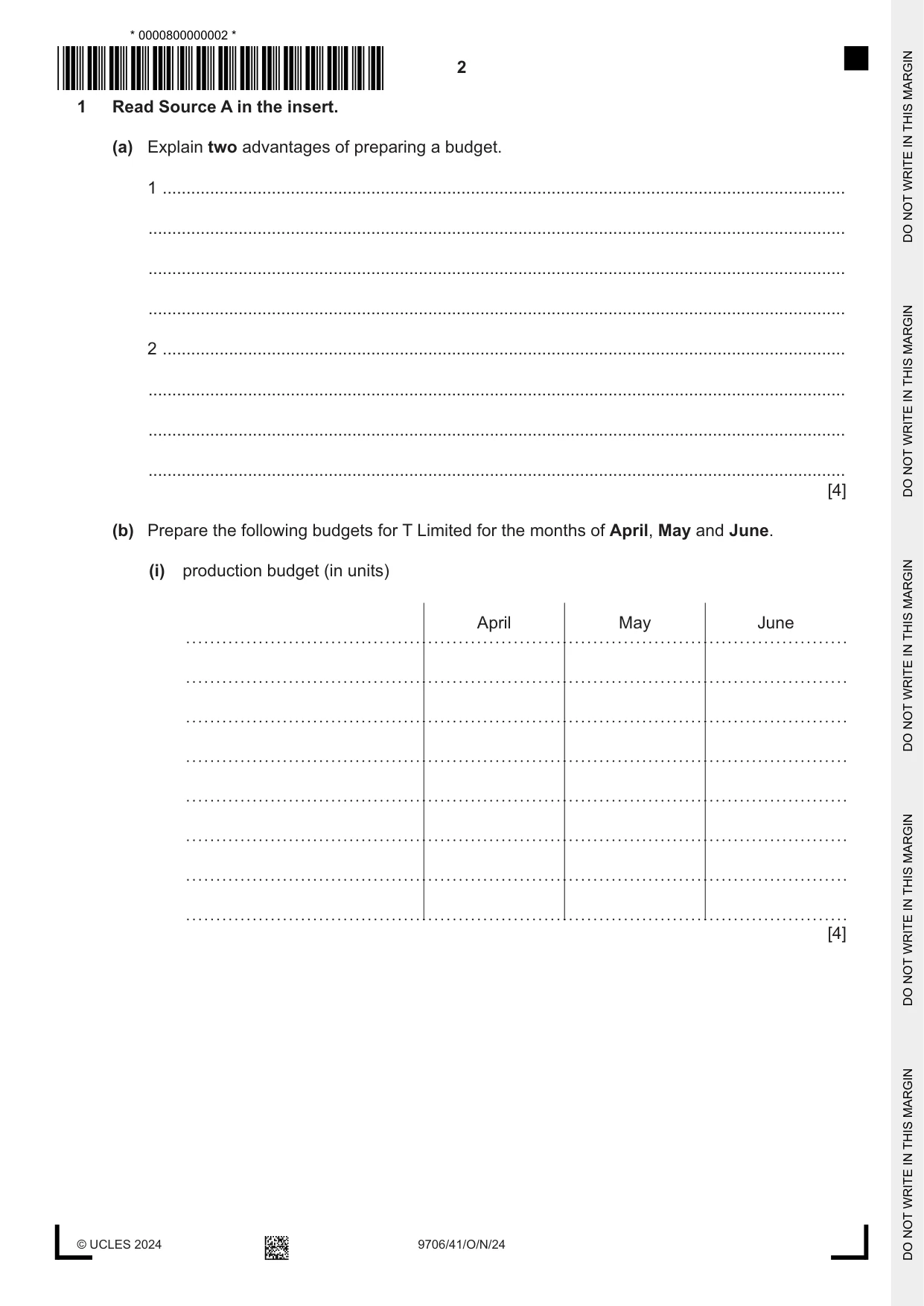
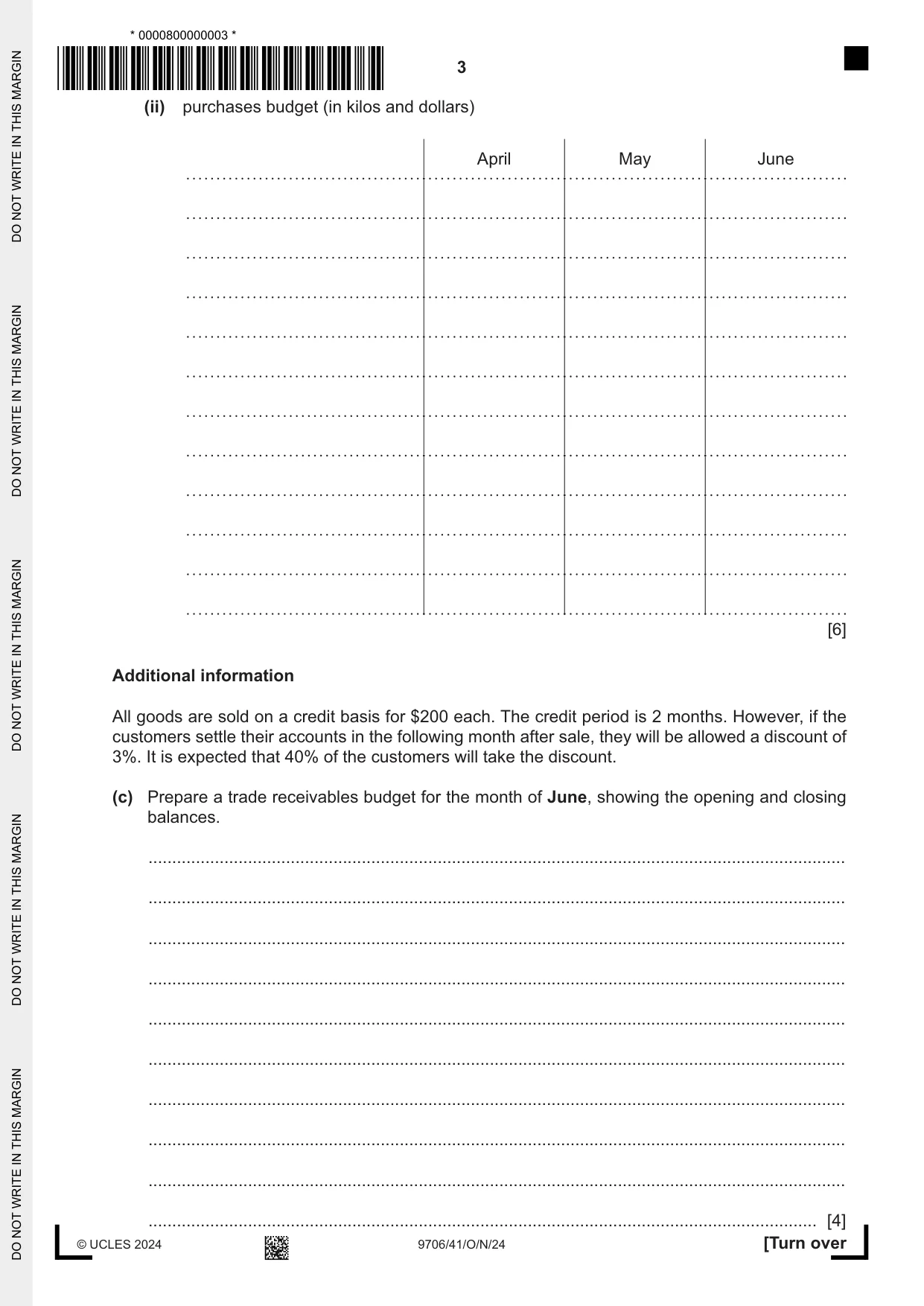
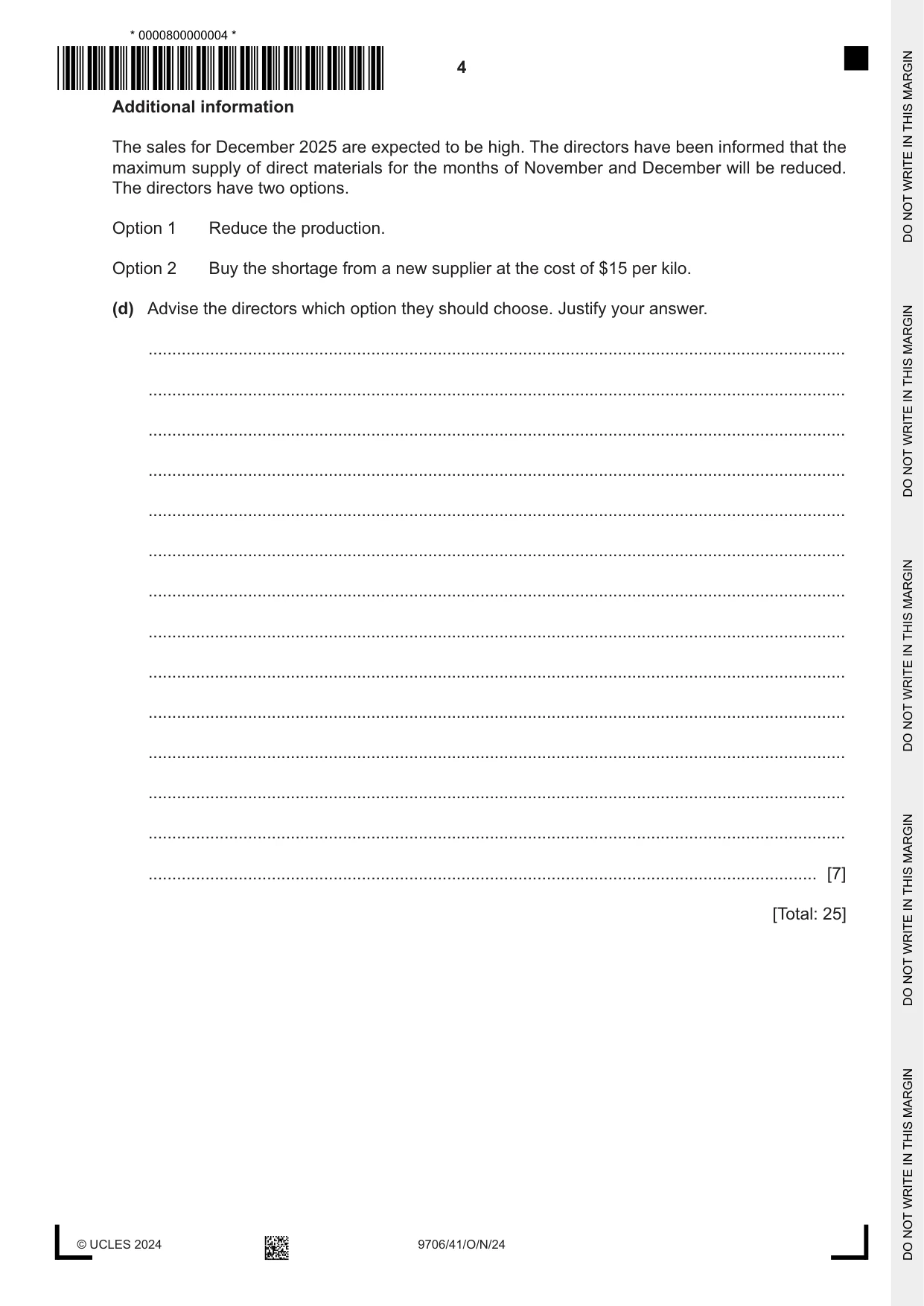
1 Read Source A in the insert. (a) Explain two advantages of preparing a budget. 1 ................................................................................................................................................ ................................................................................................................................................... ................................................................................................................................................... ................................................................................................................................................... 2 ................................................................................................................................................ ................................................................................................................................................... ................................................................................................................................................... ................................................................................................................................................... [4] (b) Prepare the following budgets for T Limited for the months of April, May and June. (i) production budget (in units) April May June [4] (ii) purchases budget (in kilos and dollars) April May June [6] Additional information All goods are sold on a credit basis for $200 each. The credit period is 2 months. However, if the customers settle their accounts in the following month after sale, they will be allowed a discount of 3%. It is expected that 40% of the customers will take the discount. (c) Prepare a trade receivables budget for the month of June, showing the opening and closing balances. ................................................................................................................................................... ................................................................................................................................................... ................................................................................................................................................... ................................................................................................................................................... ................................................................................................................................................... ................................................................................................................................................... ................................................................................................................................................... ................................................................................................................................................... ................................................................................................................................................... ............................................................................................................................................. [4] Additional information The sales for December 2025 are expected to be high. The directors have been informed that the maximum supply of direct materials for the months of November and December will be reduced. The directors have two options. Option 1 Reduce the production. Option 2 Buy the shortage from a new supplier at the cost of $15 per kilo. (d) Advise the directors which option they should choose. Justify your answer. ................................................................................................................................................... ................................................................................................................................................... ................................................................................................................................................... ................................................................................................................................................... ................................................................................................................................................... ................................................................................................................................................... ................................................................................................................................................... ................................................................................................................................................... ................................................................................................................................................... ................................................................................................................................................... ................................................................................................................................................... ................................................................................................................................................... ................................................................................................................................................... ............................................................................................................................................. [7] [Total: 25]
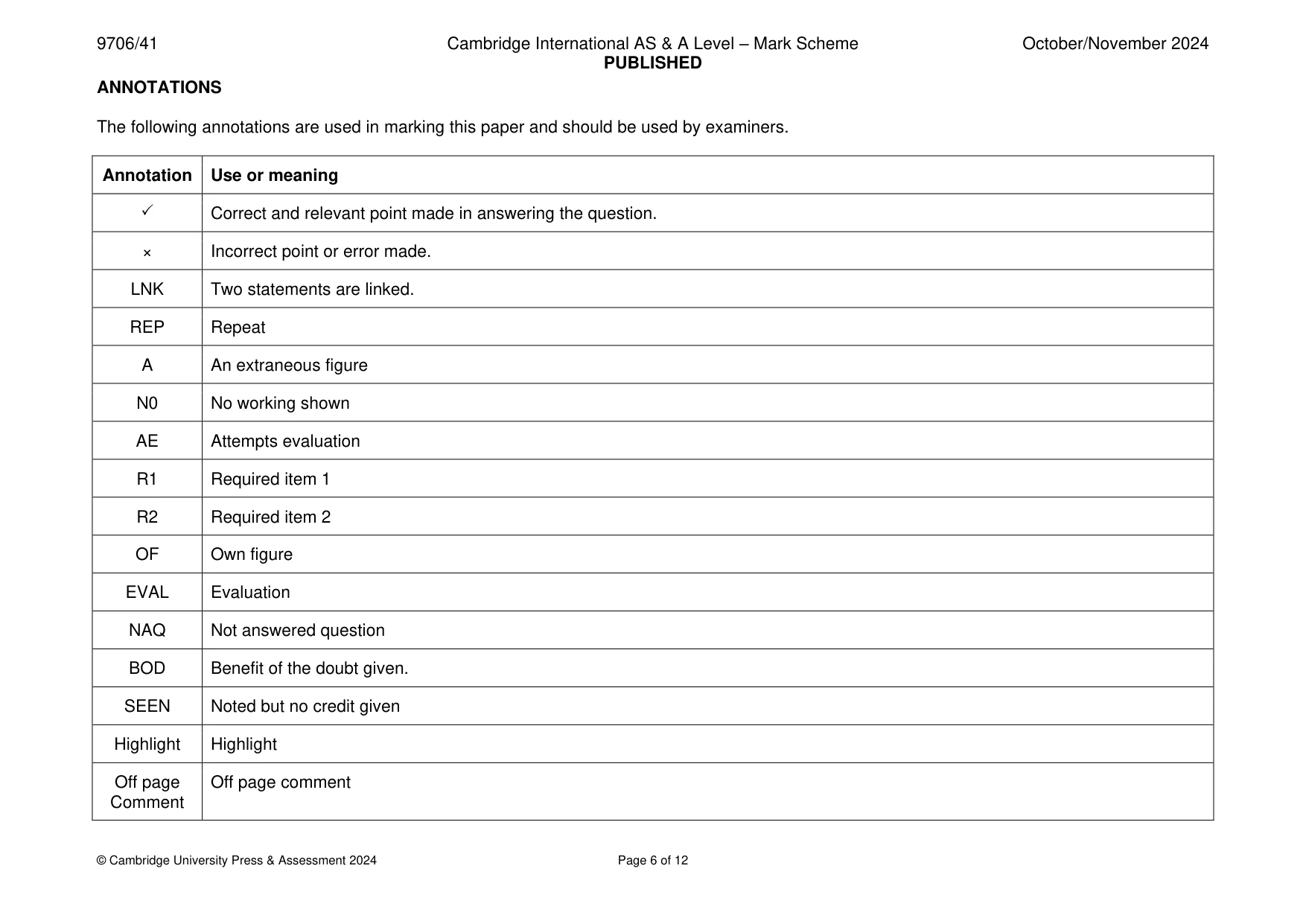
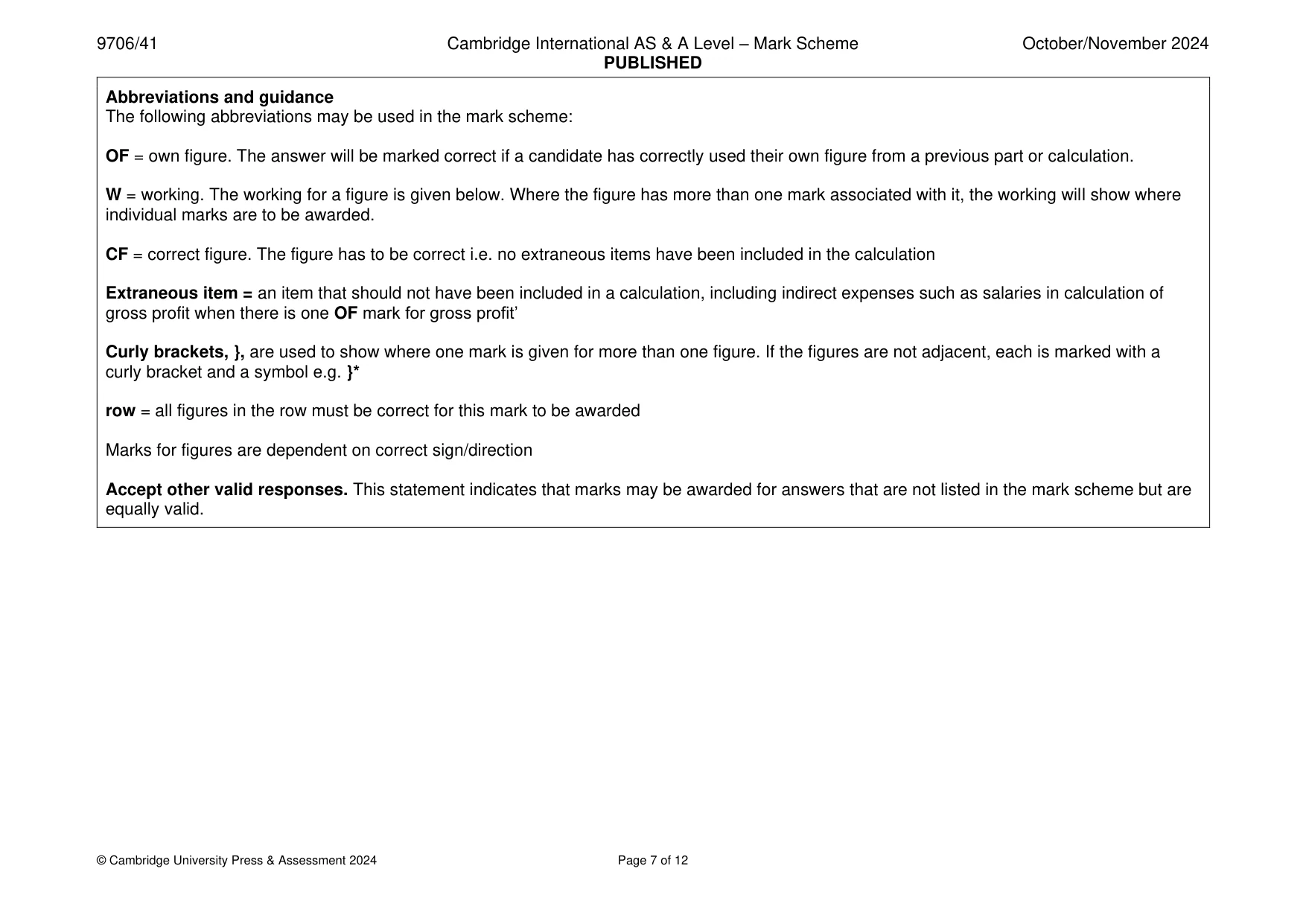
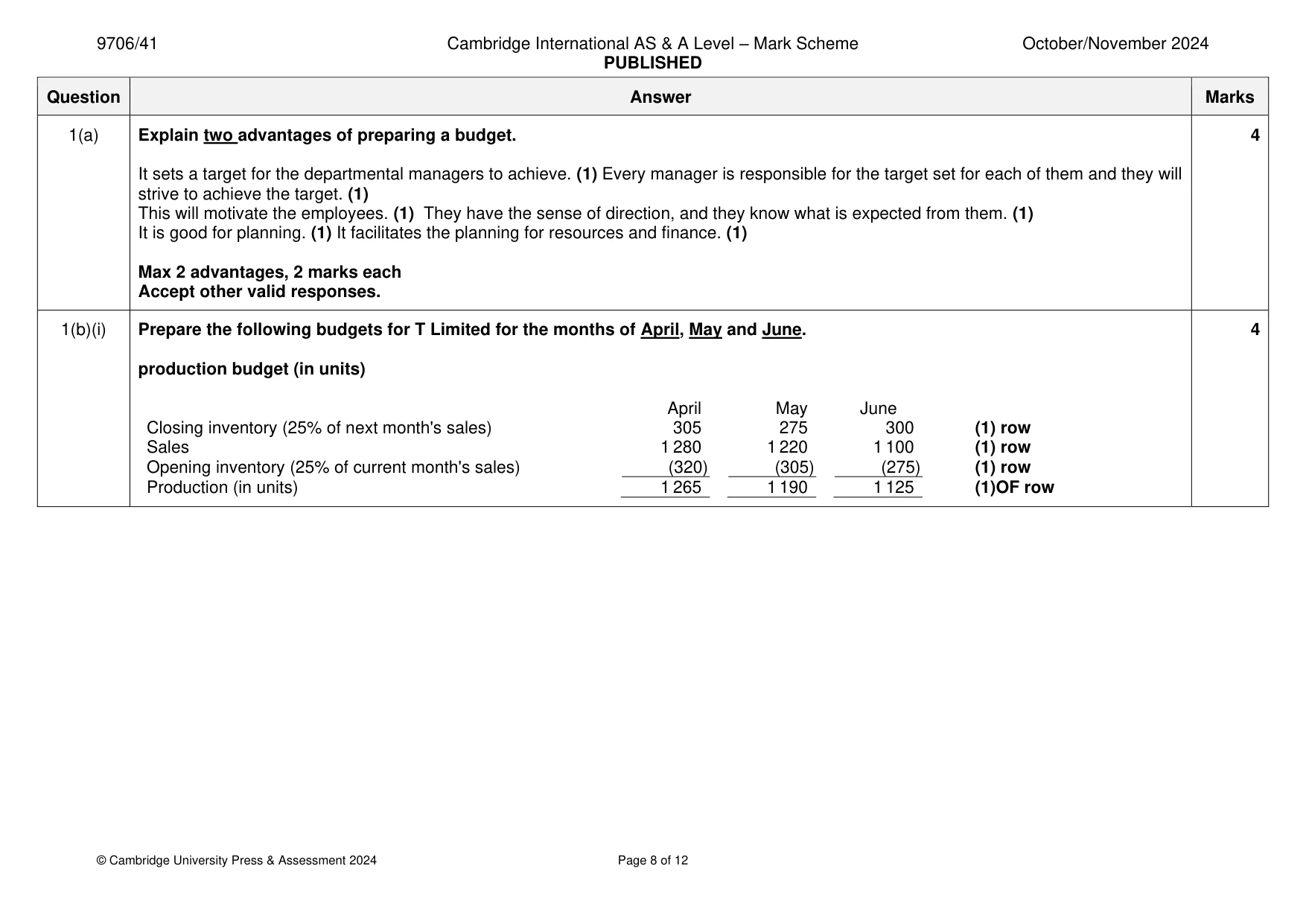
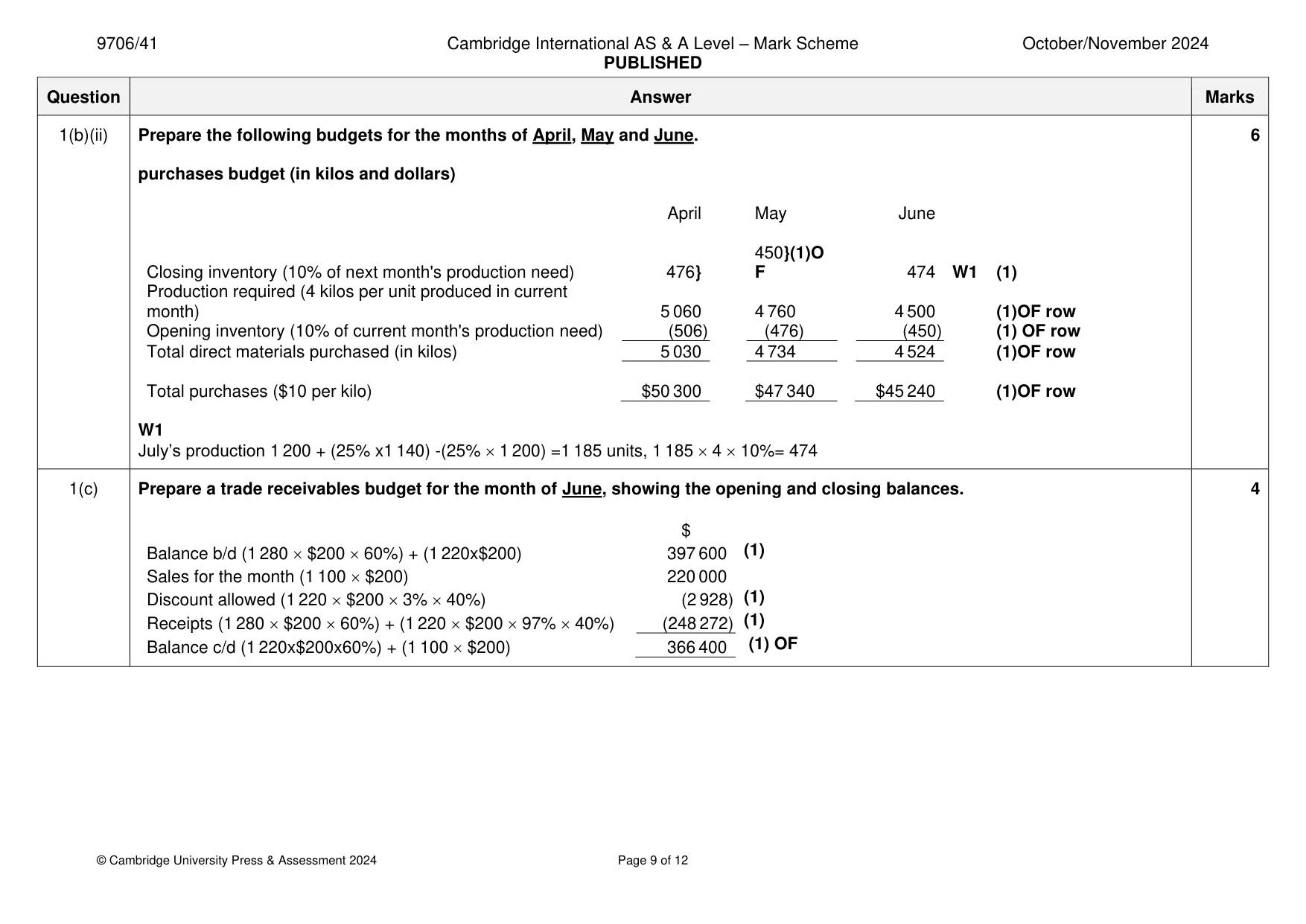
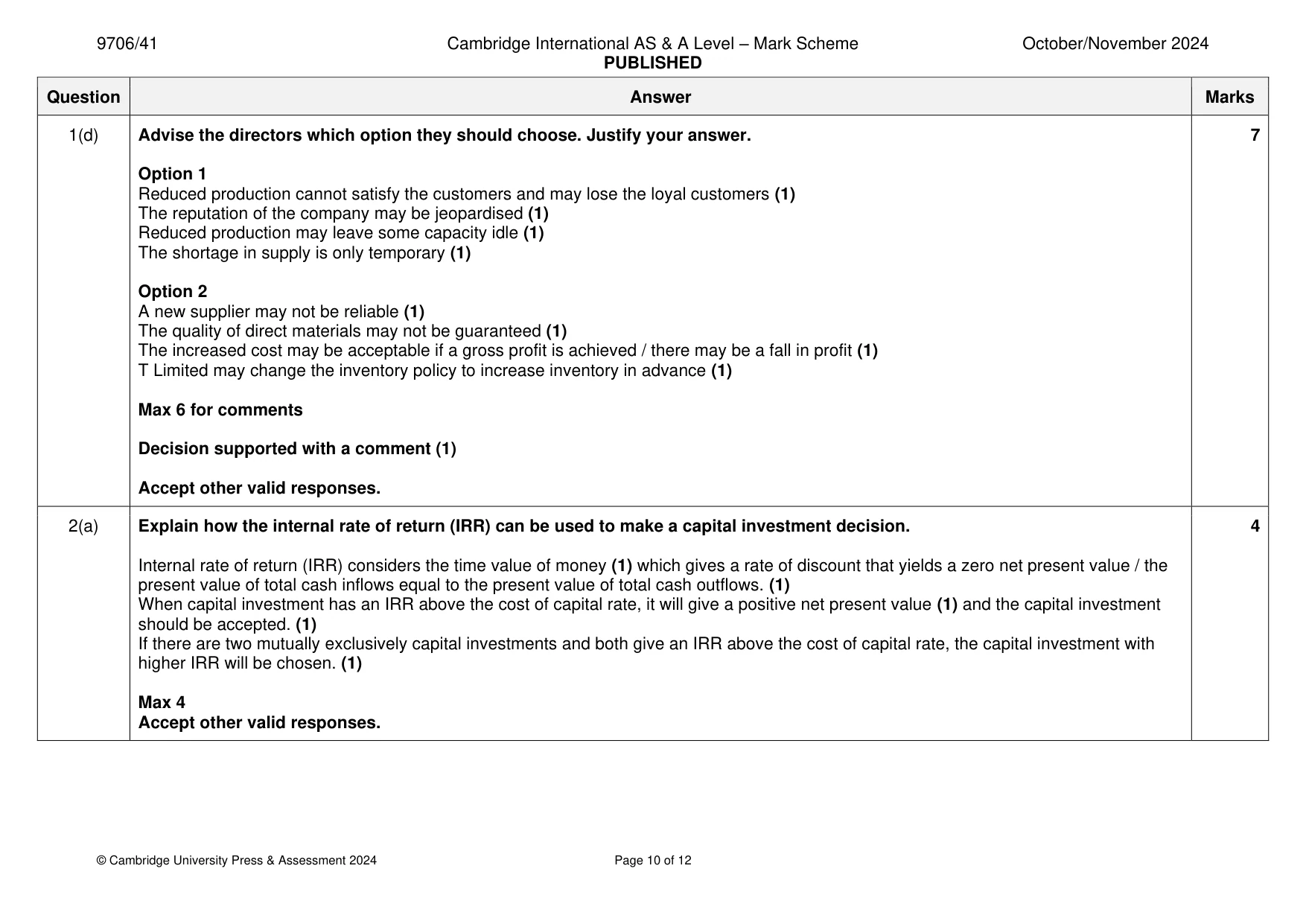
Mark scheme: Question Answer Marks 1(a) Explain two advantages of preparing a budget. 4 It sets a target for the departmental managers to achieve. (1) Every manager is responsible for the target set for each of them and they will strive to achieve the target. (1) This will motivate the employees. (1) They have the sense of direction, and they know what is expected from them. (1) It is good for planning. (1) It facilitates the planning for resources and finance. (1) Max 2 advantages, 2 marks each Accept other valid responses. 1(b)(i) Prepare the following budgets for T Limited for the months of April, May and June. 4 production budget (in units) April May June Closing inventory (25% of next month's sales) 305 275 300 (1) row Sales 1 280 1 220 1 100 (1) row Opening inventory (25% of current month's sales) (320) (305) (275) (1) row Production (in units) 1 265 1 190 1 125 (1)OF row 1(b)(ii) Prepare the following budgets for the months of April, May and June. 6 purchases budget (in kilos and dollars) April May June 450}(1)O Closing inventory (10% of next month's production need) 476} F 474 W1 (1) Production required (4 kilos per unit produced in current month) 5 060 4 760 4 500 (1)OF row Opening inventory (10% of current month's production need) (506) (476) (450) (1) OF row Total direct materials purchased (in kilos) 5 030 4 734 4 524 (1)OF row Total purchases ($10 per kilo) $50 300 $47 340 $45 240 (1)OF row W1 July’s production 1 200 + (25% x1 140) -(25% 1 200) =1 185 units, 1 185 4 10%= 474 1(c) Prepare a trade receivables budget for the month of June, showing the opening and closing balances. 4 $ Balance b/d (1 280 $200 60%) + (1 220x$200) 397 600 (1) Sales for the month (1 100 $200) 220 000 Discount allowed (1 220 $200 3% 40%) (2 928) (1) Receipts (1 280 $200 60%) + (1 220 $200 97% 40%) (248 272) (1) Balance c/d (1 220x$200x60%) + (1 100 $200) 366 400 (1) OF 1(d) Advise the directors which option they should choose. Justify your answer. 7 Option 1 Reduced production cannot satisfy the customers and may lose the loyal customers (1) The reputation of the company may be jeopardised (1) Reduced production may leave some capacity idle (1) The shortage in supply is only temporary (1) Option 2 A new supplier may not be reliable (1) The quality of direct materials may not be guaranteed (1) The increased cost may be acceptable if a gross profit is achieved / there may be a fall in profit (1) T Limited may change the inventory policy to increase inventory in advance (1) Max 6 for comments Decision supported with a comment (1) Accept other valid responses.
Q2 · Read Source B in the insert
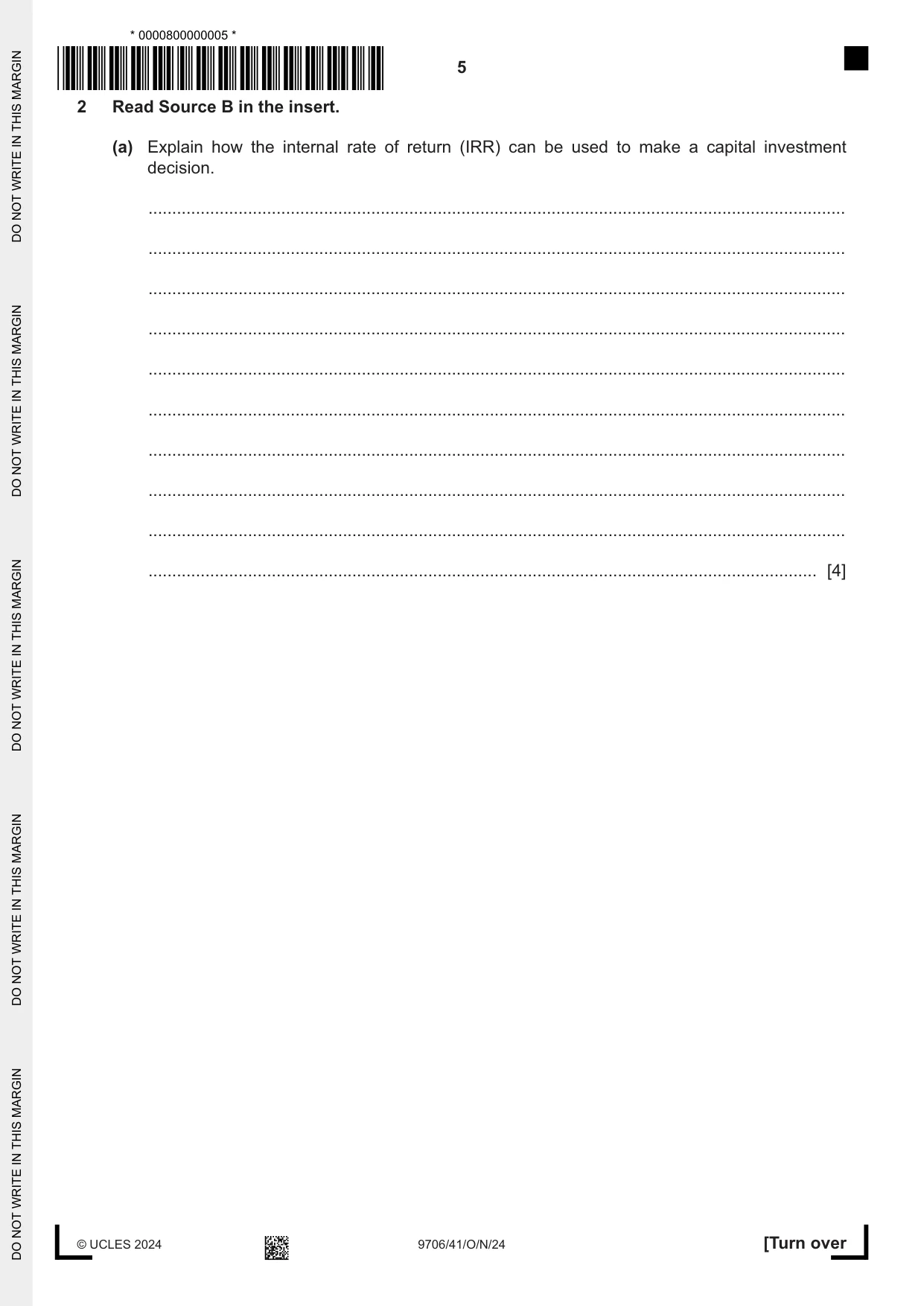
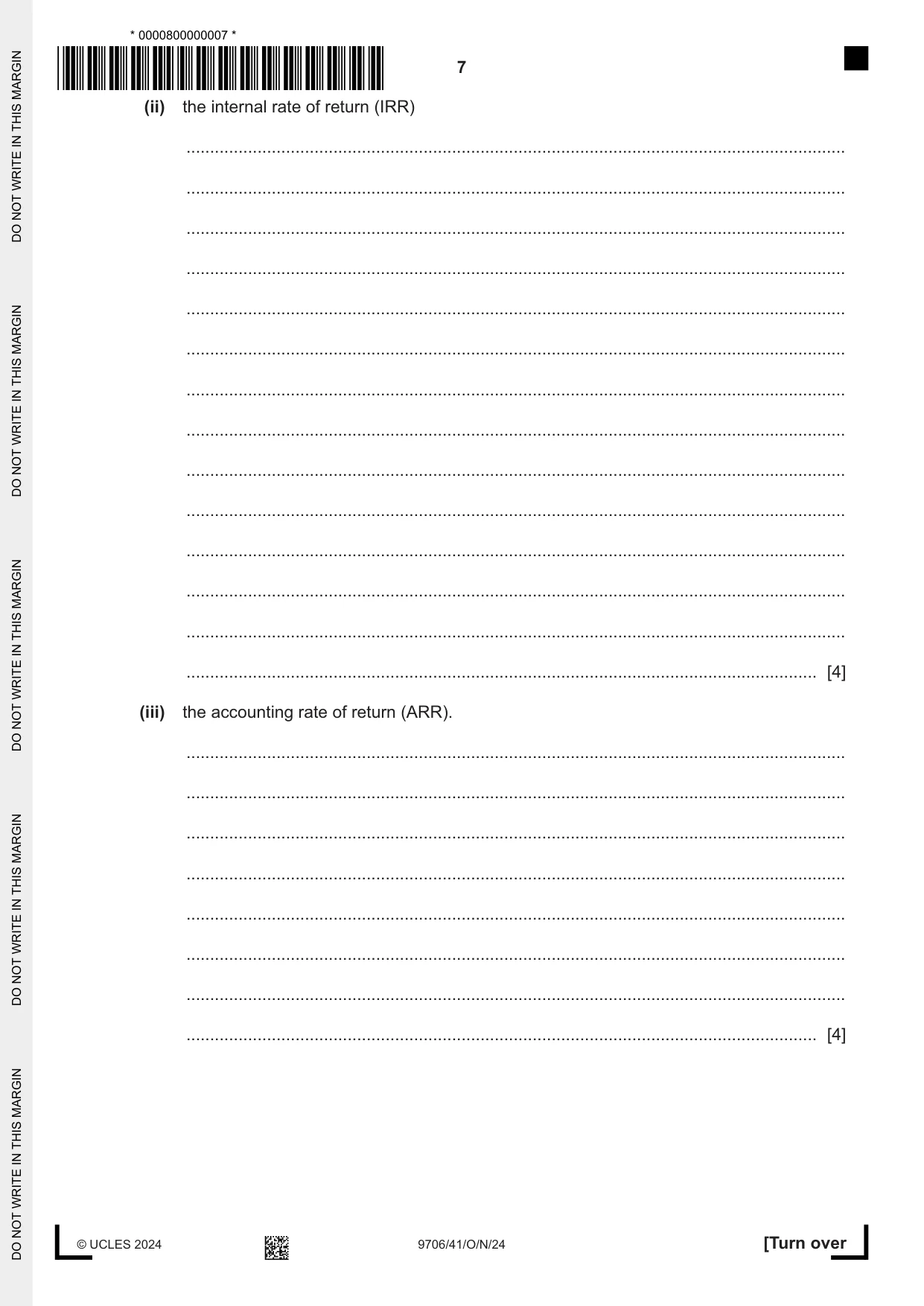
2 Read Source B in the insert. (a) Explain how the internal rate of return (IRR) can be used to make a capital investment decision. ................................................................................................................................................... ................................................................................................................................................... ................................................................................................................................................... ................................................................................................................................................... ................................................................................................................................................... ................................................................................................................................................... ................................................................................................................................................... ................................................................................................................................................... ................................................................................................................................................... ............................................................................................................................................. [4] (b) Calculate for Machine A: (i) the net present value (NPV) ........................................................................................................................................... ........................................................................................................................................... ........................................................................................................................................... ........................................................................................................................................... ........................................................................................................................................... ........................................................................................................................................... ........................................................................................................................................... ........................................................................................................................................... ........................................................................................................................................... ........................................................................................................................................... ........................................................................................................................................... ........................................................................................................................................... ........................................................................................................................................... ........................................................................................................................................... ........................................................................................................................................... ........................................................................................................................................... ........................................................................................................................................... ........................................................................................................................................... ........................................................................................................................................... ........................................................................................................................................... ........................................................................................................................................... ........................................................................................................................................... ........................................................................................................................................... ........................................................................................................................................... ........................................................................................................................................... ..................................................................................................................................... [6] (ii) the internal rate of return (IRR) ........................................................................................................................................... ........................................................................................................................................... ........................................................................................................................................... ........................................................................................................................................... ........................................................................................................................................... ........................................................................................................................................... ........................................................................................................................................... ........................................................................................................................................... ........................................................................................................................................... ........................................................................................................................................... ........................................................................................................................................... ........................................................................................................................................... ........................................................................................................................................... ..................................................................................................................................... [4] (iii) the accounting rate of return (ARR). ........................................................................................................................................... ........................................................................................................................................... ........................................................................................................................................... ........................................................................................................................................... ........................................................................................................................................... ........................................................................................................................................... ........................................................................................................................................... ..................................................................................................................................... [4]
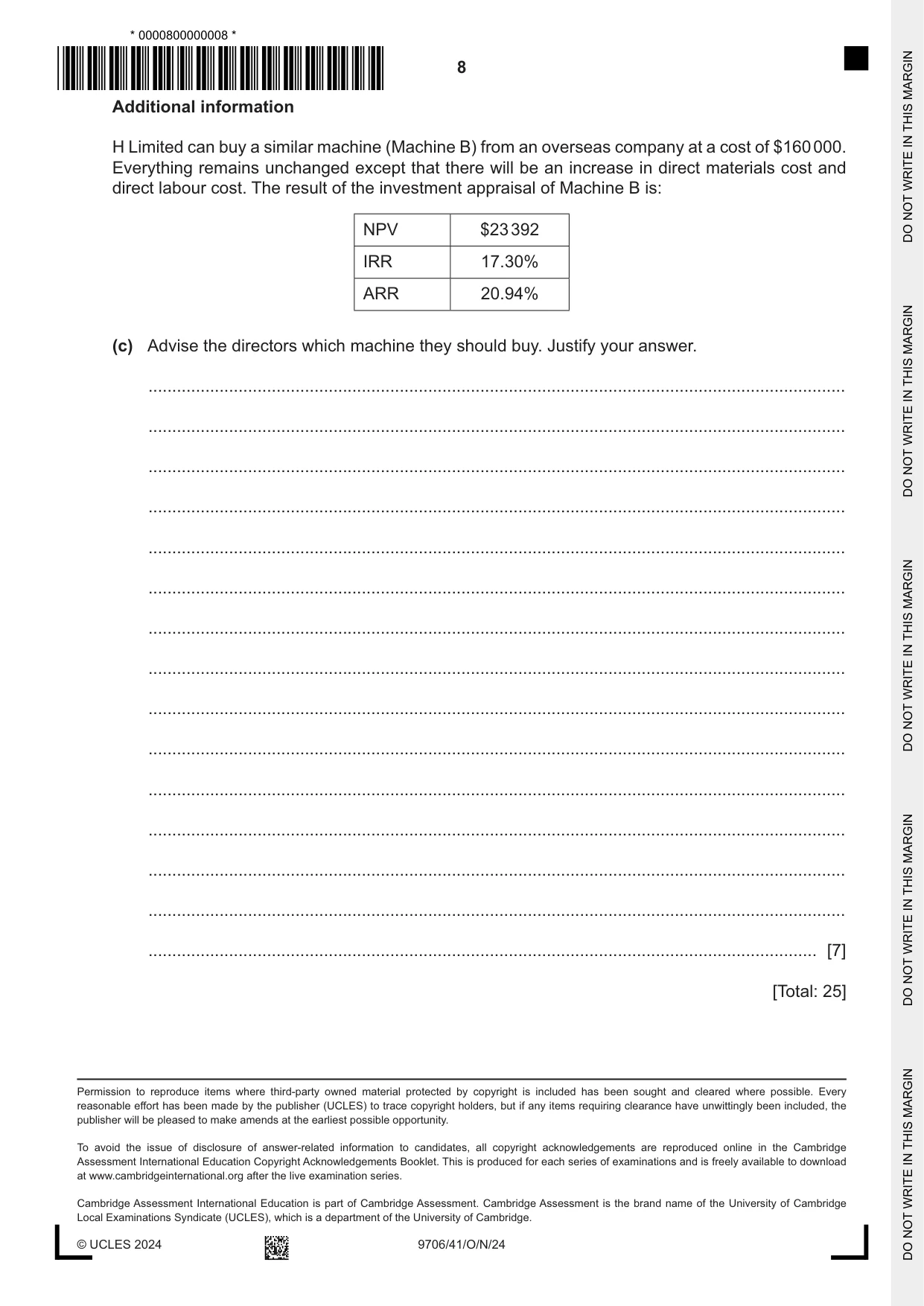
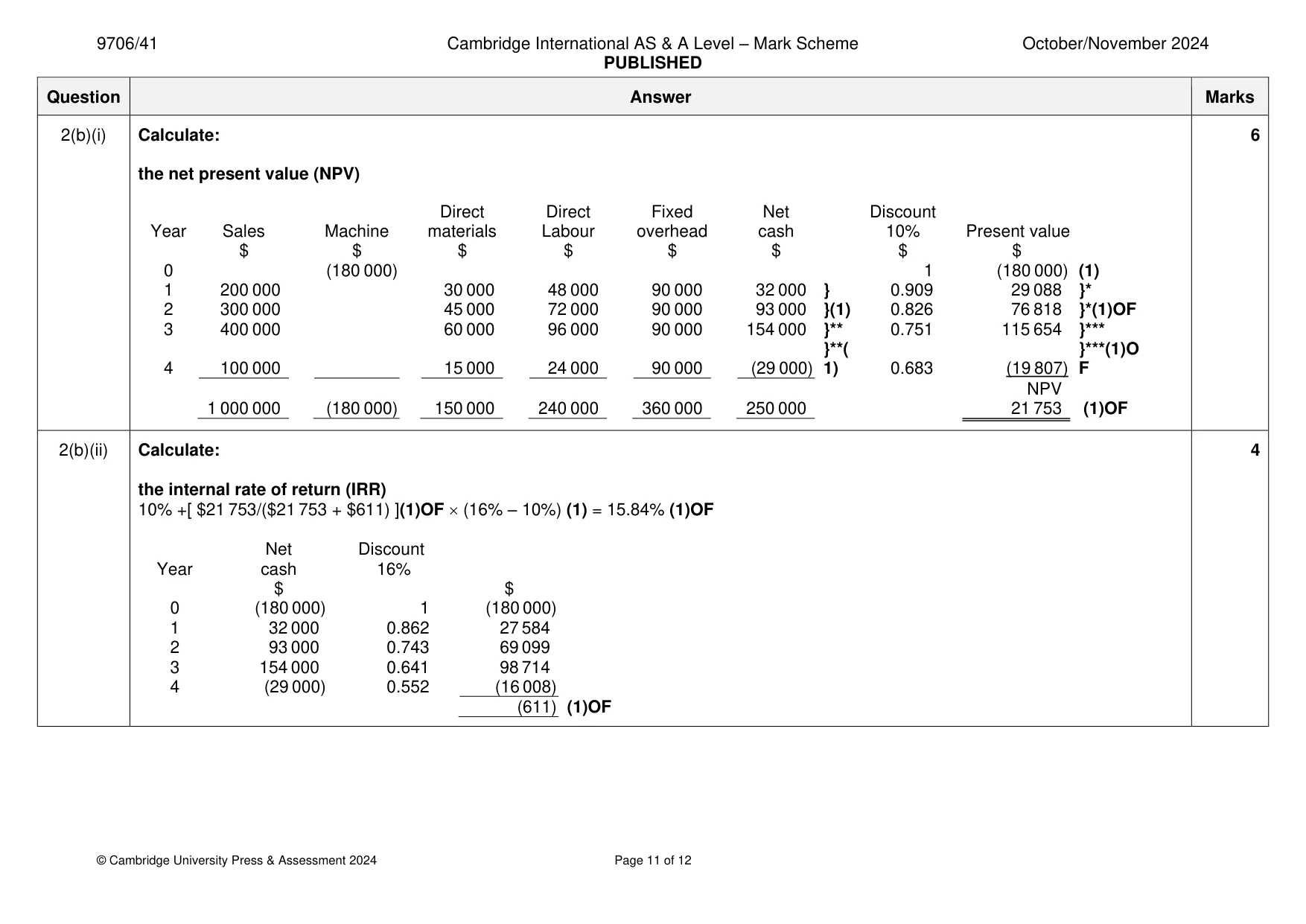
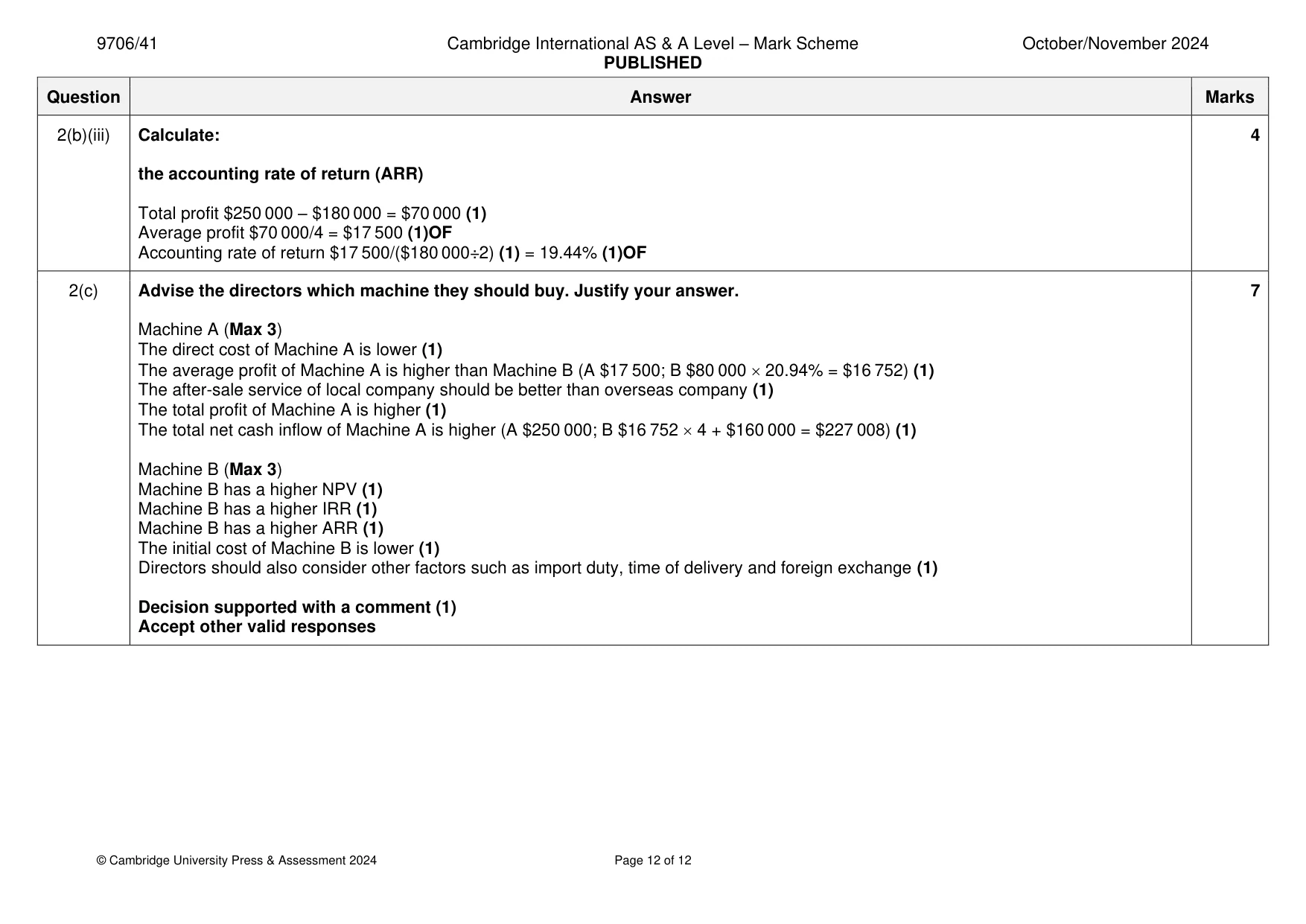
Mark scheme: 2(a) Explain how the internal rate of return (IRR) can be used to make a capital investment decision. 4 Internal rate of return (IRR) considers the time value of money (1) which gives a rate of discount that yields a zero net present value / the present value of total cash inflows equal to the present value of total cash outflows. (1) When capital investment has an IRR above the cost of capital rate, it will give a positive net present value (1) and the capital investment should be accepted. (1) If there are two mutually exclusively capital investments and both give an IRR above the cost of capital rate, the capital investment with higher IRR will be chosen. (1) Max 4 Accept other valid responses. 2(b)(i) Calculate: 6 the net present value (NPV) Direct Direct Fixed Net Discount Year Sales Machine materials Labour overhead cash 10% Present value $ $ $ $ $ $ $ $ 0 (180 000) 1 (180 000) (1) 1 200 000 30 000 48 000 90 000 32 000 } 0.909 29 088 }* 2 300 000 45 000 72 000 90 000 93 000 }(1) 0.826 76 818 }*(1)OF 3 400 000 60 000 96 000 90 000 154 000 }** 0.751 115 654 }*** }**( }***(1)O 4 100 000 15 000 24 000 90 000 (29 000) 1) 0.683 (19 807) F NPV 1 000 000 (180 000) 150 000 240 000 360 000 250 000 21 753 (1)OF 2(b)(ii) Calculate: 4 the internal rate of return (IRR) 10% +[ $21 753/($21 753 + $611) ](1)OF (16% – 10%) (1) = 15.84% (1)OF Net Discount Year cash 16% $ $ 0 (180 000) 1 (180 000) 1 32 000 0.862 27 584 2 93 000 0.743 69 099 3 154 000 0.641 98 714 4 (29 000) 0.552 (16 008) (611) (1)OF 2(b)(iii) Calculate: 4 the accounting rate of return (ARR) Total profit $250 000 – $180 000 = $70 000 (1) Average profit $70 000/4 = $17 500 (1)OF Accounting rate of return $17 500/($180 000÷2) (1) = 19.44% (1)OF 2(c) Advise the directors which machine they should buy. Justify your answer. 7 Machine A (Max 3) The direct cost of Machine A is lower (1) The average profit of Machine A is higher than Machine B (A $17 500; B $80 000 20.94% = $16 752) (1) The after-sale service of local company should be better than overseas company (1) The total profit of Machine A is higher (1) The total net cash inflow of Machine A is higher (A $250 000; B $16 752 4 + $160 000 = $227 008) (1) Machine B (Max 3) Machine B has a higher NPV (1) Machine B has a higher IRR (1) Machine B has a higher ARR (1) The initial cost of Machine B is lower (1) Directors should also consider other factors such as import duty, time of delivery and foreign exchange (1) Decision supported with a comment (1) Accept other valid responses
What was in this paper
The subtopics covered by these 2 questions, and how many questions each got. Open one in a new tab to see every Cambridge question on it.
What you needed in this session
Cambridge’s own grade thresholds for 2024 Oct/Nov, Paper 4 · Variant 1. A higher threshold means an easier paper — the bar moves with how the cohort did.