Cambridge A Level Accounting 9706 — 2015 May/June Paper 4 · Variant 3
9706/43/M/J/15 · 120 marks · ≈135 min
The question paper and its mark scheme, free to read here and free to download. This is Cambridge’s own paper, exactly as it was sat.
Question paper8 pages
Mark scheme6 pages
Answers below. Sit the paper first if you are practising.
Paper as text
Question paper, page 1
This document consists of 8 printed pages and 1 insert. IB15 06_9706_43/5RP © UCLES 2015 [Turn over *1560424483* Cambridge International Examinations Cambridge International Advanced Subsidiary and Advanced Level ACCOUNTING 9706/43 Paper 4 Problem Solving (Supplementary Topics) May/June 2015 2 hours No Additional Materials are required. READ THESE INSTRUCTIONS FIRST An answer booklet is provided inside this question paper. You should follow the instructions on the front cover of the answer booklet. If you need additional answer paper ask the invigilator for a continuation booklet. Answer all questions. All accounting statements are to be presented in good style. International accounting terms and formats should be used as appropriate. Workings should be shown. You may use a calculator. The number of marks is given in brackets [ ] at the end of each question or part question.
Question paper, page 2
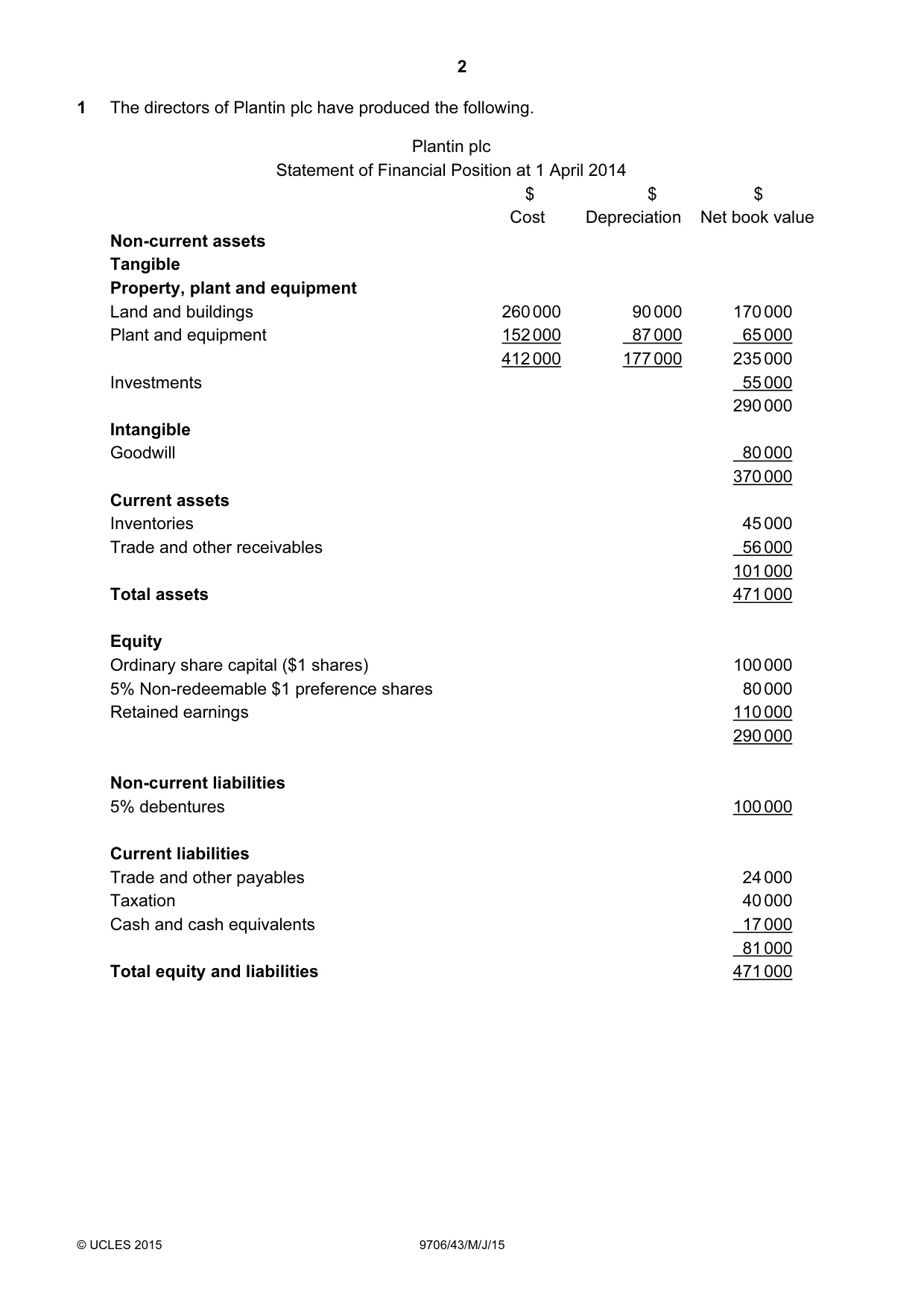
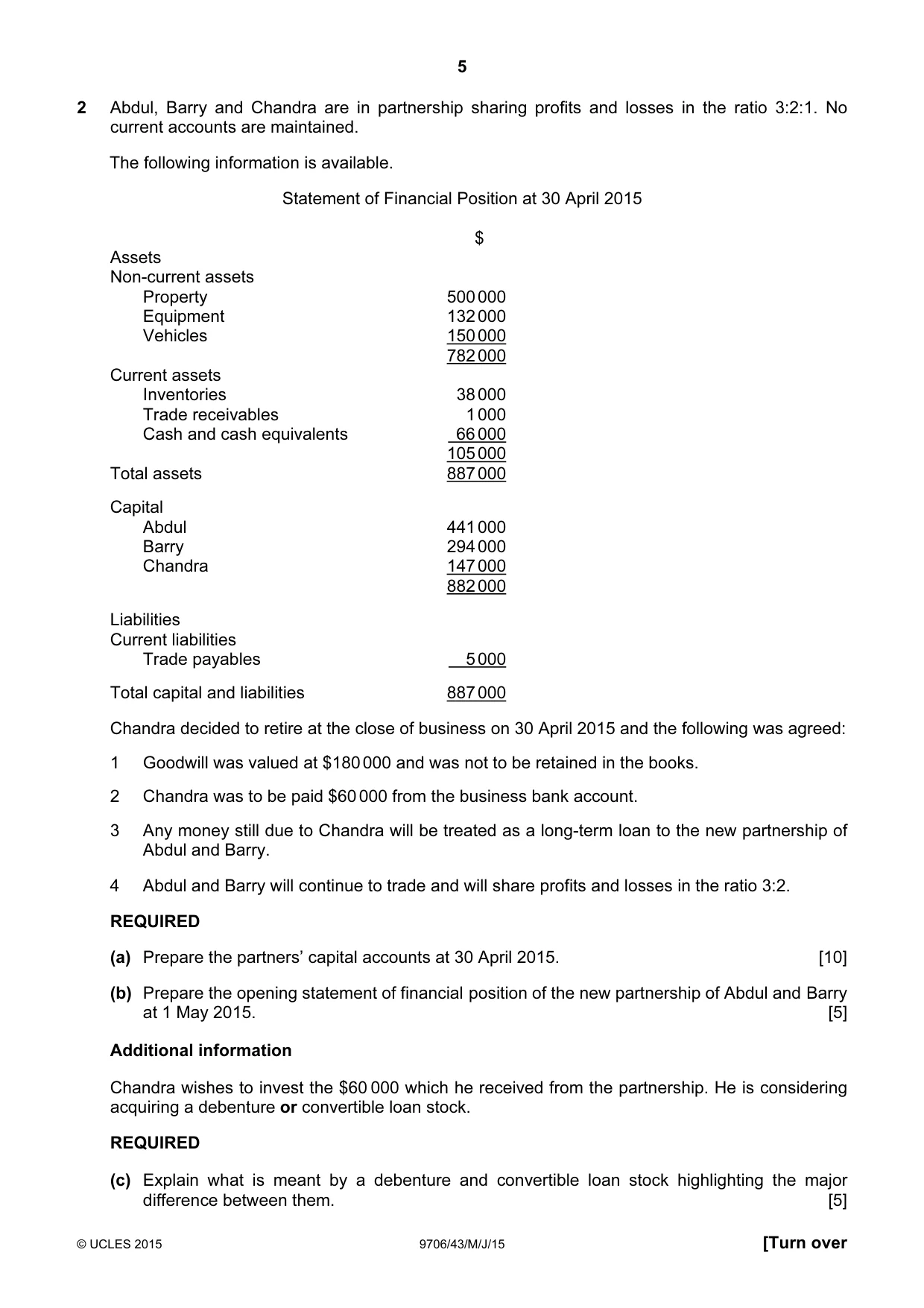
2 © UCLES 2015 9706/43/M/J/15 1 The directors of Plantin plc have produced the following. Plantin plc Statement of Financial Position at 1 April 2014 $ $ $ Cost Depreciation Net book value Non-current assets Tangible Property, plant and equipment Land and buildings 260 000 90 000 170 000 Plant and equipment 152 000 87 000 65 000 412 000 177 000 235 000 Investments 55 000 290 000 Intangible Goodwill 80 000 370 000 Current assets Inventories 45 000 Trade and other receivables 56 000 101 000 Total assets 471 000 Equity Ordinary share capital ($1 shares) 100 000 5% Non-redeemable $1 preference shares 80 000 Retained earnings 110 000 290 000 Non-current liabilities 5% debentures 100 000 Current liabilities Trade and other payables 24 000 Taxation 40 000 Cash and cash equivalents 17 000 81 000 Total equity and liabilities 471 000
Question paper, page 3
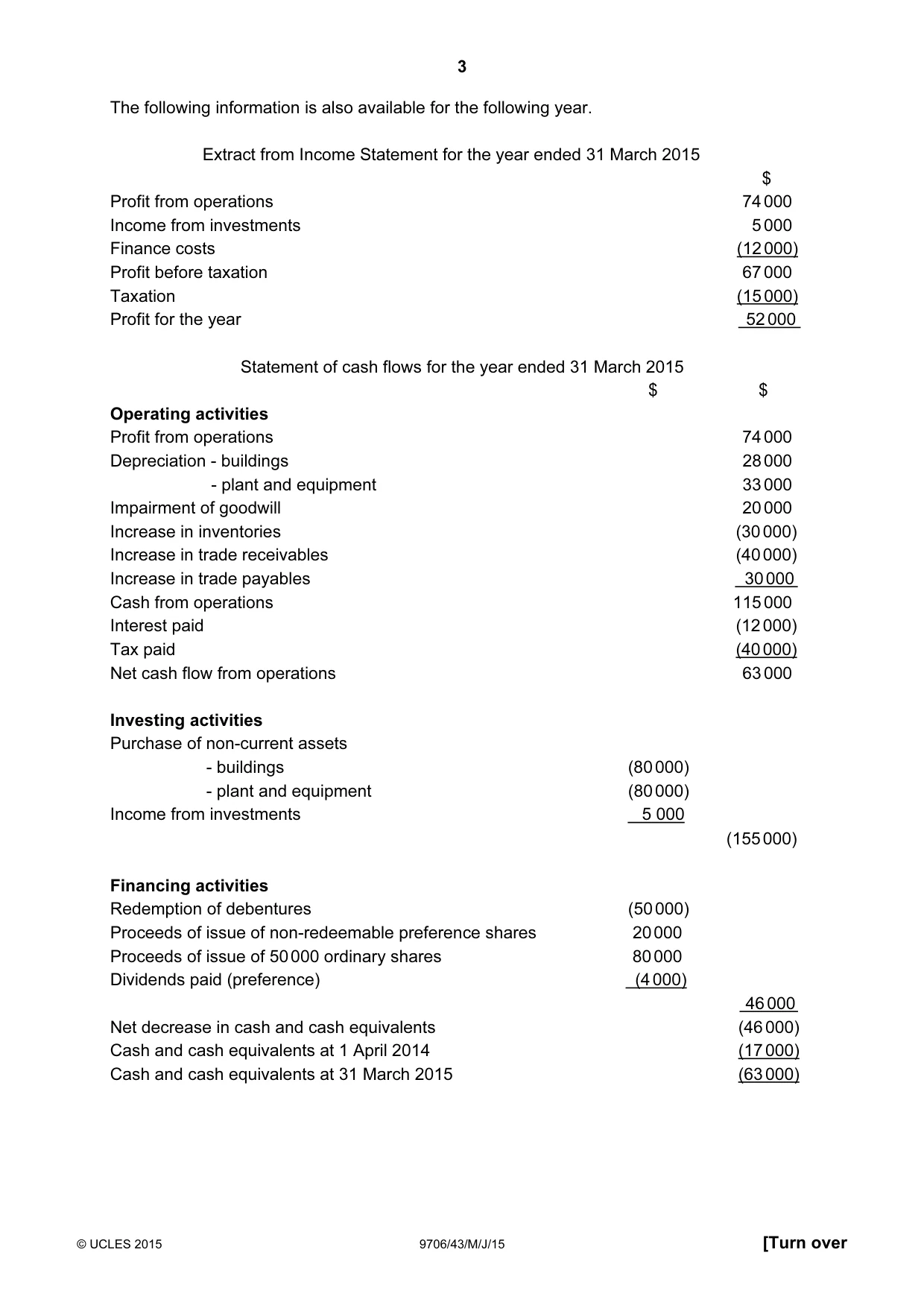
3 © UCLES 2015 9706/43/M/J/15 [Turn over The following information is also available for the following year. Extract from Income Statement for the year ended 31 March 2015 $ Profit from operations 74 000 Income from investments 5 000 Finance costs (12 000) Profit before taxation 67 000 Taxation (15 000) Profit for the year 52 000 Statement of cash flows for the year ended 31 March 2015 $ $ Operating activities Profit from operations 74 000 Depreciation - buildings 28 000 - plant and equipment 33 000 Impairment of goodwill 20 000 Increase in inventories (30 000) Increase in trade receivables (40 000) Increase in trade payables 30 000 Cash from operations 115 000 Interest paid (12 000) Tax paid (40 000) Net cash flow from operations 63 000 Investing activities Purchase of non-current assets - buildings (80 000) - plant and equipment (80 000) Income from investments 5 000 (155 000) Financing activities Redemption of debentures (50 000) Proceeds of issue of non-redeemable preference shares 20 000 Proceeds of issue of 50 000 ordinary shares 80 000 Dividends paid (preference) (4 000) 46 000 Net decrease in cash and cash equivalents (46 000) Cash and cash equivalents at 1 April 2014 (17 000) Cash and cash equivalents at 31 March 2015 (63 000)
Question paper, page 4
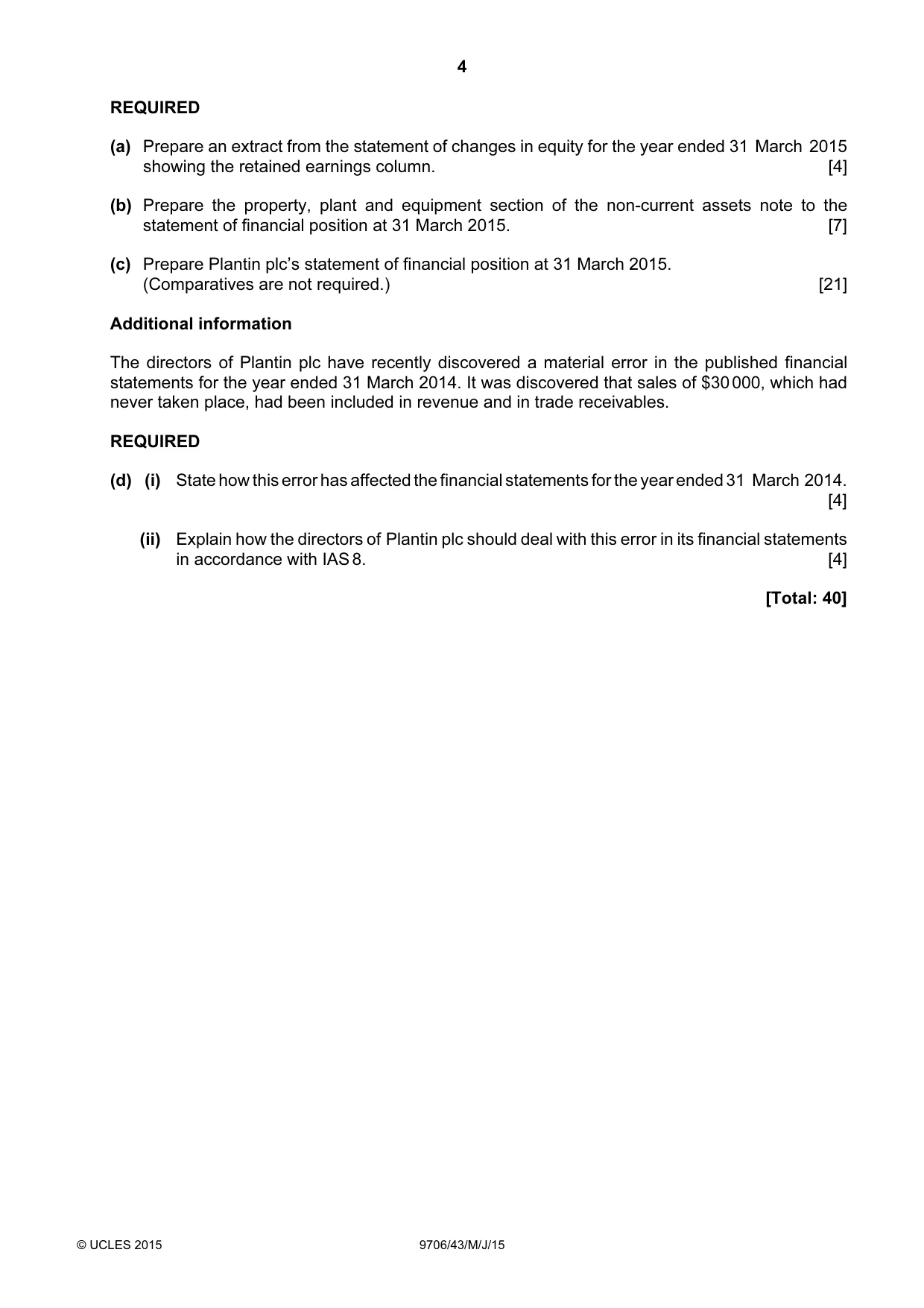
4 © UCLES 2015 9706/43/M/J/15 REQUIRED (a) Prepare an extract from the statement of changes in equity for the year ended 31 March 2015 showing the retained earnings column. [4] (b) Prepare the property, plant and equipment section of the non-current assets note to the statement of financial position at 31 March 2015. [7] (c) Prepare Plantin plc’s statement of financial position at 31 March 2015. (Comparatives are not required.) [21] Additional information The directors of Plantin plc have recently discovered a material error in the published financial statements for the year ended 31 March 2014. It was discovered that sales of $30 000, which had never taken place, had been included in revenue and in trade receivables. REQUIRED (d) (i) State how this error has affected the financial statements for the year ended 31 March 2014. [4] (ii) Explain how the directors of Plantin plc should deal with this error in its financial statements in accordance with IAS 8. [4] [Total: 40]
Question paper, page 5
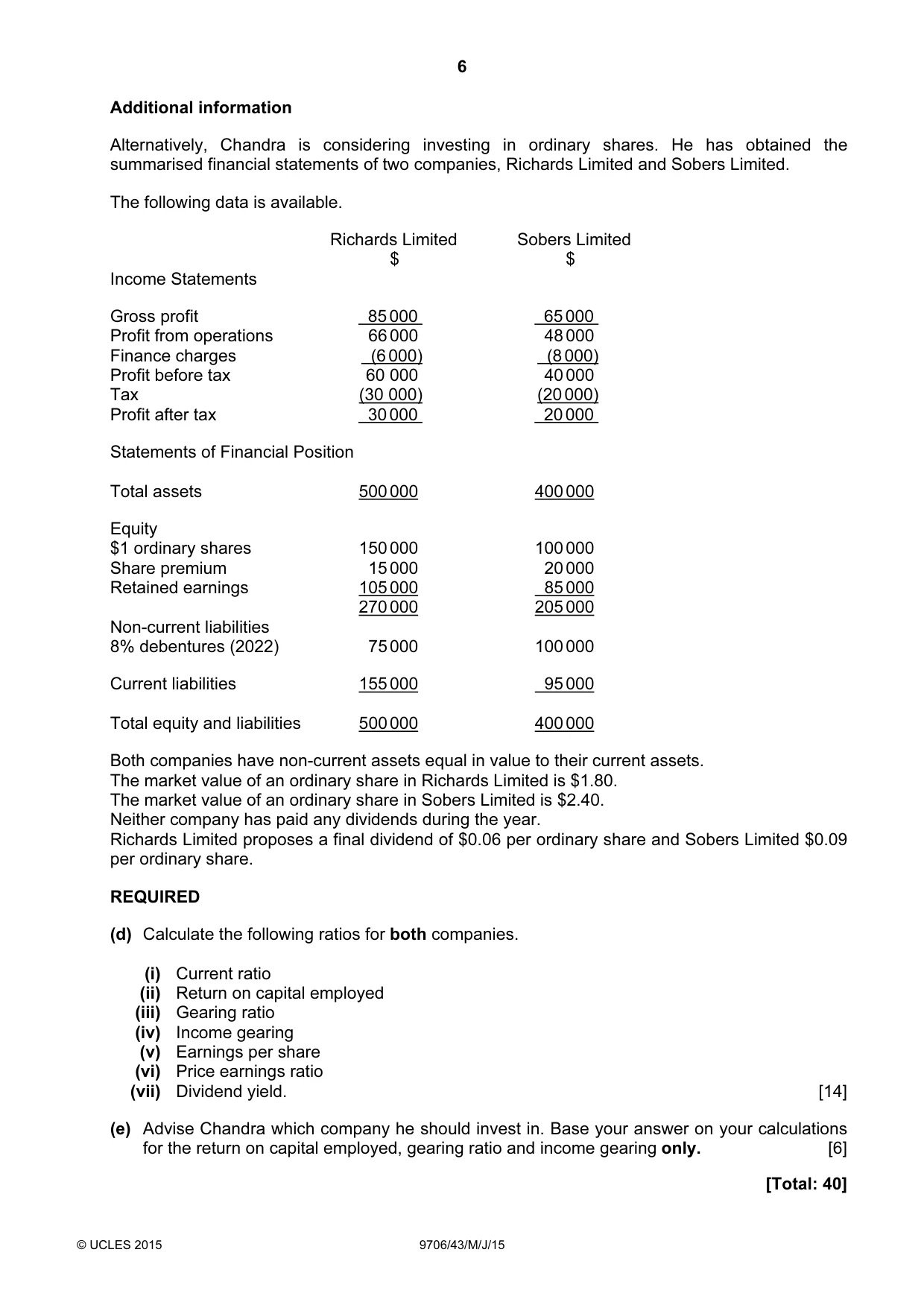
5 © UCLES 2015 9706/43/M/J/15 [Turn over 2 Abdul, Barry and Chandra are in partnership sharing profits and losses in the ratio 3:2:1. No current accounts are maintained. The following information is available. Statement of Financial Position at 30 April 2015 $ Assets Non-current assets Property 500 000 Equipment 132 000 Vehicles 150 000 782 000 Current assets Inventories 38 000 Trade receivables 1 000 Cash and cash equivalents 66 000 105 000 Total assets 887 000 Capital Abdul 441 000 Barry 294 000 Chandra 147 000 882 000 Liabilities Current liabilities Trade payables 5 000 Total capital and liabilities 887 000 Chandra decided to retire at the close of business on 30 April 2015 and the following was agreed: 1 Goodwill was valued at $180 000 and was not to be retained in the books. 2 Chandra was to be paid $60 000 from the business bank account. 3 Any money still due to Chandra will be treated as a long-term loan to the new partnership of Abdul and Barry. 4 Abdul and Barry will continue to trade and will share profits and losses in the ratio 3:2. REQUIRED (a) Prepare the partners’ capital accounts at 30 April 2015. [10] (b) Prepare the opening statement of financial position of the new partnership of Abdul and Barry at 1 May 2015. [5] Additional information Chandra wishes to invest the $60 000 which he received from the partnership. He is considering acquiring a debenture or convertible loan stock. REQUIRED (c) Explain what is meant by a debenture and convertible loan stock highlighting the major difference between them. [5]
Question paper, page 6
6 © UCLES 2015 9706/43/M/J/15 Additional information Alternatively, Chandra is considering investing in ordinary shares. He has obtained the summarised financial statements of two companies, Richards Limited and Sobers Limited. The following data is available. Richards Limited Sobers Limited $ $ Income Statements Gross profit 85 000 65 000 Profit from operations 66 000 48 000 Finance charges (6 000) (8 000) Profit before tax 60 000 40 000 Tax (30 000) (20 000) Profit after tax 30 000 20 000 Statements of Financial Position Total assets 500 000 400 000 Equity $1 ordinary shares 150 000 100 000 Share premium 15 000 20 000 Retained earnings 105 000 85 000 270 000 205 000 Non-current liabilities 8% debentures (2022) 75 000 100 000 Current liabilities 155 000 95 000 Total equity and liabilities 500 000 400 000 Both companies have non-current assets equal in value to their current assets. The market value of an ordinary share in Richards Limited is $1.80. The market value of an ordinary share in Sobers Limited is $2.40. Neither company has paid any dividends during the year. Richards Limited proposes a final dividend of $0.06 per ordinary share and Sobers Limited $0.09 per ordinary share. REQUIRED (d) Calculate the following ratios for both companies. (i) Current ratio (ii) Return on capital employed (iii) Gearing ratio (iv) Income gearing (v) Earnings per share (vi) Price earnings ratio (vii) Dividend yield. [14] (e) Advise Chandra which company he should invest in. Base your answer on your calculations for the return on capital employed, gearing ratio and income gearing only. [6] [Total: 40]
Question paper, page 7
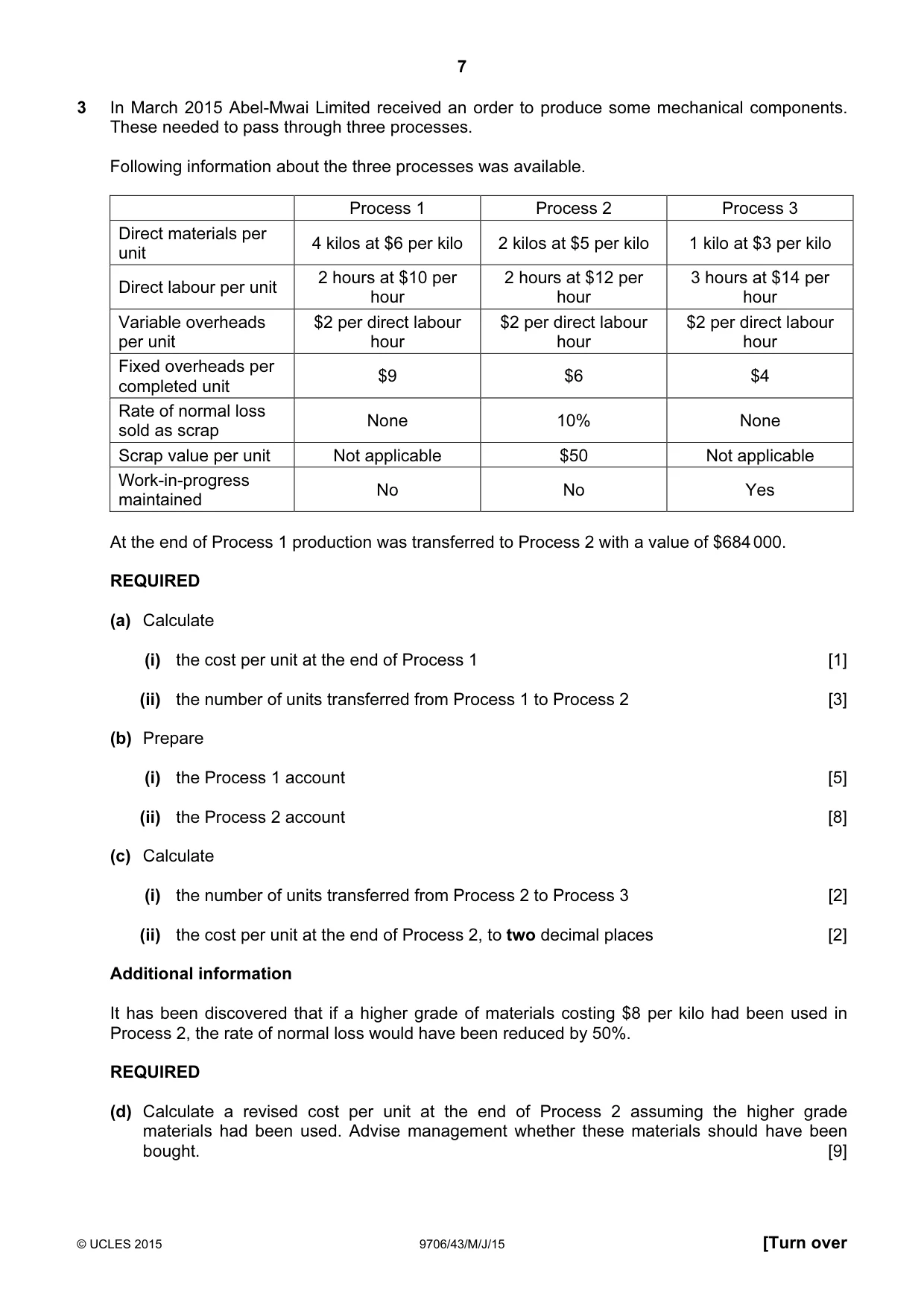
7 © UCLES 2015 9706/43/M/J/15 [Turn over 3 In March 2015 Abel-Mwai Limited received an order to produce some mechanical components. These needed to pass through three processes. Following information about the three processes was available. Process 1 Process 2 Process 3 Direct materials per unit 4 kilos at $6 per kilo 2 kilos at $5 per kilo 1 kilo at $3 per kilo Direct labour per unit 2 hours at $10 per hour 2 hours at $12 per hour 3 hours at $14 per hour Variable overheads per unit $2 per direct labour hour $2 per direct labour hour $2 per direct labour hour Fixed overheads per completed unit $9 $6 $4 Rate of normal loss sold as scrap None 10% None Scrap value per unit Not applicable $50 Not applicable Work-in-progress maintained No No Yes At the end of Process 1 production was transferred to Process 2 with a value of $684 000. REQUIRED (a) Calculate (i) the cost per unit at the end of Process 1 [1] (ii) the number of units transferred from Process 1 to Process 2 [3] (b) Prepare (i) the Process 1 account [5] (ii) the Process 2 account [8] (c) Calculate (i) the number of units transferred from Process 2 to Process 3 [2] (ii) the cost per unit at the end of Process 2, to two decimal places [2] Additional information It has been discovered that if a higher grade of materials costing $8 per kilo had been used in Process 2, the rate of normal loss would have been reduced by 50%. REQUIRED (d) Calculate a revised cost per unit at the end of Process 2 assuming the higher grade materials had been used. Advise management whether these materials should have been bought. [9]
Question paper, page 8
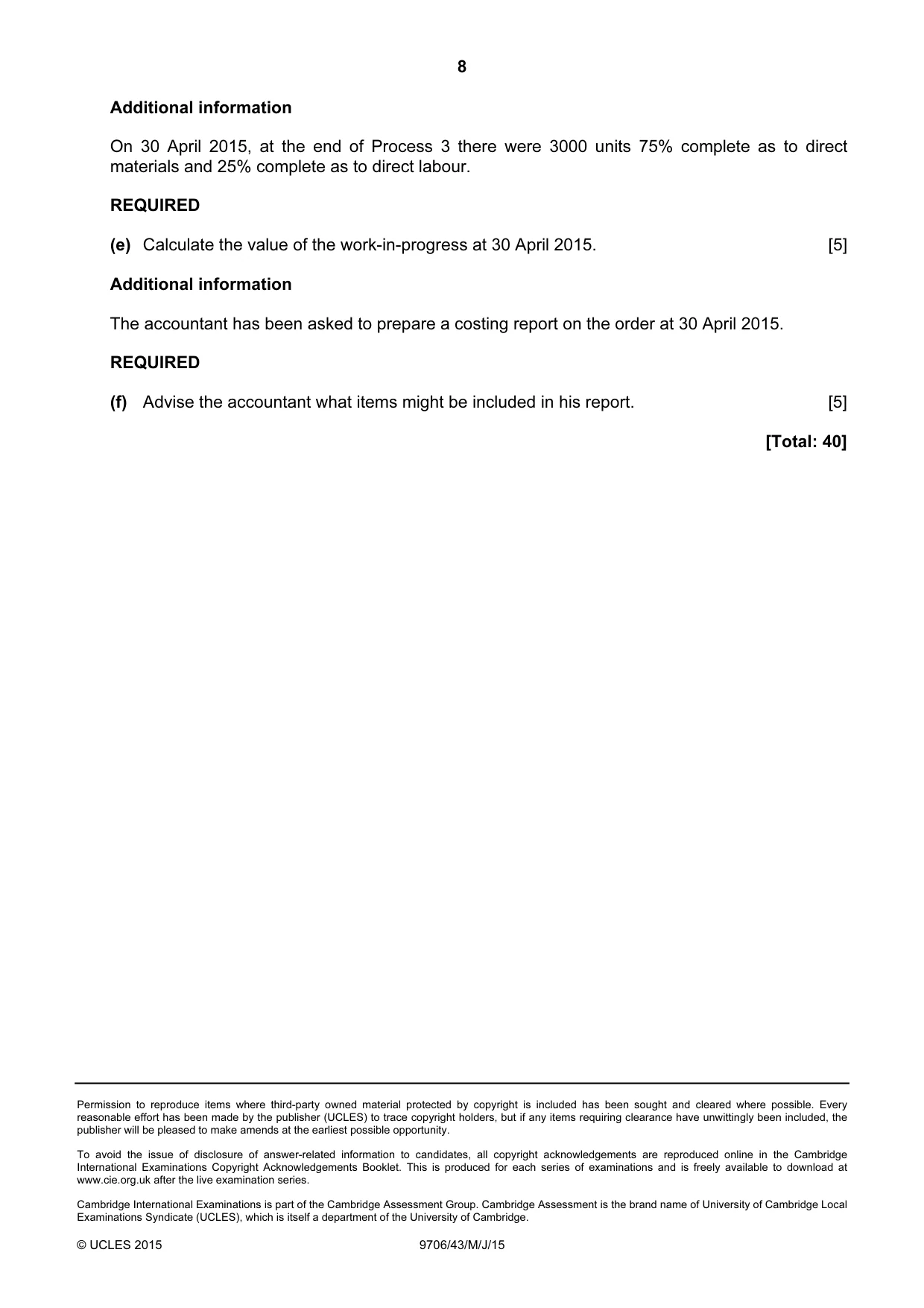
8 Permission to reproduce items where third-party owned material protected by copyright is included has been sought and cleared where possible. Every reasonable effort has been made by the publisher (UCLES) to trace copyright holders, but if any items requiring clearance have unwittingly been included, the publisher will be pleased to make amends at the earliest possible opportunity. To avoid the issue of disclosure of answer-related information to candidates, all copyright acknowledgements are reproduced online in the Cambridge International Examinations Copyright Acknowledgements Booklet. This is produced for each series of examinations and is freely available to download at www.cie.org.uk after the live examination series. Cambridge International Examinations is part of the Cambridge Assessment Group. Cambridge Assessment is the brand name of University of Cambridge Local Examinations Syndicate (UCLES), which is itself a department of the University of Cambridge. © UCLES 2015 9706/43/M/J/15 Additional information On 30 April 2015, at the end of Process 3 there were 3000 units 75% complete as to direct materials and 25% complete as to direct labour. REQUIRED (e) Calculate the value of the work-in-progress at 30 April 2015. [5] Additional information The accountant has been asked to prepare a costing report on the order at 30 April 2015. REQUIRED (f) Advise the accountant what items might be included in his report. [5] [Total: 40]
Mark scheme, page 1
® IGCSE is the registered trademark of Cambridge International Examinations. CAMBRIDGE INTERNATIONAL EXAMINATIONS Cambridge International Advanced Level MARK SCHEME for the May/June 2015 series 9706 ACCOUNTING 9706/43 Paper 4 (Problem solving – Supplement), maximum raw mark 120 This mark scheme is published as an aid to teachers and candidates, to indicate the requirements of the examination. It shows the basis on which Examiners were instructed to award marks. It does not indicate the details of the discussions that took place at an Examiners’ meeting before marking began, which would have considered the acceptability of alternative answers. Mark schemes should be read in conjunction with the question paper and the Principal Examiner Report for Teachers. Cambridge will not enter into discussions about these mark schemes. Cambridge is publishing the mark schemes for the May/June 2015 series for most Cambridge IGCSE®, Cambridge International A and AS Level components and some Cambridge O Level components.
Mark scheme, page 2
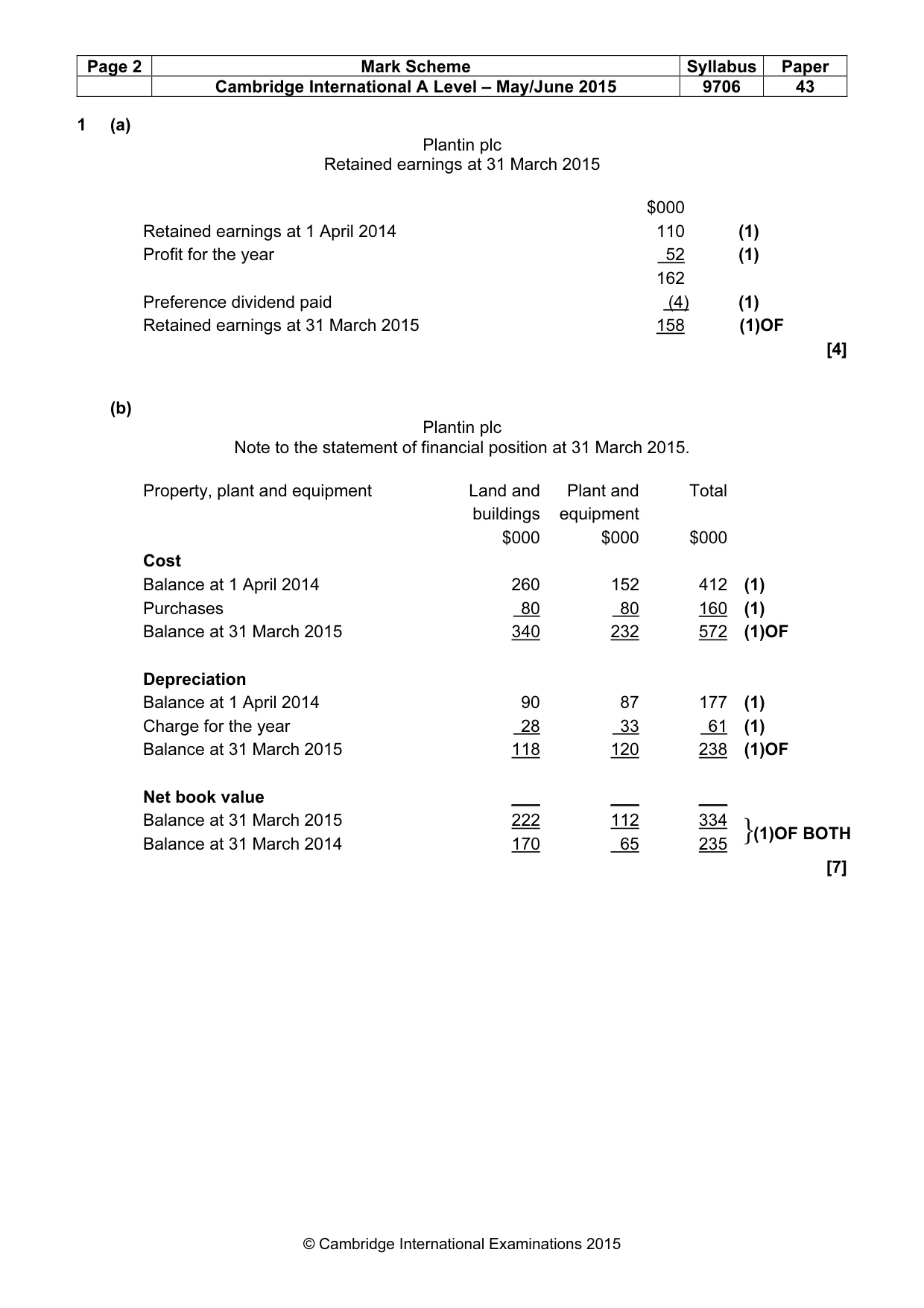
Page 2 Mark Scheme Syllabus Paper Cambridge International A Level – May/June 2015 9706 43 © Cambridge International Examinations 2015 1 (a) Plantin plc Retained earnings at 31 March 2015 $000 Retained earnings at 1 April 2014 110 (1) Profit for the year 52 (1) 162 Preference dividend paid (4) (1) Retained earnings at 31 March 2015 158 (1)OF [4] (b) Plantin plc Note to the statement of financial position at 31 March 2015. Property, plant and equipment Land and buildings Plant and equipment Total $000 $000 $000 Cost Balance at 1 April 2014 260 152 412 (1) Purchases 80 80 160 (1) Balance at 31 March 2015 340 232 572 (1)OF Depreciation Balance at 1 April 2014 90 87 177 (1) Charge for the year 28 33 61 (1) Balance at 31 March 2015 118 120 238 (1)OF Net book value ___ ___ ___ Balance at 31 March 2015 222 112 334 à(1)OF BOTH Balance at 31 March 2014 170 65 235 [7]
Mark scheme, page 3
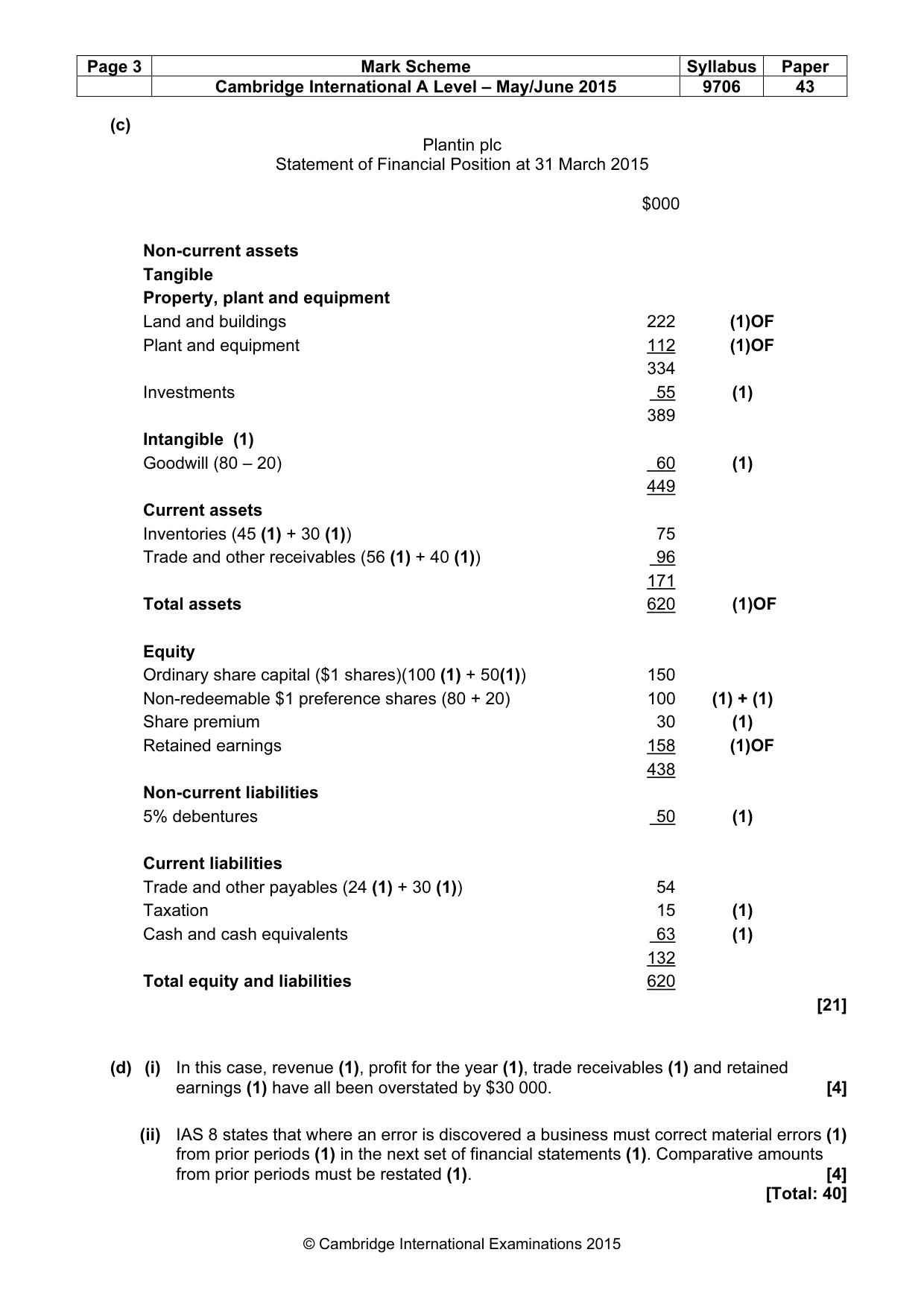
Page 3 Mark Scheme Syllabus Paper Cambridge International A Level – May/June 2015 9706 43 © Cambridge International Examinations 2015 (c) Plantin plc Statement of Financial Position at 31 March 2015 $000 Non-current assets Tangible Property, plant and equipment Land and buildings 222 (1)OF Plant and equipment 112 (1)OF 334 Investments 55 (1) 389 Intangible (1) Goodwill (80 – 20) 60 (1) 449 Current assets Inventories (45 (1) + 30 (1)) 75 Trade and other receivables (56 (1) + 40 (1)) 96 171 Total assets 620 (1)OF Equity Ordinary share capital ($1 shares)(100 (1) + 50(1)) 150 Non-redeemable $1 preference shares (80 + 20) 100 (1) + (1) Share premium 30 (1) Retained earnings 158 (1)OF 438 Non-current liabilities 5% debentures 50 (1) Current liabilities Trade and other payables (24 (1) + 30 (1)) 54 Taxation 15 (1) Cash and cash equivalents 63 (1) 132 Total equity and liabilities 620 [21] (d) (i) In this case, revenue (1), profit for the year (1), trade receivables (1) and retained earnings (1) have all been overstated by $30 000. [4] (ii) IAS 8 states that where an error is discovered a business must correct material errors (1) from prior periods (1) in the next set of financial statements (1). Comparative amounts from prior periods must be restated (1). [4] [Total: 40]
Mark scheme, page 4
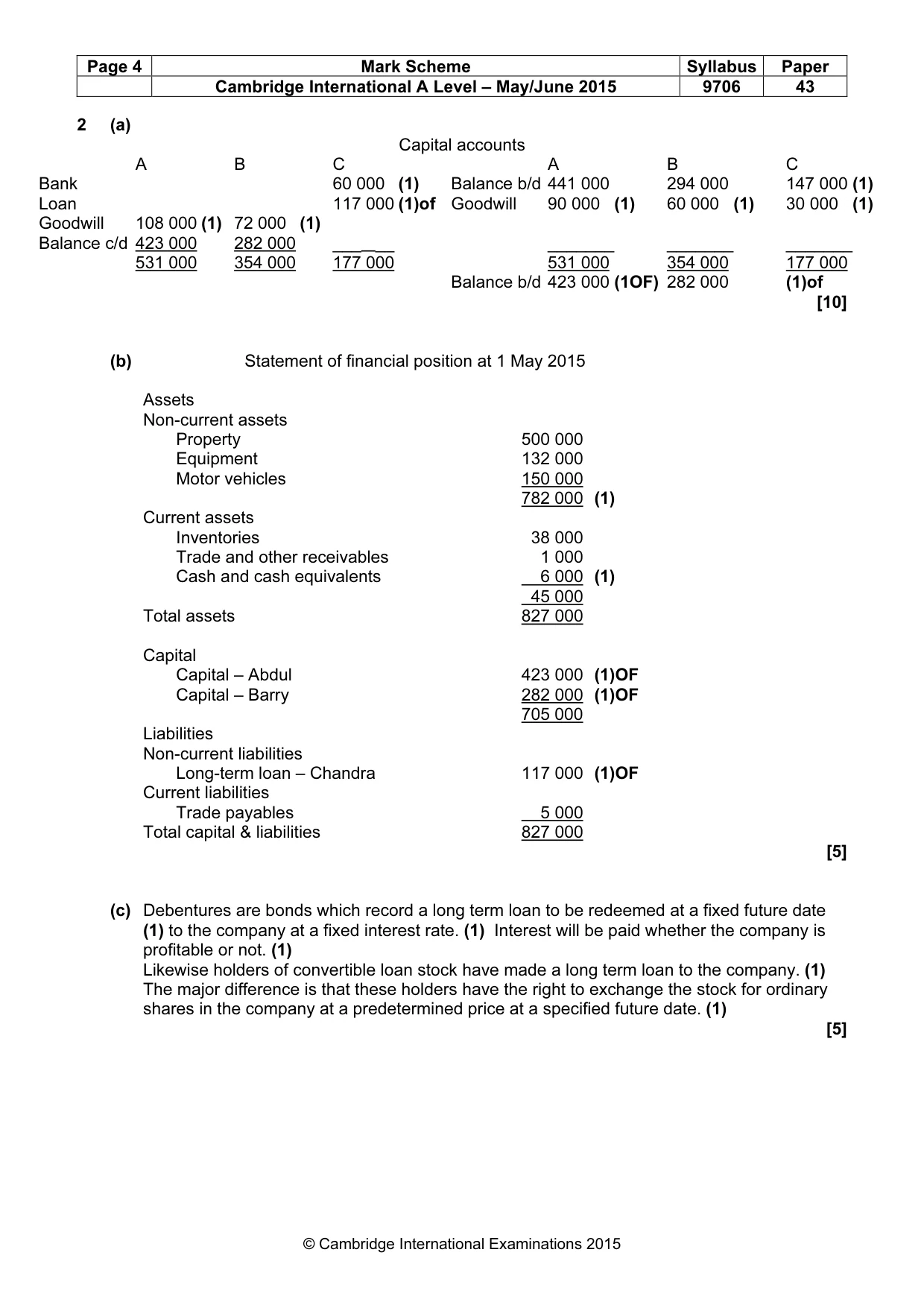
Page 4 Mark Scheme Syllabus Paper Cambridge International A Level – May/June 2015 9706 43 © Cambridge International Examinations 2015 2 (a) Capital accounts A B C A B C Bank 60 000 (1) Balance b/d 441 000 294 000 147 000 (1) Loan 117 000 (1)of Goodwill 90 000 (1) 60 000 (1) 30 000 (1) Goodwill 108 000 (1) 72 000 (1) Balance c/d 423 000 282 000 ___ __ _______ _______ _______ 531 000 354 000 177 000 531 000 354 000 177 000 Balance b/d 423 000 (1OF) 282 000 (1)of [10] (b) Statement of financial position at 1 May 2015 Assets Non-current assets Property 500 000 Equipment 132 000 Motor vehicles 150 000 782 000 (1) Current assets Inventories 38 000 Trade and other receivables 1 000 Cash and cash equivalents 6 000 (1) 45 000 Total assets 827 000 Capital Capital – Abdul 423 000 (1)OF Capital – Barry 282 000 (1)OF 705 000 Liabilities Non-current liabilities Long-term loan – Chandra 117 000 (1)OF Current liabilities Trade payables 5 000 Total capital & liabilities 827 000 [5] (c) Debentures are bonds which record a long term loan to be redeemed at a fixed future date (1) to the company at a fixed interest rate. (1) Interest will be paid whether the company is profitable or not. (1) Likewise holders of convertible loan stock have made a long term loan to the company. (1) The major difference is that these holders have the right to exchange the stock for ordinary shares in the company at a predetermined price at a specified future date. (1) [5]
Mark scheme, page 5
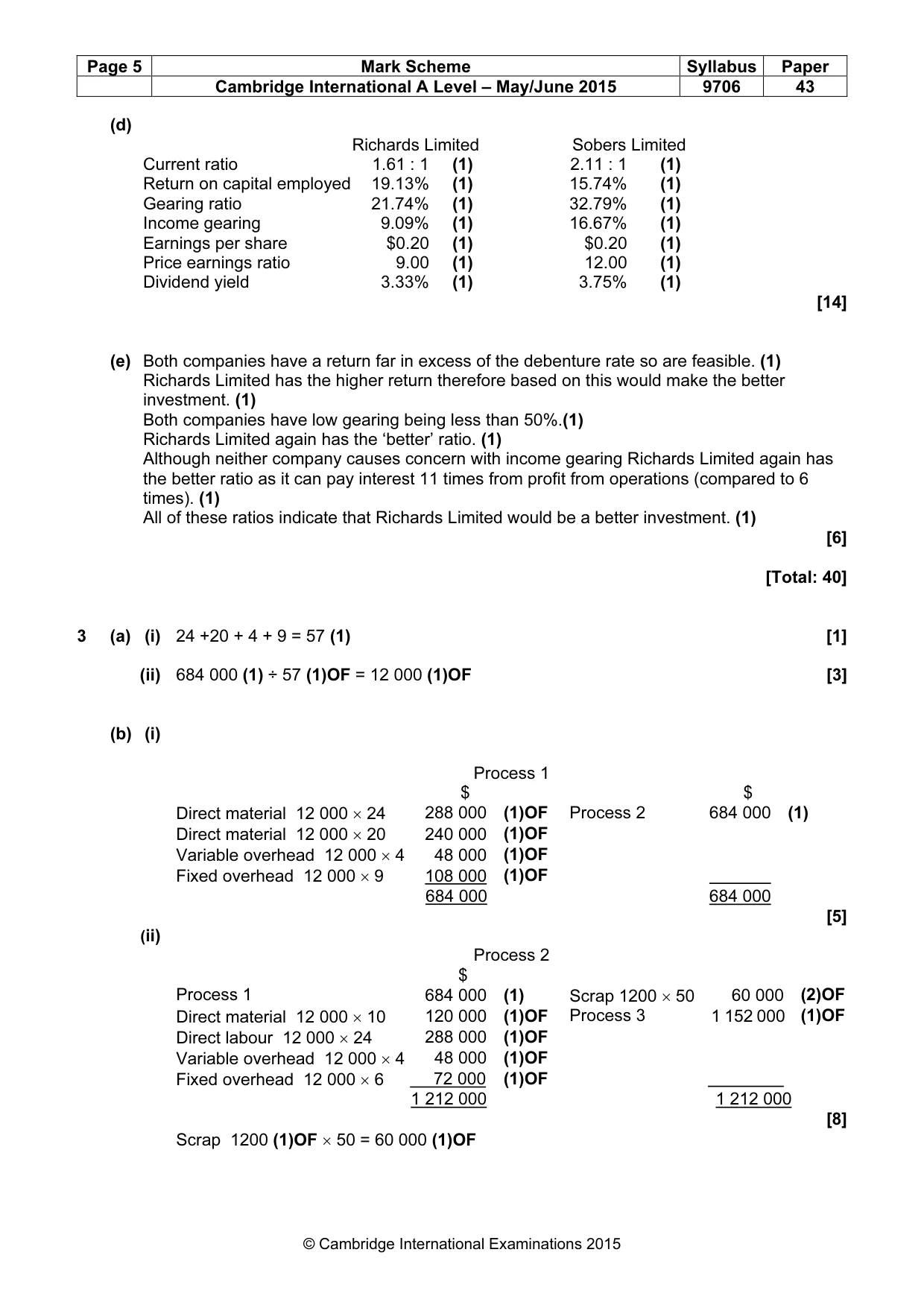
Page 5 Mark Scheme Syllabus Paper Cambridge International A Level – May/June 2015 9706 43 © Cambridge International Examinations 2015 (d) Richards Limited Sobers Limited Current ratio 1.61 : 1 (1) 2.11 : 1 (1) Return on capital employed 19.13% (1) 15.74% (1) Gearing ratio 21.74% (1) 32.79% (1) Income gearing 9.09% (1) 16.67% (1) Earnings per share $0.20 (1) $0.20 (1) Price earnings ratio 9.00 (1) 12.00 (1) Dividend yield 3.33% (1) 3.75% (1) [14] (e) Both companies have a return far in excess of the debenture rate so are feasible. (1) Richards Limited has the higher return therefore based on this would make the better investment. (1) Both companies have low gearing being less than 50%.(1) Richards Limited again has the ‘better’ ratio. (1) Although neither company causes concern with income gearing Richards Limited again has the better ratio as it can pay interest 11 times from profit from operations (compared to 6 times). (1) All of these ratios indicate that Richards Limited would be a better investment. (1) [6] [Total: 40] 3 (a) (i) 24 +20 + 4 + 9 = 57 (1) [1] (ii) 684 000 (1) ÷ 57 (1)OF = 12 000 (1)OF [3] (b) (i) Process 1 $ $ Direct material 12 000 × 24 288 000 (1)OF Process 2 684 000 (1) Direct material 12 000 × 20 240 000 (1)OF Variable overhead 12 000 × 4 48 000 (1)OF Fixed overhead 12 000 × 9 108 000 (1)OF 684 000 684 000 [5] (ii) Process 2 $ Process 1 684 000 (1) Scrap 1200 × 50 60 000 (2)OF Direct material 12 000 × 10 120 000 (1)OF Process 3 1 152 000 (1)OF Direct labour 12 000 × 24 288 000 (1)OF Variable overhead 12 000 × 4 48 000 (1)OF Fixed overhead 12 000 × 6 72 000 (1)OF 1 212 000 1 212 000 [8] Scrap 1200 (1)OF × 50 = 60 000 (1)OF
Mark scheme, page 6
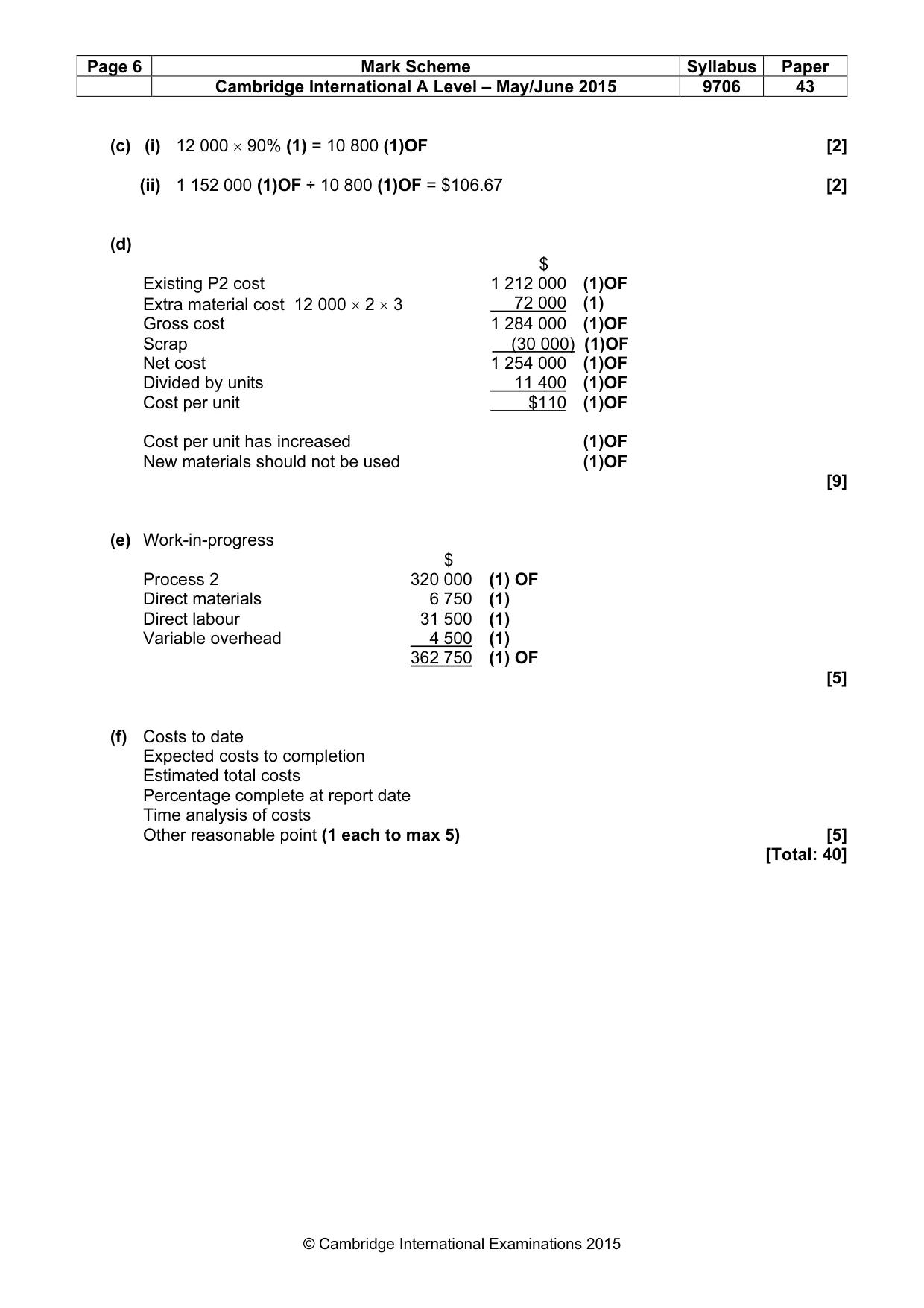
Page 6 Mark Scheme Syllabus Paper Cambridge International A Level – May/June 2015 9706 43 © Cambridge International Examinations 2015 (c) (i) 12 000 × 90% (1) = 10 800 (1)OF [2] (ii) 1 152 000 (1)OF ÷ 10 800 (1)OF = $106.67 [2] (d) $ Existing P2 cost 1 212 000 (1)OF Extra material cost 12 000 × 2 × 3 72 000 (1) Gross cost 1 284 000 (1)OF Scrap (30 000) (1)OF Net cost 1 254 000 (1)OF Divided by units 11 400 (1)OF Cost per unit $110 (1)OF Cost per unit has increased (1)OF New materials should not be used (1)OF [9] (e) Work-in-progress $ Process 2 320 000 (1) OF Direct materials 6 750 (1) Direct labour 31 500 (1) Variable overhead 4 500 (1) 362 750 (1) OF [5] (f) Costs to date Expected costs to completion Estimated total costs Percentage complete at report date Time analysis of costs Other reasonable point (1 each to max 5) [5] [Total: 40]
What you needed in this session
Cambridge’s own grade thresholds for 2015 May/June, Paper 4 · Variant 3. A higher threshold means an easier paper — the bar moves with how the cohort did.