Cambridge A Level Accounting 9706 — 2024 Oct/Nov Paper 2 · Variant 1
9706/21/O/N/24 · 4 questions · 90 marks · ≈101 min
The question paper and its mark scheme, free to read here and free to download. This is Cambridge’s own paper, exactly as it was sat.
Question paper20 pages
Mark scheme16 pages
Answers below. Sit the paper first if you are practising.
Questions as text
Q1 · The financial year end of T Limited was 30 June 2024
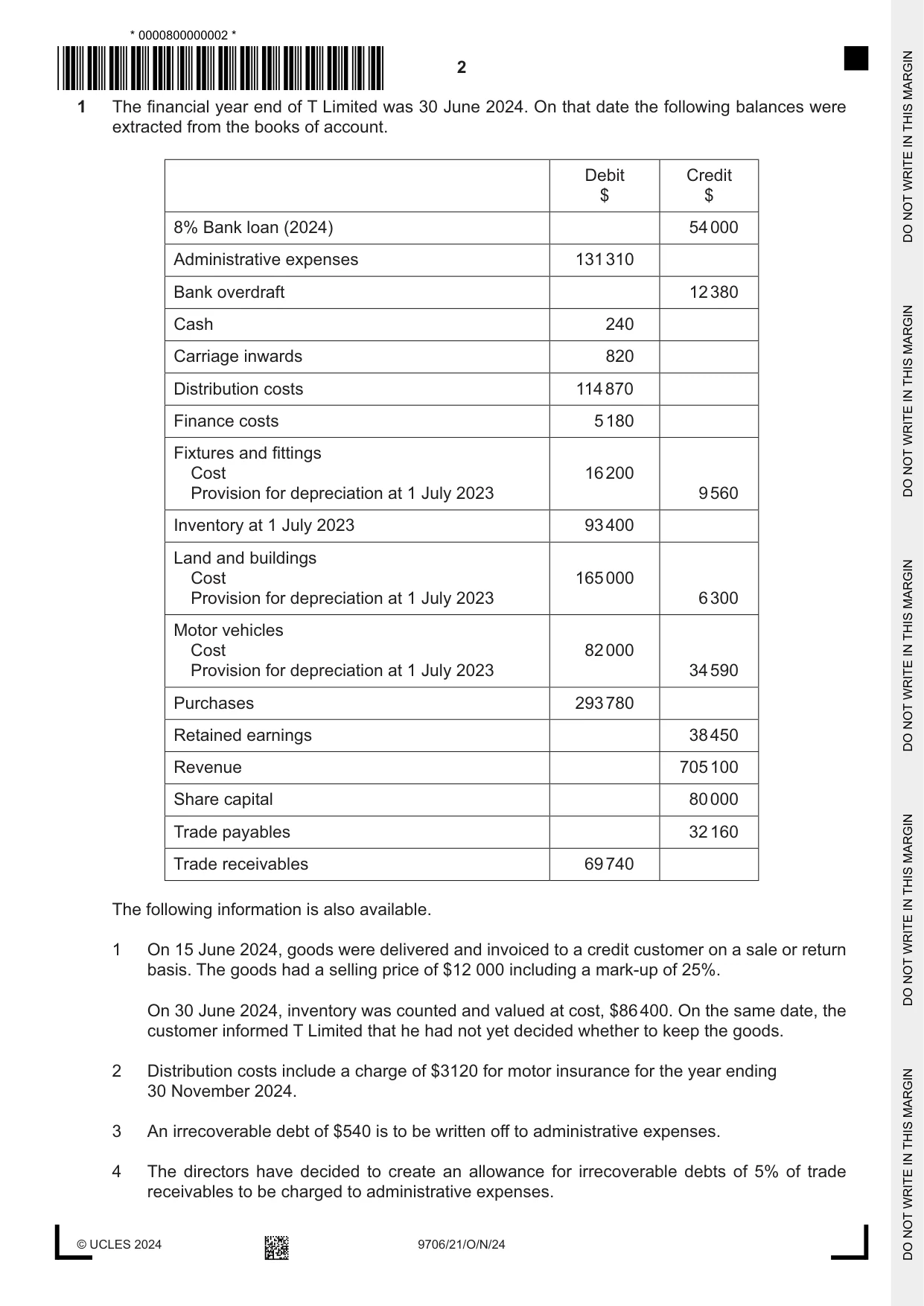
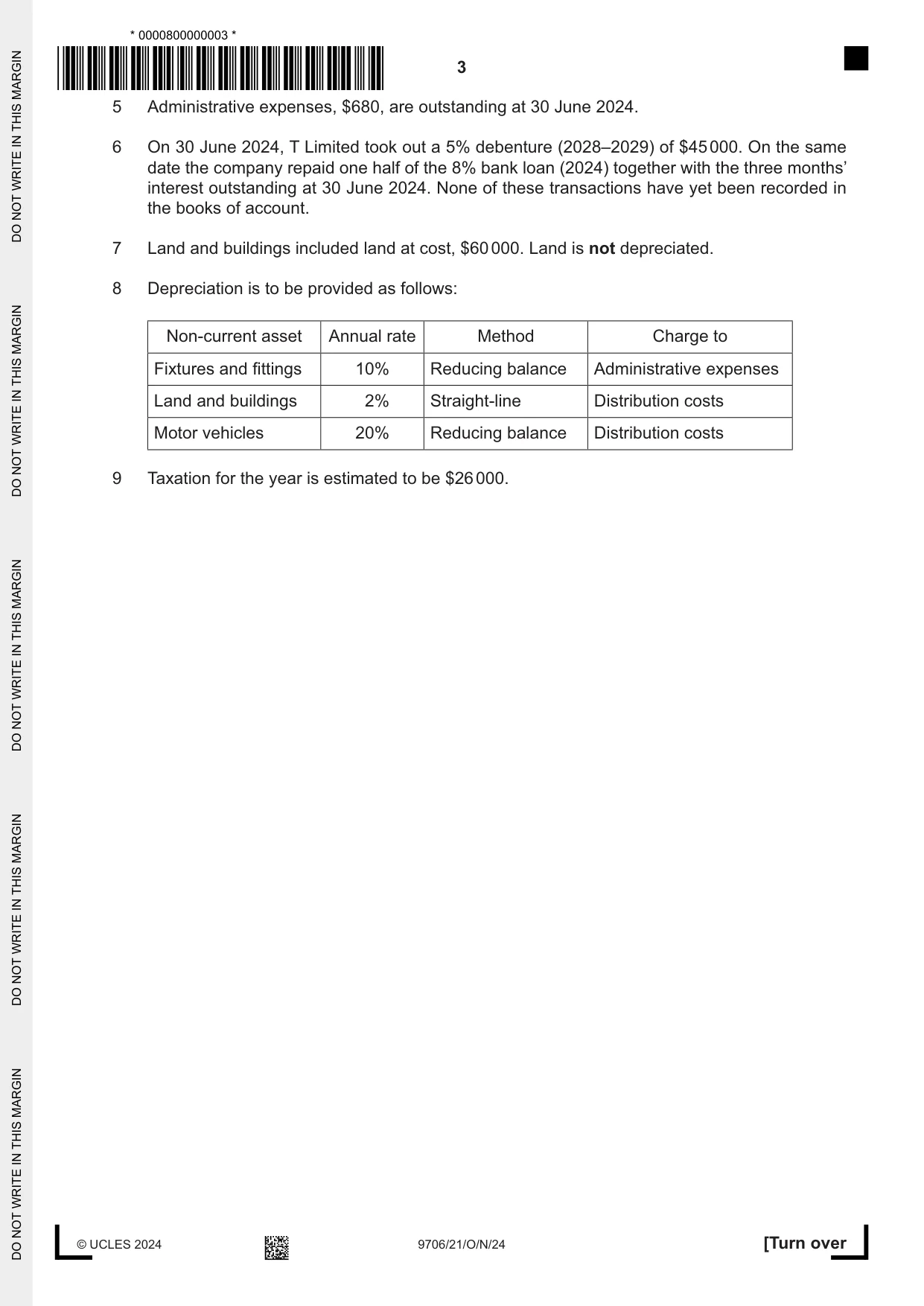
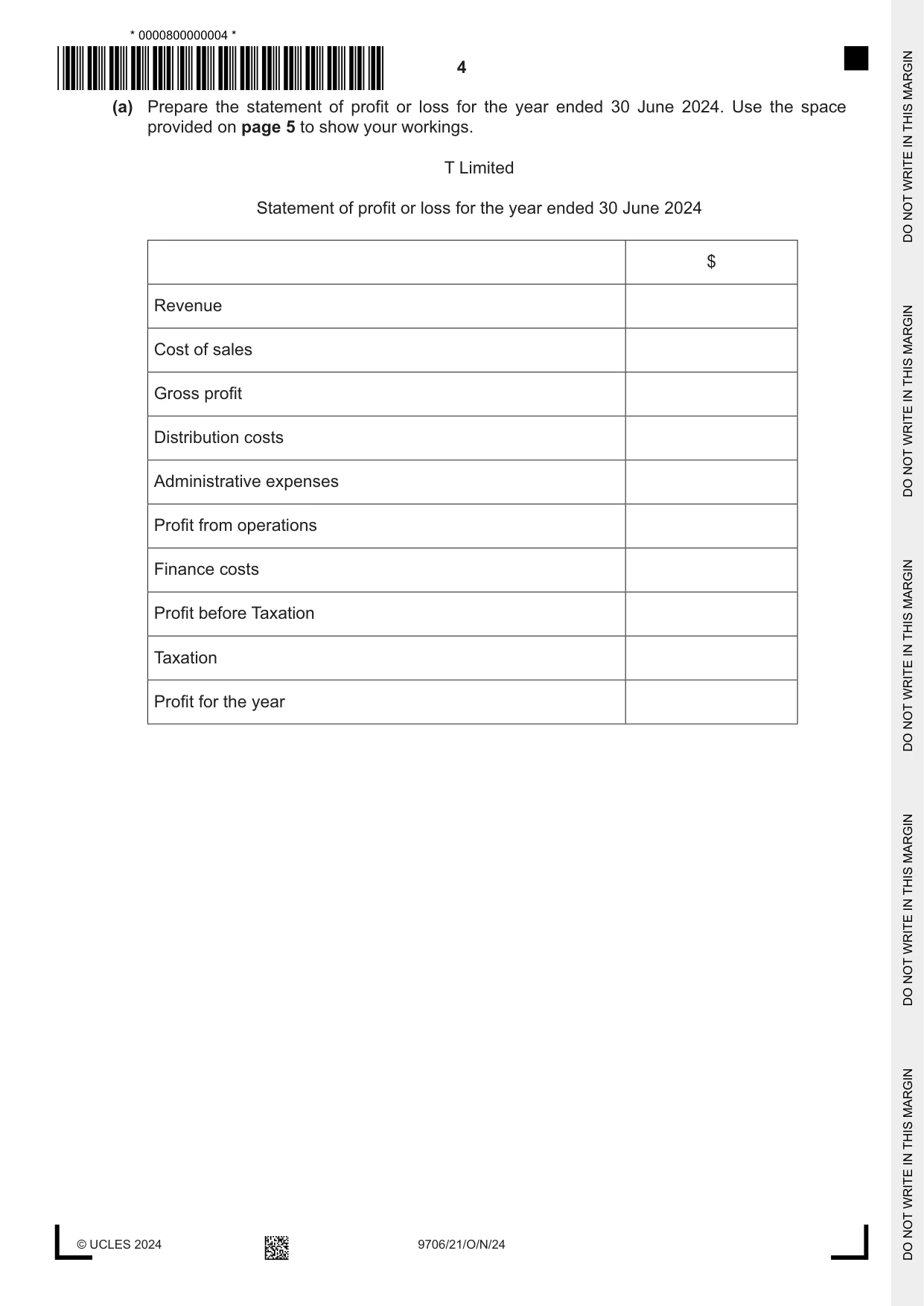
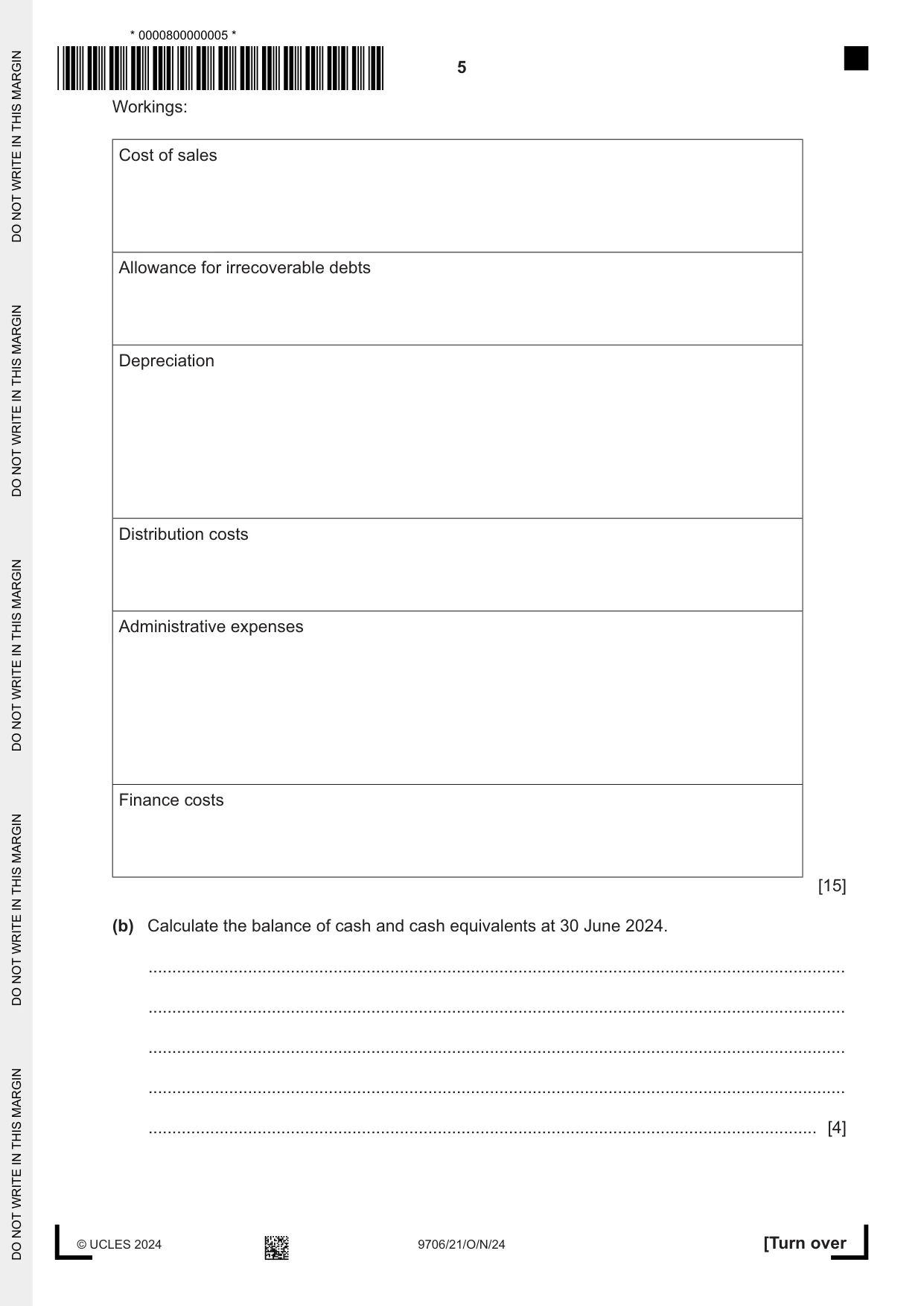
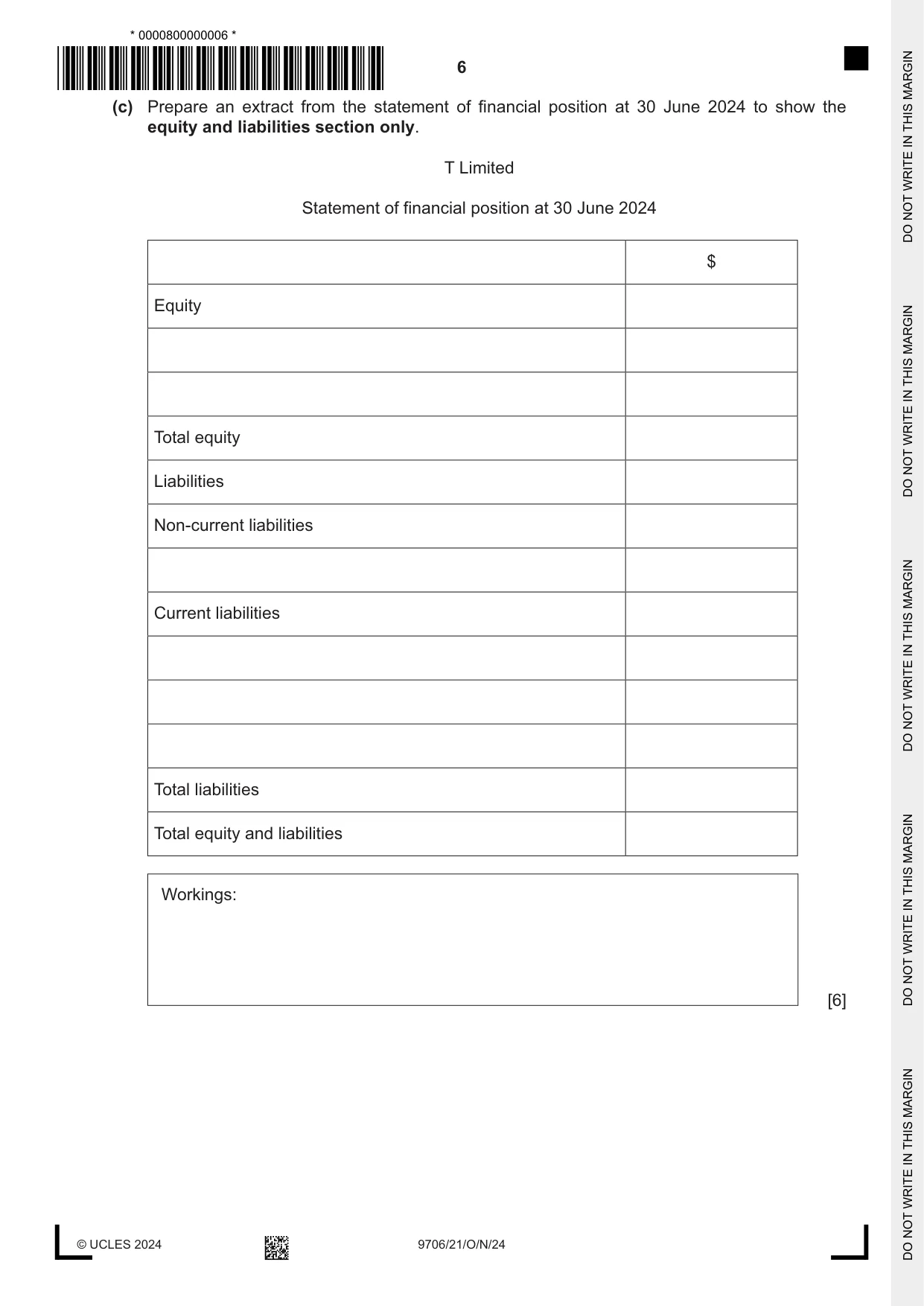
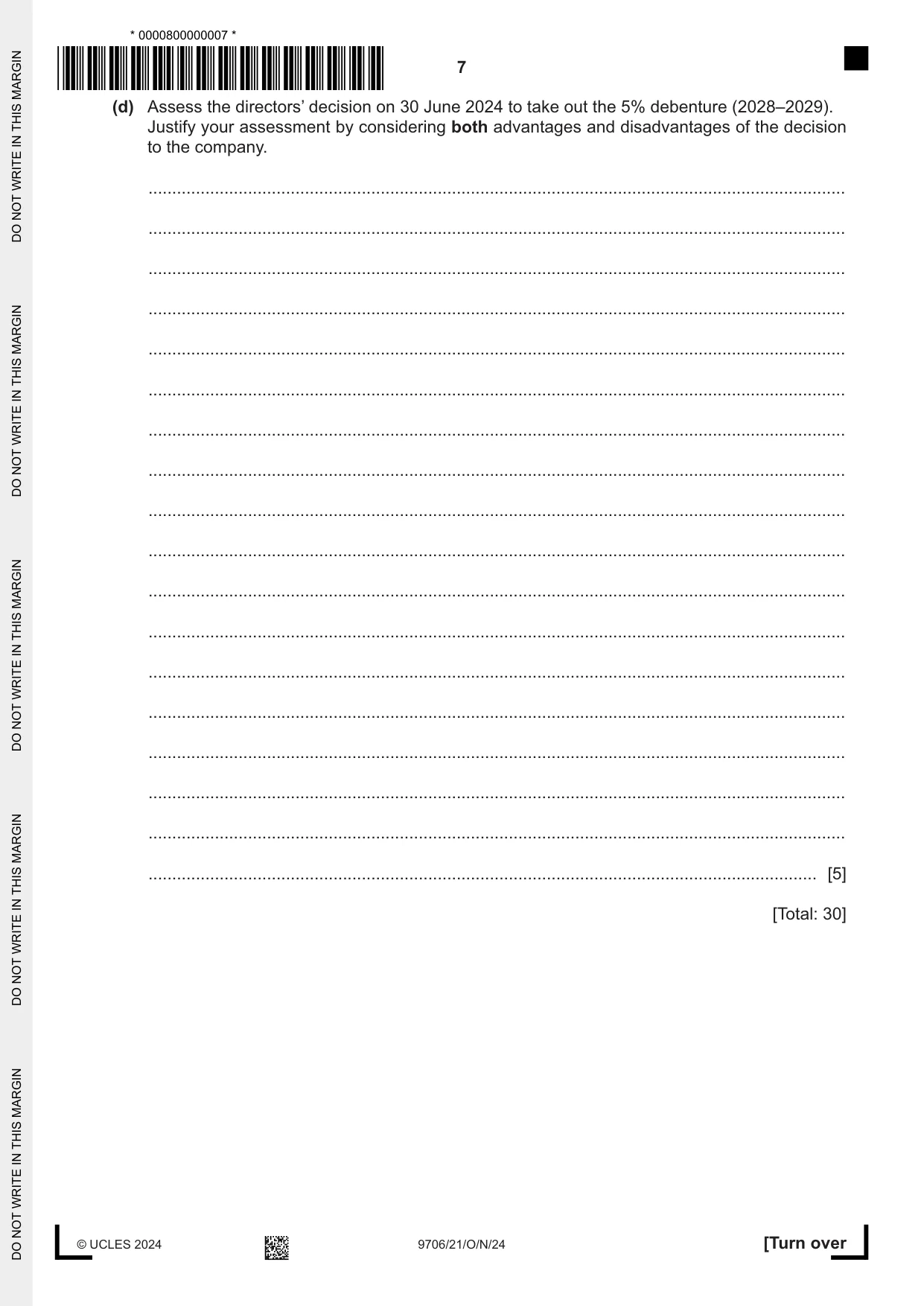
1 The financial year end of T Limited was 30 June 2024. On that date the following balances were extracted from the books of account. Debit Credit $ $ 8% Bank loan (2024) 54 000 Administrative expenses 131 310 Bank overdraft 12 380 Cash 240 Carriage inwards 820 Distribution costs 114 870 Finance costs 5 180 Fixtures and fittings Cost 16 200 Provision for depreciation at 1 July 2023 9 560 Inventory at 1 July 2023 93 400 Land and buildings Cost 165 000 Provision for depreciation at 1 July 2023 6 300 Motor vehicles Cost 82 000 Provision for depreciation at 1 July 2023 34 590 Purchases 293 780 Retained earnings 38 450 Revenue 705 100 Share capital 80 000 Trade payables 32 160 Trade receivables 69 740 The following information is also available. 1 On 15 June 2024, goods were delivered and invoiced to a credit customer on a sale or return basis. The goods had a selling price of $12 000 including a mark-up of 25%. On 30 June 2024, inventory was counted and valued at cost, $86 400. On the same date, the customer informed T Limited that he had not yet decided whether to keep the goods. 2 Distribution costs include a charge of $3120 for motor insurance for the year ending 30 November 2024. 3 An irrecoverable debt of $540 is to be written off to administrative expenses. 4 The directors have decided to create an allowance for irrecoverable debts of 5% of trade receivables to be charged to administrative expenses. 5 Administrative expenses, $680, are outstanding at 30 June 2024. 6 On 30 June 2024, T Limited took out a 5% debenture (2028–2029) of $45 000. On the same date the company repaid one half of the 8% bank loan (2024) together with the three months’ interest outstanding at 30 June 2024. None of these transactions have yet been recorded in the books of account. 7 Land and buildings included land at cost, $60 000. Land is not depreciated. 8 Depreciation is to be provided as follows: Non-current asset Annual rate Method Charge to Fixtures and fittings 10% Reducing balance Administrative expenses Land and buildings 2% Straight-line Distribution costs Motor vehicles 20% Reducing balance Distribution costs 9 Taxation for the year is estimated to be $26 000. (a) Prepare the statement of profit or loss for the year ended 30 June 2024. Use the space provided on page 5 to show your workings. T Limited Statement of profit or loss for the year ended 30 June 2024 $ Revenue Cost of sales Gross profit Distribution costs Administrative expenses Profit from operations Finance costs Profit before Taxation Taxation Profit for the year Workings: Cost of sales Allowance for irrecoverable debts Depreciation Distribution costs Administrative expenses Finance costs [15] (b) Calculate the balance of cash and cash equivalents at 30 June 2024. ................................................................................................................................................... ................................................................................................................................................... ................................................................................................................................................... ................................................................................................................................................... ............................................................................................................................................. [4] (c) Prepare an extract from the statement of financial position at 30 June 2024 to show the equity and liabilities section only. T Limited Statement of financial position at 30 June 2024 $ Equity Total equity Liabilities Non-current liabilities Current liabilities Total liabilities Total equity and liabilities Workings: [6] (d) Assess the directors’ decision on 30 June 2024 to take out the 5% debenture (2028–2029). Justify your assessment by considering both advantages and disadvantages of the decision to the company. ................................................................................................................................................... ................................................................................................................................................... ................................................................................................................................................... ................................................................................................................................................... ................................................................................................................................................... ................................................................................................................................................... ................................................................................................................................................... ................................................................................................................................................... ................................................................................................................................................... ................................................................................................................................................... ................................................................................................................................................... ................................................................................................................................................... ................................................................................................................................................... ................................................................................................................................................... ................................................................................................................................................... ................................................................................................................................................... ................................................................................................................................................... ............................................................................................................................................. [5] [Total: 30]
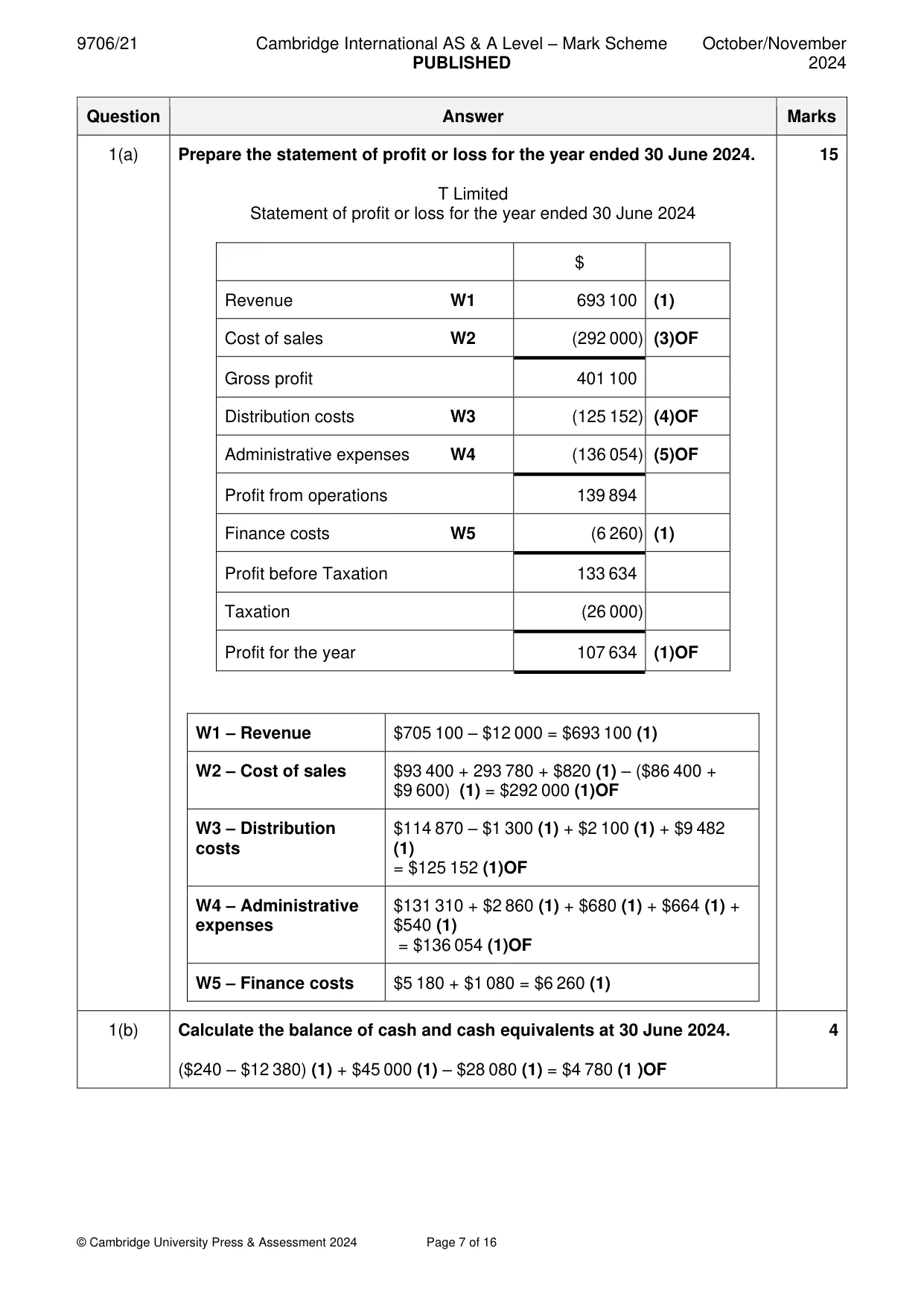
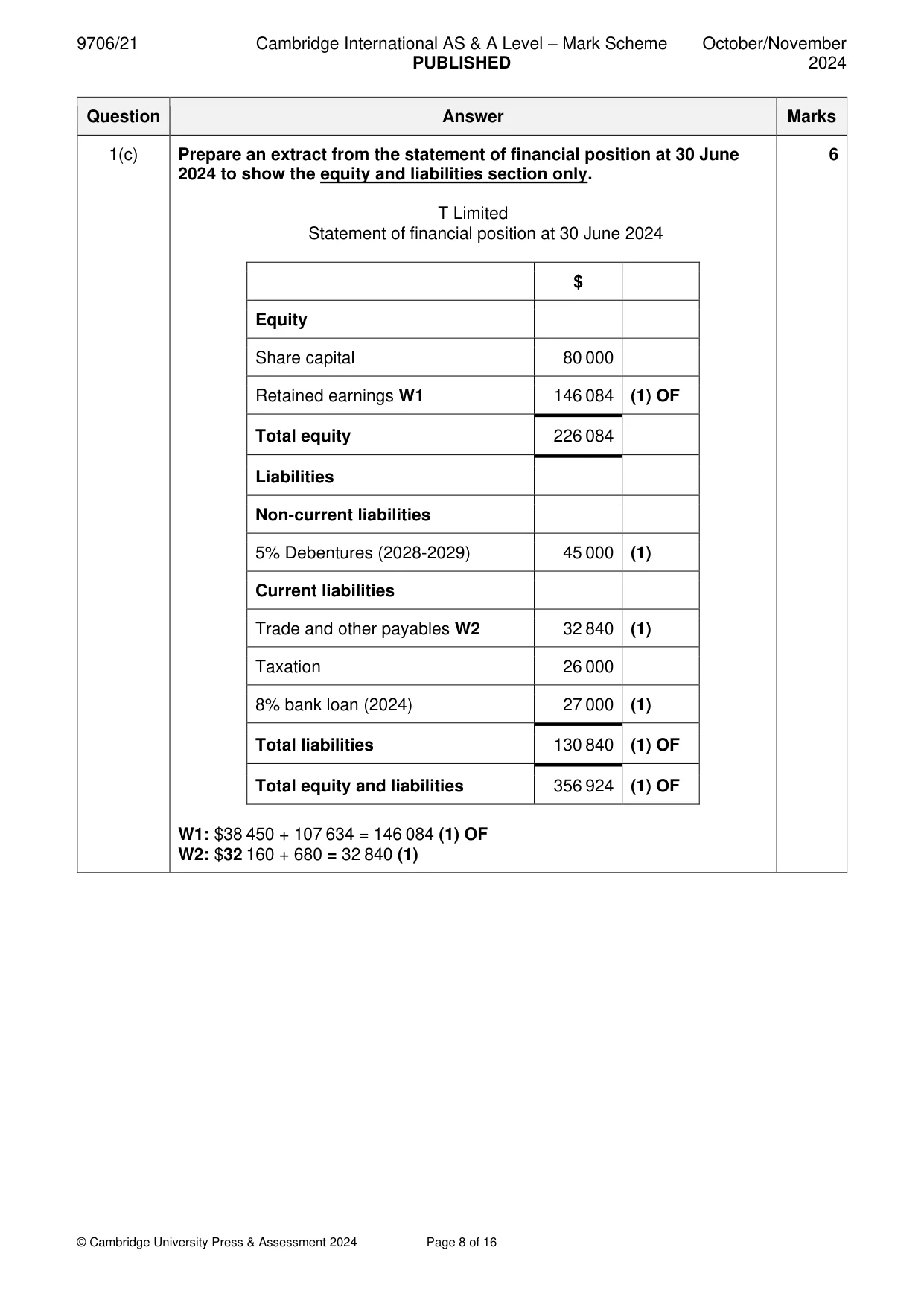
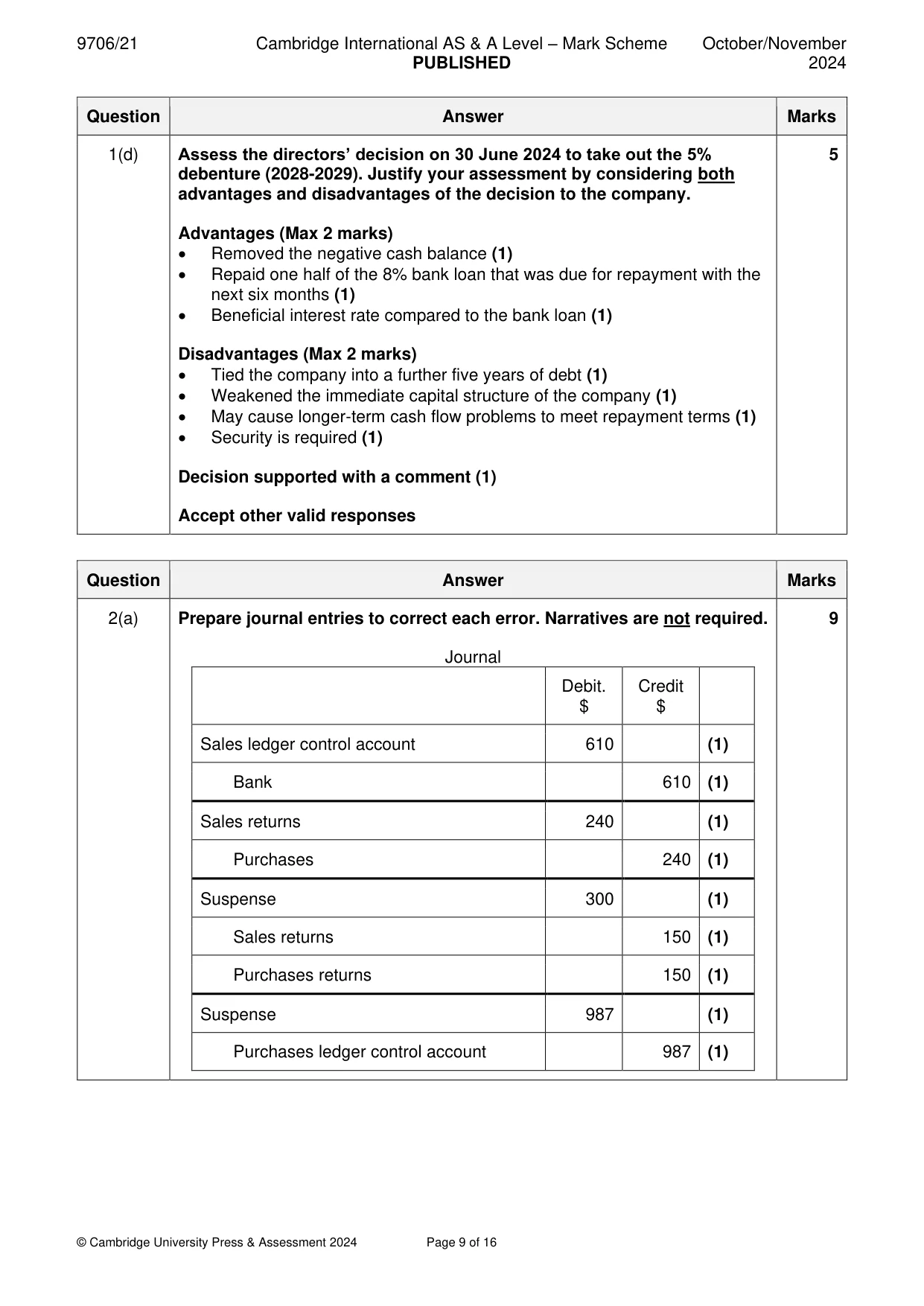
Mark scheme: Question Answer Marks 1(a) Prepare the statement of profit or loss for the year ended 30 June 2024. 15 T Limited Statement of profit or loss for the year ended 30 June 2024 $ Revenue W1 693 100 (1) Cost of sales W2 (292 000) (3)OF Gross profit 401 100 Distribution costs W3 (125 152) (4)OF Administrative expenses W4 (136 054) (5)OF Profit from operations 139 894 Finance costs W5 (6 260) (1) Profit before Taxation 133 634 Taxation (26 000) Profit for the year 107 634 (1)OF W1 – Revenue $705 100 – $12 000 = $693 100 (1) W2 – Cost of sales $93 400 + 293 780 + $820 (1) – ($86 400 + $9 600) (1) = $292 000 (1)OF W3 – Distribution $114 870 – $1 300 (1) + $2 100 (1) + $9 482 costs (1) = $125 152 (1)OF W4 – Administrative $131 310 + $2 860 (1) + $680 (1) + $664 (1) + expenses $540 (1) = $136 054 (1)OF W5 – Finance costs $5 180 + $1 080 = $6 260 (1) 1(b) Calculate the balance of cash and cash equivalents at 30 June 2024. 4 ($240 – $12 380) (1) + $45 000 (1) – $28 080 (1) = $4 780 (1 )OF 1(c) Prepare an extract from the statement of financial position at 30 June 6 2024 to show the equity and liabilities section only. T Limited Statement of financial position at 30 June 2024 $ Equity Share capital 80 000 Retained earnings W1 146 084 (1) OF Total equity 226 084 Liabilities Non-current liabilities 5% Debentures (2028-2029) 45 000 (1) Current liabilities Trade and other payables W2 32 840 (1) Taxation 26 000 8% bank loan (2024) 27 000 (1) Total liabilities 130 840 (1) OF Total equity and liabilities 356 924 (1) OF W1: $38 450 + 107 634 = 146 084 (1) OF W2: $32 160 + 680 = 32 840 (1) 1(d) Assess the directors’ decision on 30 June 2024 to take out the 5% 5 debenture (2028-2029). Justify your assessment by considering both advantages and disadvantages of the decision to the company. Advantages (Max 2 marks) • Removed the negative cash balance (1) • Repaid one half of the 8% bank loan that was due for repayment with the next six months (1) • Beneficial interest rate compared to the bank loan (1) Disadvantages (Max 2 marks) • Tied the company into a further five years of debt (1) • Weakened the immediate capital structure of the company (1) • May cause longer-term cash flow problems to meet repayment terms (1) • Security is required (1) Decision supported with a comment (1) Accept other valid responses
Q2 · Deepak maintains a full set of accounting records
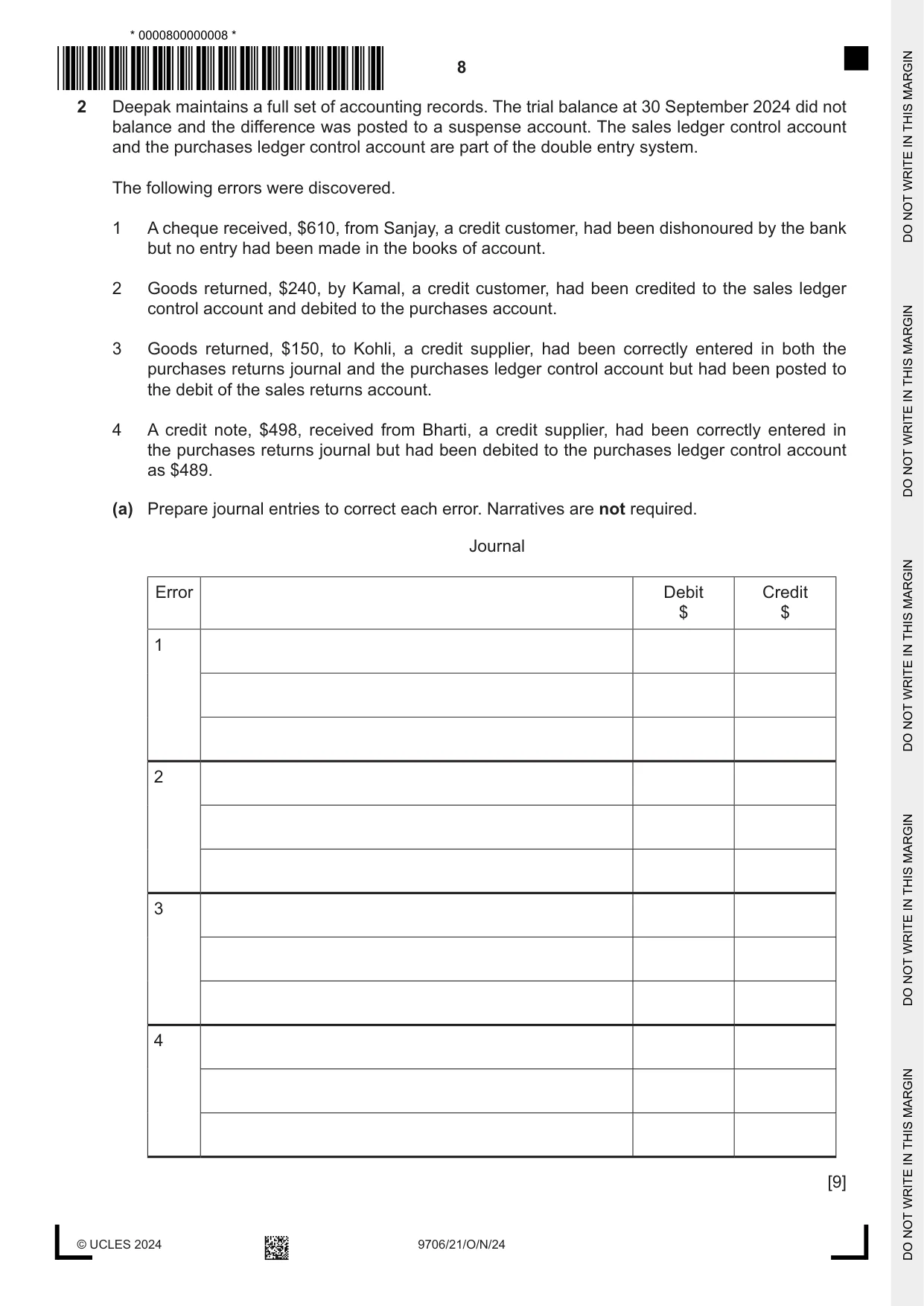
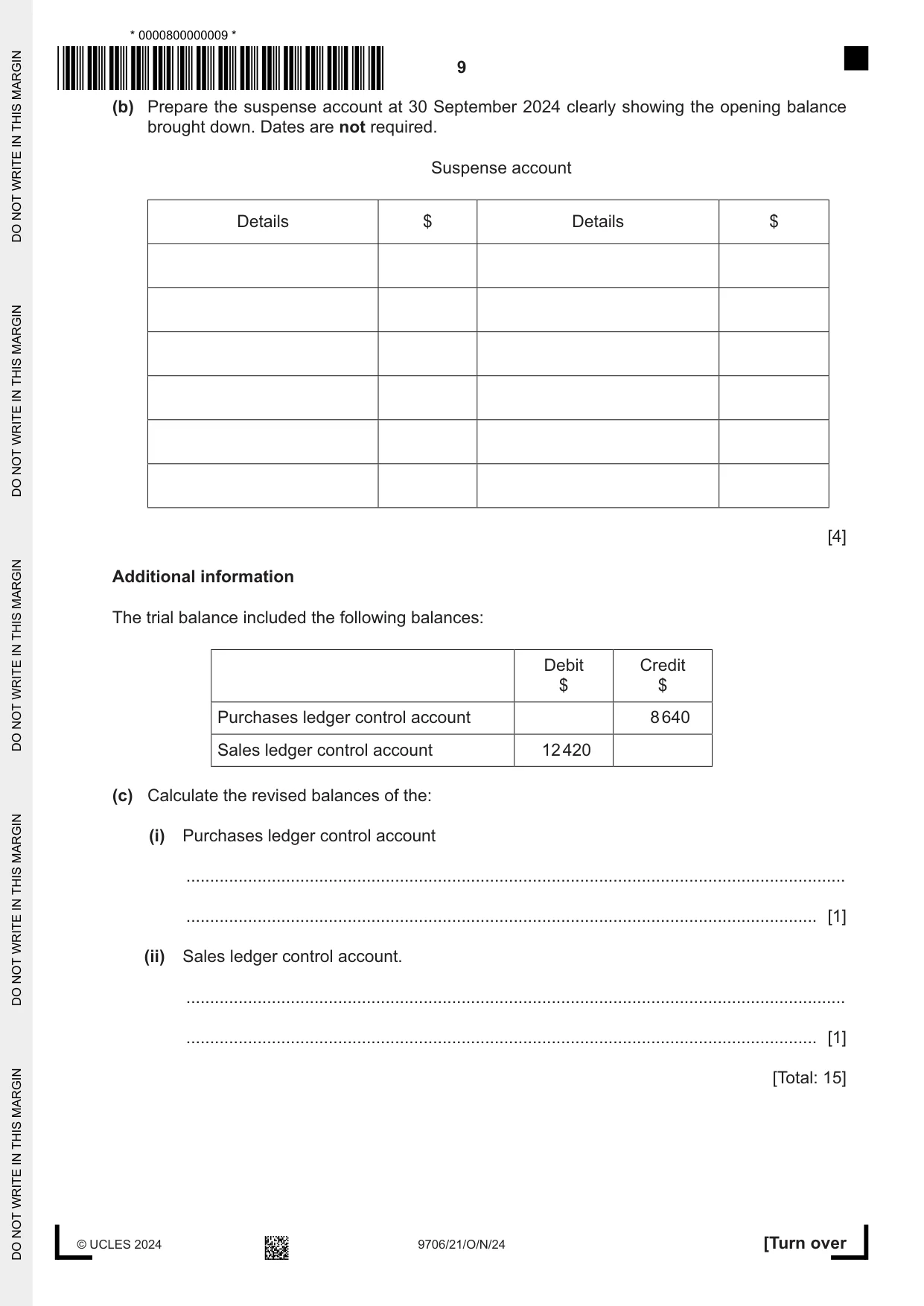
2 Deepak maintains a full set of accounting records. The trial balance at 30 September 2024 did not balance and the difference was posted to a suspense account. The sales ledger control account and the purchases ledger control account are part of the double entry system. The following errors were discovered. 1 A cheque received, $610, from Sanjay, a credit customer, had been dishonoured by the bank but no entry had been made in the books of account. 2 Goods returned, $240, by Kamal, a credit customer, had been credited to the sales ledger control account and debited to the purchases account. 3 Goods returned, $150, to Kohli, a credit supplier, had been correctly entered in both the purchases returns journal and the purchases ledger control account but had been posted to the debit of the sales returns account. 4 A credit note, $498, received from Bharti, a credit supplier, had been correctly entered in the purchases returns journal but had been debited to the purchases ledger control account as $489. (a) Prepare journal entries to correct each error. Narratives are not required. Journal Error Debit Credit $ $ 1 2 3 4 [9] (b) Prepare the suspense account at 30 September 2024 clearly showing the opening balance brought down. Dates are not required. Suspense account Details $ Details $ [4] Additional information The trial balance included the following balances: Debit Credit $ $ Purchases ledger control account 8 640 Sales ledger control account 12 420 (c) Calculate the revised balances of the: (i) Purchases ledger control account ........................................................................................................................................... ..................................................................................................................................... [1] (ii) Sales ledger control account. ........................................................................................................................................... ..................................................................................................................................... [1] [Total: 15]
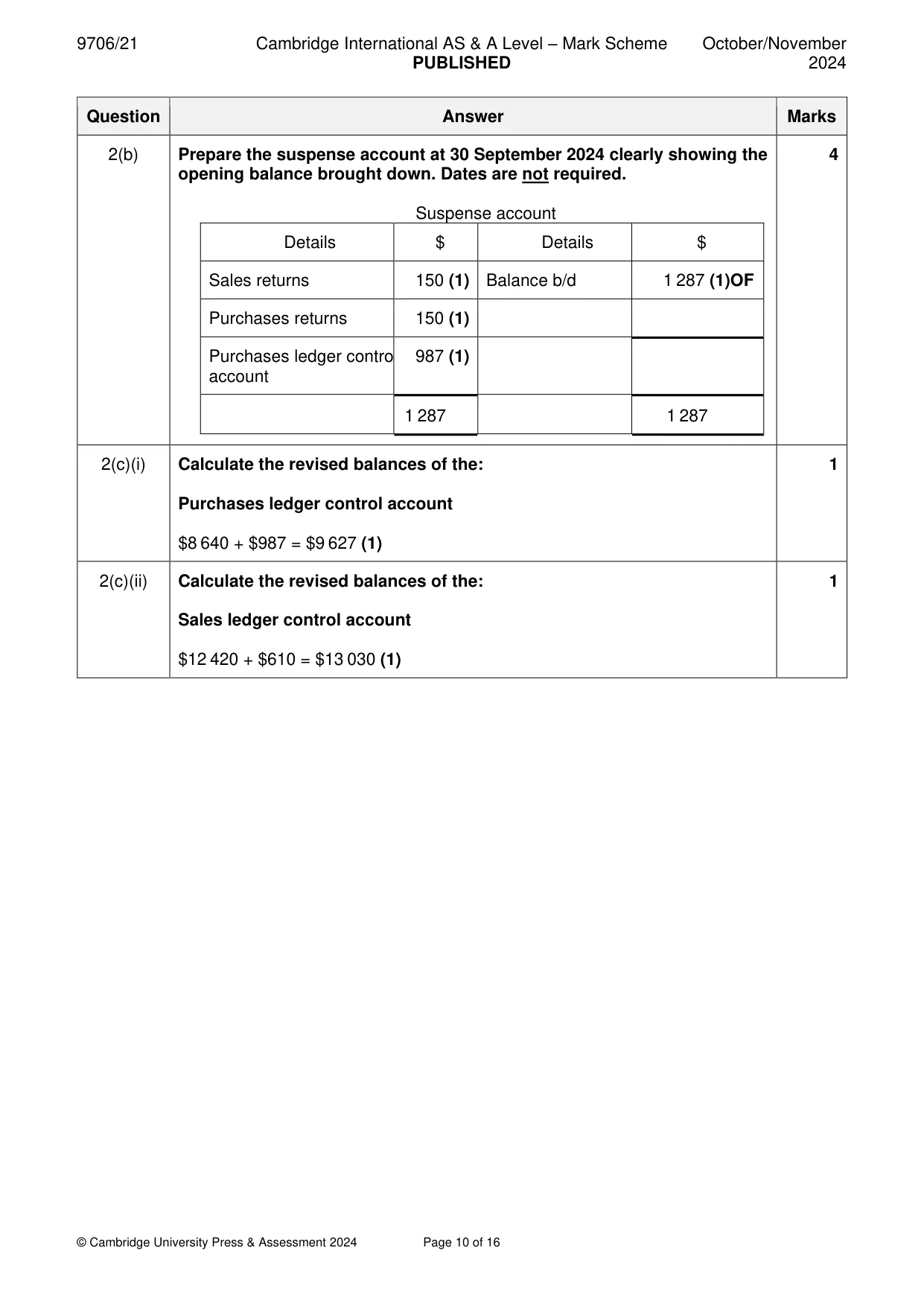
Mark scheme: 2(a) Prepare journal entries to correct each error. Narratives are not required. 9 Journal Debit. Credit $ $ Sales ledger control account 610 (1) Bank 610 (1) Sales returns 240 (1) Purchases 240 (1) Suspense 300 (1) Sales returns 150 (1) Purchases returns 150 (1) Suspense 987 (1) Purchases ledger control account 987 (1) 2(b) Prepare the suspense account at 30 September 2024 clearly showing the 4 opening balance brought down. Dates are not required. Suspense account Details $ Details $ Sales returns 150 (1) Balance b/d 1 287 (1)OF Purchases returns 150 (1) Purchases ledger contro 987 (1) account 1 287 1 287 2(c)(i) Calculate the revised balances of the: 1 Purchases ledger control account $8 640 + $987 = $9 627 (1) 2(c)(ii) Calculate the revised balances of the: 1 Sales ledger control account $12 420 + $610 = $13 030 (1)
Q3 · Clarissa started her business on 1 July 2022, and she is preparing her financial…
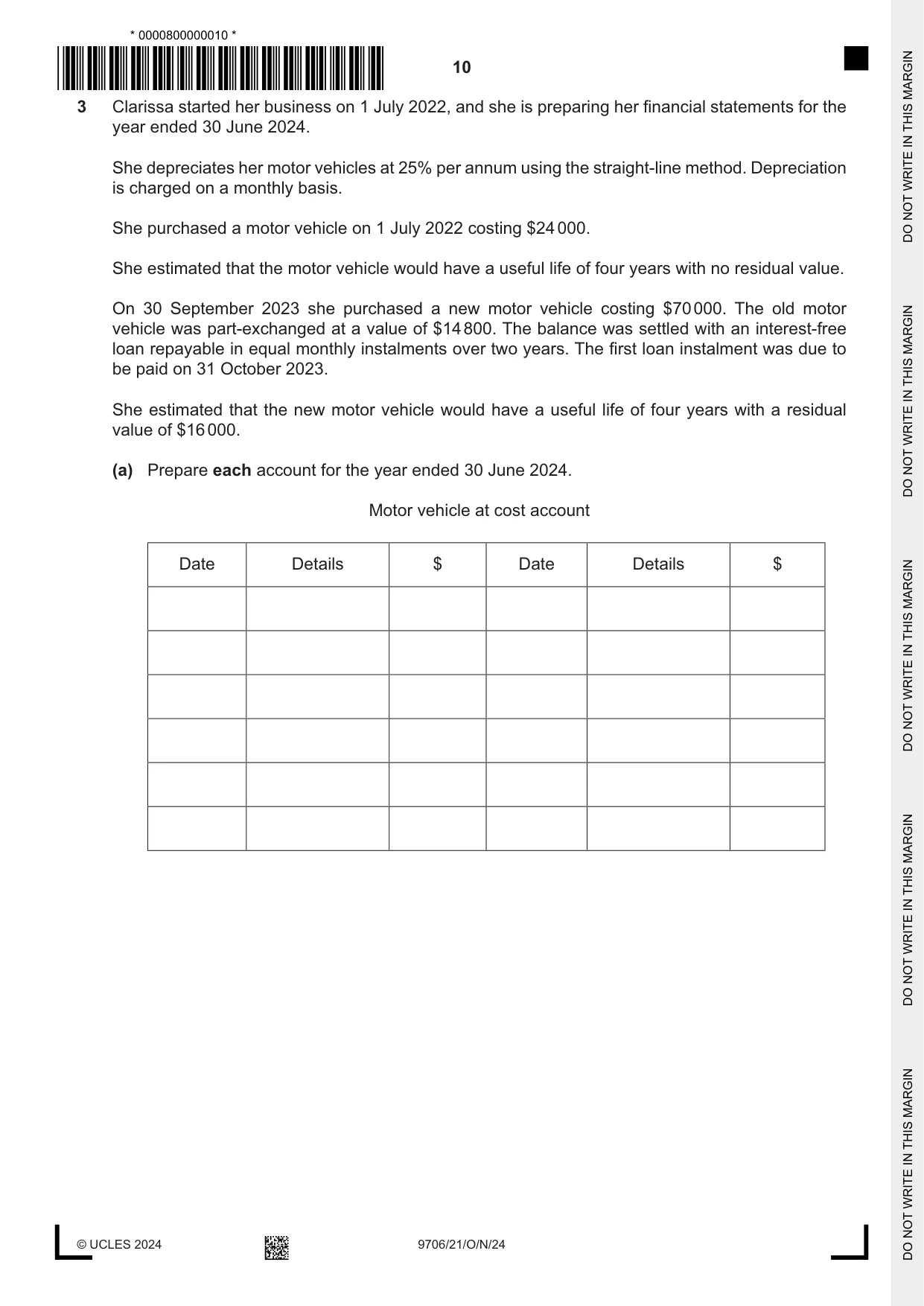
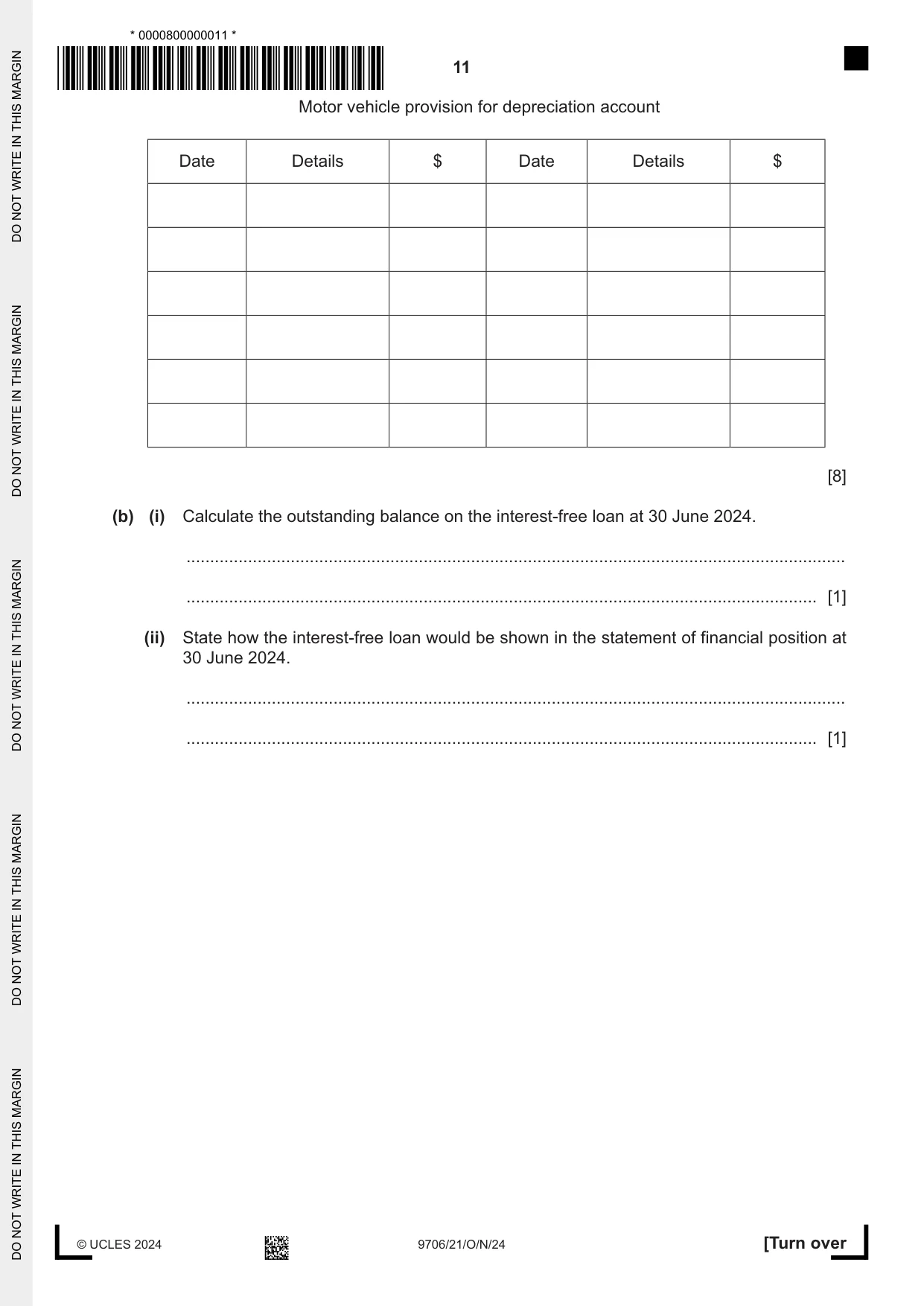
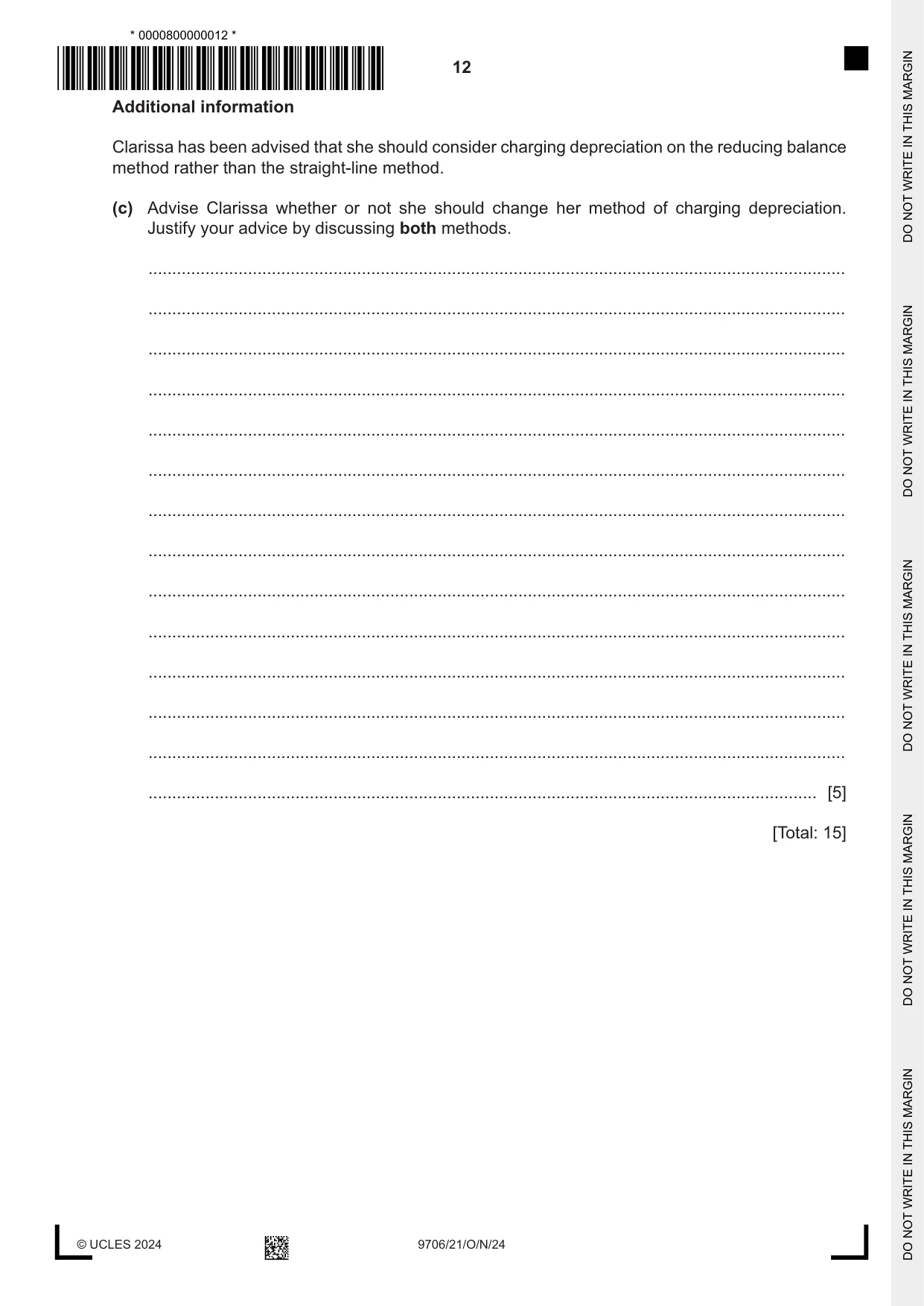
3 Clarissa started her business on 1 July 2022, and she is preparing her financial statements for the year ended 30 June 2024. She depreciates her motor vehicles at 25% per annum using the straight-line method. Depreciation is charged on a monthly basis. She purchased a motor vehicle on 1 July 2022 costing $24 000. She estimated that the motor vehicle would have a useful life of four years with no residual value. On 30 September 2023 she purchased a new motor vehicle costing $70 000. The old motor vehicle was part-exchanged at a value of $14 800. The balance was settled with an interest-free loan repayable in equal monthly instalments over two years. The first loan instalment was due to be paid on 31 October 2023. She estimated that the new motor vehicle would have a useful life of four years with a residual value of $16 000. (a) Prepare each account for the year ended 30 June 2024. Motor vehicle at cost account Date Details $ Date Details $ Motor vehicle provision for depreciation account Date Details $ Date Details $ [8] (b) (i) Calculate the outstanding balance on the interest-free loan at 30 June 2024. ........................................................................................................................................... ..................................................................................................................................... [1] (ii) State how the interest-free loan would be shown in the statement of financial position at 30 June 2024. ........................................................................................................................................... ..................................................................................................................................... [1] Additional information Clarissa has been advised that she should consider charging depreciation on the reducing balance method rather than the straight-line method. (c) Advise Clarissa whether or not she should change her method of charging depreciation. Justify your advice by discussing both methods. ................................................................................................................................................... ................................................................................................................................................... ................................................................................................................................................... ................................................................................................................................................... ................................................................................................................................................... ................................................................................................................................................... ................................................................................................................................................... ................................................................................................................................................... ................................................................................................................................................... ................................................................................................................................................... ................................................................................................................................................... ................................................................................................................................................... ................................................................................................................................................... ............................................................................................................................................. [5] [Total: 15]
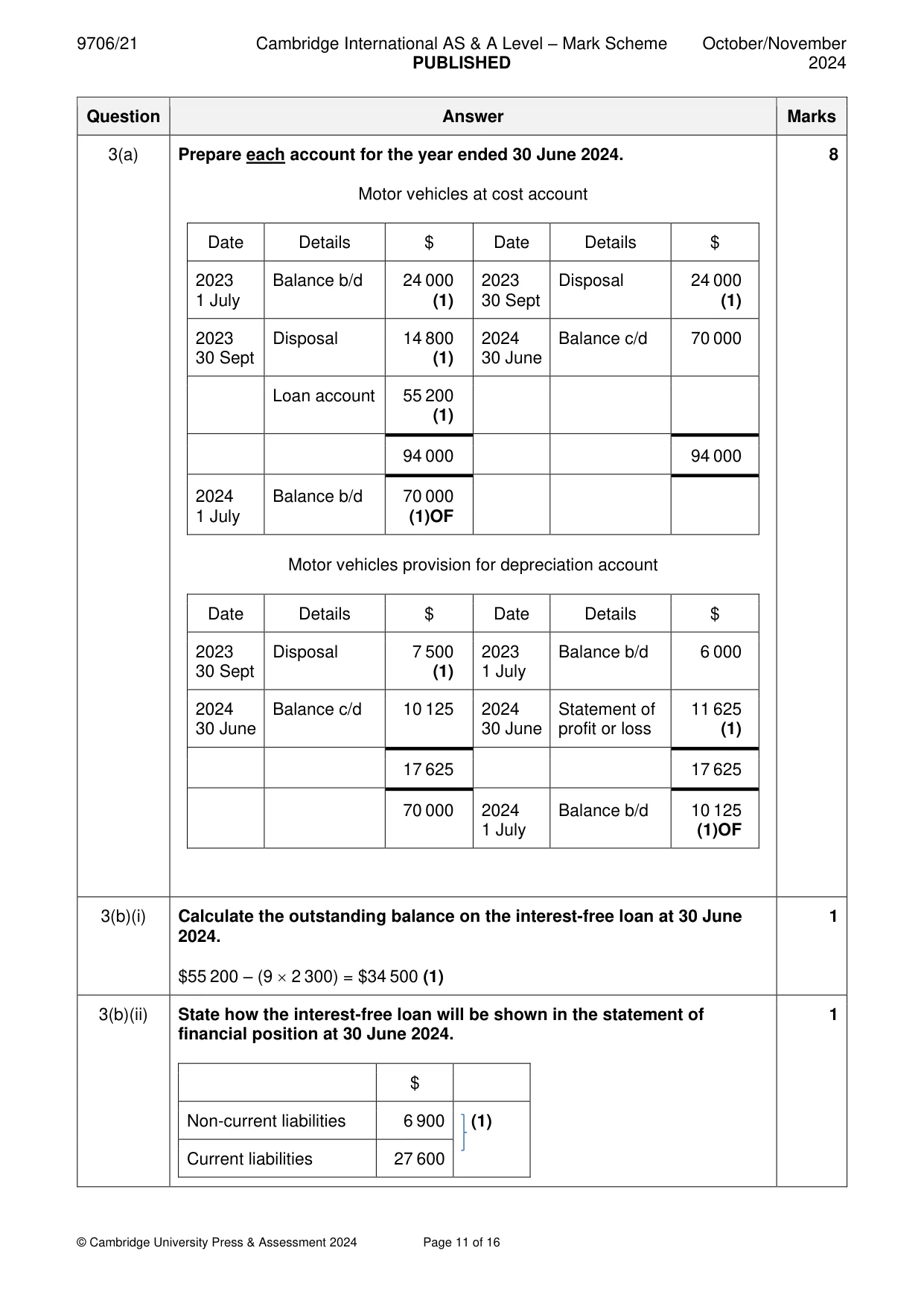
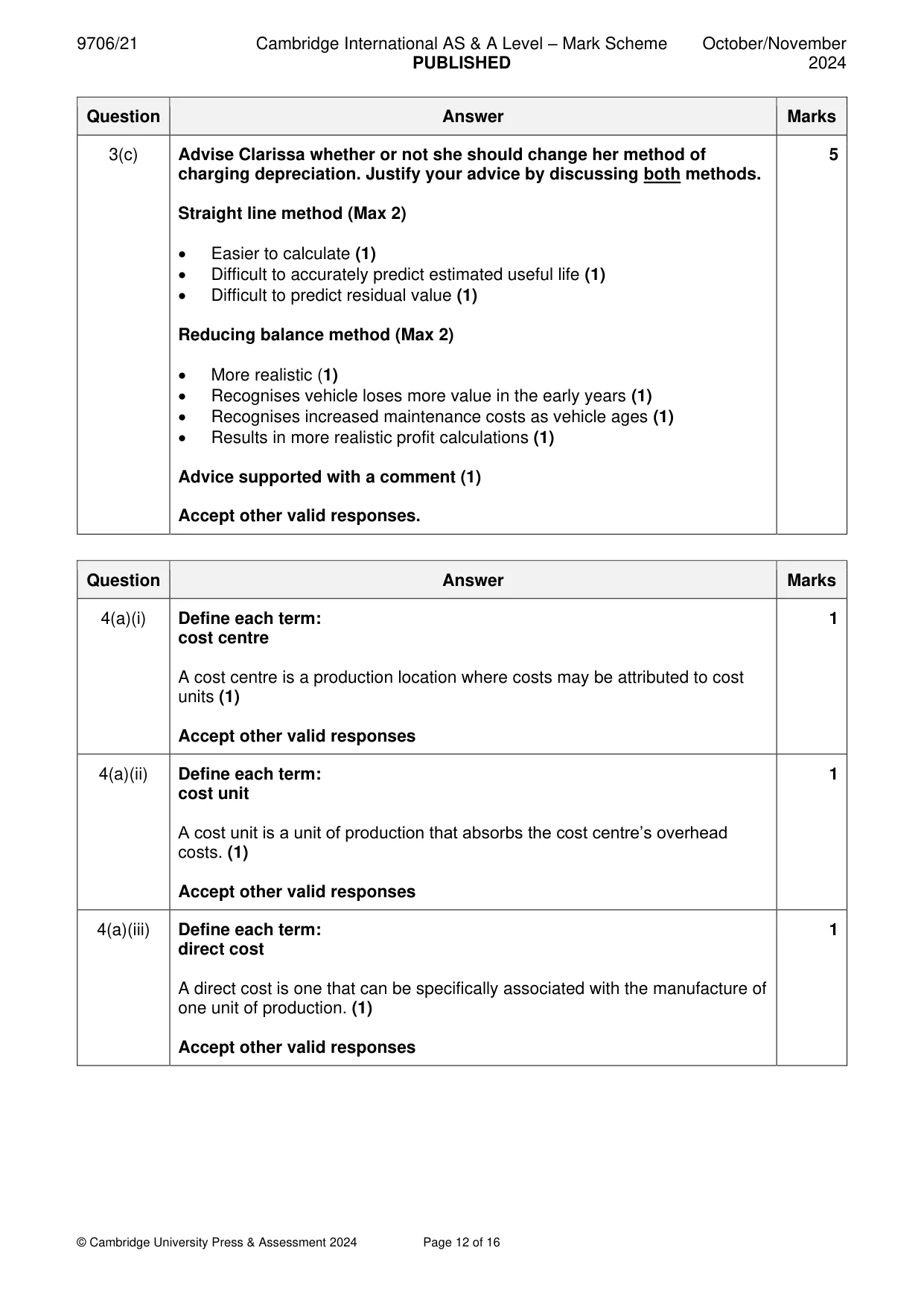
Mark scheme: 3(a) Prepare each account for the year ended 30 June 2024. 8 Motor vehicles at cost account Date Details $ Date Details $ 2023 Balance b/d 24 000 2023 Disposal 24 000 1 July (1) 30 Sept (1) 2023 Disposal 14 800 2024 Balance c/d 70 000 30 Sept (1) 30 June Loan account 55 200 (1) 94 000 94 000 2024 Balance b/d 70 000 1 July (1)OF Motor vehicles provision for depreciation account Date Details $ Date Details $ 2023 Disposal 7 500 2023 Balance b/d 6 000 30 Sept (1) 1 July 2024 Balance c/d 10 125 2024 Statement of 11 625 30 June 30 June profit or loss (1) 17 625 17 625 70 000 2024 Balance b/d 10 125 1 July (1)OF 3(b)(i) Calculate the outstanding balance on the interest-free loan at 30 June 1 2024. $55 200 – (9 2 300) = $34 500 (1) 3(b)(ii) State how the interest-free loan will be shown in the statement of 1 financial position at 30 June 2024. $ Non-current liabilities 6 900 (1) Current liabilities 27 600 3(c) Advise Clarissa whether or not she should change her method of 5 charging depreciation. Justify your advice by discussing both methods. Straight line method (Max 2) • Easier to calculate (1) • Difficult to accurately predict estimated useful life (1) • Difficult to predict residual value (1) Reducing balance method (Max 2) • More realistic (1) • Recognises vehicle loses more value in the early years (1) • Recognises increased maintenance costs as vehicle ages (1) • Results in more realistic profit calculations (1) Advice supported with a comment (1) Accept other valid responses.
Q4 · Alberto owns a manufacturing business
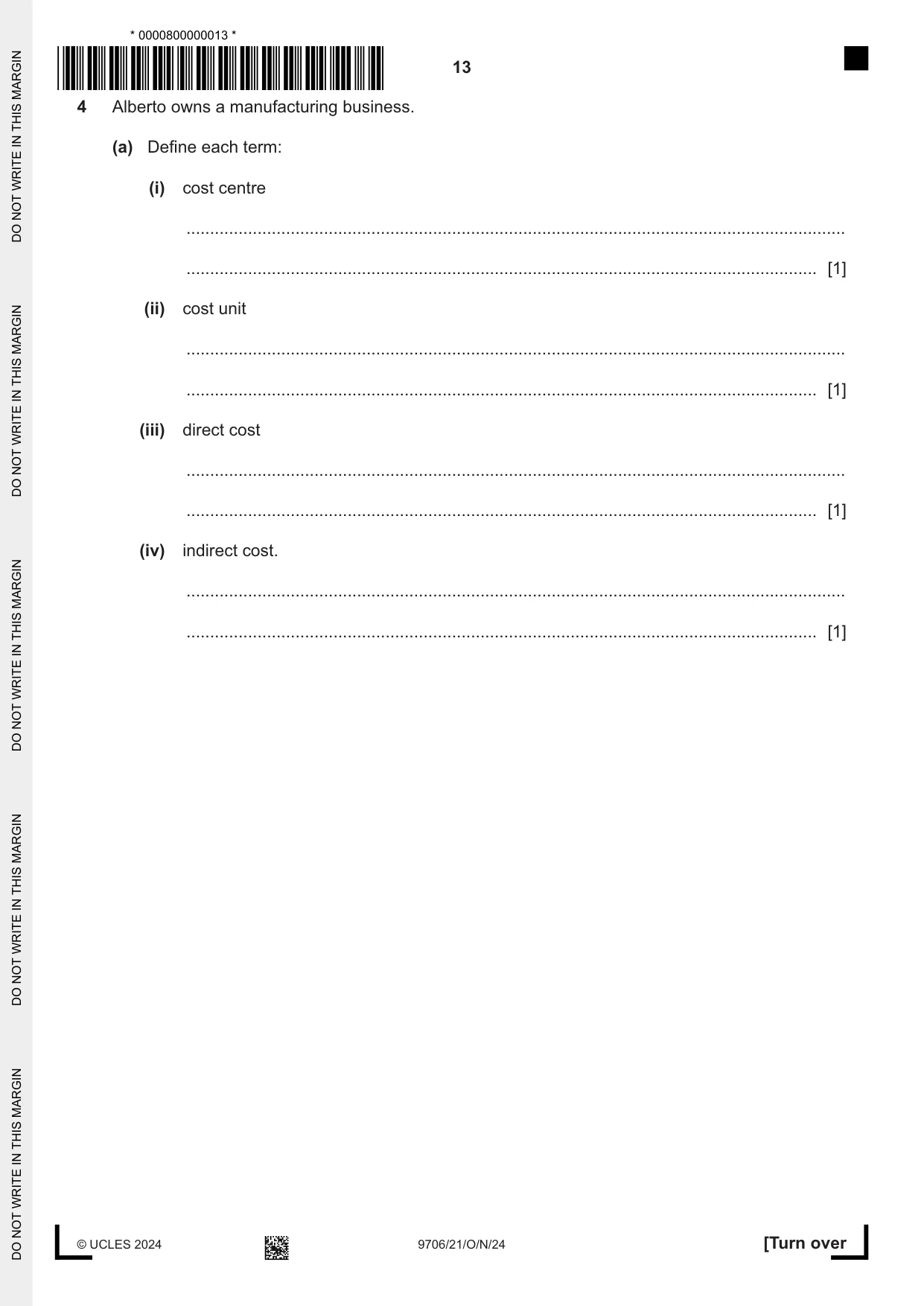
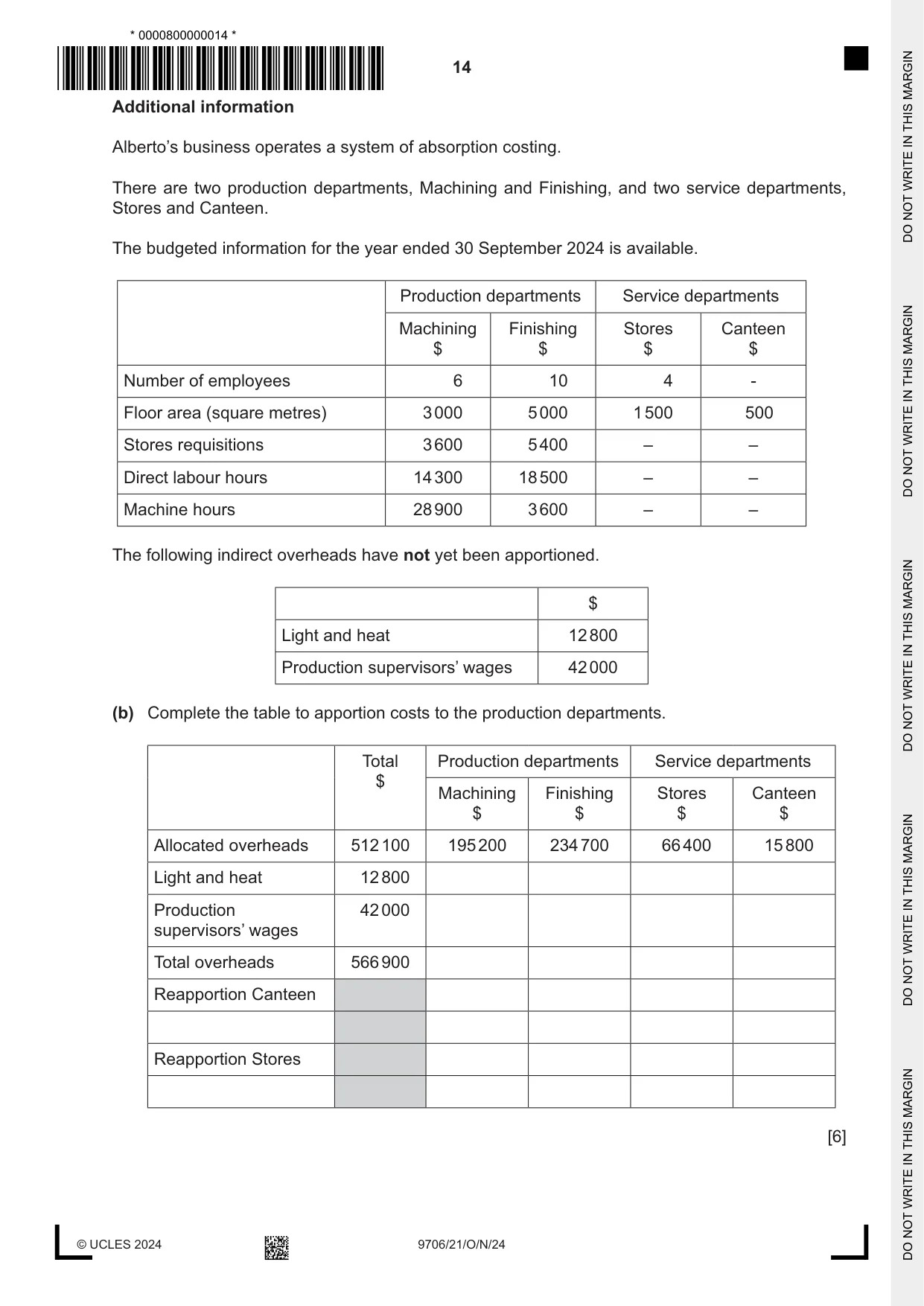
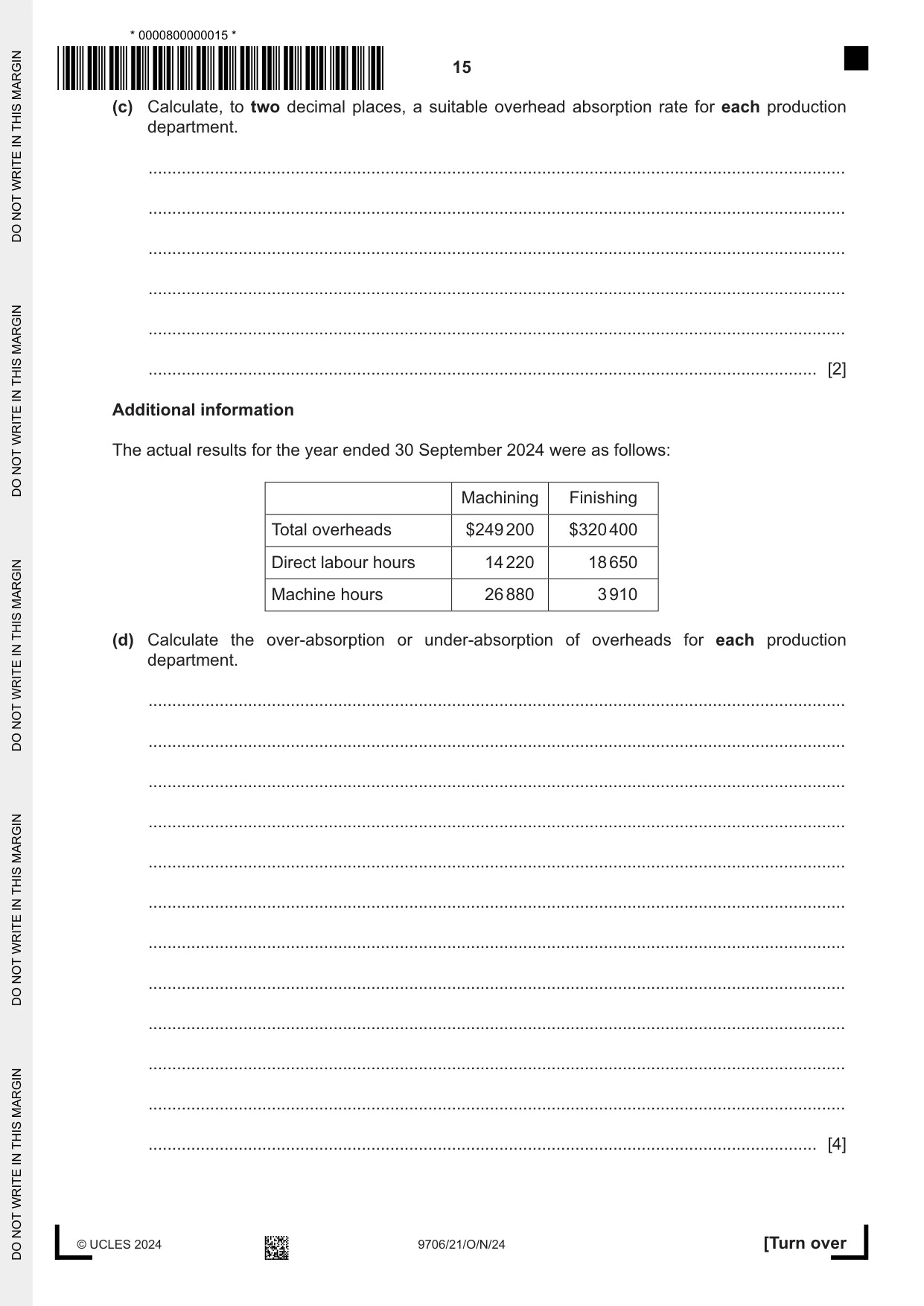
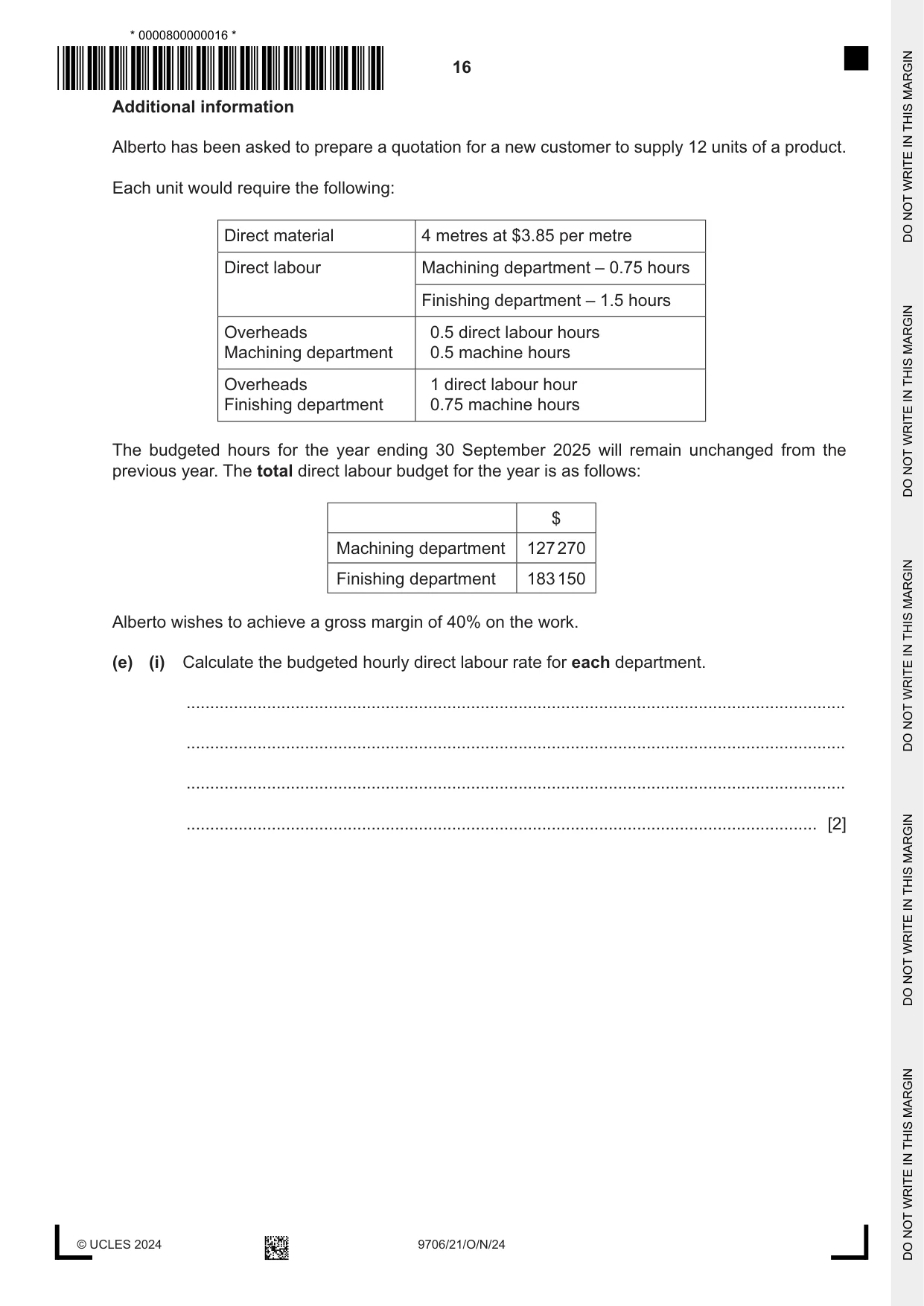
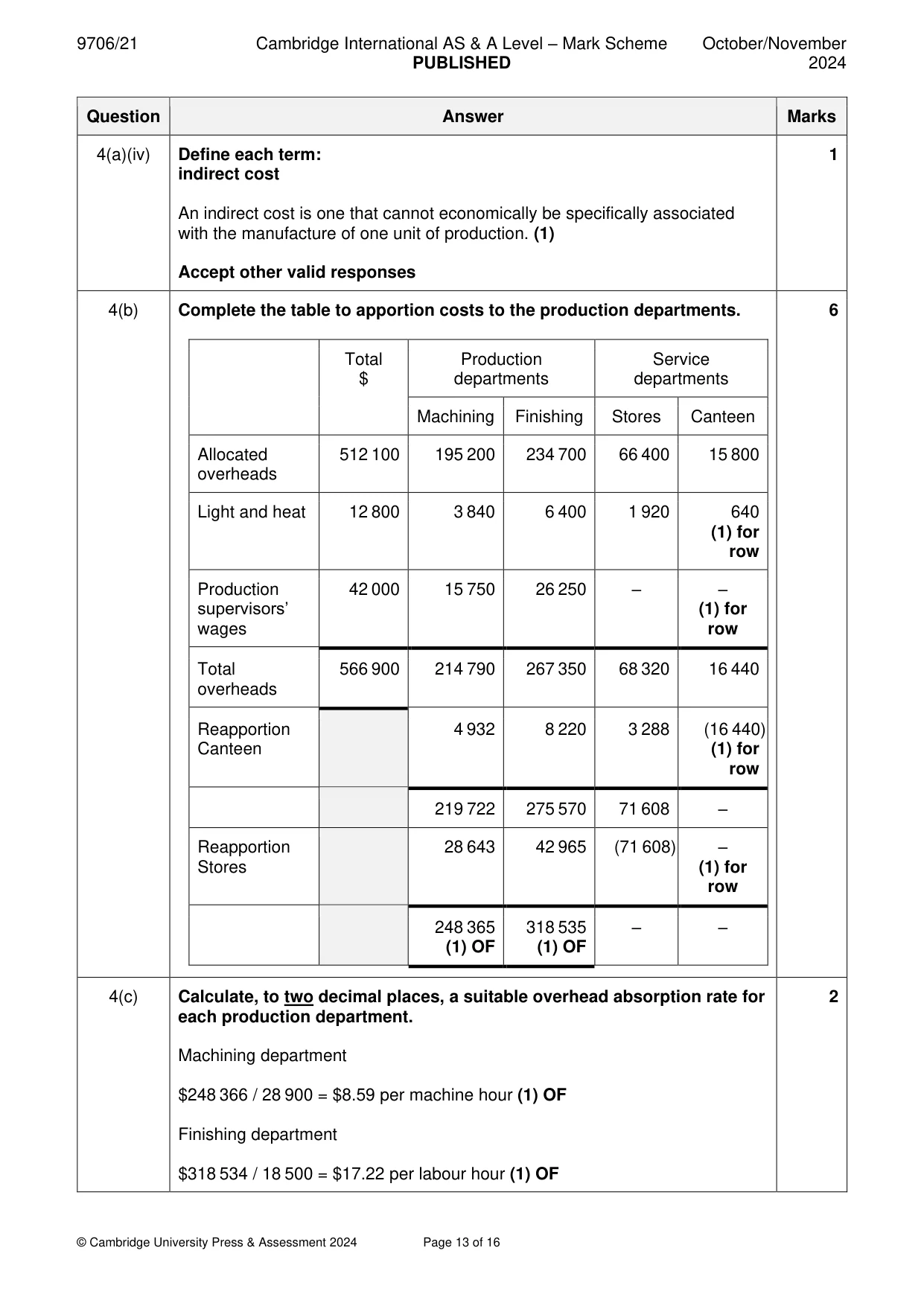
4 Alberto owns a manufacturing business. (a) Define each term: (i) cost centre ........................................................................................................................................... ..................................................................................................................................... [1] (ii) cost unit ........................................................................................................................................... ..................................................................................................................................... [1] (iii) direct cost ........................................................................................................................................... ..................................................................................................................................... [1] (iv) indirect cost. ........................................................................................................................................... ..................................................................................................................................... [1] Additional information Alberto’s business operates a system of absorption costing. There are two production departments, Machining and Finishing, and two service departments, Stores and Canteen. The budgeted information for the year ended 30 September 2024 is available. Production departments Service departments Machining Finishing Stores Canteen $ $ $ $ Number of employees 6 10 4 - Floor area (square metres) 3 000 5 000 1 500 500 Stores requisitions 3 600 5 400 – – Direct labour hours 14 300 18 500 – – Machine hours 28 900 3 600 – – The following indirect overheads have not yet been apportioned. $ Light and heat 12 800 Production supervisors’ wages 42 000 (b) Complete the table to apportion costs to the production departments. Total Production departments Service departments $ Machining Finishing Stores Canteen $ $ $ $ Allocated overheads 512 100 195 200 234 700 66 400 15 800 Light and heat 12 800 Production 42 000 supervisors’ wages Total overheads 566 900 Reapportion Canteen Reapportion Stores [6] (c) Calculate, to two decimal places, a suitable overhead absorption rate for each production department. ................................................................................................................................................... ................................................................................................................................................... ................................................................................................................................................... ................................................................................................................................................... ................................................................................................................................................... ............................................................................................................................................. [2] Additional information The actual results for the year ended 30 September 2024 were as follows: Machining Finishing Total overheads $249 200 $320 400 Direct labour hours 14 220 18 650 Machine hours 26 880 3 910 (d) Calculate the over-absorption or under-absorption of overheads for each production department. ................................................................................................................................................... ................................................................................................................................................... ................................................................................................................................................... ................................................................................................................................................... ................................................................................................................................................... ................................................................................................................................................... ................................................................................................................................................... ................................................................................................................................................... ................................................................................................................................................... ................................................................................................................................................... ................................................................................................................................................... ............................................................................................................................................. [4]
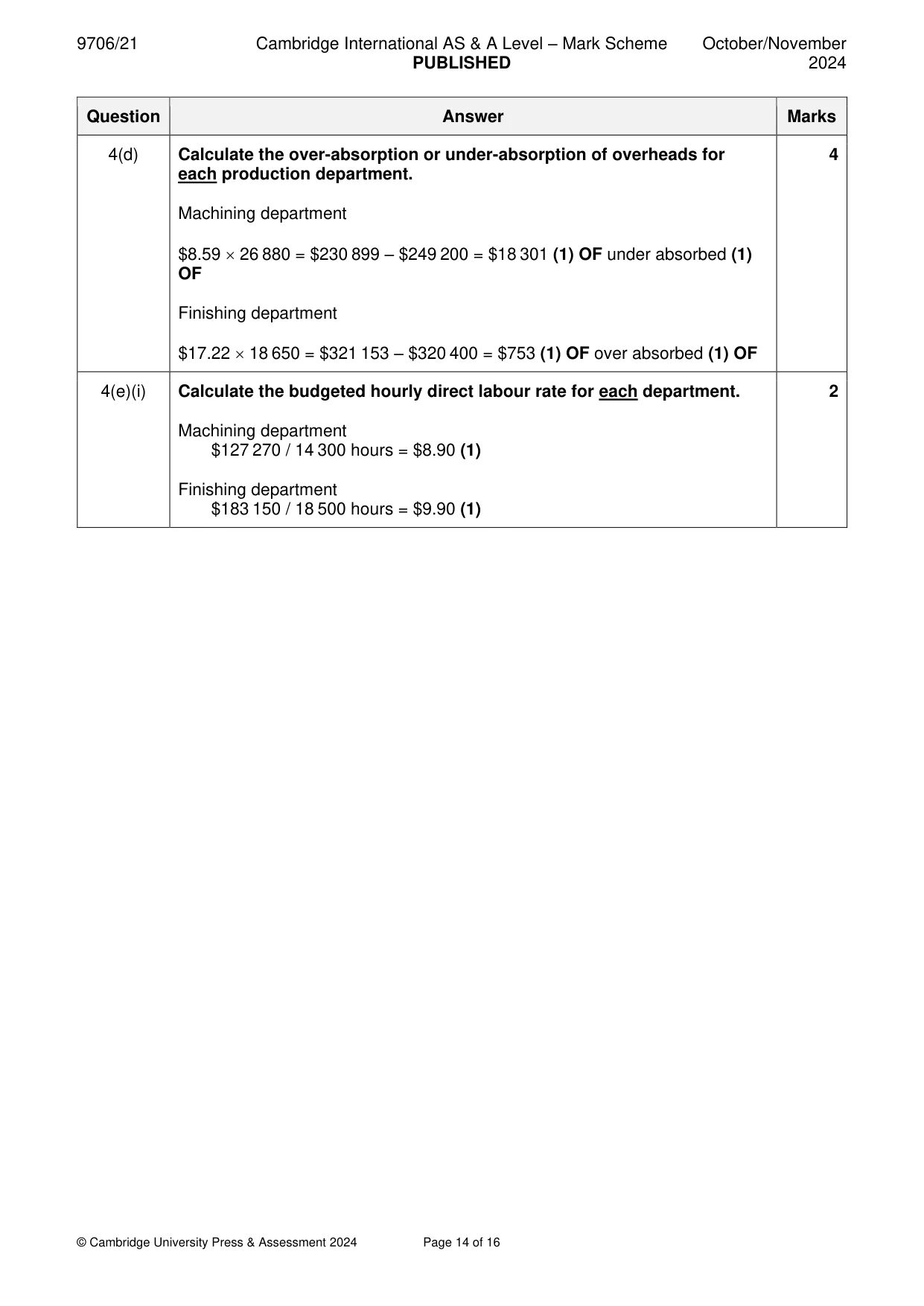
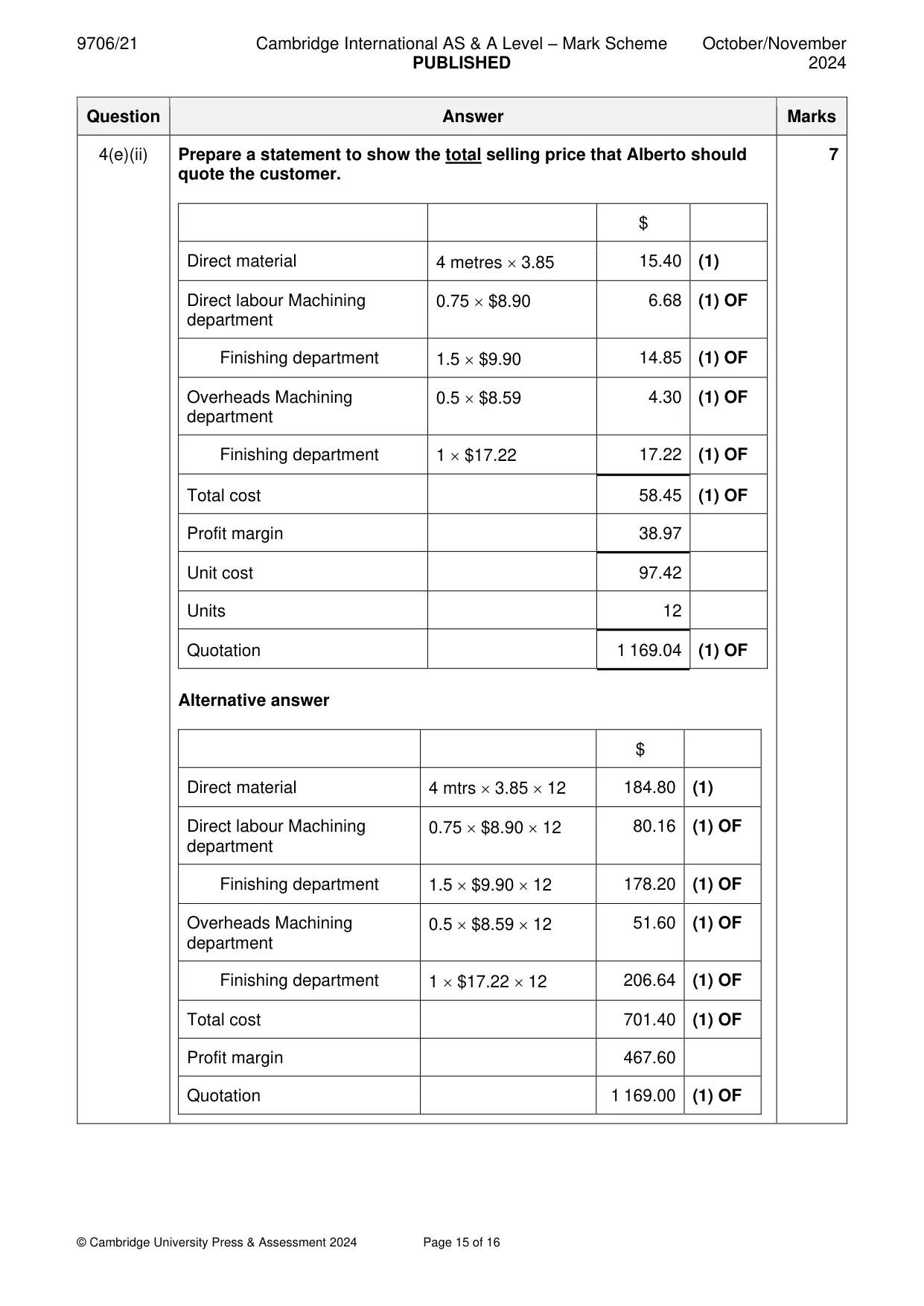
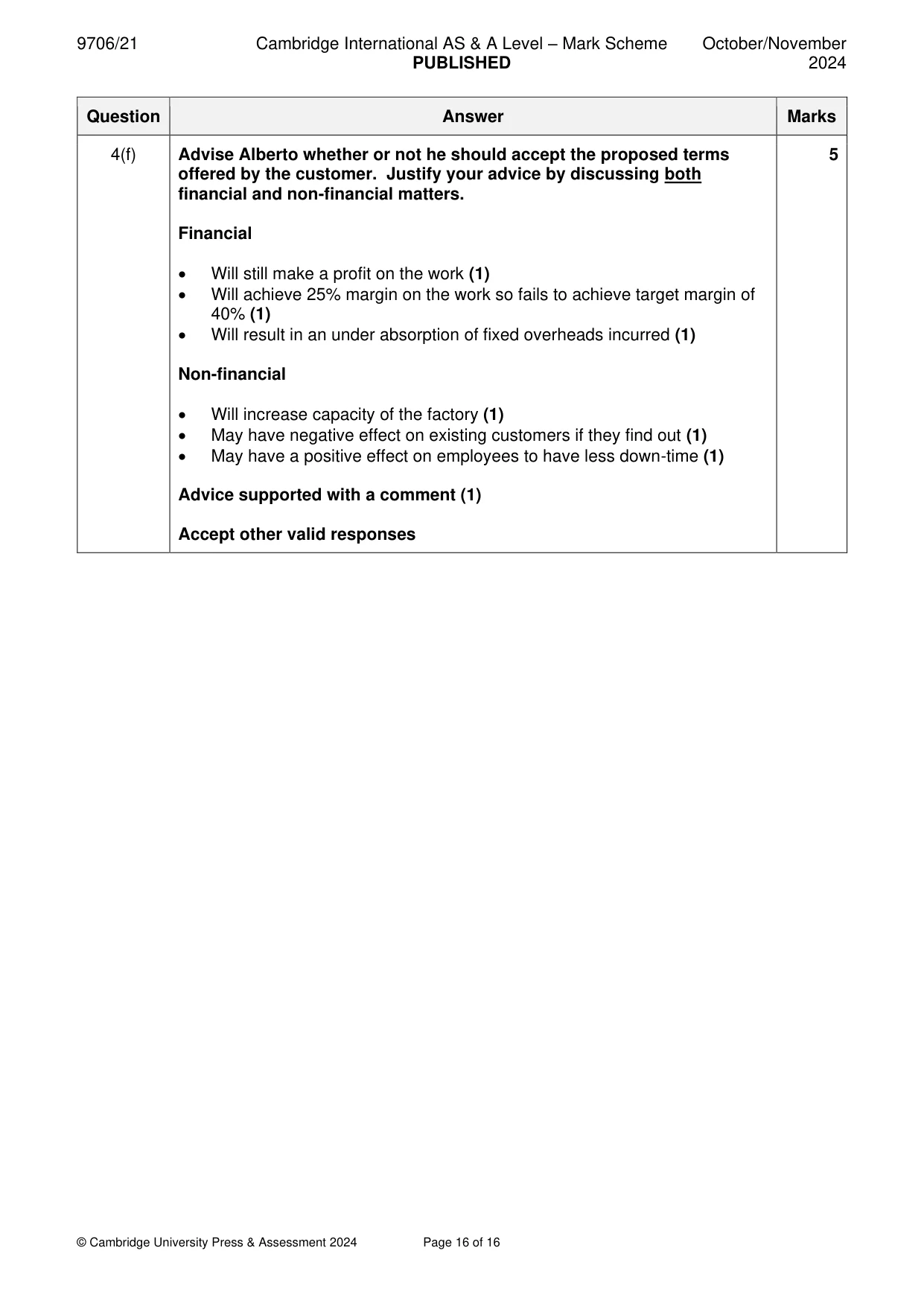
Mark scheme: 4(a)(i) Define each term: 1 cost centre A cost centre is a production location where costs may be attributed to cost units (1) Accept other valid responses 4(a)(ii) Define each term: 1 cost unit A cost unit is a unit of production that absorbs the cost centre’s overhead costs. (1) Accept other valid responses 4(a)(iii) Define each term: 1 direct cost A direct cost is one that can be specifically associated with the manufacture of one unit of production. (1) Accept other valid responses 4(a)(iv) Define each term: 1 indirect cost An indirect cost is one that cannot economically be specifically associated with the manufacture of one unit of production. (1) Accept other valid responses 4(b) Complete the table to apportion costs to the production departments. 6 Total Production Service $ departments departments Machining Finishing Stores Canteen Allocated 512 100 195 200 234 700 66 400 15 800 overheads Light and heat 12 800 3 840 6 400 1 920 640 (1) for row Production 42 000 15 750 26 250 – – supervisors’ (1) for wages row Total 566 900 214 790 267 350 68 320 16 440 overheads Reapportion 4 932 8 220 3 288 (16 440) Canteen (1) for row 219 722 275 570 71 608 – Reapportion 28 643 42 965 (71 608) – Stores (1) for row 248 365 318 535 – – (1) OF (1) OF 4(c) Calculate, to two decimal places, a suitable overhead absorption rate for 2 each production department. Machining department $248 366 / 28 900 = $8.59 per machine hour (1) OF Finishing department $318 534 / 18 500 = $17.22 per labour hour (1) OF 4(d) Calculate the over-absorption or under-absorption of overheads for 4 each production department. Machining department $8.59 26 880 = $230 899 – $249 200 = $18 301 (1) OF under absorbed (1) OF Finishing department $17.22 18 650 = $321 153 – $320 400 = $753 (1) OF over absorbed (1) OF 4(e)(i) Calculate the budgeted hourly direct labour rate for each department. 2 Machining department $127 270 / 14 300 hours = $8.90 (1) Finishing department $183 150 / 18 500 hours = $9.90 (1) 4(e)(ii) Prepare a statement to show the total selling price that Alberto should 7 quote the customer. $ Direct material 4 metres 3.85 15.40 (1) Direct labour Machining 0.75 $8.90 6.68 (1) OF department Finishing department 1.5 $9.90 14.85 (1) OF Overheads Machining 0.5 $8.59 4.30 (1) OF department Finishing department 1 $17.22 17.22 (1) OF Total cost 58.45 (1) OF Profit margin 38.97 Unit cost 97.42 Units 12 Quotation 1 169.04 (1) OF Alternative answer $ Direct material 4 mtrs 3.85 12 184.80 (1) Direct labour Machining 0.75 $8.90 12 80.16 (1) OF department Finishing department 1.5 $9.90 12 178.20 (1) OF Overheads Machining 0.5 $8.59 12 51.60 (1) OF department Finishing department 1 $17.22 12 206.64 (1) OF Total cost 701.40 (1) OF Profit margin 467.60 Quotation 1 169.00 (1) OF 4(f) Advise Alberto whether or not he should accept the proposed terms 5 offered by the customer. Justify your advice by discussing both financial and non-financial matters. Financial • Will still make a profit on the work (1) • Will achieve 25% margin on the work so fails to achieve target margin of 40% (1) • Will result in an under absorption of fixed overheads incurred (1) Non-financial • Will increase capacity of the factory (1) • May have negative effect on existing customers if they find out (1) • May have a positive effect on employees to have less down-time (1) Advice supported with a comment (1) Accept other valid responses
What was in this paper
The subtopics covered by these 4 questions, and how many questions each got. Open one in a new tab to see every Cambridge question on it.
What you needed in this session
Cambridge’s own grade thresholds for 2024 Oct/Nov, Paper 2 · Variant 1. A higher threshold means an easier paper — the bar moves with how the cohort did.