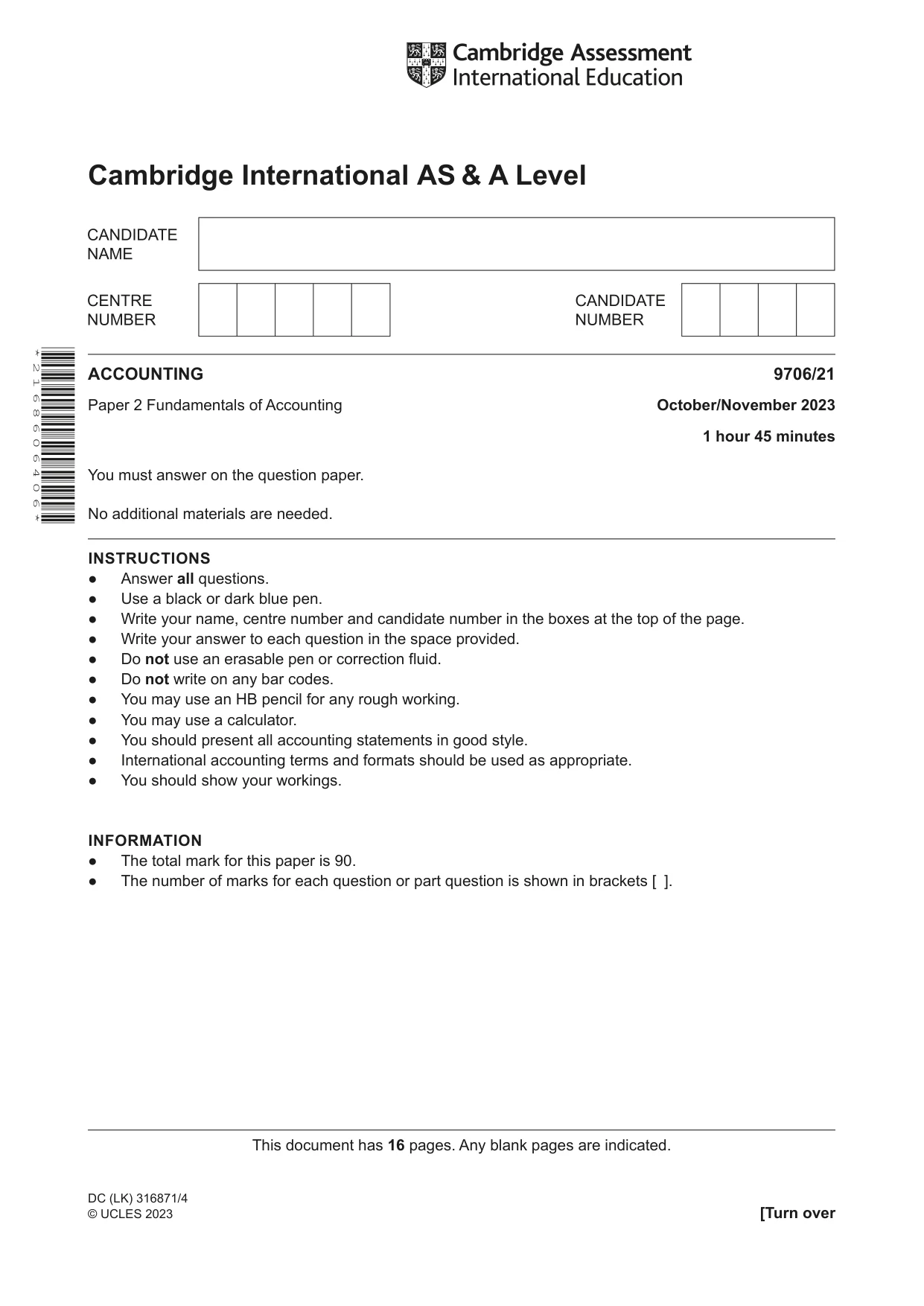
Cambridge A Level Accounting 9706 — 2023 Oct/Nov Paper 2 · Variant 1
9706/21/O/N/23 · 4 questions · 90 marks · ≈101 min
The question paper and its mark scheme, free to read here and free to download. This is Cambridge’s own paper, exactly as it was sat.
Question paper16 pages
Mark scheme21 pages
Answers below. Sit the paper first if you are practising.
Questions as text
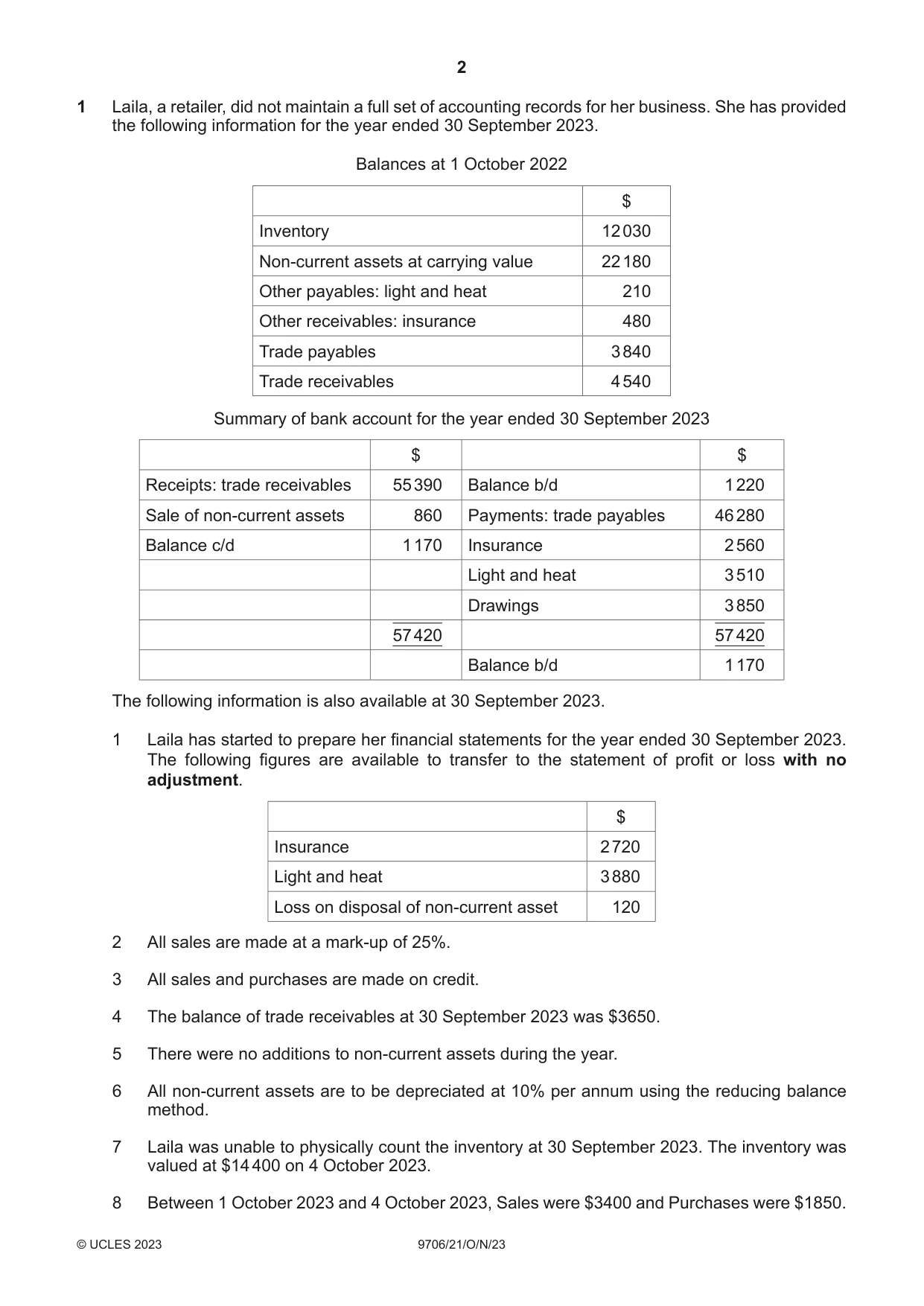
Q1 · Laila, a retailer, did not maintain a full set of accounting records for her business
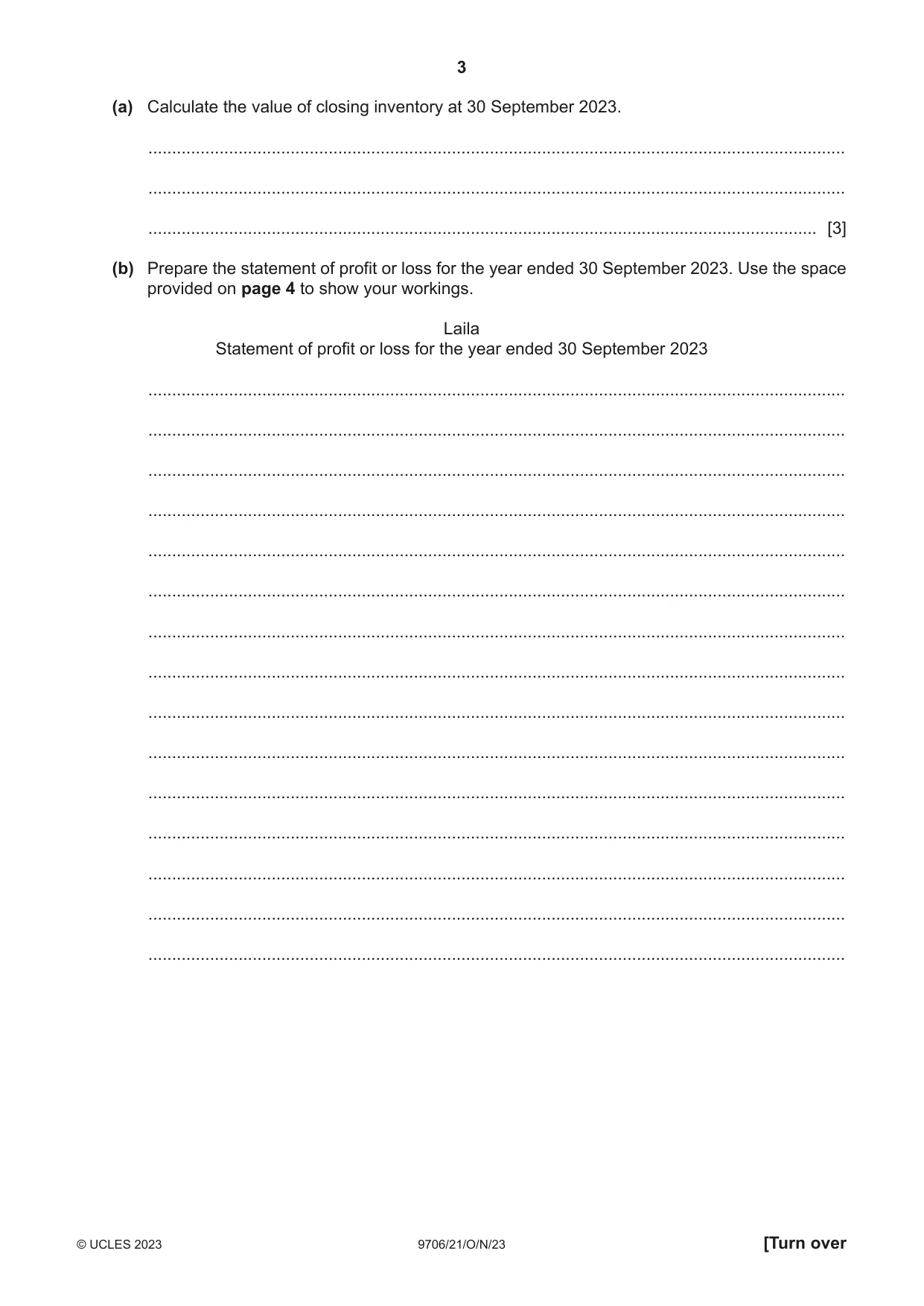
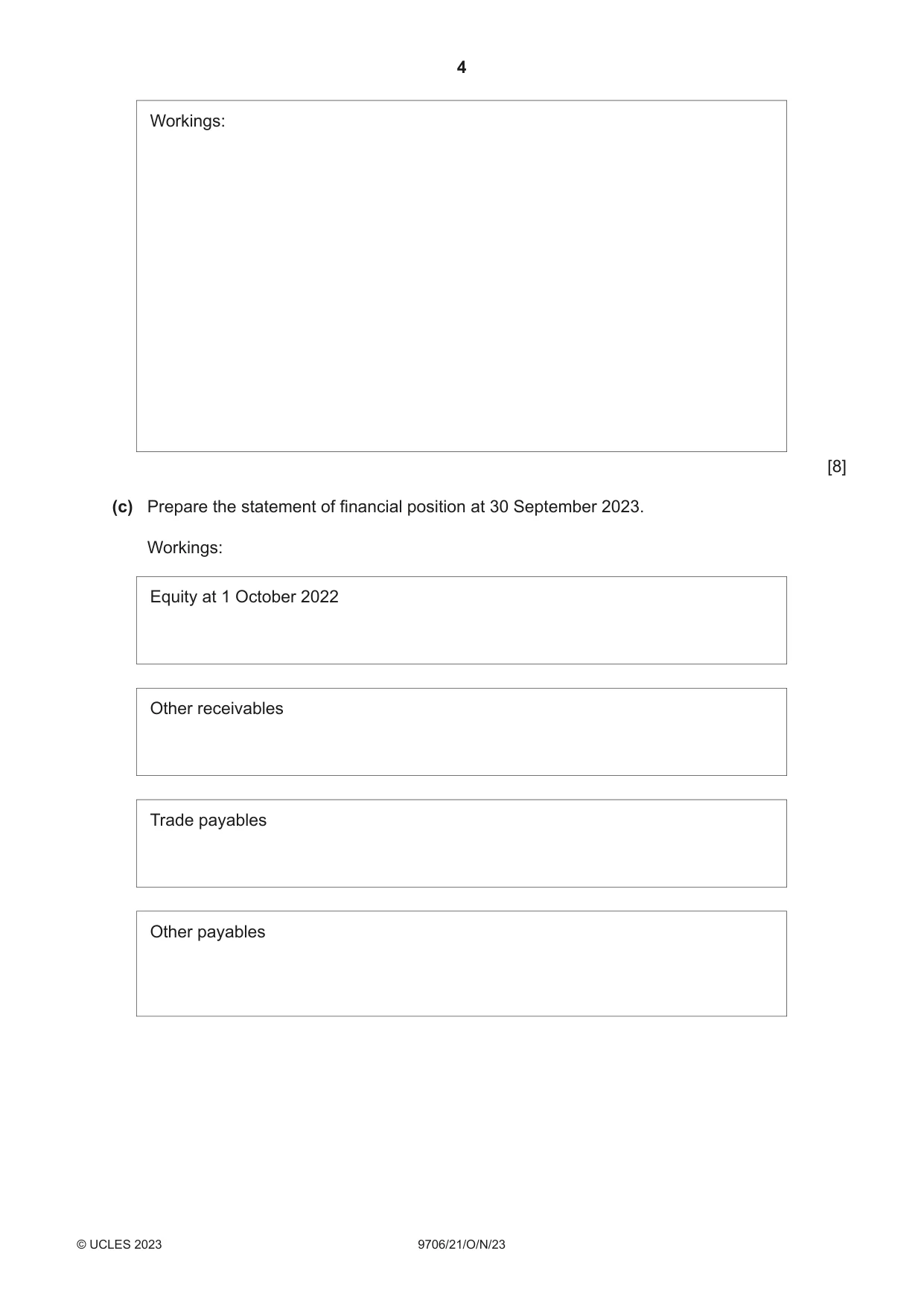
1 Laila, a retailer, did not maintain a full set of accounting records for her business. She has provided the following information for the year ended 30 September 2023. Balances at 1 October 2022 $ Inventory 12 030 Non-current assets at carrying value 22 180 Other payables: light and heat 210 Other receivables: insurance 480 Trade payables 3 840 Trade receivables 4 540 Summary of bank account for the year ended 30 September 2023 $ $ Receipts: trade receivables 55 390 Balance b/d 1 220 Sale of non-current assets 860 Payments: trade payables 46 280 Balance c/d 1 170 Insurance 2 560 Light and heat 3 510 Drawings 3 850 57 420 57 420 Balance b/d 1 170 The following information is also available at 30 September 2023. 1 Laila has started to prepare her financial statements for the year ended 30 September 2023. The following figures are available to transfer to the statement of profit or loss with no adjustment. $ Insurance 2 720 Light and heat 3 880 Loss on disposal of non-current asset 120 2 All sales are made at a mark-up of 25%. 3 All sales and purchases are made on credit. 4 The balance of trade receivables at 30 September 2023 was $3650. 5 There were no additions to non-current assets during the year. 6 All non-current assets are to be depreciated at 10% per annum using the reducing balance method. 7 Laila was unable to physically count the inventory at 30 September 2023. The inventory was valued at $14 400 on 4 October 2023. 8 Between 1 October 2023 and 4 October 2023, Sales were $3400 and Purchases were $1850. (a) Calculate the value of closing inventory at 30 September 2023. ................................................................................................................................................... ................................................................................................................................................... ............................................................................................................................................. [3] (b) Prepare the statement of profit or loss for the year ended 30 September 2023. Use the space provided on page 4 to show your workings. Laila Statement of profit or loss for the year ended 30 September 2023 ................................................................................................................................................... ................................................................................................................................................... ................................................................................................................................................... ................................................................................................................................................... ................................................................................................................................................... ................................................................................................................................................... ................................................................................................................................................... ................................................................................................................................................... ................................................................................................................................................... ................................................................................................................................................... ................................................................................................................................................... ................................................................................................................................................... ................................................................................................................................................... ................................................................................................................................................... ................................................................................................................................................... Workings: [8] (c) Prepare the statement of financial position at 30 September 2023. Workings: Equity at 1 October 2022 Other receivables Trade payables Other payables Laila Statement of financial position at 30 September 2023 ................................................................................................................................................... ................................................................................................................................................... ................................................................................................................................................... ................................................................................................................................................... ................................................................................................................................................... ................................................................................................................................................... ................................................................................................................................................... ................................................................................................................................................... ................................................................................................................................................... ................................................................................................................................................... ................................................................................................................................................... ................................................................................................................................................... ................................................................................................................................................... ................................................................................................................................................... ................................................................................................................................................... ................................................................................................................................................... ................................................................................................................................................... ................................................................................................................................................... ................................................................................................................................................... ................................................................................................................................................... ................................................................................................................................................... ................................................................................................................................................... ................................................................................................................................................... ................................................................................................................................................... ................................................................................................................................................... ........................................................................................................................................... [12] Additional information Laila wishes to expand the business and is considering forming a partnership with her friend. (d) State four provisions of the Partnership Act 1890 that would apply in the absence of a partnership agreement. 1 ................................................................................................................................................ ................................................................................................................................................... 2 ................................................................................................................................................ ................................................................................................................................................... 3 ................................................................................................................................................ ................................................................................................................................................... 4 ................................................................................................................................................ ................................................................................................................................................... [4] (e) State three possible disadvantages to a business of maintaining a full set of accounting records. 1 ................................................................................................................................................ ................................................................................................................................................... 2 ................................................................................................................................................ ................................................................................................................................................... 3 ................................................................................................................................................ ................................................................................................................................................... [3] [Total: 30]
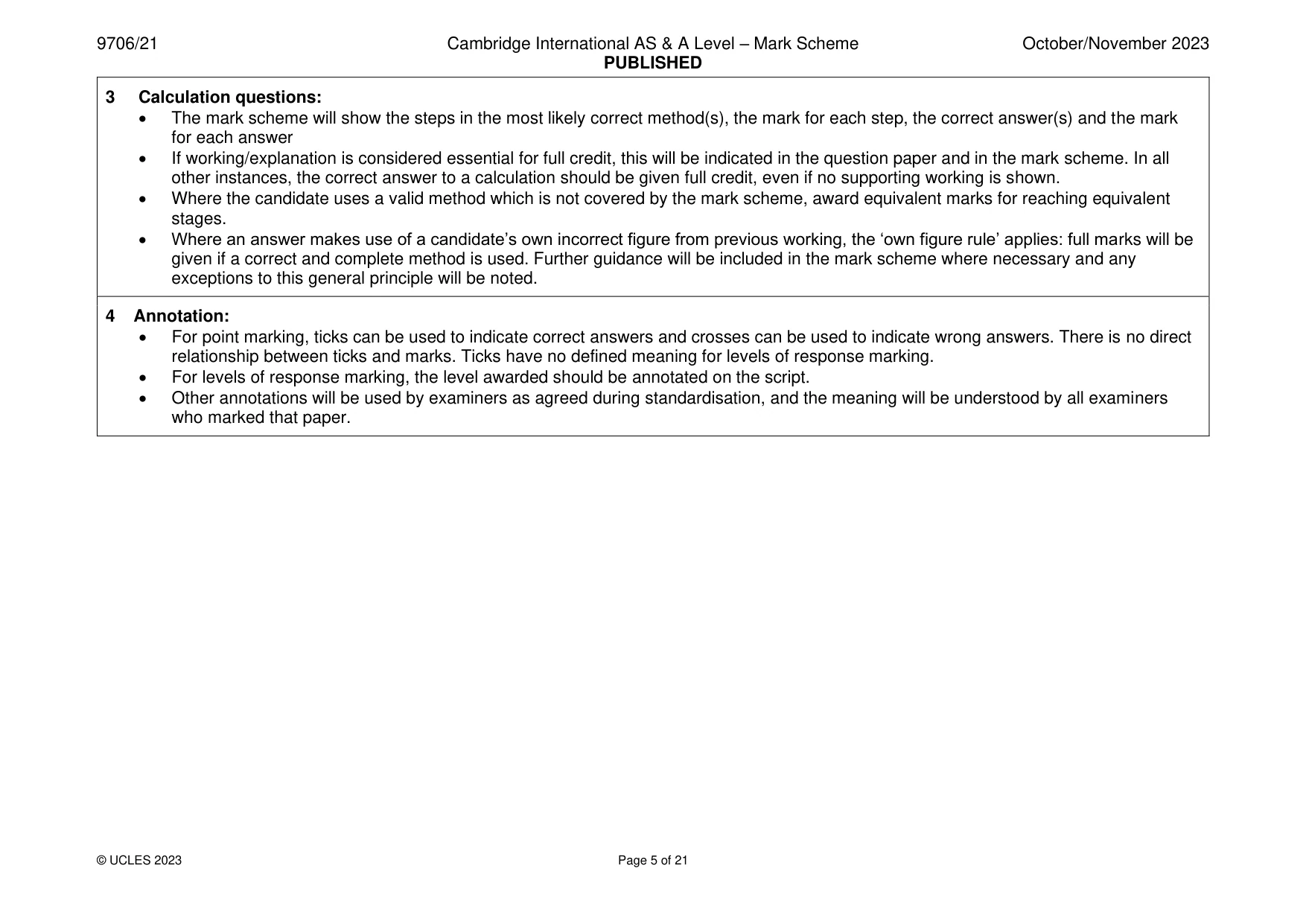
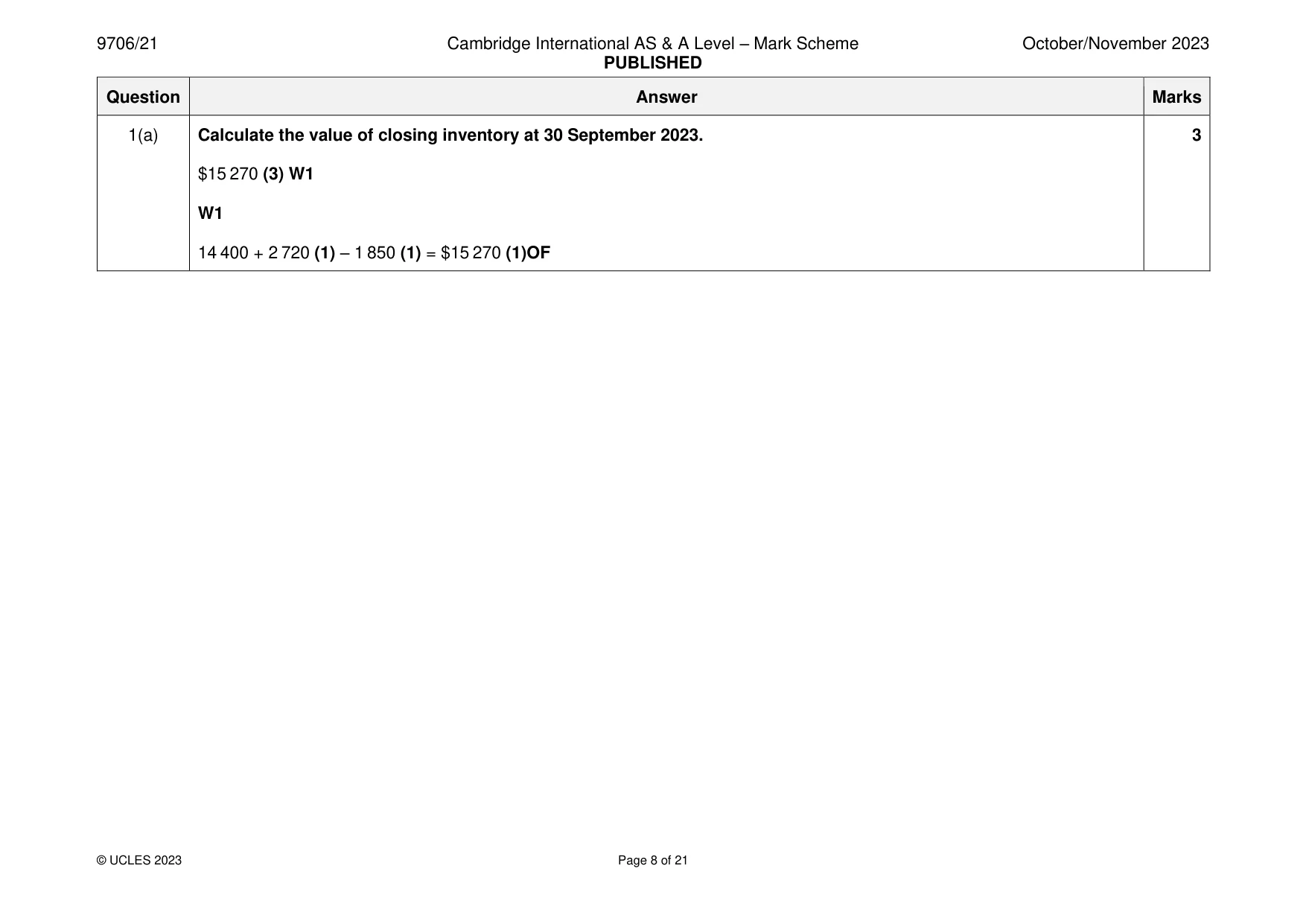
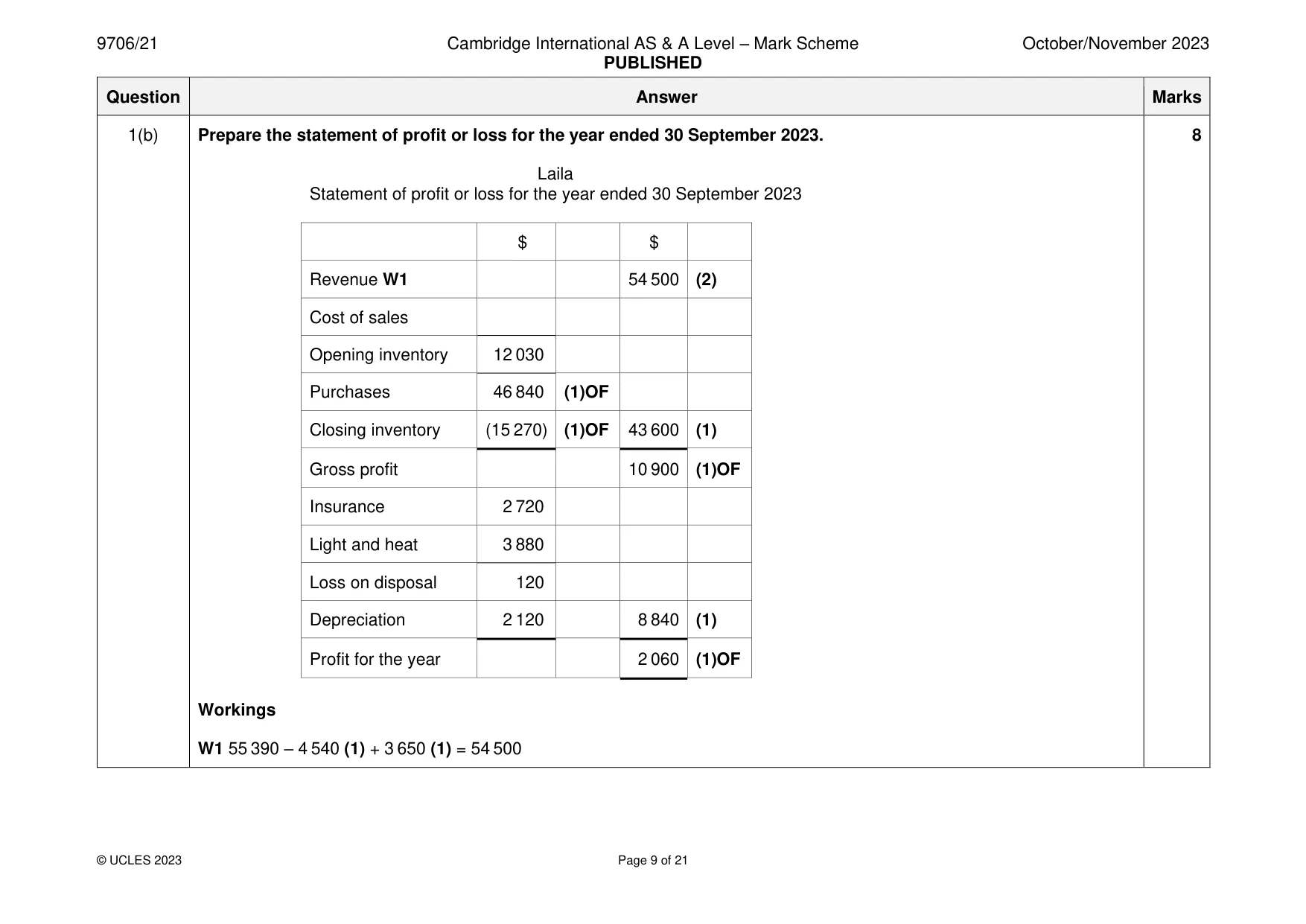
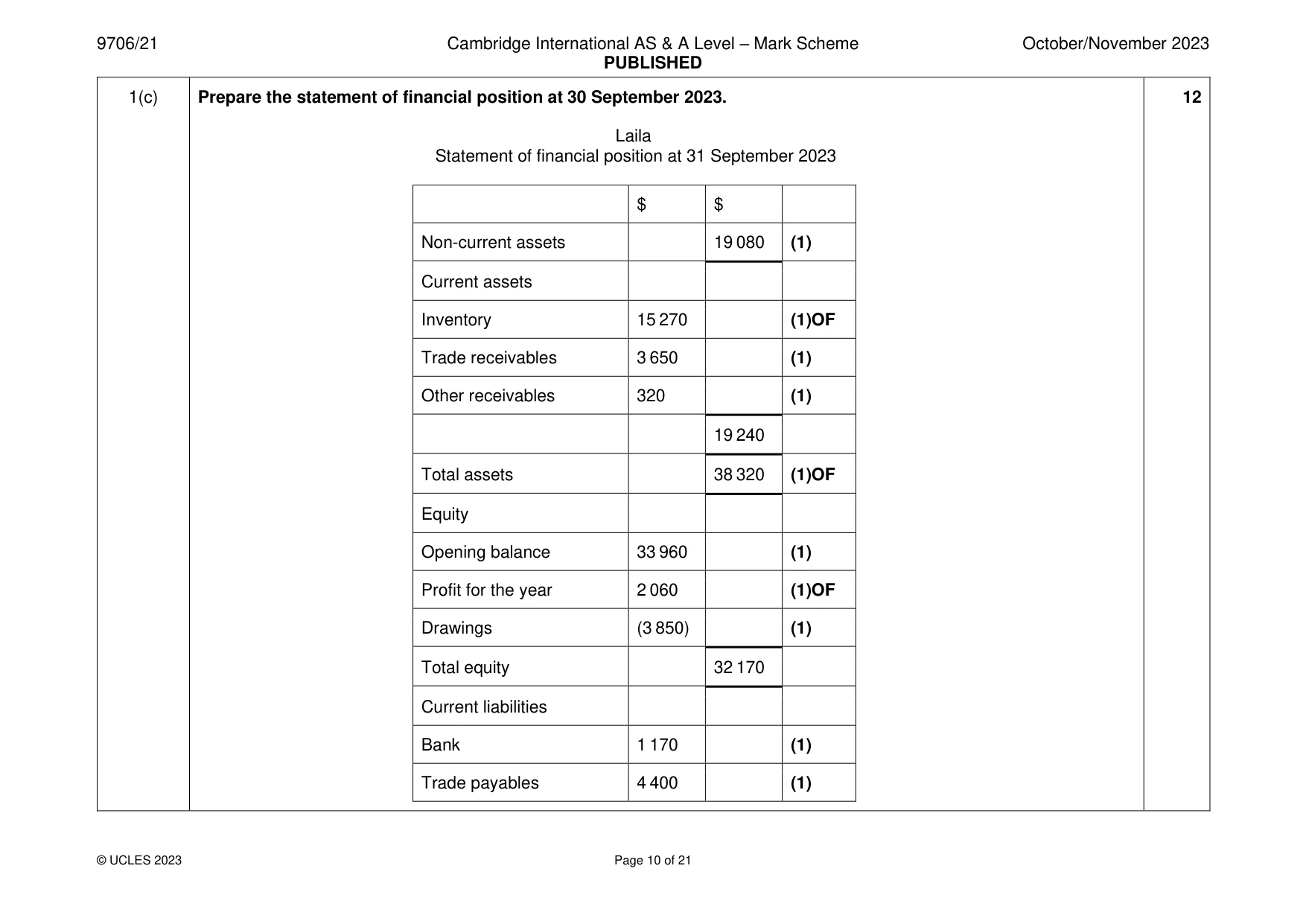
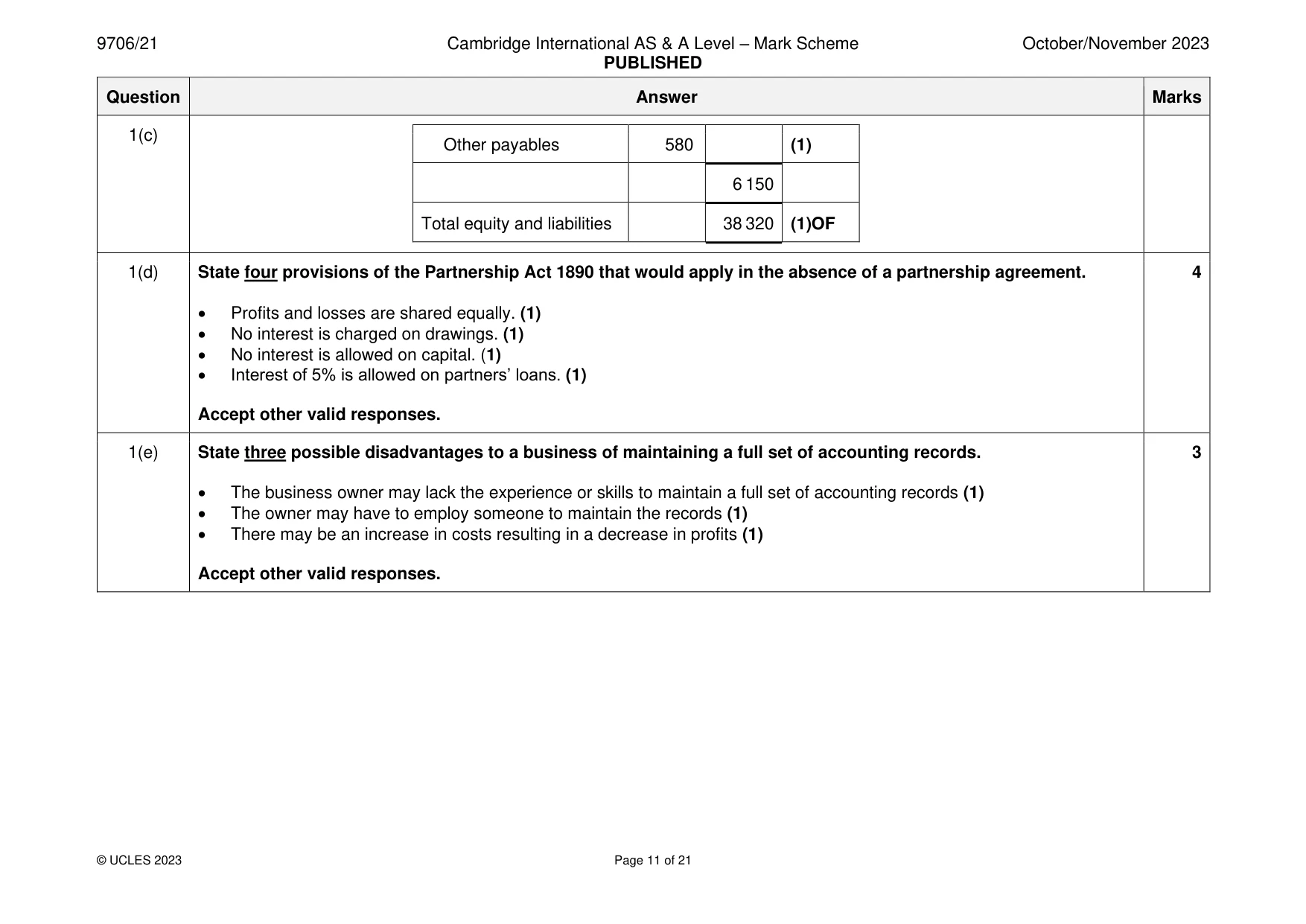
Mark scheme: Question Answer Marks 1(a) Calculate the value of closing inventory at 30 September 2023. 3 $15 270 (3) W1 W1 14 400 + 2 720 (1) – 1 850 (1) = $15 270 (1)OF 1(b) Prepare the statement of profit or loss for the year ended 30 September 2023. 8 Laila Statement of profit or loss for the year ended 30 September 2023 $ $ Revenue W1 54 500 (2) Cost of sales Opening inventory 12 030 Purchases 46 840 (1)OF Closing inventory (15 270) (1)OF 43 600 (1) Gross profit 10 900 (1)OF Insurance 2 720 Light and heat 3 880 Loss on disposal 120 Depreciation 2 120 8 840 (1) Profit for the year 2 060 (1)OF Workings W1 55 390 – 4 540 (1) + 3 650 (1) = 54 500 1(c) Prepare the statement of financial position at 30 September 2023. 12 Laila Statement of financial position at 31 September 2023 $ $ Non-current assets 19 080 (1) Current assets Inventory 15 270 (1)OF Trade receivables 3 650 (1) Other receivables 320 (1) 19 240 Total assets 38 320 (1)OF Equity Opening balance 33 960 (1) Profit for the year 2 060 (1)OF Drawings (3 850) (1) Total equity 32 170 Current liabilities Bank 1 170 (1) Trade payables 4 400 (1) 1(c) Other payables 580 (1) 6 150 Total equity and liabilities 38 320 (1)OF 1(d) State four provisions of the Partnership Act 1890 that would apply in the absence of a partnership agreement. 4 • Profits and losses are shared equally. (1) • No interest is charged on drawings. (1) • No interest is allowed on capital. (1) • Interest of 5% is allowed on partners’ loans. (1) Accept other valid responses. 1(e) State three possible disadvantages to a business of maintaining a full set of accounting records. 3 • The business owner may lack the experience or skills to maintain a full set of accounting records (1) • The owner may have to employ someone to maintain the records (1) • There may be an increase in costs resulting in a decrease in profits (1) Accept other valid responses.
Q2 · Q Limited has been in business for a number of years
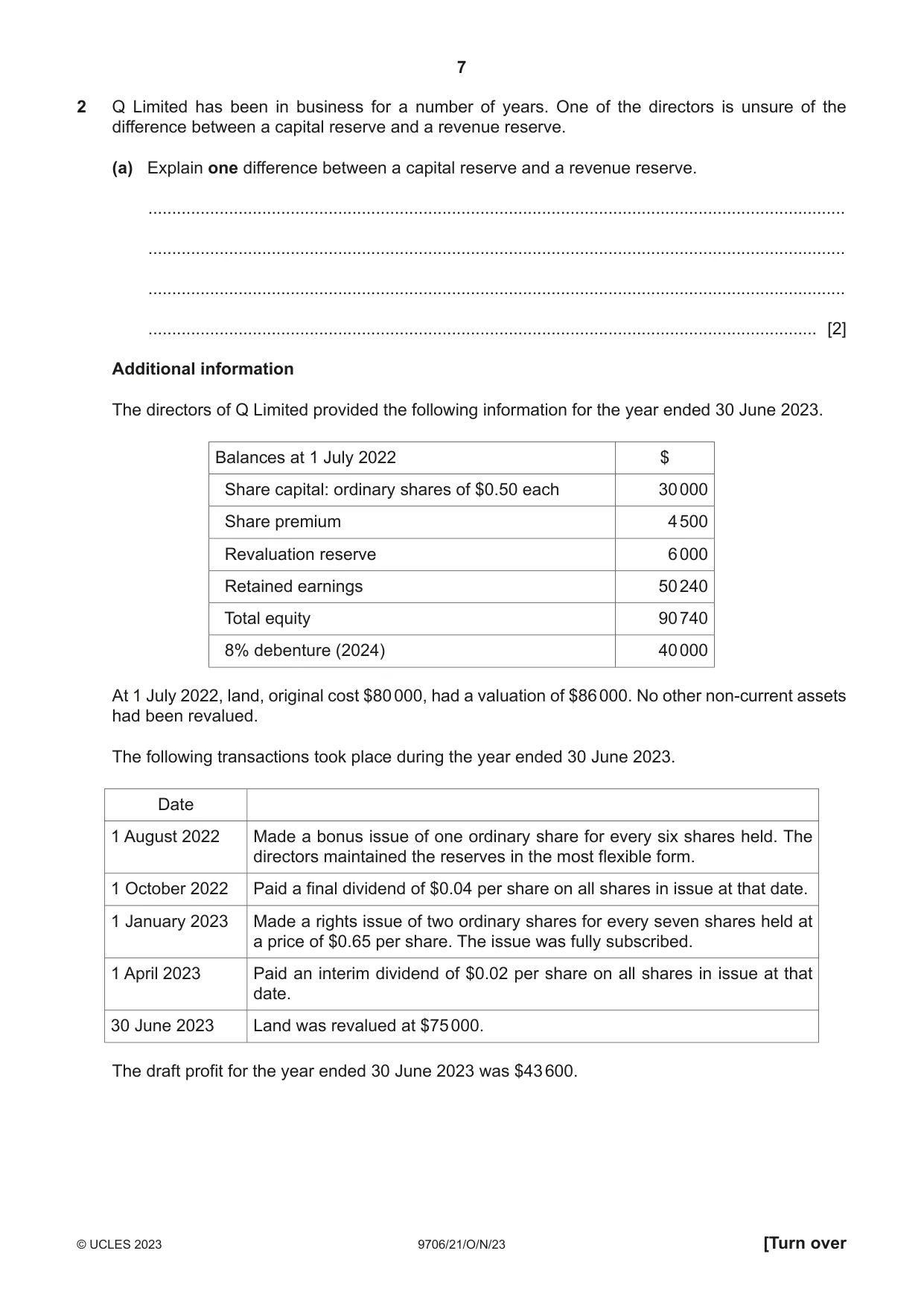
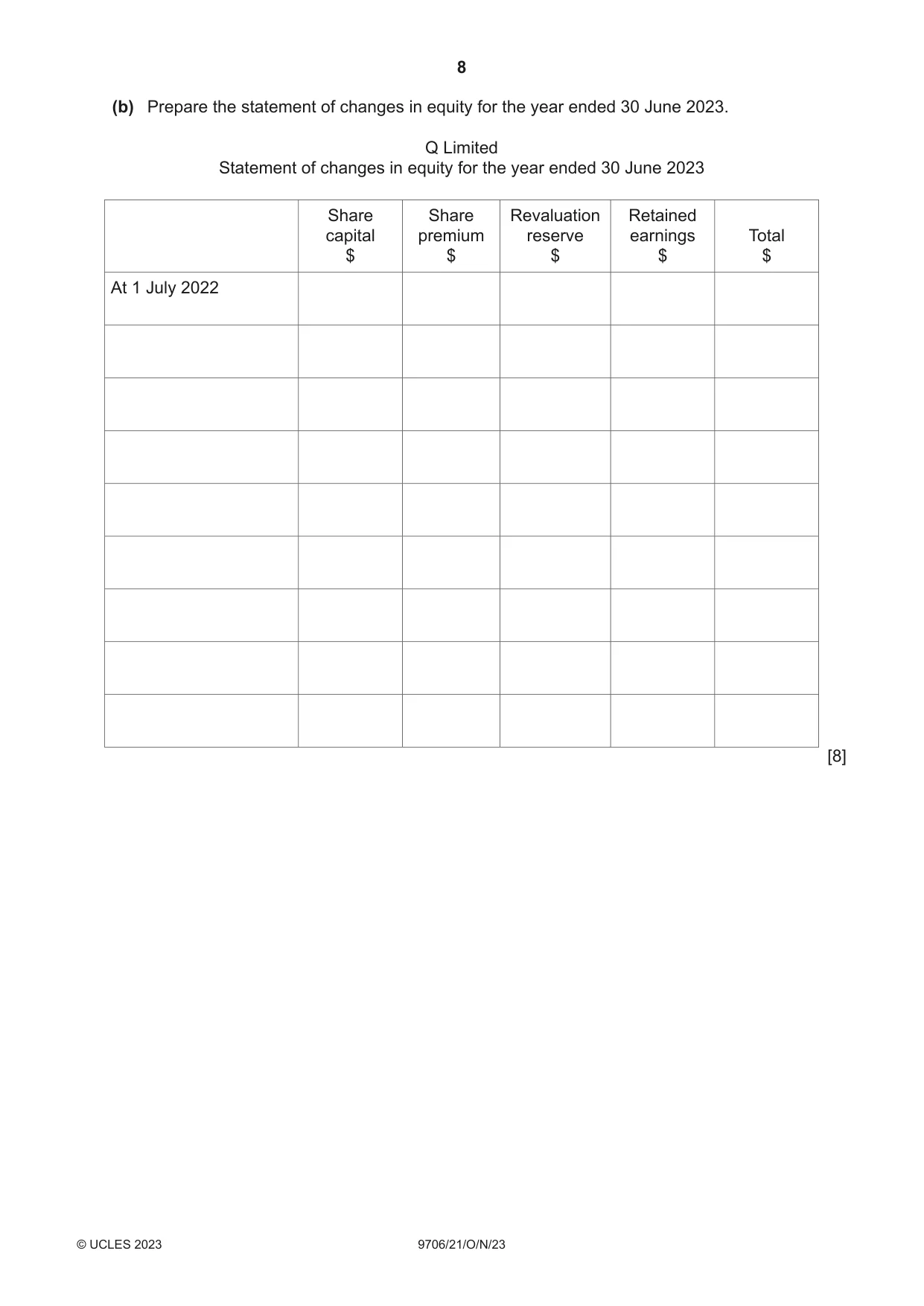
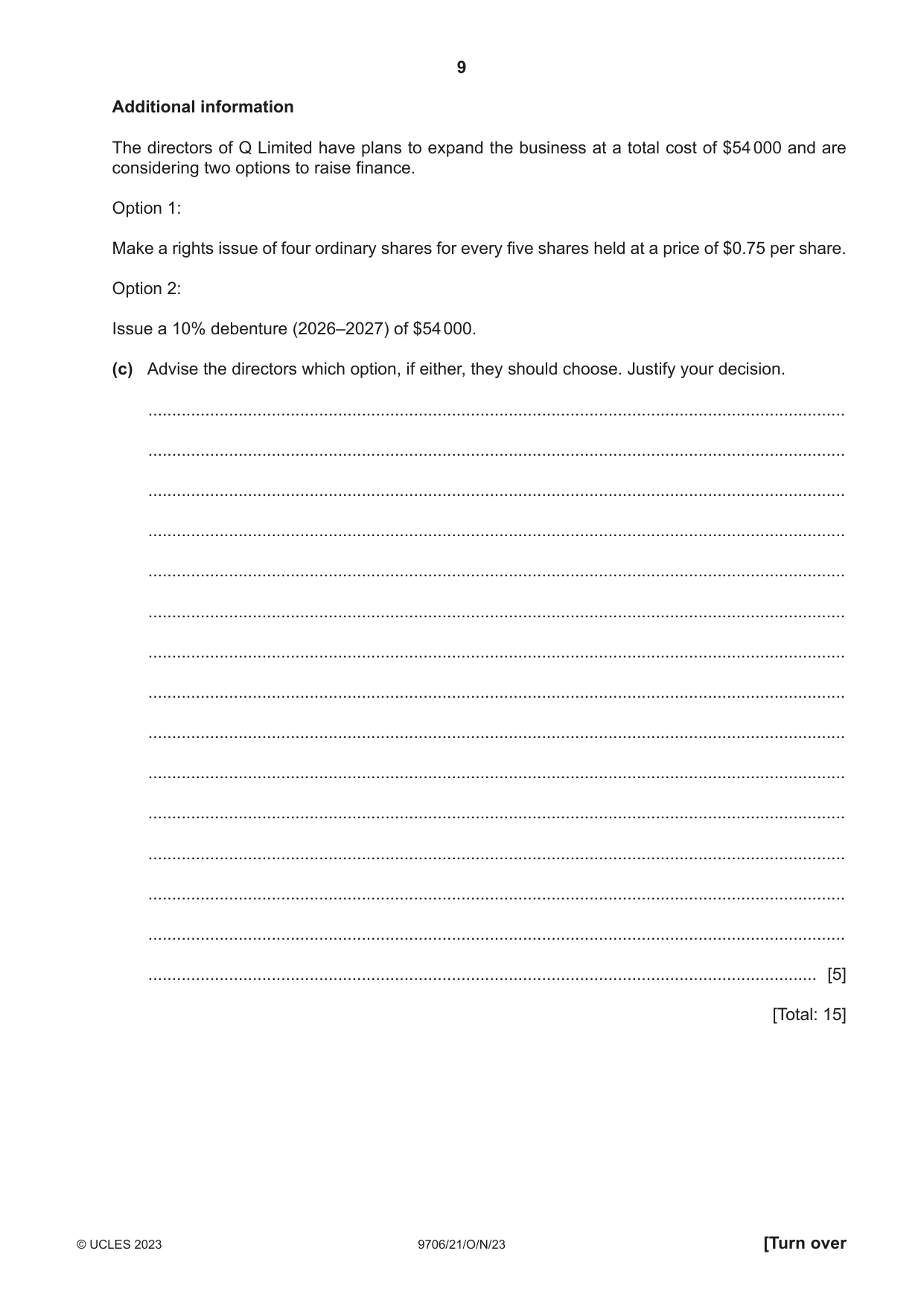
2 Q Limited has been in business for a number of years. One of the directors is unsure of the difference between a capital reserve and a revenue reserve. (a) Explain one difference between a capital reserve and a revenue reserve. ................................................................................................................................................... ................................................................................................................................................... ................................................................................................................................................... ............................................................................................................................................. [2] Additional information The directors of Q Limited provided the following information for the year ended 30 June 2023. Balances at 1 July 2022 $ Share capital: ordinary shares of $0.50 each 30 000 Share premium 4 500 Revaluation reserve 6 000 Retained earnings 50 240 Total equity 90 740 8% debenture (2024) 40 000 At 1 July 2022, land, original cost $80 000, had a valuation of $86 000. No other non-current assets had been revalued. The following transactions took place during the year ended 30 June 2023. Date 1 August 2022 Made a bonus issue of one ordinary share for every six shares held. The directors maintained the reserves in the most flexible form. 1 October 2022 Paid a final dividend of $0.04 per share on all shares in issue at that date. 1 January 2023 Made a rights issue of two ordinary shares for every seven shares held at a price of $0.65 per share. The issue was fully subscribed. 1 April 2023 Paid an interim dividend of $0.02 per share on all shares in issue at that date. 30 June 2023 Land was revalued at $75 000. The draft profit for the year ended 30 June 2023 was $43 600. (b) Prepare the statement of changes in equity for the year ended 30 June 2023. Q Limited Statement of changes in equity for the year ended 30 June 2023 Share Share Revaluation Retained capital premium reserve earnings Total $ $ $ $ $ At 1 July 2022 [8] Additional information The directors of Q Limited have plans to expand the business at a total cost of $54 000 and are considering two options to raise finance. Option 1: Make a rights issue of four ordinary shares for every five shares held at a price of $0.75 per share. Option 2: Issue a 10% debenture (2026–2027) of $54 000. (c) Advise the directors which option, if either, they should choose. Justify your decision. ................................................................................................................................................... ................................................................................................................................................... ................................................................................................................................................... ................................................................................................................................................... ................................................................................................................................................... ................................................................................................................................................... ................................................................................................................................................... ................................................................................................................................................... ................................................................................................................................................... ................................................................................................................................................... ................................................................................................................................................... ................................................................................................................................................... ................................................................................................................................................... ................................................................................................................................................... ............................................................................................................................................. [5] [Total: 15]
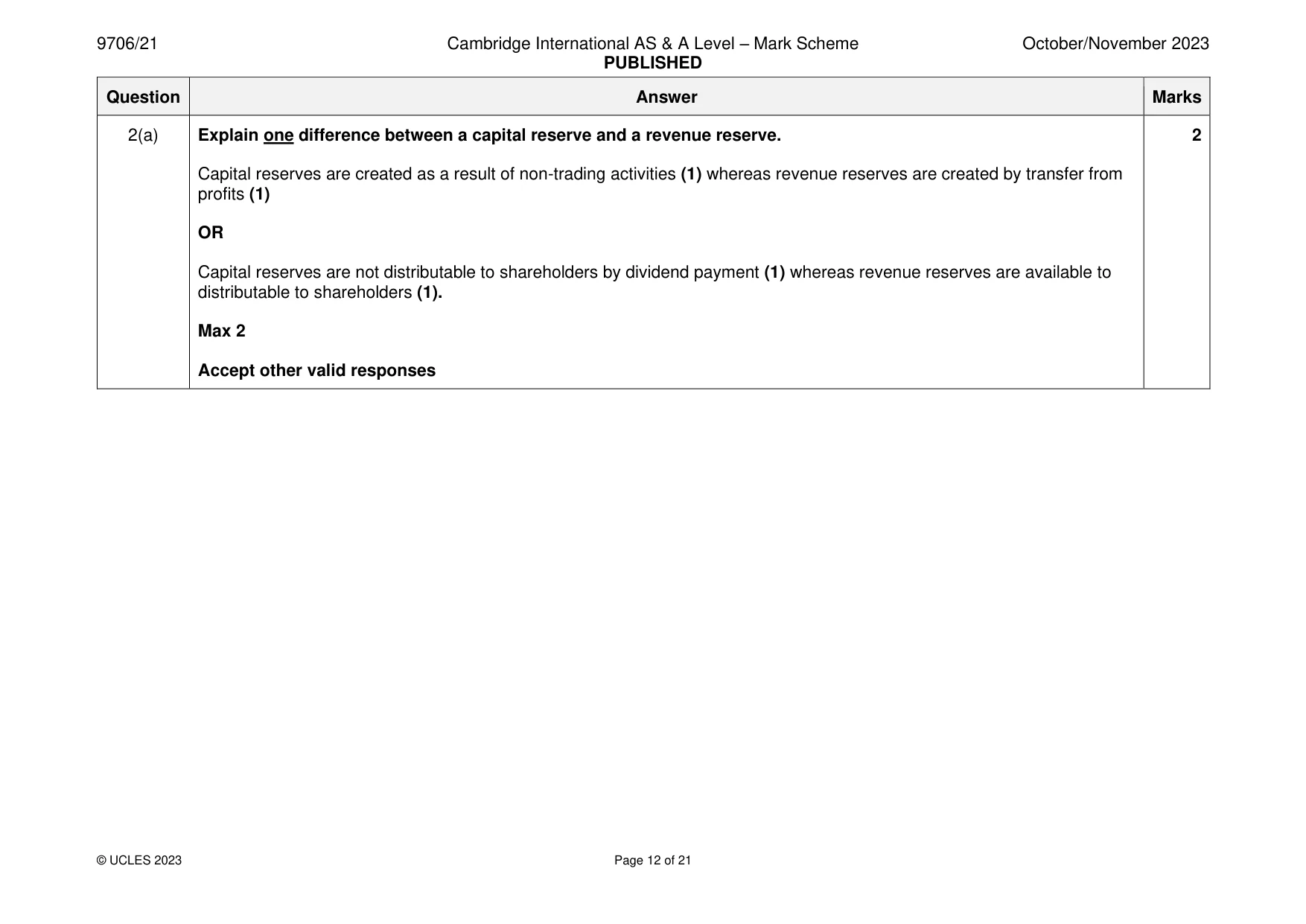
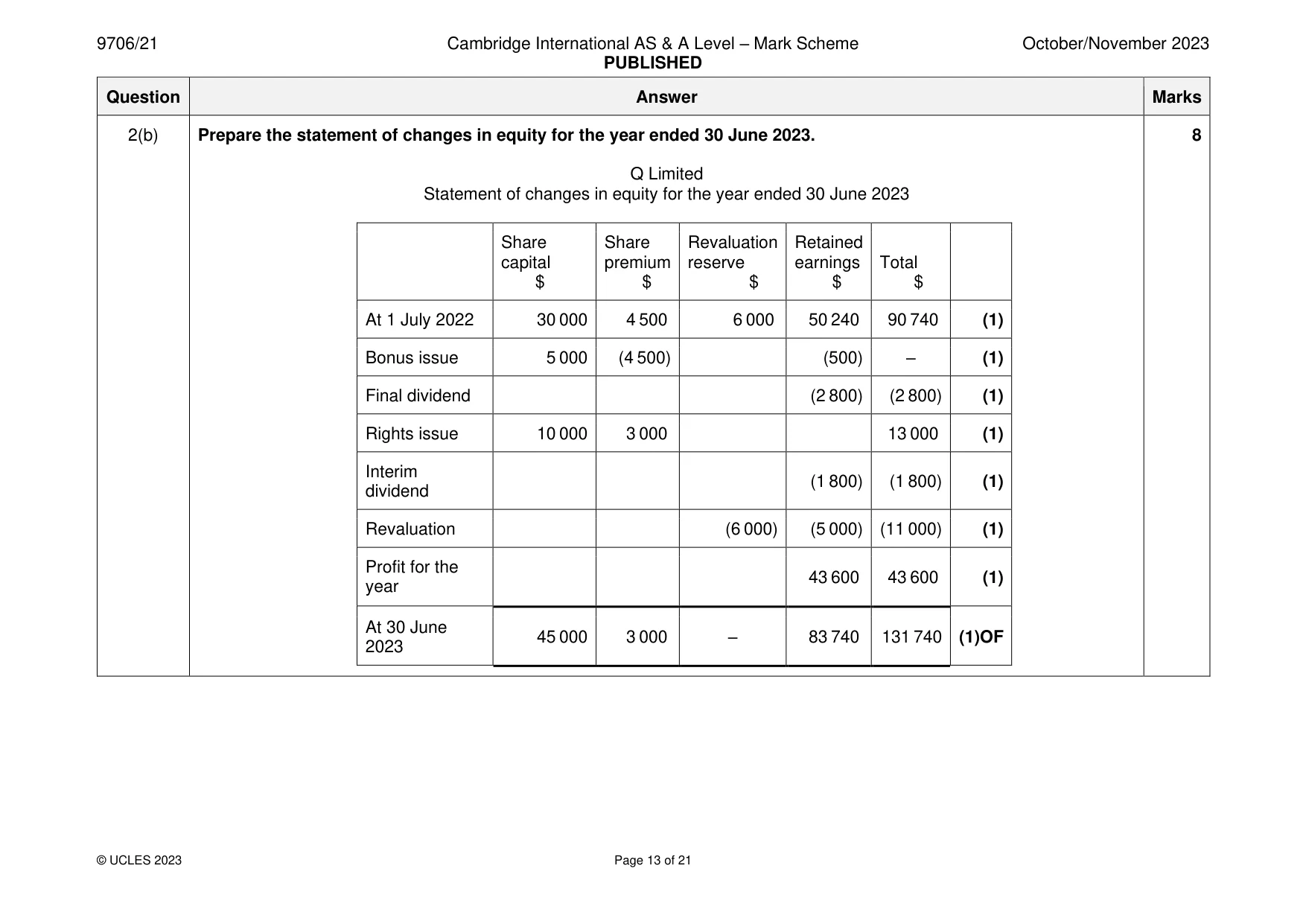
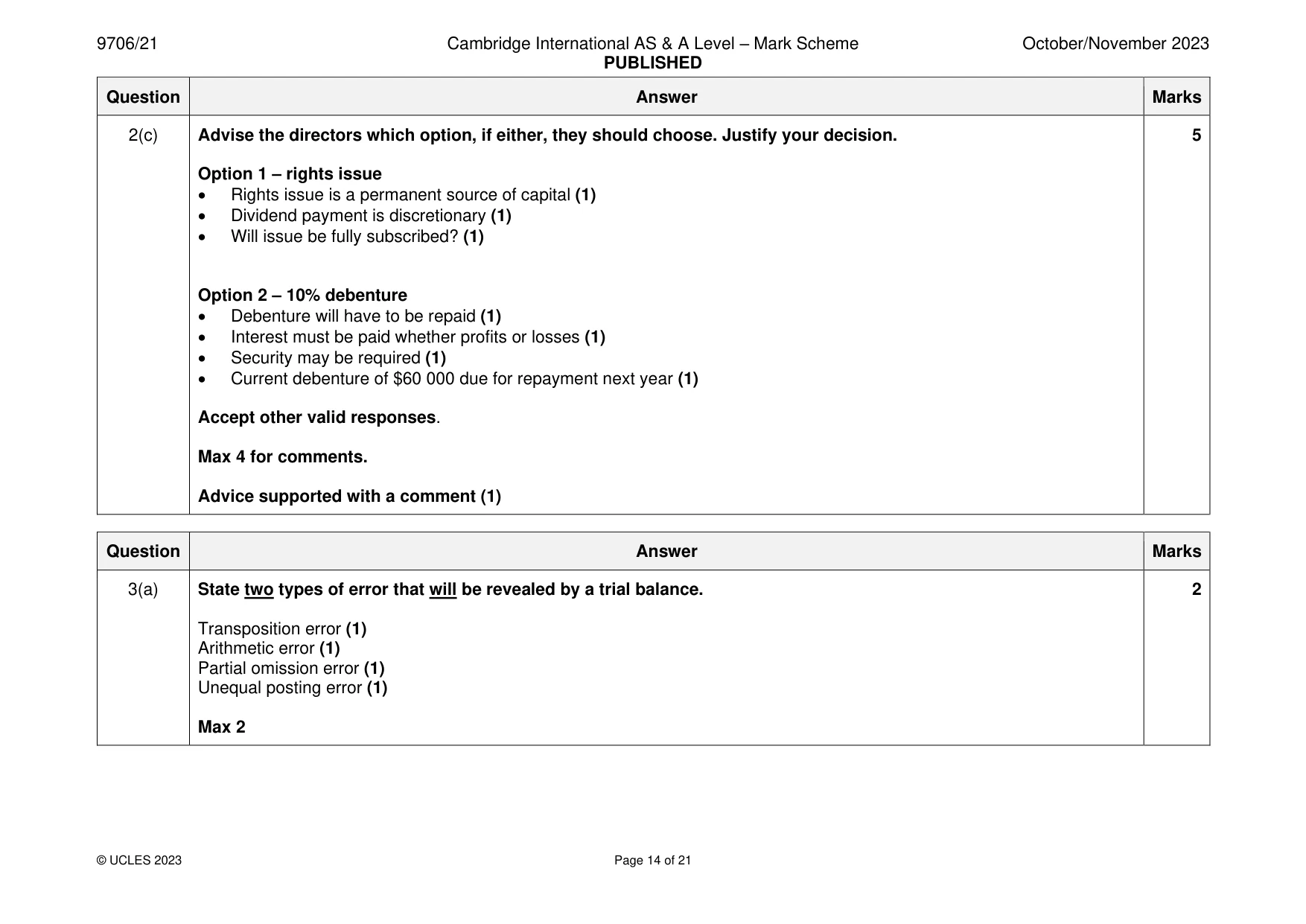
Mark scheme: 2(a) Explain one difference between a capital reserve and a revenue reserve. 2 Capital reserves are created as a result of non-trading activities (1) whereas revenue reserves are created by transfer from profits (1) OR Capital reserves are not distributable to shareholders by dividend payment (1) whereas revenue reserves are available to distributable to shareholders (1). Max 2 Accept other valid responses 2(b) Prepare the statement of changes in equity for the year ended 30 June 2023. 8 Q Limited Statement of changes in equity for the year ended 30 June 2023 Share Share Revaluation Retained capital premium reserve earnings Total $ $ $ $ $ At 1 July 2022 30 000 4 500 6 000 50 240 90 740 (1) Bonus issue 5 000 (4 500) (500) – (1) Final dividend (2 800) (2 800) (1) Rights issue 10 000 3 000 13 000 (1) Interim (1 800) (1 800) (1) dividend Revaluation (6 000) (5 000) (11 000) (1) Profit for the 43 600 43 600 (1) year At 30 June 45 000 3 000 – 83 740 131 740 (1)OF 2023 2(c) Advise the directors which option, if either, they should choose. Justify your decision. 5 Option 1 – rights issue • Rights issue is a permanent source of capital (1) • Dividend payment is discretionary (1) • Will issue be fully subscribed? (1) Option 2 – 10% debenture • Debenture will have to be repaid (1) • Interest must be paid whether profits or losses (1) • Security may be required (1) • Current debenture of $60 000 due for repayment next year (1) Accept other valid responses. Max 4 for comments. Advice supported with a comment (1)
Q3 · Yasmine has a retail business
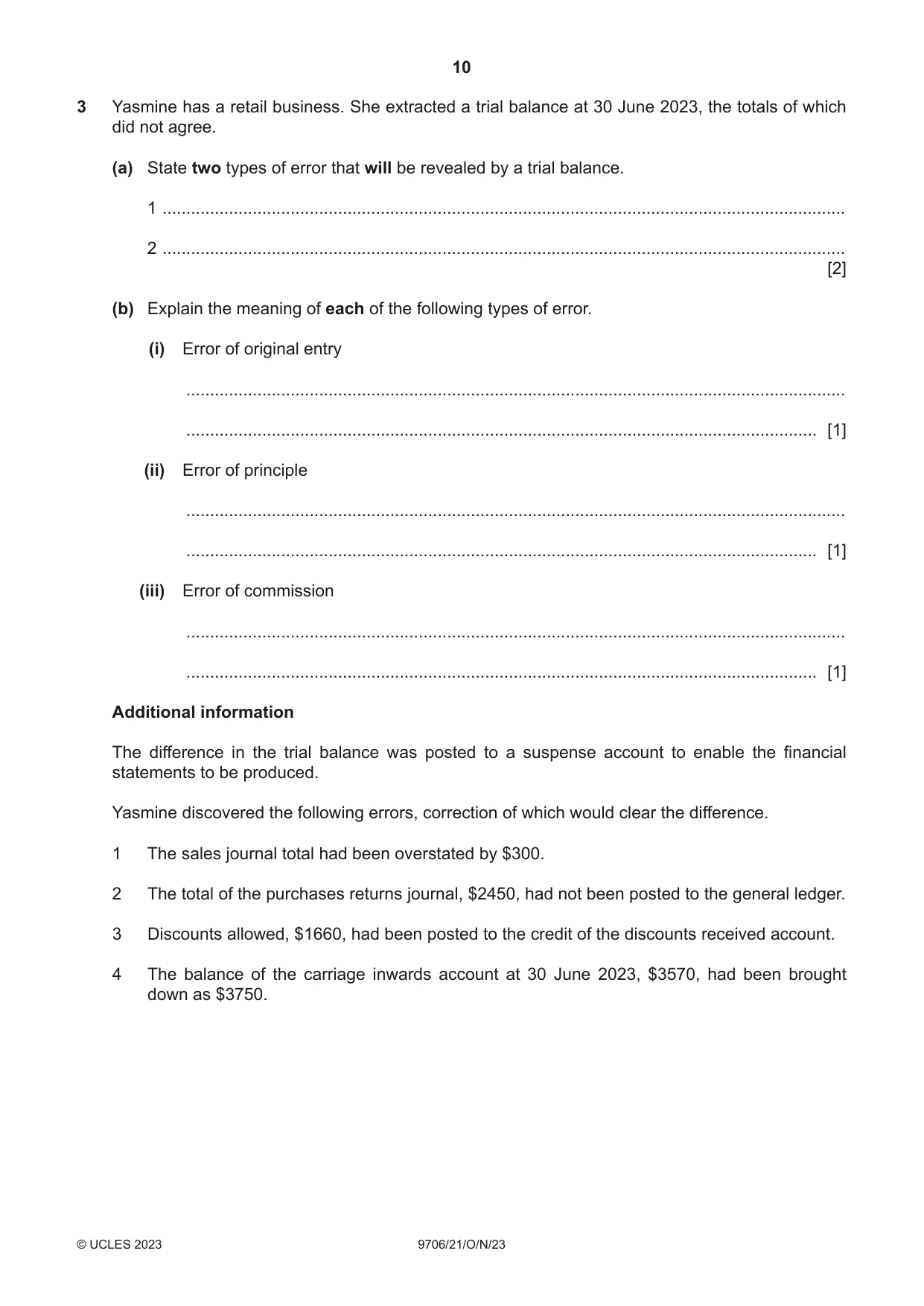
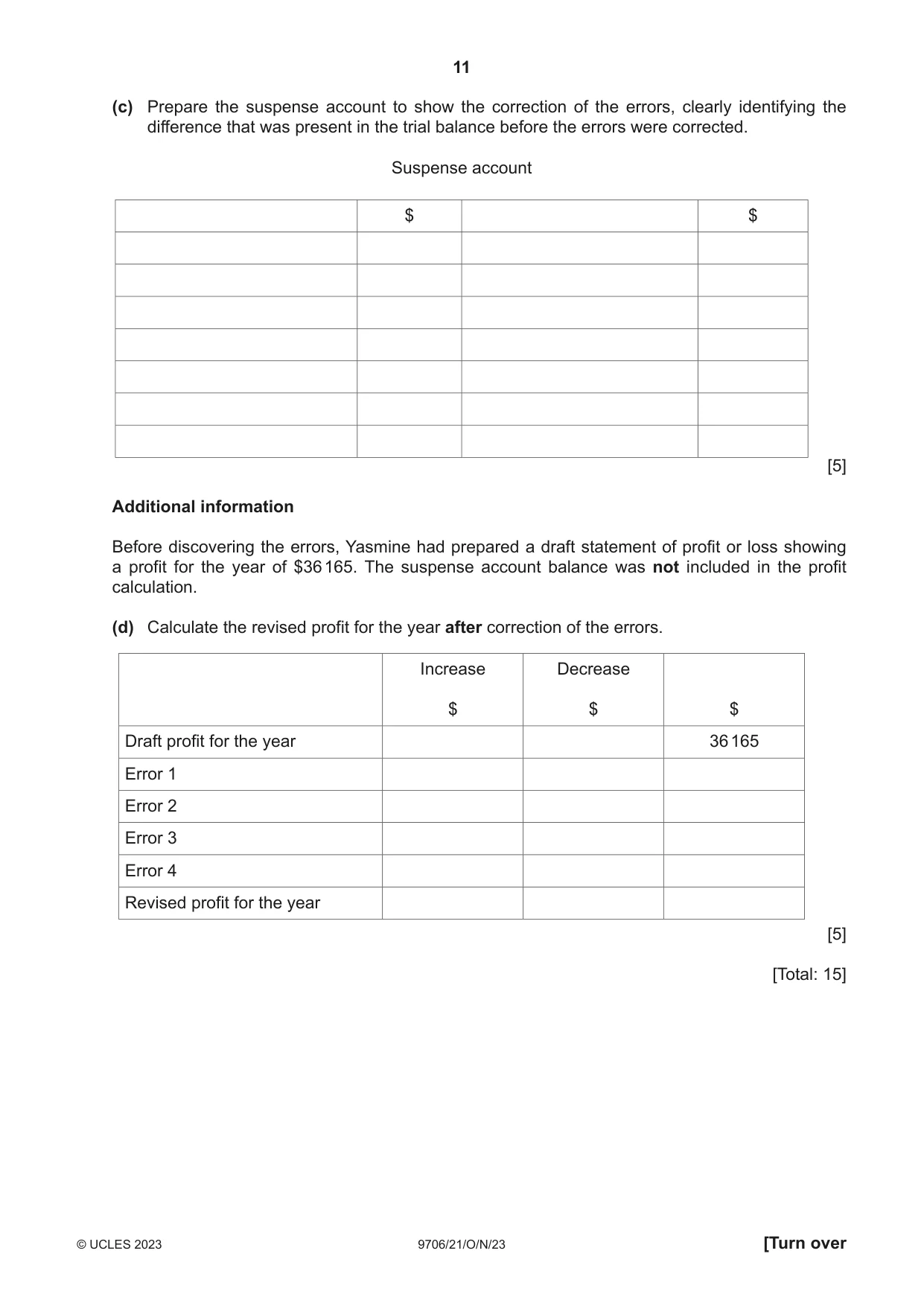
3 Yasmine has a retail business. She extracted a trial balance at 30 June 2023, the totals of which did not agree. (a) State two types of error that will be revealed by a trial balance. 1 ................................................................................................................................................ 2 ................................................................................................................................................ [2] (b) Explain the meaning of each of the following types of error. (i) Error of original entry ........................................................................................................................................... ..................................................................................................................................... [1] (ii) Error of principle ........................................................................................................................................... ..................................................................................................................................... [1] (iii) Error of commission ........................................................................................................................................... ..................................................................................................................................... [1] Additional information The difference in the trial balance was posted to a suspense account to enable the financial statements to be produced. Yasmine discovered the following errors, correction of which would clear the difference. 1 The sales journal total had been overstated by $300. 2 The total of the purchases returns journal, $2450, had not been posted to the general ledger. 3 Discounts allowed, $1660, had been posted to the credit of the discounts received account. 4 The balance of the carriage inwards account at 30 June 2023, $3570, had been brought down as $3750. (c) Prepare the suspense account to show the correction of the errors, clearly identifying the difference that was present in the trial balance before the errors were corrected. Suspense account $ $ [5] Additional information Before discovering the errors, Yasmine had prepared a draft statement of profit or loss showing a profit for the year of $36 165. The suspense account balance was not included in the profit calculation. (d) Calculate the revised profit for the year after correction of the errors. Increase Decrease $ $ $ Draft profit for the year 36 165 Error 1 Error 2 Error 3 Error 4 Revised profit for the year [5] [Total: 15]
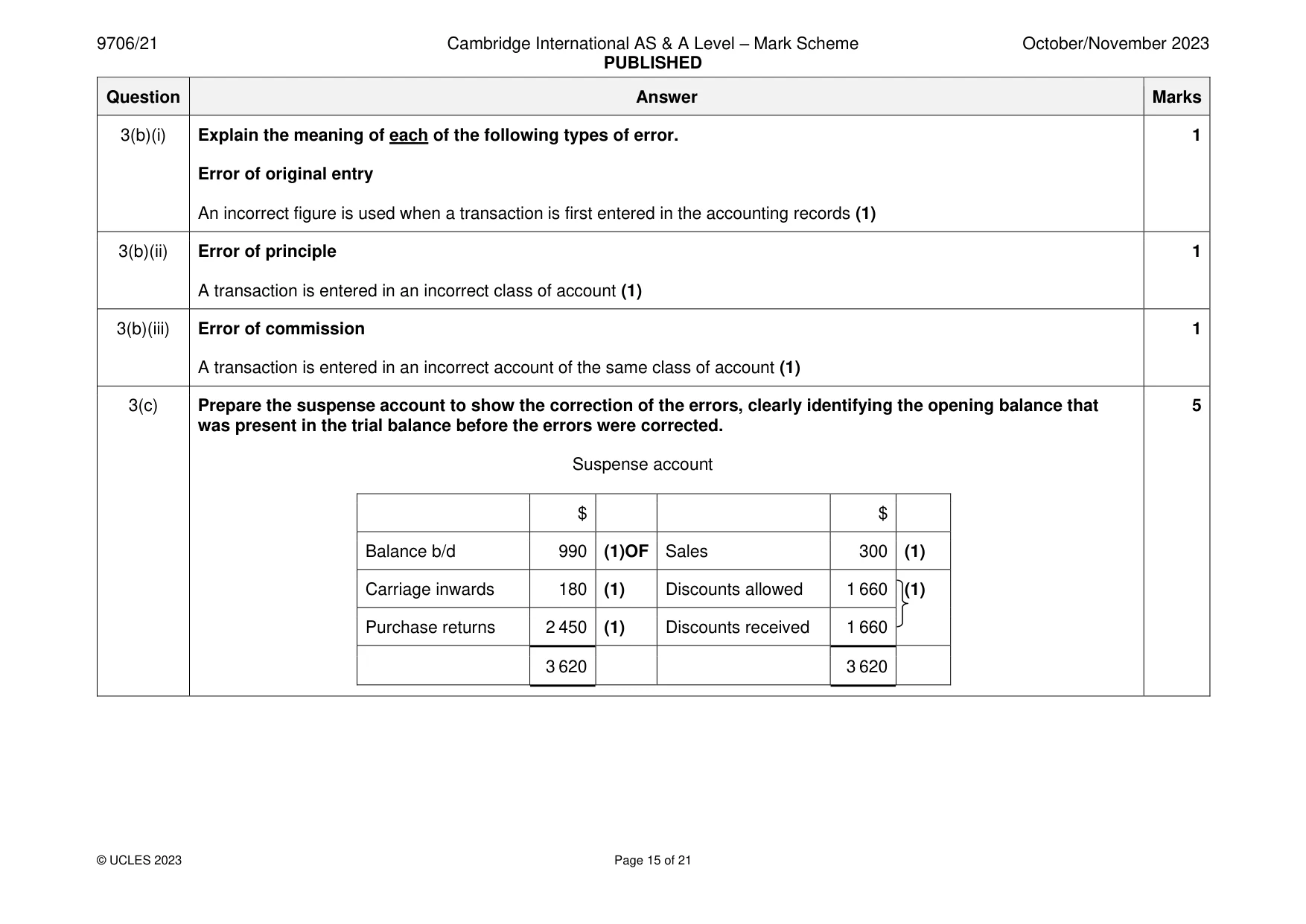
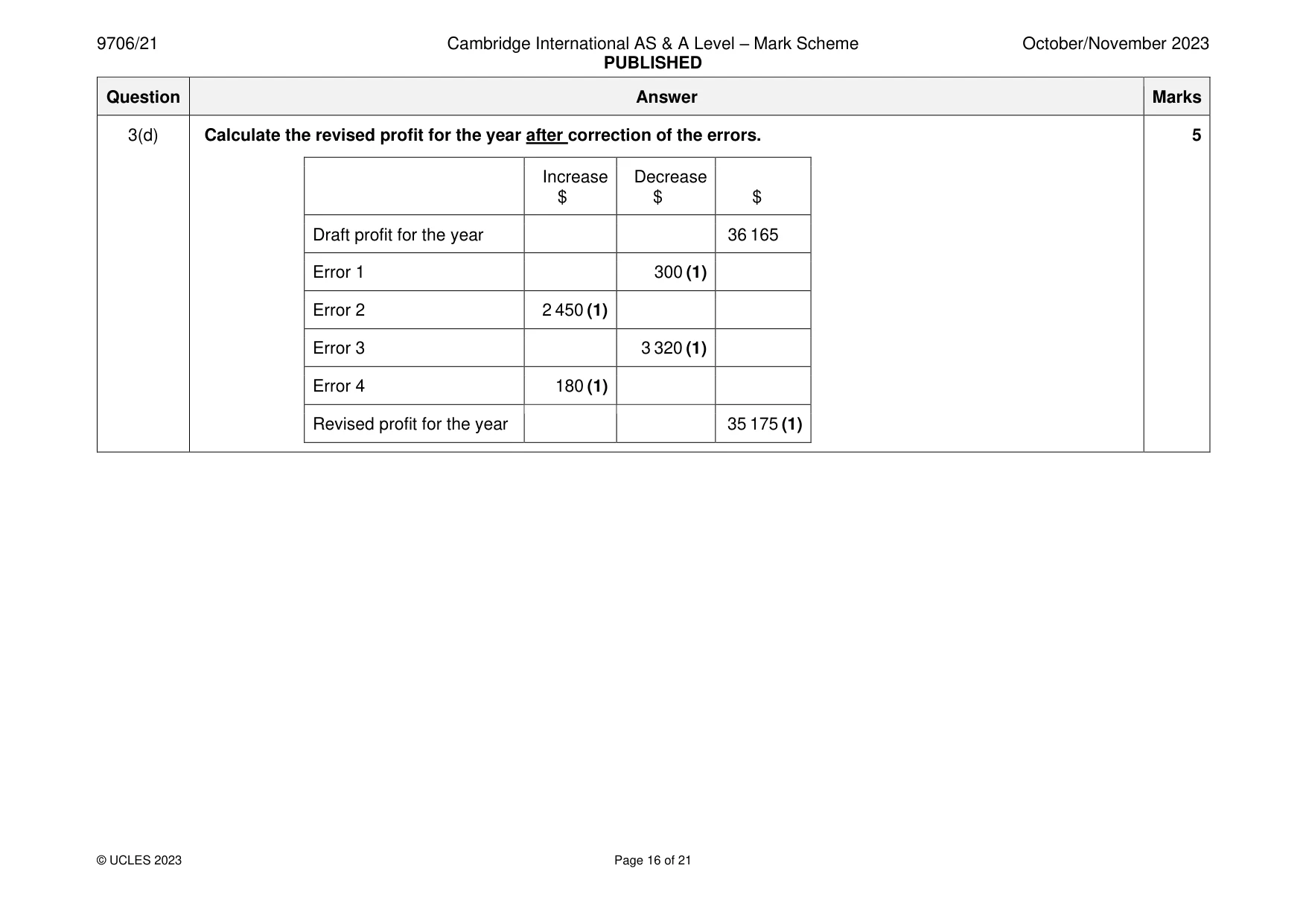
Mark scheme: 3(a) State two types of error that will be revealed by a trial balance. 2 Transposition error (1) Arithmetic error (1) Partial omission error (1) Unequal posting error (1) Max 2 3(b)(i) Explain the meaning of each of the following types of error. 1 Error of original entry An incorrect figure is used when a transaction is first entered in the accounting records (1) 3(b)(ii) Error of principle 1 A transaction is entered in an incorrect class of account (1) 3(b)(iii) Error of commission 1 A transaction is entered in an incorrect account of the same class of account (1) 3(c) Prepare the suspense account to show the correction of the errors, clearly identifying the opening balance that 5 was present in the trial balance before the errors were corrected. Suspense account $ $ Balance b/d 990 (1)OF Sales 300 (1) Carriage inwards 180 (1) Discounts allowed 1 660 (1) Purchase returns 2 450 (1) Discounts received 1 660 3 620 3 620 3(d) Calculate the revised profit for the year after correction of the errors. 5 Increase Decrease $ $ $ Draft profit for the year 36 165 Error 1 300 (1) Error 2 2 450 (1) Error 3 3 320 (1) Error 4 180 (1) Revised profit for the year 35 175 (1)
Q4 · Javid manufactures a single product
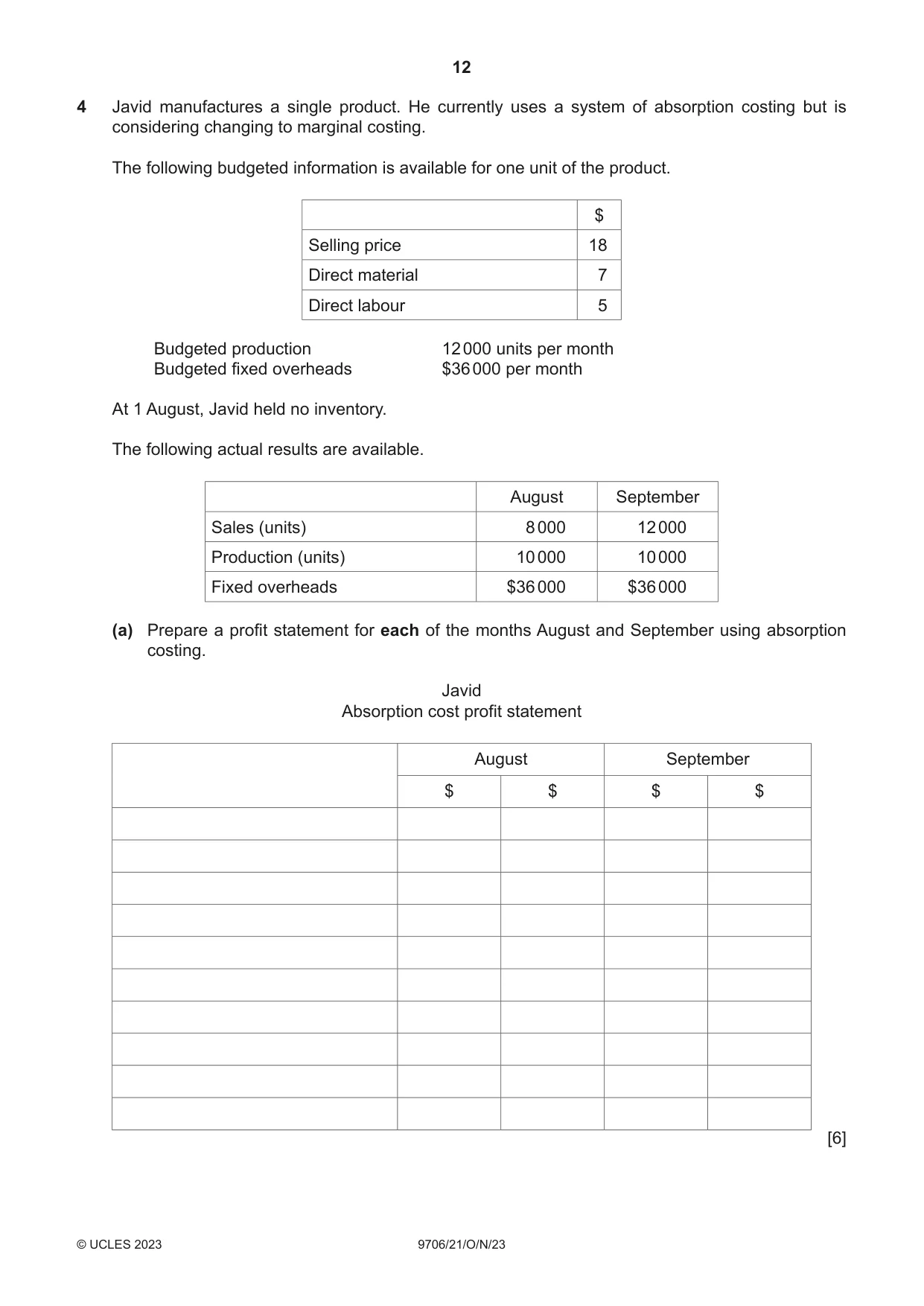
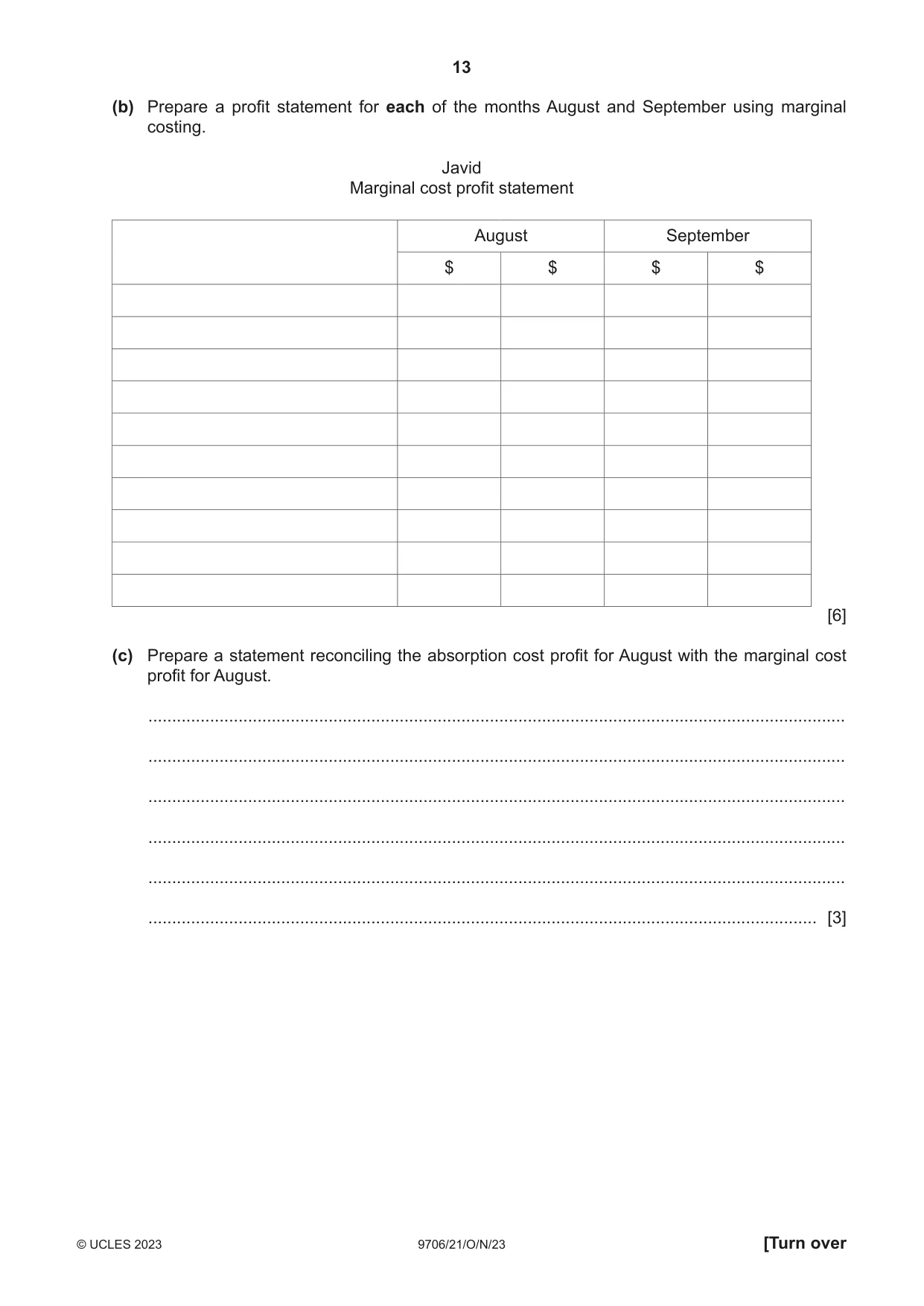
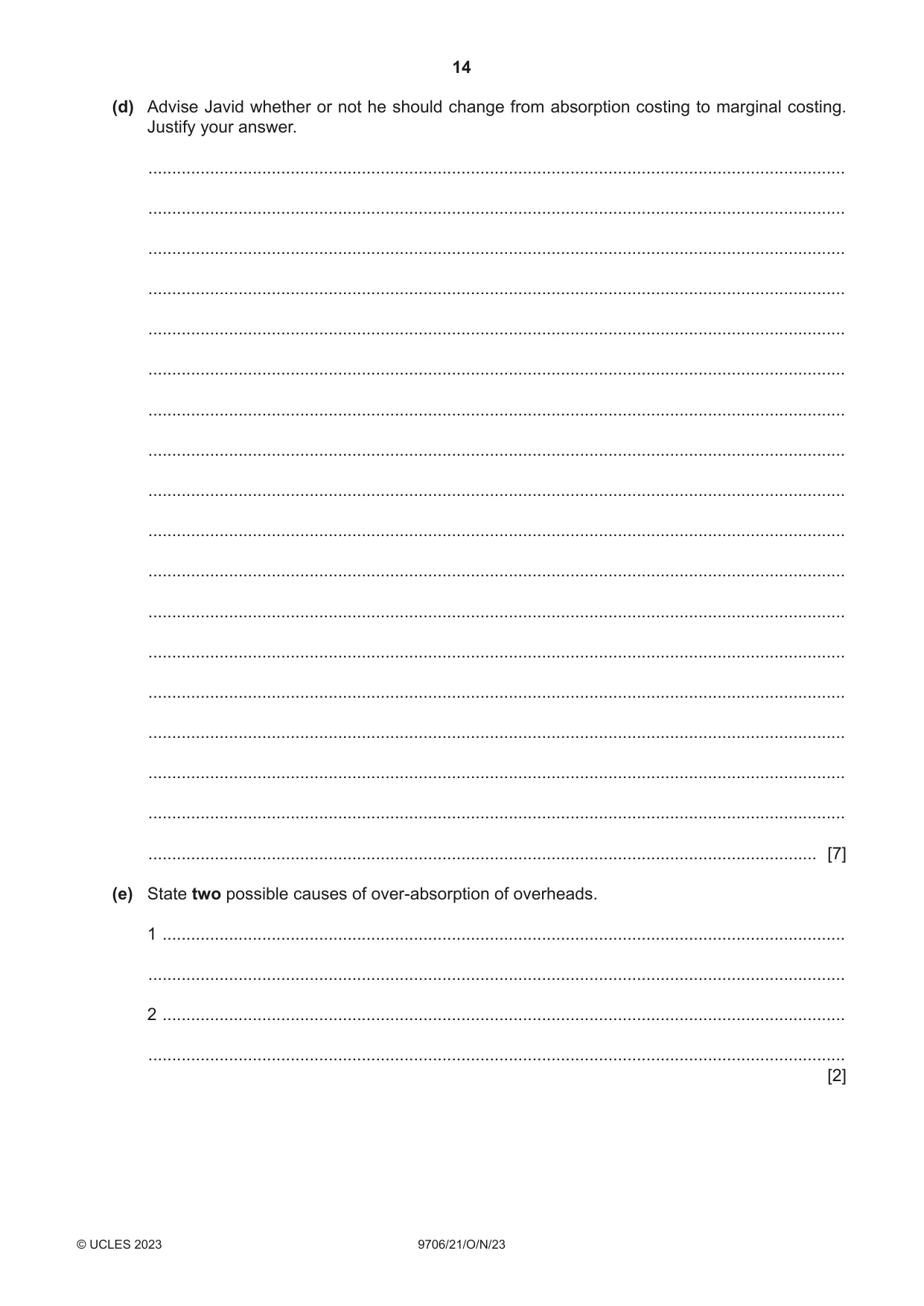
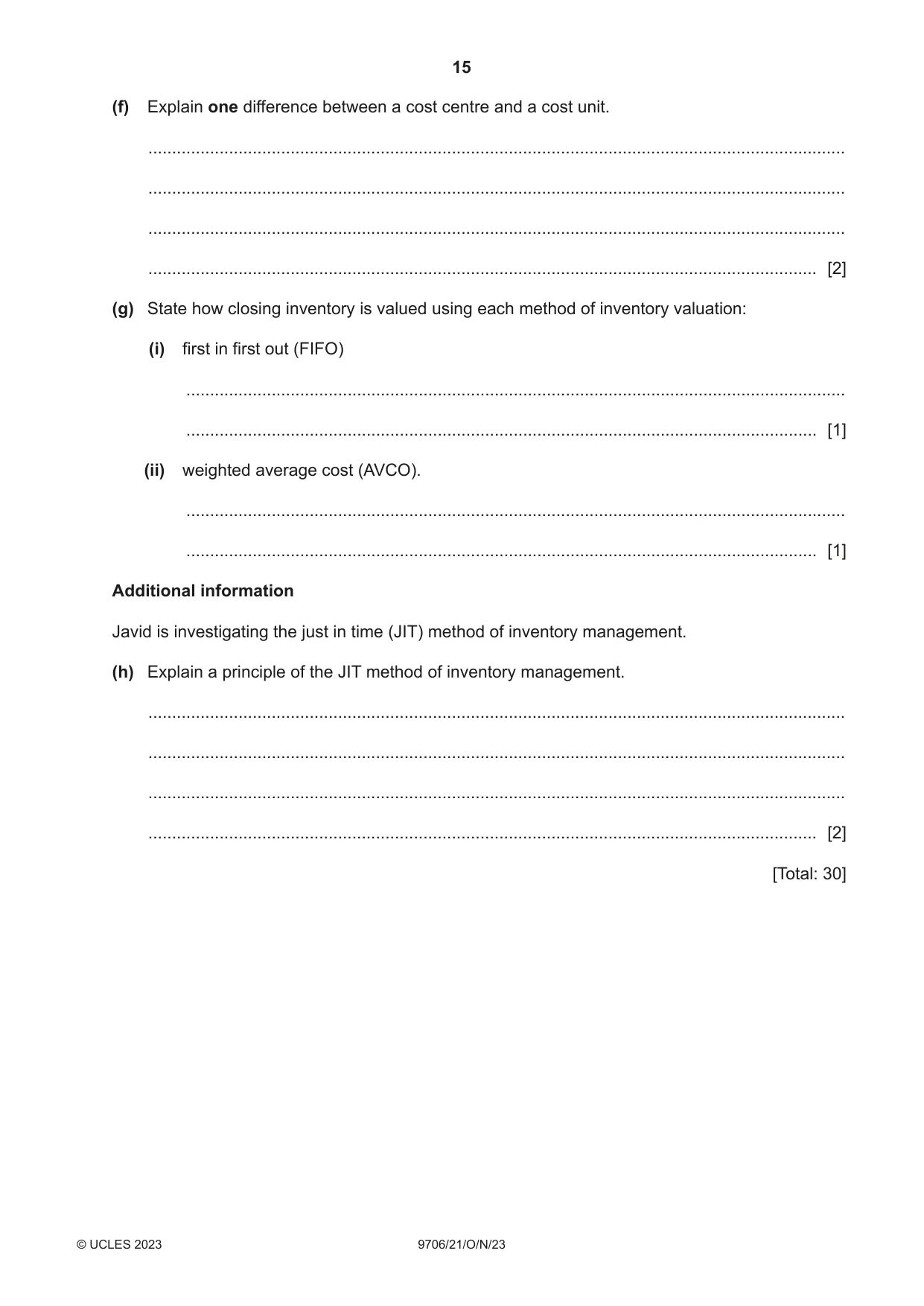
4 Javid manufactures a single product. He currently uses a system of absorption costing but is considering changing to marginal costing. The following budgeted information is available for one unit of the product. $ Selling price 18 Direct material 7 Direct labour 5 Budgeted production 12 000 units per month Budgeted fixed overheads $36 000 per month At 1 August, Javid held no inventory. The following actual results are available. August September Sales (units) 8 000 12 000 Production (units) 10 000 10 000 Fixed overheads $36 000 $36 000 (a) Prepare a profit statement for each of the months August and September using absorption costing. Javid Absorption cost profit statement August September $ $ $ $ [6] (b) Prepare a profit statement for each of the months August and September using marginal costing. Javid Marginal cost profit statement August September $ $ $ $ [6] (c) Prepare a statement reconciling the absorption cost profit for August with the marginal cost profit for August. ................................................................................................................................................... ................................................................................................................................................... ................................................................................................................................................... ................................................................................................................................................... ................................................................................................................................................... ............................................................................................................................................. [3] (d) Advise Javid whether or not he should change from absorption costing to marginal costing. Justify your answer. ................................................................................................................................................... ................................................................................................................................................... ................................................................................................................................................... ................................................................................................................................................... ................................................................................................................................................... ................................................................................................................................................... ................................................................................................................................................... ................................................................................................................................................... ................................................................................................................................................... ................................................................................................................................................... ................................................................................................................................................... ................................................................................................................................................... ................................................................................................................................................... ................................................................................................................................................... ................................................................................................................................................... ................................................................................................................................................... ................................................................................................................................................... ............................................................................................................................................. [7] (e) State two possible causes of over-absorption of overheads. 1 ................................................................................................................................................ ................................................................................................................................................... 2 ................................................................................................................................................ ................................................................................................................................................... [2]
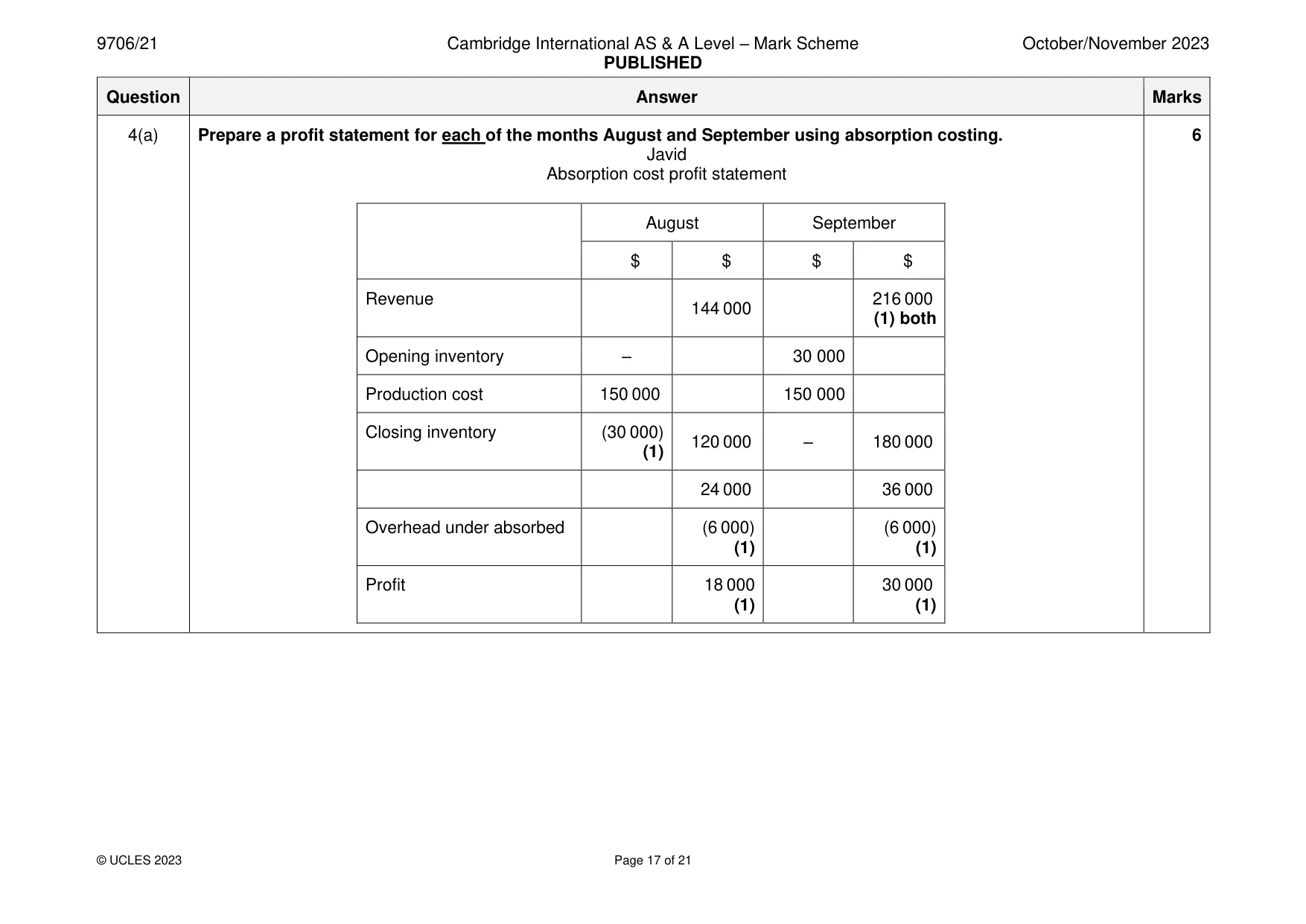
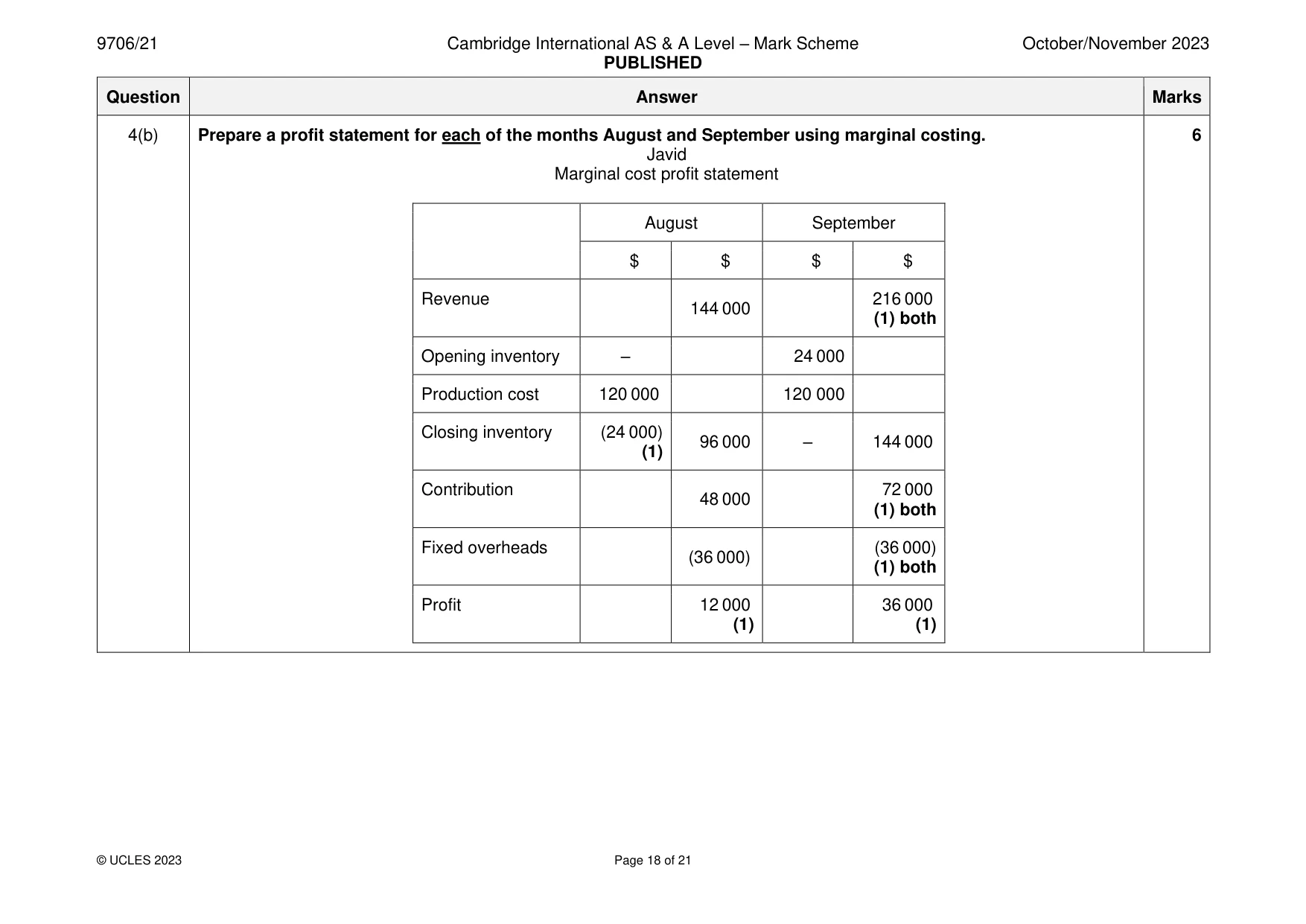
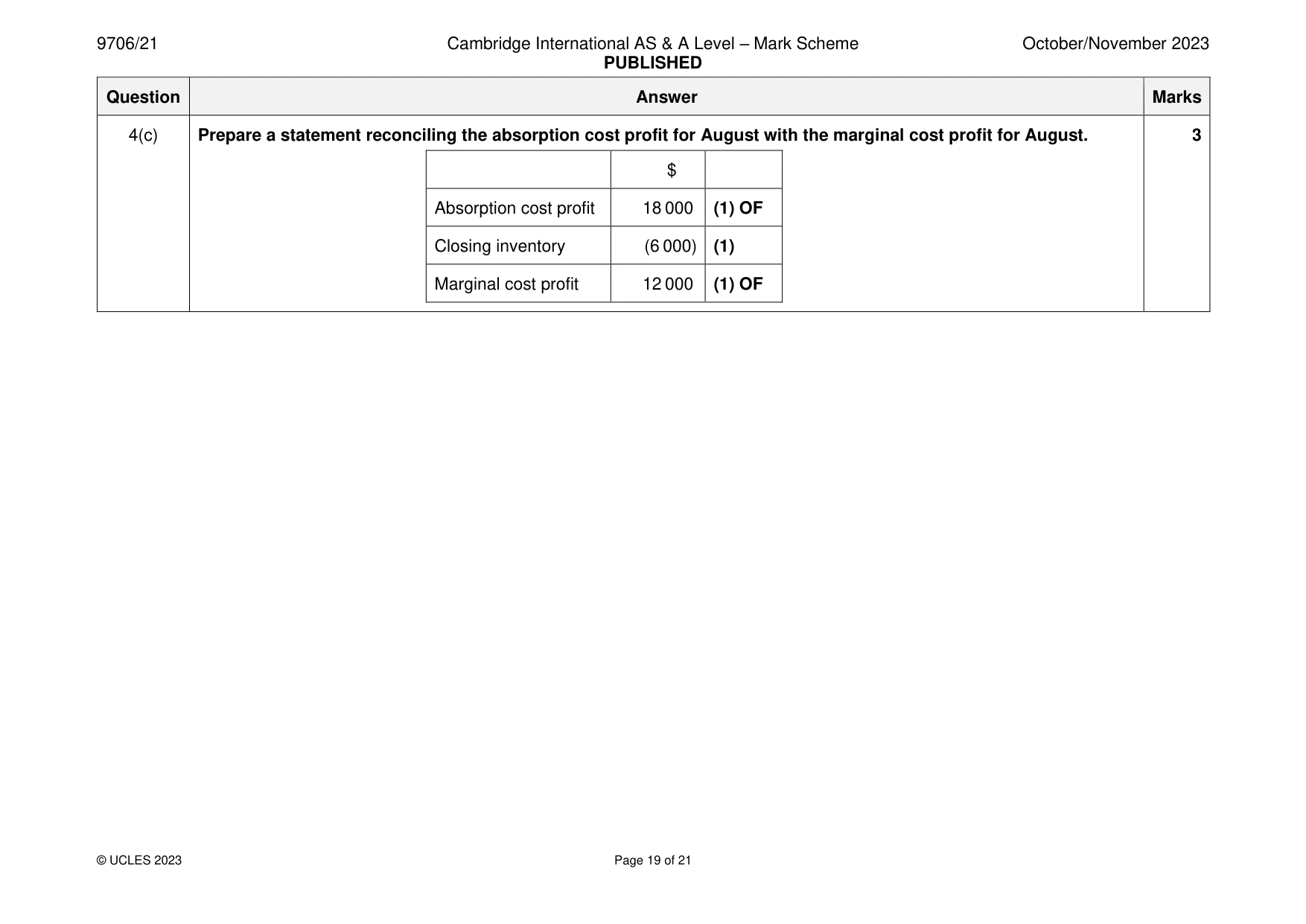
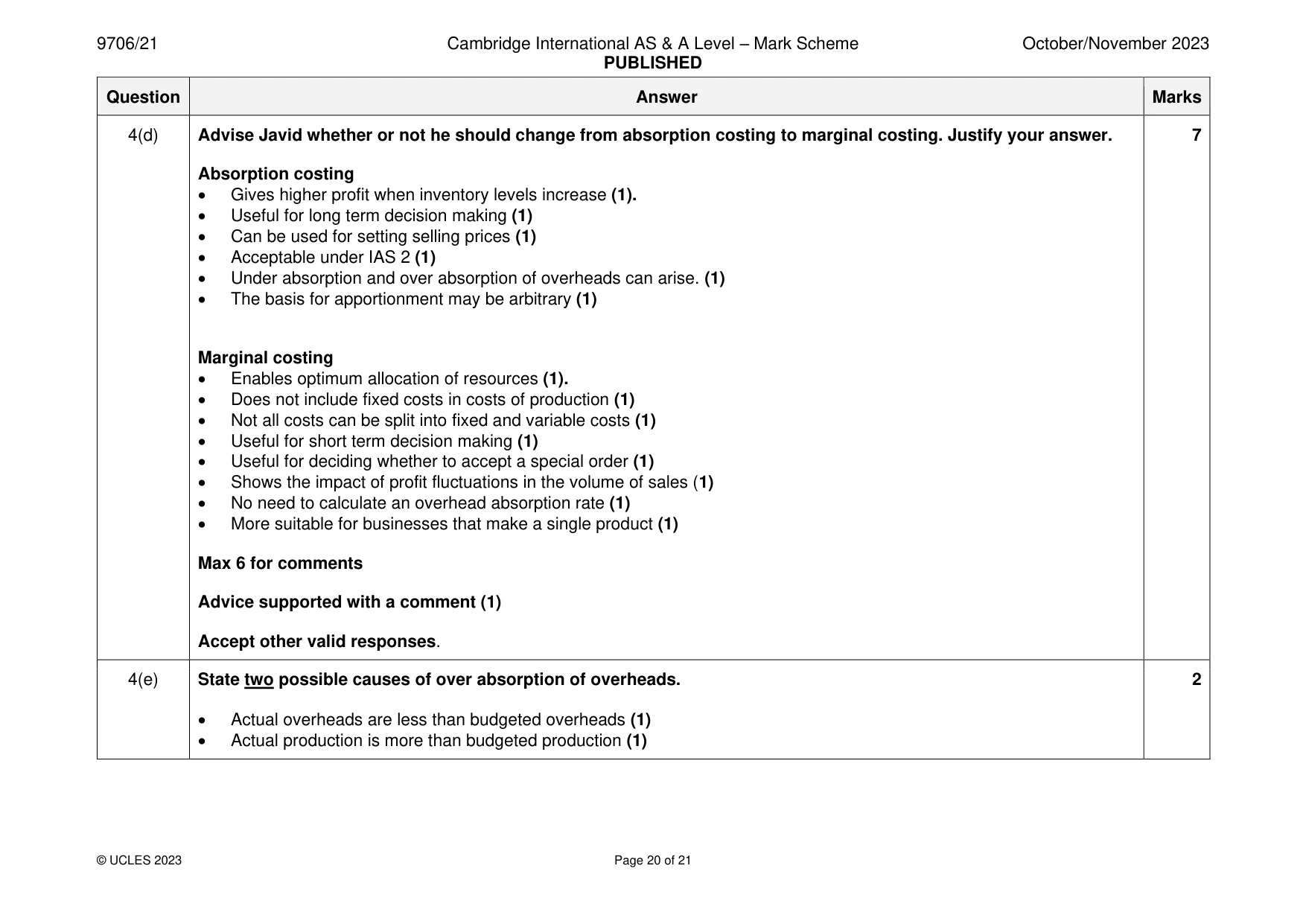
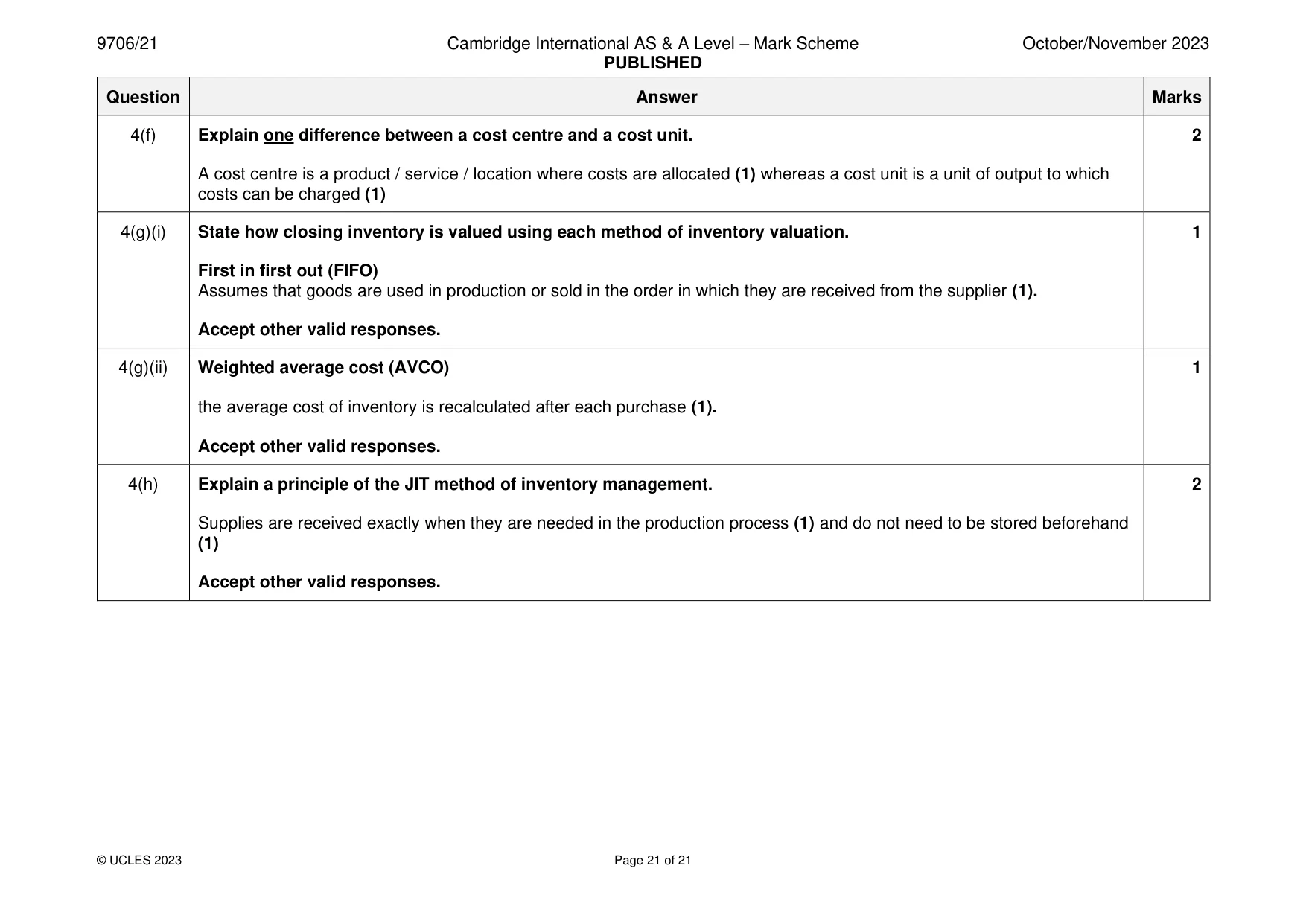
Mark scheme: 4(a) Prepare a profit statement for each of the months August and September using absorption costing. 6 Javid Absorption cost profit statement August September $ $ $ $ Revenue 216 000 144 000 (1) both Opening inventory – 30 000 Production cost 150 000 150 000 Closing inventory (30 000) 120 000 – 180 000 (1) 24 000 36 000 Overhead under absorbed (6 000) (6 000) (1) (1) Profit 18 000 30 000 (1) (1) 4(b) Prepare a profit statement for each of the months August and September using marginal costing. 6 Javid Marginal cost profit statement August September $ $ $ $ Revenue 216 000 144 000 (1) both Opening inventory – 24 000 Production cost 120 000 120 000 Closing inventory (24 000) 96 000 – 144 000 (1) Contribution 72 000 48 000 (1) both Fixed overheads (36 000) (36 000) (1) both Profit 12 000 36 000 (1) (1) 4(c) Prepare a statement reconciling the absorption cost profit for August with the marginal cost profit for August. 3 $ Absorption cost profit 18 000 (1) OF Closing inventory (6 000) (1) Marginal cost profit 12 000 (1) OF 4(d) Advise Javid whether or not he should change from absorption costing to marginal costing. Justify your answer. 7 Absorption costing • Gives higher profit when inventory levels increase (1). • Useful for long term decision making (1) • Can be used for setting selling prices (1) • Acceptable under IAS 2 (1) • Under absorption and over absorption of overheads can arise. (1) • The basis for apportionment may be arbitrary (1) Marginal costing • Enables optimum allocation of resources (1). • Does not include fixed costs in costs of production (1) • Not all costs can be split into fixed and variable costs (1) • Useful for short term decision making (1) • Useful for deciding whether to accept a special order (1) • Shows the impact of profit fluctuations in the volume of sales (1) • No need to calculate an overhead absorption rate (1) • More suitable for businesses that make a single product (1) Max 6 for comments Advice supported with a comment (1) Accept other valid responses. 4(e) State two possible causes of over absorption of overheads. 2 • Actual overheads are less than budgeted overheads (1) • Actual production is more than budgeted production (1) 4(f) Explain one difference between a cost centre and a cost unit. 2 A cost centre is a product / service / location where costs are allocated (1) whereas a cost unit is a unit of output to which costs can be charged (1) 4(g)(i) State how closing inventory is valued using each method of inventory valuation. 1 First in first out (FIFO) Assumes that goods are used in production or sold in the order in which they are received from the supplier (1). Accept other valid responses. 4(g)(ii) Weighted average cost (AVCO) 1 the average cost of inventory is recalculated after each purchase (1). Accept other valid responses. 4(h) Explain a principle of the JIT method of inventory management. 2 Supplies are received exactly when they are needed in the production process (1) and do not need to be stored beforehand (1) Accept other valid responses.
What was in this paper
The subtopics covered by these 4 questions, and how many questions each got. Open one in a new tab to see every Cambridge question on it.
What you needed in this session
Cambridge’s own grade thresholds for 2023 Oct/Nov, Paper 2 · Variant 1. A higher threshold means an easier paper — the bar moves with how the cohort did.