Cambridge A Level Accounting 9706 — 2022 May/June Paper 2 · Variant 1
9706/21/M/J/22 · 4 questions · 90 marks · ≈101 min
The question paper and its mark scheme, free to read here and free to download. This is Cambridge’s own paper, exactly as it was sat.
Question paper20 pages


Mark scheme14 pages
Answers below. Sit the paper first if you are practising.
Questions as text
Q1 · Khin is a retailer
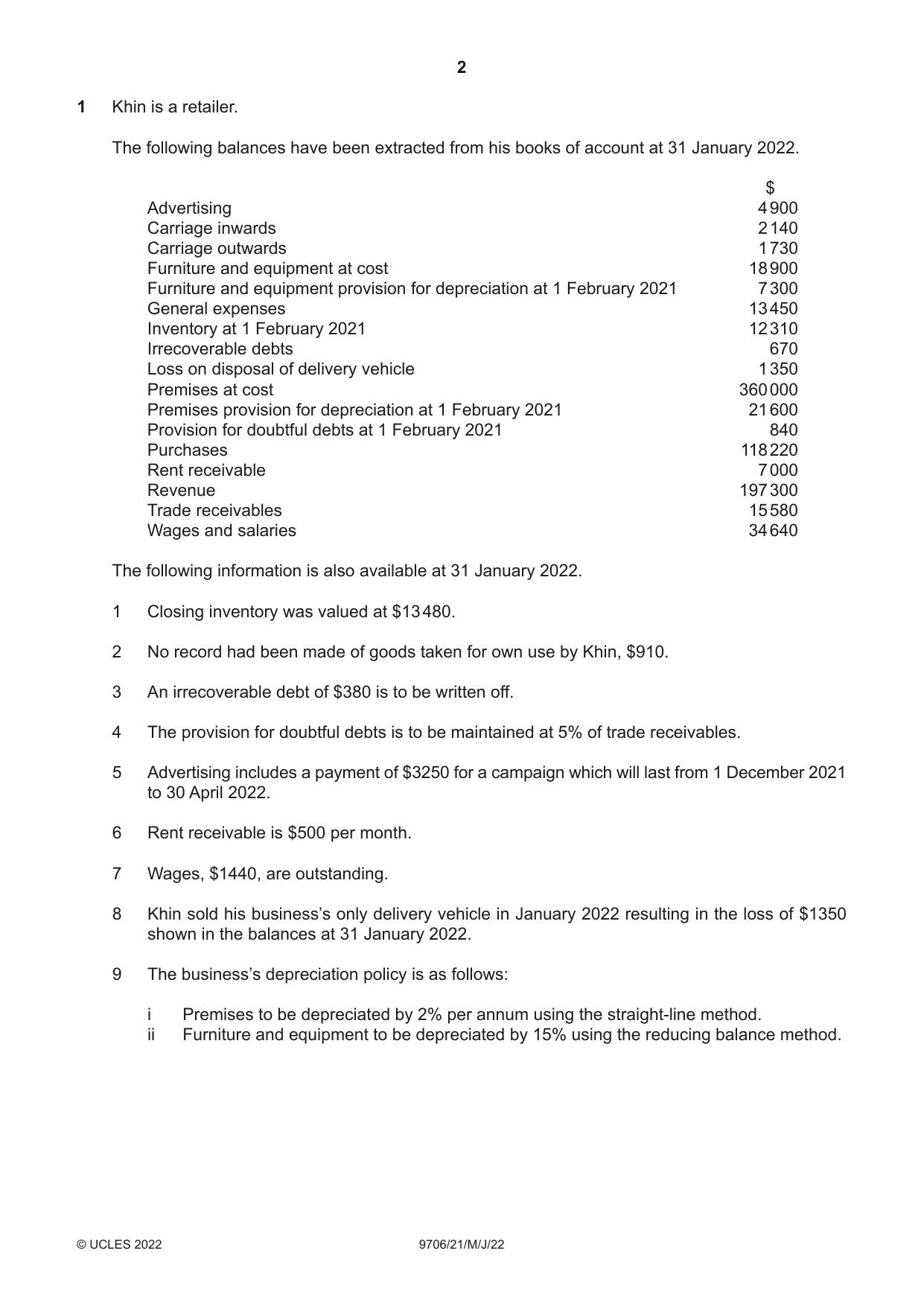
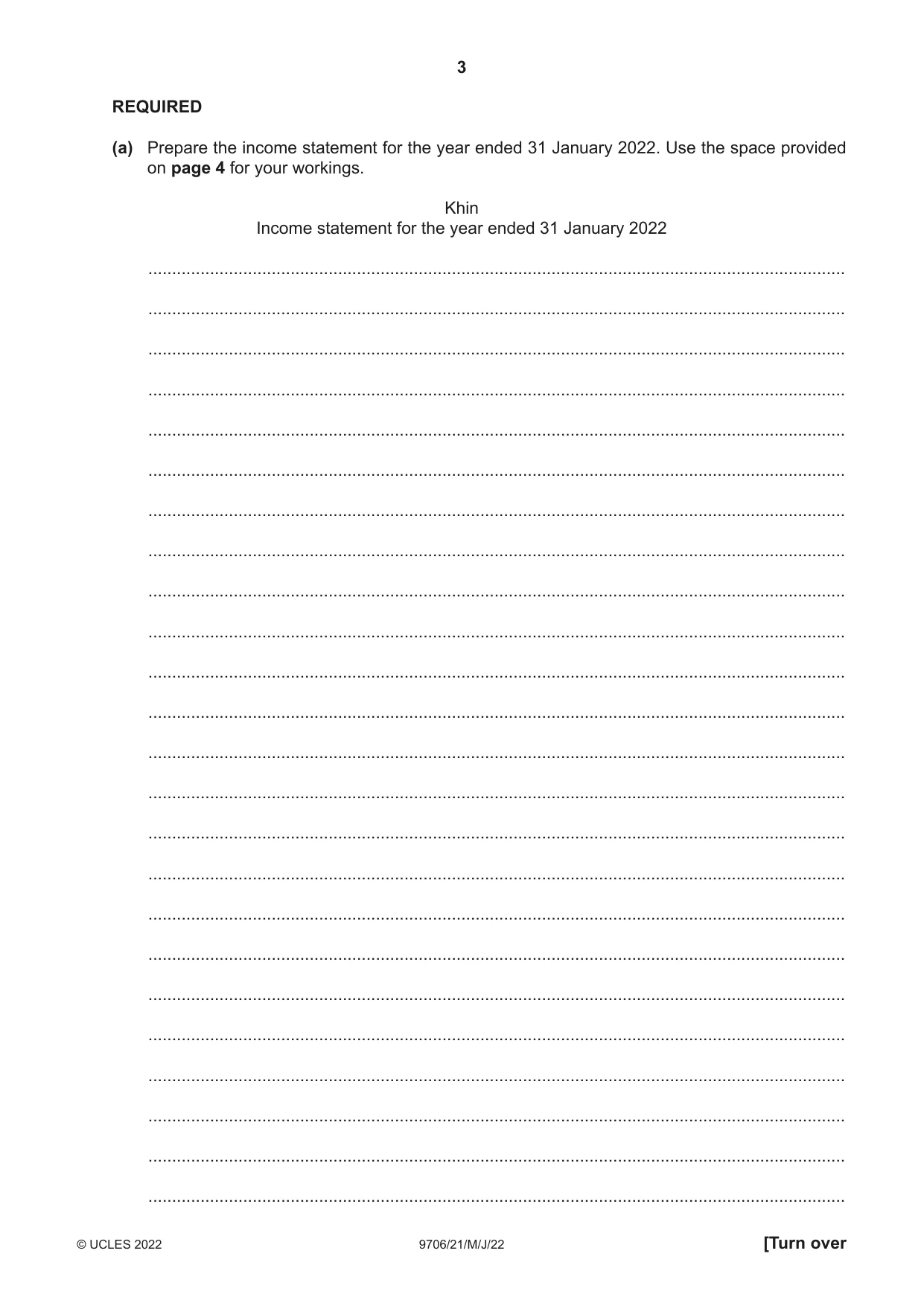
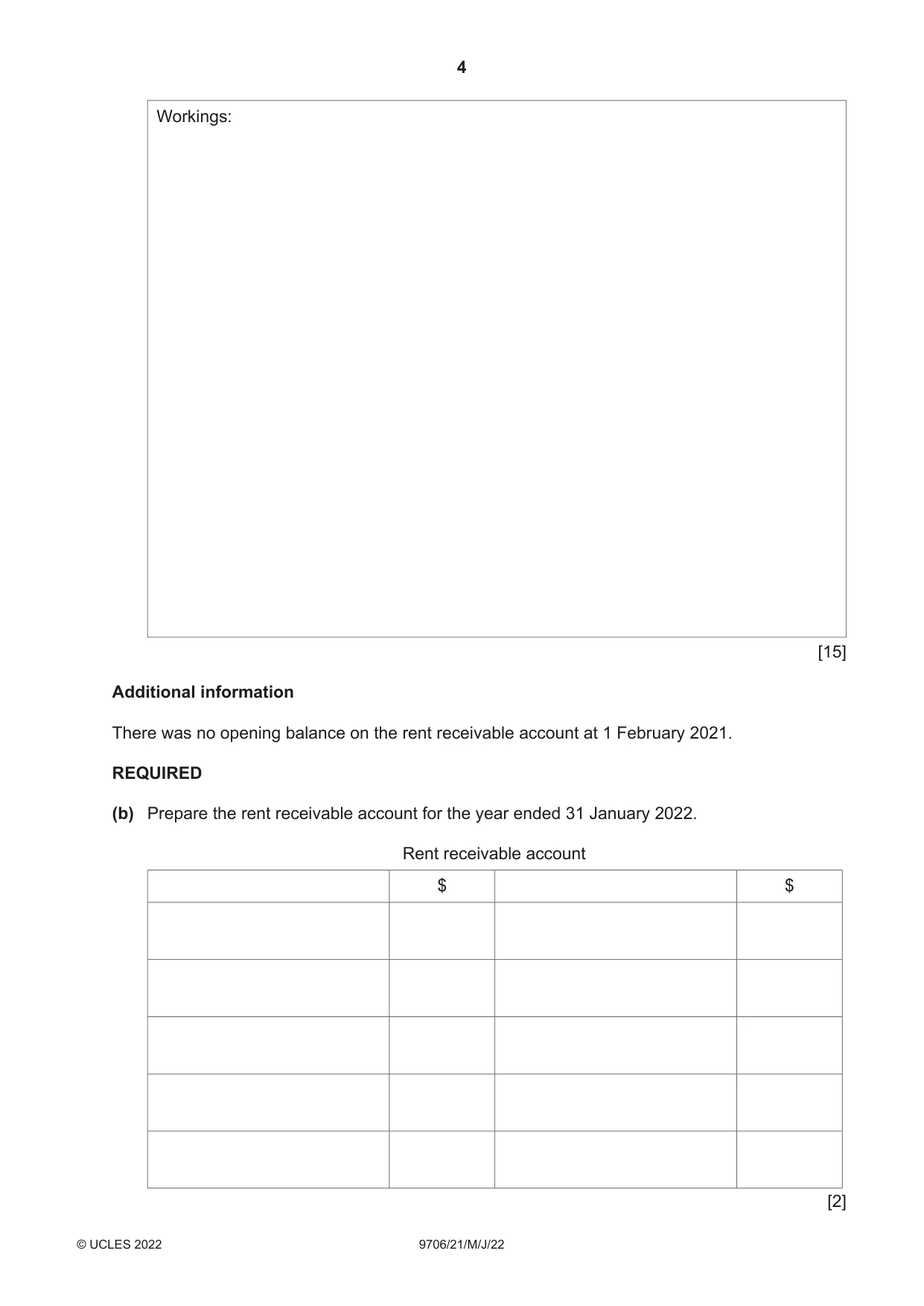
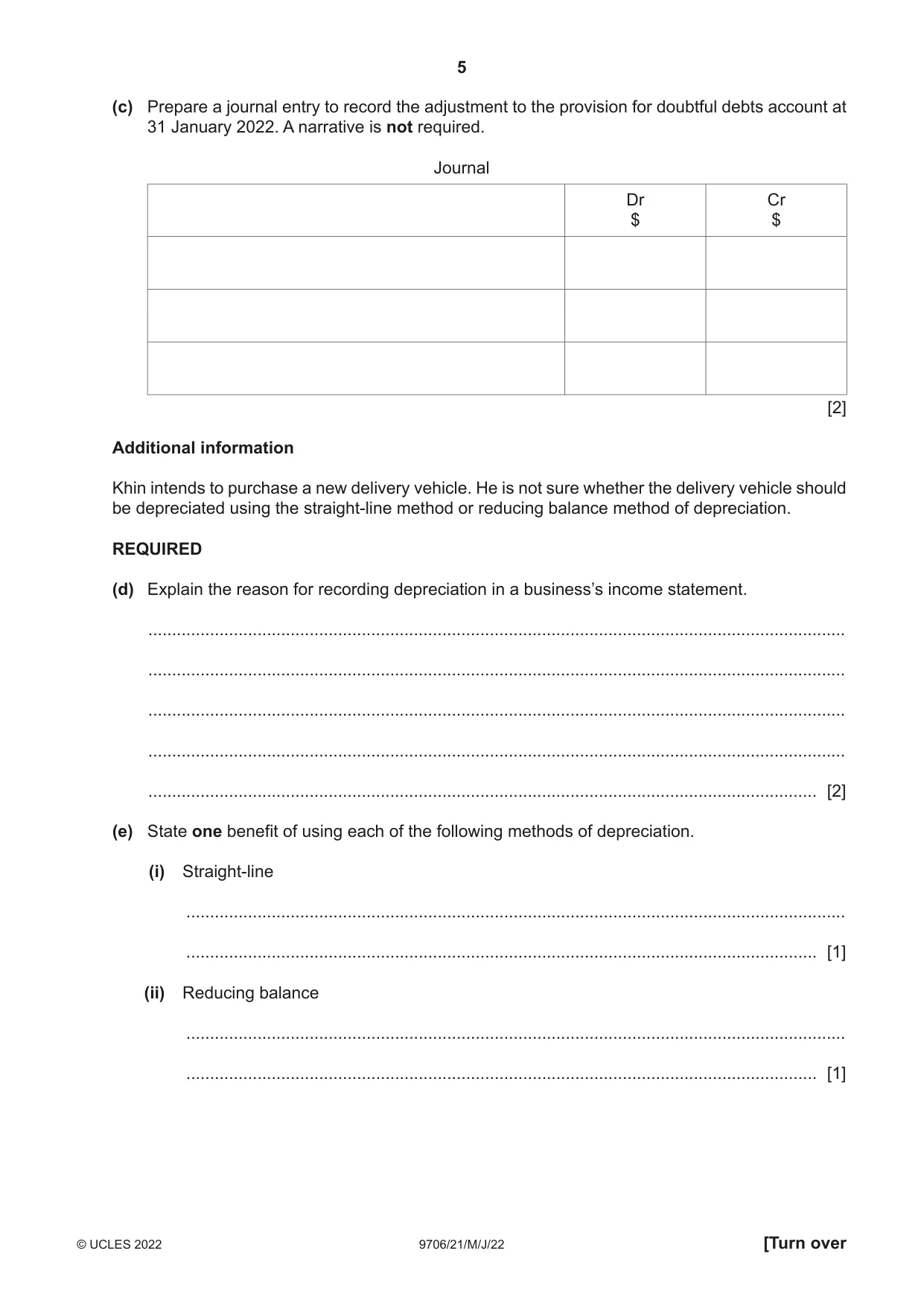
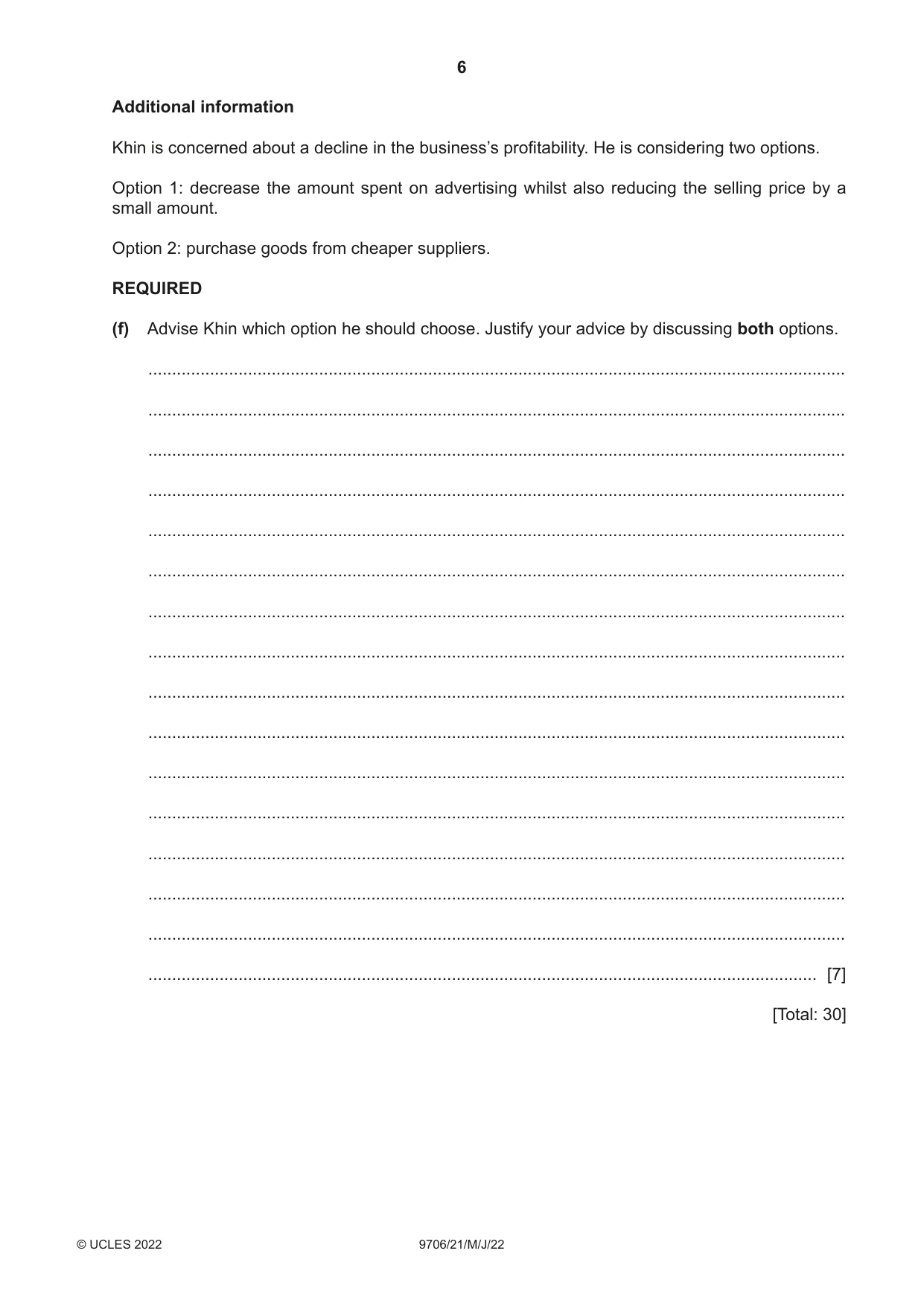
1 Khin is a retailer. The following balances have been extracted from his books of account at 31 January 2022. $ Advertising 4 900 Carriage inwards 2 140 Carriage outwards 1 730 Furniture and equipment at cost 18 900 Furniture and equipment provision for depreciation at 1 February 2021 7 300 General expenses 13 450 Inventory at 1 February 2021 12 310 Irrecoverable debts 670 Loss on disposal of delivery vehicle 1 350 Premises at cost 360 000 Premises provision for depreciation at 1 February 2021 21 600 Provision for doubtful debts at 1 February 2021 840 Purchases 118 220 Rent receivable 7 000 Revenue 197 300 Trade receivables 15 580 Wages and salaries 34 640 The following information is also available at 31 January 2022. 1 Closing inventory was valued at $13 480. 2 No record had been made of goods taken for own use by Khin, $910. 3 An irrecoverable debt of $380 is to be written off. 4 The provision for doubtful debts is to be maintained at 5% of trade receivables. 5 Advertising includes a payment of $3250 for a campaign which will last from 1 December 2021 to 30 April 2022. 6 Rent receivable is $500 per month. 7 Wages, $1440, are outstanding. 8 Khin sold his business’s only delivery vehicle in January 2022 resulting in the loss of $1350 shown in the balances at 31 January 2022. 9 The business’s depreciation policy is as follows: i Premises to be depreciated by 2% per annum using the straight-line method. ii Furniture and equipment to be depreciated by 15% using the reducing balance method. REQUIRED (a) Prepare the income statement for the year ended 31 January 2022. Use the space provided on page 4 for your workings. Khin Income statement for the year ended 31 January 2022 ................................................................................................................................................... ................................................................................................................................................... ................................................................................................................................................... ................................................................................................................................................... ................................................................................................................................................... ................................................................................................................................................... ................................................................................................................................................... ................................................................................................................................................... ................................................................................................................................................... ................................................................................................................................................... ................................................................................................................................................... ................................................................................................................................................... ................................................................................................................................................... ................................................................................................................................................... ................................................................................................................................................... ................................................................................................................................................... ................................................................................................................................................... ................................................................................................................................................... ................................................................................................................................................... ................................................................................................................................................... ................................................................................................................................................... ................................................................................................................................................... ................................................................................................................................................... ................................................................................................................................................... Workings: [15] Additional information There was no opening balance on the rent receivable account at 1 February 2021. REQUIRED (b) Prepare the rent receivable account for the year ended 31 January 2022. Rent receivable account $ $ [2] (c) Prepare a journal entry to record the adjustment to the provision for doubtful debts account at 31 January 2022. A narrative is not required. Journal Dr Cr $ $ [2] Additional information Khin intends to purchase a new delivery vehicle. He is not sure whether the delivery vehicle should be depreciated using the straight-line method or reducing balance method of depreciation. REQUIRED (d) Explain the reason for recording depreciation in a business’s income statement. ................................................................................................................................................... ................................................................................................................................................... ................................................................................................................................................... ................................................................................................................................................... ............................................................................................................................................. [2] (e) State one benefit of using each of the following methods of depreciation. (i) Straight-line ........................................................................................................................................... ..................................................................................................................................... [1] (ii) Reducing balance ........................................................................................................................................... ..................................................................................................................................... [1] Additional information Khin is concerned about a decline in the business’s profitability. He is considering two options. Option 1: decrease the amount spent on advertising whilst also reducing the selling price by a small amount. Option 2: purchase goods from cheaper suppliers. REQUIRED (f) Advise Khin which option he should choose. Justify your advice by discussing both options. ................................................................................................................................................... ................................................................................................................................................... ................................................................................................................................................... ................................................................................................................................................... ................................................................................................................................................... ................................................................................................................................................... ................................................................................................................................................... ................................................................................................................................................... ................................................................................................................................................... ................................................................................................................................................... ................................................................................................................................................... ................................................................................................................................................... ................................................................................................................................................... ................................................................................................................................................... ................................................................................................................................................... ............................................................................................................................................. [7] [Total: 30]
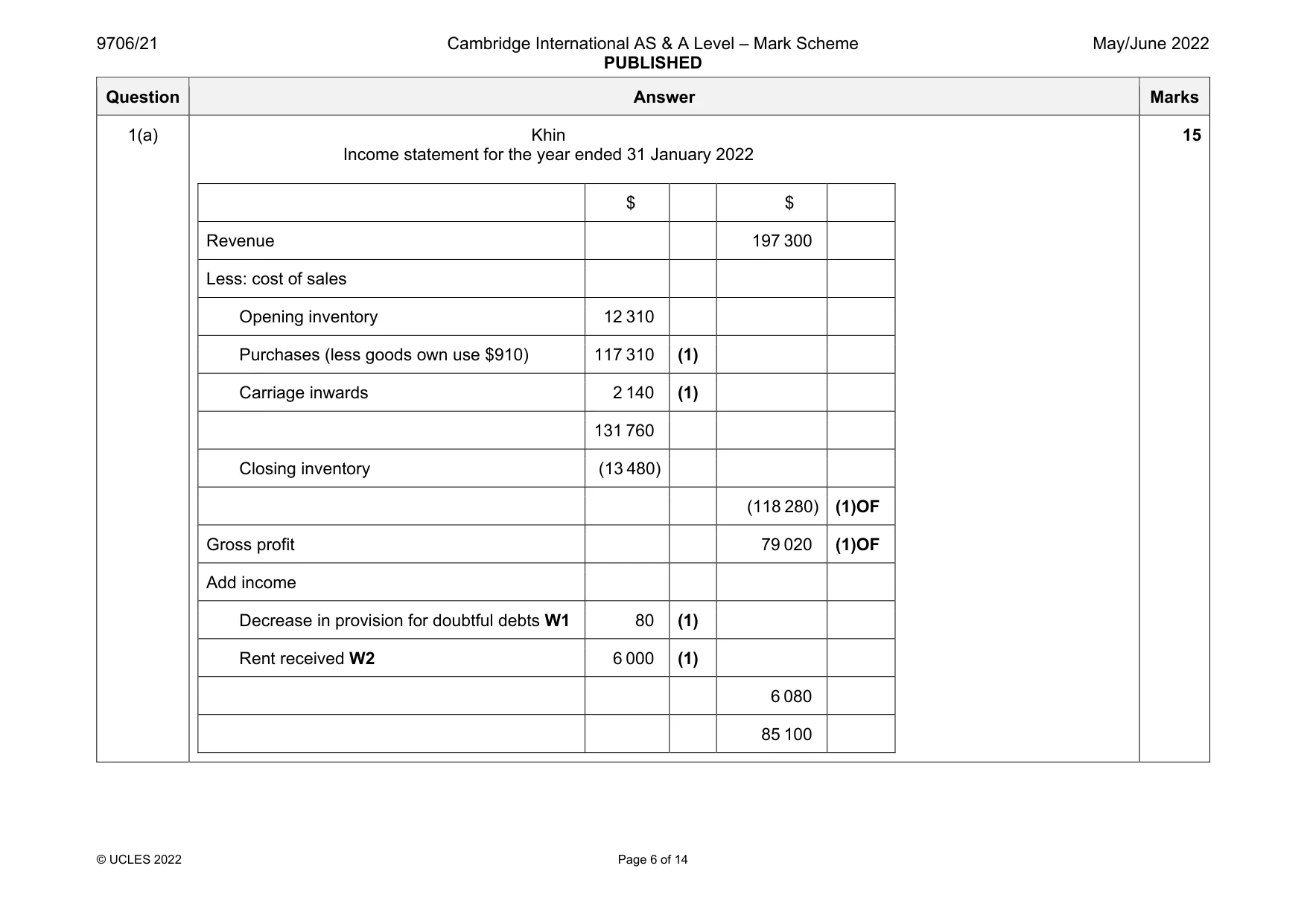
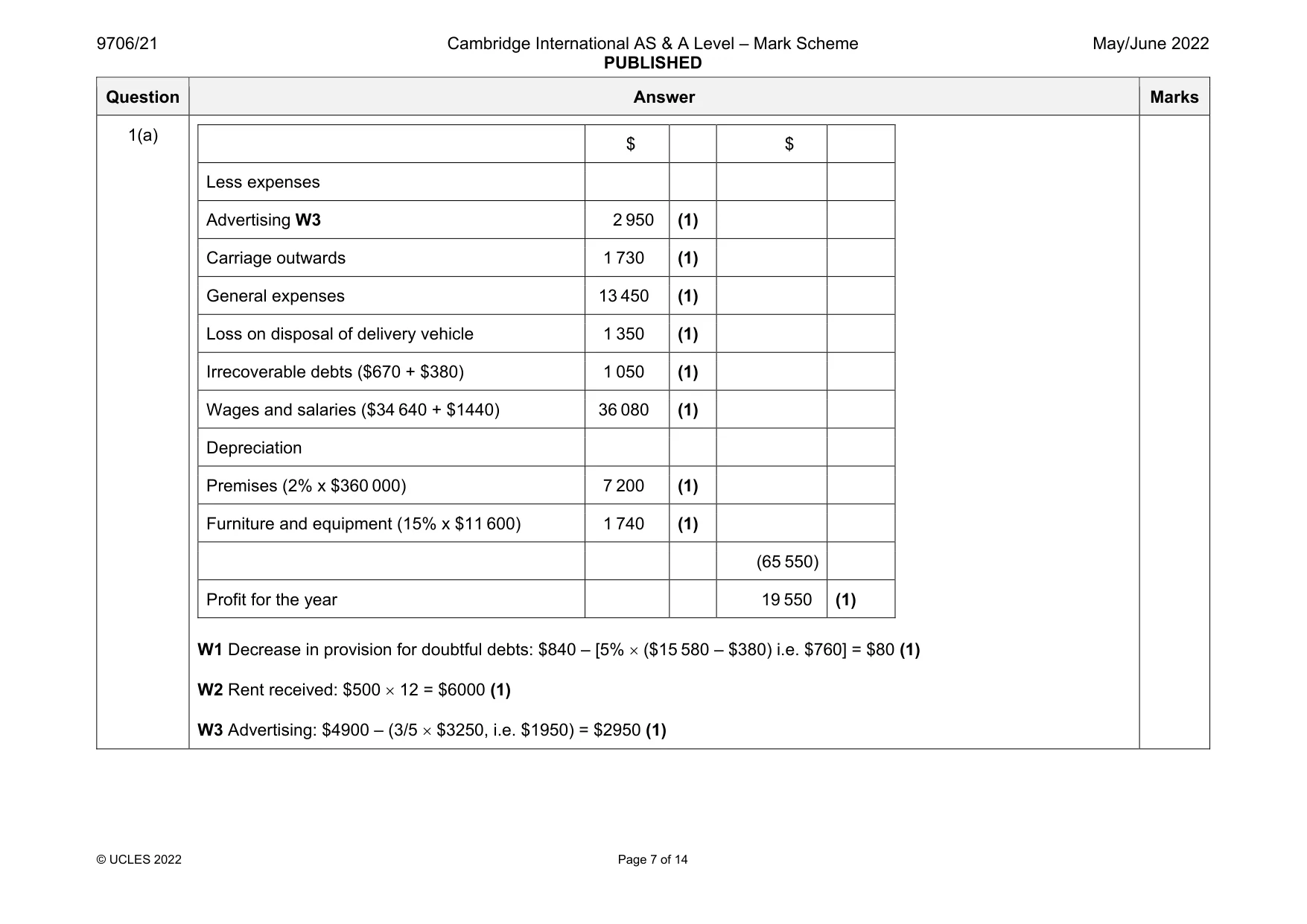
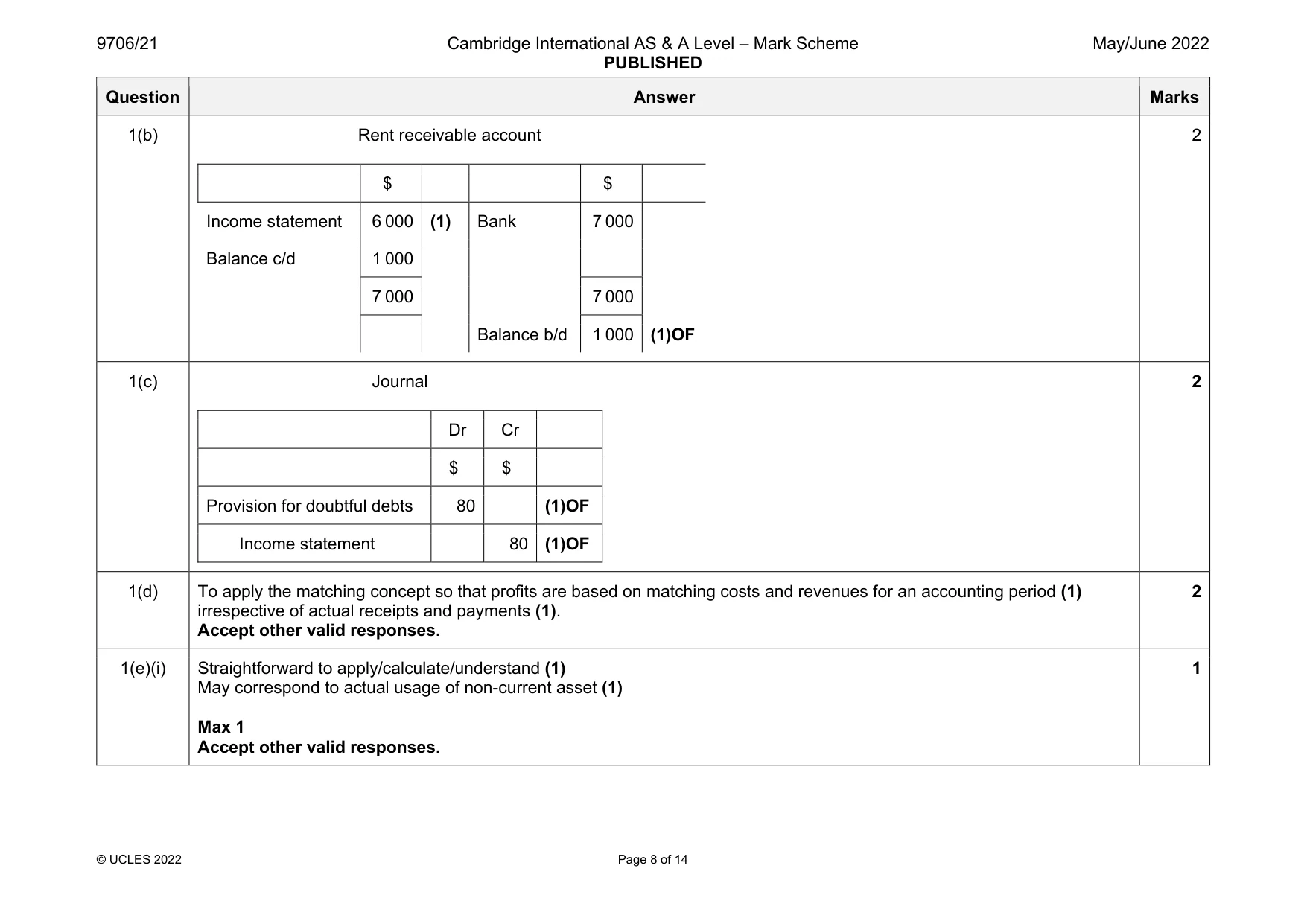
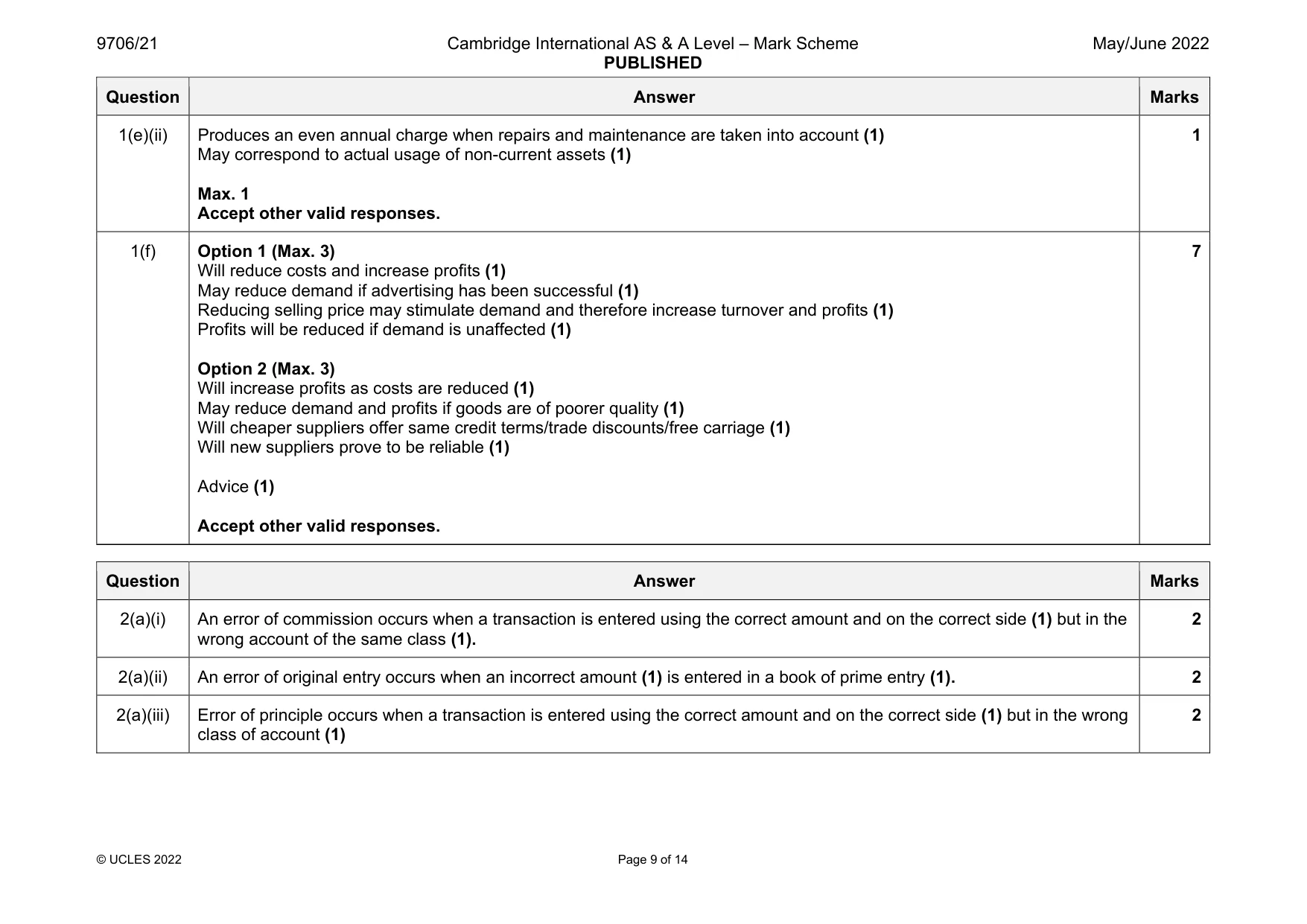
Mark scheme: 1(a) Khin Income statement for the year ended 31 January 2022 $ $ Revenue 197 300 Less: cost of sales Opening inventory 12 310 Purchases (less goods own use $910) 117 310 (1) Carriage inwards 2 140 (1) 131 760 Closing inventory (13 480) (118 280) (1)OF Gross profit 79 020 (1)OF Add income Decrease in provision for doubtful debts W1 80 (1) Rent received W2 6 000 (1) 6 080 85 100 15 Question Answer Marks 1(a) $ $ Less expenses Advertising W3 2 950 (1) Carriage outwards 1 730 (1) General expenses 13 450 (1) Loss on disposal of delivery vehicle 1 350 (1) Irrecoverable debts ($670 + $380) 1 050 (1) Wages and salaries ($34 640 + $1440) 36 080 (1) Depreciation Premises (2% x $360 000) 7 200 (1) Furniture and equipment (15% x $11 600) 1 740 (1) (65 550) Profit for the year 19 550 (1) W1 Decrease in provision for doubtful debts: $840 – [5% ($15 580 – $380) i.e. $760] = $80 (1) W2 Rent received: $500 12 = $6000 (1) W3 Advertising: $4900 – (3/5 $3250, i.e. $1950) = $2950 (1) Question Answer Marks 1(b) Rent receivable account $ $ Income statement 6 000 (1) Bank 7 000 Balance c/d 1 000 7 000 7 000 Balance b/d 1 000 (1)OF 2 1(c) Journal Dr Cr $ $ Provision for doubtful debts 80 (1)OF Income statement 80 (1)OF 2 1(d) To apply the matching concept so that profits are based on matching costs and revenues for an accounting period (1) irrespective of actual receipts and payments (1). Accept other valid responses. 2 1(e)(i) Straightforward to apply/calculate/understand (1) May correspond to actual usage of non-current asset (1) Max 1 Accept other valid responses. 1 Question Answer Marks 1(e)(ii) Produces an even annual charge when repairs and maintenance are taken into account (1) May correspond to actual usage of non-current assets (1) Max. 1 Accept other valid responses. 1 1(f) Option 1 (Max. 3) Will reduce costs and increase profits (1) May reduce demand if advertising has been successful (1) Reducing selling price may stimulate demand and therefore increase turnover and profits (1) Profits will be reduced if demand is unaffected (1) Option 2 (Max. 3) Will increase profits as costs are reduced (1) May reduce demand and profits if goods are of poorer quality (1) Will cheaper suppliers offer same credit terms/trade discounts/free carriage (1) Will new suppliers prove to be reliable (1) Advice (1) Accept other valid responses. 7
Q2 · Yasmin is a sole trader
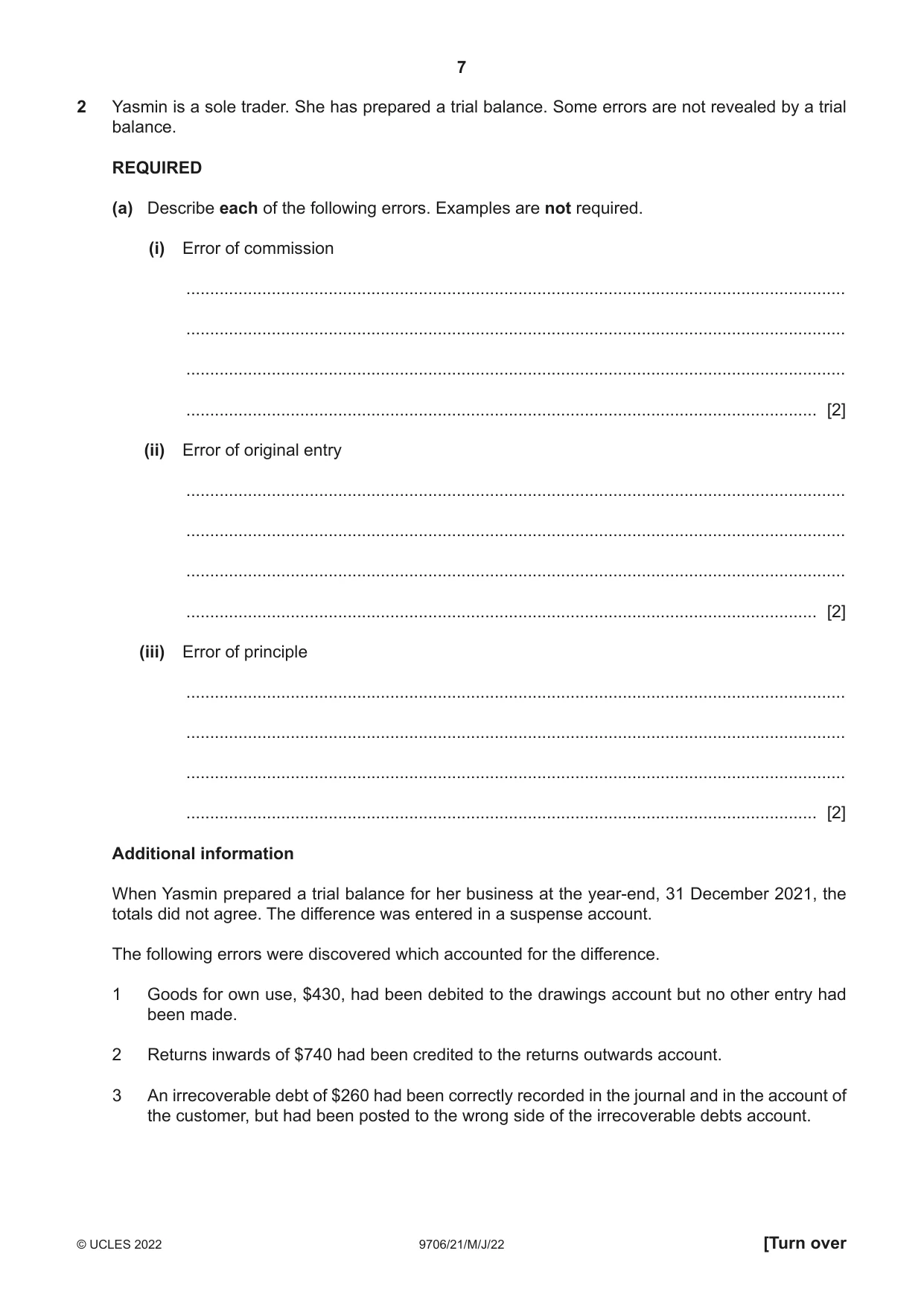
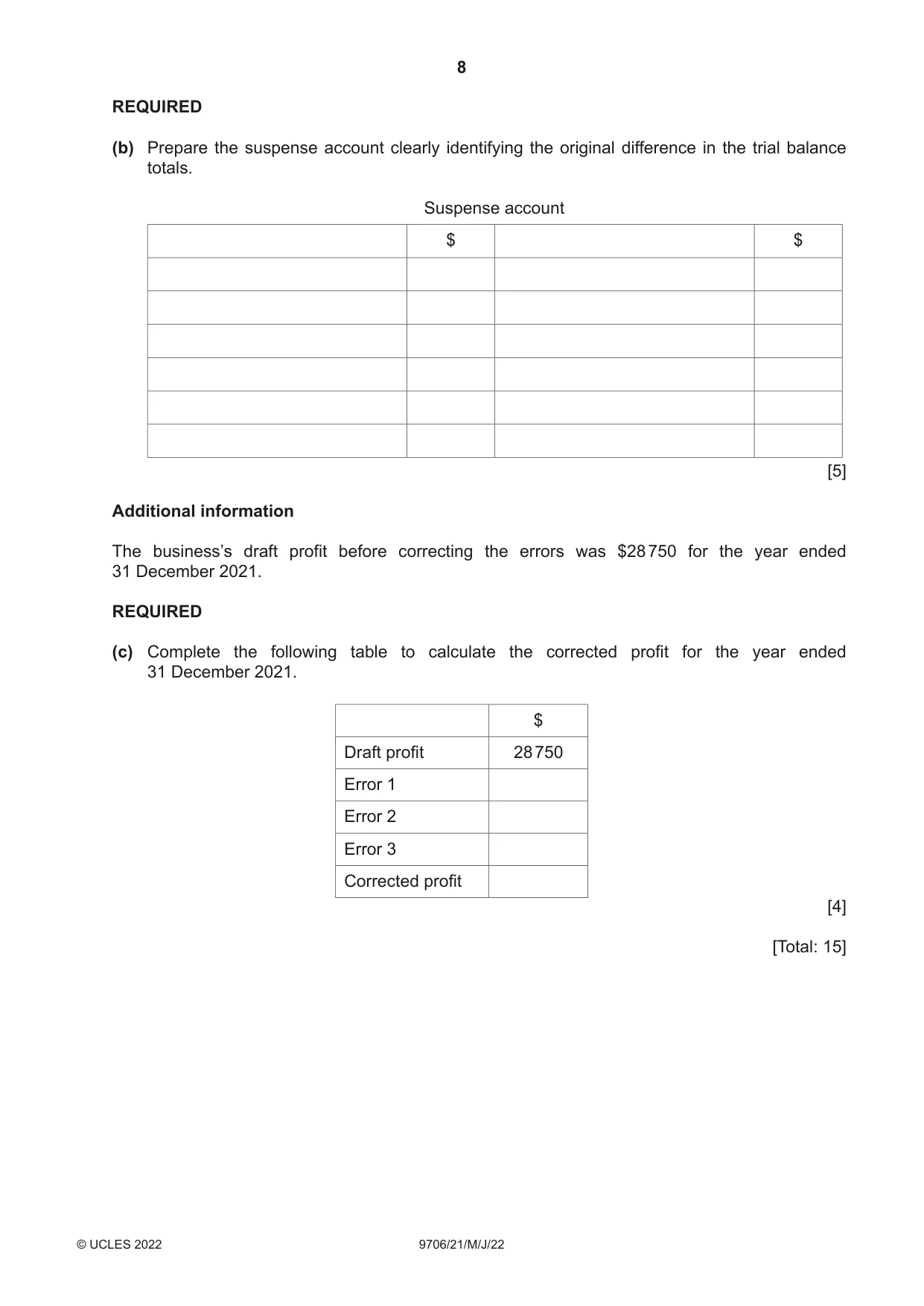
2 Yasmin is a sole trader. She has prepared a trial balance. Some errors are not revealed by a trial balance. REQUIRED (a) Describe each of the following errors. Examples are not required. (i) Error of commission ........................................................................................................................................... ........................................................................................................................................... ........................................................................................................................................... ..................................................................................................................................... [2] (ii) Error of original entry ........................................................................................................................................... ........................................................................................................................................... ........................................................................................................................................... ..................................................................................................................................... [2] (iii) Error of principle ........................................................................................................................................... ........................................................................................................................................... ........................................................................................................................................... ..................................................................................................................................... [2] Additional information When Yasmin prepared a trial balance for her business at the year-end, 31 December 2021, the totals did not agree. The difference was entered in a suspense account. The following errors were discovered which accounted for the difference. 1 Goods for own use, $430, had been debited to the drawings account but no other entry had been made. 2 Returns inwards of $740 had been credited to the returns outwards account. 3 An irrecoverable debt of $260 had been correctly recorded in the journal and in the account of the customer, but had been posted to the wrong side of the irrecoverable debts account. REQUIRED (b) Prepare the suspense account clearly identifying the original difference in the trial balance totals. Suspense account $ $ [5] Additional information The business’s draft profit before correcting the errors was $28 750 for the year ended 31 December 2021. REQUIRED (c) Complete the following table to calculate the corrected profit for the year ended 31 December 2021. $ Draft profit 28 750 Error 1 Error 2 Error 3 Corrected profit [4] [Total: 15] PLEASE TURN OVER
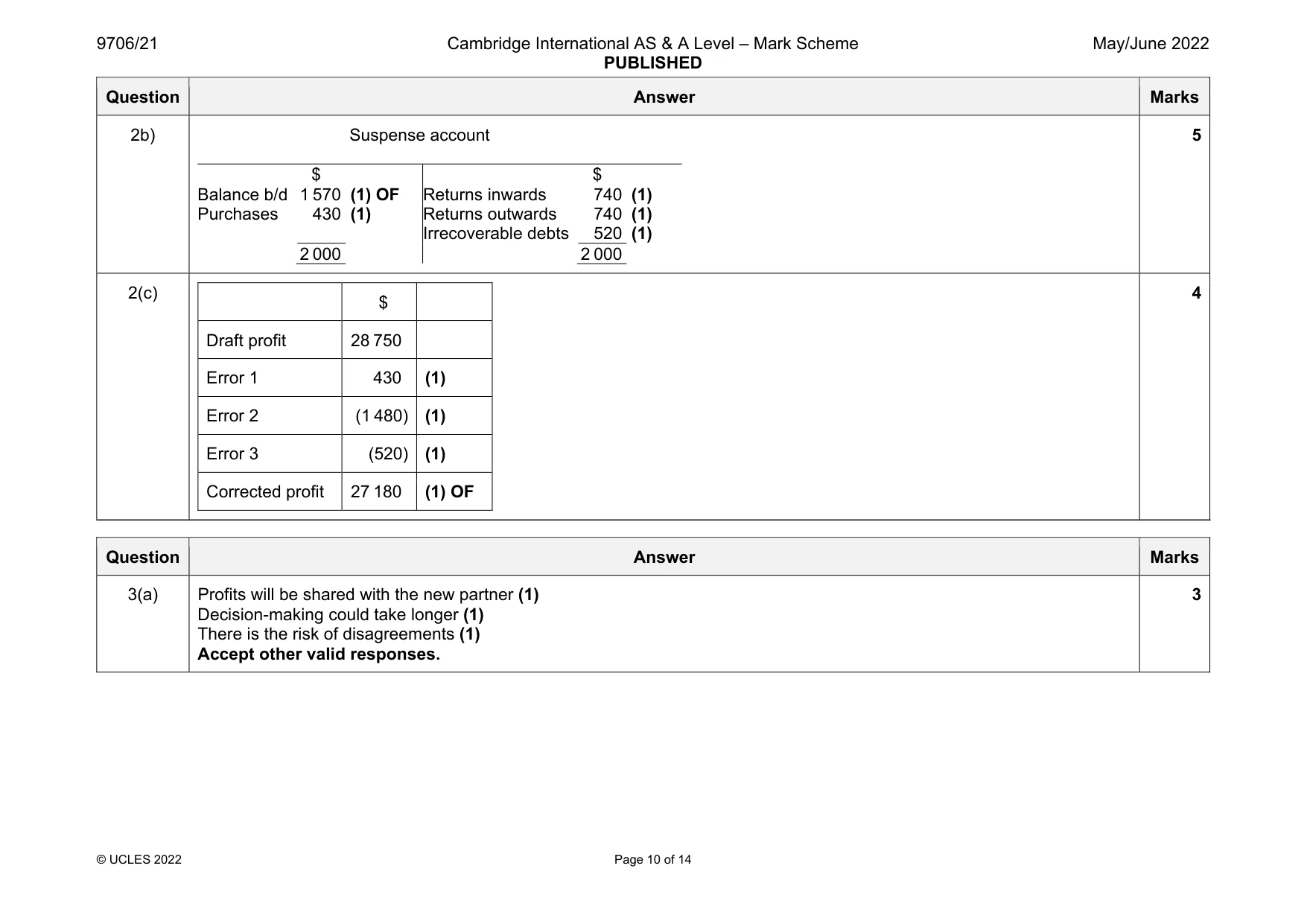
Mark scheme: 2(a)(i) An error of commission occurs when a transaction is entered using the correct amount and on the correct side (1) but in the wrong account of the same class (1). 2 2(a)(ii) An error of original entry occurs when an incorrect amount (1) is entered in a book of prime entry (1). 2 2(a)(iii) Error of principle occurs when a transaction is entered using the correct amount and on the correct side (1) but in the wrong class of account (1) 2 Question Answer Marks 2b) Suspense account $ $ Balance b/d 1 570 (1) OF Returns inwards 740 (1) Purchases 430 (1) Returns outwards 740 (1) Irrecoverable debts 520 (1) 2 000 2 000 5 2(c) $ Draft profit 28 750 Error 1 430 (1) Error 2 (1 480) (1) Error 3 (520) (1) Corrected profit 27 180 (1) OF 4
Q3 · Maria and Rio have been in partnership for a number of years
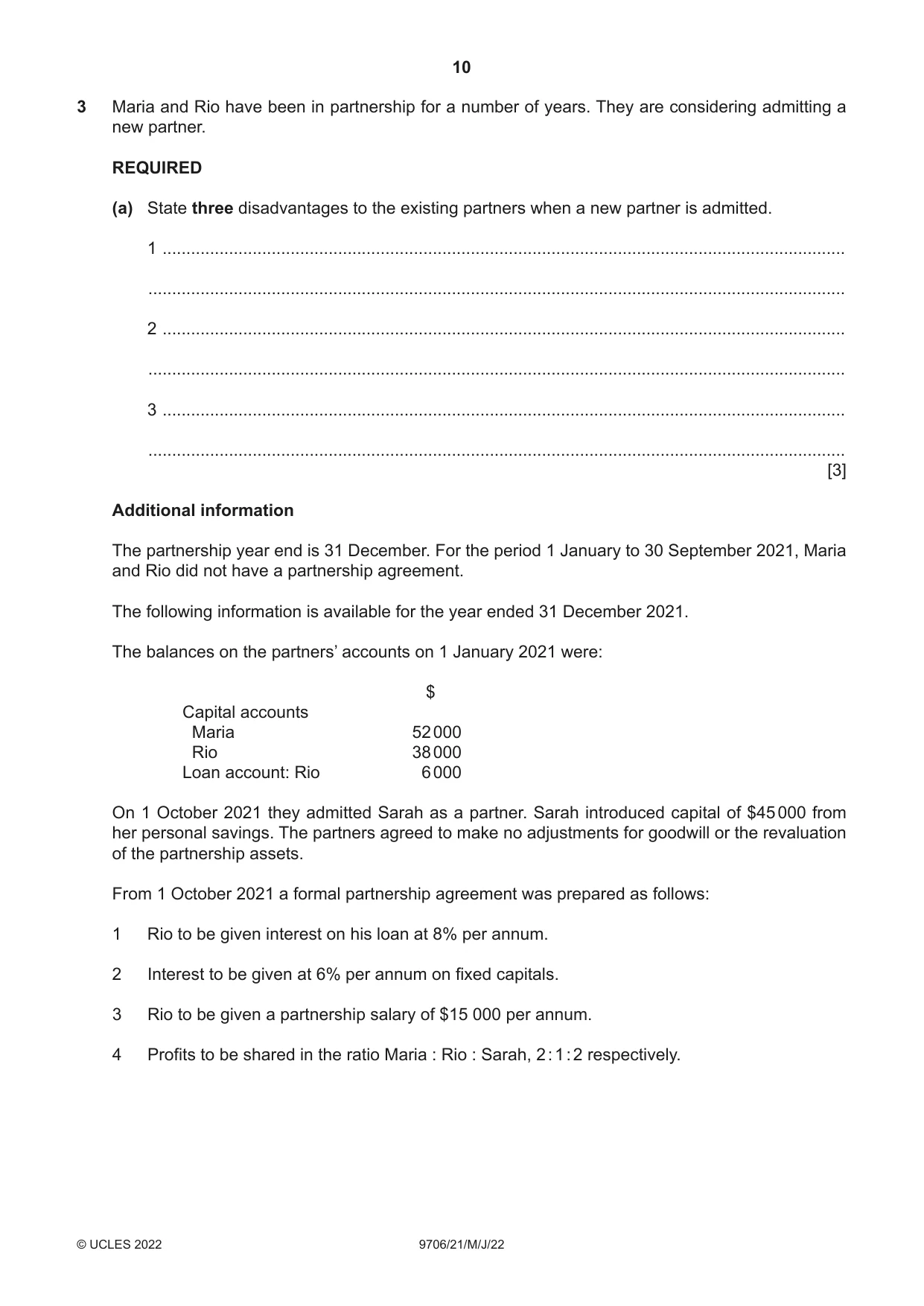
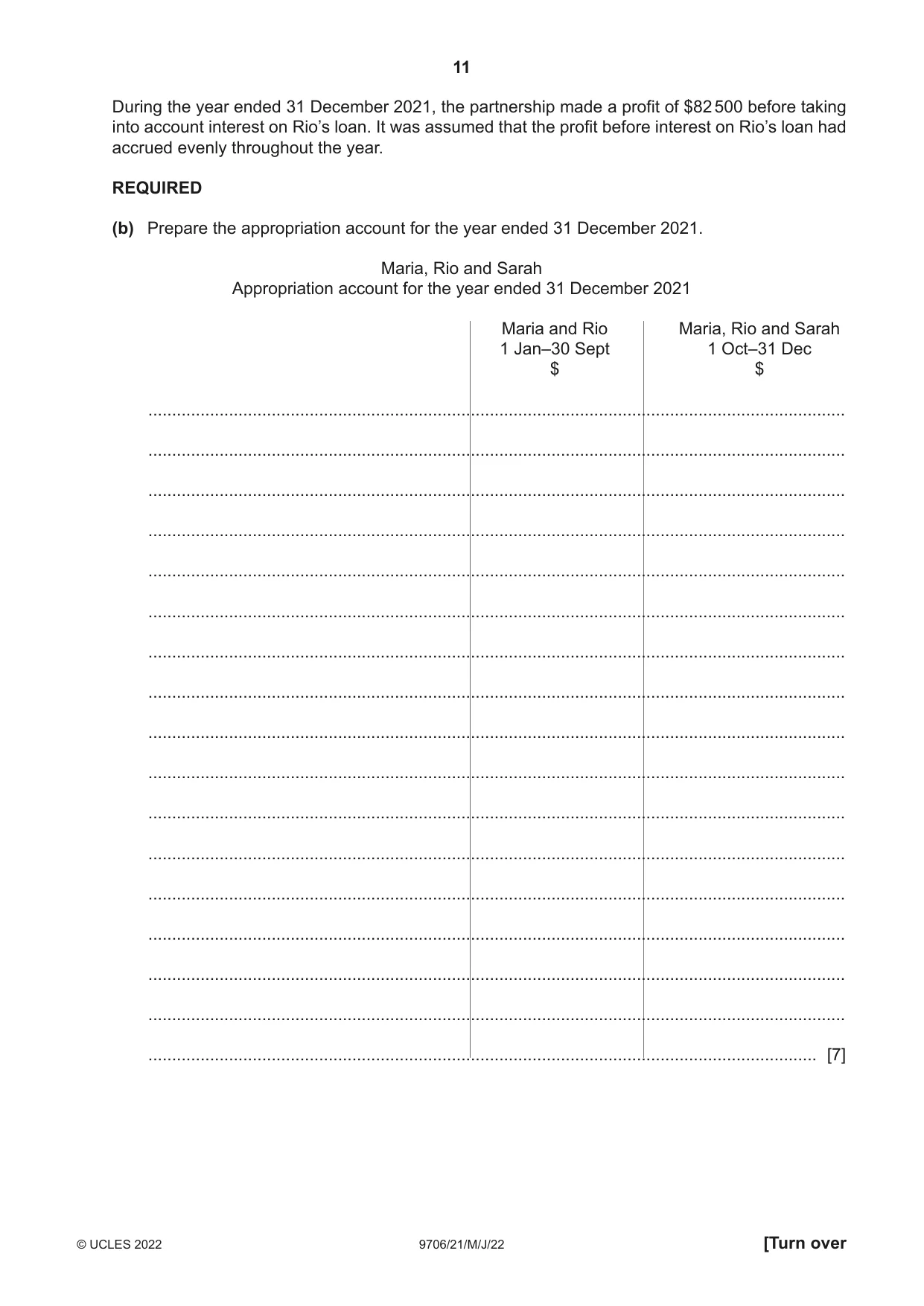
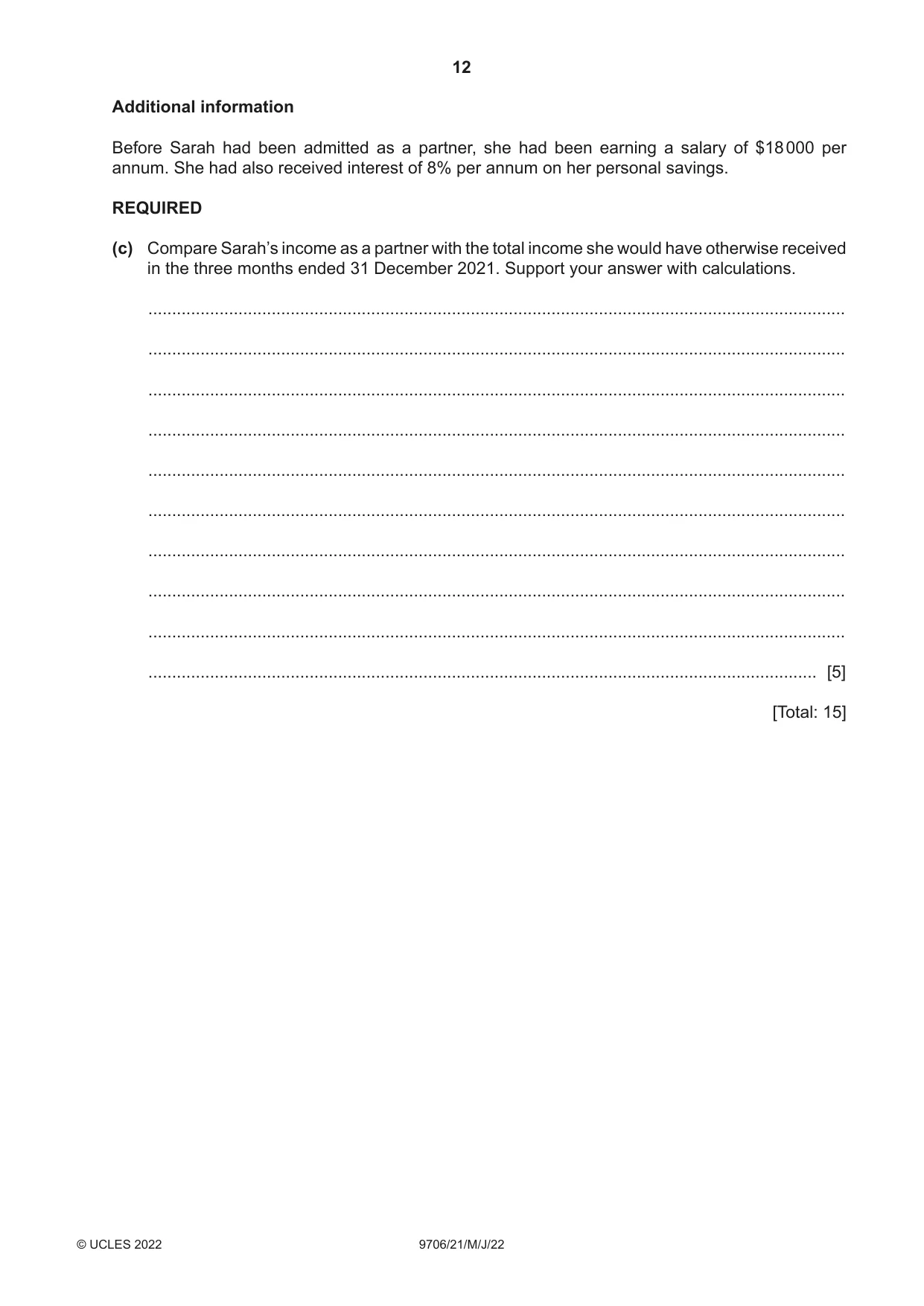
3 Maria and Rio have been in partnership for a number of years. They are considering admitting a new partner. REQUIRED (a) State three disadvantages to the existing partners when a new partner is admitted. 1 ................................................................................................................................................ ................................................................................................................................................... 2 ................................................................................................................................................ ................................................................................................................................................... 3 ................................................................................................................................................ ................................................................................................................................................... [3] Additional information The partnership year end is 31 December. For the period 1 January to 30 September 2021, Maria and Rio did not have a partnership agreement. The following information is available for the year ended 31 December 2021. The balances on the partners’ accounts on 1 January 2021 were: $ Capital accounts Maria 52 000 Rio 38 000 Loan account: Rio 6 000 On 1 October 2021 they admitted Sarah as a partner. Sarah introduced capital of $45 000 from her personal savings. The partners agreed to make no adjustments for goodwill or the revaluation of the partnership assets. From 1 October 2021 a formal partnership agreement was prepared as follows: 1 Rio to be given interest on his loan at 8% per annum. 2 Interest to be given at 6% per annum on fixed capitals. 3 Rio to be given a partnership salary of $15 000 per annum. 4 Profits to be shared in the ratio Maria : Rio : Sarah, 2 : 1 : 2 respectively. During the year ended 31 December 2021, the partnership made a profit of $82 500 before taking into account interest on Rio’s loan. It was assumed that the profit before interest on Rio’s loan had accrued evenly throughout the year. REQUIRED (b) Prepare the appropriation account for the year ended 31 December 2021. Maria, Rio and Sarah Appropriation account for the year ended 31 December 2021 Maria and Rio Maria, Rio and Sarah 1 Jan–30 Sept 1 Oct–31 Dec $ $ ................................................................................................................................................... ................................................................................................................................................... ................................................................................................................................................... ................................................................................................................................................... ................................................................................................................................................... ................................................................................................................................................... ................................................................................................................................................... ................................................................................................................................................... ................................................................................................................................................... ................................................................................................................................................... ................................................................................................................................................... ................................................................................................................................................... ................................................................................................................................................... ................................................................................................................................................... ................................................................................................................................................... ................................................................................................................................................... ............................................................................................................................................. [7] Additional information Before Sarah had been admitted as a partner, she had been earning a salary of $18 000 per annum. She had also received interest of 8% per annum on her personal savings. REQUIRED (c) Compare Sarah’s income as a partner with the total income she would have otherwise received in the three months ended 31 December 2021. Support your answer with calculations. ................................................................................................................................................... ................................................................................................................................................... ................................................................................................................................................... ................................................................................................................................................... ................................................................................................................................................... ................................................................................................................................................... ................................................................................................................................................... ................................................................................................................................................... ................................................................................................................................................... ............................................................................................................................................. [5] [Total: 15] PLEASE TURN OVER
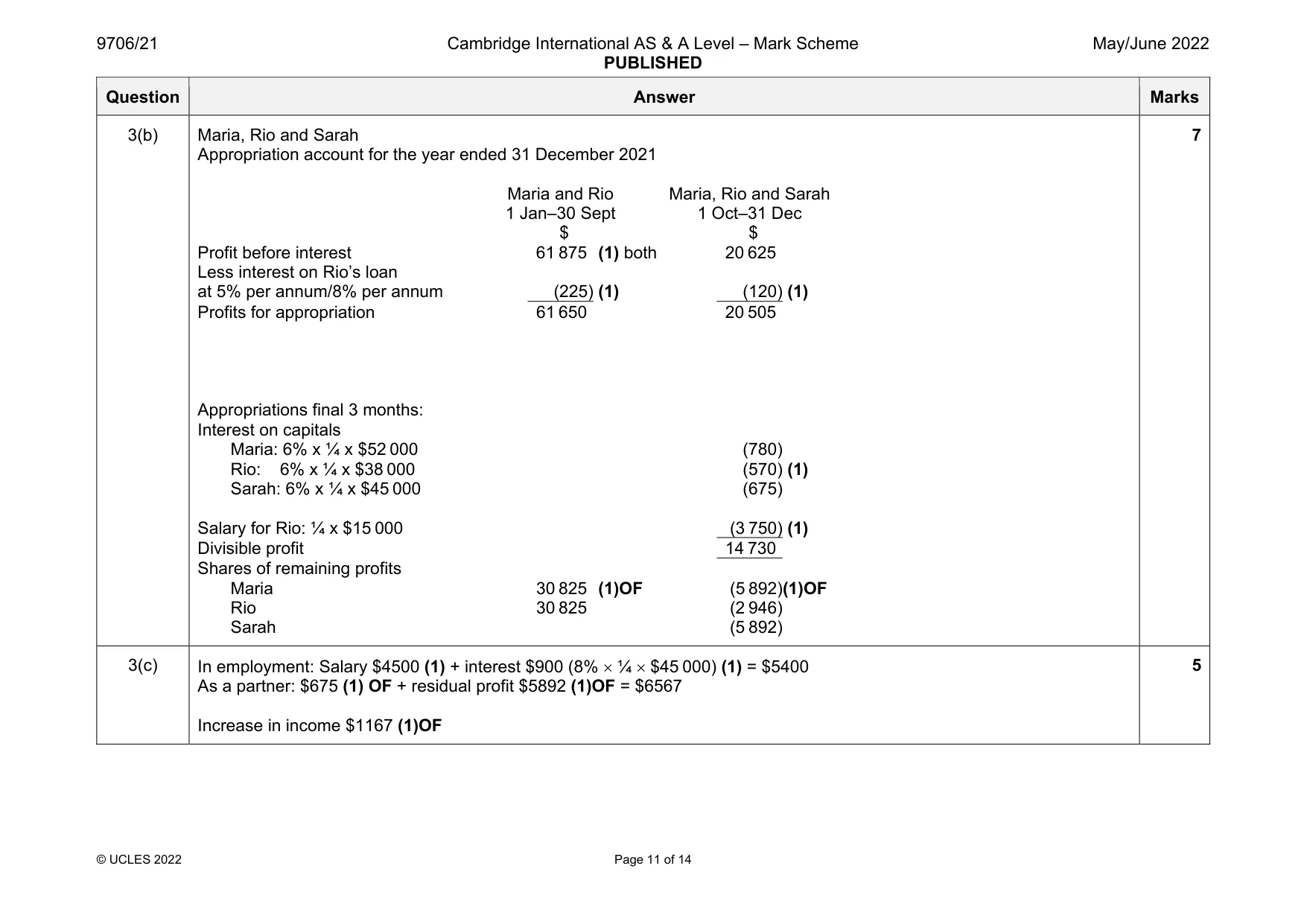
Mark scheme: 3(a) Profits will be shared with the new partner (1) Decision-making could take longer (1) There is the risk of disagreements (1) Accept other valid responses. 3 Question Answer Marks 3(b) Maria, Rio and Sarah Appropriation account for the year ended 31 December 2021 Maria and Rio Maria, Rio and Sarah 1 Jan–30 Sept 1 Oct–31 Dec $ $ Profit before interest 61 875 (1) both 20 625 Less interest on Rio’s loan at 5% per annum/8% per annum (225) (1) (120) (1) Profits for appropriation 61 650 20 505 Appropriations final 3 months: Interest on capitals Maria: 6% x ¼ x $52 000 (780) (1) Rio: 6% x ¼ x $38 000 (570) Sarah: 6% x ¼ x $45 000 (675) Salary for Rio: ¼ x $15 000 (3 750) (1) Divisible profit 14 730 Shares of remaining profits Maria 30 825 (1)OF (5 892) (1)OF Rio 30 825 (2 946) Sarah (5 892) 7 3(c) In employment: Salary $4500 (1) + interest $900 (8% ¼ $45 000) (1) = $5400 As a partner: $675 (1) OF + residual profit $5892 (1)OF = $6567 Increase in income $1167 (1)OF 5
Q4 · N Limited manufactures a single product at one of its factories
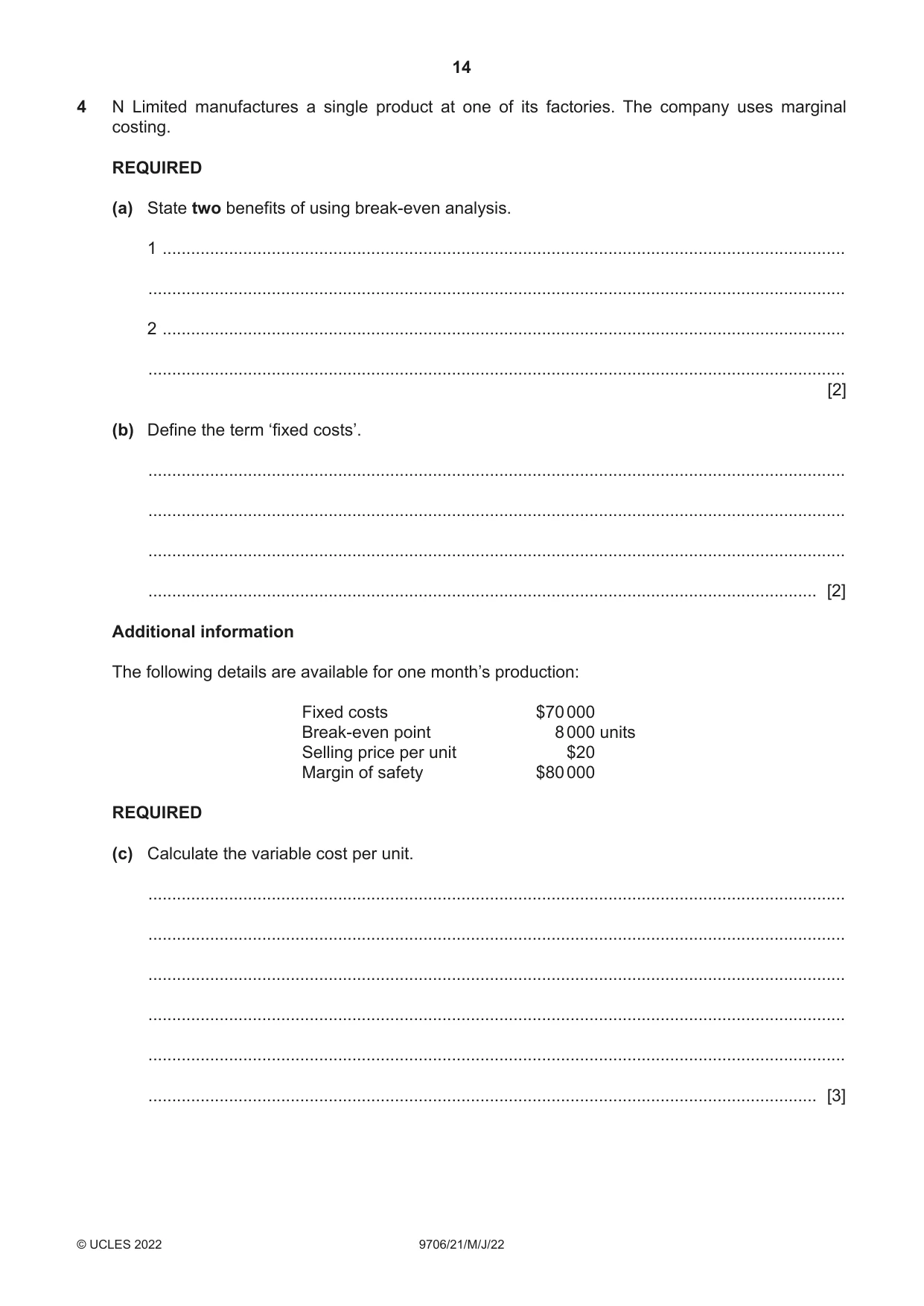
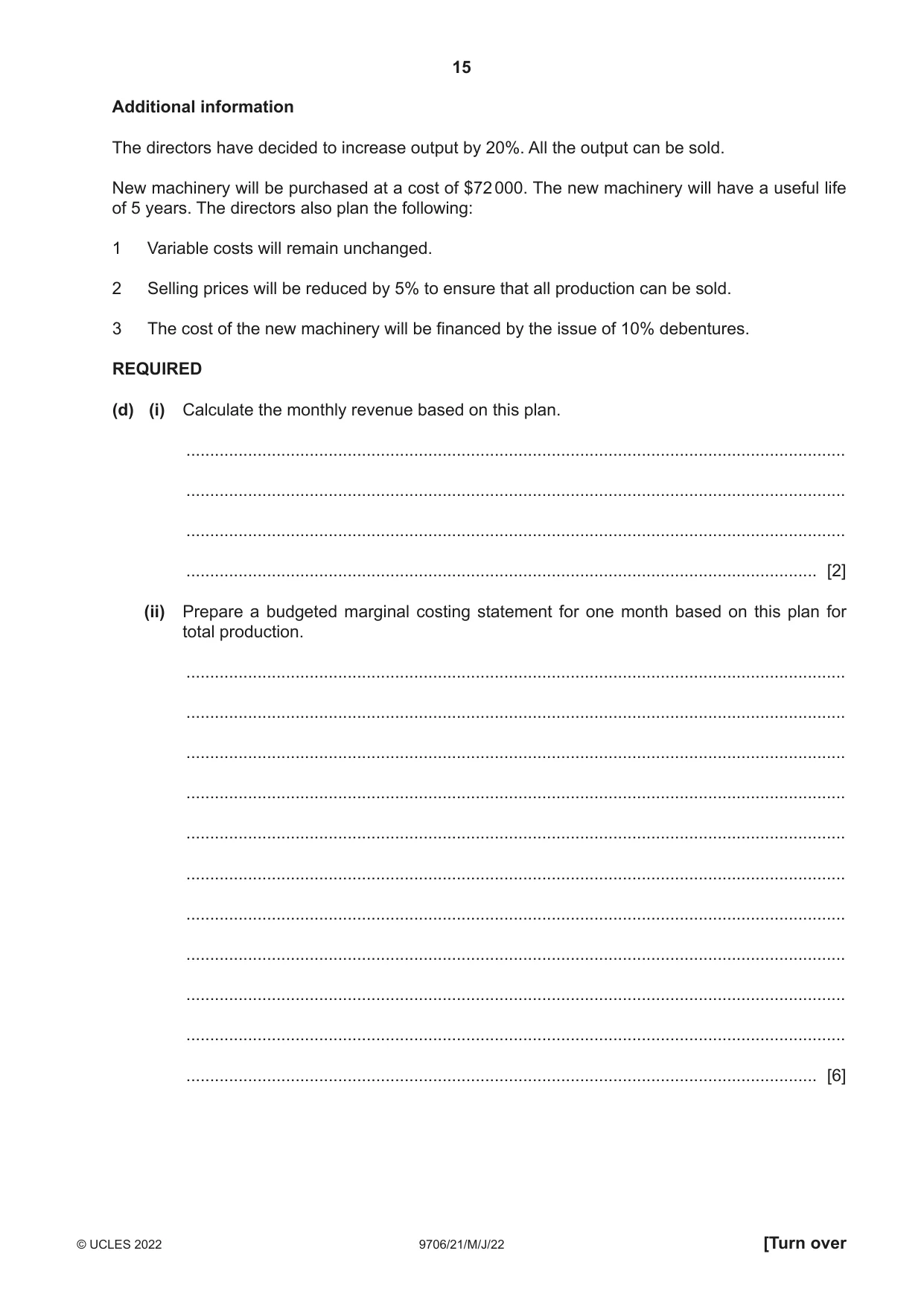
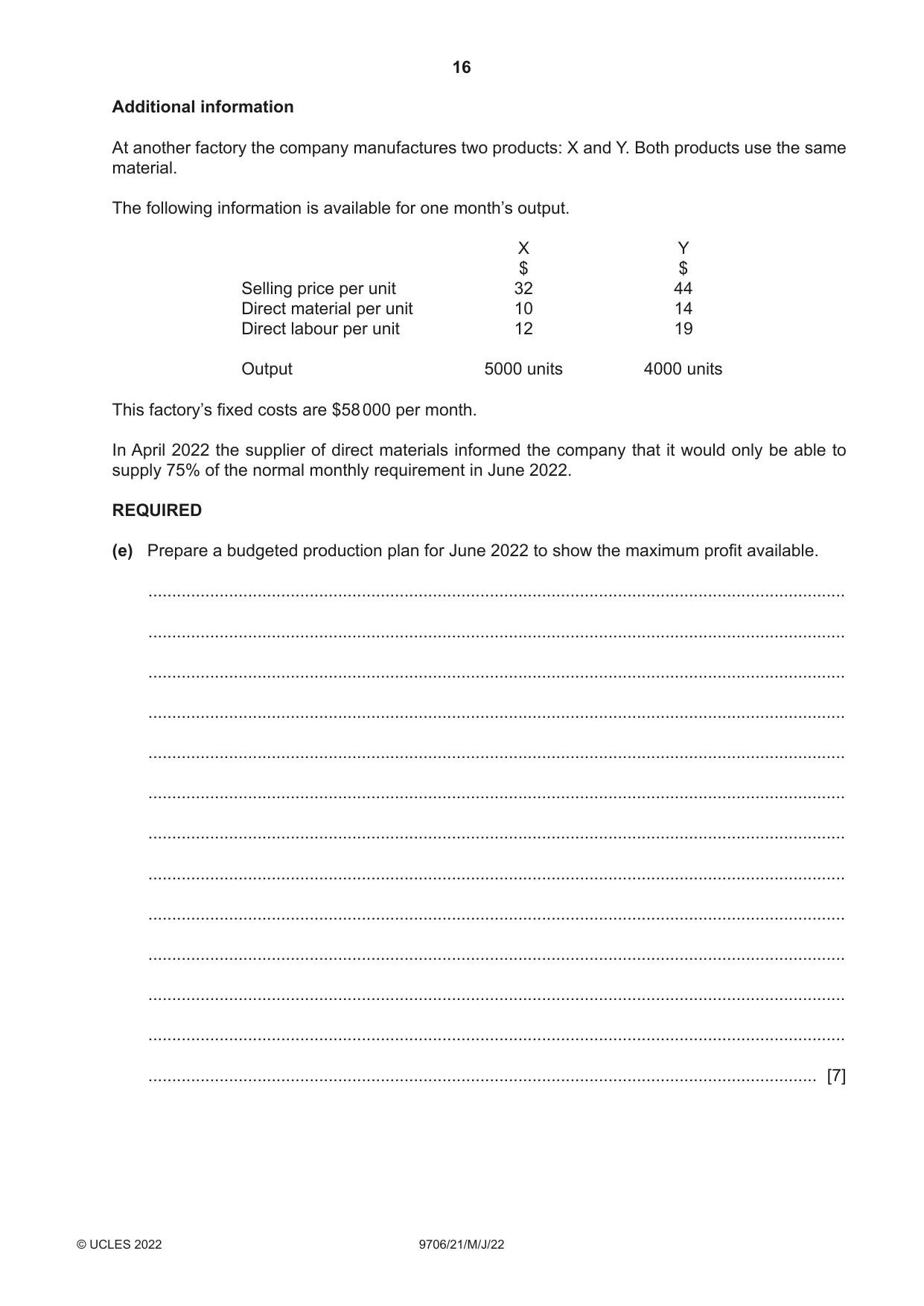
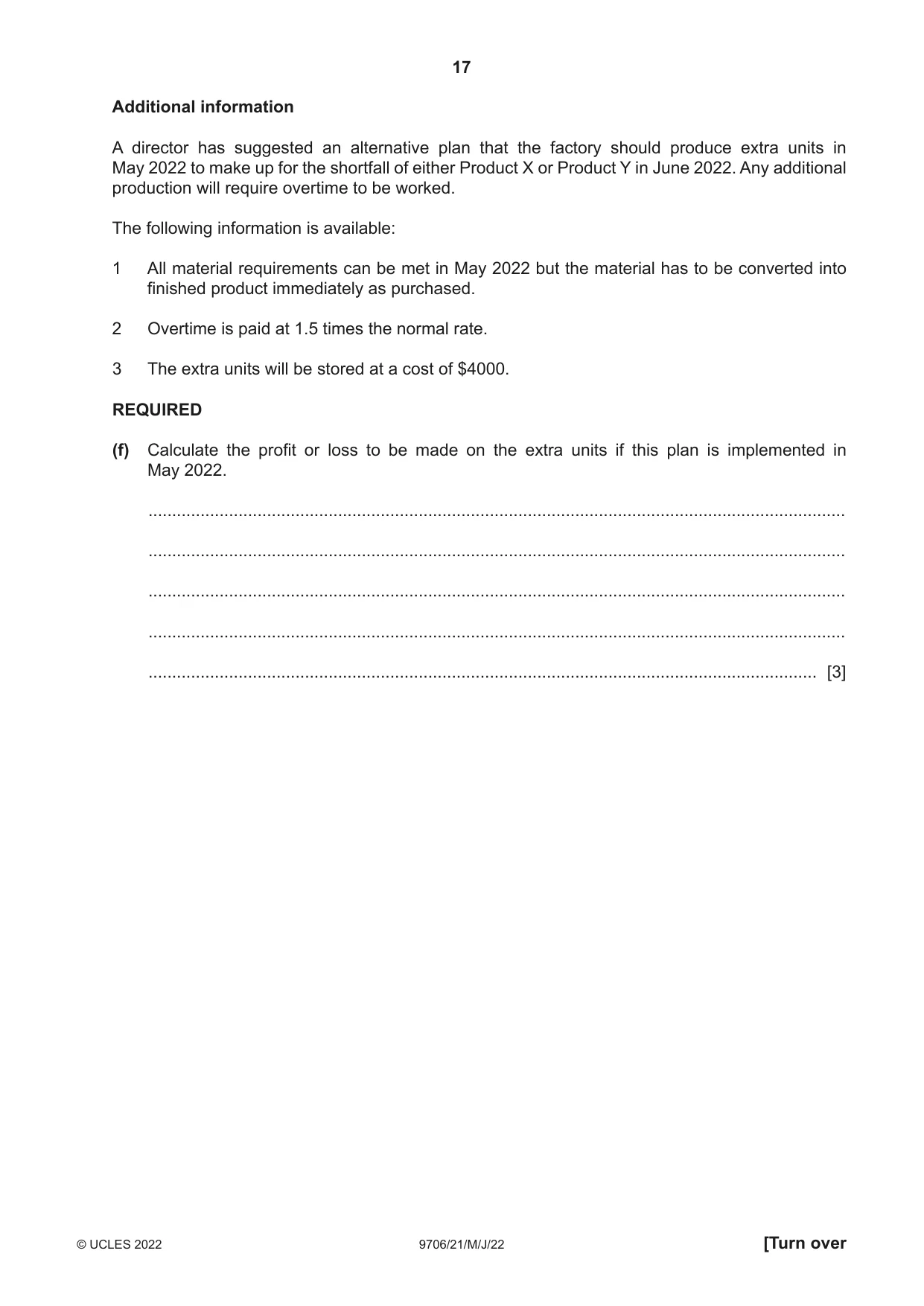
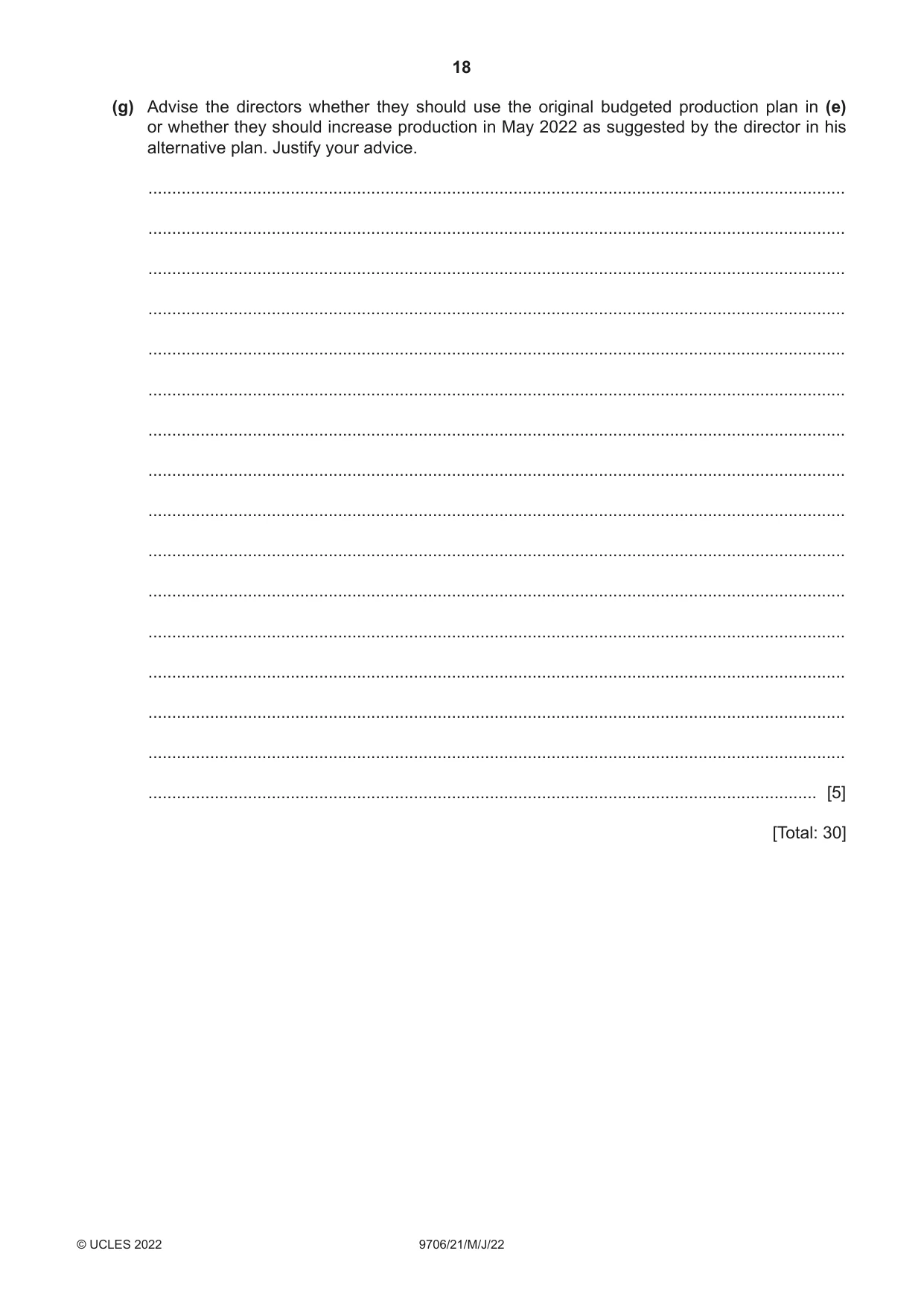
4 N Limited manufactures a single product at one of its factories. The company uses marginal costing. REQUIRED (a) State two benefits of using break-even analysis. 1 ................................................................................................................................................ ................................................................................................................................................... 2 ................................................................................................................................................ ................................................................................................................................................... [2] (b) Define the term ‘fixed costs’. ................................................................................................................................................... ................................................................................................................................................... ................................................................................................................................................... ............................................................................................................................................. [2] Additional information The following details are available for one month’s production: Fixed costs $70 000 Break-even point 8 000 units Selling price per unit $20 Margin of safety $80 000 REQUIRED (c) Calculate the variable cost per unit. ................................................................................................................................................... ................................................................................................................................................... ................................................................................................................................................... ................................................................................................................................................... ................................................................................................................................................... ............................................................................................................................................. [3] Additional information The directors have decided to increase output by 20%. All the output can be sold. New machinery will be purchased at a cost of $72 000. The new machinery will have a useful life of 5 years. The directors also plan the following: 1 Variable costs will remain unchanged. 2 Selling prices will be reduced by 5% to ensure that all production can be sold. 3 The cost of the new machinery will be financed by the issue of 10% debentures. REQUIRED (d) (i) Calculate the monthly revenue based on this plan. ........................................................................................................................................... ........................................................................................................................................... ........................................................................................................................................... ..................................................................................................................................... [2] (ii) Prepare a budgeted marginal costing statement for one month based on this plan for total production. ........................................................................................................................................... ........................................................................................................................................... ........................................................................................................................................... ........................................................................................................................................... ........................................................................................................................................... ........................................................................................................................................... ........................................................................................................................................... ........................................................................................................................................... ........................................................................................................................................... ........................................................................................................................................... ..................................................................................................................................... [6] Additional information At another factory the company manufactures two products: X and Y. Both products use the same material. The following information is available for one month’s output. X Y $ $ Selling price per unit 32 44 Direct material per unit 10 14 Direct labour per unit 12 19 Output 5000 units 4000 units This factory’s fixed costs are $58 000 per month. In April 2022 the supplier of direct materials informed the company that it would only be able to supply 75% of the normal monthly requirement in June 2022. REQUIRED (e) Prepare a budgeted production plan for June 2022 to show the maximum profit available. ................................................................................................................................................... ................................................................................................................................................... ................................................................................................................................................... ................................................................................................................................................... ................................................................................................................................................... ................................................................................................................................................... ................................................................................................................................................... ................................................................................................................................................... ................................................................................................................................................... ................................................................................................................................................... ................................................................................................................................................... ................................................................................................................................................... ............................................................................................................................................. [7]
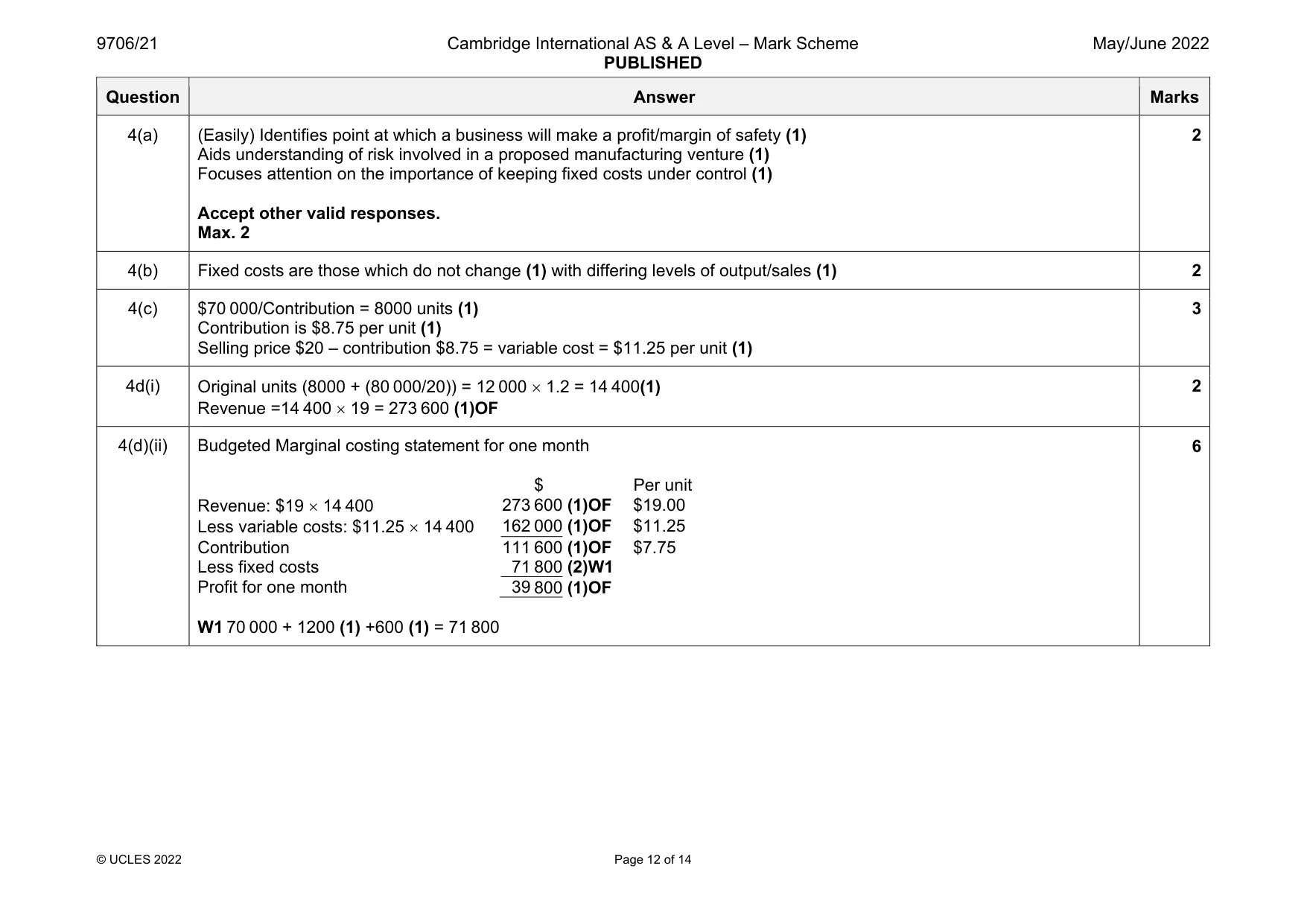
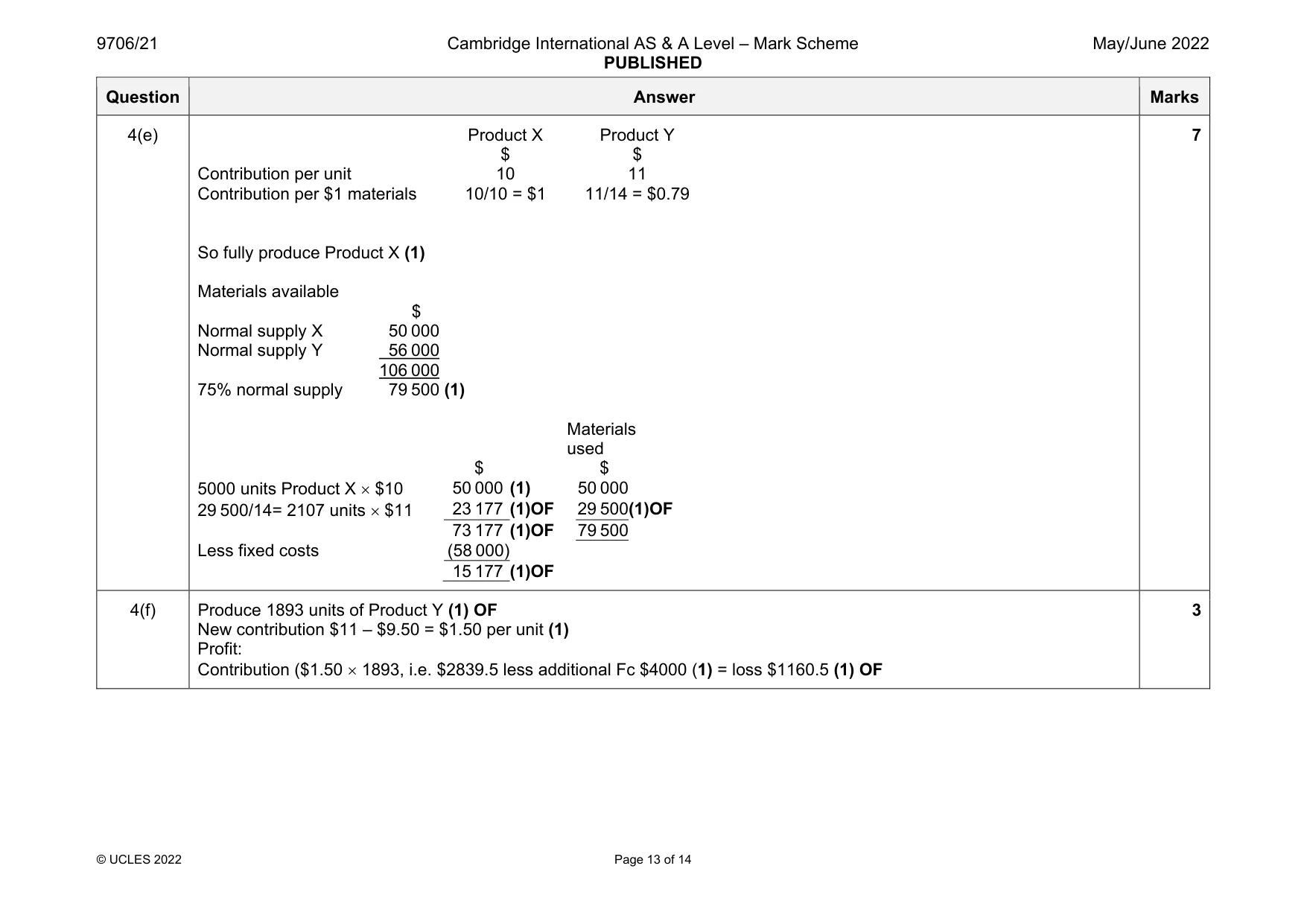
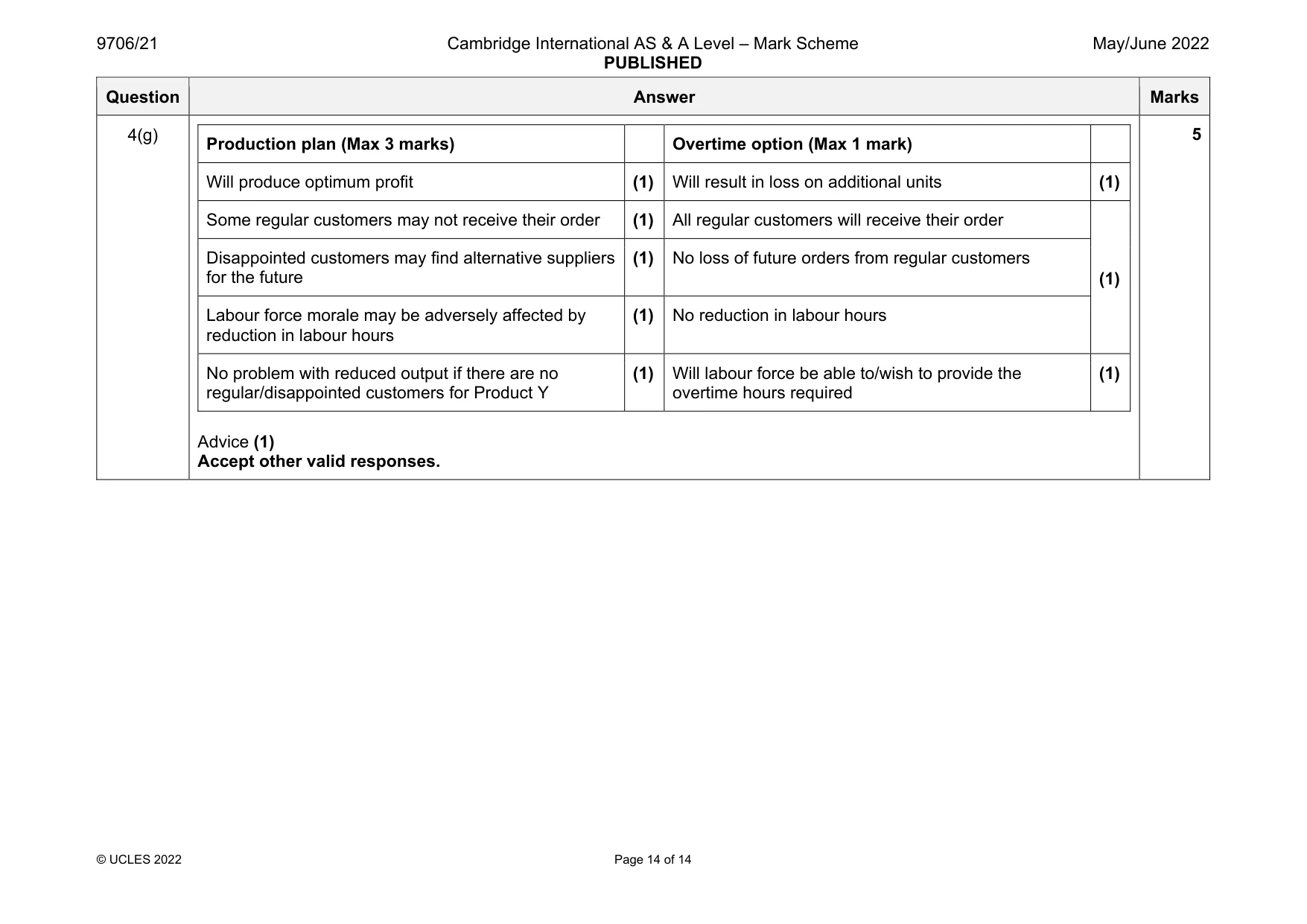
Mark scheme: 4(a) (Easily) Identifies point at which a business will make a profit/margin of safety (1) Aids understanding of risk involved in a proposed manufacturing venture (1) Focuses attention on the importance of keeping fixed costs under control (1) Accept other valid responses. Max. 2 2 4(b) Fixed costs are those which do not change (1) with differing levels of output/sales (1) 2 4(c) $70 000/Contribution = 8000 units (1) Contribution is $8.75 per unit (1) Selling price $20 – contribution $8.75 = variable cost = $11.25 per unit (1) 3 4d(i) Original units (8000 + (80 000/20)) = 12 000 1.2 = 14 400(1) Revenue =14 400 19 = 273 600 (1)OF 2 4(d)(ii) Budgeted Marginal costing statement for one month $ Per unit Revenue: $19 14 400 273 600 (1)OF $19.00 Less variable costs: $11.25 14 400 162 000 (1)OF $11.25 Contribution 111 600 (1)OF $7.75 Less fixed costs 71 800 (2)W1 Profit for one month 39 800 (1)OF W1 70 000 + 1200 (1) +600 (1) = 71 800 6 Question Answer Marks 4(e) Product X Product Y $ $ Contribution per unit 10 11 Contribution per $1 materials 10/10 = $1 11/14 = $0.79 So fully produce Product X (1) Materials available $ Normal supply X 50 000 Normal supply Y 56 000 106 000 75% normal supply 79 500 (1) Materials used $ $ 5000 units Product X $10 50 000 (1) 50 000 29 500/14= 2107 units $11 23 177 (1)OF 29 500(1)OF 73 177 (1)OF 79 500 Less fixed costs (58 000) 15 177 (1)OF 7 4(f) Produce 1893 units of Product Y (1) OF New contribution $11 – $9.50 = $1.50 per unit (1) Profit: Contribution ($1.50 1893, i.e. $2839.5 less additional Fc $4000 (1) = loss $1160.5 (1) OF 3 Question Answer Marks 4(g) Production plan (Max 3 marks) Overtime option (Max 1 mark) Will produce optimum profit (1) Will result in loss on additional units (1) Some regular customers may not receive their order (1) All regular customers will receive their order (1) Disappointed customers may find alternative suppliers for the future (1) No loss of future orders from regular customers Labour force morale may be adversely affected by reduction in labour hours (1) No reduction in labour hours No problem with reduced output if there are no regular/disappointed customers for Product Y (1) Will labour force be able to/wish to provide the overtime hours required (1) Advice (1) Accept other valid responses. 5
What was in this paper
The subtopics covered by these 4 questions, and how many questions each got. Open one in a new tab to see every Cambridge question on it.
What you needed in this session
Cambridge’s own grade thresholds for 2022 May/June, Paper 2 · Variant 1. A higher threshold means an easier paper — the bar moves with how the cohort did.