Cambridge A Level Accounting 9706 — 2023 Oct/Nov Paper 2 · Variant 3
9706/23/O/N/23 · 4 questions · 90 marks · ≈101 min
The question paper and its mark scheme, free to read here and free to download. This is Cambridge’s own paper, exactly as it was sat.
Question paper20 pages


Mark scheme13 pages
Answers below. Sit the paper first if you are practising.
Questions as text
Q1 · B Limited provided the following information for the year ended 30 September 2023
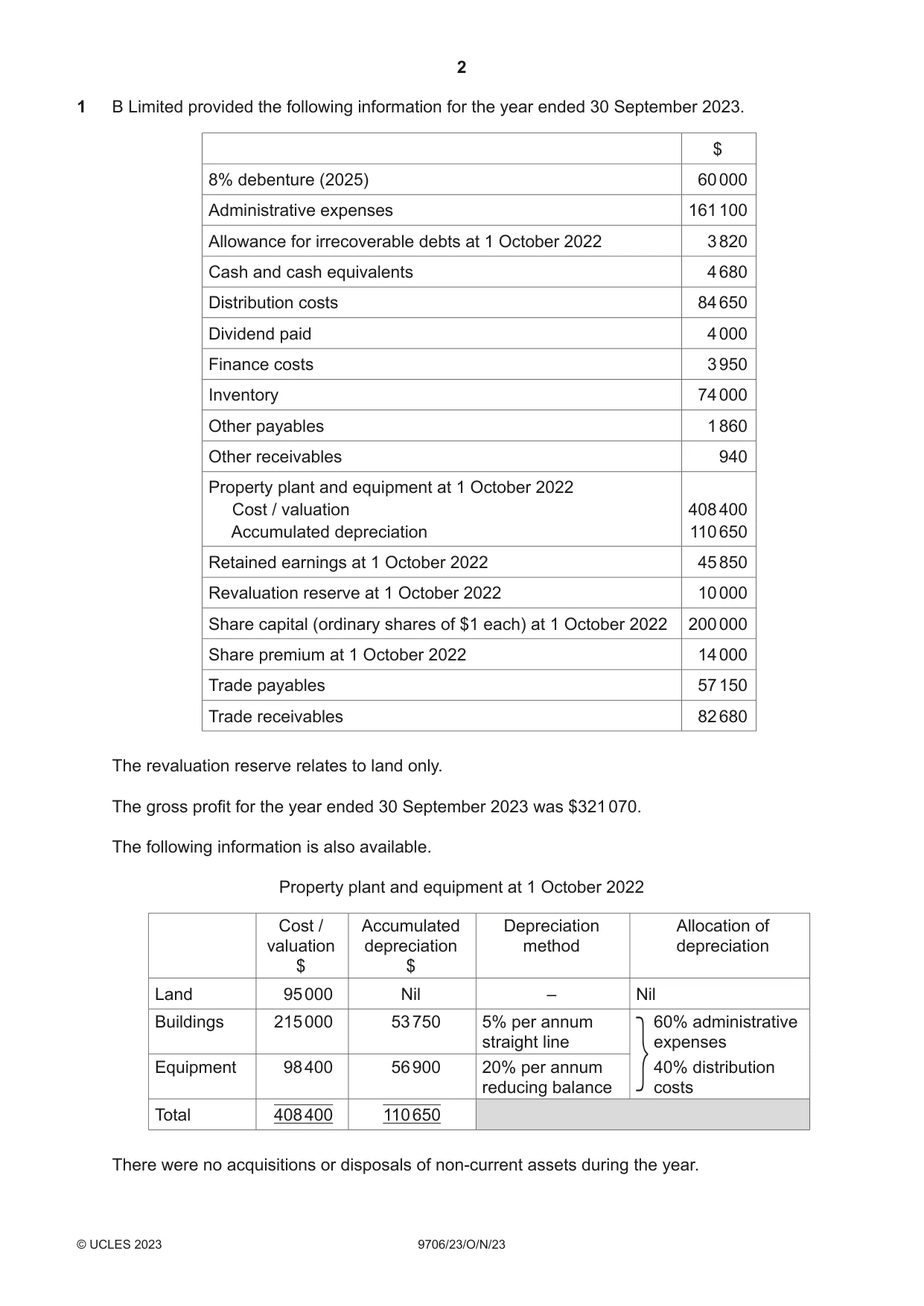
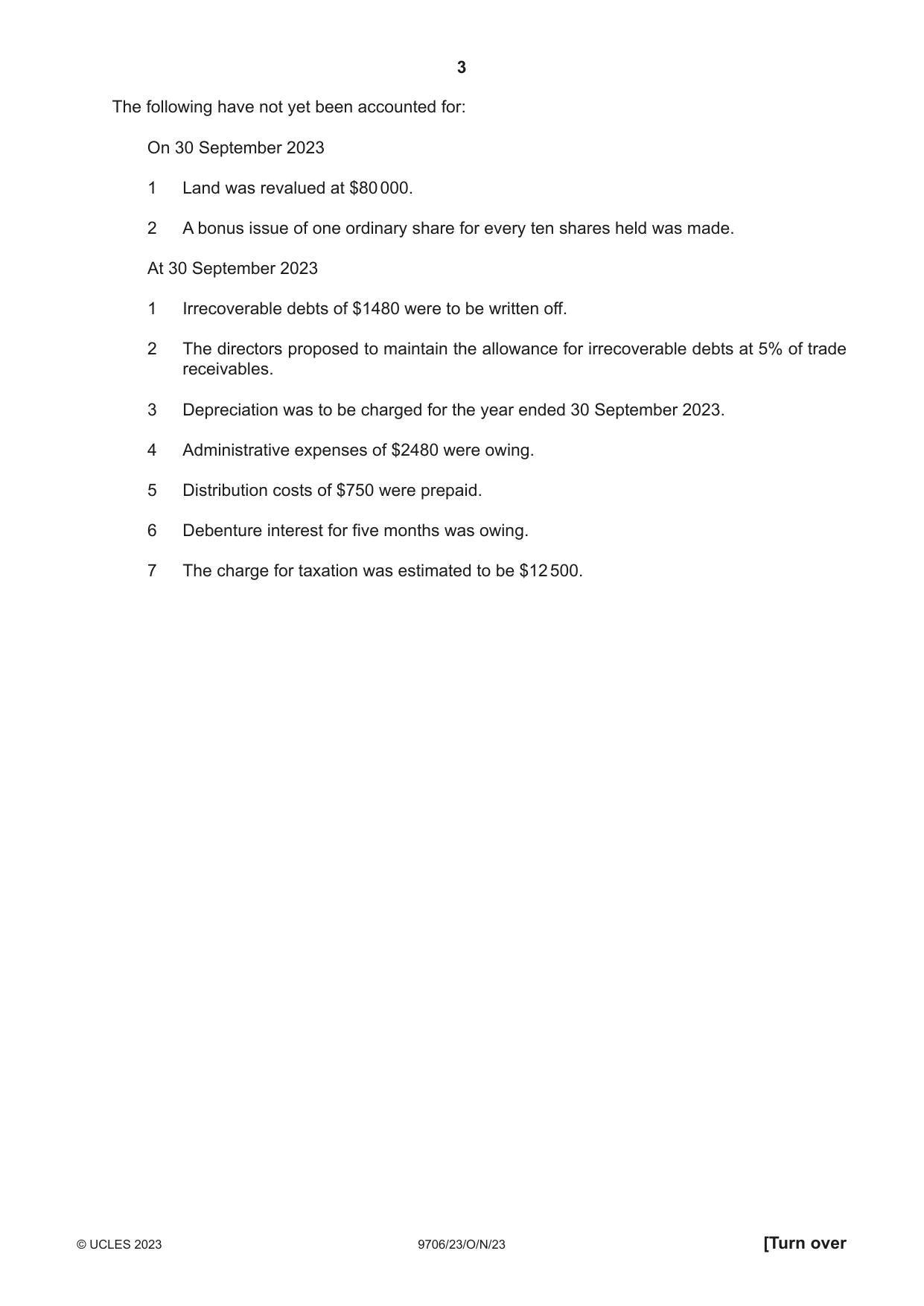
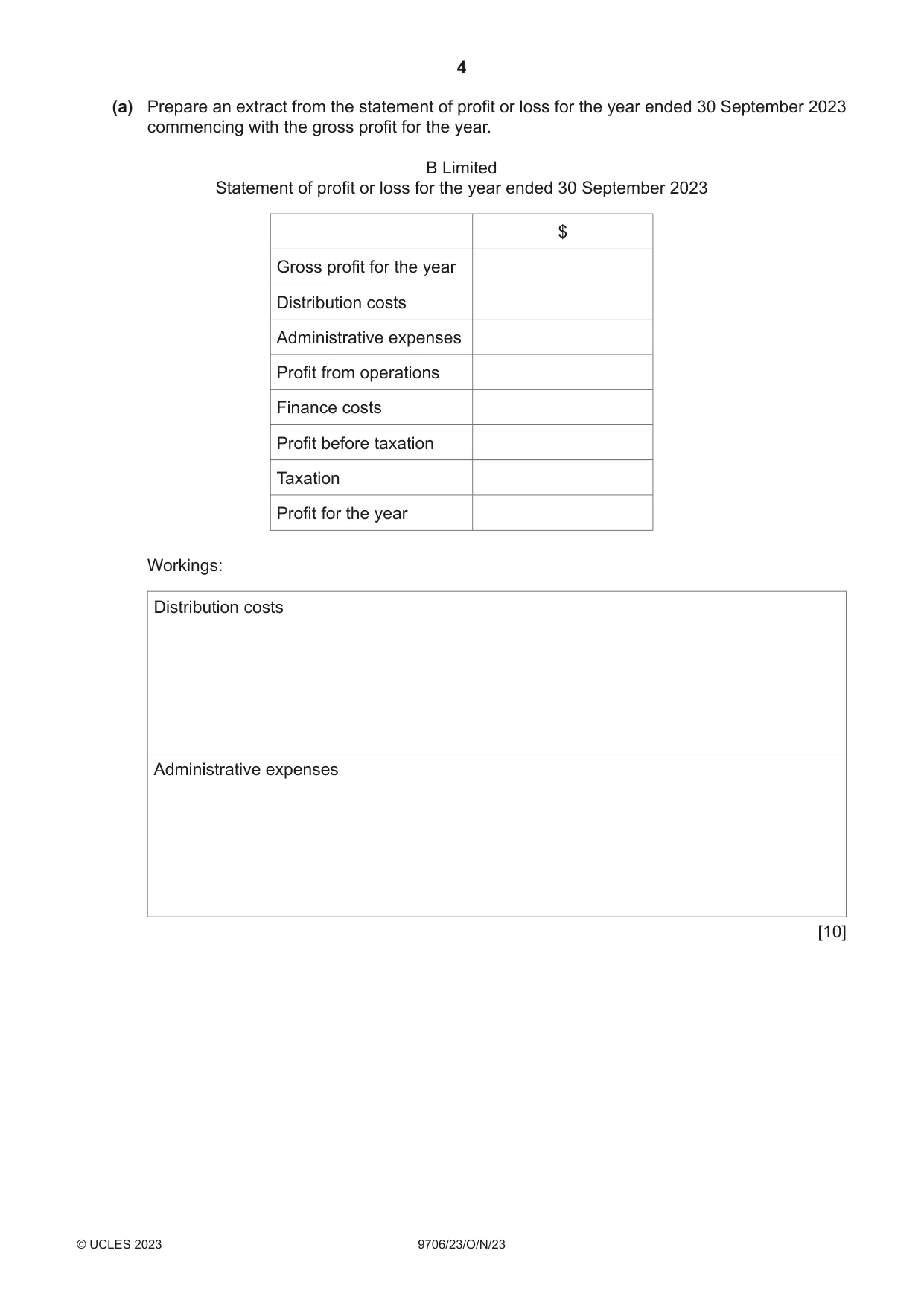
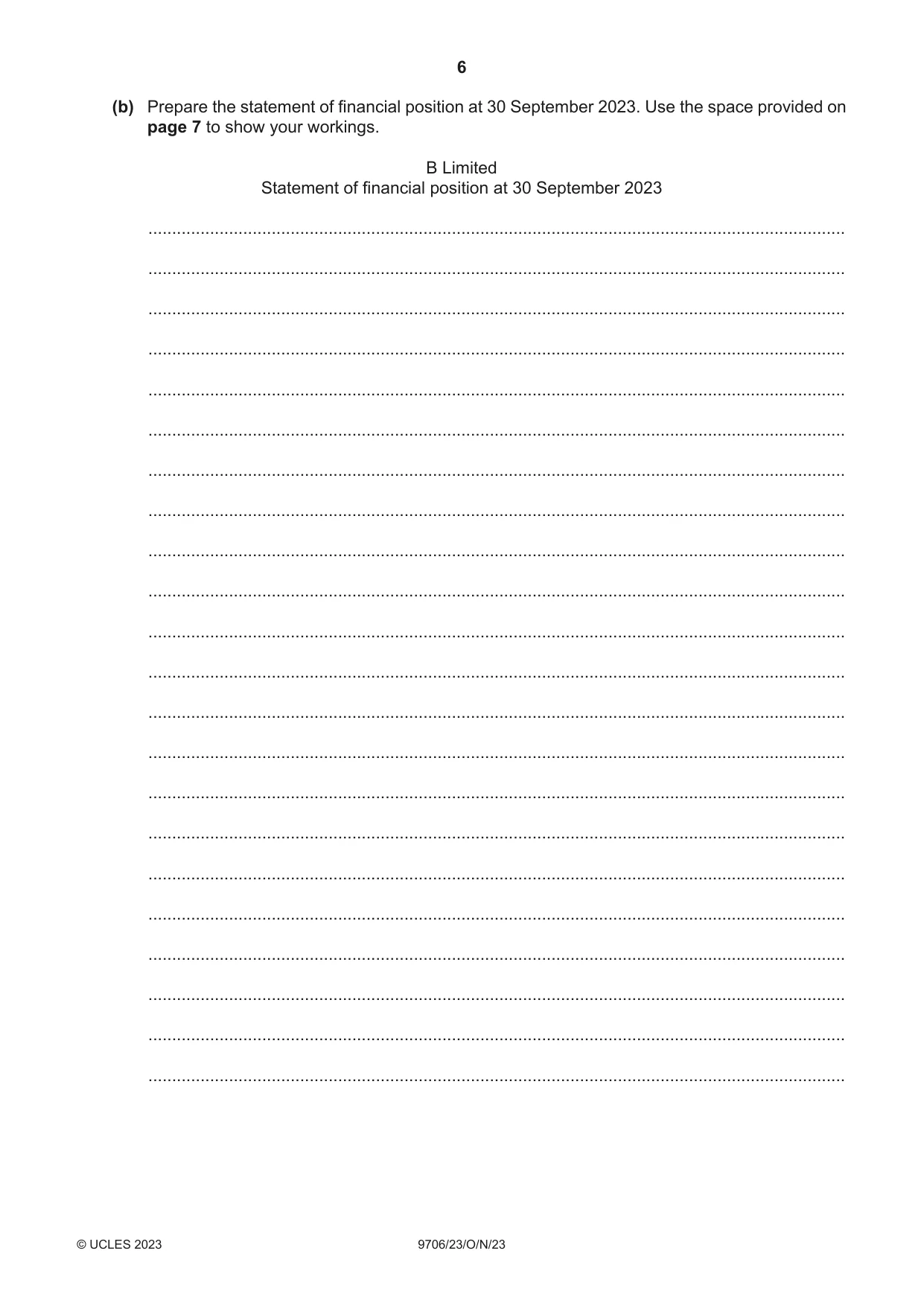
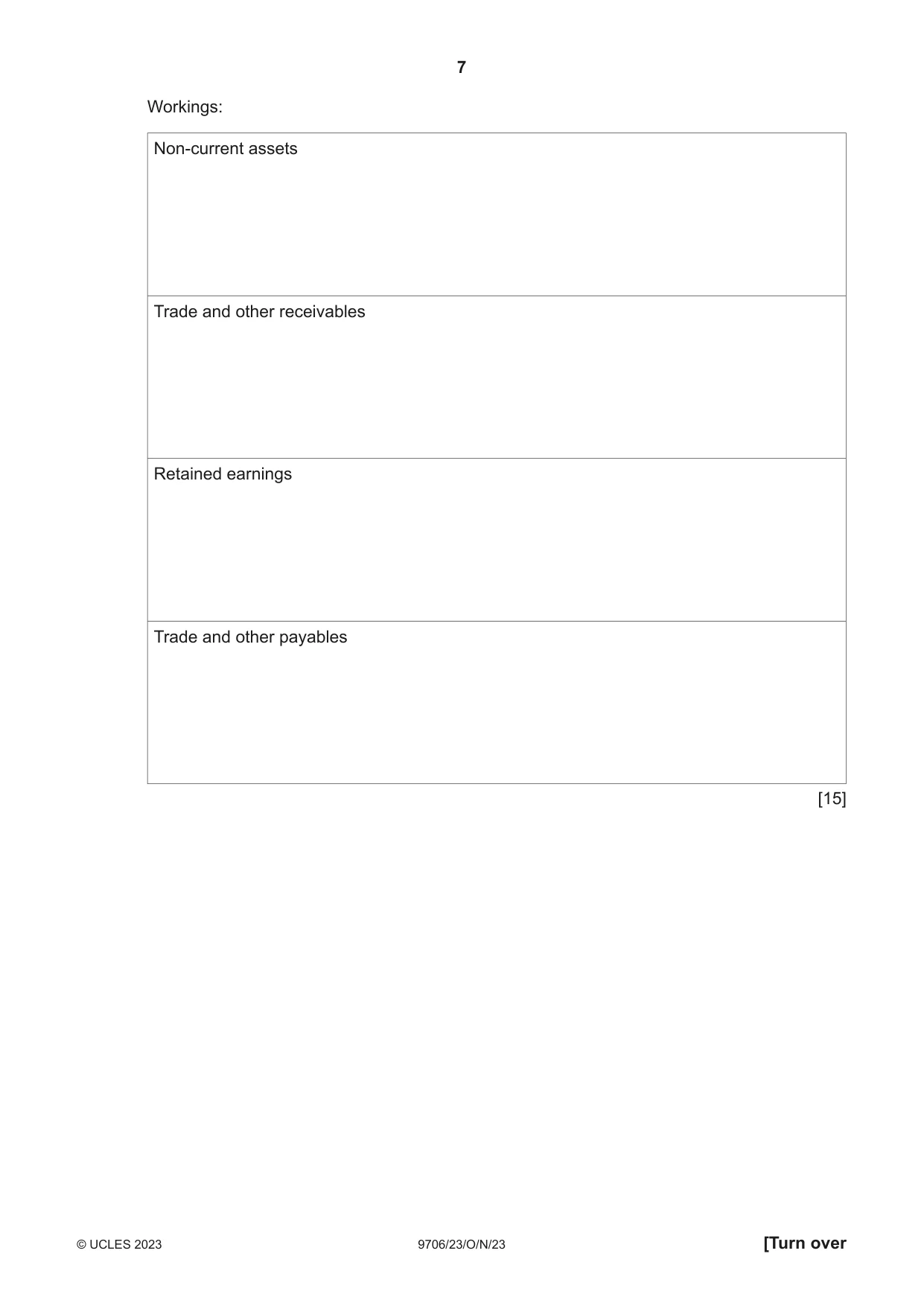
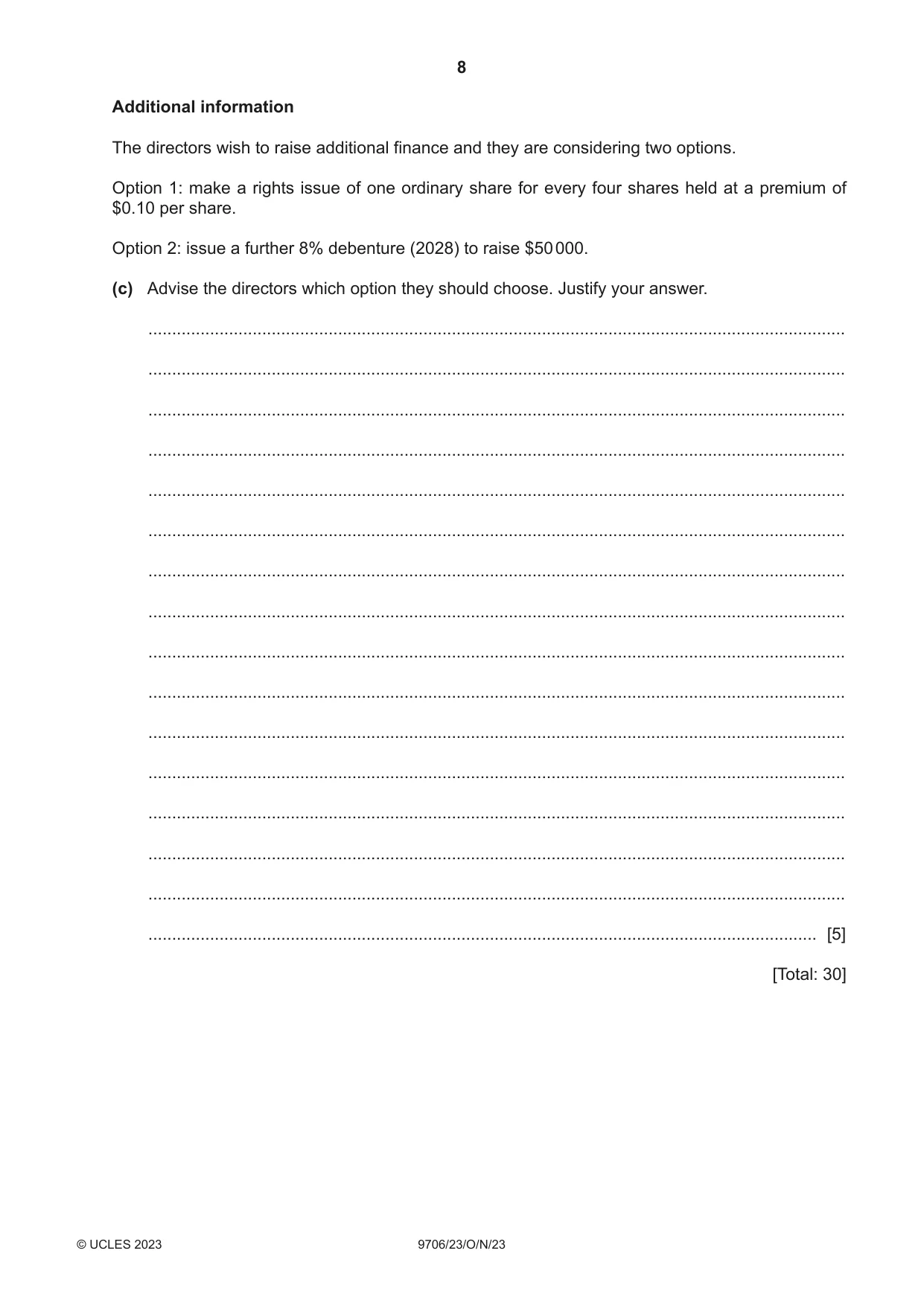
1 B Limited provided the following information for the year ended 30 September 2023. $ 8% debenture (2025) 60 000 Administrative expenses 161 100 Allowance for irrecoverable debts at 1 October 2022 3 820 Cash and cash equivalents 4 680 Distribution costs 84 650 Dividend paid 4 000 Finance costs 3 950 Inventory 74 000 Other payables 1 860 Other receivables 940 Property plant and equipment at 1 October 2022 Cost / valuation 408 400 Accumulated depreciation 110 650 Retained earnings at 1 October 2022 45 850 Revaluation reserve at 1 October 2022 10 000 Share capital (ordinary shares of $1 each) at 1 October 2022 200 000 Share premium at 1 October 2022 14 000 Trade payables 57 150 Trade receivables 82 680 The revaluation reserve relates to land only. The gross profit for the year ended 30 September 2023 was $321 070. The following information is also available. Property plant and equipment at 1 October 2022 Cost / Accumulated Depreciation Allocation of valuation depreciation method depreciation $ $ Land 95 000 Nil – Nil Buildings 215 000 53 750 5% per annum 60% administrative straight line expenses Equipment 98 400 56 900 20% per annum 40% distribution reducing balance costs Total 408 400 110 650 There were no acquisitions or disposals of non-current assets during the year. The following have not yet been accounted for: On 30 September 2023 1 Land was revalued at $80 000. 2 A bonus issue of one ordinary share for every ten shares held was made. At 30 September 2023 1 Irrecoverable debts of $1480 were to be written off. 2 The directors proposed to maintain the allowance for irrecoverable debts at 5% of trade receivables. 3 Depreciation was to be charged for the year ended 30 September 2023. 4 Administrative expenses of $2480 were owing. 5 Distribution costs of $750 were prepaid. 6 Debenture interest for five months was owing. 7 The charge for taxation was estimated to be $12 500. (a) Prepare an extract from the statement of profit or loss for the year ended 30 September 2023 commencing with the gross profit for the year. B Limited Statement of profit or loss for the year ended 30 September 2023 $ Gross profit for the year Distribution costs Administrative expenses Profit from operations Finance costs Profit before taxation Taxation Profit for the year Workings: Distribution costs Administrative expenses [10] (b) Prepare the statement of financial position at 30 September 2023. Use the space provided on page 7 to show your workings. B Limited Statement of financial position at 30 September 2023 ................................................................................................................................................... ................................................................................................................................................... ................................................................................................................................................... ................................................................................................................................................... ................................................................................................................................................... ................................................................................................................................................... ................................................................................................................................................... ................................................................................................................................................... ................................................................................................................................................... ................................................................................................................................................... ................................................................................................................................................... ................................................................................................................................................... ................................................................................................................................................... ................................................................................................................................................... ................................................................................................................................................... ................................................................................................................................................... ................................................................................................................................................... ................................................................................................................................................... ................................................................................................................................................... ................................................................................................................................................... ................................................................................................................................................... ................................................................................................................................................... Workings: Non-current assets Trade and other receivables Retained earnings Trade and other payables [15] Additional information The directors wish to raise additional finance and they are considering two options. Option 1: make a rights issue of one ordinary share for every four shares held at a premium of $0.10 per share. Option 2: issue a further 8% debenture (2028) to raise $50 000. (c) Advise the directors which option they should choose. Justify your answer. ................................................................................................................................................... ................................................................................................................................................... ................................................................................................................................................... ................................................................................................................................................... ................................................................................................................................................... ................................................................................................................................................... ................................................................................................................................................... ................................................................................................................................................... ................................................................................................................................................... ................................................................................................................................................... ................................................................................................................................................... ................................................................................................................................................... ................................................................................................................................................... ................................................................................................................................................... ................................................................................................................................................... ............................................................................................................................................. [5] [Total: 30]
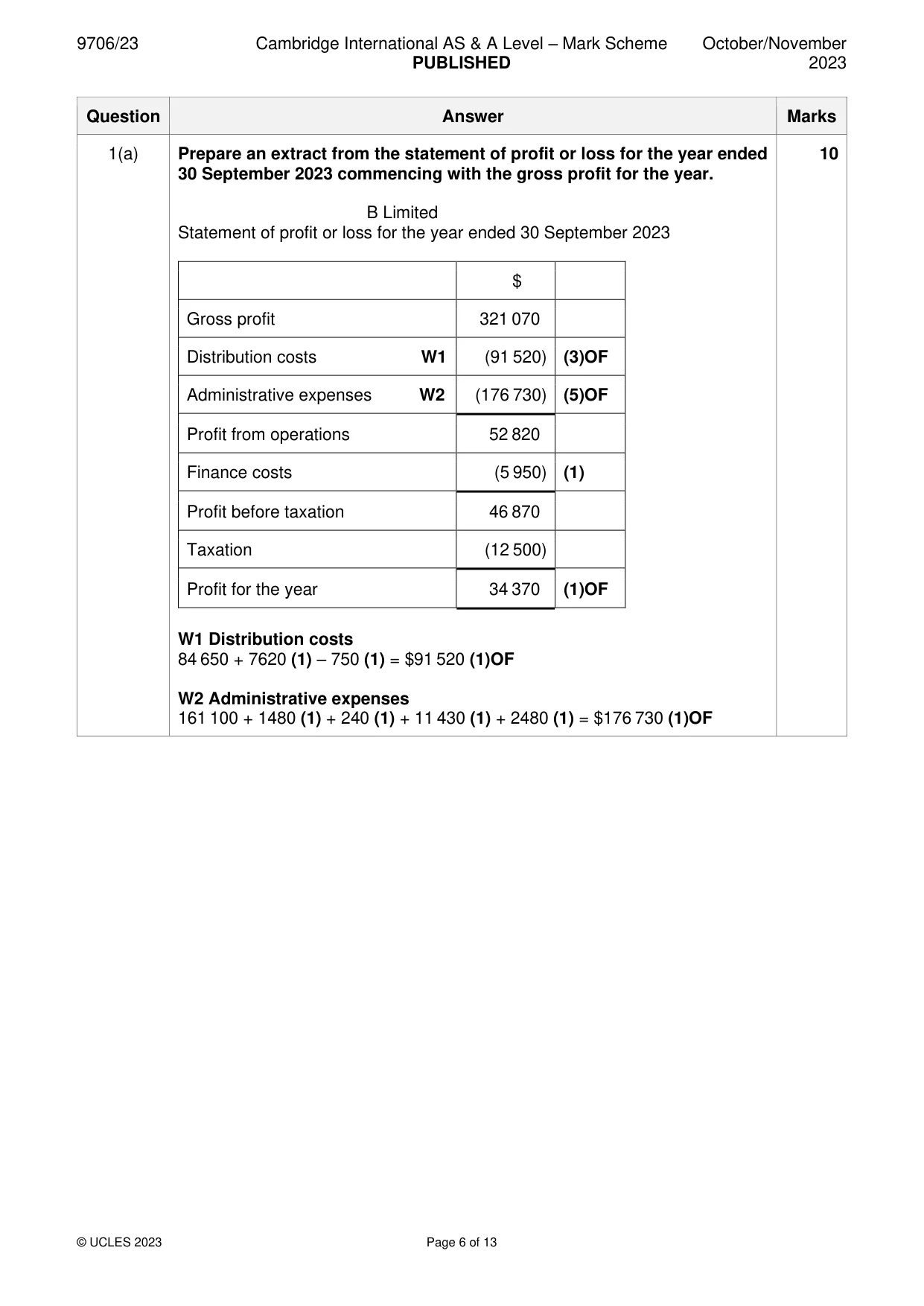
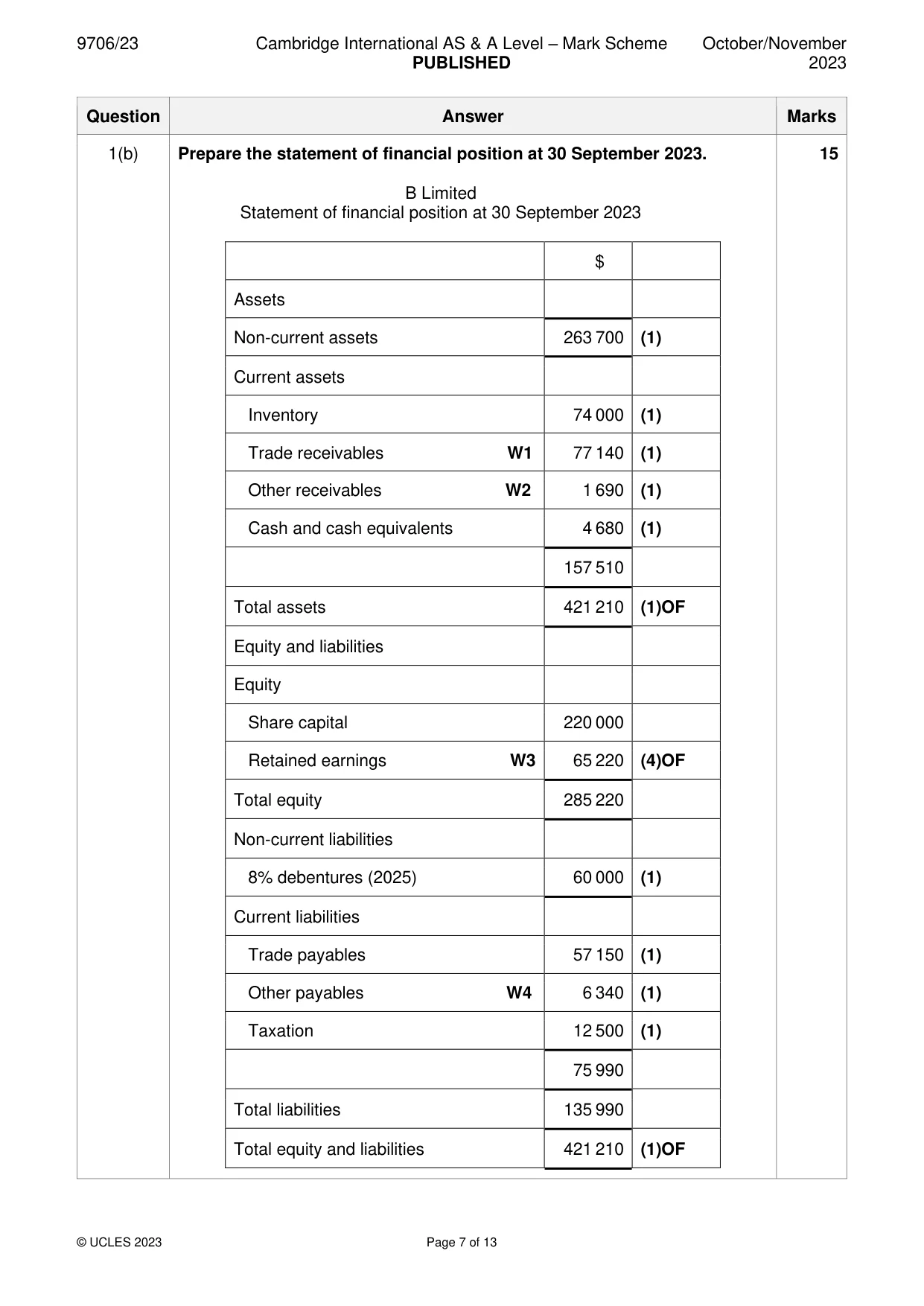
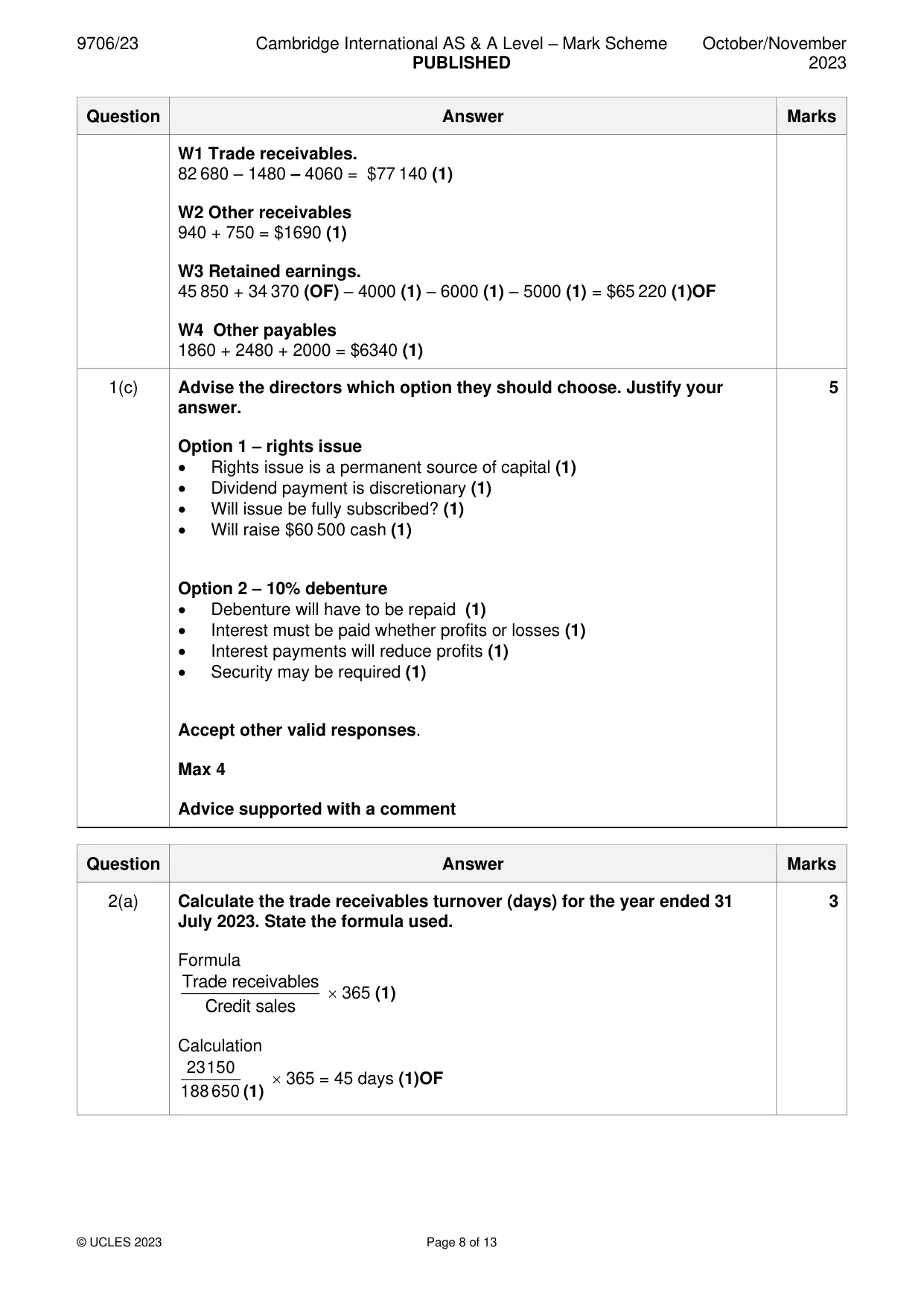
Mark scheme: Question Answer Marks 1(a) Prepare an extract from the statement of profit or loss for the year ended 10 30 September 2023 commencing with the gross profit for the year. B Limited Statement of profit or loss for the year ended 30 September 2023 $ Gross profit 321 070 Distribution costs W1 (91 520) (3)OF Administrative expenses W2 (176 730) (5)OF Profit from operations 52 820 Finance costs (5 950) (1) Profit before taxation 46 870 Taxation (12 500) Profit for the year 34 370 (1)OF W1 Distribution costs 84 650 + 7620 (1) – 750 (1) = $91 520 (1)OF W2 Administrative expenses 161 100 + 1480 (1) + 240 (1) + 11 430 (1) + 2480 (1) = $176 730 (1)OF 1(b) Prepare the statement of financial position at 30 September 2023. 15 B Limited Statement of financial position at 30 September 2023 $ Assets Non-current assets 263 700 (1) Current assets Inventory 74 000 (1) Trade receivables W1 77 140 (1) Other receivables W2 1 690 (1) Cash and cash equivalents 4 680 (1) 157 510 Total assets 421 210 (1)OF Equity and liabilities Equity Share capital 220 000 Retained earnings W3 65 220 (4)OF Total equity 285 220 Non-current liabilities 8% debentures (2025) 60 000 (1) Current liabilities Trade payables 57 150 (1) Other payables W4 6 340 (1) Taxation 12 500 (1) 75 990 Total liabilities 135 990 Total equity and liabilities 421 210 (1)OF W1 Trade receivables. 82 680 – 1480 – 4060 = $77 140 (1) W2 Other receivables 940 + 750 = $1690 (1) W3 Retained earnings. 45 850 + 34 370 (OF) – 4000 (1) – 6000 (1) – 5000 (1) = $65 220 (1)OF W4 Other payables 1860 + 2480 + 2000 = $6340 (1) 1(c) Advise the directors which option they should choose. Justify your 5 answer. Option 1 – rights issue • Rights issue is a permanent source of capital (1) • Dividend payment is discretionary (1) • Will issue be fully subscribed? (1) • Will raise $60 500 cash (1) Option 2 – 10% debenture • Debenture will have to be repaid (1) • Interest must be paid whether profits or losses (1) • Interest payments will reduce profits (1) • Security may be required (1) Accept other valid responses. Max 4 Advice supported with a comment
Q2 · Alex owns a business selling computer equipment
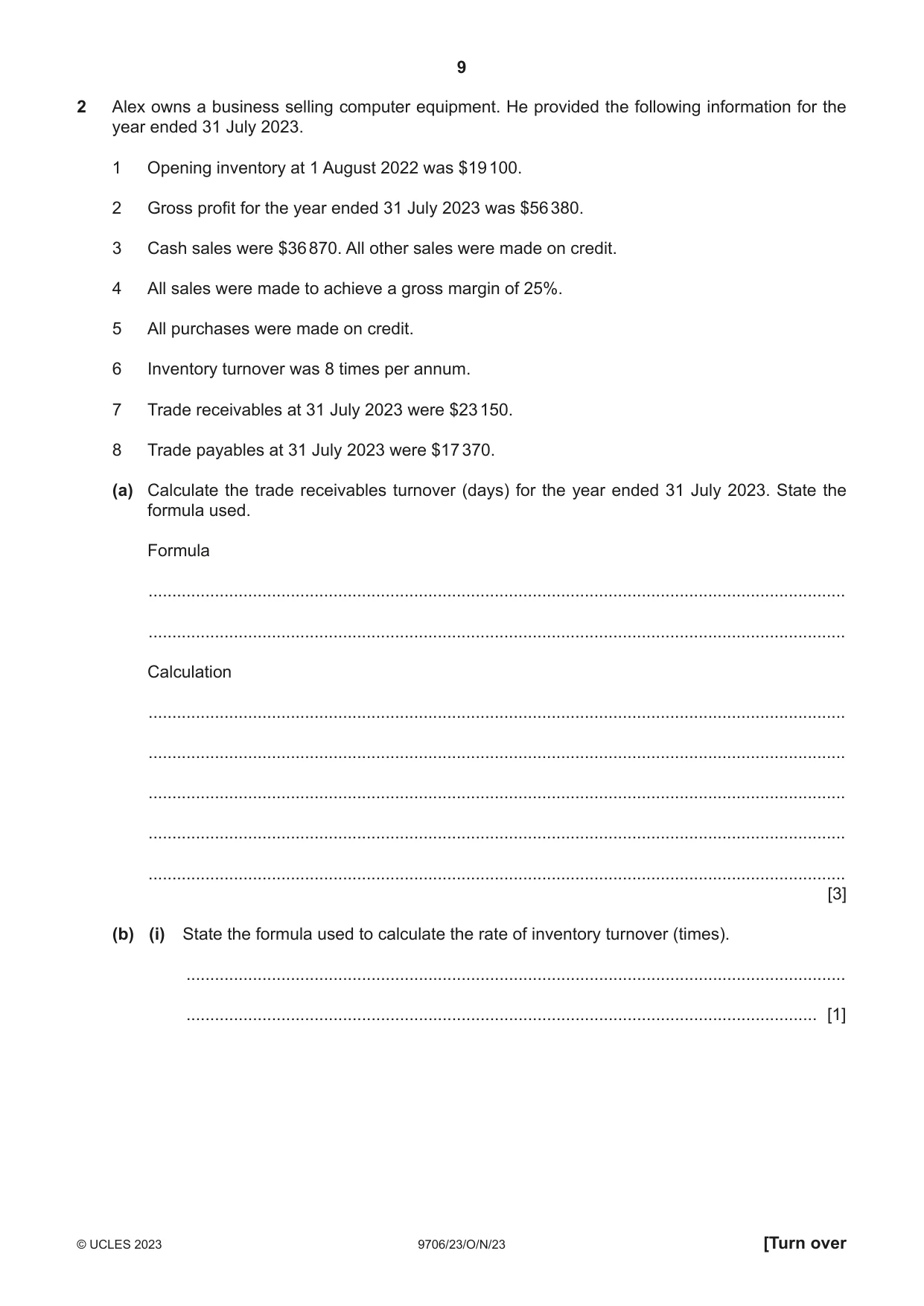
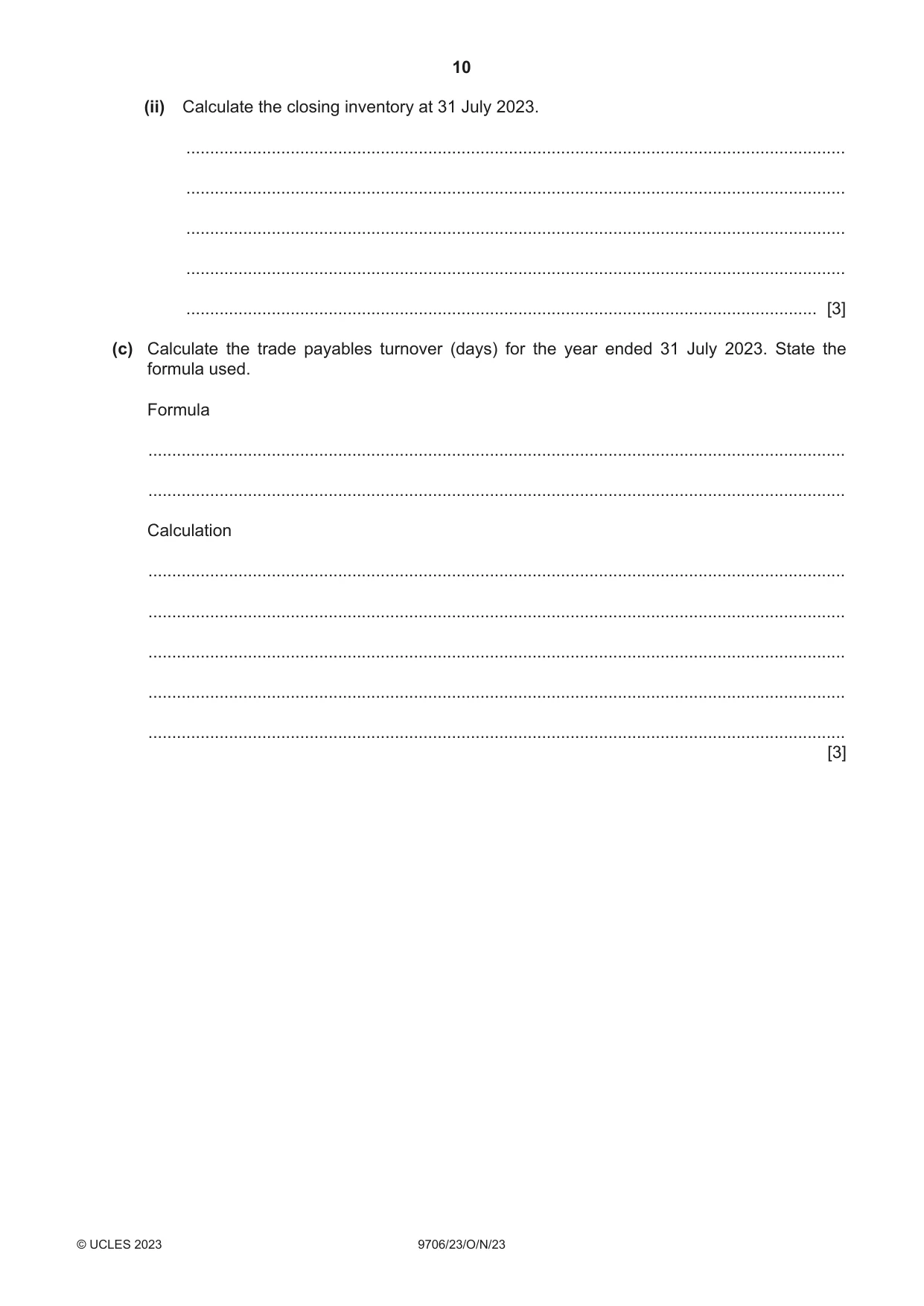
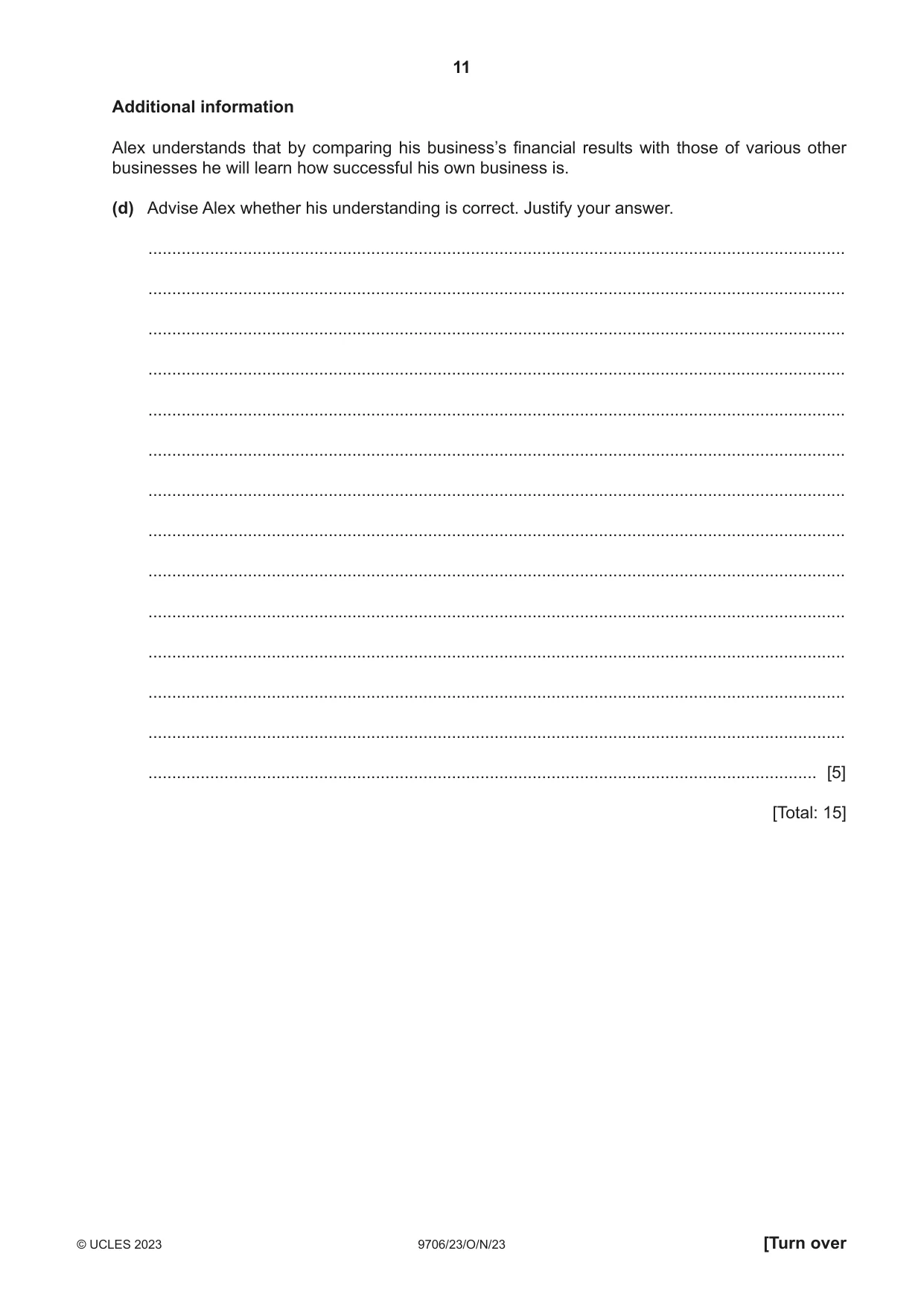
2 Alex owns a business selling computer equipment. He provided the following information for the year ended 31 July 2023. 1 Opening inventory at 1 August 2022 was $19 100. 2 Gross profit for the year ended 31 July 2023 was $56 380. 3 Cash sales were $36 870. All other sales were made on credit. 4 All sales were made to achieve a gross margin of 25%. 5 All purchases were made on credit. 6 Inventory turnover was 8 times per annum. 7 Trade receivables at 31 July 2023 were $23 150. 8 Trade payables at 31 July 2023 were $17 370. (a) Calculate the trade receivables turnover (days) for the year ended 31 July 2023. State the formula used. Formula ................................................................................................................................................... ................................................................................................................................................... Calculation ................................................................................................................................................... ................................................................................................................................................... ................................................................................................................................................... ................................................................................................................................................... ................................................................................................................................................... [3] (b) (i) State the formula used to calculate the rate of inventory turnover (times). ........................................................................................................................................... ..................................................................................................................................... [1] (ii) Calculate the closing inventory at 31 July 2023. ........................................................................................................................................... ........................................................................................................................................... ........................................................................................................................................... ........................................................................................................................................... ..................................................................................................................................... [3] (c) Calculate the trade payables turnover (days) for the year ended 31 July 2023. State the formula used. Formula ................................................................................................................................................... ................................................................................................................................................... Calculation ................................................................................................................................................... ................................................................................................................................................... ................................................................................................................................................... ................................................................................................................................................... ................................................................................................................................................... [3] Additional information Alex understands that by comparing his business’s financial results with those of various other businesses he will learn how successful his own business is. (d) Advise Alex whether his understanding is correct. Justify your answer. ................................................................................................................................................... ................................................................................................................................................... ................................................................................................................................................... ................................................................................................................................................... ................................................................................................................................................... ................................................................................................................................................... ................................................................................................................................................... ................................................................................................................................................... ................................................................................................................................................... ................................................................................................................................................... ................................................................................................................................................... ................................................................................................................................................... ................................................................................................................................................... ............................................................................................................................................. [5] [Total: 15]
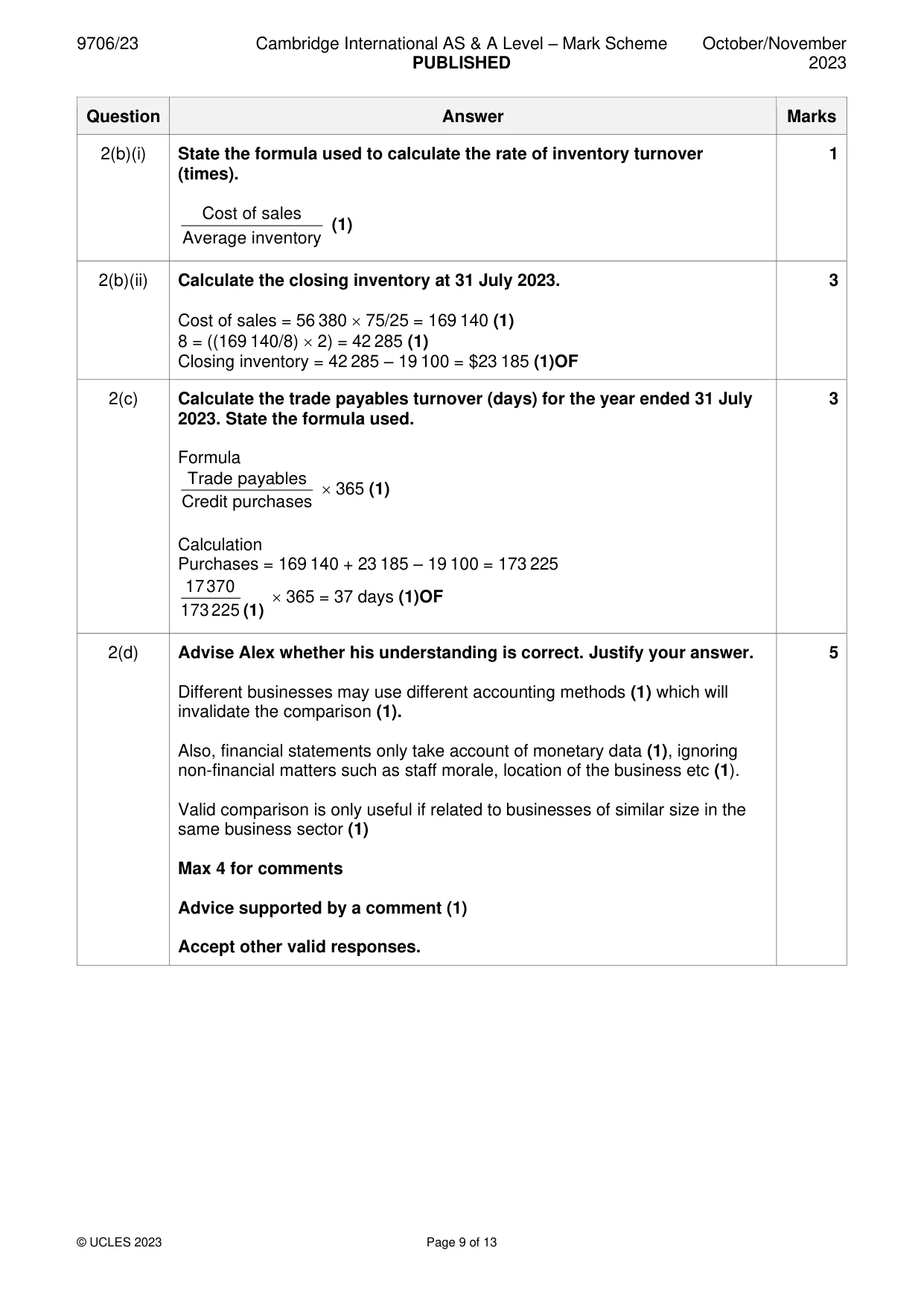
Mark scheme: 2(a) Calculate the trade receivables turnover (days) for the year ended 31 3 July 2023. State the formula used. Formula Trade receivables 365 (1) Credit sales Calculation 23150 365 = 45 days (1)OF 188650 (1) 2(b)(i) State the formula used to calculate the rate of inventory turnover 1 (times). Cost of sales (1) Average inventory 2(b)(ii) Calculate the closing inventory at 31 July 2023. 3 Cost of sales = 56 380 75/25 = 169 140 (1) 8 = ((169 140/8) 2) = 42 285 (1) Closing inventory = 42 285 – 19 100 = $23 185 (1)OF 2(c) Calculate the trade payables turnover (days) for the year ended 31 July 3 2023. State the formula used. Formula Trade payables 365 (1) Credit purchases Calculation Purchases = 169 140 + 23 185 – 19 100 = 173 225 17370 365 = 37 days (1)OF 173225 (1) 2(d) Advise Alex whether his understanding is correct. Justify your answer. 5 Different businesses may use different accounting methods (1) which will invalidate the comparison (1). Also, financial statements only take account of monetary data (1), ignoring non-financial matters such as staff morale, location of the business etc (1). Valid comparison is only useful if related to businesses of similar size in the same business sector (1) Max 4 for comments Advice supported by a comment (1) Accept other valid responses.
More questions on Analysis and communication of accounting information
Q3 · The directors of J Limited provided the following information at 1 September 2022
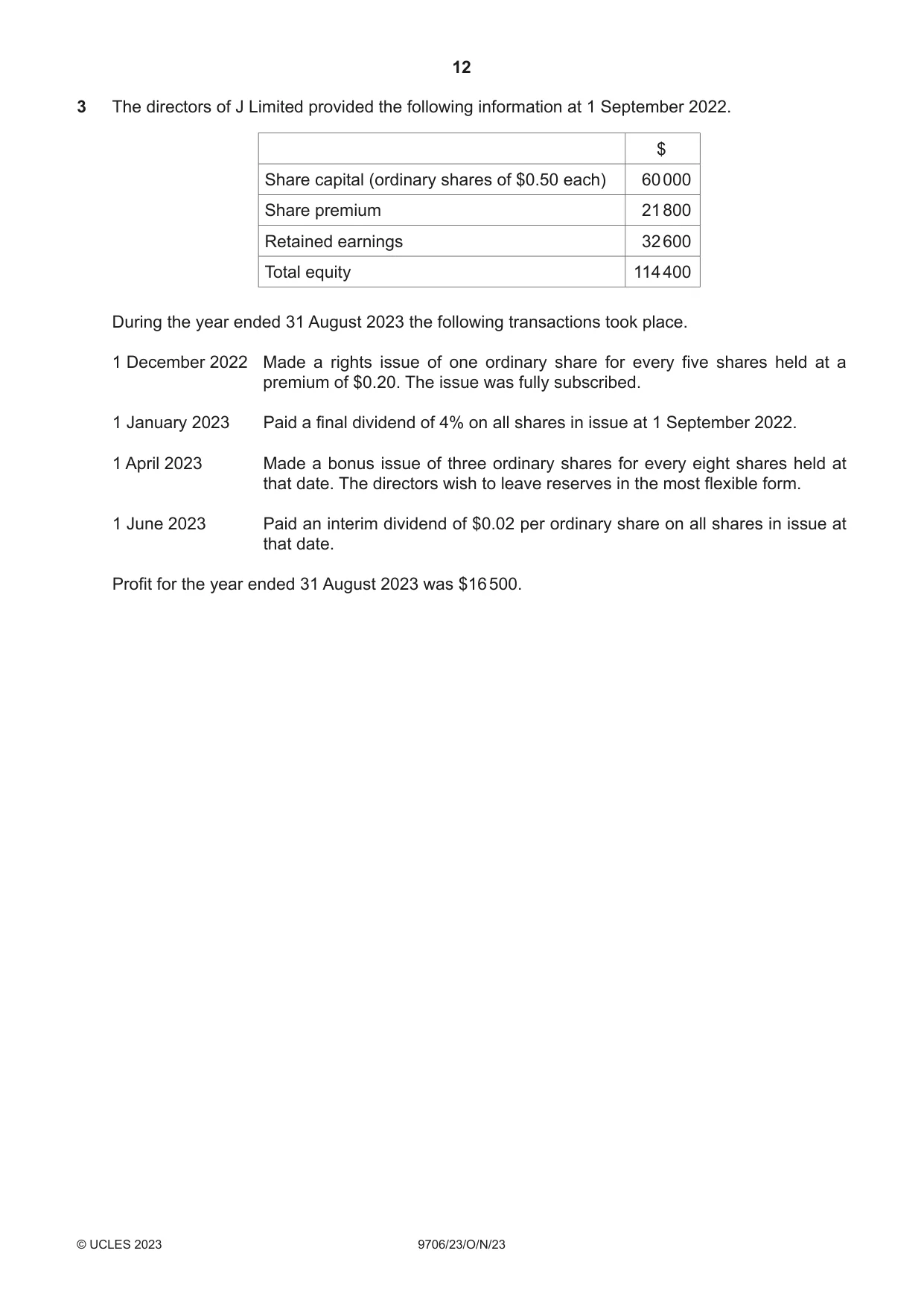
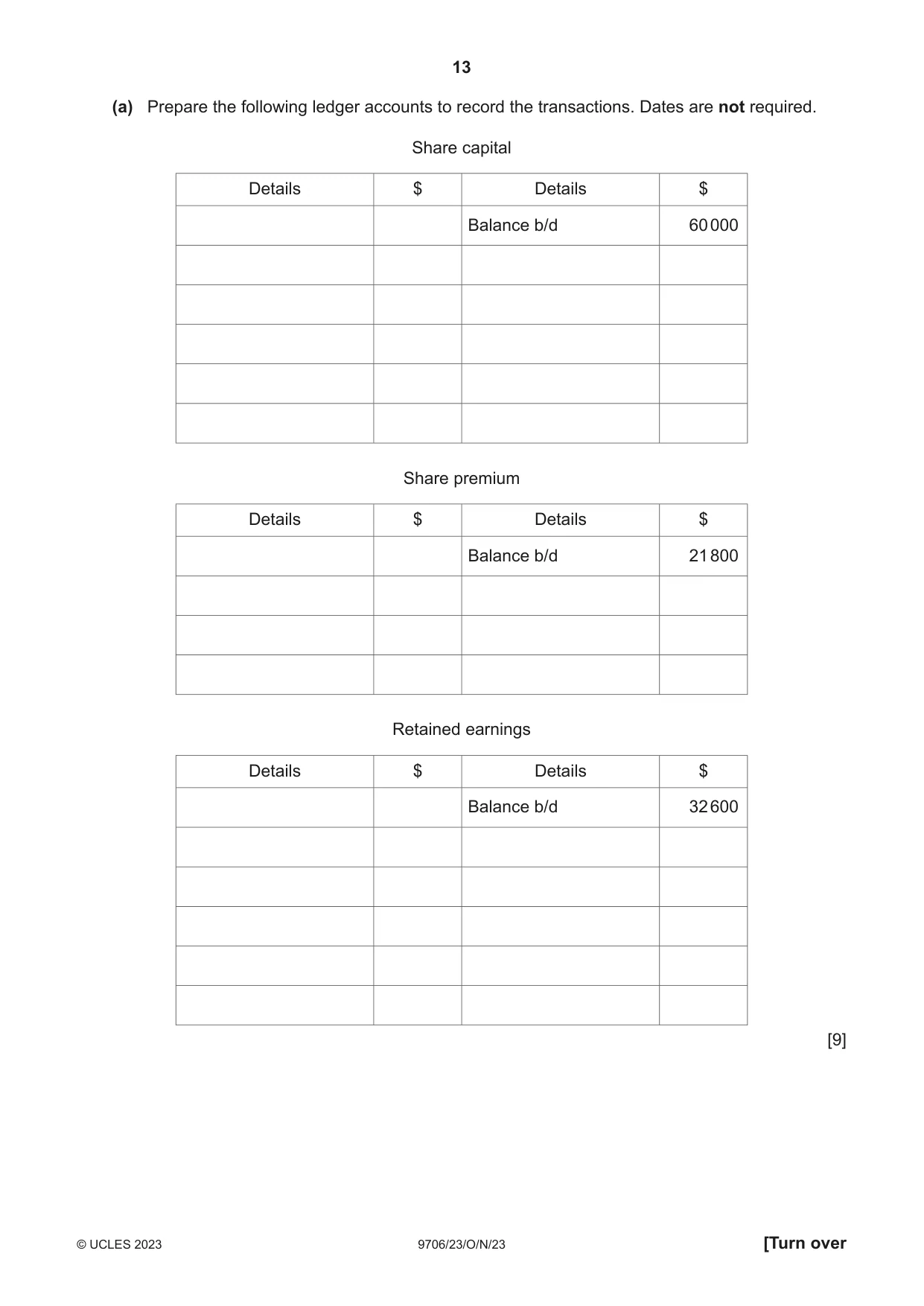
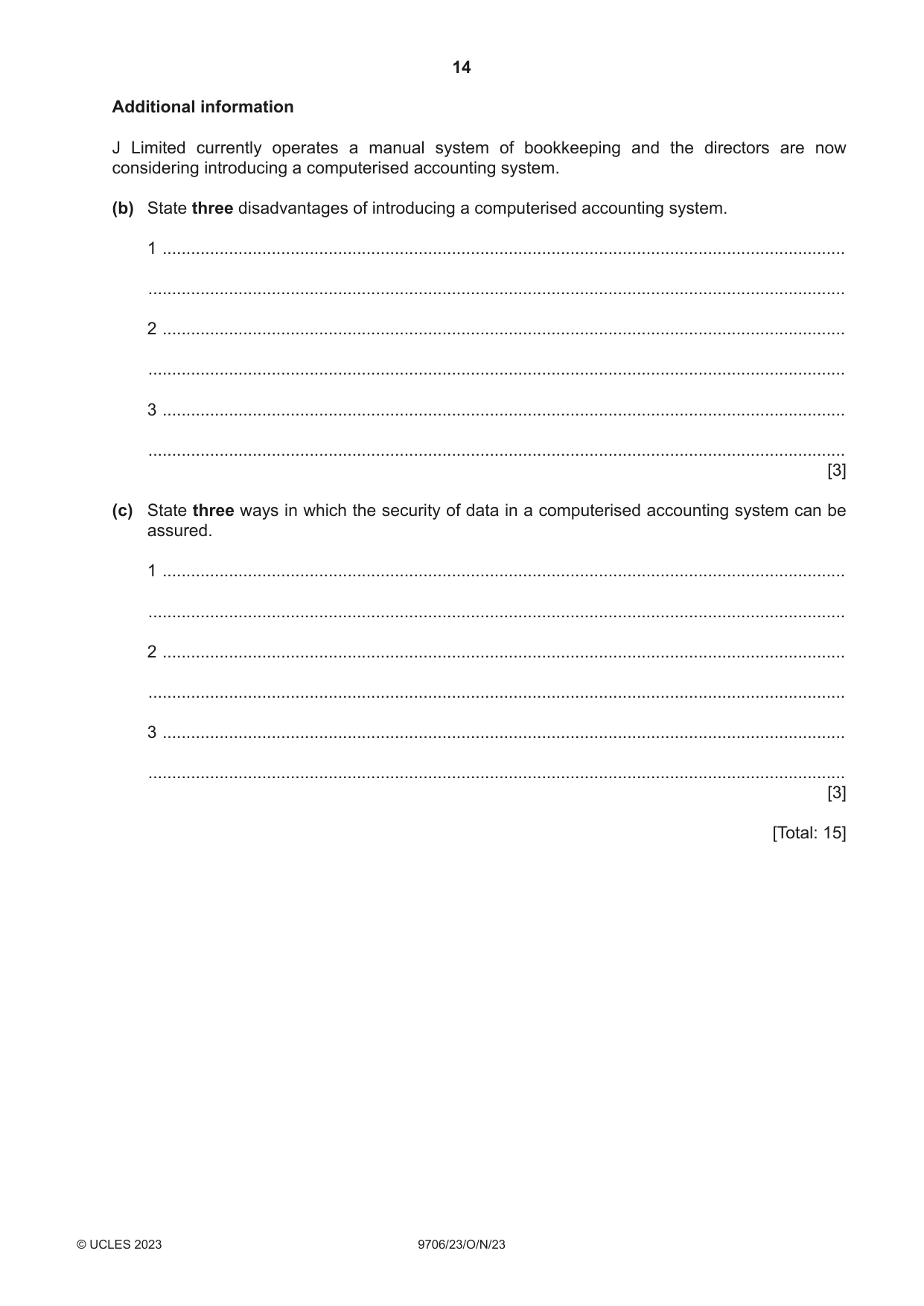
3 The directors of J Limited provided the following information at 1 September 2022. $ Share capital (ordinary shares of $0.50 each) 60 000 Share premium 21 800 Retained earnings 32 600 Total equity 114 400 During the year ended 31 August 2023 the following transactions took place. 1 December 2022 Made a rights issue of one ordinary share for every five shares held at a premium of $0.20. The issue was fully subscribed. 1 January 2023 Paid a final dividend of 4% on all shares in issue at 1 September 2022. 1 April 2023 Made a bonus issue of three ordinary shares for every eight shares held at that date. The directors wish to leave reserves in the most flexible form. 1 June 2023 Paid an interim dividend of $0.02 per ordinary share on all shares in issue at that date. Profit for the year ended 31 August 2023 was $16 500. (a) Prepare the following ledger accounts to record the transactions. Dates are not required. Share capital Details $ Details $ Balance b/d 60 000 Share premium Details $ Details $ Balance b/d 21 800 Retained earnings Details $ Details $ Balance b/d 32 600 [9] Additional information J Limited currently operates a manual system of bookkeeping and the directors are now considering introducing a computerised accounting system. (b) State three disadvantages of introducing a computerised accounting system. 1 ................................................................................................................................................ ................................................................................................................................................... 2 ................................................................................................................................................ ................................................................................................................................................... 3 ................................................................................................................................................ ................................................................................................................................................... [3] (c) State three ways in which the security of data in a computerised accounting system can be assured. 1 ................................................................................................................................................ ................................................................................................................................................... 2 ................................................................................................................................................ ................................................................................................................................................... 3 ................................................................................................................................................ ................................................................................................................................................... [3] [Total: 15]
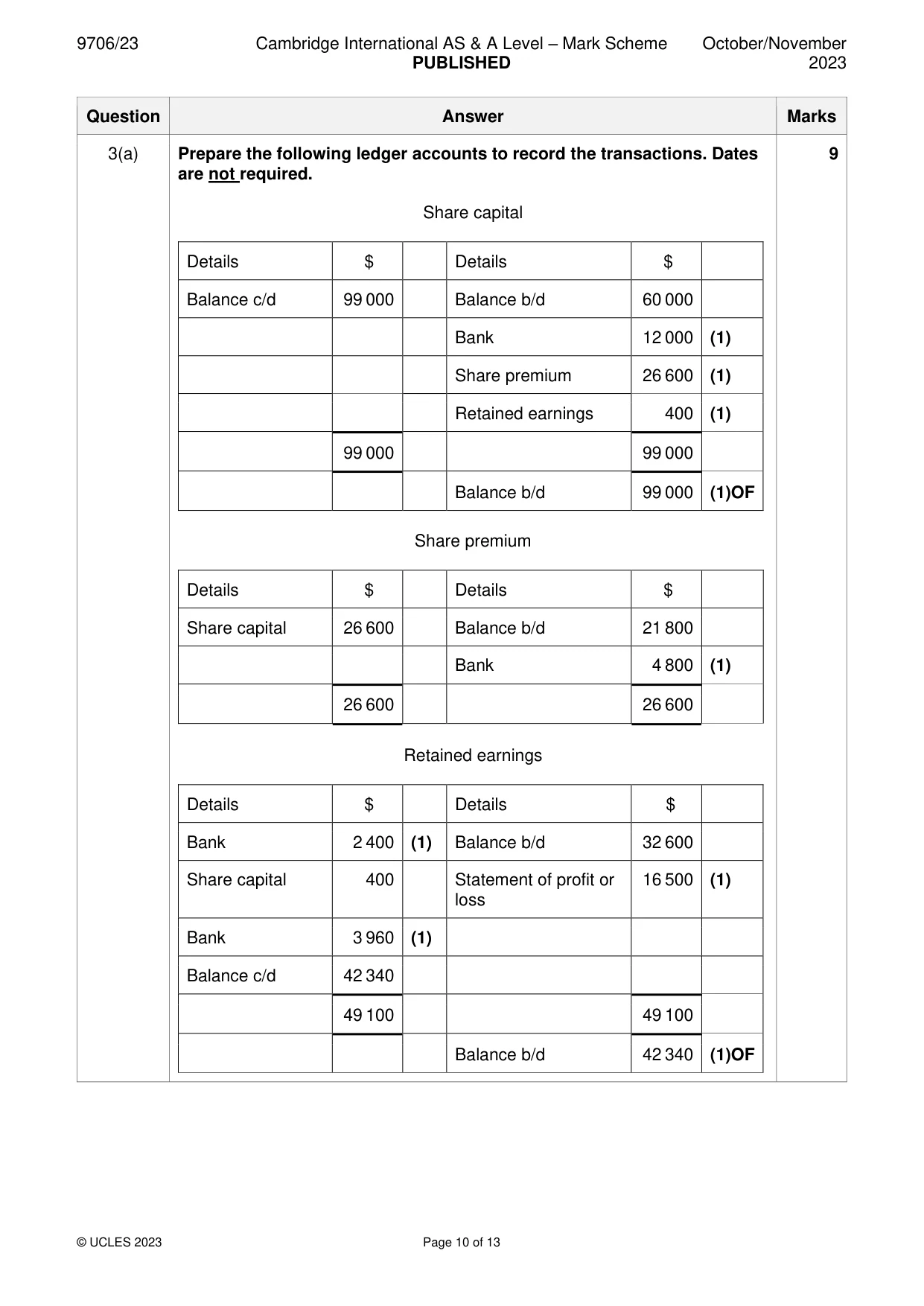
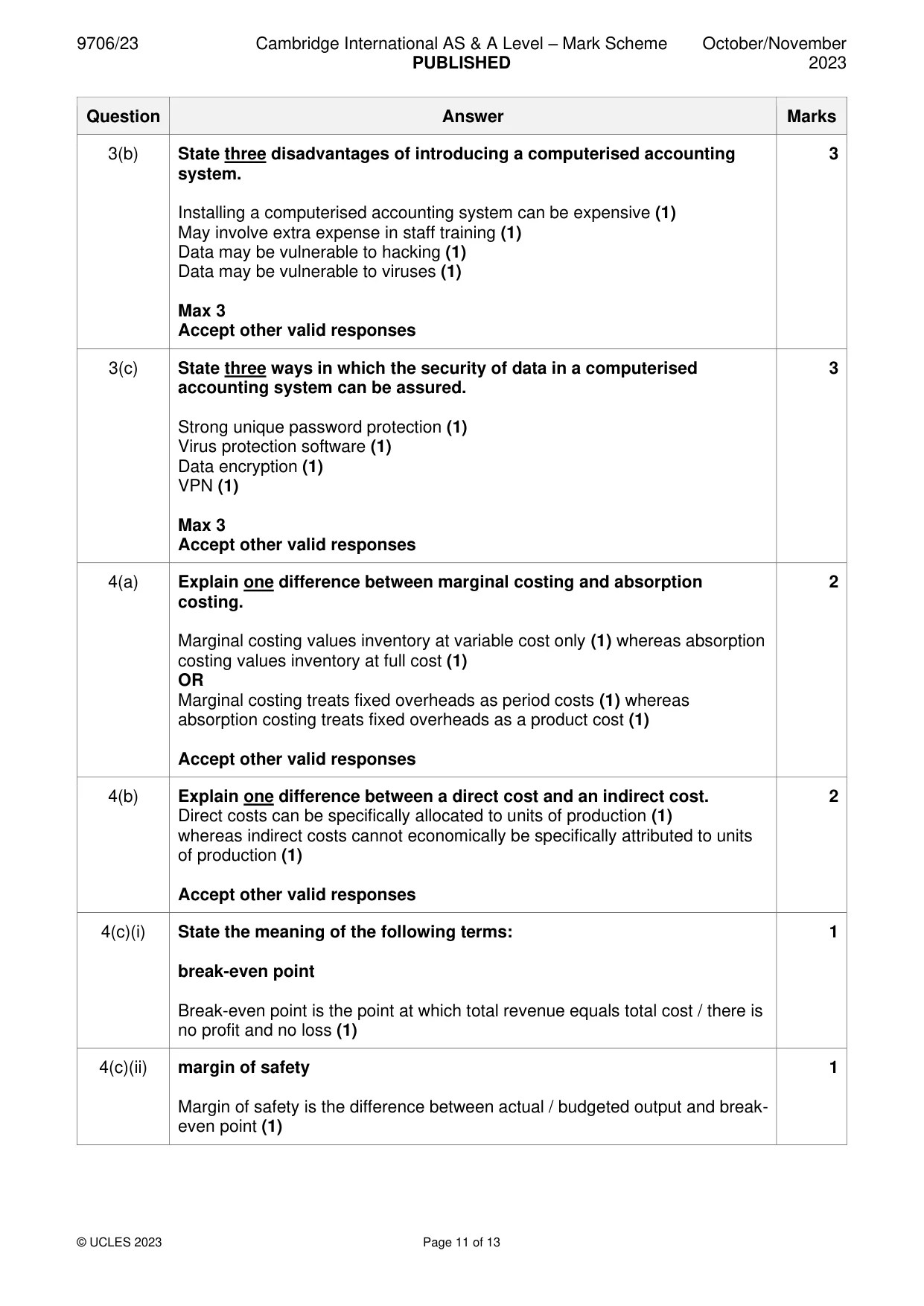
Mark scheme: 3(a) Prepare the following ledger accounts to record the transactions. Dates 9 are not required. Share capital Details $ Details $ Balance c/d 99 000 Balance b/d 60 000 Bank 12 000 (1) Share premium 26 600 (1) Retained earnings 400 (1) 99 000 99 000 Balance b/d 99 000 (1)OF Share premium Details $ Details $ Share capital 26 600 Balance b/d 21 800 Bank 4 800 (1) 26 600 26 600 Retained earnings Details $ Details $ Bank 2 400 (1) Balance b/d 32 600 Share capital 400 Statement of profit or 16 500 (1) loss Bank 3 960 (1) Balance c/d 42 340 49 100 49 100 Balance b/d 42 340 (1)OF 3(b) State three disadvantages of introducing a computerised accounting 3 system. Installing a computerised accounting system can be expensive (1) May involve extra expense in staff training (1) Data may be vulnerable to hacking (1) Data may be vulnerable to viruses (1) Max 3 Accept other valid responses 3(c) State three ways in which the security of data in a computerised 3 accounting system can be assured. Strong unique password protection (1) Virus protection software (1) Data encryption (1) VPN (1) Max 3 Accept other valid responses
Q4 · Dev manufactures two products, Aye and Bee
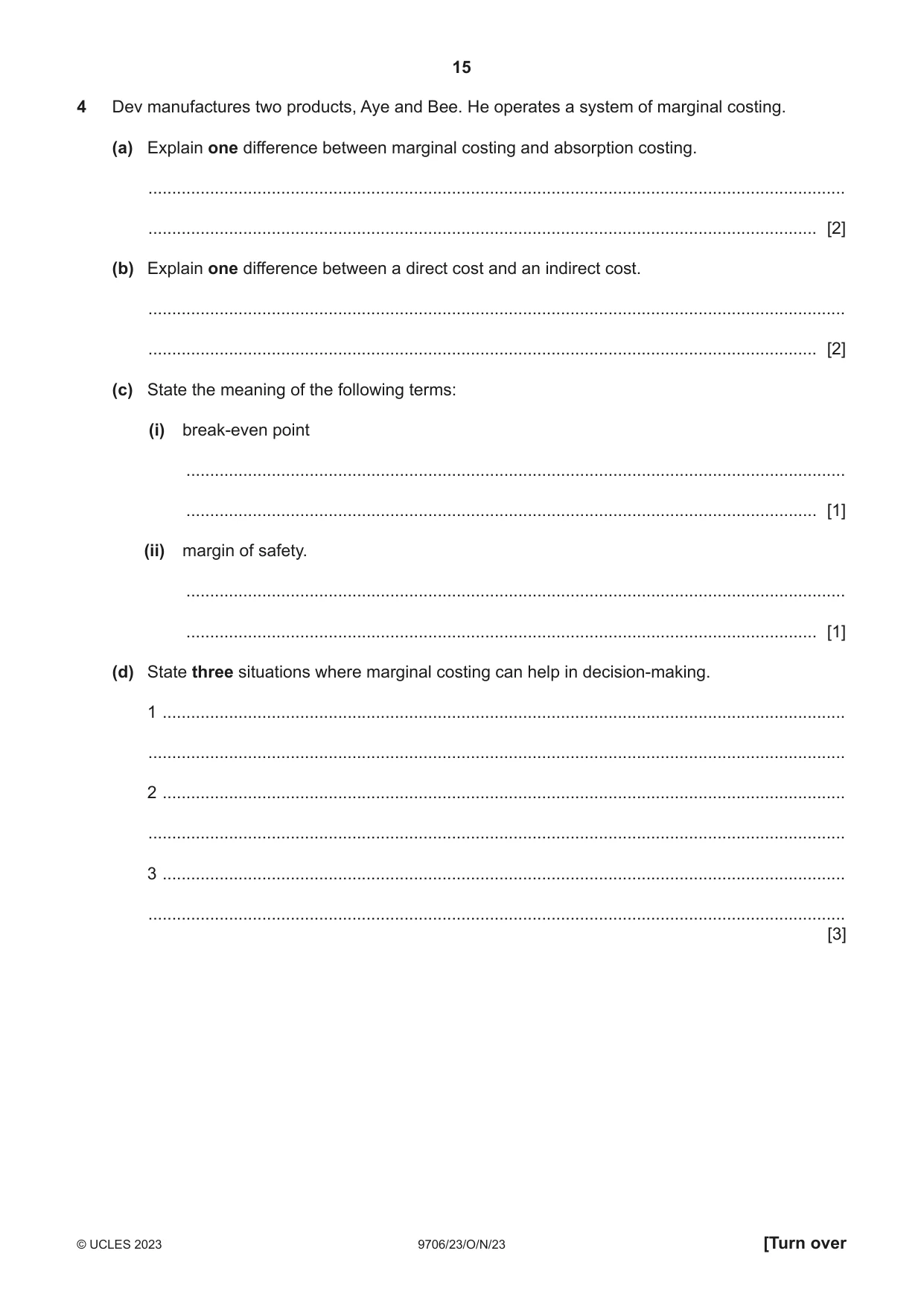
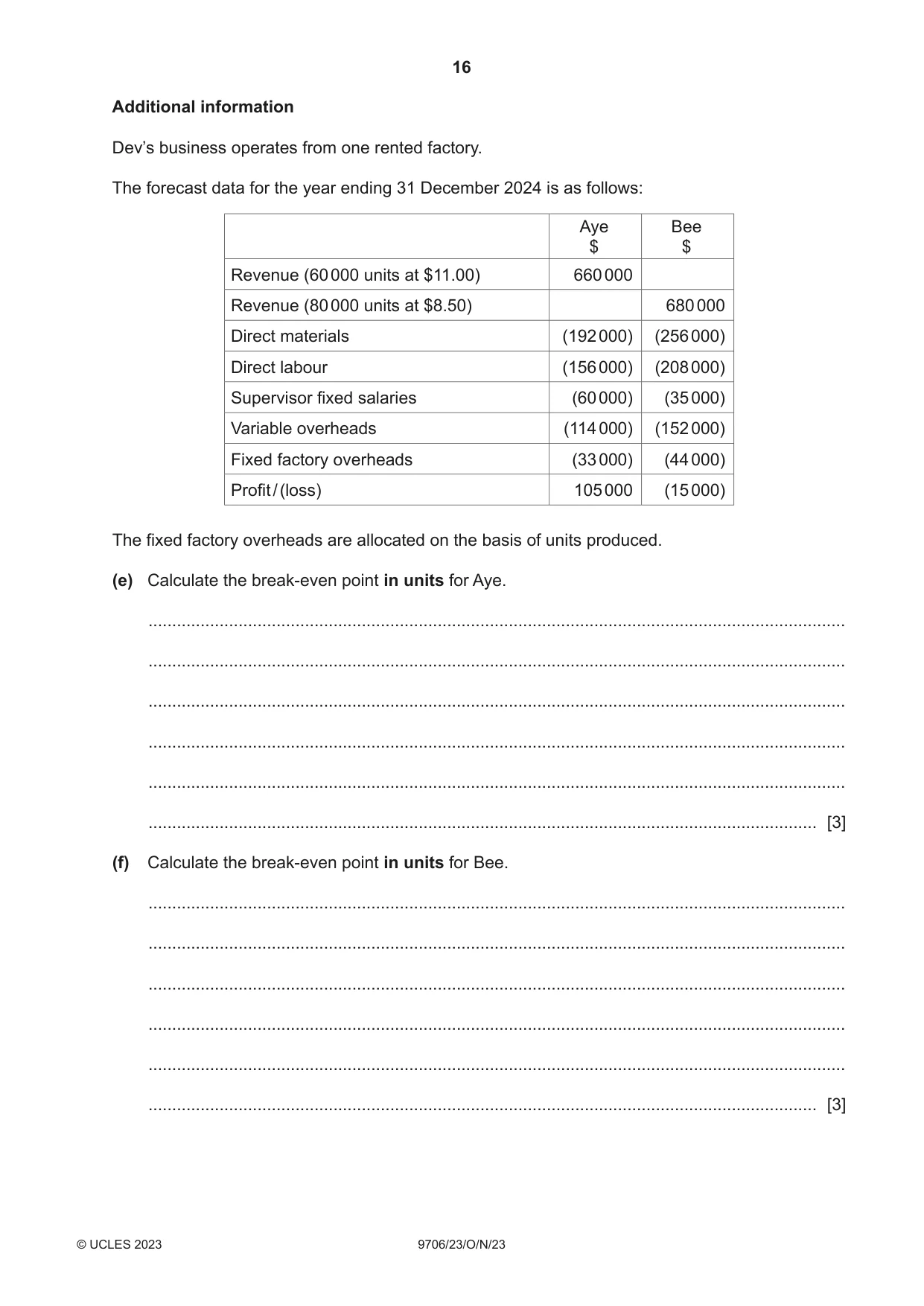
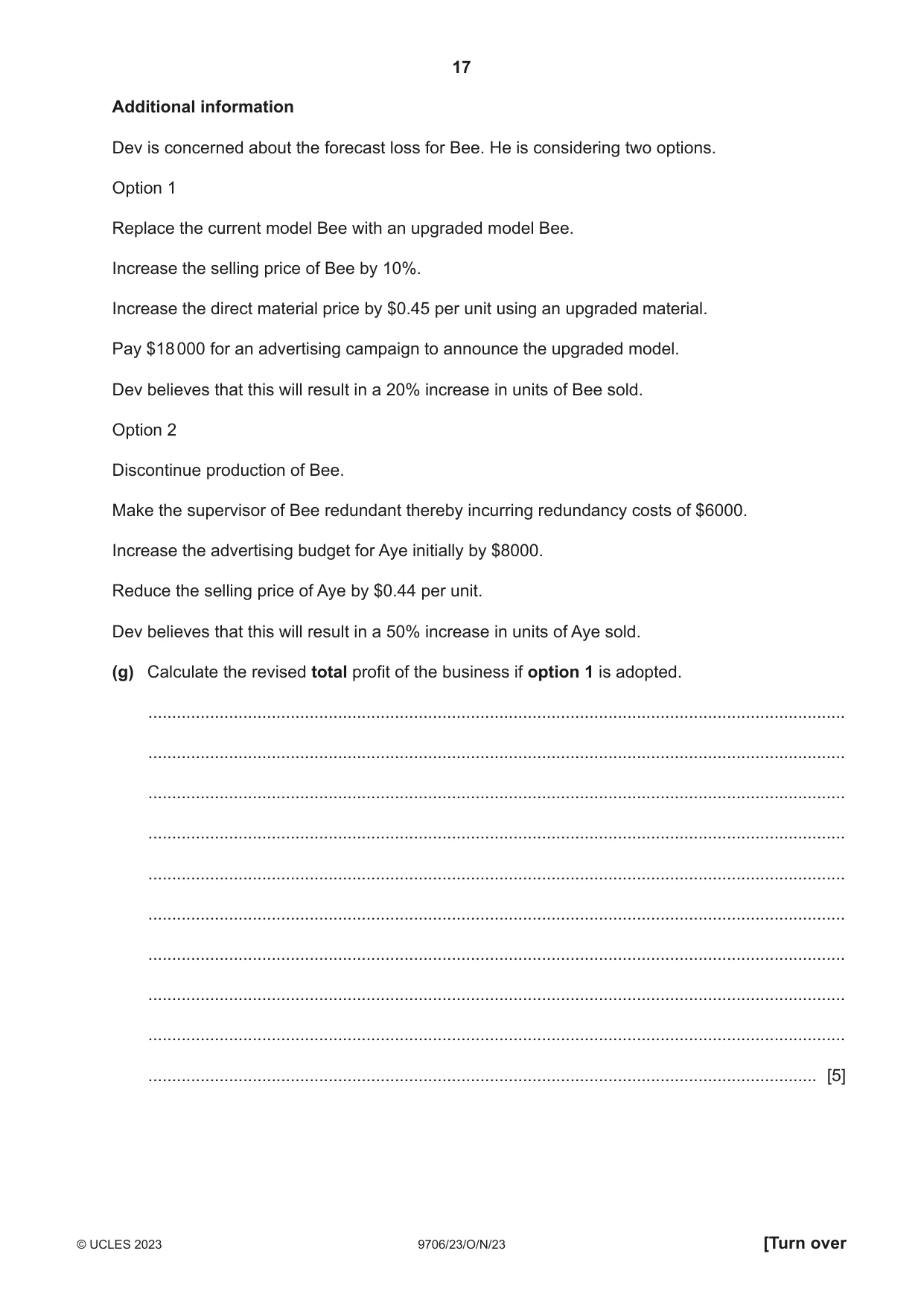
4 Dev manufactures two products, Aye and Bee. He operates a system of marginal costing. (a) Explain one difference between marginal costing and absorption costing. ................................................................................................................................................... ............................................................................................................................................. [2] (b) Explain one difference between a direct cost and an indirect cost. ................................................................................................................................................... ............................................................................................................................................. [2] (c) State the meaning of the following terms: (i) break-even point ........................................................................................................................................... ..................................................................................................................................... [1] (ii) margin of safety. ........................................................................................................................................... ..................................................................................................................................... [1] (d) State three situations where marginal costing can help in decision-making. 1 ................................................................................................................................................ ................................................................................................................................................... 2 ................................................................................................................................................ ................................................................................................................................................... 3 ................................................................................................................................................ ................................................................................................................................................... [3] Additional information Dev’s business operates from one rented factory. The forecast data for the year ending 31 December 2024 is as follows: Aye Bee $ $ Revenue (60 000 units at $11.00) 660 000 Revenue (80 000 units at $8.50) 680 000 Direct materials (192 000) (256 000) Direct labour (156 000) (208 000) Supervisor fixed salaries (60 000) (35 000) Variable overheads (114 000) (152 000) Fixed factory overheads (33 000) (44 000) Profit / (loss) 105 000 (15 000) The fixed factory overheads are allocated on the basis of units produced. (e) Calculate the break-even point in units for Aye. ................................................................................................................................................... ................................................................................................................................................... ................................................................................................................................................... ................................................................................................................................................... ................................................................................................................................................... ............................................................................................................................................. [3] (f) Calculate the break-even point in units for Bee. ................................................................................................................................................... ................................................................................................................................................... ................................................................................................................................................... ................................................................................................................................................... ................................................................................................................................................... ............................................................................................................................................. [3] Additional information Dev is concerned about the forecast loss for Bee. He is considering two options. Option 1 Replace the current model Bee with an upgraded model Bee. Increase the selling price of Bee by 10%. Increase the direct material price by $0.45 per unit using an upgraded material. Pay $18 000 for an advertising campaign to announce the upgraded model. Dev believes that this will result in a 20% increase in units of Bee sold. Option 2 Discontinue production of Bee. Make the supervisor of Bee redundant thereby incurring redundancy costs of $6000. Increase the advertising budget for Aye initially by $8000. Reduce the selling price of Aye by $0.44 per unit. Dev believes that this will result in a 50% increase in units of Aye sold. (g) Calculate the revised total profit of the business if option 1 is adopted. ................................................................................................................................................... ................................................................................................................................................... ................................................................................................................................................... ................................................................................................................................................... ................................................................................................................................................... ................................................................................................................................................... ................................................................................................................................................... ................................................................................................................................................... ................................................................................................................................................... ............................................................................................................................................. [5]
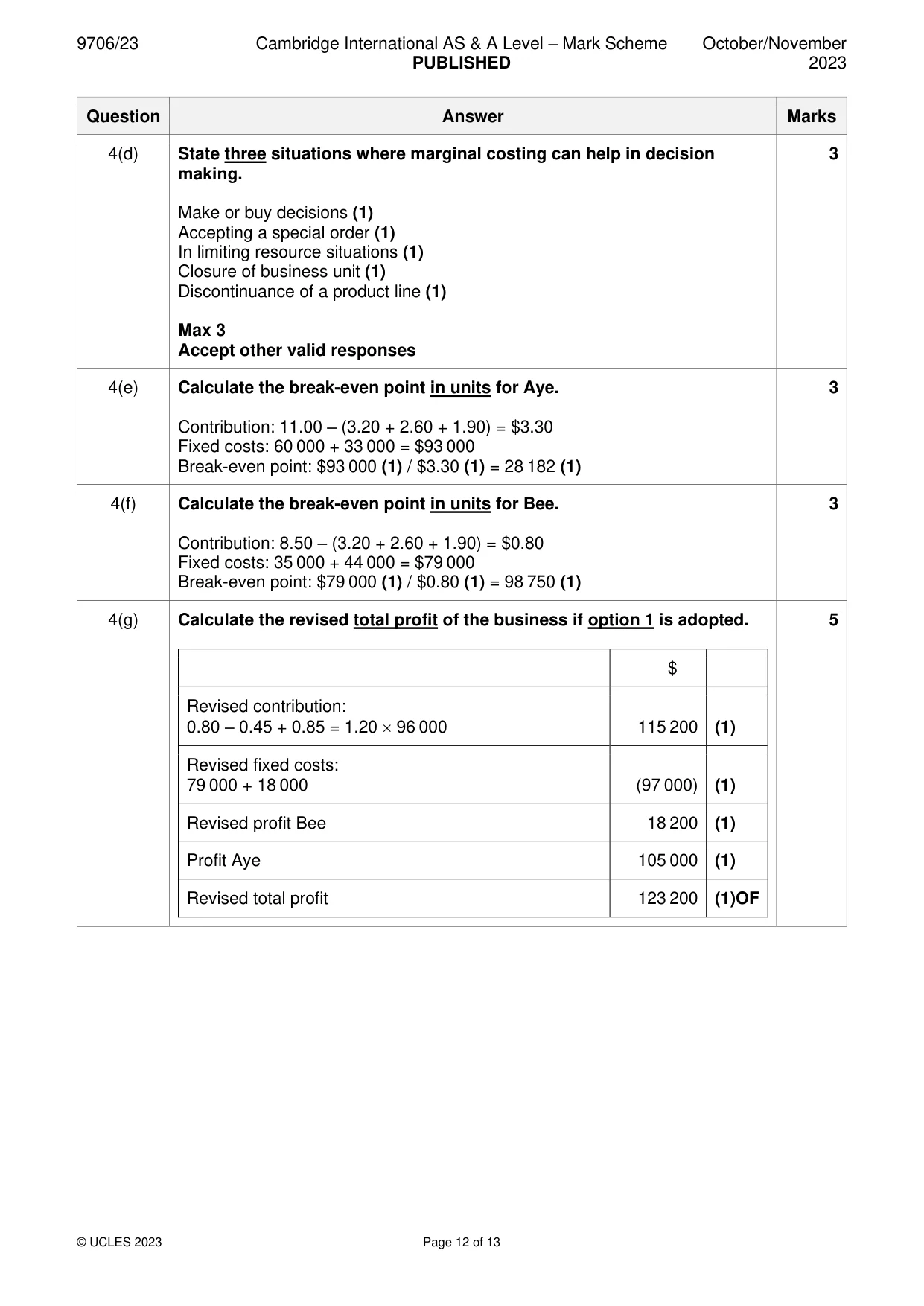
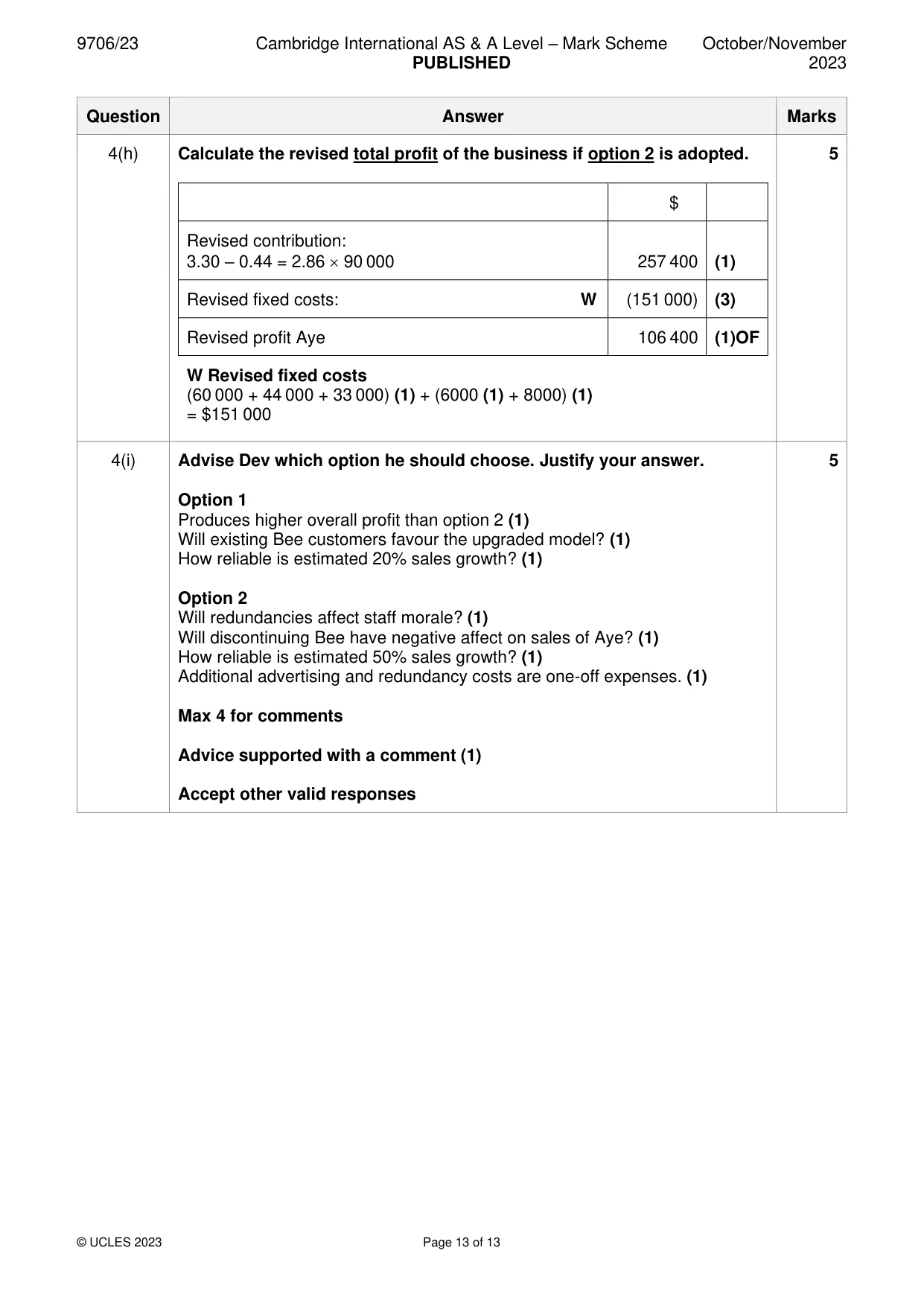
Mark scheme: 4(a) Explain one difference between marginal costing and absorption 2 costing. Marginal costing values inventory at variable cost only (1) whereas absorption costing values inventory at full cost (1) OR Marginal costing treats fixed overheads as period costs (1) whereas absorption costing treats fixed overheads as a product cost (1) Accept other valid responses 4(b) Explain one difference between a direct cost and an indirect cost. 2 Direct costs can be specifically allocated to units of production (1) whereas indirect costs cannot economically be specifically attributed to units of production (1) Accept other valid responses 4(c)(i) State the meaning of the following terms: 1 break-even point Break-even point is the point at which total revenue equals total cost / there is no profit and no loss (1) 4(c)(ii) margin of safety 1 Margin of safety is the difference between actual / budgeted output and break- even point (1) 4(d) State three situations where marginal costing can help in decision 3 making. Make or buy decisions (1) Accepting a special order (1) In limiting resource situations (1) Closure of business unit (1) Discontinuance of a product line (1) Max 3 Accept other valid responses 4(e) Calculate the break-even point in units for Aye. 3 Contribution: 11.00 – (3.20 + 2.60 + 1.90) = $3.30 Fixed costs: 60 000 + 33 000 = $93 000 Break-even point: $93 000 (1) / $3.30 (1) = 28 182 (1) 4(f) Calculate the break-even point in units for Bee. 3 Contribution: 8.50 – (3.20 + 2.60 + 1.90) = $0.80 Fixed costs: 35 000 + 44 000 = $79 000 Break-even point: $79 000 (1) / $0.80 (1) = 98 750 (1) 4(g) Calculate the revised total profit of the business if option 1 is adopted. 5 $ Revised contribution: 0.80 – 0.45 + 0.85 = 1.20 96 000 115 200 (1) Revised fixed costs: 79 000 + 18 000 (97 000) (1) Revised profit Bee 18 200 (1) Profit Aye 105 000 (1) Revised total profit 123 200 (1)OF 4(h) Calculate the revised total profit of the business if option 2 is adopted. 5 $ Revised contribution: 3.30 – 0.44 = 2.86 90 000 257 400 (1) Revised fixed costs: W (151 000) (3) Revised profit Aye 106 400 (1)OF W Revised fixed costs (60 000 + 44 000 + 33 000) (1) + (6000 (1) + 8000) (1) = $151 000 4(i) Advise Dev which option he should choose. Justify your answer. 5 Option 1 Produces higher overall profit than option 2 (1) Will existing Bee customers favour the upgraded model? (1) How reliable is estimated 20% sales growth? (1) Option 2 Will redundancies affect staff morale? (1) Will discontinuing Bee have negative affect on sales of Aye? (1) How reliable is estimated 50% sales growth? (1) Additional advertising and redundancy costs are one-off expenses. (1) Max 4 for comments Advice supported with a comment (1) Accept other valid responses
What was in this paper
The subtopics covered by these 4 questions, and how many questions each got. Open one in a new tab to see every Cambridge question on it.
What you needed in this session
Cambridge’s own grade thresholds for 2023 Oct/Nov, Paper 2 · Variant 3. A higher threshold means an easier paper — the bar moves with how the cohort did.