Cambridge A Level Accounting 9706 — 2022 May/June Paper 2 · Variant 3
9706/23/M/J/22 · 5 questions · 90 marks · ≈101 min
The question paper and its mark scheme, free to read here and free to download. This is Cambridge’s own paper, exactly as it was sat.
Question paper20 pages


Mark scheme13 pages
Answers below. Sit the paper first if you are practising.
Questions as text
Q1 · K Limited’s financial year ended on 31 December 2021
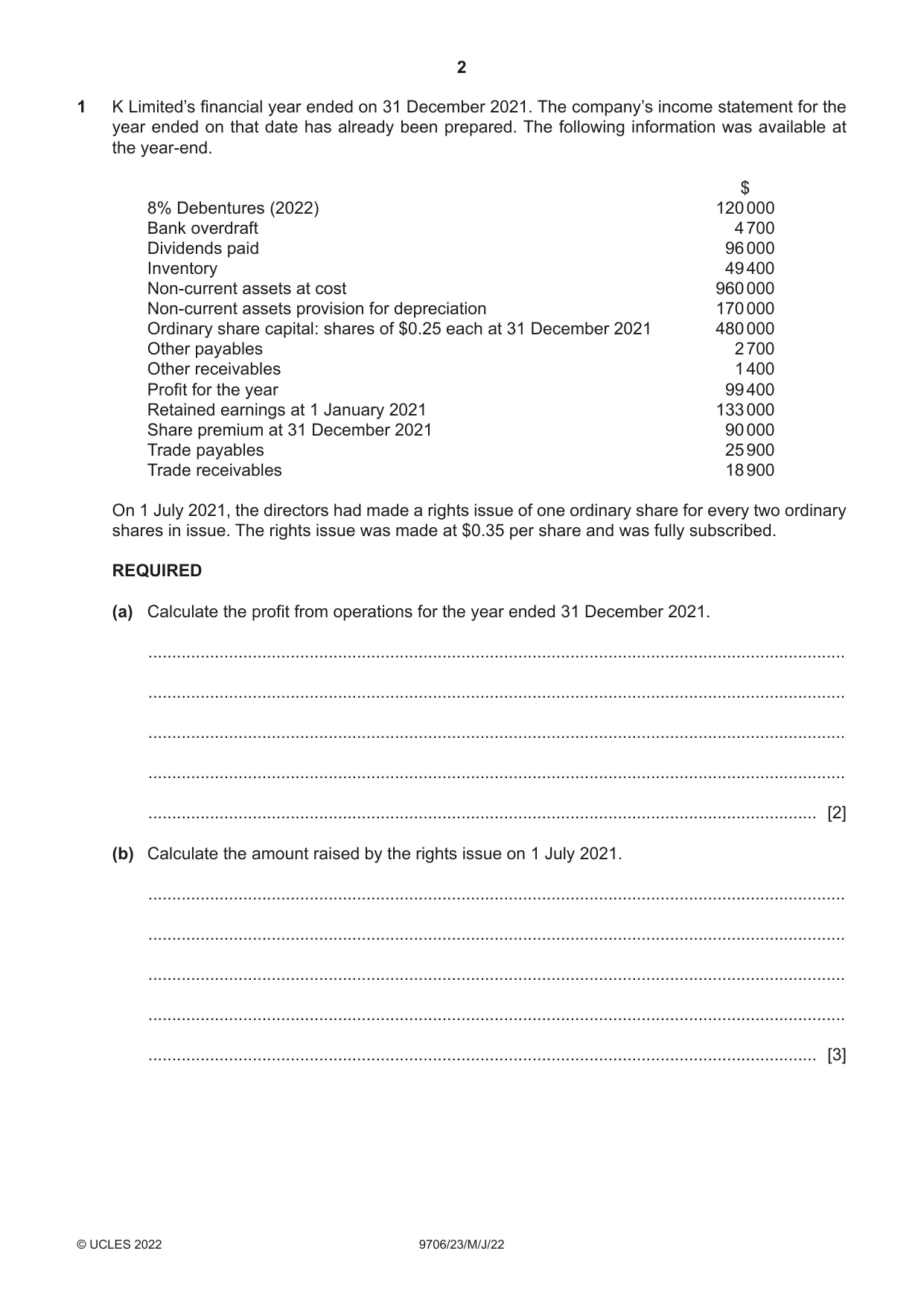
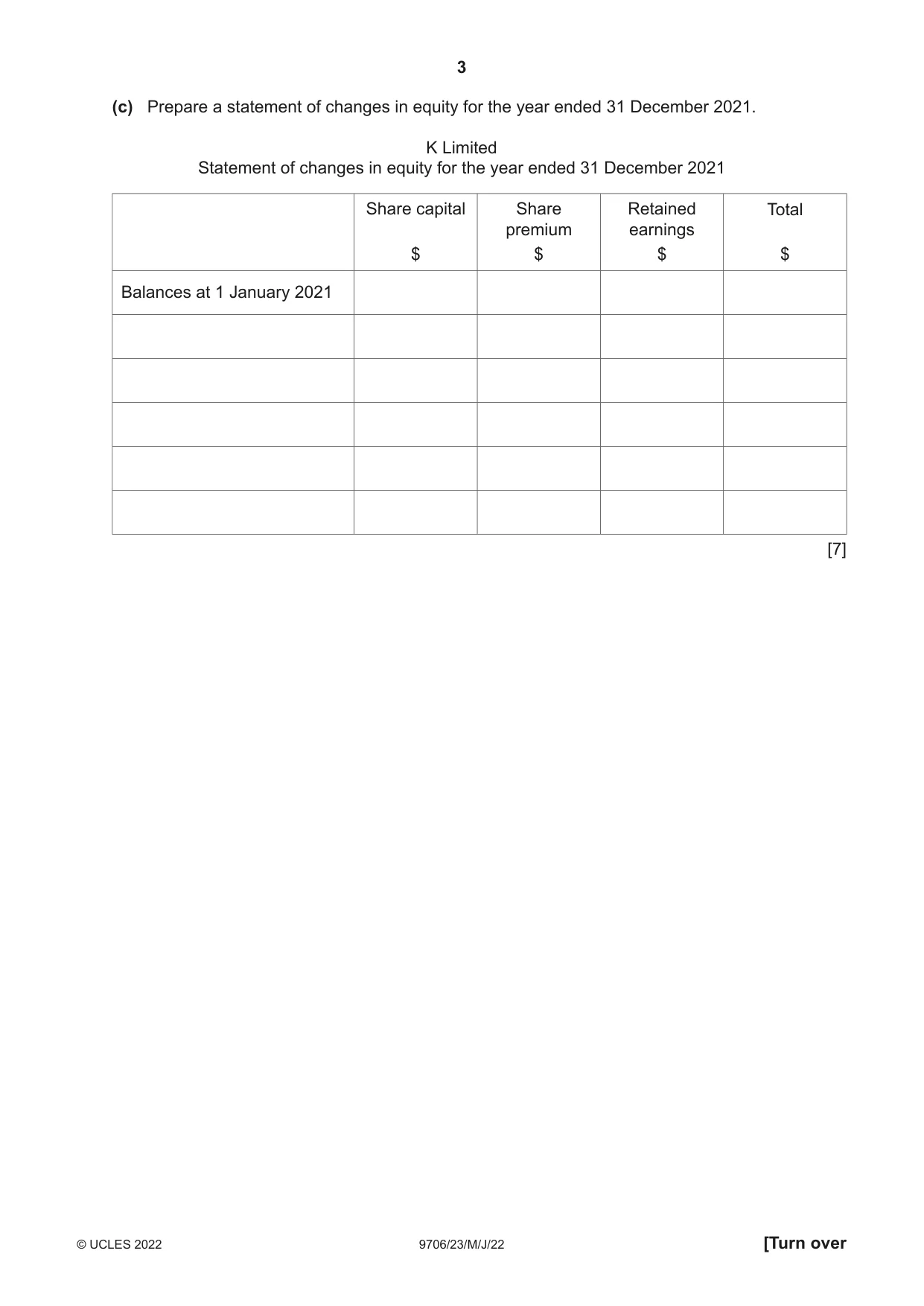
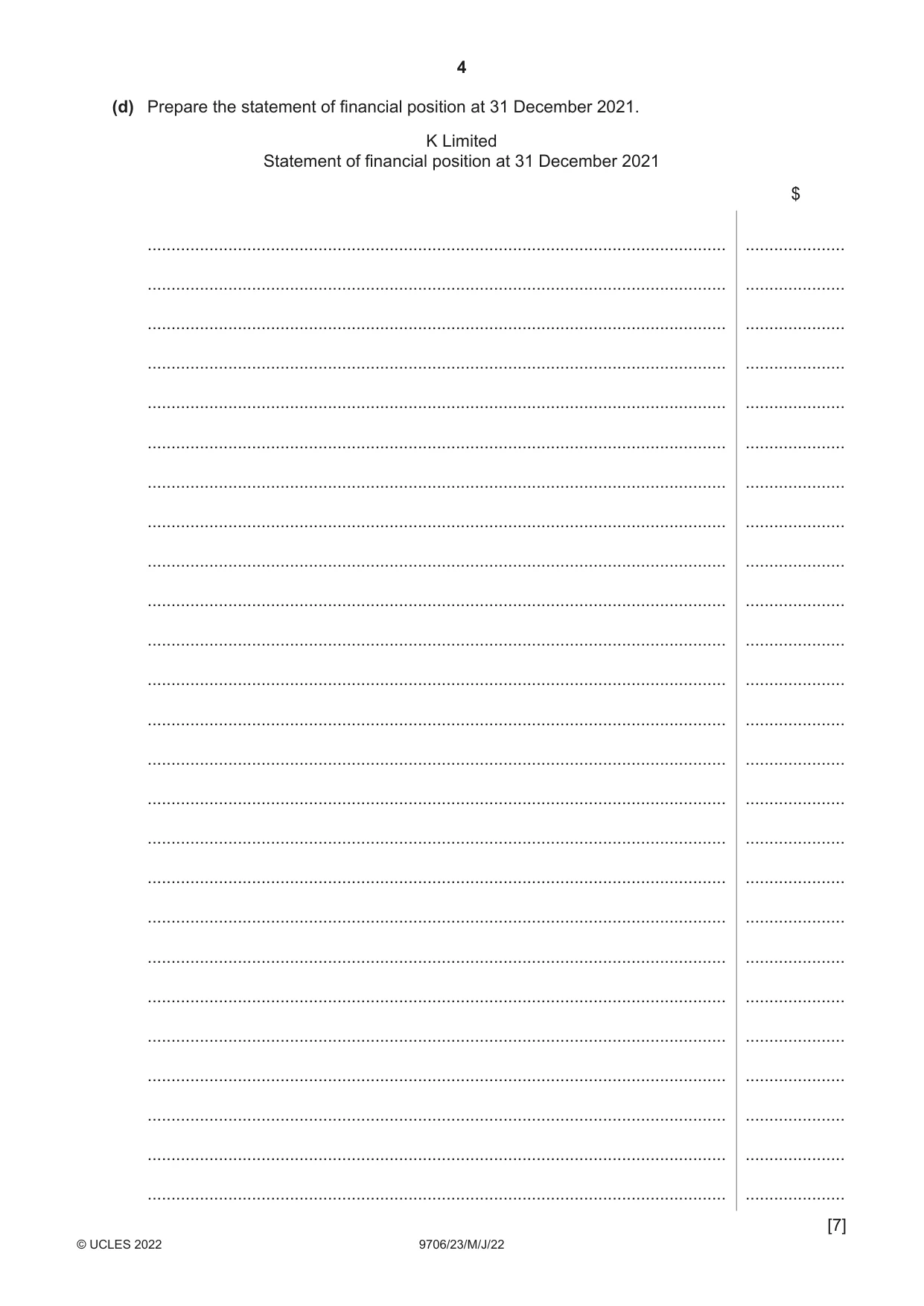
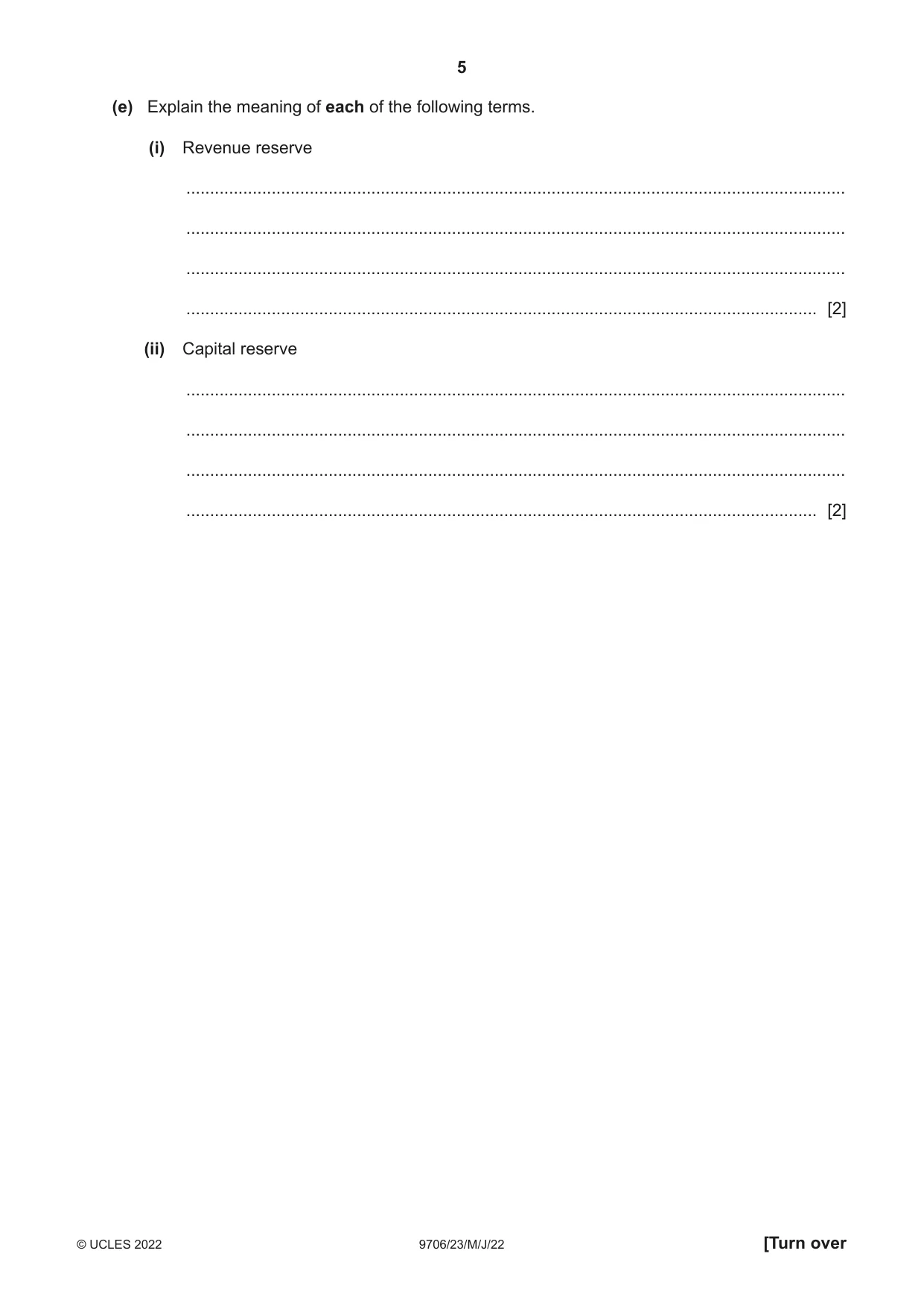
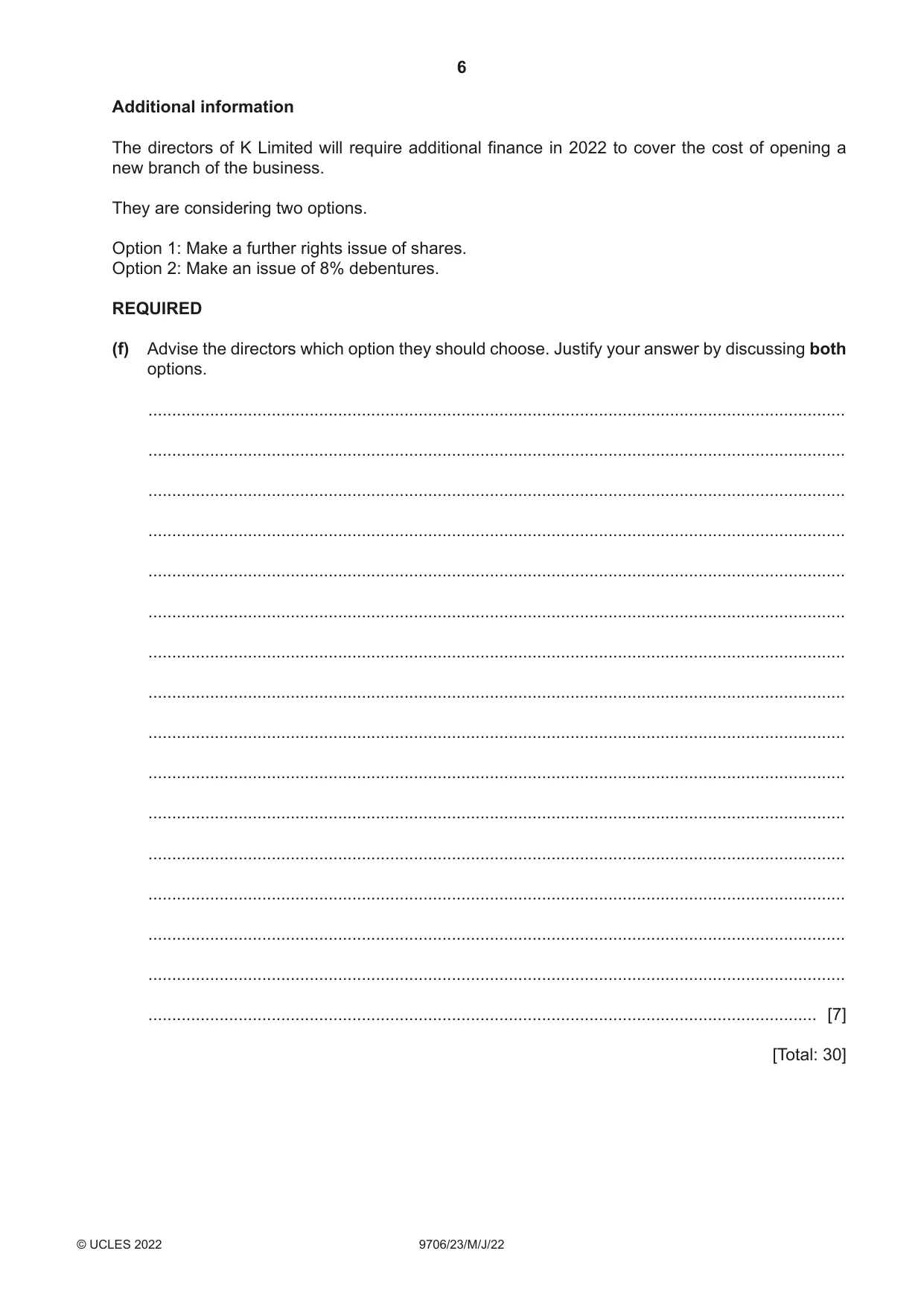
1 K Limited’s financial year ended on 31 December 2021. The company’s income statement for the year ended on that date has already been prepared. The following information was available at the year‑end. $ 8% Debentures (2022) 120 000 Bank overdraft 4 700 Dividends paid 96 000 Inventory 49 400 Non‑current assets at cost 960 000 Non‑current assets provision for depreciation 170 000 Ordinary share capital: shares of $0.25 each at 31 December 2021 480 000 Other payables 2 700 Other receivables 1 400 Profit for the year 99 400 Retained earnings at 1 January 2021 133 000 Share premium at 31 December 2021 90 000 Trade payables 25 900 Trade receivables 18 900 On 1 July 2021, the directors had made a rights issue of one ordinary share for every two ordinary shares in issue. The rights issue was made at $0.35 per share and was fully subscribed. REQUIRED (a) Calculate the profit from operations for the year ended 31 December 2021. ................................................................................................................................................... ................................................................................................................................................... ................................................................................................................................................... ................................................................................................................................................... ............................................................................................................................................. [2] (b) Calculate the amount raised by the rights issue on 1 July 2021. ................................................................................................................................................... ................................................................................................................................................... ................................................................................................................................................... ................................................................................................................................................... ............................................................................................................................................. [3] (c) Prepare a statement of changes in equity for the year ended 31 December 2021. K Limited Statement of changes in equity for the year ended 31 December 2021 Share capital Share Retained Total premium earnings $ $ $ $ Balances at 1 January 2021 [7] (d) Prepare the statement of financial position at 31 December 2021. K Limited Statement of financial position at 31 December 2021 $ .......................................................................................................................... ..................... .......................................................................................................................... ..................... .......................................................................................................................... ..................... .......................................................................................................................... ..................... .......................................................................................................................... ..................... .......................................................................................................................... ..................... .......................................................................................................................... ..................... .......................................................................................................................... ..................... .......................................................................................................................... ..................... .......................................................................................................................... ..................... .......................................................................................................................... ..................... .......................................................................................................................... ..................... .......................................................................................................................... ..................... .......................................................................................................................... ..................... .......................................................................................................................... ..................... .......................................................................................................................... ..................... .......................................................................................................................... ..................... .......................................................................................................................... ..................... .......................................................................................................................... ..................... .......................................................................................................................... ..................... .......................................................................................................................... ..................... .......................................................................................................................... ..................... .......................................................................................................................... ..................... .......................................................................................................................... ..................... .......................................................................................................................... ..................... [7] (e) Explain the meaning of each of the following terms. (i) Revenue reserve ........................................................................................................................................... ........................................................................................................................................... ........................................................................................................................................... ..................................................................................................................................... [2] (ii) Capital reserve ........................................................................................................................................... ........................................................................................................................................... ........................................................................................................................................... ..................................................................................................................................... [2] Additional information The directors of K Limited will require additional finance in 2022 to cover the cost of opening a new branch of the business. They are considering two options. Option 1: Make a further rights issue of shares. Option 2: Make an issue of 8% debentures. REQUIRED (f) Advise the directors which option they should choose. Justify your answer by discussing both options. ................................................................................................................................................... ................................................................................................................................................... ................................................................................................................................................... ................................................................................................................................................... ................................................................................................................................................... ................................................................................................................................................... ................................................................................................................................................... ................................................................................................................................................... ................................................................................................................................................... ................................................................................................................................................... ................................................................................................................................................... ................................................................................................................................................... ................................................................................................................................................... ................................................................................................................................................... ................................................................................................................................................... ............................................................................................................................................. [7] [Total: 30]
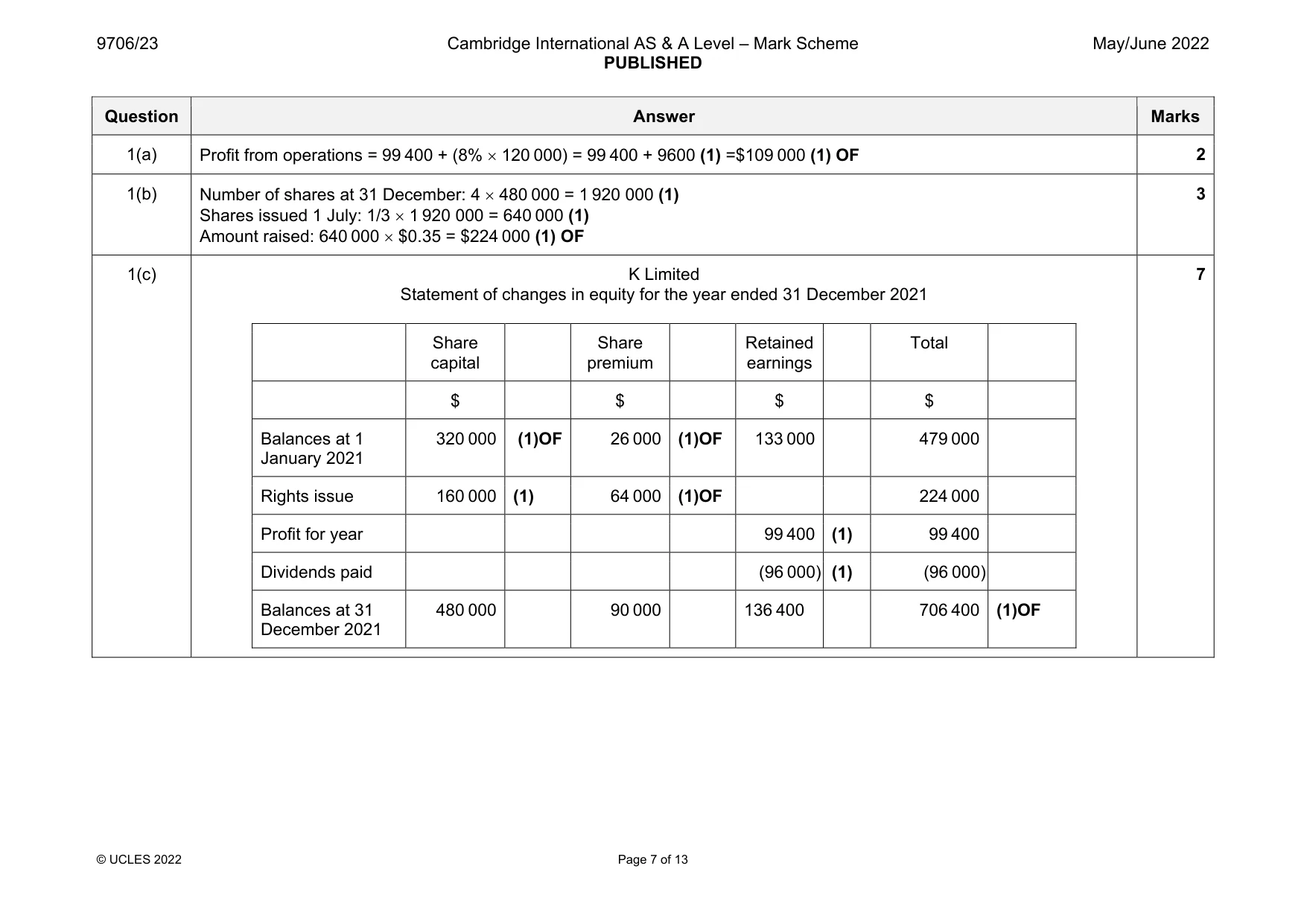
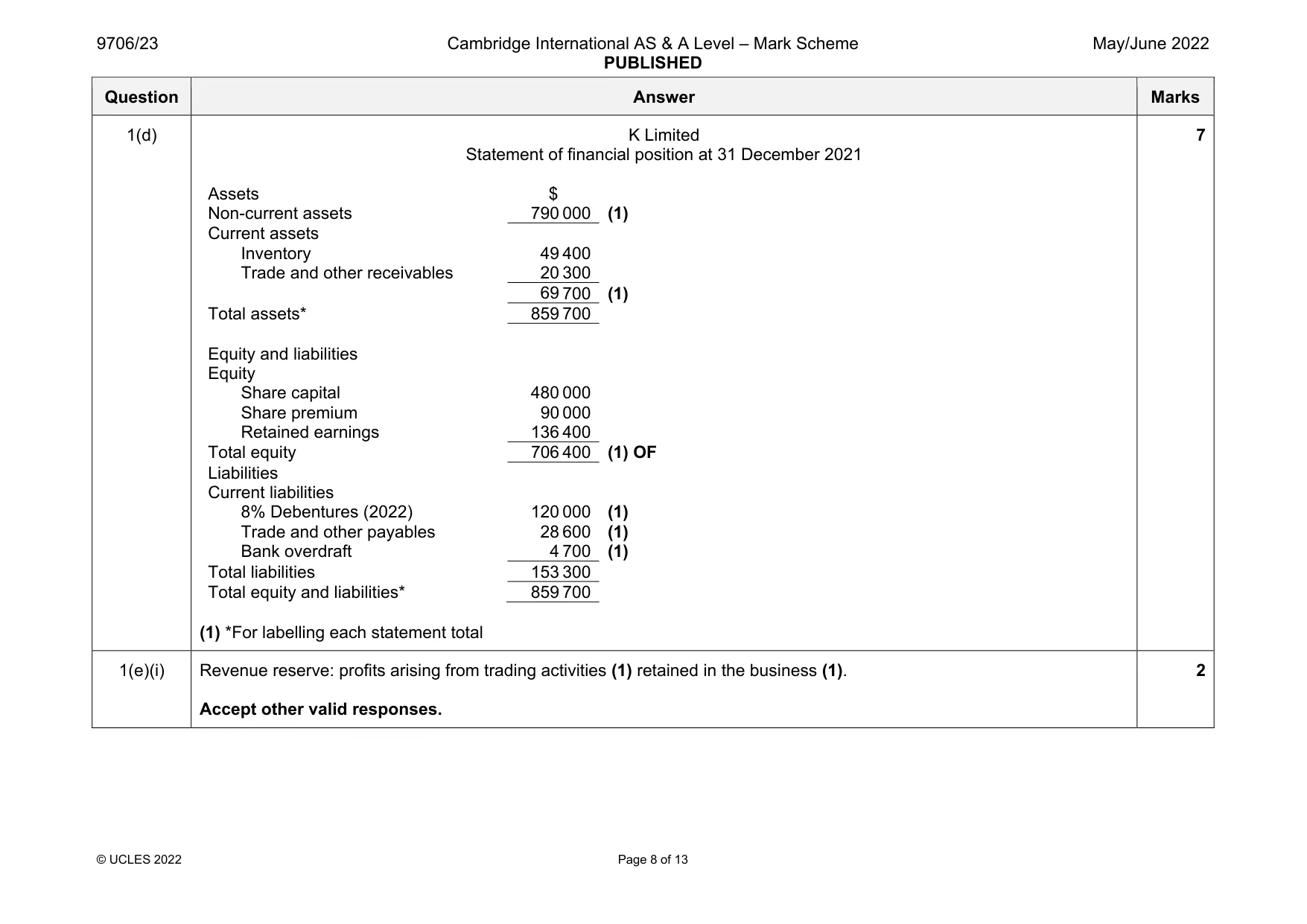
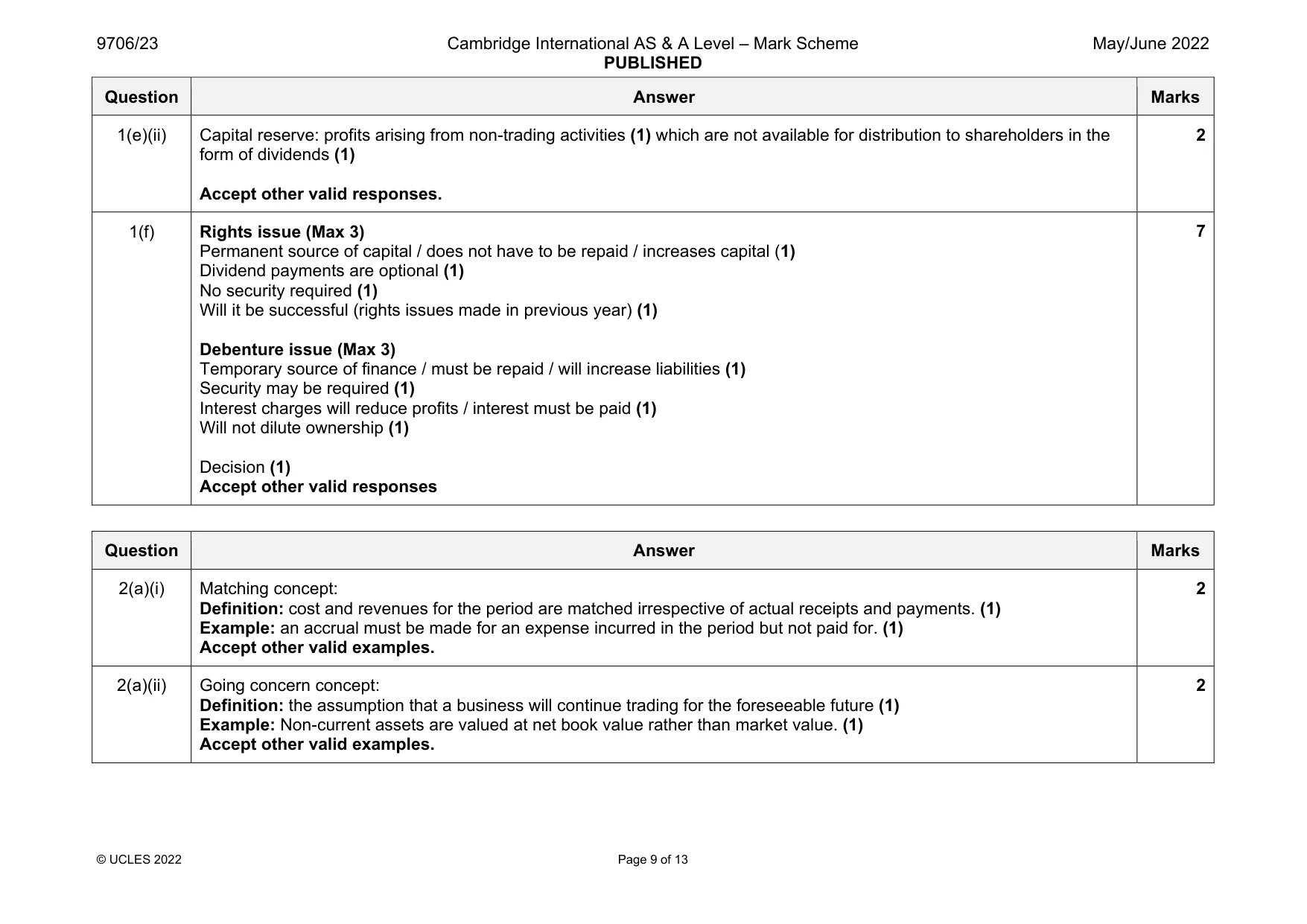
Mark scheme: 1(a) 2 1(b) Number of shares at 31 December: 4 480 000 = 1 920 000 (1) Shares issued 1 July: 1/3 1 920 000 = 640 000 (1) Amount raised: 640 000 $0.35 = $224 000 (1) OF 3 1(c) K Limited Statement of changes in equity for the year ended 31 December 2021 Share capital Share premium Retained earnings Total $ $ $ $ Balances at 1 January 2021 320 000 (1)OF 26 000 (1)OF 133 000 479 000 Rights issue 160 000 (1) 64 000 (1)OF 224 000 Profit for year 99 400 (1) 99 400 Dividends paid (96 000) (1) (96 000) Balances at 31 December 2021 480 000 90 000 136 400 706 400 (1)OF 7 Question Answer Marks 1(d) K Limited Statement of financial position at 31 December 2021 Assets $ Non-current assets 790 000 (1) Current assets Inventory 49 400 Trade and other receivables 20 300 69 700 (1) Total assets* 859 700 Equity and liabilities Equity Share capital 480 000 Share premium 90 000 Retained earnings 136 400 Total equity 706 400 (1) OF Liabilities Current liabilities 8% Debentures (2022) 120 000 (1) Trade and other payables 28 600 (1) Bank overdraft 4 700 (1) Total liabilities 153 300 Total equity and liabilities* 859 700 (1) *For labelling each statement total 7 1(e)(i) Revenue reserve: profits arising from trading activities (1) retained in the business (1). Accept other valid responses. 2 Question Answer Marks 1(e)(ii) Capital reserve: profits arising from non-trading activities (1) which are not available for distribution to shareholders in the form of dividends (1) Accept other valid responses. 2 1(f) Rights issue (Max 3) Permanent source of capital / does not have to be repaid / increases capital (1) Dividend payments are optional (1) No security required (1) Will it be successful (rights issues made in previous year) (1) Debenture issue (Max 3) Temporary source of finance / must be repaid / will increase liabilities (1) Security may be required (1) Interest charges will reduce profits / interest must be paid (1) Will not dilute ownership (1) Decision (1) Accept other valid responses 7
Q2 · Rakesh prepared his business’s end of year financial statements on 30 September 2021
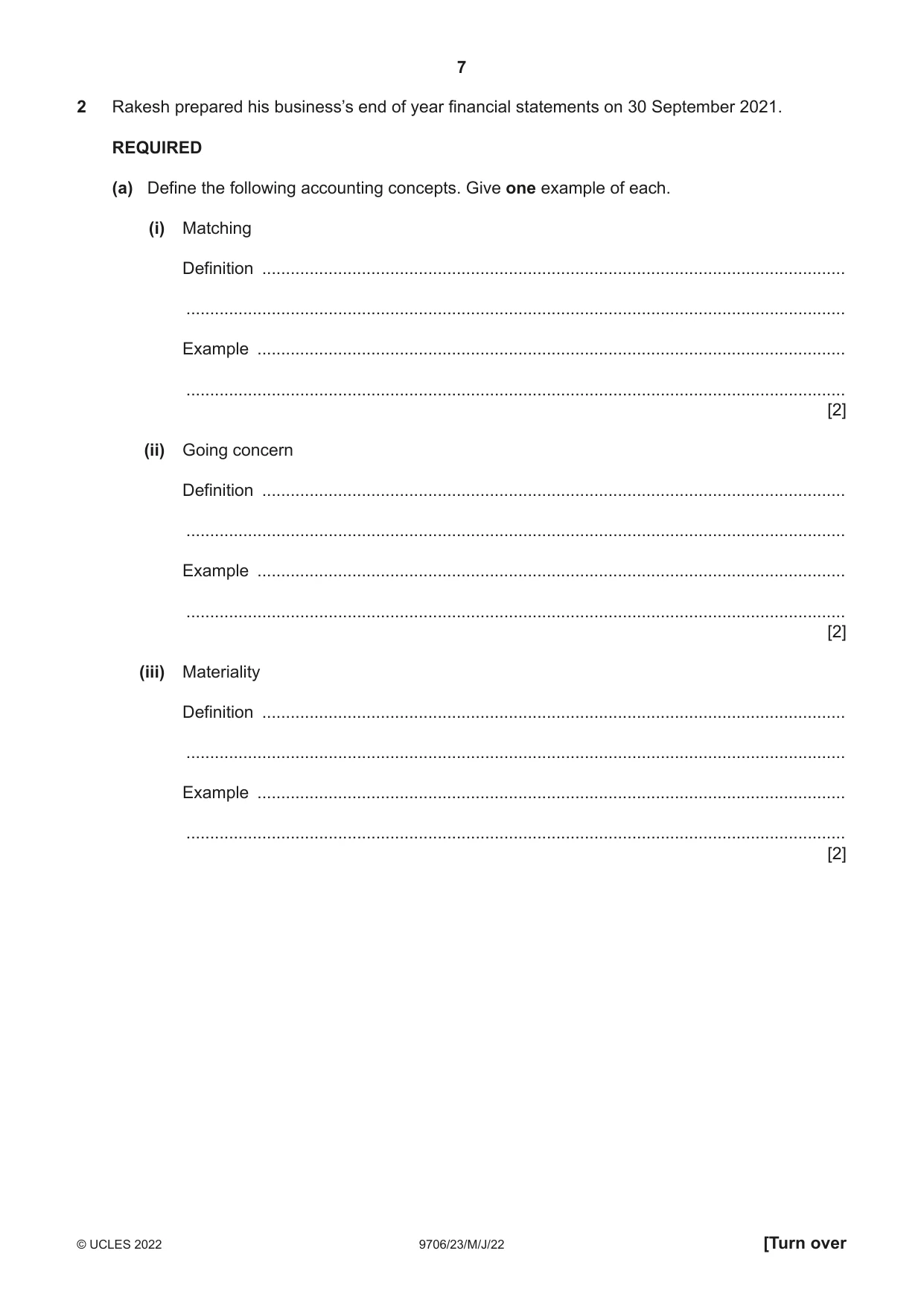
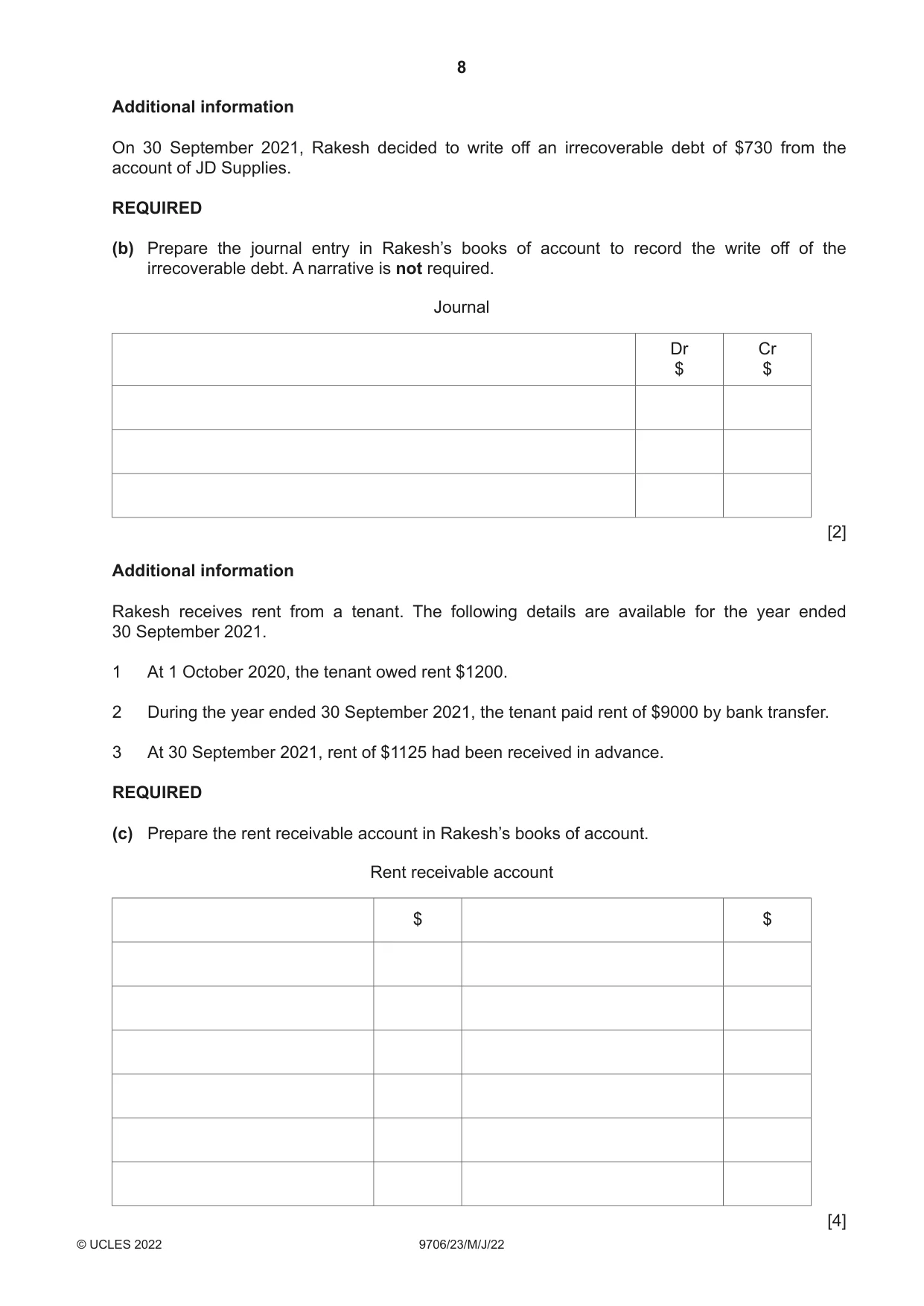
2 Rakesh prepared his business’s end of year financial statements on 30 September 2021. REQUIRED (a) Define the following accounting concepts. Give one example of each. (i) Matching Definition ........................................................................................................................... ........................................................................................................................................... Example ............................................................................................................................ ........................................................................................................................................... [2] (ii) Going concern Definition ........................................................................................................................... ........................................................................................................................................... Example ............................................................................................................................ ........................................................................................................................................... [2] (iii) Materiality Definition ........................................................................................................................... ........................................................................................................................................... Example ............................................................................................................................ ........................................................................................................................................... [2] Additional information On 30 September 2021, Rakesh decided to write off an irrecoverable debt of $730 from the account of JD Supplies. REQUIRED (b) Prepare the journal entry in Rakesh’s books of account to record the write off of the irrecoverable debt. A narrative is not required. Journal Dr Cr $ $ [2] Additional information Rakesh receives rent from a tenant. The following details are available for the year ended 30 September 2021. 1 At 1 October 2020, the tenant owed rent $1200. 2 During the year ended 30 September 2021, the tenant paid rent of $9000 by bank transfer.
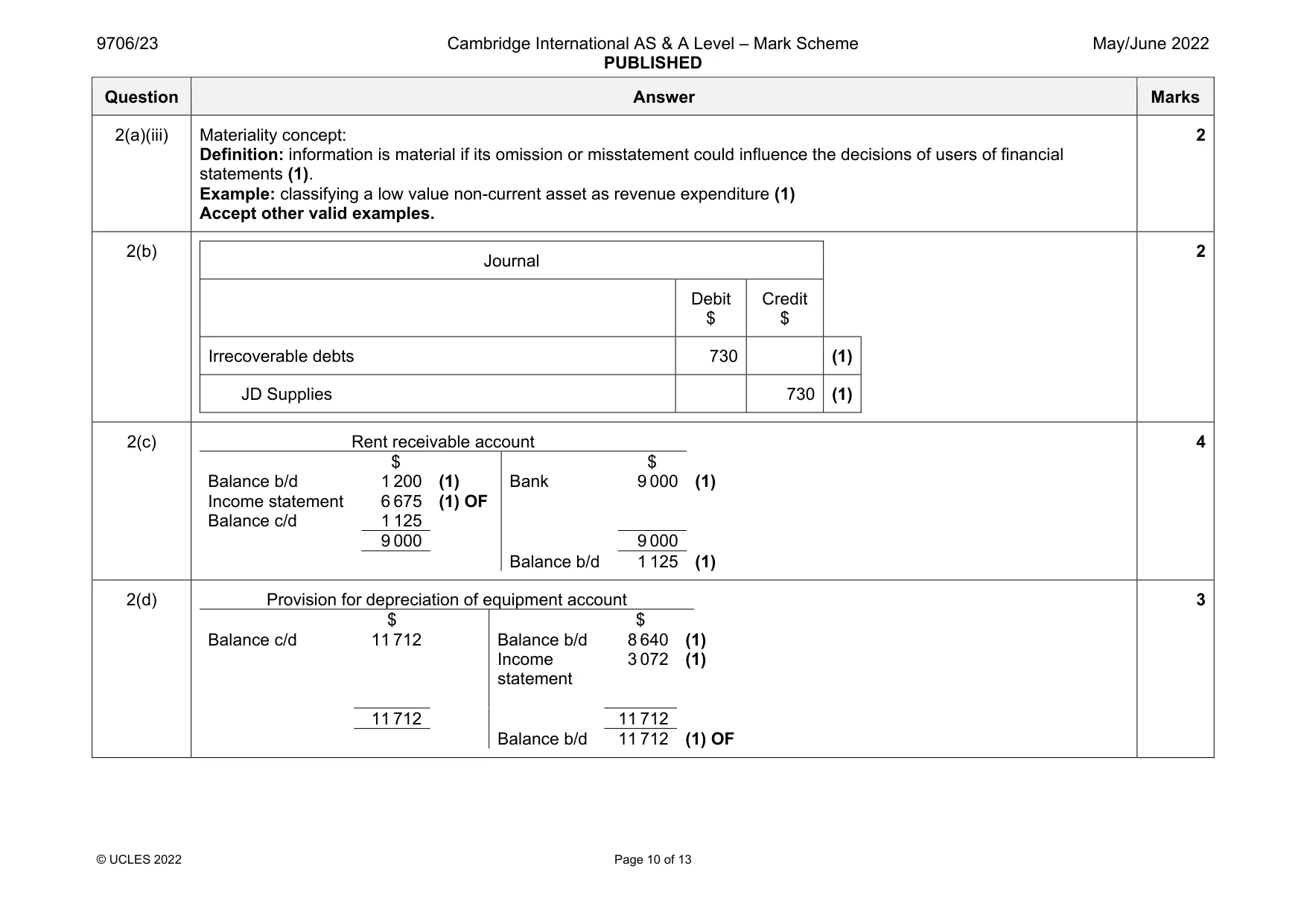
Mark scheme: 2(a)(i) Matching concept: Definition: cost and revenues for the period are matched irrespective of actual receipts and payments. (1) Example: an accrual must be made for an expense incurred in the period but not paid for. (1) Accept other valid examples. 2 2(a)(ii) Going concern concept: Definition: the assumption that a business will continue trading for the foreseeable future (1) Example: Non-current assets are valued at net book value rather than market value. (1) Accept other valid examples. 2 Question Answer Marks 2(a)(iii) Materiality concept: Definition: information is material if its omission or misstatement could influence the decisions of users of financial statements (1). Example: classifying a low value non-current asset as revenue expenditure (1) Accept other valid examples. 2 2(b) Journal Debit $ Credit $ Irrecoverable debts 730 (1) JD Supplies 730 (1) 2 2(c) Rent receivable account $ $ Balance b/d 1 200 (1) Bank 9 000 (1) Income statement 6 675 (1) OF Balance c/d 1 125 9 000 9 000 Balance b/d 1 125 (1) 4 2(d) Provision for depreciation of equipment account $ $ Balance c/d 11 712 Balance b/d 8 640 (1) Income statement 3 072 (1) 11 712 11 712 Balance b/d 11 712 (1) OF 3
Q3 · At 30 September 2021, rent of $1125 had been received in advance
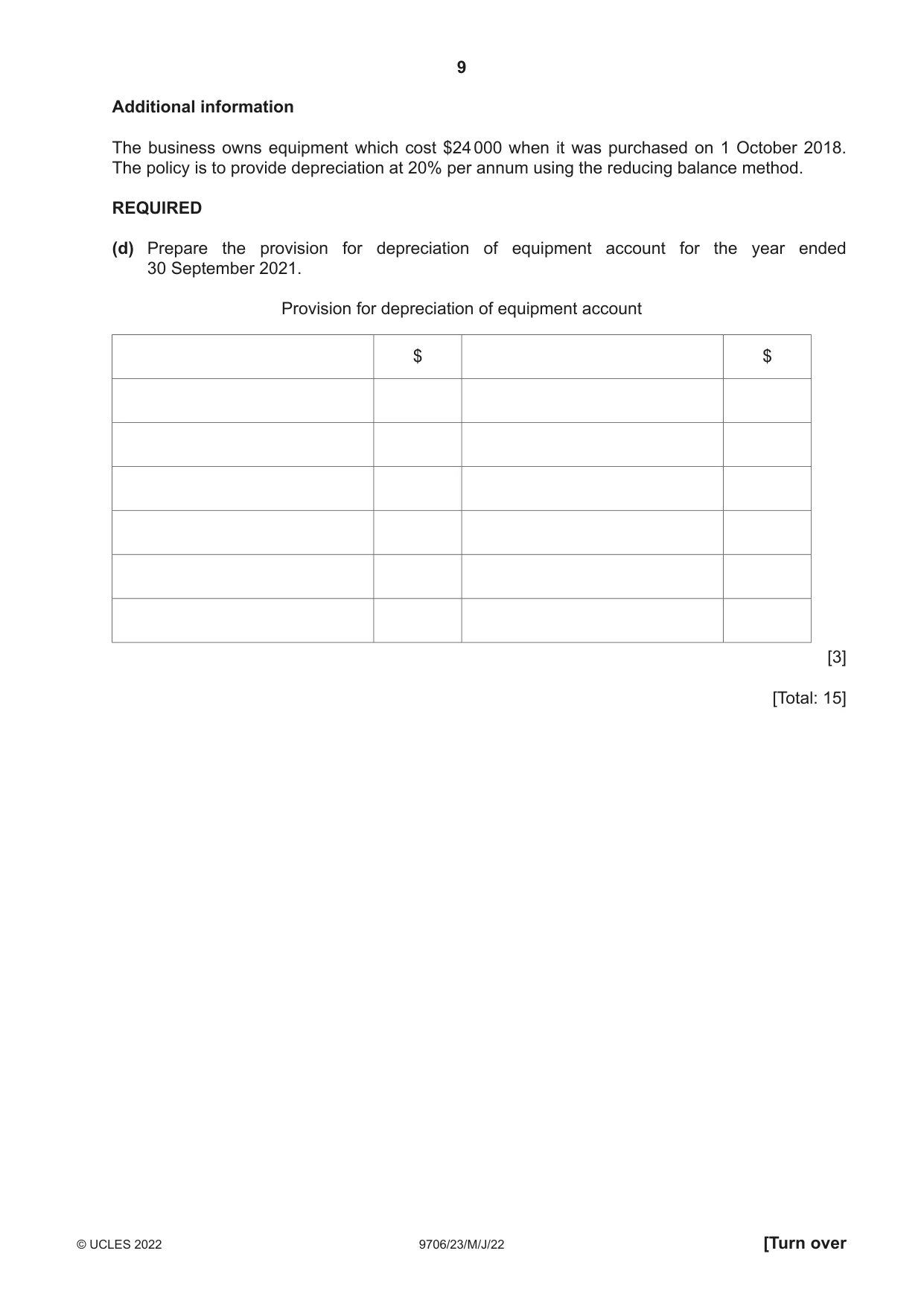
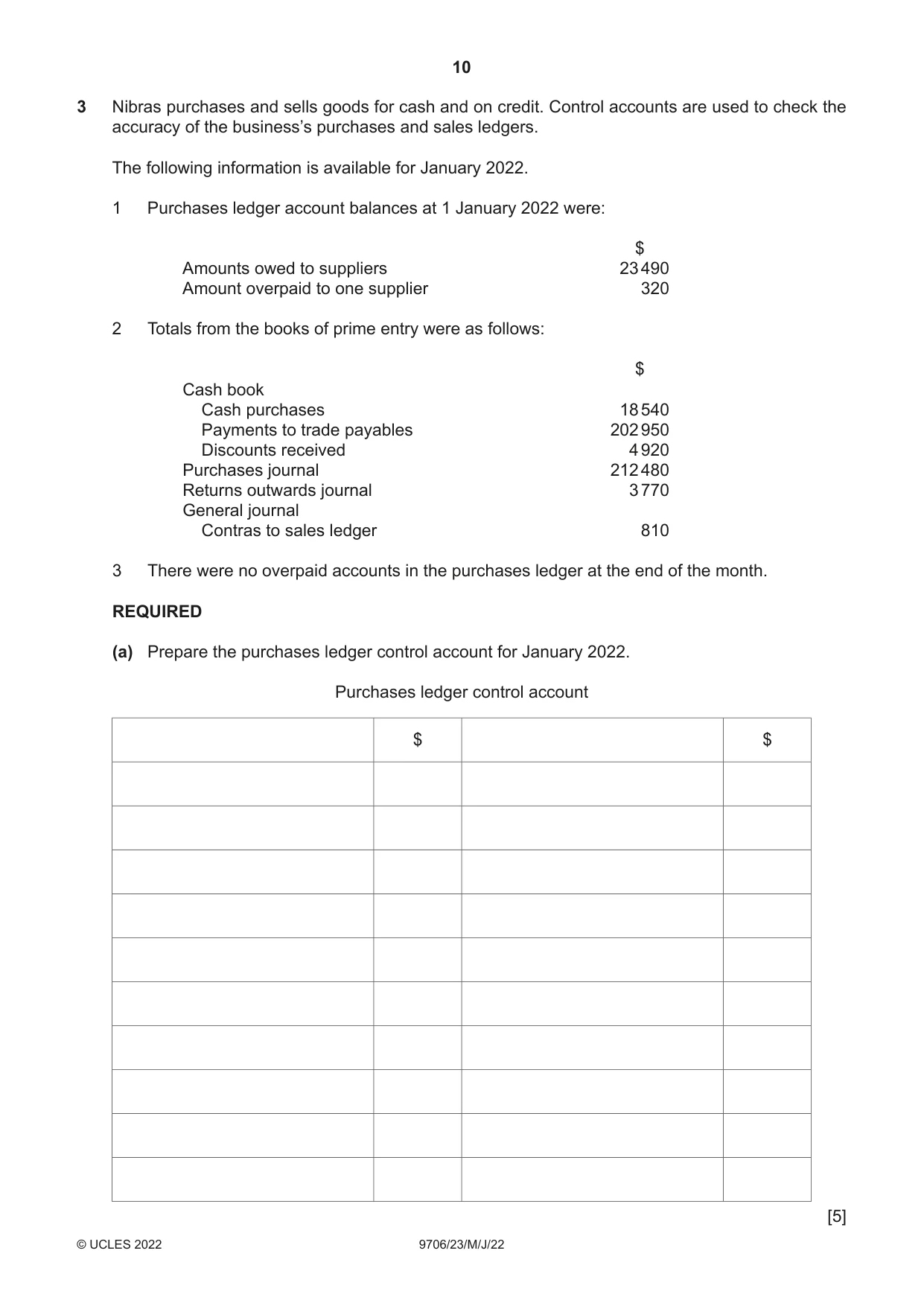
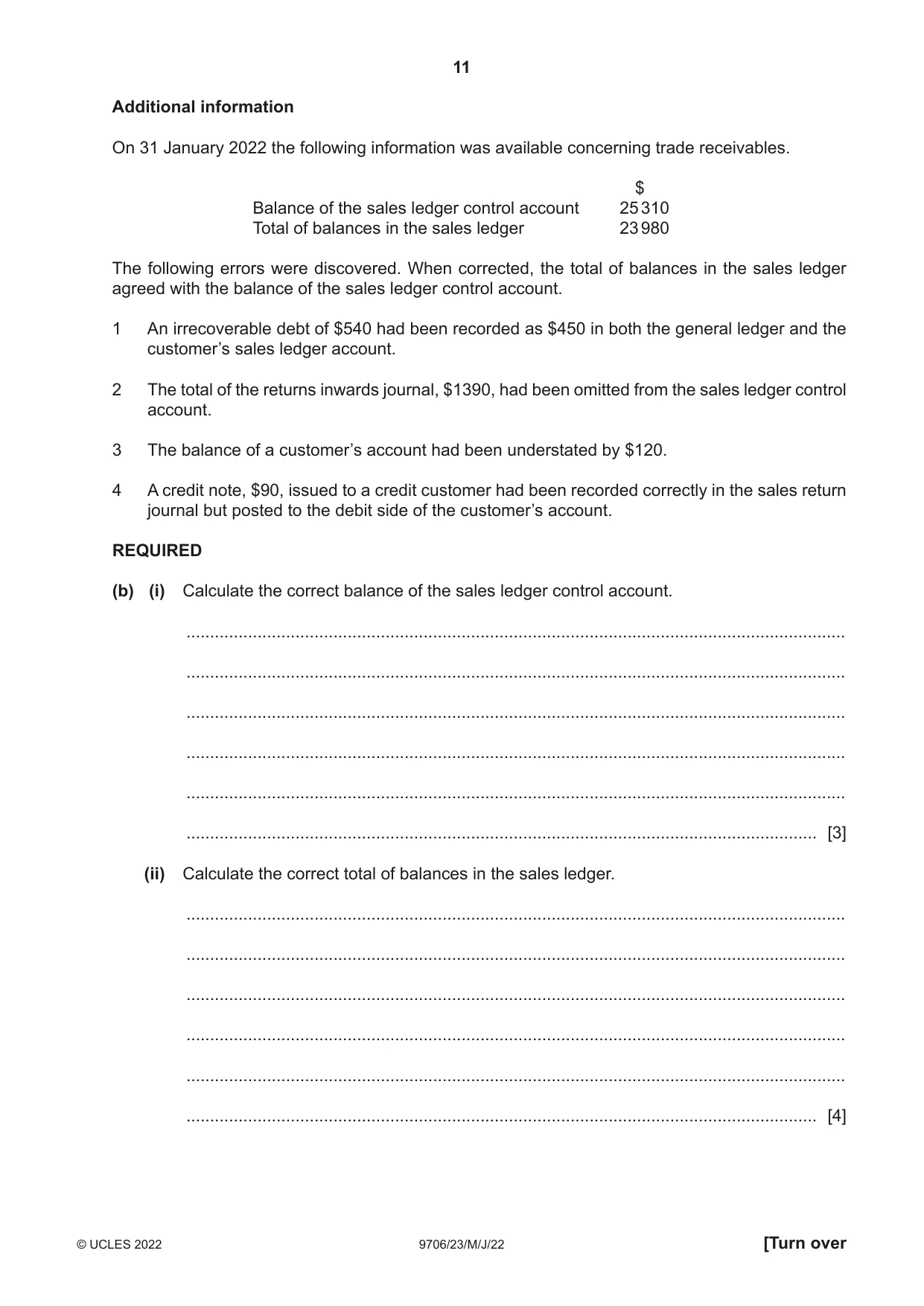
3 At 30 September 2021, rent of $1125 had been received in advance. REQUIRED (c) Prepare the rent receivable account in Rakesh’s books of account. Rent receivable account $ $ [4] Additional information The business owns equipment which cost $24 000 when it was purchased on 1 October 2018. The policy is to provide depreciation at 20% per annum using the reducing balance method. REQUIRED (d) Prepare the provision for depreciation of equipment account for the year ended 30 September 2021. Provision for depreciation of equipment account $ $ [3] [Total: 15] 3 Nibras purchases and sells goods for cash and on credit. Control accounts are used to check the accuracy of the business’s purchases and sales ledgers. The following information is available for January 2022. 1 Purchases ledger account balances at 1 January 2022 were: $ Amounts owed to suppliers 23 490 Amount overpaid to one supplier 320 2 Totals from the books of prime entry were as follows: $ Cash book Cash purchases 18 540 Payments to trade payables 202 950 Discounts received 4 920 Purchases journal 212 480 Returns outwards journal 3 770 General journal Contras to sales ledger 810 3 There were no overpaid accounts in the purchases ledger at the end of the month. REQUIRED (a) Prepare the purchases ledger control account for January 2022. Purchases ledger control account $ $ [5] Additional information On 31 January 2022 the following information was available concerning trade receivables. $ Balance of the sales ledger control account 25 310 Total of balances in the sales ledger 23 980 The following errors were discovered. When corrected, the total of balances in the sales ledger agreed with the balance of the sales ledger control account. 1 An irrecoverable debt of $540 had been recorded as $450 in both the general ledger and the customer’s sales ledger account. 2 The total of the returns inwards journal, $1390, had been omitted from the sales ledger control account. 3 The balance of a customer’s account had been understated by $120.
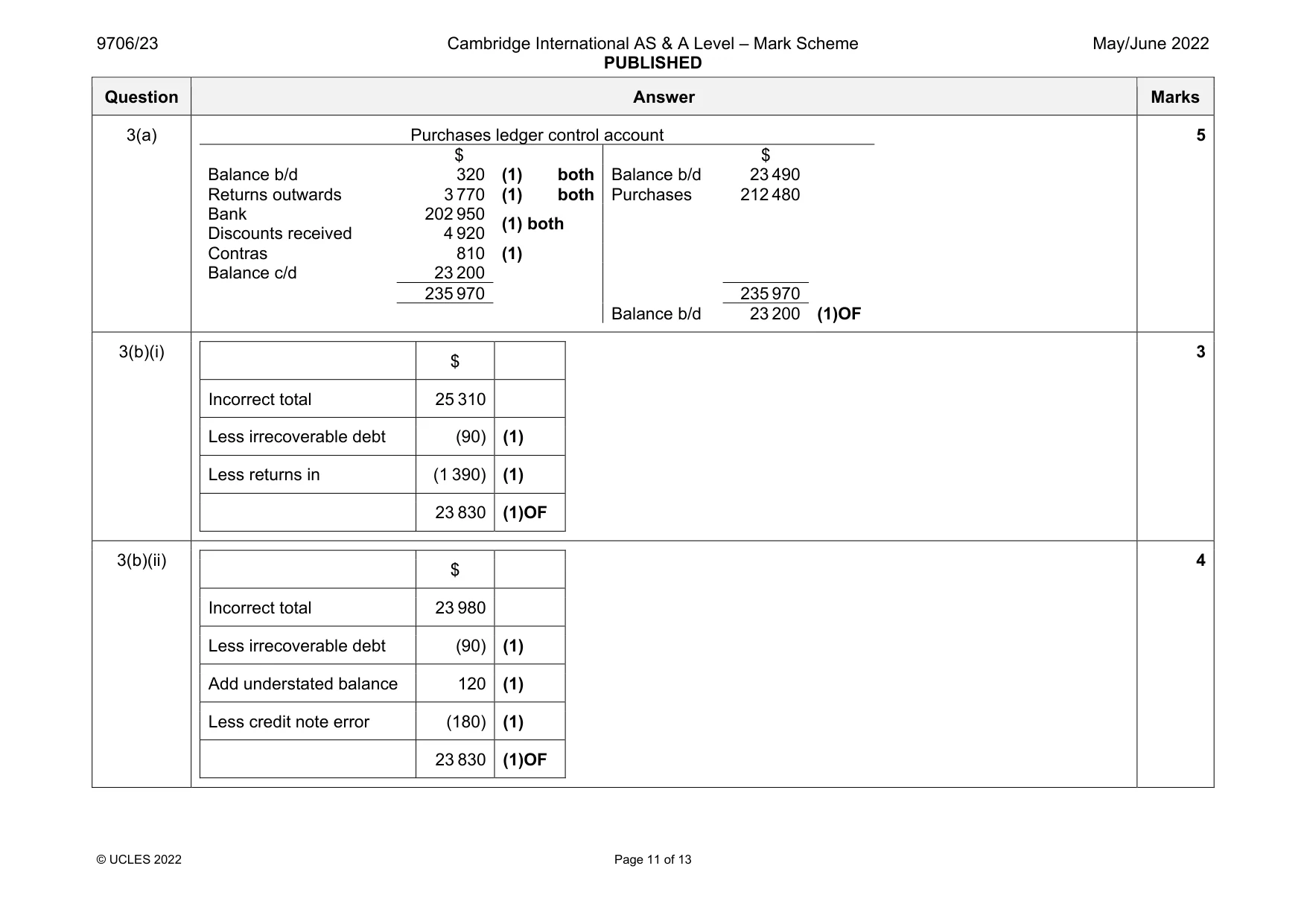
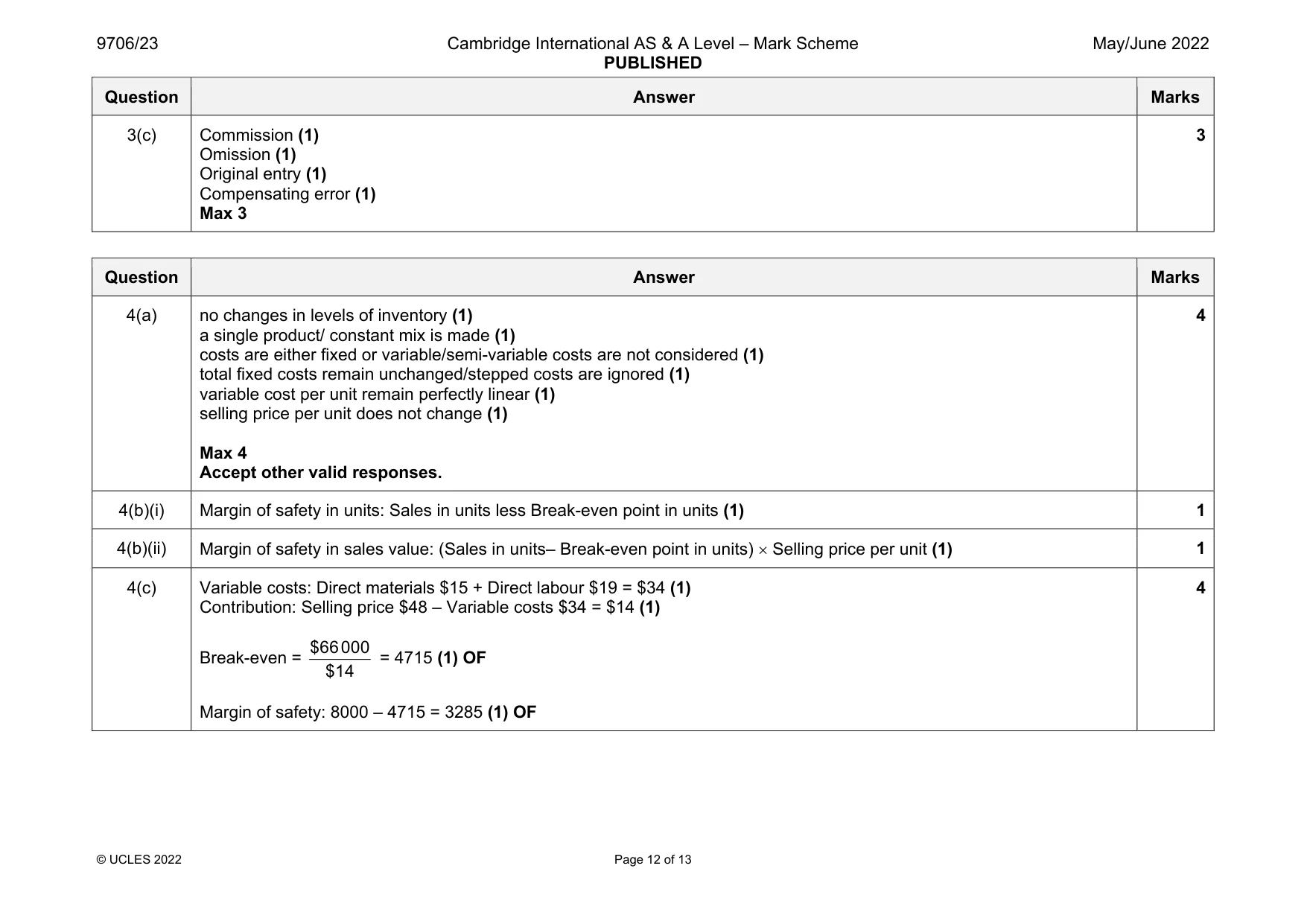
Mark scheme: 3(a) Purchases ledger control account $ $ Balance b/d 320 (1) both Balance b/d 23 490 Returns outwards 3 770 (1) both Purchases 212 480 Bank 202 950 (1) both Discounts received 4 920 Contras 810 (1) Balance c/d 23 200 235 970 235 970 Balance b/d 23 200 (1)OF 5 3(b)(i) $ Incorrect total 25 310 Less irrecoverable debt (90) (1) Less returns in (1 390) (1) 23 830 (1)OF 3 3(b)(ii) $ Incorrect total 23 980 Less irrecoverable debt (90) (1) Add understated balance 120 (1) Less credit note error (180) (1) 23 830 (1)OF 4 Question Answer Marks 3(c) Commission (1) Omission (1) Original entry (1) Compensating error (1) Max 3 3
Q4 · A credit note, $90, issued to a credit customer had been recorded correctly in the sales…
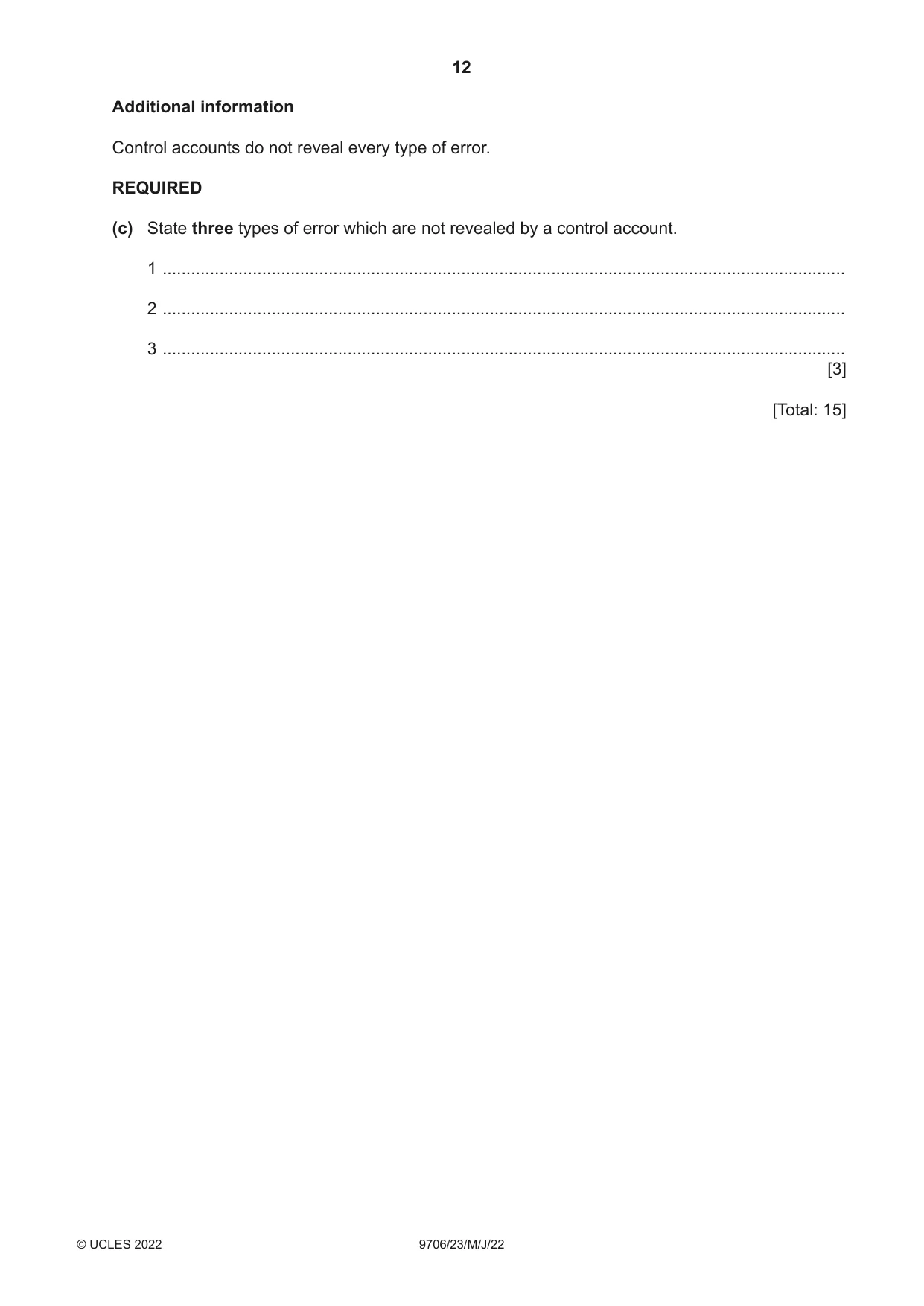
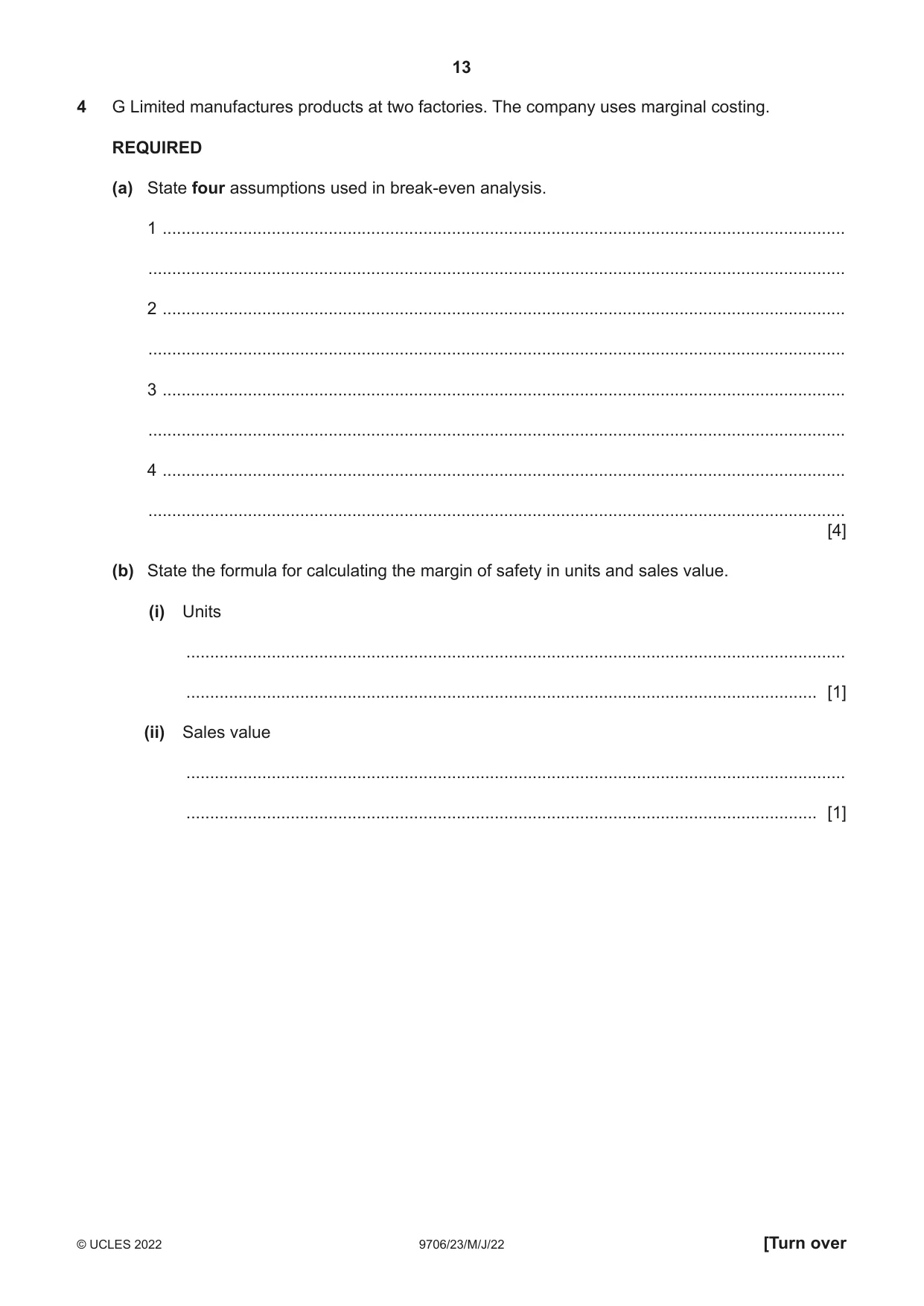
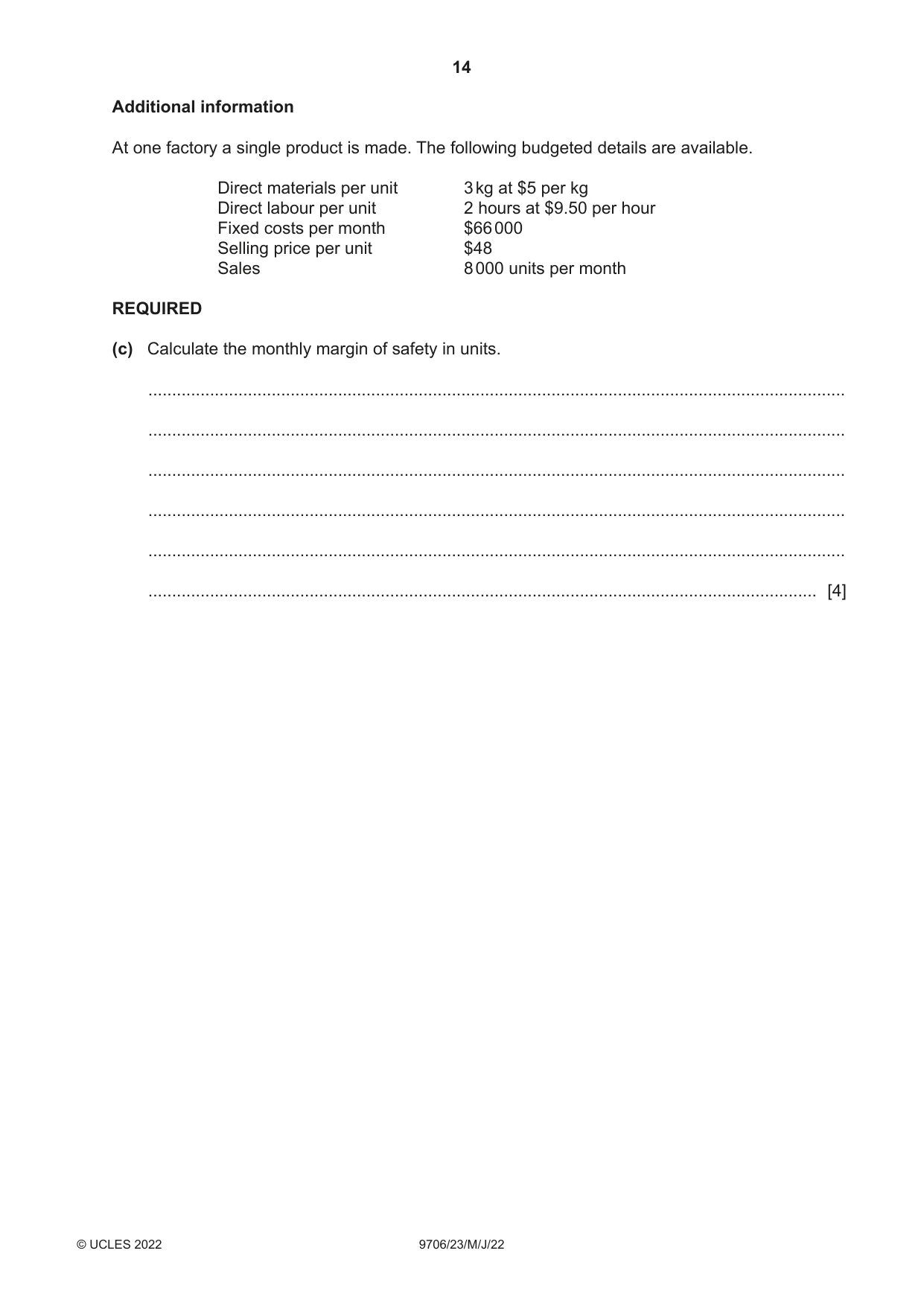
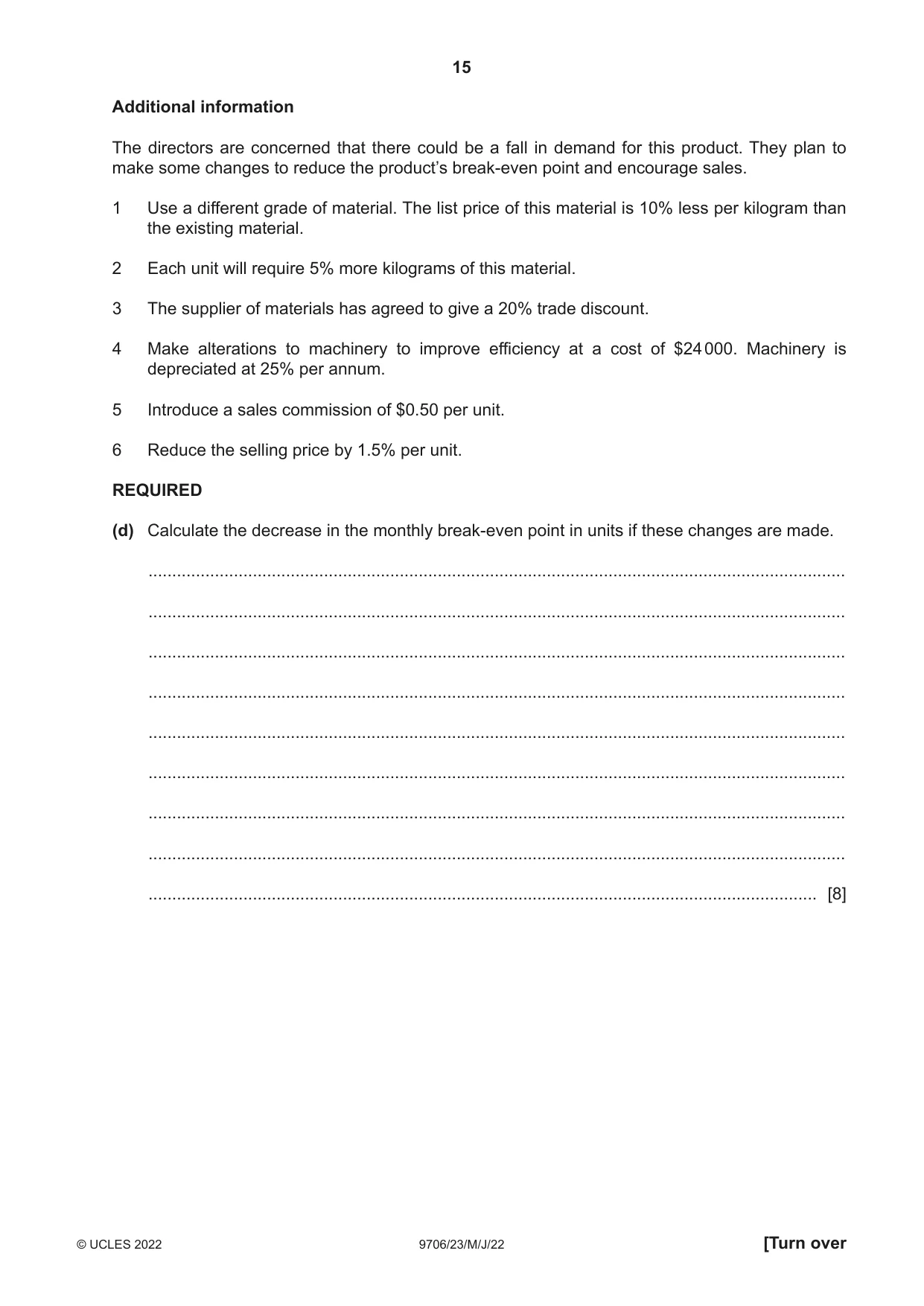
4 A credit note, $90, issued to a credit customer had been recorded correctly in the sales return journal but posted to the debit side of the customer’s account. REQUIRED (b) (i) Calculate the correct balance of the sales ledger control account. ........................................................................................................................................... ........................................................................................................................................... ........................................................................................................................................... ........................................................................................................................................... ........................................................................................................................................... ..................................................................................................................................... [3] (ii) Calculate the correct total of balances in the sales ledger. ........................................................................................................................................... ........................................................................................................................................... ........................................................................................................................................... ........................................................................................................................................... ........................................................................................................................................... ..................................................................................................................................... [4] Additional information Control accounts do not reveal every type of error. REQUIRED (c) State three types of error which are not revealed by a control account. 1 ................................................................................................................................................ 2 ................................................................................................................................................ 3 ................................................................................................................................................ [3] [Total: 15] 4 G Limited manufactures products at two factories. The company uses marginal costing. REQUIRED (a) State four assumptions used in break‑even analysis. 1 ................................................................................................................................................ ................................................................................................................................................... 2 ................................................................................................................................................ ................................................................................................................................................... 3 ................................................................................................................................................ ................................................................................................................................................... 4 ................................................................................................................................................ ................................................................................................................................................... [4] (b) State the formula for calculating the margin of safety in units and sales value. (i) Units ........................................................................................................................................... ..................................................................................................................................... [1] (ii) Sales value ........................................................................................................................................... ..................................................................................................................................... [1] Additional information At one factory a single product is made. The following budgeted details are available. Direct materials per unit 3 kg at $5 per kg Direct labour per unit 2 hours at $9.50 per hour Fixed costs per month $66 000 Selling price per unit $48 Sales 8 000 units per month REQUIRED (c) Calculate the monthly margin of safety in units. ................................................................................................................................................... ................................................................................................................................................... ................................................................................................................................................... ................................................................................................................................................... ................................................................................................................................................... ............................................................................................................................................. [4] Additional information The directors are concerned that there could be a fall in demand for this product. They plan to make some changes to reduce the product’s break‑even point and encourage sales. 1 Use a different grade of material. The list price of this material is 10% less per kilogram than the existing material. 2 Each unit will require 5% more kilograms of this material. 3 The supplier of materials has agreed to give a 20% trade discount. 4 Make alterations to machinery to improve efficiency at a cost of $24 000. Machinery is depreciated at 25% per annum.
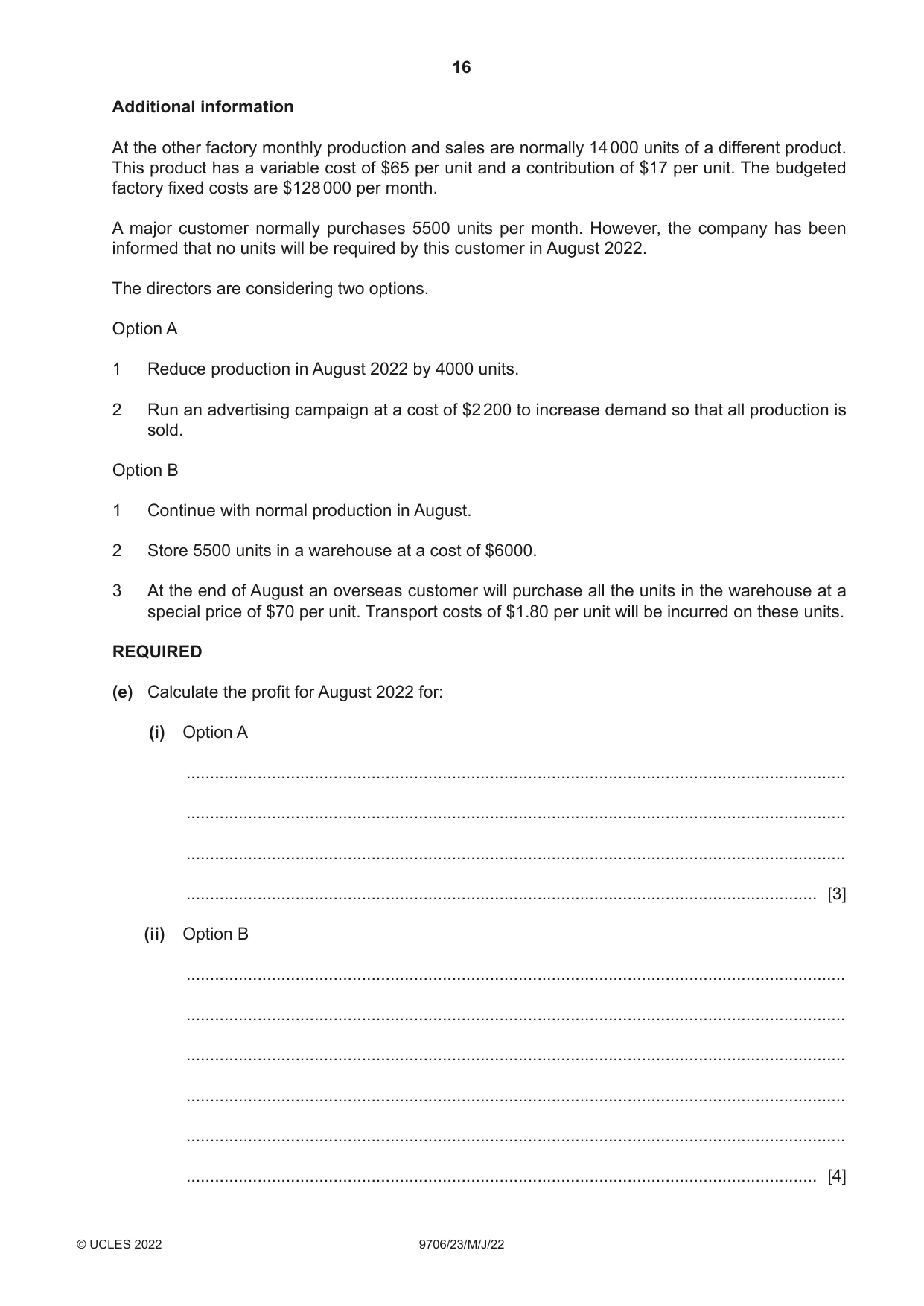
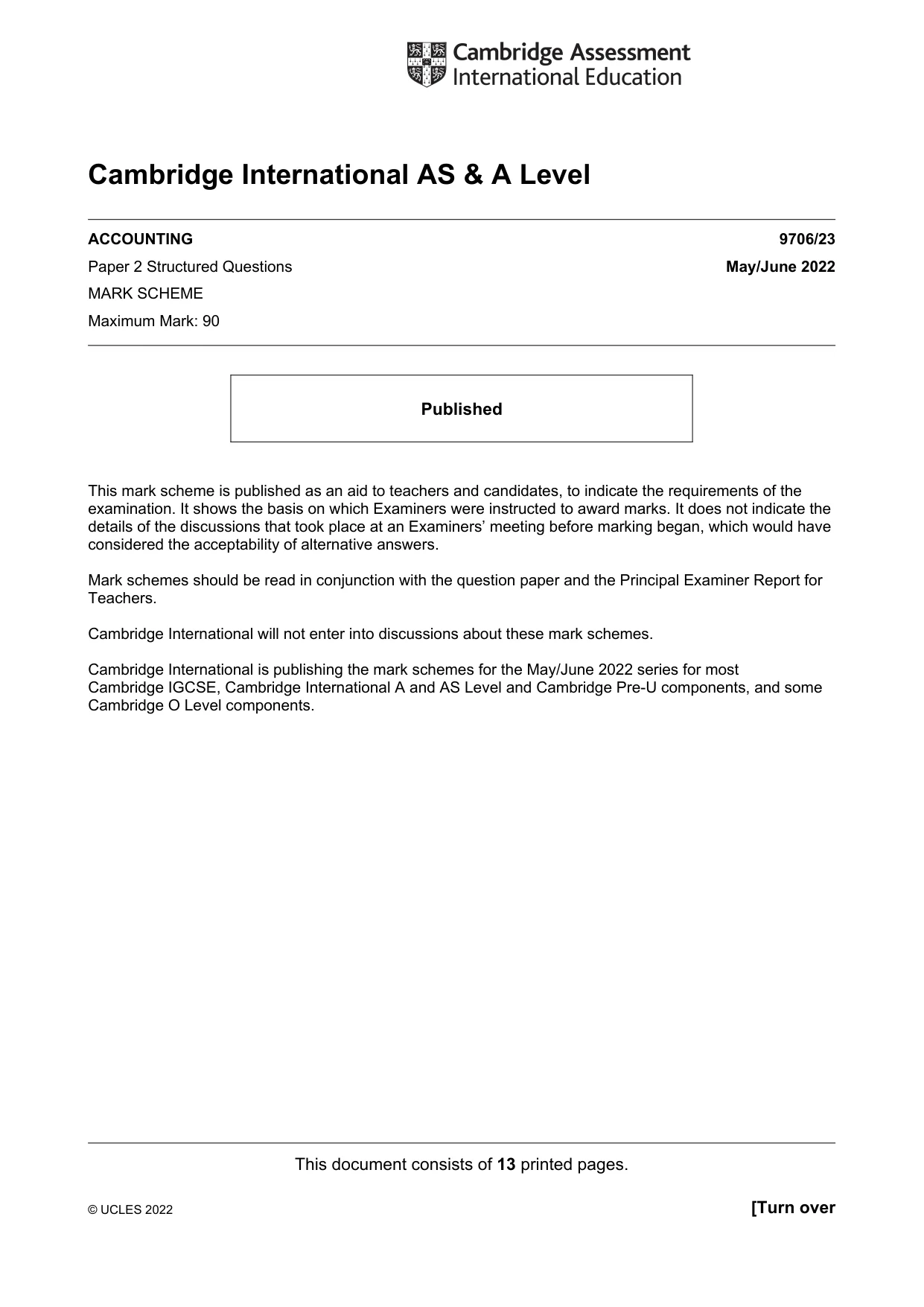
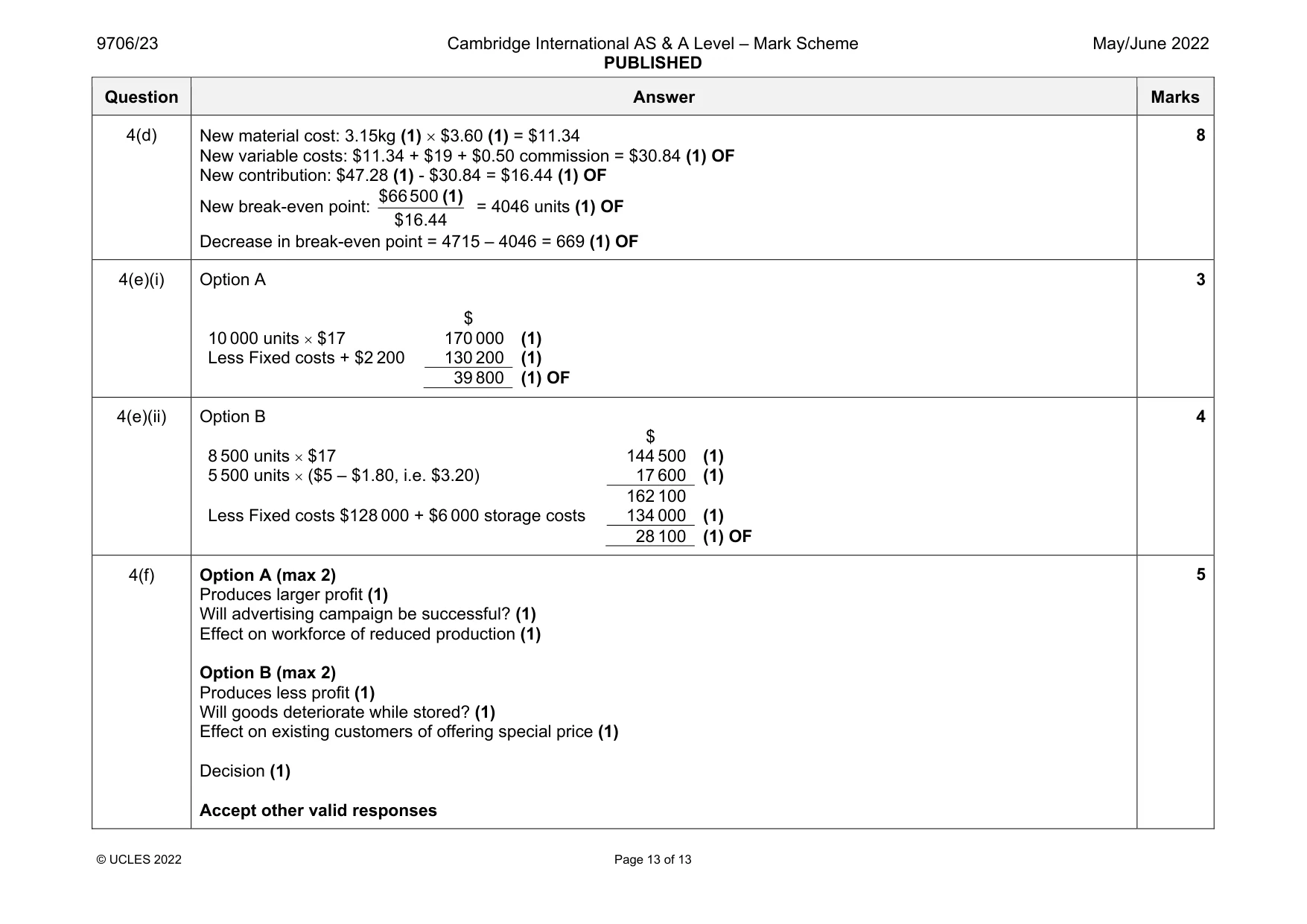
Mark scheme: 4(a) no changes in levels of inventory (1) a single product/ constant mix is made (1) costs are either fixed or variable/semi-variable costs are not considered (1) total fixed costs remain unchanged/stepped costs are ignored (1) variable cost per unit remain perfectly linear (1) selling price per unit does not change (1) Max 4 Accept other valid responses. 4(b)(i) Margin of safety in units: Sales in units less Break-even point in units (1) 1 4(b)(ii) Margin of safety in sales value: (Sales in units– Break-even point in units) Selling price per unit (1) 1 4(c) Variable costs: Direct materials $15 + Direct labour $19 = $34 (1) Contribution: Selling price $48 – Variable costs $34 = $14 (1) Break-even = $66000 $14 = 4715 (1) OF Margin of safety: 8000 – 4715 = 3285 (1) OF 4 Question Answer Marks 4(d) New material cost: 3.15kg (1) $3.60 (1) = $11.34 New variable costs: $11.34 + $19 + $0.50 commission = $30.84 (1) OF New contribution: $47.28 (1) - $30.84 = $16.44 (1) OF New break-even point: $66500 $16.44 (1) = 4046 units (1) OF Decrease in break-even point = 4715 – 4046 = 669 (1) OF 8 4(e)(i) Option A $ 10 000 units $17 170 000 (1) Less Fixed costs + $2 200 130 200 (1) 39 800 (1) OF 3 4(e)(ii) Option B $ 8 500 units $17 144 500 (1) 5 500 units ($5 – $1.80, i.e. $3.20) 17 600 (1) 162 100 Less Fixed costs $128 000 + $6 000 storage costs 134 000 (1) 28 100 (1) OF 4 4(f) Option A (max 2) Produces larger profit (1) Will advertising campaign be successful? (1) Effect on workforce of reduced production (1) Option B (max 2) Produces less profit (1) Will goods deteriorate while stored? (1) Effect on existing customers of offering special price (1) Decision (1) Accept other valid responses 5
Q6 · Reduce the selling price by 1.5% per unit
6 Reduce the selling price by 1.5% per unit. REQUIRED (d) Calculate the decrease in the monthly break‑even point in units if these changes are made. ................................................................................................................................................... ................................................................................................................................................... ................................................................................................................................................... ................................................................................................................................................... ................................................................................................................................................... ................................................................................................................................................... ................................................................................................................................................... ................................................................................................................................................... ............................................................................................................................................. [8] Additional information At the other factory monthly production and sales are normally 14 000 units of a different product. This product has a variable cost of $65 per unit and a contribution of $17 per unit. The budgeted factory fixed costs are $128 000 per month. A major customer normally purchases 5500 units per month. However, the company has been informed that no units will be required by this customer in August 2022. The directors are considering two options. Option A 1 Reduce production in August 2022 by 4000 units. 2 Run an advertising campaign at a cost of $2 200 to increase demand so that all production is sold. Option B 1 Continue with normal production in August. 2 Store 5500 units in a warehouse at a cost of $6000. 3 At the end of August an overseas customer will purchase all the units in the warehouse at a special price of $70 per unit. Transport costs of $1.80 per unit will be incurred on these units. REQUIRED (e) Calculate the profit for August 2022 for: (i) Option A ........................................................................................................................................... ........................................................................................................................................... ........................................................................................................................................... ..................................................................................................................................... [3] (ii) Option B ........................................................................................................................................... ........................................................................................................................................... ........................................................................................................................................... ........................................................................................................................................... ........................................................................................................................................... ..................................................................................................................................... [4] (f) Advise the directors which option they should choose. Justify your answer by discussing both financial and non‑financial factors. ................................................................................................................................................... ................................................................................................................................................... ................................................................................................................................................... ................................................................................................................................................... ................................................................................................................................................... ................................................................................................................................................... ................................................................................................................................................... ................................................................................................................................................... ................................................................................................................................................... ................................................................................................................................................... ................................................................................................................................................... ................................................................................................................................................... ................................................................................................................................................... ............................................................................................................................................. [5] [Total: 30]
What was in this paper
The subtopics covered by these 5 questions, and how many questions each got. Open one in a new tab to see every Cambridge question on it.
What you needed in this session
Cambridge’s own grade thresholds for 2022 May/June, Paper 2 · Variant 3. A higher threshold means an easier paper — the bar moves with how the cohort did.