Cambridge A Level Accounting 9706 — 2022 Oct/Nov Paper 2 · Variant 1
9706/21/O/N/22 · 4 questions · 90 marks · ≈101 min
The question paper and its mark scheme, free to read here and free to download. This is Cambridge’s own paper, exactly as it was sat.
Question paper20 pages
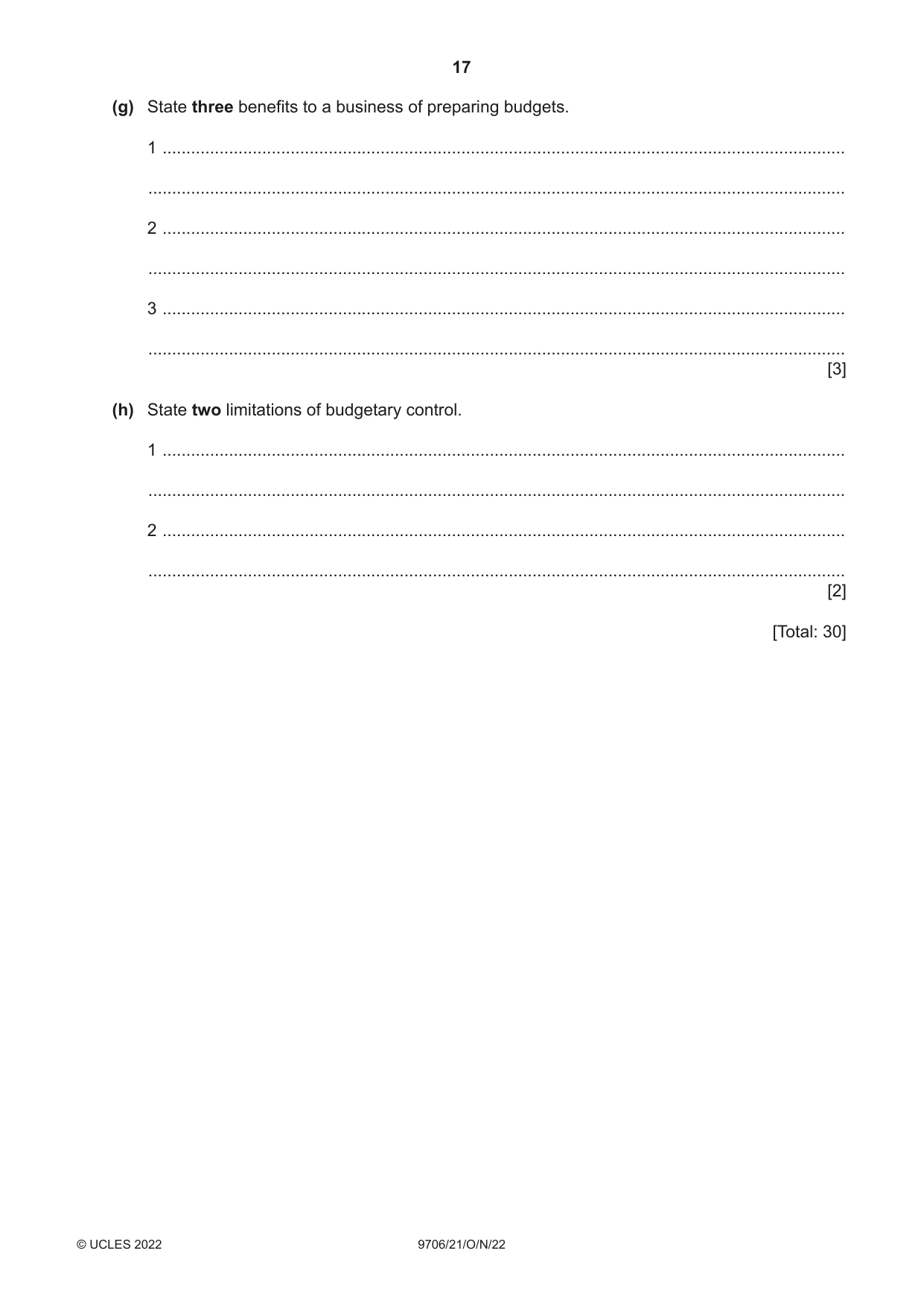


Mark scheme17 pages
Answers below. Sit the paper first if you are practising.
Questions as text
Q1 · The directors of Y Limited have provided the following balances at 30 June 2022
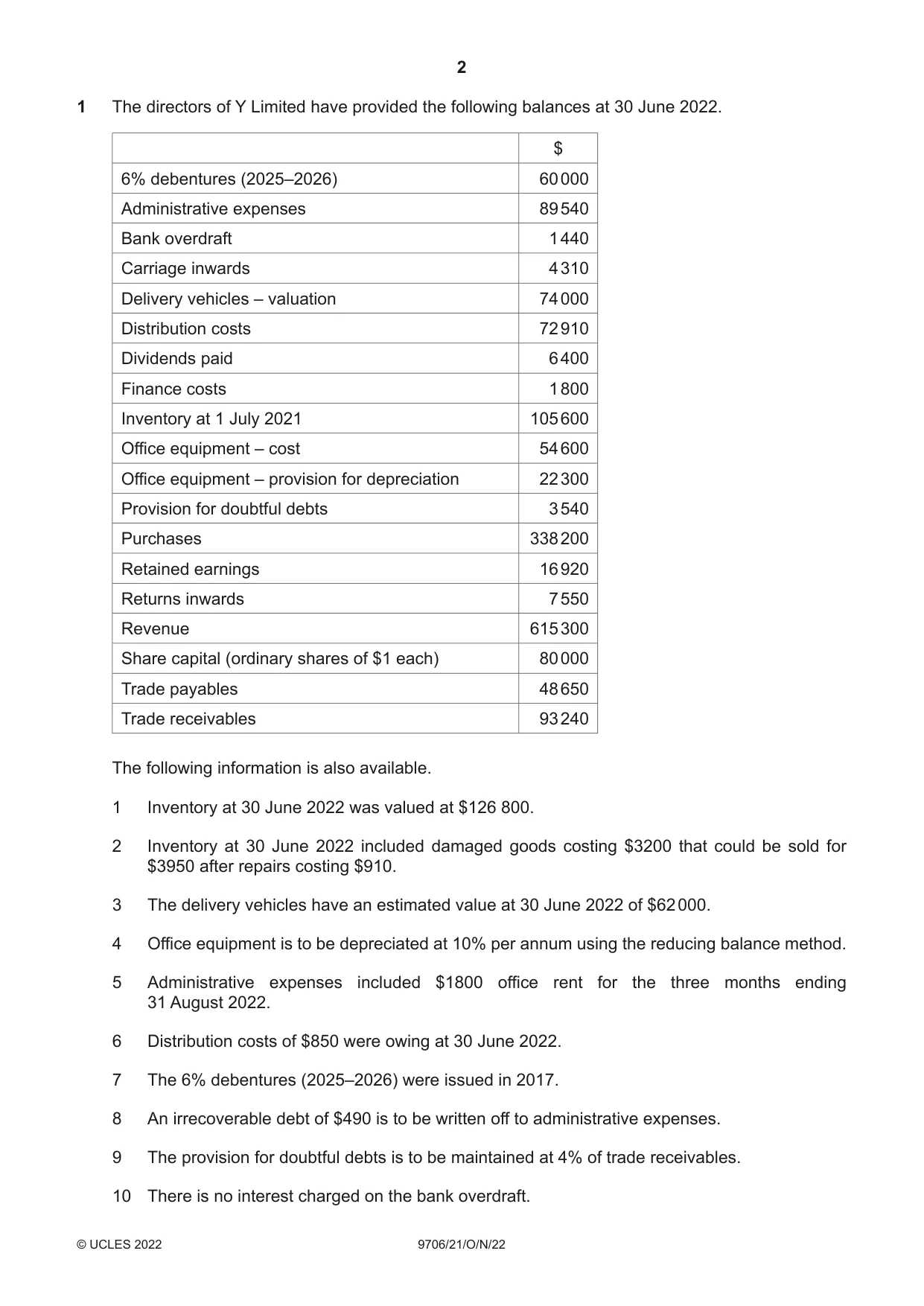
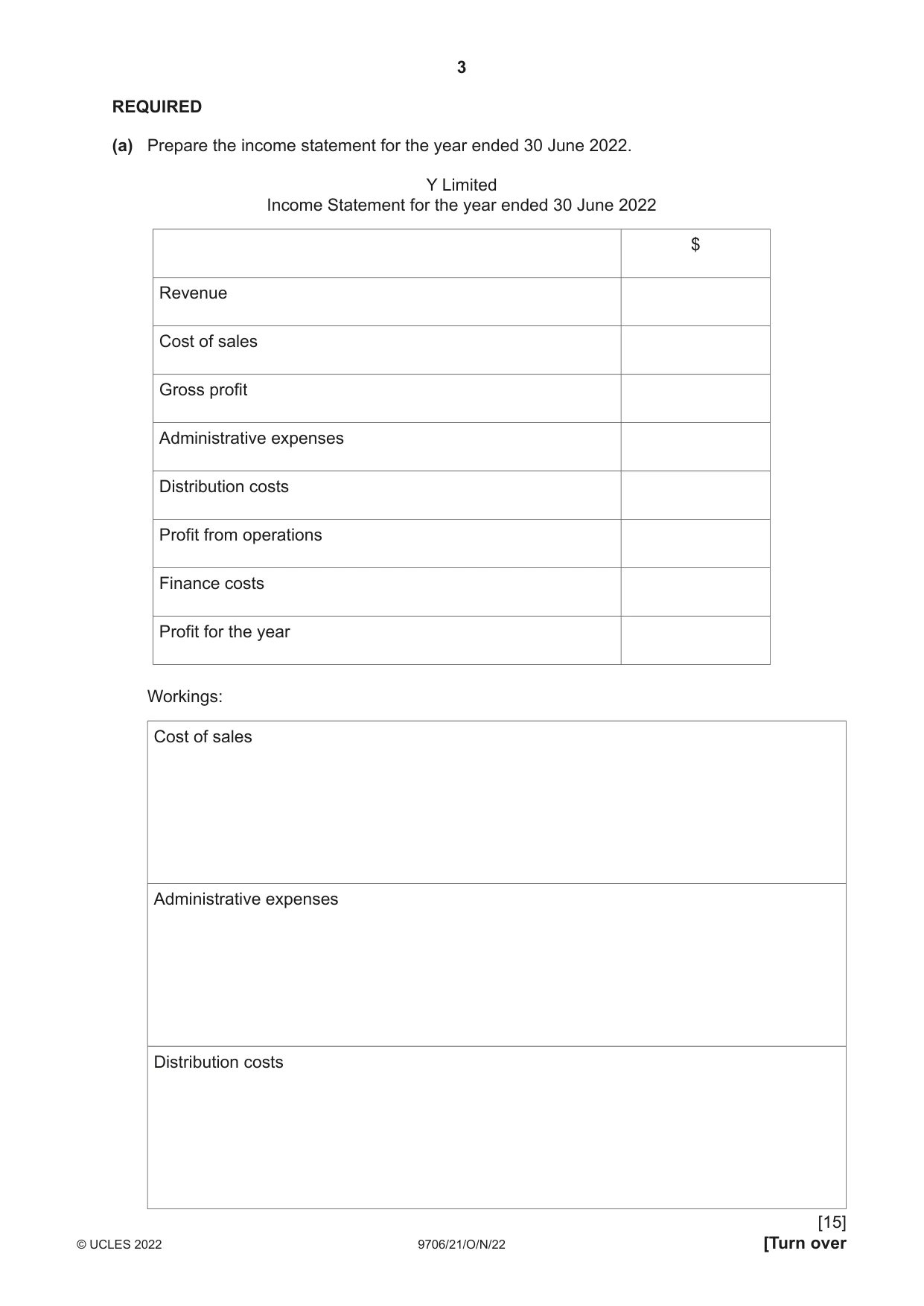
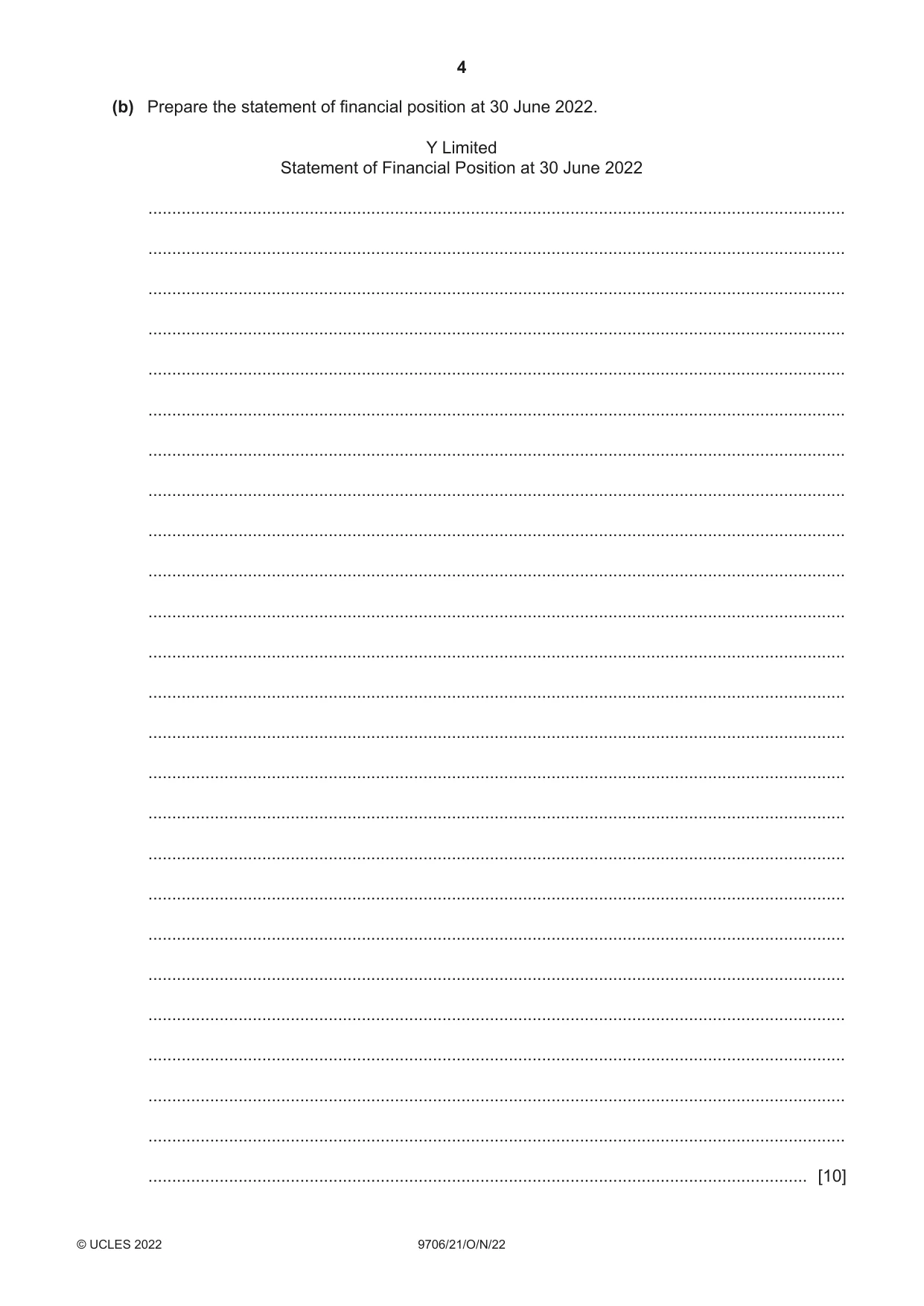
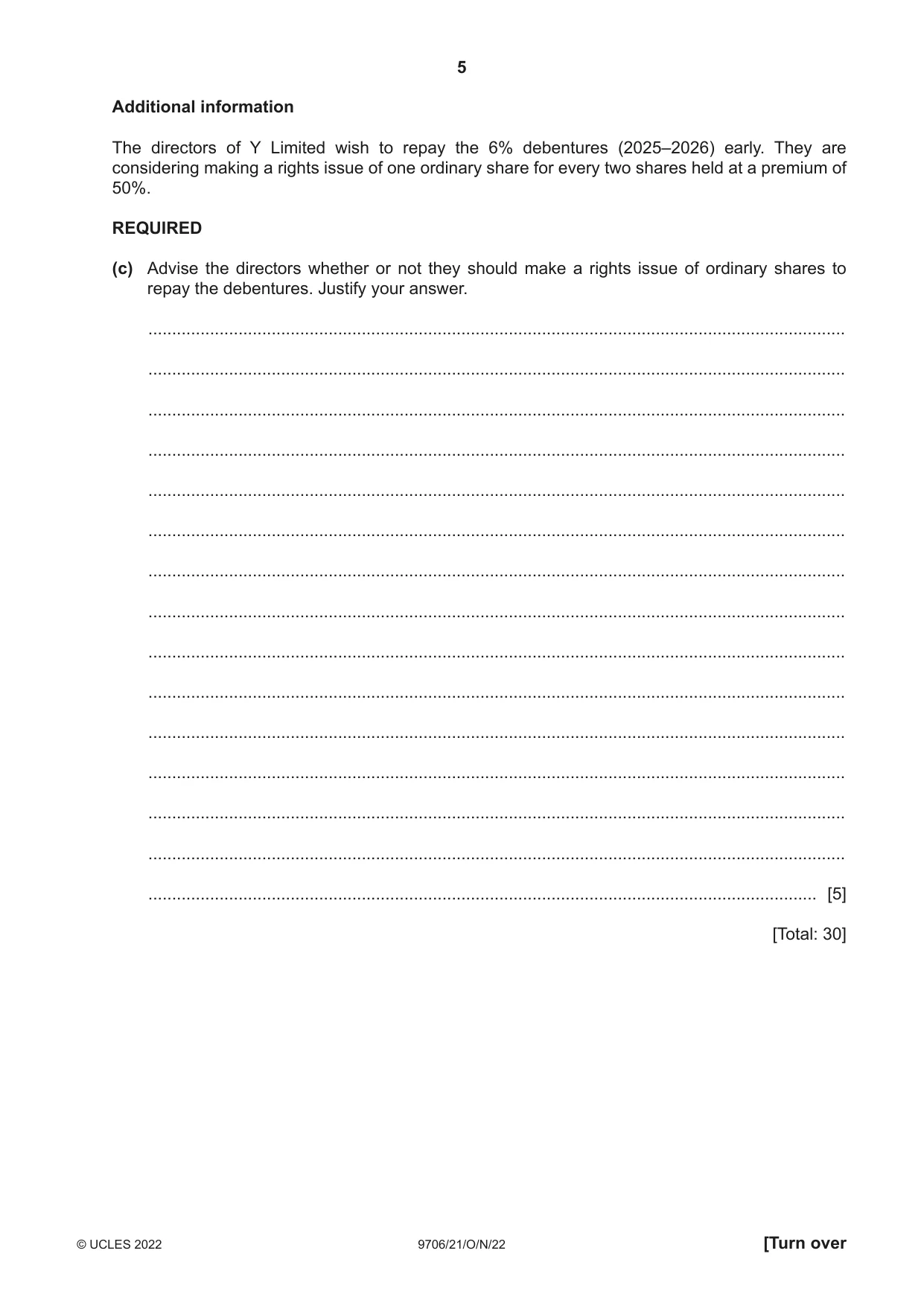
1 The directors of Y Limited have provided the following balances at 30 June 2022. $ 6% debentures (2025–2026) 60 000 Administrative expenses 89 540 Bank overdraft 1 440 Carriage inwards 4 310 Delivery vehicles – valuation 74 000 Distribution costs 72 910 Dividends paid 6 400 Finance costs 1 800 Inventory at 1 July 2021 105 600 Office equipment – cost 54 600 Office equipment – provision for depreciation 22 300 Provision for doubtful debts 3 540 Purchases 338 200 Retained earnings 16 920 Returns inwards 7 550 Revenue 615 300 Share capital (ordinary shares of $1 each) 80 000 Trade payables 48 650 Trade receivables 93 240 The following information is also available. 1 Inventory at 30 June 2022 was valued at $126 800. 2 Inventory at 30 June 2022 included damaged goods costing $3200 that could be sold for $3950 after repairs costing $910. 3 The delivery vehicles have an estimated value at 30 June 2022 of $62 000. 4 Office equipment is to be depreciated at 10% per annum using the reducing balance method. 5 Administrative expenses included $1800 office rent for the three months ending 31 August 2022. 6 Distribution costs of $850 were owing at 30 June 2022. 7 The 6% debentures (2025–2026) were issued in 2017. 8 An irrecoverable debt of $490 is to be written off to administrative expenses. 9 The provision for doubtful debts is to be maintained at 4% of trade receivables. 10 There is no interest charged on the bank overdraft. REQUIRED (a) Prepare the income statement for the year ended 30 June 2022. Y Limited Income Statement for the year ended 30 June 2022 $ Revenue Cost of sales Gross profit Administrative expenses Distribution costs Profit from operations Finance costs Profit for the year Workings: Cost of sales Administrative expenses Distribution costs [15] (b) Prepare the statement of financial position at 30 June 2022. Y Limited Statement of Financial Position at 30 June 2022 ................................................................................................................................................... ................................................................................................................................................... ................................................................................................................................................... ................................................................................................................................................... ................................................................................................................................................... ................................................................................................................................................... ................................................................................................................................................... ................................................................................................................................................... ................................................................................................................................................... ................................................................................................................................................... ................................................................................................................................................... ................................................................................................................................................... ................................................................................................................................................... ................................................................................................................................................... ................................................................................................................................................... ................................................................................................................................................... ................................................................................................................................................... ................................................................................................................................................... ................................................................................................................................................... ................................................................................................................................................... ................................................................................................................................................... ................................................................................................................................................... ................................................................................................................................................... ................................................................................................................................................... ........................................................................................................................................... [10] Additional information The directors of Y Limited wish to repay the 6% debentures (2025–2026) early. They are considering making a rights issue of one ordinary share for every two shares held at a premium of 50%. REQUIRED (c) Advise the directors whether or not they should make a rights issue of ordinary shares to repay the debentures. Justify your answer. ................................................................................................................................................... ................................................................................................................................................... ................................................................................................................................................... ................................................................................................................................................... ................................................................................................................................................... ................................................................................................................................................... ................................................................................................................................................... ................................................................................................................................................... ................................................................................................................................................... ................................................................................................................................................... ................................................................................................................................................... ................................................................................................................................................... ................................................................................................................................................... ................................................................................................................................................... ............................................................................................................................................. [5] [Total: 30]
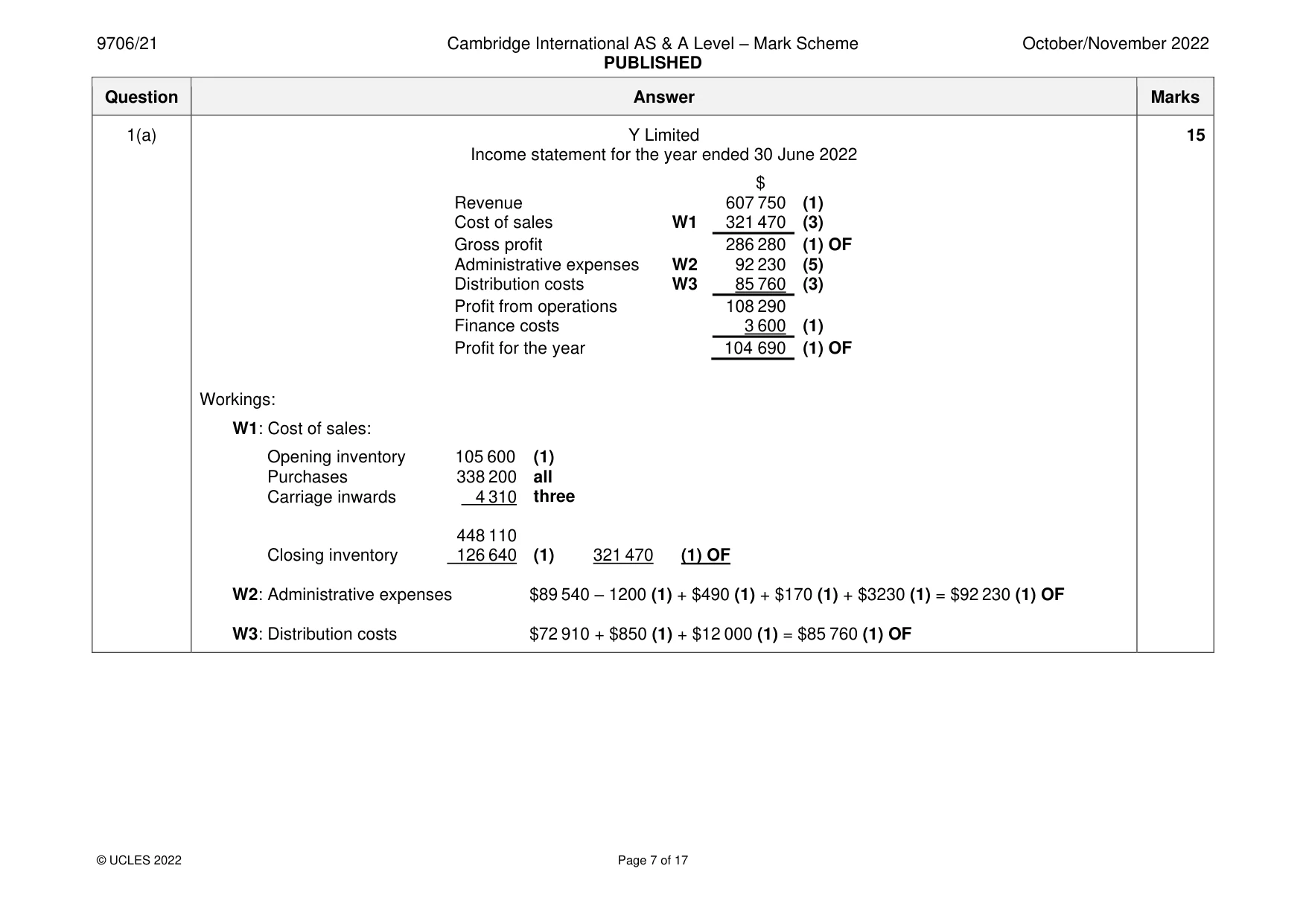
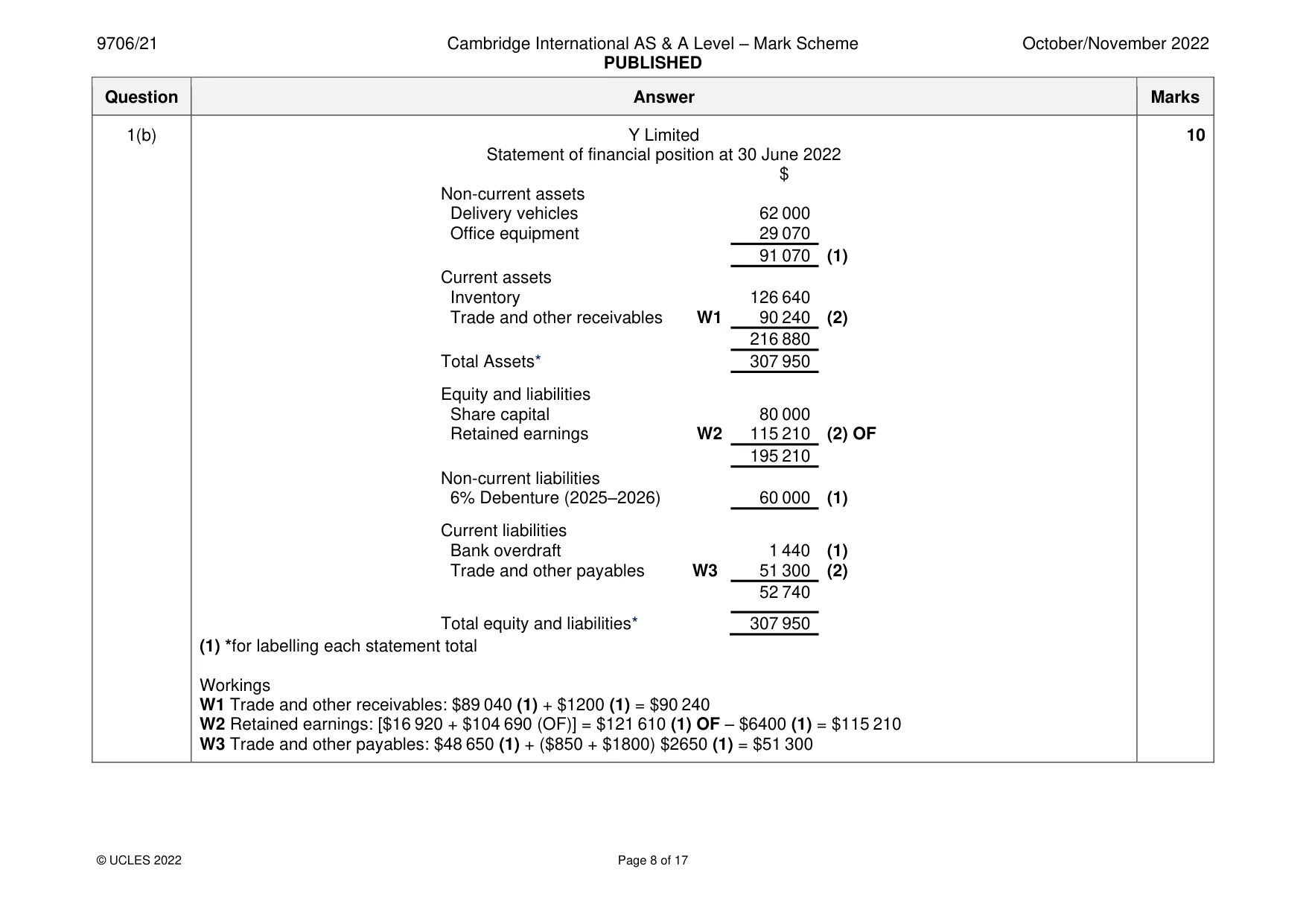
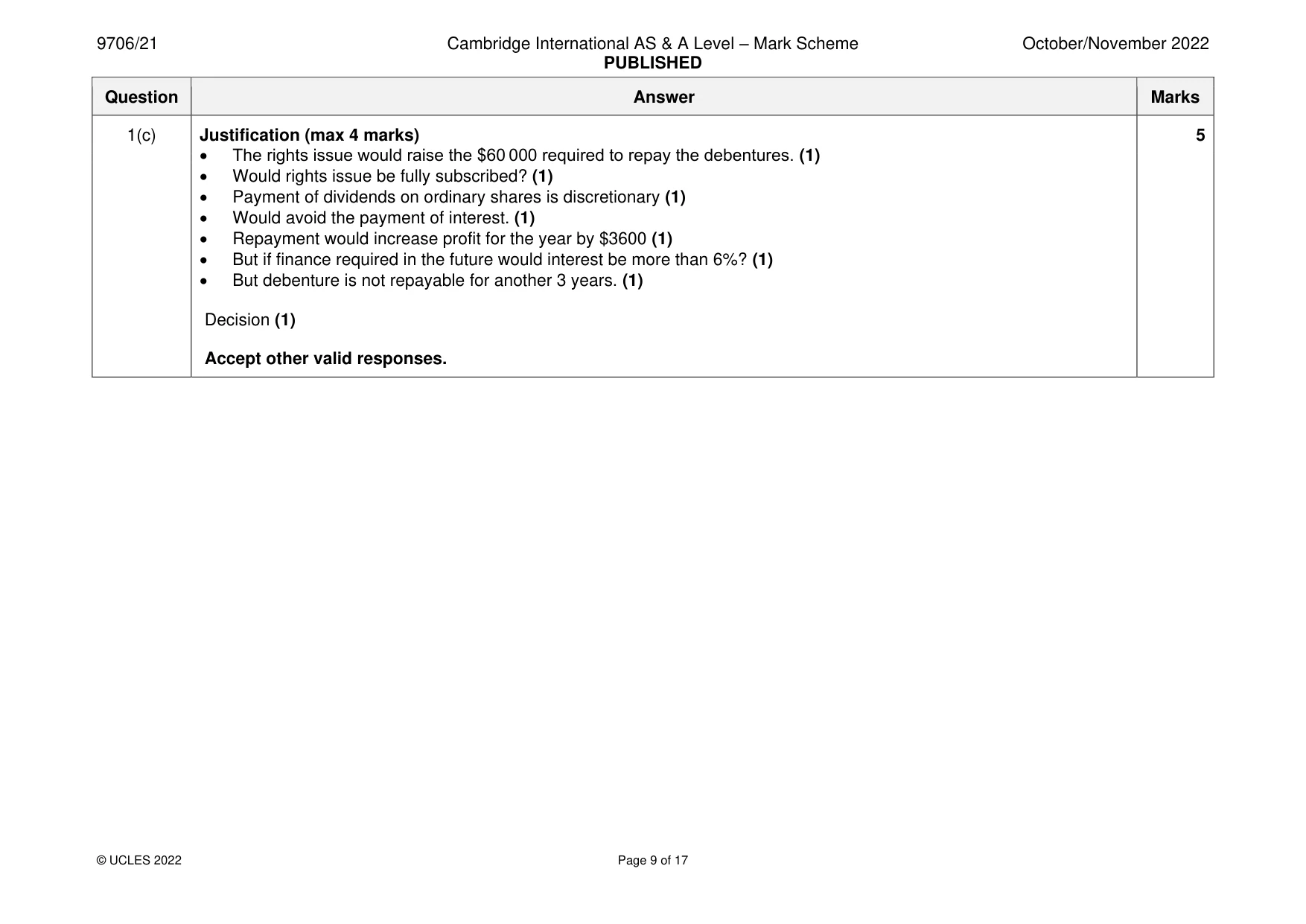
Mark scheme: Question Answer Marks 1(a) Y Limited 15 Income statement for the year ended 30 June 2022 $ Revenue 607 750 (1) Cost of sales W1 321 470 (3) Gross profit 286 280 (1) OF Administrative expenses W2 92 230 (5) Distribution costs W3 85 760 (3) Profit from operations 108 290 Finance costs 3 600 (1) Profit for the year 104 690 (1) OF Workings: W1: Cost of sales: Opening inventory 105 600 (1) Purchases 338 200 all Carriage inwards 4 310 three 448 110 Closing inventory 126 640 (1) 321 470 (1) OF W2: Administrative expenses $89 540 – 1200 (1) + $490 (1) + $170 (1) + $3230 (1) = $92 230 (1) OF W3: Distribution costs $72 910 + $850 (1) + $12 000 (1) = $85 760 (1) OF 1(b) Y Limited 10 Statement of financial position at 30 June 2022 $ Non-current assets Delivery vehicles 62 000 Office equipment 29 070 91 070 (1) Current assets Inventory 126 640 Trade and other receivables W1 90 240 (2) 216 880 Total Assets* 307 950 Equity and liabilities Share capital 80 000 Retained earnings W2 115 210 (2) OF 195 210 Non-current liabilities 6% Debenture (2025–2026) 60 000 (1) Current liabilities Bank overdraft 1 440 (1) Trade and other payables W3 51 300 (2) 52 740 Total equity and liabilities* 307 950 (1) *for labelling each statement total Workings W1 Trade and other receivables: $89 040 (1) + $1200 (1) = $90 240 W2 Retained earnings: [$16 920 + $104 690 (OF)] = $121 610 (1) OF – $6400 (1) = $115 210 W3 Trade and other payables: $48 650 (1) + ($850 + $1800) $2650 (1) = $51 300 1(c) Justification (max 4 marks) 5 • The rights issue would raise the $60 000 required to repay the debentures. (1) • Would rights issue be fully subscribed? (1) • Payment of dividends on ordinary shares is discretionary (1) • Would avoid the payment of interest. (1) • Repayment would increase profit for the year by $3600 (1) • But if finance required in the future would interest be more than 6%? (1) • But debenture is not repayable for another 3 years. (1) Decision (1) Accept other valid responses.
Q2 · Bharti owns a small business
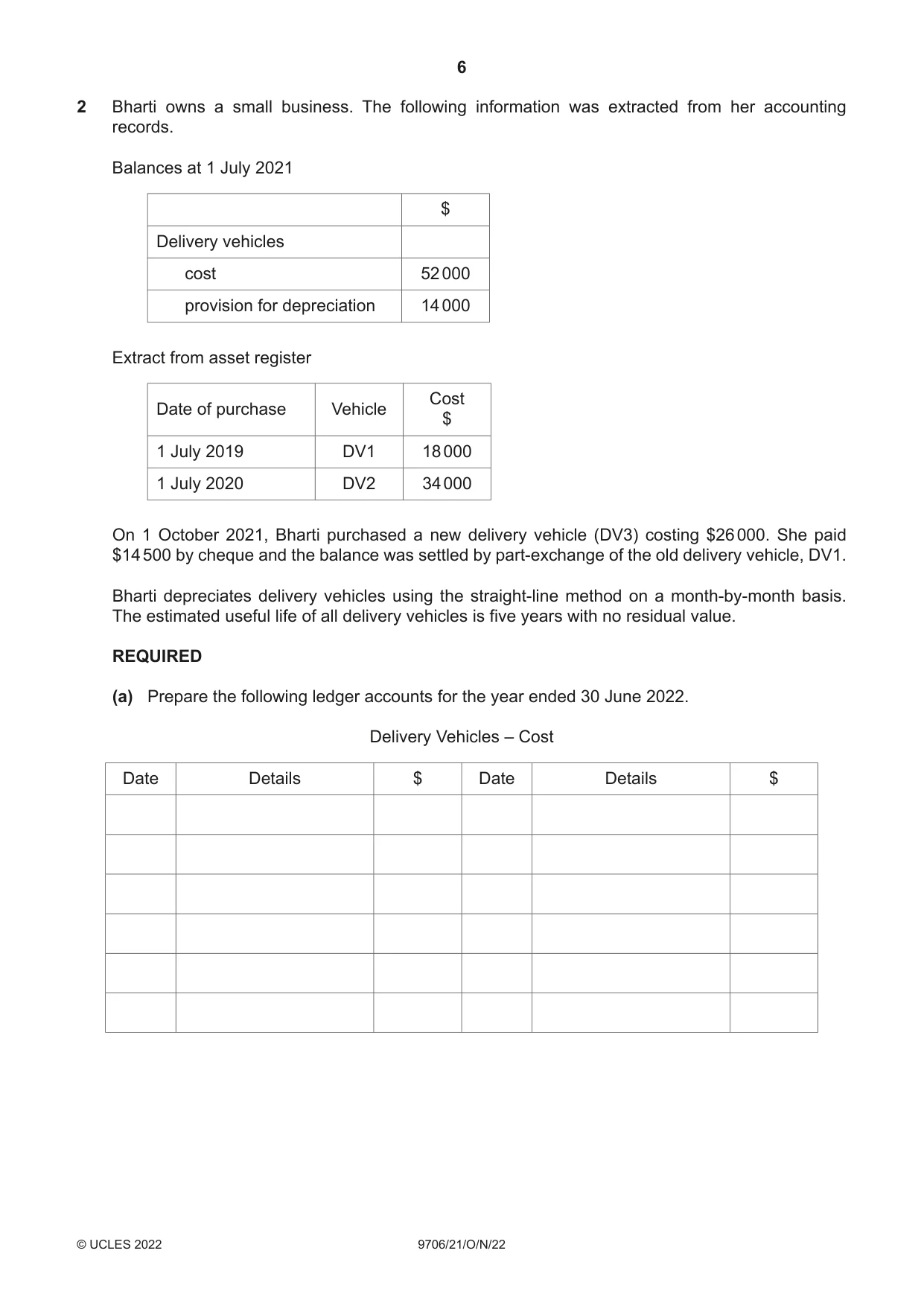
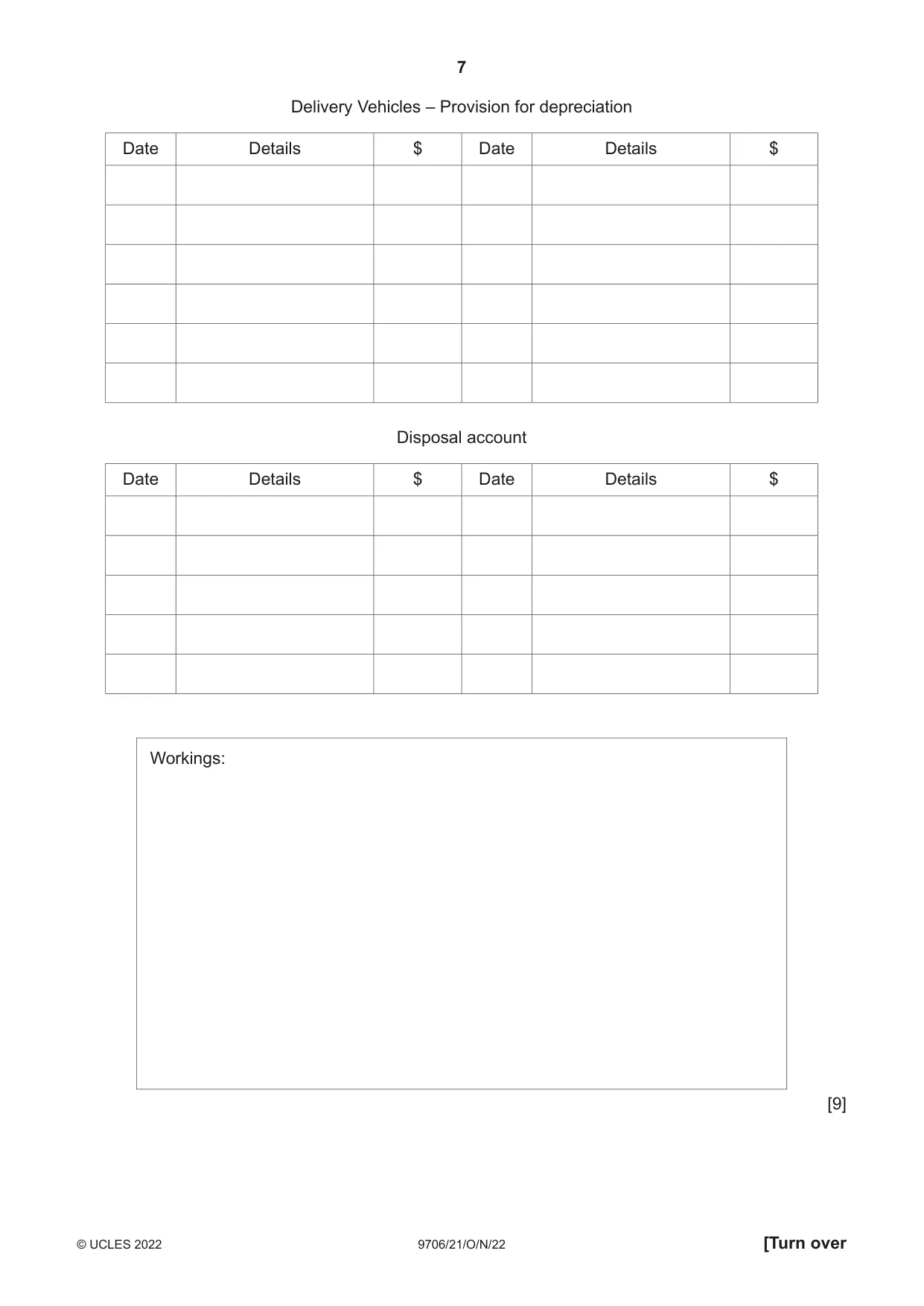
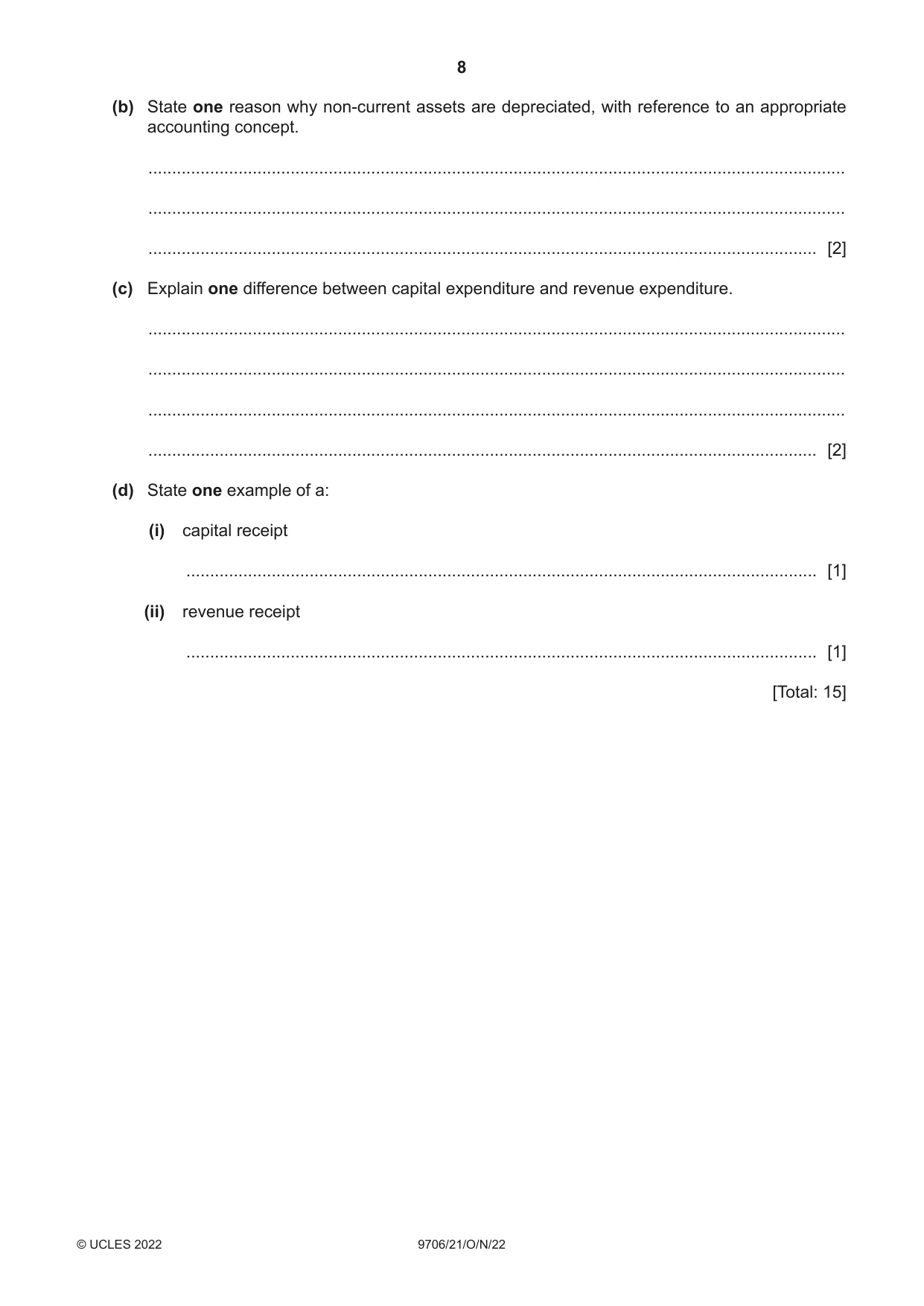
2 Bharti owns a small business. The following information was extracted from her accounting records. Balances at 1 July 2021 $ Delivery vehicles cost 52 000 provision for depreciation 14 000 Extract from asset register Cost Date of purchase Vehicle $ 1 July 2019 DV1 18 000 1 July 2020 DV2 34 000 On 1 October 2021, Bharti purchased a new delivery vehicle (DV3) costing $26 000. She paid $14 500 by cheque and the balance was settled by part-exchange of the old delivery vehicle, DV1. Bharti depreciates delivery vehicles using the straight-line method on a month-by-month basis. The estimated useful life of all delivery vehicles is five years with no residual value. REQUIRED (a) Prepare the following ledger accounts for the year ended 30 June 2022. Delivery Vehicles – Cost Date Details $ Date Details $ Delivery Vehicles – Provision for depreciation Date Details $ Date Details $ Disposal account Date Details $ Date Details $ Workings: [9] (b) State one reason why non-current assets are depreciated, with reference to an appropriate accounting concept. ................................................................................................................................................... ................................................................................................................................................... ............................................................................................................................................. [2] (c) Explain one difference between capital expenditure and revenue expenditure. ................................................................................................................................................... ................................................................................................................................................... ................................................................................................................................................... ............................................................................................................................................. [2] (d) State one example of a: (i) capital receipt ..................................................................................................................................... [1] (ii) revenue receipt ..................................................................................................................................... [1] [Total: 15]
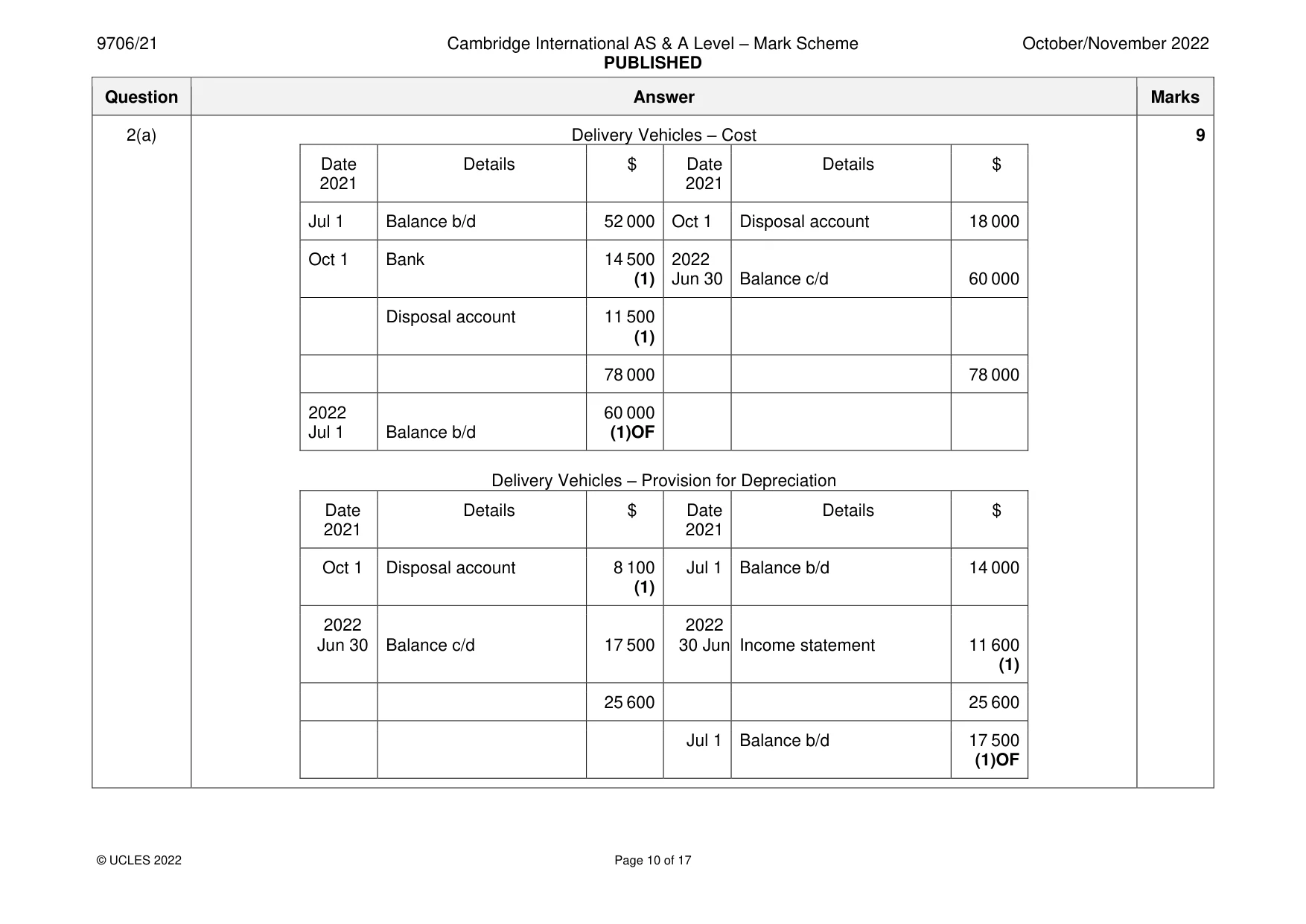
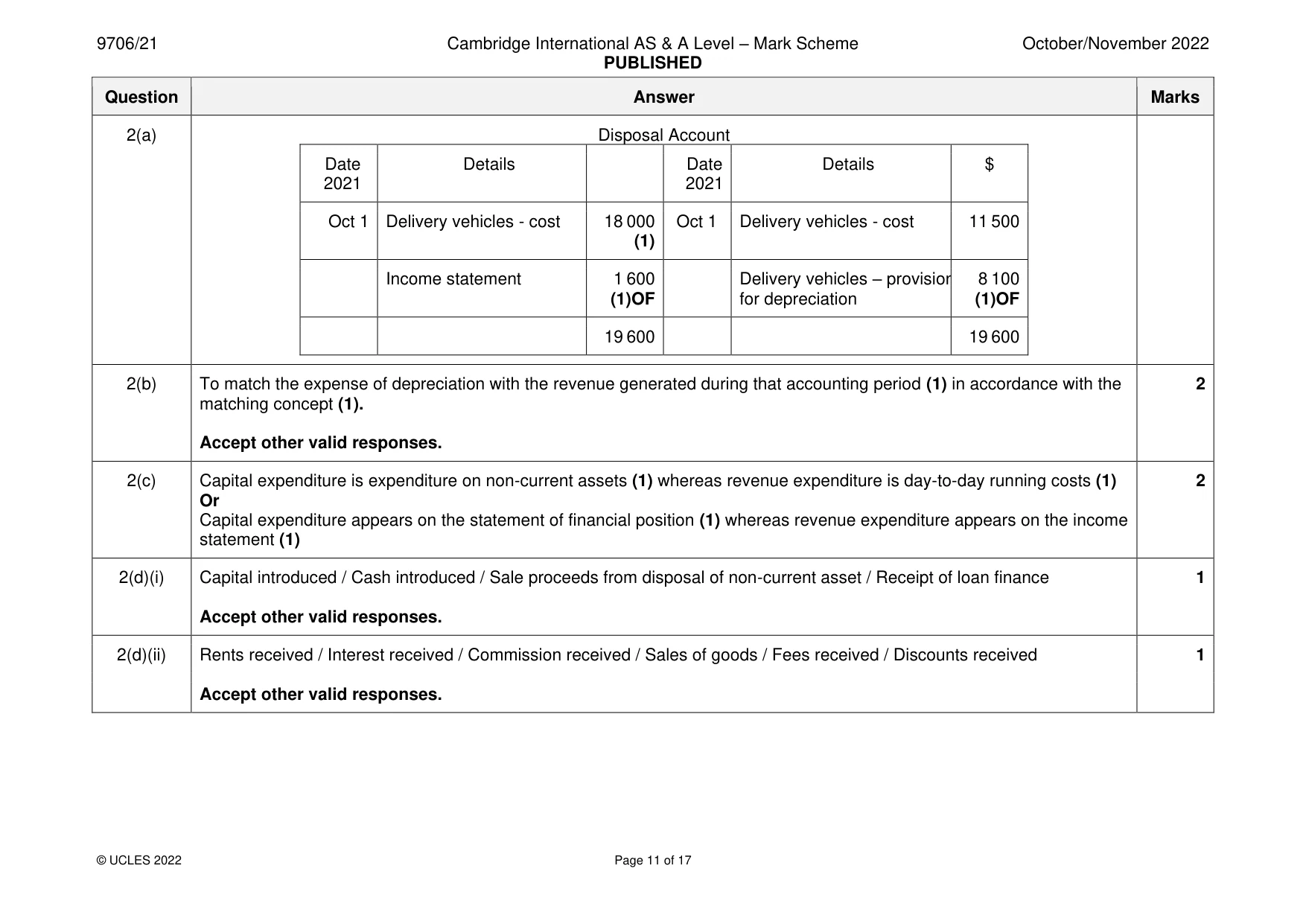
Mark scheme: 2(a) Delivery Vehicles – Cost 9 Date Details $ Date Details $ 2021 2021 Jul 1 Balance b/d 52 000 Oct 1 Disposal account 18 000 Oct 1 Bank 14 500 2022 (1) Jun 30 Balance c/d 60 000 Disposal account 11 500 (1) 78 000 78 000 2022 60 000 Jul 1 Balance b/d (1)OF Delivery Vehicles – Provision for Depreciation Date Details $ Date Details $ 2021 2021 Oct 1 Disposal account 8 100 Jul 1 Balance b/d 14 000 (1) 2022 2022 Jun 30 Balance c/d 17 500 30 Jun Income statement 11 600 (1) 25 600 25 600 Jul 1 Balance b/d 17 500 (1)OF 2(a) Disposal Account Date Details Date Details $ 2021 2021 Oct 1 Delivery vehicles - cost 18 000 Oct 1 Delivery vehicles - cost 11 500 (1) Income statement 1 600 Delivery vehicles – provision 8 100 (1)OF for depreciation (1)OF 19 600 19 600 2(b) To match the expense of depreciation with the revenue generated during that accounting period (1) in accordance with the 2 matching concept (1). Accept other valid responses. 2(c) Capital expenditure is expenditure on non-current assets (1) whereas revenue expenditure is day-to-day running costs (1) 2 Or Capital expenditure appears on the statement of financial position (1) whereas revenue expenditure appears on the income statement (1) 2(d)(i) Capital introduced / Cash introduced / Sale proceeds from disposal of non-current asset / Receipt of loan finance 1 Accept other valid responses. 2(d)(ii) Rents received / Interest received / Commission received / Sales of goods / Fees received / Discounts received 1 Accept other valid responses.
Q3 · The directors of H Limited provided the following details from the statement of financial…
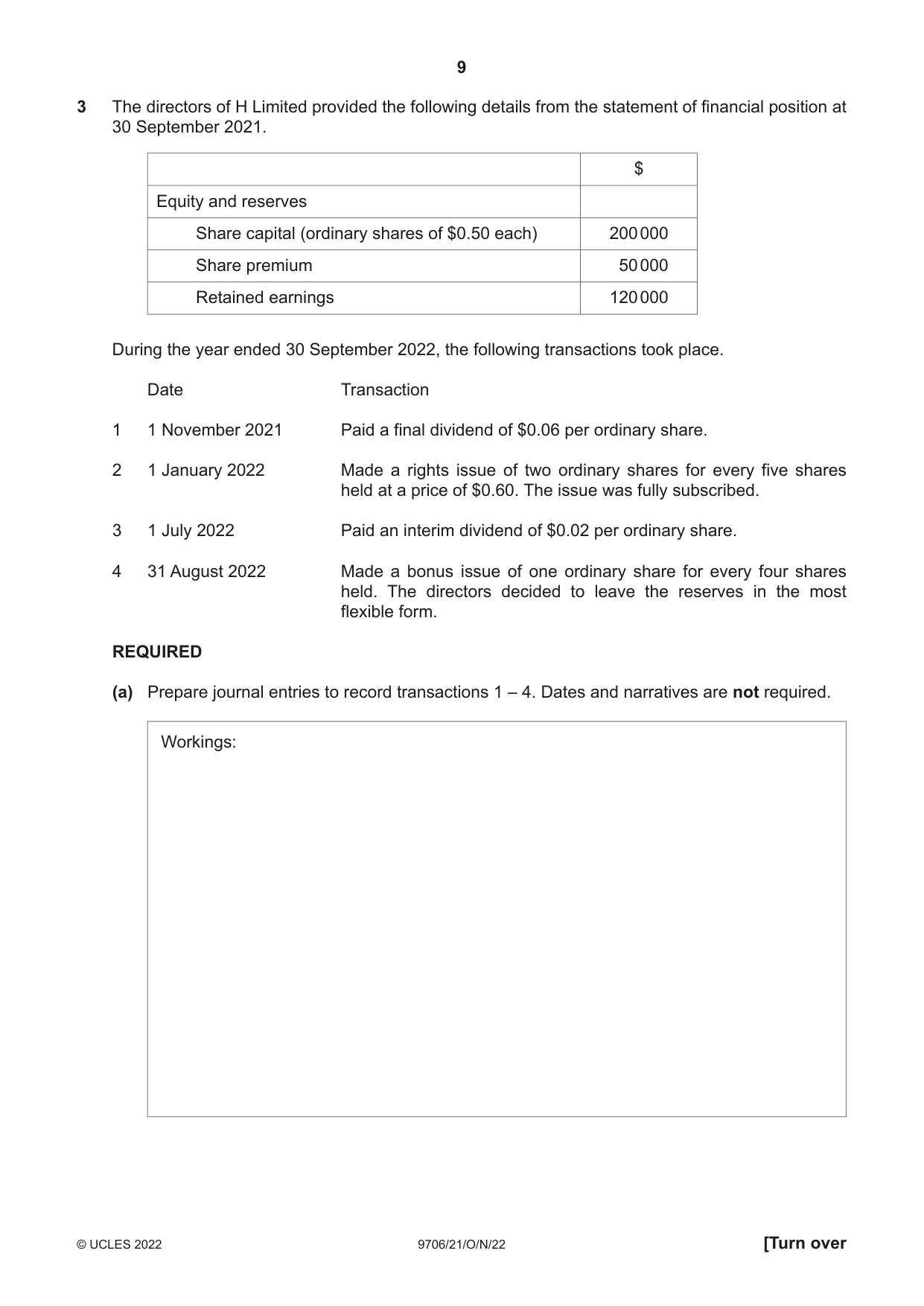
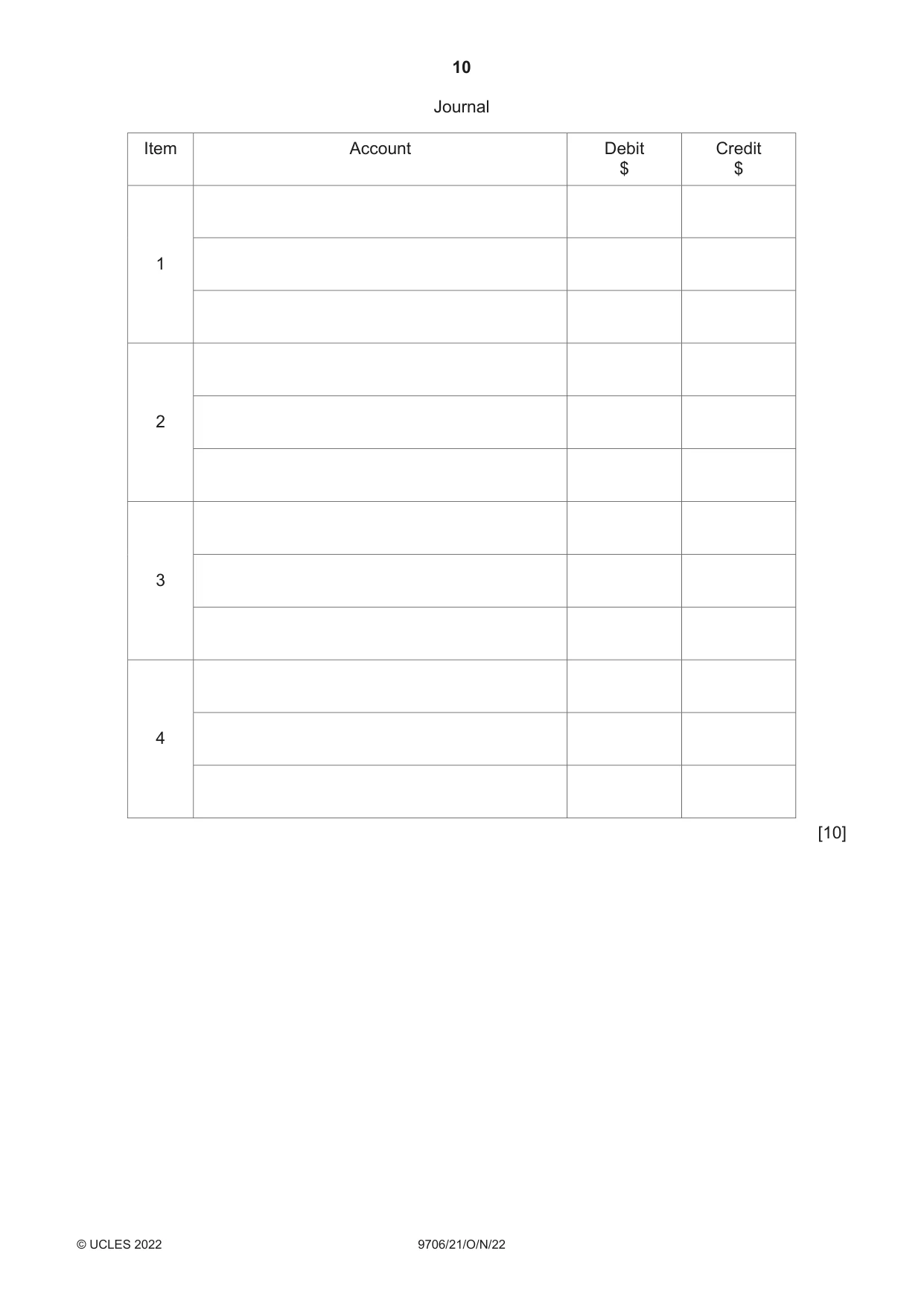
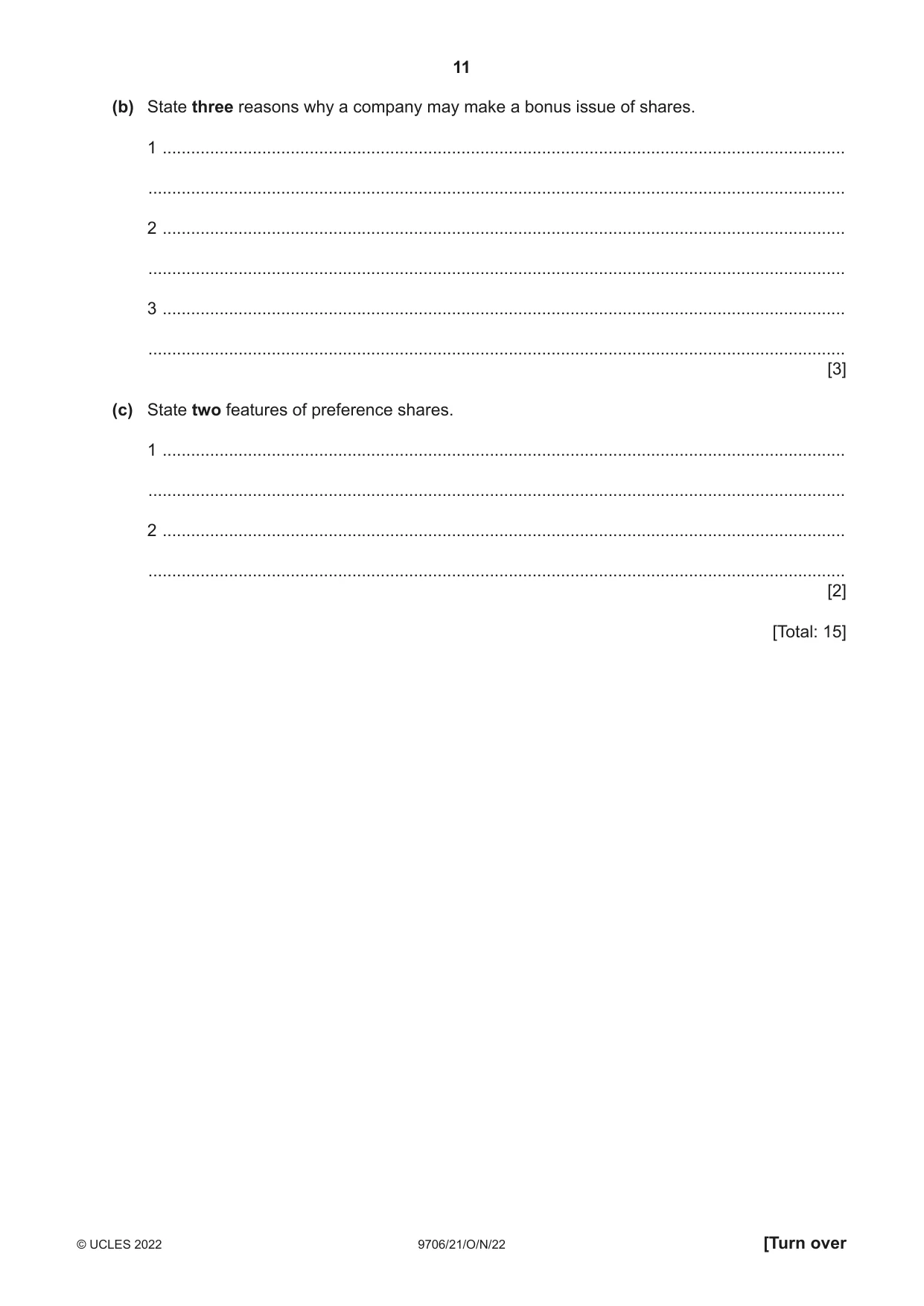
3 The directors of H Limited provided the following details from the statement of financial position at 30 September 2021. $ Equity and reserves Share capital (ordinary shares of $0.50 each) 200 000 Share premium 50 000 Retained earnings 120 000 During the year ended 30 September 2022, the following transactions took place. Date Transaction 1 1 November 2021 Paid a final dividend of $0.06 per ordinary share. 2 1 January 2022 Made a rights issue of two ordinary shares for every five shares held at a price of $0.60. The issue was fully subscribed. 3 1 July 2022 Paid an interim dividend of $0.02 per ordinary share. 4 31 August 2022 Made a bonus issue of one ordinary share for every four shares held. The directors decided to leave the reserves in the most flexible form. REQUIRED (a) Prepare journal entries to record transactions 1 – 4. Dates and narratives are not required. Workings: Journal Item Account Debit Credit $ $ 1 2 3 4 [10] (b) State three reasons why a company may make a bonus issue of shares. 1 ................................................................................................................................................ ................................................................................................................................................... 2 ................................................................................................................................................ ................................................................................................................................................... 3 ................................................................................................................................................ ................................................................................................................................................... [3] (c) State two features of preference shares. 1 ................................................................................................................................................ ................................................................................................................................................... 2 ................................................................................................................................................ ................................................................................................................................................... [2] [Total: 15]
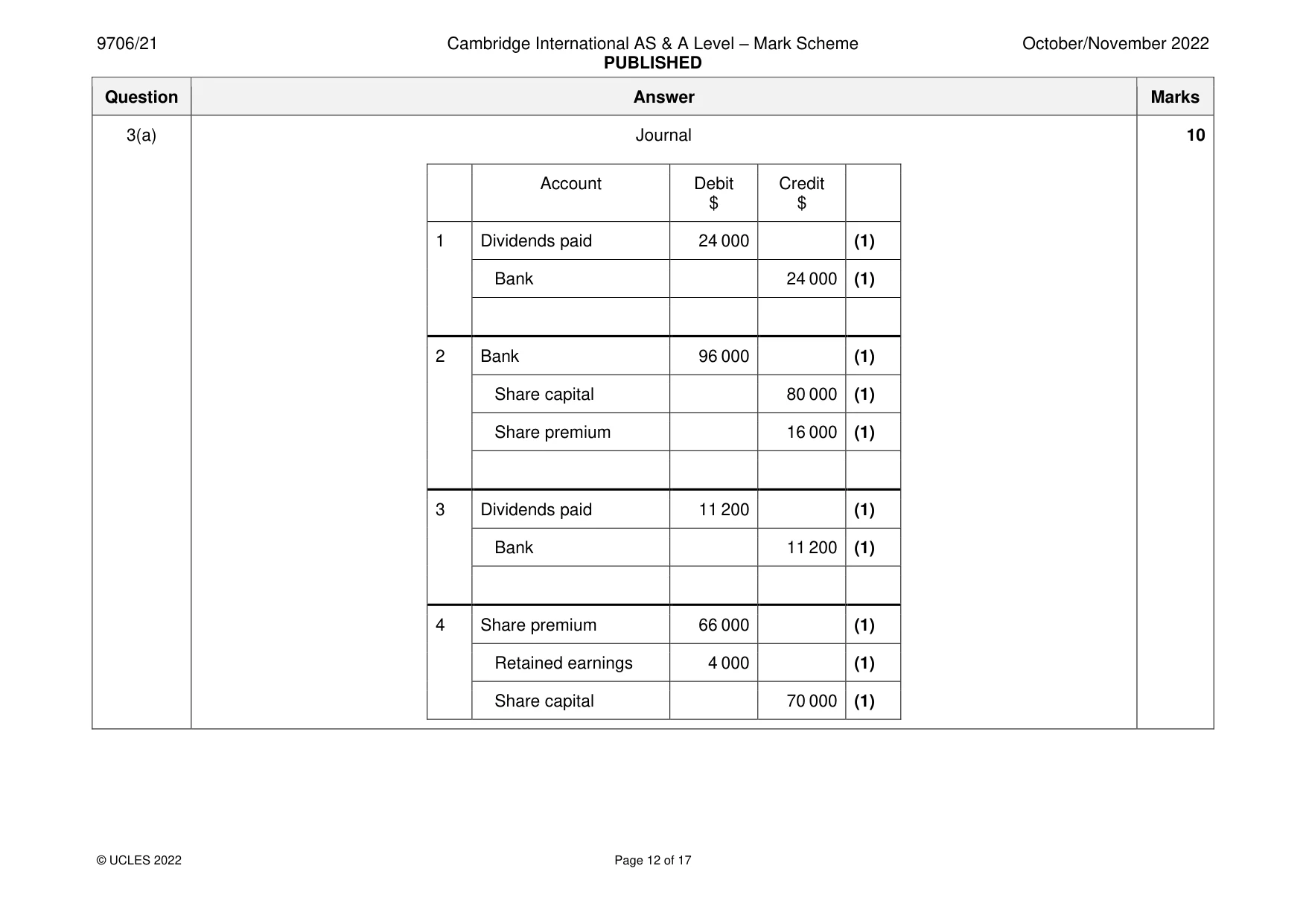
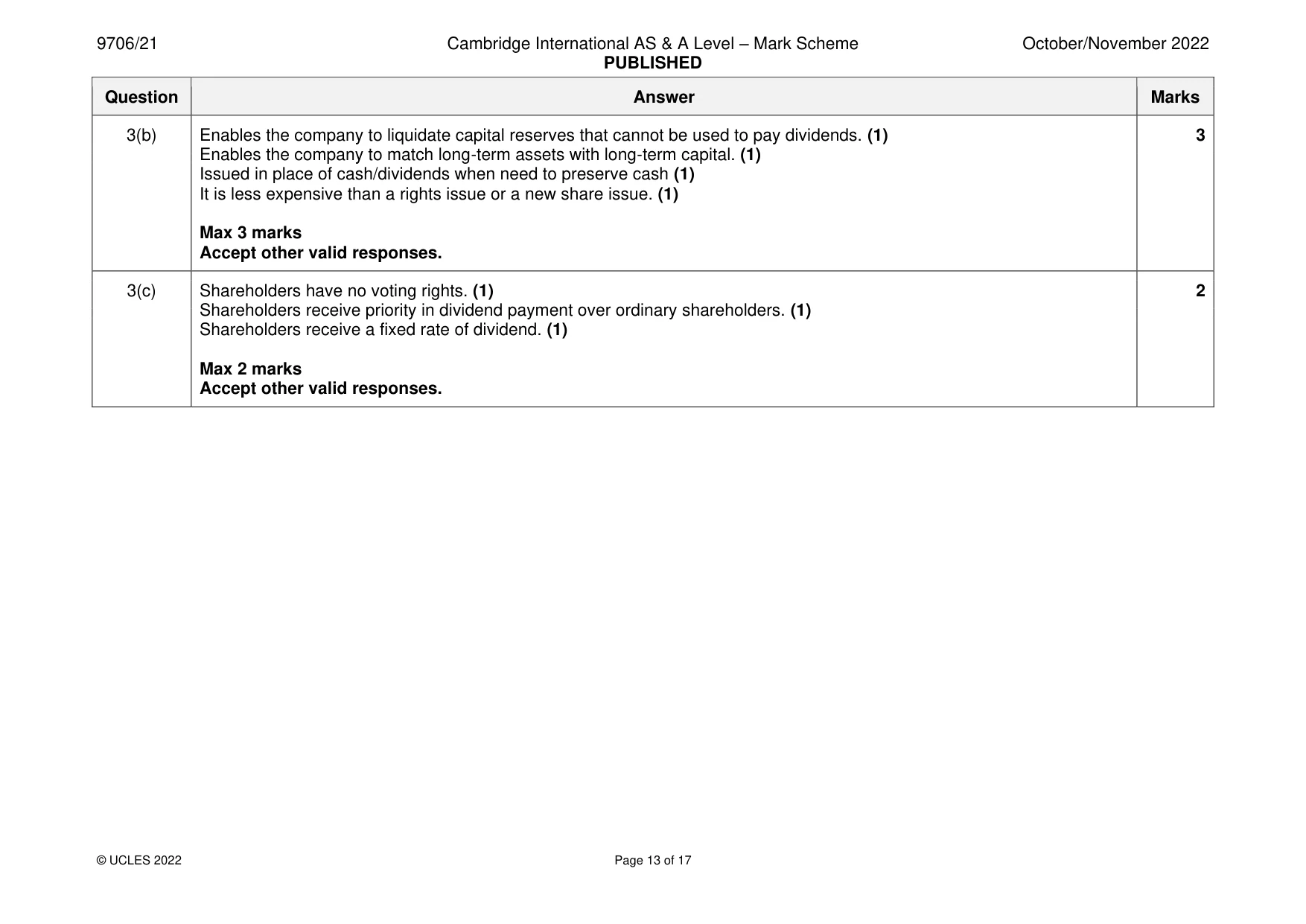
Mark scheme: 3(a) Journal 10 Account Debit Credit $ $ 1 Dividends paid 24 000 (1) Bank 24 000 (1) 2 Bank 96 000 (1) Share capital 80 000 (1) Share premium 16 000 (1) 3 Dividends paid 11 200 (1) Bank 11 200 (1) 4 Share premium 66 000 (1) Retained earnings 4 000 (1) Share capital 70 000 (1) 3(b) Enables the company to liquidate capital reserves that cannot be used to pay dividends. (1) 3 Enables the company to match long-term assets with long-term capital. (1) Issued in place of cash/dividends when need to preserve cash (1) It is less expensive than a rights issue or a new share issue. (1) Max 3 marks Accept other valid responses. 3(c) Shareholders have no voting rights. (1) 2 Shareholders receive priority in dividend payment over ordinary shareholders. (1) Shareholders receive a fixed rate of dividend. (1) Max 2 marks Accept other valid responses.
Q4 · Mandeep owns two manufacturing businesses
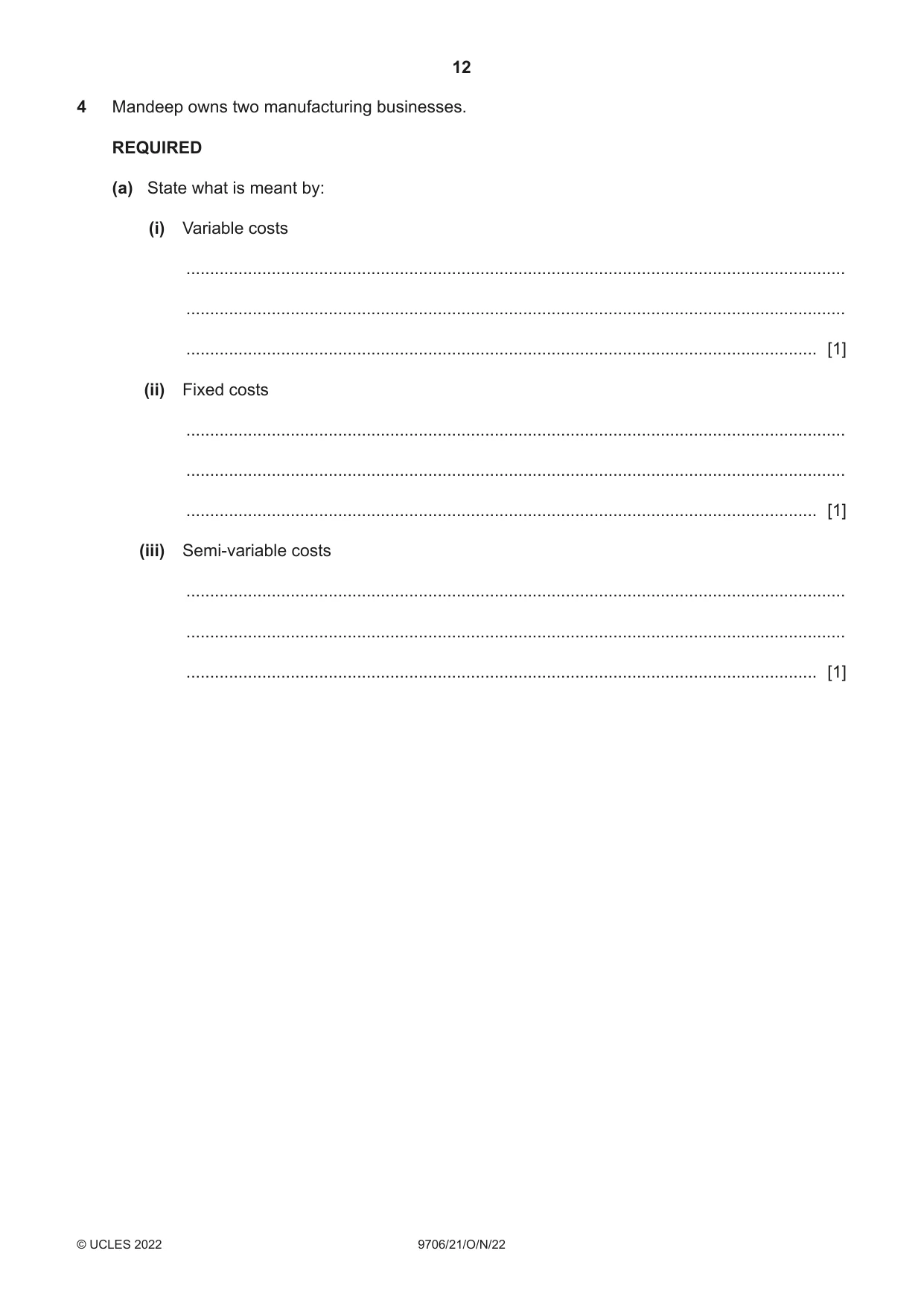
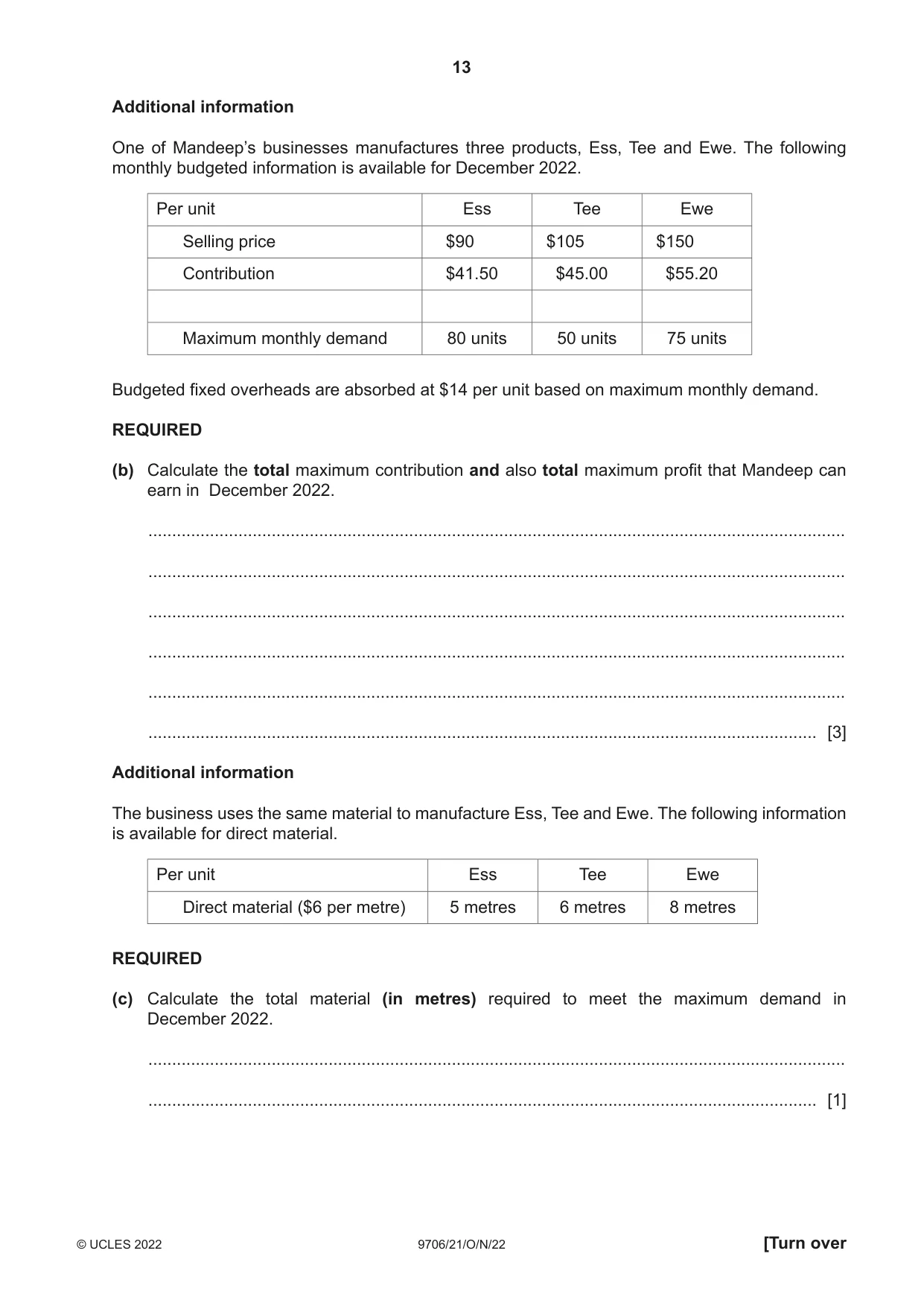
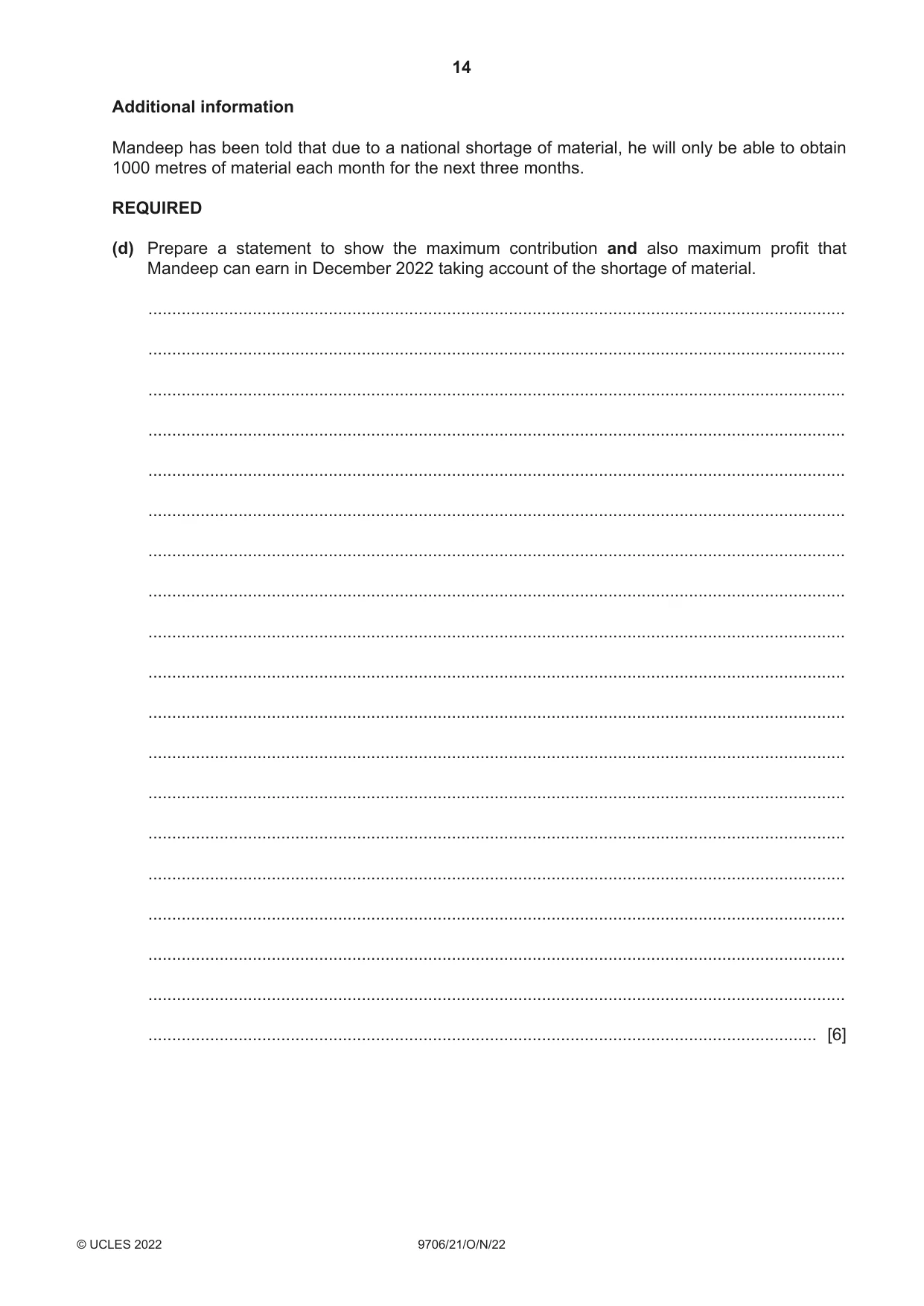
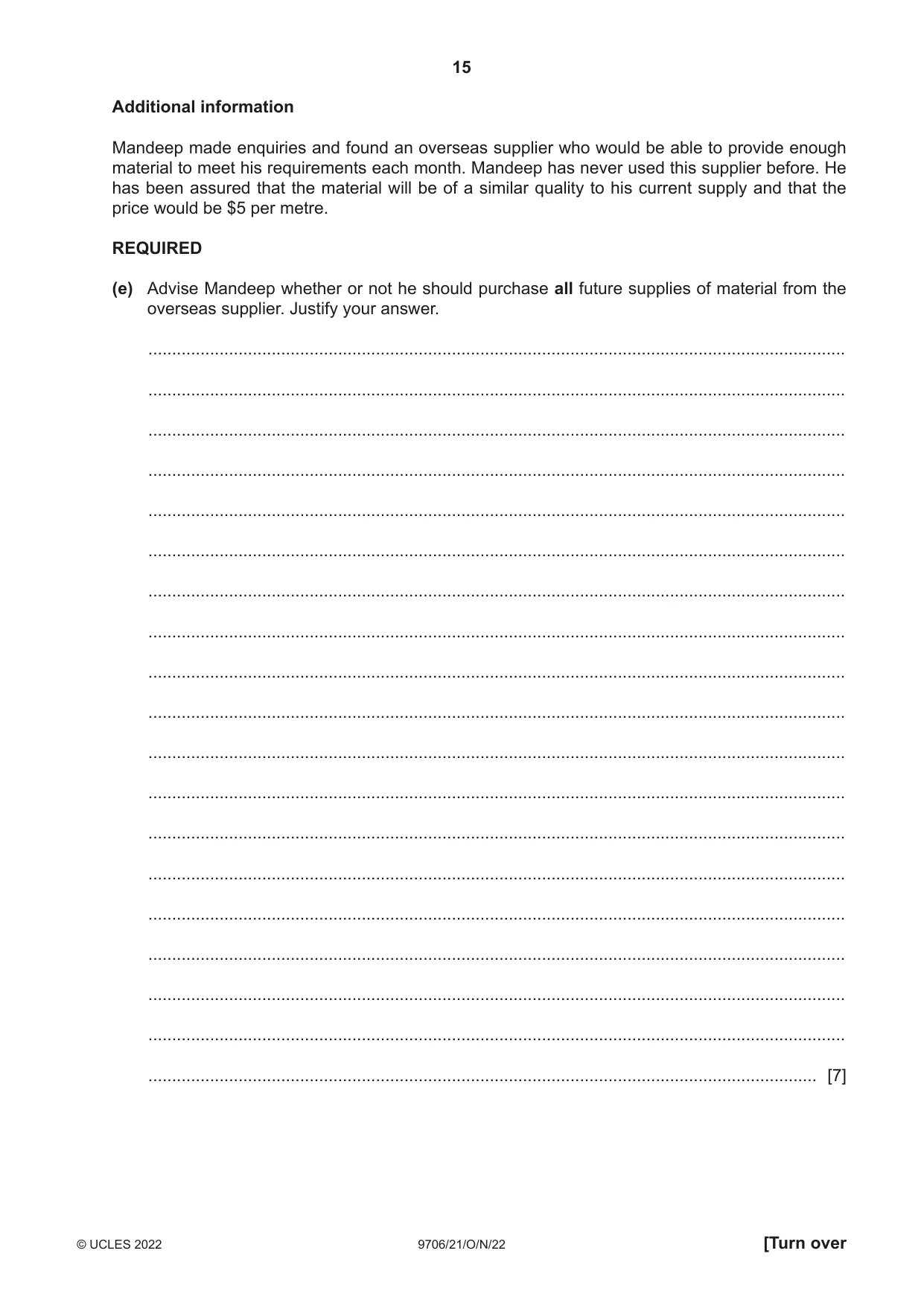
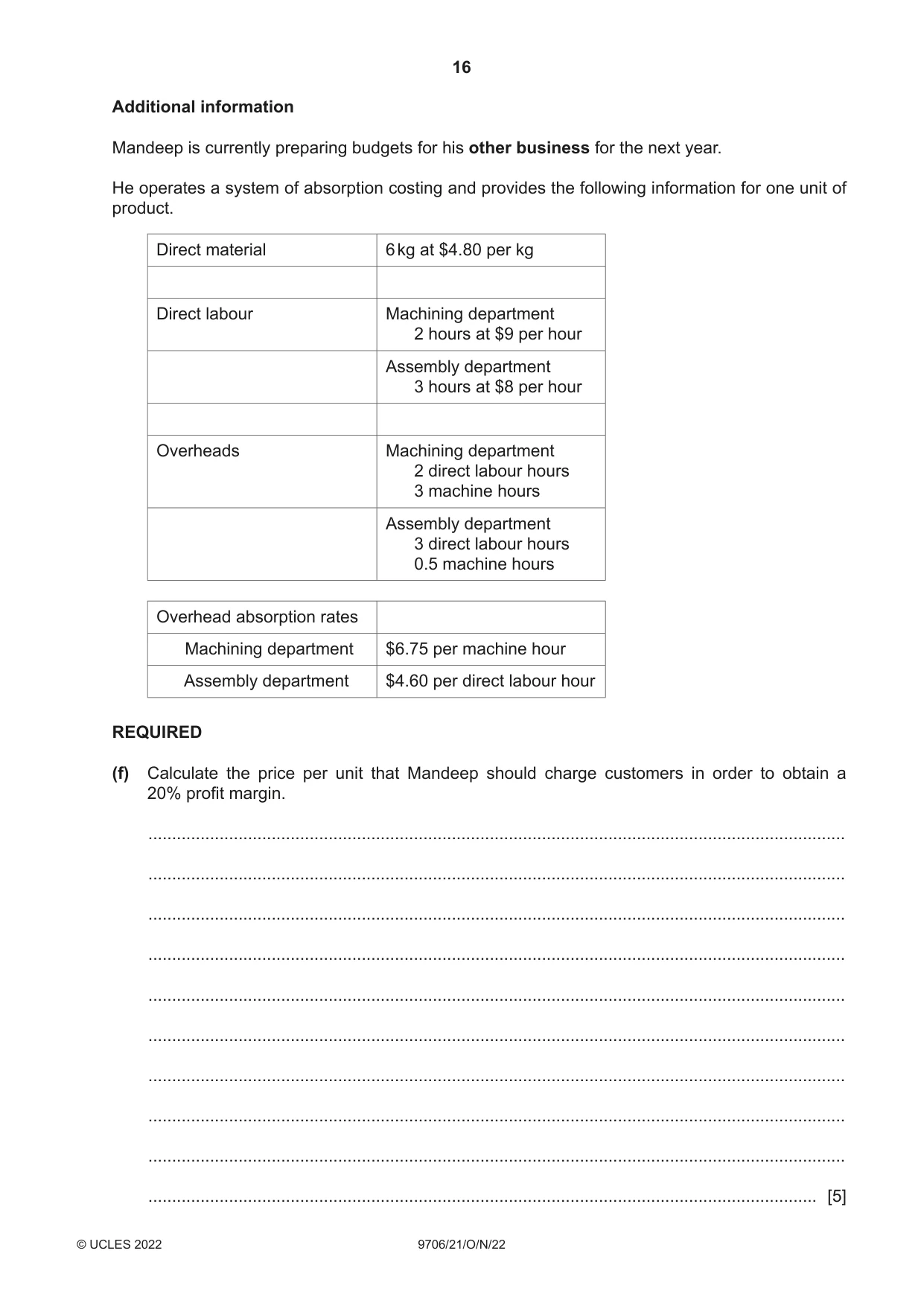
4 Mandeep owns two manufacturing businesses. REQUIRED (a) State what is meant by: (i) Variable costs ........................................................................................................................................... ........................................................................................................................................... ..................................................................................................................................... [1] (ii) Fixed costs ........................................................................................................................................... ........................................................................................................................................... ..................................................................................................................................... [1] (iii) Semi-variable costs ........................................................................................................................................... ........................................................................................................................................... ..................................................................................................................................... [1] Additional information One of Mandeep’s businesses manufactures three products, Ess, Tee and Ewe. The following monthly budgeted information is available for December 2022. Per unit Ess Tee Ewe Selling price $90 $105 $150 Contribution $41.50 $45.00 $55.20 Maximum monthly demand 80 units 50 units 75 units Budgeted fixed overheads are absorbed at $14 per unit based on maximum monthly demand. REQUIRED (b) Calculate the total maximum contribution and also total maximum profit that Mandeep can earn in December 2022. ................................................................................................................................................... ................................................................................................................................................... ................................................................................................................................................... ................................................................................................................................................... ................................................................................................................................................... ............................................................................................................................................. [3] Additional information The business uses the same material to manufacture Ess, Tee and Ewe. The following information is available for direct material. Per unit Ess Tee Ewe Direct material ($6 per metre) 5 metres 6 metres 8 metres REQUIRED (c) Calculate the total material (in metres) required to meet the maximum demand in December 2022. ................................................................................................................................................... ............................................................................................................................................. [1] Additional information Mandeep has been told that due to a national shortage of material, he will only be able to obtain 1000 metres of material each month for the next three months. REQUIRED (d) Prepare a statement to show the maximum contribution and also maximum profit that Mandeep can earn in December 2022 taking account of the shortage of material. ................................................................................................................................................... ................................................................................................................................................... ................................................................................................................................................... ................................................................................................................................................... ................................................................................................................................................... ................................................................................................................................................... ................................................................................................................................................... ................................................................................................................................................... ................................................................................................................................................... ................................................................................................................................................... ................................................................................................................................................... ................................................................................................................................................... ................................................................................................................................................... ................................................................................................................................................... ................................................................................................................................................... ................................................................................................................................................... ................................................................................................................................................... ................................................................................................................................................... ............................................................................................................................................. [6]
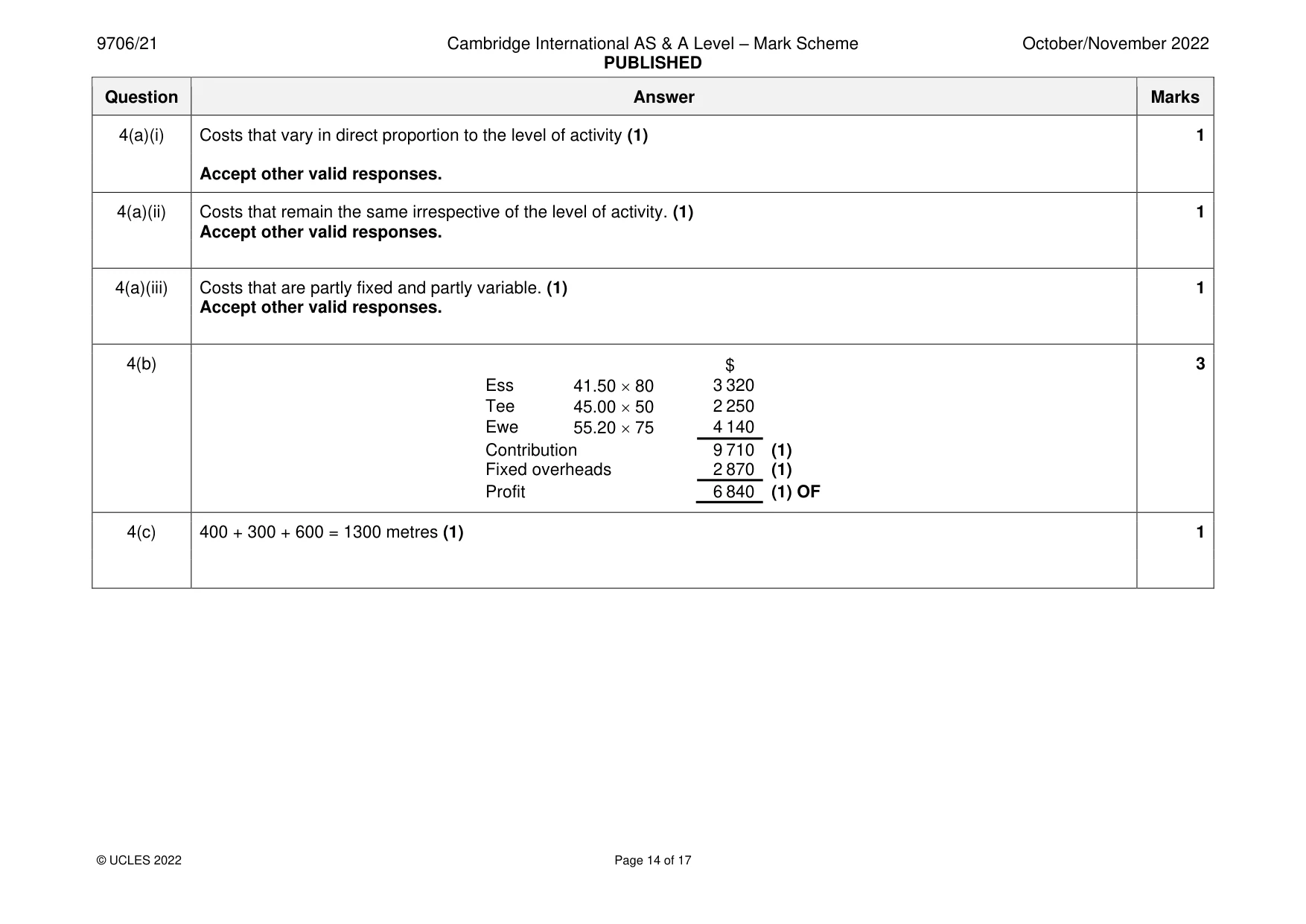
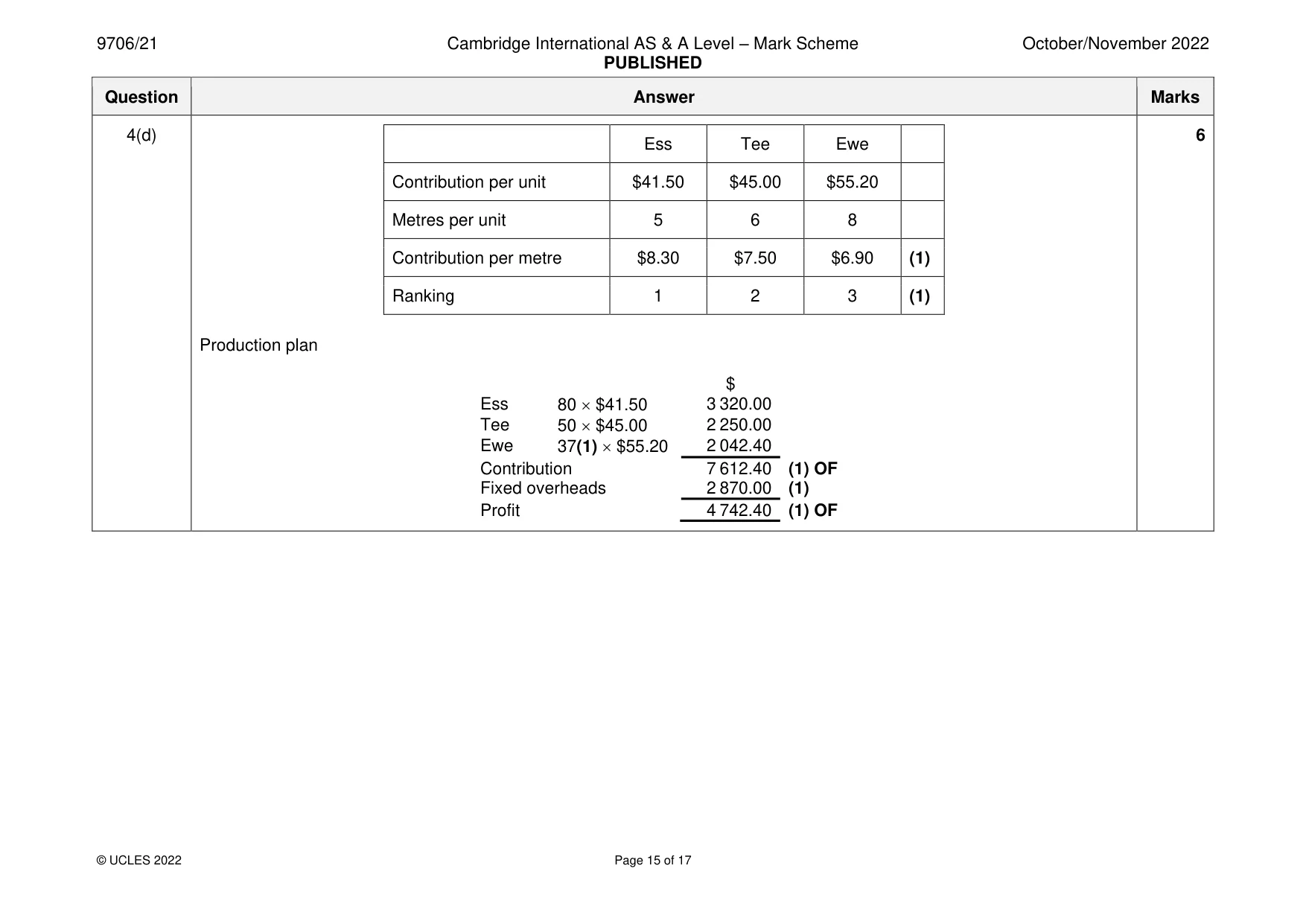
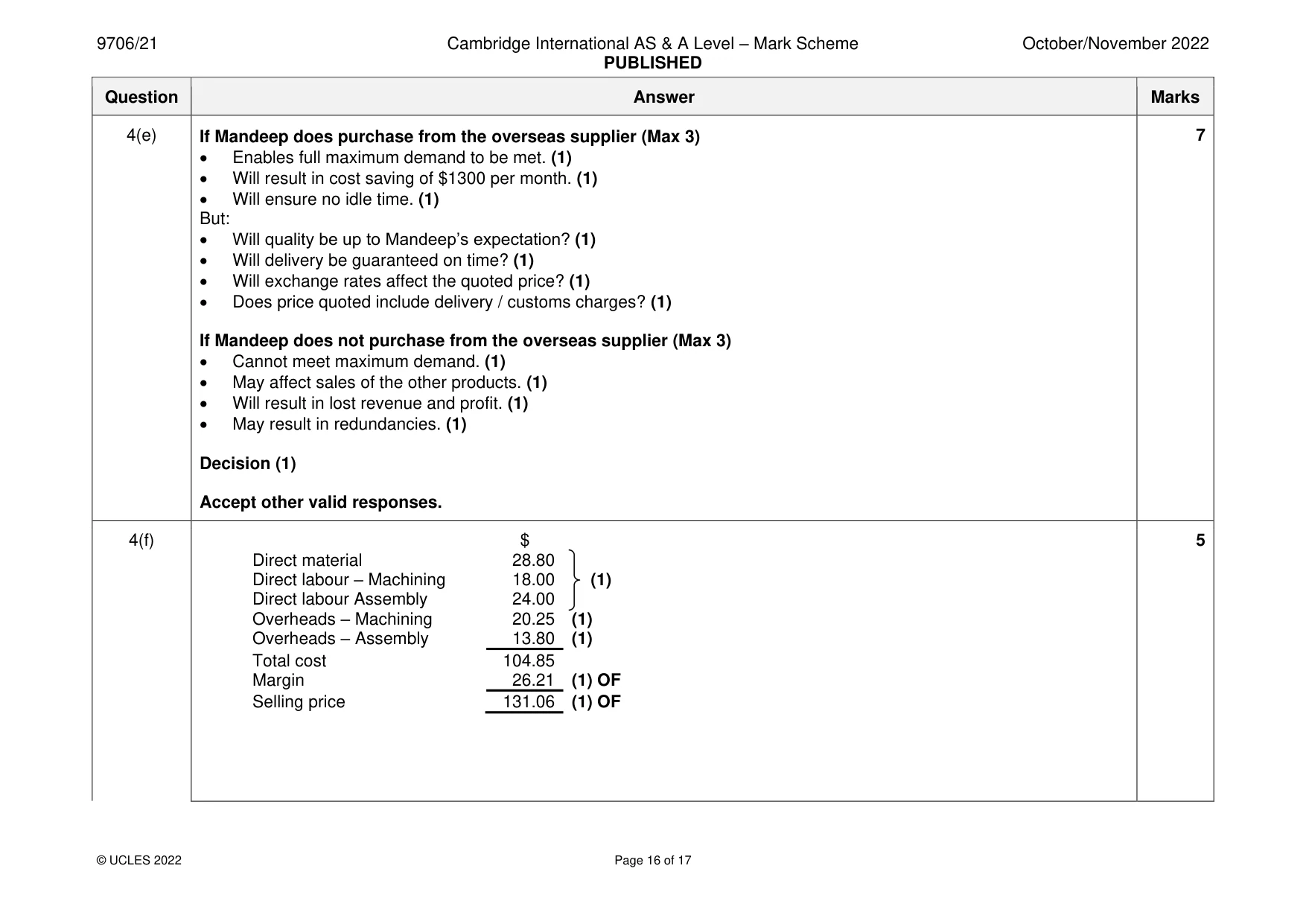
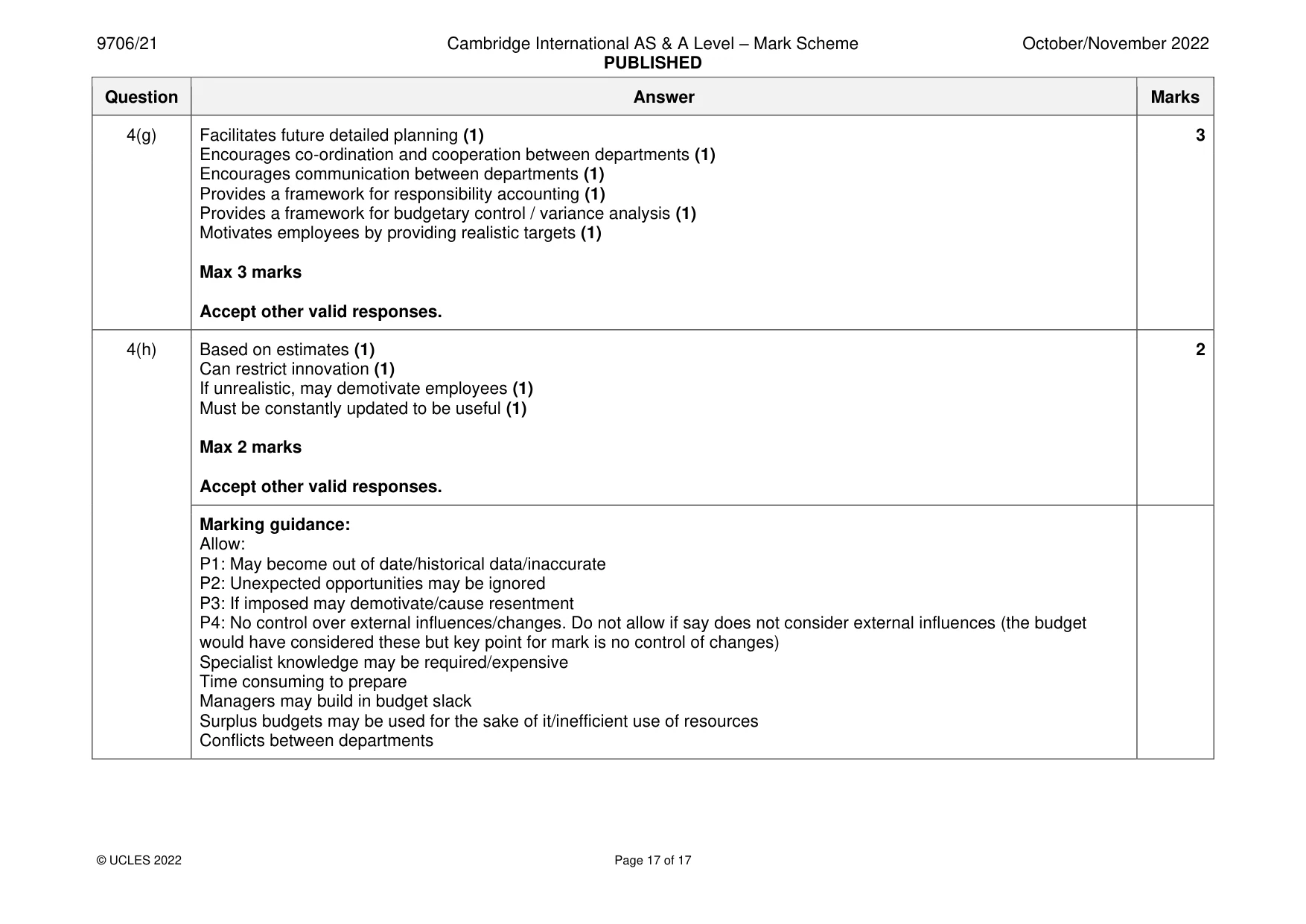
Mark scheme: 4(a)(i) Costs that vary in direct proportion to the level of activity (1) 1 Accept other valid responses. 4(a)(ii) Costs that remain the same irrespective of the level of activity. (1) 1 Accept other valid responses. 4(a)(iii) Costs that are partly fixed and partly variable. (1) 1 Accept other valid responses. 4(b) $ 3 Ess 41.50 80 3 320 Tee 45.00 50 2 250 Ewe 55.20 75 4 140 Contribution 9 710 (1) Fixed overheads 2 870 (1) Profit 6 840 (1) OF 4(c) 400 + 300 + 600 = 1300 metres (1) 1 4(d) 6 Ess Tee Ewe Contribution per unit $41.50 $45.00 $55.20 Metres per unit 5 6 8 Contribution per metre $8.30 $7.50 $6.90 (1) Ranking 1 2 3 (1) Production plan $ Ess 80 $41.50 3 320.00 Tee 50 $45.00 2 250.00 Ewe 37(1) $55.20 2 042.40 Contribution 7 612.40 (1) OF Fixed overheads 2 870.00 (1) Profit 4 742.40 (1) OF 4(e) If Mandeep does purchase from the overseas supplier (Max 3) 7 • Enables full maximum demand to be met. (1) • Will result in cost saving of $1300 per month. (1) • Will ensure no idle time. (1) But: • Will quality be up to Mandeep’s expectation? (1) • Will delivery be guaranteed on time? (1) • Will exchange rates affect the quoted price? (1) • Does price quoted include delivery / customs charges? (1) If Mandeep does not purchase from the overseas supplier (Max 3) • Cannot meet maximum demand. (1) • May affect sales of the other products. (1) • Will result in lost revenue and profit. (1) • May result in redundancies. (1) Decision (1) Accept other valid responses. 4(f) $ 5 Direct material 28.80 Direct labour – Machining 18.00 (1) Direct labour Assembly 24.00 Overheads – Machining 20.25 (1) Overheads – Assembly 13.80 (1) Total cost 104.85 Margin 26.21 (1) OF Selling price 131.06 (1) OF 4(g) Facilitates future detailed planning (1) 3 Encourages co-ordination and cooperation between departments (1) Encourages communication between departments (1) Provides a framework for responsibility accounting (1) Provides a framework for budgetary control / variance analysis (1) Motivates employees by providing realistic targets (1) Max 3 marks Accept other valid responses. 4(h) Based on estimates (1) 2 Can restrict innovation (1) If unrealistic, may demotivate employees (1) Must be constantly updated to be useful (1) Max 2 marks Accept other valid responses. Marking guidance: Allow: P1: May become out of date/historical data/inaccurate P2: Unexpected opportunities may be ignored P3: If imposed may demotivate/cause resentment P4: No control over external influences/changes. Do not allow if say does not consider external influences (the budget would have considered these but key point for mark is no control of changes) Specialist knowledge may be required/expensive Time consuming to prepare Managers may build in budget slack Surplus budgets may be used for the sake of it/inefficient use of resources Conflicts between departments
What was in this paper
The subtopics covered by these 4 questions, and how many questions each got. Open one in a new tab to see every Cambridge question on it.
What you needed in this session
Cambridge’s own grade thresholds for 2022 Oct/Nov, Paper 2 · Variant 1. A higher threshold means an easier paper — the bar moves with how the cohort did.