Cambridge A Level Accounting 9706 — 2020 Oct/Nov Paper 2 · Variant 2
9706/22/O/N/20 · 4 questions · 90 marks · ≈101 min
The question paper and its mark scheme, free to read here and free to download. This is Cambridge’s own paper, exactly as it was sat.
Question paper16 pages
Mark scheme7 pages
Answers below. Sit the paper first if you are practising.
Questions as text
Q1 · Anjali is a sole trader
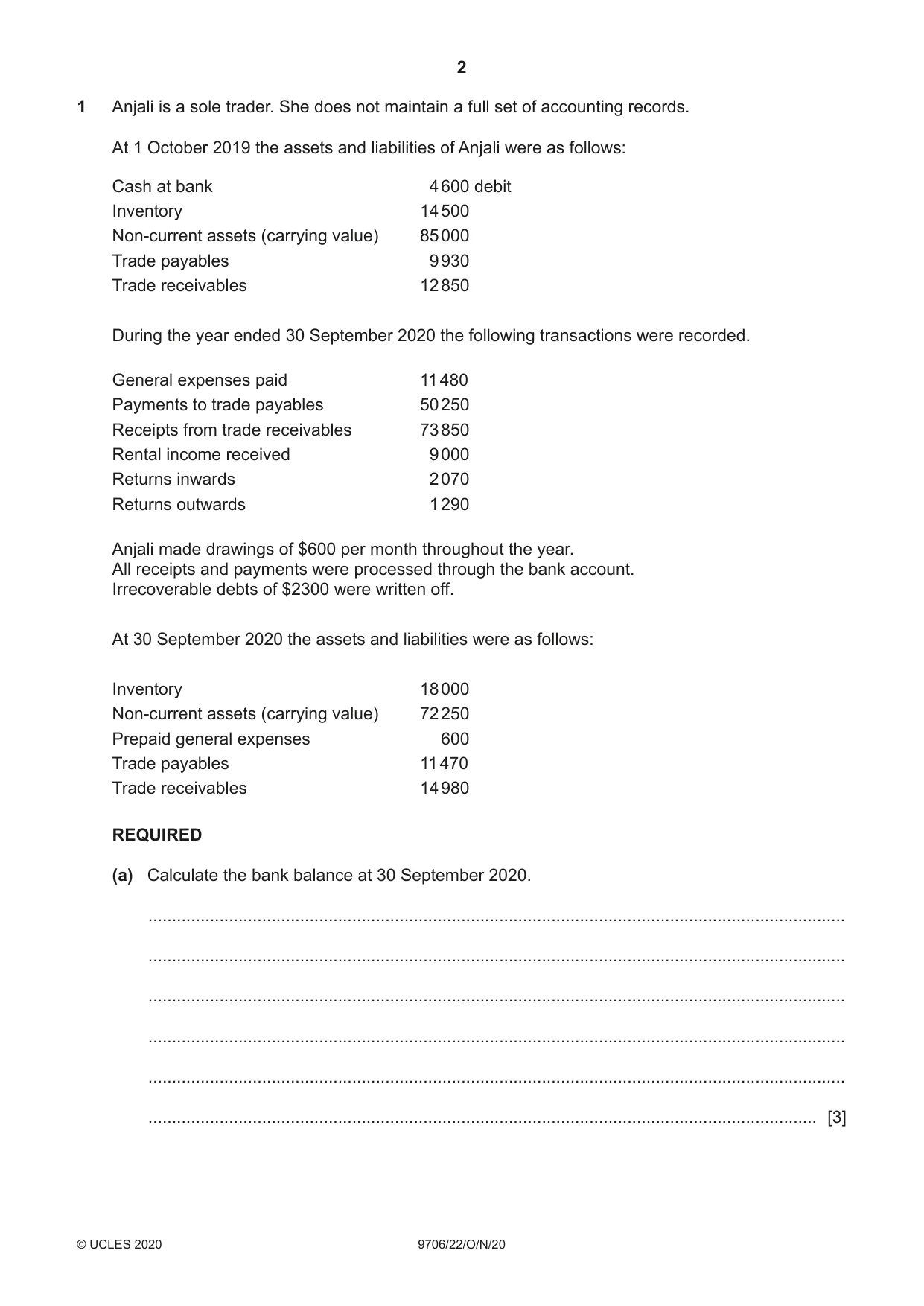
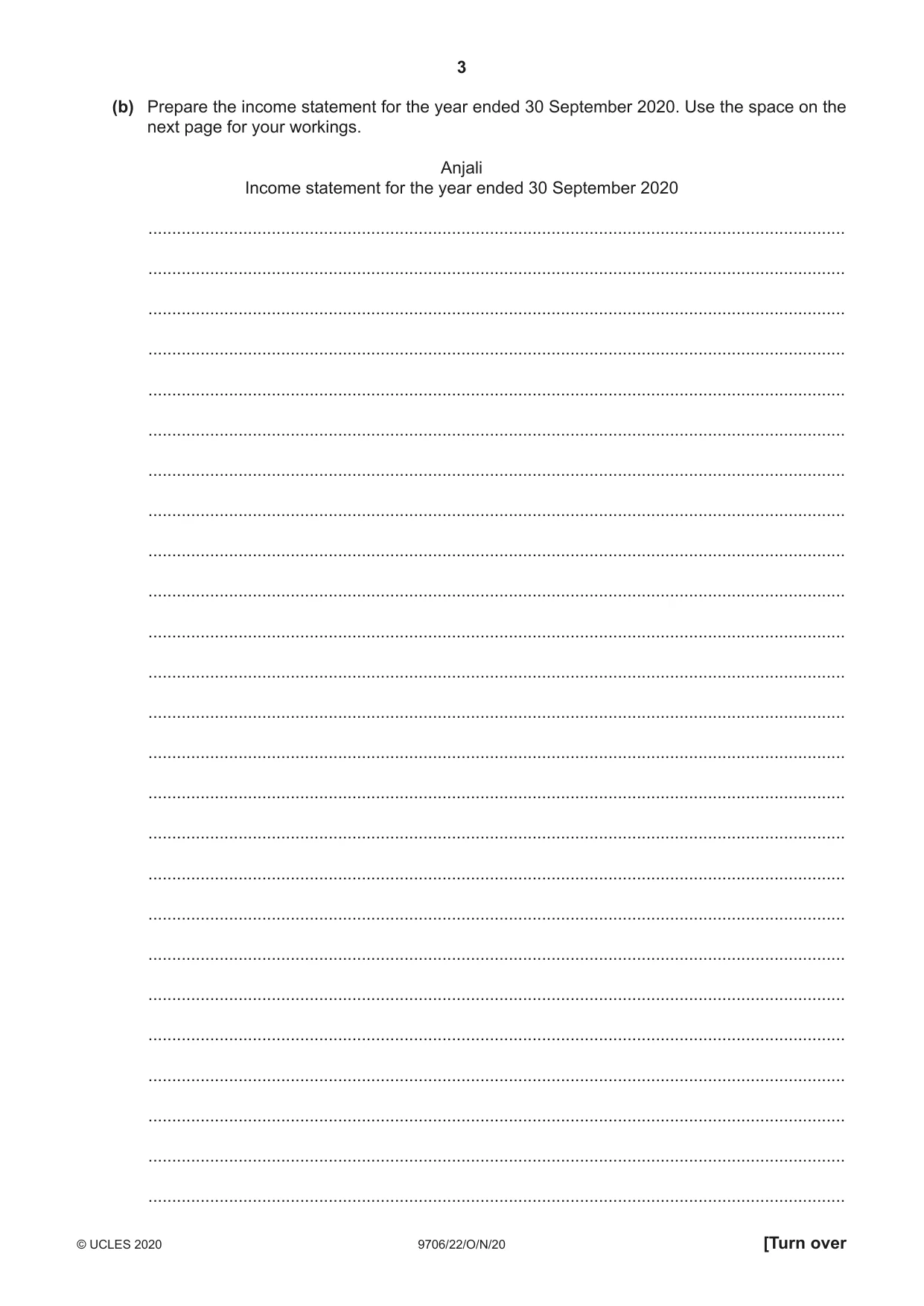
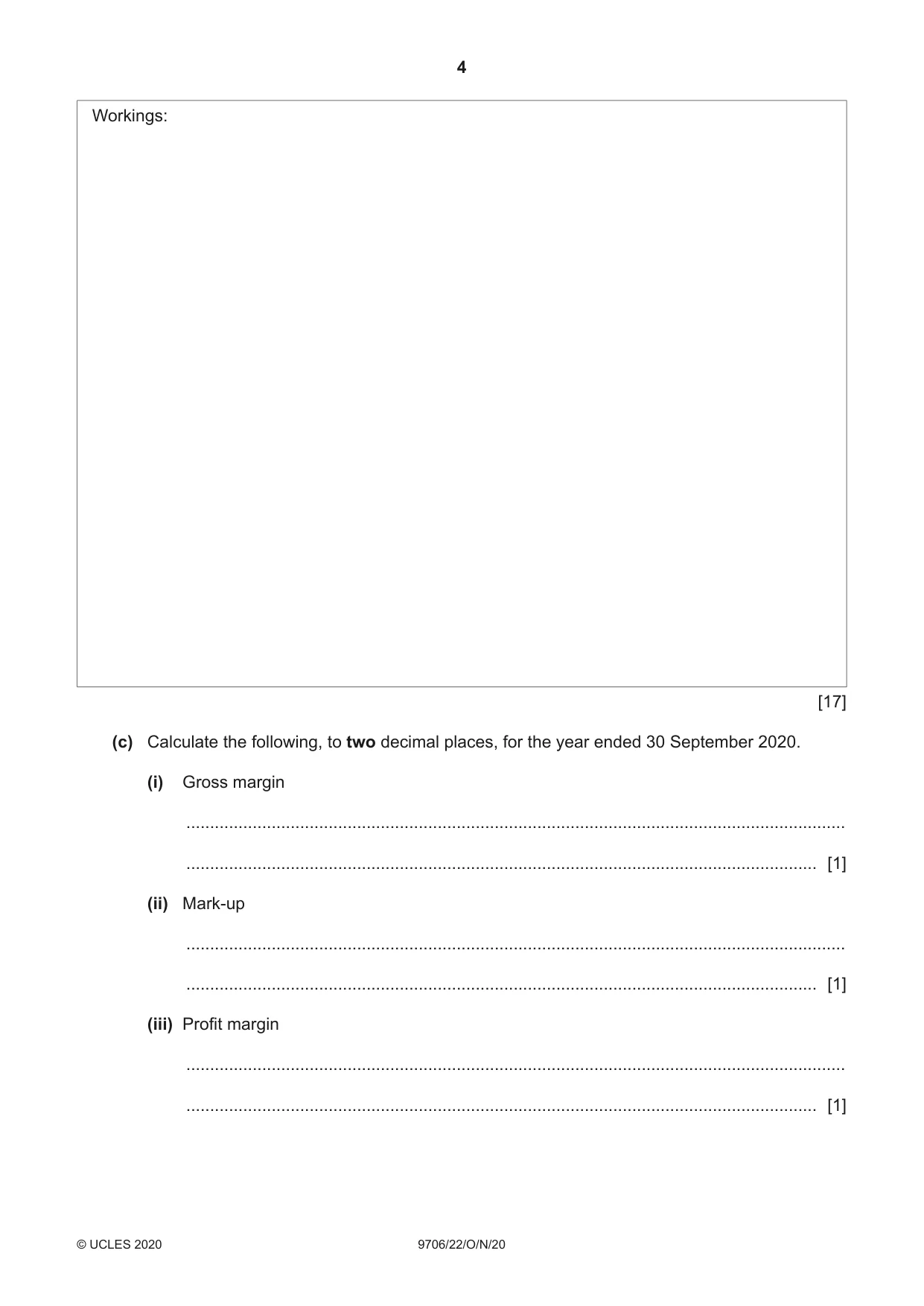
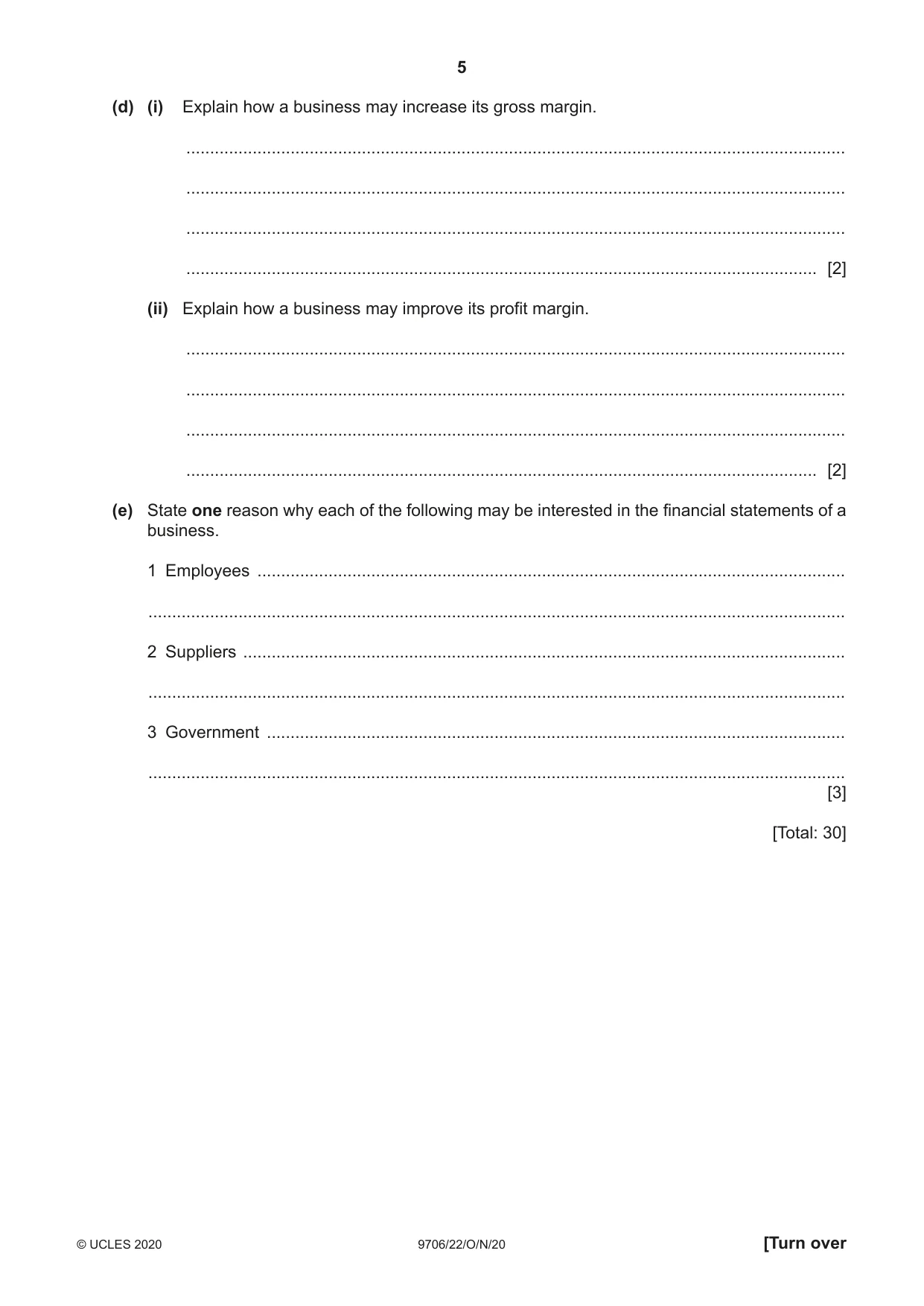
1 Anjali is a sole trader. She does not maintain a full set of accounting records. At 1 October 2019 the assets and liabilities of Anjali were as follows: Cash at bank 4 600 debit Inventory 14 500 Non-current assets (carrying value) 85 000 Trade payables 9 930 Trade receivables 12 850 During the year ended 30 September 2020 the following transactions were recorded. General expenses paid 11 480 Payments to trade payables 50 250 Receipts from trade receivables 73 850 Rental income received 9 000 Returns inwards 2 070 Returns outwards 1 290 Anjali made drawings of $600 per month throughout the year. All receipts and payments were processed through the bank account. Irrecoverable debts of $2300 were written off. At 30 September 2020 the assets and liabilities were as follows: Inventory 18 000 Non-current assets (carrying value) 72 250 Prepaid general expenses 600 Trade payables 11 470 Trade receivables 14 980 REQUIRED (a) Calculate the bank balance at 30 September 2020. ................................................................................................................................................... ................................................................................................................................................... ................................................................................................................................................... ................................................................................................................................................... ................................................................................................................................................... ............................................................................................................................................. [3] (b) Prepare the income statement for the year ended 30 September 2020. Use the space on the next page for your workings. Anjali Income statement for the year ended 30 September 2020 ................................................................................................................................................... ................................................................................................................................................... ................................................................................................................................................... ................................................................................................................................................... ................................................................................................................................................... ................................................................................................................................................... ................................................................................................................................................... ................................................................................................................................................... ................................................................................................................................................... ................................................................................................................................................... ................................................................................................................................................... ................................................................................................................................................... ................................................................................................................................................... ................................................................................................................................................... ................................................................................................................................................... ................................................................................................................................................... ................................................................................................................................................... ................................................................................................................................................... ................................................................................................................................................... ................................................................................................................................................... ................................................................................................................................................... ................................................................................................................................................... ................................................................................................................................................... ................................................................................................................................................... ................................................................................................................................................... Workings: [17] (c) Calculate the following, to two decimal places, for the year ended 30 September 2020. (i) Gross margin ........................................................................................................................................... ..................................................................................................................................... [1] (ii) Mark-up ........................................................................................................................................... ..................................................................................................................................... [1] (iii) Profit margin ........................................................................................................................................... ..................................................................................................................................... [1] (d) (i) Explain how a business may increase its gross margin. ........................................................................................................................................... ........................................................................................................................................... ........................................................................................................................................... ..................................................................................................................................... [2] (ii) Explain how a business may improve its profit margin. ........................................................................................................................................... ........................................................................................................................................... ........................................................................................................................................... ..................................................................................................................................... [2] (e) State one reason why each of the following may be interested in the financial statements of a business. 1 Employees ............................................................................................................................ ................................................................................................................................................... 2 Suppliers ............................................................................................................................... ................................................................................................................................................... 3 Government .......................................................................................................................... ................................................................................................................................................... [3] [Total: 30]
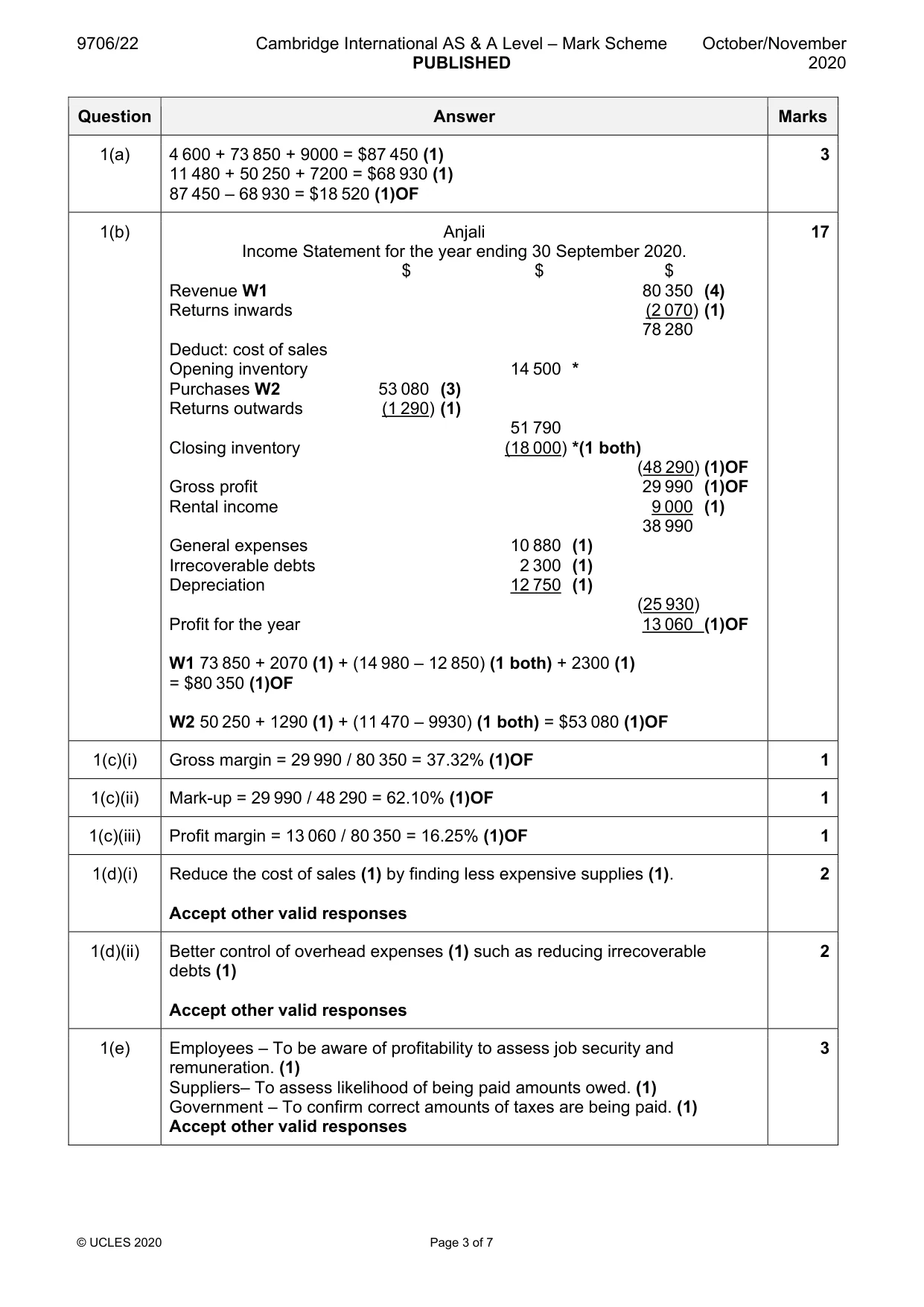
Mark scheme: Question Answer Marks 1(a) 4 600 + 73 850 + 9000 = $87 450 (1) 3 11 480 + 50 250 + 7200 = $68 930 (1) 87 450 – 68 930 = $18 520 (1)OF 1(b) Anjali 17 Income Statement for the year ending 30 September 2020. $ $ $ Revenue W1 80 350 (4) Returns inwards (2 070) (1) 78 280 Deduct: cost of sales Opening inventory 14 500 * Purchases W2 53 080 (3) Returns outwards (1 290) (1) 51 790 Closing inventory (18 000) *(1 both) (48 290) (1)OF Gross profit 29 990 (1)OF Rental income 9 000 (1) 38 990 General expenses 10 880 (1) Irrecoverable debts 2 300 (1) Depreciation 12 750 (1) (25 930) Profit for the year 13 060 (1)OF W1 73 850 + 2070 (1) + (14 980 – 12 850) (1 both) + 2300 (1) = $80 350 (1)OF W2 50 250 + 1290 (1) + (11 470 – 9930) (1 both) = $53 080 (1)OF 1(c)(i) Gross margin = 29 990 / 80 350 = 37.32% (1)OF 1 1(c)(ii) Mark-up = 29 990 / 48 290 = 62.10% (1)OF 1 1(c)(iii) Profit margin = 13 060 / 80 350 = 16.25% (1)OF 1 1(d)(i) Reduce the cost of sales (1) by finding less expensive supplies (1). 2 Accept other valid responses 1(d)(ii) Better control of overhead expenses (1) such as reducing irrecoverable 2 debts (1) Accept other valid responses 1(e) Employees – To be aware of profitability to assess job security and 3 remuneration. (1) Suppliers– To assess likelihood of being paid amounts owed. (1) Government – To confirm correct amounts of taxes are being paid. (1) Accept other valid responses
Q2 · Khalid runs a business
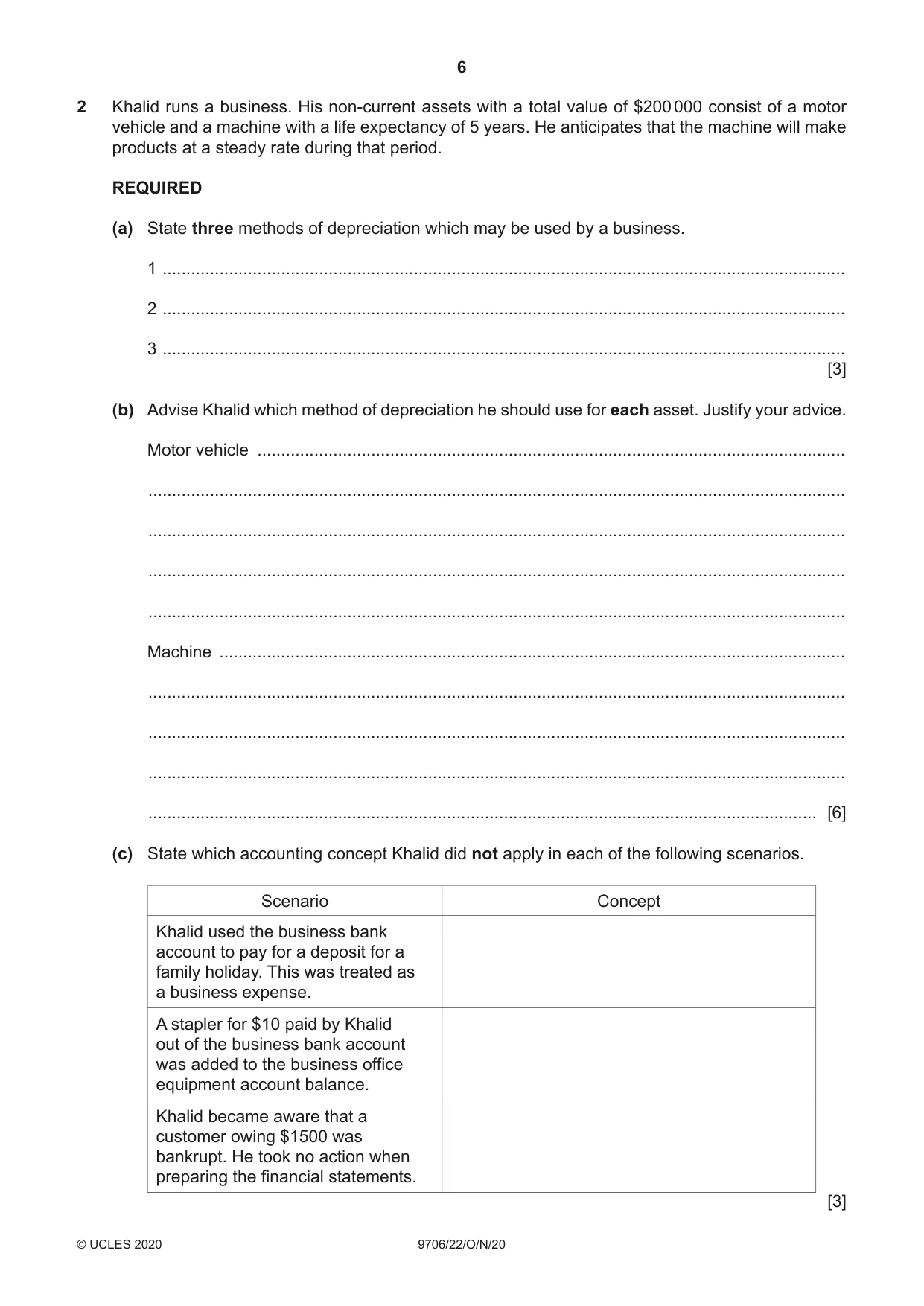
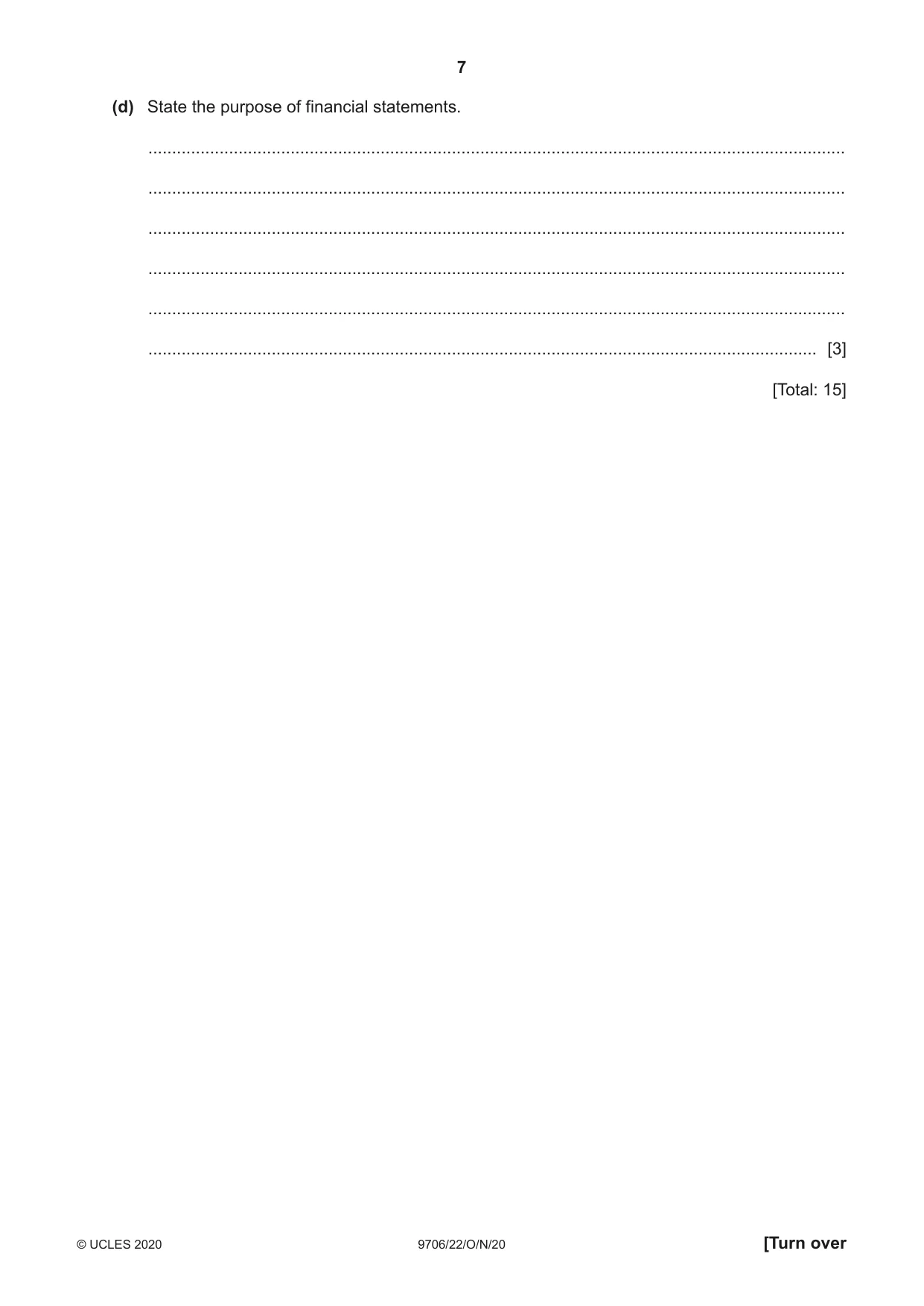
2 Khalid runs a business. His non-current assets with a total value of $200 000 consist of a motor vehicle and a machine with a life expectancy of 5 years. He anticipates that the machine will make products at a steady rate during that period. REQUIRED (a) State three methods of depreciation which may be used by a business. 1 ................................................................................................................................................ 2 ................................................................................................................................................ 3 ................................................................................................................................................ [3] (b) Advise Khalid which method of depreciation he should use for each asset. Justify your advice. Motor vehicle ............................................................................................................................ ................................................................................................................................................... ................................................................................................................................................... ................................................................................................................................................... ................................................................................................................................................... Machine .................................................................................................................................... ................................................................................................................................................... ................................................................................................................................................... ................................................................................................................................................... ............................................................................................................................................. [6] (c) State which accounting concept Khalid did not apply in each of the following scenarios. Scenario Concept Khalid used the business bank account to pay for a deposit for a family holiday. This was treated as a business expense. A stapler for $10 paid by Khalid out of the business bank account was added to the business office equipment account balance. Khalid became aware that a customer owing $1500 was bankrupt. He took no action when preparing the financial statements. [3] (d) State the purpose of financial statements. ................................................................................................................................................... ................................................................................................................................................... ................................................................................................................................................... ................................................................................................................................................... ................................................................................................................................................... ............................................................................................................................................. [3] [Total: 15]
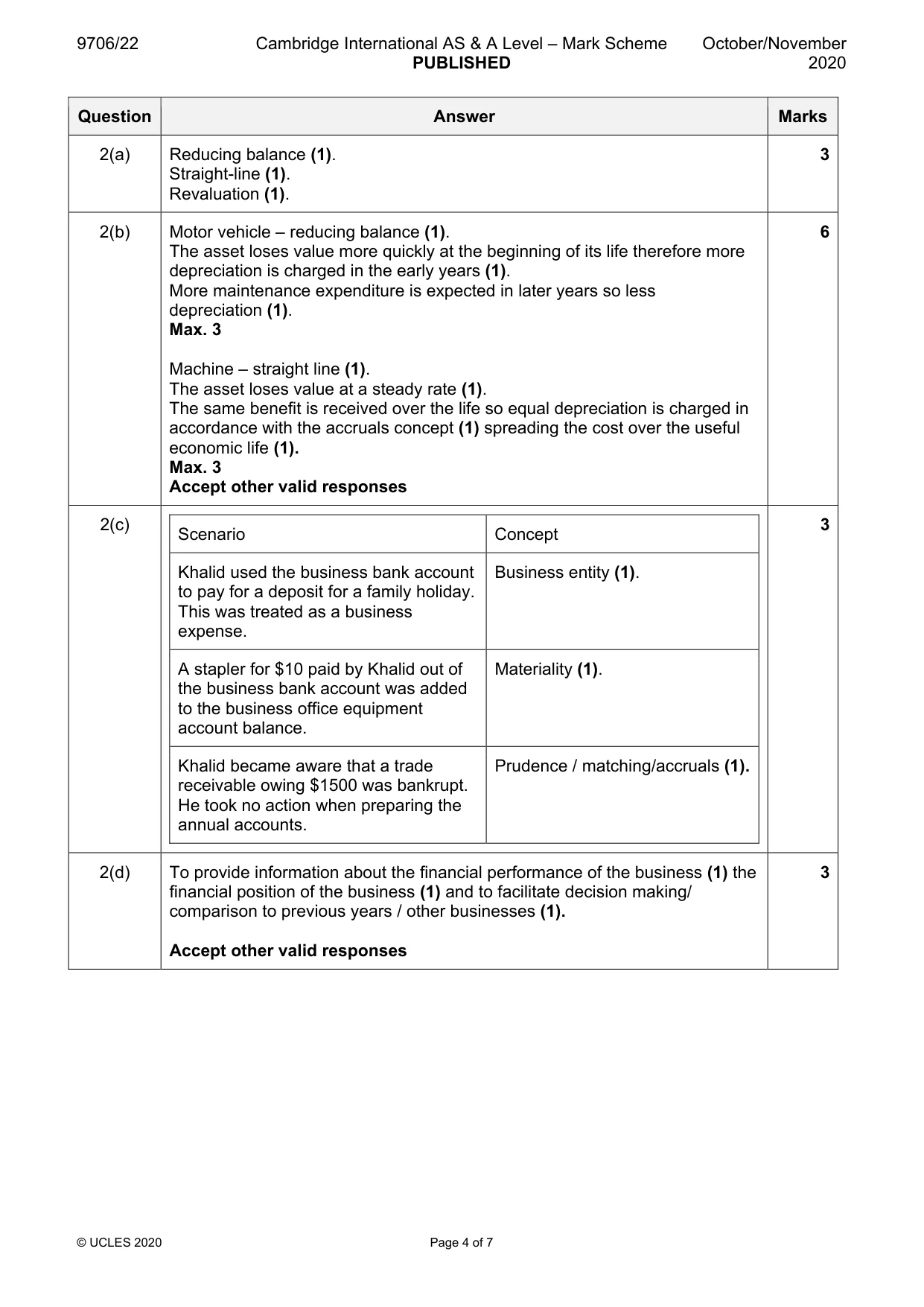
Mark scheme: 2(a) Reducing balance (1). 3 Straight-line (1). Revaluation (1). 2(b) Motor vehicle – reducing balance (1). 6 The asset loses value more quickly at the beginning of its life therefore more depreciation is charged in the early years (1). More maintenance expenditure is expected in later years so less depreciation (1). Max. 3 Machine – straight line (1). The asset loses value at a steady rate (1). The same benefit is received over the life so equal depreciation is charged in accordance with the accruals concept (1) spreading the cost over the useful economic life (1). Max. 3 Accept other valid responses 2(c) 3 Scenario Concept Khalid used the business bank account Business entity (1). to pay for a deposit for a family holiday. This was treated as a business expense. A stapler for $10 paid by Khalid out of Materiality (1). the business bank account was added to the business office equipment account balance. Khalid became aware that a trade Prudence / matching/accruals (1). receivable owing $1500 was bankrupt. He took no action when preparing the annual accounts. 2(d) To provide information about the financial performance of the business (1) the 3 financial position of the business (1) and to facilitate decision making/ comparison to previous years / other businesses (1). Accept other valid responses
Q3 · Roberto and Sangeeta have been in partnership for many years sharing profits and losses…
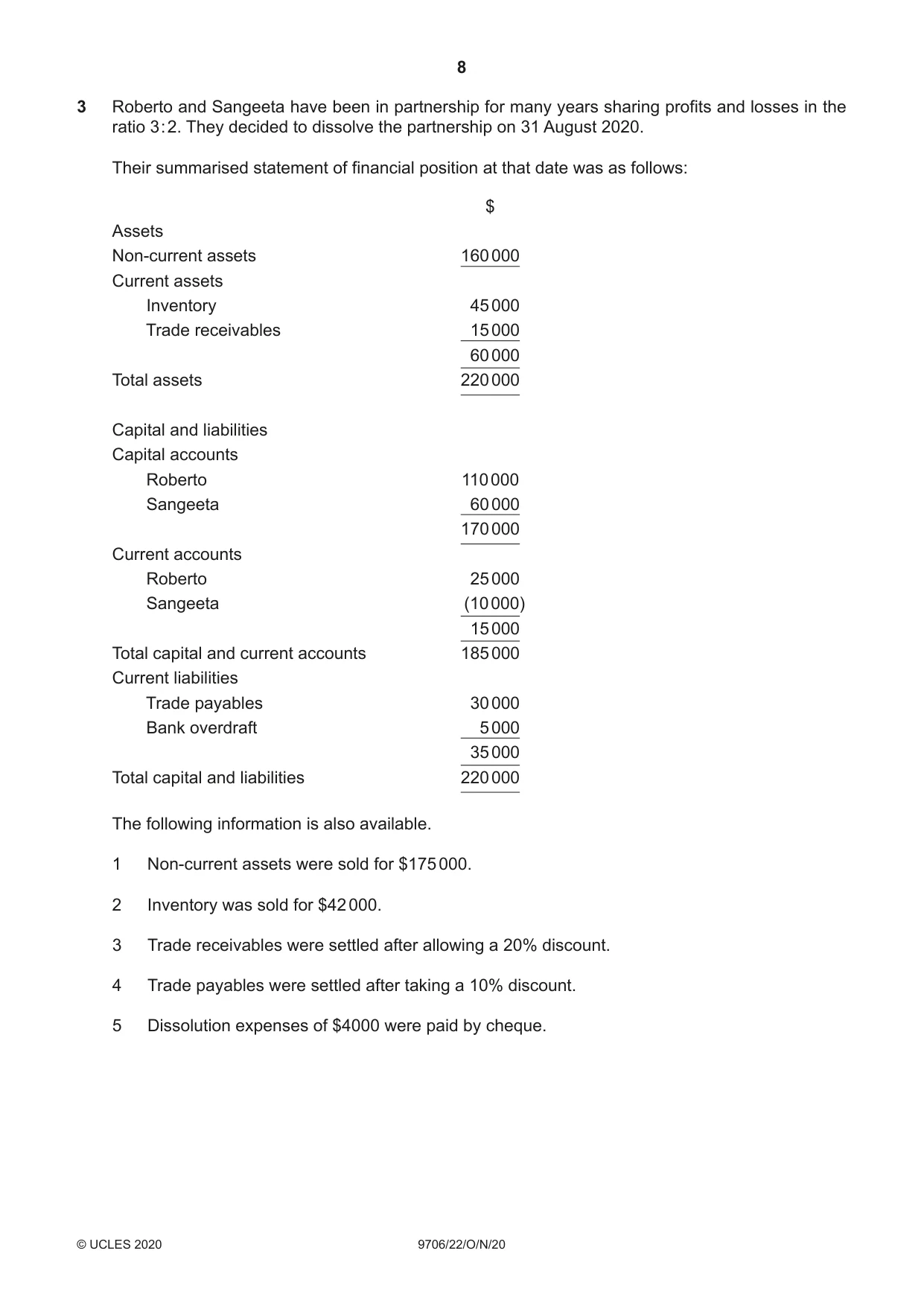
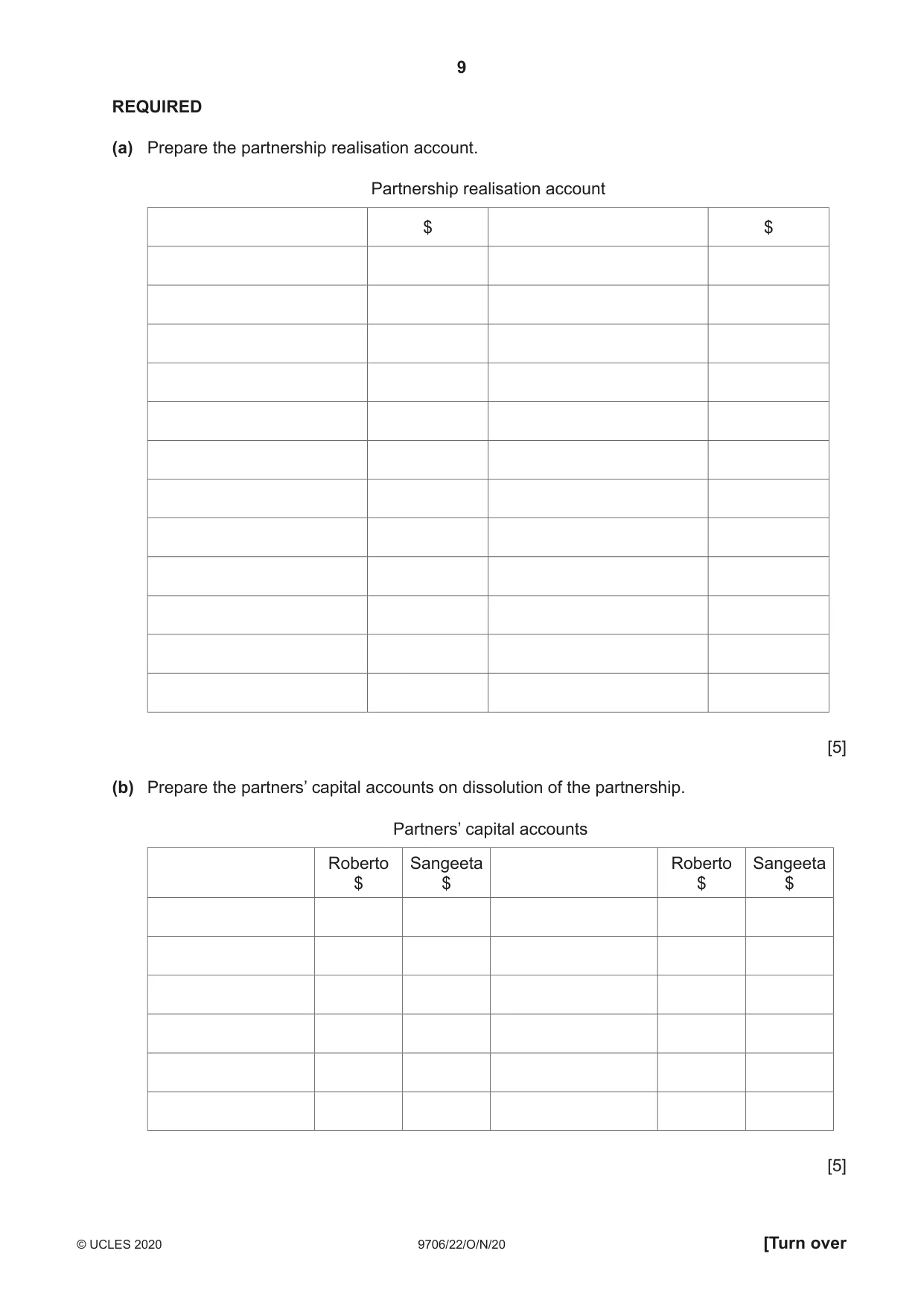
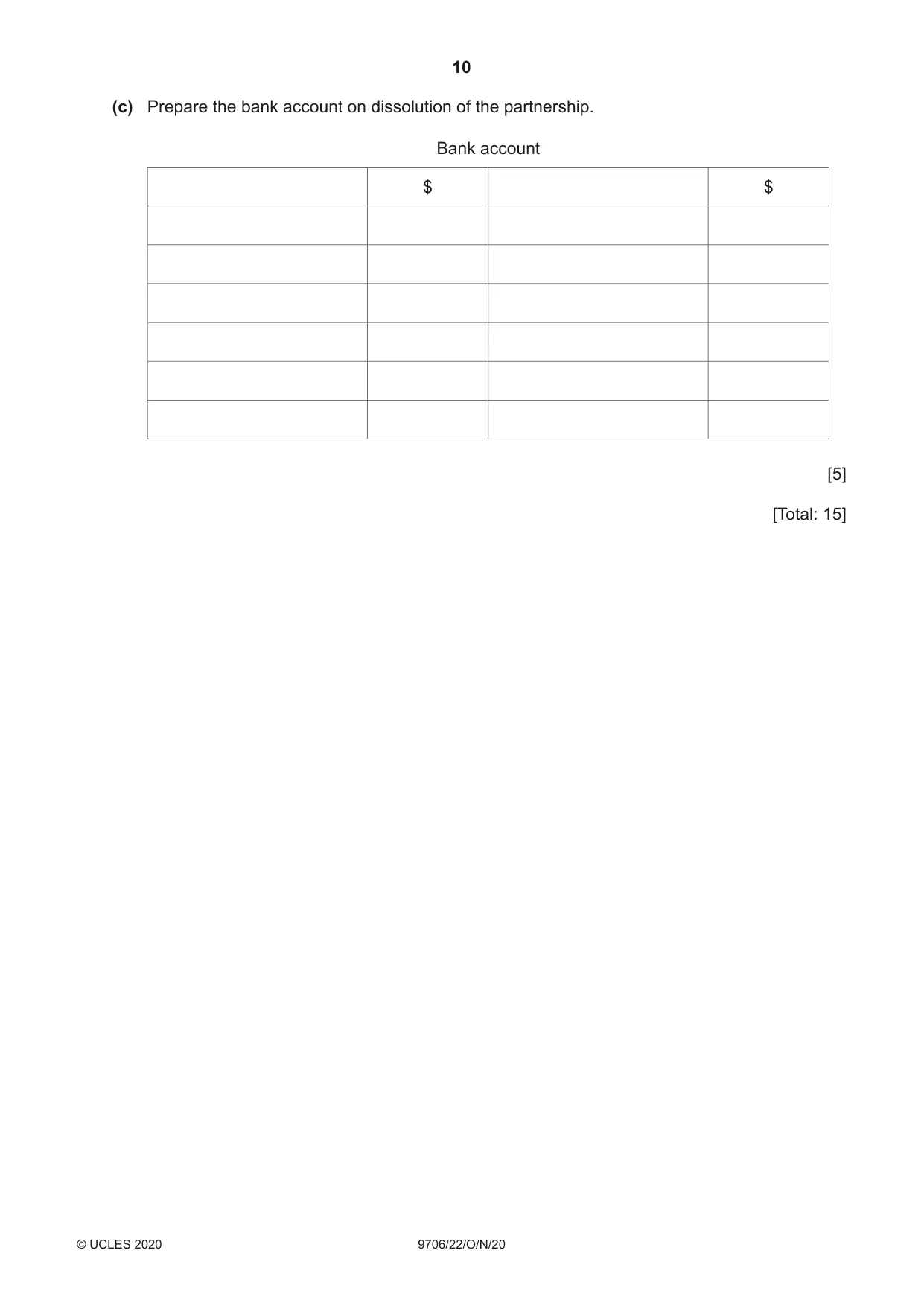
3 Roberto and Sangeeta have been in partnership for many years sharing profits and losses in the ratio 3:2. They decided to dissolve the partnership on 31 August 2020. Their summarised statement of financial position at that date was as follows: $ Assets Non-current assets 160 000 Current assets Inventory 45 000 Trade receivables 15 000 60 000 Total assets 220 000 Capital and liabilities Capital accounts Roberto 110 000 Sangeeta 60 000 170 000 Current accounts Roberto 25 000 Sangeeta (10 000) 15 000 Total capital and current accounts 185 000 Current liabilities Trade payables 30 000 Bank overdraft 5 000 35 000 Total capital and liabilities 220 000 The following information is also available. 1 Non-current assets were sold for $175 000. 2 Inventory was sold for $42 000. 3 Trade receivables were settled after allowing a 20% discount. 4 Trade payables were settled after taking a 10% discount. 5 Dissolution expenses of $4000 were paid by cheque. REQUIRED (a) Prepare the partnership realisation account. Partnership realisation account $ $ [5] (b) Prepare the partners’ capital accounts on dissolution of the partnership. Partners’ capital accounts Roberto Sangeeta Roberto Sangeeta $ $ $ $ [5] (c) Prepare the bank account on dissolution of the partnership. Bank account $ $ [5] [Total: 15]
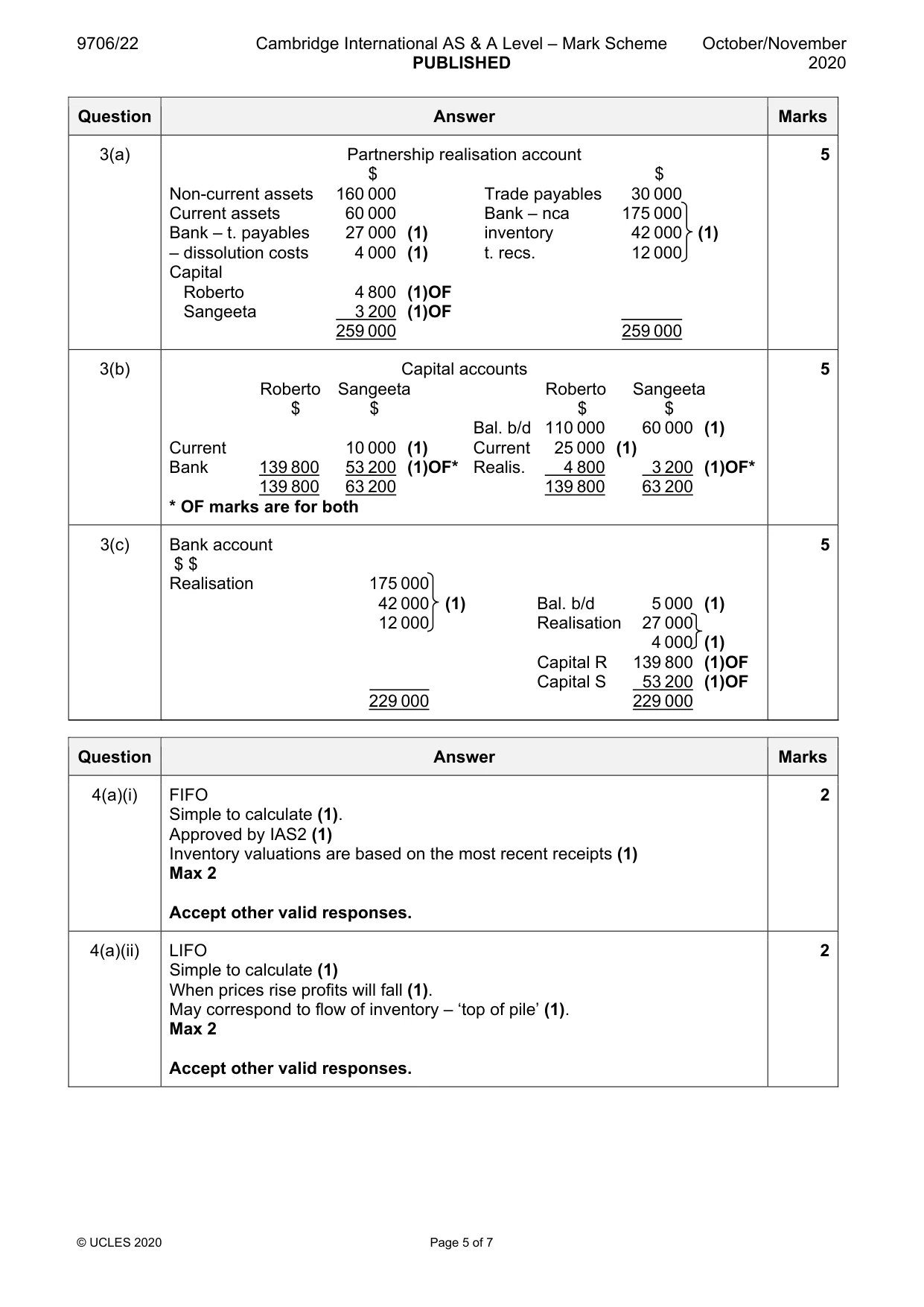
Mark scheme: 3(a) Partnership realisation account 5 $ $ Non-current assets 160 000 Trade payables 30 000 Current assets 60 000 Bank – nca 175 000 Bank – t. payables 27 000 (1) inventory 42 000 (1) – dissolution costs 4 000 (1) t. recs. 12 000 Capital Roberto 4 800 (1)OF Sangeeta 3 200 (1)OF 259 000 259 000 3(b) Capital accounts 5 Roberto Sangeeta Roberto Sangeeta $ $ $ $ Bal. b/d 110 000 60 000 (1) Current 10 000 (1) Current 25 000 (1) Bank 139 800 53 200 (1)OF* Realis. 4 800 3 200 (1)OF* 139 800 63 200 139 800 63 200 * OF marks are for both 3(c) Bank account 5 $ $ Realisation 175 000 42 000 (1) Bal. b/d 5 000 (1) 12 000 Realisation 27 000 4 000 (1) Capital R 139 800 (1)OF Capital S 53 200 (1)OF 229 000 229 000
Q4 · Kevin runs a small manufacturing business
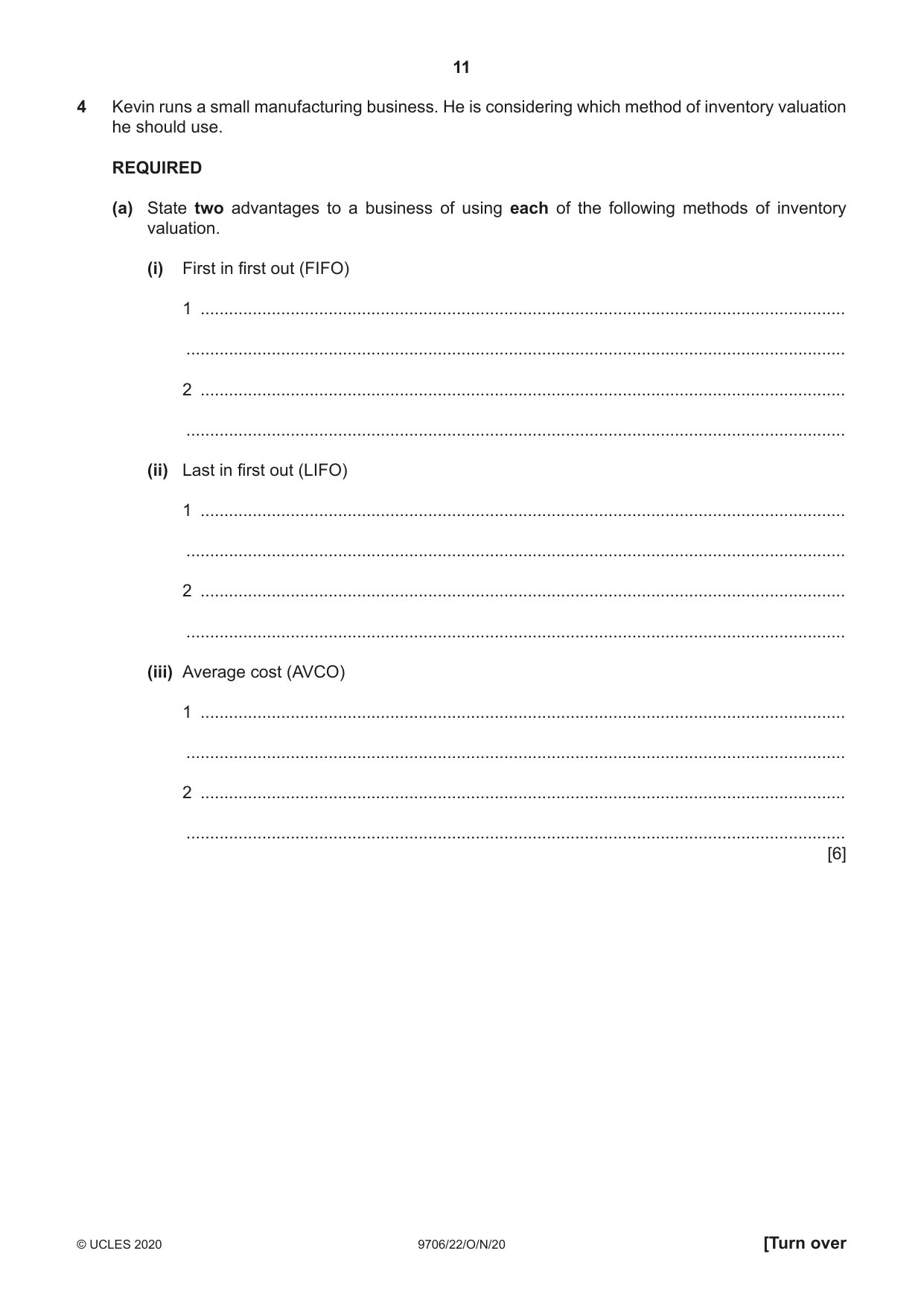
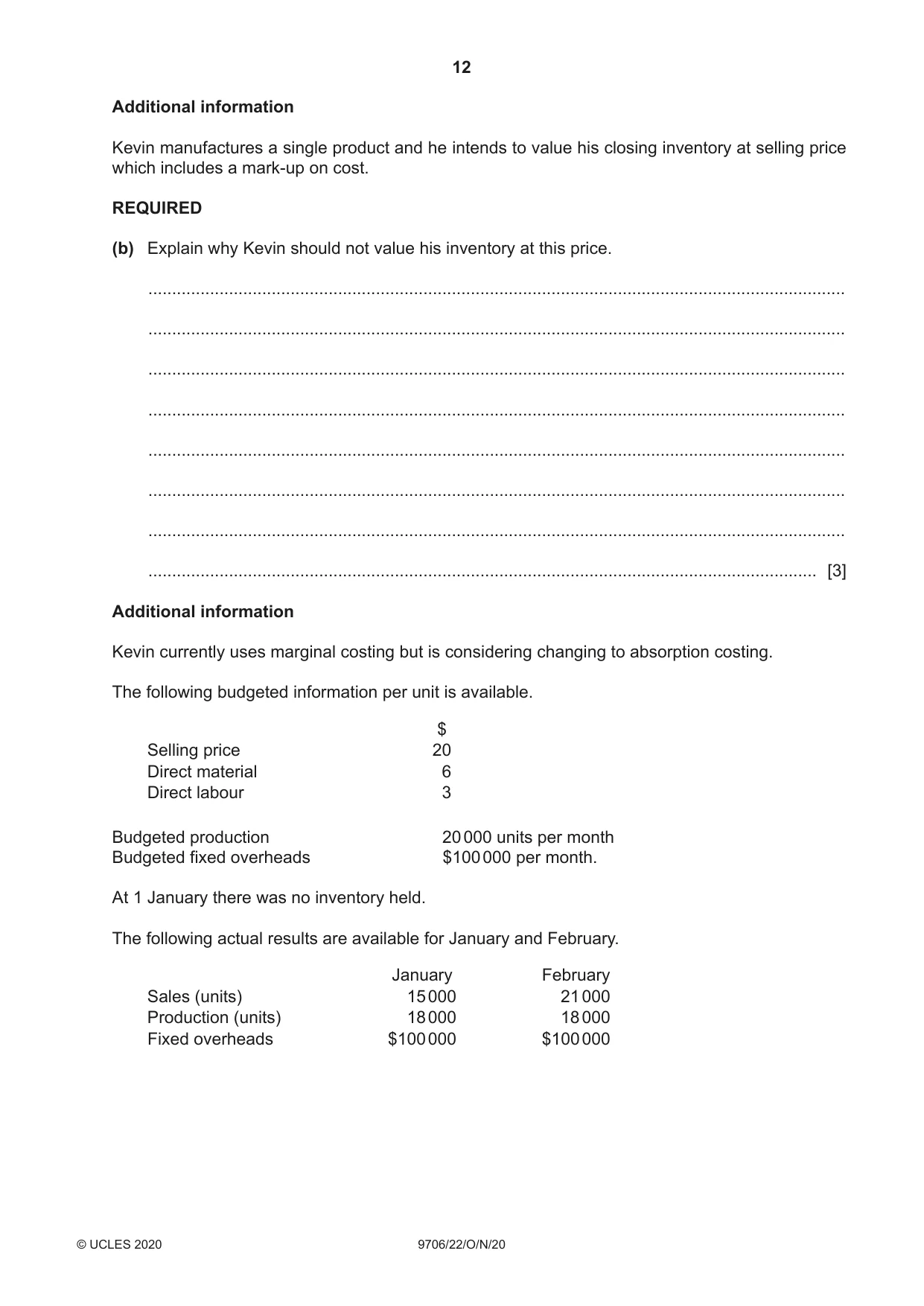
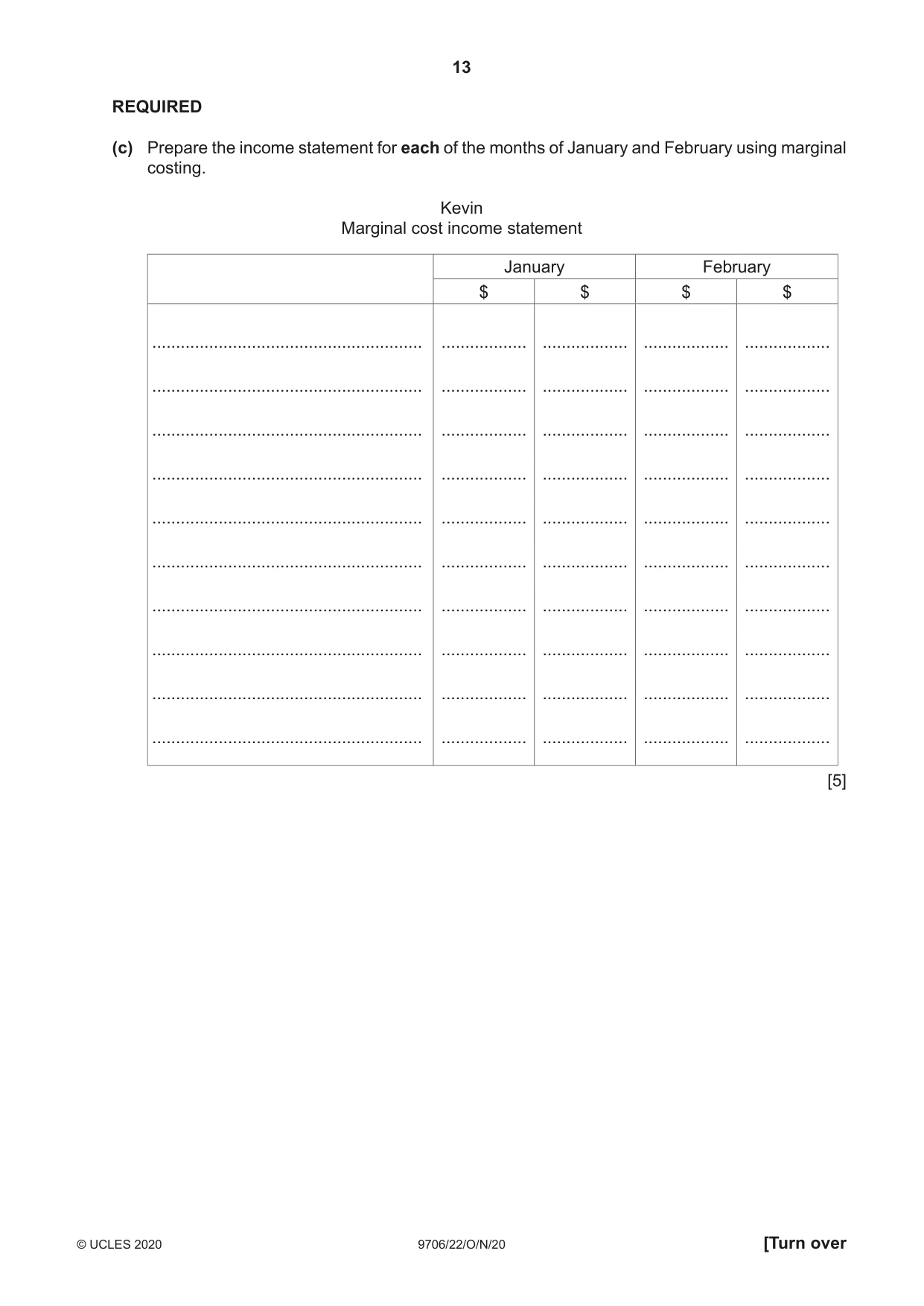
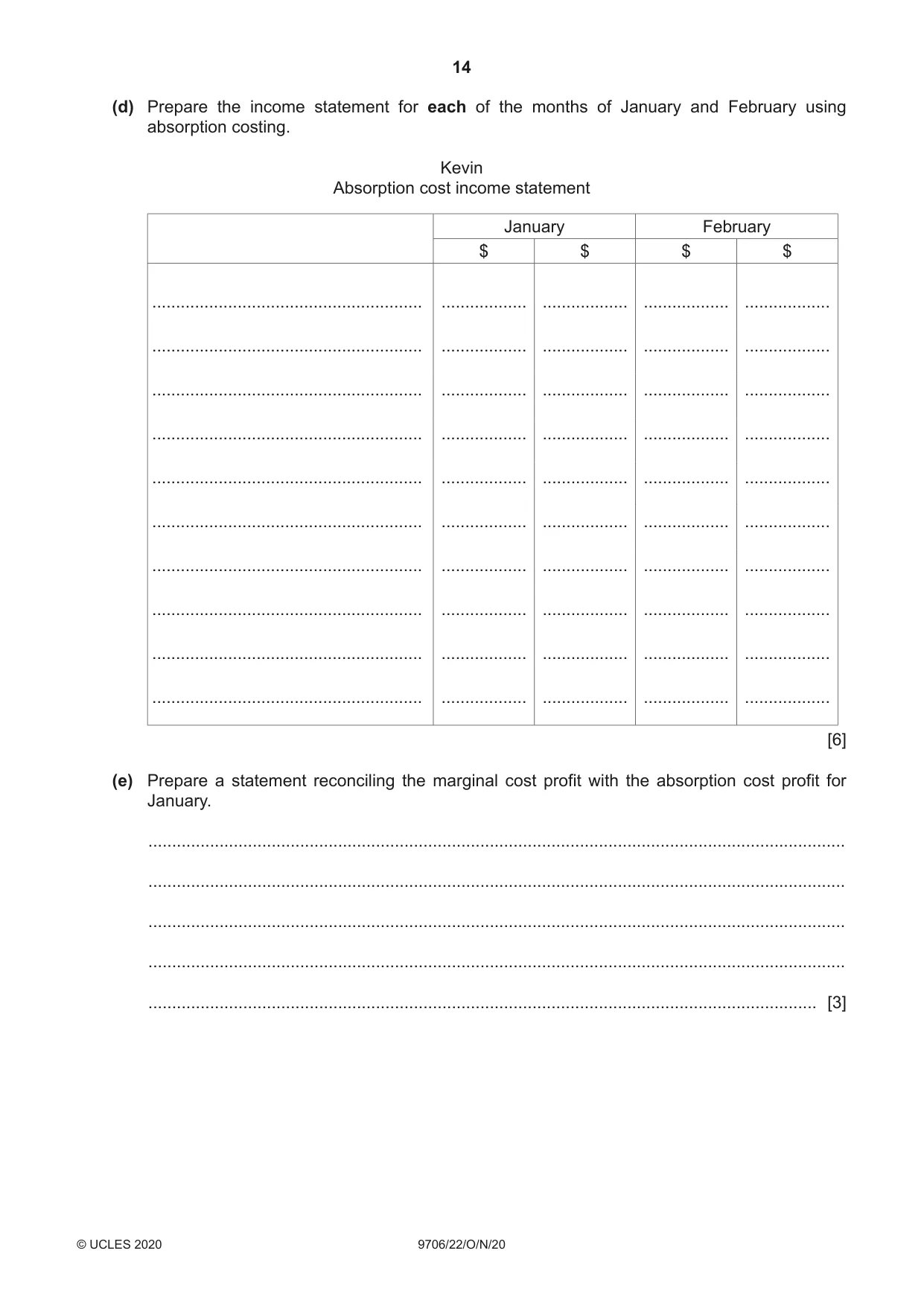
4 Kevin runs a small manufacturing business. He is considering which method of inventory valuation he should use. REQUIRED (a) State two advantages to a business of using each of the following methods of inventory valuation. (i) First in first out (FIFO) 1 ........................................................................................................................................ ........................................................................................................................................... 2 ........................................................................................................................................ ........................................................................................................................................... (ii) Last in first out (LIFO) 1 ........................................................................................................................................ ........................................................................................................................................... 2 ........................................................................................................................................ ........................................................................................................................................... (iii) Average cost (AVCO) 1 ........................................................................................................................................ ........................................................................................................................................... 2 ........................................................................................................................................ ........................................................................................................................................... [6] Additional information Kevin manufactures a single product and he intends to value his closing inventory at selling price which includes a mark-up on cost. REQUIRED (b) Explain why Kevin should not value his inventory at this price. ................................................................................................................................................... ................................................................................................................................................... ................................................................................................................................................... ................................................................................................................................................... ................................................................................................................................................... ................................................................................................................................................... ................................................................................................................................................... ............................................................................................................................................. [3] Additional information Kevin currently uses marginal costing but is considering changing to absorption costing. The following budgeted information per unit is available. $ Selling price 20 Direct material 6 Direct labour 3 Budgeted production 20 000 units per month Budgeted fixed overheads $100 000 per month. At 1 January there was no inventory held. The following actual results are available for January and February. January February Sales (units) 15 000 21 000 Production (units) 18 000 18 000 Fixed overheads $100 000 $100 000 REQUIRED (c) Prepare the income statement for each of the months of January and February using marginal costing. Kevin Marginal cost income statement January February $ $ $ $ ......................................................... .................. .................. .................. .................. ......................................................... .................. .................. .................. .................. ......................................................... .................. .................. .................. .................. ......................................................... .................. .................. .................. .................. ......................................................... .................. .................. .................. .................. ......................................................... .................. .................. .................. .................. ......................................................... .................. .................. .................. .................. ......................................................... .................. .................. .................. .................. ......................................................... .................. .................. .................. .................. ......................................................... .................. .................. .................. .................. [5]
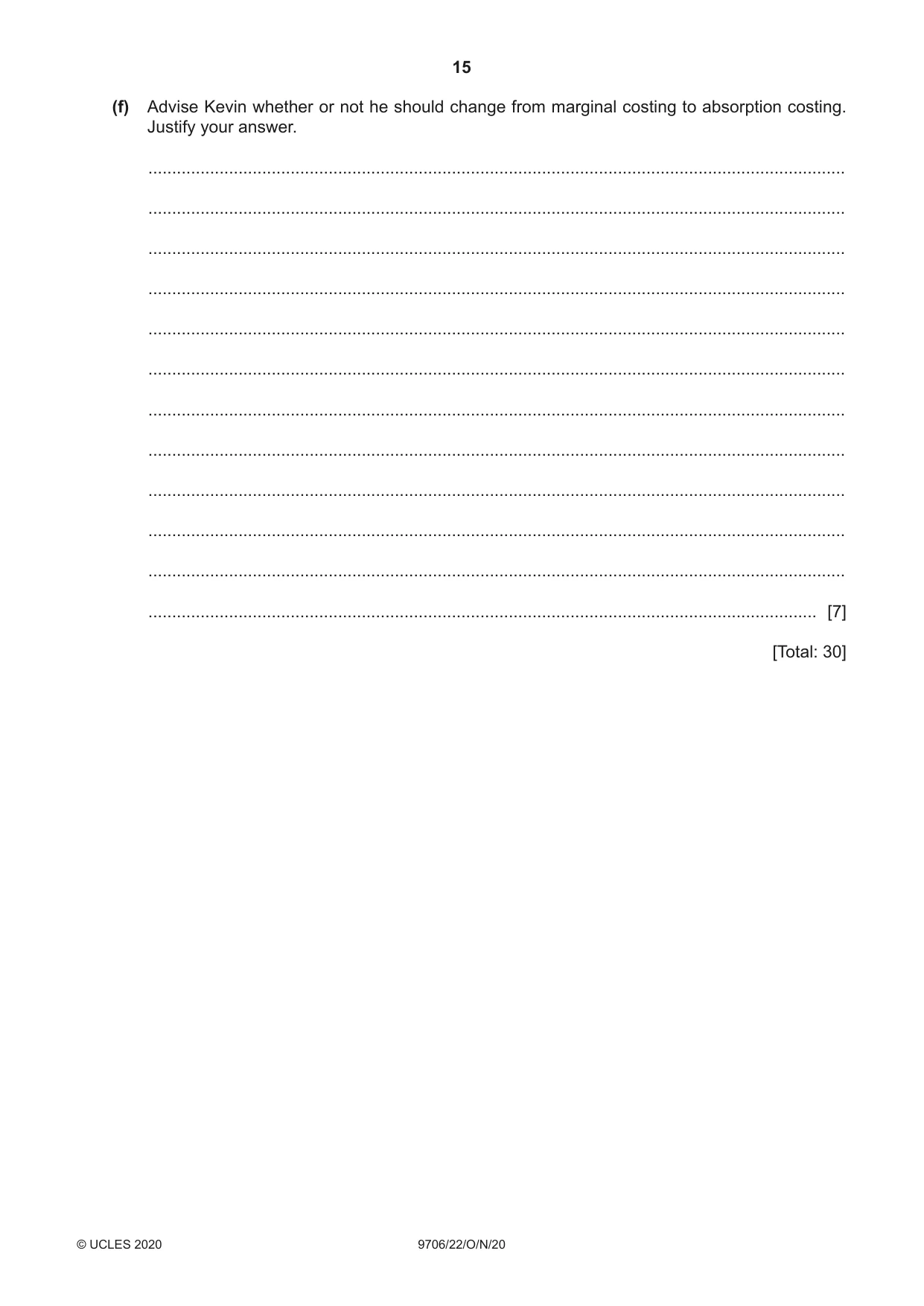
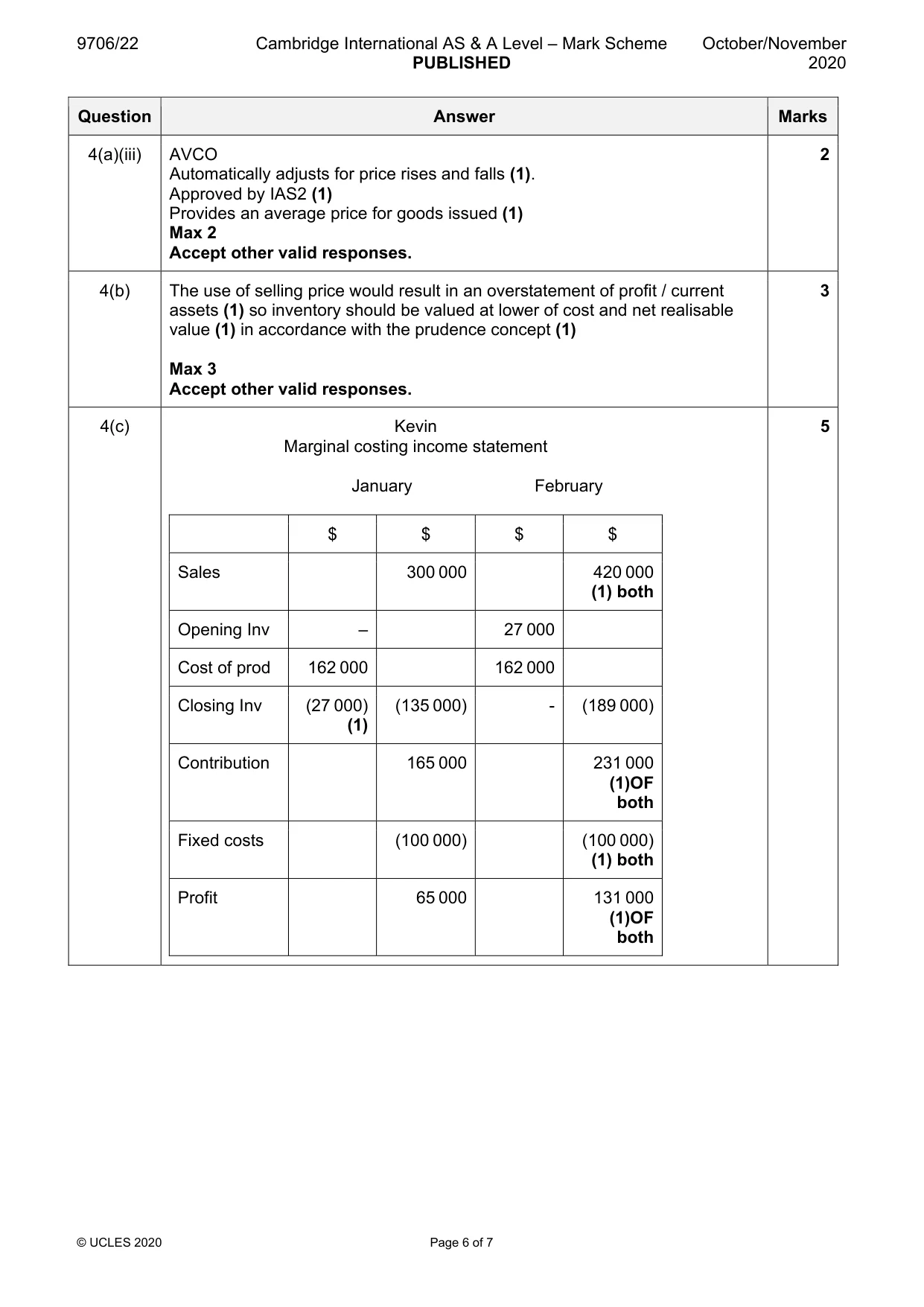
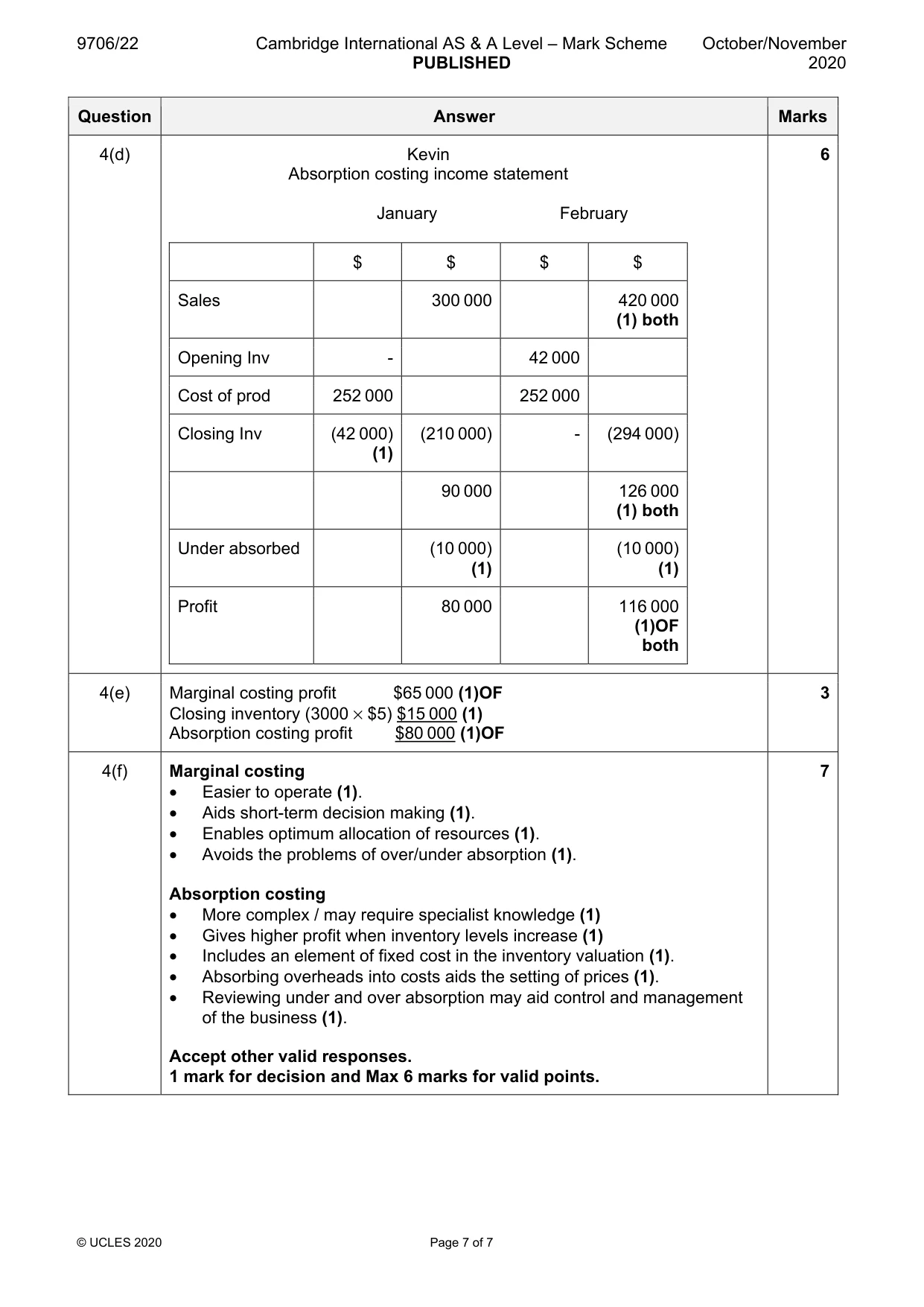
Mark scheme: 4(a)(i) FIFO 2 Simple to calculate (1). Approved by IAS2 (1) Inventory valuations are based on the most recent receipts (1) Max 2 Accept other valid responses. 4(a)(ii) LIFO 2 Simple to calculate (1) When prices rise profits will fall (1). May correspond to flow of inventory – ‘top of pile’ (1). Max 2 Accept other valid responses. 4(a)(iii) AVCO 2 Automatically adjusts for price rises and falls (1). Approved by IAS2 (1) Provides an average price for goods issued (1) Max 2 Accept other valid responses. 4(b) The use of selling price would result in an overstatement of profit / current 3 assets (1) so inventory should be valued at lower of cost and net realisable value (1) in accordance with the prudence concept (1) Max 3 Accept other valid responses. 4(c) Kevin 5 Marginal costing income statement January February $ $ $ $ Sales 300 000 420 000 (1) both Opening Inv – 27 000 Cost of prod 162 000 162 000 Closing Inv (27 000) (135 000) - (189 000) (1) Contribution 165 000 231 000 (1)OF both Fixed costs (100 000) (100 000) (1) both Profit 65 000 131 000 (1)OF both 4(d) Kevin 6 Absorption costing income statement January February $ $ $ $ Sales 300 000 420 000 (1) both Opening Inv - 42 000 Cost of prod 252 000 252 000 Closing Inv (42 000) (210 000) - (294 000) (1) 90 000 126 000 (1) both Under absorbed (10 000) (10 000) (1) (1) Profit 80 000 116 000 (1)OF both 4(e) Marginal costing profit $65 000 (1)OF 3 Closing inventory (3000 × $5) $15 000 (1) Absorption costing profit $80 000 (1)OF 4(f) Marginal costing 7 • Easier to operate (1). • Aids short-term decision making (1). • Enables optimum allocation of resources (1). • Avoids the problems of over/under absorption (1). Absorption costing • More complex / may require specialist knowledge (1) • Gives higher profit when inventory levels increase (1) • Includes an element of fixed cost in the inventory valuation (1). • Absorbing overheads into costs aids the setting of prices (1). • Reviewing under and over absorption may aid control and management of the business (1). Accept other valid responses. 1 mark for decision and Max 6 marks for valid points.
What was in this paper
The subtopics covered by these 4 questions, and how many questions each got. Open one in a new tab to see every Cambridge question on it.
What you needed in this session
Cambridge’s own grade thresholds for 2020 Oct/Nov, Paper 2 · Variant 2. A higher threshold means an easier paper — the bar moves with how the cohort did.