Cambridge A Level Accounting 9706 — 2019 Oct/Nov Paper 2 · Variant 2
9706/22/O/N/19 · 90 marks · ≈101 min
The question paper and its mark scheme, free to read here and free to download. This is Cambridge’s own paper, exactly as it was sat.
Question paper20 pages


Mark scheme15 pages
Answers below. Sit the paper first if you are practising.
Paper as text
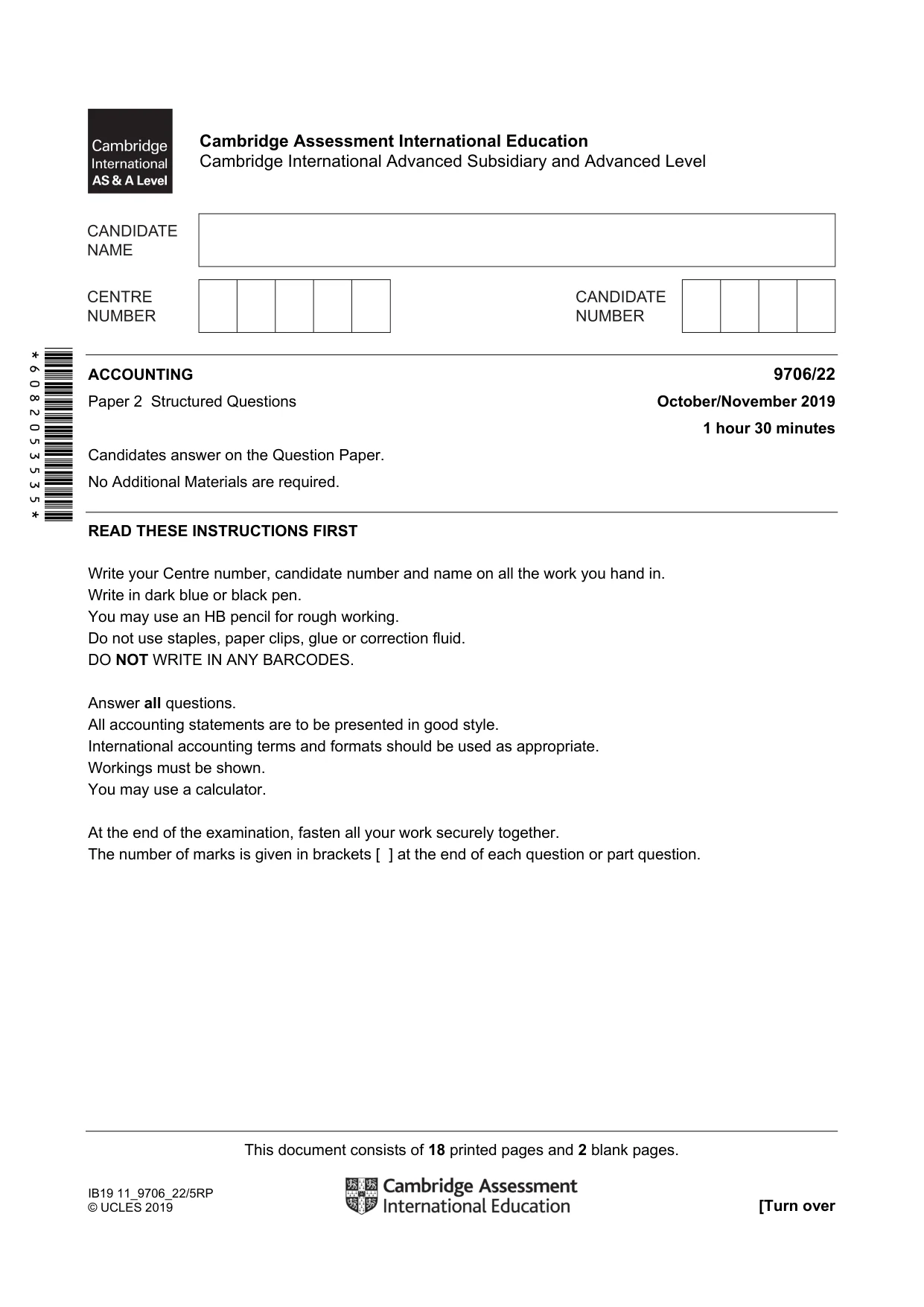
Question paper, page 1
This document consists of 18 printed pages and 2 blank pages. IB19 11_9706_22/5RP © UCLES 2019 [Turn over Cambridge Assessment International Education Cambridge International Advanced Subsidiary and Advanced Level ACCOUNTING 9706/22 Paper 2 Structured Questions October/November 2019 1 hour 30 minutes Candidates answer on the Question Paper. No Additional Materials are required. READ THESE INSTRUCTIONS FIRST Write your Centre number, candidate number and name on all the work you hand in. Write in dark blue or black pen. You may use an HB pencil for rough working. Do not use staples, paper clips, glue or correction fluid. DO NOT WRITE IN ANY BARCODES. Answer all questions. All accounting statements are to be presented in good style. International accounting terms and formats should be used as appropriate. Workings must be shown. You may use a calculator. At the end of the examination, fasten all your work securely together. The number of marks is given in brackets [ ] at the end of each question or part question.
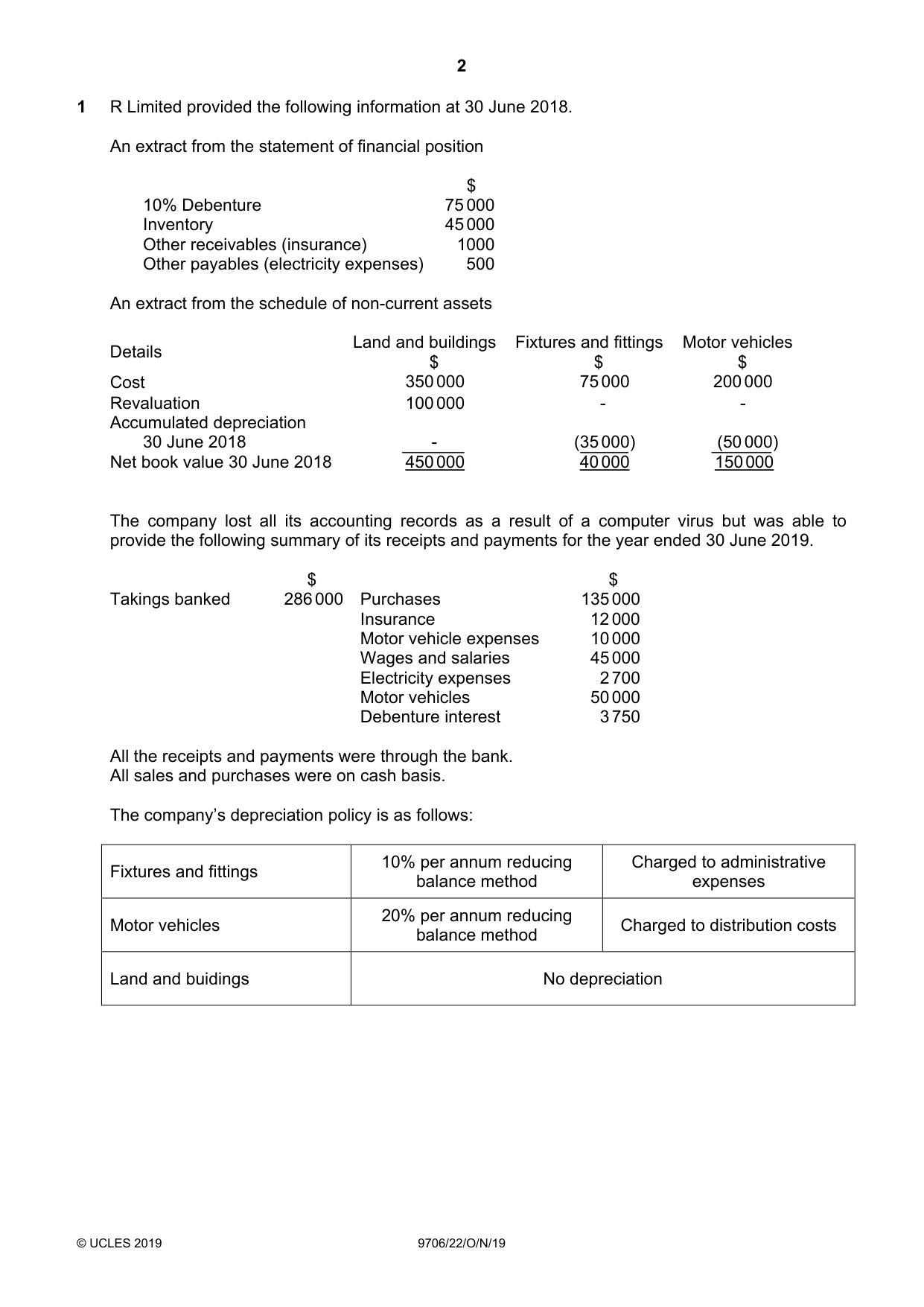
Question paper, page 2
2 © UCLES 2019 9706/22/O/N/19 1 R Limited provided the following information at 30 June 2018. An extract from the statement of financial position $ 10% Debenture 75 000 Inventory 45 000 Other receivables (insurance) 1000 Other payables (electricity expenses) 500 An extract from the schedule of non-current assets Details Land and buildings $ Fixtures and fittings $ Motor vehicles $ Cost 350 000 75 000 200 000 Revaluation 100 000 - - Accumulated depreciation 30 June 2018 - (35 000) (50 000) Net book value 30 June 2018 450 000 40 000 150 000 The company lost all its accounting records as a result of a computer virus but was able to provide the following summary of its receipts and payments for the year ended 30 June 2019. $ $ Takings banked 286 000 Purchases 135 000 Insurance 12 000 Motor vehicle expenses 10 000 Wages and salaries 45 000 Electricity expenses 2 700 Motor vehicles 50 000 Debenture interest 3 750 All the receipts and payments were through the bank. All sales and purchases were on cash basis. The company’s depreciation policy is as follows: Fixtures and fittings 10% per annum reducing balance method Charged to administrative expenses Motor vehicles 20% per annum reducing balance method Charged to distribution costs Land and buidings No depreciation
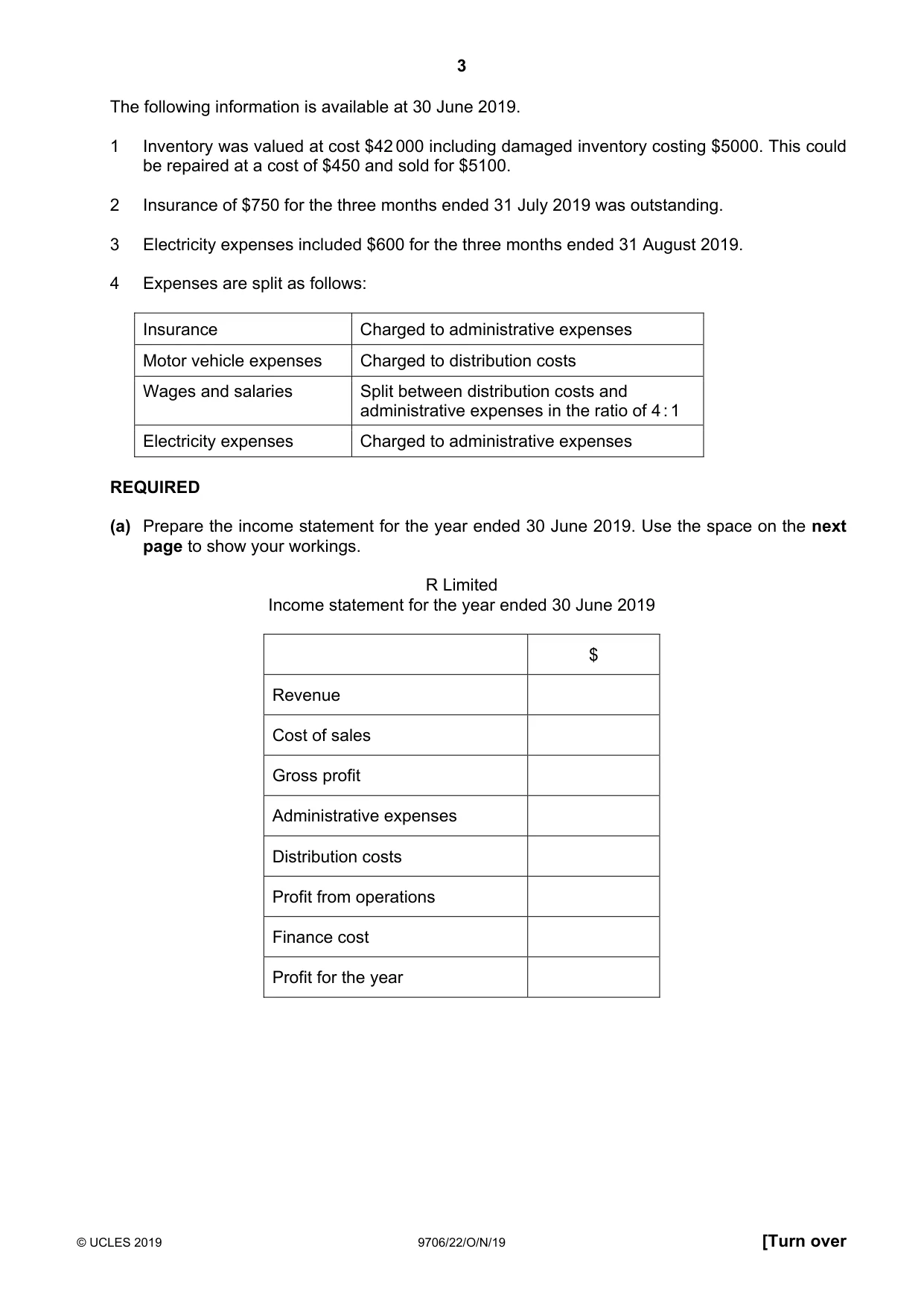
Question paper, page 3
3 © UCLES 2019 9706/22/O/N/19 [Turn over The following information is available at 30 June 2019. 1 Inventory was valued at cost $42 000 including damaged inventory costing $5000. This could be repaired at a cost of $450 and sold for $5100. 2 Insurance of $750 for the three months ended 31 July 2019 was outstanding. 3 Electricity expenses included $600 for the three months ended 31 August 2019. 4 Expenses are split as follows: Insurance Charged to administrative expenses Motor vehicle expenses Charged to distribution costs Wages and salaries Split between distribution costs and administrative expenses in the ratio of 4 : 1 Electricity expenses Charged to administrative expenses REQUIRED (a) Prepare the income statement for the year ended 30 June 2019. Use the space on the next page to show your workings. R Limited Income statement for the year ended 30 June 2019 $ Revenue Cost of sales Gross profit Administrative expenses Distribution costs Profit from operations Finance cost Profit for the year
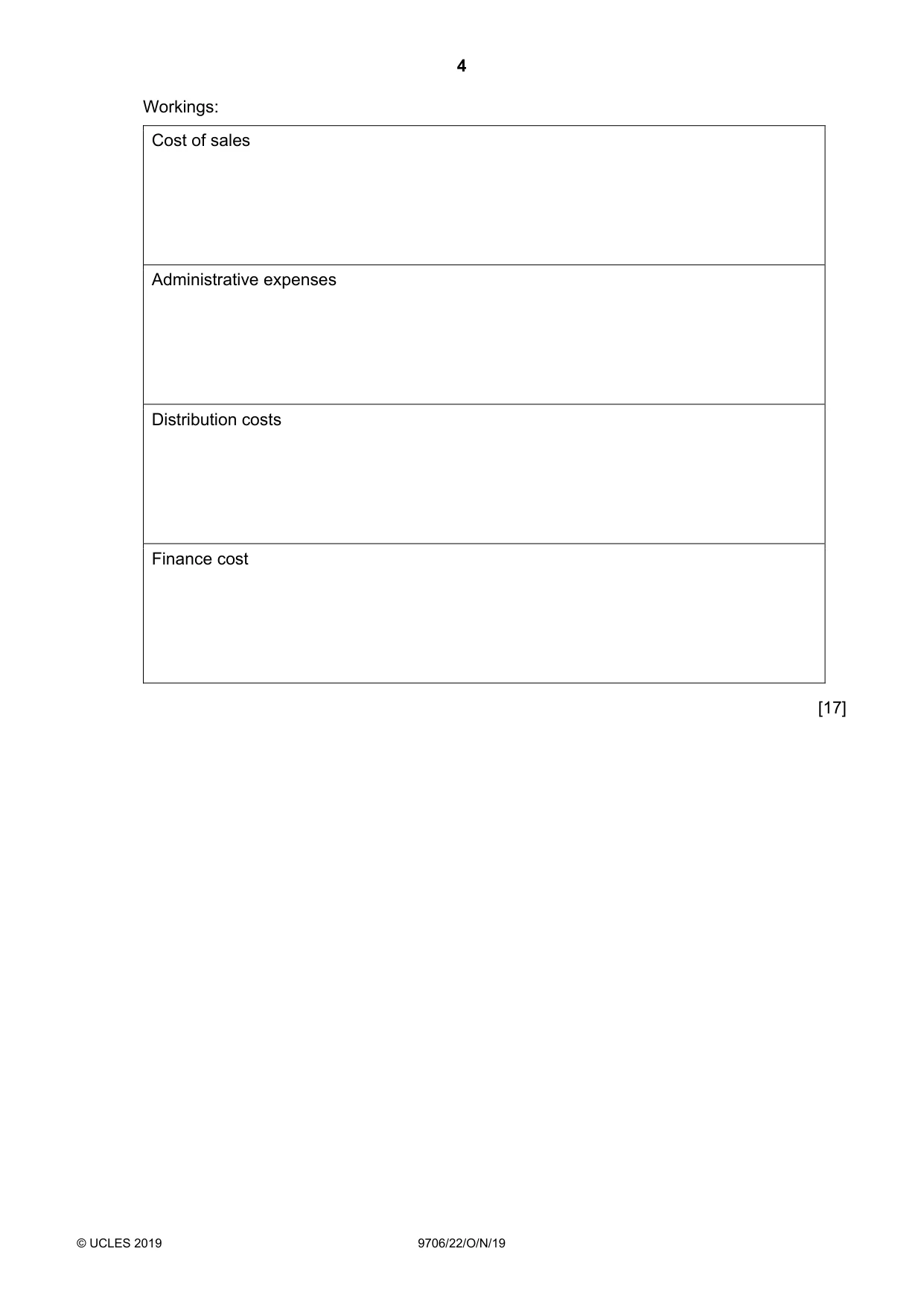
Question paper, page 4
4 © UCLES 2019 9706/22/O/N/19 Workings: Cost of sales Administrative expenses Distribution costs Finance cost [17]
Question paper, page 5
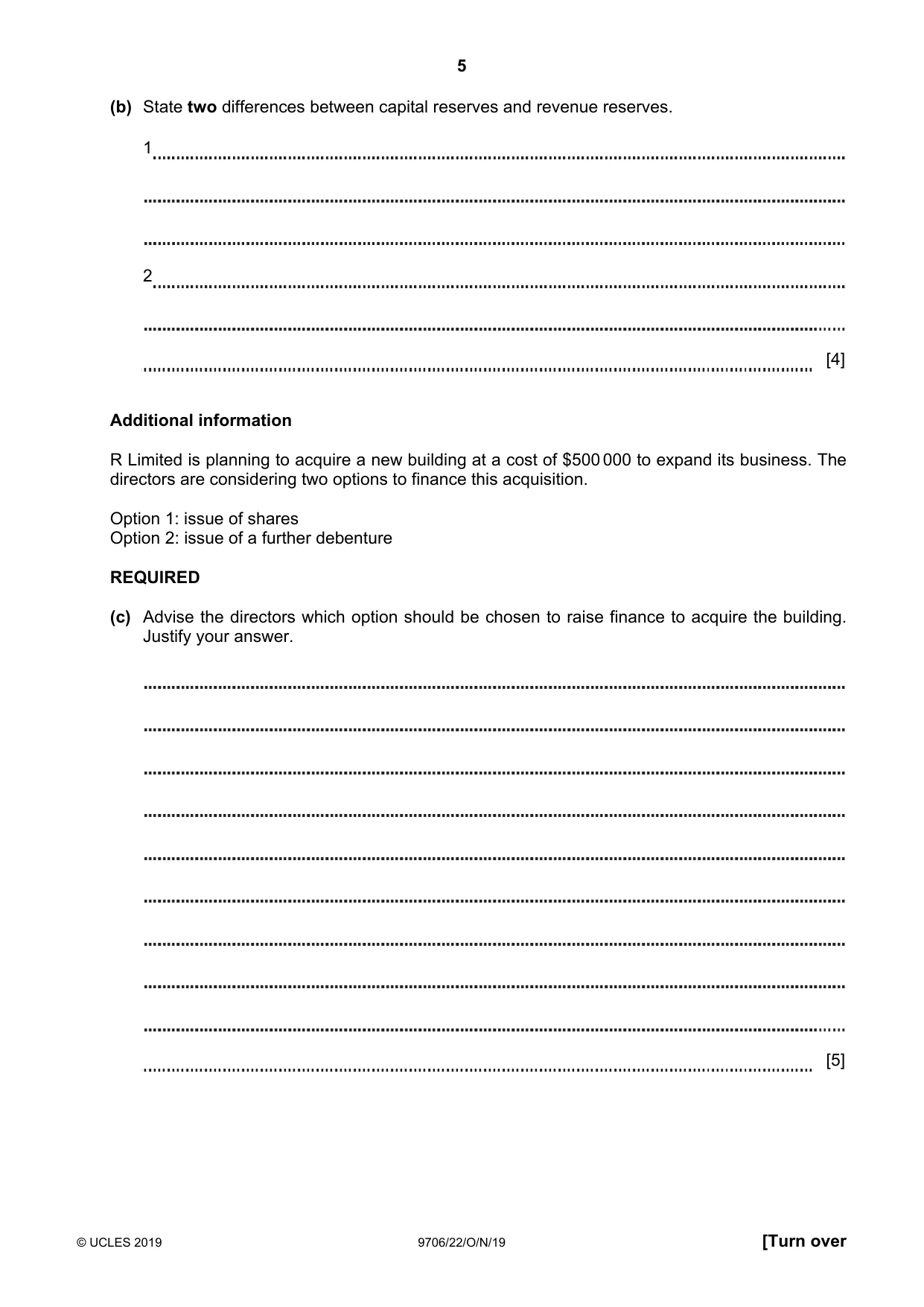
5 © UCLES 2019 9706/22/O/N/19 [Turn over (b) State two differences between capital reserves and revenue reserves. 1 2 [4] Additional information R Limited is planning to acquire a new building at a cost of $500 000 to expand its business. The directors are considering two options to finance this acquisition. Option 1: issue of shares Option 2: issue of a further debenture REQUIRED (c) Advise the directors which option should be chosen to raise finance to acquire the building. Justify your answer. [5]
Question paper, page 6
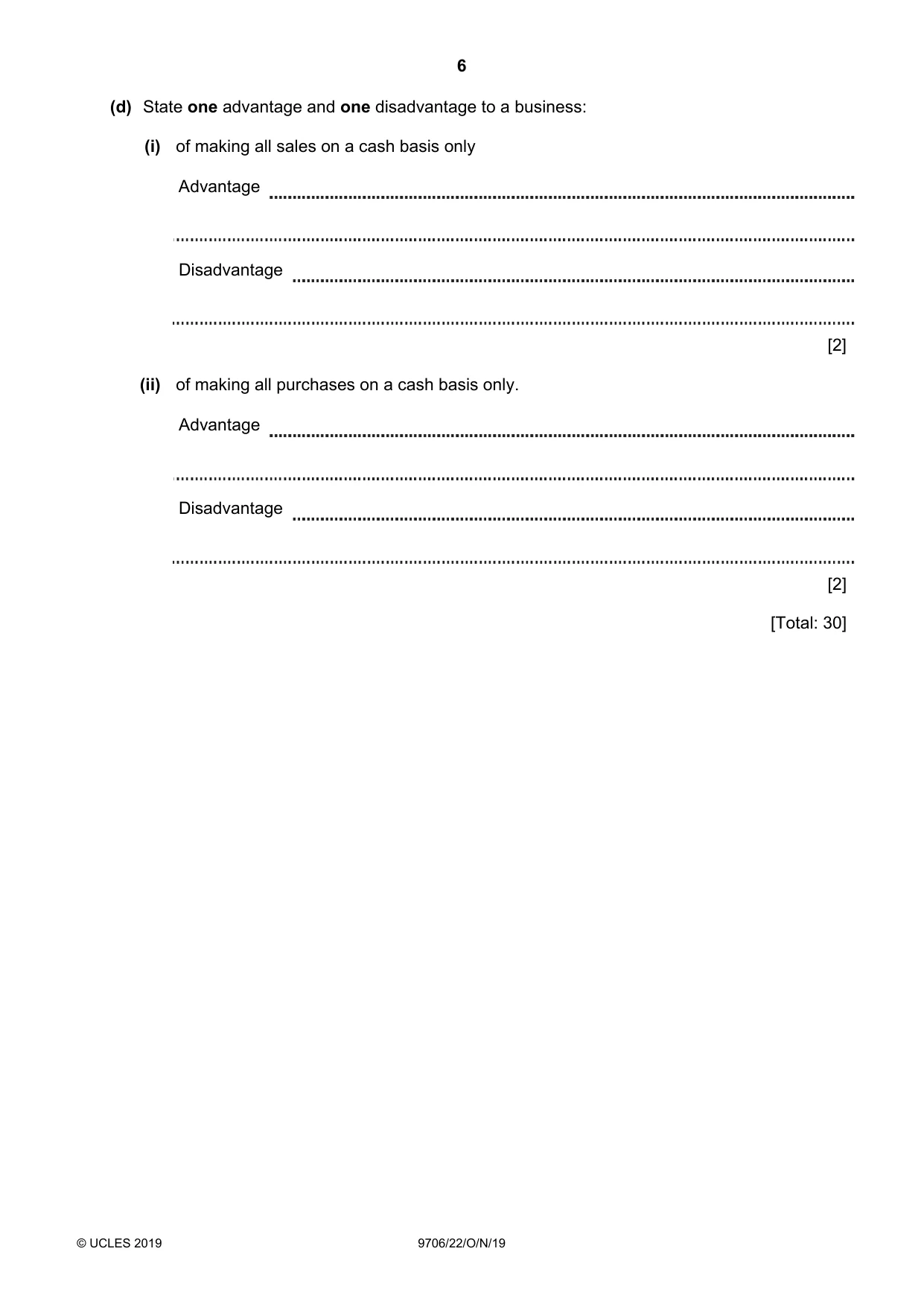
6 © UCLES 2019 9706/22/O/N/19 (d) State one advantage and one disadvantage to a business: (i) of making all sales on a cash basis only Advantage Disadvantage [2] (ii) of making all purchases on a cash basis only. Advantage Disadvantage [2] [Total: 30]
Question paper, page 7
7 © UCLES 2019 9706/22/O/N/19 [Turn over PLEASE TURN OVER
Question paper, page 8
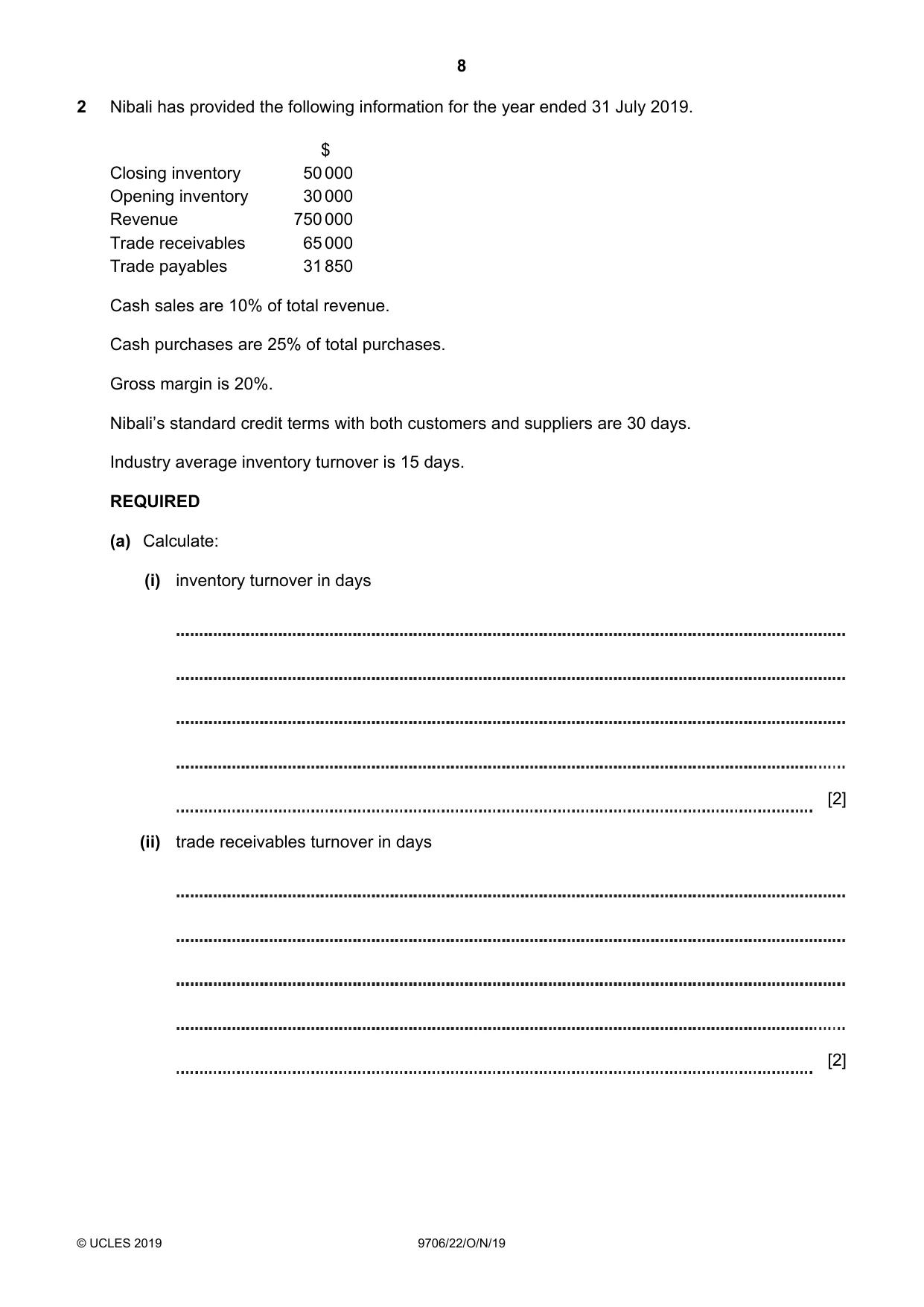
8 © UCLES 2019 9706/22/O/N/19 2 Nibali has provided the following information for the year ended 31 July 2019. $ Closing inventory 50 000 Opening inventory 30 000 Revenue 750 000 Trade receivables 65 000 Trade payables 31 850 Cash sales are 10% of total revenue. Cash purchases are 25% of total purchases. Gross margin is 20%. Nibali’s standard credit terms with both customers and suppliers are 30 days. Industry average inventory turnover is 15 days. REQUIRED (a) Calculate: (i) inventory turnover in days [2] (ii) trade receivables turnover in days [2]
Question paper, page 9
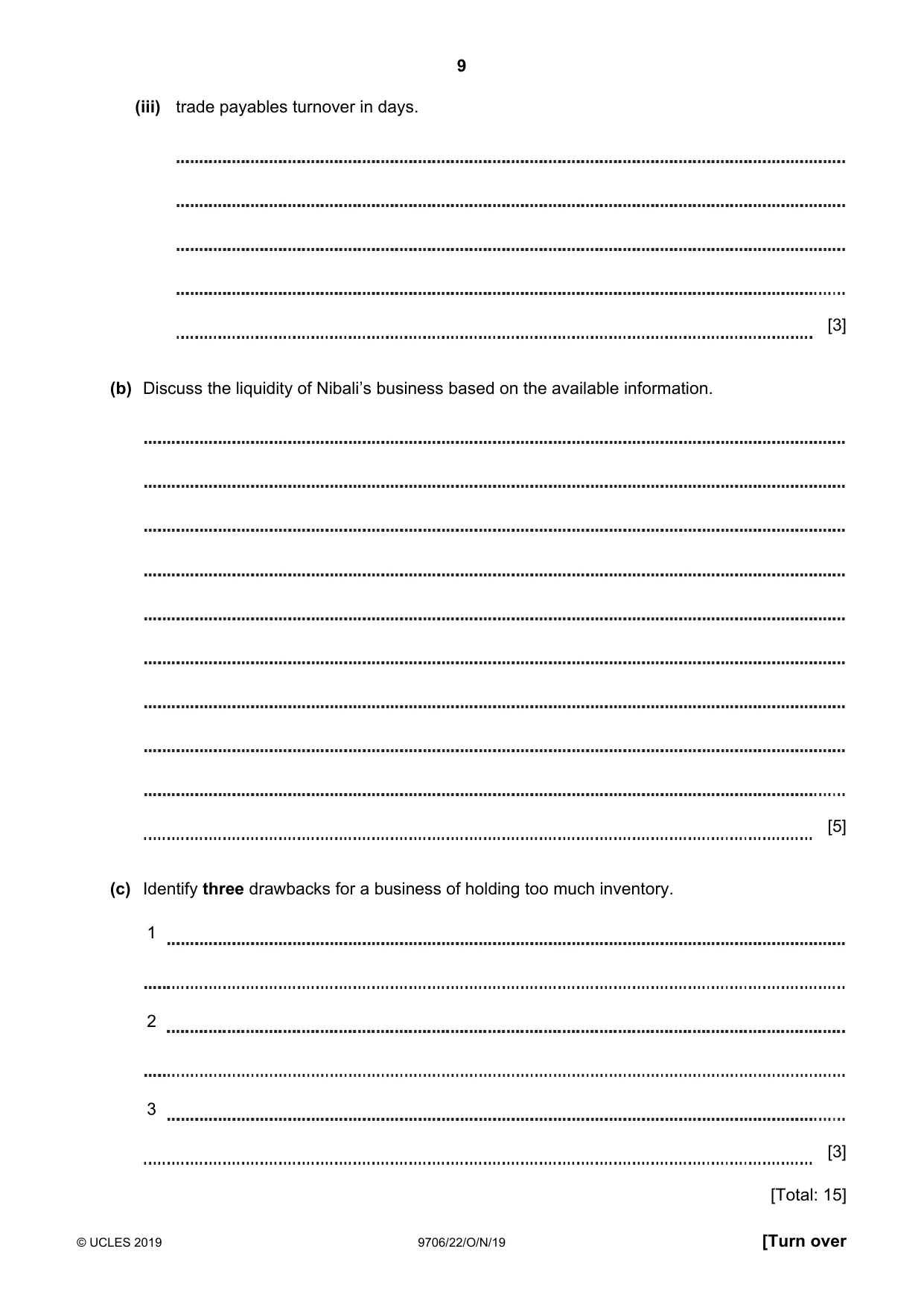
9 © UCLES 2019 9706/22/O/N/19 [Turn over (iii) trade payables turnover in days. [3] (b) Discuss the liquidity of Nibali’s business based on the available information. [5] (c) Identify three drawbacks for a business of holding too much inventory. 1 2 3 [3] [Total: 15]
Question paper, page 10
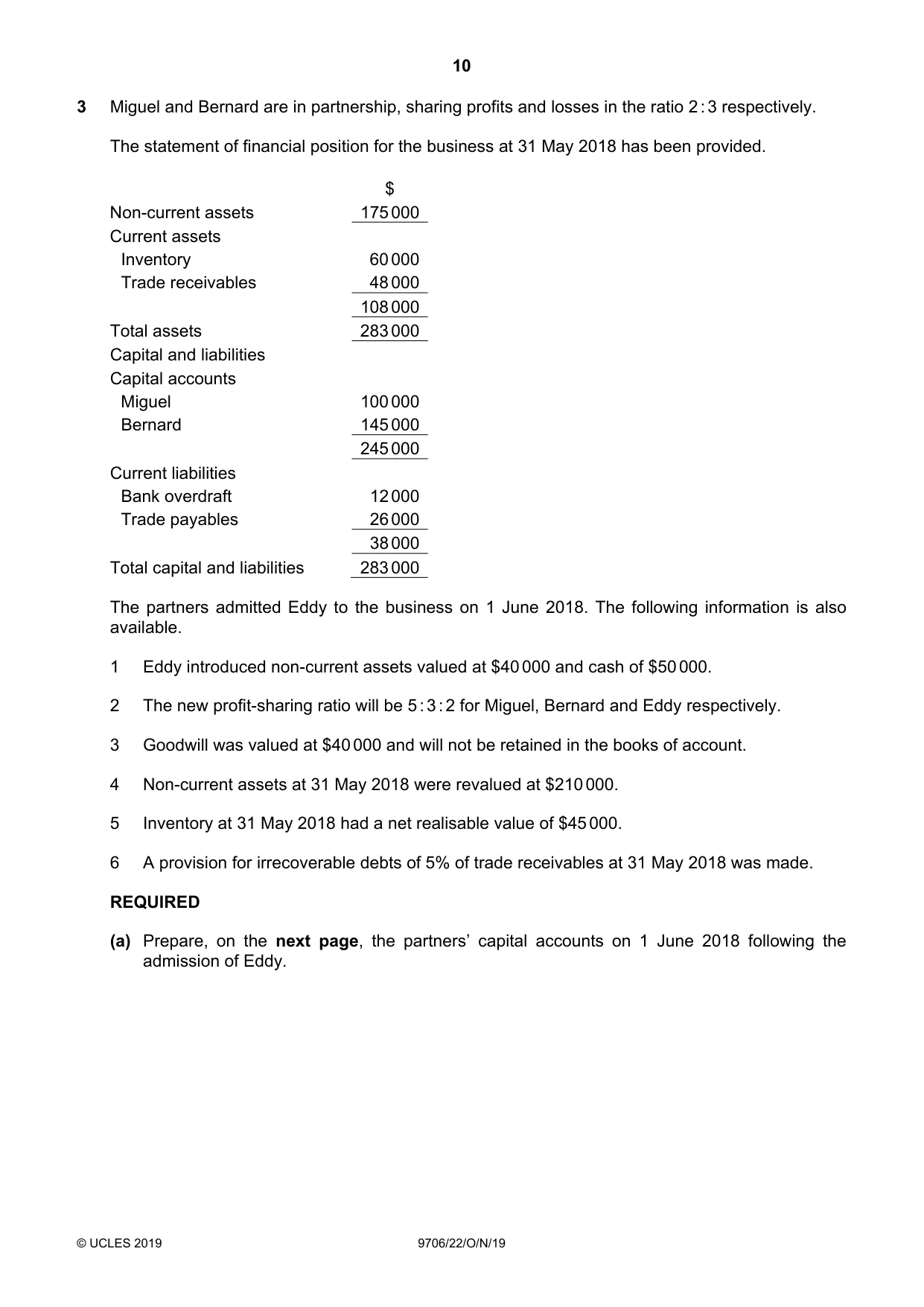
10 © UCLES 2019 9706/22/O/N/19 3 Miguel and Bernard are in partnership, sharing profits and losses in the ratio 2 : 3 respectively. The statement of financial position for the business at 31 May 2018 has been provided. $ Non-current assets 175 000 Current assets Inventory 60 000 Trade receivables 48 000 108 000 Total assets 283 000 Capital and liabilities Capital accounts Miguel 100 000 Bernard 145 000 245 000 Current liabilities Bank overdraft 12 000 Trade payables 26 000 38 000 Total capital and liabilities 283 000 The partners admitted Eddy to the business on 1 June 2018. The following information is also available. 1 Eddy introduced non-current assets valued at $40 000 and cash of $50 000. 2 The new profit-sharing ratio will be 5 : 3 : 2 for Miguel, Bernard and Eddy respectively. 3 Goodwill was valued at $40 000 and will not be retained in the books of account. 4 Non-current assets at 31 May 2018 were revalued at $210 000. 5 Inventory at 31 May 2018 had a net realisable value of $45 000. 6 A provision for irrecoverable debts of 5% of trade receivables at 31 May 2018 was made. REQUIRED (a) Prepare, on the next page, the partners’ capital accounts on 1 June 2018 following the admission of Eddy.
Question paper, page 11
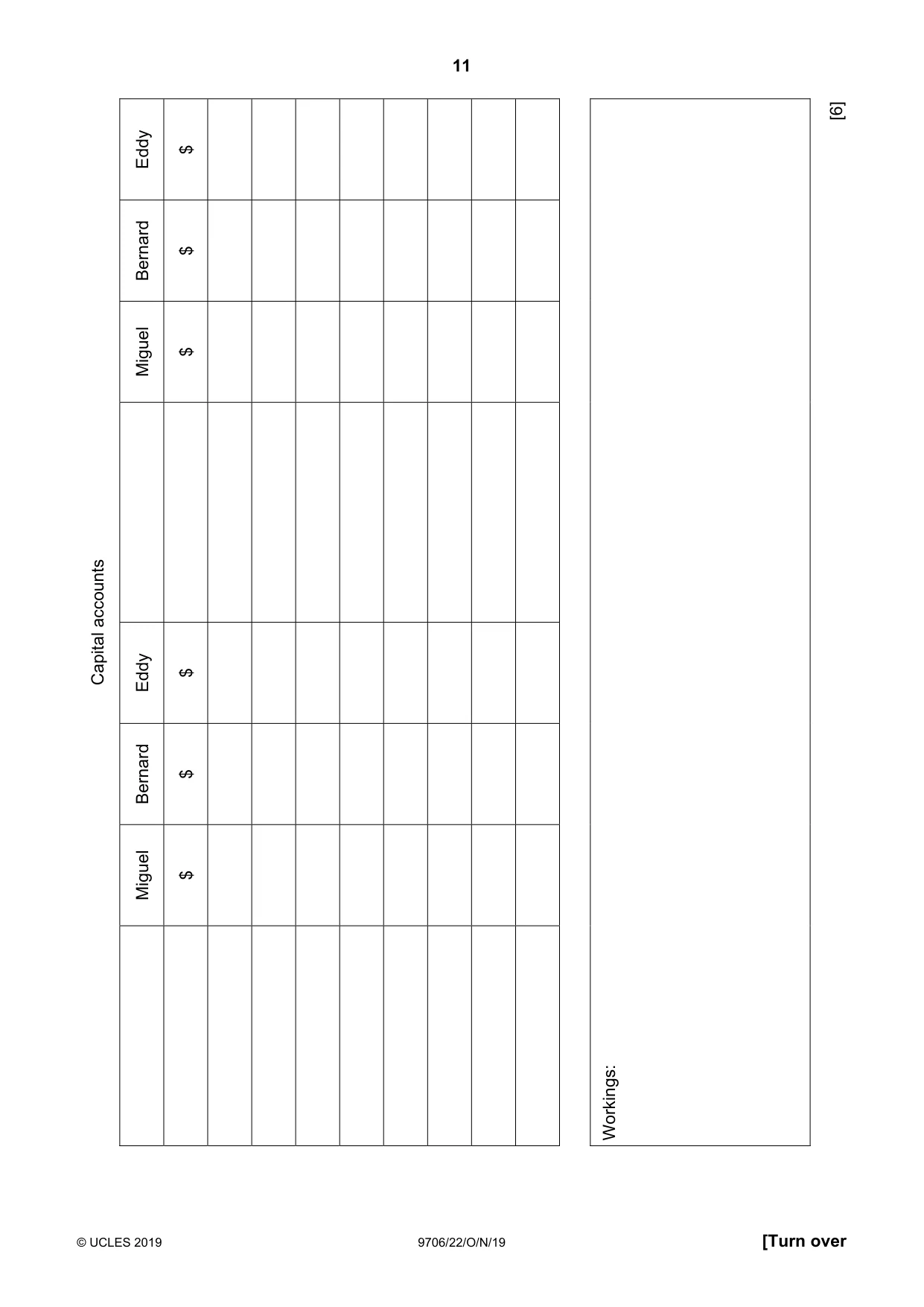
11 © UCLES 2019 9706/22/O/N/19 [Turn over Capital accounts Eddy $ Workings: [6] Bernard $ Miguel $ Eddy $ Bernard $ Miguel $
Question paper, page 12
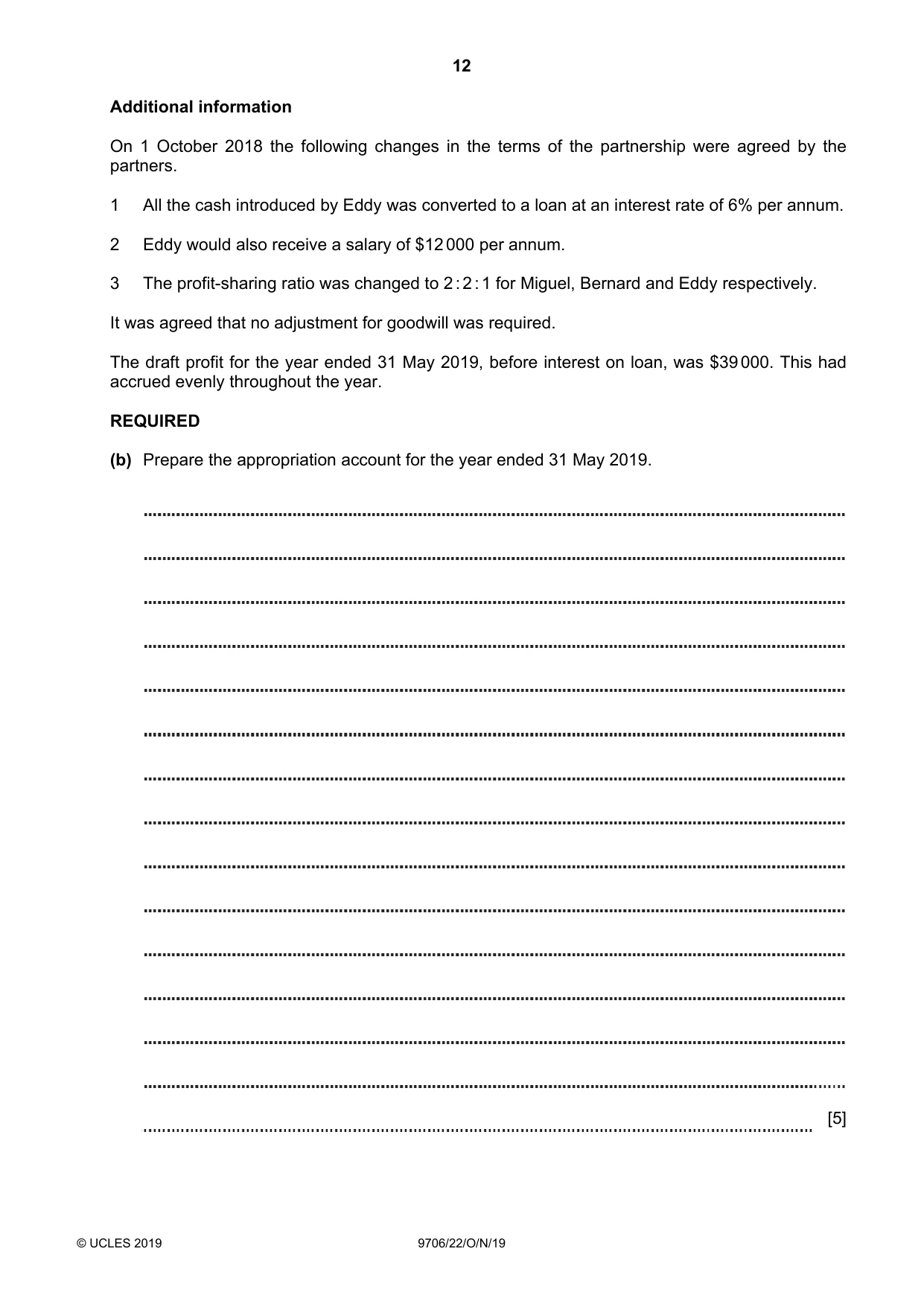
12 © UCLES 2019 9706/22/O/N/19 Additional information On 1 October 2018 the following changes in the terms of the partnership were agreed by the partners. 1 All the cash introduced by Eddy was converted to a loan at an interest rate of 6% per annum. 2 Eddy would also receive a salary of $12 000 per annum. 3 The profit-sharing ratio was changed to 2 : 2 : 1 for Miguel, Bernard and Eddy respectively. It was agreed that no adjustment for goodwill was required. The draft profit for the year ended 31 May 2019, before interest on loan, was $39 000. This had accrued evenly throughout the year. REQUIRED (b) Prepare the appropriation account for the year ended 31 May 2019. [5]
Question paper, page 13
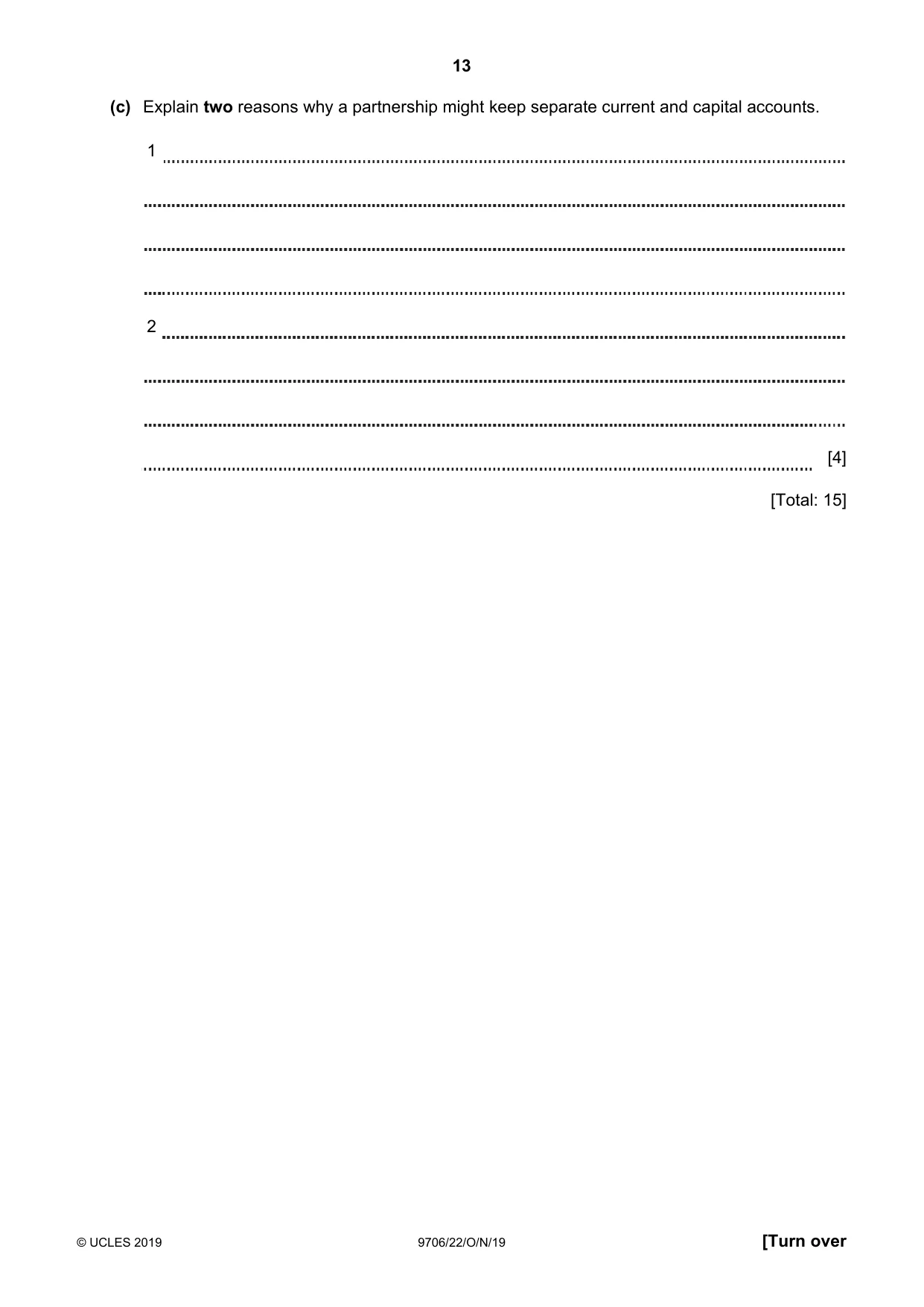
13 © UCLES 2019 9706/22/O/N/19 [Turn over (c) Explain two reasons why a partnership might keep separate current and capital accounts. 1 2 [4] [Total: 15]
Question paper, page 14
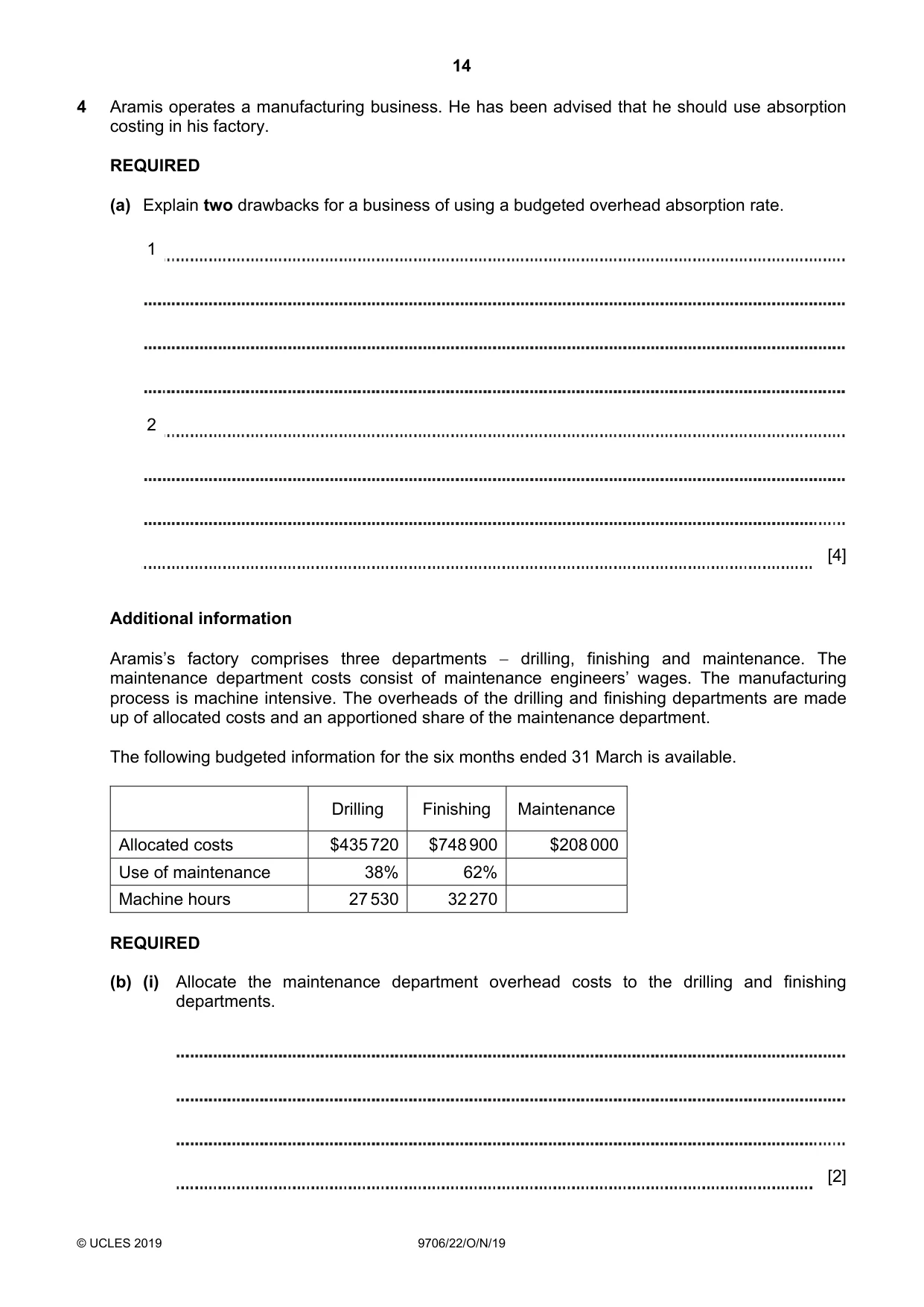
14 © UCLES 2019 9706/22/O/N/19 4 Aramis operates a manufacturing business. He has been advised that he should use absorption costing in his factory. REQUIRED (a) Explain two drawbacks for a business of using a budgeted overhead absorption rate. 1 2 [4] Additional information Aramis’s factory comprises three departments drilling, finishing and maintenance. The maintenance department costs consist of maintenance engineers’ wages. The manufacturing process is machine intensive. The overheads of the drilling and finishing departments are made up of allocated costs and an apportioned share of the maintenance department. The following budgeted information for the six months ended 31 March is available. Drilling Finishing Maintenance Allocated costs $435 720 $748 900 $208 000 Use of maintenance 38% 62% Machine hours 27 530 32 270 REQUIRED (b) (i) Allocate the maintenance department overhead costs to the drilling and finishing departments. [2]
Question paper, page 15
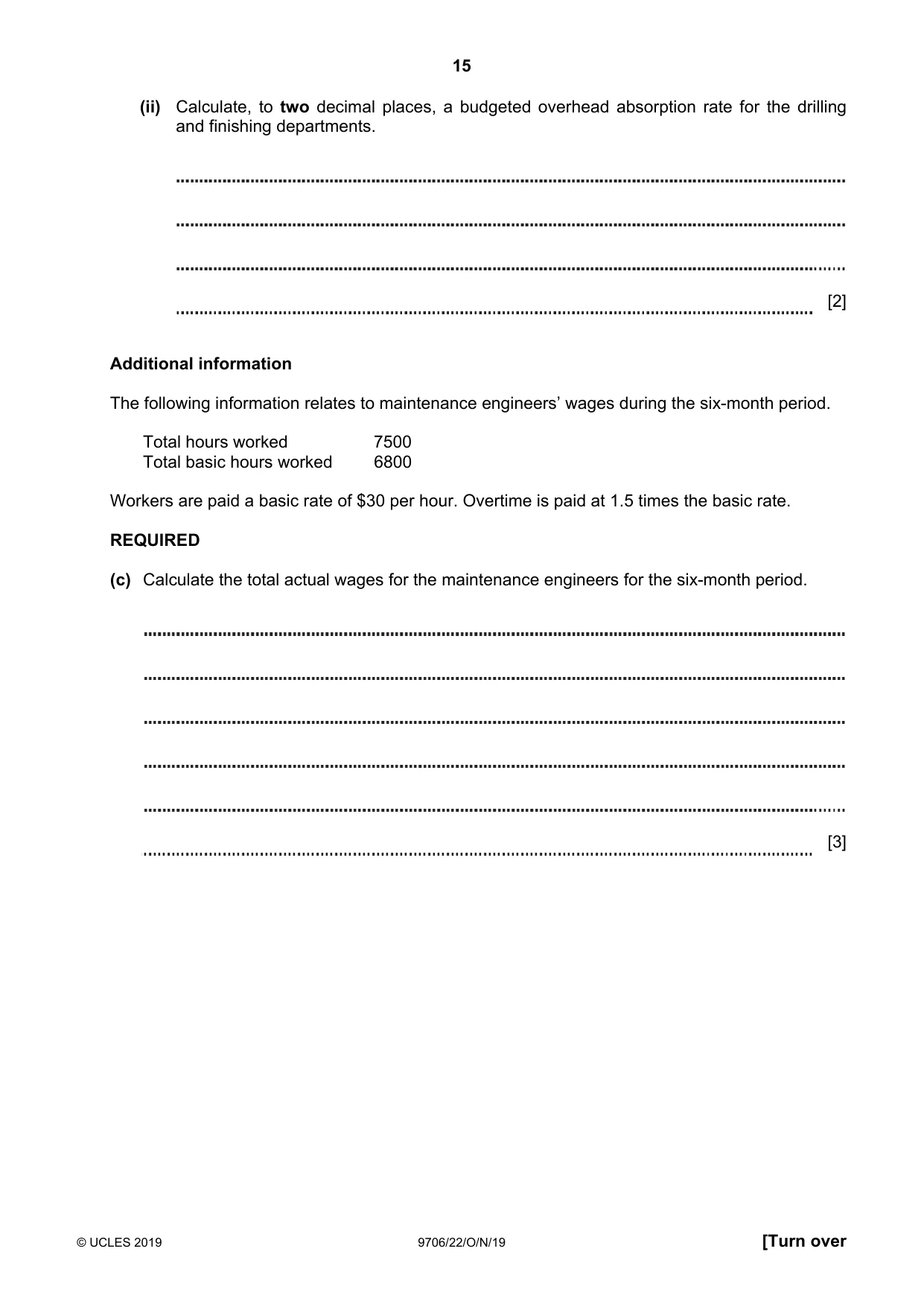
15 © UCLES 2019 9706/22/O/N/19 [Turn over (ii) Calculate, to two decimal places, a budgeted overhead absorption rate for the drilling and finishing departments. [2] Additional information The following information relates to maintenance engineers’ wages during the six-month period. Total hours worked 7500 Total basic hours worked 6800 Workers are paid a basic rate of $30 per hour. Overtime is paid at 1.5 times the basic rate. REQUIRED (c) Calculate the total actual wages for the maintenance engineers for the six-month period. [3]
Question paper, page 16
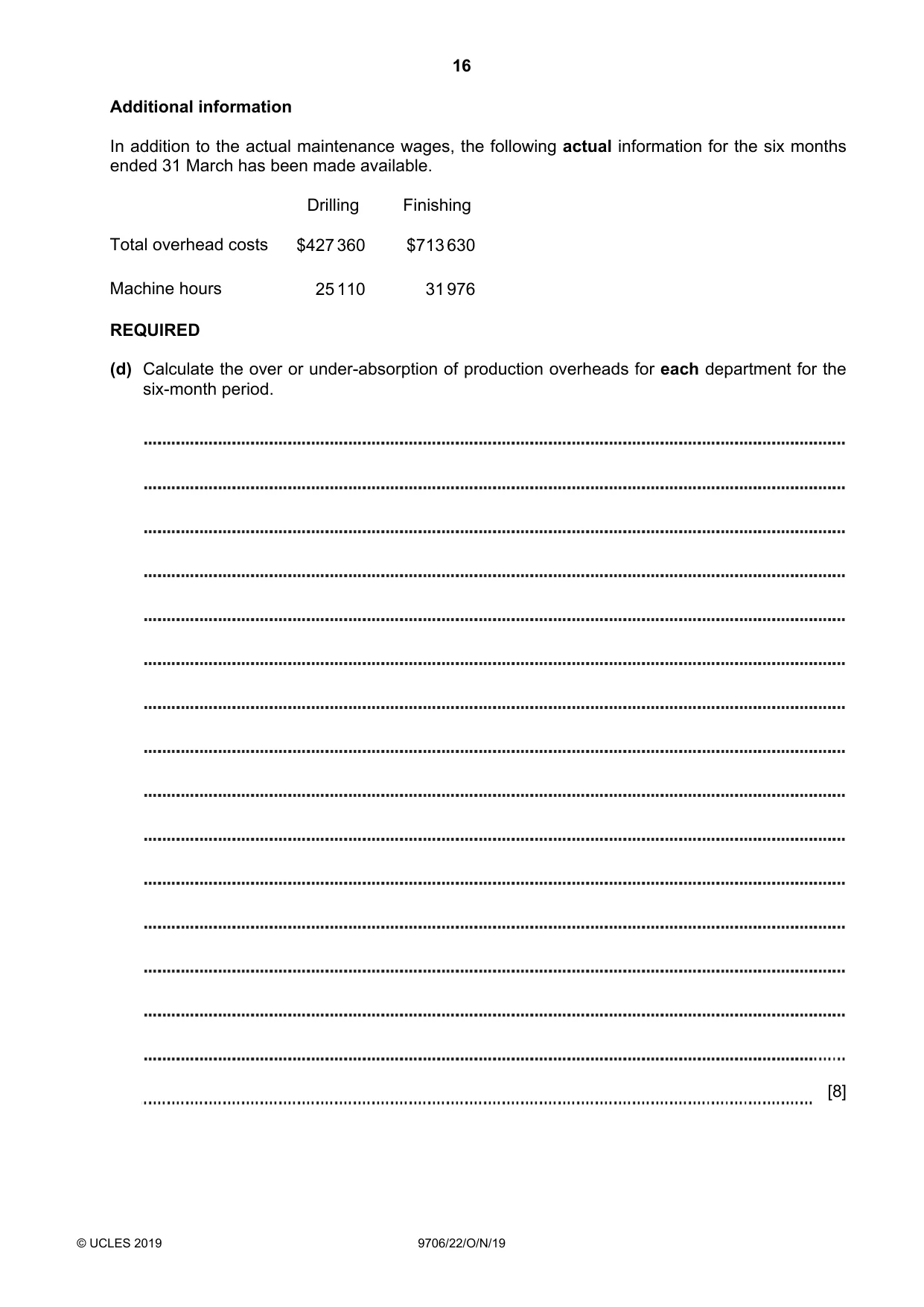
16 © UCLES 2019 9706/22/O/N/19 Additional information In addition to the actual maintenance wages, the following actual information for the six months ended 31 March has been made available. Drilling Finishing Total overhead costs $427 360 $713 630 Machine hours 25 110 31 976 REQUIRED (d) Calculate the over or under-absorption of production overheads for each department for the six-month period. [8]
Question paper, page 17
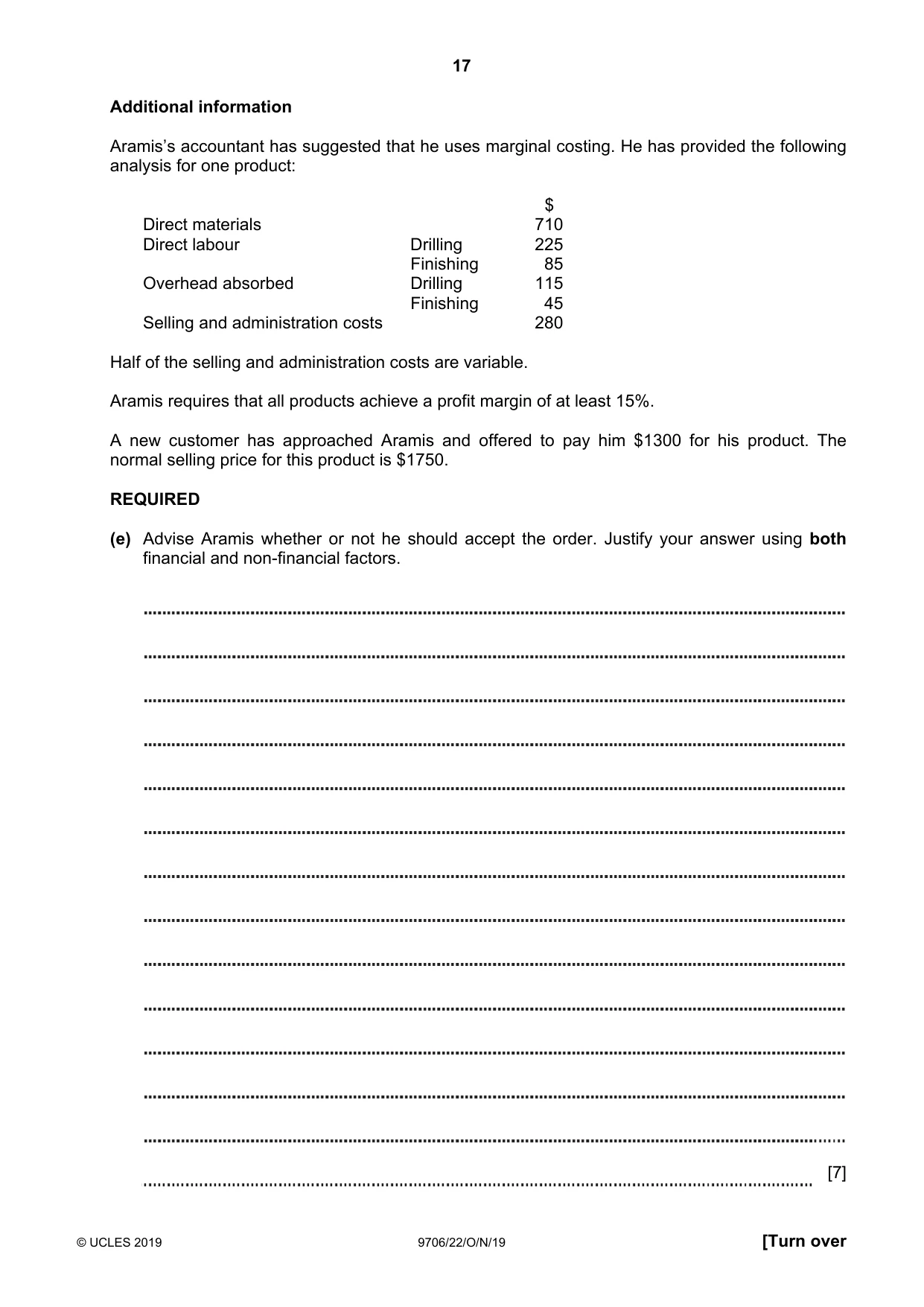
17 © UCLES 2019 9706/22/O/N/19 [Turn over Additional information Aramis’s accountant has suggested that he uses marginal costing. He has provided the following analysis for one product: $ Direct materials 710 Direct labour Drilling 225 Finishing 85 Overhead absorbed Drilling 115 Finishing 45 Selling and administration costs 280 Half of the selling and administration costs are variable. Aramis requires that all products achieve a profit margin of at least 15%. A new customer has approached Aramis and offered to pay him $1300 for his product. The normal selling price for this product is $1750. REQUIRED (e) Advise Aramis whether or not he should accept the order. Justify your answer using both financial and non-financial factors. [7]
Question paper, page 18
18 © UCLES 2019 9706/22/O/N/19 (f) State four factors that a business should consider before changing its supplier. 1 2 3 4 [4] [Total: 30]
Question paper, page 19
19 © UCLES 2019 9706/22/O/N/19 BLANK PAGE
Question paper, page 20
20 Permission to reproduce items where third-party owned material protected by copyright is included has been sought and cleared where possible. Every reasonable effort has been made by the publisher (UCLES) to trace copyright holders, but if any items requiring clearance have unwittingly been included, the publisher will be pleased to make amends at the earliest possible opportunity. To avoid the issue of disclosure of answer-related information to candidates, all copyright acknowledgements are reproduced online in the Cambridge Assessment International Education Copyright Acknowledgements Booklet. This is produced for each series of examinations and is freely available to download at www.cambridgeinternational.org after the live examination series. Cambridge Assessment International Education is part of the Cambridge Assessment Group. Cambridge Assessment is the brand name of the University of Cambridge Local Examinations Syndicate (UCLES), which itself is a department of the University of Cambridge. © UCLES 2019 9706/22/O/N/19 BLANK PAGE
Mark scheme, page 1
This document consists of 15 printed pages. © UCLES 2019 [Turn over Cambridge Assessment International Education Cambridge International Advanced Subsidiary and Advanced Level ACCOUNTING 9706/22 Paper 2 Structured Questions October/November 2019 MARK SCHEME Maximum Mark: 90 Published This mark scheme is published as an aid to teachers and candidates, to indicate the requirements of the examination. It shows the basis on which Examiners were instructed to award marks. It does not indicate the details of the discussions that took place at an Examiners’ meeting before marking began, which would have considered the acceptability of alternative answers. Mark schemes should be read in conjunction with the question paper and the Principal Examiner Report for Teachers. Cambridge International will not enter into discussions about these mark schemes. Cambridge International is publishing the mark schemes for the October/November 2019 series for most Cambridge IGCSE™, Cambridge International A and AS Level components and some Cambridge O Level components.
Mark scheme, page 2
9706/22 Cambridge International AS/A Level – Mark Scheme PUBLISHED October/November 2019 © UCLES 2019 Page 2 of 15 Generic Marking Principles These general marking principles must be applied by all examiners when marking candidate answers. They should be applied alongside the specific content of the mark scheme or generic level descriptors for a question. Each question paper and mark scheme will also comply with these marking principles. GENERIC MARKING PRINCIPLE 1: Marks must be awarded in line with: • the specific content of the mark scheme or the generic level descriptors for the question • the specific skills defined in the mark scheme or in the generic level descriptors for the question • the standard of response required by a candidate as exemplified by the standardisation scripts. GENERIC MARKING PRINCIPLE 2: Marks awarded are always whole marks (not half marks, or other fractions). GENERIC MARKING PRINCIPLE 3: Marks must be awarded positively: • marks are awarded for correct/valid answers, as defined in the mark scheme. However, credit is given for valid answers which go beyond the scope of the syllabus and mark scheme, referring to your Team Leader as appropriate • marks are awarded when candidates clearly demonstrate what they know and can do • marks are not deducted for errors • marks are not deducted for omissions • answers should only be judged on the quality of spelling, punctuation and grammar when these features are specifically assessed by the question as indicated by the mark scheme. The meaning, however, should be unambiguous. GENERIC MARKING PRINCIPLE 4: Rules must be applied consistently e.g. in situations where candidates have not followed instructions or in the application of generic level descriptors.
Mark scheme, page 3
9706/22 Cambridge International AS/A Level – Mark Scheme PUBLISHED October/November 2019 © UCLES 2019 Page 3 of 15 GENERIC MARKING PRINCIPLE 5: Marks should be awarded using the full range of marks defined in the mark scheme for the question (however; the use of the full mark range may be limited according to the quality of the candidate responses seen). GENERIC MARKING PRINCIPLE 6: Marks awarded are based solely on the requirements as defined in the mark scheme. Marks should not be awarded with grade thresholds or grade descriptors in mind.
Mark scheme, page 4
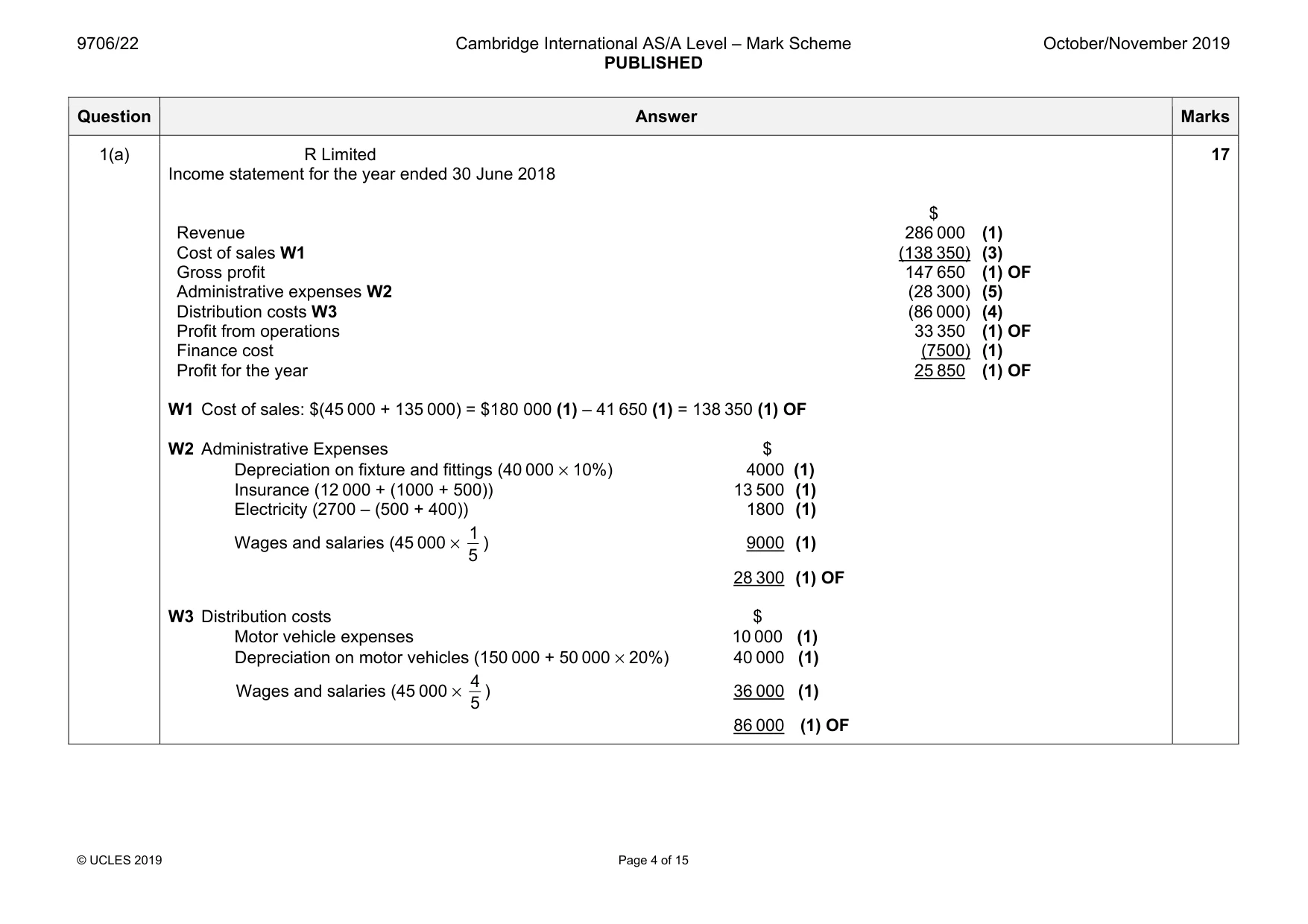
9706/22 Cambridge International AS/A Level – Mark Scheme PUBLISHED October/November 2019 © UCLES 2019 Page 4 of 15 Question Answer Marks 1(a) R Limited Income statement for the year ended 30 June 2018 $ Revenue 286 000 (1) Cost of sales W1 (138 350) (3) Gross profit 147 650 (1) OF Administrative expenses W2 (28 300) (5) Distribution costs W3 (86 000) (4) Profit from operations 33 350 (1) OF Finance cost (7500) (1) Profit for the year 25 850 (1) OF W1 Cost of sales: $(45 000 + 135 000) = $180 000 (1) – 41 650 (1) = 138 350 (1) OF W2 Administrative Expenses $ Depreciation on fixture and fittings (40 000 × 10%) 4000 (1) Insurance (12 000 + (1000 + 500)) 13 500 (1) Electricity (2700 – (500 + 400)) 1800 (1) Wages and salaries (45 000 × 5 1 ) 9000 (1) 28 300 (1) OF W3 Distribution costs $ Motor vehicle expenses 10 000 (1) Depreciation on motor vehicles (150 000 + 50 000 × 20%) 40 000 (1) Wages and salaries (45 000 × 5 4 ) 36 000 (1) 86 000 (1) OF 17
Mark scheme, page 5
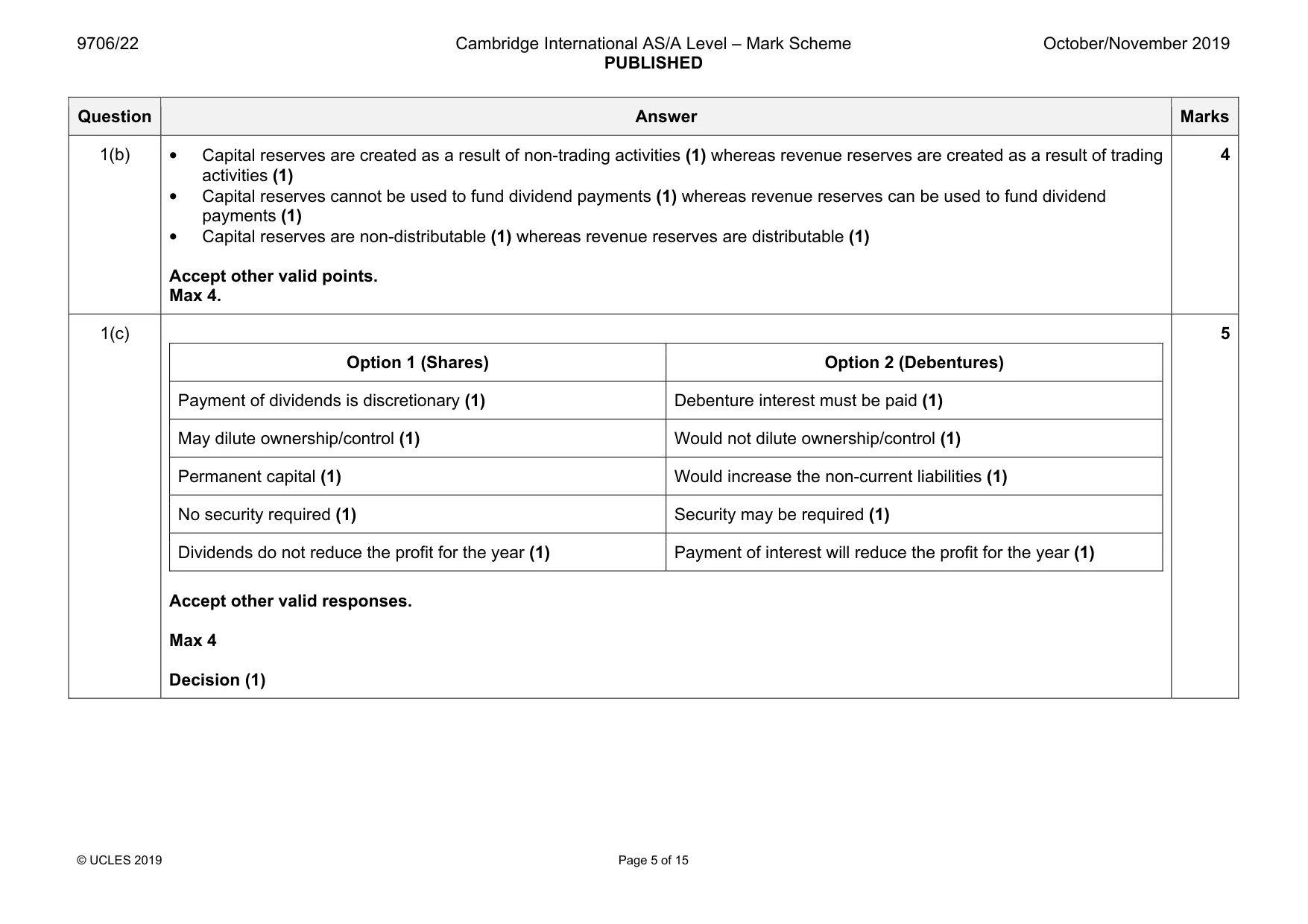
9706/22 Cambridge International AS/A Level – Mark Scheme PUBLISHED October/November 2019 © UCLES 2019 Page 5 of 15 Question Answer Marks 1(b) • Capital reserves are created as a result of non-trading activities (1) whereas revenue reserves are created as a result of trading activities (1) • Capital reserves cannot be used to fund dividend payments (1) whereas revenue reserves can be used to fund dividend payments (1) • Capital reserves are non-distributable (1) whereas revenue reserves are distributable (1) Accept other valid points. Max 4. 4 1(c) Option 1 (Shares) Option 2 (Debentures) Payment of dividends is discretionary (1) Debenture interest must be paid (1) May dilute ownership/control (1) Would not dilute ownership/control (1) Permanent capital (1) Would increase the non-current liabilities (1) No security required (1) Security may be required (1) Dividends do not reduce the profit for the year (1) Payment of interest will reduce the profit for the year (1) Accept other valid responses. Max 4 Decision (1) 5
Mark scheme, page 6
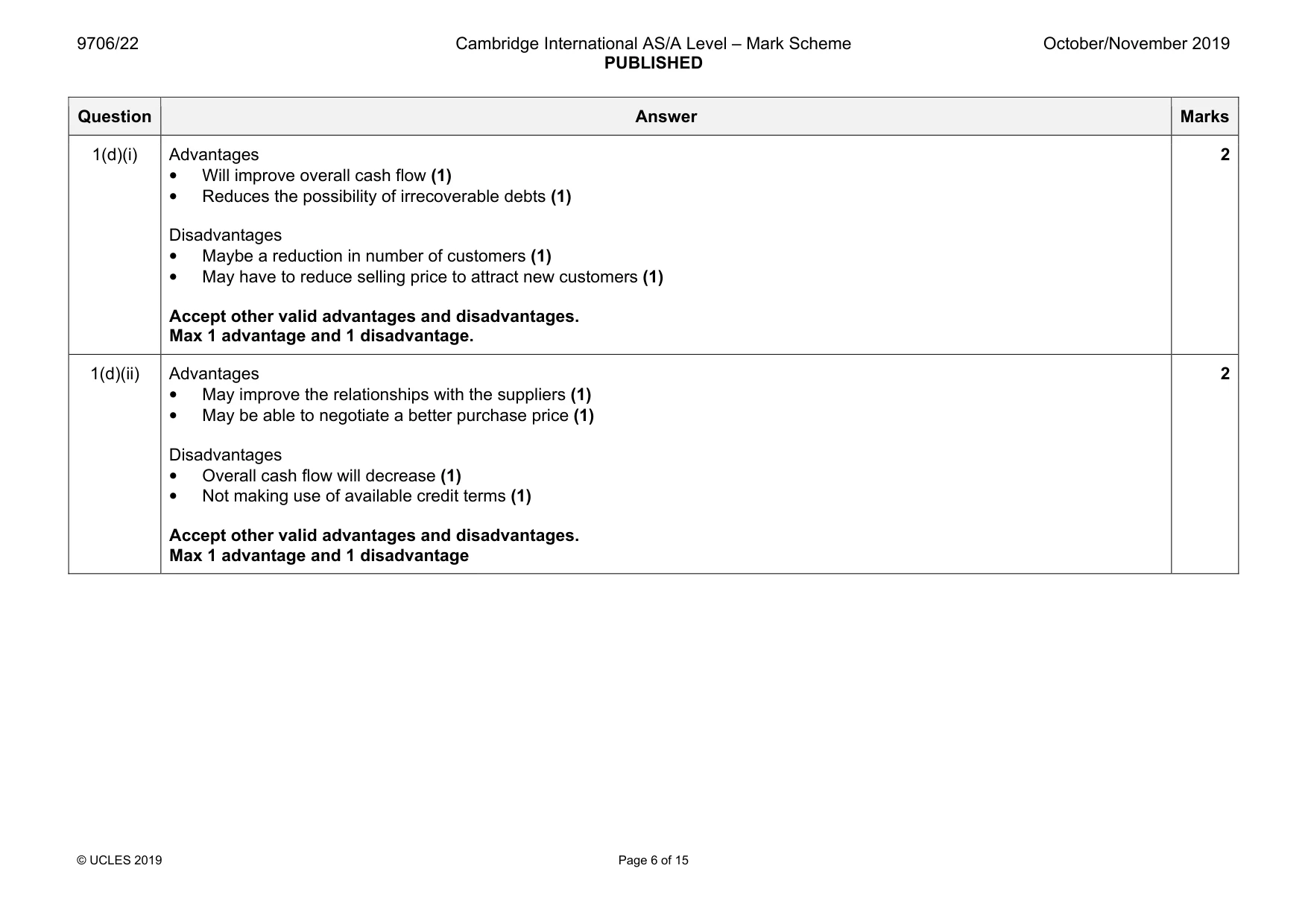
9706/22 Cambridge International AS/A Level – Mark Scheme PUBLISHED October/November 2019 © UCLES 2019 Page 6 of 15 Question Answer Marks 1(d)(i) Advantages • Will improve overall cash flow (1) • Reduces the possibility of irrecoverable debts (1) Disadvantages • Maybe a reduction in number of customers (1) • May have to reduce selling price to attract new customers (1) Accept other valid advantages and disadvantages. Max 1 advantage and 1 disadvantage. 2 1(d)(ii) Advantages • May improve the relationships with the suppliers (1) • May be able to negotiate a better purchase price (1) Disadvantages • Overall cash flow will decrease (1) • Not making use of available credit terms (1) Accept other valid advantages and disadvantages. Max 1 advantage and 1 disadvantage 2
Mark scheme, page 7
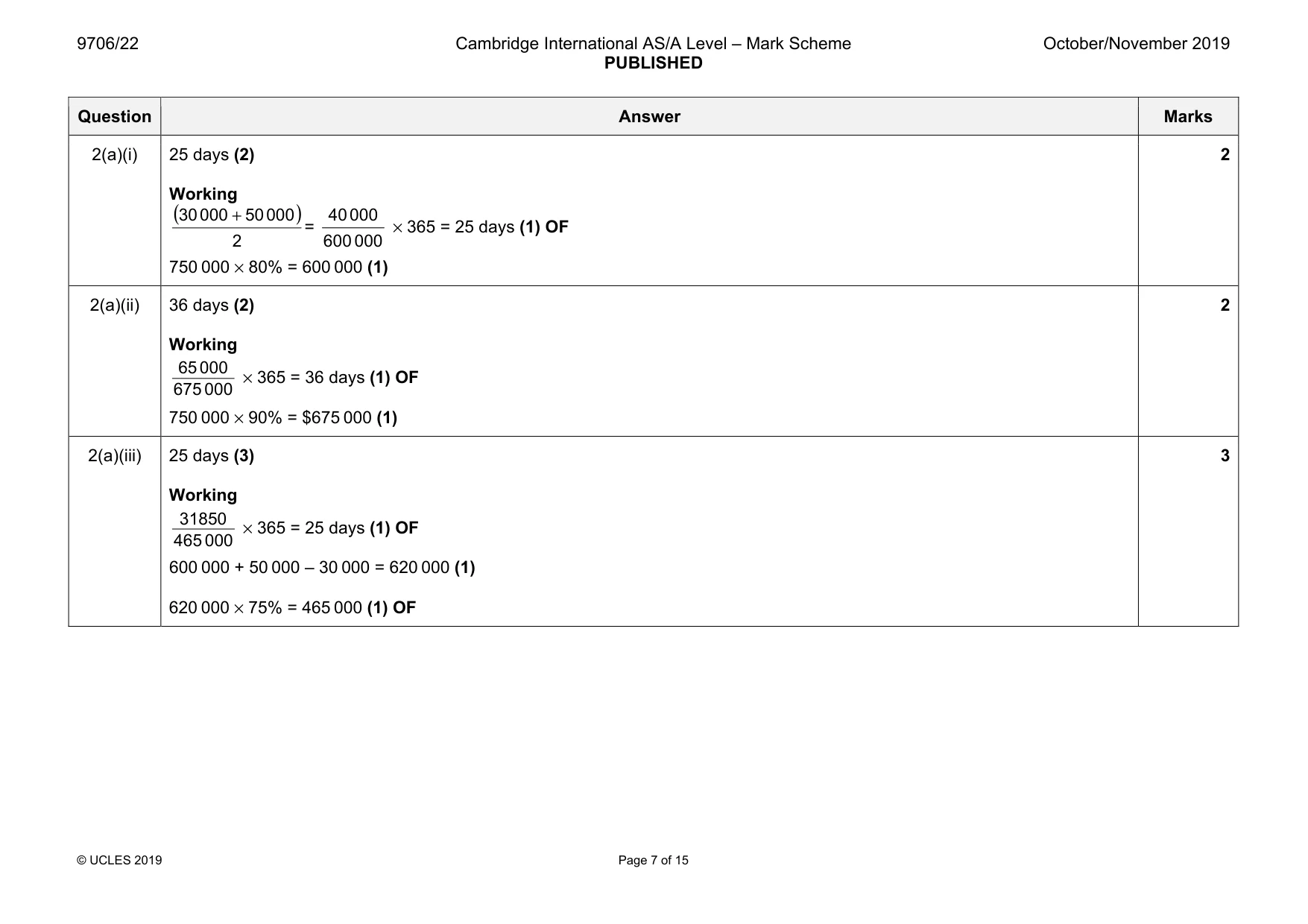
9706/22 Cambridge International AS/A Level – Mark Scheme PUBLISHED October/November 2019 © UCLES 2019 Page 7 of 15 Question Answer Marks 2(a)(i) 25 days (2) Working ( ) 2 000 50 000 30 + = 000 600 000 40 × 365 = 25 days (1) OF 750 000 × 80% = 600 000 (1) 2 2(a)(ii) 36 days (2) Working 000 675 000 65 × 365 = 36 days (1) OF 750 000 × 90% = $675 000 (1) 2 2(a)(iii) 25 days (3) Working 000 465 850 31 × 365 = 25 days (1) OF 600 000 + 50 000 – 30 000 = 620 000 (1) 620 000 × 75% = 465 000 (1) OF 3
Mark scheme, page 8
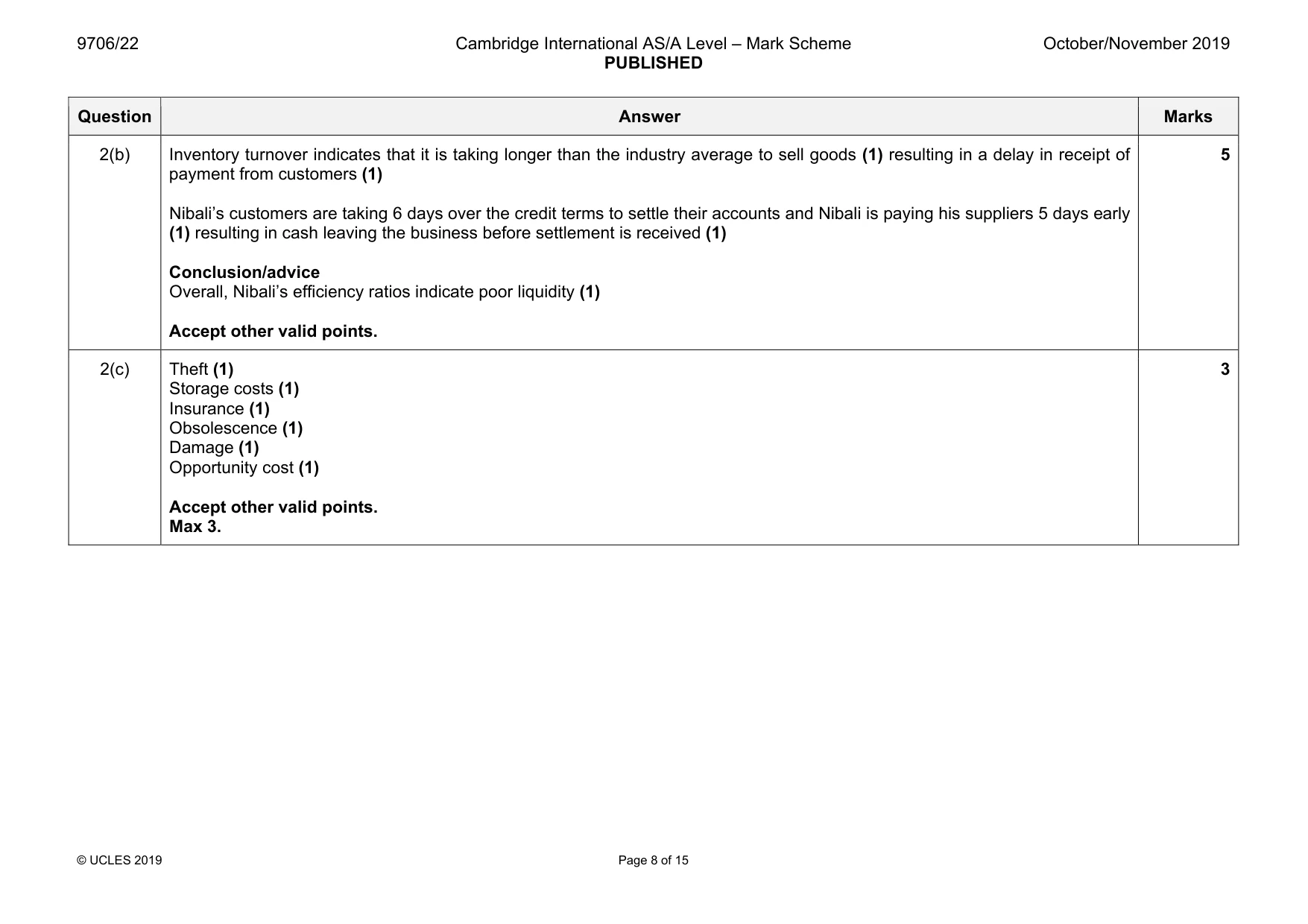
9706/22 Cambridge International AS/A Level – Mark Scheme PUBLISHED October/November 2019 © UCLES 2019 Page 8 of 15 Question Answer Marks 2(b) Inventory turnover indicates that it is taking longer than the industry average to sell goods (1) resulting in a delay in receipt of payment from customers (1) Nibali’s customers are taking 6 days over the credit terms to settle their accounts and Nibali is paying his suppliers 5 days early (1) resulting in cash leaving the business before settlement is received (1) Conclusion/advice Overall, Nibali’s efficiency ratios indicate poor liquidity (1) Accept other valid points. 5 2(c) Theft (1) Storage costs (1) Insurance (1) Obsolescence (1) Damage (1) Opportunity cost (1) Accept other valid points. Max 3. 3
Mark scheme, page 9
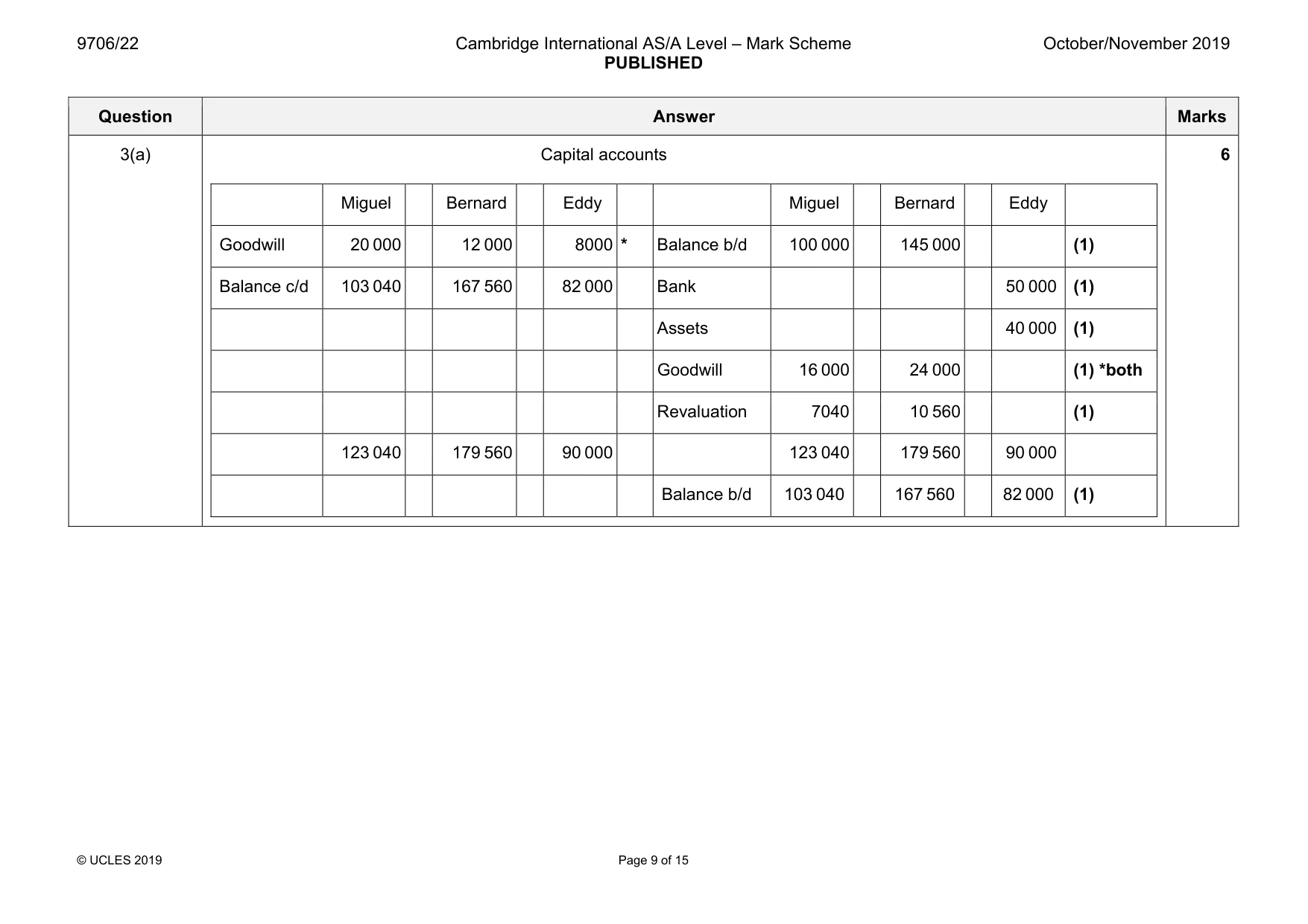
9706/22 Cambridge International AS/A Level – Mark Scheme PUBLISHED October/November 2019 © UCLES 2019 Page 9 of 15 Question Answer Marks 3(a) Capital accounts Miguel Bernard Eddy Miguel Bernard Eddy Goodwill 20 000 12 000 8000 * Balance b/d 100 000 145 000 (1) Balance c/d 103 040 167 560 82 000 Bank 50 000 (1) Assets 40 000 (1) Goodwill 16 000 24 000 (1) *both Revaluation 7040 10 560 (1) 123 040 179 560 90 000 123 040 179 560 90 000 Balance b/d 103 040 167 560 82 000 (1) 6
Mark scheme, page 10
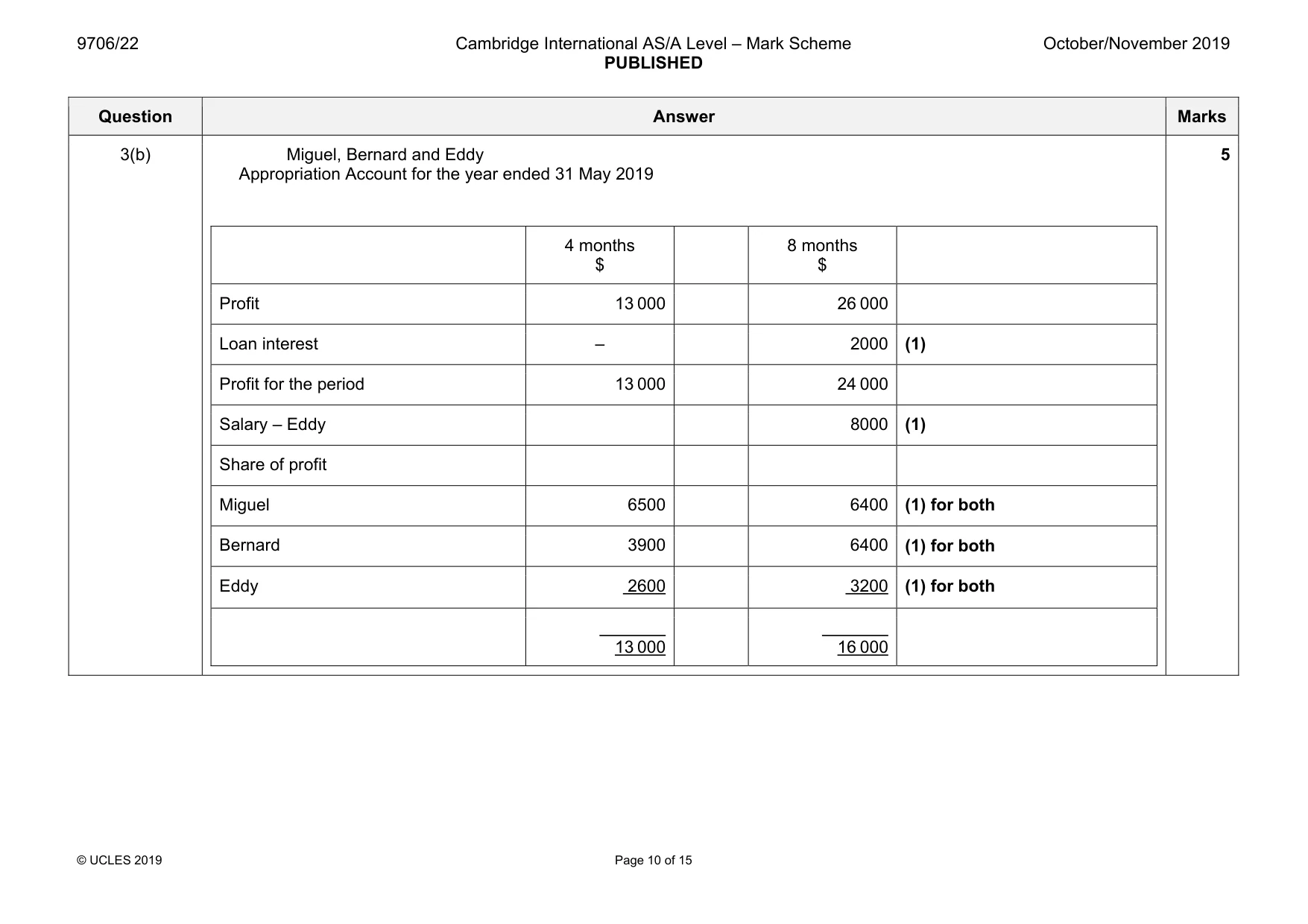
9706/22 Cambridge International AS/A Level – Mark Scheme PUBLISHED October/November 2019 © UCLES 2019 Page 10 of 15 Question Answer Marks 3(b) Miguel, Bernard and Eddy Appropriation Account for the year ended 31 May 2019 4 months $ 8 months $ Profit 13 000 26 000 Loan interest – 2000 (1) Profit for the period 13 000 24 000 Salary – Eddy 8000 (1) Share of profit Miguel 6500 6400 (1) for both Bernard 3900 6400 (1) for both Eddy 2600 3200 (1) for both 13 000 16 000 5
Mark scheme, page 11
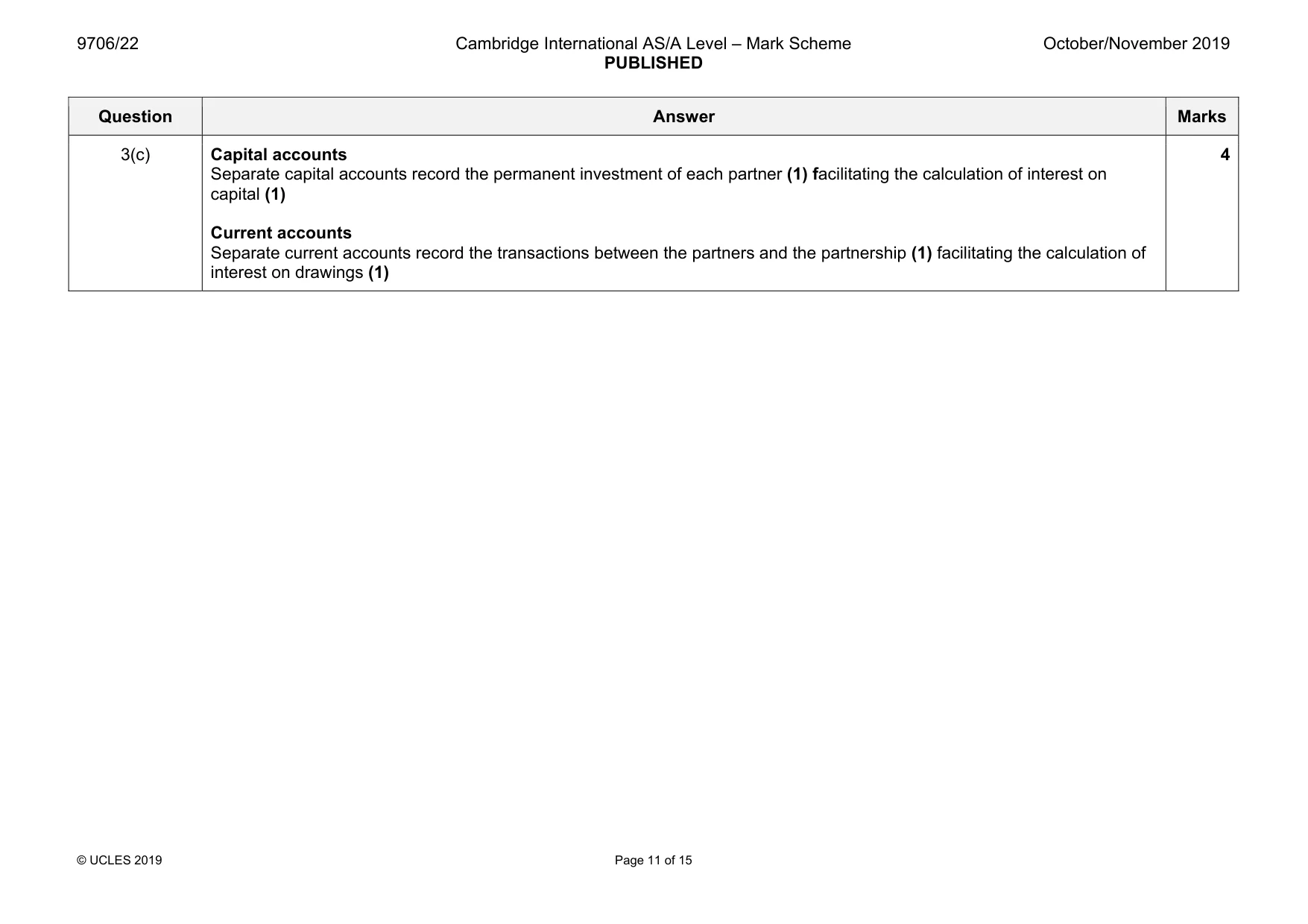
9706/22 Cambridge International AS/A Level – Mark Scheme PUBLISHED October/November 2019 © UCLES 2019 Page 11 of 15 Question Answer Marks 3(c) Capital accounts Separate capital accounts record the permanent investment of each partner (1) facilitating the calculation of interest on capital (1) Current accounts Separate current accounts record the transactions between the partners and the partnership (1) facilitating the calculation of interest on drawings (1) 4
Mark scheme, page 12
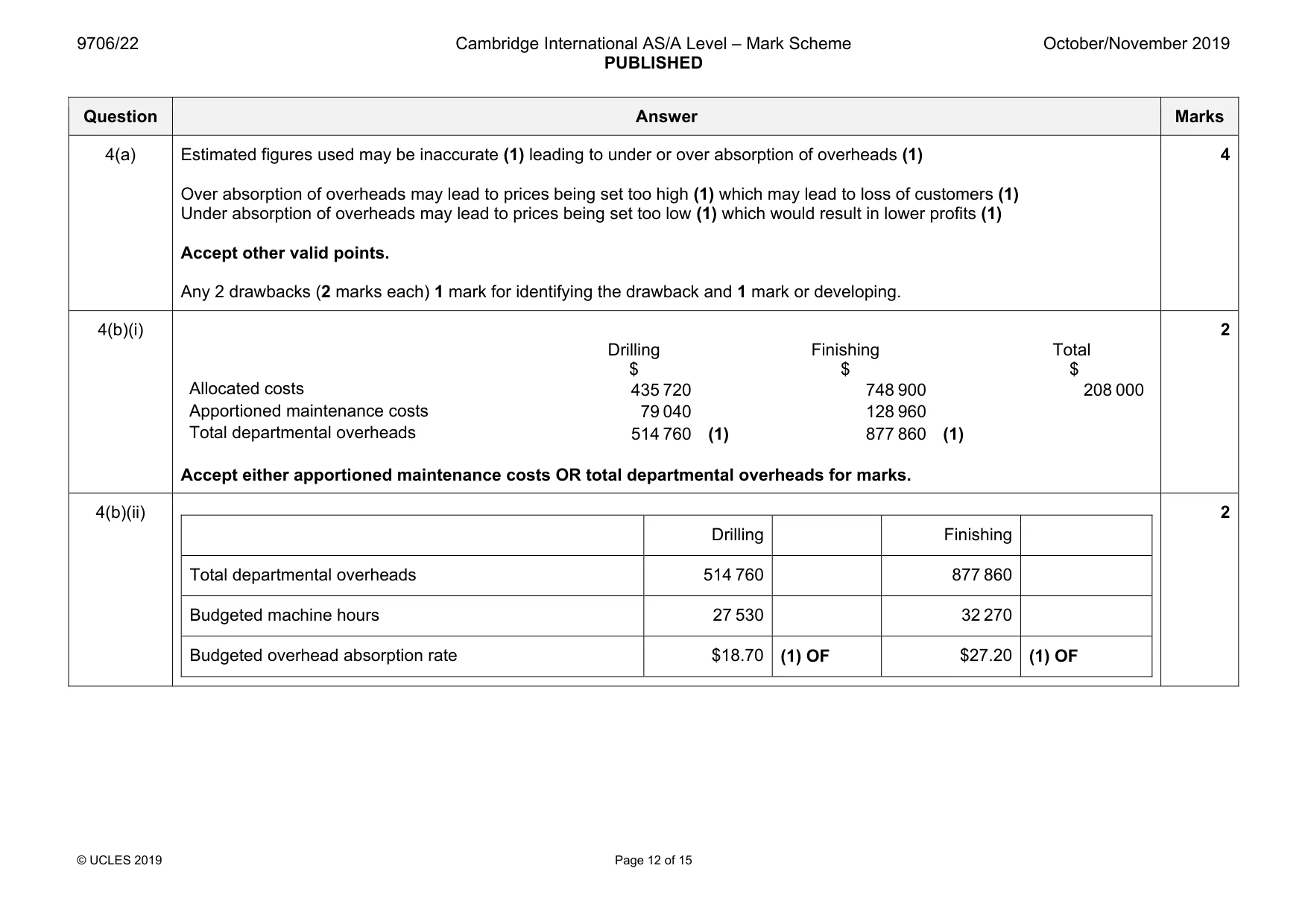
9706/22 Cambridge International AS/A Level – Mark Scheme PUBLISHED October/November 2019 © UCLES 2019 Page 12 of 15 Question Answer Marks 4(a) Estimated figures used may be inaccurate (1) leading to under or over absorption of overheads (1) Over absorption of overheads may lead to prices being set too high (1) which may lead to loss of customers (1) Under absorption of overheads may lead to prices being set too low (1) which would result in lower profits (1) Accept other valid points. Any 2 drawbacks (2 marks each) 1 mark for identifying the drawback and 1 mark or developing. 4 4(b)(i) Drilling $ Finishing $ Total $ Allocated costs 435 720 748 900 208 000 Apportioned maintenance costs 79 040 128 960 Total departmental overheads 514 760 (1) 877 860 (1) Accept either apportioned maintenance costs OR total departmental overheads for marks. 2 4(b)(ii) Drilling Finishing Total departmental overheads 514 760 877 860 Budgeted machine hours 27 530 32 270 Budgeted overhead absorption rate $18.70 (1) OF $27.20 (1) OF 2
Mark scheme, page 13
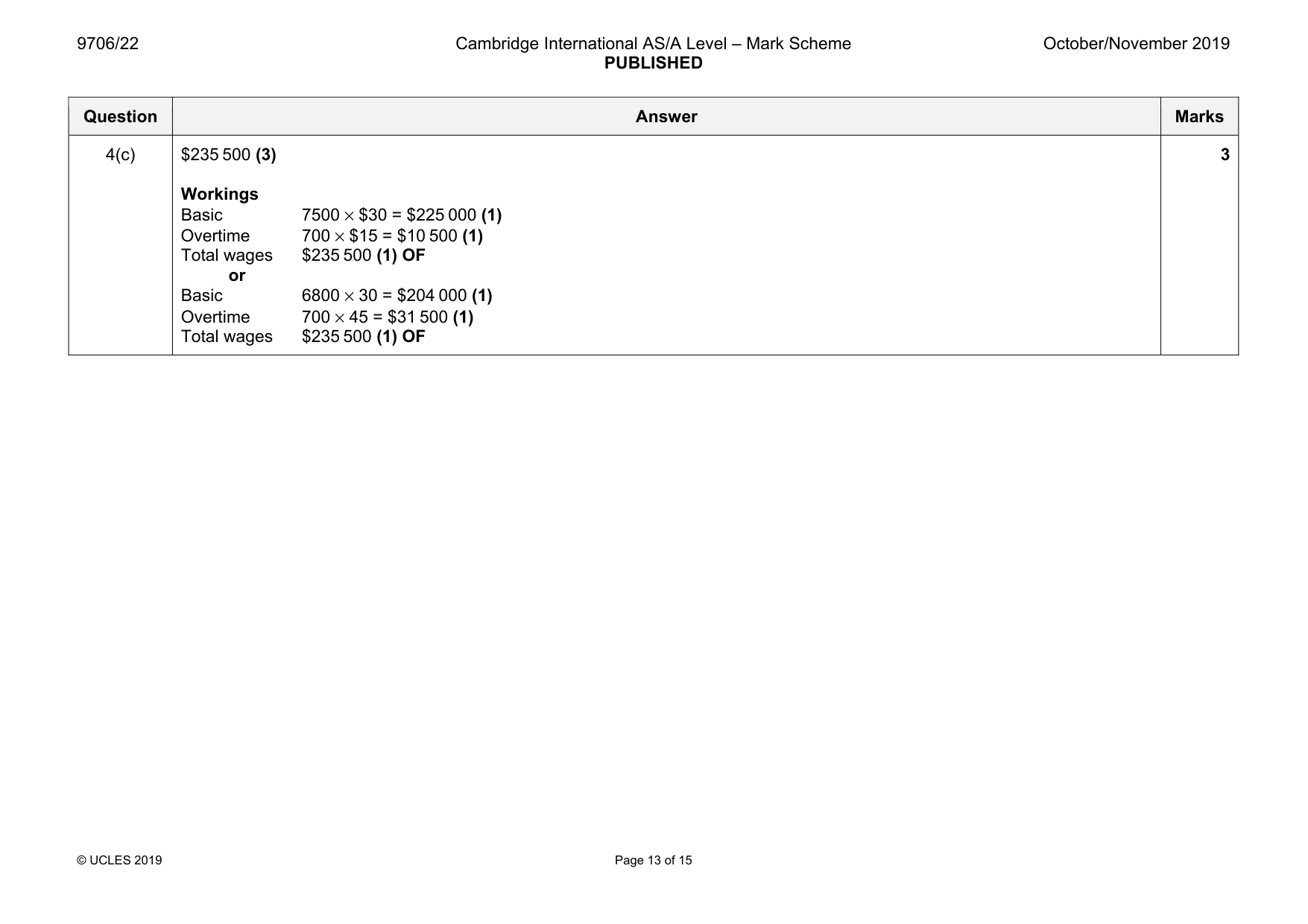
9706/22 Cambridge International AS/A Level – Mark Scheme PUBLISHED October/November 2019 © UCLES 2019 Page 13 of 15 Question Answer Marks 4(c) $235 500 (3) Workings Basic 7500 × $30 = $225 000 (1) Overtime 700 × $15 = $10 500 (1) Total wages $235 500 (1) OF or Basic 6800 × 30 = $204 000 (1) Overtime 700 × 45 = $31 500 (1) Total wages $235 500 (1) OF 3
Mark scheme, page 14
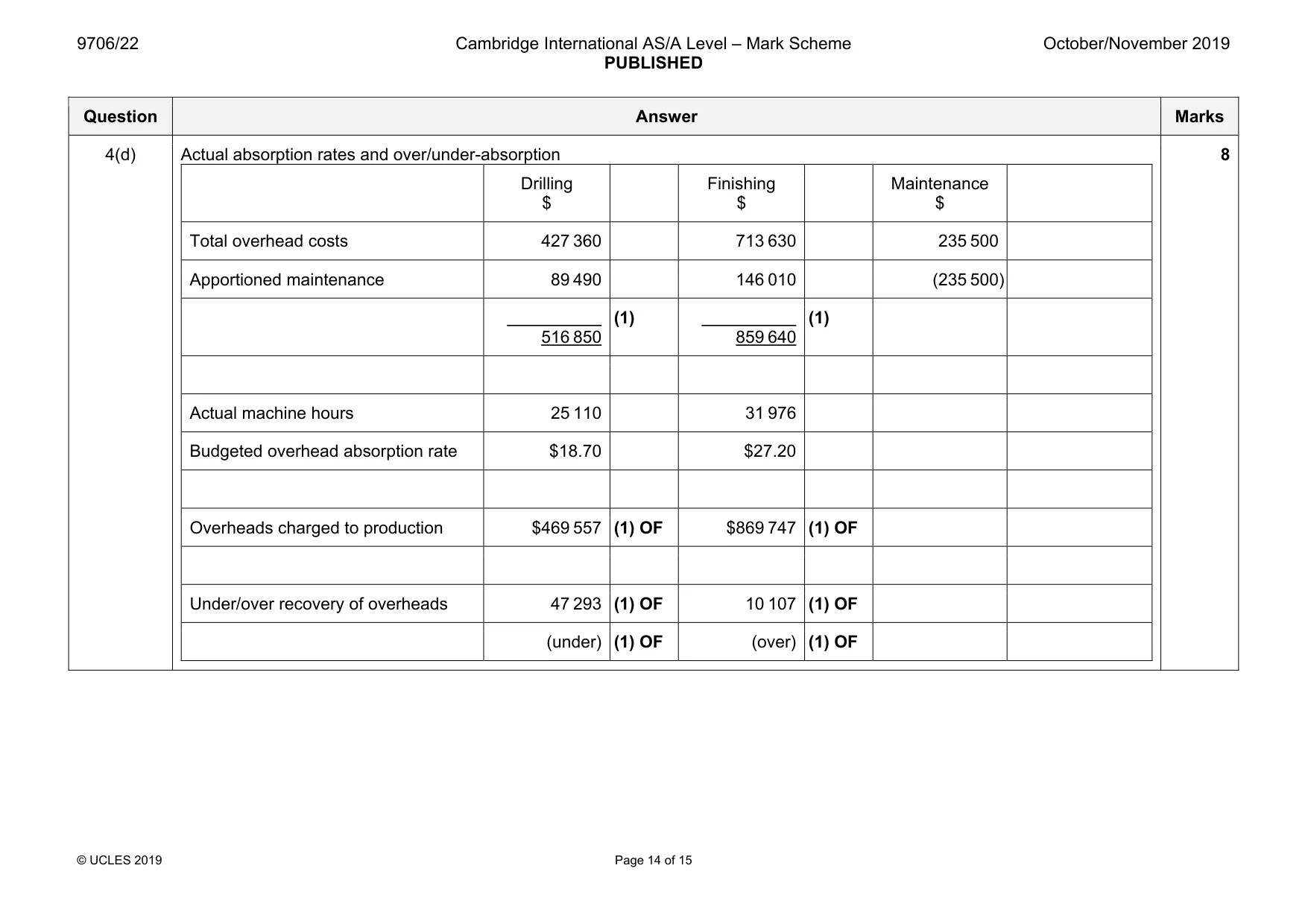
9706/22 Cambridge International AS/A Level – Mark Scheme PUBLISHED October/November 2019 © UCLES 2019 Page 14 of 15 Question Answer Marks 4(d) Actual absorption rates and over/under-absorption Drilling $ Finishing $ Maintenance $ Total overhead costs 427 360 713 630 235 500 Apportioned maintenance 89 490 146 010 (235 500) 516 850 (1) 859 640 (1) Actual machine hours 25 110 31 976 Budgeted overhead absorption rate $18.70 $27.20 Overheads charged to production $469 557 (1) OF $869 747 (1) OF Under/over recovery of overheads 47 293 (1) OF 10 107 (1) OF (under) (1) OF (over) (1) OF 8
Mark scheme, page 15
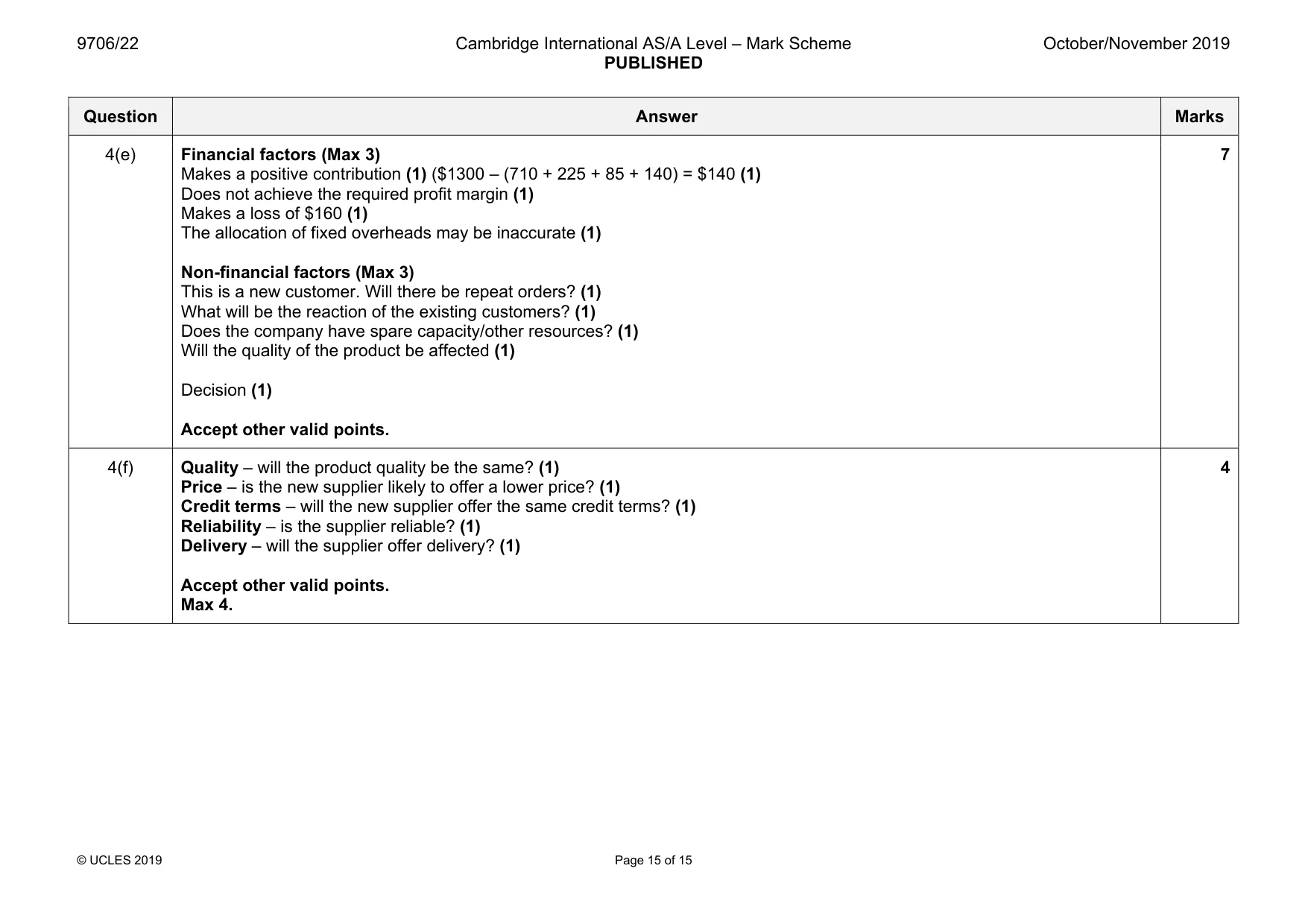
9706/22 Cambridge International AS/A Level – Mark Scheme PUBLISHED October/November 2019 © UCLES 2019 Page 15 of 15 Question Answer Marks 4(e) Financial factors (Max 3) Makes a positive contribution (1) ($1300 – (710 + 225 + 85 + 140) = $140 (1) Does not achieve the required profit margin (1) Makes a loss of $160 (1) The allocation of fixed overheads may be inaccurate (1) Non-financial factors (Max 3) This is a new customer. Will there be repeat orders? (1) What will be the reaction of the existing customers? (1) Does the company have spare capacity/other resources? (1) Will the quality of the product be affected (1) Decision (1) Accept other valid points. 7 4(f) Quality – will the product quality be the same? (1) Price – is the new supplier likely to offer a lower price? (1) Credit terms – will the new supplier offer the same credit terms? (1) Reliability – is the supplier reliable? (1) Delivery – will the supplier offer delivery? (1) Accept other valid points. Max 4. 4
What you needed in this session
Cambridge’s own grade thresholds for 2019 Oct/Nov, Paper 2 · Variant 2. A higher threshold means an easier paper — the bar moves with how the cohort did.