Cambridge A Level Accounting 9706 — 2019 Oct/Nov Paper 2 · Variant 3
9706/23/O/N/19 · 4 questions · 90 marks · ≈101 min
The question paper and its mark scheme, free to read here and free to download. This is Cambridge’s own paper, exactly as it was sat.
Question paper20 pages



Mark scheme11 pages
Answers below. Sit the paper first if you are practising.
Questions as text
Q1 · S Limited is a private limited company
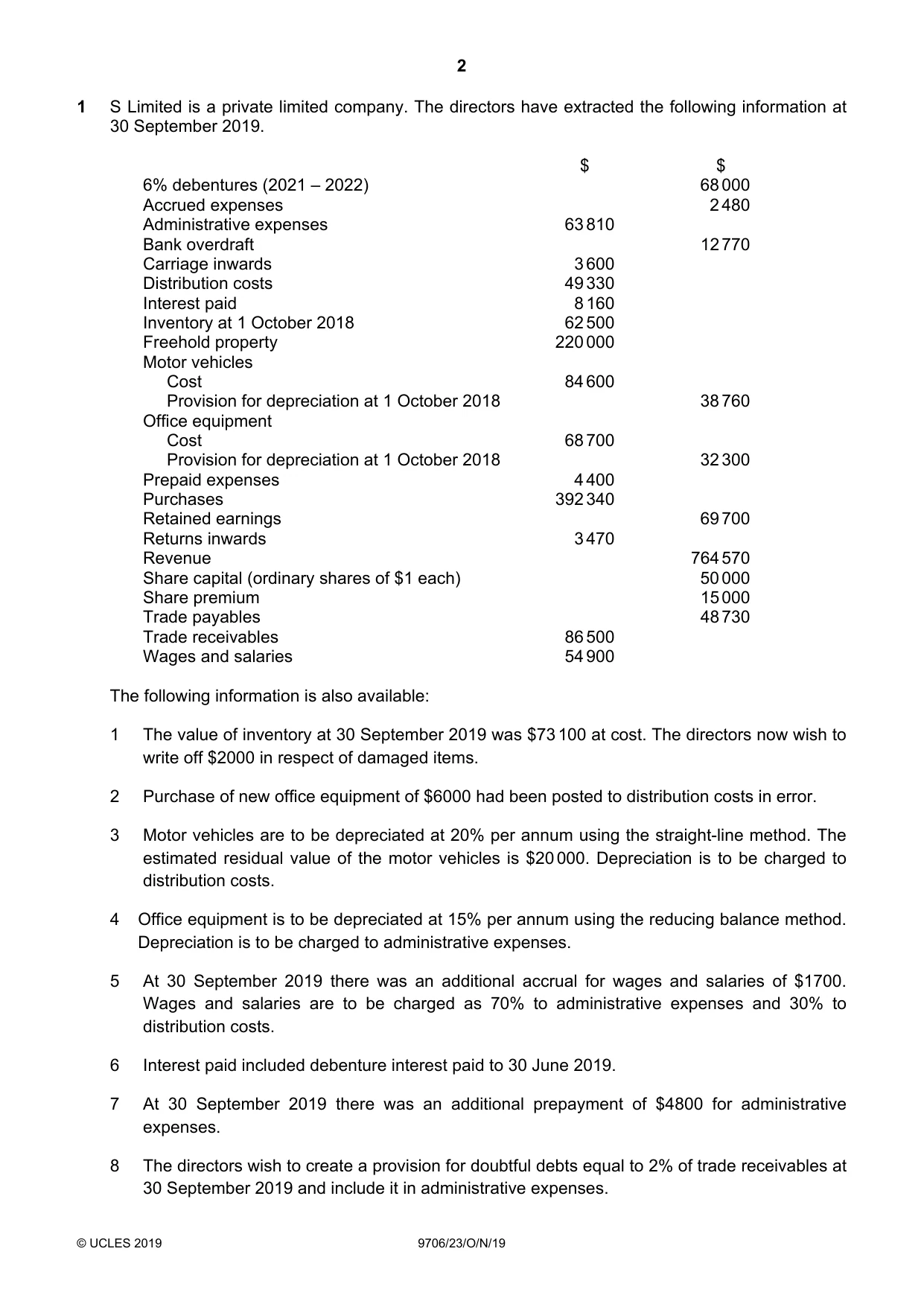
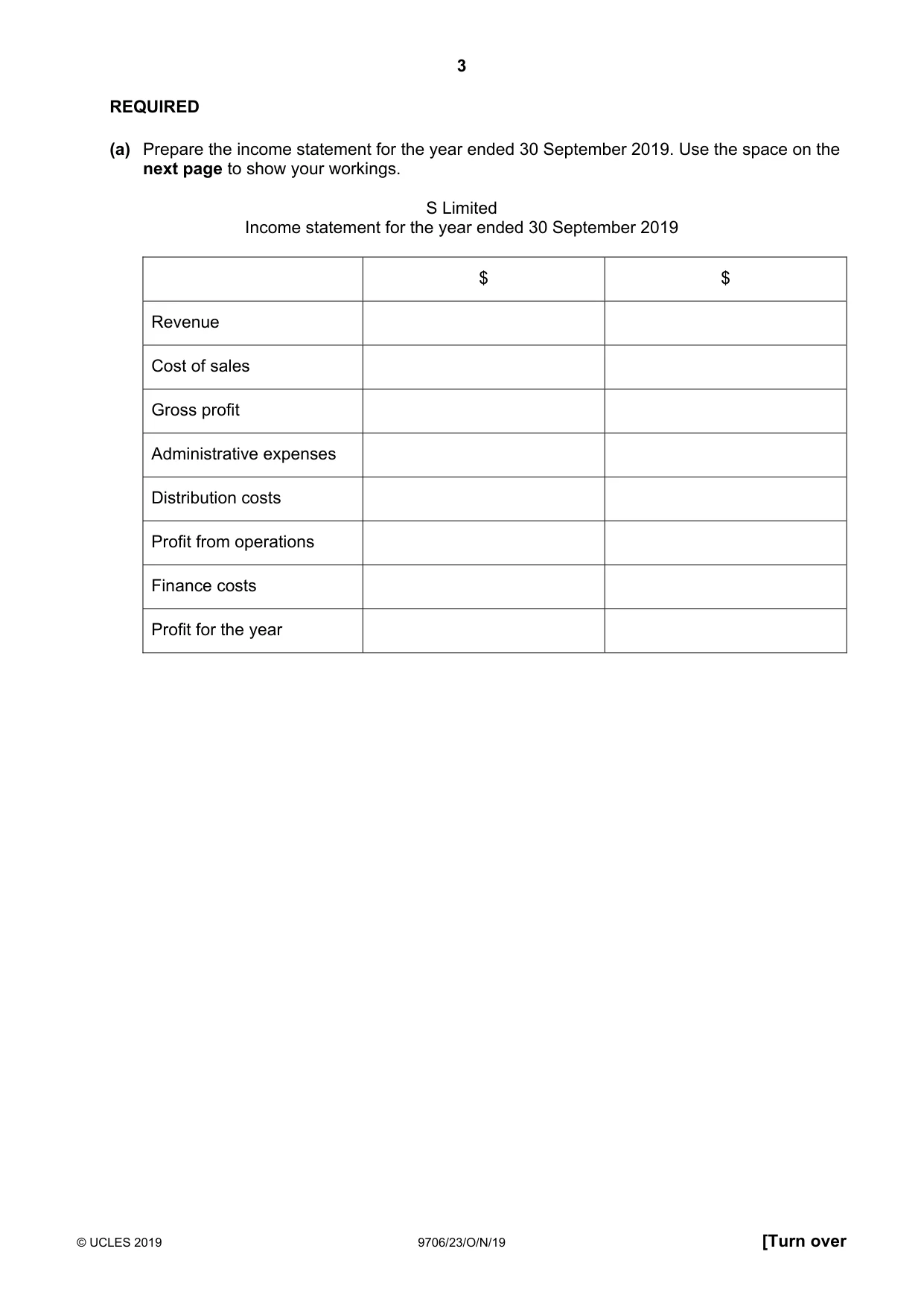
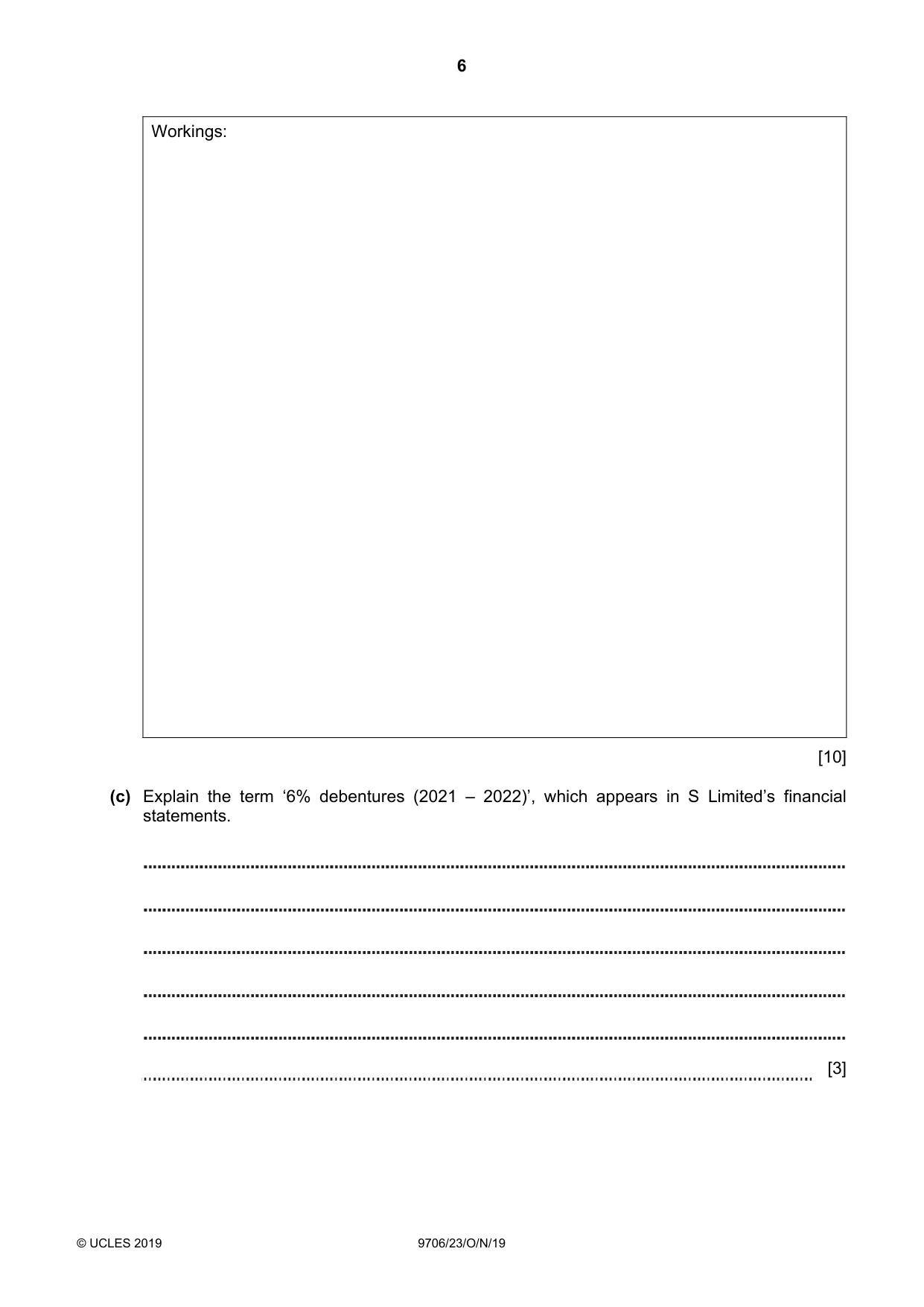
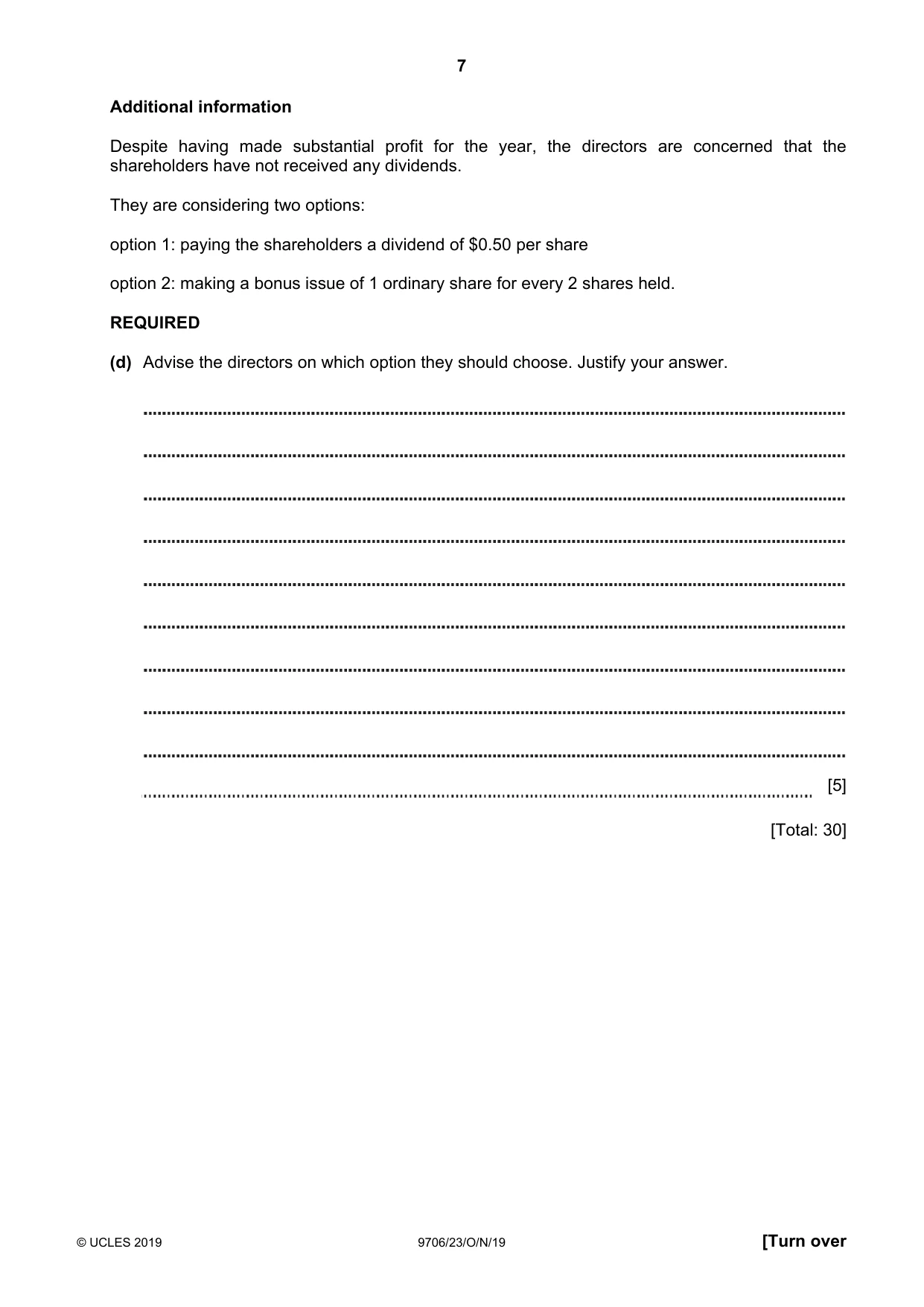
1 S Limited is a private limited company. The directors have extracted the following information at 30 September 2019. $ $ 6% debentures (2021 – 2022) 68 000 Accrued expenses 2 480 Administrative expenses 63 810 Bank overdraft 12 770 Carriage inwards 3 600 Distribution costs 49 330 Interest paid 8 160 Inventory at 1 October 2018 62 500 Freehold property 220 000 Motor vehicles Cost 84 600 Provision for depreciation at 1 October 2018 38 760 Office equipment Cost 68 700 Provision for depreciation at 1 October 2018 32 300 Prepaid expenses 4 400 Purchases 392 340 Retained earnings 69 700 Returns inwards 3 470 Revenue 764 570 Share capital (ordinary shares of $1 each) 50 000 Share premium 15 000 Trade payables 48 730 Trade receivables 86 500 Wages and salaries 54 900 The following information is also available: 1 The value of inventory at 30 September 2019 was $73 100 at cost. The directors now wish to write off $2000 in respect of damaged items. 2 Purchase of new office equipment of $6000 had been posted to distribution costs in error. 3 Motor vehicles are to be depreciated at 20% per annum using the straight-line method. The estimated residual value of the motor vehicles is $20 000. Depreciation is to be charged to distribution costs. 4 Office equipment is to be depreciated at 15% per annum using the reducing balance method. Depreciation is to be charged to administrative expenses. 5 At 30 September 2019 there was an additional accrual for wages and salaries of $1700. Wages and salaries are to be charged as 70% to administrative expenses and 30% to distribution costs. 6 Interest paid included debenture interest paid to 30 June 2019. 7 At 30 September 2019 there was an additional prepayment of $4800 for administrative expenses. 8 The directors wish to create a provision for doubtful debts equal to 2% of trade receivables at 30 September 2019 and include it in administrative expenses. REQUIRED (a) Prepare the income statement for the year ended 30 September 2019. Use the space on the next page to show your workings. S Limited Income statement for the year ended 30 September 2019 $ $ Revenue Cost of sales Gross profit Administrative expenses Distribution costs Profit from operations Finance costs Profit for the year Workings: Cost of sales Administrative expenses Distribution costs Finance costs [12] (b) Prepare the statement of financial position at 30 September 2019. Use the space provided on the next page for your workings. Workings: [10] (c) Explain the term ‘6% debentures (2021 – 2022)’, which appears in S Limited’s financial statements. [3] Additional information Despite having made substantial profit for the year, the directors are concerned that the shareholders have not received any dividends. They are considering two options: option 1: paying the shareholders a dividend of $0.50 per share option 2: making a bonus issue of 1 ordinary share for every 2 shares held. REQUIRED (d) Advise the directors on which option they should choose. Justify your answer. [5] [Total: 30]
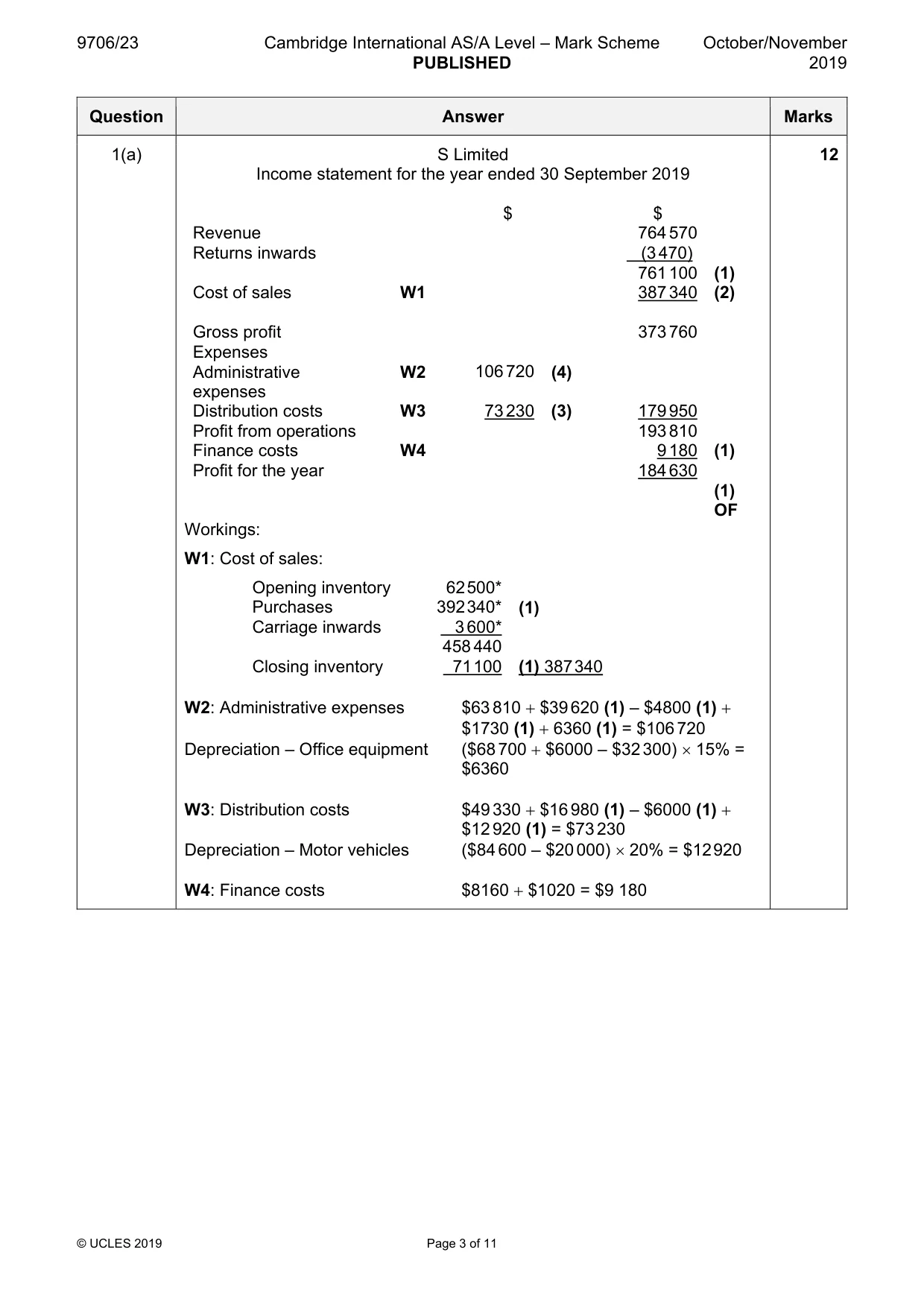
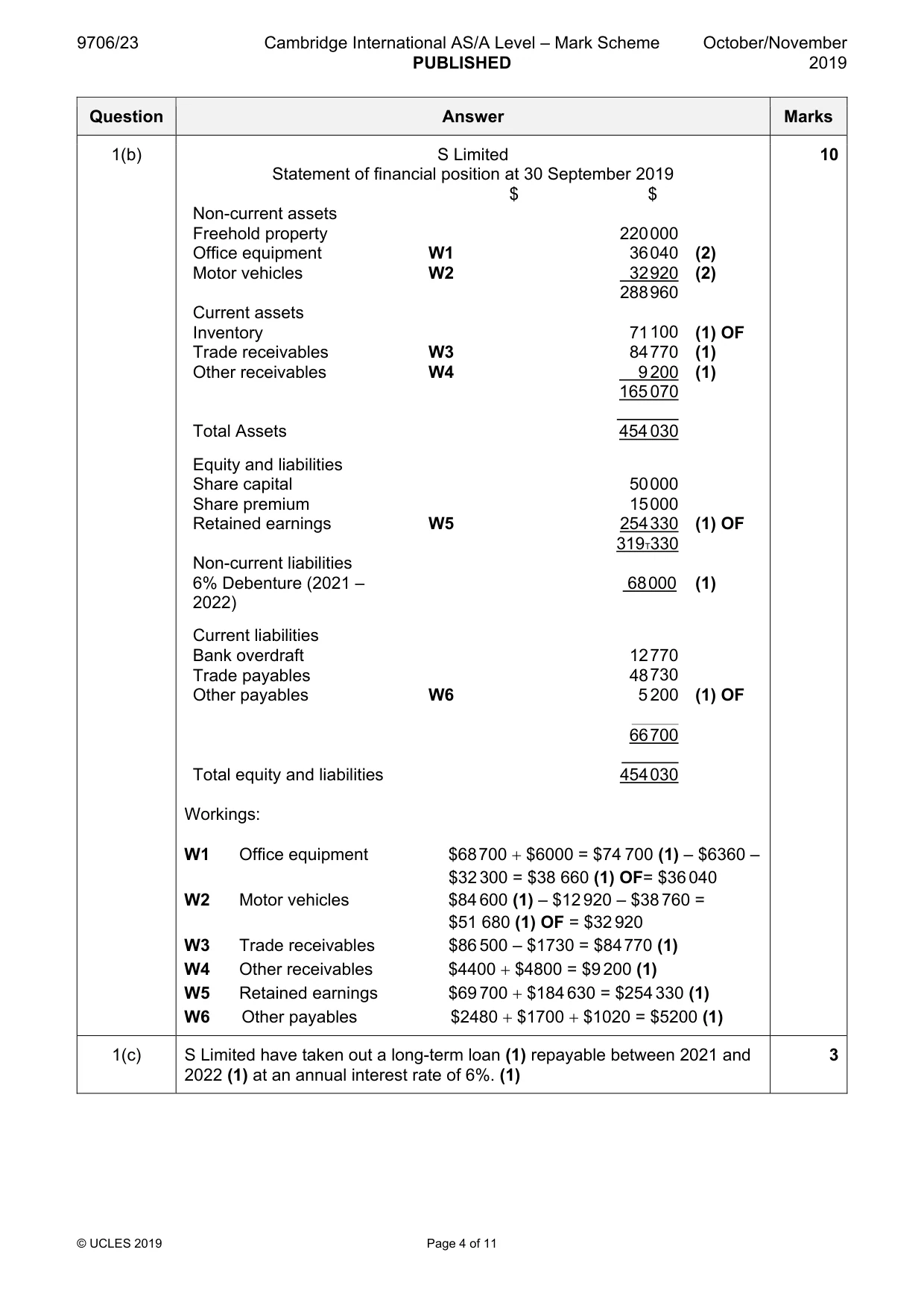
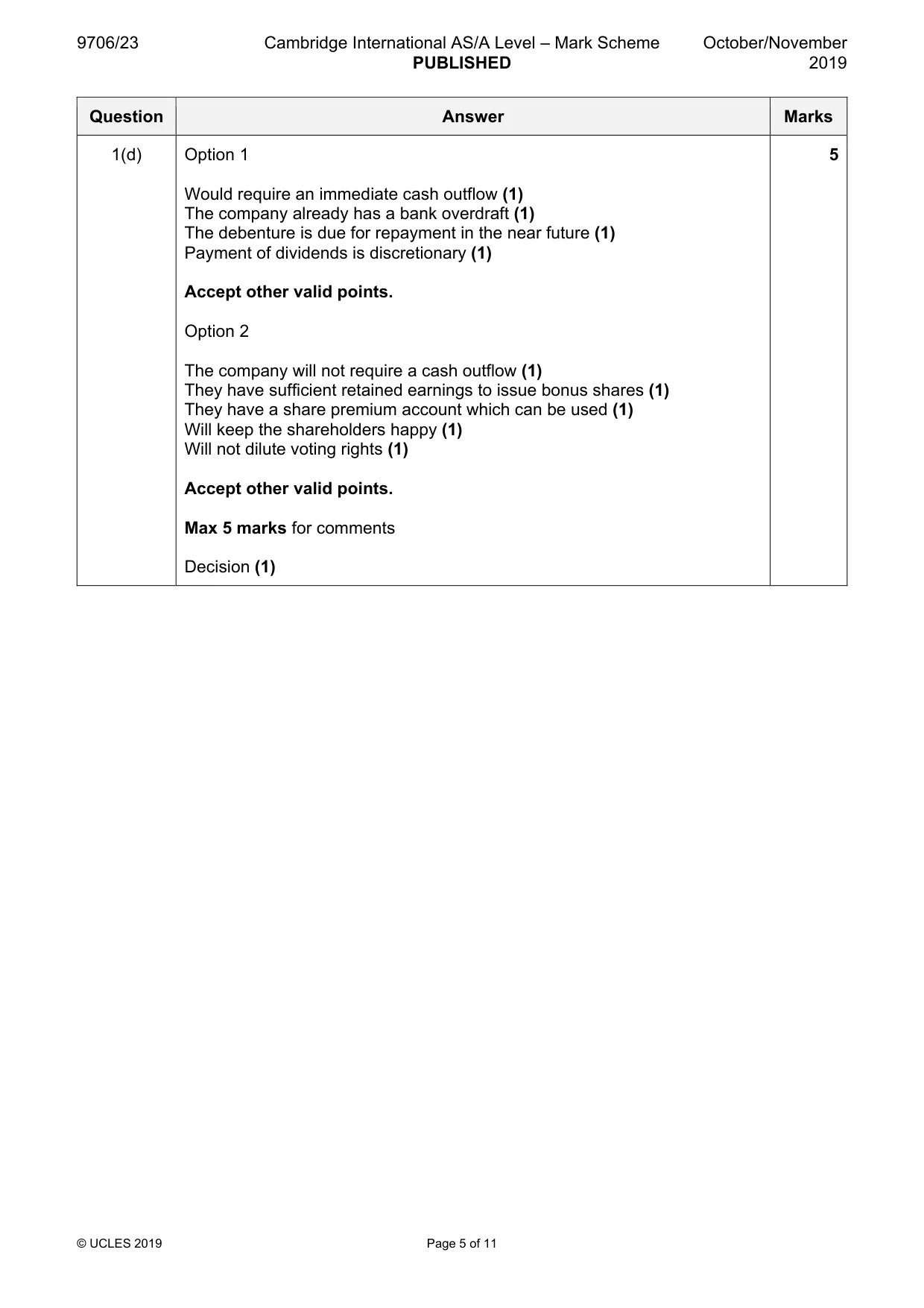
Mark scheme: Question Answer Marks 1(a) S Limited 12 Income statement for the year ended 30 September 2019 $ $ Revenue 764 570 Returns inwards (3 470) 761 100 (1) Cost of sales W1 387 340 (2) Gross profit 373 760 Expenses Administrative W2 106 720 (4) expenses Distribution costs W3 73 230 (3) 179 950 Profit from operations 193 810 Finance costs W4 9 180 (1) Profit for the year 184 630 (1) OF Workings: W1: Cost of sales: Opening inventory 62 500* Purchases 392 340* (1) Carriage inwards 3 600* 458 440 Closing inventory 71 100 (1) 387 340 W2: Administrative expenses $63 810 + $39 620 (1) – $4800 (1) + $1730 (1) + 6360 (1) = $106 720 Depreciation – Office equipment ($68 700 + $6000 – $32 300) × 15% = $6360 W3: Distribution costs $49 330 + $16 980 (1) – $6000 (1) + $12 920 (1) = $73 230 Depreciation – Motor vehicles ($84 600 – $20 000) × 20% = $12 920 W4: Finance costs $8160 + $1020 = $9 180 1(b) S Limited 10 Statement of financial position at 30 September 2019 $ $ Non-current assets Freehold property 220 000 Office equipment W1 36 040 (2) Motor vehicles W2 32 920 (2) 288 960 Current assets Inventory 71 100 (1) OF Trade receivables W3 84 770 (1) Other receivables W4 9 200 (1) 165 070 Total Assets 454 030 Equity and liabilities Share capital 50 000 Share premium 15 000 Retained earnings W5 254 330 (1) OF 319T330 Non-current liabilities 6% Debenture (2021 – 68 000 (1) 2022) Current liabilities Bank overdraft 12 770 Trade payables 48 730 Other payables W6 5 200 (1) OF 66 700 Total equity and liabilities 454 030 Workings: W1 Office equipment $68 700 + $6000 = $74 700 (1) – $6360 – $32 300 = $38 660 (1) OF= $36 040 W2 Motor vehicles $84 600 (1) – $12 920 – $38 760 = $51 680 (1) OF = $32 920 W3 Trade receivables $86 500 – $1730 = $84 770 (1) W4 Other receivables $4400 + $4800 = $9 200 (1) W5 Retained earnings $69 700 + $184 630 = $254 330 (1) W6 Other payables $2480 + $1700 + $1020 = $5200 (1) 1(c) S Limited have taken out a long-term loan (1) repayable between 2021 and 3 2022 (1) at an annual interest rate of 6%. (1) 1(d) Option 1 5 Would require an immediate cash outflow (1) The company already has a bank overdraft (1) The debenture is due for repayment in the near future (1) Payment of dividends is discretionary (1) Accept other valid points. Option 2 The company will not require a cash outflow (1) They have sufficient retained earnings to issue bonus shares (1) They have a share premium account which can be used (1) Will keep the shareholders happy (1) Will not dilute voting rights (1) Accept other valid points. Max 5 marks for comments Decision (1)
Q2 · Moser has provided the following information about his non-current assets for the year…
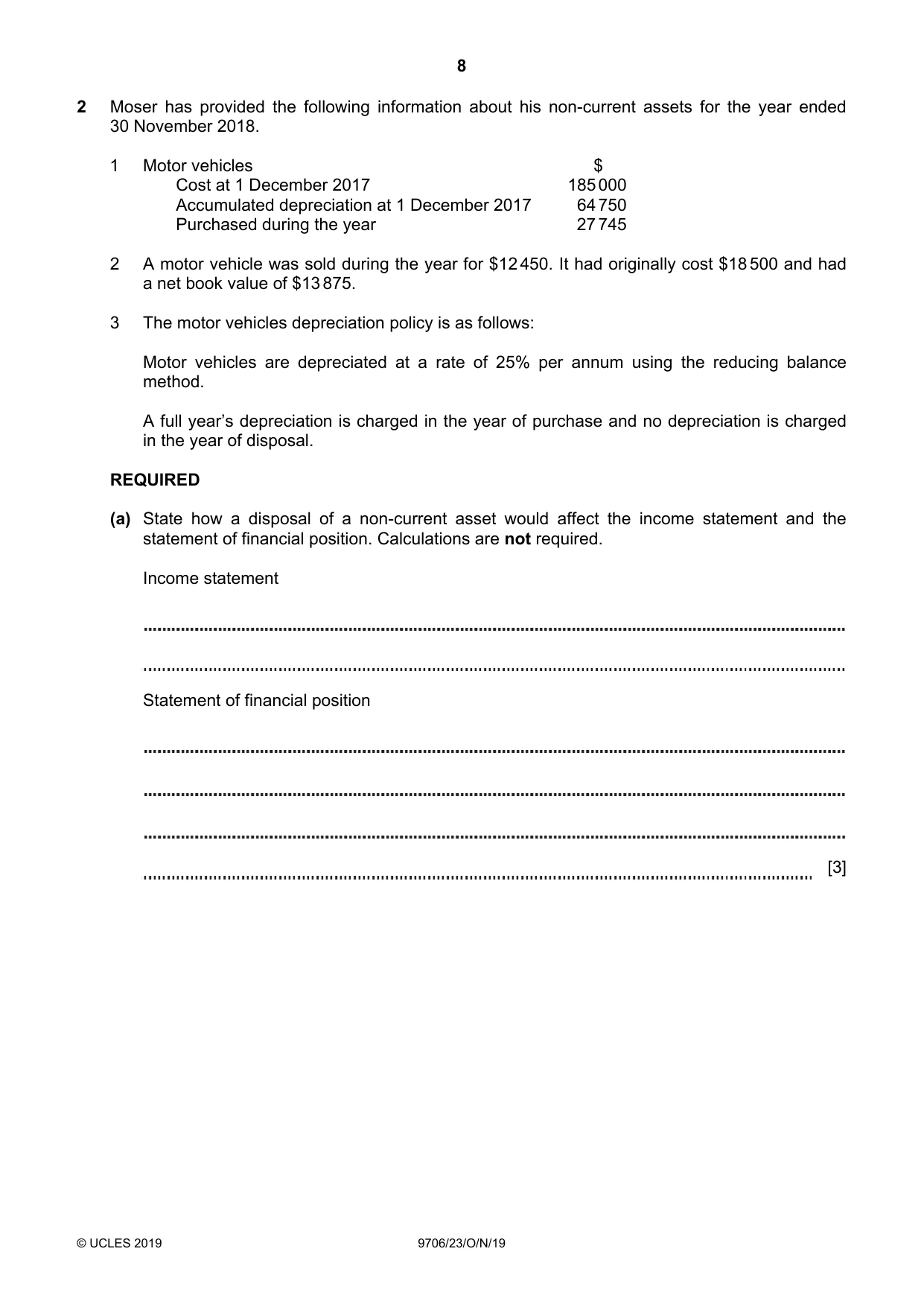
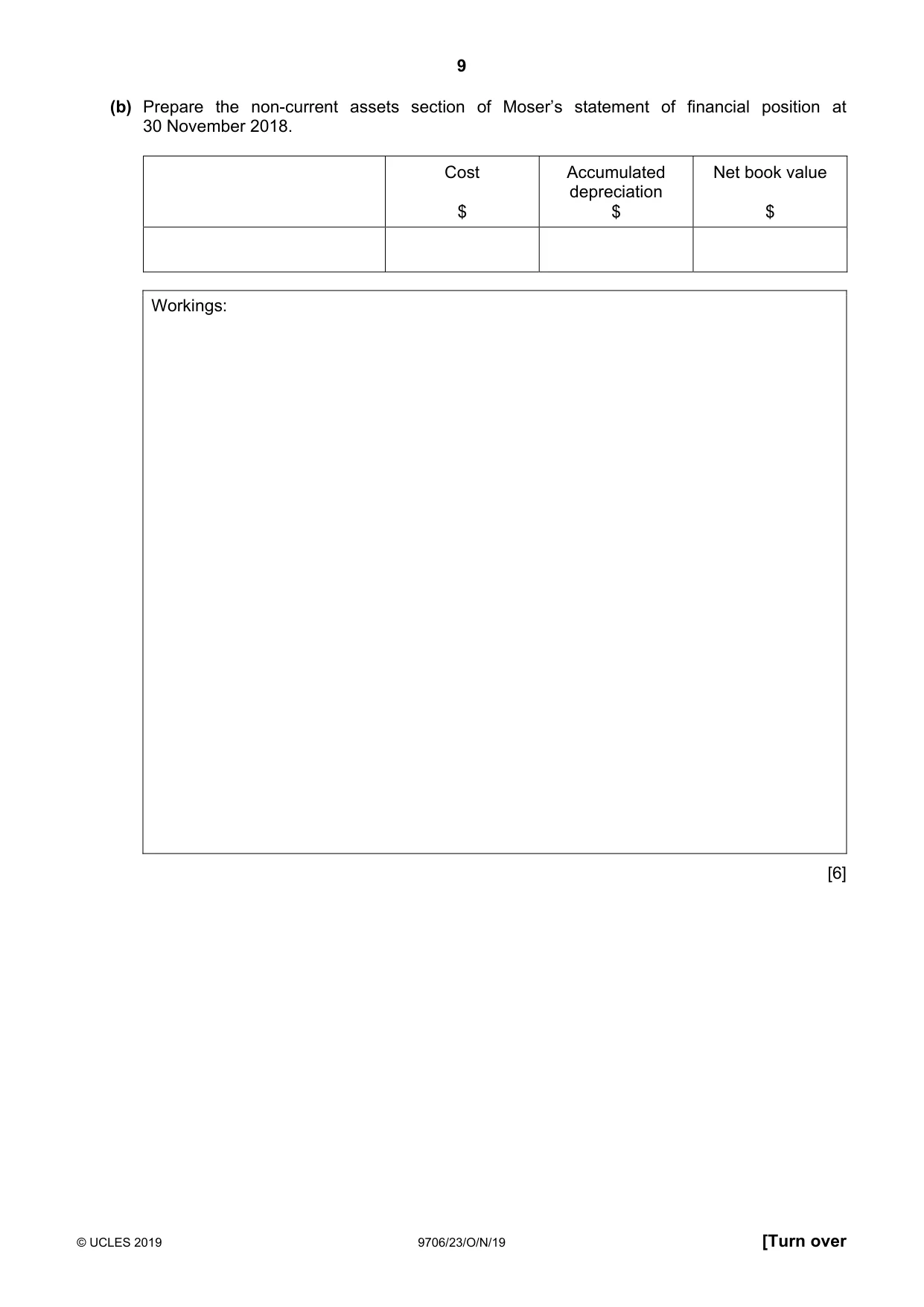
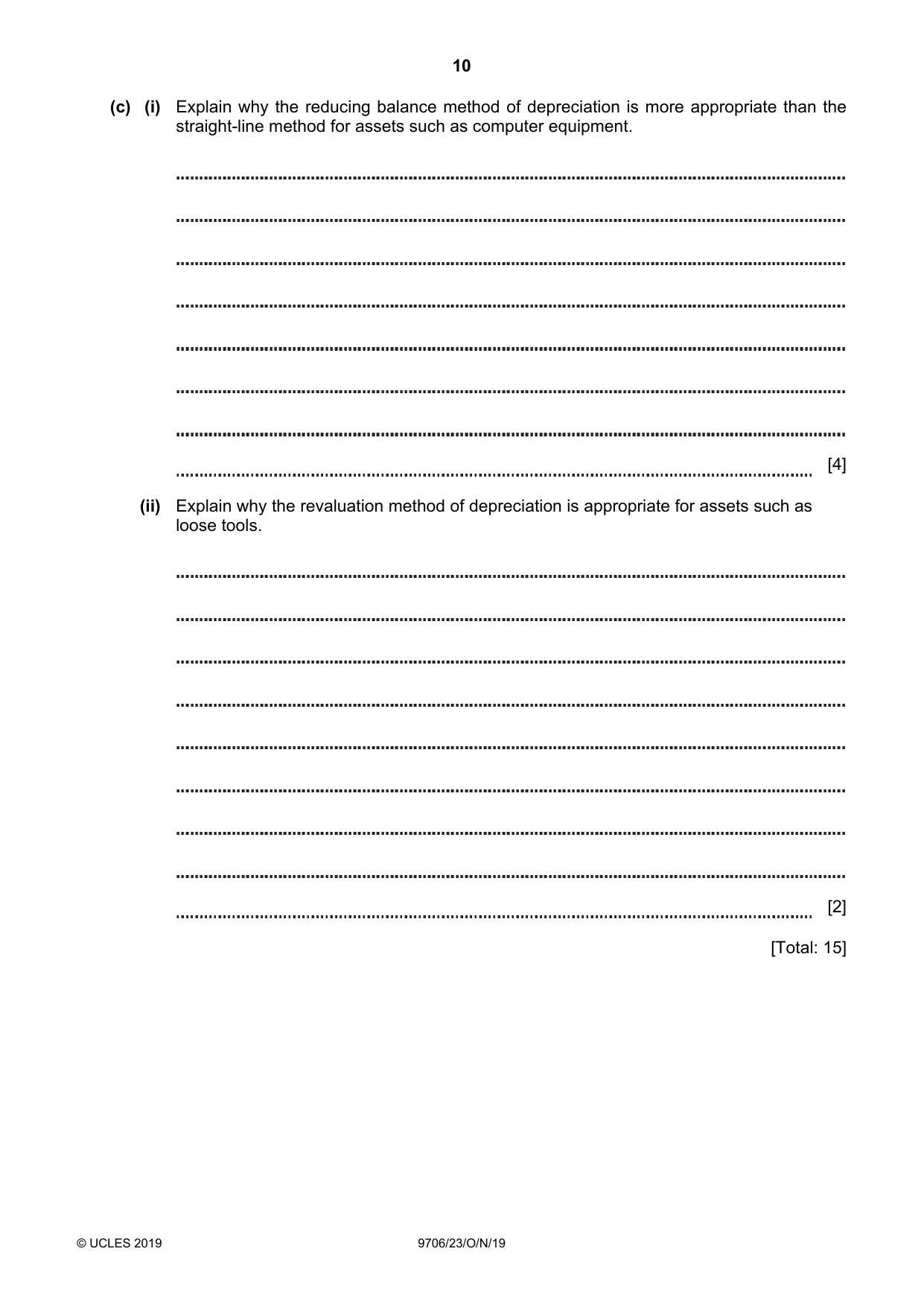
2 Moser has provided the following information about his non-current assets for the year ended 30 November 2018. 1 Motor vehicles $ Cost at 1 December 2017 185 000 Accumulated depreciation at 1 December 2017 64 750 Purchased during the year 27 745 2 A motor vehicle was sold during the year for $12 450. It had originally cost $18 500 and had a net book value of $13 875. 3 The motor vehicles depreciation policy is as follows: Motor vehicles are depreciated at a rate of 25% per annum using the reducing balance method. A full year’s depreciation is charged in the year of purchase and no depreciation is charged in the year of disposal. REQUIRED (a) State how a disposal of a non-current asset would affect the income statement and the statement of financial position. Calculations are not required. Income statement Statement of financial position [3] (b) Prepare the non-current assets section of Moser’s statement of financial position at 30 November 2018. Cost Accumulated Net book value depreciation $ $ $ Workings: [6] (c) (i) Explain why the reducing balance method of depreciation is more appropriate than the straight-line method for assets such as computer equipment. [4] (ii) Explain why the revaluation method of depreciation is appropriate for assets such as loose tools. [2] [Total: 15] PLEASE TURN OVER
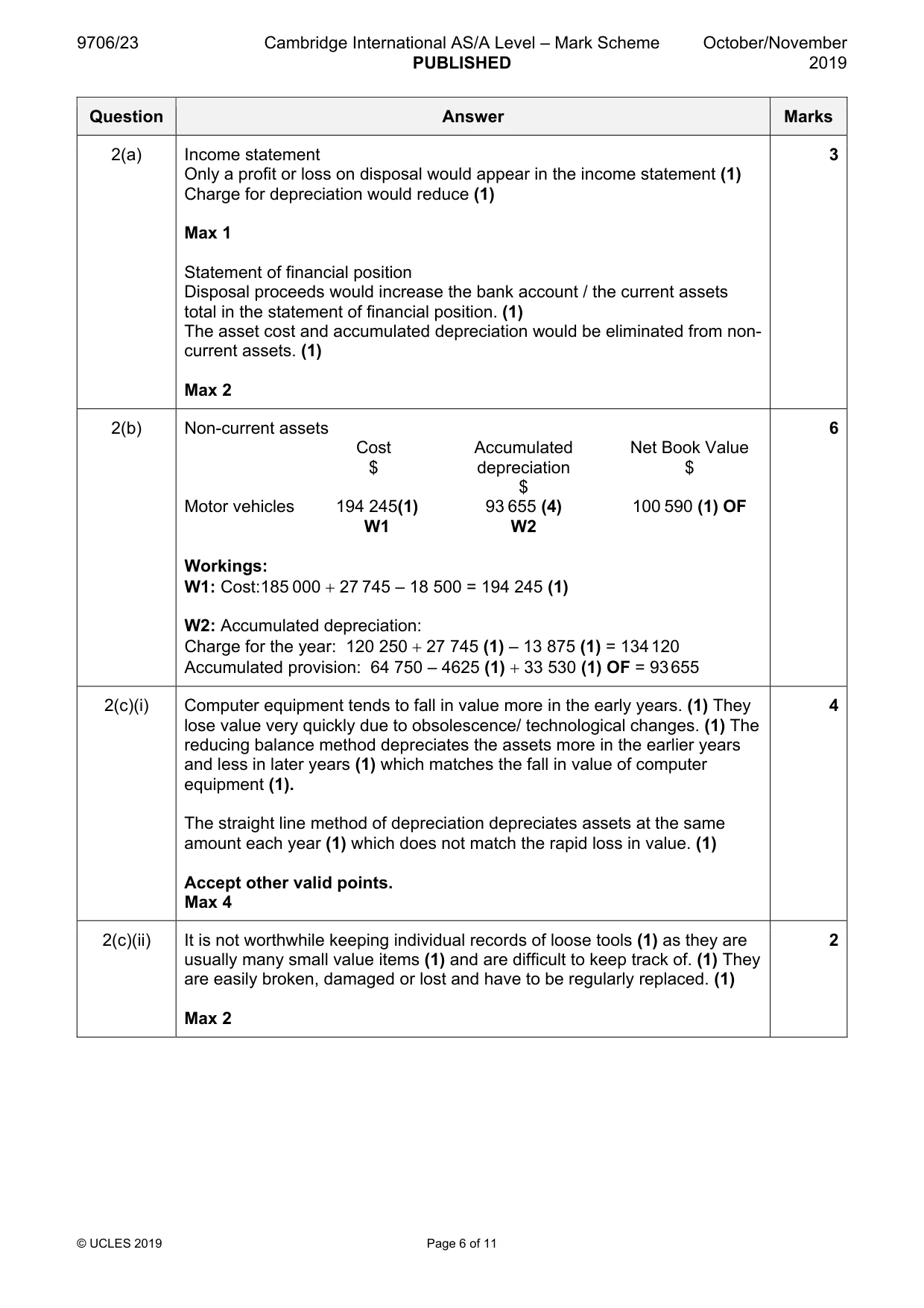
Mark scheme: 2(a) Income statement 3 Only a profit or loss on disposal would appear in the income statement (1) Charge for depreciation would reduce (1) Max 1 Statement of financial position Disposal proceeds would increase the bank account / the current assets total in the statement of financial position. (1) The asset cost and accumulated depreciation would be eliminated from non- current assets. (1) Max 2 2(b) Non-current assets 6 Cost Accumulated Net Book Value $ depreciation $ $ Motor vehicles 194 245(1) 93 655 (4) 100 590 (1) OF W1 W2 Workings: W1: Cost:185 000 + 27 745 – 18 500 = 194 245 (1) W2: Accumulated depreciation: Charge for the year: 120 250 + 27 745 (1) – 13 875 (1) = 134 120 Accumulated provision: 64 750 – 4625 (1) + 33 530 (1) OF = 93 655 2(c)(i) Computer equipment tends to fall in value more in the early years. (1) They 4 lose value very quickly due to obsolescence/ technological changes. (1) The reducing balance method depreciates the assets more in the earlier years and less in later years (1) which matches the fall in value of computer equipment (1). The straight line method of depreciation depreciates assets at the same amount each year (1) which does not match the rapid loss in value. (1) Accept other valid points. Max 4 2(c)(ii) It is not worthwhile keeping individual records of loose tools (1) as they are 2 usually many small value items (1) and are difficult to keep track of. (1) They are easily broken, damaged or lost and have to be regularly replaced. (1) Max 2
Q3 · Maria is a sole trader
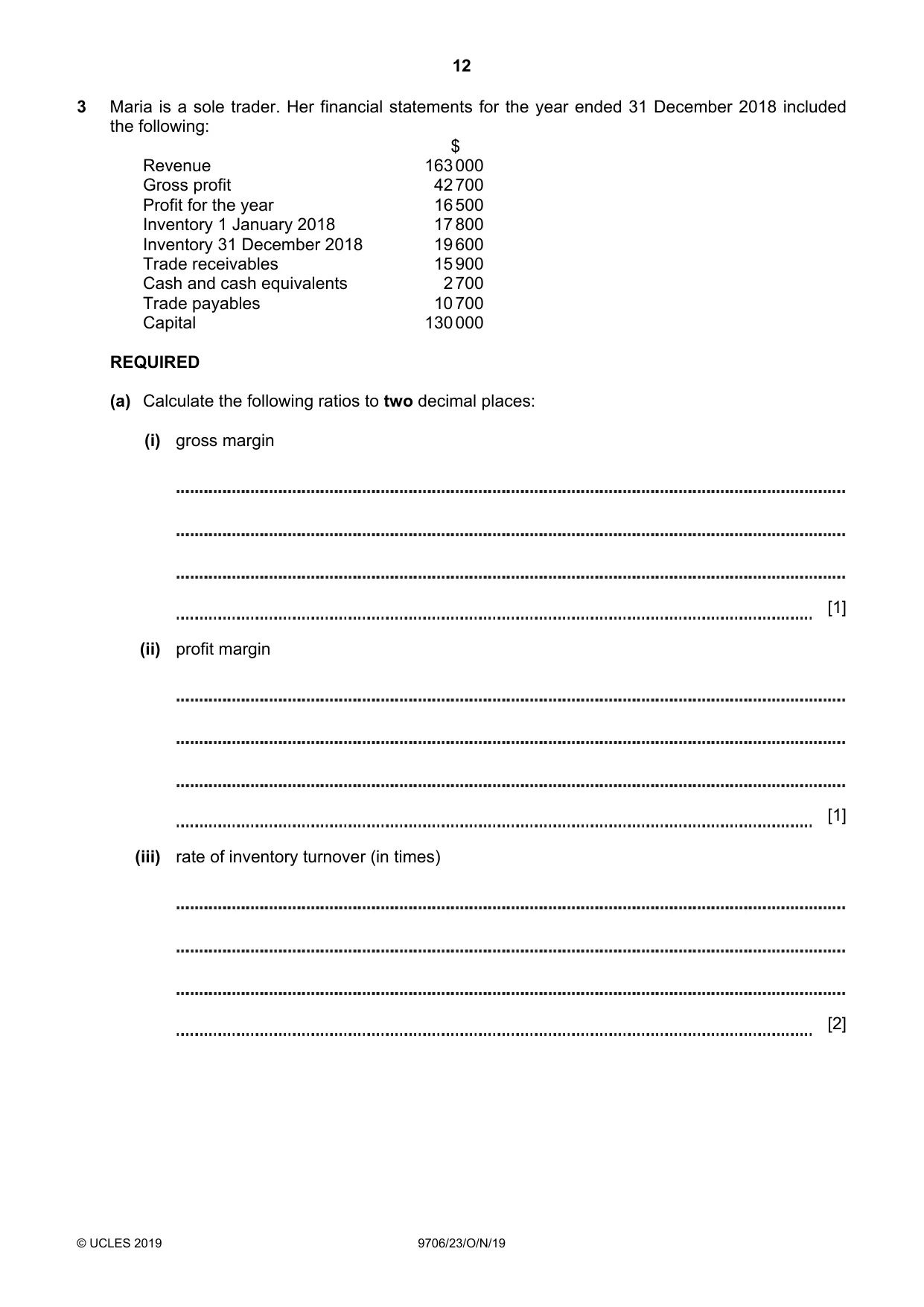
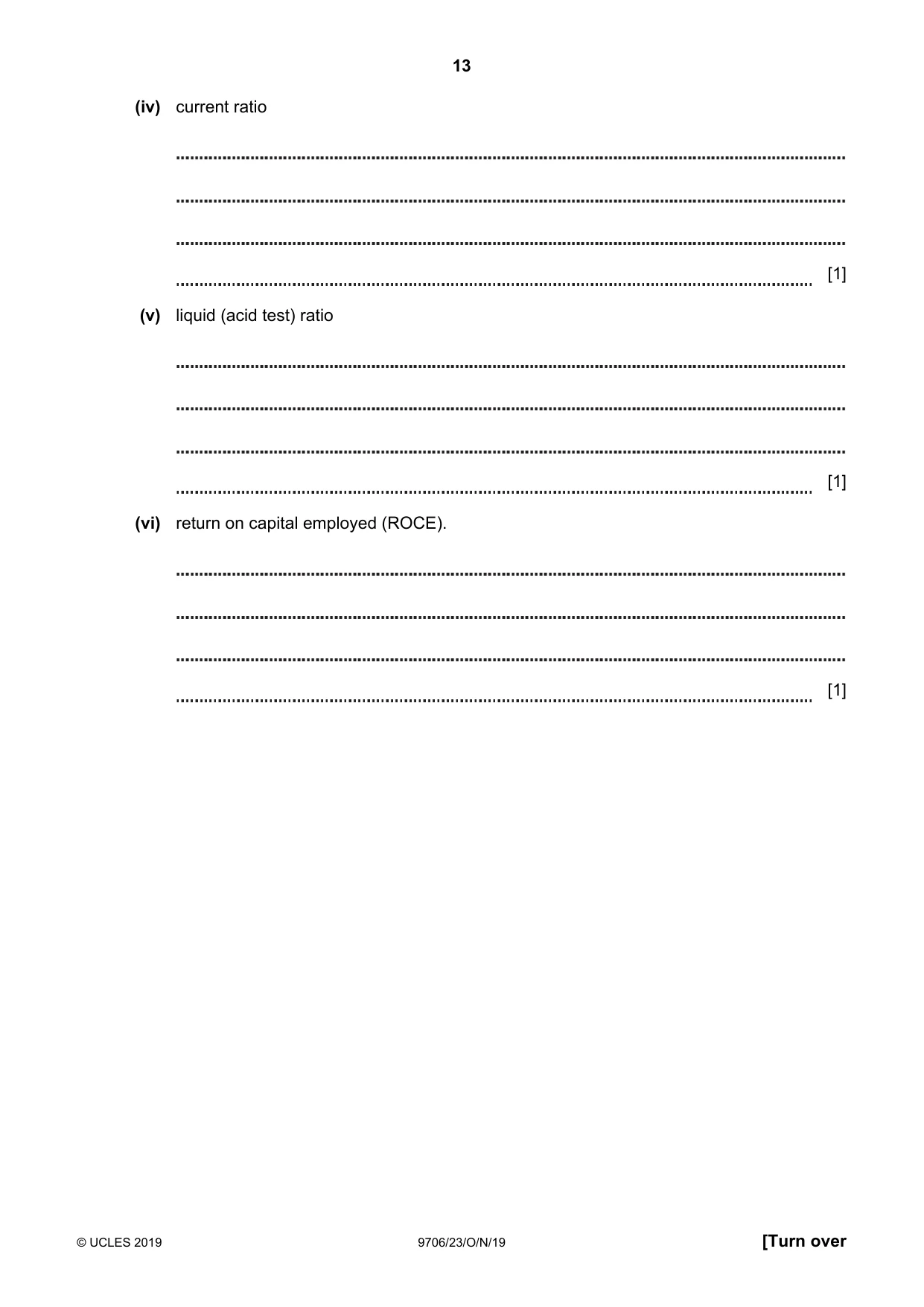
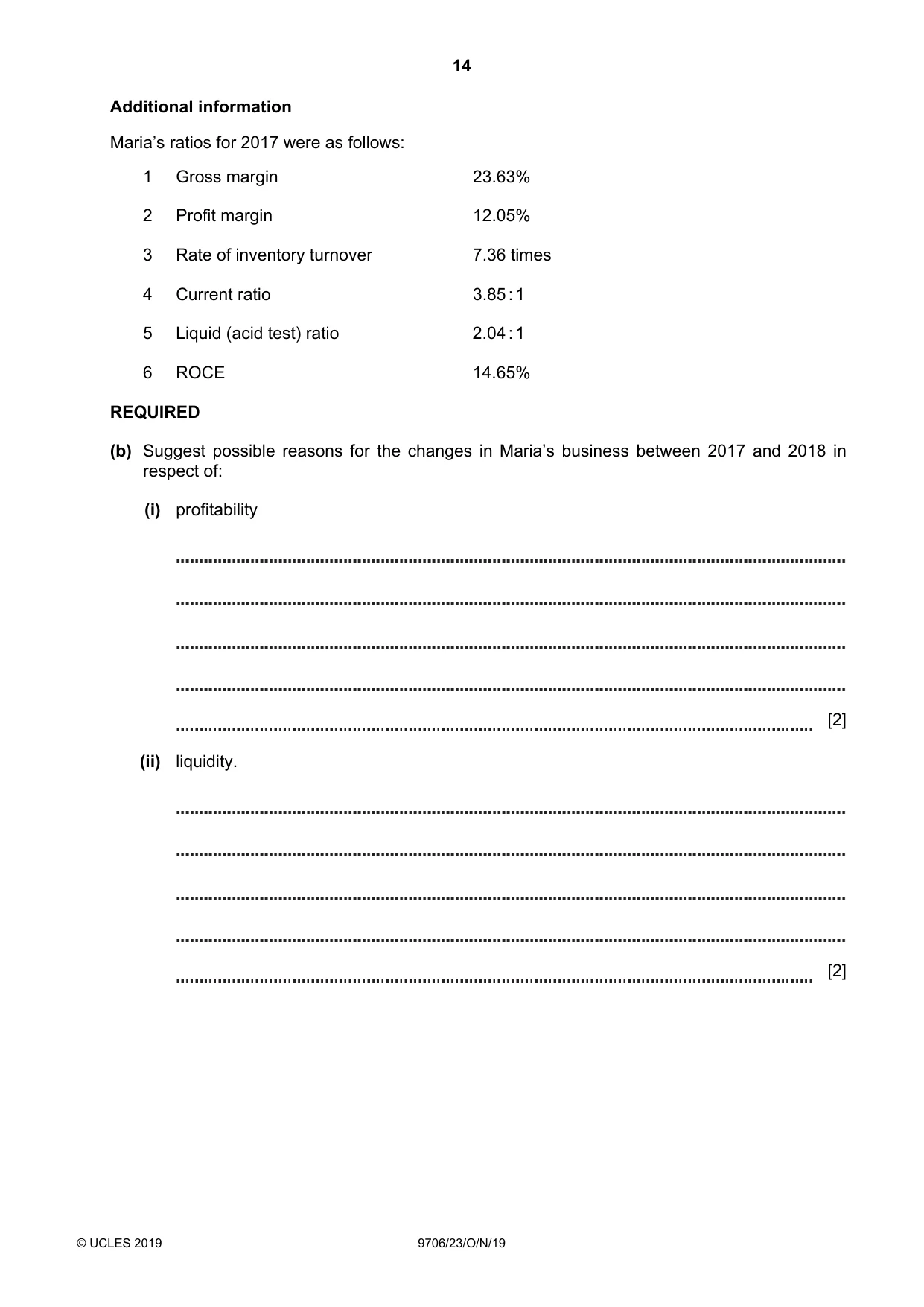
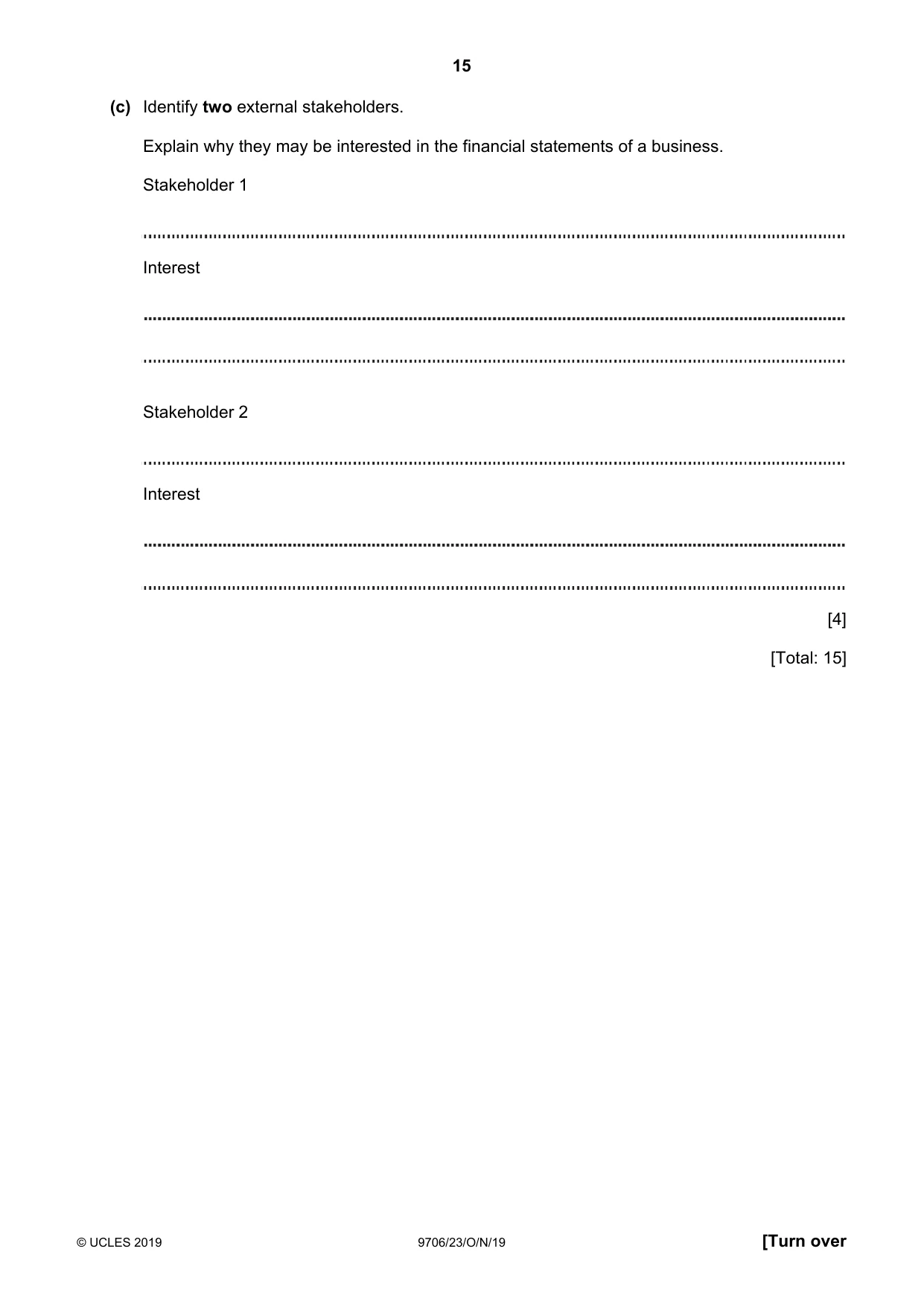
3 Maria is a sole trader. Her financial statements for the year ended 31 December 2018 included the following: $ Revenue 163 000 Gross profit 42 700 Profit for the year 16 500 Inventory 1 January 2018 17 800 Inventory 31 December 2018 19 600 Trade receivables 15 900 Cash and cash equivalents 2 700 Trade payables 10 700 Capital 130 000 REQUIRED (a) Calculate the following ratios to two decimal places: (i) gross margin [1] (ii) profit margin [1] (iii) rate of inventory turnover (in times) [2] (iv) current ratio [1] (v) liquid (acid test) ratio [1] (vi) return on capital employed (ROCE). [1] Additional information Maria’s ratios for 2017 were as follows: 1 Gross margin 23.63% 2 Profit margin 12.05% 3 Rate of inventory turnover 7.36 times 4 Current ratio 3.85 : 1 5 Liquid (acid test) ratio 2.04 : 1 6 ROCE 14.65% REQUIRED (b) Suggest possible reasons for the changes in Maria’s business between 2017 and 2018 in respect of: (i) profitability [2] (ii) liquidity. [2] (c) Identify two external stakeholders. Explain why they may be interested in the financial statements of a business. Stakeholder 1 Interest Stakeholder 2 Interest [4] [Total: 15]
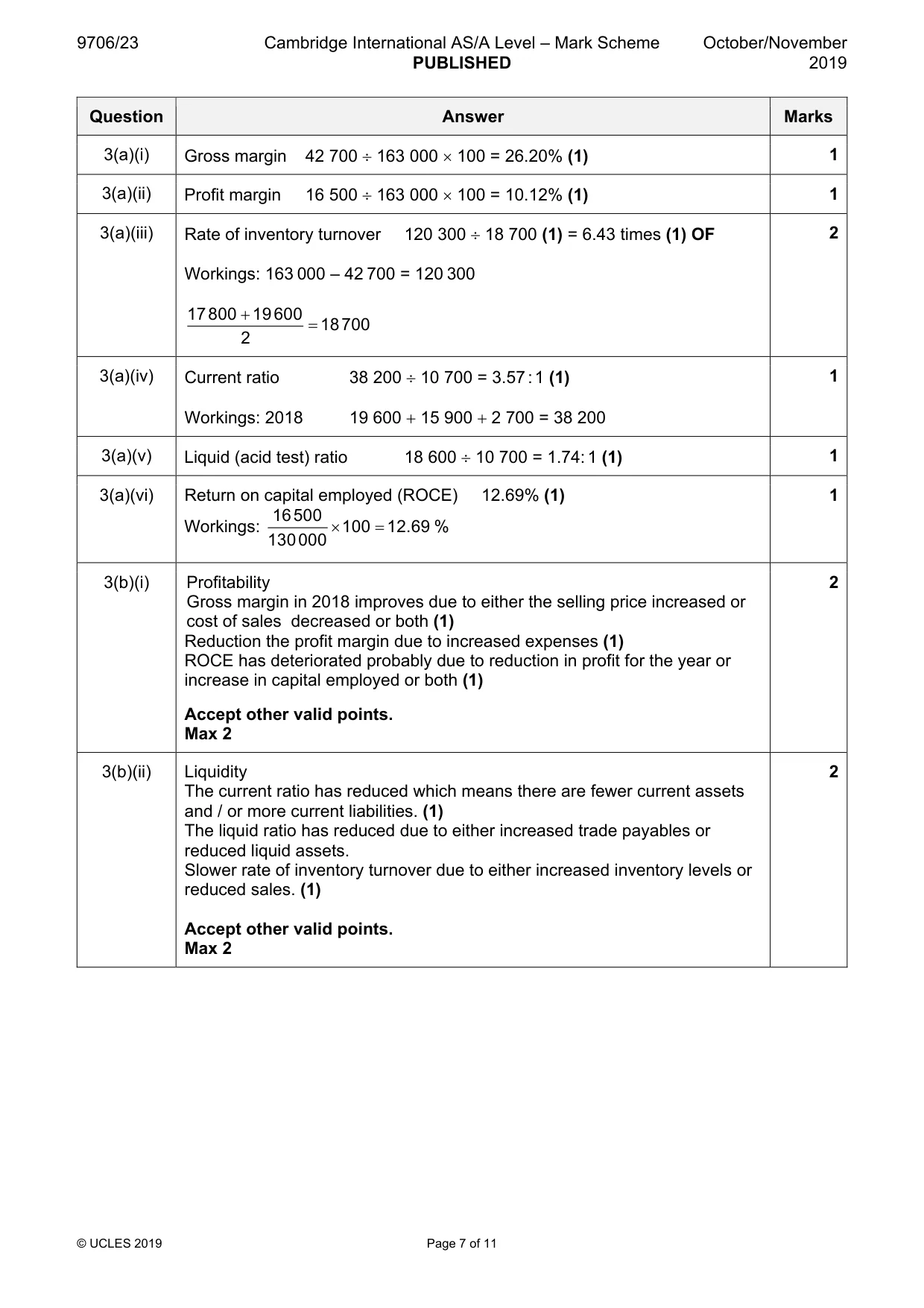
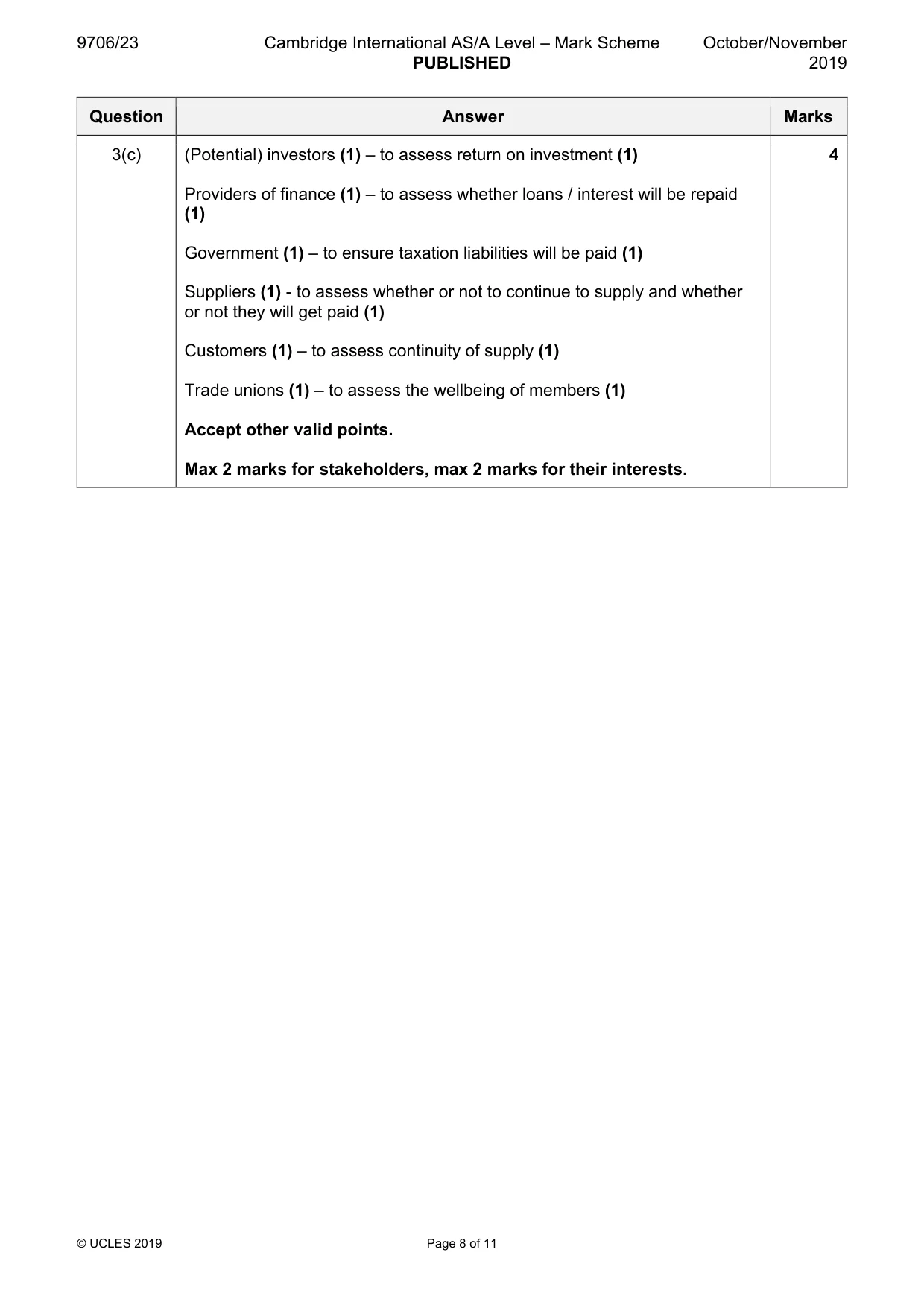
Mark scheme: 3(a)(i) Gross margin 42 700 ÷ 163 000 × 100 = 26.20% (1) 1 3(a)(ii) Profit margin 16 500 ÷ 163 000 × 100 = 10.12% (1) 1 3(a)(iii) Rate of inventory turnover 120 300 ÷ 18 700 (1) = 6.43 times (1) OF 2 Workings: 163 000 – 42 700 = 120 300 17800 + 19600 = 18700 2 3(a)(iv) Current ratio 38 200 ÷ 10 700 = 3.57 : 1 (1) 1 Workings: 2018 19 600 + 15 900 + 2 700 = 38 200 3(a)(v) Liquid (acid test) ratio 18 600 ÷ 10 700 = 1.74: 1 (1) 1 3(a)(vi) Return on capital employed (ROCE) 12.69% (1) 1 16500 Workings: × 100 = 12.69 % 130000 3(b)(i) Profitability 2 Gross margin in 2018 improves due to either the selling price increased or cost of sales decreased or both (1) Reduction the profit margin due to increased expenses (1) ROCE has deteriorated probably due to reduction in profit for the year or increase in capital employed or both (1) Accept other valid points. Max 2 3(b)(ii) Liquidity 2 The current ratio has reduced which means there are fewer current assets and / or more current liabilities. (1) The liquid ratio has reduced due to either increased trade payables or reduced liquid assets. Slower rate of inventory turnover due to either increased inventory levels or reduced sales. (1) Accept other valid points. Max 2 3(c) (Potential) investors (1) – to assess return on investment (1) 4 Providers of finance (1) – to assess whether loans / interest will be repaid (1) Government (1) – to ensure taxation liabilities will be paid (1) Suppliers (1) - to assess whether or not to continue to supply and whether or not they will get paid (1) Customers (1) – to assess continuity of supply (1) Trade unions (1) – to assess the wellbeing of members (1) Accept other valid points. Max 2 marks for stakeholders, max 2 marks for their interests.
More questions on Analysis and communication of accounting information
Q4 · D Limited manufactures a single product
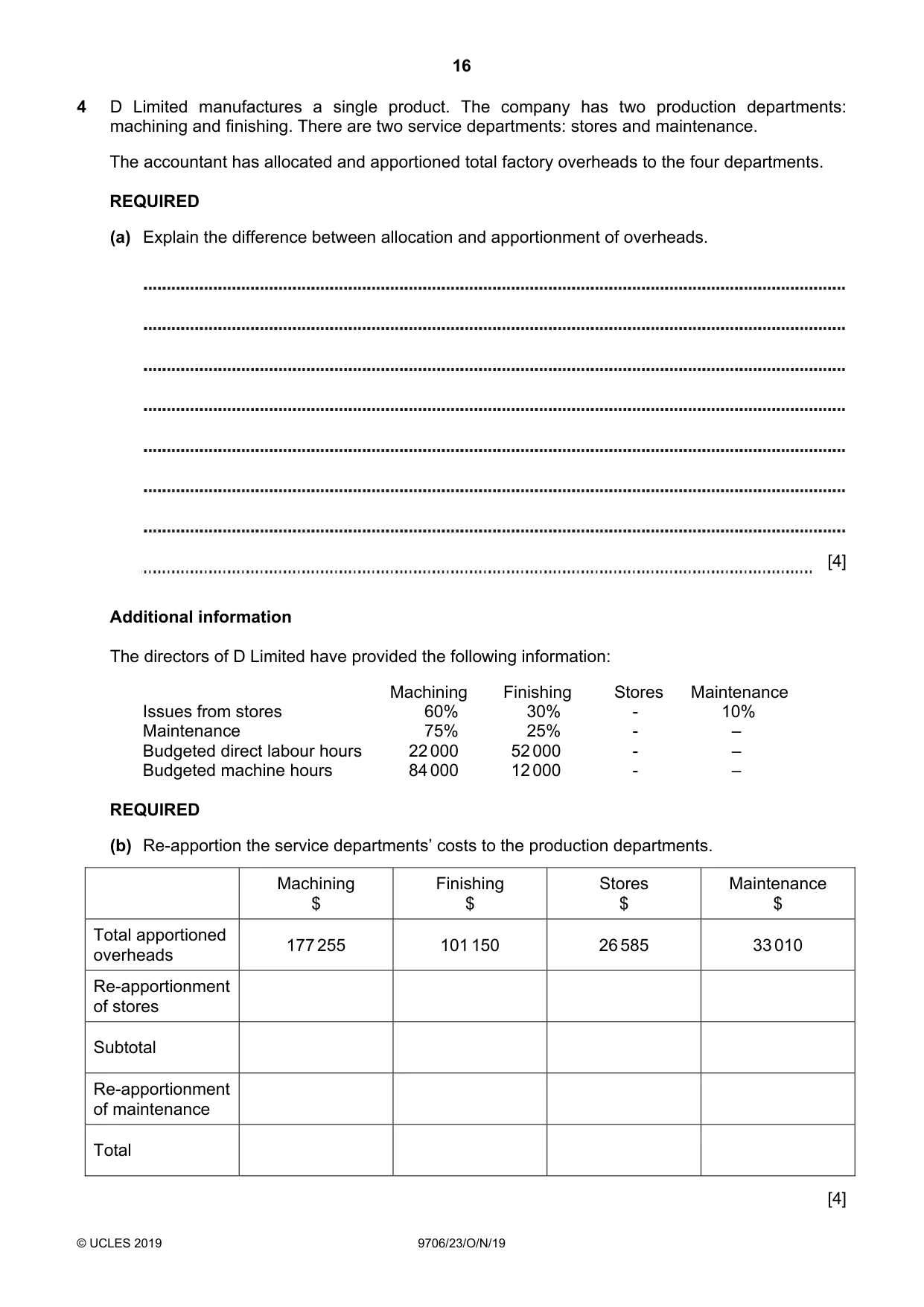
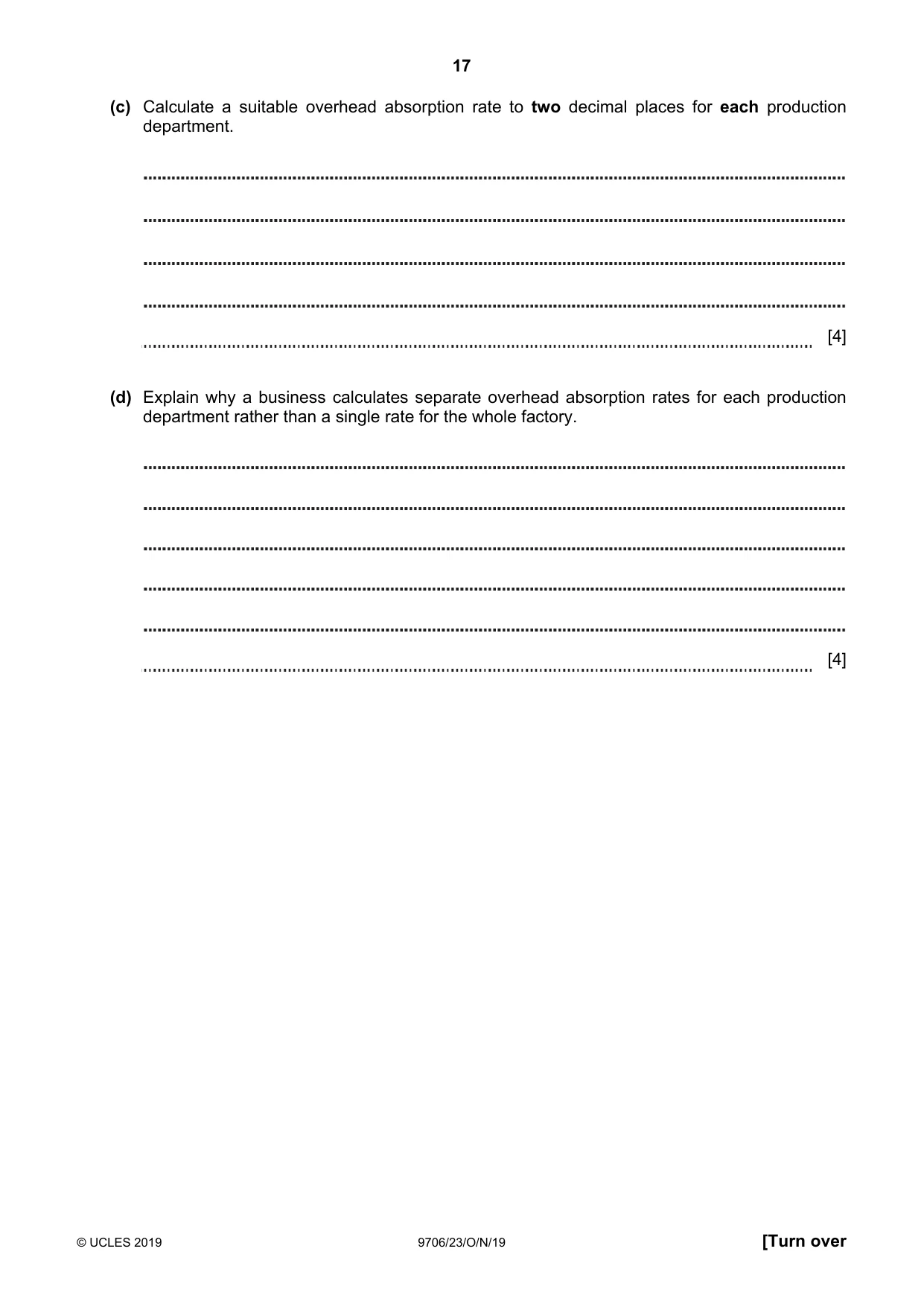
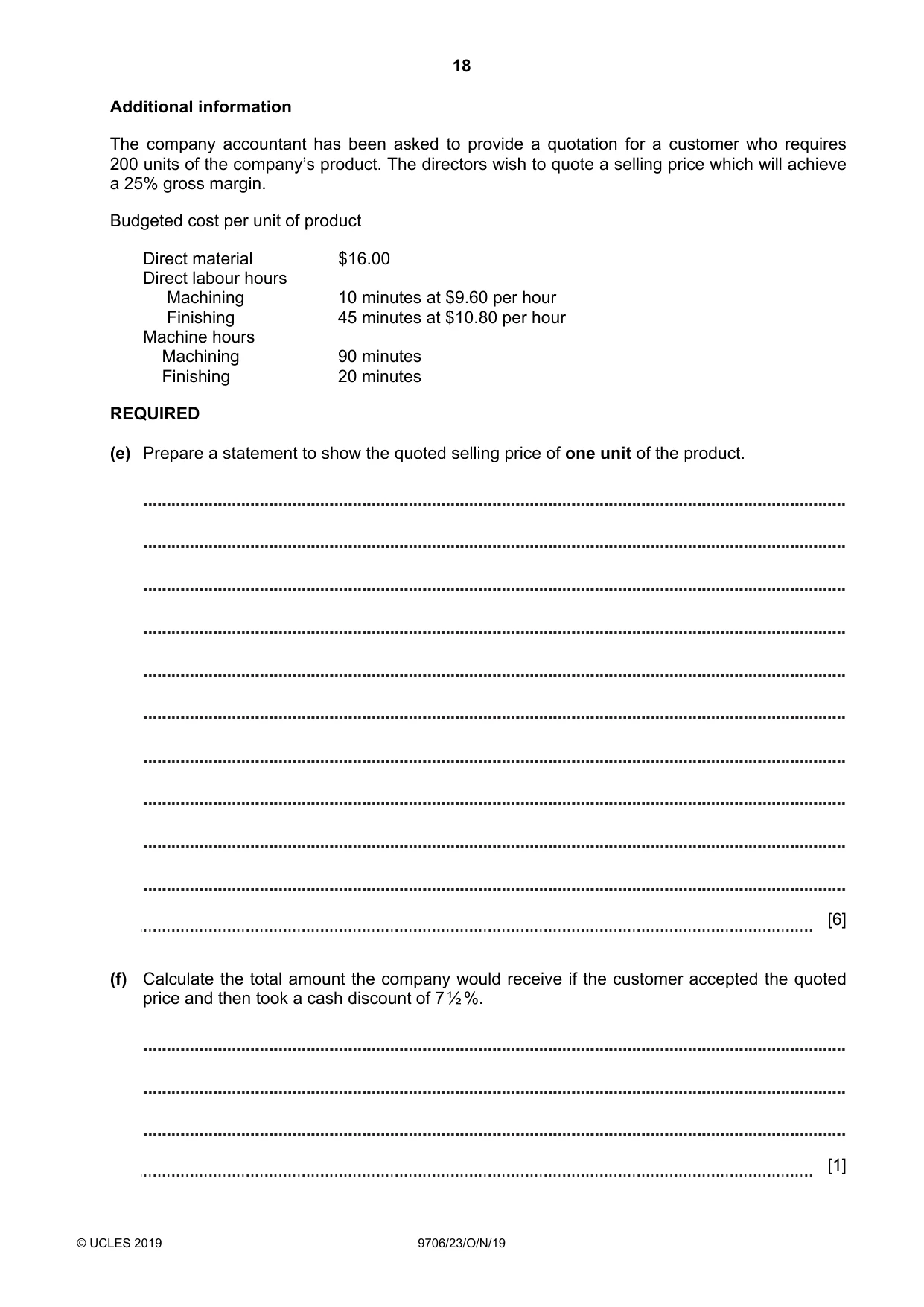
4 D Limited manufactures a single product. The company has two production departments: machining and finishing. There are two service departments: stores and maintenance. The accountant has allocated and apportioned total factory overheads to the four departments. REQUIRED (a) Explain the difference between allocation and apportionment of overheads. [4] Additional information The directors of D Limited have provided the following information: Machining Finishing Stores Maintenance Issues from stores 60% 30% - 10% Maintenance 75% 25% - – Budgeted direct labour hours 22 000 52 000 - – Budgeted machine hours 84 000 12 000 - – REQUIRED (b) Re-apportion the service departments’ costs to the production departments. Machining Finishing Stores Maintenance $ $ $ $ Total apportioned 177 255 101 150 26 585 33 010 overheads Re-apportionment of stores Subtotal Re-apportionment of maintenance Total [4] (c) Calculate a suitable overhead absorption rate to two decimal places for each production department. [4] (d) Explain why a business calculates separate overhead absorption rates for each production department rather than a single rate for the whole factory. [4] Additional information The company accountant has been asked to provide a quotation for a customer who requires 200 units of the company’s product. The directors wish to quote a selling price which will achieve a 25% gross margin. Budgeted cost per unit of product Direct material $16.00 Direct labour hours Machining 10 minutes at $9.60 per hour Finishing 45 minutes at $10.80 per hour Machine hours Machining 90 minutes Finishing 20 minutes REQUIRED (e) Prepare a statement to show the quoted selling price of one unit of the product. [6] (f) Calculate the total amount the company would receive if the customer accepted the quoted price and then took a cash discount of 7 ½ %. [1]
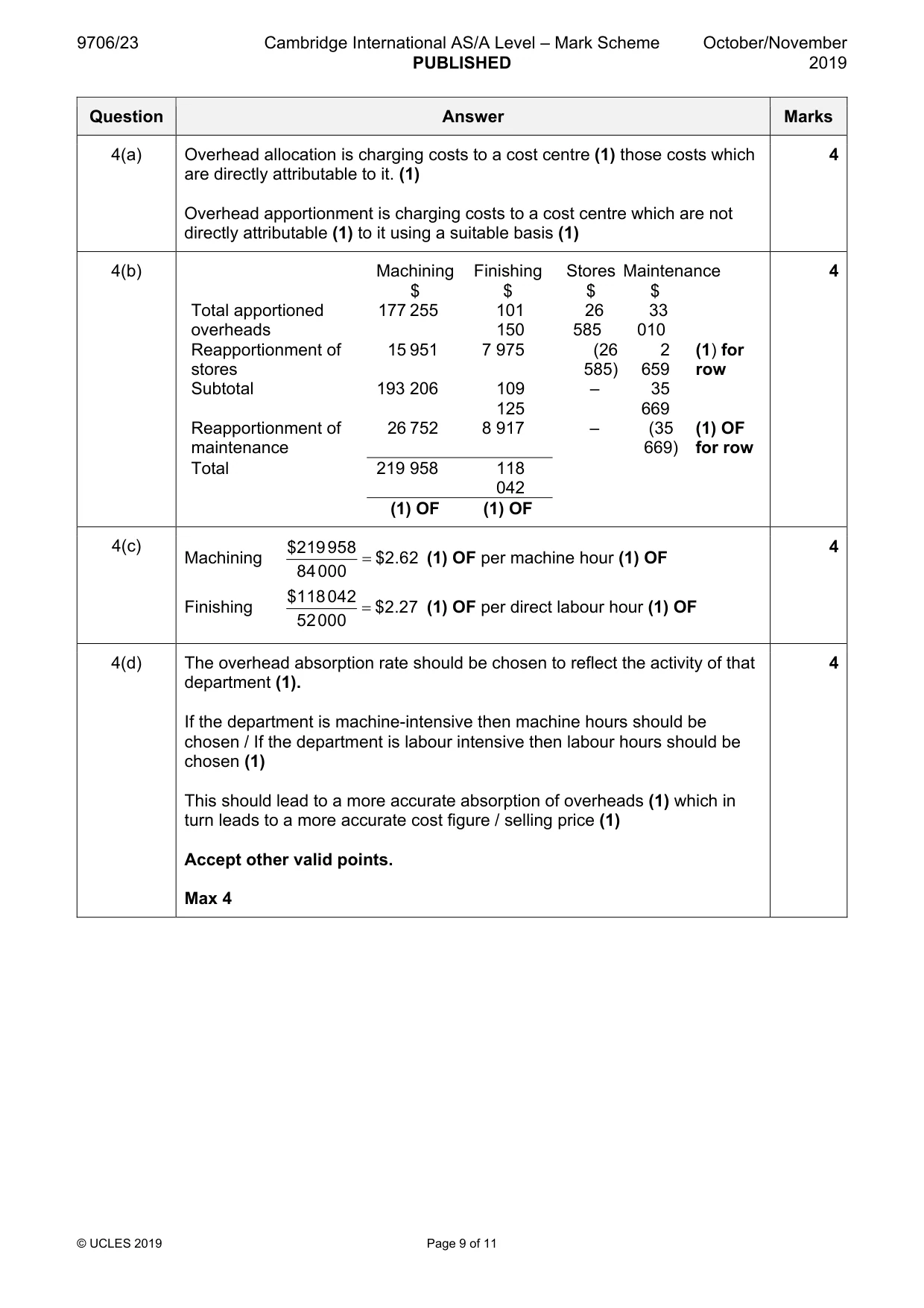
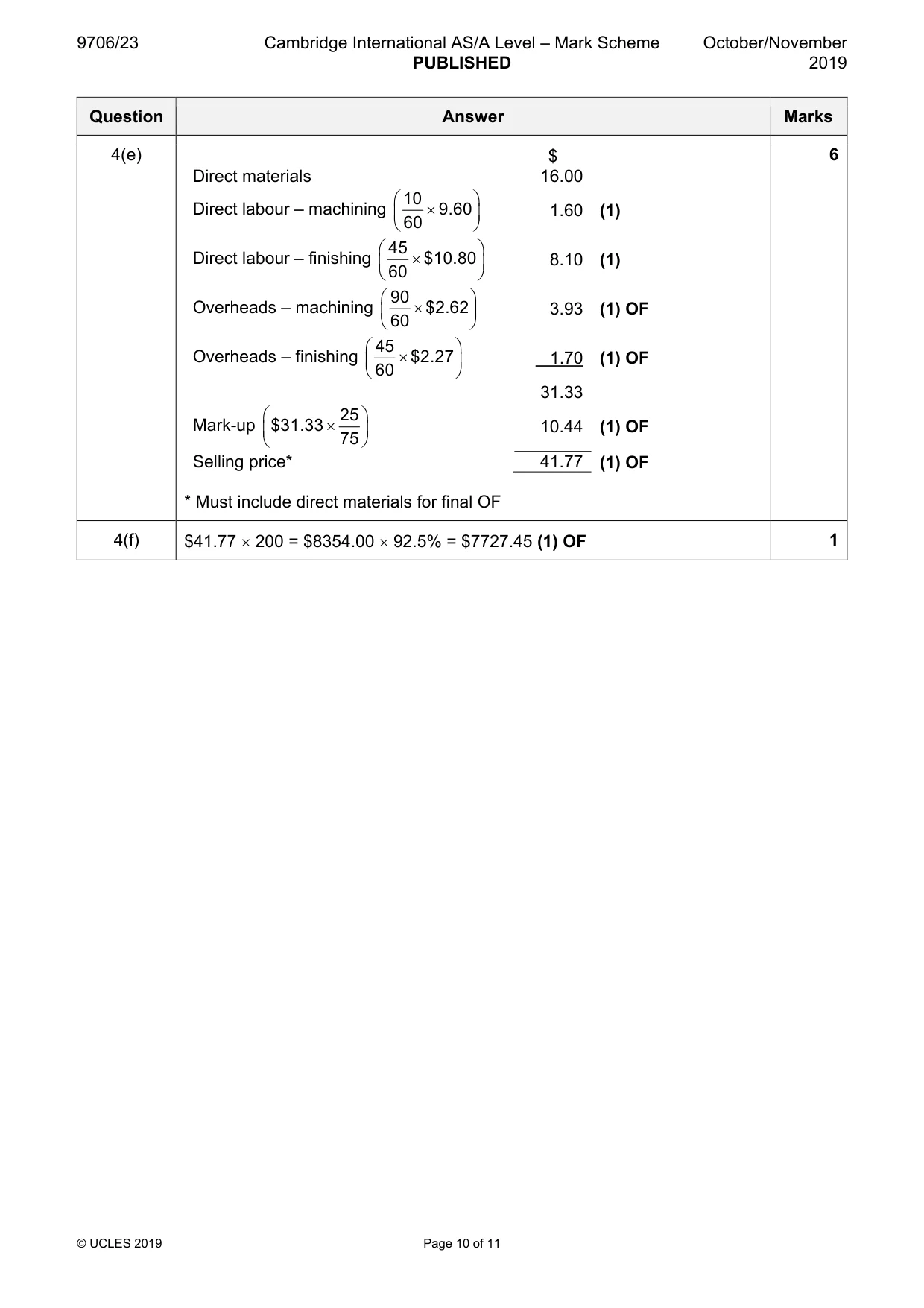
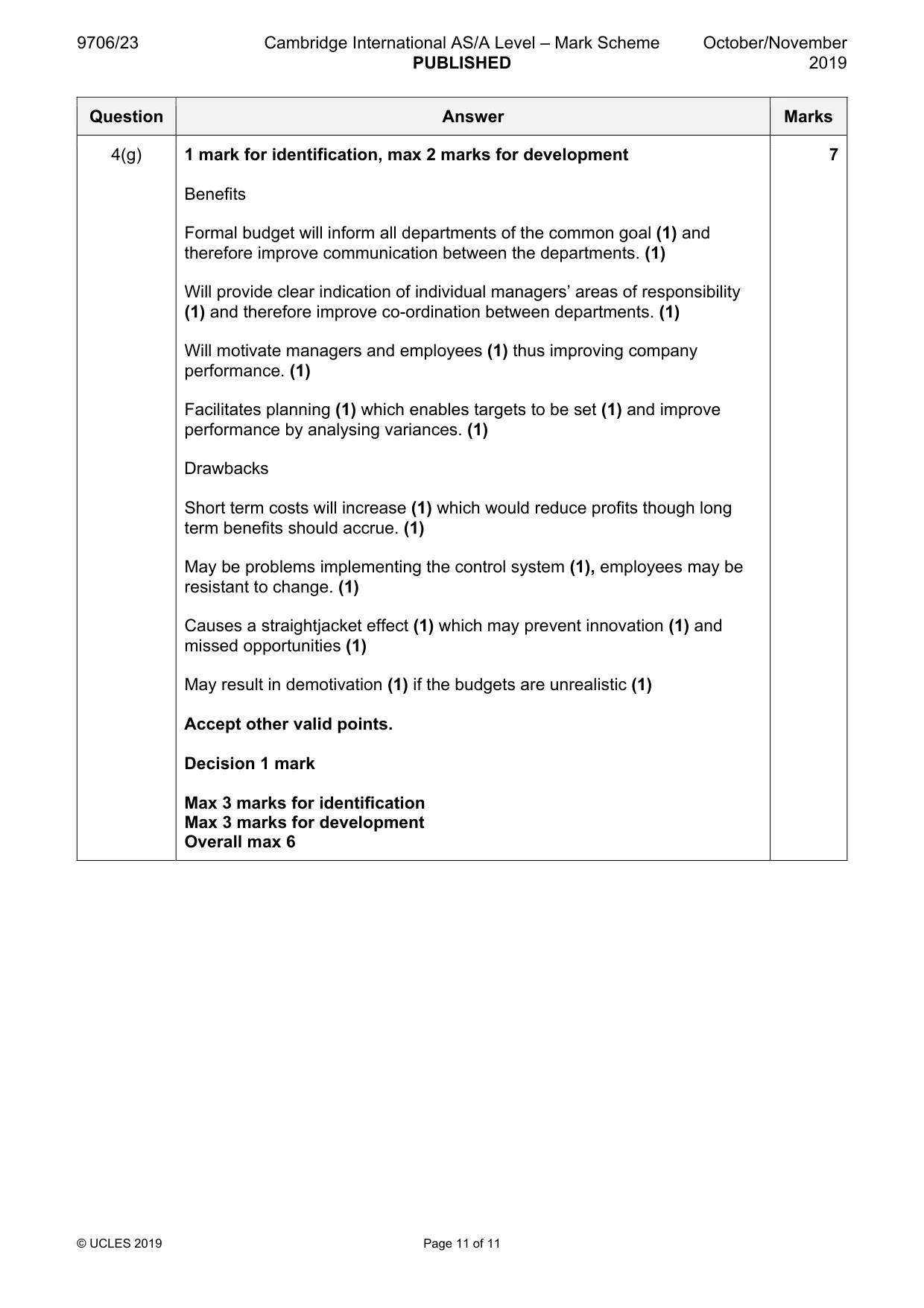
Mark scheme: 4(a) Overhead allocation is charging costs to a cost centre (1) those costs which 4 are directly attributable to it. (1) Overhead apportionment is charging costs to a cost centre which are not directly attributable (1) to it using a suitable basis (1) 4(b) Machining Finishing Stores Maintenance 4 $ $ $ $ Total apportioned 177 255 101 26 33 overheads 150 585 010 Reapportionment of 15 951 7 975 (26 2 (1) for stores 585) 659 row Subtotal 193 206 109 – 35 125 669 Reapportionment of 26 752 8 917 – (35 (1) OF maintenance 669) for row Total 219 958 118 042 (1) OF (1) OF 4(c) $219958 4 Machining = $2.62 (1) OF per machine hour (1) OF 84000 $118042 Finishing = $2.27 (1) OF per direct labour hour (1) OF 52000 4(d) The overhead absorption rate should be chosen to reflect the activity of that 4 department (1). If the department is machine-intensive then machine hours should be chosen / If the department is labour intensive then labour hours should be chosen (1) This should lead to a more accurate absorption of overheads (1) which in turn leads to a more accurate cost figure / selling price (1) Accept other valid points. Max 4 4(e) $ 6 Direct materials 16.00 10 Direct labour – machining × 9.60 1.60 (1) 60 45 Direct labour – finishing × $10.80 8.10 (1) 60 90 Overheads – machining × $2.62 3.93 (1) OF 60 45 Overheads – finishing × $2.27 1.70 (1) OF 60 31.33 25 Mark-up $31.33 × 10.44 (1) OF 75 Selling price* 41.77 (1) OF * Must include direct materials for final OF 4(f) $41.77 × 200 = $8354.00 × 92.5% = $7727.45 (1) OF 1 4(g) 1 mark for identification, max 2 marks for development 7 Benefits Formal budget will inform all departments of the common goal (1) and therefore improve communication between the departments. (1) Will provide clear indication of individual managers’ areas of responsibility (1) and therefore improve co-ordination between departments. (1) Will motivate managers and employees (1) thus improving company performance. (1) Facilitates planning (1) which enables targets to be set (1) and improve performance by analysing variances. (1) Drawbacks Short term costs will increase (1) which would reduce profits though long term benefits should accrue. (1) May be problems implementing the control system (1), employees may be resistant to change. (1) Causes a straightjacket effect (1) which may prevent innovation (1) and missed opportunities (1) May result in demotivation (1) if the budgets are unrealistic (1) Accept other valid points. Decision 1 mark Max 3 marks for identification Max 3 marks for development Overall max 6
What was in this paper
The subtopics covered by these 4 questions, and how many questions each got. Open one in a new tab to see every Cambridge question on it.
What you needed in this session
Cambridge’s own grade thresholds for 2019 Oct/Nov, Paper 2 · Variant 3. A higher threshold means an easier paper — the bar moves with how the cohort did.