Cambridge A Level Accounting 9706 — 2018 May/June Paper 2 · Variant 3
9706/23/M/J/18 · 4 questions · 90 marks · ≈101 min
The question paper and its mark scheme, free to read here and free to download. This is Cambridge’s own paper, exactly as it was sat.
Question paper20 pages


Mark scheme13 pages
Answers below. Sit the paper first if you are practising.
Questions as text
Q1 · Carlos and Erika have been in partnership for several years and prepare their financial…
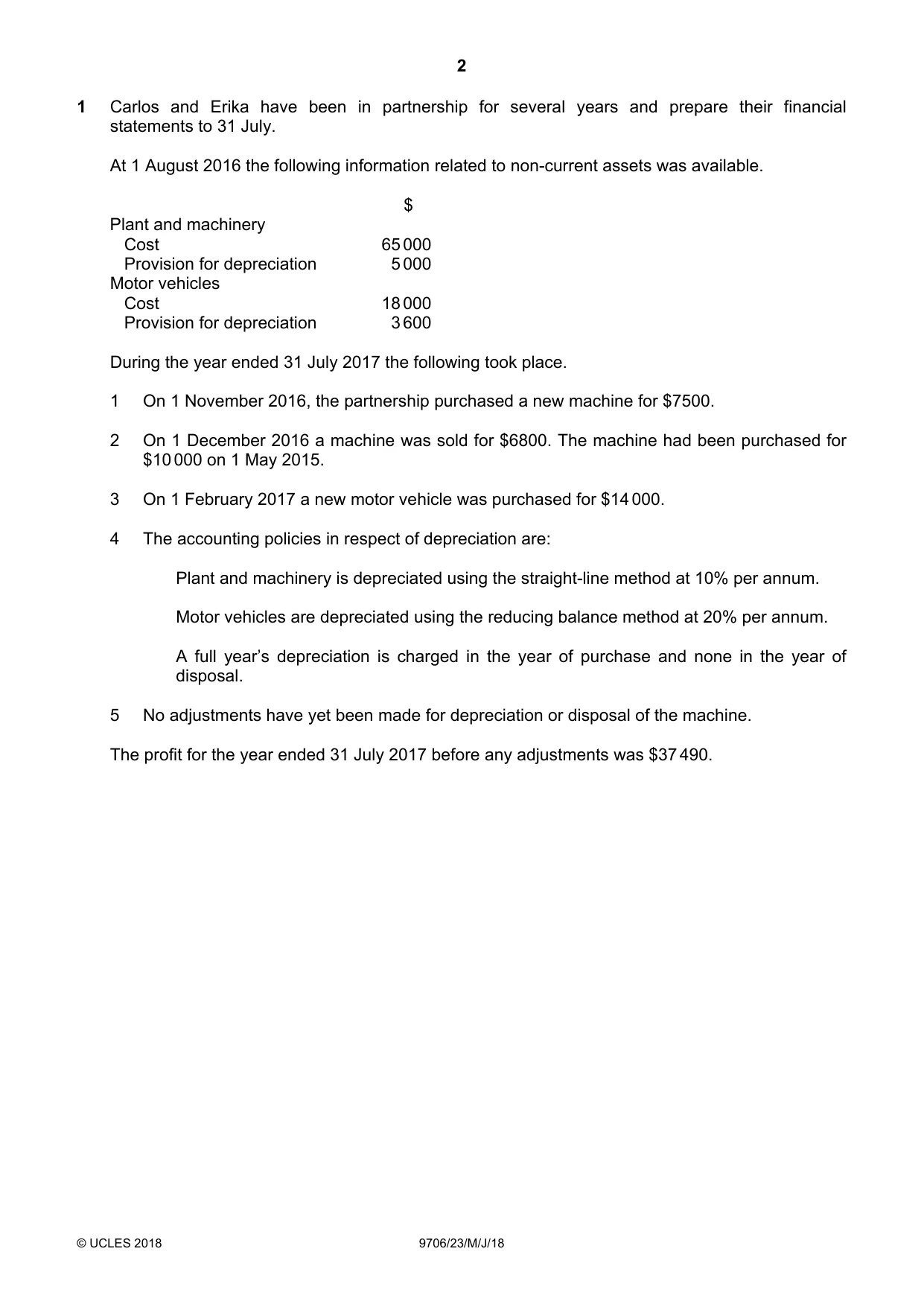
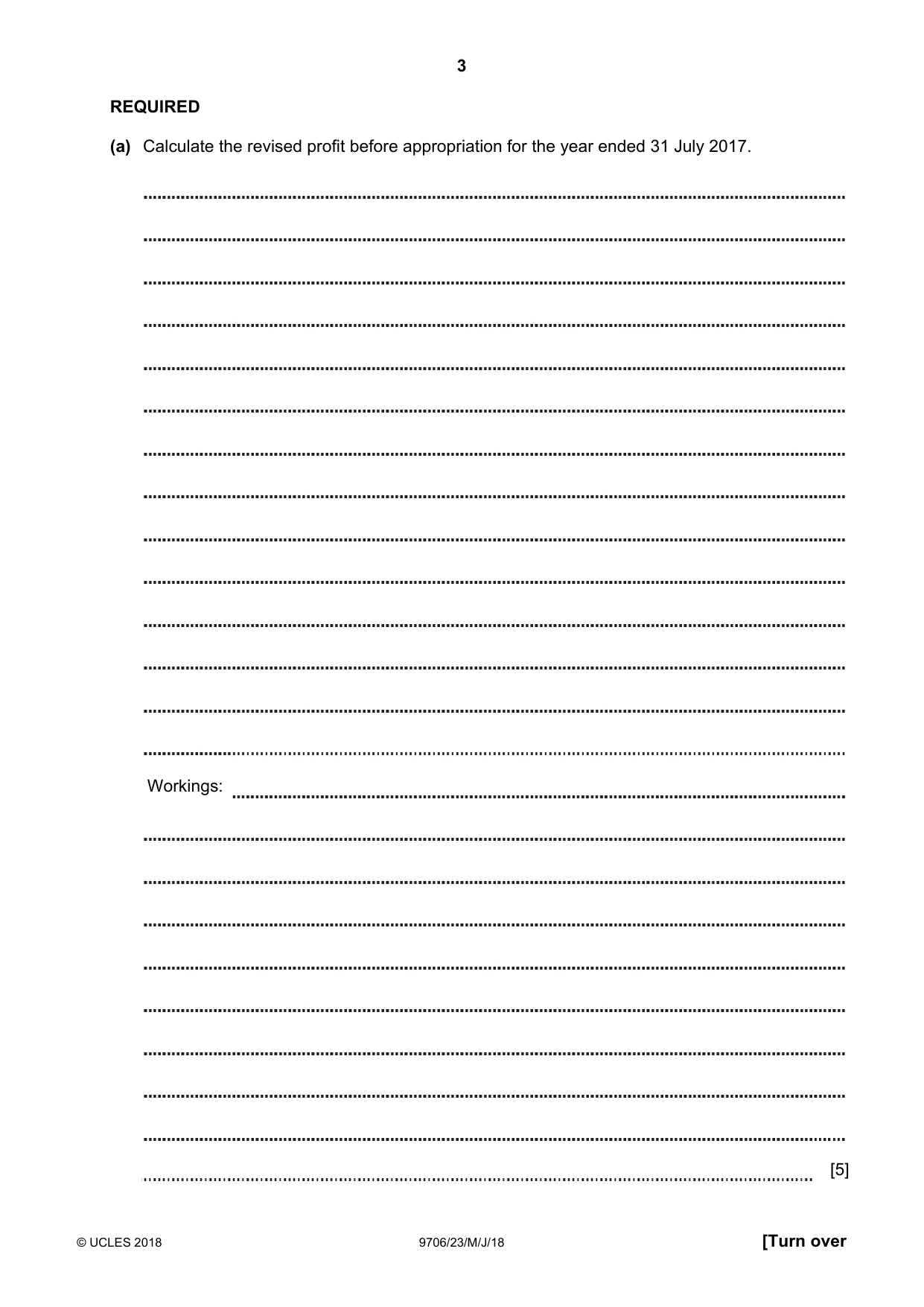
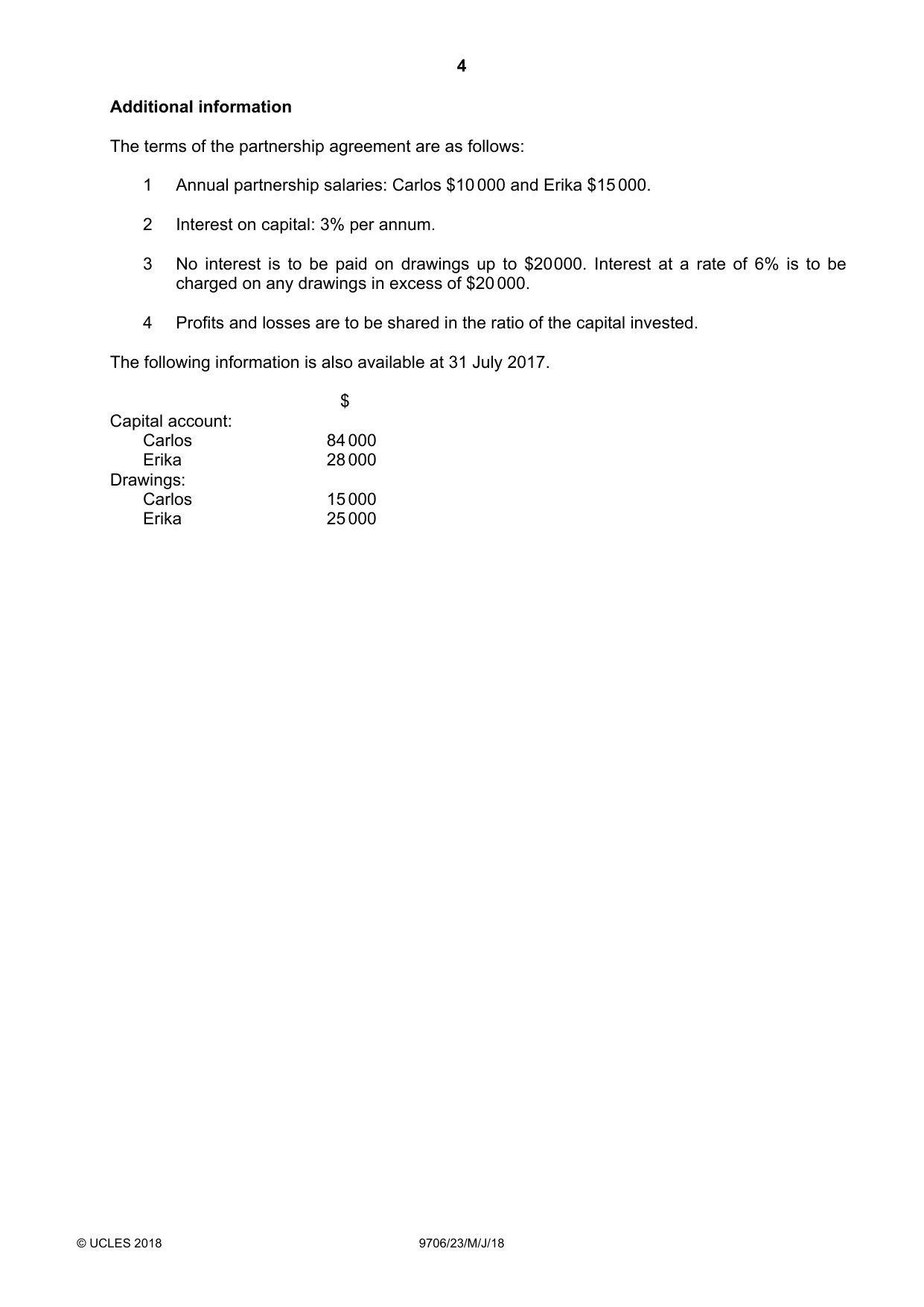
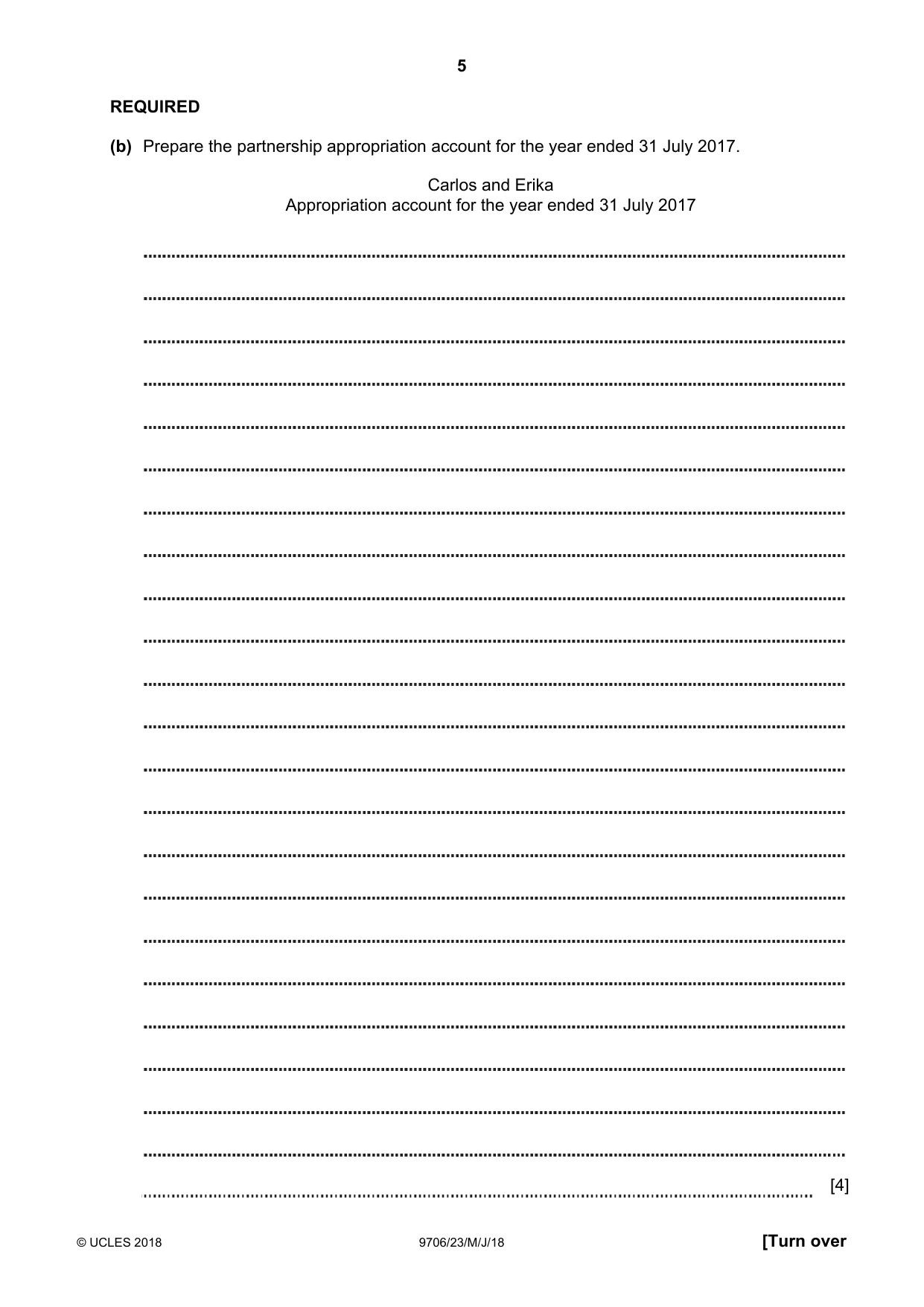
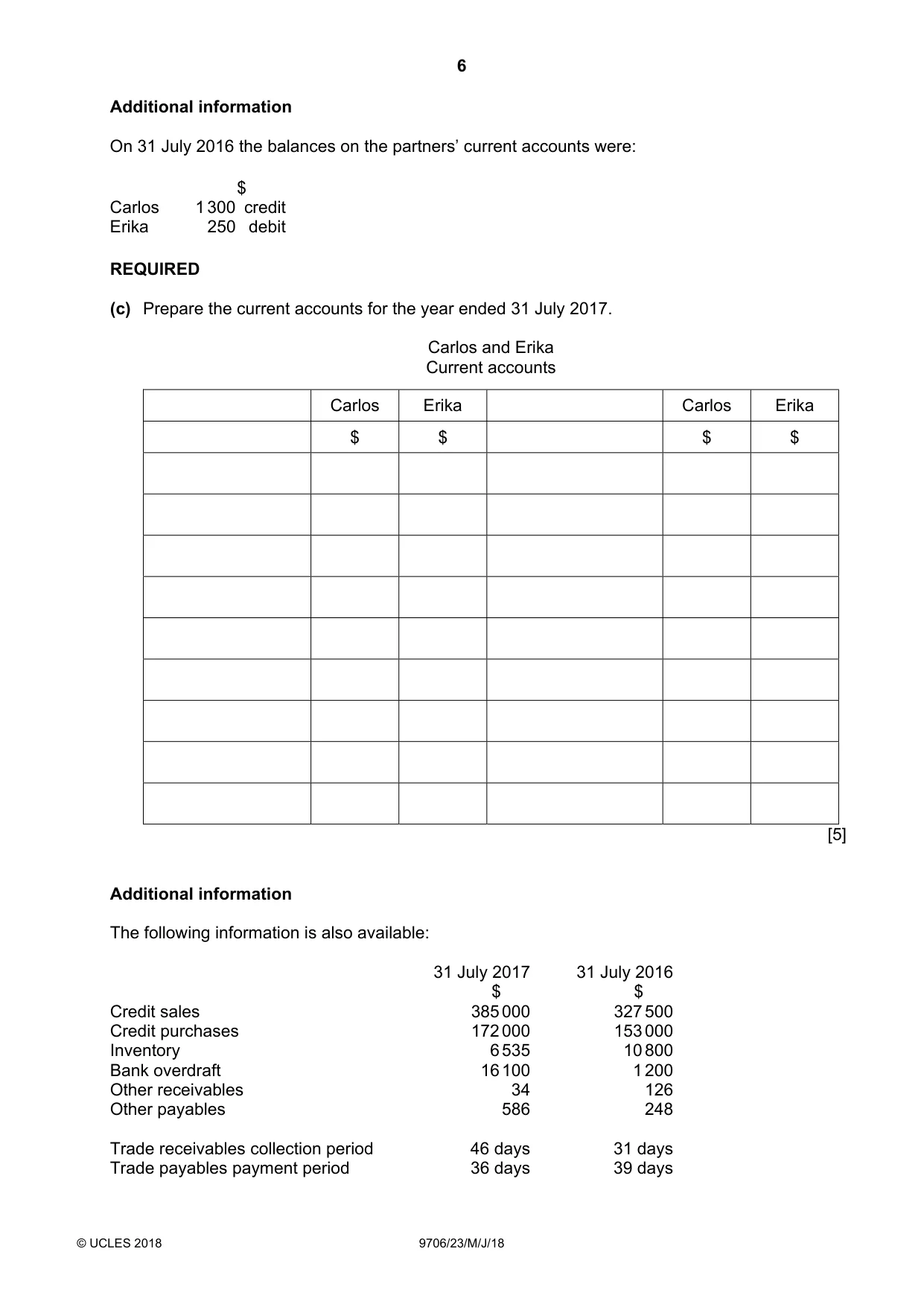
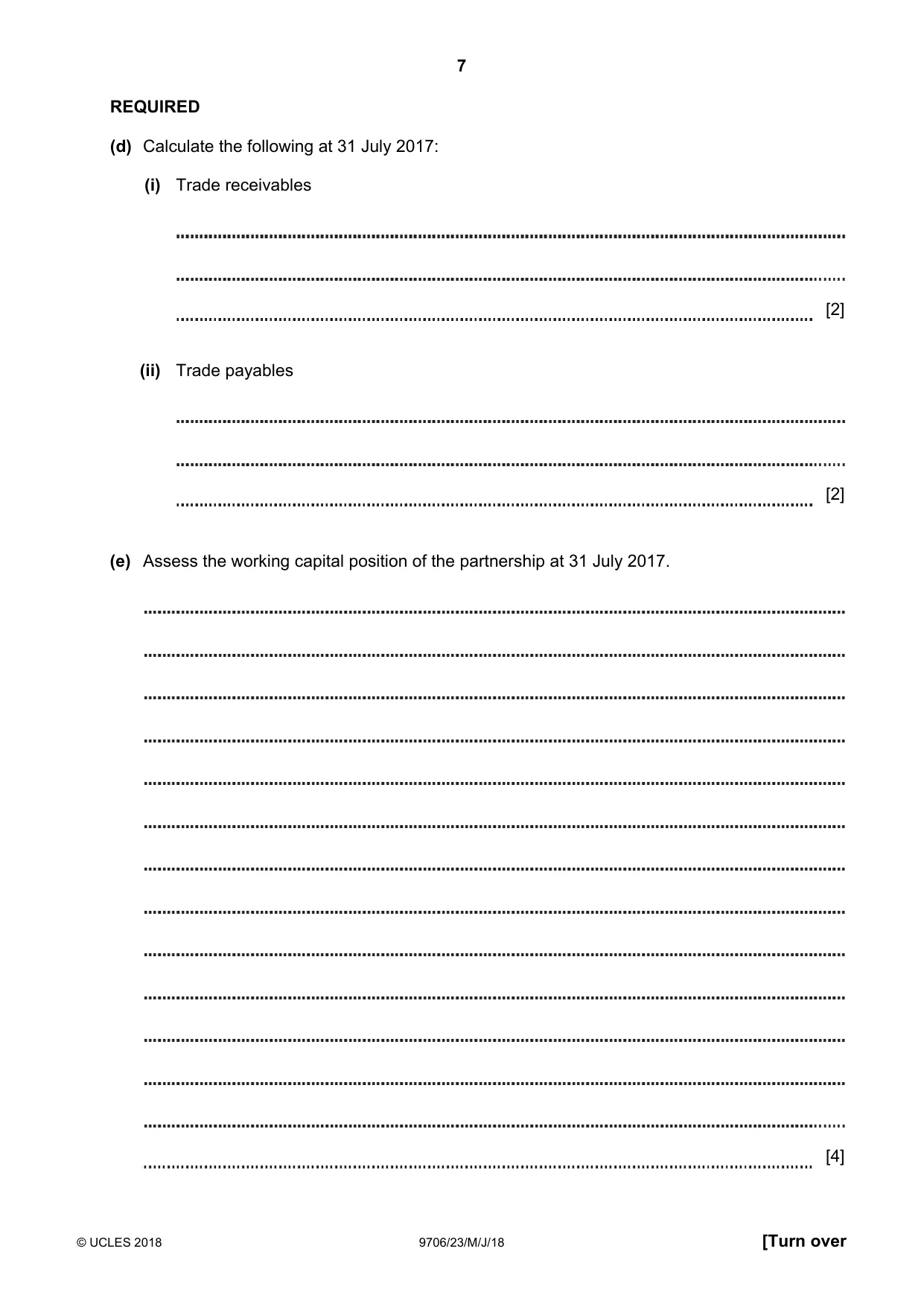
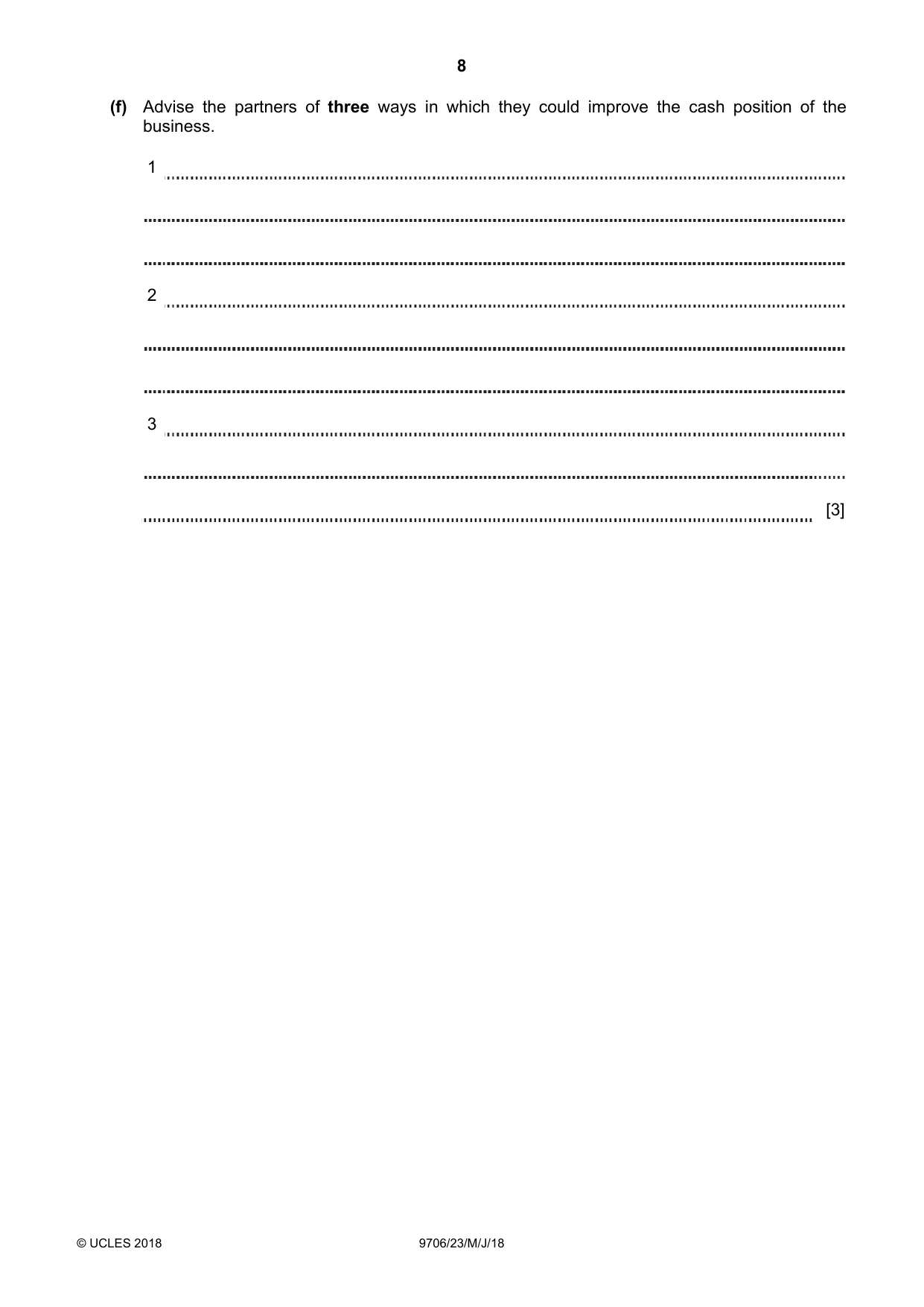
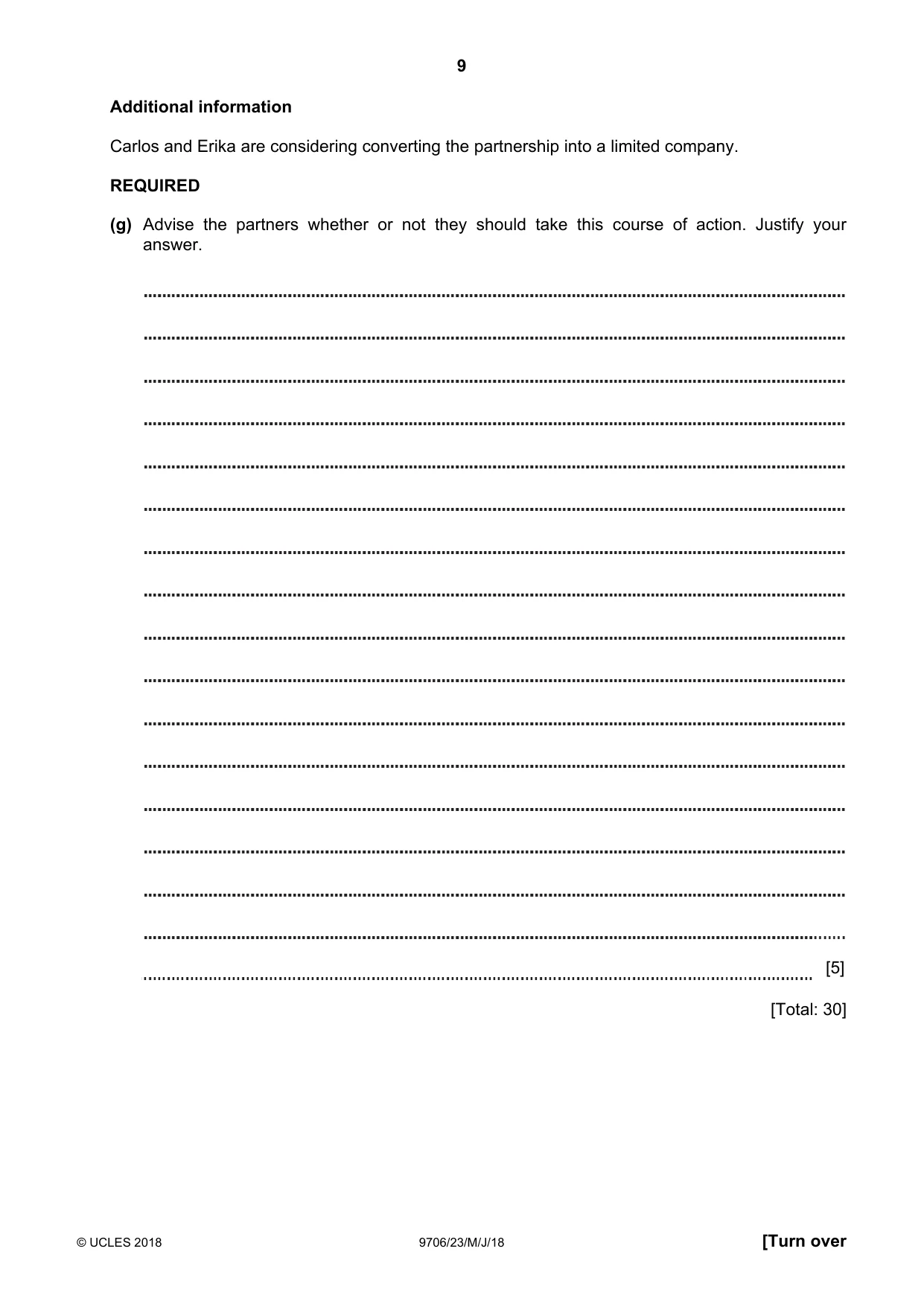
1 Carlos and Erika have been in partnership for several years and prepare their financial statements to 31 July. At 1 August 2016 the following information related to non-current assets was available. $ Plant and machinery Cost 65 000 Provision for depreciation 5 000 Motor vehicles Cost 18 000 Provision for depreciation 3 600 During the year ended 31 July 2017 the following took place. 1 On 1 November 2016, the partnership purchased a new machine for $7500. 2 On 1 December 2016 a machine was sold for $6800. The machine had been purchased for $10 000 on 1 May 2015. 3 On 1 February 2017 a new motor vehicle was purchased for $14 000. 4 The accounting policies in respect of depreciation are: Plant and machinery is depreciated using the straight-line method at 10% per annum. Motor vehicles are depreciated using the reducing balance method at 20% per annum. A full year’s depreciation is charged in the year of purchase and none in the year of disposal. 5 No adjustments have yet been made for depreciation or disposal of the machine. The profit for the year ended 31 July 2017 before any adjustments was $37 490. REQUIRED (a) Calculate the revised profit before appropriation for the year ended 31 July 2017. Workings: [5] Additional information The terms of the partnership agreement are as follows: 1 Annual partnership salaries: Carlos $10 000 and Erika $15 000. 2 Interest on capital: 3% per annum. 3 No interest is to be paid on drawings up to $20 000. Interest at a rate of 6% is to be charged on any drawings in excess of $20 000. 4 Profits and losses are to be shared in the ratio of the capital invested. The following information is also available at 31 July 2017. $ Capital account: Carlos 84 000 Erika 28 000 Drawings: Carlos 15 000 Erika 25 000 REQUIRED (b) Prepare the partnership appropriation account for the year ended 31 July 2017. Carlos and Erika Appropriation account for the year ended 31 July 2017 [4] Additional information On 31 July 2016 the balances on the partners’ current accounts were: $ Carlos 1 300 credit Erika 250 debit REQUIRED (c) Prepare the current accounts for the year ended 31 July 2017. Carlos and Erika Current accounts Carlos Erika Carlos Erika $ $ $ $ [5] Additional information The following information is also available: 31 July 2017 31 July 2016 $ $ Credit sales 385 000 327 500 Credit purchases 172 000 153 000 Inventory 6 535 10 800 Bank overdraft 16 100 1 200 Other receivables 34 126 Other payables 586 248 Trade receivables collection period 46 days 31 days Trade payables payment period 36 days 39 days REQUIRED (d) Calculate the following at 31 July 2017: (i) Trade receivables [2] (ii) Trade payables [2] (e) Assess the working capital position of the partnership at 31 July 2017. [4] (f) Advise the partners of three ways in which they could improve the cash position of the business. 1 2 3 [3] Additional information Carlos and Erika are considering converting the partnership into a limited company. REQUIRED (g) Advise the partners whether or not they should take this course of action. Justify your answer. [5] [Total: 30]
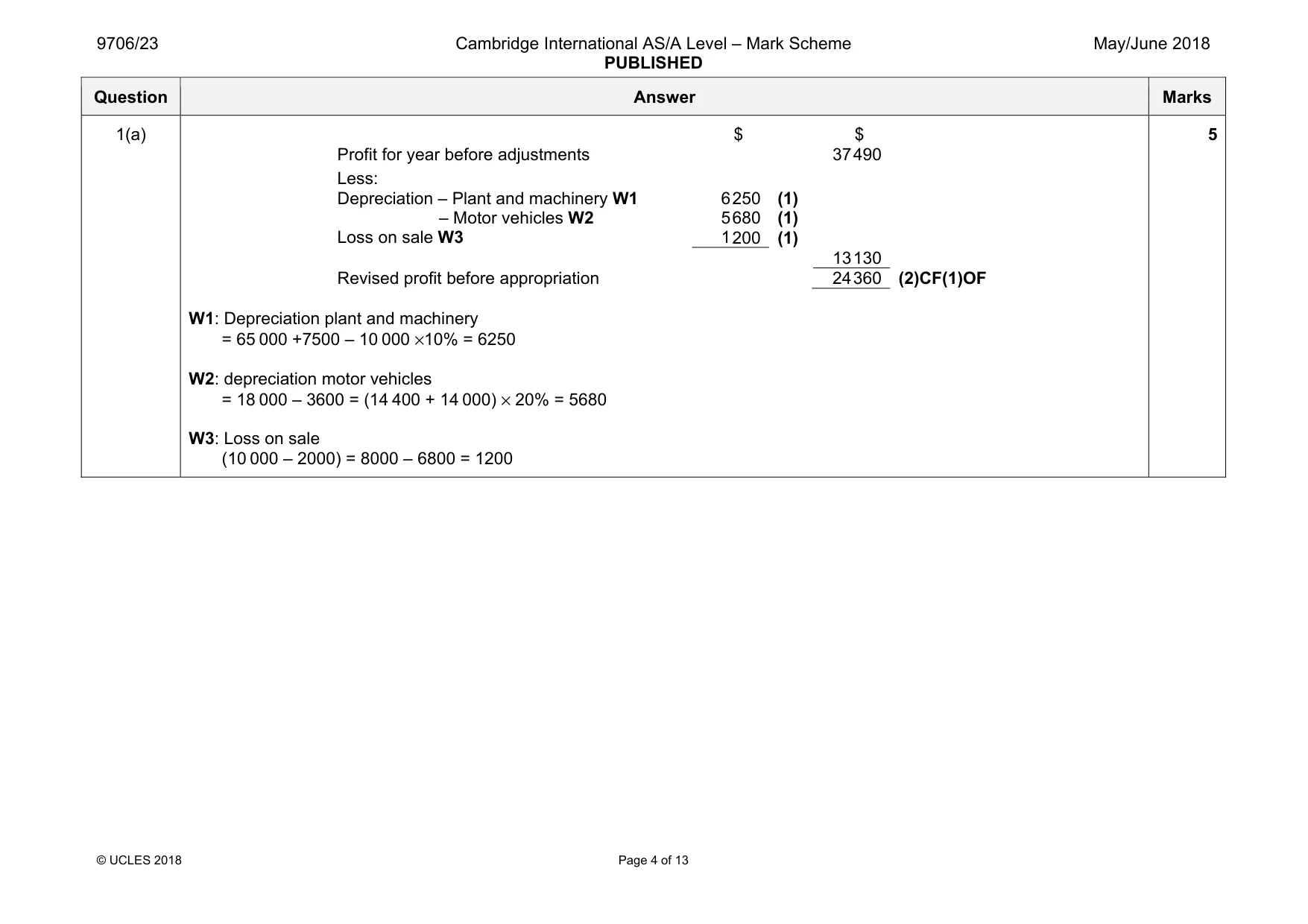
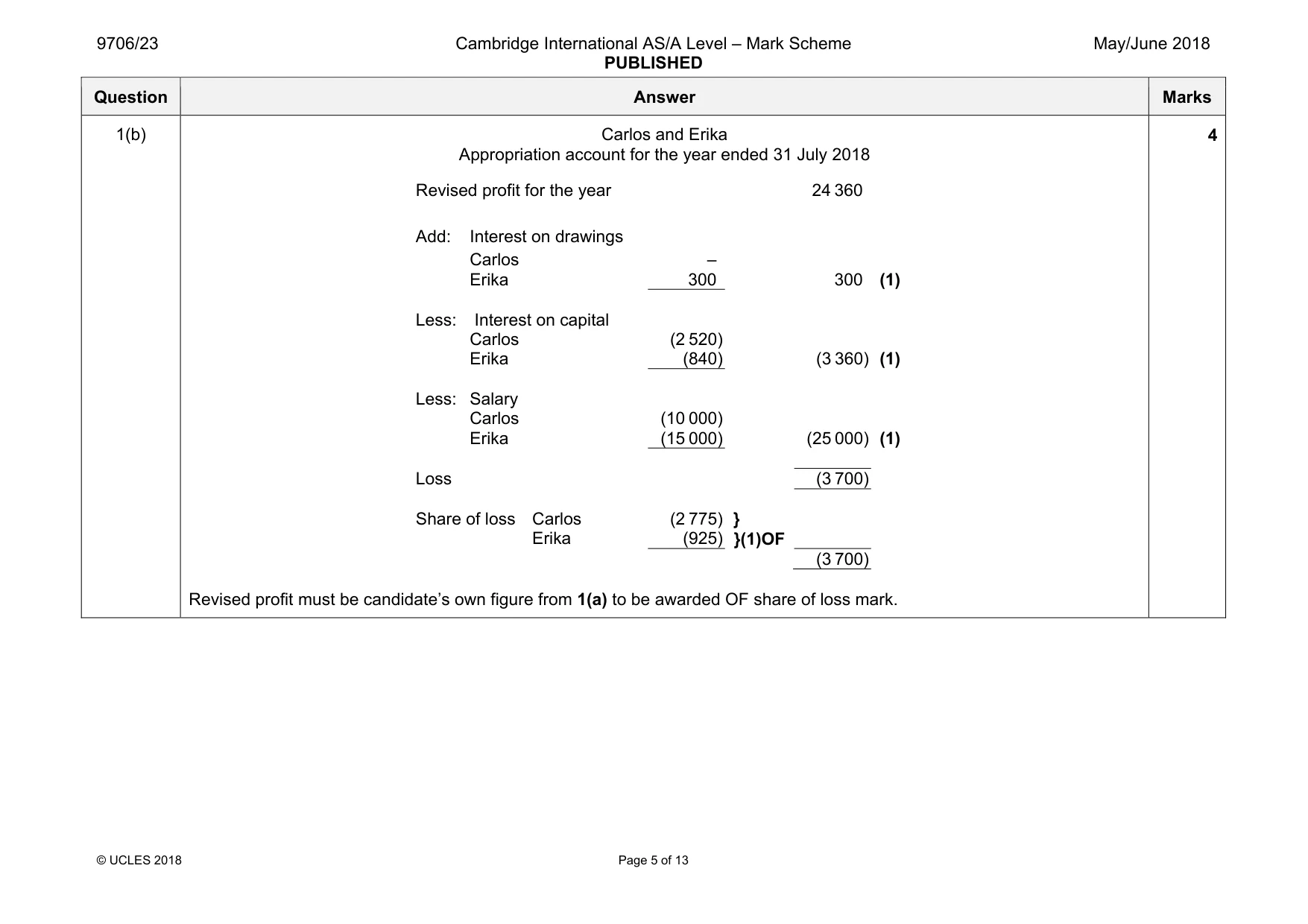
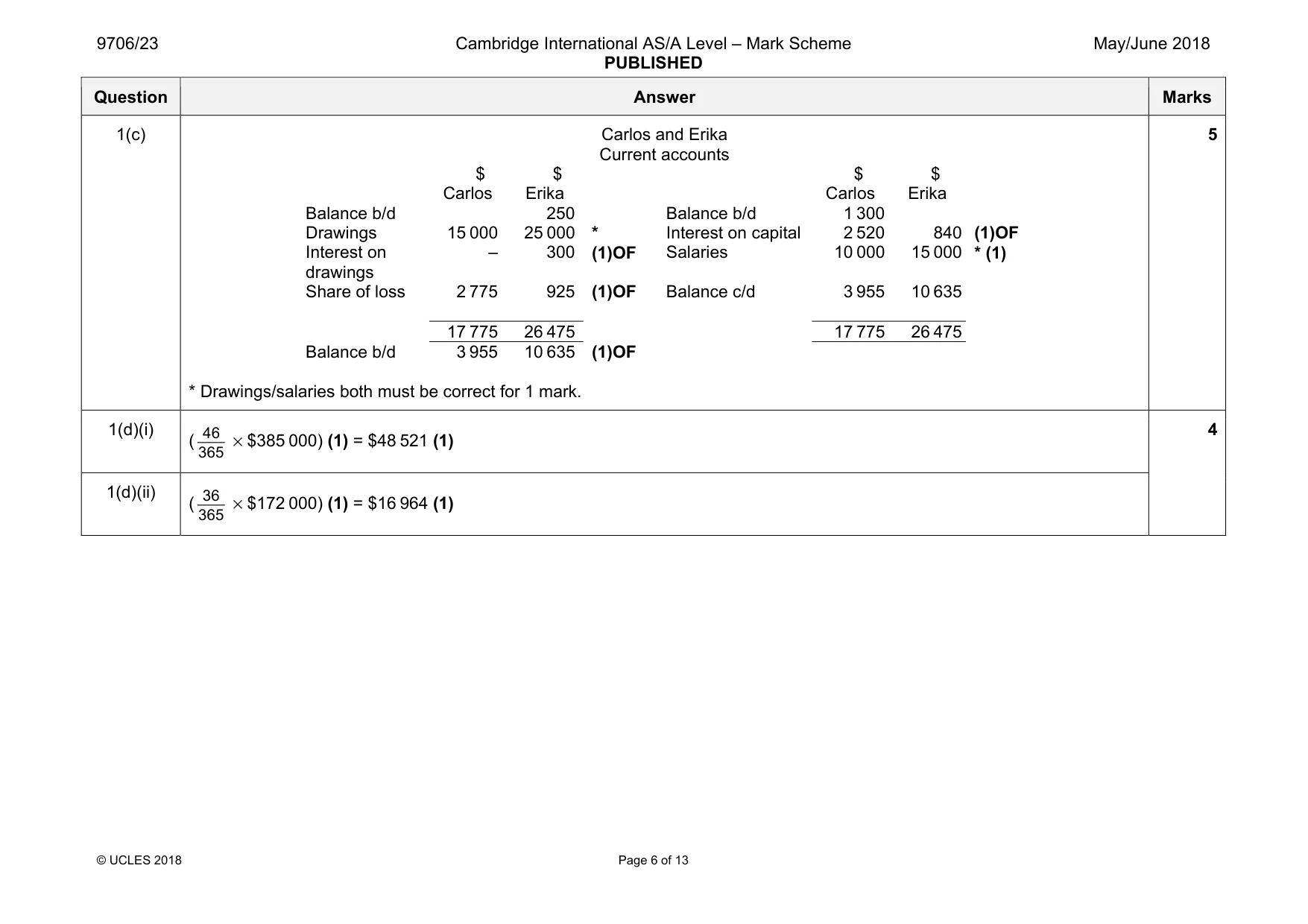
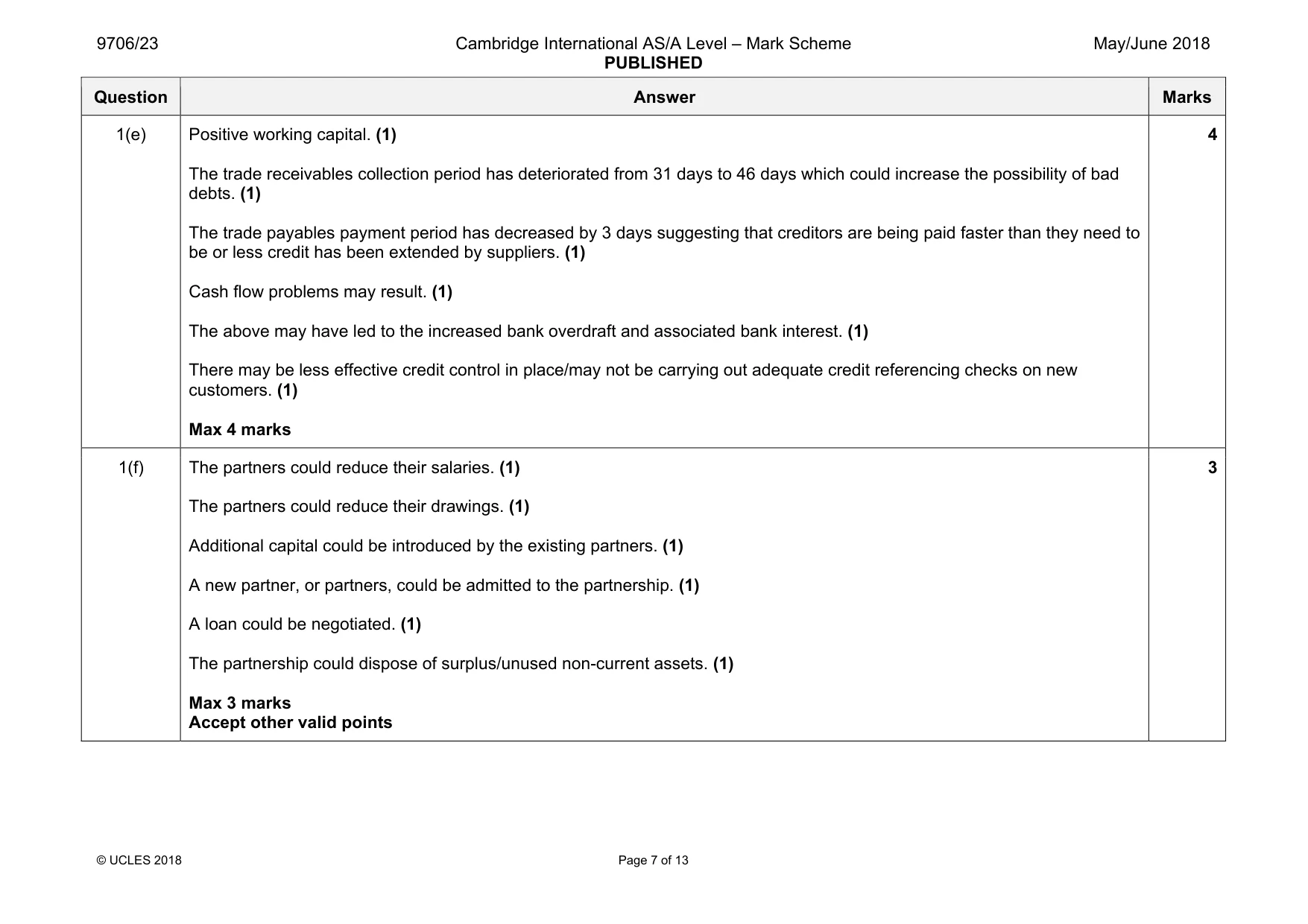
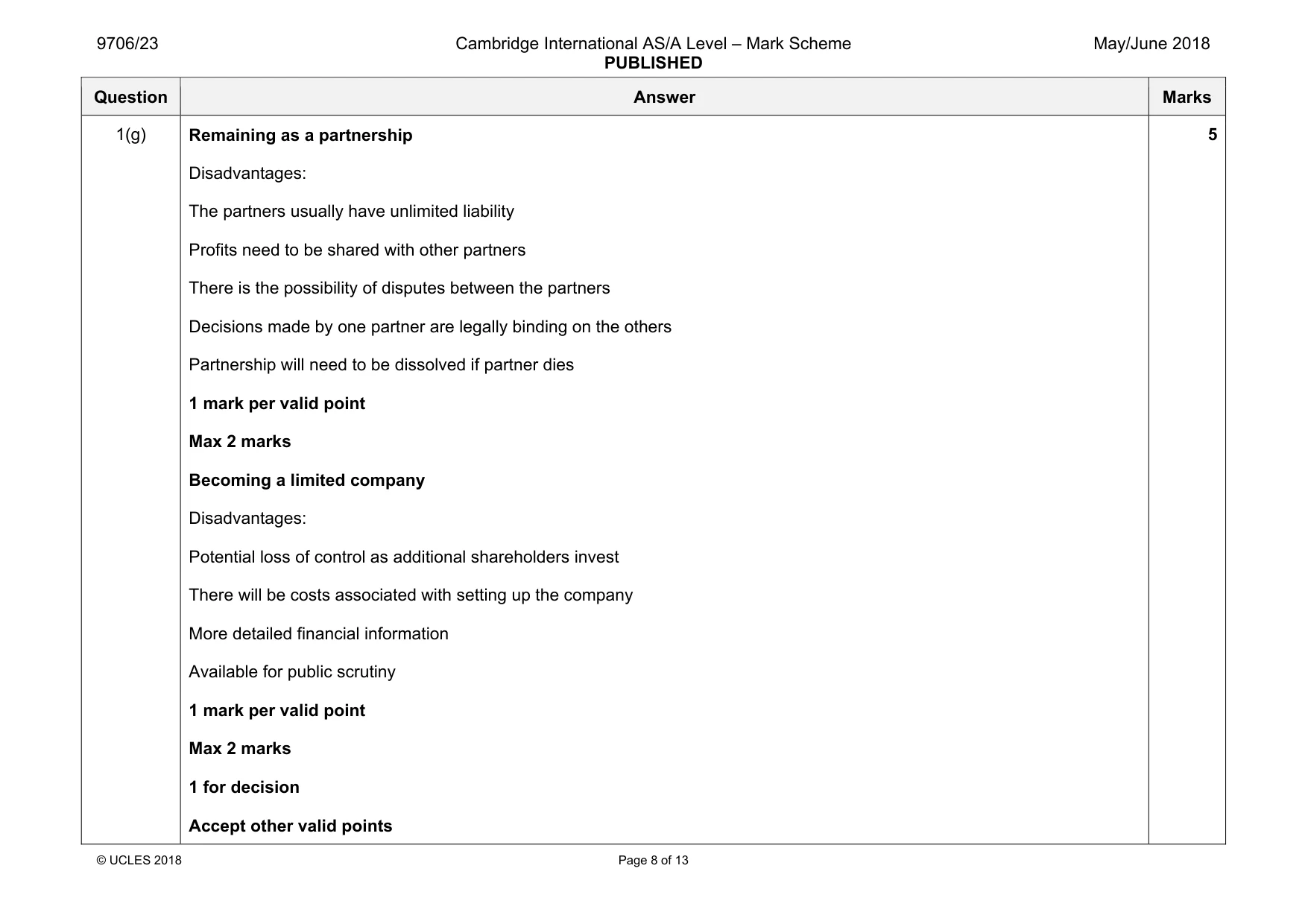
Mark scheme: 1(a) $ $ Profit for year before adjustments 37 490 Less: Depreciation – Plant and machinery W1 6 250 (1) – Motor vehicles W2 5 680 (1) Loss on sale W3 1 200 (1) 13 130 Revised profit before appropriation 24 360 (2)CF(1)OF W1: Depreciation plant and machinery = 65 000 +7500 – 10 000 ×10% = 6250 W2: depreciation motor vehicles = 18 000 – 3600 = (14 400 + 14 000) × 20% = 5680 W3: Loss on sale (10 000 – 2000) = 8000 – 6800 = 1200 5 Question Answer Marks 1(b) Carlos and Erika Appropriation account for the year ended 31 July 2018 Revised profit for the year 24 360 Add: Interest on drawings Carlos – Erika 300 300 (1) Less: Interest on capital Carlos (2 520) Erika (840) (3 360) (1) Less: Salary Carlos (10 000) Erika (15 000) (25 000) (1) Loss (3 700) Share of loss Carlos (2 775) } Erika (925) }(1)OF (3 700) Revised profit must be candidate’s own figure from 1(a) to be awarded OF share of loss mark. 4 Question Answer Marks 1(c) Carlos and Erika Current accounts $ $ $ $ Carlos Erika Carlos Erika Balance b/d 250 Balance b/d 1 300 Drawings 15 000 25 000 * Interest on capital 2 520 840 (1)OF Interest on drawings – 300 (1)OF Salaries 10 000 15 000 * (1) Share of loss 2 775 925 (1)OF Balance c/d 3 955 10 635 17 775 26 475 17 775 26 475 Balance b/d 3 955 10 635 (1)OF * Drawings/salaries both must be correct for 1 mark. 5 1(d)(i) ( 46 365 × $385 000) (1) = $48 521 (1) 4 1(d)(ii) ( 36 365 × $172 000) (1) = $16 964 (1) Question Answer Marks 1(e) Positive working capital. (1) The trade receivables collection period has deteriorated from 31 days to 46 days which could increase the possibility of bad debts. (1) The trade payables payment period has decreased by 3 days suggesting that creditors are being paid faster than they need to be or less credit has been extended by suppliers. (1) Cash flow problems may result. (1) The above may have led to the increased bank overdraft and associated bank interest. (1) There may be less effective credit control in place/may not be carrying out adequate credit referencing checks on new customers. (1) Max 4 marks 4 1(f) The partners could reduce their salaries. (1) The partners could reduce their drawings. (1) Additional capital could be introduced by the existing partners. (1) A new partner, or partners, could be admitted to the partnership. (1) A loan could be negotiated. (1) The partnership could dispose of surplus/unused non-current assets. (1) Max 3 marks Accept other valid points 3 Question Answer Marks 1(g) Remaining as a partnership Disadvantages: The partners usually have unlimited liability Profits need to be shared with other partners There is the possibility of disputes between the partners Decisions made by one partner are legally binding on the others Partnership will need to be dissolved if partner dies 1 mark per valid point Max 2 marks Becoming a limited company Disadvantages: Potential loss of control as additional shareholders invest There will be costs associated with setting up the company More detailed financial information Available for public scrutiny 1 mark per valid point Max 2 marks 1 for decision Accept other valid points 5
More questions on Analysis and communication of accounting information
Q2 · Warren is a sole trader
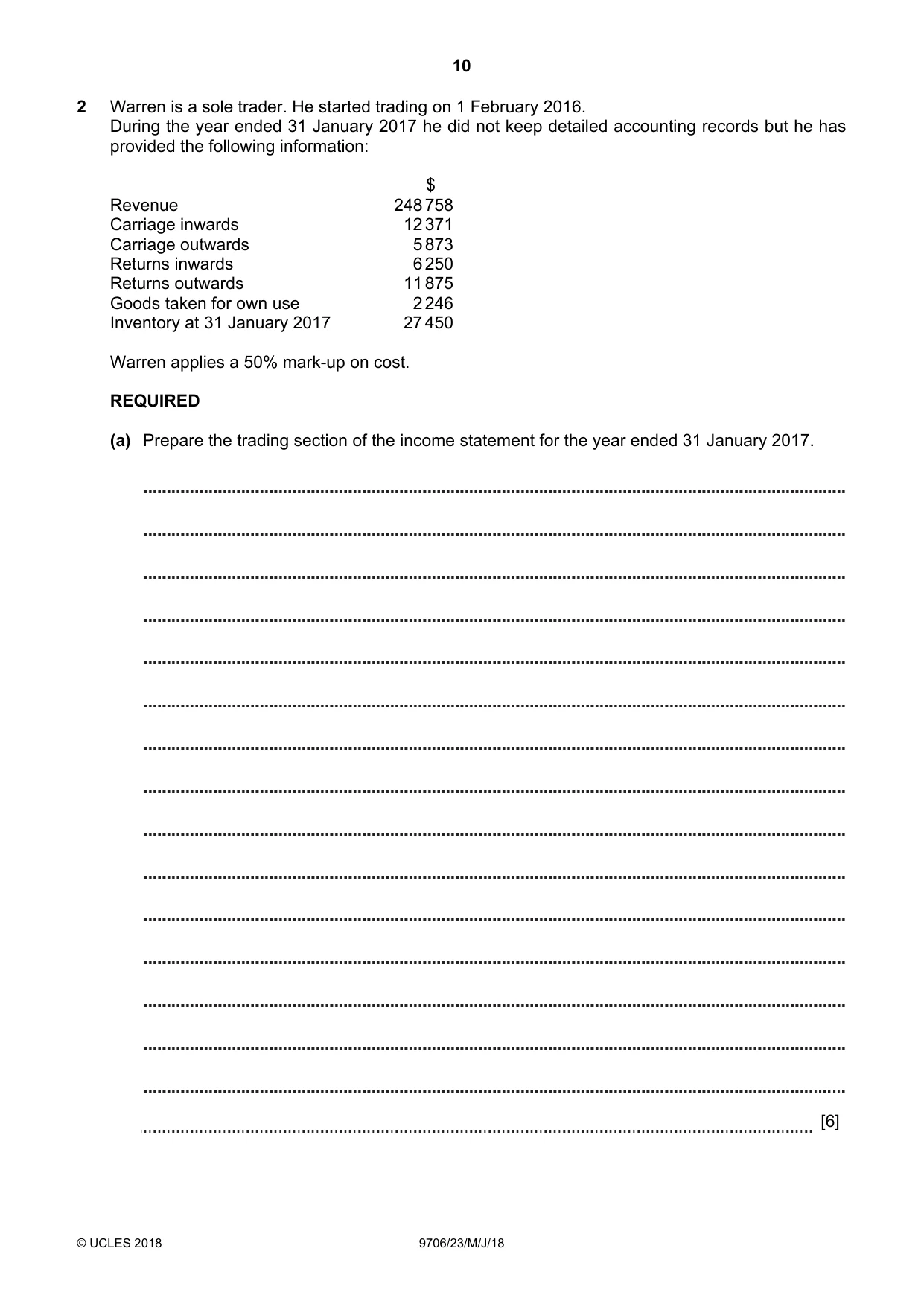
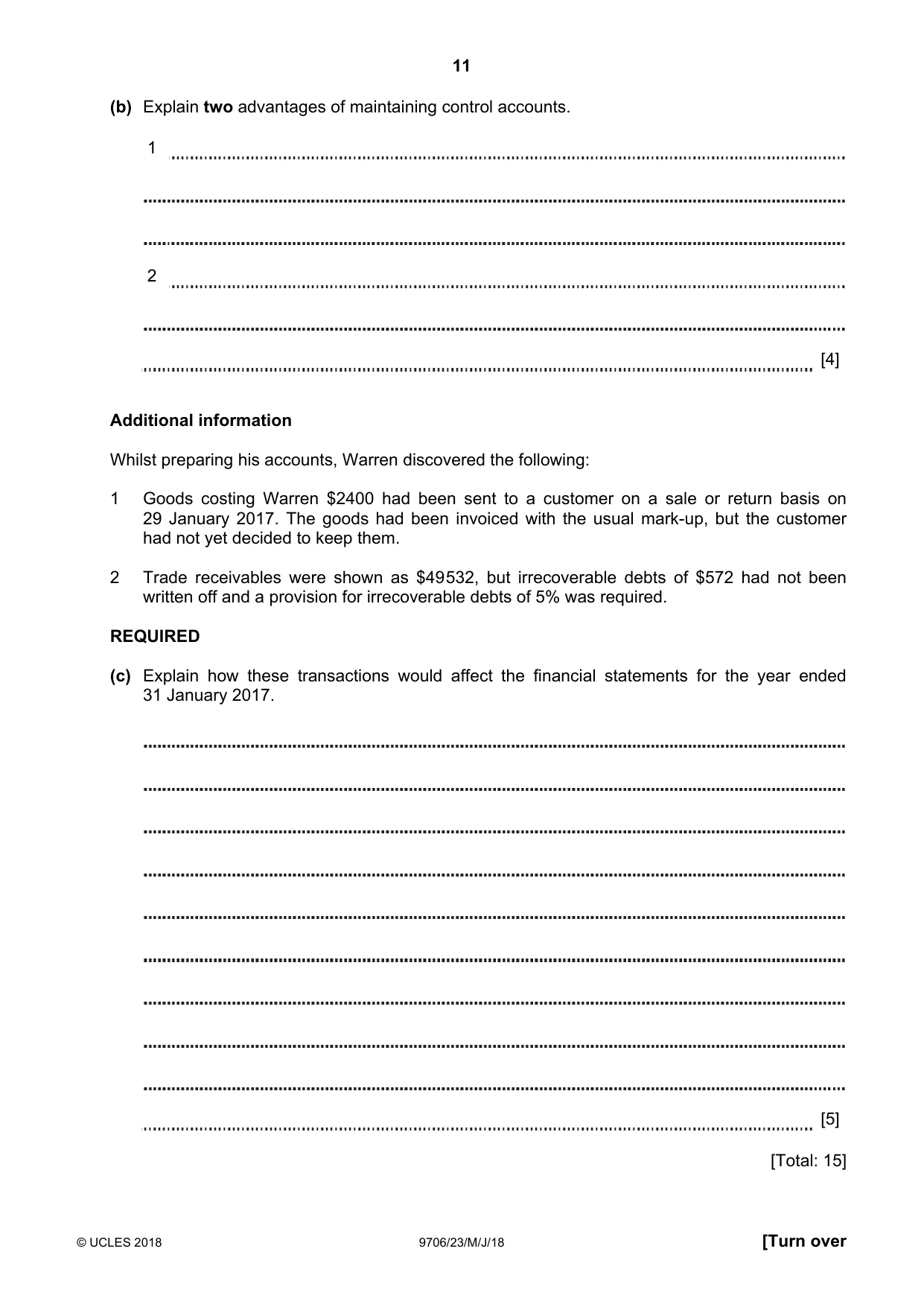
2 Warren is a sole trader. He started trading on 1 February 2016. During the year ended 31 January 2017 he did not keep detailed accounting records but he has provided the following information: $ Revenue 248 758 Carriage inwards 12 371 Carriage outwards 5 873 Returns inwards 6 250 Returns outwards 11 875 Goods taken for own use 2 246 Inventory at 31 January 2017 27 450 Warren applies a 50% mark-up on cost. REQUIRED (a) Prepare the trading section of the income statement for the year ended 31 January 2017. [6] (b) Explain two advantages of maintaining control accounts. 1 2 [4] Additional information Whilst preparing his accounts, Warren discovered the following: 1 Goods costing Warren $2400 had been sent to a customer on a sale or return basis on 29 January 2017. The goods had been invoiced with the usual mark-up, but the customer had not yet decided to keep them. 2 Trade receivables were shown as $49 532, but irrecoverable debts of $572 had not been written off and a provision for irrecoverable debts of 5% was required. REQUIRED (c) Explain how these transactions would affect the financial statements for the year ended 31 January 2017. [5] [Total: 15]
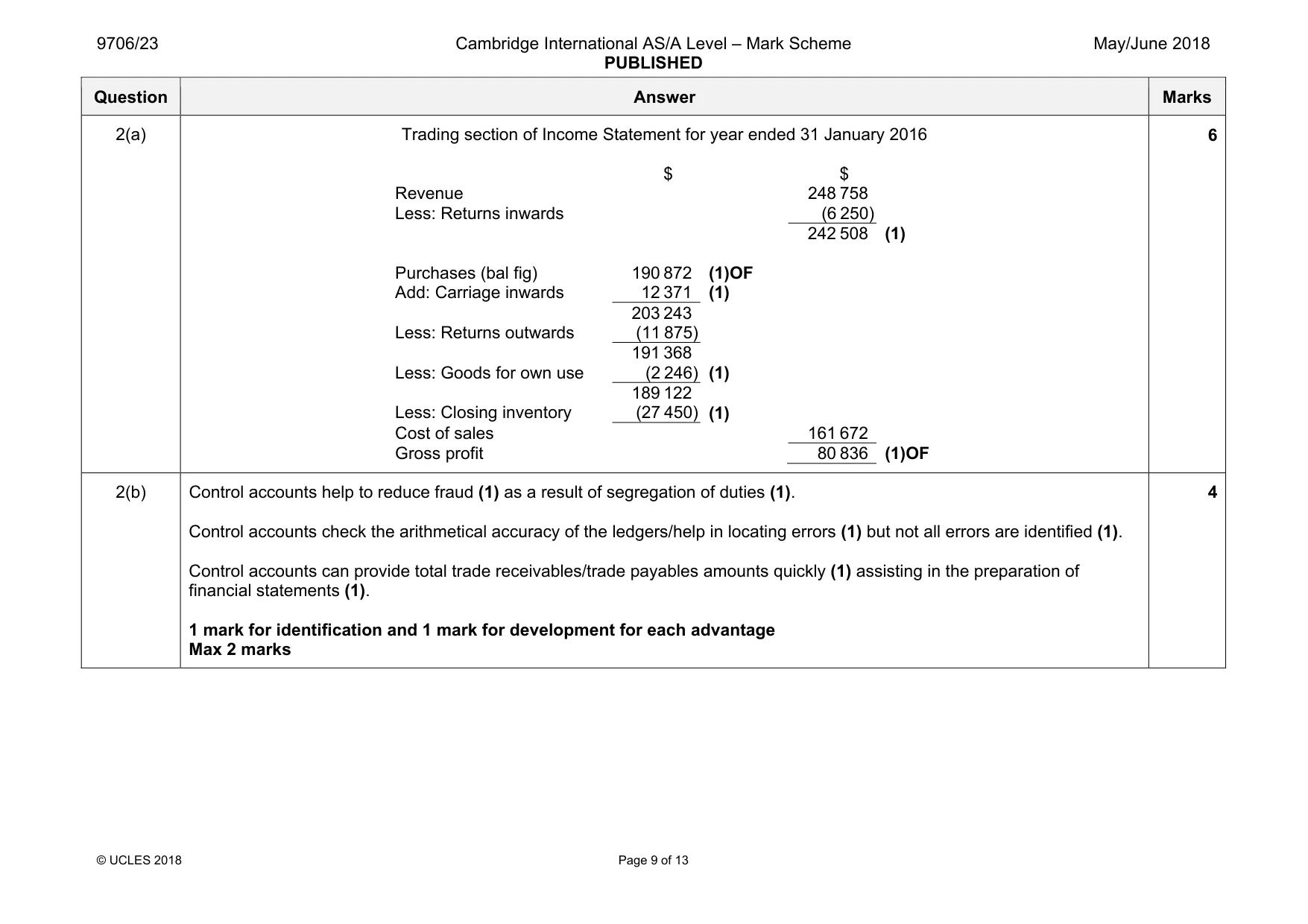
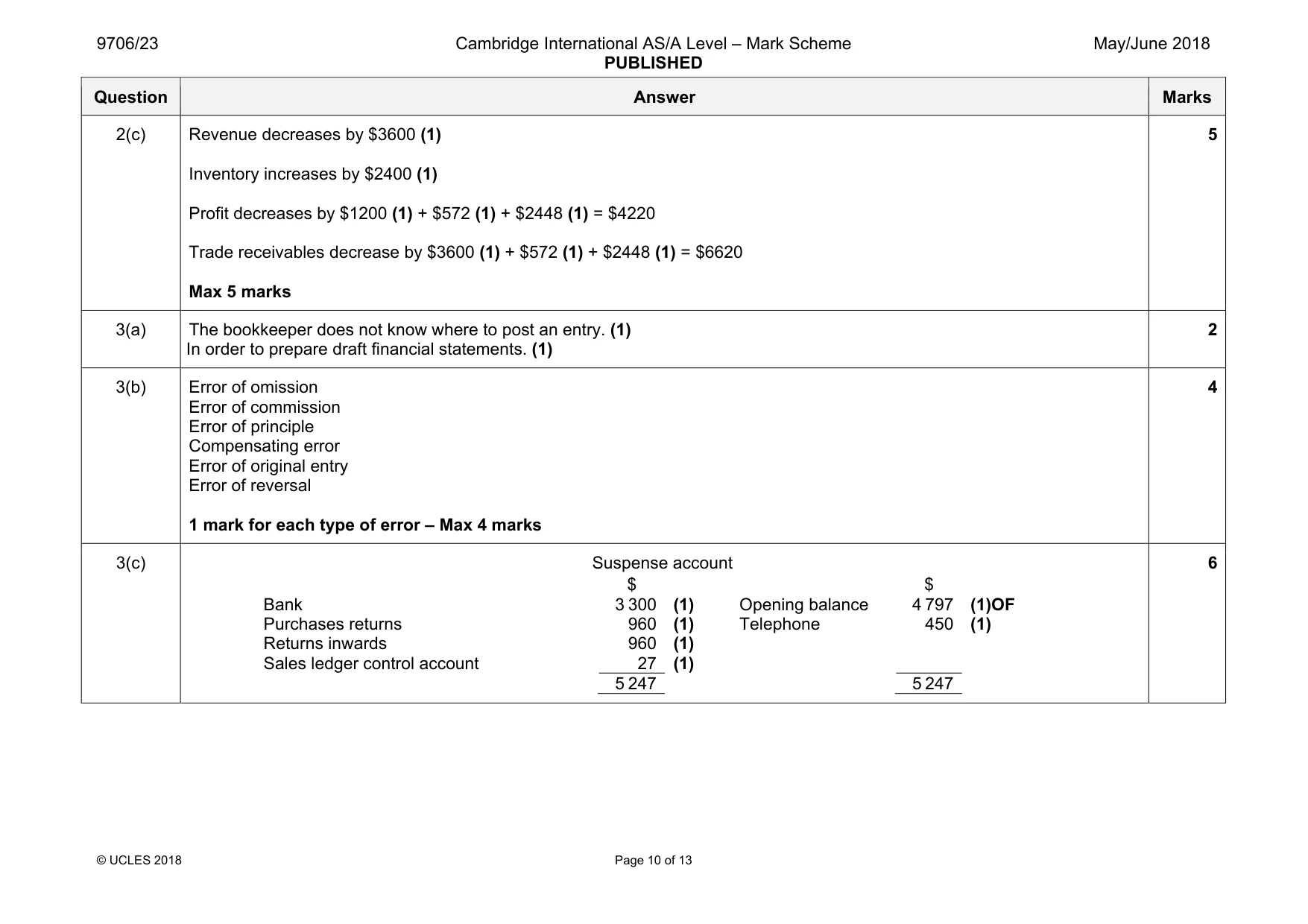
Mark scheme: 2(a) Trading section of Income Statement for year ended 31 January 2016 $ $ Revenue 248 758 Less: Returns inwards (6 250) 242 508 (1) Purchases (bal fig) 190 872 (1)OF Add: Carriage inwards 12 371 (1) 203 243 Less: Returns outwards (11 875) 191 368 Less: Goods for own use (2 246) (1) 189 122 Less: Closing inventory (27 450) (1) Cost of sales 161 672 Gross profit 80 836 (1)OF 6 2(b) Control accounts help to reduce fraud (1) as a result of segregation of duties (1). Control accounts check the arithmetical accuracy of the ledgers/help in locating errors (1) but not all errors are identified (1). Control accounts can provide total trade receivables/trade payables amounts quickly (1) assisting in the preparation of financial statements (1). 1 mark for identification and 1 mark for development for each advantage Max 2 marks 4 Question Answer Marks 2(c) Revenue decreases by $3600 (1) Inventory increases by $2400 (1) Profit decreases by $1200 (1) + $572 (1) + $2448 (1) = $4220 Trade receivables decrease by $3600 (1) + $572 (1) + $2448 (1) = $6620 Max 5 marks 5
Q3 · David, a sole trader, has prepared a trial balance at 31 December 2017 which did not…
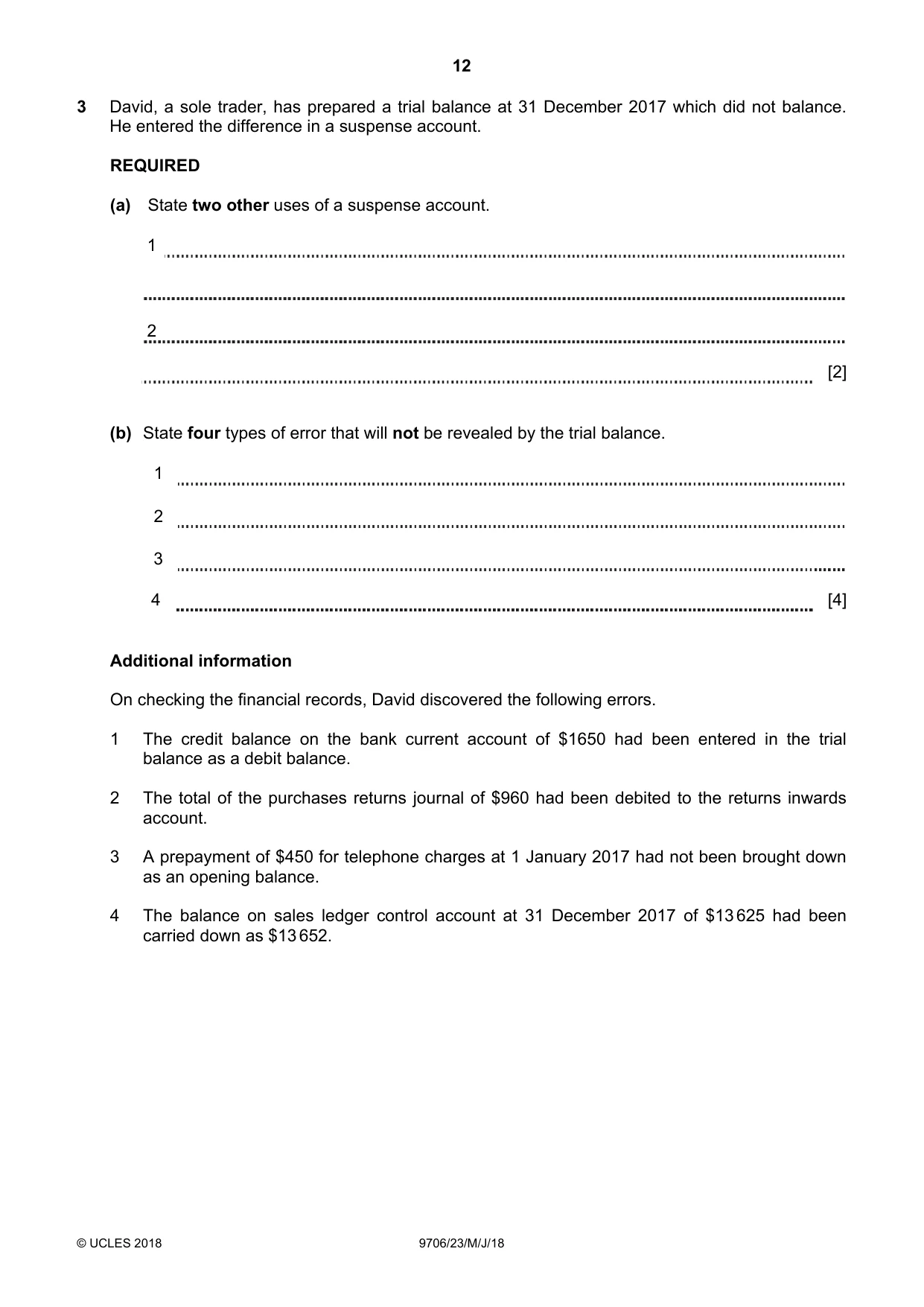
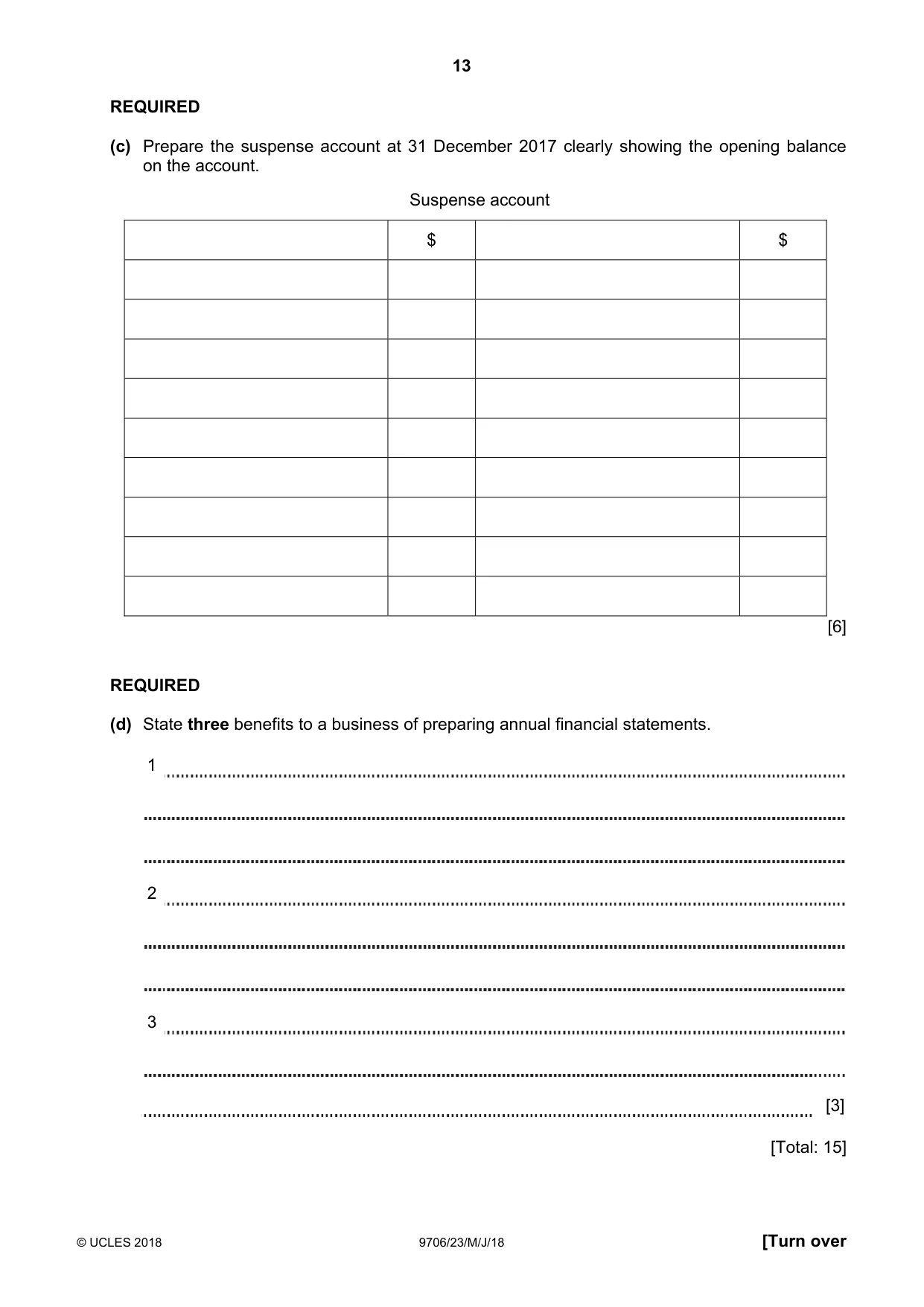
3 David, a sole trader, has prepared a trial balance at 31 December 2017 which did not balance. He entered the difference in a suspense account. REQUIRED (a) State two other uses of a suspense account. 1 2 [2] (b) State four types of error that will not be revealed by the trial balance. 1 2 3 4 [4] Additional information On checking the financial records, David discovered the following errors. 1 The credit balance on the bank current account of $1650 had been entered in the trial balance as a debit balance. 2 The total of the purchases returns journal of $960 had been debited to the returns inwards account. 3 A prepayment of $450 for telephone charges at 1 January 2017 had not been brought down as an opening balance. 4 The balance on sales ledger control account at 31 December 2017 of $13 625 had been carried down as $13 652. REQUIRED (c) Prepare the suspense account at 31 December 2017 clearly showing the opening balance on the account. Suspense account $ $ [6] REQUIRED (d) State three benefits to a business of preparing annual financial statements. 1 2 3 [3] [Total: 15]
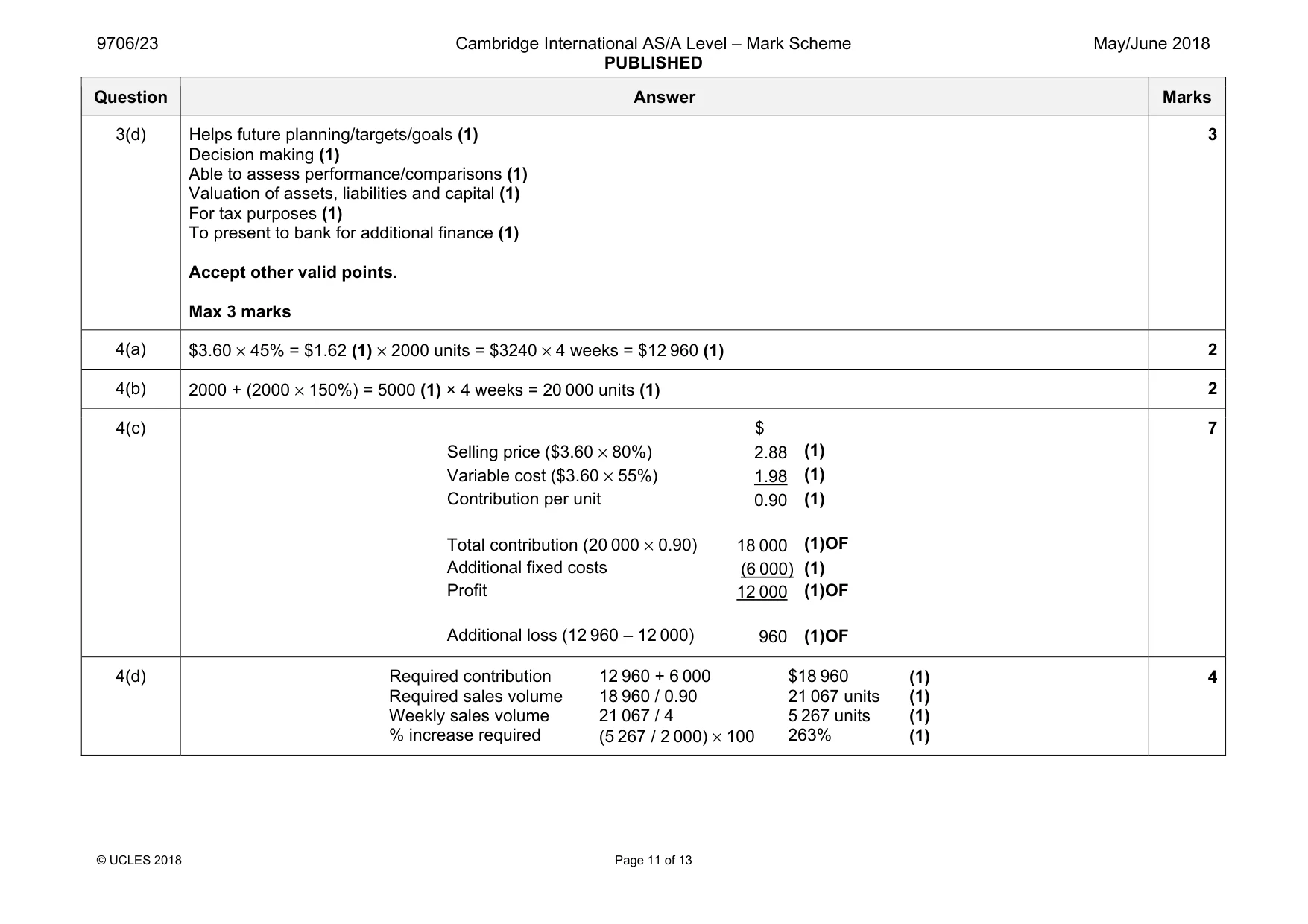
Mark scheme: 3(a) The bookkeeper does not know where to post an entry. (1) In order to prepare draft financial statements. (1) 2 3(b) Error of omission Error of commission Error of principle Compensating error Error of original entry Error of reversal 1 mark for each type of error – Max 4 marks 4 3(c) Suspense account $ $ Bank 3 300 (1) Opening balance 4 797 (1)OF Purchases returns 960 (1) Telephone 450 (1) Returns inwards 960 (1) Sales ledger control account 27 (1) 5 247 5 247 6 Question Answer Marks 3(d) Helps future planning/targets/goals (1) Decision making (1) Able to assess performance/comparisons (1) Valuation of assets, liabilities and capital (1) For tax purposes (1) To present to bank for additional finance (1) Accept other valid points. Max 3 marks 3 $3.60 × 45% = $1.62 (1) × 2000 units = $3240 × 4 weeks = $12 960 (1)
Q4 · DP Limited is a large manufacturing and retailing company
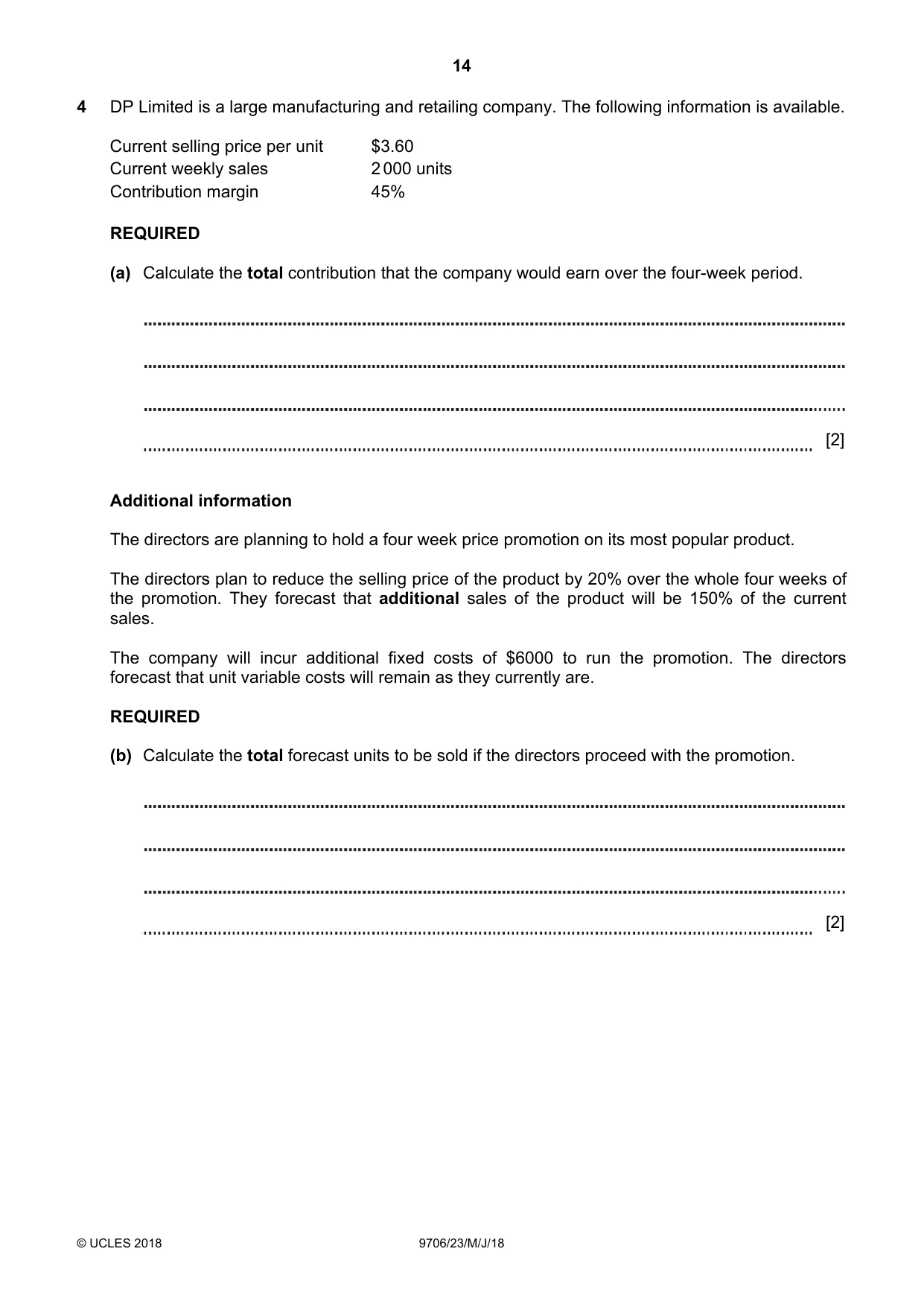
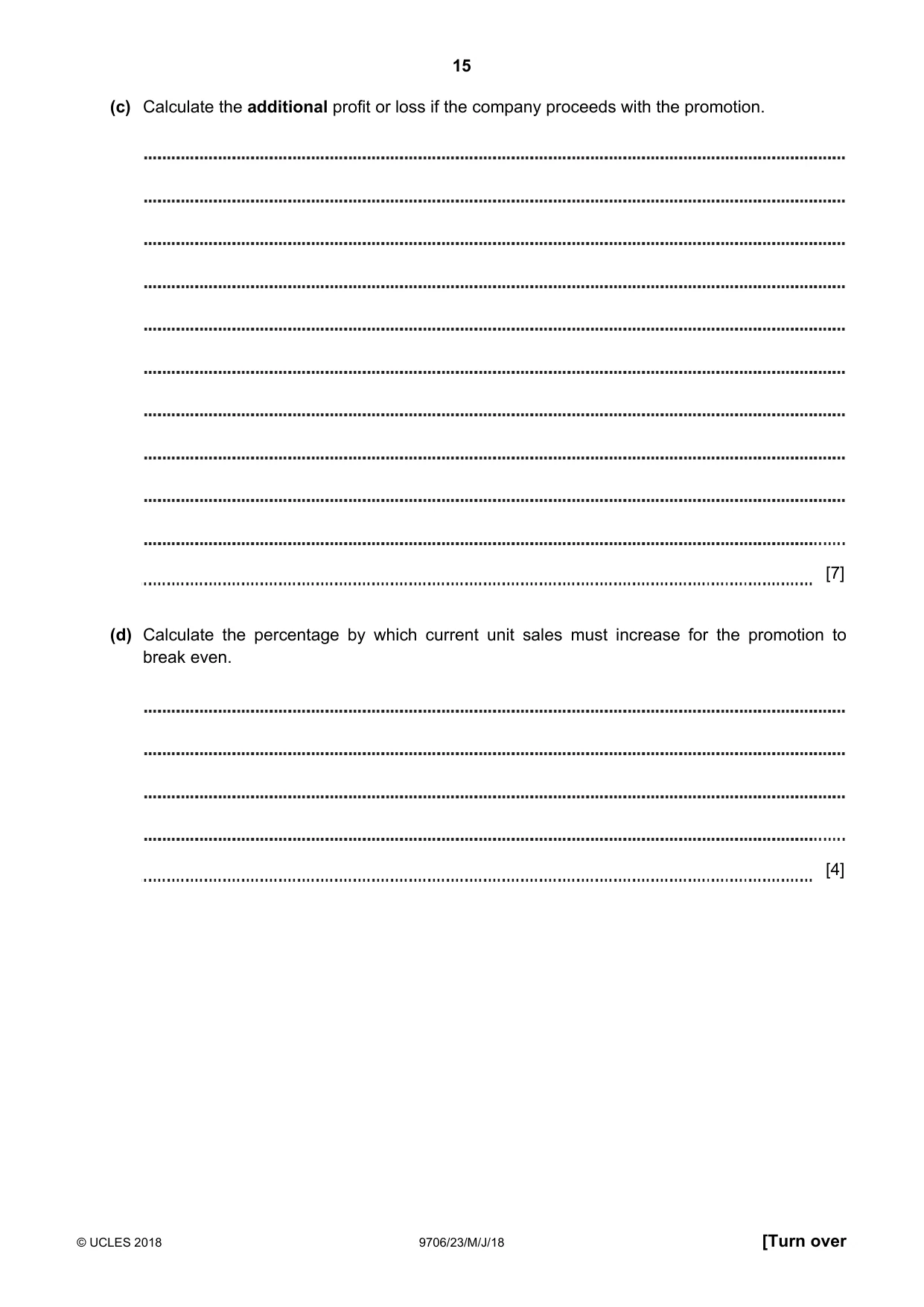
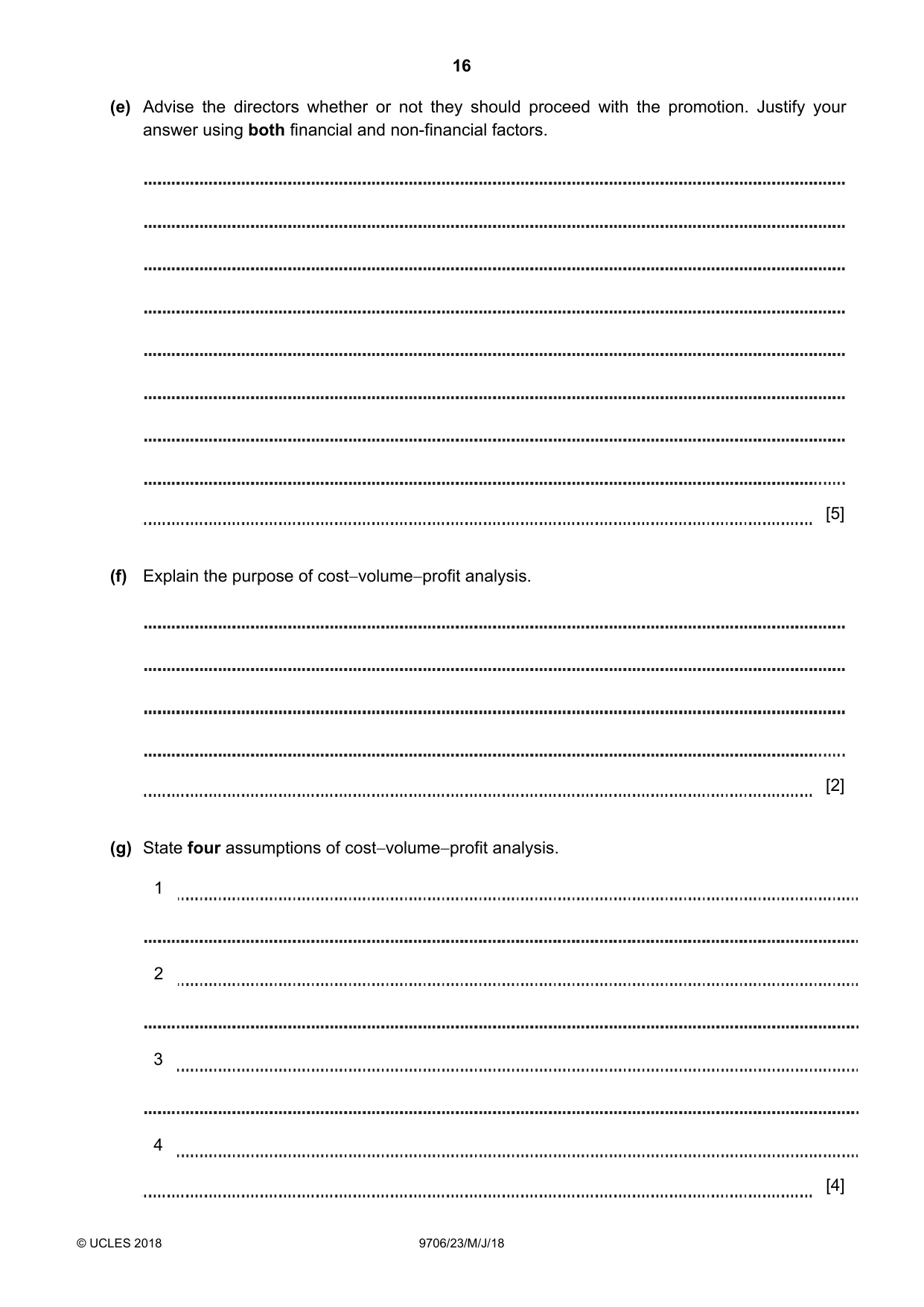
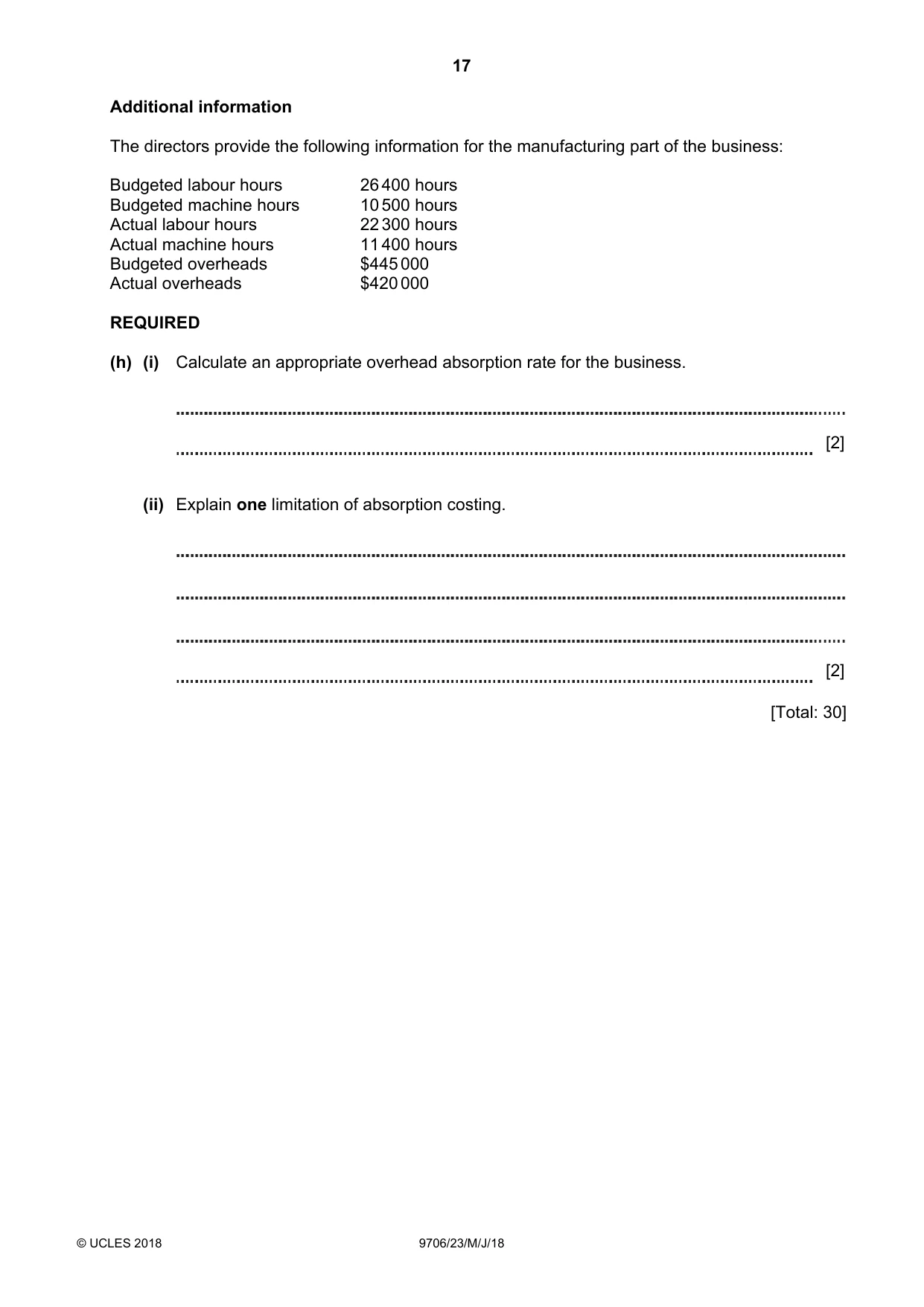
4 DP Limited is a large manufacturing and retailing company. The following information is available. Current selling price per unit $3.60 Current weekly sales 2 000 units Contribution margin 45% REQUIRED (a) Calculate the total contribution that the company would earn over the four-week period. [2] Additional information The directors are planning to hold a four week price promotion on its most popular product. The directors plan to reduce the selling price of the product by 20% over the whole four weeks of the promotion. They forecast that additional sales of the product will be 150% of the current sales. The company will incur additional fixed costs of $6000 to run the promotion. The directors forecast that unit variable costs will remain as they currently are. REQUIRED (b) Calculate the total forecast units to be sold if the directors proceed with the promotion. [2] (c) Calculate the additional profit or loss if the company proceeds with the promotion. [7] (d) Calculate the percentage by which current unit sales must increase for the promotion to break even. [4] (e) Advise the directors whether or not they should proceed with the promotion. Justify your answer using both financial and non-financial factors. [5] (f) Explain the purpose of costvolumeprofit analysis. [2] (g) State four assumptions of costvolumeprofit analysis. 1 2 3 4 [4]
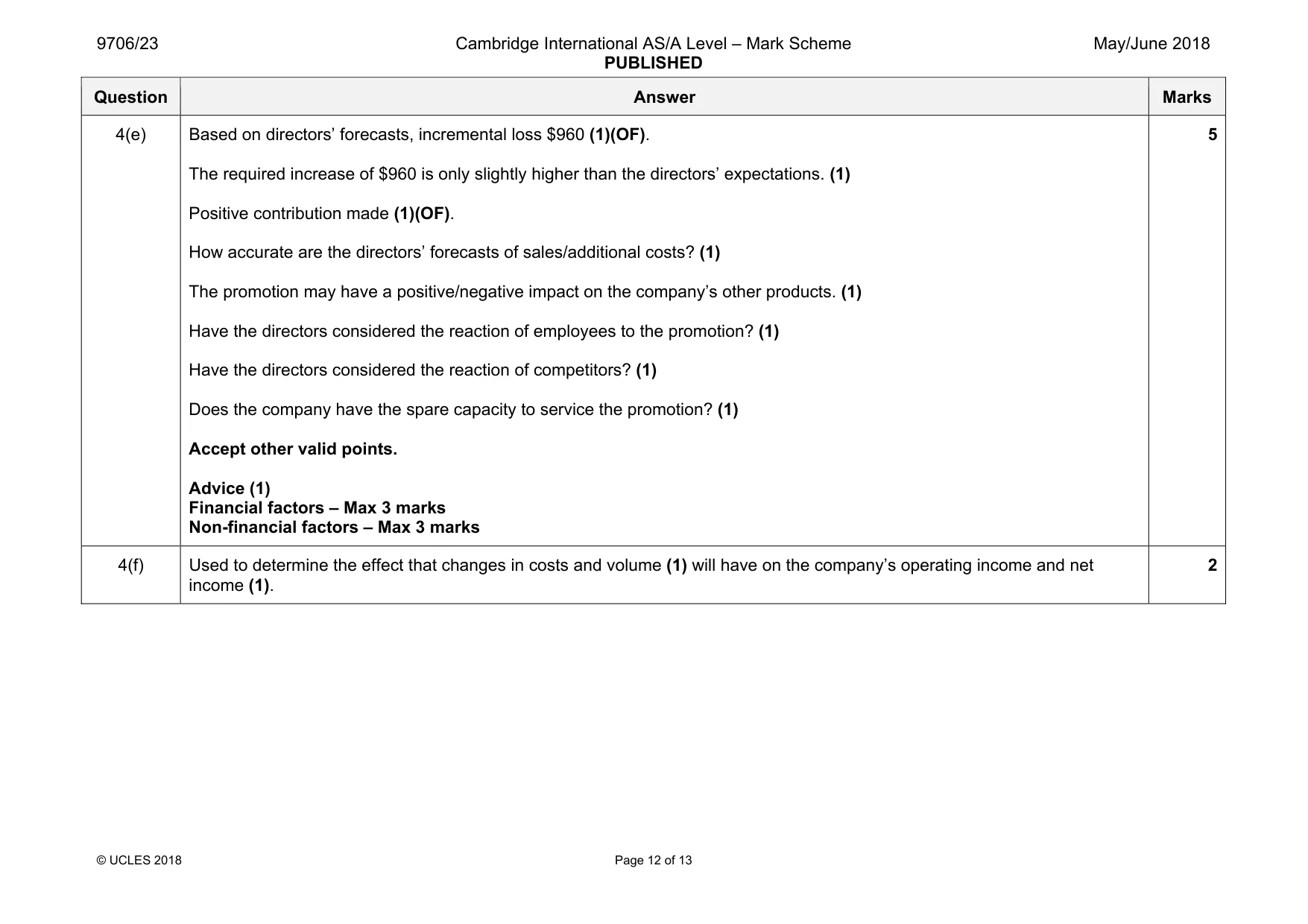
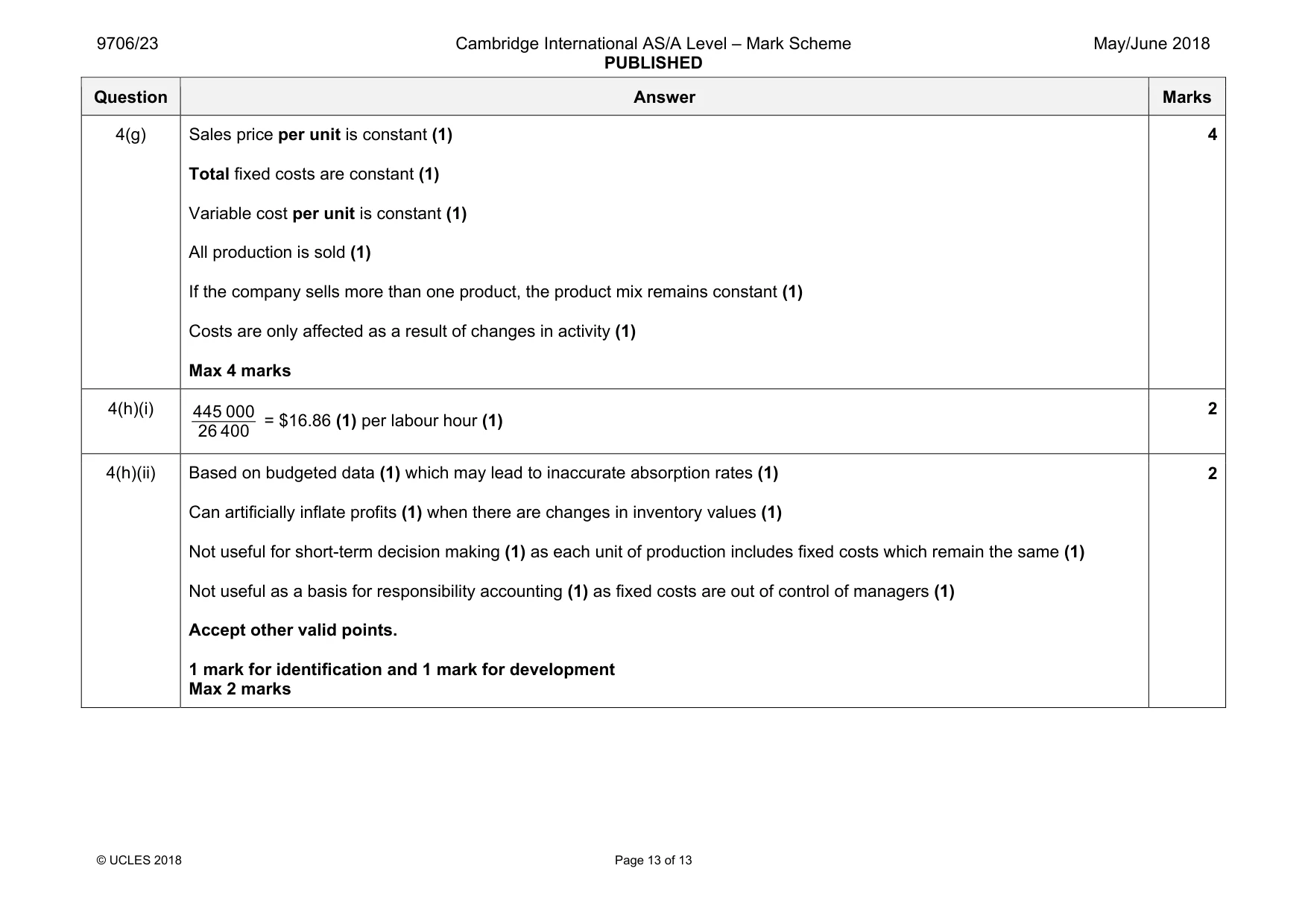
Mark scheme: 4(a) 2 4(b) 2000 + (2000 × 150%) = 5000 (1) × 4 weeks = 20 000 units (1) 2 4(c) $ Selling price ($3.60 × 80%) 2.88 (1) Variable cost ($3.60 × 55%) 1.98 (1) Contribution per unit 0.90 (1) Total contribution (20 000 × 0.90) 18 000 (1)OF Additional fixed costs (6 000) (1) Profit 12 000 (1)OF Additional loss (12 960 – 12 000) 960 (1)OF 7 4(d) Required contribution 12 960 + 6 000 $18 960 (1) Required sales volume 18 960 / 0.90 21 067 units (1) Weekly sales volume 21 067 / 4 5 267 units (1) % increase required (5 267 / 2 000) × 100 263% (1) 4 Question Answer Marks 4(e) Based on directors’ forecasts, incremental loss $960 (1)(OF). The required increase of $960 is only slightly higher than the directors’ expectations. (1) Positive contribution made (1)(OF). How accurate are the directors’ forecasts of sales/additional costs? (1) The promotion may have a positive/negative impact on the company’s other products. (1) Have the directors considered the reaction of employees to the promotion? (1) Have the directors considered the reaction of competitors? (1) Does the company have the spare capacity to service the promotion? (1) Accept other valid points. Advice (1) Financial factors – Max 3 marks Non-financial factors – Max 3 marks 5 4(f) Used to determine the effect that changes in costs and volume (1) will have on the company’s operating income and net income (1). 2 Question Answer Marks 4(g) Sales price per unit is constant (1) Total fixed costs are constant (1) Variable cost per unit is constant (1) All production is sold (1) If the company sells more than one product, the product mix remains constant (1) Costs are only affected as a result of changes in activity (1) Max 4 marks 4 4(h)(i) 445 000 26 400 = $16.86 (1) per labour hour (1) 2 4(h)(ii) Based on budgeted data (1) which may lead to inaccurate absorption rates (1) Can artificially inflate profits (1) when there are changes in inventory values (1) Not useful for short-term decision making (1) as each unit of production includes fixed costs which remain the same (1) Not useful as a basis for responsibility accounting (1) as fixed costs are out of control of managers (1) Accept other valid points. 1 mark for identification and 1 mark for development Max 2 marks 2
What was in this paper
The subtopics covered by these 4 questions, and how many questions each got. Open one in a new tab to see every Cambridge question on it.
What you needed in this session
Cambridge’s own grade thresholds for 2018 May/June, Paper 2 · Variant 3. A higher threshold means an easier paper — the bar moves with how the cohort did.