Cambridge A Level Accounting 9706 — 2018 May/June Paper 2 · Variant 1
9706/21/M/J/18 · 4 questions · 90 marks · ≈101 min
The question paper and its mark scheme, free to read here and free to download. This is Cambridge’s own paper, exactly as it was sat.
Question paper20 pages

Mark scheme15 pages
Answers below. Sit the paper first if you are practising.
Questions as text
Q1 · Ashir, Bo and Chan are in partnership
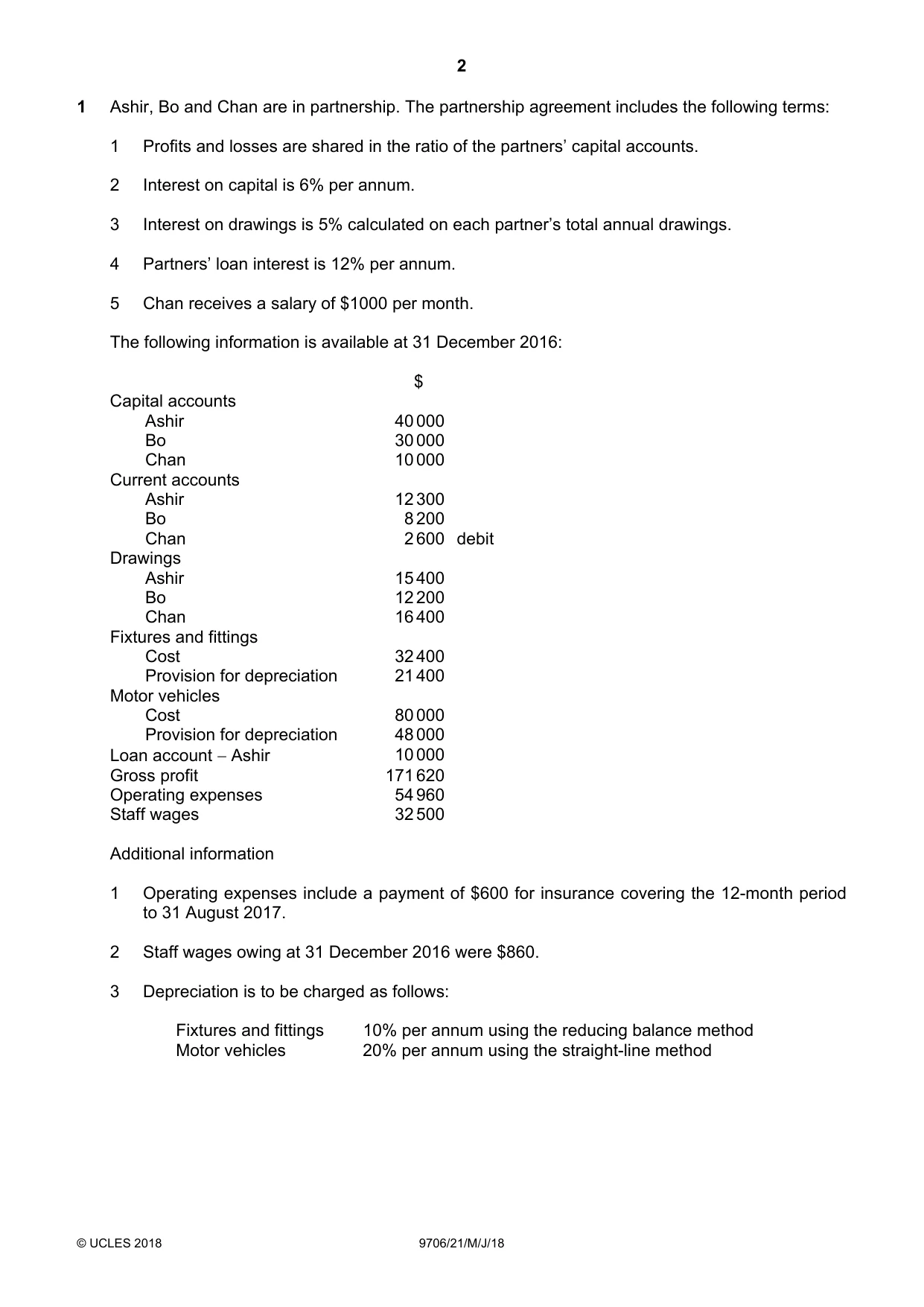
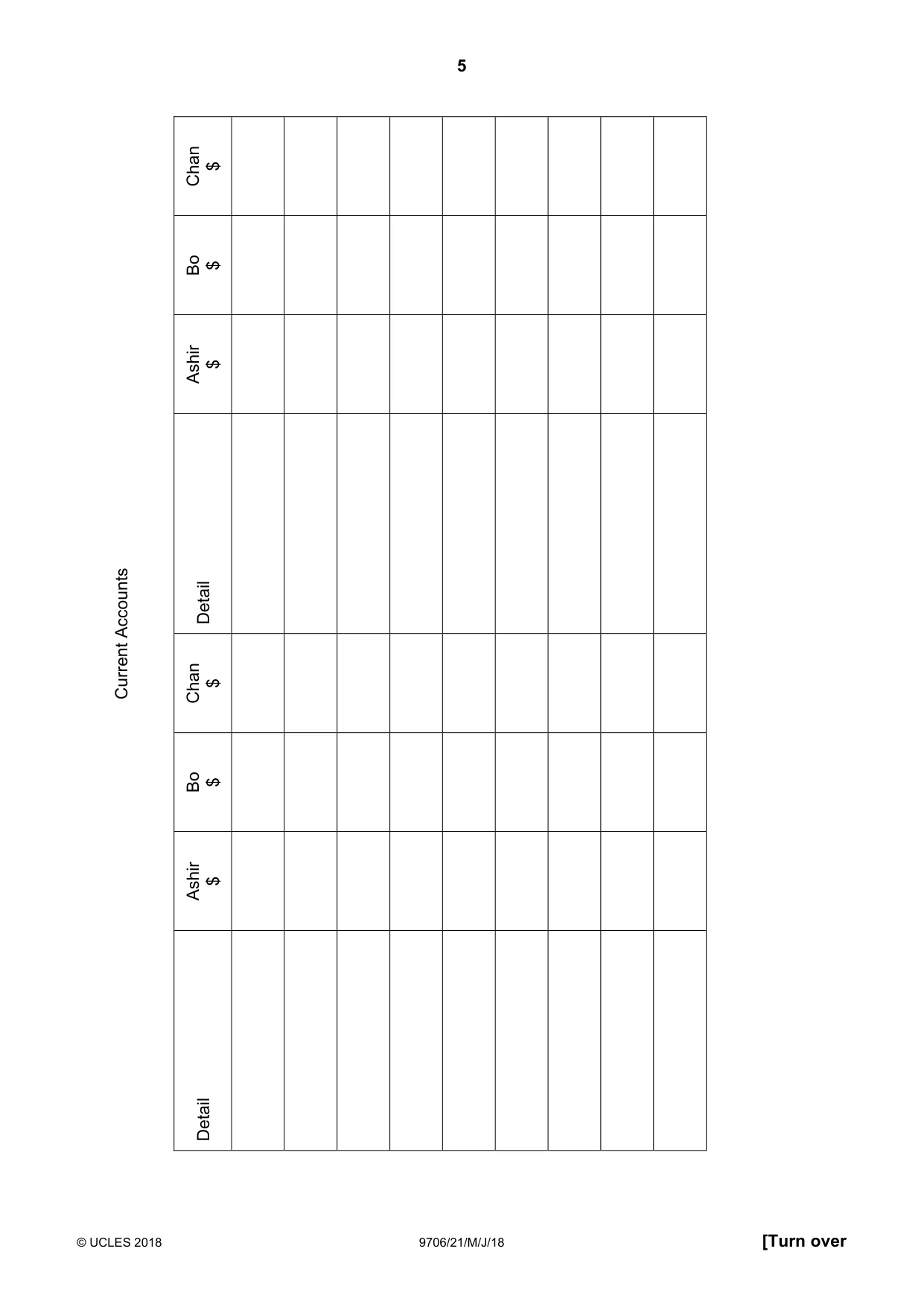
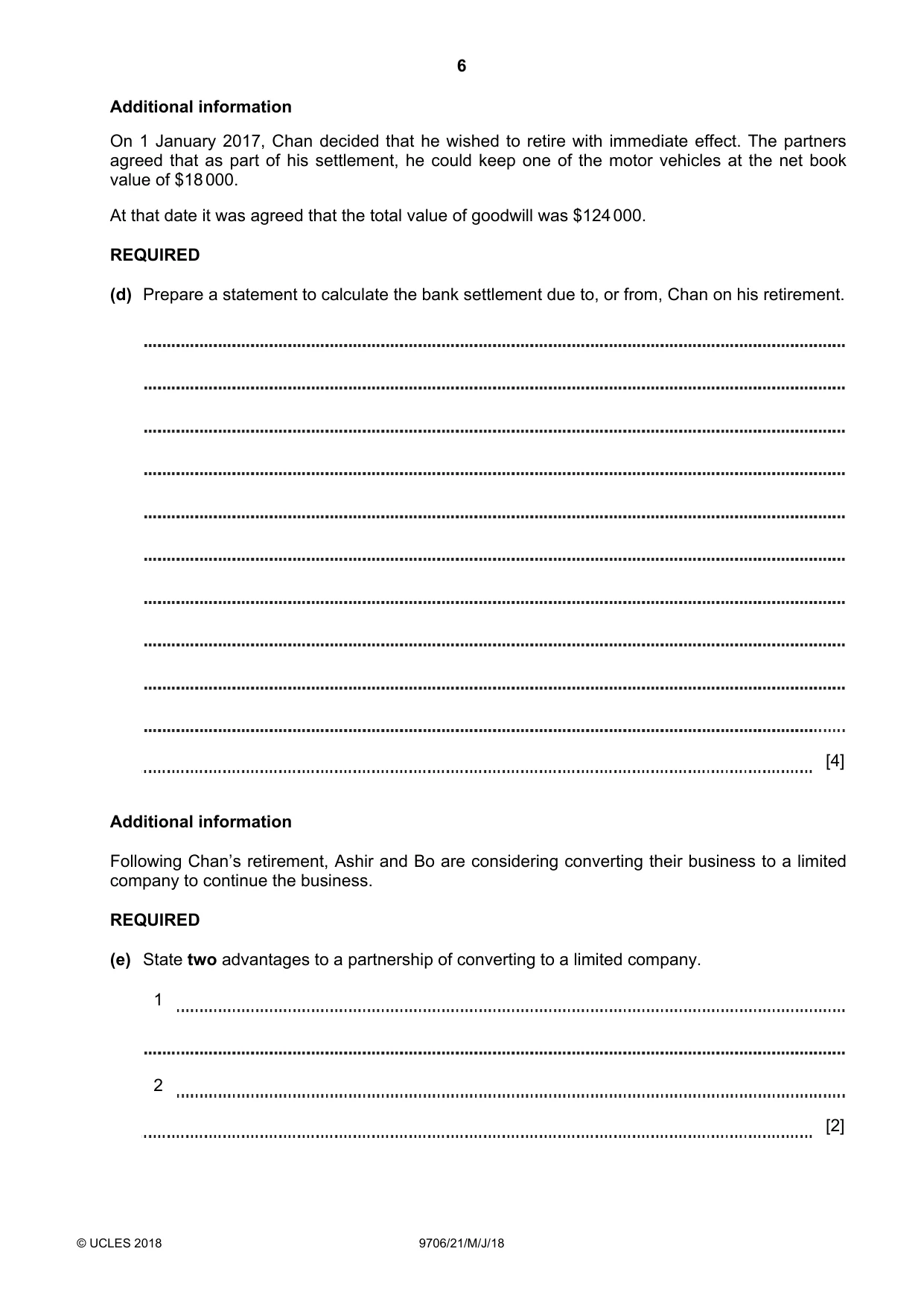
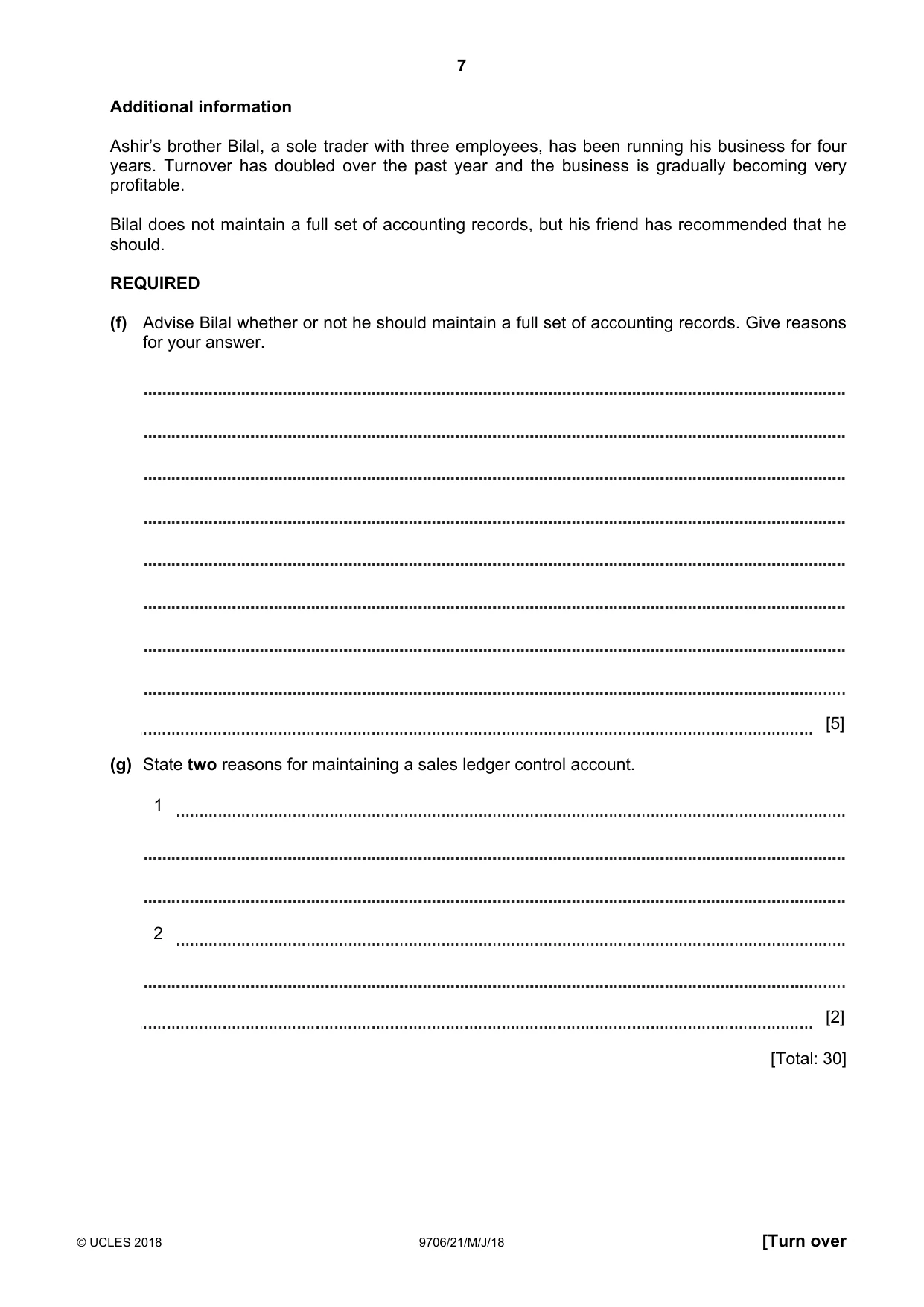
1 Ashir, Bo and Chan are in partnership. The partnership agreement includes the following terms: 1 Profits and losses are shared in the ratio of the partners’ capital accounts. 2 Interest on capital is 6% per annum. 3 Interest on drawings is 5% calculated on each partner’s total annual drawings. 4 Partners’ loan interest is 12% per annum. 5 Chan receives a salary of $1000 per month. The following information is available at 31 December 2016: $ Capital accounts Ashir 40 000 Bo 30 000 Chan 10 000 Current accounts Ashir 12 300 Bo 8 200 Chan 2 600 debit Drawings Ashir 15 400 Bo 12 200 Chan 16 400 Fixtures and fittings Cost 32 400 Provision for depreciation 21 400 Motor vehicles Cost 80 000 Provision for depreciation 48 000 Loan account Ashir 10 000 Gross profit 171 620 Operating expenses 54 960 Staff wages 32 500 Additional information 1 Operating expenses include a payment of $600 for insurance covering the 12-month period to 31 August 2017. 2 Staff wages owing at 31 December 2016 were $860. 3 Depreciation is to be charged as follows: Fixtures and fittings 10% per annum using the reducing balance method Motor vehicles 20% per annum using the straight-line method REQUIRED (a) Prepare the income statement for the partnership for the year ended 31 December 2016. Start with the given gross profit of $171 620. [5] (b) Prepare the profit and loss appropriation account for the partnership for the year ended 31 December 2016. [5] (c) Prepare the partners’ current accounts for the year ended 31 December 2016 on the next page. [7] $ Chan $ Bo $ Ashir DetailAccounts $Current Chan $ Bo $ Ashir Detail Additional information On 1 January 2017, Chan decided that he wished to retire with immediate effect. The partners agreed that as part of his settlement, he could keep one of the motor vehicles at the net book value of $18 000. At that date it was agreed that the total value of goodwill was $124 000. REQUIRED (d) Prepare a statement to calculate the bank settlement due to, or from, Chan on his retirement. [4] Additional information Following Chan’s retirement, Ashir and Bo are considering converting their business to a limited company to continue the business. REQUIRED (e) State two advantages to a partnership of converting to a limited company. 1 2 [2] Additional information Ashir’s brother Bilal, a sole trader with three employees, has been running his business for four years. Turnover has doubled over the past year and the business is gradually becoming very profitable. Bilal does not maintain a full set of accounting records, but his friend has recommended that he should. REQUIRED (f) Advise Bilal whether or not he should maintain a full set of accounting records. Give reasons for your answer. [5] (g) State two reasons for maintaining a sales ledger control account. 1 2 [2] [Total: 30]
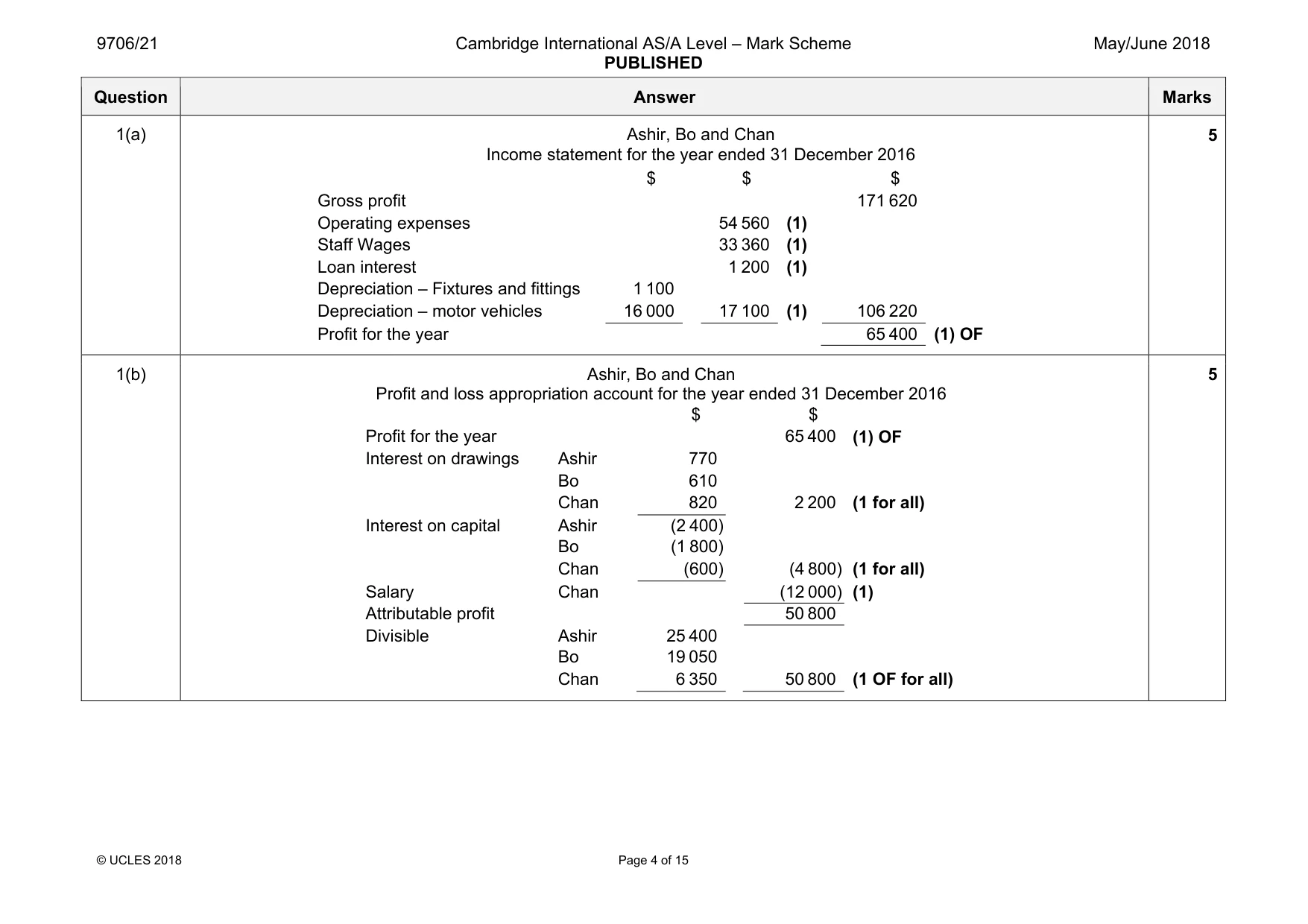
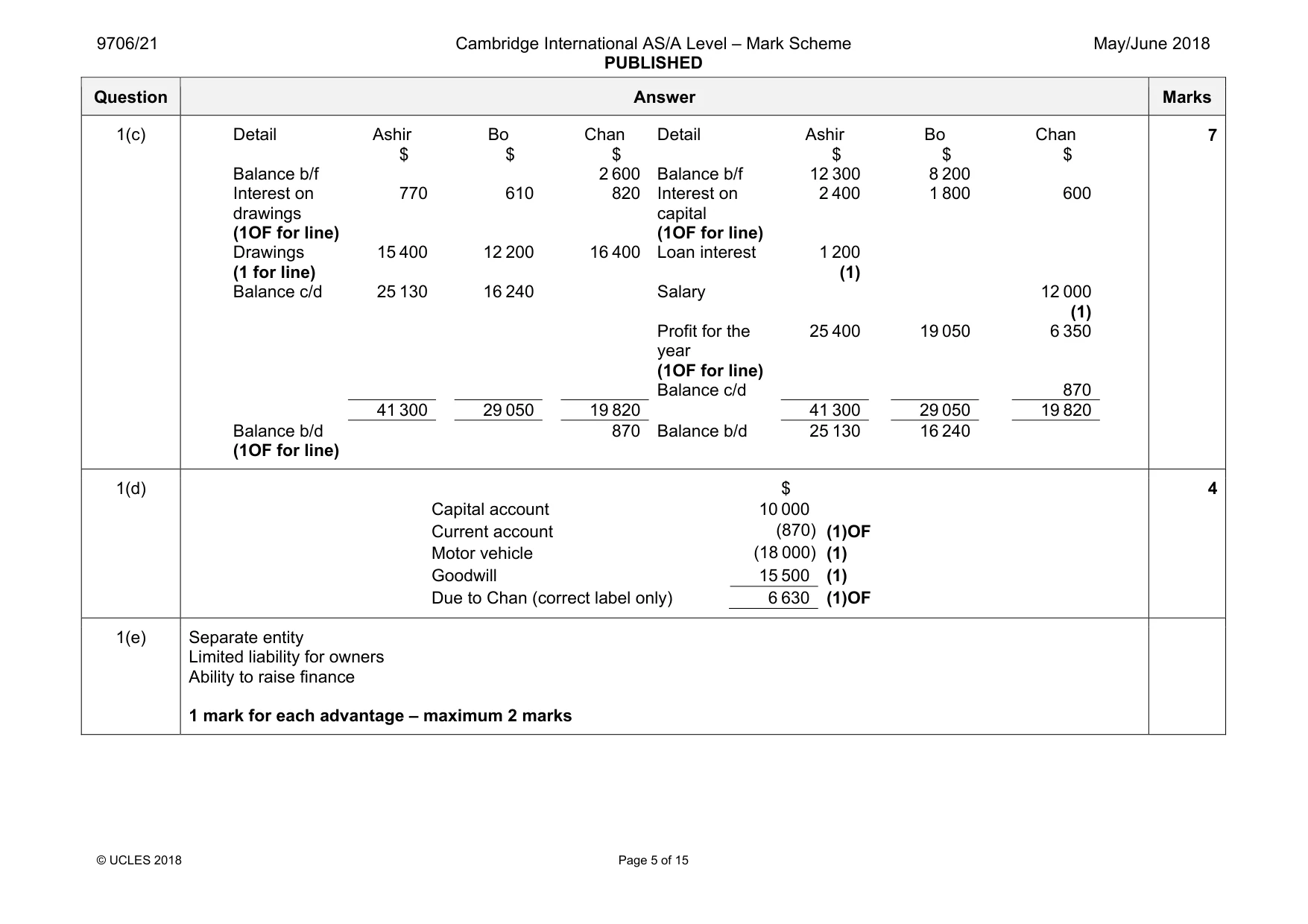
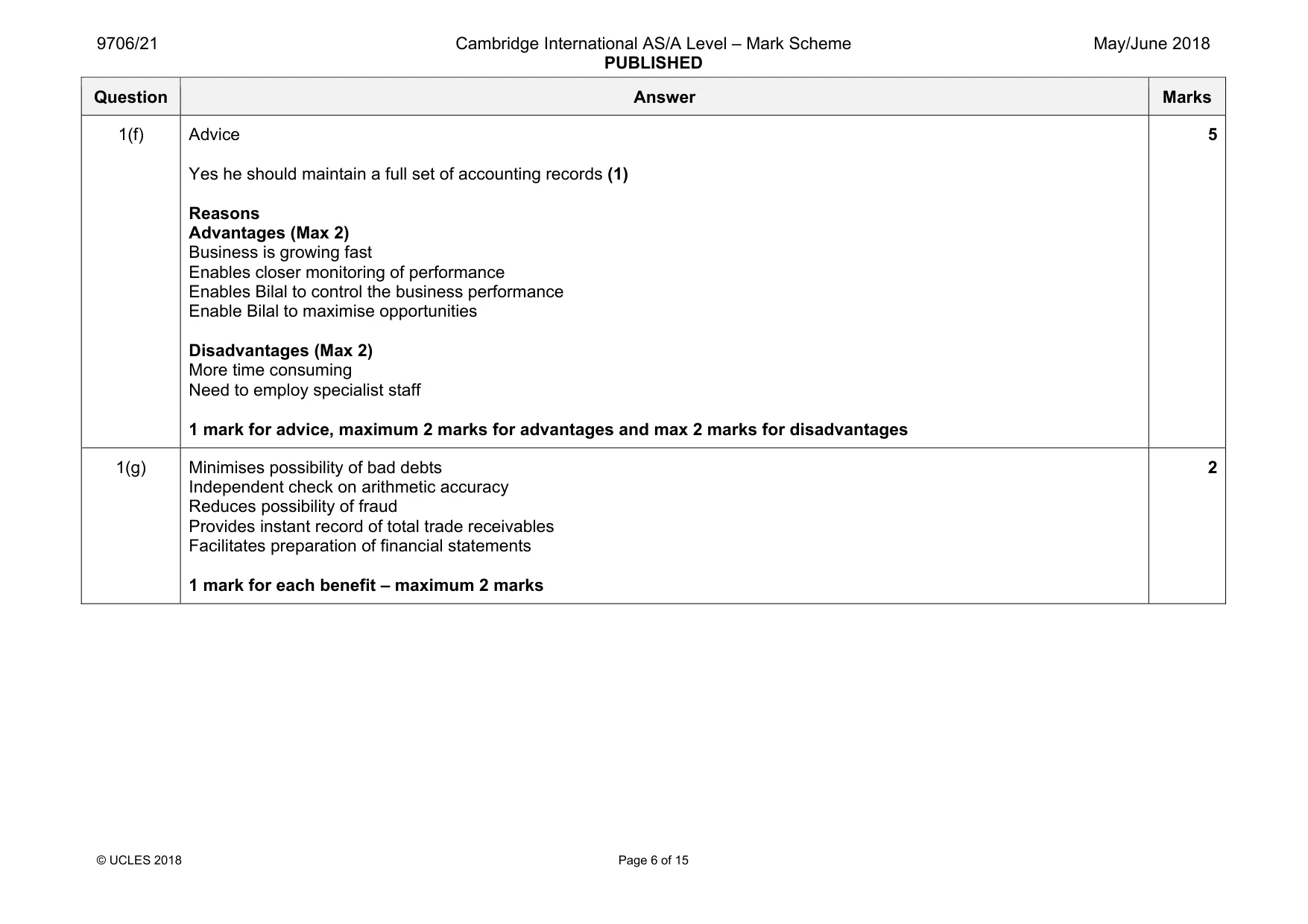
Mark scheme: 1(a) Ashir, Bo and Chan Income statement for the year ended 31 December 2016 $ $ $ Gross profit 171 620 Operating expenses 54 560 (1) Staff Wages 33 360 (1) Loan interest 1 200 (1) Depreciation – Fixtures and fittings 1 100 Depreciation – motor vehicles 16 000 17 100 (1) 106 220 Profit for the year 65 400 (1) OF 5 1(b) Ashir, Bo and Chan Profit and loss appropriation account for the year ended 31 December 2016 $ $ Profit for the year 65 400 (1) OF Interest on drawings Ashir 770 Bo 610 Chan 820 2 200 (1 for all) Interest on capital Ashir (2 400) Bo (1 800) Chan (600) (4 800) (1 for all) Salary Chan (12 000) (1) Attributable profit 50 800 Divisible Ashir 25 400 Bo 19 050 Chan 6 350 50 800 (1 OF for all) 5 Question Answer Marks 1(c) Detail Ashir $ Bo $ Chan $ Detail Ashir $ Bo $ Chan $ Balance b/f 2 600 Balance b/f 12 300 8 200 Interest on drawings (1OF for line) 770 610 820 Interest on capital (1OF for line) 2 400 1 800 600 Drawings (1 for line) 15 400 12 200 16 400 Loan interest 1 200 (1) Balance c/d 25 130 16 240 Salary Profit for the year (1OF for line) 25 400 19 050 12 000 (1) 6 350 Balance c/d 870 41 300 29 050 19 820 41 300 29 050 19 820 Balance b/d (1OF for line) 870 Balance b/d 25 130 16 240 7 1(d) $ Capital account 10 000 Current account (870) (1)OF Motor vehicle (18 000) (1) Goodwill 15 500 (1) Due to Chan (correct label only) 6 630 (1)OF 4 1(e) Separate entity Limited liability for owners Ability to raise finance 1 mark for each advantage – maximum 2 marks Question Answer Marks 1(f) Advice Yes he should maintain a full set of accounting records (1) Reasons Advantages (Max 2) Business is growing fast Enables closer monitoring of performance Enables Bilal to control the business performance Enable Bilal to maximise opportunities Disadvantages (Max 2) More time consuming Need to employ specialist staff 1 mark for advice, maximum 2 marks for advantages and max 2 marks for disadvantages 5 1(g) Minimises possibility of bad debts Independent check on arithmetic accuracy Reduces possibility of fraud Provides instant record of total trade receivables Facilitates preparation of financial statements 1 mark for each benefit – maximum 2 marks 2
Q2 · The following information has been extracted from the books of account of FA Limited at 1…
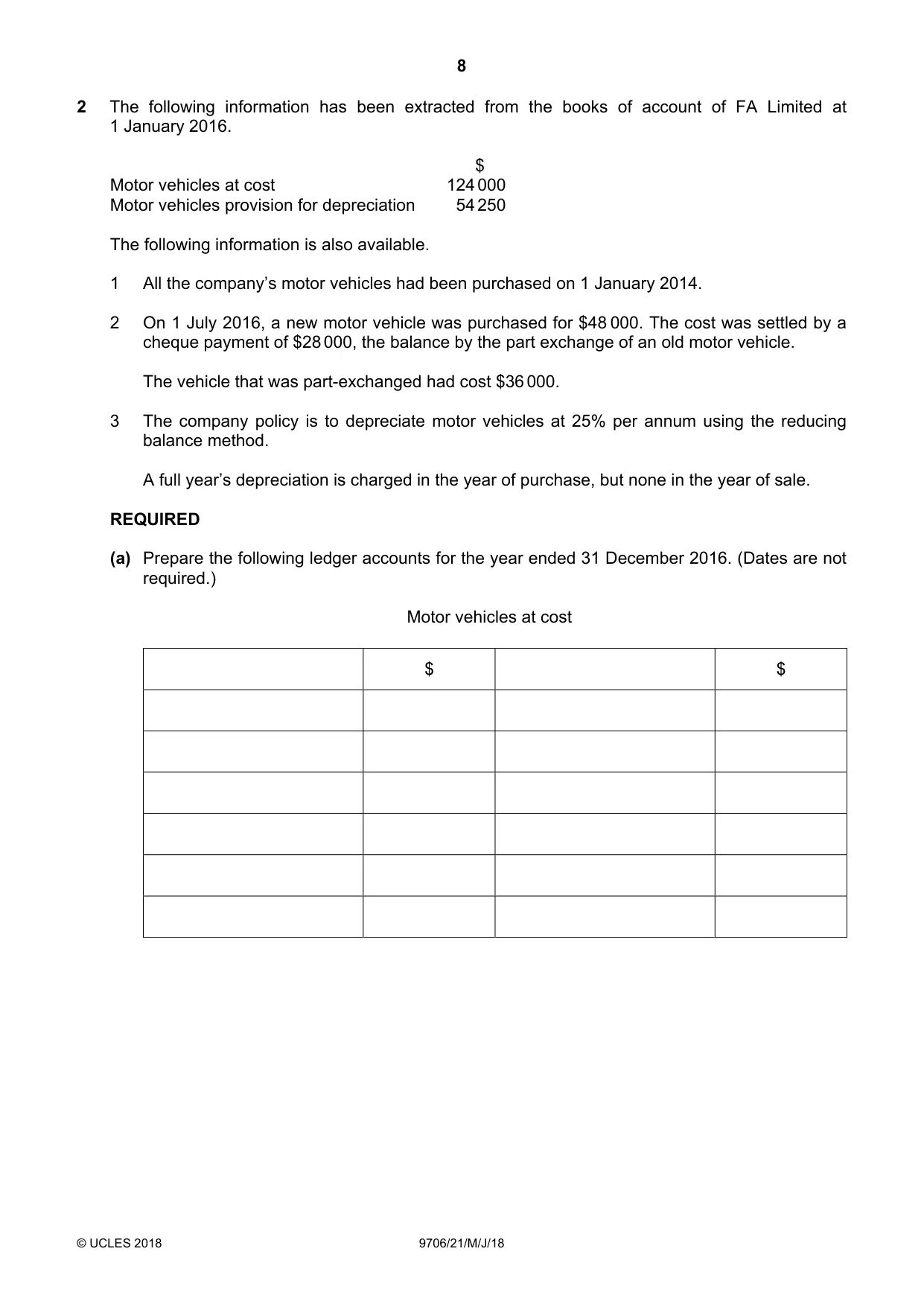
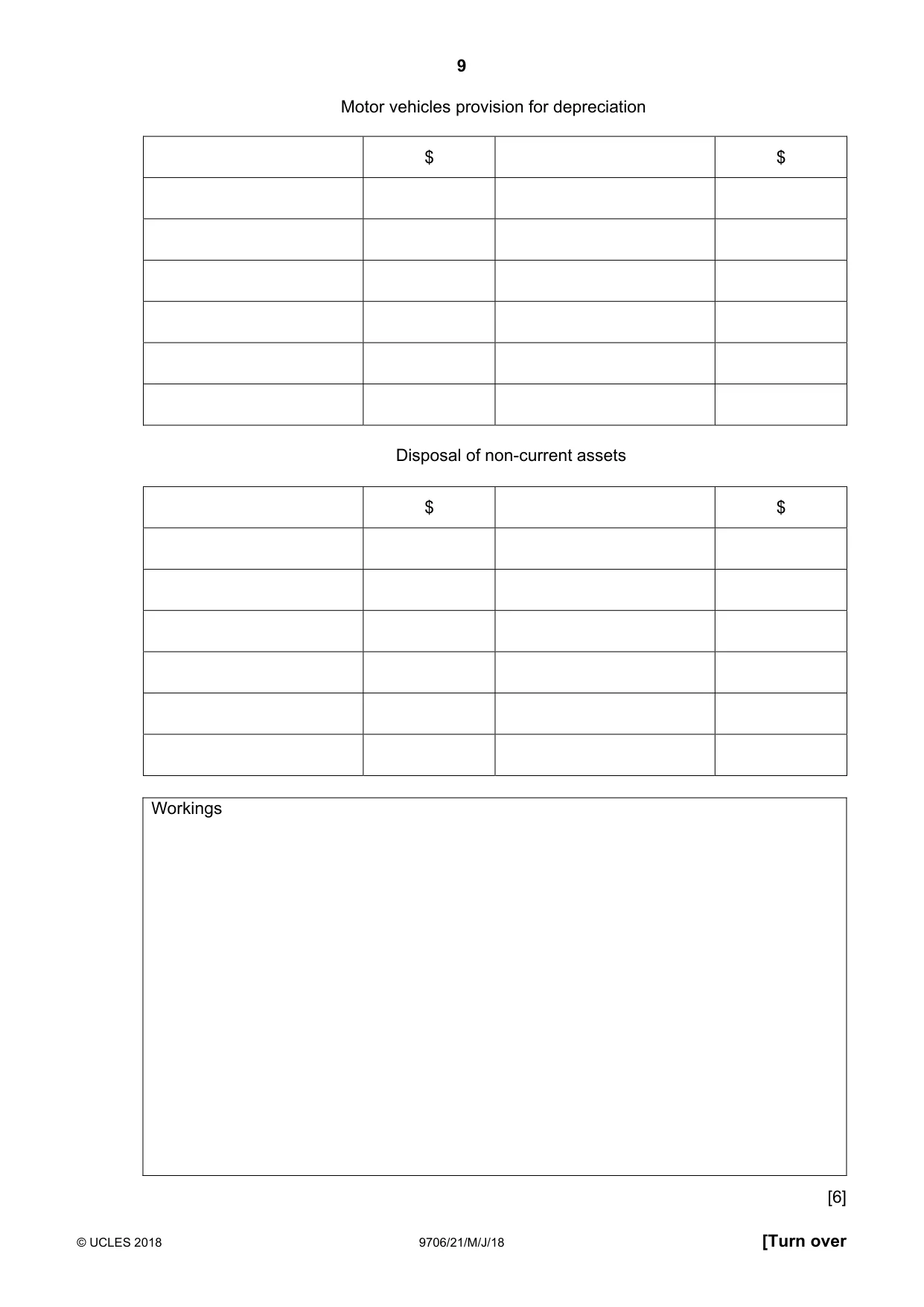
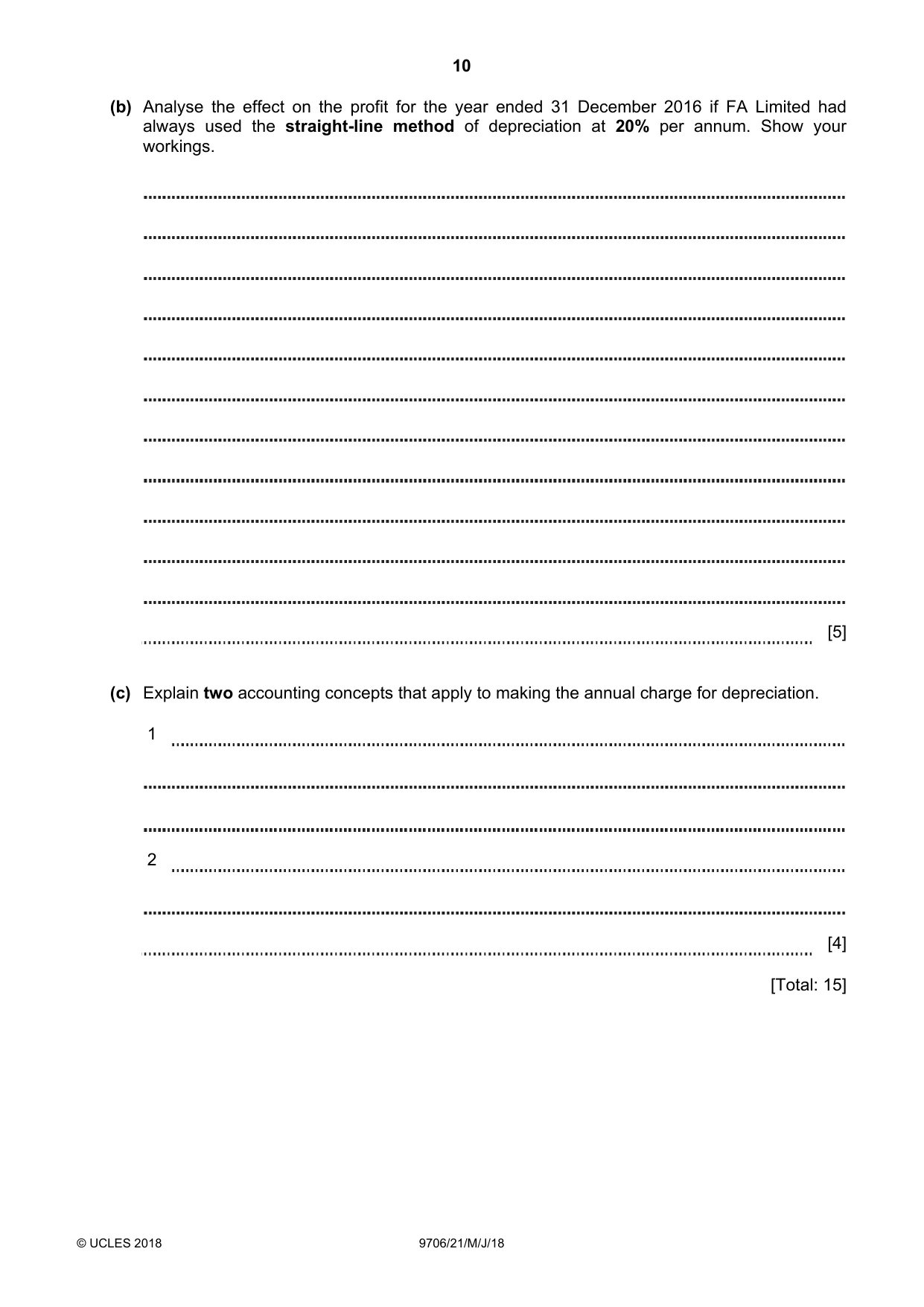
2 The following information has been extracted from the books of account of FA Limited at 1 January 2016. $ Motor vehicles at cost 124 000 Motor vehicles provision for depreciation 54 250 The following information is also available. 1 All the company’s motor vehicles had been purchased on 1 January 2014. 2 On 1 July 2016, a new motor vehicle was purchased for $48 000. The cost was settled by a cheque payment of $28 000, the balance by the part exchange of an old motor vehicle. The vehicle that was part-exchanged had cost $36 000. 3 The company policy is to depreciate motor vehicles at 25% per annum using the reducing balance method. A full year’s depreciation is charged in the year of purchase, but none in the year of sale. REQUIRED (a) Prepare the following ledger accounts for the year ended 31 December 2016. (Dates are not required.) Motor vehicles at cost $ $ Motor vehicles provision for depreciation $ $ Disposal of non-current assets $ $ Workings [6] (b) Analyse the effect on the profit for the year ended 31 December 2016 if FA Limited had always used the straight-line method of depreciation at 20% per annum. Show your workings. [5] (c) Explain two accounting concepts that apply to making the annual charge for depreciation. 1 2 [4] [Total: 15] PLEASE TURN OVER
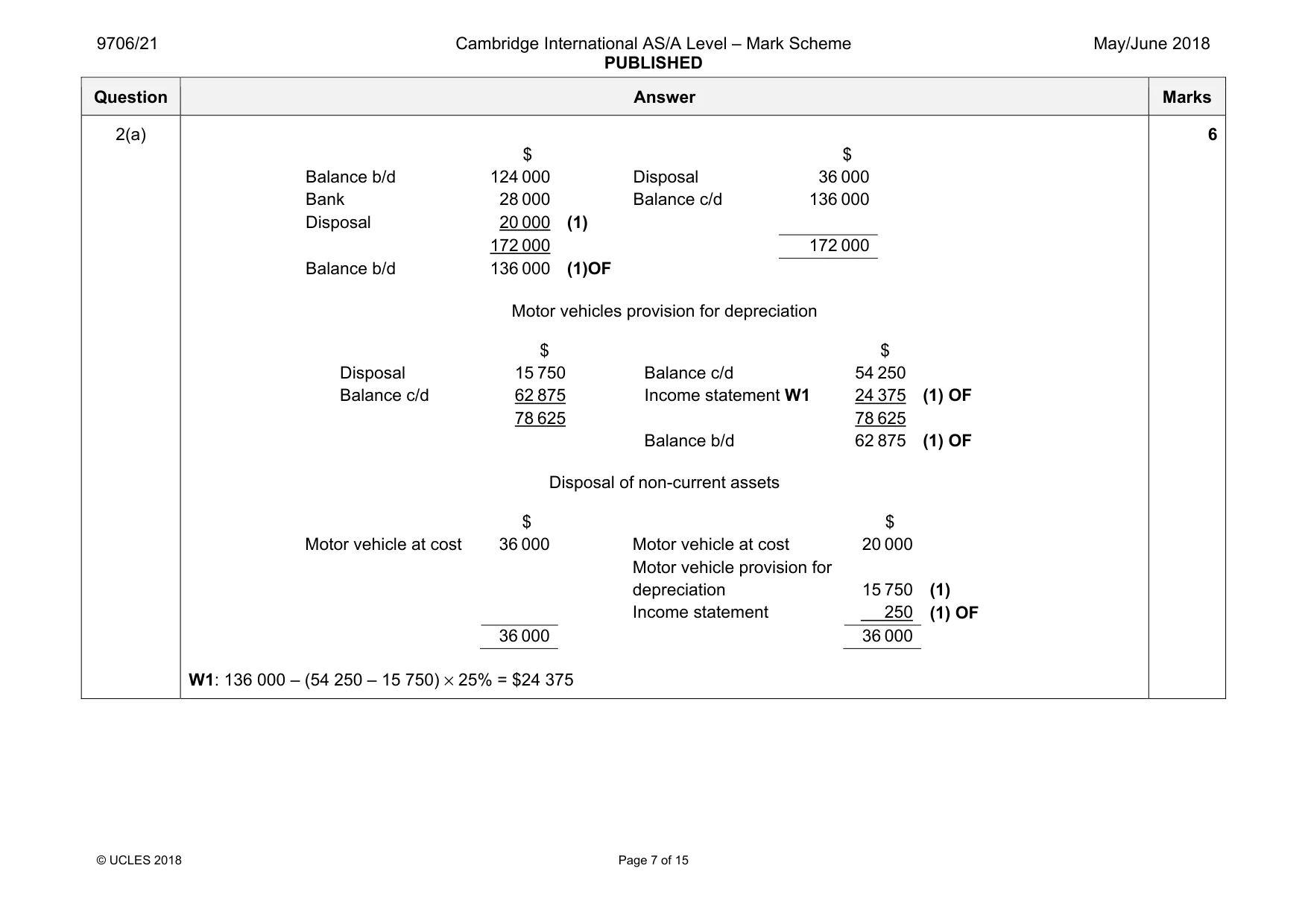
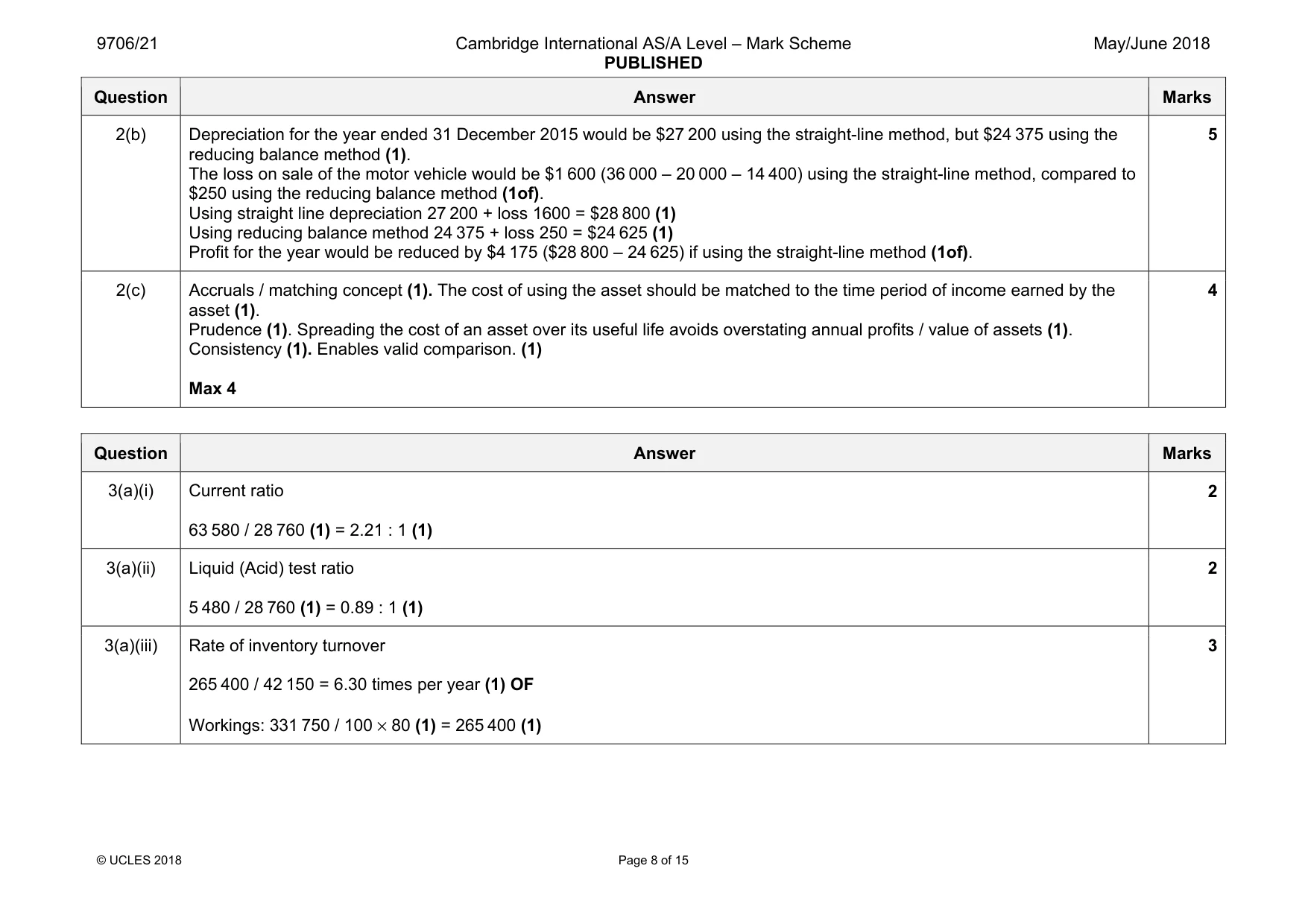
Mark scheme: 2(a) $ $ Balance b/d 124 000 Disposal 36 000 Bank 28 000 Balance c/d 136 000 Disposal 20 000 (1) 172 000 172 000 Balance b/d 136 000 (1)OF Motor vehicles provision for depreciation $ $ Disposal 15 750 Balance c/d 54 250 Balance c/d 62 875 Income statement W1 24 375 (1) OF 78 625 78 625 Balance b/d 62 875 (1) OF Disposal of non-current assets $ $ Motor vehicle at cost 36 000 Motor vehicle at cost 20 000 Motor vehicle provision for depreciation 15 750 (1) Income statement 250 (1) OF 36 000 36 000 W1: 136 000 – (54 250 – 15 750) × 25% = $24 375 6 Question Answer Marks 2(b) Depreciation for the year ended 31 December 2015 would be $27 200 using the straight-line method, but $24 375 using the reducing balance method (1). The loss on sale of the motor vehicle would be $1 600 (36 000 – 20 000 – 14 400) using the straight-line method, compared to $250 using the reducing balance method (1of). Using straight line depreciation 27 200 + loss 1600 = $28 800 (1) Using reducing balance method 24 375 + loss 250 = $24 625 (1) Profit for the year would be reduced by $4 175 ($28 800 – 24 625) if using the straight-line method (1of). 5 2(c) Accruals / matching concept (1). The cost of using the asset should be matched to the time period of income earned by the asset (1). Prudence (1). Spreading the cost of an asset over its useful life avoids overstating annual profits / value of assets (1). Consistency (1). Enables valid comparison. (1) Max 4 4
Q3 · Anna has obtained the following data at 31 December 2016 in respect of Ravi, a possible…
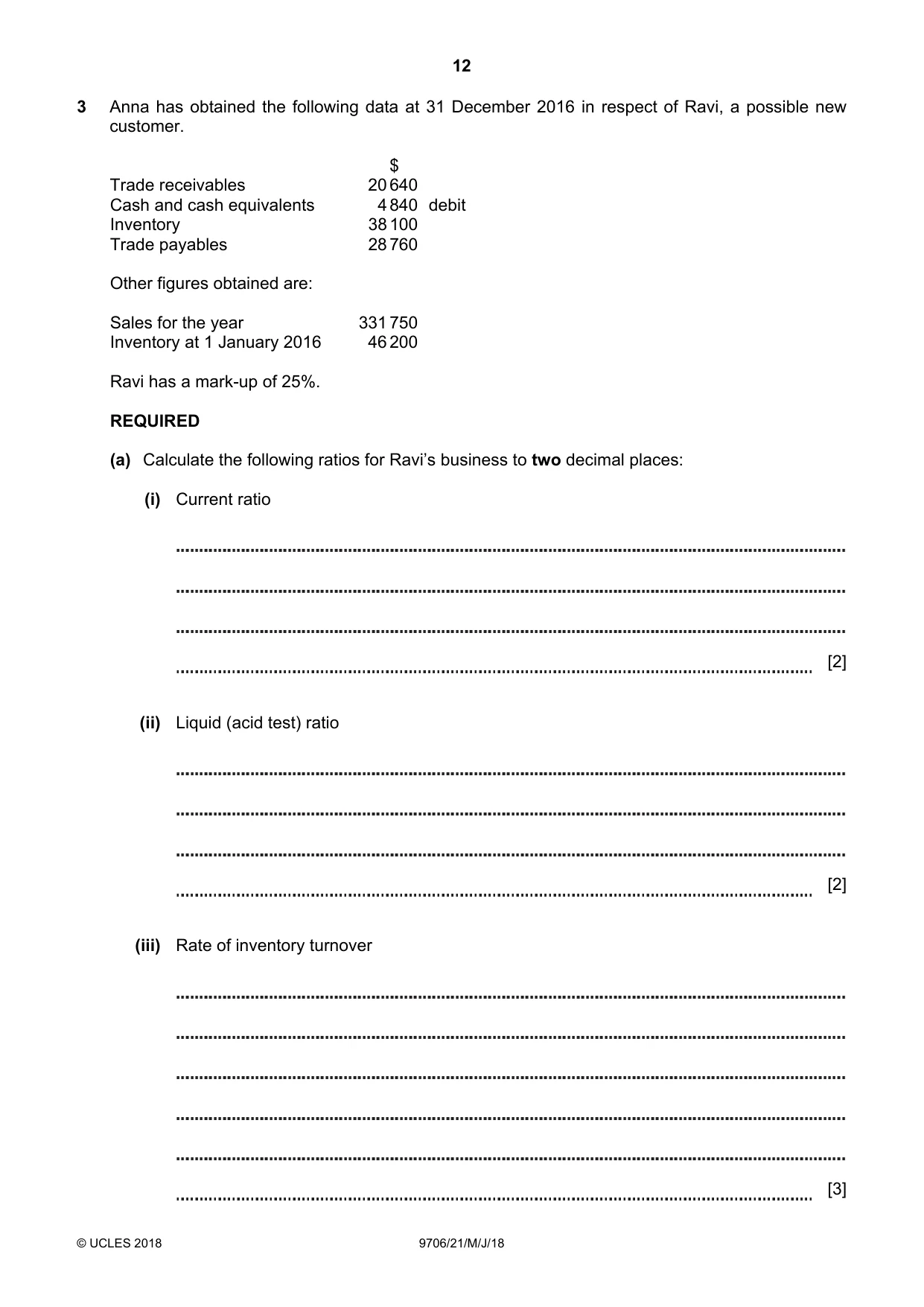
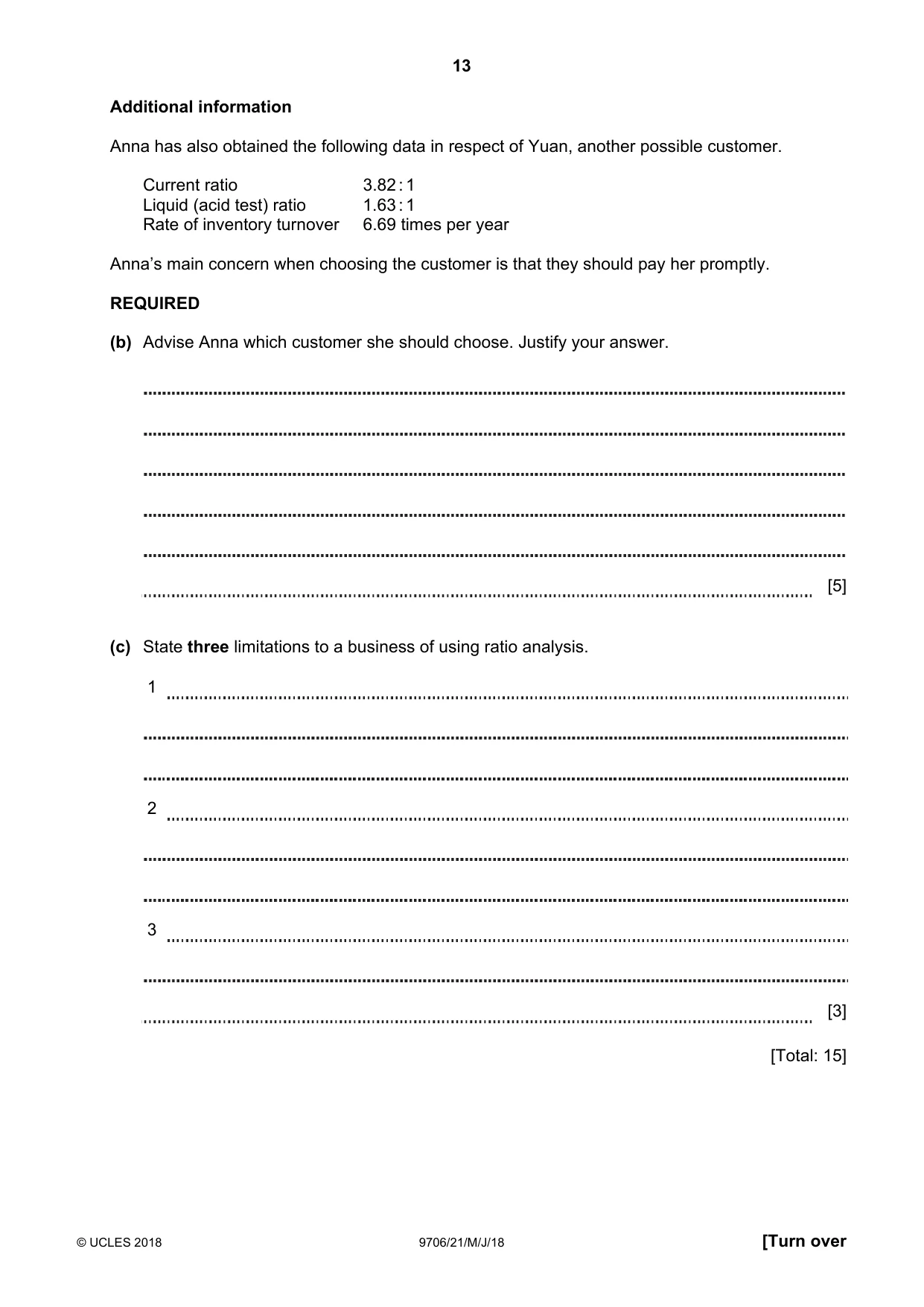
3 Anna has obtained the following data at 31 December 2016 in respect of Ravi, a possible new customer. $ Trade receivables 20 640 Cash and cash equivalents 4 840 debit Inventory 38 100 Trade payables 28 760 Other figures obtained are: Sales for the year 331 750 Inventory at 1 January 2016 46 200 Ravi has a mark-up of 25%. REQUIRED (a) Calculate the following ratios for Ravi’s business to two decimal places: (i) Current ratio [2] (ii) Liquid (acid test) ratio [2] (iii) Rate of inventory turnover [3] Additional information Anna has also obtained the following data in respect of Yuan, another possible customer. Current ratio 3.82 : 1 Liquid (acid test) ratio 1.63 : 1 Rate of inventory turnover 6.69 times per year Anna’s main concern when choosing the customer is that they should pay her promptly. REQUIRED (b) Advise Anna which customer she should choose. Justify your answer. [5] (c) State three limitations to a business of using ratio analysis. 1 2 3 [3] [Total: 15]
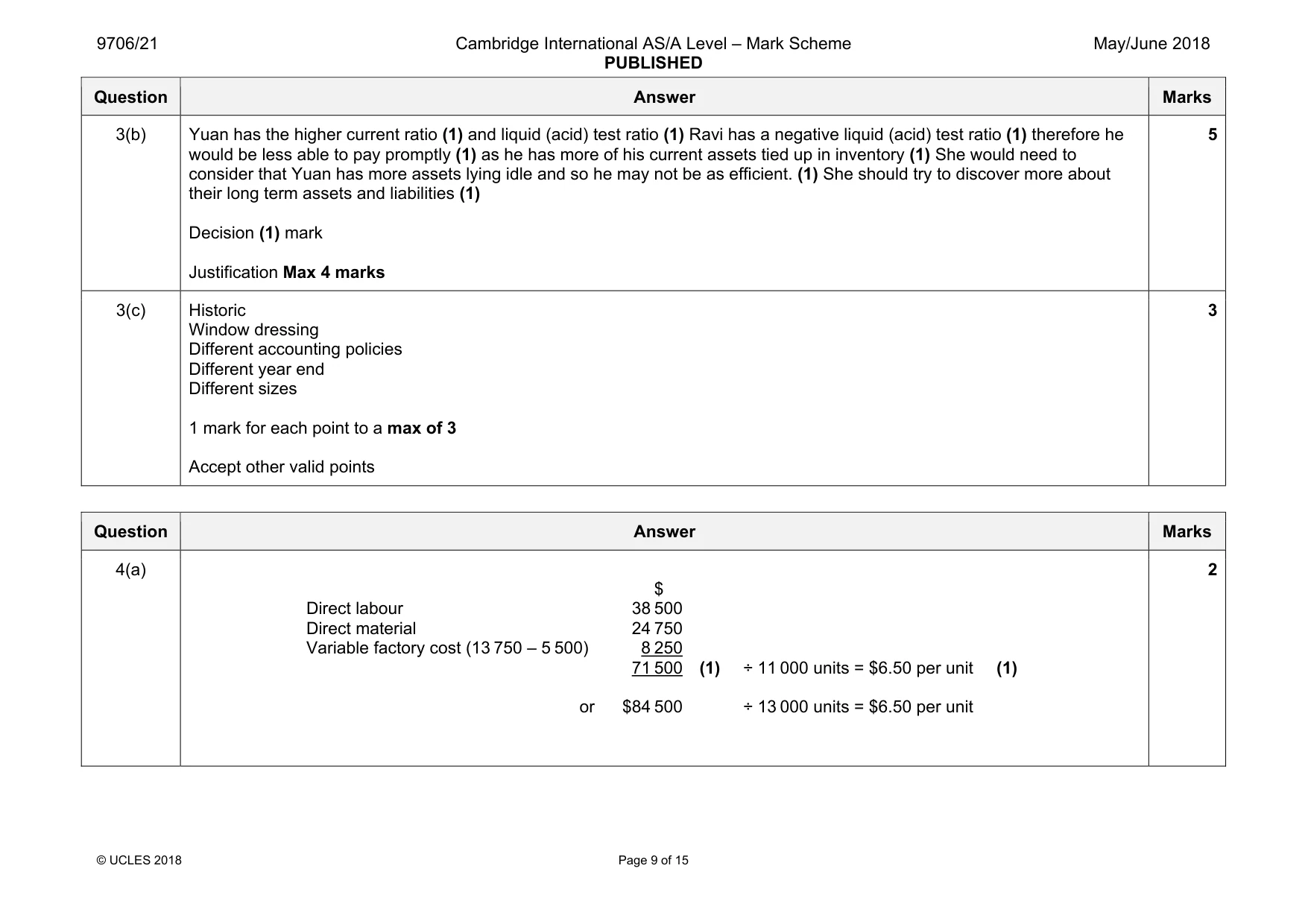
Mark scheme: 3(a)(i) Current ratio 63 580 / 28 760 (1) = 2.21 : 1 (1) 2 3(a)(ii) Liquid (Acid) test ratio 5 480 / 28 760 (1) = 0.89 : 1 (1) 2 3(a)(iii) Rate of inventory turnover 265 400 / 42 150 = 6.30 times per year (1) OF Workings: 331 750 / 100 × 80 (1) = 265 400 (1) 3 Question Answer Marks 3(b) Yuan has the higher current ratio (1) and liquid (acid) test ratio (1) Ravi has a negative liquid (acid) test ratio (1) therefore he would be less able to pay promptly (1) as he has more of his current assets tied up in inventory (1) She would need to consider that Yuan has more assets lying idle and so he may not be as efficient. (1) She should try to discover more about their long term assets and liabilities (1) Decision (1) mark Justification Max 4 marks 5 3(c) Historic Window dressing Different accounting policies Different year end Different sizes 1 mark for each point to a max of 3 Accept other valid points 3
More questions on Analysis and communication of accounting information
Q4 · Zinan is a manufacturer and makes a single product
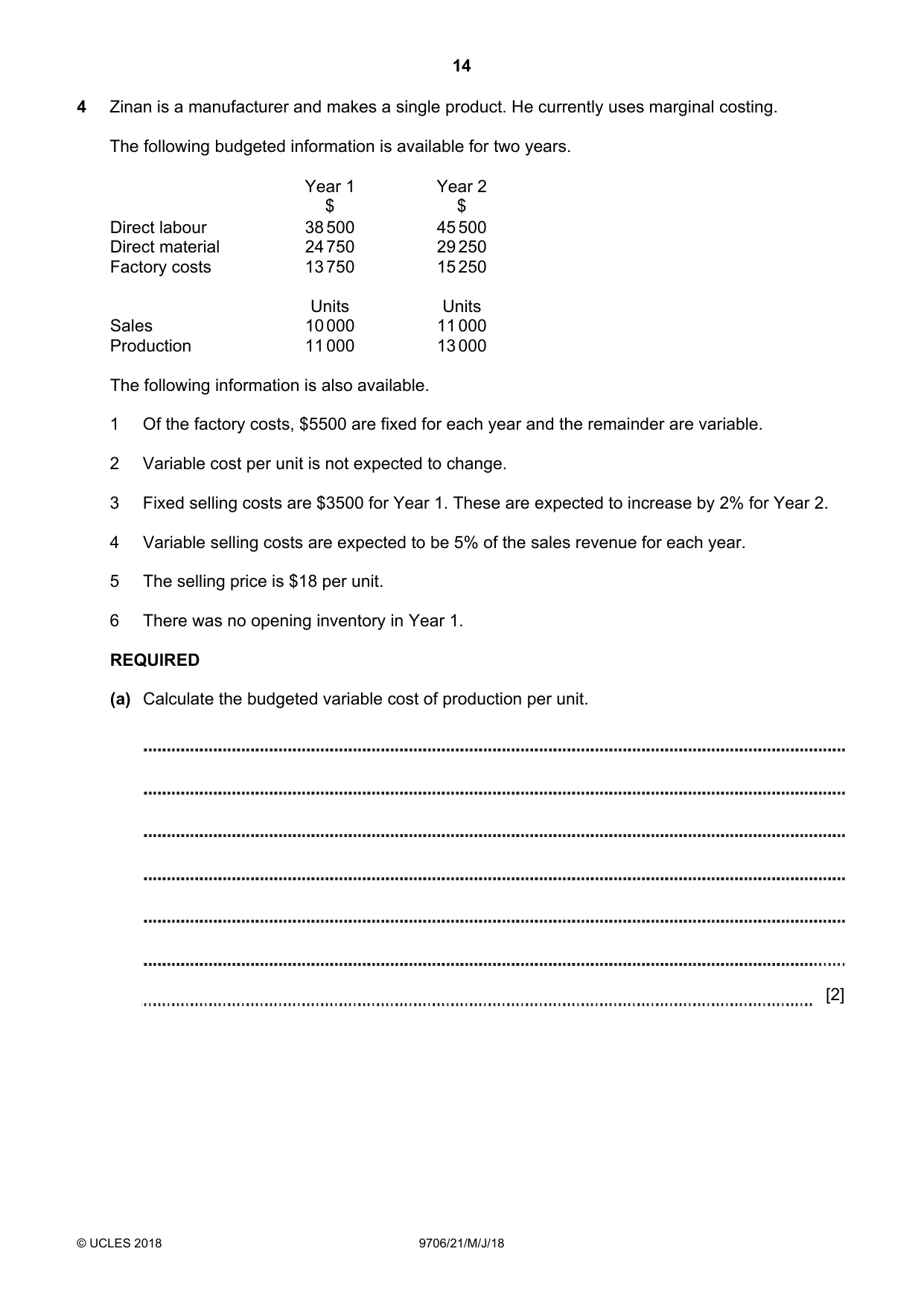
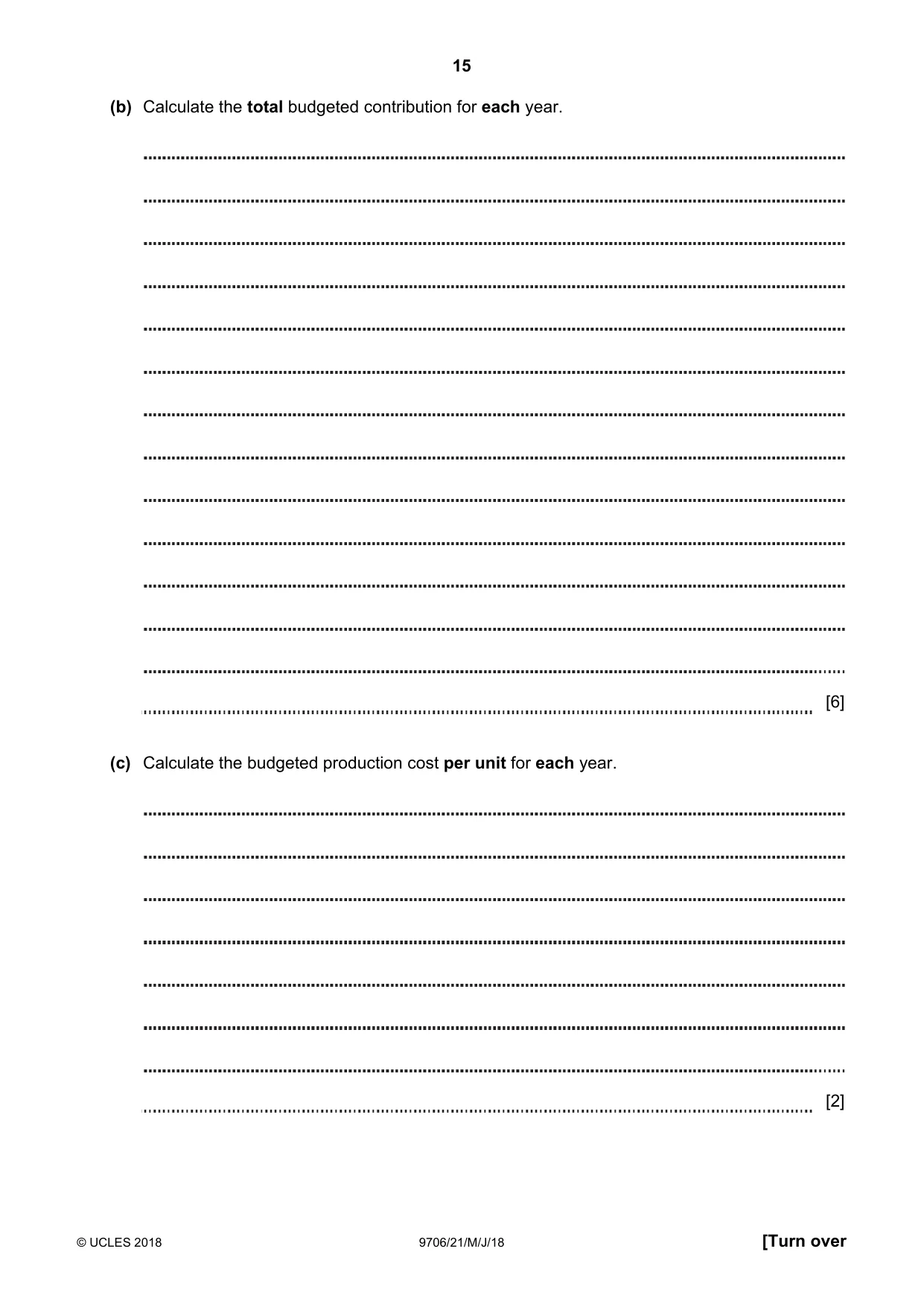
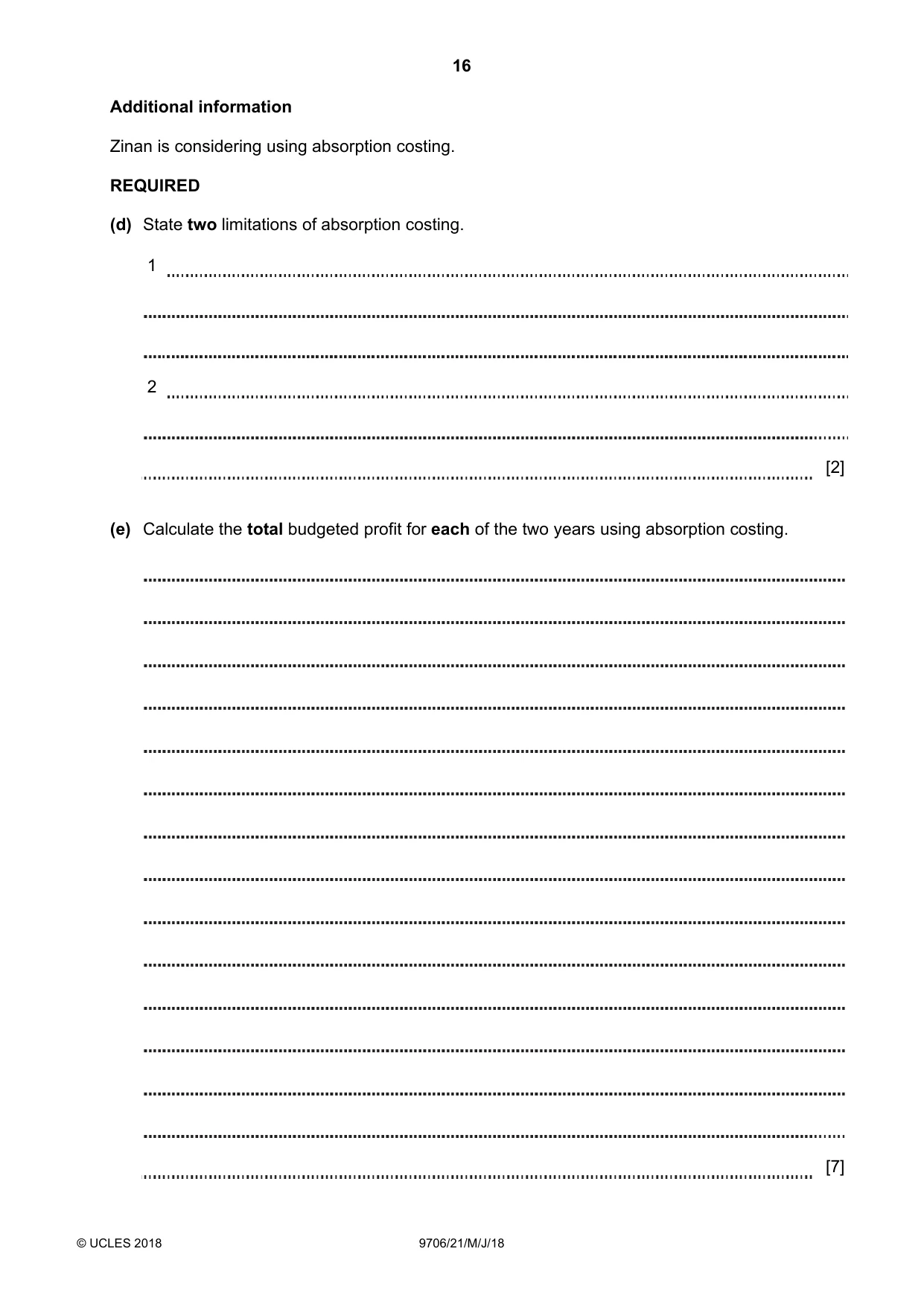
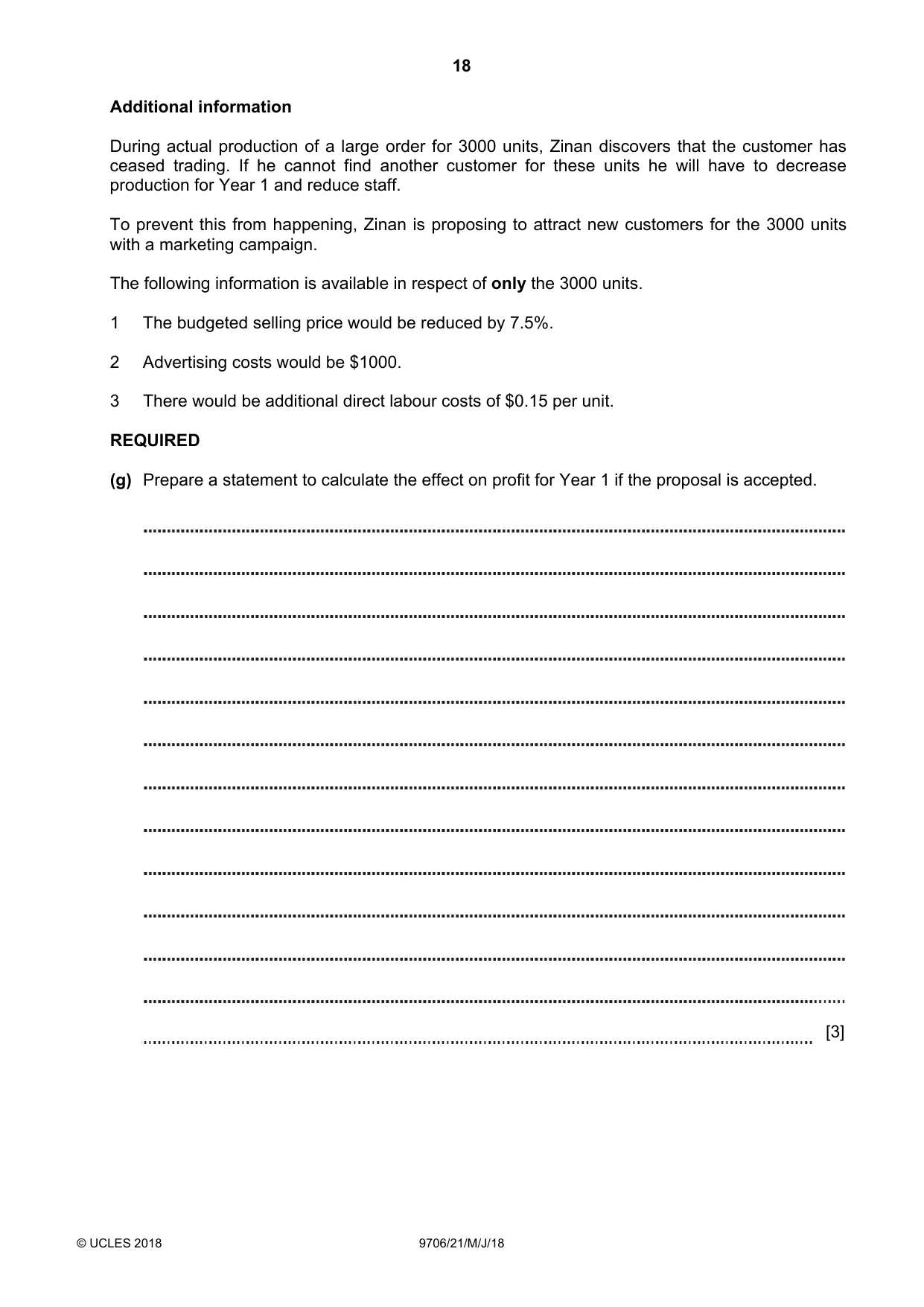
4 Zinan is a manufacturer and makes a single product. He currently uses marginal costing. The following budgeted information is available for two years. Year 1 Year 2 $ $ Direct labour 38 500 45 500 Direct material 24 750 29 250 Factory costs 13 750 15 250 Units Units Sales 10 000 11 000 Production 11 000 13 000 The following information is also available. 1 Of the factory costs, $5500 are fixed for each year and the remainder are variable. 2 Variable cost per unit is not expected to change. 3 Fixed selling costs are $3500 for Year 1. These are expected to increase by 2% for Year 2. 4 Variable selling costs are expected to be 5% of the sales revenue for each year. 5 The selling price is $18 per unit. 6 There was no opening inventory in Year 1. REQUIRED (a) Calculate the budgeted variable cost of production per unit. [2] (b) Calculate the total budgeted contribution for each year. [6] (c) Calculate the budgeted production cost per unit for each year. [2] Additional information Zinan is considering using absorption costing. REQUIRED (d) State two limitations of absorption costing. 1 2 [2] (e) Calculate the total budgeted profit for each of the two years using absorption costing. [7]
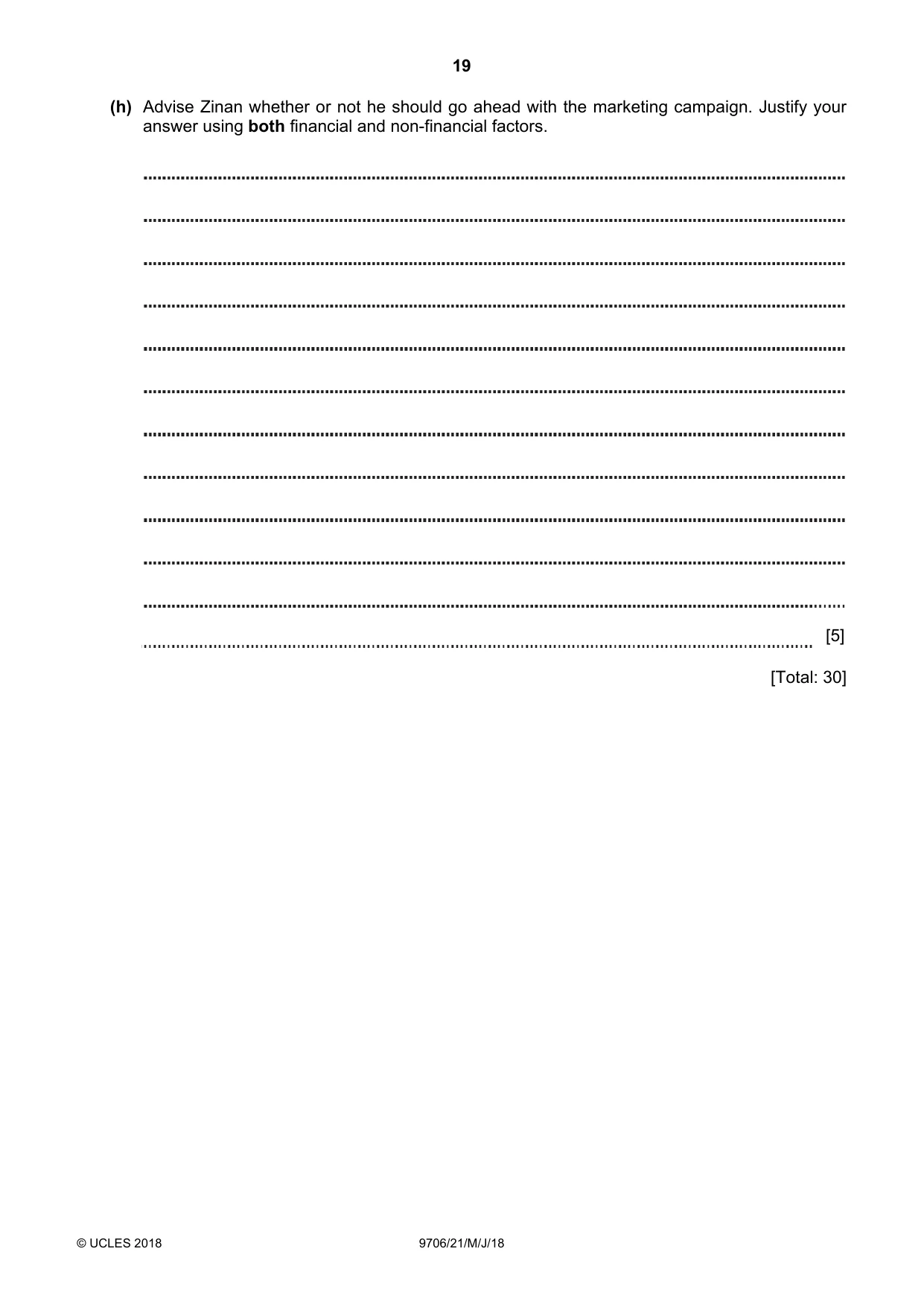
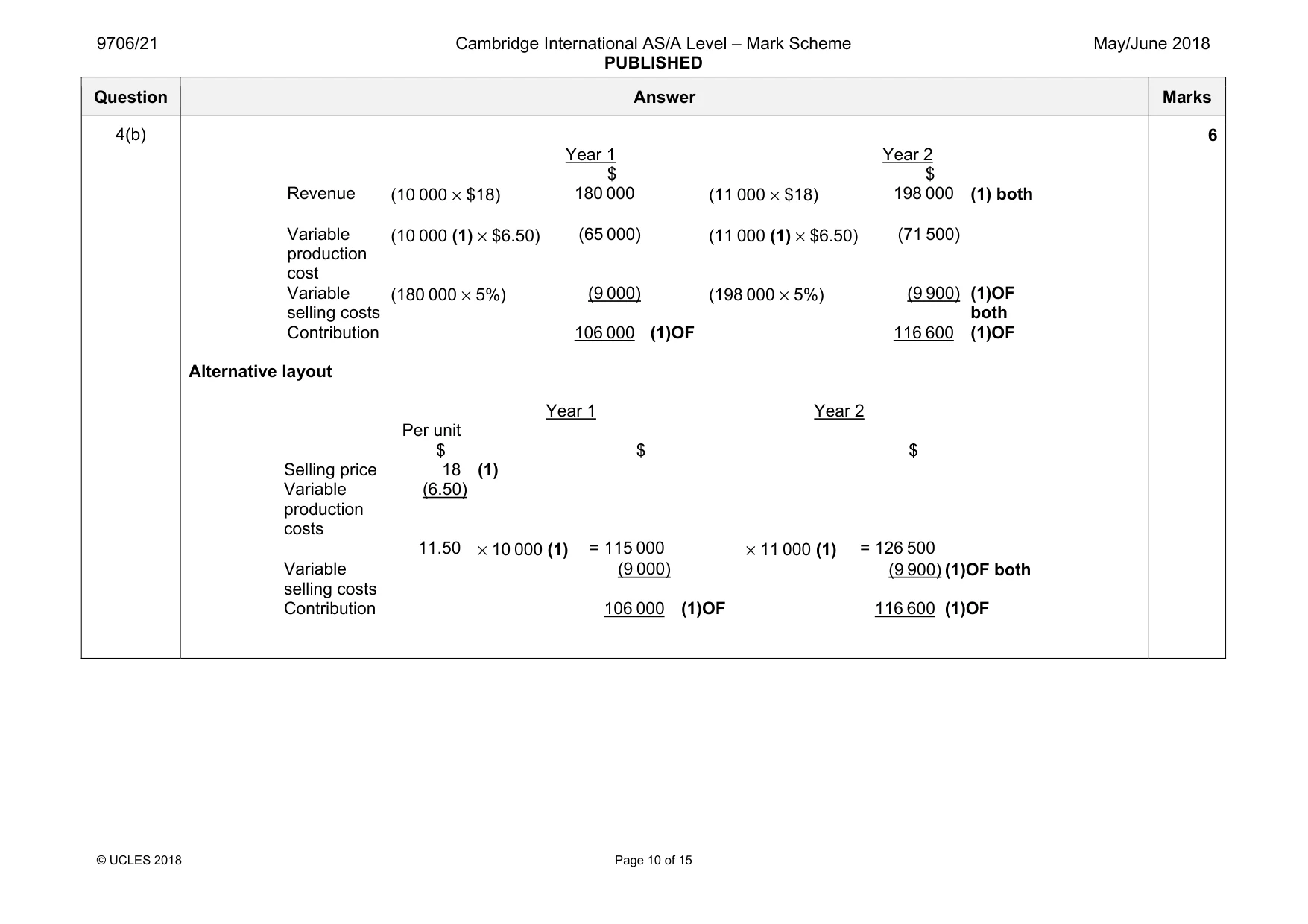
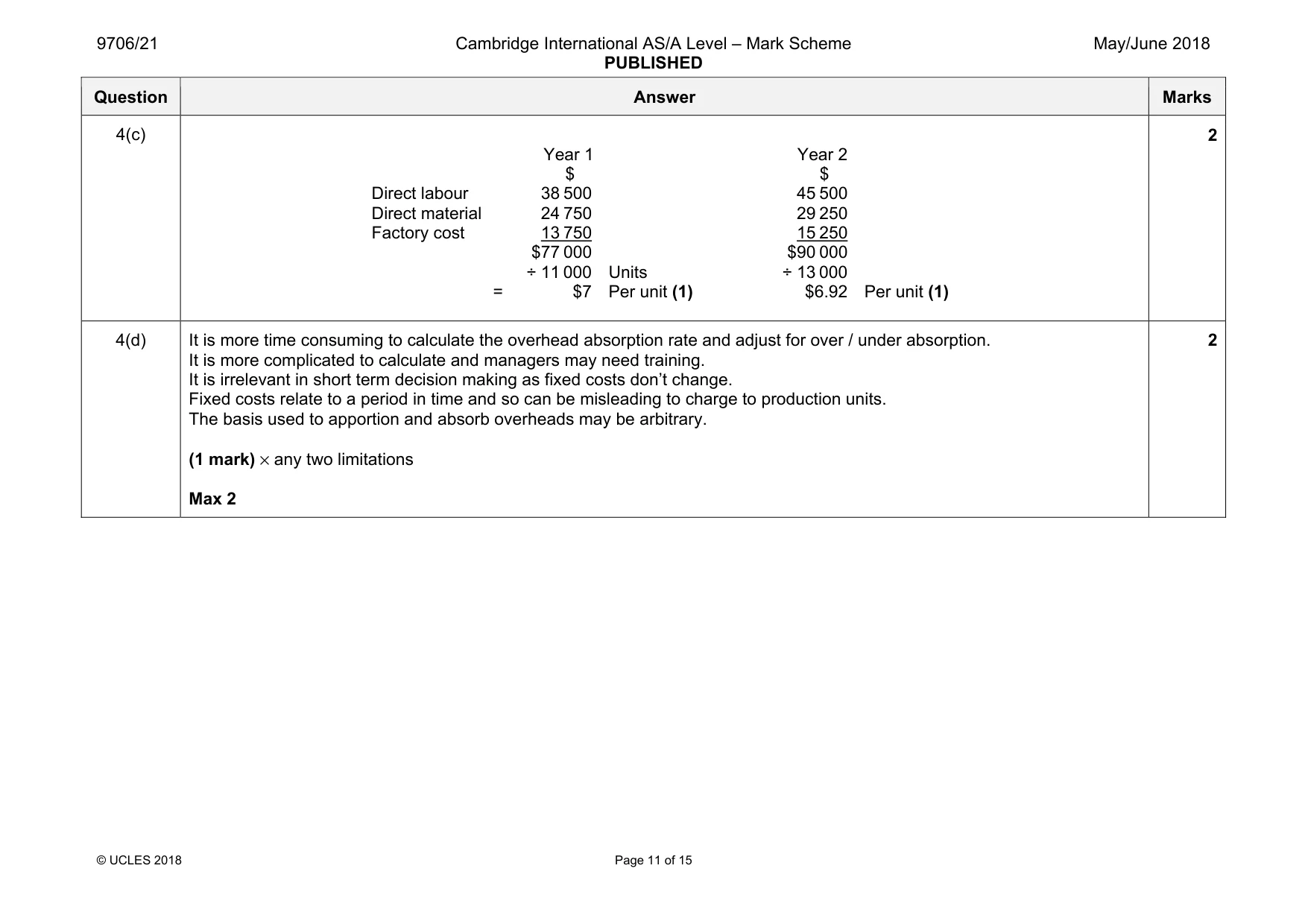
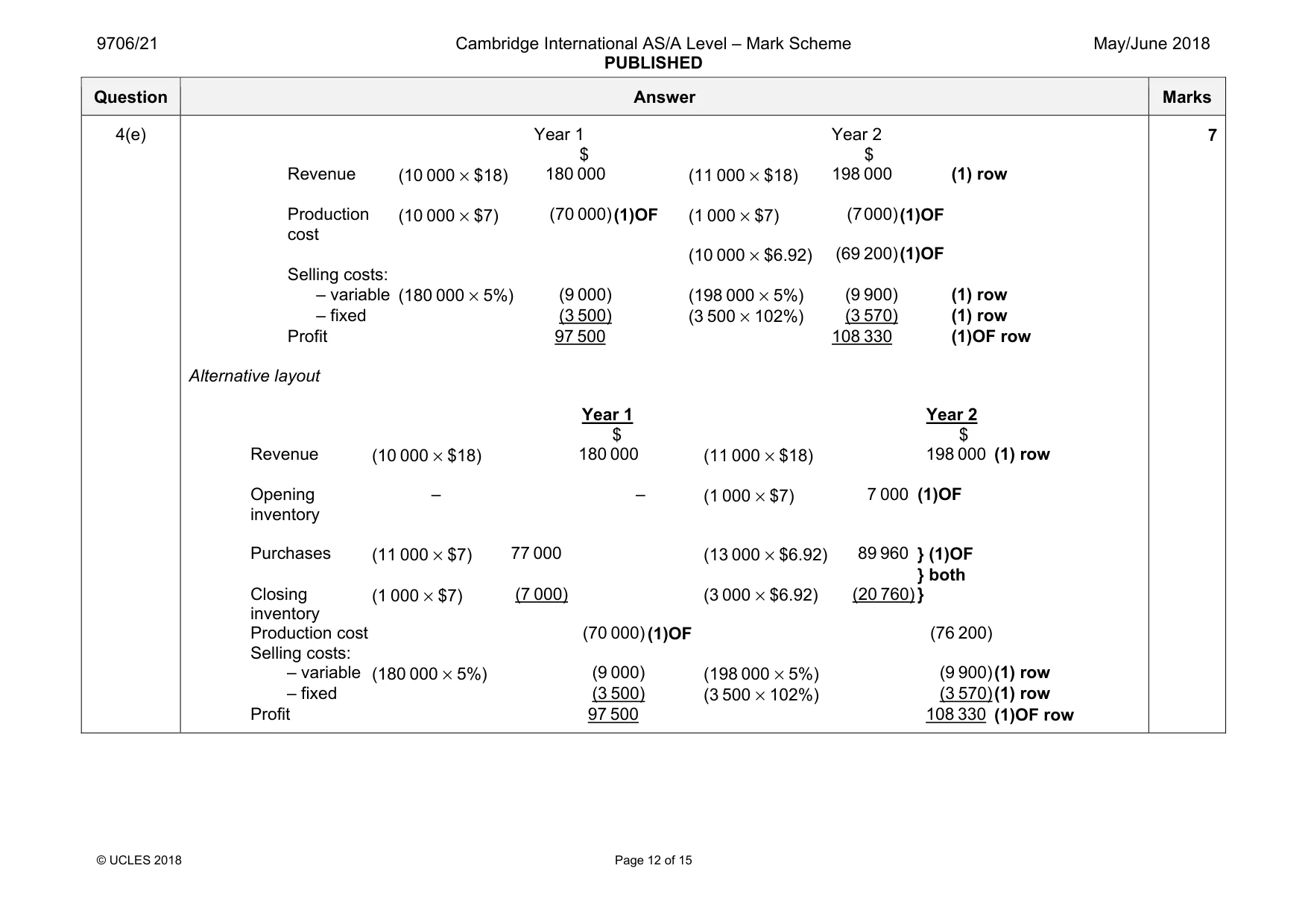
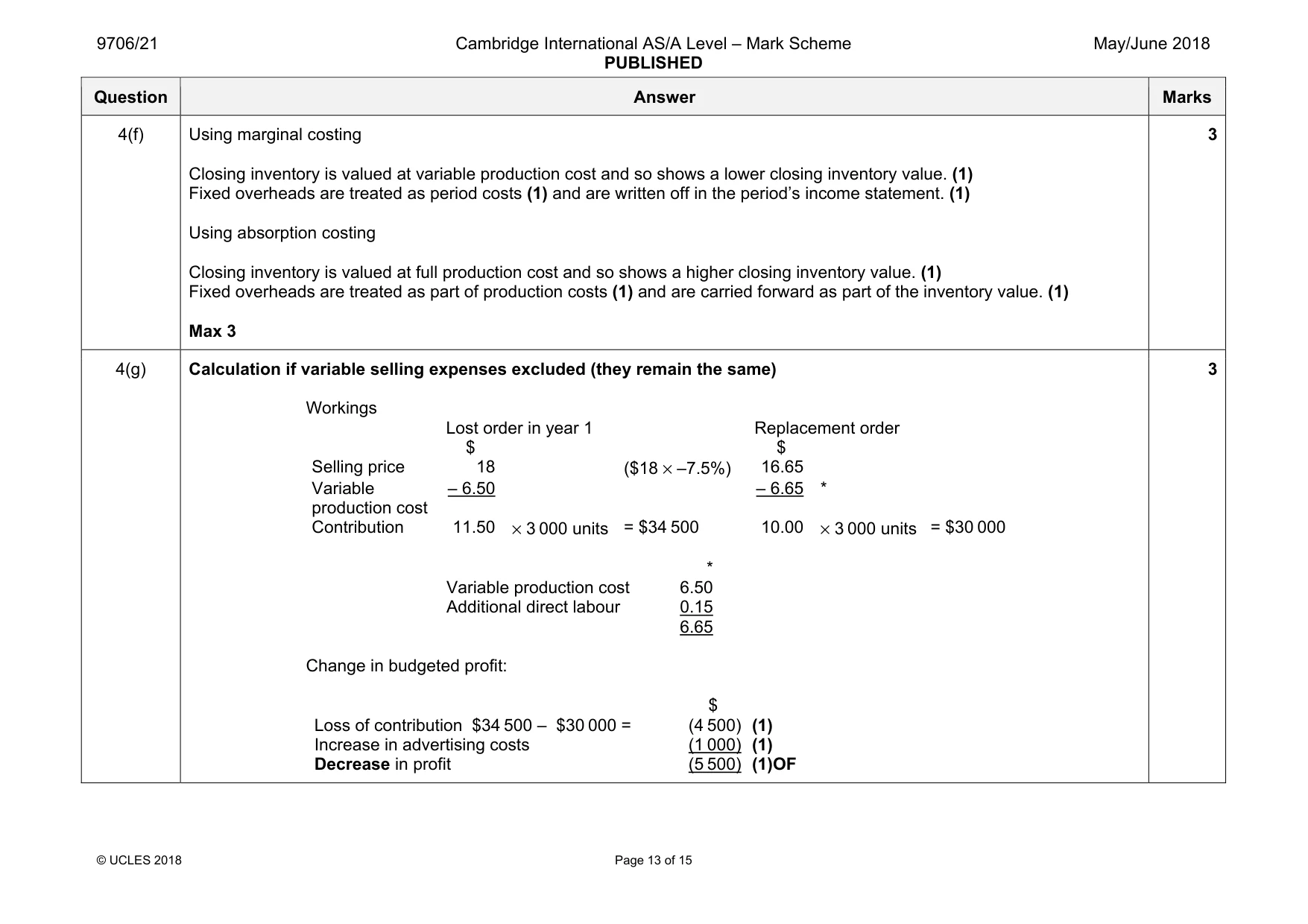
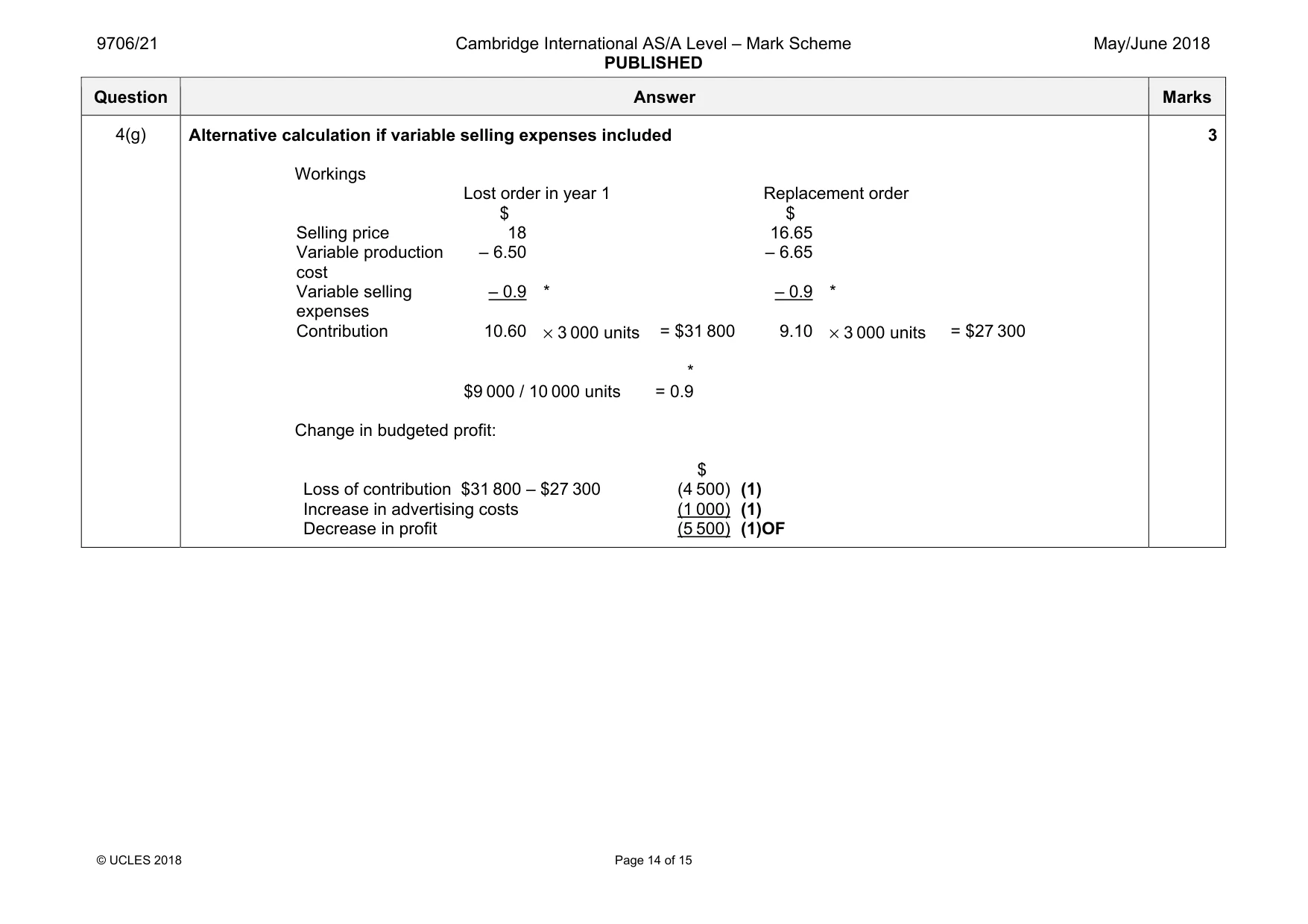
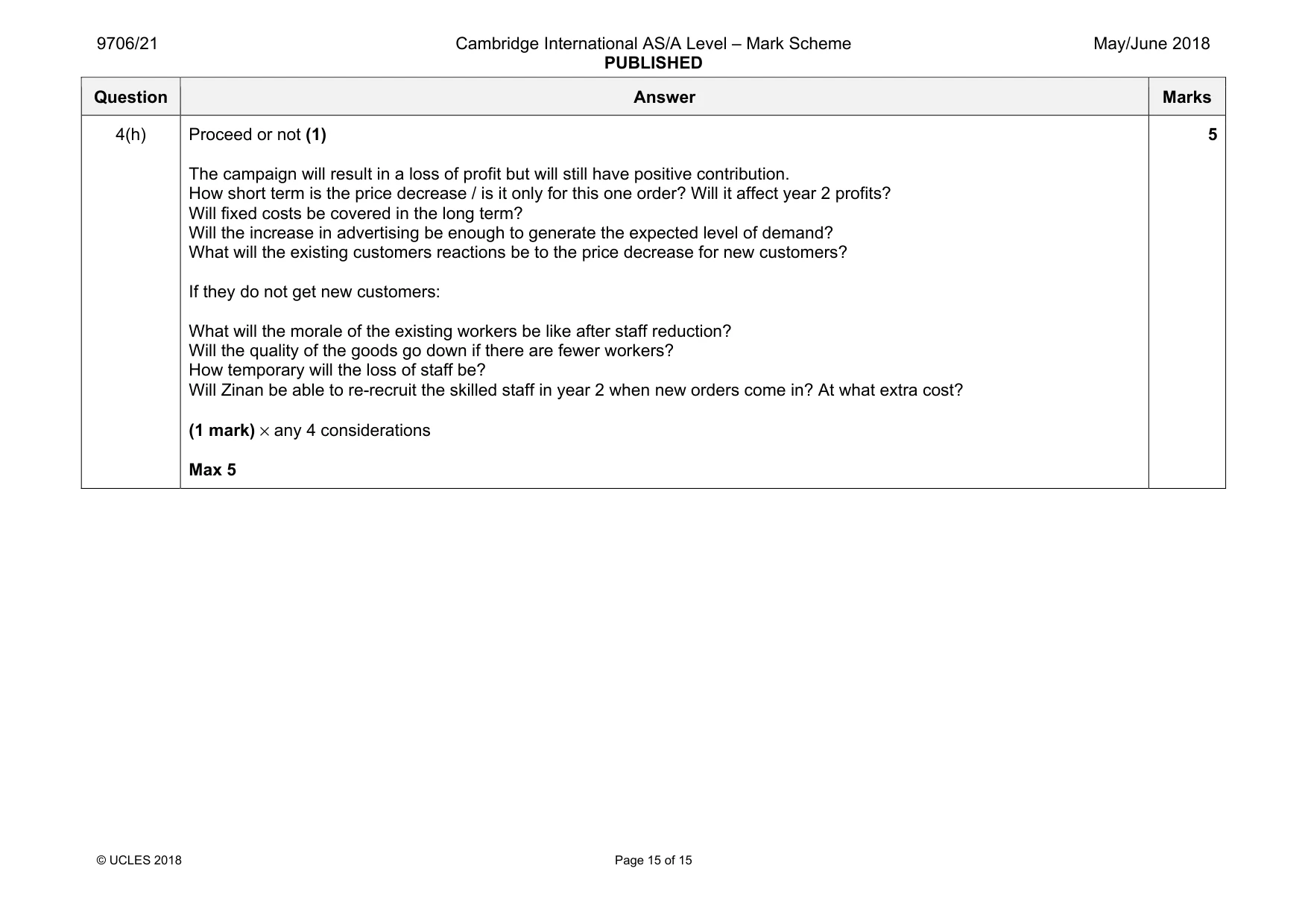
Mark scheme: 4(a) $ Direct labour 38 500 Direct material 24 750 Variable factory cost (13 750 – 5 500) 8 250 71 500 (1) ÷ 11 000 units = $6.50 per unit (1) or $84 500 ÷ 13 000 units = $6.50 per unit 2 Question Answer Marks 4(b) Year 1 Year 2 $ $ Revenue (10 000 × $18) 180 000 (11 000 × $18) 198 000 (1) both Variable production cost (10 000 (1) × $6.50) (65 000) (11 000 (1) × $6.50) (71 500) Variable selling costs (180 000 × 5%) (9 000) (198 000 × 5%) (9 900) (1)OF both Contribution 106 000 (1)OF 116 600 (1)OF Alternative layout Year 1 Year 2 Per unit $ $ $ Selling price 18 (1) Variable production costs (6.50) 11.50 × 10 000 (1) = 115 000 × 11 000 (1) = 126 500 Variable selling costs (9 000) (9 900) (1)OF both Contribution 106 000 (1)OF 116 600 (1)OF 6 Question Answer Marks 4(c) Year 1 Year 2 $ $ Direct labour 38 500 45 500 Direct material 24 750 29 250 Factory cost 13 750 15 250 $77 000 $90 000 ÷ 11 000 Units ÷ 13 000 = $7 Per unit (1) $6.92 Per unit (1) 2 4(d) It is more time consuming to calculate the overhead absorption rate and adjust for over / under absorption. It is more complicated to calculate and managers may need training. It is irrelevant in short term decision making as fixed costs don’t change. Fixed costs relate to a period in time and so can be misleading to charge to production units. The basis used to apportion and absorb overheads may be arbitrary. (1 mark) × any two limitations Max 2 2 Question Answer Marks 4(e) Year 1 Year 2 $ $ Revenue (10 000 × $18) 180 000 (11 000 × $18) 198 000 (1) row Production cost (10 000 × $7) (70 000)(1)OF (1 000 × $7) (7 000)(1)OF (10 000 × $6.92) (69 200)(1)OF Selling costs: – variable (180 000 × 5%) (9 000) (198 000 × 5%) (9 900) (1) row – fixed (3 500) (3 500 × 102%) (3 570) (1) row Profit 97 500 108 330 (1)OF row Alternative layout Year 1 Year 2 $ $ Revenue (10 000 × $18) 180 000 (11 000 × $18) 198 000 (1) row Opening inventory – – (1 000 × $7) 7 000 (1)OF Purchases (11 000 × $7) 77 000 (13 000 × $6.92) 89 960 } (1)OF } both Closing inventory (1 000 × $7) (7 000) (3 000 × $6.92) (20 760) } Production cost (70 000) (1)OF (76 200) Selling costs: – variable (180 000 × 5%) (9 000) (198 000 × 5%) (9 900)(1) row – fixed (3 500) (3 500 × 102%) (3 570)(1) row Profit 97 500 108 330 (1)OF row 7 Question Answer Marks 4(f) Using marginal costing Closing inventory is valued at variable production cost and so shows a lower closing inventory value. (1) Fixed overheads are treated as period costs (1) and are written off in the period’s income statement. (1) Using absorption costing Closing inventory is valued at full production cost and so shows a higher closing inventory value. (1) Fixed overheads are treated as part of production costs (1) and are carried forward as part of the inventory value. (1) Max 3 3 4(g) Calculation if variable selling expenses excluded (they remain the same) Workings Lost order in year 1 Replacement order $ $ Selling price 18 ($18 × –7.5%) 16.65 Variable production cost – 6.50 – 6.65 * Contribution 11.50 × 3 000 units = $34 500 10.00 × 3 000 units = $30 000 * Variable production cost 6.50 Additional direct labour 0.15 6.65 Change in budgeted profit: $ Loss of contribution $34 500 – $30 000 = (4 500) (1) Increase in advertising costs (1 000) (1) Decrease in profit (5 500) (1)OF 3 Question Answer Marks 4(g) Alternative calculation if variable selling expenses included Workings Lost order in year 1 Replacement order $ $ Selling price 18 16.65 Variable production cost – 6.50 – 6.65 Variable selling expenses – 0.9 * – 0.9 * Contribution 10.60 × 3 000 units = $31 800 9.10 × 3 000 units = $27 300 * $9 000 / 10 000 units = 0.9 Change in budgeted profit: $ Loss of contribution $31 800 – $27 300 (4 500) (1) Increase in advertising costs (1 000) (1) Decrease in profit (5 500) (1)OF 3 Question Answer Marks 4(h) Proceed or not (1) The campaign will result in a loss of profit but will still have positive contribution. How short term is the price decrease / is it only for this one order? Will it affect year 2 profits? Will fixed costs be covered in the long term? Will the increase in advertising be enough to generate the expected level of demand? What will the existing customers reactions be to the price decrease for new customers? If they do not get new customers: What will the morale of the existing workers be like after staff reduction? Will the quality of the goods go down if there are fewer workers? How temporary will the loss of staff be? Will Zinan be able to re-recruit the skilled staff in year 2 when new orders come in? At what extra cost? (1 mark) × any 4 considerations Max 5 5
What was in this paper
The subtopics covered by these 4 questions, and how many questions each got. Open one in a new tab to see every Cambridge question on it.
What you needed in this session
Cambridge’s own grade thresholds for 2018 May/June, Paper 2 · Variant 1. A higher threshold means an easier paper — the bar moves with how the cohort did.