Cambridge A Level Accounting 9706 — 2016 May/June Paper 2 · Variant 2
9706/22/M/J/16 · 90 marks · ≈101 min
The question paper and its mark scheme, free to read here and free to download. This is Cambridge’s own paper, exactly as it was sat.
Question paper16 pages
Mark scheme7 pages
Answers below. Sit the paper first if you are practising.
Paper as text
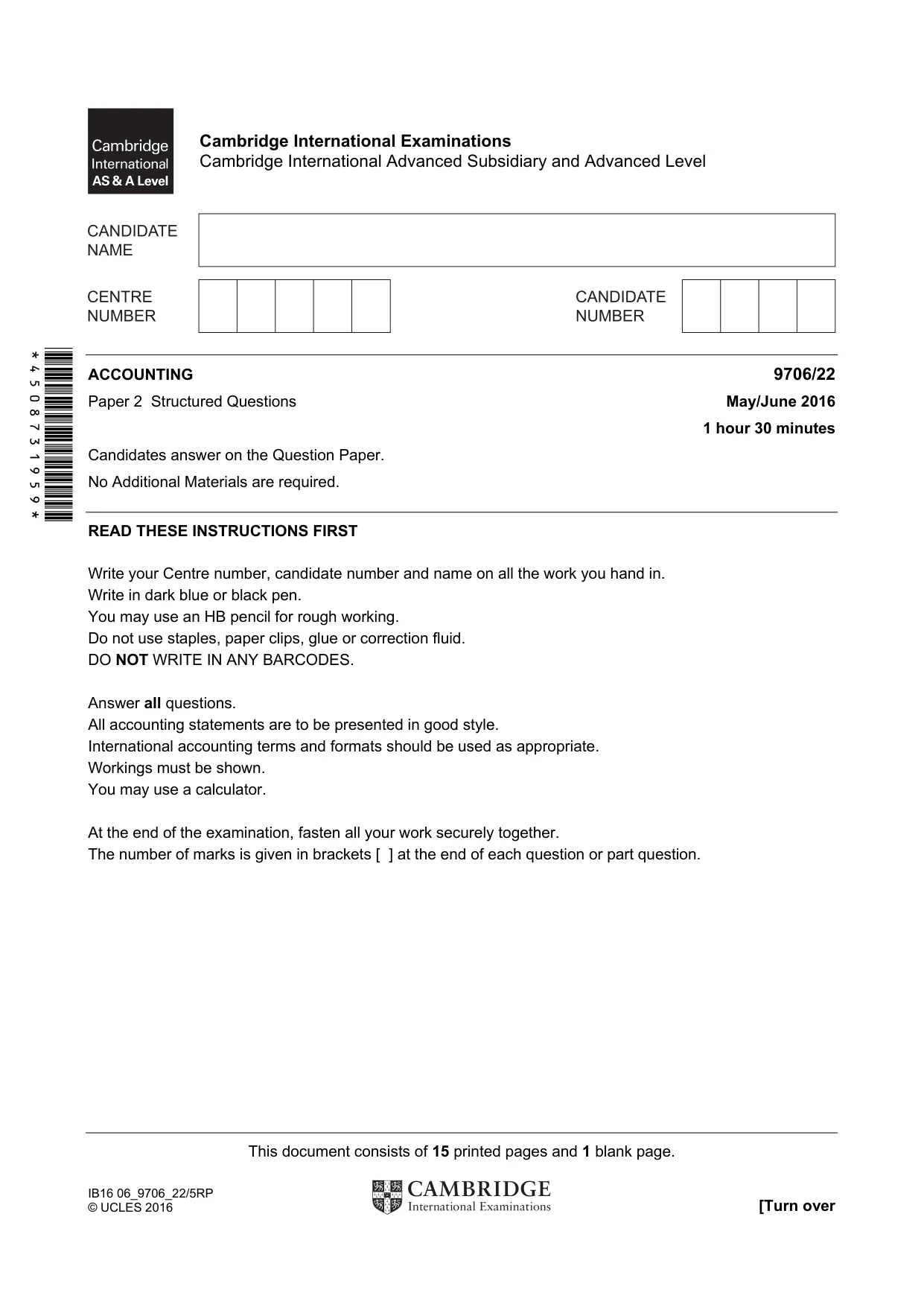
Question paper, page 1
This document consists of 15 printed pages and 1 blank page. IB16 06_9706_22/5RP © UCLES 2016 [Turn over Cambridge International Examinations Cambridge International Advanced Subsidiary and Advanced Level ACCOUNTING 9706/22 Paper 2 Structured Questions May/June 2016 1 hour 30 minutes Candidates answer on the Question Paper. No Additional Materials are required. READ THESE INSTRUCTIONS FIRST Write your Centre number, candidate number and name on all the work you hand in. Write in dark blue or black pen. You may use an HB pencil for rough working. Do not use staples, paper clips, glue or correction fluid. DO NOT WRITE IN ANY BARCODES. Answer all questions. All accounting statements are to be presented in good style. International accounting terms and formats should be used as appropriate. Workings must be shown. You may use a calculator. At the end of the examination, fasten all your work securely together. The number of marks is given in brackets [ ] at the end of each question or part question.
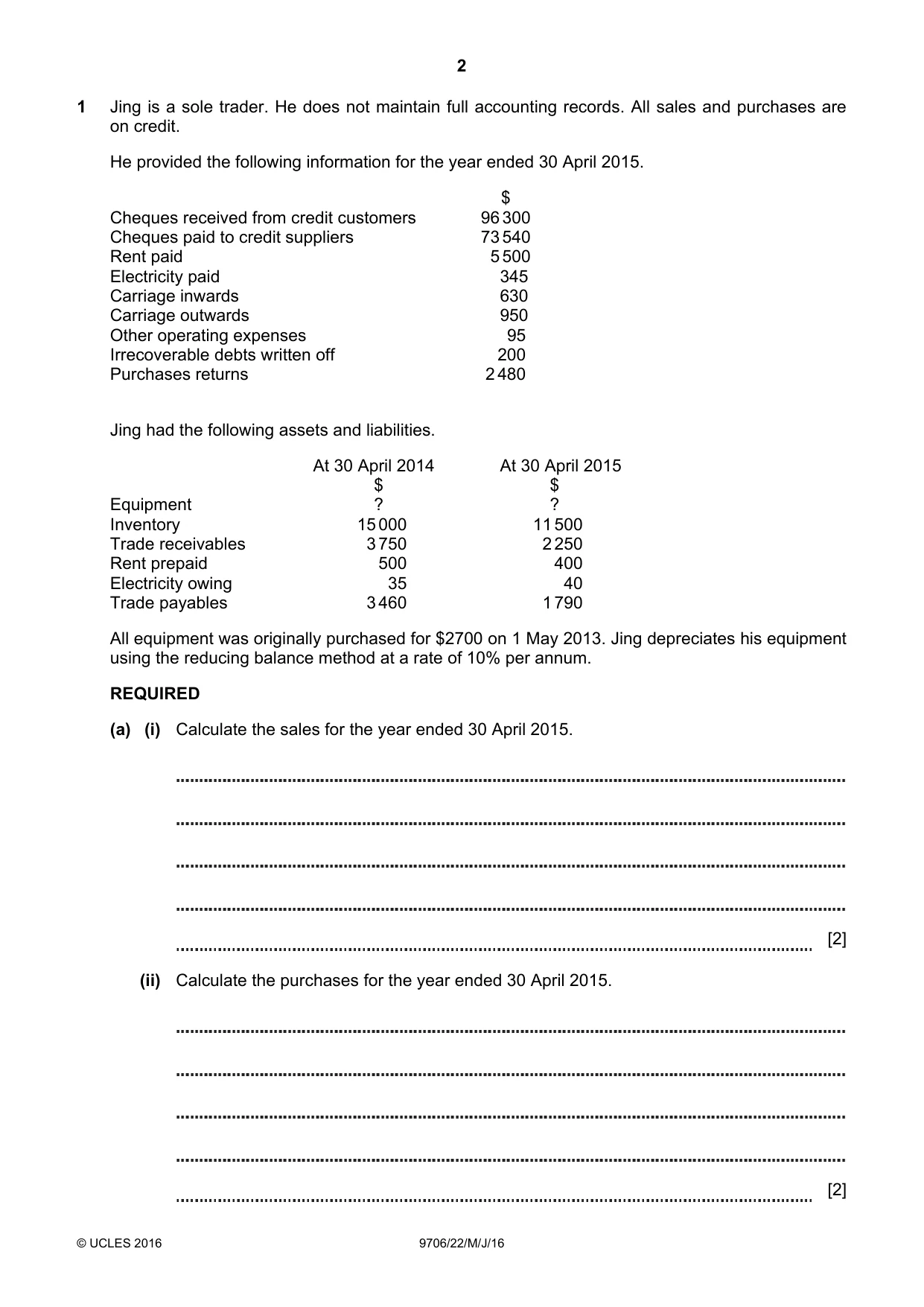
Question paper, page 2
2 © UCLES 2016 9706/22/M/J/16 1 Jing is a sole trader. He does not maintain full accounting records. All sales and purchases are on credit. He provided the following information for the year ended 30 April 2015. $ Cheques received from credit customers 96 300 Cheques paid to credit suppliers 73 540 Rent paid 5 500 Electricity paid 345 Carriage inwards 630 Carriage outwards 950 Other operating expenses 95 Irrecoverable debts written off 200 Purchases returns 2 480 Jing had the following assets and liabilities. At 30 April 2014 At 30 April 2015 $ $ Equipment ? ? Inventory 15 000 11 500 Trade receivables 3 750 2 250 Rent prepaid 500 400 Electricity owing 35 40 Trade payables 3 460 1 790 All equipment was originally purchased for $2700 on 1 May 2013. Jing depreciates his equipment using the reducing balance method at a rate of 10% per annum. REQUIRED (a) (i) Calculate the sales for the year ended 30 April 2015. [2] (ii) Calculate the purchases for the year ended 30 April 2015. [2]
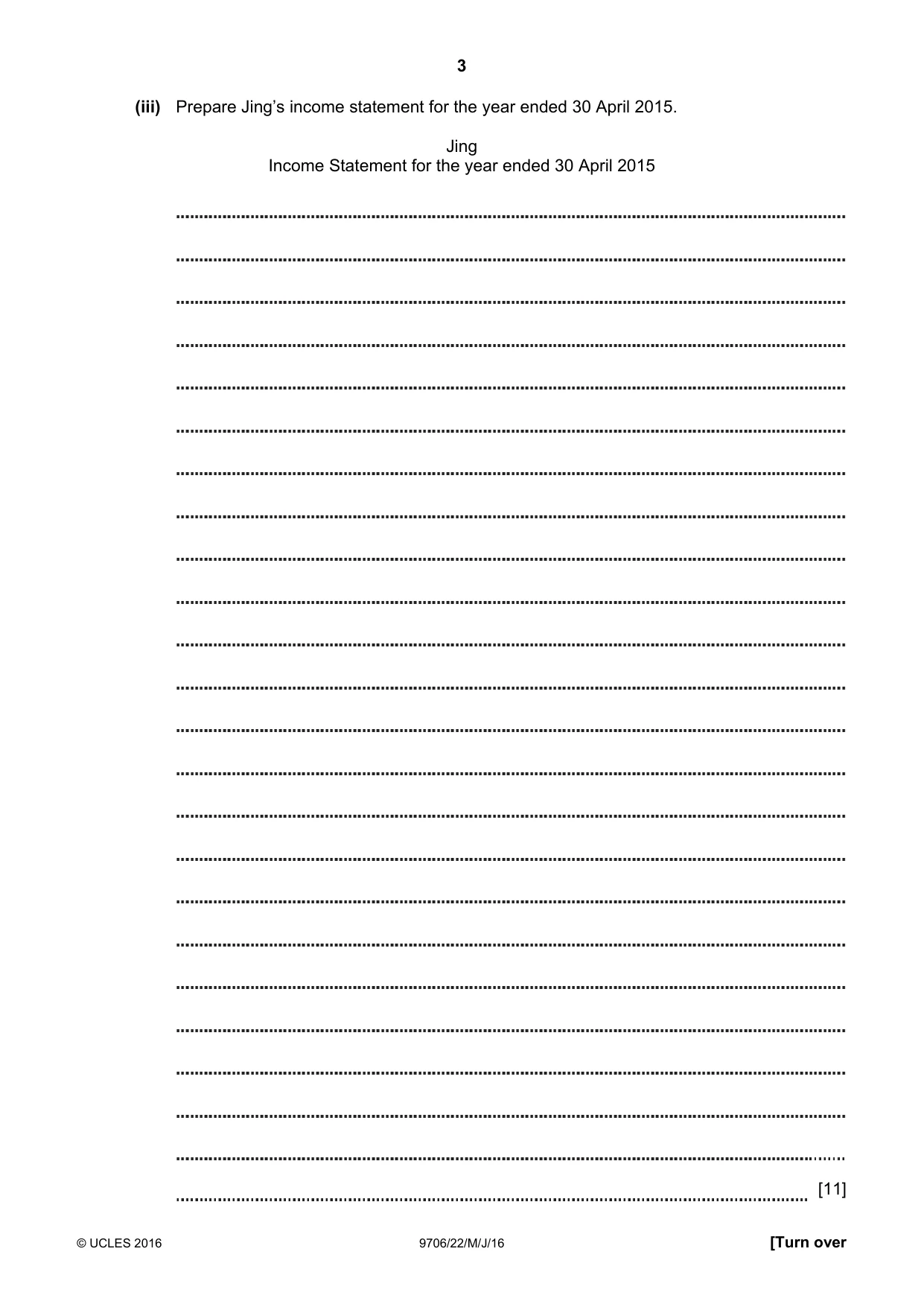
Question paper, page 3
3 © UCLES 2016 9706/22/M/J/16 [Turn over (iii) Prepare Jing’s income statement for the year ended 30 April 2015. Jing Income Statement for the year ended 30 April 2015 [11]
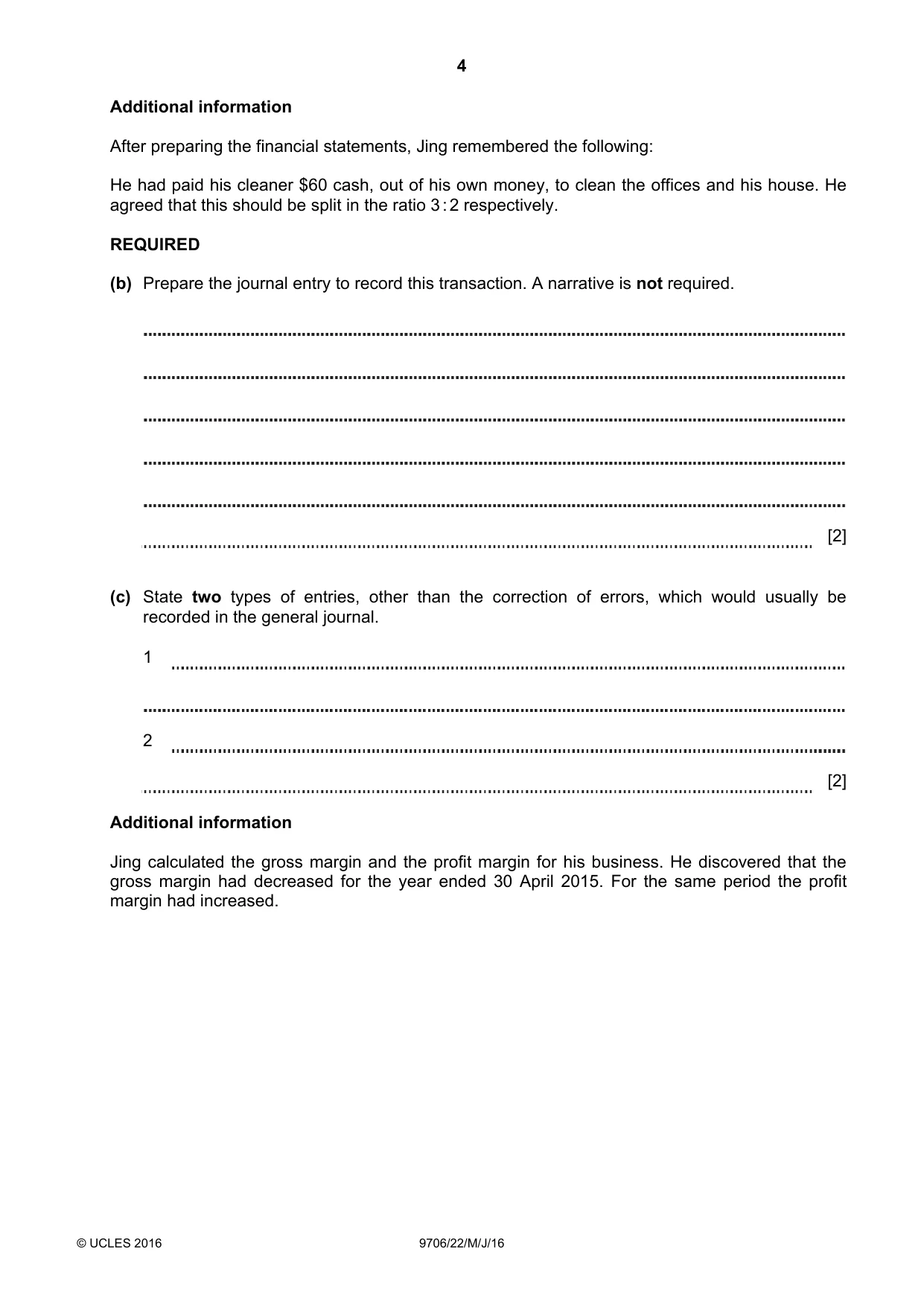
Question paper, page 4
4 © UCLES 2016 9706/22/M/J/16 Additional information After preparing the financial statements, Jing remembered the following: He had paid his cleaner $60 cash, out of his own money, to clean the offices and his house. He agreed that this should be split in the ratio 3 : 2 respectively. REQUIRED (b) Prepare the journal entry to record this transaction. A narrative is not required. [2] (c) State two types of entries, other than the correction of errors, which would usually be recorded in the general journal. 1 2 [2] Additional information Jing calculated the gross margin and the profit margin for his business. He discovered that the gross margin had decreased for the year ended 30 April 2015. For the same period the profit margin had increased.
Question paper, page 5
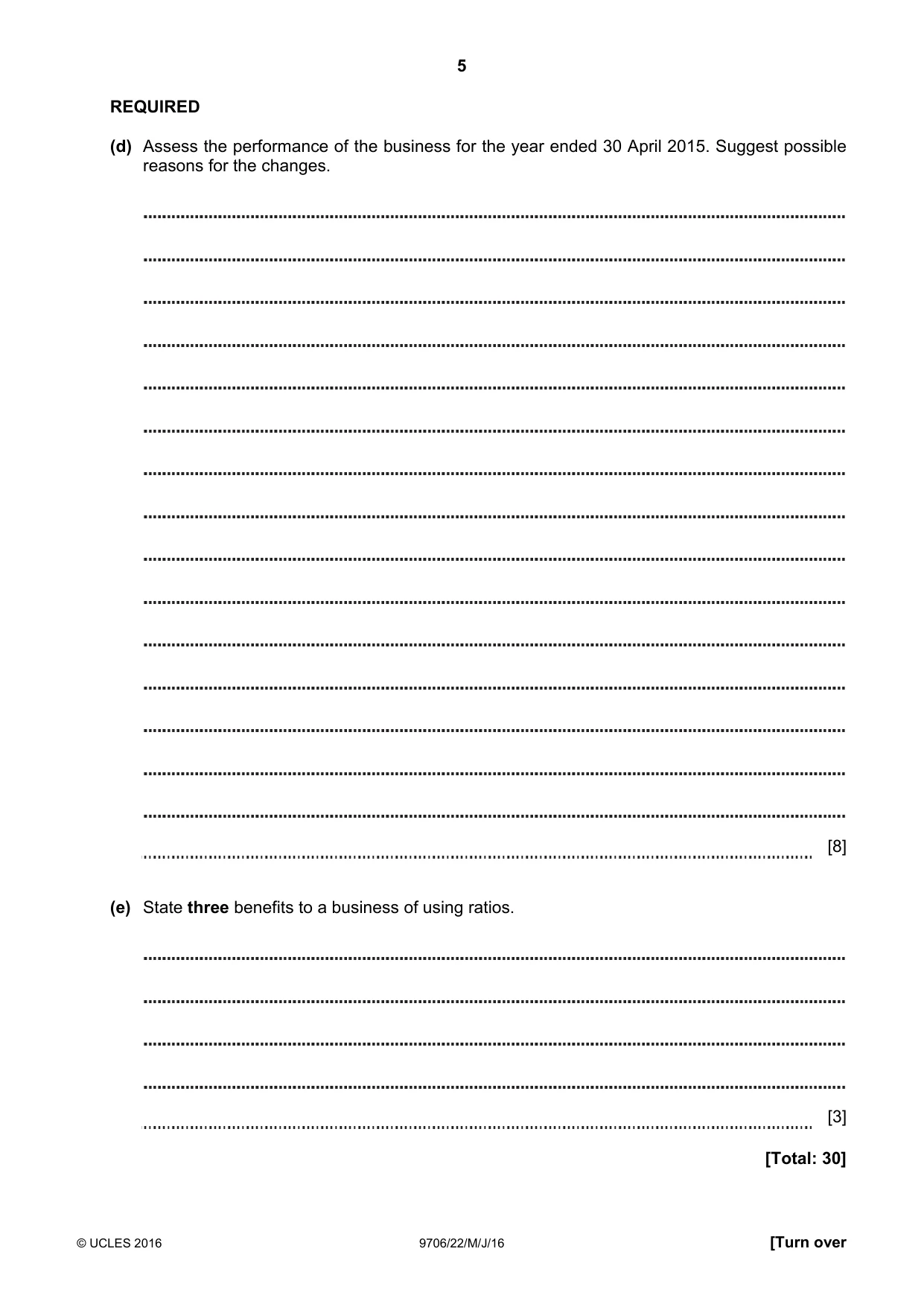
5 © UCLES 2016 9706/22/M/J/16 [Turn over REQUIRED (d) Assess the performance of the business for the year ended 30 April 2015. Suggest possible reasons for the changes. [8] (e) State three benefits to a business of using ratios. [3] [Total: 30]
Question paper, page 6
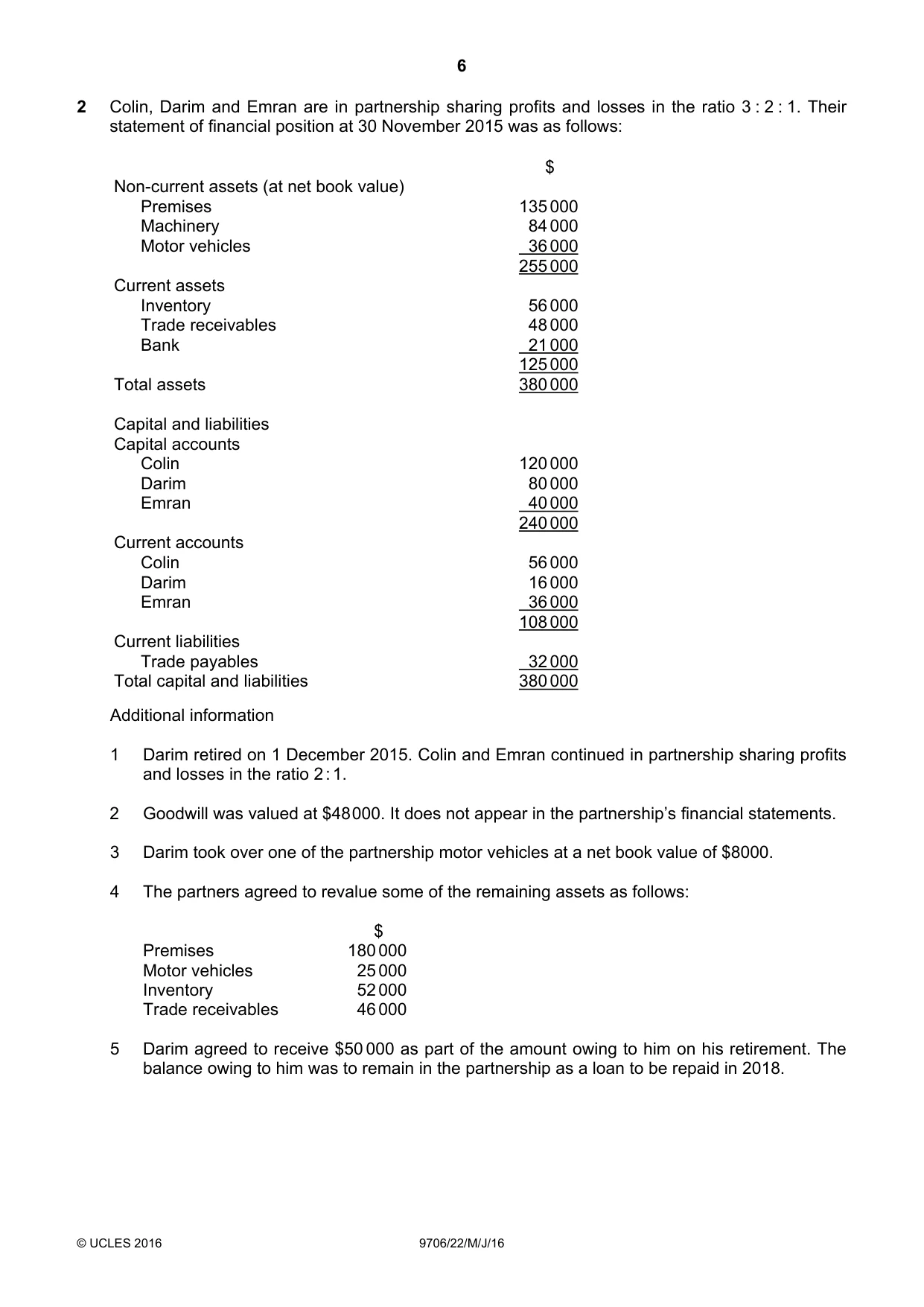
6 © UCLES 2016 9706/22/M/J/16 2 Colin, Darim and Emran are in partnership sharing profits and losses in the ratio 3 : 2 : 1. Their statement of financial position at 30 November 2015 was as follows: Additional information 1 Darim retired on 1 December 2015. Colin and Emran continued in partnership sharing profits and losses in the ratio 2 : 1. 2 Goodwill was valued at $48 000. It does not appear in the partnership’s financial statements. 3 Darim took over one of the partnership motor vehicles at a net book value of $8000. 4 The partners agreed to revalue some of the remaining assets as follows: $ Premises 180 000 Motor vehicles 25 000 Inventory 52 000 Trade receivables 46 000 5 Darim agreed to receive $50 000 as part of the amount owing to him on his retirement. The balance owing to him was to remain in the partnership as a loan to be repaid in 2018. $ Non-current assets (at net book value) Premises 135 000 Machinery 84 000 Motor vehicles 36 000 255 000 Current assets Inventory 56 000 Trade receivables 48 000 Bank 21 000 125 000 Total assets 380 000 Capital and liabilities Capital accounts Colin 120 000 Darim 80 000 Emran 40 000 240 000 Current accounts Colin 56 000 Darim 16 000 Emran 36 000 108 000 Current liabilities Trade payables 32 000 Total capital and liabilities 380 000
Question paper, page 7
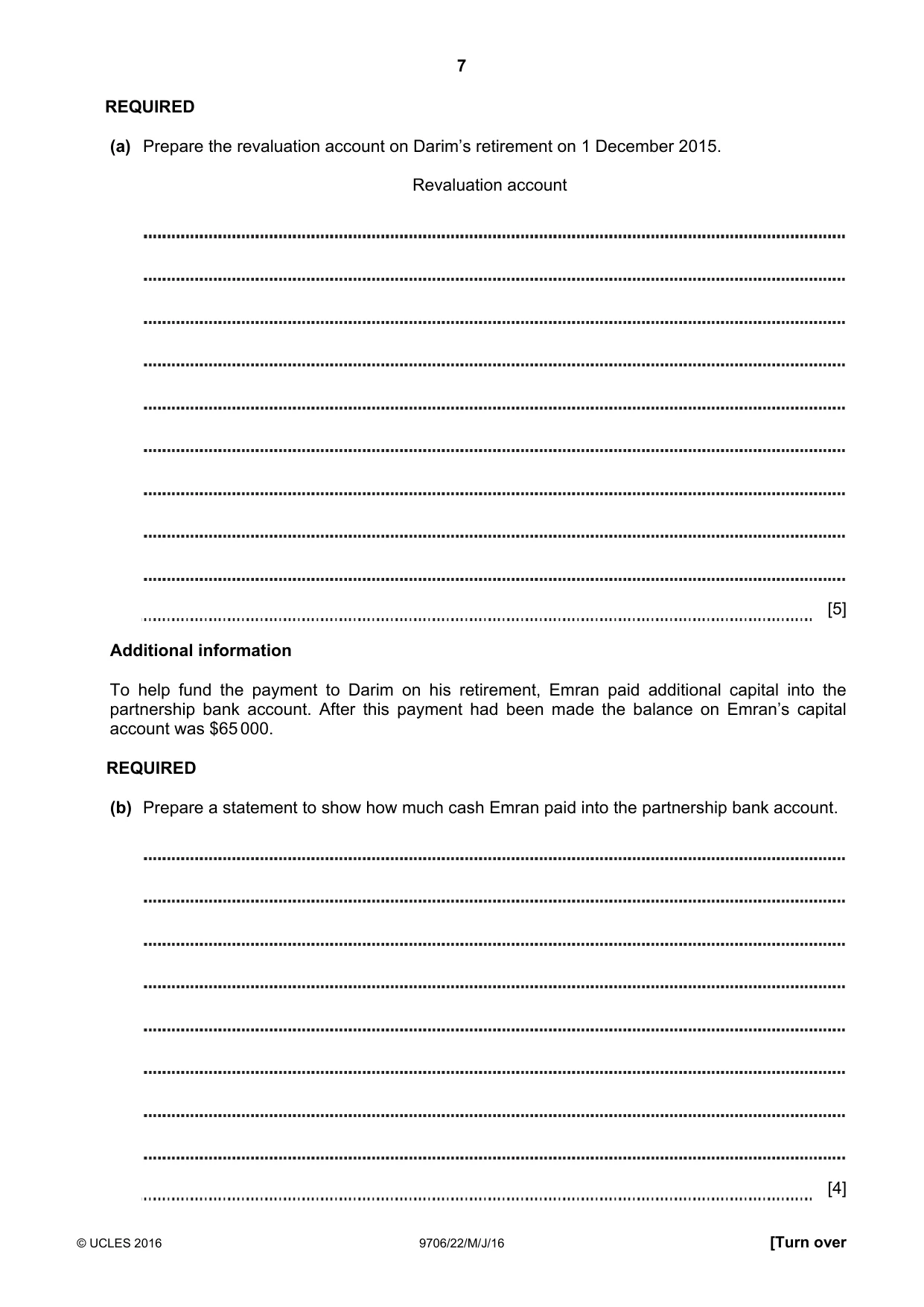
7 © UCLES 2016 9706/22/M/J/16 [Turn over REQUIRED (a) Prepare the revaluation account on Darim’s retirement on 1 December 2015. Revaluation account [5] Additional information To help fund the payment to Darim on his retirement, Emran paid additional capital into the partnership bank account. After this payment had been made the balance on Emran’s capital account was $65 000. REQUIRED (b) Prepare a statement to show how much cash Emran paid into the partnership bank account. [4]
Question paper, page 8
8 © UCLES 2016 9706/22/M/J/16 (c) State three advantages to a sole trader of forming a partnership. 1 2 3 [3] (d) State three reasons why partnerships maintain separate capital accounts and current accounts for each partner. 1 2 3 [3] [Total: 15]
Question paper, page 9
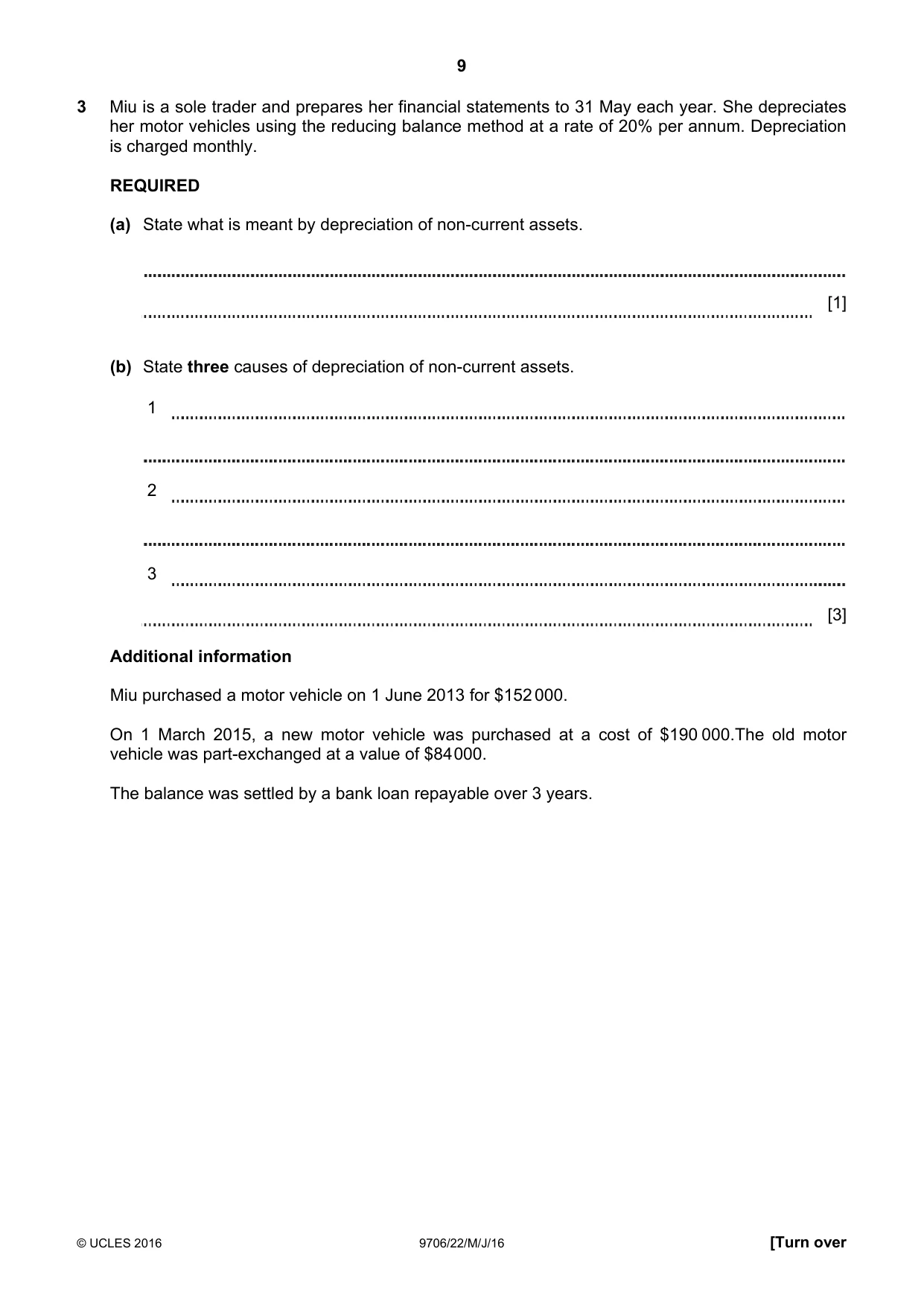
9 © UCLES 2016 9706/22/M/J/16 [Turn over 3 Miu is a sole trader and prepares her financial statements to 31 May each year. She depreciates her motor vehicles using the reducing balance method at a rate of 20% per annum. Depreciation is charged monthly. REQUIRED (a) State what is meant by depreciation of non-current assets. [1] (b) State three causes of depreciation of non-current assets. 1 2 3 [3] Additional information Miu purchased a motor vehicle on 1 June 2013 for $152 000. On 1 March 2015, a new motor vehicle was purchased at a cost of $190 000.The old motor vehicle was part-exchanged at a value of $84 000. The balance was settled by a bank loan repayable over 3 years.
Question paper, page 10
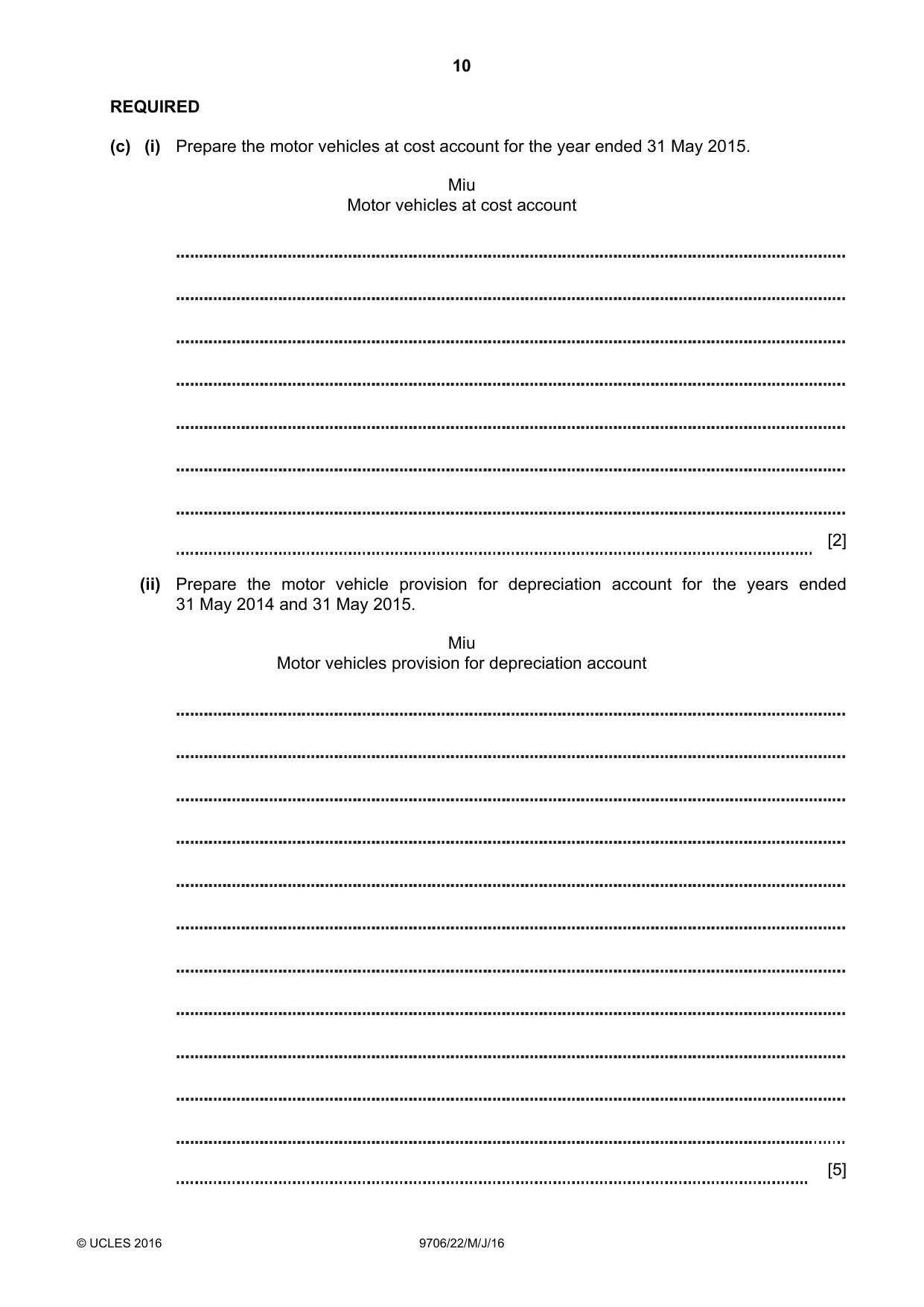
10 © UCLES 2016 9706/22/M/J/16 REQUIRED (c) (i) Prepare the motor vehicles at cost account for the year ended 31 May 2015. Miu Motor vehicles at cost account [2] (ii) Prepare the motor vehicle provision for depreciation account for the years ended 31 May 2014 and 31 May 2015. Miu Motor vehicles provision for depreciation account [5]
Question paper, page 11
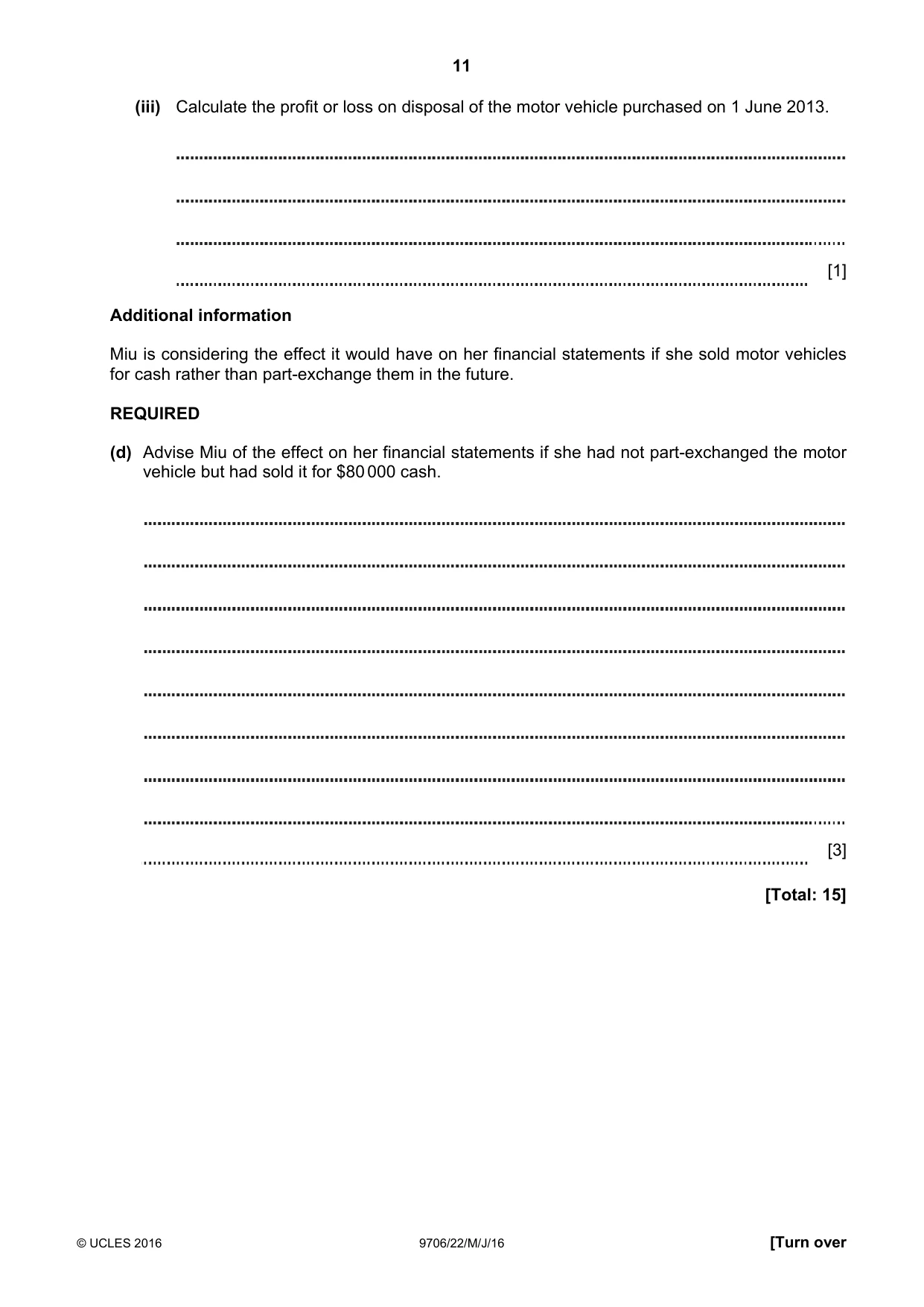
11 © UCLES 2016 9706/22/M/J/16 [Turn over (iii) Calculate the profit or loss on disposal of the motor vehicle purchased on 1 June 2013. [1] Additional information Miu is considering the effect it would have on her financial statements if she sold motor vehicles for cash rather than part-exchange them in the future. REQUIRED (d) Advise Miu of the effect on her financial statements if she had not part-exchanged the motor vehicle but had sold it for $80 000 cash. [3] [Total: 15]
Question paper, page 12
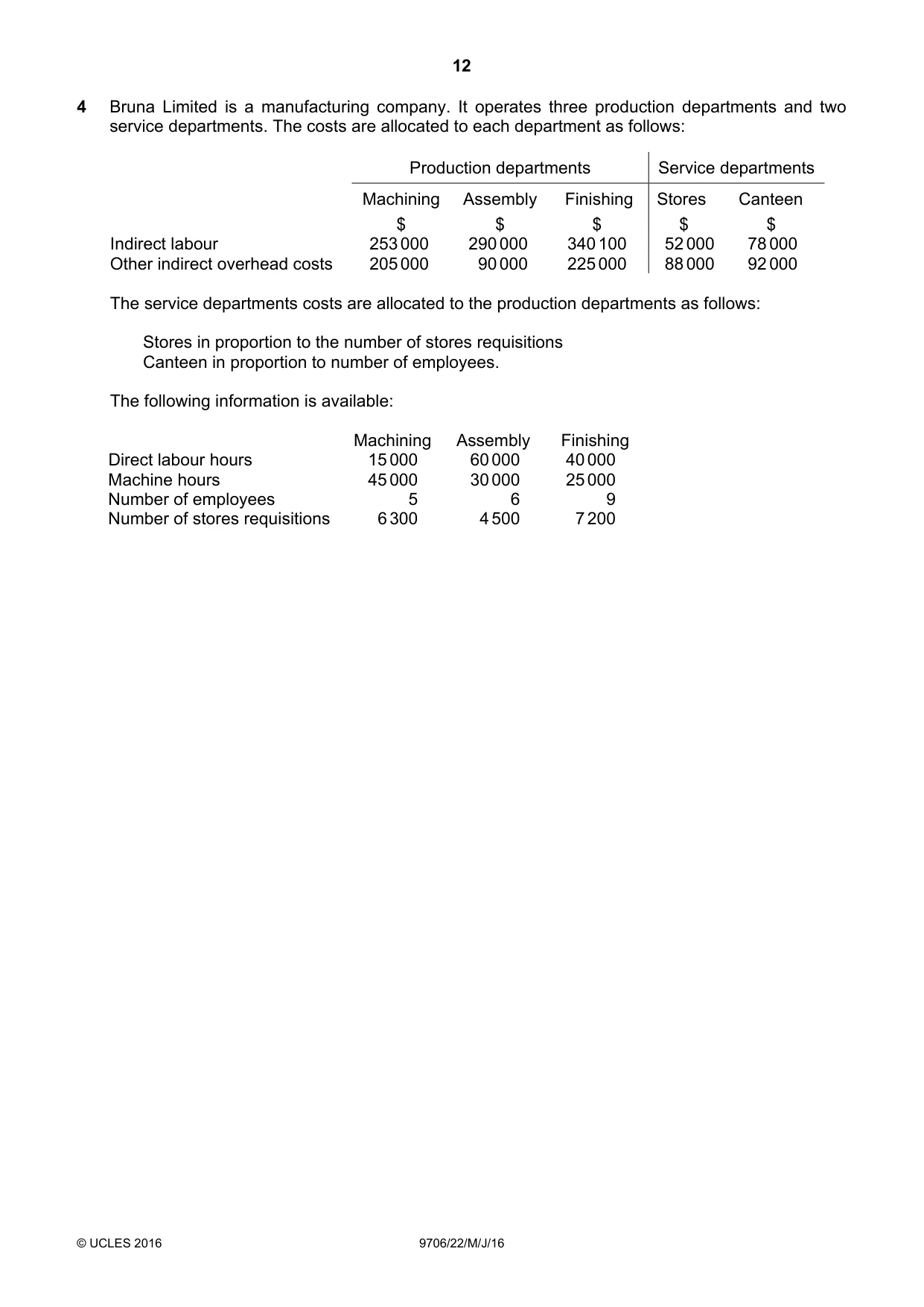
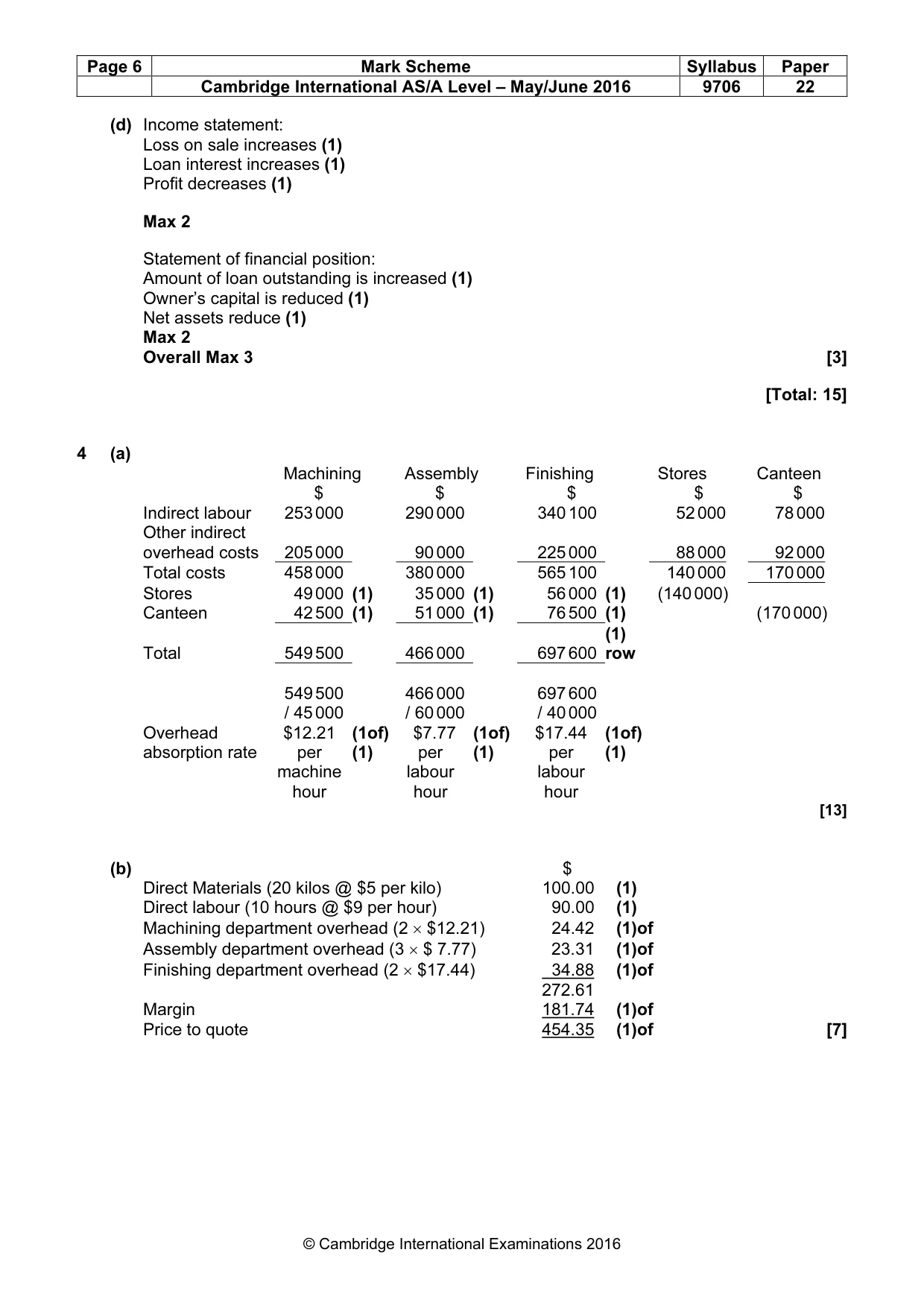
12 © UCLES 2016 9706/22/M/J/16 4 Bruna Limited is a manufacturing company. It operates three production departments and two service departments. The costs are allocated to each department as follows: Production departments Service departments Machining Assembly Finishing Stores Canteen $ $ $ $ $ Indirect labour 253 000 290 000 340 100 52 000 78 000 Other indirect overhead costs 205 000 90 000 225 000 88 000 92 000 The service departments costs are allocated to the production departments as follows: Stores in proportion to the number of stores requisitions Canteen in proportion to number of employees. The following information is available: Machining Assembly Finishing Direct labour hours 15 000 60 000 40 000 Machine hours 45 000 30 000 25 000 Number of employees 5 6 9 Number of stores requisitions 6 300 4 500 7 200
Question paper, page 13
13 © UCLES 2016 9706/22/M/J/16 [Turn over REQUIRED (a) Calculate, to two decimal places, a suitable overhead absorption rate for each of the three production departments. [13]
Question paper, page 14
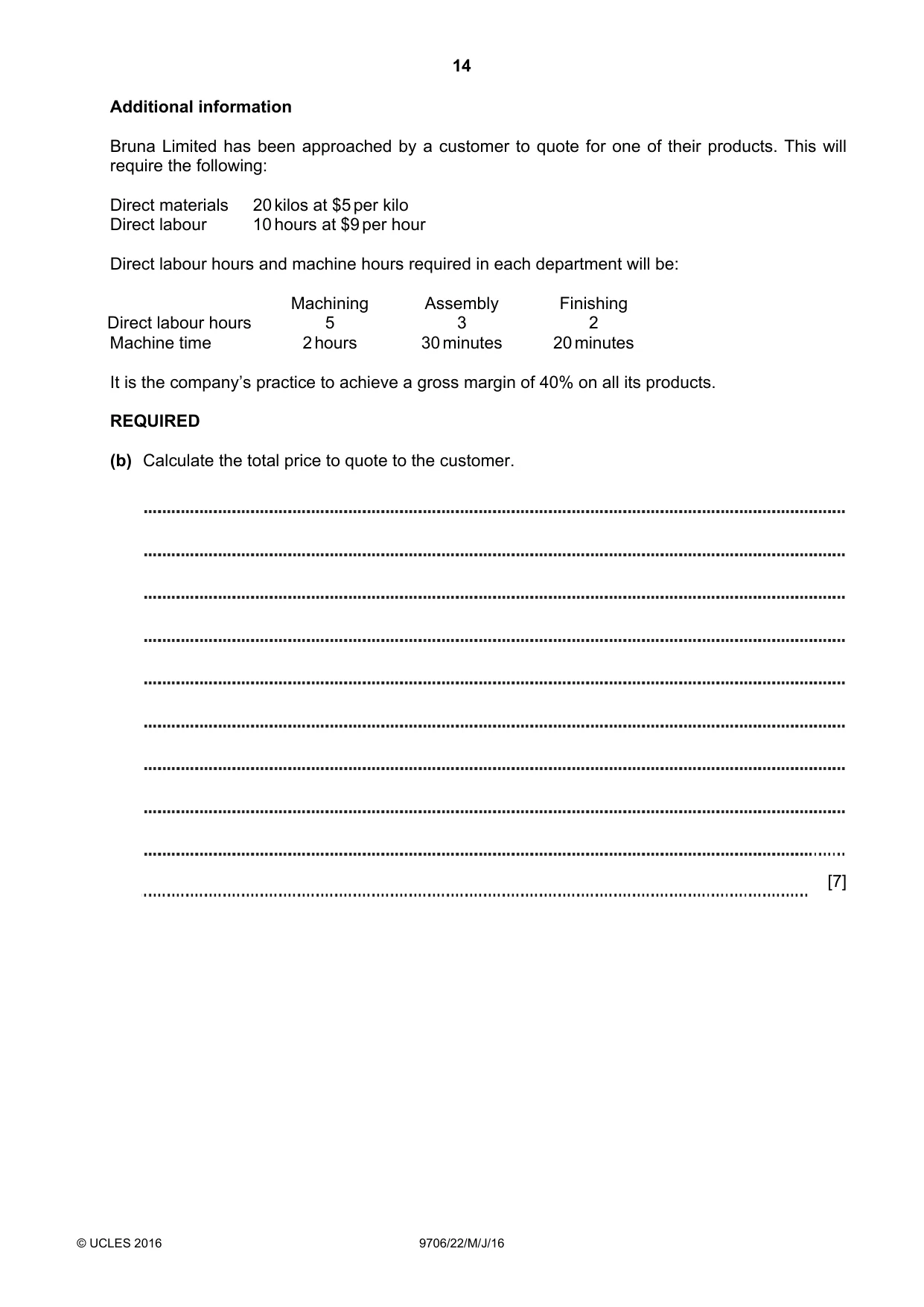
14 © UCLES 2016 9706/22/M/J/16 Additional information Bruna Limited has been approached by a customer to quote for one of their products. This will require the following: Direct materials 20 kilos at $5 per kilo Direct labour 10 hours at $9 per hour Direct labour hours and machine hours required in each department will be: Machining Assembly Finishing Direct labour hours 5 3 2 Machine time 2 hours 30 minutes 20 minutes It is the company’s practice to achieve a gross margin of 40% on all its products. REQUIRED (b) Calculate the total price to quote to the customer. [7]
Question paper, page 15
15 © UCLES 2016 9706/22/M/J/16 Additional information The directors are considering changing from departmental overhead absorption rates to one factory-wide rate. REQUIRED (c) Advise the directors whether or not they should make this change. Justify your answer. [4] (d) Explain how over absorption and under absorption of overheads can affect the profit of a manufacturing business. [6] [Total: 30]
Question paper, page 16
16 Permission to reproduce items where third-party owned material protected by copyright is included has been sought and cleared where possible. Every reasonable effort has been made by the publisher (UCLES) to trace copyright holders, but if any items requiring clearance have unwittingly been included, the publisher will be pleased to make amends at the earliest possible opportunity. To avoid the issue of disclosure of answer-related information to candidates, all copyright acknowledgements are reproduced online in the Cambridge International Examinations Copyright Acknowledgements Booklet. This is produced for each series of examinations and is freely available to download at www.cie.org.uk after the live examination series. Cambridge International Examinations is part of the Cambridge Assessment Group. Cambridge Assessment is the brand name of University of Cambridge Local Examinations Syndicate (UCLES), which is itself a department of the University of Cambridge. © UCLES 2016 9706/22/M/J/16 BLANK PAGE
Mark scheme, page 1
® IGCSE is the registered trademark of Cambridge International Examinations. This document consists of 7 printed pages. © UCLES 2016 [Turn over Cambridge International Examinations Cambridge International Advanced Subsidiary and Advanced Level ACCOUNTING 9706/22 Paper 2 Structured Questions May/June 2016 MARK SCHEME Maximum Mark: 90 Published This mark scheme is published as an aid to teachers and candidates, to indicate the requirements of the examination. It shows the basis on which Examiners were instructed to award marks. It does not indicate the details of the discussions that took place at an Examiners’ meeting before marking began, which would have considered the acceptability of alternative answers. Mark schemes should be read in conjunction with the question paper and the Principal Examiner Report for Teachers. Cambridge will not enter into discussions about these mark schemes. Cambridge is publishing the mark schemes for the May/June 2016 series for most Cambridge IGCSE®, Cambridge International A and AS Level components and some Cambridge O Level components.
Mark scheme, page 2
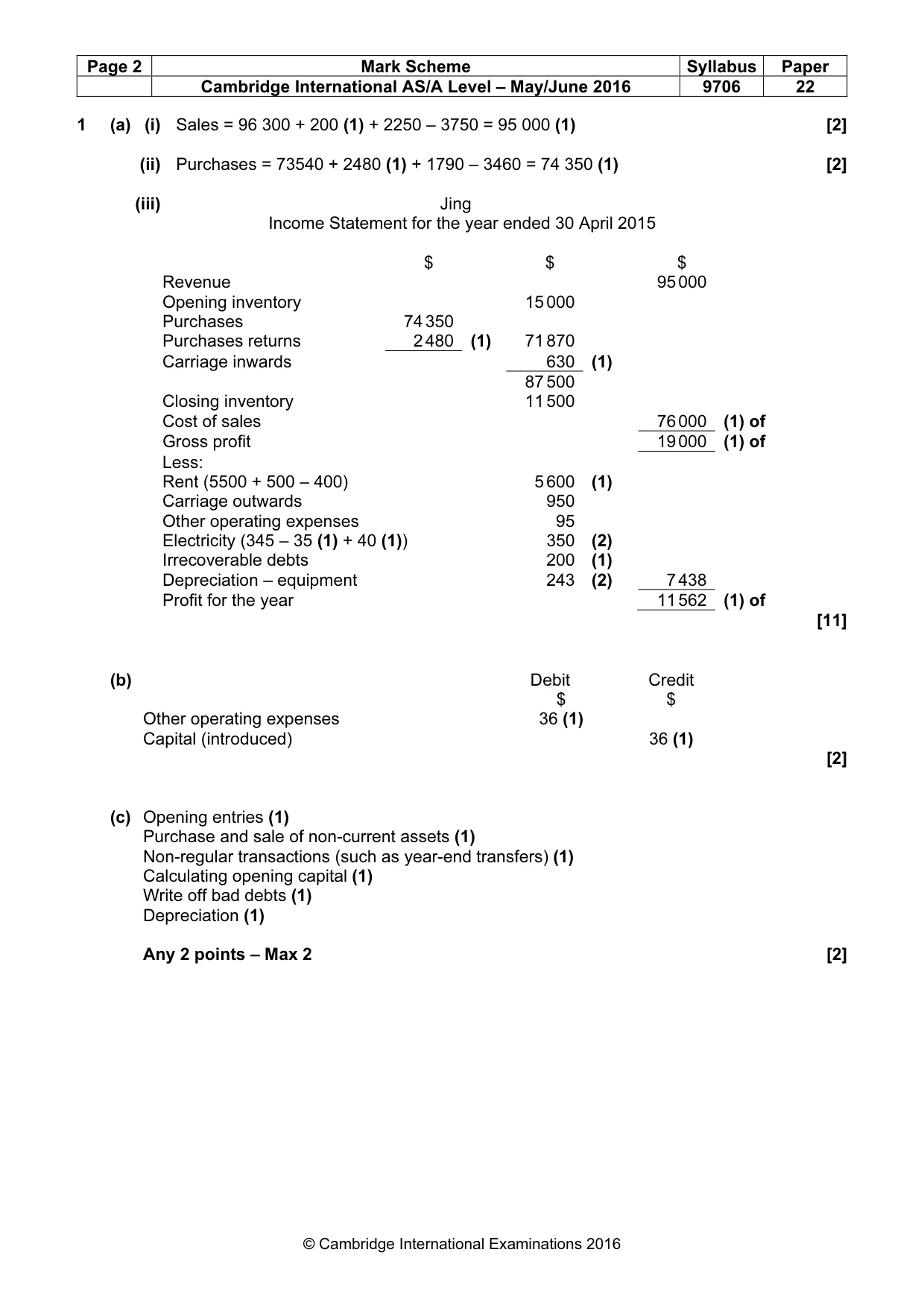
Page 2 Mark Scheme Syllabus Paper Cambridge International AS/A Level – May/June 2016 9706 22 © Cambridge International Examinations 2016 1 (a) (i) Sales = 96 300 + 200 (1) + 2250 – 3750 = 95 000 (1) [2] (ii) Purchases = 73540 + 2480 (1) + 1790 – 3460 = 74 350 (1) [2] (iii) Jing Income Statement for the year ended 30 April 2015 $ $ $ Revenue 95 000 Opening inventory 15 000 Purchases 74 350 Purchases returns 2 480 (1) 71 870 Carriage inwards 630 (1) 87 500 Closing inventory 11 500 Cost of sales 76 000 (1) of Gross profit 19 000 (1) of Less: Rent (5500 + 500 – 400) 5 600 (1) Carriage outwards 950 Other operating expenses 95 Electricity (345 – 35 (1) + 40 (1)) 350 (2) Irrecoverable debts 200 (1) Depreciation – equipment 243 (2) 7 438 Profit for the year 11 562 (1) of [11] (b) Debit Credit $ $ Other operating expenses 36 (1) Capital (introduced) 36 (1) [2] (c) Opening entries (1) Purchase and sale of non-current assets (1) Non-regular transactions (such as year-end transfers) (1) Calculating opening capital (1) Write off bad debts (1) Depreciation (1) Any 2 points – Max 2 [2]
Mark scheme, page 3
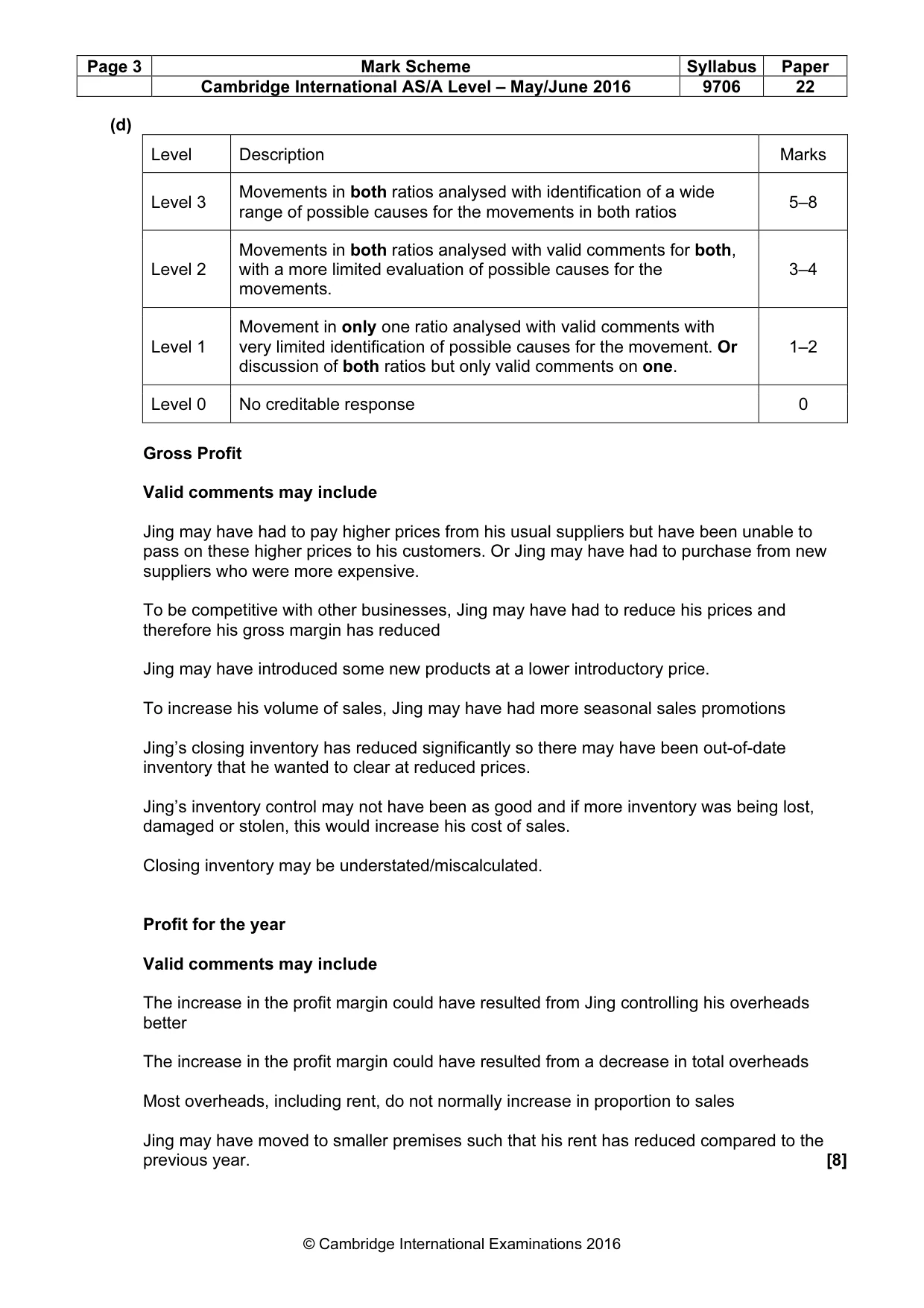
Page 3 Mark Scheme Syllabus Paper Cambridge International AS/A Level – May/June 2016 9706 22 © Cambridge International Examinations 2016 (d) Level Description Marks Level 3 Movements in both ratios analysed with identification of a wide range of possible causes for the movements in both ratios 5–8 Level 2 Movements in both ratios analysed with valid comments for both, with a more limited evaluation of possible causes for the movements. 3–4 Level 1 Movement in only one ratio analysed with valid comments with very limited identification of possible causes for the movement. Or discussion of both ratios but only valid comments on one. 1–2 Level 0 No creditable response 0 Gross Profit Valid comments may include Jing may have had to pay higher prices from his usual suppliers but have been unable to pass on these higher prices to his customers. Or Jing may have had to purchase from new suppliers who were more expensive. To be competitive with other businesses, Jing may have had to reduce his prices and therefore his gross margin has reduced Jing may have introduced some new products at a lower introductory price. To increase his volume of sales, Jing may have had more seasonal sales promotions Jing’s closing inventory has reduced significantly so there may have been out-of-date inventory that he wanted to clear at reduced prices. Jing’s inventory control may not have been as good and if more inventory was being lost, damaged or stolen, this would increase his cost of sales. Closing inventory may be understated/miscalculated. Profit for the year Valid comments may include The increase in the profit margin could have resulted from Jing controlling his overheads better The increase in the profit margin could have resulted from a decrease in total overheads Most overheads, including rent, do not normally increase in proportion to sales Jing may have moved to smaller premises such that his rent has reduced compared to the previous year. [8]
Mark scheme, page 4
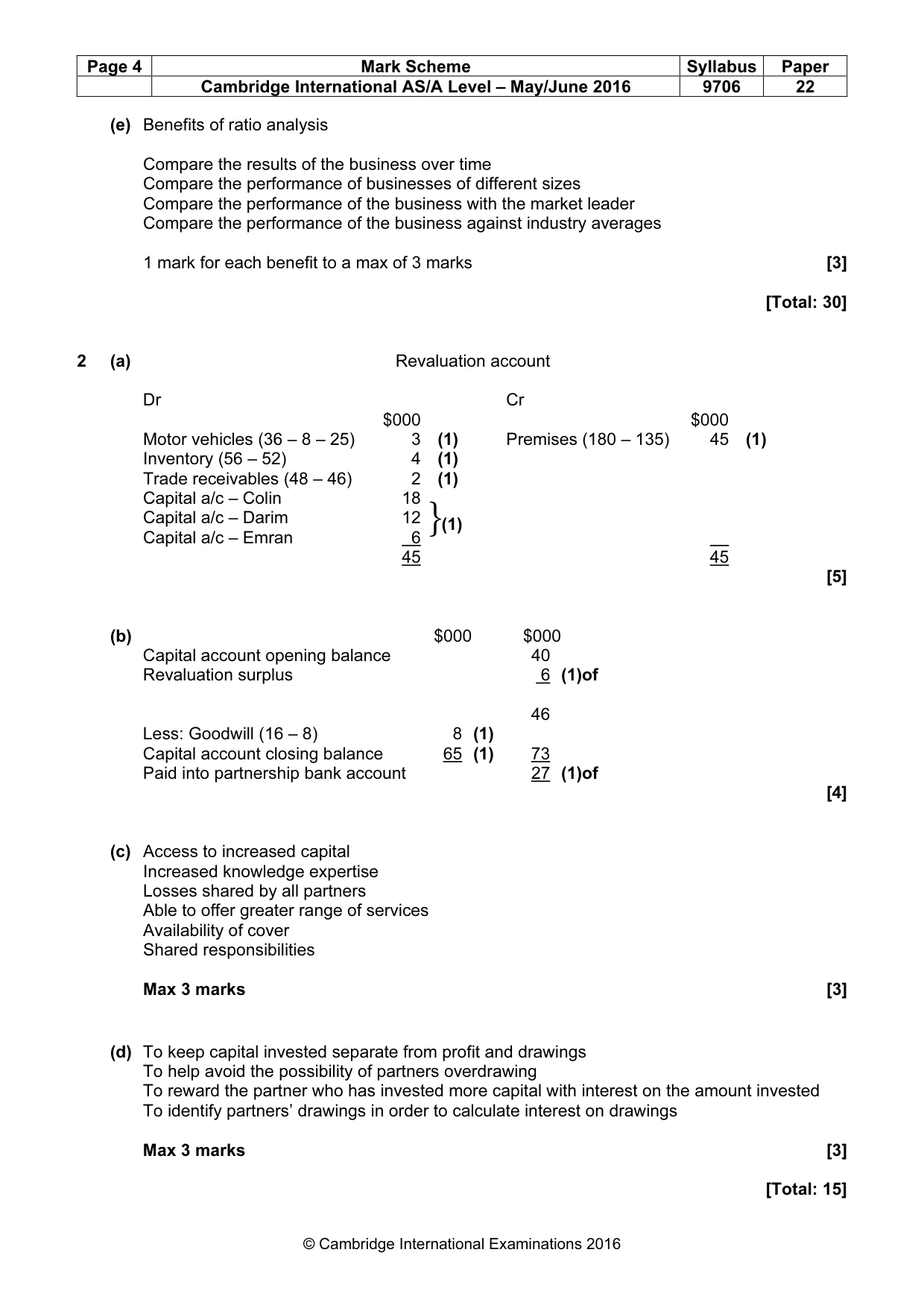
Page 4 Mark Scheme Syllabus Paper Cambridge International AS/A Level – May/June 2016 9706 22 © Cambridge International Examinations 2016 (e) Benefits of ratio analysis Compare the results of the business over time Compare the performance of businesses of different sizes Compare the performance of the business with the market leader Compare the performance of the business against industry averages 1 mark for each benefit to a max of 3 marks [3] [Total: 30] 2 (a) Revaluation account Dr Cr $000 $000 Motor vehicles (36 – 8 – 25) 3 (1) Premises (180 – 135) 45 (1) Inventory (56 – 52) 4 (1) Trade receivables (48 – 46) 2 (1) Capital a/c – Colin 18 à(1) Capital a/c – Darim 12 Capital a/c – Emran 6 45 45 [5] (b) $000 $000 Capital account opening balance 40 Revaluation surplus 6 (1)of 46 Less: Goodwill (16 – 8) 8 (1) Capital account closing balance 65 (1) 73 Paid into partnership bank account 27 (1)of [4] (c) Access to increased capital Increased knowledge expertise Losses shared by all partners Able to offer greater range of services Availability of cover Shared responsibilities Max 3 marks [3] (d) To keep capital invested separate from profit and drawings To help avoid the possibility of partners overdrawing To reward the partner who has invested more capital with interest on the amount invested To identify partners’ drawings in order to calculate interest on drawings Max 3 marks [3] [Total: 15]
Mark scheme, page 5
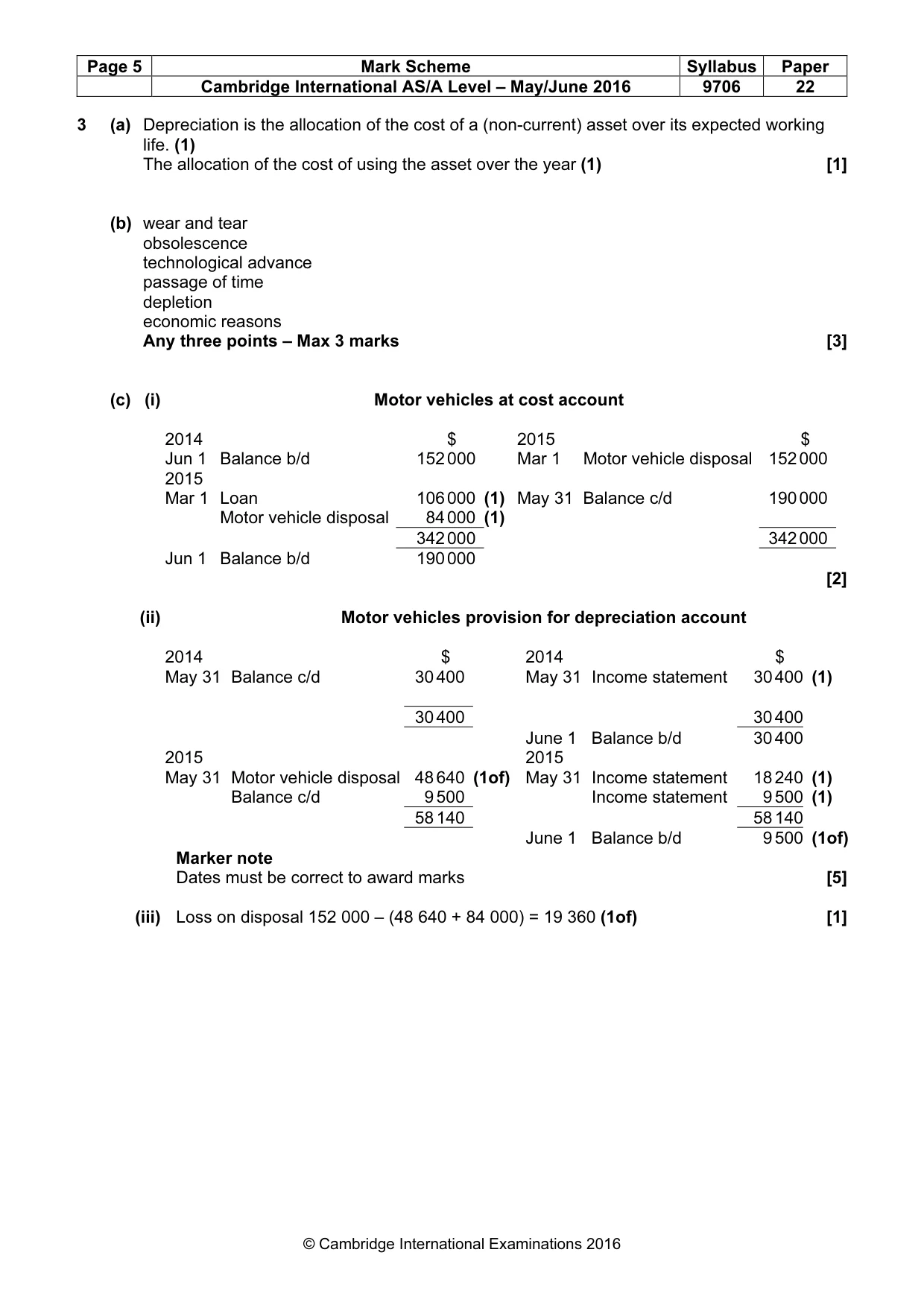
Page 5 Mark Scheme Syllabus Paper Cambridge International AS/A Level – May/June 2016 9706 22 © Cambridge International Examinations 2016 3 (a) Depreciation is the allocation of the cost of a (non-current) asset over its expected working life. (1) The allocation of the cost of using the asset over the year (1) [1] (b) wear and tear obsolescence technological advance passage of time depletion economic reasons Any three points – Max 3 marks [3] (c) (i) Motor vehicles at cost account 2014 $ 2015 $ Jun 1 Balance b/d 152 000 Mar 1 Motor vehicle disposal 152 000 2015 Mar 1 Loan 106 000 (1) May 31 Balance c/d 190 000 Motor vehicle disposal 84 000 (1) 342 000 342 000 Jun 1 Balance b/d 190 000 [2] (ii) Motor vehicles provision for depreciation account 2014 $ 2014 $ May 31 Balance c/d 30 400 May 31 Income statement 30 400 (1) 30 400 30 400 June 1 Balance b/d 30 400 2015 2015 May 31 Motor vehicle disposal 48 640 (1of) May 31 Income statement 18 240 (1) Balance c/d 9 500 Income statement 9 500 (1) 58 140 58 140 June 1 Balance b/d 9 500 (1of) Marker note Dates must be correct to award marks [5] (iii) Loss on disposal 152 000 – (48 640 + 84 000) = 19 360 (1of) [1]
Mark scheme, page 6
Page 6 Mark Scheme Syllabus Paper Cambridge International AS/A Level – May/June 2016 9706 22 © Cambridge International Examinations 2016 (d) Income statement: Loss on sale increases (1) Loan interest increases (1) Profit decreases (1) Max 2 Statement of financial position: Amount of loan outstanding is increased (1) Owner’s capital is reduced (1) Net assets reduce (1) Max 2 Overall Max 3 [3] [Total: 15] 4 (a) Machining Assembly Finishing Stores Canteen $ $ $ $ $ Indirect labour 253 000 290 000 340 100 52 000 78 000 Other indirect overhead costs 205 000 90 000 225 000 88 000 92 000 Total costs 458 000 380 000 565 100 140 000 170 000 Stores 49 000 (1) 35 000 (1) 56 000 (1) (140 000) Canteen 42 500 (1) 51 000 (1) 76 500 (1) (170 000) Total 549 500 466 000 697 600 (1) row 549 500 / 45 000 466 000 / 60 000 697 600 / 40 000 Overhead absorption rate $12.21 per machine hour (1of) (1) $7.77 per labour hour (1of) (1) $17.44 per labour hour (1of) (1) [13] (b) $ Direct Materials (20 kilos @ $5 per kilo) 100.00 (1) Direct labour (10 hours @ $9 per hour) 90.00 (1) Machining department overhead (2 × $12.21) 24.42 (1)of Assembly department overhead (3 × $ 7.77) 23.31 (1)of Finishing department overhead (2 × $17.44) 34.88 (1)of 272.61 Margin 181.74 (1)of Price to quote 454.35 (1)of [7]
Mark scheme, page 7
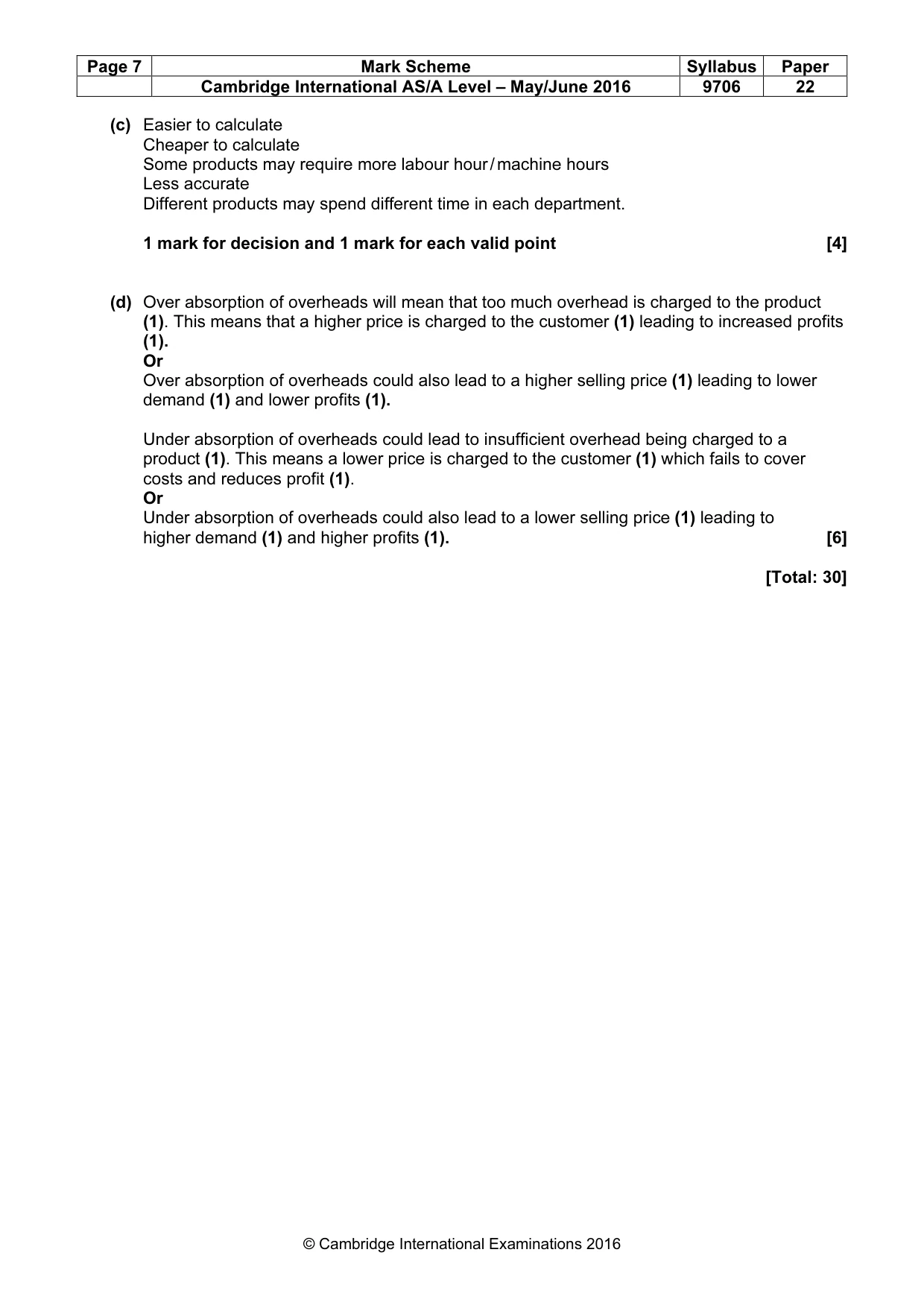
Page 7 Mark Scheme Syllabus Paper Cambridge International AS/A Level – May/June 2016 9706 22 © Cambridge International Examinations 2016 (c) Easier to calculate Cheaper to calculate Some products may require more labour hour / machine hours Less accurate Different products may spend different time in each department. 1 mark for decision and 1 mark for each valid point [4] (d) Over absorption of overheads will mean that too much overhead is charged to the product (1). This means that a higher price is charged to the customer (1) leading to increased profits (1). Or Over absorption of overheads could also lead to a higher selling price (1) leading to lower demand (1) and lower profits (1). Under absorption of overheads could lead to insufficient overhead being charged to a product (1). This means a lower price is charged to the customer (1) which fails to cover costs and reduces profit (1). Or Under absorption of overheads could also lead to a lower selling price (1) leading to higher demand (1) and higher profits (1). [6] [Total: 30]
What you needed in this session
Cambridge’s own grade thresholds for 2016 May/June, Paper 2 · Variant 2. A higher threshold means an easier paper — the bar moves with how the cohort did.