Cambridge A Level Accounting 9706 — 2016 May/June Paper 2 · Variant 3
9706/23/M/J/16 · 90 marks · ≈101 min
The question paper and its mark scheme, free to read here and free to download. This is Cambridge’s own paper, exactly as it was sat.
Question paper20 pages

Mark scheme10 pages
Answers below. Sit the paper first if you are practising.
Paper as text
Question paper, page 1
This document consists of 18 printed pages and 2 blank pages. IB16 06_9706_23/FP © UCLES 2016 [Turn over Cambridge International Examinations Cambridge International Advanced Subsidiary and Advanced Level ACCOUNTING 9706/23 Paper 2 Structured Questions May/June 2016 1 hour 30 minutes Candidates answer on the Question Paper. No Additional Materials are required. READ THESE INSTRUCTIONS FIRST Write your Centre number, candidate number and name on all the work you hand in. Write in dark blue or black pen. You may use an HB pencil for any diagrams or graphs or for rough working. Do not use staples, paper clips, glue or correction fluid. DO NOT WRITE IN ANY BARCODES. Answer all questions. All accounting statements are to be presented in good style. International accounting terms and formats should be used as appropriate. Workings must be shown. You may use a calculator. At the end of the examination, fasten all your work securely together. The number of marks is given in brackets [ ] at the end of each question or part question.
Question paper, page 2
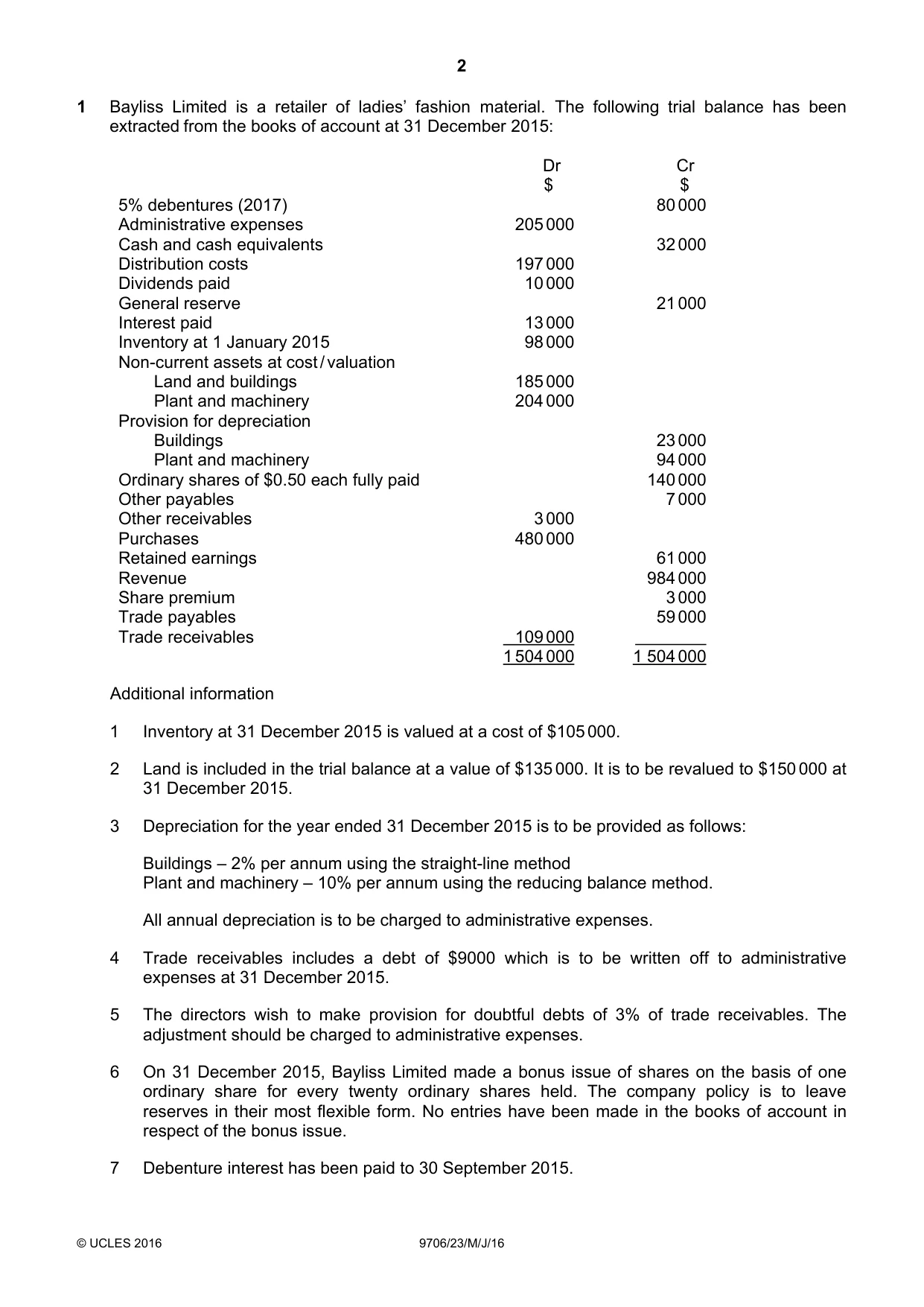
2 © UCLES 2016 9706/23/M/J/16 1 Bayliss Limited is a retailer of ladies’ fashion material. The following trial balance has been extracted from the books of account at 31 December 2015: Dr $ Cr $ 5% debentures (2017) 80 000 Administrative expenses 205 000 Cash and cash equivalents 32 000 Distribution costs 197 000 Dividends paid 10 000 General reserve 21 000 Interest paid 13 000 Inventory at 1 January 2015 98 000 Non-current assets at cost / valuation Land and buildings 185 000 Plant and machinery 204 000 Provision for depreciation Buildings 23 000 Plant and machinery 94 000 Ordinary shares of $0.50 each fully paid 140 000 Other payables 7 000 Other receivables 3 000 Purchases 480 000 Retained earnings 61 000 Revenue 984 000 Share premium 3 000 Trade payables 59 000 Trade receivables 109 000 1 504 000 1 504 000 Additional information 1 Inventory at 31 December 2015 is valued at a cost of $105 000. 2 Land is included in the trial balance at a value of $135 000. It is to be revalued to $150 000 at 31 December 2015. 3 Depreciation for the year ended 31 December 2015 is to be provided as follows: Buildings – 2% per annum using the straight-line method Plant and machinery – 10% per annum using the reducing balance method. All annual depreciation is to be charged to administrative expenses. 4 Trade receivables includes a debt of $9000 which is to be written off to administrative expenses at 31 December 2015. 5 The directors wish to make provision for doubtful debts of 3% of trade receivables. The adjustment should be charged to administrative expenses. 6 On 31 December 2015, Bayliss Limited made a bonus issue of shares on the basis of one ordinary share for every twenty ordinary shares held. The company policy is to leave reserves in their most flexible form. No entries have been made in the books of account in respect of the bonus issue. 7 Debenture interest has been paid to 30 September 2015.
Question paper, page 3
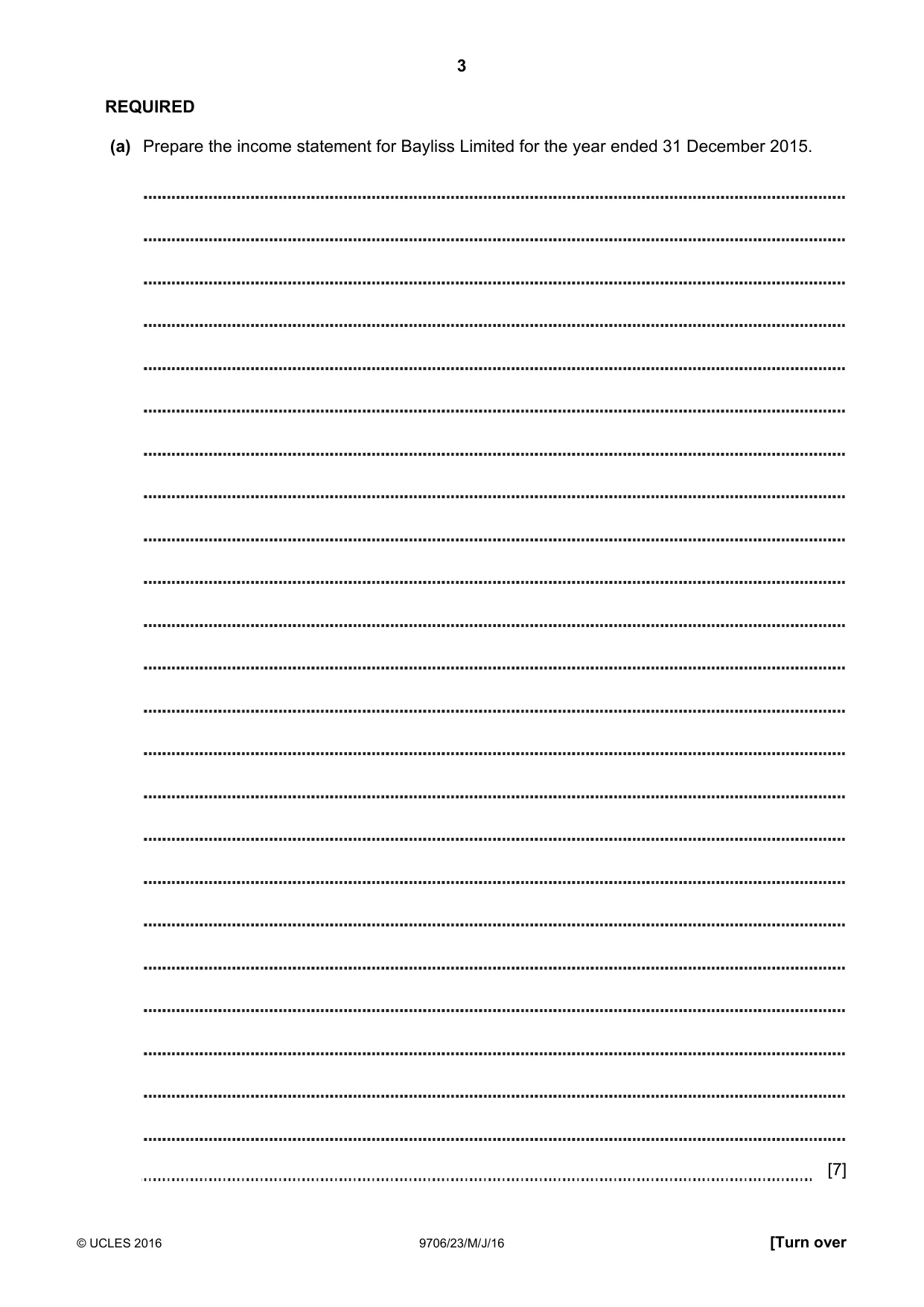
3 © UCLES 2016 9706/23/M/J/16 [Turn over REQUIRED (a) Prepare the income statement for Bayliss Limited for the year ended 31 December 2015. [7]
Question paper, page 4
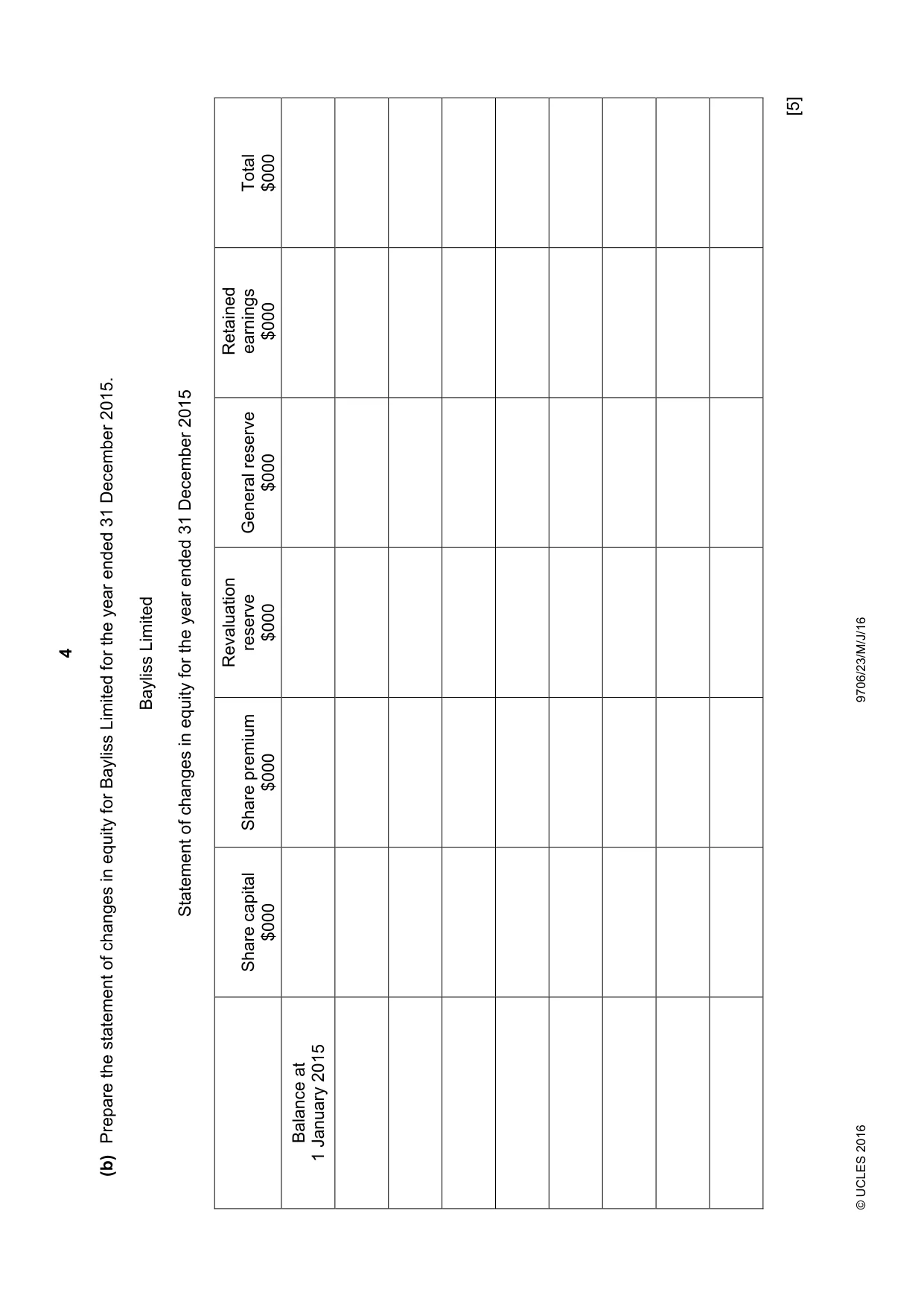
4 © UCLES 2016 9706/23/M/J/16 (b) Prepare the statement of changes in equity for Bayliss Limited for the year ended 31 December 2015. Bayliss Limited Statement of changes in equity for the year ended 31 December 2015 Share capital $000 Share premium $000 Revaluation reserve $000 General reserve $000 Retained earnings $000 Total $000 Balance at 1 January 2015 [5]
Question paper, page 5
5 © UCLES 2016 9706/23/M/J/16 [Turn over (c) Prepare the statement of financial position for Bayliss Limited at 31 December 2015. [6]
Question paper, page 6
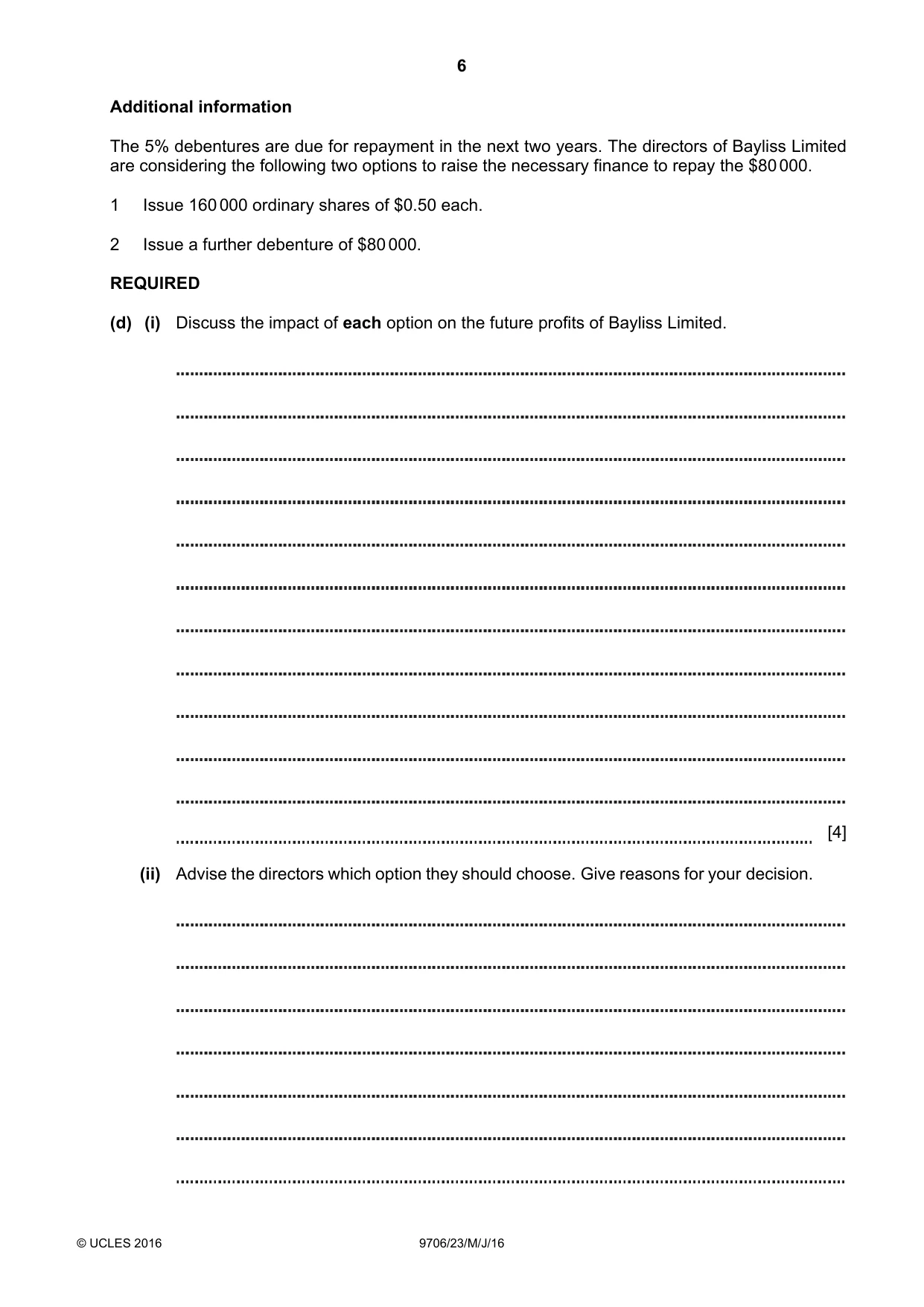
6 © UCLES 2016 9706/23/M/J/16 Additional information The 5% debentures are due for repayment in the next two years. The directors of Bayliss Limited are considering the following two options to raise the necessary finance to repay the $80 000. 1 Issue 160 000 ordinary shares of $0.50 each. 2 Issue a further debenture of $80 000. REQUIRED (d) (i) Discuss the impact of each option on the future profits of Bayliss Limited. [4] (ii) Advise the directors which option they should choose. Give reasons for your decision.
Question paper, page 7
7 © UCLES 2016 9706/23/M/J/16 [Turn over [3] Additional information The statement of financial position of a limited company may include capital reserves and also revenue reserves. REQUIRED (e) Explain the difference between a capital reserve and a revenue reserve. [4] (f) State one example of a capital reserve. [1] [Total: 30]
Question paper, page 8
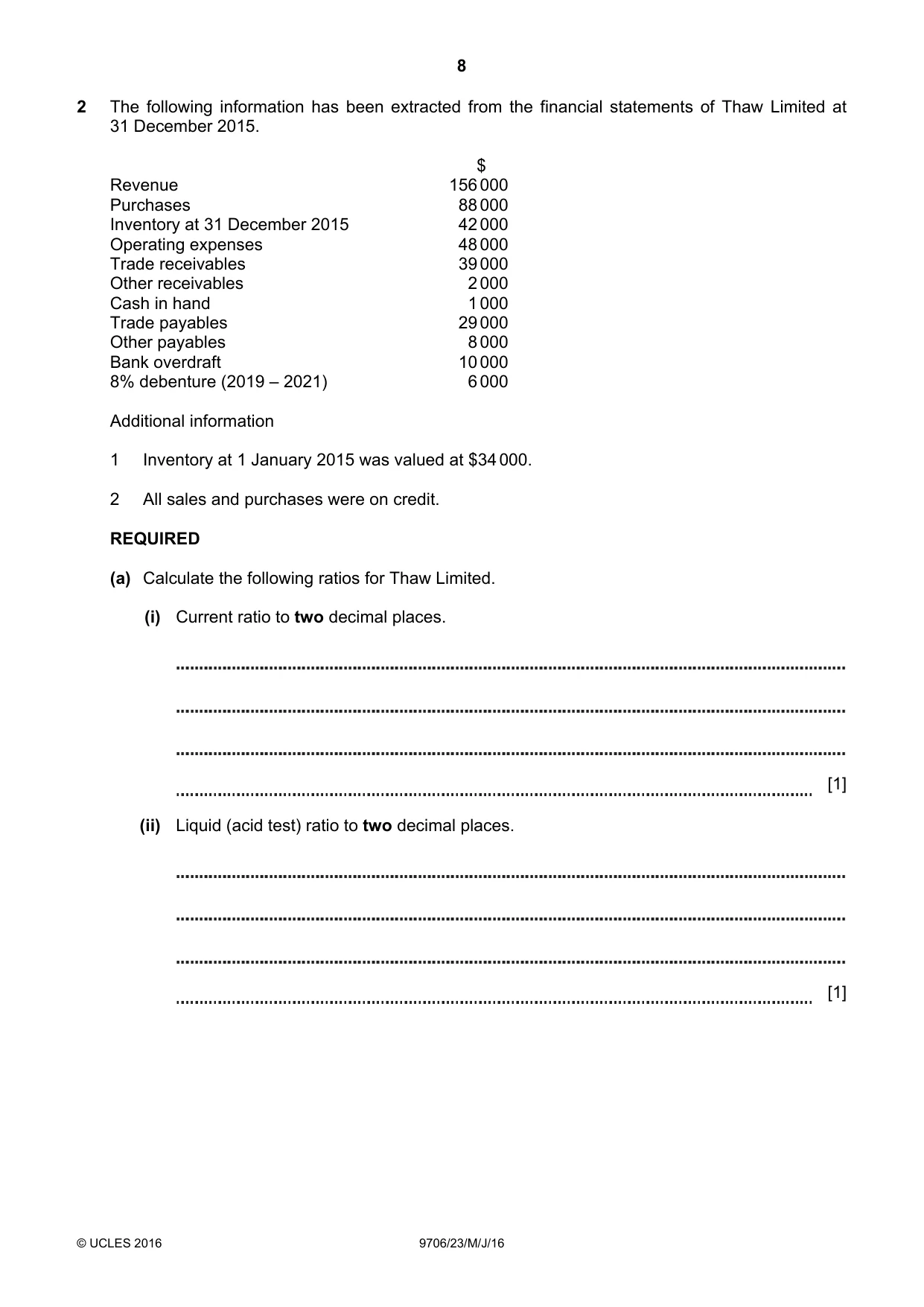
8 © UCLES 2016 9706/23/M/J/16 2 The following information has been extracted from the financial statements of Thaw Limited at 31 December 2015. $ Revenue 156 000 Purchases 88 000 Inventory at 31 December 2015 42 000 Operating expenses 48 000 Trade receivables 39 000 Other receivables 2 000 Cash in hand 1 000 Trade payables 29 000 Other payables 8 000 Bank overdraft 10 000 8% debenture (2019 – 2021) 6 000 Additional information 1 Inventory at 1 January 2015 was valued at $34 000. 2 All sales and purchases were on credit. REQUIRED (a) Calculate the following ratios for Thaw Limited. (i) Current ratio to two decimal places. [1] (ii) Liquid (acid test) ratio to two decimal places. [1]
Question paper, page 9
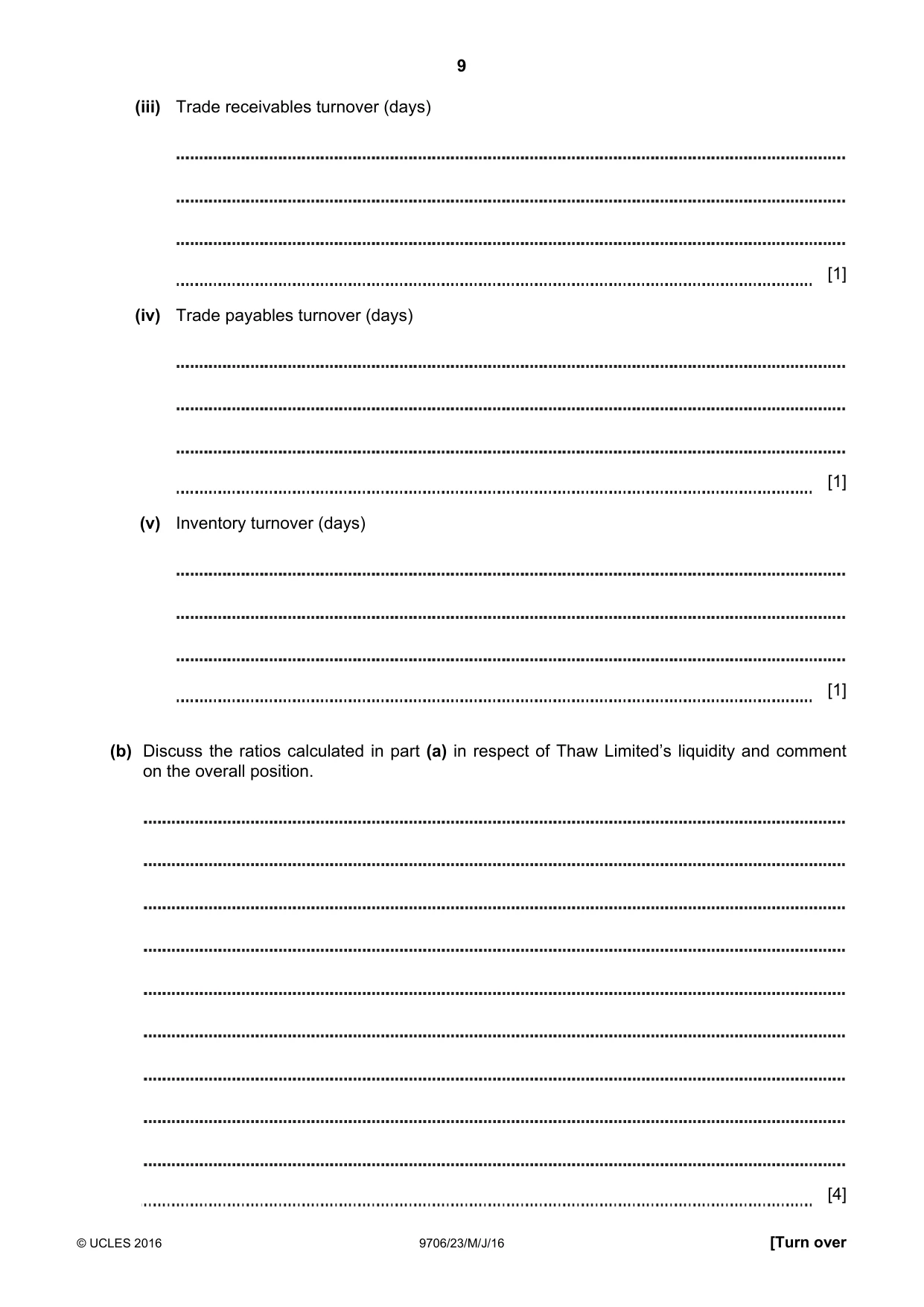
9 © UCLES 2016 9706/23/M/J/16 [Turn over (iii) Trade receivables turnover (days) [1] (iv) Trade payables turnover (days) [1] (v) Inventory turnover (days) [1] (b) Discuss the ratios calculated in part (a) in respect of Thaw Limited’s liquidity and comment on the overall position. [4]
Question paper, page 10
10 © UCLES 2016 9706/23/M/J/16 (c) Explain three limitations of ratio analysis. [6] [Total: 15]
Question paper, page 11
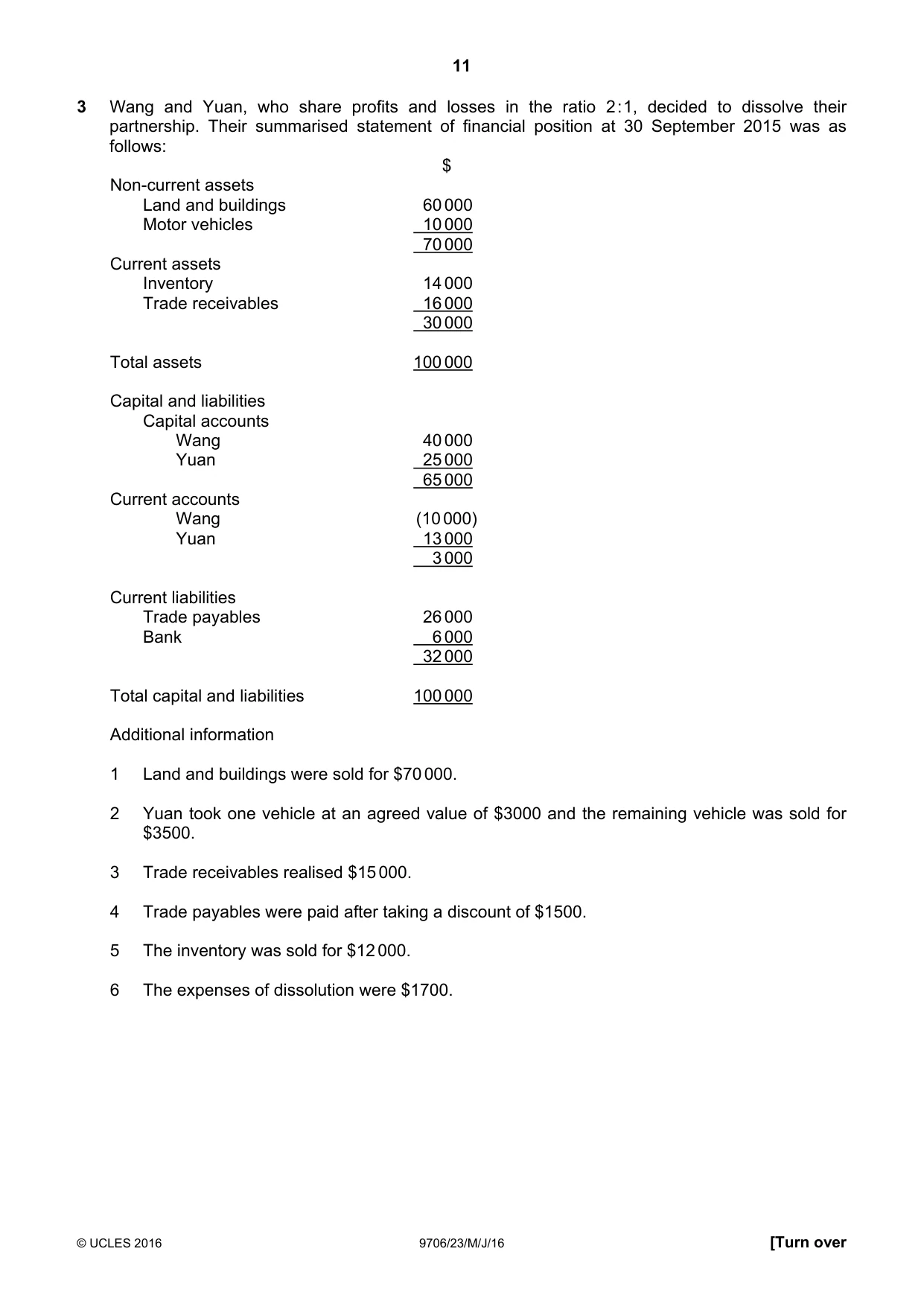
11 © UCLES 2016 9706/23/M/J/16 [Turn over 3 Wang and Yuan, who share profits and losses in the ratio 2 : 1, decided to dissolve their partnership. Their summarised statement of financial position at 30 September 2015 was as follows: $ Non-current assets Land and buildings 60 000 Motor vehicles 10 000 70 000 Current assets Inventory 14 000 Trade receivables 16 000 30 000 Total assets 100 000 Capital and liabilities Capital accounts Wang 40 000 Yuan 25 000 65 000 Current accounts Wang (10 000) Yuan 13 000 3 000 Current liabilities Trade payables 26 000 Bank 6 000 32 000 Total capital and liabilities 100 000 Additional information 1 Land and buildings were sold for $70 000. 2 Yuan took one vehicle at an agreed value of $3000 and the remaining vehicle was sold for $3500. 3 Trade receivables realised $15 000. 4 Trade payables were paid after taking a discount of $1500. 5 The inventory was sold for $12 000. 6 The expenses of dissolution were $1700.
Question paper, page 12
12 © UCLES 2016 9706/23/M/J/16 REQUIRED (a) Prepare the partnership realisation account. [5] (b) Calculate the amount due to each partner when the bank account is closed on dissolution. [7]
Question paper, page 13
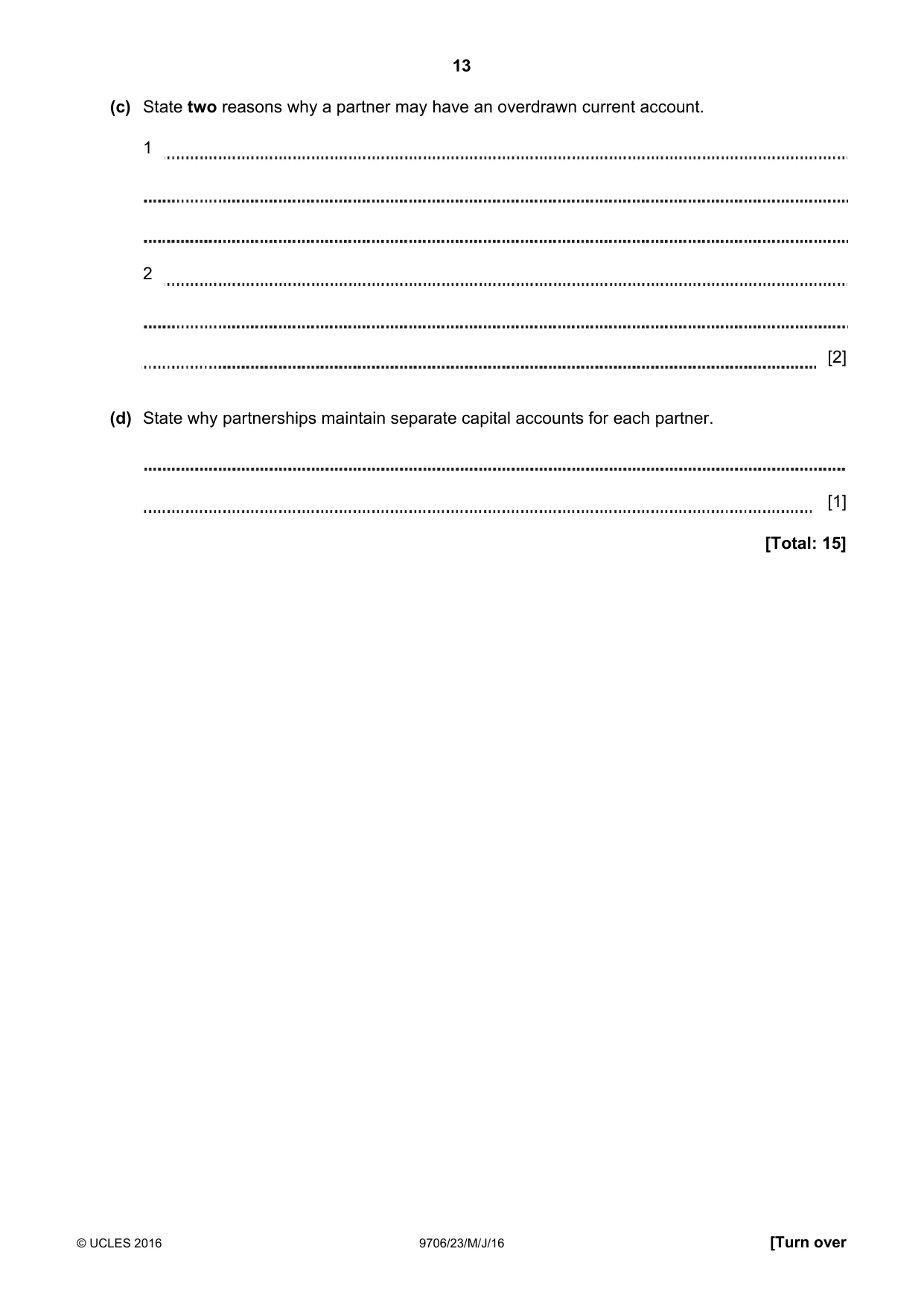
13 © UCLES 2016 9706/23/M/J/16 [Turn over (c) State two reasons why a partner may have an overdrawn current account. 1 2 [2] (d) State why partnerships maintain separate capital accounts for each partner. [1] [Total: 15]
Question paper, page 14
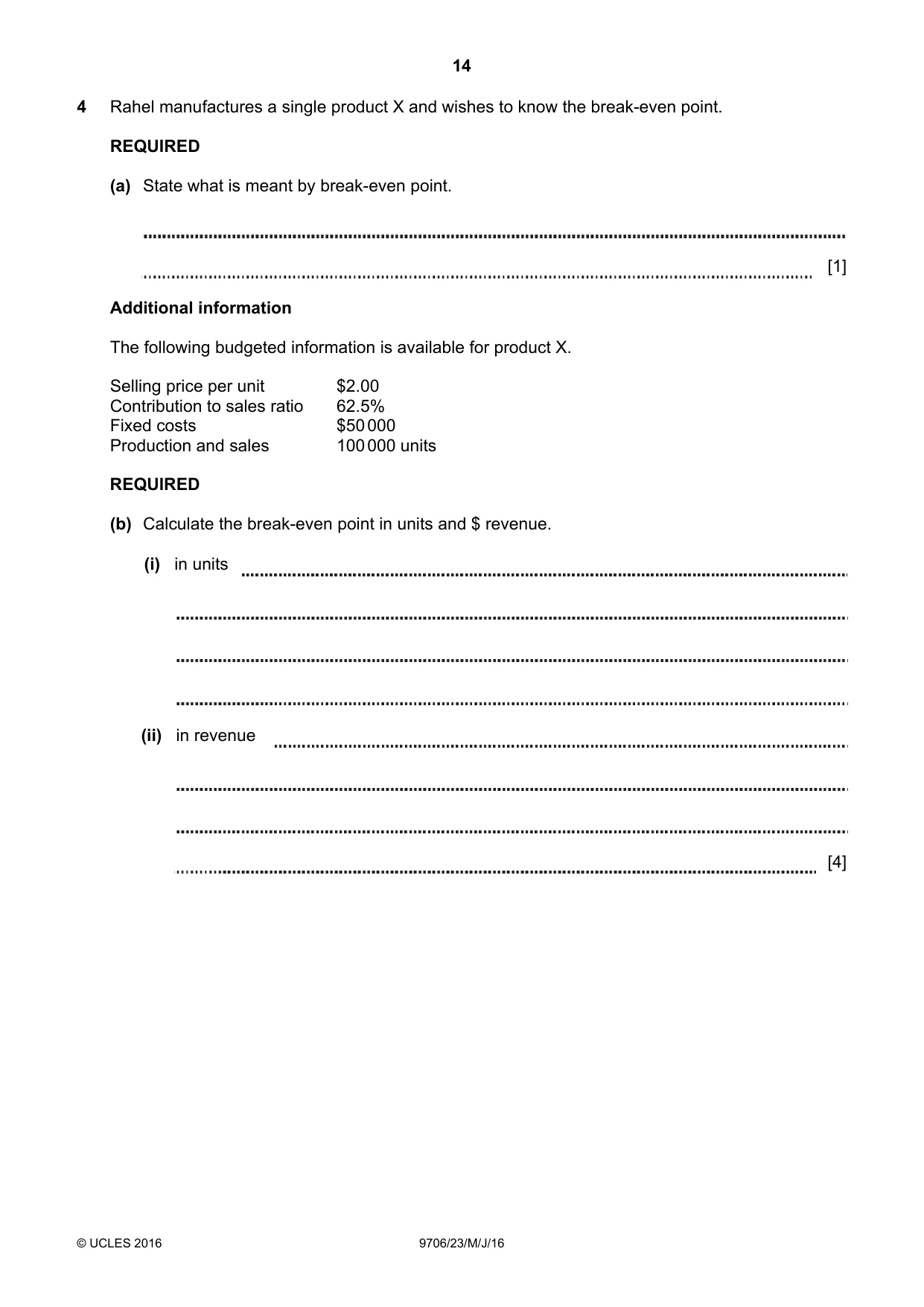
14 © UCLES 2016 9706/23/M/J/16 4 Rahel manufactures a single product X and wishes to know the break-even point. REQUIRED (a) State what is meant by break-even point. [1] Additional information The following budgeted information is available for product X. Selling price per unit $2.00 Contribution to sales ratio 62.5% Fixed costs $50 000 Production and sales 100 000 units REQUIRED (b) Calculate the break-even point in units and $ revenue. (i) in units (ii) in revenue [4]
Question paper, page 15
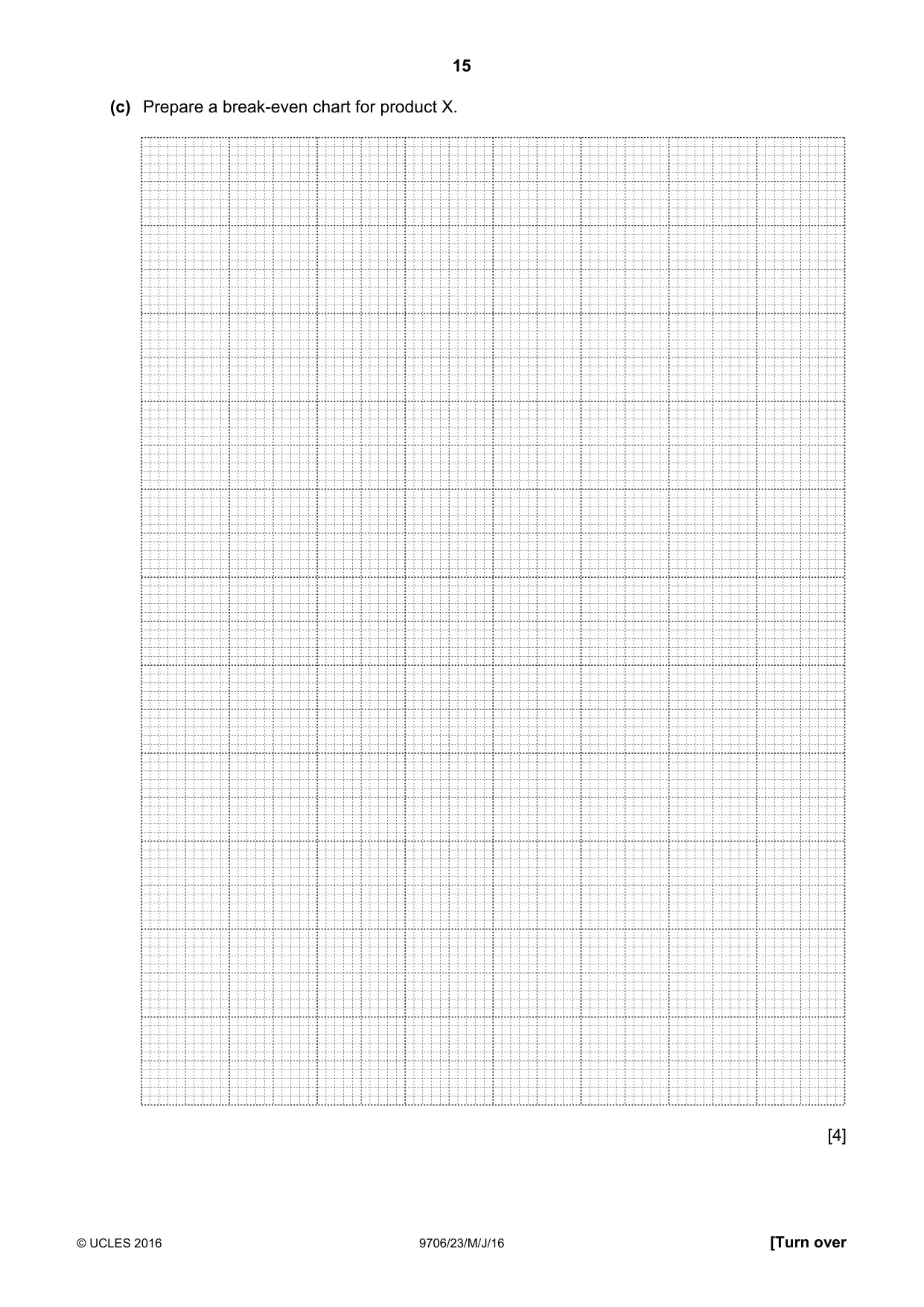
15 © UCLES 2016 9706/23/M/J/16 [Turn over (c) Prepare a break-even chart for product X. [4]
Question paper, page 16
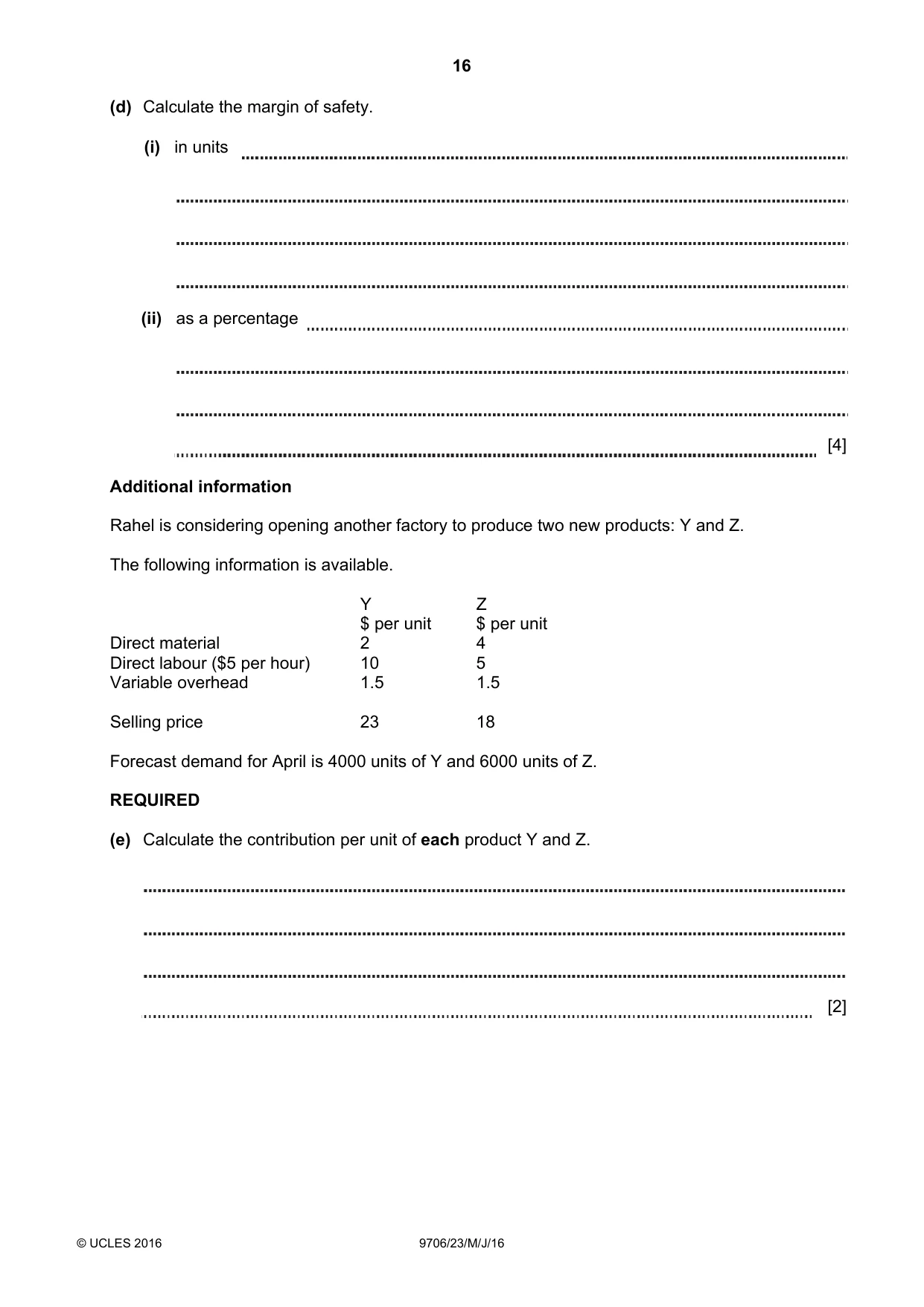
16 © UCLES 2016 9706/23/M/J/16 (d) Calculate the margin of safety. (i) in units (ii) as a percentage [4] Additional information Rahel is considering opening another factory to produce two new products: Y and Z. The following information is available. Y Z $ per unit $ per unit Direct material 2 4 Direct labour ($5 per hour) 10 5 Variable overhead 1.5 1.5 Selling price 23 18 Forecast demand for April is 4000 units of Y and 6000 units of Z. REQUIRED (e) Calculate the contribution per unit of each product Y and Z. [2]
Question paper, page 17
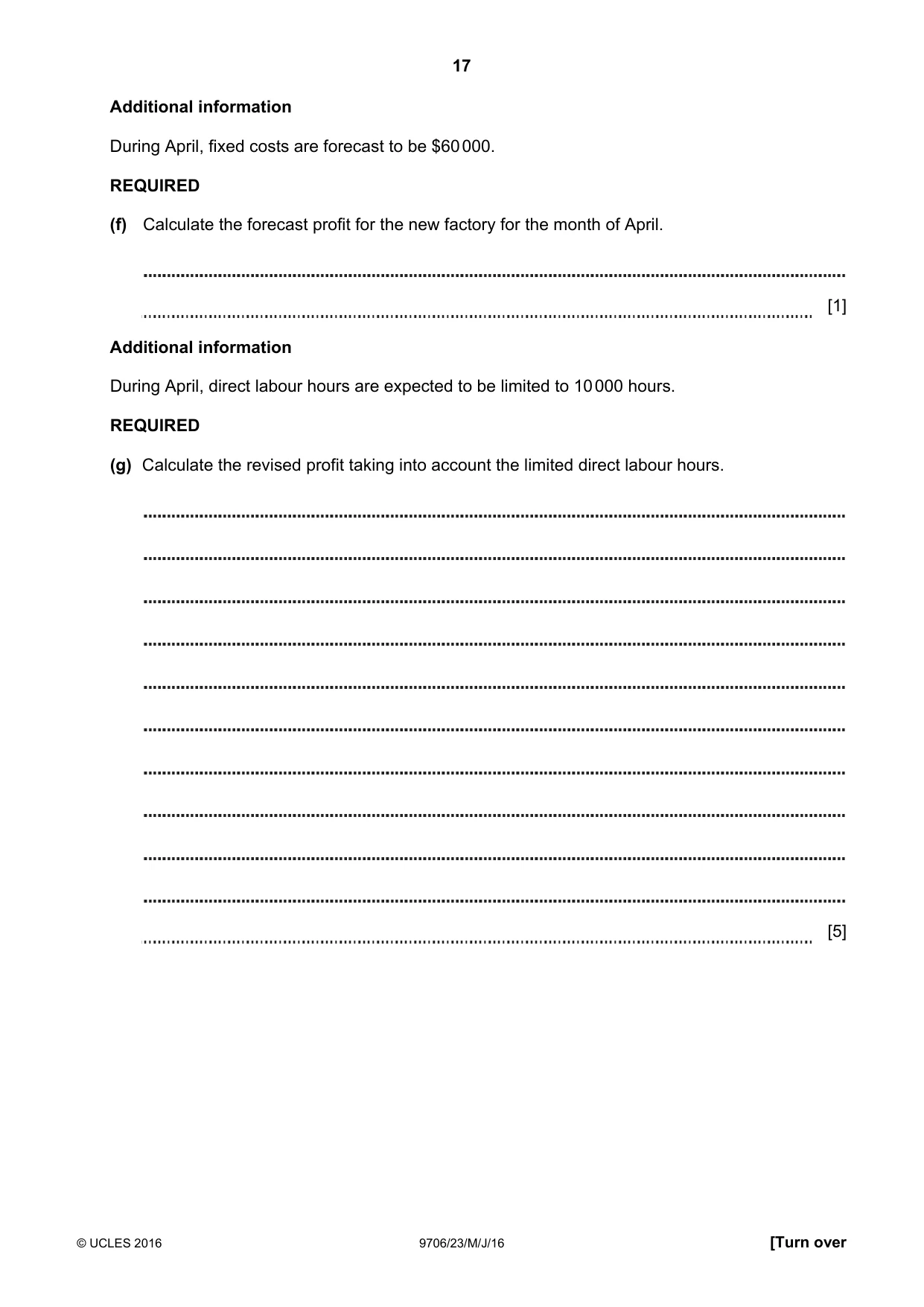
17 © UCLES 2016 9706/23/M/J/16 [Turn over Additional information During April, fixed costs are forecast to be $60 000. REQUIRED (f) Calculate the forecast profit for the new factory for the month of April. [1] Additional information During April, direct labour hours are expected to be limited to 10 000 hours. REQUIRED (g) Calculate the revised profit taking into account the limited direct labour hours. [5]
Question paper, page 18
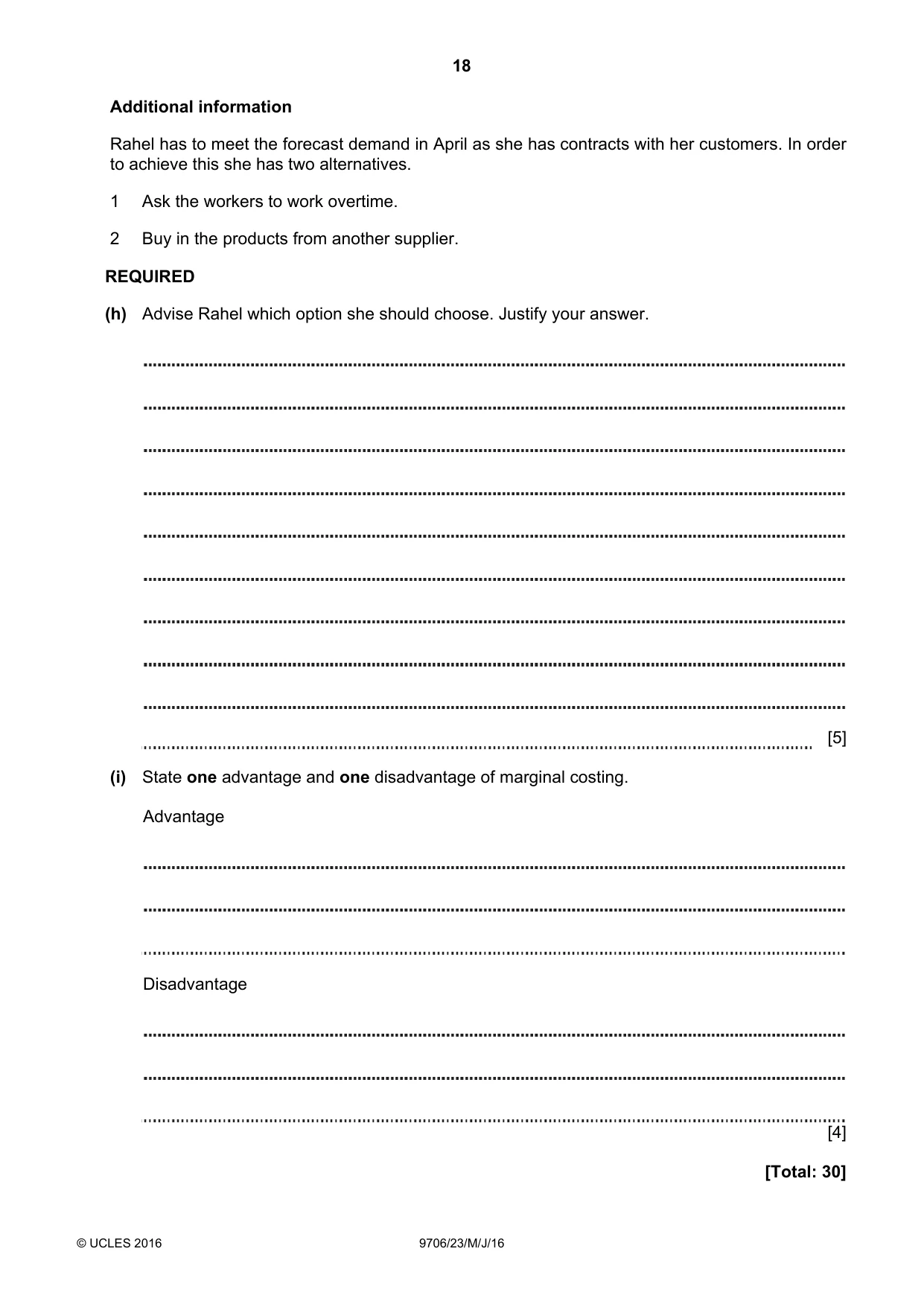
18 © UCLES 2016 9706/23/M/J/16 Additional information Rahel has to meet the forecast demand in April as she has contracts with her customers. In order to achieve this she has two alternatives. 1 Ask the workers to work overtime. 2 Buy in the products from another supplier. REQUIRED (h) Advise Rahel which option she should choose. Justify your answer. [5] (i) State one advantage and one disadvantage of marginal costing. Advantage Disadvantage [4] [Total: 30]
Question paper, page 19
19 © UCLES 2016 9706/23/M/J/16 BLANK PAGE
Question paper, page 20
20 Permission to reproduce items where third-party owned material protected by copyright is included has been sought and cleared where possible. Every reasonable effort has been made by the publisher (UCLES) to trace copyright holders, but if any items requiring clearance have unwittingly been included, the publisher will be pleased to make amends at the earliest possible opportunity. To avoid the issue of disclosure of answer-related information to candidates, all copyright acknowledgements are reproduced online in the Cambridge International Examinations Copyright Acknowledgements Booklet. This is produced for each series of examinations and is freely available to download at www.cie.org.uk after the live examination series. Cambridge International Examinations is part of the Cambridge Assessment Group. Cambridge Assessment is the brand name of University of Cambridge Local Examinations Syndicate (UCLES), which is itself a department of the University of Cambridge. © UCLES 2016 9706/23/M/J/16 BLANK PAGE
Mark scheme, page 1
® IGCSE is the registered trademark of Cambridge International Examinations. This document consists of 10 printed pages. © UCLES 2016 [Turn over Cambridge International Examinations Cambridge International Advanced Subsidiary and Advanced Level ACCOUNTING 9706/23 Paper 2 Structured Questions May/June 2016 MARK SCHEME Maximum Mark: 90 Published This mark scheme is published as an aid to teachers and candidates, to indicate the requirements of the examination. It shows the basis on which Examiners were instructed to award marks. It does not indicate the details of the discussions that took place at an Examiners’ meeting before marking began, which would have considered the acceptability of alternative answers. Mark schemes should be read in conjunction with the question paper and the Principal Examiner Report for Teachers. Cambridge will not enter into discussions about these mark schemes. Cambridge is publishing the mark schemes for the May/June 2016 series for most Cambridge IGCSE®, Cambridge International A and AS Level components and some Cambridge O Level components.
Mark scheme, page 2
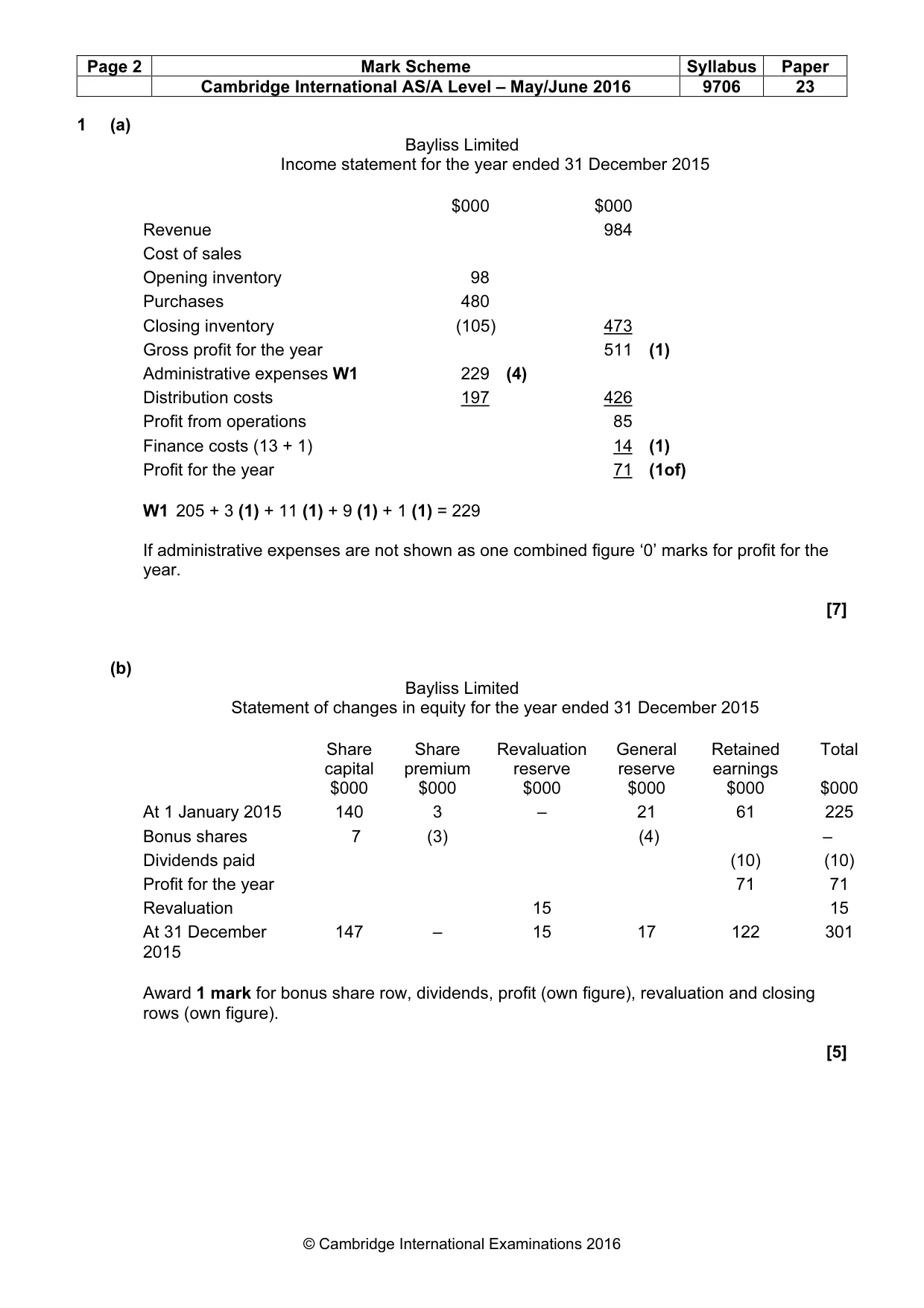
Page 2 Mark Scheme Syllabus Paper Cambridge International AS/A Level – May/June 2016 9706 23 © Cambridge International Examinations 2016 1 (a) Bayliss Limited Income statement for the year ended 31 December 2015 $000 $000 Revenue 984 Cost of sales Opening inventory 98 Purchases 480 Closing inventory (105) 473 Gross profit for the year 511 (1) Administrative expenses W1 229 (4) Distribution costs 197 426 Profit from operations 85 Finance costs (13 + 1) 14 (1) Profit for the year 71 (1of) W1 205 + 3 (1) + 11 (1) + 9 (1) + 1 (1) = 229 If administrative expenses are not shown as one combined figure ‘0’ marks for profit for the year. [7] (b) Bayliss Limited Statement of changes in equity for the year ended 31 December 2015 Share capital $000 Share premium $000 Revaluation reserve $000 General reserve $000 Retained earnings $000 Total $000 At 1 January 2015 140 3 – 21 61 225 Bonus shares 7 (3) (4) – Dividends paid (10) (10) Profit for the year 71 71 Revaluation 15 15 At 31 December 2015 147 – 15 17 122 301 Award 1 mark for bonus share row, dividends, profit (own figure), revaluation and closing rows (own figure). [5]
Mark scheme, page 3
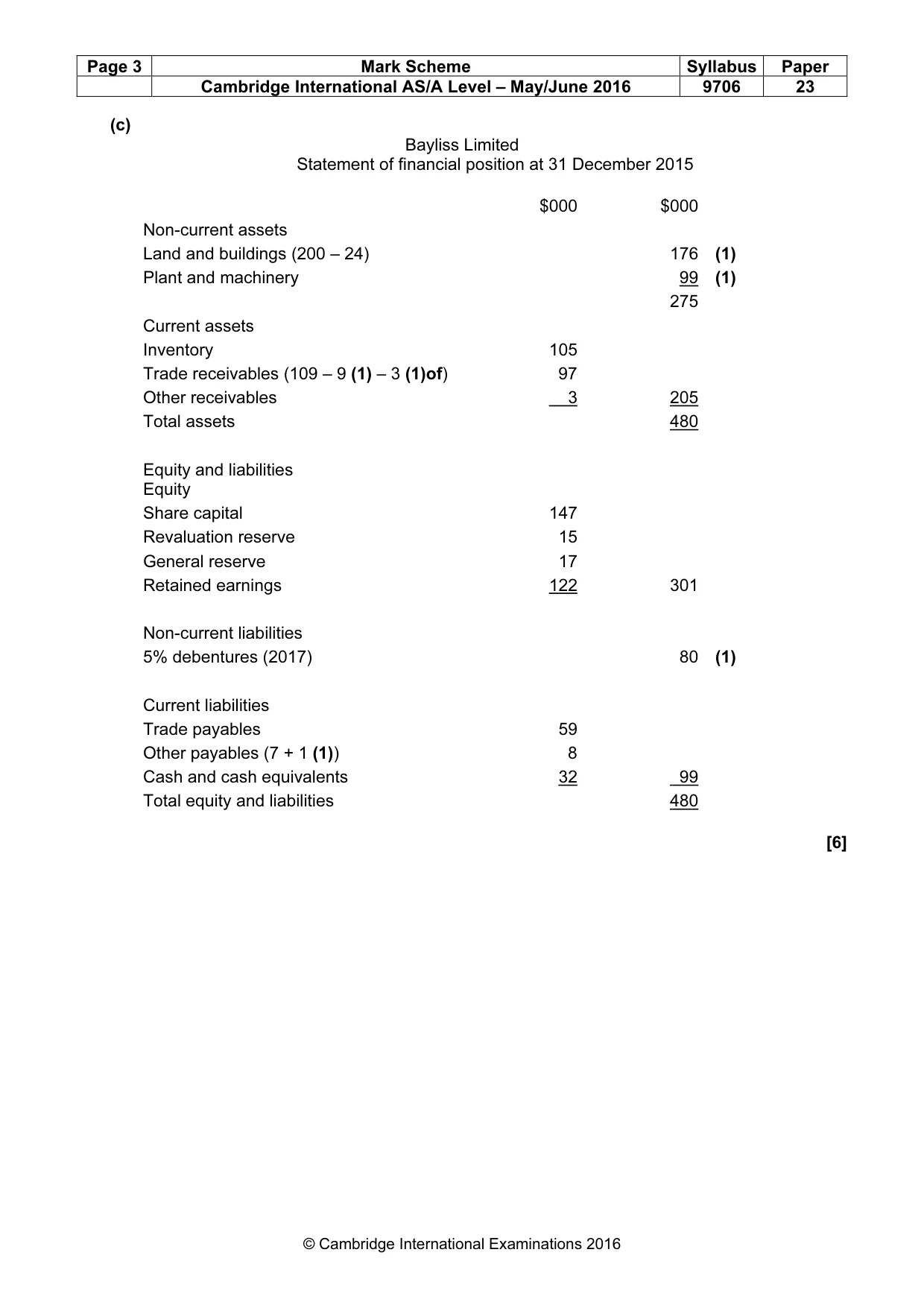
Page 3 Mark Scheme Syllabus Paper Cambridge International AS/A Level – May/June 2016 9706 23 © Cambridge International Examinations 2016 (c) Bayliss Limited Statement of financial position at 31 December 2015 $000 $000 Non-current assets Land and buildings (200 – 24) 176 (1) Plant and machinery 99 (1) 275 Current assets Inventory 105 Trade receivables (109 – 9 (1) – 3 (1)of) 97 Other receivables 3 205 Total assets 480 Equity and liabilities Equity Share capital 147 Revaluation reserve 15 General reserve 17 Retained earnings 122 301 Non-current liabilities 5% debentures (2017) 80 (1) Current liabilities Trade payables 59 Other payables (7 + 1 (1)) 8 Cash and cash equivalents 32 99 Total equity and liabilities 480 [6]
Mark scheme, page 4
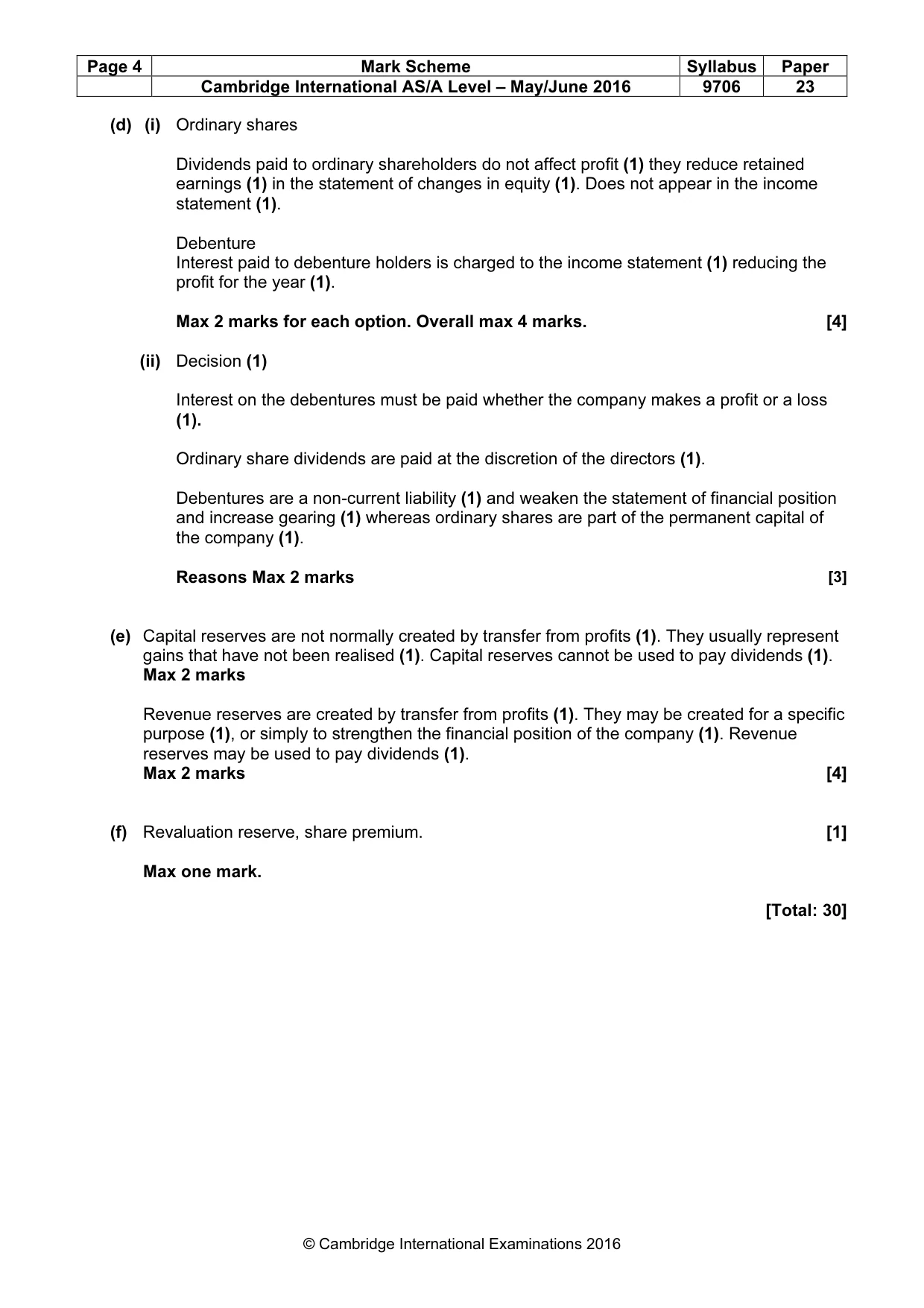
Page 4 Mark Scheme Syllabus Paper Cambridge International AS/A Level – May/June 2016 9706 23 © Cambridge International Examinations 2016 (d) (i) Ordinary shares Dividends paid to ordinary shareholders do not affect profit (1) they reduce retained earnings (1) in the statement of changes in equity (1). Does not appear in the income statement (1). Debenture Interest paid to debenture holders is charged to the income statement (1) reducing the profit for the year (1). Max 2 marks for each option. Overall max 4 marks. [4] (ii) Decision (1) Interest on the debentures must be paid whether the company makes a profit or a loss (1). Ordinary share dividends are paid at the discretion of the directors (1). Debentures are a non-current liability (1) and weaken the statement of financial position and increase gearing (1) whereas ordinary shares are part of the permanent capital of the company (1). Reasons Max 2 marks [3] (e) Capital reserves are not normally created by transfer from profits (1). They usually represent gains that have not been realised (1). Capital reserves cannot be used to pay dividends (1). Max 2 marks Revenue reserves are created by transfer from profits (1). They may be created for a specific purpose (1), or simply to strengthen the financial position of the company (1). Revenue reserves may be used to pay dividends (1). Max 2 marks [4] (f) Revaluation reserve, share premium. [1] Max one mark. [Total: 30]
Mark scheme, page 5
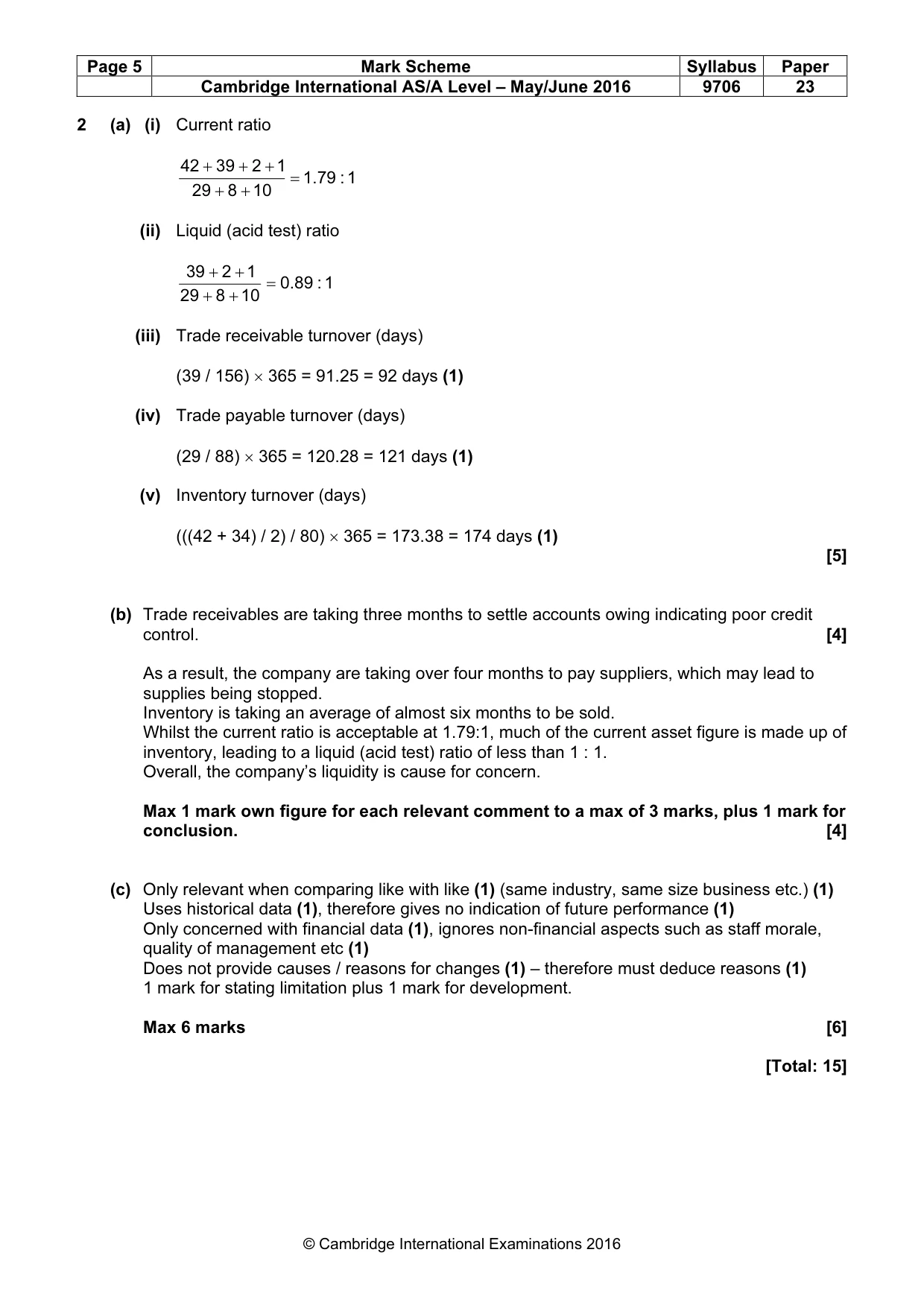
Page 5 Mark Scheme Syllabus Paper Cambridge International AS/A Level – May/June 2016 9706 23 © Cambridge International Examinations 2016 2 (a) (i) Current ratio 1 : 1.79 10 8 29 1 2 39 42 = + + + + + (ii) Liquid (acid test) ratio 1 : 0.89 10 8 29 1 2 39 = + + + + (iii) Trade receivable turnover (days) (39 / 156) × 365 = 91.25 = 92 days (1) (iv) Trade payable turnover (days) (29 / 88) × 365 = 120.28 = 121 days (1) (v) Inventory turnover (days) (((42 + 34) / 2) / 80) × 365 = 173.38 = 174 days (1) [5] (b) Trade receivables are taking three months to settle accounts owing indicating poor credit control. [4] As a result, the company are taking over four months to pay suppliers, which may lead to supplies being stopped. Inventory is taking an average of almost six months to be sold. Whilst the current ratio is acceptable at 1.79:1, much of the current asset figure is made up of inventory, leading to a liquid (acid test) ratio of less than 1 : 1. Overall, the company’s liquidity is cause for concern. Max 1 mark own figure for each relevant comment to a max of 3 marks, plus 1 mark for conclusion. [4] (c) Only relevant when comparing like with like (1) (same industry, same size business etc.) (1) Uses historical data (1), therefore gives no indication of future performance (1) Only concerned with financial data (1), ignores non-financial aspects such as staff morale, quality of management etc (1) Does not provide causes / reasons for changes (1) – therefore must deduce reasons (1) 1 mark for stating limitation plus 1 mark for development. Max 6 marks [6] [Total: 15]
Mark scheme, page 6
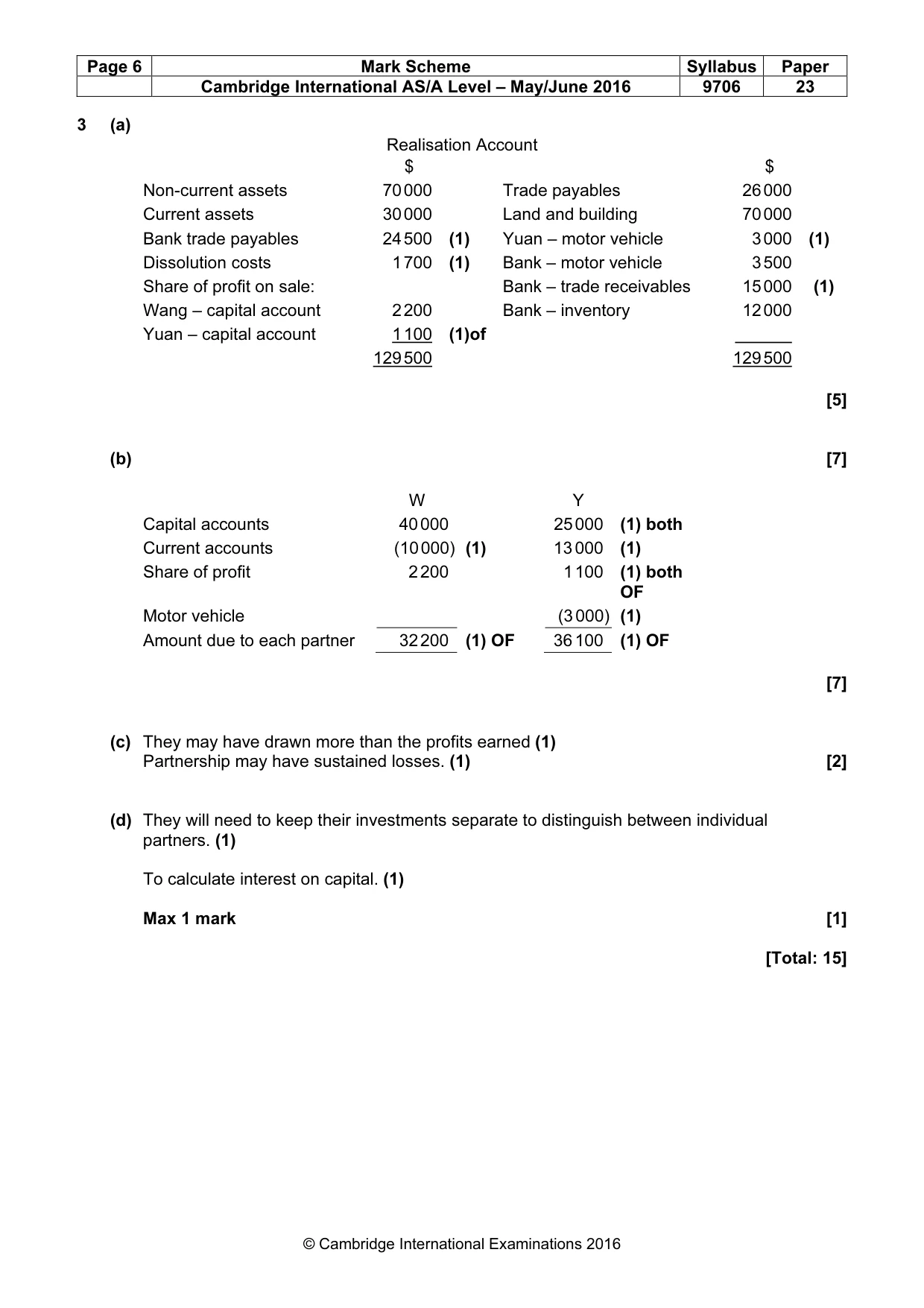
Page 6 Mark Scheme Syllabus Paper Cambridge International AS/A Level – May/June 2016 9706 23 © Cambridge International Examinations 2016 3 (a) Realisation Account $ $ Non-current assets 70 000 Trade payables 26 000 Current assets 30 000 Land and building 70 000 Bank trade payables 24 500 (1) Yuan – motor vehicle 3 000 (1) Dissolution costs 1 700 (1) Bank – motor vehicle 3 500 Share of profit on sale: Bank – trade receivables 15 000 (1) Wang – capital account 2 200 Bank – inventory 12 000 Yuan – capital account 1 100 (1)of 129 500 129 500 [5] (b) [7] W Y Capital accounts 40 000 25 000 (1) both Current accounts (10 000) (1) 13 000 (1) Share of profit 2 200 1 100 (1) both OF Motor vehicle (3 000) (1) Amount due to each partner 32 200 (1) OF 36 100 (1) OF [7] (c) They may have drawn more than the profits earned (1) Partnership may have sustained losses. (1) [2] (d) They will need to keep their investments separate to distinguish between individual partners. (1) To calculate interest on capital. (1) Max 1 mark [1] [Total: 15]
Mark scheme, page 7
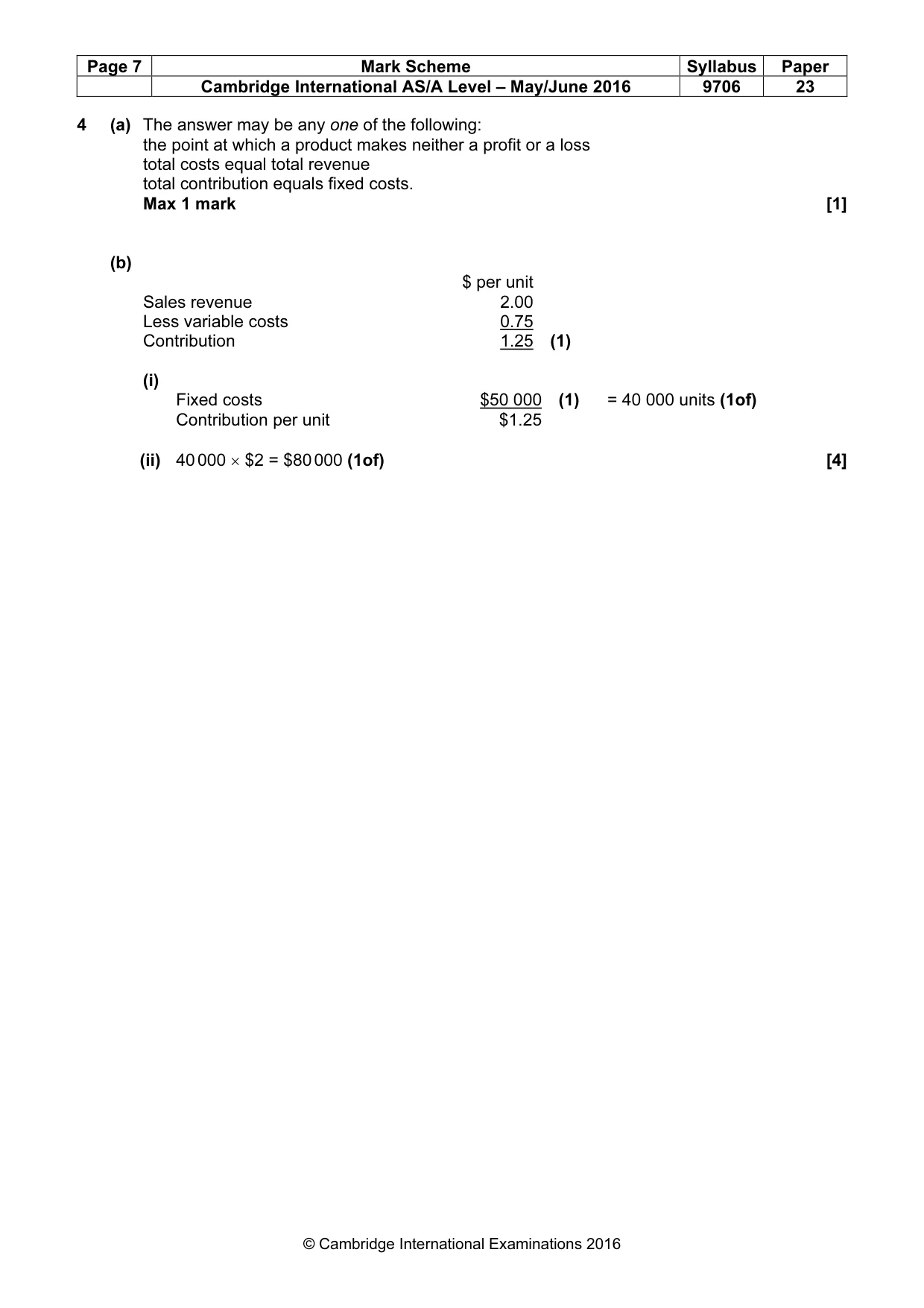
Page 7 Mark Scheme Syllabus Paper Cambridge International AS/A Level – May/June 2016 9706 23 © Cambridge International Examinations 2016 4 (a) The answer may be any one of the following: the point at which a product makes neither a profit or a loss total costs equal total revenue total contribution equals fixed costs. Max 1 mark [1] (b) $ per unit Sales revenue 2.00 Less variable costs 0.75 Contribution 1.25 (1) (i) Fixed costs $50 000 (1) = 40 000 units (1of) Contribution per unit $1.25 (ii) 40 000 × $2 = $80 000 (1of) [4]
Mark scheme, page 8
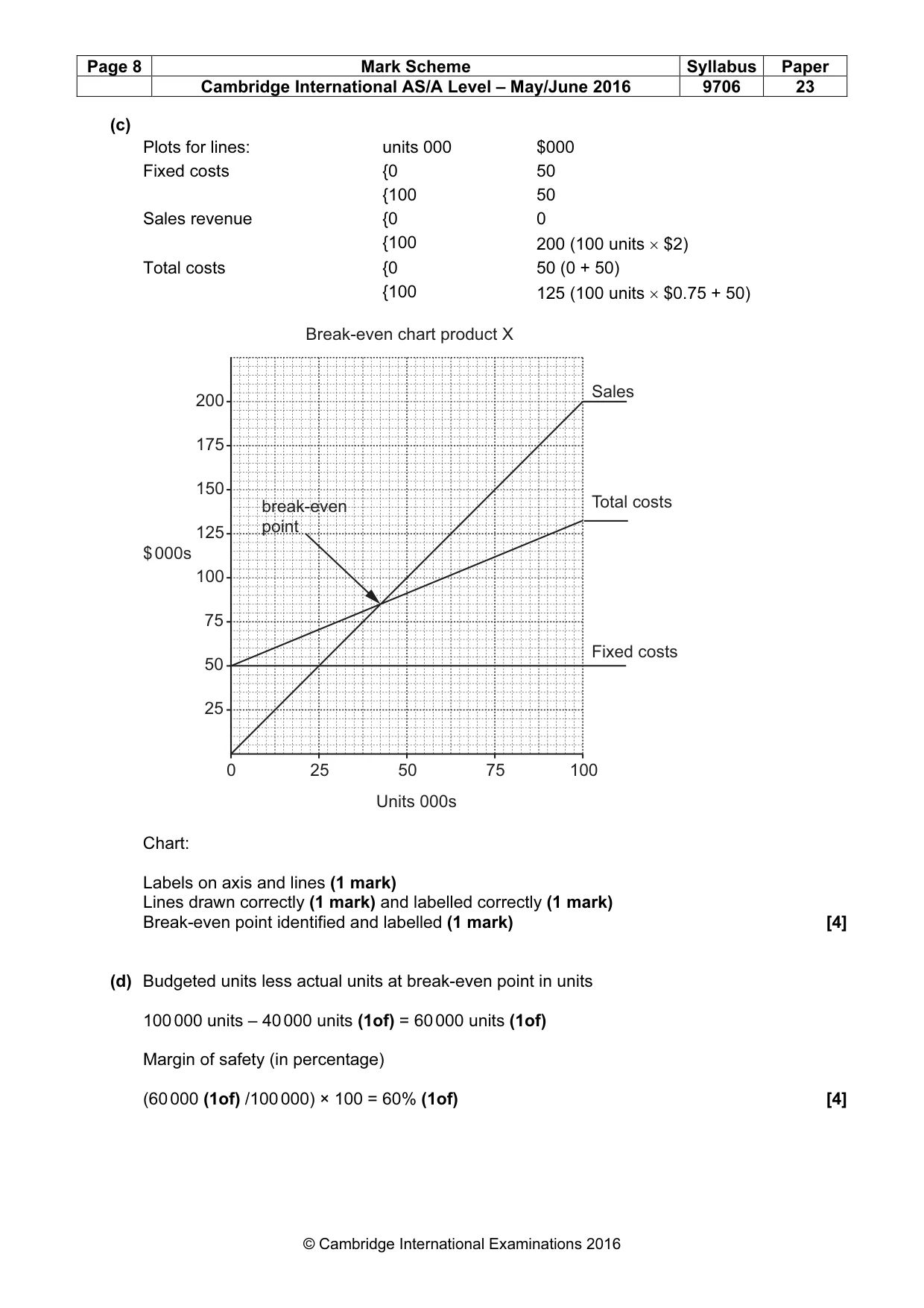
Page 8 Mark Scheme Syllabus Paper Cambridge International AS/A Level – May/June 2016 9706 23 © Cambridge International Examinations 2016 (c) Plots for lines: units 000 $000 Fixed costs {0 50 {100 50 Sales revenue {0 0 {100 200 (100 units × $2) Total costs {0 50 (0 + 50) {100 125 (100 units × $0.75 + 50) Chart: Labels on axis and lines (1 mark) Lines drawn correctly (1 mark) and labelled correctly (1 mark) Break-even point identified and labelled (1 mark) [4] (d) Budgeted units less actual units at break-even point in units 100 000 units – 40 000 units (1of) = 60 000 units (1of) Margin of safety (in percentage) (60 000 (1of) /100 000) × 100 = 60% (1of) [4] 25 50 75 100 125 150 175 200 25 50 75 100 Units 000s break-even point Total costs Break-even chart product X $ 000s Fixed costs Sales 0
Mark scheme, page 9
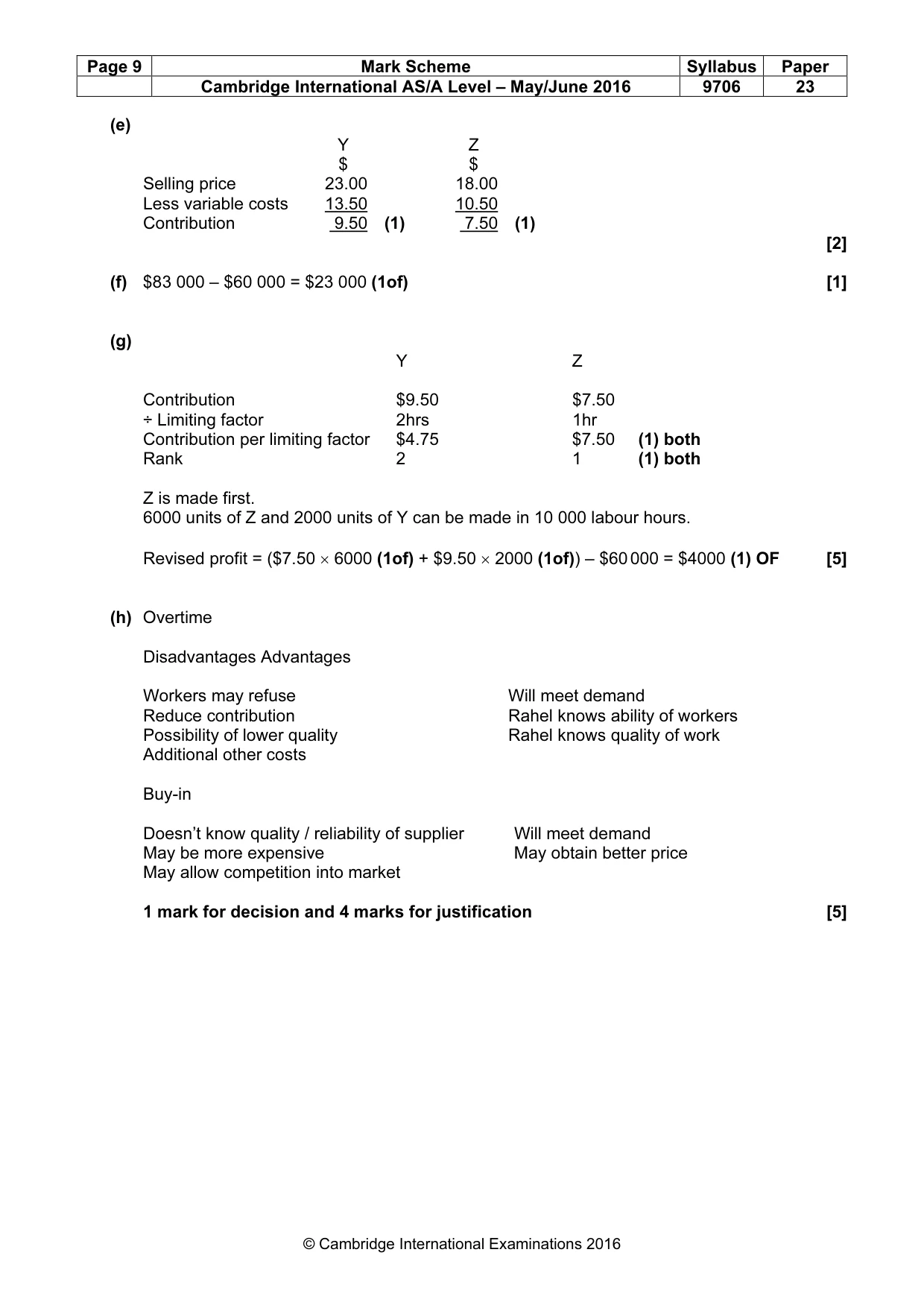
Page 9 Mark Scheme Syllabus Paper Cambridge International AS/A Level – May/June 2016 9706 23 © Cambridge International Examinations 2016 (e) Y Z $ $ Selling price 23.00 18.00 Less variable costs 13.50 10.50 Contribution 9.50 (1) 7.50 (1) [2] (f) $83 000 – $60 000 = $23 000 (1of) [1] (g) Y Z Contribution $9.50 $7.50 ÷ Limiting factor 2hrs 1hr Contribution per limiting factor $4.75 $7.50 (1) both Rank 2 1 (1) both Z is made first. 6000 units of Z and 2000 units of Y can be made in 10 000 labour hours. Revised profit = ($7.50 × 6000 (1of) + $9.50 × 2000 (1of)) – $60 000 = $4000 (1) OF [5] (h) Overtime Disadvantages Advantages Workers may refuse Will meet demand Reduce contribution Rahel knows ability of workers Possibility of lower quality Rahel knows quality of work Additional other costs Buy-in Doesn’t know quality / reliability of supplier Will meet demand May be more expensive May obtain better price May allow competition into market 1 mark for decision and 4 marks for justification [5]
Mark scheme, page 10
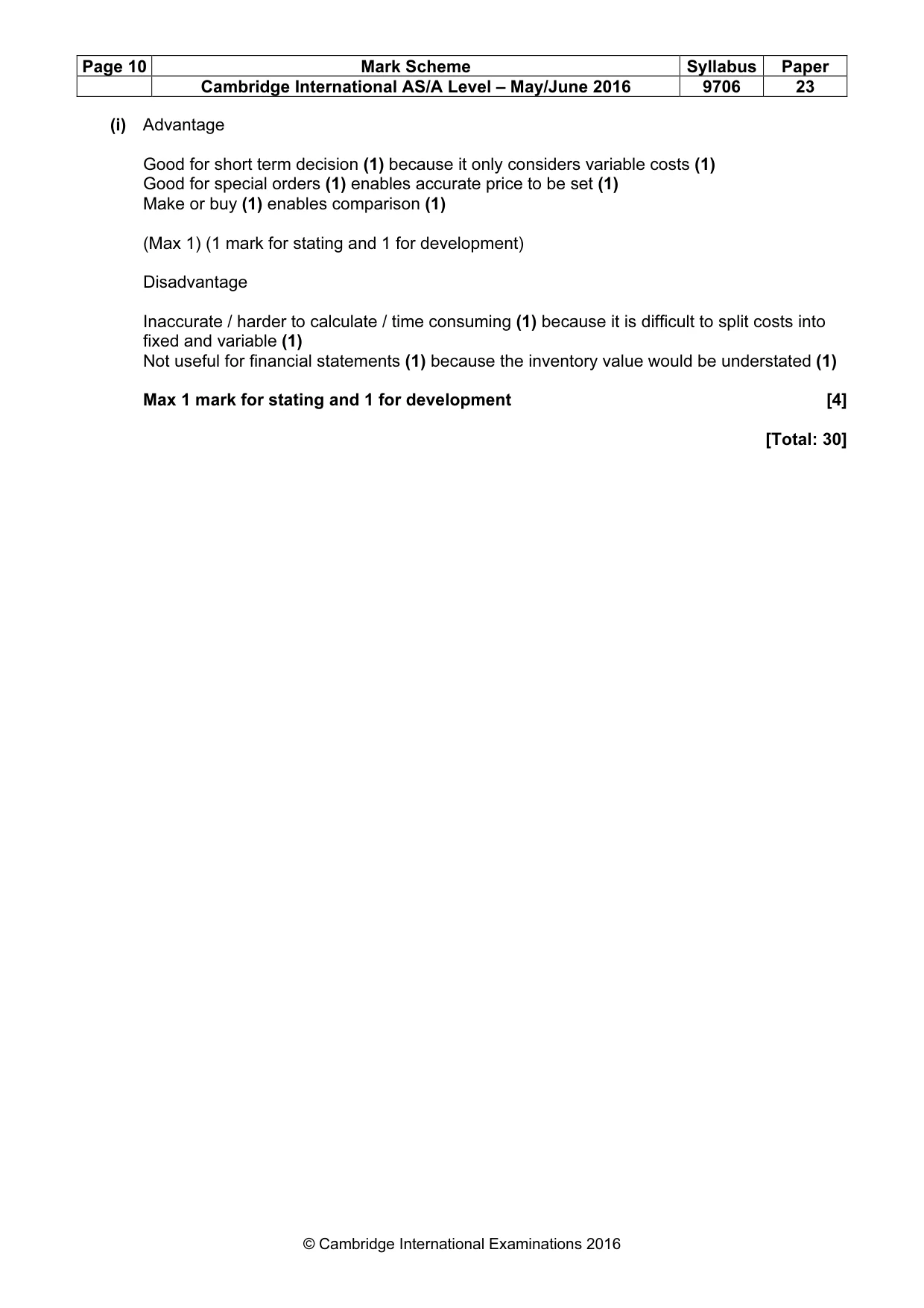
Page 10 Mark Scheme Syllabus Paper Cambridge International AS/A Level – May/June 2016 9706 23 © Cambridge International Examinations 2016 (i) Advantage Good for short term decision (1) because it only considers variable costs (1) Good for special orders (1) enables accurate price to be set (1) Make or buy (1) enables comparison (1) (Max 1) (1 mark for stating and 1 for development) Disadvantage Inaccurate / harder to calculate / time consuming (1) because it is difficult to split costs into fixed and variable (1) Not useful for financial statements (1) because the inventory value would be understated (1) Max 1 mark for stating and 1 for development [4] [Total: 30]
What you needed in this session
Cambridge’s own grade thresholds for 2016 May/June, Paper 2 · Variant 3. A higher threshold means an easier paper — the bar moves with how the cohort did.