Cambridge A Level Accounting 9706 — 2015 Oct/Nov Paper 4 · Variant 2
9706/42/O/N/15 · 120 marks · ≈135 min
The question paper and its mark scheme, free to read here and free to download. This is Cambridge’s own paper, exactly as it was sat.
Question paper8 pages

Mark scheme
No mark scheme is in the library for this paper.
Paper as text
Question paper, page 1
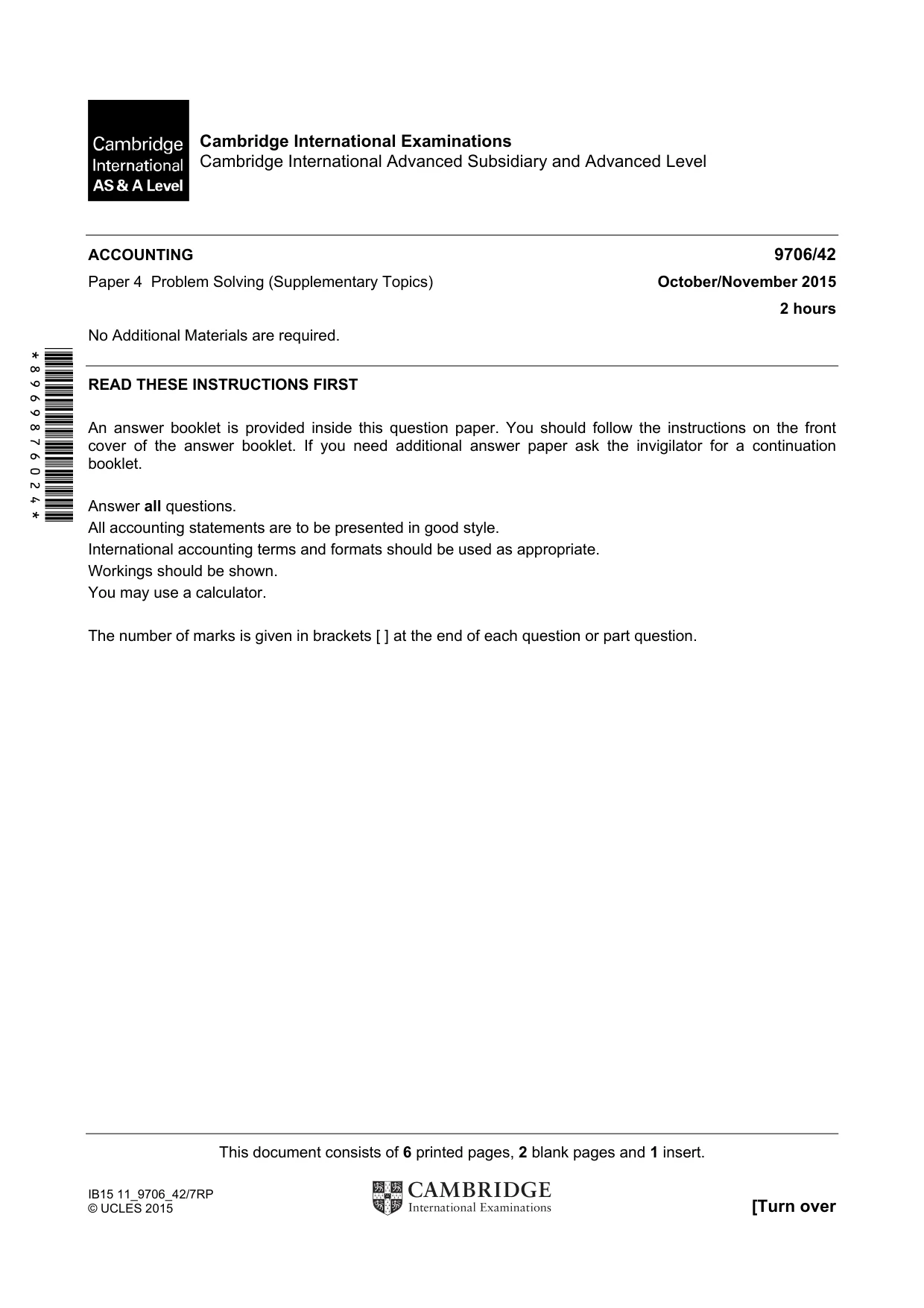
This document consists of 6 printed pages, 2 blank pages and 1 insert. IB15 11_9706_42/7RP © UCLES 2015 [Turn over *8969876024* Cambridge International Examinations Cambridge International Advanced Subsidiary and Advanced Level ACCOUNTING 9706/42 Paper 4 Problem Solving (Supplementary Topics) October/November 2015 2 hours No Additional Materials are required. READ THESE INSTRUCTIONS FIRST An answer booklet is provided inside this question paper. You should follow the instructions on the front cover of the answer booklet. If you need additional answer paper ask the invigilator for a continuation booklet. Answer all questions. All accounting statements are to be presented in good style. International accounting terms and formats should be used as appropriate. Workings should be shown. You may use a calculator. The number of marks is given in brackets [ ] at the end of each question or part question.
Question paper, page 2
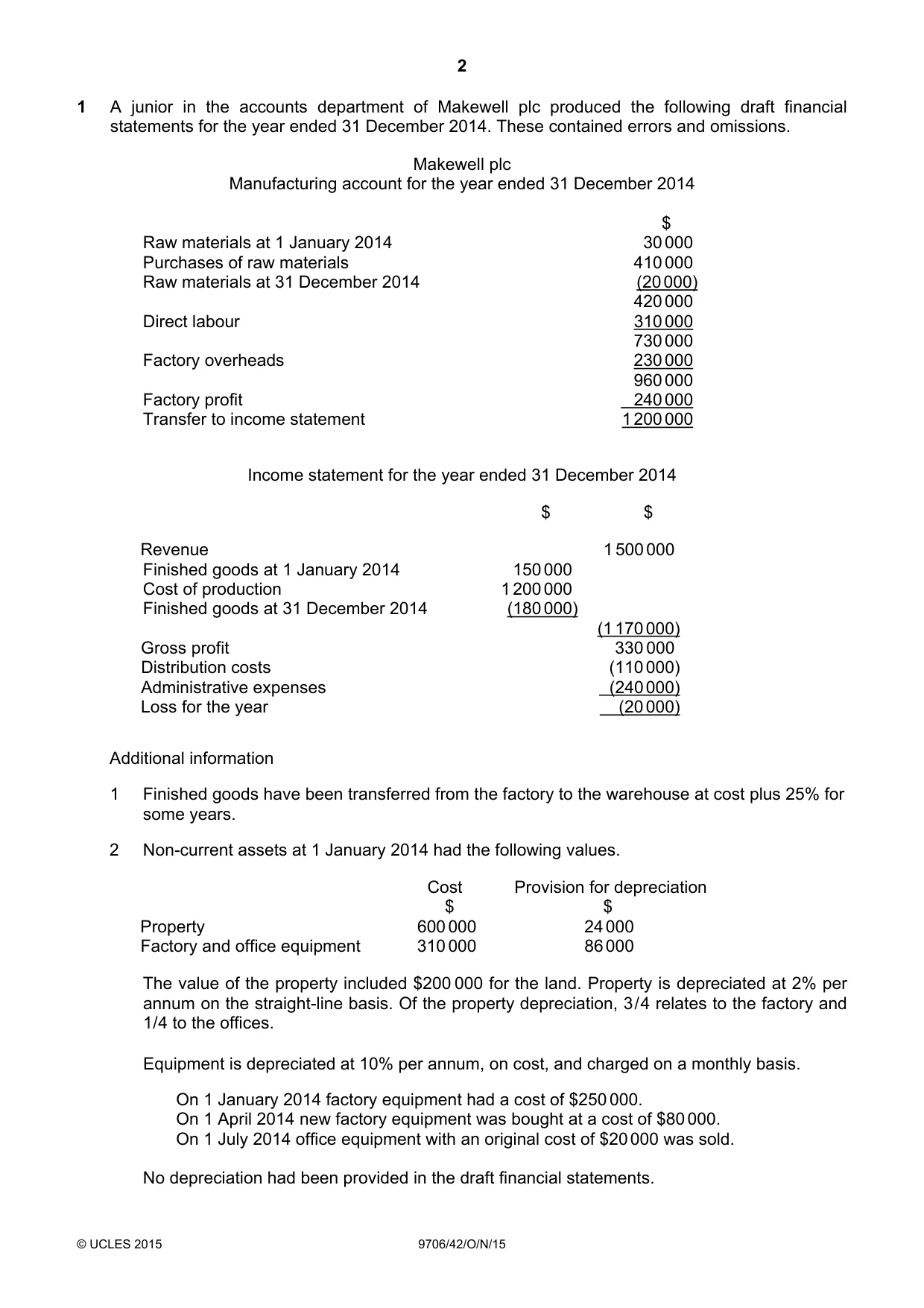
2 © UCLES 2015 9706/42/O/N/15 1 A junior in the accounts department of Makewell plc produced the following draft financial statements for the year ended 31 December 2014. These contained errors and omissions. Makewell plc Manufacturing account for the year ended 31 December 2014 $ Raw materials at 1 January 2014 30 000 Purchases of raw materials 410 000 Raw materials at 31 December 2014 (20 000) 420 000 Direct labour 310 000 730 000 Factory overheads 230 000 960 000 Factory profit 240 000 Transfer to income statement 1 200 000 Income statement for the year ended 31 December 2014 $ $ Revenue 1 500 000 Finished goods at 1 January 2014 150 000 Cost of production 1 200 000 Finished goods at 31 December 2014 (180 000) (1 170 000) Gross profit 330 000 Distribution costs (110 000) Administrative expenses (240 000) Loss for the year (20 000) Additional information 1 Finished goods have been transferred from the factory to the warehouse at cost plus 25% for some years. 2 Non-current assets at 1 January 2014 had the following values. Cost Provision for depreciation $ $ Property 600 000 24 000 Factory and office equipment 310 000 86 000 The value of the property included $200 000 for the land. Property is depreciated at 2% per annum on the straight-line basis. Of the property depreciation, 3 / 4 relates to the factory and 1 / 4 to the offices. Equipment is depreciated at 10% per annum, on cost, and charged on a monthly basis. On 1 January 2014 factory equipment had a cost of $250 000. On 1 April 2014 new factory equipment was bought at a cost of $80 000. On 1 July 2014 office equipment with an original cost of $20 000 was sold. No depreciation had been provided in the draft financial statements.
Question paper, page 3
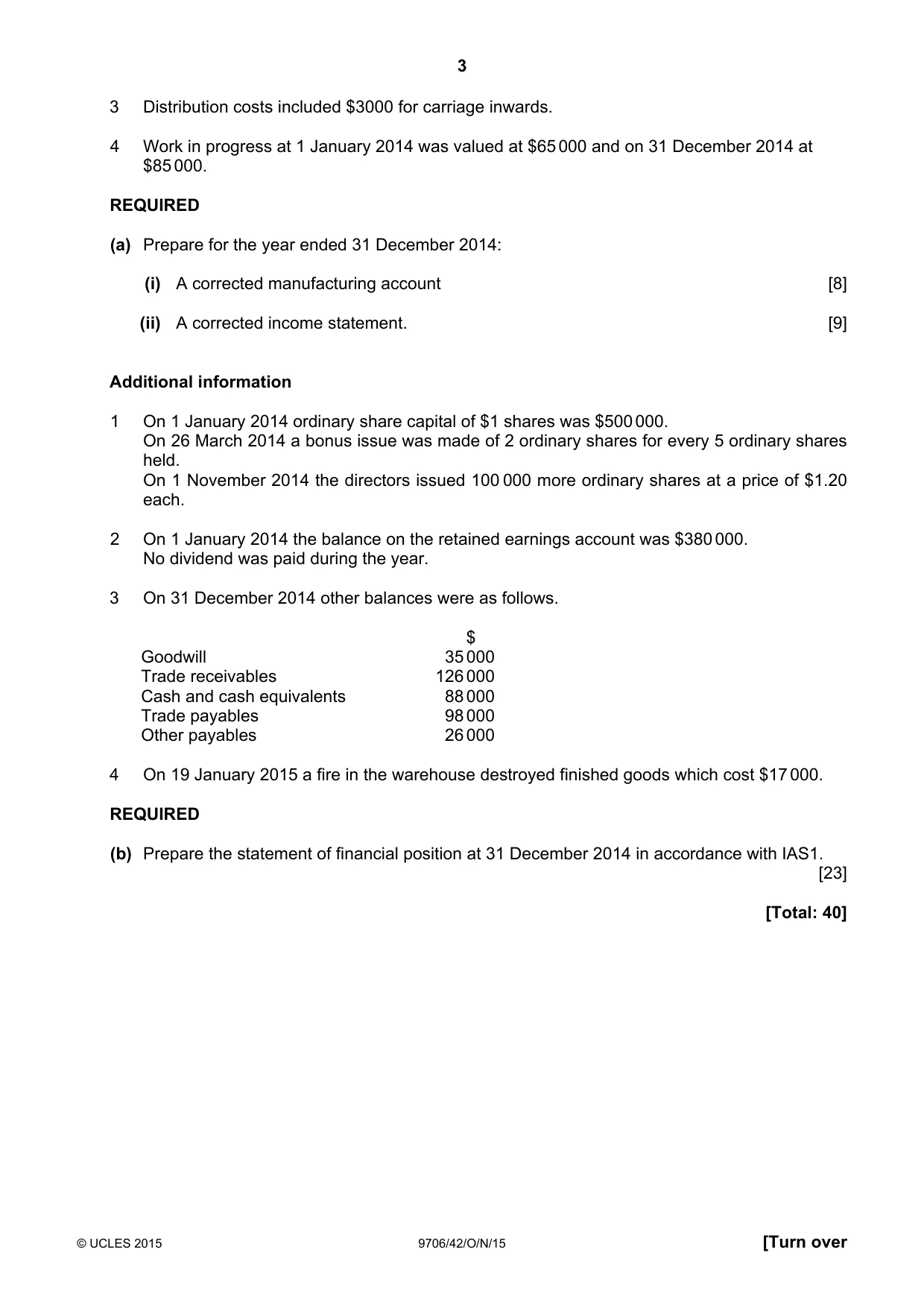
3 © UCLES 2015 9706/42/O/N/15 [Turn over 3 Distribution costs included $3000 for carriage inwards. 4 Work in progress at 1 January 2014 was valued at $65 000 and on 31 December 2014 at $85 000. REQUIRED (a) Prepare for the year ended 31 December 2014: (i) A corrected manufacturing account [8] (ii) A corrected income statement. [9] Additional information 1 On 1 January 2014 ordinary share capital of $1 shares was $500 000. On 26 March 2014 a bonus issue was made of 2 ordinary shares for every 5 ordinary shares held. On 1 November 2014 the directors issued 100 000 more ordinary shares at a price of $1.20 each. 2 On 1 January 2014 the balance on the retained earnings account was $380 000. No dividend was paid during the year. 3 On 31 December 2014 other balances were as follows. $ Goodwill 35 000 Trade receivables 126 000 Cash and cash equivalents 88 000 Trade payables 98 000 Other payables 26 000 4 On 19 January 2015 a fire in the warehouse destroyed finished goods which cost $17 000. REQUIRED (b) Prepare the statement of financial position at 31 December 2014 in accordance with IAS1. [23] [Total: 40]
Question paper, page 4
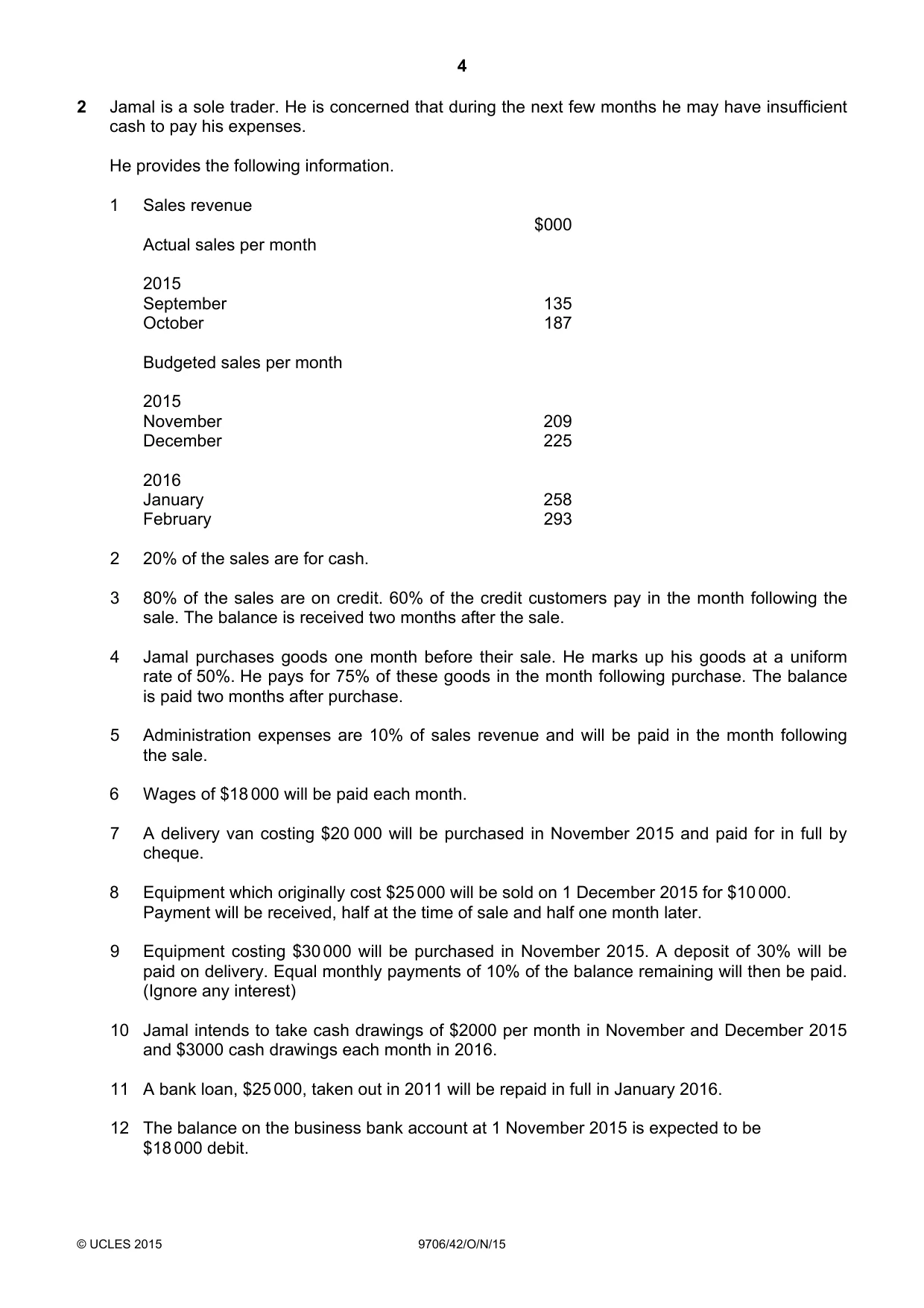
4 © UCLES 2015 9706/42/O/N/15 2 Jamal is a sole trader. He is concerned that during the next few months he may have insufficient cash to pay his expenses. He provides the following information. 1 Sales revenue $000 Actual sales per month 2015 September 135 October 187 Budgeted sales per month 2015 November 209 December 225 2016 January 258 February 293 2 20% of the sales are for cash. 3 80% of the sales are on credit. 60% of the credit customers pay in the month following the sale. The balance is received two months after the sale. 4 Jamal purchases goods one month before their sale. He marks up his goods at a uniform rate of 50%. He pays for 75% of these goods in the month following purchase. The balance is paid two months after purchase. 5 Administration expenses are 10% of sales revenue and will be paid in the month following the sale. 6 Wages of $18 000 will be paid each month. 7 A delivery van costing $20 000 will be purchased in November 2015 and paid for in full by cheque. 8 Equipment which originally cost $25 000 will be sold on 1 December 2015 for $10 000. Payment will be received, half at the time of sale and half one month later. 9 Equipment costing $30 000 will be purchased in November 2015. A deposit of 30% will be paid on delivery. Equal monthly payments of 10% of the balance remaining will then be paid. (Ignore any interest) 10 Jamal intends to take cash drawings of $2000 per month in November and December 2015 and $3000 cash drawings each month in 2016. 11 A bank loan, $25 000, taken out in 2011 will be repaid in full in January 2016. 12 The balance on the business bank account at 1 November 2015 is expected to be $18 000 debit.
Question paper, page 5
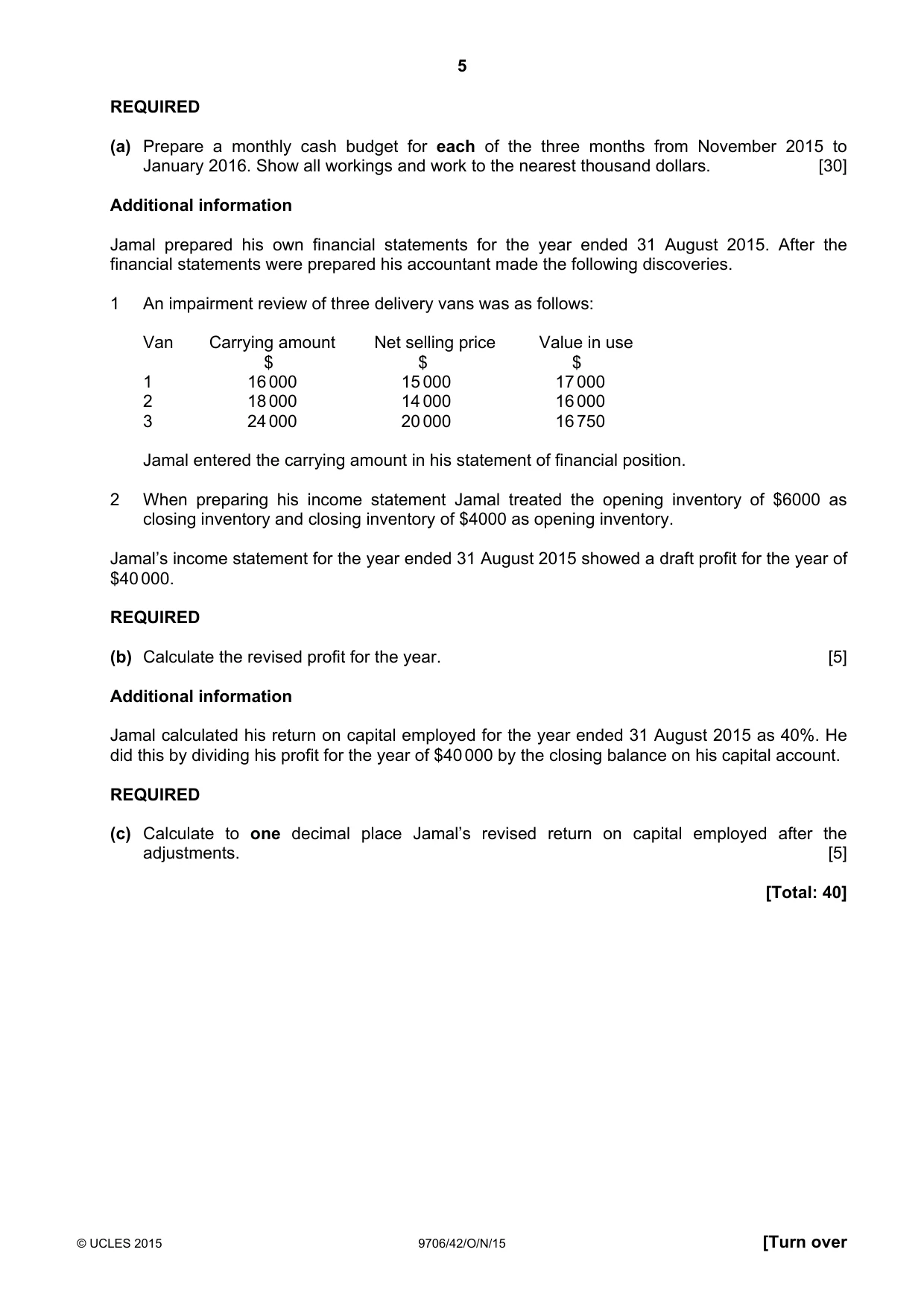
5 © UCLES 2015 9706/42/O/N/15 [Turn over REQUIRED (a) Prepare a monthly cash budget for each of the three months from November 2015 to January 2016. Show all workings and work to the nearest thousand dollars. [30] Additional information Jamal prepared his own financial statements for the year ended 31 August 2015. After the financial statements were prepared his accountant made the following discoveries. 1 An impairment review of three delivery vans was as follows: Van Carrying amount Net selling price Value in use $ $ $ 1 16 000 15 000 17 000 2 18 000 14 000 16 000 3 24 000 20 000 16 750 Jamal entered the carrying amount in his statement of financial position. 2 When preparing his income statement Jamal treated the opening inventory of $6000 as closing inventory and closing inventory of $4000 as opening inventory. Jamal’s income statement for the year ended 31 August 2015 showed a draft profit for the year of $40 000. REQUIRED (b) Calculate the revised profit for the year. [5] Additional information Jamal calculated his return on capital employed for the year ended 31 August 2015 as 40%. He did this by dividing his profit for the year of $40 000 by the closing balance on his capital account. REQUIRED (c) Calculate to one decimal place Jamal’s revised return on capital employed after the adjustments. [5] [Total: 40]
Question paper, page 6
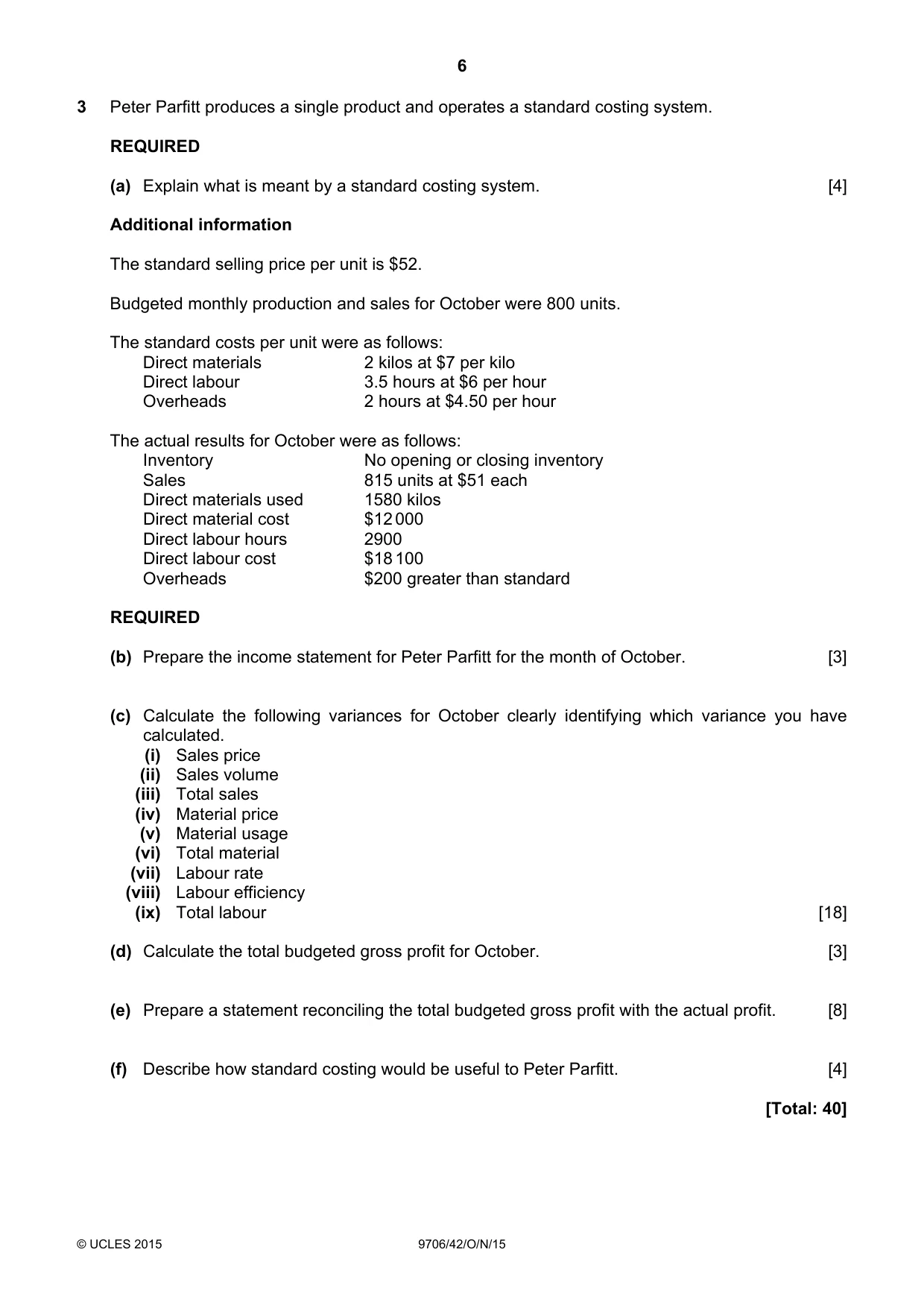
6 © UCLES 2015 9706/42/O/N/15 3 Peter Parfitt produces a single product and operates a standard costing system. REQUIRED (a) Explain what is meant by a standard costing system. [4] Additional information The standard selling price per unit is $52. Budgeted monthly production and sales for October were 800 units. The standard costs per unit were as follows: Direct materials 2 kilos at $7 per kilo Direct labour 3.5 hours at $6 per hour Overheads 2 hours at $4.50 per hour The actual results for October were as follows: Inventory No opening or closing inventory Sales 815 units at $51 each Direct materials used 1580 kilos Direct material cost $12 000 Direct labour hours 2900 Direct labour cost $18 100 Overheads $200 greater than standard REQUIRED (b) Prepare the income statement for Peter Parfitt for the month of October. [3] (c) Calculate the following variances for October clearly identifying which variance you have calculated. (i) Sales price (ii) Sales volume (iii) Total sales (iv) Material price (v) Material usage (vi) Total material (vii) Labour rate (viii) Labour efficiency (ix) Total labour [18] (d) Calculate the total budgeted gross profit for October. [3] (e) Prepare a statement reconciling the total budgeted gross profit with the actual profit. [8] (f) Describe how standard costing would be useful to Peter Parfitt. [4] [Total: 40]
Question paper, page 7
7 © UCLES 2015 9706/42/O/N/15 BLANK PAGE
Question paper, page 8
8 Permission to reproduce items where third-party owned material protected by copyright is included has been sought and cleared where possible. Every reasonable effort has been made by the publisher (UCLES) to trace copyright holders, but if any items requiring clearance have unwittingly been included, the publisher will be pleased to make amends at the earliest possible opportunity. To avoid the issue of disclosure of answer-related information to candidates, all copyright acknowledgements are reproduced online in the Cambridge International Examinations Copyright Acknowledgements Booklet. This is produced for each series of examinations and is freely available to download at www.cie.org.uk after the live examination series. Cambridge International Examinations is part of the Cambridge Assessment Group. Cambridge Assessment is the brand name of University of Cambridge Local Examinations Syndicate (UCLES), which is itself a department of the University of Cambridge. © UCLES 2015 9706/42/O/N/15 BLANK PAGE
What you needed in this session
Cambridge’s own grade thresholds for 2015 Oct/Nov, Paper 4 · Variant 2. A higher threshold means an easier paper — the bar moves with how the cohort did.