Cambridge A Level Accounting 9706 — 2014 Oct/Nov Paper 2 · Variant 2
9706/22/O/N/14 · 90 marks · ≈101 min
The question paper and its mark scheme, free to read here and free to download. This is Cambridge’s own paper, exactly as it was sat.
Question paper16 pages
Mark scheme7 pages
Answers below. Sit the paper first if you are practising.
Paper as text
Question paper, page 1
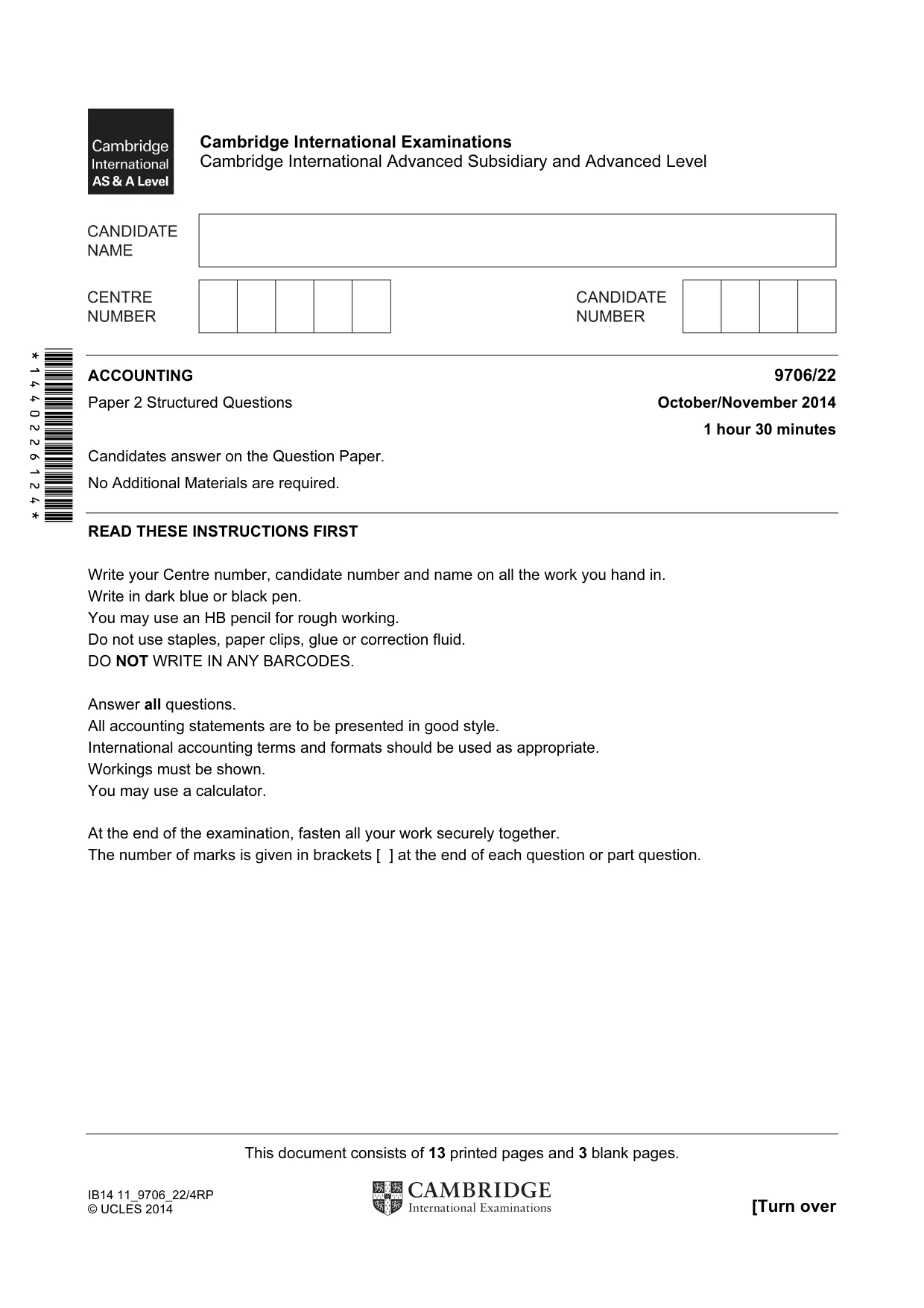
This document consists of 13 printed pages and 3 blank pages. IB14 11_9706_22/4RP © UCLES 2014 [Turn over *1440226124* Cambridge International Examinations Cambridge International Advanced Subsidiary and Advanced Level ACCOUNTING 9706/22 Paper 2 Structured Questions October/November 2014 1 hour 30 minutes Candidates answer on the Question Paper. No Additional Materials are required. READ THESE INSTRUCTIONS FIRST Write your Centre number, candidate number and name on all the work you hand in. Write in dark blue or black pen. You may use an HB pencil for rough working. Do not use staples, paper clips, glue or correction fluid. DO NOT WRITE IN ANY BARCODES. Answer all questions. All accounting statements are to be presented in good style. International accounting terms and formats should be used as appropriate. Workings must be shown. You may use a calculator. At the end of the examination, fasten all your work securely together. The number of marks is given in brackets [ ] at the end of each question or part question.
Question paper, page 2
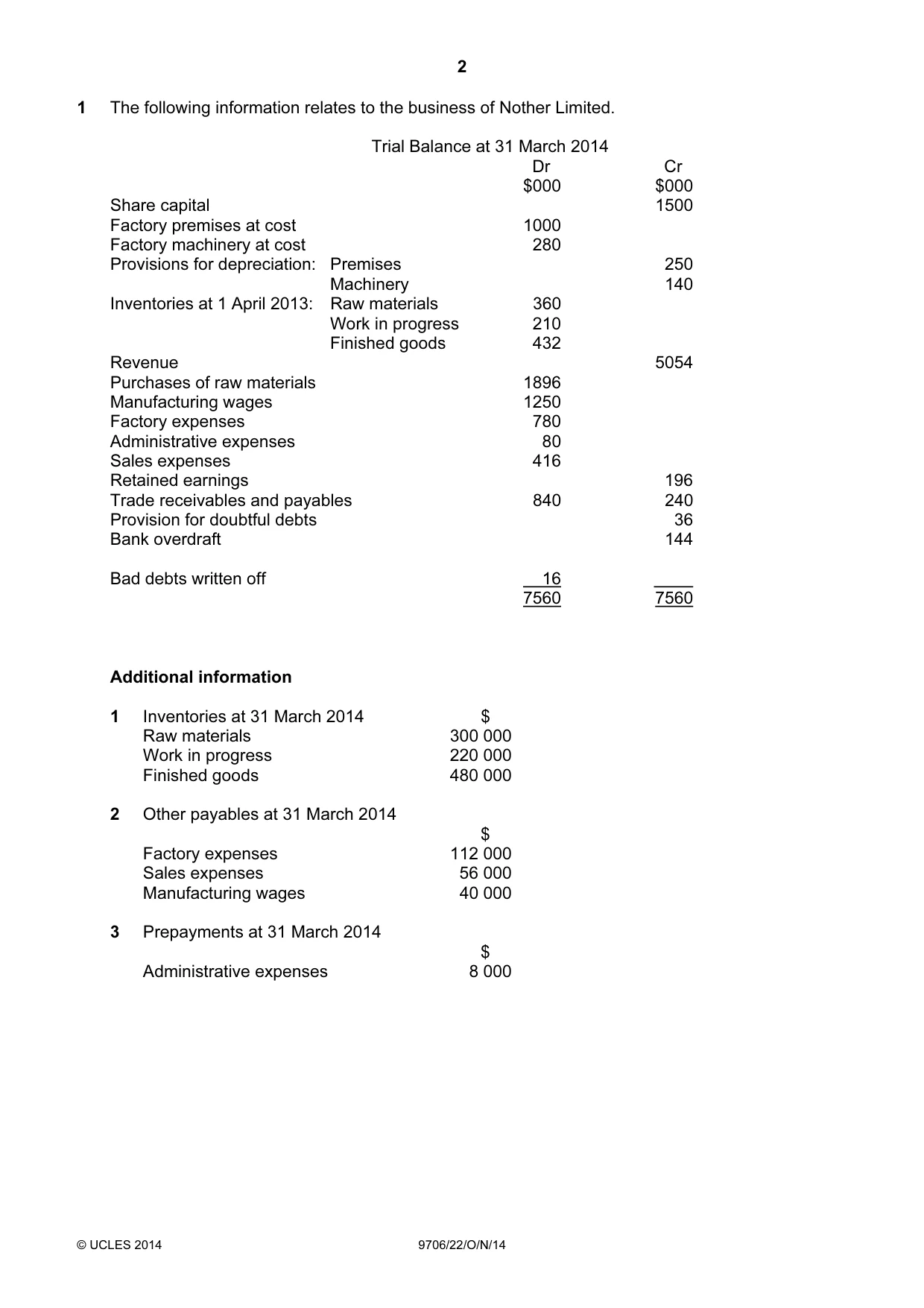
2 © UCLES 2014 9706/22/O/N/14 1 The following information relates to the business of Nother Limited. Trial Balance at 31 March 2014 Dr Cr $000 $000 Share capital 1500 Factory premises at cost 1000 Factory machinery at cost 280 Provisions for depreciation: Premises 250 Machinery 140 Inventories at 1 April 2013: Raw materials 360 Work in progress 210 Finished goods 432 Revenue 5054 Purchases of raw materials 1896 Manufacturing wages 1250 Factory expenses 780 Administrative expenses 80 Sales expenses 416 Retained earnings 196 Trade receivables and payables 840 240 Provision for doubtful debts 36 Bank overdraft 144 Bad debts written off 16 7560 7560 Additional information 1 Inventories at 31 March 2014 $ Raw materials 300 000 Work in progress 220 000 Finished goods 480 000 2 Other payables at 31 March 2014 $ Factory expenses 112 000 Sales expenses 56 000 Manufacturing wages 40 000 3 Prepayments at 31 March 2014 $ Administrative expenses 8 000
Question paper, page 3
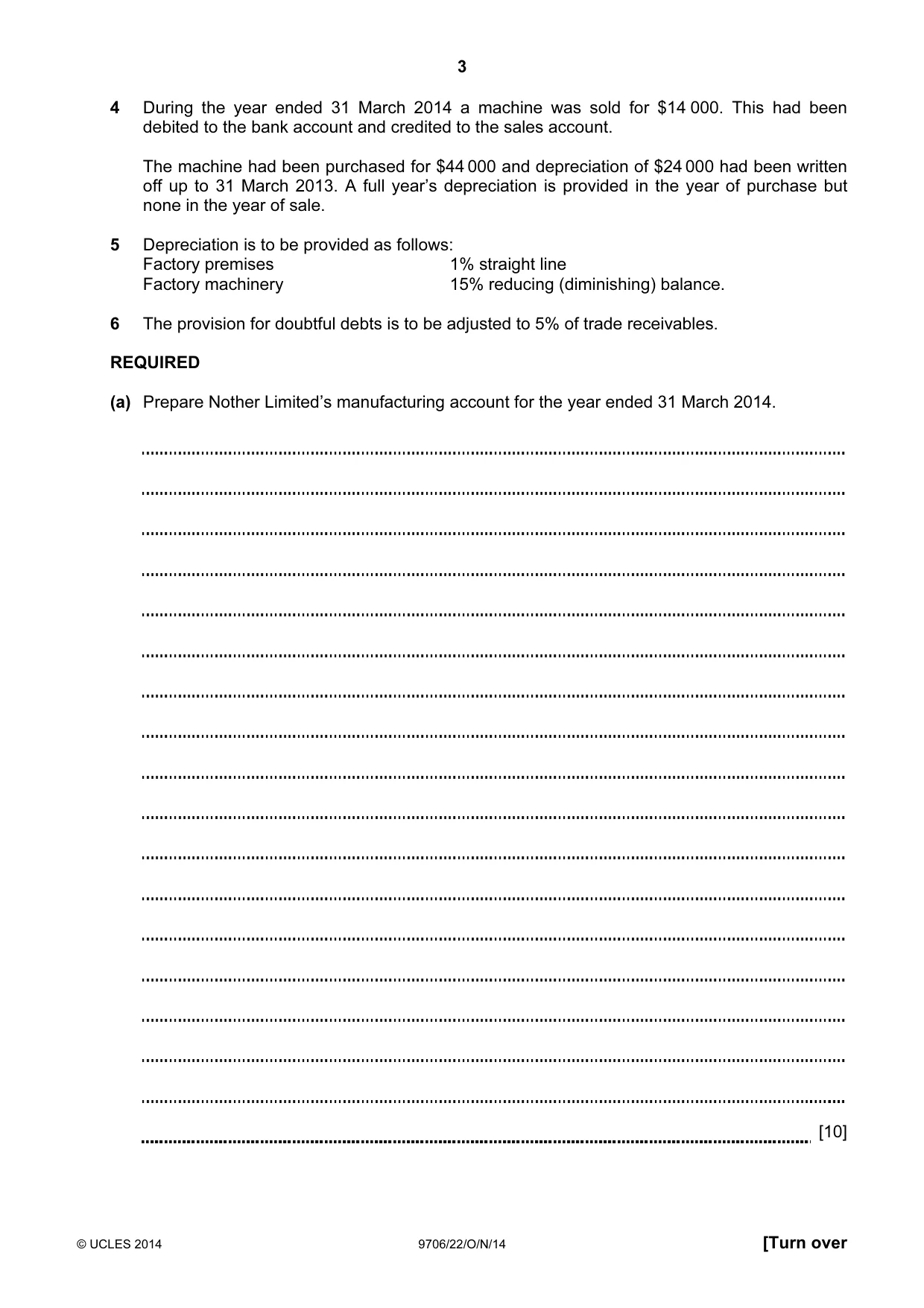
3 © UCLES 2014 9706/22/O/N/14 [Turn over 4 During the year ended 31 March 2014 a machine was sold for $14 000. This had been debited to the bank account and credited to the sales account. The machine had been purchased for $44 000 and depreciation of $24 000 had been written off up to 31 March 2013. A full year’s depreciation is provided in the year of purchase but none in the year of sale. 5 Depreciation is to be provided as follows: Factory premises 1% straight line Factory machinery 15% reducing (diminishing) balance. 6 The provision for doubtful debts is to be adjusted to 5% of trade receivables. REQUIRED (a) Prepare Nother Limited’s manufacturing account for the year ended 31 March 2014. [10]
Question paper, page 4
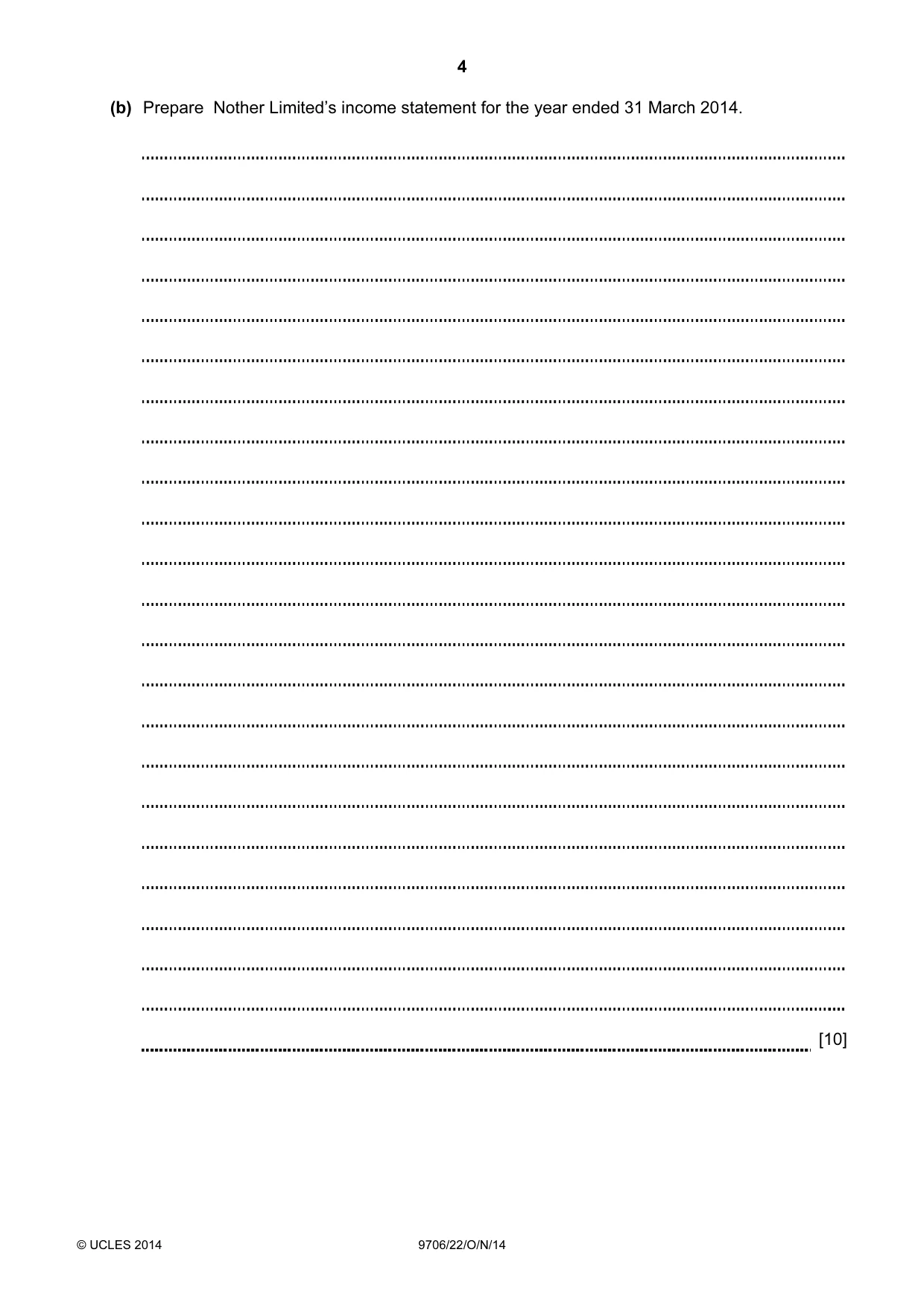
4 © UCLES 2014 9706/22/O/N/14 (b) Prepare Nother Limited’s income statement for the year ended 31 March 2014. [10]
Question paper, page 5
5 © UCLES 2014 9706/22/O/N/14 [Turn over (c) Explain the following terms. Direct costs [2] Indirect costs [4] Prime cost [2] Production cost [2] [Total: 30]
Question paper, page 6
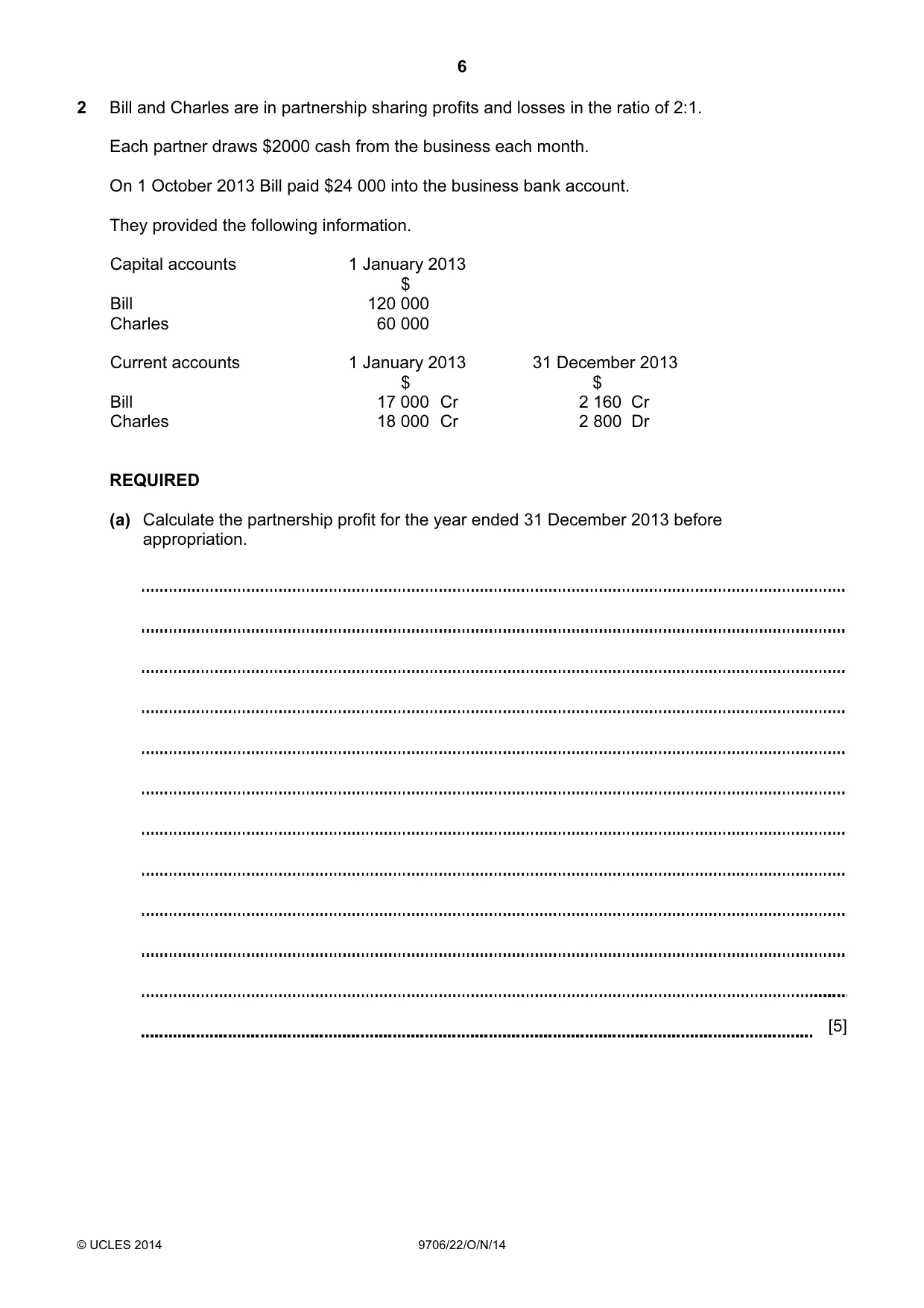
6 © UCLES 2014 9706/22/O/N/14 2 Bill and Charles are in partnership sharing profits and losses in the ratio of 2:1. Each partner draws $2000 cash from the business each month. On 1 October 2013 Bill paid $24 000 into the business bank account. They provided the following information. Capital accounts 1 January 2013 $ Bill 120 000 Charles 60 000 Current accounts 1 January 2013 31 December 2013 $ $ Bill 17 000 Cr 2 160 Cr Charles 18 000 Cr 2 800 Dr REQUIRED (a) Calculate the partnership profit for the year ended 31 December 2013 before appropriation. [5]
Question paper, page 7
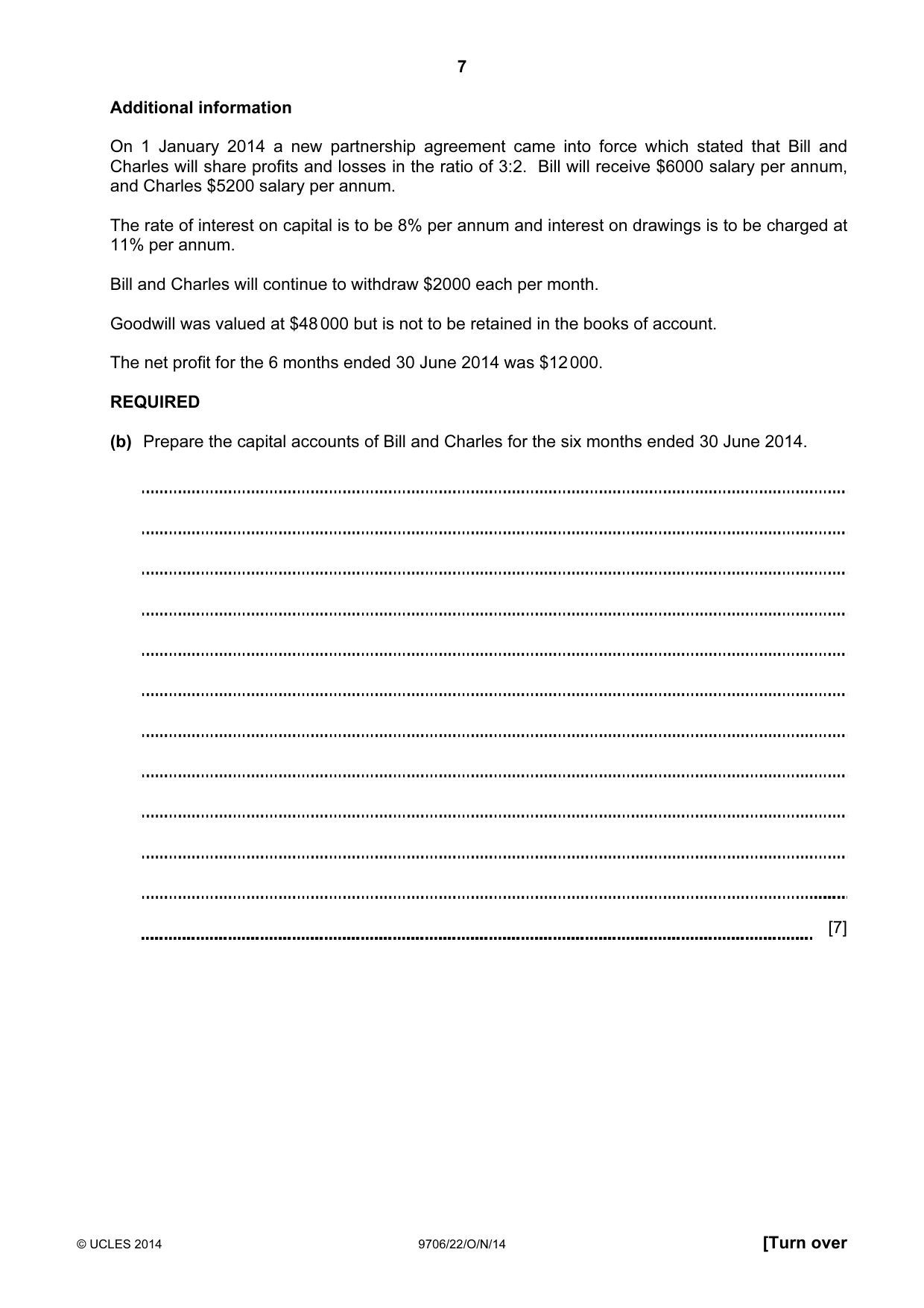
7 © UCLES 2014 9706/22/O/N/14 [Turn over Additional information On 1 January 2014 a new partnership agreement came into force which stated that Bill and Charles will share profits and losses in the ratio of 3:2. Bill will receive $6000 salary per annum, and Charles $5200 salary per annum. The rate of interest on capital is to be 8% per annum and interest on drawings is to be charged at 11% per annum. Bill and Charles will continue to withdraw $2000 each per month. Goodwill was valued at $48 000 but is not to be retained in the books of account. The net profit for the 6 months ended 30 June 2014 was $12 000. REQUIRED (b) Prepare the capital accounts of Bill and Charles for the six months ended 30 June 2014. [7]
Question paper, page 8
8 © UCLES 2014 9706/22/O/N/14 (c) Prepare the partnership appropriation account for the six months ended 30 June 2014. [7]
Question paper, page 9
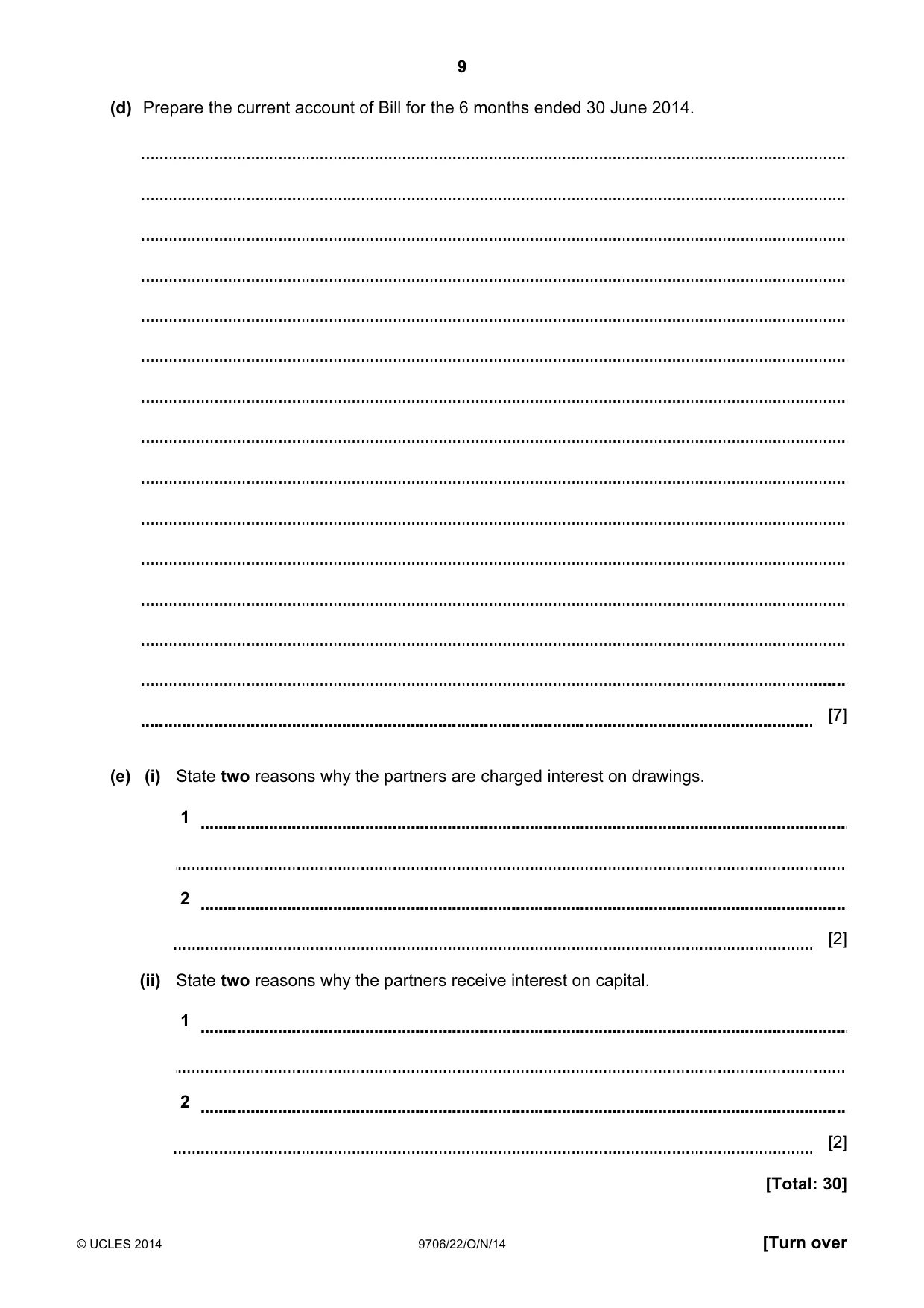
9 © UCLES 2014 9706/22/O/N/14 [Turn over (d) Prepare the current account of Bill for the 6 months ended 30 June 2014. [7] (e) (i) State two reasons why the partners are charged interest on drawings. 1 2 [2] (ii) State two reasons why the partners receive interest on capital. 1 2 [2] [Total: 30]
Question paper, page 10
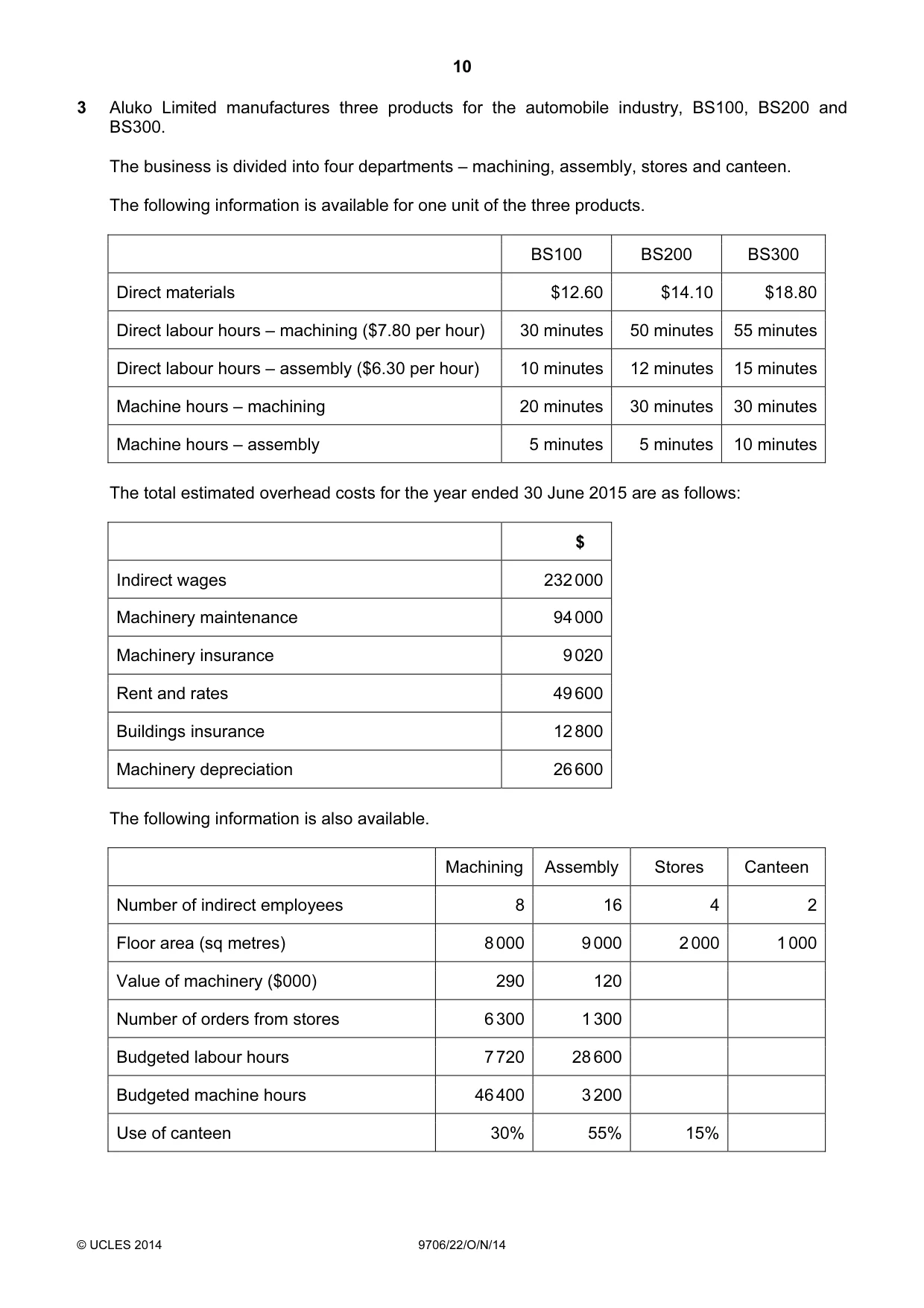
10 © UCLES 2014 9706/22/O/N/14 3 Aluko Limited manufactures three products for the automobile industry, BS100, BS200 and BS300. The business is divided into four departments – machining, assembly, stores and canteen. The following information is available for one unit of the three products. BS100 BS200 BS300 Direct materials $12.60 $14.10 $18.80 Direct labour hours – machining ($7.80 per hour) 30 minutes 50 minutes 55 minutes Direct labour hours – assembly ($6.30 per hour) 10 minutes 12 minutes 15 minutes Machine hours – machining 20 minutes 30 minutes 30 minutes Machine hours – assembly 5 minutes 5 minutes 10 minutes The total estimated overhead costs for the year ended 30 June 2015 are as follows: $ Indirect wages 232 000 Machinery maintenance 94 000 Machinery insurance 9 020 Rent and rates 49 600 Buildings insurance 12 800 Machinery depreciation 26 600 The following information is also available. Machining Assembly Stores Canteen Number of indirect employees 8 16 4 2 Floor area (sq metres) 8 000 9 000 2 000 1 000 Value of machinery ($000) 290 120 Number of orders from stores 6 300 1 300 Budgeted labour hours 7 720 28 600 Budgeted machine hours 46 400 3 200 Use of canteen 30% 55% 15%
Question paper, page 11
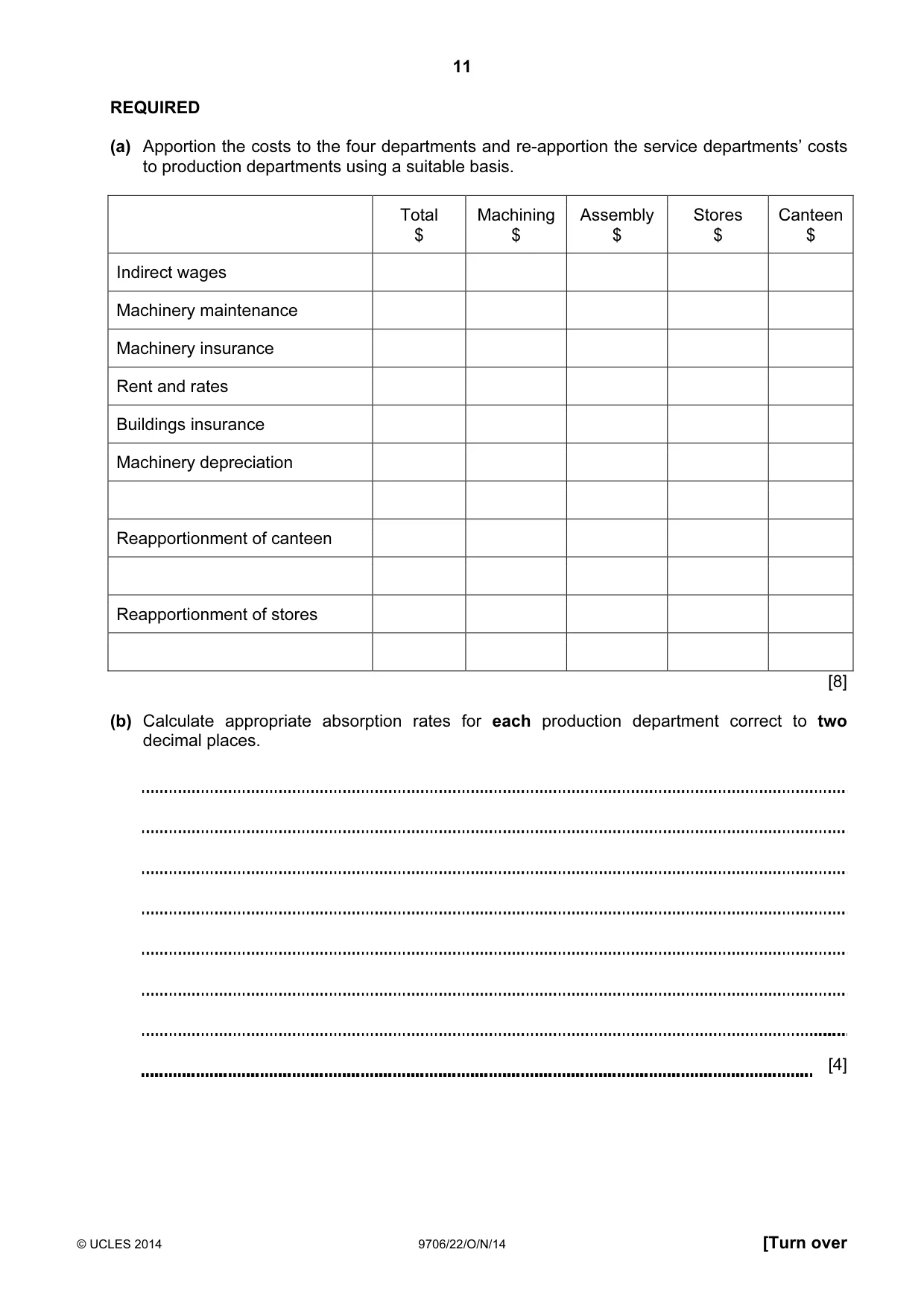
11 © UCLES 2014 9706/22/O/N/14 [Turn over REQUIRED (a) Apportion the costs to the four departments and re-apportion the service departments’ costs to production departments using a suitable basis. Total $ Machining $ Assembly $ Stores $ Canteen $ Indirect wages Machinery maintenance Machinery insurance Rent and rates Buildings insurance Machinery depreciation Reapportionment of canteen Reapportionment of stores [8] (b) Calculate appropriate absorption rates for each production department correct to two decimal places. [4]
Question paper, page 12
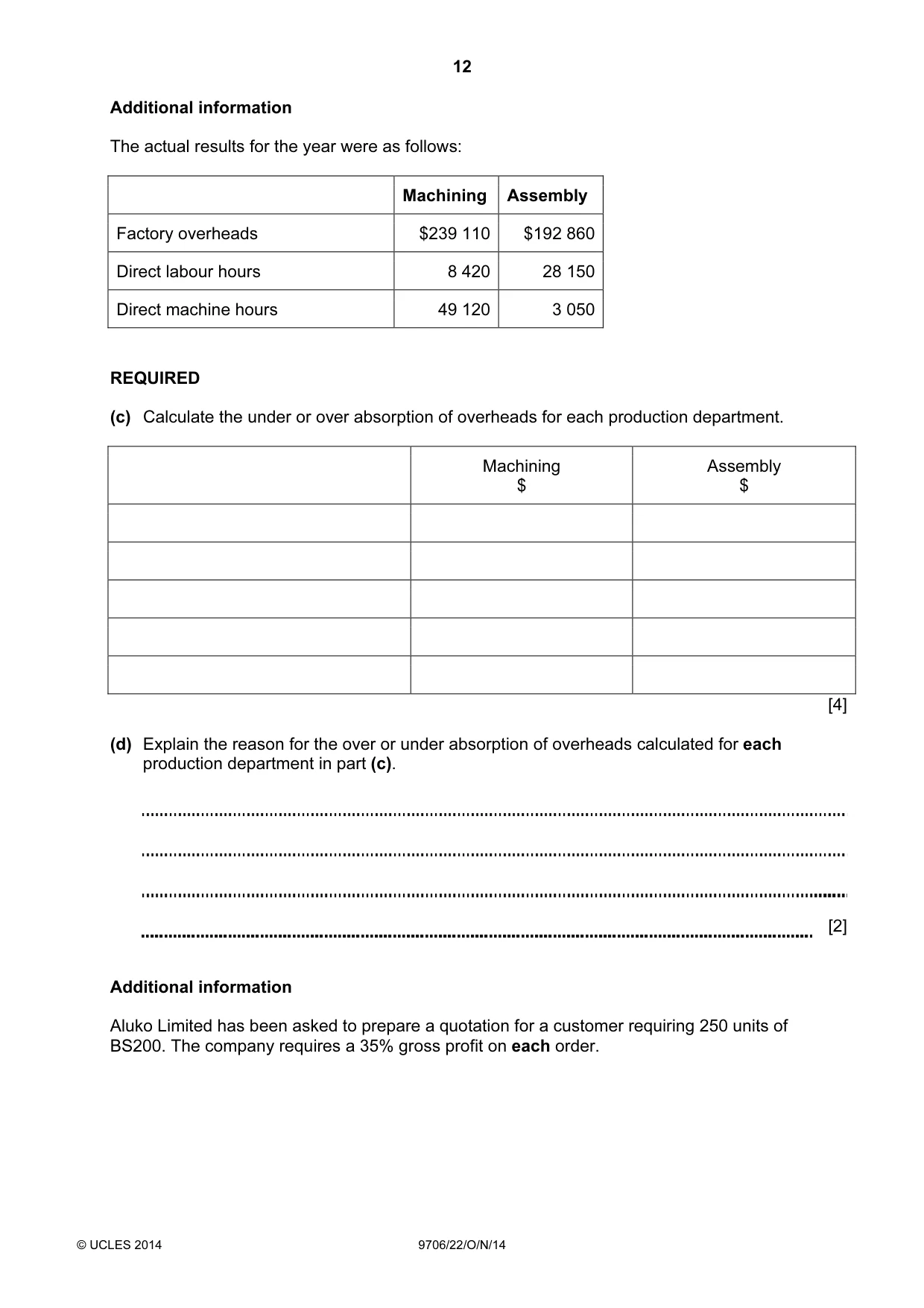
12 © UCLES 2014 9706/22/O/N/14 Additional information The actual results for the year were as follows: Machining Assembly Factory overheads $239 110 $192 860 Direct labour hours 8 420 28 150 Direct machine hours 49 120 3 050 REQUIRED (c) Calculate the under or over absorption of overheads for each production department. Machining $ Assembly $ [4] (d) Explain the reason for the over or under absorption of overheads calculated for each production department in part (c). [2] Additional information Aluko Limited has been asked to prepare a quotation for a customer requiring 250 units of BS200. The company requires a 35% gross profit on each order.
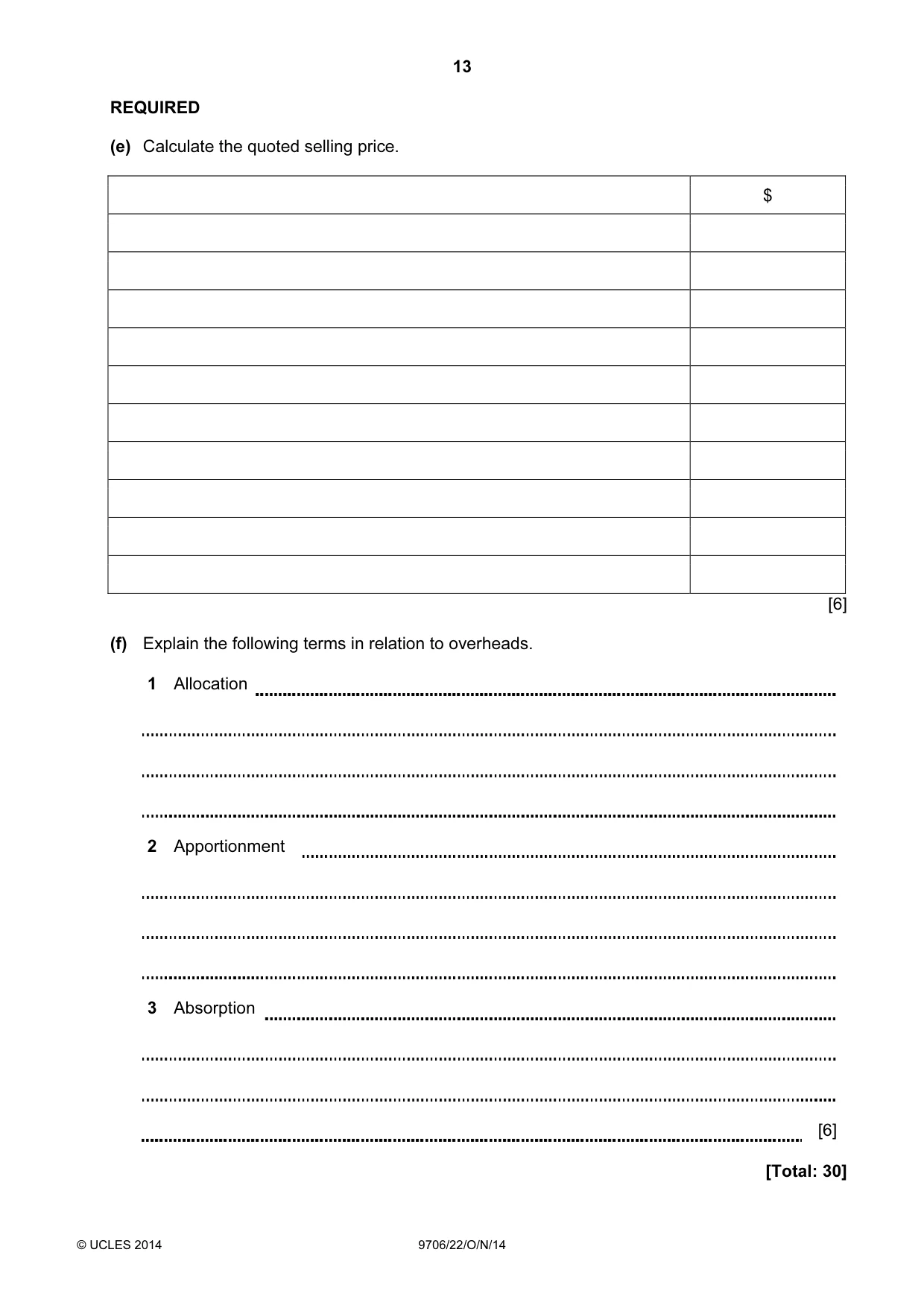
Question paper, page 13
13 © UCLES 2014 9706/22/O/N/14 REQUIRED (e) Calculate the quoted selling price. $ [6] (f) Explain the following terms in relation to overheads. 1 Allocation 2 Apportionment 3 Absorption [6] [Total: 30]
Question paper, page 14
14 © UCLES 2014 9706/22/O/N/14 BLANK PAGE
Question paper, page 15
15 © UCLES 2014 9706/22/O/N/14 BLANK PAGE
Question paper, page 16
16 Permission to reproduce items where third-party owned material protected by copyright is included has been sought and cleared where possible. Every reasonable effort has been made by the publisher (UCLES) to trace copyright holders, but if any items requiring clearance have unwittingly been included, the publisher will be pleased to make amends at the earliest possible opportunity. Cambridge International Examinations is part of the Cambridge Assessment Group. Cambridge Assessment is the brand name of University of Cambridge Local Examinations Syndicate (UCLES), which is itself a department of the University of Cambridge © UCLES 2014 9706/22/O/N/14 BLANK PAGE
Mark scheme, page 1
® IGCSE is the registered trademark of Cambridge International Examinations. CAMBRIDGE INTERNATIONAL EXAMINATIONS Cambridge International Advanced Subsidiary and Advanced Level MARK SCHEME for the October/November 2014 series 9706 ACCOUNTING 9706/22 Paper 2 (Structured Questions – Core), maximum raw mark 90 This mark scheme is published as an aid to teachers and candidates, to indicate the requirements of the examination. It shows the basis on which Examiners were instructed to award marks. It does not indicate the details of the discussions that took place at an Examiners’ meeting before marking began, which would have considered the acceptability of alternative answers. Mark schemes should be read in conjunction with the question paper and the Principal Examiner Report for Teachers. Cambridge will not enter into discussions about these mark schemes. Cambridge is publishing the mark schemes for the October/November 2014 series for most Cambridge IGCSE®, Cambridge International A and AS Level components and some Cambridge O Level components.
Mark scheme, page 2
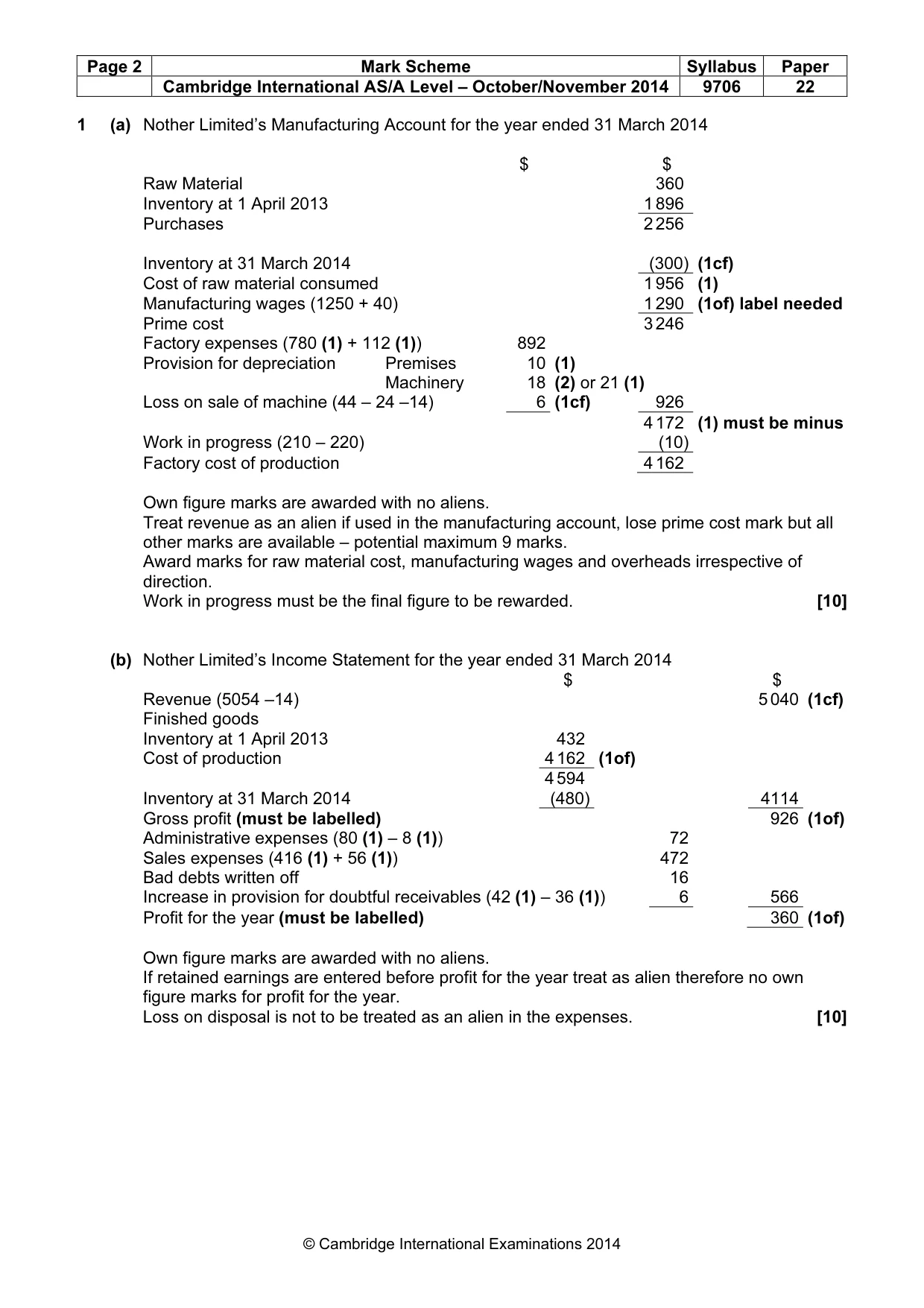
Page 2 Mark Scheme Syllabus Paper Cambridge International AS/A Level – October/November 2014 9706 22 © Cambridge International Examinations 2014 1 (a) Nother Limited’s Manufacturing Account for the year ended 31 March 2014 $ $ Raw Material 360. Inventory at 1 April 2013 1 896. Purchases 2 256. Inventory at 31 March 2014 (300) (1cf) Cost of raw material consumed 1 956. (1) Manufacturing wages (1250 + 40) 1 290. (1of) label needed Prime cost 3 246. Factory expenses (780 (1) + 112 (1)) 892 Provision for depreciation Premises 10 (1) Machinery 18 (2) or 21 (1) Loss on sale of machine (44 – 24 –14) 6 (1cf) 926. 4 172. (1) must be minus Work in progress (210 – 220) (10) Factory cost of production 4 162. Own figure marks are awarded with no aliens. Treat revenue as an alien if used in the manufacturing account, lose prime cost mark but all other marks are available – potential maximum 9 marks. Award marks for raw material cost, manufacturing wages and overheads irrespective of direction. Work in progress must be the final figure to be rewarded. [10] (b) Nother Limited’s Income Statement for the year ended 31 March 2014 $ $ Revenue (5054 –14) 5 040 (1cf) Finished goods Inventory at 1 April 2013 432. Cost of production 4 162. (1of) 4 594. Inventory at 31 March 2014 (480) 4114 Gross profit (must be labelled) 926 (1of) Administrative expenses (80 (1) – 8 (1)) 72 Sales expenses (416 (1) + 56 (1)) 472 Bad debts written off 16 Increase in provision for doubtful receivables (42 (1) – 36 (1)) 6 566 Profit for the year (must be labelled) 360 (1of) Own figure marks are awarded with no aliens. If retained earnings are entered before profit for the year treat as alien therefore no own figure marks for profit for the year. Loss on disposal is not to be treated as an alien in the expenses. [10]
Mark scheme, page 3
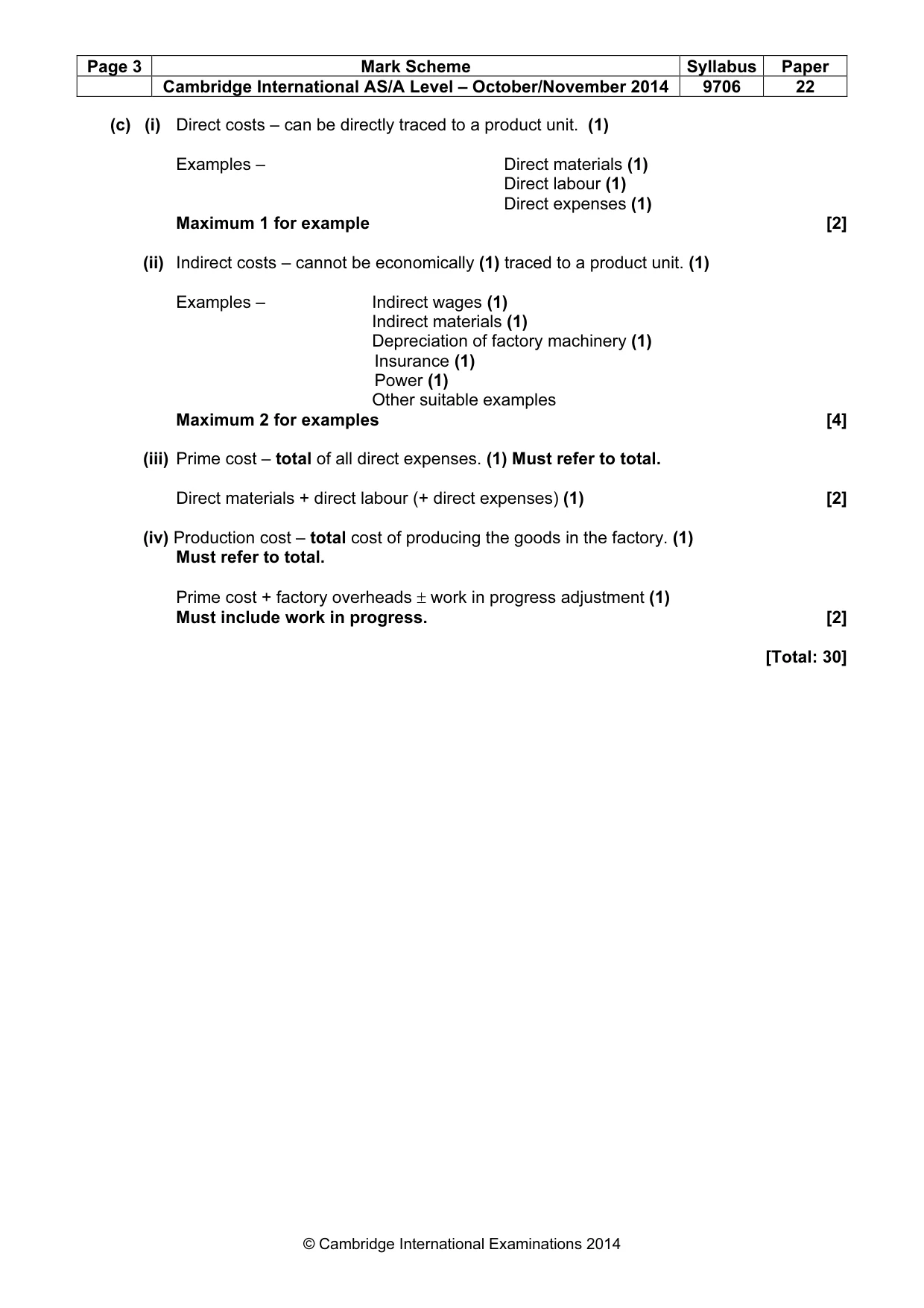
Page 3 Mark Scheme Syllabus Paper Cambridge International AS/A Level – October/November 2014 9706 22 © Cambridge International Examinations 2014 (c) (i) Direct costs – can be directly traced to a product unit. (1) Examples – Direct materials (1) Direct labour (1) Direct expenses (1) Maximum 1 for example [2] (ii) Indirect costs – cannot be economically (1) traced to a product unit. (1) Examples – Indirect wages (1) Indirect materials (1) Depreciation of factory machinery (1) Insurance (1) Power (1) Other suitable examples Maximum 2 for examples [4] (iii) Prime cost – total of all direct expenses. (1) Must refer to total. Direct materials + direct labour (+ direct expenses) (1) [2] (iv) Production cost – total cost of producing the goods in the factory. (1) Must refer to total. Prime cost + factory overheads ± work in progress adjustment (1) Must include work in progress. [2] [Total: 30]
Mark scheme, page 4
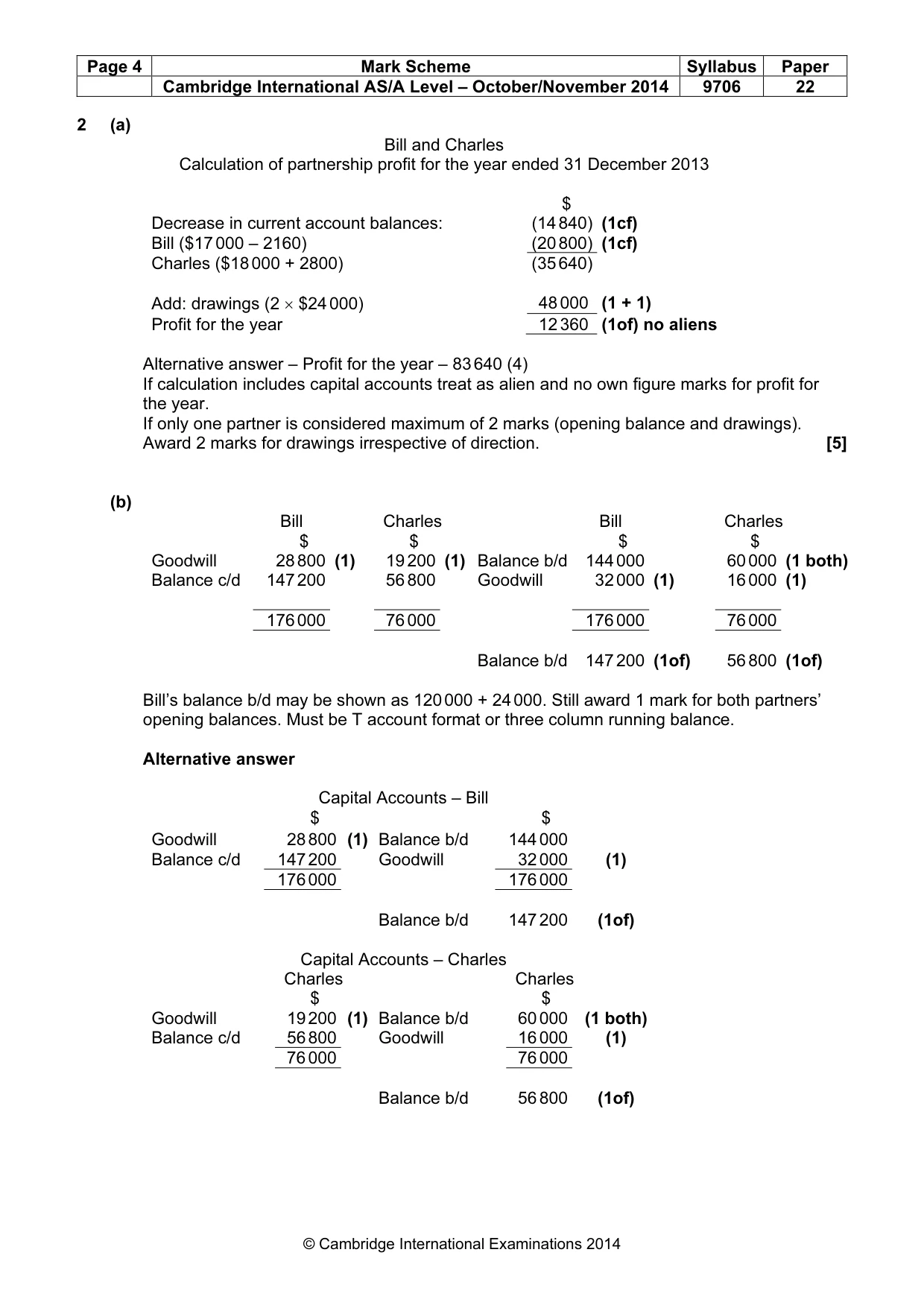
Page 4 Mark Scheme Syllabus Paper Cambridge International AS/A Level – October/November 2014 9706 22 © Cambridge International Examinations 2014 2 (a) Bill and Charles Calculation of partnership profit for the year ended 31 December 2013 $ Decrease in current account balances: (14 840) (1cf) Bill ($17 000 – 2160) (20 800) (1cf) Charles ($18 000 + 2800) (35 640) Add: drawings (2 × $24 000) 48 000. (1 + 1) Profit for the year 12 360. (1of) no aliens Alternative answer – Profit for the year – 83 640 (4) If calculation includes capital accounts treat as alien and no own figure marks for profit for the year. If only one partner is considered maximum of 2 marks (opening balance and drawings). Award 2 marks for drawings irrespective of direction. [5] (b) Bill Charles Bill Charles $ $ $ $ Goodwill 28 800 (1) 19 200 (1) Balance b/d 144 000 60 000 (1 both) Balance c/d 147 200 56 800 Goodwill 32 000 (1) 16 000 (1) 176 000 76 000 176 000 76 000 Balance b/d 147 200 (1of) 56 800 (1of) Bill’s balance b/d may be shown as 120 000 + 24 000. Still award 1 mark for both partners’ opening balances. Must be T account format or three column running balance. Alternative answer Capital Accounts – Bill $ $ Goodwill 28 800 (1) Balance b/d 144 000 Balance c/d 147 200 Goodwill 32 000 (1) 176 000 176 000 Balance b/d 147 200 (1of) Capital Accounts – Charles Charles Charles $ $ Goodwill 19 200 (1) Balance b/d 60 000 (1 both) Balance c/d 56 800 Goodwill 16 000 (1) 76 000 76 000 Balance b/d 56 800 (1of)
Mark scheme, page 5
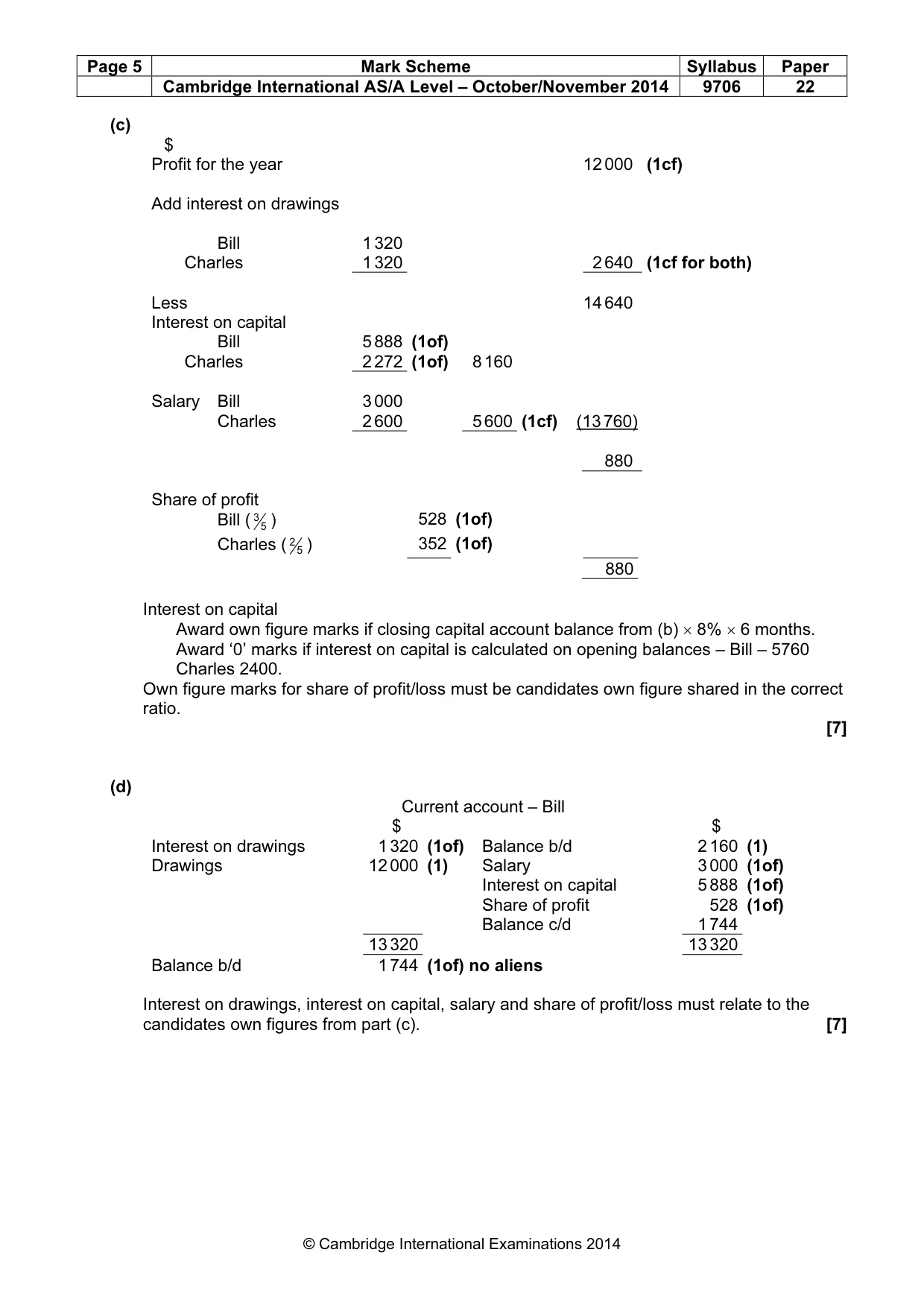
Page 5 Mark Scheme Syllabus Paper Cambridge International AS/A Level – October/November 2014 9706 22 © Cambridge International Examinations 2014 (c) $ Profit for the year 12 000. (1cf) Add interest on drawings Bill 1 320 Charles 1 320 2 640. (1cf for both) Less 14 640. Interest on capital Bill 5 888 (1of) Charles 2 272 (1of) 8 160 Salary Bill 3 000 Charles 2 600 5 600 (1cf) (13 760) 880. Share of profit Bill ( 5 3 ) 528 (1of) Charles ( 5 2 ) 352 (1of) . 880 Interest on capital Award own figure marks if closing capital account balance from (b) × 8% × 6 months. Award ‘0’ marks if interest on capital is calculated on opening balances – Bill – 5760 Charles 2400. Own figure marks for share of profit/loss must be candidates own figure shared in the correct ratio. [7] (d) Current account – Bill $ $ Interest on drawings 1 320 (1of) Balance b/d 2 160 (1) Drawings 12 000 (1) Salary 3 000 (1of) Interest on capital 5 888 (1of) Share of profit 528 (1of) Balance c/d 1 744 13 320 13 320 Balance b/d 1 744 (1of) no aliens Interest on drawings, interest on capital, salary and share of profit/loss must relate to the candidates own figures from part (c). [7]
Mark scheme, page 6
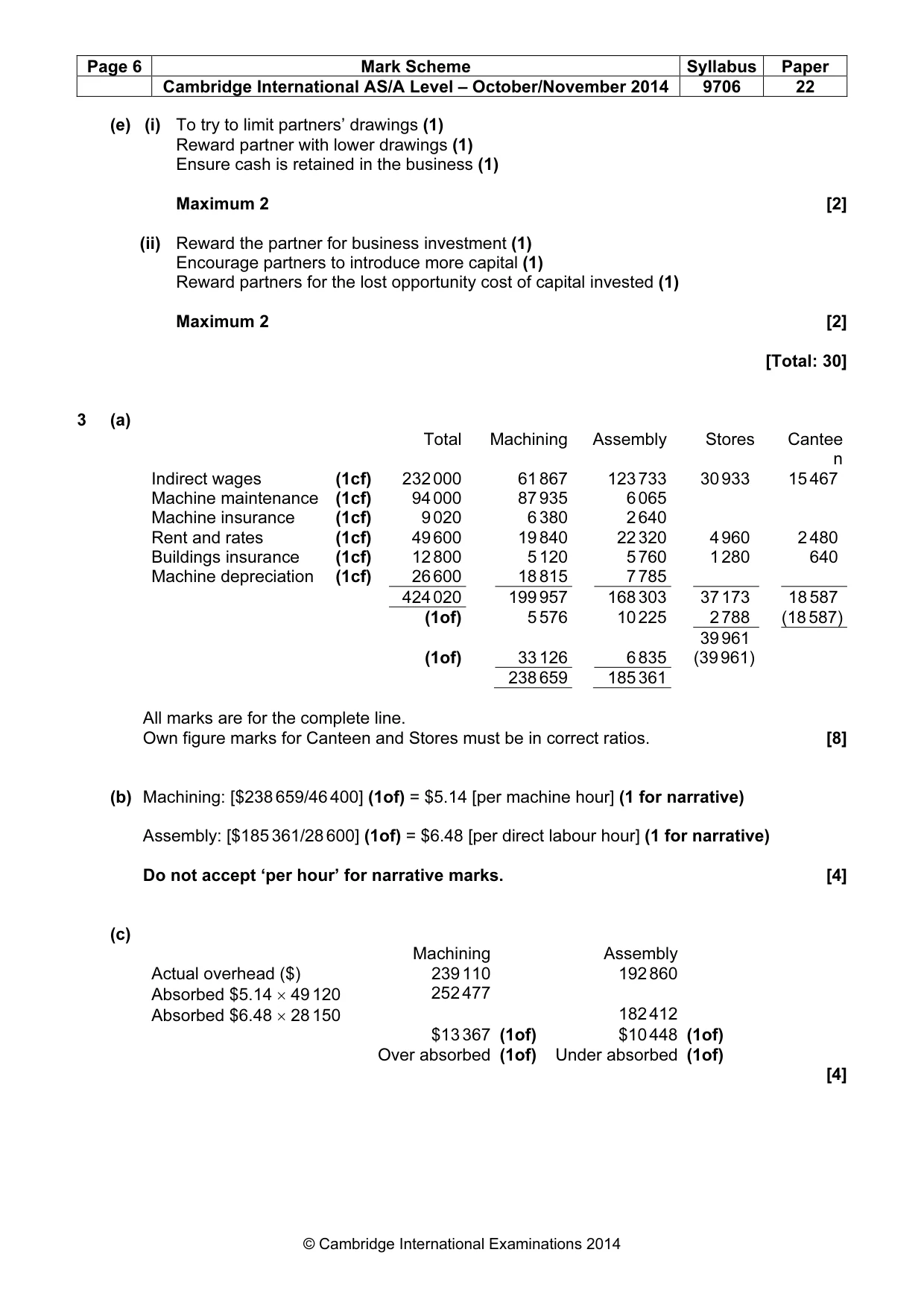
Page 6 Mark Scheme Syllabus Paper Cambridge International AS/A Level – October/November 2014 9706 22 © Cambridge International Examinations 2014 (e) (i) To try to limit partners’ drawings (1) Reward partner with lower drawings (1) Ensure cash is retained in the business (1) Maximum 2 [2] (ii) Reward the partner for business investment (1) Encourage partners to introduce more capital (1) Reward partners for the lost opportunity cost of capital invested (1) Maximum 2 [2] [Total: 30] 3 (a) Total Machining Assembly Stores Cantee n Indirect wages (1cf) 232 000 61 867 123 733 30 933. 15 467. Machine maintenance (1cf) 94 000 87 935 6 065 Machine insurance (1cf) 9 020 6 380 2 640 Rent and rates (1cf) 49 600 19 840 22 320 4 960. 2 480. Buildings insurance (1cf) 12 800 5 120 5 760 1 280. 640. Machine depreciation (1cf) 26 600 18 815 7 785 424 020 199 957 168 303 37 173. 18 587. (1of) 5 576 10 225 2 788. (18 587) 39 961. (1of) 33 126 6 835 (39 961) 238 659 185 361 All marks are for the complete line. Own figure marks for Canteen and Stores must be in correct ratios. [8] (b) Machining: [$238 659/46 400] (1of) = $5.14 [per machine hour] (1 for narrative) Assembly: [$185 361/28 600] (1of) = $6.48 [per direct labour hour] (1 for narrative) Do not accept ‘per hour’ for narrative marks. [4] (c) Machining Assembly Actual overhead ($) 239 110 192 860 Absorbed $5.14 × 49 120 252 477 Absorbed $6.48 × 28 150 182 412 $13 367 (1of) $10 448 (1of) Over absorbed (1of) Under absorbed (1of) [4]
Mark scheme, page 7
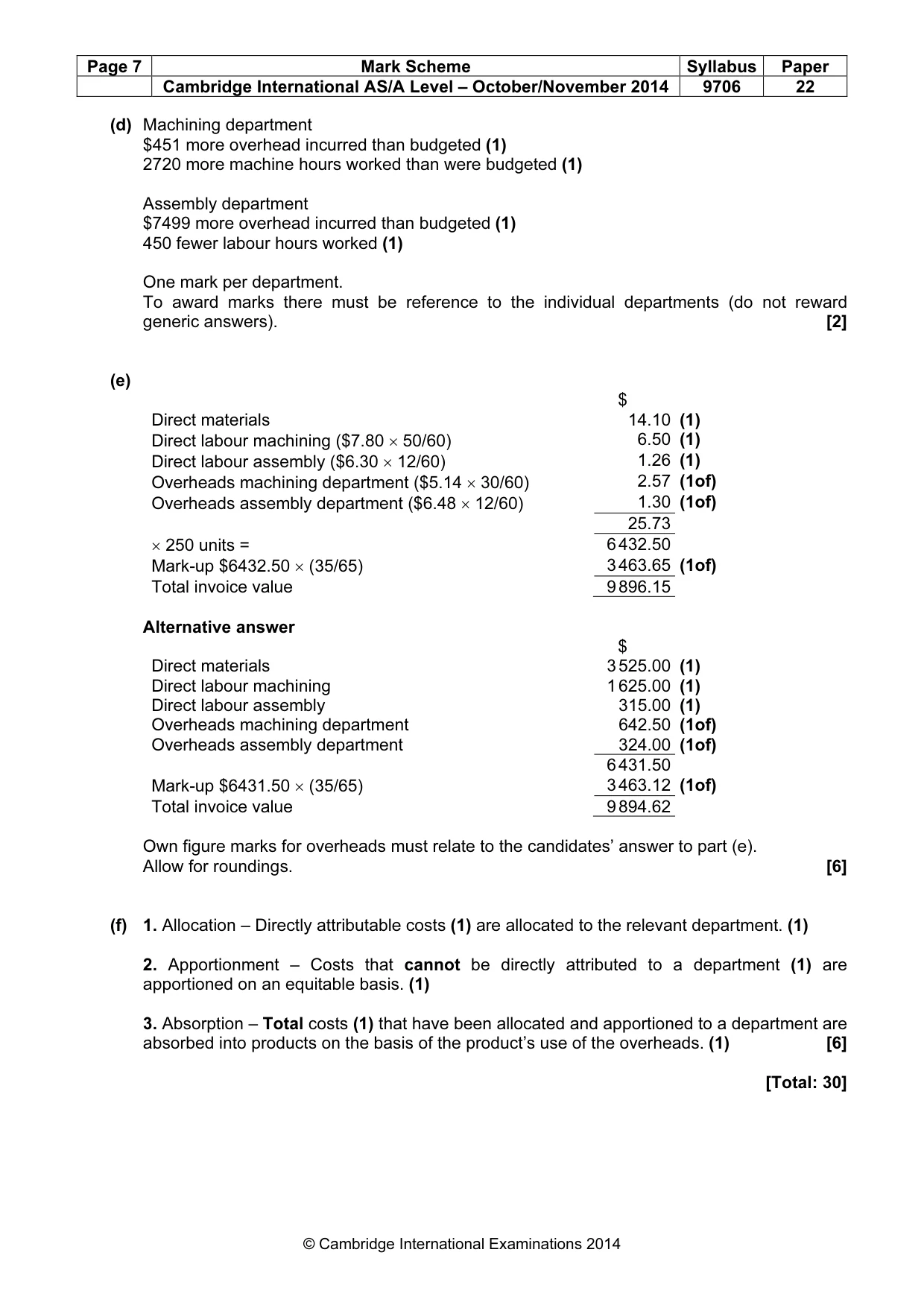
Page 7 Mark Scheme Syllabus Paper Cambridge International AS/A Level – October/November 2014 9706 22 © Cambridge International Examinations 2014 (d) Machining department $451 more overhead incurred than budgeted (1) 2720 more machine hours worked than were budgeted (1) Assembly department $7499 more overhead incurred than budgeted (1) 450 fewer labour hours worked (1) One mark per department. To award marks there must be reference to the individual departments (do not reward generic answers). [2] (e) $ Direct materials 14.10 (1) Direct labour machining ($7.80 × 50/60) 6.50 (1) Direct labour assembly ($6.30 × 12/60) 1.26 (1) Overheads machining department ($5.14 × 30/60) 2.57 (1of) Overheads assembly department ($6.48 × 12/60) 1.30 (1of) 25.73 × 250 units = 6 432.50 Mark-up $6432.50 × (35/65) 3 463.65 (1of) Total invoice value 9 896.15 Alternative answer $ Direct materials 3 525.00 (1) Direct labour machining 1 625.00 (1) Direct labour assembly 315.00 (1) Overheads machining department 642.50 (1of) Overheads assembly department 324.00 (1of) 6 431.50 Mark-up $6431.50 × (35/65) 3 463.12 (1of) Total invoice value 9 894.62 Own figure marks for overheads must relate to the candidates’ answer to part (e). Allow for roundings. [6] (f) 1. Allocation – Directly attributable costs (1) are allocated to the relevant department. (1) 2. Apportionment – Costs that cannot be directly attributed to a department (1) are apportioned on an equitable basis. (1) 3. Absorption – Total costs (1) that have been allocated and apportioned to a department are absorbed into products on the basis of the product’s use of the overheads. (1) [6] [Total: 30]
What you needed in this session
Cambridge’s own grade thresholds for 2014 Oct/Nov, Paper 2 · Variant 2. A higher threshold means an easier paper — the bar moves with how the cohort did.