Cambridge A Level Accounting 9706 — 2014 Oct/Nov Paper 2 · Variant 3
9706/23/O/N/14 · 90 marks · ≈101 min
The question paper and its mark scheme, free to read here and free to download. This is Cambridge’s own paper, exactly as it was sat.
Question paper16 pages
Mark scheme6 pages
Answers below. Sit the paper first if you are practising.
Paper as text
Question paper, page 1
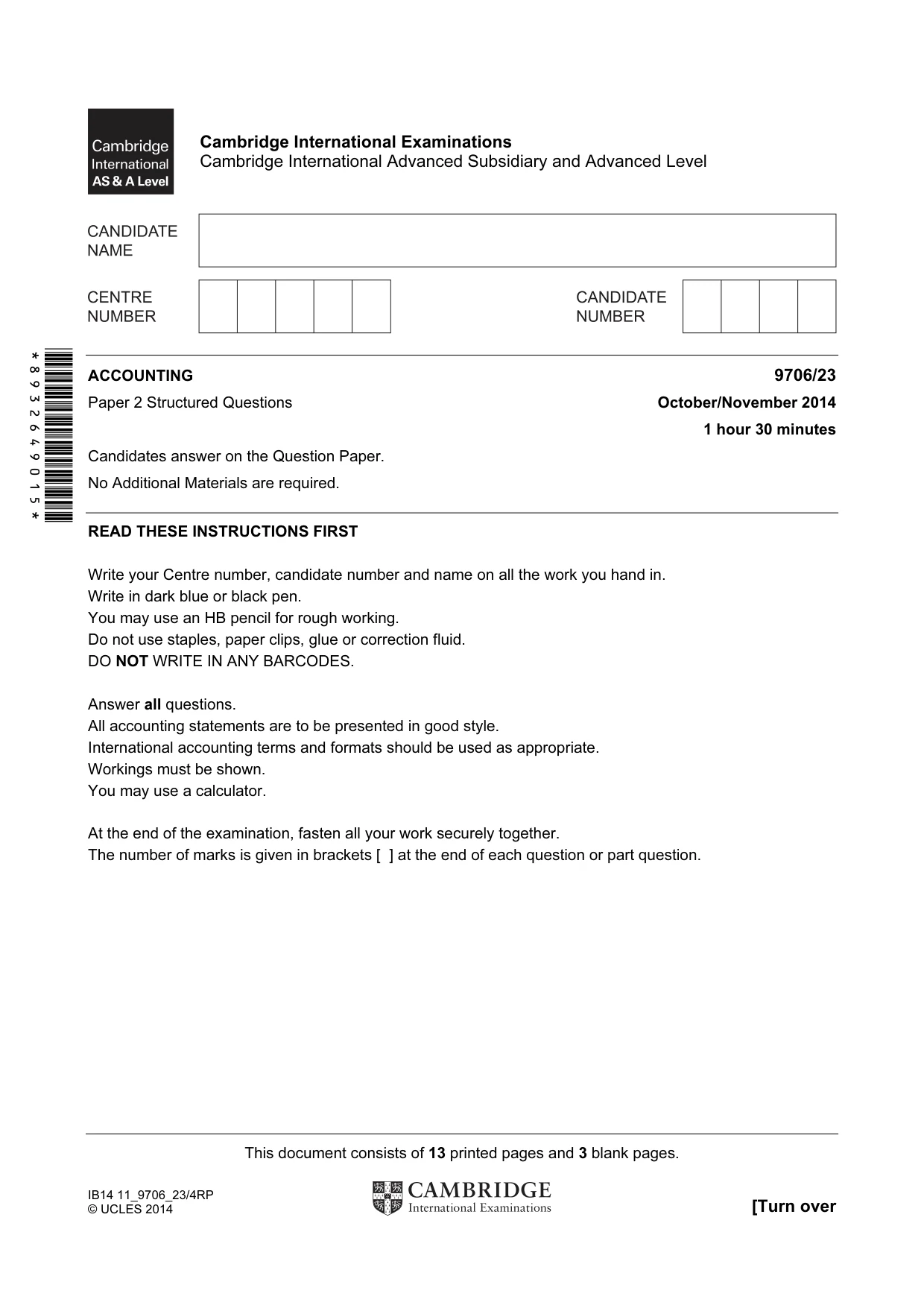
This document consists of 13 printed pages and 3 blank pages. IB14 11_9706_23/4RP © UCLES 2014 [Turn over *8932649015* Cambridge International Examinations Cambridge International Advanced Subsidiary and Advanced Level ACCOUNTING 9706/23 Paper 2 Structured Questions October/November 2014 1 hour 30 minutes Candidates answer on the Question Paper. No Additional Materials are required. READ THESE INSTRUCTIONS FIRST Write your Centre number, candidate number and name on all the work you hand in. Write in dark blue or black pen. You may use an HB pencil for rough working. Do not use staples, paper clips, glue or correction fluid. DO NOT WRITE IN ANY BARCODES. Answer all questions. All accounting statements are to be presented in good style. International accounting terms and formats should be used as appropriate. Workings must be shown. You may use a calculator. At the end of the examination, fasten all your work securely together. The number of marks is given in brackets [ ] at the end of each question or part question.
Question paper, page 2
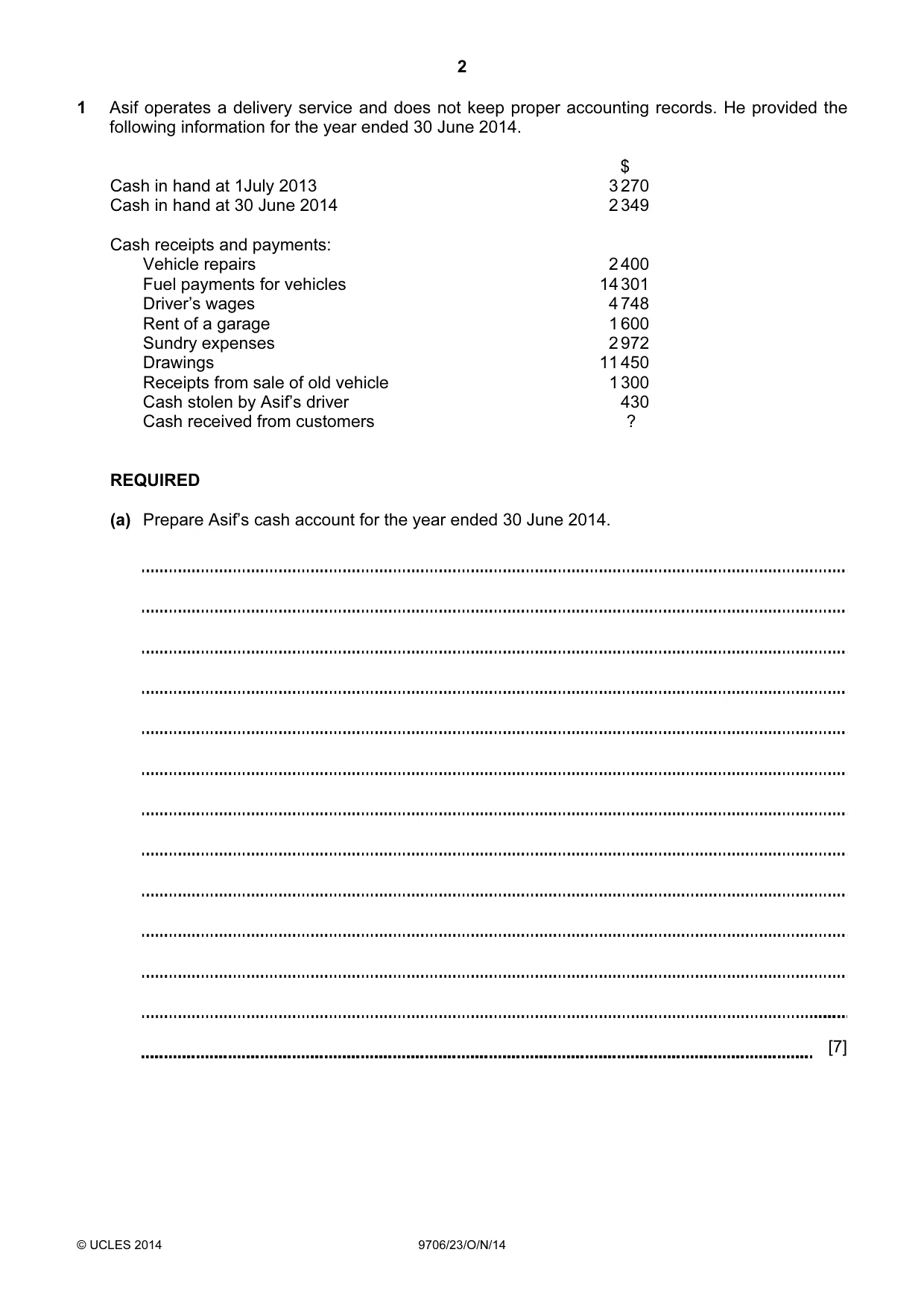
2 © UCLES 2014 9706/23/O/N/14 1 Asif operates a delivery service and does not keep proper accounting records. He provided the following information for the year ended 30 June 2014. $ Cash in hand at 1July 2013 3 270 Cash in hand at 30 June 2014 2 349 Cash receipts and payments: Vehicle repairs 2 400 Fuel payments for vehicles 14 301 Driver’s wages 4 748 Rent of a garage 1 600 Sundry expenses 2 972 Drawings 11 450 Receipts from sale of old vehicle 1 300 Cash stolen by Asif’s driver 430 Cash received from customers ? REQUIRED (a) Prepare Asif’s cash account for the year ended 30 June 2014. [7]
Question paper, page 3
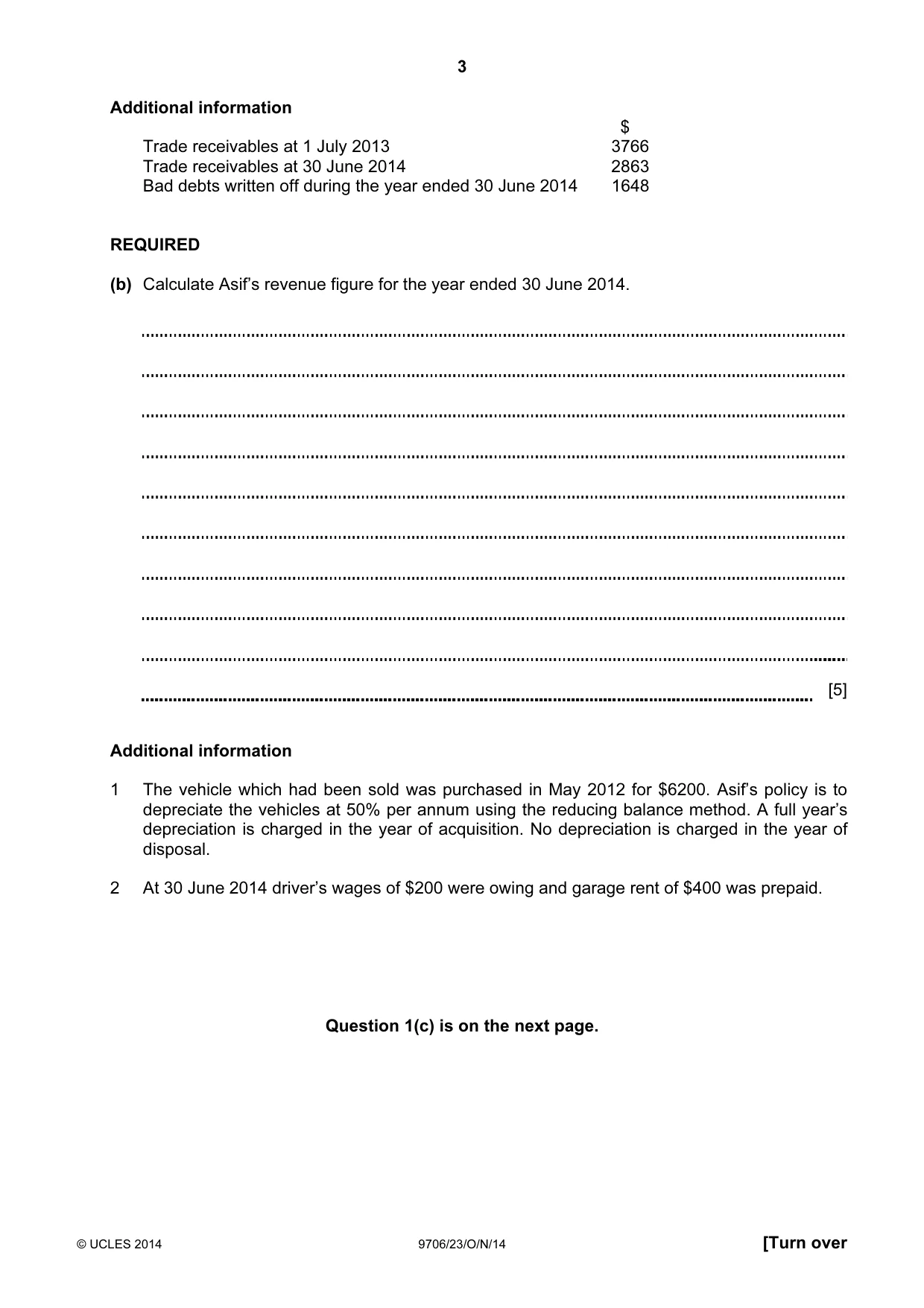
3 © UCLES 2014 9706/23/O/N/14 [Turn over Additional information $ Trade receivables at 1 July 2013 3766 Trade receivables at 30 June 2014 2863 Bad debts written off during the year ended 30 June 2014 1648 REQUIRED (b) Calculate Asif’s revenue figure for the year ended 30 June 2014. [5] Additional information 1 The vehicle which had been sold was purchased in May 2012 for $6200. Asif’s policy is to depreciate the vehicles at 50% per annum using the reducing balance method. A full year’s depreciation is charged in the year of acquisition. No depreciation is charged in the year of disposal. 2 At 30 June 2014 driver’s wages of $200 were owing and garage rent of $400 was prepaid. Question 1(c) is on the next page.
Question paper, page 4
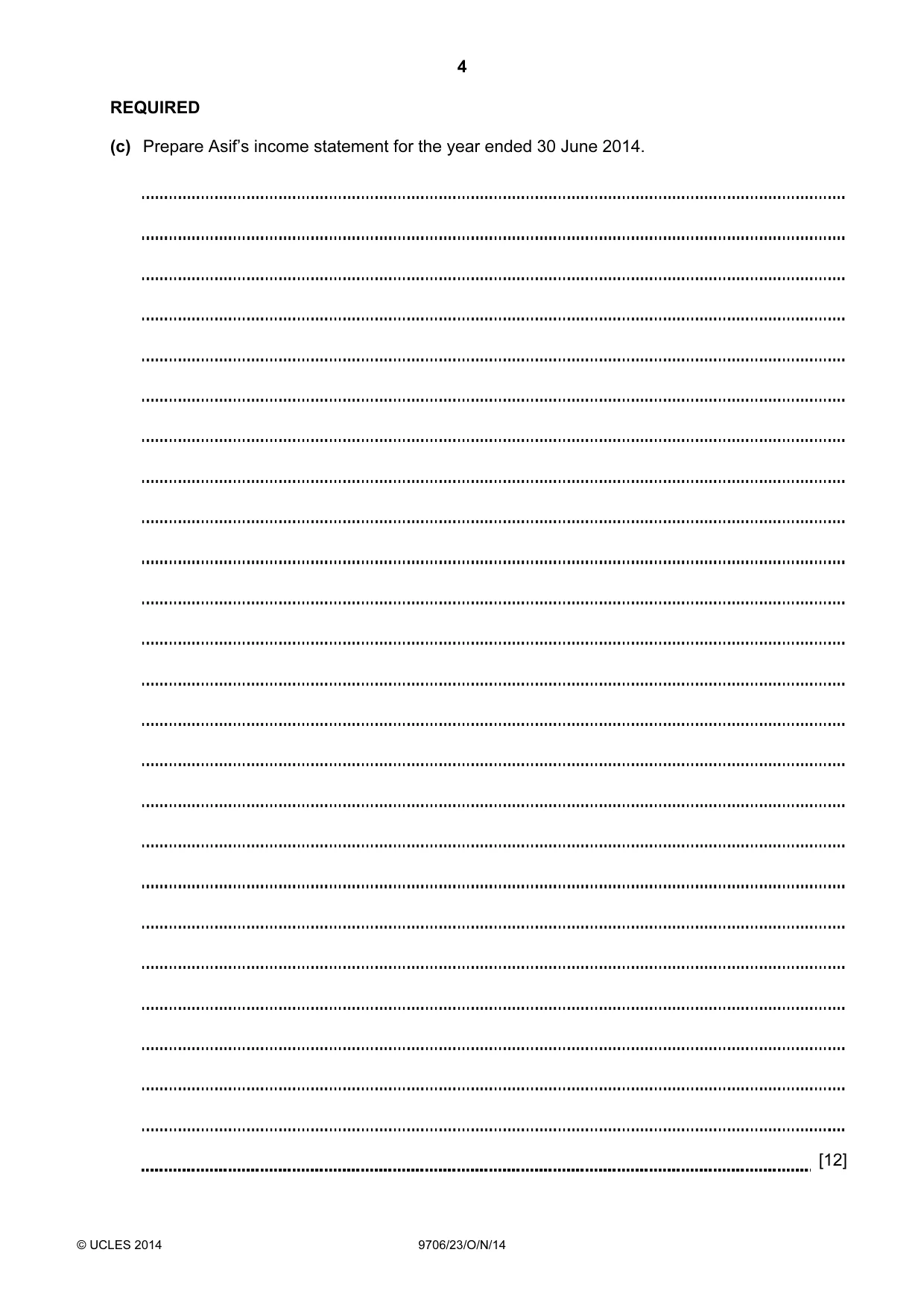
4 © UCLES 2014 9706/23/O/N/14 REQUIRED (c) Prepare Asif’s income statement for the year ended 30 June 2014. [12]
Question paper, page 5
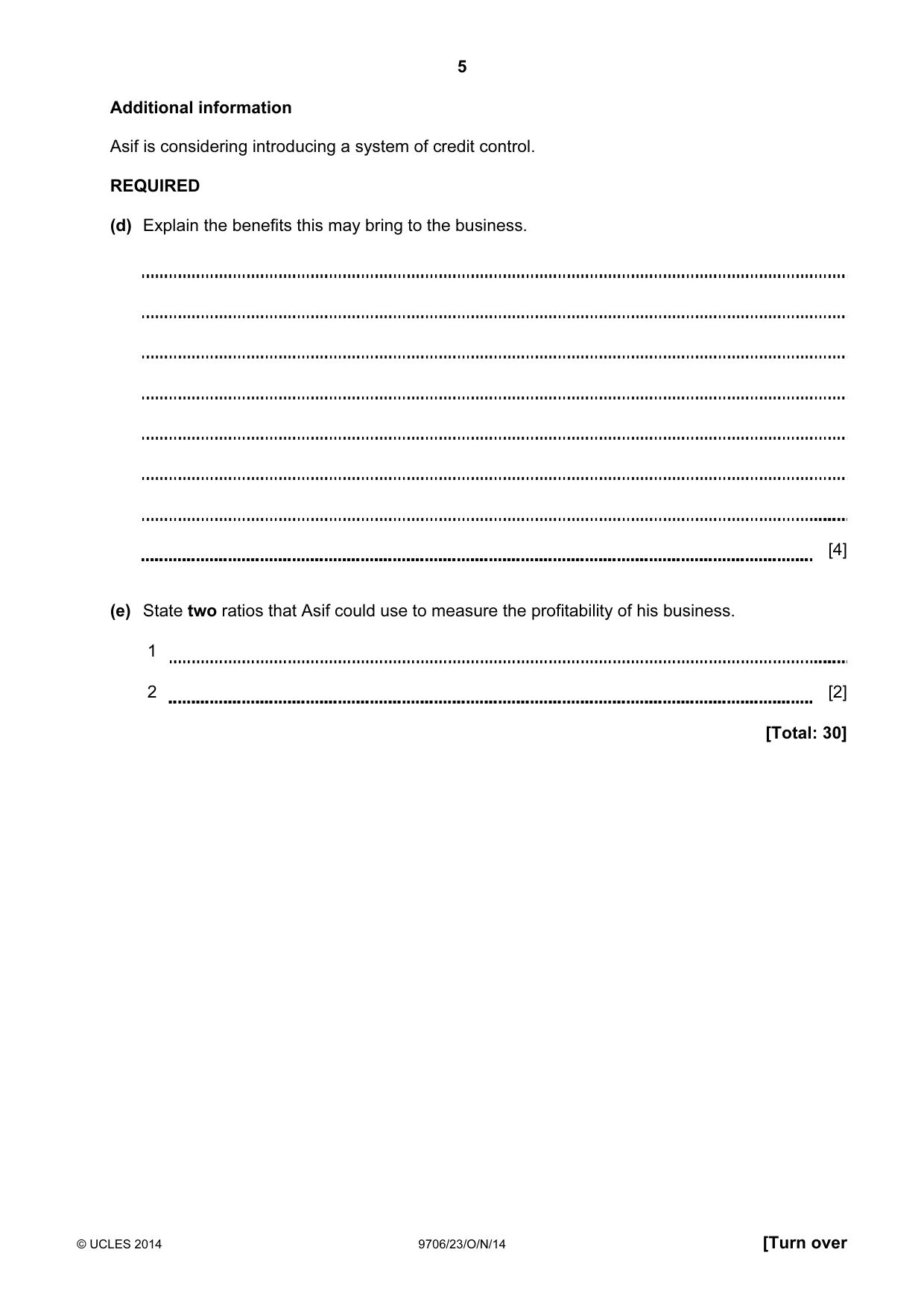
5 © UCLES 2014 9706/23/O/N/14 [Turn over Additional information Asif is considering introducing a system of credit control. REQUIRED (d) Explain the benefits this may bring to the business. [4] (e) State two ratios that Asif could use to measure the profitability of his business. 1 2 [2] [Total: 30]
Question paper, page 6
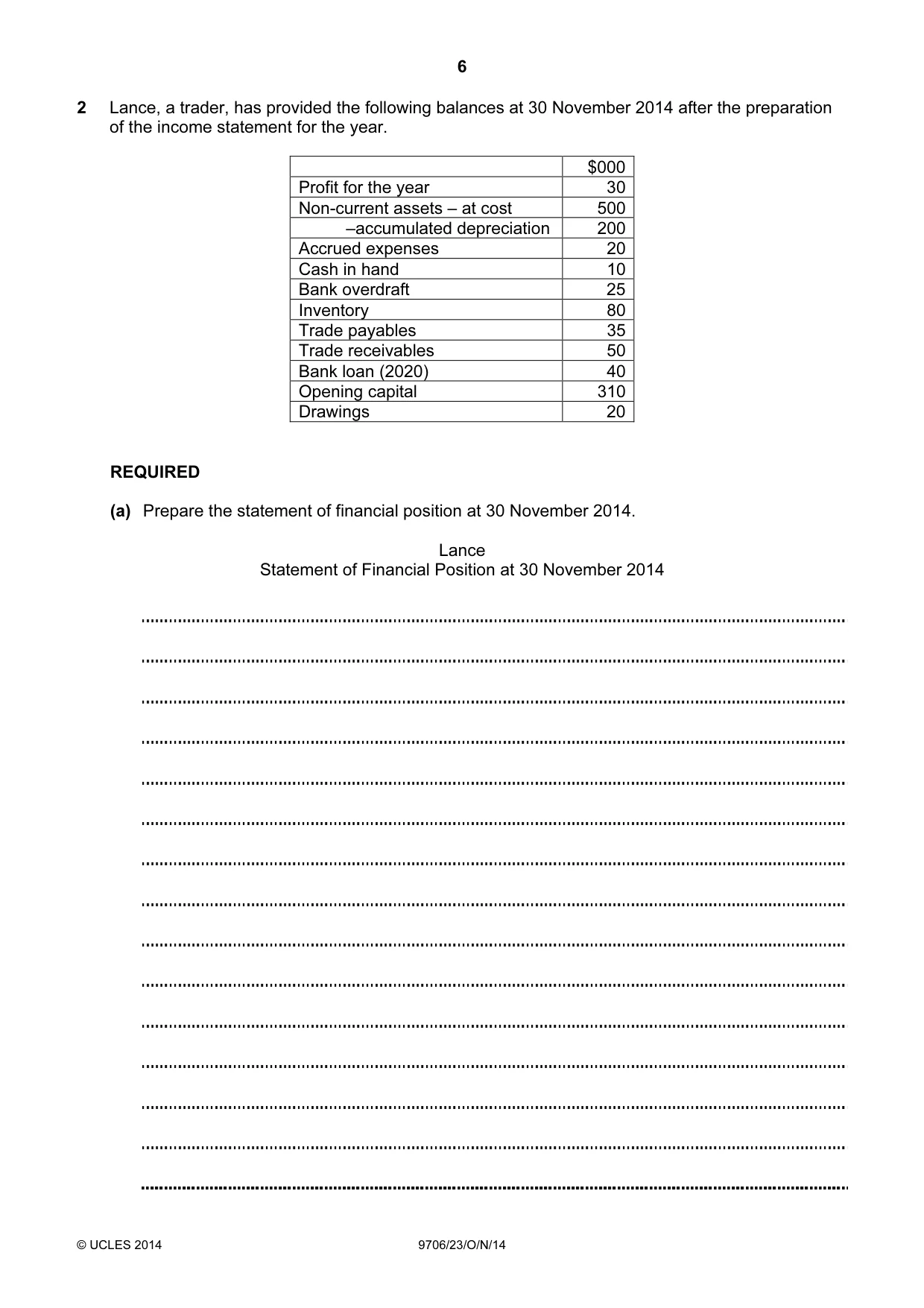
6 © UCLES 2014 9706/23/O/N/14 2 Lance, a trader, has provided the following balances at 30 November 2014 after the preparation of the income statement for the year. $000 Profit for the year 30 Non-current assets – at cost 500 –accumulated depreciation 200 Accrued expenses 20 Cash in hand 10 Bank overdraft 25 Inventory 80 Trade payables 35 Trade receivables 50 Bank loan (2020) 40 Opening capital 310 Drawings 20 REQUIRED (a) Prepare the statement of financial position at 30 November 2014. Lance Statement of Financial Position at 30 November 2014
Question paper, page 7
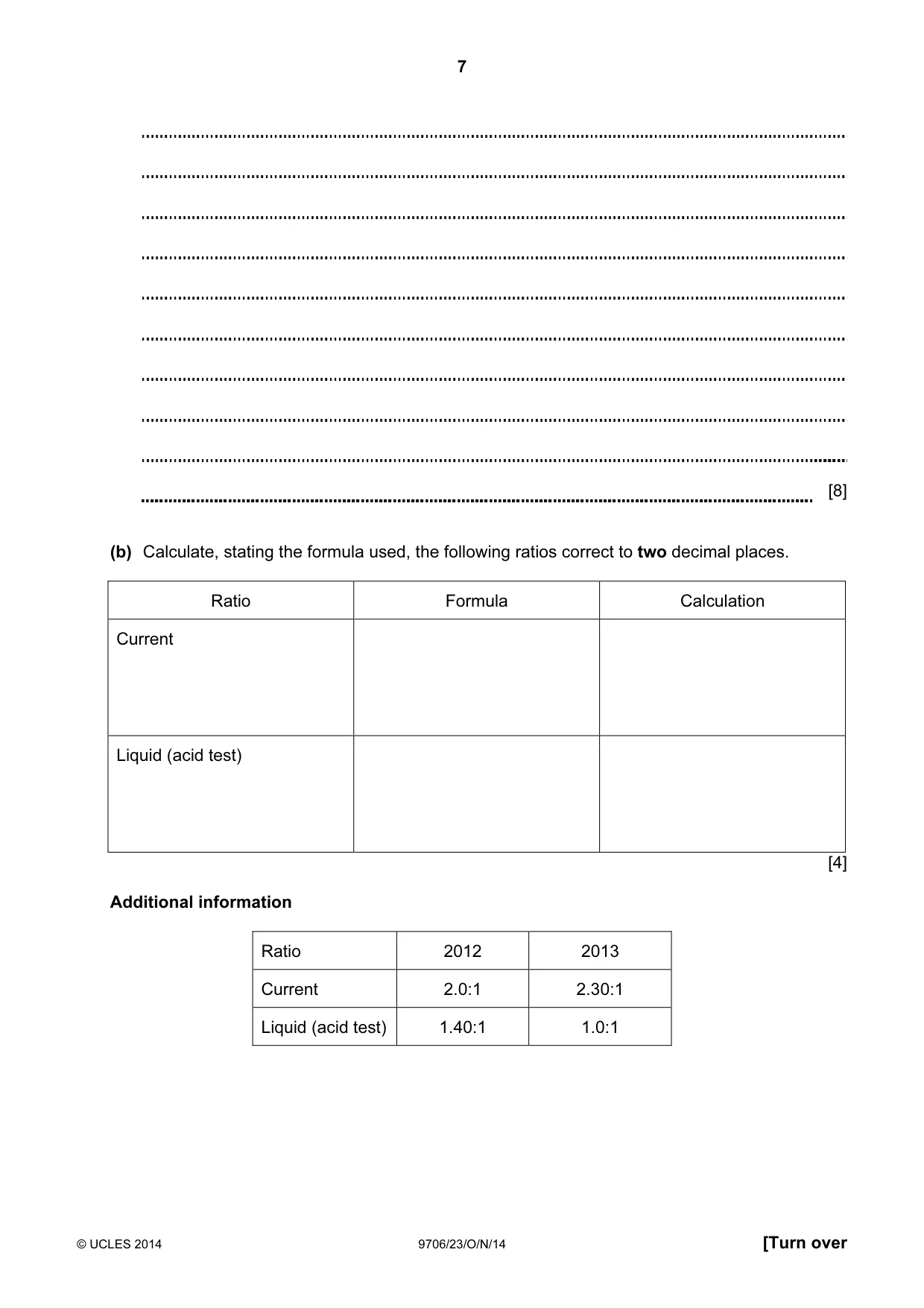
7 © UCLES 2014 9706/23/O/N/14 [Turn over [8] (b) Calculate, stating the formula used, the following ratios correct to two decimal places. Ratio Formula Calculation Current Liquid (acid test) [4] Additional information Ratio 2012 2013 Current 2.0:1 2.30:1 Liquid (acid test) 1.40:1 1.0:1
Question paper, page 8
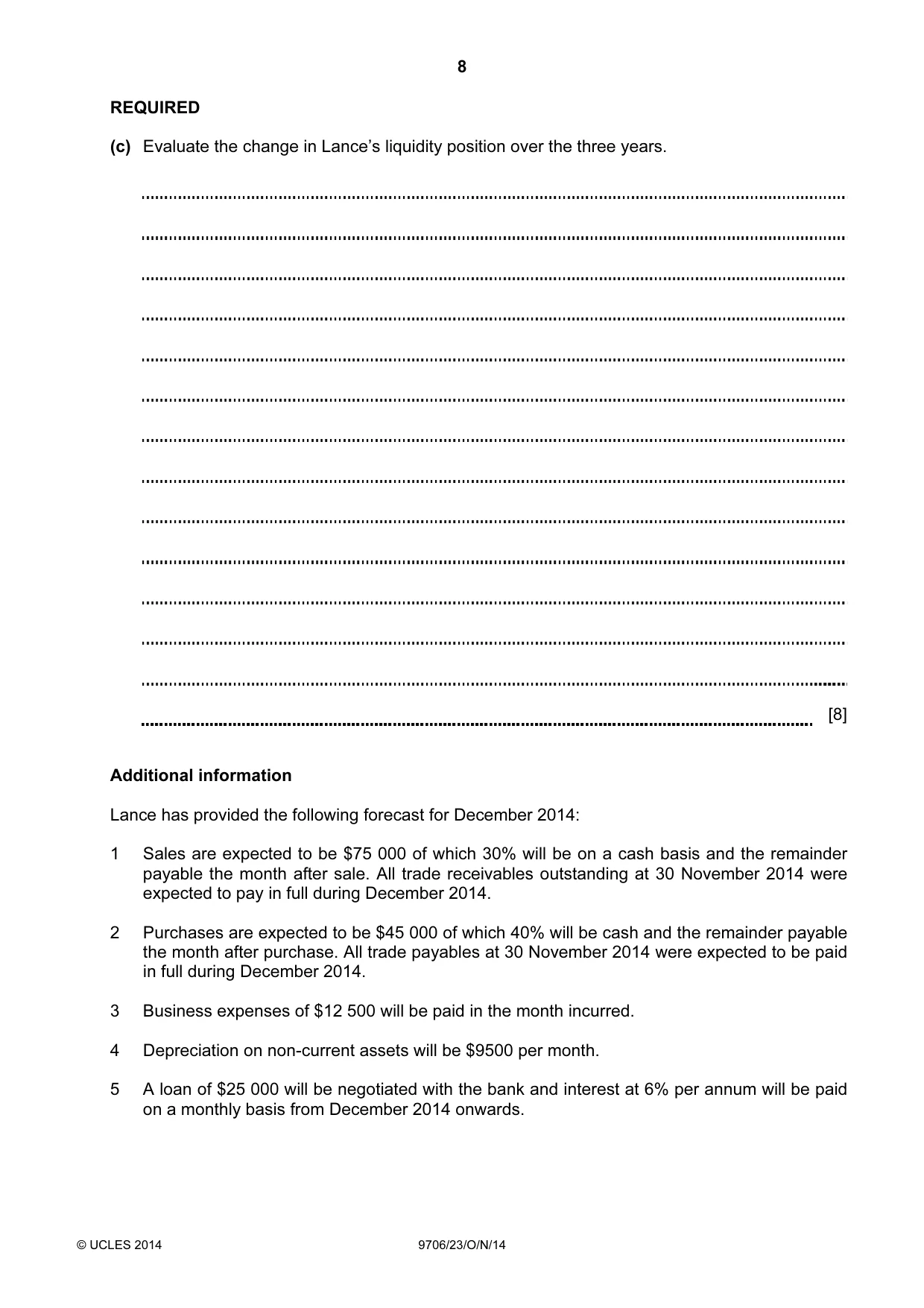
8 © UCLES 2014 9706/23/O/N/14 REQUIRED (c) Evaluate the change in Lance’s liquidity position over the three years. [8] Additional information Lance has provided the following forecast for December 2014: 1 Sales are expected to be $75 000 of which 30% will be on a cash basis and the remainder payable the month after sale. All trade receivables outstanding at 30 November 2014 were expected to pay in full during December 2014. 2 Purchases are expected to be $45 000 of which 40% will be cash and the remainder payable the month after purchase. All trade payables at 30 November 2014 were expected to be paid in full during December 2014. 3 Business expenses of $12 500 will be paid in the month incurred. 4 Depreciation on non-current assets will be $9500 per month. 5 A loan of $25 000 will be negotiated with the bank and interest at 6% per annum will be paid on a monthly basis from December 2014 onwards.
Question paper, page 9
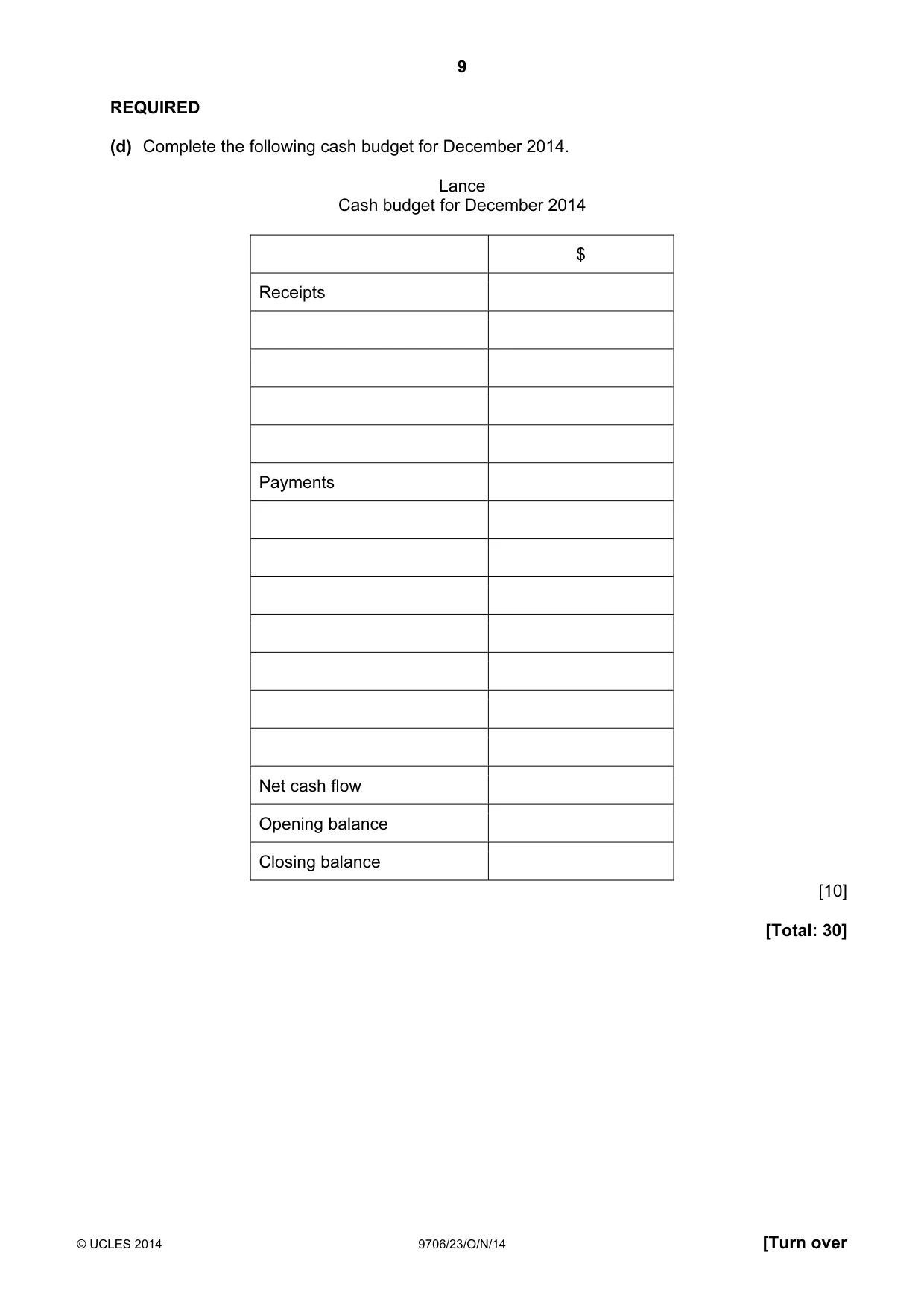
9 © UCLES 2014 9706/23/O/N/14 [Turn over REQUIRED (d) Complete the following cash budget for December 2014. Lance Cash budget for December 2014 $ Receipts Payments Net cash flow Opening balance Closing balance [10] [Total: 30]
Question paper, page 10
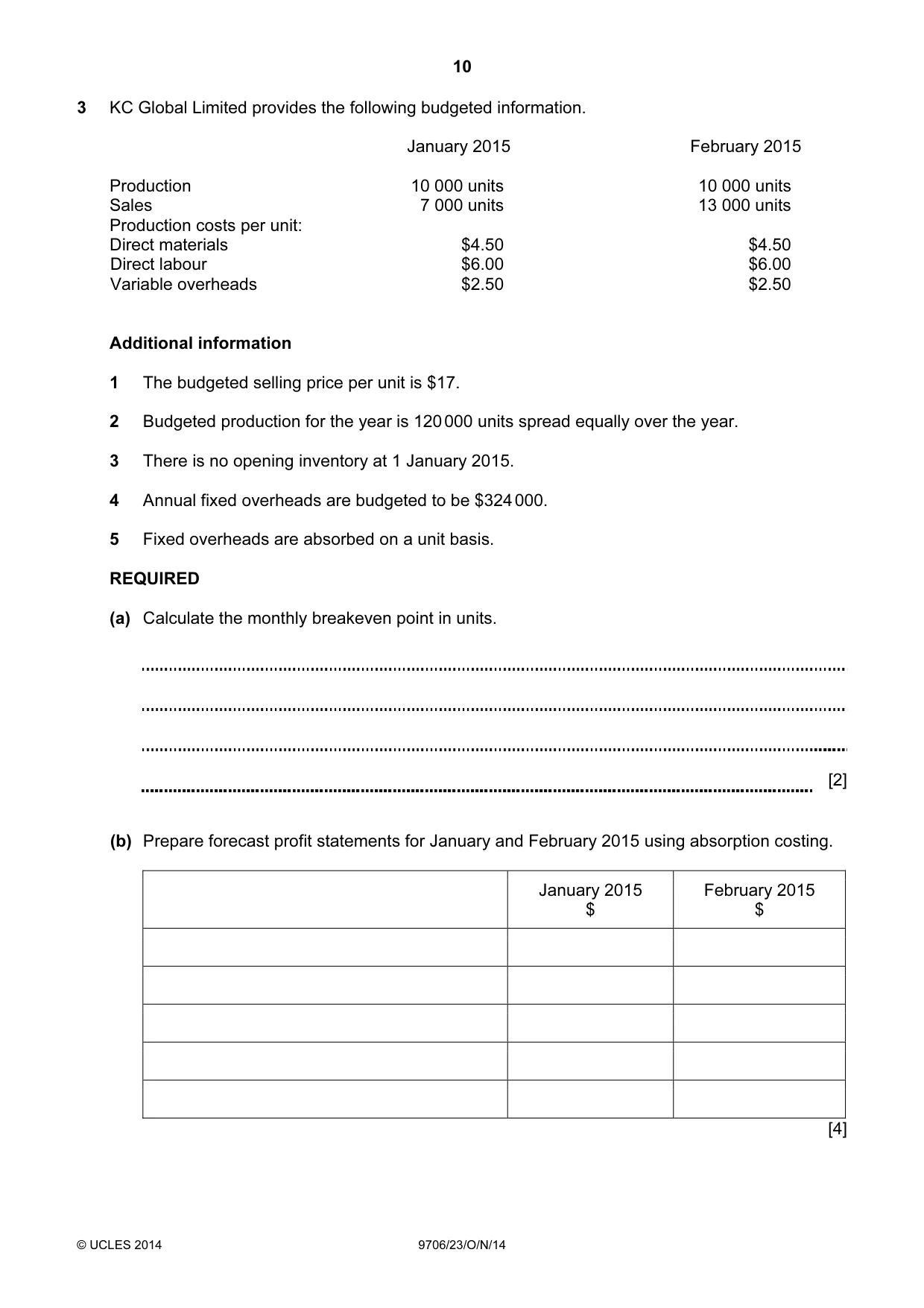
10 © UCLES 2014 9706/23/O/N/14 3 KC Global Limited provides the following budgeted information. January 2015 February 2015 Production 10 000 units 10 000 units Sales 7 000 units 13 000 units Production costs per unit: Direct materials $4.50 $4.50 Direct labour $6.00 $6.00 Variable overheads $2.50 $2.50 Additional information 1 The budgeted selling price per unit is $17. 2 Budgeted production for the year is 120 000 units spread equally over the year. 3 There is no opening inventory at 1 January 2015. 4 Annual fixed overheads are budgeted to be $324 000. 5 Fixed overheads are absorbed on a unit basis. REQUIRED (a) Calculate the monthly breakeven point in units. [2] (b) Prepare forecast profit statements for January and February 2015 using absorption costing. January 2015 $ February 2015 $ [4]
Question paper, page 11
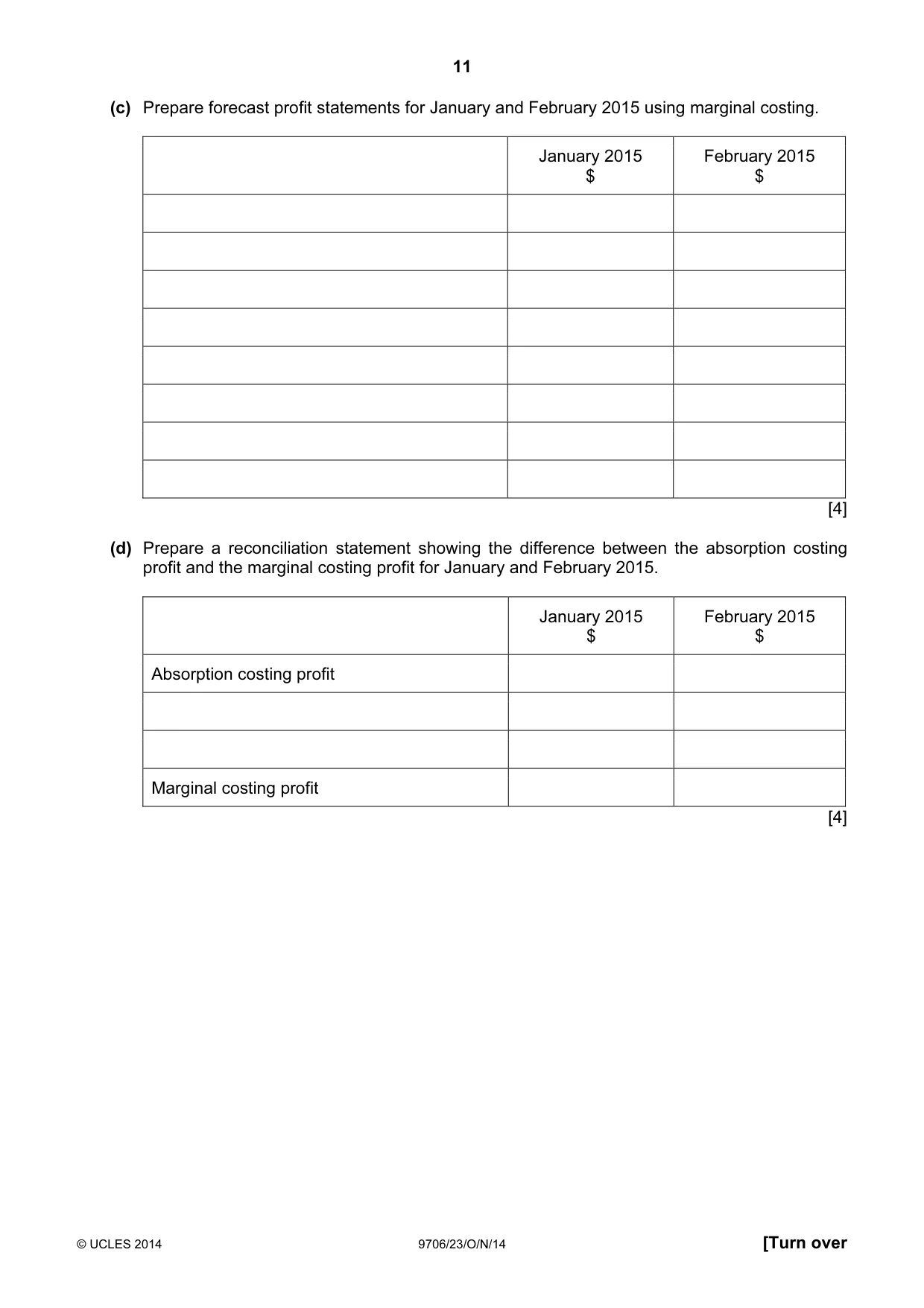
11 © UCLES 2014 9706/23/O/N/14 [Turn over (c) Prepare forecast profit statements for January and February 2015 using marginal costing. January 2015 $ February 2015 $ [4] (d) Prepare a reconciliation statement showing the difference between the absorption costing profit and the marginal costing profit for January and February 2015. January 2015 $ February 2015 $ Absorption costing profit Marginal costing profit [4]
Question paper, page 12
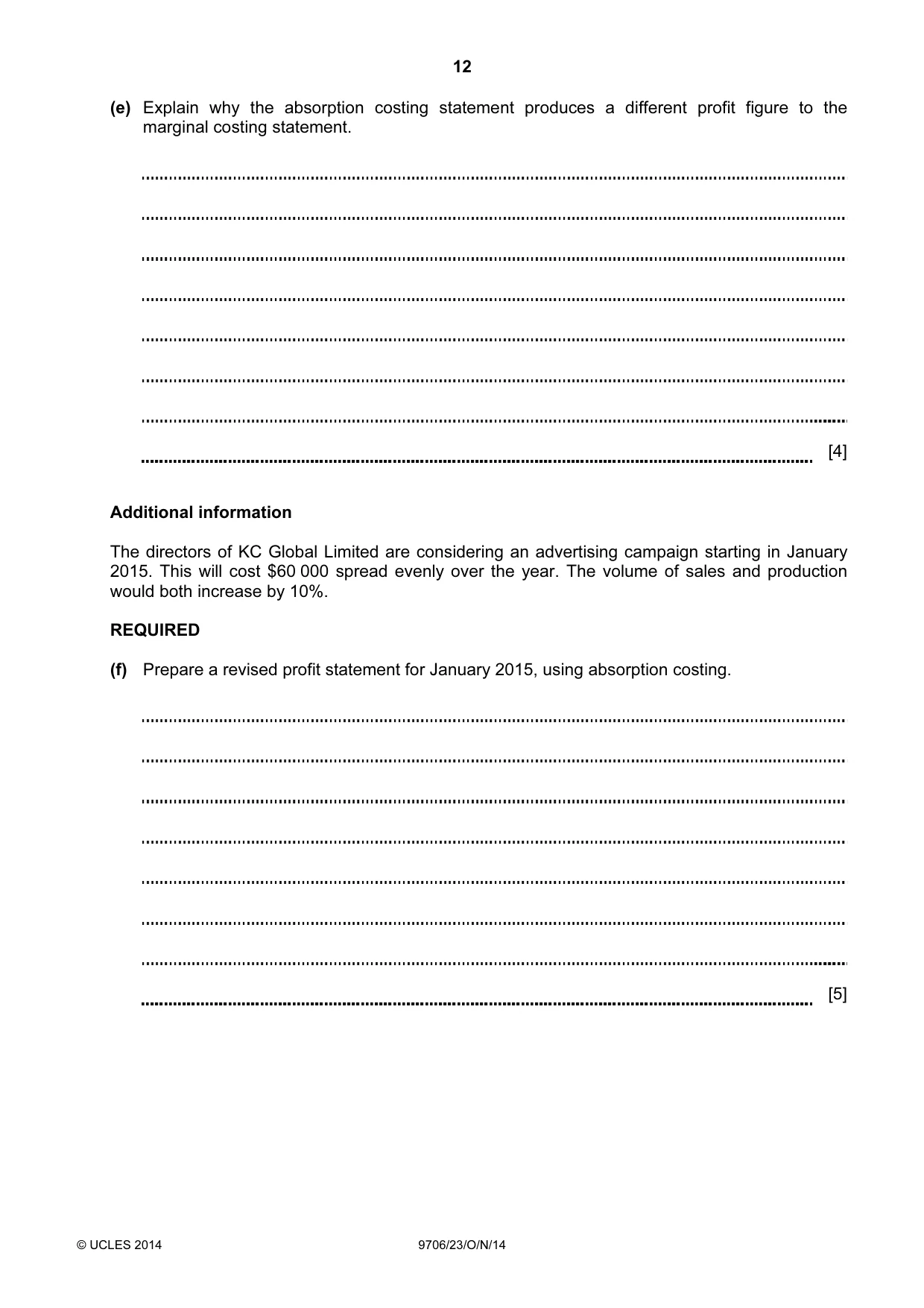
12 © UCLES 2014 9706/23/O/N/14 (e) Explain why the absorption costing statement produces a different profit figure to the marginal costing statement. [4] Additional information The directors of KC Global Limited are considering an advertising campaign starting in January 2015. This will cost $60 000 spread evenly over the year. The volume of sales and production would both increase by 10%. REQUIRED (f) Prepare a revised profit statement for January 2015, using absorption costing. [5]
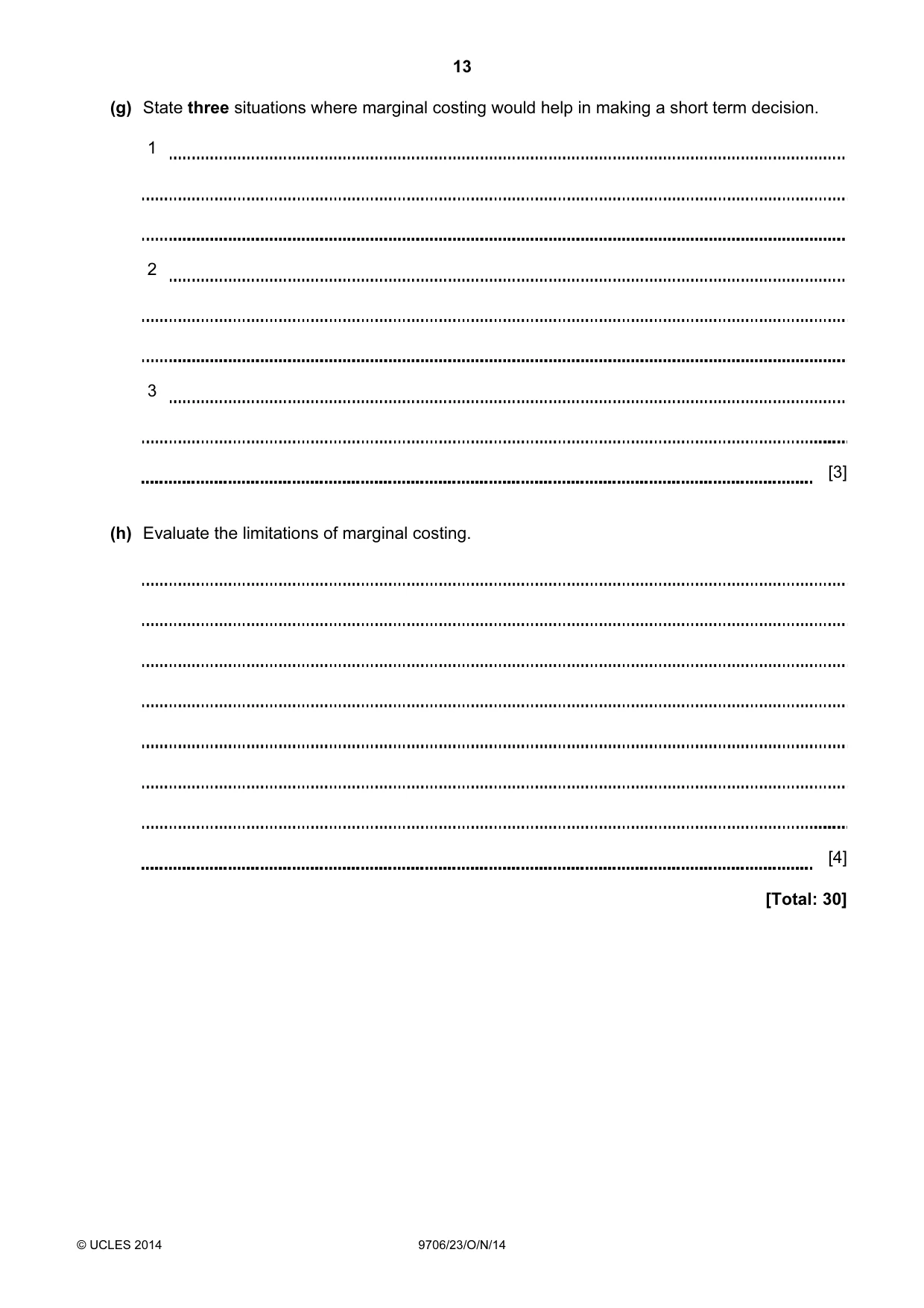
Question paper, page 13
13 © UCLES 2014 9706/23/O/N/14 (g) State three situations where marginal costing would help in making a short term decision. 1 2 3 [3] (h) Evaluate the limitations of marginal costing. [4] [Total: 30]
Question paper, page 14
14 © UCLES 2014 9706/23/O/N/14 BLANK PAGE
Question paper, page 15
15 © UCLES 2014 9706/23/O/N/14 BLANK PAGE
Question paper, page 16
16 Permission to reproduce items where third-party owned material protected by copyright is included has been sought and cleared where possible. Every reasonable effort has been made by the publisher (UCLES) to trace copyright holders, but if any items requiring clearance have unwittingly been included, the publisher will be pleased to make amends at the earliest possible opportunity. Cambridge International Examinations is part of the Cambridge Assessment Group. Cambridge Assessment is the brand name of University of Cambridge Local Examinations Syndicate (UCLES), which is itself a department of the University of Cambridge. © UCLES 2014 9706/23/O/N/14 BLANK PAGE
Mark scheme, page 1
® IGCSE is the registered trademark of Cambridge International Examinations. CAMBRIDGE INTERNATIONAL EXAMINATIONS Cambridge International Advanced Subsidiary and Advanced Level MARK SCHEME for the October/November 2014 series 9706 ACCOUNTING 9706/23 Paper 2 (Structured Questions – Core), maximum raw mark 90 This mark scheme is published as an aid to teachers and candidates, to indicate the requirements of the examination. It shows the basis on which Examiners were instructed to award marks. It does not indicate the details of the discussions that took place at an Examiners’ meeting before marking began, which would have considered the acceptability of alternative answers. Mark schemes should be read in conjunction with the question paper and the Principal Examiner Report for Teachers. Cambridge will not enter into discussions about these mark schemes. Cambridge is publishing the mark schemes for the October/November 2014 series for most Cambridge IGCSE®, Cambridge International A and AS Level components and some Cambridge O Level components.
Mark scheme, page 2
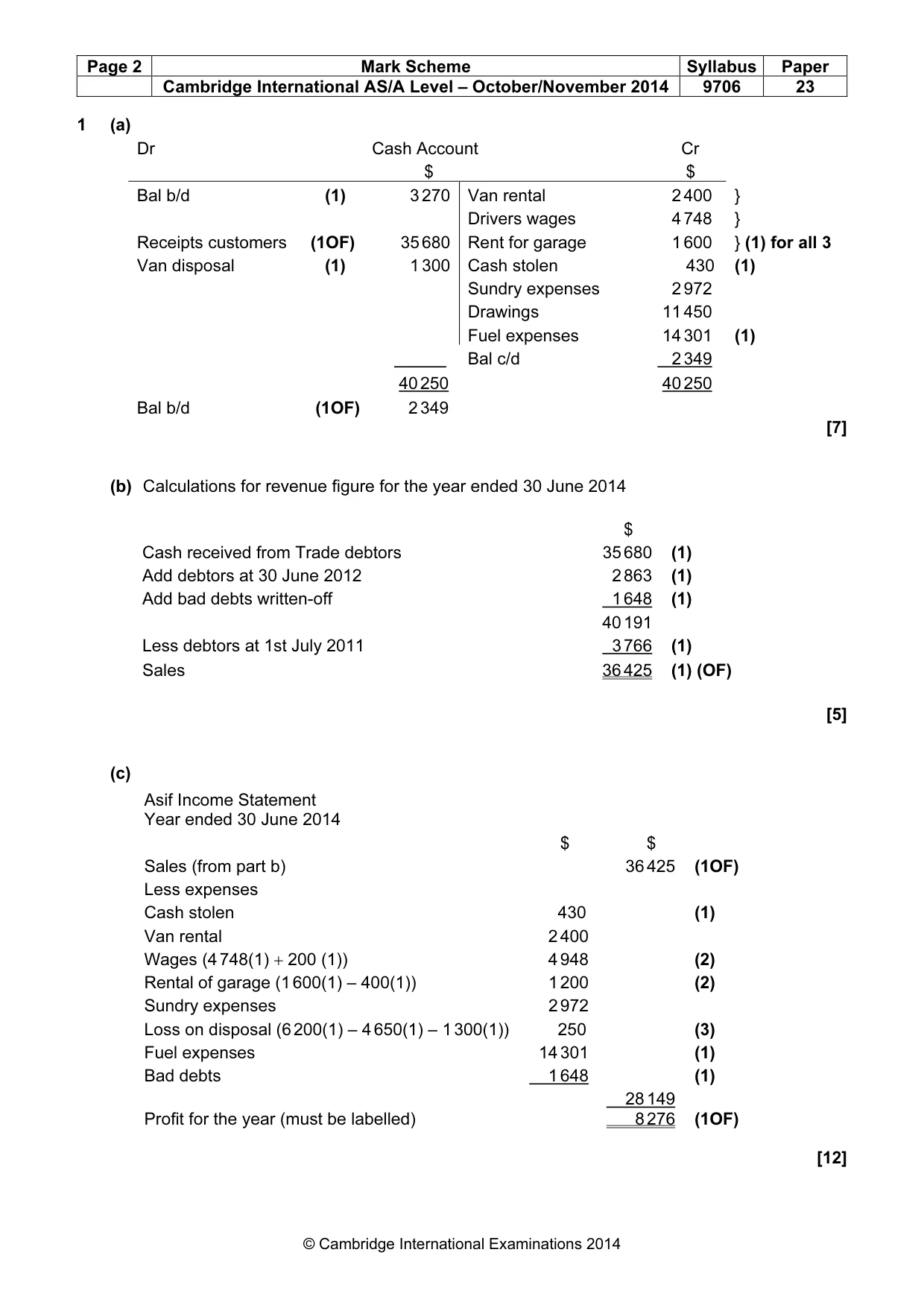
Page 2 Mark Scheme Syllabus Paper Cambridge International AS/A Level – October/November 2014 9706 23 © Cambridge International Examinations 2014 1 (a) Dr Cash Account Cr $ $ Bal b/d (1) 3 270 Van rental 2 400 } Drivers wages 4 748 } Receipts customers (1OF) 35 680 Rent for garage 1 600 } (1) for all 3 Van disposal (1) 1 300 Cash stolen 430 (1) Sundry expenses 2 972 Drawings 11 450 Fuel expenses 14 301 (1) Bal c/d 2 349 40 250 40 250 Bal b/d (1OF) 2 349 [7] (b) Calculations for revenue figure for the year ended 30 June 2014 $ Cash received from Trade debtors 35 680 (1) Add debtors at 30 June 2012 2 863 (1) Add bad debts written-off 1 648 (1) 40 191 Less debtors at 1st July 2011 3 766 (1) Sales 36 425 (1) (OF) [5] (c) Asif Income Statement Year ended 30 June 2014 $ $ Sales (from part b) 36 425 (1OF) Less expenses Cash stolen 430 (1) Van rental 2 400 Wages (4 748(1) + 200 (1)) 4 948 (2) Rental of garage (1 600(1) – 400(1)) 1 200 (2) Sundry expenses 2 972 Loss on disposal (6 200(1) – 4 650(1) – 1 300(1)) 250 (3) Fuel expenses 14 301 (1) Bad debts 1 648 (1) 28 149 Profit for the year (must be labelled) 8 276 (1OF) [12]
Mark scheme, page 3
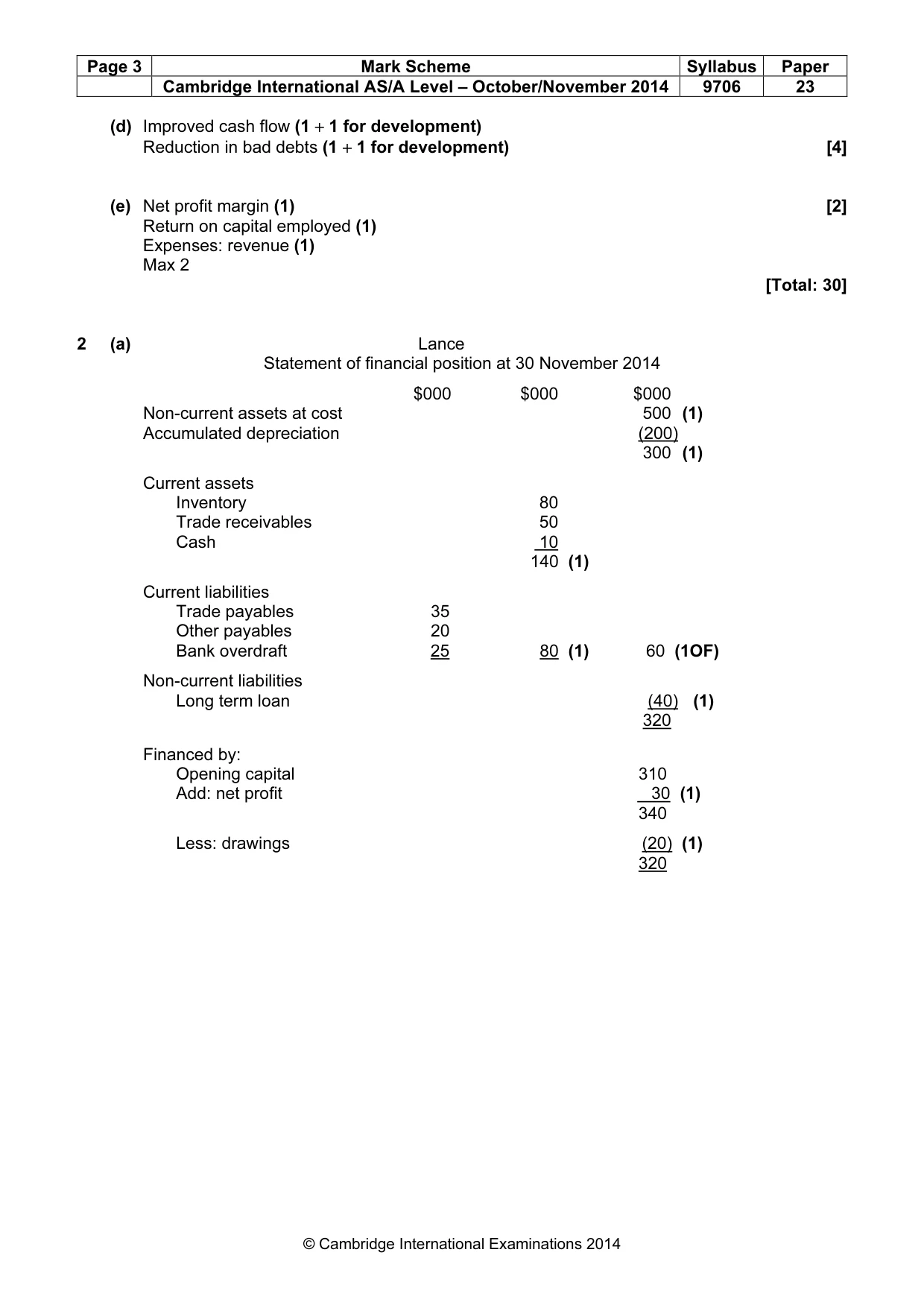
Page 3 Mark Scheme Syllabus Paper Cambridge International AS/A Level – October/November 2014 9706 23 © Cambridge International Examinations 2014 (d) Improved cash flow (1 + 1 for development) Reduction in bad debts (1 + 1 for development) [4] (e) Net profit margin (1) [2] Return on capital employed (1) Expenses: revenue (1) Max 2 [Total: 30] 2 (a) Lance Statement of financial position at 30 November 2014 $000 $000 $000 Non-current assets at cost 500 (1) Accumulated depreciation (200) 300 (1) Current assets Inventory 80 Trade receivables 50 Cash 10 140 (1) Current liabilities Trade payables 35 Other payables 20 Bank overdraft 25 80 (1) 60 (1OF) Non-current liabilities Long term loan (40) (1) 320 Financed by: Opening capital 310 Add: net profit 30 (1) 340 Less: drawings (20) (1) 320
Mark scheme, page 4
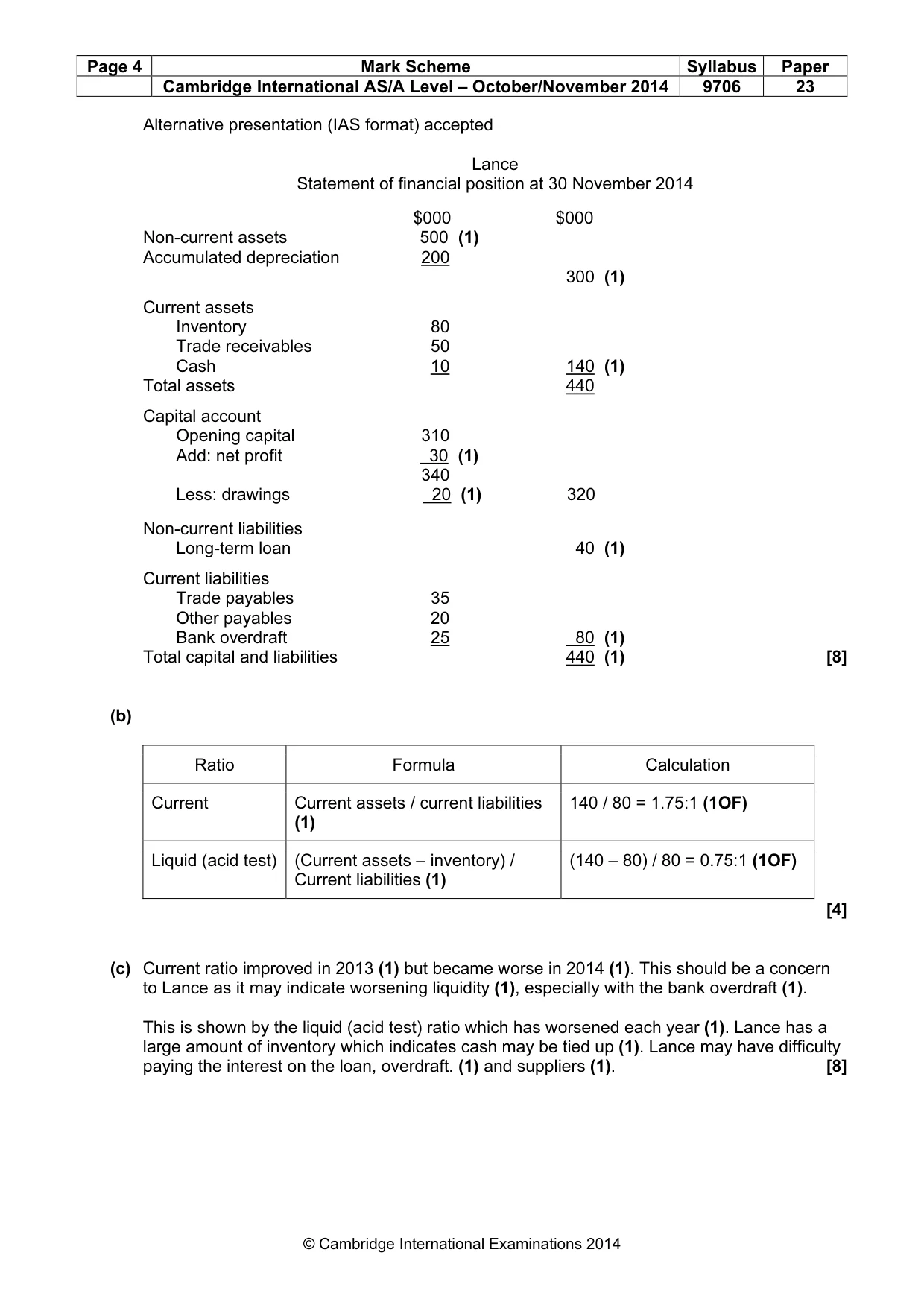
Page 4 Mark Scheme Syllabus Paper Cambridge International AS/A Level – October/November 2014 9706 23 © Cambridge International Examinations 2014 Alternative presentation (IAS format) accepted Lance Statement of financial position at 30 November 2014 $000 $000 Non-current assets 500 (1) Accumulated depreciation 200 300 (1) Current assets Inventory 80 Trade receivables 50 Cash 10 140 (1) Total assets 440 Capital account Opening capital 310 Add: net profit 30 (1) 340 Less: drawings 20 (1) 320 Non-current liabilities Long-term loan 40 (1) Current liabilities Trade payables 35 Other payables 20 Bank overdraft 25 80 (1) Total capital and liabilities 440 (1) [8] (b) Ratio Formula Calculation Current Current assets / current liabilities (1) 140 / 80 = 1.75:1 (1OF) Liquid (acid test) (Current assets – inventory) / Current liabilities (1) (140 – 80) / 80 = 0.75:1 (1OF) [4] (c) Current ratio improved in 2013 (1) but became worse in 2014 (1). This should be a concern to Lance as it may indicate worsening liquidity (1), especially with the bank overdraft (1). This is shown by the liquid (acid test) ratio which has worsened each year (1). Lance has a large amount of inventory which indicates cash may be tied up (1). Lance may have difficulty paying the interest on the loan, overdraft. (1) and suppliers (1). [8]
Mark scheme, page 5
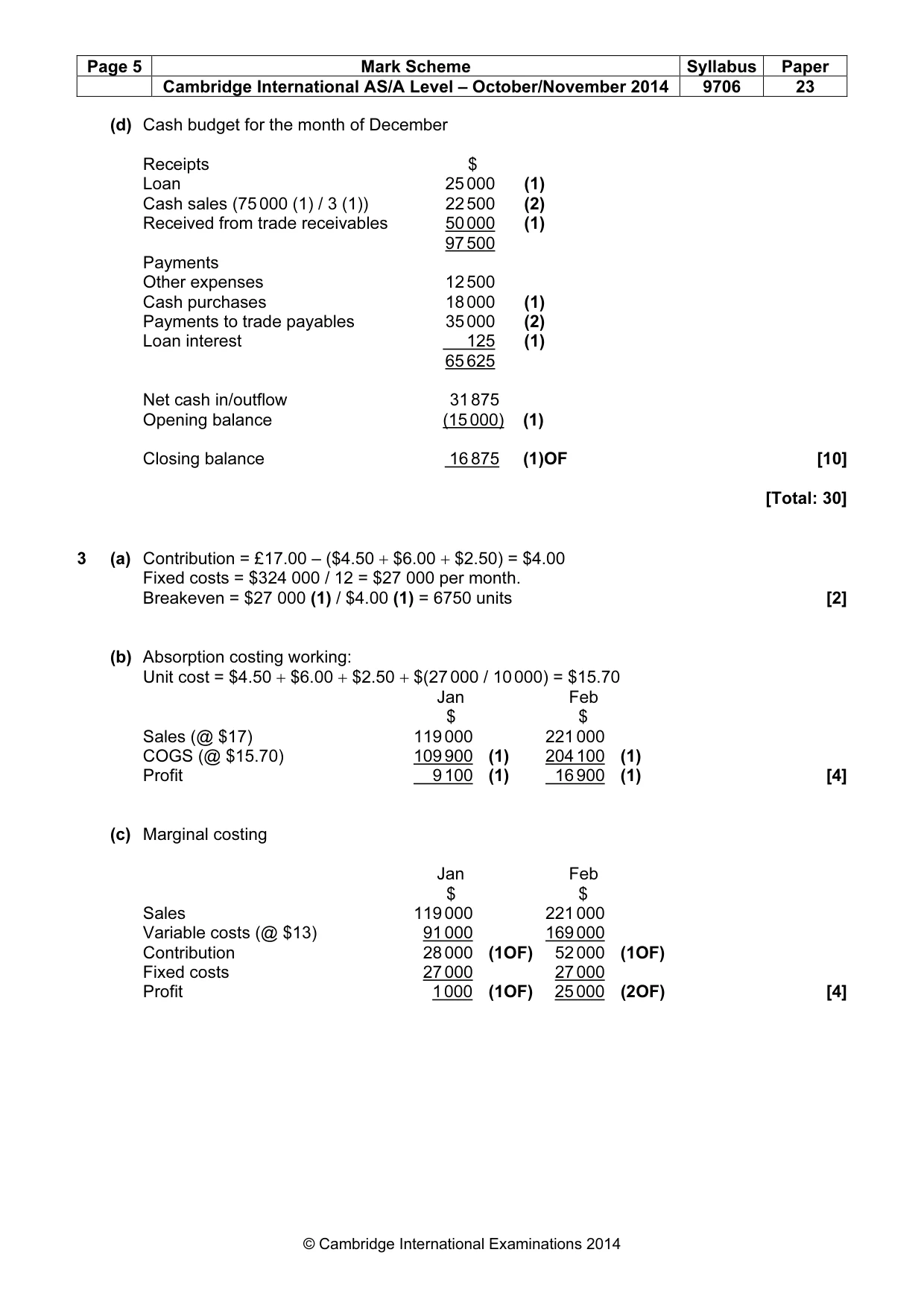
Page 5 Mark Scheme Syllabus Paper Cambridge International AS/A Level – October/November 2014 9706 23 © Cambridge International Examinations 2014 (d) Cash budget for the month of December Receipts $ Loan 25 000 (1) Cash sales (75 000 (1) / 3 (1)) 22 500 (2) Received from trade receivables 50 000 (1) 97 500 Payments Other expenses 12 500 Cash purchases 18 000 (1) Payments to trade payables 35 000 (2) Loan interest 125 (1) 65 625 Net cash in/outflow 31 875 Opening balance (15 000) (1) Closing balance 16 875 (1)OF [10] [Total: 30] 3 (a) Contribution = £17.00 – ($4.50 + $6.00 + $2.50) = $4.00 Fixed costs = $324 000 / 12 = $27 000 per month. Breakeven = $27 000 (1) / $4.00 (1) = 6750 units [2] (b) Absorption costing working: Unit cost = $4.50 + $6.00 + $2.50 + $(27 000 / 10 000) = $15.70 Jan Feb $ $ Sales (@ $17) 119 000 221 000 COGS (@ $15.70) 109 900 (1) 204 100 (1) Profit 9 100 (1) 16 900 (1) [4] (c) Marginal costing Jan Feb $ $ Sales 119 000 221 000 Variable costs (@ $13) 91 000 169 000 Contribution 28 000 (1OF) 52 000 (1OF) Fixed costs 27 000 27 000 Profit 1 000 (1OF) 25 000 (2OF) [4]
Mark scheme, page 6
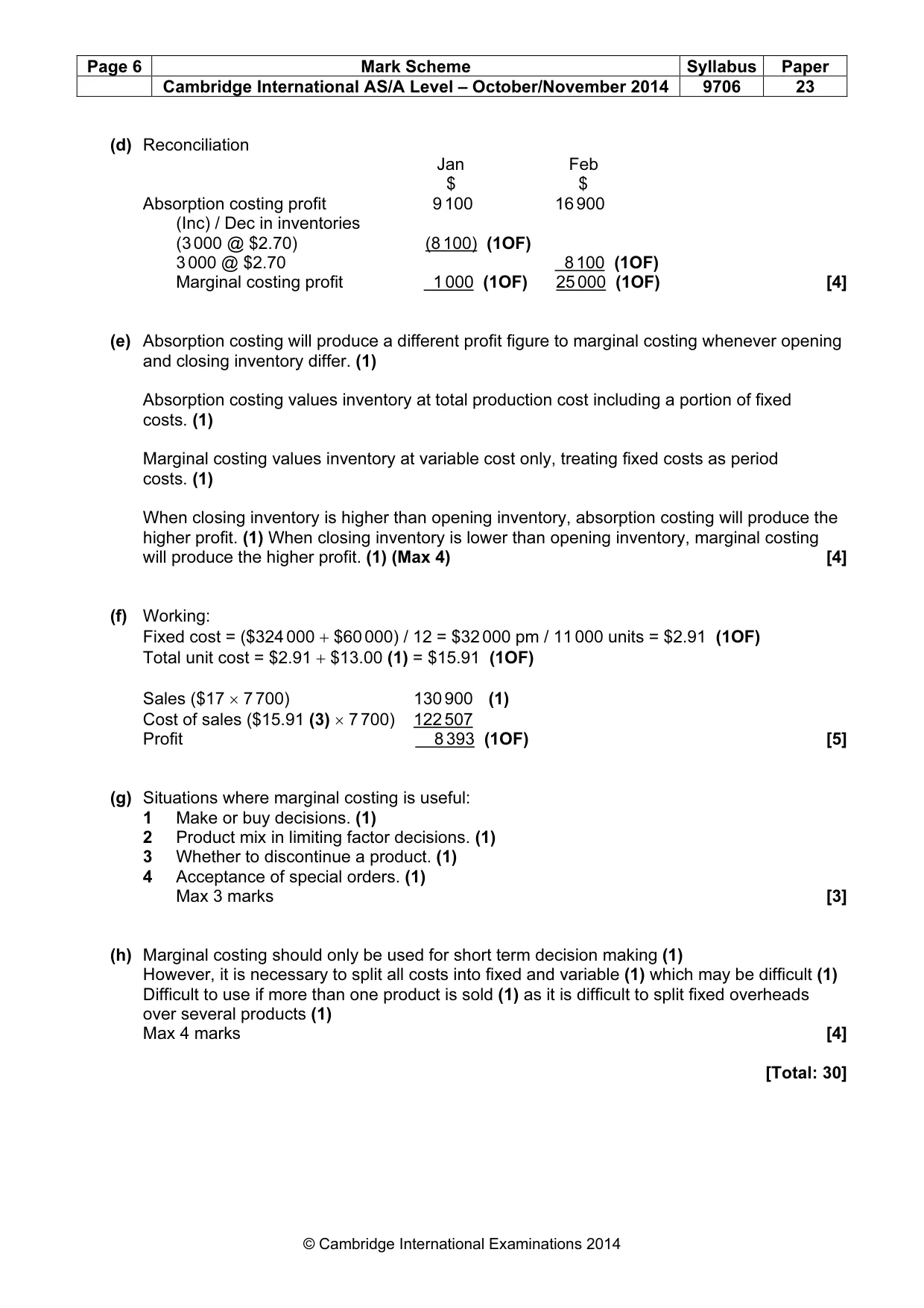
Page 6 Mark Scheme Syllabus Paper Cambridge International AS/A Level – October/November 2014 9706 23 © Cambridge International Examinations 2014 (d) Reconciliation Jan Feb $ $ Absorption costing profit 9 100 16 900 (Inc) / Dec in inventories (3 000 @ $2.70) (8 100) (1OF) 3 000 @ $2.70 8 100 (1OF) Marginal costing profit 1 000 (1OF) 25 000 (1OF) [4] (e) Absorption costing will produce a different profit figure to marginal costing whenever opening and closing inventory differ. (1) Absorption costing values inventory at total production cost including a portion of fixed costs. (1) Marginal costing values inventory at variable cost only, treating fixed costs as period costs. (1) When closing inventory is higher than opening inventory, absorption costing will produce the higher profit. (1) When closing inventory is lower than opening inventory, marginal costing will produce the higher profit. (1) (Max 4) [4] (f) Working: Fixed cost = ($324 000 + $60 000) / 12 = $32 000 pm / 11 000 units = $2.91 (1OF) Total unit cost = $2.91 + $13.00 (1) = $15.91 (1OF) Sales ($17 × 7 700) 130 900 (1) Cost of sales ($15.91 (3) × 7 700) 122 507 Profit 8 393 (1OF) [5] (g) Situations where marginal costing is useful: 1 Make or buy decisions. (1) 2 Product mix in limiting factor decisions. (1) 3 Whether to discontinue a product. (1) 4 Acceptance of special orders. (1) Max 3 marks [3] (h) Marginal costing should only be used for short term decision making (1) However, it is necessary to split all costs into fixed and variable (1) which may be difficult (1) Difficult to use if more than one product is sold (1) as it is difficult to split fixed overheads over several products (1) Max 4 marks [4] [Total: 30]
What you needed in this session
Cambridge’s own grade thresholds for 2014 Oct/Nov, Paper 2 · Variant 3. A higher threshold means an easier paper — the bar moves with how the cohort did.