Cambridge A Level Accounting 9706 — 2014 May/June Paper 4 · Variant 2
9706/42/M/J/14 · 120 marks · ≈135 min
The question paper and its mark scheme, free to read here and free to download. This is Cambridge’s own paper, exactly as it was sat.
Question paper8 pages
Mark scheme7 pages
Answers below. Sit the paper first if you are practising.
Paper as text
Question paper, page 1
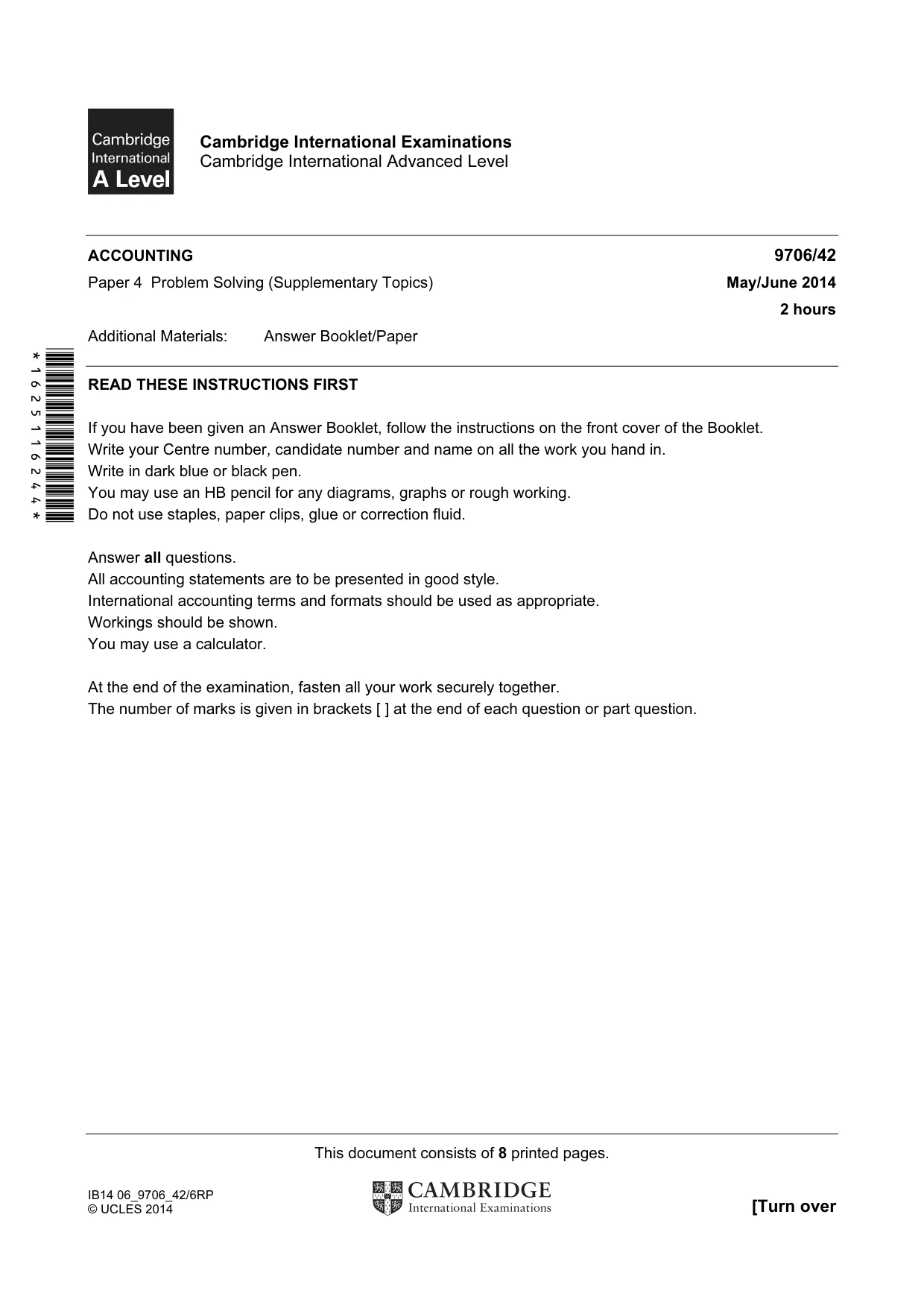
This document consists of 8 printed pages. IB14 06_9706_42/6RP © UCLES 2014 [Turn over *1625116244* Cambridge International Examinations Cambridge International Advanced Level ACCOUNTING 9706/42 Paper 4 Problem Solving (Supplementary Topics) May/June 2014 2 hours Additional Materials: Answer Booklet/Paper READ THESE INSTRUCTIONS FIRST If you have been given an Answer Booklet, follow the instructions on the front cover of the Booklet. Write your Centre number, candidate number and name on all the work you hand in. Write in dark blue or black pen. You may use an HB pencil for any diagrams, graphs or rough working. Do not use staples, paper clips, glue or correction fluid. Answer all questions. All accounting statements are to be presented in good style. International accounting terms and formats should be used as appropriate. Workings should be shown. You may use a calculator. At the end of the examination, fasten all your work securely together. The number of marks is given in brackets [ ] at the end of each question or part question.
Question paper, page 2
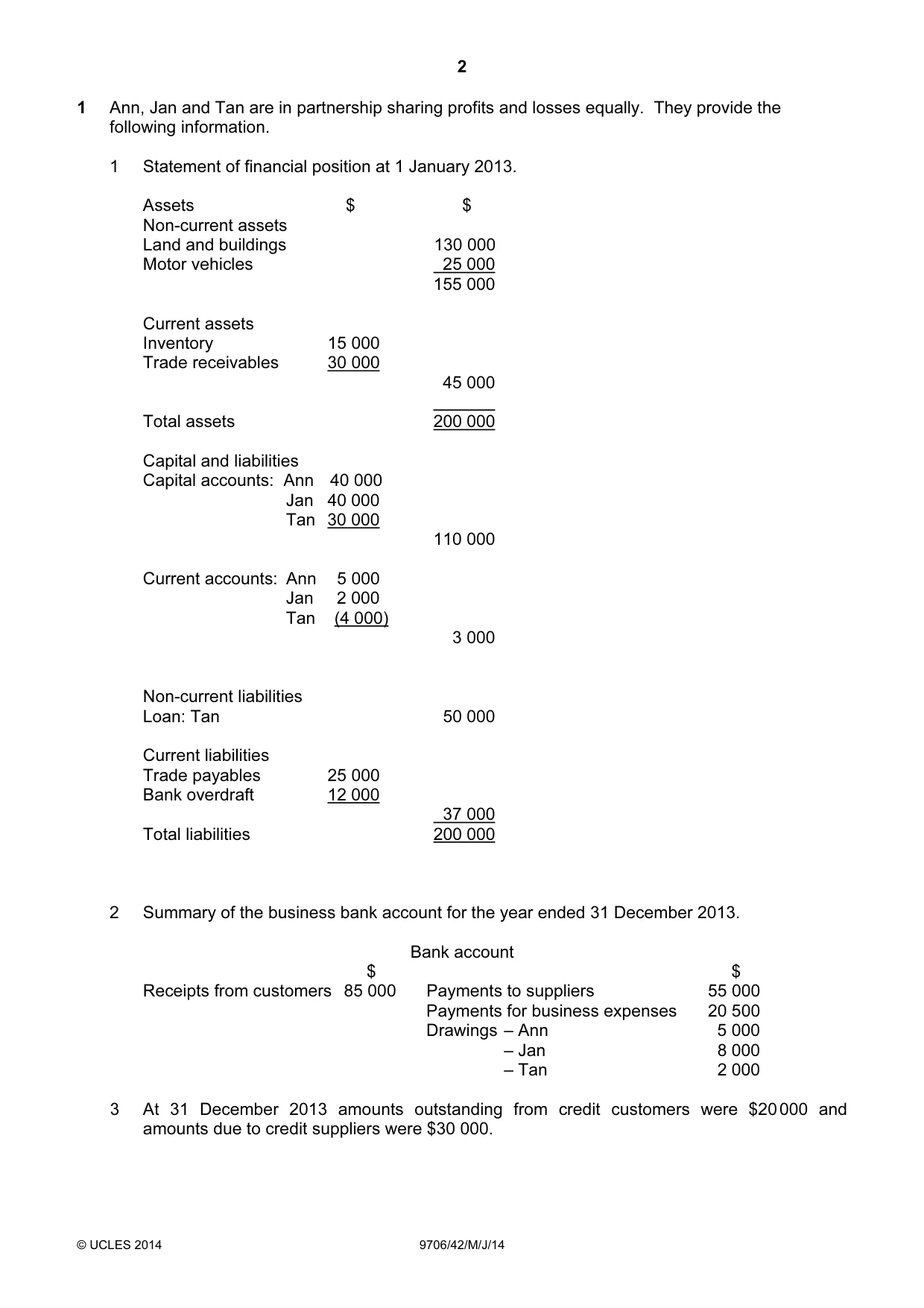
2 © UCLES 2014 9706/42/M/J/14 1 Ann, Jan and Tan are in partnership sharing profits and losses equally. They provide the following information. 1 Statement of financial position at 1 January 2013. Assets $ $ Non-current assets Land and buildings 130 000 Motor vehicles 25 000 155 000 Current assets Inventory 15 000 Trade receivables 30 000 45 000 000000 Total assets 200 000 Capital and liabilities Capital accounts: Ann 40 000 Jan 40 000 Tan 30 000 110 000 Current accounts: Ann 5 000 Jan 2 000 Tan (4 000) 3 000 Non-current liabilities Loan: Tan 50 000 Current liabilities Trade payables 25 000 Bank overdraft 12 000 37 000 Total liabilities 200 000 2 Summary of the business bank account for the year ended 31 December 2013. Bank account $ $ Receipts from customers 85 000 Payments to suppliers 55 000 Payments for business expenses 20 500 Drawings – Ann 5 000 – Jan 8 000 – Tan 2 000 3 At 31 December 2013 amounts outstanding from credit customers were $20 000 and amounts due to credit suppliers were $30 000.
Question paper, page 3
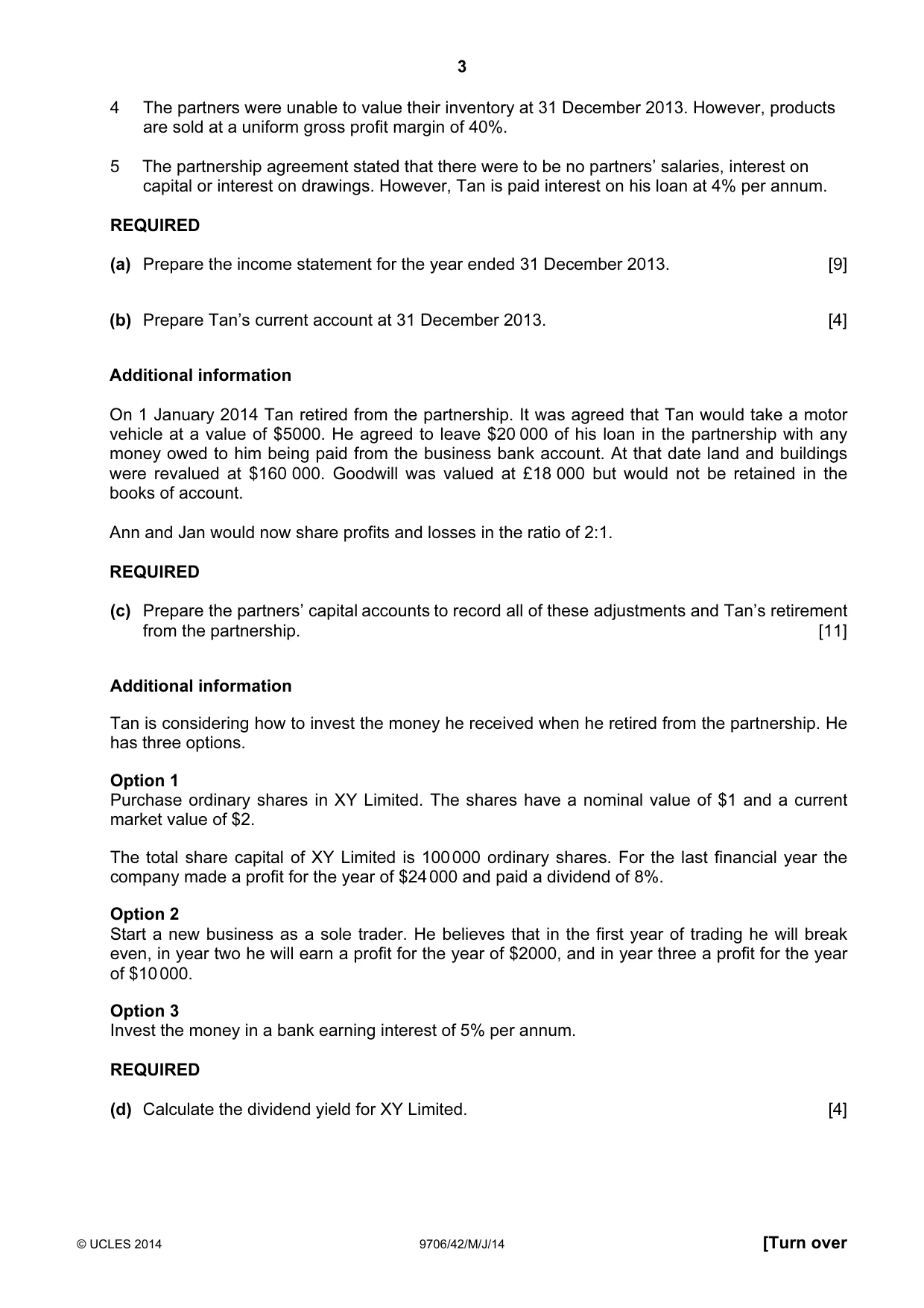
3 © UCLES 2014 9706/42/M/J/14 [Turn over 4 The partners were unable to value their inventory at 31 December 2013. However, products are sold at a uniform gross profit margin of 40%. 5 The partnership agreement stated that there were to be no partners’ salaries, interest on capital or interest on drawings. However, Tan is paid interest on his loan at 4% per annum. REQUIRED (a) Prepare the income statement for the year ended 31 December 2013. [9] (b) Prepare Tan’s current account at 31 December 2013. [4] Additional information On 1 January 2014 Tan retired from the partnership. It was agreed that Tan would take a motor vehicle at a value of $5000. He agreed to leave $20 000 of his loan in the partnership with any money owed to him being paid from the business bank account. At that date land and buildings were revalued at $160 000. Goodwill was valued at £18 000 but would not be retained in the books of account. Ann and Jan would now share profits and losses in the ratio of 2:1. REQUIRED (c) Prepare the partners’ capital accounts to record all of these adjustments and Tan’s retirement from the partnership. [11] Additional information Tan is considering how to invest the money he received when he retired from the partnership. He has three options. Option 1 Purchase ordinary shares in XY Limited. The shares have a nominal value of $1 and a current market value of $2. The total share capital of XY Limited is 100 000 ordinary shares. For the last financial year the company made a profit for the year of $24 000 and paid a dividend of 8%. Option 2 Start a new business as a sole trader. He believes that in the first year of trading he will break even, in year two he will earn a profit for the year of $2000, and in year three a profit for the year of $10 000. Option 3 Invest the money in a bank earning interest of 5% per annum. REQUIRED (d) Calculate the dividend yield for XY Limited. [4]
Question paper, page 4
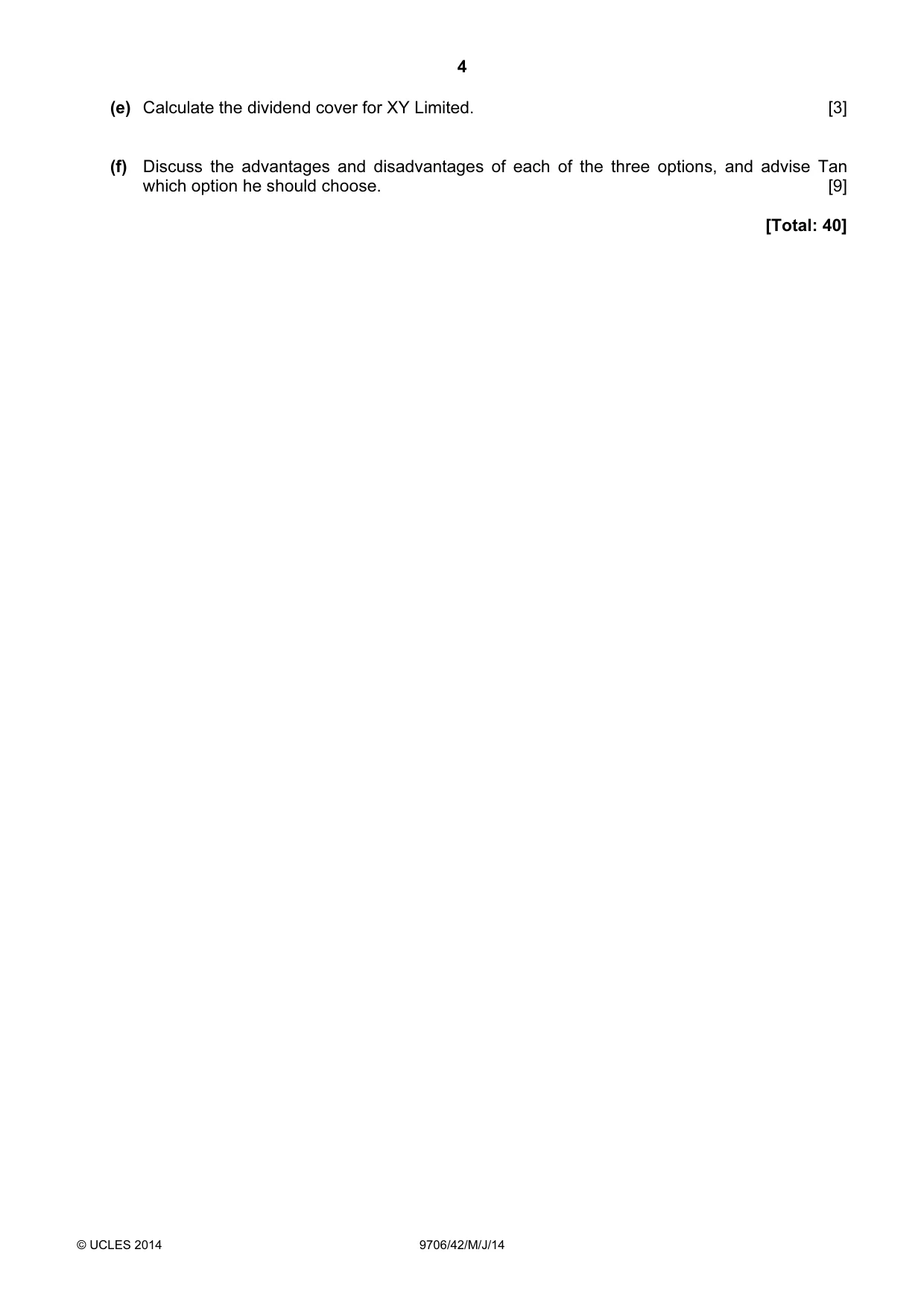
4 © UCLES 2014 9706/42/M/J/14 (e) Calculate the dividend cover for XY Limited. [3] (f) Discuss the advantages and disadvantages of each of the three options, and advise Tan which option he should choose. [9] [Total: 40]
Question paper, page 5
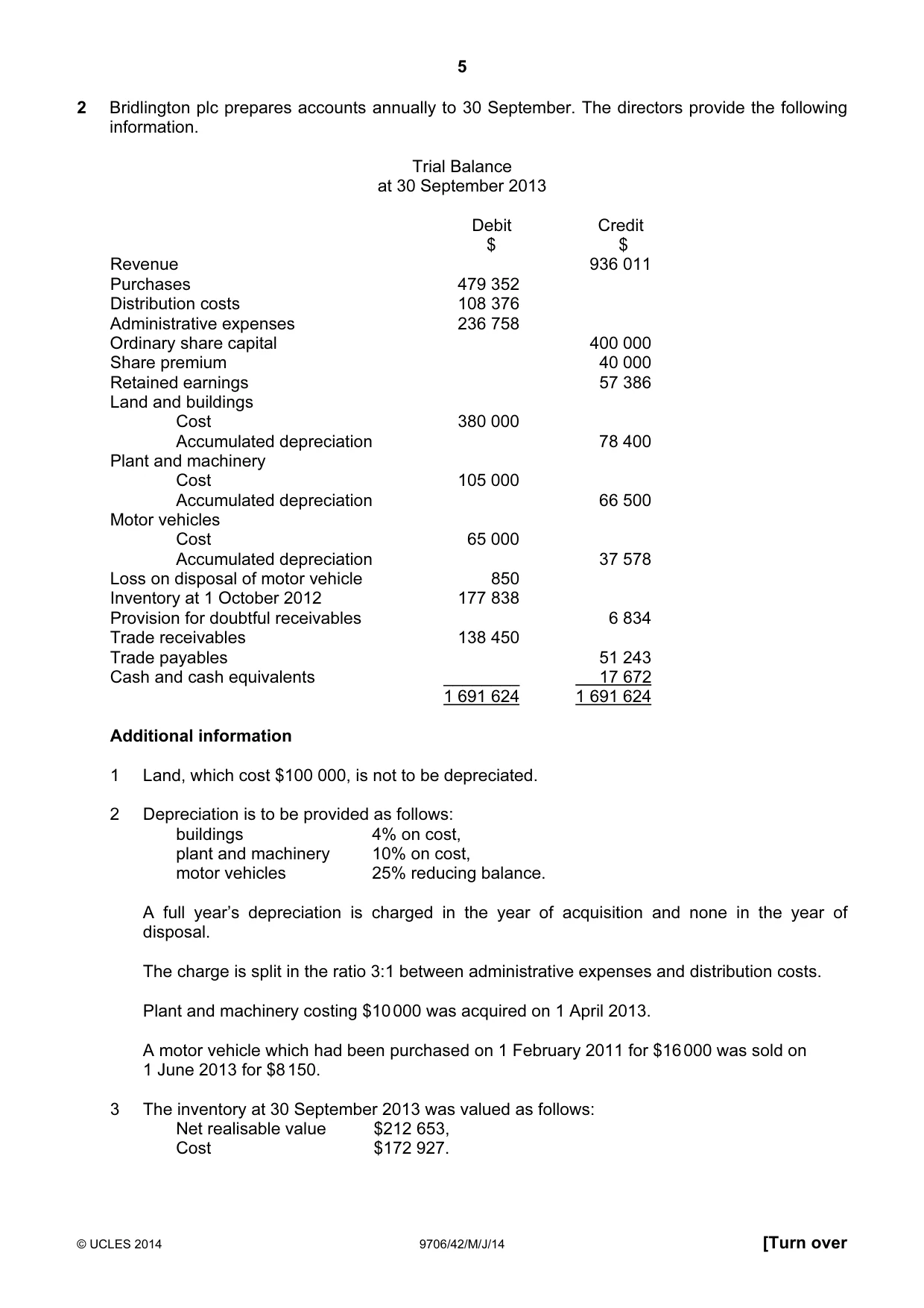
5 © UCLES 2014 9706/42/M/J/14 [Turn over 2 Bridlington plc prepares accounts annually to 30 September. The directors provide the following information. Trial Balance at 30 September 2013 Debit Credit $ $ Revenue 936 011 Purchases 479 352 Distribution costs 108 376 Administrative expenses 236 758 Ordinary share capital 400 000 Share premium 40 000 Retained earnings 57 386 Land and buildings Cost 380 000 Accumulated depreciation 78 400 Plant and machinery Cost 105 000 Accumulated depreciation 66 500 Motor vehicles Cost 65 000 Accumulated depreciation 37 578 Loss on disposal of motor vehicle 850 Inventory at 1 October 2012 177 838 Provision for doubtful receivables 6 834 Trade receivables 138 450 Trade payables 51 243 Cash and cash equivalents ________ 17 672 1 691 624 1 691 624 Additional information 1 Land, which cost $100 000, is not to be depreciated. 2 Depreciation is to be provided as follows: buildings 4% on cost, plant and machinery 10% on cost, motor vehicles 25% reducing balance. A full year’s depreciation is charged in the year of acquisition and none in the year of disposal. The charge is split in the ratio 3:1 between administrative expenses and distribution costs. Plant and machinery costing $10 000 was acquired on 1 April 2013. A motor vehicle which had been purchased on 1 February 2011 for $16 000 was sold on 1 June 2013 for $8 150. 3 The inventory at 30 September 2013 was valued as follows: Net realisable value $212 653, Cost $172 927.
Question paper, page 6
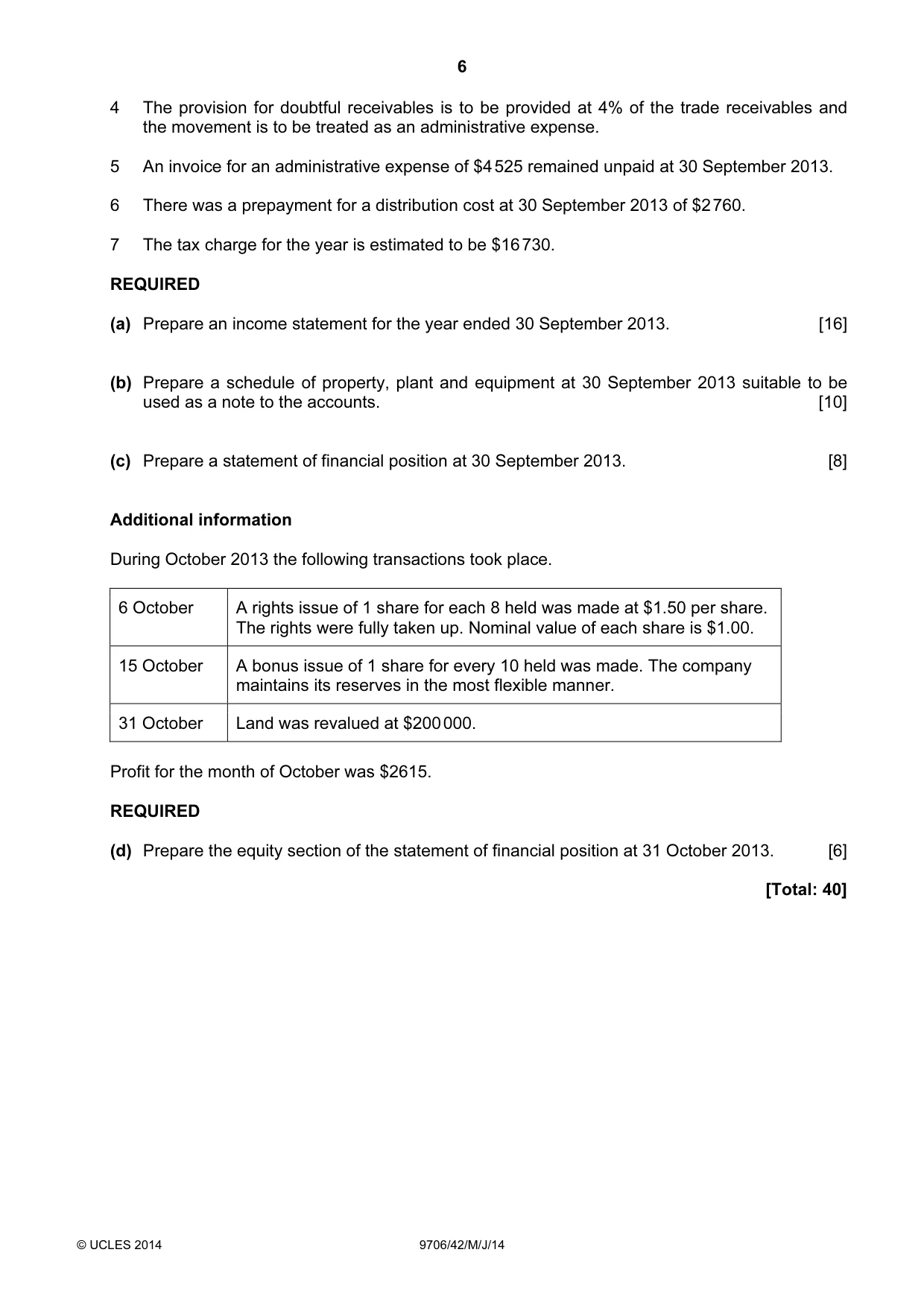
6 © UCLES 2014 9706/42/M/J/14 4 The provision for doubtful receivables is to be provided at 4% of the trade receivables and the movement is to be treated as an administrative expense. 5 An invoice for an administrative expense of $4 525 remained unpaid at 30 September 2013. 6 There was a prepayment for a distribution cost at 30 September 2013 of $2 760. 7 The tax charge for the year is estimated to be $16 730. REQUIRED (a) Prepare an income statement for the year ended 30 September 2013. [16] (b) Prepare a schedule of property, plant and equipment at 30 September 2013 suitable to be used as a note to the accounts. [10] (c) Prepare a statement of financial position at 30 September 2013. [8] Additional information During October 2013 the following transactions took place. 6 October A rights issue of 1 share for each 8 held was made at $1.50 per share. The rights were fully taken up. Nominal value of each share is $1.00. 15 October A bonus issue of 1 share for every 10 held was made. The company maintains its reserves in the most flexible manner. 31 October Land was revalued at $200 000. Profit for the month of October was $2615. REQUIRED (d) Prepare the equity section of the statement of financial position at 31 October 2013. [6] [Total: 40]
Question paper, page 7
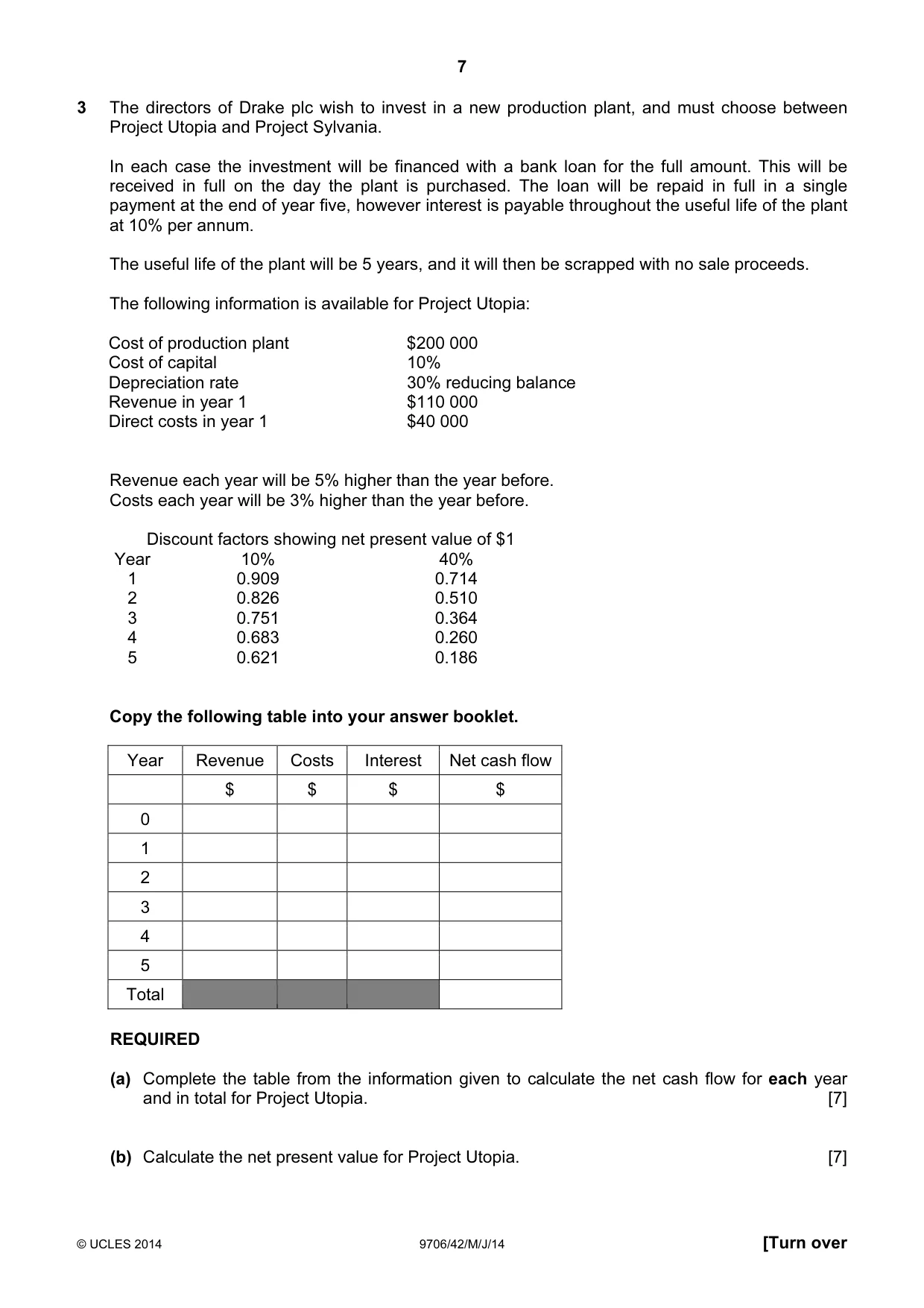
7 © UCLES 2014 9706/42/M/J/14 [Turn over 3 The directors of Drake plc wish to invest in a new production plant, and must choose between Project Utopia and Project Sylvania. In each case the investment will be financed with a bank loan for the full amount. This will be received in full on the day the plant is purchased. The loan will be repaid in full in a single payment at the end of year five, however interest is payable throughout the useful life of the plant at 10% per annum. The useful life of the plant will be 5 years, and it will then be scrapped with no sale proceeds. The following information is available for Project Utopia: Cost of production plant $200 000 Cost of capital 10% Depreciation rate 30% reducing balance Revenue in year 1 $110 000 Direct costs in year 1 $40 000 Revenue each year will be 5% higher than the year before. Costs each year will be 3% higher than the year before. Discount factors showing net present value of $1 Year 10% 40% 1 0.909 0.714 2 0.826 0.510 3 0.751 0.364 4 0.683 0.260 5 0.621 0.186 Copy the following table into your answer booklet. Year Revenue Costs Interest Net cash flow $ $ $ $ 0 1 2 3 4 5 Total REQUIRED (a) Complete the table from the information given to calculate the net cash flow for each year and in total for Project Utopia. [7] (b) Calculate the net present value for Project Utopia. [7]
Question paper, page 8
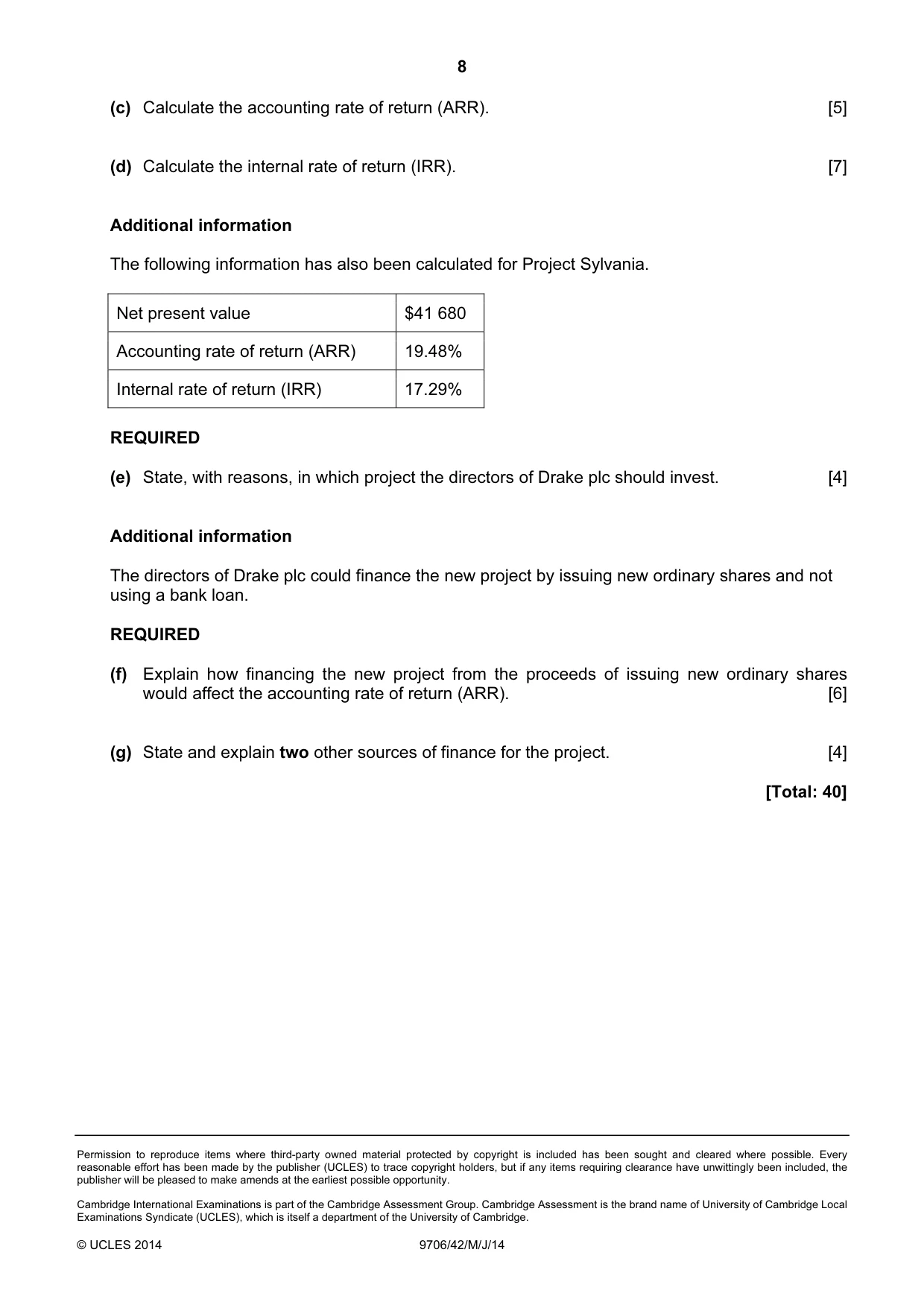
8 Permission to reproduce items where third-party owned material protected by copyright is included has been sought and cleared where possible. Every reasonable effort has been made by the publisher (UCLES) to trace copyright holders, but if any items requiring clearance have unwittingly been included, the publisher will be pleased to make amends at the earliest possible opportunity. Cambridge International Examinations is part of the Cambridge Assessment Group. Cambridge Assessment is the brand name of University of Cambridge Local Examinations Syndicate (UCLES), which is itself a department of the University of Cambridge. © UCLES 2014 9706/42/M/J/14 (c) Calculate the accounting rate of return (ARR). [5] (d) Calculate the internal rate of return (IRR). [7] Additional information The following information has also been calculated for Project Sylvania. Net present value $41 680 Accounting rate of return (ARR) 19.48% Internal rate of return (IRR) 17.29% REQUIRED (e) State, with reasons, in which project the directors of Drake plc should invest. [4] Additional information The directors of Drake plc could finance the new project by issuing new ordinary shares and not using a bank loan. REQUIRED (f) Explain how financing the new project from the proceeds of issuing new ordinary shares would affect the accounting rate of return (ARR). [6] (g) State and explain two other sources of finance for the project. [4] [Total: 40]
Mark scheme, page 1
CAMBRIDGE INTERNATIONAL EXAMINATIONS GCE Advanced Level MARK SCHEME for the May/June 2014 series 9706 ACCOUNTING 9706/42 Paper 4 (Problem Solving [Supplement]), maximum raw mark 120 This mark scheme is published as an aid to teachers and candidates, to indicate the requirements of the examination. It shows the basis on which Examiners were instructed to award marks. It does not indicate the details of the discussions that took place at an Examiners’ meeting before marking began, which would have considered the acceptability of alternative answers. Mark schemes should be read in conjunction with the question paper and the Principal Examiner Report for Teachers. Cambridge will not enter into discussions about these mark schemes. Cambridge is publishing the mark schemes for the May/June 2014 series for most IGCSE, GCE Advanced Level and Advanced Subsidiary Level components and some Ordinary Level components.
Mark scheme, page 2
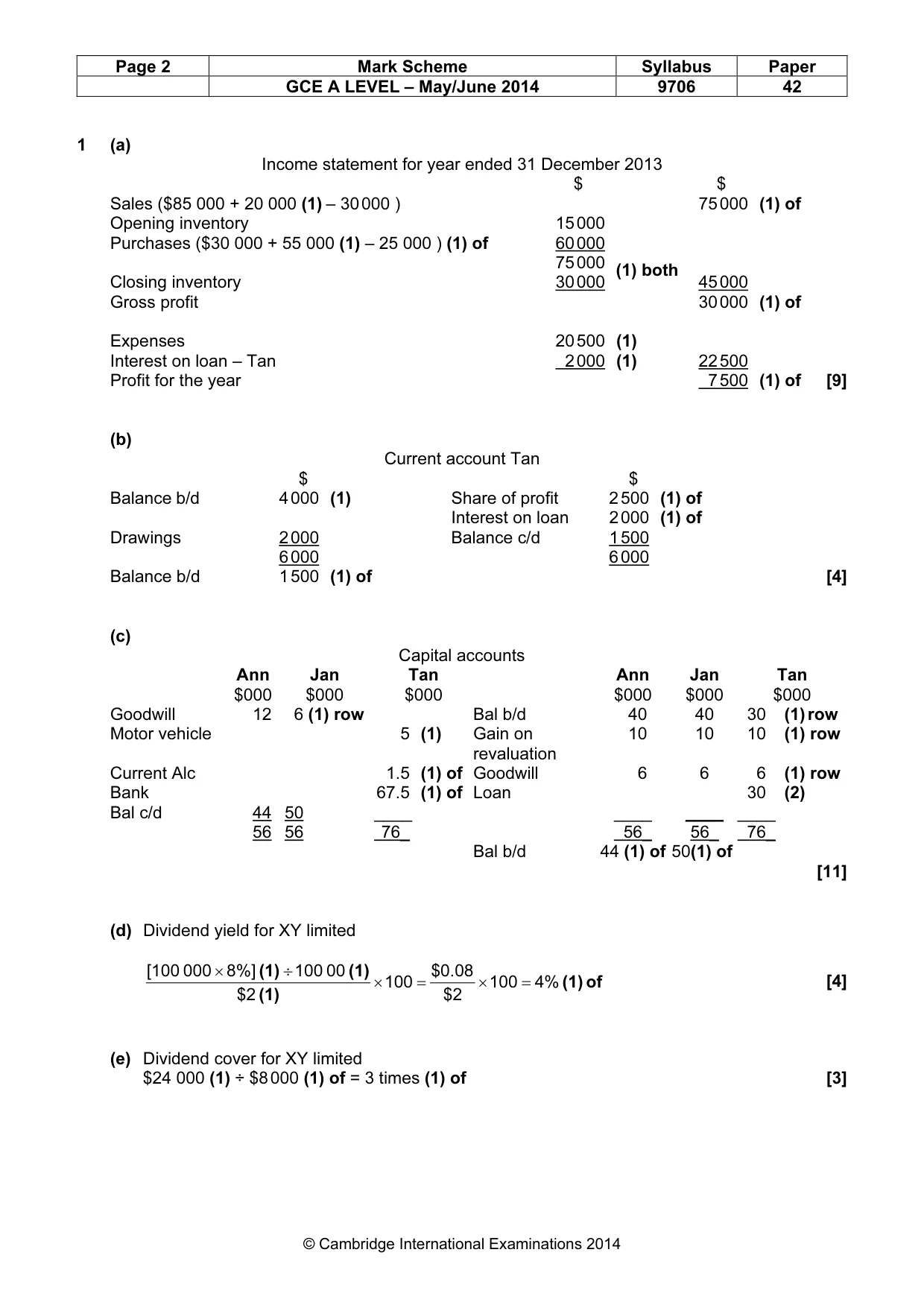
Page 2 Mark Scheme Syllabus Paper GCE A LEVEL – May/June 2014 9706 42 © Cambridge International Examinations 2014 1 (a) Income statement for year ended 31 December 2013 $ $ Sales ($85 000 + 20 000 (1) – 30 000 ) 75 000 (1) of Opening inventory 15 000 Purchases ($30 000 + 55 000 (1) – 25 000 ) (1) of 60 000 75 000 Closing inventory 30 000 45 000 Gross profit 30 000 (1) of Expenses 20 500 (1) Interest on loan – Tan 2 000 (1) 22 500 Profit for the year 7 500 (1) of [9] (b) Current account Tan $ $ Balance b/d 4 000 (1) Share of profit 2 500 (1) of Interest on loan 2 000 (1) of Drawings 2 000 Balance c/d 1 500 6 000 6 000 Balance b/d 1 500 (1) of [4] (c) Capital accounts Ann Jan Tan Ann Jan Tan $000 $000 $000 $000 $000 $000 Goodwill 12 6 (1) row Bal b/d 40 40 30 (1) row Motor vehicle 5 (1) Gain on revaluation 10 10 10 (1) row Current Alc 1.5 (1) of Goodwill 6 6 6 (1) row Bank 67.5 (1) of Loan 30 (2) Bal c/d 44 50 ____ ____ ____ ____ 56 56 76_ 56_ 56_ 76_ Bal b/d 44 (1) of 50(1) of [11] (d) Dividend yield for XY limited of (1) (1) (1) (1) 4% 100 $2 $0.08 100 $2 00 100 8%] 000 [100 = × = × ÷ × [4] (e) Dividend cover for XY limited $24 000 (1) ÷ $8 000 (1) of = 3 times (1) of [3] (1) both
Mark scheme, page 3
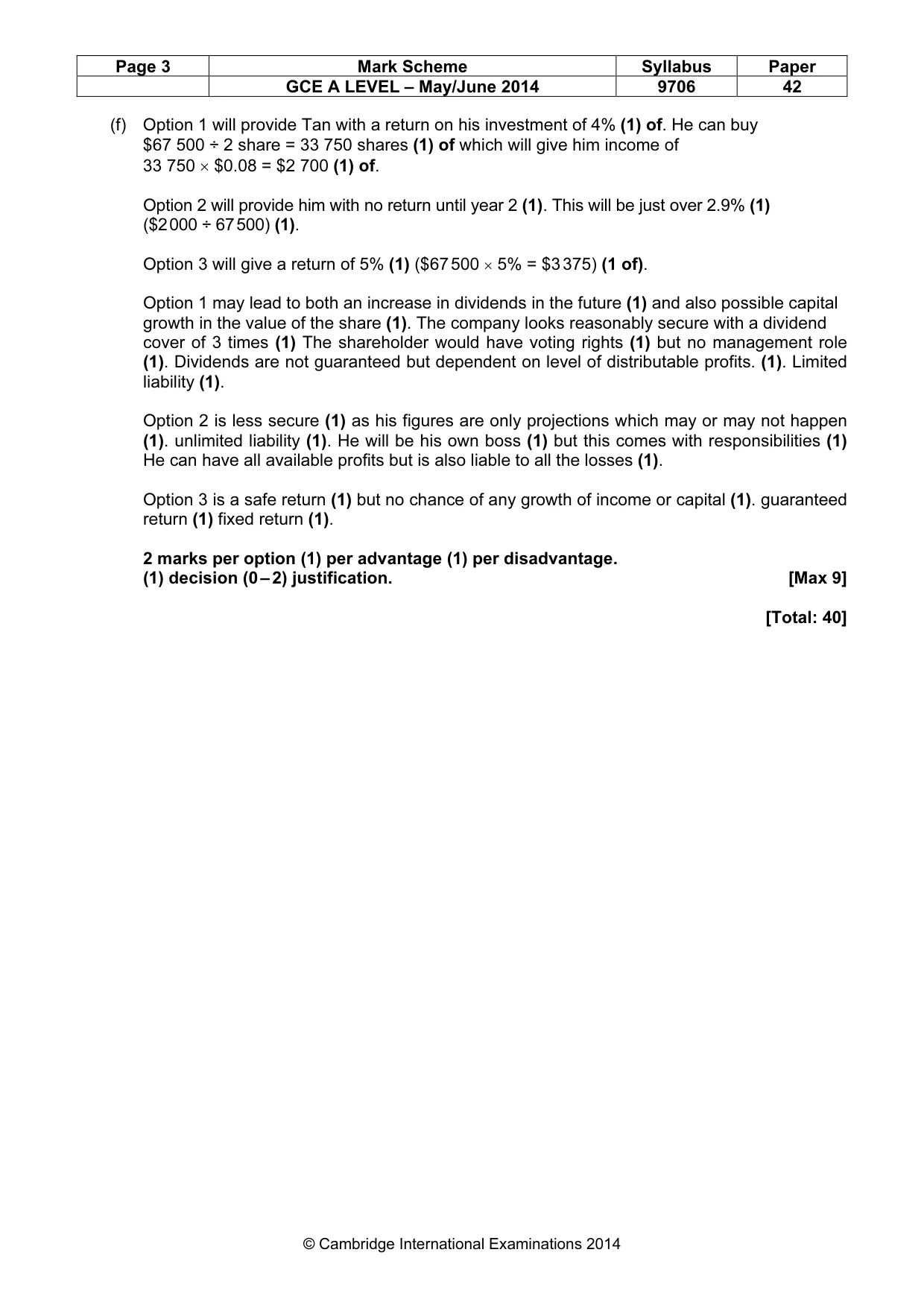
Page 3 Mark Scheme Syllabus Paper GCE A LEVEL – May/June 2014 9706 42 © Cambridge International Examinations 2014 (f) Option 1 will provide Tan with a return on his investment of 4% (1) of. He can buy $67 500 ÷ 2 share = 33 750 shares (1) of which will give him income of 33 750 × $0.08 = $2 700 (1) of. Option 2 will provide him with no return until year 2 (1). This will be just over 2.9% (1) ($2 000 ÷ 67 500) (1). Option 3 will give a return of 5% (1) ($67 500 × 5% = $3 375) (1 of). Option 1 may lead to both an increase in dividends in the future (1) and also possible capital growth in the value of the share (1). The company looks reasonably secure with a dividend cover of 3 times (1) The shareholder would have voting rights (1) but no management role (1). Dividends are not guaranteed but dependent on level of distributable profits. (1). Limited liability (1). Option 2 is less secure (1) as his figures are only projections which may or may not happen (1). unlimited liability (1). He will be his own boss (1) but this comes with responsibilities (1) He can have all available profits but is also liable to all the losses (1). Option 3 is a safe return (1) but no chance of any growth of income or capital (1). guaranteed return (1) fixed return (1). 2 marks per option (1) per advantage (1) per disadvantage. (1) decision (0 – 2) justification. [Max 9] [Total: 40]
Mark scheme, page 4
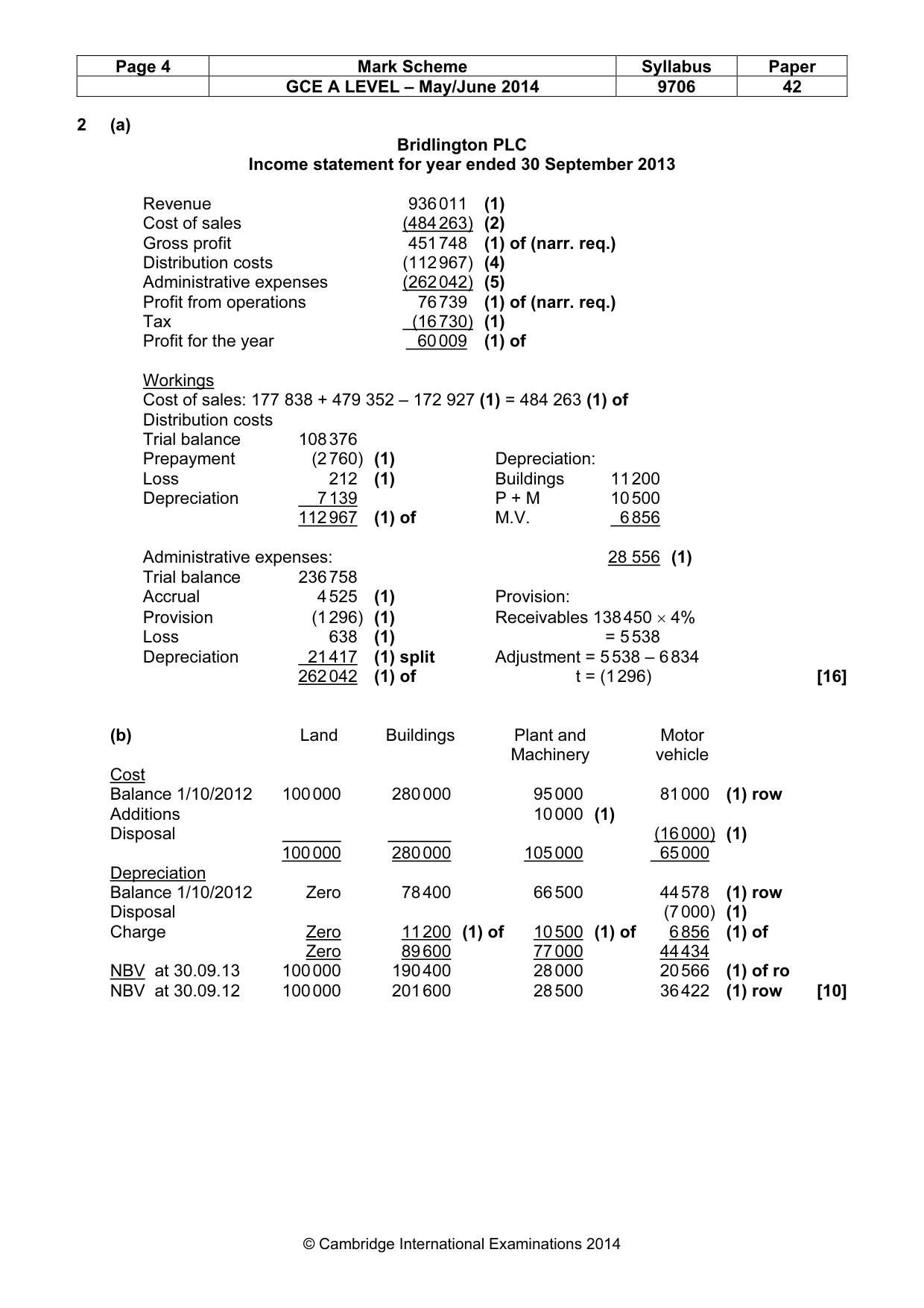
Page 4 Mark Scheme Syllabus Paper GCE A LEVEL – May/June 2014 9706 42 © Cambridge International Examinations 2014 2 (a) Bridlington PLC Income statement for year ended 30 September 2013 Revenue 936 011) (1) Cost of sales (484 263) (2) Gross profit 451 748) (1) of (narr. req.) Distribution costs (112 967) (4) Administrative expenses (262 042) (5) Profit from operations 76 739) (1) of (narr. req.) Tax (16 730) (1) Profit for the year 60 009 (1) of Workings Cost of sales: 177 838 + 479 352 – 172 927 (1) = 484 263 (1) of Distribution costs Trial balance 108 376) Prepayment (2 760) (1) Depreciation: Loss 212) (1) Buildings 11 200 Depreciation 7 139) P + M 10 500 112 967) (1) of M.V. 6 856 Administrative expenses: 28 556 (1) Trial balance 236 758) Accrual 4 525) (1) Provision: Provision (1 296) (1) Receivables 138 450 × 4% Loss 638) (1) = 5 538 Depreciation 21 417) (1) split Adjustment = 5 538 – 6 834 262 042) (1) of Adjustment = (1 296) [16] (b) Land Buildings Plant and Motor Machinery vehicle Cost Balance 1/10/2012 100 000 280 000 95 000 81 000) (1) row Additions 10 000 (1) Disposal (16 000) (1) 100 000 280 000 105 000 65 000) Depreciation Balance 1/10/2012 Zero 78 400 66 500 44 578) (1) row Disposal (7 000) (1) Charge Zero 11 200 (1) of 10 500 (1) of 6 856) (1) of Zero 89 600 77 000 44 434) NBV at 30.09.13 100 000 190 400 28 000 20 566) (1) of ro NBV at 30.09.12 100 000 201 600 28 500 36 422) (1) row [10]
Mark scheme, page 5
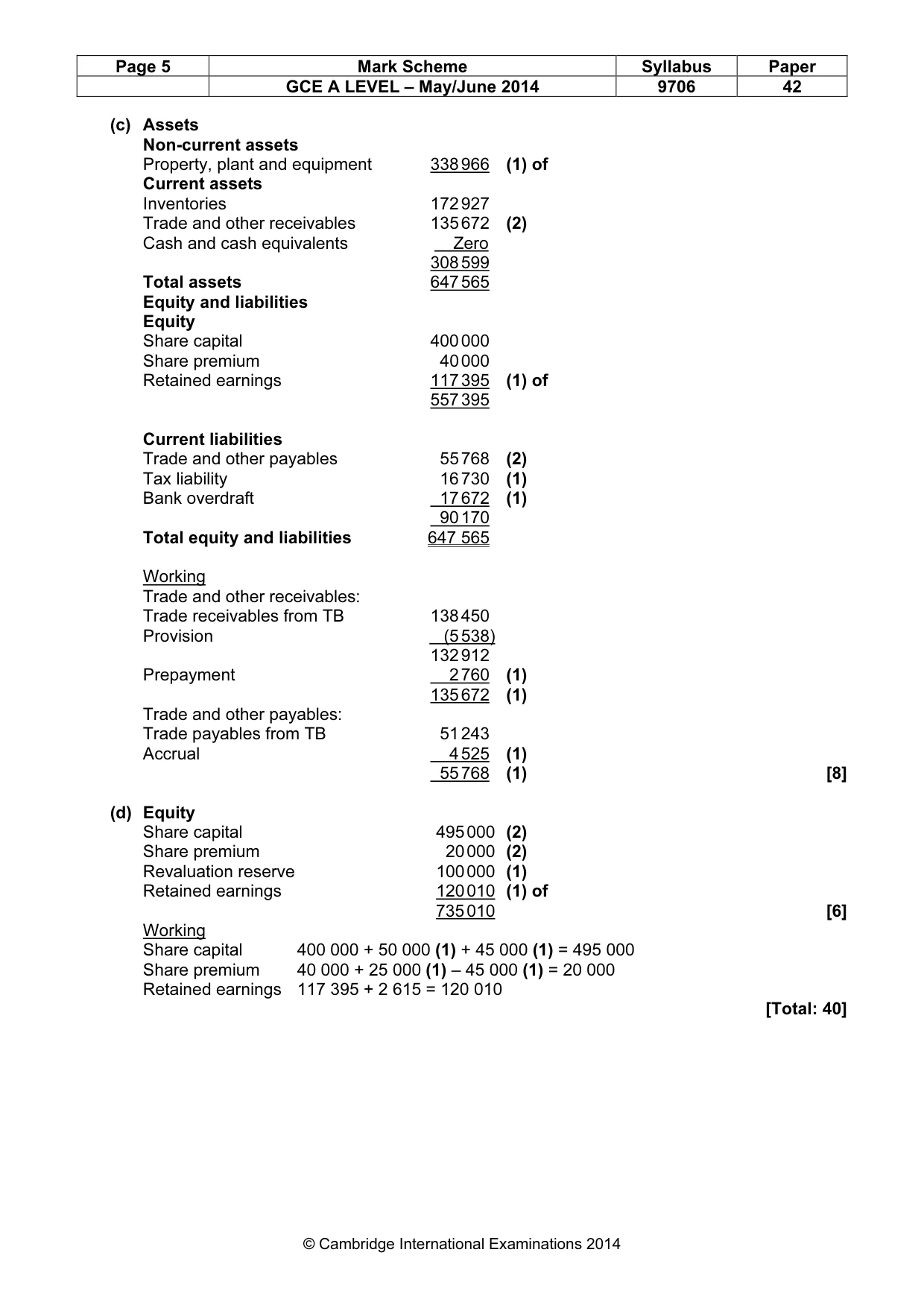
Page 5 Mark Scheme Syllabus Paper GCE A LEVEL – May/June 2014 9706 42 © Cambridge International Examinations 2014 (c) Assets Non-current assets Property, plant and equipment 338 966) (1) of Current assets Inventories 172 927) Trade and other receivables 135 672) (2) Cash and cash equivalents Zero) 308 599) Total assets 647 565) Equity and liabilities Equity Share capital 400 000) Share premium 40 000) Retained earnings 117 395) (1) of 557 395) Current liabilities Trade and other payables 55 768) (2) Tax liability 16 730) (1) Bank overdraft 17 672) (1) 90 170) Total equity and liabilities 647 565) Working Trade and other receivables: Trade receivables from TB 138 450) Provision (5 538) 132 912) Prepayment 2 760) (1) 135 672) (1) Trade and other payables: Trade payables from TB 51 243) Accrual 4 525) (1) 55 768) (1) [8] (d) Equity Share capital 495 000 (2) Share premium 20 000 (2) Revaluation reserve 100 000 (1) Retained earnings 120 010 (1) of 735 010 [6] Working Share capital 400 000 + 50 000 (1) + 45 000 (1) = 495 000 Share premium 40 000 + 25 000 (1) – 45 000 (1) = 20 000 Retained earnings 117 395 + 2 615 = 120 010 [Total: 40]
Mark scheme, page 6
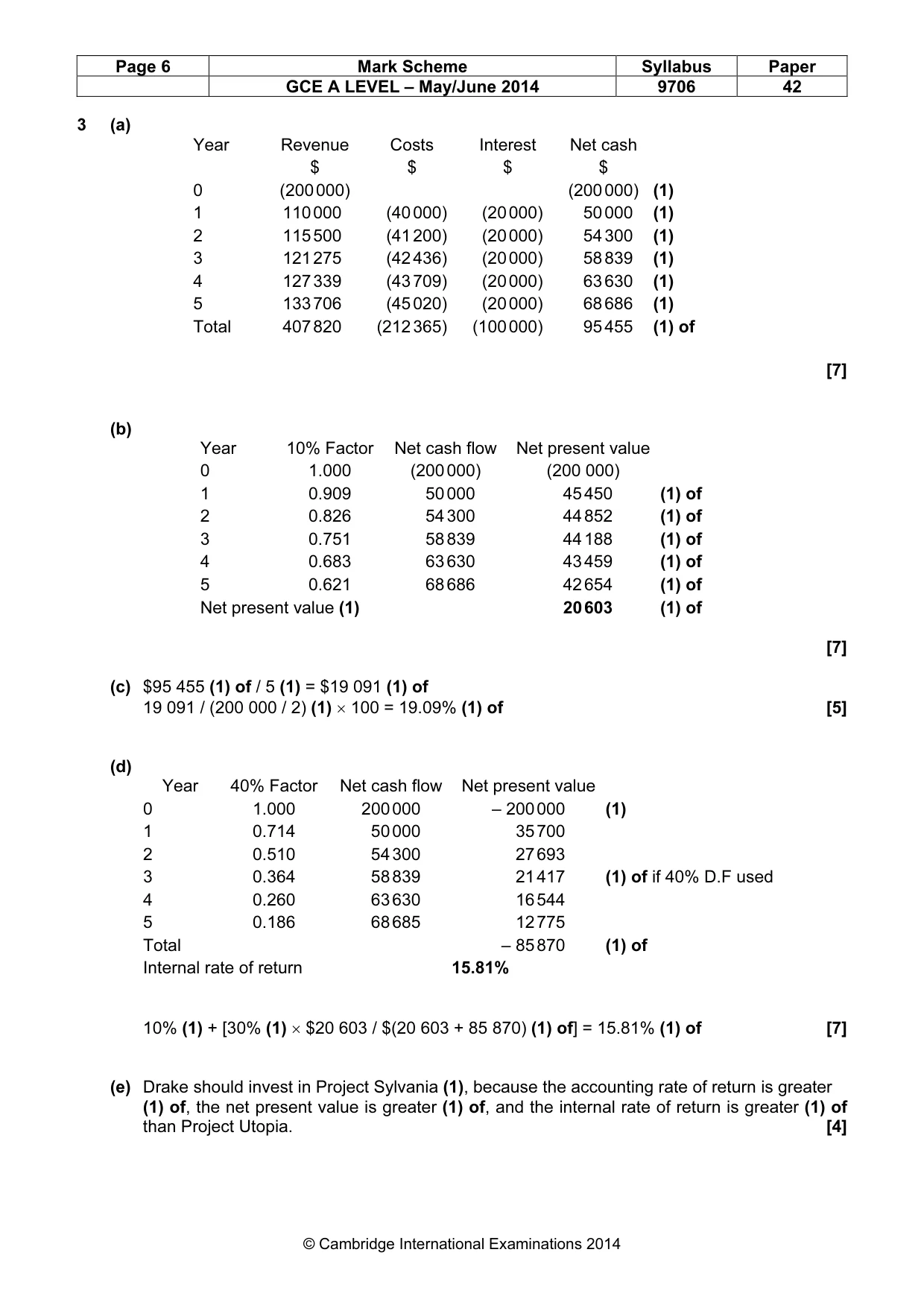
Page 6 Mark Scheme Syllabus Paper GCE A LEVEL – May/June 2014 9706 42 © Cambridge International Examinations 2014 3 (a) Year Revenue Costs Interest Net cash $ $ $ $ 0 (200 000) (200 000) (1) 1 110 000) (40 000) (20 000) ) 50 000) (1) 2 115 500) (41 200) (20 000) ) 54 300) (1) 3 121 275) (42 436) (20 000) ) 58 839) (1) 4 127 339) (43 709) (20 000) ) 63 630) (1) 5 133 706) (45 020) (20 000) ) 68 686) (1) Total 407 820) (212 365) (100 000) ) 95 455) (1) of [7] (b) Year 10% Factor Net cash flow Net present value 0 1.000 (200 000) (200 000) 1 0.909 ) 50 000) ) 45 450) (1) of 2 0.826 ) 54 300) ) 44 852) (1) of 3 0.751 ) 58 839) ) 44 188) (1) of 4 0.683 ) 63 630) ) 43 459) (1) of 5 0.621 ) 68 686) ) 42 654) (1) of Net present value (1) ) 20 603) (1) of [7] (c) $95 455 (1) of / 5 (1) = $19 091 (1) of 19 091 / (200 000 / 2) (1) × 100 = 19.09% (1) of [5] (d) Year 40% Factor Net cash flow Net present value 0 1.000 200 000 – 200 000 (1) 1 0.714 50 000 – 35 700 2 0.510 54 300 – 27 693 3 0.364 58 839 – 21 417 (1) of if 40% D.F used 4 0.260 63 630 – 16 544 5 0.186 68 685 – 12 775 Total – 85 870 (1) of Internal rate of return 15.81% 10% (1) + [30% (1) × $20 603 / $(20 603 + 85 870) (1) of] = 15.81% (1) of [7] (e) Drake should invest in Project Sylvania (1), because the accounting rate of return is greater (1) of, the net present value is greater (1) of, and the internal rate of return is greater (1) of than Project Utopia. [4]
Mark scheme, page 7
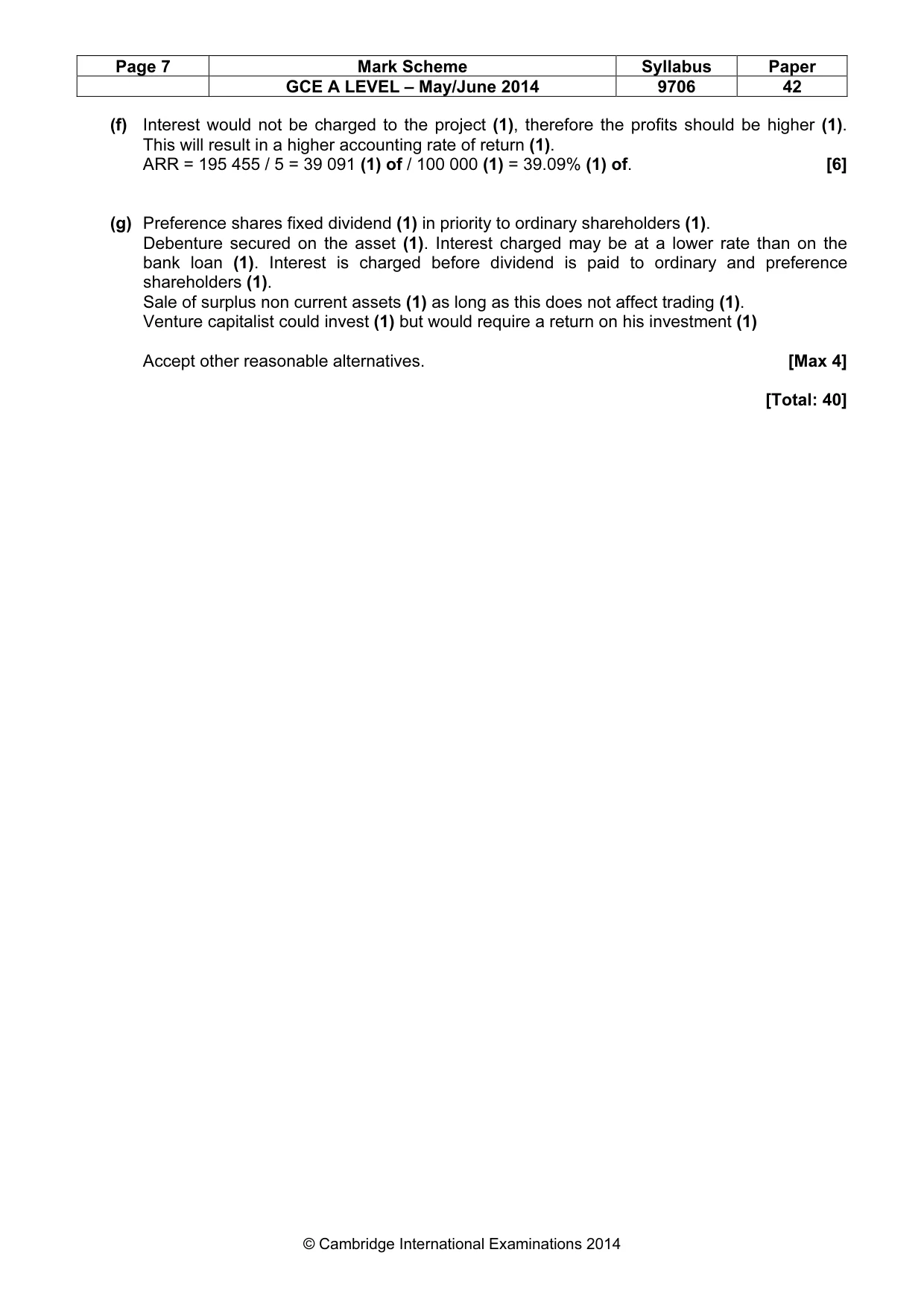
Page 7 Mark Scheme Syllabus Paper GCE A LEVEL – May/June 2014 9706 42 © Cambridge International Examinations 2014 (f) Interest would not be charged to the project (1), therefore the profits should be higher (1). This will result in a higher accounting rate of return (1). ARR = 195 455 / 5 = 39 091 (1) of / 100 000 (1) = 39.09% (1) of. [6] (g) Preference shares fixed dividend (1) in priority to ordinary shareholders (1). Debenture secured on the asset (1). Interest charged may be at a lower rate than on the bank loan (1). Interest is charged before dividend is paid to ordinary and preference shareholders (1). Sale of surplus non current assets (1) as long as this does not affect trading (1). Venture capitalist could invest (1) but would require a return on his investment (1) Accept other reasonable alternatives. [Max 4] [Total: 40]
What you needed in this session
Cambridge’s own grade thresholds for 2014 May/June, Paper 4 · Variant 2. A higher threshold means an easier paper — the bar moves with how the cohort did.