Cambridge A Level Accounting 9706 — 2014 May/June Paper 4 · Variant 3
9706/43/M/J/14 · 120 marks · ≈135 min
The question paper and its mark scheme, free to read here and free to download. This is Cambridge’s own paper, exactly as it was sat.
Question paper8 pages

Mark scheme6 pages
Answers below. Sit the paper first if you are practising.
Paper as text
Question paper, page 1
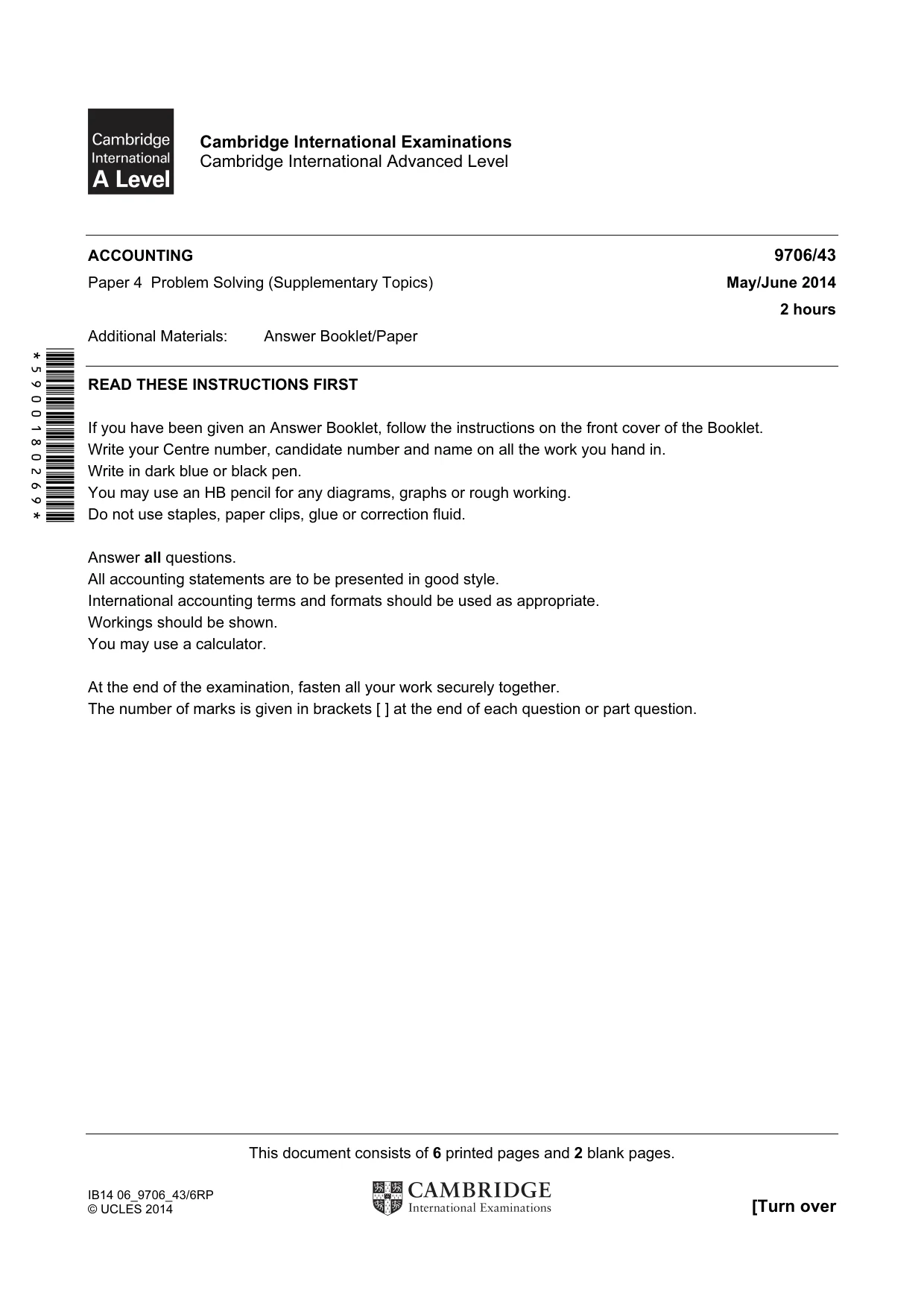
This document consists of 6 printed pages and 2 blank pages. IB14 06_9706_43/6RP © UCLES 2014 [Turn over *5900180269* Cambridge International Examinations Cambridge International Advanced Level ACCOUNTING 9706/43 Paper 4 Problem Solving (Supplementary Topics) May/June 2014 2 hours Additional Materials: Answer Booklet/Paper READ THESE INSTRUCTIONS FIRST If you have been given an Answer Booklet, follow the instructions on the front cover of the Booklet. Write your Centre number, candidate number and name on all the work you hand in. Write in dark blue or black pen. You may use an HB pencil for any diagrams, graphs or rough working. Do not use staples, paper clips, glue or correction fluid. Answer all questions. All accounting statements are to be presented in good style. International accounting terms and formats should be used as appropriate. Workings should be shown. You may use a calculator. At the end of the examination, fasten all your work securely together. The number of marks is given in brackets [ ] at the end of each question or part question.
Question paper, page 2
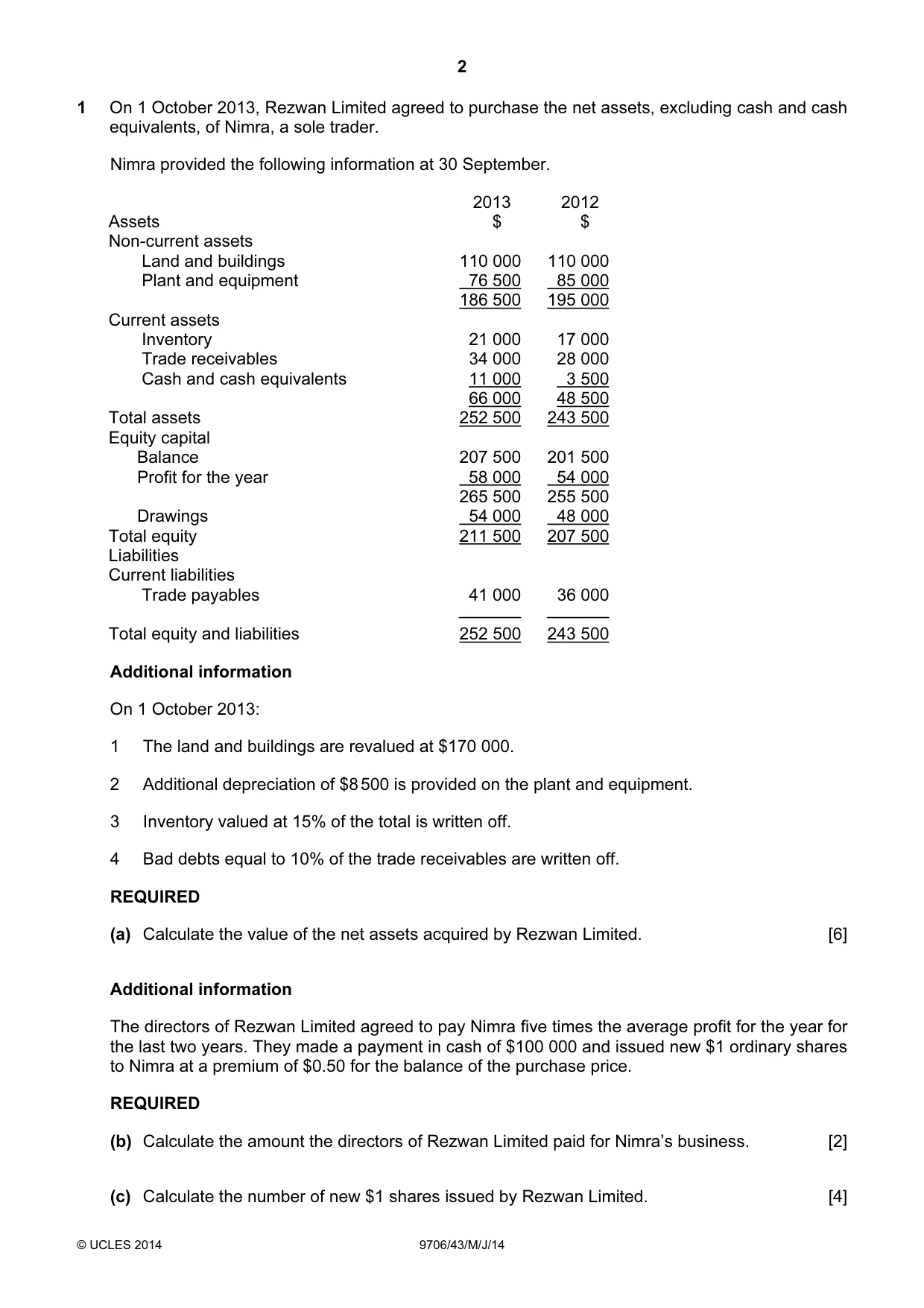
2 © UCLES 2014 9706/43/M/J/14 1 On 1 October 2013, Rezwan Limited agreed to purchase the net assets, excluding cash and cash equivalents, of Nimra, a sole trader. Nimra provided the following information at 30 September. 2013 2012 Assets $ $ Non-current assets Land and buildings 110 000 110 000 Plant and equipment 76 500 85 000 186 500 195 000 Current assets Inventory 21 000 17 000 Trade receivables 34 000 28 000 Cash and cash equivalents 11 000 3 500 66 000 48 500 Total assets 252 500 243 500 Equity capital Balance 207 500 201 500 Profit for the year 58 000 54 000 265 500 255 500 Drawings 54 000 48 000 Total equity 211 500 207 500 Liabilities Current liabilities Trade payables 41 000 36 000 _________ _________ Total equity and liabilities 252 500 243 500 Additional information On 1 October 2013: 1 The land and buildings are revalued at $170 000. 2 Additional depreciation of $8 500 is provided on the plant and equipment. 3 Inventory valued at 15% of the total is written off. 4 Bad debts equal to 10% of the trade receivables are written off. REQUIRED (a) Calculate the value of the net assets acquired by Rezwan Limited. [6] Additional information The directors of Rezwan Limited agreed to pay Nimra five times the average profit for the year for the last two years. They made a payment in cash of $100 000 and issued new $1 ordinary shares to Nimra at a premium of $0.50 for the balance of the purchase price. REQUIRED (b) Calculate the amount the directors of Rezwan Limited paid for Nimra’s business. [2] (c) Calculate the number of new $1 shares issued by Rezwan Limited. [4]
Question paper, page 3
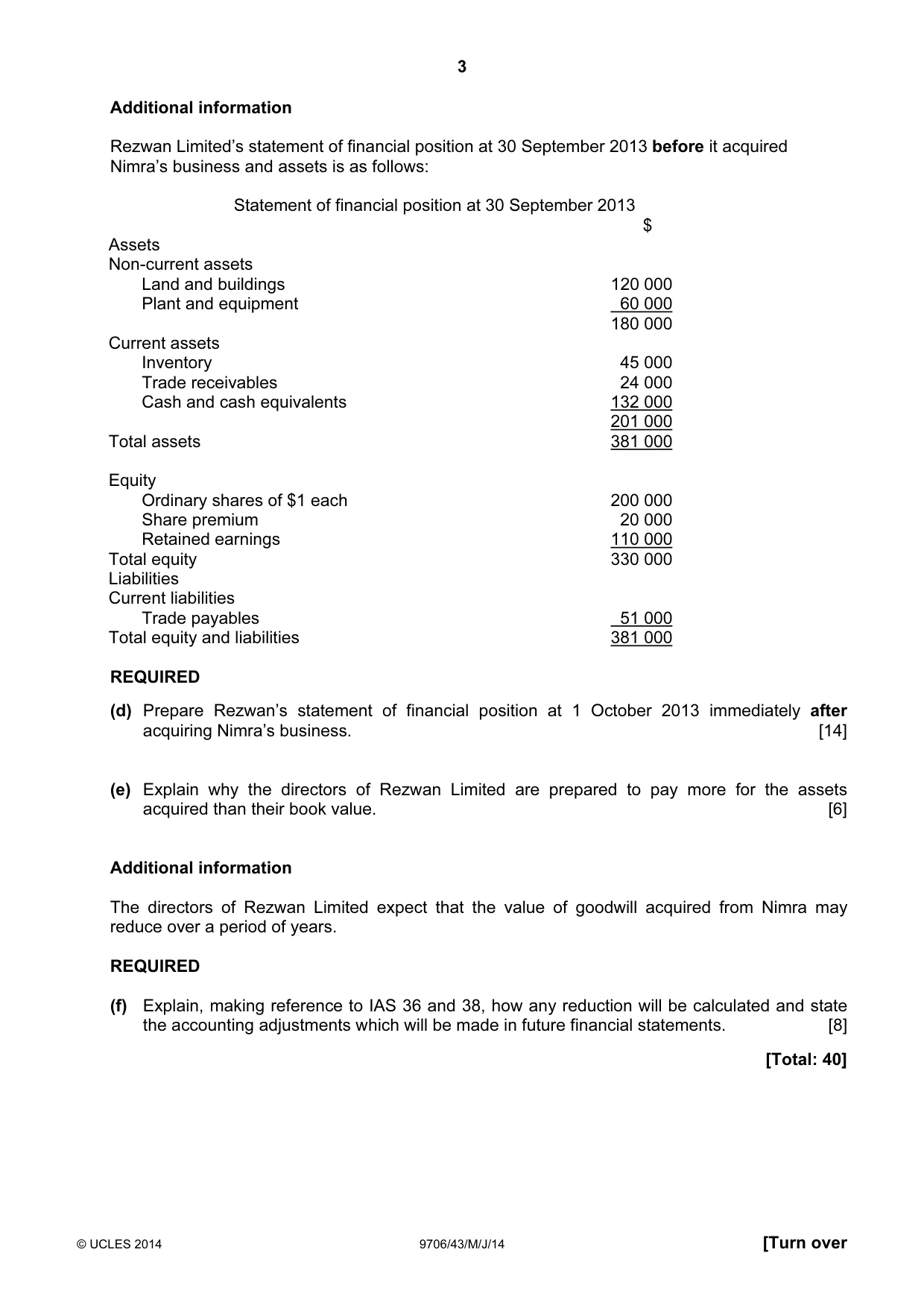
3 © UCLES 2014 9706/43/M/J/14 [Turn over Additional information Rezwan Limited’s statement of financial position at 30 September 2013 before it acquired Nimra’s business and assets is as follows: Statement of financial position at 30 September 2013 $ Assets Non-current assets Land and buildings 120 000 Plant and equipment 60 000 180 000 Current assets Inventory 45 000 Trade receivables 24 000 Cash and cash equivalents 132 000 201 000 Total assets 381 000 Equity Ordinary shares of $1 each 200 000 Share premium 20 000 Retained earnings 110 000 Total equity 330 000 Liabilities Current liabilities Trade payables 51 000 Total equity and liabilities 381 000 REQUIRED (d) Prepare Rezwan’s statement of financial position at 1 October 2013 immediately after acquiring Nimra’s business. [14] (e) Explain why the directors of Rezwan Limited are prepared to pay more for the assets acquired than their book value. [6] Additional information The directors of Rezwan Limited expect that the value of goodwill acquired from Nimra may reduce over a period of years. REQUIRED (f) Explain, making reference to IAS 36 and 38, how any reduction will be calculated and state the accounting adjustments which will be made in future financial statements. [8] [Total: 40]
Question paper, page 4
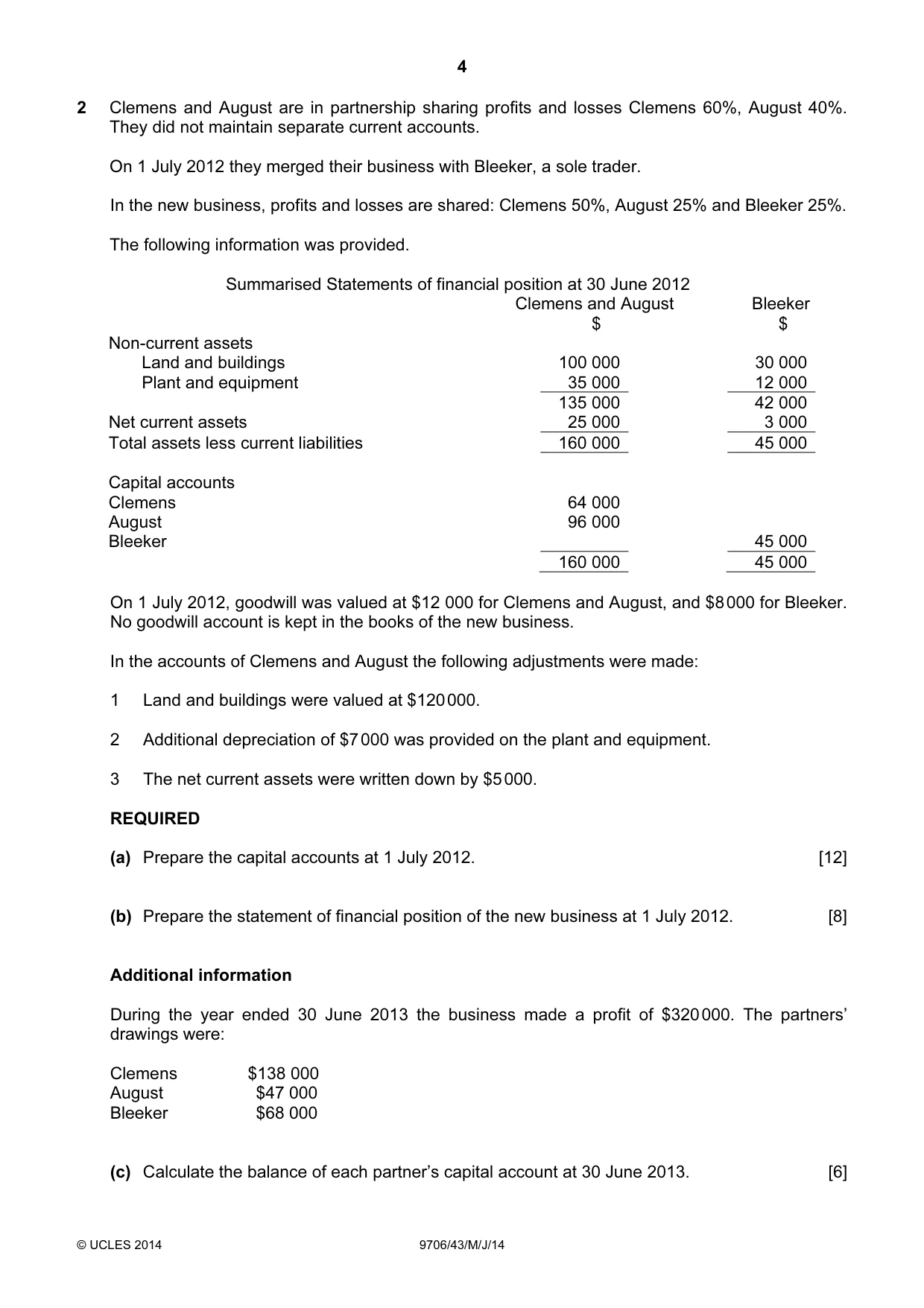
4 © UCLES 2014 9706/43/M/J/14 2 Clemens and August are in partnership sharing profits and losses Clemens 60%, August 40%. They did not maintain separate current accounts. On 1 July 2012 they merged their business with Bleeker, a sole trader. In the new business, profits and losses are shared: Clemens 50%, August 25% and Bleeker 25%. The following information was provided. Summarised Statements of financial position at 30 June 2012 Clemens and August Bleeker $ $ Non-current assets Land and buildings 100 000 30 000 Plant and equipment 35 000 12 000 135 000 42 000 Net current assets 25 000 3 000 Total assets less current liabilities 160 000 45 000 Capital accounts Clemens 64 000 August 96 000 Bleeker 45 000 160 000 45 000 On 1 July 2012, goodwill was valued at $12 000 for Clemens and August, and $8 000 for Bleeker. No goodwill account is kept in the books of the new business. In the accounts of Clemens and August the following adjustments were made: 1 Land and buildings were valued at $120 000. 2 Additional depreciation of $7 000 was provided on the plant and equipment. 3 The net current assets were written down by $5 000. REQUIRED (a) Prepare the capital accounts at 1 July 2012. [12] (b) Prepare the statement of financial position of the new business at 1 July 2012. [8] Additional information During the year ended 30 June 2013 the business made a profit of $320 000. The partners’ drawings were: Clemens $138 000 August $47 000 Bleeker $68 000 (c) Calculate the balance of each partner’s capital account at 30 June 2013. [6]
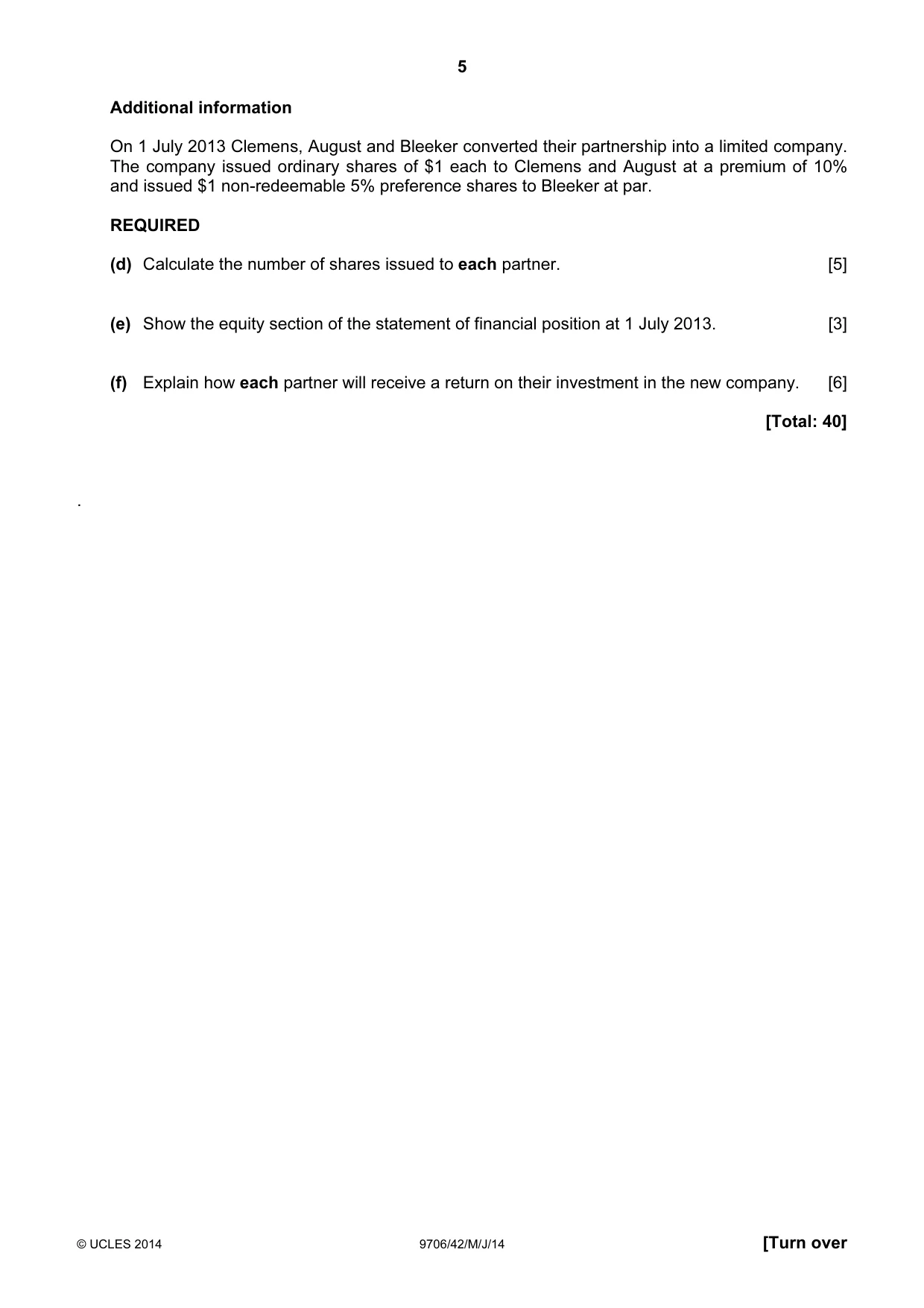
Question paper, page 5
5 © UCLES 2014 9706/42/M/J/14 [Turn over Additional information On 1 July 2013 Clemens, August and Bleeker converted their partnership into a limited company. The company issued ordinary shares of $1 each to Clemens and August at a premium of 10% and issued $1 non-redeemable 5% preference shares to Bleeker at par. REQUIRED (d) Calculate the number of shares issued to each partner. [5] (e) Show the equity section of the statement of financial position at 1 July 2013. [3] (f) Explain how each partner will receive a return on their investment in the new company. [6] [Total: 40] .
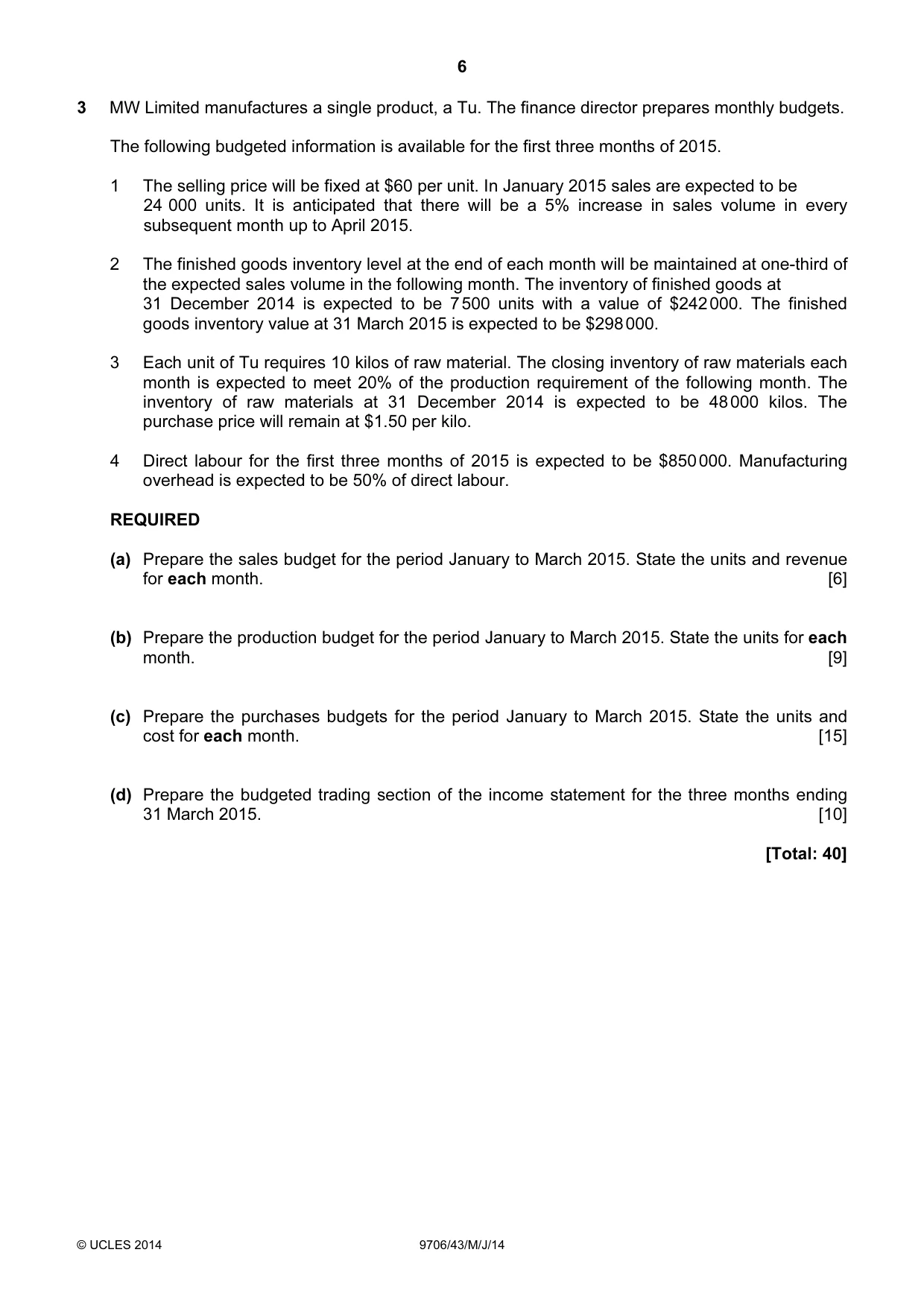
Question paper, page 6
6 © UCLES 2014 9706/43/M/J/14 3 MW Limited manufactures a single product, a Tu. The finance director prepares monthly budgets. The following budgeted information is available for the first three months of 2015. 1 The selling price will be fixed at $60 per unit. In January 2015 sales are expected to be 24 000 units. It is anticipated that there will be a 5% increase in sales volume in every subsequent month up to April 2015. 2 The finished goods inventory level at the end of each month will be maintained at one-third of the expected sales volume in the following month. The inventory of finished goods at 31 December 2014 is expected to be 7 500 units with a value of $242 000. The finished goods inventory value at 31 March 2015 is expected to be $298 000. 3 Each unit of Tu requires 10 kilos of raw material. The closing inventory of raw materials each month is expected to meet 20% of the production requirement of the following month. The inventory of raw materials at 31 December 2014 is expected to be 48 000 kilos. The purchase price will remain at $1.50 per kilo. 4 Direct labour for the first three months of 2015 is expected to be $850 000. Manufacturing overhead is expected to be 50% of direct labour. REQUIRED (a) Prepare the sales budget for the period January to March 2015. State the units and revenue for each month. [6] (b) Prepare the production budget for the period January to March 2015. State the units for each month. [9] (c) Prepare the purchases budgets for the period January to March 2015. State the units and cost for each month. [15] (d) Prepare the budgeted trading section of the income statement for the three months ending 31 March 2015. [10] [Total: 40]
Question paper, page 7
7 © UCLES 2014 9706/43/M/J/14 BLANK PAGE
Question paper, page 8
8 Permission to reproduce items where third-party owned material protected by copyright is included has been sought and cleared where possible. Every reasonable effort has been made by the publisher (UCLES) to trace copyright holders, but if any items requiring clearance have unwittingly been included, the publisher will be pleased to make amends at the earliest possible opportunity. Cambridge International Examinations is part of the Cambridge Assessment Group. Cambridge Assessment is the brand name of University of Cambridge Local Examinations Syndicate (UCLES), which is itself a department of the University of Cambridge. © UCLES 2014 9706/43/M/J/14 BLANK PAGE
Mark scheme, page 1
CAMBRIDGE INTERNATIONAL EXAMINATIONS GCE Advanced Level MARK SCHEME for the May/June 2014 series 9706 ACCOUNTING 9706/43 Paper 4 (Problem Solving – Supplement), maximum raw mark 120 This mark scheme is published as an aid to teachers and candidates, to indicate the requirements of the examination. It shows the basis on which Examiners were instructed to award marks. It does not indicate the details of the discussions that took place at an Examiners’ meeting before marking began, which would have considered the acceptability of alternative answers. Mark schemes should be read in conjunction with the question paper and the Principal Examiner Report for Teachers. Cambridge will not enter into discussions about these mark schemes. Cambridge is publishing the mark schemes for the May/June 2014 series for most IGCSE, GCE Advanced Level and Advanced Subsidiary Level components and some Ordinary Level components.
Mark scheme, page 2
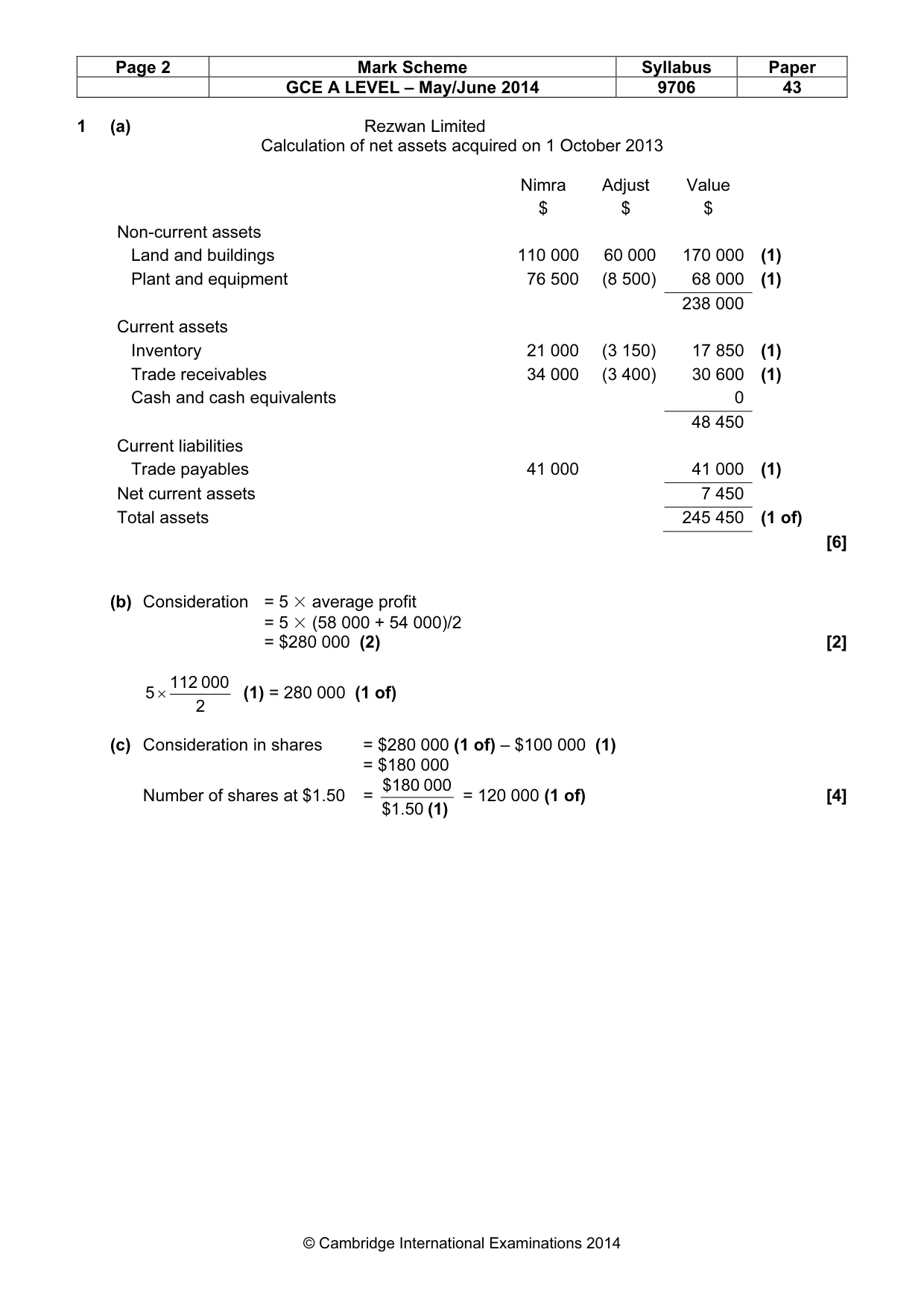
Page 2 Mark Scheme Syllabus Paper GCE A LEVEL – May/June 2014 9706 43 © Cambridge International Examinations 2014 1 (a) Rezwan Limited Calculation of net assets acquired on 1 October 2013 Nimra Adjust Value $ $ $ Non-current assets Land and buildings 110 000 60 000 170 000 (1) Plant and equipment 76 500 (8 500) 68 000 (1) 238 000 Current assets Inventory 21 000 (3 150) 17 850 (1) Trade receivables 34 000 (3 400) 30 600 (1) Cash and cash equivalents 0 48 450 Current liabilities Trade payables 41 000 41 000 (1) Net current assets 7 450 Total assets 245 450 (1 of) [6] (b) Consideration = 5 P average profit = 5 P (58 000 + 54 000)/2 = $280 000 (2) [2] 2 000 112 5 × (1) = 280 000 (1 of) (c) Consideration in shares = $280 000 (1 of) – $100 000 (1) = $180 000 Number of shares at $1.50 = (1) $1.50 000 $180 = 120 000 (1 of) [4]
Mark scheme, page 3
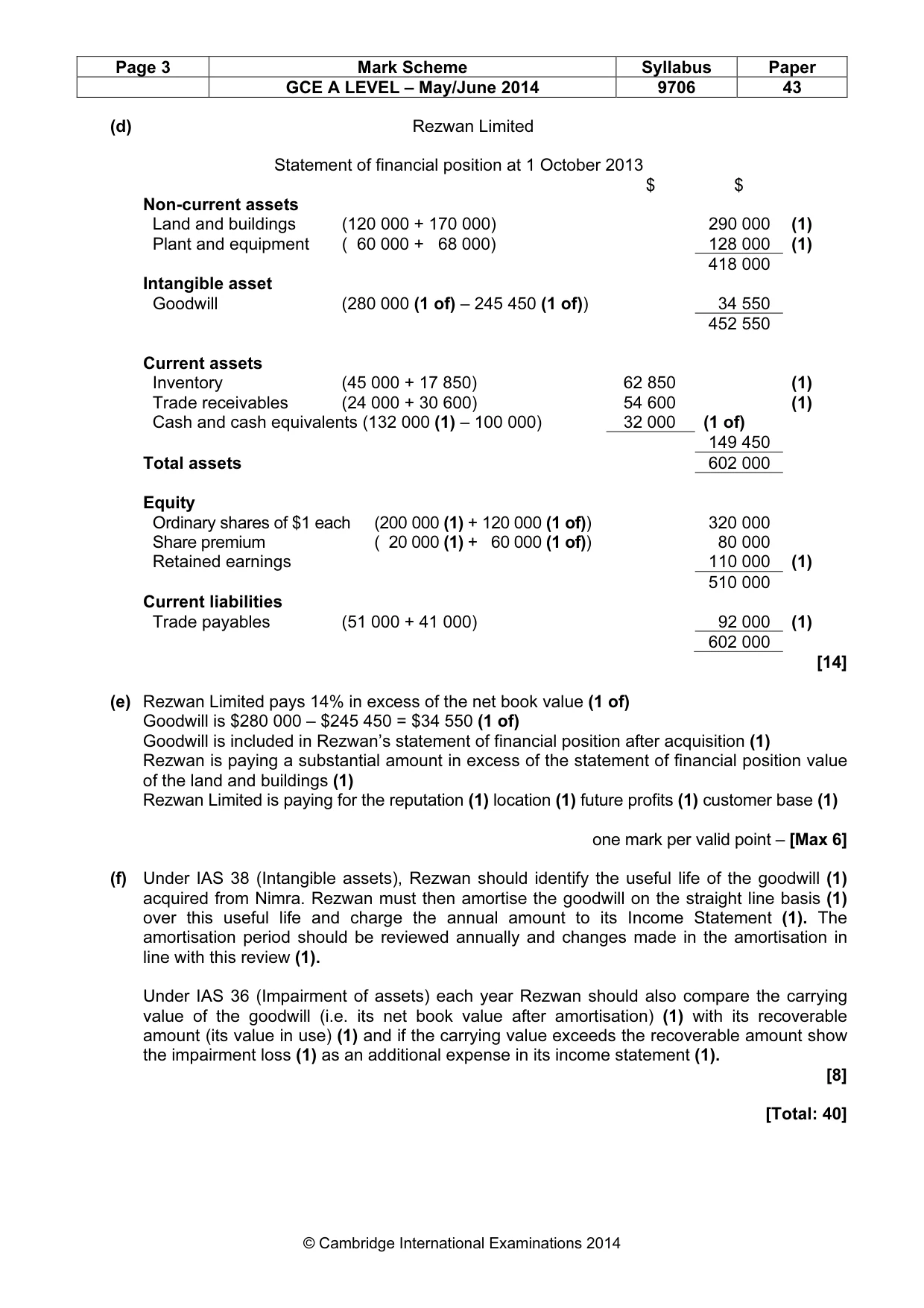
Page 3 Mark Scheme Syllabus Paper GCE A LEVEL – May/June 2014 9706 43 © Cambridge International Examinations 2014 (d) Rezwan Limited Statement of financial position at 1 October 2013 $ $ Non-current assets Land and buildings (120 000 + 170 000) 290 000 (1) Plant and equipment (160 000 + 68 000) 128 000 (1) 418 000 Intangible asset Goodwill (280 000 (1 of) – 245 450 (1 of)) 34 550 452 550 Current assets Inventory (45 000 + 17 850) 62 850 (1) Trade receivables (24 000 + 30 600) 54 600 (1) Cash and cash equivalents (132 000 (1) – 100 000) 32 000 (1 of) 149 450 Total assets 602 000 Equity Ordinary shares of $1 each (200 000 (1) + 120 000 (1 of)) 320 000 Share premium (220 000 (1) + 160 000 (1 of)) 80 000 Retained earnings 110 000 (1) 510 000 Current liabilities Trade payables (51 000 + 41 000) 92 000 (1) 602 000 [14] (e) Rezwan Limited pays 14% in excess of the net book value (1 of) Goodwill is $280 000 – $245 450 = $34 550 (1 of) Goodwill is included in Rezwan’s statement of financial position after acquisition (1) Rezwan is paying a substantial amount in excess of the statement of financial position value of the land and buildings (1) Rezwan Limited is paying for the reputation (1) location (1) future profits (1) customer base (1) one mark per valid point – [Max 6] (f) Under IAS 38 (Intangible assets), Rezwan should identify the useful life of the goodwill (1) acquired from Nimra. Rezwan must then amortise the goodwill on the straight line basis (1) over this useful life and charge the annual amount to its Income Statement (1). The amortisation period should be reviewed annually and changes made in the amortisation in line with this review (1). Under IAS 36 (Impairment of assets) each year Rezwan should also compare the carrying value of the goodwill (i.e. its net book value after amortisation) (1) with its recoverable amount (its value in use) (1) and if the carrying value exceeds the recoverable amount show the impairment loss (1) as an additional expense in its income statement (1). [8] [Total: 40]
Mark scheme, page 4
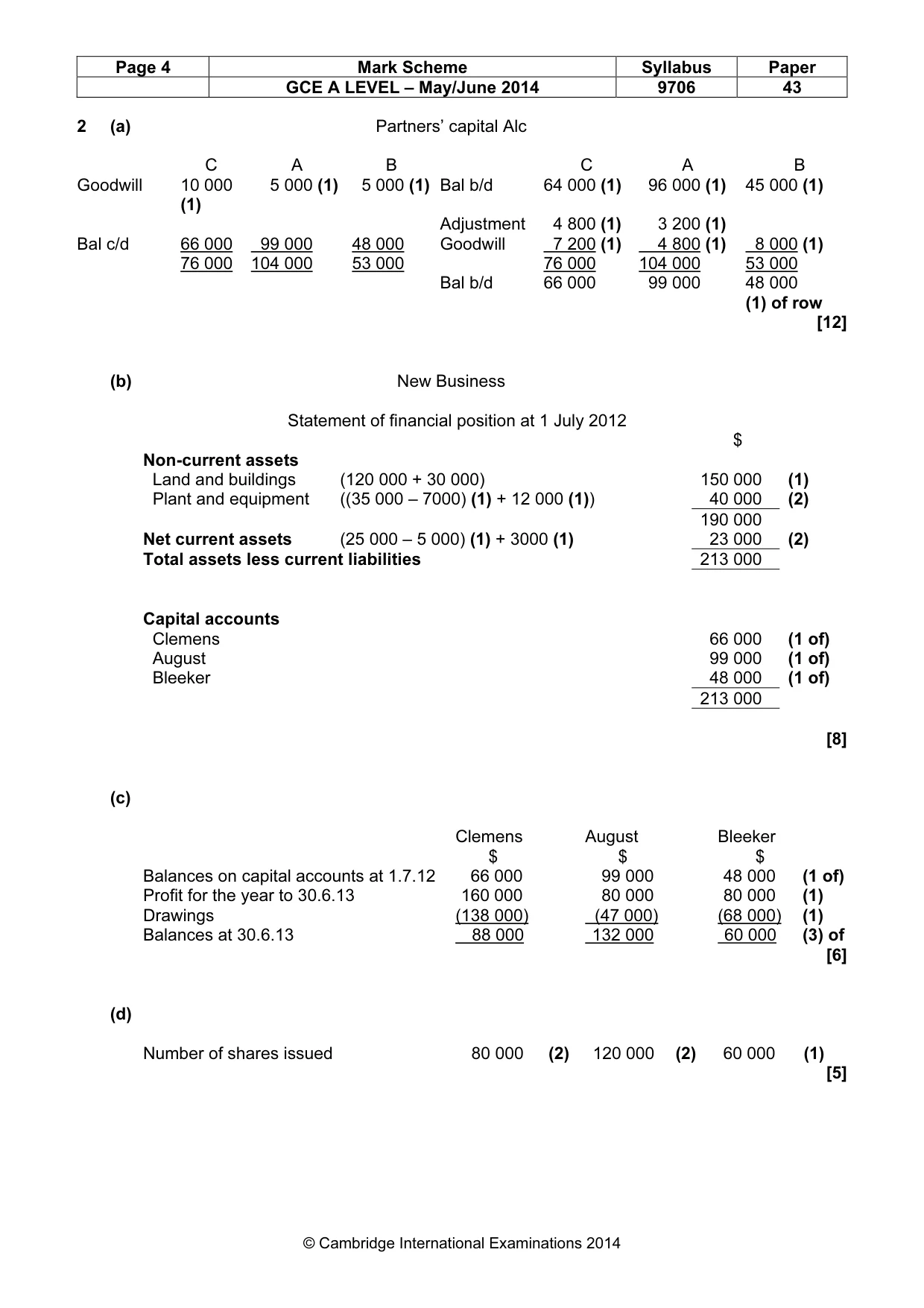
Page 4 Mark Scheme Syllabus Paper GCE A LEVEL – May/June 2014 9706 43 © Cambridge International Examinations 2014 2 (a) Partners’ capital Alc C A B C A B Goodwill 10 000 (1) 005 000 (1) 55 000 (1) Bal b/d 64 000 (1) 696 000 (1) 45 000 (1) Adjustment 64 800 (1) 663 200 (1) Bal c/d 66 000 99 000 48 000 Goodwill 7 200 (1) 4 800 (1) 8 000 (1) 76 000 104 000 53 000 76 000 104 000 53 000 Bal b/d 66 000 99 000 48 000 (1) of row [12] (b) New Business Statement of financial position at 1 July 2012 $ Non-current assets Land and buildings (120 000 + 30 000) 150 000 (1) Plant and equipment ((35 000 – 7000) (1) + 12 000 (1)) 40 000 (2) 190 000 Net current assets (25 000 – 5 000) (1) + 3000 (1) 23 000 (2) Total assets less current liabilities 213 000 Capital accounts Clemens 66 000 (1 of) August 99 000 (1 of) Bleeker 48 000 (1 of) 213 000 [8] (c) Clemens August Bleeker $ $ $ Balances on capital accounts at 1.7.12 ( 66 000 99 000 (48 000 (1 of) Profit for the year to 30.6.13 (160 000 80 000 (80 000 (1) Drawings (138 000) (47 000) (68 000) (1) Balances at 30.6.13 88 000) 132 000 60 000 (3) of [6] (d) Number of shares issued 80 000 (2) 120 000 (2) 60 000 (1) [5]
Mark scheme, page 5
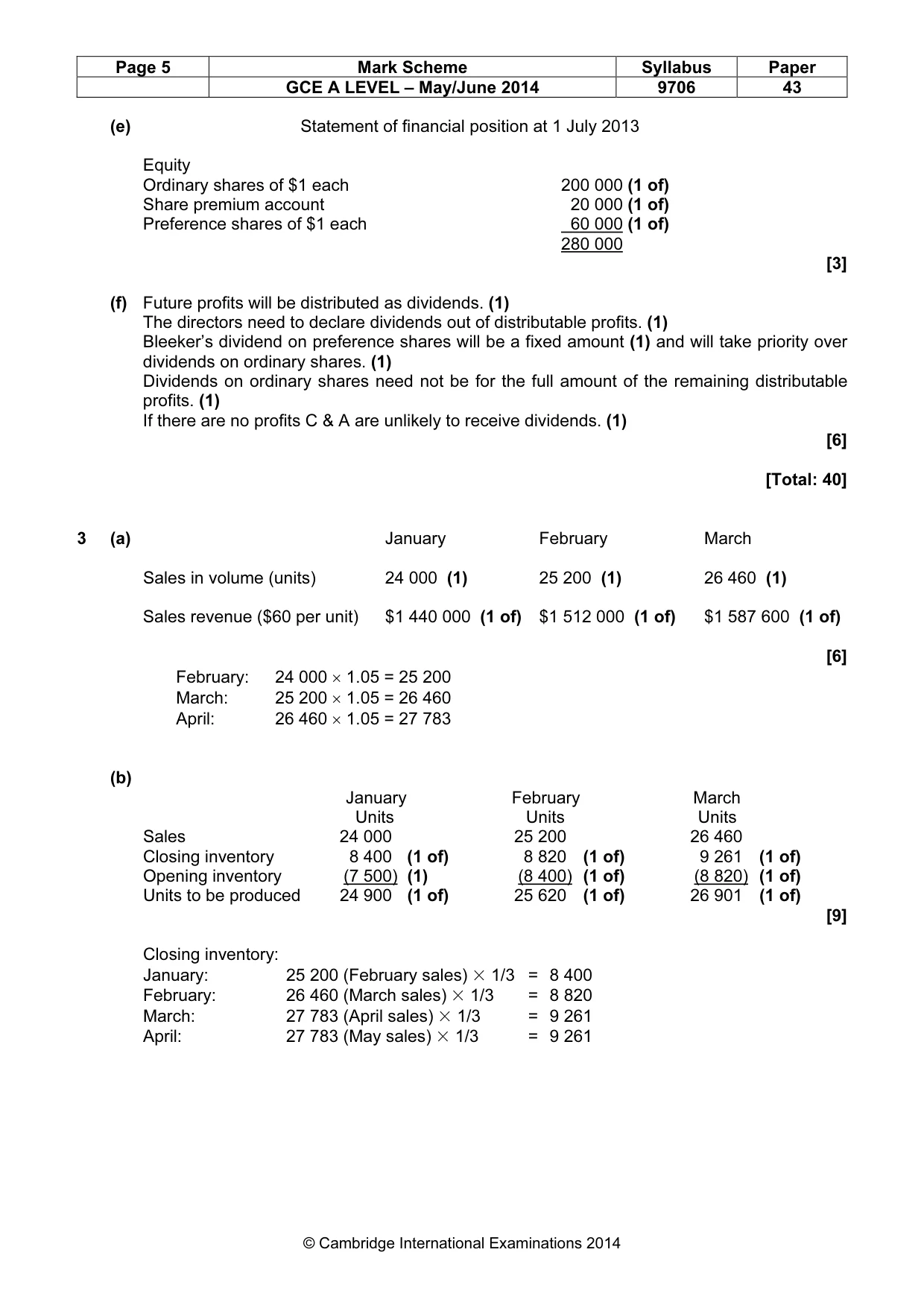
Page 5 Mark Scheme Syllabus Paper GCE A LEVEL – May/June 2014 9706 43 © Cambridge International Examinations 2014 (e) Statement of financial position at 1 July 2013 Equity Ordinary shares of $1 each 200 000 (1 of) Share premium account 20 000 (1 of) Preference shares of $1 each 60 000 (1 of) 280 000 [3] (f) Future profits will be distributed as dividends. (1) The directors need to declare dividends out of distributable profits. (1) Bleeker’s dividend on preference shares will be a fixed amount (1) and will take priority over dividends on ordinary shares. (1) Dividends on ordinary shares need not be for the full amount of the remaining distributable profits. (1) If there are no profits C & A are unlikely to receive dividends. (1) [6] [Total: 40] 3 (a) January February March Sales in volume (units) 24 000 (1) 25 200 (1) 26 460 (1) Sales revenue ($60 per unit) $1 440 000 (1 of) $1 512 000 (1 of) $1 587 600 (1 of) [6] February: 24 000 × 1.05 = 25 200 March: 25 200 × 1.05 = 26 460 April: 26 460 × 1.05 = 27 783 (b) January February March Units Units Units Sales 24 000) 25 200) 26 460) Closing inventory 8 400) (1 of) 8 820) (1 of) 9 261) (1 of) Opening inventory (7 500) (1) (8 400) (1 of) (8 820) (1 of) Units to be produced 24 900) (1 of) 25 620) (1 of) 26 901) (1 of) [9] Closing inventory: January: 25 200 (February sales) P 1/3 = 8 400 February: 26 460 (March sales) P 1/3 = 8 820 March: 27 783 (April sales) P 1/3 = 9 261 April: 27 783 (May sales) P 1/3 = 9 261
Mark scheme, page 6
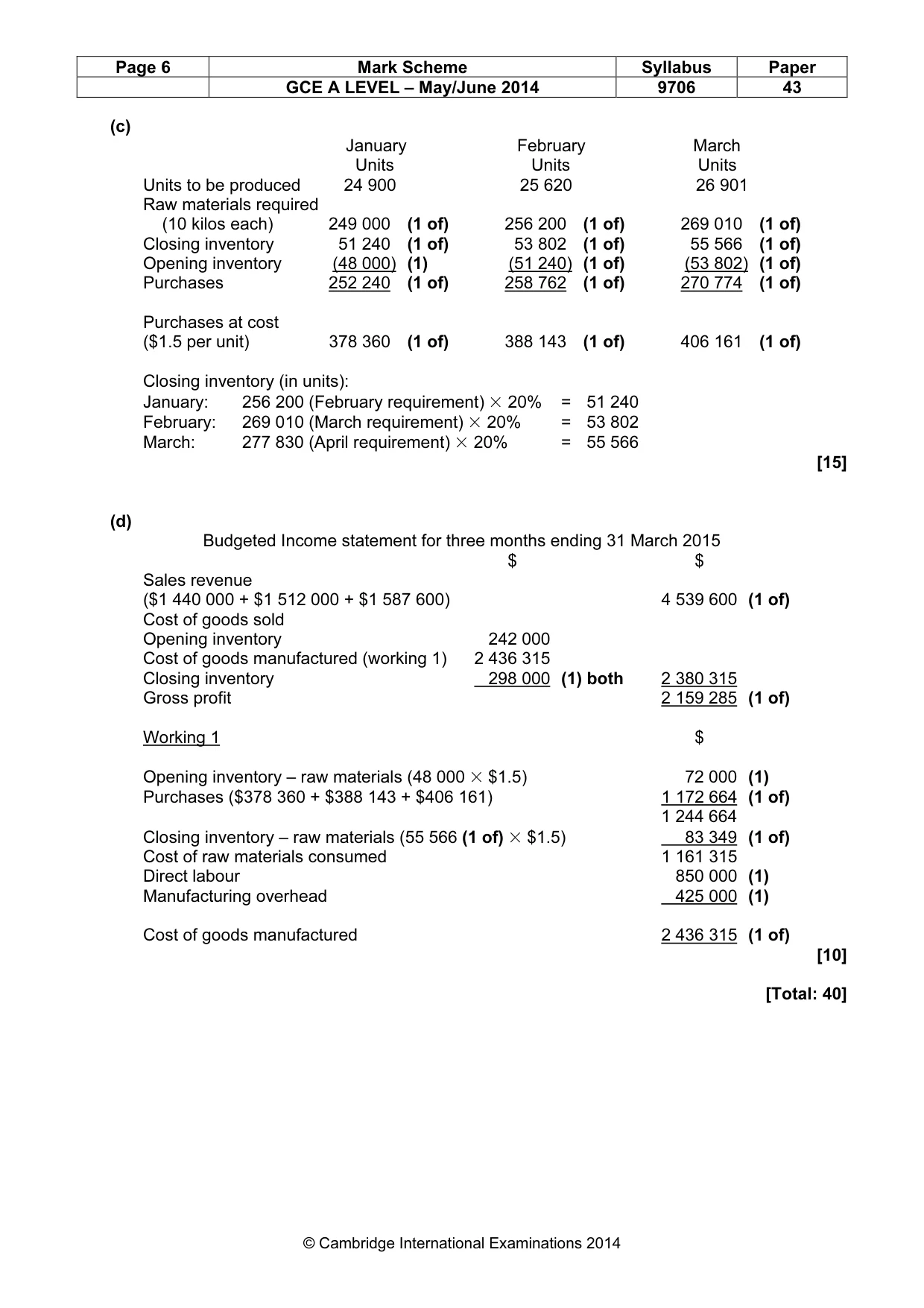
Page 6 Mark Scheme Syllabus Paper GCE A LEVEL – May/June 2014 9706 43 © Cambridge International Examinations 2014 (c) January February March Units Units Units Units to be produced 24 900 25 620 26 901 Raw materials required (10 kilos each) 249 000) (1 of) 256 200) (1 of) 269 010) (1 of) Closing inventory 51 240) (1 of) 53 802) (1 of) 55 566) (1 of) Opening inventory (48 000) (1) (51 240) (1 of) (53 802) (1 of) Purchases 252 240) (1 of) 258 762) (1 of) 270 774) (1 of) Purchases at cost ($1.5 per unit) 378 360) (1 of) 388 143) (1 of) 406 161) (1 of) Closing inventory (in units): January: 256 200 (February requirement) P 20% = 51 240 February: 269 010 (March requirement) P 20% = 53 802 March: 277 830 (April requirement) P 20% = 55 566 [15] (d) Budgeted Income statement for three months ending 31 March 2015 $ $ Sales revenue ($1 440 000 + $1 512 000 + $1 587 600) 4 539 600 (1 of) Cost of goods sold Opening inventory 242 000 Cost of goods manufactured (working 1) 2 436 315 Closing inventory 298 000 (1) both 2 380 315 Gross profit 2 159 285 (1 of) Working 1 $ Opening inventory – raw materials (48 000 P=$1.5) 72 000 (1) Purchases ($378 360 + $388 143 + $406 161) 1 172 664 (1 of) 1 244 664 Closing inventory – raw materials (55 566 (1 of) P=$1.5) 83 349 (1 of) Cost of raw materials consumed 1 161 315 Direct labour 850 000 (1) Manufacturing overhead 425 000 (1) Cost of goods manufactured 2 436 315 (1 of) [10] [Total: 40]
What you needed in this session
Cambridge’s own grade thresholds for 2014 May/June, Paper 4 · Variant 3. A higher threshold means an easier paper — the bar moves with how the cohort did.