Cambridge A Level Accounting 9706 — 2013 May/June Paper 4 · Variant 2
9706/42/M/J/13 · 120 marks · ≈135 min
The question paper and its mark scheme, free to read here and free to download. This is Cambridge’s own paper, exactly as it was sat.
Question paper8 pages

Mark scheme6 pages
Answers below. Sit the paper first if you are practising.
Paper as text
Question paper, page 1
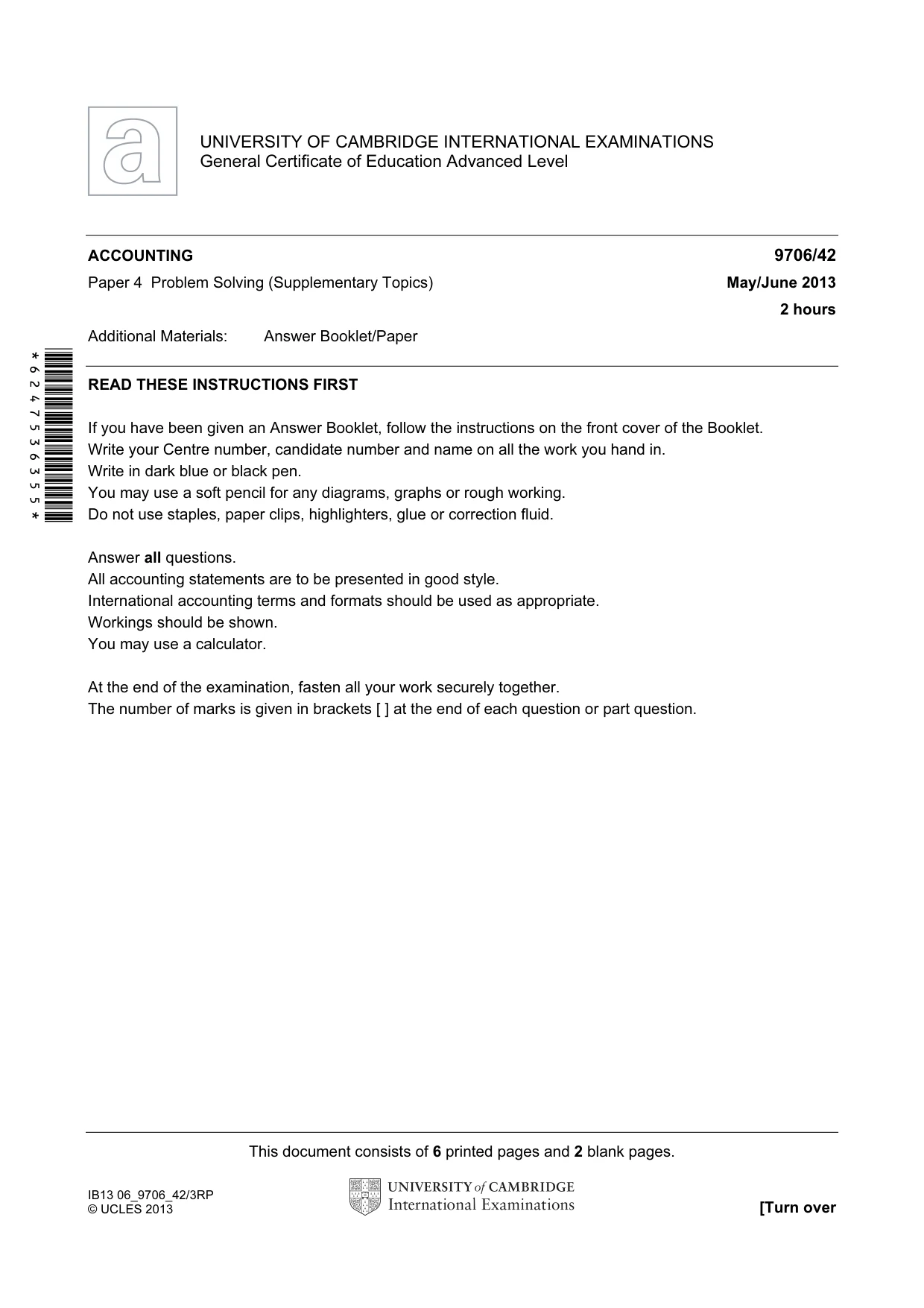
This document consists of 6 printed pages and 2 blank pages. IB13 06_9706_42/3RP © UCLES 2013 [Turn over *6247536355* UNIVERSITY OF CAMBRIDGE INTERNATIONAL EXAMINATIONS General Certificate of Education Advanced Level ACCOUNTING 9706/42 Paper 4 Problem Solving (Supplementary Topics) May/June 2013 2 hours Additional Materials: Answer Booklet/Paper READ THESE INSTRUCTIONS FIRST If you have been given an Answer Booklet, follow the instructions on the front cover of the Booklet. Write your Centre number, candidate number and name on all the work you hand in. Write in dark blue or black pen. You may use a soft pencil for any diagrams, graphs or rough working. Do not use staples, paper clips, highlighters, glue or correction fluid. Answer all questions. All accounting statements are to be presented in good style. International accounting terms and formats should be used as appropriate. Workings should be shown. You may use a calculator. At the end of the examination, fasten all your work securely together. The number of marks is given in brackets [ ] at the end of each question or part question.
Question paper, page 2
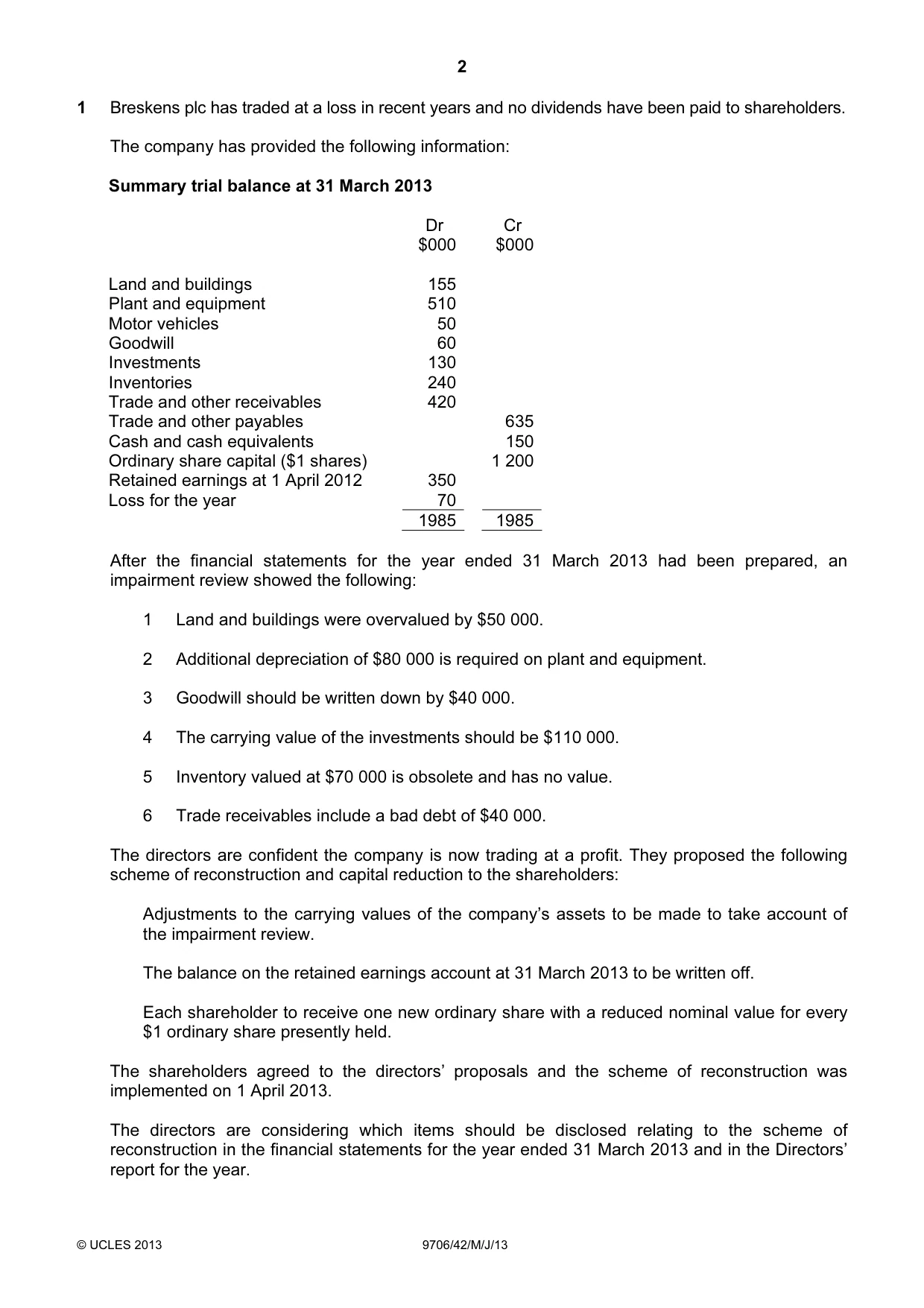
2 © UCLES 2013 9706/42/M/J/13 1 Breskens plc has traded at a loss in recent years and no dividends have been paid to shareholders. The company has provided the following information: Summary trial balance at 31 March 2013 Dr Cr $000 $000 Land and buildings 155 Plant and equipment 510 Motor vehicles 50 Goodwill 60 Investments 130 Inventories 240 Trade and other receivables 420 Trade and other payables 635 Cash and cash equivalents 150 Ordinary share capital ($1 shares) 1 200 Retained earnings at 1 April 2012 350 Loss for the year 70 1985 1985 After the financial statements for the year ended 31 March 2013 had been prepared, an impairment review showed the following: 1 Land and buildings were overvalued by $50 000. 2 Additional depreciation of $80 000 is required on plant and equipment. 3 Goodwill should be written down by $40 000. 4 The carrying value of the investments should be $110 000. 5 Inventory valued at $70 000 is obsolete and has no value. 6 Trade receivables include a bad debt of $40 000. The directors are confident the company is now trading at a profit. They proposed the following scheme of reconstruction and capital reduction to the shareholders: Adjustments to the carrying values of the company’s assets to be made to take account of the impairment review. The balance on the retained earnings account at 31 March 2013 to be written off. Each shareholder to receive one new ordinary share with a reduced nominal value for every $1 ordinary share presently held. The shareholders agreed to the directors’ proposals and the scheme of reconstruction was implemented on 1 April 2013. The directors are considering which items should be disclosed relating to the scheme of reconstruction in the financial statements for the year ended 31 March 2013 and in the Directors’ report for the year.
Question paper, page 3
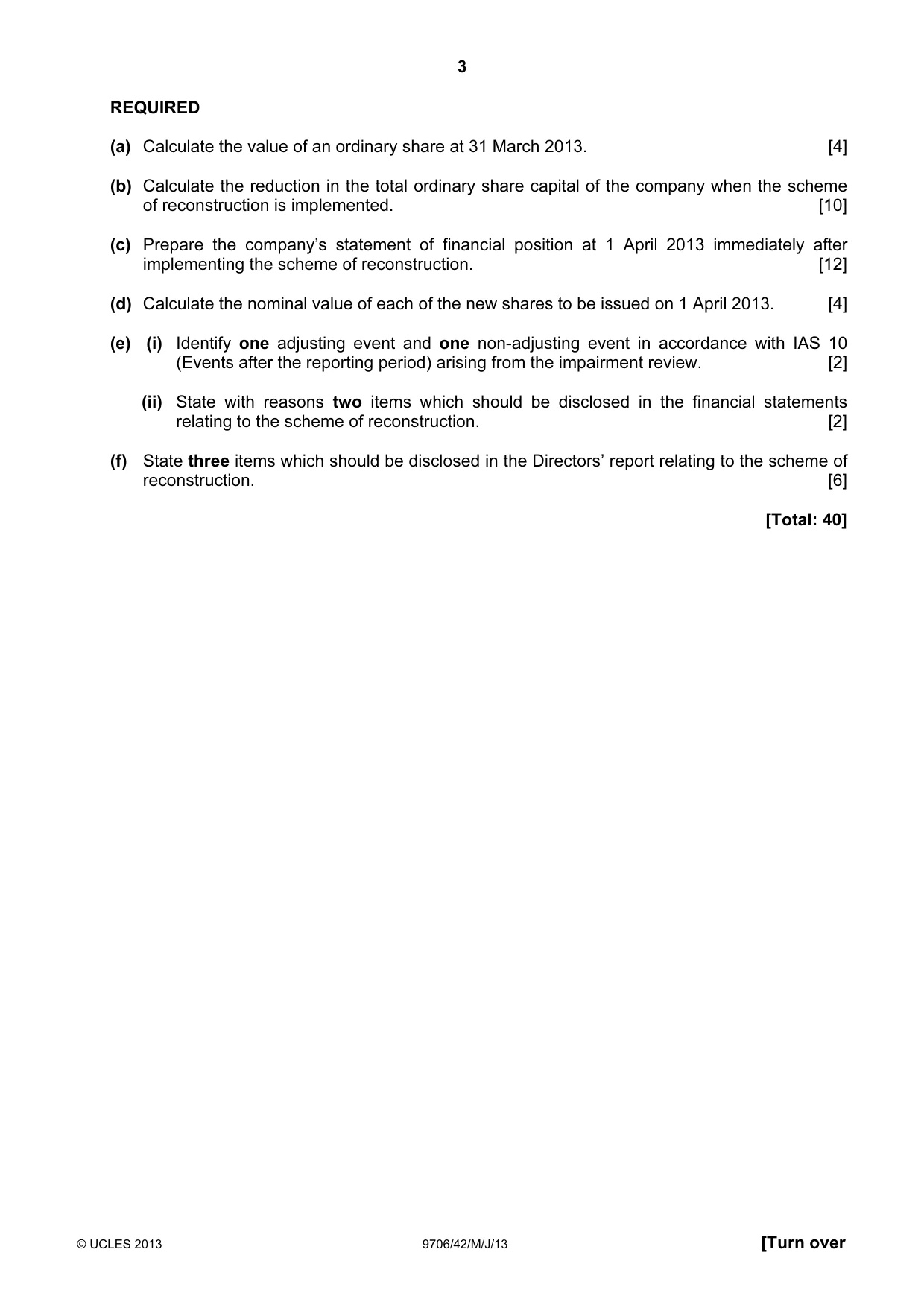
3 © UCLES 2013 9706/42/M/J/13 [Turn over REQUIRED (a) Calculate the value of an ordinary share at 31 March 2013. [4] (b) Calculate the reduction in the total ordinary share capital of the company when the scheme of reconstruction is implemented. [10] (c) Prepare the company’s statement of financial position at 1 April 2013 immediately after implementing the scheme of reconstruction. [12] (d) Calculate the nominal value of each of the new shares to be issued on 1 April 2013. [4] (e) (i) Identify one adjusting event and one non-adjusting event in accordance with IAS 10 (Events after the reporting period) arising from the impairment review. [2] (ii) State with reasons two items which should be disclosed in the financial statements relating to the scheme of reconstruction. [2] (f) State three items which should be disclosed in the Directors’ report relating to the scheme of reconstruction. [6] [Total: 40]
Question paper, page 4
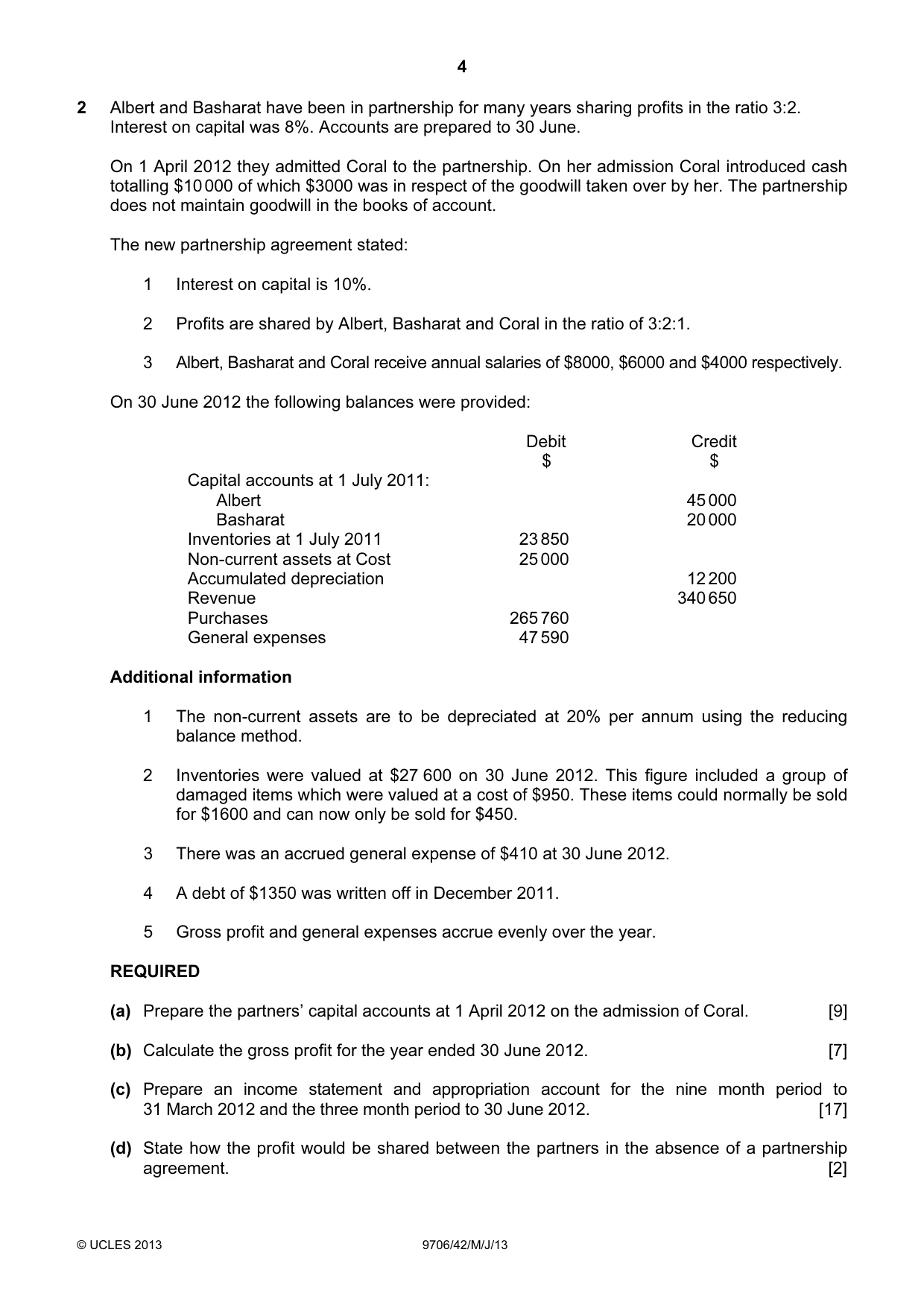
4 © UCLES 2013 9706/42/M/J/13 2 Albert and Basharat have been in partnership for many years sharing profits in the ratio 3:2. Interest on capital was 8%. Accounts are prepared to 30 June. On 1 April 2012 they admitted Coral to the partnership. On her admission Coral introduced cash totalling $10 000 of which $3000 was in respect of the goodwill taken over by her. The partnership does not maintain goodwill in the books of account. The new partnership agreement stated: 1 Interest on capital is 10%. 2 Profits are shared by Albert, Basharat and Coral in the ratio of 3:2:1. 3 Albert, Basharat and Coral receive annual salaries of $8000, $6000 and $4000 respectively. On 30 June 2012 the following balances were provided: Debit Credit $ $ Capital accounts at 1 July 2011: Albert 45 000 Basharat 20 000 Inventories at 1 July 2011 23 850 Non-current assets at Cost 25 000 Accumulated depreciation 12 200 Revenue 340 650 Purchases 265 760 General expenses 47 590 Additional information 1 The non-current assets are to be depreciated at 20% per annum using the reducing balance method. 2 Inventories were valued at $27 600 on 30 June 2012. This figure included a group of damaged items which were valued at a cost of $950. These items could normally be sold for $1600 and can now only be sold for $450. 3 There was an accrued general expense of $410 at 30 June 2012. 4 A debt of $1350 was written off in December 2011. 5 Gross profit and general expenses accrue evenly over the year. REQUIRED (a) Prepare the partners’ capital accounts at 1 April 2012 on the admission of Coral. [9] (b) Calculate the gross profit for the year ended 30 June 2012. [7] (c) Prepare an income statement and appropriation account for the nine month period to 31 March 2012 and the three month period to 30 June 2012. [17] (d) State how the profit would be shared between the partners in the absence of a partnership agreement. [2]
Question paper, page 5
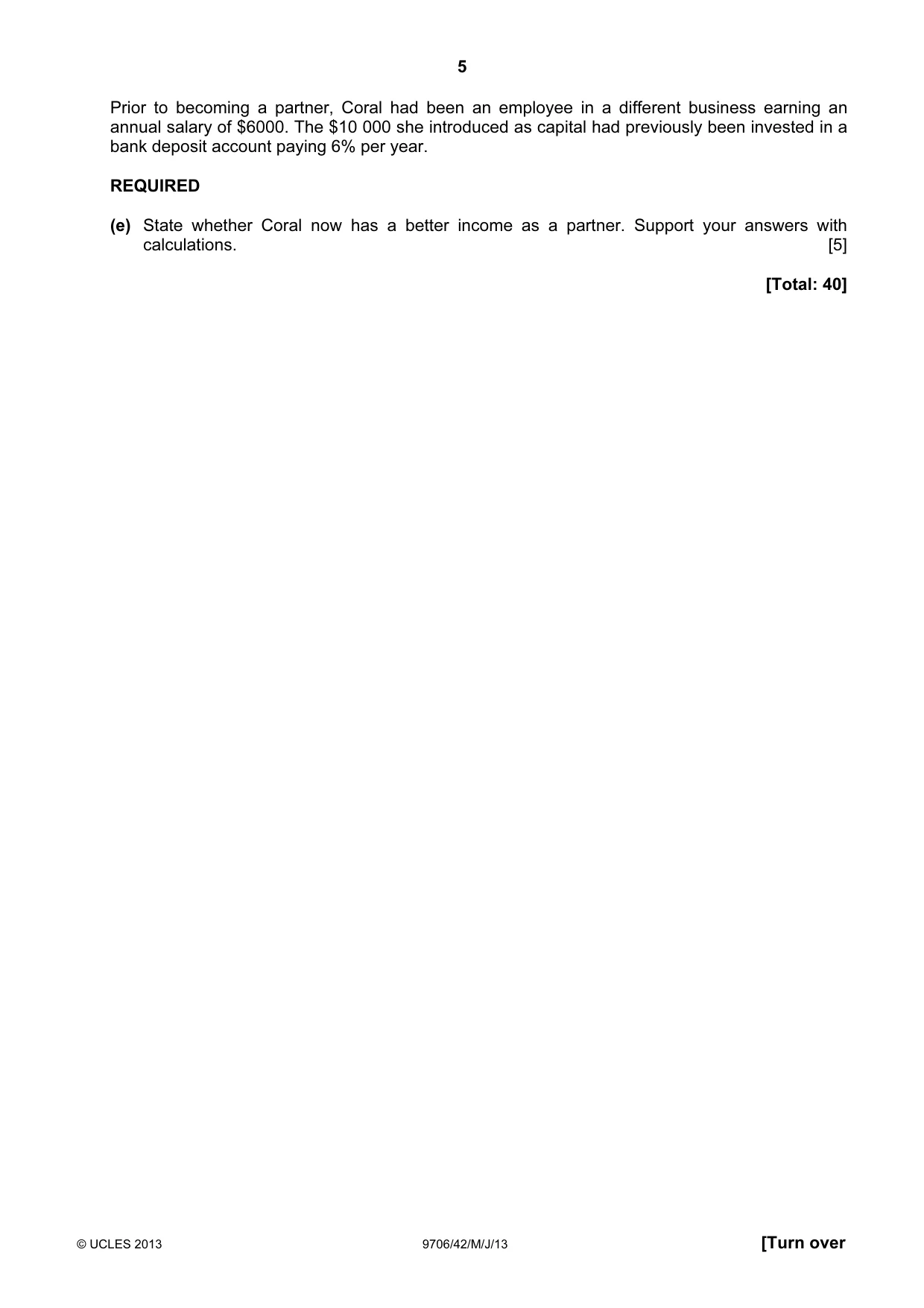
5 © UCLES 2013 9706/42/M/J/13 [Turn over Prior to becoming a partner, Coral had been an employee in a different business earning an annual salary of $6000. The $10 000 she introduced as capital had previously been invested in a bank deposit account paying 6% per year. REQUIRED (e) State whether Coral now has a better income as a partner. Support your answers with calculations. [5] [Total: 40]
Question paper, page 6
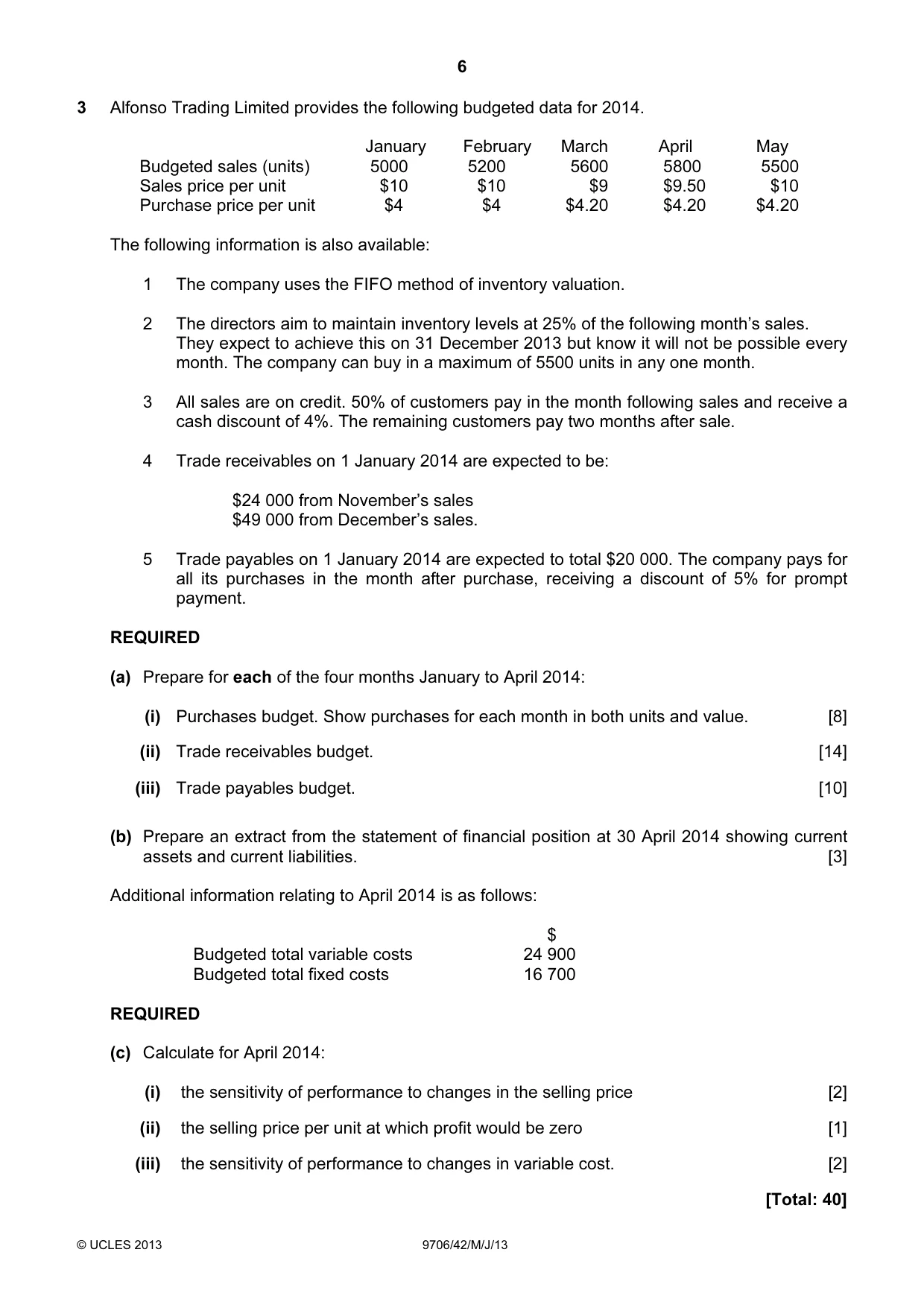
6 © UCLES 2013 9706/42/M/J/13 3 Alfonso Trading Limited provides the following budgeted data for 2014. January February March April May Budgeted sales (units) 5000 5200 5600 5800 5500 Sales price per unit $10 $10 $9 $9.50 $10 Purchase price per unit $4 $4 $4.20 $4.20 $4.20 The following information is also available: 1 The company uses the FIFO method of inventory valuation. 2 The directors aim to maintain inventory levels at 25% of the following month’s sales. They expect to achieve this on 31 December 2013 but know it will not be possible every month. The company can buy in a maximum of 5500 units in any one month. 3 All sales are on credit. 50% of customers pay in the month following sales and receive a cash discount of 4%. The remaining customers pay two months after sale. 4 Trade receivables on 1 January 2014 are expected to be: $24 000 from November’s sales $49 000 from December’s sales. 5 Trade payables on 1 January 2014 are expected to total $20 000. The company pays for all its purchases in the month after purchase, receiving a discount of 5% for prompt payment. REQUIRED (a) Prepare for each of the four months January to April 2014: (i) Purchases budget. Show purchases for each month in both units and value. [8] (ii) Trade receivables budget. [14] (iii) Trade payables budget. [10] (b) Prepare an extract from the statement of financial position at 30 April 2014 showing current assets and current liabilities. [3] Additional information relating to April 2014 is as follows: $ Budgeted total variable costs 24 900 Budgeted total fixed costs 16 700 REQUIRED (c) Calculate for April 2014: (i) the sensitivity of performance to changes in the selling price [2] (ii) the selling price per unit at which profit would be zero [1] (iii) the sensitivity of performance to changes in variable cost. [2] [Total: 40]
Question paper, page 7
7 © UCLES 2013 9706/42/M/J/13 BLANK PAGE
Question paper, page 8
8 Permission to reproduce items where third-party owned material protected by copyright is included has been sought and cleared where possible. Every reasonable effort has been made by the publisher (UCLES) to trace copyright holders, but if any items requiring clearance have unwittingly been included, the publisher will be pleased to make amends at the earliest possible opportunity. University of Cambridge International Examinations is part of the Cambridge Assessment Group. Cambridge Assessment is the brand name of University of Cambridge Local Examinations Syndicate (UCLES), which is itself a department of the University of Cambridge. © UCLES 2013 9706/42/M/J/13 BLANK PAGE
Mark scheme, page 1
CAMBRIDGE INTERNATIONAL EXAMINATIONS GCE Advanced Level MARK SCHEME for the May/June 2013 series 9706 ACCOUNTING 9706/42 Paper 4 (Problem Solving), maximum raw mark 120 This mark scheme is published as an aid to teachers and candidates, to indicate the requirements of the examination. It shows the basis on which Examiners were instructed to award marks. It does not indicate the details of the discussions that took place at an Examiners’ meeting before marking began, which would have considered the acceptability of alternative answers. Mark schemes should be read in conjunction with the question paper and the Principal Examiner Report for Teachers. Cambridge will not enter into discussions about these mark schemes. Cambridge is publishing the mark schemes for the May/June 2013 series for most IGCSE, GCE Advanced Level and Advanced Subsidiary Level components and some Ordinary Level components.
Mark scheme, page 2
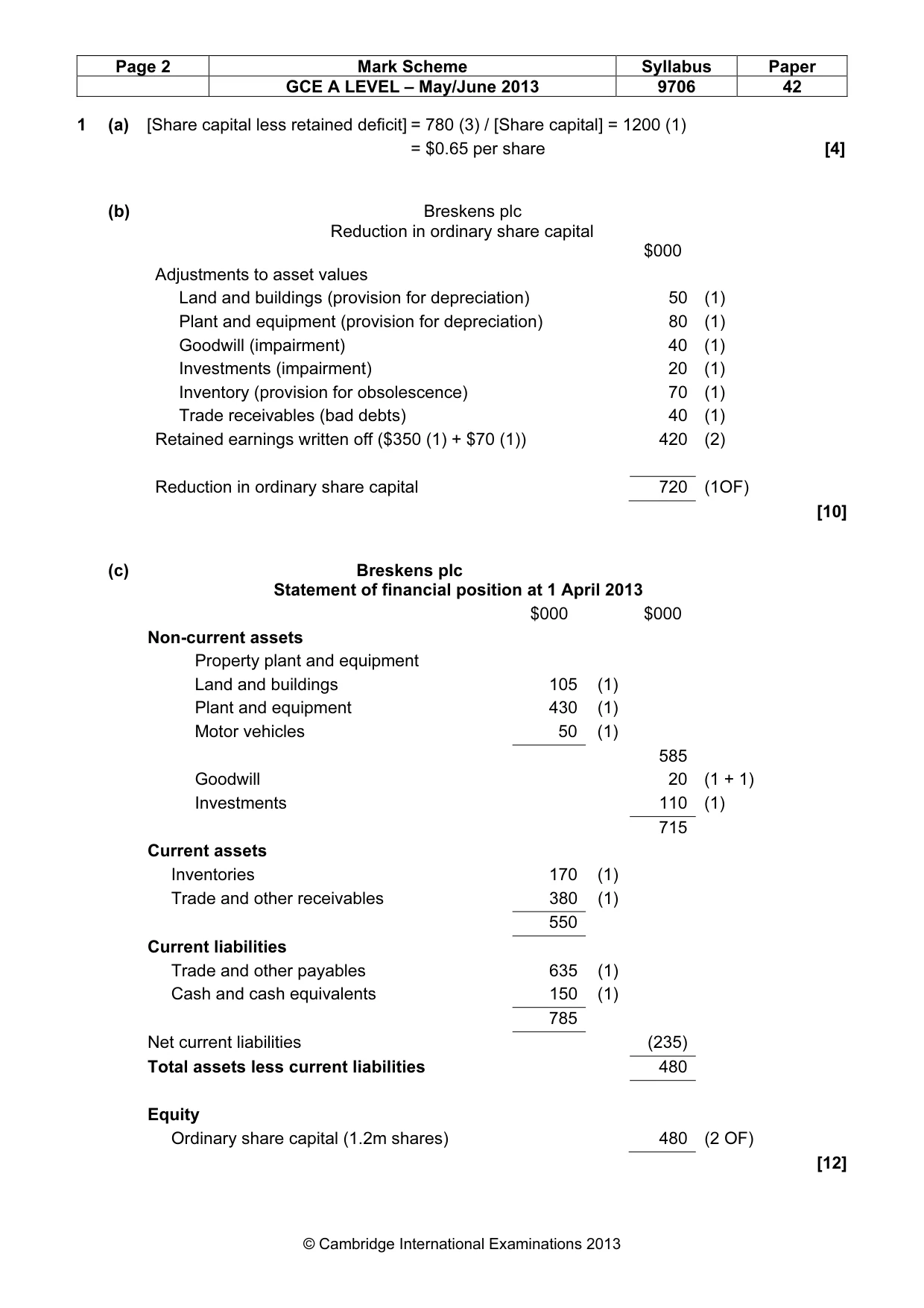
Page 2 Mark Scheme Syllabus Paper GCE A LEVEL – May/June 2013 9706 42 © Cambridge International Examinations 2013 1 (a) [Share capital less retained deficit] = 780 (3) / [Share capital] = 1200 (1) = $0.65 per share [4] (b) Breskens plc Reduction in ordinary share capital $000 Adjustments to asset values Land and buildings (provision for depreciation) 50 (1) Plant and equipment (provision for depreciation) 80 (1) Goodwill (impairment) 40 (1) Investments (impairment) 20 (1) Inventory (provision for obsolescence) 70 (1) Trade receivables (bad debts) 40 (1) Retained earnings written off ($350 (1) + $70 (1)) 420 (2) Reduction in ordinary share capital 720 (1OF) [10] (c) Breskens plc Statement of financial position at 1 April 2013 $000 $000 Non-current assets Property plant and equipment Land and buildings 105 (1) Plant and equipment 430 (1) Motor vehicles 50 (1) 585 Goodwill 20 (1 + 1) Investments 110 (1) 715 Current assets Inventories 170 (1) Trade and other receivables 380 (1) 550 Current liabilities Trade and other payables 635 (1) Cash and cash equivalents 150 (1) 785 Net current liabilities (235) Total assets less current liabilities 480 Equity Ordinary share capital (1.2m shares) 480 (2 OF) [12]
Mark scheme, page 3
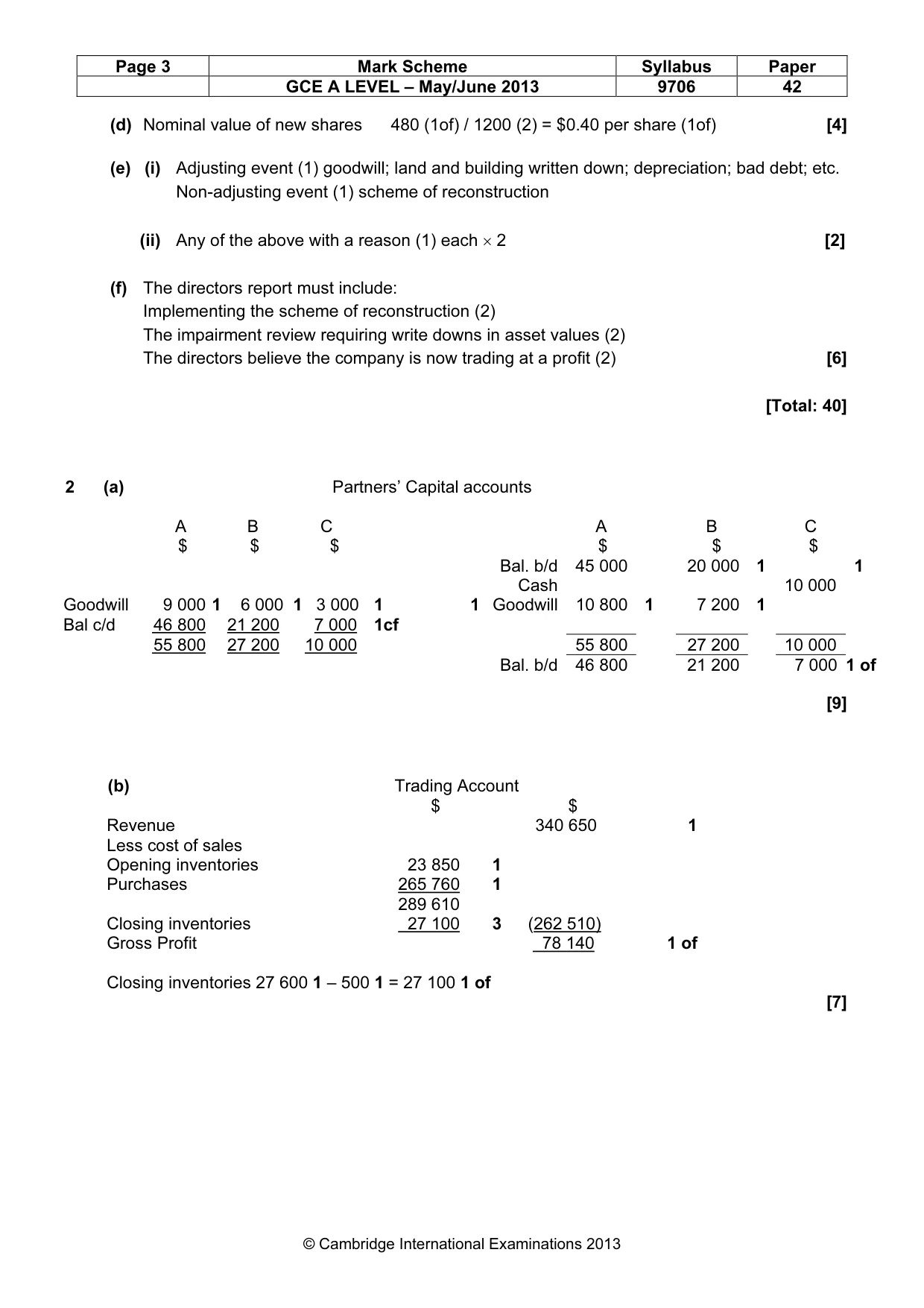
Page 3 Mark Scheme Syllabus Paper GCE A LEVEL – May/June 2013 9706 42 © Cambridge International Examinations 2013 (d) Nominal value of new shares 480 (1of) / 1200 (2) = $0.40 per share (1of) [4] (e) (i) Adjusting event (1) goodwill; land and building written down; depreciation; bad debt; etc. Non-adjusting event (1) scheme of reconstruction (ii) Any of the above with a reason (1) each × 2 [2] (f) The directors report must include: Implementing the scheme of reconstruction (2) The impairment review requiring write downs in asset values (2) The directors believe the company is now trading at a profit (2) [6] [Total: 40] 2 (a) Partners’ Capital accounts A B C A B C $ $ $ $ $ $ Bal. b/d 45 000 20 000 1 1 Cash 10 000 Goodwill 9 000 1 6 000 1 3 000 1 1 Goodwill 10 800 1 7 200 1 Bal c/d 46 800 21 200 7 000 1cf 55 800 27 200 10 000 55 800 27 200 10 000 Bal. b/d 46 800 21 200 7 000 1 of [9] (b) Trading Account $ $ Revenue 340 650 1 Less cost of sales Opening inventories 23 850 1 Purchases 265 760 1 289 610 Closing inventories 27 100 3 (262 510) Gross Profit 78 140 1 of Closing inventories 27 600 1 – 500 1 = 27 100 1 of [7]
Mark scheme, page 4
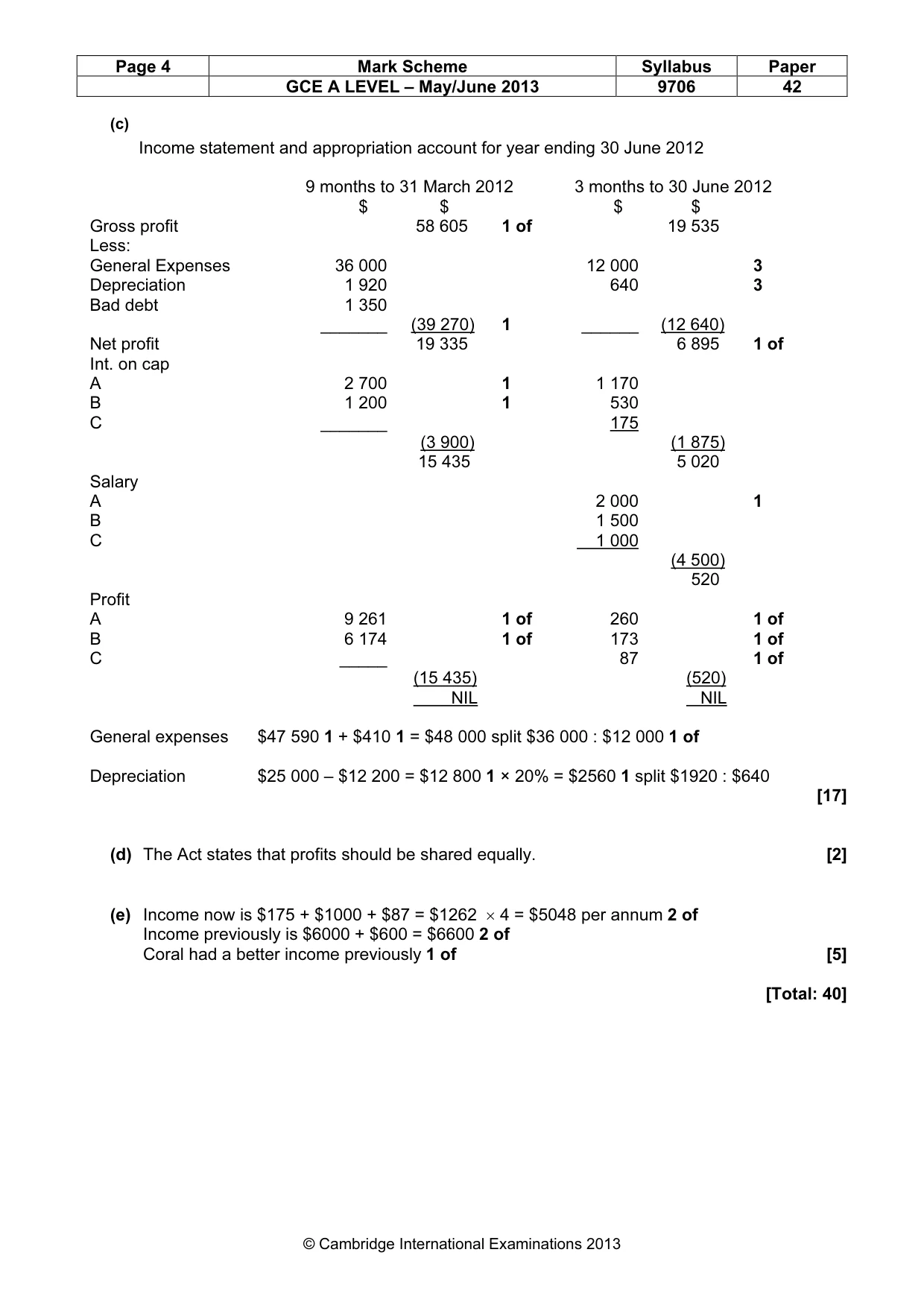
Page 4 Mark Scheme Syllabus Paper GCE A LEVEL – May/June 2013 9706 42 © Cambridge International Examinations 2013 (c) Income statement and appropriation account for year ending 30 June 2012 9 months to 31 March 2012 3 months to 30 June 2012 $ $ $ $ Gross profit 58 605 1 of 19 535 Less: General Expenses 36 000 12 000 3 Depreciation 1 920 640 3 Bad debt 1 350 _______ (39 270) 1 ______ (12 640) Net profit 19 335 6 895 1 of Int. on cap A 2 700 1 1 170 B 1 200 1 530 C _______ 175 (3 900) (1 875) 15 435 5 020 Salary A 2 000 1 B 1 500 C 1 000 (4 500) 520 Profit A 9 261 1 of 260 1 of B 6 174 1 of 173 1 of C _____ 87 1 of (15 435) (520) NIL NIL General expenses $47 590 1 + $410 1 = $48 000 split $36 000 : $12 000 1 of Depreciation $25 000 – $12 200 = $12 800 1 × 20% = $2560 1 split $1920 : $640 [17] (d) The Act states that profits should be shared equally. [2] (e) Income now is $175 + $1000 + $87 = $1262 × 4 = $5048 per annum 2 of Income previously is $6000 + $600 = $6600 2 of Coral had a better income previously 1 of [5] [Total: 40]
Mark scheme, page 5
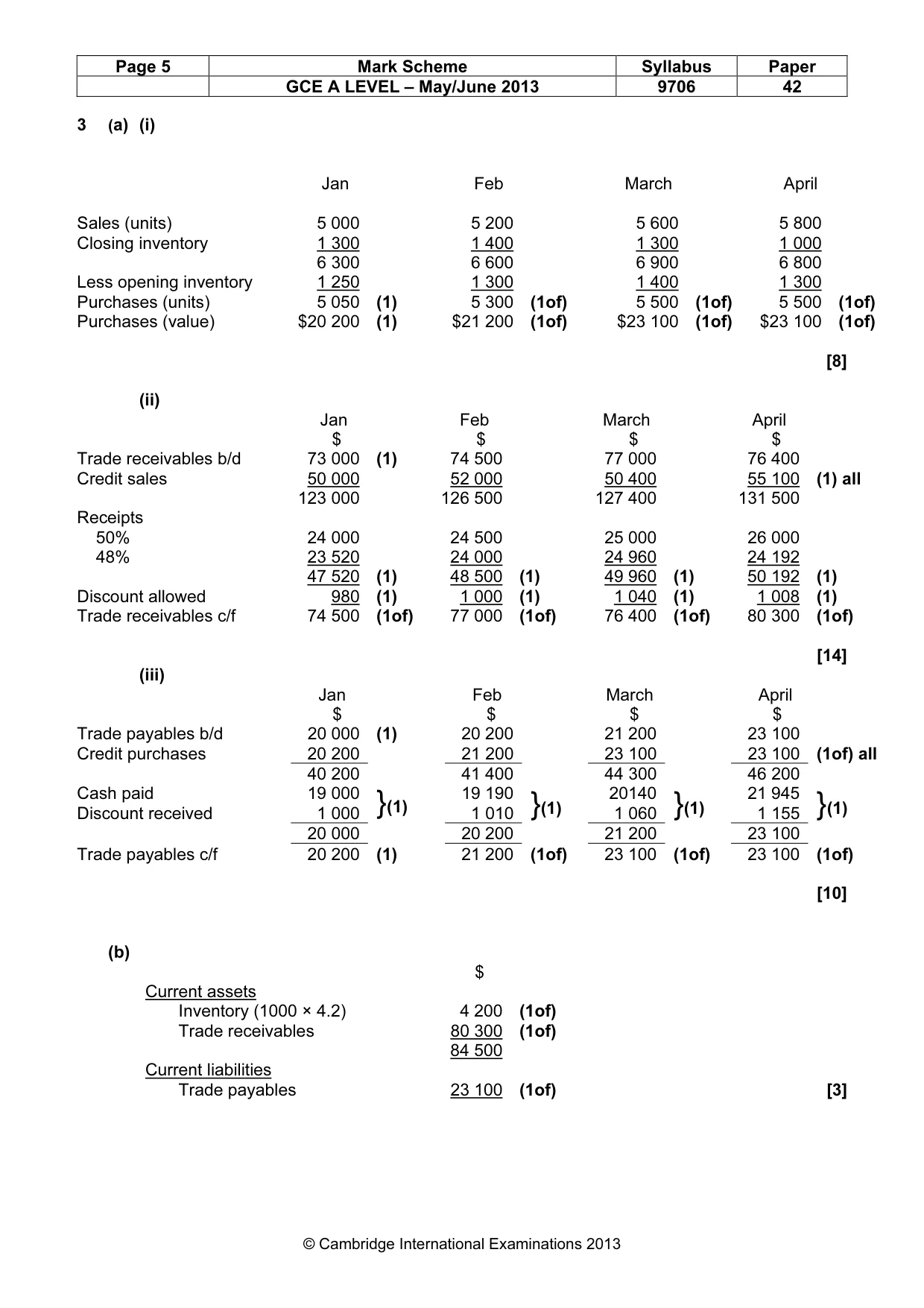
Page 5 Mark Scheme Syllabus Paper GCE A LEVEL – May/June 2013 9706 42 © Cambridge International Examinations 2013 3 (a) (i) Jan Feb March April Sales (units) 5 000 5 200 5 600 5 800 Closing inventory 1 300 1 400 1 300 1 000 6 300 6 600 6 900 6 800 Less opening inventory 1 250 1 300 1 400 1 300 Purchases (units) 5 050 (1) 5 300 (1of) 5 500 (1of) 5 500 (1of) Purchases (value) $20 200 (1) $21 200 (1of) $23 100 (1of) $23 100 (1of) [8] (ii) Jan Feb March April $ $ $ $ Trade receivables b/d 73 000 (1) 74 500 77 000 76 400 Credit sales 50 000 52 000 50 400 55 100 (1) all 123 000 126 500 127 400 131 500 Receipts 50% 24 000 24 500 25 000 26 000 48% 23 520 24 000 24 960 24 192 47 520 (1) 48 500 (1) 49 960 (1) 50 192 (1) Discount allowed 980 (1) 1 000 (1) 1 040 (1) 1 008 (1) Trade receivables c/f 74 500 (1of) 77 000 (1of) 76 400 (1of) 80 300 (1of) [14] (iii) Jan Feb March April $ $ $ $ Trade payables b/d 20 000 (1) 20 200 21 200 23 100 Credit purchases 20 200 21 200 23 100 23 100 (1of) all 40 200 41 400 44 300 46 200 Cash paid 19 000 }(1) 19 190 }(1) 20140 }(1) 21 945 }(1) Discount received 1 000 1 010 1 060 1 155 20 000 20 200 21 200 23 100 Trade payables c/f 20 200 (1) 21 200 (1of) 23 100 (1of) 23 100 (1of) [10] (b) $ Current assets Inventory (1000 × 4.2) 4 200 (1of) Trade receivables 80 300 (1of) 84 500 Current liabilities Trade payables 23 100 (1of) [3]
Mark scheme, page 6
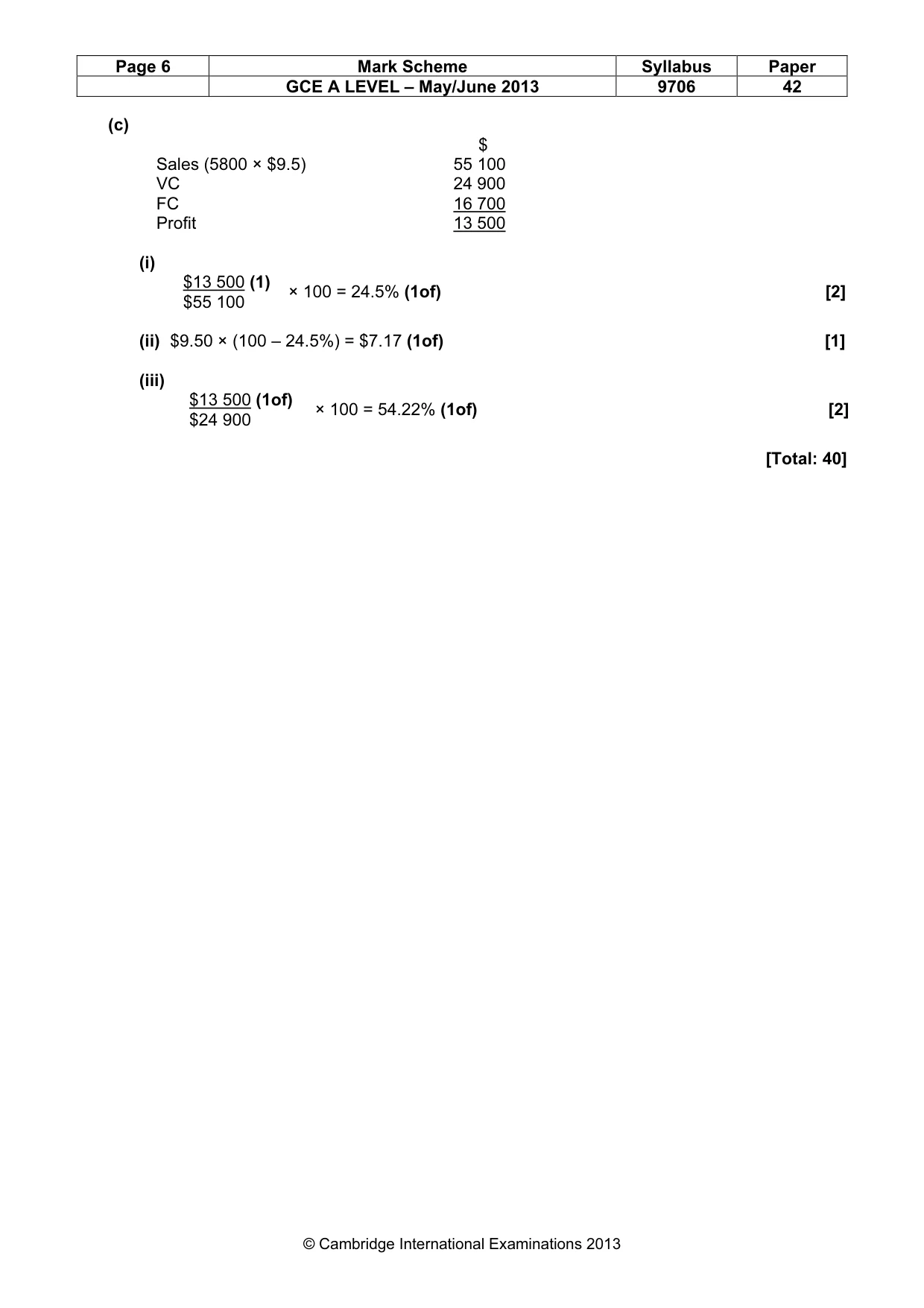
Page 6 Mark Scheme Syllabus Paper GCE A LEVEL – May/June 2013 9706 42 © Cambridge International Examinations 2013 (c) $ Sales (5800 × $9.5) 55 100 VC 24 900 FC 16 700 Profit 13 500 (i) $13 500 (1) × 100 = 24.5% (1of) [2] $55 100 (ii) $9.50 × (100 – 24.5%) = $7.17 (1of) [1] (iii) $13 500 (1of) × 100 = 54.22% (1of) [2] $24 900 [Total: 40]
What you needed in this session
Cambridge’s own grade thresholds for 2013 May/June, Paper 4 · Variant 2. A higher threshold means an easier paper — the bar moves with how the cohort did.