Cambridge A Level Accounting 9706 — 2013 May/June Paper 4 · Variant 3
9706/43/M/J/13 · 120 marks · ≈135 min
The question paper and its mark scheme, free to read here and free to download. This is Cambridge’s own paper, exactly as it was sat.
Question paper8 pages

Mark scheme7 pages
Answers below. Sit the paper first if you are practising.
Paper as text
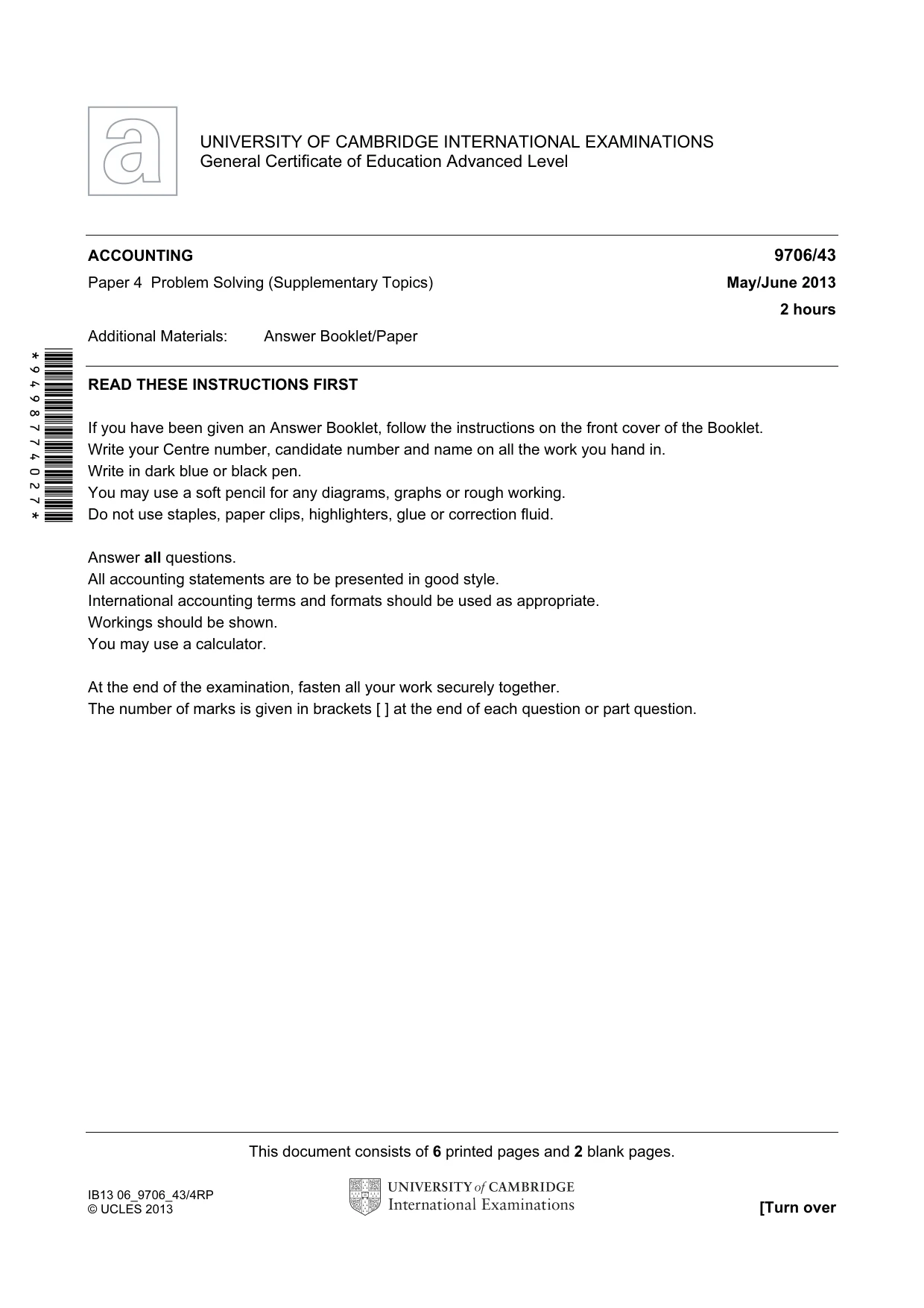
Question paper, page 1
This document consists of 6 printed pages and 2 blank pages. IB13 06_9706_43/4RP © UCLES 2013 [Turn over *9498774027* UNIVERSITY OF CAMBRIDGE INTERNATIONAL EXAMINATIONS General Certificate of Education Advanced Level ACCOUNTING 9706/43 Paper 4 Problem Solving (Supplementary Topics) May/June 2013 2 hours Additional Materials: Answer Booklet/Paper READ THESE INSTRUCTIONS FIRST If you have been given an Answer Booklet, follow the instructions on the front cover of the Booklet. Write your Centre number, candidate number and name on all the work you hand in. Write in dark blue or black pen. You may use a soft pencil for any diagrams, graphs or rough working. Do not use staples, paper clips, highlighters, glue or correction fluid. Answer all questions. All accounting statements are to be presented in good style. International accounting terms and formats should be used as appropriate. Workings should be shown. You may use a calculator. At the end of the examination, fasten all your work securely together. The number of marks is given in brackets [ ] at the end of each question or part question.
Question paper, page 2
2 © UCLES 2013 9706/43/M/J/13 BLANK PAGE
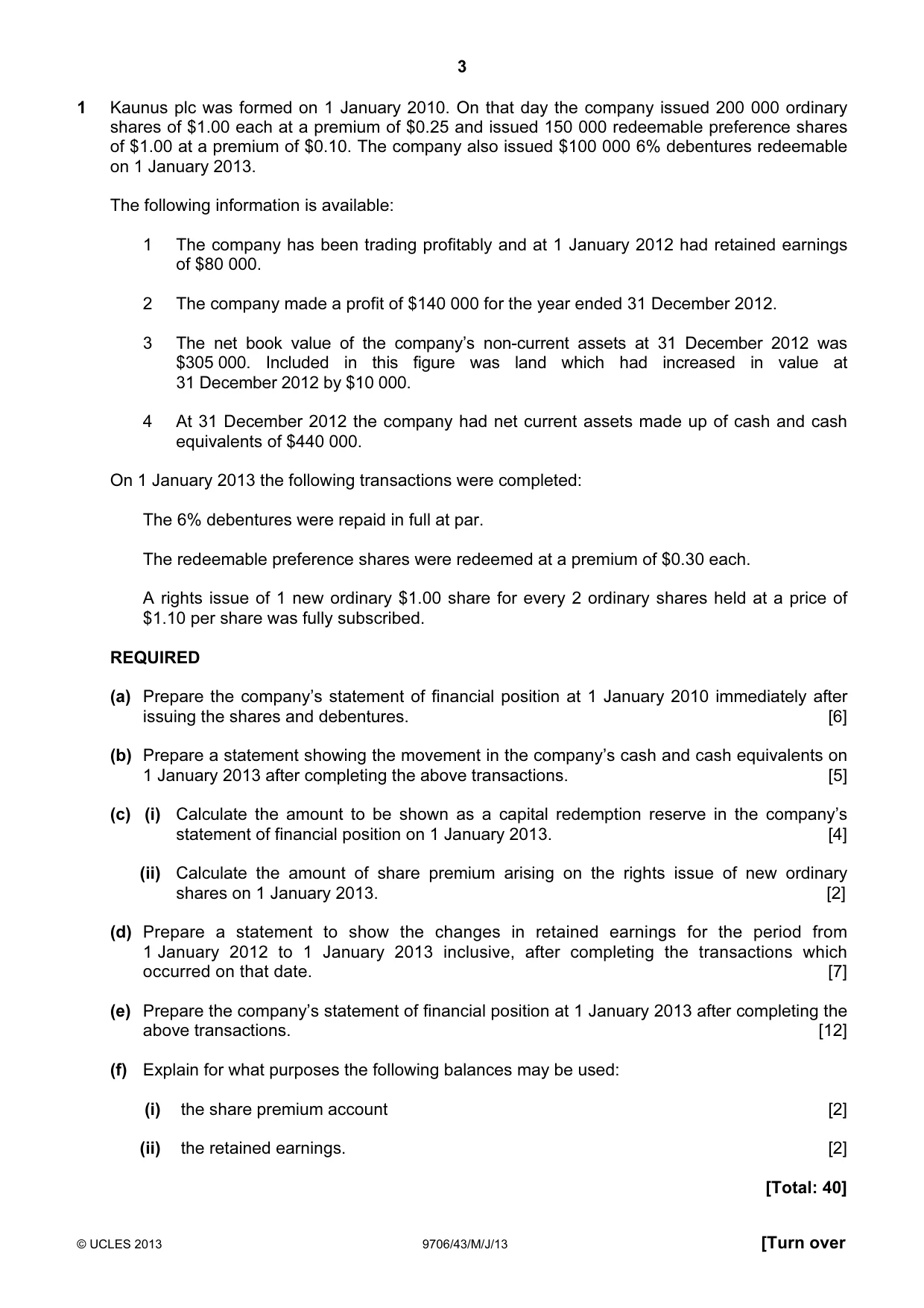
Question paper, page 3
3 © UCLES 2013 9706/43/M/J/13 [Turn over 1 Kaunus plc was formed on 1 January 2010. On that day the company issued 200 000 ordinary shares of $1.00 each at a premium of $0.25 and issued 150 000 redeemable preference shares of $1.00 at a premium of $0.10. The company also issued $100 000 6% debentures redeemable on 1 January 2013. The following information is available: 1 The company has been trading profitably and at 1 January 2012 had retained earnings of $80 000. 2 The company made a profit of $140 000 for the year ended 31 December 2012. 3 The net book value of the company’s non-current assets at 31 December 2012 was $305 000. Included in this figure was land which had increased in value at 31 December 2012 by $10 000. 4 At 31 December 2012 the company had net current assets made up of cash and cash equivalents of $440 000. On 1 January 2013 the following transactions were completed: The 6% debentures were repaid in full at par. The redeemable preference shares were redeemed at a premium of $0.30 each. A rights issue of 1 new ordinary $1.00 share for every 2 ordinary shares held at a price of $1.10 per share was fully subscribed. REQUIRED (a) Prepare the company’s statement of financial position at 1 January 2010 immediately after issuing the shares and debentures. [6] (b) Prepare a statement showing the movement in the company’s cash and cash equivalents on 1 January 2013 after completing the above transactions. [5] (c) (i) Calculate the amount to be shown as a capital redemption reserve in the company’s statement of financial position on 1 January 2013. [4] (ii) Calculate the amount of share premium arising on the rights issue of new ordinary shares on 1 January 2013. [2] (d) Prepare a statement to show the changes in retained earnings for the period from 1 January 2012 to 1 January 2013 inclusive, after completing the transactions which occurred on that date. [7] (e) Prepare the company’s statement of financial position at 1 January 2013 after completing the above transactions. [12] (f) Explain for what purposes the following balances may be used: (i) the share premium account [2] (ii) the retained earnings. [2] [Total: 40]
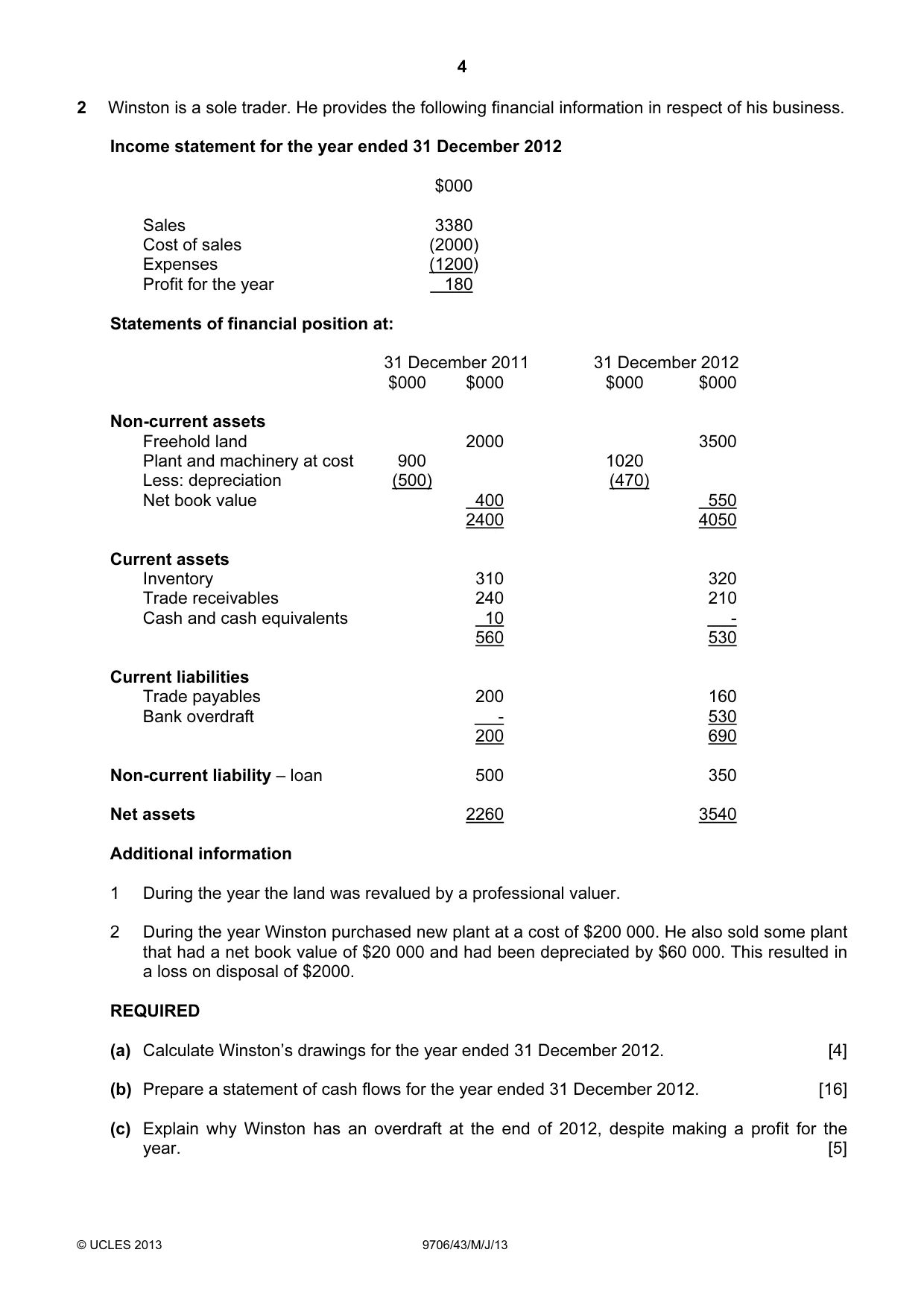
Question paper, page 4
4 © UCLES 2013 9706/43/M/J/13 2 Winston is a sole trader. He provides the following financial information in respect of his business. Income statement for the year ended 31 December 2012 $000 Sales 3380 Cost of sales (2000) Expenses (1200) Profit for the year 180 Statements of financial position at: 31 December 2011 31 December 2012 $000 $000 $000 $000 Non-current assets Freehold land 2000 3500 Plant and machinery at cost 900 1020 Less: depreciation (500) (470) Net book value 400 550 2400 4050 Current assets Inventory 310 320 Trade receivables 240 210 Cash and cash equivalents 10 - 560 530 Current liabilities Trade payables 200 160 Bank overdraft - 530 200 690 Non-current liability – loan 500 350 Net assets 2260 3540 Additional information 1 During the year the land was revalued by a professional valuer. 2 During the year Winston purchased new plant at a cost of $200 000. He also sold some plant that had a net book value of $20 000 and had been depreciated by $60 000. This resulted in a loss on disposal of $2000. REQUIRED (a) Calculate Winston’s drawings for the year ended 31 December 2012. [4] (b) Prepare a statement of cash flows for the year ended 31 December 2012. [16] (c) Explain why Winston has an overdraft at the end of 2012, despite making a profit for the year. [5]
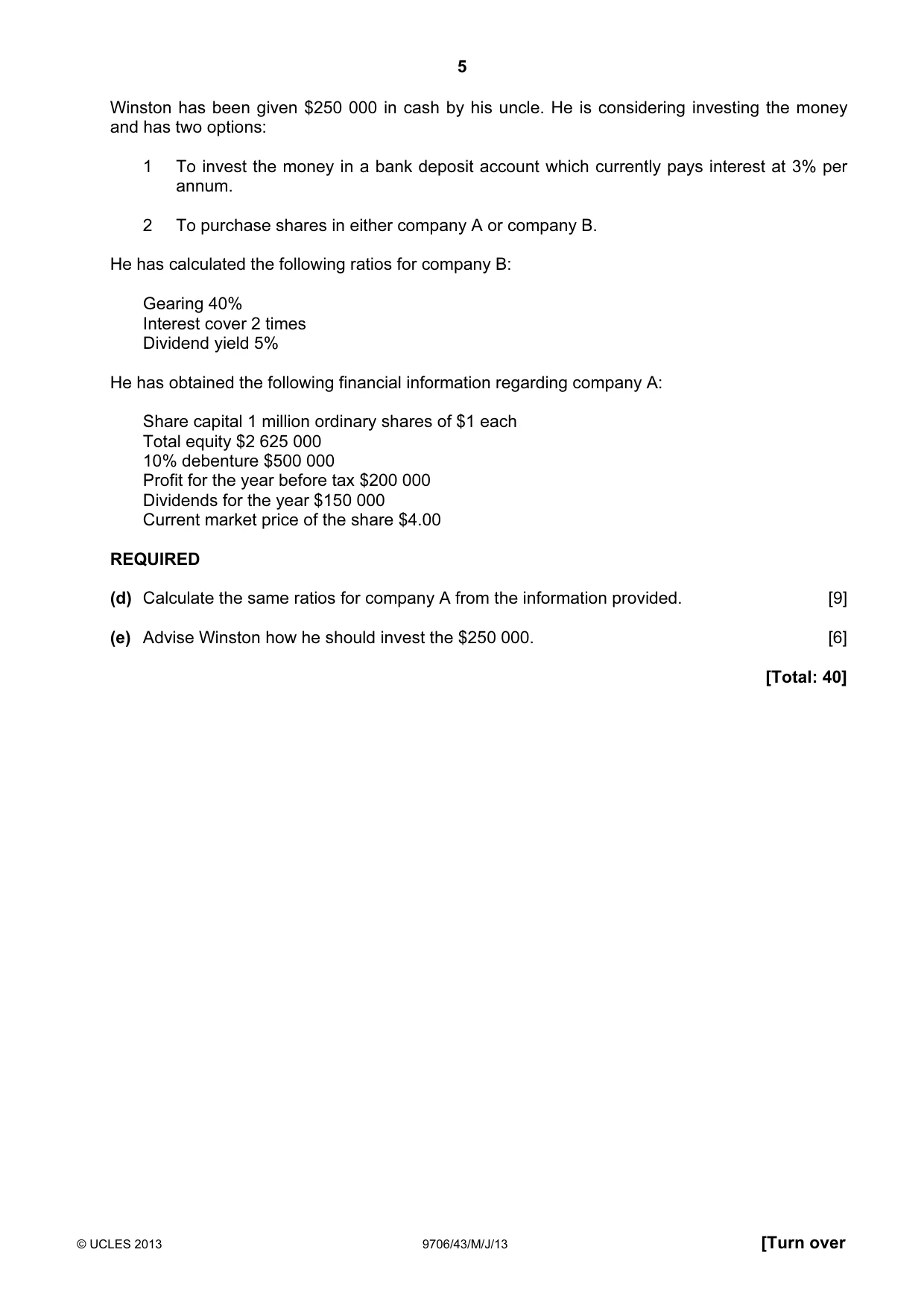
Question paper, page 5
5 © UCLES 2013 9706/43/M/J/13 [Turn over Winston has been given $250 000 in cash by his uncle. He is considering investing the money and has two options: 1 To invest the money in a bank deposit account which currently pays interest at 3% per annum. 2 To purchase shares in either company A or company B. He has calculated the following ratios for company B: Gearing 40% Interest cover 2 times Dividend yield 5% He has obtained the following financial information regarding company A: Share capital 1 million ordinary shares of $1 each Total equity $2 625 000 10% debenture $500 000 Profit for the year before tax $200 000 Dividends for the year $150 000 Current market price of the share $4.00 REQUIRED (d) Calculate the same ratios for company A from the information provided. [9] (e) Advise Winston how he should invest the $250 000. [6] [Total: 40]
Question paper, page 6
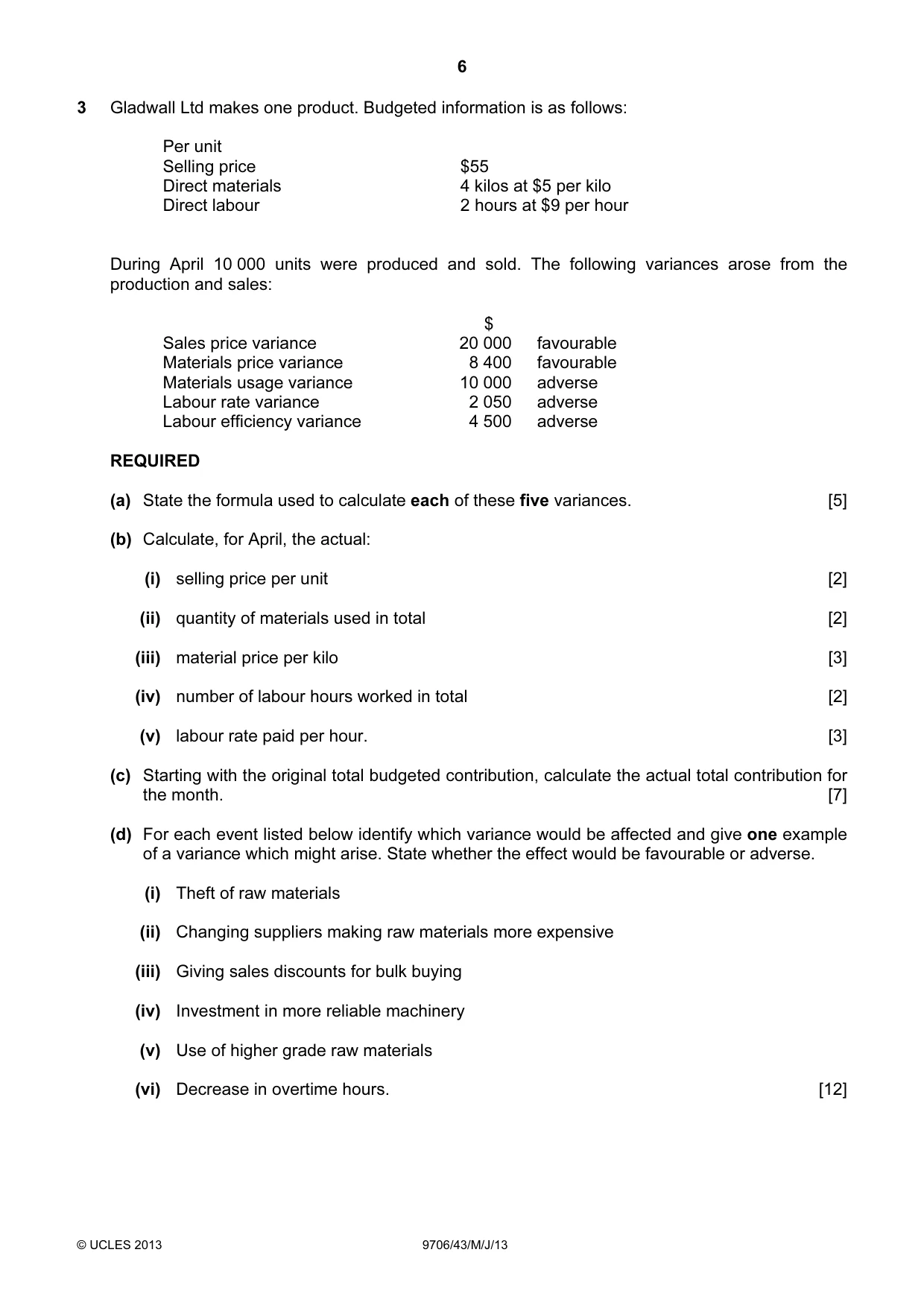
6 © UCLES 2013 9706/43/M/J/13 3 Gladwall Ltd makes one product. Budgeted information is as follows: Per unit Selling price $55 Direct materials 4 kilos at $5 per kilo Direct labour 2 hours at $9 per hour During April 10 000 units were produced and sold. The following variances arose from the production and sales: $ Sales price variance 20 000 favourable Materials price variance 8 400 favourable Materials usage variance 10 000 adverse Labour rate variance 2 050 adverse Labour efficiency variance 4 500 adverse REQUIRED (a) State the formula used to calculate each of these five variances. [5] (b) Calculate, for April, the actual: (i) selling price per unit [2] (ii) quantity of materials used in total [2] (iii) material price per kilo [3] (iv) number of labour hours worked in total [2] (v) labour rate paid per hour. [3] (c) Starting with the original total budgeted contribution, calculate the actual total contribution for the month. [7] (d) For each event listed below identify which variance would be affected and give one example of a variance which might arise. State whether the effect would be favourable or adverse. (i) Theft of raw materials (ii) Changing suppliers making raw materials more expensive (iii) Giving sales discounts for bulk buying (iv) Investment in more reliable machinery (v) Use of higher grade raw materials (vi) Decrease in overtime hours. [12]
Question paper, page 7
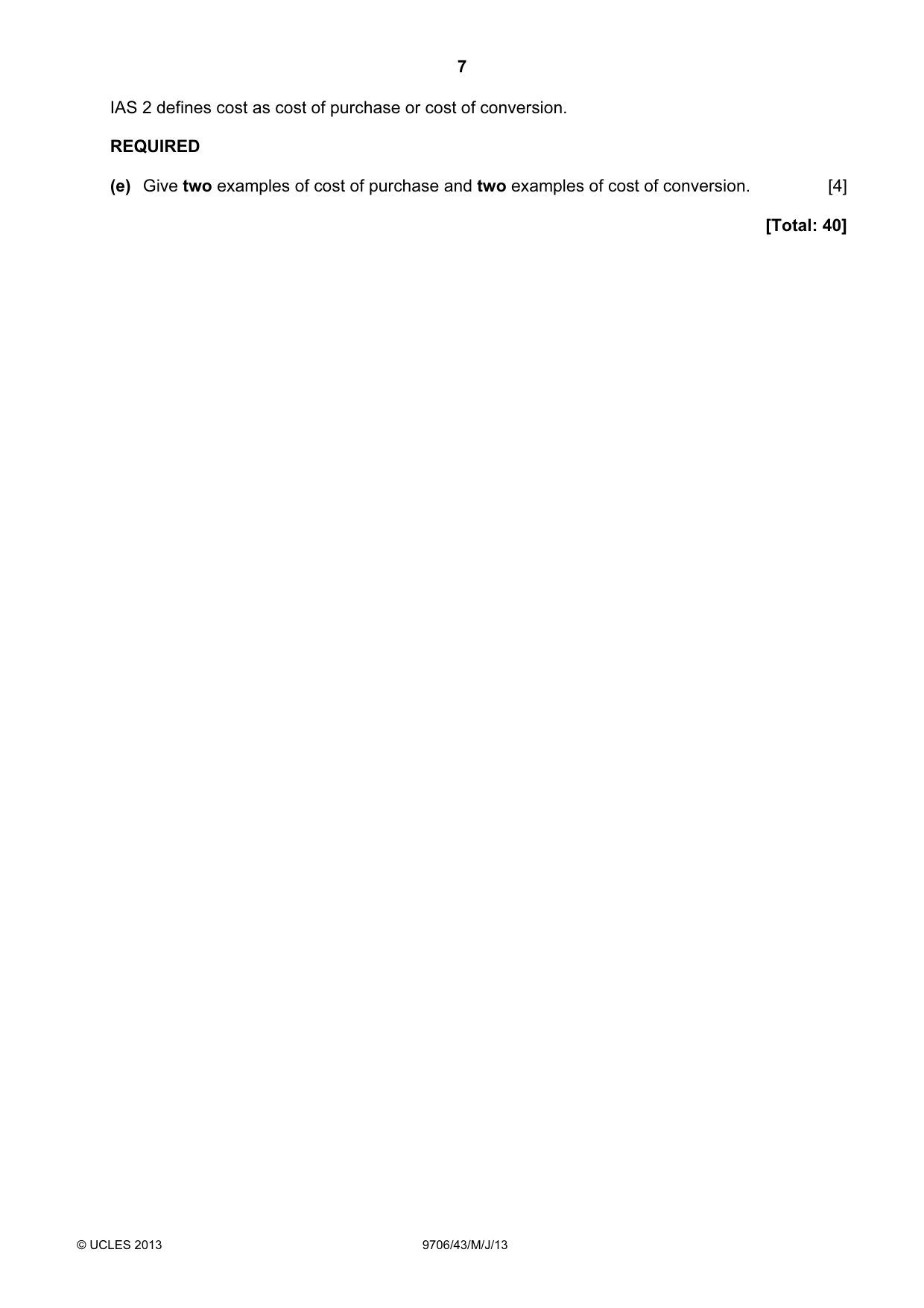
7 © UCLES 2013 9706/43/M/J/13 IAS 2 defines cost as cost of purchase or cost of conversion. REQUIRED (e) Give two examples of cost of purchase and two examples of cost of conversion. [4] [Total: 40]
Question paper, page 8
8 Permission to reproduce items where third-party owned material protected by copyright is included has been sought and cleared where possible. Every reasonable effort has been made by the publisher (UCLES) to trace copyright holders, but if any items requiring clearance have unwittingly been included, the publisher will be pleased to make amends at the earliest possible opportunity. University of Cambridge International Examinations is part of the Cambridge Assessment Group. Cambridge Assessment is the brand name of University of Cambridge Local Examinations Syndicate (UCLES), which is itself a department of the University of Cambridge. © UCLES 2013 9706/43/M/J/13 BLANK PAGE
Mark scheme, page 1
CAMBRIDGE INTERNATIONAL EXAMINATIONS GCE Advanced Level MARK SCHEME for the May/June 2013 series 9706 ACCOUNTING 9706/43 Paper 4 (Problem Solving – Supplement), maximum raw mark 120 This mark scheme is published as an aid to teachers and candidates, to indicate the requirements of the examination. It shows the basis on which Examiners were instructed to award marks. It does not indicate the details of the discussions that took place at an Examiners’ meeting before marking began, which would have considered the acceptability of alternative answers. Mark schemes should be read in conjunction with the question paper and the Principal Examiner Report for Teachers. Cambridge will not enter into discussions about these mark schemes. Cambridge is publishing the mark schemes for the May/June 2013 series for most IGCSE, GCE Advanced Level and Advanced Subsidiary Level components and some Ordinary Level components.
Mark scheme, page 2
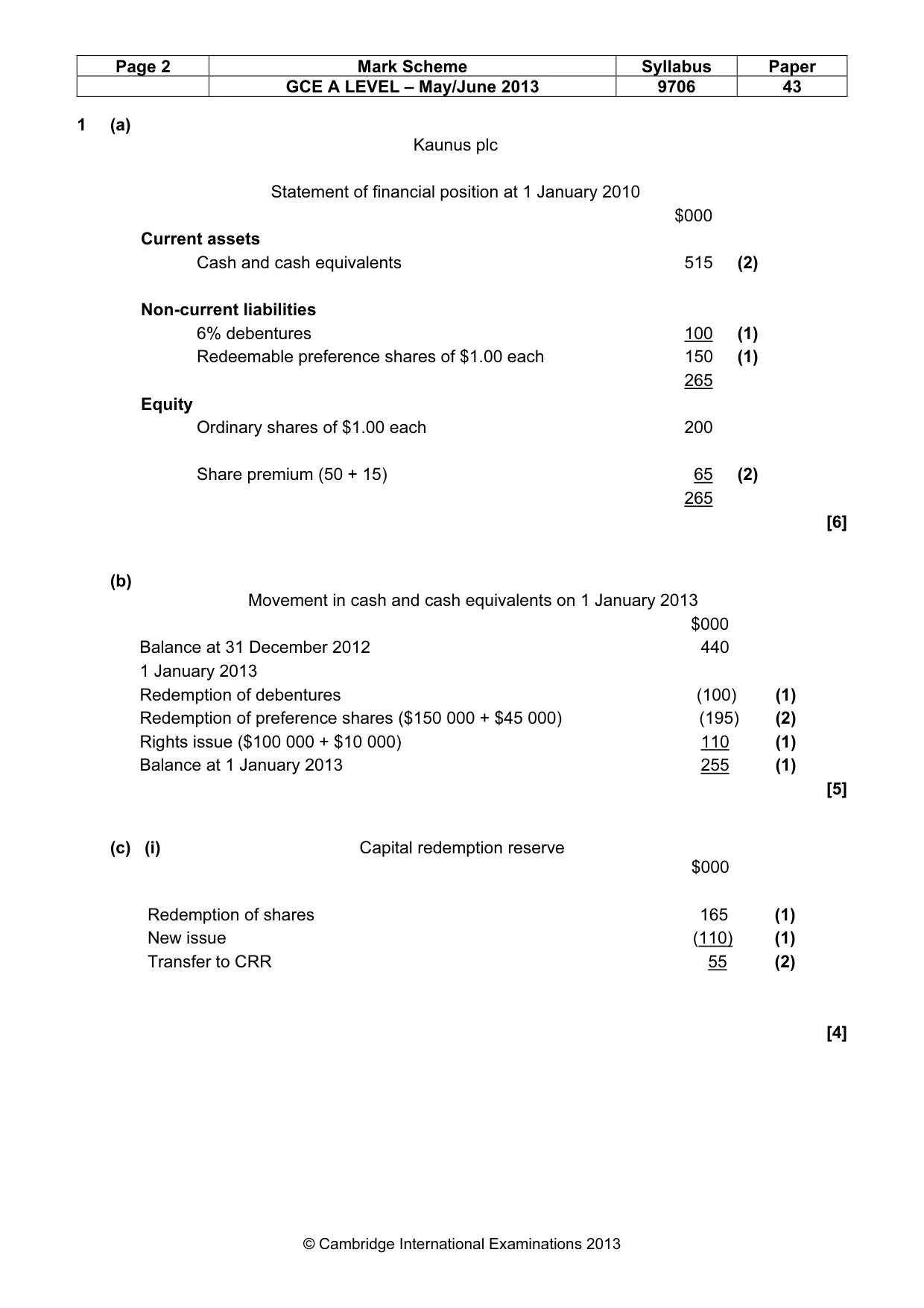
Page 2 Mark Scheme Syllabus Paper GCE A LEVEL – May/June 2013 9706 43 © Cambridge International Examinations 2013 1 (a) Kaunus plc Statement of financial position at 1 January 2010 $000 Current assets Cash and cash equivalents 515 (2) Non-current liabilities 6% debentures 100 (1) Redeemable preference shares of $1.00 each 150 (1) 265 Equity Ordinary shares of $1.00 each 200 Share premium (50 + 15) 65 (2) 265 [6] (b) Movement in cash and cash equivalents on 1 January 2013 $000 Balance at 31 December 2012 440 1 January 2013 Redemption of debentures (100) (1) Redemption of preference shares ($150 000 + $45 000) (195) (2) Rights issue ($100 000 + $10 000) 110 (1) Balance at 1 January 2013 255 (1) [5] (c) (i) Capital redemption reserve $000 Redemption of shares 165 (1) New issue (110) (1) Transfer to CRR 55 (2) [4]
Mark scheme, page 3
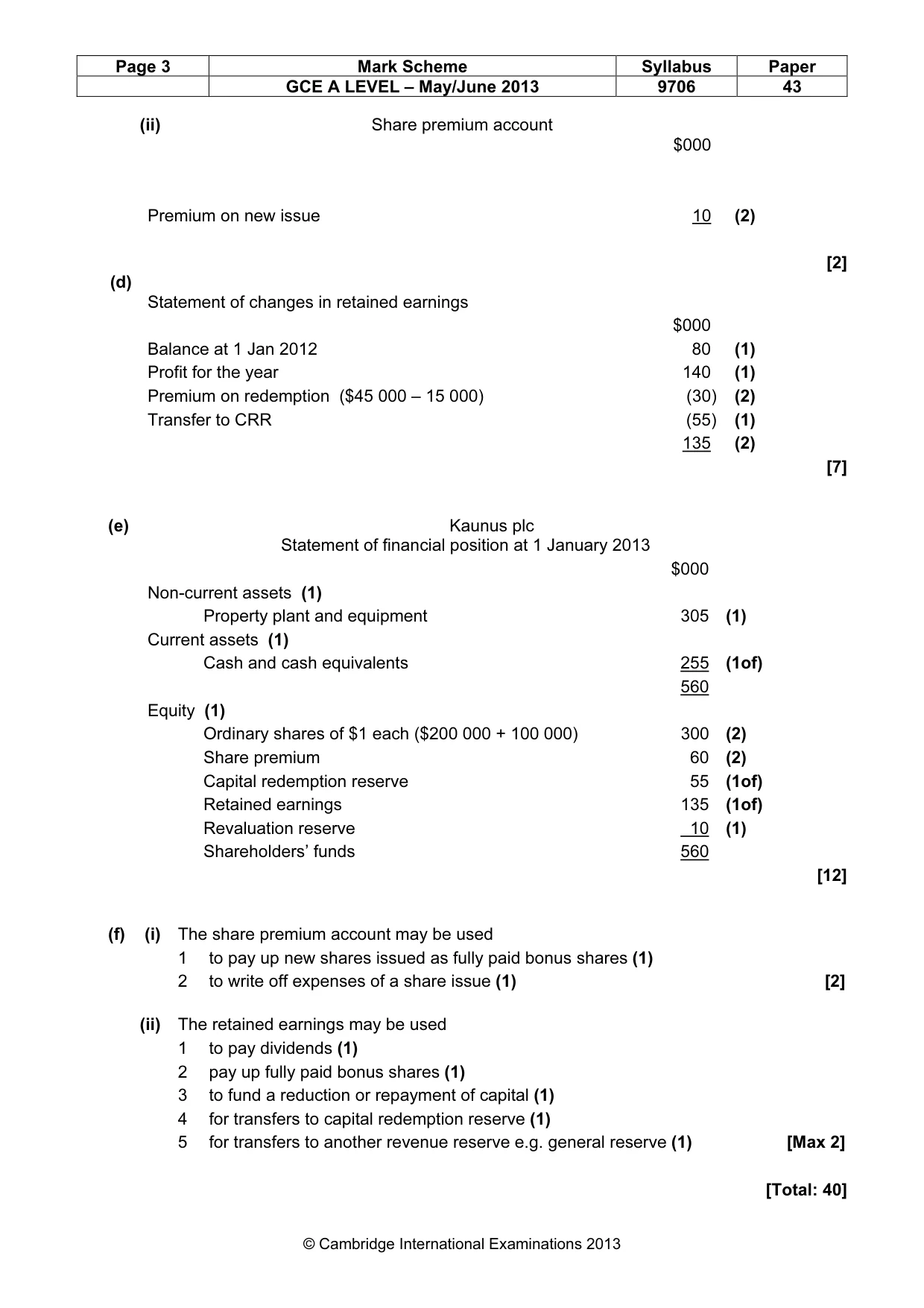
Page 3 Mark Scheme Syllabus Paper GCE A LEVEL – May/June 2013 9706 43 © Cambridge International Examinations 2013 (ii) Share premium account $000 Premium on new issue 10 (2) [2] (d) Statement of changes in retained earnings $000 Balance at 1 Jan 2012 80 (1) Profit for the year 140 (1) Premium on redemption ($45 000 – 15 000) (30) (2) Transfer to CRR (55) (1) 135 (2) [7] (e) Kaunus plc Statement of financial position at 1 January 2013 $000 Non-current assets (1) Property plant and equipment 305 (1) Current assets (1) Cash and cash equivalents 255 (1of) 560 Equity (1) Ordinary shares of $1 each ($200 000 + 100 000) 300 (2) Share premium 60 (2) Capital redemption reserve 55 (1of) Retained earnings 135 (1of) Revaluation reserve 10 (1) Shareholders’ funds 560 [12] (f) (i) The share premium account may be used 1 to pay up new shares issued as fully paid bonus shares (1) 2 to write off expenses of a share issue (1) [2] (ii) The retained earnings may be used 1 to pay dividends (1) 2 pay up fully paid bonus shares (1) 3 to fund a reduction or repayment of capital (1) 4 for transfers to capital redemption reserve (1) 5 for transfers to another revenue reserve e.g. general reserve (1) [Max 2] [Total: 40]
Mark scheme, page 4
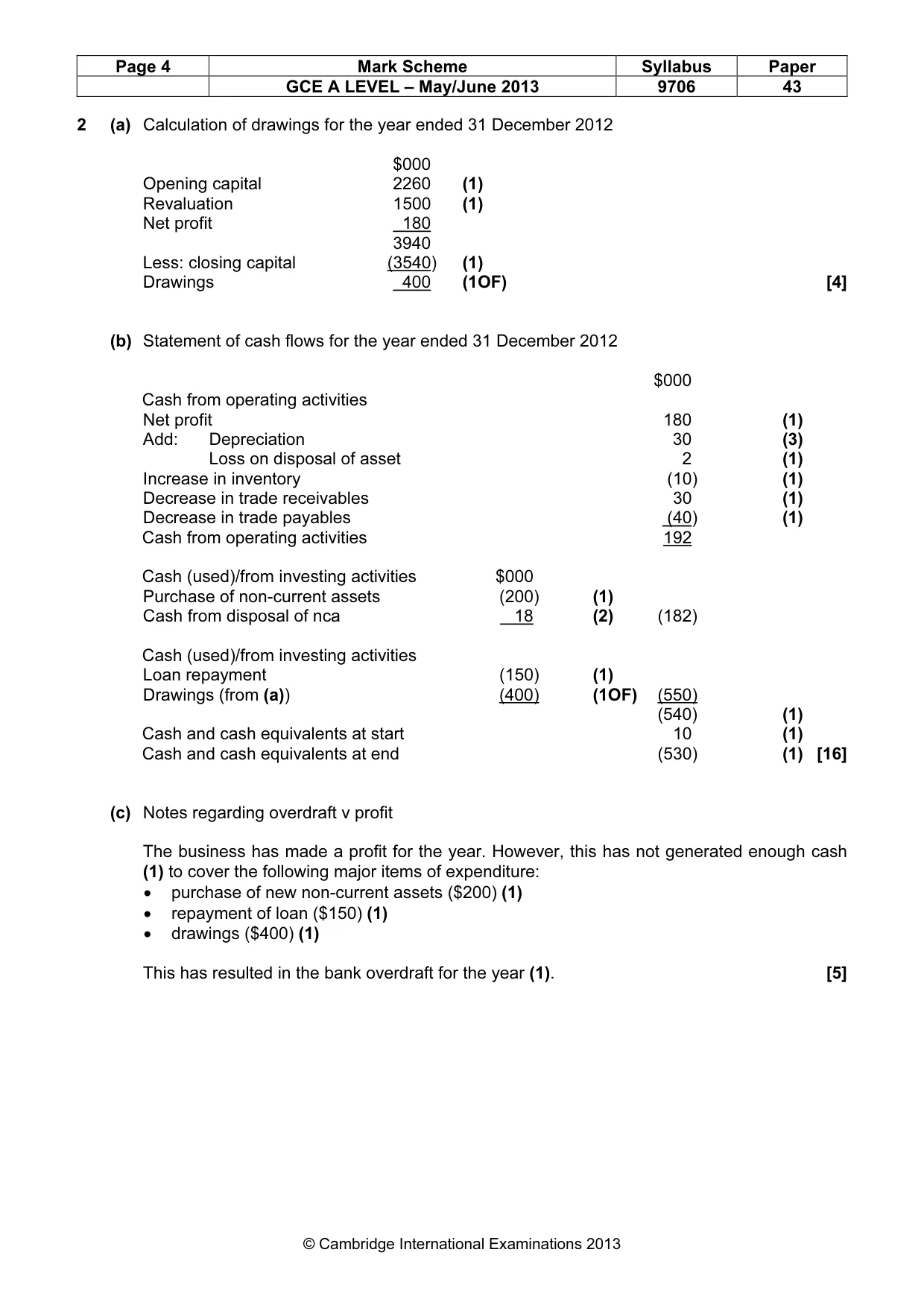
Page 4 Mark Scheme Syllabus Paper GCE A LEVEL – May/June 2013 9706 43 © Cambridge International Examinations 2013 2 (a) Calculation of drawings for the year ended 31 December 2012 $000 Opening capital 2260 (1) Revaluation 1500 (1) Net profit 180 3940 Less: closing capital (3540) (1) Drawings 400 (1OF) [4] (b) Statement of cash flows for the year ended 31 December 2012 $000 Cash from operating activities Net profit 180 (1) Add: Depreciation 30 (3) Loss on disposal of asset 2 (1) Increase in inventory (10) (1) Decrease in trade receivables 30 (1) Decrease in trade payables (40) (1) Cash from operating activities 192 Cash (used)/from investing activities $000 Purchase of non-current assets (200) (1) Cash from disposal of nca 18 (2) (182) Cash (used)/from investing activities Loan repayment (150) (1) Drawings (from (a)) (400) (1OF) (550) (540) (1) Cash and cash equivalents at start 10 (1) Cash and cash equivalents at end (530) (1) [16] (c) Notes regarding overdraft v profit The business has made a profit for the year. However, this has not generated enough cash (1) to cover the following major items of expenditure: • purchase of new non-current assets ($200) (1) • repayment of loan ($150) (1) • drawings ($400) (1) This has resulted in the bank overdraft for the year (1). [5]
Mark scheme, page 5
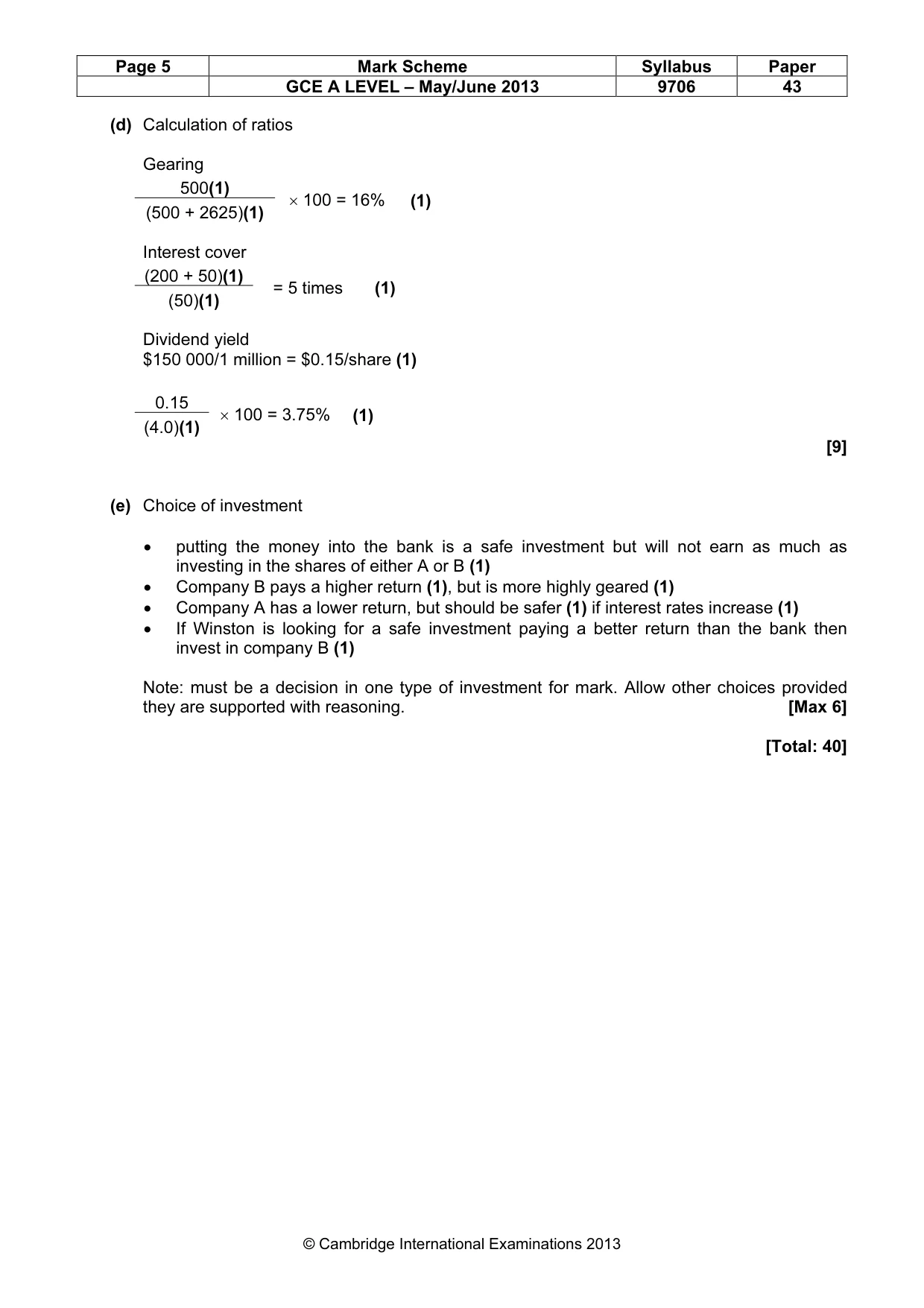
Page 5 Mark Scheme Syllabus Paper GCE A LEVEL – May/June 2013 9706 43 © Cambridge International Examinations 2013 (d) Calculation of ratios Gearing 500(1) × 100 = 16% (1) (500 + 2625)(1) Interest cover (200 + 50)(1) = 5 times (1) (50)(1) Dividend yield $150 000/1 million = $0.15/share (1) 0.15 × 100 = 3.75% (1) (4.0)(1) [9] (e) Choice of investment • putting the money into the bank is a safe investment but will not earn as much as investing in the shares of either A or B (1) • Company B pays a higher return (1), but is more highly geared (1) • Company A has a lower return, but should be safer (1) if interest rates increase (1) • If Winston is looking for a safe investment paying a better return than the bank then invest in company B (1) Note: must be a decision in one type of investment for mark. Allow other choices provided they are supported with reasoning. [Max 6] [Total: 40]
Mark scheme, page 6
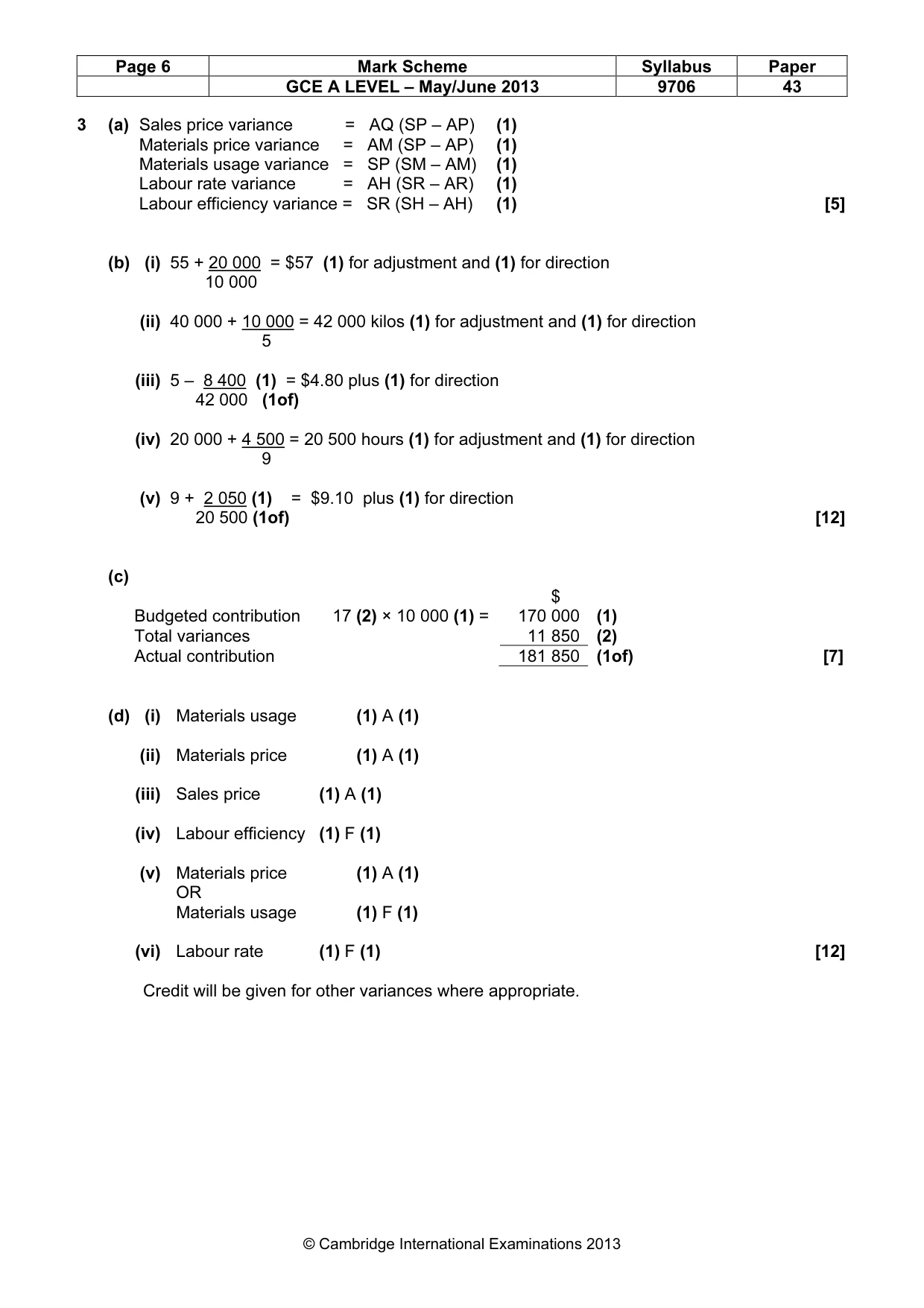
Page 6 Mark Scheme Syllabus Paper GCE A LEVEL – May/June 2013 9706 43 © Cambridge International Examinations 2013 3 (a) Sales price variance = AQ (SP – AP) (1) Materials price variance = AM (SP – AP) (1) Materials usage variance = SP (SM – AM) (1) Labour rate variance = AH (SR – AR) (1) Labour efficiency variance = SR (SH – AH) (1) [5] (b) (i) 55 + 20 000 = $57 (1) for adjustment and (1) for direction 10 000 (ii) 40 000 + 10 000 = 42 000 kilos (1) for adjustment and (1) for direction 5 (iii) 5 – 8 400 (1) = $4.80 plus (1) for direction 42 000 (1of) (iv) 20 000 + 4 500 = 20 500 hours (1) for adjustment and (1) for direction 9 (v) 9 + 2 050 (1) = $9.10 plus (1) for direction 20 500 (1of) [12] (c) $ Budgeted contribution 17 (2) × 10 000 (1) = 170 000 (1) Total variances 11 850 (2) Actual contribution 181 850 (1of) [7] (d) (i) Materials usage (1) A (1) (ii) Materials price (1) A (1) (iii) Sales price (1) A (1) (iv) Labour efficiency (1) F (1) (v) Materials price (1) A (1) OR Materials usage (1) F (1) (vi) Labour rate (1) F (1) [12] Credit will be given for other variances where appropriate.
Mark scheme, page 7
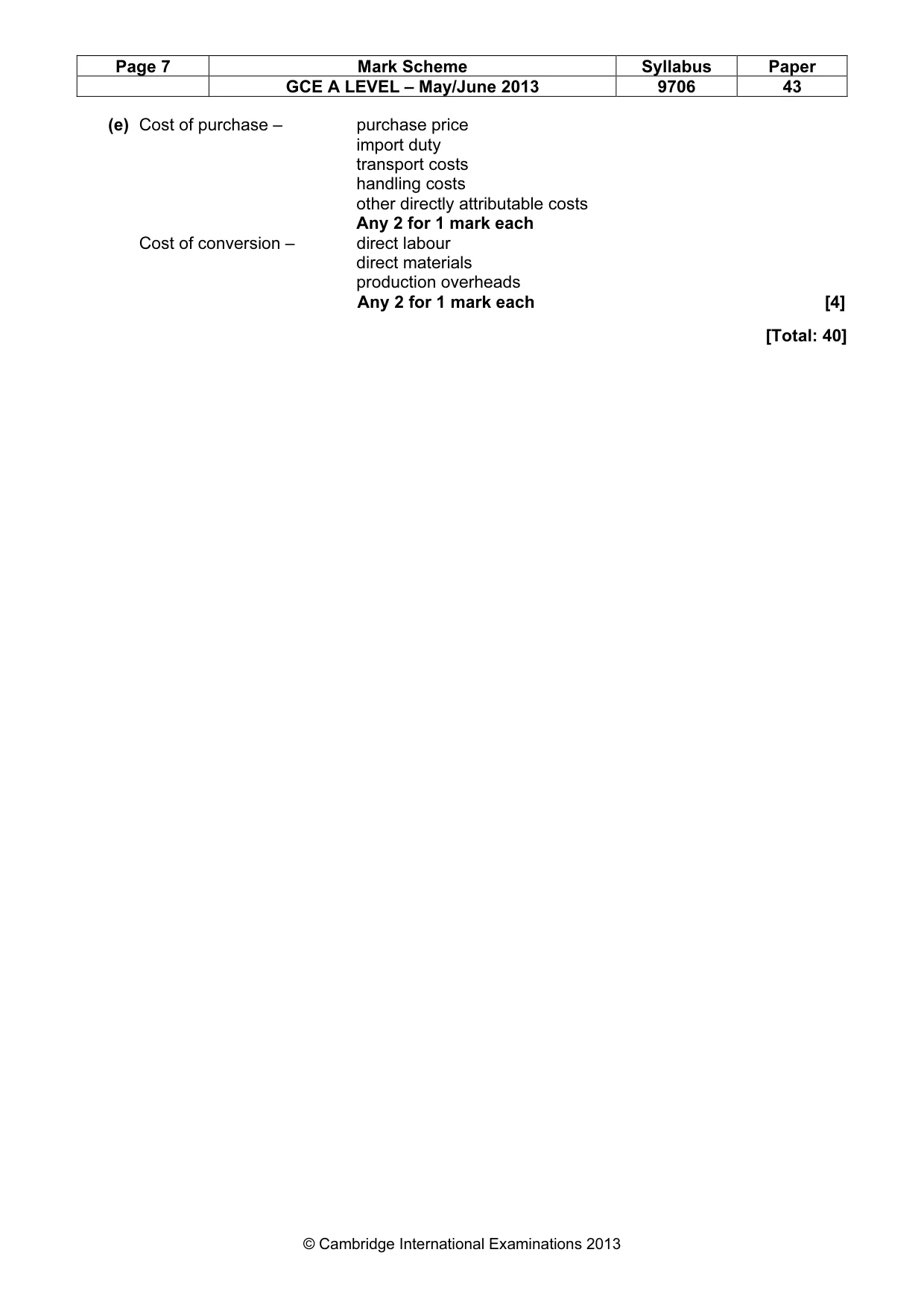
Page 7 Mark Scheme Syllabus Paper GCE A LEVEL – May/June 2013 9706 43 © Cambridge International Examinations 2013 (e) Cost of purchase – purchase price import duty transport costs handling costs other directly attributable costs Any 2 for 1 mark each Cost of conversion – direct labour direct materials production overheads Any 2 for 1 mark each [4] [Total: 40]
What you needed in this session
Cambridge’s own grade thresholds for 2013 May/June, Paper 4 · Variant 3. A higher threshold means an easier paper — the bar moves with how the cohort did.