Cambridge A Level Accounting 9706 — 2012 Oct/Nov Paper 2 · Variant 3
9706/23/O/N/12 · 90 marks · ≈101 min
The question paper and its mark scheme, free to read here and free to download. This is Cambridge’s own paper, exactly as it was sat.
Question paper16 pages
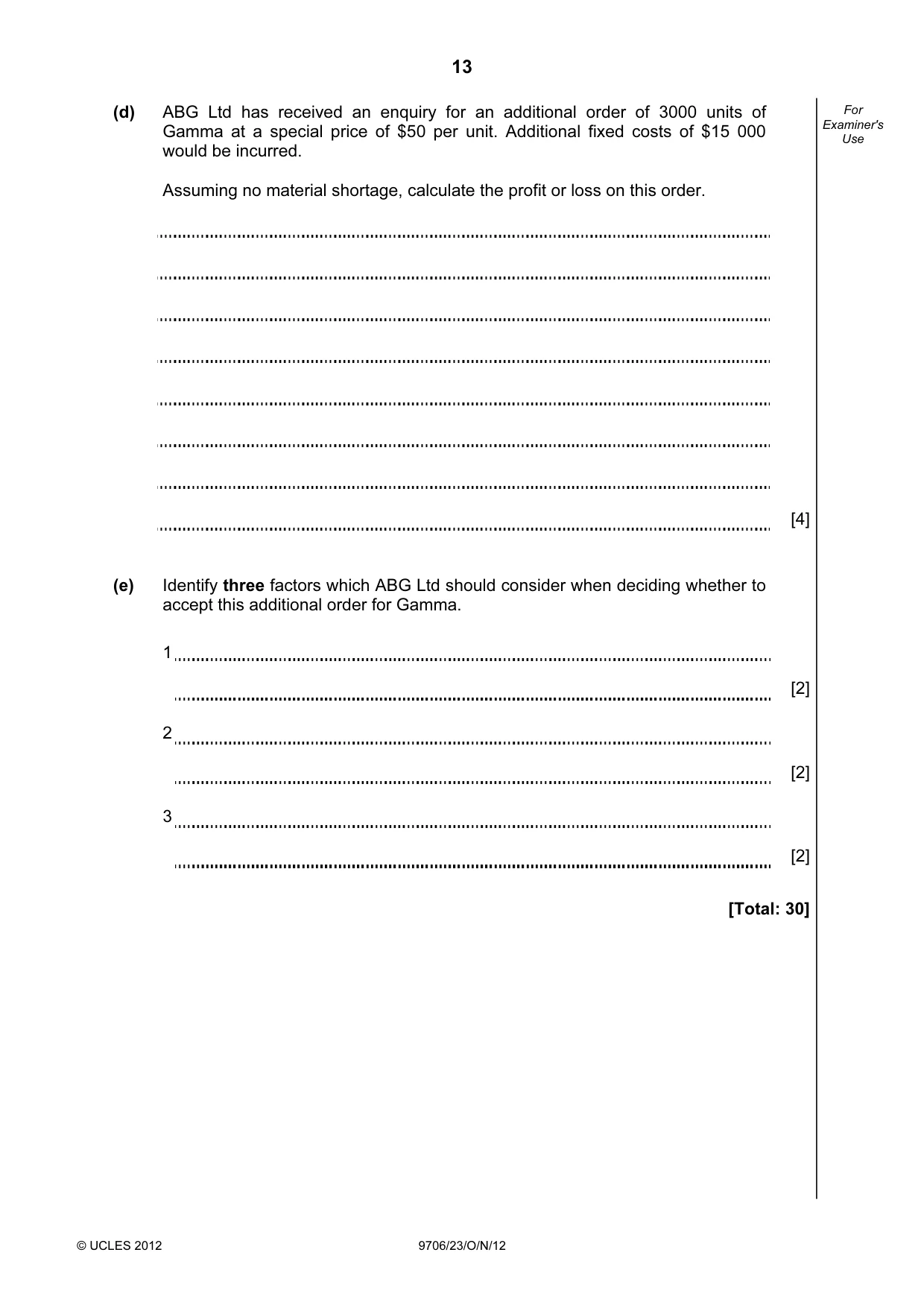
Mark scheme7 pages
Answers below. Sit the paper first if you are practising.
Paper as text
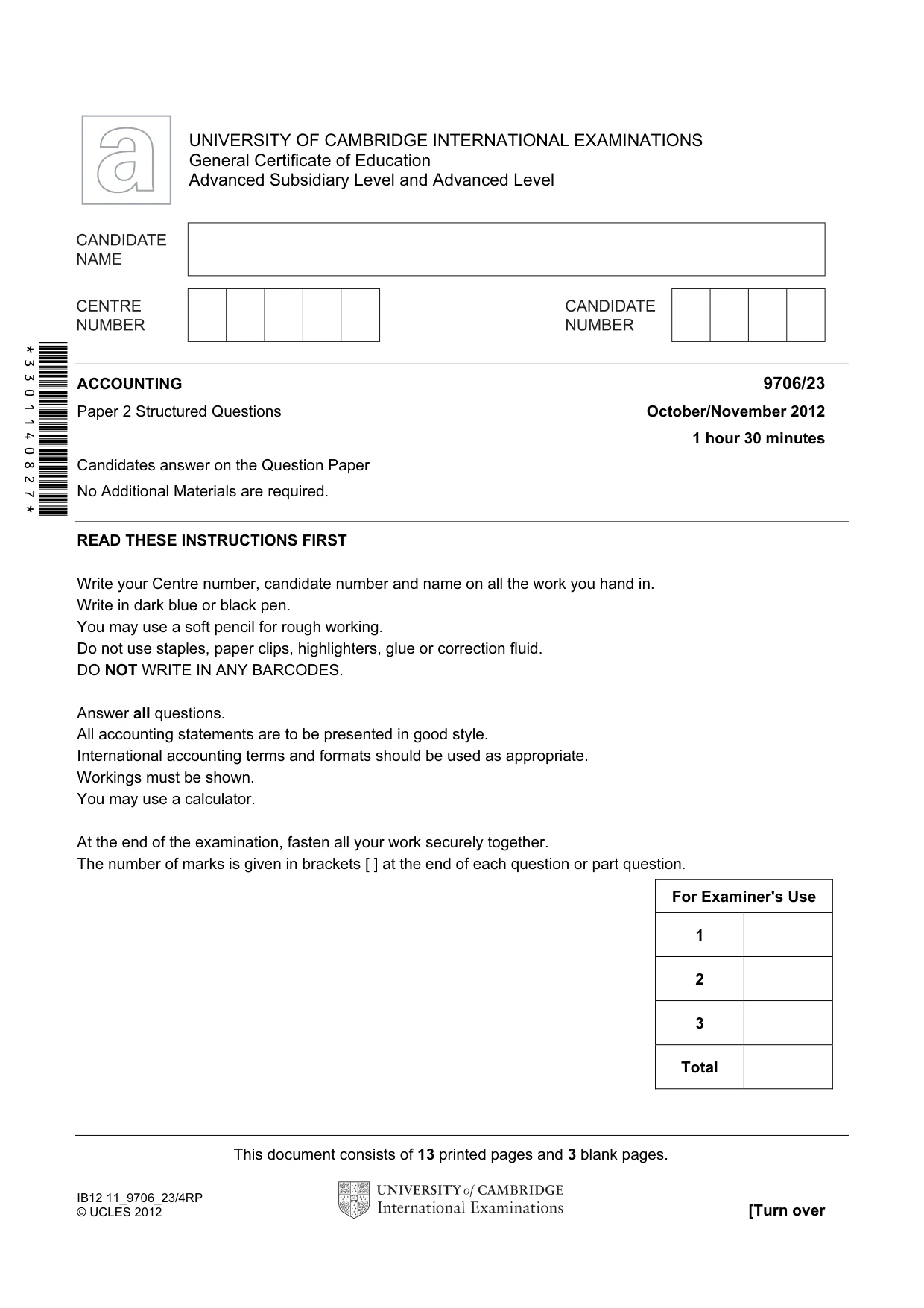
Question paper, page 1
This document consists of 13 printed pages and 3 blank pages. IB12 11_9706_23/4RP © UCLES 2012 [Turn over *3301140827* For Examiner's Use 1 2 3 Total UNIVERSITY OF CAMBRIDGE INTERNATIONAL EXAMINATIONS General Certificate of Education Advanced Subsidiary Level and Advanced Level ACCOUNTING 9706/23 Paper 2 Structured Questions October/November 2012 1 hour 30 minutes Candidates answer on the Question Paper No Additional Materials are required. READ THESE INSTRUCTIONS FIRST Write your Centre number, candidate number and name on all the work you hand in. Write in dark blue or black pen. You may use a soft pencil for rough working. Do not use staples, paper clips, highlighters, glue or correction fluid. DO NOT WRITE IN ANY BARCODES. Answer all questions. All accounting statements are to be presented in good style. International accounting terms and formats should be used as appropriate. Workings must be shown. You may use a calculator. At the end of the examination, fasten all your work securely together. The number of marks is given in brackets [ ] at the end of each question or part question.
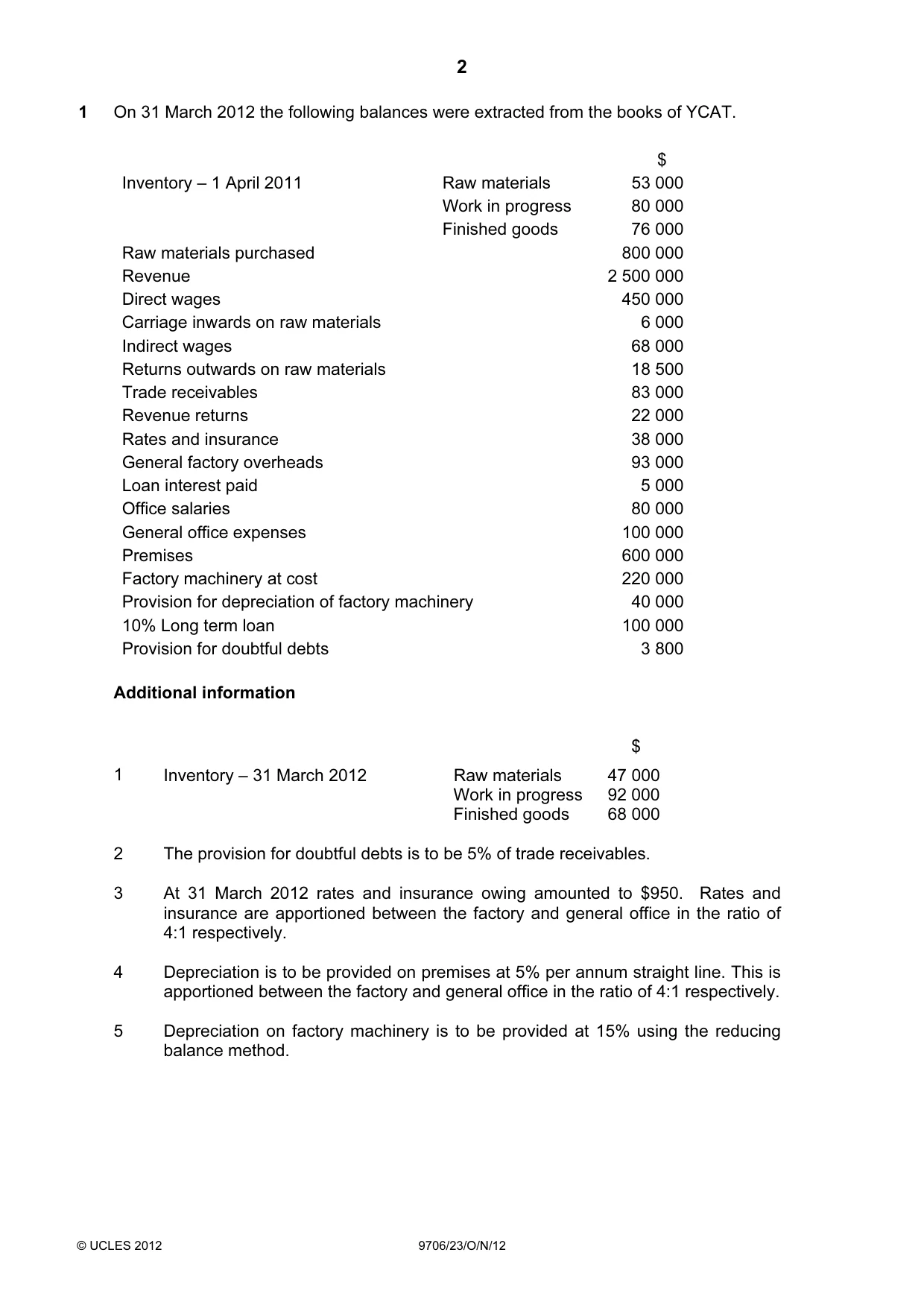
Question paper, page 2
2 © UCLES 2012 9706/23/O/N/12 1 On 31 March 2012 the following balances were extracted from the books of YCAT. $ Inventory – 1 April 2011 Raw materials 53 000 Work in progress 80 000 Finished goods 76 000 Raw materials purchased 800 000 Revenue 2 500 000 Direct wages 450 000 Carriage inwards on raw materials 6 000 Indirect wages 68 000 Returns outwards on raw materials 18 500 Trade receivables 83 000 Revenue returns 22 000 Rates and insurance 38 000 General factory overheads 93 000 Loan interest paid 5 000 Office salaries 80 000 General office expenses 100 000 Premises 600 000 Factory machinery at cost 220 000 Provision for depreciation of factory machinery 40 000 10% Long term loan 100 000 Provision for doubtful debts 3 800 . Additional information 1 $ Inventory – 31 March 2012 Raw materials 47 000 Work in progress 92 000 Finished goods 68 000 2 The provision for doubtful debts is to be 5% of trade receivables. 3 At 31 March 2012 rates and insurance owing amounted to $950. Rates and insurance are apportioned between the factory and general office in the ratio of 4:1 respectively. 4 Depreciation is to be provided on premises at 5% per annum straight line. This is apportioned between the factory and general office in the ratio of 4:1 respectively. 5 Depreciation on factory machinery is to be provided at 15% using the reducing balance method.
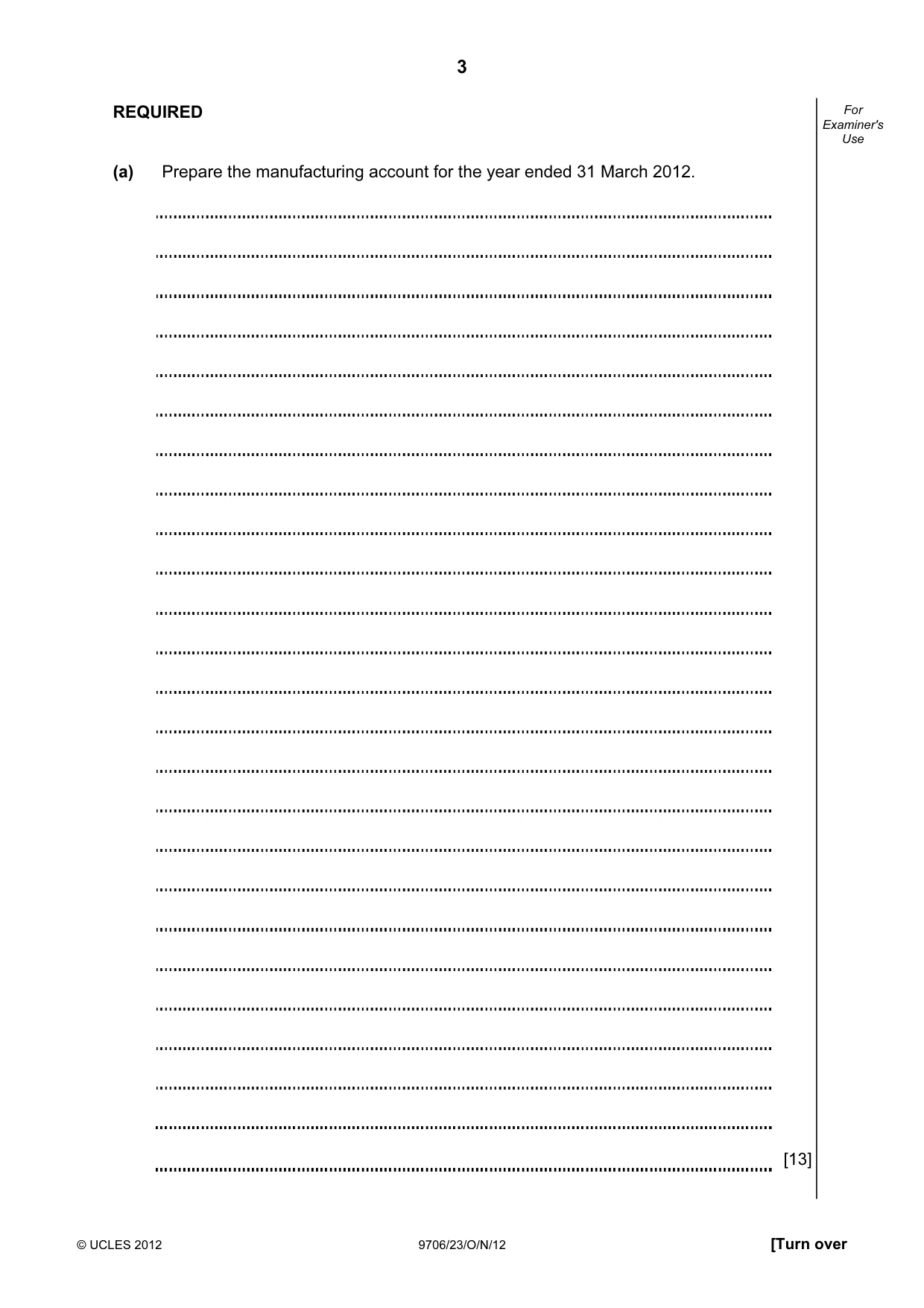
Question paper, page 3
3 © UCLES 2012 9706/23/O/N/12 [Turn over For Examiner's Use REQUIRED (a) Prepare the manufacturing account for the year ended 31 March 2012. [13]
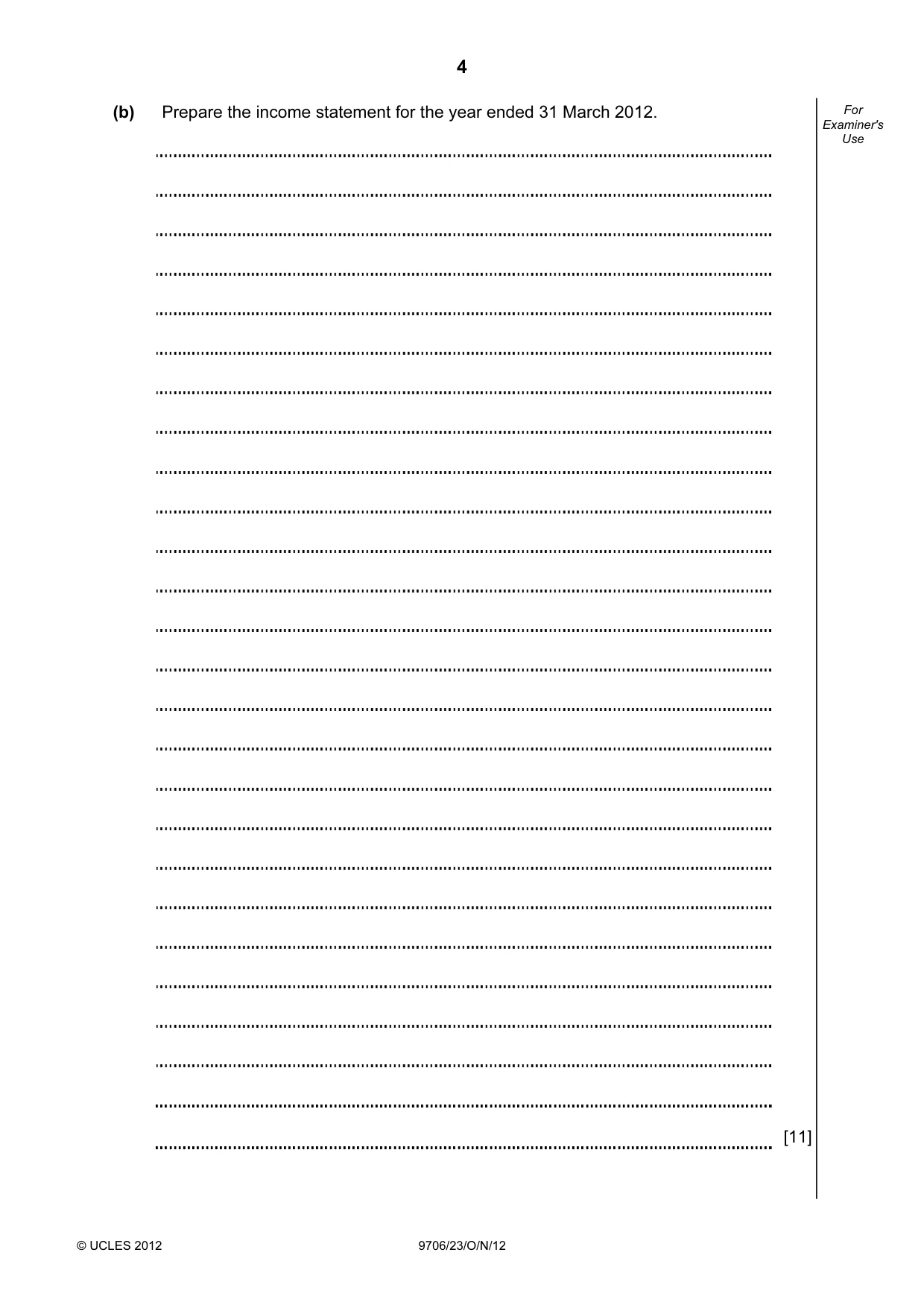
Question paper, page 4
4 © UCLES 2012 9706/23/O/N/12 For Examiner's Use (b) Prepare the income statement for the year ended 31 March 2012. [11]
Question paper, page 5
5 © UCLES 2012 9706/23/O/N/12 [Turn over For Examiner's Use (c) Define the prudence concept. State three examples of how this has been applied in the financial statements. [6] [Total: 30]
Question paper, page 6
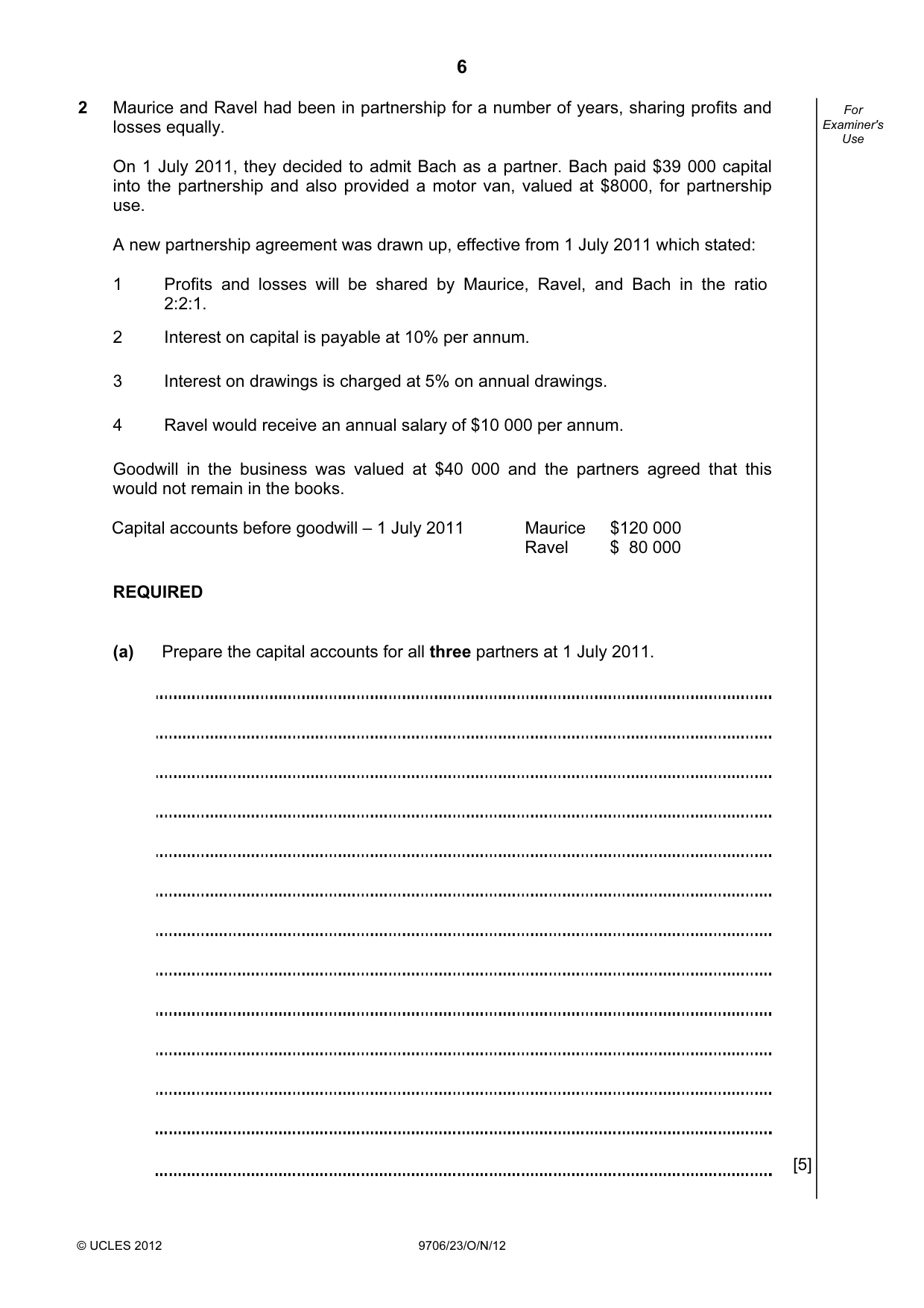
6 © UCLES 2012 9706/23/O/N/12 For Examiner's Use 2 Maurice and Ravel had been in partnership for a number of years, sharing profits and losses equally. On 1 July 2011, they decided to admit Bach as a partner. Bach paid $39 000 capital into the partnership and also provided a motor van, valued at $8000, for partnership use. A new partnership agreement was drawn up, effective from 1 July 2011 which stated: 1 Profits and losses will be shared by Maurice, Ravel, and Bach in the ratio 2:2:1. 2 Interest on capital is payable at 10% per annum. 3 Interest on drawings is charged at 5% on annual drawings. 4 Ravel would receive an annual salary of $10 000 per annum. Goodwill in the business was valued at $40 000 and the partners agreed that this would not remain in the books. Capital accounts before goodwill – 1 July 2011 Maurice $120 000 Ravel $ 80 000 REQUIRED (a) Prepare the capital accounts for all three partners at 1 July 2011. [5]
Question paper, page 7
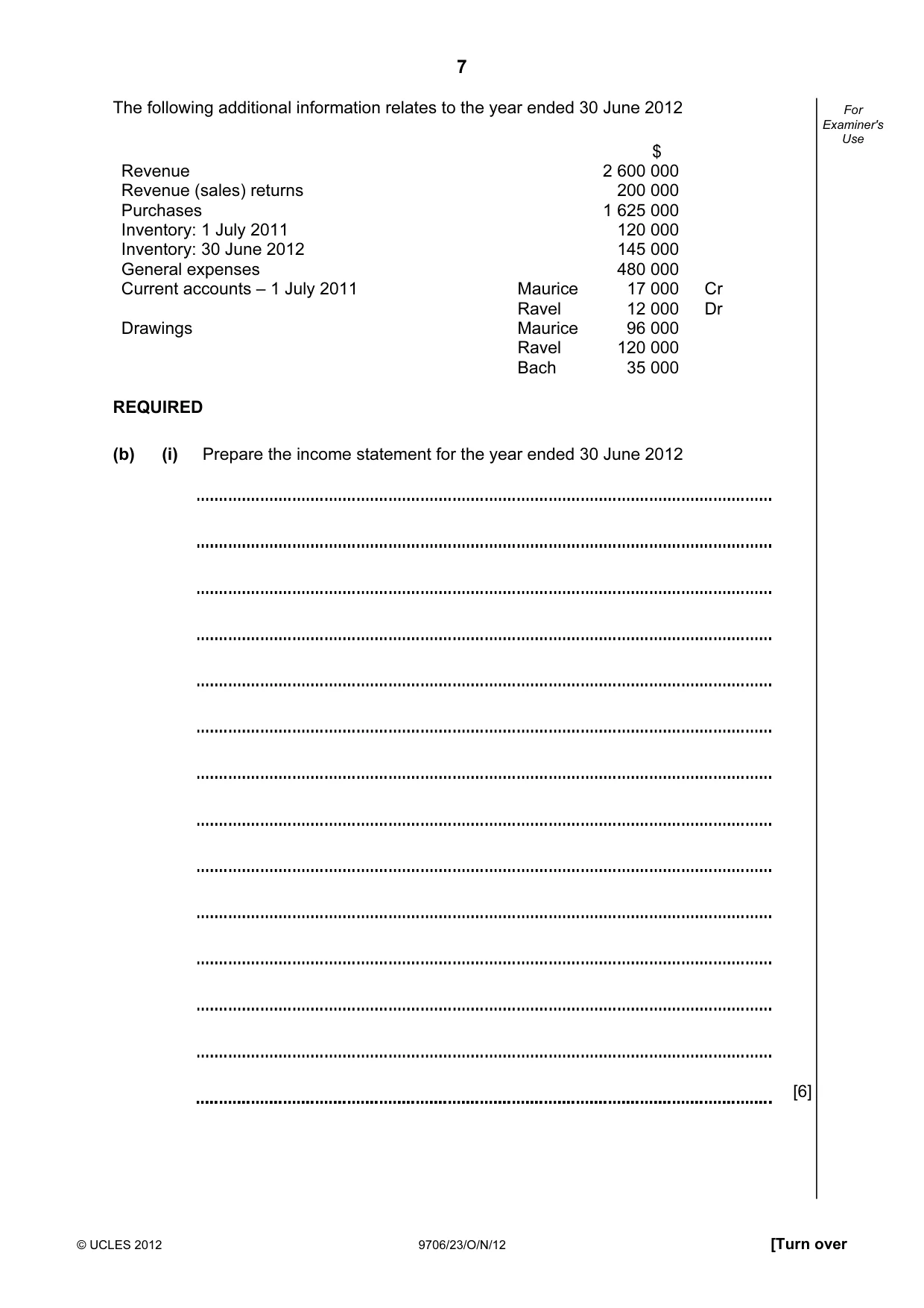
7 © UCLES 2012 9706/23/O/N/12 [Turn over For Examiner's Use The following additional information relates to the year ended 30 June 2012 $ Revenue 2 600 000 Revenue (sales) returns 200 000 Purchases 1 625 000 Inventory: 1 July 2011 120 000 Inventory: 30 June 2012 145 000 General expenses 480 000 Current accounts – 1 July 2011 Maurice 17 000 Cr Ravel 12 000 Dr Drawings Maurice 96 000 Ravel 120 000 Bach 35 000 REQUIRED (b) (i) Prepare the income statement for the year ended 30 June 2012 [6]
Question paper, page 8
8 © UCLES 2012 9706/23/O/N/12 For Examiner's Use (ii) Prepare the appropriation account for the year ended 30 June 2012. [9]
Question paper, page 9
9 © UCLES 2012 9706/23/O/N/12 [Turn over For Examiner's Use (c) Prepare the current accounts for all three partners at 30 June 2012. [7]
Question paper, page 10
10 © UCLES 2012 9706/23/O/N/12 For Examiner's Use (d) The partners are now considering changing their business from a partnership to a limited company. Explain to the partners the meaning of the term ‘limited liability’. [3] [Total: 30]
Question paper, page 11
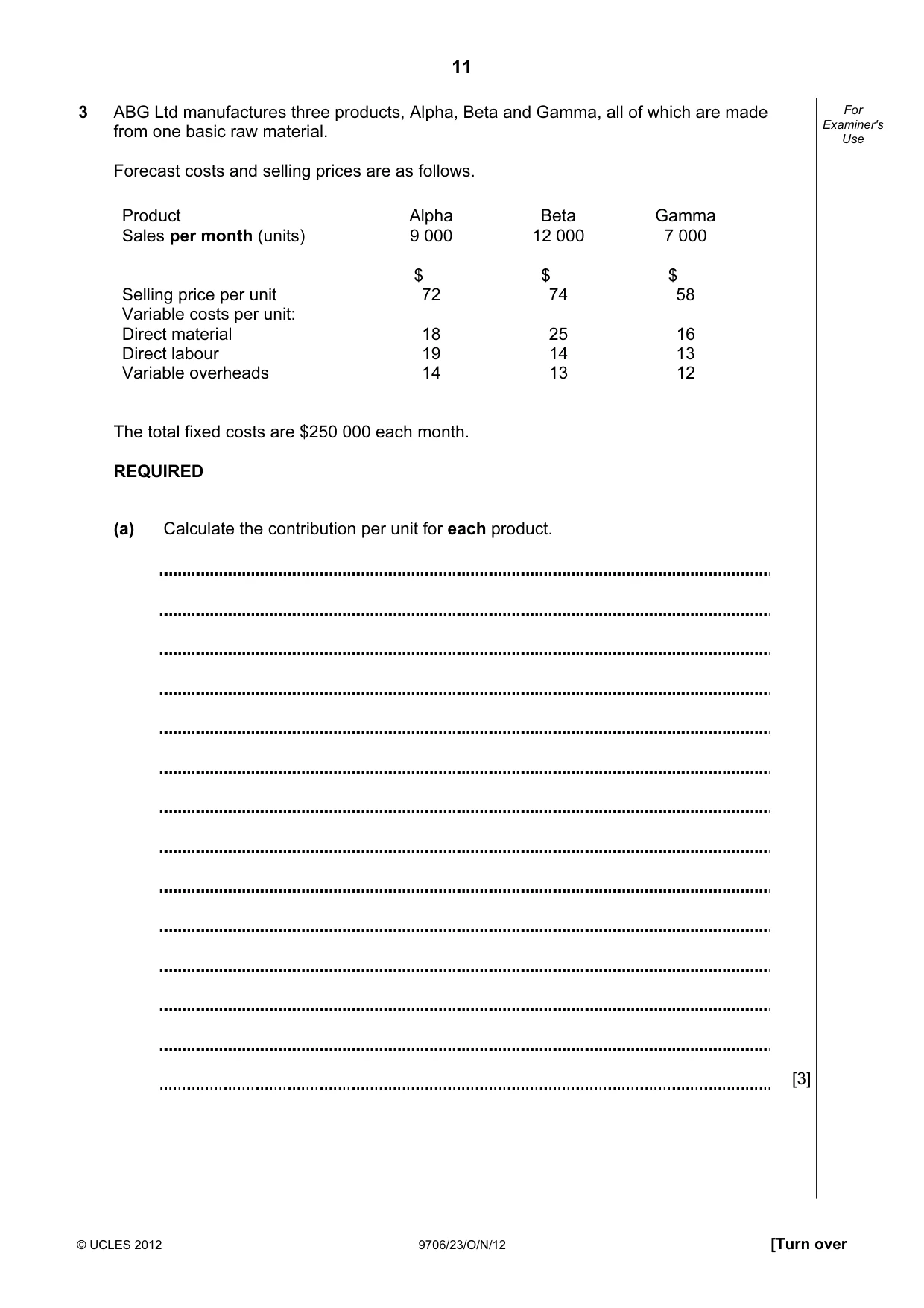
11 © UCLES 2012 9706/23/O/N/12 [Turn over For Examiner's Use 3 ABG Ltd manufactures three products, Alpha, Beta and Gamma, all of which are made from one basic raw material. Forecast costs and selling prices are as follows. Product Alpha Beta Gamma Sales per month (units) 9 000 12 000 7 000 $ $ $ Selling price per unit 72 74 58 Variable costs per unit: Direct material 18 25 16 Direct labour 19 14 13 Variable overheads 14 13 12 The total fixed costs are $250 000 each month. REQUIRED (a) Calculate the contribution per unit for each product. [3]
Question paper, page 12
12 © UCLES 2012 9706/23/O/N/12 For Examiner's Use (b) Calculate the total monthly profit which can be achieved. [5] Due to a material shortage, ABG Ltd will only receive 80% of its material requirement for the month of April 2013. No other shortages are expected. REQUIRED (c) Using the quantity of material that is available, prepare a statement to show the maximum profit that could be achieved for the three months ended 30 April 2013. [12]
Question paper, page 13
13 © UCLES 2012 9706/23/O/N/12 For Examiner's Use (d) ABG Ltd has received an enquiry for an additional order of 3000 units of Gamma at a special price of $50 per unit. Additional fixed costs of $15 000 would be incurred. Assuming no material shortage, calculate the profit or loss on this order. [4] (e) Identify three factors which ABG Ltd should consider when deciding whether to accept this additional order for Gamma. 1 [2] 2 [2] 3 [2] [Total: 30]
Question paper, page 14
14 © UCLES 2012 9706/23/O/N/12 BLANK PAGE
Question paper, page 15
15 © UCLES 2012 9706/23/O/N/12 BLANK PAGE
Question paper, page 16
16 Permission to reproduce items where third-party owned material protected by copyright is included has been sought and cleared where possible. Every reasonable effort has been made by the publisher (UCLES) to trace copyright holders, but if any items requiring clearance have unwittingly been included, the publisher will be pleased to make amends at the earliest possible opportunity. University of Cambridge International Examinations is part of the Cambridge Assessment Group. Cambridge Assessment is the brand name of University of Cambridge Local Examinations Syndicate (UCLES), which is itself a department of the University of Cambridge. © UCLES 2012 9706/23/O/N/12 BLANK PAGE
Mark scheme, page 1
CAMBRIDGE INTERNATIONAL EXAMINATIONS GCE Advanced Subsidiary Level and GCE Advanced Level MARK SCHEME for the October/November 2012 series 9706 ACCOUNTING 9706/23 Paper 2 (Structured Questions – Core), maximum raw mark 90 This mark scheme is published as an aid to teachers and candidates, to indicate the requirements of the examination. It shows the basis on which Examiners were instructed to award marks. It does not indicate the details of the discussions that took place at an Examiners’ meeting before marking began, which would have considered the acceptability of alternative answers. Mark schemes should be read in conjunction with the question paper and the Principal Examiner Report for Teachers. Cambridge will not enter into discussions about these mark schemes. Cambridge is publishing the mark schemes for the October/November 2012 series for most IGCSE, GCE Advanced Level and Advanced Subsidiary Level components and some Ordinary Level components.
Mark scheme, page 2
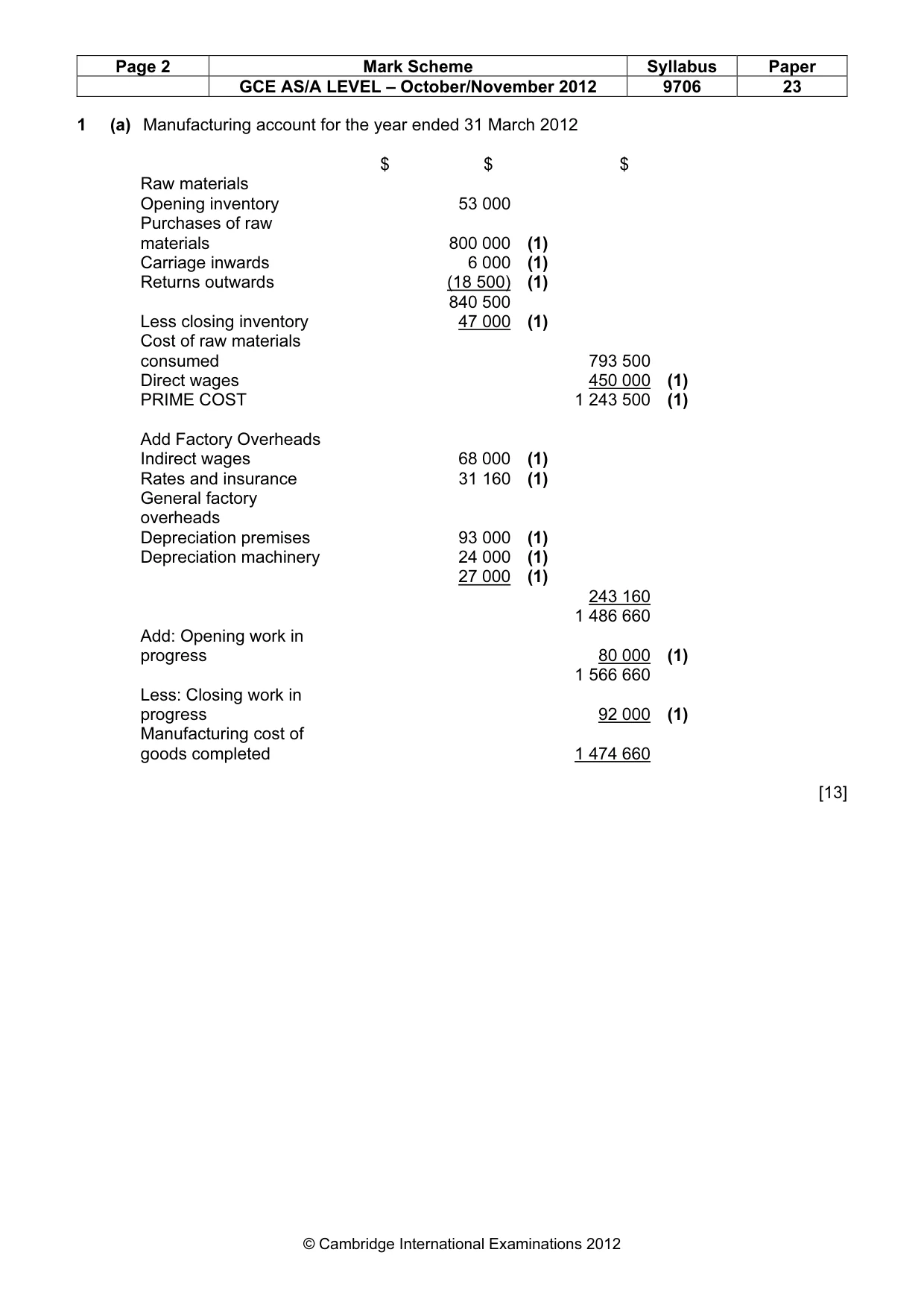
Page 2 Mark Scheme Syllabus Paper GCE AS/A LEVEL – October/November 2012 9706 23 © Cambridge International Examinations 2012 1 (a) Manufacturing account for the year ended 31 March 2012 $ $ $ Raw materials Opening inventory 53 000 Purchases of raw materials 800 000 (1) Carriage inwards 6 000 (1) Returns outwards (18 500) (1) 840 500 Less closing inventory 47 000 (1) Cost of raw materials consumed 793 500 Direct wages 450 000 (1) PRIME COST 1 243 500 (1) Add Factory Overheads Indirect wages 68 000 (1) Rates and insurance 31 160 (1) General factory overheads Depreciation premises 93 000 (1) Depreciation machinery 24 000 (1) 27 000 (1) 243 160 1 486 660 Add: Opening work in progress 80 000 (1) 1 566 660 Less: Closing work in progress 92 000 (1) Manufacturing cost of goods completed 1 474 660 [13]
Mark scheme, page 3
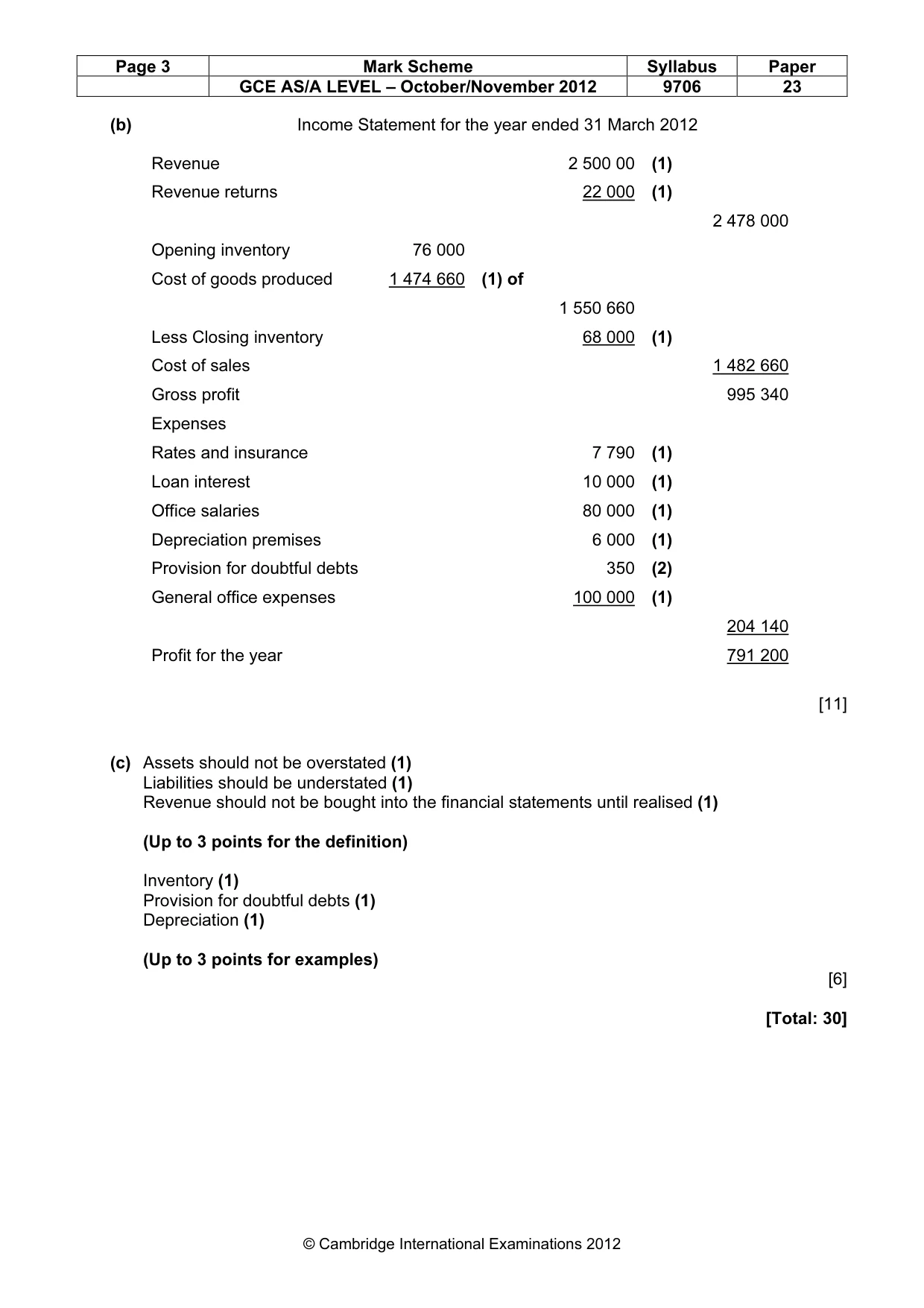
Page 3 Mark Scheme Syllabus Paper GCE AS/A LEVEL – October/November 2012 9706 23 © Cambridge International Examinations 2012 (b) Income Statement for the year ended 31 March 2012 [11] (c) Assets should not be overstated (1) Liabilities should be understated (1) Revenue should not be bought into the financial statements until realised (1) (Up to 3 points for the definition) Inventory (1) Provision for doubtful debts (1) Depreciation (1) (Up to 3 points for examples) [6] [Total: 30] Revenue 2 500 00 (1) Revenue returns 22 000 (1) 2 478 000 Opening inventory 76 000 Cost of goods produced 1 474 660 (1) of 1 550 660 Less Closing inventory 68 000 (1) Cost of sales 1 482 660 Gross profit 995 340 Expenses Rates and insurance 7 790 (1) Loan interest 10 000 (1) Office salaries 80 000 (1) Depreciation premises 6 000 (1) Provision for doubtful debts 350 (2) General office expenses 100 000 (1) 204 140 Profit for the year 791 200
Mark scheme, page 4
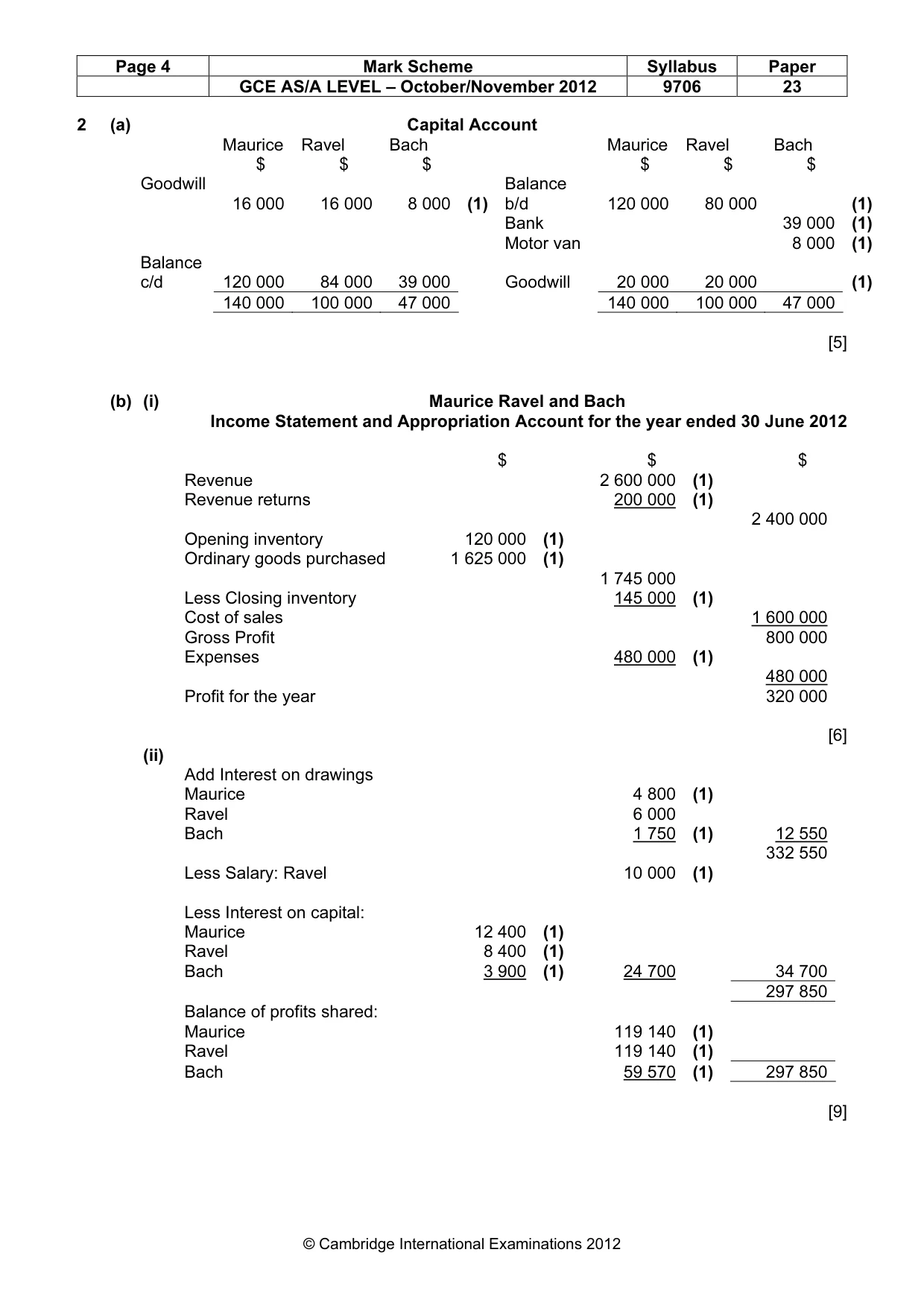
Page 4 Mark Scheme Syllabus Paper GCE AS/A LEVEL – October/November 2012 9706 23 © Cambridge International Examinations 2012 2 (a) Capital Account Maurice Ravel Bach Maurice Ravel Bach $ $ $ $ $ $ Goodwill Balance 16 000 16 000 8 000 (1) b/d 120 000 80 000 (1) Bank 39 000 (1) Motor van 8 000 (1) Balance c/d 120 000 84 000 39 000 Goodwill 20 000 20 000 (1) 140 000 100 000 47 000 140 000 100 000 47 000 [5] (b) (i) Maurice Ravel and Bach Income Statement and Appropriation Account for the year ended 30 June 2012 $ $ $ Revenue 2 600 000 (1) Revenue returns 200 000 (1) 2 400 000 Opening inventory 120 000 (1) Ordinary goods purchased 1 625 000 (1) 1 745 000 Less Closing inventory 145 000 (1) Cost of sales 1 600 000 Gross Profit 800 000 Expenses 480 000 (1) 480 000 Profit for the year 320 000 [6] (ii) Add Interest on drawings Maurice 4 800 (1) Ravel 6 000 Bach 1 750 (1) 12 550 332 550 Less Salary: Ravel 10 000 (1) Less Interest on capital: Maurice 12 400 (1) Ravel 8 400 (1) Bach 3 900 (1) 24 700 34 700 297 850 Balance of profits shared: Maurice 119 140 (1) Ravel 119 140 (1) Bach 59 570 (1) 297 850 [9]
Mark scheme, page 5
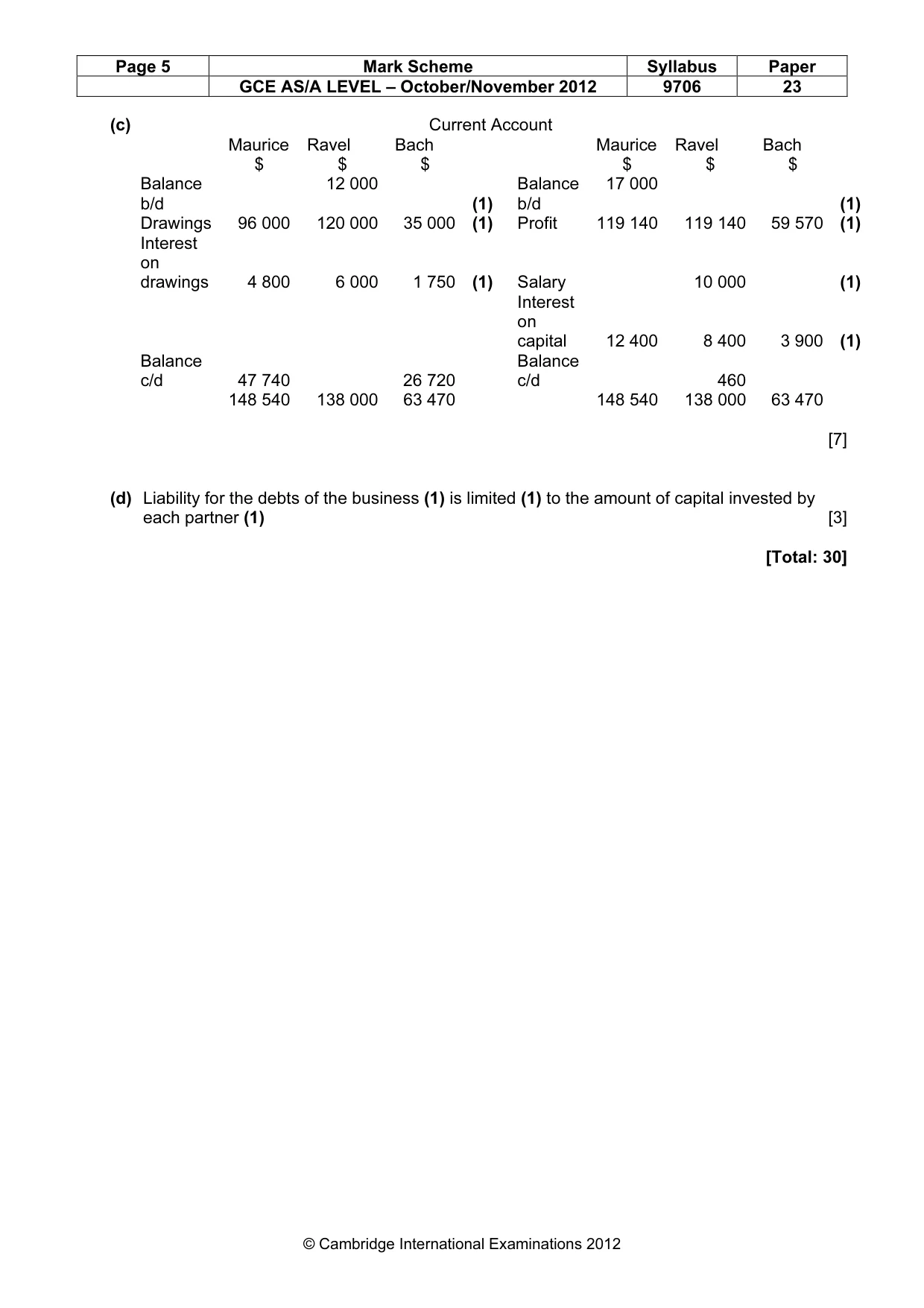
Page 5 Mark Scheme Syllabus Paper GCE AS/A LEVEL – October/November 2012 9706 23 © Cambridge International Examinations 2012 (c) Current Account Maurice Ravel Bach Maurice Ravel Bach $ $ $ $ $ $ Balance b/d 12 000 (1) Balance b/d 17 000 (1) Drawings 96 000 120 000 35 000 (1) Profit 119 140 119 140 59 570 (1) Interest on drawings 4 800 6 000 1 750 (1) Salary 10 000 (1) Interest on capital 12 400 8 400 3 900 (1) Balance c/d 47 740 26 720 Balance c/d 460 148 540 138 000 63 470 148 540 138 000 63 470 [7] (d) Liability for the debts of the business (1) is limited (1) to the amount of capital invested by each partner (1) [3] [Total: 30]
Mark scheme, page 6
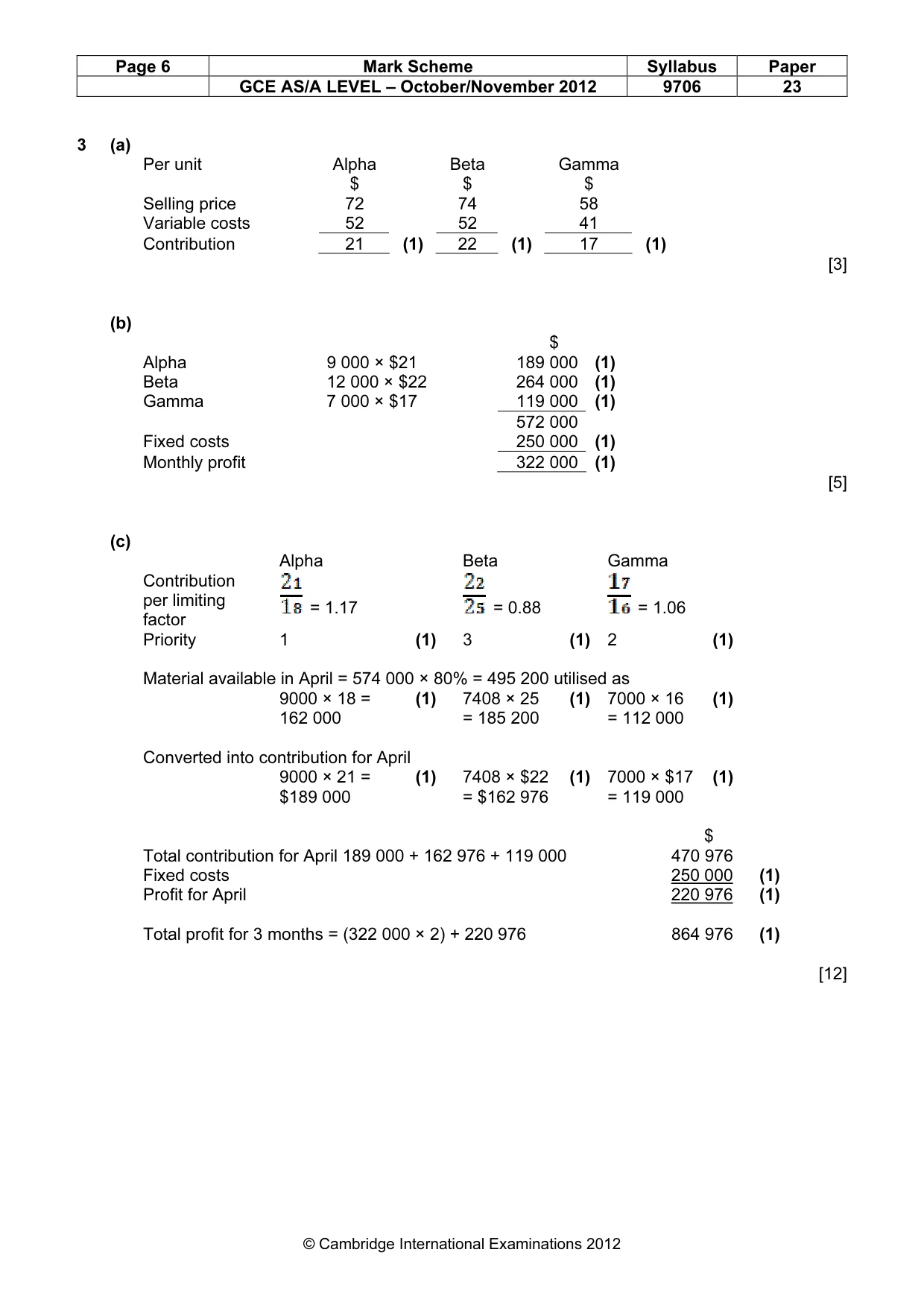
Page 6 Mark Scheme Syllabus Paper GCE AS/A LEVEL – October/November 2012 9706 23 © Cambridge International Examinations 2012 3 (a) Per unit Alpha Beta Gamma $ $ $ Selling price 72 74 58 Variable costs 52 52 41 Contribution 21 (1) 22 (1) 17 (1) [3] (b) $ Alpha 9 000 × $21 189 000 (1) Beta 12 000 × $22 264 000 (1) Gamma 7 000 × $17 119 000 (1) 572 000 Fixed costs 250 000 (1) Monthly profit 322 000 (1) [5] (c) Alpha Beta Gamma Contribution per limiting factor = 1.17 = 0.88 = 1.06 Priority 1 (1) 3 (1) 2 (1) Material available in April = 574 000 × 80% = 495 200 utilised as 9000 × 18 = 162 000 (1) 7408 × 25 = 185 200 (1) 7000 × 16 = 112 000 (1) Converted into contribution for April 9000 × 21 = $189 000 (1) 7408 × $22 = $162 976 (1) 7000 × $17 = 119 000 (1) $ Total contribution for April 189 000 + 162 976 + 119 000 470 976 Fixed costs 250 000 (1) Profit for April 220 976 (1) Total profit for 3 months = (322 000 × 2) + 220 976 864 976 (1) [12]
Mark scheme, page 7
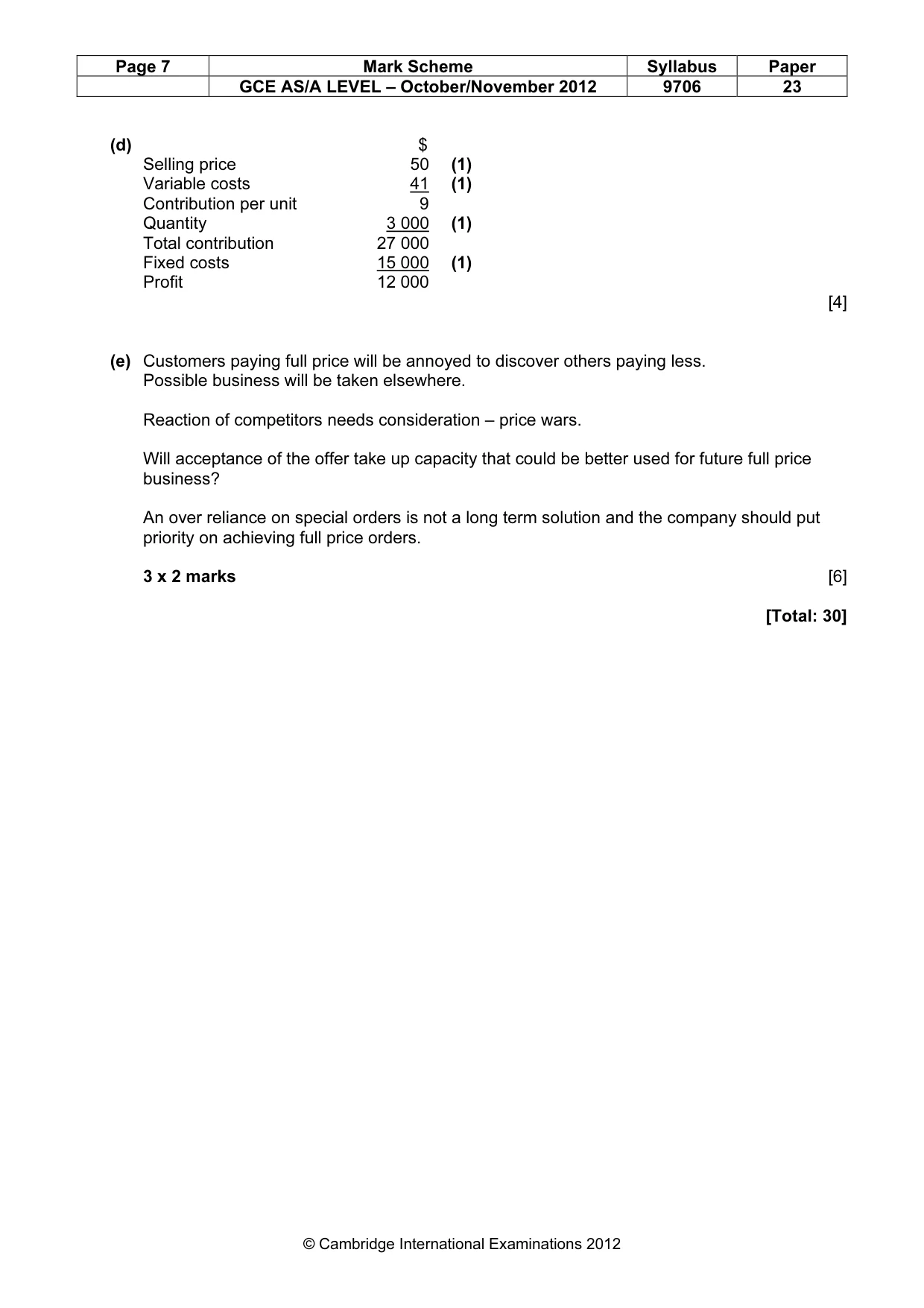
Page 7 Mark Scheme Syllabus Paper GCE AS/A LEVEL – October/November 2012 9706 23 © Cambridge International Examinations 2012 (d) $ Selling price 50 (1) Variable costs 41 (1) Contribution per unit 9 Quantity 3 000 (1) Total contribution 27 000 Fixed costs 15 000 (1) Profit 12 000 [4] (e) Customers paying full price will be annoyed to discover others paying less. Possible business will be taken elsewhere. Reaction of competitors needs consideration – price wars. Will acceptance of the offer take up capacity that could be better used for future full price business? An over reliance on special orders is not a long term solution and the company should put priority on achieving full price orders. 3 x 2 marks [6] [Total: 30]
What you needed in this session
Cambridge’s own grade thresholds for 2012 Oct/Nov, Paper 2 · Variant 3. A higher threshold means an easier paper — the bar moves with how the cohort did.