Cambridge A Level Accounting 9706 — 2012 Oct/Nov Paper 2 · Variant 1
9706/21/O/N/12 · 90 marks · ≈101 min
The question paper and its mark scheme, free to read here and free to download. This is Cambridge’s own paper, exactly as it was sat.
Question paper16 pages



Mark scheme5 pages
Answers below. Sit the paper first if you are practising.
Paper as text
Question paper, page 1
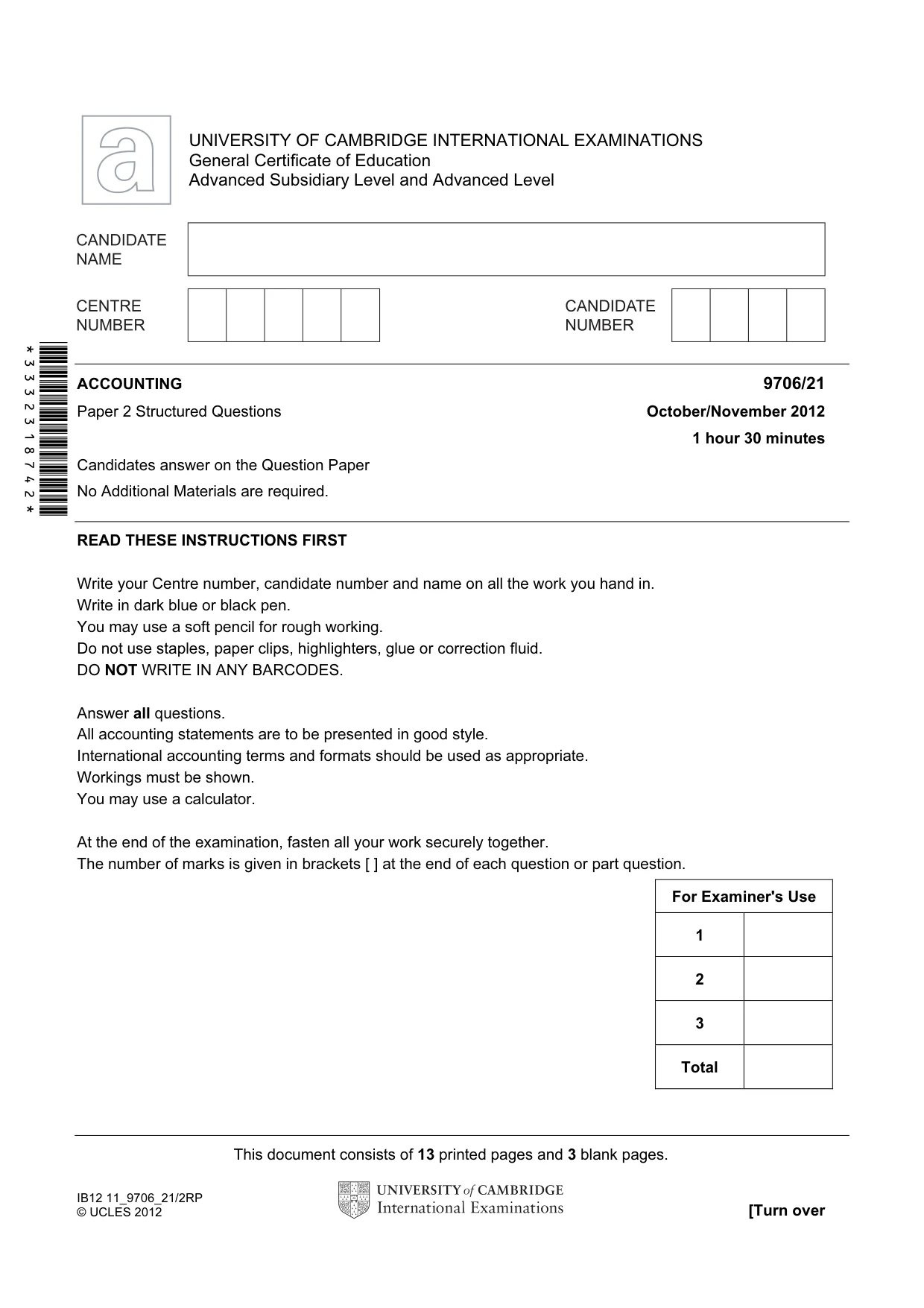
This document consists of 13 printed pages and 3 blank pages. IB12 11_9706_21/2RP © UCLES 2012 [Turn over *3332318742* For Examiner's Use 1 2 3 Total UNIVERSITY OF CAMBRIDGE INTERNATIONAL EXAMINATIONS General Certificate of Education Advanced Subsidiary Level and Advanced Level ACCOUNTING 9706/21 Paper 2 Structured Questions October/November 2012 1 hour 30 minutes Candidates answer on the Question Paper No Additional Materials are required. READ THESE INSTRUCTIONS FIRST Write your Centre number, candidate number and name on all the work you hand in. Write in dark blue or black pen. You may use a soft pencil for rough working. Do not use staples, paper clips, highlighters, glue or correction fluid. DO NOT WRITE IN ANY BARCODES. Answer all questions. All accounting statements are to be presented in good style. International accounting terms and formats should be used as appropriate. Workings must be shown. You may use a calculator. At the end of the examination, fasten all your work securely together. The number of marks is given in brackets [ ] at the end of each question or part question.
Question paper, page 2
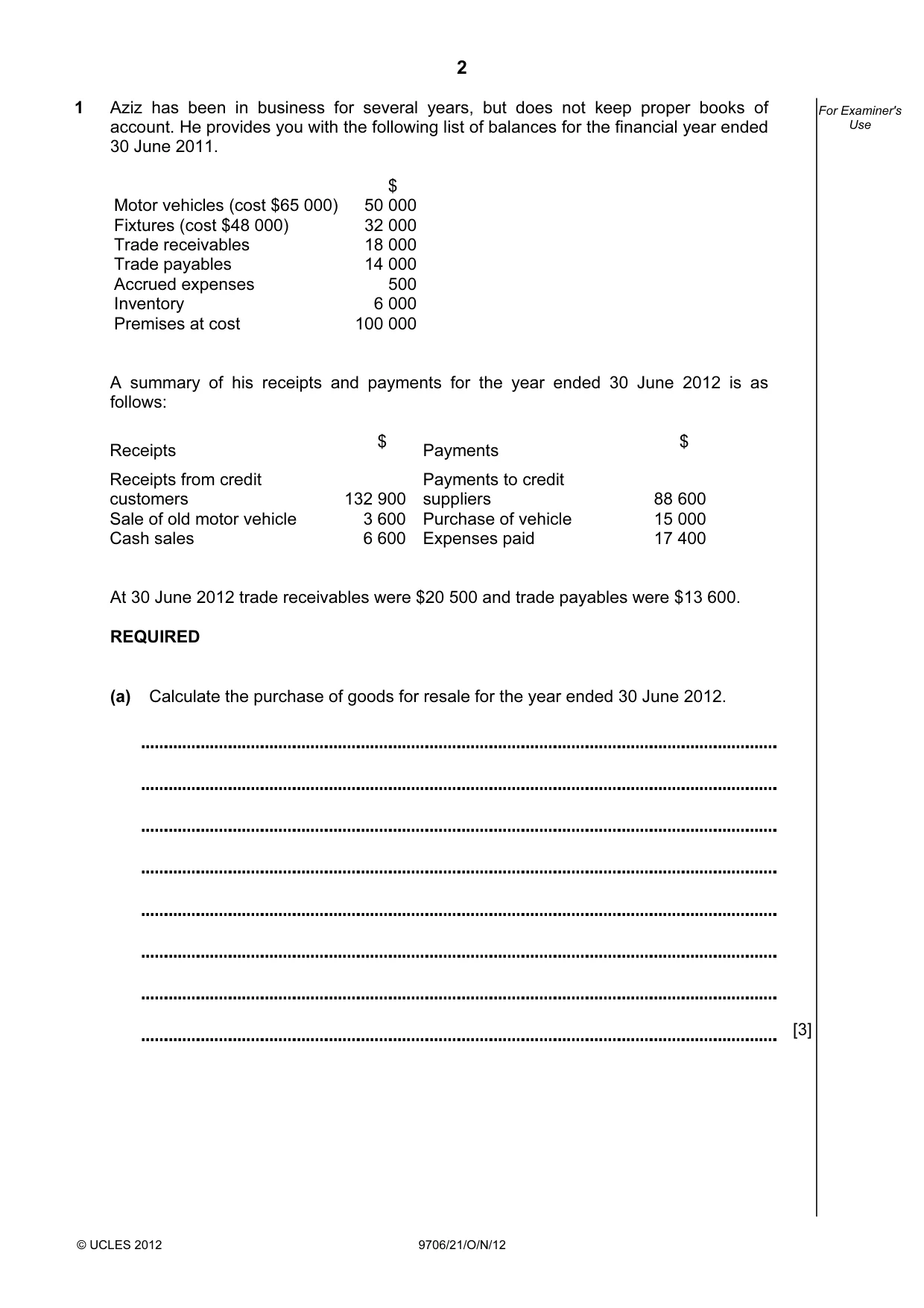
2 © UCLES 2012 9706/21/O/N/12 For Examiner's Use 1 Aziz has been in business for several years, but does not keep proper books of account. He provides you with the following list of balances for the financial year ended 30 June 2011. $ Motor vehicles (cost $65 000) 50 000 Fixtures (cost $48 000) 32 000 Trade receivables 18 000 Trade payables 14 000 Accrued expenses 500 Inventory 6 000 Premises at cost 100 000 A summary of his receipts and payments for the year ended 30 June 2012 is as follows: Receipts $ Payments $ Receipts from credit customers 132 900 Payments to credit suppliers 88 600 Sale of old motor vehicle 3 600 Purchase of vehicle 15 000 Cash sales 6 600 Expenses paid 17 400 At 30 June 2012 trade receivables were $20 500 and trade payables were $13 600. REQUIRED (a) Calculate the purchase of goods for resale for the year ended 30 June 2012. [3]
Question paper, page 3
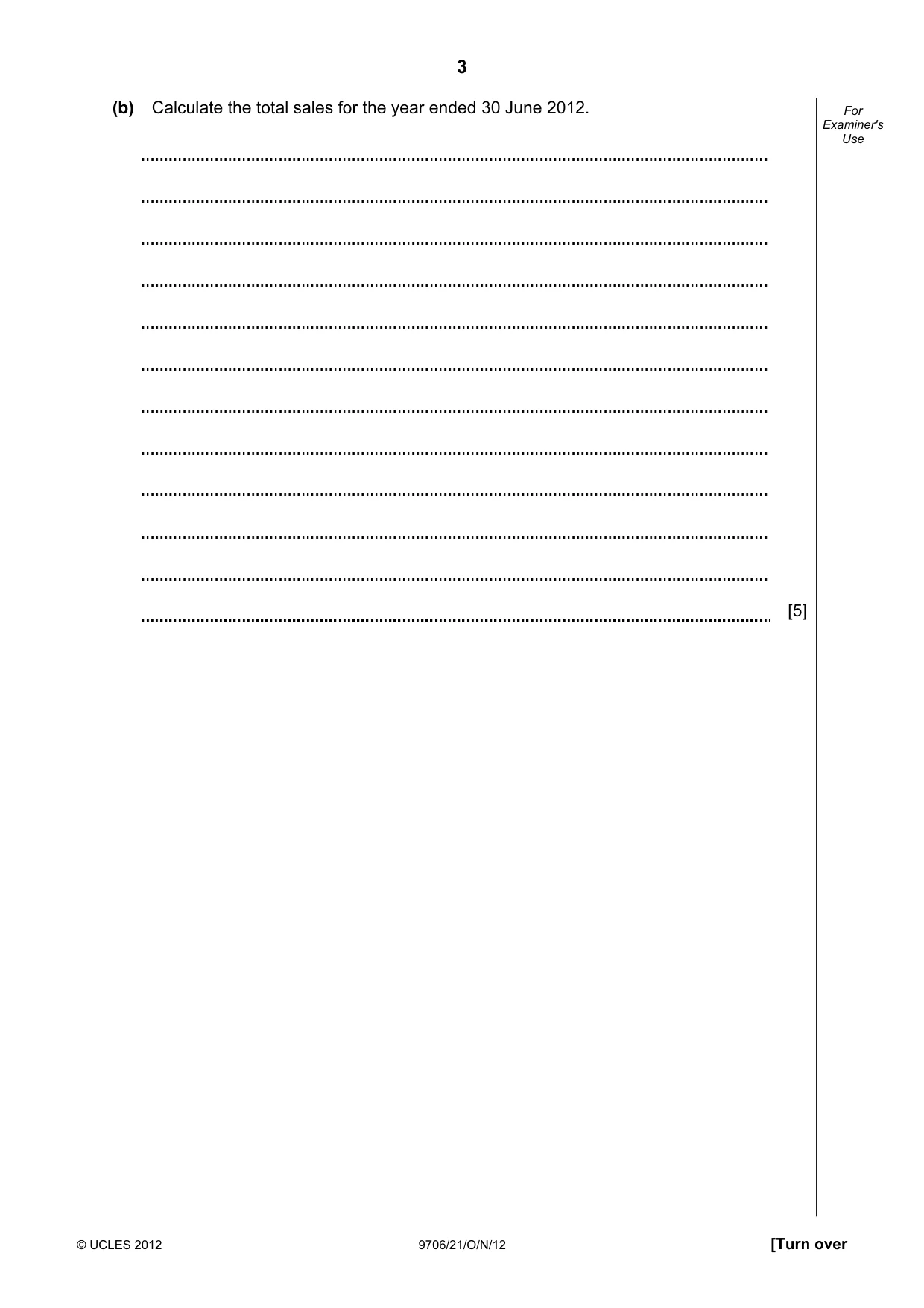
3 © UCLES 2012 9706/21/O/N/12 [Turn over For Examiner's Use (b) Calculate the total sales for the year ended 30 June 2012. [5]
Question paper, page 4
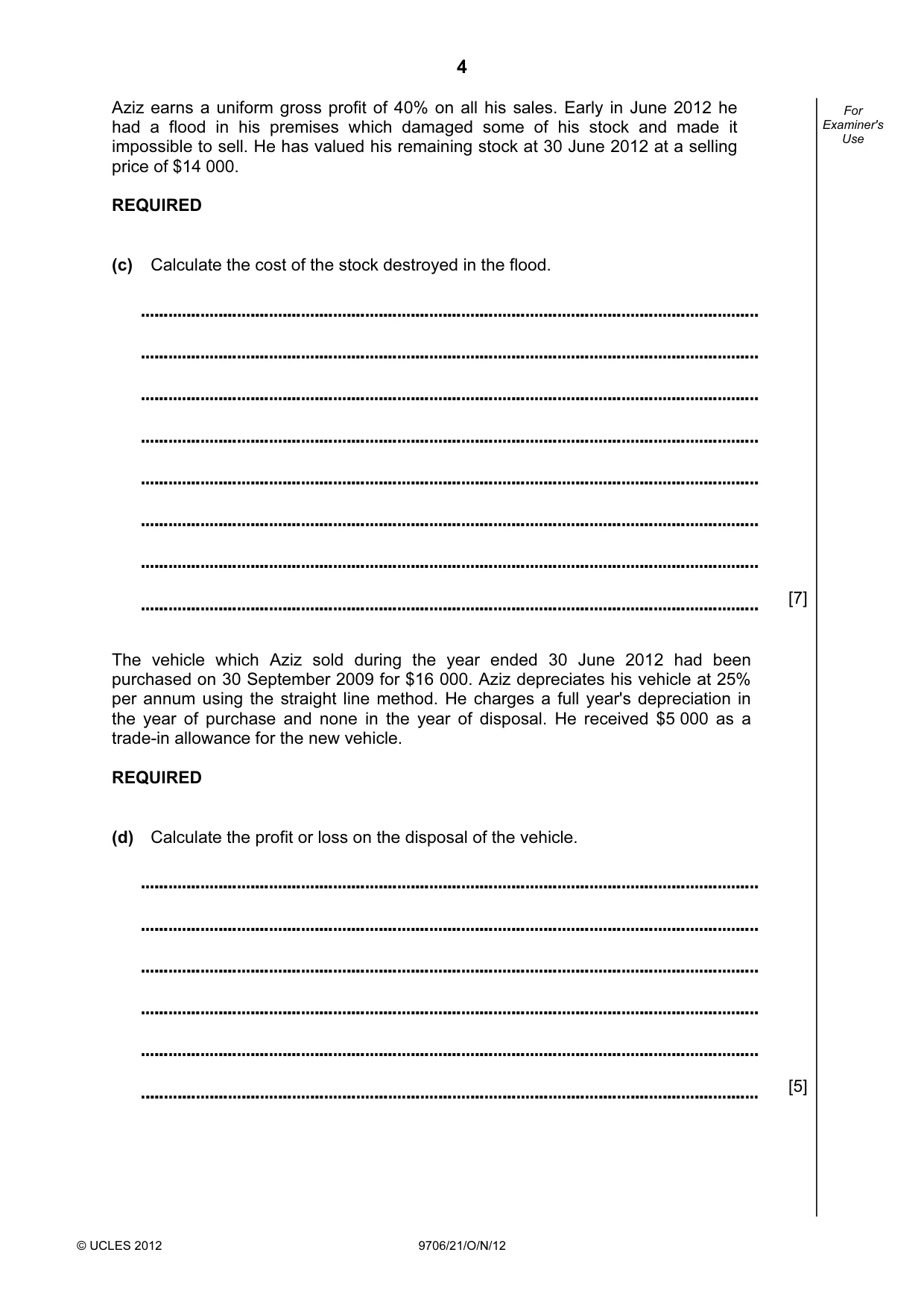
4 © UCLES 2012 9706/21/O/N/12 For Examiner's Use Aziz earns a uniform gross profit of 40% on all his sales. Early in June 2012 he had a flood in his premises which damaged some of his stock and made it impossible to sell. He has valued his remaining stock at 30 June 2012 at a selling price of $14 000. REQUIRED (c) Calculate the cost of the stock destroyed in the flood. [7] The vehicle which Aziz sold during the year ended 30 June 2012 had been purchased on 30 September 2009 for $16 000. Aziz depreciates his vehicle at 25% per annum using the straight line method. He charges a full year's depreciation in the year of purchase and none in the year of disposal. He received $5 000 as a trade-in allowance for the new vehicle. REQUIRED (d) Calculate the profit or loss on the disposal of the vehicle. [5]
Question paper, page 5
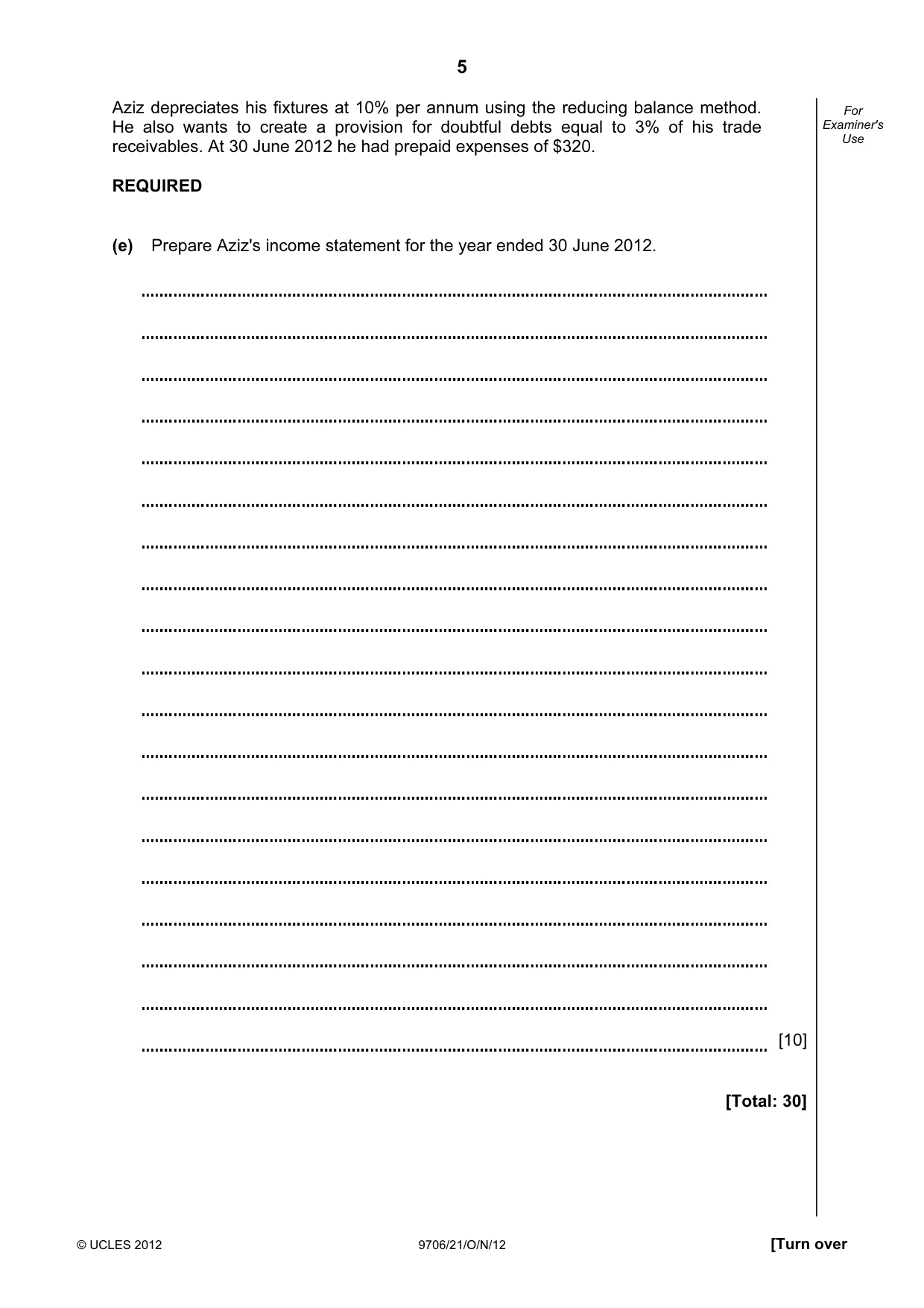
5 © UCLES 2012 9706/21/O/N/12 [Turn over For Examiner's Use Aziz depreciates his fixtures at 10% per annum using the reducing balance method. He also wants to create a provision for doubtful debts equal to 3% of his trade receivables. At 30 June 2012 he had prepaid expenses of $320. REQUIRED (e) Prepare Aziz's income statement for the year ended 30 June 2012. [10] [Total: 30]
Question paper, page 6
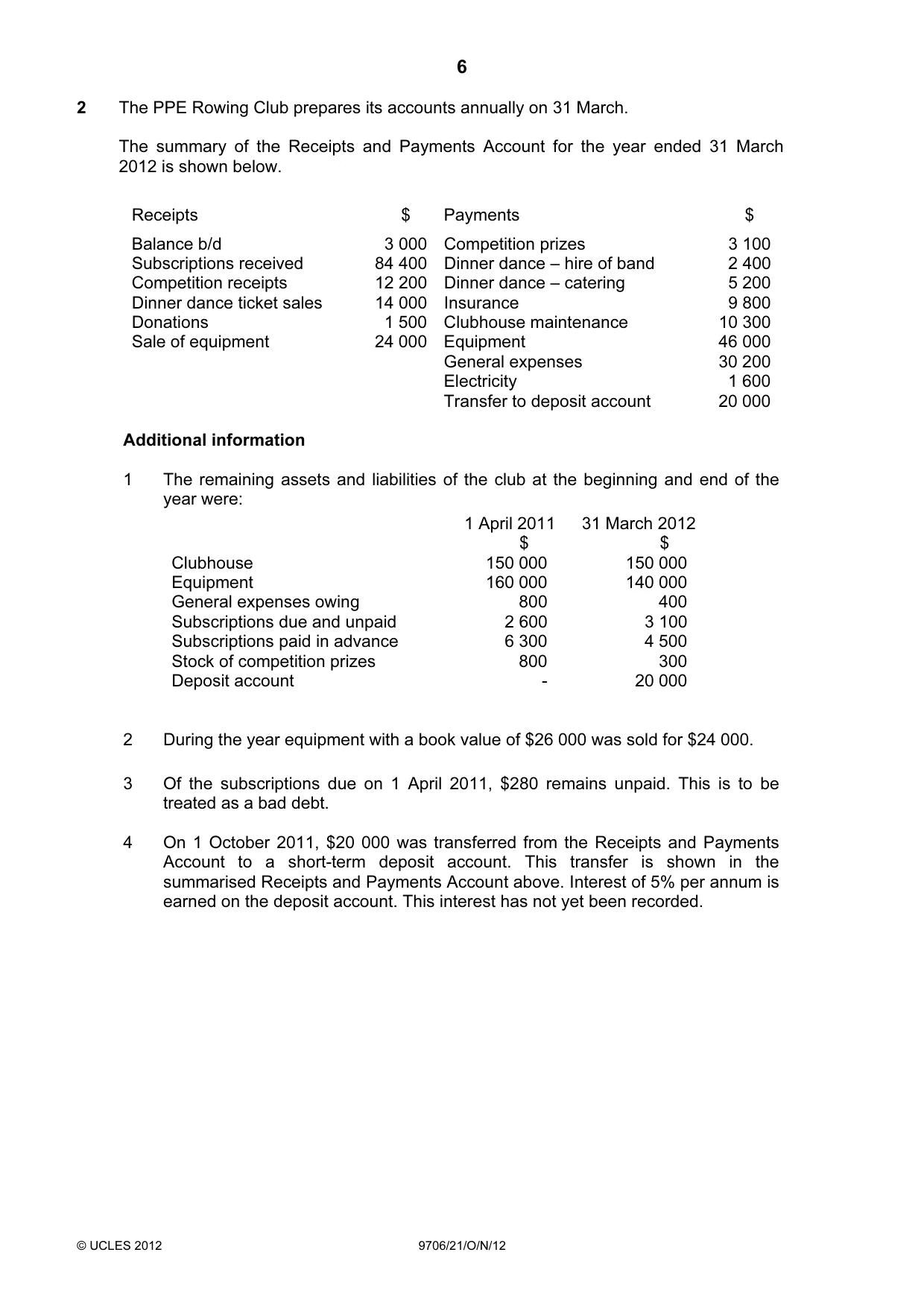
6 © UCLES 2012 9706/21/O/N/12 2 The PPE Rowing Club prepares its accounts annually on 31 March. The summary of the Receipts and Payments Account for the year ended 31 March 2012 is shown below. Receipts $ Payments $ Balance b/d 3 000 Competition prizes 3 100 Subscriptions received 84 400 Dinner dance – hire of band 2 400 Competition receipts 12 200 Dinner dance – catering 5 200 Dinner dance ticket sales 14 000 Insurance 9 800 Donations 1 500 Clubhouse maintenance 10 300 Sale of equipment 24 000 Equipment 46 000 General expenses 30 200 Electricity 1 600 Transfer to deposit account 20 000 Additional information 1 The remaining assets and liabilities of the club at the beginning and end of the year were: 1 April 2011 31 March 2012 $ $ Clubhouse 150 000 150 000 Equipment 160 000 140 000 General expenses owing 800 400 Subscriptions due and unpaid 2 600 3 100 Subscriptions paid in advance 6 300 4 500 Stock of competition prizes 800 300 Deposit account - 20 000 2 During the year equipment with a book value of $26 000 was sold for $24 000. 3 Of the subscriptions due on 1 April 2011, $280 remains unpaid. This is to be treated as a bad debt. 4 On 1 October 2011, $20 000 was transferred from the Receipts and Payments Account to a short-term deposit account. This transfer is shown in the summarised Receipts and Payments Account above. Interest of 5% per annum is earned on the deposit account. This interest has not yet been recorded.
Question paper, page 7
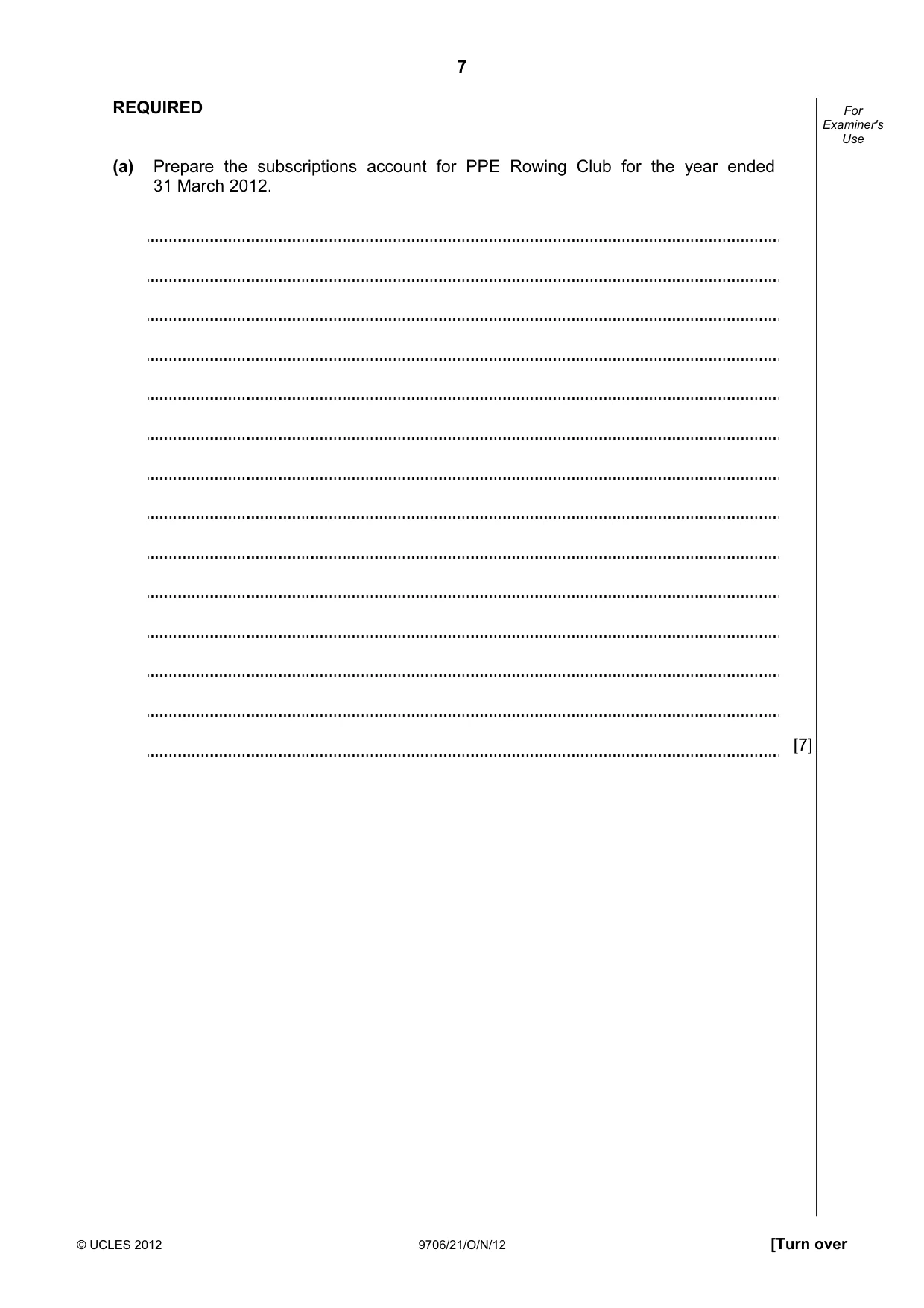
7 © UCLES 2012 9706/21/O/N/12 [Turn over For Examiner's Use REQUIRED (a) Prepare the subscriptions account for PPE Rowing Club for the year ended 31 March 2012. [7]
Question paper, page 8
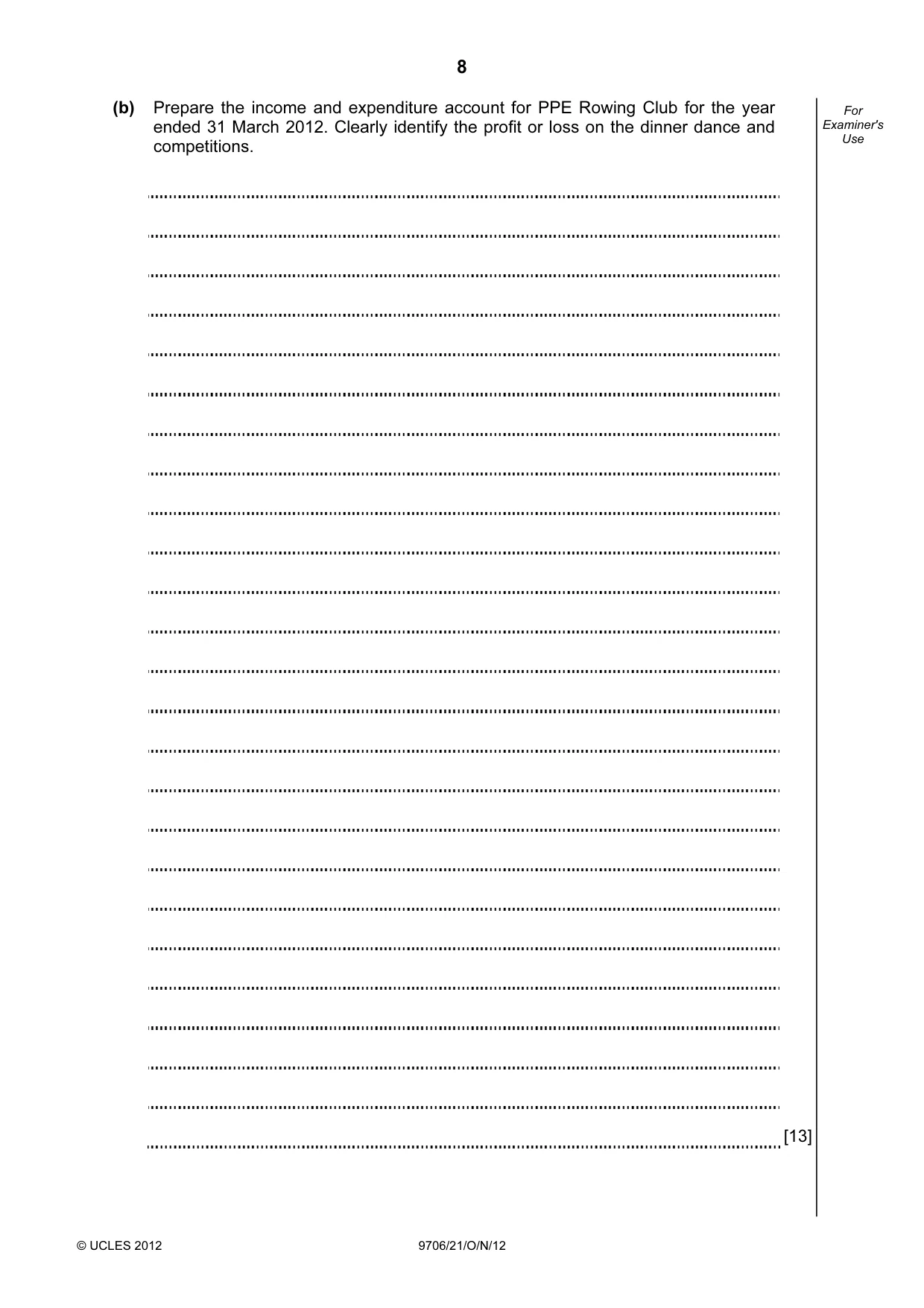
8 © UCLES 2012 9706/21/O/N/12 For Examiner's Use (b) Prepare the income and expenditure account for PPE Rowing Club for the year ended 31 March 2012. Clearly identify the profit or loss on the dinner dance and competitions. [13]
Question paper, page 9
9 © UCLES 2012 9706/21/O/N/12 [Turn over For Examiner's Use (c) Prepare the statement of financial position for PPE Rowing Club at 31 March 2012. [10] [Total: 30]
Question paper, page 10
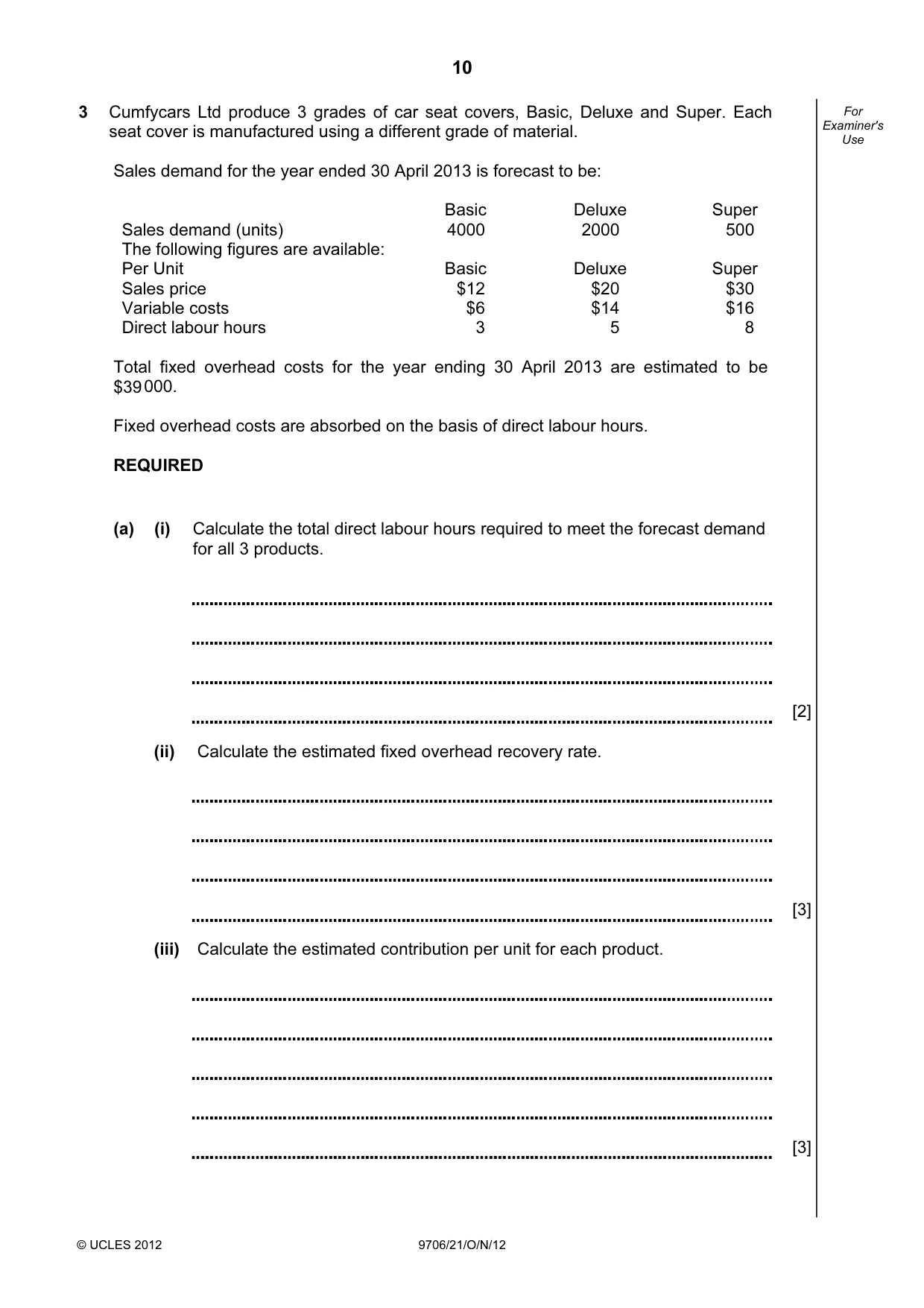
10 © UCLES 2012 9706/21/O/N/12 For Examiner's Use 3 Cumfycars Ltd produce 3 grades of car seat covers, Basic, Deluxe and Super. Each seat cover is manufactured using a different grade of material. Sales demand for the year ended 30 April 2013 is forecast to be: Basic Deluxe Super Sales demand (units) 4000 2000 500 The following figures are available: Per Unit Basic Deluxe Super Sales price $12 $20 $30 Variable costs $6 $14 $16 Direct labour hours 3 5 8 Total fixed overhead costs for the year ending 30 April 2013 are estimated to be $39 000. Fixed overhead costs are absorbed on the basis of direct labour hours. REQUIRED (a) (i) Calculate the total direct labour hours required to meet the forecast demand for all 3 products. [2] (ii) Calculate the estimated fixed overhead recovery rate. [3] (iii) Calculate the estimated contribution per unit for each product. [3]
Question paper, page 11
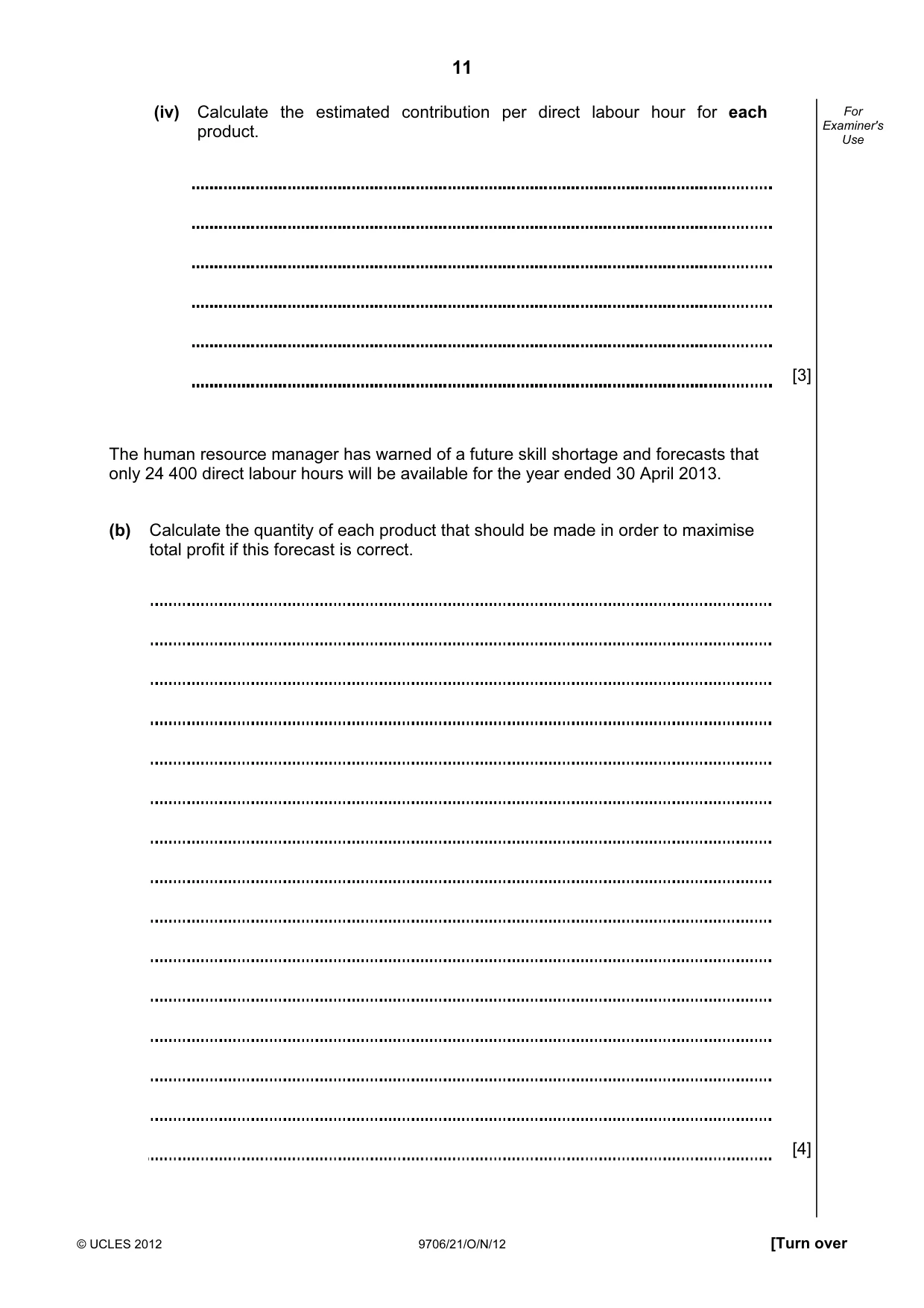
11 © UCLES 2012 9706/21/O/N/12 [Turn over For Examiner's Use (iv) Calculate the estimated contribution per direct labour hour for each product. [3] The human resource manager has warned of a future skill shortage and forecasts that only 24 400 direct labour hours will be available for the year ended 30 April 2013. (b) Calculate the quantity of each product that should be made in order to maximise total profit if this forecast is correct. [4]
Question paper, page 12
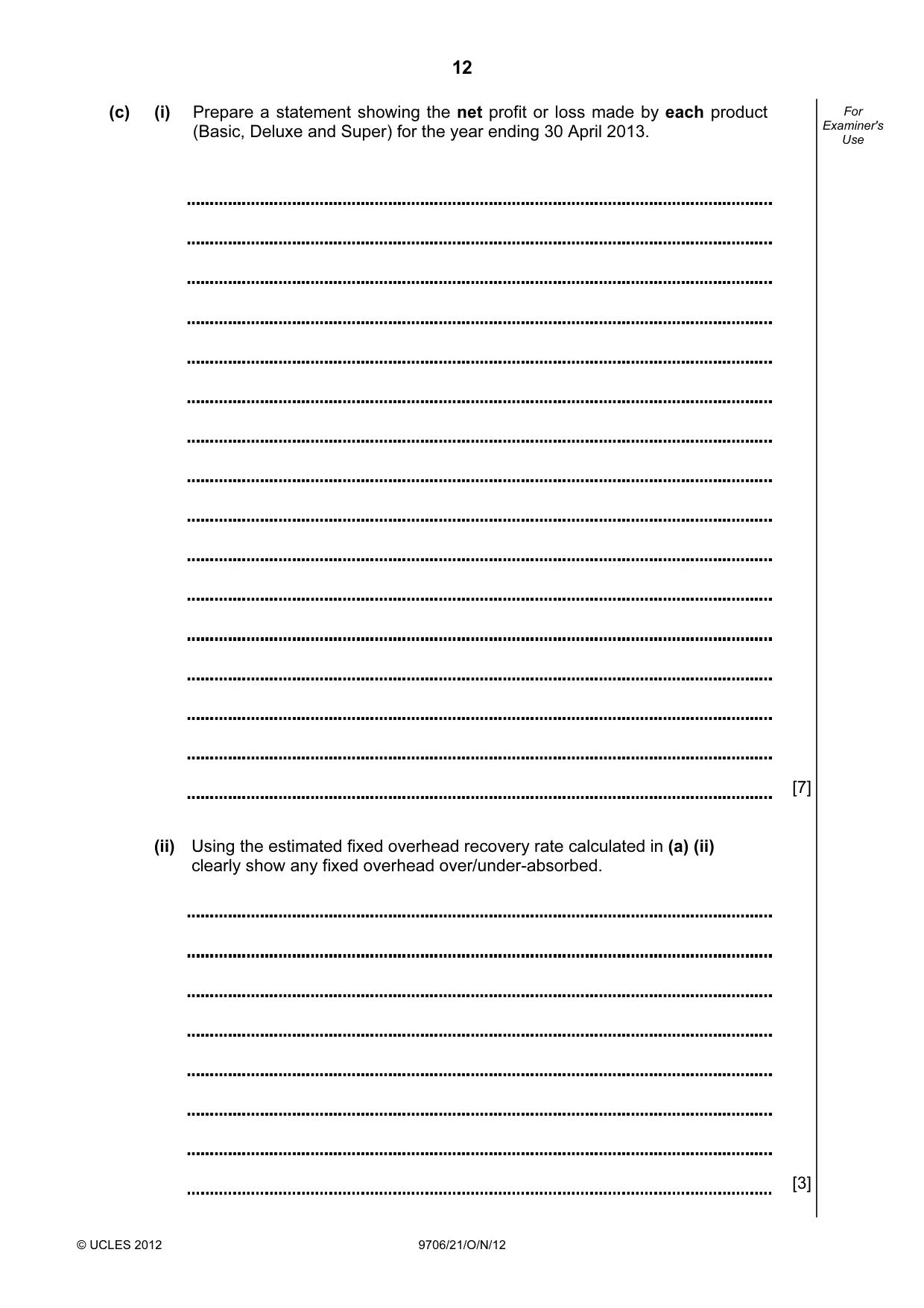
12 © UCLES 2012 9706/21/O/N/12 For Examiner's Use (c) (i) Prepare a statement showing the net profit or loss made by each product (Basic, Deluxe and Super) for the year ending 30 April 2013. [7] (ii) Using the estimated fixed overhead recovery rate calculated in (a) (ii) clearly show any fixed overhead over/under-absorbed. [3]
Question paper, page 13
13 © UCLES 2012 9706/21/O/N/12 For Examiner's Use Cumfycars Ltd also produce car roof racks in separate premises. The total forecast fixed costs for the year ending 30 April 2013 amount to $10 000. Each roof rack has the following unit costs: Unit costs $ Raw materials 40 Direct labour 30 Variable Overheads 25 There are no other costs. Each roof rack sells for $100. REQUIRED (d) Calculate the estimated break-even point in units and in sales revenue. [3] (e) Calculate the estimated margin of safety in units and revenue if 2200 units are produced. [2] [Total: 30]
Question paper, page 14
14 © UCLES 2012 9706/21/O/N/12 BLANK PAGE
Question paper, page 15
15 © UCLES 2012 9706/21/O/N/12 BLANK PAGE
Question paper, page 16
16 Permission to reproduce items where third-party owned material protected by copyright is included has been sought and cleared where possible. Every reasonable effort has been made by the publisher (UCLES) to trace copyright holders, but if any items requiring clearance have unwittingly been included, the publisher will be pleased to make amends at the earliest possible opportunity. University of Cambridge International Examinations is part of the Cambridge Assessment Group. Cambridge Assessment is the brand name of University of Cambridge Local Examinations Syndicate (UCLES), which is itself a department of the University of Cambridge. © UCLES 2012 9706/21/O/N/12 BLANK PAGE
Mark scheme, page 1
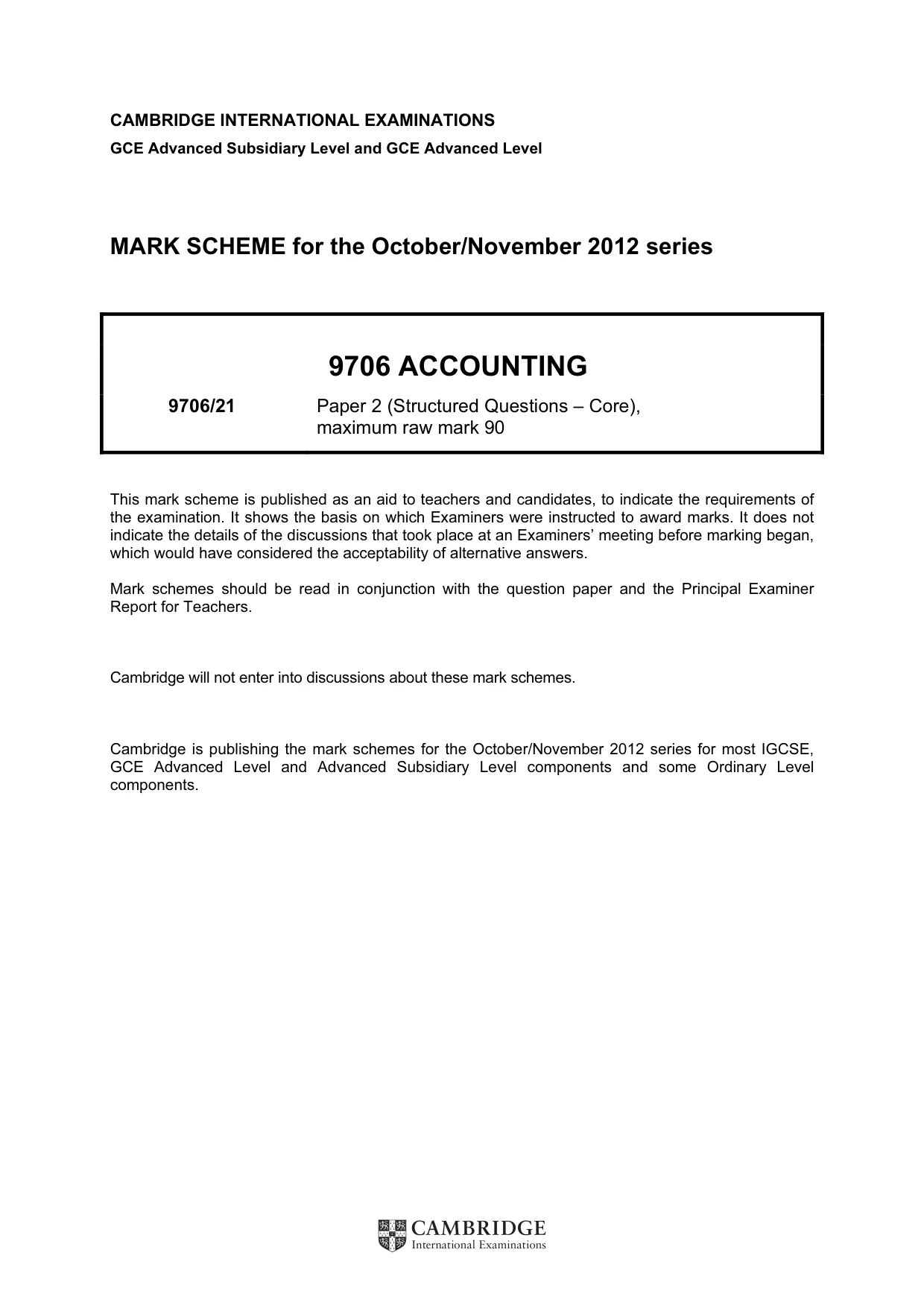
CAMBRIDGE INTERNATIONAL EXAMINATIONS GCE Advanced Subsidiary Level and GCE Advanced Level MARK SCHEME for the October/November 2012 series 9706 ACCOUNTING 9706/21 Paper 2 (Structured Questions – Core), maximum raw mark 90 This mark scheme is published as an aid to teachers and candidates, to indicate the requirements of the examination. It shows the basis on which Examiners were instructed to award marks. It does not indicate the details of the discussions that took place at an Examiners’ meeting before marking began, which would have considered the acceptability of alternative answers. Mark schemes should be read in conjunction with the question paper and the Principal Examiner Report for Teachers. Cambridge will not enter into discussions about these mark schemes. Cambridge is publishing the mark schemes for the October/November 2012 series for most IGCSE, GCE Advanced Level and Advanced Subsidiary Level components and some Ordinary Level components.
Mark scheme, page 2
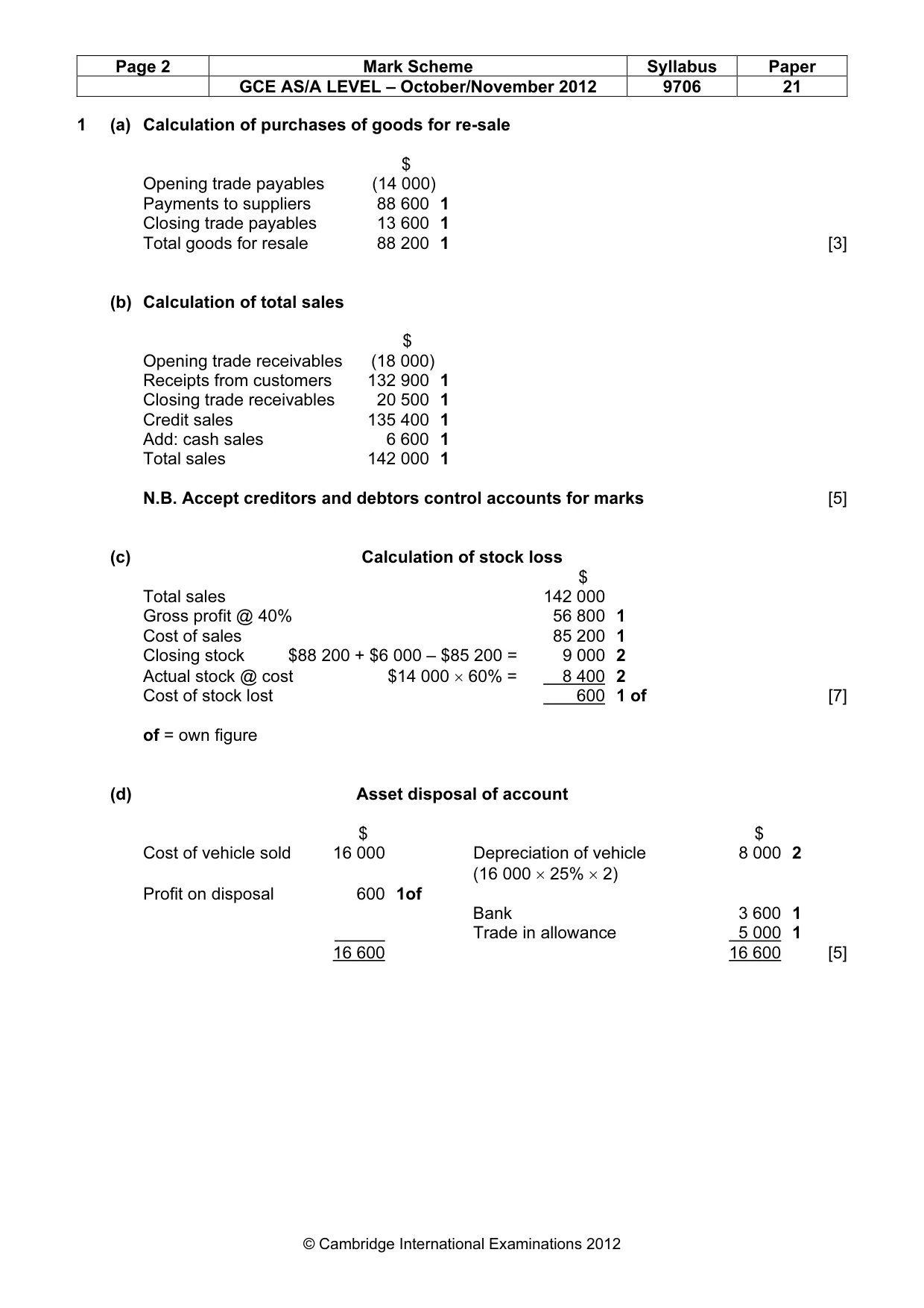
Page 2 Mark Scheme Syllabus Paper GCE AS/A LEVEL – October/November 2012 9706 21 © Cambridge International Examinations 2012 1 (a) Calculation of purchases of goods for re-sale $ Opening trade payables (14 000) Payments to suppliers 88 600 1 Closing trade payables 13 600 1 Total goods for resale 88 200 1 [3] (b) Calculation of total sales $ Opening trade receivables (18 000) Receipts from customers 132 900 1 Closing trade receivables 20 500 1 Credit sales 135 400 1 Add: cash sales 6 600 1 Total sales 142 000 1 N.B. Accept creditors and debtors control accounts for marks [5] (c) Calculation of stock loss $ Total sales 142 000 Gross profit @ 40% 56 800 1 Cost of sales 85 200 1 Closing stock $88 200 + $6 000 – $85 200 = 9 000 2 Actual stock @ cost $14 000 × 60% = 8 400 2 Cost of stock lost 600 1 of [7] of = own figure (d) Asset disposal of account $ $ Cost of vehicle sold 16 000 Depreciation of vehicle 8 000 2 (16 000 × 25% × 2) Profit on disposal 600 1of Bank 3 600 1 Trade in allowance 5 000 1 16 600 16 600 [5]
Mark scheme, page 3
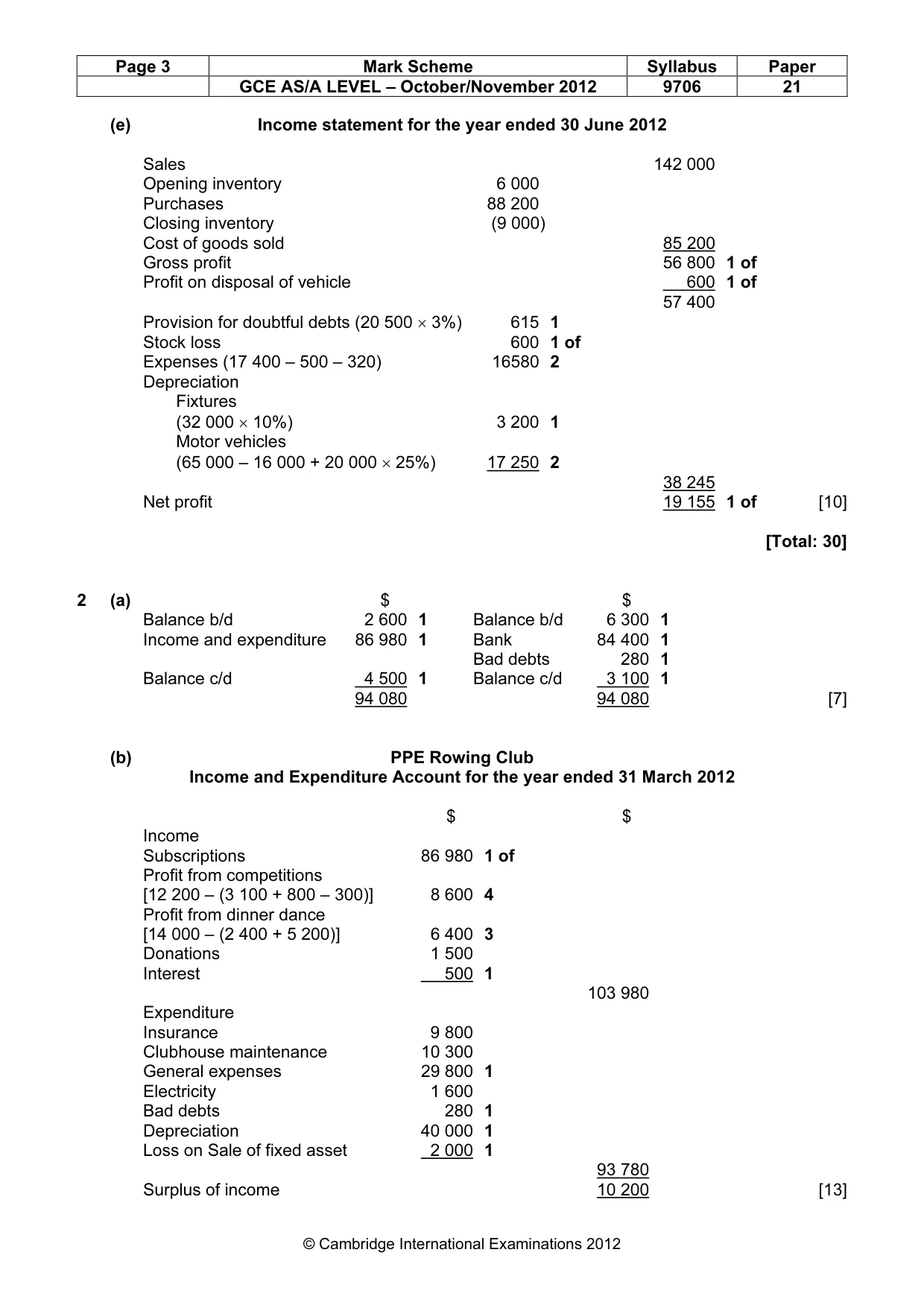
Page 3 Mark Scheme Syllabus Paper GCE AS/A LEVEL – October/November 2012 9706 21 © Cambridge International Examinations 2012 (e) Income statement for the year ended 30 June 2012 Sales 142 000 Opening inventory 6 000 Purchases 88 200 Closing inventory (9 000) Cost of goods sold 85 200 Gross profit 56 800 1 of Profit on disposal of vehicle 600 1 of 57 400 Provision for doubtful debts (20 500 × 3%) 615 1 Stock loss 600 1 of Expenses (17 400 – 500 – 320) 16580 2 Depreciation Fixtures (32 000 × 10%) 3 200 1 Motor vehicles (65 000 – 16 000 + 20 000 × 25%) 17 250 2 38 245 Net profit 19 155 1 of [10] [Total: 30] 2 (a) $ $ Balance b/d 2 600 1 Balance b/d 6 300 1 Income and expenditure 86 980 1 Bank 84 400 1 Bad debts 280 1 Balance c/d 4 500 1 Balance c/d 3 100 1 94 080 94 080 [7] (b) PPE Rowing Club Income and Expenditure Account for the year ended 31 March 2012 $ $ Income Subscriptions 86 980 1 of Profit from competitions [12 200 – (3 100 + 800 – 300)] 8 600 4 Profit from dinner dance [14 000 – (2 400 + 5 200)] 6 400 3 Donations 1 500 Interest 500 1 103 980 Expenditure Insurance 9 800 Clubhouse maintenance 10 300 General expenses 29 800 1 Electricity 1 600 Bad debts 280 1 Depreciation 40 000 1 Loss on Sale of fixed asset 2 000 1 93 780 Surplus of income 10 200 [13]
Mark scheme, page 4
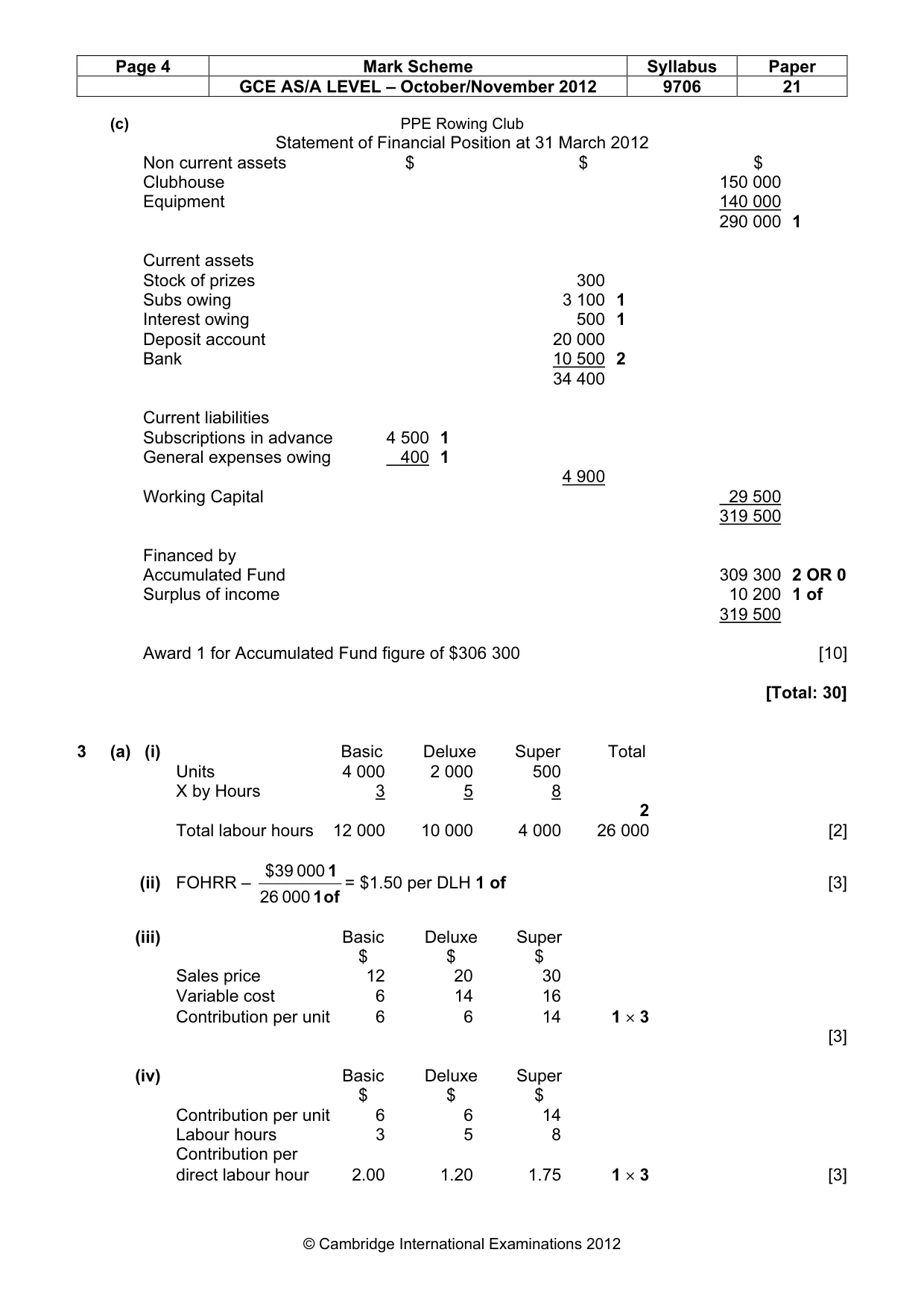
Page 4 Mark Scheme Syllabus Paper GCE AS/A LEVEL – October/November 2012 9706 21 © Cambridge International Examinations 2012 (c) PPE Rowing Club Statement of Financial Position at 31 March 2012 Non current assets $ $ $ Clubhouse 150 000 Equipment 140 000 290 000 1 Current assets Stock of prizes 300 Subs owing 3 100 1 Interest owing 500 1 Deposit account 20 000 Bank 10 500 2 34 400 Current liabilities Subscriptions in advance 4 500 1 General expenses owing 400 1 4 900 Working Capital 29 500 319 500 Financed by Accumulated Fund 309 300 2 OR 0 Surplus of income 10 200 1 of 319 500 Award 1 for Accumulated Fund figure of $306 300 [10] [Total: 30] 3 (a) (i) Basic Deluxe Super Total Units 4 000 2 000 500 X by Hours 3 5 8 2 Total labour hours 12 000 10 000 4 000 26 000 [2] (ii) FOHRR – of 1 1 000 26 000 39 $ = $1.50 per DLH 1 of [3] (iii) Basic Deluxe Super $ $ $ Sales price 12 20 30 Variable cost 6 14 16 Contribution per unit 6 6 14 1 × 3 [3] (iv) Basic Deluxe Super $ $ $ Contribution per unit 6 6 14 Labour hours 3 5 8 Contribution per direct labour hour 2.00 1.20 1.75 1 × 3 [3]
Mark scheme, page 5
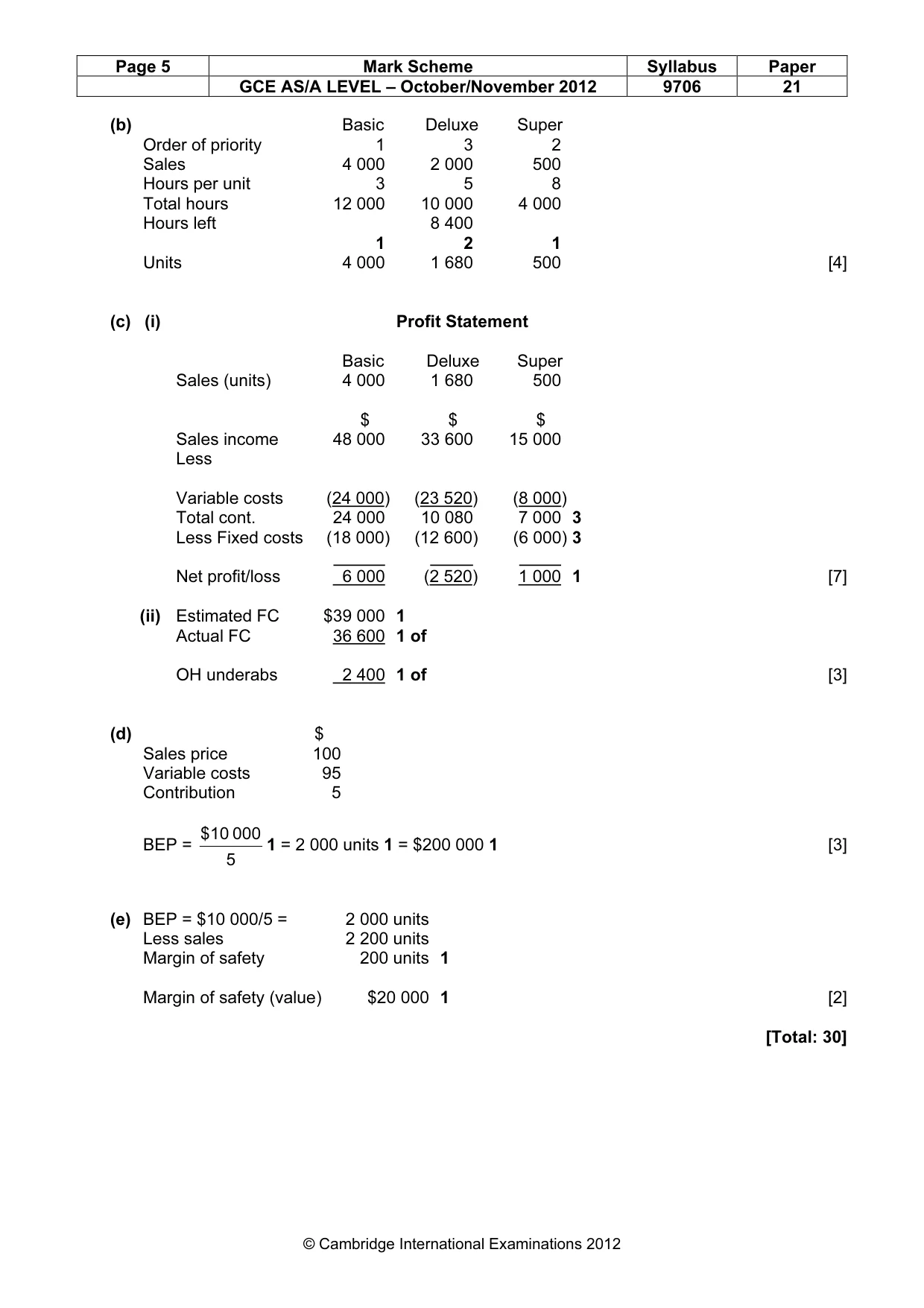
Page 5 Mark Scheme Syllabus Paper GCE AS/A LEVEL – October/November 2012 9706 21 © Cambridge International Examinations 2012 (b) Basic Deluxe Super Order of priority 1 3 2 Sales 4 000 2 000 500 Hours per unit 3 5 8 Total hours 12 000 10 000 4 000 Hours left 8 400 1 2 1 Units 4 000 1 680 500 [4] (c) (i) Profit Statement Basic Deluxe Super Sales (units) 4 000 1 680 500 $ $ $ Sales income 48 000 33 600 15 000 Less Variable costs (24 000) (23 520) (8 000) Total cont. 24 000 10 080 7 000 3 Less Fixed costs (18 000) (12 600) (6 000) 3 Net profit/loss 6 000 (2 520) 1 000 1 [7] (ii) Estimated FC $39 000 1 Actual FC 36 600 1 of OH underabs 2 400 1 of [3] (d) $ Sales price 100 Variable costs 95 Contribution 5 BEP = 5 000 10 $ 1 = 2 000 units 1 = $200 000 1 [3] (e) BEP = $10 000/5 = 2 000 units Less sales 2 200 units Margin of safety 200 units 1 Margin of safety (value) $20 000 1 [2] [Total: 30]
What you needed in this session
Cambridge’s own grade thresholds for 2012 Oct/Nov, Paper 2 · Variant 1. A higher threshold means an easier paper — the bar moves with how the cohort did.