Cambridge A Level Accounting 9706 — 2012 May/June Paper 2 · Variant 2
9706/22/M/J/12 · 90 marks · ≈101 min
The question paper and its mark scheme, free to read here and free to download. This is Cambridge’s own paper, exactly as it was sat.
Question paper16 pages


Mark scheme6 pages
Answers below. Sit the paper first if you are practising.
Paper as text
Question paper, page 1
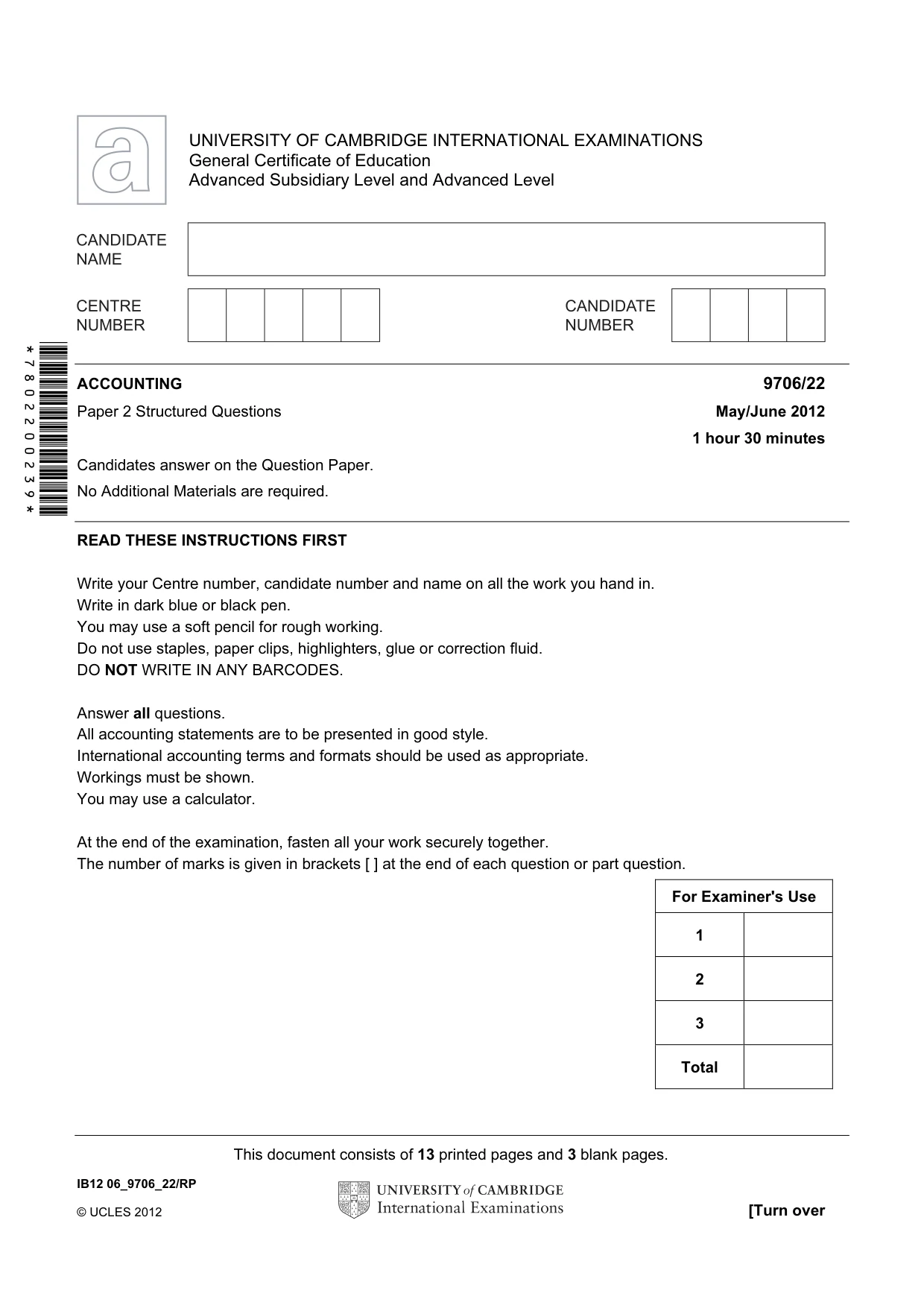
This document consists of 13 printed pages and 3 blank pages. IB12 06_9706_22/RP © UCLES 2012 [Turn over *7802200239* For Examiner's Use 1 2 3 Total UNIVERSITY OF CAMBRIDGE INTERNATIONAL EXAMINATIONS General Certificate of Education Advanced Subsidiary Level and Advanced Level ACCOUNTING 9706/22 Paper 2 Structured Questions May/June 2012 1 hour 30 minutes Candidates answer on the Question Paper. No Additional Materials are required. READ THESE INSTRUCTIONS FIRST Write your Centre number, candidate number and name on all the work you hand in. Write in dark blue or black pen. You may use a soft pencil for rough working. Do not use staples, paper clips, highlighters, glue or correction fluid. DO NOT WRITE IN ANY BARCODES. Answer all questions. All accounting statements are to be presented in good style. International accounting terms and formats should be used as appropriate. Workings must be shown. You may use a calculator. At the end of the examination, fasten all your work securely together. The number of marks is given in brackets [ ] at the end of each question or part question.
Question paper, page 2
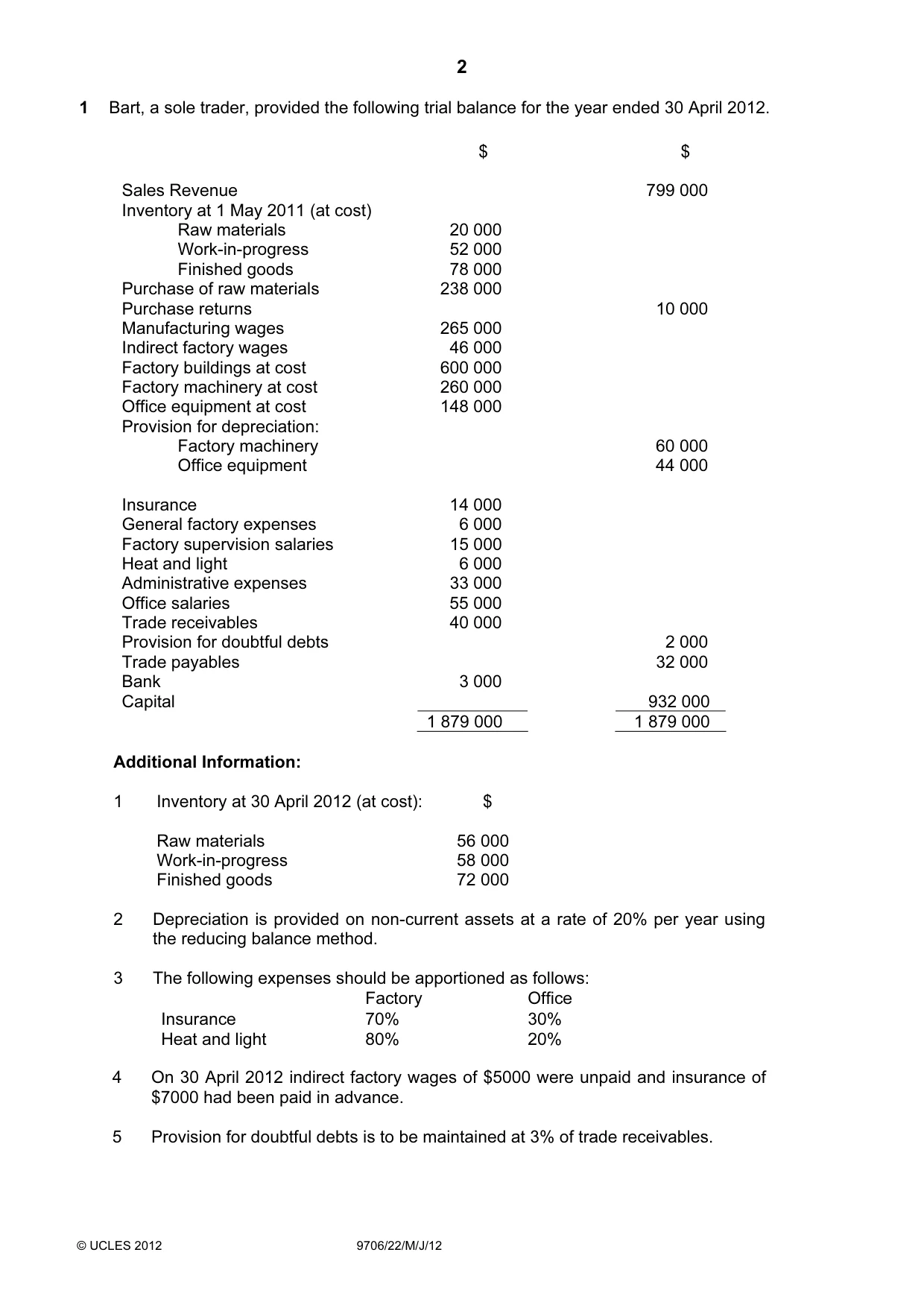
2 © UCLES 2012 9706/22/M/J/12 1 Bart, a sole trader, provided the following trial balance for the year ended 30 April 2012. $ $ Sales Revenue 799 000 Inventory at 1 May 2011 (at cost) Raw materials 20 000 Work-in-progress 52 000 Finished goods 78 000 Purchase of raw materials 238 000 Purchase returns 10 000 Manufacturing wages 265 000 Indirect factory wages 46 000 Factory buildings at cost 600 000 Factory machinery at cost 260 000 Office equipment at cost 148 000 Provision for depreciation: Factory machinery 60 000 Office equipment 44 000 Insurance 14 000 General factory expenses 6 000 Factory supervision salaries 15 000 Heat and light 6 000 Administrative expenses 33 000 Office salaries 55 000 Trade receivables 40 000 Provision for doubtful debts 2 000 Trade payables 32 000 Bank 3 000 Capital 932 000 1 879 000 1 879 000 . Additional Information: 1 Inventory at 30 April 2012 (at cost): $ Raw materials 56 000 Work-in-progress 58 000 Finished goods 72 000 2 Depreciation is provided on non-current assets at a rate of 20% per year using the reducing balance method. 3 The following expenses should be apportioned as follows: Factory Office Insurance 70% 30% Heat and light 80% 20% 4 On 30 April 2012 indirect factory wages of $5000 were unpaid and insurance of $7000 had been paid in advance. 5 Provision for doubtful debts is to be maintained at 3% of trade receivables.
Question paper, page 3
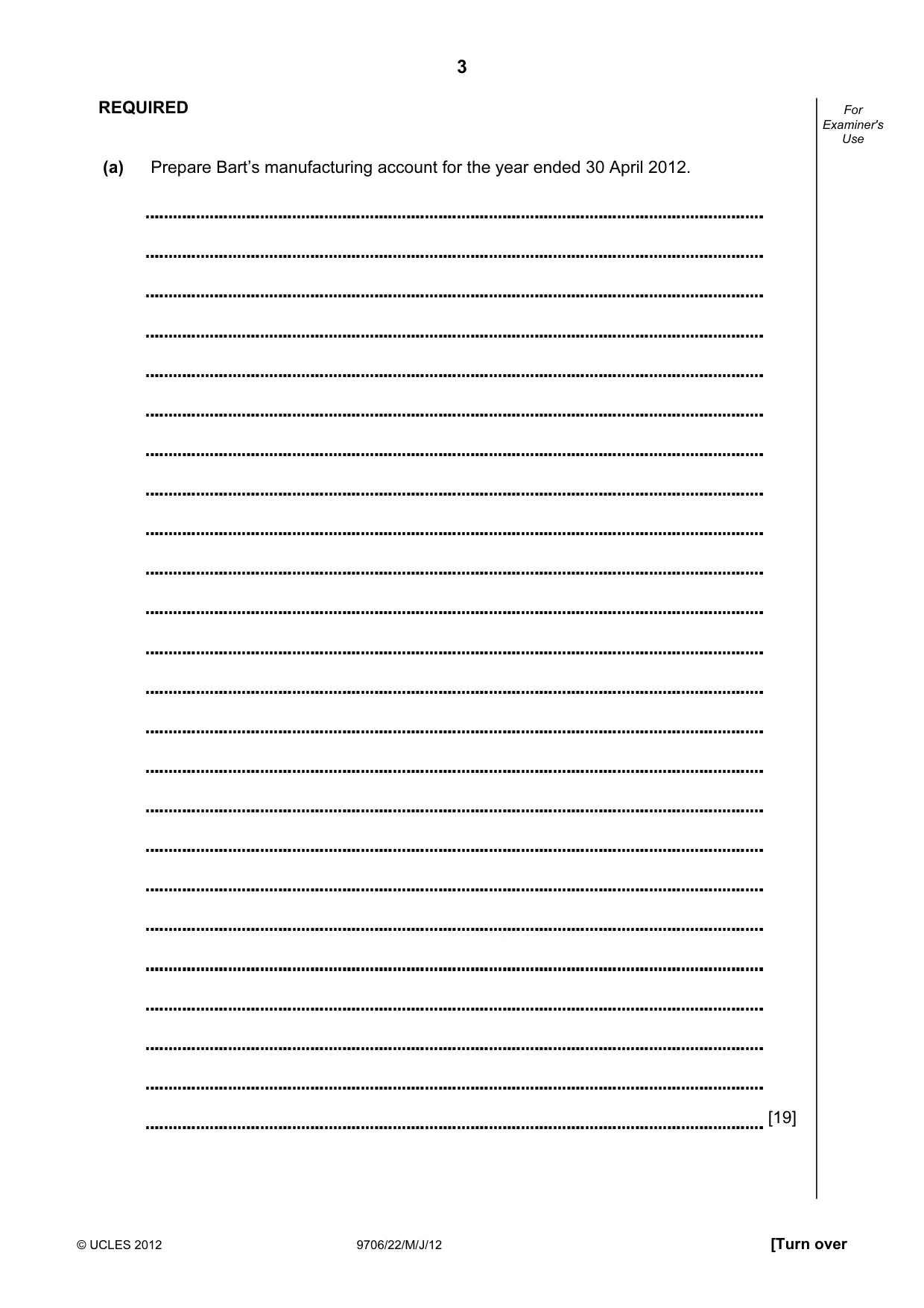
3 © UCLES 2012 9706/22/M/J/12 [Turn over For Examiner's Use REQUIRED (a) Prepare Bart’s manufacturing account for the year ended 30 April 2012. [19]
Question paper, page 4
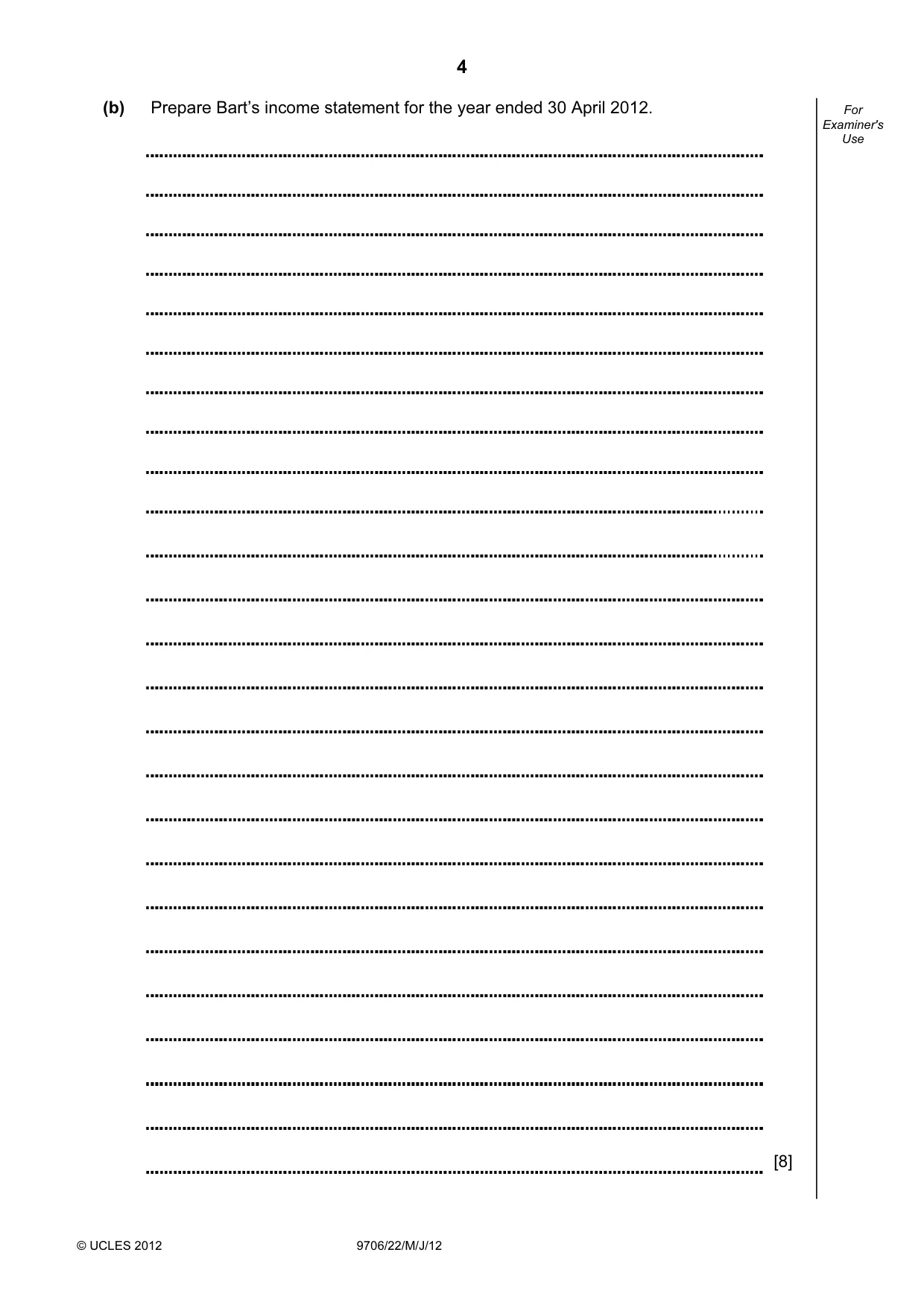
4 © UCLES 2012 9706/22/M/J/12 For Examiner's Use (b) Prepare Bart’s income statement for the year ended 30 April 2012. [8]
Question paper, page 5
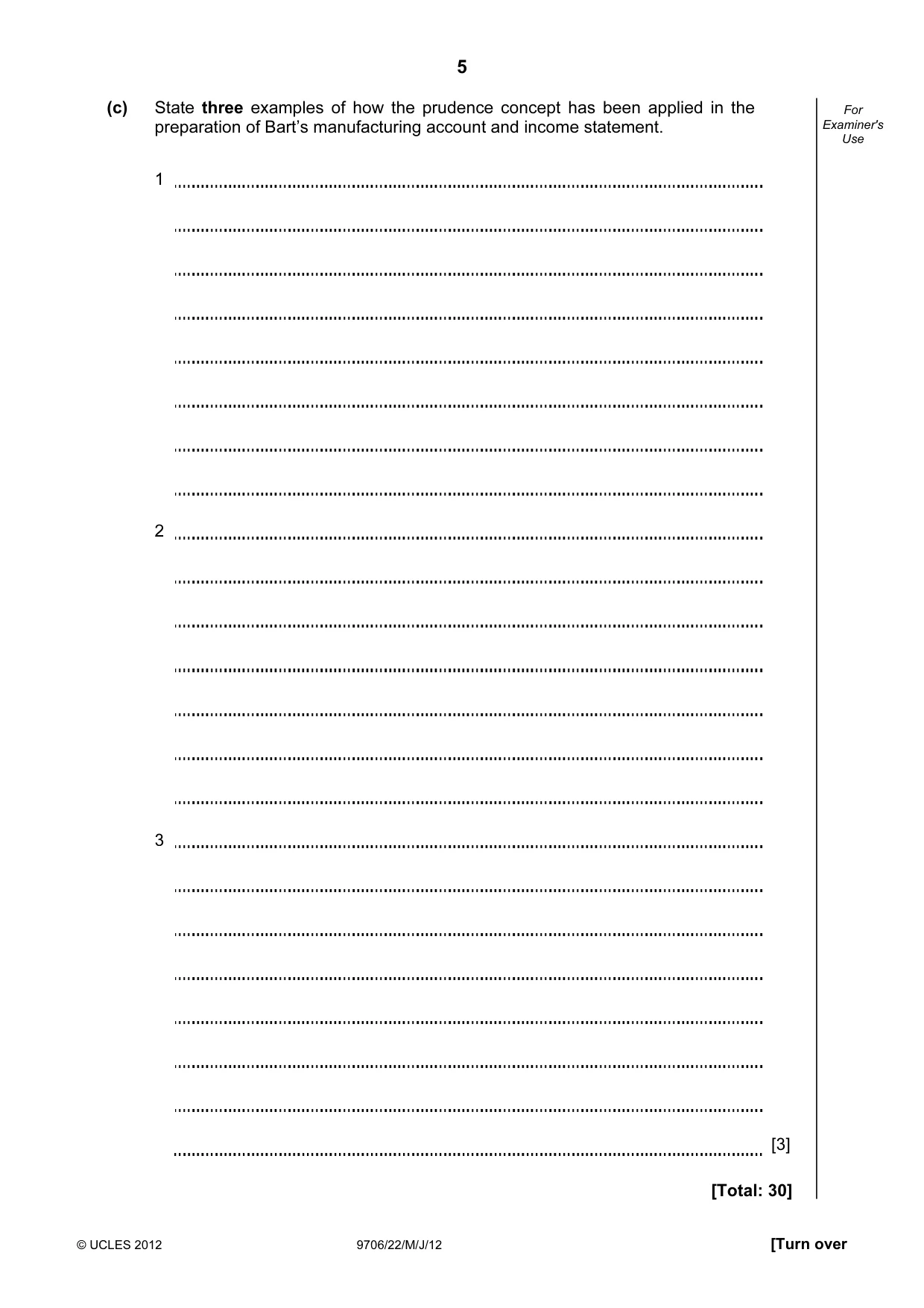
5 © UCLES 2012 9706/22/M/J/12 [Turn over For Examiner's Use (c) State three examples of how the prudence concept has been applied in the preparation of Bart’s manufacturing account and income statement. 1 2 3 [3] [Total: 30]
Question paper, page 6
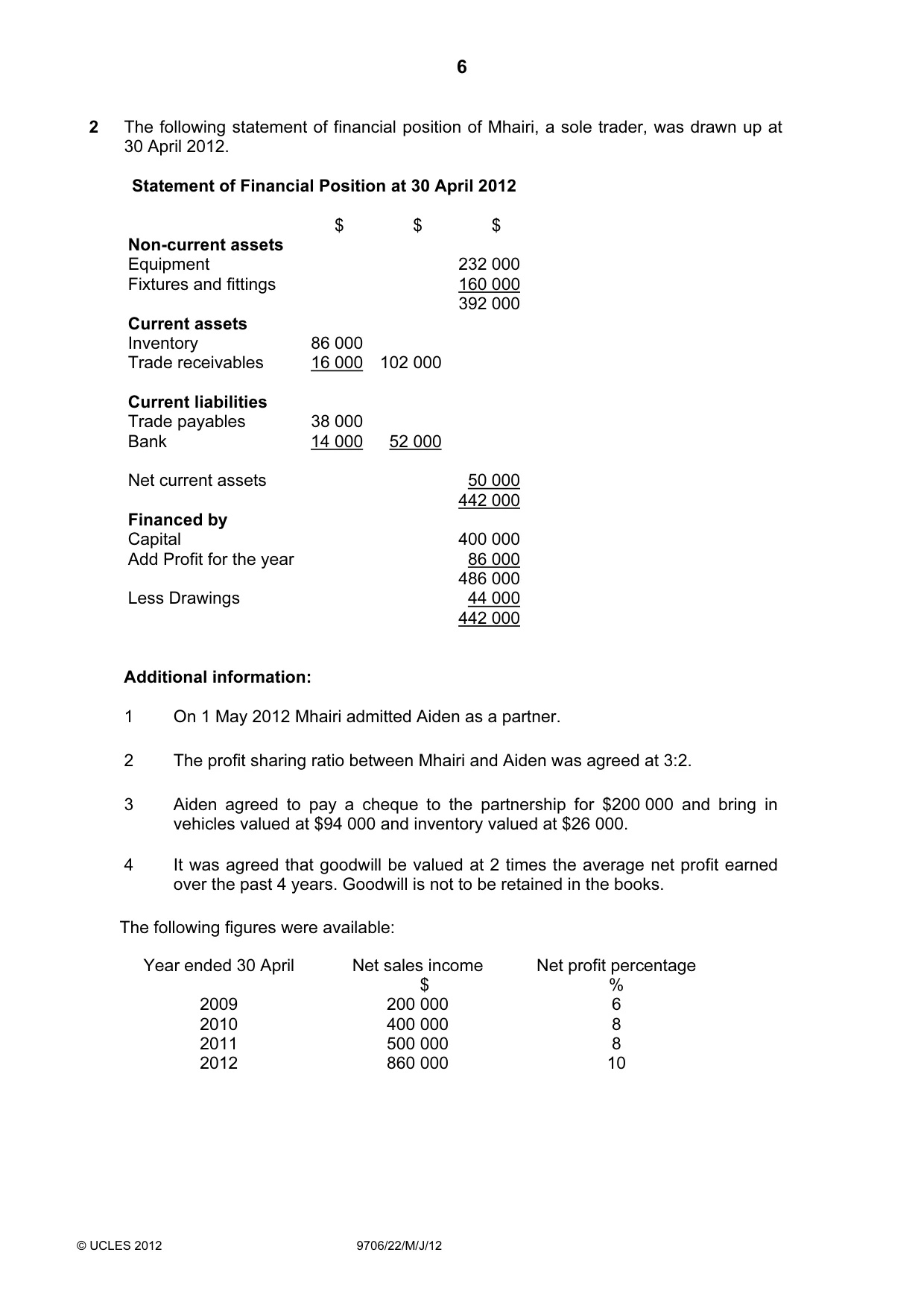
6 © UCLES 2012 9706/22/M/J/12 2 The following statement of financial position of Mhairi, a sole trader, was drawn up at 30 April 2012. Statement of Financial Position at 30 April 2012 $ $ $ Non-current assets Equipment 232 000 Fixtures and fittings 160 000 392 000 Current assets Inventory 86 000 Trade receivables 16 000 102 000 Current liabilities Trade payables 38 000 Bank 14 000 52 000 Net current assets 50 000 442 000 Financed by Capital 400 000 Add Profit for the year 86 000 486 000 Less Drawings 44 000 442 000 . Additional information: 1 On 1 May 2012 Mhairi admitted Aiden as a partner. 2 The profit sharing ratio between Mhairi and Aiden was agreed at 3:2. 3 Aiden agreed to pay a cheque to the partnership for $200 000 and bring in vehicles valued at $94 000 and inventory valued at $26 000. 4 It was agreed that goodwill be valued at 2 times the average net profit earned over the past 4 years. Goodwill is not to be retained in the books. The following figures were available: Year ended 30 April Net sales income $ Net profit percentage % 2009 200 000 6 2010 400 000 8 2011 500 000 8 2012 860 000 10
Question paper, page 7
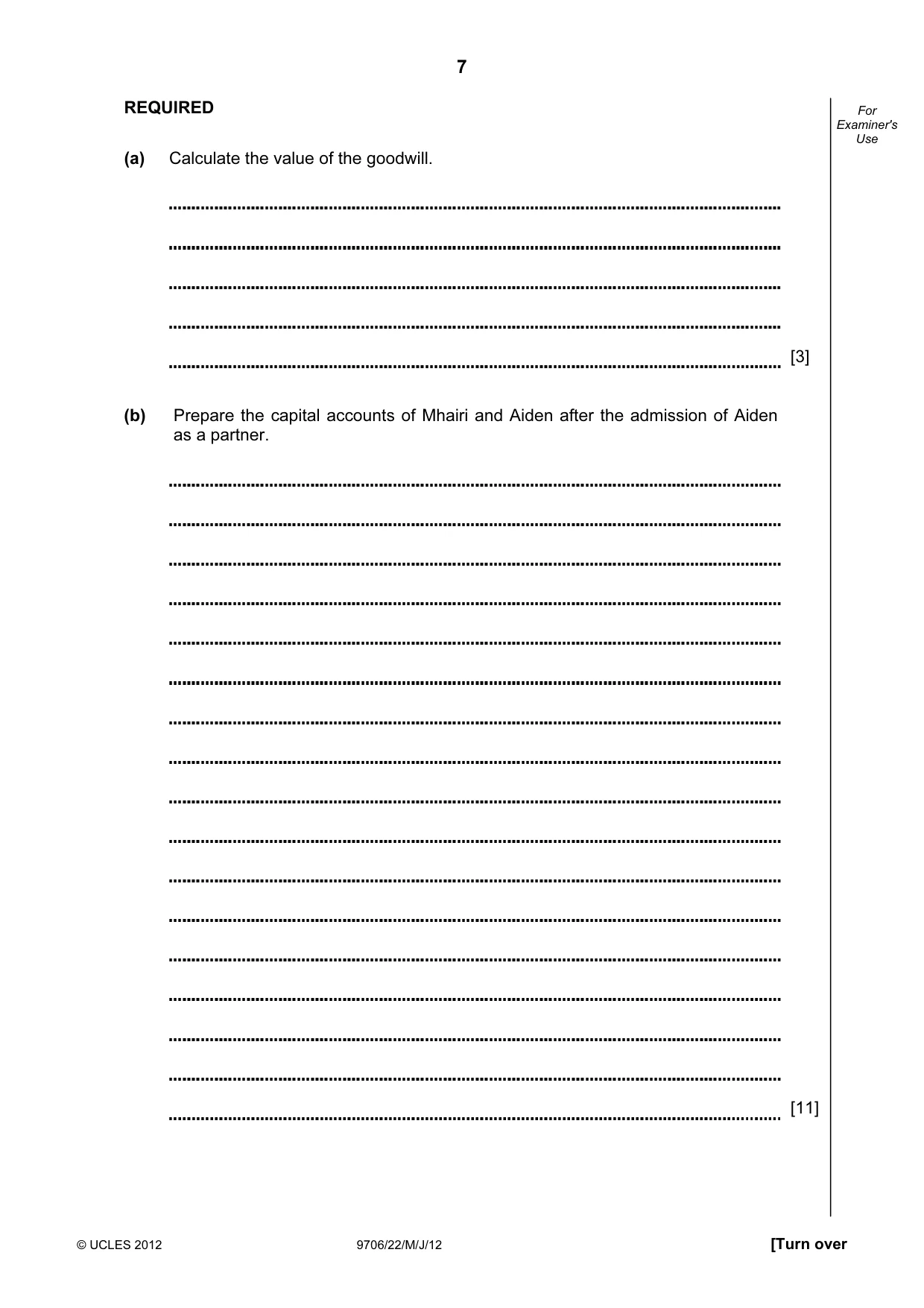
7 © UCLES 2012 9706/22/M/J/12 [Turn over For Examiner's Use REQUIRED (a) Calculate the value of the goodwill. [3] (b) Prepare the capital accounts of Mhairi and Aiden after the admission of Aiden as a partner. [11]
Question paper, page 8
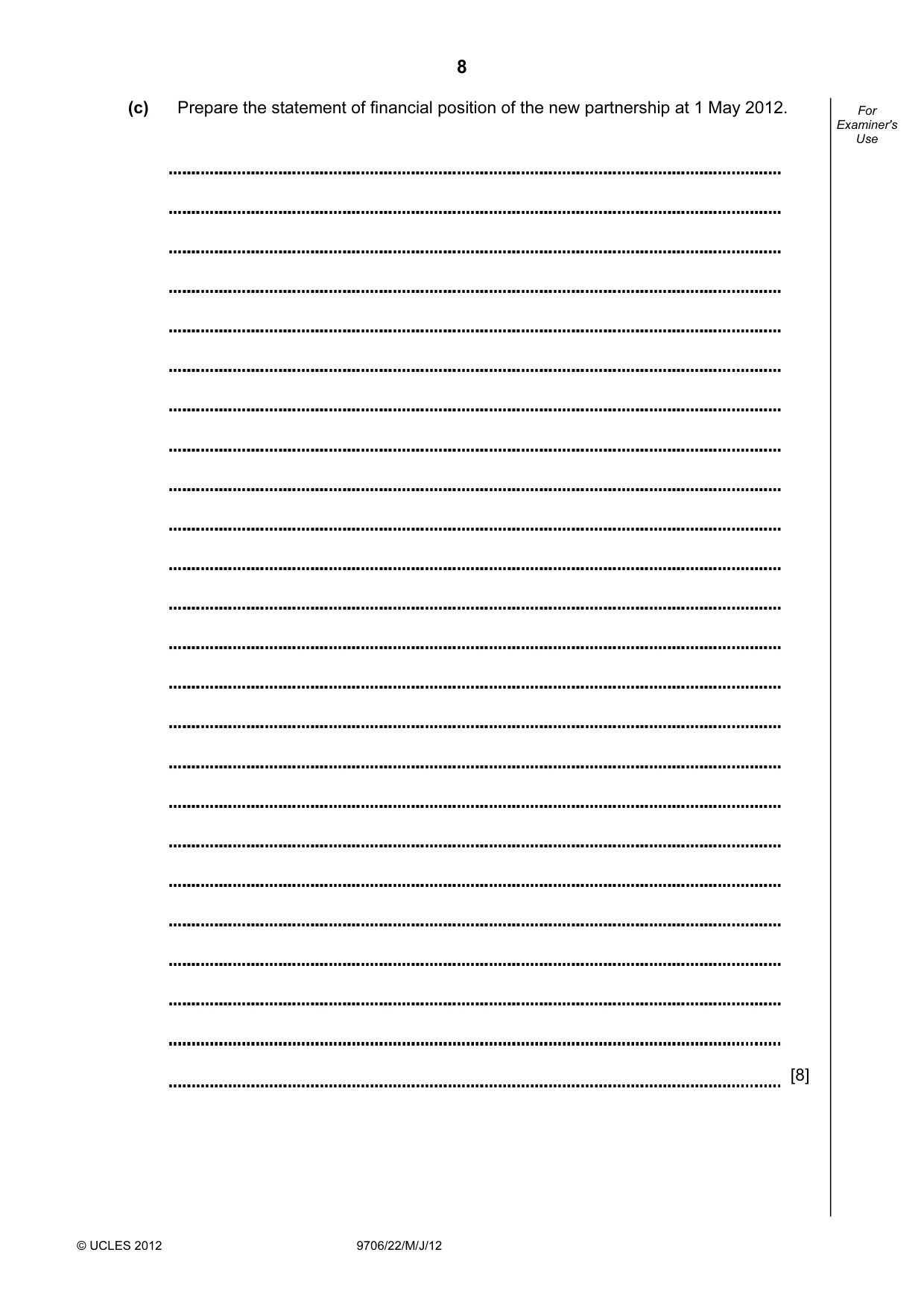
8 © UCLES 2012 9706/22/M/J/12 For Examiner's Use (c) Prepare the statement of financial position of the new partnership at 1 May 2012. [8]
Question paper, page 9
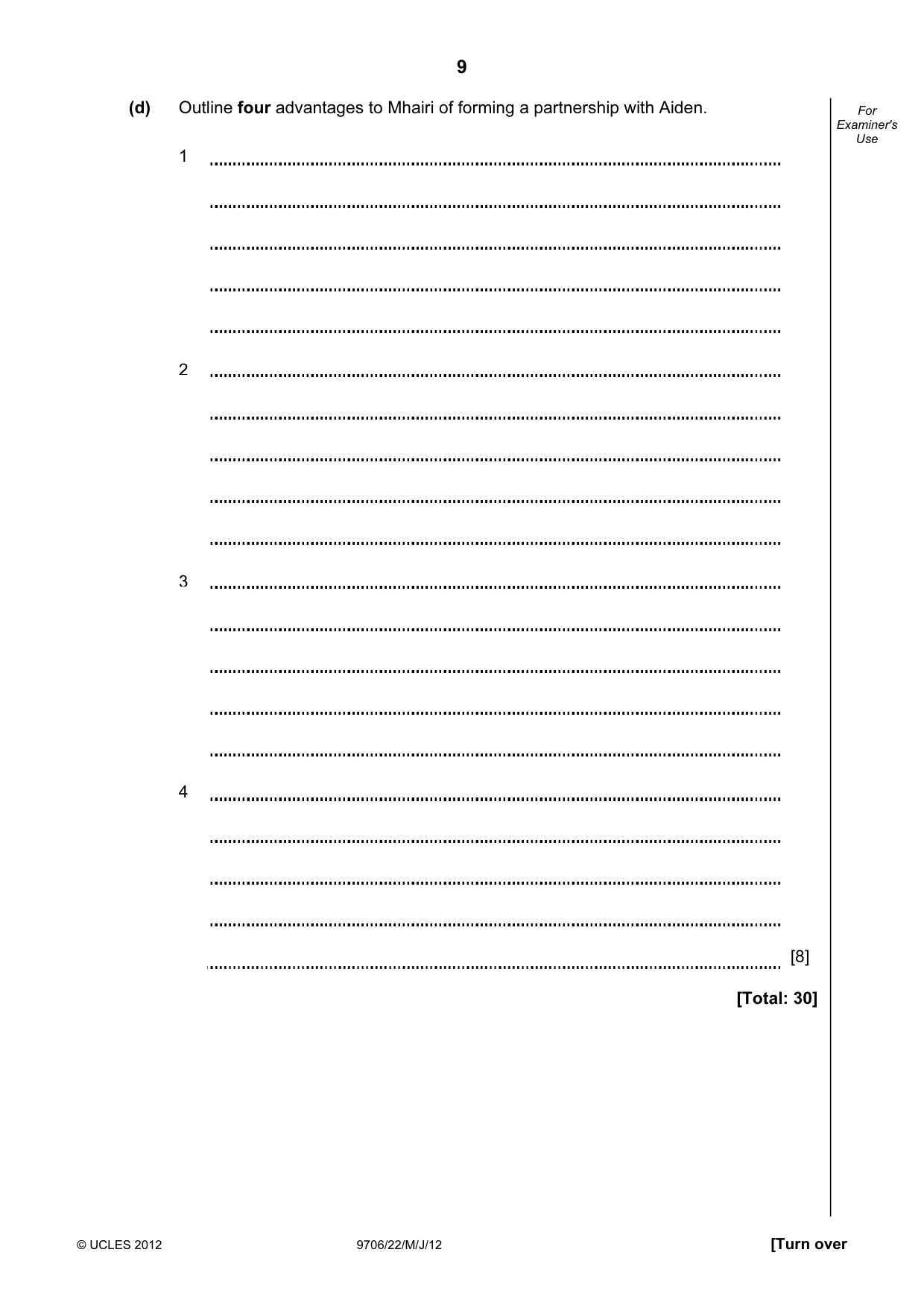
9 © UCLES 2012 9706/22/M/J/12 [Turn over For Examiner's Use (d) Outline four advantages to Mhairi of forming a partnership with Aiden. 1 2 3 4 [8] [Total: 30]
Question paper, page 10
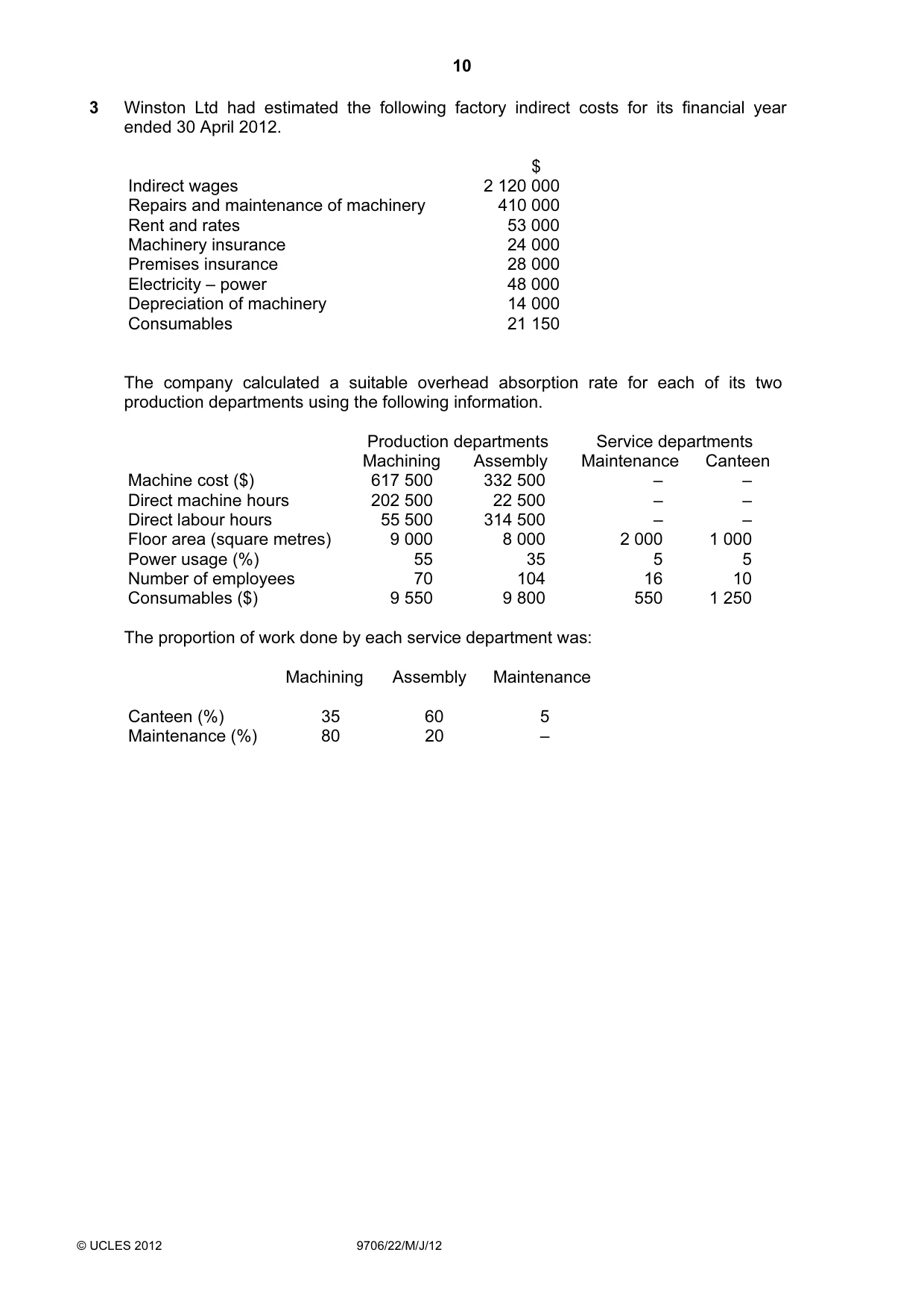
10 © UCLES 2012 9706/22/M/J/12 3 Winston Ltd had estimated the following factory indirect costs for its financial year ended 30 April 2012. $ Indirect wages 2 120 000 Repairs and maintenance of machinery 410 000 Rent and rates 53 000 Machinery insurance 24 000 Premises insurance 28 000 Electricity – power 48 000 Depreciation of machinery 14 000 Consumables 21 150 The company calculated a suitable overhead absorption rate for each of its two production departments using the following information. Production departments Service departments Machining Assembly Maintenance Canteen Machine cost ($) 617 500 332 500 – – Direct machine hours 202 500 22 500 – – Direct labour hours 55 500 314 500 – – Floor area (square metres) 9 000 8 000 2 000 1 000 Power usage (%) 55 35 5 5 Number of employees 70 104 16 10 Consumables ($) 9 550 9 800 550 1 250 The proportion of work done by each service department was: Machining Assembly Maintenance Canteen (%) 35 60 5 Maintenance (%) 80 20 –
Question paper, page 11
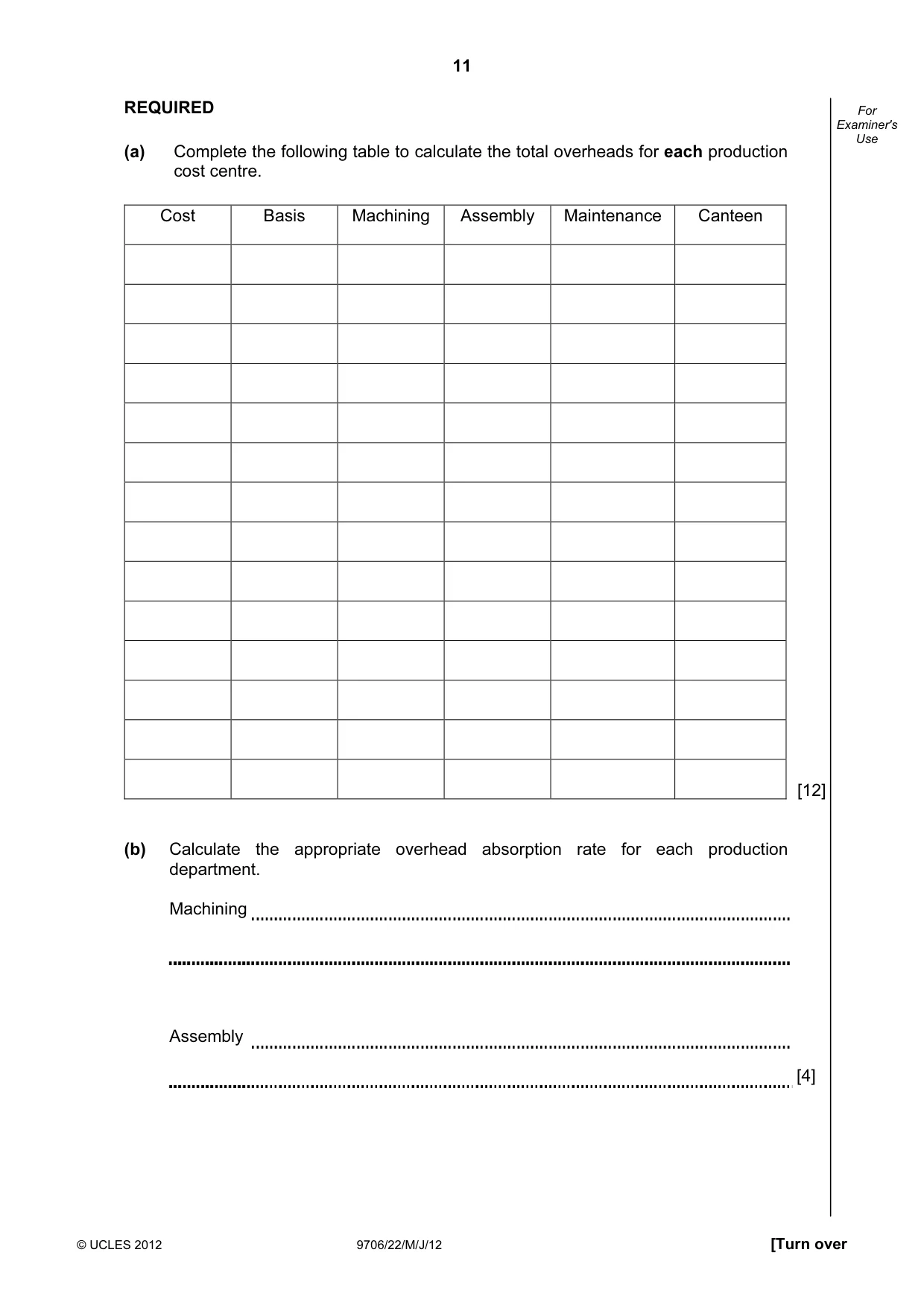
11 © UCLES 2012 9706/22/M/J/12 [Turn over For Examiner's Use REQUIRED (a) Complete the following table to calculate the total overheads for each production cost centre. Cost Basis Machining Assembly Maintenance Canteen [12] (b) Calculate the appropriate overhead absorption rate for each production department. Machining Assembly [4]
Question paper, page 12
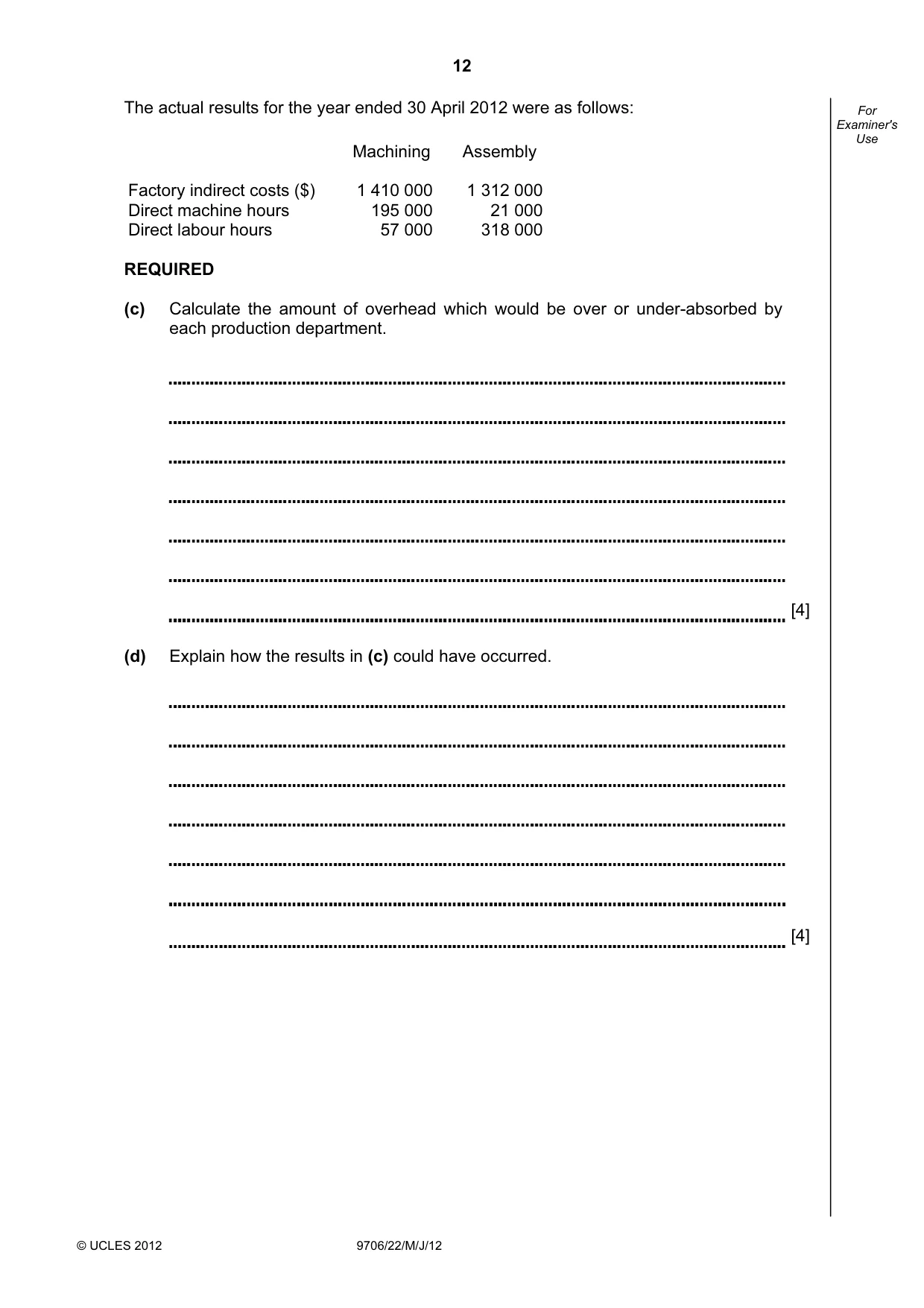
12 © UCLES 2012 9706/22/M/J/12 For Examiner's Use The actual results for the year ended 30 April 2012 were as follows: Machining Assembly Factory indirect costs ($) 1 410 000 1 312 000 Direct machine hours 195 000 21 000 Direct labour hours 57 000 318 000 REQUIRED (c) Calculate the amount of overhead which would be over or under-absorbed by each production department. [4] (d) Explain how the results in (c) could have occurred. [4]
Question paper, page 13
13 © UCLES 2012 9706/22/M/J/12 For Examiner's Use (e) Explain the problems associated with using predetermined overhead absorption rates in calculating the price of a product. [6] [Total: 30]
Question paper, page 14
14 © UCLES 2012 9706/22/M/J/12 BLANK PAGE
Question paper, page 15
15 © UCLES 2012 9706/22/M/J/12 BLANK PAGE
Question paper, page 16
16 Permission to reproduce items where third-party owned material protected by copyright is included has been sought and cleared where possible. Every reasonable effort has been made by the publisher (UCLES) to trace copyright holders, but if any items requiring clearance have unwittingly been included, the publisher will be pleased to make amends at the earliest possible opportunity. University of Cambridge International Examinations is part of the Cambridge Assessment Group. Cambridge Assessment is the brand name of University of Cambridge Local Examinations Syndicate (UCLES), which is itself a department of the University of Cambridge. © UCLES 2012 9706/22/M/J/12 BLANK PAGE
Mark scheme, page 1
UNIVERSITY OF CAMBRIDGE INTERNATIONAL EXAMINATIONS GCE Advanced Subsidiary Level and GCE Advanced Level MARK SCHEME for the May/June 2012 question paper for the guidance of teachers 9706 ACCOUNTING 9706/22 Paper 2 (Structured Questions – Core), maximum raw mark 90 This mark scheme is published as an aid to teachers and candidates, to indicate the requirements of the examination. It shows the basis on which Examiners were instructed to award marks. It does not indicate the details of the discussions that took place at an Examiners’ meeting before marking began, which would have considered the acceptability of alternative answers. Mark schemes must be read in conjunction with the question papers and the report on the examination. • Cambridge will not enter into discussions or correspondence in connection with these mark schemes. Cambridge is publishing the mark schemes for the May/June 2012 question papers for most IGCSE, GCE Advanced Level and Advanced Subsidiary Level syllabuses and some Ordinary Level syllabuses.
Mark scheme, page 2
Page 2 Mark Scheme: Teachers’ version Syllabus Paper GCE AS/A LEVEL – May/June 2012 9706 22 © University of Cambridge International Examinations 2012 1 (a) Manufacturing Account for the year ended 30 April 2012 Raw Materials $ $ Inventory (1.05.11) 20 000 1 Add Purchases of raw materials 238 000 1 Less Purchase returns 10 000 1 228 000 248 000 Less Inventory (30.04.12) 56 000 1 Cost of raw materials consumed 192 000 1 Direct costs Manufacturing wages 265 000 1 Prime cost 457 000 1 Factory Overhead Indirect factory wages (46 + 5) 51 000 2 Insurance (14 – 7) × 70% 4 900 2 General expenses 6 000 Factory supervision salaries 15 000 1 Heat and light 6 000 × 80% 4 800 2 Depreciation (260 – 60) × 20% 40 000 2 121 700 578 700 Work-in-progress Add inventory (1.05.11) 52 000 1 Less inventory (30.4.12) 58 000 1 (6 000) Factory cost of production 1OF 572 700 [19] If Depreciation on Factory Premises, $120 000 is included, ignore it. Factory cost of production will now be $692 700 if all else is correct. (b) Income Statement for the year ended 30 April 2012 Sales 799 000 Less Cost of Sales Inventory of finished goods (1.05.11) 78 000 Transfer value of finished goods 572 700 1OF 650 700 Less inventory of finished goods (30.04.12) 72 000 578 700 Gross profit 220 300 1OF Decrease in provision DD 800 1 221 100 Insurance 2 100 1 Heat and light 1 200 1 Admin expenses 33 000 Office salaries 55 000 1 Depreciation 20 800 1 112 100 Net profit 109 000 1OF [8]
Mark scheme, page 3
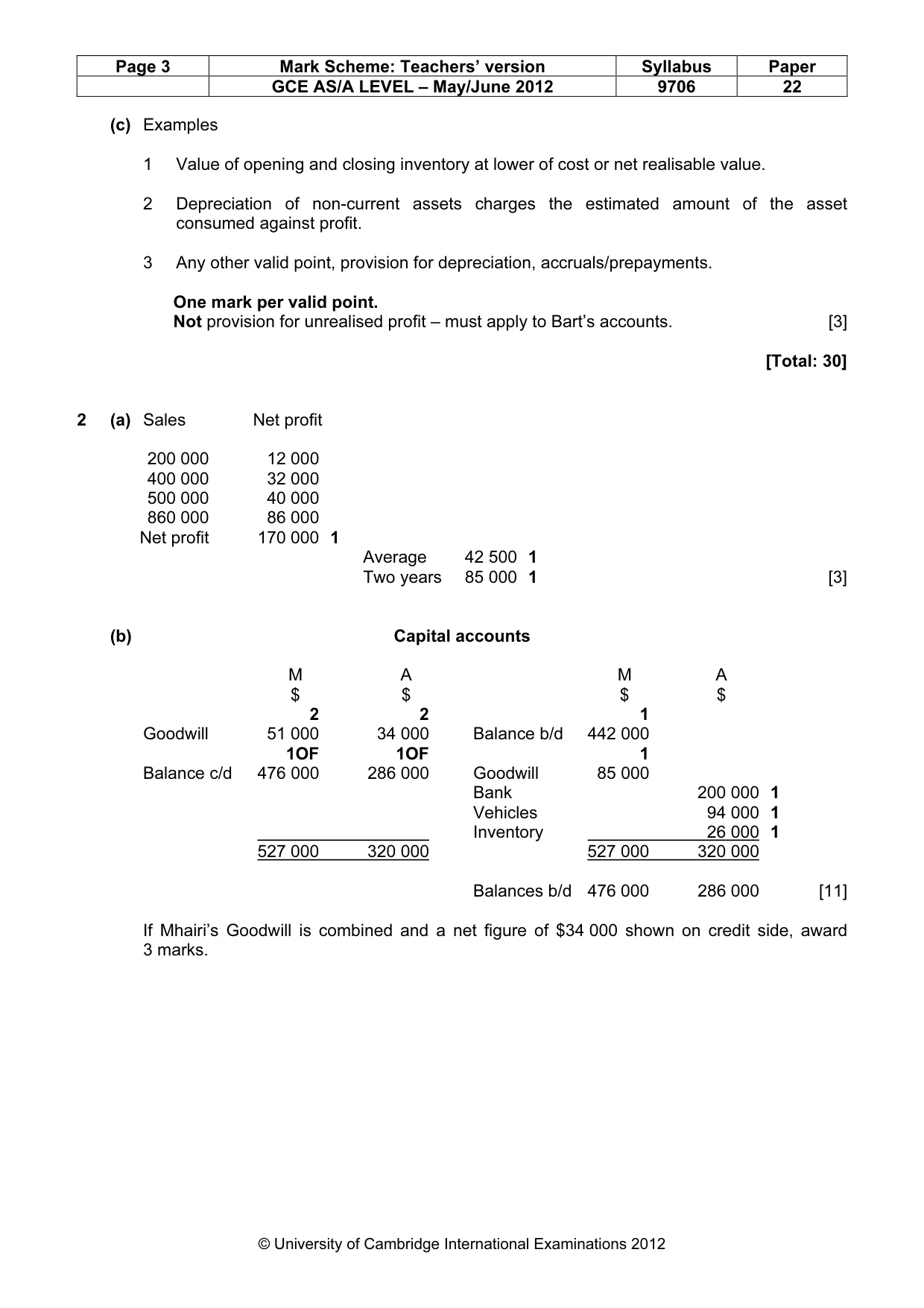
Page 3 Mark Scheme: Teachers’ version Syllabus Paper GCE AS/A LEVEL – May/June 2012 9706 22 © University of Cambridge International Examinations 2012 (c) Examples 1 Value of opening and closing inventory at lower of cost or net realisable value. 2 Depreciation of non-current assets charges the estimated amount of the asset consumed against profit. 3 Any other valid point, provision for depreciation, accruals/prepayments. One mark per valid point. Not provision for unrealised profit – must apply to Bart’s accounts. [3] [Total: 30] 2 (a) Sales Net profit 200 000 12 000 400 000 32 000 500 000 40 000 860 000 86 000 Net profit 170 000 1 Average 42 500 1 Two years 85 000 1 [3] (b) Capital accounts M A M A $ $ $ $ 2 2 1 Goodwill 51 000 34 000 Balance b/d 442 000 1OF 1OF 1 Balance c/d 476 000 286 000 Goodwill 85 000 Bank 200 000 1 Vehicles 94 000 1 Inventory 26 000 1 527 000 320 000 527 000 320 000 Balances b/d 476 000 286 000 [11] If Mhairi’s Goodwill is combined and a net figure of $34 000 shown on credit side, award 3 marks.
Mark scheme, page 4
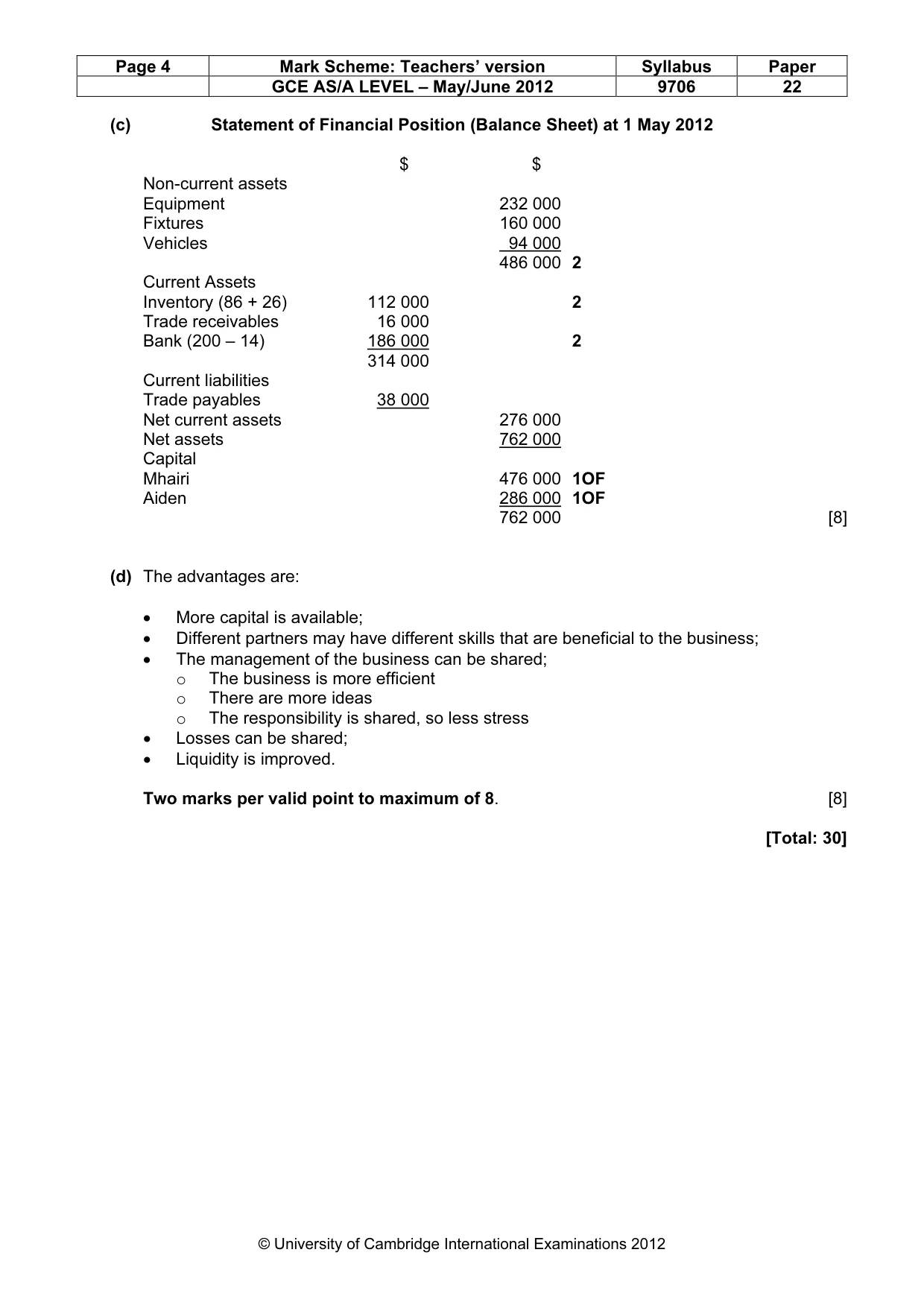
Page 4 Mark Scheme: Teachers’ version Syllabus Paper GCE AS/A LEVEL – May/June 2012 9706 22 © University of Cambridge International Examinations 2012 (c) Statement of Financial Position (Balance Sheet) at 1 May 2012 $ $ Non-current assets Equipment 232 000 Fixtures 160 000 Vehicles 94 000 486 000 2 Current Assets Inventory (86 + 26) 112 000 2 Trade receivables 16 000 Bank (200 – 14) 186 000 2 314 000 Current liabilities Trade payables 38 000 Net current assets 276 000 Net assets 762 000 Capital Mhairi 476 000 1OF Aiden 286 000 1OF 762 000 [8] (d) The advantages are: • More capital is available; • Different partners may have different skills that are beneficial to the business; • The management of the business can be shared; o The business is more efficient o There are more ideas o The responsibility is shared, so less stress • Losses can be shared; • Liquidity is improved. Two marks per valid point to maximum of 8. [8] [Total: 30]
Mark scheme, page 5
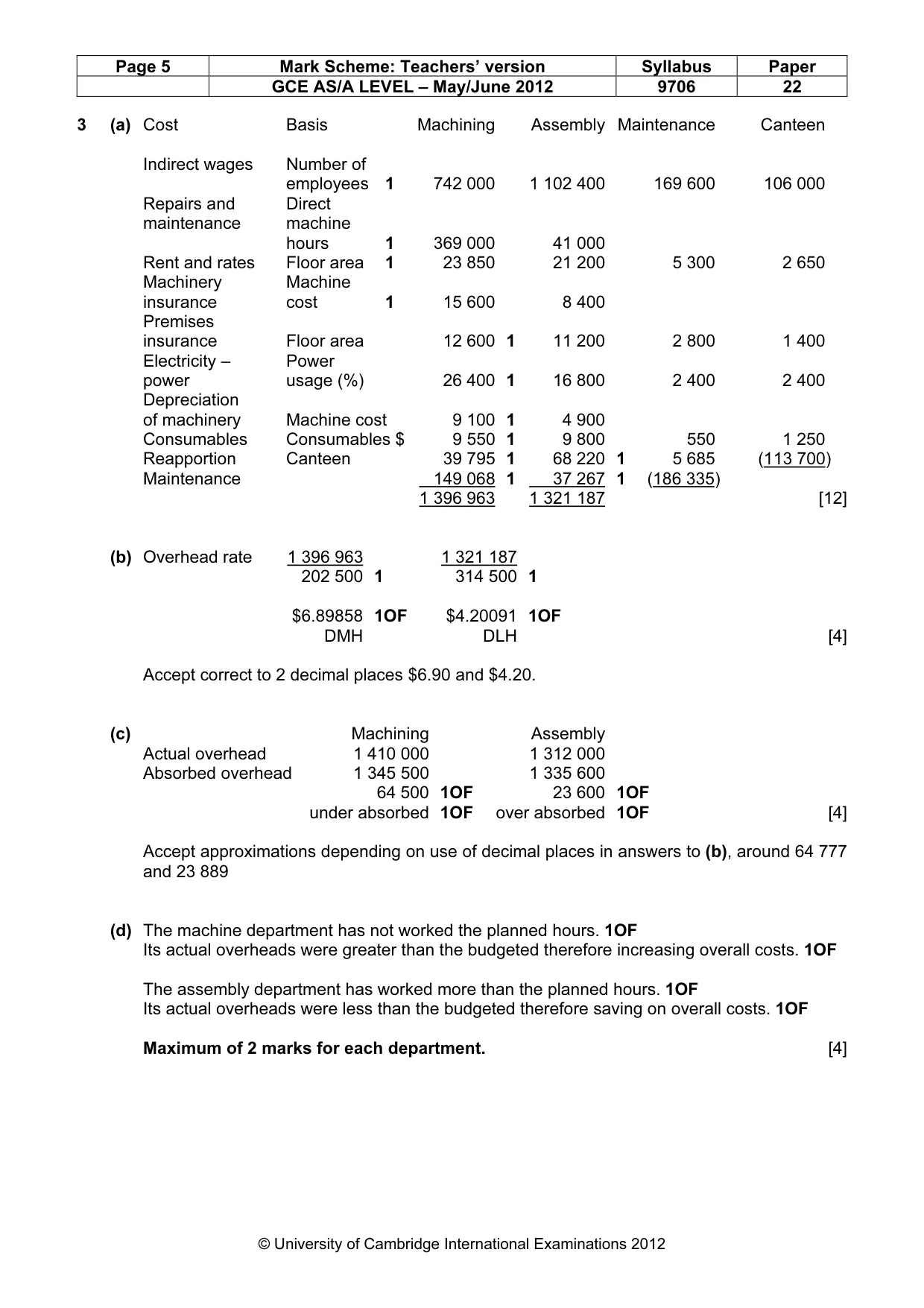
Page 5 Mark Scheme: Teachers’ version Syllabus Paper GCE AS/A LEVEL – May/June 2012 9706 22 © University of Cambridge International Examinations 2012 3 (a) Cost Basis Machining Assembly Maintenance Canteen Indirect wages Number of employees 1 742 000 1 102 400 169 600 106 000 Repairs and Direct maintenance machine hours 1 369 000 41 000 Rent and rates Floor area 1 23 850 21 200 5 300 2 650 Machinery Machine insurance cost 1 15 600 8 400 Premises insurance Floor area 12 600 1 11 200 2 800 1 400 Electricity – Power power usage (%) 26 400 1 16 800 2 400 2 400 Depreciation of machinery Machine cost 9 100 1 4 900 Consumables Consumables $ 9 550 1 9 800 550 1 250 Reapportion Canteen 39 795 1 68 220 1 5 685 (113 700) Maintenance 149 068 1 37 267 1 (186 335) 1 396 963 1 321 187 [12] (b) Overhead rate 1 396 963 1 321 187 202 500 1 314 500 1 $6.89858 1OF $4.20091 1OF DMH DLH [4] Accept correct to 2 decimal places $6.90 and $4.20. (c) Machining Assembly Actual overhead 1 410 000 1 312 000 Absorbed overhead 1 345 500 1 335 600 64 500 1OF 23 600 1OF under absorbed 1OF over absorbed 1OF [4] Accept approximations depending on use of decimal places in answers to (b), around 64 777 and 23 889 (d) The machine department has not worked the planned hours. 1OF Its actual overheads were greater than the budgeted therefore increasing overall costs. 1OF The assembly department has worked more than the planned hours. 1OF Its actual overheads were less than the budgeted therefore saving on overall costs. 1OF Maximum of 2 marks for each department. [4]
Mark scheme, page 6
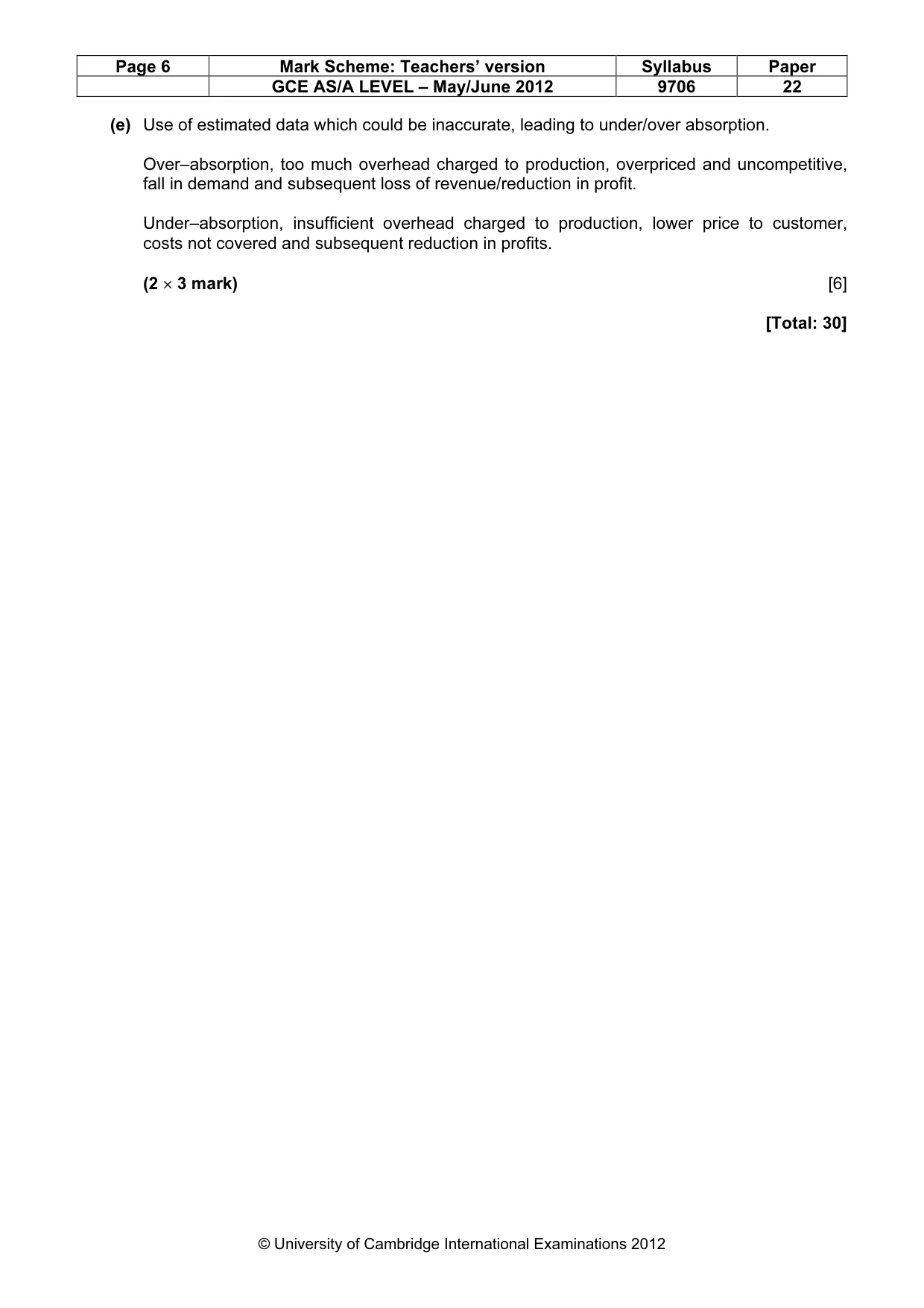
Page 6 Mark Scheme: Teachers’ version Syllabus Paper GCE AS/A LEVEL – May/June 2012 9706 22 © University of Cambridge International Examinations 2012 (e) Use of estimated data which could be inaccurate, leading to under/over absorption. Over–absorption, too much overhead charged to production, overpriced and uncompetitive, fall in demand and subsequent loss of revenue/reduction in profit. Under–absorption, insufficient overhead charged to production, lower price to customer, costs not covered and subsequent reduction in profits. (2 × 3 mark) [6] [Total: 30]
What you needed in this session
Cambridge’s own grade thresholds for 2012 May/June, Paper 2 · Variant 2. A higher threshold means an easier paper — the bar moves with how the cohort did.