Cambridge A Level Accounting 9706 — 2011 May/June Paper 2 · Variant 3
9706/23/M/J/11 · 90 marks · ≈101 min
The question paper and its mark scheme, free to read here and free to download. This is Cambridge’s own paper, exactly as it was sat.
Question paper16 pages
Mark scheme6 pages
Answers below. Sit the paper first if you are practising.
Paper as text
Question paper, page 1
This document consists of 14 printed pages and 2 blank pages. DC (NH) 31868/4 © UCLES 2011 [Turn over UNIVERSITY OF CAMBRIDGE INTERNATIONAL EXAMINATIONS General Certificate of Education Advanced Subsidiary Level and Advanced Level * 8 3 8 8 0 9 8 3 9 3 * ACCOUNTING 9706/23 Paper 2 Structured Questions May/June 2011 1 hour 30 minutes Candidates answer on the Question Paper. No Additional Materials are required. READ THESE INSTRUCTIONS FIRST Write your Centre number, candidate number and name on all the work you hand in. Write in dark blue or black pen. You may use a soft pencil for rough working. Do not use staples, paper clips, highlighters, glue or correction fluid. DO NOT WRITE IN ANY BARCODES. Answer all questions. All accounting statements are to be presented in good style. International accounting terms and formats should be used as appropriate. Workings must be shown. You may use a calculator. At the end of the examination, fasten all your work securely together. The number of marks is given in brackets [ ] at the end of each question or part question. For Examiner’s Use 1 2 3 Total
Question paper, page 2
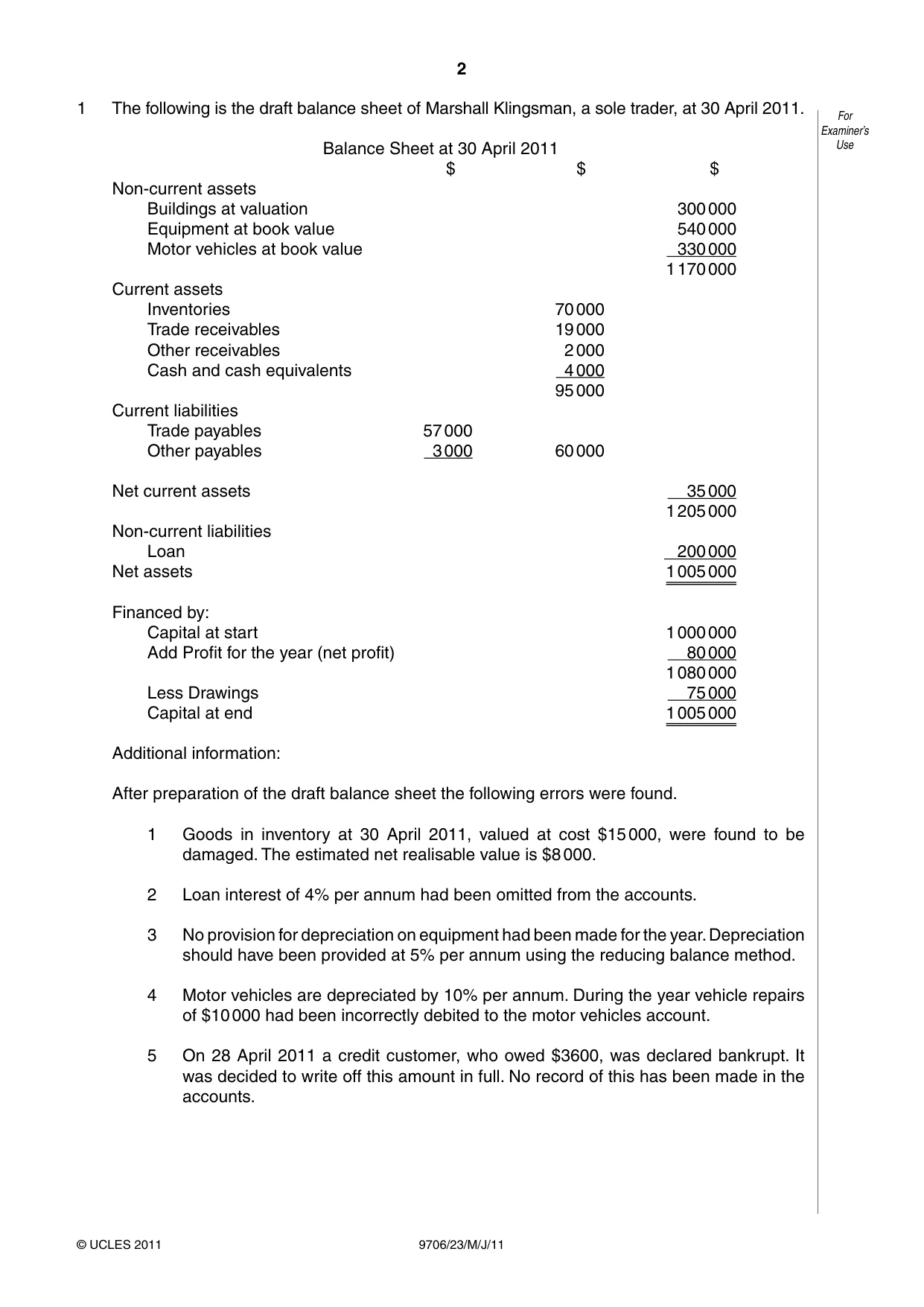
2 9706/23/M/J/11 © UCLES 2011 For Examiner’s Use 1 The following is the draft balance sheet of Marshall Klingsman, a sole trader, at 30 April 2011. Balance Sheet at 30 April 2011 $ $ $ Non-current assets Buildings at valuation 300 000 Equipment at book value 540 000 Motor vehicles at book value 330 000 1 170 000 Current assets Inventories 70 000 Trade receivables 19 000 Other receivables 2 000 Cash and cash equivalents 4 000 95 000 Current liabilities Trade payables 57 000 Other payables 3 000 60 000 Net current assets 35 000 1 205 000 Non-current liabilities Loan 200 000 Net assets 1 005 000 Financed by: Capital at start 1 000 000 Add Profit for the year (net profit) 80 000 1 080 000 Less Drawings 75 000 Capital at end 1 005 000 Additional information: After preparation of the draft balance sheet the following errors were found. 1 Goods in inventory at 30 April 2011, valued at cost $15 000, were found to be damaged. The estimated net realisable value is $8 000. 2 Loan interest of 4% per annum had been omitted from the accounts. 3 No provision for depreciation on equipment had been made for the year. Depreciation should have been provided at 5% per annum using the reducing balance method. 4 Motor vehicles are depreciated by 10% per annum. During the year vehicle repairs of $10 000 had been incorrectly debited to the motor vehicles account. 5 On 28 April 2011 a credit customer, who owed $3600, was declared bankrupt. It was decided to write off this amount in full. No record of this has been made in the accounts.
Question paper, page 3
3 9706/23/M/J/11 © UCLES 2011 [Turn over For Examiner’s Use REQUIRED (a) Prepare a statement to show the corrected profit for the year (net profit) ended 30 April 2011. … … … … … … … … … … … … … … … … … …[9]
Question paper, page 4
4 9706/23/M/J/11 © UCLES 2011 For Examiner’s Use (b) Prepare the corrected balance sheet at 30 April 2011. … … … … … … … … … … … … … … … … … … … … … … … … … … …[7]
Question paper, page 5
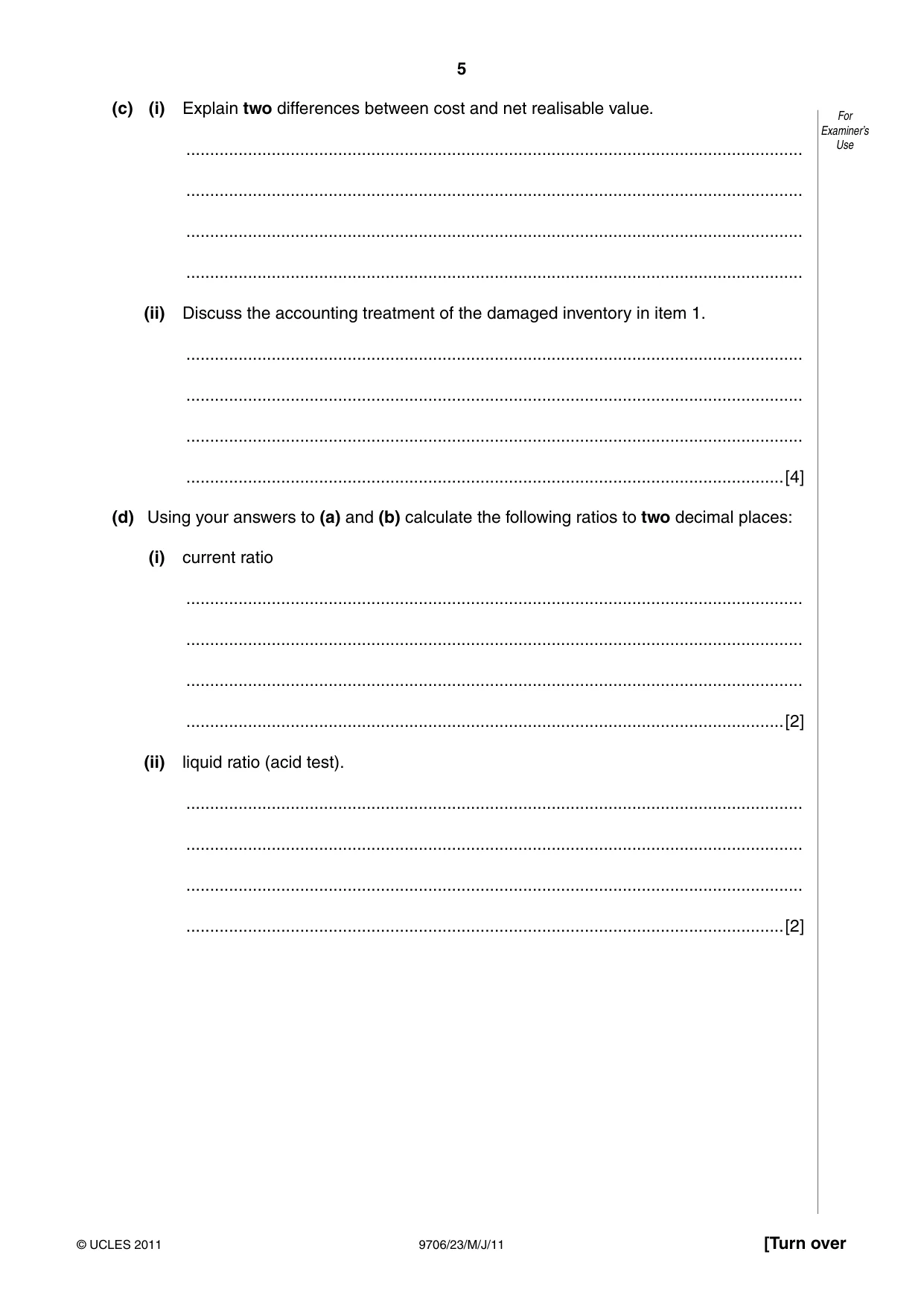
5 9706/23/M/J/11 © UCLES 2011 [Turn over For Examiner’s Use (c) (i) Explain two differences between cost and net realisable value. … … … … (ii) Discuss the accounting treatment of the damaged inventory in item 1. … … … …[4] (d) Using your answers to (a) and (b) calculate the following ratios to two decimal places: (i) current ratio … … … …[2] (ii) liquid ratio (acid test). … … … …[2]
Question paper, page 6
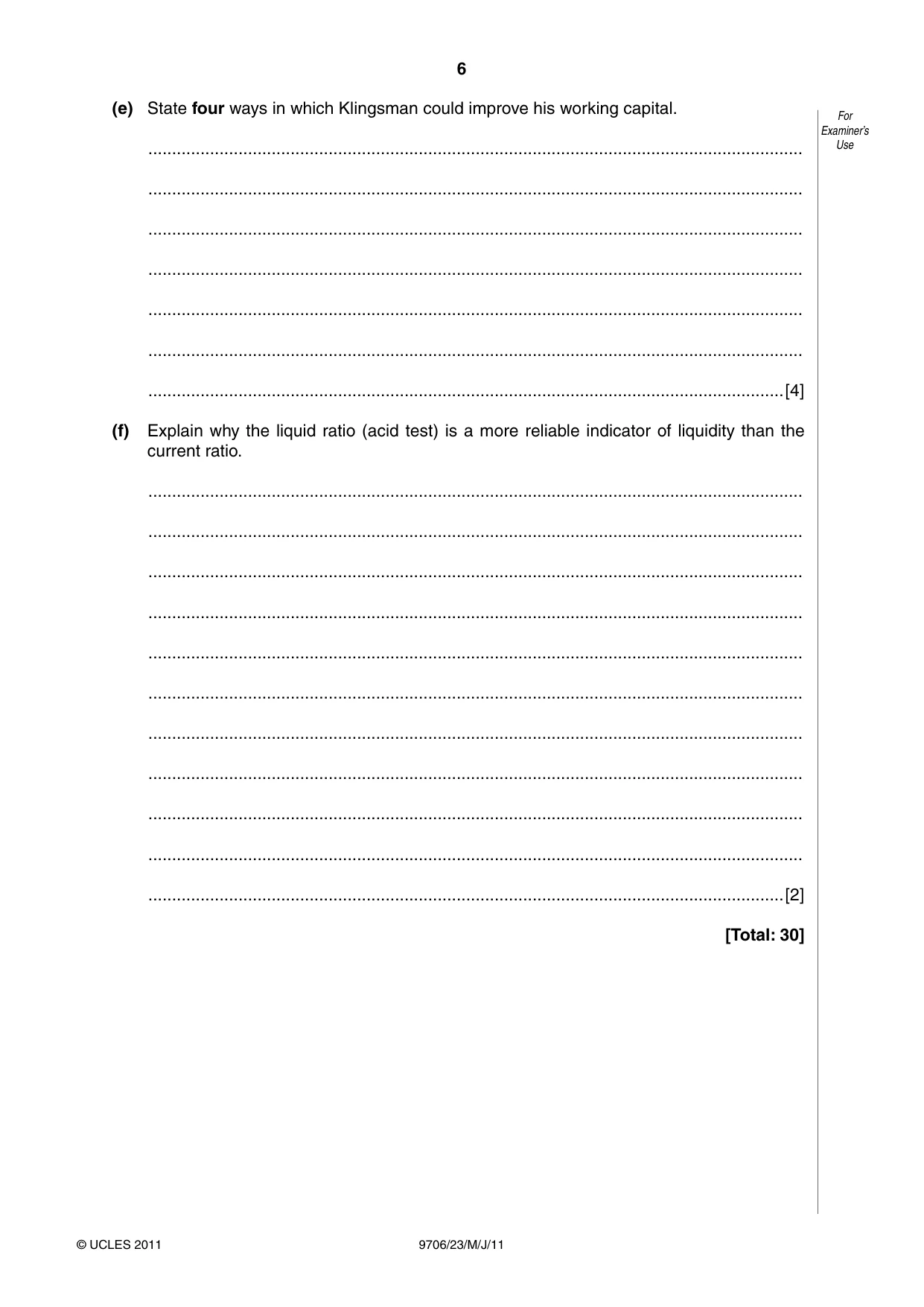
6 9706/23/M/J/11 © UCLES 2011 For Examiner’s Use (e) State four ways in which Klingsman could improve his working capital. … … … … … … …[4] (f) Explain why the liquid ratio (acid test) is a more reliable indicator of liquidity than the current ratio. … … … … … … … … … … …[2] [Total: 30]
Question paper, page 7
7 9706/23/M/J/11 © UCLES 2011 [Turn over BLANK PAGE Question 2 is on the next page.
Question paper, page 8
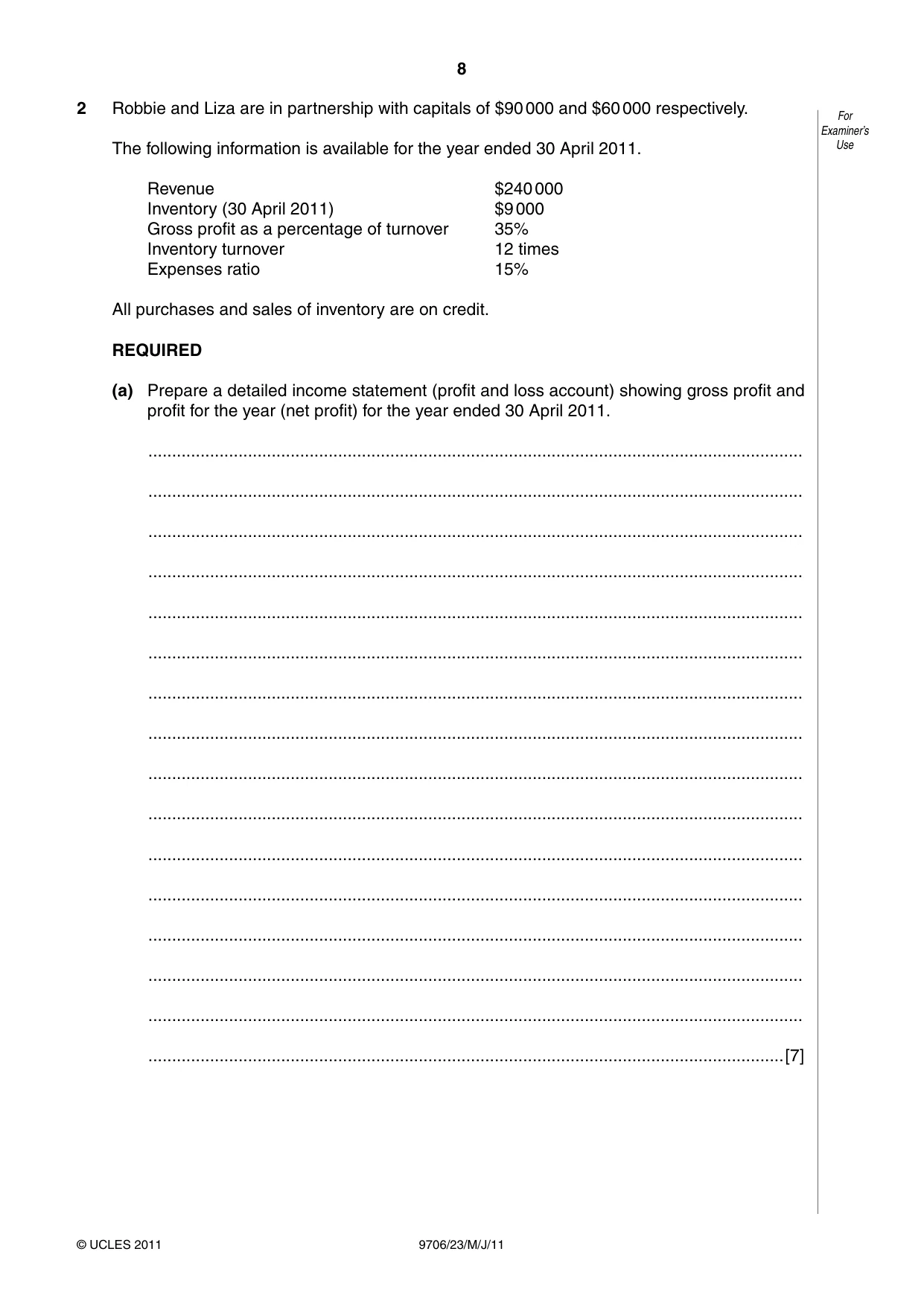
8 9706/23/M/J/11 © UCLES 2011 For Examiner’s Use 2 Robbie and Liza are in partnership with capitals of $90 000 and $60 000 respectively. The following information is available for the year ended 30 April 2011. Revenue $240 000 Inventory (30 April 2011) $9 000 Gross profit as a percentage of turnover 35% Inventory turnover 12 times Expenses ratio 15% All purchases and sales of inventory are on credit. REQUIRED (a) Prepare a detailed income statement (profit and loss account) showing gross profit and profit for the year (net profit) for the year ended 30 April 2011. … … … … … … … … … … … … … … … …[7]
Question paper, page 9
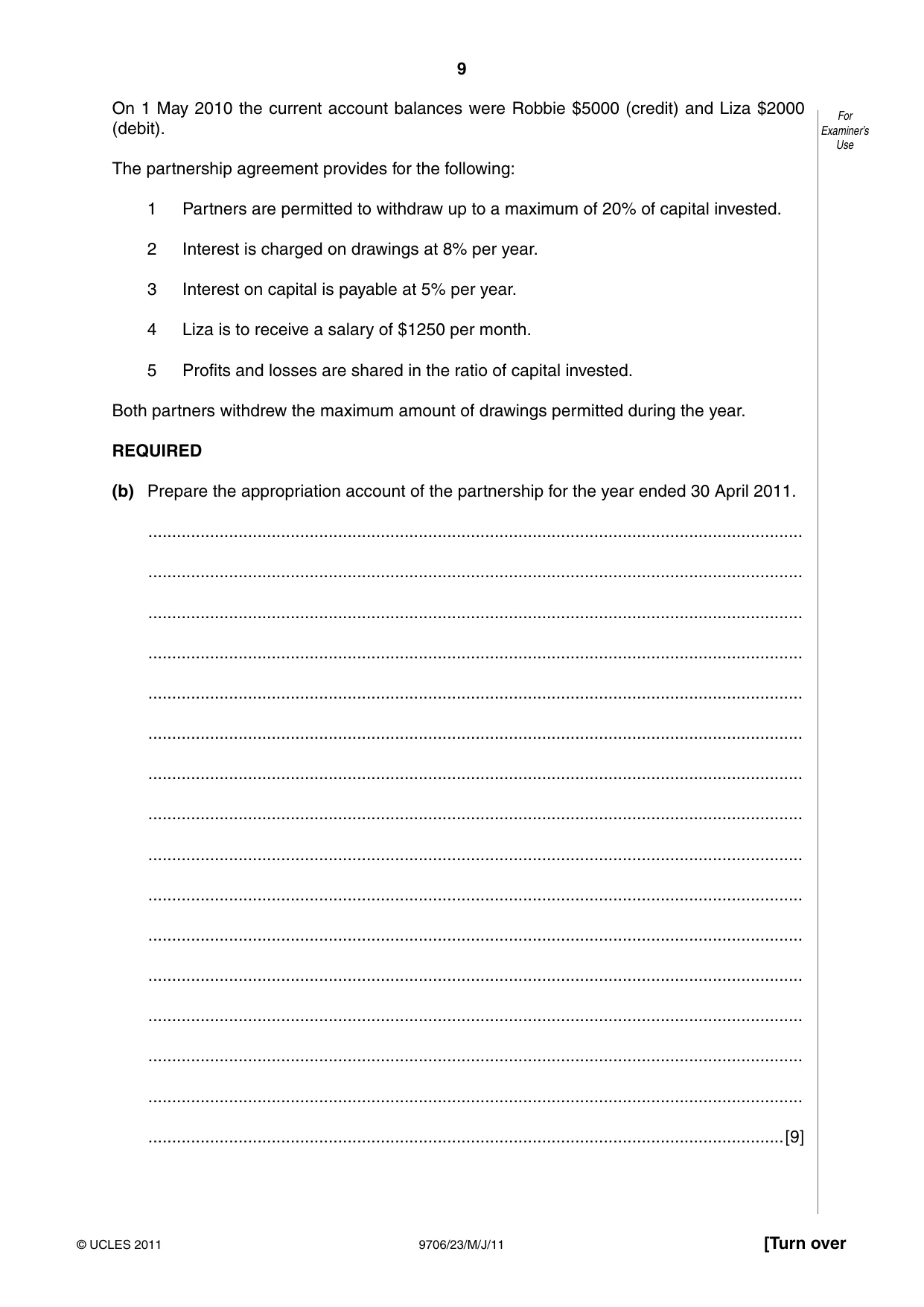
9 9706/23/M/J/11 © UCLES 2011 [Turn over For Examiner’s Use On 1 May 2010 the current account balances were Robbie $5000 (credit) and Liza $2000 (debit). The partnership agreement provides for the following: 1 Partners are permitted to withdraw up to a maximum of 20% of capital invested. 2 Interest is charged on drawings at 8% per year. 3 Interest on capital is payable at 5% per year. 4 Liza is to receive a salary of $1250 per month. 5 Profits and losses are shared in the ratio of capital invested. Both partners withdrew the maximum amount of drawings permitted during the year. REQUIRED (b) Prepare the appropriation account of the partnership for the year ended 30 April 2011. … … … … … … … … … … … … … … … …[9]
Question paper, page 10
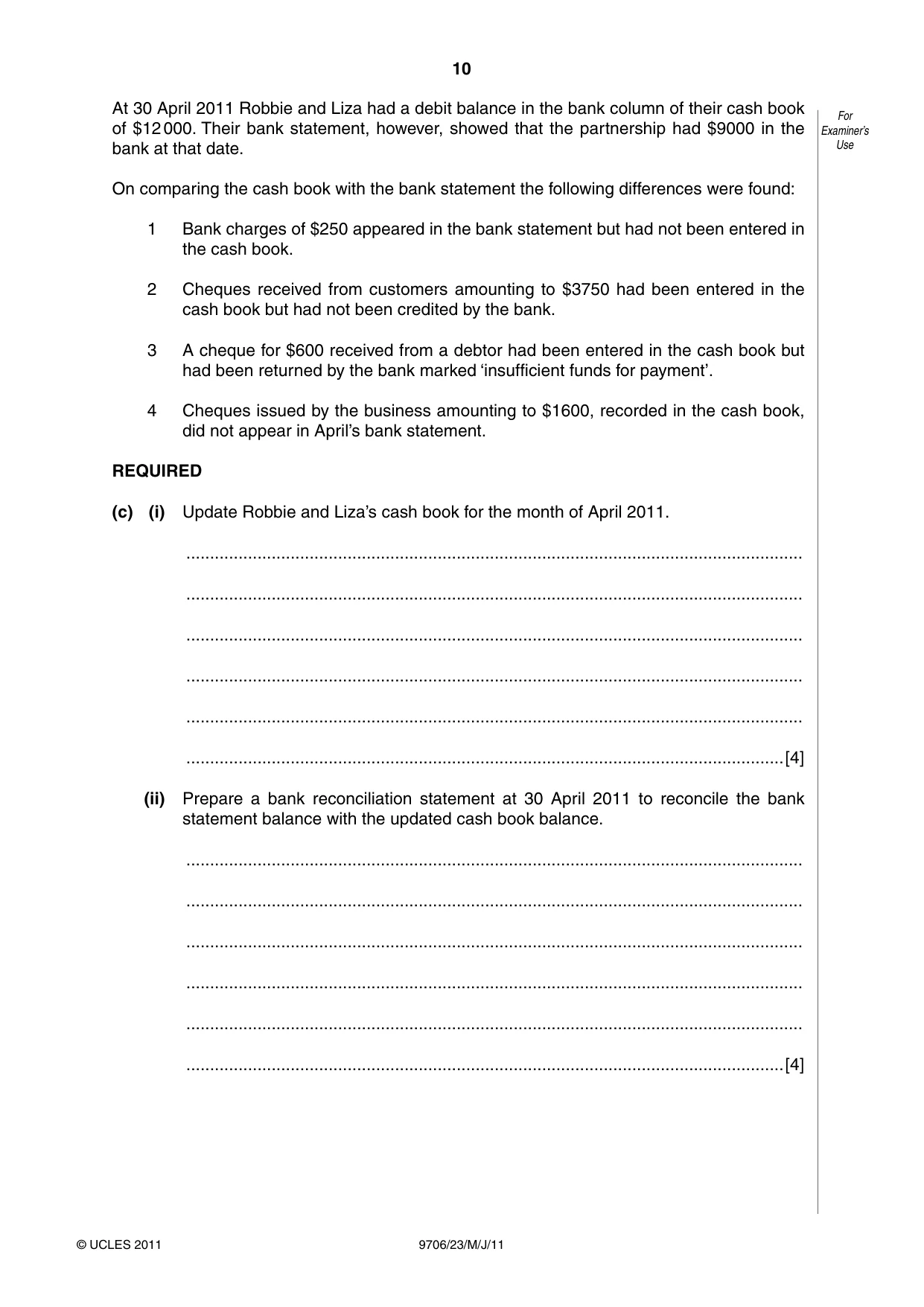
10 9706/23/M/J/11 © UCLES 2011 For Examiner’s Use At 30 April 2011 Robbie and Liza had a debit balance in the bank column of their cash book of $12 000. Their bank statement, however, showed that the partnership had $9000 in the bank at that date. On comparing the cash book with the bank statement the following differences were found: 1 Bank charges of $250 appeared in the bank statement but had not been entered in the cash book. 2 Cheques received from customers amounting to $3750 had been entered in the cash book but had not been credited by the bank. 3 A cheque for $600 received from a debtor had been entered in the cash book but had been returned by the bank marked ‘insufficient funds for payment’. 4 Cheques issued by the business amounting to $1600, recorded in the cash book, did not appear in April’s bank statement. REQUIRED (c) (i) Update Robbie and Liza’s cash book for the month of April 2011. … … … … … …[4] (ii) Prepare a bank reconciliation statement at 30 April 2011 to reconcile the bank statement balance with the updated cash book balance. … … … … … …[4]
Question paper, page 11
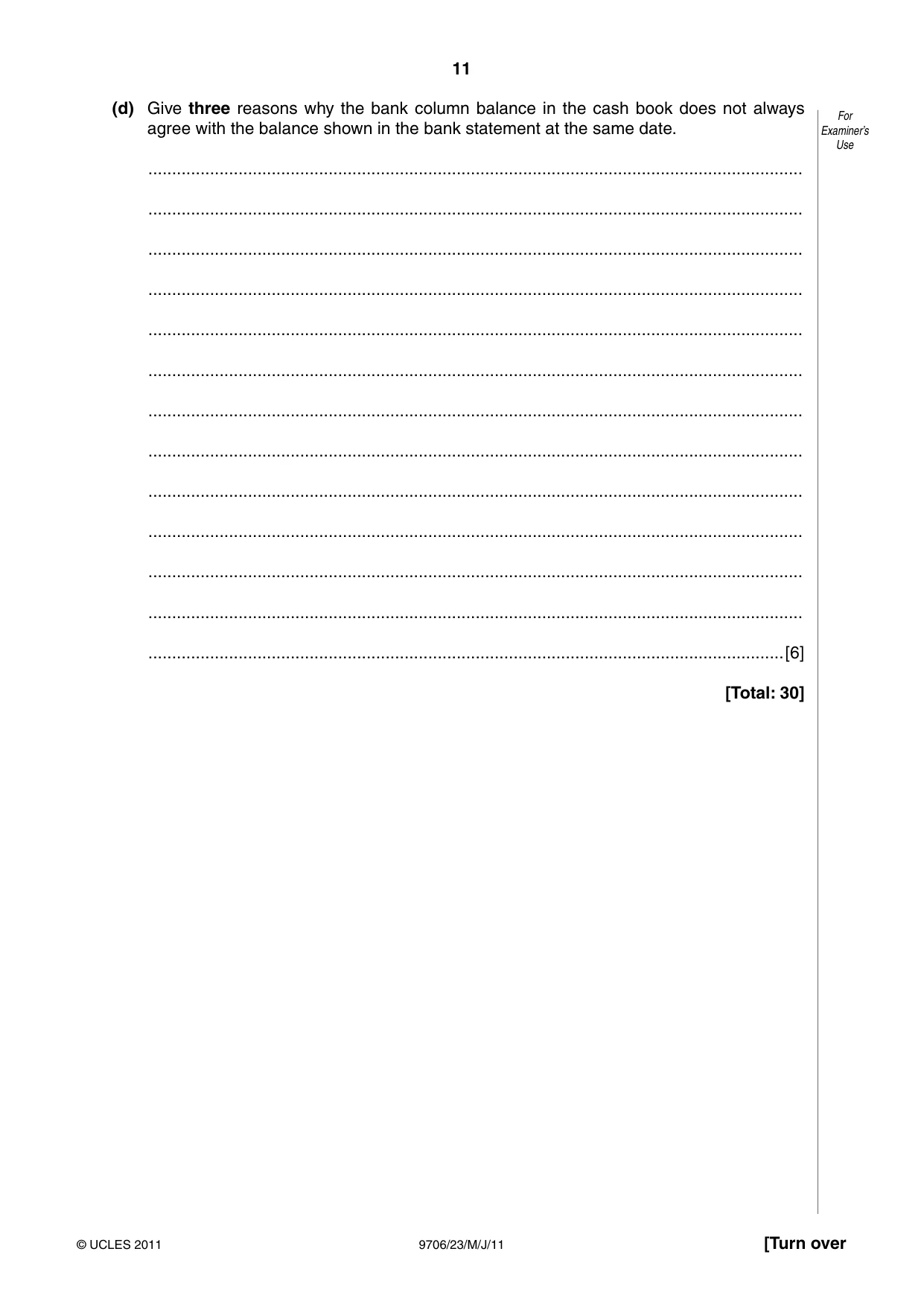
11 9706/23/M/J/11 © UCLES 2011 [Turn over For Examiner’s Use (d) Give three reasons why the bank column balance in the cash book does not always agree with the balance shown in the bank statement at the same date. … … … … … … … … … … … … …[6] [Total: 30]
Question paper, page 12
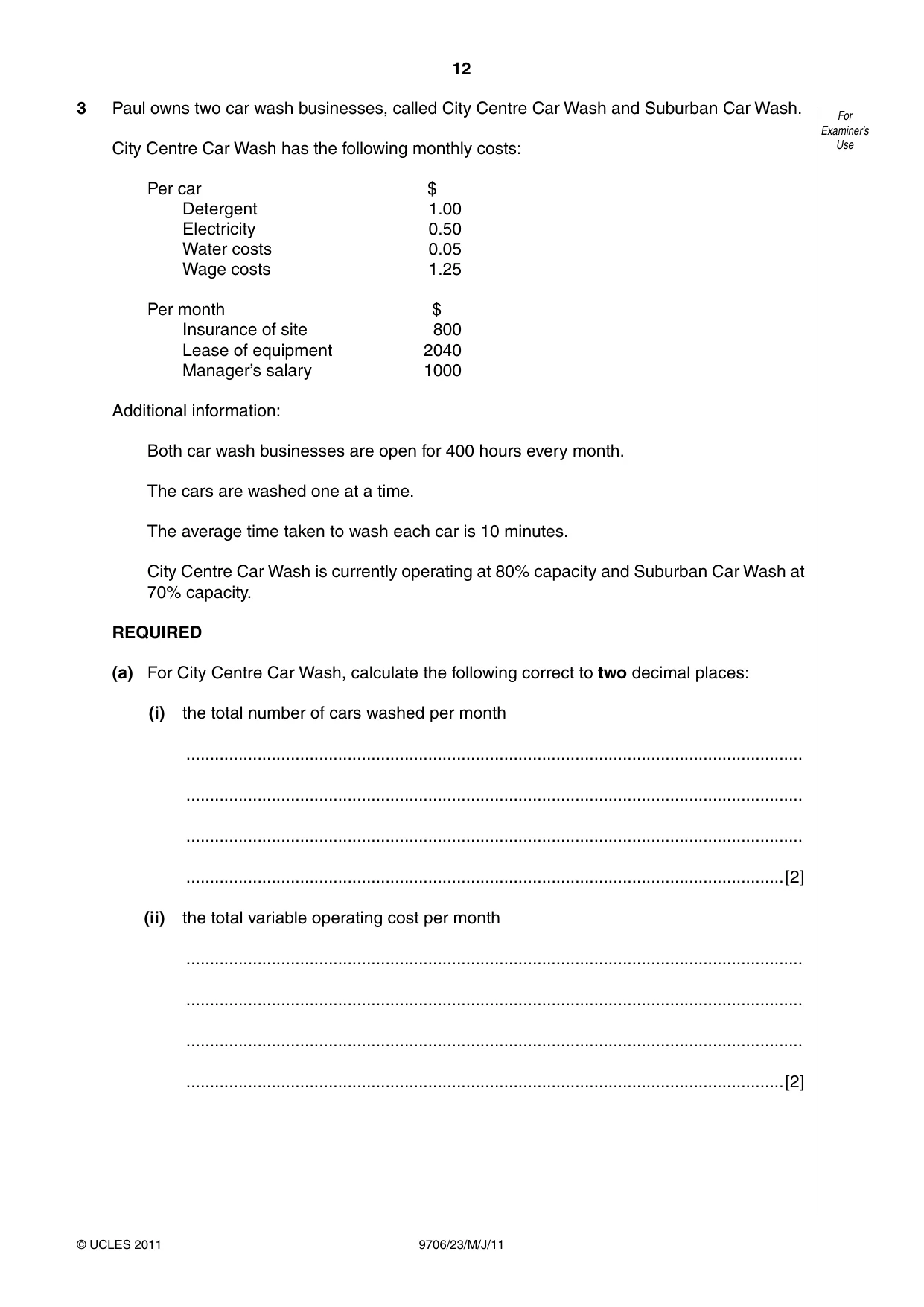
12 9706/23/M/J/11 © UCLES 2011 For Examiner’s Use 3 Paul owns two car wash businesses, called City Centre Car Wash and Suburban Car Wash. City Centre Car Wash has the following monthly costs: Per car $ Detergent 1.00 Electricity 0.50 Water costs 0.05 Wage costs 1.25 Per month $ Insurance of site 800 Lease of equipment 2040 Manager’s salary 1000 Additional information: Both car wash businesses are open for 400 hours every month. The cars are washed one at a time. The average time taken to wash each car is 10 minutes. City Centre Car Wash is currently operating at 80% capacity and Suburban Car Wash at 70% capacity. REQUIRED (a) For City Centre Car Wash, calculate the following correct to two decimal places: (i) the total number of cars washed per month … … … …[2] (ii) the total variable operating cost per month … … … …[2]
Question paper, page 13
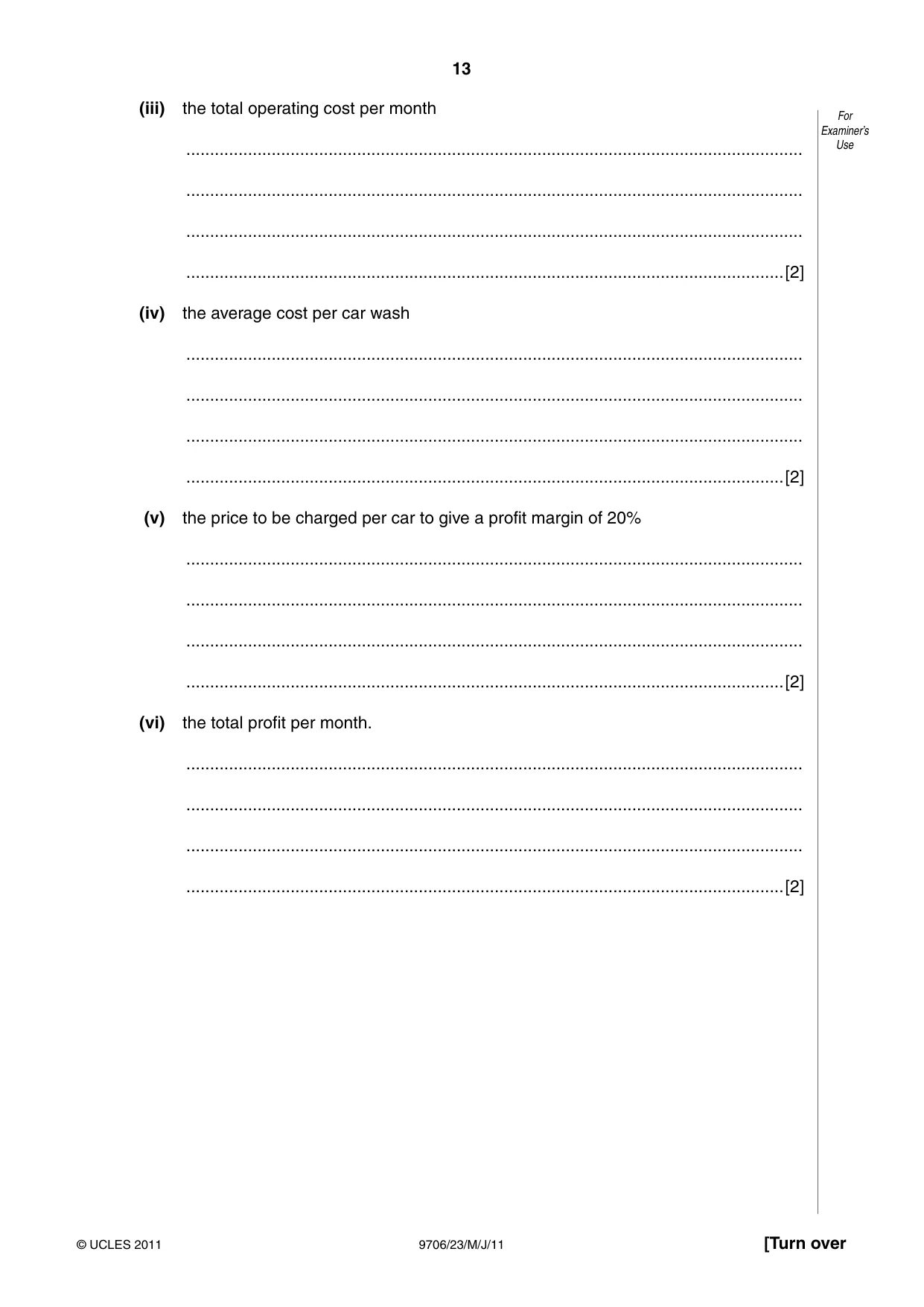
13 9706/23/M/J/11 © UCLES 2011 [Turn over For Examiner’s Use (iii) the total operating cost per month … … … …[2] (iv) the average cost per car wash … … … …[2] (v) the price to be charged per car to give a profit margin of 20% … … … …[2] (vi) the total profit per month. … … … …[2]
Question paper, page 14
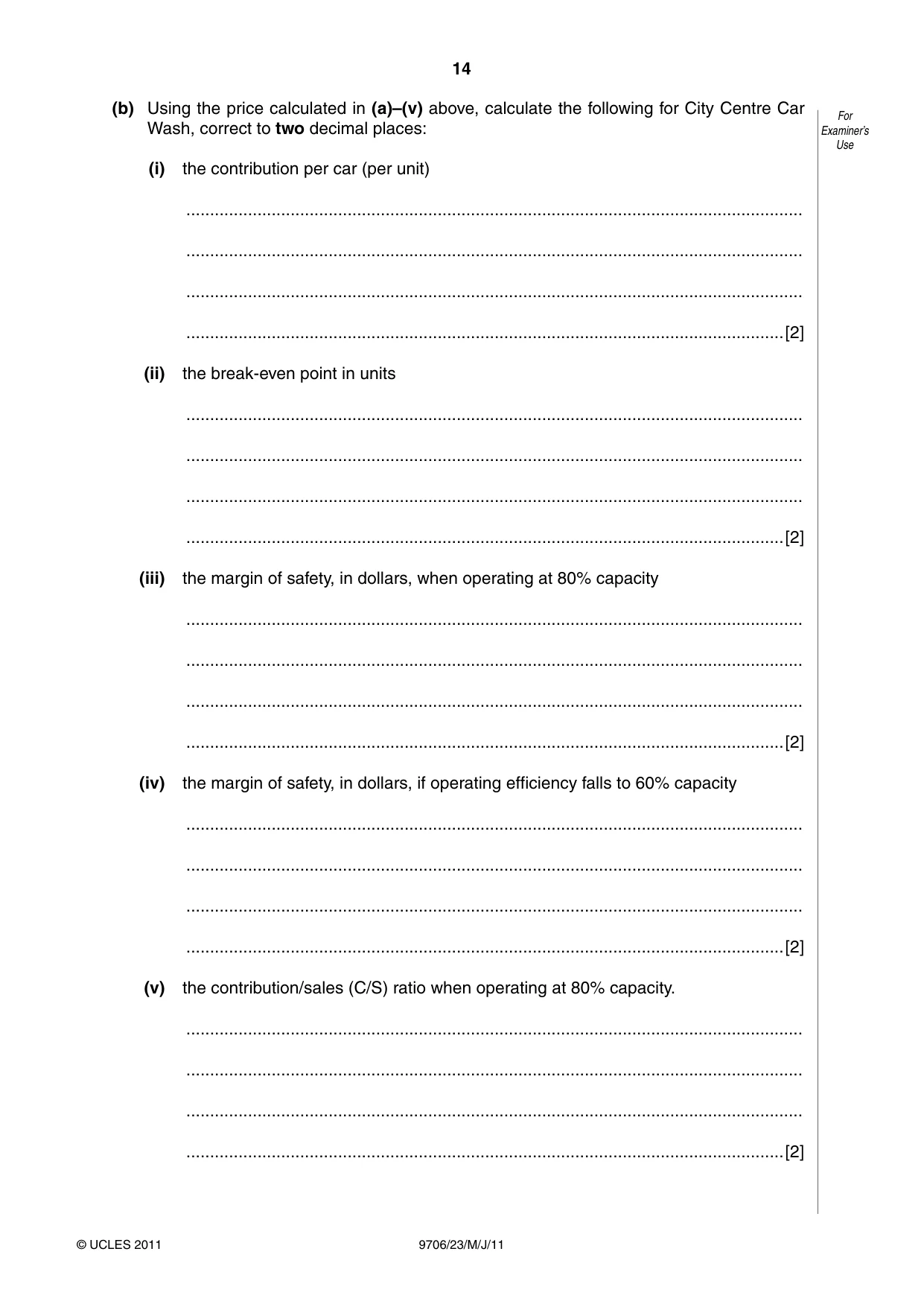
14 9706/23/M/J/11 © UCLES 2011 For Examiner’s Use (b) Using the price calculated in (a)–(v) above, calculate the following for City Centre Car Wash, correct to two decimal places: (i) the contribution per car (per unit) … … … …[2] (ii) the break-even point in units … … … …[2] (iii) the margin of safety, in dollars, when operating at 80% capacity … … … …[2] (iv) the margin of safety, in dollars, if operating efficiency falls to 60% capacity … … … …[2] (v) the contribution/sales (C/S) ratio when operating at 80% capacity. … … … …[2]
Question paper, page 15
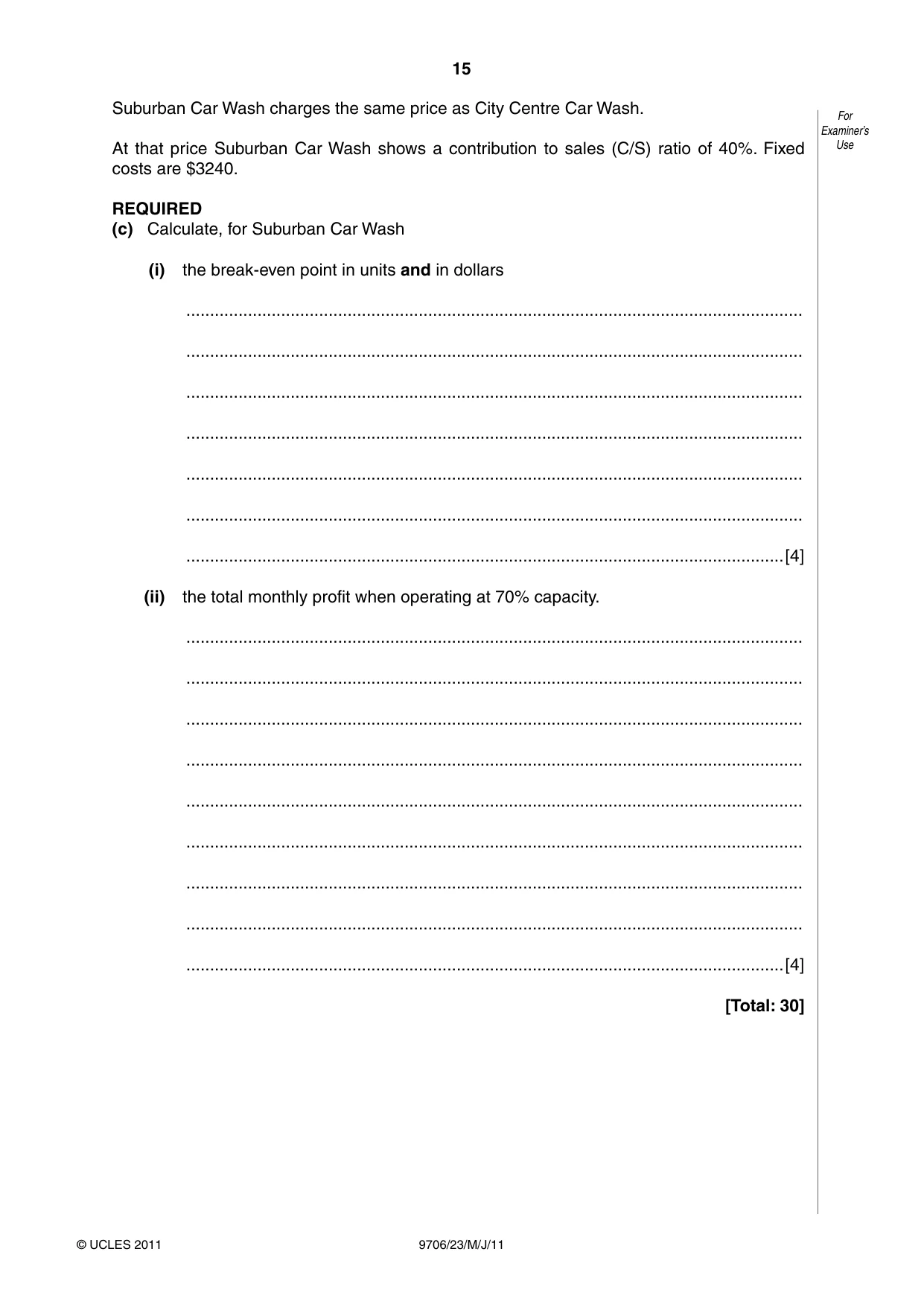
15 9706/23/M/J/11 © UCLES 2011 For Examiner’s Use Suburban Car Wash charges the same price as City Centre Car Wash. At that price Suburban Car Wash shows a contribution to sales (C/S) ratio of 40%. Fixed costs are $3240. REQUIRED (c) Calculate, for Suburban Car Wash (i) the break-even point in units and in dollars … … … … … … …[4] (ii) the total monthly profit when operating at 70% capacity. … … … … … … … … …[4] [Total: 30]
Question paper, page 16
16 9706/23/M/J/11 © UCLES 2011 BLANK PAGE Permission to reproduce items where third-party owned material protected by copyright is included has been sought and cleared where possible. Every reasonable effort has been made by the publisher (UCLES) to trace copyright holders, but if any items requiring clearance have unwittingly been included, the publisher will be pleased to make amends at the earliest possible opportunity. University of Cambridge International Examinations is part of the Cambridge Assessment Group. Cambridge Assessment is the brand name of University of Cambridge Local Examinations Syndicate (UCLES), which is itself a department of the University of Cambridge.
Mark scheme, page 1
UNIVERSITY OF CAMBRIDGE INTERNATIONAL EXAMINATIONS GCE Advanced Subsidiary Level and GCE Advanced Level MARK SCHEME for the May/June 2011 question paper for the guidance of teachers 9706 ACCOUNTING 9706/23 Paper 2 (Structured Questions – Core), maximum raw mark 90 This mark scheme is published as an aid to teachers and candidates, to indicate the requirements of the examination. It shows the basis on which Examiners were instructed to award marks. It does not indicate the details of the discussions that took place at an Examiners’ meeting before marking began, which would have considered the acceptability of alternative answers. Mark schemes must be read in conjunction with the question papers and the report on the examination. • Cambridge will not enter into discussions or correspondence in connection with these mark schemes. Cambridge is publishing the mark schemes for the May/June 2011 question papers for most IGCSE, GCE Advanced Level and Advanced Subsidiary Level syllabuses and some Ordinary Level syllabuses.
Mark scheme, page 2
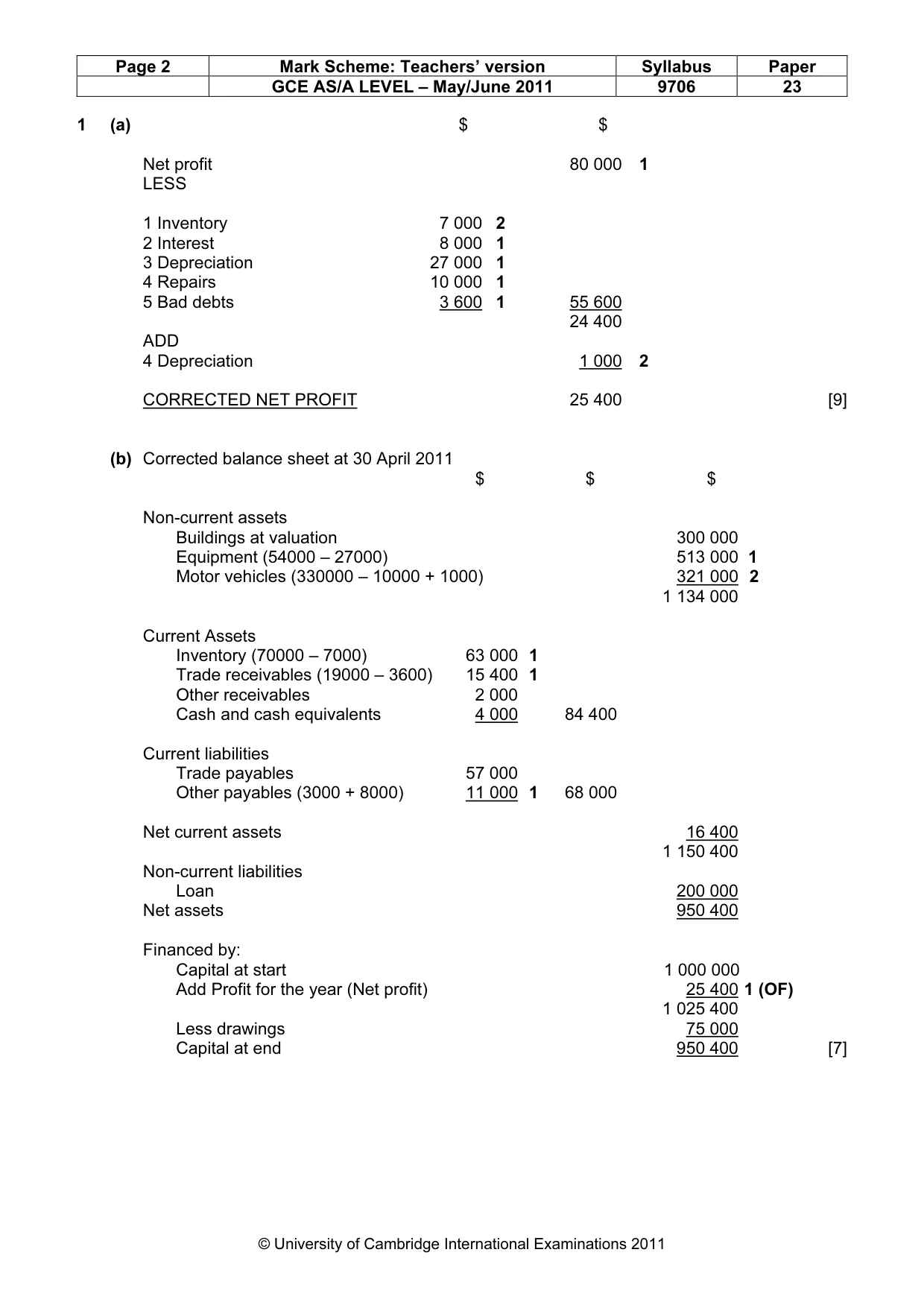
Page 2 Mark Scheme: Teachers’ version Syllabus Paper GCE AS/A LEVEL – May/June 2011 9706 23 © University of Cambridge International Examinations 2011 1 (a) $ $ Net profit 80 000 1 LESS 1 Inventory 7 000 2 2 Interest 8 000 1 3 Depreciation 27 000 1 4 Repairs 10 000 1 5 Bad debts 3 600 1 55 600 24 400 ADD 4 Depreciation 1 000 2 CORRECTED NET PROFIT 25 400 [9] (b) Corrected balance sheet at 30 April 2011 $ $ $ Non-current assets Buildings at valuation 300 000 Equipment (54000 – 27000) 513 000 1 Motor vehicles (330000 – 10000 + 1000) 321 000 2 1 134 000 Current Assets Inventory (70000 – 7000) 63 000 1 Trade receivables (19000 – 3600) 15 400 1 Other receivables 2 000 Cash and cash equivalents 4 000 84 400 Current liabilities Trade payables 57 000 Other payables (3000 + 8000) 11 000 1 68 000 Net current assets 16 400 1 150 400 Non-current liabilities Loan 200 000 Net assets 950 400 Financed by: Capital at start 1 000 000 Add Profit for the year (Net profit) 25 400 1 (OF) 1 025 400 Less drawings 75 000 Capital at end 950 400 [7]
Mark scheme, page 3
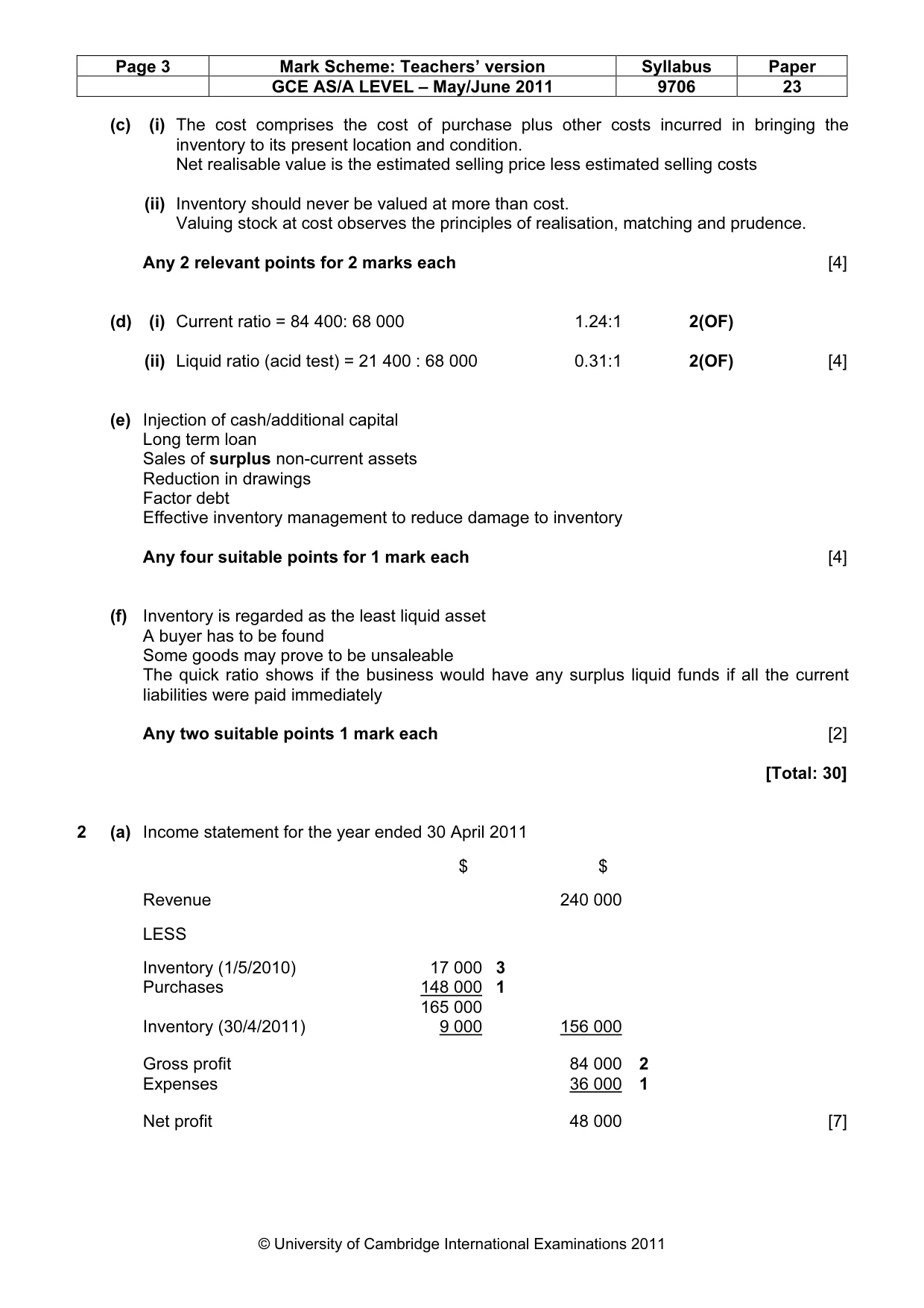
Page 3 Mark Scheme: Teachers’ version Syllabus Paper GCE AS/A LEVEL – May/June 2011 9706 23 © University of Cambridge International Examinations 2011 (c) (i) The cost comprises the cost of purchase plus other costs incurred in bringing the inventory to its present location and condition. Net realisable value is the estimated selling price less estimated selling costs (ii) Inventory should never be valued at more than cost. Valuing stock at cost observes the principles of realisation, matching and prudence. Any 2 relevant points for 2 marks each [4] (d) (i) Current ratio = 84 400: 68 000 1.24:1 2(OF) (ii) Liquid ratio (acid test) = 21 400 : 68 000 0.31:1 2(OF) [4] (e) Injection of cash/additional capital Long term loan Sales of surplus non-current assets Reduction in drawings Factor debt Effective inventory management to reduce damage to inventory Any four suitable points for 1 mark each [4] (f) Inventory is regarded as the least liquid asset A buyer has to be found Some goods may prove to be unsaleable The quick ratio shows if the business would have any surplus liquid funds if all the current liabilities were paid immediately Any two suitable points 1 mark each [2] [Total: 30] 2 (a) Income statement for the year ended 30 April 2011 $ $ Revenue 240 000 LESS Inventory (1/5/2010) 17 000 3 Purchases 148 000 1 165 000 Inventory (30/4/2011) 9 000 156 000 Gross profit 84 000 2 Expenses 36 000 1 Net profit 48 000 [7]
Mark scheme, page 4
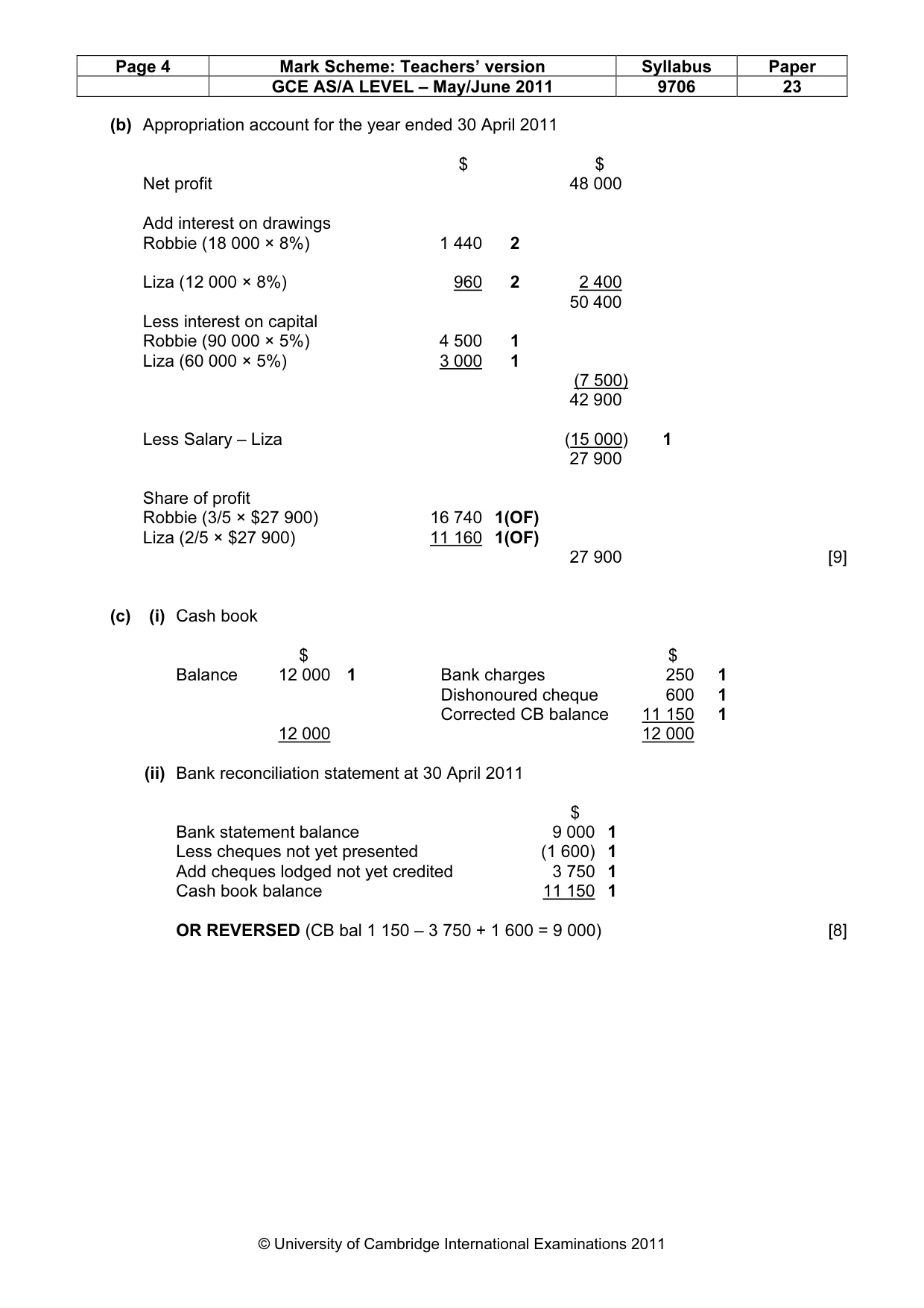
Page 4 Mark Scheme: Teachers’ version Syllabus Paper GCE AS/A LEVEL – May/June 2011 9706 23 © University of Cambridge International Examinations 2011 (b) Appropriation account for the year ended 30 April 2011 $ $ Net profit 48 000 Add interest on drawings Robbie (18 000 × 8%) 1 440 2 Liza (12 000 × 8%) 960 2 2 400 50 400 Less interest on capital Robbie (90 000 × 5%) 4 500 1 Liza (60 000 × 5%) 3 000 1 (7 500) 42 900 Less Salary – Liza (15 000) 1 27 900 Share of profit Robbie (3/5 × $27 900) 16 740 1(OF) Liza (2/5 × $27 900) 11 160 1(OF) 27 900 [9] (c) (i) Cash book $ $ Balance 12 000 1 Bank charges 250 1 Dishonoured cheque 600 1 Corrected CB balance 11 150 1 12 000 12 000 (ii) Bank reconciliation statement at 30 April 2011 $ Bank statement balance 9 000 1 Less cheques not yet presented (1 600) 1 Add cheques lodged not yet credited 3 750 1 Cash book balance 11 150 1 OR REVERSED (CB bal 1 150 – 3 750 + 1 600 = 9 000) [8]
Mark scheme, page 5
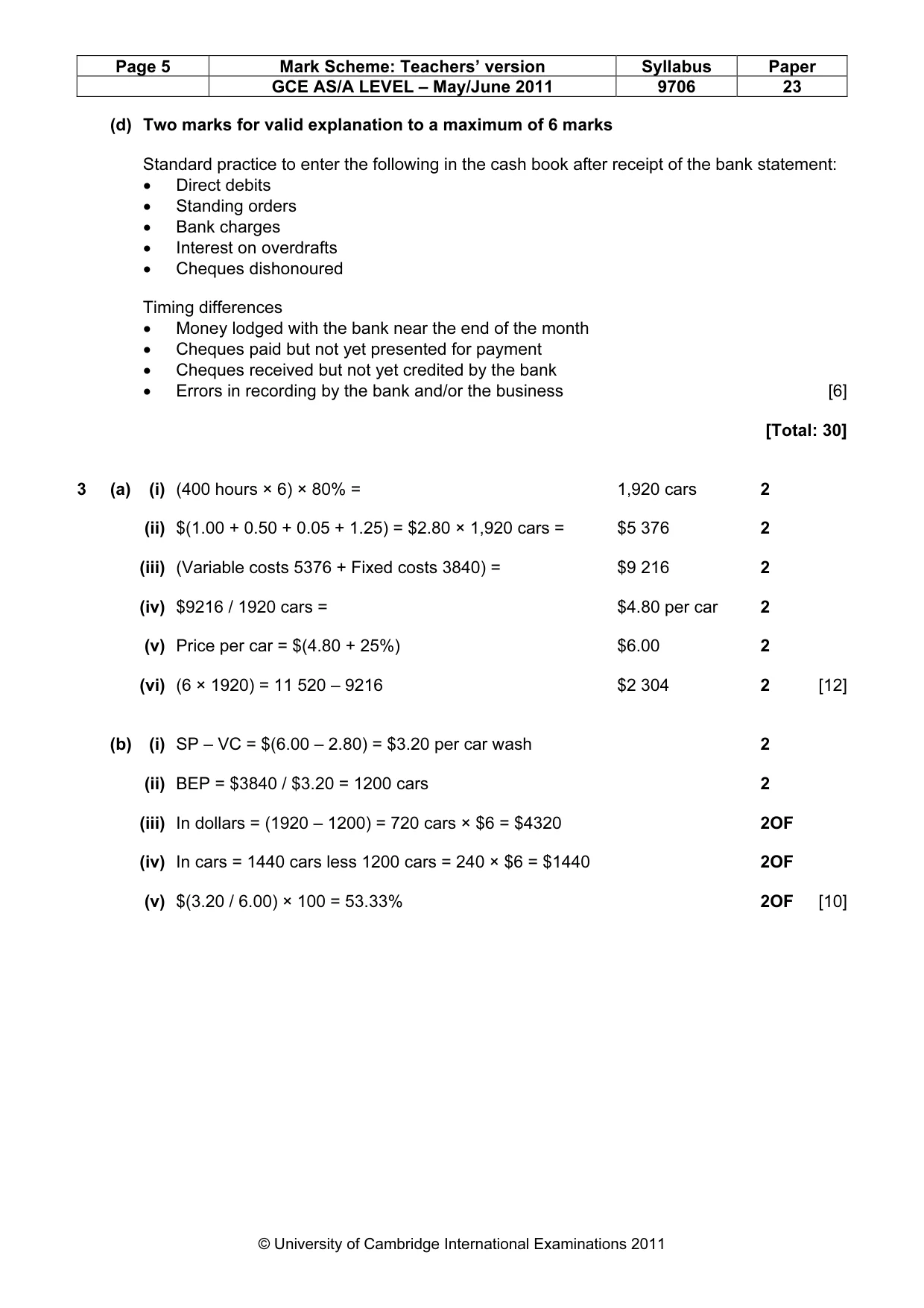
Page 5 Mark Scheme: Teachers’ version Syllabus Paper GCE AS/A LEVEL – May/June 2011 9706 23 © University of Cambridge International Examinations 2011 (d) Two marks for valid explanation to a maximum of 6 marks Standard practice to enter the following in the cash book after receipt of the bank statement: • Direct debits • Standing orders • Bank charges • Interest on overdrafts • Cheques dishonoured Timing differences • Money lodged with the bank near the end of the month • Cheques paid but not yet presented for payment • Cheques received but not yet credited by the bank • Errors in recording by the bank and/or the business [6] [Total: 30] 3 (a) (i) (400 hours × 6) × 80% = 1,920 cars 2 (ii) $(1.00 + 0.50 + 0.05 + 1.25) = $2.80 × 1,920 cars = $5 376 2 (iii) (Variable costs 5376 + Fixed costs 3840) = $9 216 2 (iv) $9216 / 1920 cars = $4.80 per car 2 (v) Price per car = $(4.80 + 25%) $6.00 2 (vi) (6 × 1920) = 11 520 – 9216 $2 304 2 [12] (b) (i) SP – VC = $(6.00 – 2.80) = $3.20 per car wash 2 (ii) BEP = $3840 / $3.20 = 1200 cars 2 (iii) In dollars = (1920 – 1200) = 720 cars × $6 = $4320 2OF (iv) In cars = 1440 cars less 1200 cars = 240 × $6 = $1440 2OF (v) $(3.20 / 6.00) × 100 = 53.33% 2OF [10]
Mark scheme, page 6
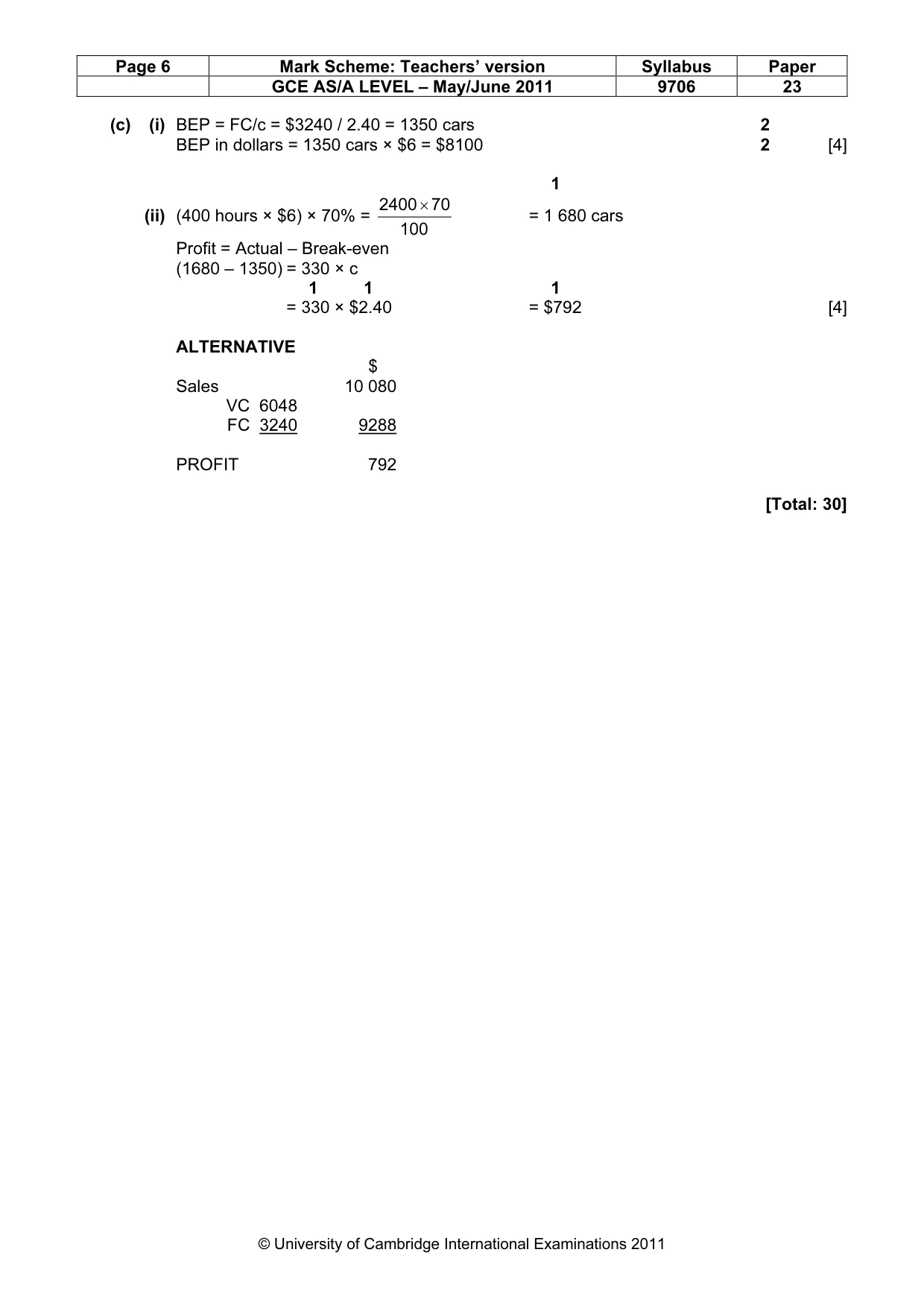
Page 6 Mark Scheme: Teachers’ version Syllabus Paper GCE AS/A LEVEL – May/June 2011 9706 23 © University of Cambridge International Examinations 2011 (c) (i) BEP = FC/c = $3240 / 2.40 = 1350 cars 2 BEP in dollars = 1350 cars × $6 = $8100 2 [4] 1 (ii) (400 hours × $6) × 70% = 100 70 2400× = 1 680 cars Profit = Actual – Break-even (1680 – 1350) = 330 × c 1 1 1 = 330 × $2.40 = $792 [4] ALTERNATIVE $ Sales 10 080 VC 6048 FC 3240 9288 PROFIT 792 [Total: 30]
What you needed in this session
Cambridge’s own grade thresholds for 2011 May/June, Paper 2 · Variant 3. A higher threshold means an easier paper — the bar moves with how the cohort did.