Cambridge A Level Accounting 9706 — 2011 May/June Paper 2 · Variant 1
9706/21/M/J/11 · 90 marks · ≈101 min
The question paper and its mark scheme, free to read here and free to download. This is Cambridge’s own paper, exactly as it was sat.
Question paper12 pages
Mark scheme7 pages
Answers below. Sit the paper first if you are practising.
Paper as text
Question paper, page 1
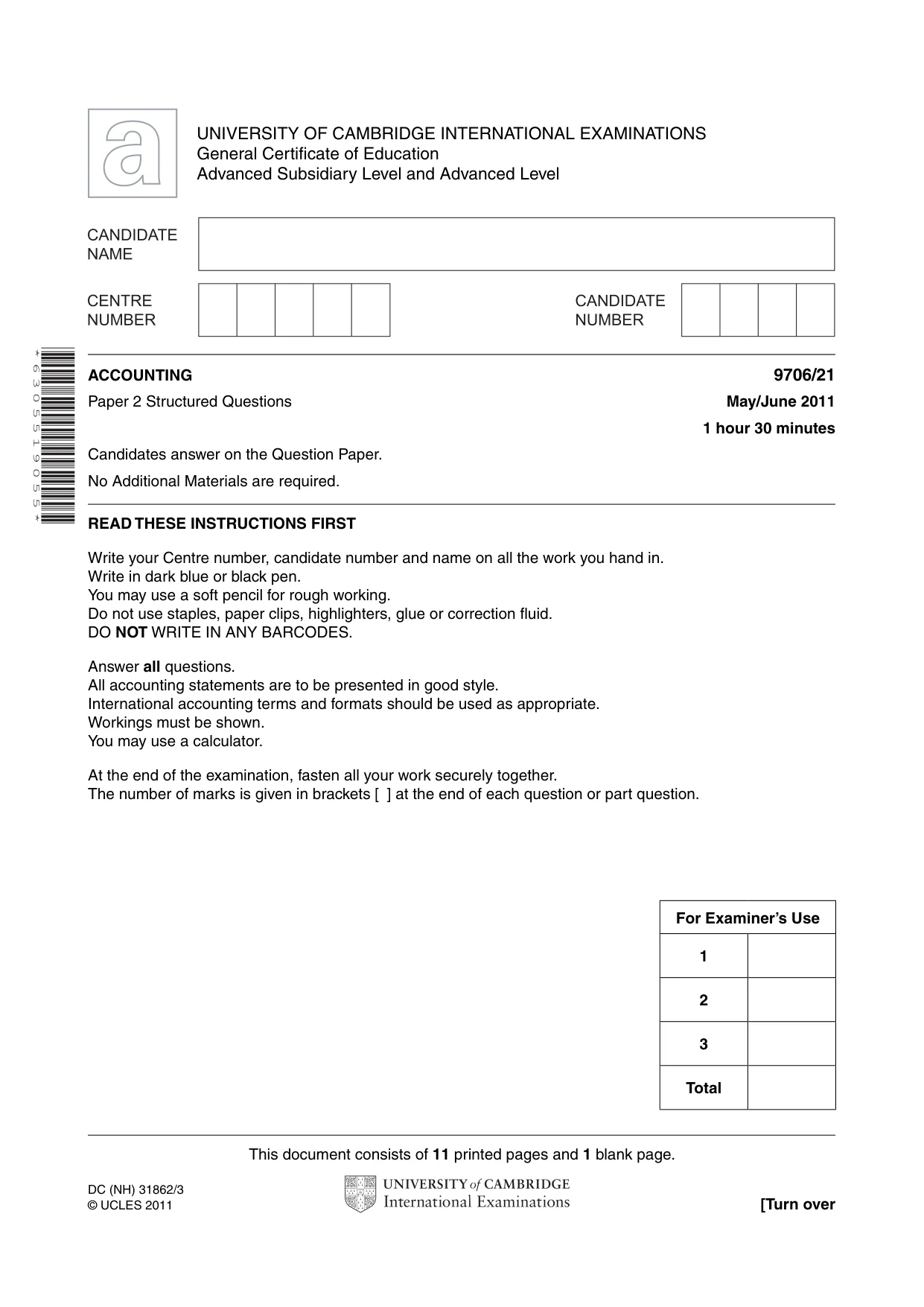
This document consists of 11 printed pages and 1 blank page. DC (NH) 31862/3 © UCLES 2011 [Turn over UNIVERSITY OF CAMBRIDGE INTERNATIONAL EXAMINATIONS General Certificate of Education Advanced Subsidiary Level and Advanced Level * 6 3 0 5 5 1 9 0 5 5 * ACCOUNTING 9706/21 Paper 2 Structured Questions May/June 2011 1 hour 30 minutes Candidates answer on the Question Paper. No Additional Materials are required. READ THESE INSTRUCTIONS FIRST Write your Centre number, candidate number and name on all the work you hand in. Write in dark blue or black pen. You may use a soft pencil for rough working. Do not use staples, paper clips, highlighters, glue or correction fluid. DO NOT WRITE IN ANY BARCODES. Answer all questions. All accounting statements are to be presented in good style. International accounting terms and formats should be used as appropriate. Workings must be shown. You may use a calculator. At the end of the examination, fasten all your work securely together. The number of marks is given in brackets [ ] at the end of each question or part question. For Examiner’s Use 1 2 3 Total
Question paper, page 2
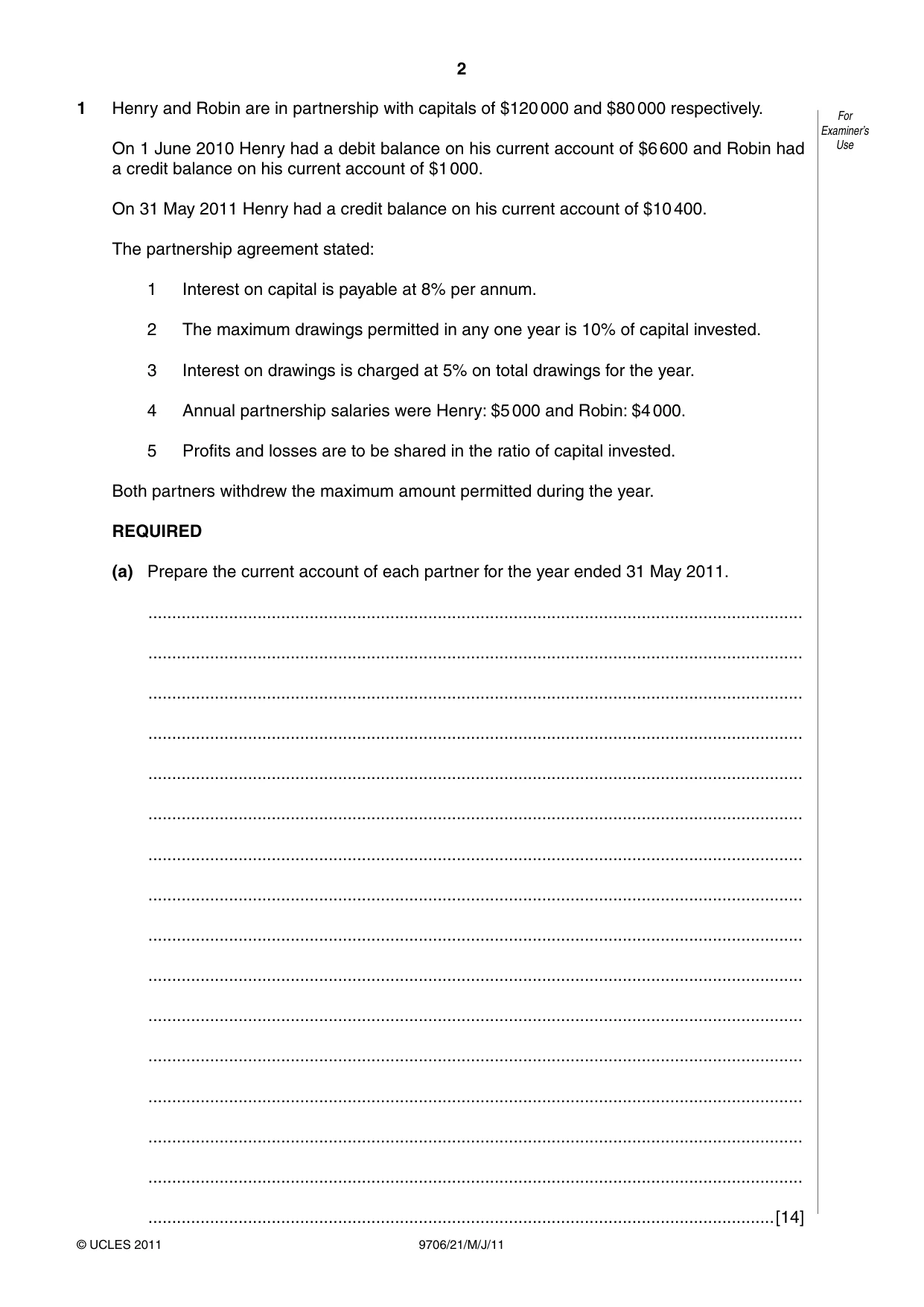
2 9706/21/M/J/11 © UCLES 2011 For Examiner’s Use 1 Henry and Robin are in partnership with capitals of $120 000 and $80 000 respectively. On 1 June 2010 Henry had a debit balance on his current account of $6 600 and Robin had a credit balance on his current account of $1 000. On 31 May 2011 Henry had a credit balance on his current account of $10 400. The partnership agreement stated: 1 Interest on capital is payable at 8% per annum. 2 The maximum drawings permitted in any one year is 10% of capital invested. 3 Interest on drawings is charged at 5% on total drawings for the year. 4 Annual partnership salaries were Henry: $5 000 and Robin: $4 000. 5 Profits and losses are to be shared in the ratio of capital invested. Both partners withdrew the maximum amount permitted during the year. REQUIRED (a) Prepare the current account of each partner for the year ended 31 May 2011. … … … … … … … … … … … … … … … …[14]
Question paper, page 3
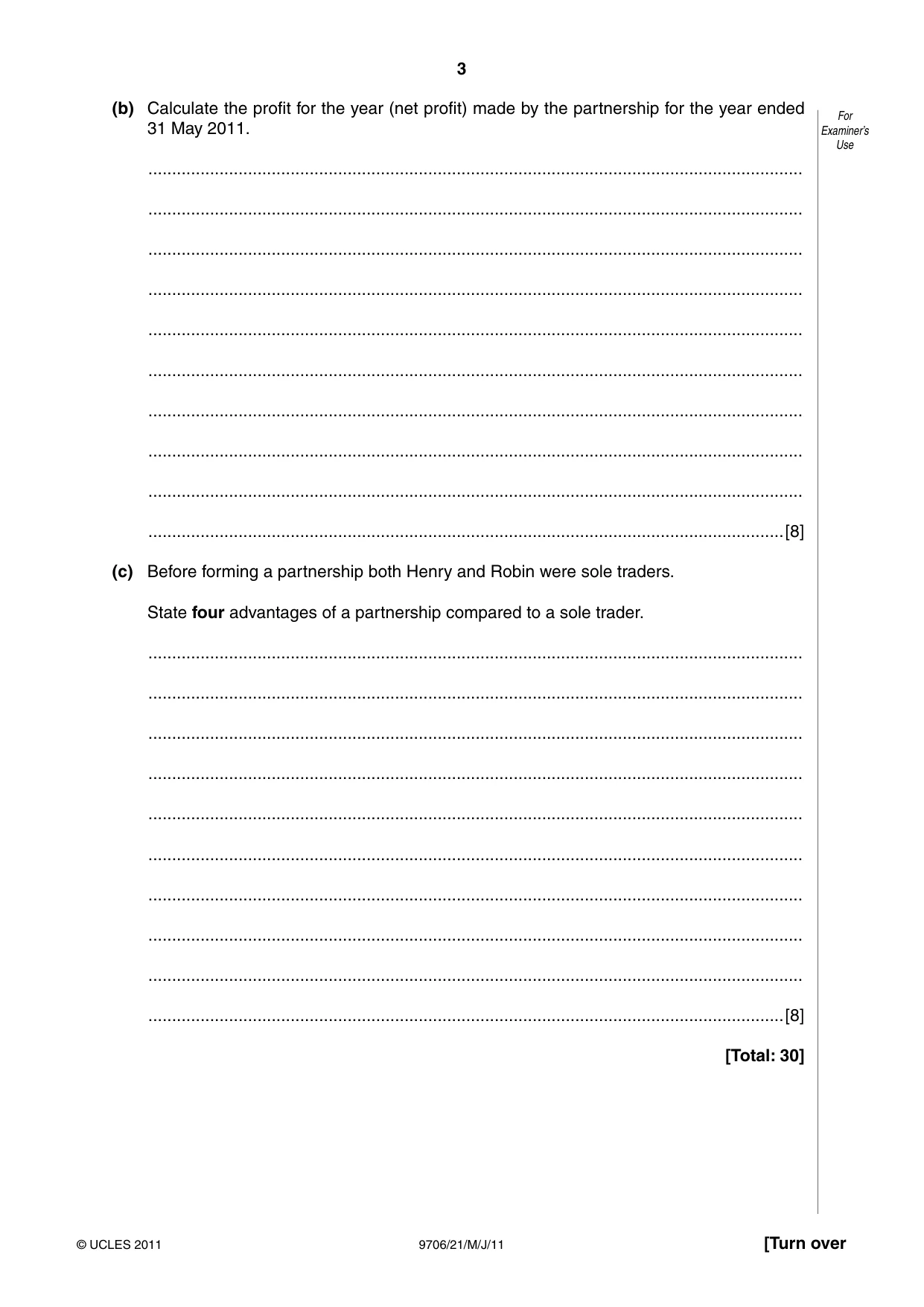
3 9706/21/M/J/11 © UCLES 2011 [Turn over For Examiner’s Use (b) Calculate the profit for the year (net profit) made by the partnership for the year ended 31 May 2011. … … … … … … … … … …[8] (c) Before forming a partnership both Henry and Robin were sole traders. State four advantages of a partnership compared to a sole trader. … … … … … … … … … …[8] [Total: 30]
Question paper, page 4
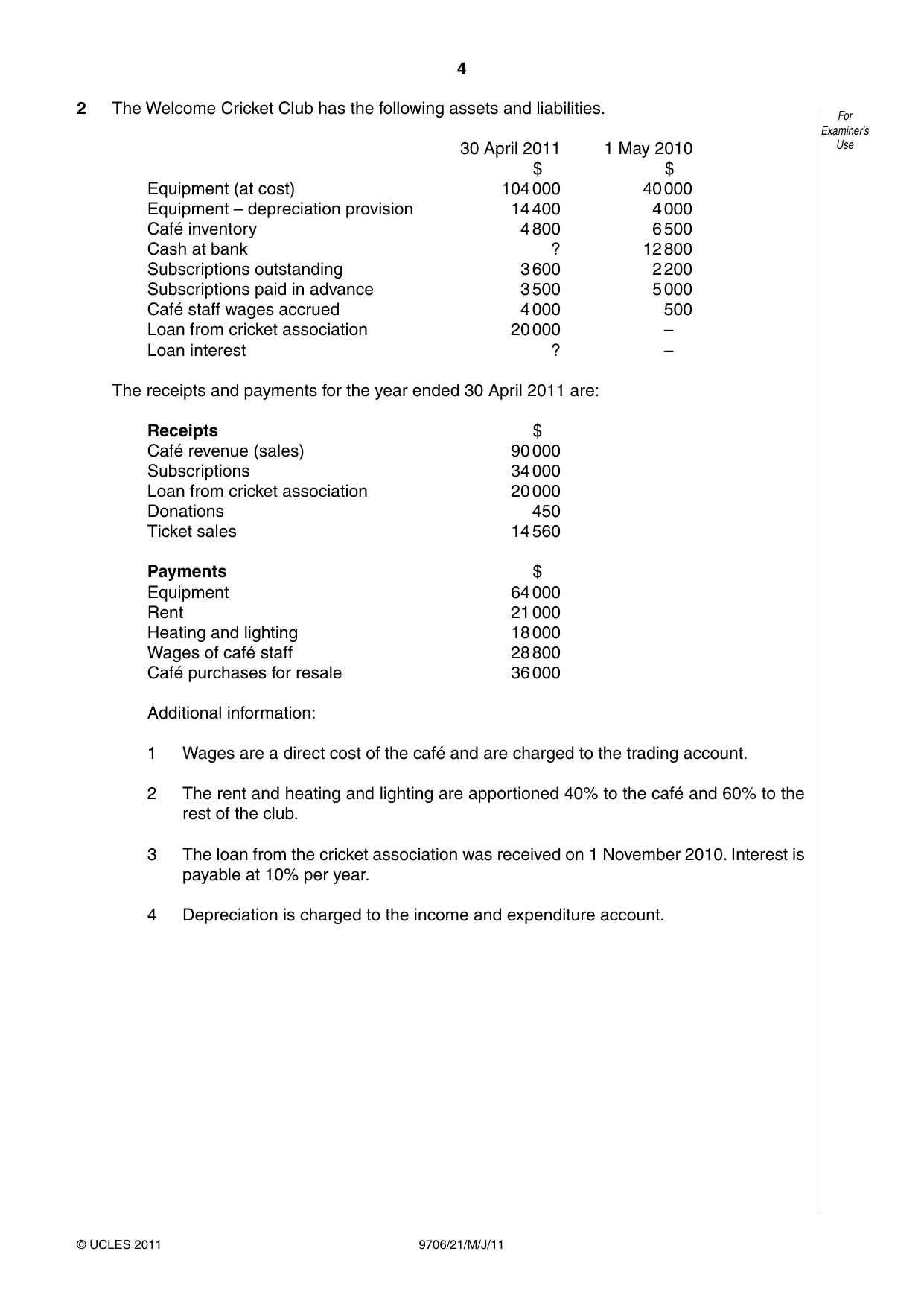
4 9706/21/M/J/11 © UCLES 2011 For Examiner’s Use 2 The Welcome Cricket Club has the following assets and liabilities. 30 April 2011 1 May 2010 $ $ Equipment (at cost) 104 000 40 000 Equipment – depreciation provision 14 400 4 000 Café inventory 4 800 6 500 Cash at bank ? 12 800 Subscriptions outstanding 3 600 2 200 Subscriptions paid in advance 3 500 5 000 Café staff wages accrued 4 000 500 Loan from cricket association 20 000 –nn Loan interest ? –nn The receipts and payments for the year ended 30 April 2011 are: Receipts $ Café revenue (sales) 90 000 Subscriptions 34 000 Loan from cricket association 20 000 Donations 450 Ticket sales 14 560 Payments $ Equipment 64 000 Rent 21 000 Heating and lighting 18 000 Wages of café staff 28 800 Café purchases for resale 36 000 Additional information: 1 Wages are a direct cost of the café and are charged to the trading account. 2 The rent and heating and lighting are apportioned 40% to the café and 60% to the rest of the club. 3 The loan from the cricket association was received on 1 November 2010. Interest is payable at 10% per year. 4 Depreciation is charged to the income and expenditure account.
Question paper, page 5
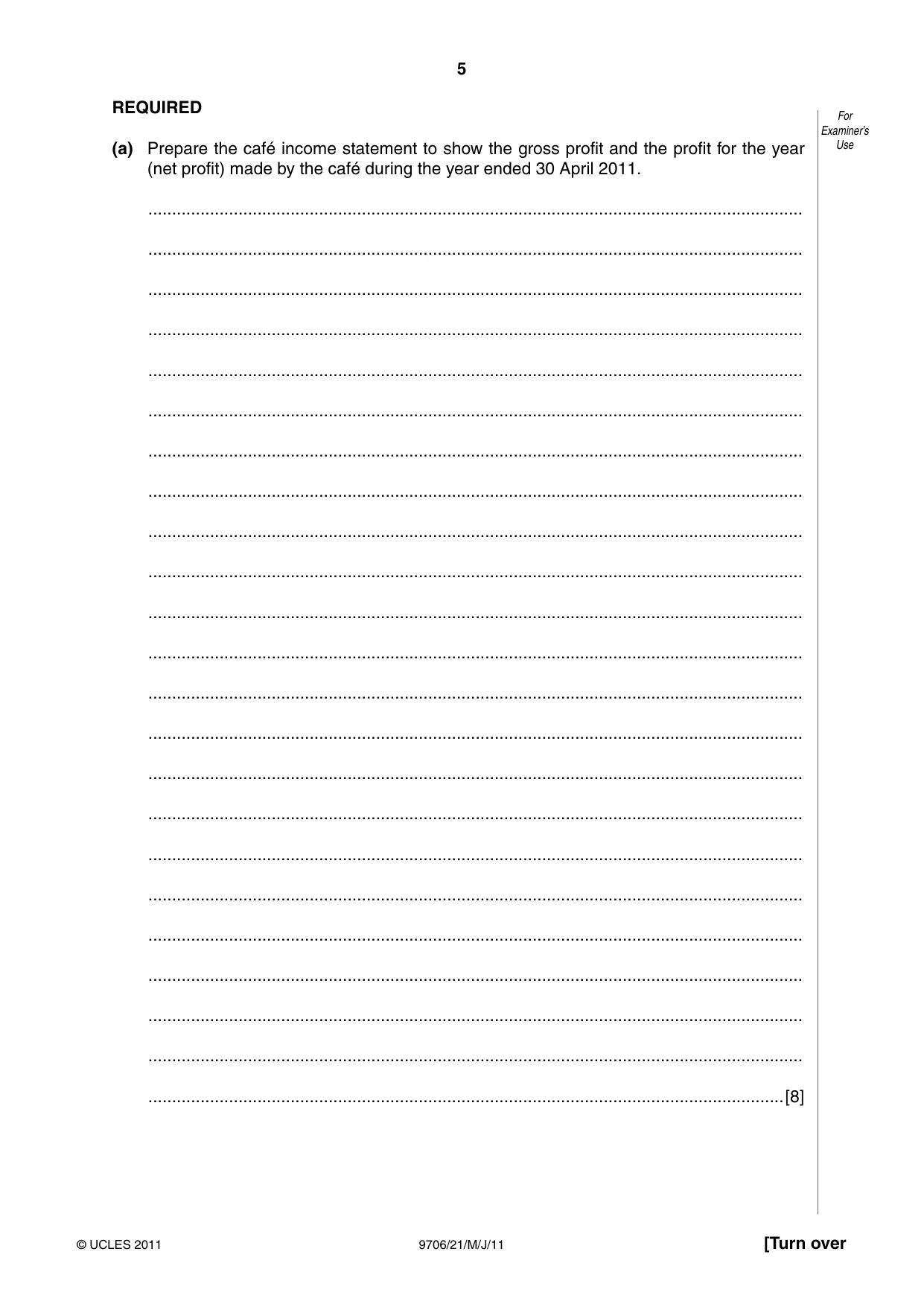
5 9706/21/M/J/11 © UCLES 2011 [Turn over For Examiner’s Use REQUIRED (a) Prepare the café income statement to show the gross profit and the profit for the year (net profit) made by the café during the year ended 30 April 2011. … … … … … … … … … … … … … … … … … … … … … … …[8]
Question paper, page 6
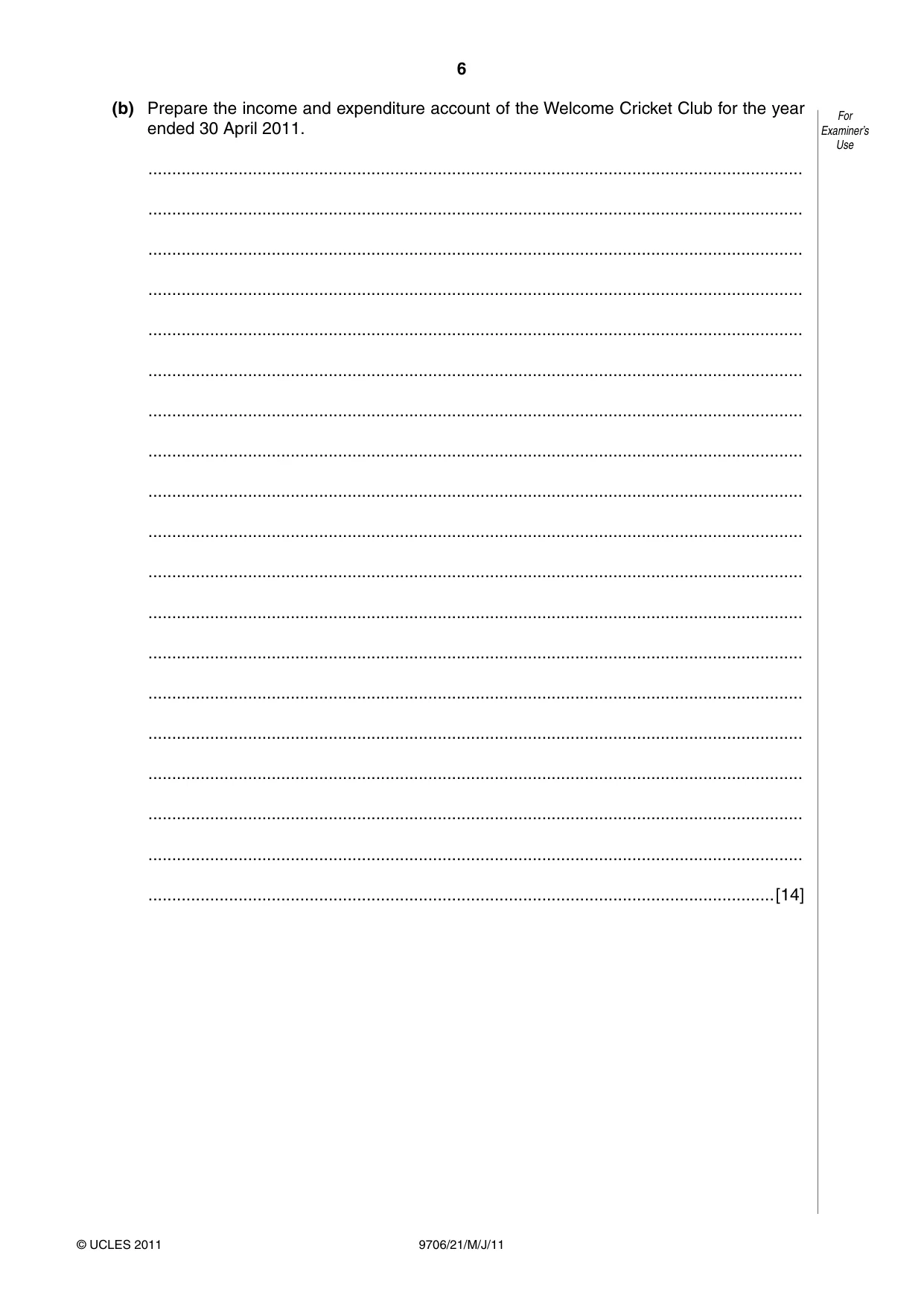
6 9706/21/M/J/11 © UCLES 2011 For Examiner’s Use (b) Prepare the income and expenditure account of the Welcome Cricket Club for the year ended 30 April 2011. … … … … … … … … … … … … … … … … … … …[14]
Question paper, page 7
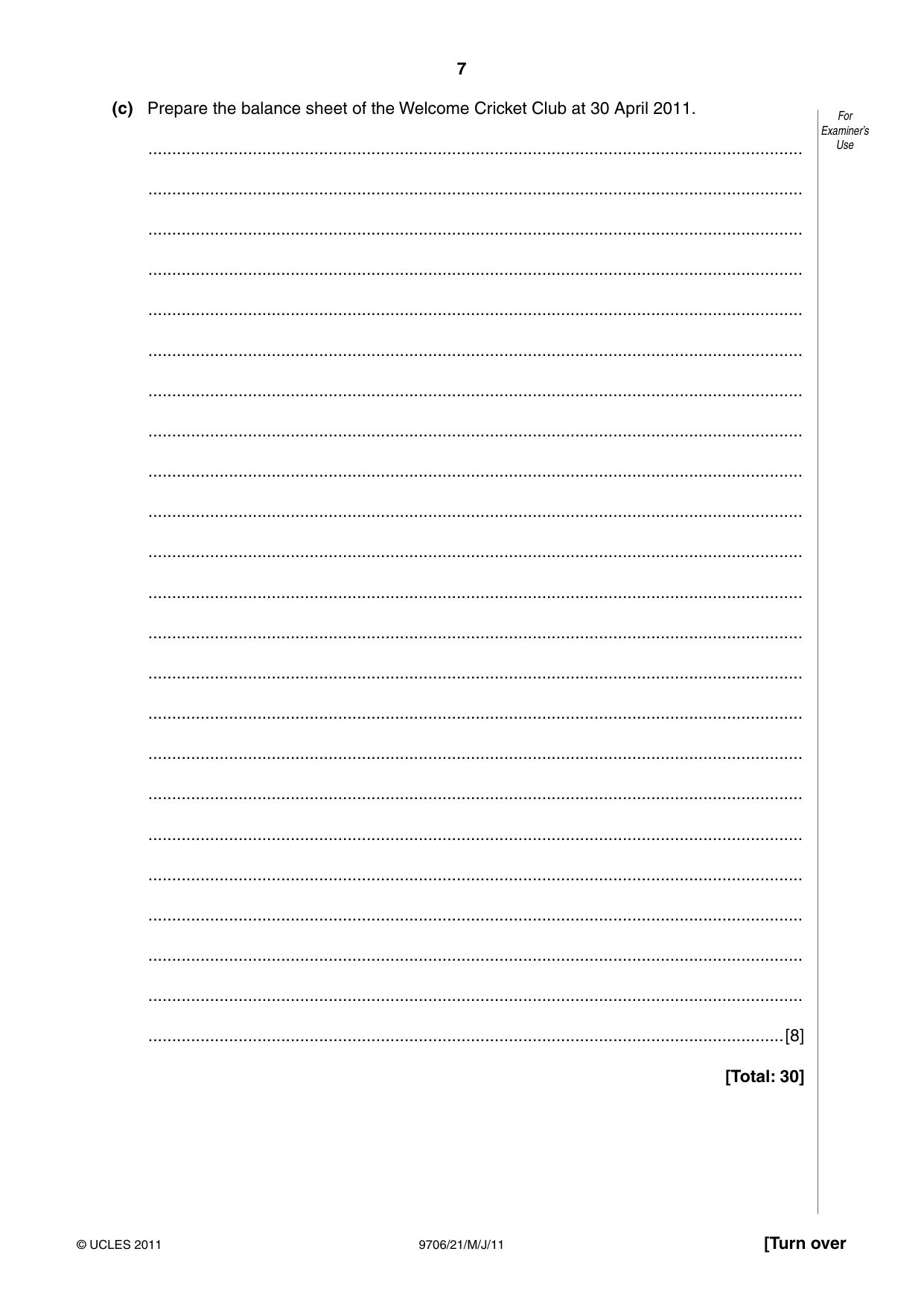
7 9706/21/M/J/11 © UCLES 2011 [Turn over For Examiner’s Use (c) Prepare the balance sheet of the Welcome Cricket Club at 30 April 2011. … … … … … … … … … … … … … … … … … … … … … … …[8] [Total: 30]
Question paper, page 8
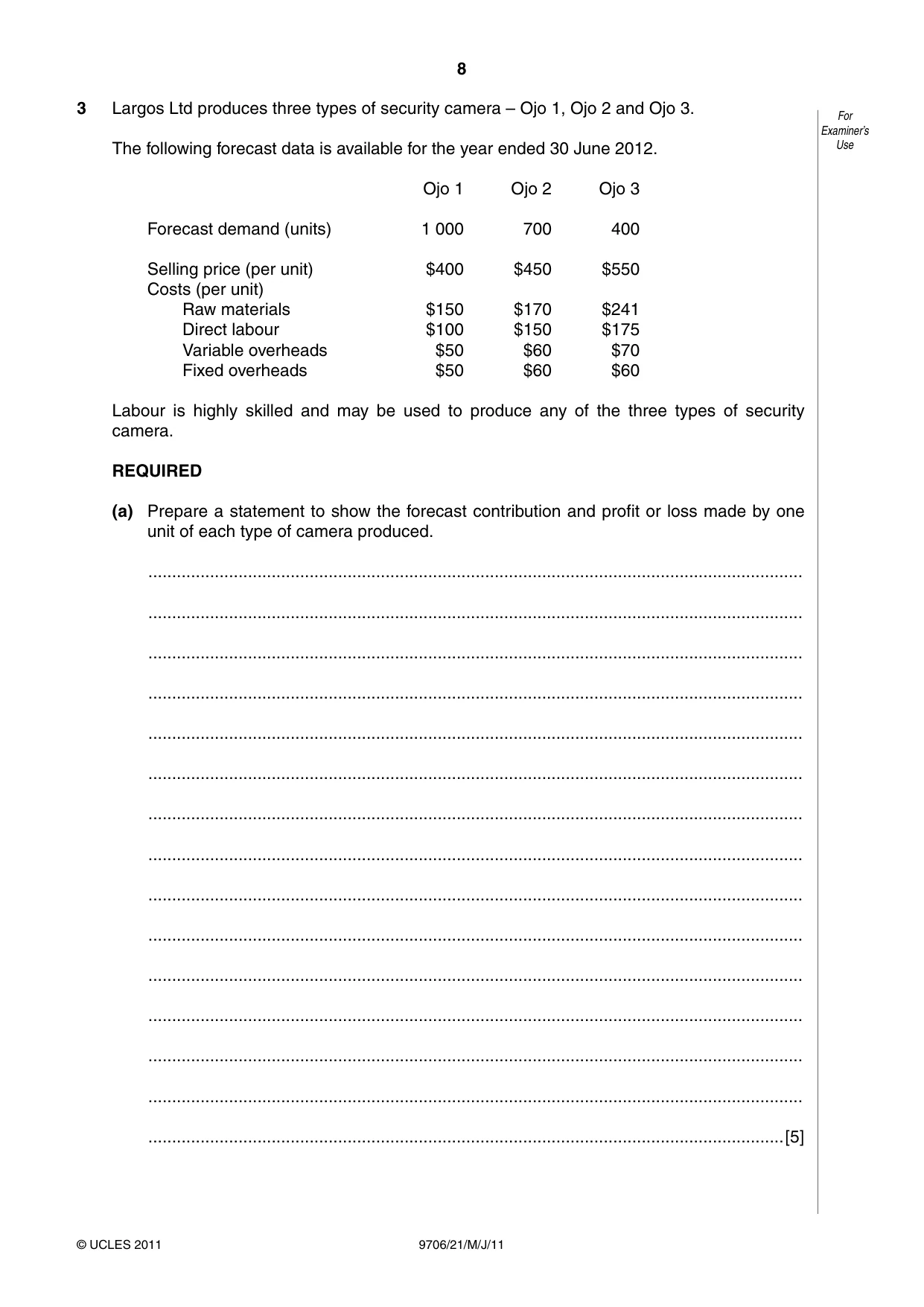
8 9706/21/M/J/11 © UCLES 2011 For Examiner’s Use 3 Largos Ltd produces three types of security camera – Ojo 1, Ojo 2 and Ojo 3. The following forecast data is available for the year ended 30 June 2012. Ojo 1 Ojo 2 Ojo 3 Forecast demand (units) 1 000 700 400 Selling price (per unit) $400 $450 $550 Costs (per unit) Raw materials $150 $170 $241 Direct labour $100 $150 $175 Variable overheads $50 $60 $70 Fixed overheads $50 $60 $60 Labour is highly skilled and may be used to produce any of the three types of security camera. REQUIRED (a) Prepare a statement to show the forecast contribution and profit or loss made by one unit of each type of camera produced. … … … … … … … … … … … … … … …[5]
Question paper, page 9
9 9706/21/M/J/11 © UCLES 2011 [Turn over For Examiner’s Use (b) Prepare a statement to show the forecast total contribution and profit/loss made by each product for the year ended 30 June 2012. … … … … … … … … … … … …[5] (c) If the forecast output is produced, calculate the break-even point and the margin of safety in units for each product. Show your workings. … … … … … … … … … … …[4]
Question paper, page 10
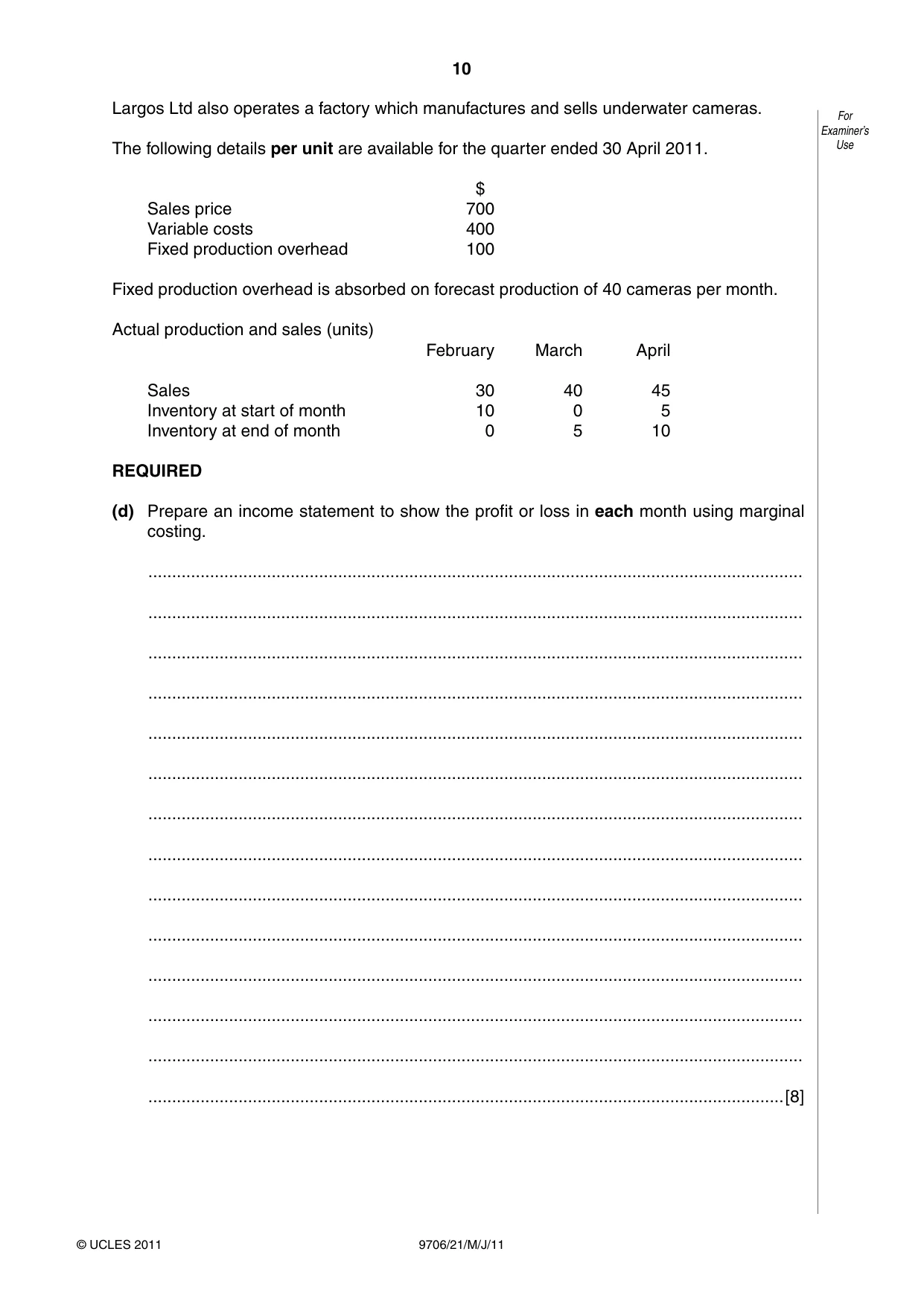
10 9706/21/M/J/11 © UCLES 2011 For Examiner’s Use Largos Ltd also operates a factory which manufactures and sells underwater cameras. The following details per unit are available for the quarter ended 30 April 2011. $0 Sales price 700 Variable costs 400 Fixed production overhead 100 Fixed production overhead is absorbed on forecast production of 40 cameras per month. Actual production and sales (units) February March April Sales 30 40 45 Inventory at start of month 10 0 5 Inventory at end of month 0 5 10 REQUIRED (d) Prepare an income statement to show the profit or loss in each month using marginal costing. … … … … … … … … … … … … … …[8]
Question paper, page 11
11 9706/21/M/J/11 © UCLES 2011 For Examiner’s Use (e) Prepare an income statement to show the profit or loss in each month using absorption costing. … … … … … … … … … … … … … … … … …[8] [Total: 30]
Question paper, page 12
12 9706/21/M/J/11 © UCLES 2011 BLANK PAGE Permission to reproduce items where third-party owned material protected by copyright is included has been sought and cleared where possible. Every reasonable effort has been made by the publisher (UCLES) to trace copyright holders, but if any items requiring clearance have unwittingly been included, the publisher will be pleased to make amends at the earliest possible opportunity. University of Cambridge International Examinations is part of the Cambridge Assessment Group. Cambridge Assessment is the brand name of University of Cambridge Local Examinations Syndicate (UCLES), which is itself a department of the University of Cambridge.
Mark scheme, page 1
UNIVERSITY OF CAMBRIDGE INTERNATIONAL EXAMINATIONS GCE Advanced Subsidiary Level and GCE Advanced Level MARK SCHEME for the May/June 2011 question paper for the guidance of teachers 9706 ACCOUNTING 9706/21 Paper 2 (Structured Questions (Core)), maximum raw mark 90 This mark scheme is published as an aid to teachers and candidates, to indicate the requirements of the examination. It shows the basis on which Examiners were instructed to award marks. It does not indicate the details of the discussions that took place at an Examiners’ meeting before marking began, which would have considered the acceptability of alternative answers. Mark schemes must be read in conjunction with the question papers and the report on the examination. • Cambridge will not enter into discussions or correspondence in connection with these mark schemes. Cambridge is publishing the mark schemes for the May/June 2011 question papers for most IGCSE, GCE Advanced Level and Advanced Subsidiary Level syllabuses and some Ordinary Level syllabuses.
Mark scheme, page 2
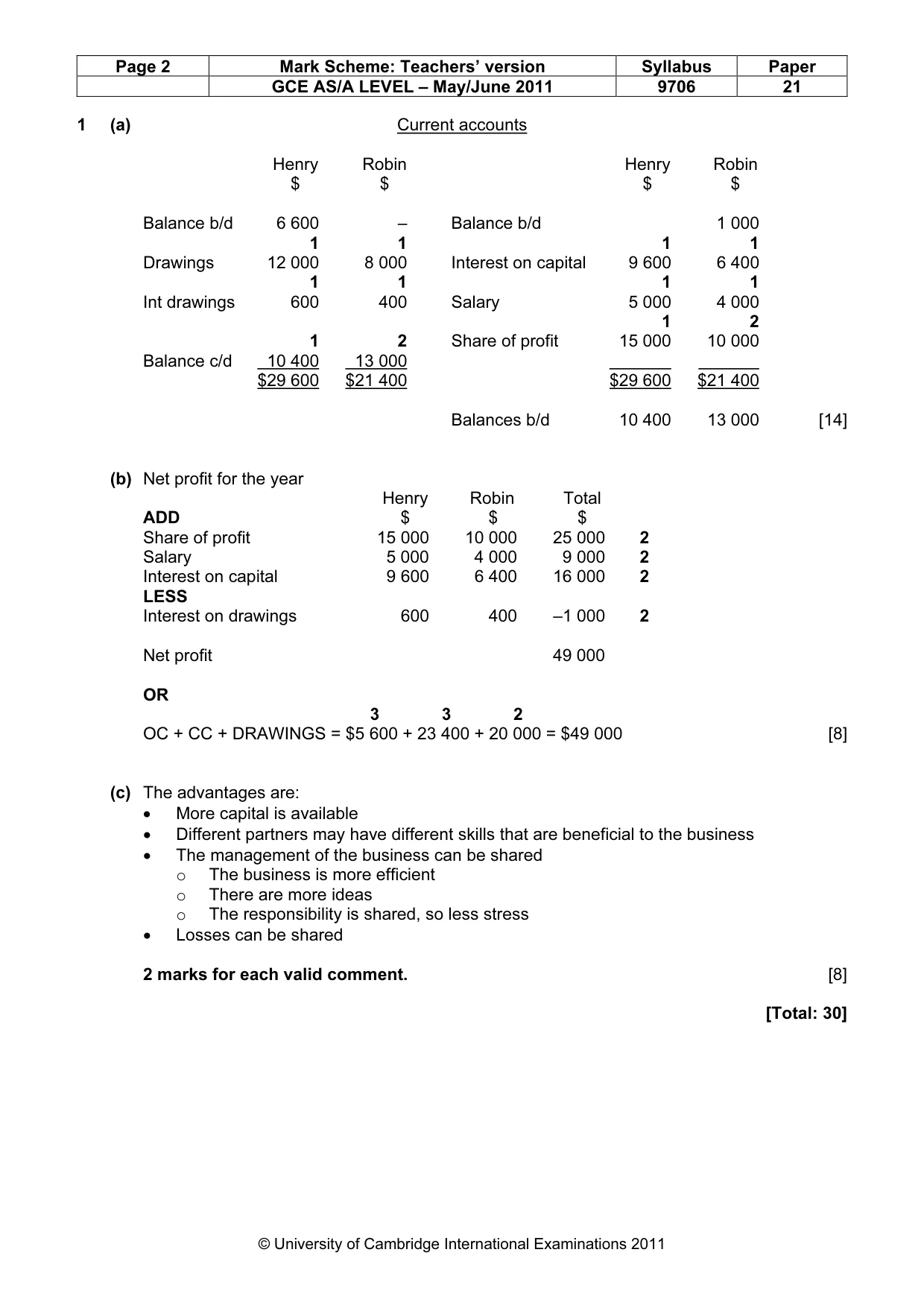
Page 2 Mark Scheme: Teachers’ version Syllabus Paper GCE AS/A LEVEL – May/June 2011 9706 21 © University of Cambridge International Examinations 2011 1 (a) Current accounts Henry Robin Henry Robin $ $ $ $ Balance b/d 6 600 – Balance b/d 1 000 1 1 1 1 Drawings 12 000 8 000 Interest on capital 9 600 6 400 1 1 1 1 Int drawings 600 400 Salary 5 000 4 000 1 2 1 2 Share of profit 15 000 10 000 Balance c/d 10 400 13 000 $29 600 $21 400 $29 600 $21 400 Balances b/d 10 400 13 000 [14] (b) Net profit for the year Henry Robin Total ADD $ $ $ Share of profit 15 000 10 000 25 000 2 Salary 5 000 4 000 9 000 2 Interest on capital 9 600 6 400 16 000 2 LESS Interest on drawings 600 400 –1 000 2 Net profit 49 000 OR 3 3 2 OC + CC + DRAWINGS = $5 600 + 23 400 + 20 000 = $49 000 [8] (c) The advantages are: • More capital is available • Different partners may have different skills that are beneficial to the business • The management of the business can be shared o The business is more efficient o There are more ideas o The responsibility is shared, so less stress • Losses can be shared 2 marks for each valid comment. [8] [Total: 30]
Mark scheme, page 3
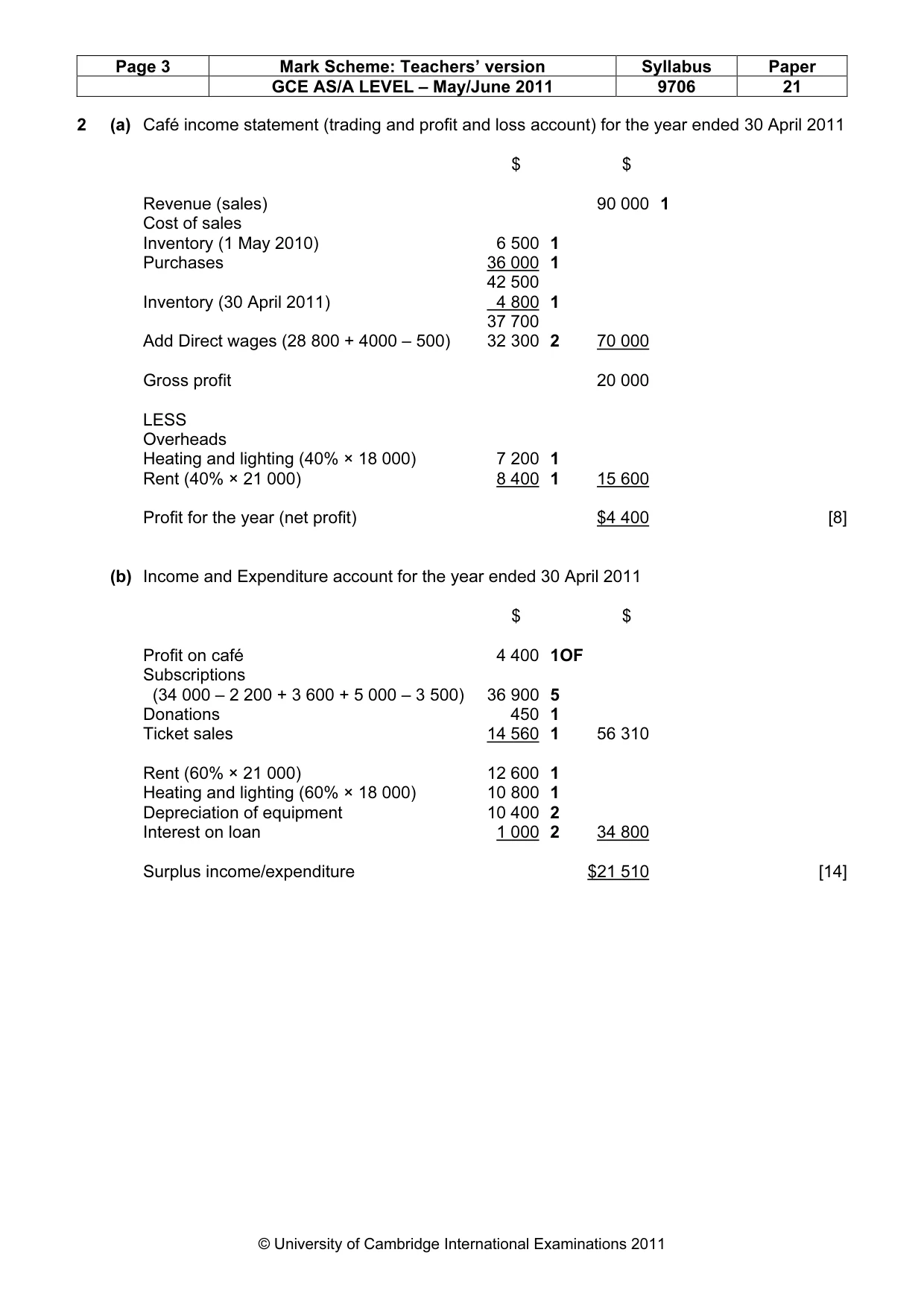
Page 3 Mark Scheme: Teachers’ version Syllabus Paper GCE AS/A LEVEL – May/June 2011 9706 21 © University of Cambridge International Examinations 2011 2 (a) Café income statement (trading and profit and loss account) for the year ended 30 April 2011 $ $ Revenue (sales) 90 000 1 Cost of sales Inventory (1 May 2010) 6 500 1 Purchases 36 000 1 42 500 Inventory (30 April 2011) 4 800 1 37 700 Add Direct wages (28 800 + 4000 – 500) 32 300 2 70 000 Gross profit 20 000 LESS Overheads Heating and lighting (40% × 18 000) 7 200 1 Rent (40% × 21 000) 8 400 1 15 600 Profit for the year (net profit) $4 400 [8] (b) Income and Expenditure account for the year ended 30 April 2011 $ $ Profit on café 4 400 1OF Subscriptions (34 000 – 2 200 + 3 600 + 5 000 – 3 500) 36 900 5 Donations 450 1 Ticket sales 14 560 1 56 310 Rent (60% × 21 000) 12 600 1 Heating and lighting (60% × 18 000) 10 800 1 Depreciation of equipment 10 400 2 Interest on loan 1 000 2 34 800 Surplus income/expenditure $21 510 [14]
Mark scheme, page 4
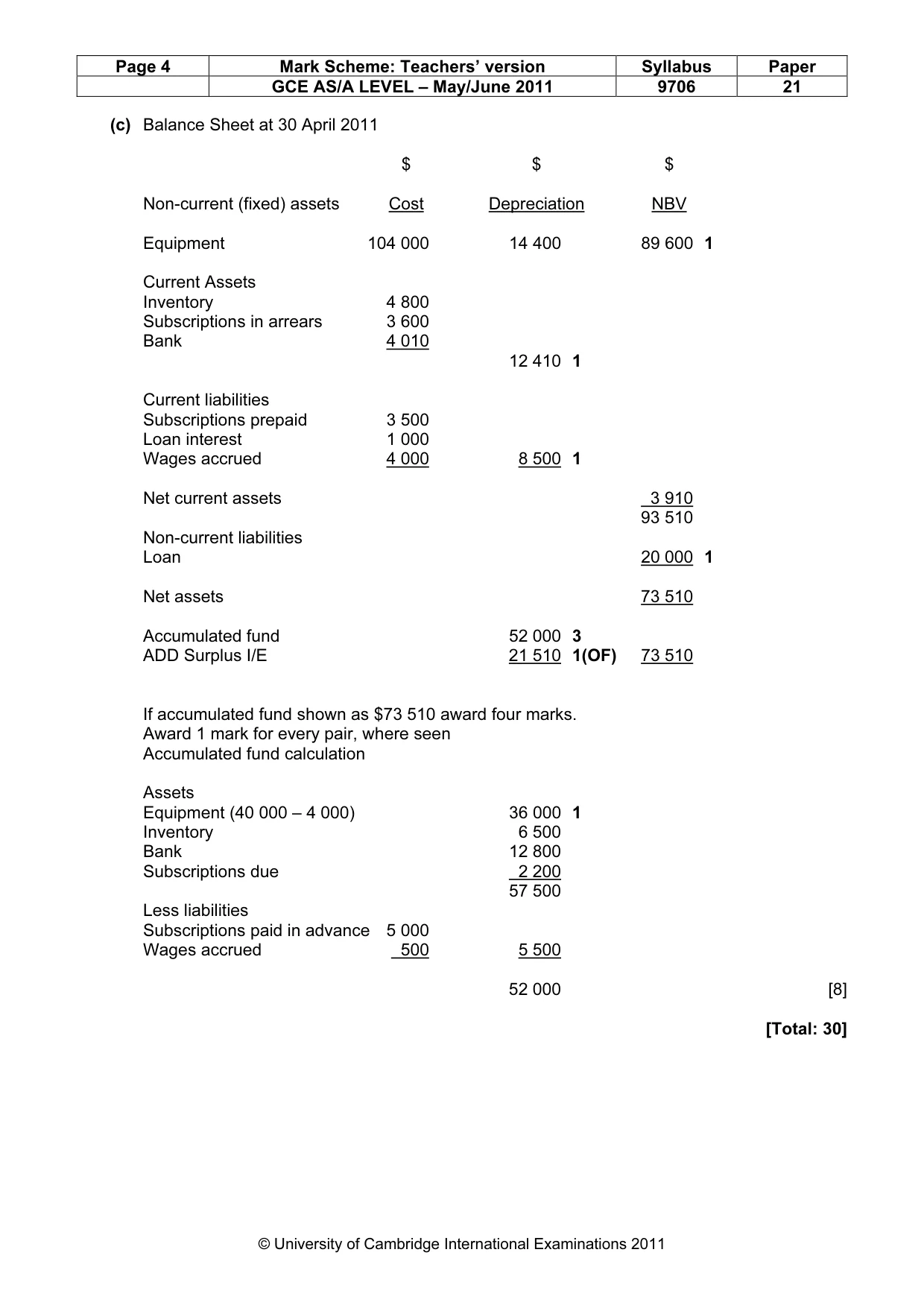
Page 4 Mark Scheme: Teachers’ version Syllabus Paper GCE AS/A LEVEL – May/June 2011 9706 21 © University of Cambridge International Examinations 2011 (c) Balance Sheet at 30 April 2011 $ $ $ Non-current (fixed) assets Cost Depreciation NBV Equipment 104 000 14 400 89 600 1 Current Assets Inventory 4 800 Subscriptions in arrears 3 600 Bank 4 010 12 410 1 Current liabilities Subscriptions prepaid 3 500 Loan interest 1 000 Wages accrued 4 000 8 500 1 Net current assets 3 910 93 510 Non-current liabilities Loan 20 000 1 Net assets 73 510 Accumulated fund 52 000 3 ADD Surplus I/E 21 510 1(OF) 73 510 If accumulated fund shown as $73 510 award four marks. Award 1 mark for every pair, where seen Accumulated fund calculation Assets Equipment (40 000 – 4 000) 36 000 1 Inventory 6 500 Bank 12 800 Subscriptions due 2 200 57 500 Less liabilities Subscriptions paid in advance 5 000 Wages accrued 500 5 500 52 000 [8] [Total: 30]
Mark scheme, page 5
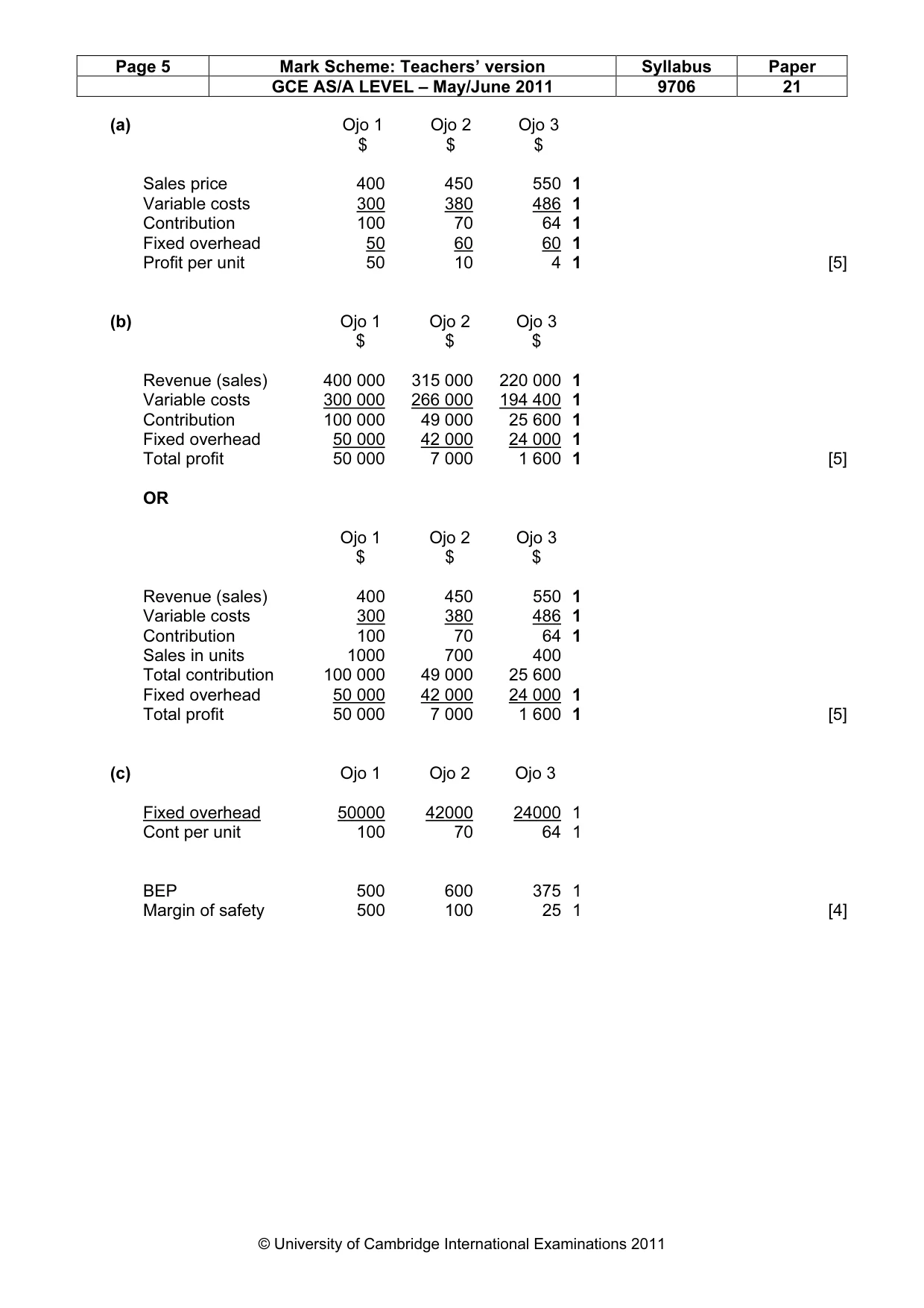
Page 5 Mark Scheme: Teachers’ version Syllabus Paper GCE AS/A LEVEL – May/June 2011 9706 21 © University of Cambridge International Examinations 2011 (a) Ojo 1 Ojo 2 Ojo 3 $ $ $ Sales price 400 450 550 1 Variable costs 300 380 486 1 Contribution 100 70 64 1 Fixed overhead 50 60 60 1 Profit per unit 50 10 4 1 [5] (b) Ojo 1 Ojo 2 Ojo 3 $ $ $ Revenue (sales) 400 000 315 000 220 000 1 Variable costs 300 000 266 000 194 400 1 Contribution 100 000 49 000 25 600 1 Fixed overhead 50 000 42 000 24 000 1 Total profit 50 000 7 000 1 600 1 [5] OR Ojo 1 Ojo 2 Ojo 3 $ $ $ Revenue (sales) 400 450 550 1 Variable costs 300 380 486 1 Contribution 100 70 64 1 Sales in units 1000 700 400 Total contribution 100 000 49 000 25 600 Fixed overhead 50 000 42 000 24 000 1 Total profit 50 000 7 000 1 600 1 [5] (c) Ojo 1 Ojo 2 Ojo 3 Fixed overhead 50000 42000 24000 1 Cont per unit 100 70 64 1 BEP 500 600 375 1 Margin of safety 500 100 25 1 [4]
Mark scheme, page 6
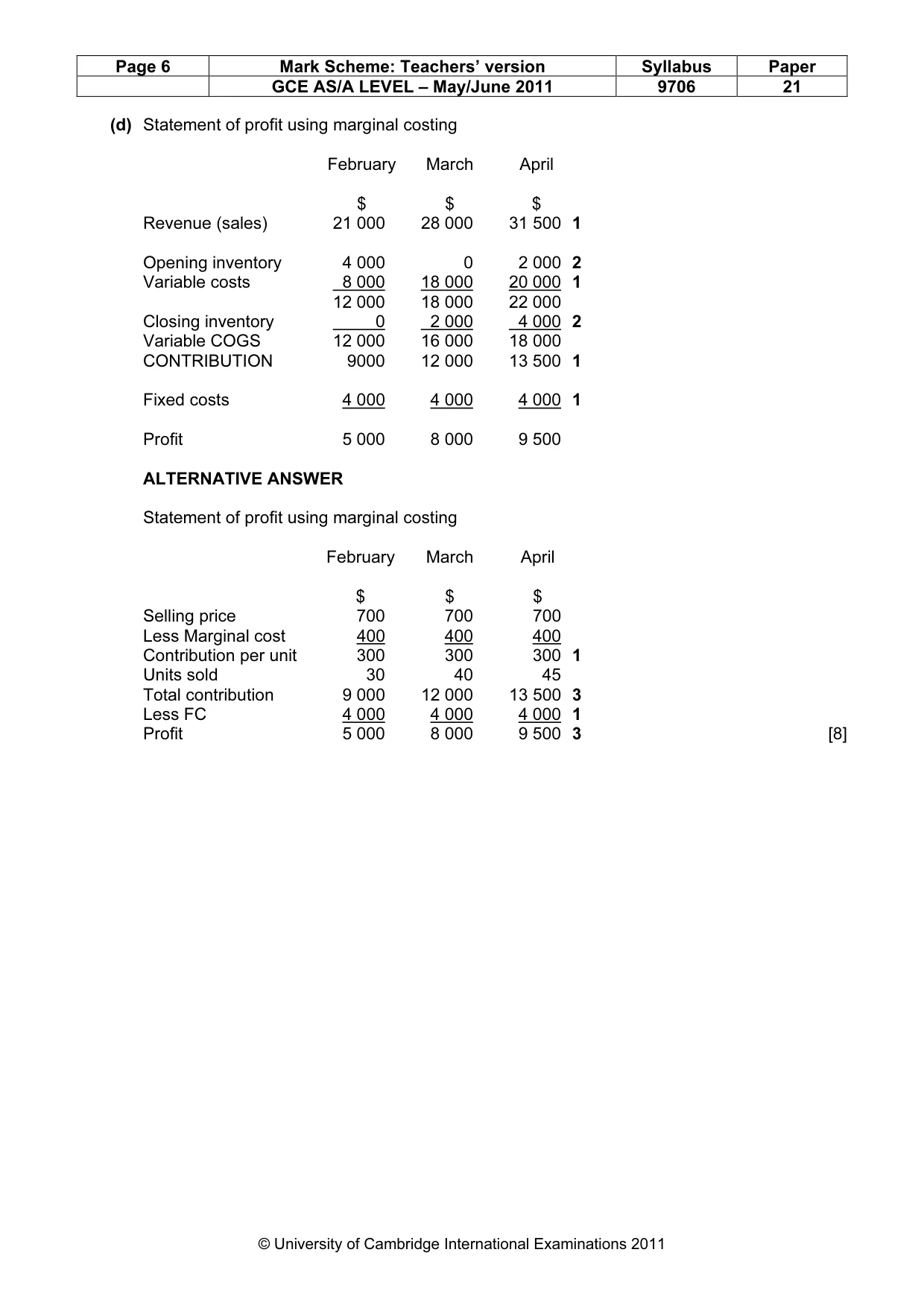
Page 6 Mark Scheme: Teachers’ version Syllabus Paper GCE AS/A LEVEL – May/June 2011 9706 21 © University of Cambridge International Examinations 2011 (d) Statement of profit using marginal costing February March April $ $ $ Revenue (sales) 21 000 28 000 31 500 1 Opening inventory 4 000 0 2 000 2 Variable costs 8 000 18 000 20 000 1 12 000 18 000 22 000 Closing inventory 0 2 000 4 000 2 Variable COGS 12 000 16 000 18 000 CONTRIBUTION 9000 12 000 13 500 1 Fixed costs 4 000 4 000 4 000 1 Profit 5 000 8 000 9 500 ALTERNATIVE ANSWER Statement of profit using marginal costing February March April $ $ $ Selling price 700 700 700 Less Marginal cost 400 400 400 Contribution per unit 300 300 300 1 Units sold 30 40 45 Total contribution 9 000 12 000 13 500 3 Less FC 4 000 4 000 4 000 1 Profit 5 000 8 000 9 500 3 [8]
Mark scheme, page 7
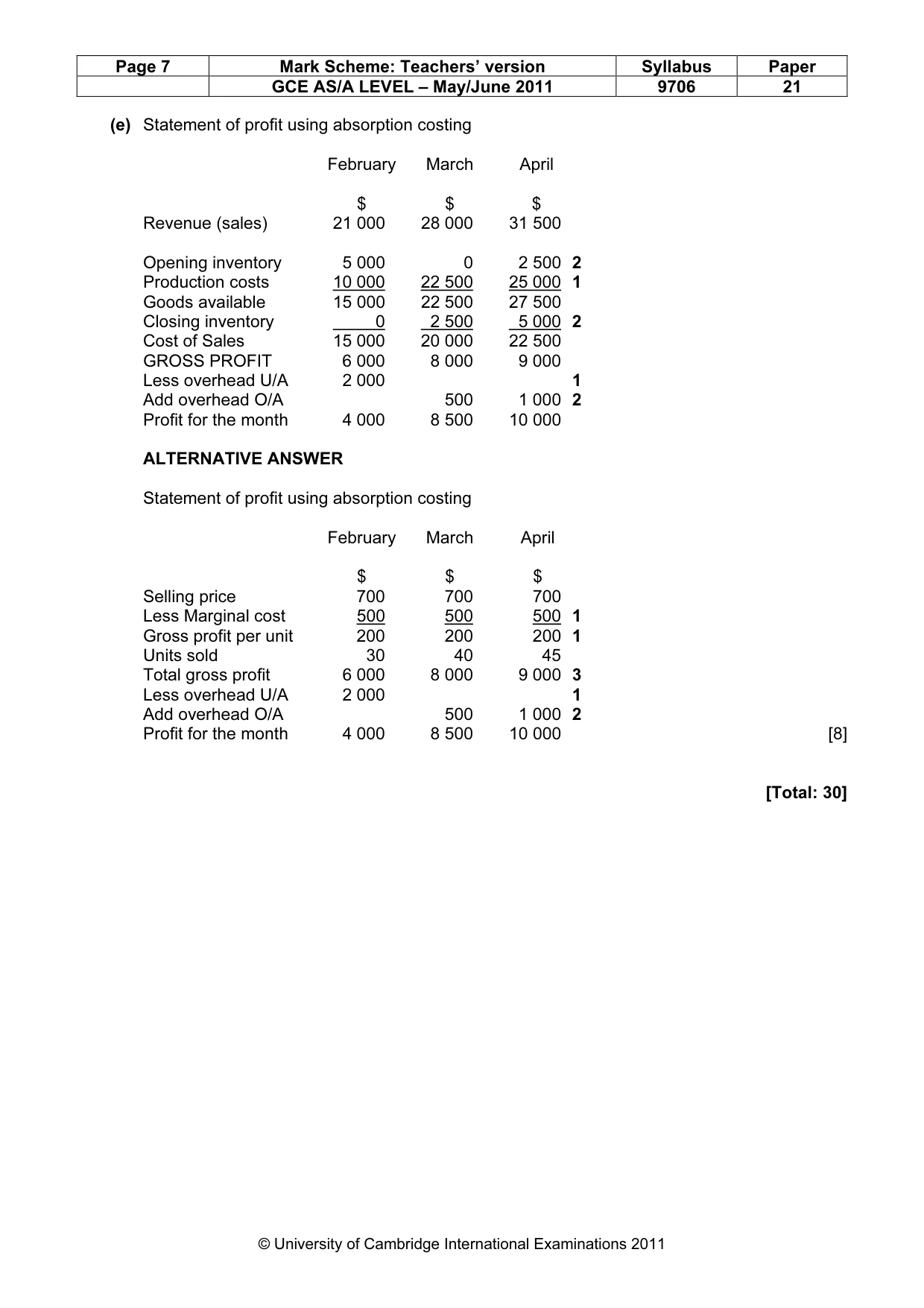
Page 7 Mark Scheme: Teachers’ version Syllabus Paper GCE AS/A LEVEL – May/June 2011 9706 21 © University of Cambridge International Examinations 2011 (e) Statement of profit using absorption costing February March April $ $ $ Revenue (sales) 21 000 28 000 31 500 Opening inventory 5 000 0 2 500 2 Production costs 10 000 22 500 25 000 1 Goods available 15 000 22 500 27 500 Closing inventory 0 2 500 5 000 2 Cost of Sales 15 000 20 000 22 500 GROSS PROFIT 6 000 8 000 9 000 Less overhead U/A 2 000 1 Add overhead O/A 500 1 000 2 Profit for the month 4 000 8 500 10 000 ALTERNATIVE ANSWER Statement of profit using absorption costing February March April $ $ $ Selling price 700 700 700 Less Marginal cost 500 500 500 1 Gross profit per unit 200 200 200 1 Units sold 30 40 45 Total gross profit 6 000 8 000 9 000 3 Less overhead U/A 2 000 1 Add overhead O/A 500 1 000 2 Profit for the month 4 000 8 500 10 000 [8] [Total: 30]
What you needed in this session
Cambridge’s own grade thresholds for 2011 May/June, Paper 2 · Variant 1. A higher threshold means an easier paper — the bar moves with how the cohort did.