Cambridge A Level Accounting 9706 — 2010 Oct/Nov Paper 2 · Variant 2
9706/22/O/N/10 · 90 marks · ≈101 min
The question paper and its mark scheme, free to read here and free to download. This is Cambridge’s own paper, exactly as it was sat.
Question paper16 pages
Mark scheme6 pages
Answers below. Sit the paper first if you are practising.
Paper as text
Question paper, page 1
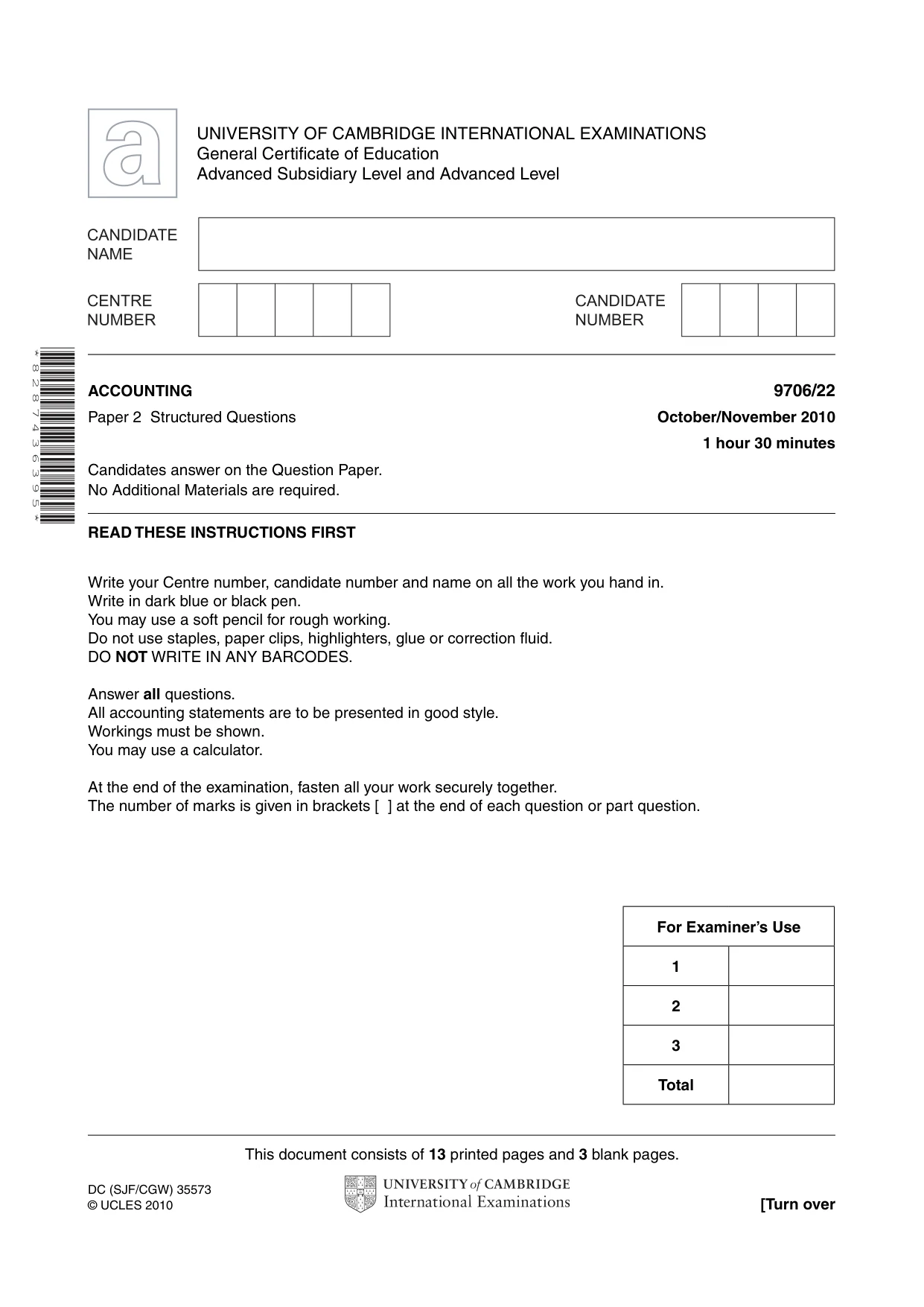
This document consists of 13 printed pages and 3 blank pages. DC (SJF/CGW) 35573 © UCLES 2010 [Turn over UNIVERSITY OF CAMBRIDGE INTERNATIONAL EXAMINATIONS General Certificate of Education Advanced Subsidiary Level and Advanced Level * 8 2 8 7 4 3 6 3 9 5 * ACCOUNTING 9706/22 Paper 2 Structured Questions October/November 2010 1 hour 30 minutes Candidates answer on the Question Paper. No Additional Materials are required. READ THESE INSTRUCTIONS FIRST Write your Centre number, candidate number and name on all the work you hand in. Write in dark blue or black pen. You may use a soft pencil for rough working. Do not use staples, paper clips, highlighters, glue or correction fluid. DO NOT WRITE IN ANY BARCODES. Answer all questions. All accounting statements are to be presented in good style. Workings must be shown. You may use a calculator. At the end of the examination, fasten all your work securely together. The number of marks is given in brackets [ ] at the end of each question or part question. For Examiner’s Use 1 2 3 Total
Question paper, page 2
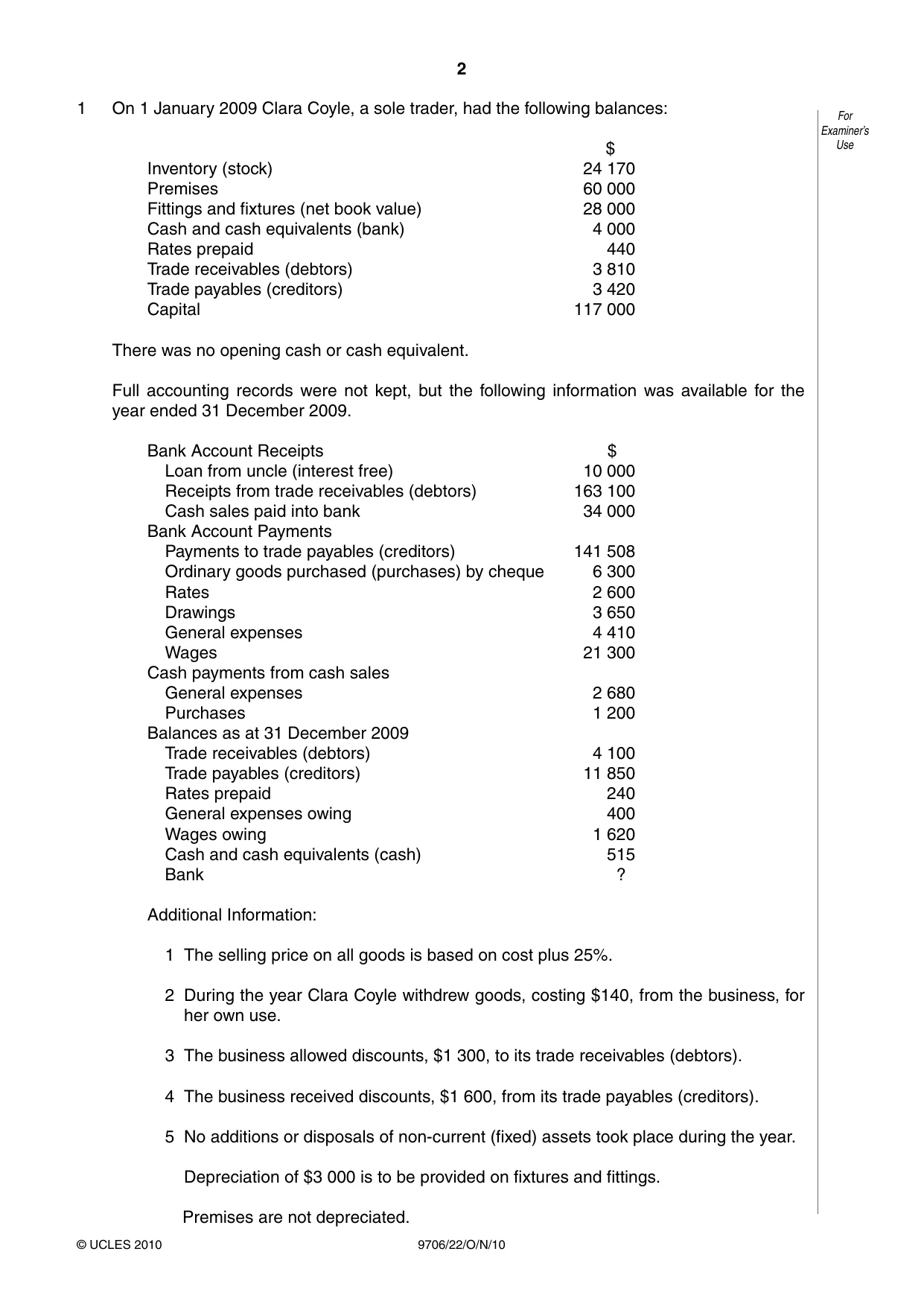
2 9706/22/O/N/10 © UCLES 2010 For Examiner’s Use 1 On 1 January 2009 Clara Coyle, a sole trader, had the following balances: $ Inventory (stock) 24 170 Premises 60 000 Fittings and fixtures (net book value) 28 000 Cash and cash equivalents (bank) 4 000 Rates prepaid 440 Trade receivables (debtors) 3 810 Trade payables (creditors) 3 420 Capital 117 000 There was no opening cash or cash equivalent. Full accounting records were not kept, but the following information was available for the year ended 31 December 2009. Bank Account Receipts $ Loan from uncle (interest free) 10 000 Receipts from trade receivables (debtors) 163 100 Cash sales paid into bank 34 000 Bank Account Payments Payments to trade payables (creditors) 141 508 Ordinary goods purchased (purchases) by cheque 6 300 Rates 2 600 Drawings 3 650 General expenses 4 410 Wages 21 300 Cash payments from cash sales General expenses 2 680 Purchases 1 200 Balances as at 31 December 2009 Trade receivables (debtors) 4 100 Trade payables (creditors) 11 850 Rates prepaid 240 General expenses owing 400 Wages owing 1 620 Cash and cash equivalents (cash) 515 Bank ? Additional Information: 1 The selling price on all goods is based on cost plus 25%. 2 During the year Clara Coyle withdrew goods, costing $140, from the business, for her own use. 3 The business allowed discounts, $1 300, to its trade receivables (debtors). 4 The business received discounts, $1 600, from its trade payables (creditors). 5 No additions or disposals of non-current (fixed) assets took place during the year. Depreciation of $3 000 is to be provided on fixtures and fittings. Premises are not depreciated.
Question paper, page 3
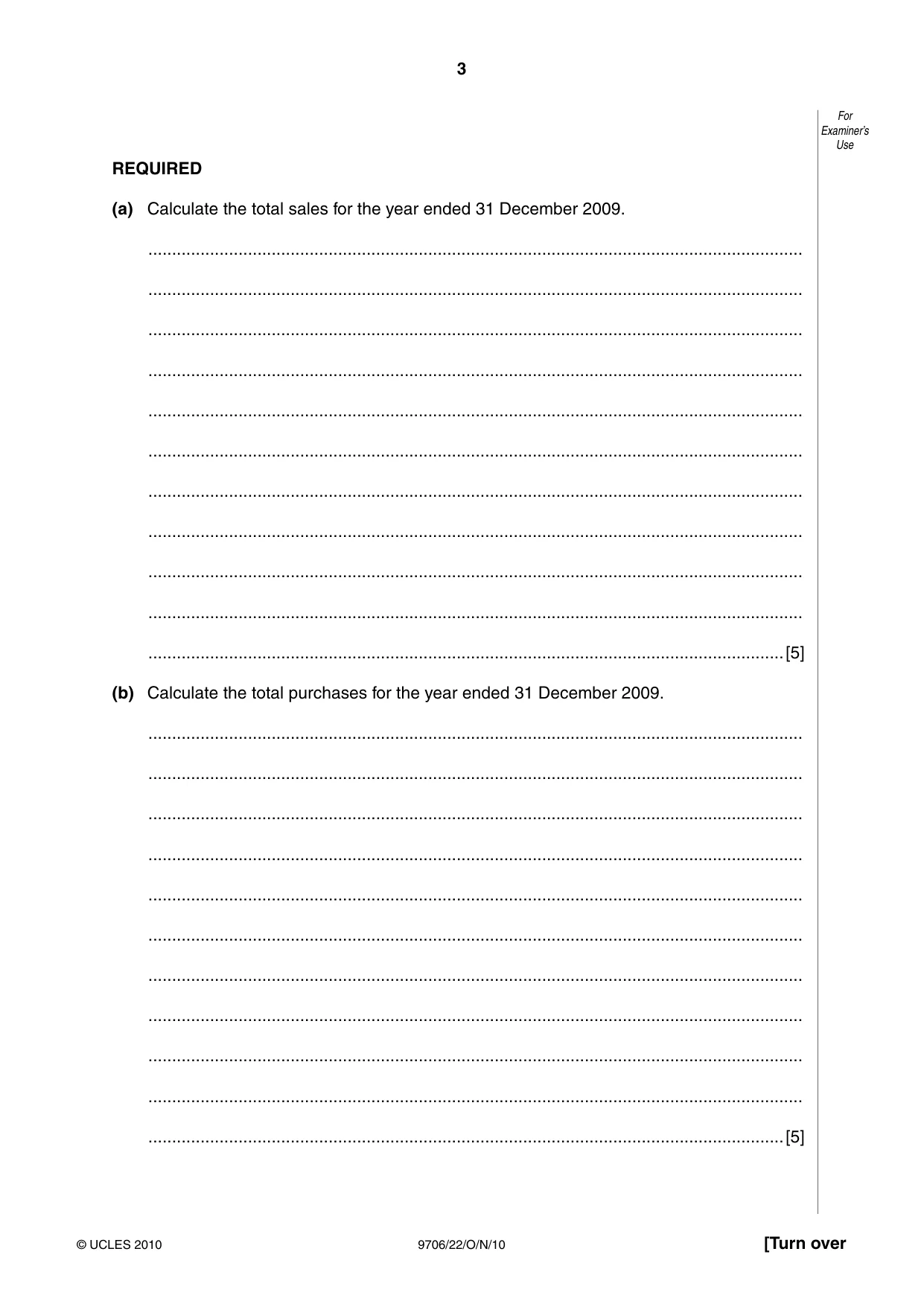
3 9706/22/O/N/10 © UCLES 2010 [Turn over For Examiner’s Use REQUIRED (a) Calculate the total sales for the year ended 31 December 2009. … … … … … … … … … … …[5] (b) Calculate the total purchases for the year ended 31 December 2009. … … … … … … … … … … …[5]
Question paper, page 4
4 9706/22/O/N/10 © UCLES 2010 For Examiner’s Use (c) Prepare the Income Statement (trading and profit and loss account) for Clara Coyle for the year ended 31 December 2009. … … … … … … … … … … … … … … … … … … … … … … … … … [8]
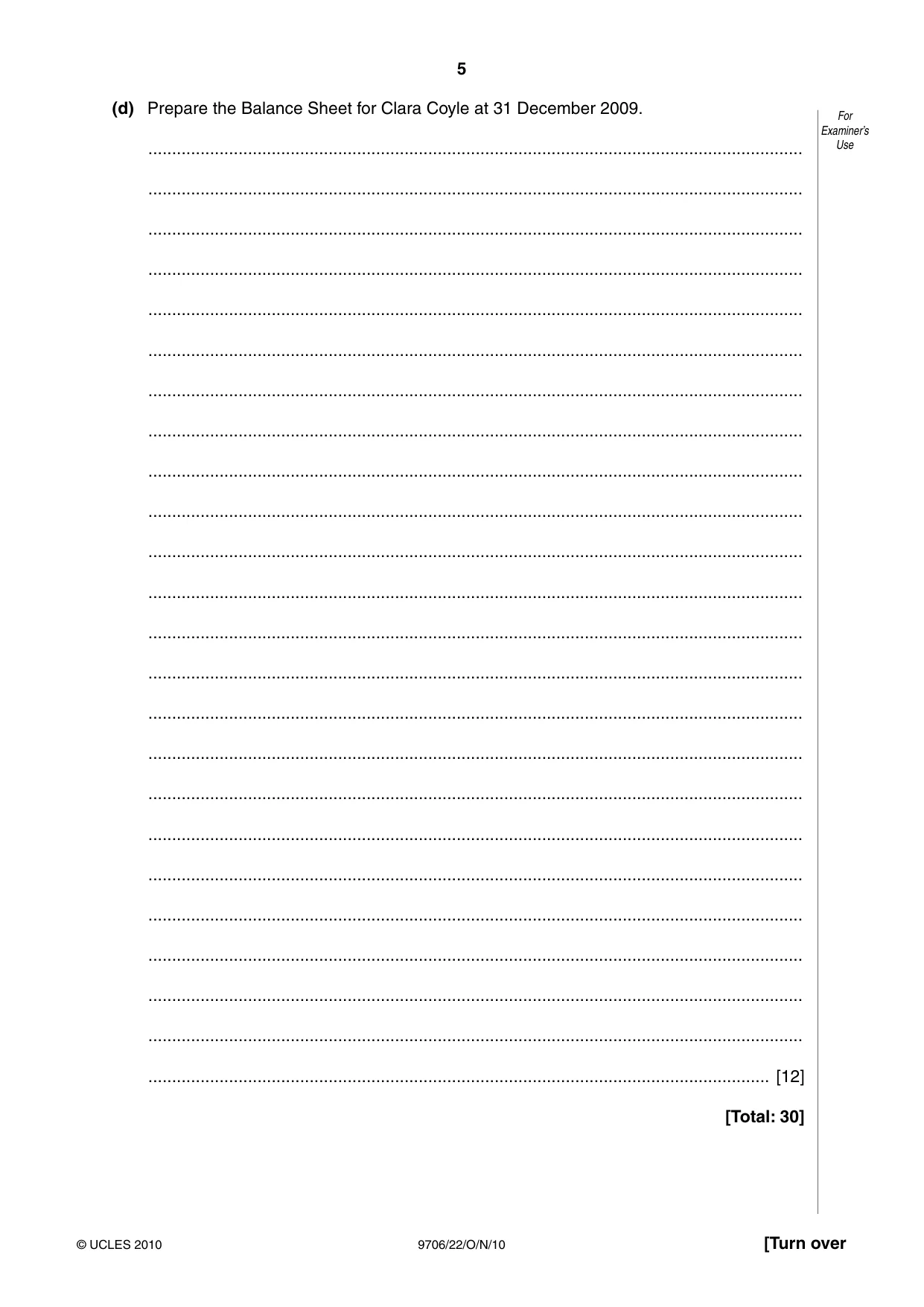
Question paper, page 5
5 9706/22/O/N/10 © UCLES 2010 [Turn over For Examiner’s Use (d) Prepare the Balance Sheet for Clara Coyle at 31 December 2009. … … … … … … … … … … … … … … … … … … … … … … … … [12] [Total: 30]
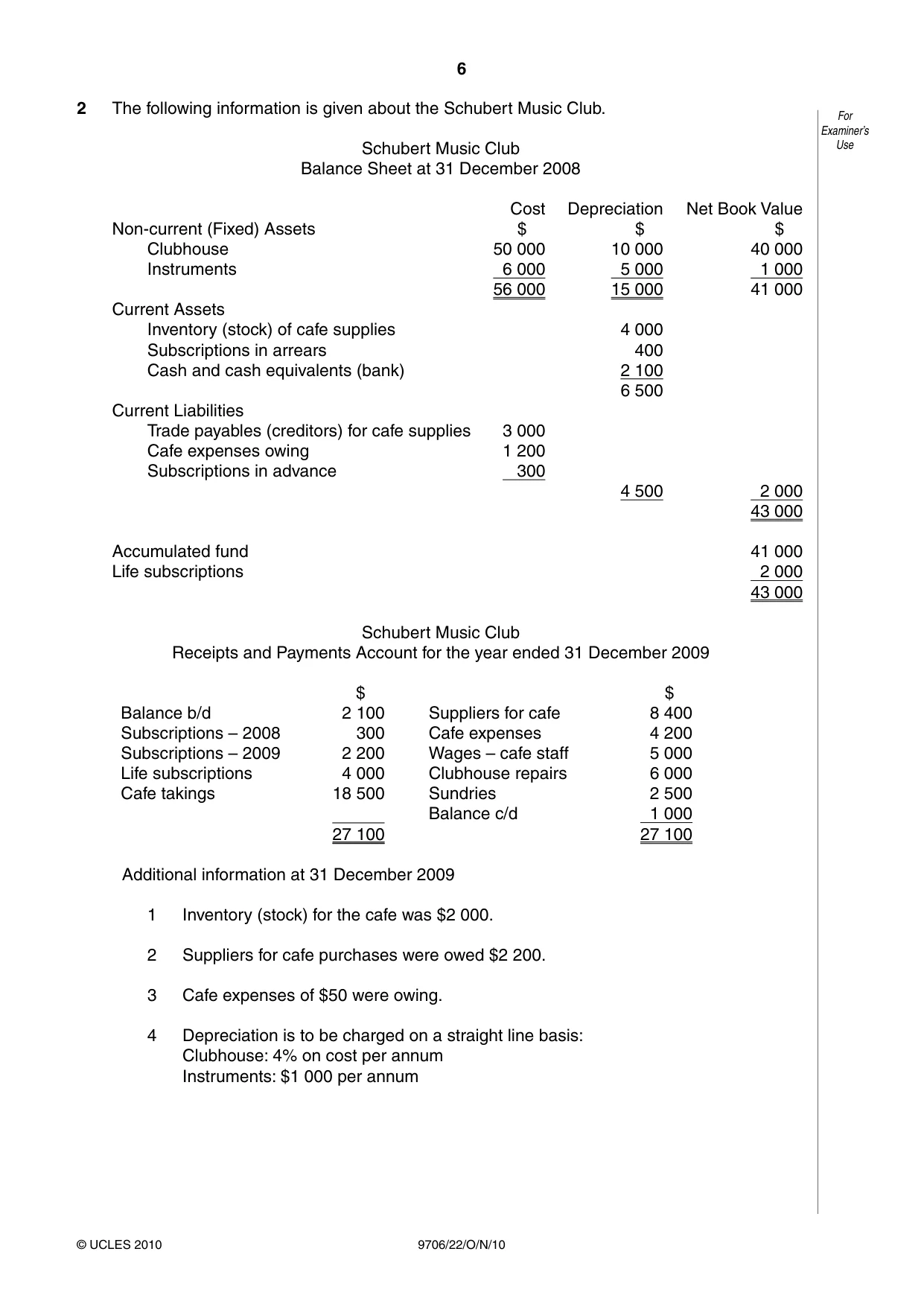
Question paper, page 6
6 9706/22/O/N/10 © UCLES 2010 For Examiner’s Use 2 The following information is given about the Schubert Music Club. Schubert Music Club Balance Sheet at 31 December 2008 Cost Depreciation Net Book Value Non-current (Fixed) Assets $ $ $ Clubhouse 50 000 10 000 40 000 Instruments 06 000 05 000 01 000 56 000 15 000 41 000 Current Assets Inventory (stock) of cafe supplies 4 000 Subscriptions in arrears 400 Cash and cash equivalents (bank) 2 100 6 500 Current Liabilities Trade payables (creditors) for cafe supplies 3 000 Cafe expenses owing 1 200 Subscriptions in advance 0 300 4 500 02 000 43 000 Accumulated fund 41 000 Life subscriptions 02 000 43 000 Schubert Music Club Receipts and Payments Account for the year ended 31 December 2009 $ $ Balance b/d 2 100 Suppliers for cafe 8 400 Subscriptions – 2008 300 Cafe expenses 4 200 Subscriptions – 2009 2 200 Wages – cafe staff 5 000 Life subscriptions 4 000 Clubhouse repairs 6 000 Cafe takings 18 500 Sundries 2 500 Balance c/d 01 000 27 100 27 100 Additional information at 31 December 2009 1 Inventory (stock) for the cafe was $2 000. 2 Suppliers for cafe purchases were owed $2 200. 3 Cafe expenses of $50 were owing. 4 Depreciation is to be charged on a straight line basis: Clubhouse: 4% on cost per annum Instruments: $1 000 per annum
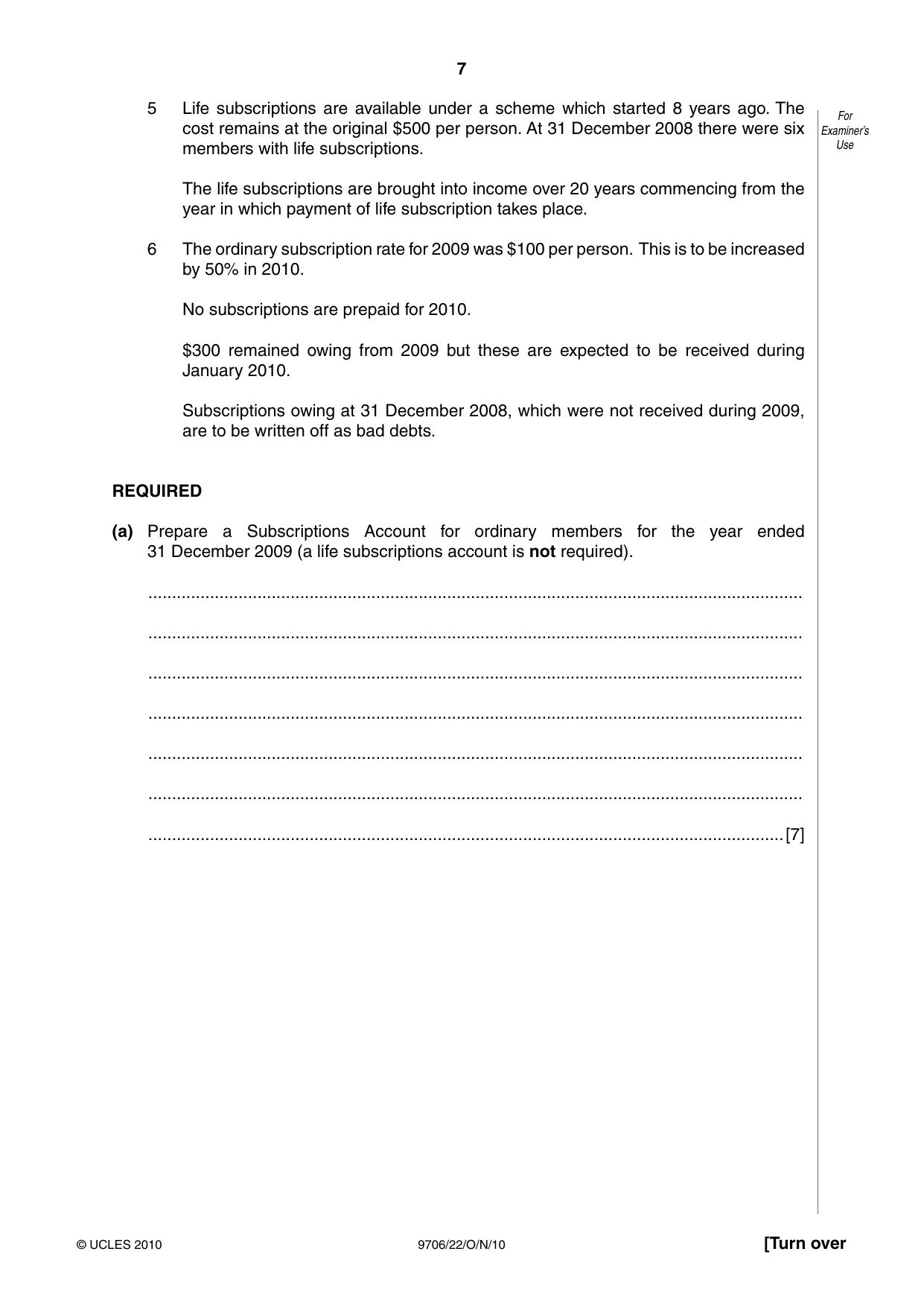
Question paper, page 7
7 9706/22/O/N/10 © UCLES 2010 [Turn over For Examiner’s Use 5 Life subscriptions are available under a scheme which started 8 years ago. The cost remains at the original $500 per person. At 31 December 2008 there were six members with life subscriptions. The life subscriptions are brought into income over 20 years commencing from the year in which payment of life subscription takes place. 6 The ordinary subscription rate for 2009 was $100 per person. This is to be increased by 50% in 2010. No subscriptions are prepaid for 2010. $300 remained owing from 2009 but these are expected to be received during January 2010. Subscriptions owing at 31 December 2008, which were not received during 2009, are to be written off as bad debts. REQUIRED (a) Prepare a Subscriptions Account for ordinary members for the year ended 31 December 2009 (a life subscriptions account is not required). … … … … … … …[7]
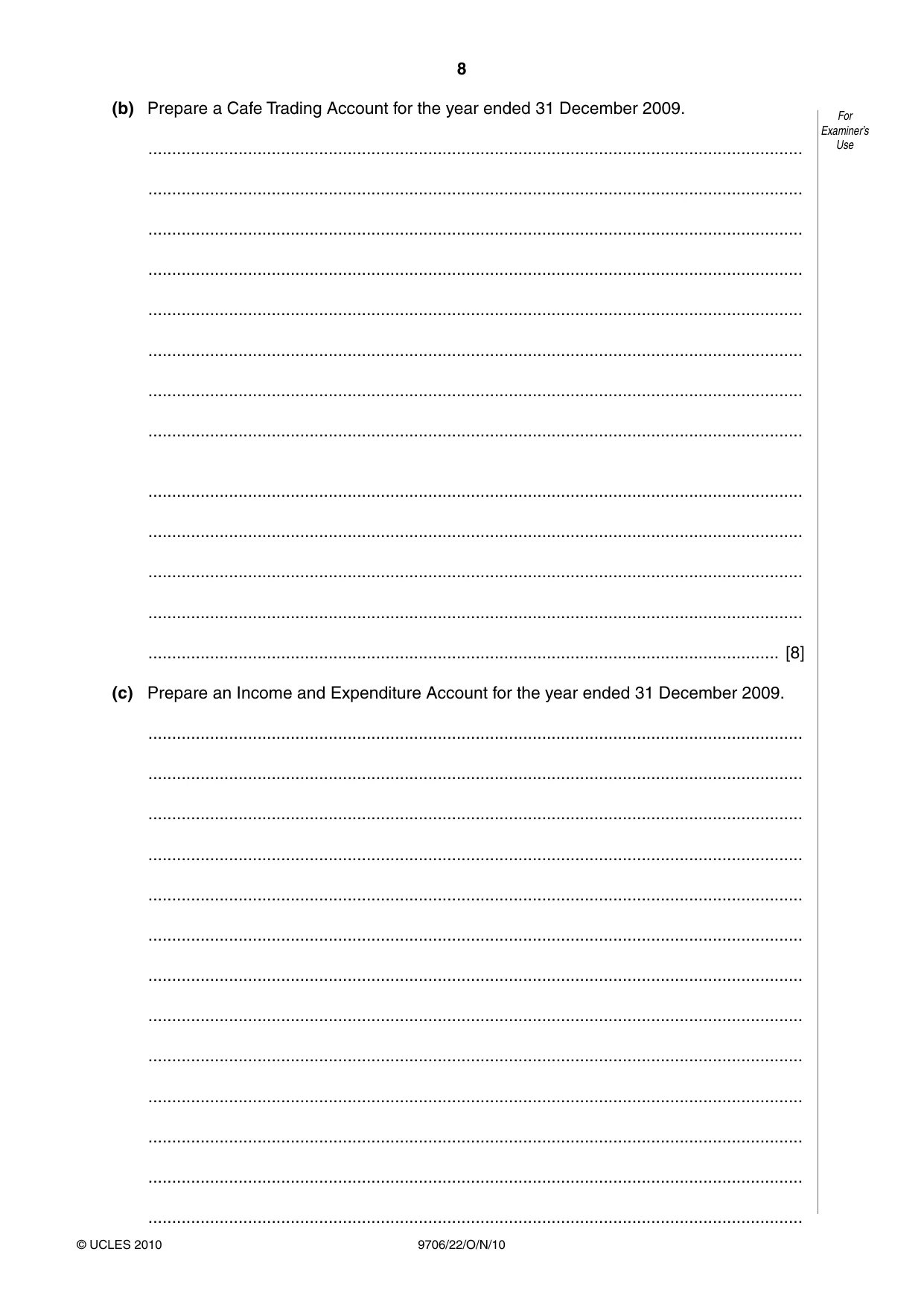
Question paper, page 8
8 9706/22/O/N/10 © UCLES 2010 For Examiner’s Use (b) Prepare a Cafe Trading Account for the year ended 31 December 2009. … … … … … … … … … … … … … [8] (c) Prepare an Income and Expenditure Account for the year ended 31 December 2009. … … … … … … … … … … … … …
Question paper, page 9
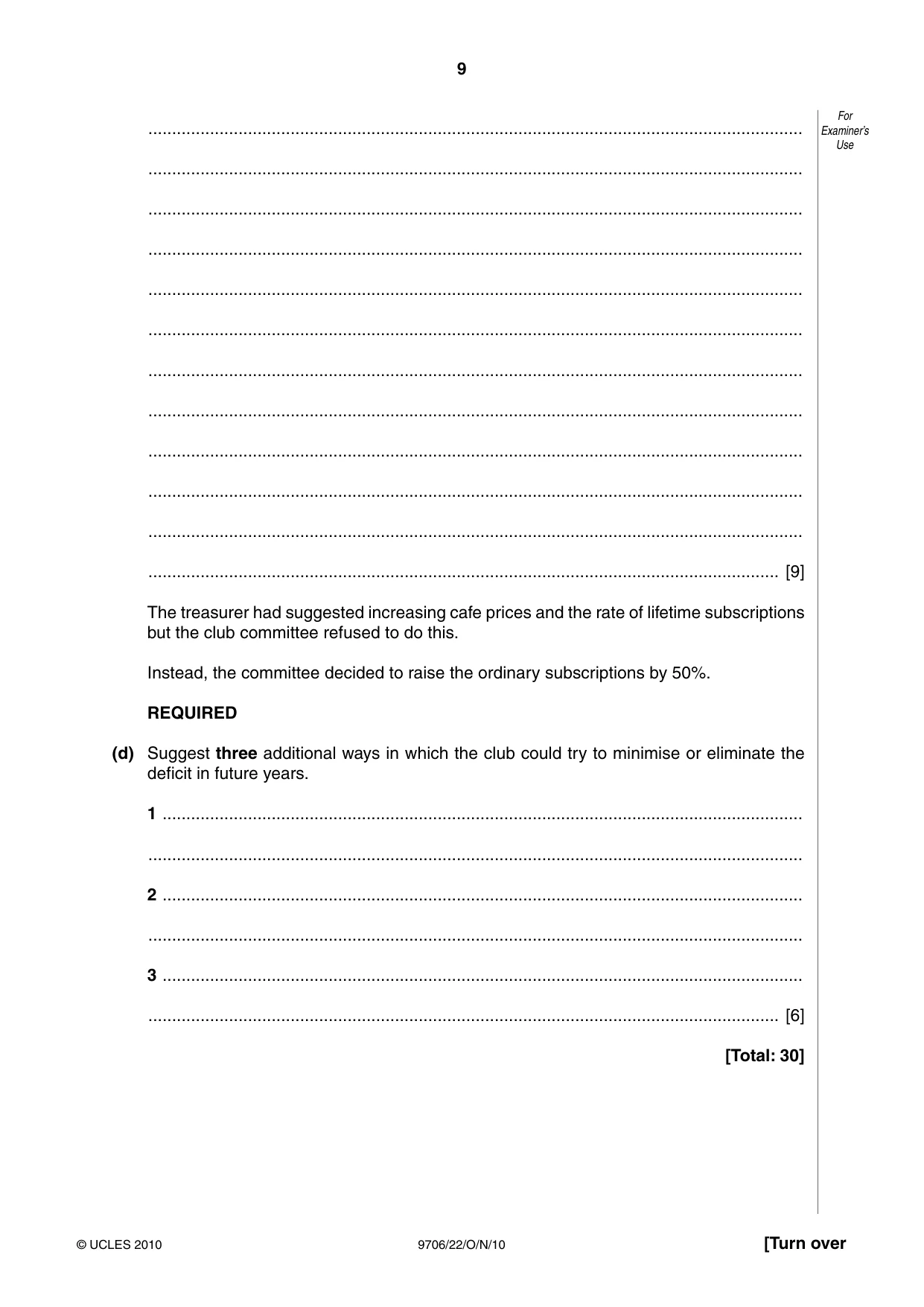
9 9706/22/O/N/10 © UCLES 2010 [Turn over For Examiner’s Use … … … … … … … … … … … … [9] The treasurer had suggested increasing cafe prices and the rate of lifetime subscriptions but the club committee refused to do this. Instead, the committee decided to raise the ordinary subscriptions by 50%. REQUIRED (d) Suggest three additional ways in which the club could try to minimise or eliminate the deficit in future years. 1 … … 2 … … 3 … … [6] [Total: 30]
Question paper, page 10
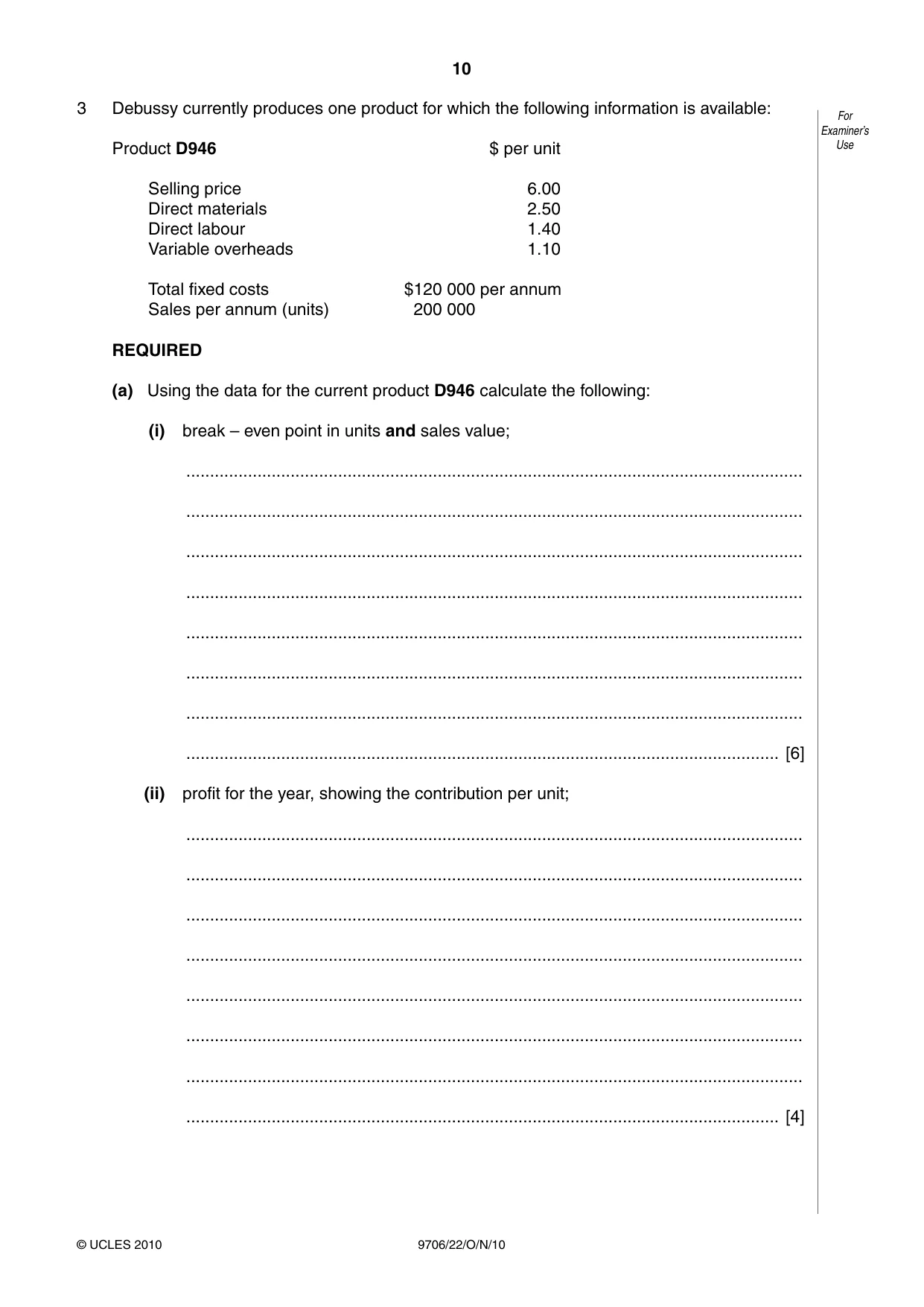
10 9706/22/O/N/10 © UCLES 2010 For Examiner’s Use 3 Debussy currently produces one product for which the following information is available: Product D946 $ per unit Selling price 6.00 Direct materials 2.50 Direct labour 1.40 Variable overheads 1.10 Total fixed costs $120 000 per annum Sales per annum (units) $200 000 REQUIRED (a) Using the data for the current product D946 calculate the following: (i) break – even point in units and sales value; … … … … … … … … [6] (ii) profit for the year, showing the contribution per unit; … … … … … … … … [4]
Question paper, page 11
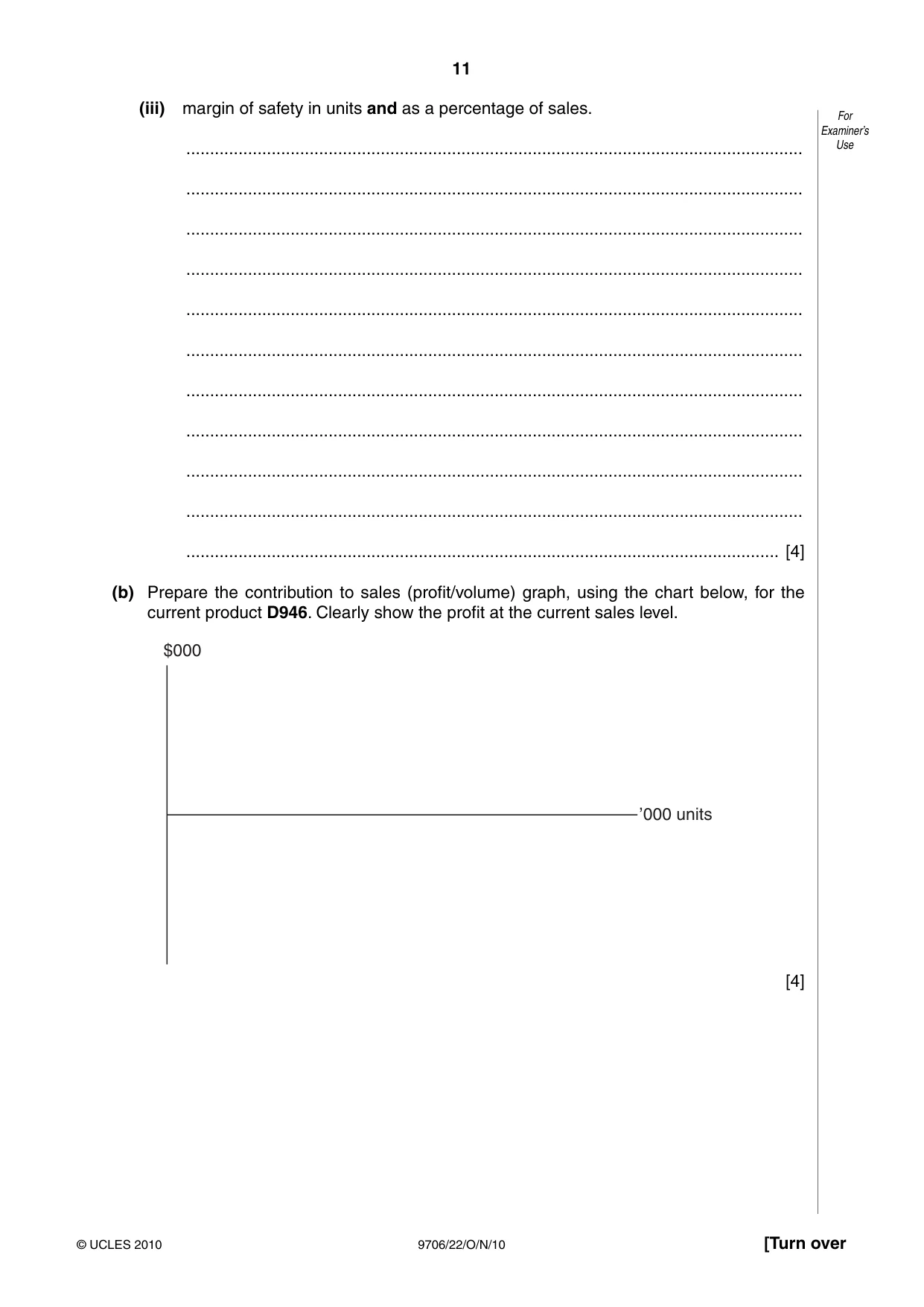
11 9706/22/O/N/10 © UCLES 2010 [Turn over For Examiner’s Use (iii) margin of safety in units and as a percentage of sales. … … … … … … … … … … … [4] (b) Prepare the contribution to sales (profit/volume) graph, using the chart below, for the current product D946. Clearly show the profit at the current sales level. $000 ’000 units [4]
Question paper, page 12
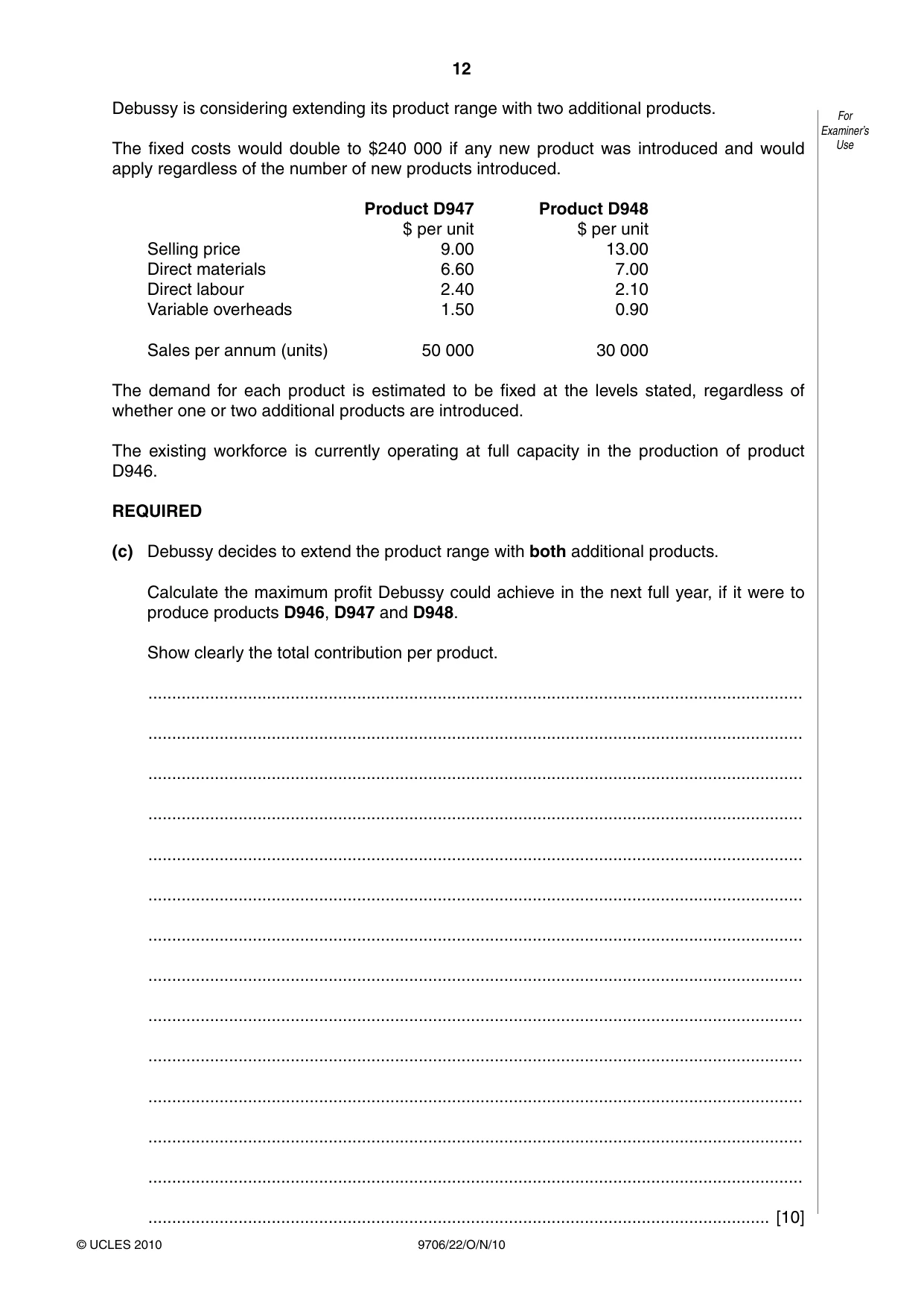
12 9706/22/O/N/10 © UCLES 2010 For Examiner’s Use Debussy is considering extending its product range with two additional products. The fixed costs would double to $240 000 if any new product was introduced and would apply regardless of the number of new products introduced. Product D947 Product D948 $ per unit $ per unit Selling price 9.00 13.00 Direct materials 6.60 7.00 Direct labour 2.40 2.10 Variable overheads 1.50 0.90 Sales per annum (units) 50 000 30 000 The demand for each product is estimated to be fixed at the levels stated, regardless of whether one or two additional products are introduced. The existing workforce is currently operating at full capacity in the production of product D946. REQUIRED (c) Debussy decides to extend the product range with both additional products. Calculate the maximum profit Debussy could achieve in the next full year, if it were to produce products D946, D947 and D948. Show clearly the total contribution per product. … … … … … … … … … … … … … … [10]
Question paper, page 13
13 9706/22/O/N/10 © UCLES 2010 For Examiner’s Use (d) Based on your calculations advise Debussy whether or not to go ahead and produce all three products. Give reasons for your advice. … … … … [2] [Total: 30]
Question paper, page 14
14 9706/22/O/N/10 © UCLES 2010 BLANK PAGE
Question paper, page 15
15 9706/22/O/N/10 © UCLES 2010 BLANK PAGE
Question paper, page 16
16 9706/22/O/N/10 © UCLES 2010 Permission to reproduce items where third-party owned material protected by copyright is included has been sought and cleared where possible. Every reasonable effort has been made by the publisher (UCLES) to trace copyright holders, but if any items requiring clearance have unwittingly been included, the publisher will be pleased to make amends at the earliest possible opportunity. University of Cambridge International Examinations is part of the Cambridge Assessment Group. Cambridge Assessment is the brand name of University of Cambridge Local Examinations Syndicate (UCLES), which is itself a department of the University of Cambridge. BLANK PAGE
Mark scheme, page 1
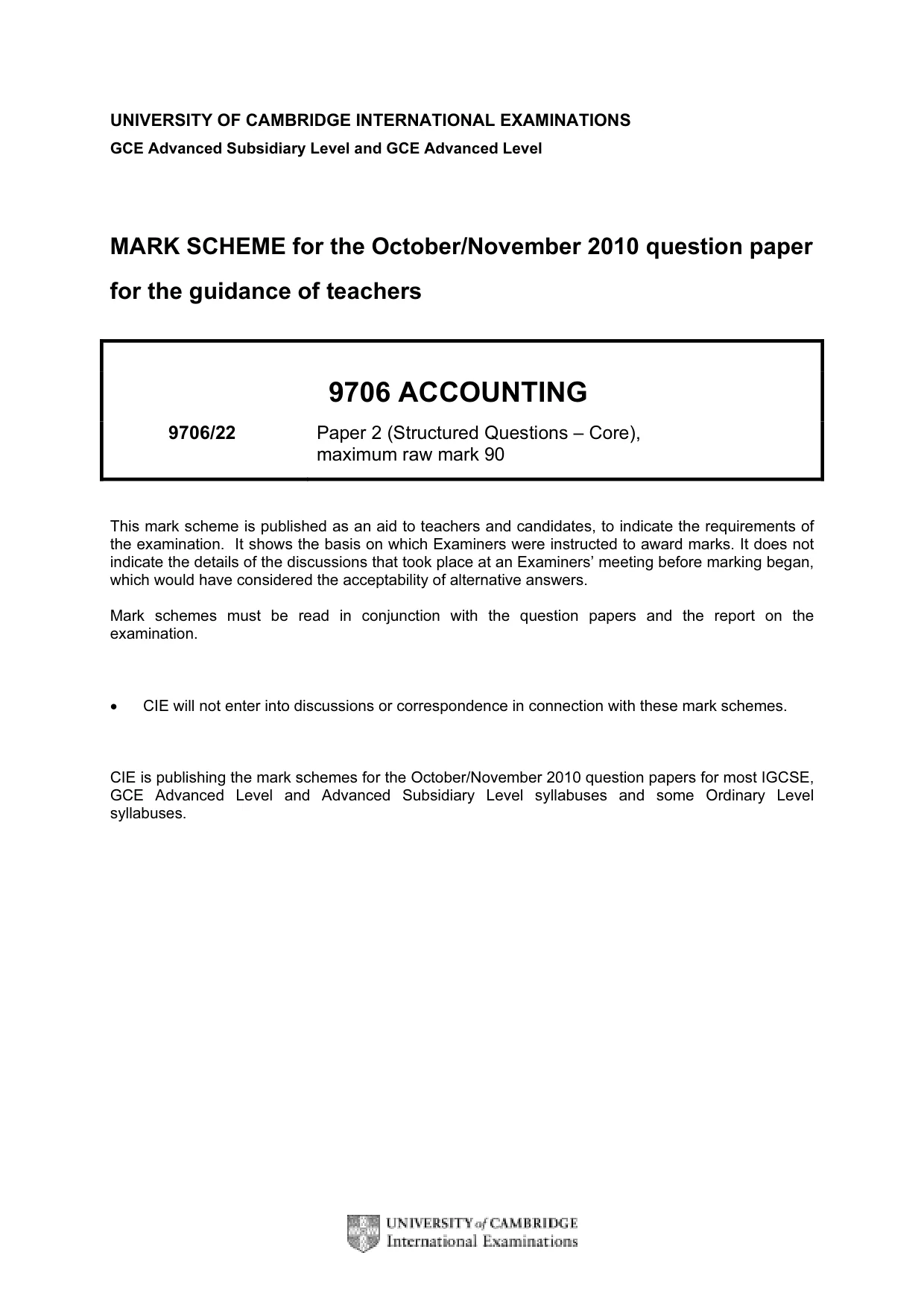
UNIVERSITY OF CAMBRIDGE INTERNATIONAL EXAMINATIONS GCE Advanced Subsidiary Level and GCE Advanced Level MARK SCHEME for the October/November 2010 question paper for the guidance of teachers 9706 ACCOUNTING 9706/22 Paper 2 (Structured Questions – Core), maximum raw mark 90 This mark scheme is published as an aid to teachers and candidates, to indicate the requirements of the examination. It shows the basis on which Examiners were instructed to award marks. It does not indicate the details of the discussions that took place at an Examiners’ meeting before marking began, which would have considered the acceptability of alternative answers. Mark schemes must be read in conjunction with the question papers and the report on the examination. • CIE will not enter into discussions or correspondence in connection with these mark schemes. CIE is publishing the mark schemes for the October/November 2010 question papers for most IGCSE, GCE Advanced Level and Advanced Subsidiary Level syllabuses and some Ordinary Level syllabuses.
Mark scheme, page 2
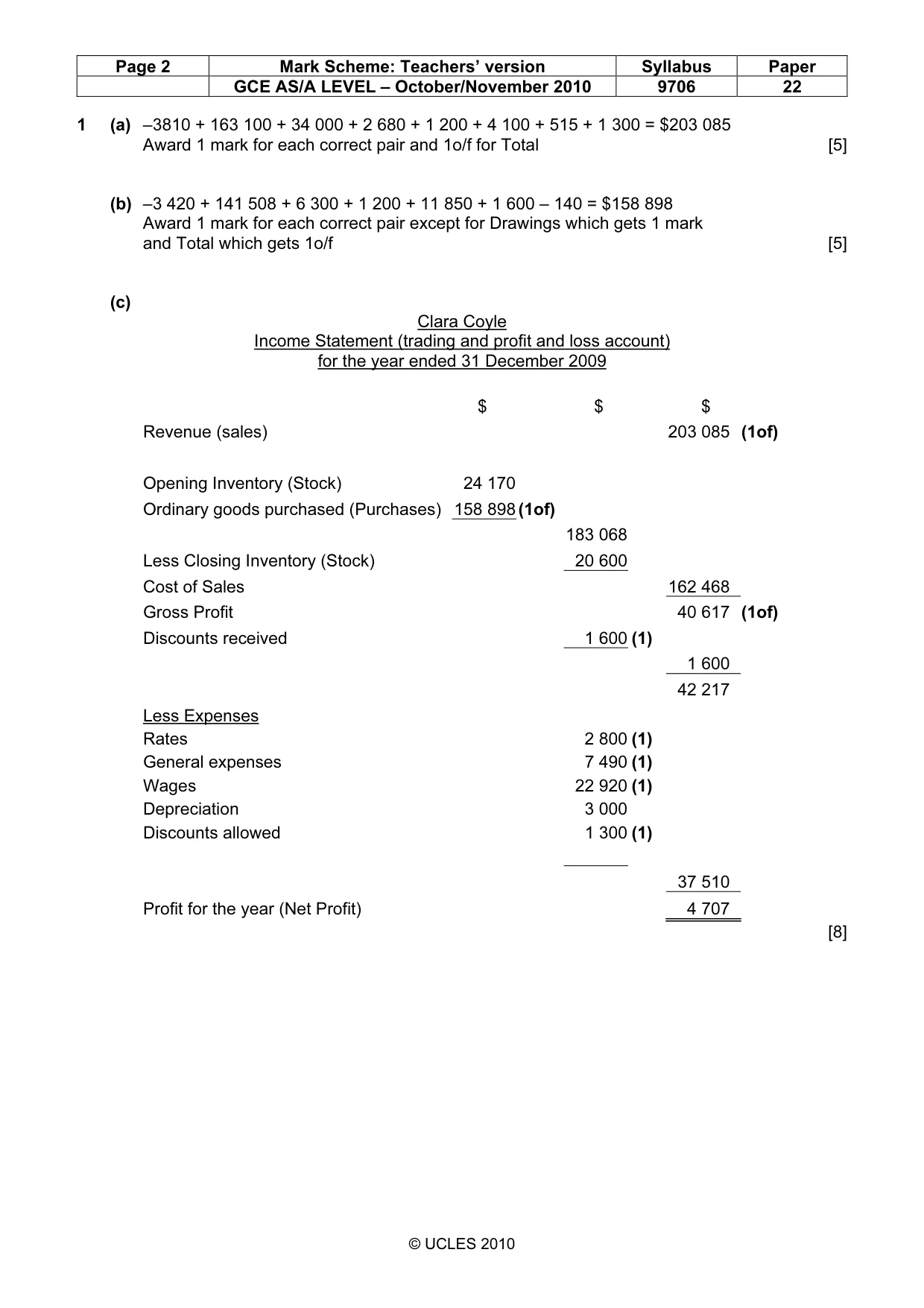
Page 2 Mark Scheme: Teachers’ version Syllabus Paper GCE AS/A LEVEL – October/November 2010 9706 22 © UCLES 2010 1 (a) –3810 + 163 100 + 34 000 + 2 680 + 1 200 + 4 100 + 515 + 1 300 = $203 085 Award 1 mark for each correct pair and 1o/f for Total [5] (b) –3 420 + 141 508 + 6 300 + 1 200 + 11 850 + 1 600 – 140 = $158 898 Award 1 mark for each correct pair except for Drawings which gets 1 mark and Total which gets 1o/f [5] (c) Clara Coyle Income Statement (trading and profit and loss account) for the year ended 31 December 2009 $ $ $ Revenue (sales) 203 085 (1of) Opening Inventory (Stock) 24 170 Ordinary goods purchased (Purchases) 158 898 (1of) 183 068 Less Closing Inventory (Stock) 20 600 Cost of Sales 162 468 Gross Profit 40 617 (1of) Discounts received 1 600 (1) 1 600 42 217 Less Expenses Rates 2 800 (1) General expenses 7 490 (1) Wages 22 920 (1) Depreciation 3 000 Discounts allowed 1 300 (1) 37 510 Profit for the year (Net Profit) 4 707 [8]
Mark scheme, page 3
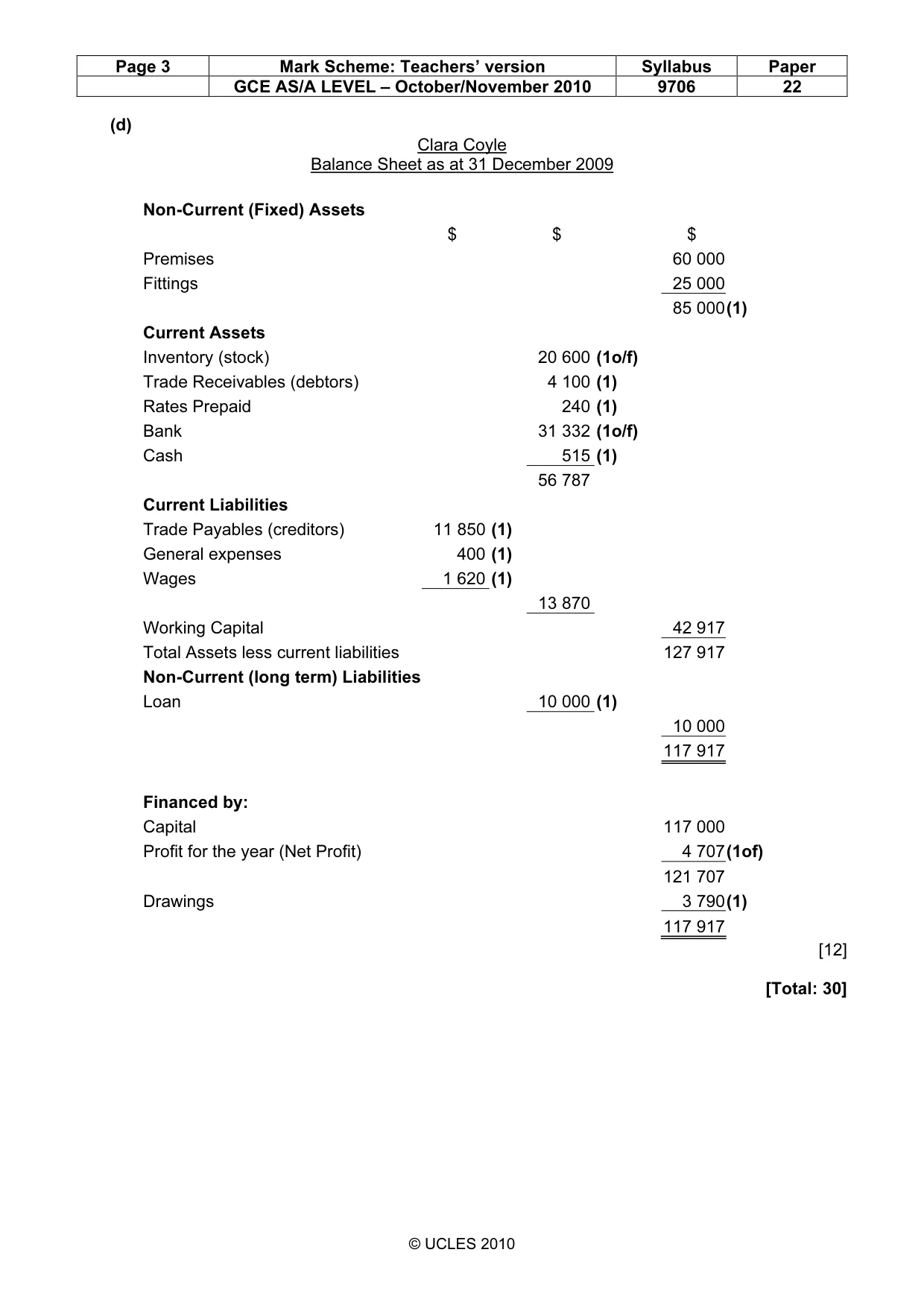
Page 3 Mark Scheme: Teachers’ version Syllabus Paper GCE AS/A LEVEL – October/November 2010 9706 22 © UCLES 2010 (d) Clara Coyle Balance Sheet as at 31 December 2009 Non-Current (Fixed) Assets $ $ $ Premises 60 000 Fittings 25 000 85 000 (1) Current Assets Inventory (stock) 20 600 (1o/f) Trade Receivables (debtors) 4 100 (1) Rates Prepaid 240 (1) Bank 31 332 (1o/f) Cash 515 (1) 56 787 Current Liabilities Trade Payables (creditors) 11 850 (1) General expenses 400 (1) Wages 1 620 (1) 13 870 Working Capital 42 917 Total Assets less current liabilities 127 917 Non-Current (long term) Liabilities Loan 10 000 (1) 10 000 117 917 Financed by: Capital 117 000 Profit for the year (Net Profit) 4 707(1of) 121 707 Drawings 3 790(1) 117 917 [12] [Total: 30]
Mark scheme, page 4
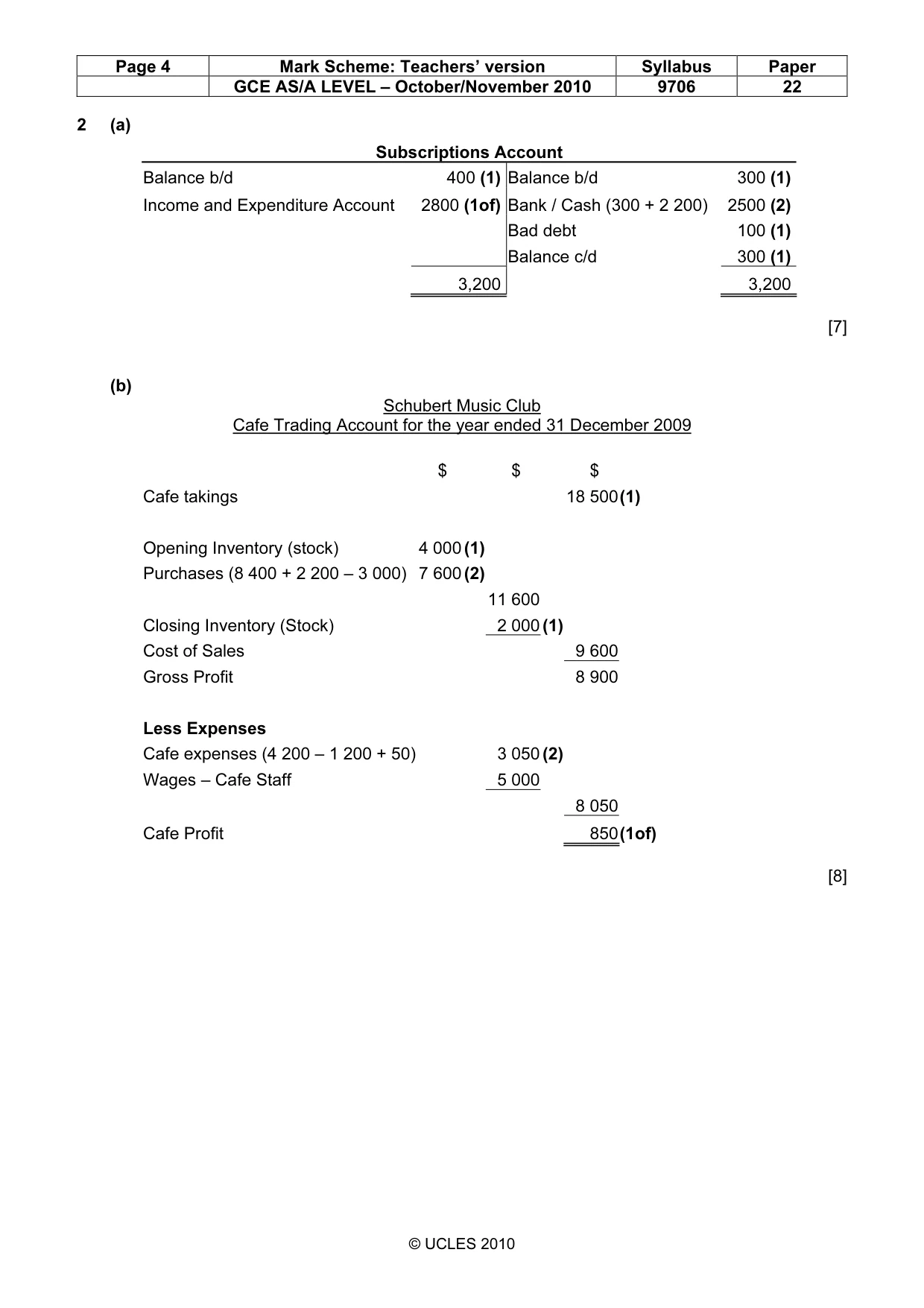
Page 4 Mark Scheme: Teachers’ version Syllabus Paper GCE AS/A LEVEL – October/November 2010 9706 22 © UCLES 2010 2 (a) Subscriptions Account Balance b/d 400 (1) Balance b/d 300 (1) Income and Expenditure Account 2800 (1of) Bank / Cash (300 + 2 200) 2500 (2) Bad debt 100 (1) Balance c/d 300 (1) 3,200 3,200 [7] (b) Schubert Music Club Cafe Trading Account for the year ended 31 December 2009 $ $ $ Cafe takings 18 500(1) Opening Inventory (stock) 4 000 (1) Purchases (8 400 + 2 200 – 3 000) 7 600 (2) 11 600 Closing Inventory (Stock) 2 000 (1) Cost of Sales 9 600 Gross Profit 8 900 Less Expenses Cafe expenses (4 200 – 1 200 + 50) 3 050 (2) Wages – Cafe Staff 5 000 8 050 Cafe Profit 850(1of) [8]
Mark scheme, page 5
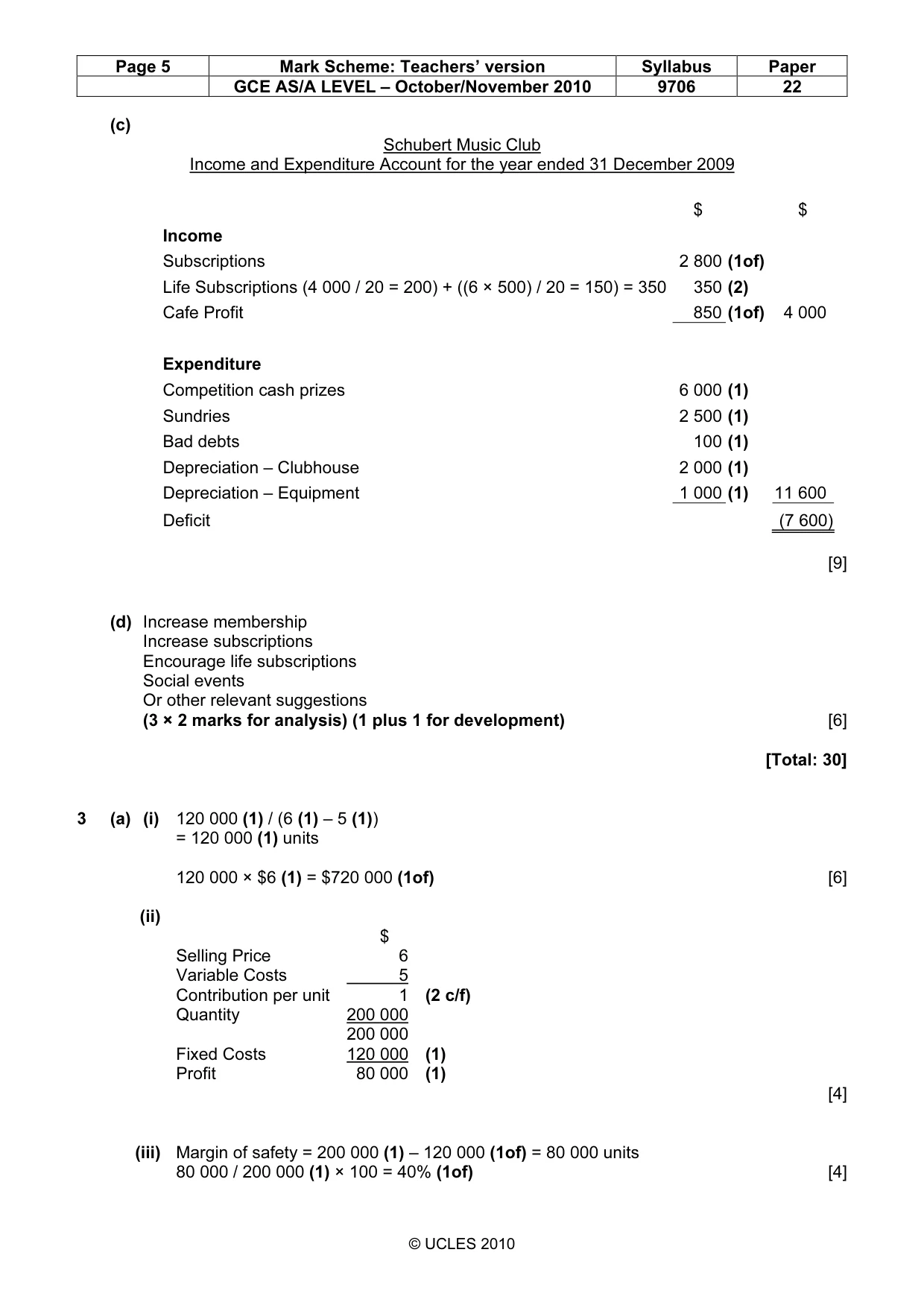
Page 5 Mark Scheme: Teachers’ version Syllabus Paper GCE AS/A LEVEL – October/November 2010 9706 22 © UCLES 2010 (c) Schubert Music Club Income and Expenditure Account for the year ended 31 December 2009 $ $ Income Subscriptions 2 800 (1of) Life Subscriptions (4 000 / 20 = 200) + ((6 × 500) / 20 = 150) = 350 350 (2) Cafe Profit 850 (1of) 4 000 Expenditure Competition cash prizes 6 000 (1) Sundries 2 500 (1) Bad debts 100 (1) Depreciation – Clubhouse 2 000 (1) Depreciation – Equipment 1 000 (1) 11 600 Deficit (7 600) [9] (d) Increase membership Increase subscriptions Encourage life subscriptions Social events Or other relevant suggestions (3 × 2 marks for analysis) (1 plus 1 for development) [6] [Total: 30] 3 (a) (i) 120 000 (1) / (6 (1) – 5 (1)) = 120 000 (1) units 120 000 × $6 (1) = $720 000 (1of) [6] (ii) $ Selling Price 6 Variable Costs 5 Contribution per unit 1 (2 c/f) Quantity 200 000 200 000 Fixed Costs 120 000 (1) Profit 80 000 (1) [4] (iii) Margin of safety = 200 000 (1) – 120 000 (1of) = 80 000 units 80 000 / 200 000 (1) × 100 = 40% (1of) [4]
Mark scheme, page 6
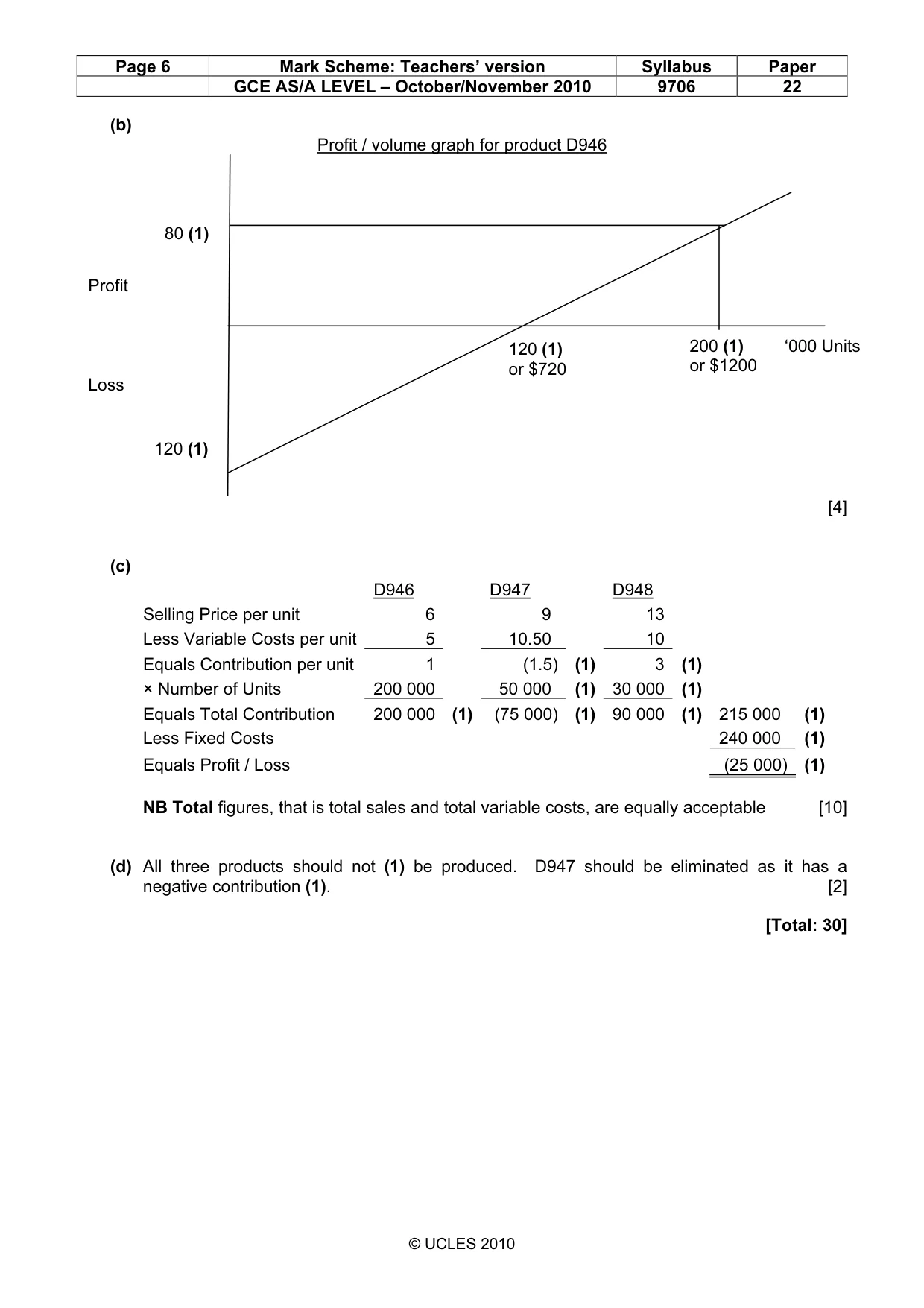
Page 6 Mark Scheme: Teachers’ version Syllabus Paper GCE AS/A LEVEL – October/November 2010 9706 22 © UCLES 2010 (b) Profit / volume graph for product D946 [4] (c) D946 D947 D948 Selling Price per unit 6 9 13 Less Variable Costs per unit 5 10.50 10 Equals Contribution per unit 1 (1.5) (1) 3 (1) × Number of Units 200 000 50 000 (1) 30 000 (1) Equals Total Contribution 200 000 (1) (75 000) (1) 90 000 (1) 215 000 (1) Less Fixed Costs 240 000 (1) Equals Profit / Loss (25 000) (1) NB Total figures, that is total sales and total variable costs, are equally acceptable [10] (d) All three products should not (1) be produced. D947 should be eliminated as it has a negative contribution (1). [2] [Total: 30] 120 (1) or $720 120 (1) Loss Profit 80 (1) ‘000 Units 200 (1) or $1200
What you needed in this session
Cambridge’s own grade thresholds for 2010 Oct/Nov, Paper 2 · Variant 2. A higher threshold means an easier paper — the bar moves with how the cohort did.