Cambridge A Level Accounting 9706 — 2010 Oct/Nov Paper 2 · Variant 3
9706/23/O/N/10 · 90 marks · ≈101 min
The question paper and its mark scheme, free to read here and free to download. This is Cambridge’s own paper, exactly as it was sat.
Question paper16 pages
Mark scheme7 pages
Answers below. Sit the paper first if you are practising.
Paper as text
Question paper, page 1
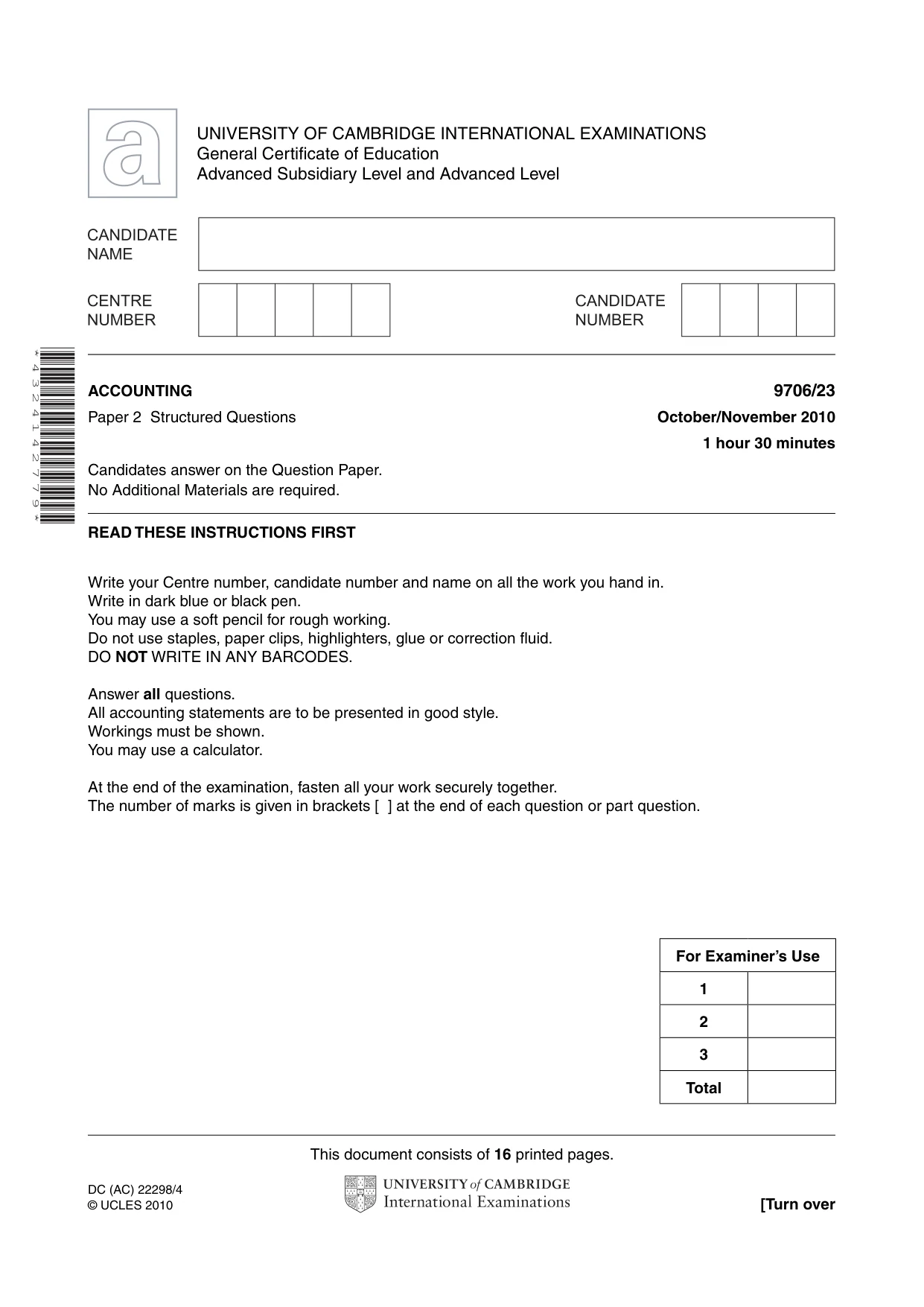
This document consists of 16 printed pages. DC (AC) 22298/4 © UCLES 2010 [Turn over UNIVERSITY OF CAMBRIDGE INTERNATIONAL EXAMINATIONS General Certificate of Education Advanced Subsidiary Level and Advanced Level * 4 3 2 4 1 4 2 7 7 9 * ACCOUNTING 9706/23 Paper 2 Structured Questions October/November 2010 1 hour 30 minutes Candidates answer on the Question Paper. No Additional Materials are required. READ THESE INSTRUCTIONS FIRST Write your Centre number, candidate number and name on all the work you hand in. Write in dark blue or black pen. You may use a soft pencil for rough working. Do not use staples, paper clips, highlighters, glue or correction fluid. DO NOT WRITE IN ANY BARCODES. Answer all questions. All accounting statements are to be presented in good style. Workings must be shown. You may use a calculator. At the end of the examination, fasten all your work securely together. The number of marks is given in brackets [ ] at the end of each question or part question. For Examiner’s Use 1 2 3 Total
Question paper, page 2
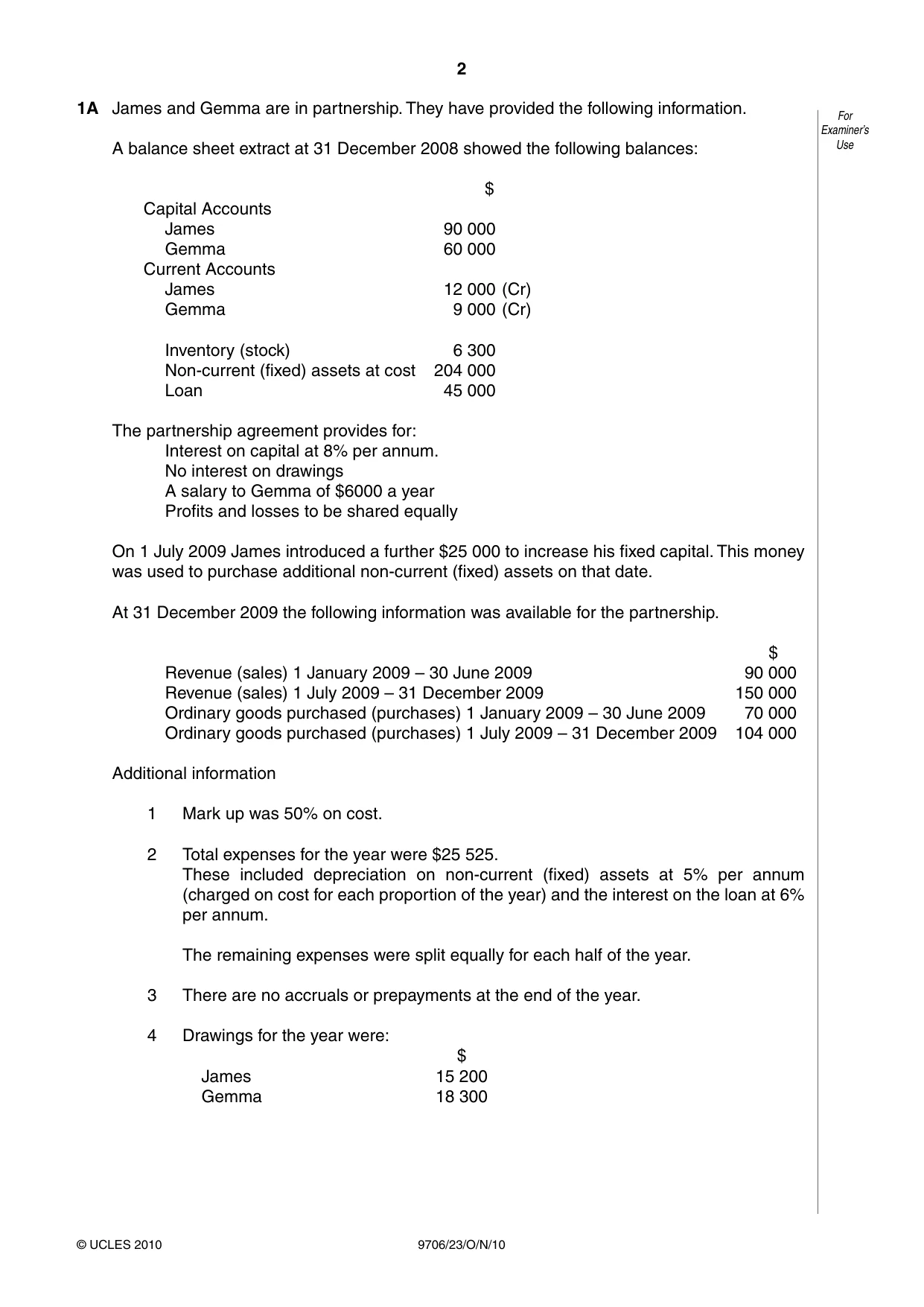
2 9706/23/O/N/10 © UCLES 2010 For Examiner’s Use 1A James and Gemma are in partnership. They have provided the following information. A balance sheet extract at 31 December 2008 showed the following balances: $ Capital Accounts James 90 000 Gemma 60 000 Current Accounts James 12 000 (Cr) Gemma 9 000 (Cr) Inventory (stock) 6 300 Non-current (fixed) assets at cost 204 000 Loan 45 000 The partnership agreement provides for: Interest on capital at 8% per annum. No interest on drawings A salary to Gemma of $6000 a year Profits and losses to be shared equally On 1 July 2009 James introduced a further $25 000 to increase his fixed capital. This money was used to purchase additional non-current (fixed) assets on that date. At 31 December 2009 the following information was available for the partnership. $ Revenue (sales) 1 January 2009 – 30 June 2009 90 000 Revenue (sales) 1 July 2009 – 31 December 2009 150 000 Ordinary goods purchased (purchases) 1 January 2009 – 30 June 2009 70 000 Ordinary goods purchased (purchases) 1 July 2009 – 31 December 2009 104 000 Additional information 1 Mark up was 50% on cost. 2 Total expenses for the year were $25 525. These included depreciation on non-current (fixed) assets at 5% per annum (charged on cost for each proportion of the year) and the interest on the loan at 6% per annum. The remaining expenses were split equally for each half of the year. 3 There are no accruals or prepayments at the end of the year. 4 Drawings for the year were: $ James 15 200 Gemma 18 300
Question paper, page 3
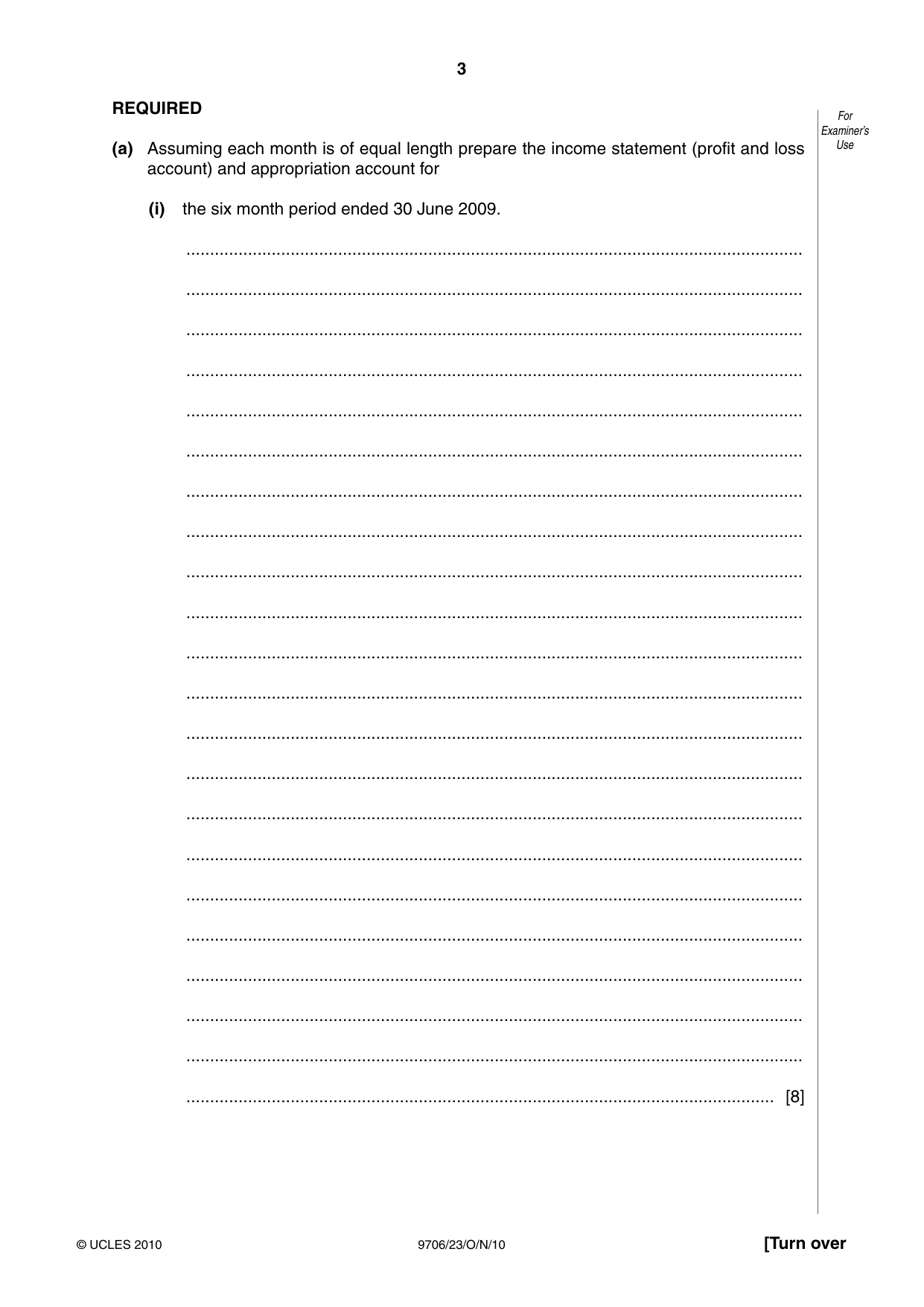
3 9706/23/O/N/10 © UCLES 2010 [Turn over For Examiner’s Use REQUIRED (a) Assuming each month is of equal length prepare the income statement (profit and loss account) and appropriation account for (i) the six month period ended 30 June 2009. … … … … … … … … … … … … … … … … … … … … … … [8]
Question paper, page 4
4 9706/23/O/N/10 © UCLES 2010 For Examiner’s Use (ii) the six month period ended 31 December 2009. … … … … … … … … … … … … … … … … … … … … … … [7]
Question paper, page 5
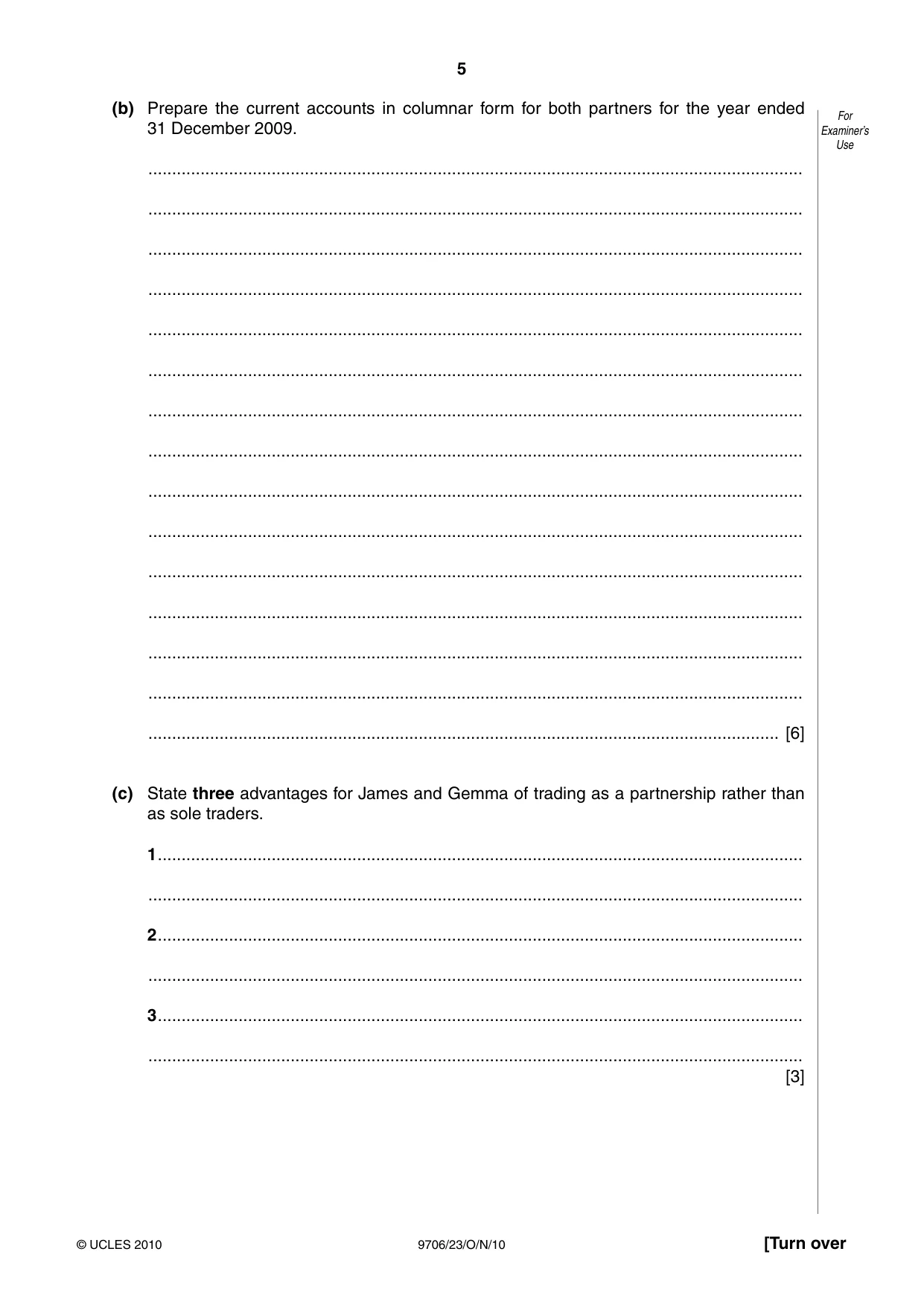
5 9706/23/O/N/10 © UCLES 2010 [Turn over For Examiner’s Use (b) Prepare the current accounts in columnar form for both partners for the year ended 31 December 2009. … … … … … … … … … … … … … … … [6] (c) State three advantages for James and Gemma of trading as a partnership rather than as sole traders. 1 … … 2 … … 3 … … [3]
Question paper, page 6
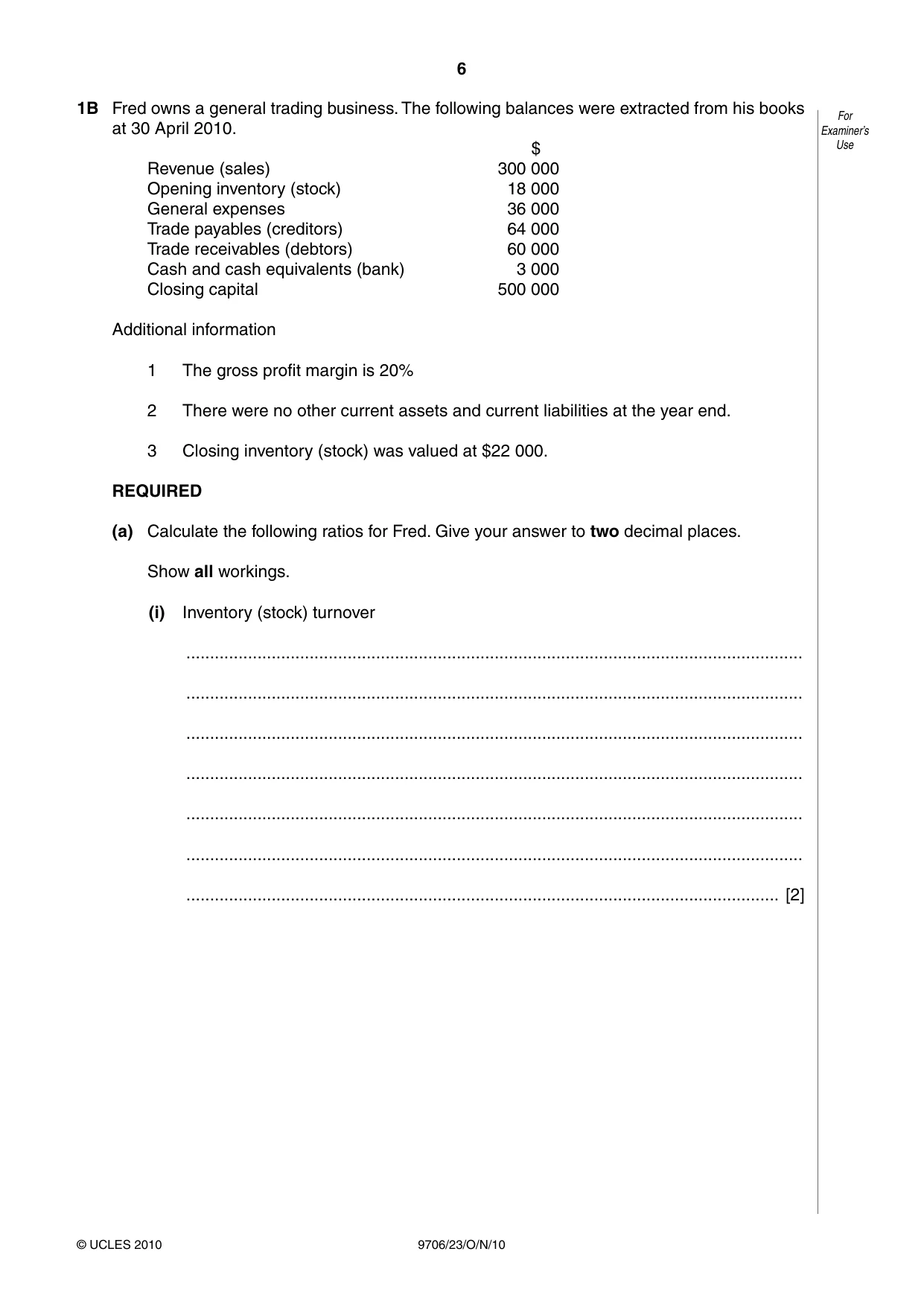
6 9706/23/O/N/10 © UCLES 2010 For Examiner’s Use 1B Fred owns a general trading business. The following balances were extracted from his books at 30 April 2010. $ Revenue (sales) 300 000 Opening inventory (stock) 18 000 General expenses 36 000 Trade payables (creditors) 64 000 Trade receivables (debtors) 60 000 Cash and cash equivalents (bank) 3 000 Closing capital 500 000 Additional information 1 The gross profit margin is 20% 2 There were no other current assets and current liabilities at the year end. 3 Closing inventory (stock) was valued at $22 000. REQUIRED (a) Calculate the following ratios for Fred. Give your answer to two decimal places. Show all workings. (i) Inventory (stock) turnover … … … … … … … [2]
Question paper, page 7
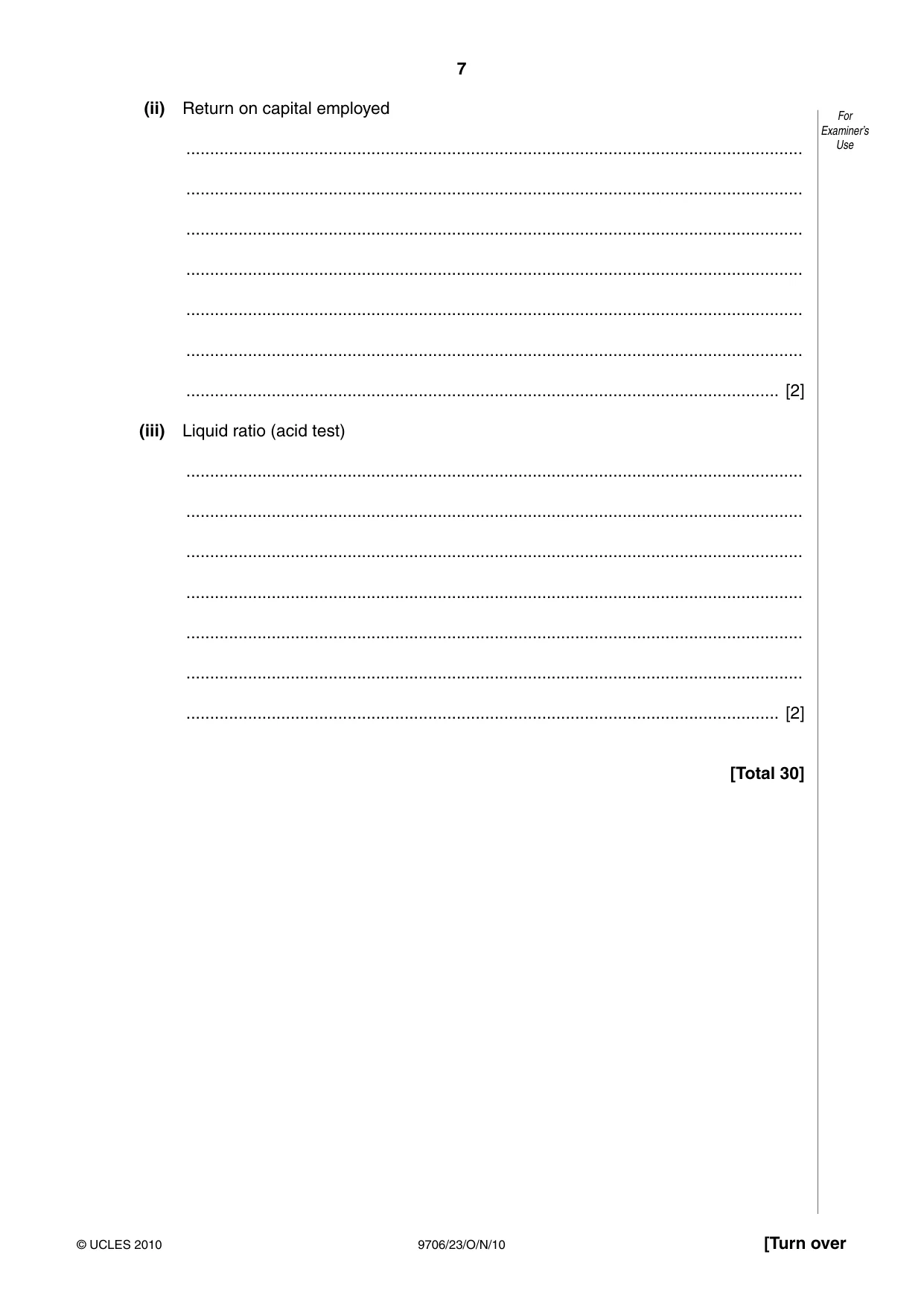
7 9706/23/O/N/10 © UCLES 2010 [Turn over For Examiner’s Use (ii) Return on capital employed … … … … … … … [2] (iii) Liquid ratio (acid test) … … … … … … … [2] [Total 30]
Question paper, page 8
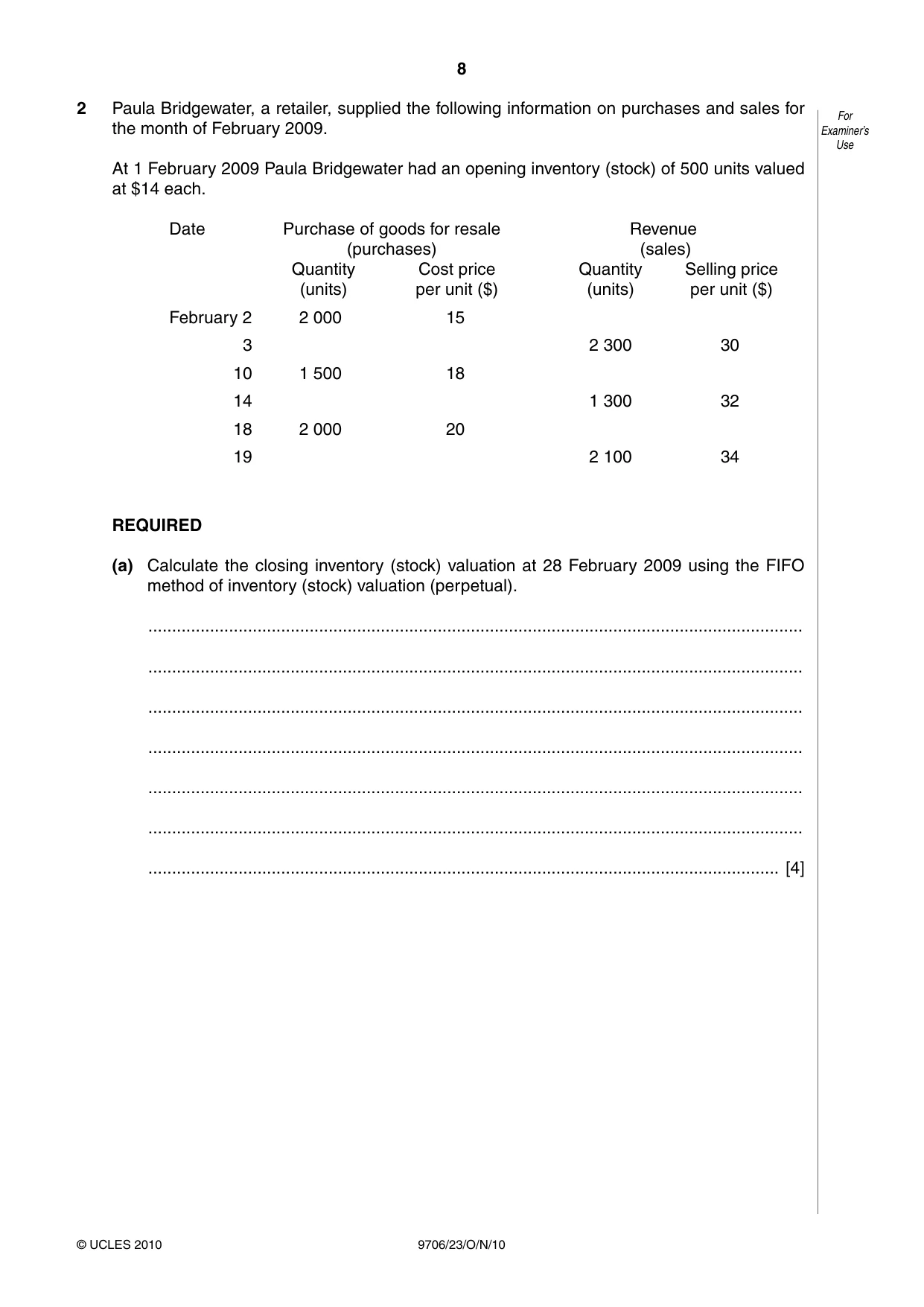
8 9706/23/O/N/10 © UCLES 2010 For Examiner’s Use 2 Paula Bridgewater, a retailer, supplied the following information on purchases and sales for the month of February 2009. At 1 February 2009 Paula Bridgewater had an opening inventory (stock) of 500 units valued at $14 each. Date Purchase of goods for resale Revenue (purchases) (sales) Quantity Cost price Quantity Selling price (units) per unit ($) (units) per unit ($) February 2 2 000 15 3 2 300 30 10 1 500 18 14 1 300 32 18 2 000 20 19 2 100 34 REQUIRED (a) Calculate the closing inventory (stock) valuation at 28 February 2009 using the FIFO method of inventory (stock) valuation (perpetual). … … … … … … … [4]
Question paper, page 9
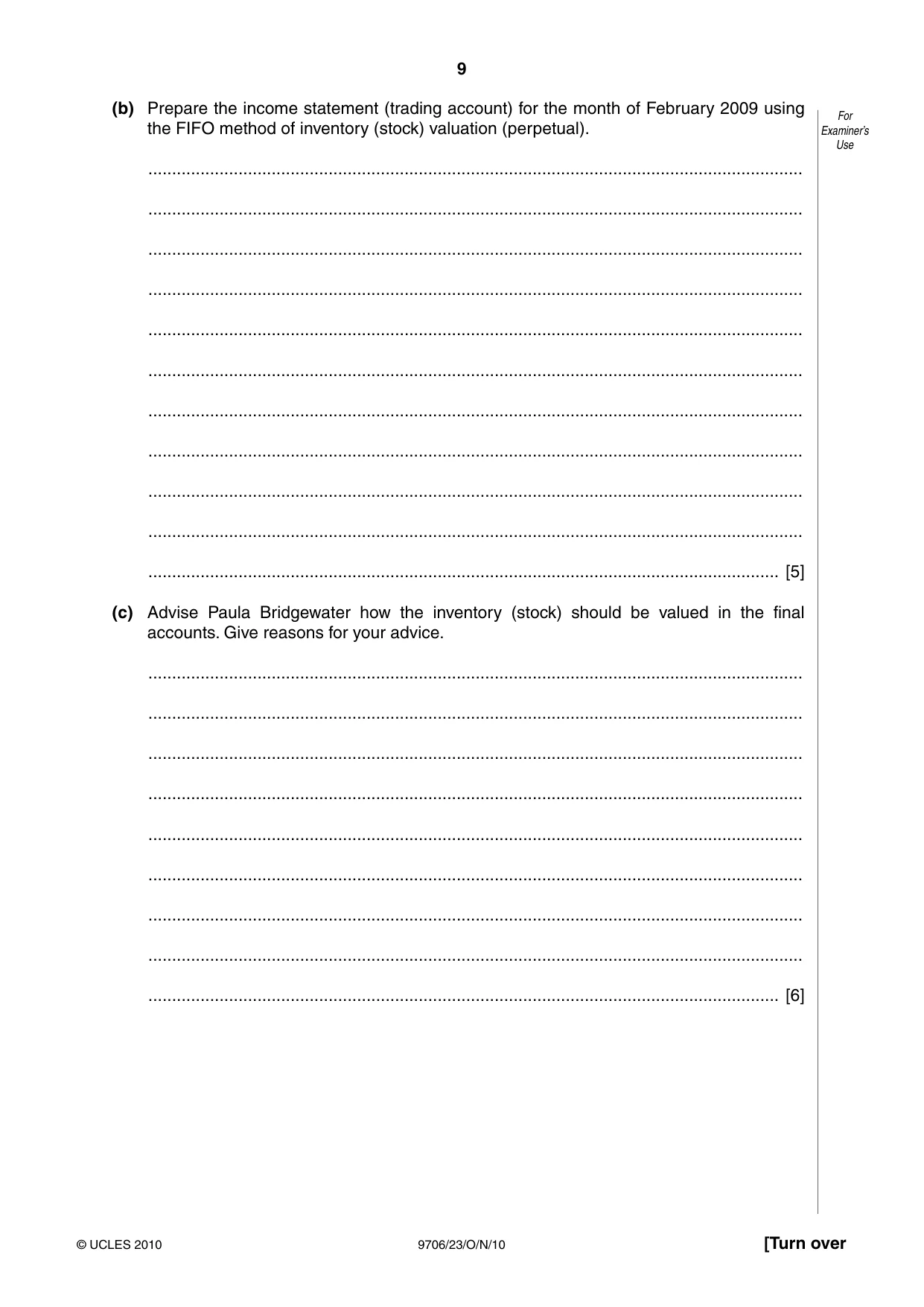
9 9706/23/O/N/10 © UCLES 2010 [Turn over For Examiner’s Use (b) Prepare the income statement (trading account) for the month of February 2009 using the FIFO method of inventory (stock) valuation (perpetual). … … … … … … … … … … … [5] (c) Advise Paula Bridgewater how the inventory (stock) should be valued in the final accounts. Give reasons for your advice. … … … … … … … … … [6]
Question paper, page 10
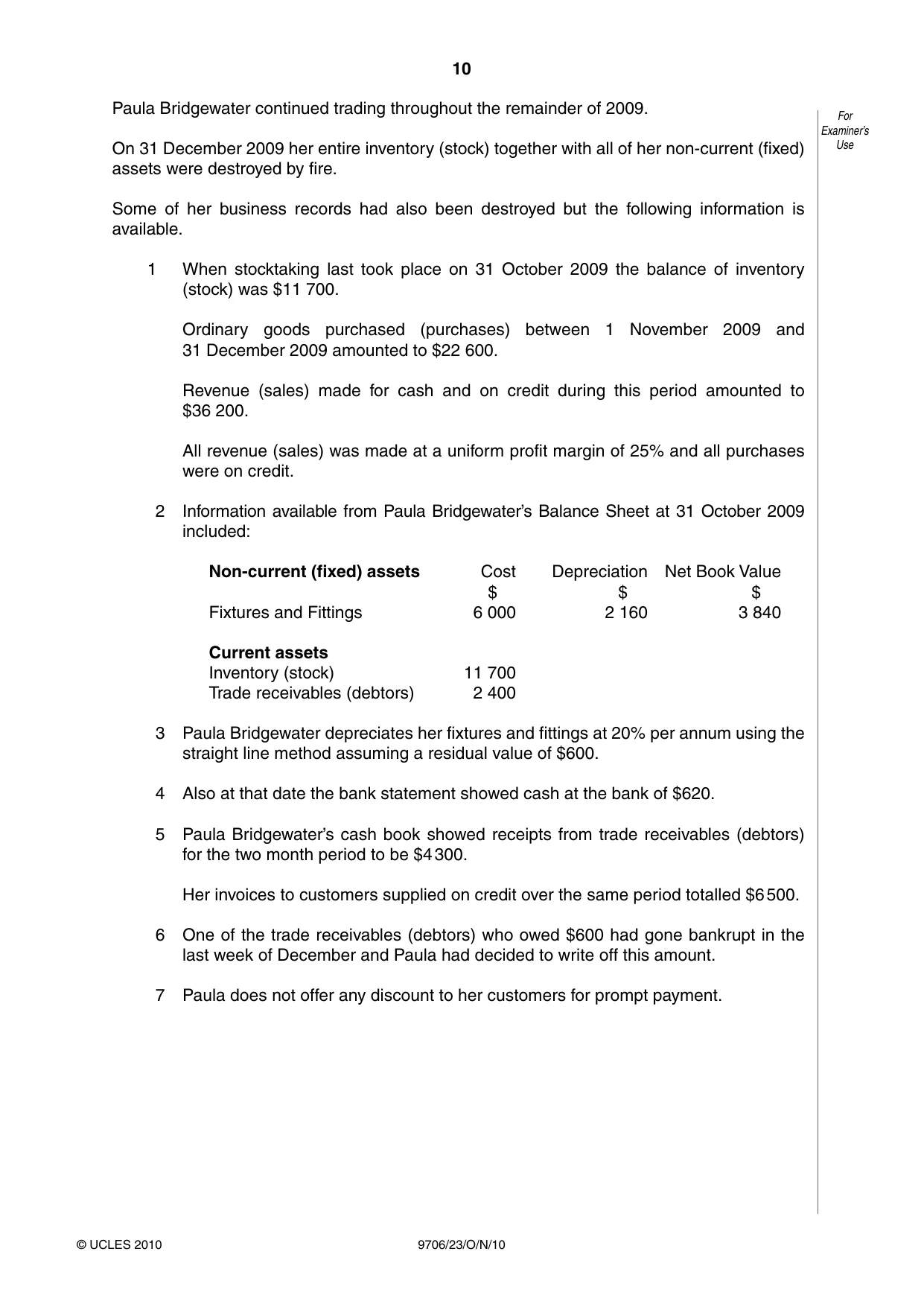
10 9706/23/O/N/10 © UCLES 2010 For Examiner’s Use Paula Bridgewater continued trading throughout the remainder of 2009. On 31 December 2009 her entire inventory (stock) together with all of her non-current (fixed) assets were destroyed by fire. Some of her business records had also been destroyed but the following information is available. 1 When stocktaking last took place on 31 October 2009 the balance of inventory (stock) was $11 700. Ordinary goods purchased (purchases) between 1 November 2009 and 31 December 2009 amounted to $22 600. Revenue (sales) made for cash and on credit during this period amounted to $36 200. All revenue (sales) was made at a uniform profit margin of 25% and all purchases were on credit. 2 Information available from Paula Bridgewater’s Balance Sheet at 31 October 2009 included: Non-current (fixed) assets Cost Depreciation Net Book Value $ $ $ Fixtures and Fittings 6 000 2 160 3 840 Current assets Inventory (stock) 11 700 Trade receivables (debtors) 2 400 3 Paula Bridgewater depreciates her fixtures and fittings at 20% per annum using the straight line method assuming a residual value of $600. 4 Also at that date the bank statement showed cash at the bank of $620. 5 Paula Bridgewater’s cash book showed receipts from trade receivables (debtors) for the two month period to be $4 300. Her invoices to customers supplied on credit over the same period totalled $6 500. 6 One of the trade receivables (debtors) who owed $600 had gone bankrupt in the last week of December and Paula had decided to write off this amount. 7 Paula does not offer any discount to her customers for prompt payment.
Question paper, page 11
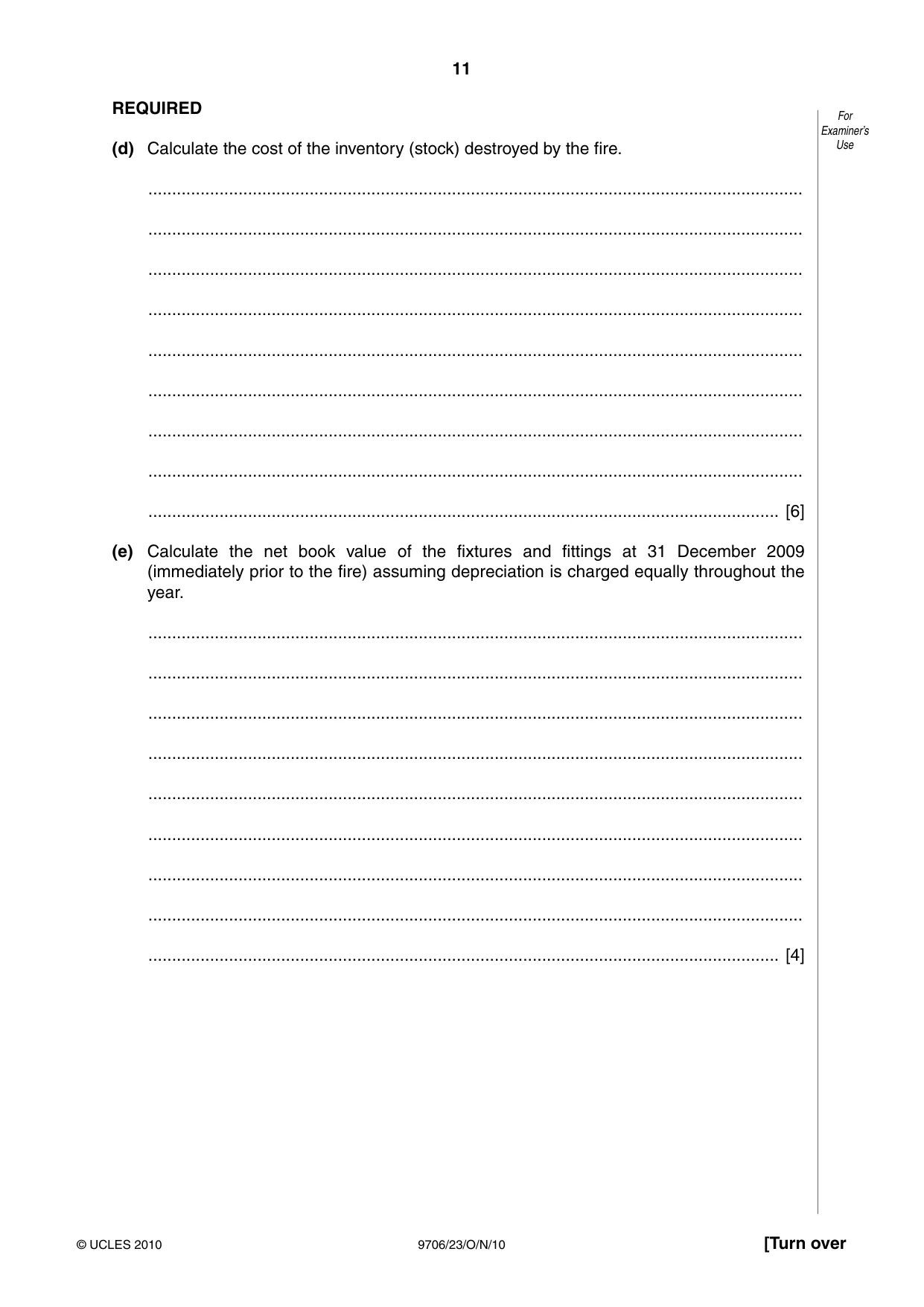
11 9706/23/O/N/10 © UCLES 2010 [Turn over For Examiner’s Use REQUIRED (d) Calculate the cost of the inventory (stock) destroyed by the fire. … … … … … … … … … [6] (e) Calculate the net book value of the fixtures and fittings at 31 December 2009 (immediately prior to the fire) assuming depreciation is charged equally throughout the year. … … … … … … … … … [4]
Question paper, page 12
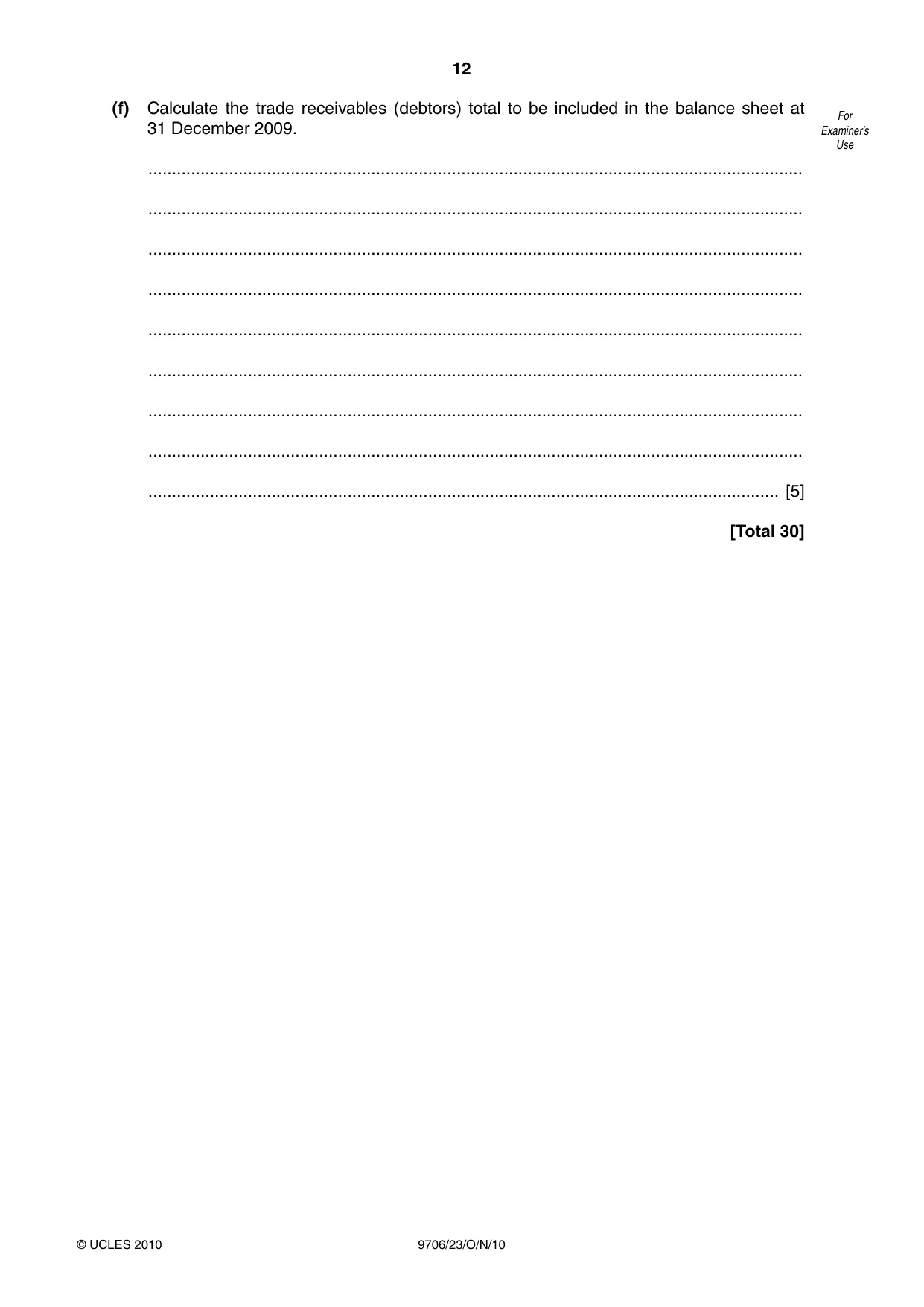
12 9706/23/O/N/10 © UCLES 2010 For Examiner’s Use (f) Calculate the trade receivables (debtors) total to be included in the balance sheet at 31 December 2009. … … … … … … … … … [5] [Total 30]
Question paper, page 13
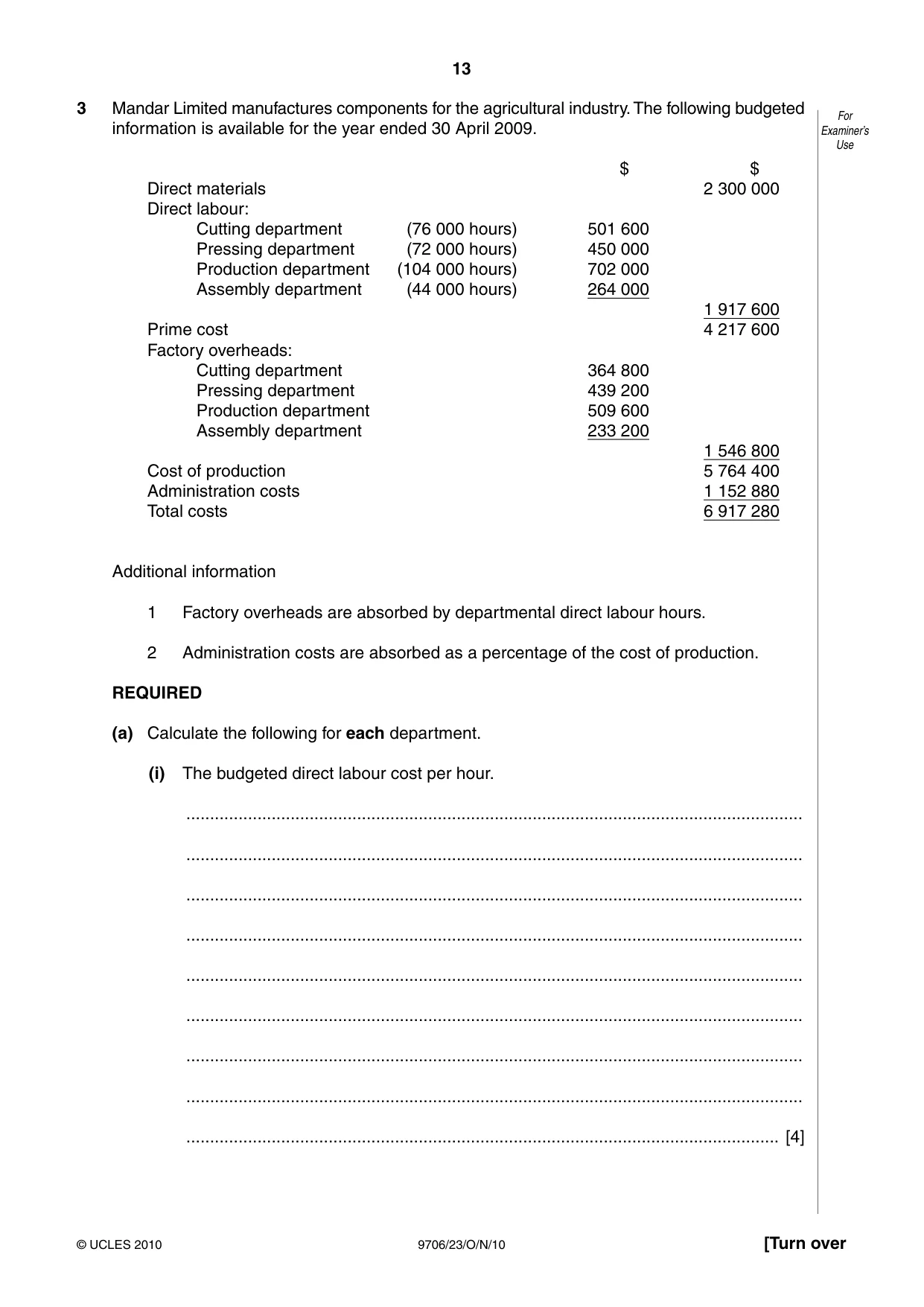
13 9706/23/O/N/10 © UCLES 2010 [Turn over For Examiner’s Use 3 Mandar Limited manufactures components for the agricultural industry. The following budgeted information is available for the year ended 30 April 2009. $ $ Direct materials 2 300 000 Direct labour: Cutting department (76 000 hours) 501 600 Pressing department (72 000 hours) 450 000 Production department (104 000 hours) 702 000 Assembly department (44 000 hours) 264 000 1 917 600 Prime cost 4 217 600 Factory overheads: Cutting department 364 800 Pressing department 439 200 Production department 509 600 Assembly department 233 200 1 546 800 Cost of production 5 764 400 Administration costs 1 152 880 Total costs 6 917 280 Additional information 1 Factory overheads are absorbed by departmental direct labour hours. 2 Administration costs are absorbed as a percentage of the cost of production. REQUIRED (a) Calculate the following for each department. (i) The budgeted direct labour cost per hour. … … … … … … … … … [4]
Question paper, page 14
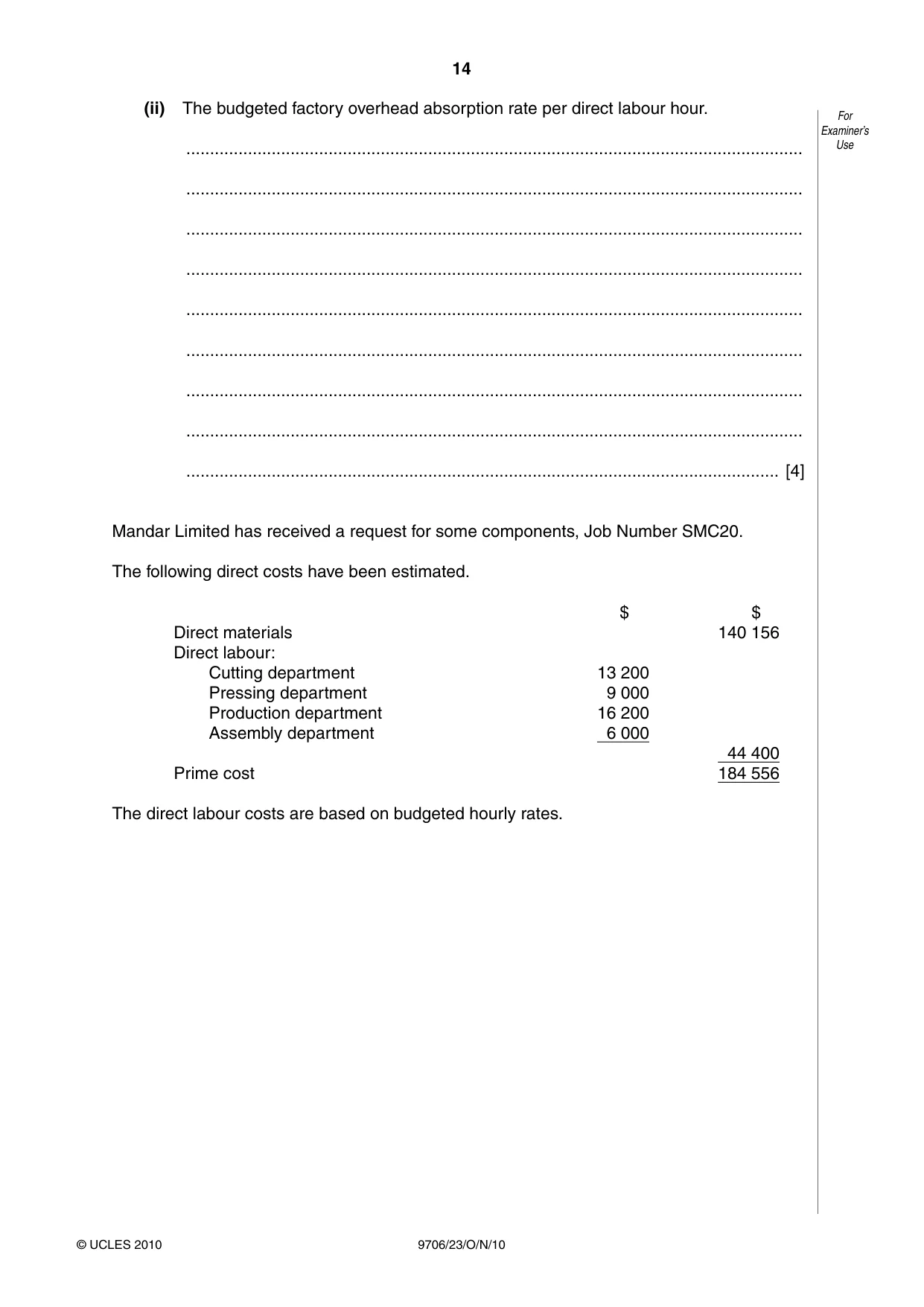
14 9706/23/O/N/10 © UCLES 2010 For Examiner’s Use (ii) The budgeted factory overhead absorption rate per direct labour hour. … … … … … … … … … [4] Mandar Limited has received a request for some components, Job Number SMC20. The following direct costs have been estimated. $ $ Direct materials 140 156 Direct labour: Cutting department 13 200 Pressing department 9 000 Production department 16 200 Assembly department 06 000 444 400 Prime cost 184 556 The direct labour costs are based on budgeted hourly rates.
Question paper, page 15
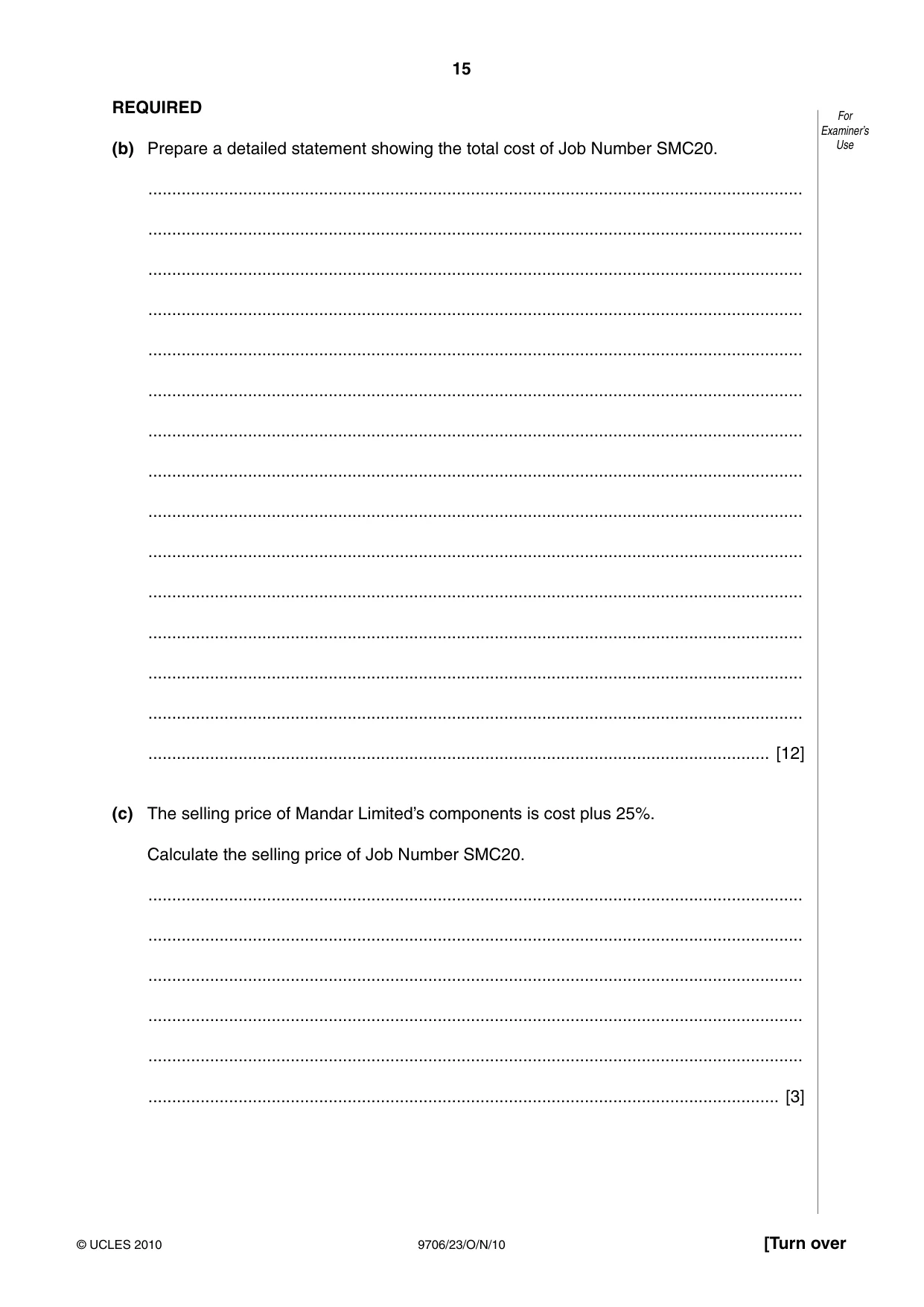
15 9706/23/O/N/10 © UCLES 2010 [Turn over For Examiner’s Use REQUIRED (b) Prepare a detailed statement showing the total cost of Job Number SMC20. … … … … … … … … … … … … … … … [12] (c) The selling price of Mandar Limited’s components is cost plus 25%. Calculate the selling price of Job Number SMC20. … … … … … … [3]
Question paper, page 16
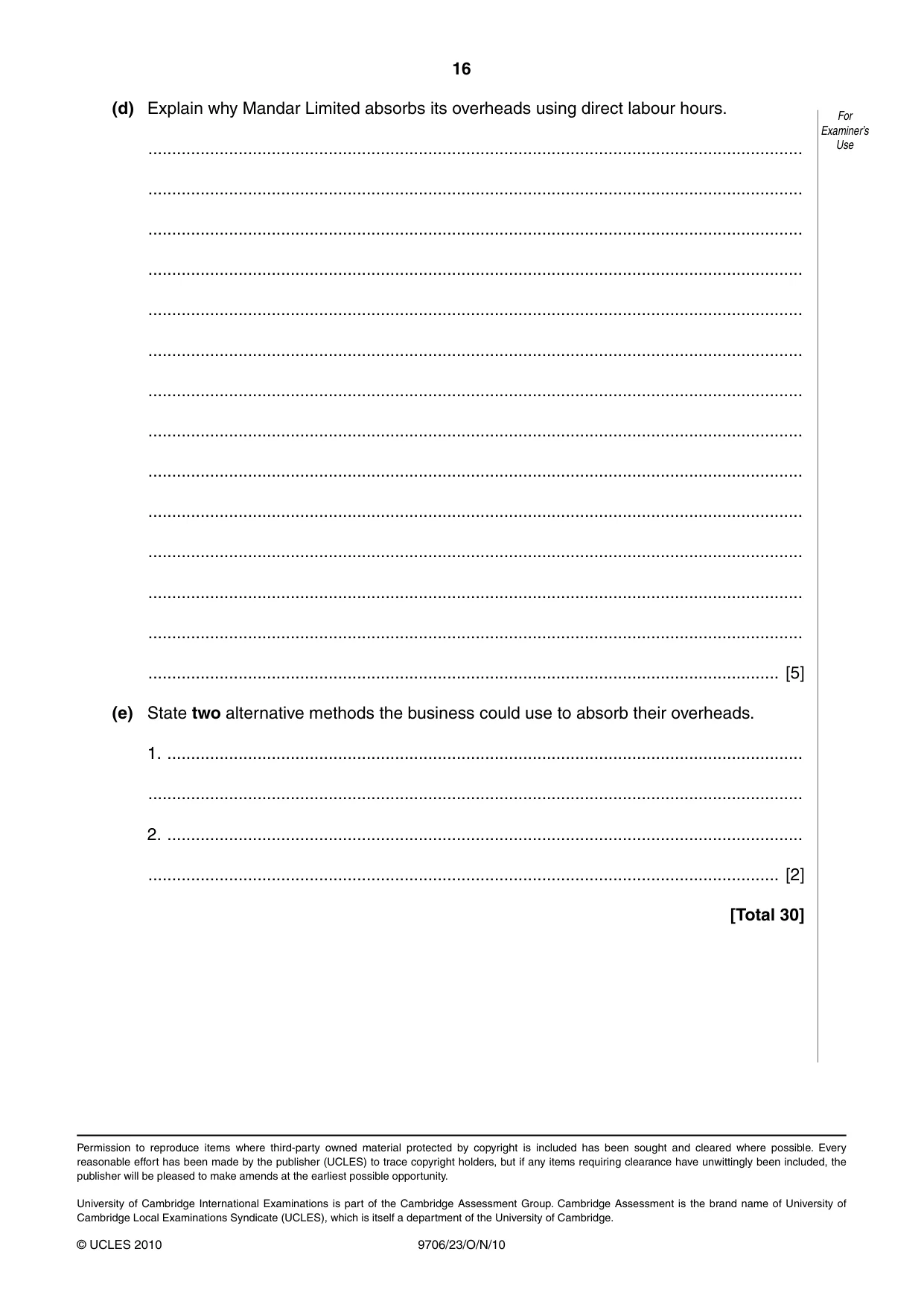
16 9706/23/O/N/10 © UCLES 2010 For Examiner’s Use Permission to reproduce items where third-party owned material protected by copyright is included has been sought and cleared where possible. Every reasonable effort has been made by the publisher (UCLES) to trace copyright holders, but if any items requiring clearance have unwittingly been included, the publisher will be pleased to make amends at the earliest possible opportunity. University of Cambridge International Examinations is part of the Cambridge Assessment Group. Cambridge Assessment is the brand name of University of Cambridge Local Examinations Syndicate (UCLES), which is itself a department of the University of Cambridge. (d) Explain why Mandar Limited absorbs its overheads using direct labour hours. … … … … … … … … … … … … … … [5] (e) State two alternative methods the business could use to absorb their overheads. 1. … … 2. … … [2] [Total 30]
Mark scheme, page 1
UNIVERSITY OF CAMBRIDGE INTERNATIONAL EXAMINATIONS GCE Advanced Subsidiary Level and GCE Advanced Level MARK SCHEME for the October/November 2010 question paper for the guidance of teachers 9706 ACCOUNTING 9706/23 Paper 2 (Structured Questions – Core), maximum raw mark 90 This mark scheme is published as an aid to teachers and candidates, to indicate the requirements of the examination. It shows the basis on which Examiners were instructed to award marks. It does not indicate the details of the discussions that took place at an Examiners’ meeting before marking began, which would have considered the acceptability of alternative answers. Mark schemes must be read in conjunction with the question papers and the report on the examination. • CIE will not enter into discussions or correspondence in connection with these mark schemes. CIE is publishing the mark schemes for the October/November 2010 question papers for most IGCSE, GCE Advanced Level and Advanced Subsidiary Level syllabuses and some Ordinary Level syllabuses.
Mark scheme, page 2
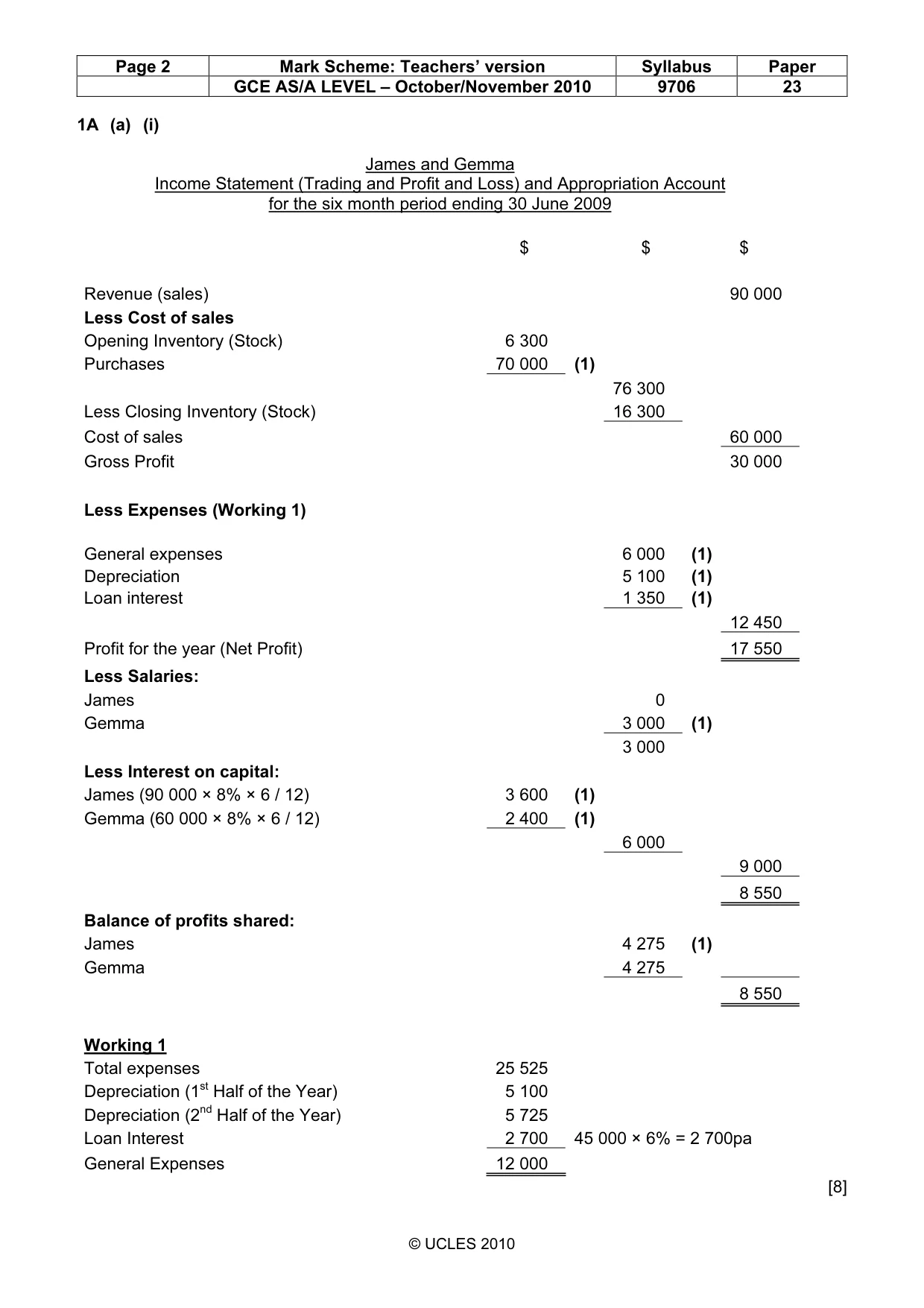
Page 2 Mark Scheme: Teachers’ version Syllabus Paper GCE AS/A LEVEL – October/November 2010 9706 23 © UCLES 2010 1A (a) (i) James and Gemma Income Statement (Trading and Profit and Loss) and Appropriation Account for the six month period ending 30 June 2009 $ $ $ Revenue (sales) 90 000 Less Cost of sales Opening Inventory (Stock) 6 300 Purchases 70 000 (1) 76 300 Less Closing Inventory (Stock) 16 300 Cost of sales 60 000 Gross Profit 30 000 Less Expenses (Working 1) General expenses 6 000 (1) Depreciation 5 100 (1) Loan interest 1 350 (1) 12 450 Profit for the year (Net Profit) 17 550 Less Salaries: James 0 Gemma 3 000 (1) 3 000 Less Interest on capital: James (90 000 × 8% × 6 / 12) 3 600 (1) Gemma (60 000 × 8% × 6 / 12) 2 400 (1) 6 000 9 000 8 550 Balance of profits shared: James 4 275 (1) Gemma 4 275 8 550 Working 1 Total expenses 25 525 Depreciation (1st Half of the Year) 5 100 Depreciation (2nd Half of the Year) 5 725 Loan Interest 2 700 45 000 × 6% = 2 700pa General Expenses 12 000 [8]
Mark scheme, page 3
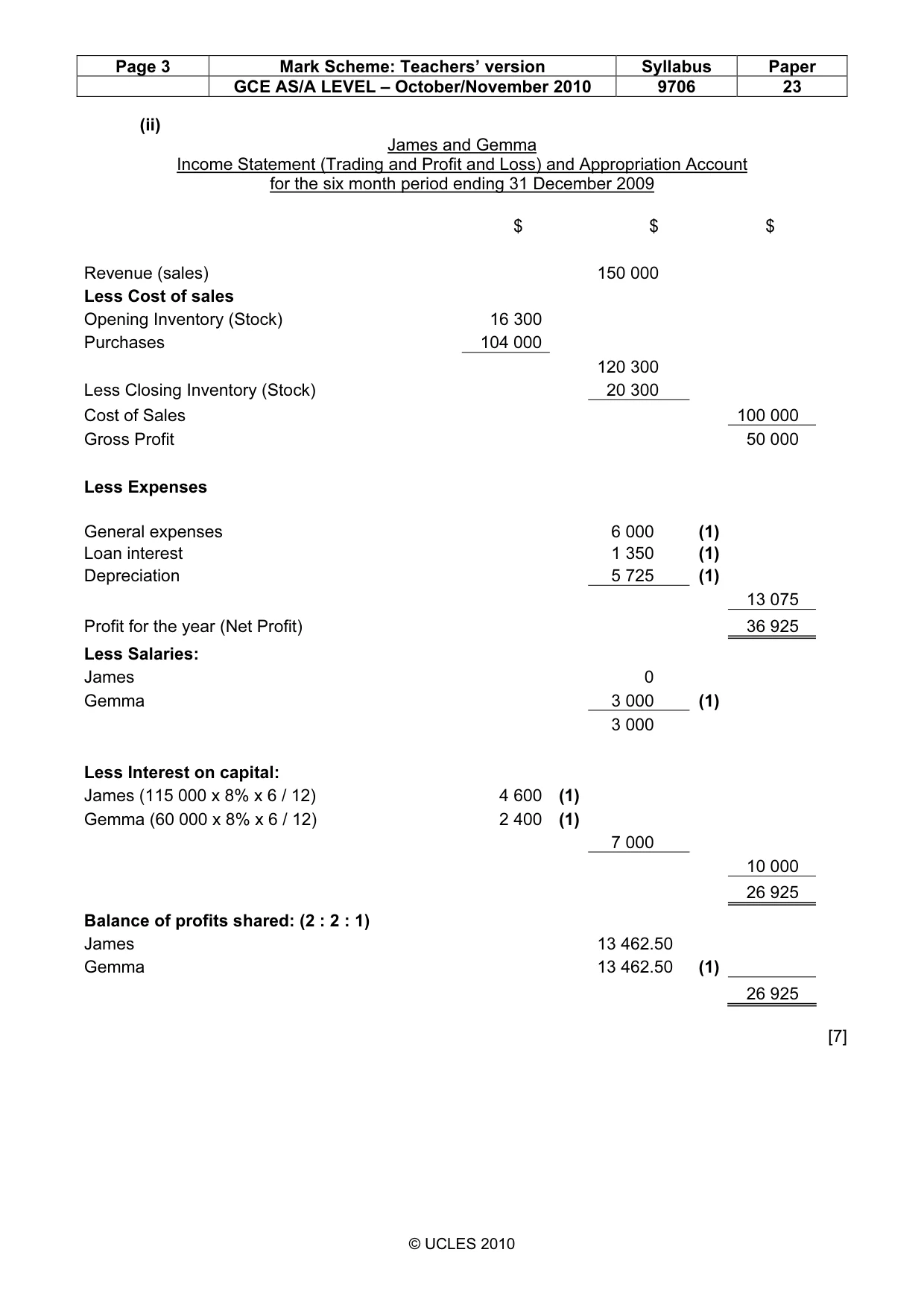
Page 3 Mark Scheme: Teachers’ version Syllabus Paper GCE AS/A LEVEL – October/November 2010 9706 23 © UCLES 2010 (ii) James and Gemma Income Statement (Trading and Profit and Loss) and Appropriation Account for the six month period ending 31 December 2009 $ $ $ Revenue (sales) 150 000 Less Cost of sales Opening Inventory (Stock) 16 300 Purchases 104 000 120 300 Less Closing Inventory (Stock) 20 300 Cost of Sales 100 000 Gross Profit 50 000 Less Expenses General expenses 6 000 (1) Loan interest 1 350 (1) Depreciation 5 725 (1) 13 075 Profit for the year (Net Profit) 36 925 Less Salaries: James 0 Gemma 3 000 (1) 3 000 Less Interest on capital: James (115 000 x 8% x 6 / 12) 4 600 (1) Gemma (60 000 x 8% x 6 / 12) 2 400 (1) 7 000 10 000 26 925 Balance of profits shared: (2 : 2 : 1) James 13 462.50 Gemma 13 462.50 (1) 26 925 [7]
Mark scheme, page 4
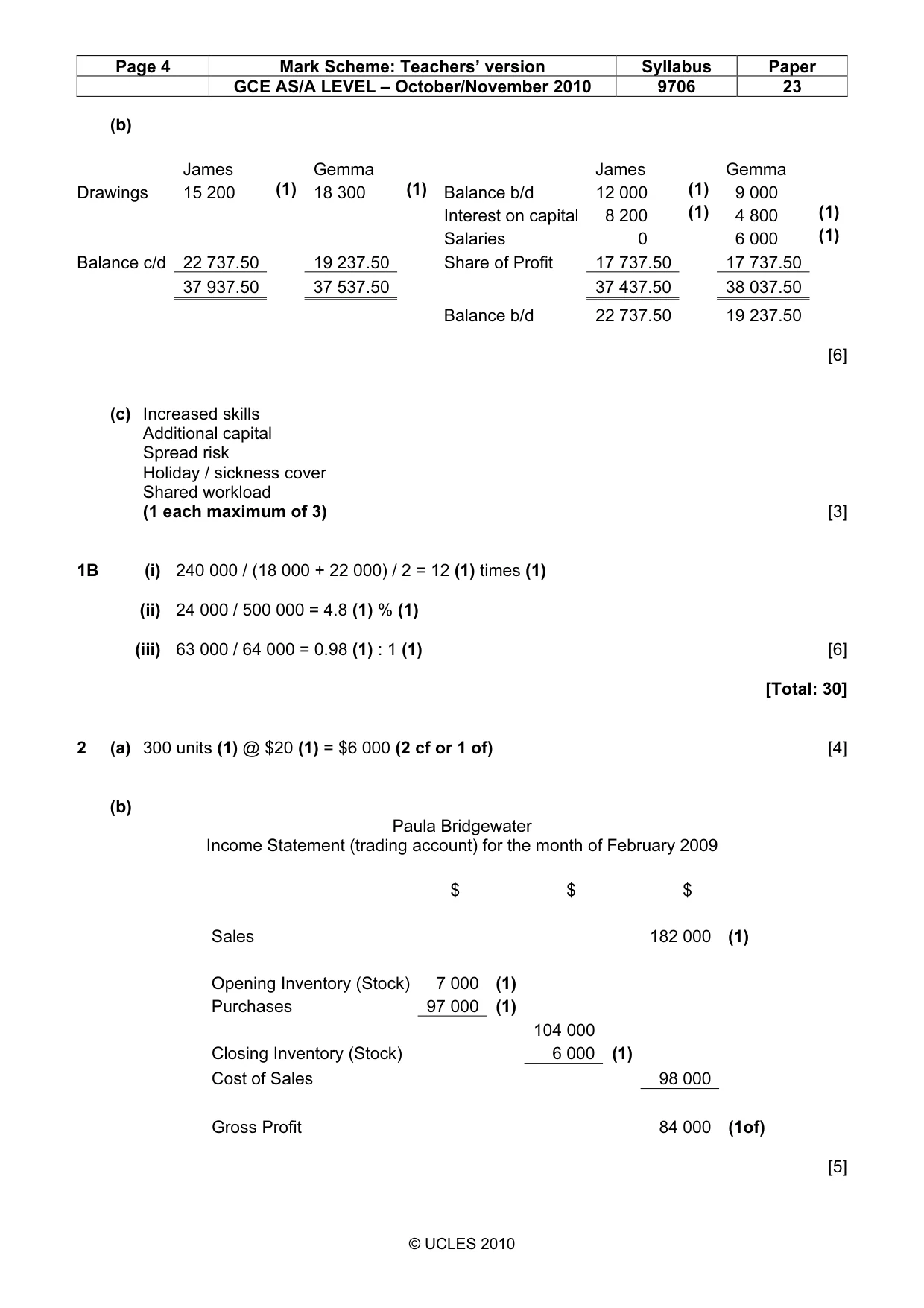
Page 4 Mark Scheme: Teachers’ version Syllabus Paper GCE AS/A LEVEL – October/November 2010 9706 23 © UCLES 2010 (b) James Gemma James Gemma Drawings 15 200 (1) 18 300 (1) Balance b/d 12 000 (1) 9 000 Interest on capital 8 200 (1) 4 800 (1) Salaries 0 6 000 (1) Balance c/d 22 737.50 19 237.50 Share of Profit 17 737.50 17 737.50 37 937.50 37 537.50 37 437.50 38 037.50 Balance b/d 22 737.50 19 237.50 [6] (c) Increased skills Additional capital Spread risk Holiday / sickness cover Shared workload (1 each maximum of 3) [3] 1B (i) 240 000 / (18 000 + 22 000) / 2 = 12 (1) times (1) (ii) 24 000 / 500 000 = 4.8 (1) % (1) (iii) 63 000 / 64 000 = 0.98 (1) : 1 (1) [6] [Total: 30] 2 (a) 300 units (1) @ $20 (1) = $6 000 (2 cf or 1 of) [4] (b) Paula Bridgewater Income Statement (trading account) for the month of February 2009 $ $ $ Sales 182 000 (1) Opening Inventory (Stock) 7 000 (1) Purchases 97 000 (1) 104 000 Closing Inventory (Stock) 6 000 (1) Cost of Sales 98 000 Gross Profit 84 000 (1of) [5]
Mark scheme, page 5
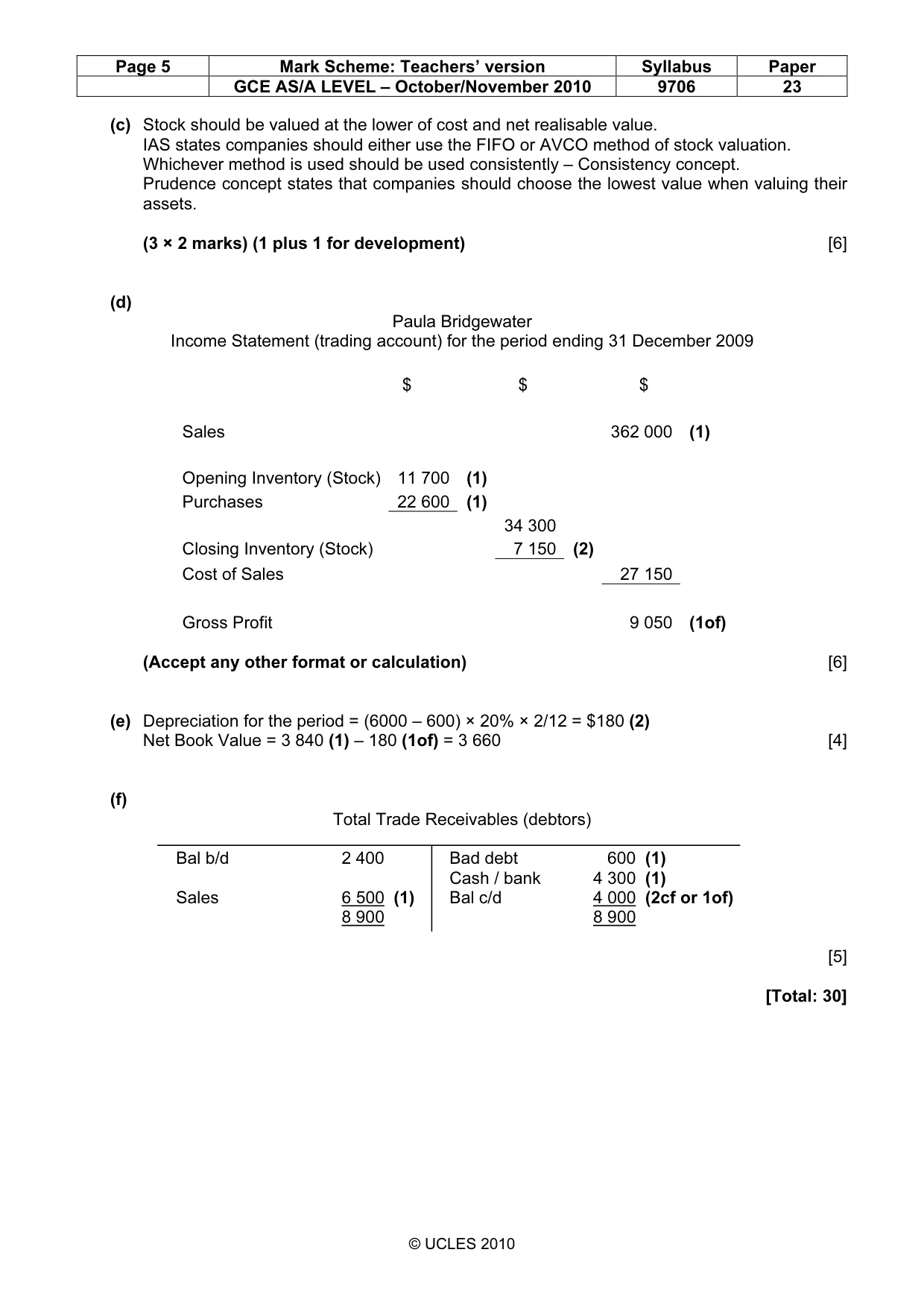
Page 5 Mark Scheme: Teachers’ version Syllabus Paper GCE AS/A LEVEL – October/November 2010 9706 23 © UCLES 2010 (c) Stock should be valued at the lower of cost and net realisable value. IAS states companies should either use the FIFO or AVCO method of stock valuation. Whichever method is used should be used consistently – Consistency concept. Prudence concept states that companies should choose the lowest value when valuing their assets. (3 × 2 marks) (1 plus 1 for development) [6] (d) Paula Bridgewater Income Statement (trading account) for the period ending 31 December 2009 $ $ $ Sales 362 000 (1) Opening Inventory (Stock) 11 700 (1) Purchases 22 600 (1) 34 300 Closing Inventory (Stock) 7 150 (2) Cost of Sales 27 150 Gross Profit 9 050 (1of) (Accept any other format or calculation) [6] (e) Depreciation for the period = (6000 – 600) × 20% × 2/12 = $180 (2) Net Book Value = 3 840 (1) – 180 (1of) = 3 660 [4] (f) Total Trade Receivables (debtors) Bal b/d 2 400 Bad debt 600 (1) Cash / bank 4 300 (1) Sales 6 500 (1) Bal c/d 4 000 (2cf or 1of) 8 900 8 900 [5] [Total: 30]
Mark scheme, page 6
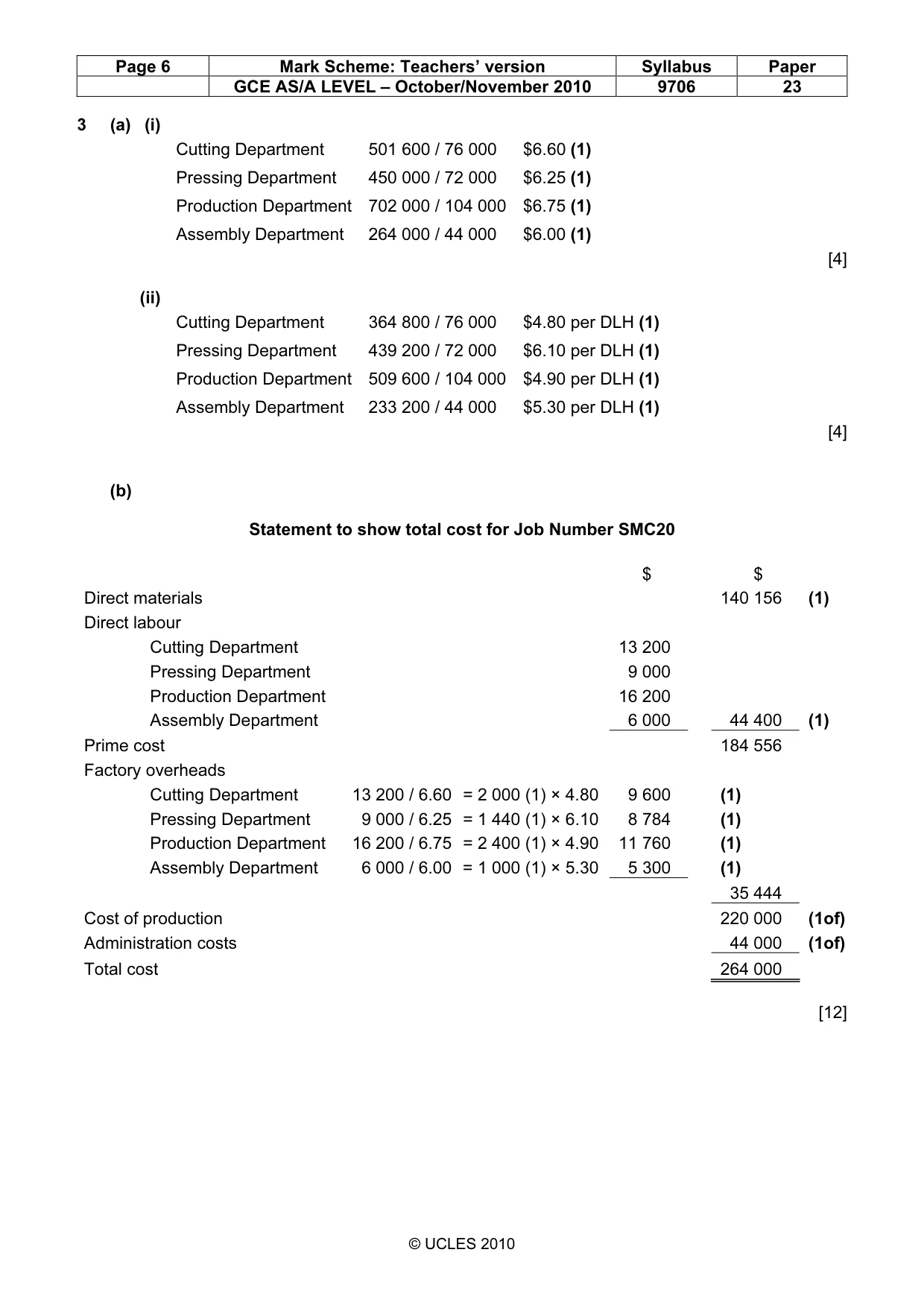
Page 6 Mark Scheme: Teachers’ version Syllabus Paper GCE AS/A LEVEL – October/November 2010 9706 23 © UCLES 2010 3 (a) (i) Cutting Department 501 600 / 76 000 $6.60 (1) Pressing Department 450 000 / 72 000 $6.25 (1) Production Department 702 000 / 104 000 $6.75 (1) Assembly Department 264 000 / 44 000 $6.00 (1) [4] (ii) Cutting Department 364 800 / 76 000 $4.80 per DLH (1) Pressing Department 439 200 / 72 000 $6.10 per DLH (1) Production Department 509 600 / 104 000 $4.90 per DLH (1) Assembly Department 233 200 / 44 000 $5.30 per DLH (1) [4] (b) Statement to show total cost for Job Number SMC20 $ $ Direct materials 140 156 (1) Direct labour Cutting Department 13 200 Pressing Department 9 000 Production Department 16 200 Assembly Department 6 000 44 400 (1) Prime cost 184 556 Factory overheads Cutting Department 13 200 / 6.60 = 2 000 (1) × 4.80 9 600 (1) Pressing Department 9 000 / 6.25 = 1 440 (1) × 6.10 8 784 (1) Production Department 16 200 / 6.75 = 2 400 (1) × 4.90 11 760 (1) Assembly Department 6 000 / 6.00 = 1 000 (1) × 5.30 5 300 (1) 35 444 Cost of production 220 000 (1of) Administration costs 44 000 (1of) Total cost 264 000 [12]
Mark scheme, page 7
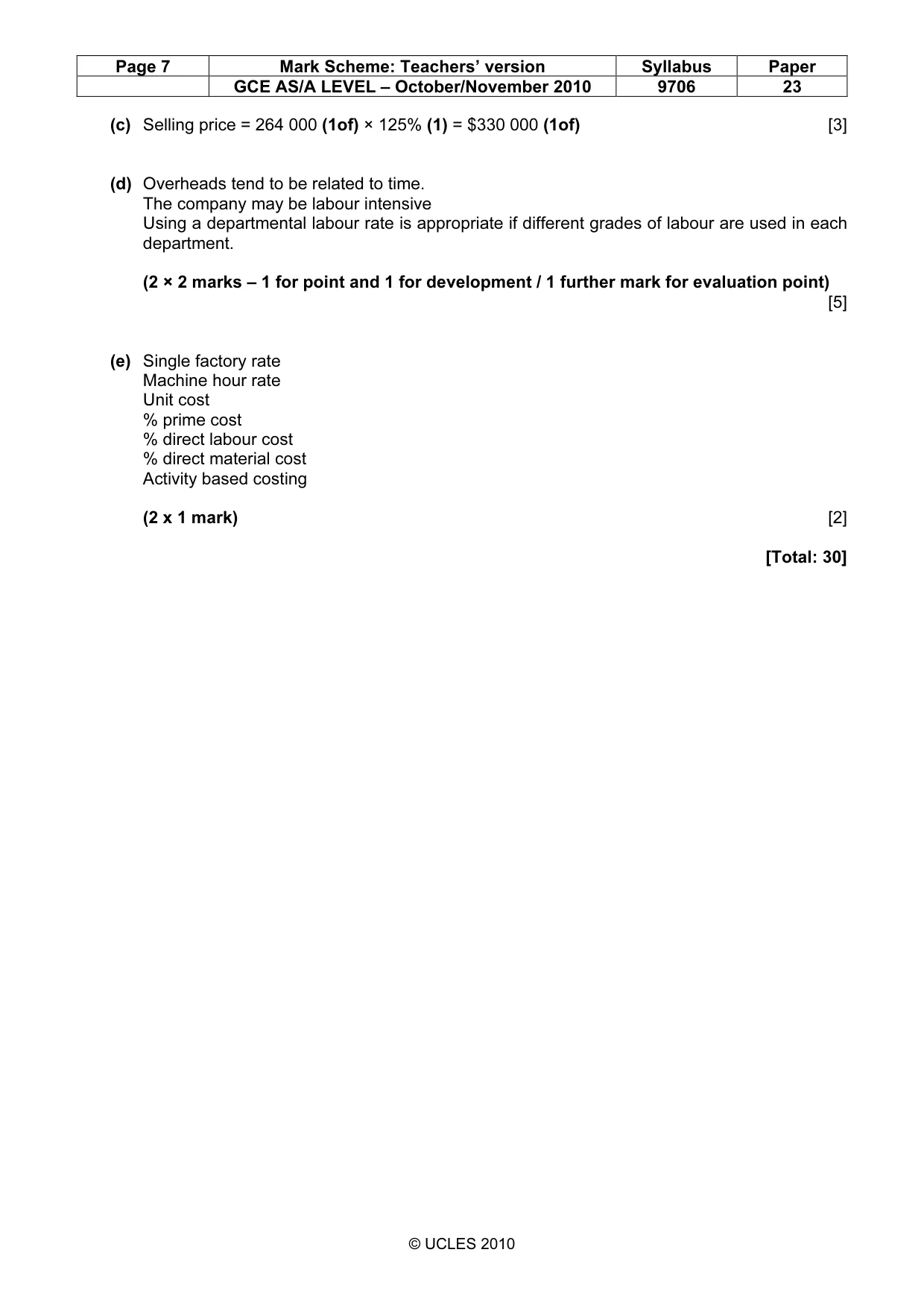
Page 7 Mark Scheme: Teachers’ version Syllabus Paper GCE AS/A LEVEL – October/November 2010 9706 23 © UCLES 2010 (c) Selling price = 264 000 (1of) × 125% (1) = $330 000 (1of) [3] (d) Overheads tend to be related to time. The company may be labour intensive Using a departmental labour rate is appropriate if different grades of labour are used in each department. (2 × 2 marks – 1 for point and 1 for development / 1 further mark for evaluation point) [5] (e) Single factory rate Machine hour rate Unit cost % prime cost % direct labour cost % direct material cost Activity based costing (2 x 1 mark) [2] [Total: 30]
What you needed in this session
Cambridge’s own grade thresholds for 2010 Oct/Nov, Paper 2 · Variant 3. A higher threshold means an easier paper — the bar moves with how the cohort did.