Cambridge A Level Accounting 9706 — 2010 May/June Paper 2 · Variant 3
9706/23/M/J/10 · 90 marks · ≈101 min
The question paper and its mark scheme, free to read here and free to download. This is Cambridge’s own paper, exactly as it was sat.
Question paper12 pages
Mark scheme6 pages
Answers below. Sit the paper first if you are practising.
Paper as text
Question paper, page 1
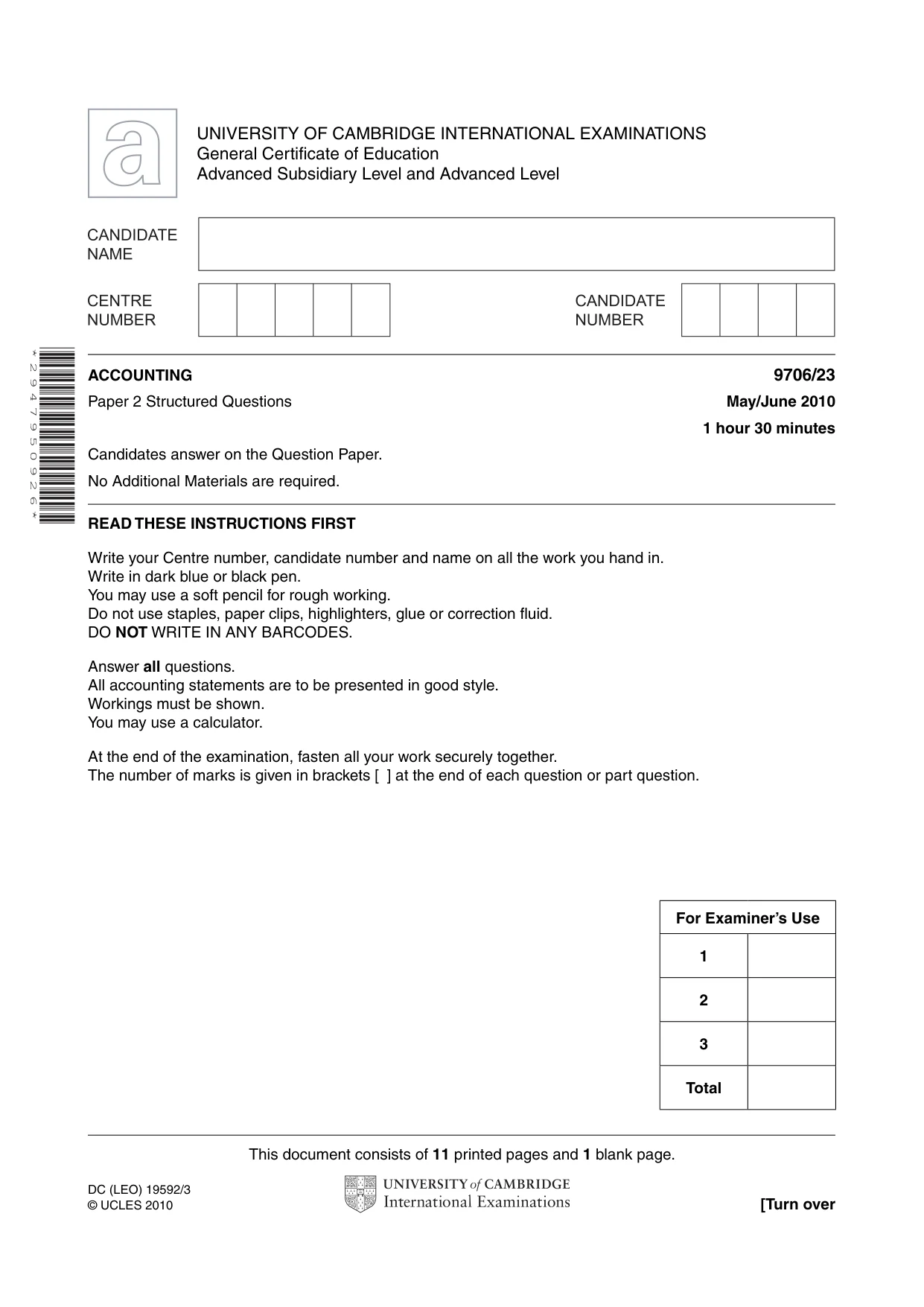
This document consists of 11 printed pages and 1 blank page. DC (LEO) 19592/3 © UCLES 2010 [Turn over UNIVERSITY OF CAMBRIDGE INTERNATIONAL EXAMINATIONS General Certificate of Education Advanced Subsidiary Level and Advanced Level * 2 9 4 7 9 5 0 9 2 6 * ACCOUNTING 9706/23 Paper 2 Structured Questions May/June 2010 1 hour 30 minutes Candidates answer on the Question Paper. No Additional Materials are required. READ THESE INSTRUCTIONS FIRST Write your Centre number, candidate number and name on all the work you hand in. Write in dark blue or black pen. You may use a soft pencil for rough working. Do not use staples, paper clips, highlighters, glue or correction fluid. DO NOT WRITE IN ANY BARCODES. Answer all questions. All accounting statements are to be presented in good style. Workings must be shown. You may use a calculator. At the end of the examination, fasten all your work securely together. The number of marks is given in brackets [ ] at the end of each question or part question. For Examiner’s Use 1 2 3 Total
Question paper, page 2
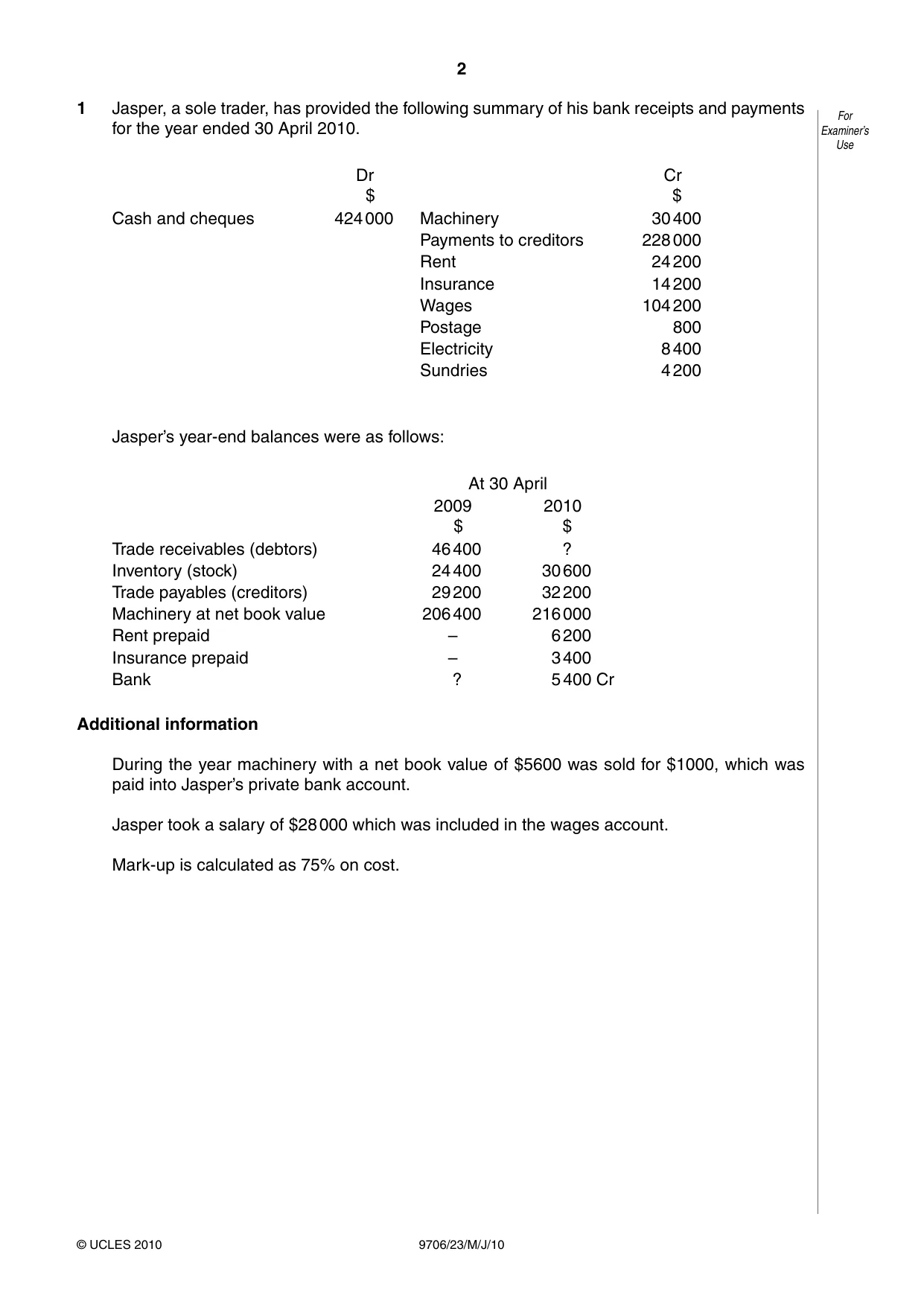
2 9706/23/M/J/10 © UCLES 2010 For Examiner’s Use 1 Jasper, a sole trader, has provided the following summary of his bank receipts and payments for the year ended 30 April 2010. Dr $ Cr $ Cash and cheques 424 000 Machinery 30 400 Payments to creditors 228 000 Rent 24 200 Insurance 14 200 Wages 104 200 Postage 800 Electricity 8 400 Sundries 4 200 Jasper’s year-end balances were as follows: At 30 April 2009 $ 2010 $ Trade receivables (debtors) 46 400 ? Inventory (stock) 24 400 30 600 Trade payables (creditors) 29 200 32 200 Machinery at net book value 206 400 216 000 Rent prepaid – 6 200 Insurance prepaid – 3 400 Bank ? 5 400 Cr Additional information During the year machinery with a net book value of $5600 was sold for $1000, which was paid into Jasper’s private bank account. Jasper took a salary of $28 000 which was included in the wages account. Mark-up is calculated as 75% on cost.
Question paper, page 3
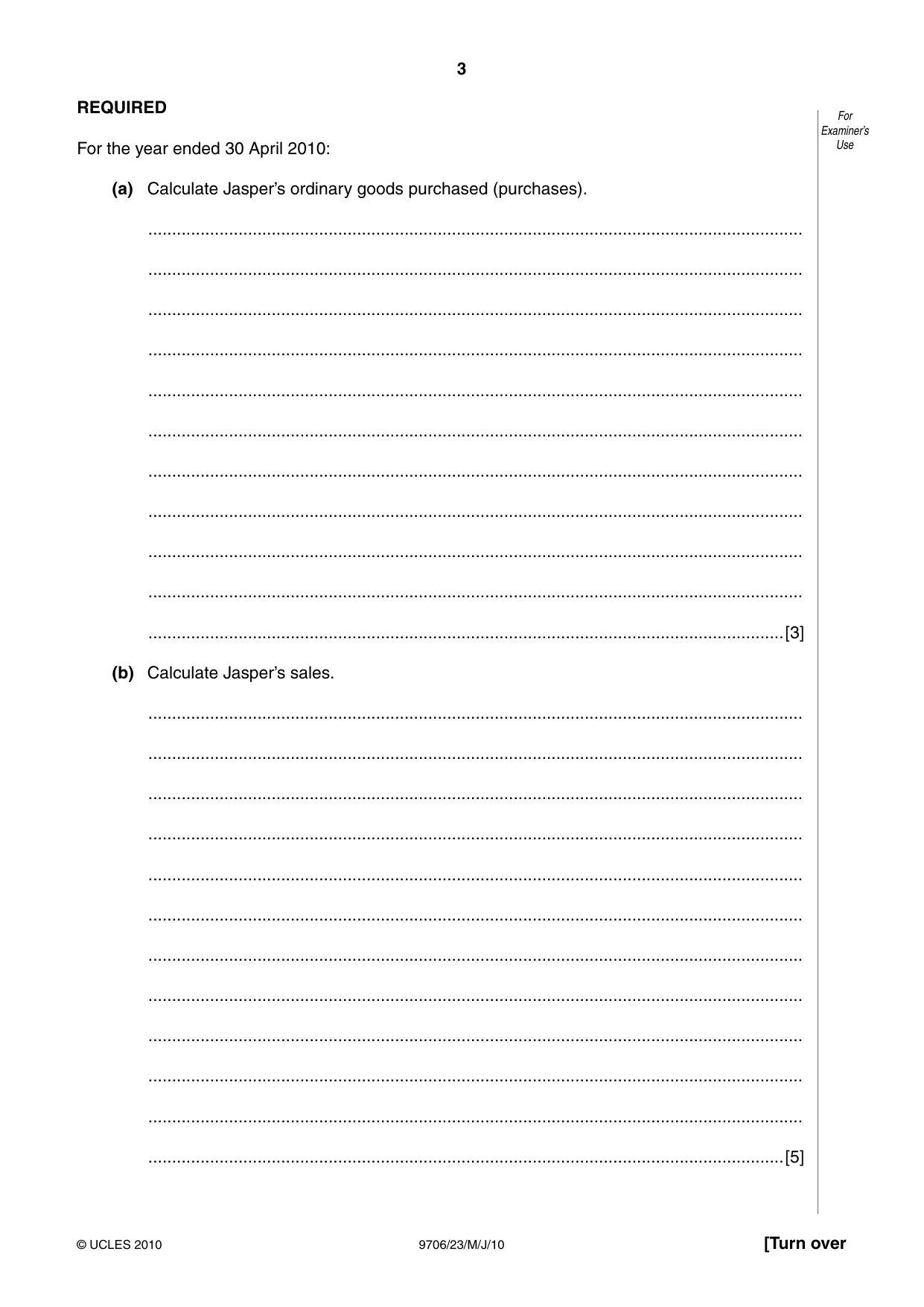
3 9706/23/M/J/10 © UCLES 2010 [Turn over For Examiner’s Use REQUIRED For the year ended 30 April 2010: (a) Calculate Jasper’s ordinary goods purchased (purchases). … … … … … … … … … … …[3] (b) Calculate Jasper’s sales. … … … … … … … … … … … …[5]
Question paper, page 4
4 9706/23/M/J/10 © UCLES 2010 For Examiner’s Use (c) Prepare Jasper’s income statement (trading and profit and loss account). … … … … … … … … … … … … … … … … … … … … … … …[16]
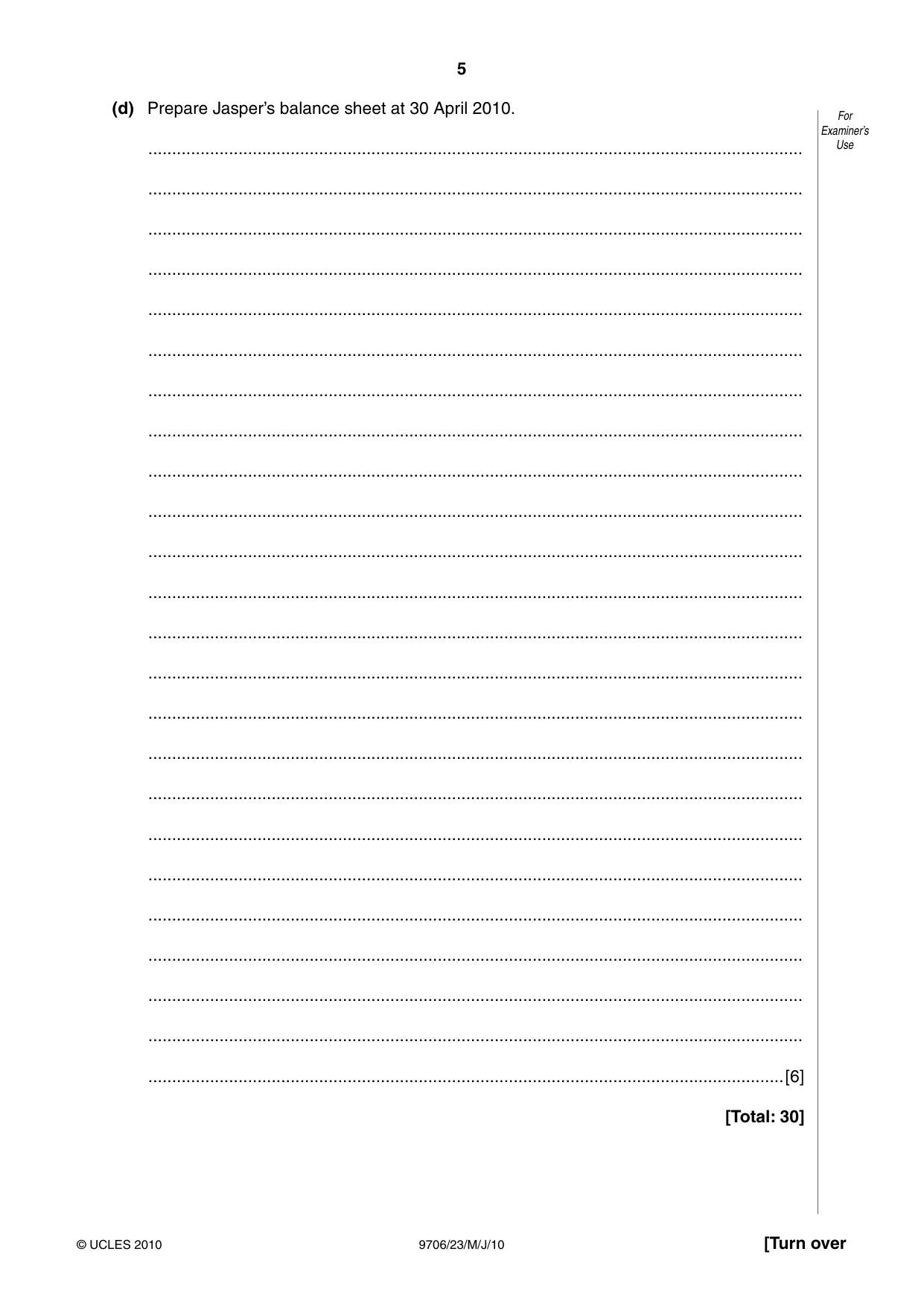
Question paper, page 5
5 9706/23/M/J/10 © UCLES 2010 [Turn over For Examiner’s Use (d) Prepare Jasper’s balance sheet at 30 April 2010. … … … … … … … … … … … … … … … … … … … … … … … …[6] [Total: 30]
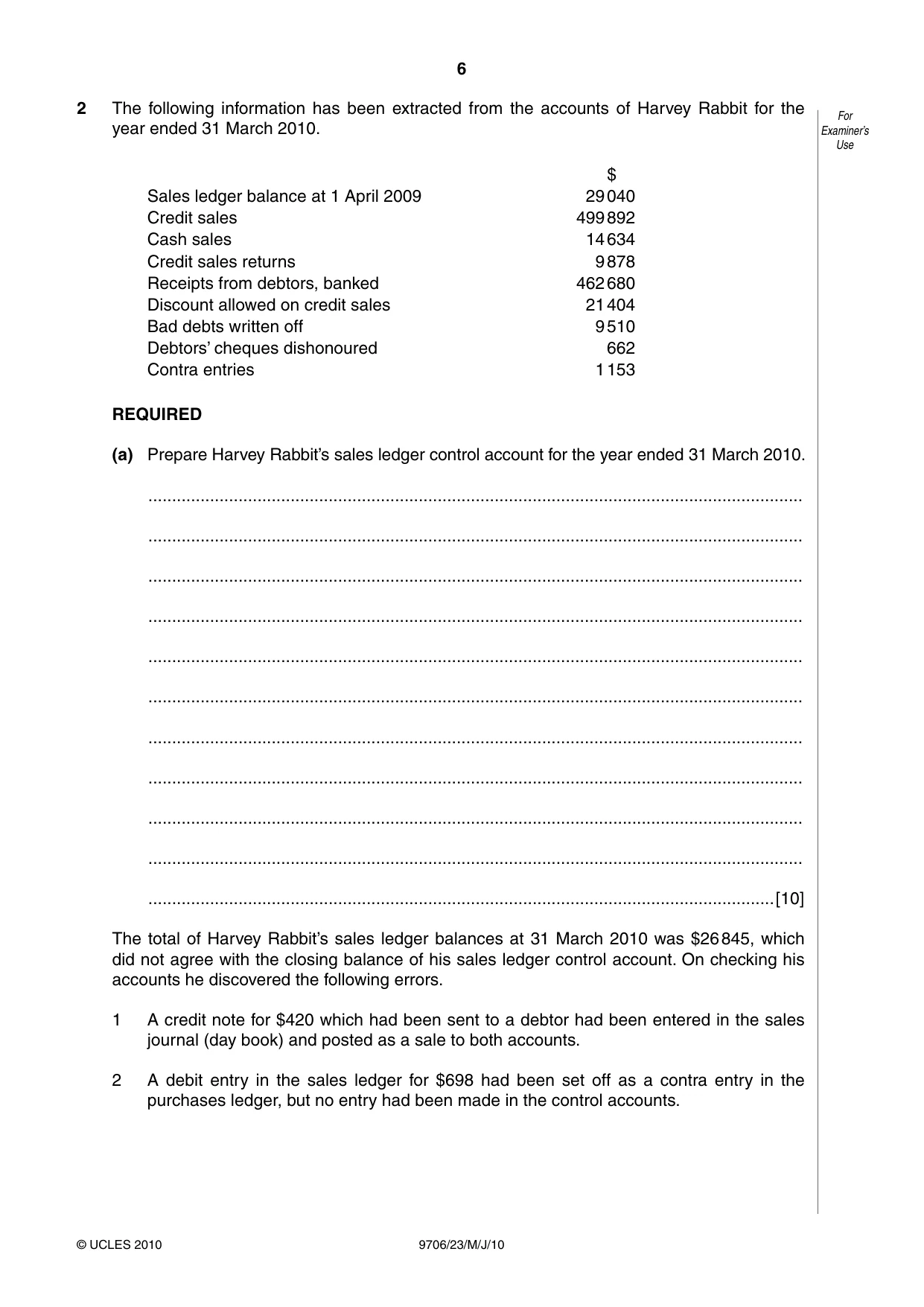
Question paper, page 6
6 9706/23/M/J/10 © UCLES 2010 For Examiner’s Use 2 The following information has been extracted from the accounts of Harvey Rabbit for the year ended 31 March 2010. $ Sales ledger balance at 1 April 2009 29 040 Credit sales 499 892 Cash sales 14 634 Credit sales returns 9 878 Receipts from debtors, banked 462 680 Discount allowed on credit sales 21 404 Bad debts written off 9 510 Debtors’ cheques dishonoured 662 Contra entries 1 153 REQUIRED (a) Prepare Harvey Rabbit’s sales ledger control account for the year ended 31 March 2010. … … … … … … … … … … …[10] The total of Harvey Rabbit’s sales ledger balances at 31 March 2010 was $26 845, which did not agree with the closing balance of his sales ledger control account. On checking his accounts he discovered the following errors. 1 A credit note for $420 which had been sent to a debtor had been entered in the sales journal (day book) and posted as a sale to both accounts. 2 A debit entry in the sales ledger for $698 had been set off as a contra entry in the purchases ledger, but no entry had been made in the control accounts.
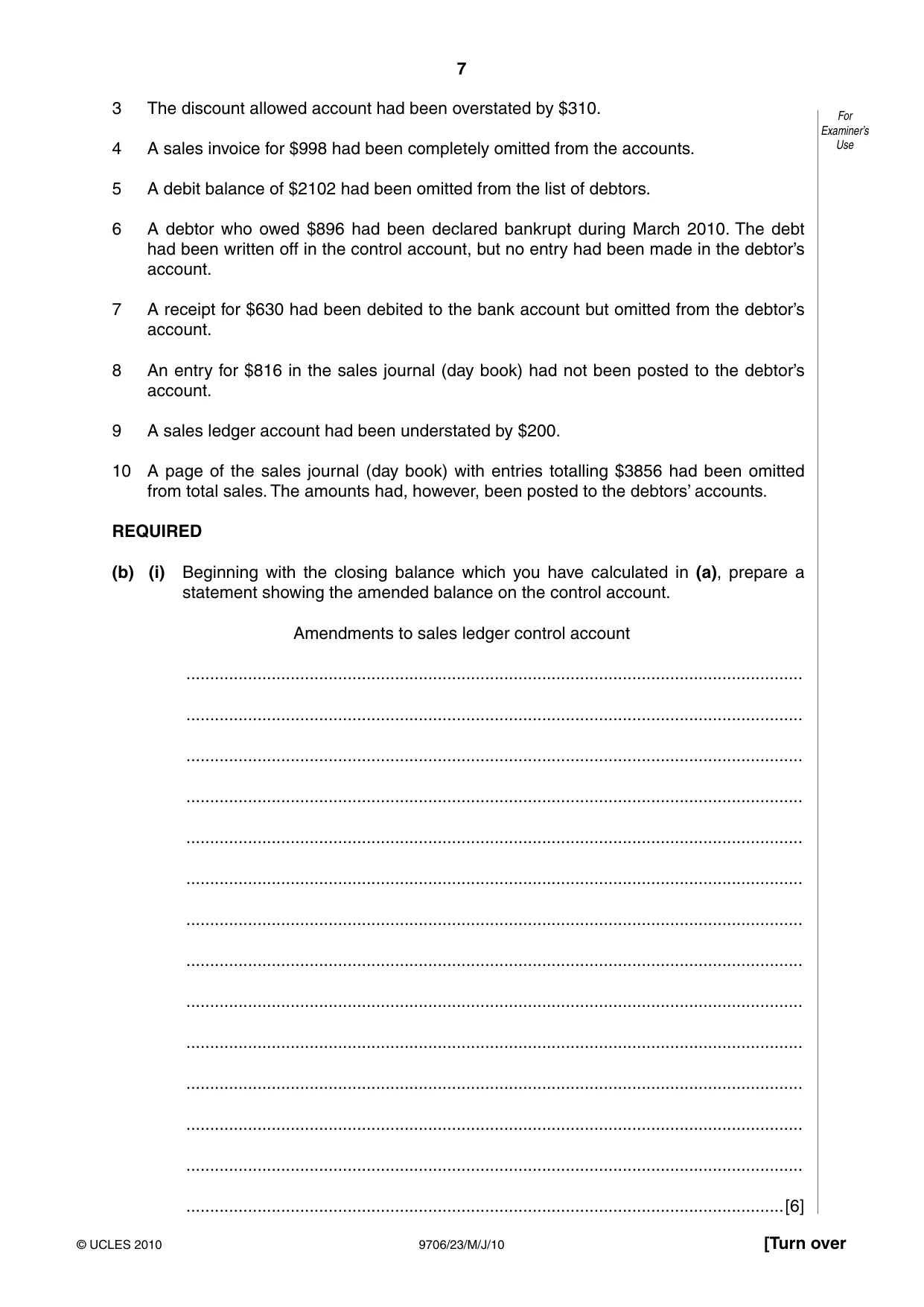
Question paper, page 7
7 9706/23/M/J/10 © UCLES 2010 [Turn over For Examiner’s Use 3 The discount allowed account had been overstated by $310. 4 A sales invoice for $998 had been completely omitted from the accounts. 5 A debit balance of $2102 had been omitted from the list of debtors. 6 A debtor who owed $896 had been declared bankrupt during March 2010. The debt had been written off in the control account, but no entry had been made in the debtor’s account. 7 A receipt for $630 had been debited to the bank account but omitted from the debtor’s account. 8 An entry for $816 in the sales journal (day book) had not been posted to the debtor’s account. 9 A sales ledger account had been understated by $200. 10 A page of the sales journal (day book) with entries totalling $3856 had been omitted from total sales. The amounts had, however, been posted to the debtors’ accounts. REQUIRED (b) (i) Beginning with the closing balance which you have calculated in (a), prepare a statement showing the amended balance on the control account. Amendments to sales ledger control account … … … … … … … … … … … … … …[6]
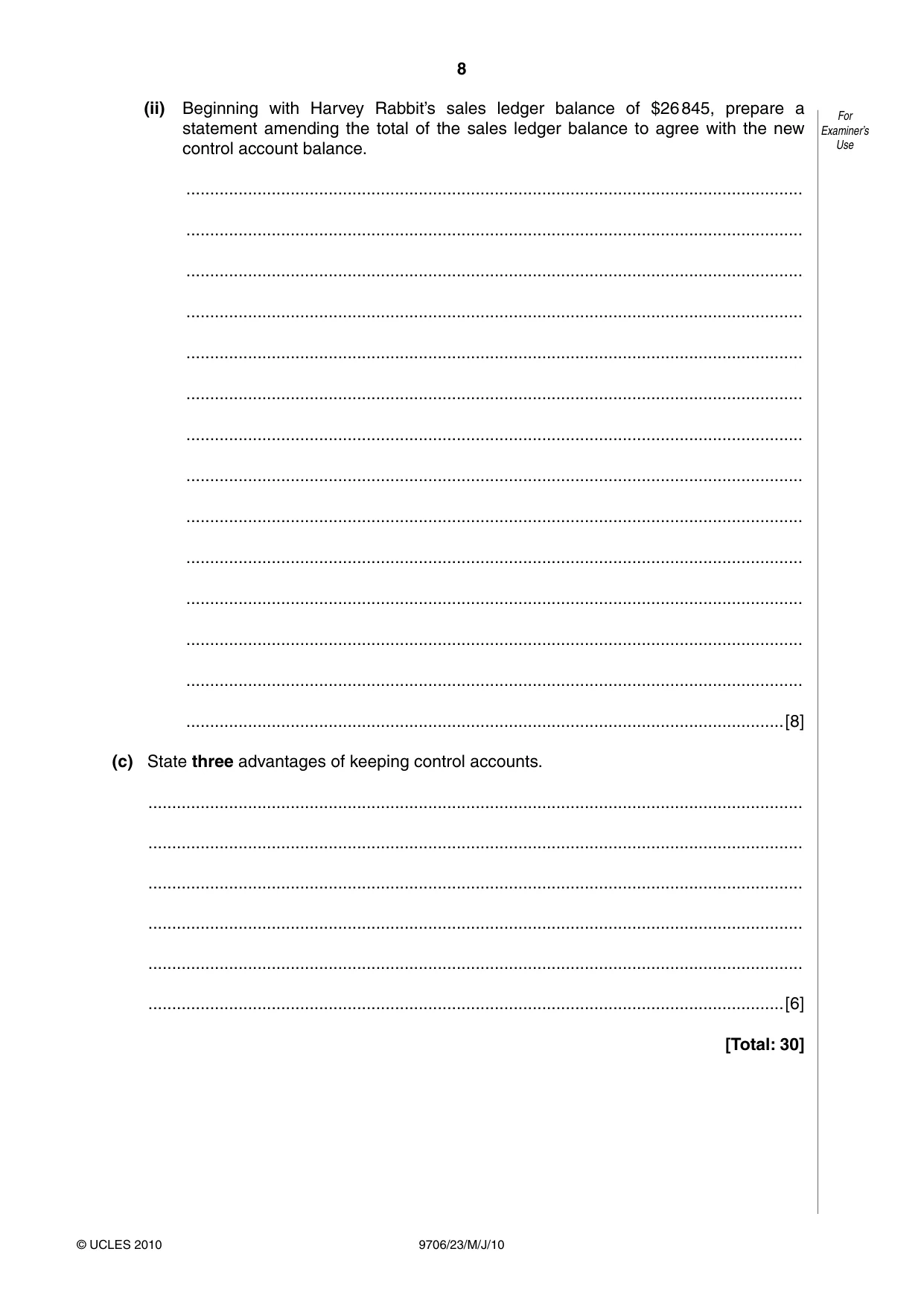
Question paper, page 8
8 9706/23/M/J/10 © UCLES 2010 For Examiner’s Use (ii) Beginning with Harvey Rabbit’s sales ledger balance of $26 845, prepare a statement amending the total of the sales ledger balance to agree with the new control account balance. … … … … … … … … … … … … … …[8] (c) State three advantages of keeping control accounts. … … … … … …[6] [Total: 30]
Question paper, page 9
9 9706/23/M/J/10 [Turn over BLANK PAGE Question 3 is on the next page.
Question paper, page 10
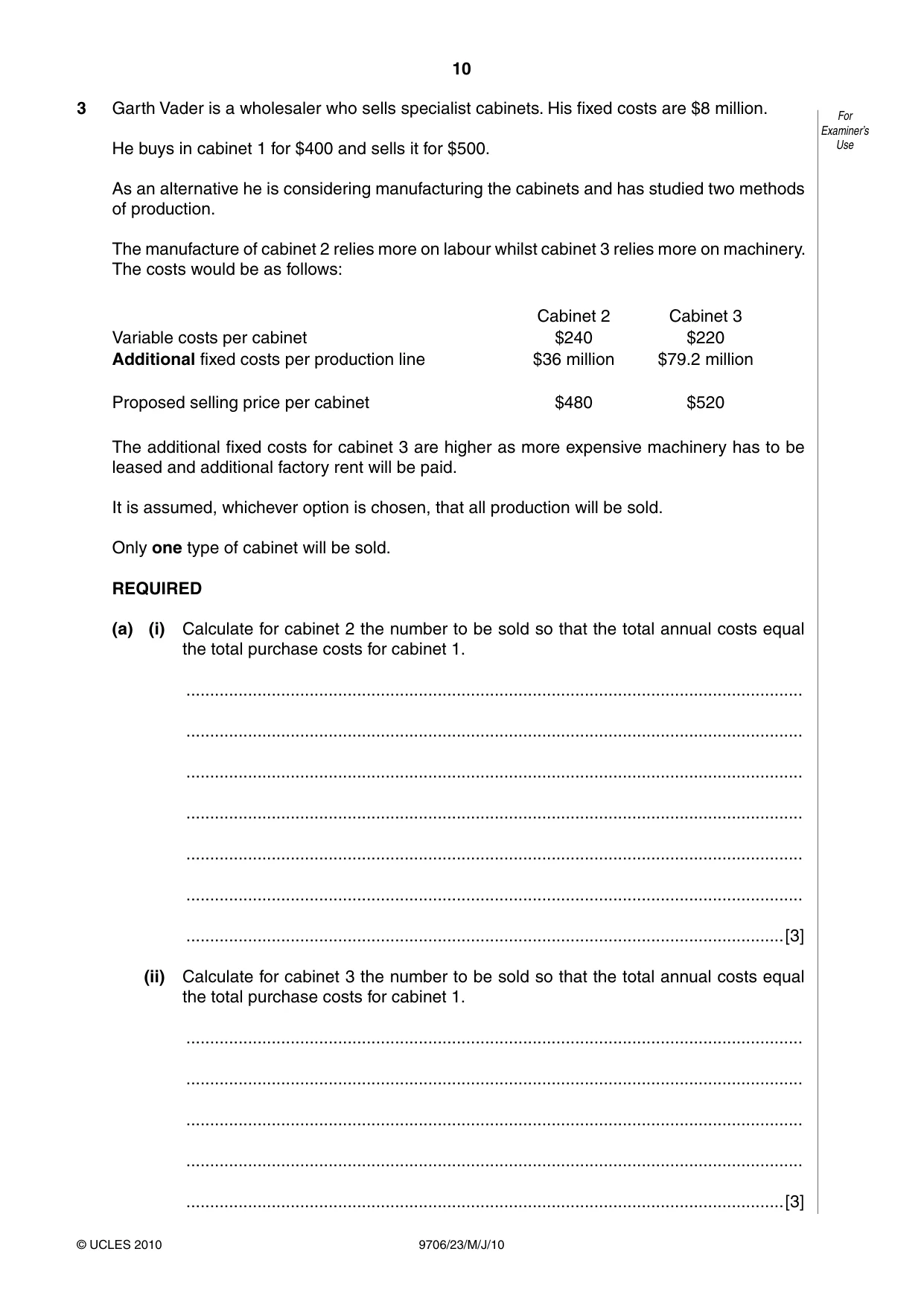
10 9706/23/M/J/10 © UCLES 2010 For Examiner’s Use 3 Garth Vader is a wholesaler who sells specialist cabinets. His fixed costs are $8 million. He buys in cabinet 1 for $400 and sells it for $500. As an alternative he is considering manufacturing the cabinets and has studied two methods of production. The manufacture of cabinet 2 relies more on labour whilst cabinet 3 relies more on machinery. The costs would be as follows: Cabinet 2 Cabinet 3 Variable costs per cabinet $240 $220 Additional fixed costs per production line $36 million $79.2 million Proposed selling price per cabinet $480 $520 The additional fixed costs for cabinet 3 are higher as more expensive machinery has to be leased and additional factory rent will be paid. It is assumed, whichever option is chosen, that all production will be sold. Only one type of cabinet will be sold. REQUIRED (a) (i) Calculate for cabinet 2 the number to be sold so that the total annual costs equal the total purchase costs for cabinet 1. … … … … … … …[3] (ii) Calculate for cabinet 3 the number to be sold so that the total annual costs equal the total purchase costs for cabinet 1. … … … … …[3]
Question paper, page 11
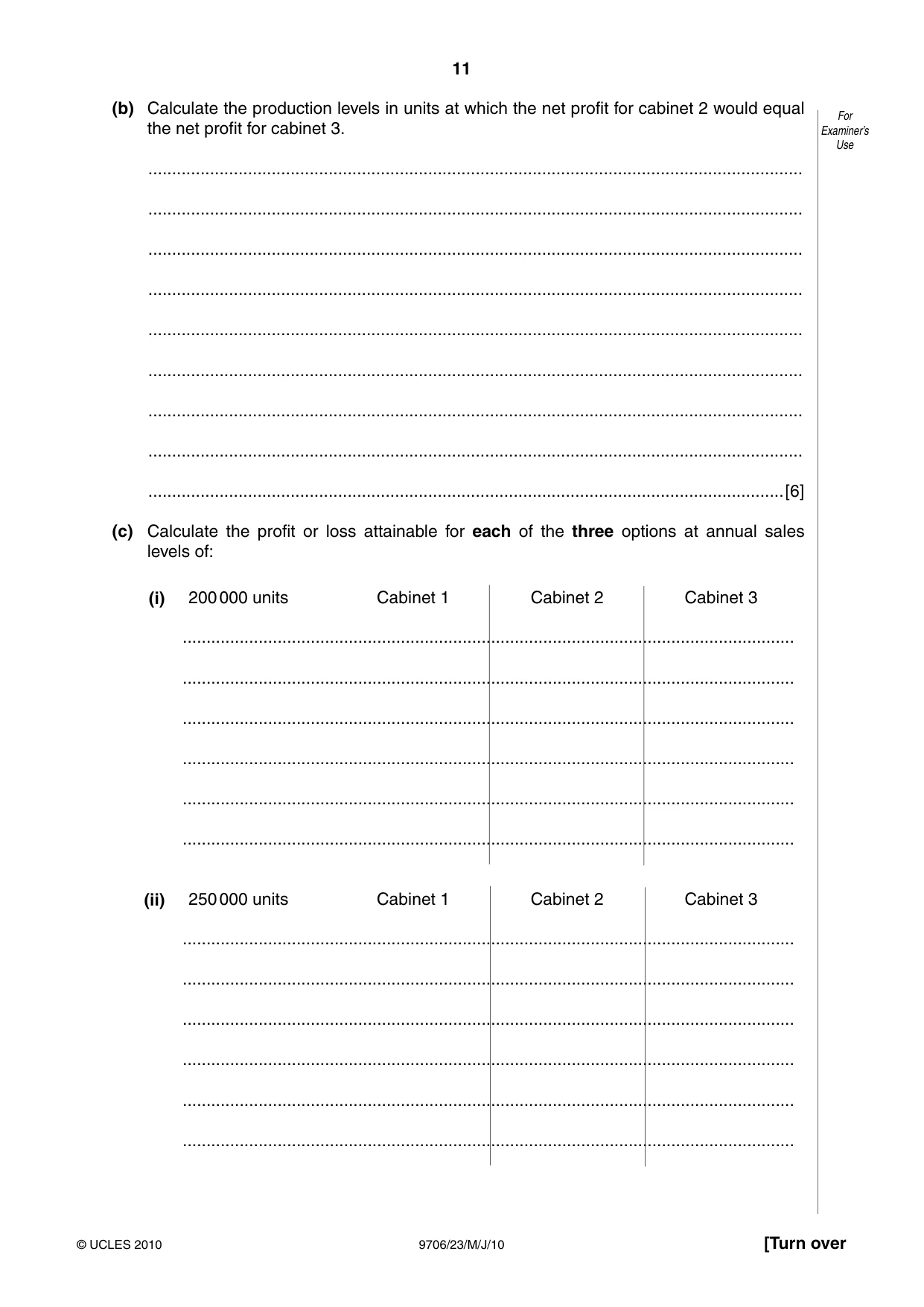
11 9706/23/M/J/10 © UCLES 2010 [Turn over For Examiner’s Use (b) Calculate the production levels in units at which the net profit for cabinet 2 would equal the net profit for cabinet 3. … … … … … … … … …[6] (c) Calculate the profit or loss attainable for each of the three options at annual sales levels of: (i) 200 000 units Cabinet 1 Cabinet 2 Cabinet 3 … … … … … … (ii) 250 000 units Cabinet 1 Cabinet 2 Cabinet 3 … … … … … …
Question paper, page 12
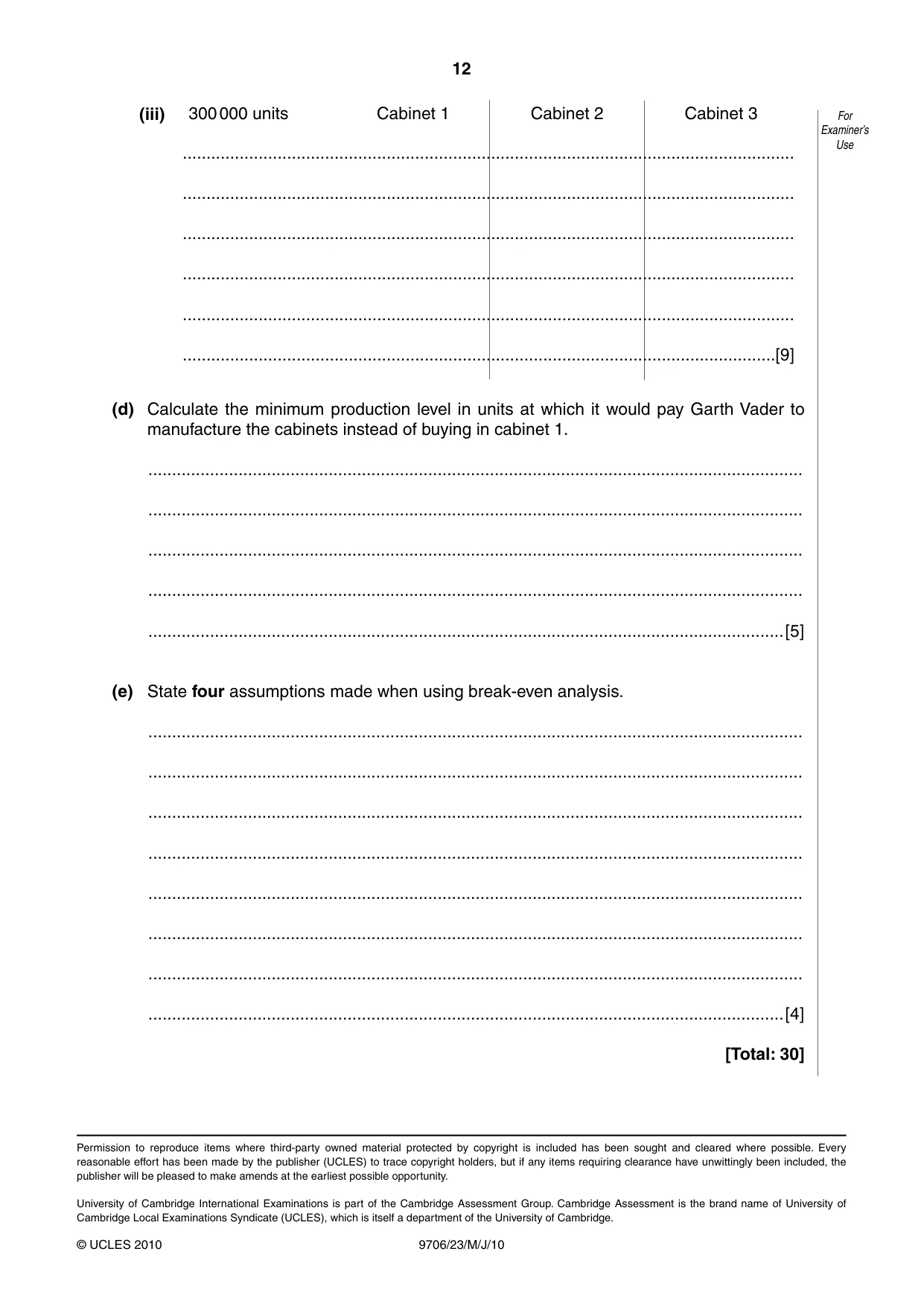
12 9706/23/M/J/10 © UCLES 2010 For Examiner’s Use (iii) 300 000 units Cabinet 1 Cabinet 2 Cabinet 3 … … … … … …[9] (d) Calculate the minimum production level in units at which it would pay Garth Vader to manufacture the cabinets instead of buying in cabinet 1. … … … … …[5] (e) State four assumptions made when using break-even analysis. … … … … … … … …[4] [Total: 30] Permission to reproduce items where third-party owned material protected by copyright is included has been sought and cleared where possible. Every reasonable effort has been made by the publisher (UCLES) to trace copyright holders, but if any items requiring clearance have unwittingly been included, the publisher will be pleased to make amends at the earliest possible opportunity. University of Cambridge International Examinations is part of the Cambridge Assessment Group. Cambridge Assessment is the brand name of University of Cambridge Local Examinations Syndicate (UCLES), which is itself a department of the University of Cambridge.
Mark scheme, page 1
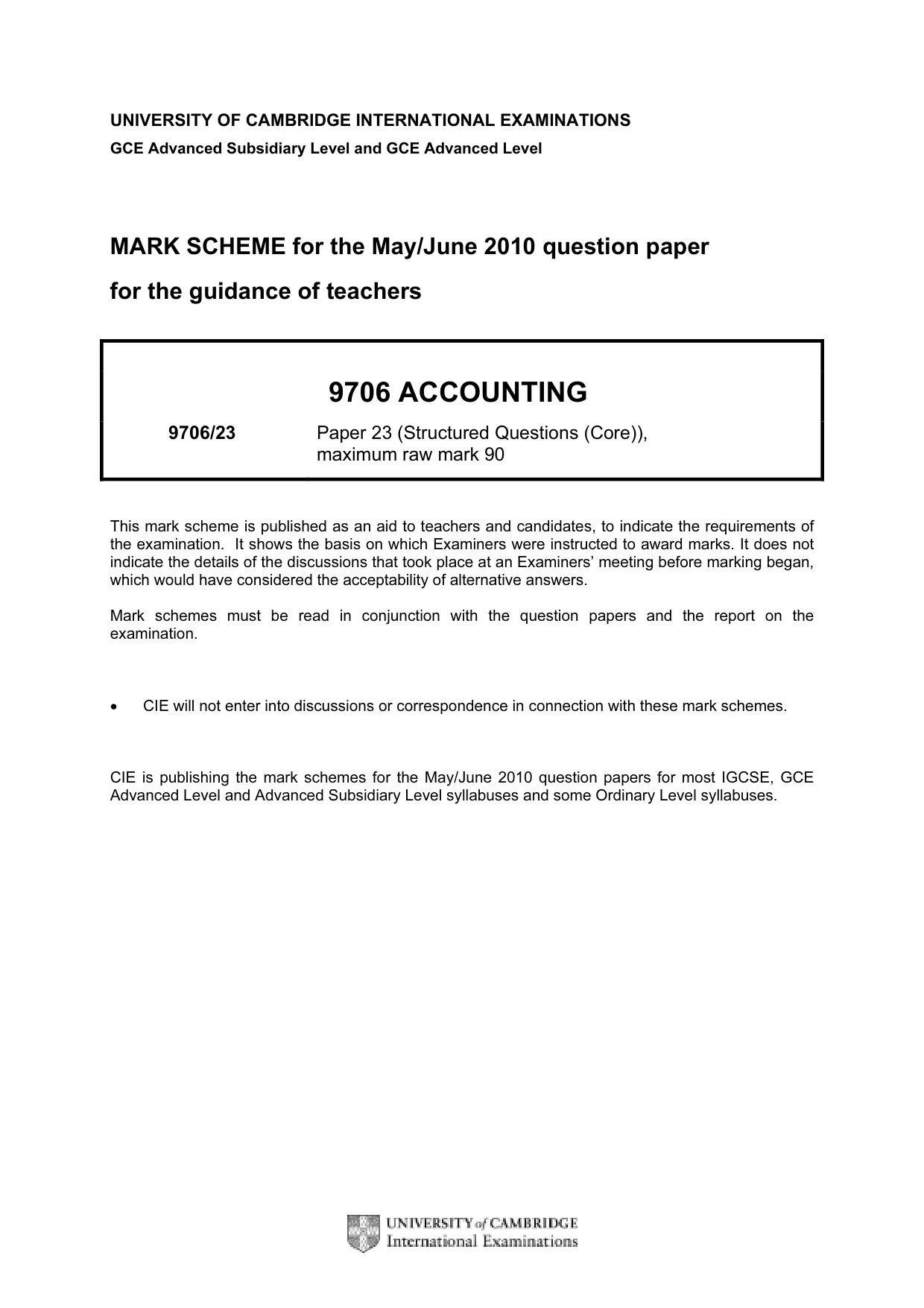
UNIVERSITY OF CAMBRIDGE INTERNATIONAL EXAMINATIONS GCE Advanced Subsidiary Level and GCE Advanced Level MARK SCHEME for the May/June 2010 question paper for the guidance of teachers 9706 ACCOUNTING 9706/23 Paper 23 (Structured Questions (Core)), maximum raw mark 90 This mark scheme is published as an aid to teachers and candidates, to indicate the requirements of the examination. It shows the basis on which Examiners were instructed to award marks. It does not indicate the details of the discussions that took place at an Examiners’ meeting before marking began, which would have considered the acceptability of alternative answers. Mark schemes must be read in conjunction with the question papers and the report on the examination. • CIE will not enter into discussions or correspondence in connection with these mark schemes. CIE is publishing the mark schemes for the May/June 2010 question papers for most IGCSE, GCE Advanced Level and Advanced Subsidiary Level syllabuses and some Ordinary Level syllabuses.
Mark scheme, page 2
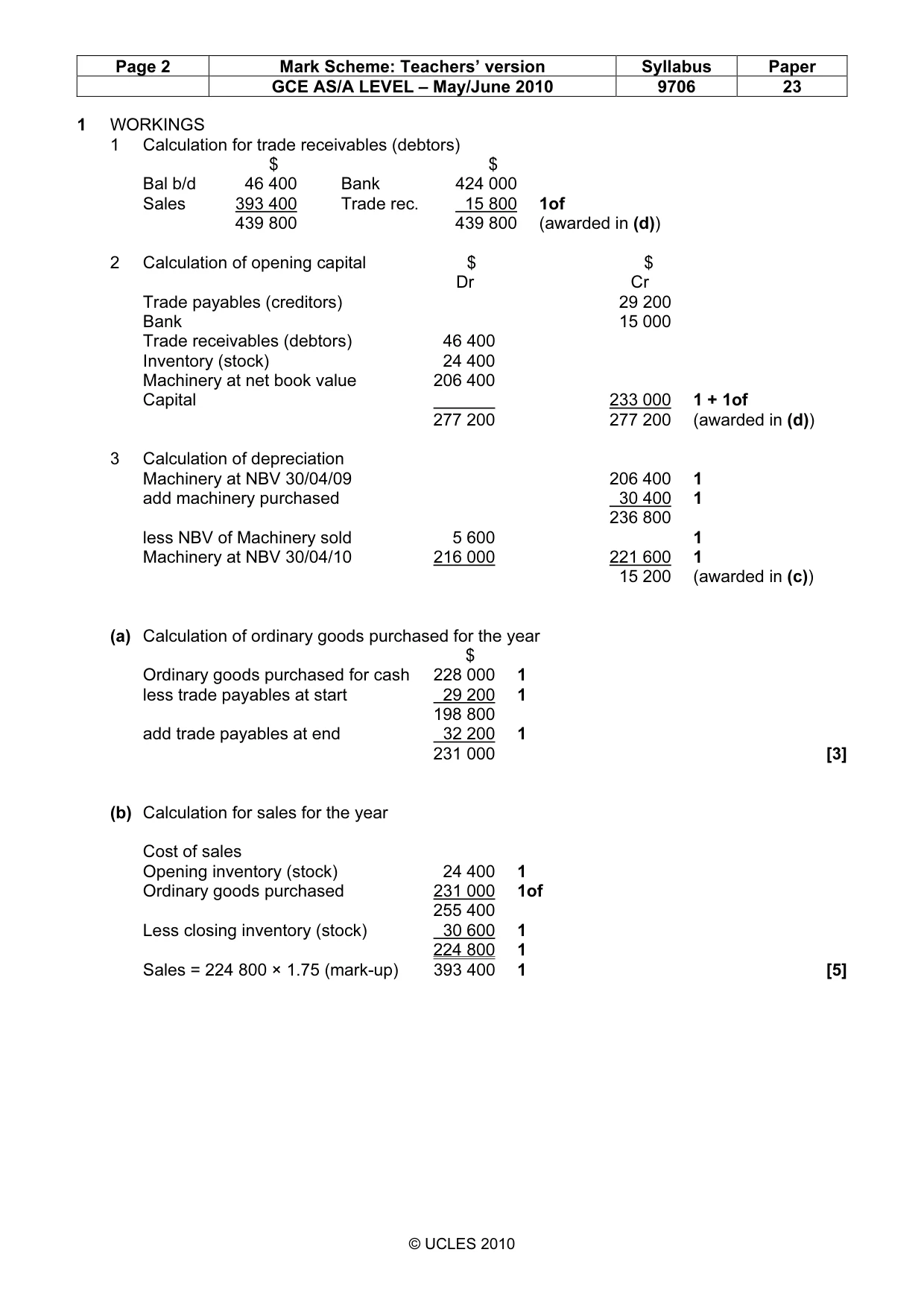
Page 2 Mark Scheme: Teachers’ version Syllabus Paper GCE AS/A LEVEL – May/June 2010 9706 23 © UCLES 2010 1 WORKINGS 1 Calculation for trade receivables (debtors) $ $ Bal b/d 46 400 Bank 424 000 Sales 393 400 Trade rec. 15 800 1of 439 800 439 800 (awarded in (d)) 2 Calculation of opening capital $ $ Dr Cr Trade payables (creditors) 29 200 Bank 15 000 Trade receivables (debtors) 46 400 Inventory (stock) 24 400 Machinery at net book value 206 400 Capital 233 000 1 + 1of 277 200 277 200 (awarded in (d)) 3 Calculation of depreciation Machinery at NBV 30/04/09 206 400 1 add machinery purchased 30 400 1 236 800 less NBV of Machinery sold 5 600 1 Machinery at NBV 30/04/10 216 000 221 600 1 15 200 (awarded in (c)) (a) Calculation of ordinary goods purchased for the year $ Ordinary goods purchased for cash 228 000 1 less trade payables at start 29 200 1 198 800 add trade payables at end 32 200 1 231 000 [3] (b) Calculation for sales for the year Cost of sales Opening inventory (stock) 24 400 1 Ordinary goods purchased 231 000 1of 255 400 Less closing inventory (stock) 30 600 1 224 800 1 Sales = 224 800 × 1.75 (mark-up) 393 400 1 [5]
Mark scheme, page 3
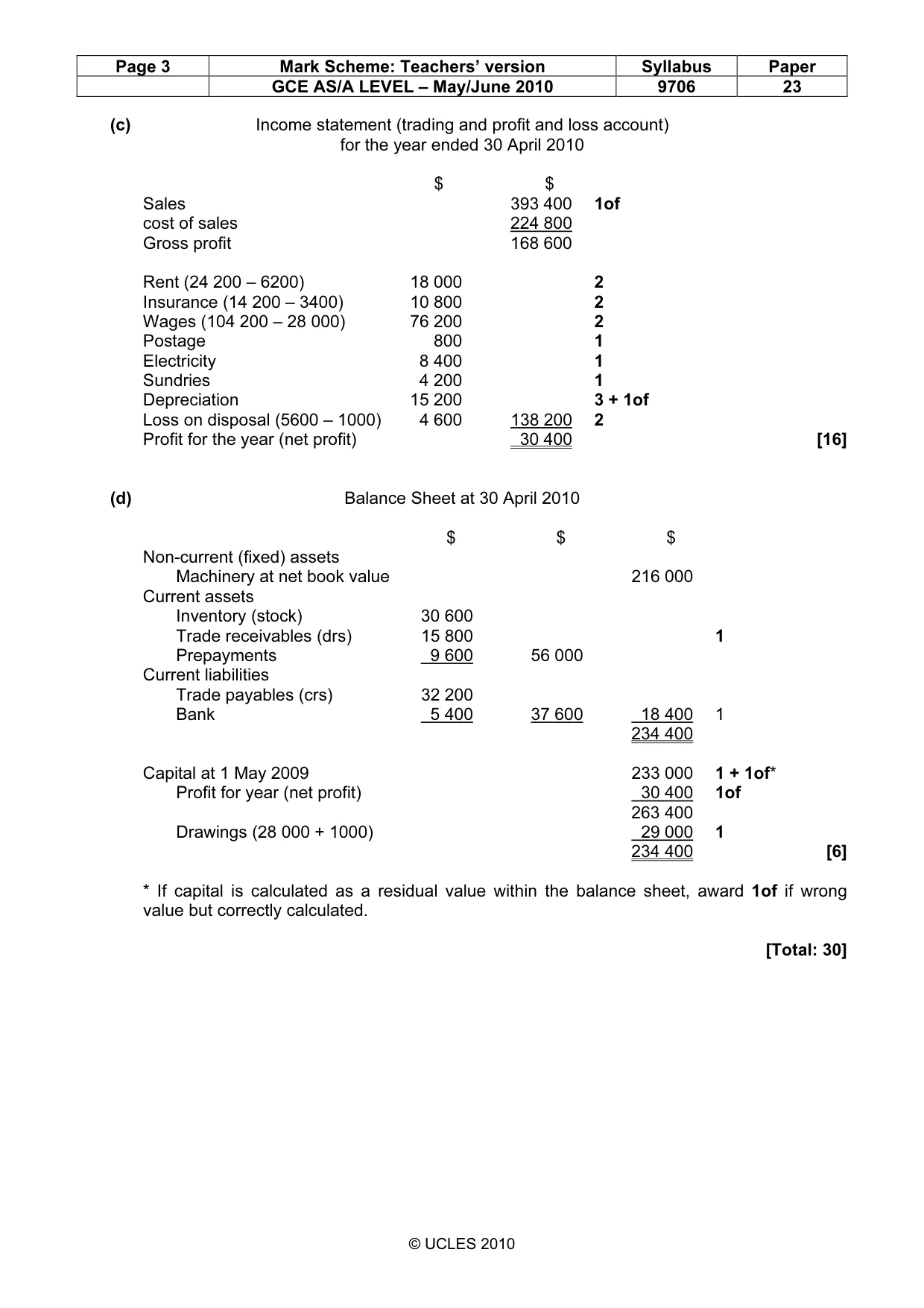
Page 3 Mark Scheme: Teachers’ version Syllabus Paper GCE AS/A LEVEL – May/June 2010 9706 23 © UCLES 2010 (c) Income statement (trading and profit and loss account) for the year ended 30 April 2010 $ $ Sales 393 400 1of cost of sales 224 800 Gross profit 168 600 Rent (24 200 – 6200) 18 000 2 Insurance (14 200 – 3400) 10 800 2 Wages (104 200 – 28 000) 76 200 2 Postage 800 1 Electricity 8 400 1 Sundries 4 200 1 Depreciation 15 200 3 + 1of Loss on disposal (5600 – 1000) 4 600 138 200 2 Profit for the year (net profit) 30 400 [16] (d) Balance Sheet at 30 April 2010 $ $ $ Non-current (fixed) assets Machinery at net book value 216 000 Current assets Inventory (stock) 30 600 Trade receivables (drs) 15 800 1 Prepayments 9 600 56 000 Current liabilities Trade payables (crs) 32 200 Bank 5 400 37 600 18 400 1 234 400 Capital at 1 May 2009 233 000 1 + 1of* Profit for year (net profit) 30 400 1of 263 400 Drawings (28 000 + 1000) 29 000 1 234 400 [6] * If capital is calculated as a residual value within the balance sheet, award 1of if wrong value but correctly calculated. [Total: 30]
Mark scheme, page 4
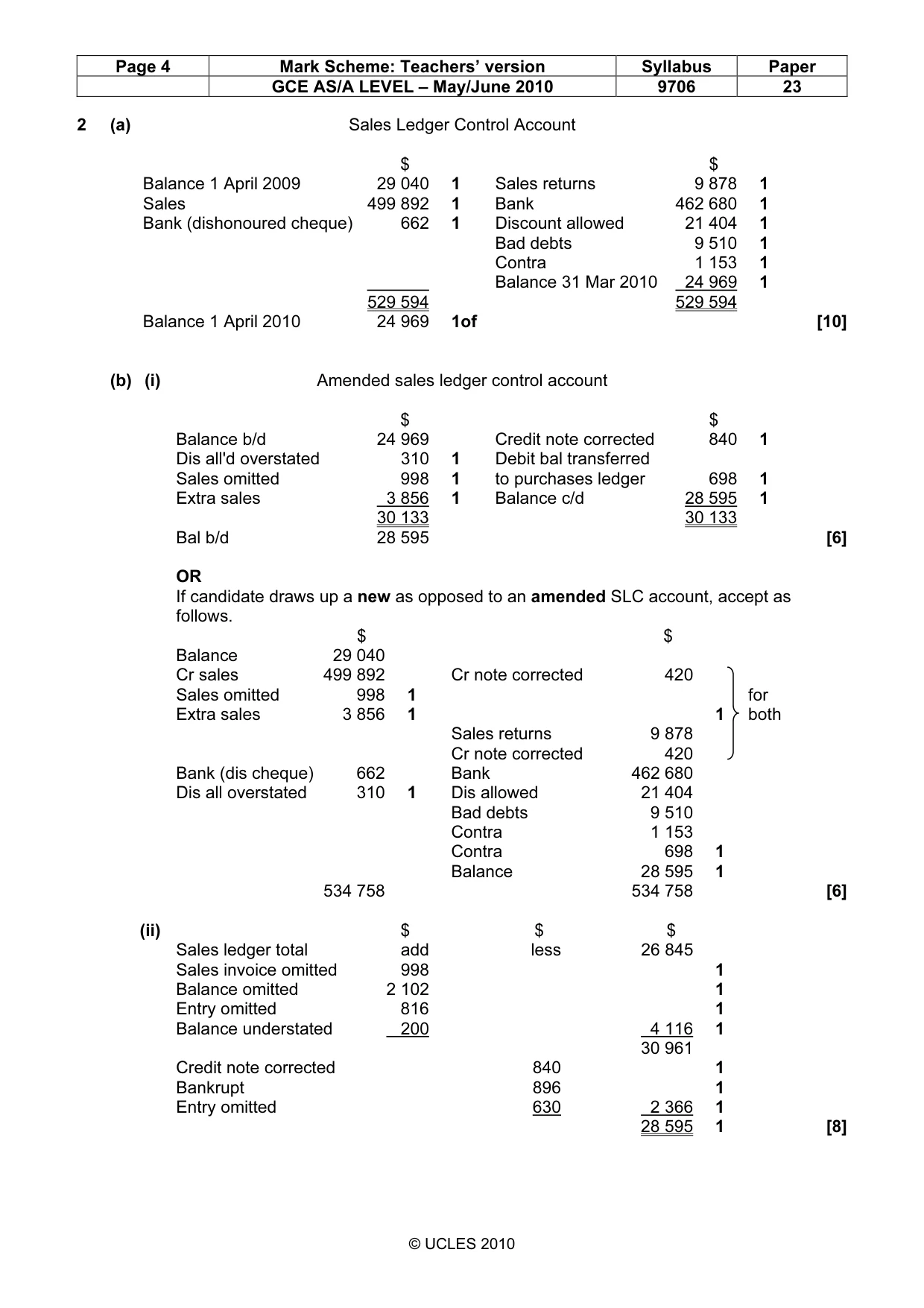
Page 4 Mark Scheme: Teachers’ version Syllabus Paper GCE AS/A LEVEL – May/June 2010 9706 23 © UCLES 2010 2 (a) Sales Ledger Control Account $ $ Balance 1 April 2009 29 040 1 Sales returns 9 878 1 Sales 499 892 1 Bank 462 680 1 Bank (dishonoured cheque) 662 1 Discount allowed 21 404 1 Bad debts 9 510 1 Contra 1 153 1 Balance 31 Mar 2010 24 969 1 529 594 529 594 Balance 1 April 2010 24 969 1of [10] (b) (i) Amended sales ledger control account $ $ Balance b/d 24 969 Credit note corrected 840 1 Dis all'd overstated 310 1 Debit bal transferred Sales omitted 998 1 to purchases ledger 698 1 Extra sales 3 856 1 Balance c/d 28 595 1 30 133 30 133 Bal b/d 28 595 [6] OR If candidate draws up a new as opposed to an amended SLC account, accept as follows. $ $ Balance 29 040 Cr sales 499 892 Cr note corrected 420 Sales omitted 998 1 for Extra sales 3 856 1 1 both Sales returns 9 878 Cr note corrected 420 Bank (dis cheque) 662 Bank 462 680 Dis all overstated 310 1 Dis allowed 21 404 Bad debts 9 510 Contra 1 153 Contra 698 1 Balance 28 595 1 534 758 534 758 [6] (ii) $ $ $ Sales ledger total add less 26 845 Sales invoice omitted 998 1 Balance omitted 2 102 1 Entry omitted 816 1 Balance understated 200 4 116 1 30 961 Credit note corrected 840 1 Bankrupt 896 1 Entry omitted 630 2 366 1 28 595 1 [8]
Mark scheme, page 5
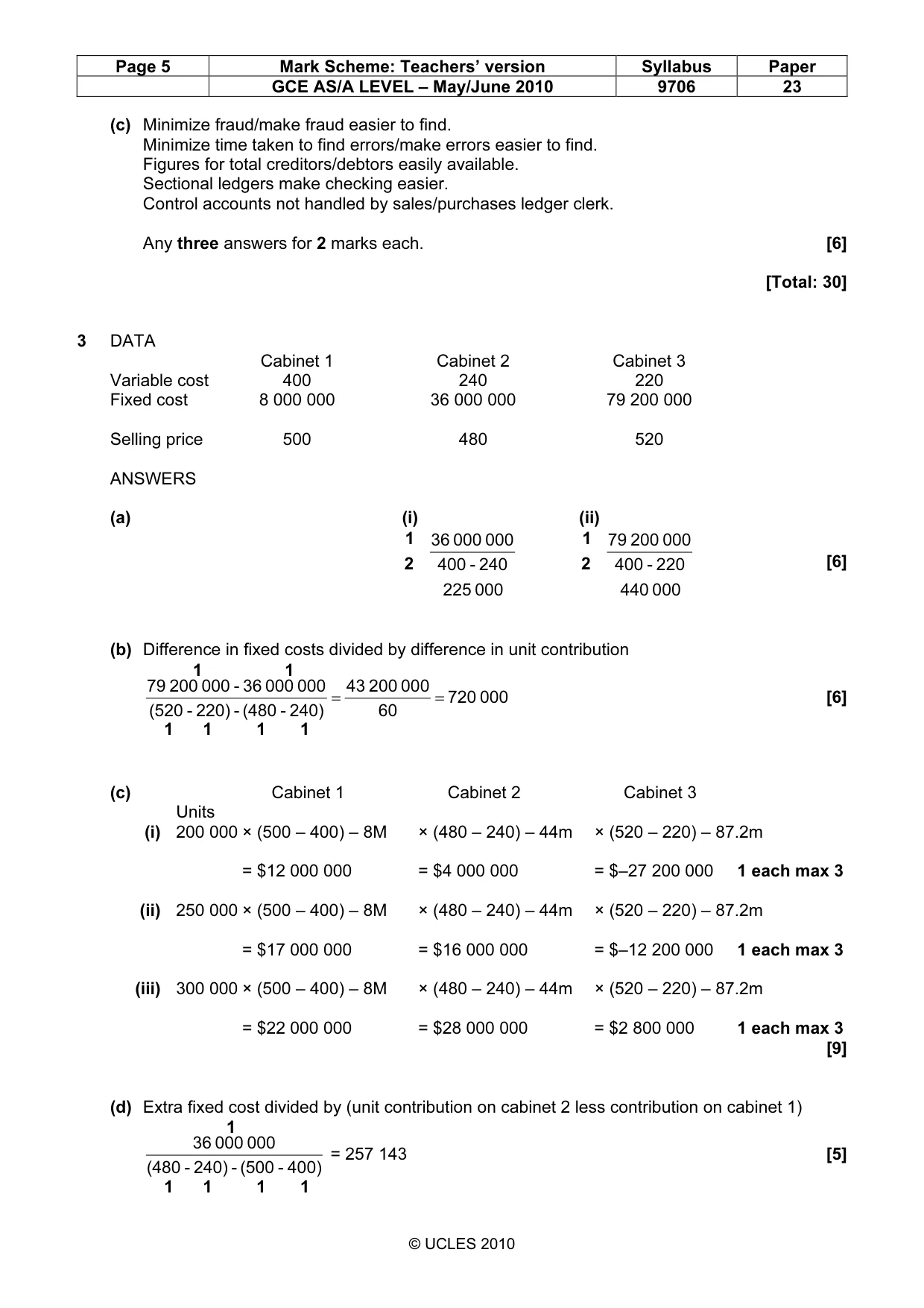
Page 5 Mark Scheme: Teachers’ version Syllabus Paper GCE AS/A LEVEL – May/June 2010 9706 23 © UCLES 2010 (c) Minimize fraud/make fraud easier to find. Minimize time taken to find errors/make errors easier to find. Figures for total creditors/debtors easily available. Sectional ledgers make checking easier. Control accounts not handled by sales/purchases ledger clerk. Any three answers for 2 marks each. [6] [Total: 30] 3 DATA Cabinet 1 Cabinet 2 Cabinet 3 Variable cost 400 240 220 Fixed cost 8 000 000 36 000 000 79 200 000 Selling price 500 480 520 ANSWERS (a) (i) (ii) 000 225 240 - 400 000 000 36 2 1 000 440 220 - 400 000 200 79 2 1 [6] (b) Difference in fixed costs divided by difference in unit contribution 1 1 1 1 1 1 000 720 60 000 200 43 240) - (480 - 220) - (520 000 000 36 - 000 200 79 = = [6] (c) Cabinet 1 Cabinet 2 Cabinet 3 Units (i) 200 000 × (500 – 400) – 8M × (480 – 240) – 44m × (520 – 220) – 87.2m = $12 000 000 = $4 000 000 = $–27 200 000 1 each max 3 (ii) 250 000 × (500 – 400) – 8M × (480 – 240) – 44m × (520 – 220) – 87.2m = $17 000 000 = $16 000 000 = $–12 200 000 1 each max 3 (iii) 300 000 × (500 – 400) – 8M × (480 – 240) – 44m × (520 – 220) – 87.2m = $22 000 000 = $28 000 000 = $2 800 000 1 each max 3 [9] (d) Extra fixed cost divided by (unit contribution on cabinet 2 less contribution on cabinet 1) 1 1 1 1 1 400) - (500 - 240) - (480 000 000 36 = 257 143 [5]
Mark scheme, page 6
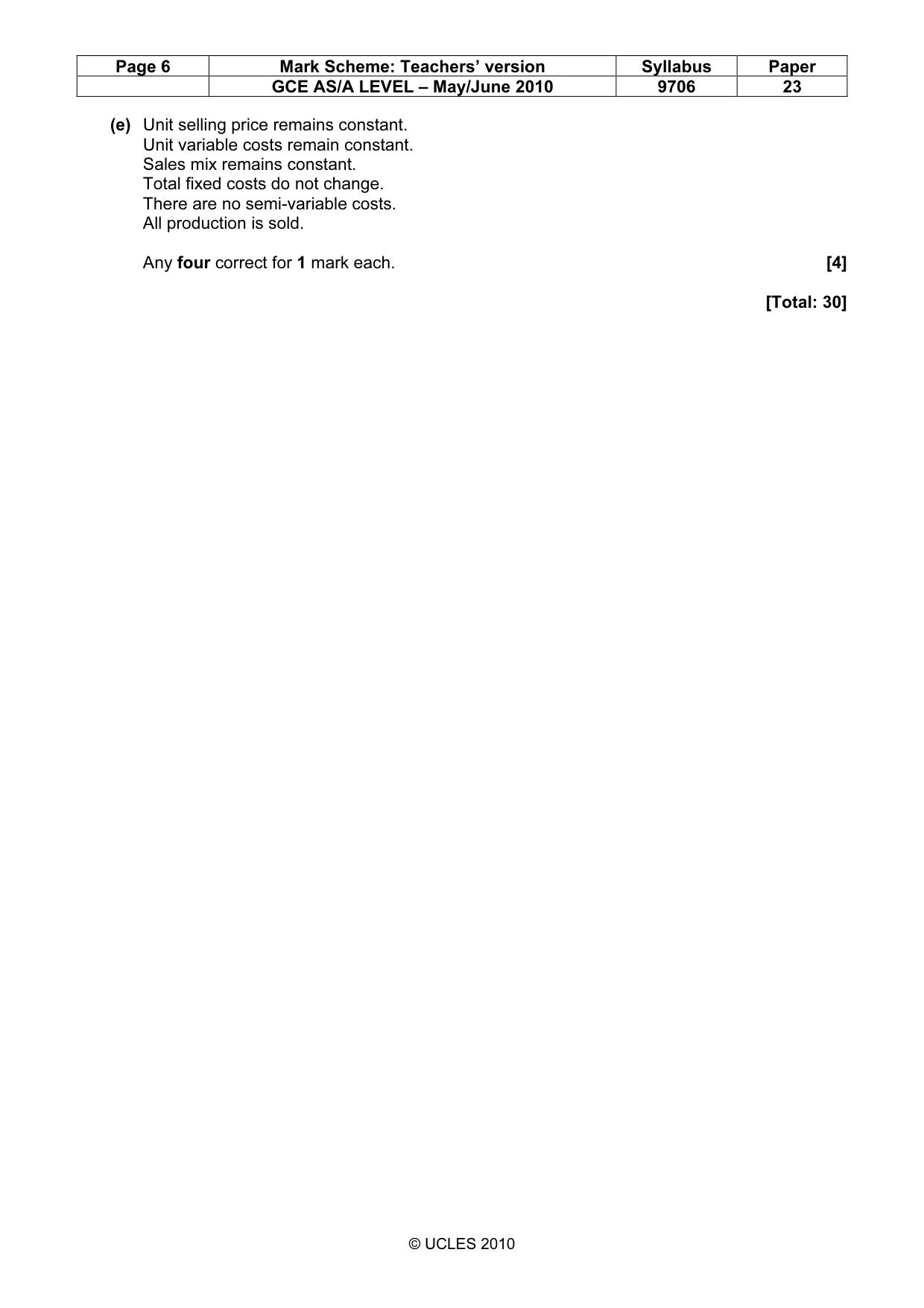
Page 6 Mark Scheme: Teachers’ version Syllabus Paper GCE AS/A LEVEL – May/June 2010 9706 23 © UCLES 2010 (e) Unit selling price remains constant. Unit variable costs remain constant. Sales mix remains constant. Total fixed costs do not change. There are no semi-variable costs. All production is sold. Any four correct for 1 mark each. [4] [Total: 30]
What you needed in this session
Cambridge’s own grade thresholds for 2010 May/June, Paper 2 · Variant 3. A higher threshold means an easier paper — the bar moves with how the cohort did.