Cambridge A Level Accounting 9706 — 2009 Oct/Nov Paper 2 · Variant 2
9706/22/O/N/09 · 90 marks · ≈101 min
The question paper and its mark scheme, free to read here and free to download. This is Cambridge’s own paper, exactly as it was sat.
Question paper16 pages
Mark scheme5 pages
Answers below. Sit the paper first if you are practising.
Paper as text
Question paper, page 1
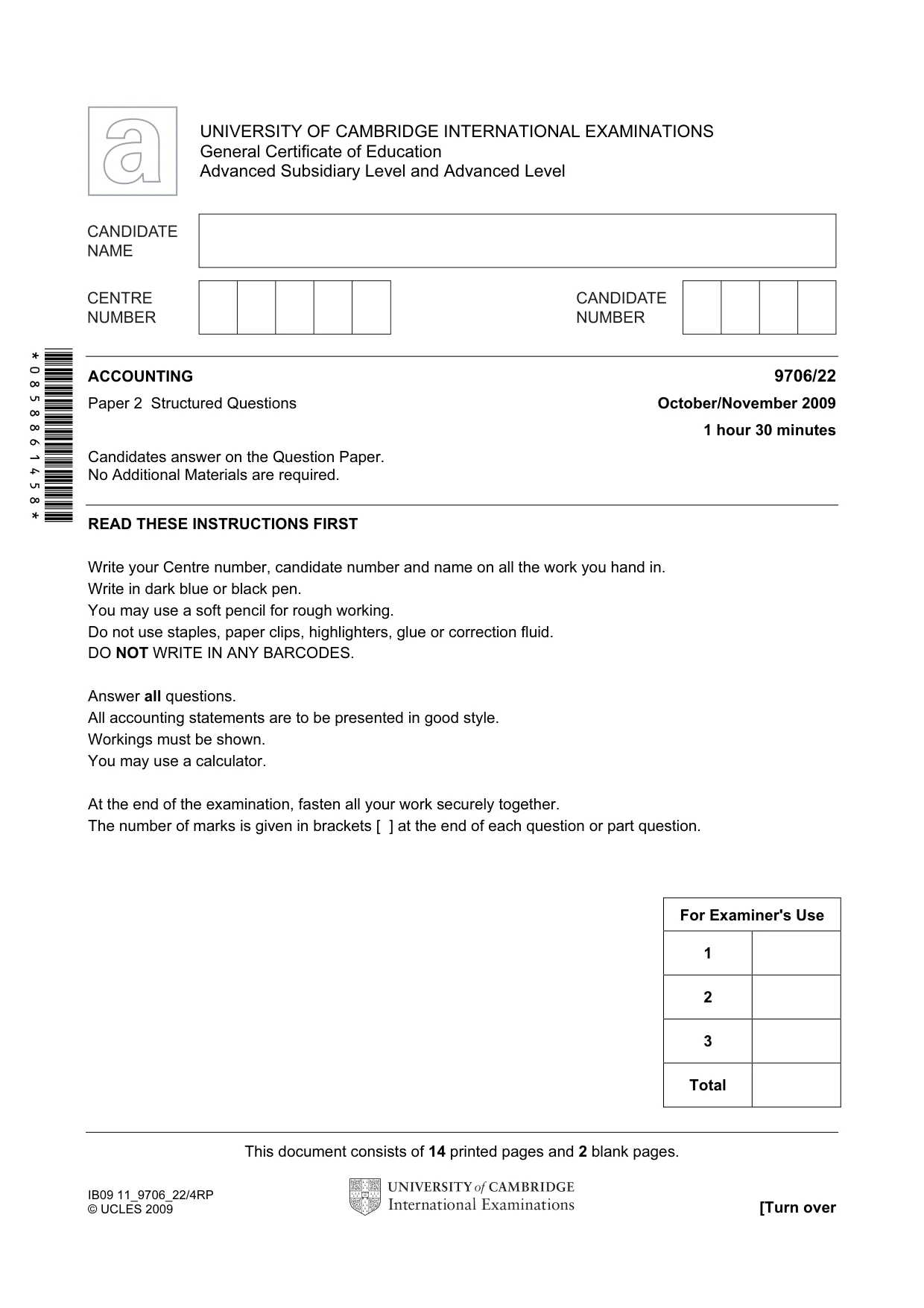
This document consists of 14 printed pages and 2 blank pages. IB09 11_9706_22/4RP © UCLES 2009 [Turn over *0858861458* For Examiner's Use 1 2 3 Total UNIVERSITY OF CAMBRIDGE INTERNATIONAL EXAMINATIONS General Certificate of Education Advanced Subsidiary Level and Advanced Level ACCOUNTING 9706/22 Paper 2 Structured Questions October/November 2009 1 hour 30 minutes Candidates answer on the Question Paper. No Additional Materials are required. READ THESE INSTRUCTIONS FIRST Write your Centre number, candidate number and name on all the work you hand in. Write in dark blue or black pen. You may use a soft pencil for rough working. Do not use staples, paper clips, highlighters, glue or correction fluid. DO NOT WRITE IN ANY BARCODES. Answer all questions. All accounting statements are to be presented in good style. Workings must be shown. You may use a calculator. At the end of the examination, fasten all your work securely together. The number of marks is given in brackets [ ] at the end of each question or part question.
Question paper, page 2
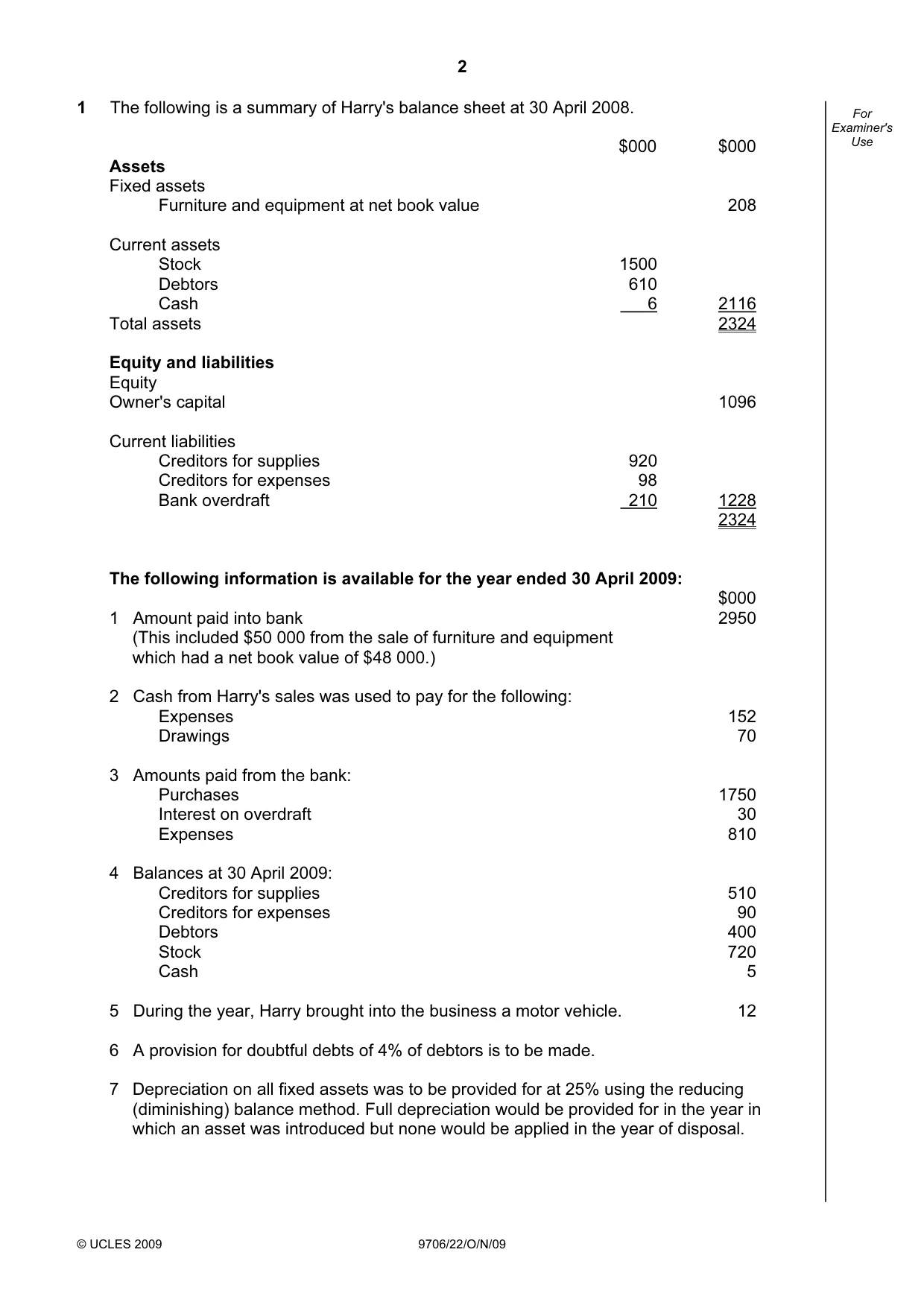
2 © UCLES 2009 9706/22/O/N/09 For Examiner's Use 1 The following is a summary of Harry's balance sheet at 30 April 2008. $000 $000 Assets Fixed assets Furniture and equipment at net book value 208 Current assets Stock 1500 Debtors 610 Cash 6 2116 Total assets 2324 Equity and liabilities Equity Owner's capital 1096 Current liabilities Creditors for supplies 920 Creditors for expenses 98 Bank overdraft 210 1228 2324 The following information is available for the year ended 30 April 2009: $000 1 Amount paid into bank 2950 (This included $50 000 from the sale of furniture and equipment which had a net book value of $48 000.) 2 Cash from Harry's sales was used to pay for the following: Expenses 152 Drawings 70 3 Amounts paid from the bank: Purchases 1750 Interest on overdraft 30 Expenses 810 4 Balances at 30 April 2009: Creditors for supplies 510 Creditors for expenses 90 Debtors 400 Stock 720 Cash 5 5 During the year, Harry brought into the business a motor vehicle. 12 6 A provision for doubtful debts of 4% of debtors is to be made. 7 Depreciation on all fixed assets was to be provided for at 25% using the reducing (diminishing) balance method. Full depreciation would be provided for in the year in which an asset was introduced but none would be applied in the year of disposal.
Question paper, page 3
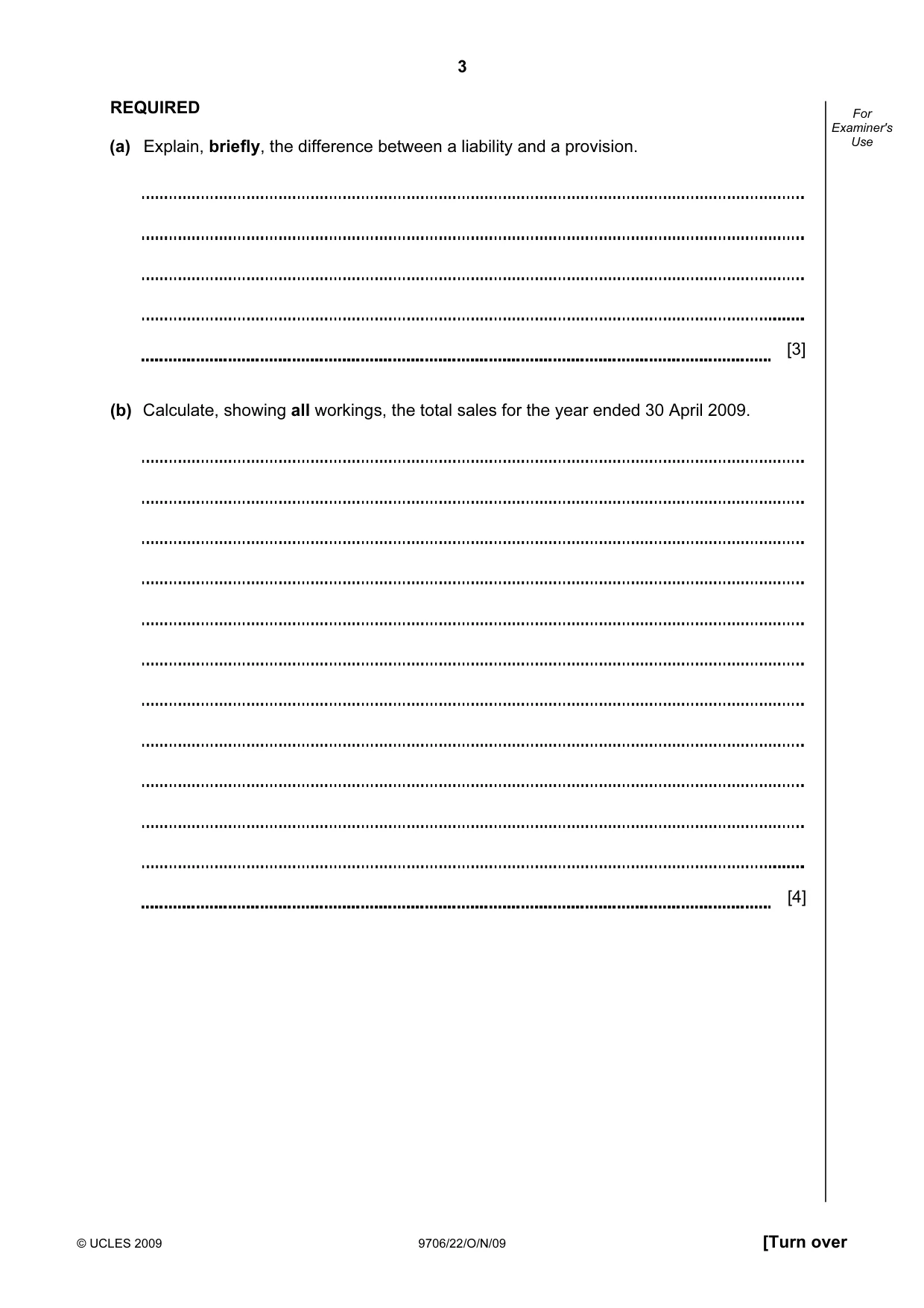
3 © UCLES 2009 9706/22/O/N/09 [Turn over For Examiner's Use REQUIRED (a) Explain, briefly, the difference between a liability and a provision. [3] (b) Calculate, showing all workings, the total sales for the year ended 30 April 2009. [4]
Question paper, page 4
4 © UCLES 2009 9706/22/O/N/09 For Examiner's Use (c) Calculate, showing all workings, Harry's bank balance at 30 April 2009. [3]
Question paper, page 5
5 © UCLES 2009 9706/22/O/N/09 [Turn over For Examiner's Use (d) Prepare Harry's trading and profit and loss account for the year ended 30 April 2009. [12]
Question paper, page 6
6 © UCLES 2009 9706/22/O/N/09 For Examiner's Use (e) Prepare Harry's balance sheet at 30 April 2009. Use a layout similar to the balance sheet at the beginning of the question. [8] [Total: 30]
Question paper, page 7
7 BLANK PAGE 9706/22/O/N/09 [Turn over Question 2 is on the following page.
Question paper, page 8
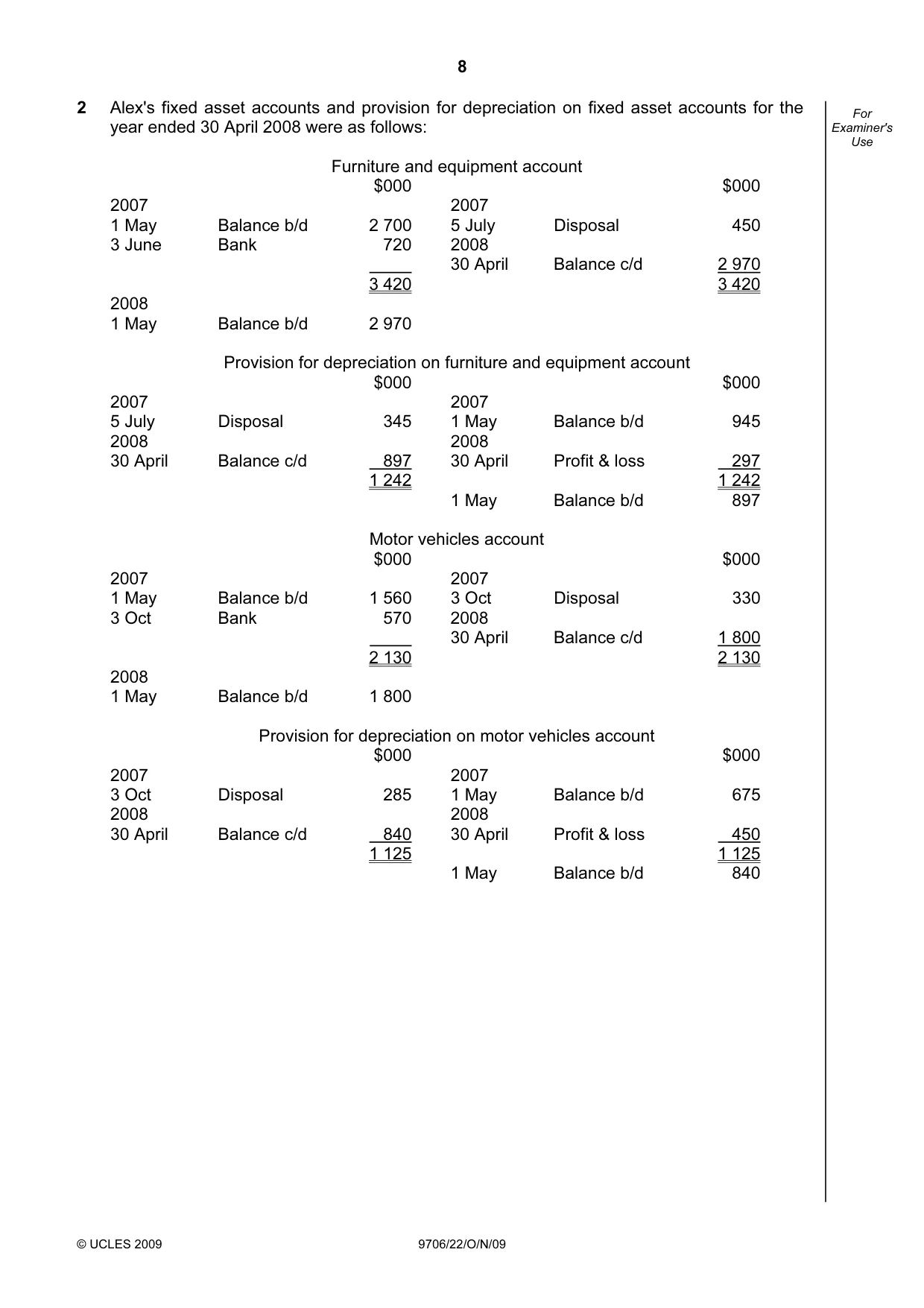
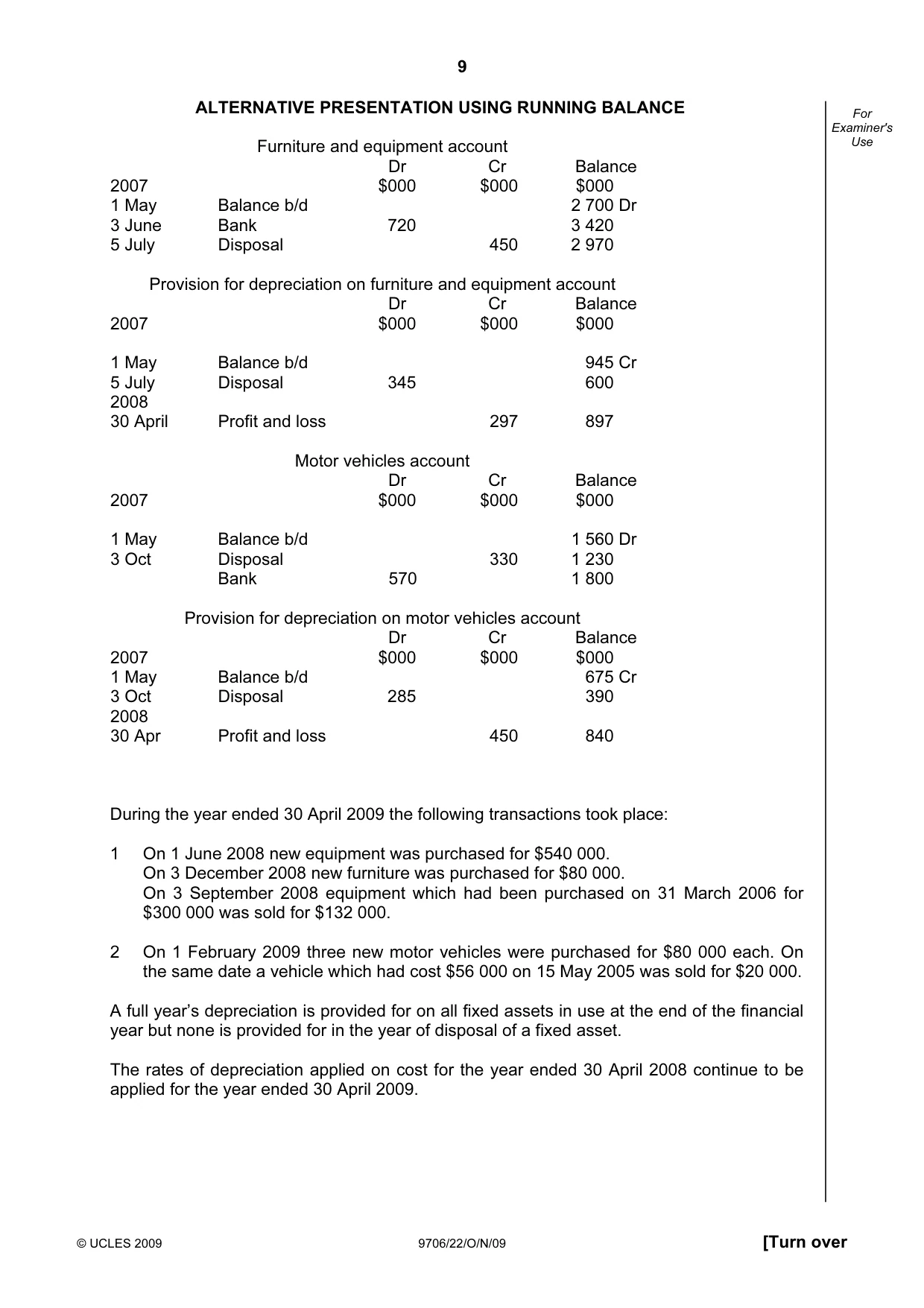
8 © UCLES 2009 9706/22/O/N/09 For Examiner's Use 2 Alex's fixed asset accounts and provision for depreciation on fixed asset accounts for the year ended 30 April 2008 were as follows: Furniture and equipment account $000 $000 2007 2007 1 May Balance b/d 2 700 5 July Disposal 450 3 June Bank 720 2008 30 April Balance c/d 2 970 3 420 3 420 2008 1 May Balance b/d 2 970 Provision for depreciation on furniture and equipment account $000 $000 2007 2007 5 July Disposal 345 1 May Balance b/d 945 2008 2008 30 April Balance c/d 897 30 April Profit & loss 297 1 242 1 242 1 May Balance b/d 897 Motor vehicles account $000 $000 2007 2007 1 May Balance b/d 1 560 3 Oct Disposal 330 3 Oct Bank 570 2008 30 April Balance c/d 1 800 2 130 2 130 2008 1 May Balance b/d 1 800 Provision for depreciation on motor vehicles account $000 $000 2007 2007 3 Oct Disposal 285 1 May Balance b/d 675 2008 2008 30 April Balance c/d 840 30 April Profit & loss 450 1 125 1 125 1 May Balance b/d 840
Question paper, page 9
9 © UCLES 2009 9706/22/O/N/09 [Turn over For Examiner's Use ALTERNATIVE PRESENTATION USING RUNNING BALANCE Furniture and equipment account Dr Cr Balance 2007 $000 $000 $000 1 May Balance b/d 2 700 Dr 3 June Bank 720 3 420 5 July Disposal 450 2 970 Provision for depreciation on furniture and equipment account Dr Cr Balance 2007 $000 $000 $000 1 May Balance b/d 945 Cr 5 July Disposal 345 600 2008 30 April Profit and loss 297 897 Motor vehicles account Dr Cr Balance 2007 $000 $000 $000 1 May Balance b/d 1 560 Dr 3 Oct Disposal 330 1 230 Bank 570 1 800 Provision for depreciation on motor vehicles account Dr Cr Balance 2007 $000 $000 $000 1 May Balance b/d 675 Cr 3 Oct Disposal 285 390 2008 30 Apr Profit and loss 450 840 During the year ended 30 April 2009 the following transactions took place: 1 On 1 June 2008 new equipment was purchased for $540 000. On 3 December 2008 new furniture was purchased for $80 000. On 3 September 2008 equipment which had been purchased on 31 March 2006 for $300 000 was sold for $132 000. 2 On 1 February 2009 three new motor vehicles were purchased for $80 000 each. On the same date a vehicle which had cost $56 000 on 15 May 2005 was sold for $20 000. A full year’s depreciation is provided for on all fixed assets in use at the end of the financial year but none is provided for in the year of disposal of a fixed asset. The rates of depreciation applied on cost for the year ended 30 April 2008 continue to be applied for the year ended 30 April 2009.
Question paper, page 10
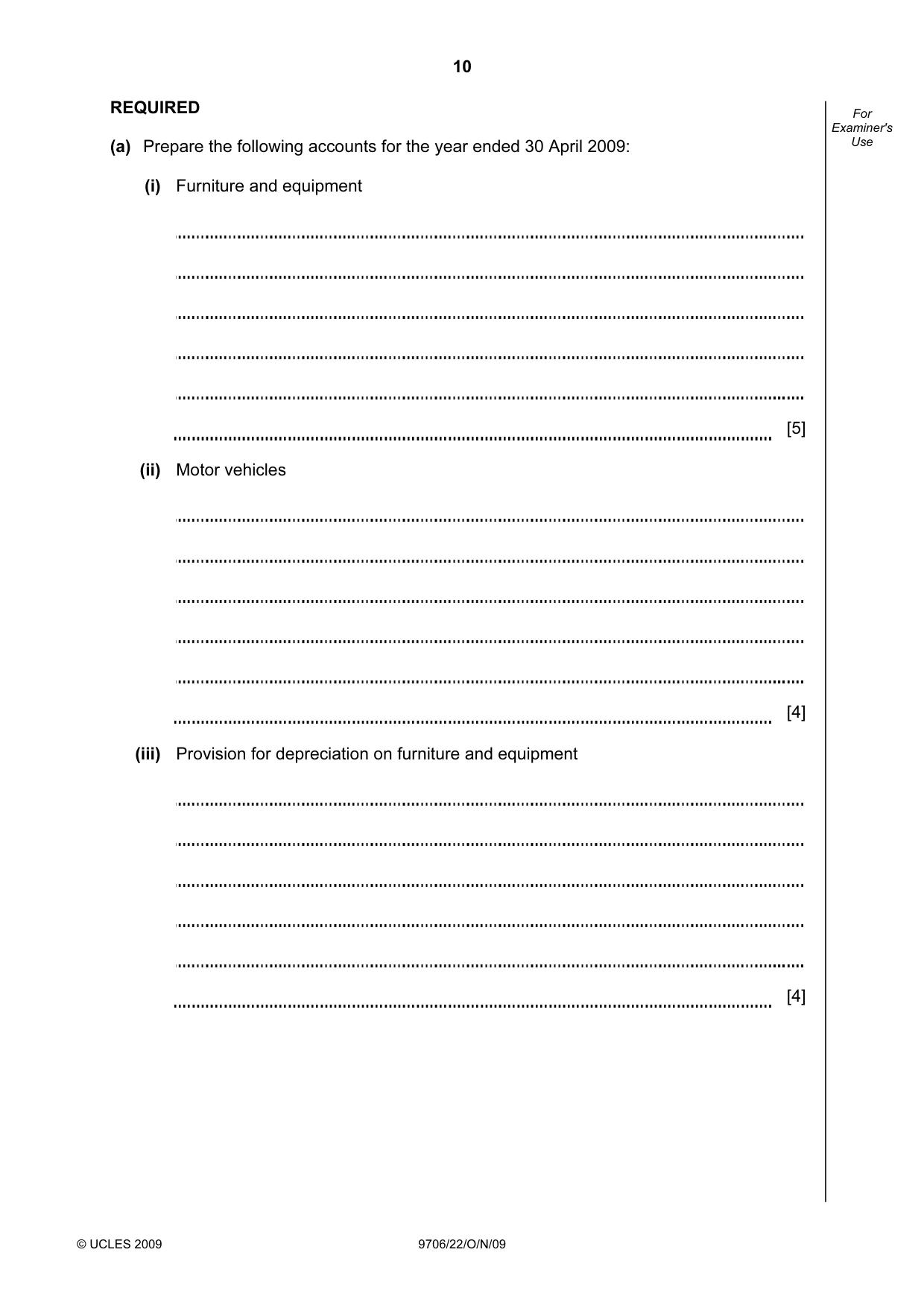
10 © UCLES 2009 9706/22/O/N/09 For Examiner's Use REQUIRED (a) Prepare the following accounts for the year ended 30 April 2009: (i) Furniture and equipment [5] (ii) Motor vehicles [4] (iii) Provision for depreciation on furniture and equipment [4]
Question paper, page 11
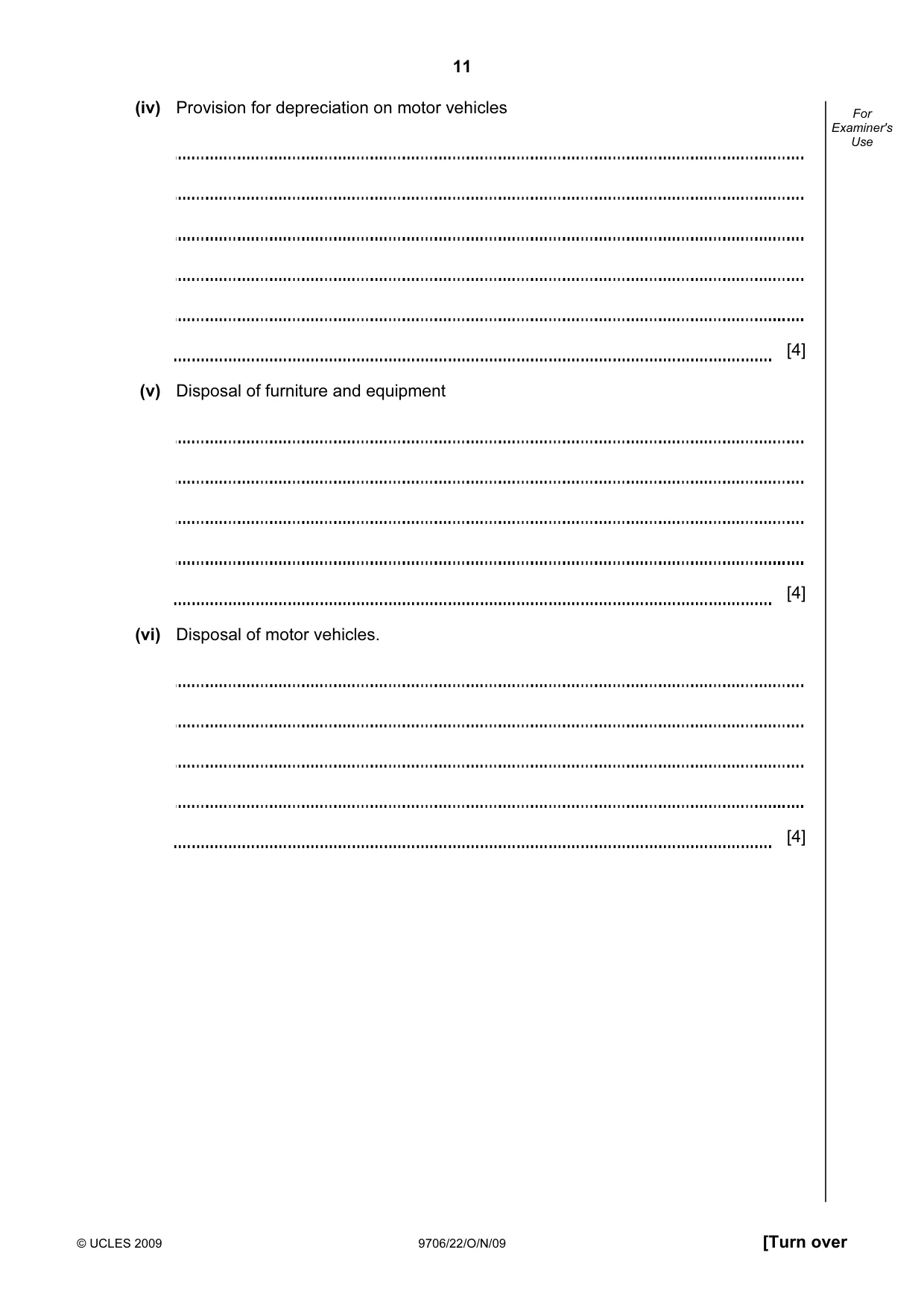
11 © UCLES 2009 9706/22/O/N/09 [Turn over For Examiner's Use (iv) Provision for depreciation on motor vehicles [4] (v) Disposal of furniture and equipment [4] (vi) Disposal of motor vehicles. [4]
Question paper, page 12
12 © UCLES 2009 9706/22/O/N/09 For Examiner's Use (b) Explain the term ‘depreciation’ and give one example. [5] [Total: 30]
Question paper, page 13
13 BLANK PAGE 9706/22/O/N/09 [Turn over Question 3 is on the following page.
Question paper, page 14
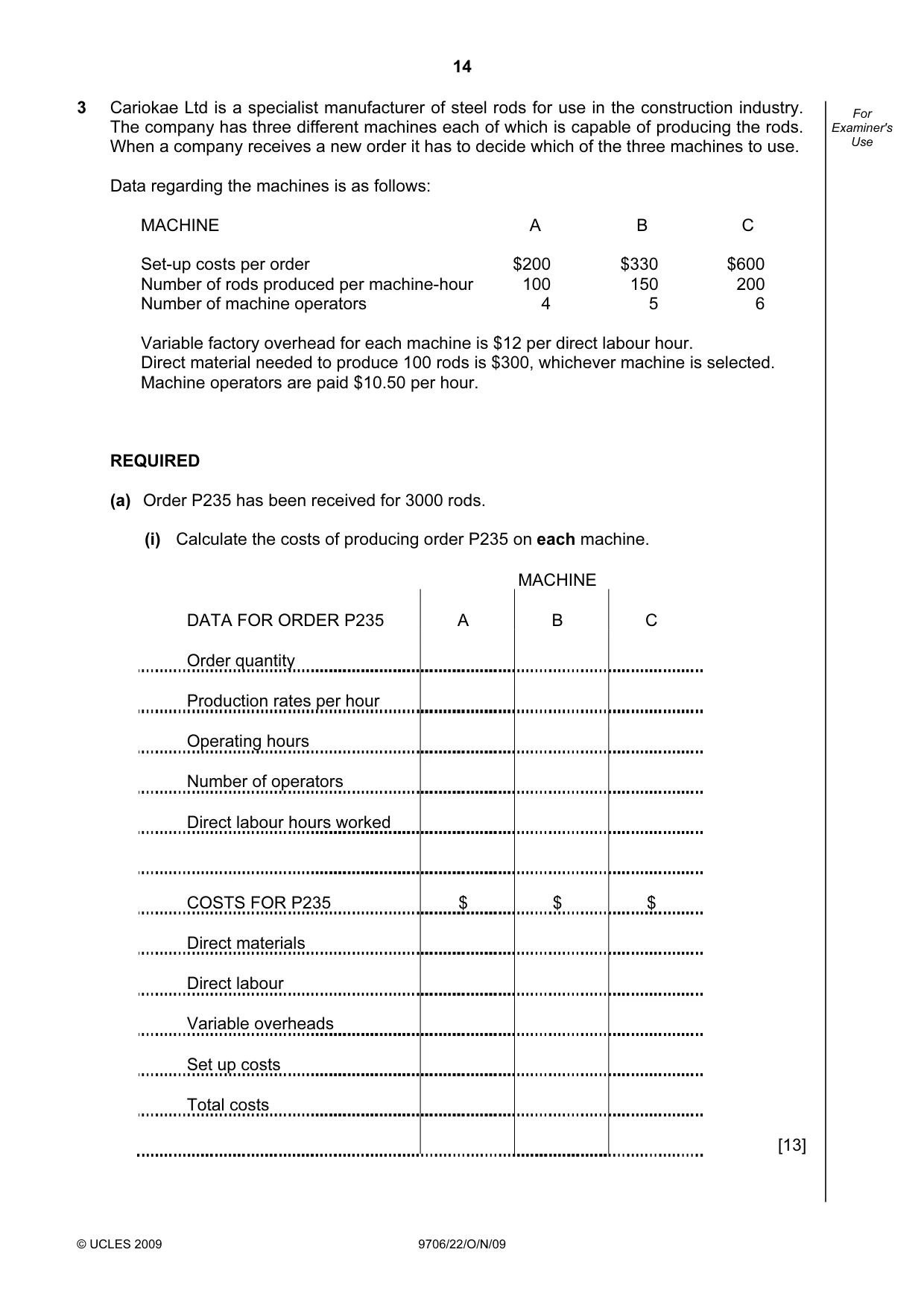
14 © UCLES 2009 9706/22/O/N/09 For Examiner's Use 3 Cariokae Ltd is a specialist manufacturer of steel rods for use in the construction industry. The company has three different machines each of which is capable of producing the rods. When a company receives a new order it has to decide which of the three machines to use. Data regarding the machines is as follows: MACHINE A B C Set-up costs per order $200 $330 $600 Number of rods produced per machine-hour 100 150 200 Number of machine operators 4 5 6 Variable factory overhead for each machine is $12 per direct labour hour. Direct material needed to produce 100 rods is $300, whichever machine is selected. Machine operators are paid $10.50 per hour. REQUIRED (a) Order P235 has been received for 3000 rods. (i) Calculate the costs of producing order P235 on each machine. MACHINE DATA FOR ORDER P235 A B C Order quantity Production rates per hour Operating hours Number of operators Direct labour hours worked COSTS FOR P235 $ $ $ Direct materials Direct labour Variable overheads Set up costs Total costs [13]
Question paper, page 15
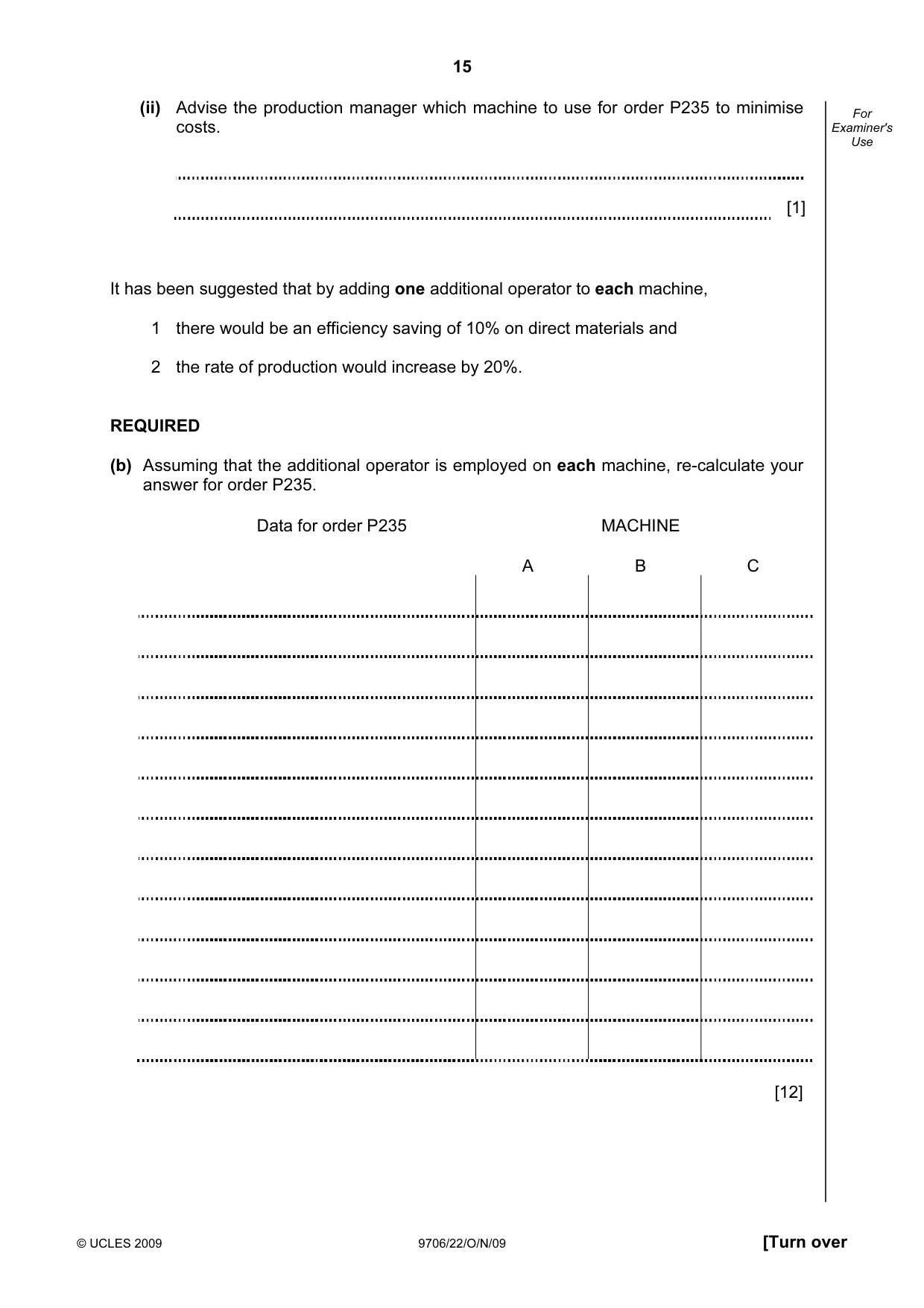
15 © UCLES 2009 9706/22/O/N/09 [Turn over For Examiner's Use (ii) Advise the production manager which machine to use for order P235 to minimise costs. [1] It has been suggested that by adding one additional operator to each machine, 1 there would be an efficiency saving of 10% on direct materials and 2 the rate of production would increase by 20%. REQUIRED (b) Assuming that the additional operator is employed on each machine, re-calculate your answer for order P235. Data for order P235 MACHINE A B C [12]
Question paper, page 16
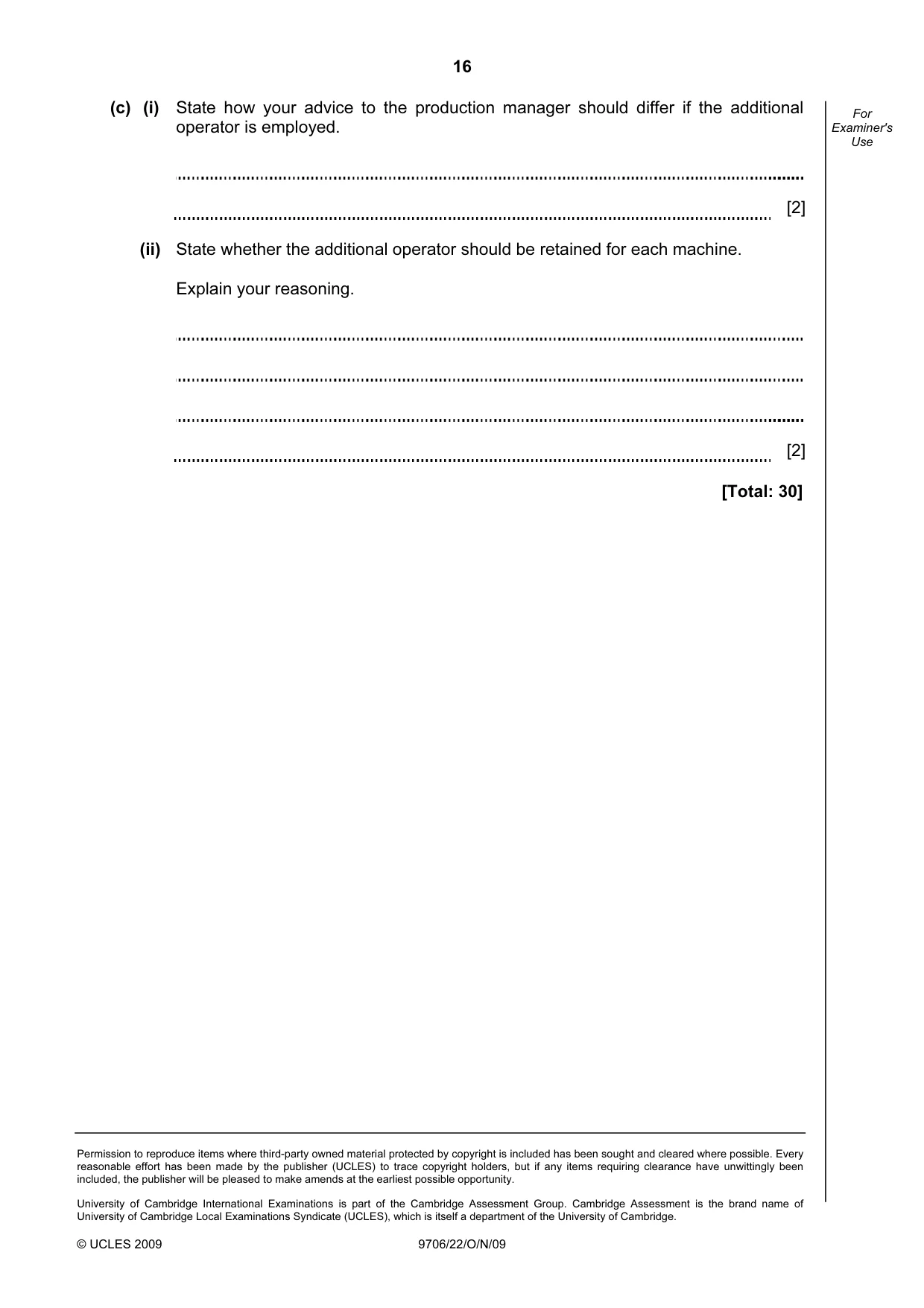
16 Permission to reproduce items where third-party owned material protected by copyright is included has been sought and cleared where possible. Every reasonable effort has been made by the publisher (UCLES) to trace copyright holders, but if any items requiring clearance have unwittingly been included, the publisher will be pleased to make amends at the earliest possible opportunity. University of Cambridge International Examinations is part of the Cambridge Assessment Group. Cambridge Assessment is the brand name of University of Cambridge Local Examinations Syndicate (UCLES), which is itself a department of the University of Cambridge. © UCLES 2009 9706/22/O/N/09 For Examiner's Use (c) (i) State how your advice to the production manager should differ if the additional operator is employed. [2] (ii) State whether the additional operator should be retained for each machine. Explain your reasoning. [2] [Total: 30]
Mark scheme, page 1
UNIVERSITY OF CAMBRIDGE INTERNATIONAL EXAMINATIONS GCE Advanced Subsidiary Level and GCE Advanced Level MARK SCHEME for the October/November 2009 question paper for the guidance of teachers 9706 ACCOUNTING 9706/22 Paper 22 (Structured Questions), maximum raw mark 90 This mark scheme is published as an aid to teachers and candidates, to indicate the requirements of the examination. It shows the basis on which Examiners were instructed to award marks. It does not indicate the details of the discussions that took place at an Examiners’ meeting before marking began, which would have considered the acceptability of alternative answers. Mark schemes must be read in conjunction with the question papers and the report on the examination. • CIE will not enter into discussions or correspondence in connection with these mark schemes. CIE is publishing the mark schemes for the October/November 2009 question papers for most IGCSE, GCE Advanced Level and Advanced Subsidiary Level syllabuses and some Ordinary Level syllabuses.
Mark scheme, page 2
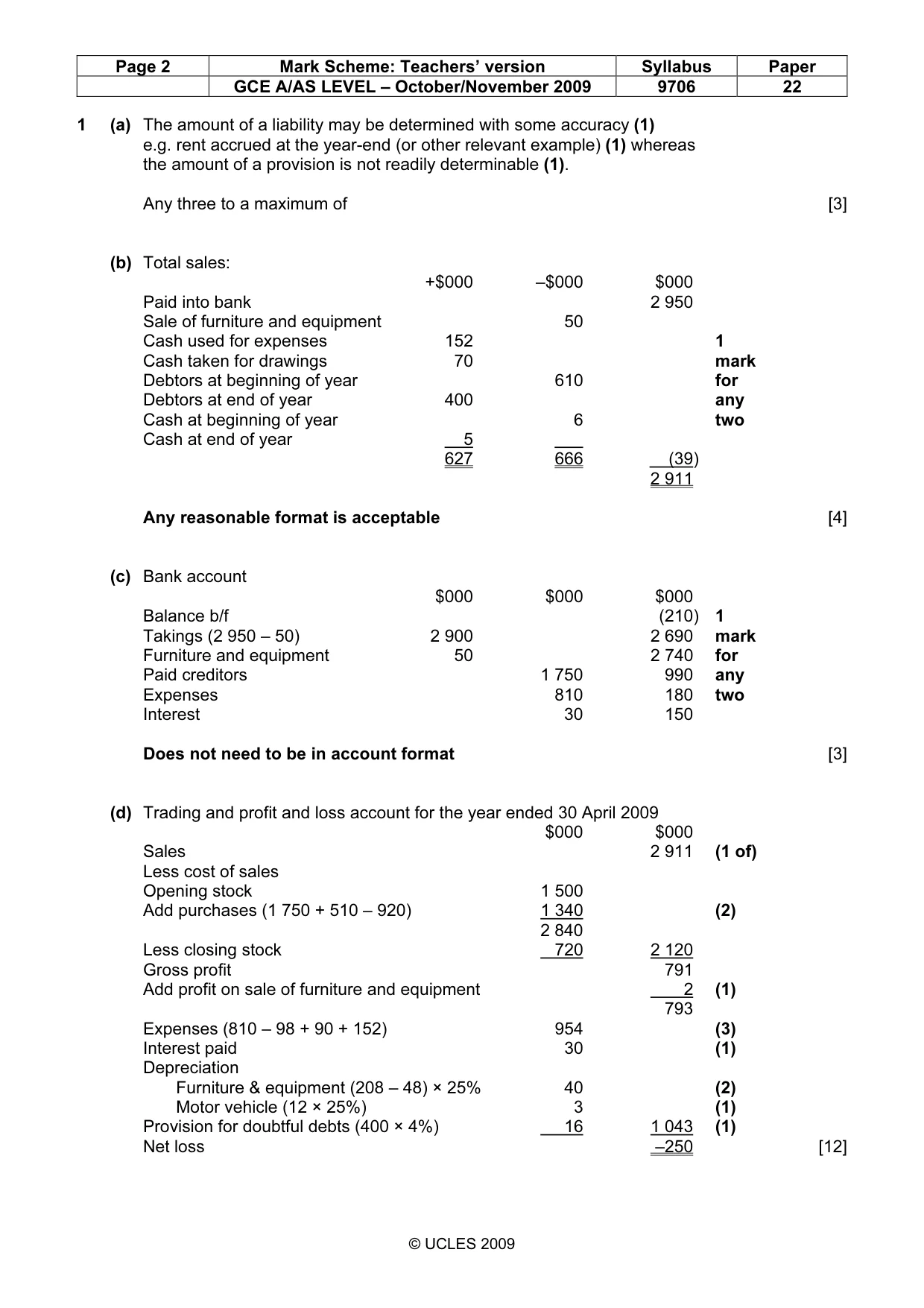
Page 2 Mark Scheme: Teachers’ version Syllabus Paper GCE A/AS LEVEL – October/November 2009 9706 22 © UCLES 2009 1 (a) The amount of a liability may be determined with some accuracy (1) e.g. rent accrued at the year-end (or other relevant example) (1) whereas the amount of a provision is not readily determinable (1). Any three to a maximum of [3] (b) Total sales: +$000 –$000 $000 Paid into bank 2 950 Sale of furniture and equipment 50 Cash used for expenses 152 1 Cash taken for drawings 70 mark Debtors at beginning of year 610 for Debtors at end of year 400 any Cash at beginning of year 6 two Cash at end of year 5 627 666 (39) 2 911 Any reasonable format is acceptable [4] (c) Bank account $000 $000 $000 Balance b/f (210) 1 Takings (2 950 – 50) 2 900 2 690 mark Furniture and equipment 50 2 740 for Paid creditors 1 750 990 any Expenses 810 180 two Interest 30 150 Does not need to be in account format [3] (d) Trading and profit and loss account for the year ended 30 April 2009 $000 $000 Sales 2 911 (1 of) Less cost of sales Opening stock 1 500 Add purchases (1 750 + 510 – 920) 1 340 (2) 2 840 Less closing stock 720 2 120 Gross profit 791 Add profit on sale of furniture and equipment 2 (1) 793 Expenses (810 – 98 + 90 + 152) 954 (3) Interest paid 30 (1) Depreciation Furniture & equipment (208 – 48) × 25% 40 (2) Motor vehicle (12 × 25%) 3 (1) Provision for doubtful debts (400 × 4%) 16 1 043 (1) Net loss –250 [12]
Mark scheme, page 3
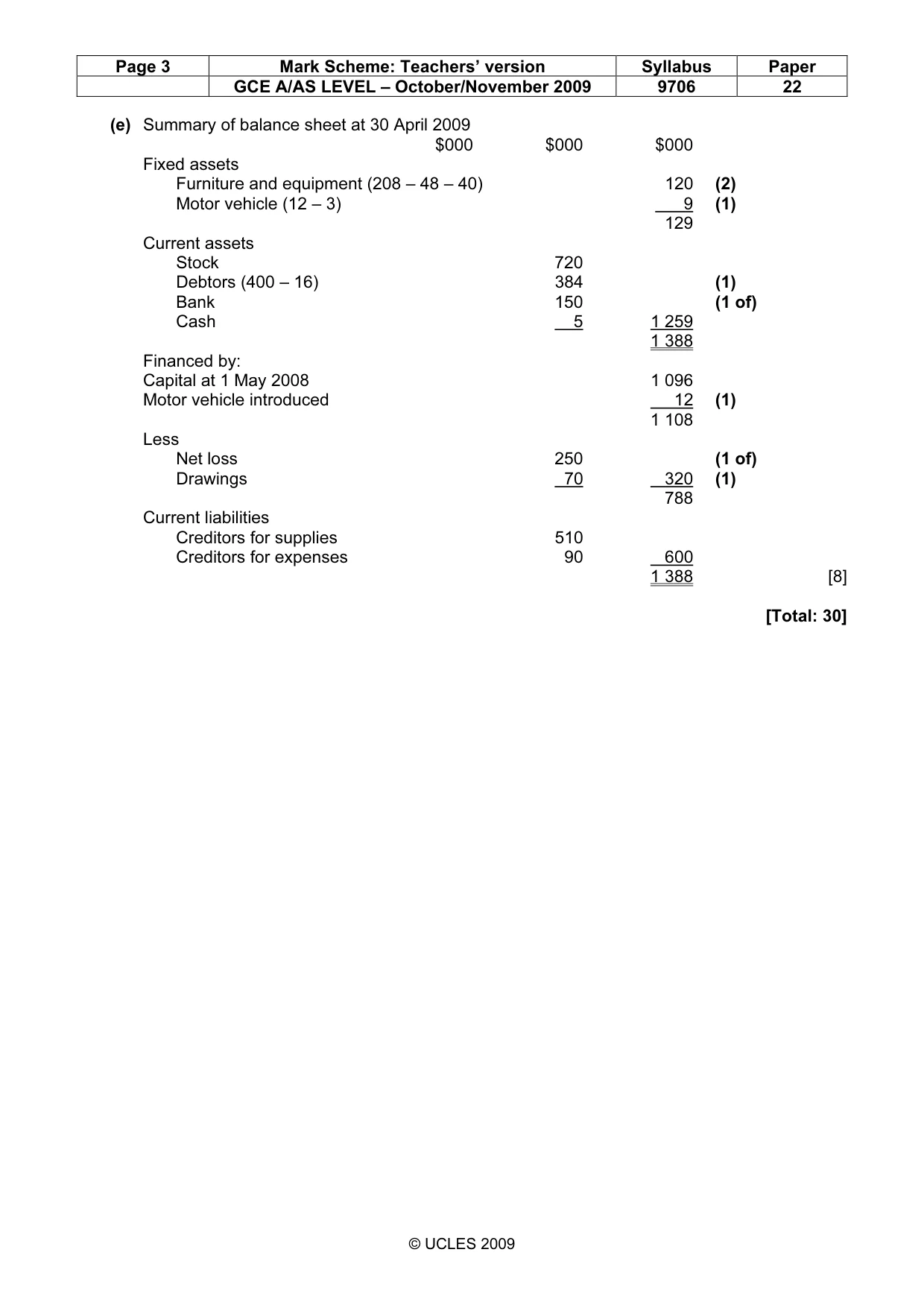
Page 3 Mark Scheme: Teachers’ version Syllabus Paper GCE A/AS LEVEL – October/November 2009 9706 22 © UCLES 2009 (e) Summary of balance sheet at 30 April 2009 $000 $000 $000 Fixed assets Furniture and equipment (208 – 48 – 40) 120 (2) Motor vehicle (12 – 3) 9 (1) 129 Current assets Stock 720 Debtors (400 – 16) 384 (1) Bank 150 (1 of) Cash 5 1 259 1 388 Financed by: Capital at 1 May 2008 1 096 Motor vehicle introduced 12 (1) 1 108 Less Net loss 250 (1 of) Drawings 70 320 (1) 788 Current liabilities Creditors for supplies 510 Creditors for expenses 90 600 1 388 [8] [Total: 30]
Mark scheme, page 4
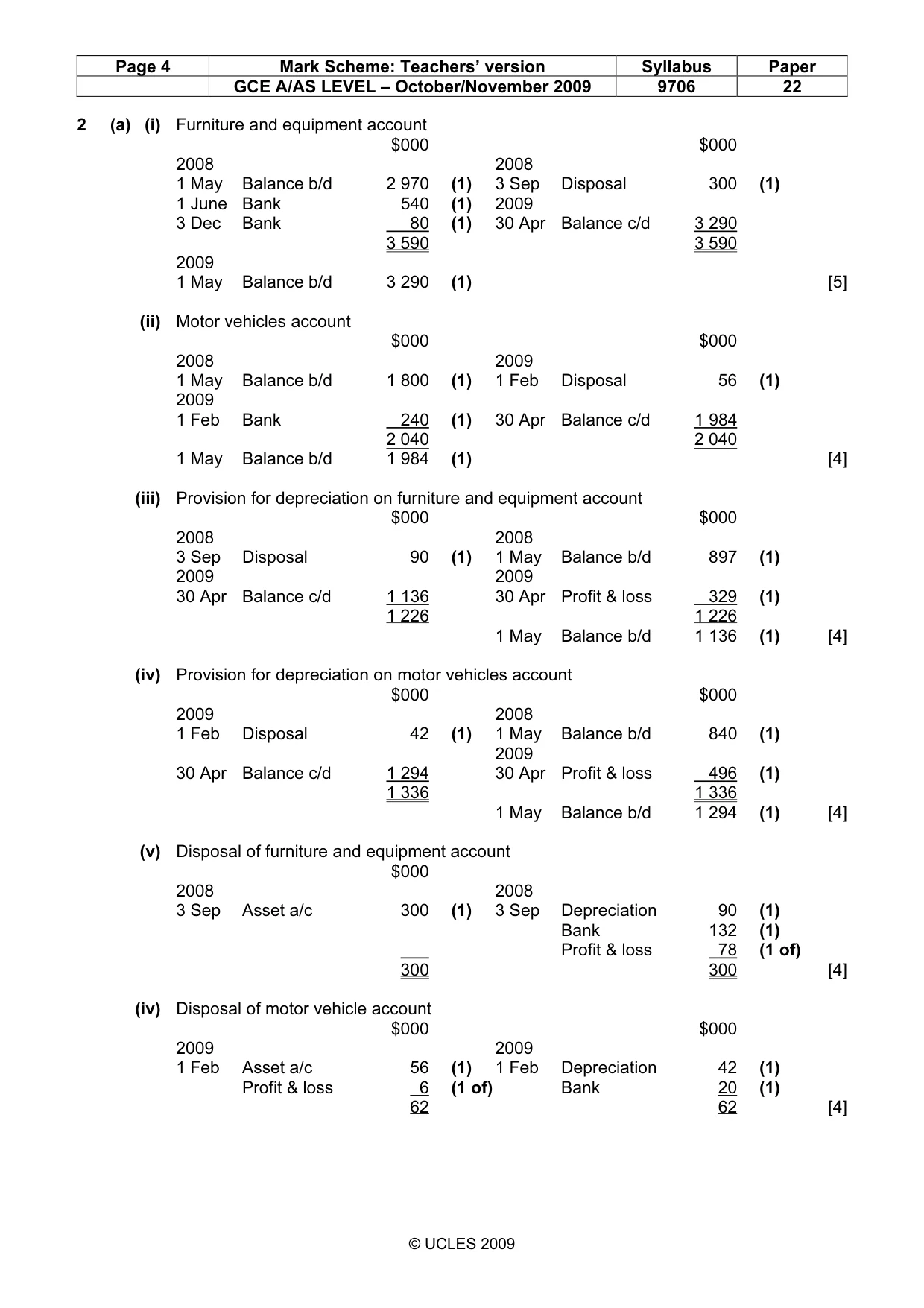
Page 4 Mark Scheme: Teachers’ version Syllabus Paper GCE A/AS LEVEL – October/November 2009 9706 22 © UCLES 2009 2 (a) (i) Furniture and equipment account $000 $000 2008 2008 1 May Balance b/d 2 970 (1) 3 Sep Disposal 300 (1) 1 June Bank 540 (1) 2009 3 Dec Bank 80 (1) 30 Apr Balance c/d 3 290 3 590 3 590 2009 1 May Balance b/d 3 290 (1) [5] (ii) Motor vehicles account $000 $000 2008 2009 1 May Balance b/d 1 800 (1) 1 Feb Disposal 56 (1) 2009 1 Feb Bank 240 (1) 30 Apr Balance c/d 1 984 2 040 2 040 1 May Balance b/d 1 984 (1) [4] (iii) Provision for depreciation on furniture and equipment account $000 $000 2008 2008 3 Sep Disposal 90 (1) 1 May Balance b/d 897 (1) 2009 2009 30 Apr Balance c/d 1 136 30 Apr Profit & loss 329 (1) 1 226 1 226 1 May Balance b/d 1 136 (1) [4] (iv) Provision for depreciation on motor vehicles account $000 $000 2009 2008 1 Feb Disposal 42 (1) 1 May Balance b/d 840 (1) 2009 30 Apr Balance c/d 1 294 30 Apr Profit & loss 496 (1) 1 336 1 336 1 May Balance b/d 1 294 (1) [4] (v) Disposal of furniture and equipment account $000 2008 2008 3 Sep Asset a/c 300 (1) 3 Sep Depreciation 90 (1) Bank 132 (1) Profit & loss 78 (1 of) 300 300 [4] (iv) Disposal of motor vehicle account $000 $000 2009 2009 1 Feb Asset a/c 56 (1) 1 Feb Depreciation 42 (1) Profit & loss 6 (1 of) Bank 20 (1) 62 62 [4]
Mark scheme, page 5
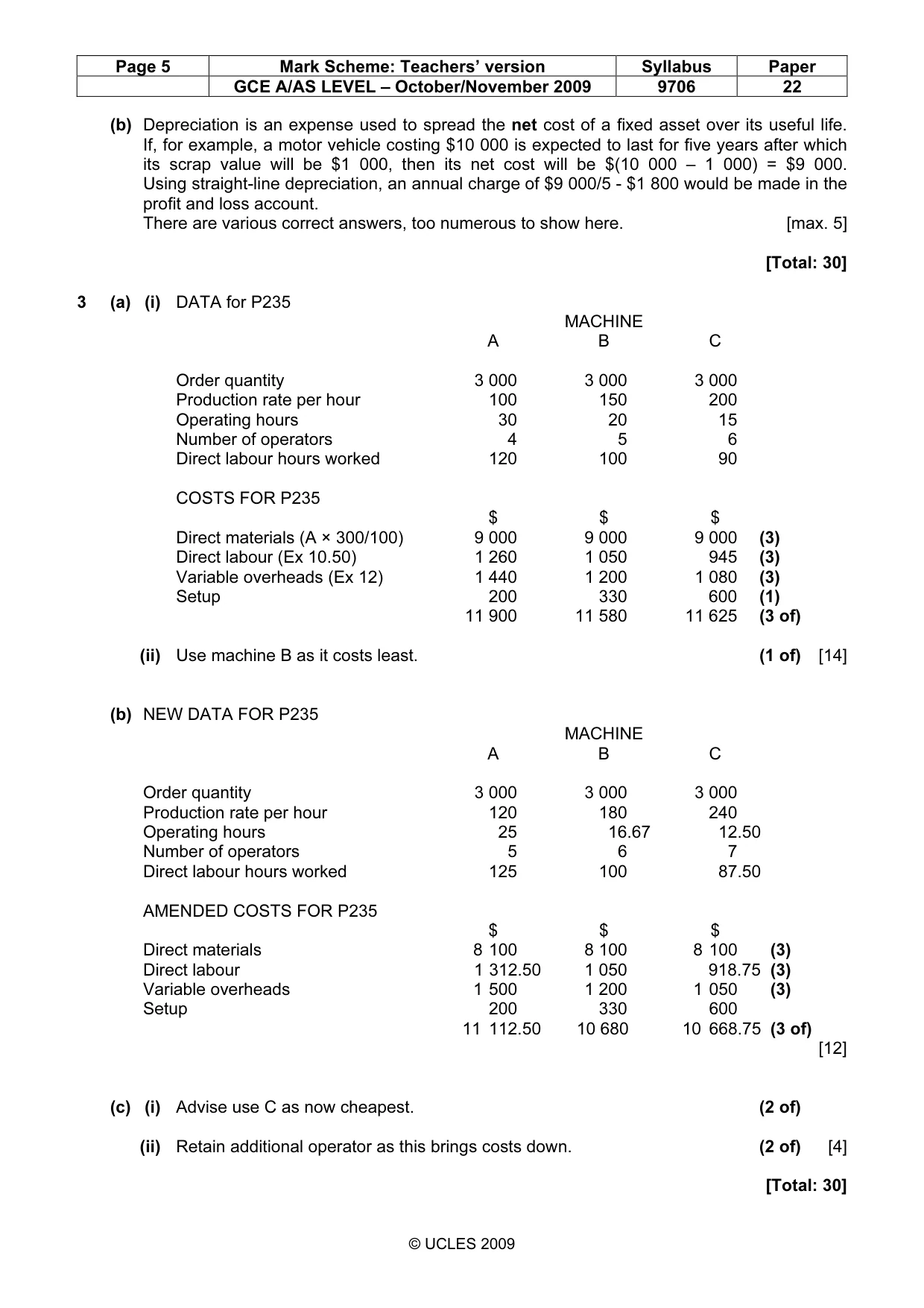
Page 5 Mark Scheme: Teachers’ version Syllabus Paper GCE A/AS LEVEL – October/November 2009 9706 22 © UCLES 2009 (b) Depreciation is an expense used to spread the net cost of a fixed asset over its useful life. If, for example, a motor vehicle costing $10 000 is expected to last for five years after which its scrap value will be $1 000, then its net cost will be $(10 000 – 1 000) = $9 000. Using straight-line depreciation, an annual charge of $9 000/5 - $1 800 would be made in the profit and loss account. There are various correct answers, too numerous to show here. [max. 5] [Total: 30] 3 (a) (i) DATA for P235 MACHINE A B C Order quantity 3 000 3 000 3 000 Production rate per hour 100 150 200 Operating hours 30 20 15 Number of operators 4 5 6 Direct labour hours worked 120 100 90 COSTS FOR P235 $ $ $ Direct materials (A × 300/100) 9 000 9 000 9 000 (3) Direct labour (Ex 10.50) 1 260 1 050 945 (3) Variable overheads (Ex 12) 1 440 1 200 1 080 (3) Setup 200 330 600 (1) 11 900 11 580 11 625 (3 of) (ii) Use machine B as it costs least. (1 of) [14] (b) NEW DATA FOR P235 MACHINE A B C Order quantity 3 000 3 000 3 000 Production rate per hour 120 180 240 Operating hours 25 16.67 12.50 Number of operators 5 6 7 Direct labour hours worked 125 100 87.50 AMENDED COSTS FOR P235 $ $ $ Direct materials 8 100 8 100 8 100 (3) Direct labour 1 312.50 1 050 918.75 (3) Variable overheads 1 500 1 200 1 050 (3) Setup 200 330 600 11 112.50 10 680 10 668.75 (3 of) [12] (c) (i) Advise use C as now cheapest. (2 of) (ii) Retain additional operator as this brings costs down. (2 of) [4] [Total: 30]
What you needed in this session
Cambridge’s own grade thresholds for 2009 Oct/Nov, Paper 2 · Variant 2. A higher threshold means an easier paper — the bar moves with how the cohort did.