Cambridge A Level Accounting 9706 — 2009 Oct/Nov Paper 2 · Variant 1
9706/21/O/N/09 · 90 marks · ≈101 min
The question paper and its mark scheme, free to read here and free to download. This is Cambridge’s own paper, exactly as it was sat.
Question paper16 pages


Mark scheme6 pages
Answers below. Sit the paper first if you are practising.
Paper as text
Question paper, page 1
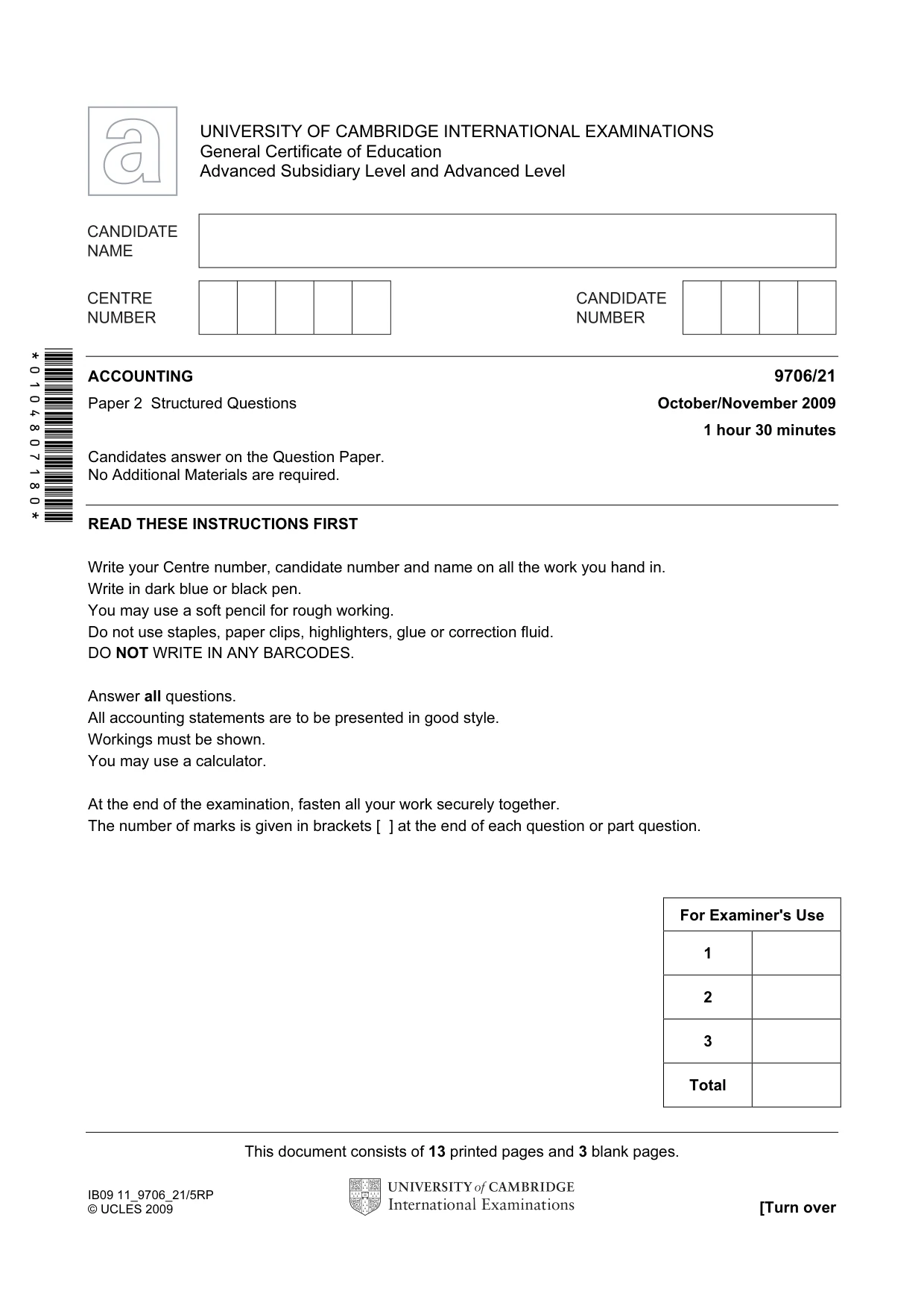
This document consists of 13 printed pages and 3 blank pages. IB09 11_9706_21/5RP © UCLES 2009 [Turn over *0104807180* For Examiner's Use 1 2 3 Total UNIVERSITY OF CAMBRIDGE INTERNATIONAL EXAMINATIONS General Certificate of Education Advanced Subsidiary Level and Advanced Level ACCOUNTING 9706/21 Paper 2 Structured Questions October/November 2009 1 hour 30 minutes Candidates answer on the Question Paper. No Additional Materials are required. READ THESE INSTRUCTIONS FIRST Write your Centre number, candidate number and name on all the work you hand in. Write in dark blue or black pen. You may use a soft pencil for rough working. Do not use staples, paper clips, highlighters, glue or correction fluid. DO NOT WRITE IN ANY BARCODES. Answer all questions. All accounting statements are to be presented in good style. Workings must be shown. You may use a calculator. At the end of the examination, fasten all your work securely together. The number of marks is given in brackets [ ] at the end of each question or part question.
Question paper, page 2
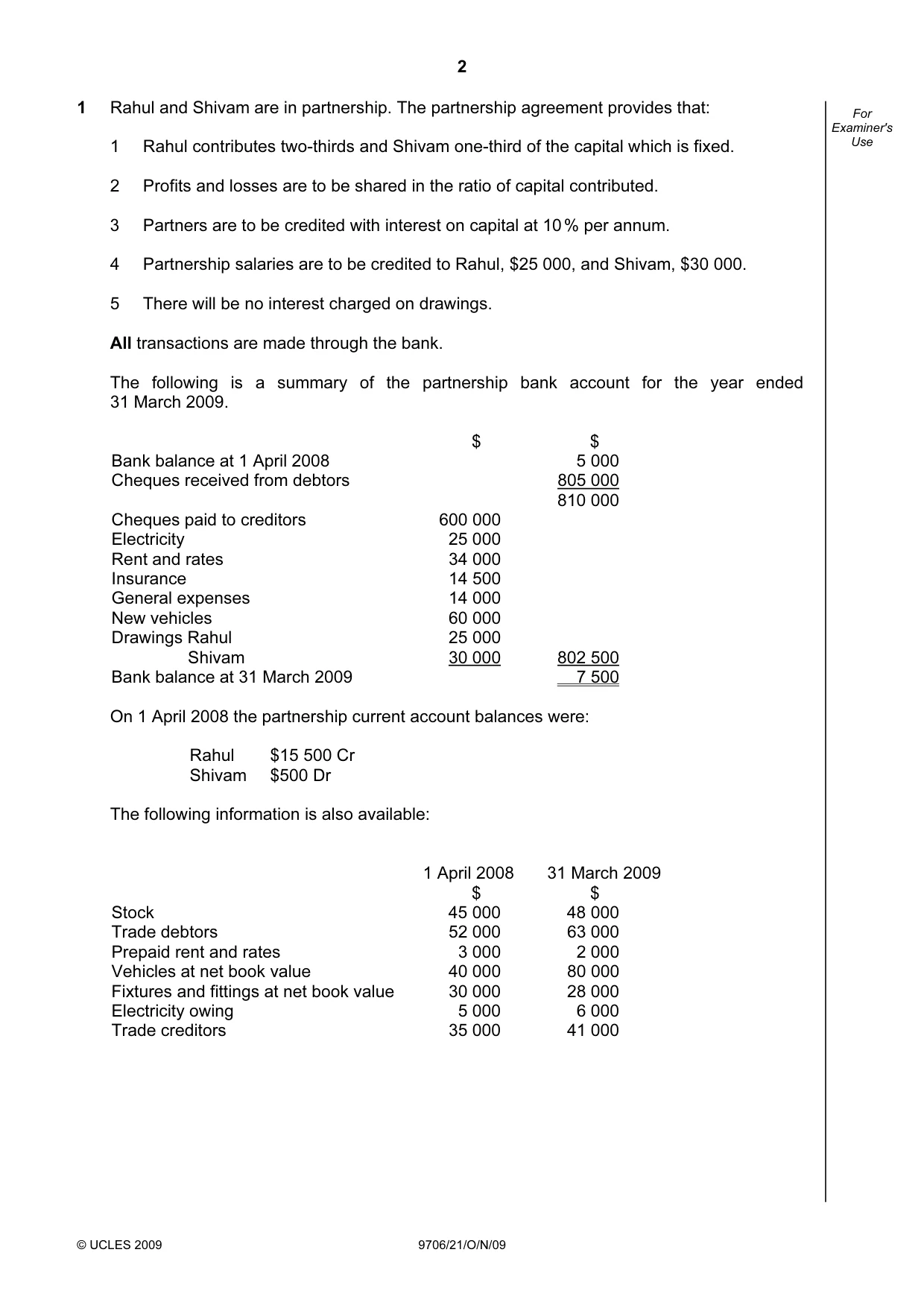
2 © UCLES 2009 9706/21/O/N/09 For Examiner's Use 1 Rahul and Shivam are in partnership. The partnership agreement provides that: 1 Rahul contributes two-thirds and Shivam one-third of the capital which is fixed. 2 Profits and losses are to be shared in the ratio of capital contributed. 3 Partners are to be credited with interest on capital at 10 % per annum. 4 Partnership salaries are to be credited to Rahul, $25 000, and Shivam, $30 000. 5 There will be no interest charged on drawings. All transactions are made through the bank. The following is a summary of the partnership bank account for the year ended 31 March 2009. $ $ Bank balance at 1 April 2008 5 000 Cheques received from debtors 805 000 810 000 Cheques paid to creditors 600 000 Electricity 25 000 Rent and rates 34 000 Insurance 14 500 General expenses 14 000 New vehicles 60 000 Drawings Rahul 25 000 Shivam 30 000 802 500 Bank balance at 31 March 2009 7 500 On 1 April 2008 the partnership current account balances were: Rahul $15 500 Cr Shivam $500 Dr The following information is also available: 1 April 2008 31 March 2009 $ $ Stock 45 000 48 000 Trade debtors 52 000 63 000 Prepaid rent and rates 3 000 2 000 Vehicles at net book value 40 000 80 000 Fixtures and fittings at net book value 30 000 28 000 Electricity owing 5 000 6 000 Trade creditors 35 000 41 000
Question paper, page 3
3 © UCLES 2009 9706/21/O/N/09 [Turn over For Examiner's Use REQUIRED (a) Calculate the fixed capital account balance for each partner. [4]
Question paper, page 4
4 © UCLES 2009 9706/21/O/N/09 For Examiner's Use REQUIRED (b) Prepare the trading, profit and loss and appropriation accounts for the year ended 31 March 2009. [20]
Question paper, page 5
5 © UCLES 2009 9706/21/O/N/09 [Turn over For Examiner's Use REQUIRED (c) Prepare Rahul's current account for the year ended 31 March 2009. [6] [Total: 30]
Question paper, page 6
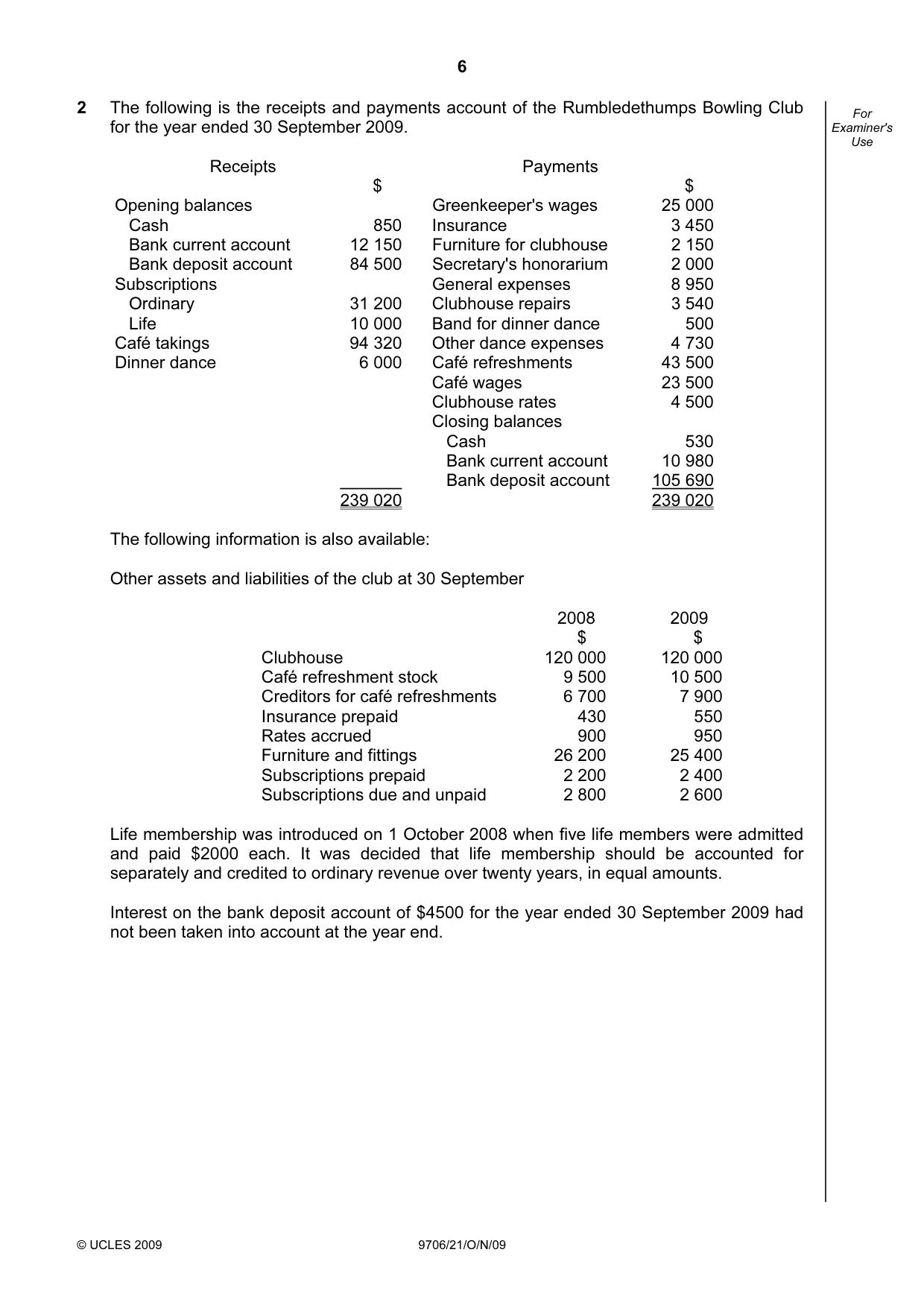
6 © UCLES 2009 9706/21/O/N/09 For Examiner's Use 2 The following is the receipts and payments account of the Rumbledethumps Bowling Club for the year ended 30 September 2009. Receipts Payments $ $ Opening balances Greenkeeper's wages 25 000 Cash 850 Insurance 3 450 Bank current account 12 150 Furniture for clubhouse 2 150 Bank deposit account 84 500 Secretary's honorarium 2 000 Subscriptions General expenses 8 950 Ordinary 31 200 Clubhouse repairs 3 540 Life 10 000 Band for dinner dance 500 Café takings 94 320 Other dance expenses 4 730 Dinner dance 6 000 Café refreshments 43 500 Café wages 23 500 Clubhouse rates 4 500 Closing balances Cash 530 Bank current account 10 980 Bank deposit account 105 690 239 020 239 020 The following information is also available: Other assets and liabilities of the club at 30 September 2008 2009 $ $ Clubhouse 120 000 120 000 Café refreshment stock 9 500 10 500 Creditors for café refreshments 6 700 7 900 Insurance prepaid 430 550 Rates accrued 900 950 Furniture and fittings 26 200 25 400 Subscriptions prepaid 2 200 2 400 Subscriptions due and unpaid 2 800 2 600 Life membership was introduced on 1 October 2008 when five life members were admitted and paid $2000 each. It was decided that life membership should be accounted for separately and credited to ordinary revenue over twenty years, in equal amounts. Interest on the bank deposit account of $4500 for the year ended 30 September 2009 had not been taken into account at the year end.
Question paper, page 7
7 © UCLES 2009 9706/21/O/N/09 [Turn over For Examiner's Use REQUIRED (a) Prepare the café trading account for the year ended 30 September 2009. [4]
Question paper, page 8
8 © UCLES 2009 9706/21/O/N/09 For Examiner's Use (b) Prepare the club income and expenditure account for the year ended 30 September 2009. [10]
Question paper, page 9
9 © UCLES 2009 9706/21/O/N/09 [Turn over For Examiner's Use (c) Prepare the club balance sheet at 30 September 2009. [12]
Question paper, page 10
10 © UCLES 2009 9706/21/O/N/09 For Examiner's Use (d) State two advantages and two disadvantages of using a receipts and payments account instead of an income and expenditure account, in a non-trading organisation. [4] [Total: 30]
Question paper, page 11
11 BLANK PAGE 9706/21/O/N/09 [Turn over Question 3 is on the next page.
Question paper, page 12
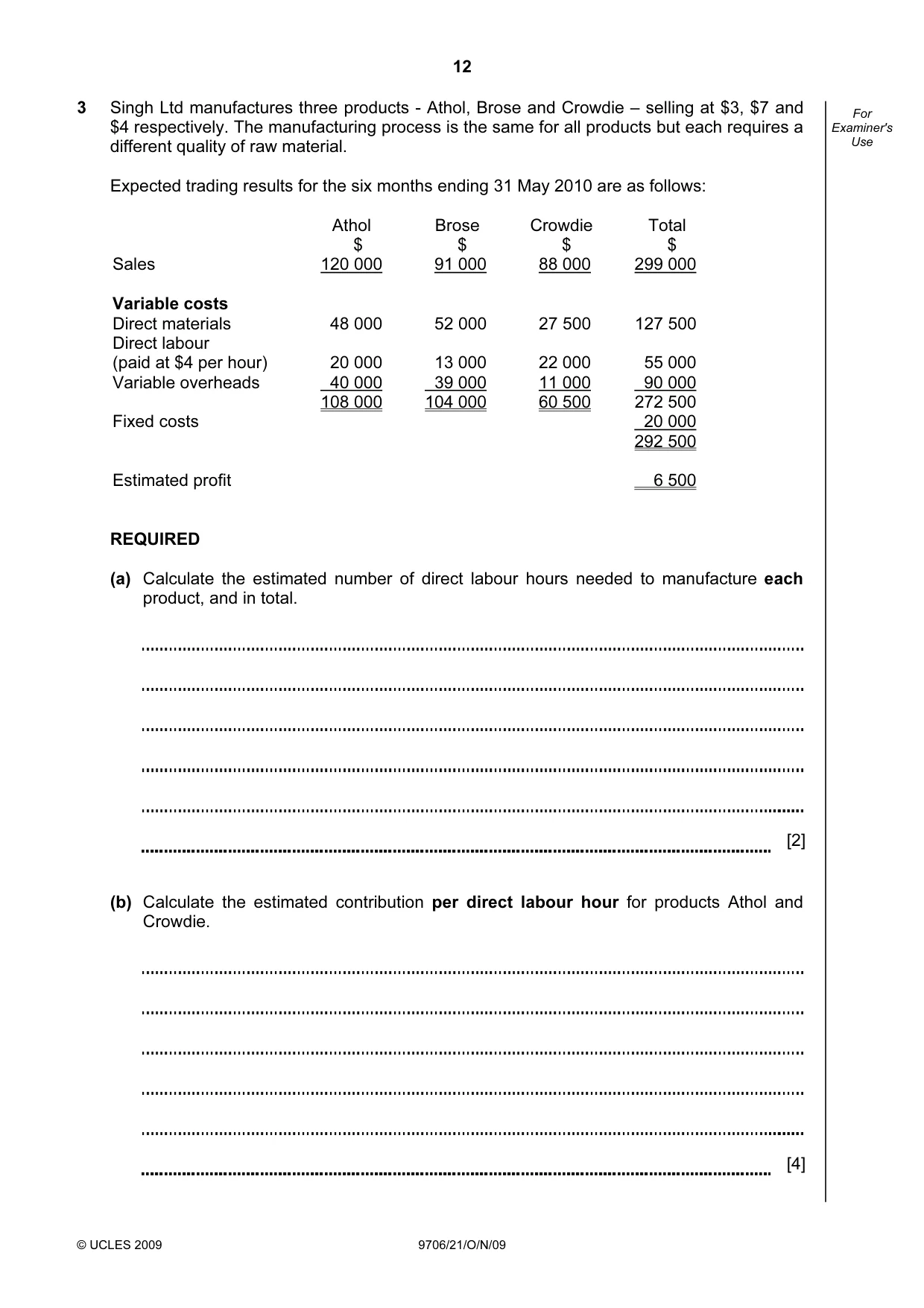
12 © UCLES 2009 9706/21/O/N/09 For Examiner's Use 3 Singh Ltd manufactures three products - Athol, Brose and Crowdie – selling at $3, $7 and $4 respectively. The manufacturing process is the same for all products but each requires a different quality of raw material. Expected trading results for the six months ending 31 May 2010 are as follows: Athol Brose Crowdie Total $ $ $ $ Sales 120 000 91 000 88 000 299 000 Variable costs Direct materials 48 000 52 000 27 500 127 500 Direct labour (paid at $4 per hour) 20 000 13 000 22 000 55 000 Variable overheads 40 000 39 000 11 000 90 000 108 000 104 000 60 500 272 500 Fixed costs 20 000 292 500 Estimated profit 6 500 REQUIRED (a) Calculate the estimated number of direct labour hours needed to manufacture each product, and in total. [2] (b) Calculate the estimated contribution per direct labour hour for products Athol and Crowdie. [4]
Question paper, page 13
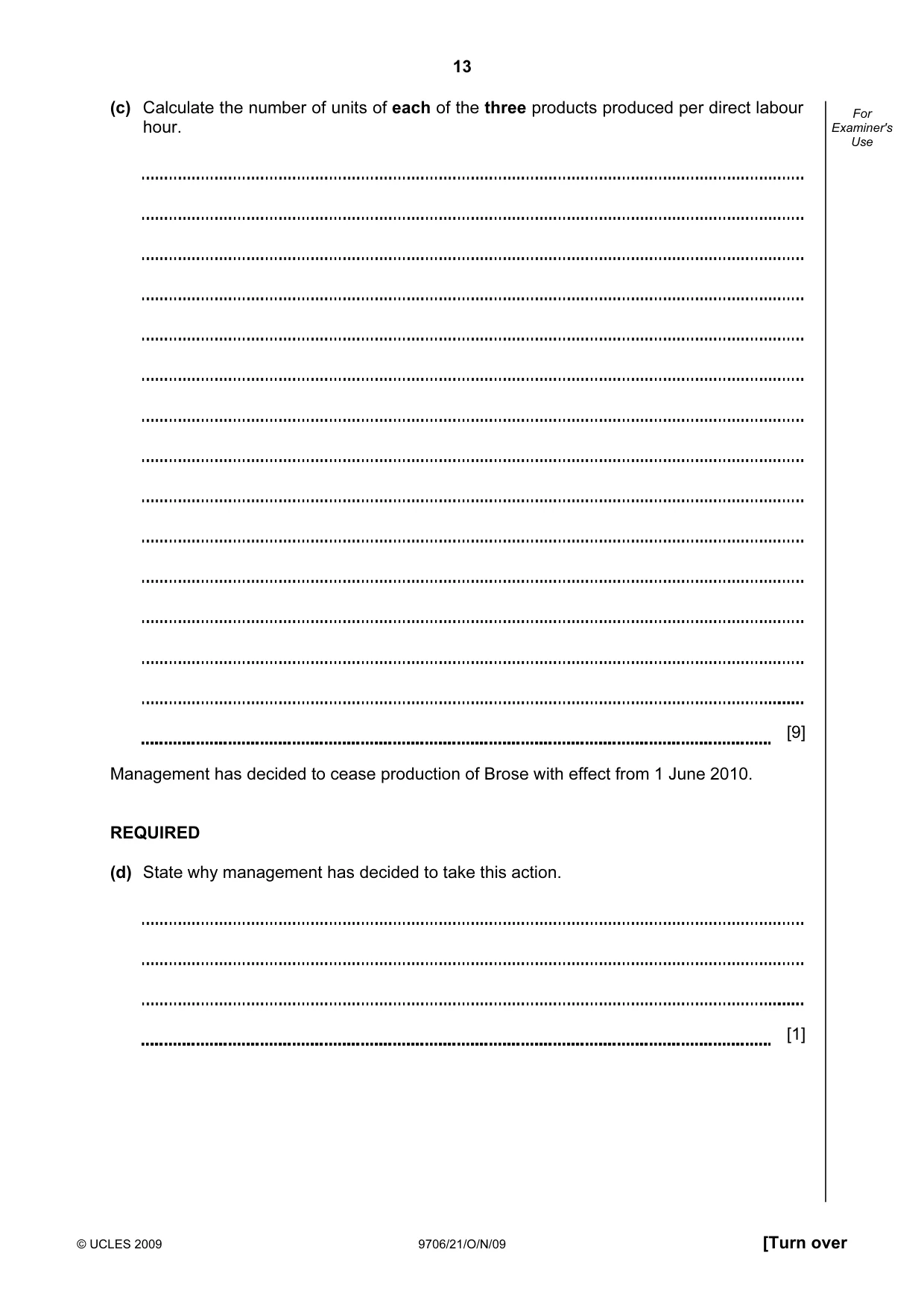
13 © UCLES 2009 9706/21/O/N/09 [Turn over For Examiner's Use (c) Calculate the number of units of each of the three products produced per direct labour hour. [9] Management has decided to cease production of Brose with effect from 1 June 2010. REQUIRED (d) State why management has decided to take this action. [1]
Question paper, page 14
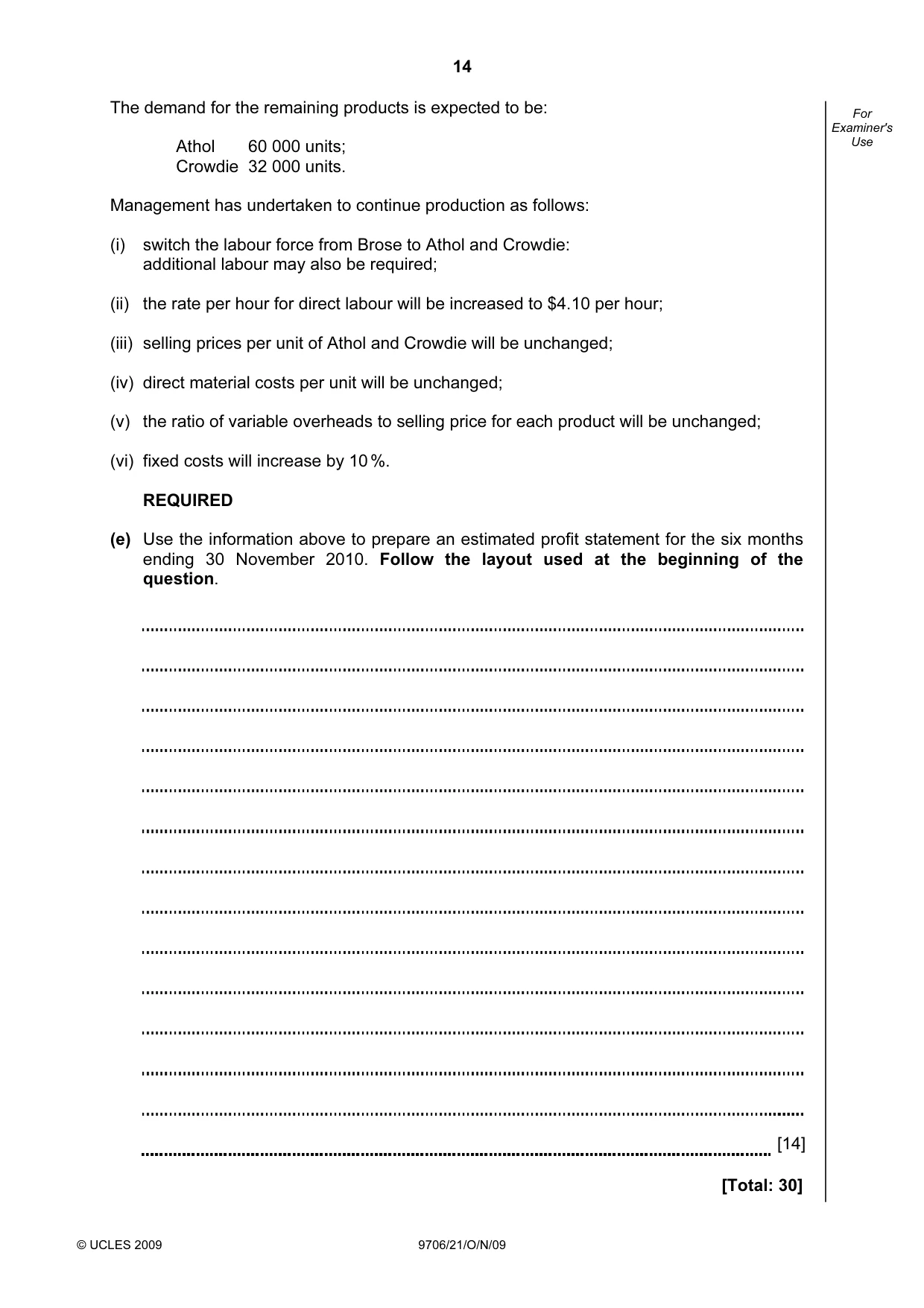
14 © UCLES 2009 9706/21/O/N/09 For Examiner's Use The demand for the remaining products is expected to be: Athol 60 000 units; Crowdie 32 000 units. Management has undertaken to continue production as follows: (i) switch the labour force from Brose to Athol and Crowdie: additional labour may also be required; (ii) the rate per hour for direct labour will be increased to $4.10 per hour; (iii) selling prices per unit of Athol and Crowdie will be unchanged; (iv) direct material costs per unit will be unchanged; (v) the ratio of variable overheads to selling price for each product will be unchanged; (vi) fixed costs will increase by 10 %. REQUIRED (e) Use the information above to prepare an estimated profit statement for the six months ending 30 November 2010. Follow the layout used at the beginning of the question. [14] [Total: 30]
Question paper, page 16
16 BLANK PAGE Permission to reproduce items where third-party owned material protected by copyright is included has been sought and cleared where possible. Every reasonable effort has been made by the publisher (UCLES) to trace copyright holders, but if any items requiring clearance have unwittingly been included, the publisher will be pleased to make amends at the earliest possible opportunity. University of Cambridge International Examinations is part of the Cambridge Assessment Group. Cambridge Assessment is the brand name of University of Cambridge Local Examinations Syndicate (UCLES), which is itself a department of the University of Cambridge. 9706/21/O/N/09
Mark scheme, page 1
UNIVERSITY OF CAMBRIDGE INTERNATIONAL EXAMINATIONS GCE Advanced Subsidiary Level and GCE Advanced Level MARK SCHEME for the October/November 2009 question paper for the guidance of teachers 9706 ACCOUNTING 9706/21 Paper 21 (Structured Questions), maximum raw mark 90 This mark scheme is published as an aid to teachers and candidates, to indicate the requirements of the examination. It shows the basis on which Examiners were instructed to award marks. It does not indicate the details of the discussions that took place at an Examiners’ meeting before marking began, which would have considered the acceptability of alternative answers. Mark schemes must be read in conjunction with the question papers and the report on the examination. • CIE will not enter into discussions or correspondence in connection with these mark schemes. CIE is publishing the mark schemes for the October/November 2009 question papers for most IGCSE, GCE Advanced Level and Advanced Subsidiary Level syllabuses and some Ordinary Level syllabuses.
Mark scheme, page 2
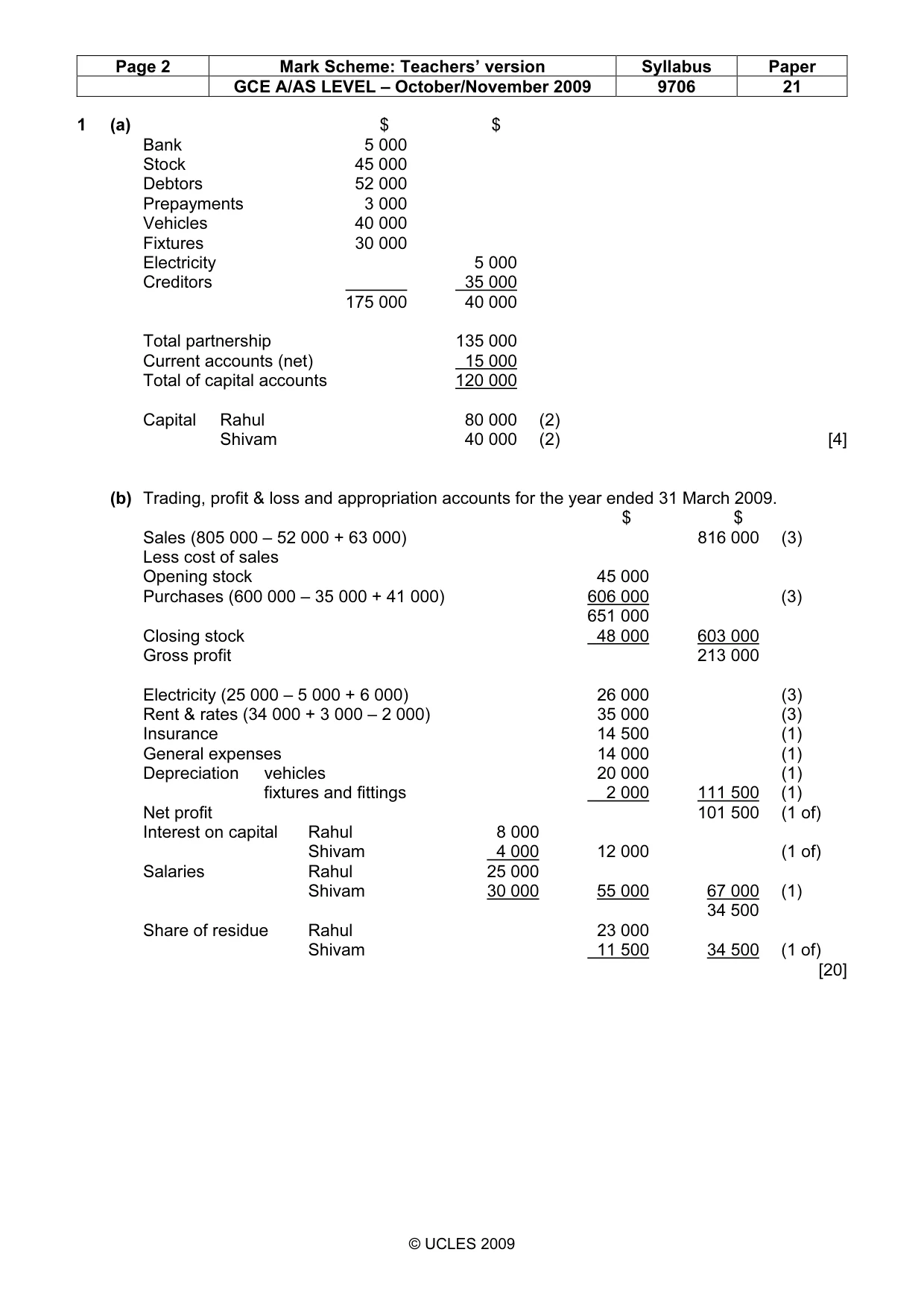
Page 2 Mark Scheme: Teachers’ version Syllabus Paper GCE A/AS LEVEL – October/November 2009 9706 21 © UCLES 2009 1 (a) $ $ Bank 5 000 Stock 45 000 Debtors 52 000 Prepayments 3 000 Vehicles 40 000 Fixtures 30 000 Electricity 5 000 Creditors 35 000 175 000 40 000 Total partnership 135 000 Current accounts (net) 15 000 Total of capital accounts 120 000 Capital Rahul 80 000 (2) Shivam 40 000 (2) [4] (b) Trading, profit & loss and appropriation accounts for the year ended 31 March 2009. $ $ Sales (805 000 – 52 000 + 63 000) 816 000 (3) Less cost of sales Opening stock 45 000 Purchases (600 000 – 35 000 + 41 000) 606 000 (3) 651 000 Closing stock 48 000 603 000 Gross profit 213 000 Electricity (25 000 – 5 000 + 6 000) 26 000 (3) Rent & rates (34 000 + 3 000 – 2 000) 35 000 (3) Insurance 14 500 (1) General expenses 14 000 (1) Depreciation vehicles 20 000 (1) fixtures and fittings 2 000 111 500 (1) Net profit 101 500 (1 of) Interest on capital Rahul 8 000 Shivam 4 000 12 000 (1 of) Salaries Rahul 25 000 Shivam 30 000 55 000 67 000 (1) 34 500 Share of residue Rahul 23 000 Shivam 11 500 34 500 (1 of) [20]
Mark scheme, page 3
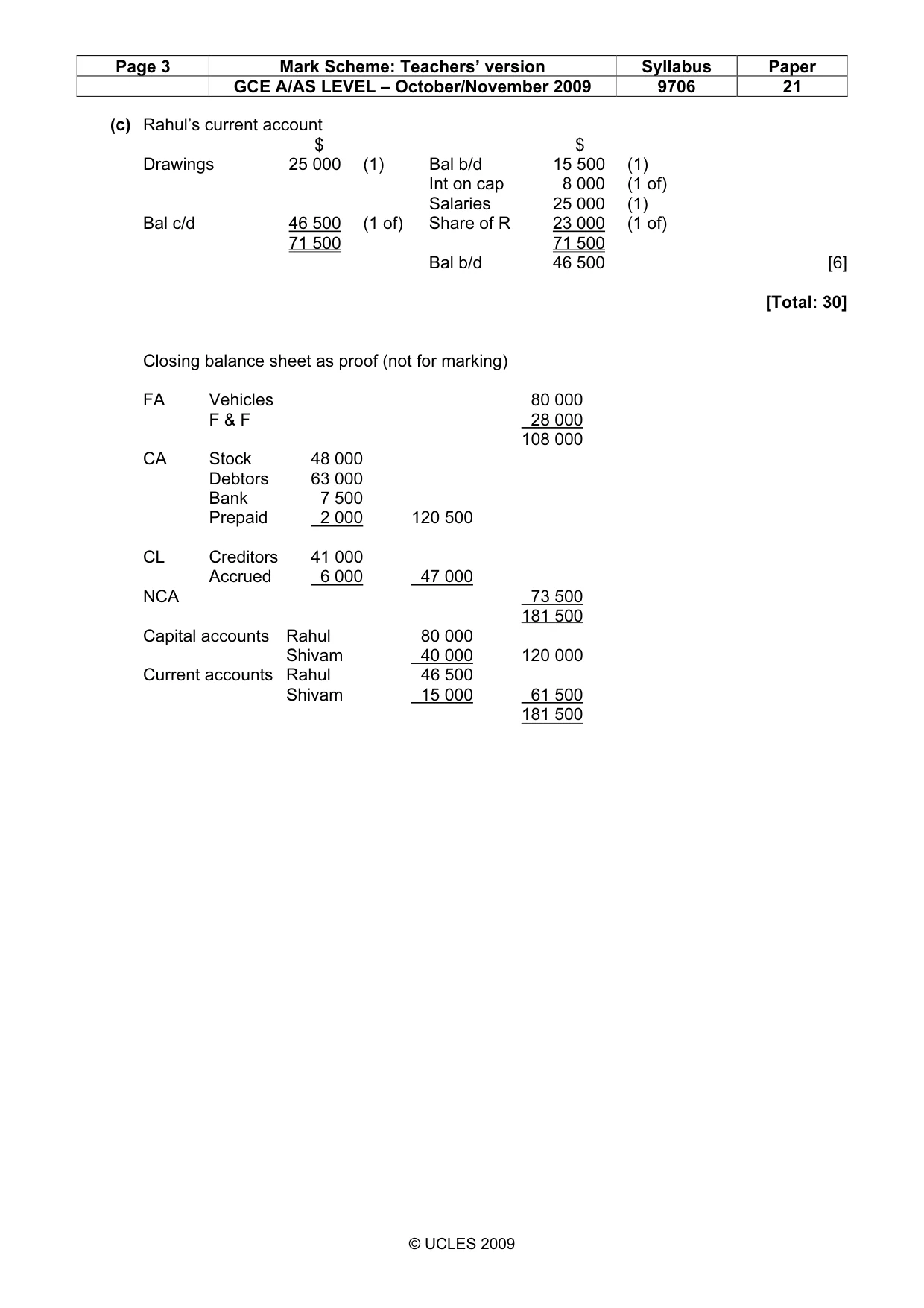
Page 3 Mark Scheme: Teachers’ version Syllabus Paper GCE A/AS LEVEL – October/November 2009 9706 21 © UCLES 2009 (c) Rahul’s current account $ $ Drawings 25 000 (1) Bal b/d 15 500 (1) Int on cap 8 000 (1 of) Salaries 25 000 (1) Bal c/d 46 500 (1 of) Share of R 23 000 (1 of) 71 500 71 500 Bal b/d 46 500 [6] [Total: 30] Closing balance sheet as proof (not for marking) FA Vehicles 80 000 F & F 28 000 108 000 CA Stock 48 000 Debtors 63 000 Bank 7 500 Prepaid 2 000 120 500 CL Creditors 41 000 Accrued 6 000 47 000 NCA 73 500 181 500 Capital accounts Rahul 80 000 Shivam 40 000 120 000 Current accounts Rahul 46 500 Shivam 15 000 61 500 181 500
Mark scheme, page 4
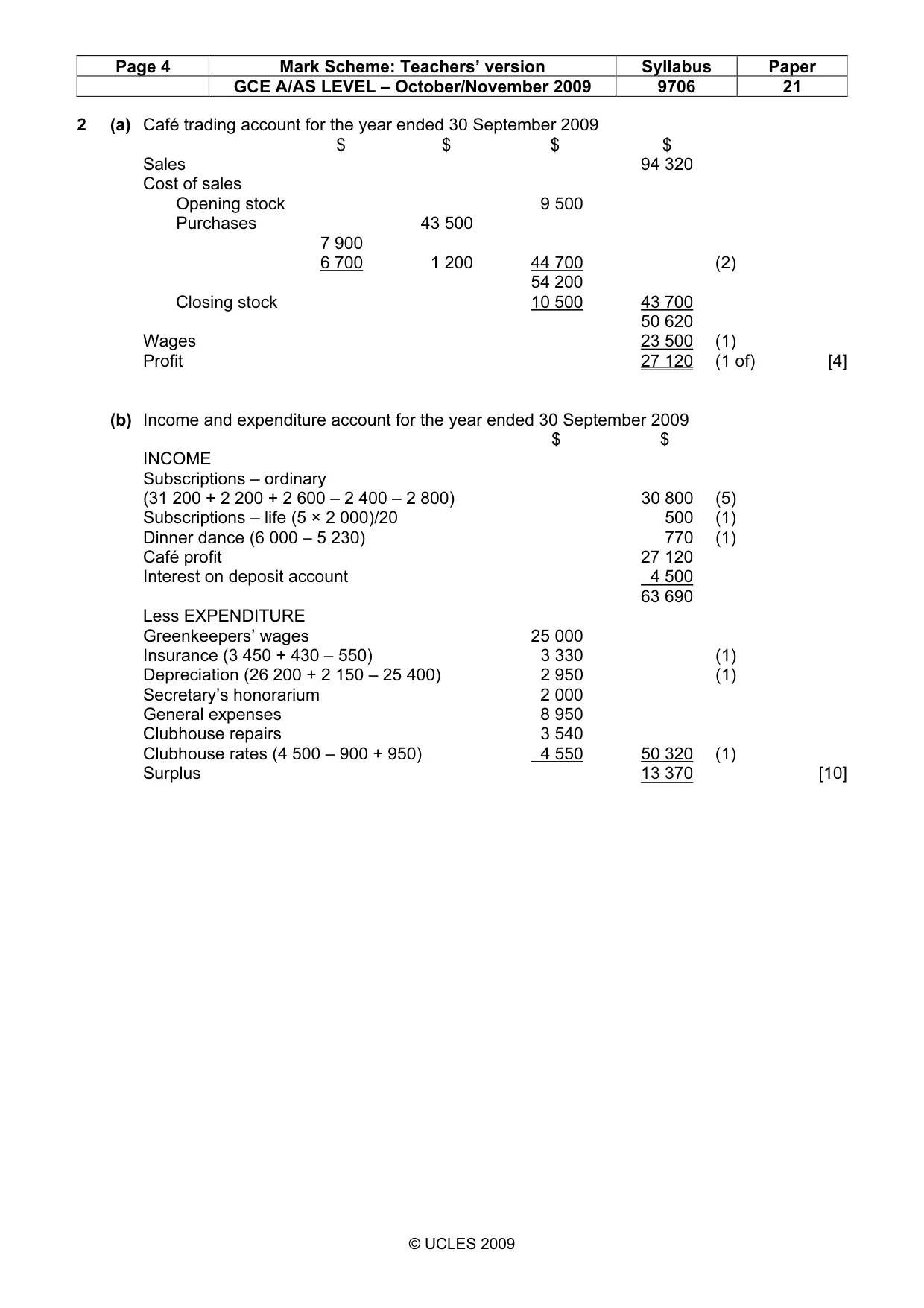
Page 4 Mark Scheme: Teachers’ version Syllabus Paper GCE A/AS LEVEL – October/November 2009 9706 21 © UCLES 2009 2 (a) Café trading account for the year ended 30 September 2009 $ $ $ $ Sales 94 320 Cost of sales Opening stock 9 500 Purchases 43 500 7 900 6 700 1 200 44 700 (2) 54 200 Closing stock 10 500 43 700 50 620 Wages 23 500 (1) Profit 27 120 (1 of) [4] (b) Income and expenditure account for the year ended 30 September 2009 $ $ INCOME Subscriptions – ordinary (31 200 + 2 200 + 2 600 – 2 400 – 2 800) 30 800 (5) Subscriptions – life (5 × 2 000)/20 500 (1) Dinner dance (6 000 – 5 230) 770 (1) Café profit 27 120 Interest on deposit account 4 500 63 690 Less EXPENDITURE Greenkeepers’ wages 25 000 Insurance (3 450 + 430 – 550) 3 330 (1) Depreciation (26 200 + 2 150 – 25 400) 2 950 (1) Secretary’s honorarium 2 000 General expenses 8 950 Clubhouse repairs 3 540 Clubhouse rates (4 500 – 900 + 950) 4 550 50 320 (1) Surplus 13 370 [10]
Mark scheme, page 5
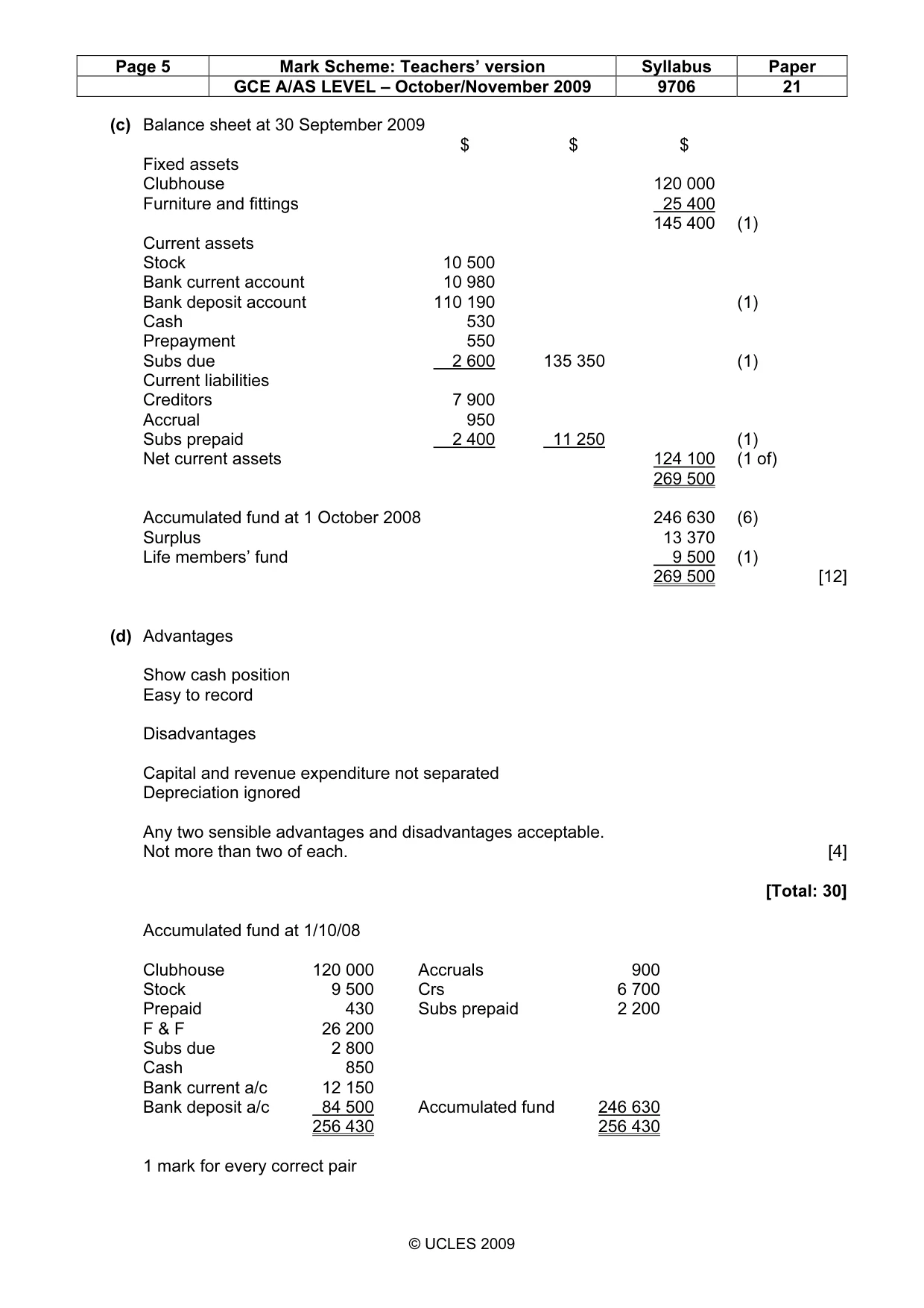
Page 5 Mark Scheme: Teachers’ version Syllabus Paper GCE A/AS LEVEL – October/November 2009 9706 21 © UCLES 2009 (c) Balance sheet at 30 September 2009 $ $ $ Fixed assets Clubhouse 120 000 Furniture and fittings 25 400 145 400 (1) Current assets Stock 10 500 Bank current account 10 980 Bank deposit account 110 190 (1) Cash 530 Prepayment 550 Subs due 2 600 135 350 (1) Current liabilities Creditors 7 900 Accrual 950 Subs prepaid 2 400 11 250 (1) Net current assets 124 100 (1 of) 269 500 Accumulated fund at 1 October 2008 246 630 (6) Surplus 13 370 Life members’ fund 9 500 (1) 269 500 [12] (d) Advantages Show cash position Easy to record Disadvantages Capital and revenue expenditure not separated Depreciation ignored Any two sensible advantages and disadvantages acceptable. Not more than two of each. [4] [Total: 30] Accumulated fund at 1/10/08 Clubhouse 120 000 Accruals 900 Stock 9 500 Crs 6 700 Prepaid 430 Subs prepaid 2 200 F & F 26 200 Subs due 2 800 Cash 850 Bank current a/c 12 150 Bank deposit a/c 84 500 Accumulated fund 246 630 256 430 256 430 1 mark for every correct pair
Mark scheme, page 6
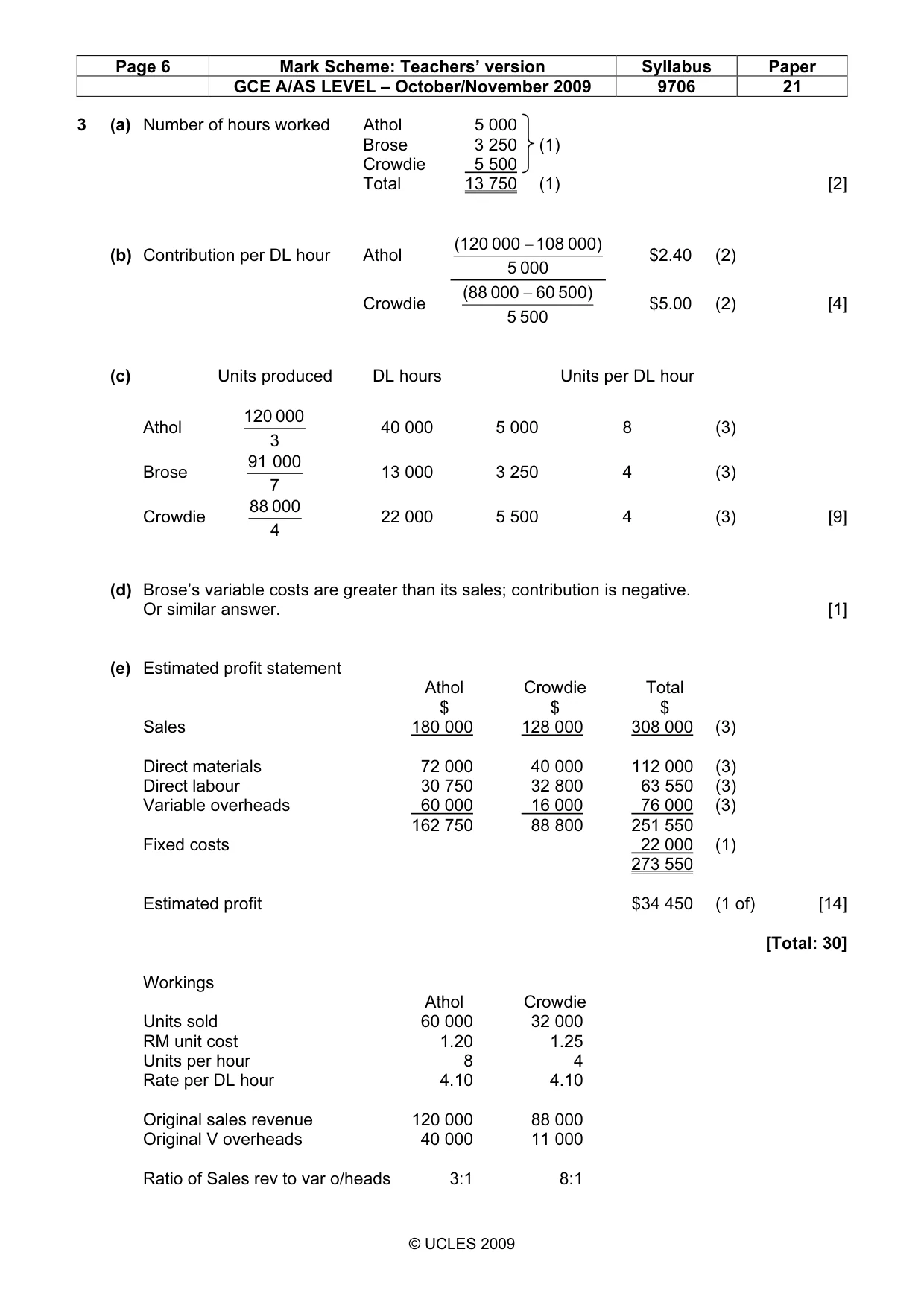
Page 6 Mark Scheme: Teachers’ version Syllabus Paper GCE A/AS LEVEL – October/November 2009 9706 21 © UCLES 2009 3 (a) Number of hours worked Athol 5 000 Brose 3 250 (1) Crowdie 5 500 Total 13 750 (1) [2] (b) Contribution per DL hour Athol 000 5 000) 108 000 (120 − $2.40 (2) Crowdie 500 5 500) 60 000 (88 − $5.00 (2) [4] (c) Units produced DL hours Units per DL hour Athol 3 000 120 40 000 5 000 8 (3) Brose 7 000 91 13 000 3 250 4 (3) Crowdie 4 000 88 22 000 5 500 4 (3) [9] (d) Brose’s variable costs are greater than its sales; contribution is negative. Or similar answer. [1] (e) Estimated profit statement Athol Crowdie Total $ $ $ Sales 180 000 128 000 308 000 (3) Direct materials 72 000 40 000 112 000 (3) Direct labour 30 750 32 800 63 550 (3) Variable overheads 60 000 16 000 76 000 (3) 162 750 88 800 251 550 Fixed costs 22 000 (1) 273 550 Estimated profit $34 450 (1 of) [14] [Total: 30] Workings Athol Crowdie Units sold 60 000 32 000 RM unit cost 1.20 1.25 Units per hour 8 4 Rate per DL hour 4.10 4.10 Original sales revenue 120 000 88 000 Original V overheads 40 000 11 000 Ratio of Sales rev to var o/heads 3:1 8:1
What you needed in this session
Cambridge’s own grade thresholds for 2009 Oct/Nov, Paper 2 · Variant 1. A higher threshold means an easier paper — the bar moves with how the cohort did.