Cambridge IGCSE Twenty-First Century Science 0608 — 2013 Oct/Nov Paper 5 · Variant 1
0608/51/O/N/13
The question paper and its mark scheme, free to read here and free to download. This is Cambridge’s own paper, exactly as it was sat.
Question paper16 pages



Mark scheme4 pages
Answers below. Sit the paper first if you are practising.
Paper as text
Question paper, page 1
This document consists of 14 printed pages and 2 blank pages. DC (LEG/JG) 65056/3 © UCLES 2013 [Turn over UNIVERSITY OF CAMBRIDGE INTERNATIONAL EXAMINATIONS International General Certificate of Secondary Education * 2 4 6 6 7 4 4 4 6 3 * TWENTY FIRST CENTURY SCIENCE 0608/05 Paper 5 October/November 2013 1 hour 30 minutes Candidates answer on the Question Paper. No Additional Materials are required. READ THESE INSTRUCTIONS FIRST Write your Centre number, candidate number and name on all the work you hand in. Write in dark blue or black pen. You may use a pencil for any diagrams or graphs. Do not use staples, paper clips, highlighters, glue or correction fluid. DO NOT WRITE IN ANY BARCODES. Answer all questions. Electronic calculators may be used. At the end of the examination, fasten all your work securely together. The number of marks is given in brackets [ ] at the end of each question or part question. www.XtremePapers.com
Question paper, page 2
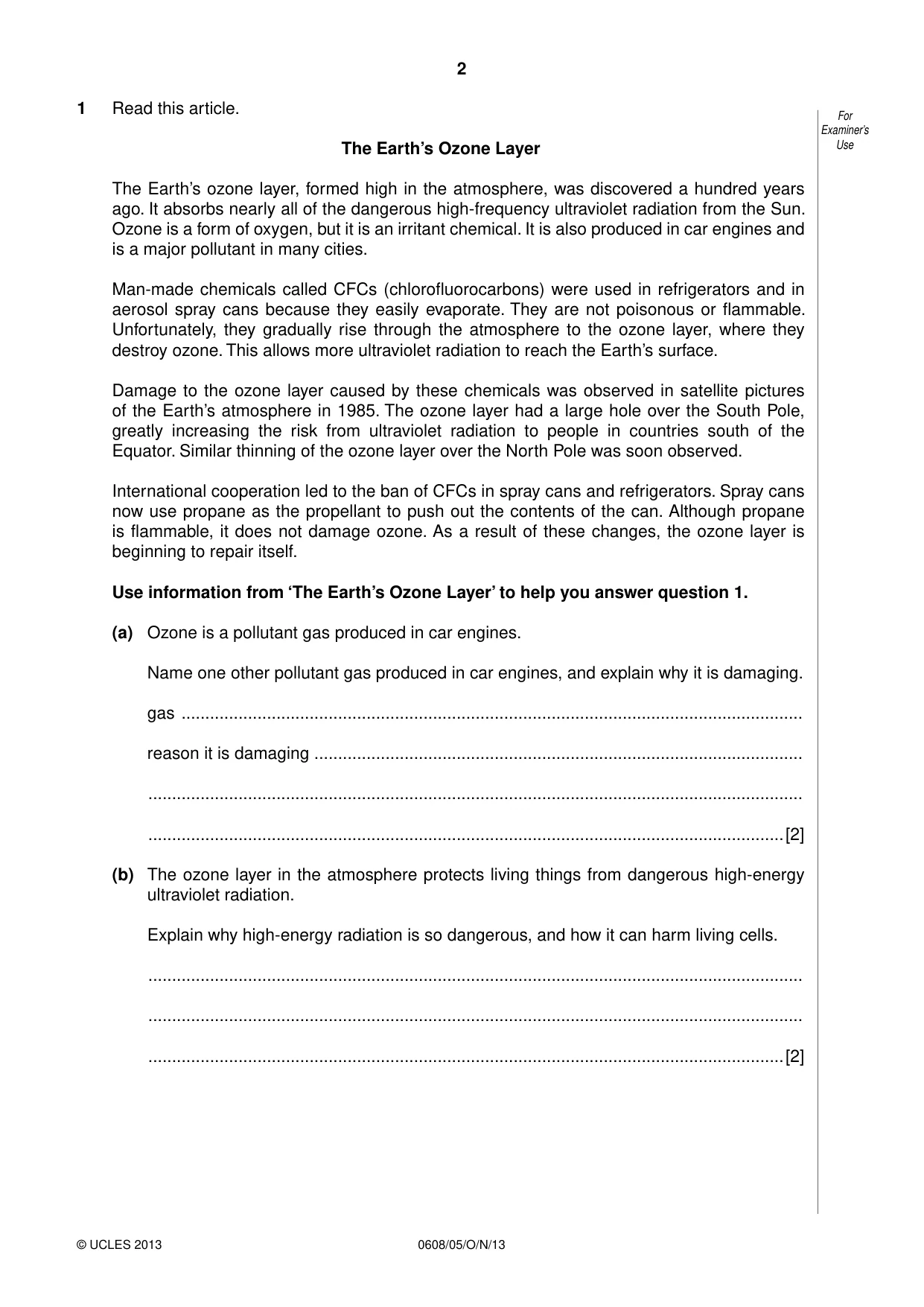
2 0608/05/O/N/13 © UCLES 2013 For Examiner’s Use 1 Read this article. The Earth’s Ozone Layer The Earth’s ozone layer, formed high in the atmosphere, was discovered a hundred years ago. It absorbs nearly all of the dangerous high-frequency ultraviolet radiation from the Sun. Ozone is a form of oxygen, but it is an irritant chemical. It is also produced in car engines and is a major pollutant in many cities. Man-made chemicals called CFCs (chlorofluorocarbons) were used in refrigerators and in aerosol spray cans because they easily evaporate. They are not poisonous or flammable. Unfortunately, they gradually rise through the atmosphere to the ozone layer, where they destroy ozone. This allows more ultraviolet radiation to reach the Earth’s surface. Damage to the ozone layer caused by these chemicals was observed in satellite pictures of the Earth’s atmosphere in 1985. The ozone layer had a large hole over the South Pole, greatly increasing the risk from ultraviolet radiation to people in countries south of the Equator. Similar thinning of the ozone layer over the North Pole was soon observed. International cooperation led to the ban of CFCs in spray cans and refrigerators. Spray cans now use propane as the propellant to push out the contents of the can. Although propane is flammable, it does not damage ozone. As a result of these changes, the ozone layer is beginning to repair itself. Use information from ‘The Earth’s Ozone Layer’ to help you answer question 1. (a) Ozone is a pollutant gas produced in car engines. Name one other pollutant gas produced in car engines, and explain why it is damaging. gas … reason it is damaging … … …[2] (b) The ozone layer in the atmosphere protects living things from dangerous high-energy ultraviolet radiation. Explain why high-energy radiation is so dangerous, and how it can harm living cells. … … …[2]
Question paper, page 3
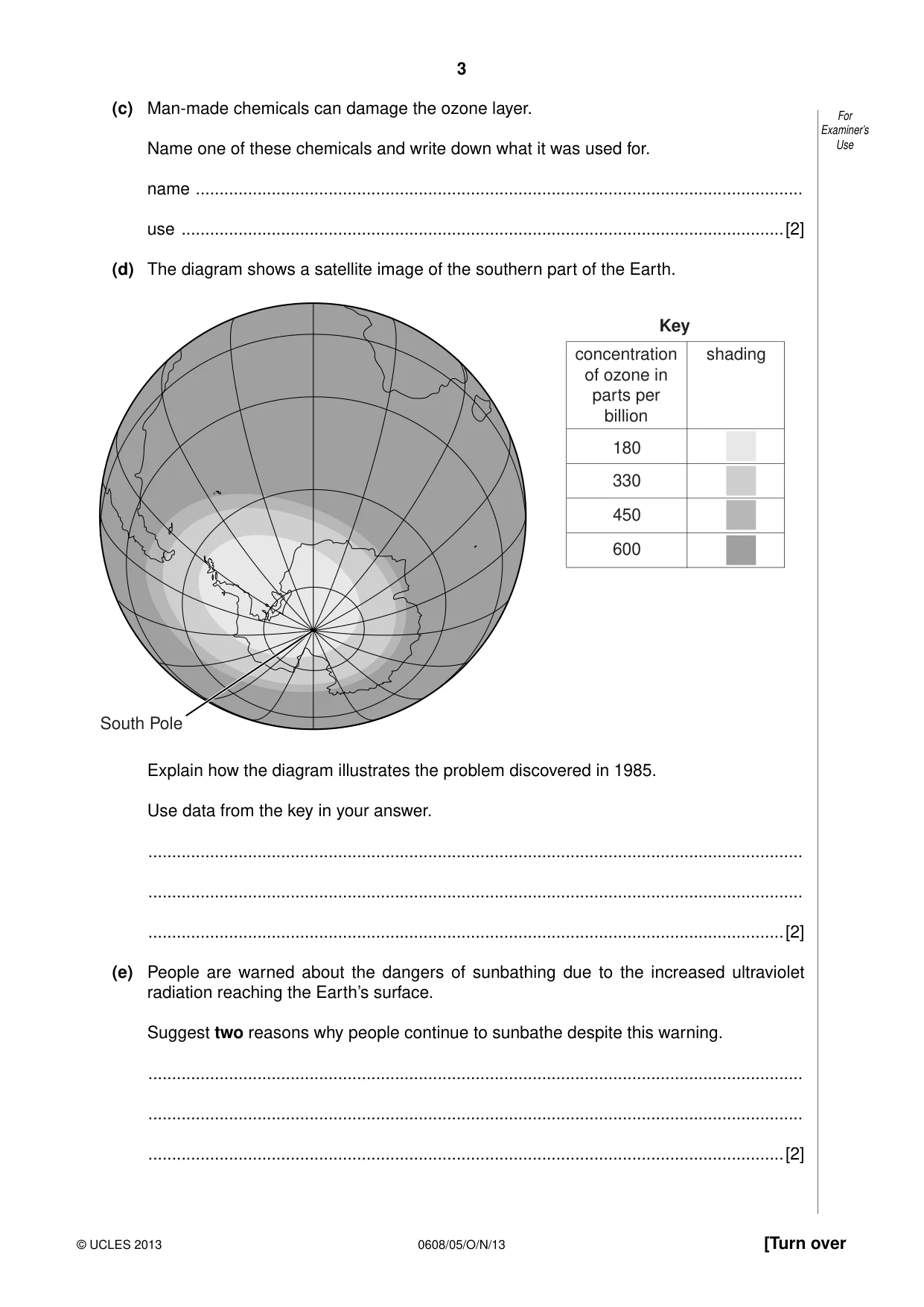
3 0608/05/O/N/13 © UCLES 2013 [Turn over For Examiner’s Use (c) Man-made chemicals can damage the ozone layer. Name one of these chemicals and write down what it was used for. name … use …[2] (d) The diagram shows a satellite image of the southern part of the Earth. Key concentration of ozone in parts per billion shading South Pole 180 330 450 600 Explain how the diagram illustrates the problem discovered in 1985. Use data from the key in your answer. … … …[2] (e) People are warned about the dangers of sunbathing due to the increased ultraviolet radiation reaching the Earth’s surface. Suggest two reasons why people continue to sunbathe despite this warning. … … …[2]
Question paper, page 4
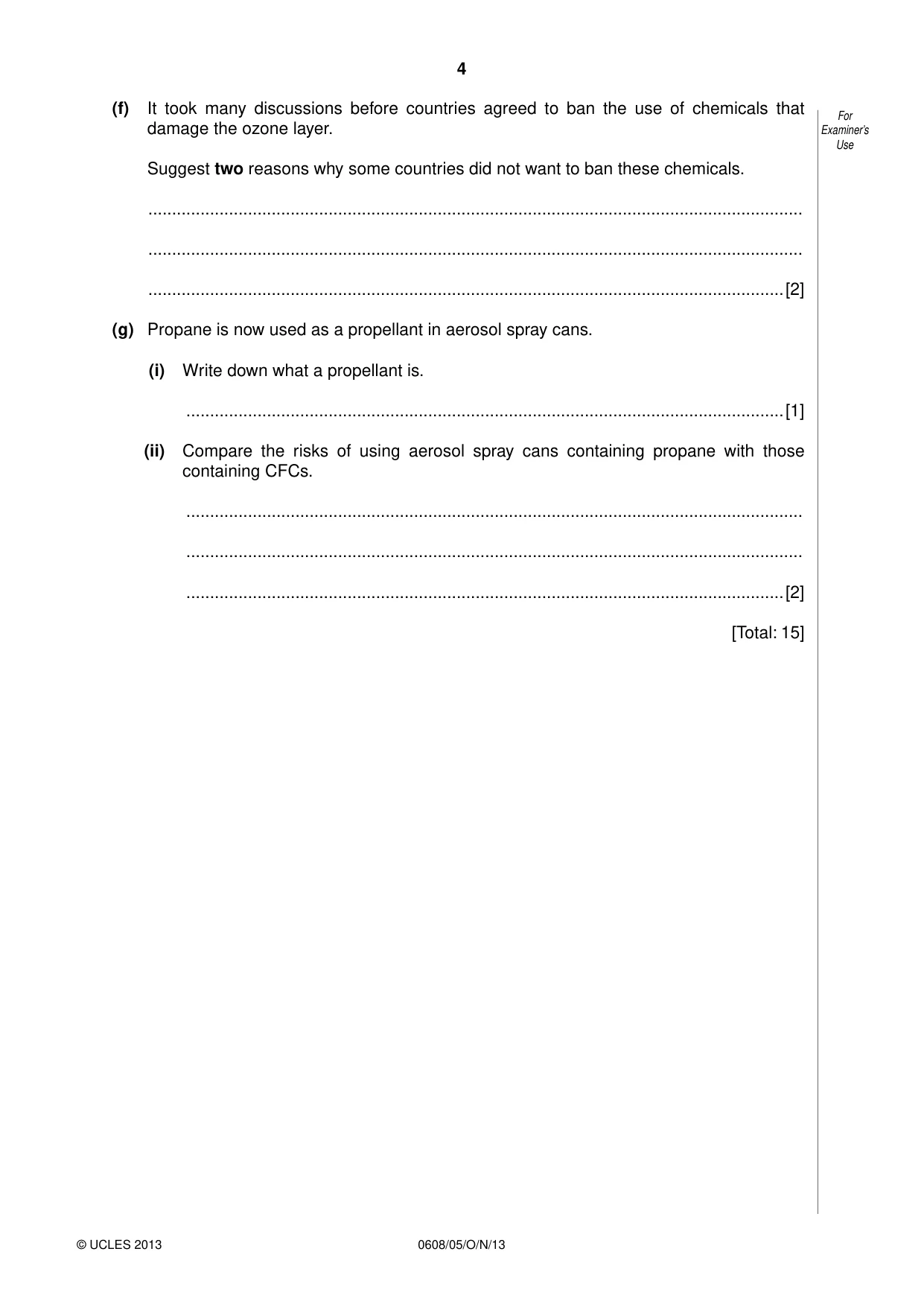
4 0608/05/O/N/13 © UCLES 2013 For Examiner’s Use (f) It took many discussions before countries agreed to ban the use of chemicals that damage the ozone layer. Suggest two reasons why some countries did not want to ban these chemicals. … … …[2] (g) Propane is now used as a propellant in aerosol spray cans. (i) Write down what a propellant is. …[1] (ii) Compare the risks of using aerosol spray cans containing propane with those containing CFCs. … … …[2] [Total: 15]
Question paper, page 5
5 0608/05/O/N/13 © UCLES 2013 [Turn over QUESTION 2 BEGINS ON PAGE 6
Question paper, page 6
6 0608/05/O/N/13 © UCLES 2013 For Examiner’s Use 2 Read this article. Pollution and heart disease A study has found that polluted air in towns and cities increases the risk of dying from heart disease or stroke. Tiny carbon particulates in the air can be breathed deep into the lungs. These particulates are emitted by vehicles and factories. Scientists studied 66 000 women for nine years, but say the results are likely to apply equally to men. Data on the women’s health was compared with air pollution readings from the 36 cities in which they lived. Heart disease occurs mostly in people aged over 50 and becomes more common with increasing age. Women in the study were aged between 50 and 79 and had no sign of heart disease at the start. Over the course of the study 1816 suffered from a heart attack or stroke. Scientists suggest that the particulates enter the bloodstream through vessels in the lung. They may then cause the arteries to narrow which affects blood flow to the heart. The study suggests that heart disease could be reduced by lowering particulate pollution. If the average concentration of particulates can be reduced, it may prevent many heart attacks and strokes. Use information from ‘Pollution and heart disease’ to help you answer question 2. (a) The study suggests there is a correlation between air pollution and the risk of heart disease. Describe this correlation. …[1] (b) Carbon particulates in the atmosphere may affect blood flow to the heart muscle. Suggest how these particulates reach the vessels taking blood to the heart. … … …[2] (c) (i) Name the type of blood vessel taking blood to the heart muscle cells. …[1] (ii) Explain why the heart muscle cells need their own blood supply. … … …[2]
Question paper, page 7
7 0608/05/O/N/13 © UCLES 2013 [Turn over For Examiner’s Use (iii) Explain how the carbon particulates may cause a heart attack. … … … …[3] (d) Calculate the percentage of the women in the study who had a heart attack or stroke. percentage = …% [2] (e) The article says “If the average concentration of particulates can be reduced, it may prevent many heart attacks and strokes.” Suggest reasons why reducing the concentration of particulates may not prevent heart attacks and strokes. … … … …[2] (f) A second study investigating the link between pollution and heart disease is carried out by a different group of scientists. In this study, 5000 women aged between 20 and 30 are followed for 15 years. Write down and explain one advantage of the design of each study. first study … … … second study … … … [2] [Total: 15]
Question paper, page 8
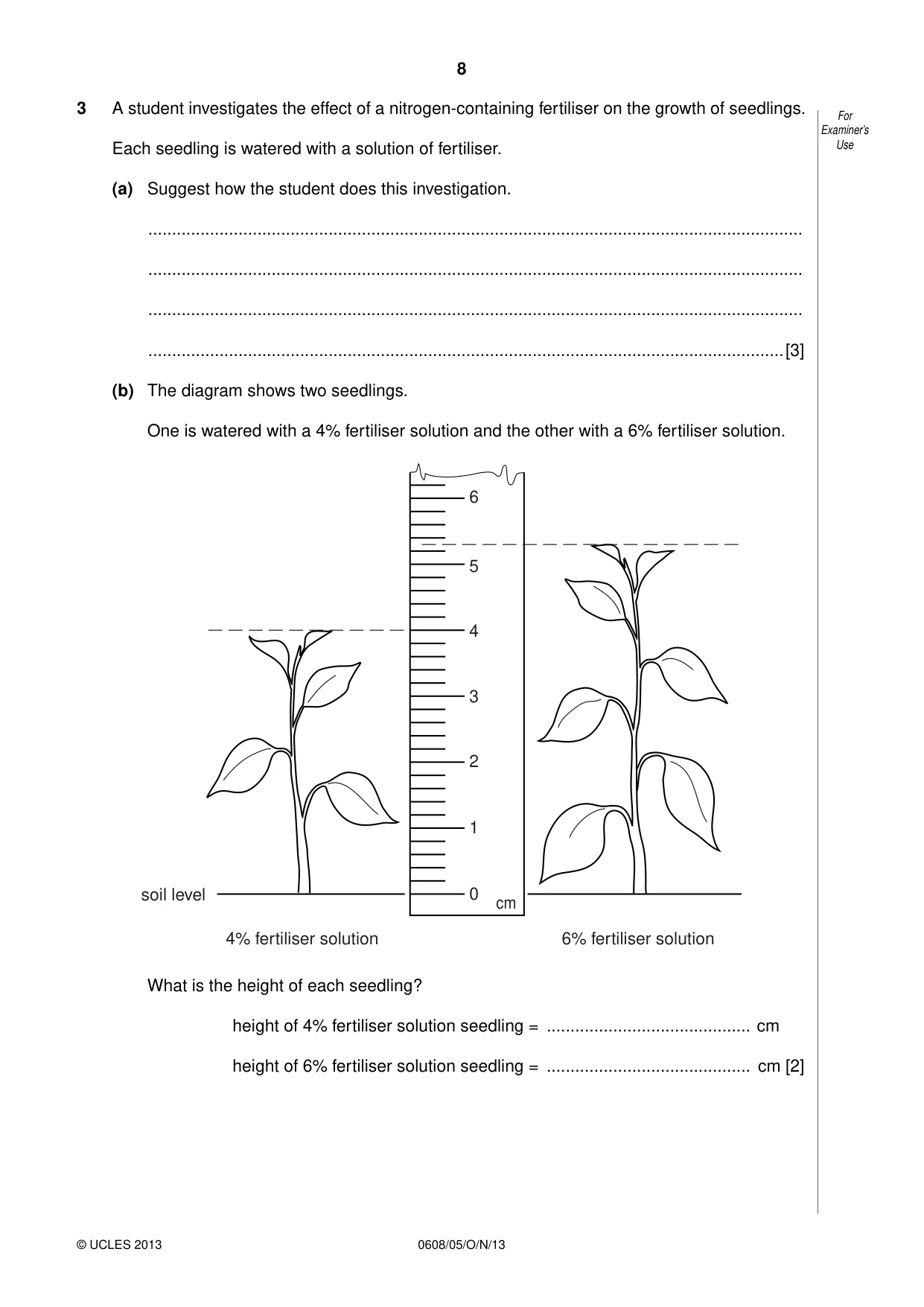
8 0608/05/O/N/13 © UCLES 2013 For Examiner’s Use 3 A student investigates the effect of a nitrogen-containing fertiliser on the growth of seedlings. Each seedling is watered with a solution of fertiliser. (a) Suggest how the student does this investigation. … … … …[3] (b) The diagram shows two seedlings. One is watered with a 4% fertiliser solution and the other with a 6% fertiliser solution. 6 5 4 3 2 1 0 cm soil level 4% fertiliser solution 6% fertiliser solution What is the height of each seedling? height of 4% fertiliser solution seedling = … cm height of 6% fertiliser solution seedling = … cm [2]
Question paper, page 9
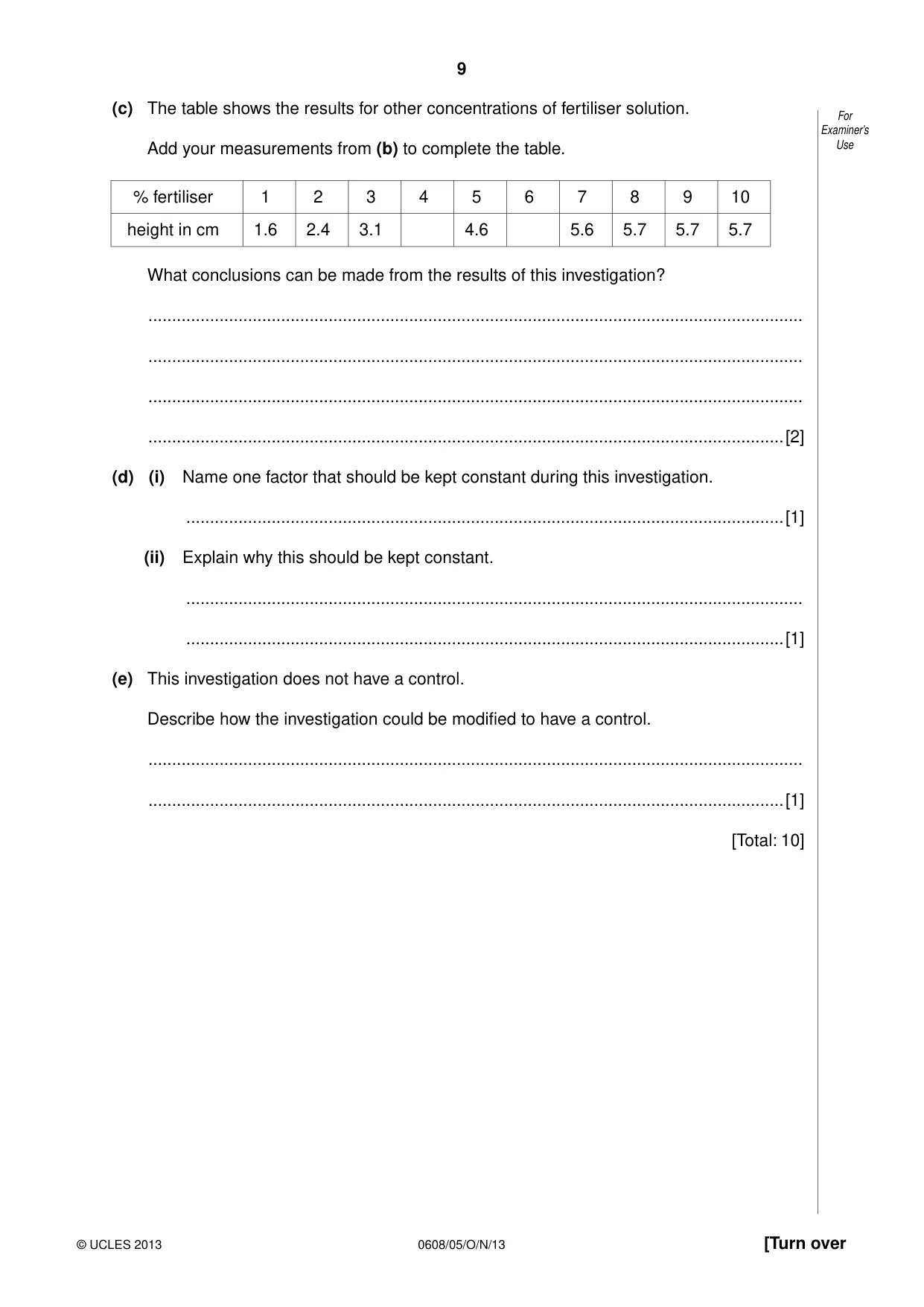
9 0608/05/O/N/13 © UCLES 2013 [Turn over For Examiner’s Use (c) The table shows the results for other concentrations of fertiliser solution. Add your measurements from (b) to complete the table. % fertiliser 1 2 3 4 5 6 7 8 9 10 height in cm 1.6 2.4 3.1 4.6 5.6 5.7 5.7 5.7 What conclusions can be made from the results of this investigation? … … … …[2] (d) (i) Name one factor that should be kept constant during this investigation. …[1] (ii) Explain why this should be kept constant. … …[1] (e) This investigation does not have a control. Describe how the investigation could be modified to have a control. … …[1] [Total: 10]
Question paper, page 10
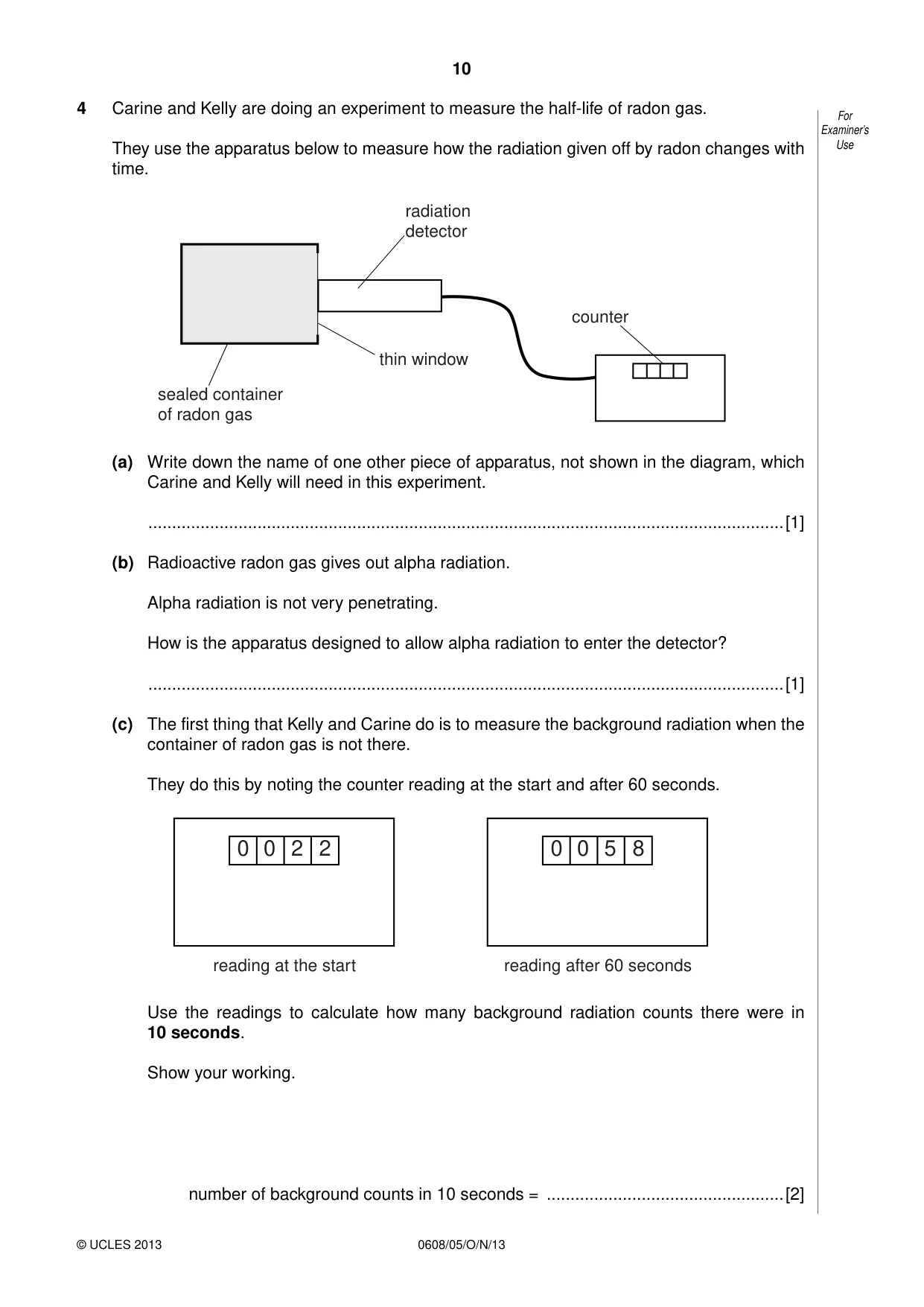
10 0608/05/O/N/13 © UCLES 2013 For Examiner’s Use 4 Carine and Kelly are doing an experiment to measure the half-life of radon gas. They use the apparatus below to measure how the radiation given off by radon changes with time. counter radiation detector thin window sealed container of radon gas (a) Write down the name of one other piece of apparatus, not shown in the diagram, which Carine and Kelly will need in this experiment. …[1] (b) Radioactive radon gas gives out alpha radiation. Alpha radiation is not very penetrating. How is the apparatus designed to allow alpha radiation to enter the detector? …[1] (c) The first thing that Kelly and Carine do is to measure the background radiation when the container of radon gas is not there. They do this by noting the counter reading at the start and after 60 seconds. 0 0 2 2 reading at the start 0 0 5 8 reading after 60 seconds Use the readings to calculate how many background radiation counts there were in 10 seconds. Show your working. number of background counts in 10 seconds = …[2]
Question paper, page 11
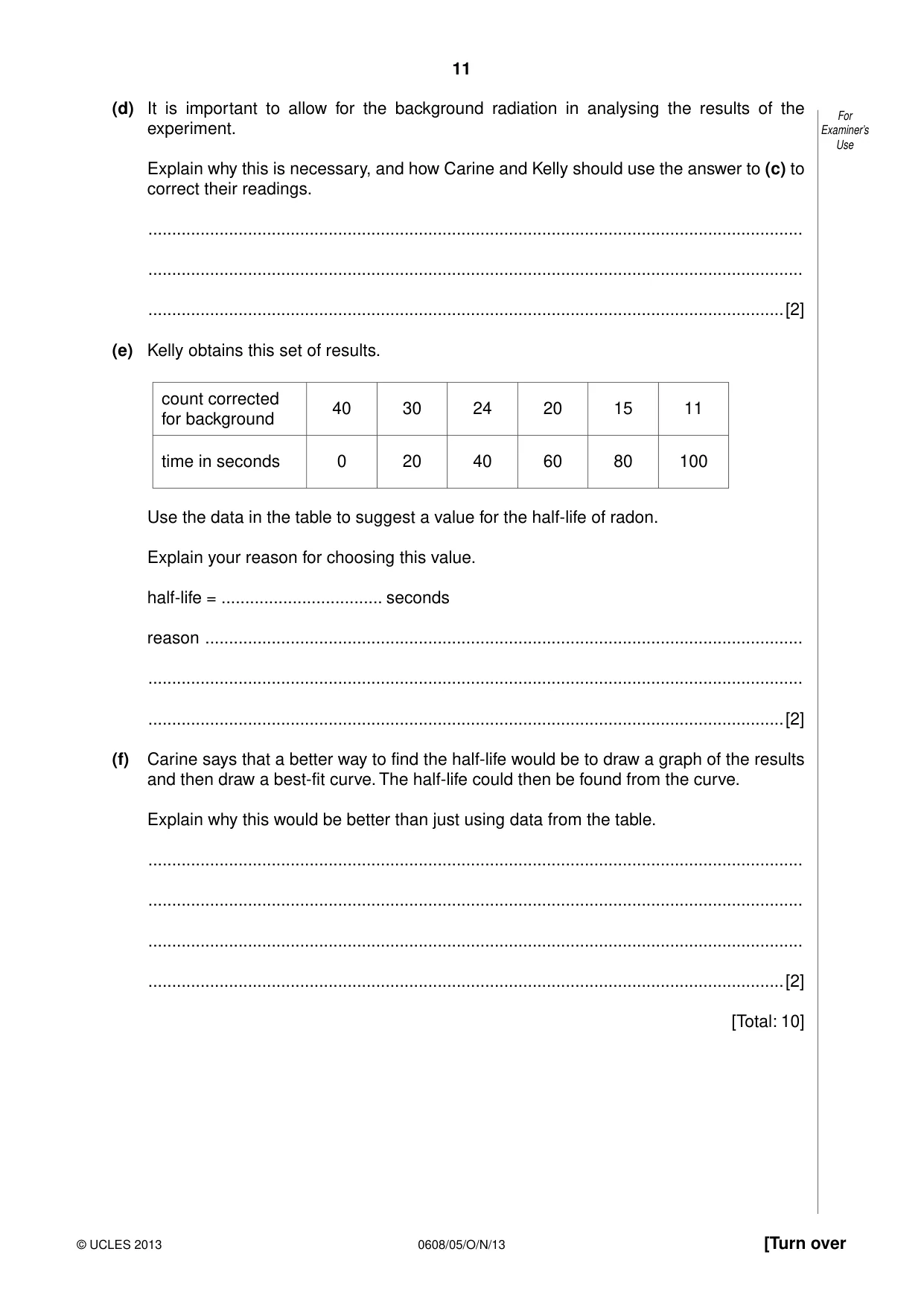
11 0608/05/O/N/13 © UCLES 2013 [Turn over For Examiner’s Use (d) It is important to allow for the background radiation in analysing the results of the experiment. Explain why this is necessary, and how Carine and Kelly should use the answer to (c) to correct their readings. … … …[2] (e) Kelly obtains this set of results. count corrected for background 40 30 24 20 15 11 time in seconds 0 20 40 60 80 100 Use the data in the table to suggest a value for the half-life of radon. Explain your reason for choosing this value. half-life = … seconds reason … … …[2] (f) Carine says that a better way to find the half-life would be to draw a graph of the results and then draw a best-fit curve. The half-life could then be found from the curve. Explain why this would be better than just using data from the table. … … … …[2] [Total: 10]
Question paper, page 12
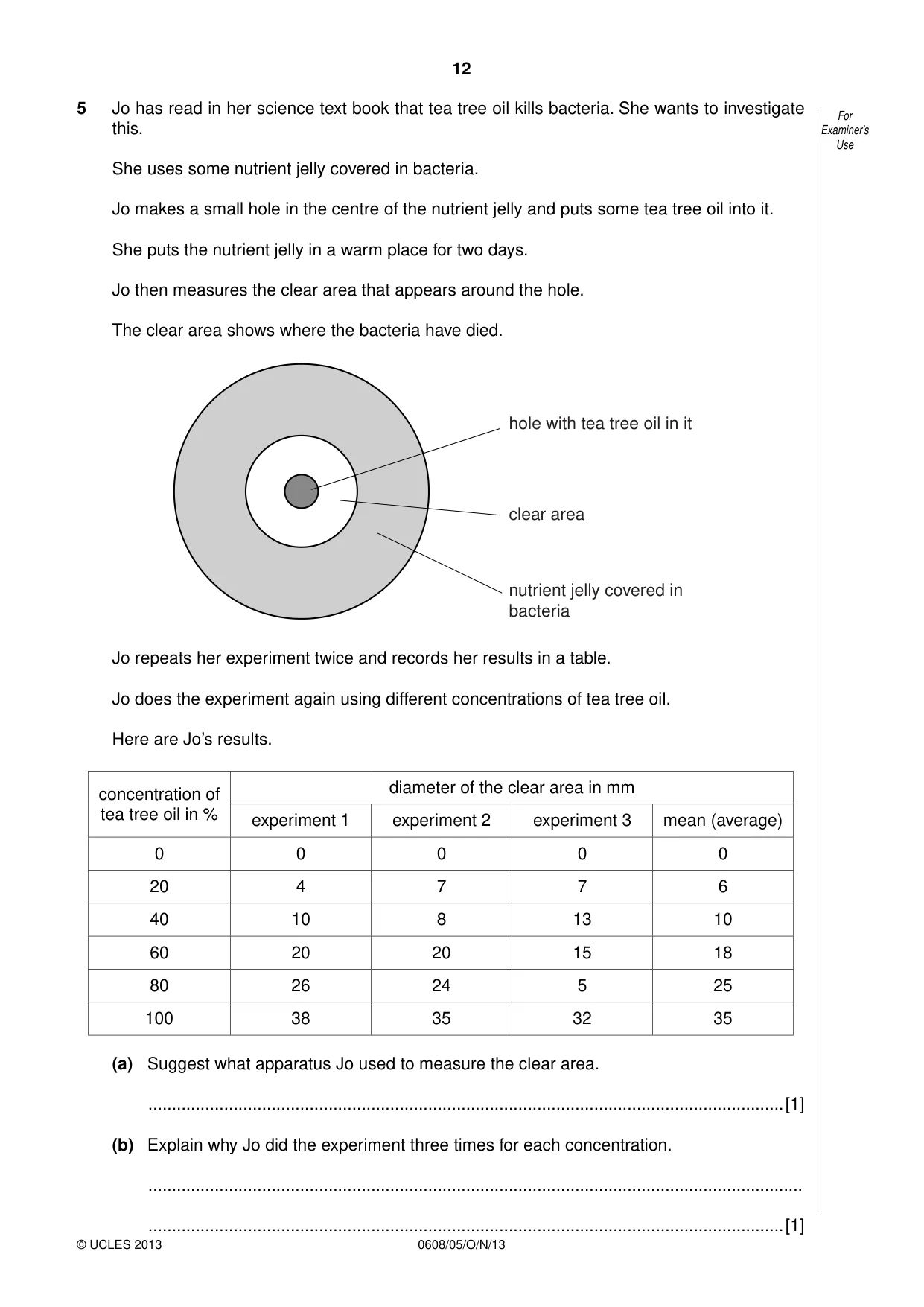
12 0608/05/O/N/13 © UCLES 2013 For Examiner’s Use 5 Jo has read in her science text book that tea tree oil kills bacteria. She wants to investigate this. She uses some nutrient jelly covered in bacteria. Jo makes a small hole in the centre of the nutrient jelly and puts some tea tree oil into it. She puts the nutrient jelly in a warm place for two days. Jo then measures the clear area that appears around the hole. The clear area shows where the bacteria have died. hole with tea tree oil in it clear area nutrient jelly covered in bacteria Jo repeats her experiment twice and records her results in a table. Jo does the experiment again using different concentrations of tea tree oil. Here are Jo’s results. concentration of tea tree oil in % diameter of the clear area in mm experiment 1 experiment 2 experiment 3 mean (average) 0 0 0 0 0 20 4 7 7 6 40 10 8 13 10 60 20 20 15 18 80 26 24 5 25 100 38 35 32 35 (a) Suggest what apparatus Jo used to measure the clear area. …[1] (b) Explain why Jo did the experiment three times for each concentration. … …[1]
Question paper, page 13
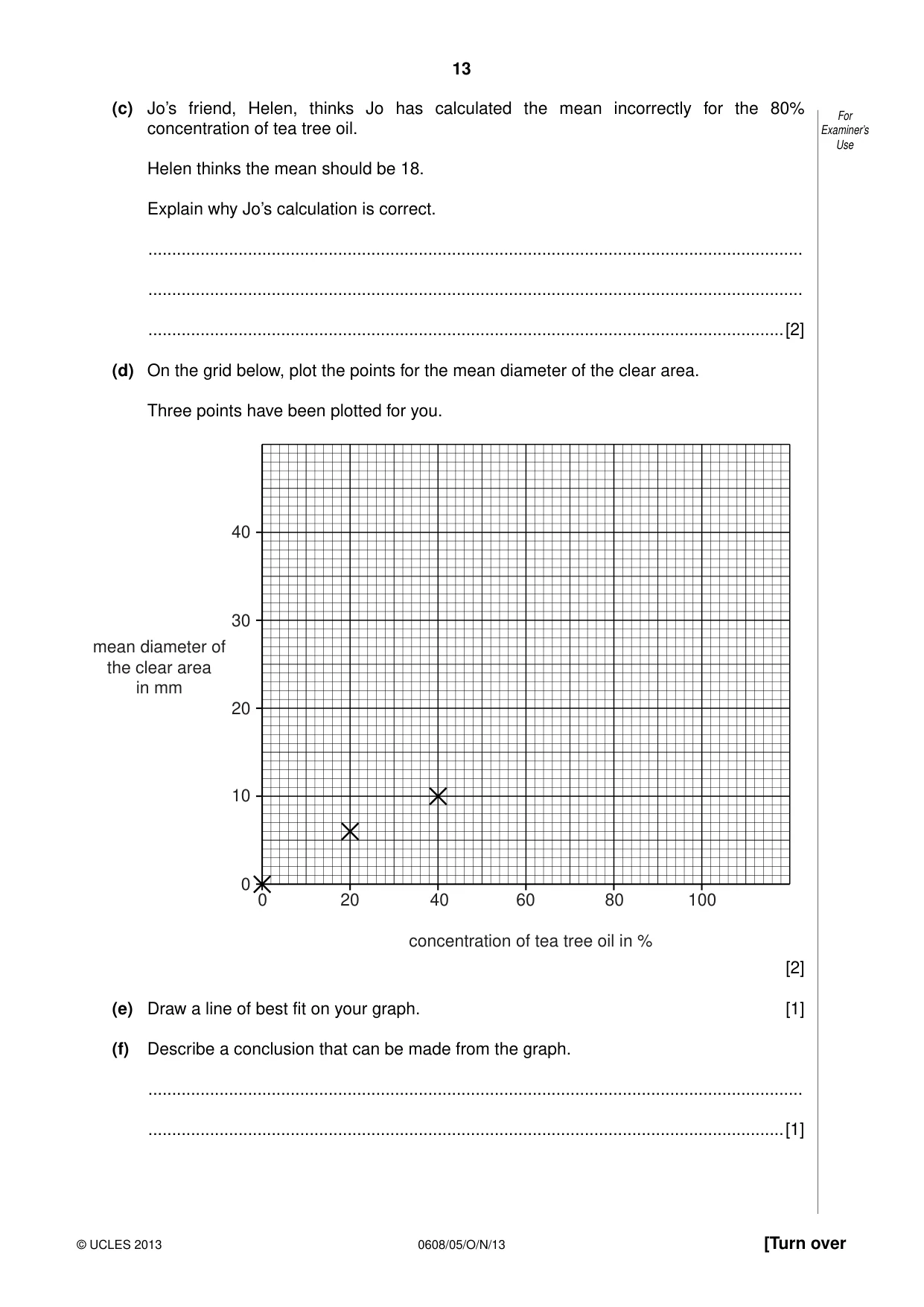
13 0608/05/O/N/13 © UCLES 2013 [Turn over For Examiner’s Use (c) Jo’s friend, Helen, thinks Jo has calculated the mean incorrectly for the 80% concentration of tea tree oil. Helen thinks the mean should be 18. Explain why Jo’s calculation is correct. … … …[2] (d) On the grid below, plot the points for the mean diameter of the clear area. Three points have been plotted for you. 0 0 10 20 30 40 20 40 60 80 100 mean diameter of the clear area in mm concentration of tea tree oil in % [2] (e) Draw a line of best fit on your graph. [1] (f) Describe a conclusion that can be made from the graph. … …[1]
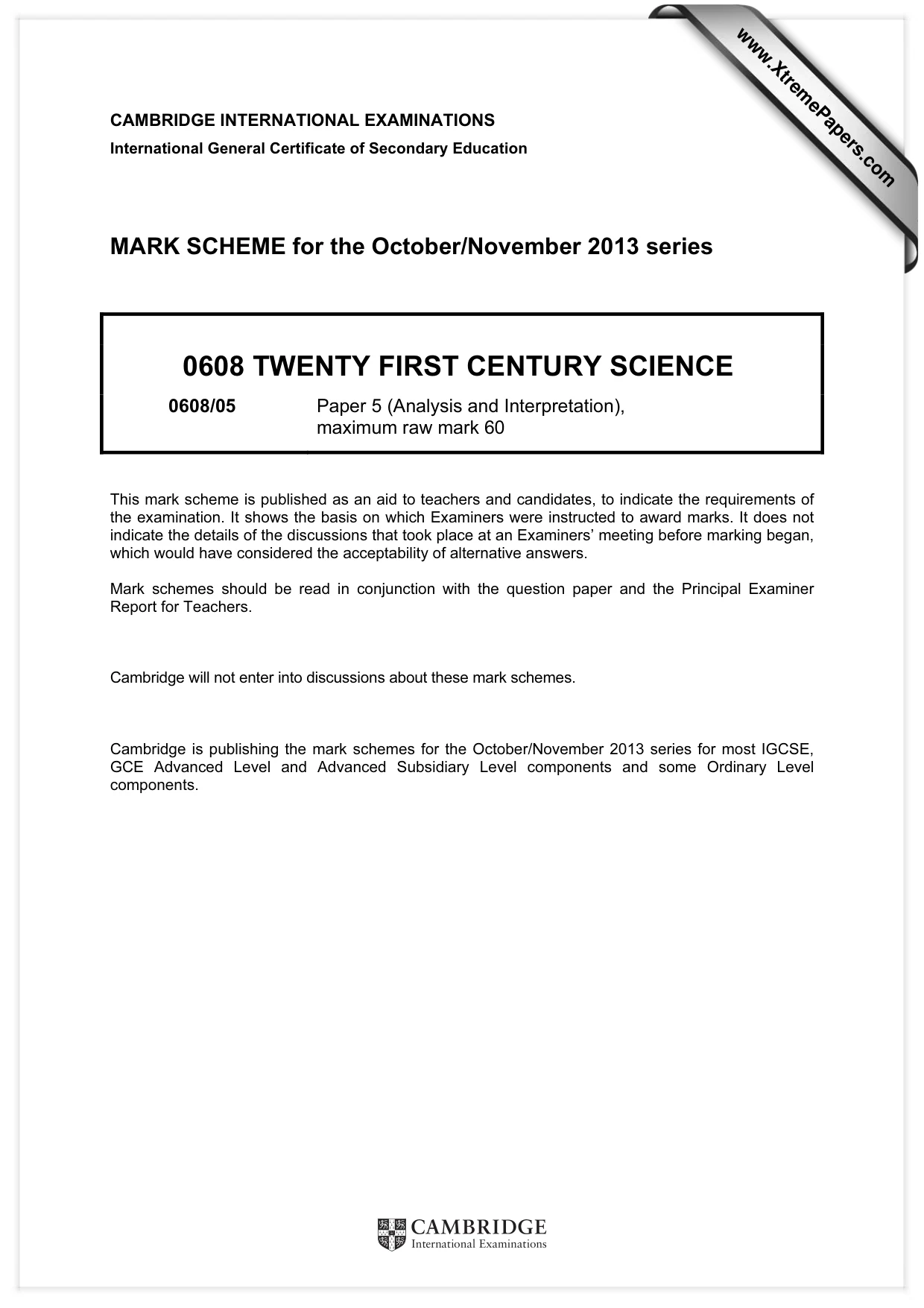
Question paper, page 14
14 0608/05/O/N/13 © UCLES 2013 For Examiner’s Use (g) Suggest and explain one way Jo could improve her experiment. … … … …[2] [Total: 10]
Question paper, page 15
15 0608/05/O/N/13 © UCLES 2013 BLANK PAGE
Question paper, page 16
16 0608/05/O/N/13 © UCLES 2013 Permission to reproduce items where third-party owned material protected by copyright is included has been sought and cleared where possible. Every reasonable effort has been made by the publisher (UCLES) to trace copyright holders, but if any items requiring clearance have unwittingly been included, the publisher will be pleased to make amends at the earliest possible opportunity. University of Cambridge International Examinations is part of the Cambridge Assessment Group. Cambridge Assessment is the brand name of University of Cambridge Local Examinations Syndicate (UCLES), which is itself a department of the University of Cambridge. BLANK PAGE
Mark scheme, page 1
CAMBRIDGE INTERNATIONAL EXAMINATIONS International General Certificate of Secondary Education MARK SCHEME for the October/November 2013 series 0608 TWENTY FIRST CENTURY SCIENCE 0608/05 Paper 5 (Analysis and Interpretation), maximum raw mark 60 This mark scheme is published as an aid to teachers and candidates, to indicate the requirements of the examination. It shows the basis on which Examiners were instructed to award marks. It does not indicate the details of the discussions that took place at an Examiners’ meeting before marking began, which would have considered the acceptability of alternative answers. Mark schemes should be read in conjunction with the question paper and the Principal Examiner Report for Teachers. Cambridge will not enter into discussions about these mark schemes. Cambridge is publishing the mark schemes for the October/November 2013 series for most IGCSE, GCE Advanced Level and Advanced Subsidiary Level components and some Ordinary Level components. www.XtremePapers.com
Mark scheme, page 2
Page 2 Mark Scheme Syllabus Paper IGCSE – October/November 2013 0608 05 © Cambridge International Examinations 2013 Question Expected Answers Mks Additional Guidance 1 (a) carbon monoxide / carbon dioxide / nitrogen monoxide / nitrogen dioxide (1) causes breathing difficulties (CO/NO/NO2) / acid rain (NO2) / global warming or greenhouse effect (CO2) (1) 2 allow CO / CO2 / NO / NO2 / NOx reason must match pollutant gas for second mark (b) is ionising (1) kills/damages cells / can cause cancer (1) 2 (c) chlorofluorocarbon / CFC (1) refrigerators/aerosol sprays/spray cans (1) 2 (d) ozone concentration low over S pole (1) use of correct numerical data (1) 2 allow ozone hole over south pole (e) risk over-rated / benefit outweighs risk (1) want to look tanned/healthy (1) don’t think it will happen to them (1) they use sunblock/suntan lotion (1) 2 any two Allow it forms vitamin D (in the skin) (f) affects their companies/economy (1) cannot afford alternatives / alternatives are more expensive (1) do not trust countries wanting restriction / not convinced by the evidence (1) 2 any two (g) (i) forces/pushes contents out of can (1) 1 (ii) CFC: risk is damage to ozone layer (1) propane: risk is contents flammable (1) 2 [Total: 15] 2 (a) as pollution/particulates increases risk of heart disease increases / more pollution the more people get heart disease 1 allow AW (b) Inhaled / breathed into lungs (1) pass into blood/blood vessels (1) 2 (c) (i) (coronary) artery 1 (ii) to supply oxygen/glucose (1) heart muscle needs a large supply of oxygen/glucose (as working hard) (1) cannot get oxygen/glucose from the blood going through the heart (1) 2 any two allow to remove carbon dioxide (iii) cause narrowing of (coronary) arteries (1) less blood/oxygen reaching the heart (1) heart muscle dies (1) 3 do not allow ‘affects blood flow’
Mark scheme, page 3
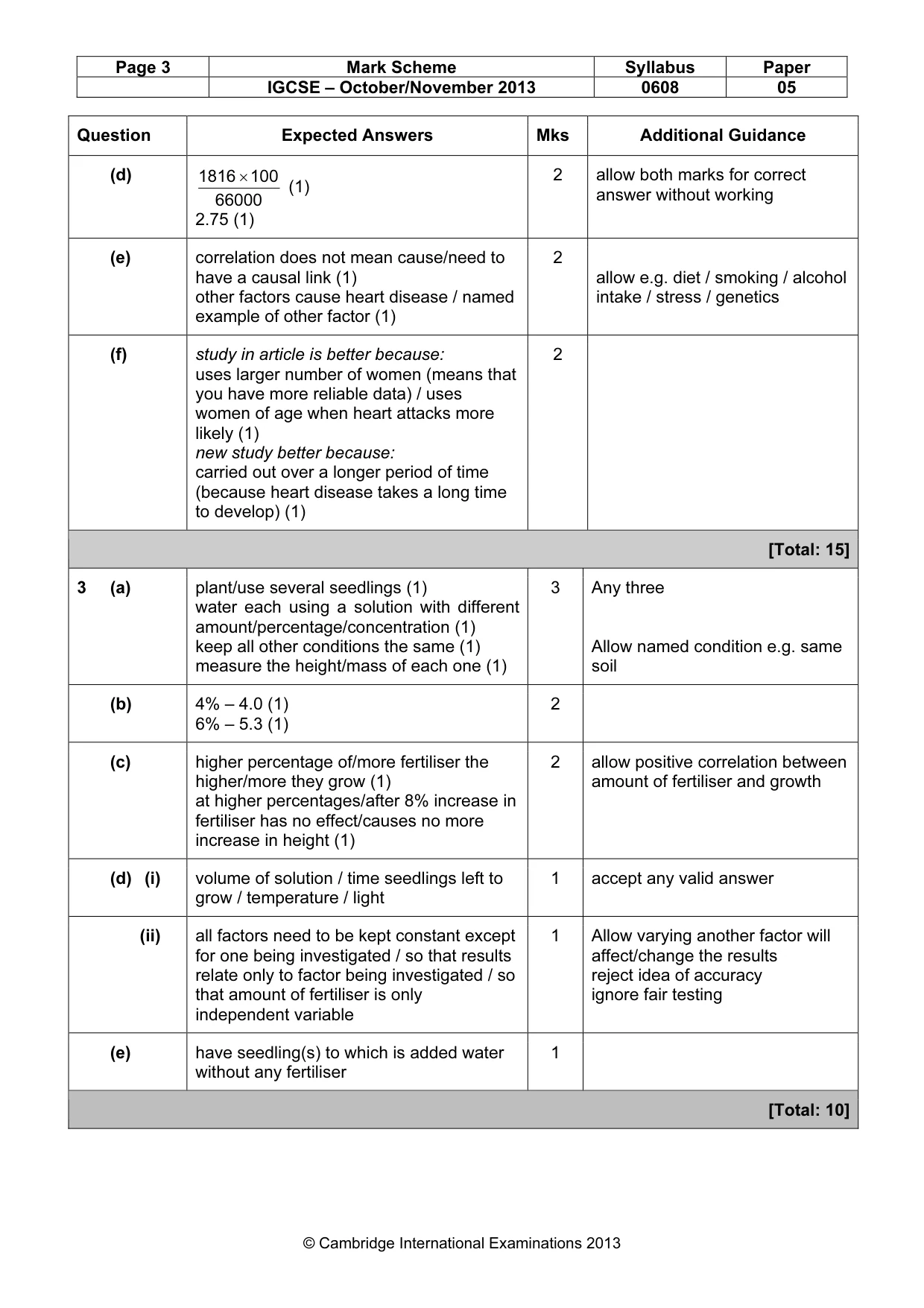
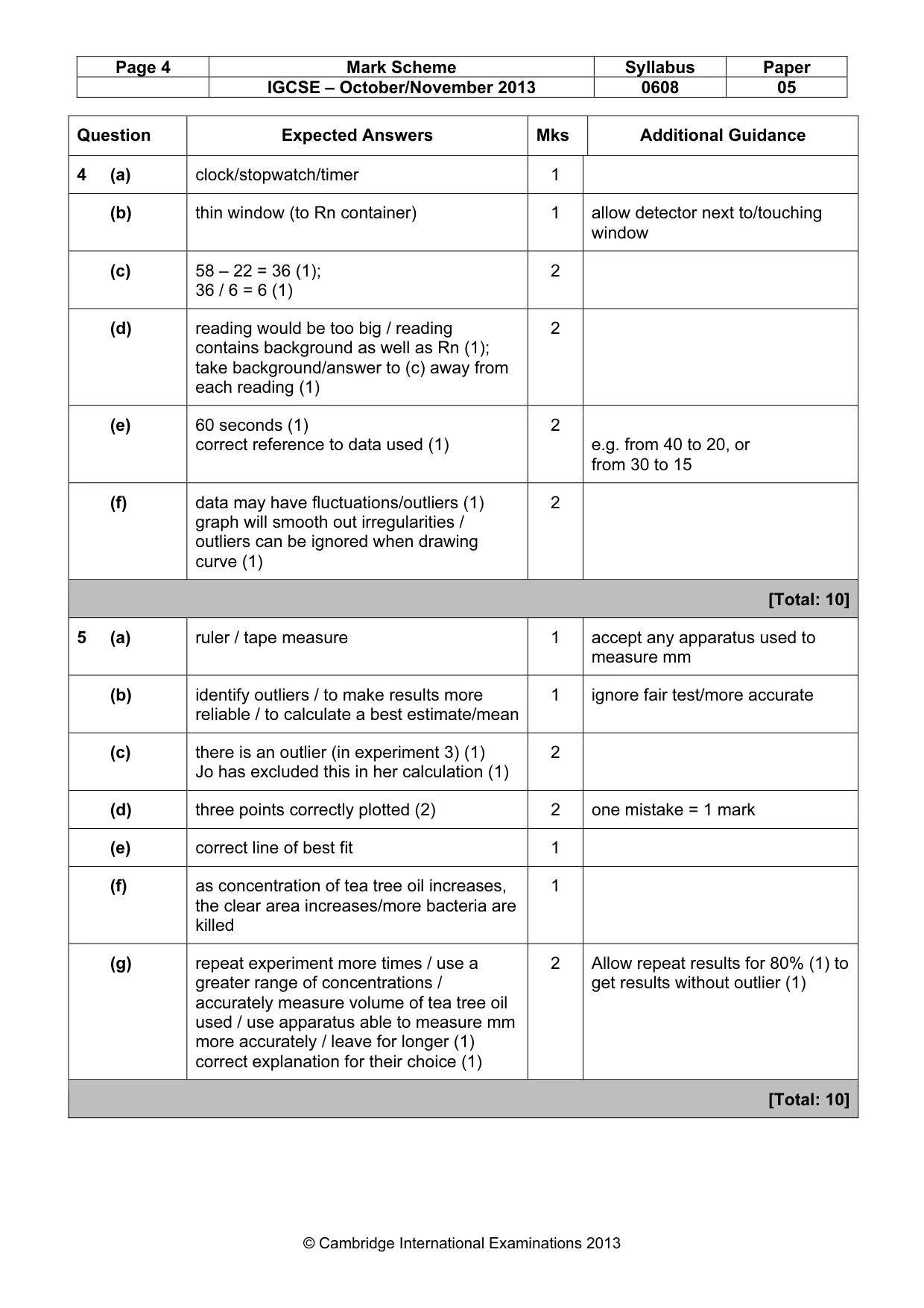
Page 3 Mark Scheme Syllabus Paper IGCSE – October/November 2013 0608 05 © Cambridge International Examinations 2013 Question Expected Answers Mks Additional Guidance (d) 66000 100 1816 × (1) 2.75 (1) 2 allow both marks for correct answer without working (e) correlation does not mean cause/need to have a causal link (1) other factors cause heart disease / named example of other factor (1) 2 allow e.g. diet / smoking / alcohol intake / stress / genetics (f) study in article is better because: uses larger number of women (means that you have more reliable data) / uses women of age when heart attacks more likely (1) new study better because: carried out over a longer period of time (because heart disease takes a long time to develop) (1) 2 [Total: 15] 3 (a) plant/use several seedlings (1) water each using a solution with different amount/percentage/concentration (1) keep all other conditions the same (1) measure the height/mass of each one (1) 3 Any three Allow named condition e.g. same soil (b) 4% – 4.0 (1) 6% – 5.3 (1) 2 (c) higher percentage of/more fertiliser the higher/more they grow (1) at higher percentages/after 8% increase in fertiliser has no effect/causes no more increase in height (1) 2 allow positive correlation between amount of fertiliser and growth (d) (i) volume of solution / time seedlings left to grow / temperature / light 1 accept any valid answer (ii) all factors need to be kept constant except for one being investigated / so that results relate only to factor being investigated / so that amount of fertiliser is only independent variable 1 Allow varying another factor will affect/change the results reject idea of accuracy ignore fair testing (e) have seedling(s) to which is added water without any fertiliser 1 [Total: 10]
Mark scheme, page 4
Page 4 Mark Scheme Syllabus Paper IGCSE – October/November 2013 0608 05 © Cambridge International Examinations 2013 Question Expected Answers Mks Additional Guidance 4 (a) clock/stopwatch/timer 1 (b) thin window (to Rn container) 1 allow detector next to/touching window (c) 58 – 22 = 36 (1); 36 / 6 = 6 (1) 2 (d) reading would be too big / reading contains background as well as Rn (1); take background/answer to (c) away from each reading (1) 2 (e) 60 seconds (1) correct reference to data used (1) 2 e.g. from 40 to 20, or from 30 to 15 (f) data may have fluctuations/outliers (1) graph will smooth out irregularities / outliers can be ignored when drawing curve (1) 2 [Total: 10] 5 (a) ruler / tape measure 1 accept any apparatus used to measure mm (b) identify outliers / to make results more reliable / to calculate a best estimate/mean 1 ignore fair test/more accurate (c) there is an outlier (in experiment 3) (1) Jo has excluded this in her calculation (1) 2 (d) three points correctly plotted (2) 2 one mistake = 1 mark (e) correct line of best fit 1 (f) as concentration of tea tree oil increases, the clear area increases/more bacteria are killed 1 (g) repeat experiment more times / use a greater range of concentrations / accurately measure volume of tea tree oil used / use apparatus able to measure mm more accurately / leave for longer (1) correct explanation for their choice (1) 2 Allow repeat results for 80% (1) to get results without outlier (1) [Total: 10]