Cambridge IGCSE Twenty-First Century Science 0608 — 2011 Oct/Nov Paper 5 · Variant 1
0608/51/O/N/11 · 60 marks · ≈68 min
The question paper and its mark scheme, free to read here and free to download. This is Cambridge’s own paper, exactly as it was sat.
Question paper16 pages
Mark scheme4 pages
Answers below. Sit the paper first if you are practising.
Paper as text
Question paper, page 1
This document consists of 15 printed pages and 1 blank page. DC (NF/CGW) 36192/2 © UCLES 2011 [Turn over UNIVERSITY OF CAMBRIDGE INTERNATIONAL EXAMINATIONS International General Certificate of Secondary Education * 3 5 8 1 7 5 9 7 7 2 * TWENTY FIRST CENTURY SCIENCE 0608/05 Paper 5 October/November 2011 1 hour 30 minutes Candidates answer on the Question Paper. No Additional Materials are required. READ THESE INSTRUCTIONS FIRST Write your Centre number, candidate number and name on all the work you hand in. Write in dark blue or black pen. You may use a pencil for any diagrams or graphs. Do not use staples, paper clips, highlighters, glue or correction fluid. DO NOT WRITE IN ANY BARCODES. Answer all questions. At the end of the examination, fasten all your work securely together. The number of marks is given in brackets [ ] at the end of each question or part question. For Examiner’s Use 1 2 3 4 Total www.XtremePapers.com
Question paper, page 2
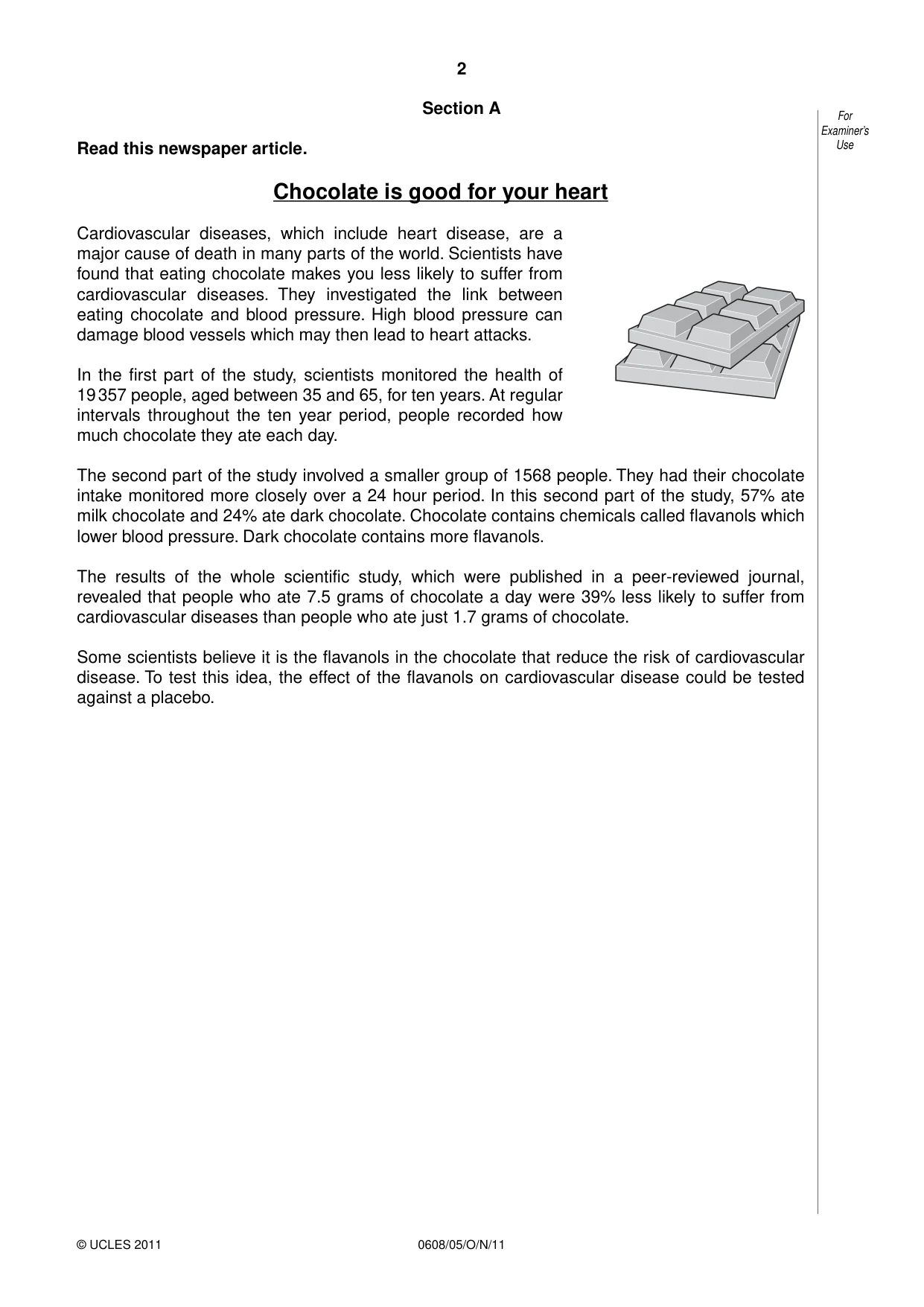
2 0608/05/O/N/11 © UCLES 2011 For Examiner’s Use Section A Read this newspaper article. Chocolate is good for your heart Cardiovascular diseases, which include heart disease, are a major cause of death in many parts of the world. Scientists have found that eating chocolate makes you less likely to suffer from cardiovascular diseases. They investigated the link between eating chocolate and blood pressure. High blood pressure can damage blood vessels which may then lead to heart attacks. In the first part of the study, scientists monitored the health of 19 357 people, aged between 35 and 65, for ten years. At regular intervals throughout the ten year period, people recorded how much chocolate they ate each day. The second part of the study involved a smaller group of 1568 people. They had their chocolate intake monitored more closely over a 24 hour period. In this second part of the study, 57% ate milk chocolate and 24% ate dark chocolate. Chocolate contains chemicals called flavanols which lower blood pressure. Dark chocolate contains more flavanols. The results of the whole scientific study, which were published in a peer-reviewed journal, revealed that people who ate 7.5 grams of chocolate a day were 39% less likely to suffer from cardiovascular diseases than people who ate just 1.7 grams of chocolate. Some scientists believe it is the flavanols in the chocolate that reduce the risk of cardiovascular disease. To test this idea, the effect of the flavanols on cardiovascular disease could be tested against a placebo.
Question paper, page 3
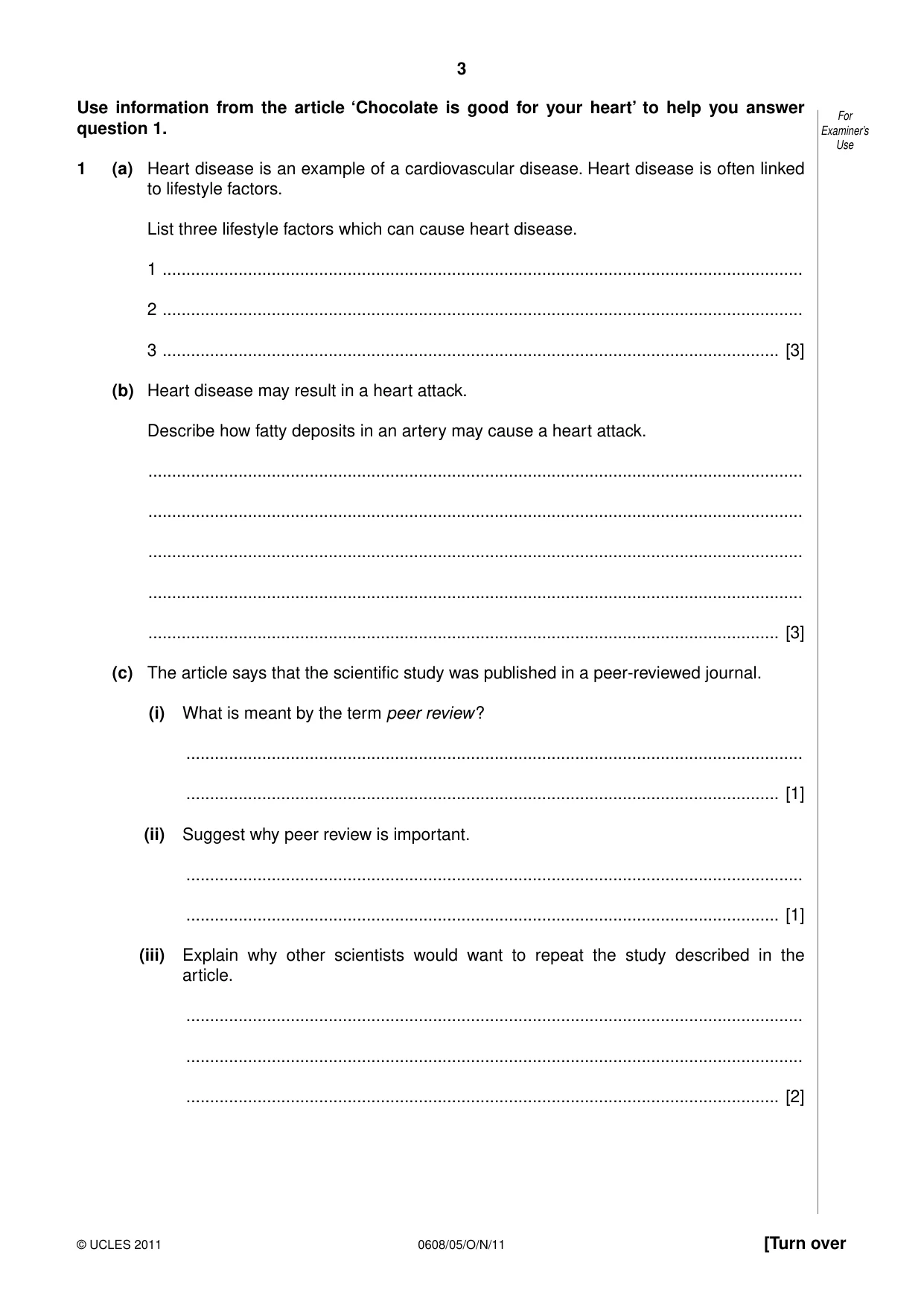
3 0608/05/O/N/11 © UCLES 2011 [Turn over For Examiner’s Use Use information from the article ‘Chocolate is good for your heart’ to help you answer question 1. 1 (a) Heart disease is an example of a cardiovascular disease. Heart disease is often linked to lifestyle factors. List three lifestyle factors which can cause heart disease. 1 … 2 … 3 … [3] (b) Heart disease may result in a heart attack. Describe how fatty deposits in an artery may cause a heart attack. … … … … … [3] (c) The article says that the scientific study was published in a peer-reviewed journal. (i) What is meant by the term peer review? … … [1] (ii) Suggest why peer review is important. … … [1] (iii) Explain why other scientists would want to repeat the study described in the article. … … … [2]
Question paper, page 4
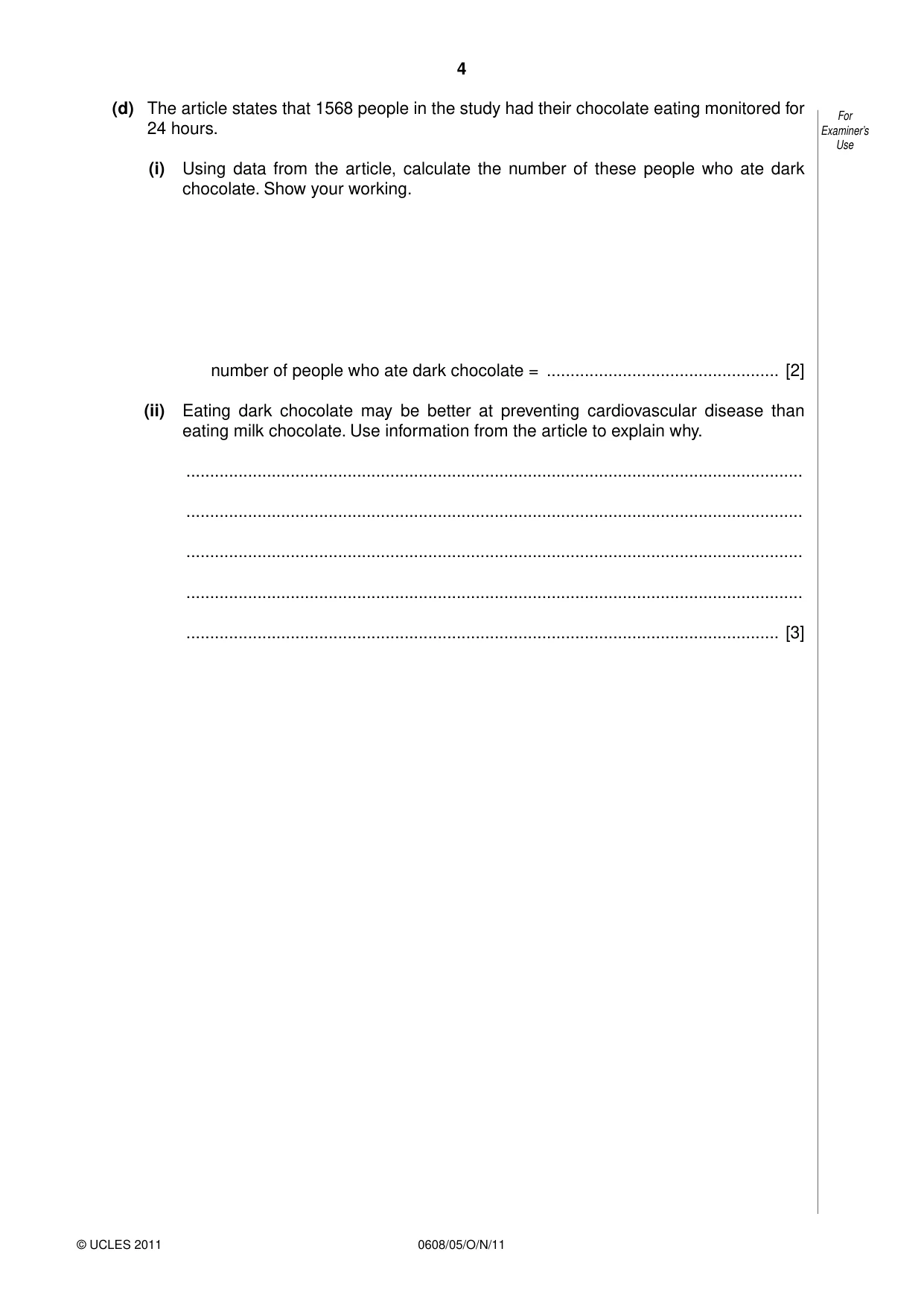
4 0608/05/O/N/11 © UCLES 2011 For Examiner’s Use (d) The article states that 1568 people in the study had their chocolate eating monitored for 24 hours. (i) Using data from the article, calculate the number of these people who ate dark chocolate. Show your working. number of people who ate dark chocolate = … [2] (ii) Eating dark chocolate may be better at preventing cardiovascular disease than eating milk chocolate. Use information from the article to explain why. … … … … … [3]
Question paper, page 5
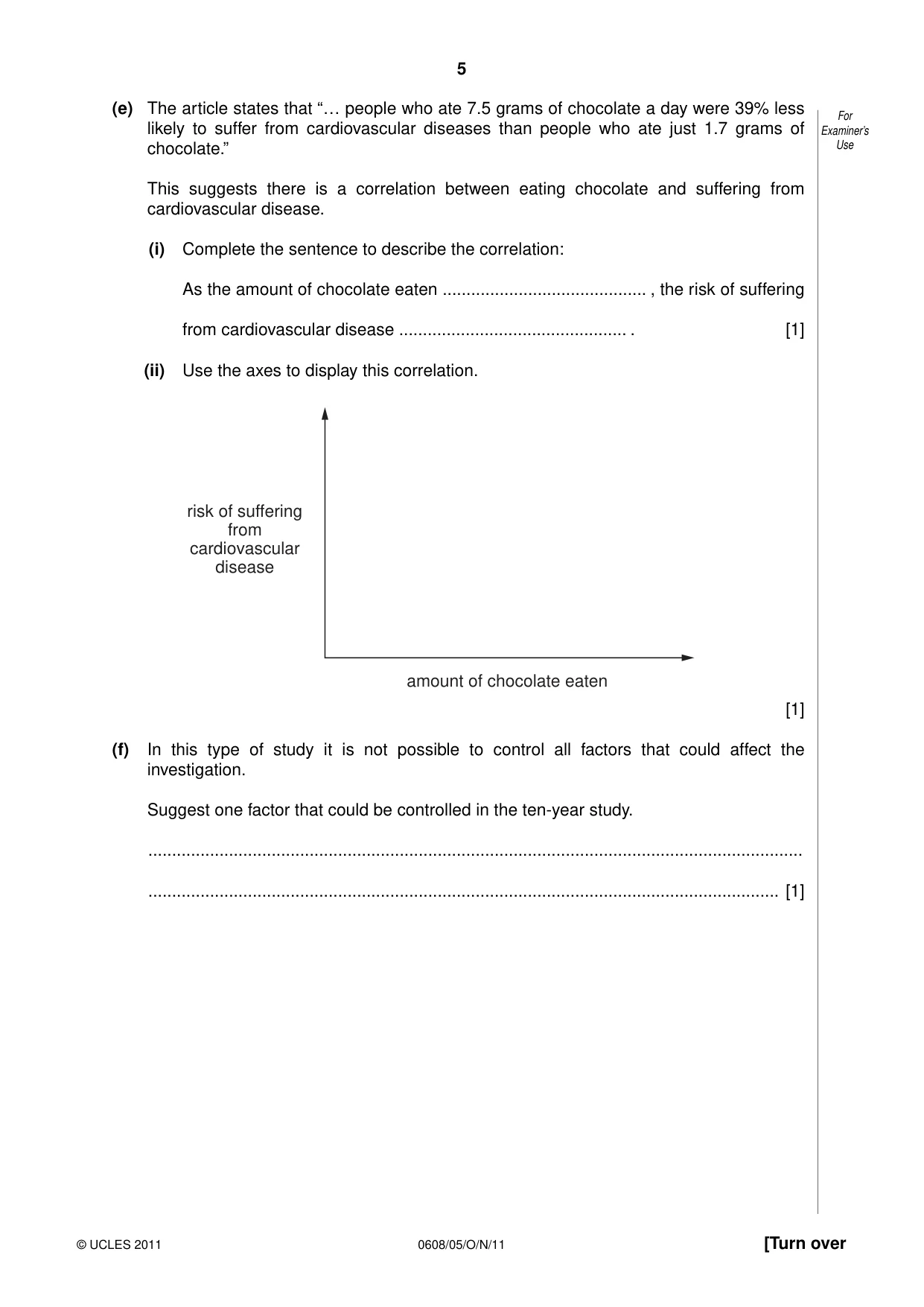
5 0608/05/O/N/11 © UCLES 2011 [Turn over For Examiner’s Use (e) The article states that “… people who ate 7.5 grams of chocolate a day were 39% less likely to suffer from cardiovascular diseases than people who ate just 1.7 grams of chocolate.” This suggests there is a correlation between eating chocolate and suffering from cardiovascular disease. (i) Complete the sentence to describe the correlation: As the amount of chocolate eaten … , the risk of suffering from cardiovascular disease … . [1] (ii) Use the axes to display this correlation. risk of suffering from cardiovascular disease amount of chocolate eaten [1] (f) In this type of study it is not possible to control all factors that could affect the investigation. Suggest one factor that could be controlled in the ten-year study. … … [1]
Question paper, page 6
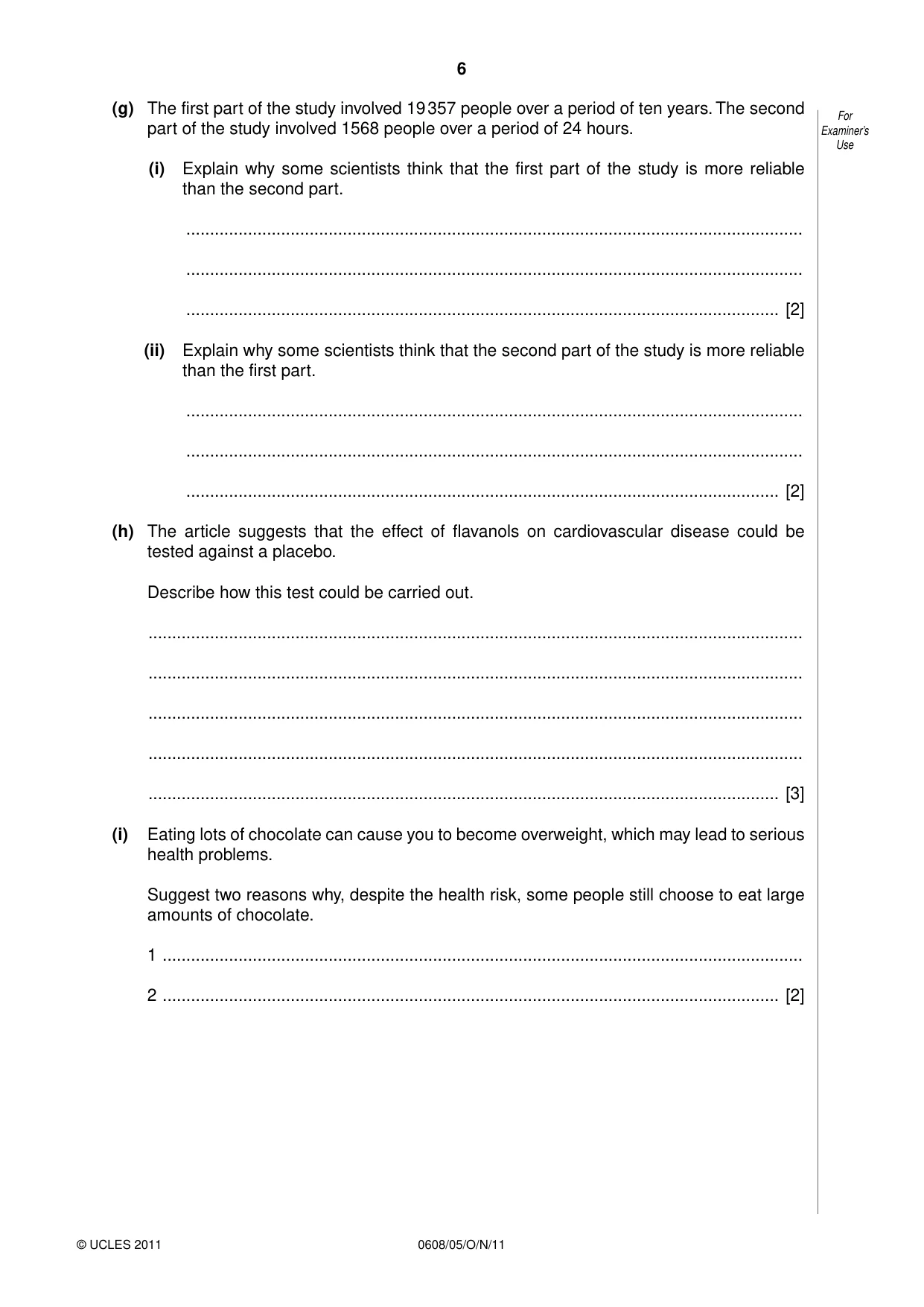
6 0608/05/O/N/11 © UCLES 2011 For Examiner’s Use (g) The first part of the study involved 19 357 people over a period of ten years. The second part of the study involved 1568 people over a period of 24 hours. (i) Explain why some scientists think that the first part of the study is more reliable than the second part. … … … [2] (ii) Explain why some scientists think that the second part of the study is more reliable than the first part. … … … [2] (h) The article suggests that the effect of flavanols on cardiovascular disease could be tested against a placebo. Describe how this test could be carried out. … … … … … [3] (i) Eating lots of chocolate can cause you to become overweight, which may lead to serious health problems. Suggest two reasons why, despite the health risk, some people still choose to eat large amounts of chocolate. 1 … 2 … [2]
Question paper, page 7
7 0608/05/O/N/11 © UCLES 2011 [Turn over For Examiner’s Use (j) Chocolate can be eaten as part of a balanced diet. Chocolate contains lots of carbohydrate and fat. Other than carbohydrate and fat, list three components of a balanced diet. 1 … 2 … 3 … [3] [Total: 30]
Question paper, page 8
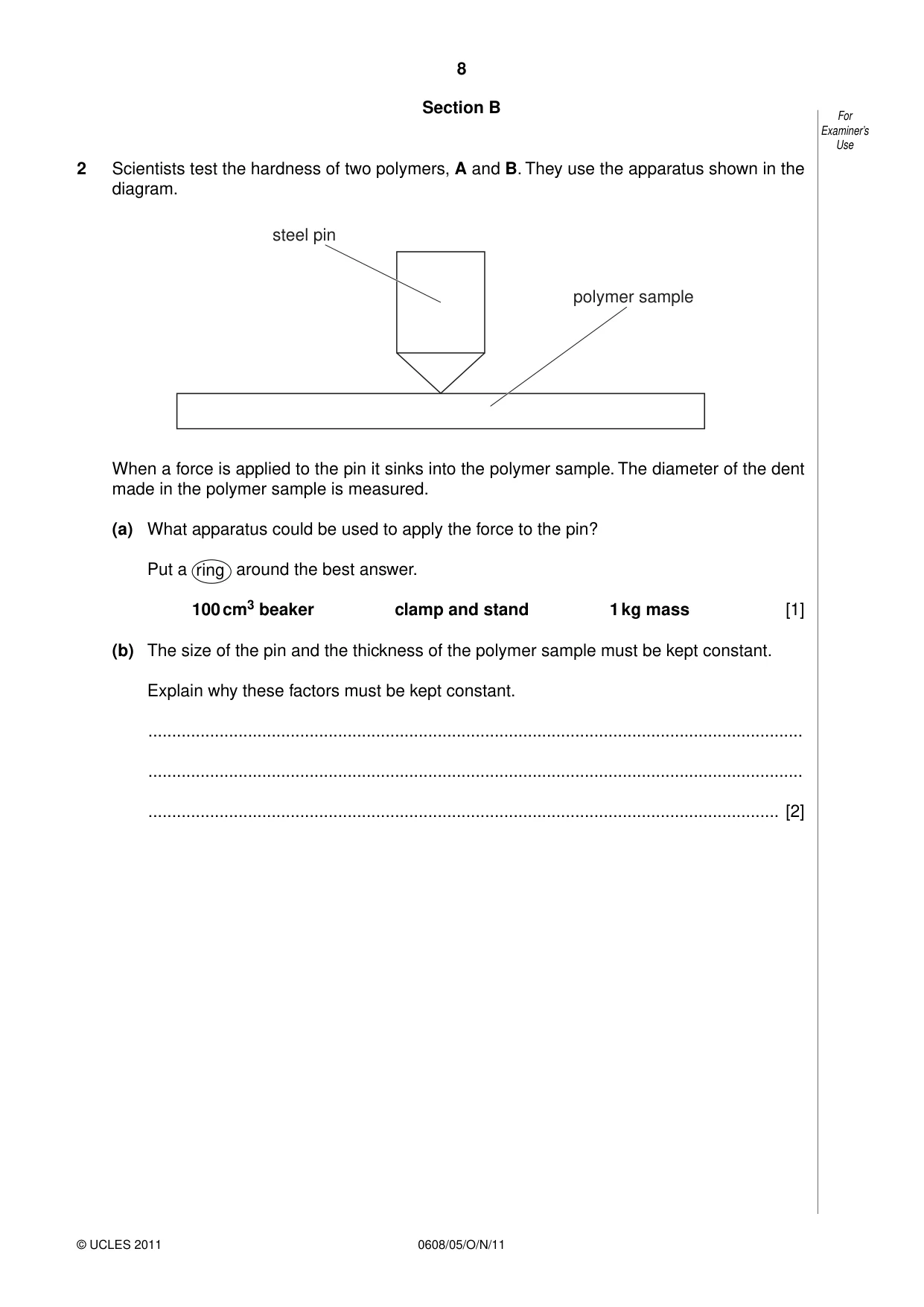
8 0608/05/O/N/11 © UCLES 2011 For Examiner’s Use Section B 2 Scientists test the hardness of two polymers, A and B. They use the apparatus shown in the diagram. steel pin polymer sample When a force is applied to the pin it sinks into the polymer sample. The diameter of the dent made in the polymer sample is measured. (a) What apparatus could be used to apply the force to the pin? Put a ring around the best answer. 100 cm3 beaker clamp and stand 1 kg mass [1] (b) The size of the pin and the thickness of the polymer sample must be kept constant. Explain why these factors must be kept constant. … … … [2]
Question paper, page 9
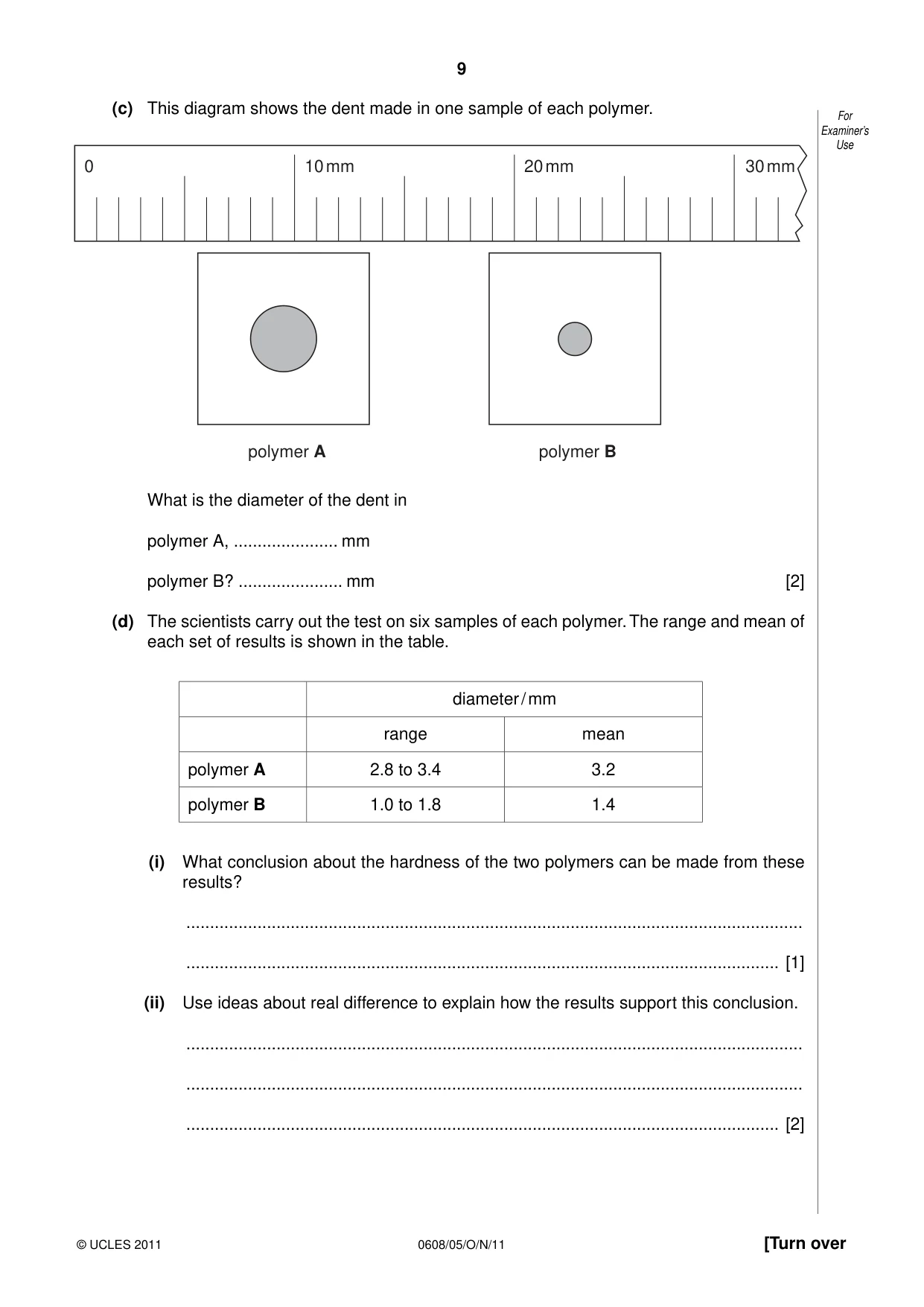
9 0608/05/O/N/11 © UCLES 2011 [Turn over For Examiner’s Use (c) This diagram shows the dent made in one sample of each polymer. polymer A polymer B 20 mm 30 mm 10 mm 0 What is the diameter of the dent in polymer A, … mm polymer B? … mm [2] (d) The scientists carry out the test on six samples of each polymer. The range and mean of each set of results is shown in the table. diameter / mm range mean polymer A 2.8 to 3.4 3.2 polymer B 1.0 to 1.8 1.4 (i) What conclusion about the hardness of the two polymers can be made from these results? … … [1] (ii) Use ideas about real difference to explain how the results support this conclusion. … … … [2]
Question paper, page 10
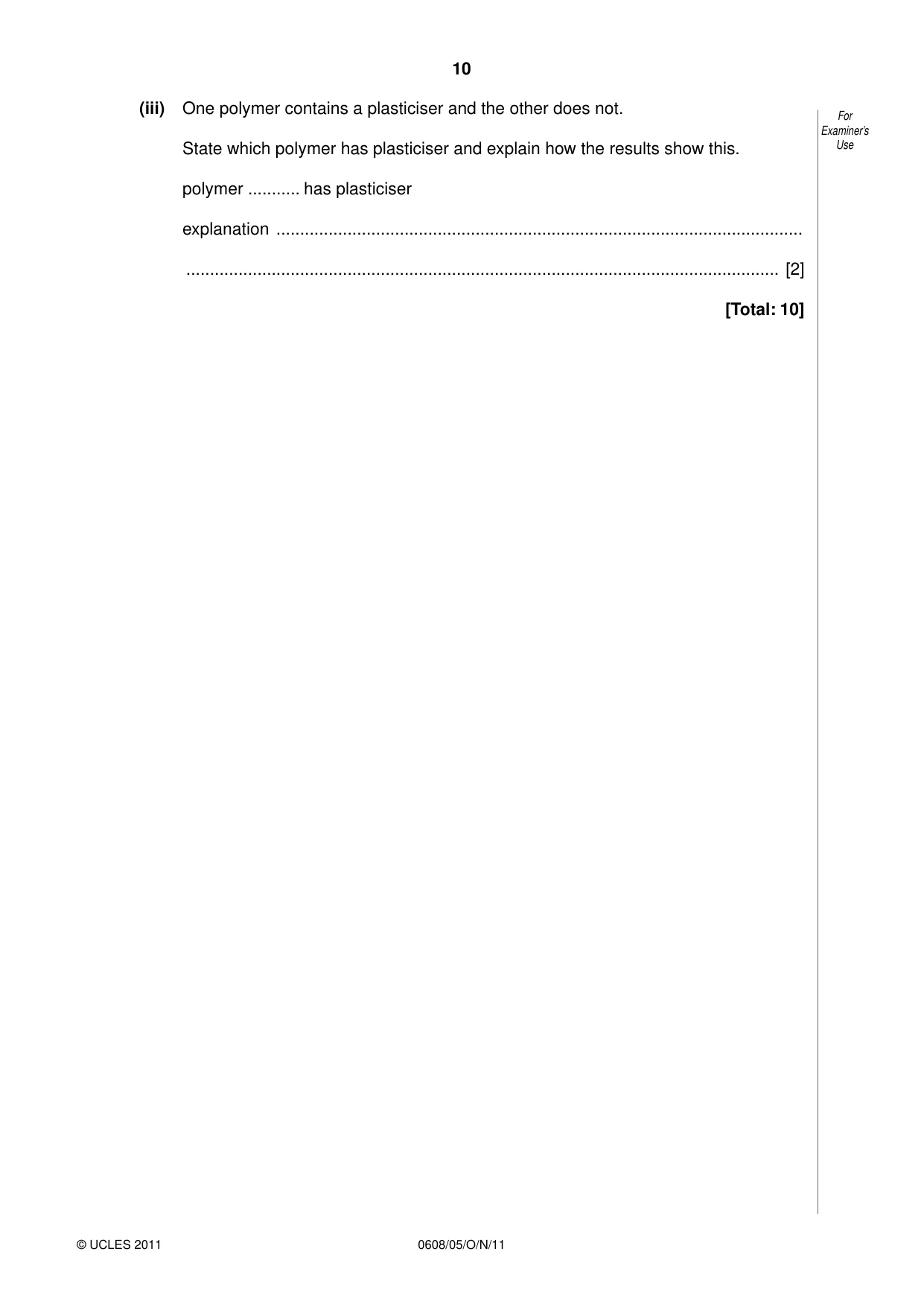
10 0608/05/O/N/11 © UCLES 2011 For Examiner’s Use (iii) One polymer contains a plasticiser and the other does not. State which polymer has plasticiser and explain how the results show this. polymer … has plasticiser explanation … … [2] [Total: 10]
Question paper, page 11
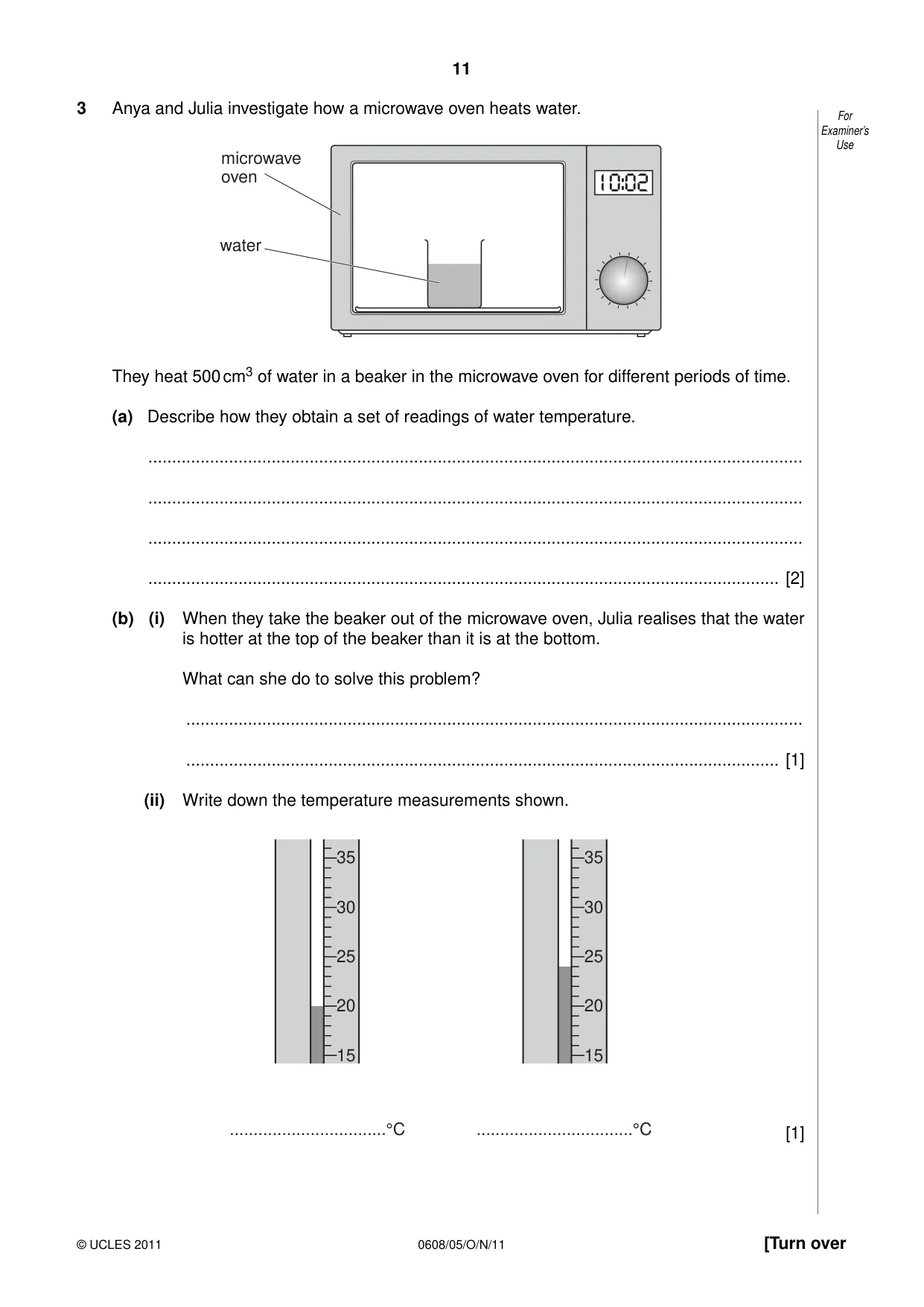
11 0608/05/O/N/11 © UCLES 2011 [Turn over For Examiner’s Use 3 Anya and Julia investigate how a microwave oven heats water. 10:02 water microwave oven They heat 500 cm3 of water in a beaker in the microwave oven for different periods of time. (a) Describe how they obtain a set of readings of water temperature. … … … … [2] (b) (i) When they take the beaker out of the microwave oven, Julia realises that the water is hotter at the top of the beaker than it is at the bottom. What can she do to solve this problem? … … [1] (ii) Write down the temperature measurements shown. 15 20 …°C …°C 25 35 30 15 20 25 35 30 [1]
Question paper, page 12
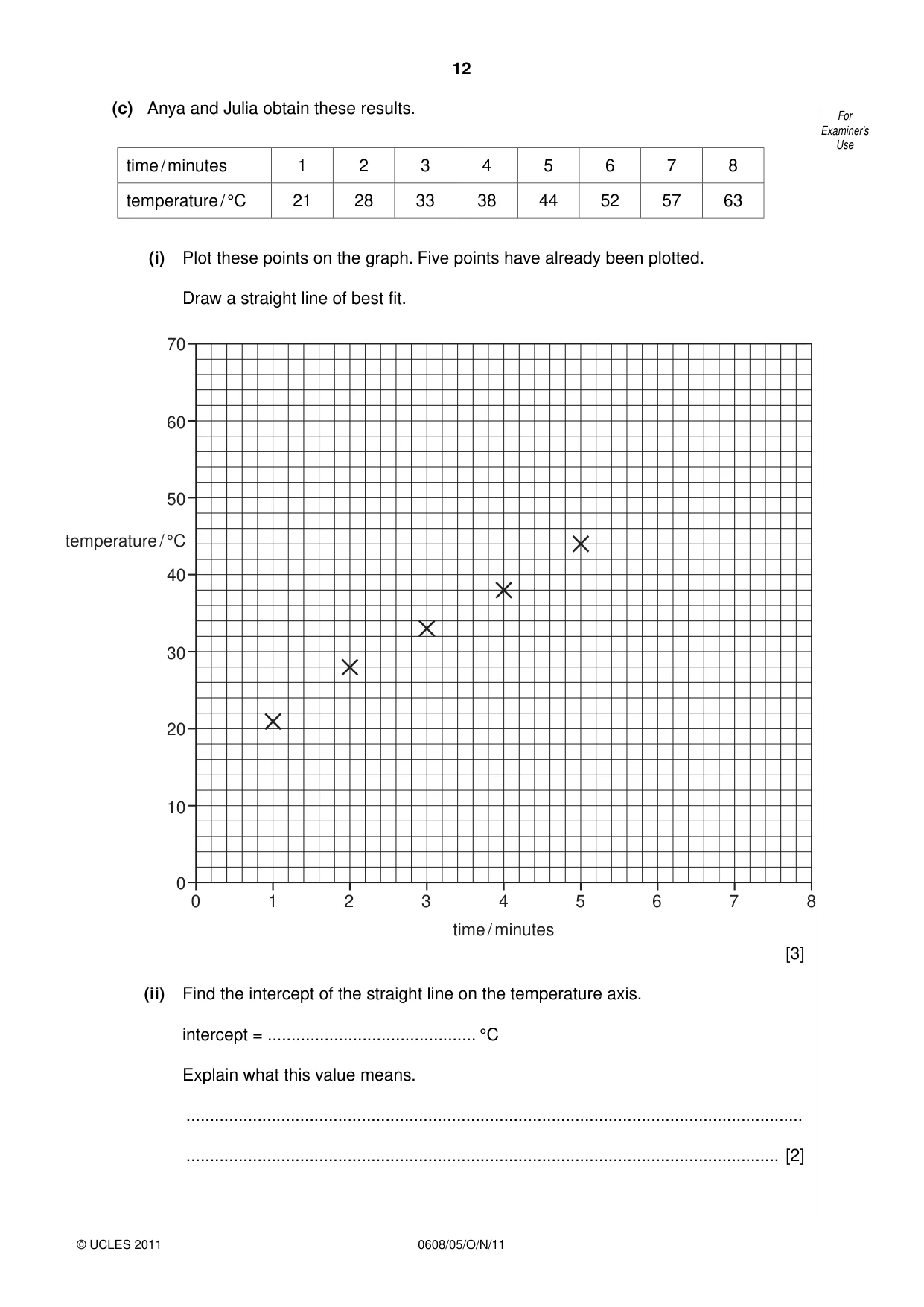
12 0608/05/O/N/11 © UCLES 2011 For Examiner’s Use (c) Anya and Julia obtain these results. time / minutes 1 2 3 4 5 6 7 8 temperature / °C 21 28 33 38 44 52 57 63 (i) Plot these points on the graph. Five points have already been plotted. Draw a straight line of best fit. 70 60 50 40 30 20 10 0 1 2 3 4 time / minutes temperature / °C 5 8 6 7 0 [3] (ii) Find the intercept of the straight line on the temperature axis. intercept = … °C Explain what this value means. … … [2]
Question paper, page 13
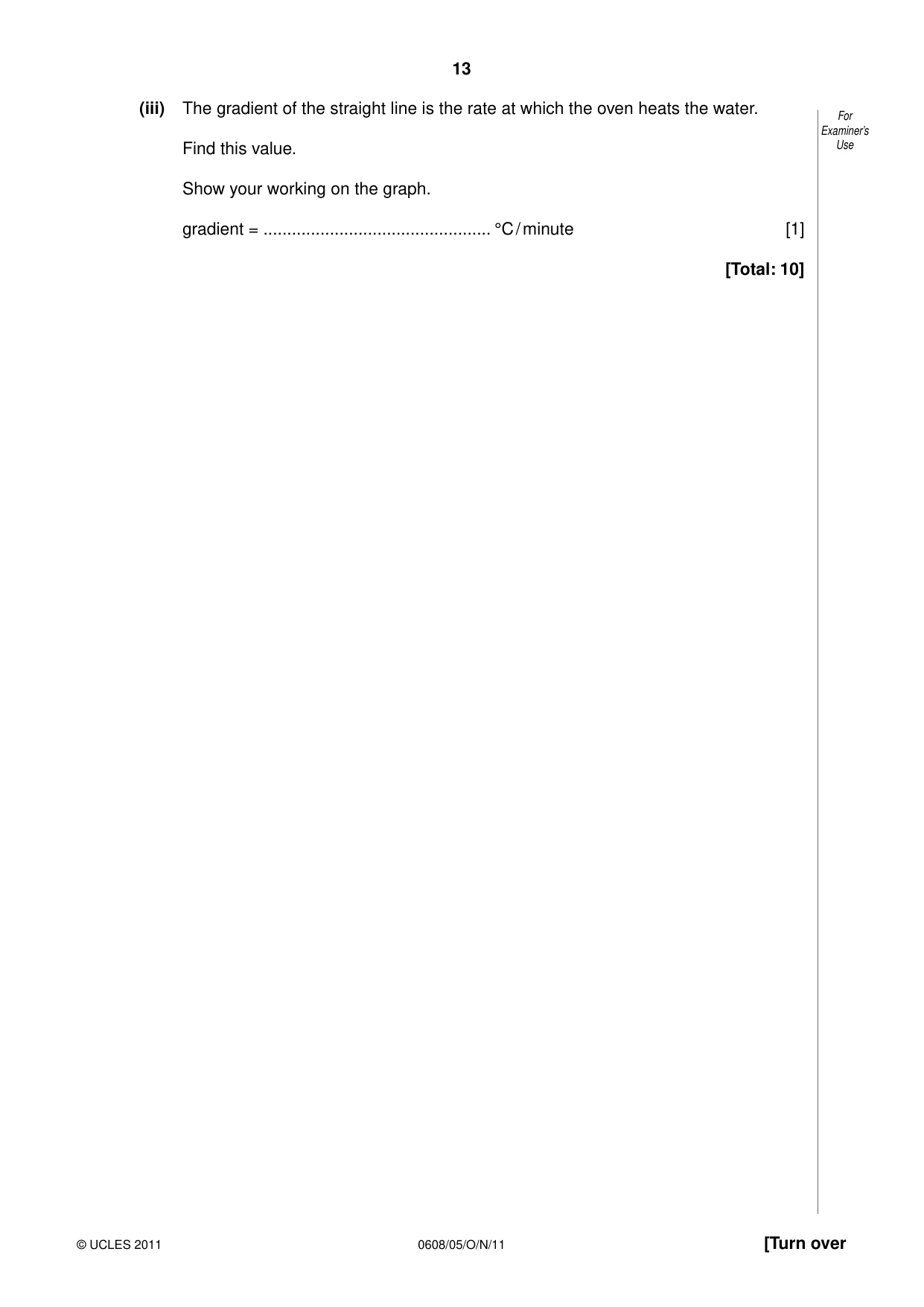
13 0608/05/O/N/11 © UCLES 2011 [Turn over For Examiner’s Use (iii) The gradient of the straight line is the rate at which the oven heats the water. Find this value. Show your working on the graph. gradient = … °C / minute [1] [Total: 10]
Question paper, page 14
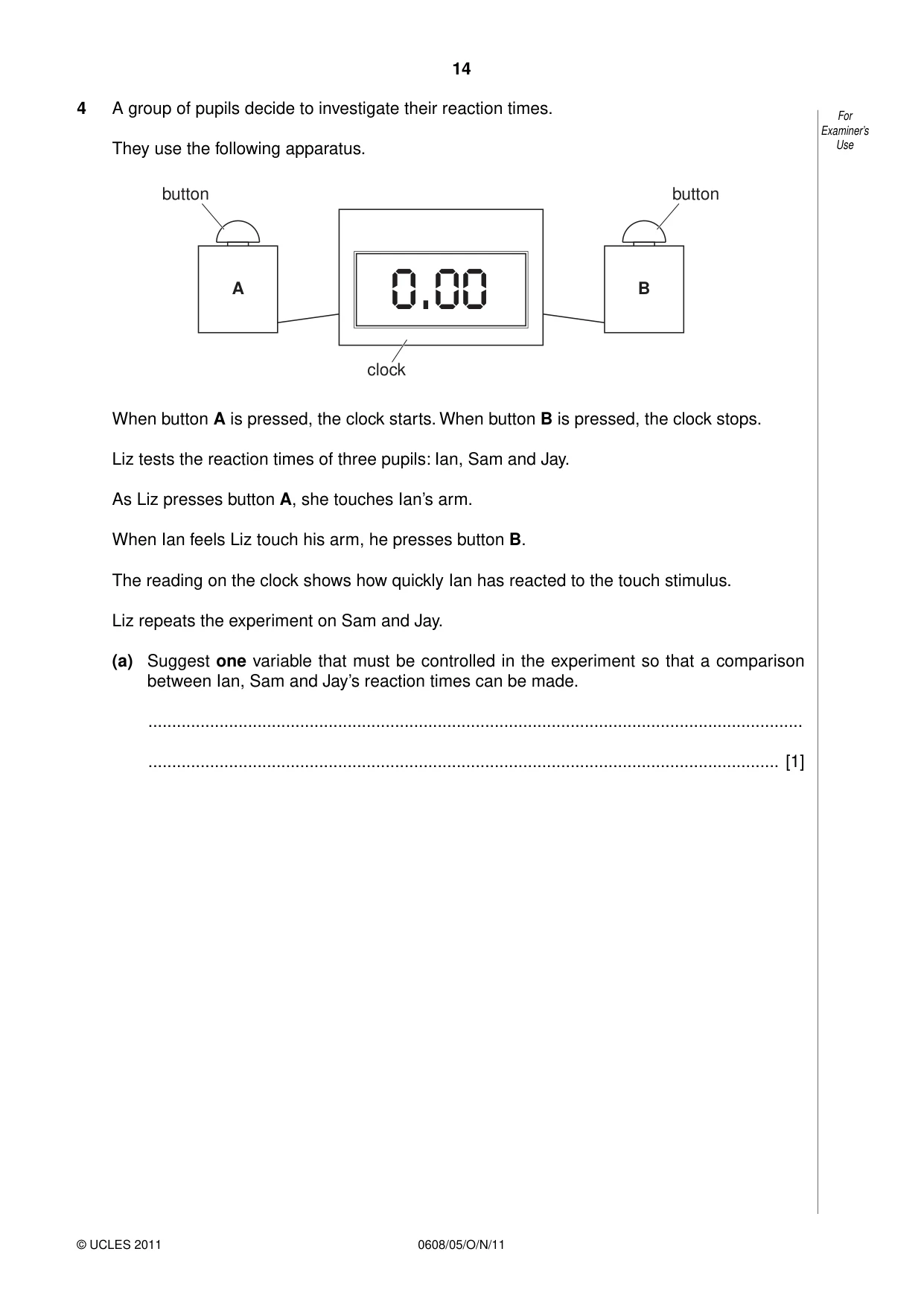
14 0608/05/O/N/11 © UCLES 2011 For Examiner’s Use 4 A group of pupils decide to investigate their reaction times. They use the following apparatus. button button 0 . 00 clock A B When button A is pressed, the clock starts. When button B is pressed, the clock stops. Liz tests the reaction times of three pupils: Ian, Sam and Jay. As Liz presses button A, she touches Ian’s arm. When Ian feels Liz touch his arm, he presses button B. The reading on the clock shows how quickly Ian has reacted to the touch stimulus. Liz repeats the experiment on Sam and Jay. (a) Suggest one variable that must be controlled in the experiment so that a comparison between Ian, Sam and Jay’s reaction times can be made. … … [1]
Question paper, page 15
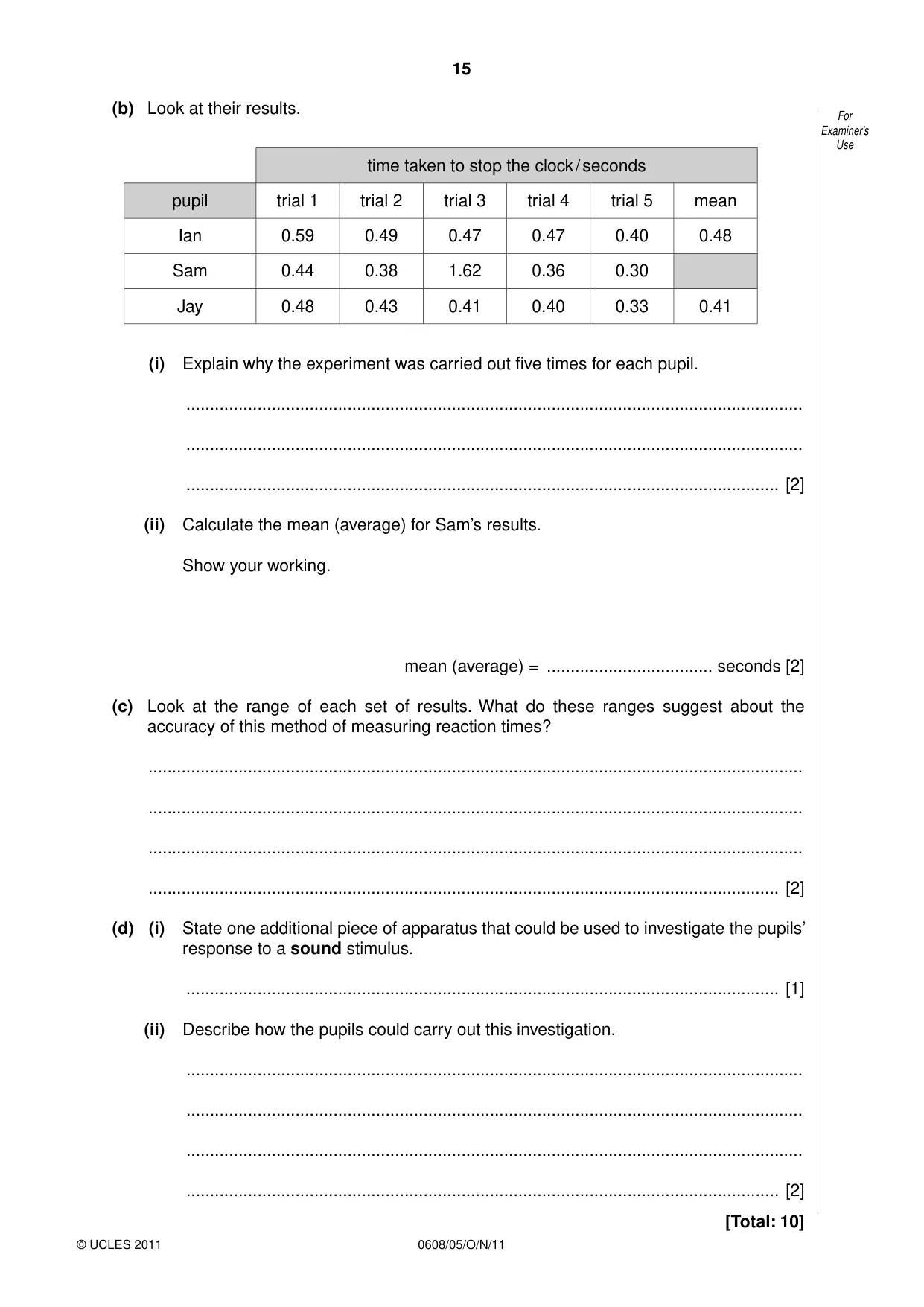
15 0608/05/O/N/11 © UCLES 2011 For Examiner’s Use (b) Look at their results. time taken to stop the clock / seconds pupil trial 1 trial 2 trial 3 trial 4 trial 5 mean Ian 0.59 0.49 0.47 0.47 0.40 0.48 Sam 0.44 0.38 1.62 0.36 0.30 Jay 0.48 0.43 0.41 0.40 0.33 0.41 (i) Explain why the experiment was carried out five times for each pupil. … … … [2] (ii) Calculate the mean (average) for Sam’s results. Show your working. mean (average) = … seconds [2] (c) Look at the range of each set of results. What do these ranges suggest about the accuracy of this method of measuring reaction times? … … … … [2] (d) (i) State one additional piece of apparatus that could be used to investigate the pupils’ response to a sound stimulus. … [1] (ii) Describe how the pupils could carry out this investigation. … … … … [2] [Total: 10]
Question paper, page 16
16 0608/05/O/N/11 © UCLES 2011 Permission to reproduce items where third-party owned material protected by copyright is included has been sought and cleared where possible. Every reasonable effort has been made by the publisher (UCLES) to trace copyright holders, but if any items requiring clearance have unwittingly been included, the publisher will be pleased to make amends at the earliest possible opportunity. University of Cambridge International Examinations is part of the Cambridge Assessment Group. Cambridge Assessment is the brand name of University of Cambridge Local Examinations Syndicate (UCLES), which is itself a department of the University of Cambridge. BLANK PAGE
Mark scheme, page 1
UNIVERSITY OF CAMBRIDGE INTERNATIONAL EXAMINATIONS International General Certificate of Secondary Education MARK SCHEME for the October/November 2011 question paper for the guidance of teachers 0608 TWENTY FIRST CENTURY SCIENCE 0608/05 Paper 5 (Analysis and Interpretation), maximum raw mark 60 This mark scheme is published as an aid to teachers and candidates, to indicate the requirements of the examination. It shows the basis on which Examiners were instructed to award marks. It does not indicate the details of the discussions that took place at an Examiners’ meeting before marking began, which would have considered the acceptability of alternative answers. Mark schemes must be read in conjunction with the question papers and the report on the examination. • Cambridge will not enter into discussions or correspondence in connection with these mark schemes. Cambridge is publishing the mark schemes for the October/November 2011 question papers for most IGCSE, GCE Advanced Level and Advanced Subsidiary Level syllabuses and some Ordinary Level syllabuses. www.XtremePapers.com
Mark scheme, page 2
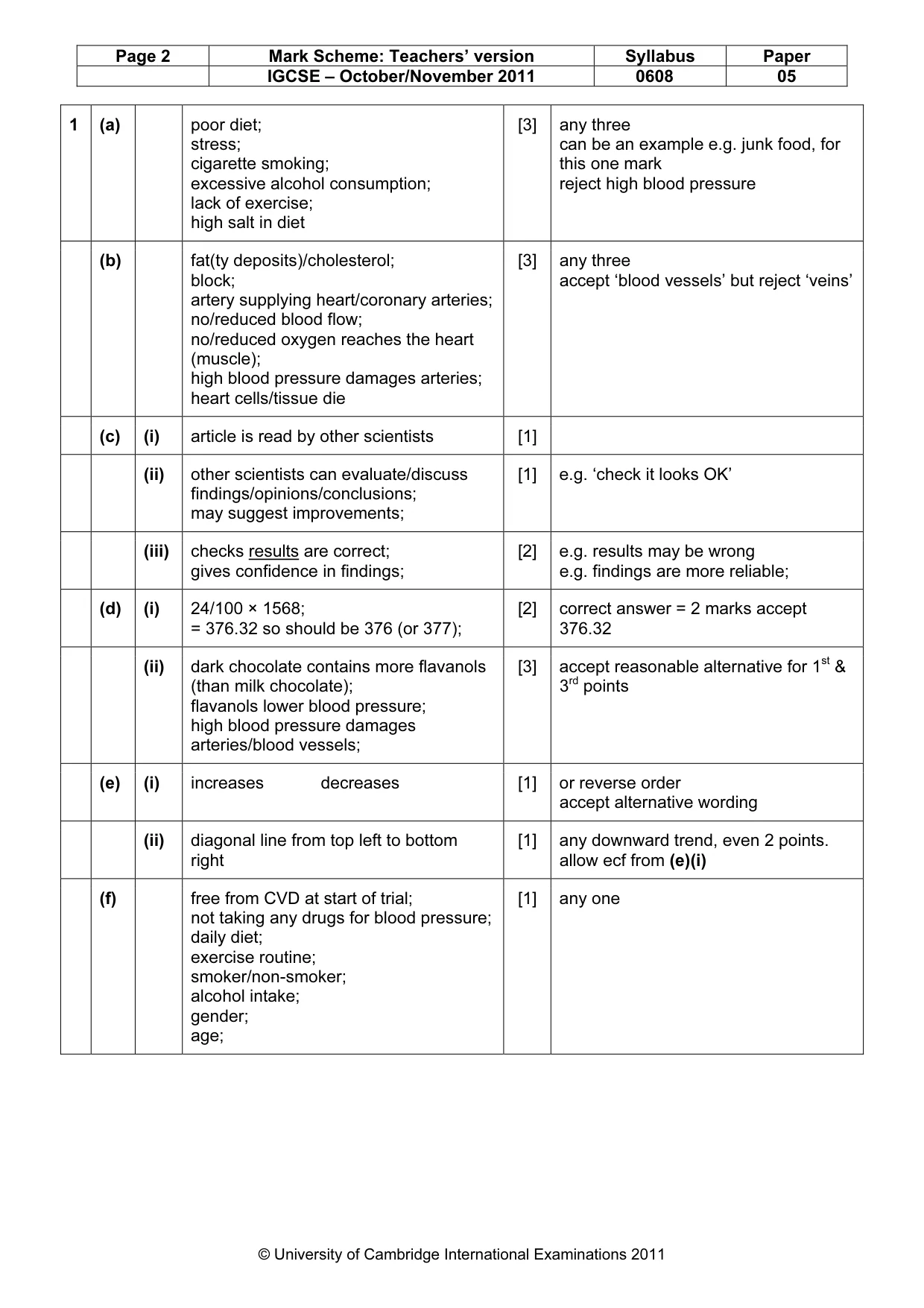
Page 2 Mark Scheme: Teachers’ version Syllabus Paper IGCSE – October/November 2011 0608 05 © University of Cambridge International Examinations 2011 1 (a) poor diet; stress; cigarette smoking; excessive alcohol consumption; lack of exercise; high salt in diet [3] any three can be an example e.g. junk food, for this one mark reject high blood pressure (b) fat(ty deposits)/cholesterol; block; artery supplying heart/coronary arteries; no/reduced blood flow; no/reduced oxygen reaches the heart (muscle); high blood pressure damages arteries; heart cells/tissue die [3] any three accept ‘blood vessels’ but reject ‘veins’ (c) (i) article is read by other scientists [1] (ii) other scientists can evaluate/discuss findings/opinions/conclusions; may suggest improvements; [1] e.g. ‘check it looks OK’ (iii) checks results are correct; gives confidence in findings; [2] e.g. results may be wrong e.g. findings are more reliable; (d) (i) 24/100 × 1568; = 376.32 so should be 376 (or 377); [2] correct answer = 2 marks accept 376.32 (ii) dark chocolate contains more flavanols (than milk chocolate); flavanols lower blood pressure; high blood pressure damages arteries/blood vessels; [3] accept reasonable alternative for 1st & 3rd points (e) (i) increases decreases [1] or reverse order accept alternative wording (ii) diagonal line from top left to bottom right [1] any downward trend, even 2 points. allow ecf from (e)(i) (f) free from CVD at start of trial; not taking any drugs for blood pressure; daily diet; exercise routine; smoker/non-smoker; alcohol intake; gender; age; [1] any one
Mark scheme, page 3
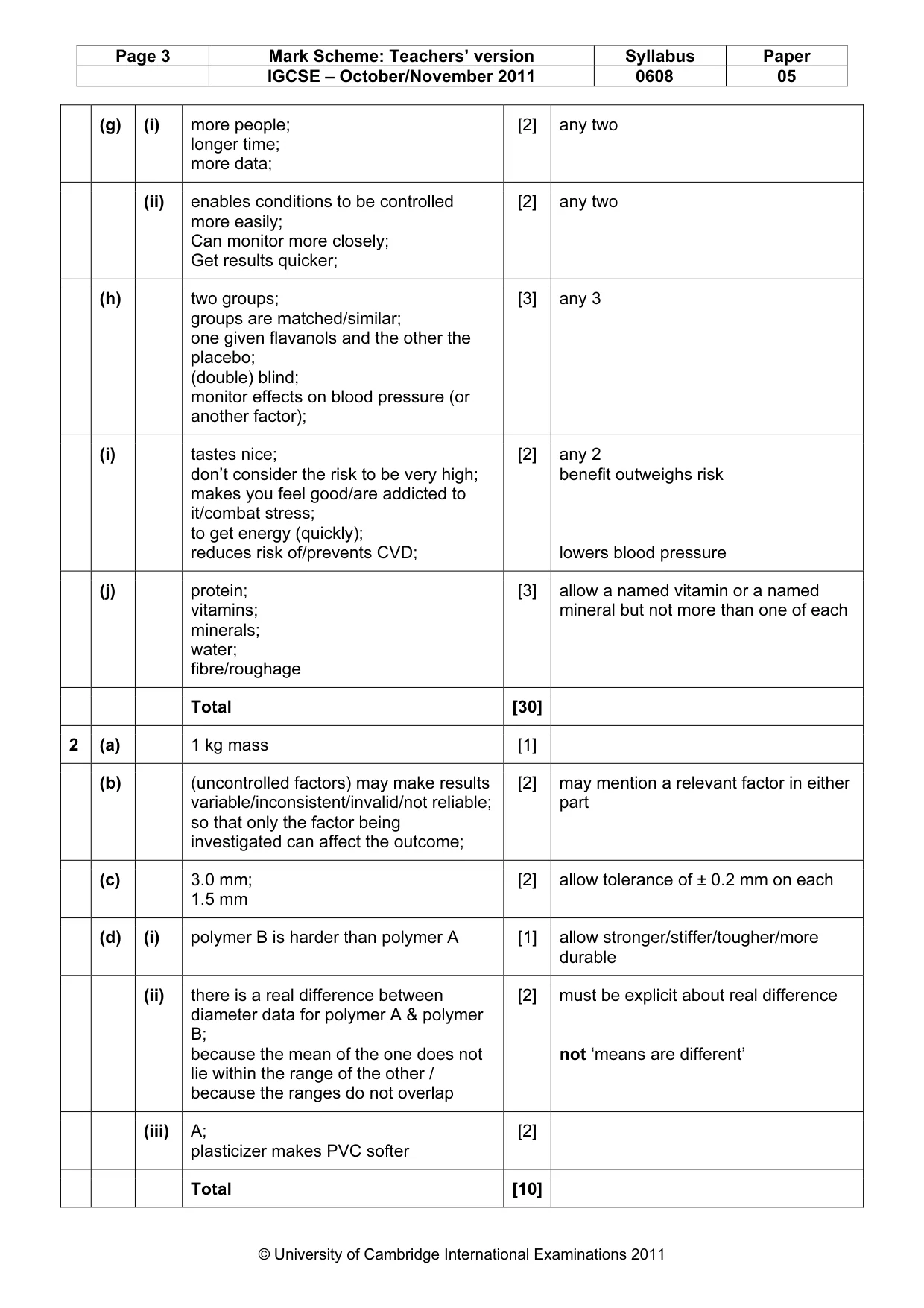
Page 3 Mark Scheme: Teachers’ version Syllabus Paper IGCSE – October/November 2011 0608 05 © University of Cambridge International Examinations 2011 (g) (i) more people; longer time; more data; [2] any two (ii) enables conditions to be controlled more easily; Can monitor more closely; Get results quicker; [2] any two (h) two groups; groups are matched/similar; one given flavanols and the other the placebo; (double) blind; monitor effects on blood pressure (or another factor); [3] any 3 (i) tastes nice; don’t consider the risk to be very high; makes you feel good/are addicted to it/combat stress; to get energy (quickly); reduces risk of/prevents CVD; [2] any 2 benefit outweighs risk lowers blood pressure (j) protein; vitamins; minerals; water; fibre/roughage [3] allow a named vitamin or a named mineral but not more than one of each Total [30] 2 (a) 1 kg mass [1] (b) (uncontrolled factors) may make results variable/inconsistent/invalid/not reliable; so that only the factor being investigated can affect the outcome; [2] may mention a relevant factor in either part (c) 3.0 mm; 1.5 mm [2] allow tolerance of ± 0.2 mm on each (d) (i) polymer B is harder than polymer A [1] allow stronger/stiffer/tougher/more durable (ii) there is a real difference between diameter data for polymer A & polymer B; because the mean of the one does not lie within the range of the other / because the ranges do not overlap [2] must be explicit about real difference not ‘means are different’ (iii) A; plasticizer makes PVC softer [2] Total [10]
Mark scheme, page 4
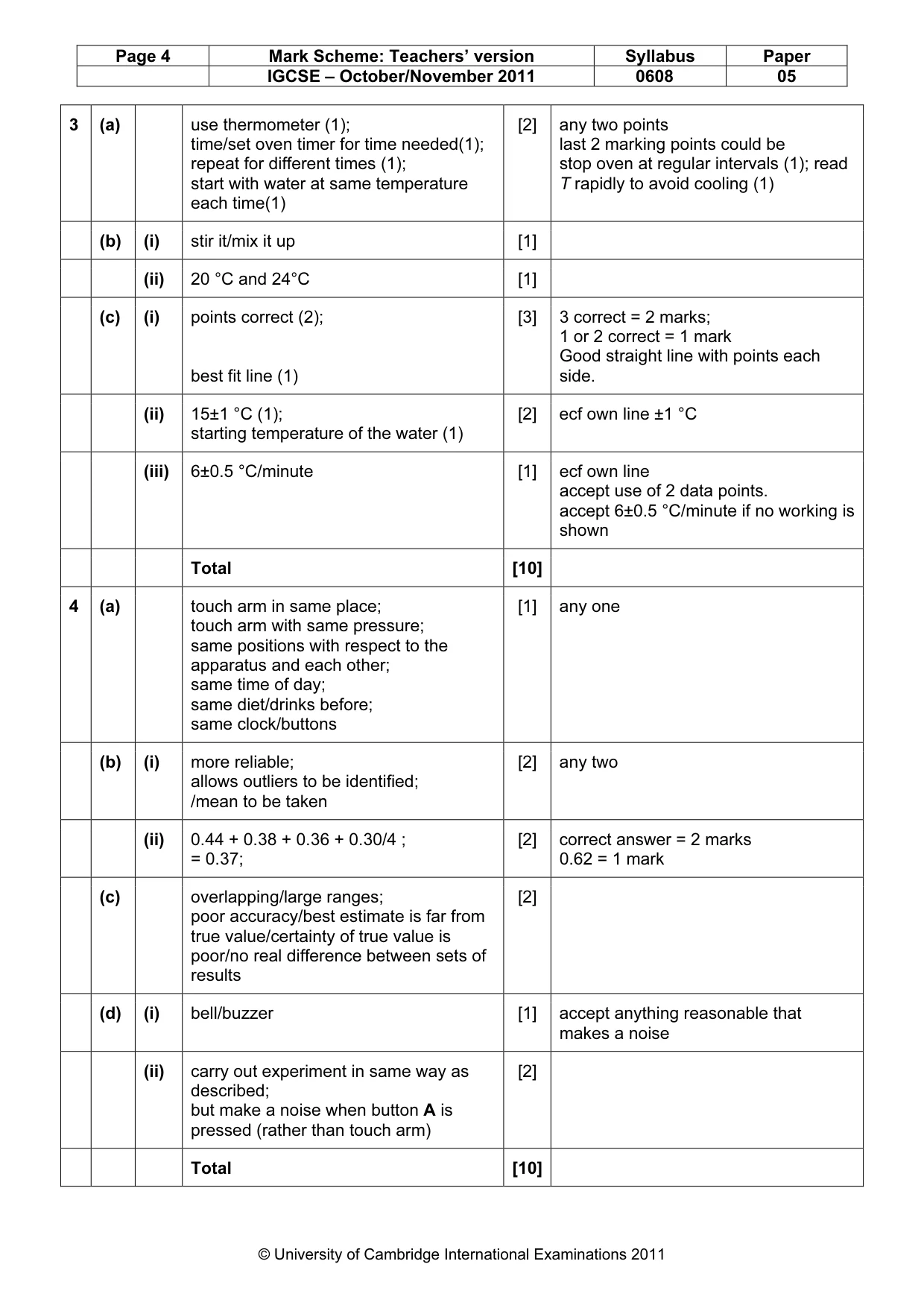
Page 4 Mark Scheme: Teachers’ version Syllabus Paper IGCSE – October/November 2011 0608 05 © University of Cambridge International Examinations 2011 3 (a) use thermometer (1); time/set oven timer for time needed(1); repeat for different times (1); start with water at same temperature each time(1) [2] any two points last 2 marking points could be stop oven at regular intervals (1); read T rapidly to avoid cooling (1) (b) (i) stir it/mix it up [1] (ii) 20 °C and 24°C [1] (c) (i) points correct (2); best fit line (1) [3] 3 correct = 2 marks; 1 or 2 correct = 1 mark Good straight line with points each side. (ii) 15±1 °C (1); starting temperature of the water (1) [2] ecf own line ±1 °C (iii) 6±0.5 °C/minute [1] ecf own line accept use of 2 data points. accept 6±0.5 °C/minute if no working is shown Total [10] 4 (a) touch arm in same place; touch arm with same pressure; same positions with respect to the apparatus and each other; same time of day; same diet/drinks before; same clock/buttons [1] any one (b) (i) more reliable; allows outliers to be identified; /mean to be taken [2] any two (ii) 0.44 + 0.38 + 0.36 + 0.30/4 ; = 0.37; [2] correct answer = 2 marks 0.62 = 1 mark (c) overlapping/large ranges; poor accuracy/best estimate is far from true value/certainty of true value is poor/no real difference between sets of results [2] (d) (i) bell/buzzer [1] accept anything reasonable that makes a noise (ii) carry out experiment in same way as described; but make a noise when button A is pressed (rather than touch arm) [2] Total [10]
What you needed in this session
Cambridge’s own grade thresholds for 2011 Oct/Nov, Paper 5 · Variant 1. A higher threshold means an easier paper — the bar moves with how the cohort did.