Cambridge IGCSE Twenty-First Century Science 0608 — 2010 May/June Paper 5 · Variant 1
0608/51/M/J/10
The question paper and its mark scheme, free to read here and free to download. This is Cambridge’s own paper, exactly as it was sat.
Question paper16 pages


Mark scheme4 pages
Answers below. Sit the paper first if you are practising.
Paper as text
Question paper, page 1
This document consists of 14 printed pages and 2 blank pages. DC (LEO/KN) 20151/3 © UCLES 2010 [Turn over UNIVERSITY OF CAMBRIDGE INTERNATIONAL EXAMINATIONS International General Certificate of Secondary Education READ THESE INSTRUCTIONS FIRST Write your Centre number, candidate number and name on all the work you hand in. Write in dark blue or black pen. You may use a pencil for any diagrams or graphs. Do not use staples, paper clips, highlighters, glue or correction fluid. DO NOT WRITE IN ANY BARCODES. Answer all questions. At the end of the examination, fasten all your work securely together. The number of marks is given in brackets [ ] at the end of each question or part question. * 0 6 8 7 6 3 5 1 7 9 * TWENTY FIRST CENTURY SCIENCE 0608/05 Paper 5 May/June 2010 1 hour 30 minutes Candidates answer on the Question Paper. No Additional Materials are required. For Examiner’s Use 1 2 3 4 Total www.XtremePapers.com
Question paper, page 2
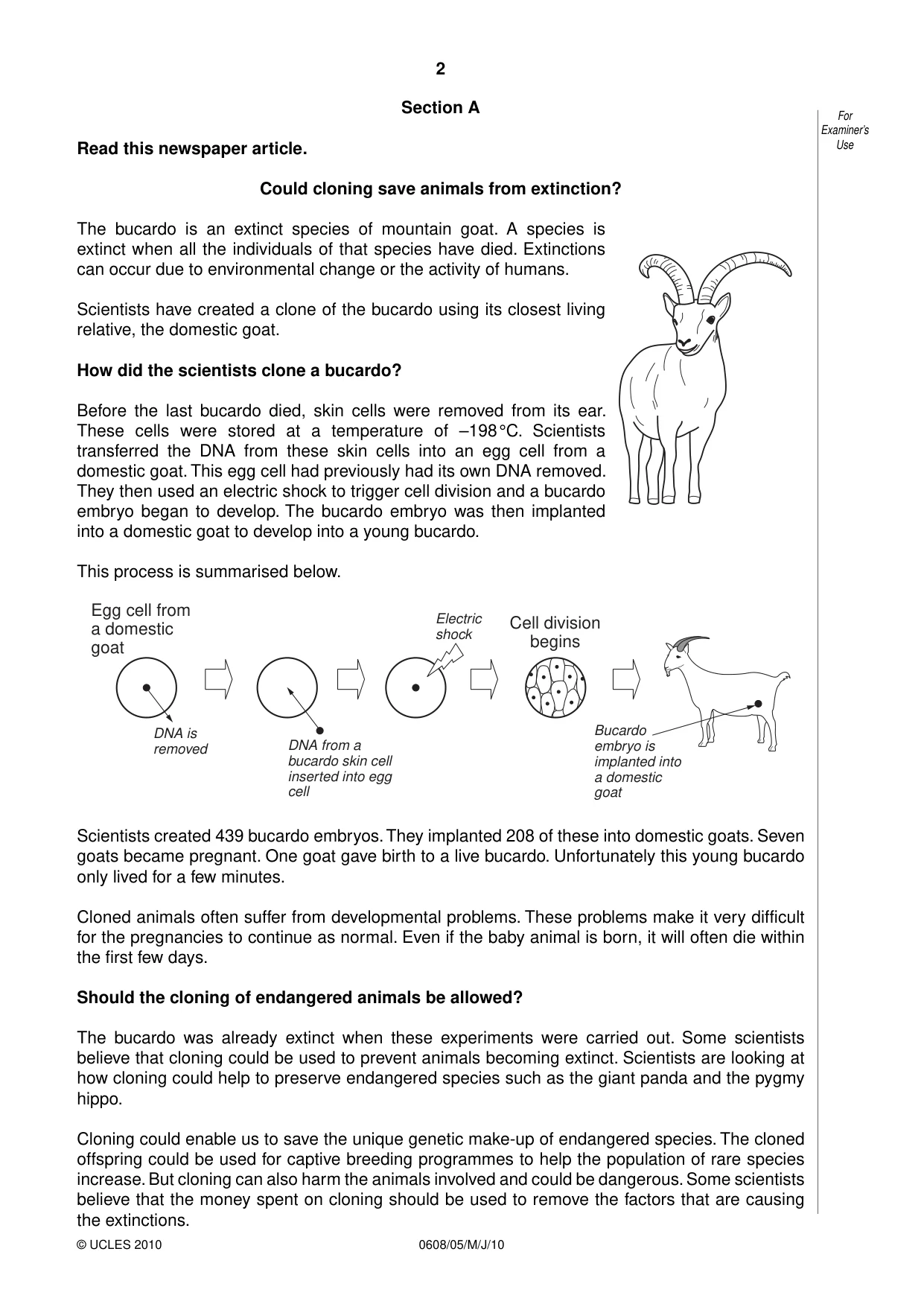
0608/05/M/J/10 © UCLES 2010 2 For Examiner’s Use Section A Read this newspaper article. Could cloning save animals from extinction? The bucardo is an extinct species of mountain goat. A species is extinct when all the individuals of that species have died. Extinctions can occur due to environmental change or the activity of humans. Scientists have created a clone of the bucardo using its closest living relative, the domestic goat. How did the scientists clone a bucardo? Before the last bucardo died, skin cells were removed from its ear. These cells were stored at a temperature of –198 °C. Scientists transferred the DNA from these skin cells into an egg cell from a domestic goat. This egg cell had previously had its own DNA removed. They then used an electric shock to trigger cell division and a bucardo embryo began to develop. The bucardo embryo was then implanted into a domestic goat to develop into a young bucardo. This process is summarised below. Egg cell from a domestic goat DNA is removed DNA from a bucardo skin cell inserted into egg cell Electric shock Cell division begins Bucardo embryo is implanted into a domestic goat Scientists created 439 bucardo embryos. They implanted 208 of these into domestic goats. Seven goats became pregnant. One goat gave birth to a live bucardo. Unfortunately this young bucardo only lived for a few minutes. Cloned animals often suffer from developmental problems. These problems make it very difficult for the pregnancies to continue as normal. Even if the baby animal is born, it will often die within the first few days. Should the cloning of endangered animals be allowed? The bucardo was already extinct when these experiments were carried out. Some scientists believe that cloning could be used to prevent animals becoming extinct. Scientists are looking at how cloning could help to preserve endangered species such as the giant panda and the pygmy hippo. Cloning could enable us to save the unique genetic make-up of endangered species. The cloned offspring could be used for captive breeding programmes to help the population of rare species increase. But cloning can also harm the animals involved and could be dangerous. Some scientists believe that the money spent on cloning should be used to remove the factors that are causing the extinctions.
Question paper, page 3
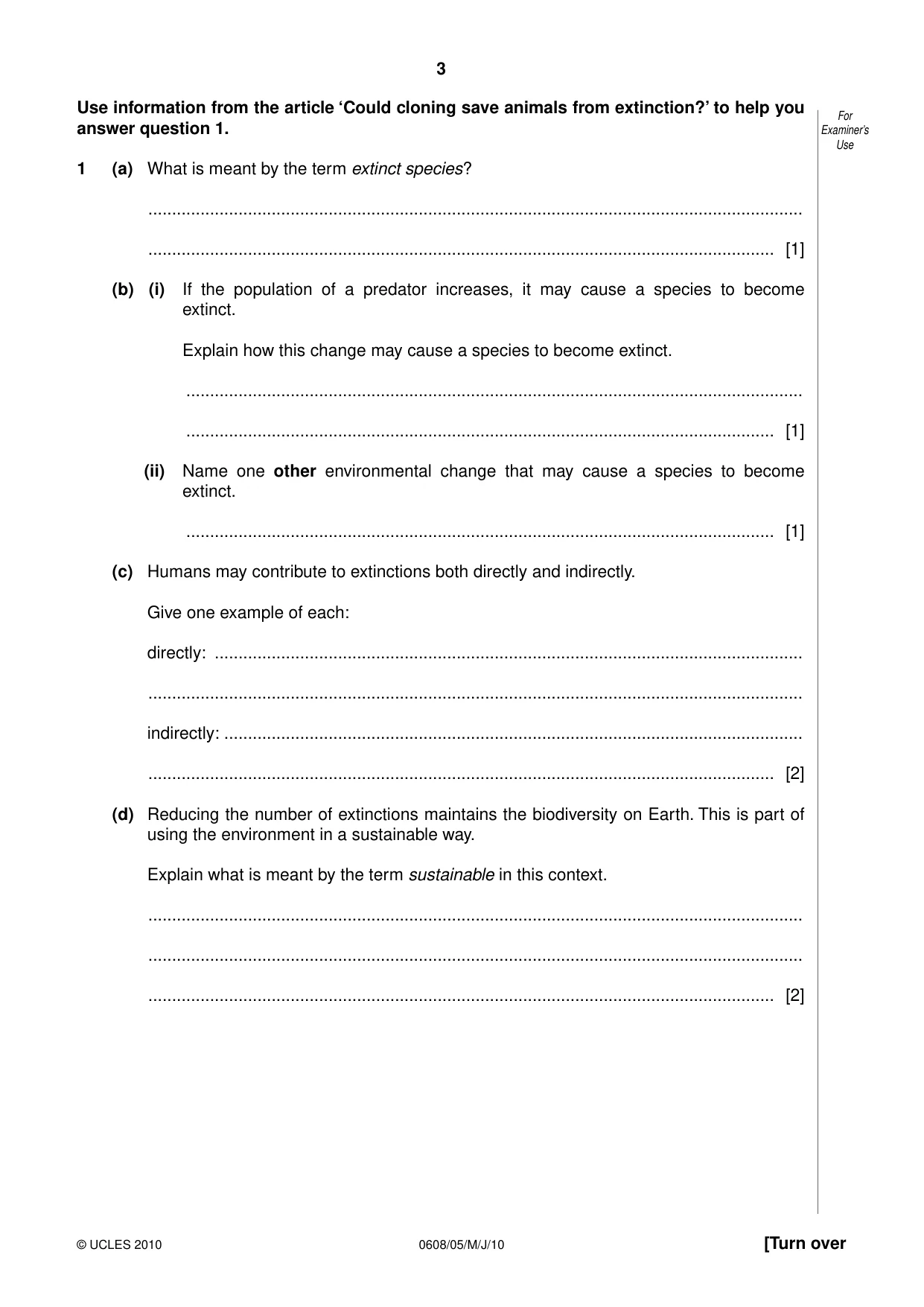
0608/05/M/J/10 © UCLES 2010 [Turn over 3 For Examiner’s Use Use information from the article ‘Could cloning save animals from extinction?’ to help you answer question 1. 1 (a) What is meant by the term extinct species? … … [1] (b) (i) If the population of a predator increases, it may cause a species to become extinct. Explain how this change may cause a species to become extinct. … … [1] (ii) Name one other environmental change that may cause a species to become extinct. … [1] (c) Humans may contribute to extinctions both directly and indirectly. Give one example of each: directly: … … indirectly: … … [2] (d) Reducing the number of extinctions maintains the biodiversity on Earth. This is part of using the environment in a sustainable way. Explain what is meant by the term sustainable in this context. … … … [2]
Question paper, page 4
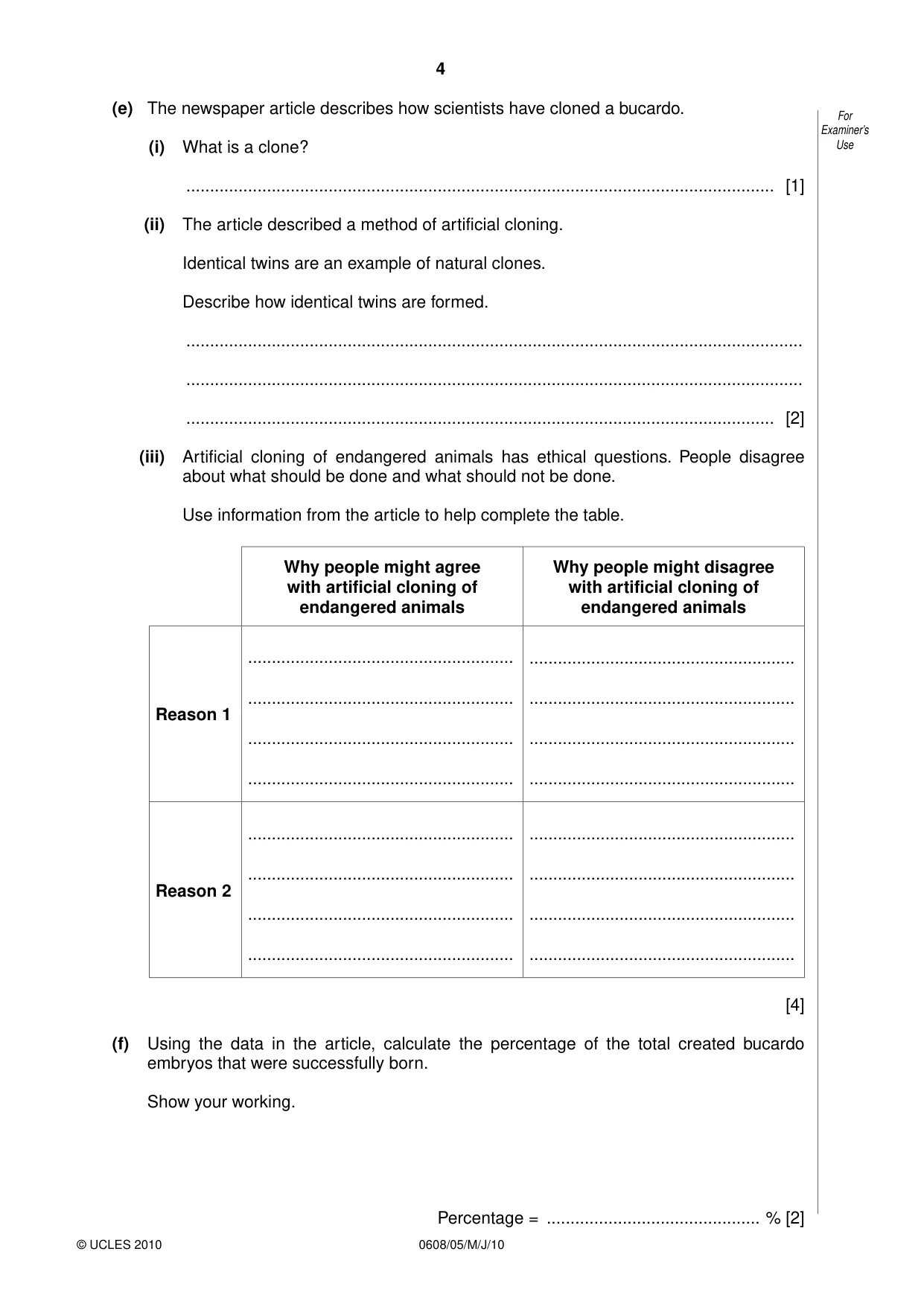
0608/05/M/J/10 © UCLES 2010 4 For Examiner’s Use (e) The newspaper article describes how scientists have cloned a bucardo. (i) What is a clone? … [1] (ii) The article described a method of artificial cloning. Identical twins are an example of natural clones. Describe how identical twins are formed. … … … [2] (iii) Artificial cloning of endangered animals has ethical questions. People disagree about what should be done and what should not be done. Use information from the article to help complete the table. Why people might agree with artificial cloning of endangered animals Why people might disagree with artificial cloning of endangered animals Reason 1 … … … … … … … … Reason 2 … … … … … … … … [4] (f) Using the data in the article, calculate the percentage of the total created bucardo embryos that were successfully born. Show your working. Percentage = … % [2]
Question paper, page 5
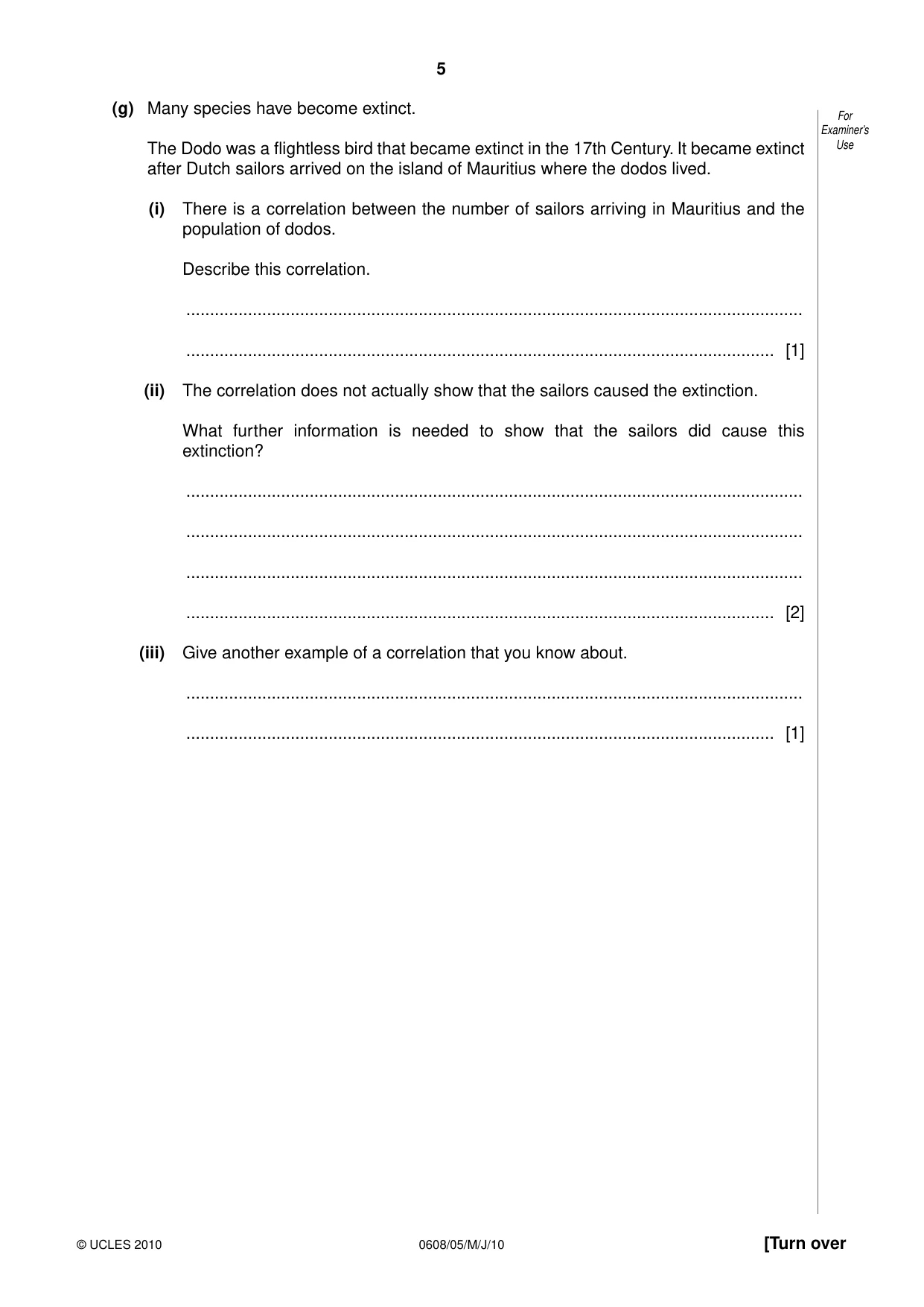
0608/05/M/J/10 © UCLES 2010 [Turn over 5 For Examiner’s Use (g) Many species have become extinct. The Dodo was a flightless bird that became extinct in the 17th Century. It became extinct after Dutch sailors arrived on the island of Mauritius where the dodos lived. (i) There is a correlation between the number of sailors arriving in Mauritius and the population of dodos. Describe this correlation. … … [1] (ii) The correlation does not actually show that the sailors caused the extinction. What further information is needed to show that the sailors did cause this extinction? … … … … [2] (iii) Give another example of a correlation that you know about. … … [1]
Question paper, page 6
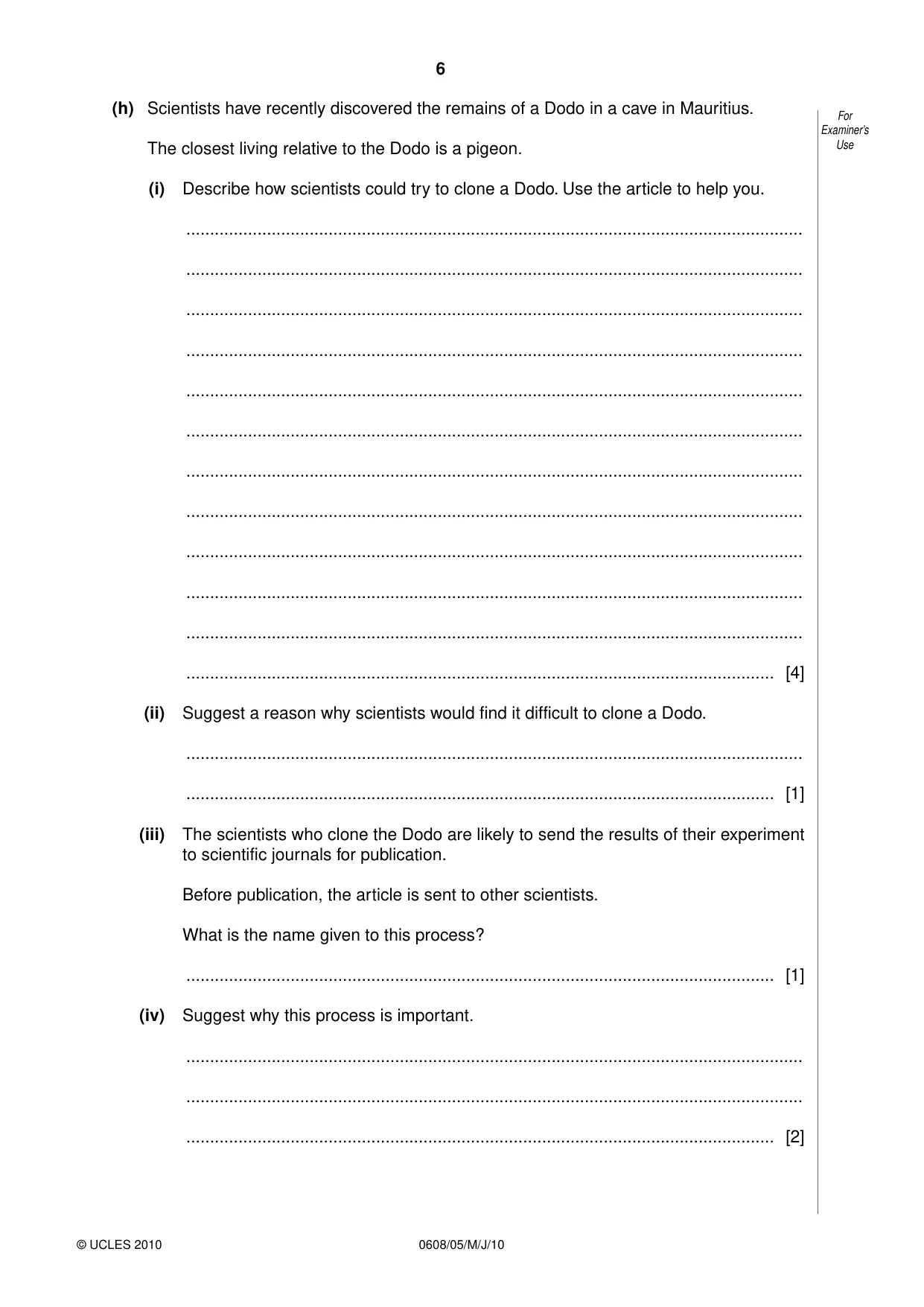
0608/05/M/J/10 © UCLES 2010 6 For Examiner’s Use (h) Scientists have recently discovered the remains of a Dodo in a cave in Mauritius. The closest living relative to the Dodo is a pigeon. (i) Describe how scientists could try to clone a Dodo. Use the article to help you. … … … … … … … … … … … … [4] (ii) Suggest a reason why scientists would find it difficult to clone a Dodo. … … [1] (iii) The scientists who clone the Dodo are likely to send the results of their experiment to scientific journals for publication. Before publication, the article is sent to other scientists. What is the name given to this process? … [1] (iv) Suggest why this process is important. … … … [2]
Question paper, page 7
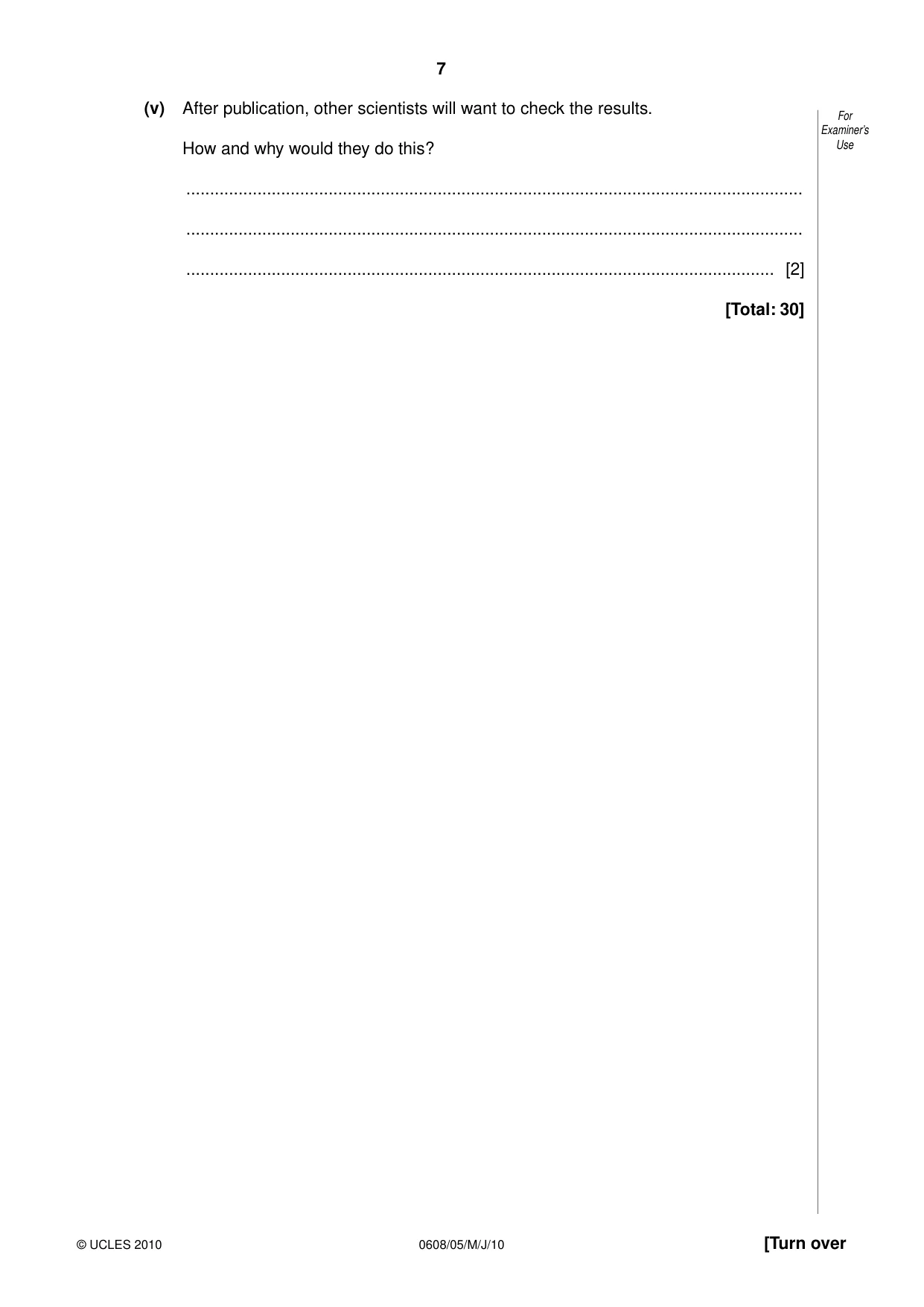
0608/05/M/J/10 © UCLES 2010 [Turn over 7 For Examiner’s Use (v) After publication, other scientists will want to check the results. How and why would they do this? … … … [2] [Total: 30]
Question paper, page 8
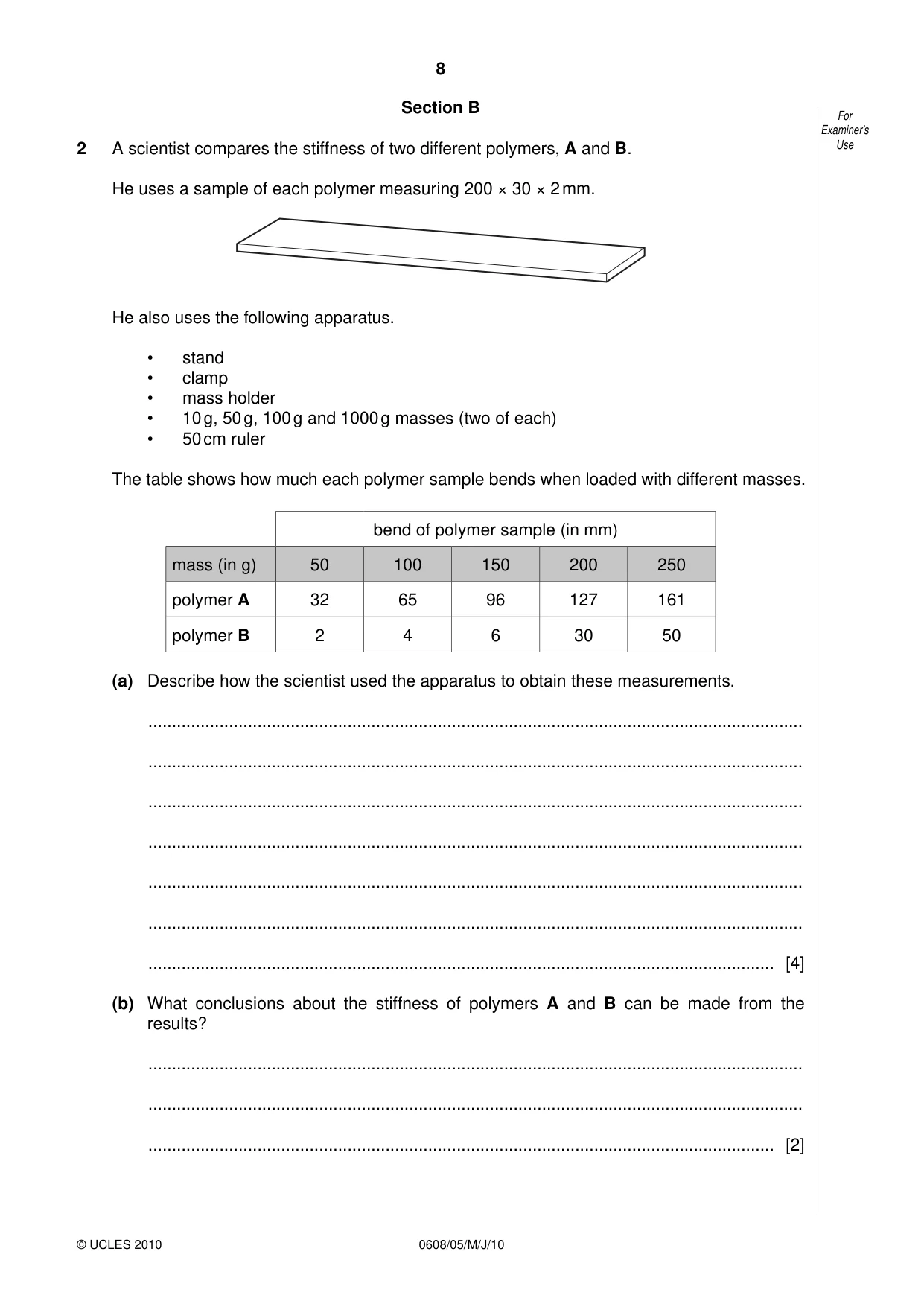
0608/05/M/J/10 © UCLES 2010 8 For Examiner’s Use Section B 2 A scientist compares the stiffness of two different polymers, A and B. He uses a sample of each polymer measuring 200 × 30 × 2 mm. He also uses the following apparatus. • stand • clamp • mass holder • 10 g, 50 g, 100 g and 1000 g masses (two of each) • 50 cm ruler The table shows how much each polymer sample bends when loaded with different masses. bend of polymer sample (in mm) mass (in g) 50 100 150 200 250 polymer A 32 65 96 127 161 polymer B 2 4 6 30 50 (a) Describe how the scientist used the apparatus to obtain these measurements. … … … … … … … [4] (b) What conclusions about the stiffness of polymers A and B can be made from the results? … … … [2]
Question paper, page 9
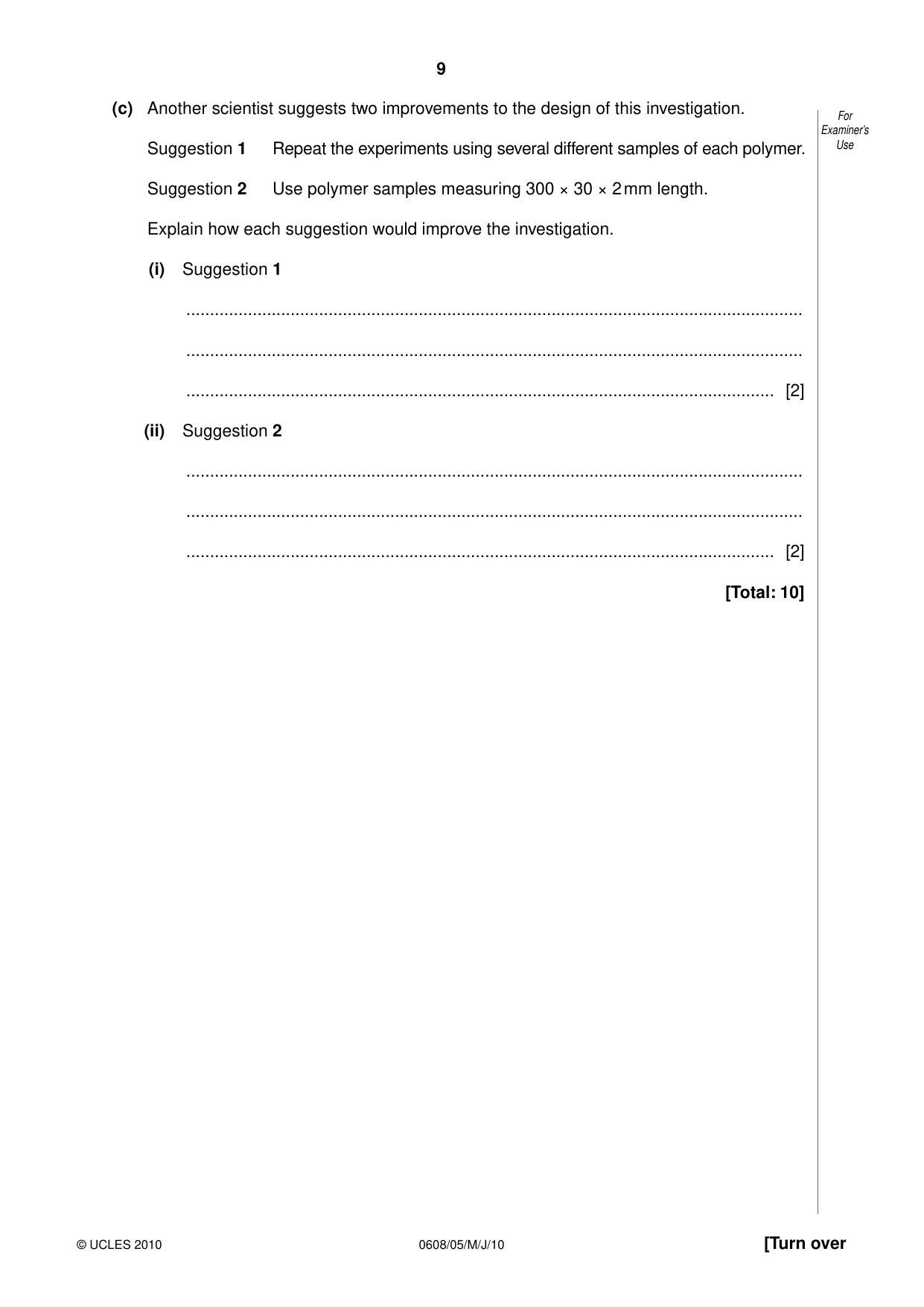
0608/05/M/J/10 © UCLES 2010 [Turn over 9 For Examiner’s Use (c) Another scientist suggests two improvements to the design of this investigation. Suggestion 1 Repeat the experiments using several different samples of each polymer. Suggestion 2 Use polymer samples measuring 300 × 30 × 2 mm length. Explain how each suggestion would improve the investigation. (i) Suggestion 1 … … … [2] (ii) Suggestion 2 … … … [2] [Total: 10]
Question paper, page 10
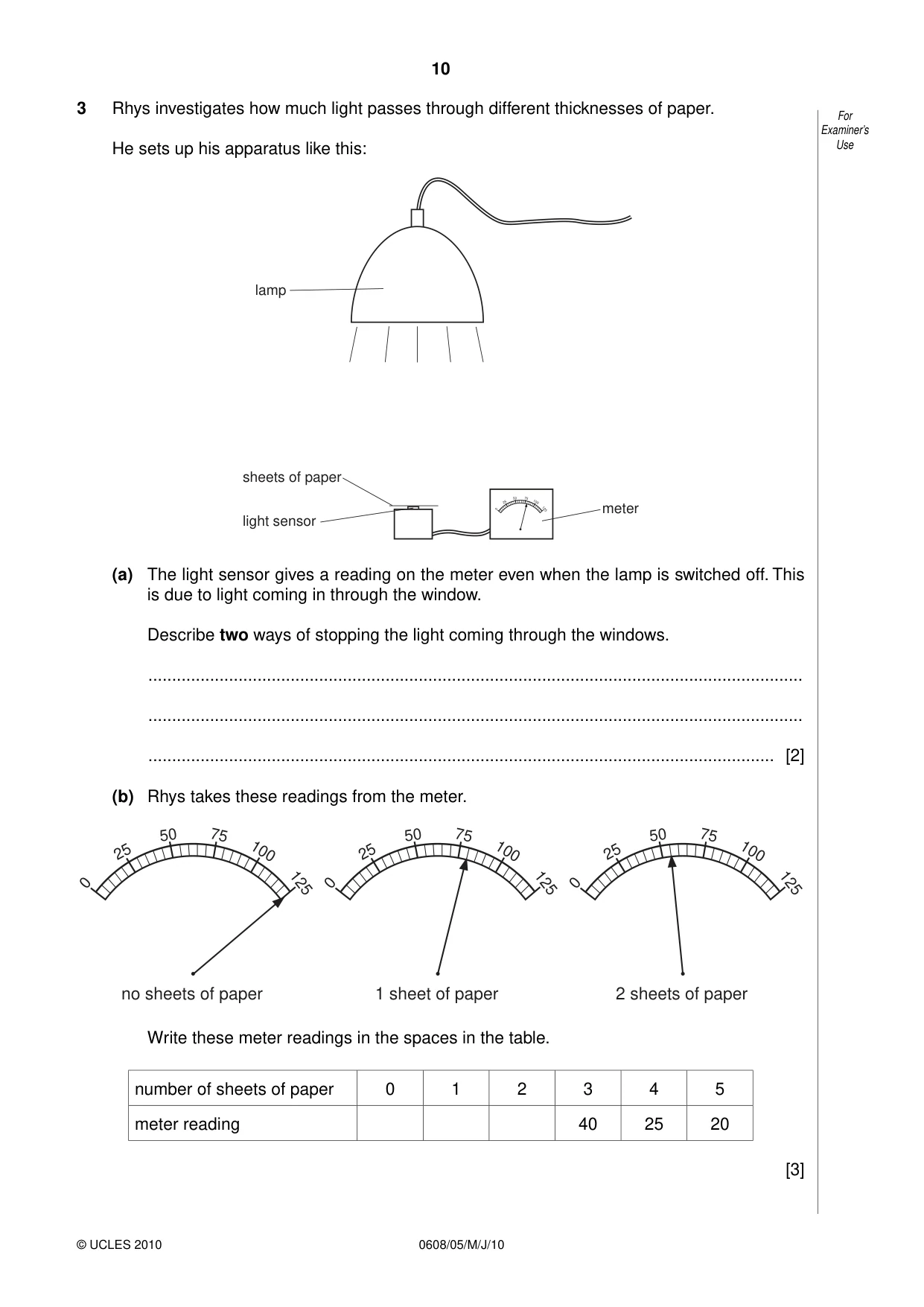
0608/05/M/J/10 © UCLES 2010 10 For Examiner’s Use 3 Rhys investigates how much light passes through different thicknesses of paper. He sets up his apparatus like this: lamp sheets of paper light sensor meter 0 25 50 75 100 125 (a) The light sensor gives a reading on the meter even when the lamp is switched off. This is due to light coming in through the window. Describe two ways of stopping the light coming through the windows. … … … [2] (b) Rhys takes these readings from the meter. 0 25 50 75 100 125 1 sheet of paper 0 25 50 75 100 125 2 sheets of paper 0 25 50 75 100 125 no sheets of paper Write these meter readings in the spaces in the table. number of sheets of paper 0 1 2 3 4 5 meter reading 40 25 20 [3]
Question paper, page 11
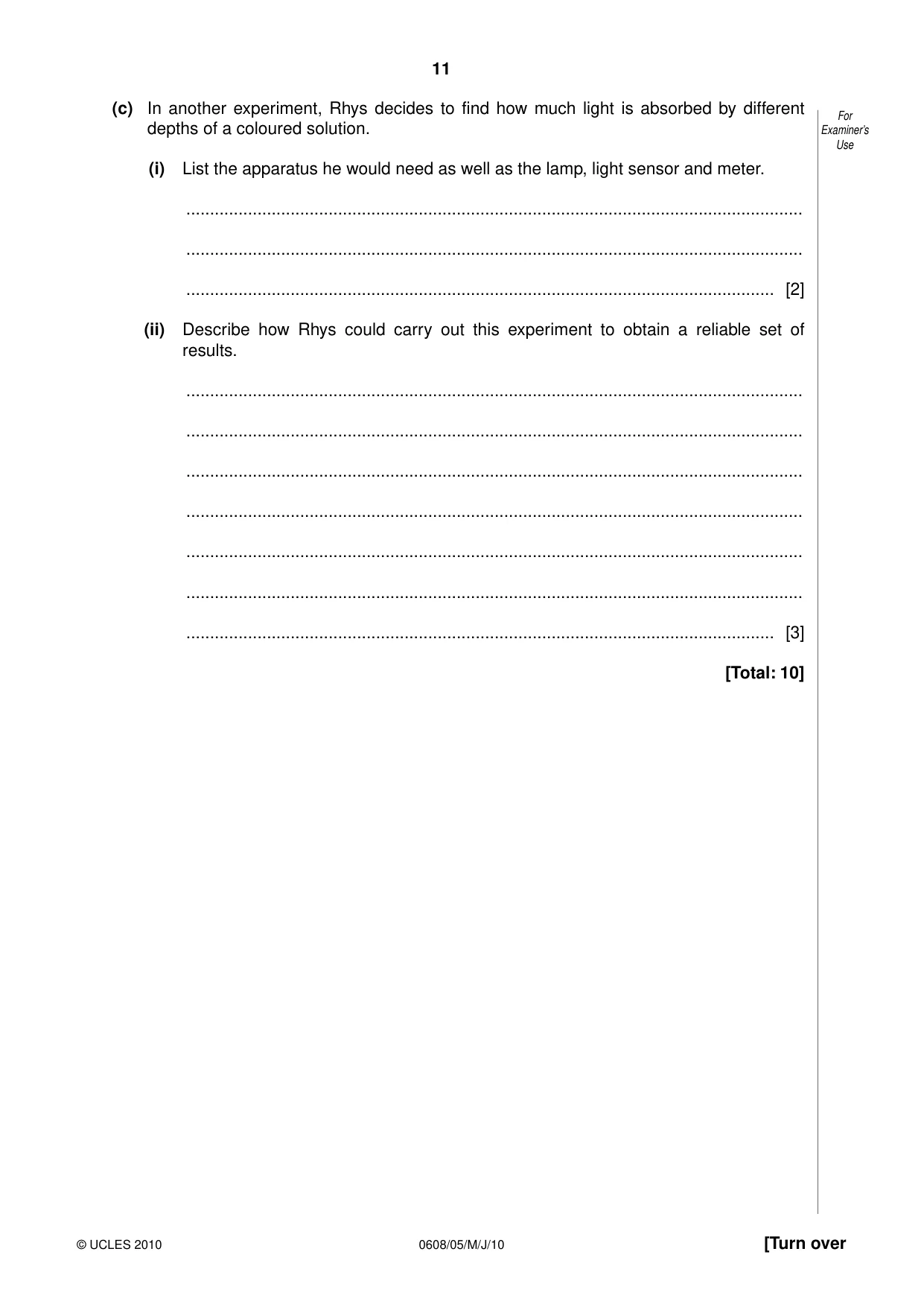
0608/05/M/J/10 © UCLES 2010 [Turn over 11 For Examiner’s Use (c) In another experiment, Rhys decides to find how much light is absorbed by different depths of a coloured solution. (i) List the apparatus he would need as well as the lamp, light sensor and meter. … … … [2] (ii) Describe how Rhys could carry out this experiment to obtain a reliable set of results. … … … … … … … [3] [Total: 10]
Question paper, page 12
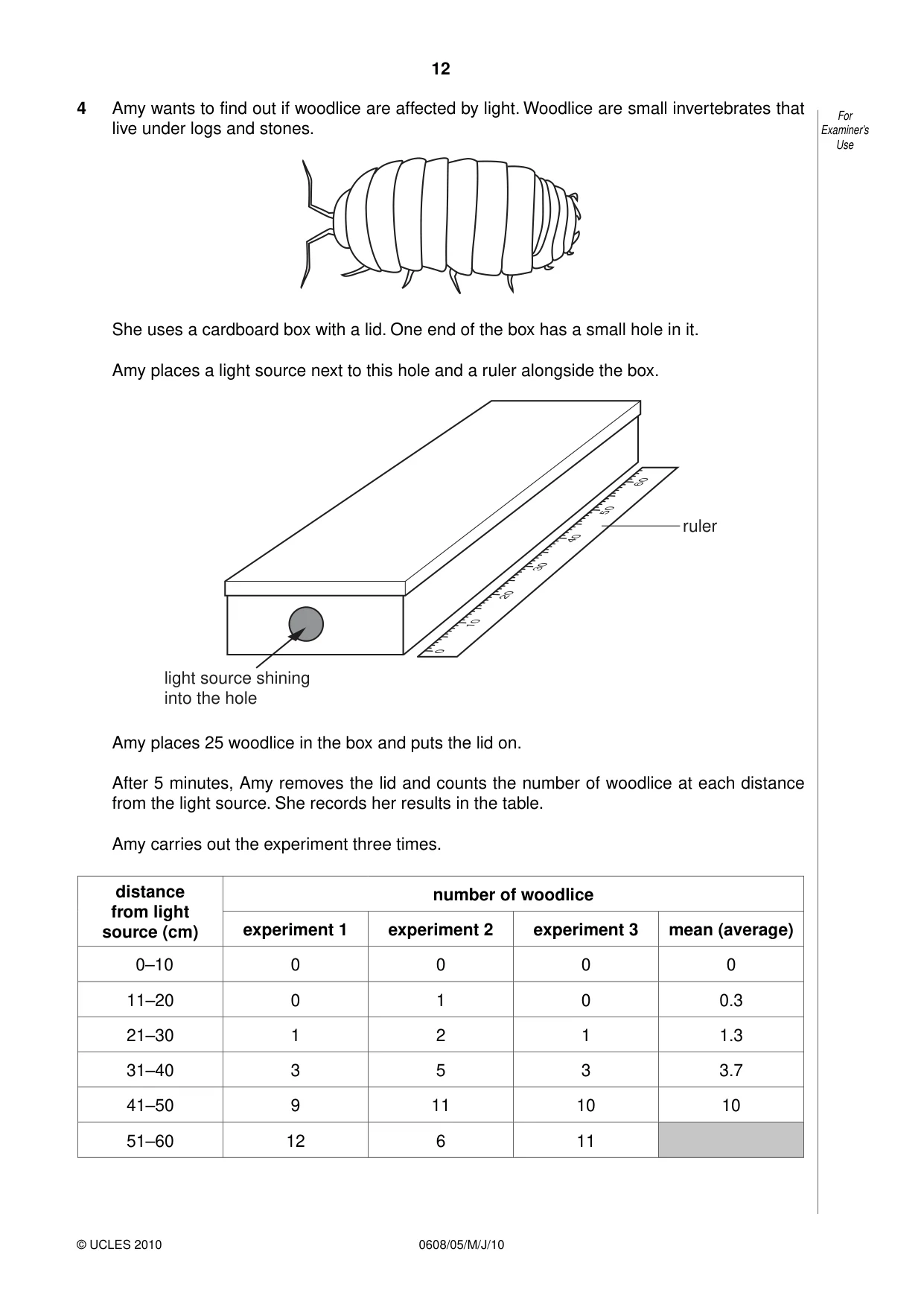
0608/05/M/J/10 © UCLES 2010 12 For Examiner’s Use 4 Amy wants to find out if woodlice are affected by light. Woodlice are small invertebrates that live under logs and stones. She uses a cardboard box with a lid. One end of the box has a small hole in it. Amy places a light source next to this hole and a ruler alongside the box. 0 10 20 30 40 50 60 ruler light source shining into the hole Amy places 25 woodlice in the box and puts the lid on. After 5 minutes, Amy removes the lid and counts the number of woodlice at each distance from the light source. She records her results in the table. Amy carries out the experiment three times. distance from light source (cm) number of woodlice experiment 1 experiment 2 experiment 3 mean (average) 0–10 0 0 0 0 11–20 0 1 0 0.3 21–30 1 2 1 1.3 31–40 3 5 3 3.7 41–50 9 11 10 10 51–60 12 6 11
Question paper, page 13
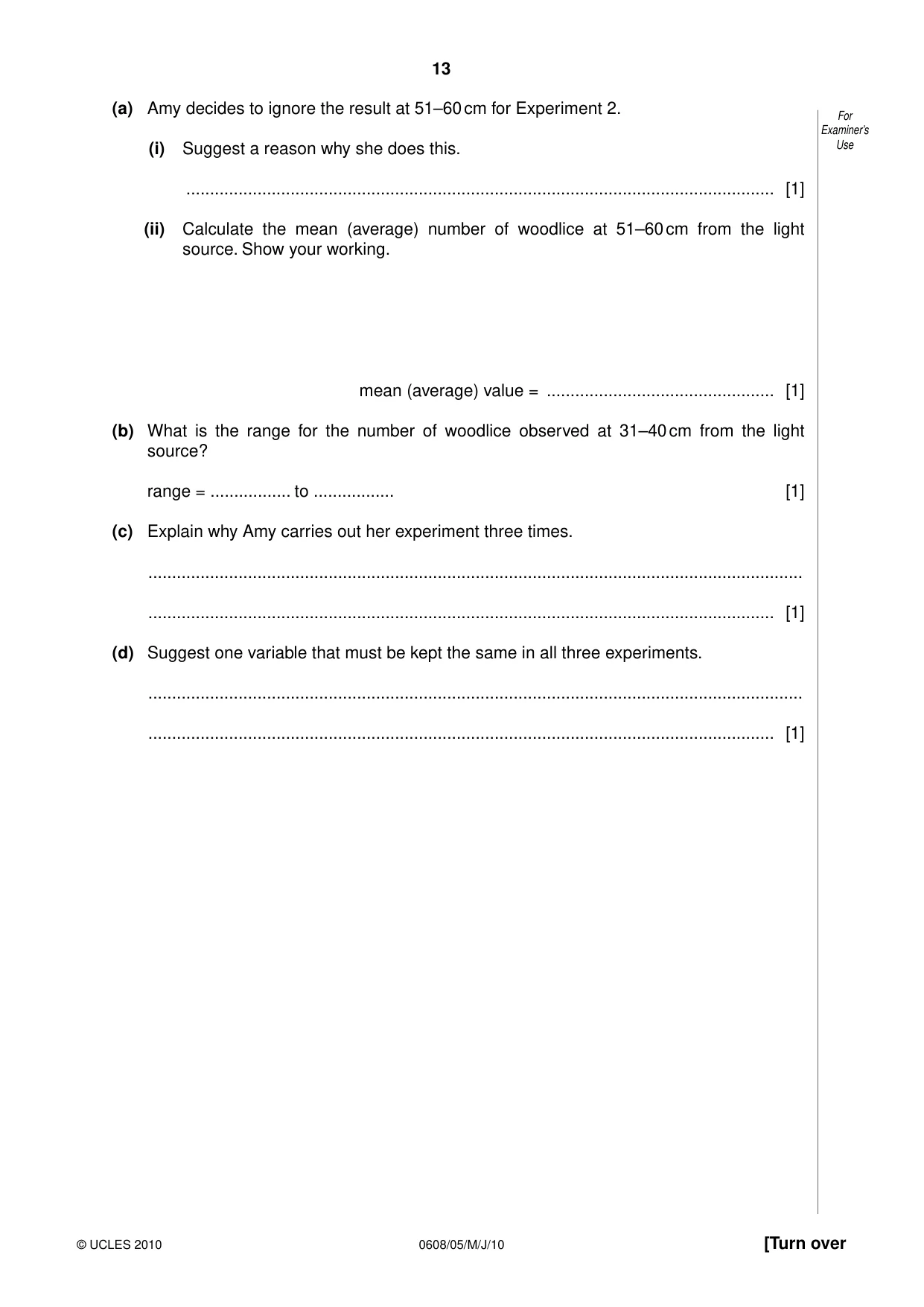
0608/05/M/J/10 © UCLES 2010 [Turn over 13 For Examiner’s Use (a) Amy decides to ignore the result at 51–60 cm for Experiment 2. (i) Suggest a reason why she does this. … [1] (ii) Calculate the mean (average) number of woodlice at 51–60 cm from the light source. Show your working. mean (average) value = … [1] (b) What is the range for the number of woodlice observed at 31–40 cm from the light source? range = … to … [1] (c) Explain why Amy carries out her experiment three times. … … [1] (d) Suggest one variable that must be kept the same in all three experiments. … … [1]
Question paper, page 14
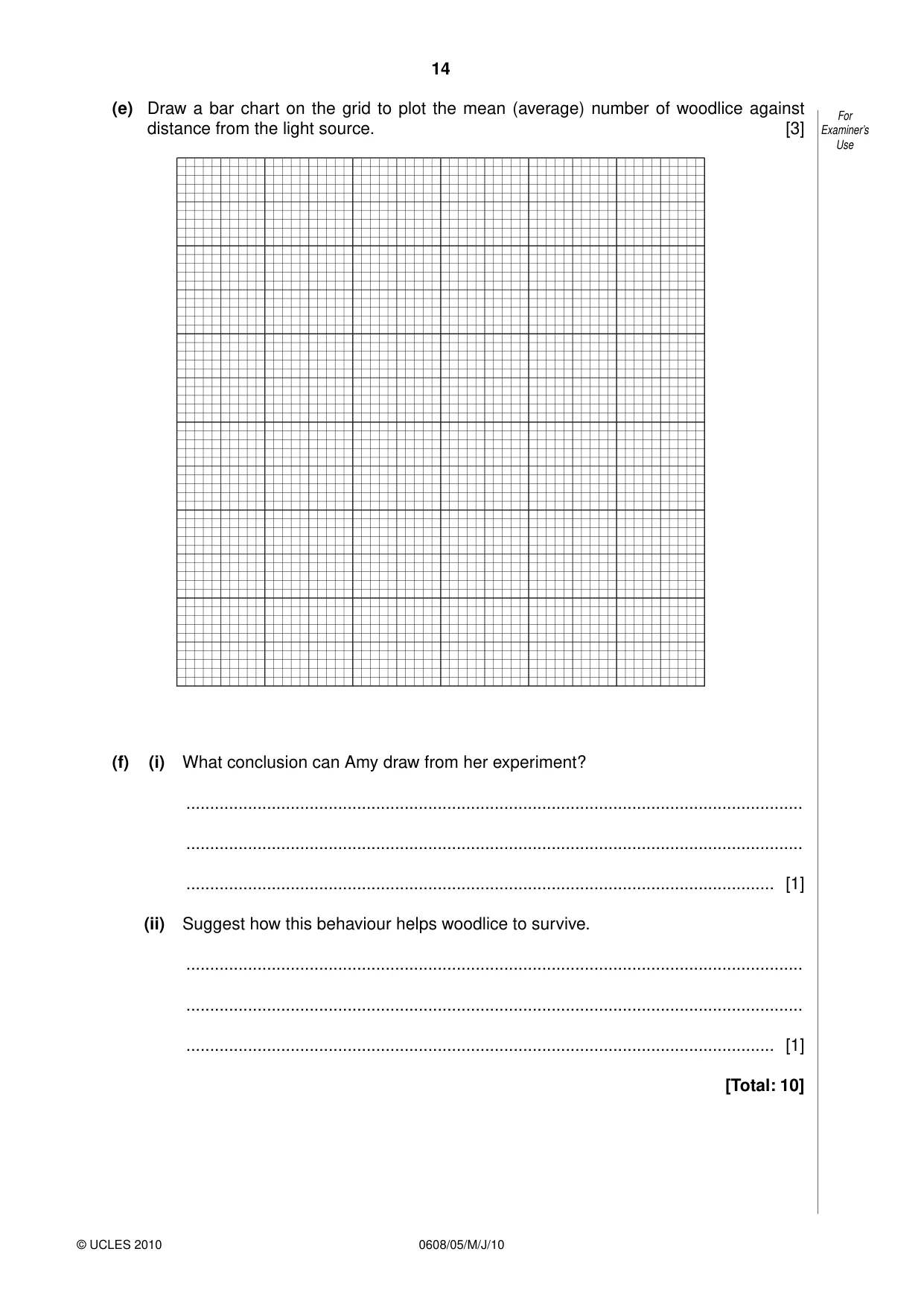
0608/05/M/J/10 © UCLES 2010 14 For Examiner’s Use (e) Draw a bar chart on the grid to plot the mean (average) number of woodlice against distance from the light source. [3] (f) (i) What conclusion can Amy draw from her experiment? … … … [1] (ii) Suggest how this behaviour helps woodlice to survive. … … … [1] [Total: 10]
Question paper, page 15
15 0608/05/M/J/10 © UCLES 2010 BLANK PAGE
Question paper, page 16
16 0608/05/M/J/10 © UCLES 2010 BLANK PAGE Permission to reproduce items where third-party owned material protected by copyright is included has been sought and cleared where possible. Every reasonable effort has been made by the publisher (UCLES) to trace copyright holders, but if any items requiring clearance have unwittingly been included, the publisher will be pleased to make amends at the earliest possible opportunity. University of Cambridge International Examinations is part of the Cambridge Assessment Group. Cambridge Assessment is the brand name of University of Cambridge Local Examinations Syndicate (UCLES), which is itself a department of the University of Cambridge.
Mark scheme, page 1
UNIVERSITY OF CAMBRIDGE INTERNATIONAL EXAMINATIONS International General Certificate of Secondary Education MARK SCHEME for the May/June 2010 question paper for the guidance of teachers 0608 TWENTY FIRST CENTURY SCIENCE 0608/05 Paper 5 (Comprehension and Practical), maximum raw mark 60 This mark scheme is published as an aid to teachers and candidates, to indicate the requirements of the examination. It shows the basis on which Examiners were instructed to award marks. It does not indicate the details of the discussions that took place at an Examiners’ meeting before marking began, which would have considered the acceptability of alternative answers. Mark schemes must be read in conjunction with the question papers and the report on the examination. • CIE will not enter into discussions or correspondence in connection with these mark schemes. CIE is publishing the mark schemes for the May/June 2010 question papers for most IGCSE, GCE Advanced Level and Advanced Subsidiary Level syllabuses and some Ordinary Level syllabuses. www.XtremePapers.com
Mark scheme, page 2
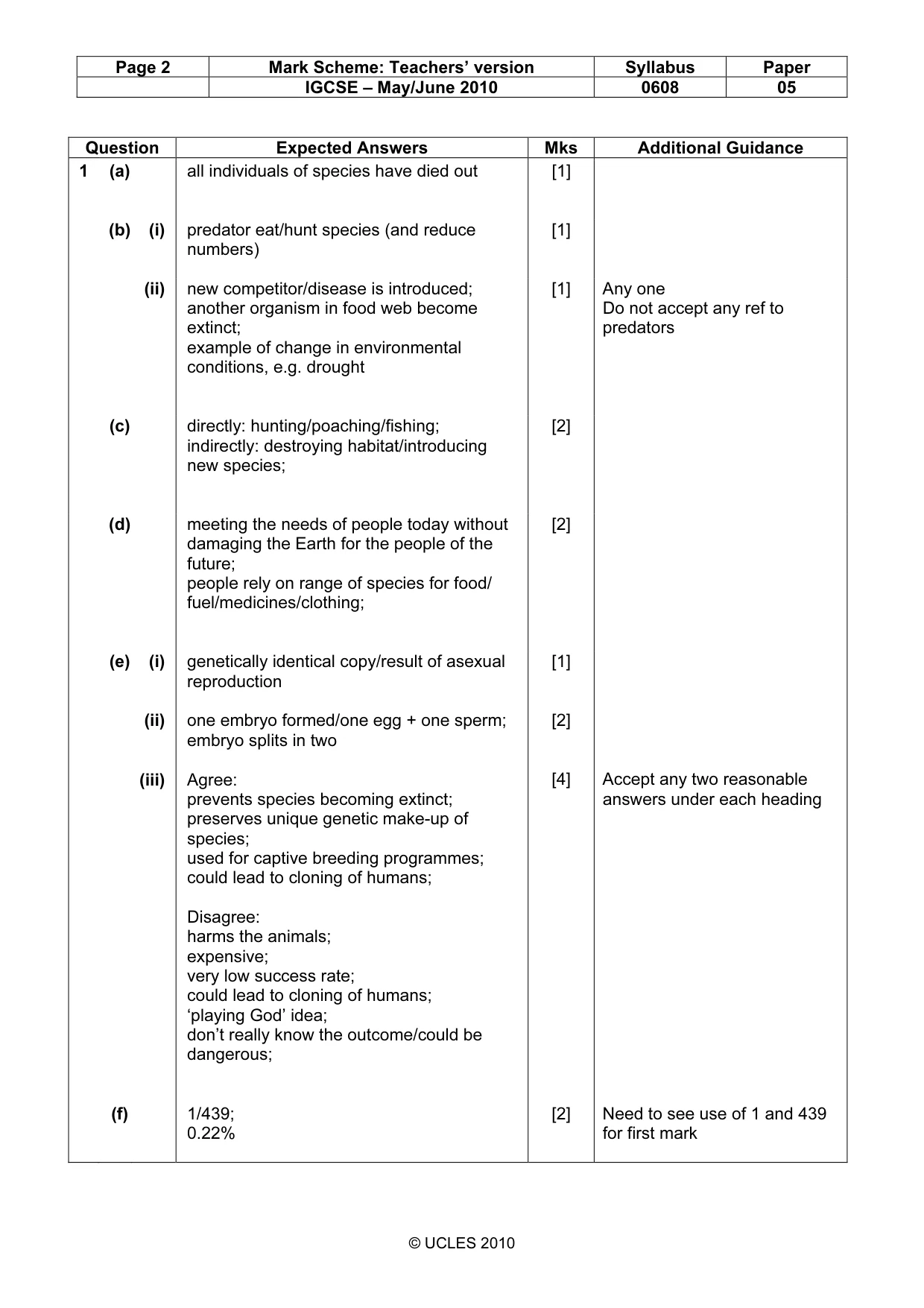
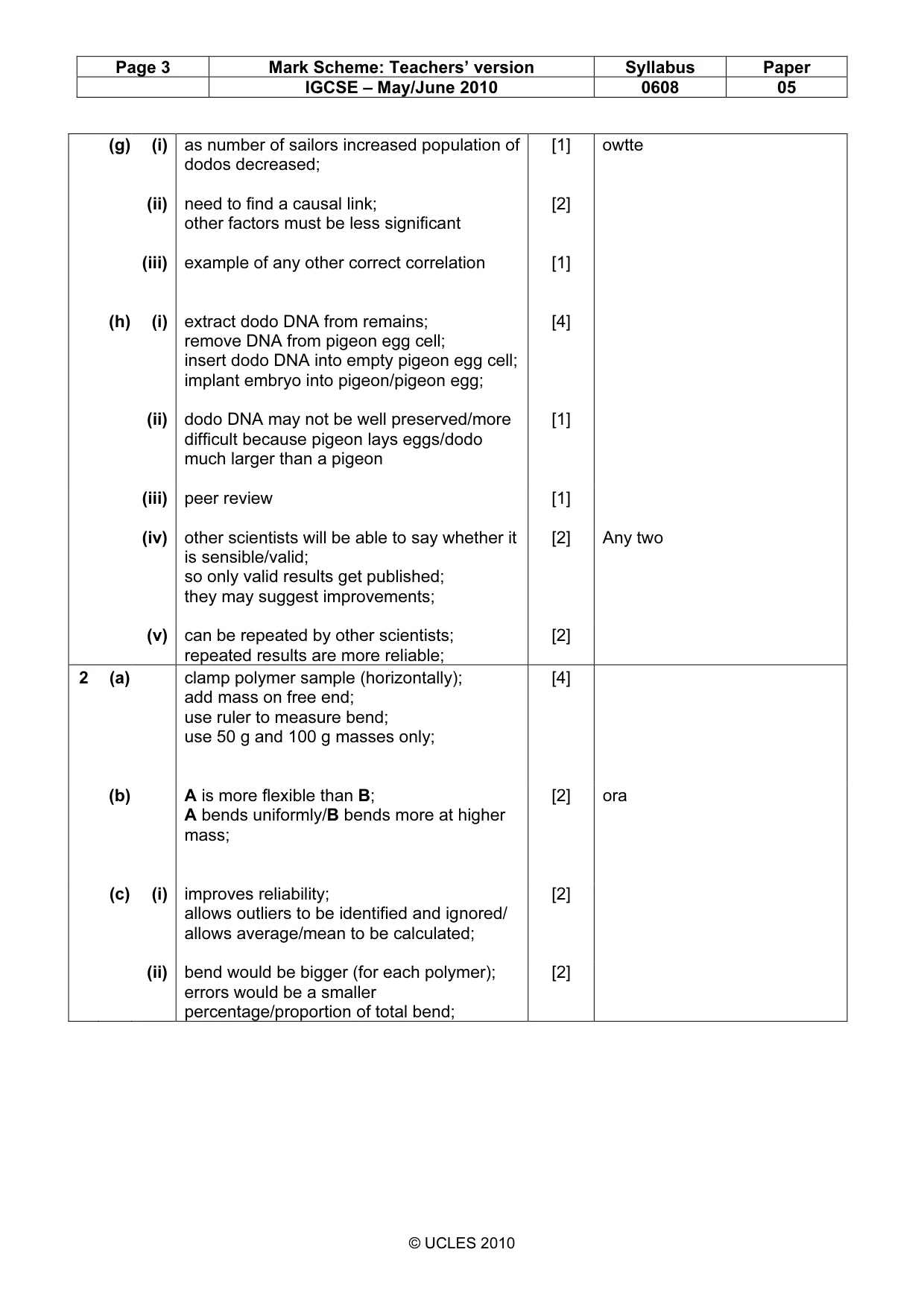
Page 2 Mark Scheme: Teachers’ version Syllabus Paper IGCSE – May/June 2010 0608 05 © UCLES 2010 Question Expected Answers Mks Additional Guidance 1 (a) all individuals of species have died out [1] (b) (i) predator eat/hunt species (and reduce numbers) [1] (ii) new competitor/disease is introduced; another organism in food web become extinct; example of change in environmental conditions, e.g. drought [1] Any one Do not accept any ref to predators (c) directly: hunting/poaching/fishing; indirectly: destroying habitat/introducing new species; [2] (d) meeting the needs of people today without damaging the Earth for the people of the future; people rely on range of species for food/ fuel/medicines/clothing; [2] (e) (i) genetically identical copy/result of asexual reproduction [1] (ii) one embryo formed/one egg + one sperm; embryo splits in two [2] (iii) Agree: prevents species becoming extinct; preserves unique genetic make-up of species; used for captive breeding programmes; could lead to cloning of humans; Disagree: harms the animals; expensive; very low success rate; could lead to cloning of humans; ‘playing God’ idea; don’t really know the outcome/could be dangerous; [4] Accept any two reasonable answers under each heading (f) 1/439; 0.22% [2] Need to see use of 1 and 439 for first mark
Mark scheme, page 3
Page 3 Mark Scheme: Teachers’ version Syllabus Paper IGCSE – May/June 2010 0608 05 © UCLES 2010 (g) (i) as number of sailors increased population of dodos decreased; [1] owtte (ii) need to find a causal link; other factors must be less significant [2] (iii) example of any other correct correlation [1] (h) (i) extract dodo DNA from remains; remove DNA from pigeon egg cell; insert dodo DNA into empty pigeon egg cell; implant embryo into pigeon/pigeon egg; [4] (ii) dodo DNA may not be well preserved/more difficult because pigeon lays eggs/dodo much larger than a pigeon [1] (iii) peer review [1] (iv) other scientists will be able to say whether it is sensible/valid; so only valid results get published; they may suggest improvements; [2] Any two (v) can be repeated by other scientists; repeated results are more reliable; [2] 2 (a) clamp polymer sample (horizontally); add mass on free end; use ruler to measure bend; use 50 g and 100 g masses only; [4] (b) A is more flexible than B; A bends uniformly/B bends more at higher mass; [2] ora (c) (i) improves reliability; allows outliers to be identified and ignored/ allows average/mean to be calculated; [2] (ii) bend would be bigger (for each polymer); errors would be a smaller percentage/proportion of total bend; [2]
Mark scheme, page 4
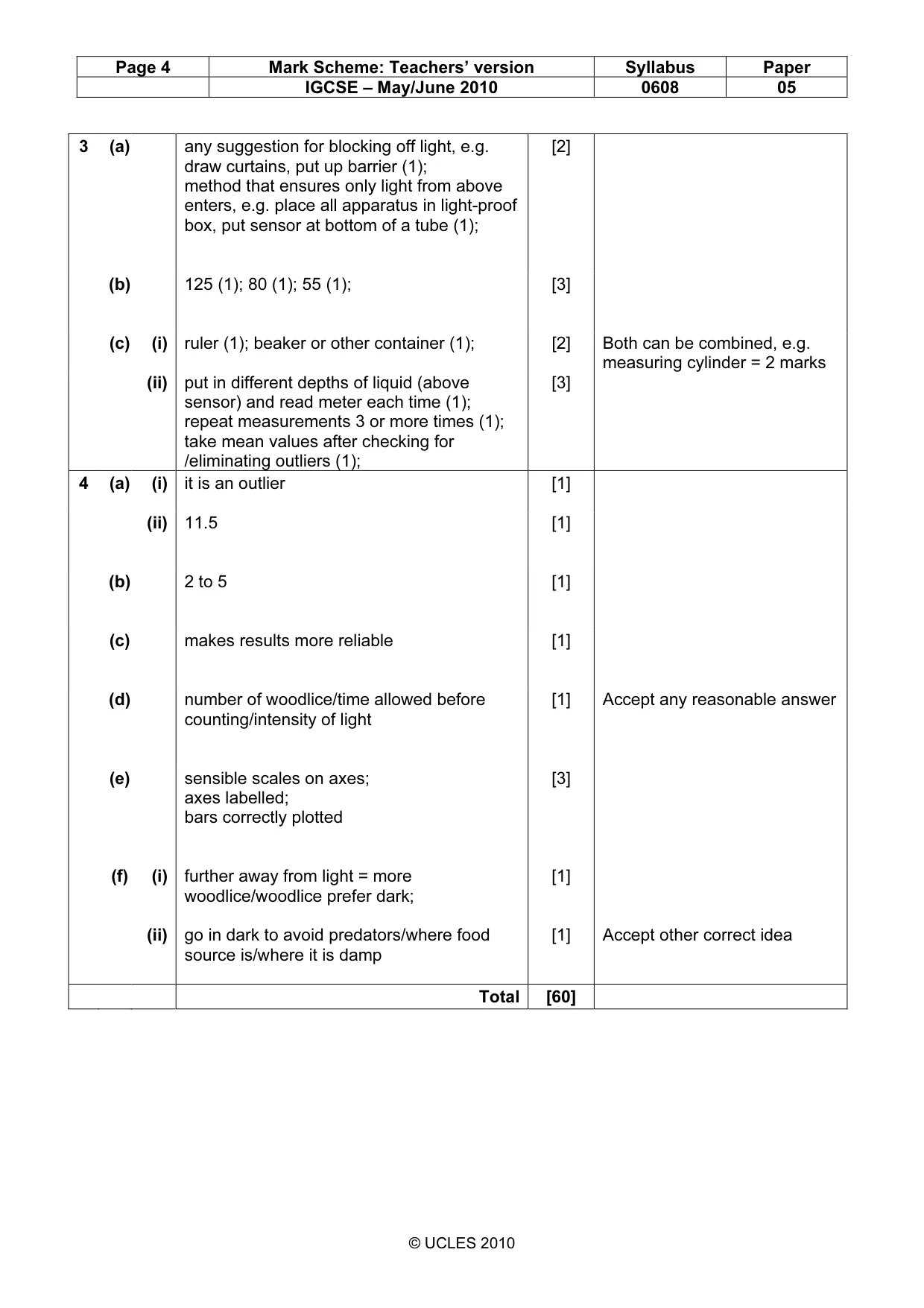
Page 4 Mark Scheme: Teachers’ version Syllabus Paper IGCSE – May/June 2010 0608 05 © UCLES 2010 3 (a) any suggestion for blocking off light, e.g. draw curtains, put up barrier (1); method that ensures only light from above enters, e.g. place all apparatus in light-proof box, put sensor at bottom of a tube (1); [2] (b) 125 (1); 80 (1); 55 (1); [3] (c) (i) ruler (1); beaker or other container (1); [2] Both can be combined, e.g. measuring cylinder = 2 marks (ii) put in different depths of liquid (above sensor) and read meter each time (1); repeat measurements 3 or more times (1); take mean values after checking for /eliminating outliers (1); [3] 4 (a) (i) it is an outlier [1] (ii) 11.5 [1] (b) 2 to 5 [1] (c) makes results more reliable [1] (d) number of woodlice/time allowed before counting/intensity of light [1] Accept any reasonable answer (e) sensible scales on axes; axes labelled; bars correctly plotted [3] (f) (i) further away from light = more woodlice/woodlice prefer dark; [1] (ii) go in dark to avoid predators/where food source is/where it is damp [1] Accept other correct idea Total [60]