Cambridge IGCSE Twenty-First Century Science 0608 — 2012 Oct/Nov Paper 5 · Variant 1
0608/51/O/N/12
The question paper and its mark scheme, free to read here and free to download. This is Cambridge’s own paper, exactly as it was sat.
Question paper16 pages

Mark scheme6 pages
Answers below. Sit the paper first if you are practising.
Paper as text
Question paper, page 1
This document consists of 15 printed pages and 1 blank page. DC (SJF/SW) 51971/4 © UCLES 2012 [Turn over UNIVERSITY OF CAMBRIDGE INTERNATIONAL EXAMINATIONS International General Certificate of Secondary Education * 1 5 3 4 7 0 3 4 0 1 * TWENTY FIRST CENTURY SCIENCE 0608/05 Paper 5 October/November 2012 1 hour 30 minutes Candidates answer on the Question Paper. No Additional Materials are required. READ THESE INSTRUCTIONS FIRST Write your Centre number, candidate number and name on all the work you hand in. Write in dark blue or black pen. You may use a pencil for any diagrams or graphs. Do not use staples, paper clips, highlighters, glue or correction fluid. DO NOT WRITE IN ANY BARCODES. Answer all questions. At the end of the examination, fasten all your work securely together. The number of marks is given in brackets [ ] at the end of each question or part question. For Examiner’s Use 1 2 3 4 5 Total www.XtremePapers.com
Question paper, page 2
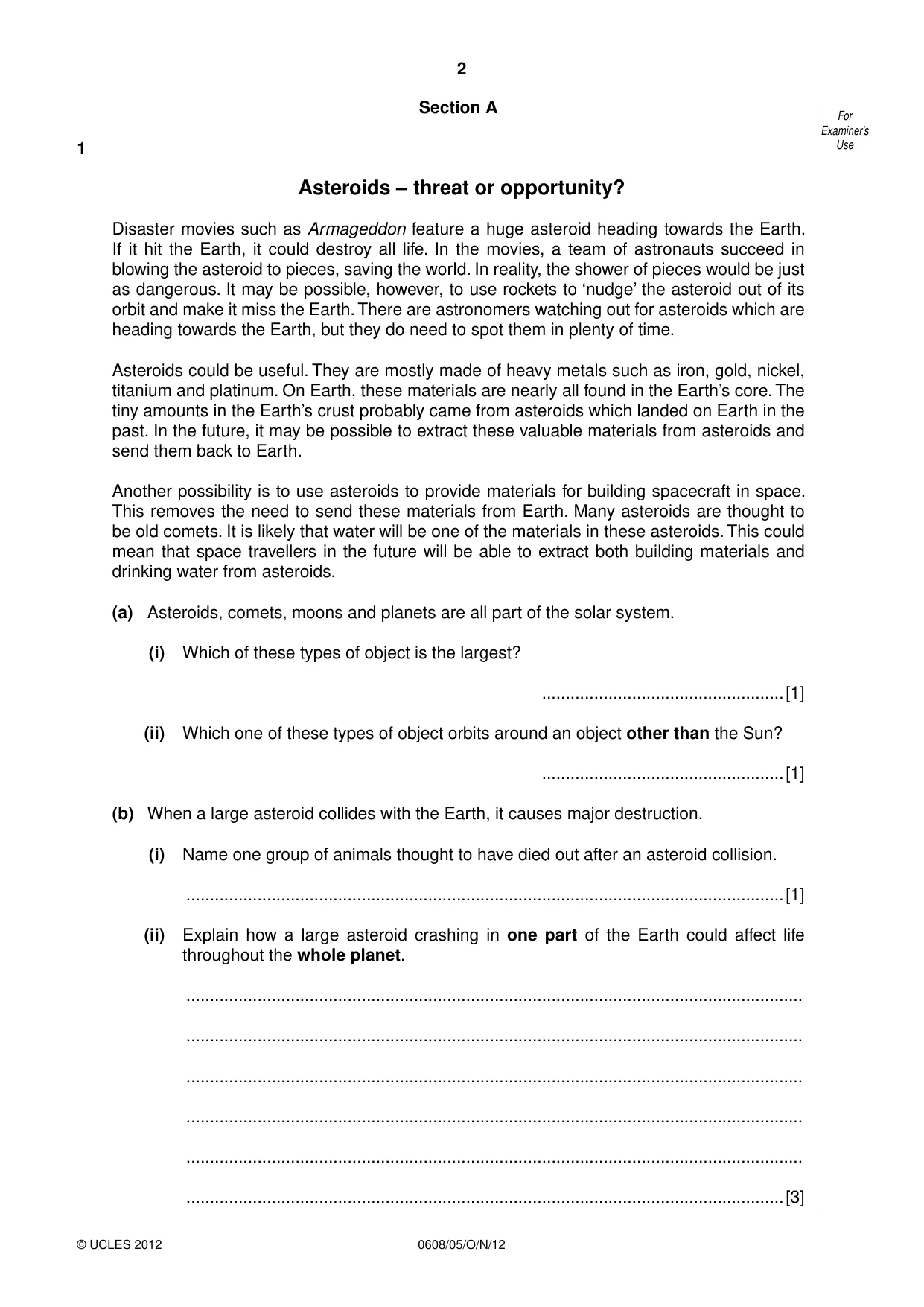
2 0608/05/O/N/12 © UCLES 2012 For Examiner’s Use Section A 1 Asteroids – threat or opportunity? Disaster movies such as Armageddon feature a huge asteroid heading towards the Earth. If it hit the Earth, it could destroy all life. In the movies, a team of astronauts succeed in blowing the asteroid to pieces, saving the world. In reality, the shower of pieces would be just as dangerous. It may be possible, however, to use rockets to ‘nudge’ the asteroid out of its orbit and make it miss the Earth. There are astronomers watching out for asteroids which are heading towards the Earth, but they do need to spot them in plenty of time. Asteroids could be useful. They are mostly made of heavy metals such as iron, gold, nickel, titanium and platinum. On Earth, these materials are nearly all found in the Earth’s core. The tiny amounts in the Earth’s crust probably came from asteroids which landed on Earth in the past. In the future, it may be possible to extract these valuable materials from asteroids and send them back to Earth. Another possibility is to use asteroids to provide materials for building spacecraft in space. This removes the need to send these materials from Earth. Many asteroids are thought to be old comets. It is likely that water will be one of the materials in these asteroids. This could mean that space travellers in the future will be able to extract both building materials and drinking water from asteroids. (a) Asteroids, comets, moons and planets are all part of the solar system. (i) Which of these types of object is the largest? …[1] (ii) Which one of these types of object orbits around an object other than the Sun? …[1] (b) When a large asteroid collides with the Earth, it causes major destruction. (i) Name one group of animals thought to have died out after an asteroid collision. …[1] (ii) Explain how a large asteroid crashing in one part of the Earth could affect life throughout the whole planet. … … … … … …[3]
Question paper, page 3
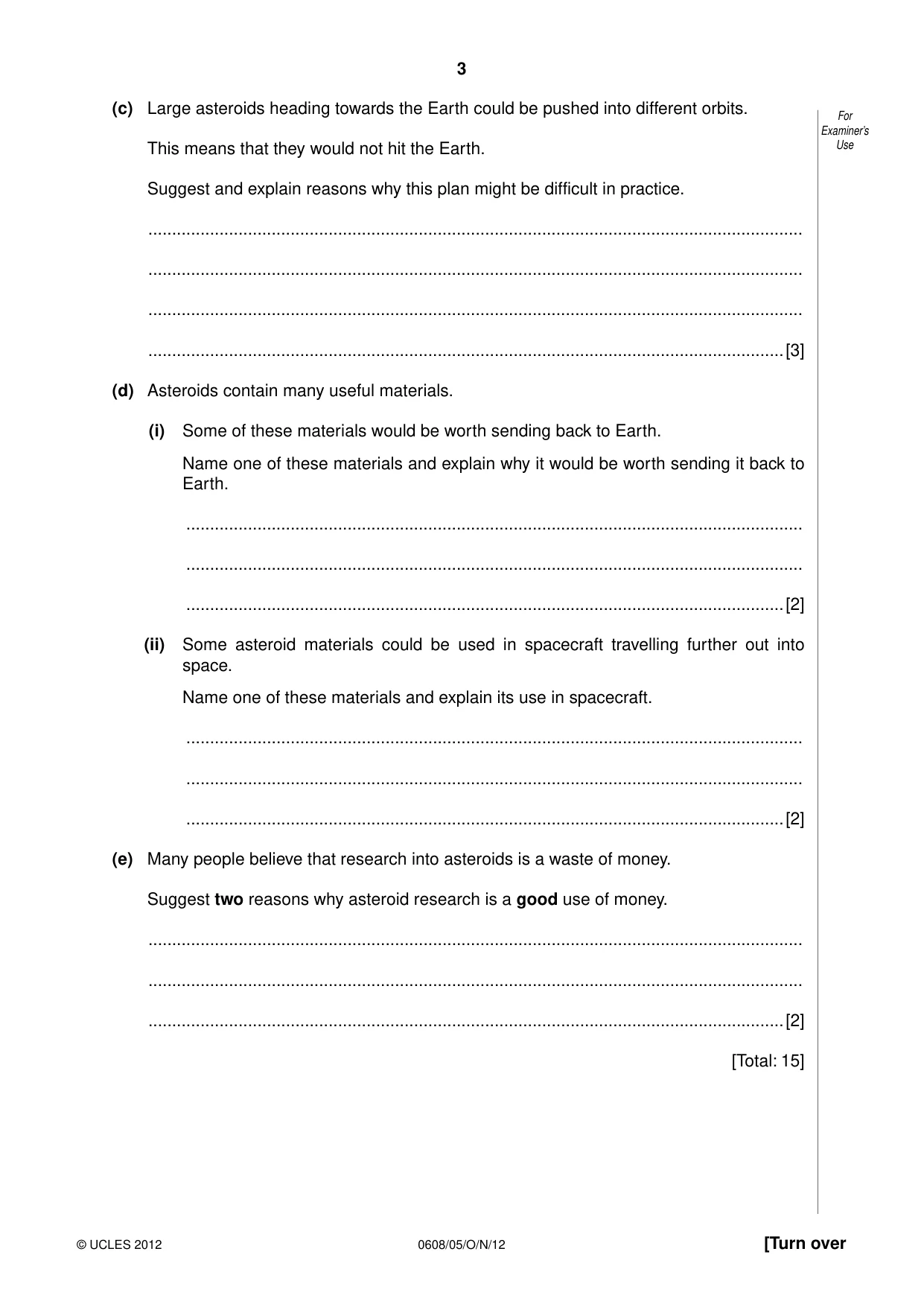
3 0608/05/O/N/12 © UCLES 2012 [Turn over For Examiner’s Use (c) Large asteroids heading towards the Earth could be pushed into different orbits. This means that they would not hit the Earth. Suggest and explain reasons why this plan might be difficult in practice. … … … …[3] (d) Asteroids contain many useful materials. (i) Some of these materials would be worth sending back to Earth. Name one of these materials and explain why it would be worth sending it back to Earth. … … …[2] (ii) Some asteroid materials could be used in spacecraft travelling further out into space. Name one of these materials and explain its use in spacecraft. … … …[2] (e) Many people believe that research into asteroids is a waste of money. Suggest two reasons why asteroid research is a good use of money. … … …[2] [Total: 15]
Question paper, page 4
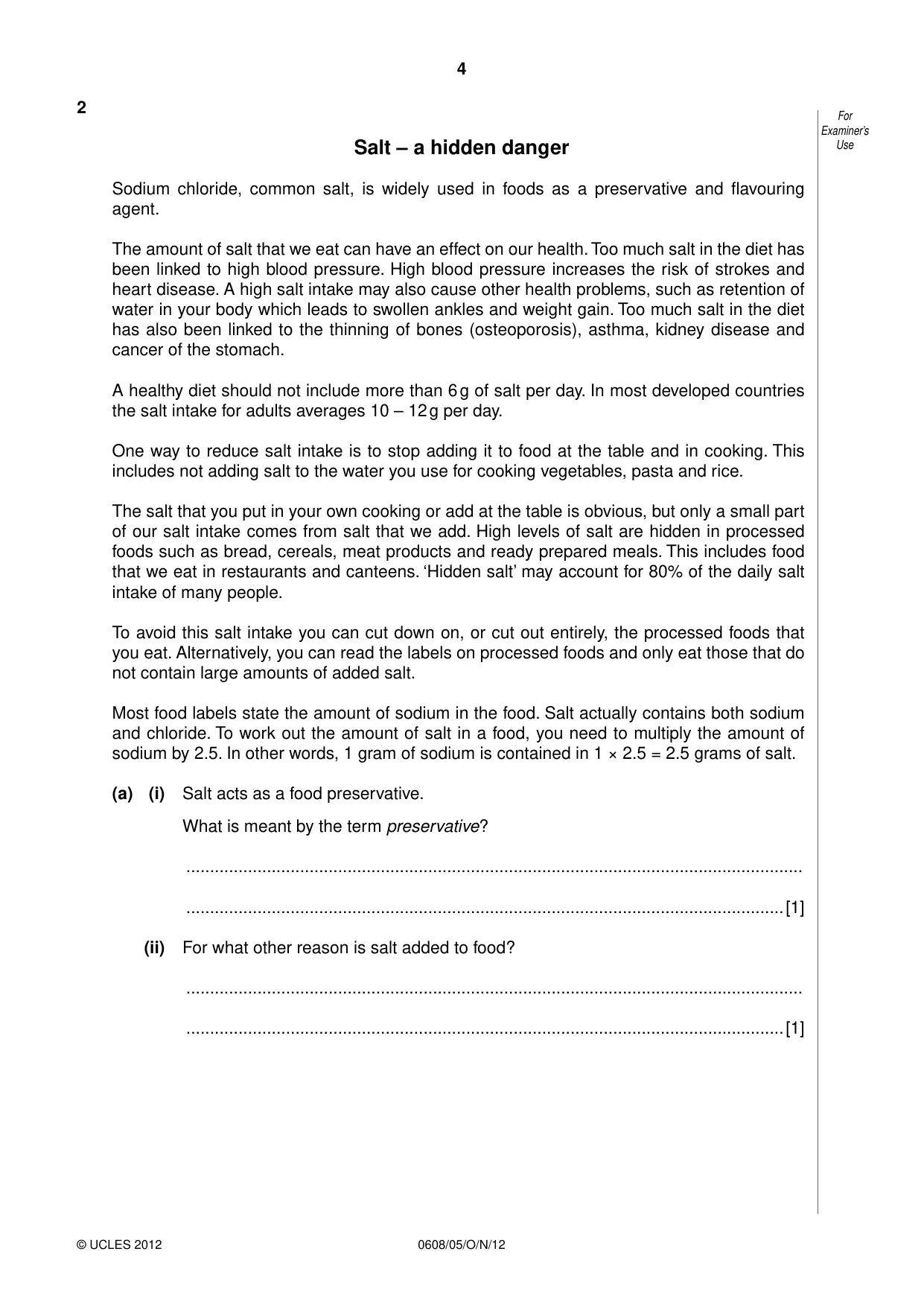
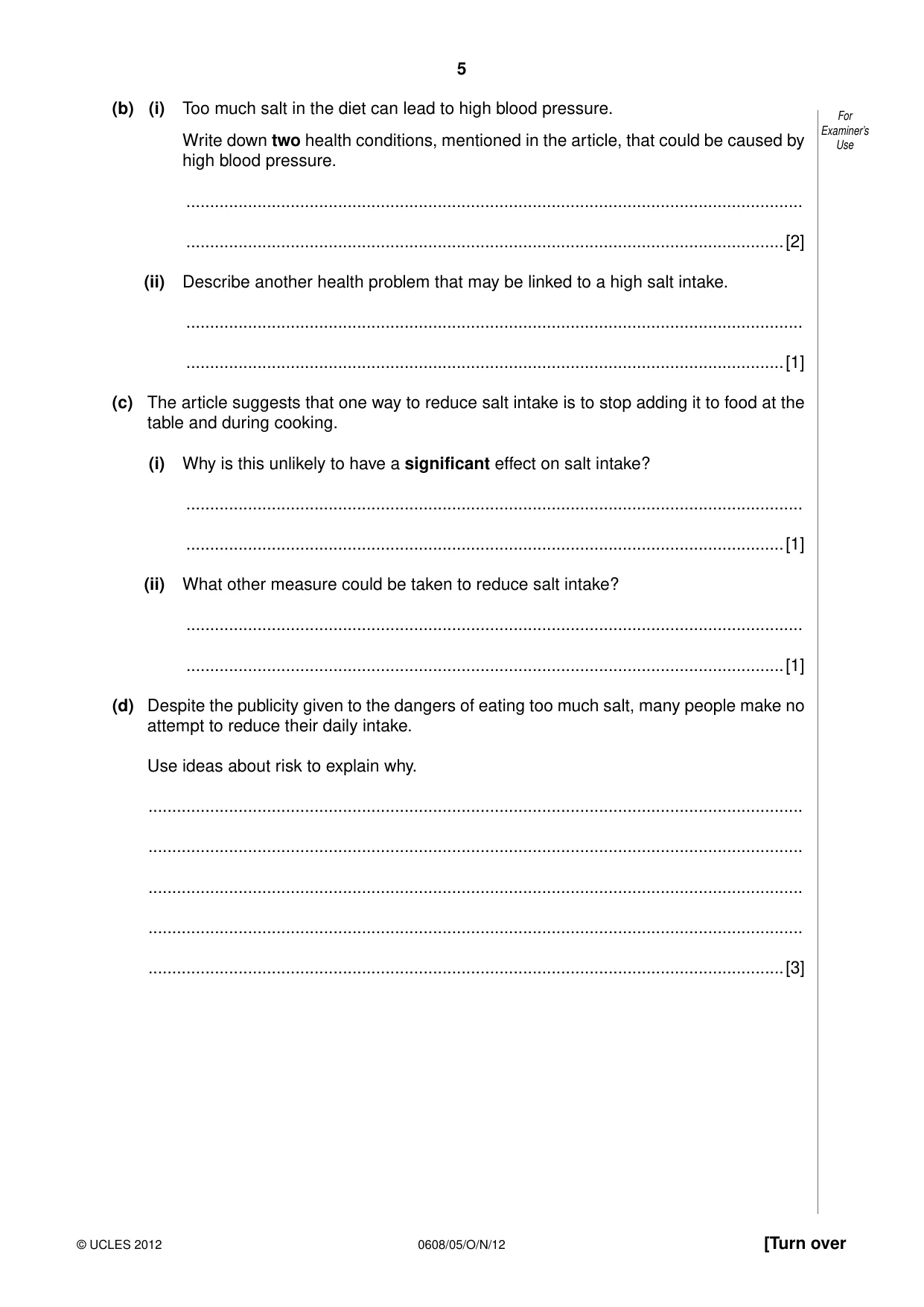
4 0608/05/O/N/12 © UCLES 2012 For Examiner’s Use 2 Salt – a hidden danger Sodium chloride, common salt, is widely used in foods as a preservative and flavouring agent. The amount of salt that we eat can have an effect on our health. Too much salt in the diet has been linked to high blood pressure. High blood pressure increases the risk of strokes and heart disease. A high salt intake may also cause other health problems, such as retention of water in your body which leads to swollen ankles and weight gain. Too much salt in the diet has also been linked to the thinning of bones (osteoporosis), asthma, kidney disease and cancer of the stomach. A healthy diet should not include more than 6 g of salt per day. In most developed countries the salt intake for adults averages 10 – 12 g per day. One way to reduce salt intake is to stop adding it to food at the table and in cooking. This includes not adding salt to the water you use for cooking vegetables, pasta and rice. The salt that you put in your own cooking or add at the table is obvious, but only a small part of our salt intake comes from salt that we add. High levels of salt are hidden in processed foods such as bread, cereals, meat products and ready prepared meals. This includes food that we eat in restaurants and canteens. ‘Hidden salt’ may account for 80% of the daily salt intake of many people. To avoid this salt intake you can cut down on, or cut out entirely, the processed foods that you eat. Alternatively, you can read the labels on processed foods and only eat those that do not contain large amounts of added salt. Most food labels state the amount of sodium in the food. Salt actually contains both sodium and chloride. To work out the amount of salt in a food, you need to multiply the amount of sodium by 2.5. In other words, 1 gram of sodium is contained in 1 × 2.5 = 2.5 grams of salt. (a) (i) Salt acts as a food preservative. What is meant by the term preservative? … …[1] (ii) For what other reason is salt added to food? … …[1]
Question paper, page 5
5 0608/05/O/N/12 © UCLES 2012 [Turn over For Examiner’s Use (b) (i) Too much salt in the diet can lead to high blood pressure. Write down two health conditions, mentioned in the article, that could be caused by high blood pressure. … …[2] (ii) Describe another health problem that may be linked to a high salt intake. … …[1] (c) The article suggests that one way to reduce salt intake is to stop adding it to food at the table and during cooking. (i) Why is this unlikely to have a significant effect on salt intake? … …[1] (ii) What other measure could be taken to reduce salt intake? … …[1] (d) Despite the publicity given to the dangers of eating too much salt, many people make no attempt to reduce their daily intake. Use ideas about risk to explain why. … … … … …[3]
Question paper, page 6
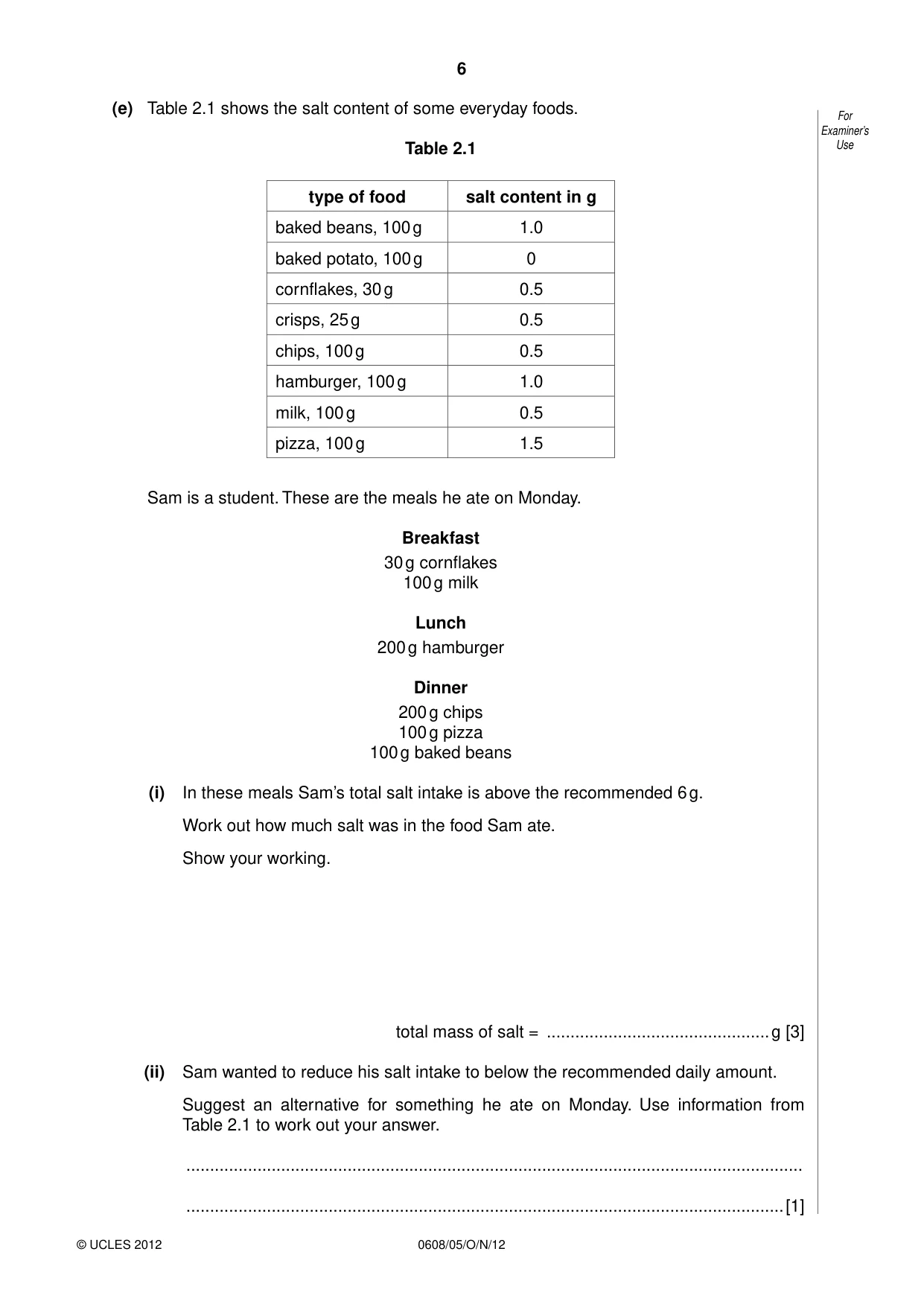
6 0608/05/O/N/12 © UCLES 2012 For Examiner’s Use (e) Table 2.1 shows the salt content of some everyday foods. Table 2.1 type of food salt content in g baked beans, 100 g 1.0 baked potato, 100 g 0 cornflakes, 30 g 0.5 crisps, 25 g 0.5 chips, 100 g 0.5 hamburger, 100 g 1.0 milk, 100 g 0.5 pizza, 100 g 1.5 Sam is a student. These are the meals he ate on Monday. Breakfast 30 g cornflakes 100 g milk Lunch 200 g hamburger Dinner 200 g chips 100 g pizza 100 g baked beans (i) In these meals Sam’s total salt intake is above the recommended 6 g. Work out how much salt was in the food Sam ate. Show your working. total mass of salt = …g [3] (ii) Sam wanted to reduce his salt intake to below the recommended daily amount. Suggest an alternative for something he ate on Monday. Use information from Table 2.1 to work out your answer. … …[1]
Question paper, page 7
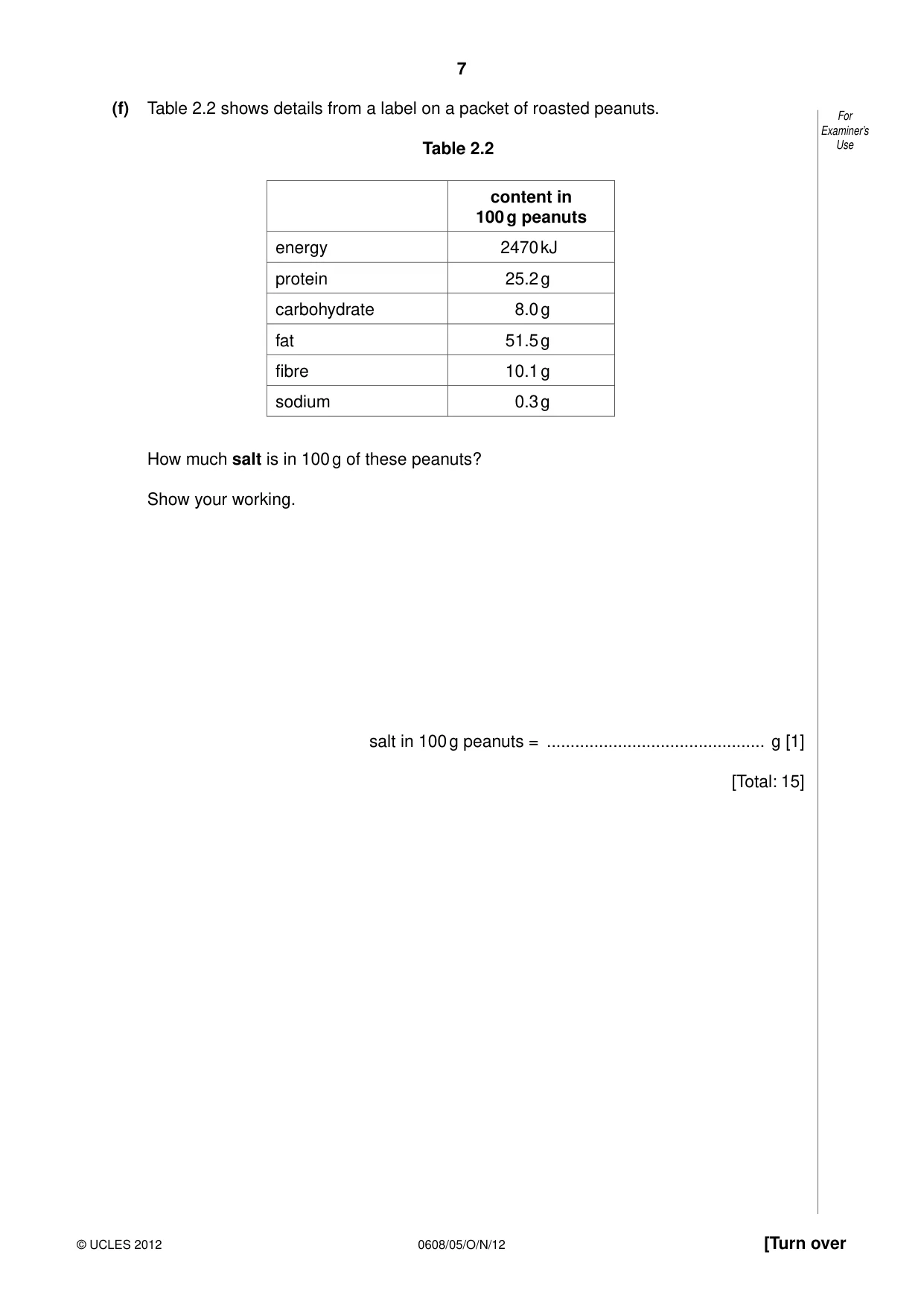
7 0608/05/O/N/12 © UCLES 2012 [Turn over For Examiner’s Use (f) Table 2.2 shows details from a label on a packet of roasted peanuts. Table 2.2 content in 100 g peanuts energy 2470 kJ protein 25.2 g carbohydrate 8.0 g fat 51.5 g fibre 10.1 g sodium 0.3 g How much salt is in 100 g of these peanuts? Show your working. salt in 100 g peanuts = … g [1] [Total: 15]
Question paper, page 8
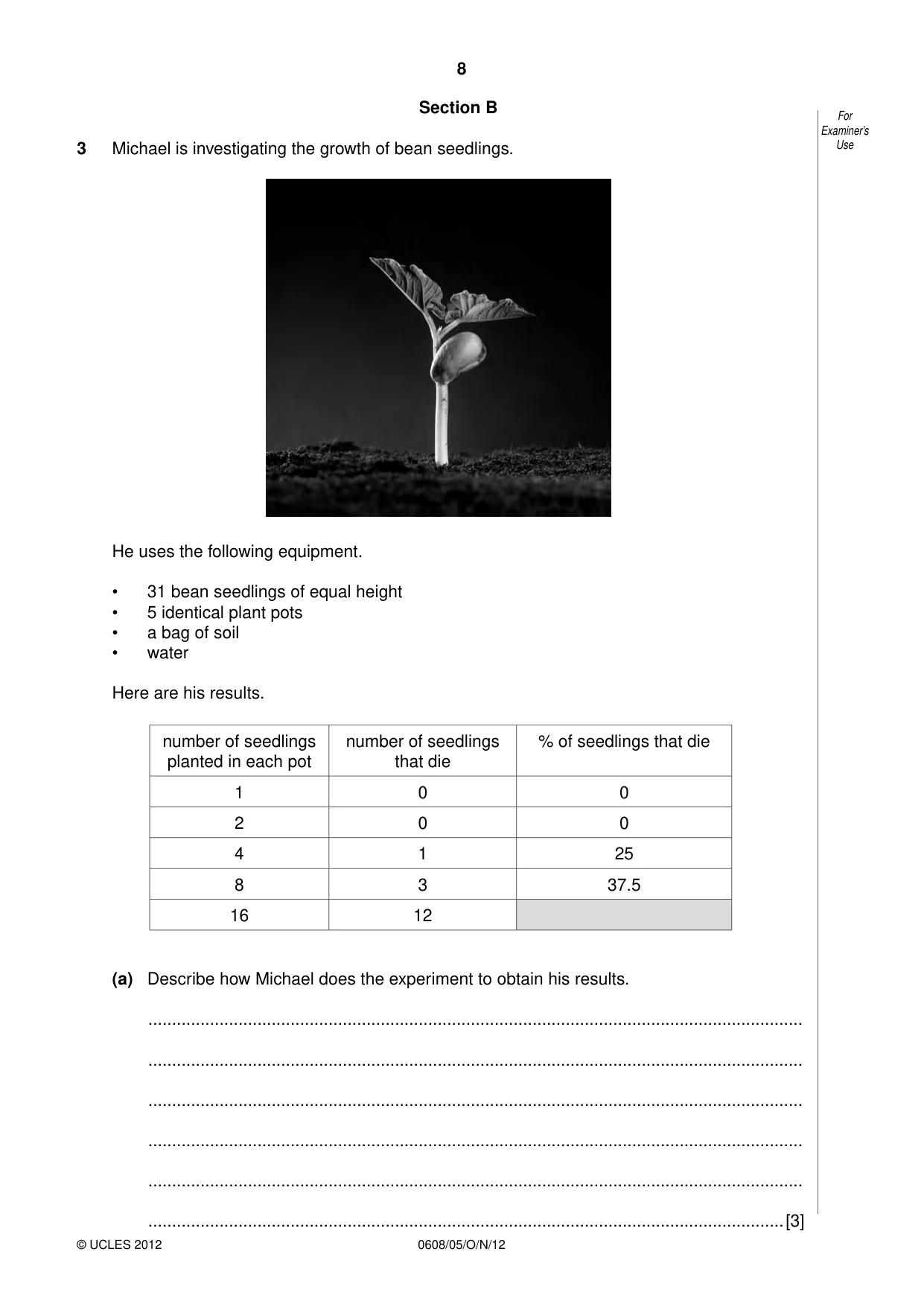
8 0608/05/O/N/12 © UCLES 2012 For Examiner’s Use Section B 3 Michael is investigating the growth of bean seedlings. He uses the following equipment. • 31 bean seedlings of equal height • 5 identical plant pots • a bag of soil • water Here are his results. number of seedlings planted in each pot number of seedlings that die % of seedlings that die 1 0 0 2 0 0 4 1 25 8 3 37.5 16 12 (a) Describe how Michael does the experiment to obtain his results. … … … … … …[3]
Question paper, page 9
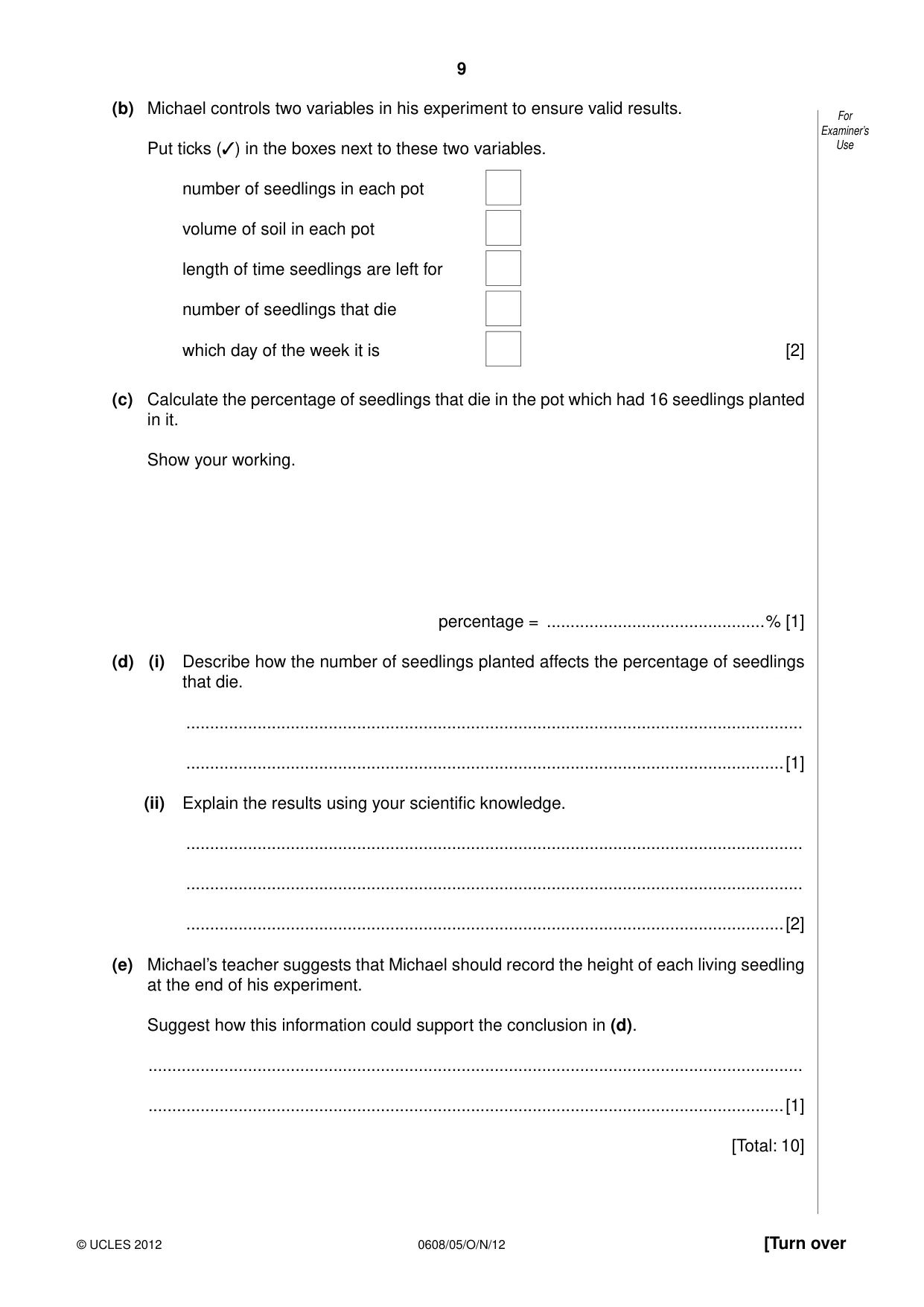
9 0608/05/O/N/12 © UCLES 2012 [Turn over For Examiner’s Use (b) Michael controls two variables in his experiment to ensure valid results. Put ticks (✓) in the boxes next to these two variables. number of seedlings in each pot volume of soil in each pot length of time seedlings are left for number of seedlings that die which day of the week it is [2] (c) Calculate the percentage of seedlings that die in the pot which had 16 seedlings planted in it. Show your working. percentage = …% [1] (d) (i) Describe how the number of seedlings planted affects the percentage of seedlings that die. … …[1] (ii) Explain the results using your scientific knowledge. … … …[2] (e) Michael’s teacher suggests that Michael should record the height of each living seedling at the end of his experiment. Suggest how this information could support the conclusion in (d). … …[1] [Total: 10]
Question paper, page 10
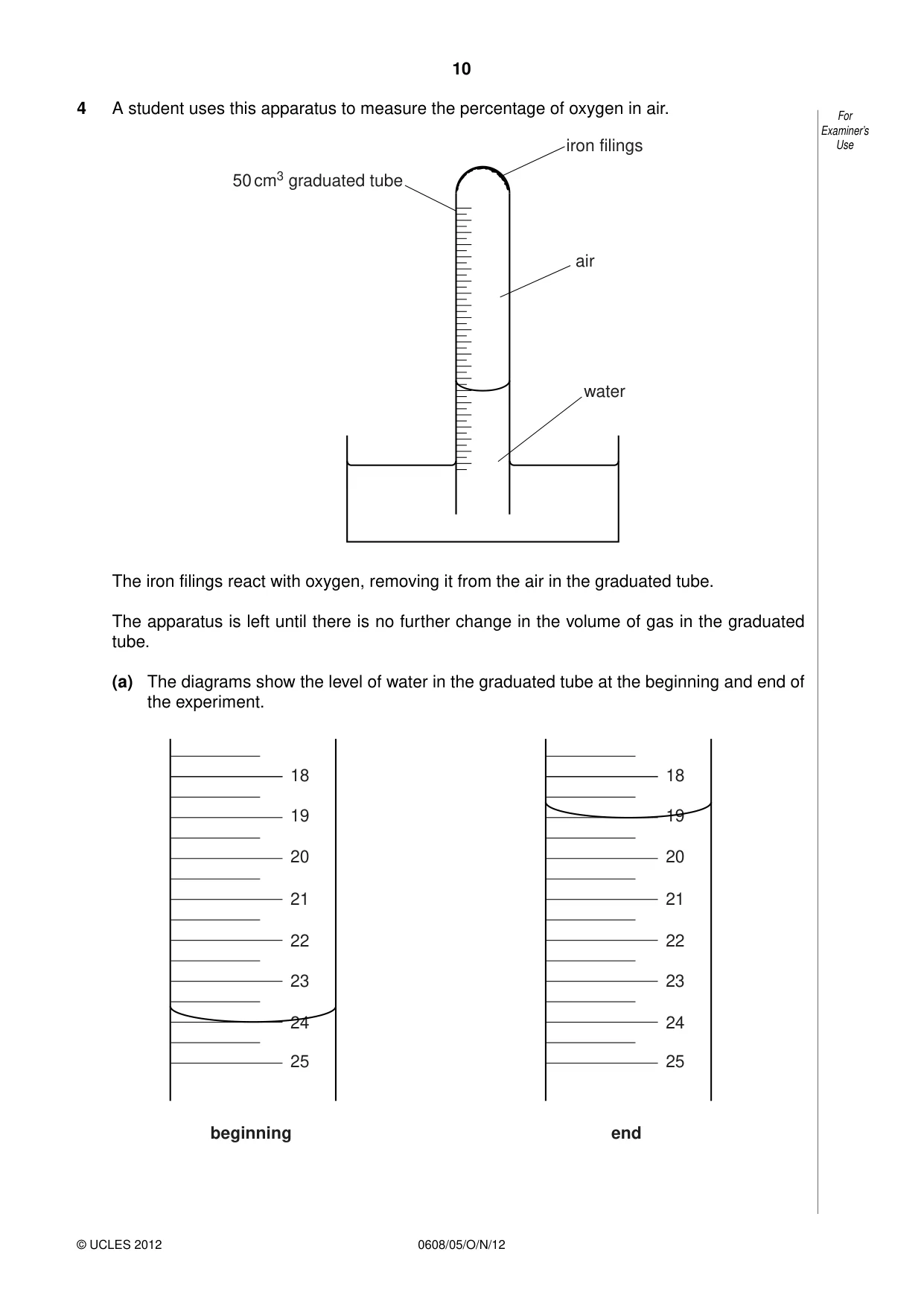
10 0608/05/O/N/12 © UCLES 2012 For Examiner’s Use 4 A student uses this apparatus to measure the percentage of oxygen in air. iron filings air 50 cm3 graduated tube water The iron filings react with oxygen, removing it from the air in the graduated tube. The apparatus is left until there is no further change in the volume of gas in the graduated tube. (a) The diagrams show the level of water in the graduated tube at the beginning and end of the experiment. 18 19 20 21 22 23 24 25 beginning 18 19 20 21 22 23 24 25 end
Question paper, page 11
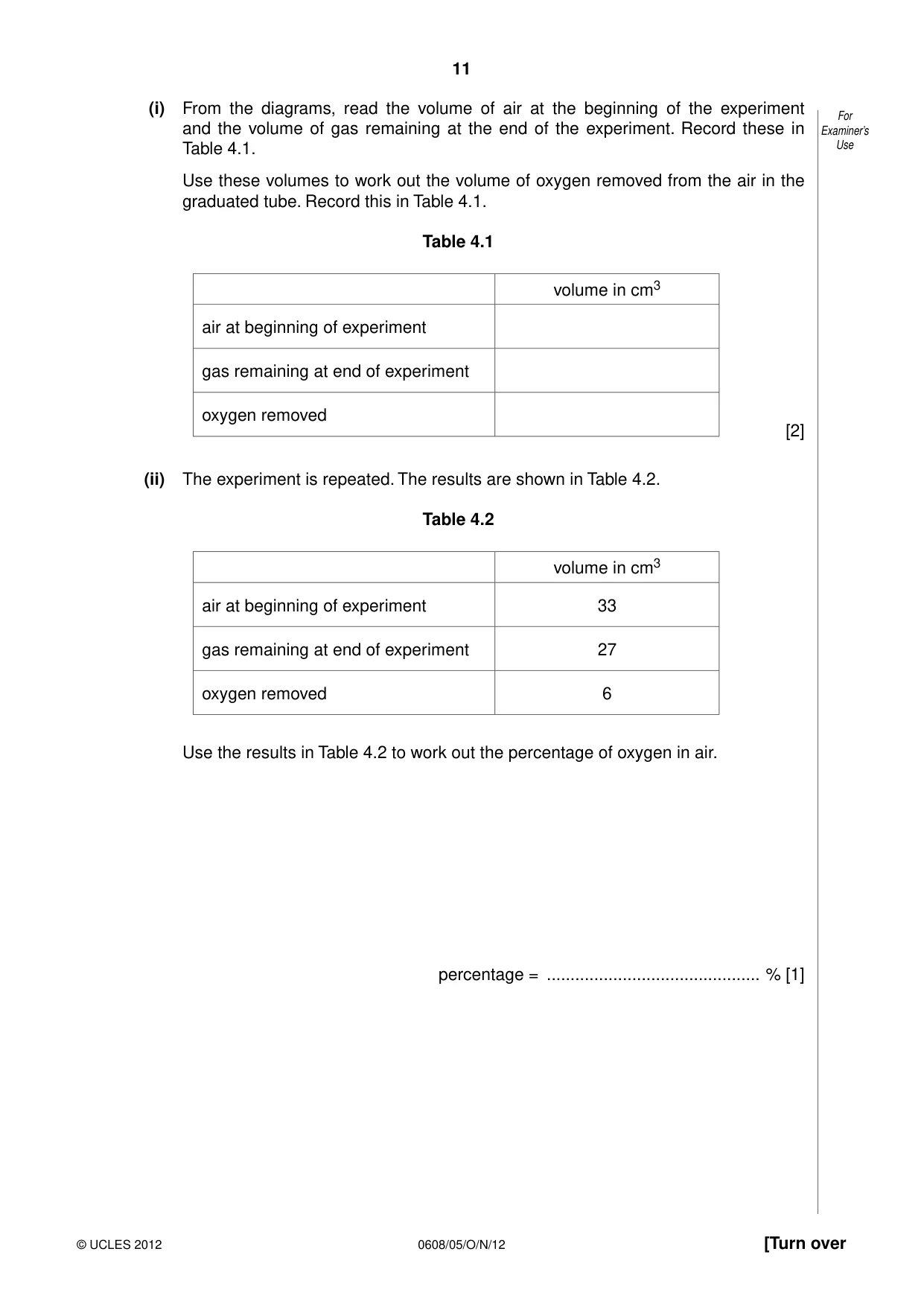
11 0608/05/O/N/12 © UCLES 2012 [Turn over For Examiner’s Use (i) From the diagrams, read the volume of air at the beginning of the experiment and the volume of gas remaining at the end of the experiment. Record these in Table 4.1. Use these volumes to work out the volume of oxygen removed from the air in the graduated tube. Record this in Table 4.1. Table 4.1 volume in cm3 air at beginning of experiment gas remaining at end of experiment oxygen removed [2] (ii) The experiment is repeated. The results are shown in Table 4.2. Table 4.2 volume in cm3 air at beginning of experiment 33 gas remaining at end of experiment 27 oxygen removed 6 Use the results in Table 4.2 to work out the percentage of oxygen in air. percentage = … % [1]
Question paper, page 12
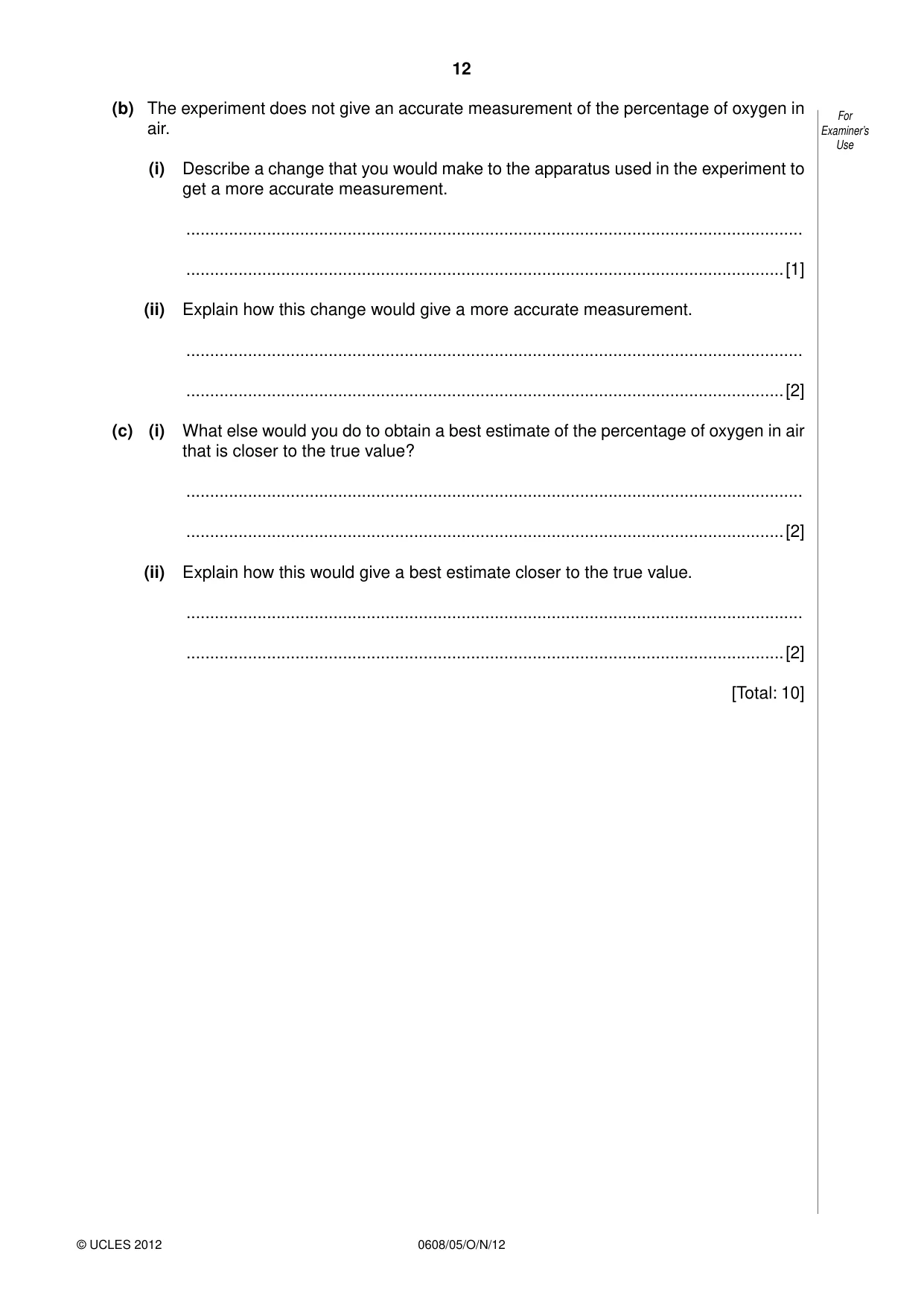
12 0608/05/O/N/12 © UCLES 2012 For Examiner’s Use (b) The experiment does not give an accurate measurement of the percentage of oxygen in air. (i) Describe a change that you would make to the apparatus used in the experiment to get a more accurate measurement. … …[1] (ii) Explain how this change would give a more accurate measurement. … …[2] (c) (i) What else would you do to obtain a best estimate of the percentage of oxygen in air that is closer to the true value? … …[2] (ii) Explain how this would give a best estimate closer to the true value. … …[2] [Total: 10]
Question paper, page 13
13 0608/05/O/N/12 © UCLES 2012 [Turn over PLEASE TURN OVER FOR QUESTION 5
Question paper, page 14
14 0608/05/O/N/12 © UCLES 2012 For Examiner’s Use 5 Anita and Vijay are doing an experiment to investigate how water absorbs microwaves. They set up their experiment as in the diagram. microwave detector microwave emitter glass tank wooden support for glass tank water Anita and Vijay measure the depth of the water in the tank and the intensity of the microwave signal received by the detector. (a) Vijay and Anita do their experiment five times with a water depth of 3.0 cm. Their readings are in Table 5.1. Table 5.1 microwave intensity 3 4 3 5 5 Calculate the mean value of intensity for this water depth. mean value of intensity = …[2] (b) They use six depths of water over a range 0.5 cm to 3.0 cm and calculate the mean value of intensity for each. Use your mean value from (a) to complete Table 5.2 opposite.
Question paper, page 15
15 0608/05/O/N/12 © UCLES 2012 For Examiner’s Use Table 5.2 depth of water in cm 0.5 1.0 1.5 2.0 2.5 3.0 mean microwave intensity 30 20 13 9 6 Use the data in Table 5.2 to plot the graph on the grid below. Complete the graph by drawing a best-fit curve. 0.0 0 5 10 15 20 25 microwave intensity depth of water in cm 30 35 40 45 50 0.5 1.0 1.5 2.0 2.5 3.0 [4] (c) Use the graph to find the depth of water at which the microwave intensity is 25. depth = … cm [1] (d) Use the graph to find the microwave intensity when the water in the glass tank is 0.6 cm deep. intensity = … [1] (e) Describe in detail the way in which the microwave intensity changes as the depth of the water increases from 0.0 to 3.0 cm. … … …[2] [Total: 10]
Question paper, page 16
16 0608/05/O/N/12 © UCLES 2012 Copyright Acknowledgements: Question 3 Photograph © Nigel Cattlin; Ref: BT188R; alamy.com. Permission to reproduce items where third-party owned material protected by copyright is included has been sought and cleared where possible. Every reasonable effort has been made by the publisher (UCLES) to trace copyright holders, but if any items requiring clearance have unwittingly been included, the publisher will be pleased to make amends at the earliest possible opportunity. University of Cambridge International Examinations is part of the Cambridge Assessment Group. Cambridge Assessment is the brand name of University of Cambridge Local Examinations Syndicate (UCLES), which is itself a department of the University of Cambridge. BLANK PAGE
Mark scheme, page 1
CAMBRIDGE INTERNATIONAL EXAMINATIONS International General Certificate of Secondary Education MARK SCHEME for the October/November 2012 series 0608 TWENTY FIRST CENTURY SCIENCE 0608/05 Paper 5 (Analysis and Interpretation), maximum raw mark 60 This mark scheme is published as an aid to teachers and candidates, to indicate the requirements of the examination. It shows the basis on which Examiners were instructed to award marks. It does not indicate the details of the discussions that took place at an Examiners’ meeting before marking began, which would have considered the acceptability of alternative answers. Mark schemes should be read in conjunction with the question paper and the Principal Examiner Report for Teachers. Cambridge will not enter into discussions about these mark schemes. Cambridge is publishing the mark schemes for the October/November 2012 series for most IGCSE, GCE Advanced Level and Advanced Subsidiary Level components and some Ordinary Level components. www.XtremePapers.com
Mark scheme, page 2
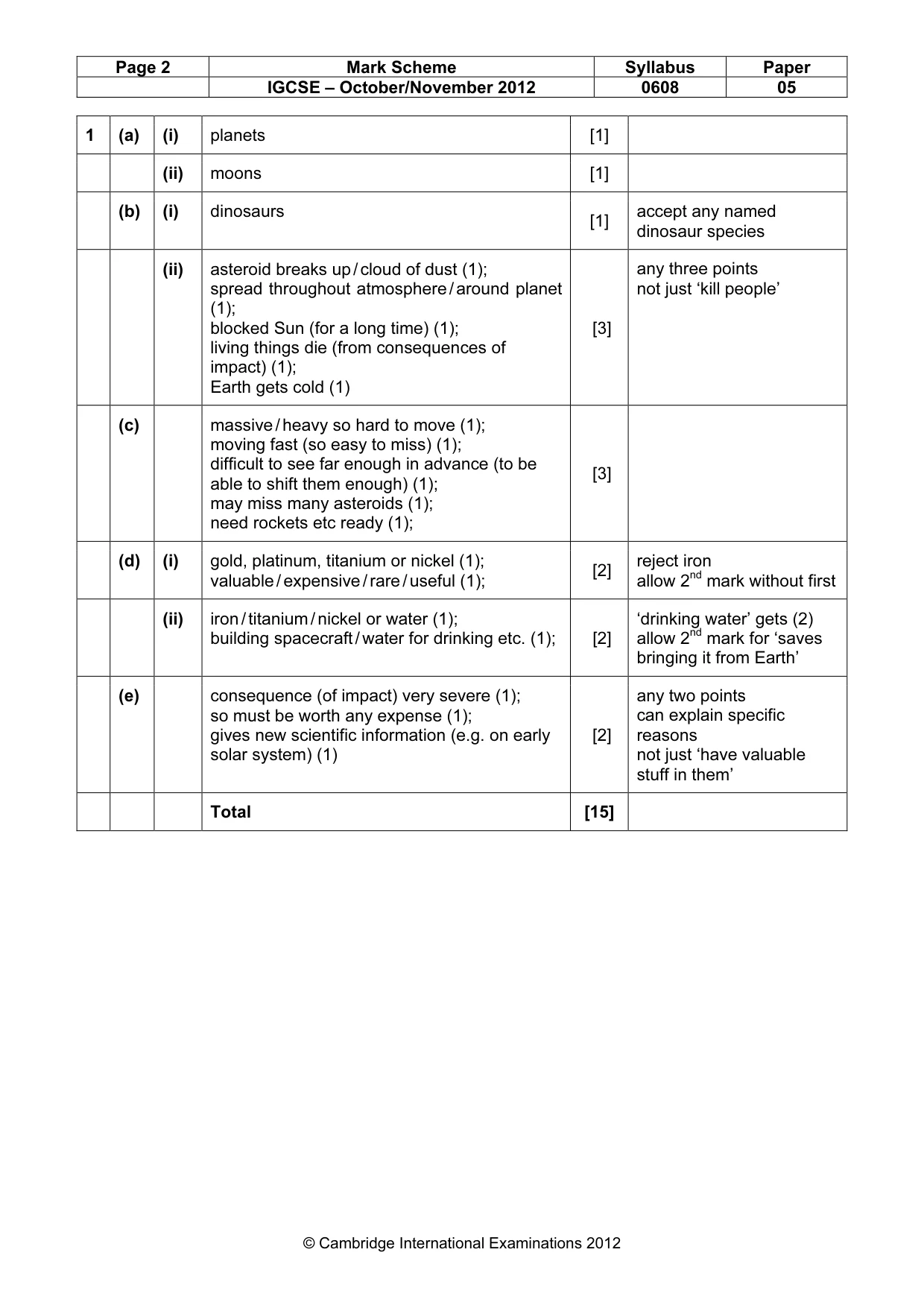
Page 2 Mark Scheme Syllabus Paper IGCSE – October/November 2012 0608 05 © Cambridge International Examinations 2012 1 (a) (i) planets [1] (ii) moons [1] (b) (i) dinosaurs [1] accept any named dinosaur species (ii) asteroid breaks up / cloud of dust (1); spread throughout atmosphere / around planet (1); blocked Sun (for a long time) (1); living things die (from consequences of impact) (1); Earth gets cold (1) [3] any three points not just ‘kill people’ (c) massive / heavy so hard to move (1); moving fast (so easy to miss) (1); difficult to see far enough in advance (to be able to shift them enough) (1); may miss many asteroids (1); need rockets etc ready (1); [3] (d) (i) gold, platinum, titanium or nickel (1); valuable / expensive / rare / useful (1); [2] reject iron allow 2nd mark without first (ii) iron / titanium / nickel or water (1); building spacecraft / water for drinking etc. (1); [2] ‘drinking water’ gets (2) allow 2nd mark for ‘saves bringing it from Earth’ (e) consequence (of impact) very severe (1); so must be worth any expense (1); gives new scientific information (e.g. on early solar system) (1) [2] any two points can explain specific reasons not just ‘have valuable stuff in them’ Total [15]
Mark scheme, page 3
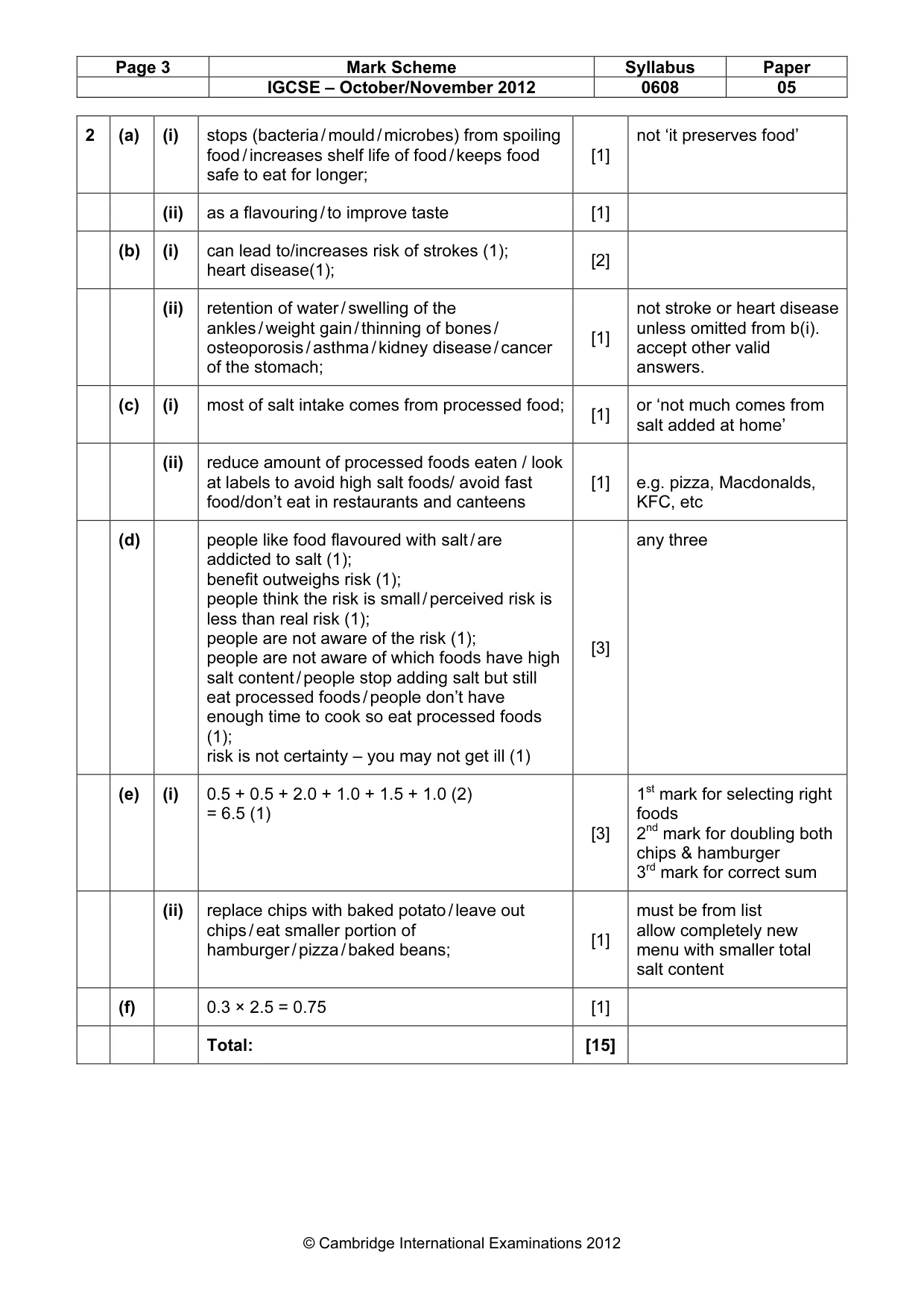
Page 3 Mark Scheme Syllabus Paper IGCSE – October/November 2012 0608 05 © Cambridge International Examinations 2012 2 (a) (i) stops (bacteria / mould / microbes) from spoiling food / increases shelf life of food / keeps food safe to eat for longer; [1] not ‘it preserves food’ (ii) as a flavouring / to improve taste [1] (b) (i) can lead to/increases risk of strokes (1); heart disease(1); [2] (ii) retention of water / swelling of the ankles / weight gain / thinning of bones / osteoporosis / asthma / kidney disease / cancer of the stomach; [1] not stroke or heart disease unless omitted from b(i). accept other valid answers. (c) (i) most of salt intake comes from processed food; [1] or ‘not much comes from salt added at home’ (ii) reduce amount of processed foods eaten / look at labels to avoid high salt foods/ avoid fast food/don’t eat in restaurants and canteens [1] e.g. pizza, Macdonalds, KFC, etc (d) people like food flavoured with salt / are addicted to salt (1); benefit outweighs risk (1); people think the risk is small / perceived risk is less than real risk (1); people are not aware of the risk (1); people are not aware of which foods have high salt content / people stop adding salt but still eat processed foods / people don’t have enough time to cook so eat processed foods (1); risk is not certainty – you may not get ill (1) [3] any three (e) (i) 0.5 + 0.5 + 2.0 + 1.0 + 1.5 + 1.0 (2) = 6.5 (1) [3] 1st mark for selecting right foods 2nd mark for doubling both chips & hamburger 3rd mark for correct sum (ii) replace chips with baked potato / leave out chips / eat smaller portion of hamburger / pizza / baked beans; [1] must be from list allow completely new menu with smaller total salt content (f) 0.3 × 2.5 = 0.75 [1] Total: [15]
Mark scheme, page 4
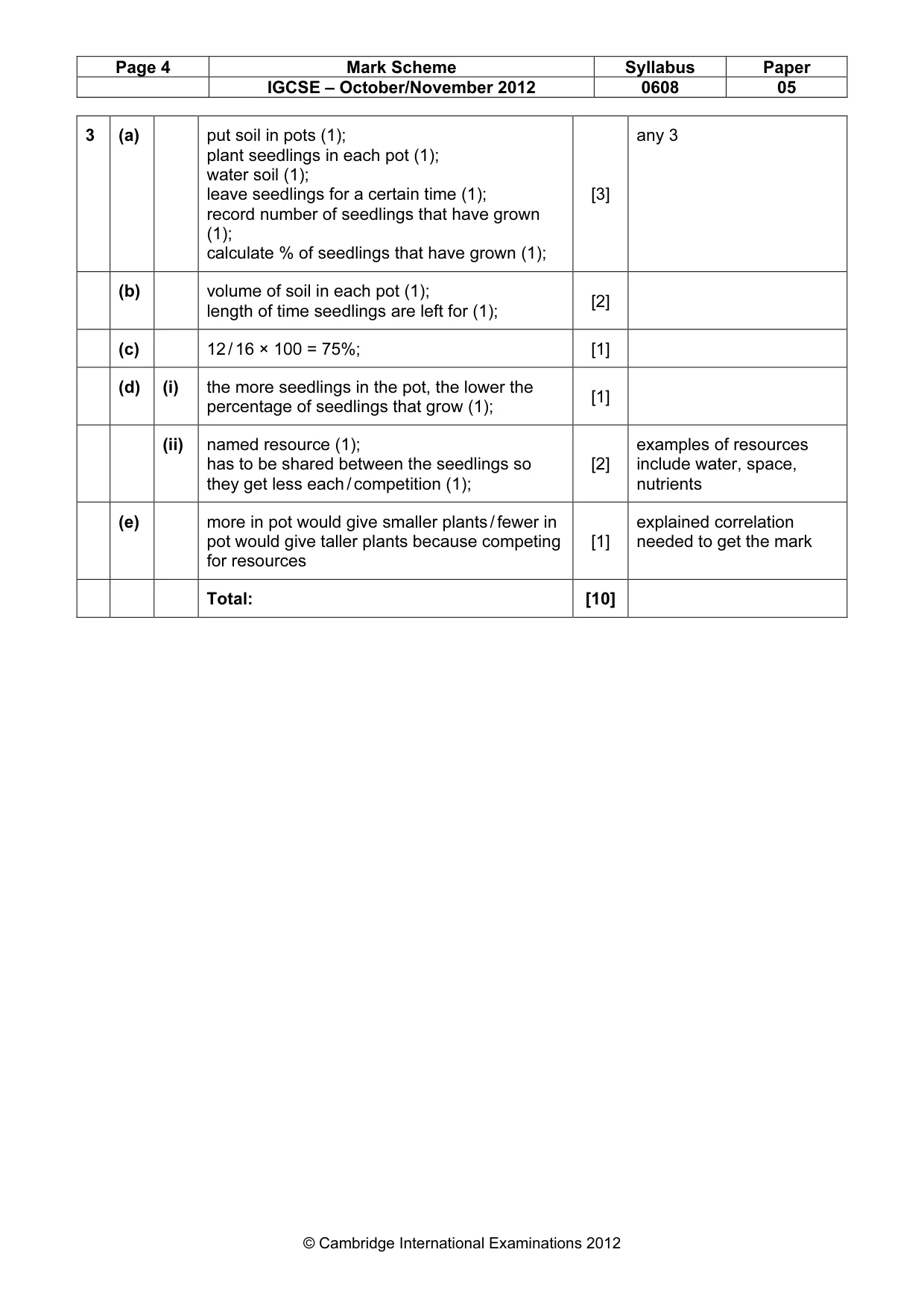
Page 4 Mark Scheme Syllabus Paper IGCSE – October/November 2012 0608 05 © Cambridge International Examinations 2012 3 (a) put soil in pots (1); plant seedlings in each pot (1); water soil (1); leave seedlings for a certain time (1); record number of seedlings that have grown (1); calculate % of seedlings that have grown (1); [3] any 3 (b) volume of soil in each pot (1); length of time seedlings are left for (1); [2] (c) 12 / 16 × 100 = 75%; [1] (d) (i) the more seedlings in the pot, the lower the percentage of seedlings that grow (1); [1] (ii) named resource (1); has to be shared between the seedlings so they get less each / competition (1); [2] examples of resources include water, space, nutrients (e) more in pot would give smaller plants / fewer in pot would give taller plants because competing for resources [1] explained correlation needed to get the mark Total: [10]
Mark scheme, page 5
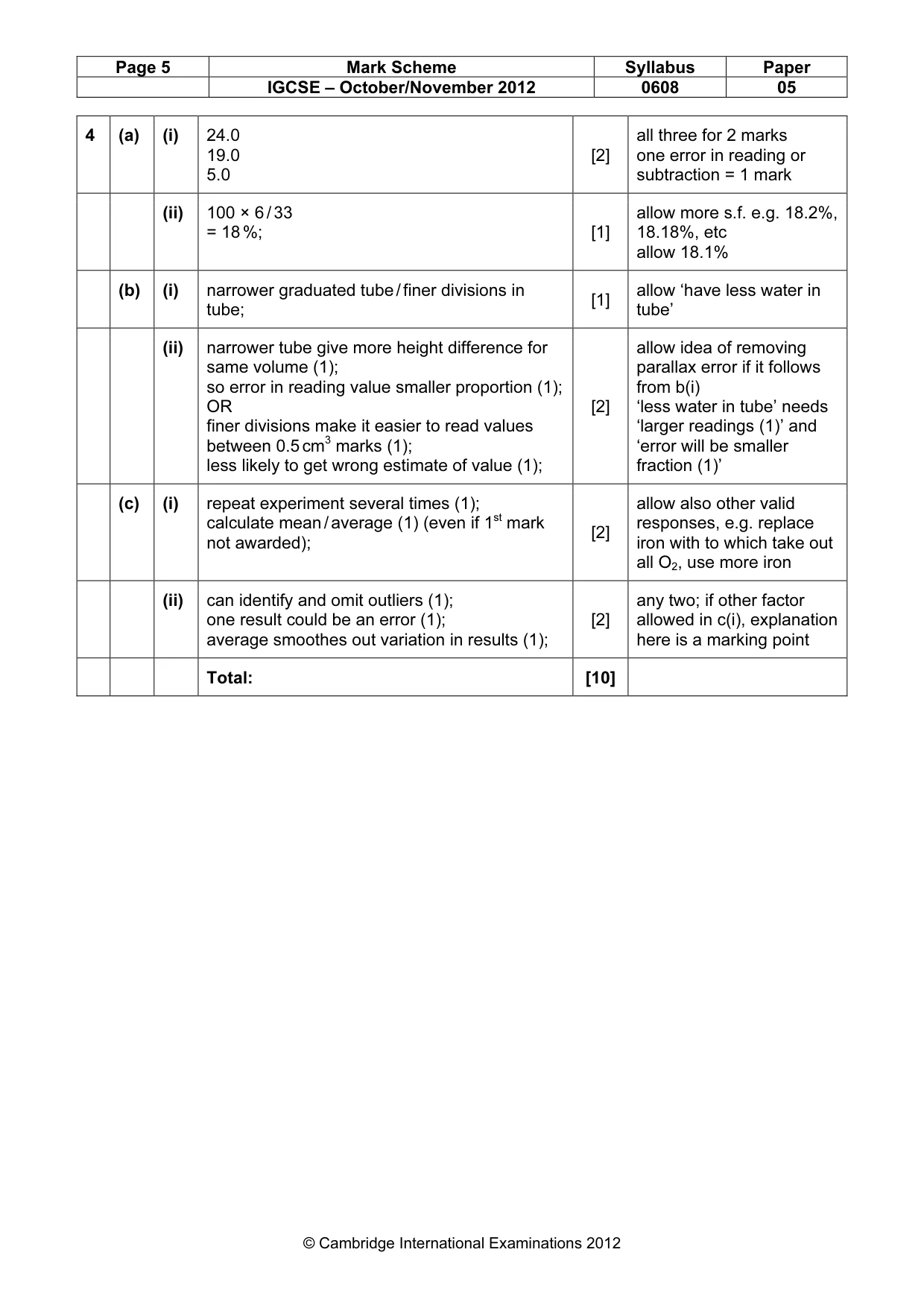
Page 5 Mark Scheme Syllabus Paper IGCSE – October/November 2012 0608 05 © Cambridge International Examinations 2012 4 (a) (i) 24.0 19.0 5.0 [2] all three for 2 marks one error in reading or subtraction = 1 mark (ii) 100 × 6 / 33 = 18 %; [1] allow more s.f. e.g. 18.2%, 18.18%, etc allow 18.1% (b) (i) narrower graduated tube / finer divisions in tube; [1] allow ‘have less water in tube’ (ii) narrower tube give more height difference for same volume (1); so error in reading value smaller proportion (1); OR finer divisions make it easier to read values between 0.5 cm3 marks (1); less likely to get wrong estimate of value (1); [2] allow idea of removing parallax error if it follows from b(i) ‘less water in tube’ needs ‘larger readings (1)’ and ‘error will be smaller fraction (1)’ (c) (i) repeat experiment several times (1); calculate mean / average (1) (even if 1st mark not awarded); [2] allow also other valid responses, e.g. replace iron with to which take out all O2, use more iron (ii) can identify and omit outliers (1); one result could be an error (1); average smoothes out variation in results (1); [2] any two; if other factor allowed in c(i), explanation here is a marking point Total: [10]
Mark scheme, page 6
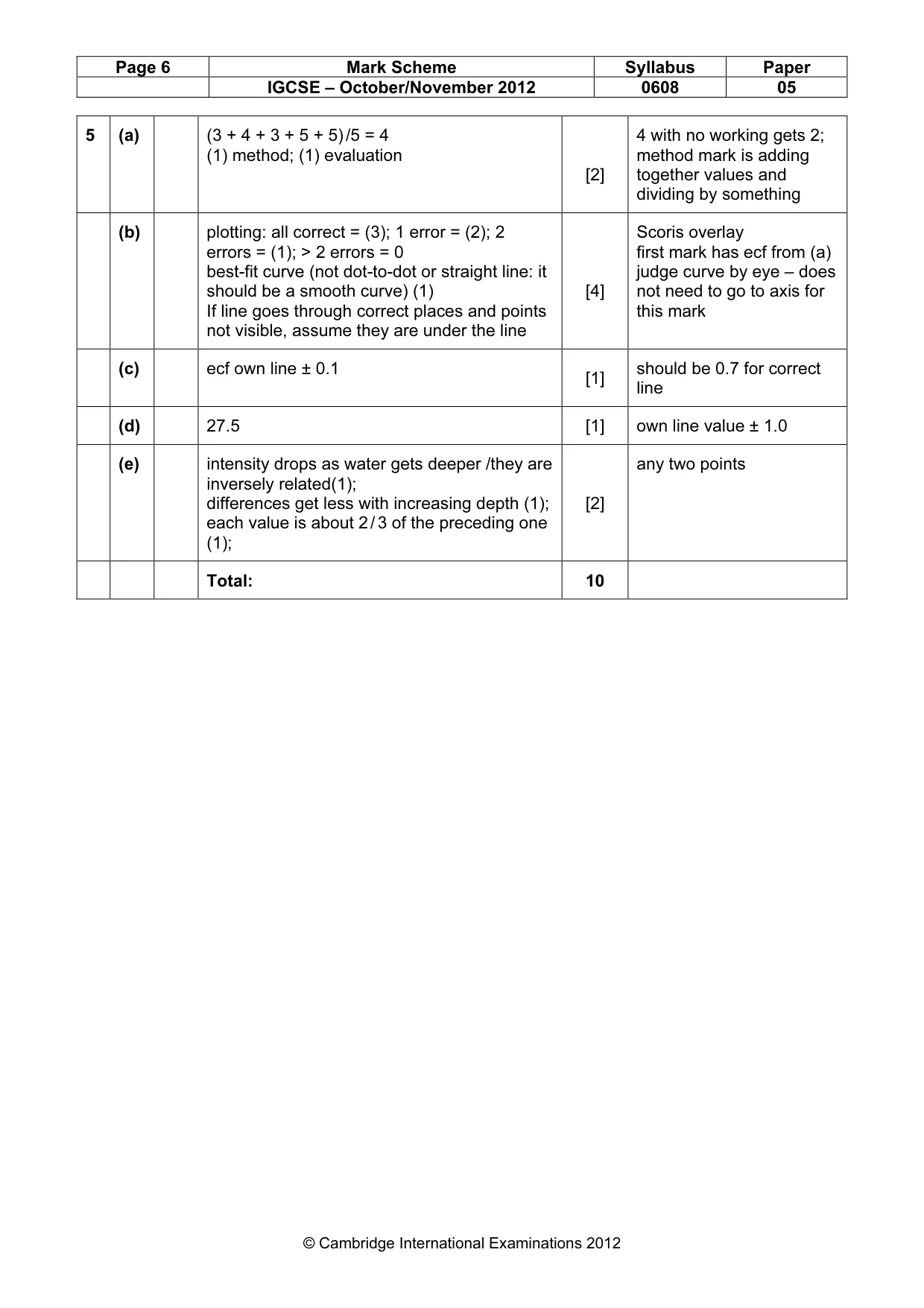
Page 6 Mark Scheme Syllabus Paper IGCSE – October/November 2012 0608 05 © Cambridge International Examinations 2012 5 (a) (3 + 4 + 3 + 5 + 5) /5 = 4 (1) method; (1) evaluation [2] 4 with no working gets 2; method mark is adding together values and dividing by something (b) plotting: all correct = (3); 1 error = (2); 2 errors = (1); > 2 errors = 0 best-fit curve (not dot-to-dot or straight line: it should be a smooth curve) (1) If line goes through correct places and points not visible, assume they are under the line [4] Scoris overlay first mark has ecf from (a) judge curve by eye – does not need to go to axis for this mark (c) ecf own line ± 0.1 [1] should be 0.7 for correct line (d) 27.5 [1] own line value ± 1.0 (e) intensity drops as water gets deeper /they are inversely related(1); differences get less with increasing depth (1); each value is about 2 / 3 of the preceding one (1); [2] any two points Total: 10