Cambridge IGCSE Twenty-First Century Science 0608 — 2011 May/June Paper 5 · Variant 1
0608/51/M/J/11 · 60 marks · ≈68 min
The question paper and its mark scheme, free to read here and free to download. This is Cambridge’s own paper, exactly as it was sat.
Question paper16 pages

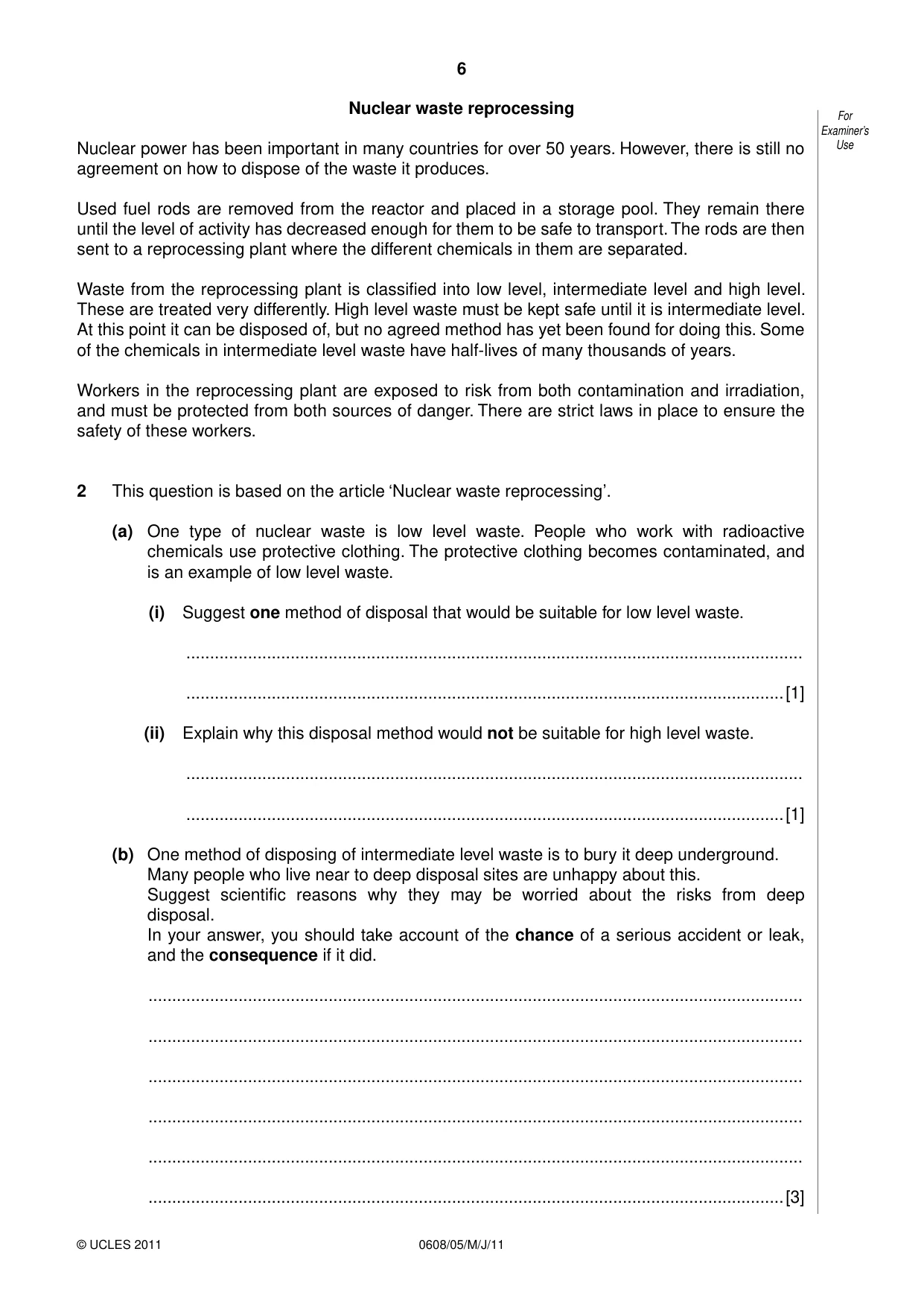
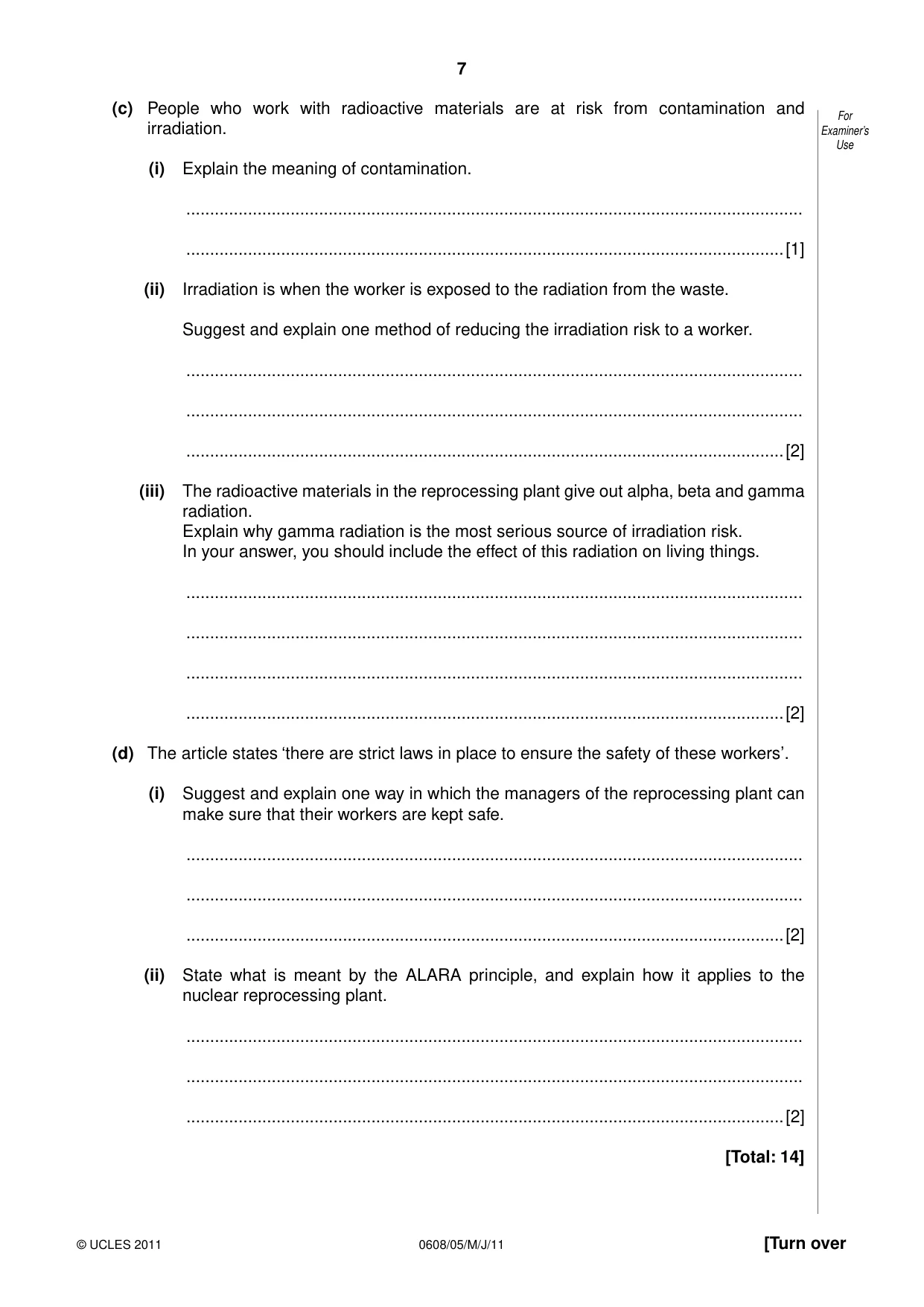
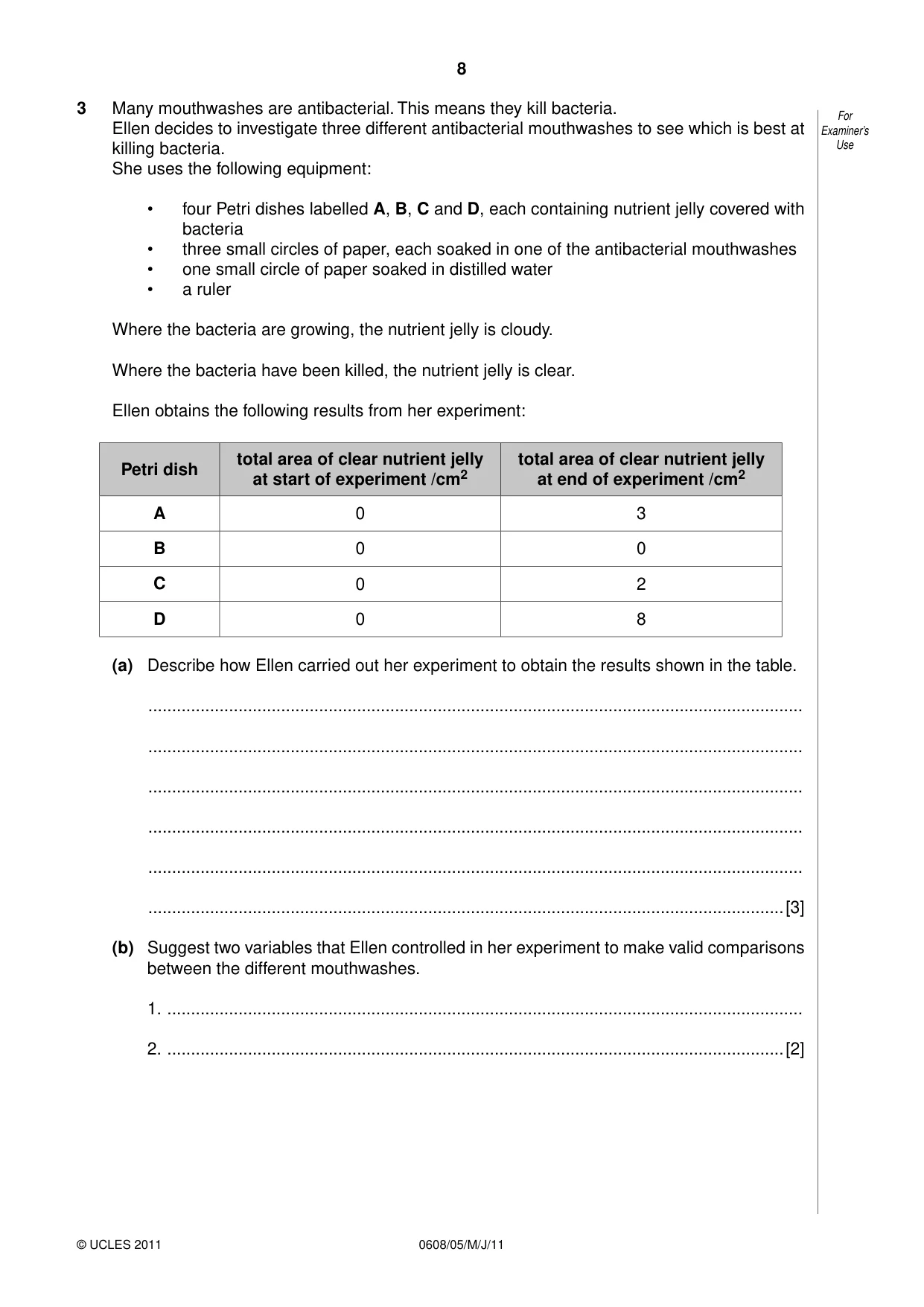
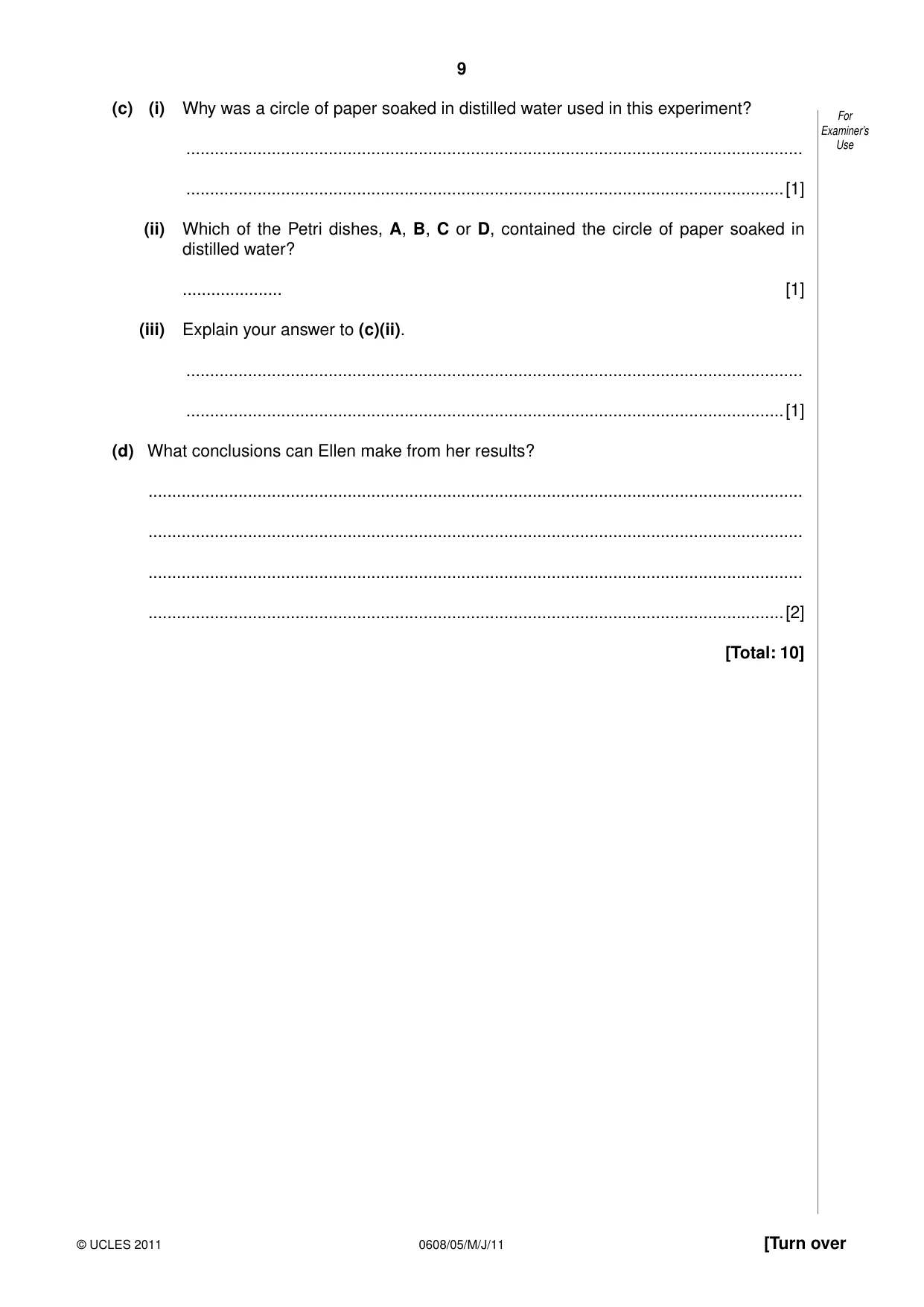



Mark scheme5 pages
Answers below. Sit the paper first if you are practising.
Paper as text
Question paper, page 1
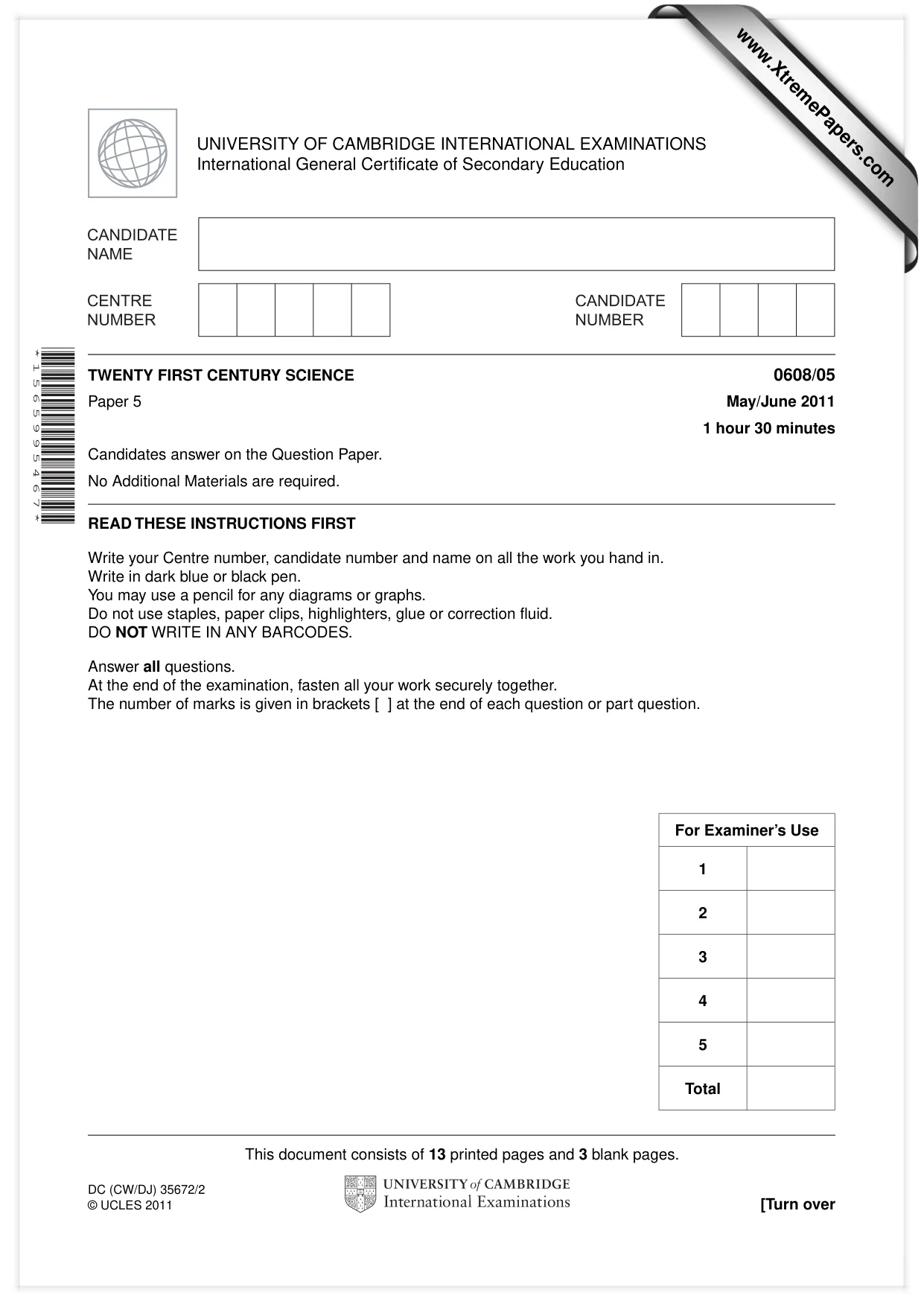
This document consists of 13 printed pages and 3 blank pages. DC (CW/DJ) 35672/2 © UCLES 2011 [Turn over UNIVERSITY OF CAMBRIDGE INTERNATIONAL EXAMINATIONS International General Certificate of Secondary Education * 1 5 6 5 9 9 5 4 6 7 * TWENTY FIRST CENTURY SCIENCE 0608/05 Paper 5 May/June 2011 1 hour 30 minutes Candidates answer on the Question Paper. No Additional Materials are required. READ THESE INSTRUCTIONS FIRST Write your Centre number, candidate number and name on all the work you hand in. Write in dark blue or black pen. You may use a pencil for any diagrams or graphs. Do not use staples, paper clips, highlighters, glue or correction fluid. DO NOT WRITE IN ANY BARCODES. Answer all questions. At the end of the examination, fasten all your work securely together. The number of marks is given in brackets [ ] at the end of each question or part question. For Examiner’s Use 1 2 3 4 5 Total www.XtremePapers.com
Question paper, page 2
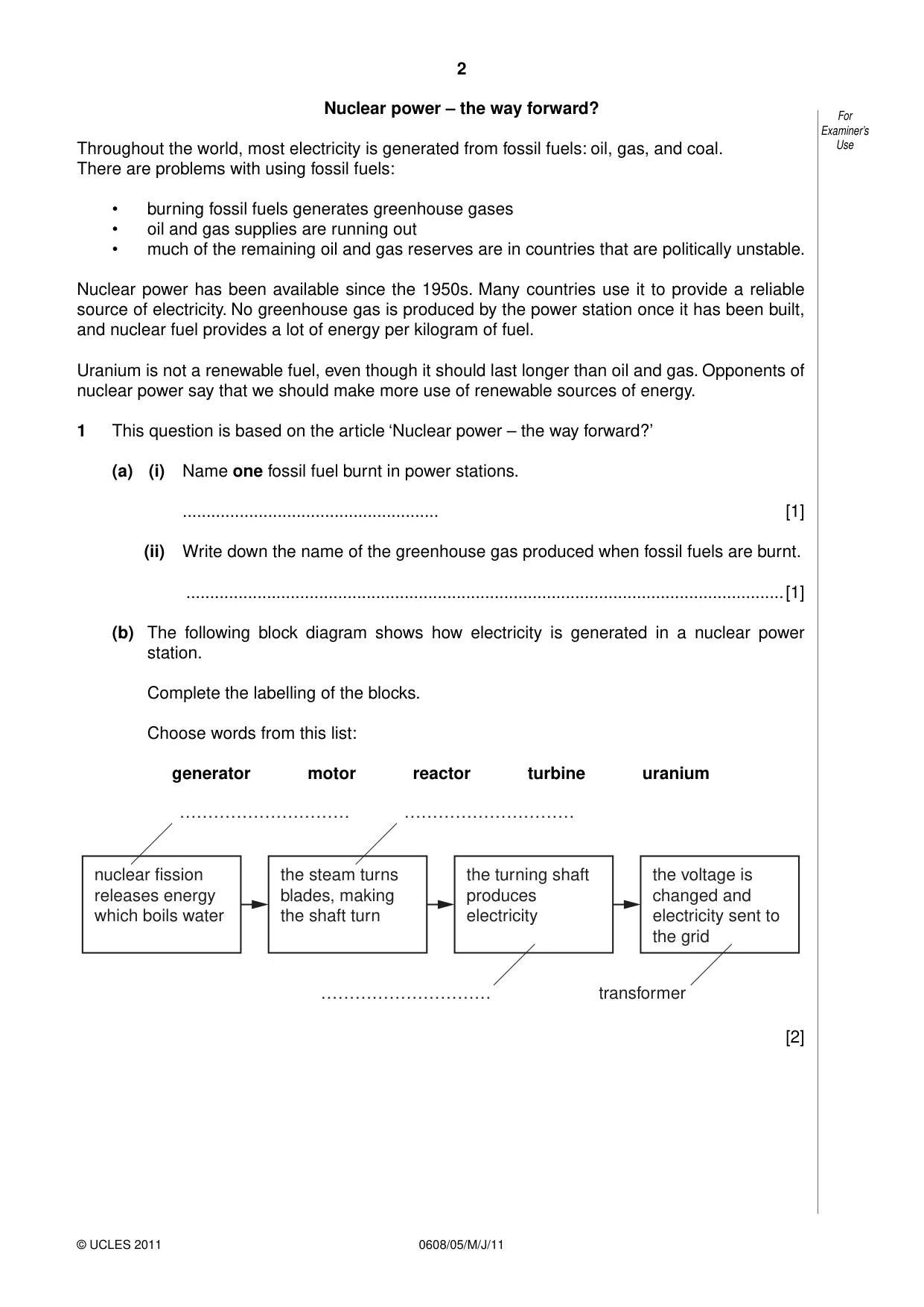
2 0608/05/M/J/11 © UCLES 2011 For Examiner’s Use Nuclear power – the way forward? Throughout the world, most electricity is generated from fossil fuels: oil, gas, and coal. There are problems with using fossil fuels: • burning fossil fuels generates greenhouse gases • oil and gas supplies are running out • much of the remaining oil and gas reserves are in countries that are politically unstable. Nuclear power has been available since the 1950s. Many countries use it to provide a reliable source of electricity. No greenhouse gas is produced by the power station once it has been built, and nuclear fuel provides a lot of energy per kilogram of fuel. Uranium is not a renewable fuel, even though it should last longer than oil and gas. Opponents of nuclear power say that we should make more use of renewable sources of energy. 1 This question is based on the article ‘Nuclear power – the way forward?’ (a) (i) Name one fossil fuel burnt in power stations. … [1] (ii) Write down the name of the greenhouse gas produced when fossil fuels are burnt. …[1] (b) The following block diagram shows how electricity is generated in a nuclear power station. Complete the labelling of the blocks. Choose words from this list: generator motor reactor turbine uranium nuclear fission releases energy which boils water ………………………… the steam turns blades, making the shaft turn the turning shaft produces electricity the voltage is changed and electricity sent to the grid ………………………… ………………………… transformer [2]
Question paper, page 3
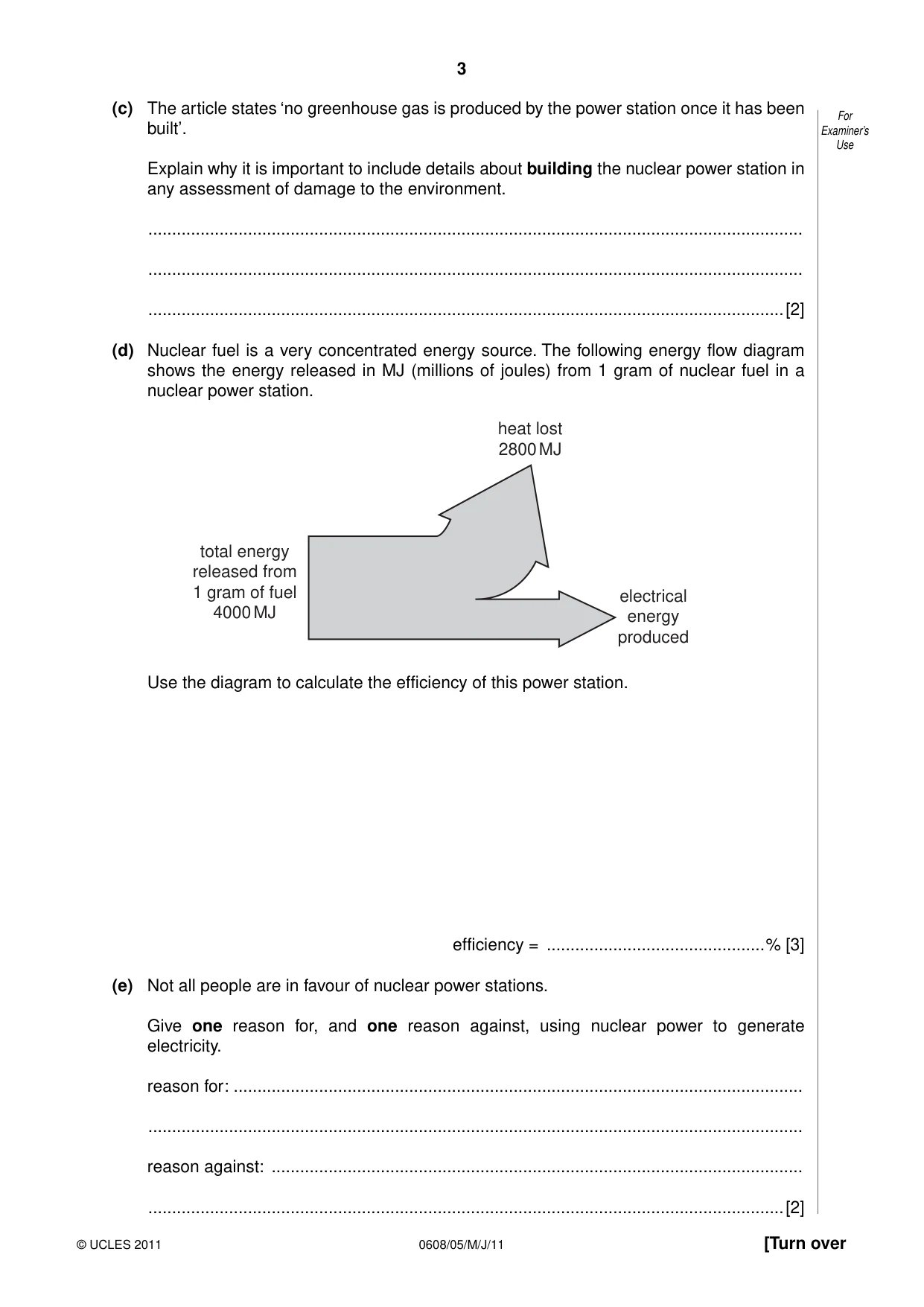
3 0608/05/M/J/11 © UCLES 2011 [Turn over For Examiner’s Use (c) The article states ‘no greenhouse gas is produced by the power station once it has been built’. Explain why it is important to include details about building the nuclear power station in any assessment of damage to the environment. … … …[2] (d) Nuclear fuel is a very concentrated energy source. The following energy flow diagram shows the energy released in MJ (millions of joules) from 1 gram of nuclear fuel in a nuclear power station. heat lost 2800 MJ electrical energy produced total energy released from 1 gram of fuel 4000 MJ Use the diagram to calculate the efficiency of this power station. efficiency = …% [3] (e) Not all people are in favour of nuclear power stations. Give one reason for, and one reason against, using nuclear power to generate electricity. reason for: … … reason against: … …[2]
Question paper, page 4
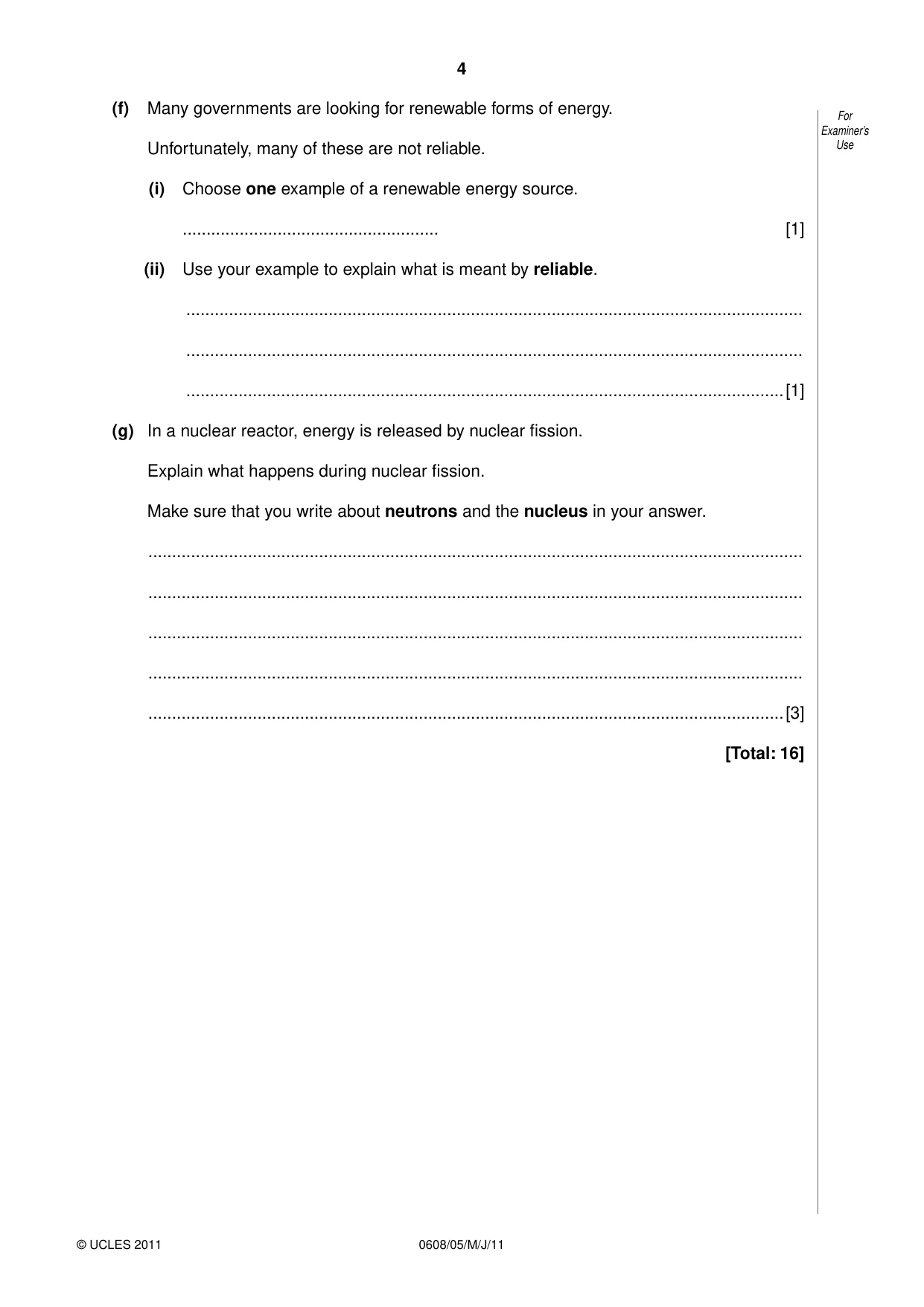
4 0608/05/M/J/11 © UCLES 2011 For Examiner’s Use (f) Many governments are looking for renewable forms of energy. Unfortunately, many of these are not reliable. (i) Choose one example of a renewable energy source. … [1] (ii) Use your example to explain what is meant by reliable. … … …[1] (g) In a nuclear reactor, energy is released by nuclear fission. Explain what happens during nuclear fission. Make sure that you write about neutrons and the nucleus in your answer. … … … … …[3] [Total: 16]
Question paper, page 5
5 0608/05/M/J/11 © UCLES 2011 [Turn over BLANK PAGE Please turn over for Question 2.
Question paper, page 6
6 0608/05/M/J/11 © UCLES 2011 For Examiner’s Use Nuclear waste reprocessing Nuclear power has been important in many countries for over 50 years. However, there is still no agreement on how to dispose of the waste it produces. Used fuel rods are removed from the reactor and placed in a storage pool. They remain there until the level of activity has decreased enough for them to be safe to transport. The rods are then sent to a reprocessing plant where the different chemicals in them are separated. Waste from the reprocessing plant is classified into low level, intermediate level and high level. These are treated very differently. High level waste must be kept safe until it is intermediate level. At this point it can be disposed of, but no agreed method has yet been found for doing this. Some of the chemicals in intermediate level waste have half-lives of many thousands of years. Workers in the reprocessing plant are exposed to risk from both contamination and irradiation, and must be protected from both sources of danger. There are strict laws in place to ensure the safety of these workers. 2 This question is based on the article ‘Nuclear waste reprocessing’. (a) One type of nuclear waste is low level waste. People who work with radioactive chemicals use protective clothing. The protective clothing becomes contaminated, and is an example of low level waste. (i) Suggest one method of disposal that would be suitable for low level waste. … …[1] (ii) Explain why this disposal method would not be suitable for high level waste. … …[1] (b) One method of disposing of intermediate level waste is to bury it deep underground. Many people who live near to deep disposal sites are unhappy about this. Suggest scientific reasons why they may be worried about the risks from deep disposal. In your answer, you should take account of the chance of a serious accident or leak, and the consequence if it did. … … … … … …[3]
Question paper, page 7
7 0608/05/M/J/11 © UCLES 2011 [Turn over For Examiner’s Use (c) People who work with radioactive materials are at risk from contamination and irradiation. (i) Explain the meaning of contamination. … …[1] (ii) Irradiation is when the worker is exposed to the radiation from the waste. Suggest and explain one method of reducing the irradiation risk to a worker. … … …[2] (iii) The radioactive materials in the reprocessing plant give out alpha, beta and gamma radiation. Explain why gamma radiation is the most serious source of irradiation risk. In your answer, you should include the effect of this radiation on living things. … … … …[2] (d) The article states ‘there are strict laws in place to ensure the safety of these workers’. (i) Suggest and explain one way in which the managers of the reprocessing plant can make sure that their workers are kept safe. … … …[2] (ii) State what is meant by the ALARA principle, and explain how it applies to the nuclear reprocessing plant. … … …[2] [Total: 14]
Question paper, page 8
8 0608/05/M/J/11 © UCLES 2011 For Examiner’s Use 3 Many mouthwashes are antibacterial. This means they kill bacteria. Ellen decides to investigate three different antibacterial mouthwashes to see which is best at killing bacteria. She uses the following equipment: • four Petri dishes labelled A, B, C and D, each containing nutrient jelly covered with bacteria • three small circles of paper, each soaked in one of the antibacterial mouthwashes • one small circle of paper soaked in distilled water • a ruler Where the bacteria are growing, the nutrient jelly is cloudy. Where the bacteria have been killed, the nutrient jelly is clear. Ellen obtains the following results from her experiment: Petri dish total area of clear nutrient jelly at start of experiment /cm2 total area of clear nutrient jelly at end of experiment /cm2 A 0 3 B 0 0 C 0 2 D 0 8 (a) Describe how Ellen carried out her experiment to obtain the results shown in the table. … … … … … …[3] (b) Suggest two variables that Ellen controlled in her experiment to make valid comparisons between the different mouthwashes. 1. … 2. …[2]
Question paper, page 9
9 0608/05/M/J/11 © UCLES 2011 [Turn over For Examiner’s Use (c) (i) Why was a circle of paper soaked in distilled water used in this experiment? … …[1] (ii) Which of the Petri dishes, A, B, C or D, contained the circle of paper soaked in distilled water? … [1] (iii) Explain your answer to (c)(ii). … …[1] (d) What conclusions can Ellen make from her results? … … … …[2] [Total: 10]
Question paper, page 10
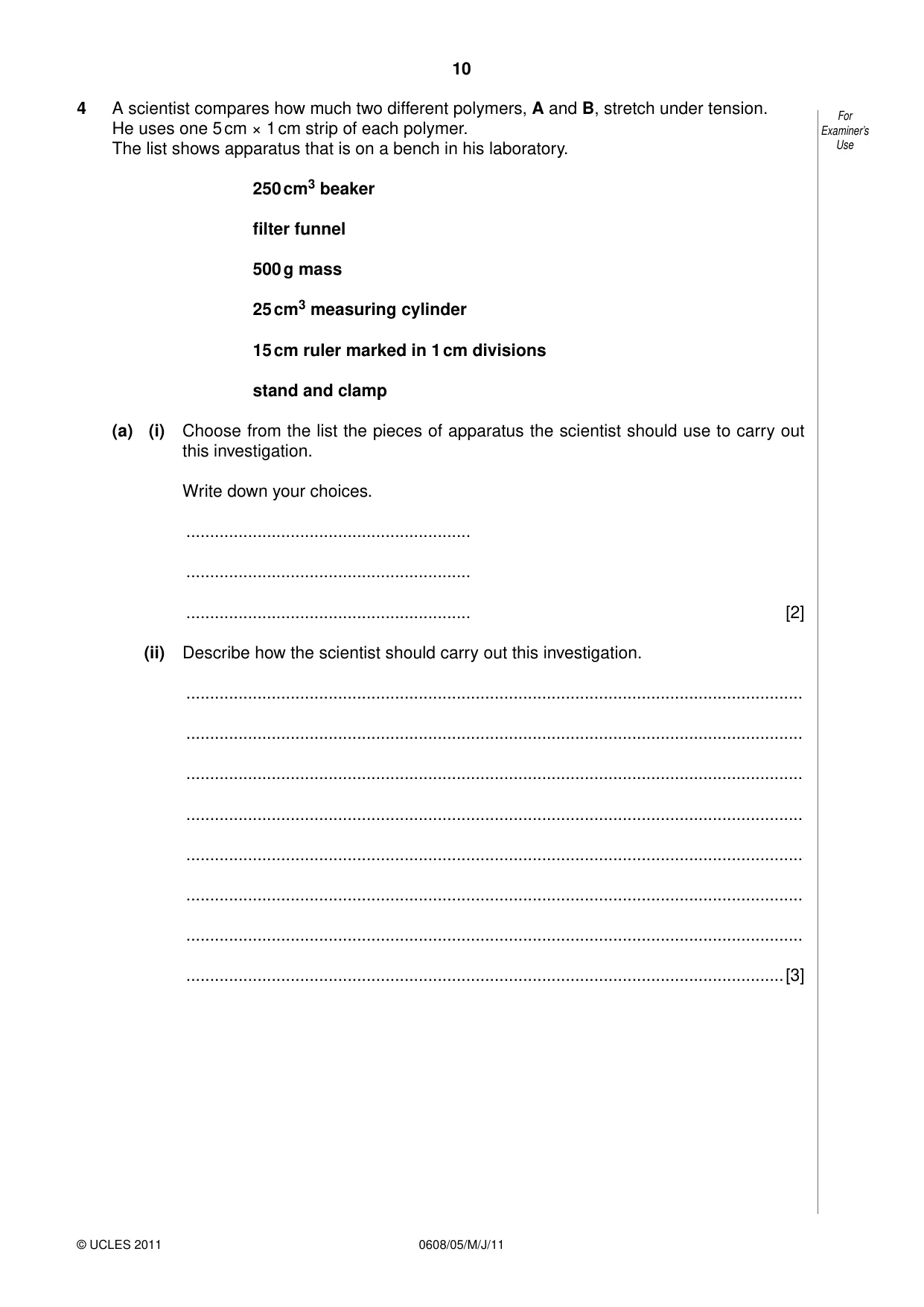
10 0608/05/M/J/11 © UCLES 2011 For Examiner’s Use 4 A scientist compares how much two different polymers, A and B, stretch under tension. He uses one 5 cm × 1 cm strip of each polymer. The list shows apparatus that is on a bench in his laboratory. 250 cm3 beaker filter funnel 500 g mass 25 cm3 measuring cylinder 15 cm ruler marked in 1 cm divisions stand and clamp (a) (i) Choose from the list the pieces of apparatus the scientist should use to carry out this investigation. Write down your choices. … … … [2] (ii) Describe how the scientist should carry out this investigation. … … … … … … … …[3]
Question paper, page 11
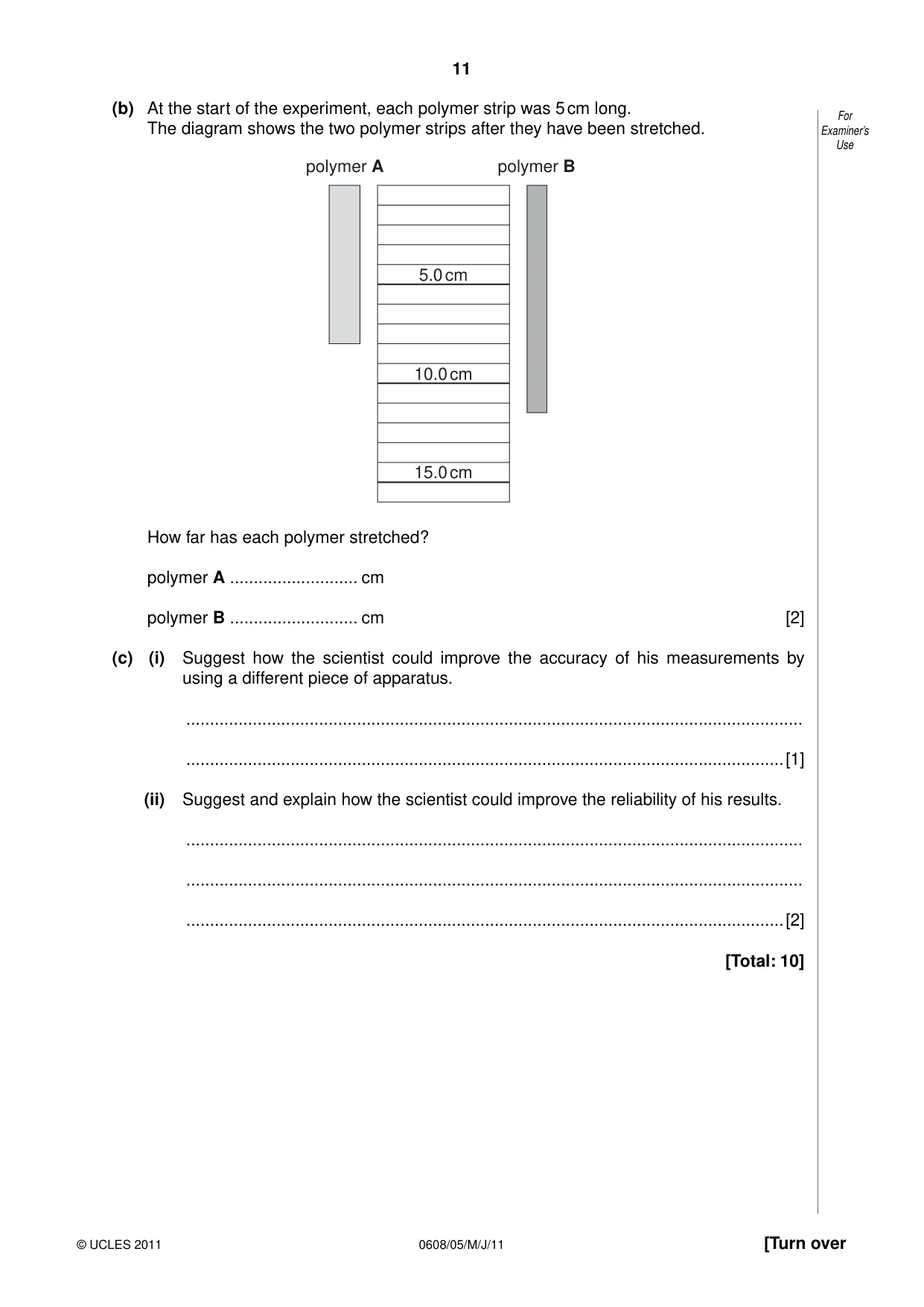
11 0608/05/M/J/11 © UCLES 2011 [Turn over For Examiner’s Use (b) At the start of the experiment, each polymer strip was 5 cm long. The diagram shows the two polymer strips after they have been stretched. 5.0 cm 10.0 cm 15.0 cm polymer A polymer B How far has each polymer stretched? polymer A … cm polymer B … cm [2] (c) (i) Suggest how the scientist could improve the accuracy of his measurements by using a different piece of apparatus. … …[1] (ii) Suggest and explain how the scientist could improve the reliability of his results. … … …[2] [Total: 10]
Question paper, page 12
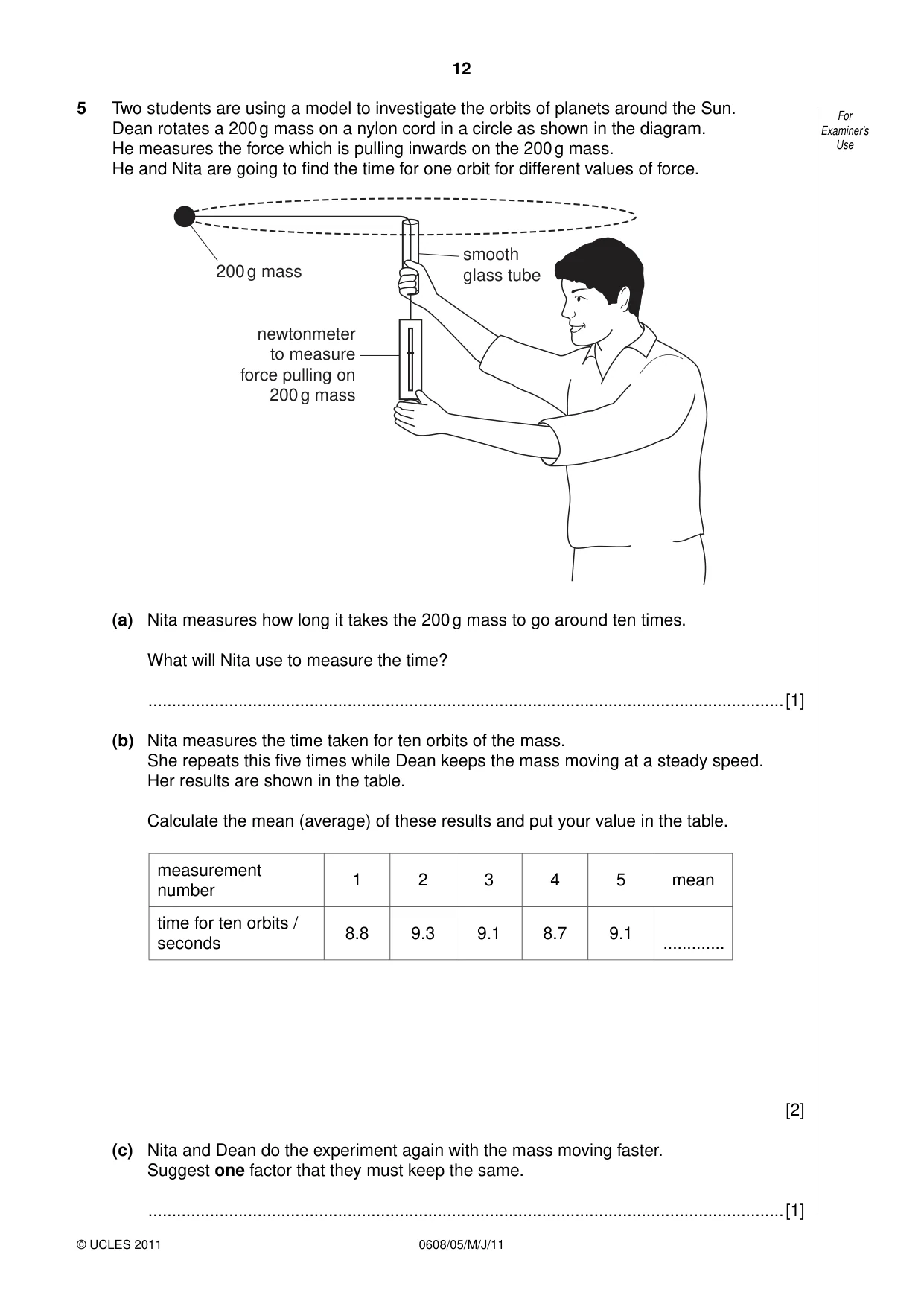
12 0608/05/M/J/11 © UCLES 2011 For Examiner’s Use 5 Two students are using a model to investigate the orbits of planets around the Sun. Dean rotates a 200 g mass on a nylon cord in a circle as shown in the diagram. He measures the force which is pulling inwards on the 200 g mass. He and Nita are going to find the time for one orbit for different values of force. smooth glass tube newtonmeter to measure force pulling on 200 g mass 200 g mass (a) Nita measures how long it takes the 200 g mass to go around ten times. What will Nita use to measure the time? …[1] (b) Nita measures the time taken for ten orbits of the mass. She repeats this five times while Dean keeps the mass moving at a steady speed. Her results are shown in the table. Calculate the mean (average) of these results and put your value in the table. measurement number 1 2 3 4 5 mean time for ten orbits / seconds 8.8 9.3 9.1 8.7 9.1 … [2] (c) Nita and Dean do the experiment again with the mass moving faster. Suggest one factor that they must keep the same. …[1]
Question paper, page 13
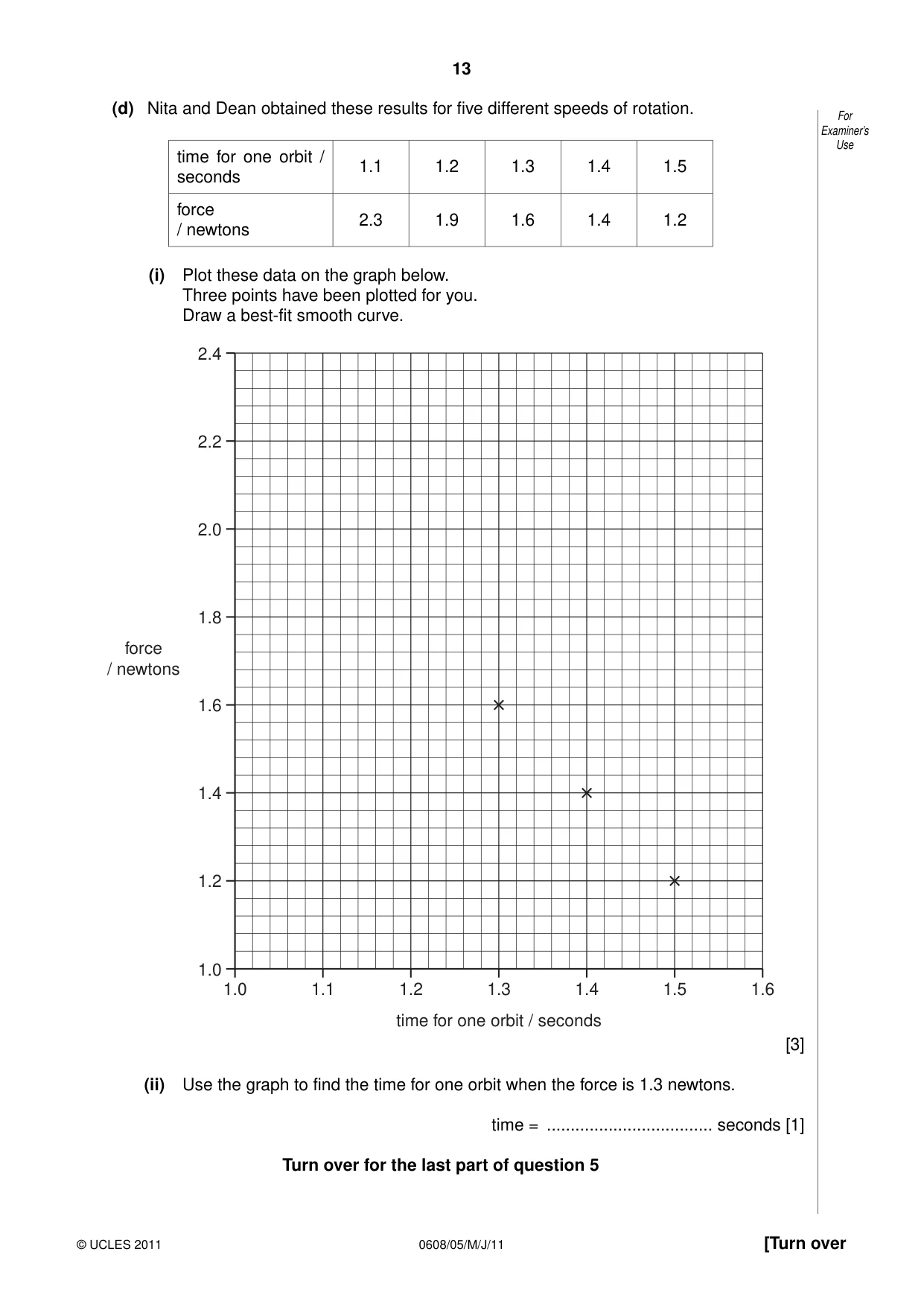
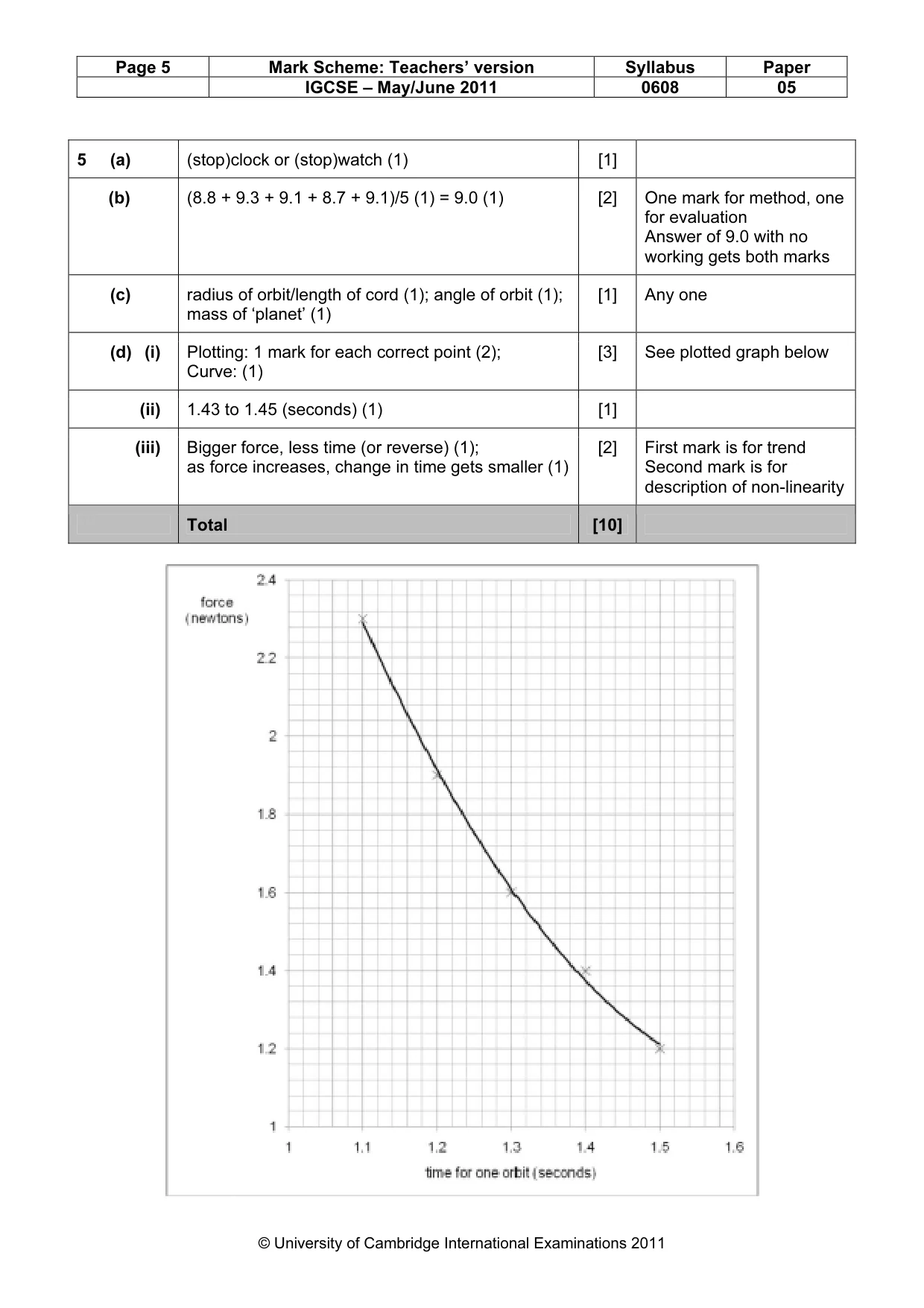
13 0608/05/M/J/11 © UCLES 2011 [Turn over For Examiner’s Use (d) Nita and Dean obtained these results for five different speeds of rotation. time for one orbit / seconds 1.1 1.2 1.3 1.4 1.5 force / newtons 2.3 1.9 1.6 1.4 1.2 (i) Plot these data on the graph below. Three points have been plotted for you. Draw a best-fit smooth curve. 2.4 2.2 2.0 1.8 force / newtons 1.6 1.4 1.2 1.0 1.0 1.1 1.2 1.3 time for one orbit / seconds 1.4 1.5 1.6 [3] (ii) Use the graph to find the time for one orbit when the force is 1.3 newtons. time = … seconds [1] Turn over for the last part of question 5
Question paper, page 14
14 0608/05/M/J/11 © UCLES 2011 For Examiner’s Use (iii) The graph shows a relationship between force and time for one orbit. Describe this relationship. … … …[2] [Total: 10]
Question paper, page 15
15 0608/05/M/J/11 © UCLES 2011 BLANK PAGE
Question paper, page 16
16 0608/05/M/J/11 © UCLES 2011 BLANK PAGE Permission to reproduce items where third-party owned material protected by copyright is included has been sought and cleared where possible. Every reasonable effort has been made by the publisher (UCLES) to trace copyright holders, but if any items requiring clearance have unwittingly been included, the publisher will be pleased to make amends at the earliest possible opportunity. University of Cambridge International Examinations is part of the Cambridge Assessment Group. Cambridge Assessment is the brand name of University of Cambridge Local Examinations Syndicate (UCLES), which is itself a department of the University of Cambridge.
Mark scheme, page 1
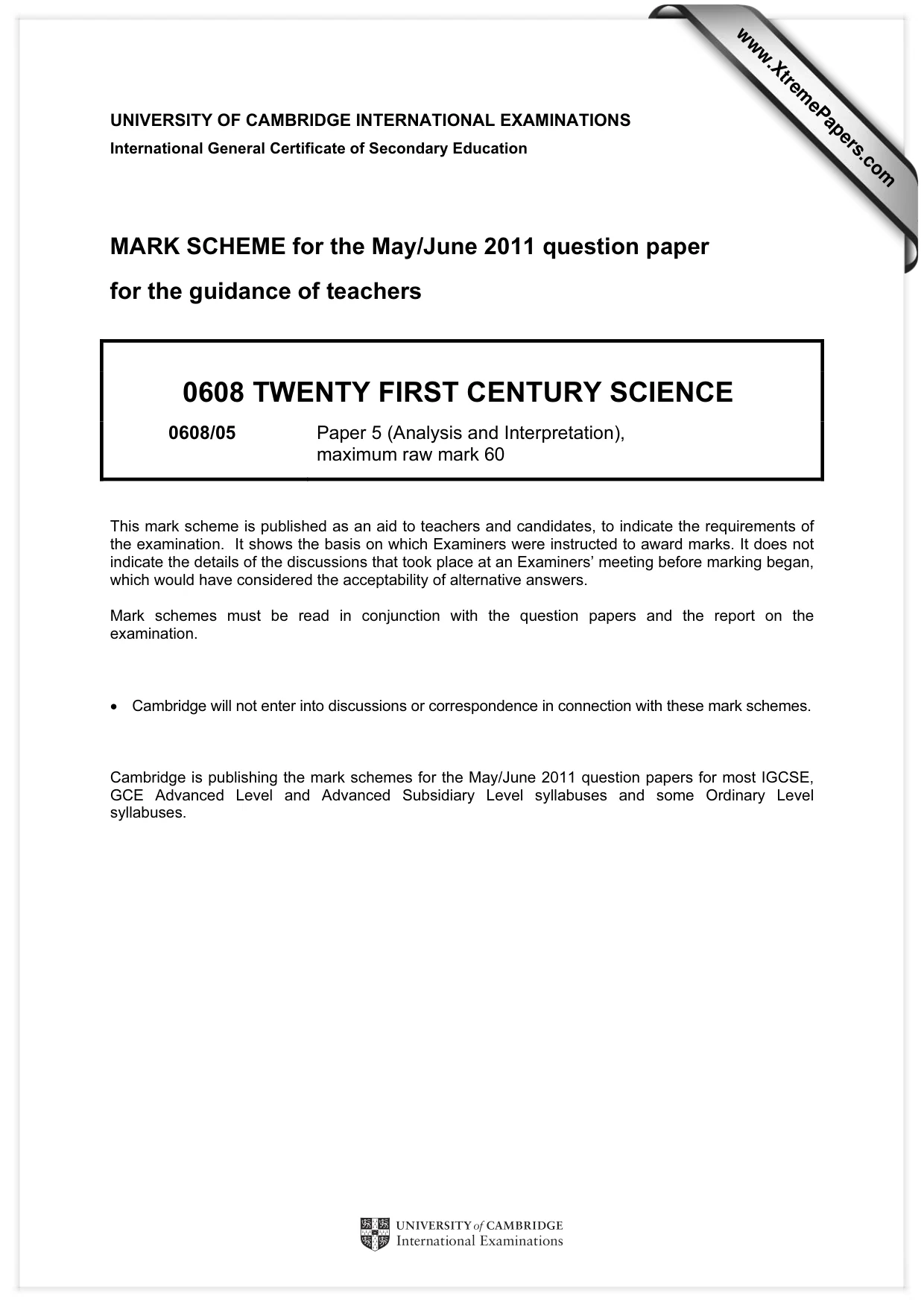
UNIVERSITY OF CAMBRIDGE INTERNATIONAL EXAMINATIONS International General Certificate of Secondary Education MARK SCHEME for the May/June 2011 question paper for the guidance of teachers 0608 TWENTY FIRST CENTURY SCIENCE 0608/05 Paper 5 (Analysis and Interpretation), maximum raw mark 60 This mark scheme is published as an aid to teachers and candidates, to indicate the requirements of the examination. It shows the basis on which Examiners were instructed to award marks. It does not indicate the details of the discussions that took place at an Examiners’ meeting before marking began, which would have considered the acceptability of alternative answers. Mark schemes must be read in conjunction with the question papers and the report on the examination. • Cambridge will not enter into discussions or correspondence in connection with these mark schemes. Cambridge is publishing the mark schemes for the May/June 2011 question papers for most IGCSE, GCE Advanced Level and Advanced Subsidiary Level syllabuses and some Ordinary Level syllabuses. www.XtremePapers.com
Mark scheme, page 2
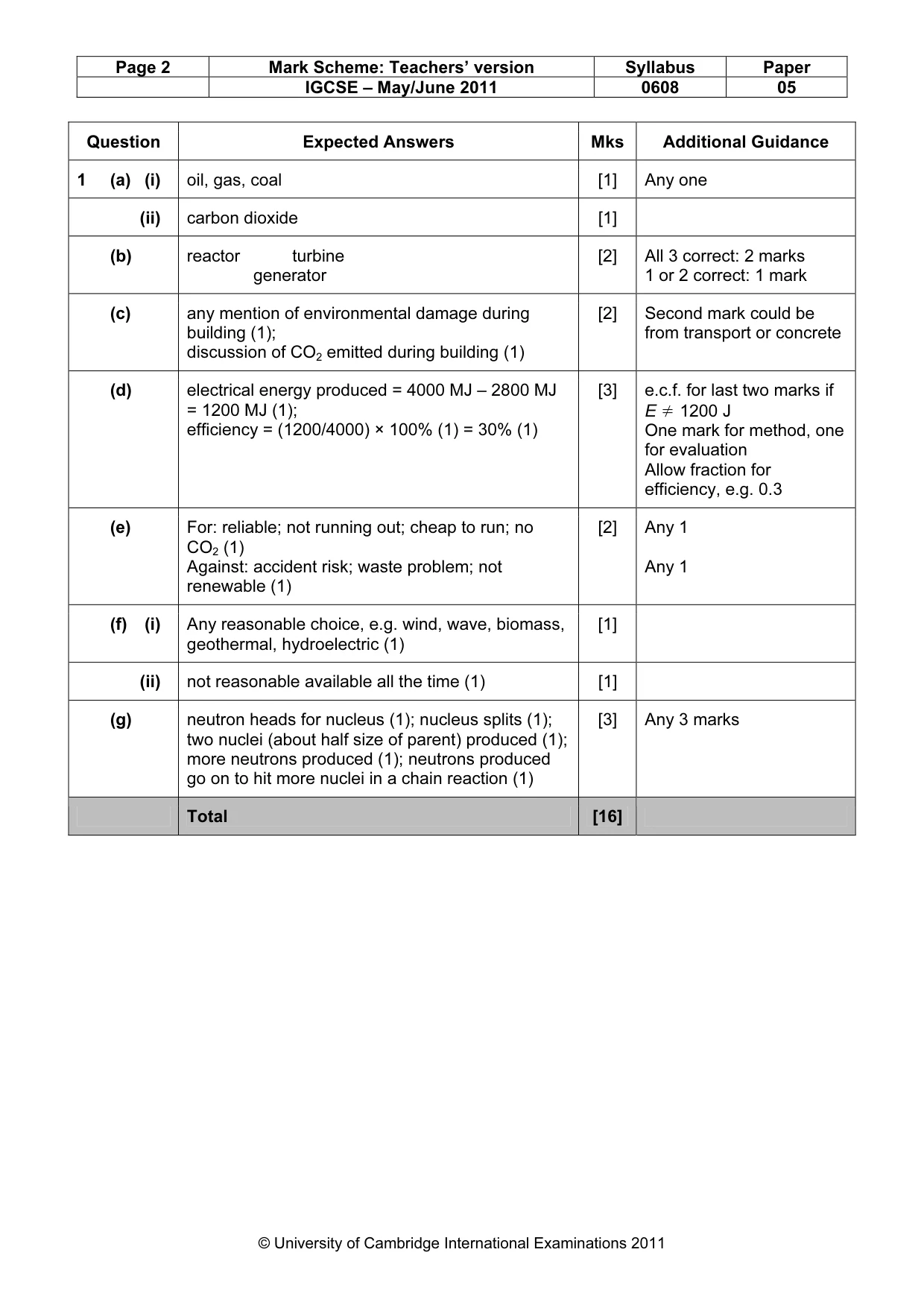
Page 2 Mark Scheme: Teachers’ version Syllabus Paper IGCSE – May/June 2011 0608 05 © University of Cambridge International Examinations 2011 Question Expected Answers Mks Additional Guidance 1 (a) (i) oil, gas, coal [1] Any one (ii) carbon dioxide [1] (b) reactor turbine generator [2] All 3 correct: 2 marks 1 or 2 correct: 1 mark (c) any mention of environmental damage during building (1); discussion of CO2 emitted during building (1) [2] Second mark could be from transport or concrete (d) electrical energy produced = 4000 MJ – 2800 MJ = 1200 MJ (1); efficiency = (1200/4000) × 100% (1) = 30% (1) [3] e.c.f. for last two marks if E ¸ 1200 J One mark for method, one for evaluation Allow fraction for efficiency, e.g. 0.3 (e) For: reliable; not running out; cheap to run; no CO2 (1) Against: accident risk; waste problem; not renewable (1) [2] Any 1 Any 1 (f) (i) Any reasonable choice, e.g. wind, wave, biomass, geothermal, hydroelectric (1) [1] (ii) not reasonable available all the time (1) [1] (g) neutron heads for nucleus (1); nucleus splits (1); two nuclei (about half size of parent) produced (1); more neutrons produced (1); neutrons produced go on to hit more nuclei in a chain reaction (1) [3] Any 3 marks Total [16]
Mark scheme, page 3
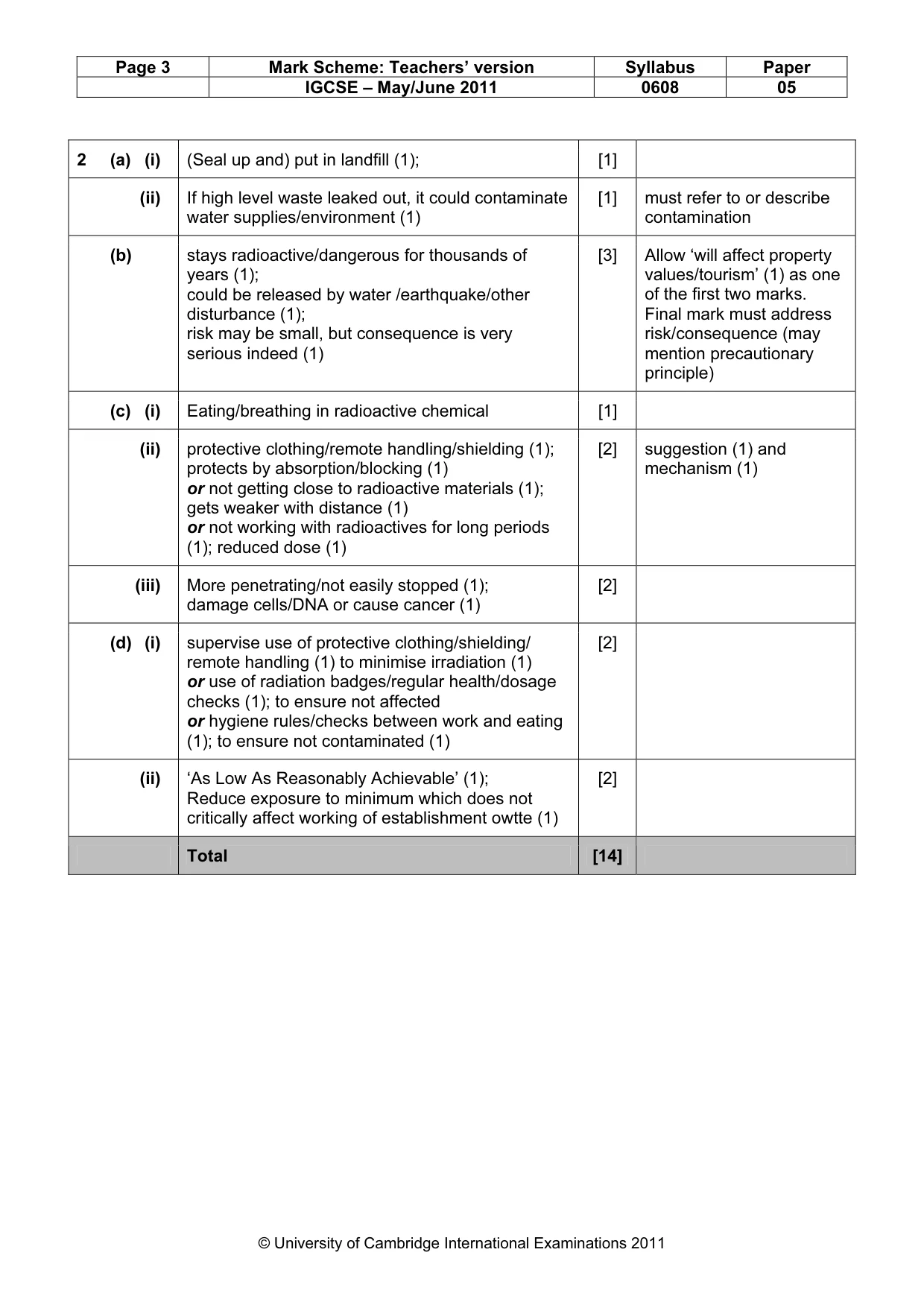
Page 3 Mark Scheme: Teachers’ version Syllabus Paper IGCSE – May/June 2011 0608 05 © University of Cambridge International Examinations 2011 2 (a) (i) (Seal up and) put in landfill (1); [1] (ii) If high level waste leaked out, it could contaminate water supplies/environment (1) [1] must refer to or describe contamination (b) stays radioactive/dangerous for thousands of years (1); could be released by water /earthquake/other disturbance (1); risk may be small, but consequence is very serious indeed (1) [3] Allow ‘will affect property values/tourism’ (1) as one of the first two marks. Final mark must address risk/consequence (may mention precautionary principle) (c) (i) Eating/breathing in radioactive chemical [1] (ii) protective clothing/remote handling/shielding (1); protects by absorption/blocking (1) or not getting close to radioactive materials (1); gets weaker with distance (1) or not working with radioactives for long periods (1); reduced dose (1) [2] suggestion (1) and mechanism (1) (iii) More penetrating/not easily stopped (1); damage cells/DNA or cause cancer (1) [2] (d) (i) supervise use of protective clothing/shielding/ remote handling (1) to minimise irradiation (1) or use of radiation badges/regular health/dosage checks (1); to ensure not affected or hygiene rules/checks between work and eating (1); to ensure not contaminated (1) [2] (ii) ‘As Low As Reasonably Achievable’ (1); Reduce exposure to minimum which does not critically affect working of establishment owtte (1) [2] Total [14]
Mark scheme, page 4
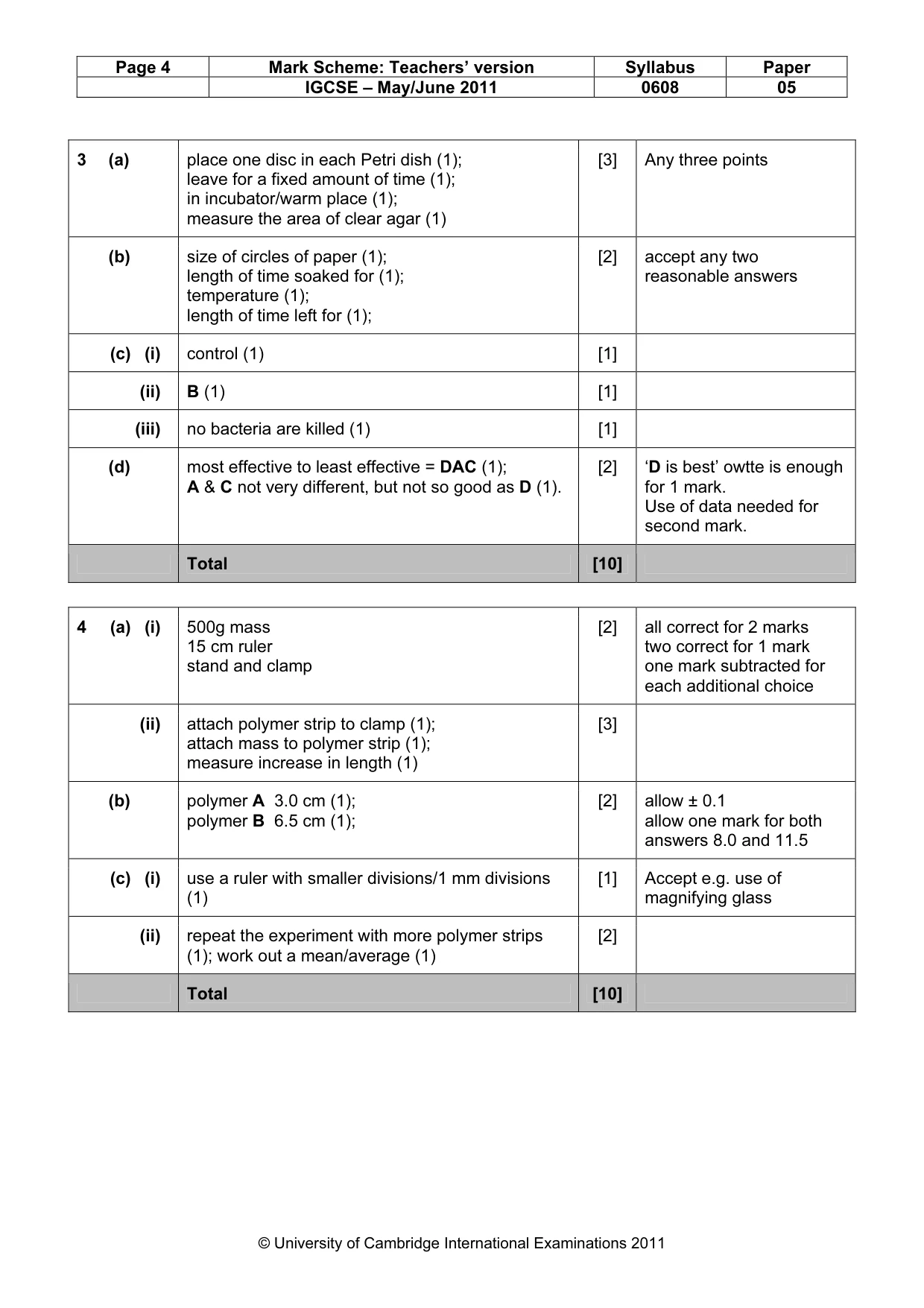
Page 4 Mark Scheme: Teachers’ version Syllabus Paper IGCSE – May/June 2011 0608 05 © University of Cambridge International Examinations 2011 3 (a) place one disc in each Petri dish (1); leave for a fixed amount of time (1); in incubator/warm place (1); measure the area of clear agar (1) [3] Any three points (b) size of circles of paper (1); length of time soaked for (1); temperature (1); length of time left for (1); [2] accept any two reasonable answers (c) (i) control (1) [1] (ii) B (1) [1] (iii) no bacteria are killed (1) [1] (d) most effective to least effective = DAC (1); A & C not very different, but not so good as D (1). [2] ‘D is best’ owtte is enough for 1 mark. Use of data needed for second mark. Total [10] 4 (a) (i) 500g mass 15 cm ruler stand and clamp [2] all correct for 2 marks two correct for 1 mark one mark subtracted for each additional choice (ii) attach polymer strip to clamp (1); attach mass to polymer strip (1); measure increase in length (1) [3] (b) polymer A 3.0 cm (1); polymer B 6.5 cm (1); [2] allow ± 0.1 allow one mark for both answers 8.0 and 11.5 (c) (i) use a ruler with smaller divisions/1 mm divisions (1) [1] Accept e.g. use of magnifying glass (ii) repeat the experiment with more polymer strips (1); work out a mean/average (1) [2] Total [10]
Mark scheme, page 5
Page 5 Mark Scheme: Teachers’ version Syllabus Paper IGCSE – May/June 2011 0608 05 © University of Cambridge International Examinations 2011 5 (a) (stop)clock or (stop)watch (1) [1] (b) (8.8 + 9.3 + 9.1 + 8.7 + 9.1)/5 (1) = 9.0 (1) [2] One mark for method, one for evaluation Answer of 9.0 with no working gets both marks (c) radius of orbit/length of cord (1); angle of orbit (1); mass of ‘planet’ (1) [1] Any one (d) (i) Plotting: 1 mark for each correct point (2); Curve: (1) [3] See plotted graph below (ii) 1.43 to 1.45 (seconds) (1) [1] (iii) Bigger force, less time (or reverse) (1); as force increases, change in time gets smaller (1) [2] First mark is for trend Second mark is for description of non-linearity Total [10]
What you needed in this session
Cambridge’s own grade thresholds for 2011 May/June, Paper 5 · Variant 1. A higher threshold means an easier paper — the bar moves with how the cohort did.