Cambridge IGCSE Twenty-First Century Science 0608 — 2009 May/June Paper 5 · Variant 1
0608/51/M/J/09 · 60 marks · ≈68 min
The question paper and its mark scheme, free to read here and free to download. This is Cambridge’s own paper, exactly as it was sat.
Question paper16 pages
Mark scheme5 pages
Answers below. Sit the paper first if you are practising.
Paper as text
Question paper, page 1
This document consists of 15 printed pages and 1 blank page. SPA SHW 00387 1/09 V06771/2 © UCLES 2009 [Turn over UNIVERSITY OF CAMBRIDGE INTERNATIONAL EXAMINATIONS International General Certificate of Secondary Education READ THESE INSTRUCTIONS FIRST Write your Centre number, candidate number and name on all the work you hand in. Write in dark blue or black pen. You may use a pencil for any diagrams or graphs. Do not use staples, paper clips, highlighters, glue or correction fluid. DO NOT WRITE IN ANY BARCODES. Answer all questions. At the end of the examination, fasten all your work securely together. The number of marks is given in brackets [ ] at the end of each question or part question. * 5 5 1 9 9 9 1 9 0 2 * 21ST CENTURY SCIENCE 0608/05 Paper 5 May/June 2009 1 hour 30 minutes Candidates answer on the Question Paper. No Additional Materials are required. For Examiner’s Use 1 2 3 4 Total www.XtremePapers.com
Question paper, page 2
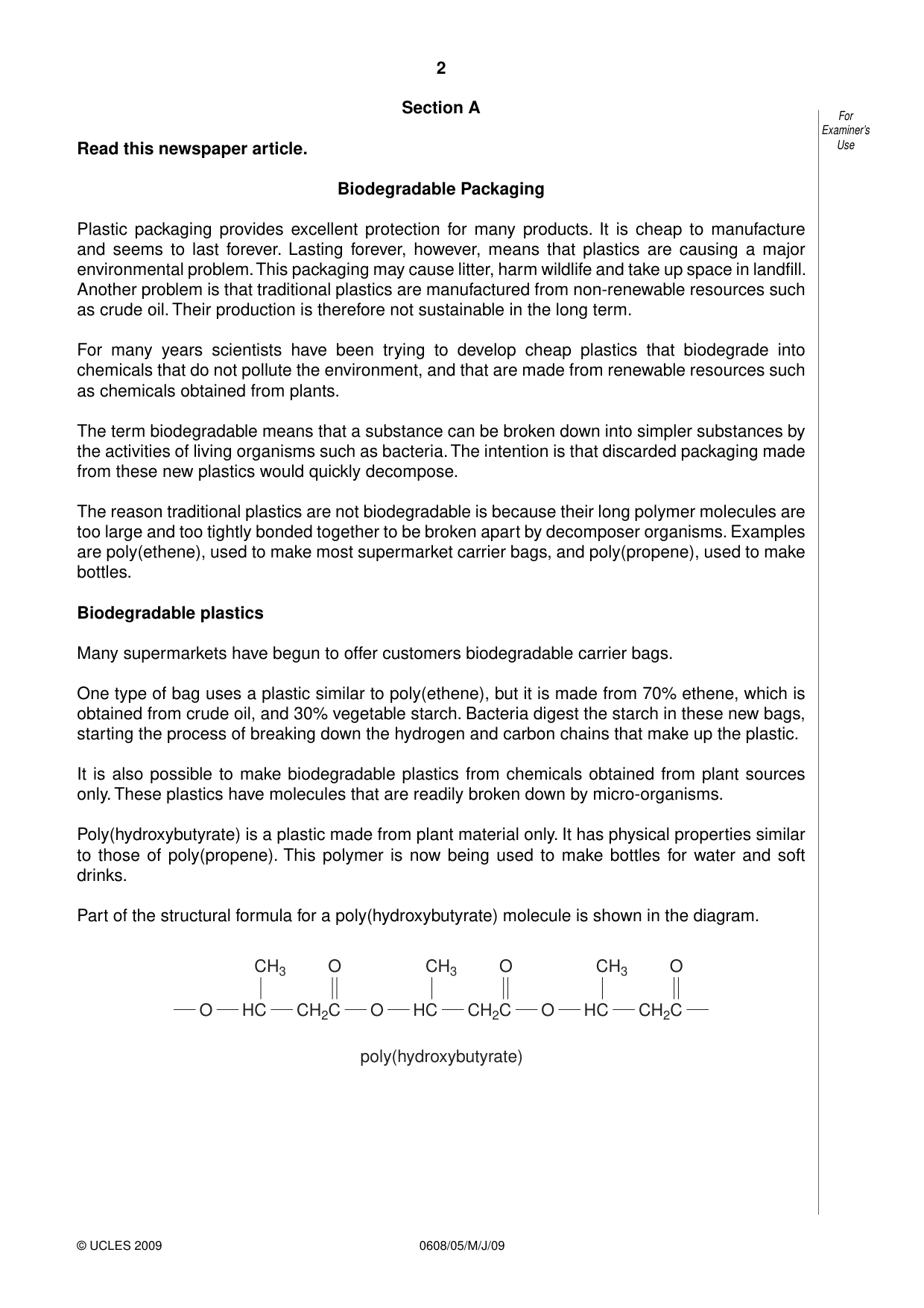
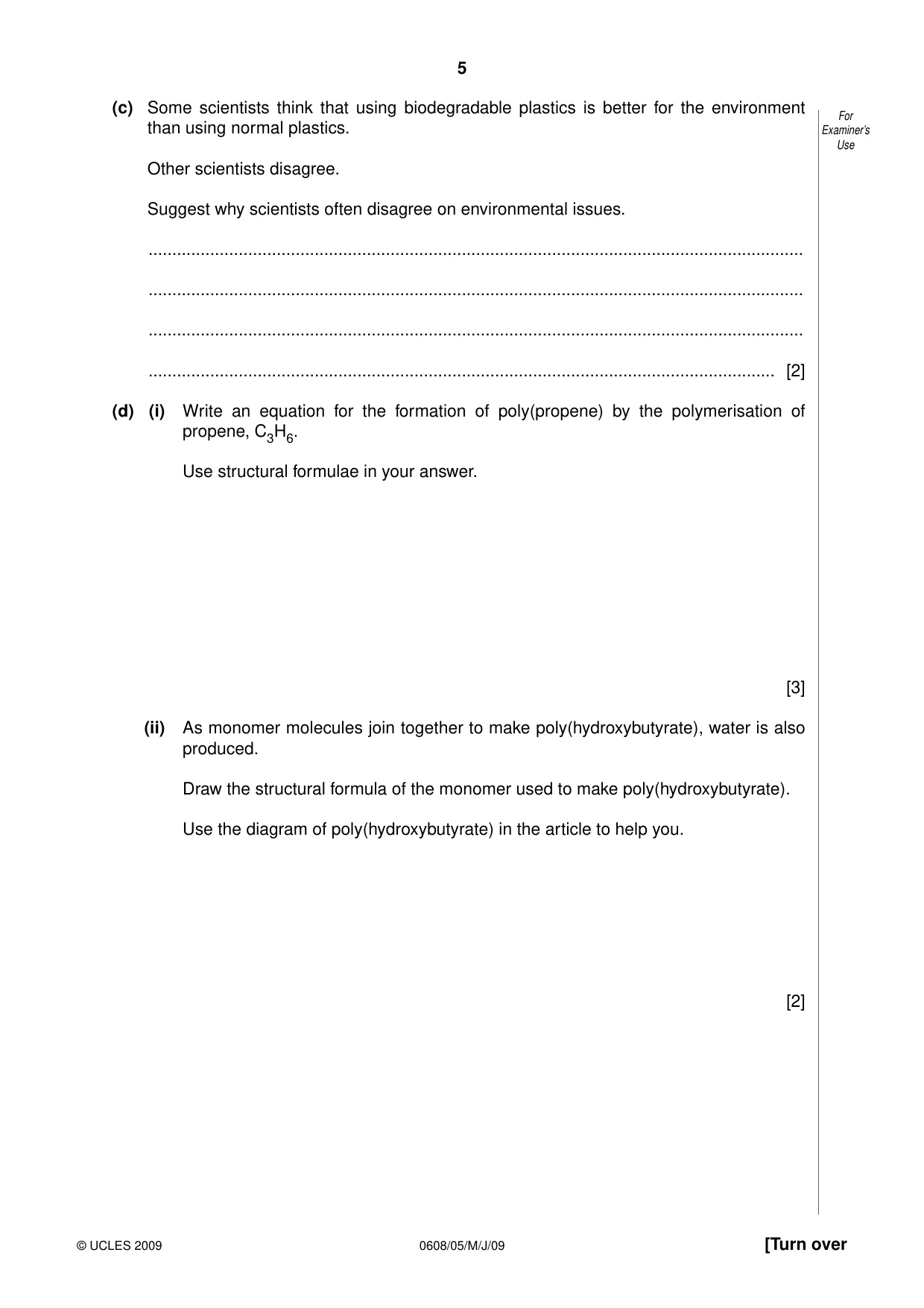
0608/05/M/J/09 © UCLES 2009 For Examiner’s Use Section A Read this newspaper article. Biodegradable Packaging Plastic packaging provides excellent protection for many products. It is cheap to manufacture and seems to last forever. Lasting forever, however, means that plastics are causing a major environmental problem. This packaging may cause litter, harm wildlife and take up space in landfill. Another problem is that traditional plastics are manufactured from non-renewable resources such as crude oil. Their production is therefore not sustainable in the long term. For many years scientists have been trying to develop cheap plastics that biodegrade into chemicals that do not pollute the environment, and that are made from renewable resources such as chemicals obtained from plants. The term biodegradable means that a substance can be broken down into simpler substances by the activities of living organisms such as bacteria. The intention is that discarded packaging made from these new plastics would quickly decompose. The reason traditional plastics are not biodegradable is because their long polymer molecules are too large and too tightly bonded together to be broken apart by decomposer organisms. Examples are poly(ethene), used to make most supermarket carrier bags, and poly(propene), used to make bottles. Biodegradable plastics Many supermarkets have begun to offer customers biodegradable carrier bags. One type of bag uses a plastic similar to poly(ethene), but it is made from 70% ethene, which is obtained from crude oil, and 30% vegetable starch. Bacteria digest the starch in these new bags, starting the process of breaking down the hydrogen and carbon chains that make up the plastic. It is also possible to make biodegradable plastics from chemicals obtained from plant sources only. These plastics have molecules that are readily broken down by micro-organisms. Poly(hydroxybutyrate) is a plastic made from plant material only. It has physical properties similar to those of poly(propene). This polymer is now being used to make bottles for water and soft drinks. Part of the structural formula for a poly(hydroxybutyrate) molecule is shown in the diagram. CH3 O CH3 O CH3 O O O CH2C CH2C HC HC O CH2C HC poly(hydroxybutyrate) 2
Question paper, page 3
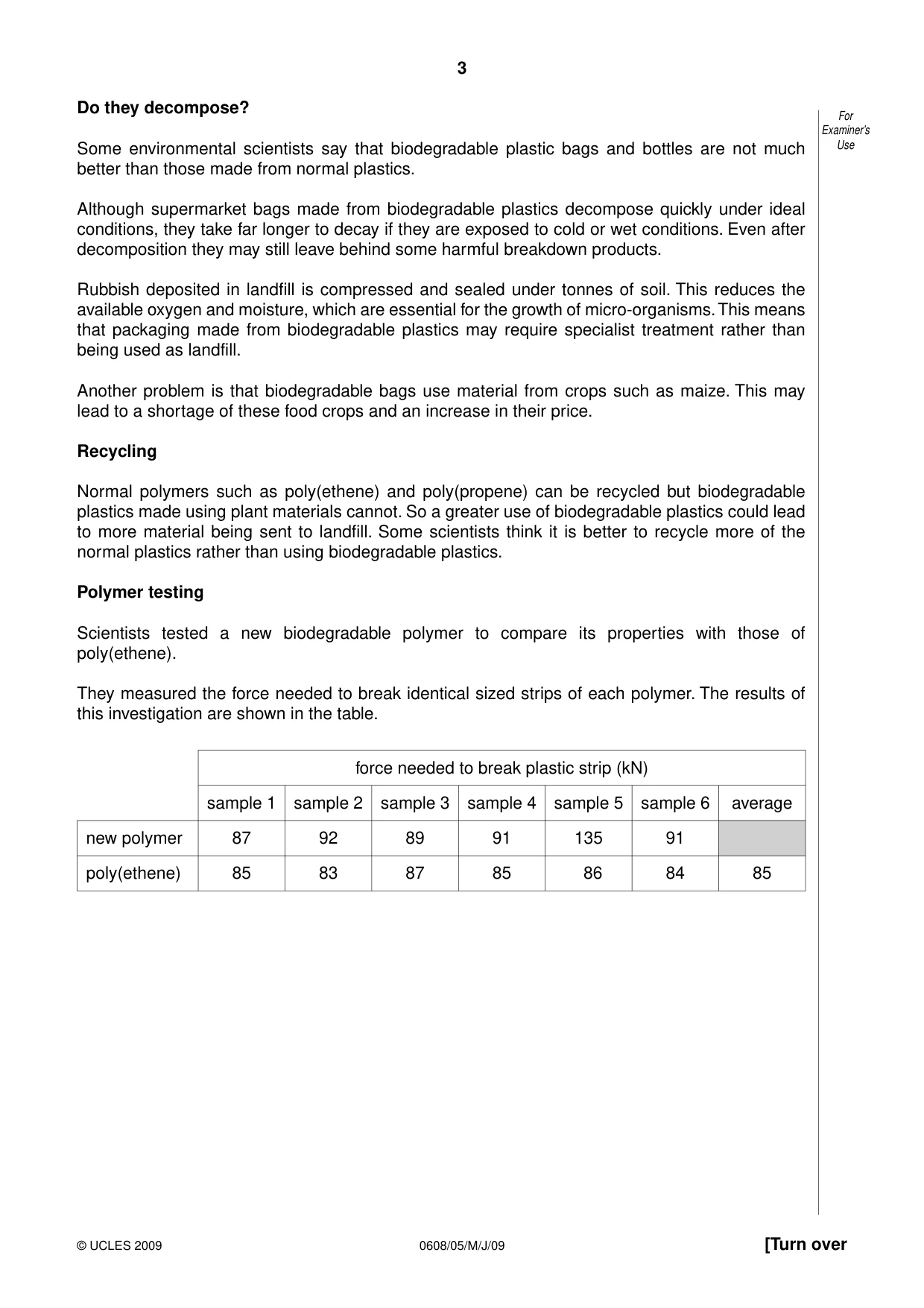
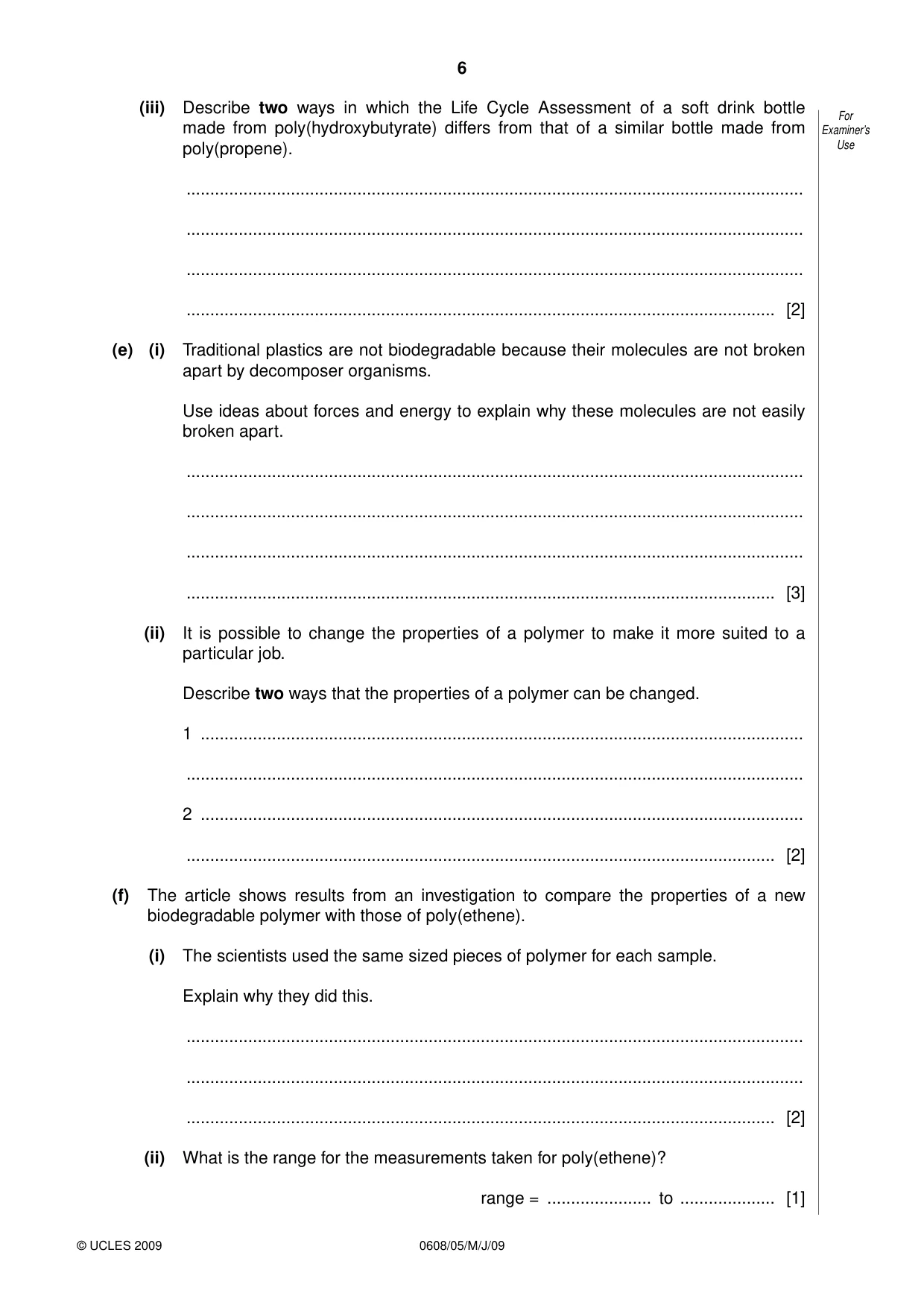
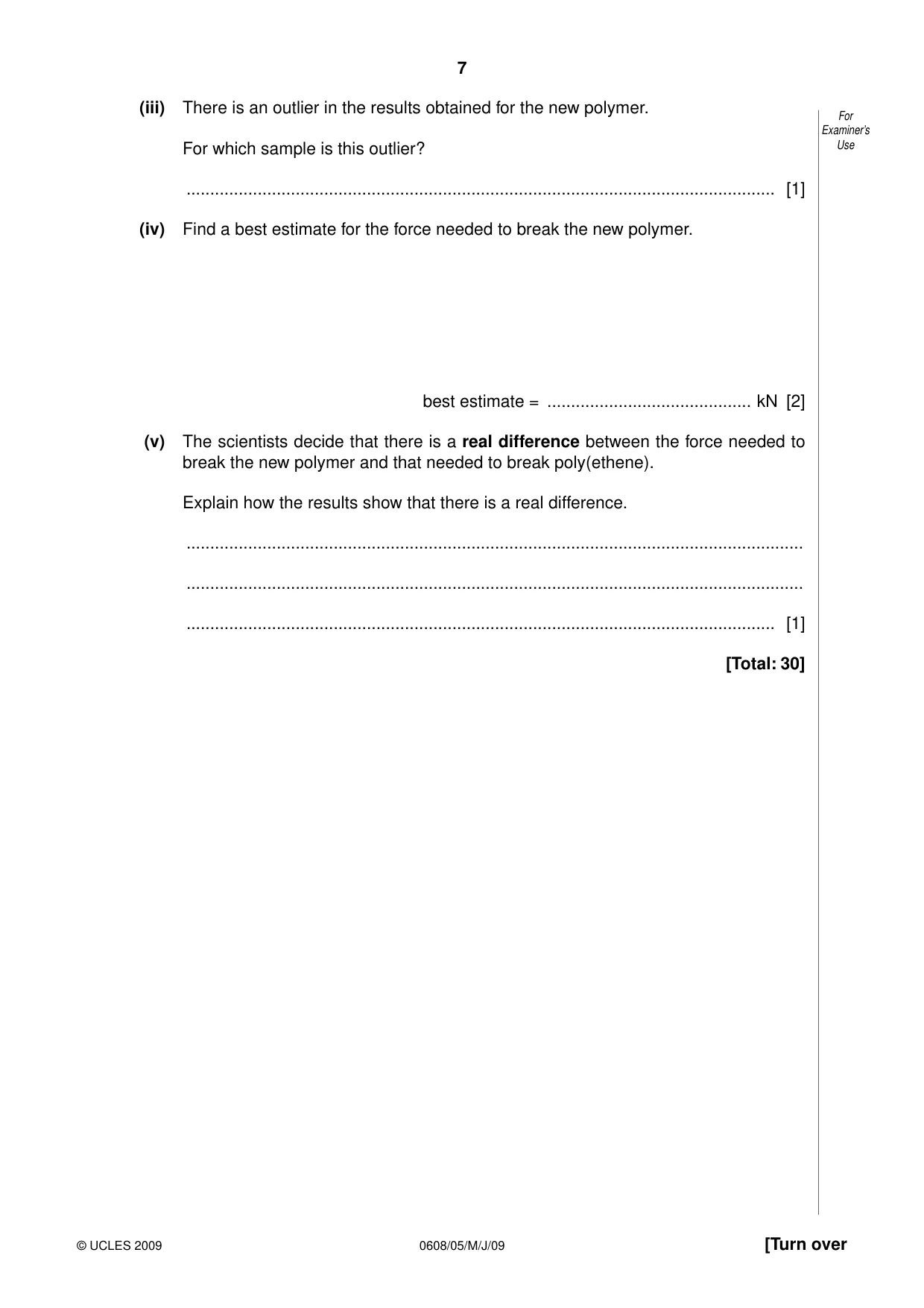
3 0608/05/M/J/09 © UCLES 2009 [Turn over For Examiner’s Use Do they decompose? Some environmental scientists say that biodegradable plastic bags and bottles are not much better than those made from normal plastics. Although supermarket bags made from biodegradable plastics decompose quickly under ideal conditions, they take far longer to decay if they are exposed to cold or wet conditions. Even after decomposition they may still leave behind some harmful breakdown products. Rubbish deposited in landfill is compressed and sealed under tonnes of soil. This reduces the available oxygen and moisture, which are essential for the growth of micro-organisms. This means that packaging made from biodegradable plastics may require specialist treatment rather than being used as landfill. Another problem is that biodegradable bags use material from crops such as maize. This may lead to a shortage of these food crops and an increase in their price. Recycling Normal polymers such as poly(ethene) and poly(propene) can be recycled but biodegradable plastics made using plant materials cannot. So a greater use of biodegradable plastics could lead to more material being sent to landfill. Some scientists think it is better to recycle more of the normal plastics rather than using biodegradable plastics. Polymer testing Scientists tested a new biodegradable polymer to compare its properties with those of poly(ethene). They measured the force needed to break identical sized strips of each polymer. The results of this investigation are shown in the table. force needed to break plastic strip (kN) sample 1 sample 2 sample 3 sample 4 sample 5 sample 6 average new polymer 87 92 89 91 135 91 poly(ethene) 85 83 87 85 86 84 85
Question paper, page 4
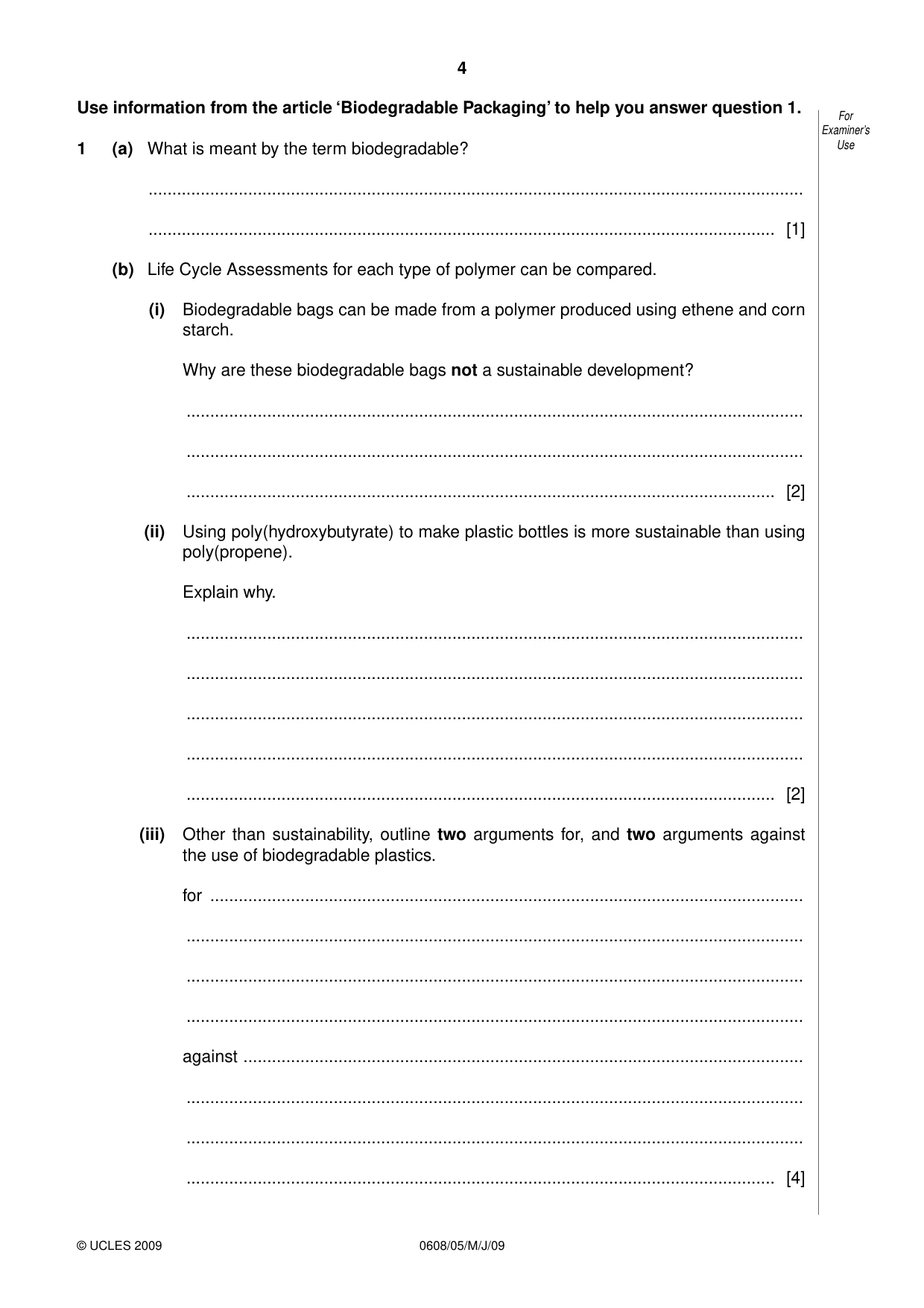
4 0608/05/M/J/09 © UCLES 2009 For Examiner’s Use Use information from the article ‘Biodegradable Packaging’ to help you answer question 1. 1 (a) What is meant by the term biodegradable? … … [1] (b) Life Cycle Assessments for each type of polymer can be compared. (i) Biodegradable bags can be made from a polymer produced using ethene and corn starch. Why are these biodegradable bags not a sustainable development? … … … [2] (ii) Using poly(hydroxybutyrate) to make plastic bottles is more sustainable than using poly(propene). Explain why. … … … … … [2] (iii) Other than sustainability, outline two arguments for, and two arguments against the use of biodegradable plastics. for … … … … against … … … … [4]
Question paper, page 5
5 0608/05/M/J/09 © UCLES 2009 [Turn over For Examiner’s Use (c) Some scientists think that using biodegradable plastics is better for the environment than using normal plastics. Other scientists disagree. Suggest why scientists often disagree on environmental issues. … … … … [2] (d) (i) Write an equation for the formation of poly(propene) by the polymerisation of propene, C3H6. Use structural formulae in your answer. [3] (ii) As monomer molecules join together to make poly(hydroxybutyrate), water is also produced. Draw the structural formula of the monomer used to make poly(hydroxybutyrate). Use the diagram of poly(hydroxybutyrate) in the article to help you. [2]
Question paper, page 6
6 0608/05/M/J/09 © UCLES 2009 For Examiner’s Use (iii) Describe two ways in which the Life Cycle Assessment of a soft drink bottle made from poly(hydroxybutyrate) differs from that of a similar bottle made from poly(propene). … … … … [2] (e) (i) Traditional plastics are not biodegradable because their molecules are not broken apart by decomposer organisms. Use ideas about forces and energy to explain why these molecules are not easily broken apart. … … … … [3] (ii) It is possible to change the properties of a polymer to make it more suited to a particular job. Describe two ways that the properties of a polymer can be changed. 1 … … 2 … … [2] (f) The article shows results from an investigation to compare the properties of a new biodegradable polymer with those of poly(ethene). (i) The scientists used the same sized pieces of polymer for each sample. Explain why they did this. … … … [2] (ii) What is the range for the measurements taken for poly(ethene)? range = … to … [1]
Question paper, page 7
7 0608/05/M/J/09 © UCLES 2009 [Turn over For Examiner’s Use (iii) There is an outlier in the results obtained for the new polymer. For which sample is this outlier? … [1] (iv) Find a best estimate for the force needed to break the new polymer. best estimate = … kN [2] (v) The scientists decide that there is a real difference between the force needed to break the new polymer and that needed to break poly(ethene). Explain how the results show that there is a real difference. … … … [1] [Total: 30]
Question paper, page 8
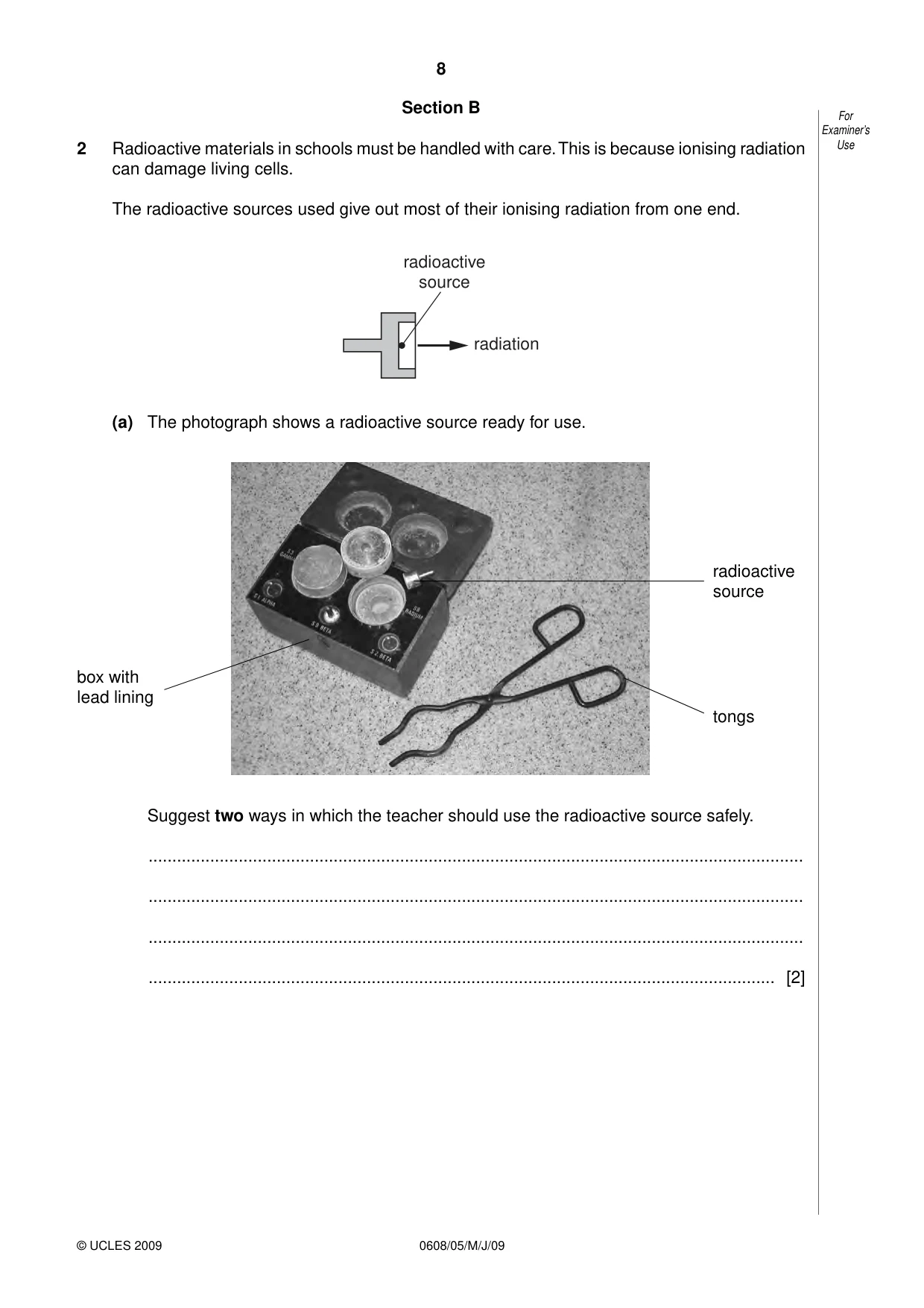
0608/05/M/J/09 © UCLES 2009 For Examiner’s Use Section B 2 Radioactive materials in schools must be handled with care. This is because ionising radiation can damage living cells. The radioactive sources used give out most of their ionising radiation from one end. radioactive source radiation (a) The photograph shows a radioactive source ready for use. radioactive source tongs box with lead lining Suggest two ways in which the teacher should use the radioactive source safely. … … … … [2] 8
Question paper, page 9
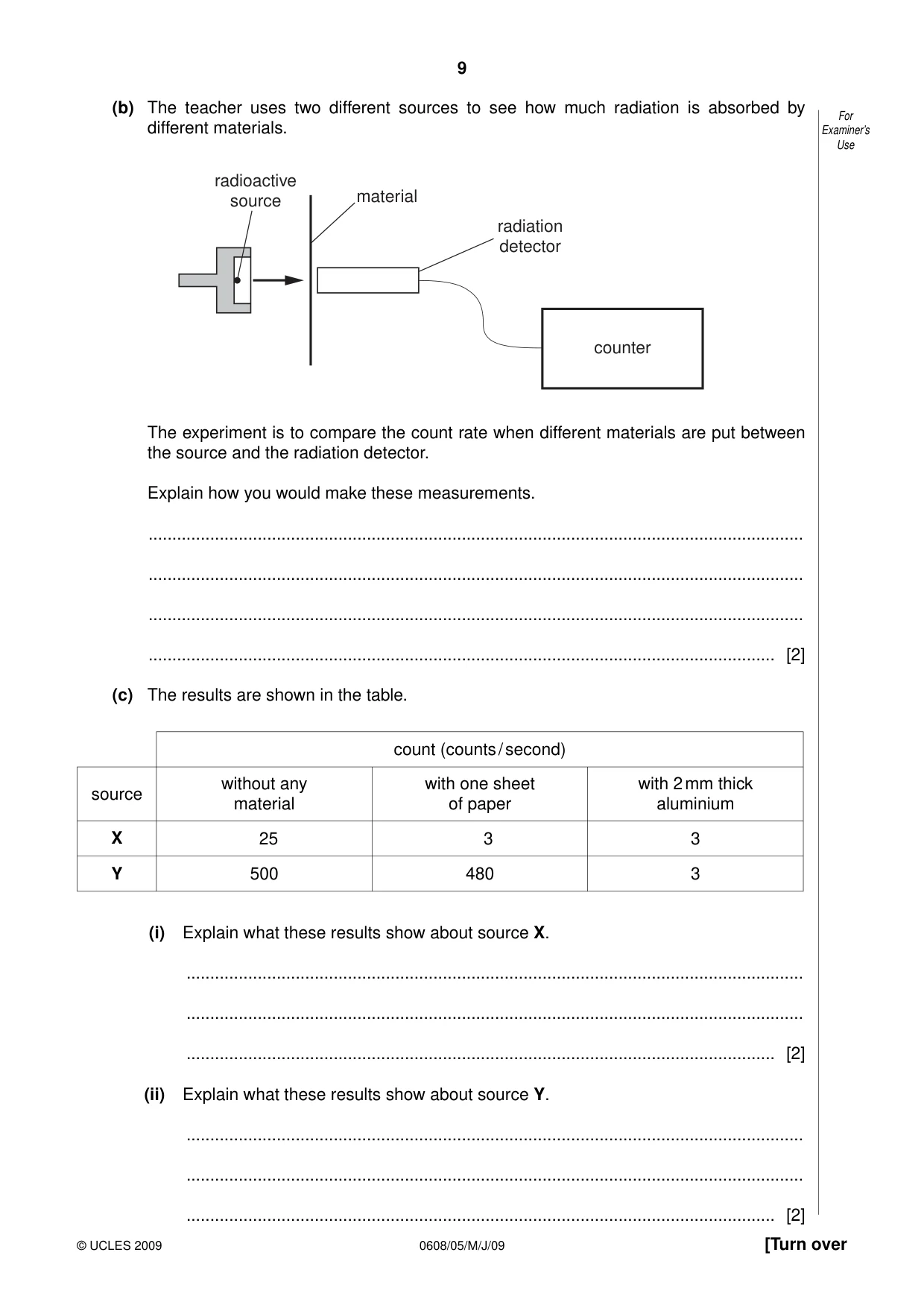
9 0608/05/M/J/09 © UCLES 2009 [Turn over For Examiner’s Use (b) The teacher uses two different sources to see how much radiation is absorbed by different materials. radioactive source radiation detector material counter The experiment is to compare the count rate when different materials are put between the source and the radiation detector. Explain how you would make these measurements. … … … … [2] (c) The results are shown in the table. count (counts / second) source without any material with one sheet of paper with 2 mm thick aluminium X 25 3 3 Y 500 480 3 (i) Explain what these results show about source X. … … … [2] (ii) Explain what these results show about source Y. … … … [2]
Question paper, page 10
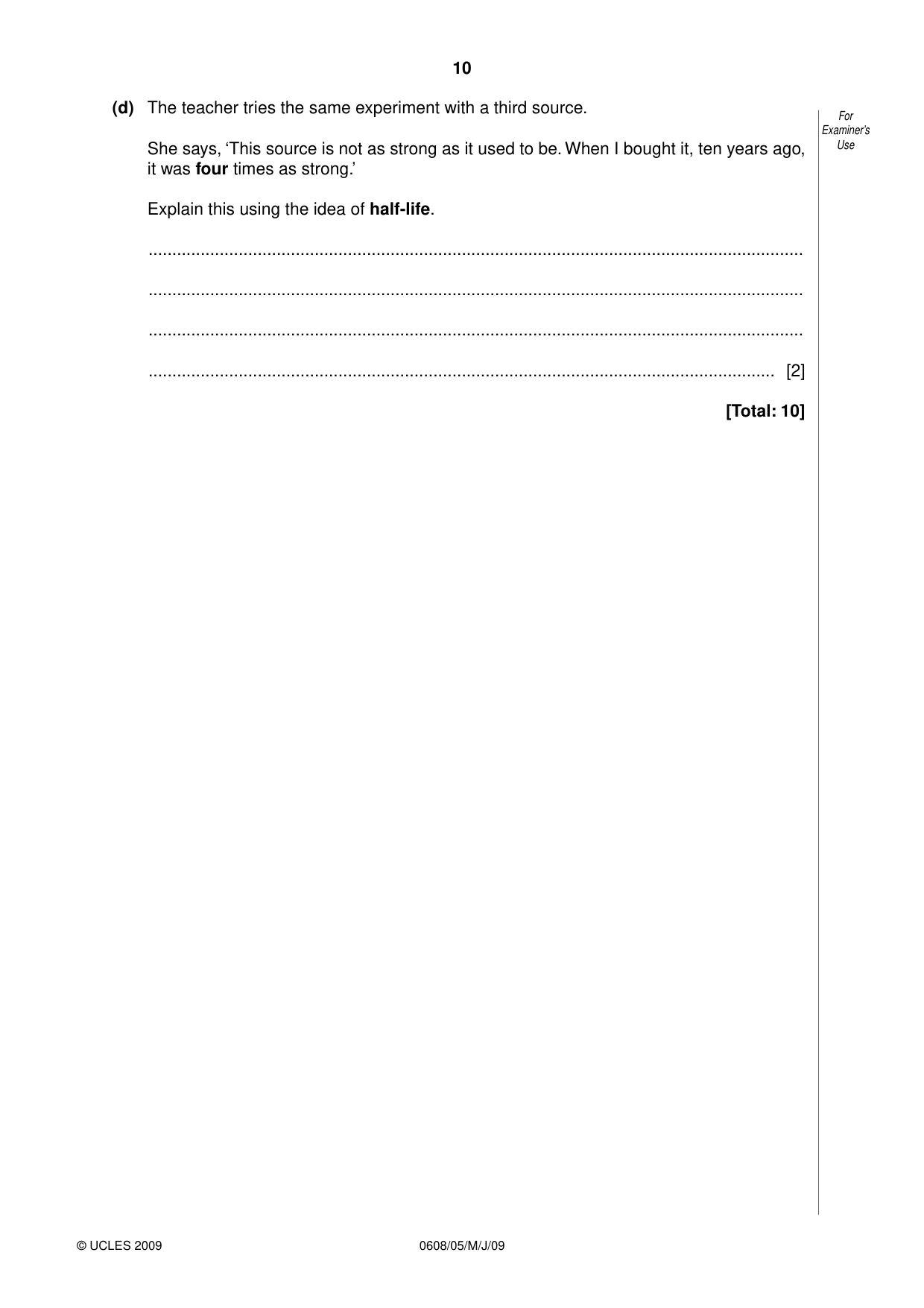
10 0608/05/M/J/09 © UCLES 2009 For Examiner’s Use (d) The teacher tries the same experiment with a third source. She says, ‘This source is not as strong as it used to be. When I bought it, ten years ago, it was four times as strong.’ Explain this using the idea of half-life. … … … … [2] [Total: 10]
Question paper, page 11
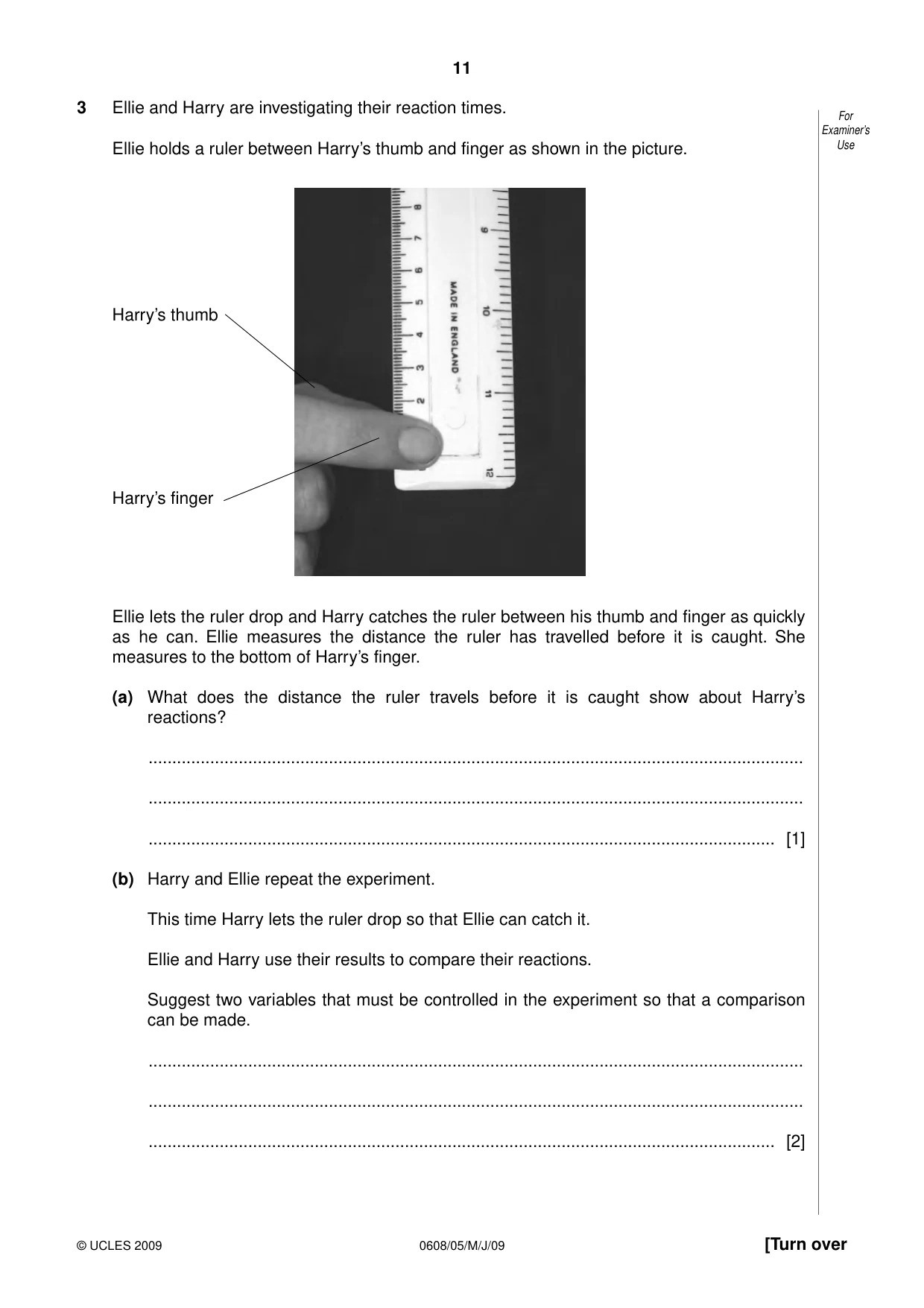
11 0608/05/M/J/09 © UCLES 2009 [Turn over For Examiner’s Use 3 Ellie and Harry are investigating their reaction times. Ellie holds a ruler between Harry’s thumb and finger as shown in the picture. Harry’s thumb Harry’s finger Ellie lets the ruler drop and Harry catches the ruler between his thumb and finger as quickly as he can. Ellie measures the distance the ruler has travelled before it is caught. She measures to the bottom of Harry’s finger. (a) What does the distance the ruler travels before it is caught show about Harry’s reactions? … … … [1] (b) Harry and Ellie repeat the experiment. This time Harry lets the ruler drop so that Ellie can catch it. Ellie and Harry use their results to compare their reactions. Suggest two variables that must be controlled in the experiment so that a comparison can be made. … … … [2]
Question paper, page 12
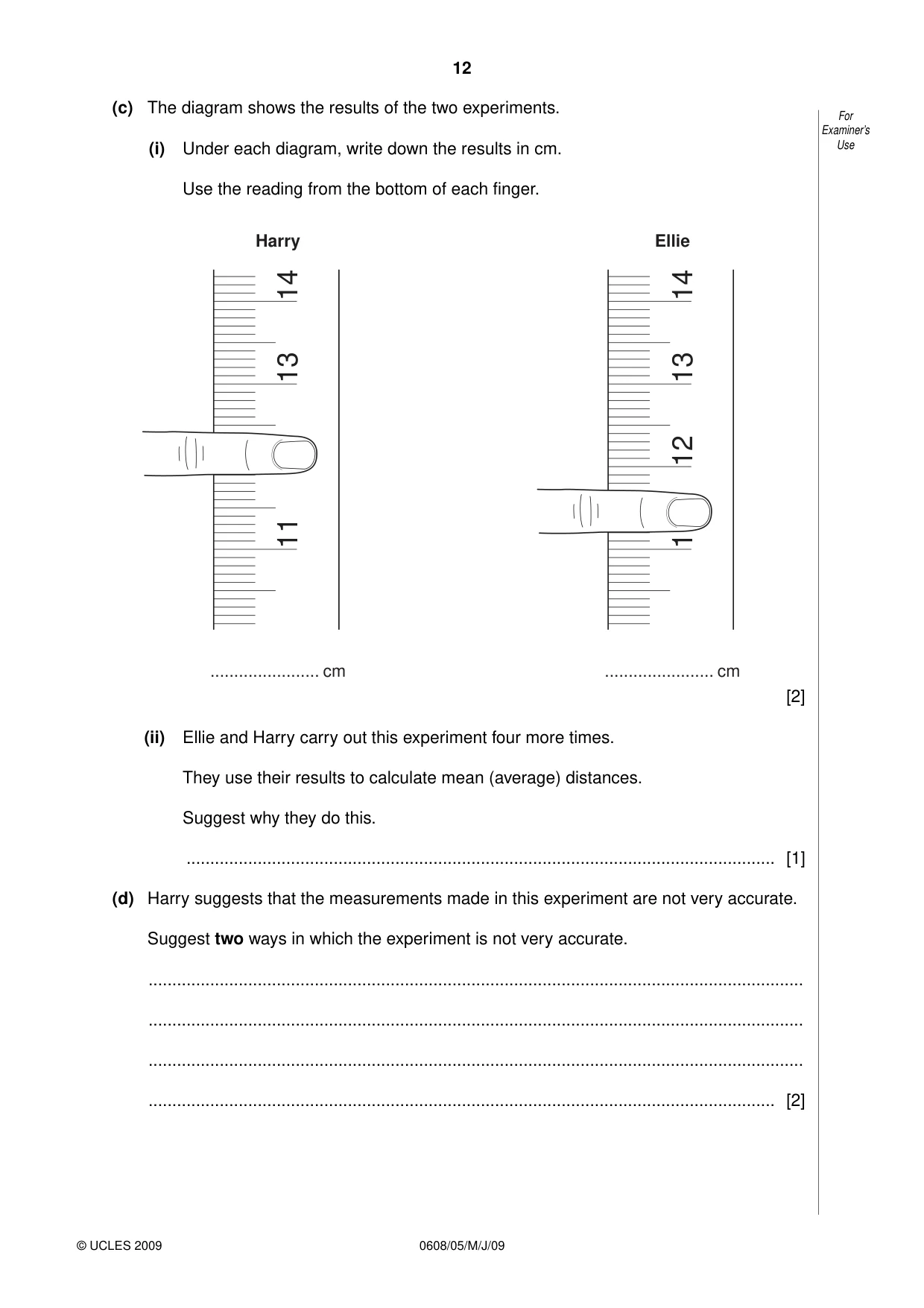
12 0608/05/M/J/09 © UCLES 2009 For Examiner’s Use (c) The diagram shows the results of the two experiments. (i) Under each diagram, write down the results in cm. Use the reading from the bottom of each finger. 11 12 13 14 Harry … cm 11 12 13 14 Ellie … cm [2] (ii) Ellie and Harry carry out this experiment four more times. They use their results to calculate mean (average) distances. Suggest why they do this. … [1] (d) Harry suggests that the measurements made in this experiment are not very accurate. Suggest two ways in which the experiment is not very accurate. … … … … [2]
Question paper, page 13
13 0608/05/M/J/09 © UCLES 2009 [Turn over For Examiner’s Use (e) Ellie and Harry carry out another similar experiment. Sam measures the time taken for the ruler to drop. Sam uses a stopwatch to make this measurement. (i) Why will the time measurements made by Sam be inaccurate? … … [1] (ii) Suggest what apparatus Sam can use to make a more accurate measurement. … [1] [Total: 10]
Question paper, page 14
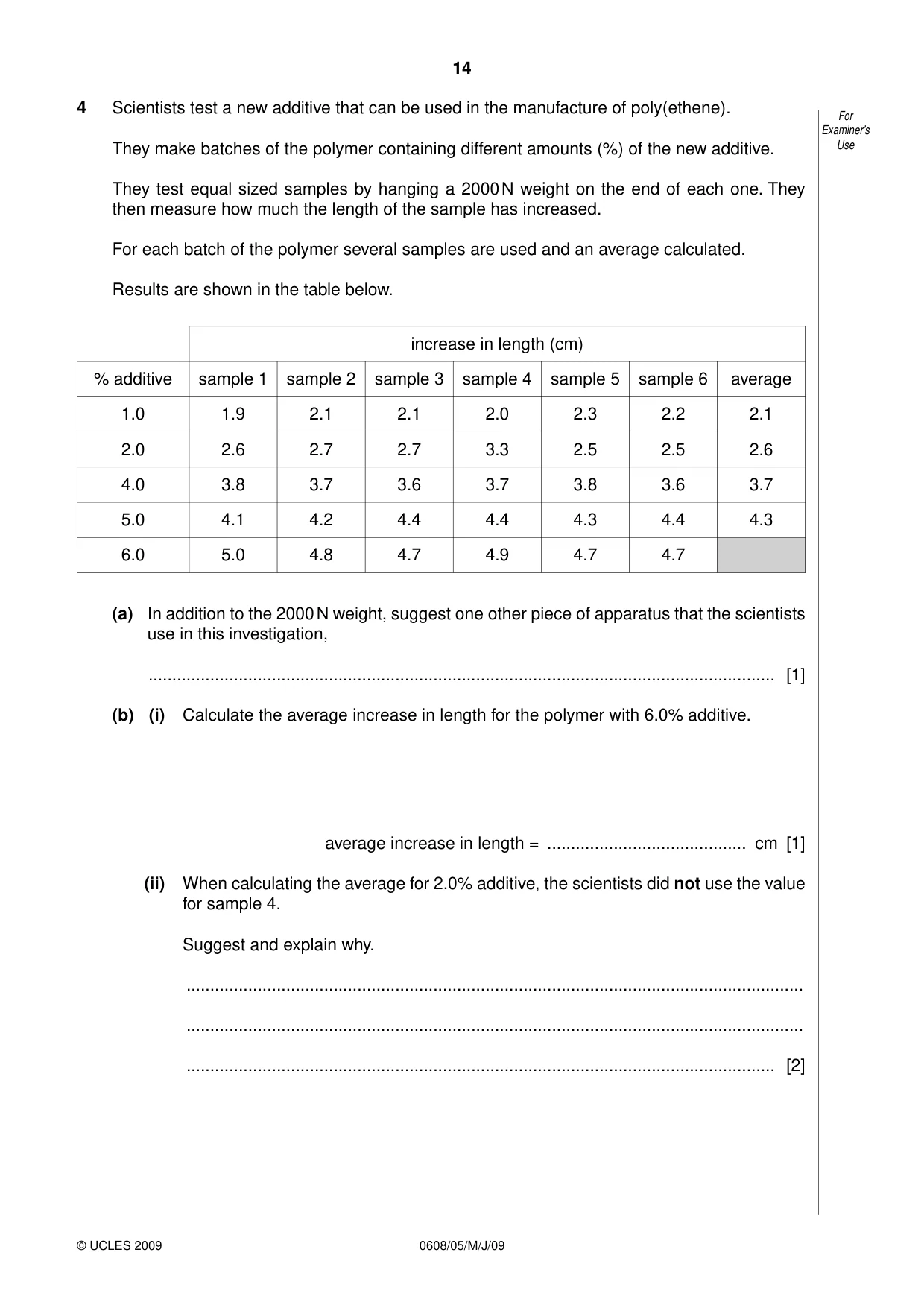
14 0608/05/M/J/09 © UCLES 2009 For Examiner’s Use 4 Scientists test a new additive that can be used in the manufacture of poly(ethene). They make batches of the polymer containing different amounts (%) of the new additive. They test equal sized samples by hanging a 2000 N weight on the end of each one. They then measure how much the length of the sample has increased. For each batch of the polymer several samples are used and an average calculated. Results are shown in the table below. increase in length (cm) % additive sample 1 sample 2 sample 3 sample 4 sample 5 sample 6 average 1.0 1.9 2.1 2.1 2.0 2.3 2.2 2.1 2.0 2.6 2.7 2.7 3.3 2.5 2.5 2.6 4.0 3.8 3.7 3.6 3.7 3.8 3.6 3.7 5.0 4.1 4.2 4.4 4.4 4.3 4.4 4.3 6.0 5.0 4.8 4.7 4.9 4.7 4.7 (a) In addition to the 2000 N weight, suggest one other piece of apparatus that the scientists use in this investigation, … [1] (b) (i) Calculate the average increase in length for the polymer with 6.0% additive. average increase in length = … cm [1] (ii) When calculating the average for 2.0% additive, the scientists did not use the value for sample 4. Suggest and explain why. … … … [2]
Question paper, page 15
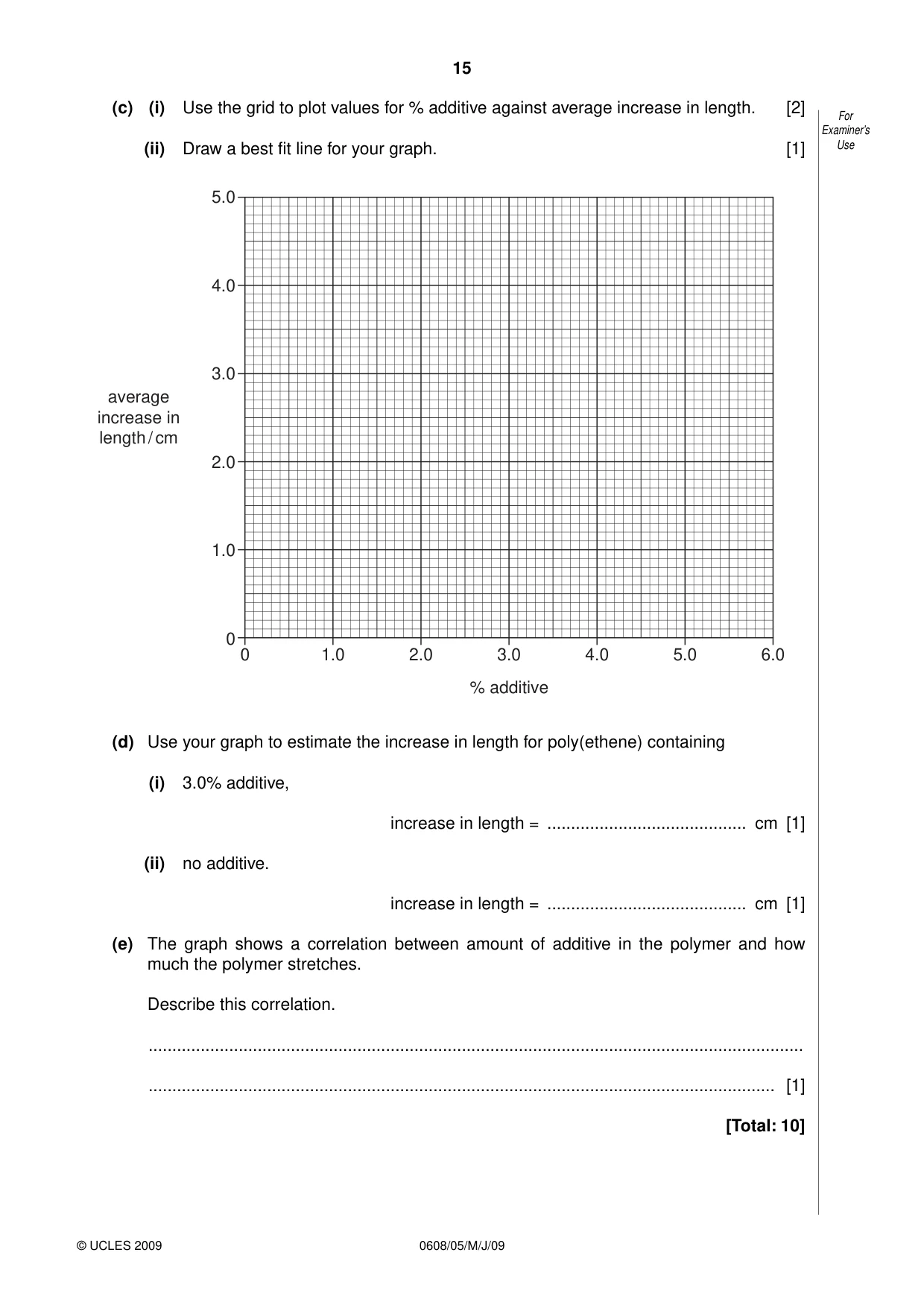
15 0608/05/M/J/09 © UCLES 2009 For Examiner’s Use (c) (i) Use the grid to plot values for % additive against average increase in length. [2] (ii) Draw a best fit line for your graph. [1] 0 % additive average increase in length / cm 1.0 2.0 1.0 0 3.0 2.0 5.0 4.0 3.0 4.0 5.0 6.0 (d) Use your graph to estimate the increase in length for poly(ethene) containing (i) 3.0% additive, increase in length = … cm [1] (ii) no additive. increase in length = … cm [1] (e) The graph shows a correlation between amount of additive in the polymer and how much the polymer stretches. Describe this correlation. … … [1] [Total: 10]
Question paper, page 16
16 0608/05/M/J/09 Permission to reproduce items where third-party owned material protected by copyright is included has been sought and cleared where possible. Every reasonable effort has been made by the publisher (UCLES) to trace copyright holders, but if any items requiring clearance have unwittingly been included, the publisher will be pleased to make amends at the earliest possible opportunity. University of Cambridge International Examinations is part of the Cambridge Assessment Group. Cambridge Assessment is the brand name of University of Cambridge Local Examinations Syndicate (UCLES), which is itself a department of the University of Cambridge. BLANK PAGE
Mark scheme, page 1
UNIVERSITY OF CAMBRIDGE INTERNATIONAL EXAMINATIONS International General Certificate of Secondary Education MARK SCHEME for the May/June 2009 question paper for the guidance of teachers 0608 21ST CENTURY SCIENCE 0608/05 Paper 5 (Comprehension and Practical), maximum raw mark 60 This mark scheme is published as an aid to teachers and candidates, to indicate the requirements of the examination. It shows the basis on which Examiners were instructed to award marks. It does not indicate the details of the discussions that took place at an Examiners’ meeting before marking began, which would have considered the acceptability of alternative answers. Mark schemes must be read in conjunction with the question papers and the report on the examination. • CIE will not enter into discussions or correspondence in connection with these mark schemes. CIE is publishing the mark schemes for the May/June 2009 question papers for most IGCSE, GCE Advanced Level and Advanced Subsidiary Level syllabuses and some Ordinary Level syllabuses. www.XtremePapers.com
Mark scheme, page 2
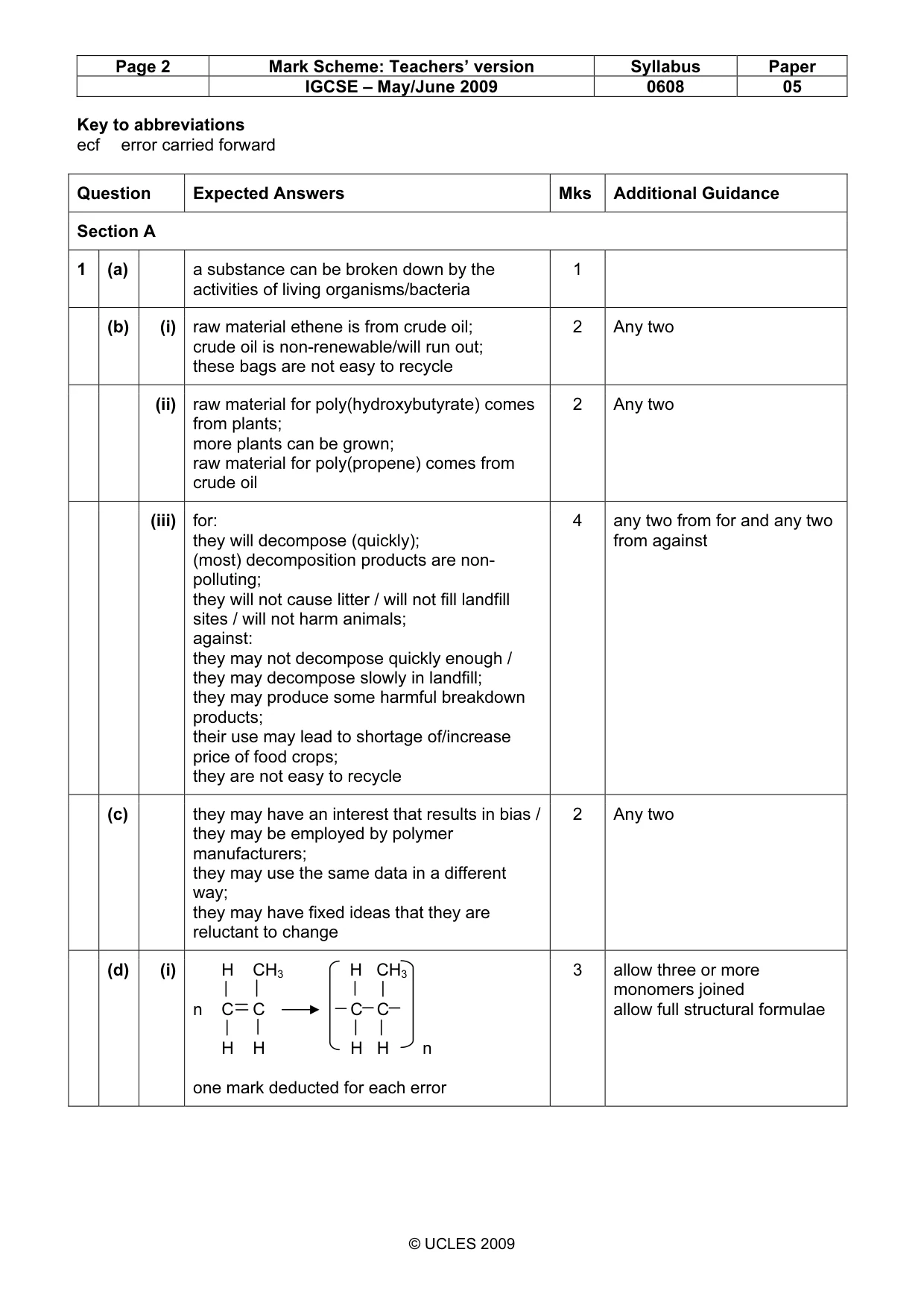
Page 2 Mark Scheme: Teachers’ version Syllabus Paper IGCSE – May/June 2009 0608 05 © UCLES 2009 Key to abbreviations ecf error carried forward Question Expected Answers Mks Additional Guidance Section A 1 (a) a substance can be broken down by the activities of living organisms/bacteria 1 (b) (i) raw material ethene is from crude oil; crude oil is non-renewable/will run out; these bags are not easy to recycle 2 Any two (ii) raw material for poly(hydroxybutyrate) comes from plants; more plants can be grown; raw material for poly(propene) comes from crude oil 2 Any two (iii) for: they will decompose (quickly); (most) decomposition products are non- polluting; they will not cause litter / will not fill landfill sites / will not harm animals; against: they may not decompose quickly enough / they may decompose slowly in landfill; they may produce some harmful breakdown products; their use may lead to shortage of/increase price of food crops; they are not easy to recycle 4 any two from for and any two from against (c) they may have an interest that results in bias / they may be employed by polymer manufacturers; they may use the same data in a different way; they may have fixed ideas that they are reluctant to change 2 Any two (d) (i) H CH3 H CH3 n C C C C H H H H n one mark deducted for each error 3 allow three or more monomers joined allow full structural formulae
Mark scheme, page 3
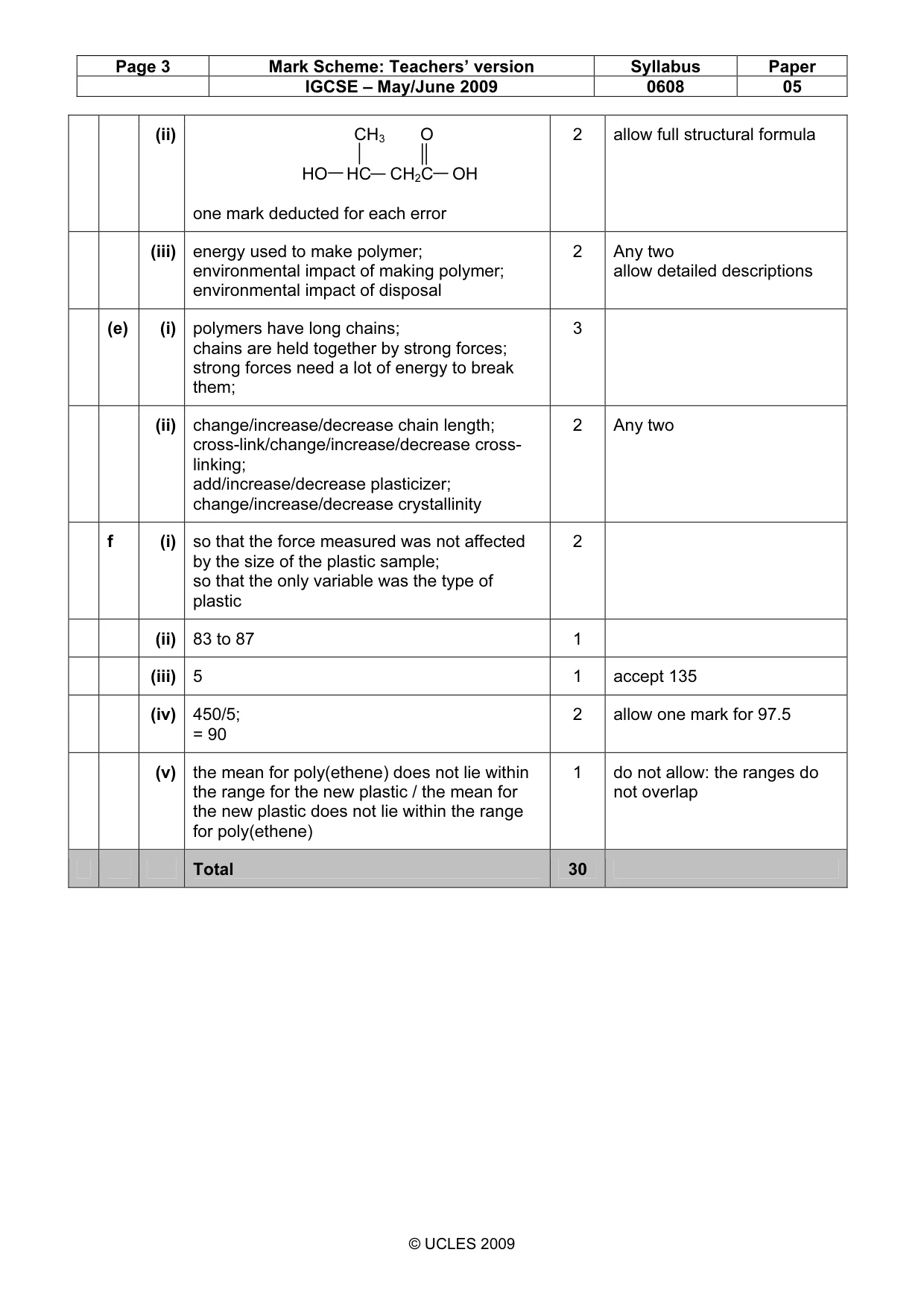
Page 3 Mark Scheme: Teachers’ version Syllabus Paper IGCSE – May/June 2009 0608 05 © UCLES 2009 (ii) CH3 O HO HC CH2C OH one mark deducted for each error 2 allow full structural formula (iii) energy used to make polymer; environmental impact of making polymer; environmental impact of disposal 2 Any two allow detailed descriptions (e) (i) polymers have long chains; chains are held together by strong forces; strong forces need a lot of energy to break them; 3 (ii) change/increase/decrease chain length; cross-link/change/increase/decrease cross- linking; add/increase/decrease plasticizer; change/increase/decrease crystallinity 2 Any two f (i) so that the force measured was not affected by the size of the plastic sample; so that the only variable was the type of plastic 2 (ii) 83 to 87 1 (iii) 5 1 accept 135 (iv) 450/5; = 90 2 allow one mark for 97.5 (v) the mean for poly(ethene) does not lie within the range for the new plastic / the mean for the new plastic does not lie within the range for poly(ethene) 1 do not allow: the ranges do not overlap Total 30
Mark scheme, page 4
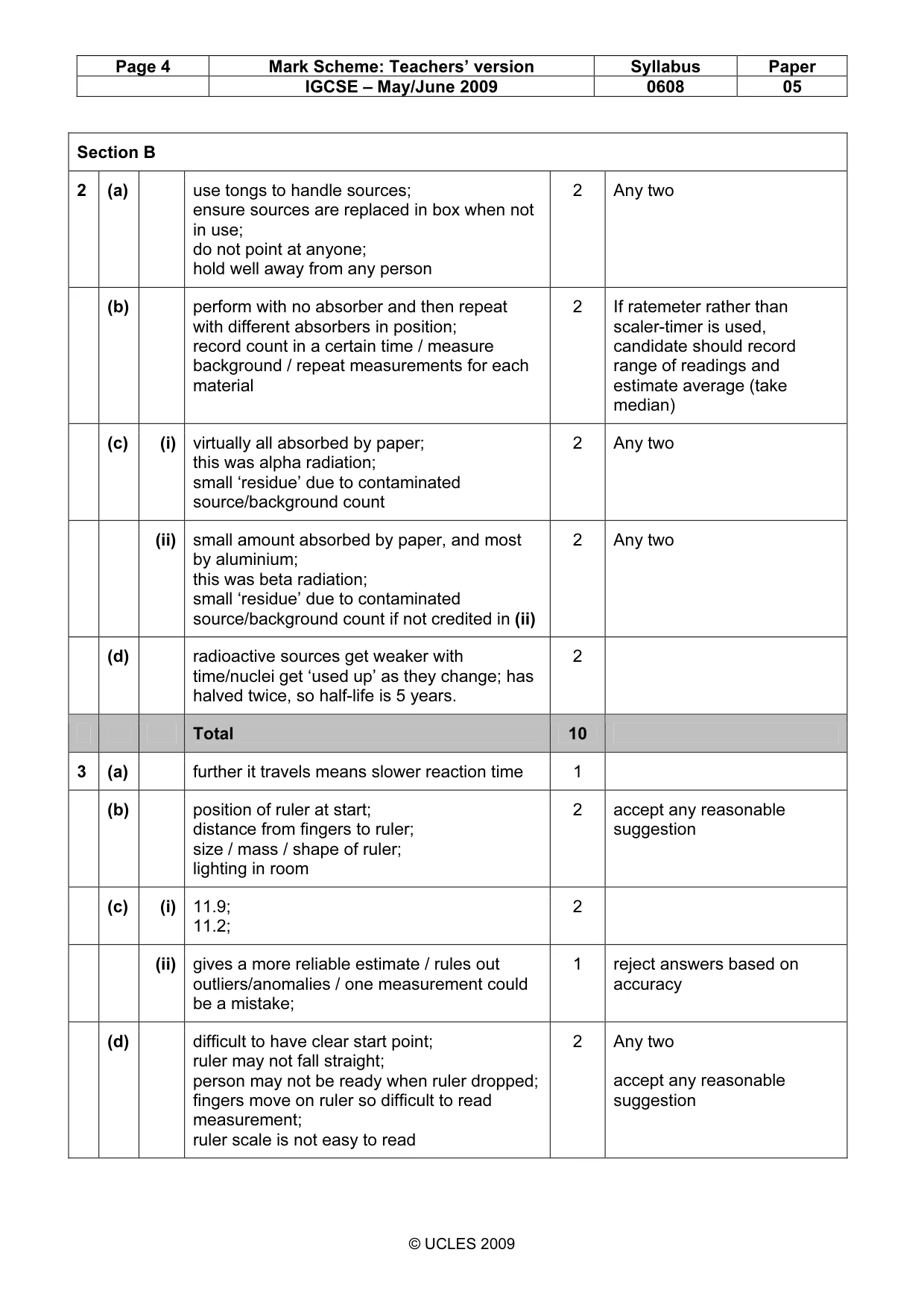
Page 4 Mark Scheme: Teachers’ version Syllabus Paper IGCSE – May/June 2009 0608 05 © UCLES 2009 Section B 2 (a) use tongs to handle sources; ensure sources are replaced in box when not in use; do not point at anyone; hold well away from any person 2 Any two (b) perform with no absorber and then repeat with different absorbers in position; record count in a certain time / measure background / repeat measurements for each material 2 If ratemeter rather than scaler-timer is used, candidate should record range of readings and estimate average (take median) (c) (i) virtually all absorbed by paper; this was alpha radiation; small ‘residue’ due to contaminated source/background count 2 Any two (ii) small amount absorbed by paper, and most by aluminium; this was beta radiation; small ‘residue’ due to contaminated source/background count if not credited in (ii) 2 Any two (d) radioactive sources get weaker with time/nuclei get ‘used up’ as they change; has halved twice, so half-life is 5 years. 2 Total 10 3 (a) further it travels means slower reaction time 1 (b) position of ruler at start; distance from fingers to ruler; size / mass / shape of ruler; lighting in room 2 accept any reasonable suggestion (c) (i) 11.9; 11.2; 2 (ii) gives a more reliable estimate / rules out outliers/anomalies / one measurement could be a mistake; 1 reject answers based on accuracy (d) difficult to have clear start point; ruler may not fall straight; person may not be ready when ruler dropped; fingers move on ruler so difficult to read measurement; ruler scale is not easy to read 2 Any two accept any reasonable suggestion
Mark scheme, page 5
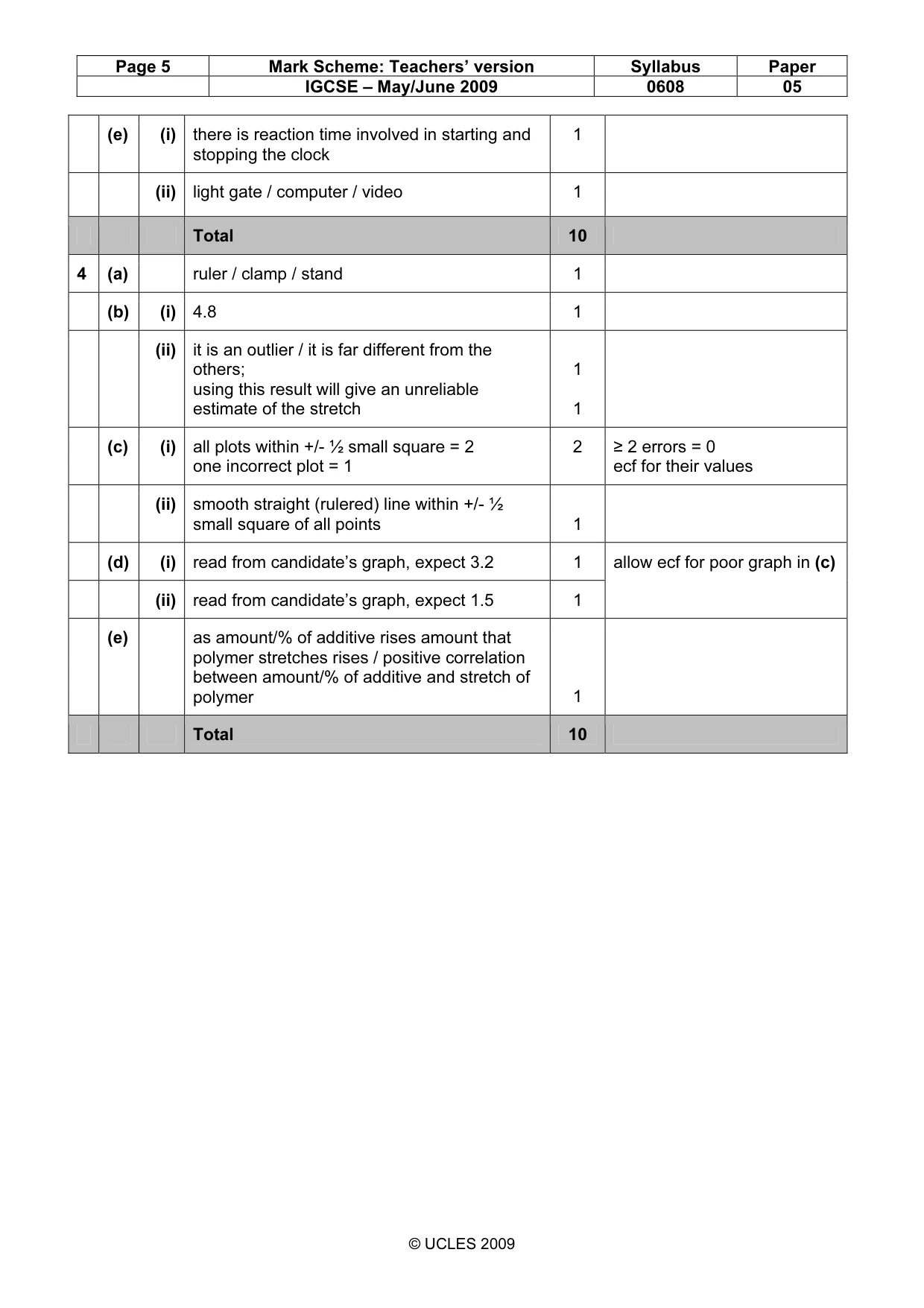
Page 5 Mark Scheme: Teachers’ version Syllabus Paper IGCSE – May/June 2009 0608 05 © UCLES 2009 (e) (i) there is reaction time involved in starting and stopping the clock 1 (ii) light gate / computer / video 1 Total 10 4 (a) ruler / clamp / stand 1 (b) (i) 4.8 1 (ii) it is an outlier / it is far different from the others; using this result will give an unreliable estimate of the stretch 1 1 (c) (i) all plots within +/- ½ small square = 2 one incorrect plot = 1 2 ≥ 2 errors = 0 ecf for their values (ii) smooth straight (rulered) line within +/- ½ small square of all points 1 (d) (i) read from candidate’s graph, expect 3.2 1 (ii) read from candidate’s graph, expect 1.5 1 allow ecf for poor graph in (c) (e) as amount/% of additive rises amount that polymer stretches rises / positive correlation between amount/% of additive and stretch of polymer 1 Total 10
What you needed in this session
Cambridge’s own grade thresholds for 2009 May/June, Paper 5 · Variant 1. A higher threshold means an easier paper — the bar moves with how the cohort did.