Cambridge IGCSE Spanish - Literature 0488 — 2019 Oct/Nov Paper 3 · Variant 1
0488/31/O/N/19 · 20 marks · ≈23 min
The question paper and its mark scheme, free to read here and free to download. This is Cambridge’s own paper, exactly as it was sat.
Question paper4 pages

Mark scheme5 pages
Answers below. Sit the paper first if you are practising.
Paper as text
Question paper, page 1
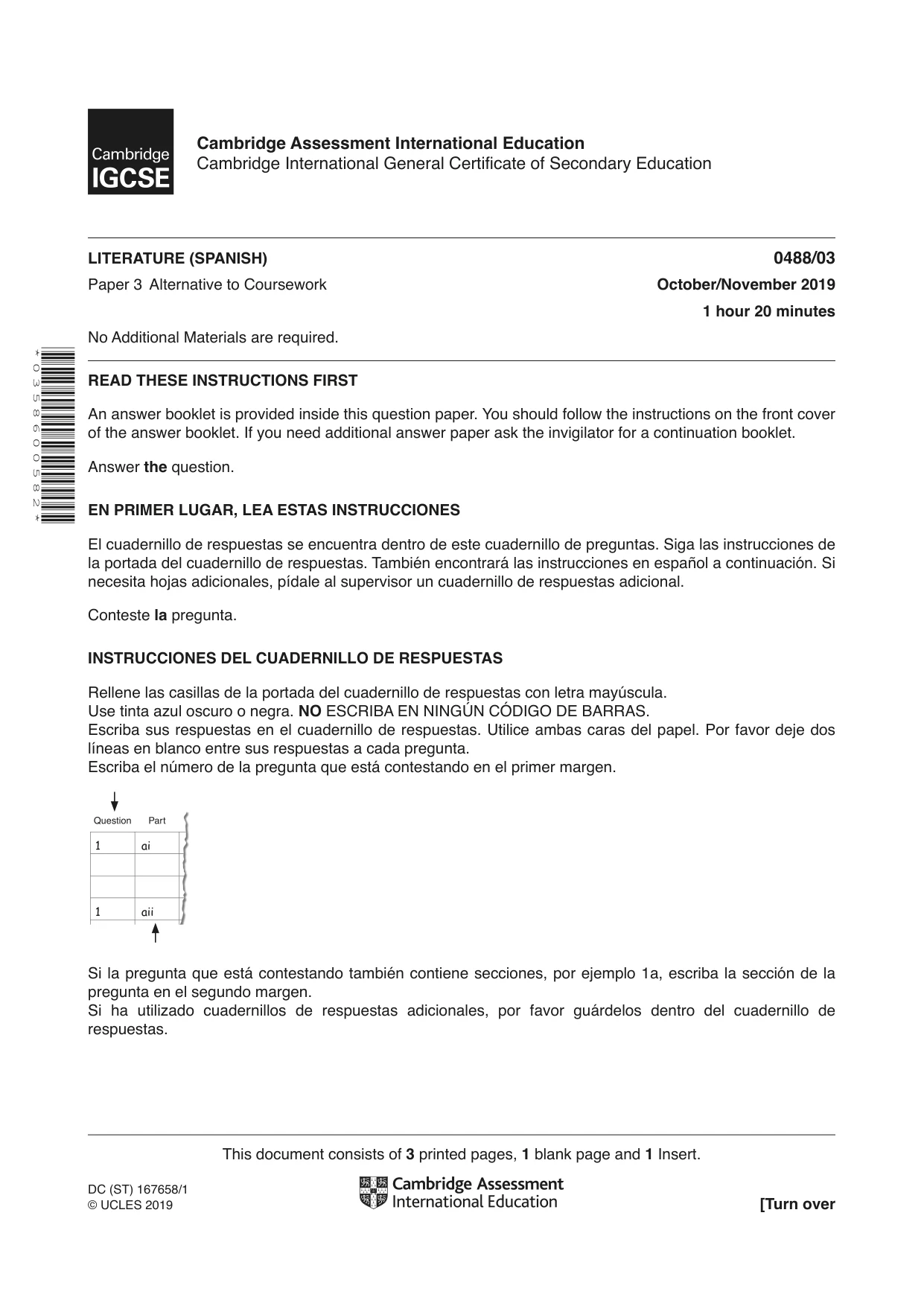
This document consists of 3 printed pages, 1 blank page and 1 Insert. DC (ST) 167658/1 © UCLES 2019 [Turn over Cambridge Assessment International Education Cambridge International General Certificate of Secondary Education * 0 3 5 8 6 0 0 5 8 2 * LITERATURE (SPANISH) 0488/03 Paper 3 Alternative to Coursework October/November 2019 1 hour 20 minutes No Additional Materials are required. READ THESE INSTRUCTIONS FIRST An answer booklet is provided inside this question paper. You should follow the instructions on the front cover of the answer booklet. If you need additional answer paper ask the invigilator for a continuation booklet. Answer the question. EN PRIMER LUGAR, LEA ESTAS INSTRUCCIONES El cuadernillo de respuestas se encuentra dentro de este cuadernillo de preguntas. Siga las instrucciones de la portada del cuadernillo de respuestas. También encontrará las instrucciones en español a continuación. Si necesita hojas adicionales, pídale al supervisor un cuadernillo de respuestas adicional. Conteste la pregunta. INSTRUCCIONES DEL CUADERNILLO DE RESPUESTAS Rellene las casillas de la portada del cuadernillo de respuestas con letra mayúscula. Use tinta azul oscuro o negra. NO ESCRIBA EN NINGÚN CÓDIGO DE BARRAS. Escriba sus respuestas en el cuadernillo de respuestas. Utilice ambas caras del papel. Por favor deje dos líneas en blanco entre sus respuestas a cada pregunta. Escriba el número de la pregunta que está contestando en el primer margen. Si la pregunta que está contestando también contiene secciones, por ejemplo 1a, escriba la sección de la pregunta en el segundo margen. Si ha utilizado cuadernillos de respuestas adicionales, por favor guárdelos dentro del cuadernillo de respuestas.
Question paper, page 2
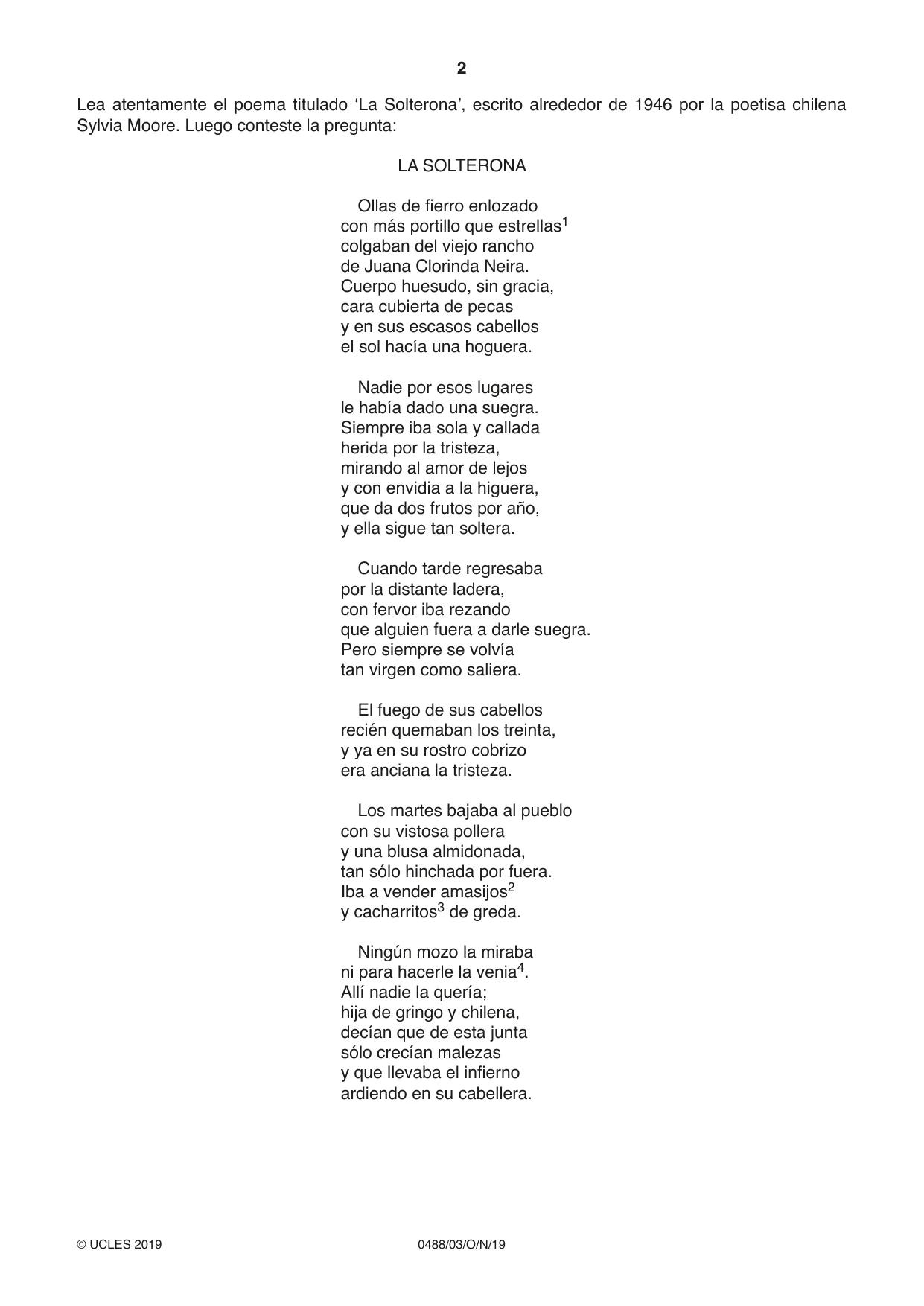
2 0488/03/O/N/19 © UCLES 2019 Lea atentamente el poema titulado ‘La Solterona’, escrito alrededor de 1946 por la poetisa chilena Sylvia Moore. Luego conteste la pregunta: LA SOLTERONA Ollas de fierro enlozado con más portillo que estrellas1 colgaban del viejo rancho de Juana Clorinda Neira. Cuerpo huesudo, sin gracia, cara cubierta de pecas y en sus escasos cabellos el sol hacía una hoguera. Nadie por esos lugares le había dado una suegra. Siempre iba sola y callada herida por la tristeza, mirando al amor de lejos y con envidia a la higuera, que da dos frutos por año, y ella sigue tan soltera. Cuando tarde regresaba por la distante ladera, con fervor iba rezando que alguien fuera a darle suegra. Pero siempre se volvía tan virgen como saliera. El fuego de sus cabellos recién quemaban los treinta, y ya en su rostro cobrizo era anciana la tristeza. Los martes bajaba al pueblo con su vistosa pollera y una blusa almidonada, tan sólo hinchada por fuera. Iba a vender amasijos2 y cacharritos3 de greda. Ningún mozo la miraba ni para hacerle la venia4. Allí nadie la quería; hija de gringo y chilena, decían que de esta junta sólo crecían malezas y que llevaba el infierno ardiendo en su cabellera.
Question paper, page 3
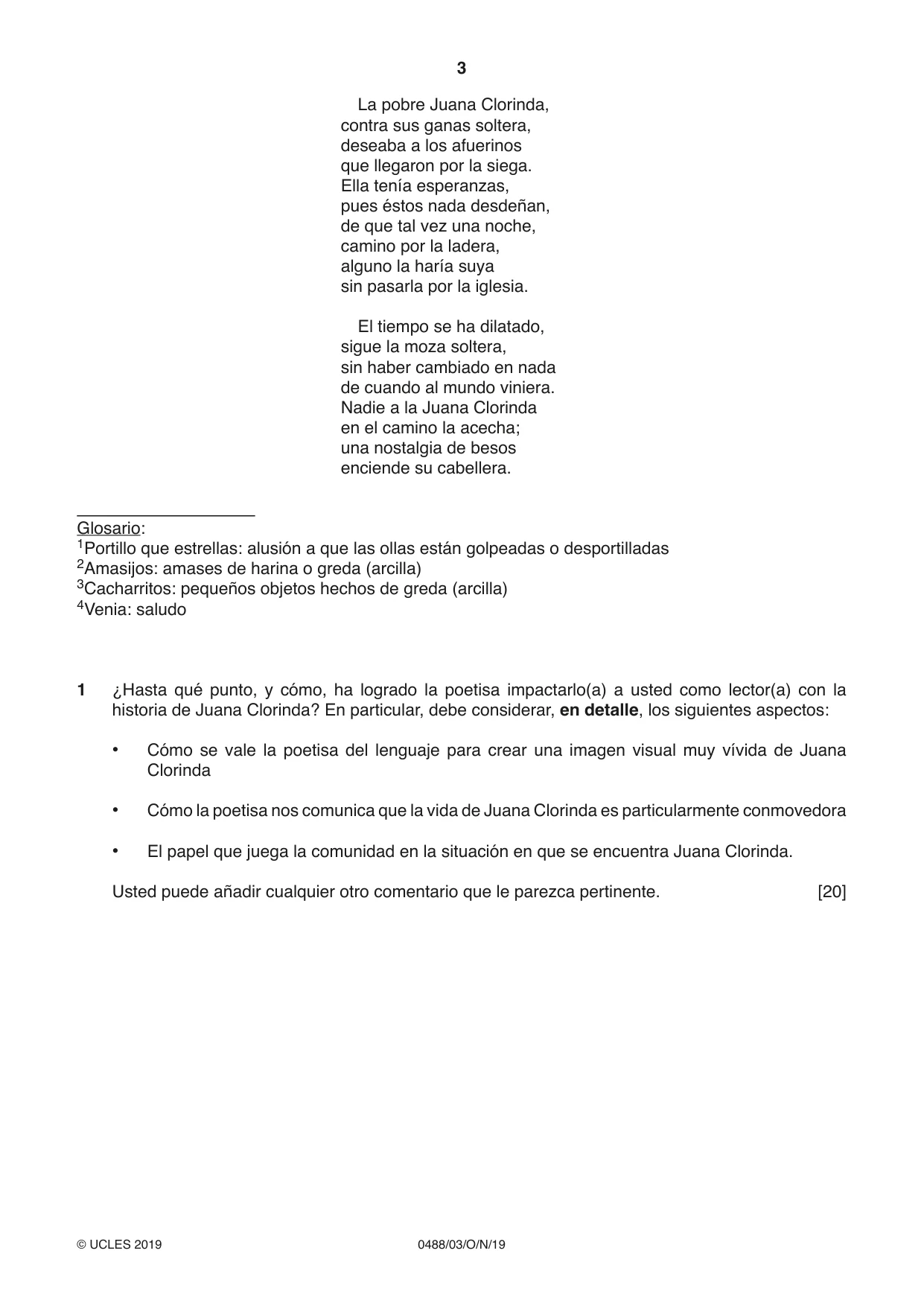
3 0488/03/O/N/19 © UCLES 2019 La pobre Juana Clorinda, contra sus ganas soltera, deseaba a los afuerinos que llegaron por la siega. Ella tenía esperanzas, pues éstos nada desdeñan, de que tal vez una noche, camino por la ladera, alguno la haría suya sin pasarla por la iglesia. El tiempo se ha dilatado, sigue la moza soltera, sin haber cambiado en nada de cuando al mundo viniera. Nadie a la Juana Clorinda en el camino la acecha; una nostalgia de besos enciende su cabellera. Glosario: 1Portillo que estrellas: alusión a que las ollas están golpeadas o desportilladas 2Amasijos: amases de harina o greda (arcilla) 3Cacharritos: pequeños objetos hechos de greda (arcilla) 4Venia: saludo 1 ¿Hasta qué punto, y cómo, ha logrado la poetisa impactarlo(a) a usted como lector(a) con la historia de Juana Clorinda? En particular, debe considerar, en detalle, los siguientes aspectos: • Cómo se vale la poetisa del lenguaje para crear una imagen visual muy vívida de Juana Clorinda • Cómo la poetisa nos comunica que la vida de Juana Clorinda es particularmente conmovedora • El papel que juega la comunidad en la situación en que se encuentra Juana Clorinda. Usted puede añadir cualquier otro comentario que le parezca pertinente. [20]
Question paper, page 4
4 0488/03/O/N/19 © UCLES 2019 BLANK PAGE Permission to reproduce items where third-party owned material protected by copyright is included has been sought and cleared where possible. Every reasonable effort has been made by the publisher (UCLES) to trace copyright holders, but if any items requiring clearance have unwittingly been included, the publisher will be pleased to make amends at the earliest possible opportunity. To avoid the issue of disclosure of answer-related information to candidates, all copyright acknowledgements are reproduced online in the Cambridge Assessment International Education Copyright Acknowledgements Booklet. This is produced for each series of examinations and is freely available to download at www.cambridgeinternational.org after the live examination series. Cambridge Assessment International Education is part of the Cambridge Assessment Group. Cambridge Assessment is the brand name of the University of Cambridge Local Examinations Syndicate (UCLES), which itself is a department of the University of Cambridge.
Mark scheme, page 1
This document consists of 5 printed pages. © UCLES 2019 [Turn over Cambridge Assessment International Education Cambridge International General Certificate of Secondary Education LITERATURE (SPANISH) 0488/03 Paper 3 Alternative to Coursework October/November 2019 MARK SCHEME Maximum Mark: 20 Published This mark scheme is published as an aid to teachers and candidates, to indicate the requirements of the examination. It shows the basis on which Examiners were instructed to award marks. It does not indicate the details of the discussions that took place at an Examiners’ meeting before marking began, which would have considered the acceptability of alternative answers. Mark schemes should be read in conjunction with the question paper and the Principal Examiner Report for Teachers. Cambridge International will not enter into discussions about these mark schemes. Cambridge International is publishing the mark schemes for the October/November 2019 series for most Cambridge IGCSE™, Cambridge International A and AS Level components and some Cambridge O Level components.
Mark scheme, page 2
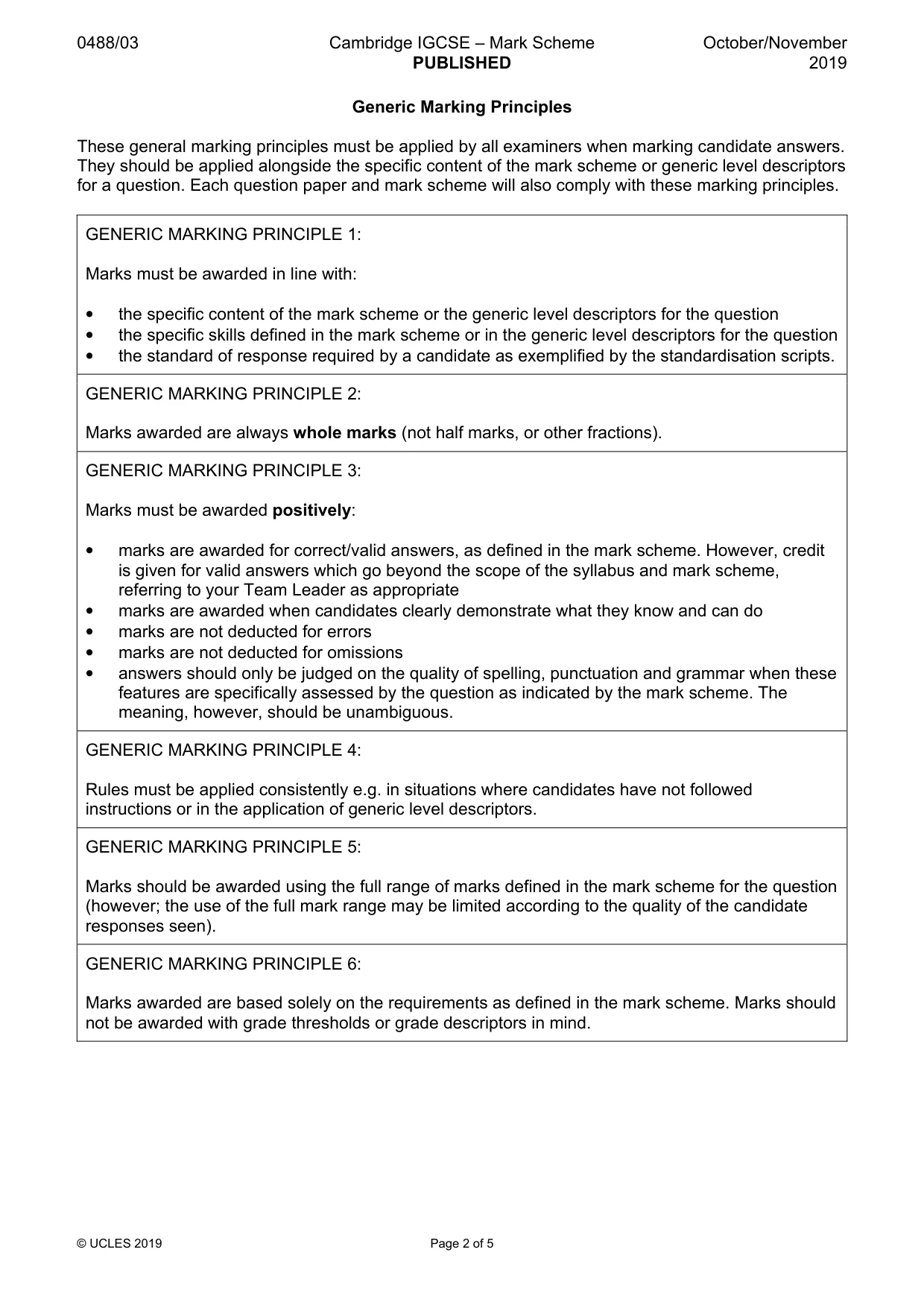
0488/03 Cambridge IGCSE – Mark Scheme PUBLISHED October/November 2019 © UCLES 2019 Page 2 of 5 Generic Marking Principles These general marking principles must be applied by all examiners when marking candidate answers. They should be applied alongside the specific content of the mark scheme or generic level descriptors for a question. Each question paper and mark scheme will also comply with these marking principles. GENERIC MARKING PRINCIPLE 1: Marks must be awarded in line with: • the specific content of the mark scheme or the generic level descriptors for the question • the specific skills defined in the mark scheme or in the generic level descriptors for the question • the standard of response required by a candidate as exemplified by the standardisation scripts. GENERIC MARKING PRINCIPLE 2: Marks awarded are always whole marks (not half marks, or other fractions). GENERIC MARKING PRINCIPLE 3: Marks must be awarded positively: • marks are awarded for correct/valid answers, as defined in the mark scheme. However, credit is given for valid answers which go beyond the scope of the syllabus and mark scheme, referring to your Team Leader as appropriate • marks are awarded when candidates clearly demonstrate what they know and can do • marks are not deducted for errors • marks are not deducted for omissions • answers should only be judged on the quality of spelling, punctuation and grammar when these features are specifically assessed by the question as indicated by the mark scheme. The meaning, however, should be unambiguous. GENERIC MARKING PRINCIPLE 4: Rules must be applied consistently e.g. in situations where candidates have not followed instructions or in the application of generic level descriptors. GENERIC MARKING PRINCIPLE 5: Marks should be awarded using the full range of marks defined in the mark scheme for the question (however; the use of the full mark range may be limited according to the quality of the candidate responses seen). GENERIC MARKING PRINCIPLE 6: Marks awarded are based solely on the requirements as defined in the mark scheme. Marks should not be awarded with grade thresholds or grade descriptors in mind.
Mark scheme, page 3
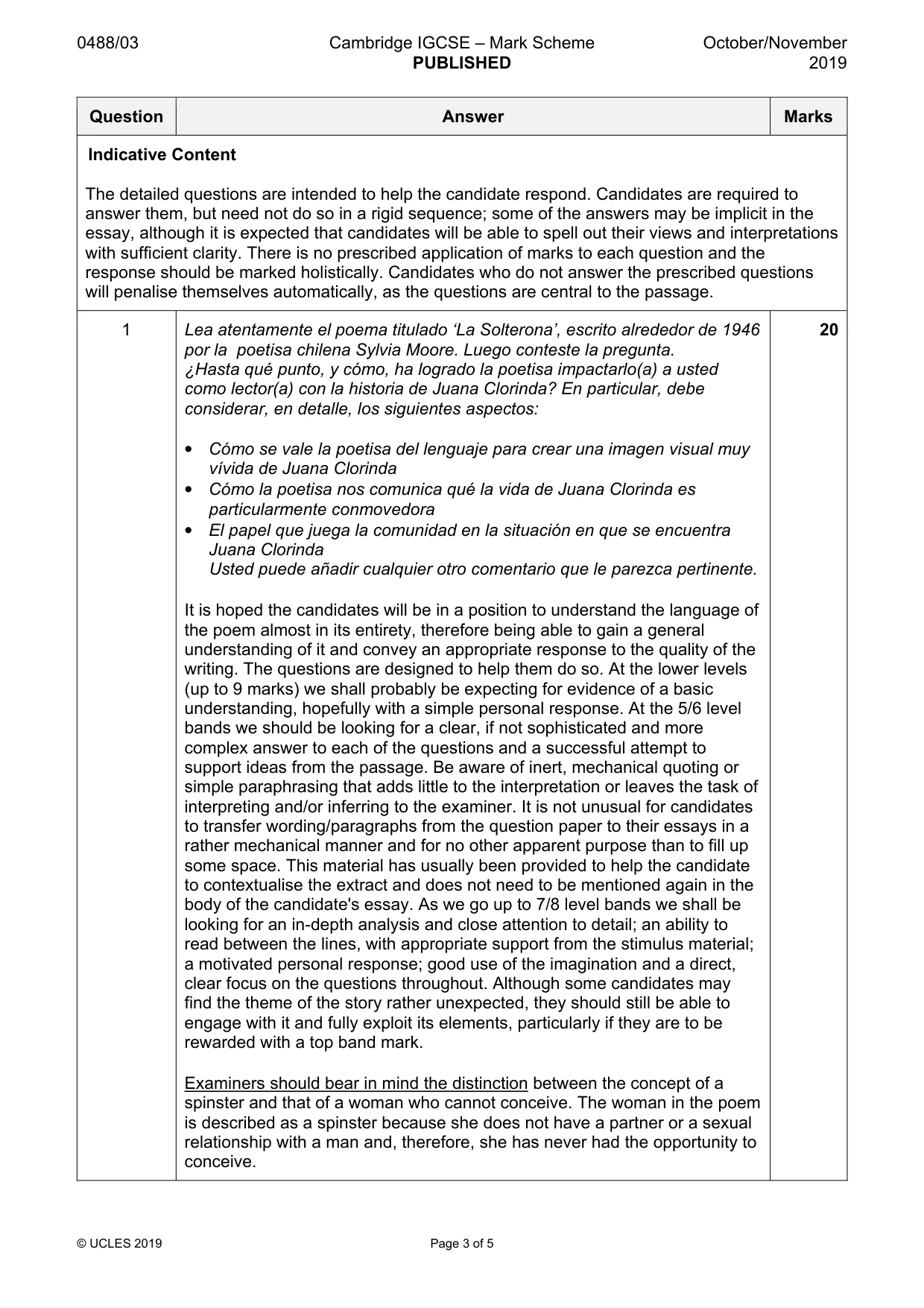
0488/03 Cambridge IGCSE – Mark Scheme PUBLISHED October/November 2019 © UCLES 2019 Page 3 of 5 Question Answer Marks Indicative Content The detailed questions are intended to help the candidate respond. Candidates are required to answer them, but need not do so in a rigid sequence; some of the answers may be implicit in the essay, although it is expected that candidates will be able to spell out their views and interpretations with sufficient clarity. There is no prescribed application of marks to each question and the response should be marked holistically. Candidates who do not answer the prescribed questions will penalise themselves automatically, as the questions are central to the passage. 1 Lea atentamente el poema titulado ‘La Solterona’, escrito alrededor de 1946 por la poetisa chilena Sylvia Moore. Luego conteste la pregunta. ¿Hasta qué punto, y cómo, ha logrado la poetisa impactarlo(a) a usted como lector(a) con la historia de Juana Clorinda? En particular, debe considerar, en detalle, los siguientes aspectos: • Cómo se vale la poetisa del lenguaje para crear una imagen visual muy vívida de Juana Clorinda • Cómo la poetisa nos comunica qué la vida de Juana Clorinda es particularmente conmovedora • El papel que juega la comunidad en la situación en que se encuentra Juana Clorinda Usted puede añadir cualquier otro comentario que le parezca pertinente. It is hoped the candidates will be in a position to understand the language of the poem almost in its entirety, therefore being able to gain a general understanding of it and convey an appropriate response to the quality of the writing. The questions are designed to help them do so. At the lower levels (up to 9 marks) we shall probably be expecting for evidence of a basic understanding, hopefully with a simple personal response. At the 5/6 level bands we should be looking for a clear, if not sophisticated and more complex answer to each of the questions and a successful attempt to support ideas from the passage. Be aware of inert, mechanical quoting or simple paraphrasing that adds little to the interpretation or leaves the task of interpreting and/or inferring to the examiner. It is not unusual for candidates to transfer wording/paragraphs from the question paper to their essays in a rather mechanical manner and for no other apparent purpose than to fill up some space. This material has usually been provided to help the candidate to contextualise the extract and does not need to be mentioned again in the body of the candidate's essay. As we go up to 7/8 level bands we shall be looking for an in-depth analysis and close attention to detail; an ability to read between the lines, with appropriate support from the stimulus material; a motivated personal response; good use of the imagination and a direct, clear focus on the questions throughout. Although some candidates may find the theme of the story rather unexpected, they should still be able to engage with it and fully exploit its elements, particularly if they are to be rewarded with a top band mark. Examiners should bear in mind the distinction between the concept of a spinster and that of a woman who cannot conceive. The woman in the poem is described as a spinster because she does not have a partner or a sexual relationship with a man and, therefore, she has never had the opportunity to conceive. 20
Mark scheme, page 4
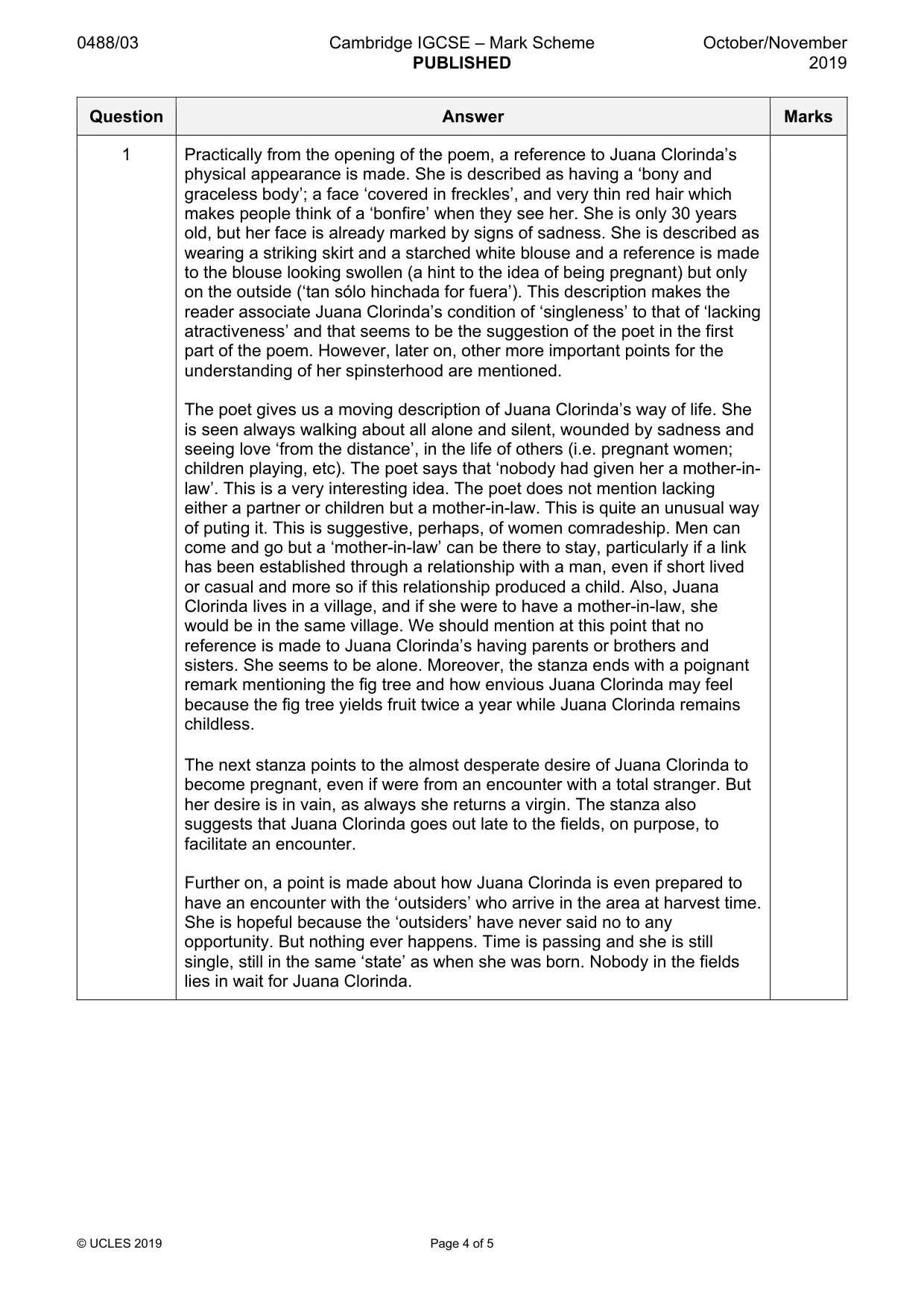
0488/03 Cambridge IGCSE – Mark Scheme PUBLISHED October/November 2019 © UCLES 2019 Page 4 of 5 Question Answer Marks 1 Practically from the opening of the poem, a reference to Juana Clorinda’s physical appearance is made. She is described as having a ‘bony and graceless body’; a face ‘covered in freckles’, and very thin red hair which makes people think of a ‘bonfire’ when they see her. She is only 30 years old, but her face is already marked by signs of sadness. She is described as wearing a striking skirt and a starched white blouse and a reference is made to the blouse looking swollen (a hint to the idea of being pregnant) but only on the outside (‘tan sólo hinchada for fuera’). This description makes the reader associate Juana Clorinda’s condition of ‘singleness’ to that of ‘lacking atractiveness’ and that seems to be the suggestion of the poet in the first part of the poem. However, later on, other more important points for the understanding of her spinsterhood are mentioned. The poet gives us a moving description of Juana Clorinda’s way of life. She is seen always walking about all alone and silent, wounded by sadness and seeing love ‘from the distance’, in the life of others (i.e. pregnant women; children playing, etc). The poet says that ‘nobody had given her a mother-in- law’. This is a very interesting idea. The poet does not mention lacking either a partner or children but a mother-in-law. This is quite an unusual way of puting it. This is suggestive, perhaps, of women comradeship. Men can come and go but a ‘mother-in-law’ can be there to stay, particularly if a link has been established through a relationship with a man, even if short lived or casual and more so if this relationship produced a child. Also, Juana Clorinda lives in a village, and if she were to have a mother-in-law, she would be in the same village. We should mention at this point that no reference is made to Juana Clorinda’s having parents or brothers and sisters. She seems to be alone. Moreover, the stanza ends with a poignant remark mentioning the fig tree and how envious Juana Clorinda may feel because the fig tree yields fruit twice a year while Juana Clorinda remains childless. The next stanza points to the almost desperate desire of Juana Clorinda to become pregnant, even if were from an encounter with a total stranger. But her desire is in vain, as always she returns a virgin. The stanza also suggests that Juana Clorinda goes out late to the fields, on purpose, to facilitate an encounter. Further on, a point is made about how Juana Clorinda is even prepared to have an encounter with the ‘outsiders’ who arrive in the area at harvest time. She is hopeful because the ‘outsiders’ have never said no to any opportunity. But nothing ever happens. Time is passing and she is still single, still in the same ‘state’ as when she was born. Nobody in the fields lies in wait for Juana Clorinda.
Mark scheme, page 5
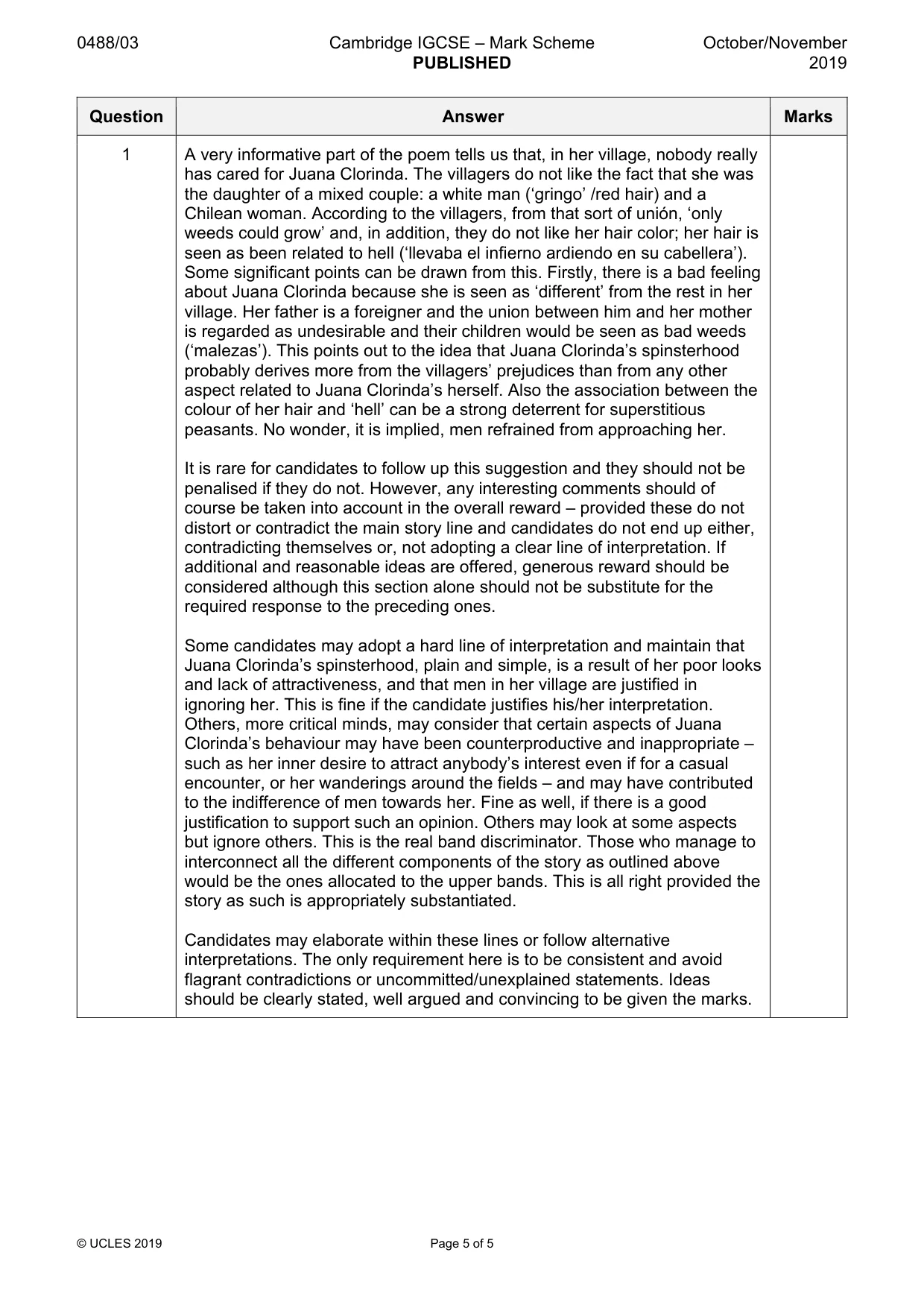
0488/03 Cambridge IGCSE – Mark Scheme PUBLISHED October/November 2019 © UCLES 2019 Page 5 of 5 Question Answer Marks 1 A very informative part of the poem tells us that, in her village, nobody really has cared for Juana Clorinda. The villagers do not like the fact that she was the daughter of a mixed couple: a white man (‘gringo’ /red hair) and a Chilean woman. According to the villagers, from that sort of unión, ‘only weeds could grow’ and, in addition, they do not like her hair color; her hair is seen as been related to hell (‘llevaba el infierno ardiendo en su cabellera’). Some significant points can be drawn from this. Firstly, there is a bad feeling about Juana Clorinda because she is seen as ‘different’ from the rest in her village. Her father is a foreigner and the union between him and her mother is regarded as undesirable and their children would be seen as bad weeds (‘malezas’). This points out to the idea that Juana Clorinda’s spinsterhood probably derives more from the villagers’ prejudices than from any other aspect related to Juana Clorinda’s herself. Also the association between the colour of her hair and ‘hell’ can be a strong deterrent for superstitious peasants. No wonder, it is implied, men refrained from approaching her. It is rare for candidates to follow up this suggestion and they should not be penalised if they do not. However, any interesting comments should of course be taken into account in the overall reward – provided these do not distort or contradict the main story line and candidates do not end up either, contradicting themselves or, not adopting a clear line of interpretation. If additional and reasonable ideas are offered, generous reward should be considered although this section alone should not be substitute for the required response to the preceding ones. Some candidates may adopt a hard line of interpretation and maintain that Juana Clorinda’s spinsterhood, plain and simple, is a result of her poor looks and lack of attractiveness, and that men in her village are justified in ignoring her. This is fine if the candidate justifies his/her interpretation. Others, more critical minds, may consider that certain aspects of Juana Clorinda’s behaviour may have been counterproductive and inappropriate – such as her inner desire to attract anybody’s interest even if for a casual encounter, or her wanderings around the fields – and may have contributed to the indifference of men towards her. Fine as well, if there is a good justification to support such an opinion. Others may look at some aspects but ignore others. This is the real band discriminator. Those who manage to interconnect all the different components of the story as outlined above would be the ones allocated to the upper bands. This is all right provided the story as such is appropriately substantiated. Candidates may elaborate within these lines or follow alternative interpretations. The only requirement here is to be consistent and avoid flagrant contradictions or uncommitted/unexplained statements. Ideas should be clearly stated, well argued and convincing to be given the marks.
What you needed in this session
Cambridge’s own grade thresholds for 2019 Oct/Nov, Paper 3 · Variant 1. A higher threshold means an easier paper — the bar moves with how the cohort did.