Cambridge IGCSE Spanish - Foreign Language 0530 — 2023 May/June Paper 2 · Variant 1
0530/21/M/J/23 · 45 marks · ≈51 min
The question paper and its mark scheme, free to read here and free to download. This is Cambridge’s own paper, exactly as it was sat.
Question paper12 pages

Mark scheme12 pages
Answers below. Sit the paper first if you are practising.
Paper as text
Question paper, page 1
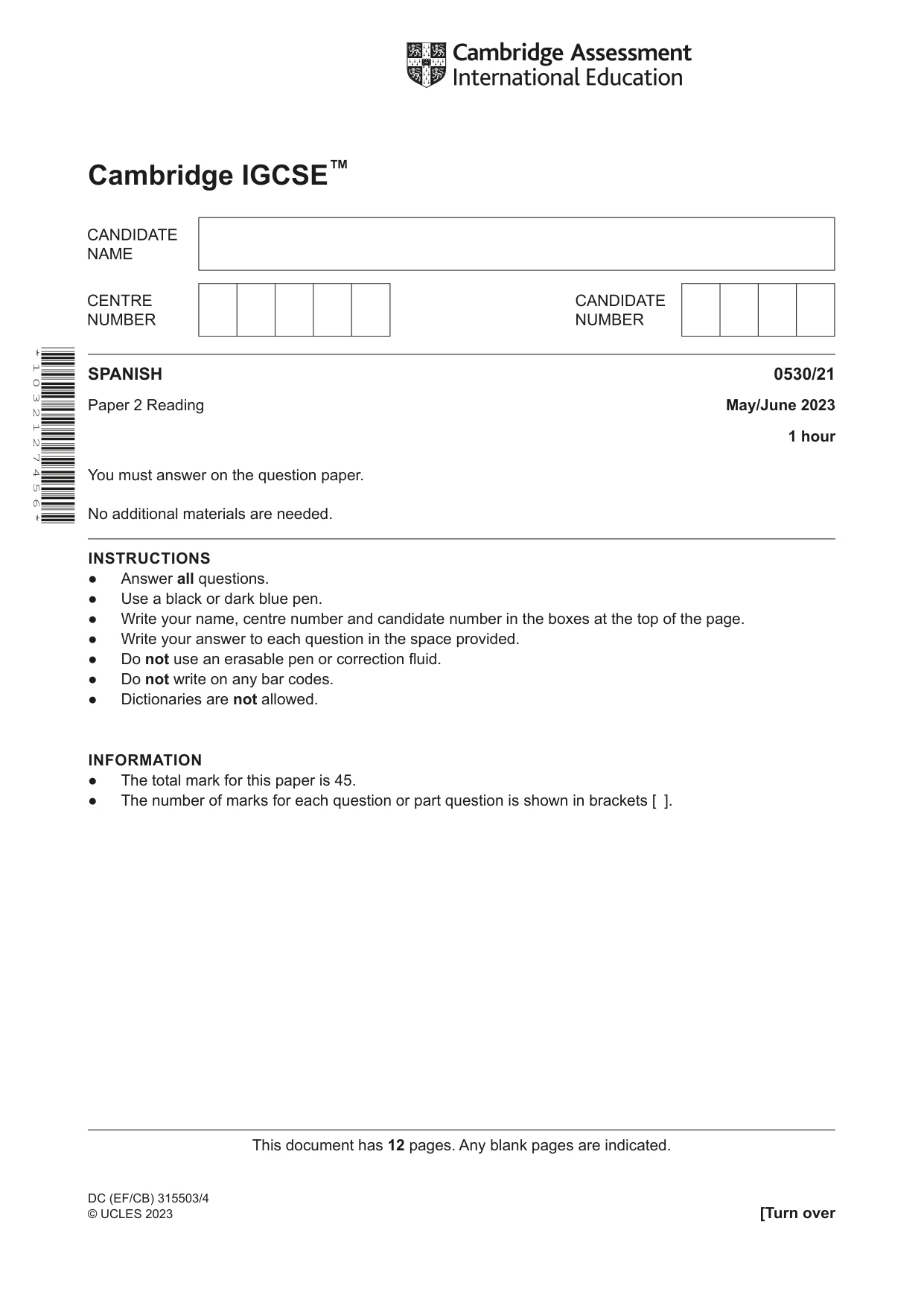
This document has 12 pages. Any blank pages are indicated. [Turn over Cambridge IGCSE™ DC (EF/CB) 315503/4 © UCLES 2023 * 1 0 3 2 1 2 7 4 5 6 * SPANISH 0530/21 Paper 2 Reading May/June 2023 1 hour You must answer on the question paper. No additional materials are needed. INSTRUCTIONS ● Answer all questions. ● Use a black or dark blue pen. ● Write your name, centre number and candidate number in the boxes at the top of the page. ● Write your answer to each question in the space provided. ● Do not use an erasable pen or correction fluid. ● Do not write on any bar codes. ● Dictionaries are not allowed. INFORMATION ● The total mark for this paper is 45. ● The number of marks for each question or part question is shown in brackets [ ].
Question paper, page 2
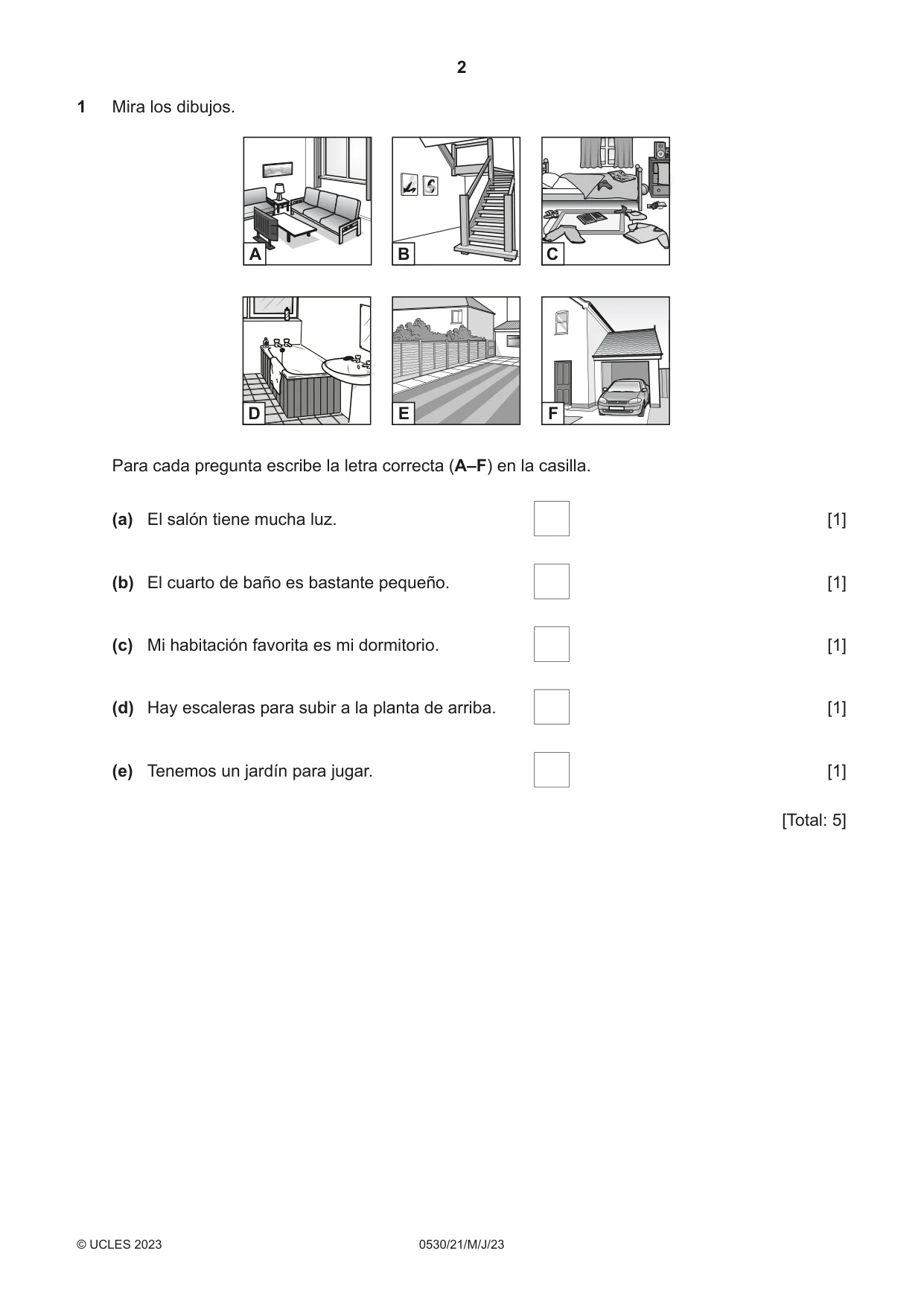
2 0530/21/ M / J /23 © UCLES 2023 1 Mira los dibujos. C B A E D F Para cada pregunta escribe la letra correcta (A–F) en la casilla. (a) El salón tiene mucha luz. [1] (b) El cuarto de baño es bastante pequeño. [1] (c) Mi habitación favorita es mi dormitorio. [1] (d) Hay escaleras para subir a la planta de arriba. [1] (e) Tenemos un jardín para jugar. [1] [Total: 5]
Question paper, page 3
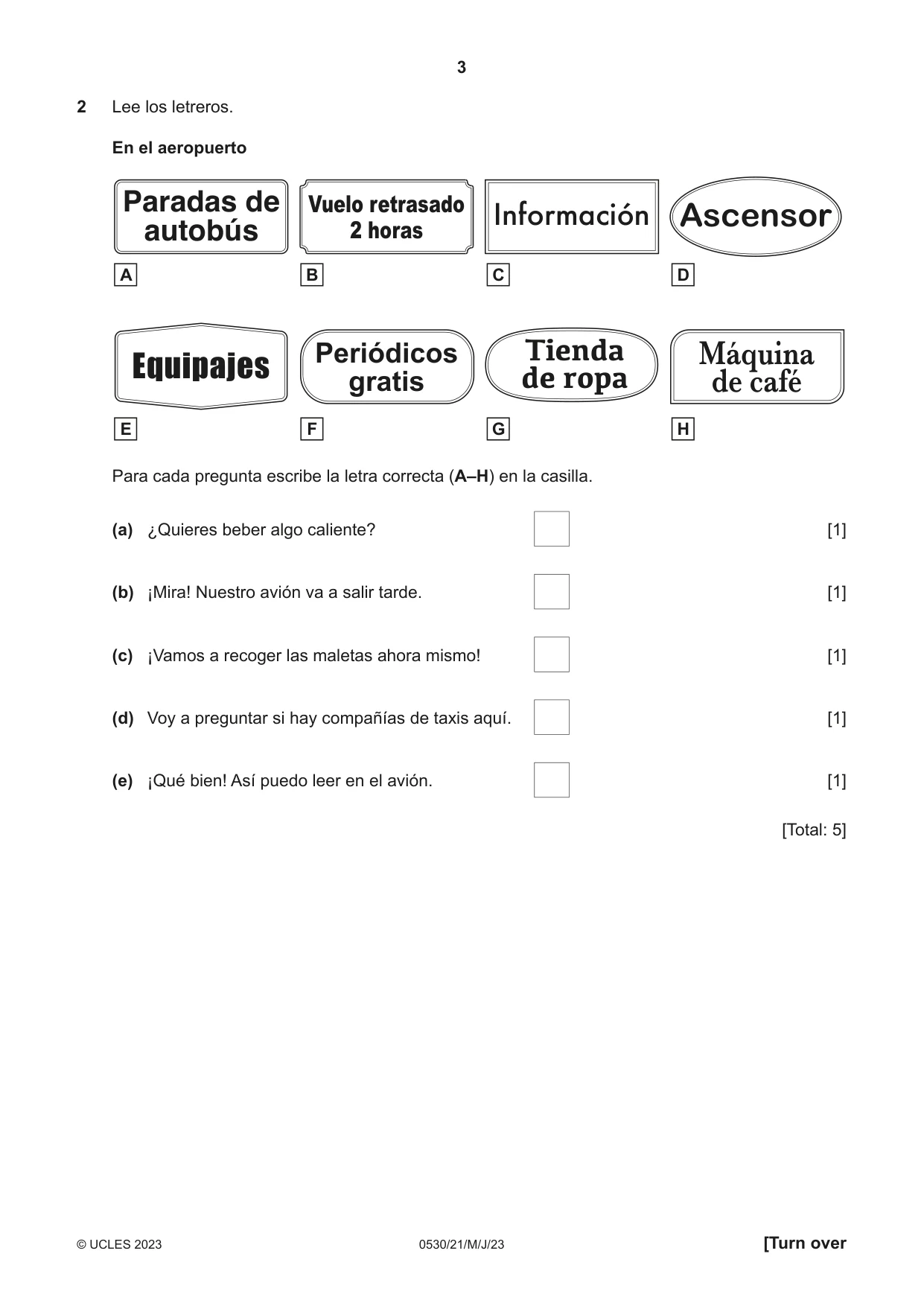
3 0530/21/M/J/23 © UCLES 2023 [Turn over 2 Lee los letreros. En el aeropuerto Paradas de autobús Equipajes Periódicos gratis Tienda de ropa Vuelo retrasado 2 horas Información Ascensor Máquina de café A B C D E F G H Para cada pregunta escribe la letra correcta (A–H) en la casilla. (a) ¿Quieres beber algo caliente? [1] (b) ¡Mira! Nuestro avión va a salir tarde. [1] (c) ¡Vamos a recoger las maletas ahora mismo! [1] (d) Voy a preguntar si hay compañías de taxis aquí. [1] (e) ¡Qué bien! Así puedo leer en el avión. [1] [Total: 5]
Question paper, page 4
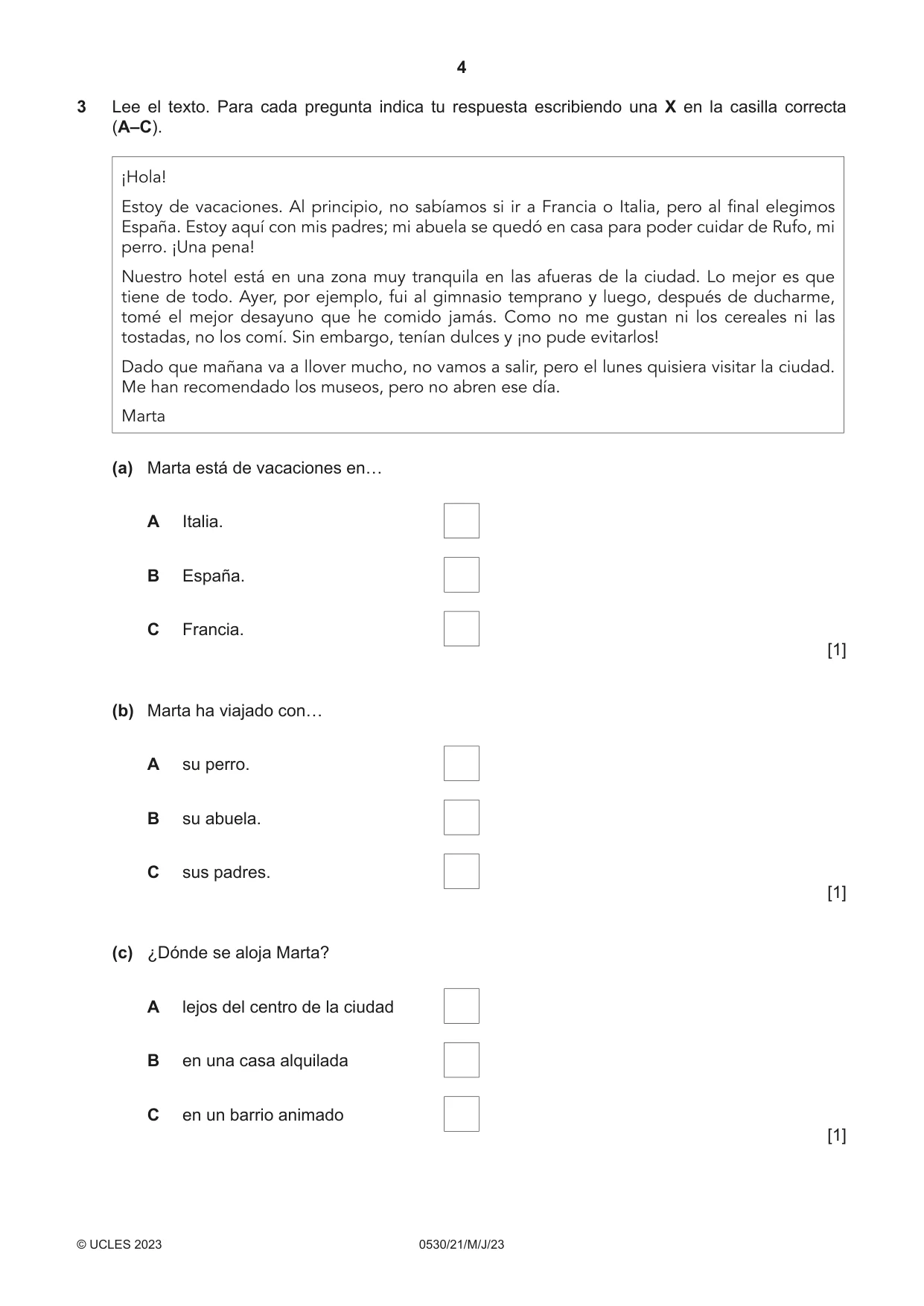
4 0530/21/M/J/23 © UCLES 2023 3 Lee el texto. Para cada pregunta indica tu respuesta escribiendo una X en la casilla correcta (A–C). ¡Hola! Estoy de vacaciones. Al principio, no sabíamos si ir a Francia o Italia, pero al final elegimos España. Estoy aquí con mis padres; mi abuela se quedó en casa para poder cuidar de Rufo, mi perro. ¡Una pena! Nuestro hotel está en una zona muy tranquila en las afueras de la ciudad. Lo mejor es que tiene de todo. Ayer, por ejemplo, fui al gimnasio temprano y luego, después de ducharme, tomé el mejor desayuno que he comido jamás. Como no me gustan ni los cereales ni las tostadas, no los comí. Sin embargo, tenían dulces y ¡no pude evitarlos! Dado que mañana va a llover mucho, no vamos a salir, pero el lunes quisiera visitar la ciudad. Me han recomendado los museos, pero no abren ese día. Marta (a) Marta está de vacaciones en… A Italia. B España. C Francia. [1] (b) Marta ha viajado con… A su perro. B su abuela. C sus padres. [1] (c) ¿Dónde se aloja Marta? A lejos del centro de la ciudad B en una casa alquilada C en un barrio animado [1]
Question paper, page 5
5 0530/21/M/J/23 © UCLES 2023 [Turn over (d) Ayer, antes de ducharse, Marta… A escuchó música. B vio las noticias. C hizo ejercicio. [1] (e) ¿Qué desayunó Marta ayer? A dulces B tostadas C cereales [1] (f) Según Marta, ¿qué tiempo hará mañana? A Va a nevar. B Va a hacer sol. C Va a hacer mal tiempo. [1] (g) ¿Por qué Marta no puede ir a los museos el lunes? A Son demasiado caros. B Están cerrados los lunes. C Ella tiene que ir al médico. [1] [Total: 7]
Question paper, page 6
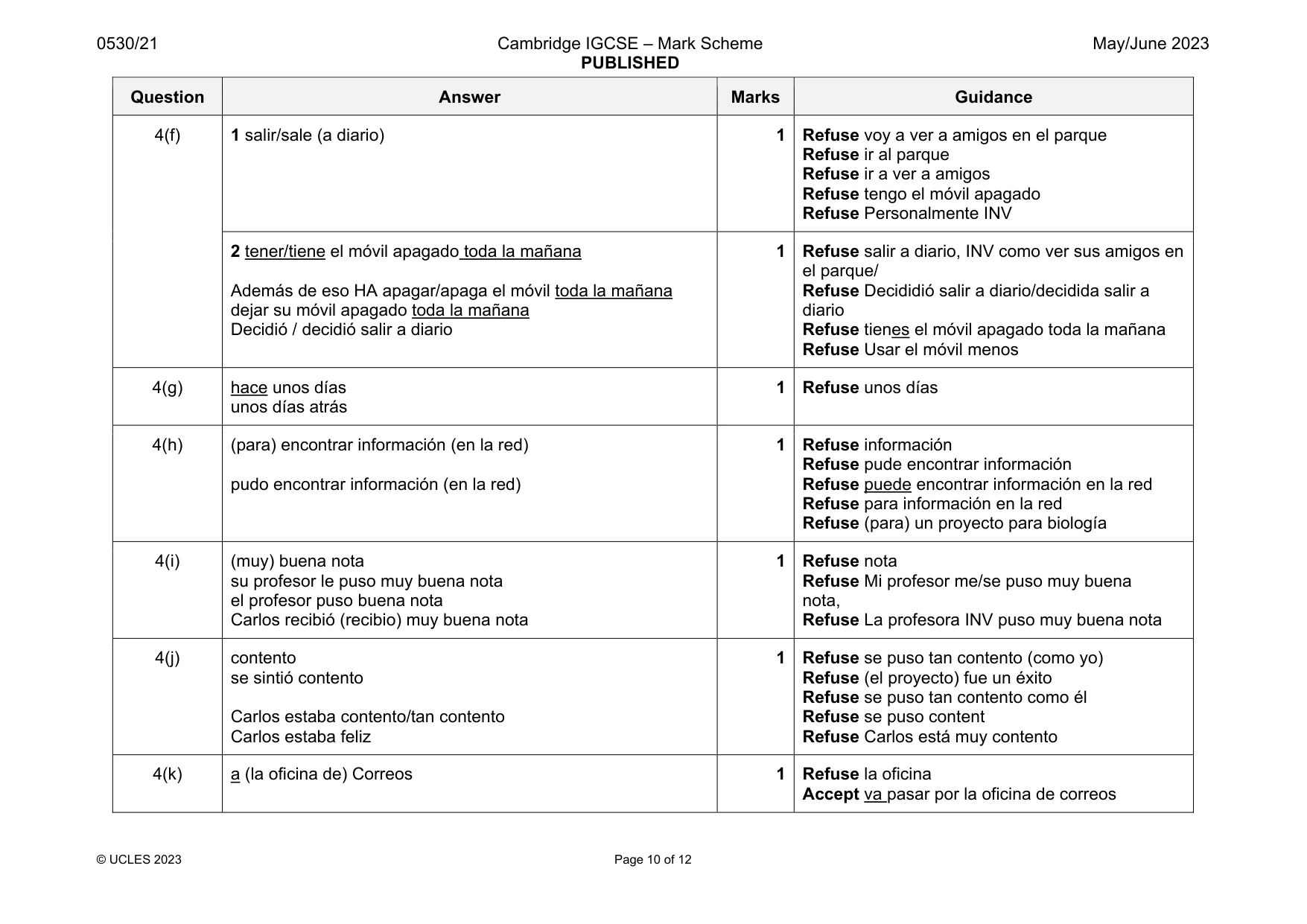
6 0530/21/M/J/23 © UCLES 2023 4 Lee el texto. Contesta a las preguntas en español. Hola, José: ¿Qué tal? Yo estoy muy preocupado por mi hermana Paula. No deja ni un segundo su nuevo móvil. Mi padre se lo regaló por su cumpleaños, aunque mi madre no quería. Ayer mi madre preparó un plato delicioso, pero durante la cena, aunque todos charlábamos, Paula no dijo ni una sola palabra. Lo único que hace todo el día es mirar mensajes en el móvil. ¡Qué pesada es! Ya he intentado hablarle de los peligros de la tecnología porque sé que es algo que afecta a muchos jóvenes. Sin embargo, no me quiso escuchar y no sé qué más puedo hacer. Yo, personalmente, he decidido salir a diario. Esta tarde, por ejemplo, voy a ver a mis amigos en el parque. Además de eso, tengo el móvil apagado toda la mañana y así lo uso mucho menos. La verdad es que la tecnología es muy útil. Hace unos días tenía que hacer un proyecto para biología y usé el ordenador. Pude encontrar información en la red. Al final conseguí todo lo que necesitaba y el proyecto fue un éxito. Mi profesor me puso muy buena nota, y mis amigos me felicitaron. Cuando se lo conté a mi padre, ¡se puso tan contento como yo! Bueno, José, te dejo porque tengo un paquete y voy a pasar por la oficina de Correos para mandarlo. ¡Escríbeme pronto! Un abrazo, Carlos (a) ¿Quién dio un teléfono móvil nuevo a Paula? … [1] (b) ¿Cuándo se quedó Paula totalmente en silencio? … [1] (c) ¿Qué lee Paula todo el tiempo? … [1] (d) ¿Qué ha intentado explicar Carlos a su hermana? … [1]
Question paper, page 7
7 0530/21/M/J/23 © UCLES 2023 [Turn over (e) ¿Cómo reaccionó Paula cuando Carlos habló con ella? … [1] (f) ¿Qué ha decidido hacer Carlos todos los días para usar menos el móvil? Menciona dos cosas. 1 … [1] 2 … [1] (g) ¿Cuándo tuvo que hacer Carlos la tarea de ciencias? … [1] (h) ¿Para qué utilizó Carlos Internet cuando hacía la tarea de ciencias? … [1] (i) ¿Qué le dio el profesor de biología a Carlos? … [1] (j) ¿Cómo se sintió Carlos después de hablar con su padre? … [1] (k) ¿Adónde tiene que ir Carlos pronto? … [1] [Total: 12]
Question paper, page 8
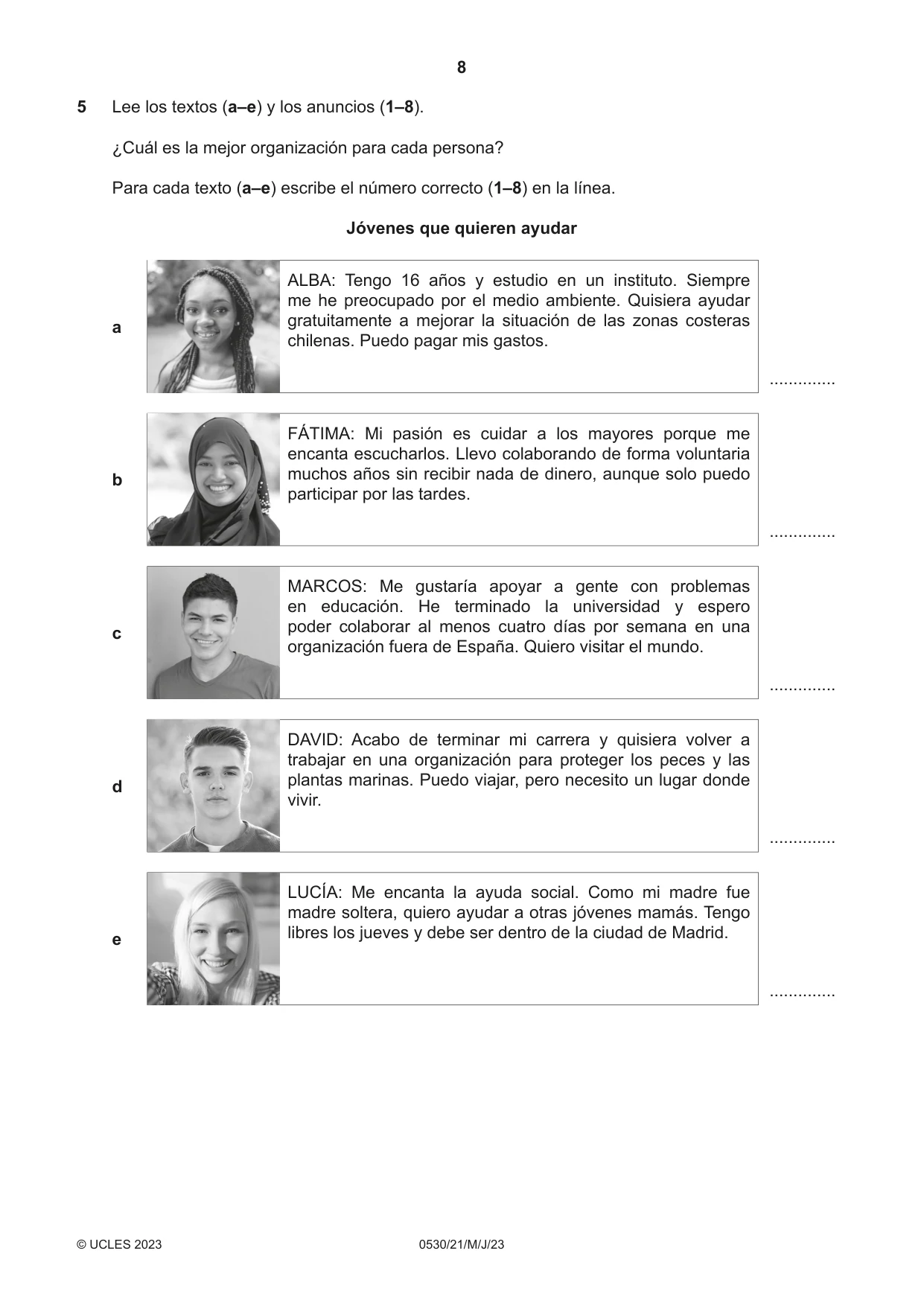
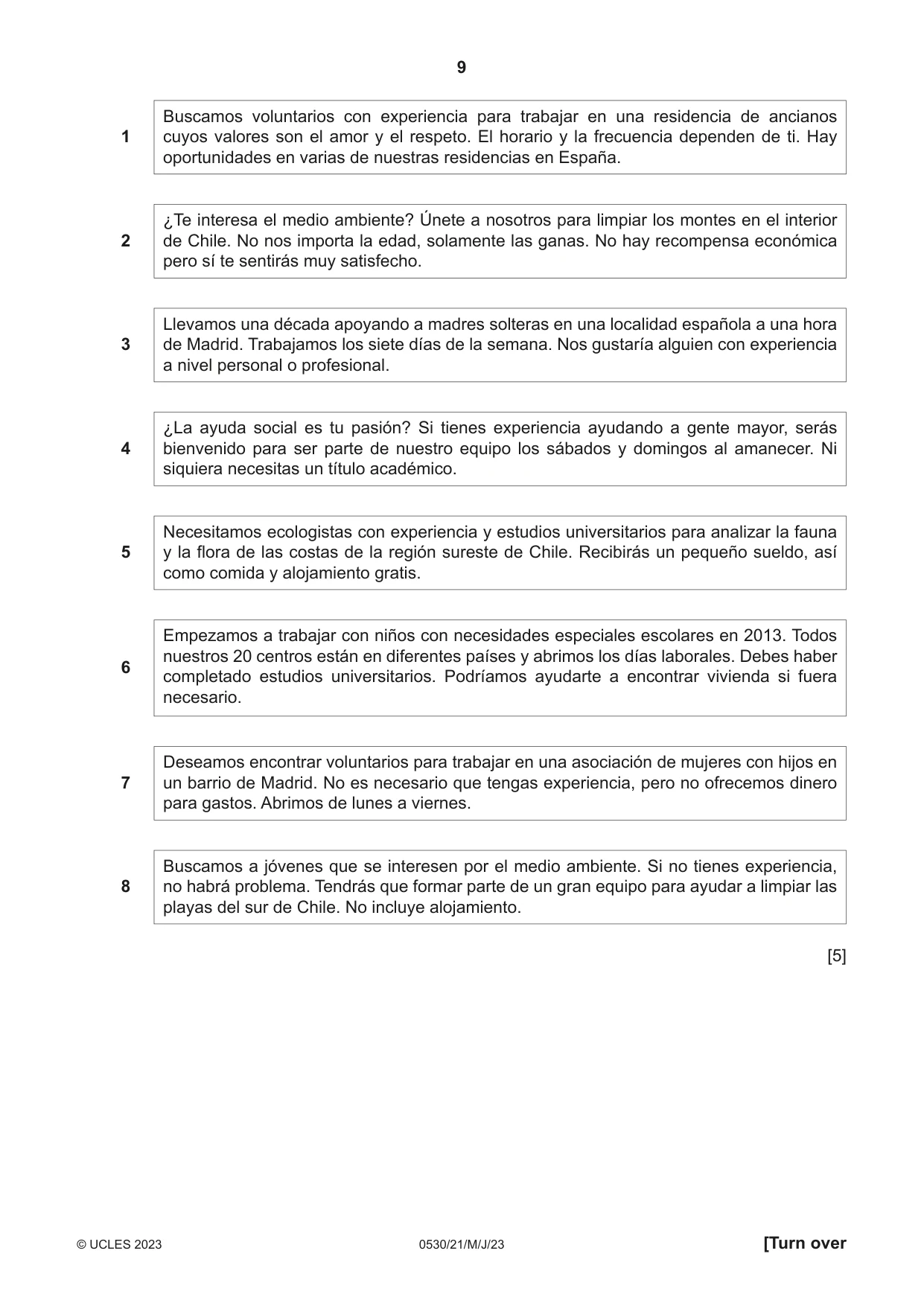
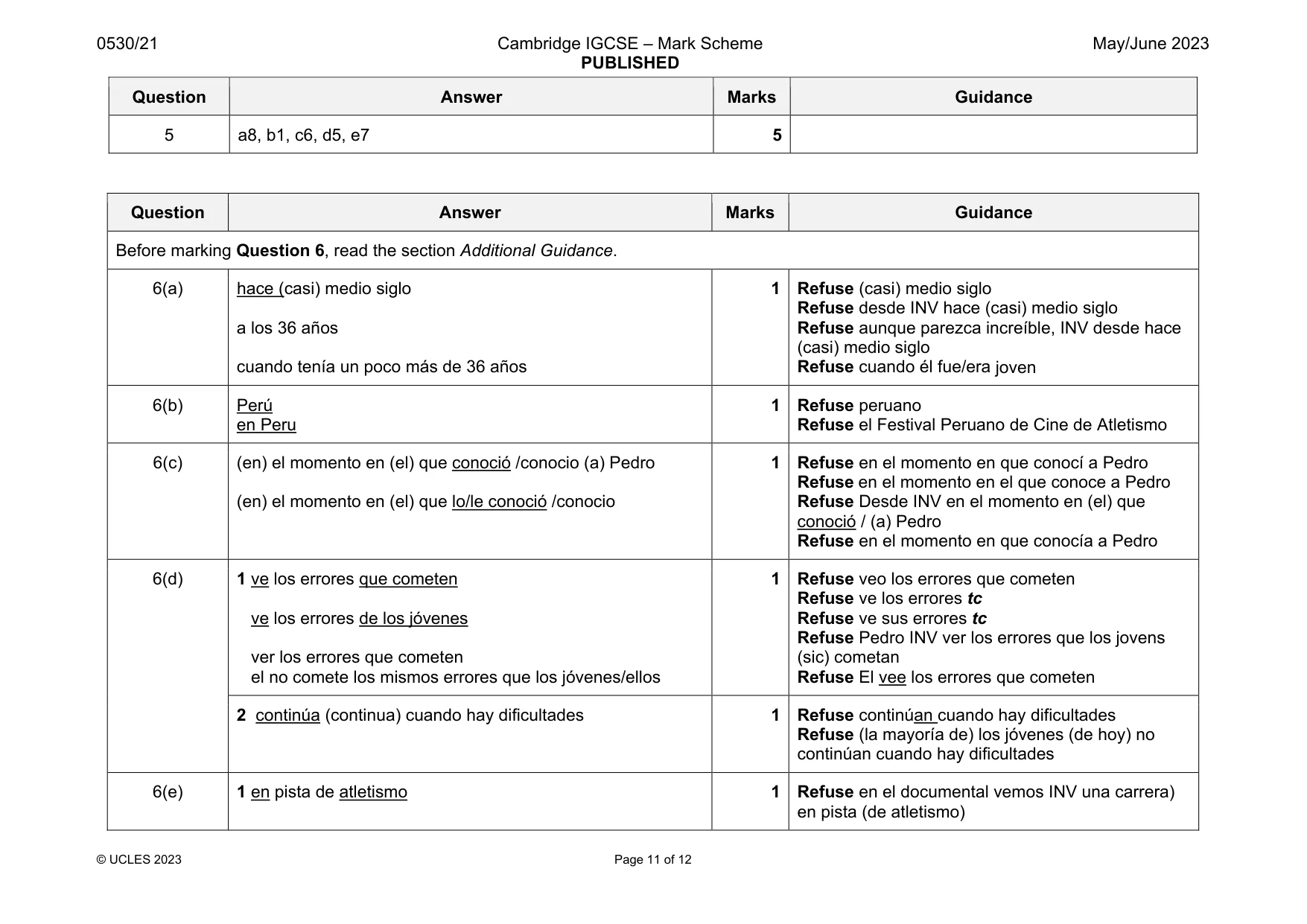
8 0530/21/M/J/23 © UCLES 2023 5 Lee los textos (a–e) y los anuncios (1–8). ¿Cuál es la mejor organización para cada persona? Para cada texto (a–e) escribe el número correcto (1–8) en la línea. Jóvenes que quieren ayudar a ALBA: Tengo 16 años y estudio en un instituto. Siempre me he preocupado por el medio ambiente. Quisiera ayudar gratuitamente a mejorar la situación de las zonas costeras chilenas. Puedo pagar mis gastos. … b FÁTIMA: Mi pasión es cuidar a los mayores porque me encanta escucharlos. Llevo colaborando de forma voluntaria muchos años sin recibir nada de dinero, aunque solo puedo participar por las tardes. … c MARCOS: Me gustaría apoyar a gente con problemas en educación. He terminado la universidad y espero poder colaborar al menos cuatro días por semana en una organización fuera de España. Quiero visitar el mundo. … d DAVID: Acabo de terminar mi carrera y quisiera volver a trabajar en una organización para proteger los peces y las plantas marinas. Puedo viajar, pero necesito un lugar donde vivir. … e LUCÍA: Me encanta la ayuda social. Como mi madre fue madre soltera, quiero ayudar a otras jóvenes mamás. Tengo libres los jueves y debe ser dentro de la ciudad de Madrid. …
Question paper, page 9
9 0530/21/M/J/23 © UCLES 2023 [Turn over 1 Buscamos voluntarios con experiencia para trabajar en una residencia de ancianos cuyos valores son el amor y el respeto. El horario y la frecuencia dependen de ti. Hay oportunidades en varias de nuestras residencias en España. 2 ¿Te interesa el medio ambiente? Únete a nosotros para limpiar los montes en el interior de Chile. No nos importa la edad, solamente las ganas. No hay recompensa económica pero sí te sentirás muy satisfecho. 3 Llevamos una década apoyando a madres solteras en una localidad española a una hora de Madrid. Trabajamos los siete días de la semana. Nos gustaría alguien con experiencia a nivel personal o profesional. 4 ¿La ayuda social es tu pasión? Si tienes experiencia ayudando a gente mayor, serás bienvenido para ser parte de nuestro equipo los sábados y domingos al amanecer. Ni siquiera necesitas un título académico. 5 Necesitamos ecologistas con experiencia y estudios universitarios para analizar la fauna y la flora de las costas de la región sureste de Chile. Recibirás un pequeño sueldo, así como comida y alojamiento gratis. 6 Empezamos a trabajar con niños con necesidades especiales escolares en 2013. Todos nuestros 20 centros están en diferentes países y abrimos los días laborales. Debes haber completado estudios universitarios. Podríamos ayudarte a encontrar vivienda si fuera necesario. 7 Deseamos encontrar voluntarios para trabajar en una asociación de mujeres con hijos en un barrio de Madrid. No es necesario que tengas experiencia, pero no ofrecemos dinero para gastos. Abrimos de lunes a viernes. 8 Buscamos a jóvenes que se interesen por el medio ambiente. Si no tienes experiencia, no habrá problema. Tendrás que formar parte de un gran equipo para ayudar a limpiar las playas del sur de Chile. No incluye alojamiento. [5]
Question paper, page 10
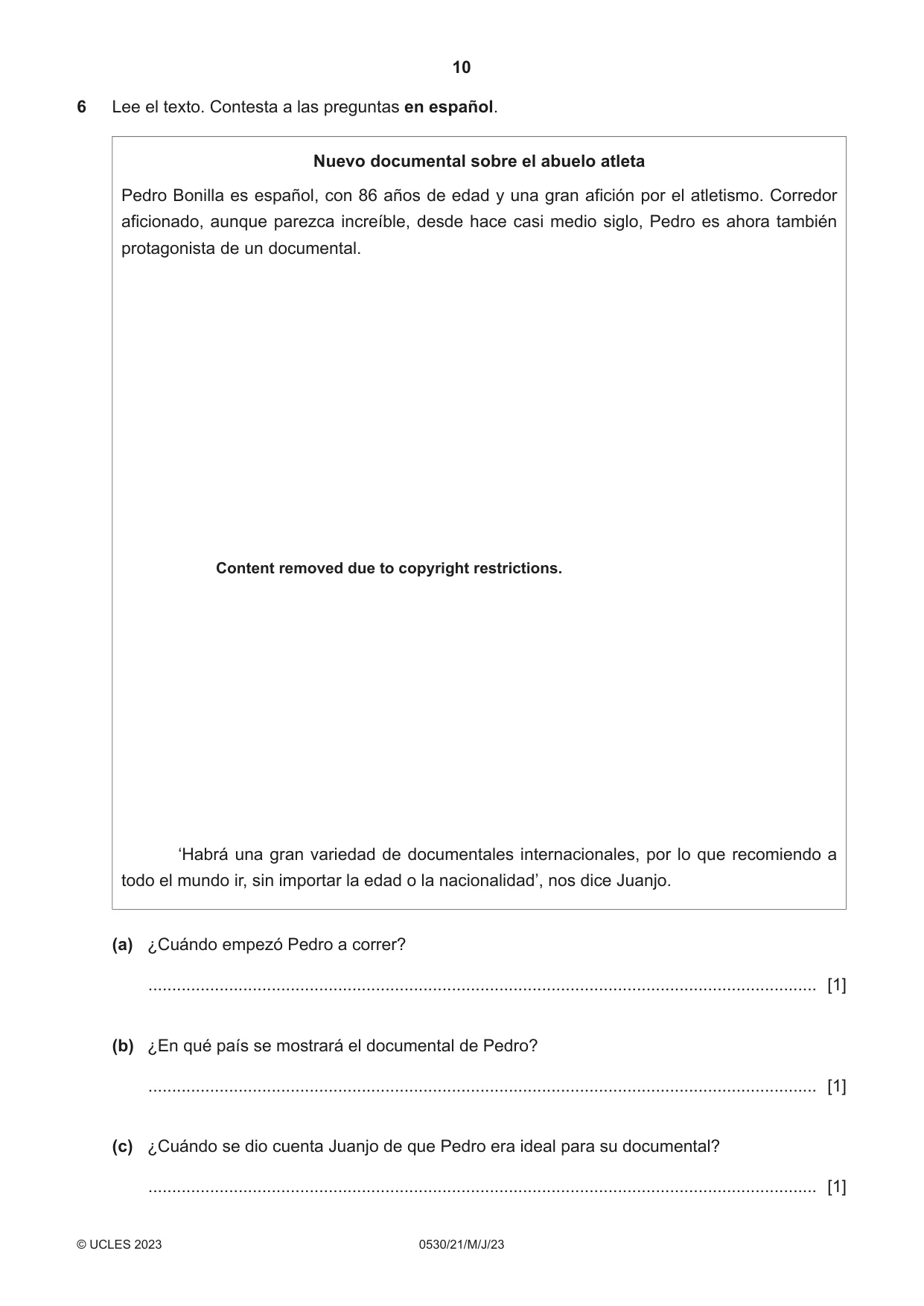
10 0530/21/M/J/23 © UCLES 2023 6 Lee el texto. Contesta a las preguntas en español. Nuevo documental sobre el abuelo atleta Pedro Bonilla es español, con 86 años de edad y una gran afición por el atletismo. Corredor aficionado, aunque parezca increíble, desde hace casi medio siglo, Pedro es ahora también protagonista de un documental. ‘Habrá una gran variedad de documentales internacionales, por lo que recomiendo a todo el mundo ir, sin importar la edad o la nacionalidad’, nos dice Juanjo. (a) ¿Cuándo empezó Pedro a correr? … [1] (b) ¿En qué país se mostrará el documental de Pedro? … [1] (c) ¿Cuándo se dio cuenta Juanjo de que Pedro era ideal para su documental? … [1] Content removed due to copyright restrictions.
Question paper, page 11
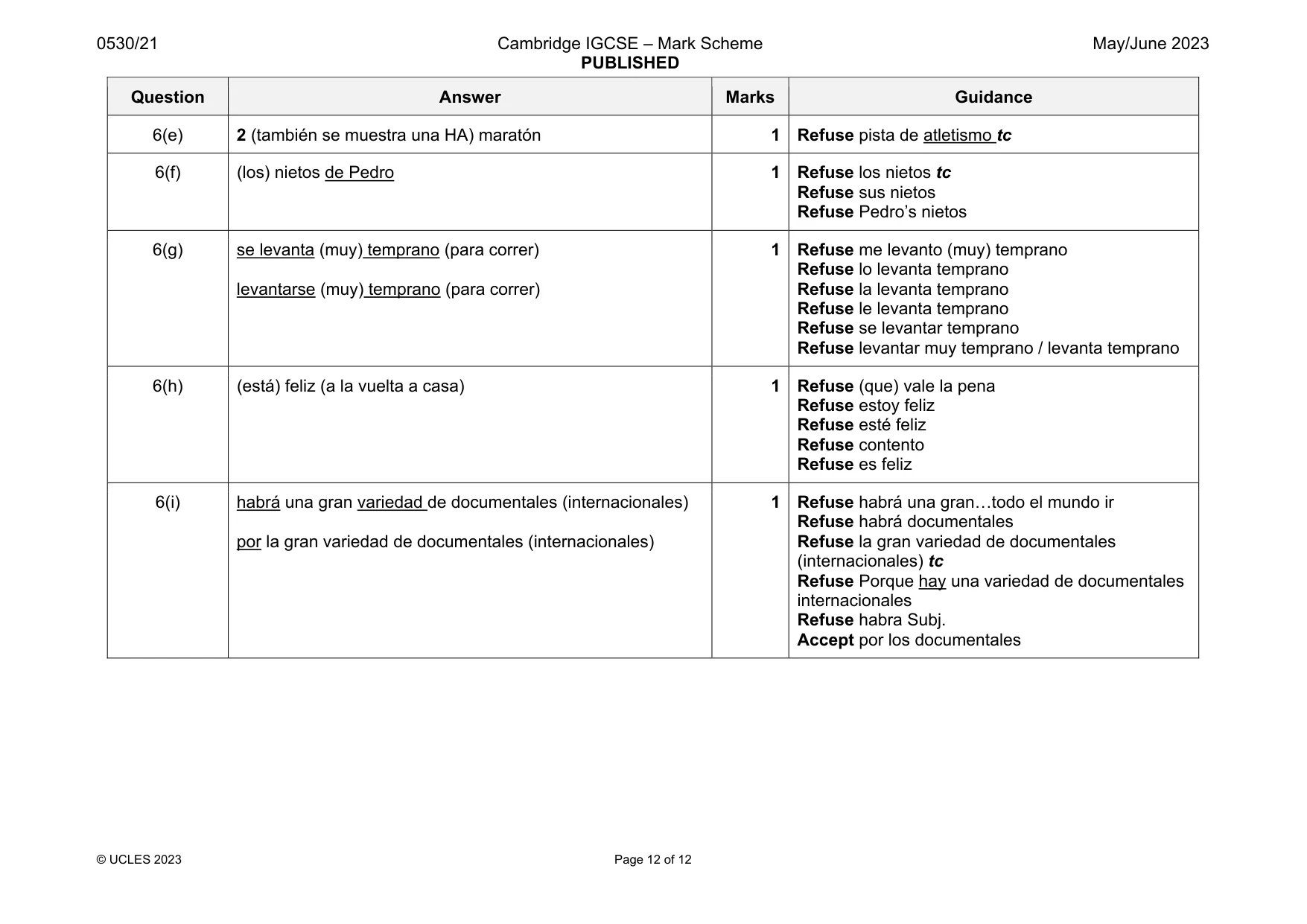
11 0530/21/M/J/23 © UCLES 2023 (d) ¿Qué hace Pedro para ganar a los jóvenes? Menciona dos cosas. 1 … [1] 2 … [1] (e) ¿Qué tipos de carreras se han grabado para el documental? Menciona dos cosas. 1 … [1] 2 … [1] (f) ¿Quiénes inspiraron a Juanjo para darle el título al documental? … [1] (g) Según Pedro, ¿qué es lo que más lo ayuda a correr mejor? … [1] (h) ¿Cómo se siente Pedro después de correr? … [1] (i) ¿Por qué recomienda Juanjo a toda la gente ir al festival de cine? … [1] [Total: 11]
Question paper, page 12
12 0530/21/M/J/23 © UCLES 2023 Permission to reproduce items where third‑party owned material protected by copyright is included has been sought and cleared where possible. Every reasonable effort has been made by the publisher (UCLES) to trace copyright holders, but if any items requiring clearance have unwittingly been included, the publisher will be pleased to make amends at the earliest possible opportunity. To avoid the issue of disclosure of answer‑related information to candidates, all copyright acknowledgements are reproduced online in the Cambridge Assessment International Education Copyright Acknowledgements Booklet. This is produced for each series of examinations and is freely available to download at www.cambridgeinternational.org after the live examination series. Cambridge Assessment International Education is part of Cambridge Assessment. Cambridge Assessment is the brand name of the University of Cambridge Local Examinations Syndicate (UCLES), which is a department of the University of Cambridge. BLANK PAGE
Mark scheme, page 1
This document consists of 12 printed pages. © UCLES 2023 [Turn over Cambridge IGCSE™ SPANISH 0530/21 Paper 2 Reading May/June 2023 MARK SCHEME Maximum Mark: 45 Published This mark scheme is published as an aid to teachers and candidates, to indicate the requirements of the examination. It shows the basis on which Examiners were instructed to award marks. It does not indicate the details of the discussions that took place at an Examiners’ meeting before marking began, which would have considered the acceptability of alternative answers. Mark schemes should be read in conjunction with the question paper and the Principal Examiner Report for Teachers. Cambridge International will not enter into discussions about these mark schemes. Cambridge International is publishing the mark schemes for the May/June 2023 series for most Cambridge IGCSE, Cambridge International A and AS Level and Cambridge Pre-U components, and some Cambridge O Level components.
Mark scheme, page 2
0530/21 Cambridge IGCSE – Mark Scheme PUBLISHED May/June 2023 © UCLES 2023 Page 2 of 12 Generic Marking Principles These general marking principles must be applied by all examiners when marking candidate answers. They should be applied alongside the specific content of the mark scheme or generic level descriptors for a question. Each question paper and mark scheme will also comply with these marking principles. GENERIC MARKING PRINCIPLE 1: Marks must be awarded in line with: the specific content of the mark scheme or the generic level descriptors for the question the specific skills defined in the mark scheme or in the generic level descriptors for the question the standard of response required by a candidate as exemplified by the standardisation scripts. GENERIC MARKING PRINCIPLE 2: Marks awarded are always whole marks (not half marks, or other fractions). GENERIC MARKING PRINCIPLE 3: Marks must be awarded positively: marks are awarded for correct/valid answers, as defined in the mark scheme. However, credit is given for valid answers which go beyond the scope of the syllabus and mark scheme, referring to your Team Leader as appropriate marks are awarded when candidates clearly demonstrate what they know and can do marks are not deducted for errors marks are not deducted for omissions answers should only be judged on the quality of spelling, punctuation and grammar when these features are specifically assessed by the question as indicated by the mark scheme. The meaning, however, should be unambiguous. GENERIC MARKING PRINCIPLE 4: Rules must be applied consistently, e.g. in situations where candidates have not followed instructions or in the application of generic level descriptors.
Mark scheme, page 3
0530/21 Cambridge IGCSE – Mark Scheme PUBLISHED May/June 2023 © UCLES 2023 Page 3 of 12 GENERIC MARKING PRINCIPLE 5: Marks should be awarded using the full range of marks defined in the mark scheme for the question (however; the use of the full mark range may be limited according to the quality of the candidate responses seen). GENERIC MARKING PRINCIPLE 6: Marks awarded are based solely on the requirements as defined in the mark scheme. Marks should not be awarded with grade thresholds or grade descriptors in mind.
Mark scheme, page 4
0530/21 Cambridge IGCSE – Mark Scheme PUBLISHED May/June 2023 © UCLES 2023 Page 4 of 12 Additional Guidance The following guidance underpins the detailed instructions provided in the mark scheme. Where a decision is taken to deviate from this guidance for a particular question, this will be specified in the mark scheme. Often the additional guidance points will have to be weighed up against each other, e.g. the answer might look or sound like the intended word/phrase in Spanish, but if what the candidate has written means something different in Spanish from what is expected, the mark cannot be awarded. It is not possible to list all acceptable alternatives in the mark scheme. If you encounter an answer which is not covered by the mark scheme, you will need to make a decision about whether it communicates the required elements (in consultation with your Team Leader if necessary, or with your Product Manager if you are a single examiner), and award marks accordingly. Crossing out: (a) If a candidate changes his/her mind about an answer and crosses out an attempt, award a mark if the final attempt is correct. (b) If a candidate crosses out an answer to a whole question but makes no second attempt at it, mark the crossed out work. More than the stipulated number of boxes ticked/crossed by the candidate: (a) If more than one attempt is visible but the candidate has clearly indicated which attempt is his/her final answer (e.g. by crossing out other attempts or by annotating the script in some way), mark in the usual way. (b) If two attempts are visible (e.g. two boxes ticked instead of the one box stipulated), and neither has been crossed out/discounted by the candidate, no mark can be awarded. For questions requiring more than one element for the answer, 1 and 2, where the answers are interchangeable: (a) Both of the correct answers are on line 1 and line 2 blank (or vice versa) = 2 marks (b) Both correct answers on line 1 and line 2 contains a wrong answer (or vice versa) = 1 mark
Mark scheme, page 5
0530/21 Cambridge IGCSE – Mark Scheme PUBLISHED May/June 2023 © UCLES 2023 Page 5 of 12 Mark for communication: Answers requiring the use of Spanish (rather than a non-verbal response) should be marked for communication. Tolerate inaccuracies provided that the message is clear. However, do not accept incorrect Spanish if the word written by the candidate means something else in Spanish (unless the mark scheme specifies otherwise). (a) If you read aloud what the candidate has written, does it sound like the correct answer? Would a native speaker of Spanish understand it? (b) Does what the candidate has written look like the correct answer, e.g. one letter missing but no other word created? Would a native speaker of Spanish understand it? Annotations used in the mark scheme: (a) INV = invalidation. This is used when the additional material included by the candidate is judged to invalidate an otherwise correct answer and therefore prevents him/her from scoring the mark. (INV = 0) (b) tc = ‘tout court’. This means that, on its own, the material is not sufficient to score the mark. (c) HA = harmless addition. This means that the candidate has included additional material which, in conjunction with the correct answer, does not prevent him/her from scoring the mark. No response and ‘0’ marks: (a) Award NR (no response): If there is nothing written at all in the answer space or If there is only a comment which does not in any way relate to the question being asked (e.g. ‘can’t do’ or ‘don’t know’) or If there is only a mark which isn’t an attempt at the question (e.g. a dash, a question mark). (b) Award 0: If there is any attempt that earns no credit, e.g. the candidate has copied out part or all of the question.
Mark scheme, page 6
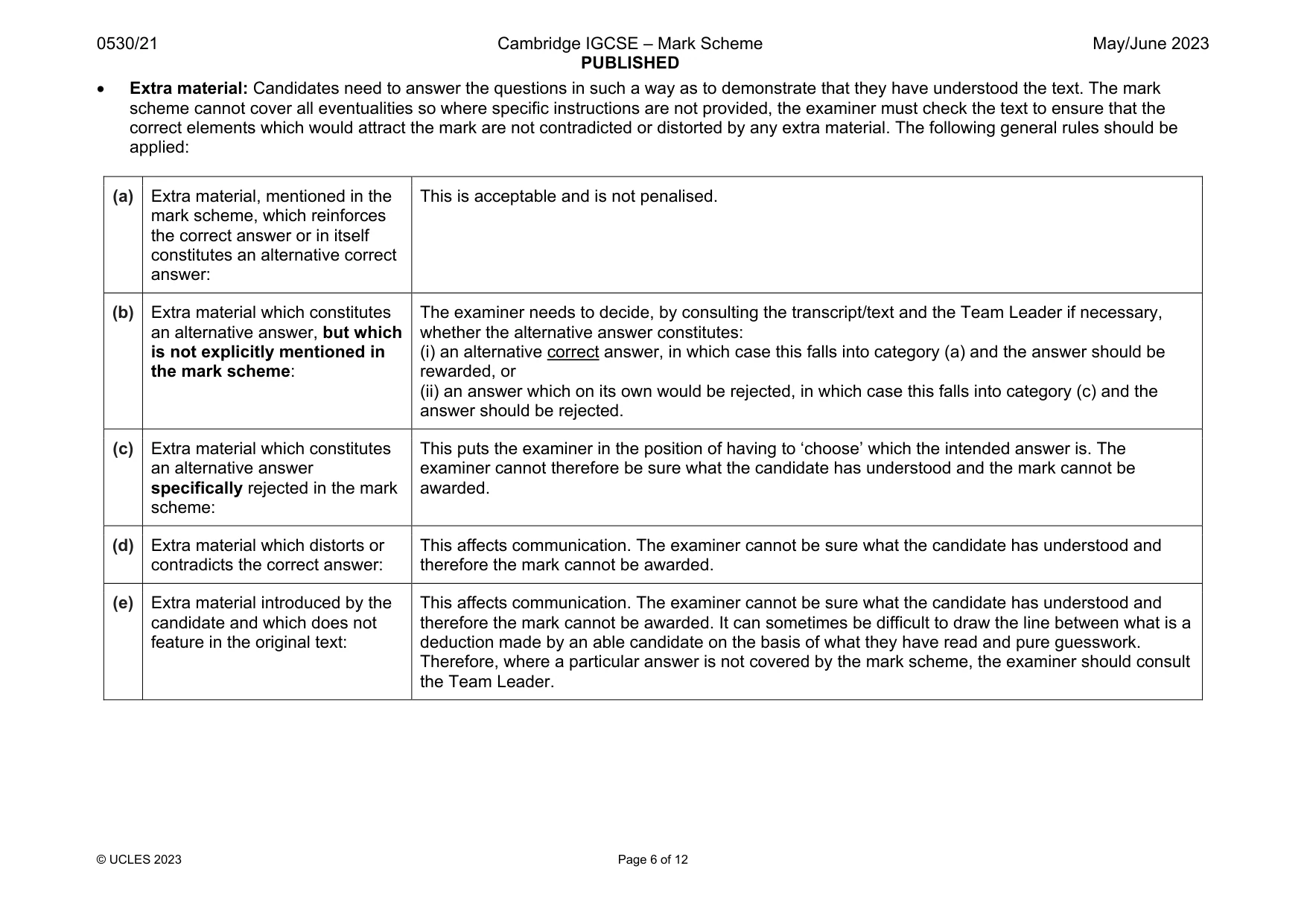
0530/21 Cambridge IGCSE – Mark Scheme PUBLISHED May/June 2023 © UCLES 2023 Page 6 of 12 Extra material: Candidates need to answer the questions in such a way as to demonstrate that they have understood the text. The mark scheme cannot cover all eventualities so where specific instructions are not provided, the examiner must check the text to ensure that the correct elements which would attract the mark are not contradicted or distorted by any extra material. The following general rules should be applied: (a) Extra material, mentioned in the mark scheme, which reinforces the correct answer or in itself constitutes an alternative correct answer: This is acceptable and is not penalised. (b) Extra material which constitutes an alternative answer, but which is not explicitly mentioned in the mark scheme: The examiner needs to decide, by consulting the transcript/text and the Team Leader if necessary, whether the alternative answer constitutes: (i) an alternative correct answer, in which case this falls into category (a) and the answer should be rewarded, or (ii) an answer which on its own would be rejected, in which case this falls into category (c) and the answer should be rejected. (c) Extra material which constitutes an alternative answer specifically rejected in the mark scheme: This puts the examiner in the position of having to ‘choose’ which the intended answer is. The examiner cannot therefore be sure what the candidate has understood and the mark cannot be awarded. (d) Extra material which distorts or contradicts the correct answer: This affects communication. The examiner cannot be sure what the candidate has understood and therefore the mark cannot be awarded. (e) Extra material introduced by the candidate and which does not feature in the original text: This affects communication. The examiner cannot be sure what the candidate has understood and therefore the mark cannot be awarded. It can sometimes be difficult to draw the line between what is a deduction made by an able candidate on the basis of what they have read and pure guesswork. Therefore, where a particular answer is not covered by the mark scheme, the examiner should consult the Team Leader.
Mark scheme, page 7
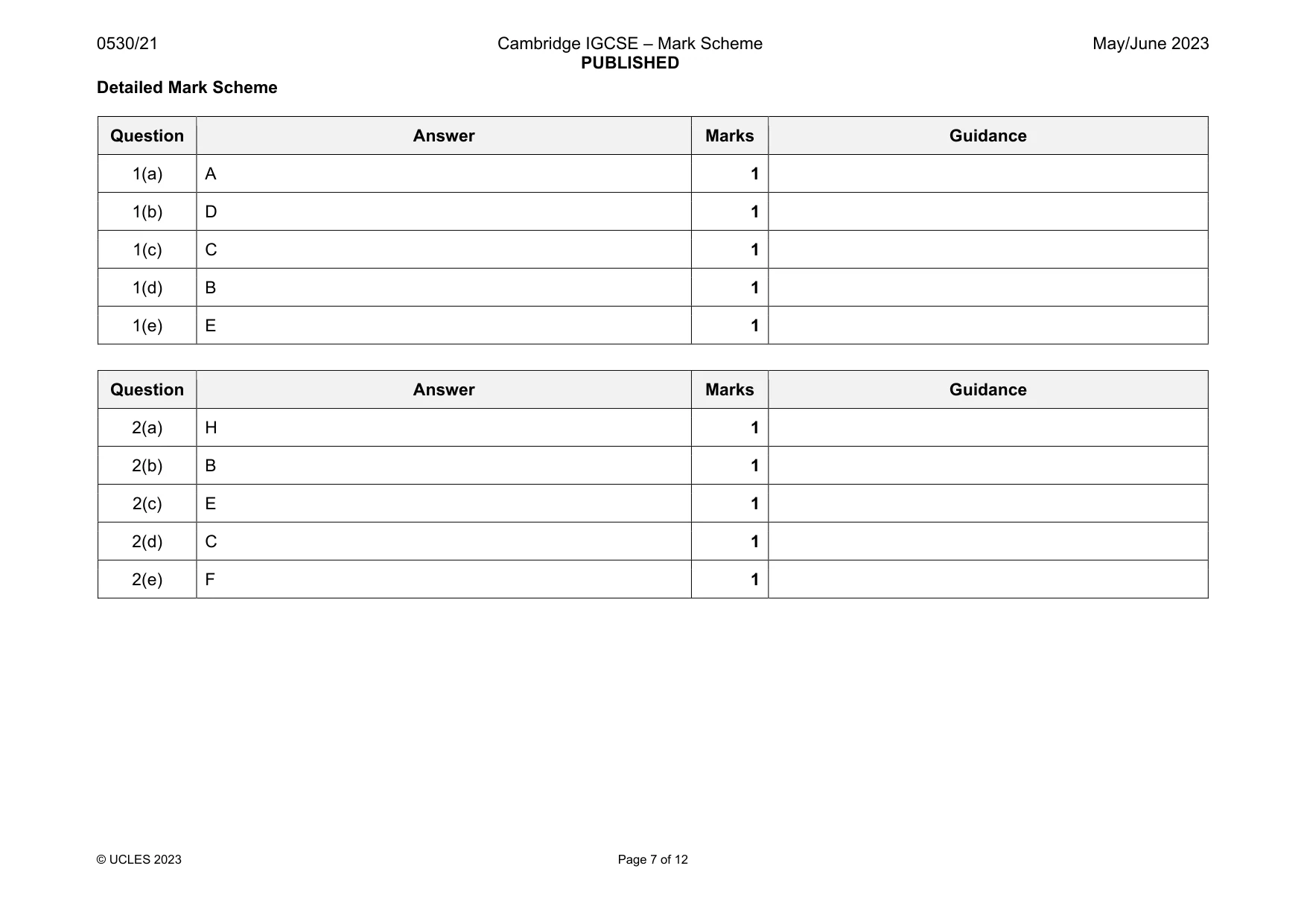
0530/21 Cambridge IGCSE – Mark Scheme PUBLISHED May/June 2023 © UCLES 2023 Page 7 of 12 Detailed Mark Scheme Question Answer Marks Guidance 1(a) A 1 1(b) D 1 1(c) C 1 1(d) B 1 1(e) E 1 Question Answer Marks Guidance 2(a) H 1 2(b) B 1 2(c) E 1 2(d) C 1 2(e) F 1
Mark scheme, page 8
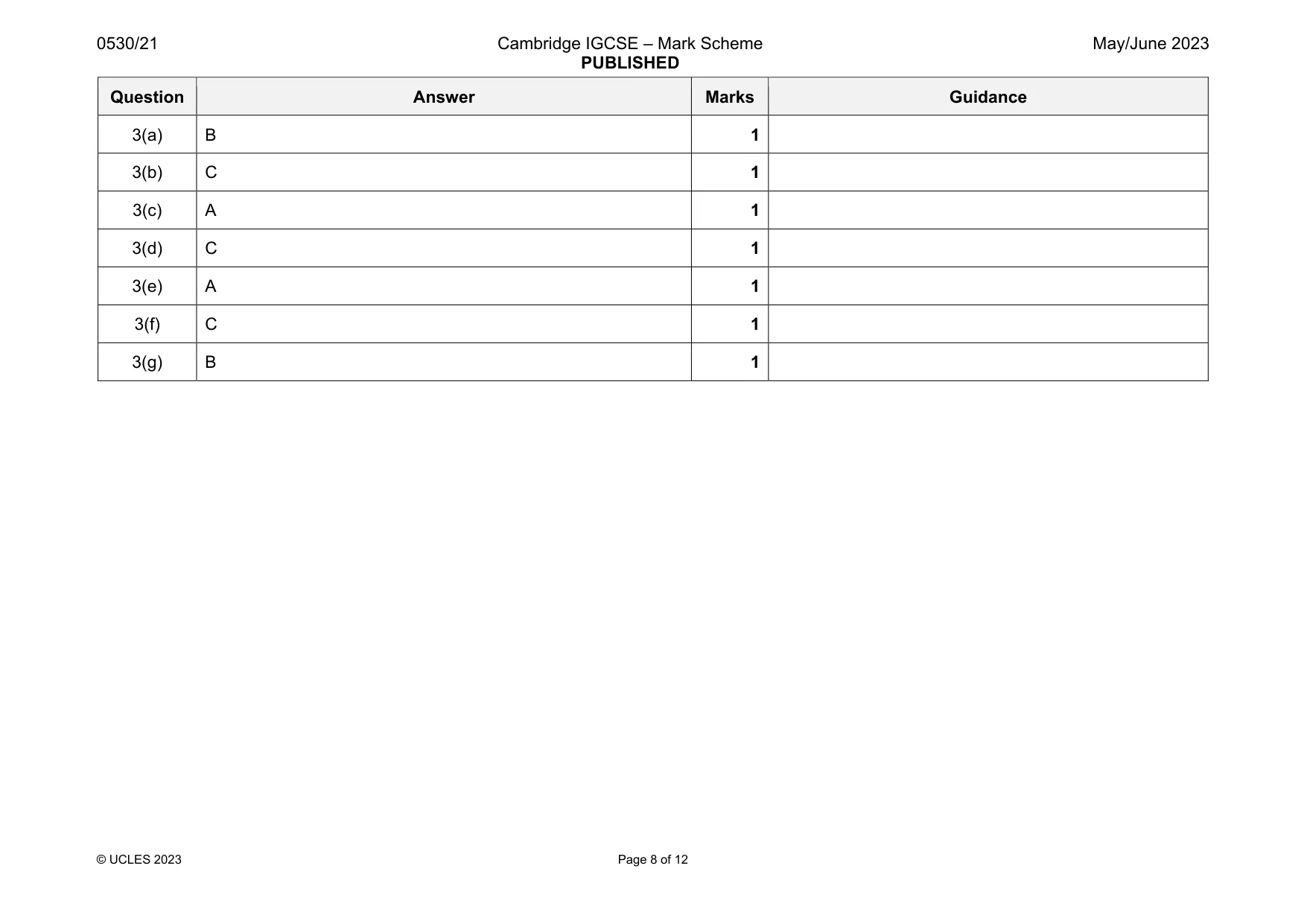
0530/21 Cambridge IGCSE – Mark Scheme PUBLISHED May/June 2023 © UCLES 2023 Page 8 of 12 Question Answer Marks Guidance 3(a) B 1 3(b) C 1 3(c) A 1 3(d) C 1 3(e) A 1 3(f) C 1 3(g) B 1
Mark scheme, page 9
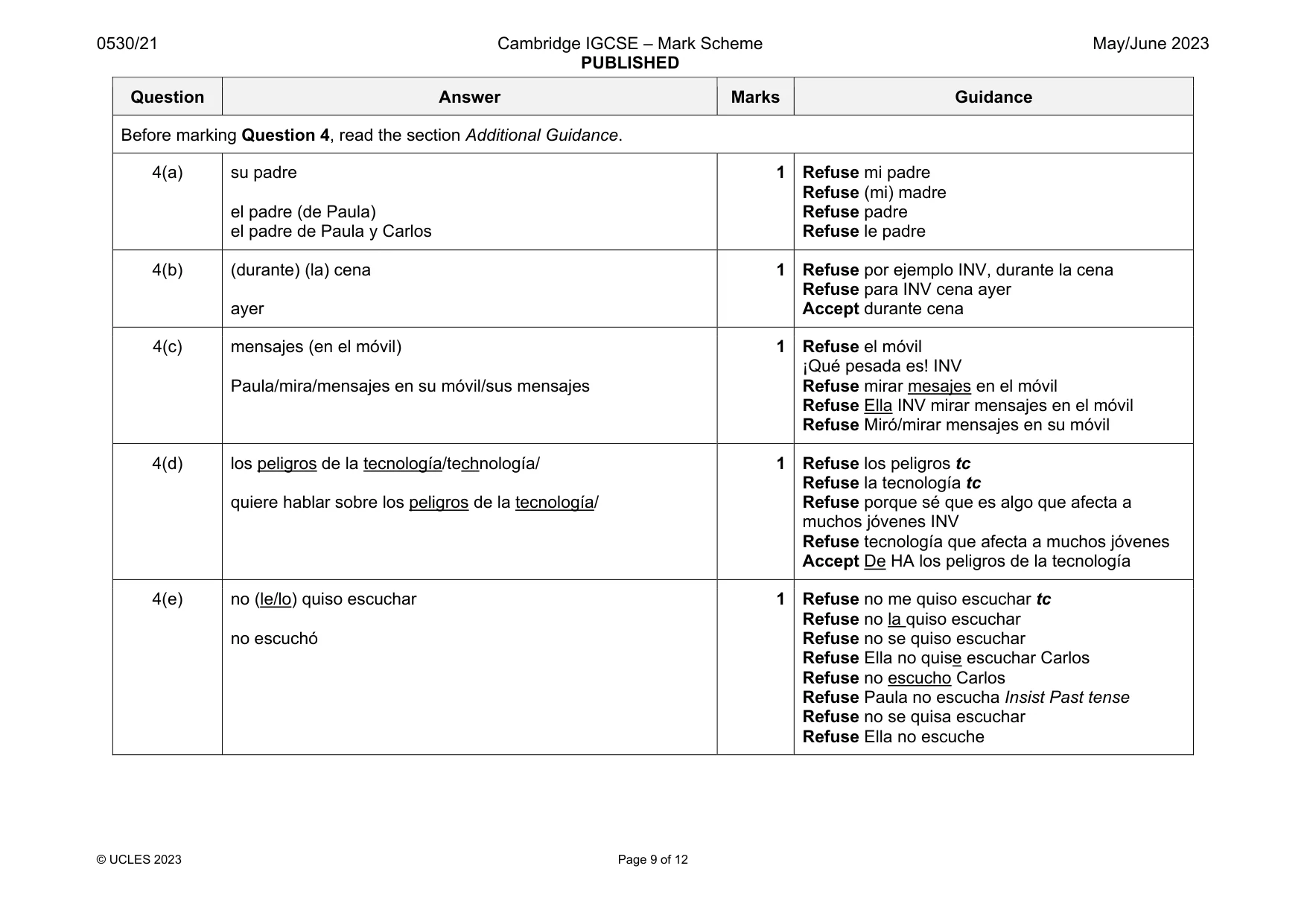
0530/21 Cambridge IGCSE – Mark Scheme PUBLISHED May/June 2023 © UCLES 2023 Page 9 of 12 Question Answer Marks Guidance Before marking Question 4, read the section Additional Guidance. 4(a) su padre el padre (de Paula) el padre de Paula y Carlos 1 Refuse mi padre Refuse (mi) madre Refuse padre Refuse le padre 4(b) (durante) (la) cena ayer 1 Refuse por ejemplo INV, durante la cena Refuse para INV cena ayer Accept durante cena 4(c) mensajes (en el móvil) Paula/mira/mensajes en su móvil/sus mensajes 1 Refuse el móvil ¡Qué pesada es! INV Refuse mirar mesajes en el móvil Refuse Ella INV mirar mensajes en el móvil Refuse Miró/mirar mensajes en su móvil 4(d) los peligros de la tecnología/technología/ quiere hablar sobre los peligros de la tecnología/ 1 Refuse los peligros tc Refuse la tecnología tc Refuse porque sé que es algo que afecta a muchos jóvenes INV Refuse tecnología que afecta a muchos jóvenes Accept De HA los peligros de la tecnología 4(e) no (le/lo) quiso escuchar no escuchó 1 Refuse no me quiso escuchar tc Refuse no la quiso escuchar Refuse no se quiso escuchar Refuse Ella no quise escuchar Carlos Refuse no escucho Carlos Refuse Paula no escucha Insist Past tense Refuse no se quisa escuchar Refuse Ella no escuche
Mark scheme, page 10
0530/21 Cambridge IGCSE – Mark Scheme PUBLISHED May/June 2023 © UCLES 2023 Page 10 of 12 Question Answer Marks Guidance 4(f) 1 salir/sale (a diario) 1 Refuse voy a ver a amigos en el parque Refuse ir al parque Refuse ir a ver a amigos Refuse tengo el móvil apagado Refuse Personalmente INV 2 tener/tiene el móvil apagado toda la mañana Además de eso HA apagar/apaga el móvil toda la mañana dejar su móvil apagado toda la mañana Decidió / decidió salir a diario 1 Refuse salir a diario, INV como ver sus amigos en el parque/ Refuse Decididió salir a diario/decidida salir a diario Refuse tienes el móvil apagado toda la mañana Refuse Usar el móvil menos 4(g) hace unos días unos días atrás 1 Refuse unos días 4(h) (para) encontrar información (en la red) pudo encontrar información (en la red) 1 Refuse información Refuse pude encontrar información Refuse puede encontrar información en la red Refuse para información en la red Refuse (para) un proyecto para biología 4(i) (muy) buena nota su profesor le puso muy buena nota el profesor puso buena nota Carlos recibió (recibio) muy buena nota 1 Refuse nota Refuse Mi profesor me/se puso muy buena nota, Refuse La profesora INV puso muy buena nota 4(j) contento se sintió contento Carlos estaba contento/tan contento Carlos estaba feliz 1 Refuse se puso tan contento (como yo) Refuse (el proyecto) fue un éxito Refuse se puso tan contento como él Refuse se puso content Refuse Carlos está muy contento 4(k) a (la oficina de) Correos 1 Refuse la oficina Accept va pasar por la oficina de correos
Mark scheme, page 11
0530/21 Cambridge IGCSE – Mark Scheme PUBLISHED May/June 2023 © UCLES 2023 Page 11 of 12 Question Answer Marks Guidance 5 a8, b1, c6, d5, e7 5 Question Answer Marks Guidance Before marking Question 6, read the section Additional Guidance. 6(a) hace (casi) medio siglo a los 36 años cuando tenía un poco más de 36 años 1 Refuse (casi) medio siglo Refuse desde INV hace (casi) medio siglo Refuse aunque parezca increíble, INV desde hace (casi) medio siglo Refuse cuando él fue/era joven 6(b) Perú en Peru 1 Refuse peruano Refuse el Festival Peruano de Cine de Atletismo 6(c) (en) el momento en (el) que conoció /conocio (a) Pedro (en) el momento en (el) que lo/le conoció /conocio 1 Refuse en el momento en que conocí a Pedro Refuse en el momento en el que conoce a Pedro Refuse Desde INV en el momento en (el) que conoció / (a) Pedro Refuse en el momento en que conocía a Pedro 6(d) 1 ve los errores que cometen ve los errores de los jóvenes ver los errores que cometen el no comete los mismos errores que los jóvenes/ellos 1 Refuse veo los errores que cometen Refuse ve los errores tc Refuse ve sus errores tc Refuse Pedro INV ver los errores que los jovens (sic) cometan Refuse El vee los errores que cometen 2 continúa (continua) cuando hay dificultades 1 Refuse continúan cuando hay dificultades Refuse (la mayoría de) los jóvenes (de hoy) no continúan cuando hay dificultades 6(e) 1 en pista de atletismo 1 Refuse en el documental vemos INV una carrera) en pista (de atletismo)
Mark scheme, page 12
0530/21 Cambridge IGCSE – Mark Scheme PUBLISHED May/June 2023 © UCLES 2023 Page 12 of 12 Question Answer Marks Guidance 6(e) 2 (también se muestra una HA) maratón 1 Refuse pista de atletismo tc 6(f) (los) nietos de Pedro 1 Refuse los nietos tc Refuse sus nietos Refuse Pedro’s nietos 6(g) se levanta (muy) temprano (para correr) levantarse (muy) temprano (para correr) 1 Refuse me levanto (muy) temprano Refuse lo levanta temprano Refuse la levanta temprano Refuse le levanta temprano Refuse se levantar temprano Refuse levantar muy temprano / levanta temprano 6(h) (está) feliz (a la vuelta a casa) 1 Refuse (que) vale la pena Refuse estoy feliz Refuse esté feliz Refuse contento Refuse es feliz 6(i) habrá una gran variedad de documentales (internacionales) por la gran variedad de documentales (internacionales) 1 Refuse habrá una gran…todo el mundo ir Refuse habrá documentales Refuse la gran variedad de documentales (internacionales) tc Refuse Porque hay una variedad de documentales internacionales Refuse habra Subj. Accept por los documentales
What you needed in this session
Cambridge’s own grade thresholds for 2023 May/June, Paper 2 · Variant 1. A higher threshold means an easier paper — the bar moves with how the cohort did.