Cambridge IGCSE Spanish - Foreign Language 0530 — 2017 Oct/Nov Paper 2 · Variant 1
0530/21/O/N/17 · 45 marks · ≈51 min
The question paper and its mark scheme, free to read here and free to download. This is Cambridge’s own paper, exactly as it was sat.
Question paper16 pages



Mark scheme12 pages
Answers below. Sit the paper first if you are practising.
Paper as text
Question paper, page 1
* 1 2 6 0 8 5 9 0 0 8 * This document consists of 14 printed pages and 2 blank pages. DC (LK/FC) 132881/3 © UCLES 2017 [Turn over Cambridge International Examinations Cambridge International General Certificate of Secondary Education SPANISH 0530/21 Paper 2 Reading October/November 2017 1 hour Candidates answer on the Question Paper. No Additional Materials are required. READ THESE INSTRUCTIONS FIRST Write your Centre number, candidate number and name in the spaces at the top of this page. Write in dark blue or black pen. Do not use staples, paper clips, glue or correction fluid. DO NOT WRITE IN ANY BARCODES. Answer all questions. The number of marks is given in brackets [ ] at the end of each question or part question. The syllabus is approved for use in England, Wales and Northern Ireland as a Cambridge International Level 1/Level 2 Certificate.
Question paper, page 2
2 0530/21/O/N/17 © UCLES 2017 BLANK PAGE
Question paper, page 3
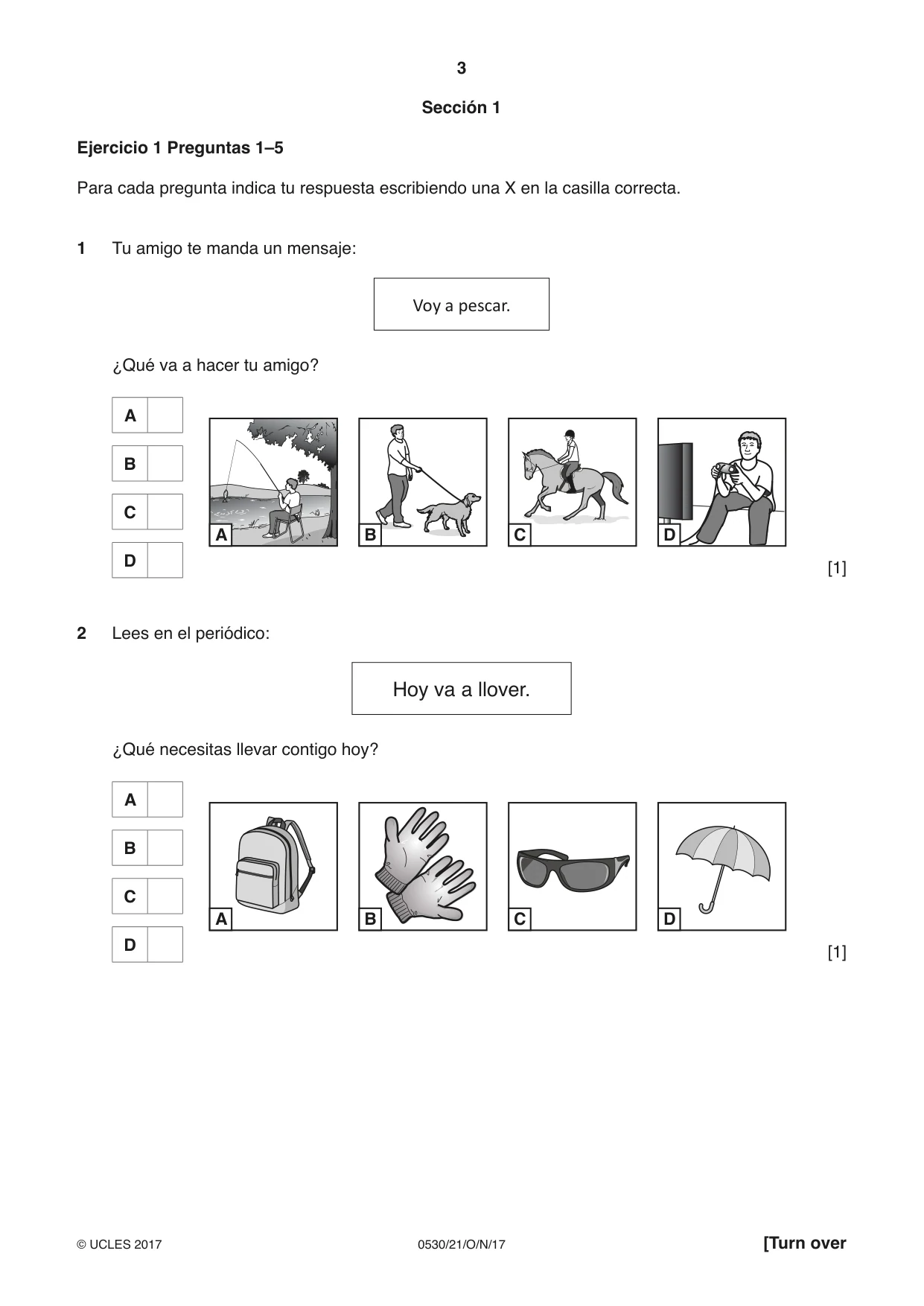
3 0530/21/O/N/17 © UCLES 2017 [Turn over Sección 1 Ejercicio 1 Preguntas 1–5 Para cada pregunta indica tu respuesta escribiendo una X en la casilla correcta. 1 Tu amigo te manda un mensaje: Voy a pescar. ¿Qué va a hacer tu amigo? A A B C D [1] B C D 2 Lees en el periódico: Hoy va a llover. ¿Qué necesitas llevar contigo hoy? A A B C D [1] B C D
Question paper, page 4
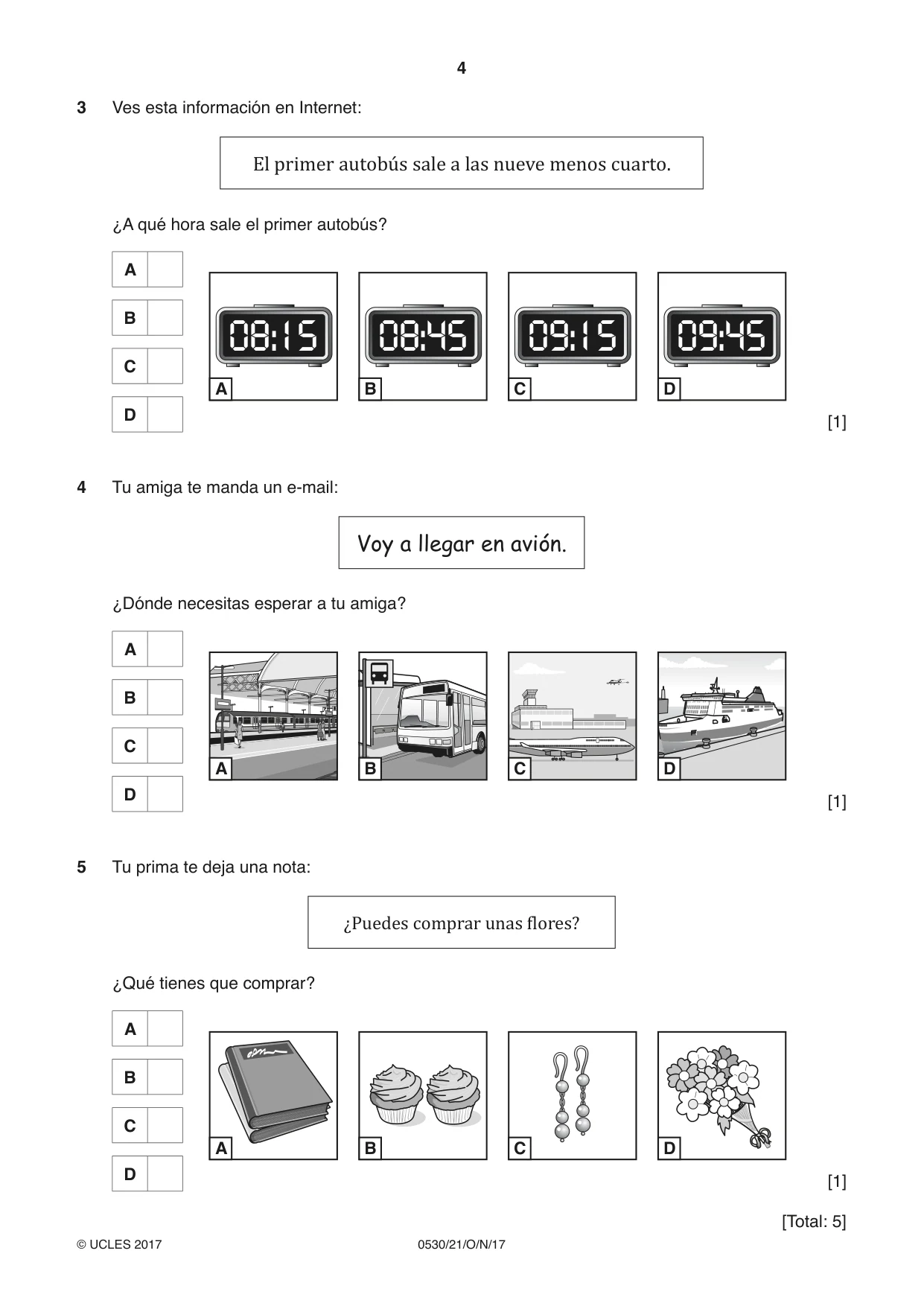
4 0530/21/O/N/17 © UCLES 2017 3 Ves esta información en Internet: El primer autobús sale a las nueve menos cuarto. ¿A qué hora sale el primer autobús? A 08:15 08:45 09:15 09:45 A B C D [1] B C D 4 Tu amiga te manda un e-mail: Voy a llegar en avión. ¿Dónde necesitas esperar a tu amiga? A A B C D [1] B C D 5 Tu prima te deja una nota: ¿Puedes comprar unas flores? ¿Qué tienes que comprar? A A B C D [1] B C D [Total: 5]
Question paper, page 5
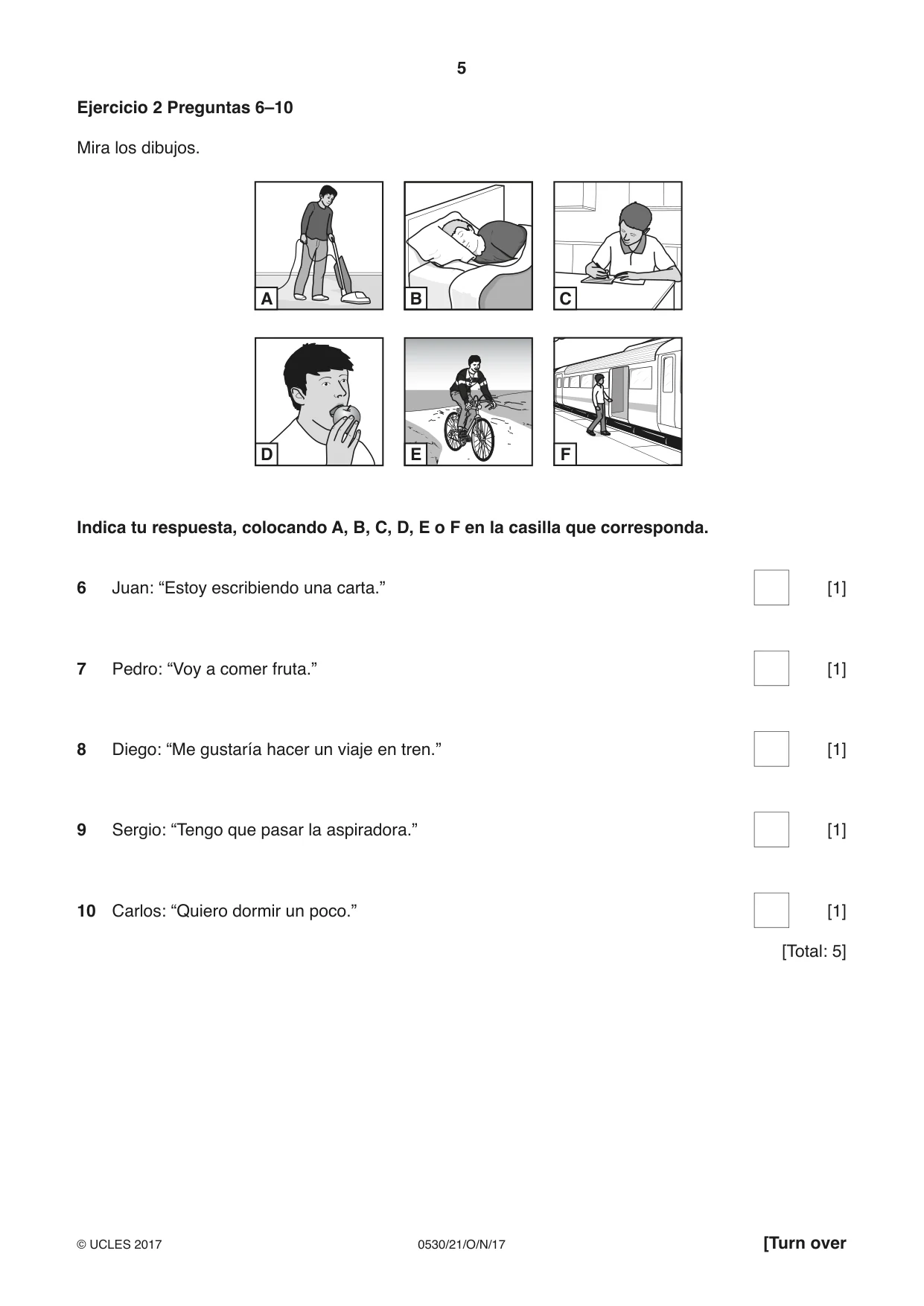
5 0530/21/O/N/17 © UCLES 2017 [Turn over Ejercicio 2 Preguntas 6–10 Mira los dibujos. A B C E F D Indica tu respuesta, colocando A, B, C, D, E o F en la casilla que corresponda. 6 Juan: “Estoy escribiendo una carta.” [1] 7 Pedro: “Voy a comer fruta.” [1] 8 Diego: “Me gustaría hacer un viaje en tren.” [1] 9 Sergio: “Tengo que pasar la aspiradora.” [1] 10 Carlos: “Quiero dormir un poco.” [1] [Total: 5]
Question paper, page 6
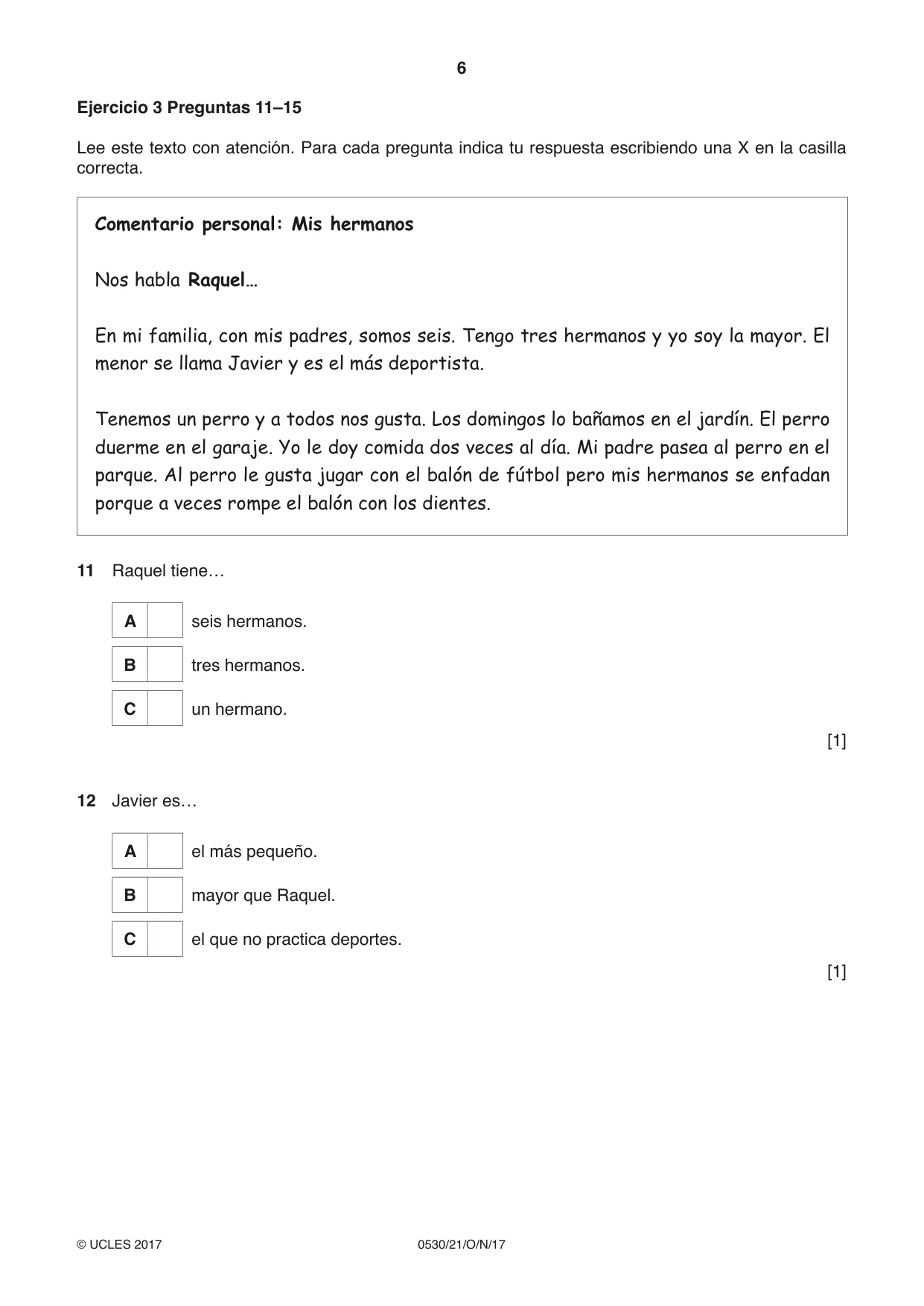
6 0530/21/O/N/17 © UCLES 2017 Ejercicio 3 Preguntas 11–15 Lee este texto con atención. Para cada pregunta indica tu respuesta escribiendo una X en la casilla correcta. Comentario personal: Mis hermanos Nos habla Raquel… En mi familia, con mis padres, somos seis. Tengo tres hermanos y yo soy la mayor. El menor se llama Javier y es el más deportista. Tenemos un perro y a todos nos gusta. Los domingos lo bañamos en el jardín. El perro duerme en el garaje. Yo le doy comida dos veces al día. Mi padre pasea al perro en el parque. Al perro le gusta jugar con el balón de fútbol pero mis hermanos se enfadan porque a veces rompe el balón con los dientes. 11 Raquel tiene… A seis hermanos. B tres hermanos. C un hermano. [1] 12 Javier es… A el más pequeño. B mayor que Raquel. C el que no practica deportes. [1]
Question paper, page 7
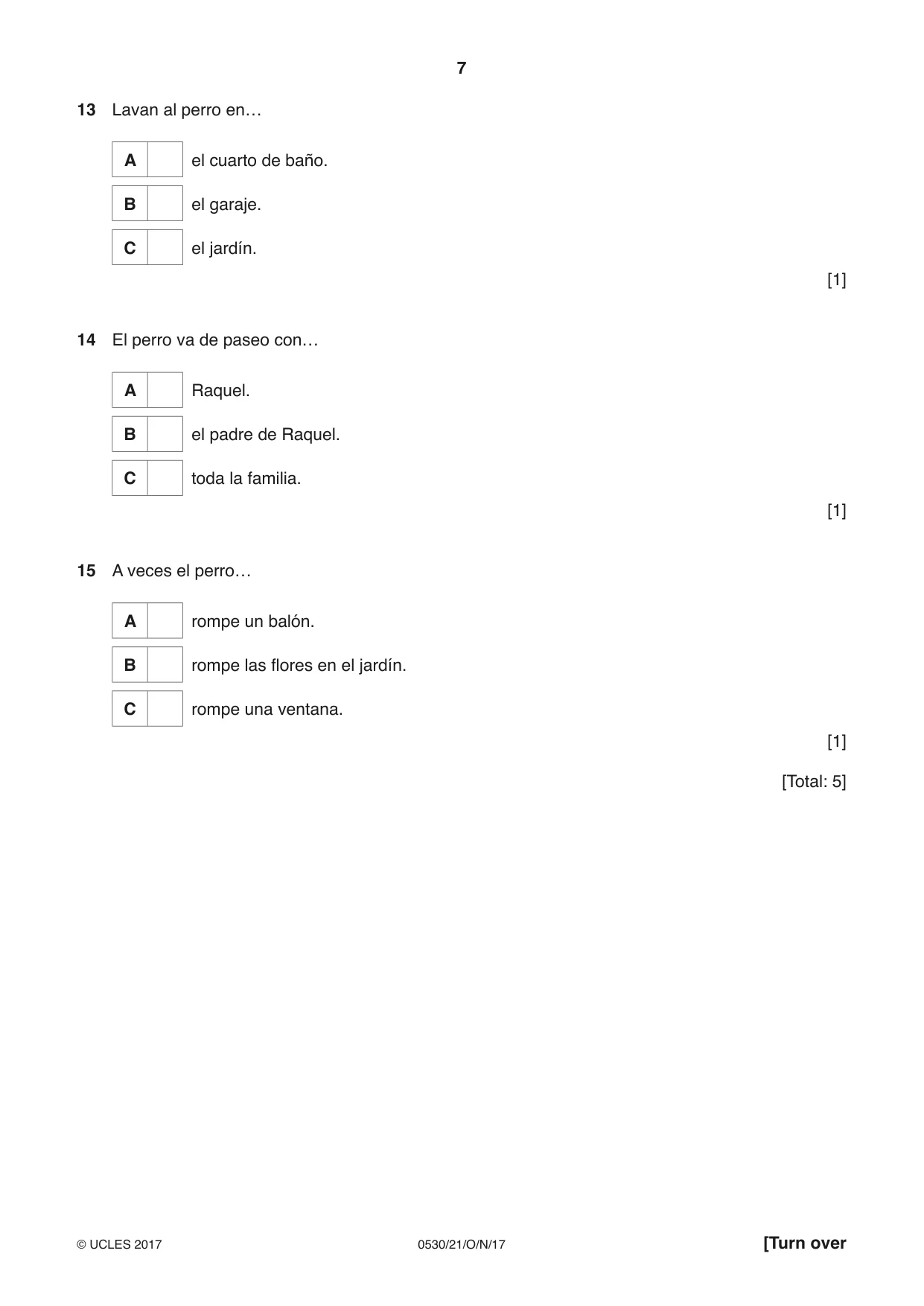
7 0530/21/O/N/17 © UCLES 2017 [Turn over 13 Lavan al perro en… A el cuarto de baño. B el garaje. C el jardín. [1] 14 El perro va de paseo con… A Raquel. B el padre de Raquel. C toda la familia. [1] 15 A veces el perro… A rompe un balón. B rompe las flores en el jardín. C rompe una ventana. [1] [Total: 5]
Question paper, page 8
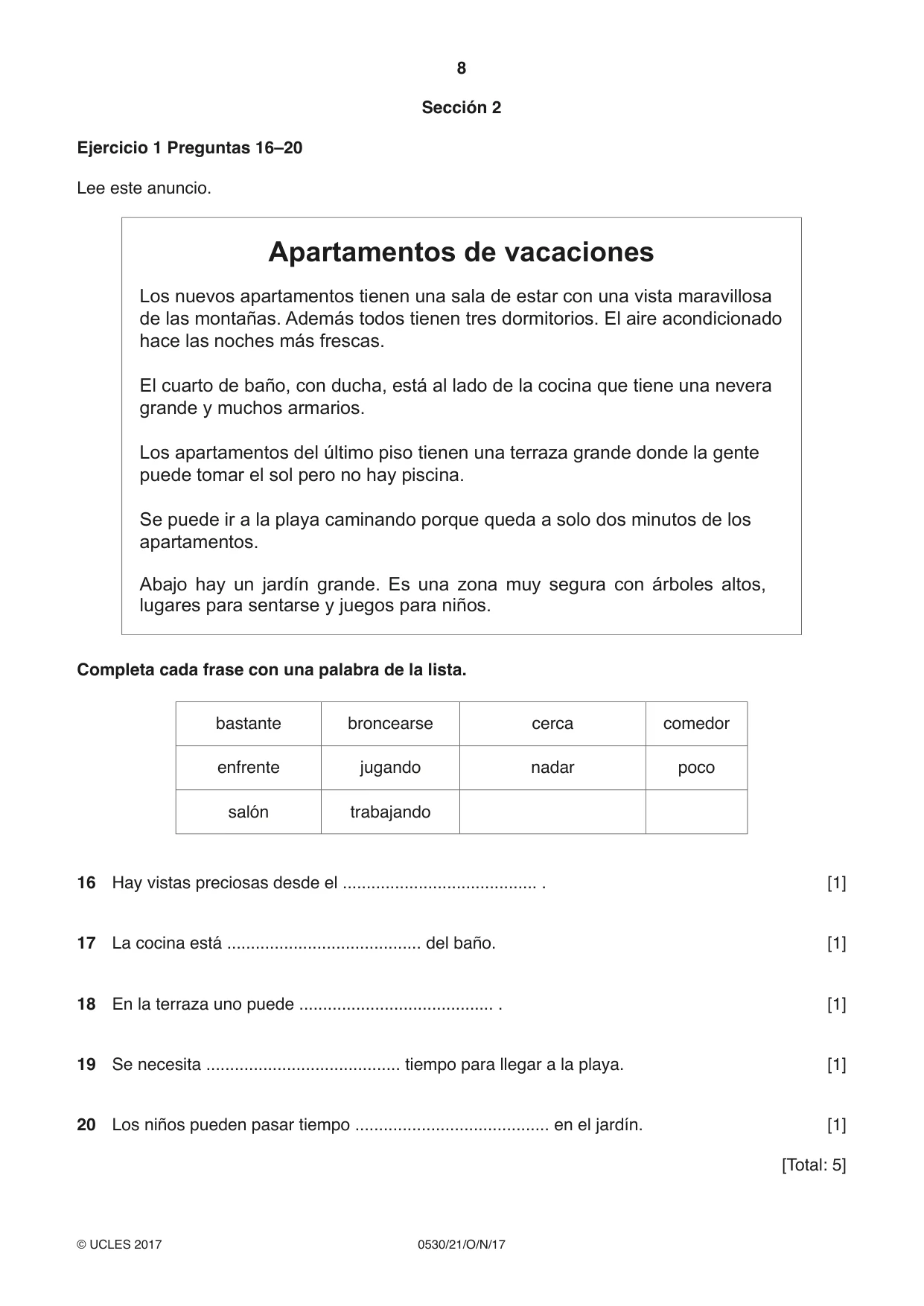
8 0530/21/O/N/17 © UCLES 2017 Sección 2 Ejercicio 1 Preguntas 16–20 Lee este anuncio. Apartamentos de vacaciones Los nuevos apartamentos tienen una sala de estar con una vista maravillosa de las montañas. Además todos tienen tres dormitorios. El aire acondicionado hace las noches más frescas. El cuarto de baño, con ducha, está al lado de la cocina que tiene una nevera grande y muchos armarios. Los apartamentos del último piso tienen una terraza grande donde la gente puede tomar el sol pero no hay piscina. Se puede ir a la playa caminando porque queda a solo dos minutos de los apartamentos. Abajo hay un jardín grande. Es una zona muy segura con árboles altos, lugares para sentarse y juegos para niños. Completa cada frase con una palabra de la lista. bastante broncearse cerca comedor enfrente jugando nadar poco salón trabajando 16 Hay vistas preciosas desde el … . [1] 17 La cocina está … del baño. [1] 18 En la terraza uno puede … . [1] 19 Se necesita … tiempo para llegar a la playa. [1] 20 Los niños pueden pasar tiempo … en el jardín. [1] [Total: 5]
Question paper, page 9
9 0530/21/O/N/17 © UCLES 2017 [Turn over Dar la vuelta para el Ejercicio 2.
Question paper, page 10
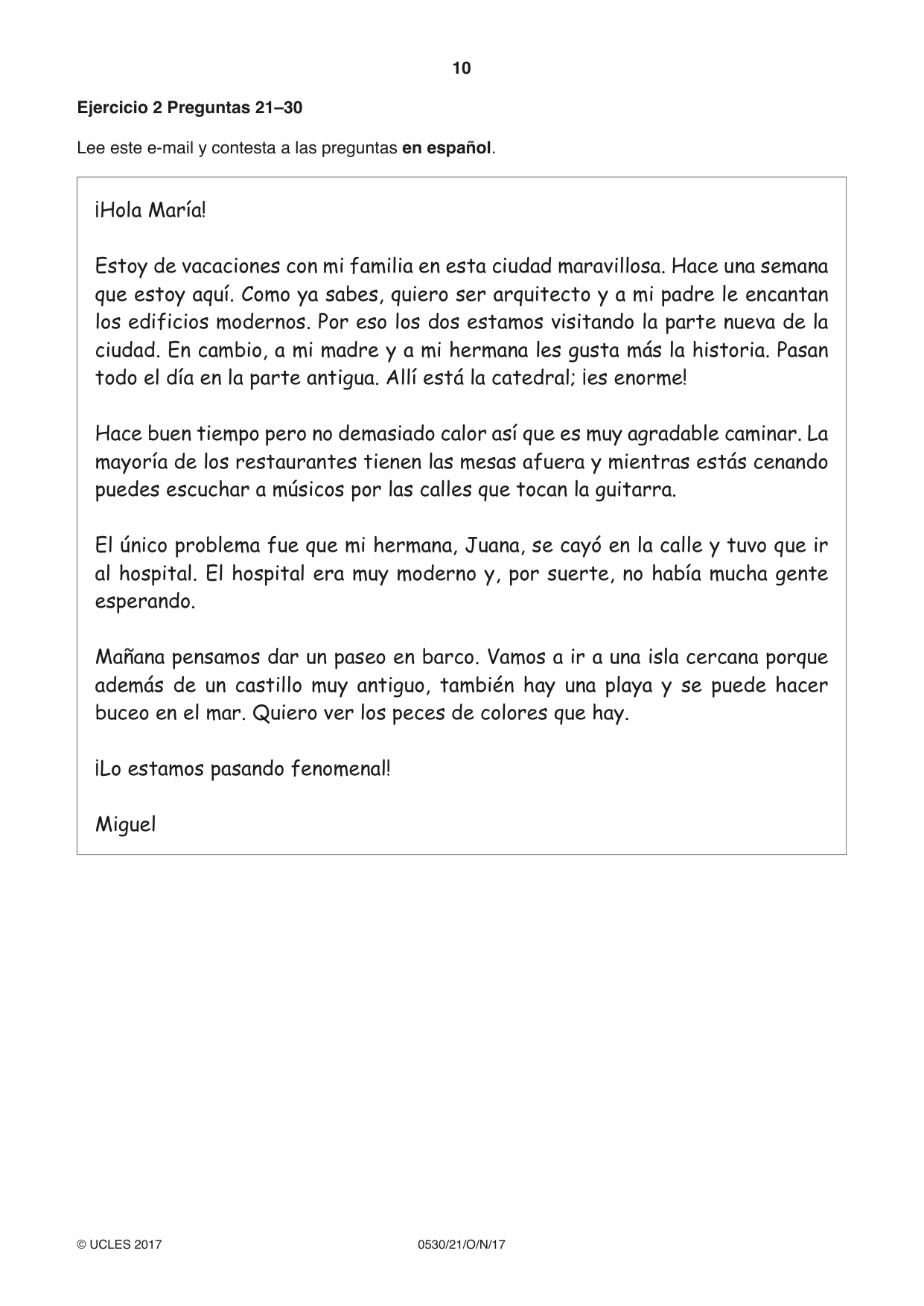
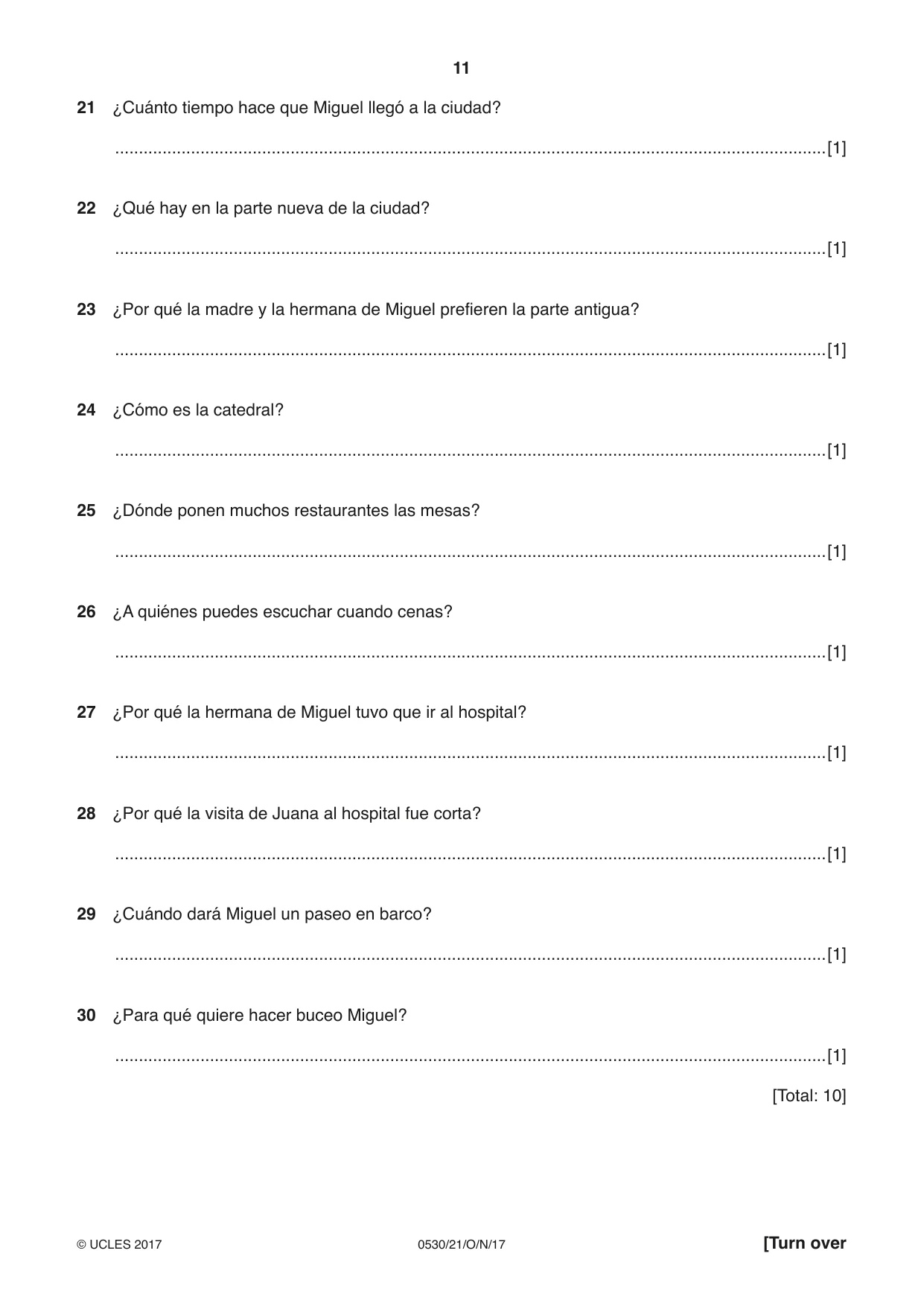
10 0530/21/O/N/17 © UCLES 2017 Ejercicio 2 Preguntas 21–30 Lee este e-mail y contesta a las preguntas en español. ¡Hola María! Estoy de vacaciones con mi familia en esta ciudad maravillosa. Hace una semana que estoy aquí. Como ya sabes, quiero ser arquitecto y a mi padre le encantan los edificios modernos. Por eso los dos estamos visitando la parte nueva de la ciudad. En cambio, a mi madre y a mi hermana les gusta más la historia. Pasan todo el día en la parte antigua. Allí está la catedral; ¡es enorme! Hace buen tiempo pero no demasiado calor así que es muy agradable caminar. La mayoría de los restaurantes tienen las mesas afuera y mientras estás cenando puedes escuchar a músicos por las calles que tocan la guitarra. El único problema fue que mi hermana, Juana, se cayó en la calle y tuvo que ir al hospital. El hospital era muy moderno y, por suerte, no había mucha gente esperando. Mañana pensamos dar un paseo en barco. Vamos a ir a una isla cercana porque además de un castillo muy antiguo, también hay una playa y se puede hacer buceo en el mar. Quiero ver los peces de colores que hay. ¡Lo estamos pasando fenomenal! Miguel
Question paper, page 11
11 0530/21/O/N/17 © UCLES 2017 [Turn over 21 ¿Cuánto tiempo hace que Miguel llegó a la ciudad? …[1] 22 ¿Qué hay en la parte nueva de la ciudad? …[1] 23 ¿Por qué la madre y la hermana de Miguel prefieren la parte antigua? …[1] 24 ¿Cómo es la catedral? …[1] 25 ¿Dónde ponen muchos restaurantes las mesas? …[1] 26 ¿A quiénes puedes escuchar cuando cenas? …[1] 27 ¿Por qué la hermana de Miguel tuvo que ir al hospital? …[1] 28 ¿Por qué la visita de Juana al hospital fue corta? …[1] 29 ¿Cuándo dará Miguel un paseo en barco? …[1] 30 ¿Para qué quiere hacer buceo Miguel? …[1] [Total: 10]
Question paper, page 12
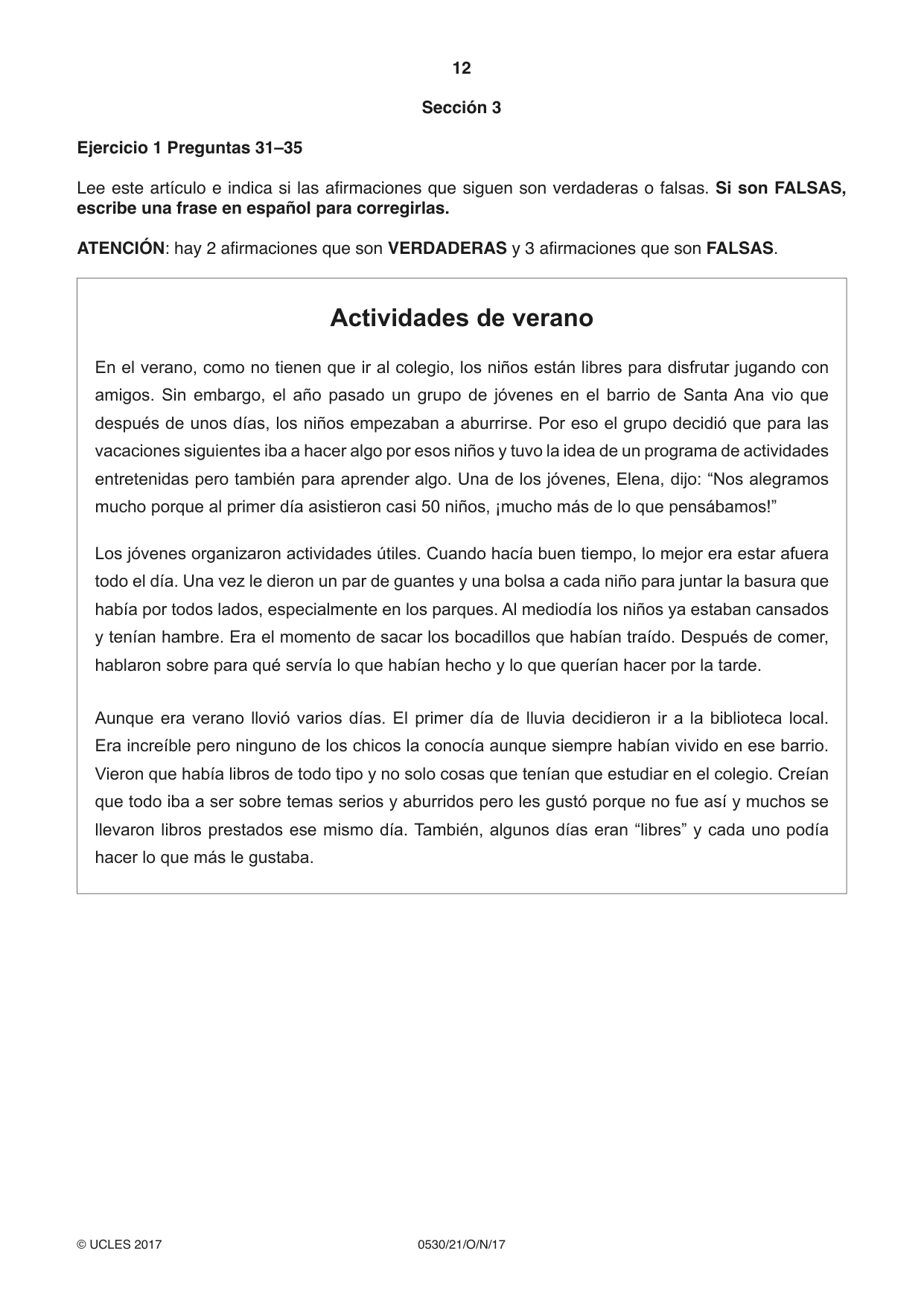
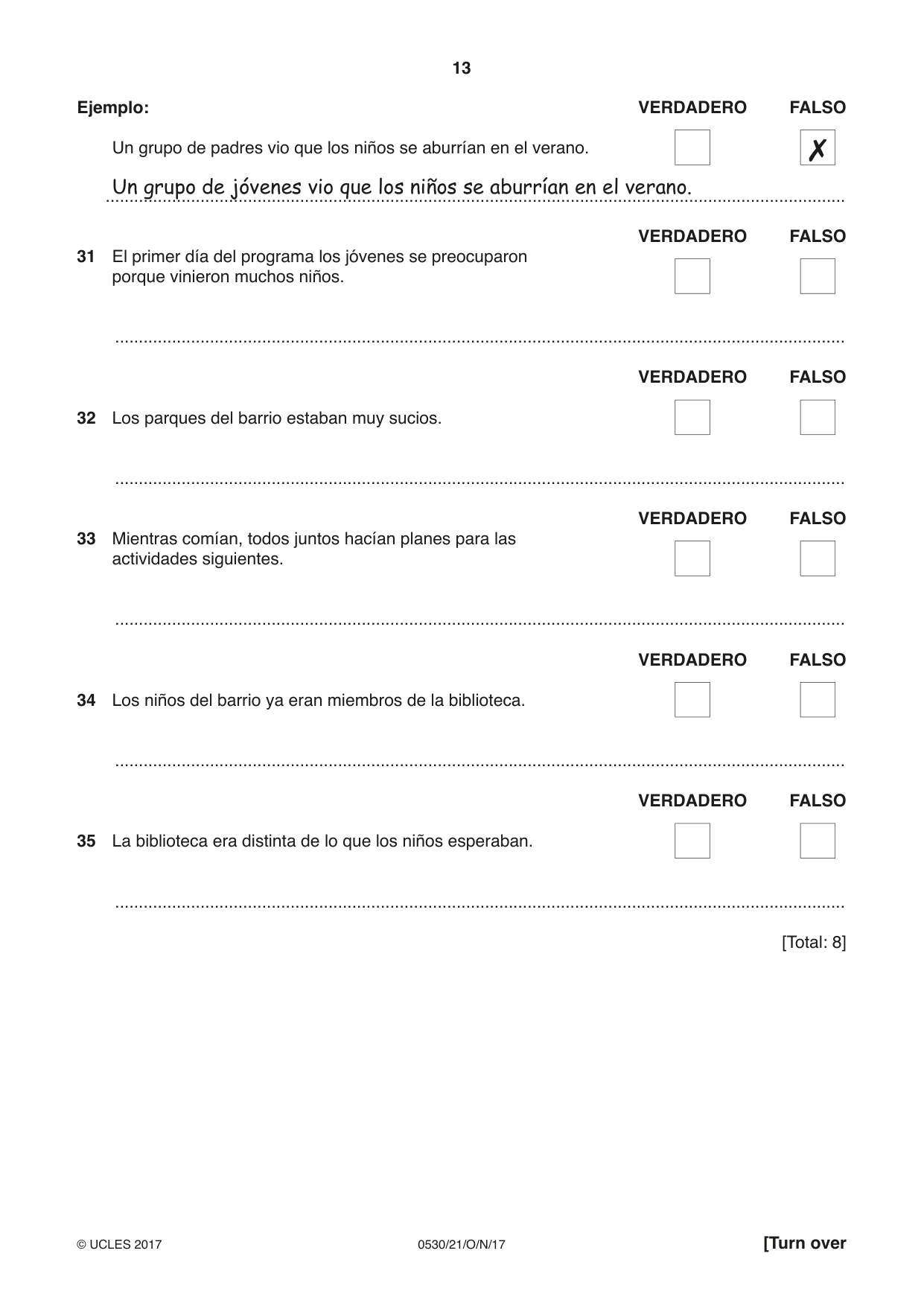
12 0530/21/O/N/17 © UCLES 2017 Sección 3 Ejercicio 1 Preguntas 31–35 Lee este artículo e indica si las afirmaciones que siguen son verdaderas o falsas. Si son FALSAS, escribe una frase en español para corregirlas. ATENCIÓN: hay 2 afirmaciones que son VERDADERAS y 3 afirmaciones que son FALSAS. Actividades de verano En el verano, como no tienen que ir al colegio, los niños están libres para disfrutar jugando con amigos. Sin embargo, el año pasado un grupo de jóvenes en el barrio de Santa Ana vio que después de unos días, los niños empezaban a aburrirse. Por eso el grupo decidió que para las vacaciones siguientes iba a hacer algo por esos niños y tuvo la idea de un programa de actividades entretenidas pero también para aprender algo. Una de los jóvenes, Elena, dijo: “Nos alegramos mucho porque al primer día asistieron casi 50 niños, ¡mucho más de lo que pensábamos!” Los jóvenes organizaron actividades útiles. Cuando hacía buen tiempo, lo mejor era estar afuera todo el día. Una vez le dieron un par de guantes y una bolsa a cada niño para juntar la basura que había por todos lados, especialmente en los parques. Al mediodía los niños ya estaban cansados y tenían hambre. Era el momento de sacar los bocadillos que habían traído. Después de comer, hablaron sobre para qué servía lo que habían hecho y lo que querían hacer por la tarde. Aunque era verano llovió varios días. El primer día de lluvia decidieron ir a la biblioteca local. Era increíble pero ninguno de los chicos la conocía aunque siempre habían vivido en ese barrio. Vieron que había libros de todo tipo y no solo cosas que tenían que estudiar en el colegio. Creían que todo iba a ser sobre temas serios y aburridos pero les gustó porque no fue así y muchos se llevaron libros prestados ese mismo día. También, algunos días eran “libres” y cada uno podía hacer lo que más le gustaba.
Question paper, page 13
13 0530/21/O/N/17 © UCLES 2017 [Turn over Ejemplo: VERDADERO FALSO Un grupo de padres vio que los niños se aburrían en el verano. ✗ Un grupo de jóvenes vio que los niños se aburrían en el verano. … VERDADERO FALSO 31 El primer día del programa los jóvenes se preocuparon porque vinieron muchos niños. … VERDADERO FALSO 32 Los parques del barrio estaban muy sucios. … VERDADERO FALSO 33 Mientras comían, todos juntos hacían planes para las actividades siguientes. … VERDADERO FALSO 34 Los niños del barrio ya eran miembros de la biblioteca. … VERDADERO FALSO 35 La biblioteca era distinta de lo que los niños esperaban. … [Total: 8]
Question paper, page 14
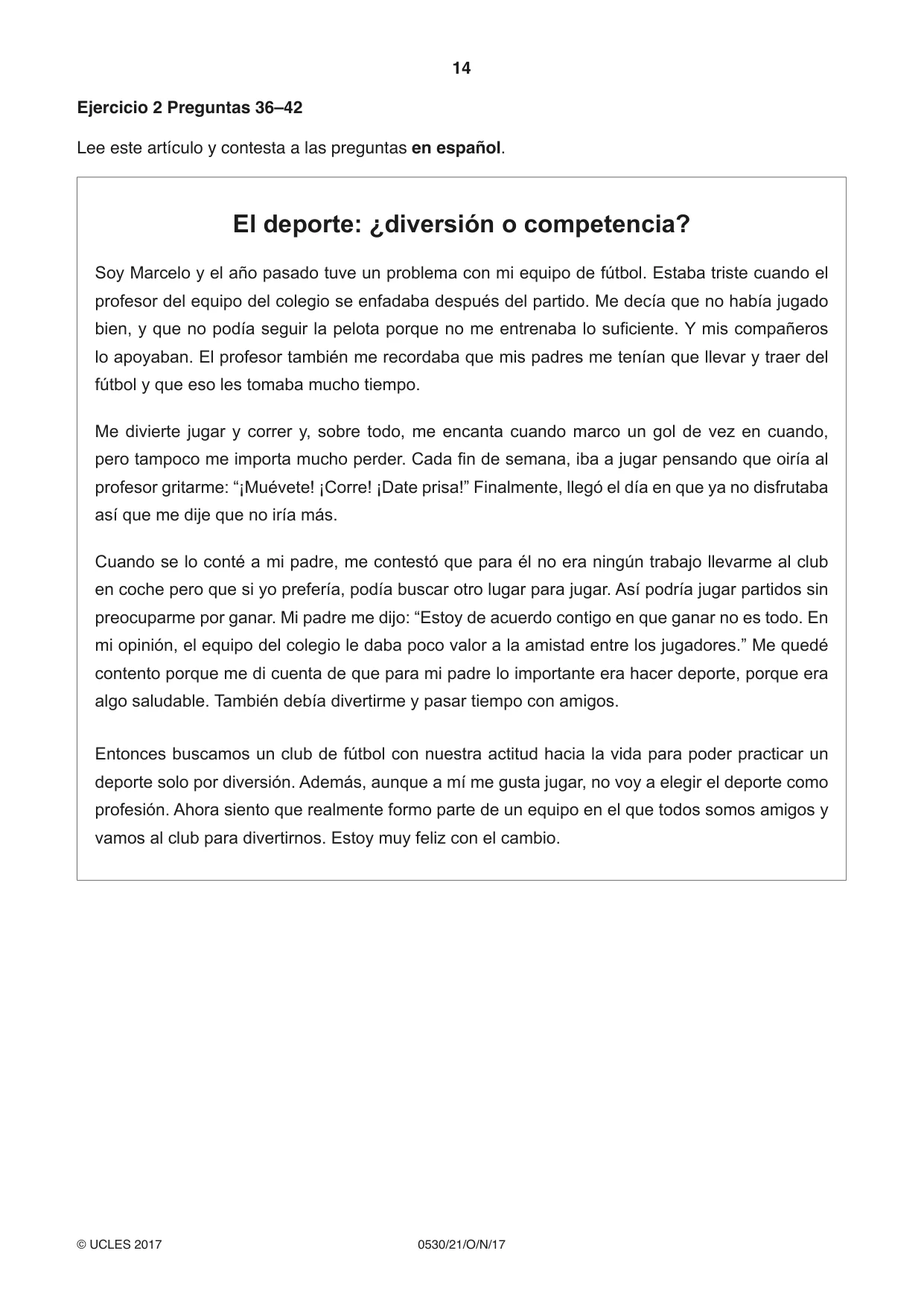
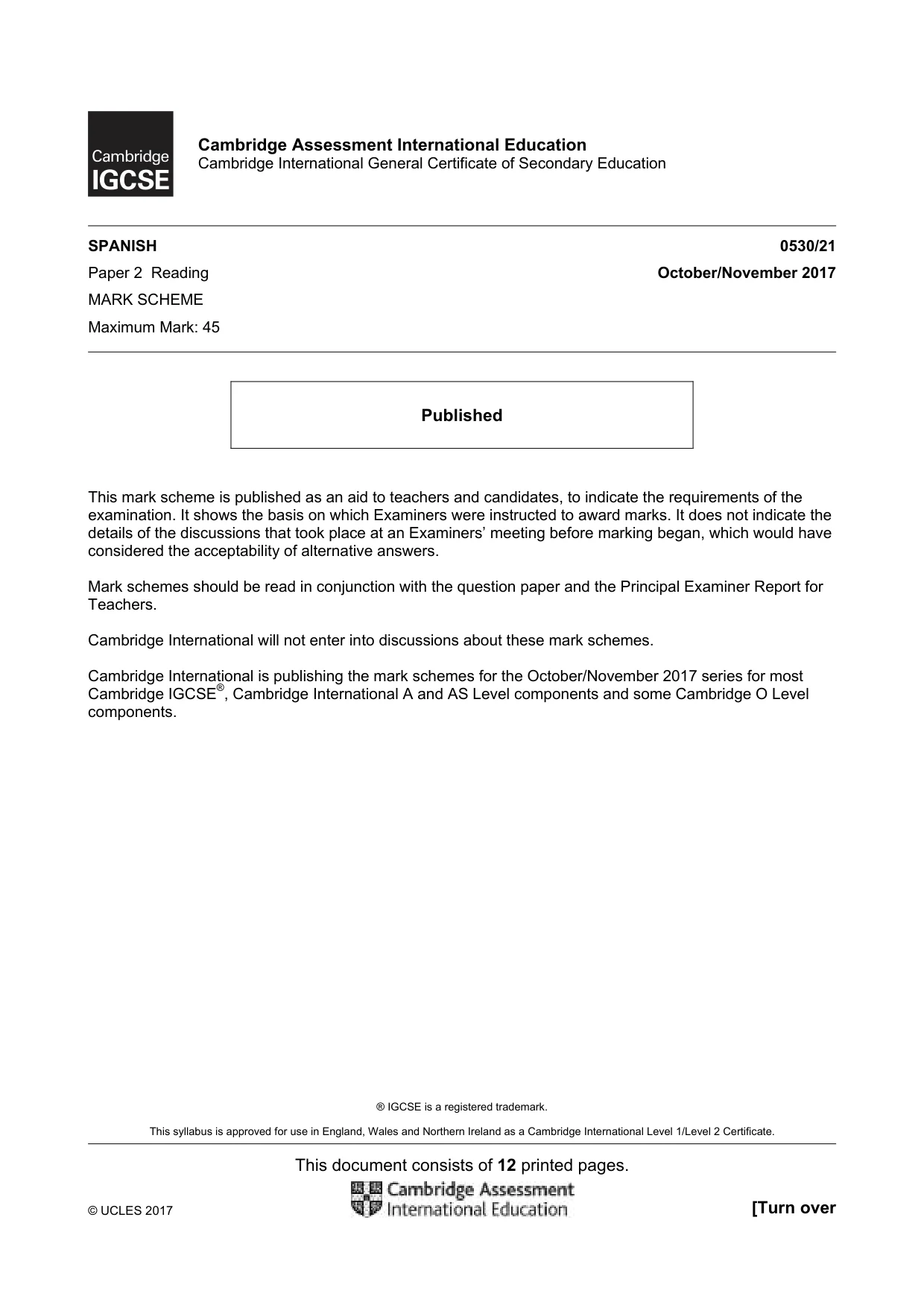
14 0530/21/O/N/17 © UCLES 2017 Ejercicio 2 Preguntas 36–42 Lee este artículo y contesta a las preguntas en español. El deporte: ¿diversión o competencia? Soy Marcelo y el año pasado tuve un problema con mi equipo de fútbol. Estaba triste cuando el profesor del equipo del colegio se enfadaba después del partido. Me decía que no había jugado bien, y que no podía seguir la pelota porque no me entrenaba lo suficiente. Y mis compañeros lo apoyaban. El profesor también me recordaba que mis padres me tenían que llevar y traer del fútbol y que eso les tomaba mucho tiempo. Me divierte jugar y correr y, sobre todo, me encanta cuando marco un gol de vez en cuando, pero tampoco me importa mucho perder. Cada fin de semana, iba a jugar pensando que oiría al profesor gritarme: “¡Muévete! ¡Corre! ¡Date prisa!” Finalmente, llegó el día en que ya no disfrutaba así que me dije que no iría más. Cuando se lo conté a mi padre, me contestó que para él no era ningún trabajo llevarme al club en coche pero que si yo prefería, podía buscar otro lugar para jugar. Así podría jugar partidos sin preocuparme por ganar. Mi padre me dijo: “Estoy de acuerdo contigo en que ganar no es todo. En mi opinión, el equipo del colegio le daba poco valor a la amistad entre los jugadores.” Me quedé contento porque me di cuenta de que para mi padre lo importante era hacer deporte, porque era algo saludable. También debía divertirme y pasar tiempo con amigos. Entonces buscamos un club de fútbol con nuestra actitud hacia la vida para poder practicar un deporte solo por diversión. Además, aunque a mí me gusta jugar, no voy a elegir el deporte como profesión. Ahora siento que realmente formo parte de un equipo en el que todos somos amigos y vamos al club para divertirnos. Estoy muy feliz con el cambio.
Question paper, page 15
15 0530/21/O/N/17 © UCLES 2017 36 ¿Cómo se sentía Marcelo cuando el profesor se enfadaba con él? …[1] 37 ¿Con quién estaban de acuerdo los otros jugadores del equipo? …[1] 38 Para Marcelo, ¿cuál es el mejor momento de un partido de fútbol? …[1] 39 ¿Cuándo Marcelo decidió dejar el equipo del colegio? …[1] 40 ¿Cuál fue la sugerencia del padre de Marcelo? …[1] 41 Para el padre de Marcelo, ¿qué error hacía el equipo del colegio? …[1] 42 ¿Por qué la decisión de Marcelo no afectará sus planes para el futuro? …[1] [Total: 7]
Question paper, page 16
16 0530/21/O/N/17 © UCLES 2017 Permission to reproduce items where third-party owned material protected by copyright is included has been sought and cleared where possible. Every reasonable effort has been made by the publisher (UCLES) to trace copyright holders, but if any items requiring clearance have unwittingly been included, the publisher will be pleased to make amends at the earliest possible opportunity. To avoid the issue of disclosure of answer-related information to candidates, all copyright acknowledgements are reproduced online in the Cambridge International Examinations Copyright Acknowledgements Booklet. This is produced for each series of examinations and is freely available to download at www.cie.org.uk after the live examination series. Cambridge International Examinations is part of the Cambridge Assessment Group. Cambridge Assessment is the brand name of University of Cambridge Local Examinations Syndicate (UCLES), which is itself a department of the University of Cambridge. BLANK PAGE
Mark scheme, page 1
® IGCSE is a registered trademark. This syllabus is approved for use in England, Wales and Northern Ireland as a Cambridge International Level 1/Level 2 Certificate. This document consists of 12 printed pages. © UCLES 2017 [Turn over Cambridge Assessment International Education Cambridge International General Certificate of Secondary Education SPANISH 0530/21 Paper 2 Reading October/November 2017 MARK SCHEME Maximum Mark: 45 Published This mark scheme is published as an aid to teachers and candidates, to indicate the requirements of the examination. It shows the basis on which Examiners were instructed to award marks. It does not indicate the details of the discussions that took place at an Examiners’ meeting before marking began, which would have considered the acceptability of alternative answers. Mark schemes should be read in conjunction with the question paper and the Principal Examiner Report for Teachers. Cambridge International will not enter into discussions about these mark schemes. Cambridge International is publishing the mark schemes for the October/November 2017 series for most Cambridge IGCSE®, Cambridge International A and AS Level components and some Cambridge O Level components.
Mark scheme, page 2
0530/21 Cambridge IGCSE – Mark Scheme PUBLISHED October/November 2017 © UCLES 2017 Page 2 of 12 1 General Marking Principles 1.1 It is not possible to list all acceptable alternatives in the Detailed Mark Scheme provided in Section 4. You will need to consider all alternative answers and unexpected approaches in candidates’ scripts, make a decision on whether they communicate the required elements, in consultation with your Team Leader if necessary (or with your Product Manager if you are a single Examiner), and award marks accordingly. The following marking principles underpin the detailed instructions provided in Section 4 of the Mark Scheme. Where a decision is taken to deviate from these principles for a particular question, this will be specified in the Mark Scheme. Often the general principles will have to be weighed up against each other, e.g. the answer might pass the look-alike test (1.5(b)), but if the candidate has produced an answer that is another word in the target language they will not score (1.6). 1.2 Crossing out: (a) If a candidate changes his/her mind over an answer and crosses out an attempt, award a mark if the final attempt is correct. (b) If a candidate crosses out an answer to a whole question but makes no second attempt at it, mark the crossed out work. 1.3 More than the stipulated number of boxes ticked/crossed by the candidate: (a) If more than one attempt is visible, but the candidate has clearly indicated which attempt is his/her final answer (e.g. by crossing out other attempts or by annotating the script in some way), mark in the usual way. (b) If two attempts are visible (e.g. two boxes ticked instead of the 1 box stipulated), and neither has been crossed out/discounted by the candidate, no mark can be awarded. (c) Where candidates must tick a number of boxes (e.g. tick the 6 true statements) and tick too many, apply the following rule: deduct the number of ‘extra’ answers indicated by the candidate from their number of correct answers. The remaining number is the mark awarded, e.g. the candidate is asked to tick 6 statements, but ticks 8. 5 of the ticks are correctly placed, but 2 are ‘extras’ (8 ticks placed by candidate minus 6 ticks required by rubric = 2 ‘extras’). Therefore the candidate is awarded a mark of 3. (d) Answers in pen do not take precedence over answers in pencil, e.g. if a candidate is asked to tick 1 box and ticks two, one in pen and the other in pencil, the mark cannot be awarded unless there is explicit indication from the candidate as to which is his/her final answer.
Mark scheme, page 3
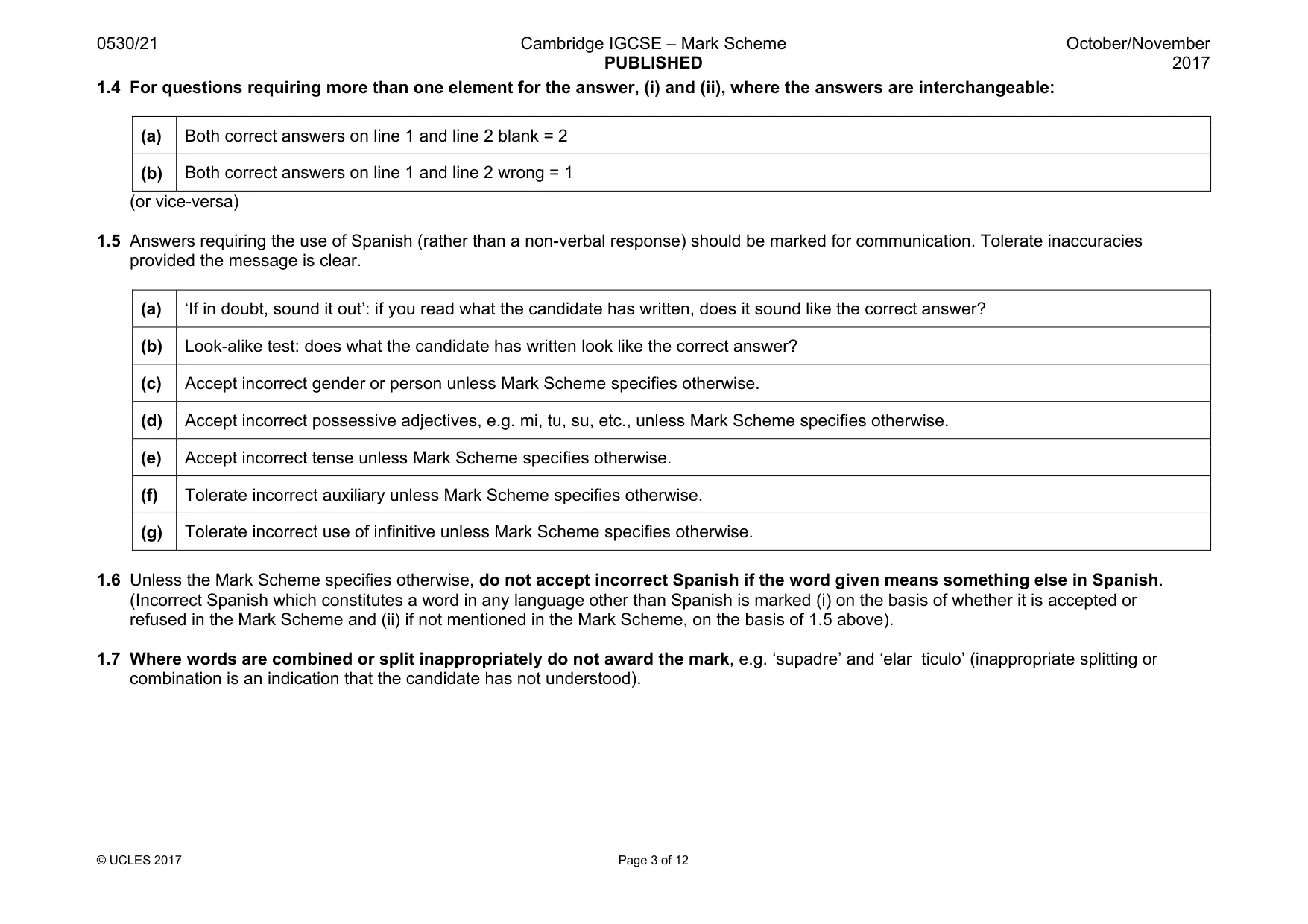
0530/21 Cambridge IGCSE – Mark Scheme PUBLISHED October/November 2017 © UCLES 2017 Page 3 of 12 1.4 For questions requiring more than one element for the answer, (i) and (ii), where the answers are interchangeable: (a) Both correct answers on line 1 and line 2 blank = 2 (b) Both correct answers on line 1 and line 2 wrong = 1 (or vice-versa) 1.5 Answers requiring the use of Spanish (rather than a non-verbal response) should be marked for communication. Tolerate inaccuracies provided the message is clear. (a) ‘If in doubt, sound it out’: if you read what the candidate has written, does it sound like the correct answer? (b) Look-alike test: does what the candidate has written look like the correct answer? (c) Accept incorrect gender or person unless Mark Scheme specifies otherwise. (d) Accept incorrect possessive adjectives, e.g. mi, tu, su, etc., unless Mark Scheme specifies otherwise. (e) Accept incorrect tense unless Mark Scheme specifies otherwise. (f) Tolerate incorrect auxiliary unless Mark Scheme specifies otherwise. (g) Tolerate incorrect use of infinitive unless Mark Scheme specifies otherwise. 1.6 Unless the Mark Scheme specifies otherwise, do not accept incorrect Spanish if the word given means something else in Spanish. (Incorrect Spanish which constitutes a word in any language other than Spanish is marked (i) on the basis of whether it is accepted or refused in the Mark Scheme and (ii) if not mentioned in the Mark Scheme, on the basis of 1.5 above). 1.7 Where words are combined or split inappropriately do not award the mark, e.g. ‘supadre’ and ‘elar ticulo’ (inappropriate splitting or combination is an indication that the candidate has not understood).
Mark scheme, page 4
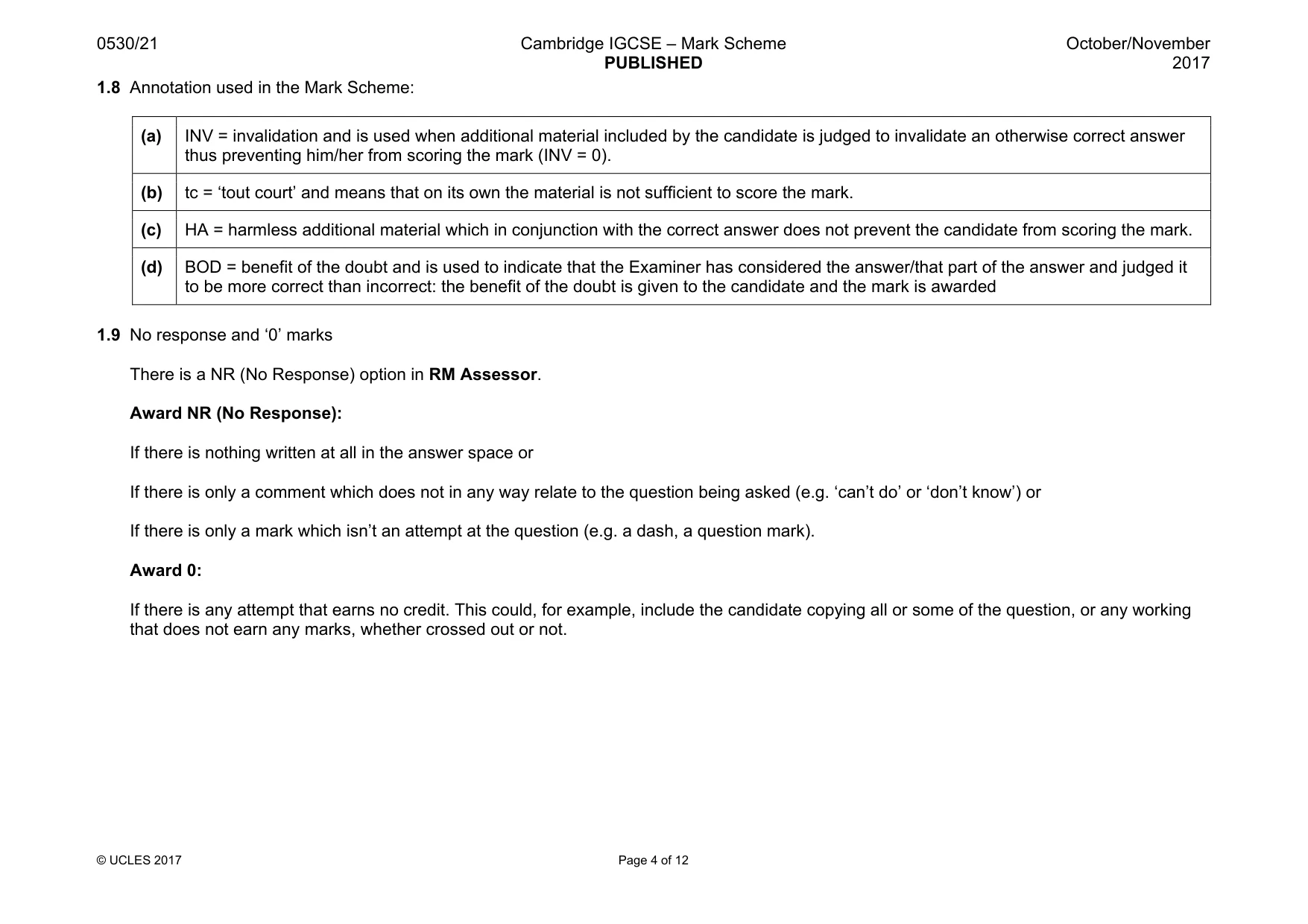
0530/21 Cambridge IGCSE – Mark Scheme PUBLISHED October/November 2017 © UCLES 2017 Page 4 of 12 1.8 Annotation used in the Mark Scheme: (a) INV = invalidation and is used when additional material included by the candidate is judged to invalidate an otherwise correct answer thus preventing him/her from scoring the mark (INV = 0). (b) tc = ‘tout court’ and means that on its own the material is not sufficient to score the mark. (c) HA = harmless additional material which in conjunction with the correct answer does not prevent the candidate from scoring the mark. (d) BOD = benefit of the doubt and is used to indicate that the Examiner has considered the answer/that part of the answer and judged it to be more correct than incorrect: the benefit of the doubt is given to the candidate and the mark is awarded 1.9 No response and ‘0’ marks There is a NR (No Response) option in RM Assessor. Award NR (No Response): If there is nothing written at all in the answer space or If there is only a comment which does not in any way relate to the question being asked (e.g. ‘can’t do’ or ‘don’t know’) or If there is only a mark which isn’t an attempt at the question (e.g. a dash, a question mark). Award 0: If there is any attempt that earns no credit. This could, for example, include the candidate copying all or some of the question, or any working that does not earn any marks, whether crossed out or not.
Mark scheme, page 5
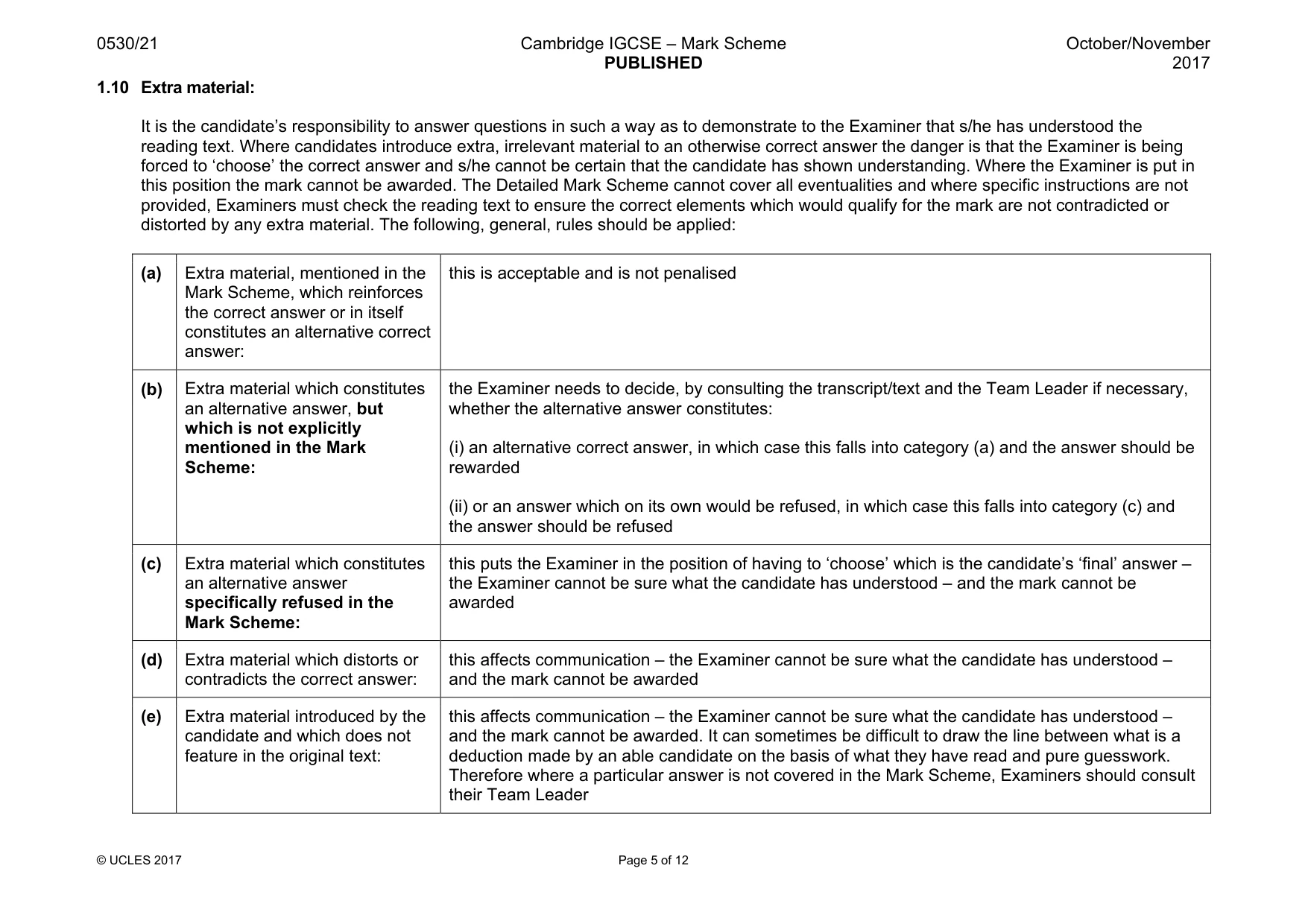
0530/21 Cambridge IGCSE – Mark Scheme PUBLISHED October/November 2017 © UCLES 2017 Page 5 of 12 1.10 Extra material: It is the candidate’s responsibility to answer questions in such a way as to demonstrate to the Examiner that s/he has understood the reading text. Where candidates introduce extra, irrelevant material to an otherwise correct answer the danger is that the Examiner is being forced to ‘choose’ the correct answer and s/he cannot be certain that the candidate has shown understanding. Where the Examiner is put in this position the mark cannot be awarded. The Detailed Mark Scheme cannot cover all eventualities and where specific instructions are not provided, Examiners must check the reading text to ensure the correct elements which would qualify for the mark are not contradicted or distorted by any extra material. The following, general, rules should be applied: (a) Extra material, mentioned in the Mark Scheme, which reinforces the correct answer or in itself constitutes an alternative correct answer: this is acceptable and is not penalised (b) Extra material which constitutes an alternative answer, but which is not explicitly mentioned in the Mark Scheme: the Examiner needs to decide, by consulting the transcript/text and the Team Leader if necessary, whether the alternative answer constitutes: (i) an alternative correct answer, in which case this falls into category (a) and the answer should be rewarded (ii) or an answer which on its own would be refused, in which case this falls into category (c) and the answer should be refused (c) Extra material which constitutes an alternative answer specifically refused in the Mark Scheme: this puts the Examiner in the position of having to ‘choose’ which is the candidate’s ‘final’ answer – the Examiner cannot be sure what the candidate has understood – and the mark cannot be awarded (d) Extra material which distorts or contradicts the correct answer: this affects communication – the Examiner cannot be sure what the candidate has understood – and the mark cannot be awarded (e) Extra material introduced by the candidate and which does not feature in the original text: this affects communication – the Examiner cannot be sure what the candidate has understood – and the mark cannot be awarded. It can sometimes be difficult to draw the line between what is a deduction made by an able candidate on the basis of what they have read and pure guesswork. Therefore where a particular answer is not covered in the Mark Scheme, Examiners should consult their Team Leader
Mark scheme, page 6
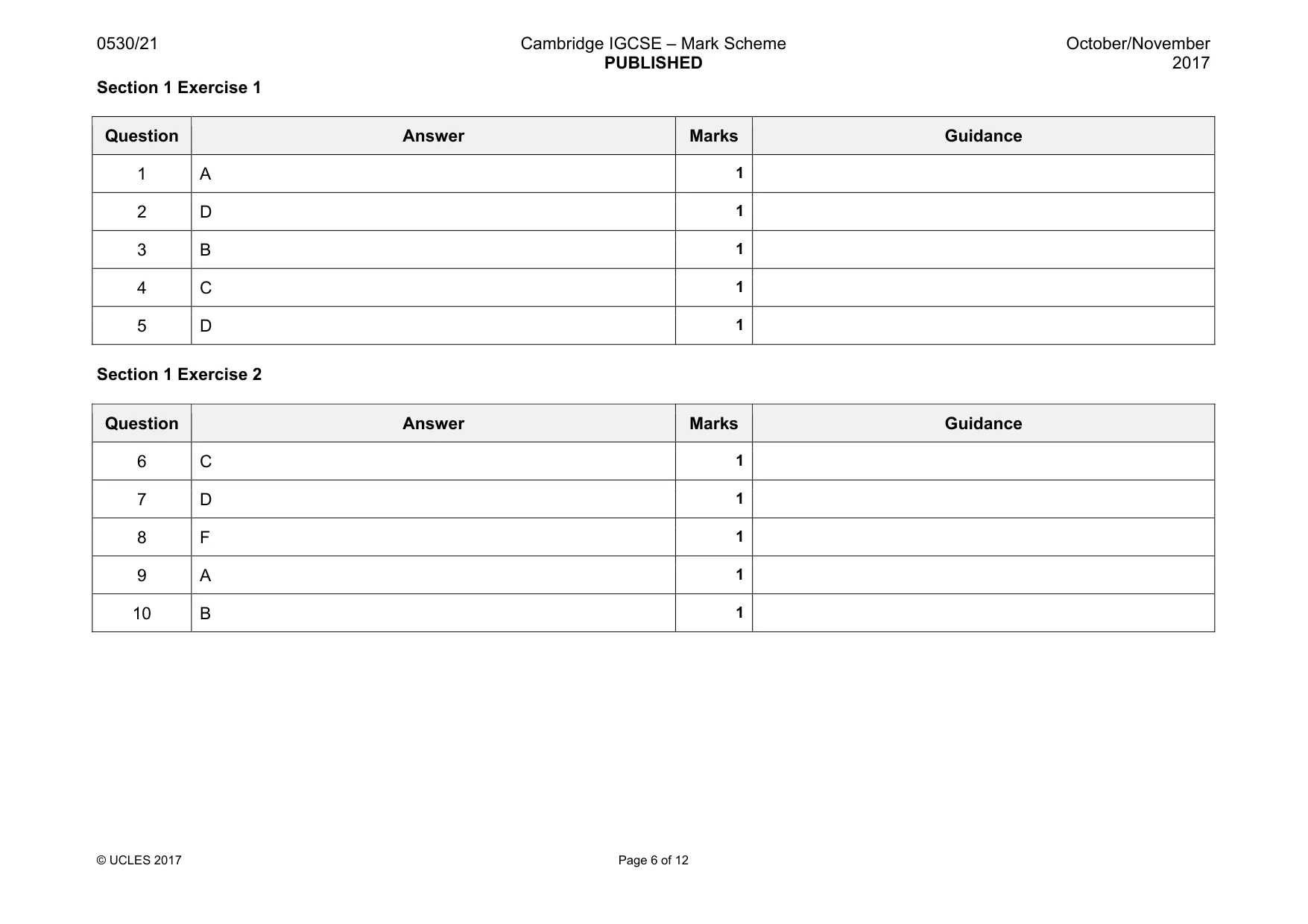
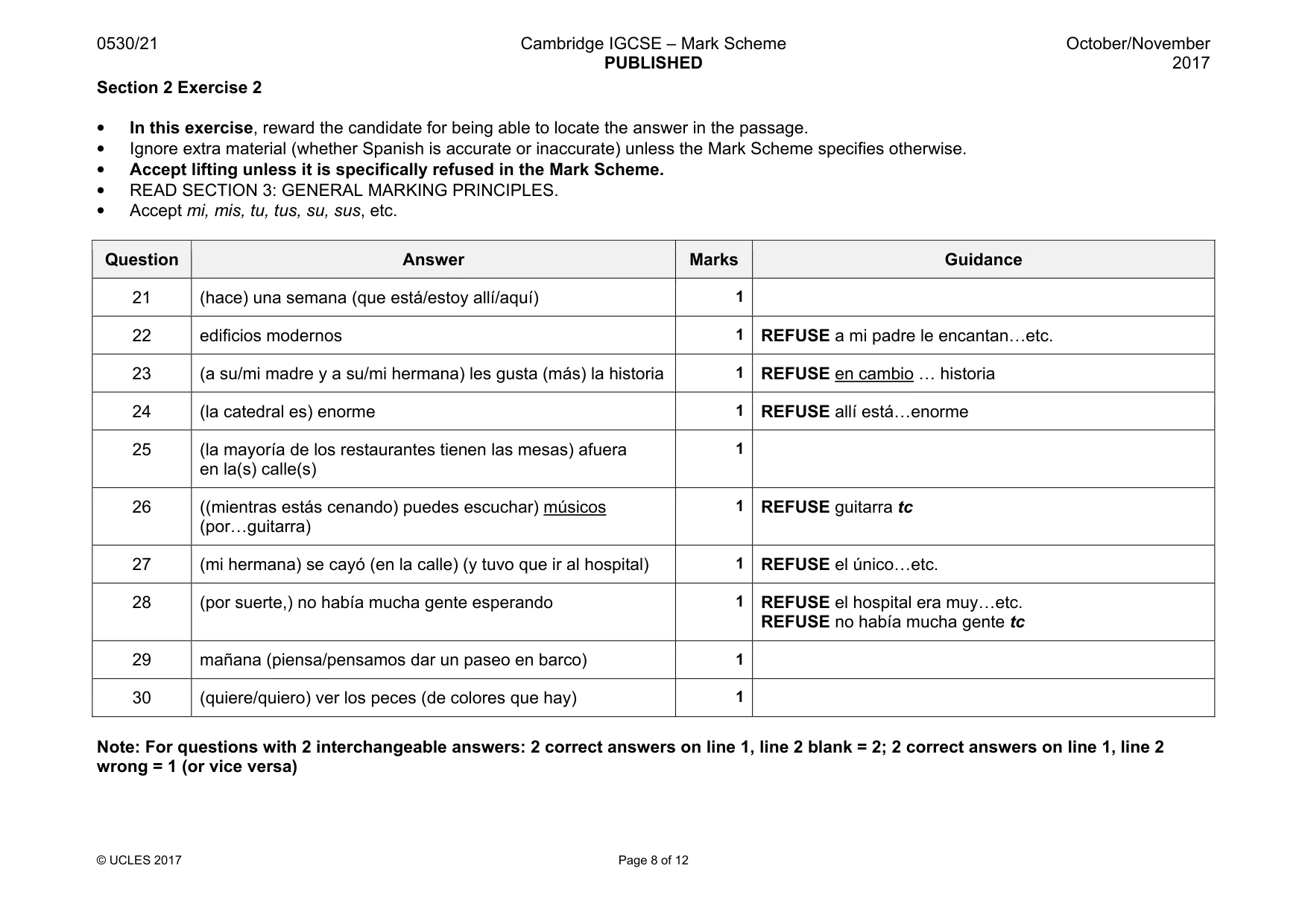
0530/21 Cambridge IGCSE – Mark Scheme PUBLISHED October/November 2017 © UCLES 2017 Page 6 of 12 Section 1 Exercise 1 Question Answer Marks Guidance 1 A 1 2 D 1 3 B 1 4 C 1 5 D 1 Section 1 Exercise 2 Question Answer Marks Guidance 6 C 1 7 D 1 8 F 1 9 A 1 10 B 1
Mark scheme, page 7
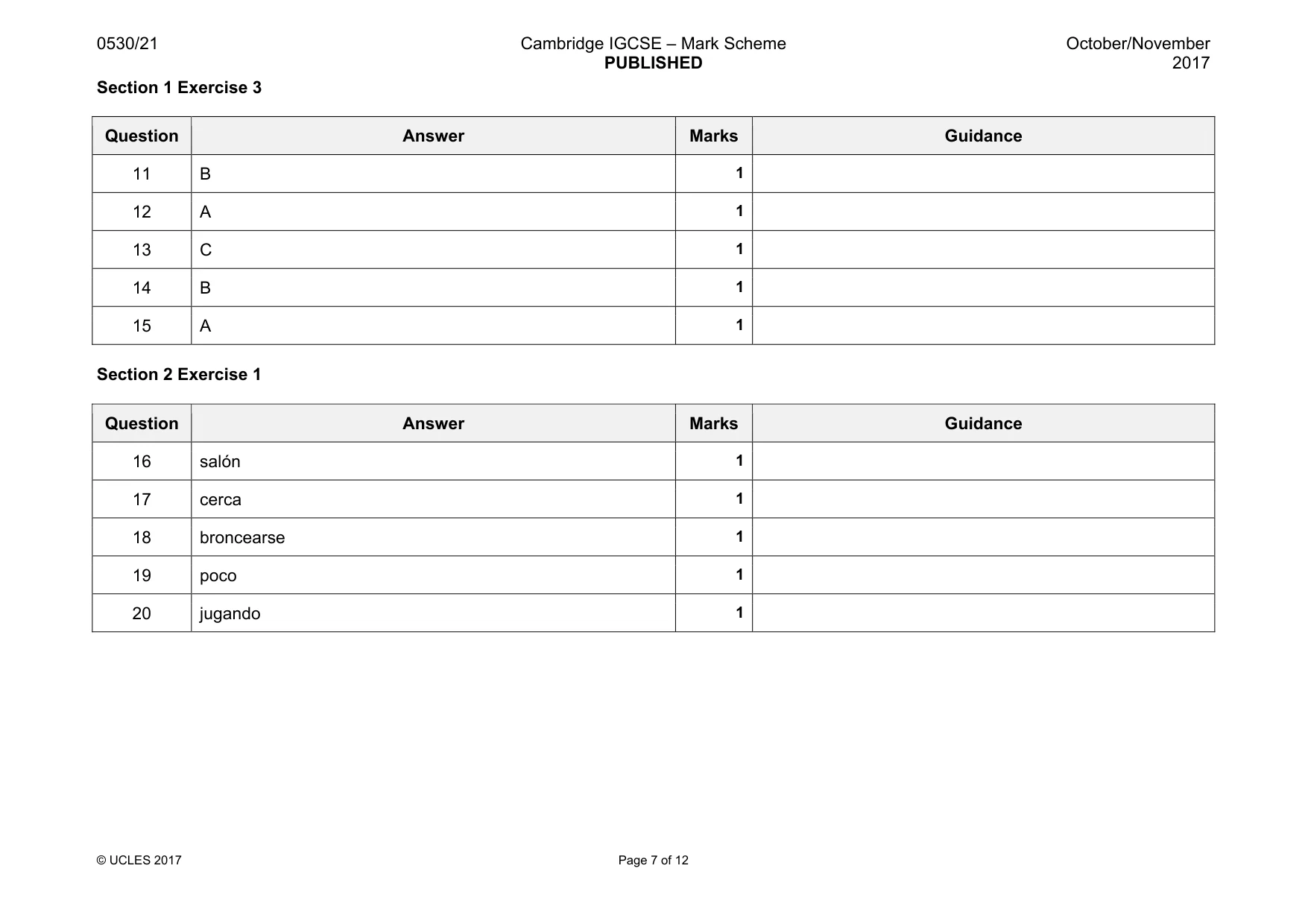
0530/21 Cambridge IGCSE – Mark Scheme PUBLISHED October/November 2017 © UCLES 2017 Page 7 of 12 Section 1 Exercise 3 Question Answer Marks Guidance 11 B 1 12 A 1 13 C 1 14 B 1 15 A 1 Section 2 Exercise 1 Question Answer Marks Guidance 16 salón 1 17 cerca 1 18 broncearse 1 19 poco 1 20 jugando 1
Mark scheme, page 8
0530/21 Cambridge IGCSE – Mark Scheme PUBLISHED October/November 2017 © UCLES 2017 Page 8 of 12 Section 2 Exercise 2 • In this exercise, reward the candidate for being able to locate the answer in the passage. • Ignore extra material (whether Spanish is accurate or inaccurate) unless the Mark Scheme specifies otherwise. • Accept lifting unless it is specifically refused in the Mark Scheme. • READ SECTION 3: GENERAL MARKING PRINCIPLES. • Accept mi, mis, tu, tus, su, sus, etc. Question Answer Marks Guidance 21 (hace) una semana (que está/estoy allí/aquí) 1 22 edificios modernos 1 REFUSE a mi padre le encantan«etc. 23 (a su/mi madre y a su/mi hermana) les gusta (más) la historia 1 REFUSE en cambio « historia 24 (la catedral es) enorme 1 REFUSE allí está«enorme 25 (la mayoría de los restaurantes tienen las mesas) afuera en la(s) calle(s) 1 26 ((mientras estás cenando) puedes escuchar) músicos (por«guitarra) 1 REFUSE guitarra tc 27 (mi hermana) se cayó (en la calle) (y tuvo que ir al hospital) 1 REFUSE el único«etc. 28 (por suerte,) no había mucha gente esperando 1 REFUSE el hospital era muy«etc. REFUSE no había mucha gente tc 29 mañana (piensa/pensamos dar un paseo en barco) 1 30 (quiere/quiero) ver los peces (de colores que hay) 1 Note: For questions with 2 interchangeable answers: 2 correct answers on line 1, line 2 blank = 2; 2 correct answers on line 1, line 2 wrong = 1 (or vice versa)
Mark scheme, page 9
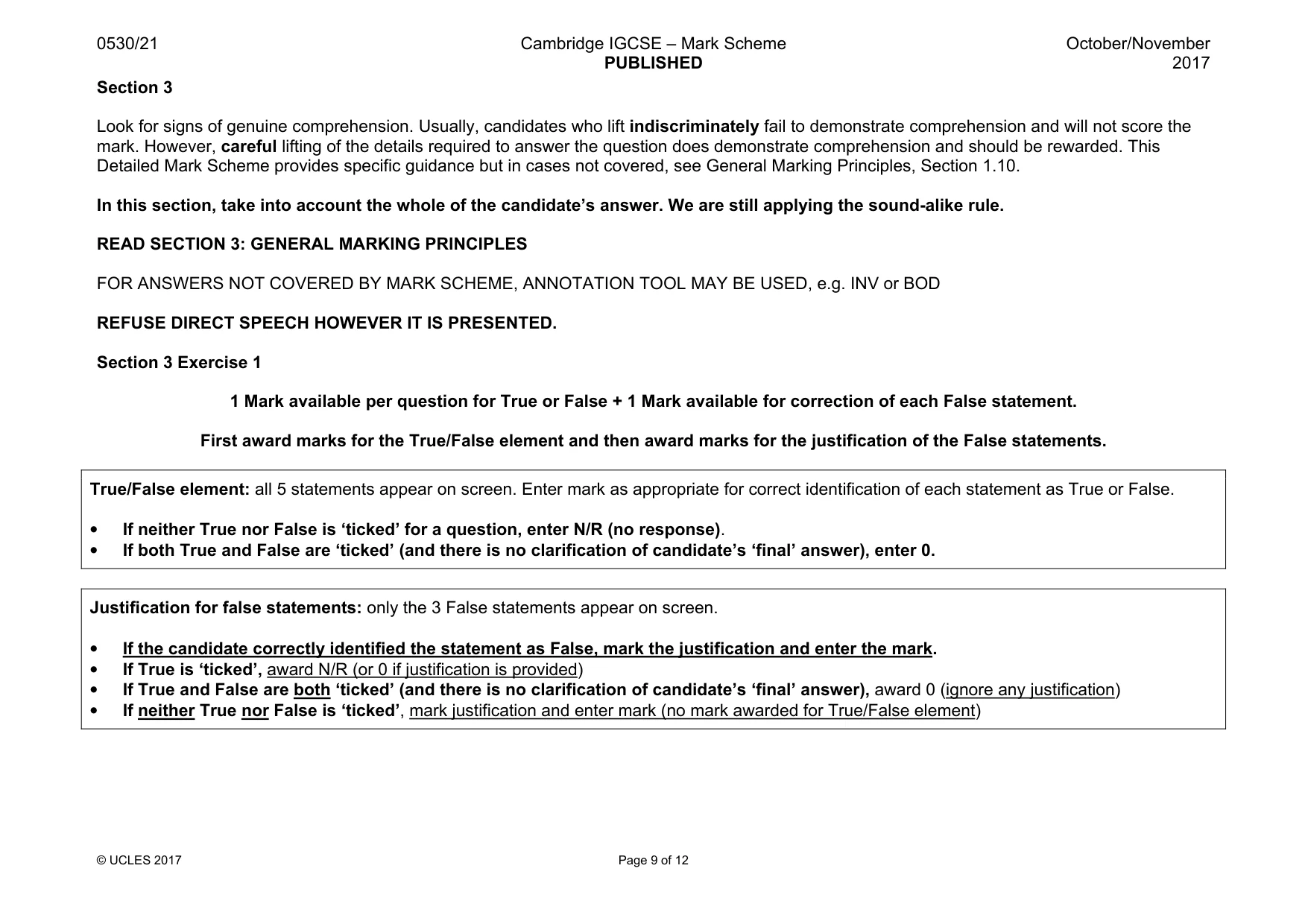
0530/21 Cambridge IGCSE – Mark Scheme PUBLISHED October/November 2017 © UCLES 2017 Page 9 of 12 Section 3 Look for signs of genuine comprehension. Usually, candidates who lift indiscriminately fail to demonstrate comprehension and will not score the mark. However, careful lifting of the details required to answer the question does demonstrate comprehension and should be rewarded. This Detailed Mark Scheme provides specific guidance but in cases not covered, see General Marking Principles, Section 1.10. In this section, take into account the whole of the candidate’s answer. We are still applying the sound-alike rule. READ SECTION 3: GENERAL MARKING PRINCIPLES FOR ANSWERS NOT COVERED BY MARK SCHEME, ANNOTATION TOOL MAY BE USED, e.g. INV or BOD REFUSE DIRECT SPEECH HOWEVER IT IS PRESENTED. Section 3 Exercise 1 1 Mark available per question for True or False + 1 Mark available for correction of each False statement. First award marks for the True/False element and then award marks for the justification of the False statements. True/False element: all 5 statements appear on screen. Enter mark as appropriate for correct identification of each statement as True or False. • If neither True nor False is ‘ticked’ for a question, enter N/R (no response). • If both True and False are ‘ticked’ (and there is no clarification of candidate’s ‘final’ answer), enter 0. Justification for false statements: only the 3 False statements appear on screen. • If the candidate correctly identified the statement as False, mark the justification and enter the mark. • If True is ‘ticked’, award N/R (or 0 if justification is provided) • If True and False are both ‘ticked’ (and there is no clarification of candidate’s ‘final’ answer), award 0 (ignore any justification) • If neither True nor False is ‘ticked’, mark justification and enter mark (no mark awarded for True/False element)
Mark scheme, page 10
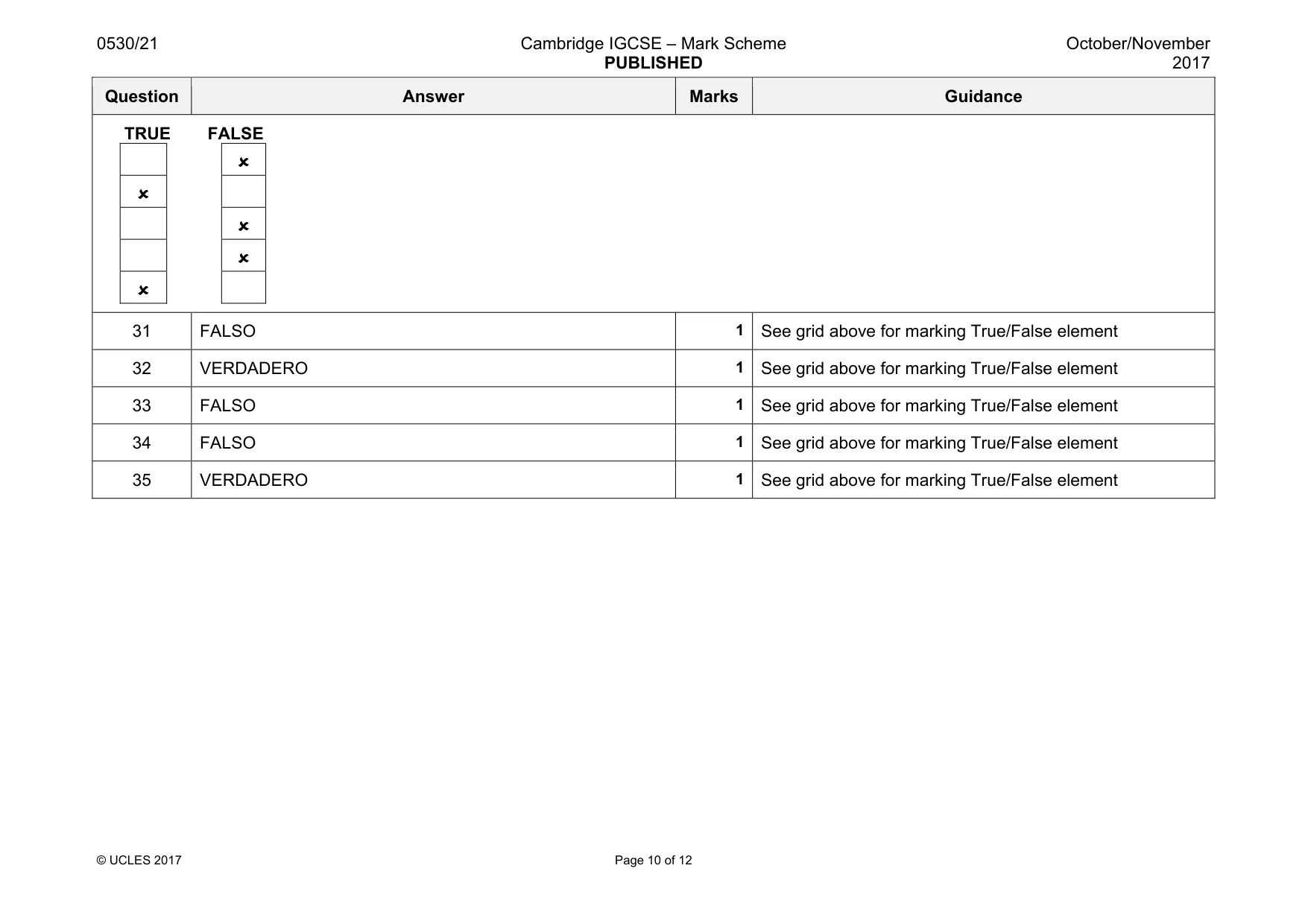
0530/21 Cambridge IGCSE – Mark Scheme PUBLISHED October/November 2017 © UCLES 2017 Page 10 of 12 Question Answer Marks Guidance TRUE FALSE 8 8 8 8 8 31 FALSO 1 See grid above for marking True/False element 32 VERDADERO 1 See grid above for marking True/False element 33 FALSO 1 See grid above for marking True/False element 34 FALSO 1 See grid above for marking True/False element 35 VERDADERO 1 See grid above for marking True/False element
Mark scheme, page 11
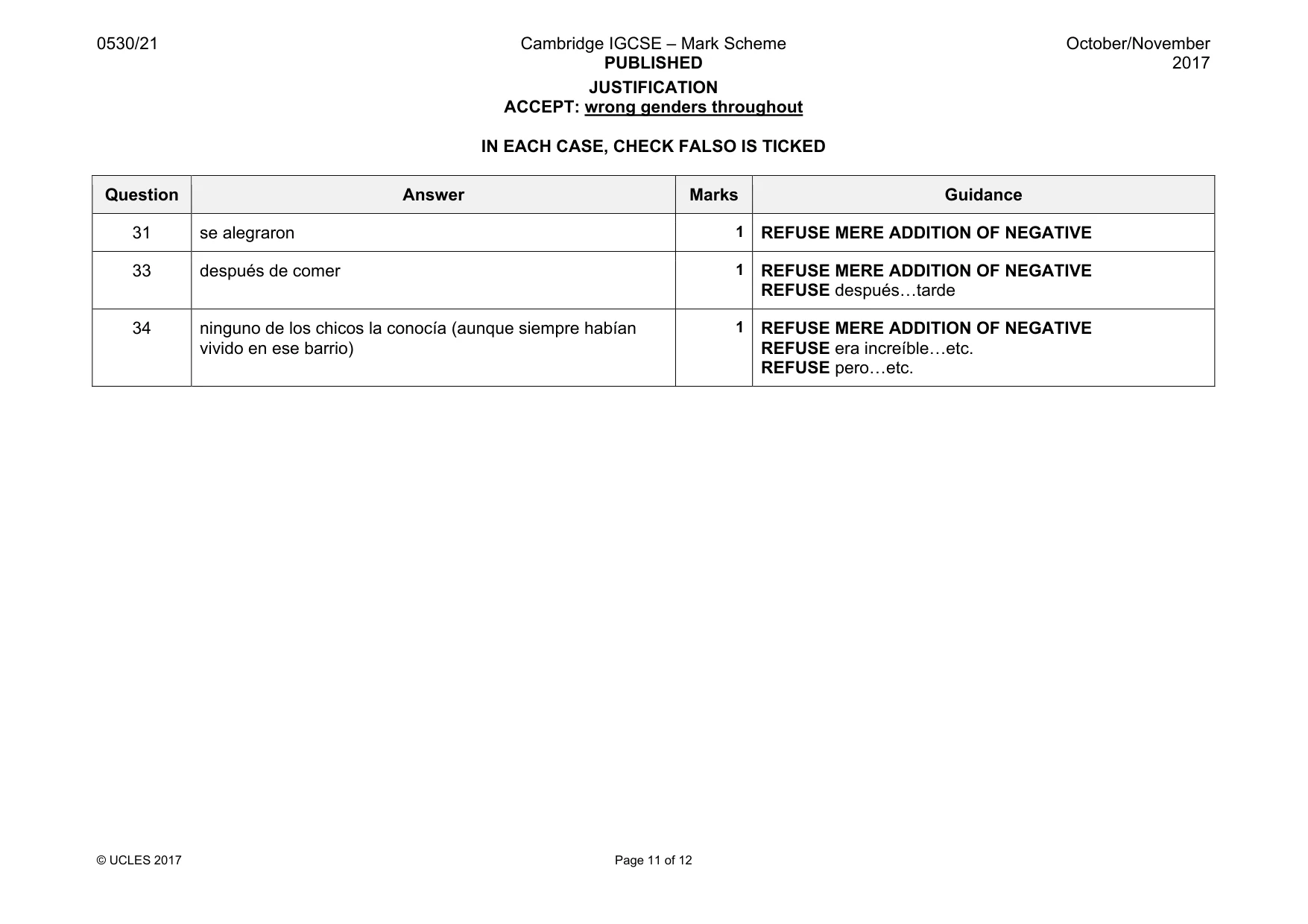
0530/21 Cambridge IGCSE – Mark Scheme PUBLISHED October/November 2017 © UCLES 2017 Page 11 of 12 JUSTIFICATION ACCEPT: wrong genders throughout IN EACH CASE, CHECK FALSO IS TICKED Question Answer Marks Guidance 31 se alegraron 1 REFUSE MERE ADDITION OF NEGATIVE 33 después de comer 1 REFUSE MERE ADDITION OF NEGATIVE REFUSE después«tarde 34 ninguno de los chicos la conocía (aunque siempre habían vivido en ese barrio) 1 REFUSE MERE ADDITION OF NEGATIVE REFUSE era increíble«etc. REFUSE pero«etc.
Mark scheme, page 12
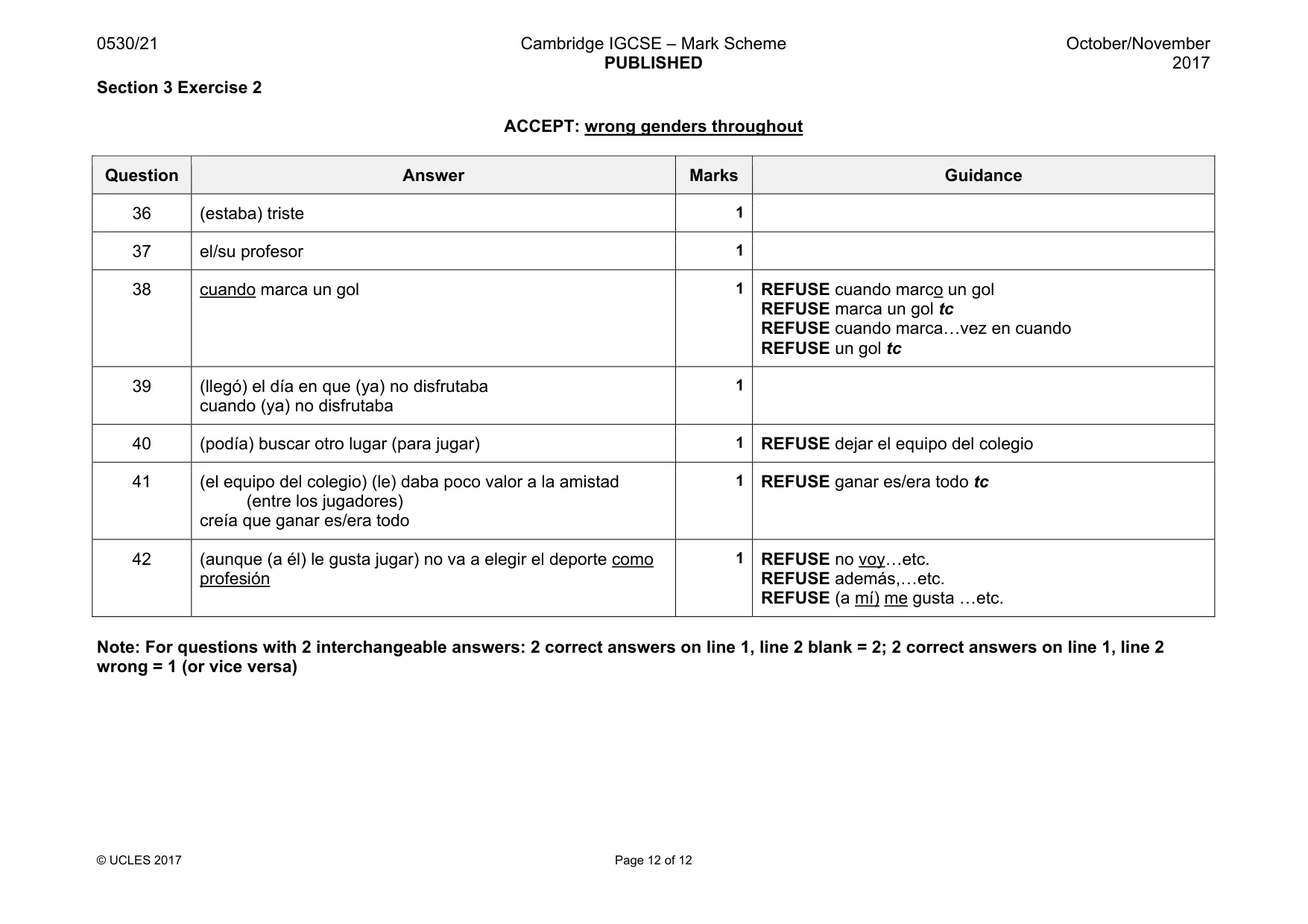
0530/21 Cambridge IGCSE – Mark Scheme PUBLISHED October/November 2017 © UCLES 2017 Page 12 of 12 Section 3 Exercise 2 ACCEPT: wrong genders throughout Question Answer Marks Guidance 36 (estaba) triste 1 37 el/su profesor 1 38 cuando marca un gol 1 REFUSE cuando marco un gol REFUSE marca un gol tc REFUSE cuando marca«vez en cuando REFUSE un gol tc 39 (llegó) el día en que (ya) no disfrutaba cuando (ya) no disfrutaba 1 40 (podía) buscar otro lugar (para jugar) 1 REFUSE dejar el equipo del colegio 41 (el equipo del colegio) (le) daba poco valor a la amistad (entre los jugadores) creía que ganar es/era todo 1 REFUSE ganar es/era todo tc 42 (aunque (a él) le gusta jugar) no va a elegir el deporte como profesión 1 REFUSE no voy«etc. REFUSE además,«etc. REFUSE (a mí) me gusta «etc. Note: For questions with 2 interchangeable answers: 2 correct answers on line 1, line 2 blank = 2; 2 correct answers on line 1, line 2 wrong = 1 (or vice versa)
What you needed in this session
Cambridge’s own grade thresholds for 2017 Oct/Nov, Paper 2 · Variant 1. A higher threshold means an easier paper — the bar moves with how the cohort did.