Cambridge IGCSE Sociology 0495 — 2021 May/June Paper 1 · Variant 2
0495/12/M/J/21 · 80 marks · ≈90 min
The question paper and its mark scheme, free to read here and free to download. This is Cambridge’s own paper, exactly as it was sat.
Question paper4 pages

Mark scheme22 pages
Answers below. Sit the paper first if you are practising.


Paper as text
Question paper, page 1
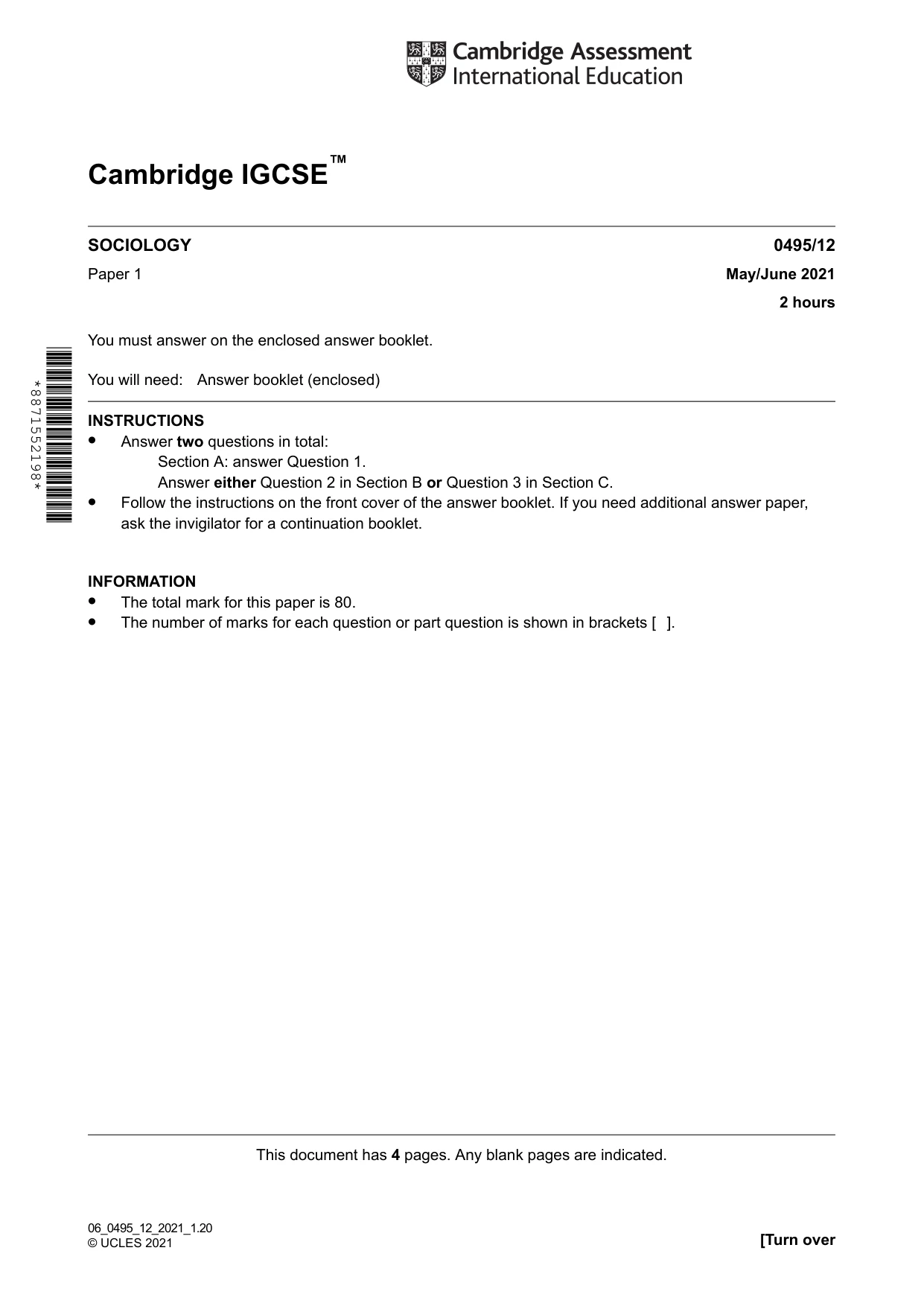
Cambridge IGCSE™ 0495/12 May/June 2021 2 hours SOCIOLOGY Paper 1 You must answer on the enclosed answer booklet. You will need: Answer booklet (enclosed) INSTRUCTIONS • Answer two questions in total: Section A: answer Question 1. Answer either Question 2 in Section B or Question 3 in Section C. • Follow the instructions on the front cover of the answer booklet. If you need additional answer paper, ask the invigilator for a continuation booklet. INFORMATION • The total mark for this paper is 80. • The number of marks for each question or part question is shown in brackets [ ]. This document has 4 pages. Any blank pages are indicated. [Turn over 06_0495_12_2021_1.20 © UCLES 2021 *8871552198*
Question paper, page 2
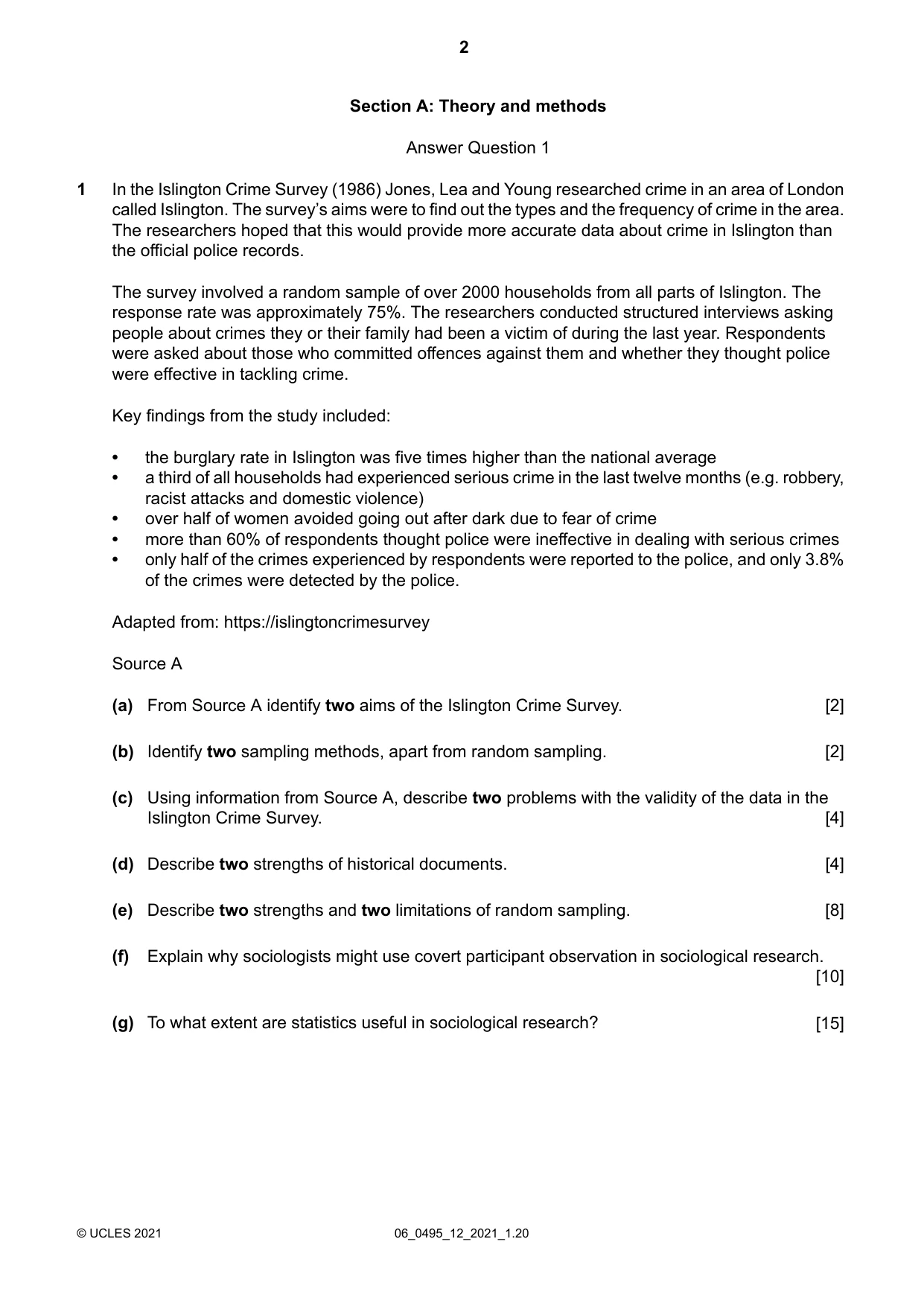
Section A: Theory and methods Answer Question 1 In the Islington Crime Survey (1986) Jones, Lea and Young researched crime in an area of London called Islington. The survey’s aims were to find out the types and the frequency of crime in the area. 1 The researchers hoped that this would provide more accurate data about crime in Islington than the official police records. The survey involved a random sample of over 2000 households from all parts of Islington. The response rate was approximately 75%. The researchers conducted structured interviews asking people about crimes they or their family had been a victim of during the last year. Respondents were asked about those who committed offences against them and whether they thought police were effective in tackling crime. Key findings from the study included: • the burglary rate in Islington was five times higher than the national average • a third of all households had experienced serious crime in the last twelve months (e.g. robbery, racist attacks and domestic violence) • over half of women avoided going out after dark due to fear of crime • more than 60% of respondents thought police were ineffective in dealing with serious crimes • only half of the crimes experienced by respondents were reported to the police, and only 3.8% of the crimes were detected by the police. Adapted from: https://islingtoncrimesurvey Source A From Source A identify two aims of the Islington Crime Survey. [2] (a) Identify two sampling methods, apart from random sampling. [2] (b) Using information from Source A, describe two problems with the validity of the data in the Islington Crime Survey. [4] (c) Describe two strengths of historical documents. [4] (d) Describe two strengths and two limitations of random sampling. [8] (e) Explain why sociologists might use covert participant observation in sociological research. [10] (f) To what extent are statistics useful in sociological research? [15] (g) 06_0495_12_2021_1.20 © UCLES 2021 2
Question paper, page 3
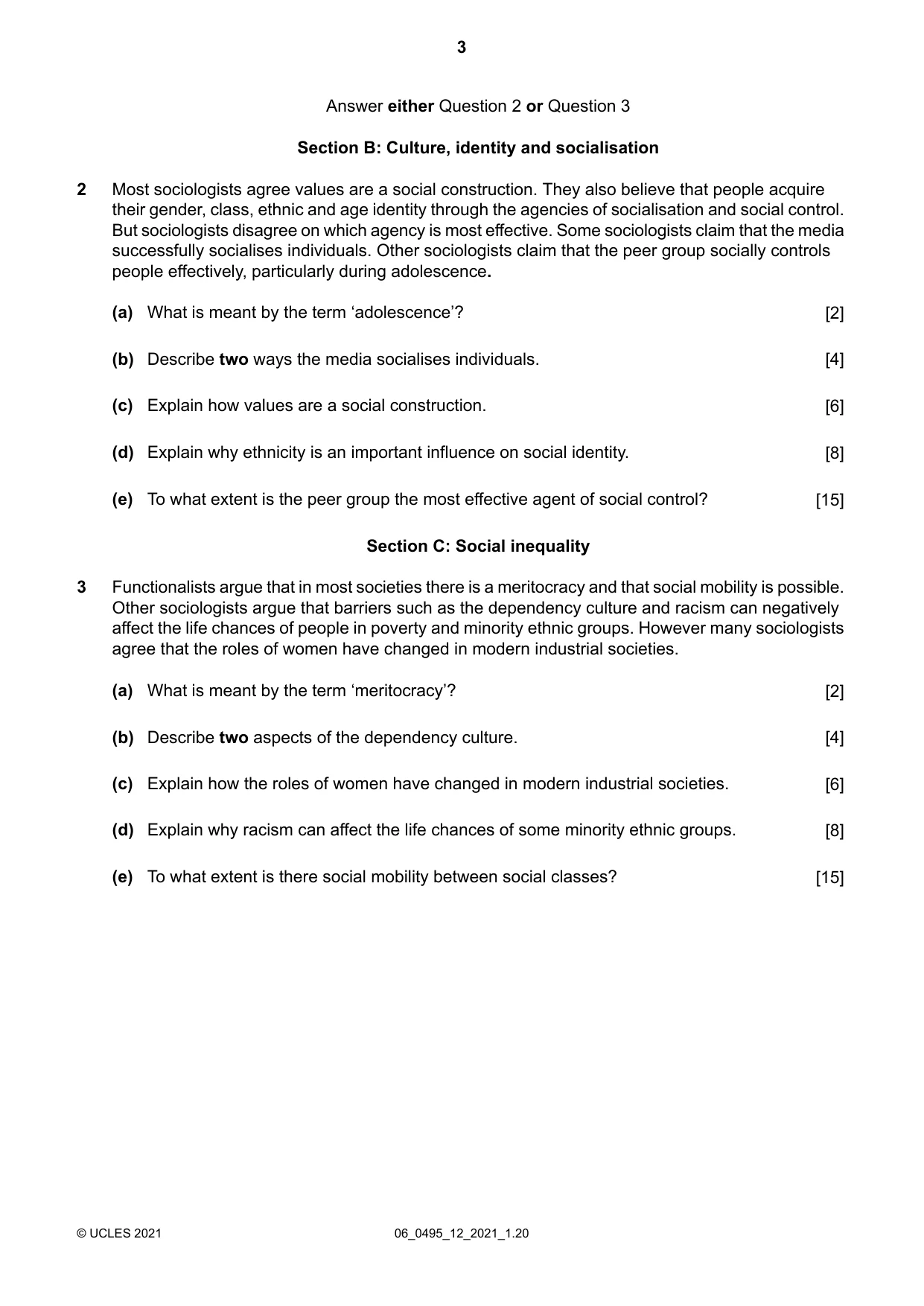
Answer either Question 2 or Question 3 Section B: Culture, identity and socialisation Most sociologists agree values are a social construction. They also believe that people acquire their gender, class, ethnic and age identity through the agencies of socialisation and social control. 2 But sociologists disagree on which agency is most effective. Some sociologists claim that the media successfully socialises individuals. Other sociologists claim that the peer group socially controls people effectively, particularly during adolescence. What is meant by the term ‘adolescence’? [2] (a) Describe two ways the media socialises individuals. [4] (b) Explain how values are a social construction. [6] (c) Explain why ethnicity is an important influence on social identity. [8] (d) To what extent is the peer group the most effective agent of social control? [15] (e) Section C: Social inequality Functionalists argue that in most societies there is a meritocracy and that social mobility is possible. Other sociologists argue that barriers such as the dependency culture and racism can negatively 3 affect the life chances of people in poverty and minority ethnic groups. However many sociologists agree that the roles of women have changed in modern industrial societies. What is meant by the term ‘meritocracy’? [2] (a) Describe two aspects of the dependency culture. [4] (b) Explain how the roles of women have changed in modern industrial societies. [6] (c) Explain why racism can affect the life chances of some minority ethnic groups. [8] (d) To what extent is there social mobility between social classes? [15] (e) 06_0495_12_2021_1.20 © UCLES 2021 3
Question paper, page 4
BLANK PAGE Permission to reproduce items where third-party owned material protected by copyright is included has been sought and cleared where possible. Every reasonable effort has been made by the publisher (UCLES) to trace copyright holders, but if any items requiring clearance have unwittingly been included, the publisher will be pleased to make amends at the earliest possible opportunity. To avoid the issue of disclosure of answer-related information to candidates, all copyright acknowledgements are reproduced online in the Cambridge Assessment International Education Copyright Acknowledgements Booklet. This is produced for each series of examinations and is freely available to download at www.cambridgeinternational.org after the live examination series. Cambridge Assessment International Education is part of the Cambridge Assessment Group. Cambridge Assessment is the brand name of the University of Cambridge Local Examinations Syndicate (UCLES), which itself is a department of the University of Cambridge. 06_0495_12_2021_1.20 © UCLES 2021 4
Mark scheme, page 1
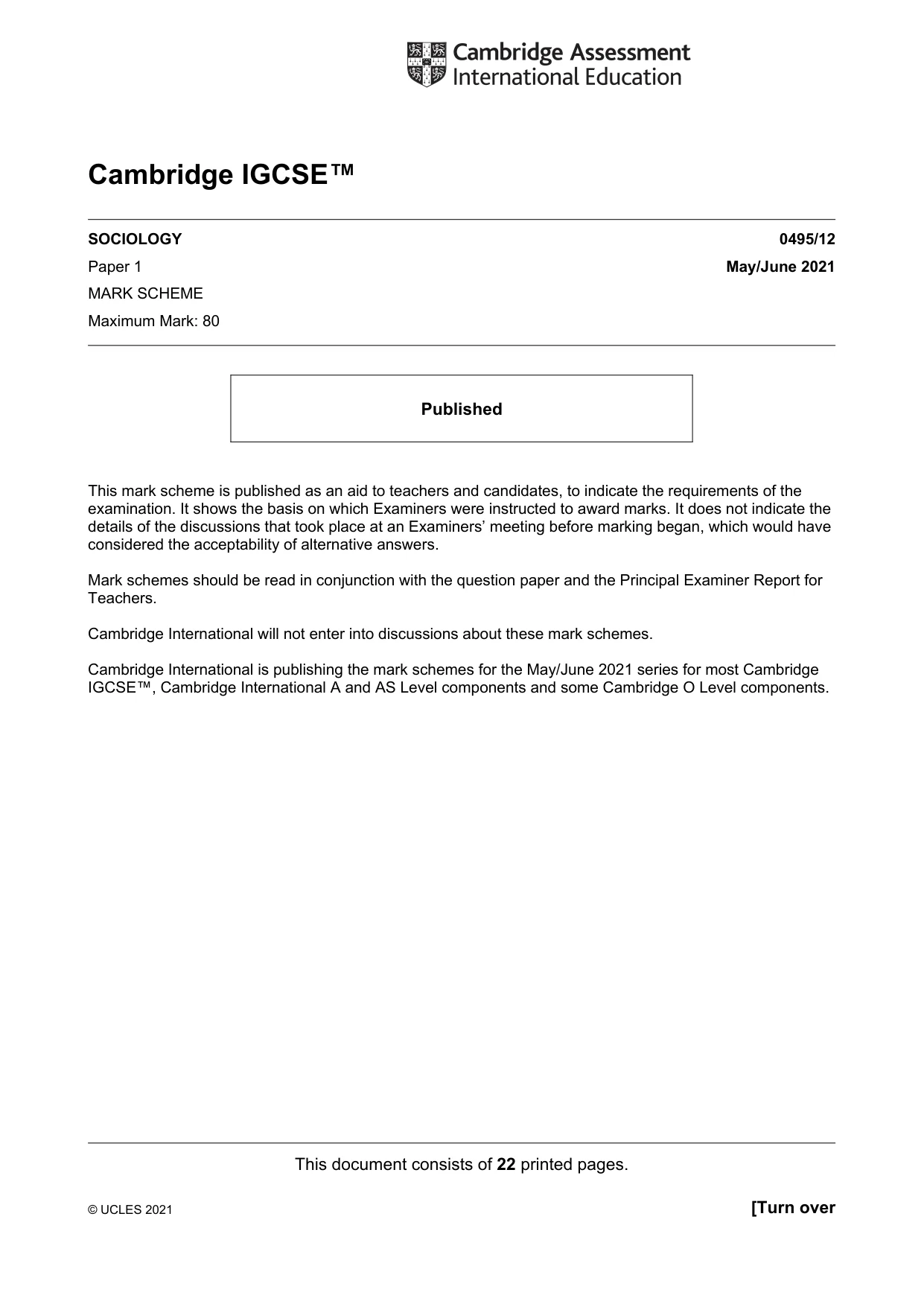
This document consists of 22 printed pages. © UCLES 2021 [Turn over Cambridge IGCSE™ SOCIOLOGY 0495/12 Paper 1 May/June 2021 MARK SCHEME Maximum Mark: 80 Published This mark scheme is published as an aid to teachers and candidates, to indicate the requirements of the examination. It shows the basis on which Examiners were instructed to award marks. It does not indicate the details of the discussions that took place at an Examiners’ meeting before marking began, which would have considered the acceptability of alternative answers. Mark schemes should be read in conjunction with the question paper and the Principal Examiner Report for Teachers. Cambridge International will not enter into discussions about these mark schemes. Cambridge International is publishing the mark schemes for the May/June 2021 series for most Cambridge IGCSE™, Cambridge International A and AS Level components and some Cambridge O Level components.
Mark scheme, page 2
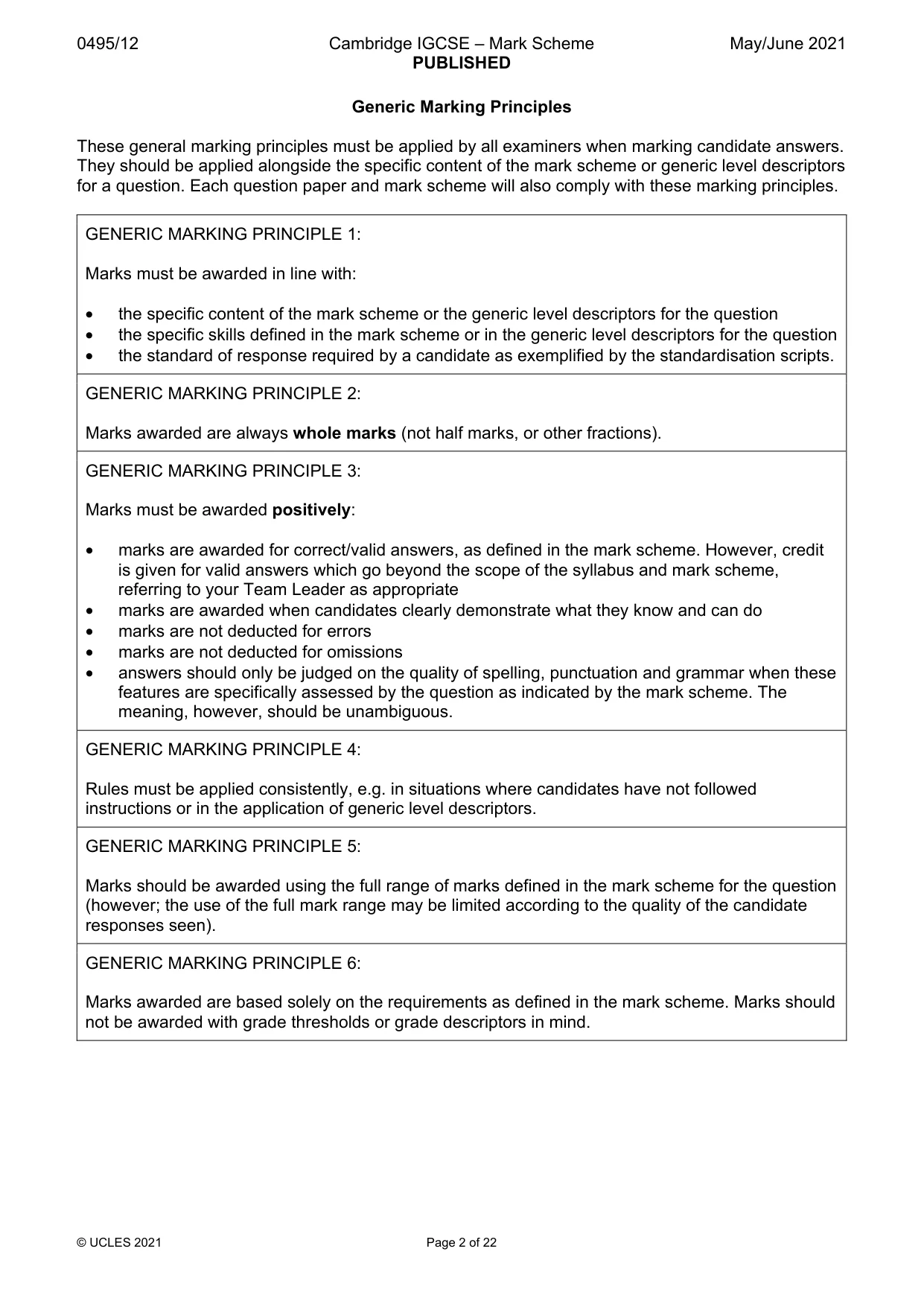
0495/12 Cambridge IGCSE – Mark Scheme PUBLISHED May/June 2021 © UCLES 2021 Page 2 of 22 Generic Marking Principles These general marking principles must be applied by all examiners when marking candidate answers. They should be applied alongside the specific content of the mark scheme or generic level descriptors for a question. Each question paper and mark scheme will also comply with these marking principles. GENERIC MARKING PRINCIPLE 1: Marks must be awarded in line with: • the specific content of the mark scheme or the generic level descriptors for the question • the specific skills defined in the mark scheme or in the generic level descriptors for the question • the standard of response required by a candidate as exemplified by the standardisation scripts. GENERIC MARKING PRINCIPLE 2: Marks awarded are always whole marks (not half marks, or other fractions). GENERIC MARKING PRINCIPLE 3: Marks must be awarded positively: • marks are awarded for correct/valid answers, as defined in the mark scheme. However, credit is given for valid answers which go beyond the scope of the syllabus and mark scheme, referring to your Team Leader as appropriate • marks are awarded when candidates clearly demonstrate what they know and can do • marks are not deducted for errors • marks are not deducted for omissions • answers should only be judged on the quality of spelling, punctuation and grammar when these features are specifically assessed by the question as indicated by the mark scheme. The meaning, however, should be unambiguous. GENERIC MARKING PRINCIPLE 4: Rules must be applied consistently, e.g. in situations where candidates have not followed instructions or in the application of generic level descriptors. GENERIC MARKING PRINCIPLE 5: Marks should be awarded using the full range of marks defined in the mark scheme for the question (however; the use of the full mark range may be limited according to the quality of the candidate responses seen). GENERIC MARKING PRINCIPLE 6: Marks awarded are based solely on the requirements as defined in the mark scheme. Marks should not be awarded with grade thresholds or grade descriptors in mind.
Mark scheme, page 3
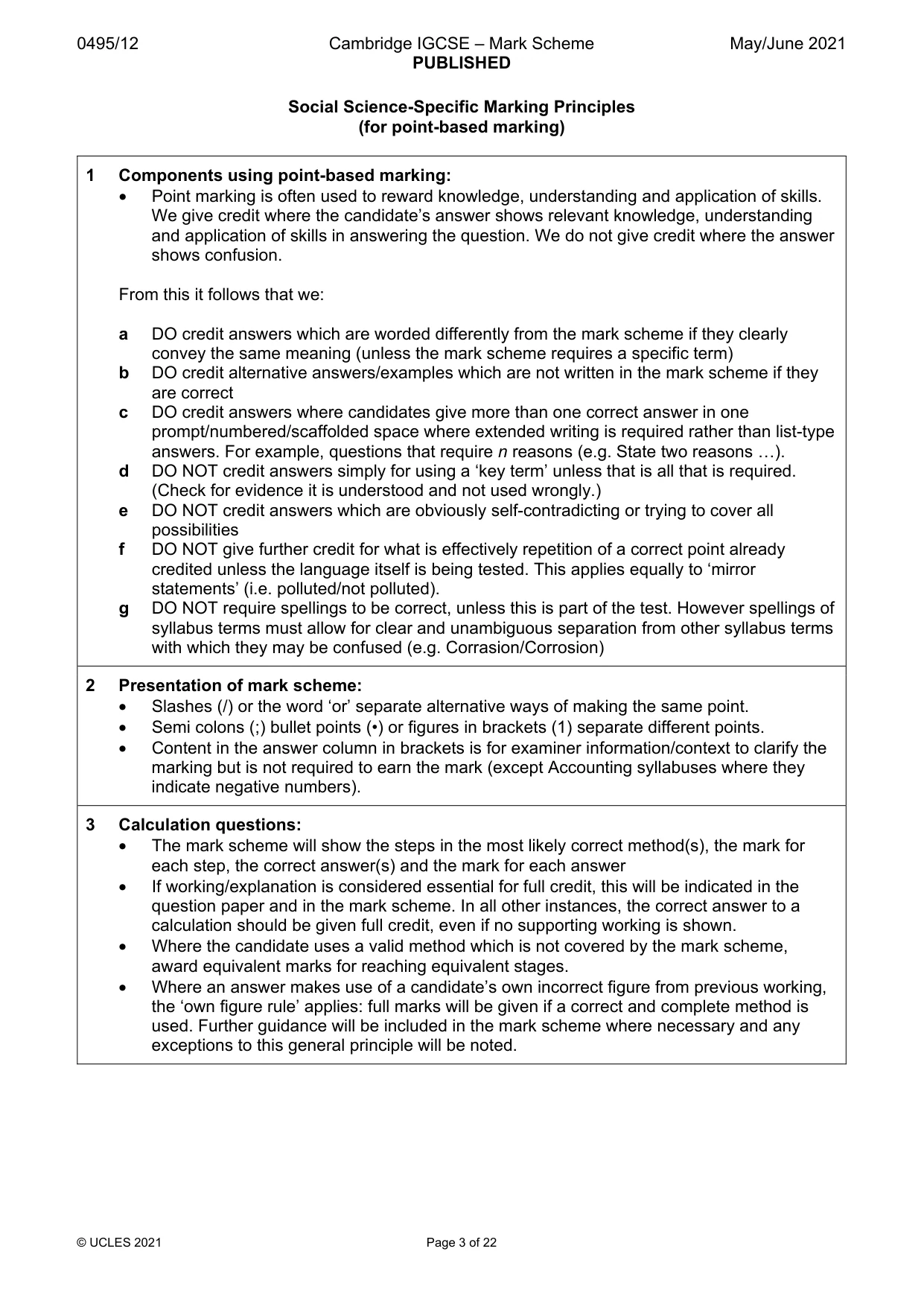
0495/12 Cambridge IGCSE – Mark Scheme PUBLISHED May/June 2021 © UCLES 2021 Page 3 of 22 Social Science-Specific Marking Principles (for point-based marking) 1 Components using point-based marking: • Point marking is often used to reward knowledge, understanding and application of skills. We give credit where the candidate’s answer shows relevant knowledge, understanding and application of skills in answering the question. We do not give credit where the answer shows confusion. From this it follows that we: a DO credit answers which are worded differently from the mark scheme if they clearly convey the same meaning (unless the mark scheme requires a specific term) b DO credit alternative answers/examples which are not written in the mark scheme if they are correct c DO credit answers where candidates give more than one correct answer in one prompt/numbered/scaffolded space where extended writing is required rather than list-type answers. For example, questions that require n reasons (e.g. State two reasons …). d DO NOT credit answers simply for using a ‘key term’ unless that is all that is required. (Check for evidence it is understood and not used wrongly.) e DO NOT credit answers which are obviously self-contradicting or trying to cover all possibilities f DO NOT give further credit for what is effectively repetition of a correct point already credited unless the language itself is being tested. This applies equally to ‘mirror statements’ (i.e. polluted/not polluted). g DO NOT require spellings to be correct, unless this is part of the test. However spellings of syllabus terms must allow for clear and unambiguous separation from other syllabus terms with which they may be confused (e.g. Corrasion/Corrosion) 2 Presentation of mark scheme: • Slashes (/) or the word ‘or’ separate alternative ways of making the same point. • Semi colons (;) bullet points (•) or figures in brackets (1) separate different points. • Content in the answer column in brackets is for examiner information/context to clarify the marking but is not required to earn the mark (except Accounting syllabuses where they indicate negative numbers). 3 Calculation questions: • The mark scheme will show the steps in the most likely correct method(s), the mark for each step, the correct answer(s) and the mark for each answer • If working/explanation is considered essential for full credit, this will be indicated in the question paper and in the mark scheme. In all other instances, the correct answer to a calculation should be given full credit, even if no supporting working is shown. • Where the candidate uses a valid method which is not covered by the mark scheme, award equivalent marks for reaching equivalent stages. • Where an answer makes use of a candidate’s own incorrect figure from previous working, the ‘own figure rule’ applies: full marks will be given if a correct and complete method is used. Further guidance will be included in the mark scheme where necessary and any exceptions to this general principle will be noted.
Mark scheme, page 4
0495/12 Cambridge IGCSE – Mark Scheme PUBLISHED May/June 2021 © UCLES 2021 Page 4 of 22 4 Annotation: • For point marking, ticks can be used to indicate correct answers and crosses can be used to indicate wrong answers. There is no direct relationship between ticks and marks. Ticks have no defined meaning for levels of response marking. • For levels of response marking, the level awarded should be annotated on the script. • Other annotations will be used by examiners as agreed during standardisation, and the meaning will be understood by all examiners who marked that paper.
Mark scheme, page 5
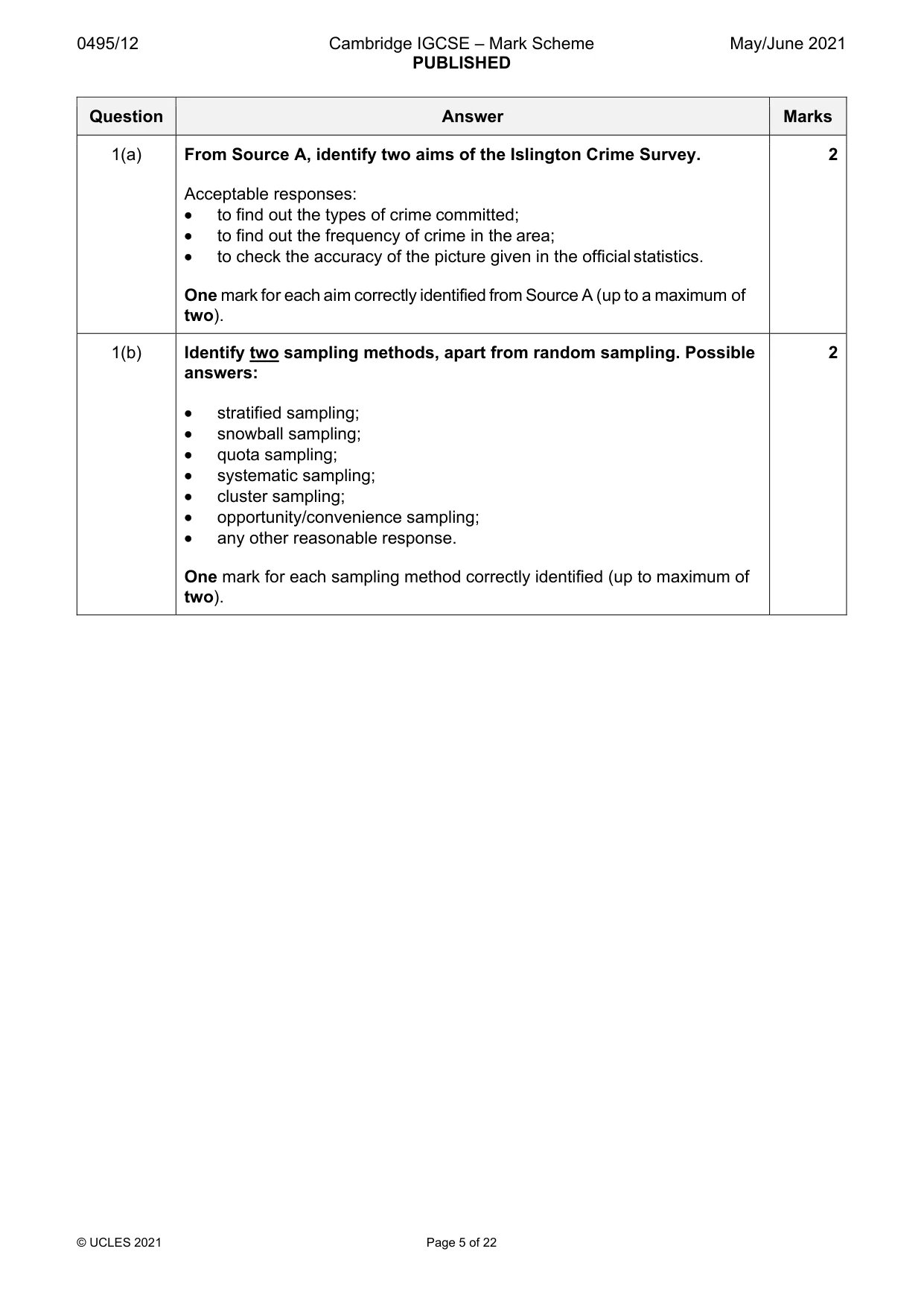
0495/12 Cambridge IGCSE – Mark Scheme PUBLISHED May/June 2021 © UCLES 2021 Page 5 of 22 Question Answer Marks 1(a) From Source A, identify two aims of the Islington Crime Survey. Acceptable responses: • to find out the types of crime committed; • to find out the frequency of crime in the area; • to check the accuracy of the picture given in the official statistics. One mark for each aim correctly identified from Source A (up to a maximum of two). 2 1(b) Identify two sampling methods, apart from random sampling. Possible answers: • stratified sampling; • snowball sampling; • quota sampling; • systematic sampling; • cluster sampling; • opportunity/convenience sampling; • any other reasonable response. One mark for each sampling method correctly identified (up to maximum of two). 2
Mark scheme, page 6
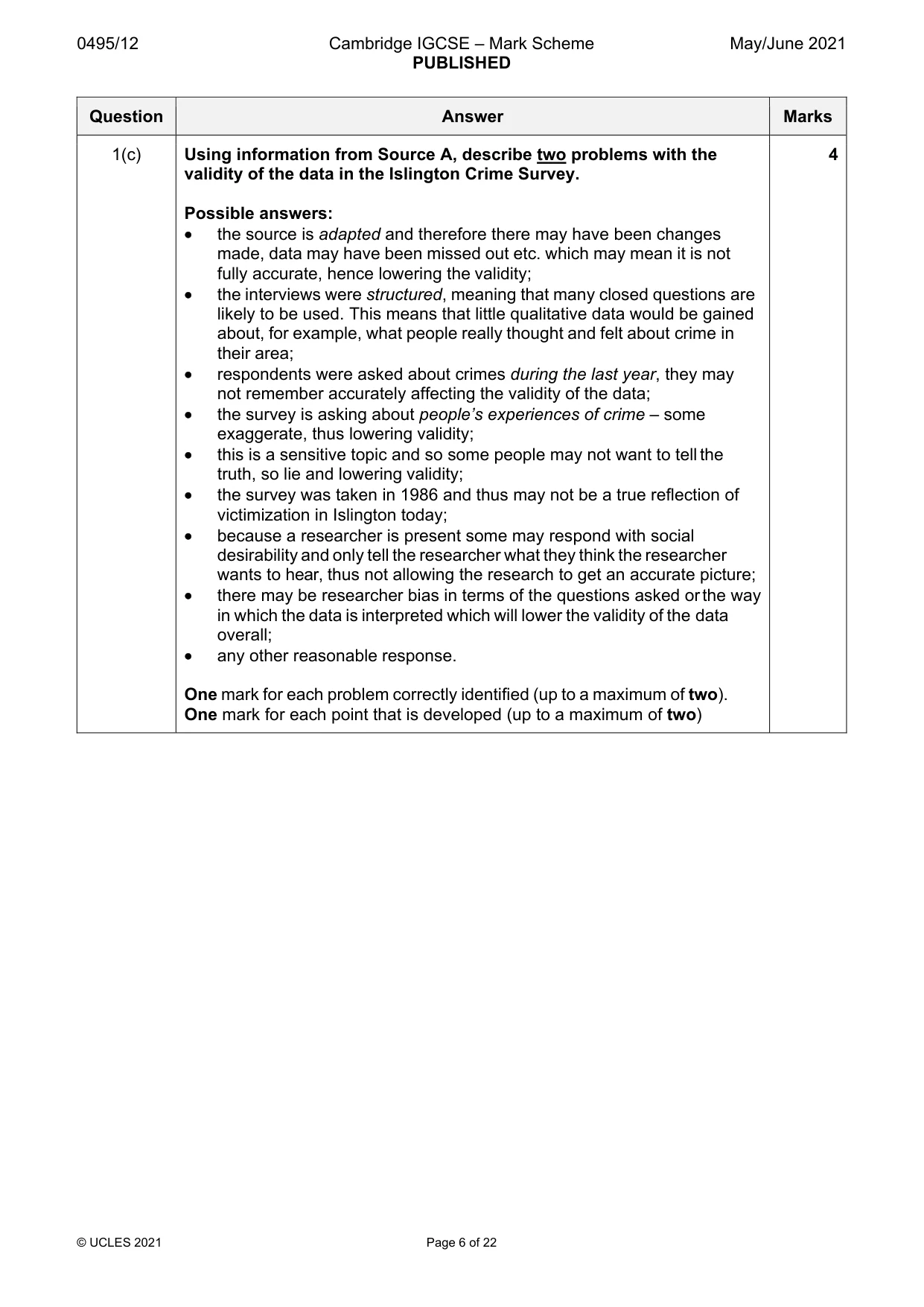
0495/12 Cambridge IGCSE – Mark Scheme PUBLISHED May/June 2021 © UCLES 2021 Page 6 of 22 Question Answer Marks 1(c) Using information from Source A, describe two problems with the validity of the data in the Islington Crime Survey. Possible answers: • the source is adapted and therefore there may have been changes made, data may have been missed out etc. which may mean it is not fully accurate, hence lowering the validity; • the interviews were structured, meaning that many closed questions are likely to be used. This means that little qualitative data would be gained about, for example, what people really thought and felt about crime in their area; • respondents were asked about crimes during the last year, they may not remember accurately affecting the validity of the data; • the survey is asking about people’s experiences of crime – some exaggerate, thus lowering validity; • this is a sensitive topic and so some people may not want to tell the truth, so lie and lowering validity; • the survey was taken in 1986 and thus may not be a true reflection of victimization in Islington today; • because a researcher is present some may respond with social desirability and only tell the researcher what they think the researcher wants to hear, thus not allowing the research to get an accurate picture; • there may be researcher bias in terms of the questions asked or the way in which the data is interpreted which will lower the validity of the data overall; • any other reasonable response. One mark for each problem correctly identified (up to a maximum of two). One mark for each point that is developed (up to a maximum of two) 4
Mark scheme, page 7
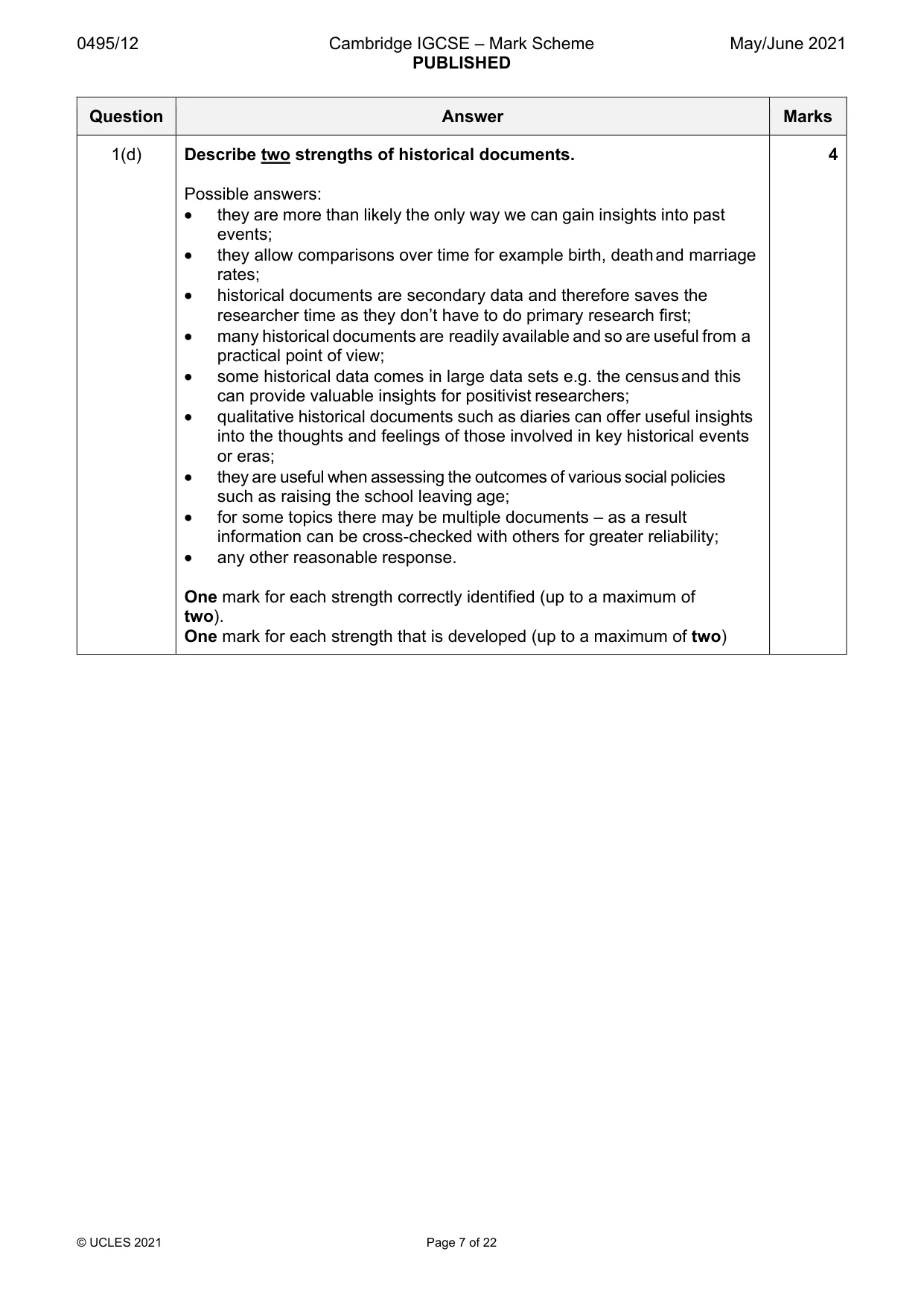
0495/12 Cambridge IGCSE – Mark Scheme PUBLISHED May/June 2021 © UCLES 2021 Page 7 of 22 Question Answer Marks 1(d) Describe two strengths of historical documents. Possible answers: • they are more than likely the only way we can gain insights into past events; • they allow comparisons over time for example birth, death and marriage rates; • historical documents are secondary data and therefore saves the researcher time as they don’t have to do primary research first; • many historical documents are readily available and so are useful from a practical point of view; • some historical data comes in large data sets e.g. the census and this can provide valuable insights for positivist researchers; • qualitative historical documents such as diaries can offer useful insights into the thoughts and feelings of those involved in key historical events or eras; • they are useful when assessing the outcomes of various social policies such as raising the school leaving age; • for some topics there may be multiple documents – as a result information can be cross-checked with others for greater reliability; • any other reasonable response. One mark for each strength correctly identified (up to a maximum of two). One mark for each strength that is developed (up to a maximum of two) 4
Mark scheme, page 8
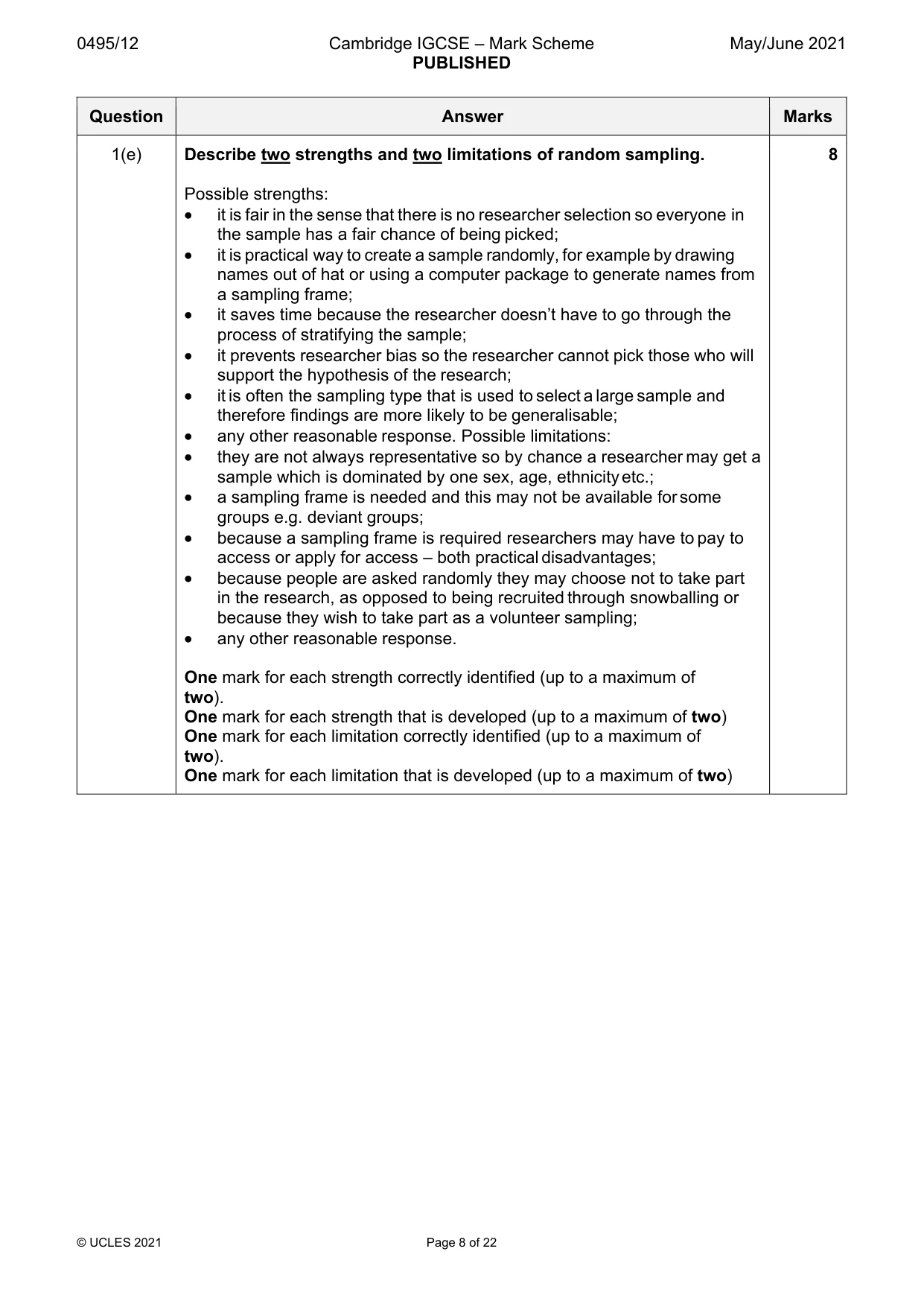
0495/12 Cambridge IGCSE – Mark Scheme PUBLISHED May/June 2021 © UCLES 2021 Page 8 of 22 Question Answer Marks 1(e) Describe two strengths and two limitations of random sampling. Possible strengths: • it is fair in the sense that there is no researcher selection so everyone in the sample has a fair chance of being picked; • it is practical way to create a sample randomly, for example by drawing names out of hat or using a computer package to generate names from a sampling frame; • it saves time because the researcher doesn’t have to go through the process of stratifying the sample; • it prevents researcher bias so the researcher cannot pick those who will support the hypothesis of the research; • it is often the sampling type that is used to select a large sample and therefore findings are more likely to be generalisable; • any other reasonable response. Possible limitations: • they are not always representative so by chance a researcher may get a sample which is dominated by one sex, age, ethnicity etc.; • a sampling frame is needed and this may not be available for some groups e.g. deviant groups; • because a sampling frame is required researchers may have to pay to access or apply for access – both practical disadvantages; • because people are asked randomly they may choose not to take part in the research, as opposed to being recruited through snowballing or because they wish to take part as a volunteer sampling; • any other reasonable response. One mark for each strength correctly identified (up to a maximum of two). One mark for each strength that is developed (up to a maximum of two) One mark for each limitation correctly identified (up to a maximum of two). One mark for each limitation that is developed (up to a maximum of two) 8
Mark scheme, page 9
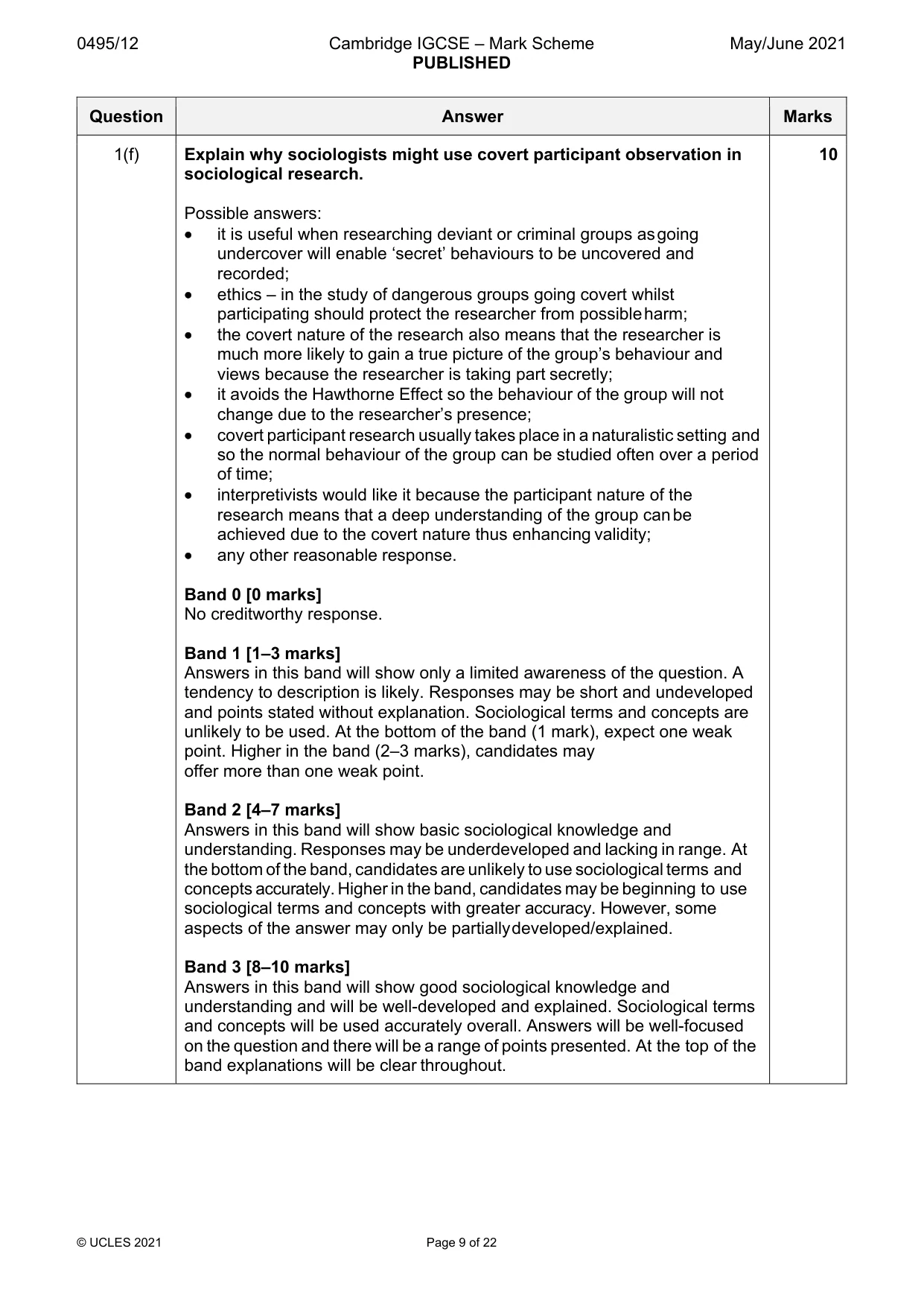
0495/12 Cambridge IGCSE – Mark Scheme PUBLISHED May/June 2021 © UCLES 2021 Page 9 of 22 Question Answer Marks 1(f) Explain why sociologists might use covert participant observation in sociological research. Possible answers: • it is useful when researching deviant or criminal groups as going undercover will enable ‘secret’ behaviours to be uncovered and recorded; • ethics – in the study of dangerous groups going covert whilst participating should protect the researcher from possible harm; • the covert nature of the research also means that the researcher is much more likely to gain a true picture of the group’s behaviour and views because the researcher is taking part secretly; • it avoids the Hawthorne Effect so the behaviour of the group will not change due to the researcher’s presence; • covert participant research usually takes place in a naturalistic setting and so the normal behaviour of the group can be studied often over a period of time; • interpretivists would like it because the participant nature of the research means that a deep understanding of the group can be achieved due to the covert nature thus enhancing validity; • any other reasonable response. Band 0 [0 marks] No creditworthy response. Band 1 [1–3 marks] Answers in this band will show only a limited awareness of the question. A tendency to description is likely. Responses may be short and undeveloped and points stated without explanation. Sociological terms and concepts are unlikely to be used. At the bottom of the band (1 mark), expect one weak point. Higher in the band (2–3 marks), candidates may offer more than one weak point. Band 2 [4–7 marks] Answers in this band will show basic sociological knowledge and understanding. Responses may be underdeveloped and lacking in range. At the bottom of the band, candidates are unlikely to use sociological terms and concepts accurately. Higher in the band, candidates may be beginning to use sociological terms and concepts with greater accuracy. However, some aspects of the answer may only be partially developed/explained. Band 3 [8–10 marks] Answers in this band will show good sociological knowledge and understanding and will be well-developed and explained. Sociological terms and concepts will be used accurately overall. Answers will be well-focused on the question and there will be a range of points presented. At the top of the band explanations will be clear throughout. 10
Mark scheme, page 10
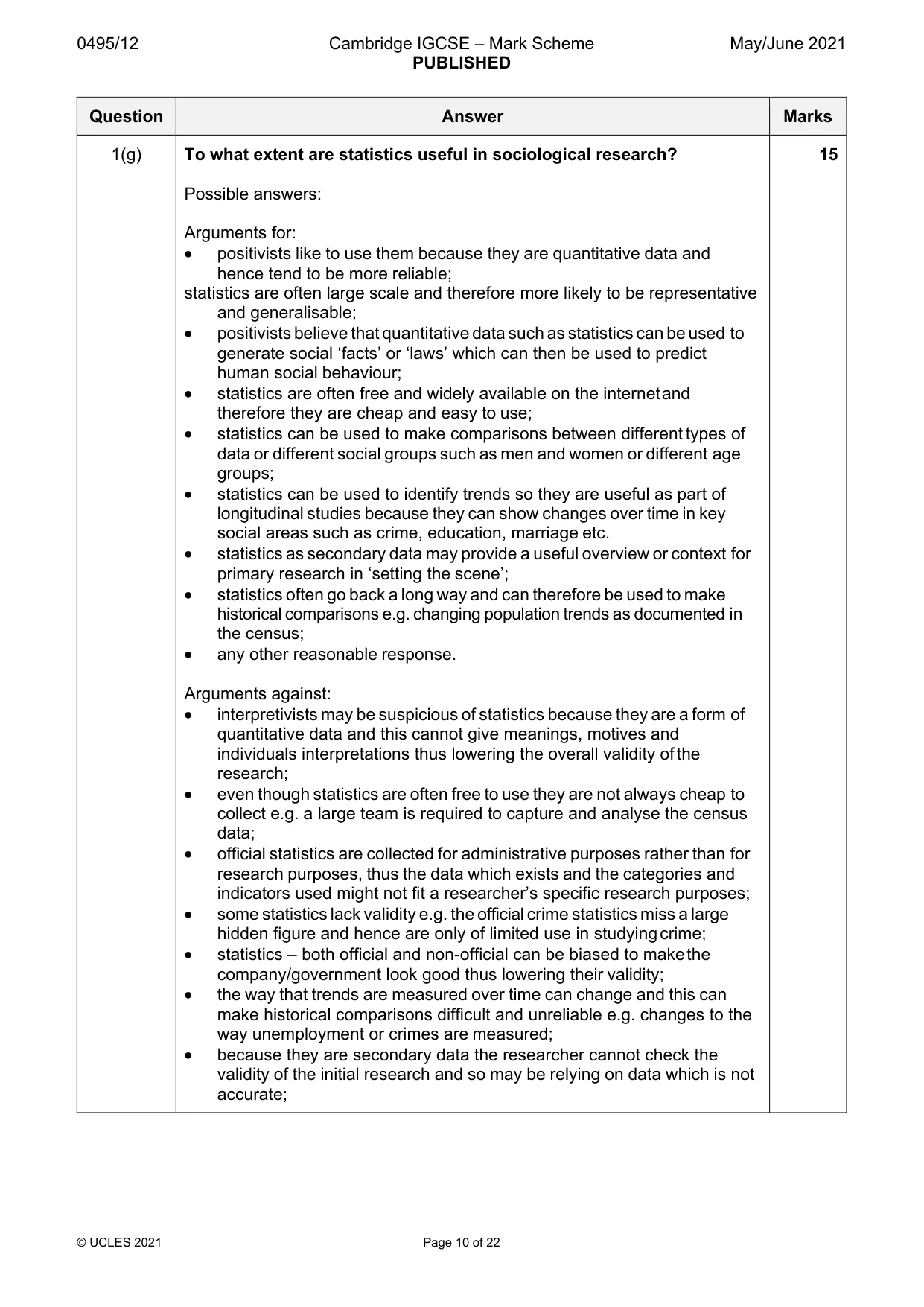
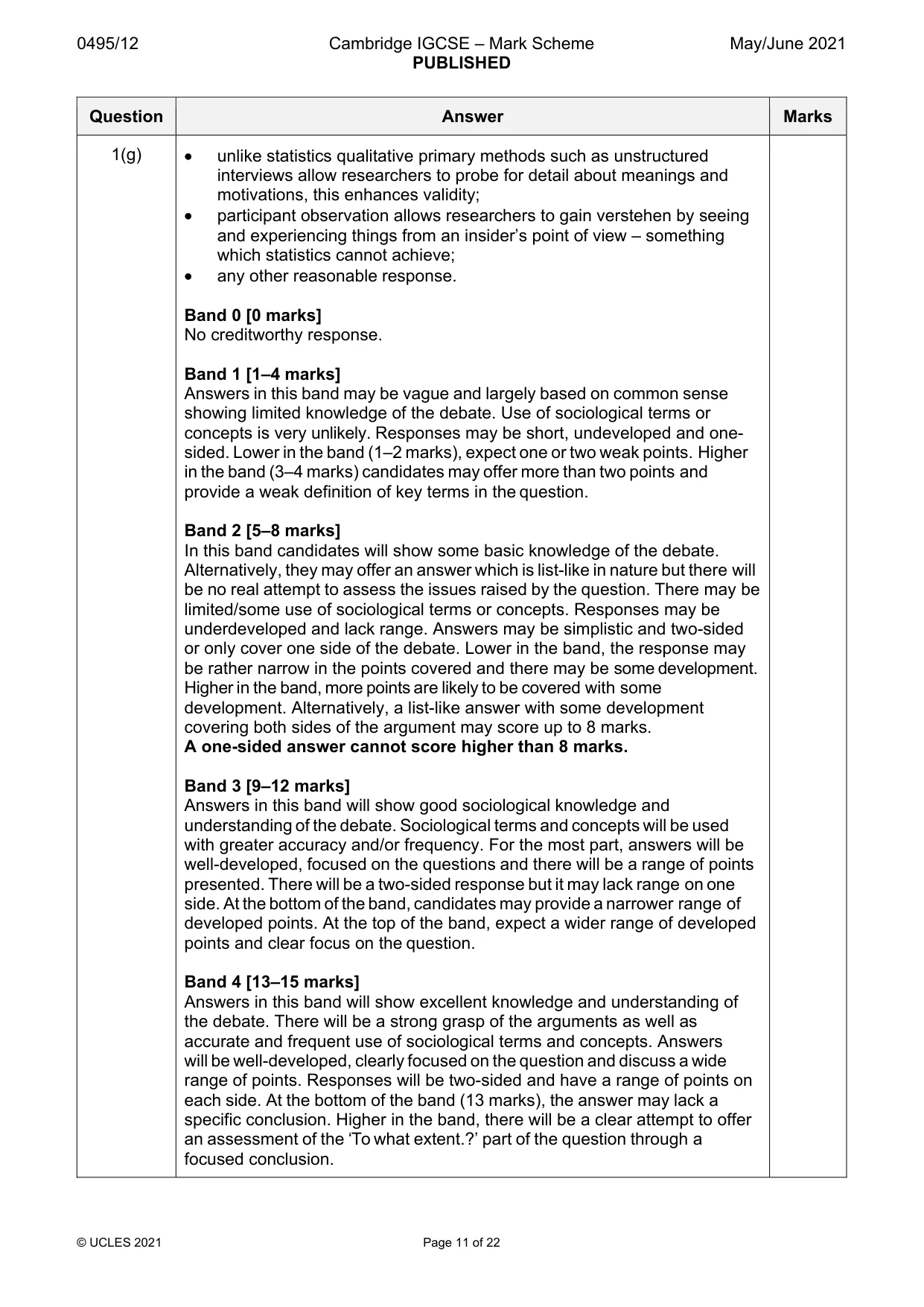
0495/12 Cambridge IGCSE – Mark Scheme PUBLISHED May/June 2021 © UCLES 2021 Page 10 of 22 Question Answer Marks 1(g) To what extent are statistics useful in sociological research? Possible answers: Arguments for: • positivists like to use them because they are quantitative data and hence tend to be more reliable; statistics are often large scale and therefore more likely to be representative and generalisable; • positivists believe that quantitative data such as statistics can be used to generate social ‘facts’ or ‘laws’ which can then be used to predict human social behaviour; • statistics are often free and widely available on the internet and therefore they are cheap and easy to use; • statistics can be used to make comparisons between different types of data or different social groups such as men and women or different age groups; • statistics can be used to identify trends so they are useful as part of longitudinal studies because they can show changes over time in key social areas such as crime, education, marriage etc. • statistics as secondary data may provide a useful overview or context for primary research in ‘setting the scene’; • statistics often go back a long way and can therefore be used to make historical comparisons e.g. changing population trends as documented in the census; • any other reasonable response. Arguments against: • interpretivists may be suspicious of statistics because they are a form of quantitative data and this cannot give meanings, motives and individuals interpretations thus lowering the overall validity of the research; • even though statistics are often free to use they are not always cheap to collect e.g. a large team is required to capture and analyse the census data; • official statistics are collected for administrative purposes rather than for research purposes, thus the data which exists and the categories and indicators used might not fit a researcher’s specific research purposes; • some statistics lack validity e.g. the official crime statistics miss a large hidden figure and hence are only of limited use in studying crime; • statistics – both official and non-official can be biased to make the company/government look good thus lowering their validity; • the way that trends are measured over time can change and this can make historical comparisons difficult and unreliable e.g. changes to the way unemployment or crimes are measured; • because they are secondary data the researcher cannot check the validity of the initial research and so may be relying on data which is not accurate; 15
Mark scheme, page 11
0495/12 Cambridge IGCSE – Mark Scheme PUBLISHED May/June 2021 © UCLES 2021 Page 11 of 22 Question Answer Marks 1(g) • unlike statistics qualitative primary methods such as unstructured interviews allow researchers to probe for detail about meanings and motivations, this enhances validity; • participant observation allows researchers to gain verstehen by seeing and experiencing things from an insider’s point of view – something which statistics cannot achieve; • any other reasonable response. Band 0 [0 marks] No creditworthy response. Band 1 [1–4 marks] Answers in this band may be vague and largely based on common sense showing limited knowledge of the debate. Use of sociological terms or concepts is very unlikely. Responses may be short, undeveloped and one- sided. Lower in the band (1–2 marks), expect one or two weak points. Higher in the band (3–4 marks) candidates may offer more than two points and provide a weak definition of key terms in the question. Band 2 [5–8 marks] In this band candidates will show some basic knowledge of the debate. Alternatively, they may offer an answer which is list-like in nature but there will be no real attempt to assess the issues raised by the question. There may be limited/some use of sociological terms or concepts. Responses may be underdeveloped and lack range. Answers may be simplistic and two-sided or only cover one side of the debate. Lower in the band, the response may be rather narrow in the points covered and there may be some development. Higher in the band, more points are likely to be covered with some development. Alternatively, a list-like answer with some development covering both sides of the argument may score up to 8 marks. A one-sided answer cannot score higher than 8 marks. Band 3 [9–12 marks] Answers in this band will show good sociological knowledge and understanding of the debate. Sociological terms and concepts will be used with greater accuracy and/or frequency. For the most part, answers will be well-developed, focused on the questions and there will be a range of points presented. There will be a two-sided response but it may lack range on one side. At the bottom of the band, candidates may provide a narrower range of developed points. At the top of the band, expect a wider range of developed points and clear focus on the question. Band 4 [13–15 marks] Answers in this band will show excellent knowledge and understanding of the debate. There will be a strong grasp of the arguments as well as accurate and frequent use of sociological terms and concepts. Answers will be well-developed, clearly focused on the question and discuss a wide range of points. Responses will be two-sided and have a range of points on each side. At the bottom of the band (13 marks), the answer may lack a specific conclusion. Higher in the band, there will be a clear attempt to offer an assessment of the ‘To what extent.?’ part of the question through a focused conclusion.
Mark scheme, page 12
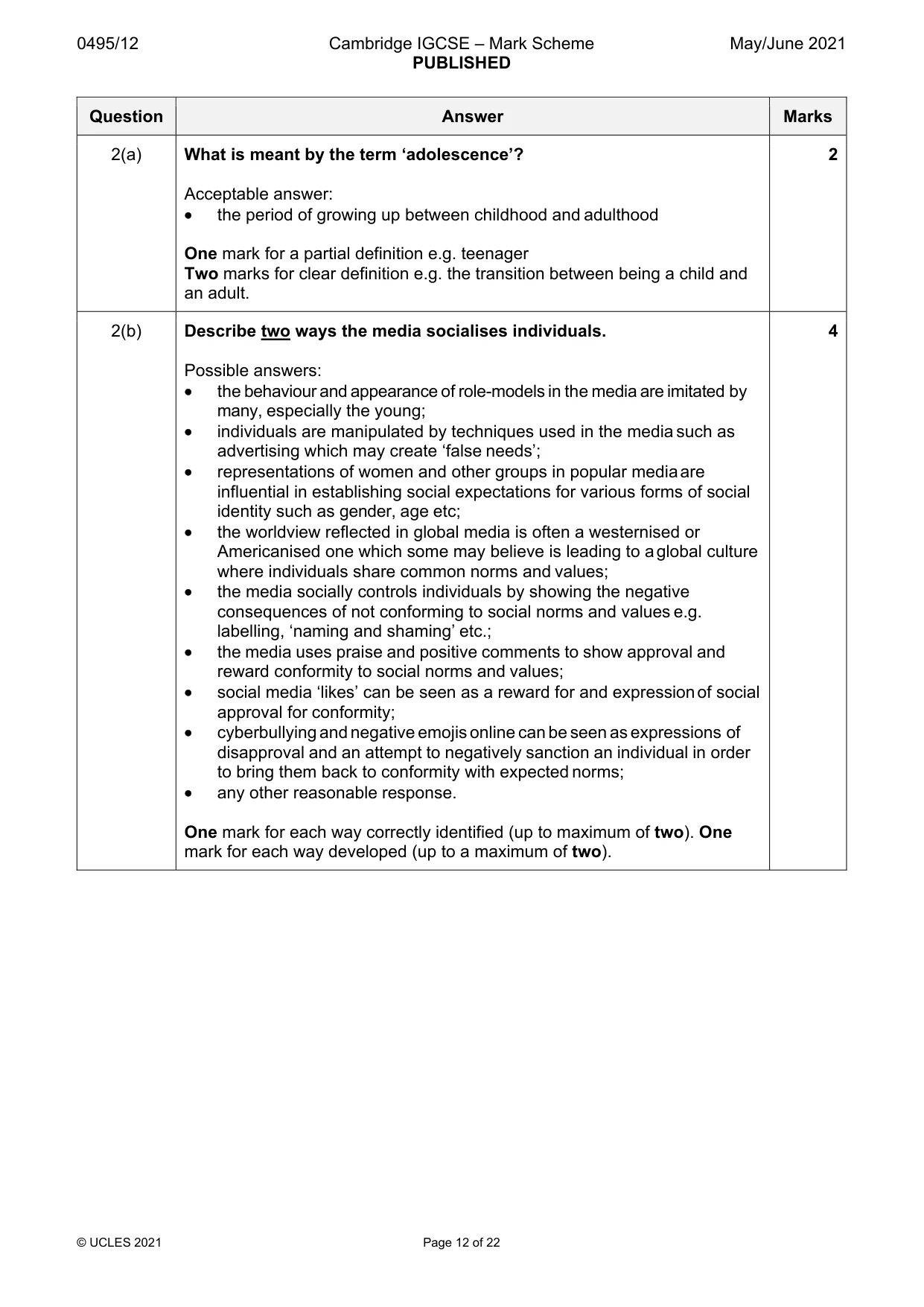
0495/12 Cambridge IGCSE – Mark Scheme PUBLISHED May/June 2021 © UCLES 2021 Page 12 of 22 Question Answer Marks 2(a) What is meant by the term ‘adolescence’? Acceptable answer: • the period of growing up between childhood and adulthood One mark for a partial definition e.g. teenager Two marks for clear definition e.g. the transition between being a child and an adult. 2 2(b) Describe two ways the media socialises individuals. Possible answers: • the behaviour and appearance of role-models in the media are imitated by many, especially the young; • individuals are manipulated by techniques used in the media such as advertising which may create ‘false needs’; • representations of women and other groups in popular media are influential in establishing social expectations for various forms of social identity such as gender, age etc; • the worldview reflected in global media is often a westernised or Americanised one which some may believe is leading to a global culture where individuals share common norms and values; • the media socially controls individuals by showing the negative consequences of not conforming to social norms and values e.g. labelling, ‘naming and shaming’ etc.; • the media uses praise and positive comments to show approval and reward conformity to social norms and values; • social media ‘likes’ can be seen as a reward for and expression of social approval for conformity; • cyberbullying and negative emojis online can be seen as expressions of disapproval and an attempt to negatively sanction an individual in order to bring them back to conformity with expected norms; • any other reasonable response. One mark for each way correctly identified (up to maximum of two). One mark for each way developed (up to a maximum of two). 4
Mark scheme, page 13
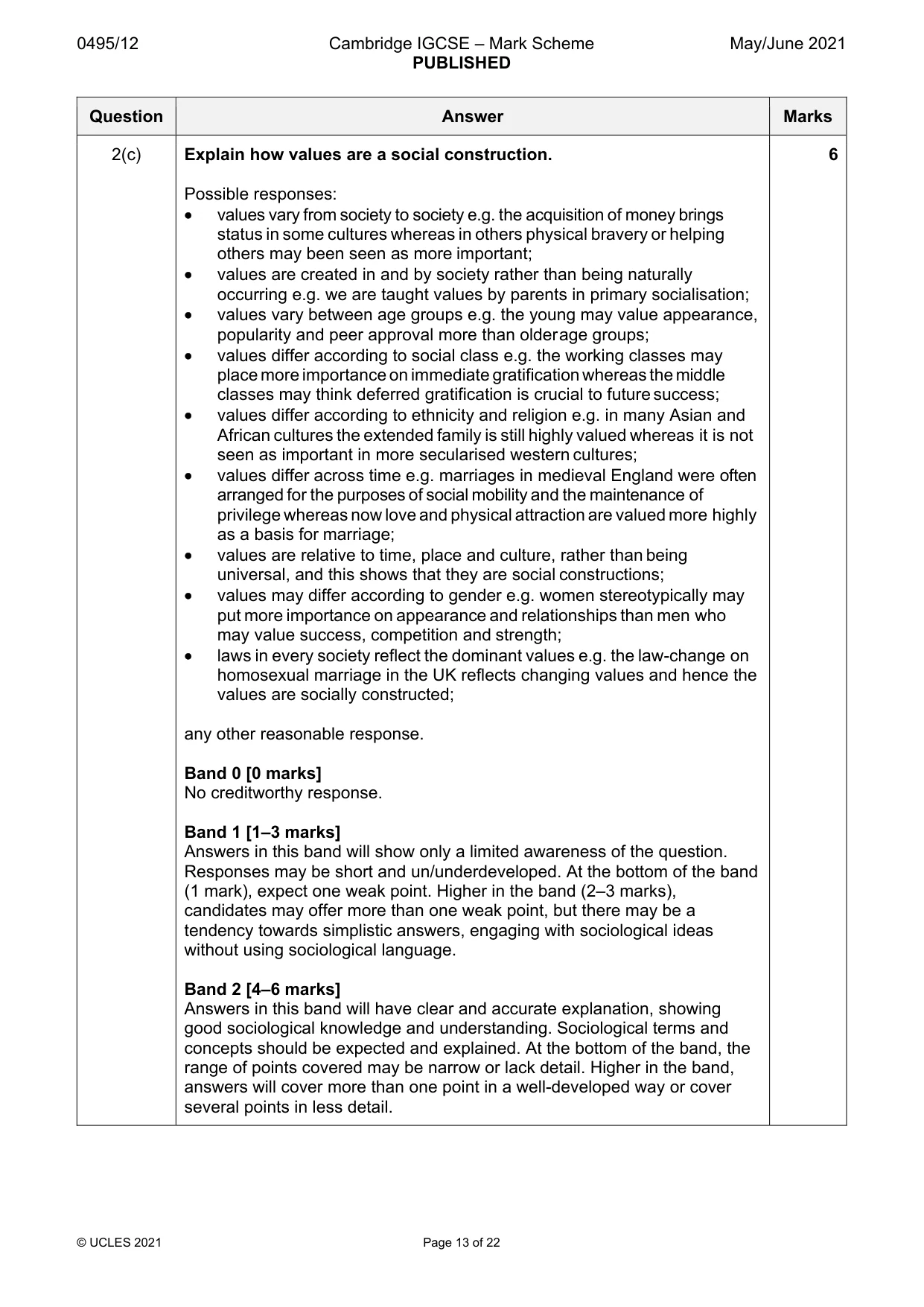
0495/12 Cambridge IGCSE – Mark Scheme PUBLISHED May/June 2021 © UCLES 2021 Page 13 of 22 Question Answer Marks 2(c) Explain how values are a social construction. Possible responses: • values vary from society to society e.g. the acquisition of money brings status in some cultures whereas in others physical bravery or helping others may been seen as more important; • values are created in and by society rather than being naturally occurring e.g. we are taught values by parents in primary socialisation; • values vary between age groups e.g. the young may value appearance, popularity and peer approval more than older age groups; • values differ according to social class e.g. the working classes may place more importance on immediate gratification whereas the middle classes may think deferred gratification is crucial to future success; • values differ according to ethnicity and religion e.g. in many Asian and African cultures the extended family is still highly valued whereas it is not seen as important in more secularised western cultures; • values differ across time e.g. marriages in medieval England were often arranged for the purposes of social mobility and the maintenance of privilege whereas now love and physical attraction are valued more highly as a basis for marriage; • values are relative to time, place and culture, rather than being universal, and this shows that they are social constructions; • values may differ according to gender e.g. women stereotypically may put more importance on appearance and relationships than men who may value success, competition and strength; • laws in every society reflect the dominant values e.g. the law-change on homosexual marriage in the UK reflects changing values and hence the values are socially constructed; any other reasonable response. Band 0 [0 marks] No creditworthy response. Band 1 [1–3 marks] Answers in this band will show only a limited awareness of the question. Responses may be short and un/underdeveloped. At the bottom of the band (1 mark), expect one weak point. Higher in the band (2–3 marks), candidates may offer more than one weak point, but there may be a tendency towards simplistic answers, engaging with sociological ideas without using sociological language. Band 2 [4–6 marks] Answers in this band will have clear and accurate explanation, showing good sociological knowledge and understanding. Sociological terms and concepts should be expected and explained. At the bottom of the band, the range of points covered may be narrow or lack detail. Higher in the band, answers will cover more than one point in a well-developed way or cover several points in less detail. 6
Mark scheme, page 14
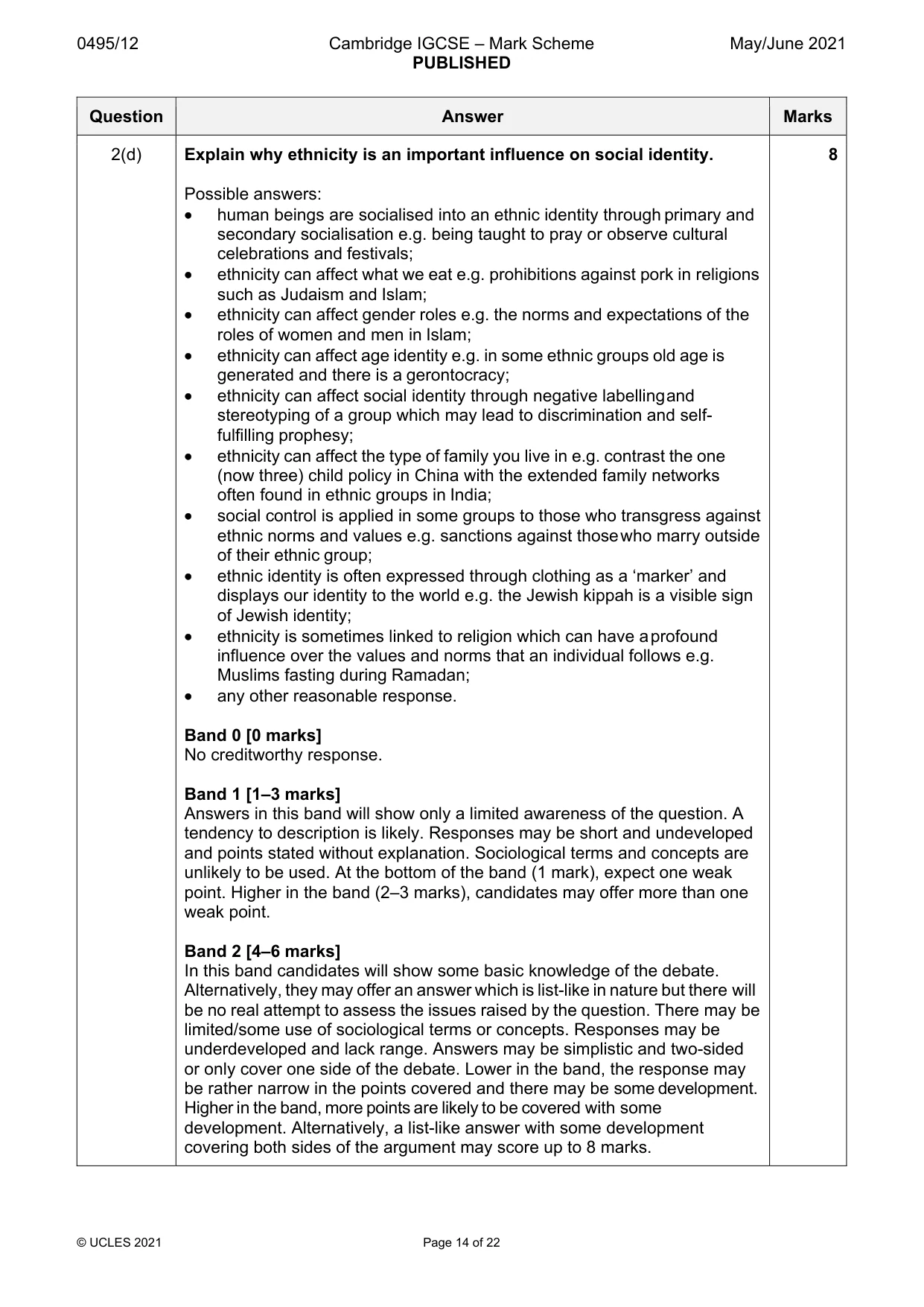
0495/12 Cambridge IGCSE – Mark Scheme PUBLISHED May/June 2021 © UCLES 2021 Page 14 of 22 Question Answer Marks 2(d) Explain why ethnicity is an important influence on social identity. Possible answers: • human beings are socialised into an ethnic identity through primary and secondary socialisation e.g. being taught to pray or observe cultural celebrations and festivals; • ethnicity can affect what we eat e.g. prohibitions against pork in religions such as Judaism and Islam; • ethnicity can affect gender roles e.g. the norms and expectations of the roles of women and men in Islam; • ethnicity can affect age identity e.g. in some ethnic groups old age is generated and there is a gerontocracy; • ethnicity can affect social identity through negative labelling and stereotyping of a group which may lead to discrimination and self- fulfilling prophesy; • ethnicity can affect the type of family you live in e.g. contrast the one (now three) child policy in China with the extended family networks often found in ethnic groups in India; • social control is applied in some groups to those who transgress against ethnic norms and values e.g. sanctions against those who marry outside of their ethnic group; • ethnic identity is often expressed through clothing as a ‘marker’ and displays our identity to the world e.g. the Jewish kippah is a visible sign of Jewish identity; • ethnicity is sometimes linked to religion which can have a profound influence over the values and norms that an individual follows e.g. Muslims fasting during Ramadan; • any other reasonable response. Band 0 [0 marks] No creditworthy response. Band 1 [1–3 marks] Answers in this band will show only a limited awareness of the question. A tendency to description is likely. Responses may be short and undeveloped and points stated without explanation. Sociological terms and concepts are unlikely to be used. At the bottom of the band (1 mark), expect one weak point. Higher in the band (2–3 marks), candidates may offer more than one weak point. Band 2 [4–6 marks] In this band candidates will show some basic knowledge of the debate. Alternatively, they may offer an answer which is list-like in nature but there will be no real attempt to assess the issues raised by the question. There may be limited/some use of sociological terms or concepts. Responses may be underdeveloped and lack range. Answers may be simplistic and two-sided or only cover one side of the debate. Lower in the band, the response may be rather narrow in the points covered and there may be some development. Higher in the band, more points are likely to be covered with some development. Alternatively, a list-like answer with some development covering both sides of the argument may score up to 8 marks. 8
Mark scheme, page 15
0495/12 Cambridge IGCSE – Mark Scheme PUBLISHED May/June 2021 © UCLES 2021 Page 15 of 22 Question Answer Marks 2(d) Band 3 [7–8 marks] Answers in this band will show good sociological knowledge and understanding of the debate. Sociological terms and concepts will be used with greater accuracy and/or frequency. For the most part, answers will be well-developed, focused on the questions and there will be a range of points presented. There will be a two-sided response but it may lack range on one side. At the bottom of the band, candidates may provide a narrower range of developed points. At the top of the band, expect a wider range of developed points and clear focus on the question.
Mark scheme, page 16
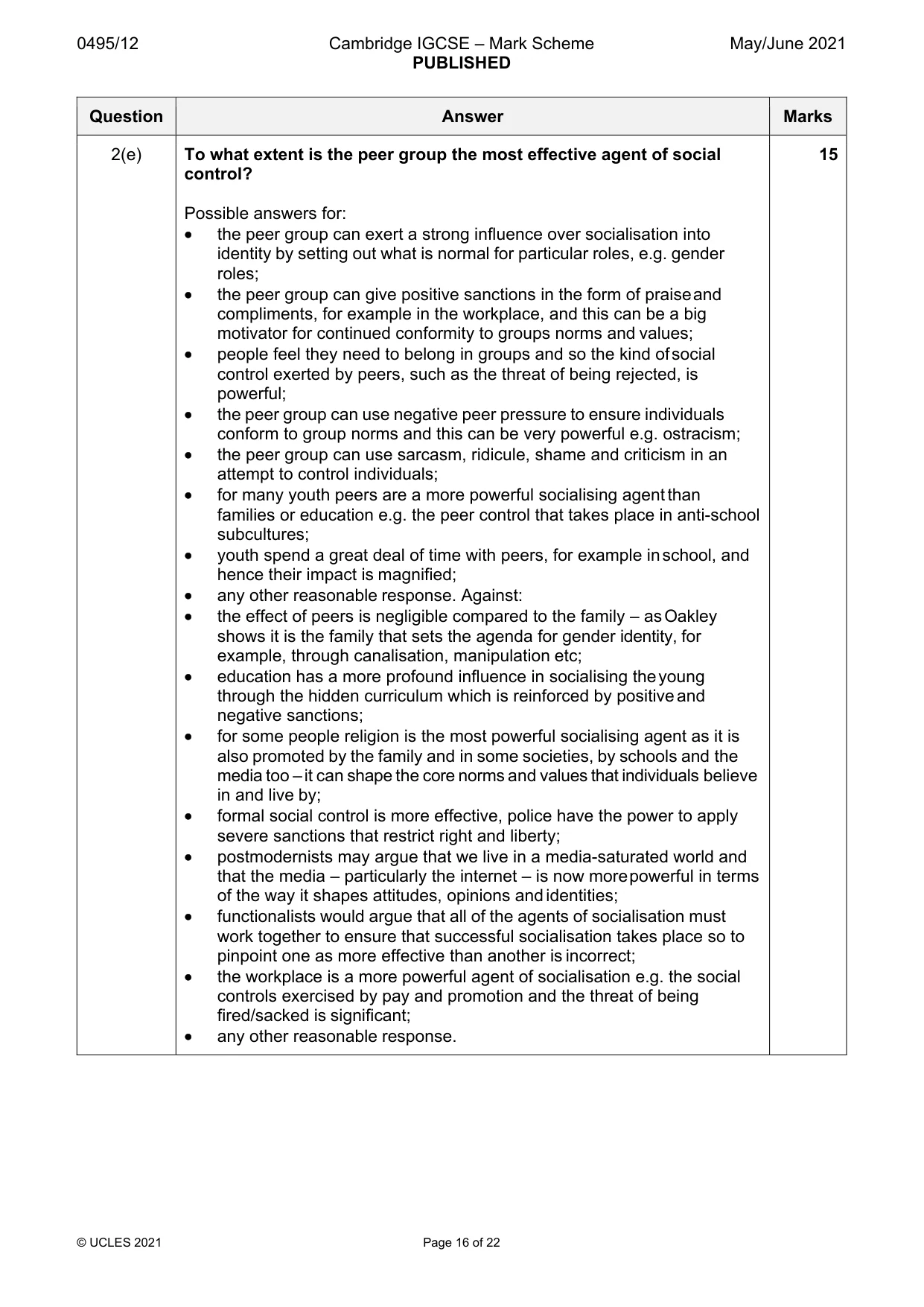
0495/12 Cambridge IGCSE – Mark Scheme PUBLISHED May/June 2021 © UCLES 2021 Page 16 of 22 Question Answer Marks 2(e) To what extent is the peer group the most effective agent of social control? Possible answers for: • the peer group can exert a strong influence over socialisation into identity by setting out what is normal for particular roles, e.g. gender roles; • the peer group can give positive sanctions in the form of praise and compliments, for example in the workplace, and this can be a big motivator for continued conformity to groups norms and values; • people feel they need to belong in groups and so the kind of social control exerted by peers, such as the threat of being rejected, is powerful; • the peer group can use negative peer pressure to ensure individuals conform to group norms and this can be very powerful e.g. ostracism; • the peer group can use sarcasm, ridicule, shame and criticism in an attempt to control individuals; • for many youth peers are a more powerful socialising agent than families or education e.g. the peer control that takes place in anti-school subcultures; • youth spend a great deal of time with peers, for example in school, and hence their impact is magnified; • any other reasonable response. Against: • the effect of peers is negligible compared to the family – as Oakley shows it is the family that sets the agenda for gender identity, for example, through canalisation, manipulation etc; • education has a more profound influence in socialising the young through the hidden curriculum which is reinforced by positive and negative sanctions; • for some people religion is the most powerful socialising agent as it is also promoted by the family and in some societies, by schools and the media too – it can shape the core norms and values that individuals believe in and live by; • formal social control is more effective, police have the power to apply severe sanctions that restrict right and liberty; • postmodernists may argue that we live in a media-saturated world and that the media – particularly the internet – is now more powerful in terms of the way it shapes attitudes, opinions and identities; • functionalists would argue that all of the agents of socialisation must work together to ensure that successful socialisation takes place so to pinpoint one as more effective than another is incorrect; • the workplace is a more powerful agent of socialisation e.g. the social controls exercised by pay and promotion and the threat of being fired/sacked is significant; • any other reasonable response. 15
Mark scheme, page 17
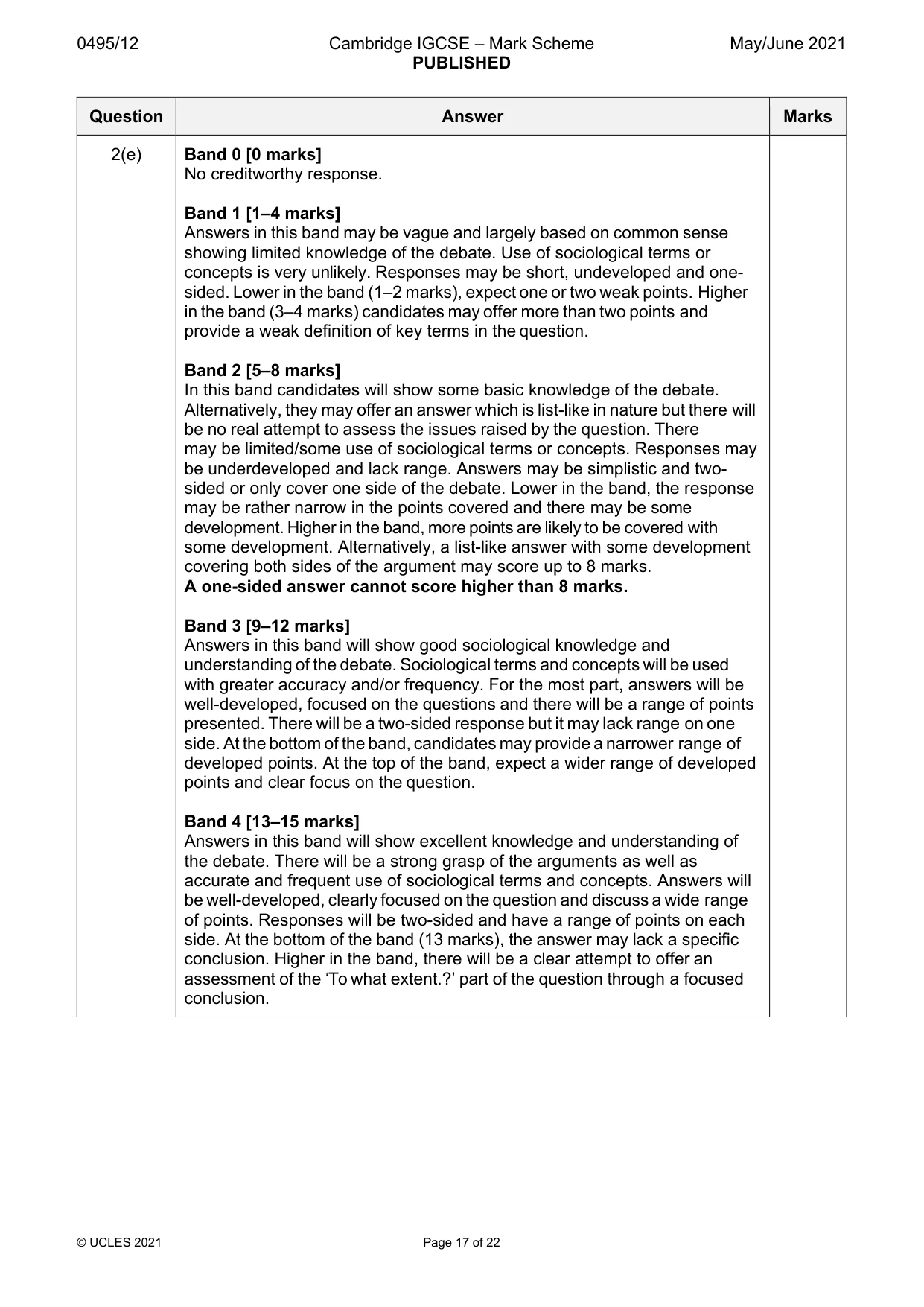
0495/12 Cambridge IGCSE – Mark Scheme PUBLISHED May/June 2021 © UCLES 2021 Page 17 of 22 Question Answer Marks 2(e) Band 0 [0 marks] No creditworthy response. Band 1 [1–4 marks] Answers in this band may be vague and largely based on common sense showing limited knowledge of the debate. Use of sociological terms or concepts is very unlikely. Responses may be short, undeveloped and one- sided. Lower in the band (1–2 marks), expect one or two weak points. Higher in the band (3–4 marks) candidates may offer more than two points and provide a weak definition of key terms in the question. Band 2 [5–8 marks] In this band candidates will show some basic knowledge of the debate. Alternatively, they may offer an answer which is list-like in nature but there will be no real attempt to assess the issues raised by the question. There may be limited/some use of sociological terms or concepts. Responses may be underdeveloped and lack range. Answers may be simplistic and two- sided or only cover one side of the debate. Lower in the band, the response may be rather narrow in the points covered and there may be some development. Higher in the band, more points are likely to be covered with some development. Alternatively, a list-like answer with some development covering both sides of the argument may score up to 8 marks. A one-sided answer cannot score higher than 8 marks. Band 3 [9–12 marks] Answers in this band will show good sociological knowledge and understanding of the debate. Sociological terms and concepts will be used with greater accuracy and/or frequency. For the most part, answers will be well-developed, focused on the questions and there will be a range of points presented. There will be a two-sided response but it may lack range on one side. At the bottom of the band, candidates may provide a narrower range of developed points. At the top of the band, expect a wider range of developed points and clear focus on the question. Band 4 [13–15 marks] Answers in this band will show excellent knowledge and understanding of the debate. There will be a strong grasp of the arguments as well as accurate and frequent use of sociological terms and concepts. Answers will be well-developed, clearly focused on the question and discuss a wide range of points. Responses will be two-sided and have a range of points on each side. At the bottom of the band (13 marks), the answer may lack a specific conclusion. Higher in the band, there will be a clear attempt to offer an assessment of the ‘To what extent.?’ part of the question through a focused conclusion.
Mark scheme, page 18
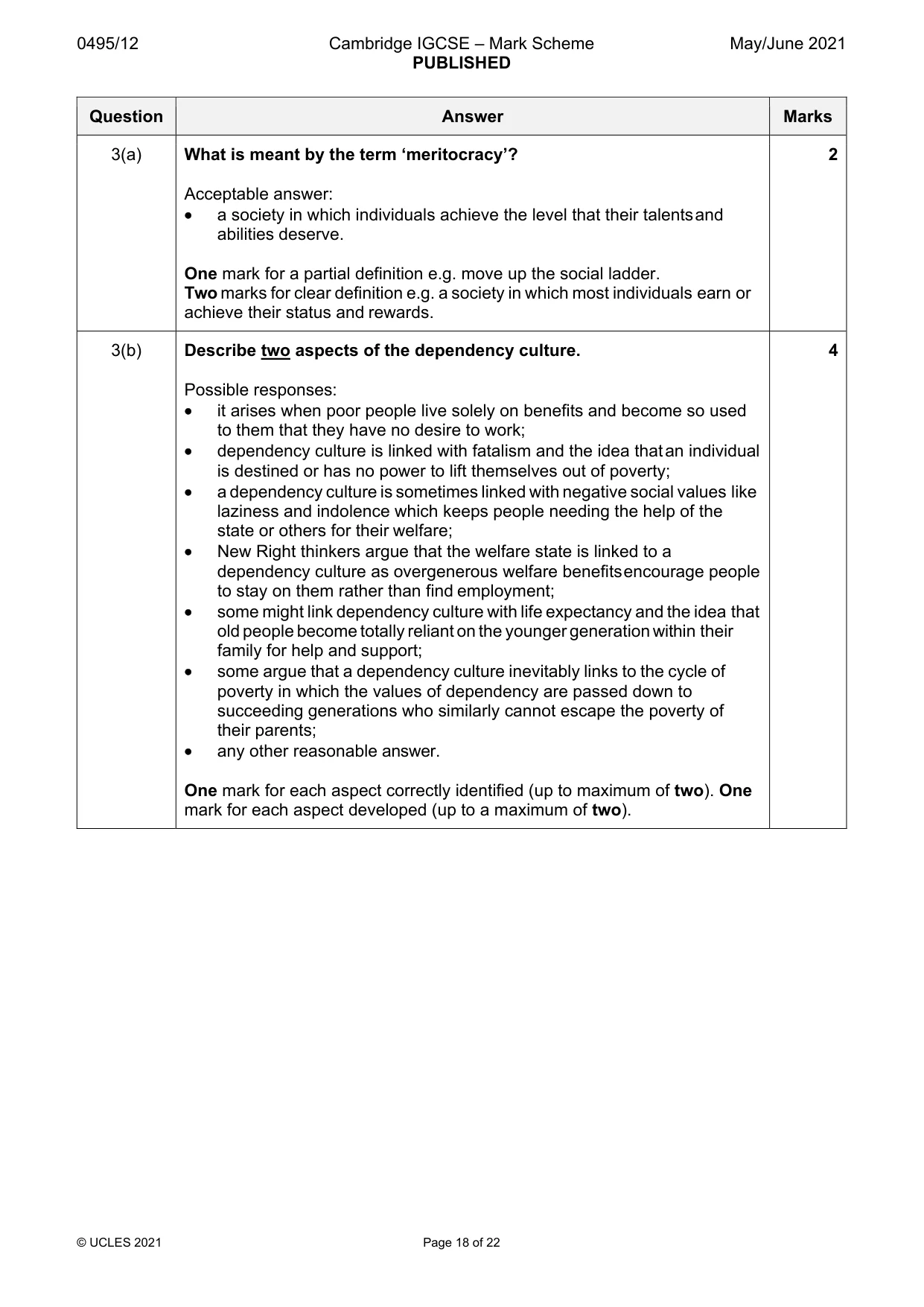
0495/12 Cambridge IGCSE – Mark Scheme PUBLISHED May/June 2021 © UCLES 2021 Page 18 of 22 Question Answer Marks 3(a) What is meant by the term ‘meritocracy’? Acceptable answer: • a society in which individuals achieve the level that their talents and abilities deserve. One mark for a partial definition e.g. move up the social ladder. Two marks for clear definition e.g. a society in which most individuals earn or achieve their status and rewards. 2 3(b) Describe two aspects of the dependency culture. Possible responses: • it arises when poor people live solely on benefits and become so used to them that they have no desire to work; • dependency culture is linked with fatalism and the idea that an individual is destined or has no power to lift themselves out of poverty; • a dependency culture is sometimes linked with negative social values like laziness and indolence which keeps people needing the help of the state or others for their welfare; • New Right thinkers argue that the welfare state is linked to a dependency culture as overgenerous welfare benefits encourage people to stay on them rather than find employment; • some might link dependency culture with life expectancy and the idea that old people become totally reliant on the younger generation within their family for help and support; • some argue that a dependency culture inevitably links to the cycle of poverty in which the values of dependency are passed down to succeeding generations who similarly cannot escape the poverty of their parents; • any other reasonable answer. One mark for each aspect correctly identified (up to maximum of two). One mark for each aspect developed (up to a maximum of two). 4
Mark scheme, page 19
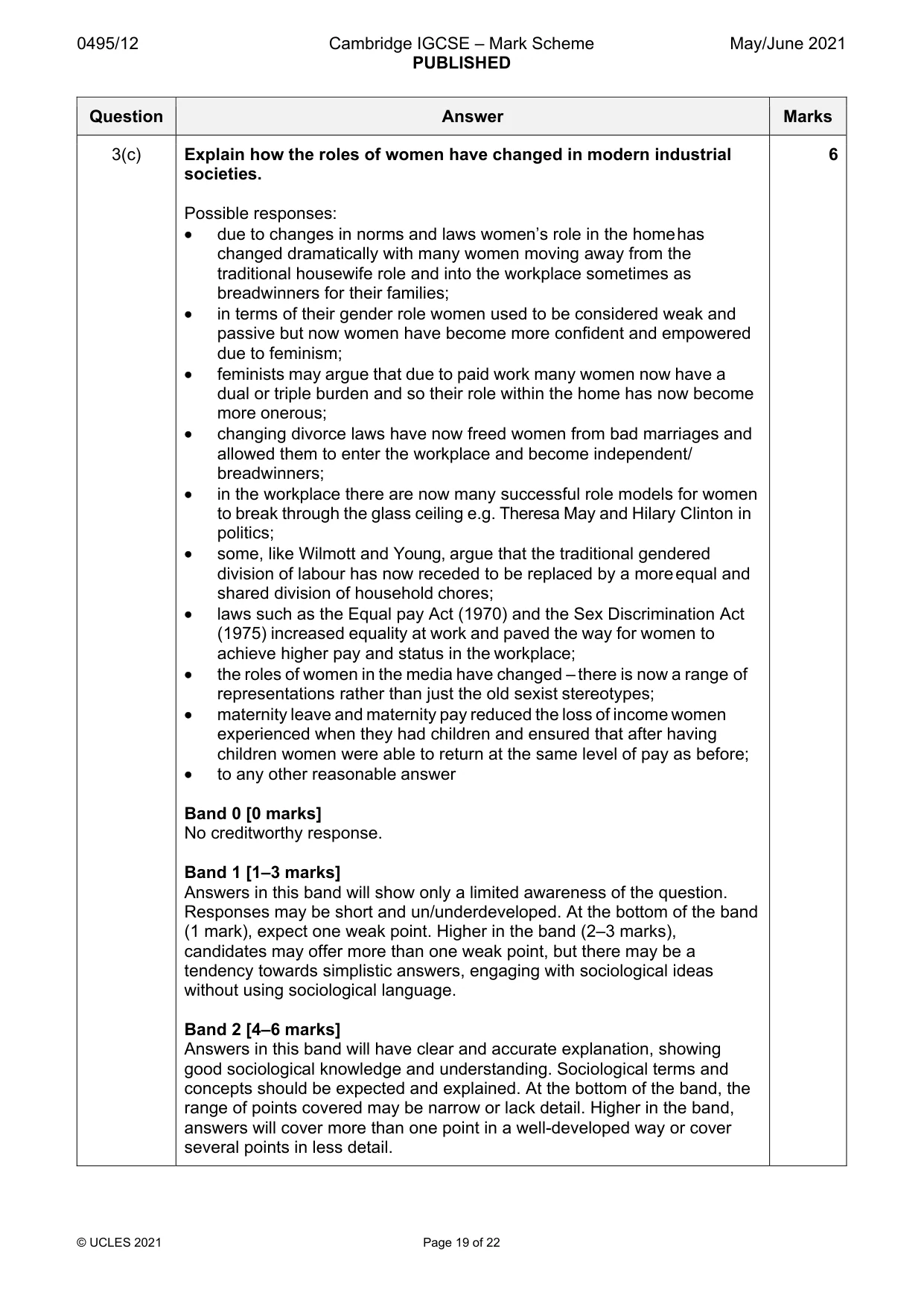
0495/12 Cambridge IGCSE – Mark Scheme PUBLISHED May/June 2021 © UCLES 2021 Page 19 of 22 Question Answer Marks 3(c) Explain how the roles of women have changed in modern industrial societies. Possible responses: • due to changes in norms and laws women’s role in the home has changed dramatically with many women moving away from the traditional housewife role and into the workplace sometimes as breadwinners for their families; • in terms of their gender role women used to be considered weak and passive but now women have become more confident and empowered due to feminism; • feminists may argue that due to paid work many women now have a dual or triple burden and so their role within the home has now become more onerous; • changing divorce laws have now freed women from bad marriages and allowed them to enter the workplace and become independent/ breadwinners; • in the workplace there are now many successful role models for women to break through the glass ceiling e.g. Theresa May and Hilary Clinton in politics; • some, like Wilmott and Young, argue that the traditional gendered division of labour has now receded to be replaced by a more equal and shared division of household chores; • laws such as the Equal pay Act (1970) and the Sex Discrimination Act (1975) increased equality at work and paved the way for women to achieve higher pay and status in the workplace; • the roles of women in the media have changed – there is now a range of representations rather than just the old sexist stereotypes; • maternity leave and maternity pay reduced the loss of income women experienced when they had children and ensured that after having children women were able to return at the same level of pay as before; • to any other reasonable answer Band 0 [0 marks] No creditworthy response. Band 1 [1–3 marks] Answers in this band will show only a limited awareness of the question. Responses may be short and un/underdeveloped. At the bottom of the band (1 mark), expect one weak point. Higher in the band (2–3 marks), candidates may offer more than one weak point, but there may be a tendency towards simplistic answers, engaging with sociological ideas without using sociological language. Band 2 [4–6 marks] Answers in this band will have clear and accurate explanation, showing good sociological knowledge and understanding. Sociological terms and concepts should be expected and explained. At the bottom of the band, the range of points covered may be narrow or lack detail. Higher in the band, answers will cover more than one point in a well-developed way or cover several points in less detail. 6
Mark scheme, page 20
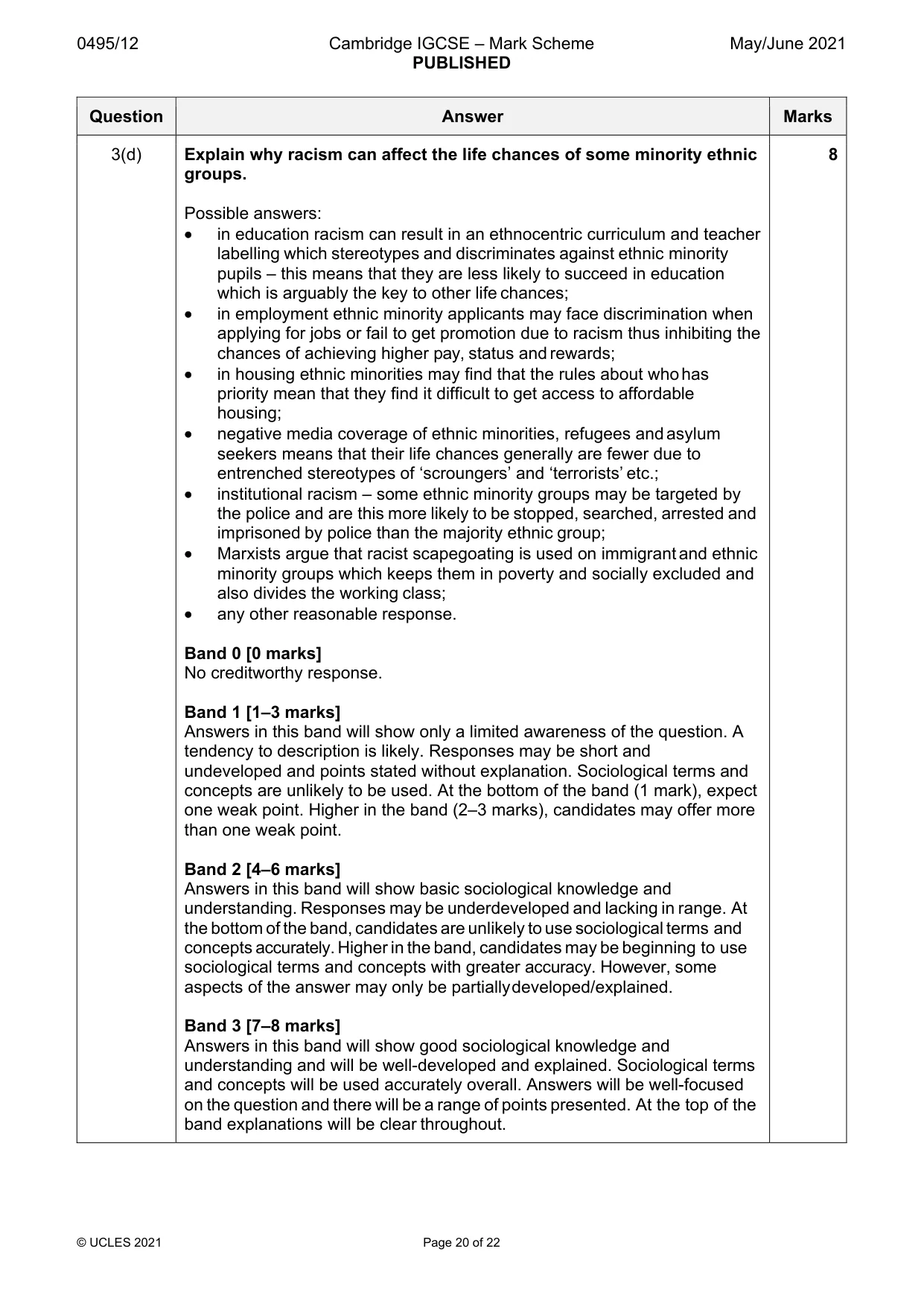
0495/12 Cambridge IGCSE – Mark Scheme PUBLISHED May/June 2021 © UCLES 2021 Page 20 of 22 Question Answer Marks 3(d) Explain why racism can affect the life chances of some minority ethnic groups. Possible answers: • in education racism can result in an ethnocentric curriculum and teacher labelling which stereotypes and discriminates against ethnic minority pupils – this means that they are less likely to succeed in education which is arguably the key to other life chances; • in employment ethnic minority applicants may face discrimination when applying for jobs or fail to get promotion due to racism thus inhibiting the chances of achieving higher pay, status and rewards; • in housing ethnic minorities may find that the rules about who has priority mean that they find it difficult to get access to affordable housing; • negative media coverage of ethnic minorities, refugees and asylum seekers means that their life chances generally are fewer due to entrenched stereotypes of ‘scroungers’ and ‘terrorists’ etc.; • institutional racism – some ethnic minority groups may be targeted by the police and are this more likely to be stopped, searched, arrested and imprisoned by police than the majority ethnic group; • Marxists argue that racist scapegoating is used on immigrant and ethnic minority groups which keeps them in poverty and socially excluded and also divides the working class; • any other reasonable response. Band 0 [0 marks] No creditworthy response. Band 1 [1–3 marks] Answers in this band will show only a limited awareness of the question. A tendency to description is likely. Responses may be short and undeveloped and points stated without explanation. Sociological terms and concepts are unlikely to be used. At the bottom of the band (1 mark), expect one weak point. Higher in the band (2–3 marks), candidates may offer more than one weak point. Band 2 [4–6 marks] Answers in this band will show basic sociological knowledge and understanding. Responses may be underdeveloped and lacking in range. At the bottom of the band, candidates are unlikely to use sociological terms and concepts accurately. Higher in the band, candidates may be beginning to use sociological terms and concepts with greater accuracy. However, some aspects of the answer may only be partially developed/explained. Band 3 [7–8 marks] Answers in this band will show good sociological knowledge and understanding and will be well-developed and explained. Sociological terms and concepts will be used accurately overall. Answers will be well-focused on the question and there will be a range of points presented. At the top of the band explanations will be clear throughout. 8
Mark scheme, page 21
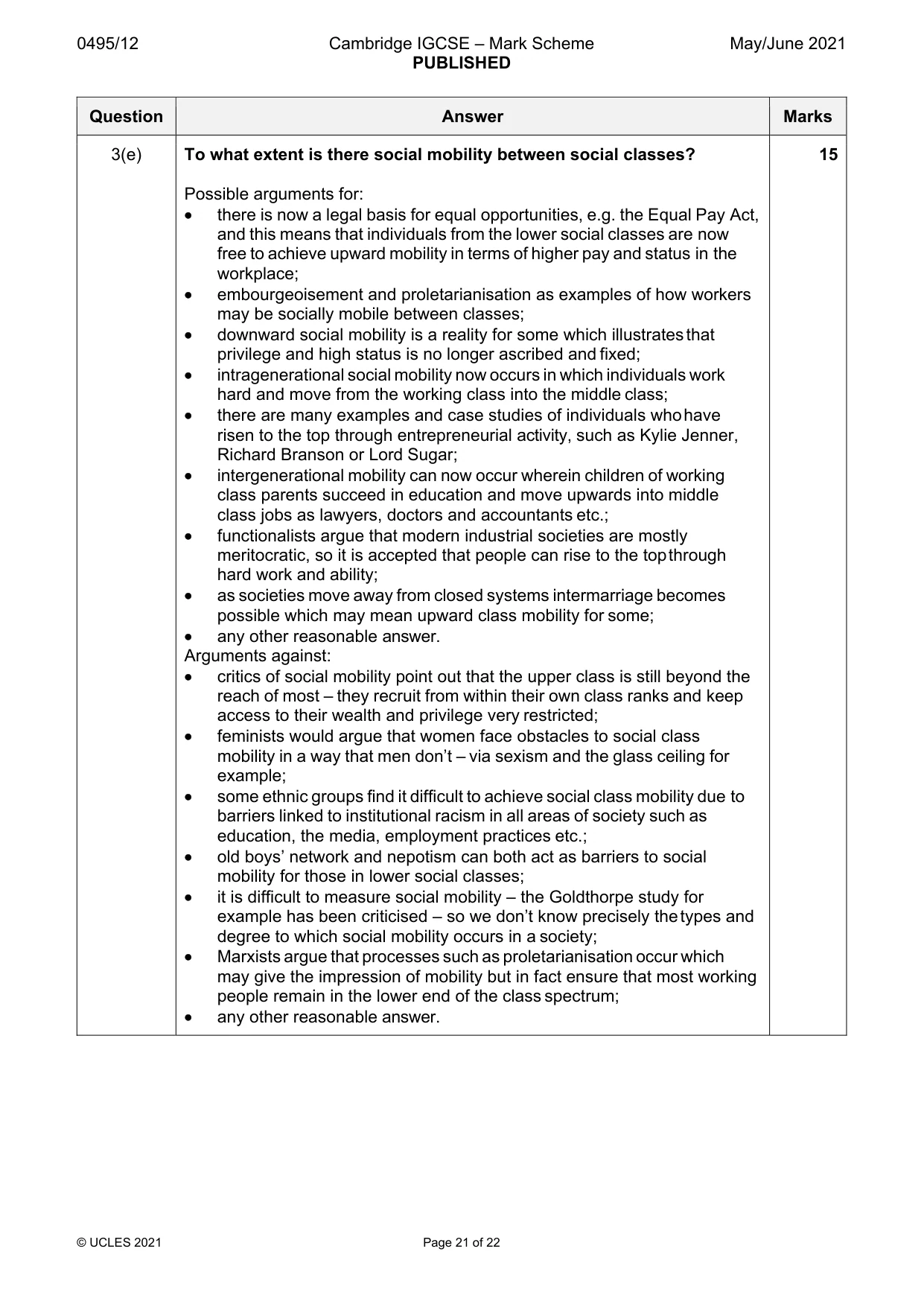
0495/12 Cambridge IGCSE – Mark Scheme PUBLISHED May/June 2021 © UCLES 2021 Page 21 of 22 Question Answer Marks 3(e) To what extent is there social mobility between social classes? Possible arguments for: • there is now a legal basis for equal opportunities, e.g. the Equal Pay Act, and this means that individuals from the lower social classes are now free to achieve upward mobility in terms of higher pay and status in the workplace; • embourgeoisement and proletarianisation as examples of how workers may be socially mobile between classes; • downward social mobility is a reality for some which illustrates that privilege and high status is no longer ascribed and fixed; • intragenerational social mobility now occurs in which individuals work hard and move from the working class into the middle class; • there are many examples and case studies of individuals who have risen to the top through entrepreneurial activity, such as Kylie Jenner, Richard Branson or Lord Sugar; • intergenerational mobility can now occur wherein children of working class parents succeed in education and move upwards into middle class jobs as lawyers, doctors and accountants etc.; • functionalists argue that modern industrial societies are mostly meritocratic, so it is accepted that people can rise to the top through hard work and ability; • as societies move away from closed systems intermarriage becomes possible which may mean upward class mobility for some; • any other reasonable answer. Arguments against: • critics of social mobility point out that the upper class is still beyond the reach of most – they recruit from within their own class ranks and keep access to their wealth and privilege very restricted; • feminists would argue that women face obstacles to social class mobility in a way that men don’t – via sexism and the glass ceiling for example; • some ethnic groups find it difficult to achieve social class mobility due to barriers linked to institutional racism in all areas of society such as education, the media, employment practices etc.; • old boys’ network and nepotism can both act as barriers to social mobility for those in lower social classes; • it is difficult to measure social mobility – the Goldthorpe study for example has been criticised – so we don’t know precisely the types and degree to which social mobility occurs in a society; • Marxists argue that processes such as proletarianisation occur which may give the impression of mobility but in fact ensure that most working people remain in the lower end of the class spectrum; • any other reasonable answer. 15
Mark scheme, page 22
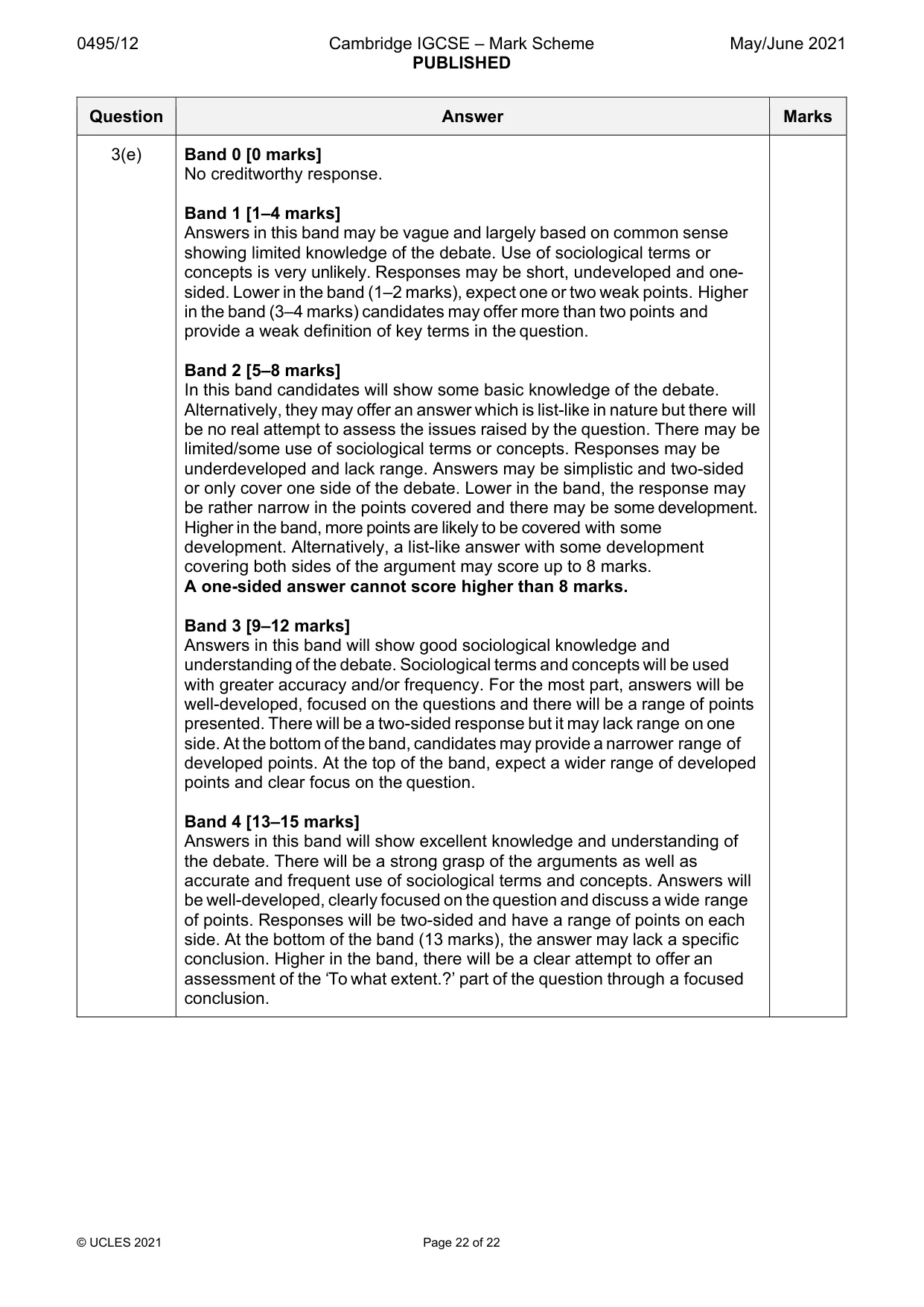
0495/12 Cambridge IGCSE – Mark Scheme PUBLISHED May/June 2021 © UCLES 2021 Page 22 of 22 Question Answer Marks 3(e) Band 0 [0 marks] No creditworthy response. Band 1 [1–4 marks] Answers in this band may be vague and largely based on common sense showing limited knowledge of the debate. Use of sociological terms or concepts is very unlikely. Responses may be short, undeveloped and one- sided. Lower in the band (1–2 marks), expect one or two weak points. Higher in the band (3–4 marks) candidates may offer more than two points and provide a weak definition of key terms in the question. Band 2 [5–8 marks] In this band candidates will show some basic knowledge of the debate. Alternatively, they may offer an answer which is list-like in nature but there will be no real attempt to assess the issues raised by the question. There may be limited/some use of sociological terms or concepts. Responses may be underdeveloped and lack range. Answers may be simplistic and two-sided or only cover one side of the debate. Lower in the band, the response may be rather narrow in the points covered and there may be some development. Higher in the band, more points are likely to be covered with some development. Alternatively, a list-like answer with some development covering both sides of the argument may score up to 8 marks. A one-sided answer cannot score higher than 8 marks. Band 3 [9–12 marks] Answers in this band will show good sociological knowledge and understanding of the debate. Sociological terms and concepts will be used with greater accuracy and/or frequency. For the most part, answers will be well-developed, focused on the questions and there will be a range of points presented. There will be a two-sided response but it may lack range on one side. At the bottom of the band, candidates may provide a narrower range of developed points. At the top of the band, expect a wider range of developed points and clear focus on the question. Band 4 [13–15 marks] Answers in this band will show excellent knowledge and understanding of the debate. There will be a strong grasp of the arguments as well as accurate and frequent use of sociological terms and concepts. Answers will be well-developed, clearly focused on the question and discuss a wide range of points. Responses will be two-sided and have a range of points on each side. At the bottom of the band (13 marks), the answer may lack a specific conclusion. Higher in the band, there will be a clear attempt to offer an assessment of the ‘To what extent.?’ part of the question through a focused conclusion.
What you needed in this session
Cambridge’s own grade thresholds for 2021 May/June, Paper 1 · Variant 2. A higher threshold means an easier paper — the bar moves with how the cohort did.