Cambridge IGCSE Sociology 0495 — 2020 Oct/Nov Paper 2 · Variant 3
0495/23/O/N/20 · 4 questions · 70 marks · ≈79 min
The question paper and its mark scheme, free to read here and free to download. This is Cambridge’s own paper, exactly as it was sat.
Question paper4 pages

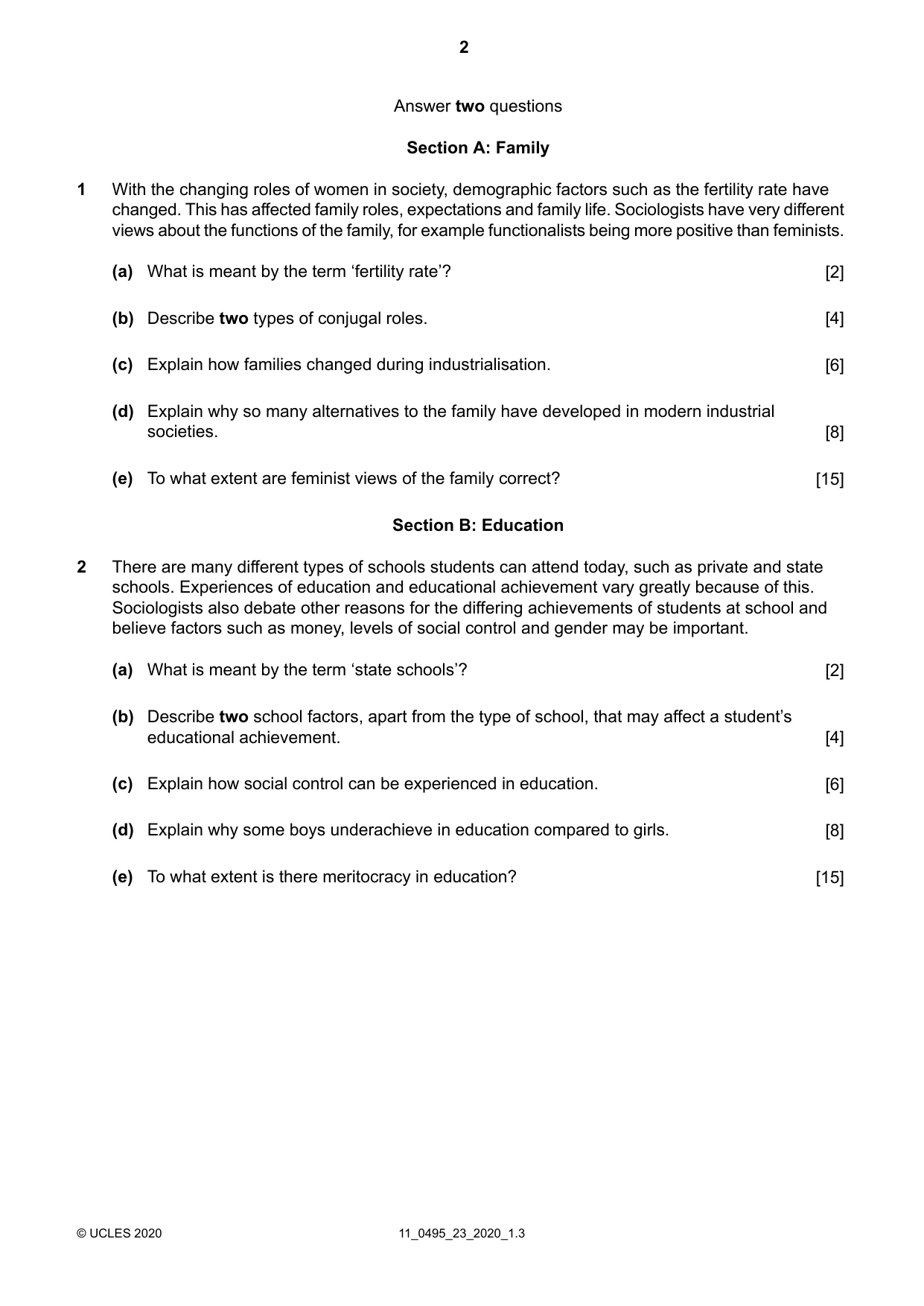
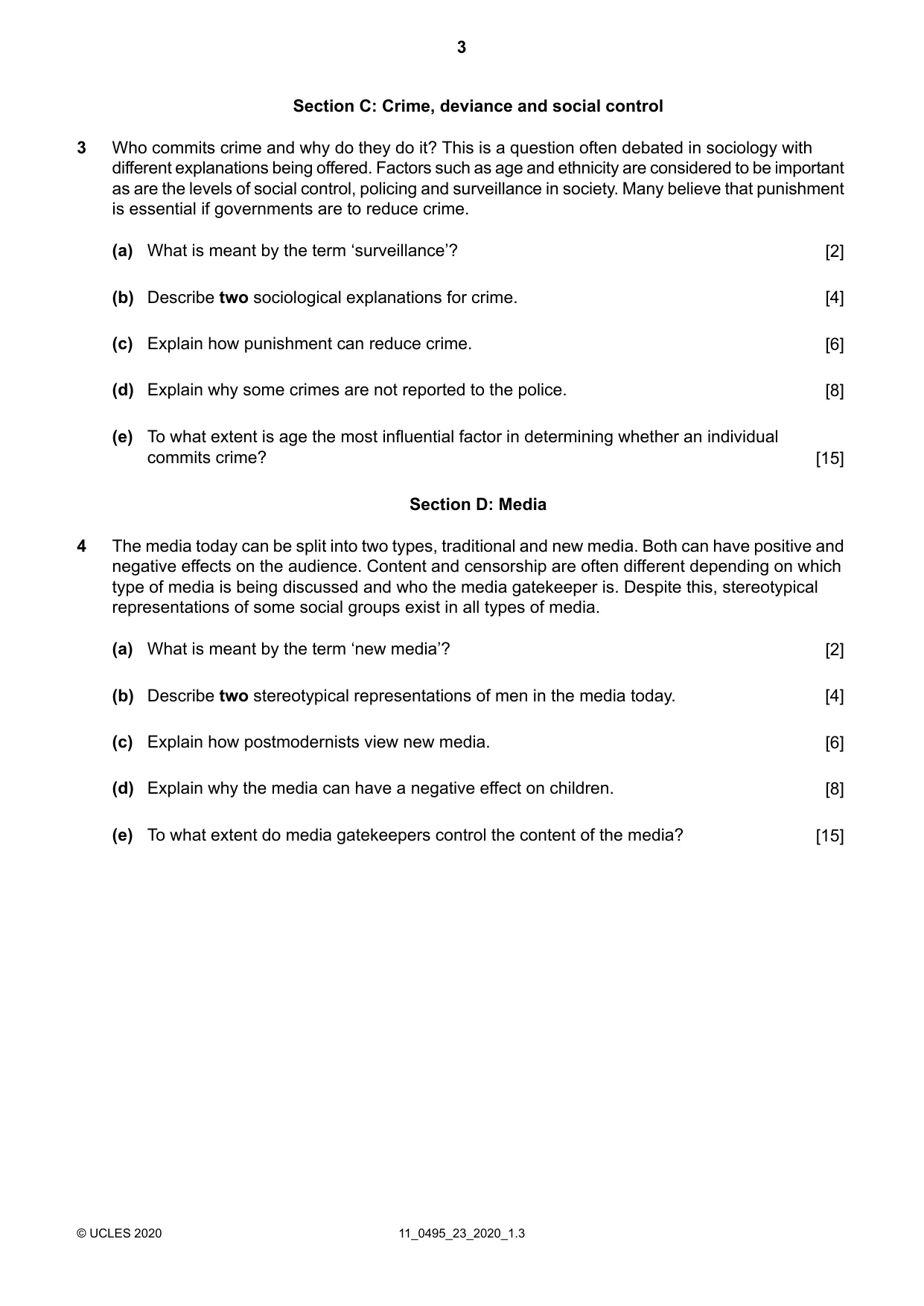

Mark scheme37 pages
Answers below. Sit the paper first if you are practising.



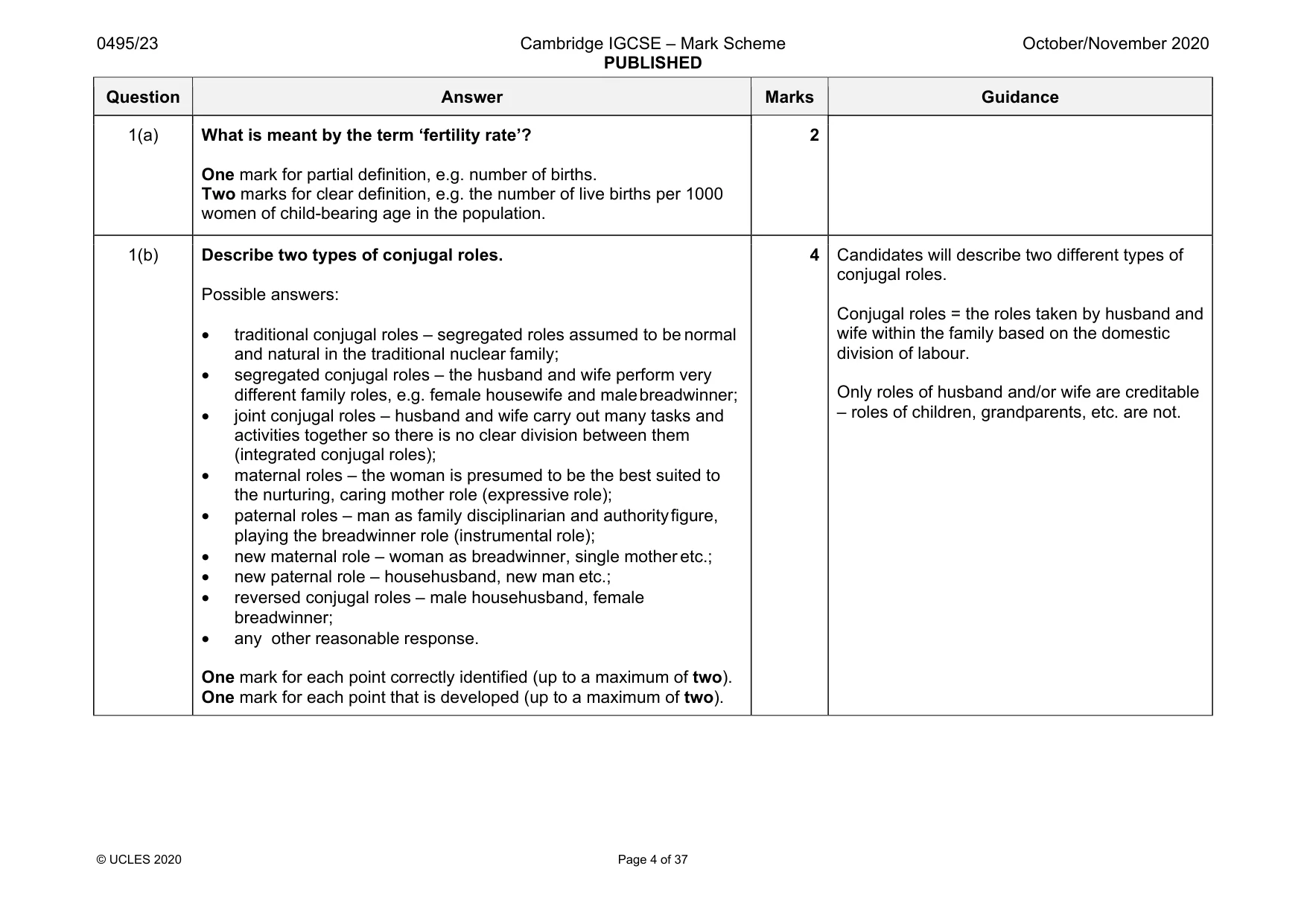


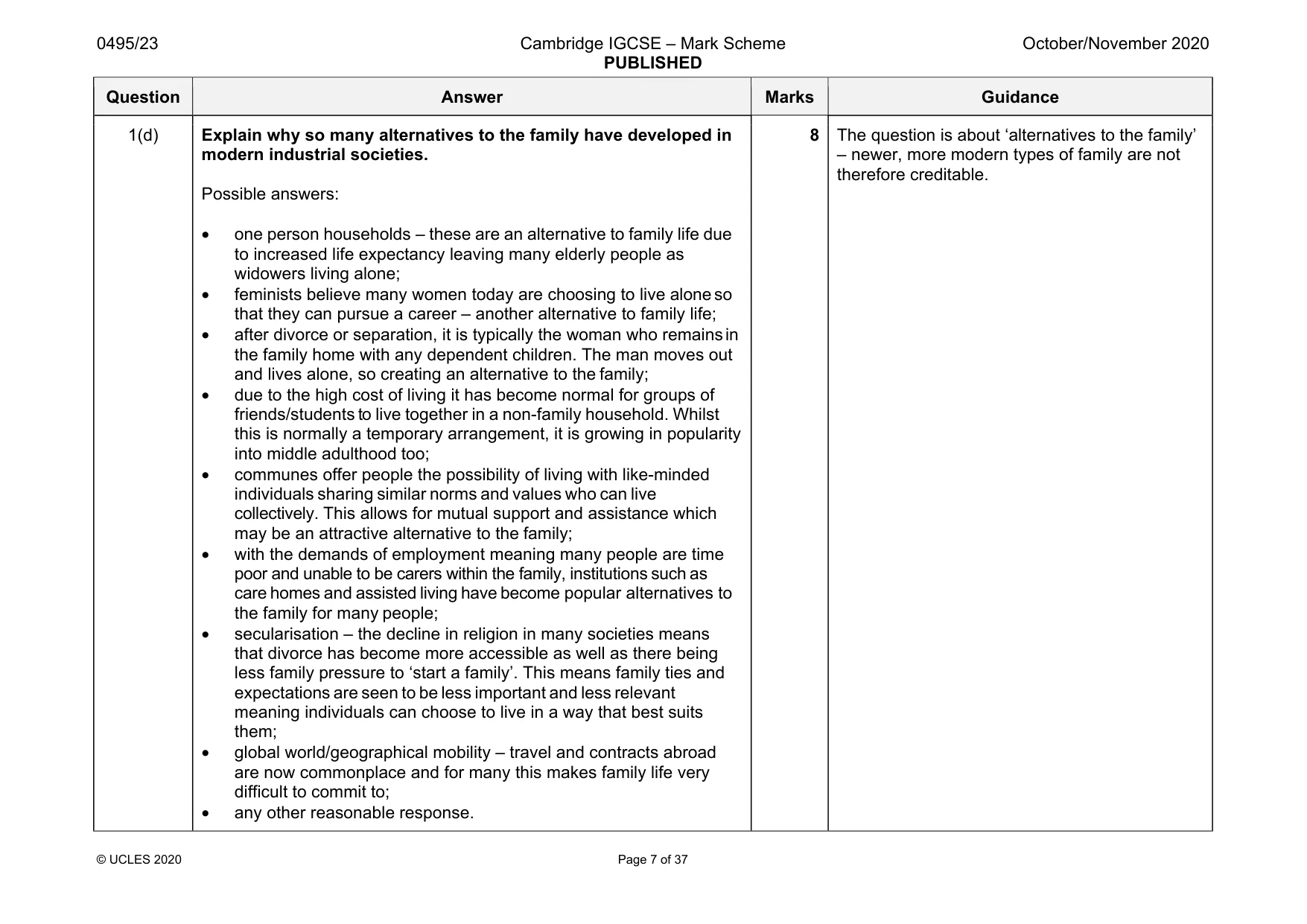














Questions as text
Q1 · With the changing roles of women in society, demographic factors such as the fertility…
1 With the changing roles of women in society, demographic factors such as the fertility rate have changed. This has affected family roles, expectations and family life. Sociologists have very different views about the functions of the family, for example functionalists being more positive than feminists. (a) What is meant by the term ‘fertility rate’? [2] (b) Describe two types of conjugal roles. [4] (c) Explain how families changed during industrialisation. [6] (d) Explain why so many alternatives to the family have developed in modern industrial societies. [8] (e) To what extent are feminist views of the family correct? [15]
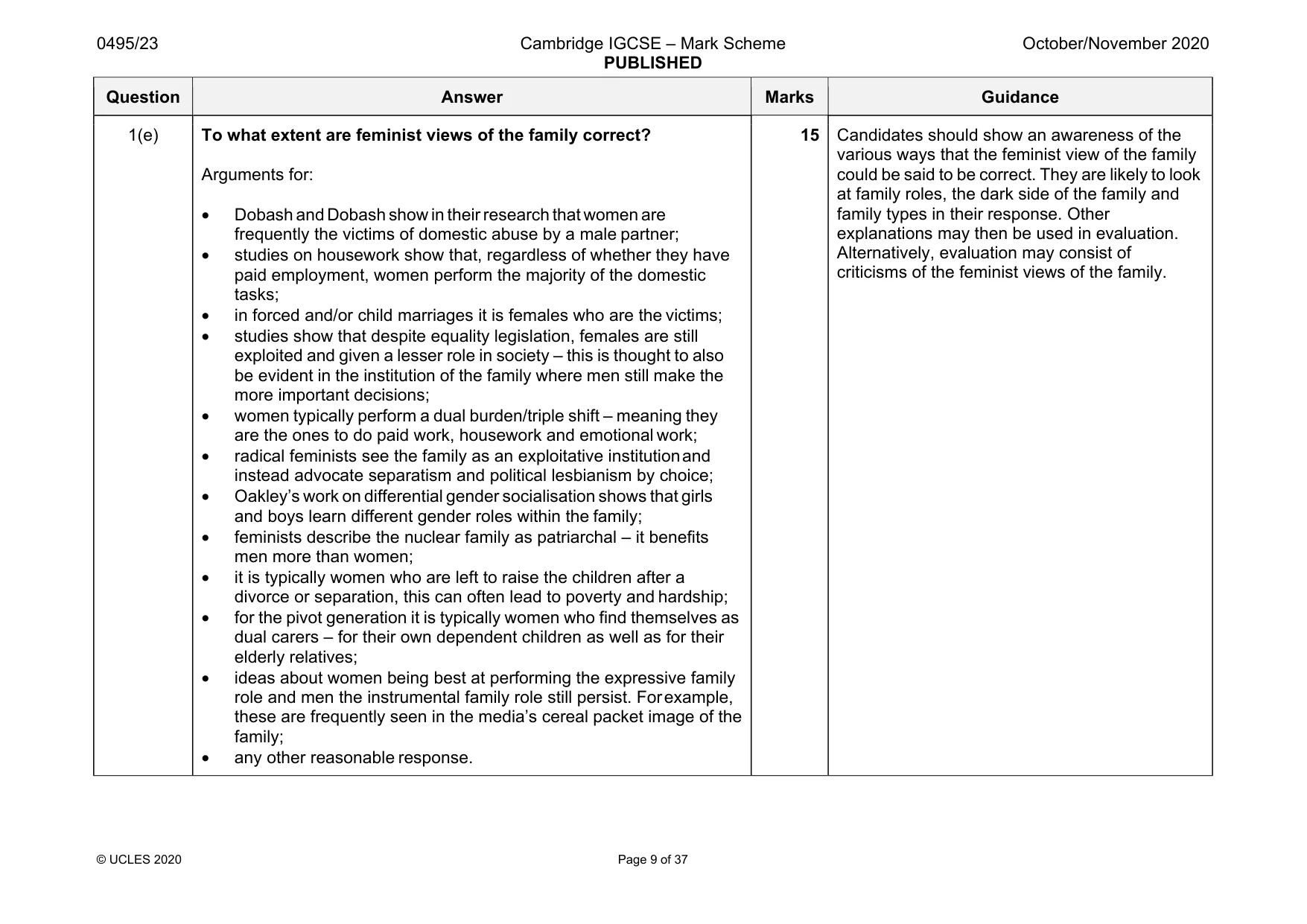
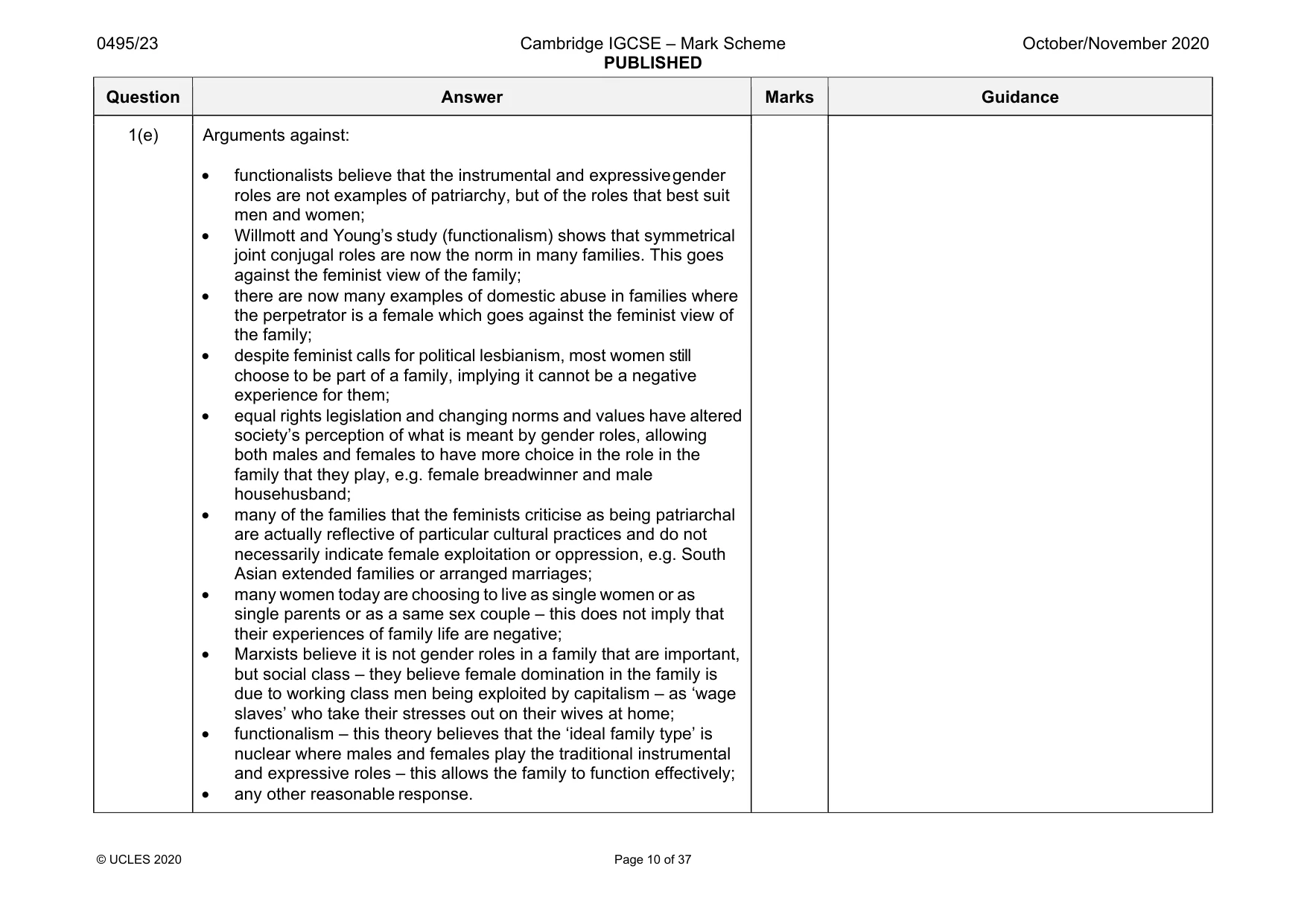
Mark scheme: 1(a) What is meant by the term ‘fertility rate’? One mark for partial definition, e.g. number of births. Two marks for clear definition, e.g. the number of live births per 1000 women of child-bearing age in the population. 1(b) Describe two types of conjugal roles. Possible answers: • traditional conjugal roles – segregated roles assumed to be normal and natural in the traditional nuclear family; • segregated conjugal roles – the husband and wife perform very different family roles, e.g. female housewife and male breadwinner; • joint conjugal roles – husband and wife carry out many tasks and activities together so there is no clear division between them (integrated conjugal roles); • maternal roles – the woman is presumed to be the best suited to the nurturing, caring mother role (expressive role); • paternal roles – man as family disciplinarian and authority figure, playing the breadwinner role (instrumental role); • new maternal role – woman as breadwinner, single mother etc.; • new paternal role – househusband, new man etc.; • reversed conjugal roles – male househusband, female breadwinner; • any other reasonable response. One mark for each point correctly identified (up to a maximum of two). One mark for each point that is developed (up to a maximum of two). 4 Candidates will describe two different types of conjugal roles. Conjugal roles = the roles taken by husband and wife within the family based on the domestic division of labour. Only roles of husband and/or wife are creditable – roles of children, grandparents, etc. are not. Question Answer Marks Guidance 1(c) Explain how families changed during industrialisation. Possible answers: • extended families were seen to fit the needs of pre-industrial societies whereas nuclear families were a better fit during industrialisation Parsons, the ‘fit thesis’; • in industrialisation institutions other than the family emerged who would take over many of the functions previously performed by families, e.g. healthcare and childcare. This meant the extended family was no longer needed; • industrial economies required workers who would move to wherever the work was available – they needed to be geographically mobile. This was much easier for a small nuclear family than a large extended family; • grandparents – family networks and wider kin may be involved in supporting the family in terms of childcare due to the rising trend for dual-worker families; • urbanisation accompanied industrialisation and saw a large movement of families out of rural areas to the cities. This corresponded with the decline in agricultural work; • industrialisation changed family roles, e.g. it created the segregated roles of the breadwinner and the housewife, childhood through children going to school; • dual worker families – this trend has occurred because of rising living costs in the city and has resulted in a more flexible family structure, e.g. men helping out more at home etc.; • any other reasonable response. 6 Industrialisation – the process in history when societies changed from being mainly rural and agriculture based, to being urban with more people working in industry. Candidates should show an understanding of how industrialisation has affected families. Urbanisation may also be discussed here. This is fine to credit. Question Answer Marks Guidance 1(c) Band 0 [0 marks] No creditworthy response. Band 1 [1–3 marks] Answers in this band will show only a limited awareness of the question. Responses may be short and un/underdeveloped. At the bottom of the band (1 mark), expect one weak point. Higher in the band (2–3 marks), candidates may offer more than one weak point, but there may be a tendency towards simplistic answers, engaging with sociological ideas without using sociological language. Band 2 [4–6 marks] Answers in this band will have clear and accurate explanation, showing good sociological knowledge and understanding. Sociological terms and concepts should be expected and explained. At the bottom of the band, the range of points covered may be narrow or lack detail. Higher in the band, answers will cover more than one point in a well-developed way or cover several points in less detail. Question Answer Marks Guidance 1(d) Explain why so many alternatives to the family have developed in modern industrial societies. Possible answers: • one person households – these are an alternative to family life due to increased life expectancy leaving many elderly people as widowers living alone; • feminists believe many women today are choosing to live alone so that they can pursue a career – another alternative to family life; • after divorce or separation, it is typically the woman who remains in the family home with any dependent children. The man moves out and lives alone, so creating an alternative to the family; • due to the high cost of living it has become normal for groups of friends/students to live together in a non-family household. Whilst this is normally a temporary arrangement, it is growing in popularity into middle adulthood too; • communes offer people the possibility of living with like-minded individuals sharing similar norms and values who can live collectively. This allows for mutual support and assistance which may be an attractive alternative to the family; • with the demands of employment meaning many people are time poor and unable to be carers within the family, institutions such as care homes and assisted living have become popular alternatives to the family for many people; • secularisation – the decline in religion in many societies means that divorce has become more accessible as well as there being less family pressure to ‘start a family’. This means family ties and expectations are seen to be less important and less relevant meaning individuals can choose to live in a way that best suits them; • global world/geographical mobility – travel and contracts abroad are now commonplace and for many this makes family life very difficult to commit to; • any other reasonable response. 8 The question is about ‘alternatives to the family’ – newer, more modern types of family are not therefore creditable. Question Answer Marks Guidance 1(d) Band 0 [0 marks] No creditworthy response. Band 1 [1–3 marks] Answers in this band will show only a limited awareness of the question. A tendency to description is likely. Responses may be short and undeveloped and points stated without explanation. Sociological terms and concepts are unlikely to be used. At the bottom of the band (1 mark), expect one weak point. Higher in the band (2–3 marks), candidates may offer more than one weak point. Band 2 [4–6 marks] Answers in this band will show basic sociological knowledge and understanding. Responses may be underdeveloped and lacking in range. At the bottom of the band, candidates are unlikely to use sociological terms and concepts accurately. Higher in the band, candidates may be beginning to use sociological terms and concepts with greater accuracy. However, some aspects of the answer may only be partially developed/explained. Band 3 [7–8 marks] Answers in this band will show good sociological knowledge and understanding and will be well-developed and explained. Sociological terms and concepts will be used accurately overall. Answers will be well-focused on the question and there will be a range of points presented. At the top of the band explanations will be clear throughout. Question Answer Marks Guidance 1(e) To what extent are feminist views of the family correct? Arguments for: • Dobash and Dobash show in their research that women are frequently the victims of domestic abuse by a male partner; • studies on housework show that, regardless of whether they have paid employment, women perform the majority of the domestic tasks; • in forced and/or child marriages it is females who are the victims; • studies show that despite equality legislation, females are still exploited and given a lesser role in society – this is thought to also be evident in the institution of the family where men still make the more important decisions; • women typically perform a dual burden/triple shift – meaning they are the ones to do paid work, housework and emotional work; • radical feminists see the family as an exploitative institution and instead advocate separatism and political lesbianism by choice; • Oakley’s work on differential gender socialisation shows that girls and boys learn different gender roles within the family; • feminists describe the nuclear family as patriarchal – it benefits men more than women; • it is typically women who are left to raise the children after a divorce or separation, this can often lead to poverty and hardship; • for the pivot generation it is typically women who find themselves as dual carers – for their own dependent children as well as for their elderly relatives; • ideas about women being best at performing the expressive family role and men the instrumental family role still persist. For example, these are frequently seen in the media’s cereal packet image of the family; • any other reasonable response. 15 Candidates should show an awareness of the various ways that the feminist view of the family could be said to be correct. They are likely to look at family roles, the dark side of the family and family types in their response. Other explanations may then be used in evaluation. Alternatively, evaluation may consist of criticisms of the feminist views of the family. Question Answer Marks Guidance 1(e) Arguments against: • functionalists believe that the instrumental and expressive gender roles are not examples of patriarchy, but of the roles that best suit men and women; • Willmott and Young’s study (functionalism) shows that symmetrical joint conjugal roles are now the norm in many families. This goes against the feminist view of the family; • there are now many examples of domestic abuse in families where the perpetrator is a female which goes against the feminist view of the family; • despite feminist calls for political lesbianism, most women still choose to be part of a family, implying it cannot be a negative experience for them; • equal rights legislation and changing norms and values have altered society’s perception of what is meant by gender roles, allowing both males and females to have more choice in the role in the family that they play, e.g. female breadwinner and male househusband; • many of the families that the feminists criticise as being patriarchal are actually reflective of particular cultural practices and do not necessarily indicate female exploitation or oppression, e.g. South Asian extended families or arranged marriages; • many women today are choosing to live as single women or as single parents or as a same sex couple – this does not imply that their experiences of family life are negative; • Marxists believe it is not gender roles in a family that are important, but social class – they believe female domination in the family is due to working class men being exploited by capitalism – as ‘wage slaves’ who take their stresses out on their wives at home; • functionalism – this theory believes that the ‘ideal family type’ is nuclear where males and females play the traditional instrumental and expressive roles – this allows the family to function effectively; • any other reasonable response. Question Answer Marks Guidance 1(e) Band 0 [0 marks] No creditworthy response. Band 1 [1–4 marks] Answers in this band may be vague and largely based on common sense showing limited knowledge of the debate. Use of sociological terms or concepts is very unlikely. Responses may be short, undeveloped and one-sided. Lower in the band (1–2 marks), expect one or two weak points. Higher in the band (3–4 marks) candidates may offer more than two points and provide a weak definition of key terms in the question. Band 2 [5–8 marks] In this band candidates will show some basic knowledge of the debate. Alternatively, they may offer an answer which is list-like in nature but there will be no real attempt to assess the issues raised by the question. There may be limited/some use of sociological terms or concepts. Responses may be underdeveloped and lack range. Answers may be simplistic and two-sided or only cover one side of the debate. Lower in the band, the response may be rather narrow in the points covered and there may be some development. Higher in the band, more points are likely to be covered with some development. Alternatively, a list-like answer with some development covering both sides of the argument may score up to 8 marks. A one-sided answer cannot score higher than 8 marks. Question Answer Marks Guidance 1(e) Band 3 [9–12 marks] Answers in this band will show good sociological knowledge and understanding of the debate. Sociological terms and concepts will be used with greater accuracy and/or frequency. For the most part, answers will be well-developed, focused on the questions and there will be a range of points presented. There will be a two-sided response, but it may lack range on one side. At the bottom of the band, candidates may provide a narrower range of developed points. At the top of the band, expect a wider range of developed points and clear focus on the question. Band 4 [13–15 marks] Answers in this band will show excellent knowledge and understanding of the debate. There will be a strong grasp of the arguments as well as accurate and frequent use of sociological terms and concepts. Answers will be well-developed, clearly focused on the question and discuss a wide range of points. Responses will be two-sided and have a range of points on each side. At the bottom of the band (13 marks), the answer may lack a specific conclusion. Higher in the band, there will be a clear attempt to offer an assessment of the ‘To what extent?’ part of the question through a focused conclusion.
Q2 · There are many different types of schools students can attend today, such as private and…
2 There are many different types of schools students can attend today, such as private and state schools. Experiences of education and educational achievement vary greatly because of this. Sociologists also debate other reasons for the differing achievements of students at school and believe factors such as money, levels of social control and gender may be important. (a) What is meant by the term ‘state schools’? [2] (b) Describe two school factors, apart from the type of school, that may affect a student’s educational achievement. [4] (c) Explain how social control can be experienced in education. [6] (d) Explain why some boys underachieve in education compared to girls. [8] (e) To what extent is there meritocracy in education? [15] Section C: Crime, deviance and social control
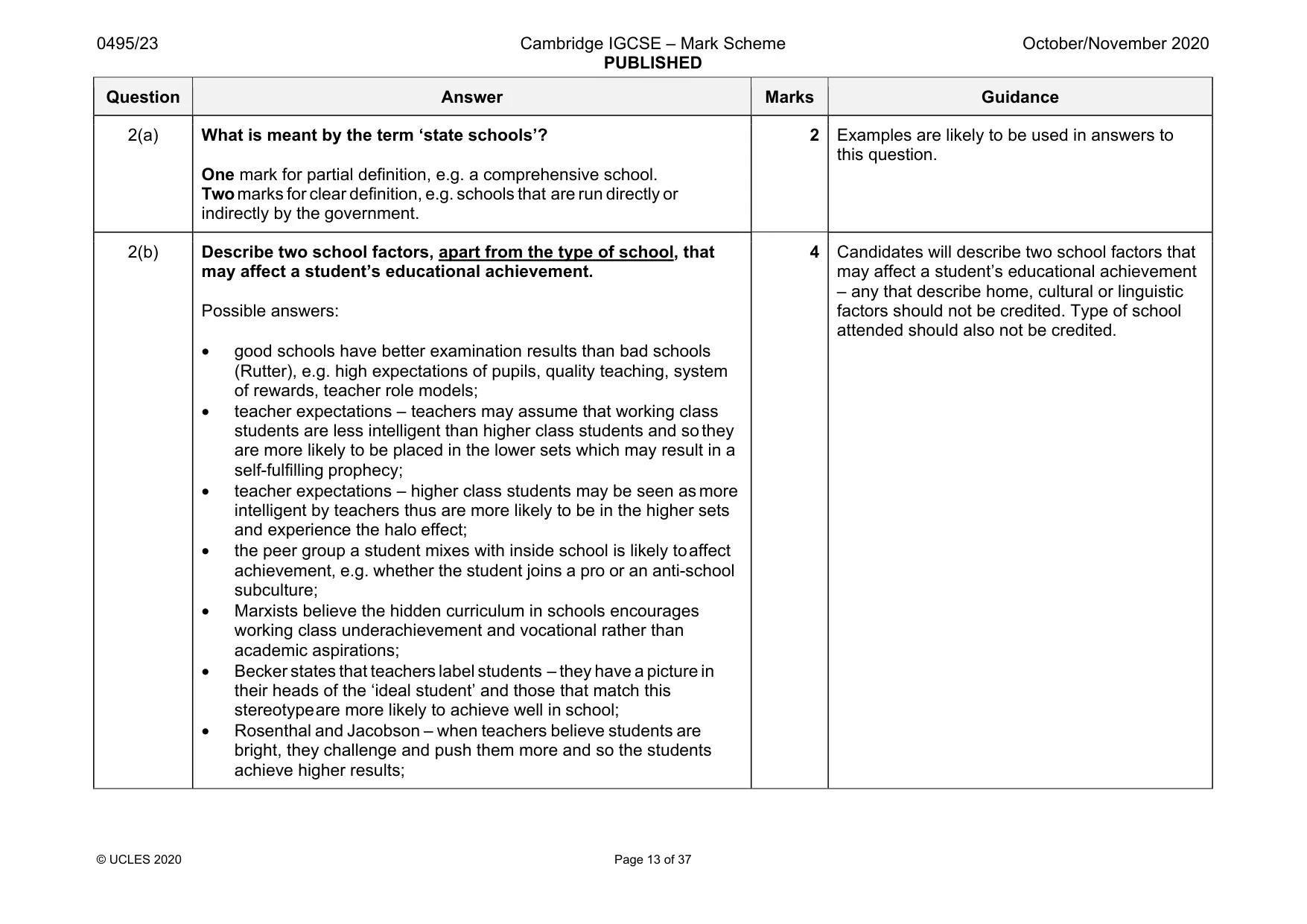
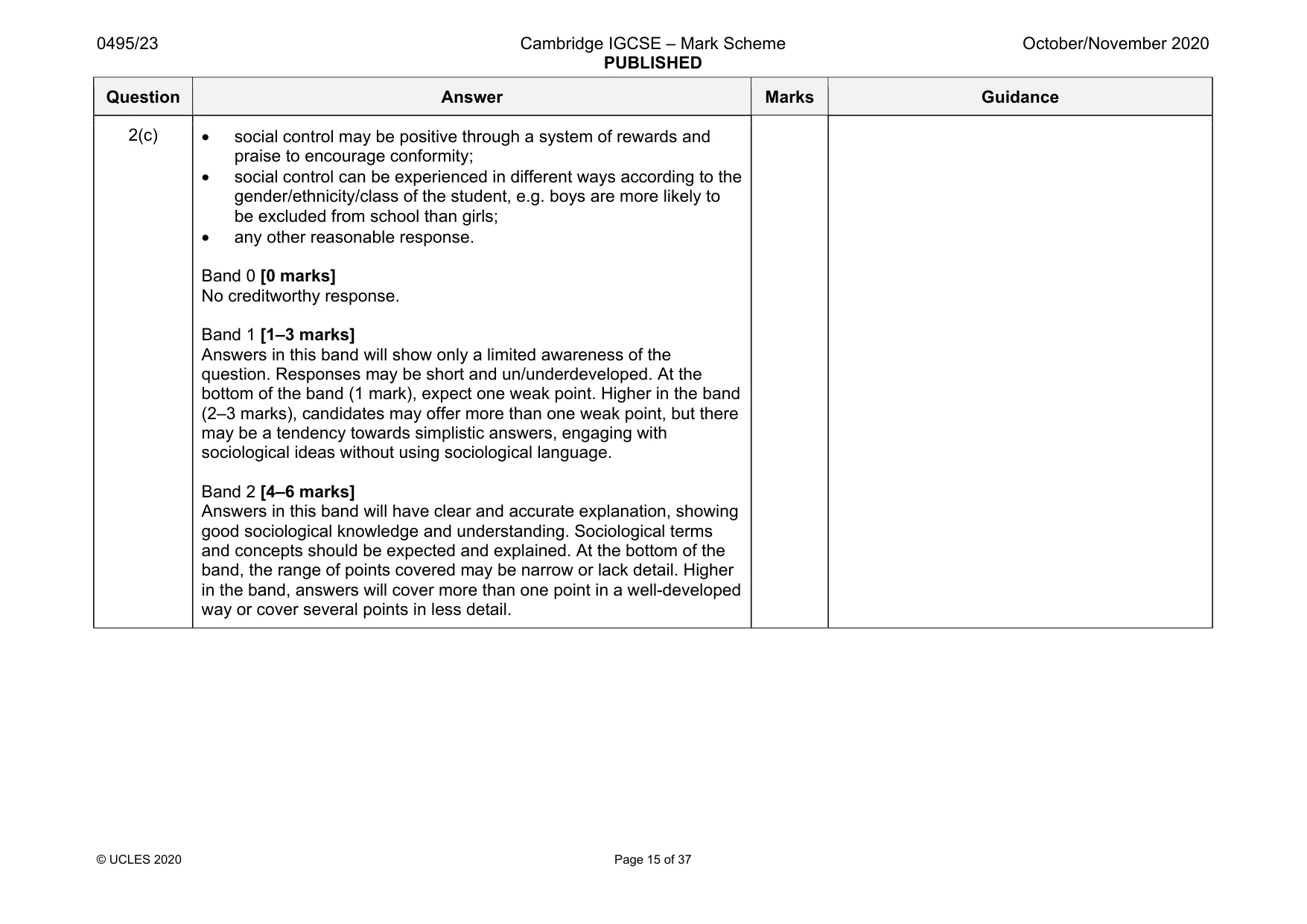
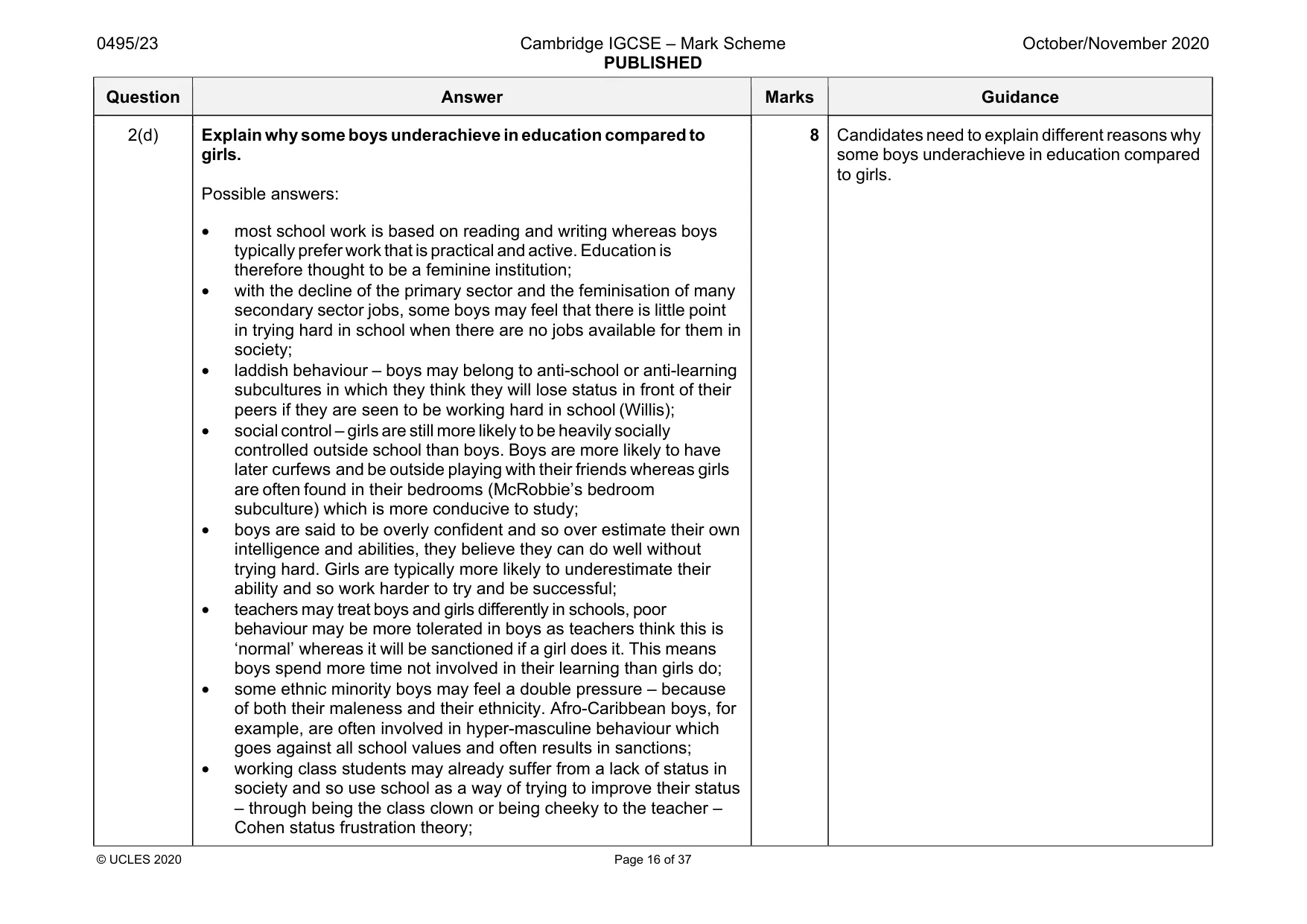
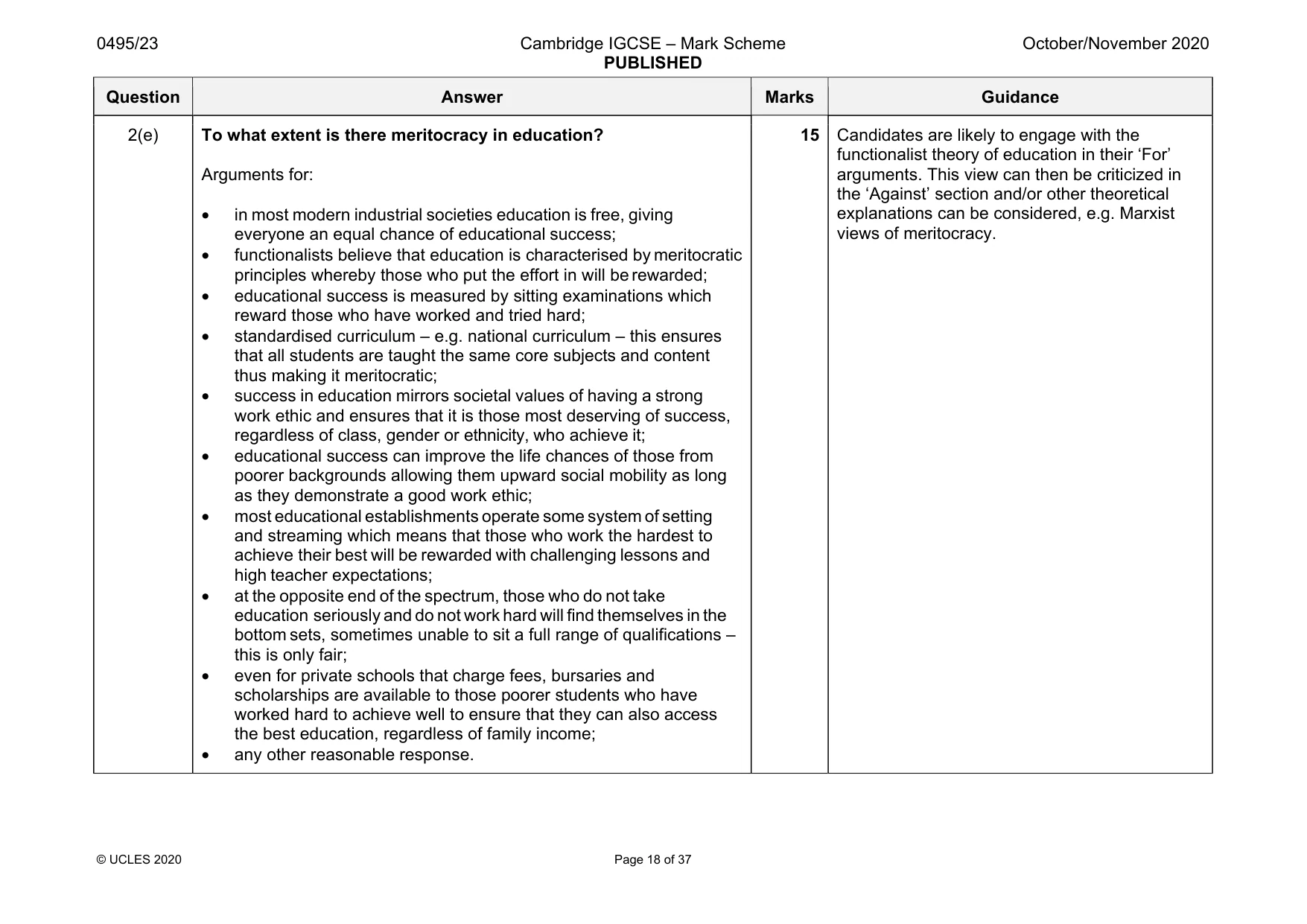
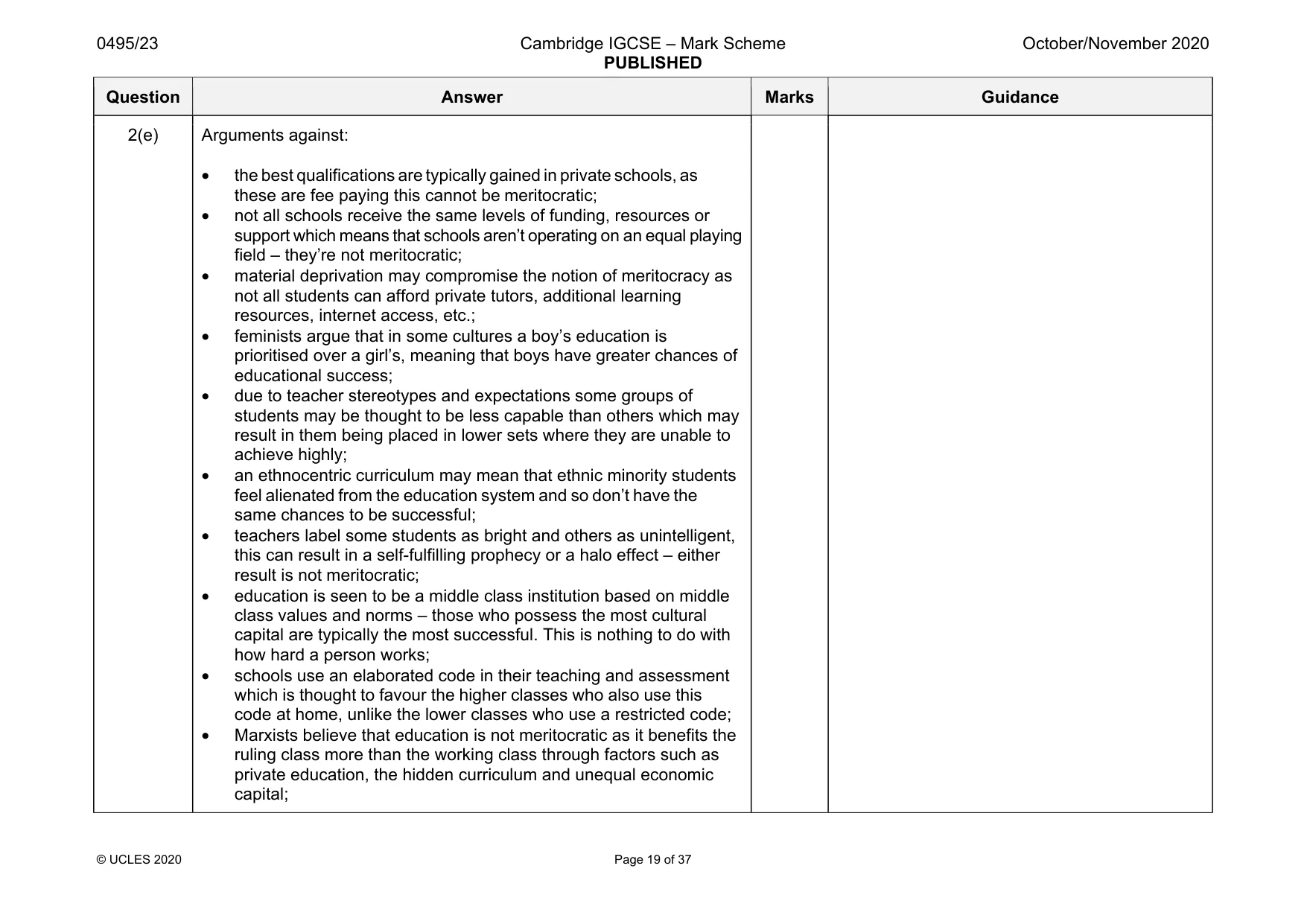
Mark scheme: 2(a) What is meant by the term ‘state schools’? One mark for partial definition, e.g. a comprehensive school. Two marks for clear definition, e.g. schools that are run directly or indirectly by the government. this question. 2(b) Describe two school factors, apart from the type of school, that may affect a student’s educational achievement. Possible answers: • good schools have better examination results than bad schools (Rutter), e.g. high expectations of pupils, quality teaching, system of rewards, teacher role models; • teacher expectations – teachers may assume that working class students are less intelligent than higher class students and so they are more likely to be placed in the lower sets which may result in a self-fulfilling prophecy; • teacher expectations – higher class students may be seen as more intelligent by teachers thus are more likely to be in the higher sets and experience the halo effect; • the peer group a student mixes with inside school is likely to affect achievement, e.g. whether the student joins a pro or an anti-school subculture; • Marxists believe the hidden curriculum in schools encourages working class underachievement and vocational rather than academic aspirations; • Becker states that teachers label students – they have a picture in their heads of the ‘ideal student’ and those that match this stereotype are more likely to achieve well in school; • Rosenthal and Jacobson – when teachers believe students are bright, they challenge and push them more and so the students achieve higher results; 4 Candidates will describe two school factors that may affect a student’s educational achievement – any that describe home, cultural or linguistic factors should not be credited. Type of school attended should also not be credited. Question Answer Marks Guidance 2(b) • setting and streaming students is seen to limit what they are able to achieve academically; • there may be gendered expectations in school transmitted through the hidden curriculum that may result in gendered subject choice and achievement; • there may be an ethnocentric curriculum in place that alienates certain students and so negatively affects their educational achievement; • other reasonable response. One mark for each point correctly identified (up to a maximum of two). One mark for each point that is developed (up to a maximum of two). 2(c) Explain how social control can be experienced in education. Possible answers: • formal social control – if a student breaks a recognised rule then they can expect to be punished through a series of written sanctions by a teacher; • social control may be physical, such as corporal punishment; • social control may be to do with time, e.g. detentions, isolations and exclusions; • social control can be informal – teachers looks, words and instructions will often ensure the student conforms; • social control can also be exercised in schools through the peer group – peer group pressure, for example. This may result in the formation of pro or anti-school subcultures; • bullying from peers may control students through pressure and coercion; • social control may be through negative sanctions – these act to punish students for their actions and deter them from doing them again; 6 Candidates should consider how social control can be experienced in education/schools. Candidates may refer to informal or formal social control or a combination of the two. Question Answer Marks Guidance 2(c) • social control may be positive through a system of rewards and praise to encourage conformity; • social control can be experienced in different ways according to the gender/ethnicity/class of the student, e.g. boys are more likely to be excluded from school than girls; • any other reasonable response. Band 0 [0 marks] No creditworthy response. Band 1 [1–3 marks] Answers in this band will show only a limited awareness of the question. Responses may be short and un/underdeveloped. At the bottom of the band (1 mark), expect one weak point. Higher in the band (2–3 marks), candidates may offer more than one weak point, but there may be a tendency towards simplistic answers, engaging with sociological ideas without using sociological language. Band 2 [4–6 marks] Answers in this band will have clear and accurate explanation, showing good sociological knowledge and understanding. Sociological terms and concepts should be expected and explained. At the bottom of the band, the range of points covered may be narrow or lack detail. Higher in the band, answers will cover more than one point in a well-developed way or cover several points in less detail. Question Answer Marks Guidance 2(d) Explain why some boys underachieve in education compared to girls. Possible answers: • most school work is based on reading and writing whereas boys typically prefer work that is practical and active. Education is therefore thought to be a feminine institution; • with the decline of the primary sector and the feminisation of many secondary sector jobs, some boys may feel that there is little point in trying hard in school when there are no jobs available for them in society; • laddish behaviour – boys may belong to anti-school or anti-learning subcultures in which they think they will lose status in front of their peers if they are seen to be working hard in school (Willis); • social control – girls are still more likely to be heavily socially controlled outside school than boys. Boys are more likely to have later curfews and be outside playing with their friends whereas girls are often found in their bedrooms (McRobbie’s bedroom subculture) which is more conducive to study; • boys are said to be overly confident and so over estimate their own intelligence and abilities, they believe they can do well without trying hard. Girls are typically more likely to underestimate their ability and so work harder to try and be successful; • teachers may treat boys and girls differently in schools, poor behaviour may be more tolerated in boys as teachers think this is ‘normal’ whereas it will be sanctioned if a girl does it. This means boys spend more time not involved in their learning than girls do; • some ethnic minority boys may feel a double pressure – because of both their maleness and their ethnicity. Afro-Caribbean boys, for example, are often involved in hyper-masculine behaviour which goes against all school values and often results in sanctions; • working class students may already suffer from a lack of status in society and so use school as a way of trying to improve their status – through being the class clown or being cheeky to the teacher – Cohen status frustration theory; 8 Candidates need to explain different reasons why some boys underachieve in education compared to girls. Question Answer Marks Guidance 2(d) • girls are still thought by many to be socialised to be more passive than boys, this will then translate to them being more conformist in school and so more likely to do well; • media role models for males often emphasise violence, hyper masculinity and anti-education values which can lead to male under-achievement as compared to girls; • any other reasonable response. Band 0 [0 marks] No creditworthy response. Band 1 [1–3 marks] Answers in this band will show only a limited awareness of the question. A tendency to description is likely. Responses may be short and undeveloped and points stated without explanation. Sociological terms and concepts are unlikely to be used. At the bottom of the band (1 mark), expect one weak point. Higher in the band (2–3 marks), candidates may offer more than one weak point. Band 2 [4–6 marks] Answers in this band will show basic sociological knowledge and understanding. Responses may be underdeveloped and lacking in range. At the bottom of the band, candidates are unlikely to use sociological terms and concepts accurately. Higher in the band, candidates may be beginning to use sociological terms and concepts with greater accuracy. However, some aspects of the answer may only be partially developed/explained. Band 3 [7–8 marks] Answers in this band will show good sociological knowledge and understanding and will be well-developed and explained. Sociological terms and concepts will be used accurately overall. Answers will be well-focused on the question and there will be a range of points presented. At the top of the band explanations will be clear throughout. Question Answer Marks Guidance 2(e) To what extent is there meritocracy in education? Arguments for: • in most modern industrial societies education is free, giving everyone an equal chance of educational success; • functionalists believe that education is characterised by meritocratic principles whereby those who put the effort in will be rewarded; • educational success is measured by sitting examinations which reward those who have worked and tried hard; • standardised curriculum – e.g. national curriculum – this ensures that all students are taught the same core subjects and content thus making it meritocratic; • success in education mirrors societal values of having a strong work ethic and ensures that it is those most deserving of success, regardless of class, gender or ethnicity, who achieve it; • educational success can improve the life chances of those from poorer backgrounds allowing them upward social mobility as long as they demonstrate a good work ethic; • most educational establishments operate some system of setting and streaming which means that those who work the hardest to achieve their best will be rewarded with challenging lessons and high teacher expectations; • at the opposite end of the spectrum, those who do not take education seriously and do not work hard will find themselves in the bottom sets, sometimes unable to sit a full range of qualifications – this is only fair; • even for private schools that charge fees, bursaries and scholarships are available to those poorer students who have worked hard to achieve well to ensure that they can also access the best education, regardless of family income; • any other reasonable response. 15 Candidates are likely to engage with the functionalist theory of education in their ‘For’ arguments. This view can then be criticized in the ‘Against’ section and/or other theoretical explanations can be considered, e.g. Marxist views of meritocracy. Question Answer Marks Guidance 2(e) Arguments against: • the best qualifications are typically gained in private schools, as these are fee paying this cannot be meritocratic; • not all schools receive the same levels of funding, resources or support which means that schools aren’t operating on an equal playing field – they’re not meritocratic; • material deprivation may compromise the notion of meritocracy as not all students can afford private tutors, additional learning resources, internet access, etc.; • feminists argue that in some cultures a boy’s education is prioritised over a girl’s, meaning that boys have greater chances of educational success; • due to teacher stereotypes and expectations some groups of students may be thought to be less capable than others which may result in them being placed in lower sets where they are unable to achieve highly; • an ethnocentric curriculum may mean that ethnic minority students feel alienated from the education system and so don’t have the same chances to be successful; • teachers label some students as bright and others as unintelligent, this can result in a self-fulfilling prophecy or a halo effect – either result is not meritocratic; • education is seen to be a middle class institution based on middle class values and norms – those who possess the most cultural capital are typically the most successful. This is nothing to do with how hard a person works; • schools use an elaborated code in their teaching and assessment which is thought to favour the higher classes who also use this code at home, unlike the lower classes who use a restricted code; • Marxists believe that education is not meritocratic as it benefits the ruling class more than the working class through factors such as private education, the hidden curriculum and unequal economic capital; Question Answer Marks Guidance 2(e) • gender – an examination based system of assessment is thought to favour boys over girls whereas a coursework based system seems to favour girls – this is not meritocratic; • any other reasonable response. Band 0 [0 marks] No creditworthy response. Band 1 [1–4 marks] Answers in this band may be vague and largely based on common sense showing limited knowledge of the debate. Use of sociological terms or concepts is very unlikely. Responses may be short, undeveloped and one-sided. Lower in the band (1–2 marks), expect one or two weak points. Higher in the band (3–4 marks) candidates may offer more than two points and provide a weak definition of key terms in the question. Band 2 [5–8 marks] In this band candidates will show some basic knowledge of the debate. Alternatively, they may offer an answer which is list-like in nature but there will be no real attempt to assess the issues raised by the question. There may be limited/some use of sociological terms or concepts. Responses may be underdeveloped and lack range. Answers may be simplistic and two-sided or only cover one side of the debate. Lower in the band, the response may be rather narrow in the points covered and there may be some development. Higher in the band, more points are likely to be covered with some development. Alternatively, a list-like answer with some development covering both sides of the argument may score up to 8 marks. A one-sided answer cannot score higher than 8 marks. Question Answer Marks Guidance 2(e) Band 3 [9–12 marks] Answers in this band will show good sociological knowledge and understanding of the debate. Sociological terms and concepts will be used with greater accuracy and/or frequency. For the most part, answers will be well-developed, focused on the questions and there will be a range of points presented. There will be a two-sided response, but it may lack range on one side. At the bottom of the band, candidates may provide a narrower range of developed points. At the top of the band, expect a wider range of developed points and clear focus on the question. Band 4 [13–15 marks] Answers in this band will show excellent knowledge and understanding of the debate. There will be a strong grasp of the arguments as well as accurate and frequent use of sociological terms and concepts. Answers will be well-developed, clearly focused on the question and discuss a wide range of points. Responses will be two-sided and have a range of points on each side. At the bottom of the band (13 marks), the answer may lack a specific conclusion. Higher in the band, there will be a clear attempt to offer an assessment of the ‘To what extent?’ part of the question through a focused conclusion.
Q3 · Who commits crime and why do they do it?
3 Who commits crime and why do they do it? This is a question often debated in sociology with different explanations being offered. Factors such as age and ethnicity are considered to be important as are the levels of social control, policing and surveillance in society. Many believe that punishment is essential if governments are to reduce crime. (a) What is meant by the term ‘surveillance’? [2] (b) Describe two sociological explanations for crime. [4] (c) Explain how punishment can reduce crime. [6] (d) Explain why some crimes are not reported to the police. [8] (e) To what extent is age the most influential factor in determining whether an individual commits crime? [15] Section D: Media
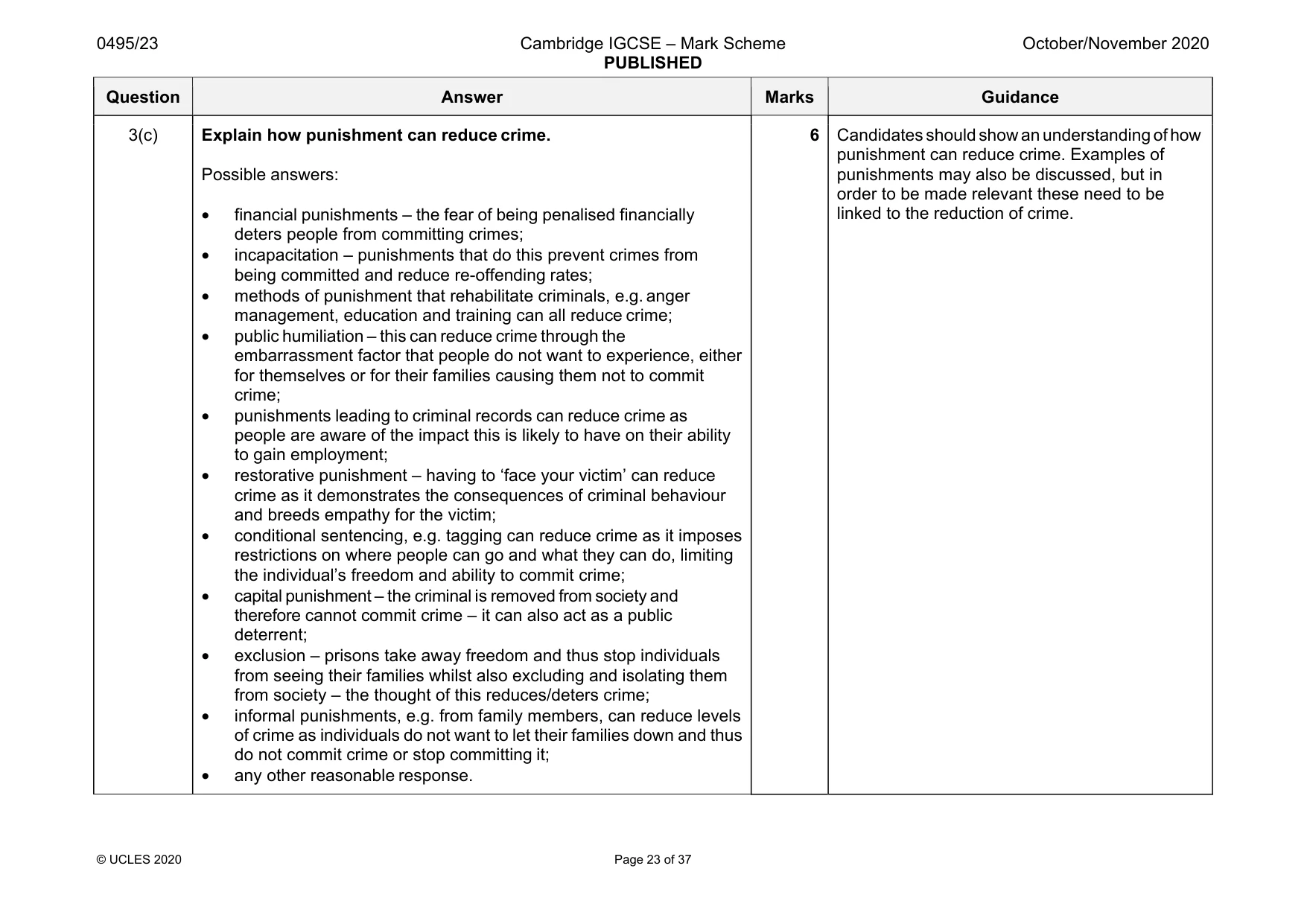
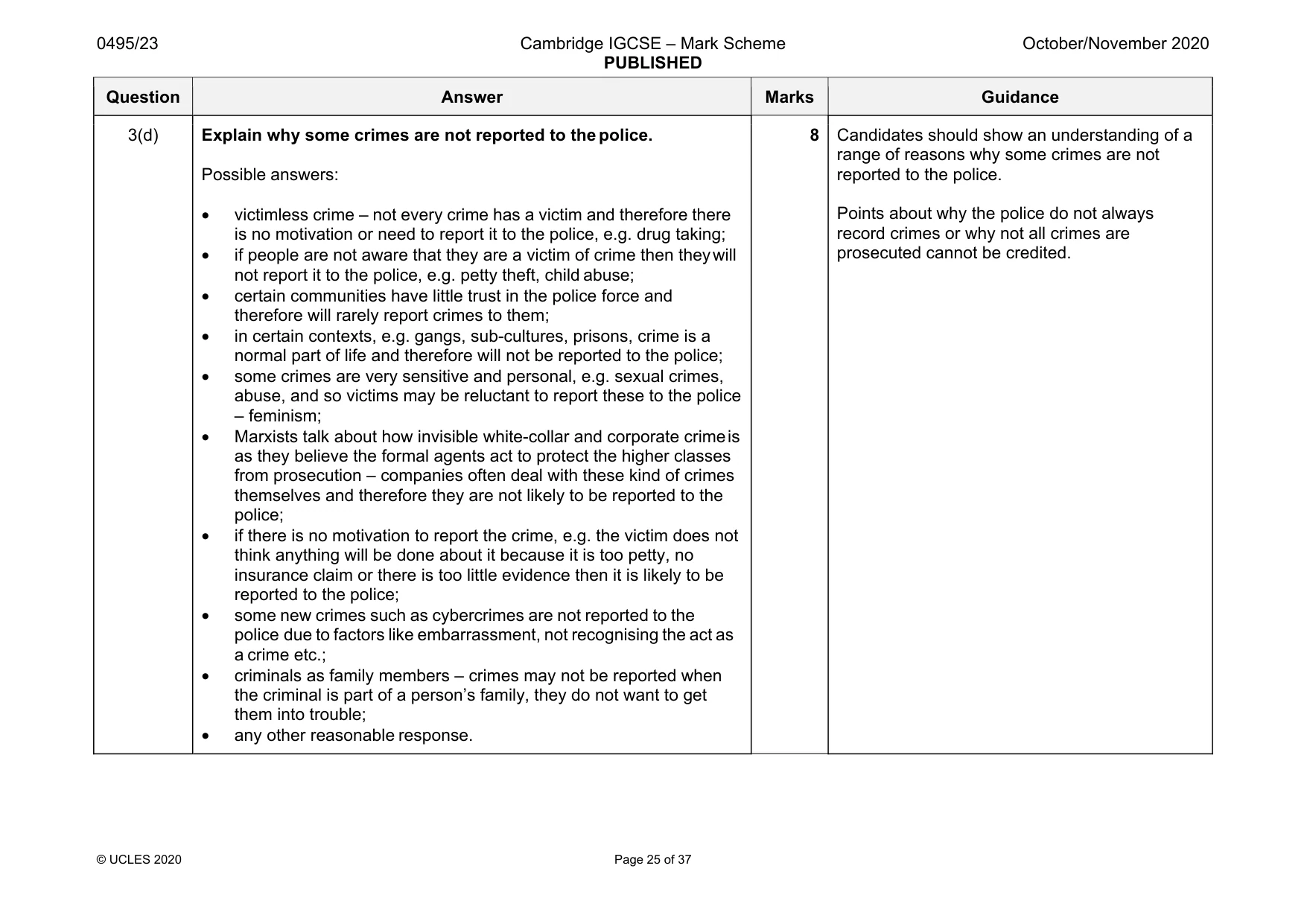
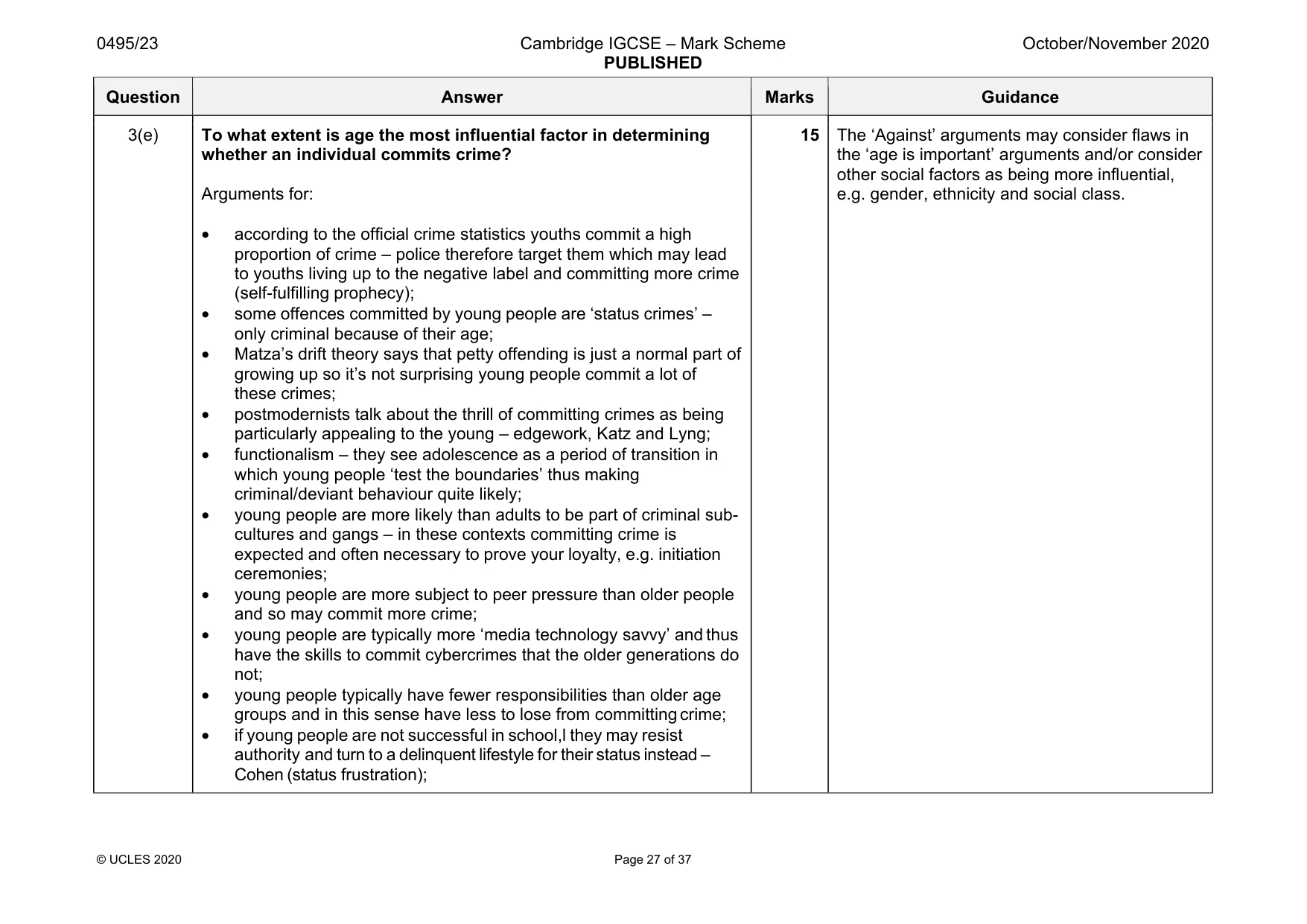
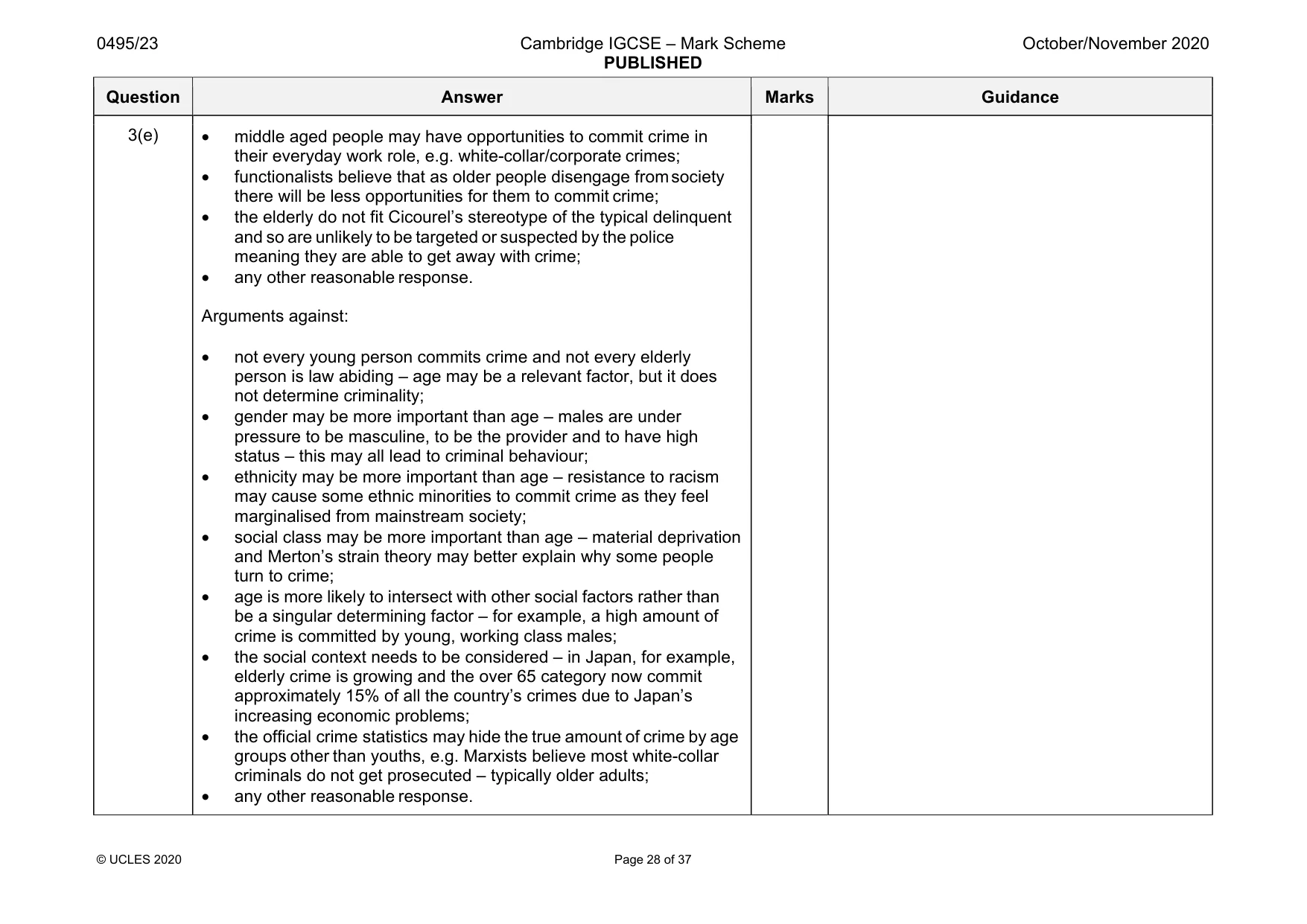
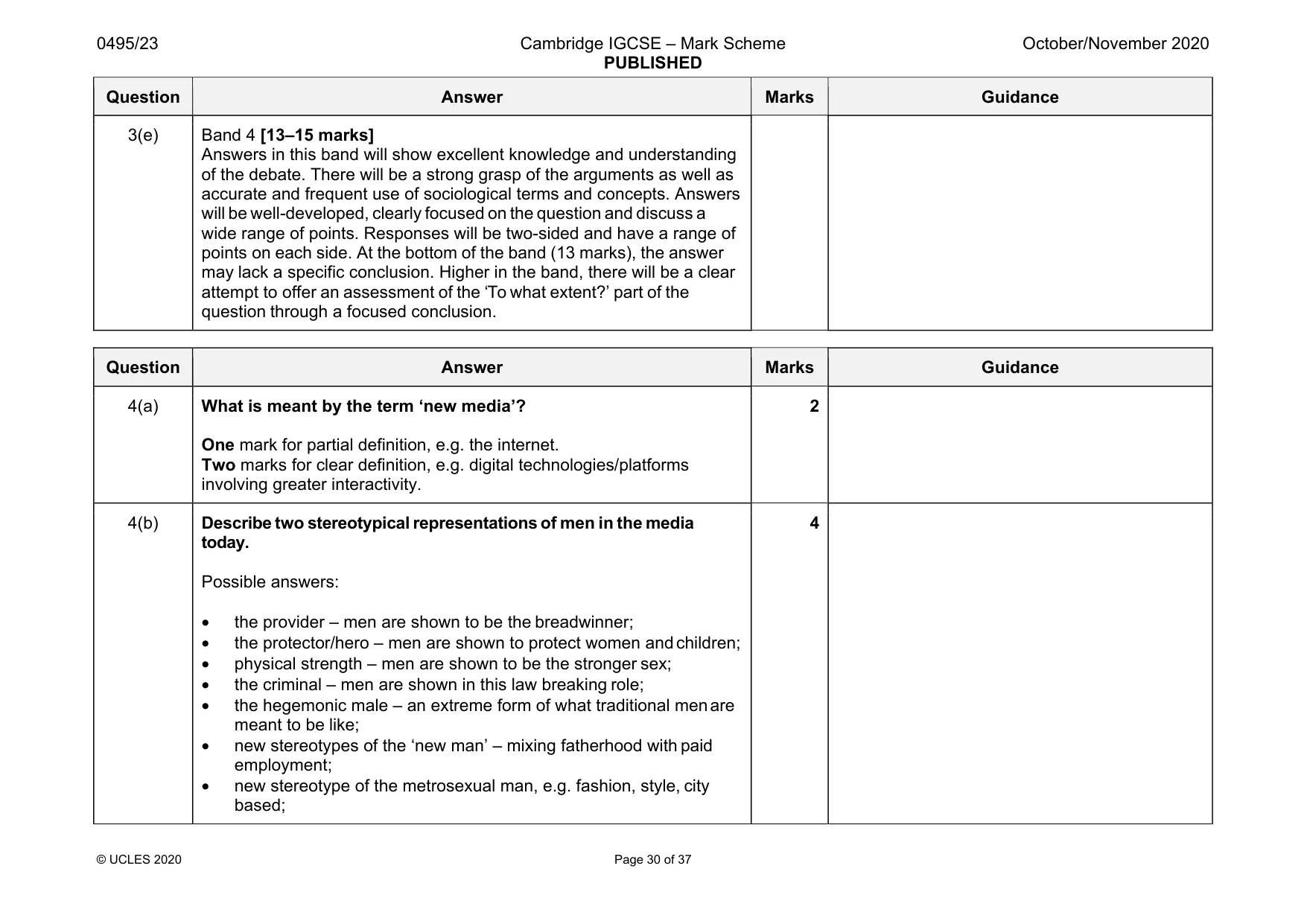
Mark scheme: 3(a) What is meant by the term ‘surveillance’? One mark for partial definition, e.g. watching people. Two marks for clear definition, e.g. monitoring individuals and groups by governments or other agents such as the police, collecting information with the intention of preventing crime. 3(b) Describe two sociological explanations for crime. Possible answers: • inadequate socialisation – not being taught the correct norms and values of society; • labelling theory – being stereotyped to be criminal and living up to this label (self-fulfilling prophecy); • Marxism – crime is resistance to the upper class exploitation of the working class in society; • material/relative deprivation – not having enough money to buy desired material goods leads to crime; • status frustration – Cohen – a lack of status in society may lead some people to turn to crime; • a search for thrills – postmodernism and edgework (Katz, Lyng); • peer pressure – particularly with young people; juvenile delinquency, gangs etc.; • being in a time of transition characterised by a lack of responsibility, e.g. functionalism and drift theory (Matza); • hegemonic masculinity – pressure on men to be the breadwinner and to prove their masculinity may lead to crime; • any other reasonable response. One mark for each point correctly identified (up to a maximum of two). One mark for each point that is developed (up to a maximum of two). 4 Candidates will describe two different sociological explanations for crime. Question Answer Marks Guidance 3(c) Explain how punishment can reduce crime. Possible answers: • financial punishments – the fear of being penalised financially deters people from committing crimes; • incapacitation – punishments that do this prevent crimes from being committed and reduce re-offending rates; • methods of punishment that rehabilitate criminals, e.g. anger management, education and training can all reduce crime; • public humiliation – this can reduce crime through the embarrassment factor that people do not want to experience, either for themselves or for their families causing them not to commit crime; • punishments leading to criminal records can reduce crime as people are aware of the impact this is likely to have on their ability to gain employment; • restorative punishment – having to ‘face your victim’ can reduce crime as it demonstrates the consequences of criminal behaviour and breeds empathy for the victim; • conditional sentencing, e.g. tagging can reduce crime as it imposes restrictions on where people can go and what they can do, limiting the individual’s freedom and ability to commit crime; • capital punishment – the criminal is removed from society and therefore cannot commit crime – it can also act as a public deterrent; • exclusion – prisons take away freedom and thus stop individuals from seeing their families whilst also excluding and isolating them from society – the thought of this reduces/deters crime; • informal punishments, e.g. from family members, can reduce levels of crime as individuals do not want to let their families down and thus do not commit crime or stop committing it; • any other reasonable response. 6 Candidates should show an understanding of how punishment can reduce crime. Examples of punishments may also be discussed, but in order to be made relevant these need to be linked to the reduction of crime. Question Answer Marks Guidance 3(c) Band 0 [0 marks] No creditworthy response. Band 1 [1–3 marks] Answers in this band will show only a limited awareness of the question. Responses may be short and un/underdeveloped. At the bottom of the band (1 mark), expect one weak point. Higher in the band (2–3 marks), candidates may offer more than one weak point, but there may be a tendency towards simplistic answers, engaging with sociological ideas without using sociological language. Band 2 [4–6 marks] Answers in this band will have clear and accurate explanation, showing good sociological knowledge and understanding. Sociological terms and concepts should be expected and explained. At the bottom of the band, the range of points covered may be narrow or lack detail. Higher in the band, answers will cover more than one point in a well-developed way or cover several points in less detail. Question Answer Marks Guidance 3(d) Explain why some crimes are not reported to the police. Possible answers: • victimless crime – not every crime has a victim and therefore there is no motivation or need to report it to the police, e.g. drug taking; • if people are not aware that they are a victim of crime then they will not report it to the police, e.g. petty theft, child abuse; • certain communities have little trust in the police force and therefore will rarely report crimes to them; • in certain contexts, e.g. gangs, sub-cultures, prisons, crime is a normal part of life and therefore will not be reported to the police; • some crimes are very sensitive and personal, e.g. sexual crimes, abuse, and so victims may be reluctant to report these to the police – feminism; • Marxists talk about how invisible white-collar and corporate crime is as they believe the formal agents act to protect the higher classes from prosecution – companies often deal with these kind of crimes themselves and therefore they are not likely to be reported to the police; • if there is no motivation to report the crime, e.g. the victim does not think anything will be done about it because it is too petty, no insurance claim or there is too little evidence then it is likely to be reported to the police; • some new crimes such as cybercrimes are not reported to the police due to factors like embarrassment, not recognising the act as a crime etc.; • criminals as family members – crimes may not be reported when the criminal is part of a person’s family, they do not want to get them into trouble; • any other reasonable response. 8 Candidates should show an understanding of a range of reasons why some crimes are not reported to the police. Points about why the police do not always record crimes or why not all crimes are prosecuted cannot be credited. Question Answer Marks Guidance 3(d) Band 0 [0 marks] No creditworthy response. Band 1 [1–3 marks] Answers in this band will show only a limited awareness of the question. A tendency to description is likely. Responses may be short and undeveloped and points stated without explanation. Sociological terms and concepts are unlikely to be used. At the bottom of the band (1 mark), expect one weak point. Higher in the band (2–3 marks), candidates may offer more than one weak point. Band 2 [4–6 marks] Answers in this band will show basic sociological knowledge and understanding. Responses may be underdeveloped and lacking in range. At the bottom of the band, candidates are unlikely to use sociological terms and concepts accurately. Higher in the band, candidates may be beginning to use sociological terms and concepts with greater accuracy. However, some aspects of the answer may only be partially developed/explained. Band 3 [7–8 marks] Answers in this band will show good sociological knowledge and understanding and will be well-developed and explained. Sociological terms and concepts will be used accurately overall. Answers will be well-focused on the question and there will be a range of points presented. At the top of the band explanations will be clear throughout. Question Answer Marks Guidance 3(e) To what extent is age the most influential factor in determining whether an individual commits crime? Arguments for: • according to the official crime statistics youths commit a high proportion of crime – police therefore target them which may lead to youths living up to the negative label and committing more crime (self-fulfilling prophecy); • some offences committed by young people are ‘status crimes’ – only criminal because of their age; • Matza’s drift theory says that petty offending is just a normal part of growing up so it’s not surprising young people commit a lot of these crimes; • postmodernists talk about the thrill of committing crimes as being particularly appealing to the young – edgework, Katz and Lyng; • functionalism – they see adolescence as a period of transition in which young people ‘test the boundaries’ thus making criminal/deviant behaviour quite likely; • young people are more likely than adults to be part of criminal sub- cultures and gangs – in these contexts committing crime is expected and often necessary to prove your loyalty, e.g. initiation ceremonies; • young people are more subject to peer pressure than older people and so may commit more crime; • young people are typically more ‘media technology savvy’ and thus have the skills to commit cybercrimes that the older generations do not; • young people typically have fewer responsibilities than older age groups and in this sense have less to lose from committing crime; • if young people are not successful in school,l they may resist authority and turn to a delinquent lifestyle for their status instead – Cohen (status frustration); 15 The ‘Against’ arguments may consider flaws in the ‘age is important’ arguments and/or consider other social factors as being more influential, e.g. gender, ethnicity and social class. Question Answer Marks Guidance 3(e) • middle aged people may have opportunities to commit crime in their everyday work role, e.g. white-collar/corporate crimes; • functionalists believe that as older people disengage from society there will be less opportunities for them to commit crime; • the elderly do not fit Cicourel’s stereotype of the typical delinquent and so are unlikely to be targeted or suspected by the police meaning they are able to get away with crime; • any other reasonable response. Arguments against: • not every young person commits crime and not every elderly person is law abiding – age may be a relevant factor, but it does not determine criminality; • gender may be more important than age – males are under pressure to be masculine, to be the provider and to have high status – this may all lead to criminal behaviour; • ethnicity may be more important than age – resistance to racism may cause some ethnic minorities to commit crime as they feel marginalised from mainstream society; • social class may be more important than age – material deprivation and Merton’s strain theory may better explain why some people turn to crime; • age is more likely to intersect with other social factors rather than be a singular determining factor – for example, a high amount of crime is committed by young, working class males; • the social context needs to be considered – in Japan, for example, elderly crime is growing and the over 65 category now commit approximately 15% of all the country’s crimes due to Japan’s increasing economic problems; • the official crime statistics may hide the true amount of crime by age groups other than youths, e.g. Marxists believe most white-collar criminals do not get prosecuted – typically older adults; • any other reasonable response. Question Answer Marks Guidance 3(e) Band 0 [0 marks] No creditworthy response. Band 1 [1–4 marks] Answers in this band may be vague and largely based on common sense showing limited knowledge of the debate. Use of sociological terms or concepts is very unlikely. Responses may be short, undeveloped and one-sided. Lower in the band (1–2 marks), expect one or two weak points. Higher in the band (3–4 marks) candidates may offer more than two points and provide a weak definition of key terms in the question. Band 2 [5–8 marks] In this band candidates will show some basic knowledge of the debate. Alternatively, they may offer an answer which is list-like in nature but there will be no real attempt to assess the issues raised by the question. There may be limited/some use of sociological terms or concepts. Responses may be underdeveloped and lack range. Answers may be simplistic and two-sided or only cover one side of the debate. Lower in the band, the response may be rather narrow in the points covered and there may be some development. Higher in the band, more points are likely to be covered with some development. Alternatively, a list-like answer with some development covering both sides of the argument may score up to 8 marks. A one-sided answer cannot score higher than 8 marks. Band 3 [9–12 marks] Answers in this band will show good sociological knowledge and understanding of the debate. Sociological terms and concepts will be used with greater accuracy and/or frequency. For the most part, answers will be well-developed, focused on the questions and there will be a range of points presented. There will be a two-sided response, but it may lack range on one side. At the bottom of the band, candidates may provide a narrower range of developed points. At the top of the band, expect a wider range of developed points and clear focus on the question. Question Answer Marks Guidance 3(e) Band 4 [13–15 marks] Answers in this band will show excellent knowledge and understanding of the debate. There will be a strong grasp of the arguments as well as accurate and frequent use of sociological terms and concepts. Answers will be well-developed, clearly focused on the question and discuss a wide range of points. Responses will be two-sided and have a range of points on each side. At the bottom of the band (13 marks), the answer may lack a specific conclusion. Higher in the band, there will be a clear attempt to offer an assessment of the ‘To what extent?’ part of the question through a focused conclusion.
Q4 · The media today can be split into two types, traditional and new media
4 The media today can be split into two types, traditional and new media. Both can have positive and negative effects on the audience. Content and censorship are often different depending on which type of media is being discussed and who the media gatekeeper is. Despite this, stereotypical representations of some social groups exist in all types of media. (a) What is meant by the term ‘new media’? [2] (b) Describe two stereotypical representations of men in the media today. [4] (c) Explain how postmodernists view new media. [6] (d) Explain why the media can have a negative effect on children. [8] (e) To what extent do media gatekeepers control the content of the media? [15]
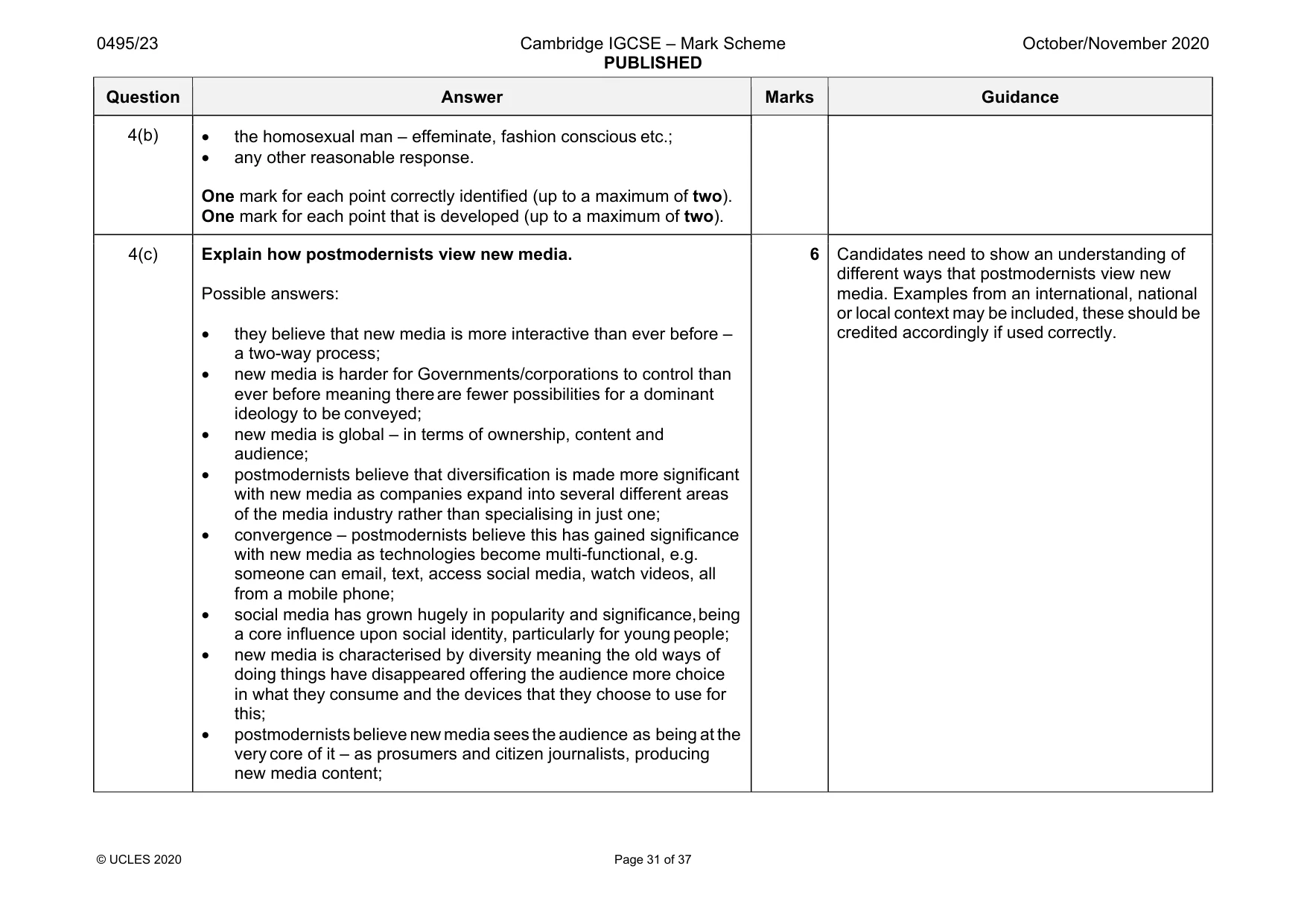
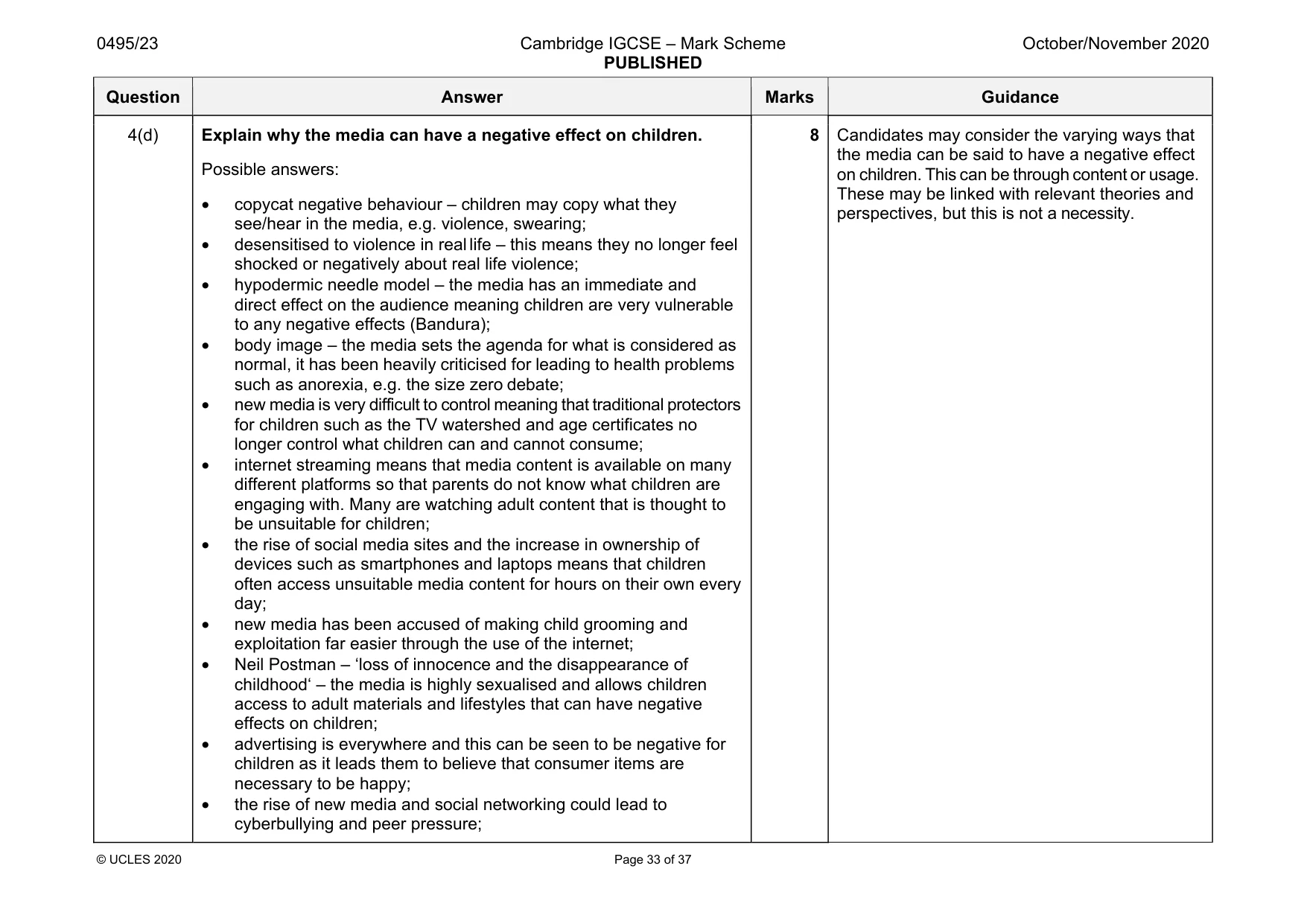
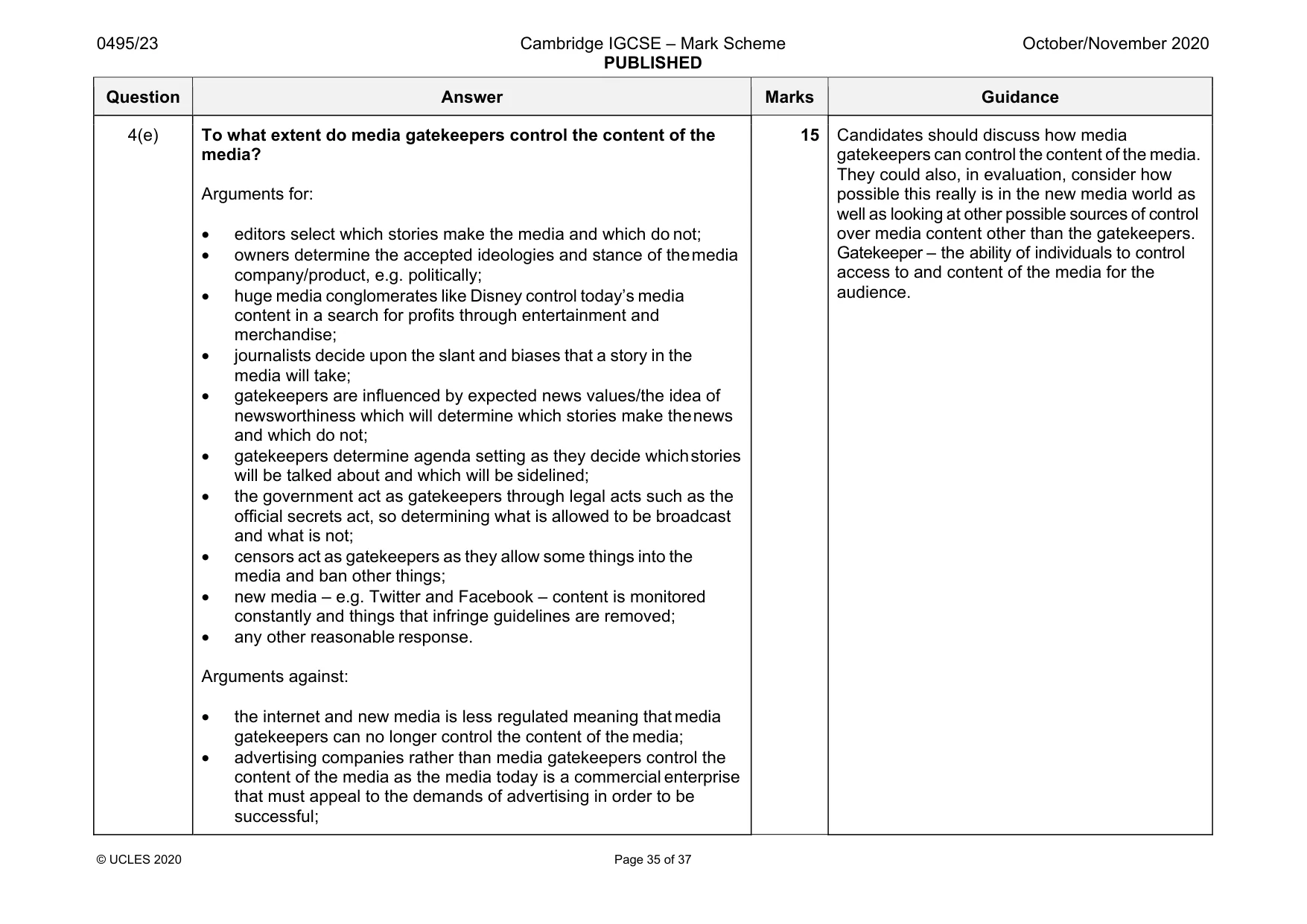
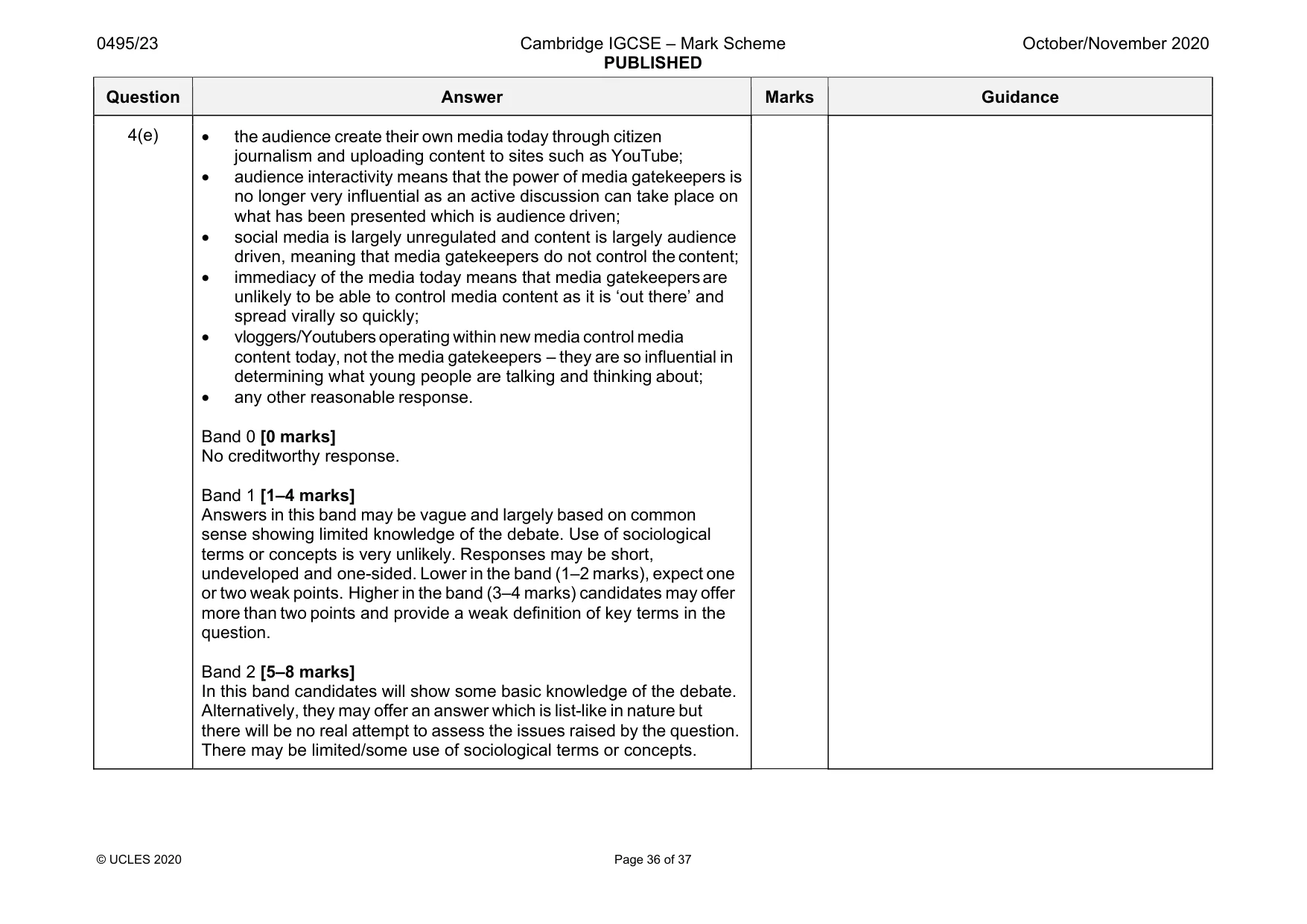
Mark scheme: 4(a) What is meant by the term ‘new media’? One mark for partial definition, e.g. the internet. Two marks for clear definition, e.g. digital technologies/platforms involving greater interactivity. 2 4(b) Describe two stereotypical representations of men in the media today. Possible answers: • the provider – men are shown to be the breadwinner; • the protector/hero – men are shown to protect women and children; • physical strength – men are shown to be the stronger sex; • the criminal – men are shown in this law breaking role; • the hegemonic male – an extreme form of what traditional men are meant to be like; • new stereotypes of the ‘new man’ – mixing fatherhood with paid employment; • new stereotype of the metrosexual man, e.g. fashion, style, city based; 4 Question Answer Marks Guidance 4(b) • the homosexual man – effeminate, fashion conscious etc.; • any other reasonable response. One mark for each point correctly identified (up to a maximum of two). One mark for each point that is developed (up to a maximum of two). 4(c) Explain how postmodernists view new media. Possible answers: • they believe that new media is more interactive than ever before – a two-way process; • new media is harder for Governments/corporations to control than ever before meaning there are fewer possibilities for a dominant ideology to be conveyed; • new media is global – in terms of ownership, content and audience; • postmodernists believe that diversification is made more significant with new media as companies expand into several different areas of the media industry rather than specialising in just one; • convergence – postmodernists believe this has gained significance with new media as technologies become multi-functional, e.g. someone can email, text, access social media, watch videos, all from a mobile phone; • social media has grown hugely in popularity and significance, being a core influence upon social identity, particularly for young people; • new media is characterised by diversity meaning the old ways of doing things have disappeared offering the audience more choice in what they consume and the devices that they choose to use for this; • postmodernists believe new media sees the audience as being at the very core of it – as prosumers and citizen journalists, producing new media content; 6 Candidates need to show an understanding of different ways that postmodernists view new media. Examples from an international, national or local context may be included, these should be credited accordingly if used correctly. Question Answer Marks Guidance 4(c) • postmodernists believe new media allows for more specialist and niche programming to be made and consumed, not just mass appeal material; • postmodernists see new media as internet based and thus it operates on multiple platforms, unlike traditional media; • other reasonable response. Band 0 [0 marks] No creditworthy response. Band 1 [1–3 marks] Answers in this band will show only a limited awareness of the question. Responses may be short and un/underdeveloped. At the bottom of the band (1 mark), expect one weak point. Higher in the band (2–3 marks), candidates may offer more than one weak point, but there may be a tendency towards simplistic answers, engaging with sociological ideas without using sociological language. Band 2 [4–6 marks] Answers in this band will have clear and accurate explanation, showing good sociological knowledge and understanding. Sociological terms and concepts should be expected and explained. At the bottom of the band, the range of points covered may be narrow or lack detail. Higher in the band, answers will cover more than one point in a well-developed way or cover several points in less detail. Question Answer Marks Guidance 4(d) Explain why the media can have a negative effect on children. Possible answers: • copycat negative behaviour – children may copy what they see/hear in the media, e.g. violence, swearing; • desensitised to violence in real life – this means they no longer feel shocked or negatively about real life violence; • hypodermic needle model – the media has an immediate and direct effect on the audience meaning children are very vulnerable to any negative effects (Bandura); • body image – the media sets the agenda for what is considered as normal, it has been heavily criticised for leading to health problems such as anorexia, e.g. the size zero debate; • new media is very difficult to control meaning that traditional protectors for children such as the TV watershed and age certificates no longer control what children can and cannot consume; • internet streaming means that media content is available on many different platforms so that parents do not know what children are engaging with. Many are watching adult content that is thought to be unsuitable for children; • the rise of social media sites and the increase in ownership of devices such as smartphones and laptops means that children often access unsuitable media content for hours on their own every day; • new media has been accused of making child grooming and exploitation far easier through the use of the internet; • Neil Postman – ‘loss of innocence and the disappearance of childhood‘ – the media is highly sexualised and allows children access to adult materials and lifestyles that can have negative effects on children; • advertising is everywhere and this can be seen to be negative for children as it leads them to believe that consumer items are necessary to be happy; • the rise of new media and social networking could lead to cyberbullying and peer pressure; 8 Candidates may consider the varying ways that the media can be said to have a negative effect on children. This can be through content or usage. These may be linked with relevant theories and perspectives, but this is not a necessity. Question Answer Marks Guidance 4(d) • video game culture – some children may spend so much of their time playing video games that they become uninterested in schoolwork and/or socially isolated; • any other reasonable response. Band 0 [0 marks] No creditworthy response. Band 1 [1–3 marks] Answers in this band will show only a limited awareness of the question. A tendency to description is likely. Responses may be short and undeveloped and points stated without explanation. Sociological terms and concepts are unlikely to be used. At the bottom of the band (1 mark), expect one weak point. Higher in the band (2–3 marks), candidates may offer more than one weak point. Band 2 [4–6 marks] Answers in this band will show basic sociological knowledge and understanding. Responses may be underdeveloped and lacking in range. At the bottom of the band, candidates are unlikely to use sociological terms and concepts accurately. Higher in the band, candidates may be beginning to use sociological terms and concepts with greater accuracy. However, some aspects of the answer may only be partially developed/explained. Band 3 [7–8 marks] Answers in this band will show good sociological knowledge and understanding and will be well-developed and explained. Sociological terms and concepts will be used accurately overall. Answers will be well-focused on the question and there will be a range of points presented. At the top of the band explanations will be clear throughout. Question Answer Marks Guidance 4(e) To what extent do media gatekeepers control the content of the media? Arguments for: • editors select which stories make the media and which do not; • owners determine the accepted ideologies and stance of the media company/product, e.g. politically; • huge media conglomerates like Disney control today’s media content in a search for profits through entertainment and merchandise; • journalists decide upon the slant and biases that a story in the media will take; • gatekeepers are influenced by expected news values/the idea of newsworthiness which will determine which stories make the news and which do not; • gatekeepers determine agenda setting as they decide which stories will be talked about and which will be sidelined; • the government act as gatekeepers through legal acts such as the official secrets act, so determining what is allowed to be broadcast and what is not; • censors act as gatekeepers as they allow some things into the media and ban other things; • new media – e.g. Twitter and Facebook – content is monitored constantly and things that infringe guidelines are removed; • any other reasonable response. Arguments against: • the internet and new media is less regulated meaning that media gatekeepers can no longer control the content of the media; • advertising companies rather than media gatekeepers control the content of the media as the media today is a commercial enterprise that must appeal to the demands of advertising in order to be successful; 15 Candidates should discuss how media gatekeepers can control the content of the media. They could also, in evaluation, consider how possible this really is in the new media world as well as looking at other possible sources of control over media content other than the gatekeepers. Gatekeeper – the ability of individuals to control access to and content of the media for the audience. Question Answer Marks Guidance 4(e) • the audience create their own media today through citizen journalism and uploading content to sites such as YouTube; • audience interactivity means that the power of media gatekeepers is no longer very influential as an active discussion can take place on what has been presented which is audience driven; • social media is largely unregulated and content is largely audience driven, meaning that media gatekeepers do not control the content; • immediacy of the media today means that media gatekeepers are unlikely to be able to control media content as it is ‘out there’ and spread virally so quickly; • vloggers/Youtubers operating within new media control media content today, not the media gatekeepers – they are so influential in determining what young people are talking and thinking about; • any other reasonable response. Band 0 [0 marks] No creditworthy response. Band 1 [1–4 marks] Answers in this band may be vague and largely based on common sense showing limited knowledge of the debate. Use of sociological terms or concepts is very unlikely. Responses may be short, undeveloped and one-sided. Lower in the band (1–2 marks), expect one or two weak points. Higher in the band (3–4 marks) candidates may offer more than two points and provide a weak definition of key terms in the question. Band 2 [5–8 marks] In this band candidates will show some basic knowledge of the debate. Alternatively, they may offer an answer which is list-like in nature but there will be no real attempt to assess the issues raised by the question. There may be limited/some use of sociological terms or concepts. Question Answer Marks Guidance 4(e) Responses may be underdeveloped and lack range. Answers may be simplistic and two-sided or only cover one side of the debate. Lower in the band, the response may be rather narrow in the points covered and there may be some development. Higher in the band, more points are likely to be covered with some development. Alternatively, a list-like answer with some development covering both sides of the argument may score up to 8 marks. A one-sided answer cannot score higher than 8 marks. Band 3 [9–12 marks] Answers in this band will show good sociological knowledge and understanding of the debate. Sociological terms and concepts will be used with greater accuracy and/or frequency. For the most part, answers will be well-developed, focused on the questions and there will be a range of points presented. There will be a two-sided response, but it may lack range on one side. At the bottom of the band, candidates may provide a narrower range of developed points. At the top of the band, expect a wider range of developed points and clear focus on the question. Band 4 [13–15 marks] Answers in this band will show excellent knowledge and understanding of the debate. There will be a strong grasp of the arguments as well as accurate and frequent use of sociological terms and concepts. Answers will be well-developed, clearly focused on the question and discuss a wide range of points. Responses will be two-sided and have a range of points on each side. At the bottom of the band (13 marks), the answer may lack a specific conclusion. Higher in the band, there will be a clear attempt to offer an assessment of the ‘To what extent?’ part of the question through a focused conclusion.
What was in this paper
The subtopics covered by these 4 questions, and how many questions each got. Open one in a new tab to see every Cambridge question on it.
What you needed in this session
Cambridge’s own grade thresholds for 2020 Oct/Nov, Paper 2 · Variant 3. A higher threshold means an easier paper — the bar moves with how the cohort did.