Cambridge IGCSE Sociology 0495 — 2019 May/June Paper 1 · Variant 2
0495/12/M/J/19 · 80 marks · ≈90 min
The question paper and its mark scheme, free to read here and free to download. This is Cambridge’s own paper, exactly as it was sat.
Question paper4 pages

Mark scheme23 pages
Answers below. Sit the paper first if you are practising.
Paper as text
Question paper, page 1
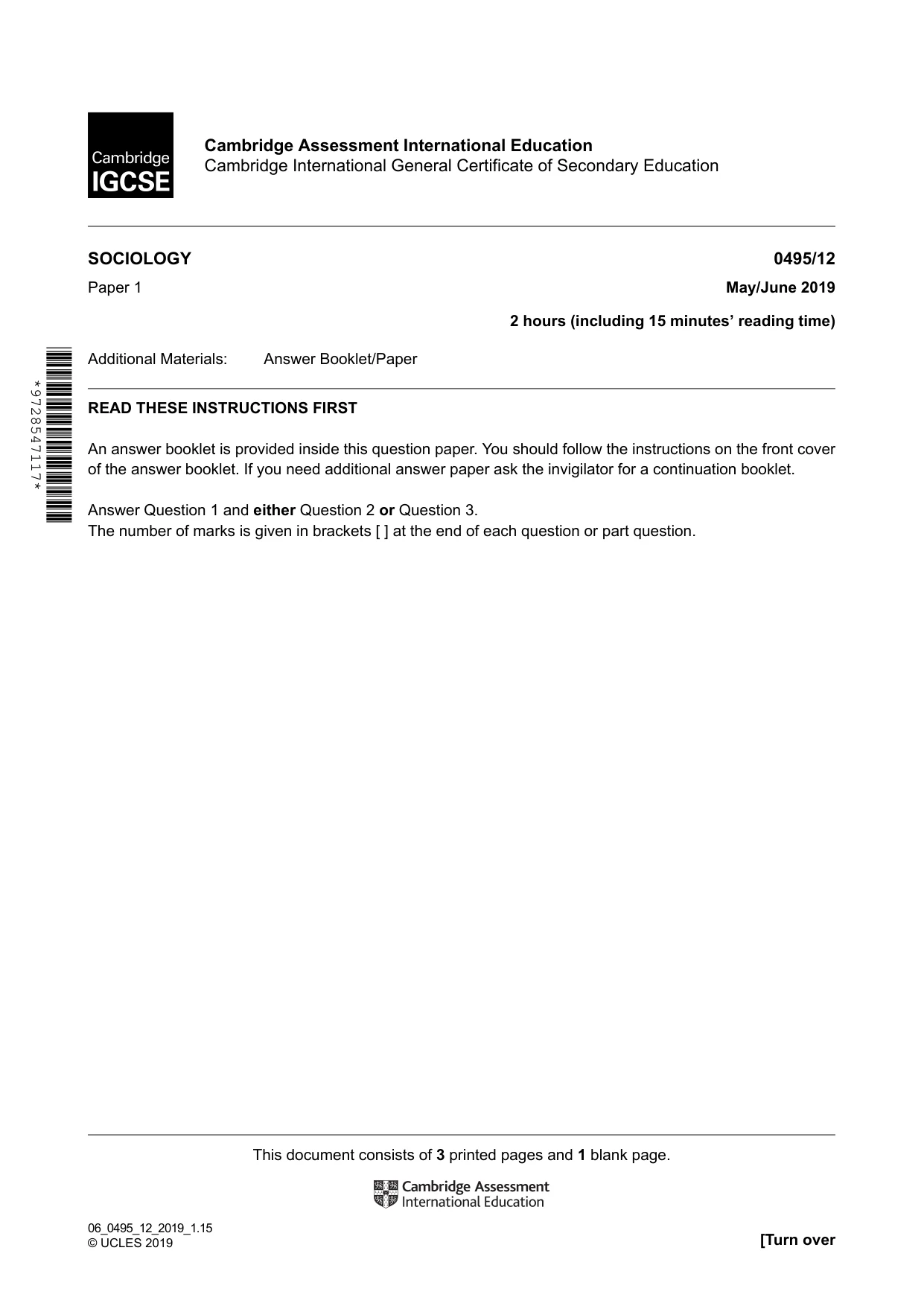
Cambridge Assessment International Education Cambridge International General Certificate of Secondary Education 0495/12 May/June 2019 SOCIOLOGY Paper 1 2 hours (including 15 minutes’ reading time) Additional Materials: Answer Booklet/Paper READ THESE INSTRUCTIONS FIRST An answer booklet is provided inside this question paper. You should follow the instructions on the front cover of the answer booklet. If you need additional answer paper ask the invigilator for a continuation booklet. Answer Question 1 and either Question 2 or Question 3. The number of marks is given in brackets [ ] at the end of each question or part question. This document consists of 3 printed pages and 1 blank page. [Turn over 06_0495_12_2019_1.15 © UCLES 2019 *9728547117*
Question paper, page 2
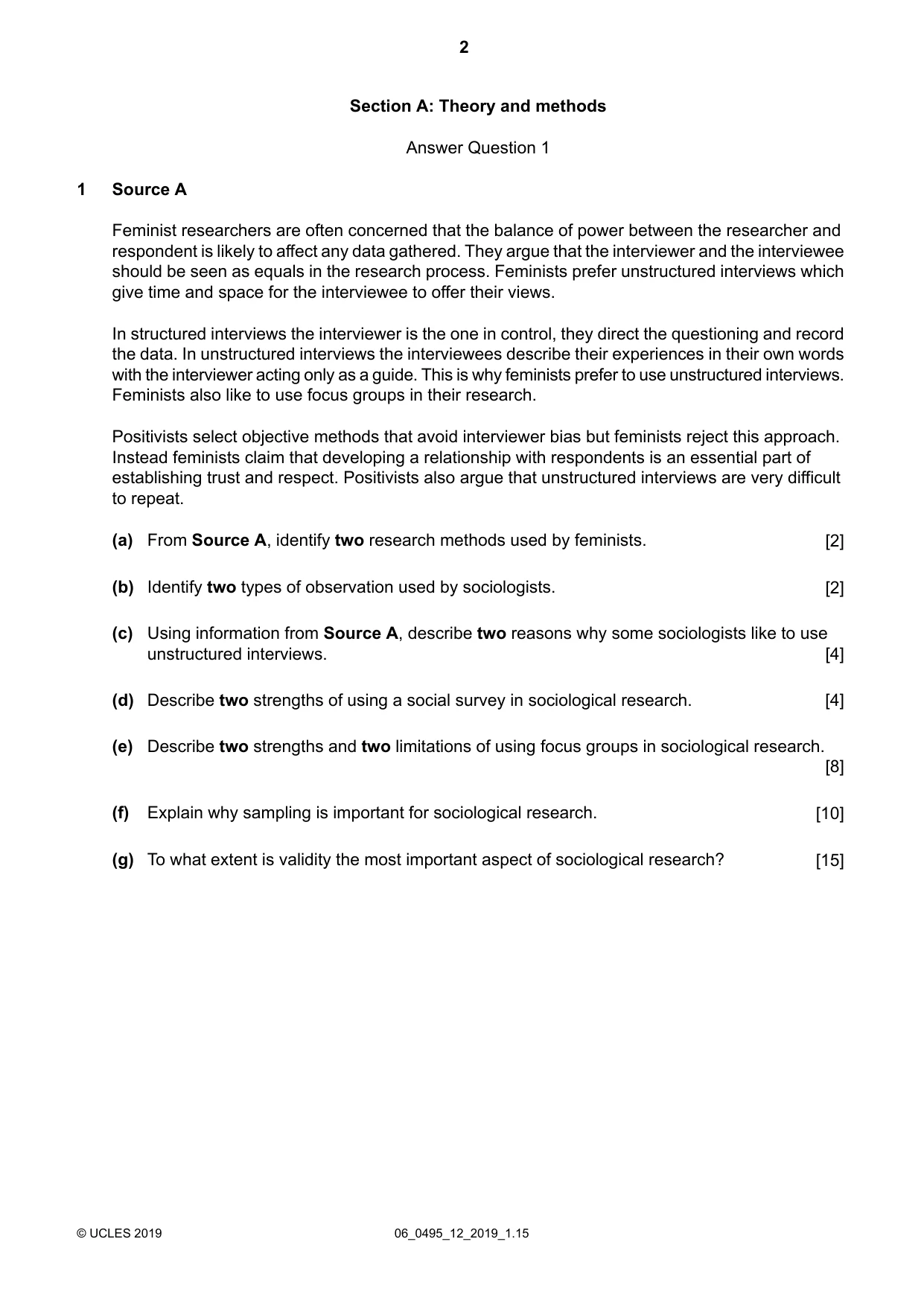
Section A: Theory and methods Answer Question 1 Source A 1 Feminist researchers are often concerned that the balance of power between the researcher and respondent is likely to affect any data gathered. They argue that the interviewer and the interviewee should be seen as equals in the research process. Feminists prefer unstructured interviews which give time and space for the interviewee to offer their views. In structured interviews the interviewer is the one in control, they direct the questioning and record the data. In unstructured interviews the interviewees describe their experiences in their own words with the interviewer acting only as a guide. This is why feminists prefer to use unstructured interviews. Feminists also like to use focus groups in their research. Positivists select objective methods that avoid interviewer bias but feminists reject this approach. Instead feminists claim that developing a relationship with respondents is an essential part of establishing trust and respect. Positivists also argue that unstructured interviews are very difficult to repeat. From Source A, identify two research methods used by feminists. [2] (a) Identify two types of observation used by sociologists. [2] (b) Using information from Source A, describe two reasons why some sociologists like to use unstructured interviews. [4] (c) Describe two strengths of using a social survey in sociological research. [4] (d) Describe two strengths and two limitations of using focus groups in sociological research. [8] (e) Explain why sampling is important for sociological research. [10] (f) To what extent is validity the most important aspect of sociological research? [15] (g) 06_0495_12_2019_1.15 © UCLES 2019 2
Question paper, page 3
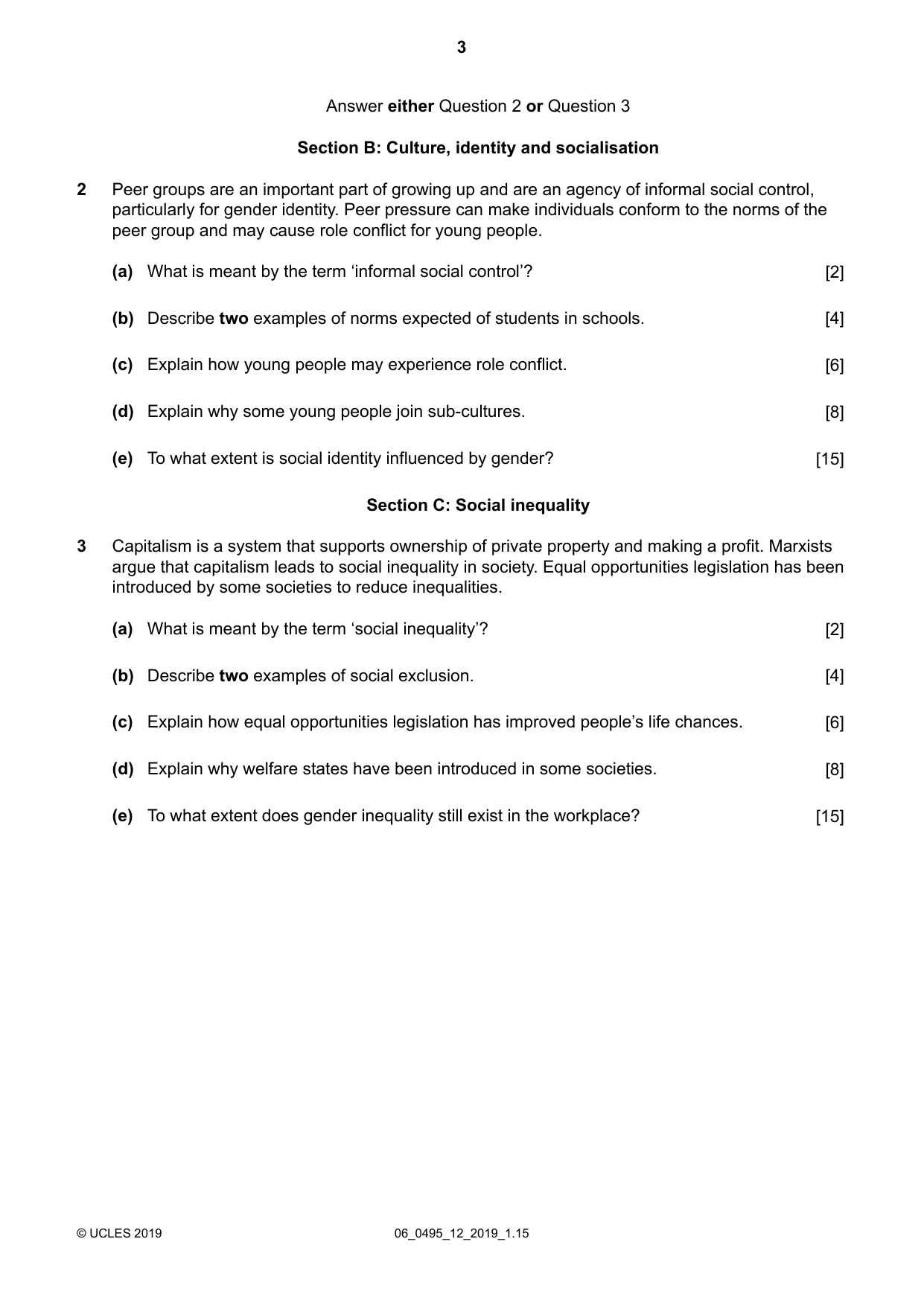
Answer either Question 2 or Question 3 Section B: Culture, identity and socialisation Peer groups are an important part of growing up and are an agency of informal social control, particularly for gender identity. Peer pressure can make individuals conform to the norms of the peer group and may cause role conflict for young people. 2 What is meant by the term ‘informal social control’? [2] (a) Describe two examples of norms expected of students in schools. [4] (b) Explain how young people may experience role conflict. [6] (c) Explain why some young people join sub-cultures. [8] (d) To what extent is social identity influenced by gender? [15] (e) Section C: Social inequality Capitalism is a system that supports ownership of private property and making a profit. Marxists argue that capitalism leads to social inequality in society. Equal opportunities legislation has been introduced by some societies to reduce inequalities. 3 What is meant by the term ‘social inequality’? [2] (a) Describe two examples of social exclusion. [4] (b) Explain how equal opportunities legislation has improved people’s life chances. [6] (c) Explain why welfare states have been introduced in some societies. [8] (d) To what extent does gender inequality still exist in the workplace? [15] (e) 06_0495_12_2019_1.15 © UCLES 2019 3
Question paper, page 4
BLANK PAGE Permission to reproduce items where third-party owned material protected by copyright is included has been sought and cleared where possible. Every reasonable effort has been made by the publisher (UCLES) to trace copyright holders, but if any items requiring clearance have unwittingly been included, the publisher will be pleased to make amends at the earliest possible opportunity. To avoid the issue of disclosure of answer-related information to candidates, all copyright acknowledgements are reproduced online in the Cambridge Assessment International Education Copyright Acknowledgements Booklet. This is produced for each series of examinations and is freely available to download at www.cambridgeinternational.org after the live examination series. Cambridge Assessment International Education is part of the Cambridge Assessment Group. Cambridge Assessment is the brand name of the University of Cambridge Local Examinations Syndicate (UCLES), which itself is a department of the University of Cambridge. 06_0495_12_2019_1.15 © UCLES 2019 4
Mark scheme, page 1
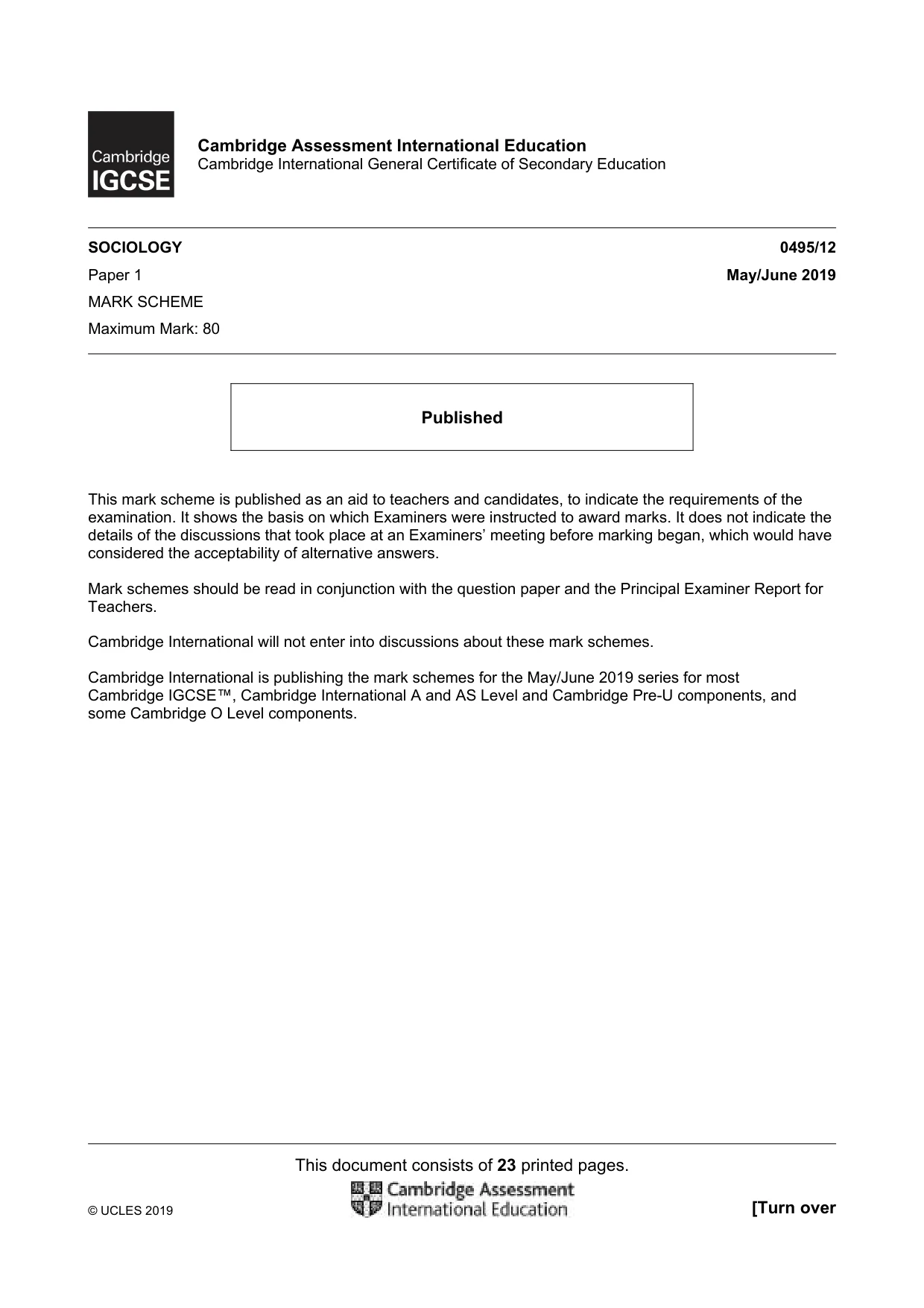
This document consists of 23 printed pages. © UCLES 2019 [Turn over Cambridge Assessment International Education Cambridge International General Certificate of Secondary Education SOCIOLOGY 0495/12 Paper 1 May/June 2019 MARK SCHEME Maximum Mark: 80 Published This mark scheme is published as an aid to teachers and candidates, to indicate the requirements of the examination. It shows the basis on which Examiners were instructed to award marks. It does not indicate the details of the discussions that took place at an Examiners’ meeting before marking began, which would have considered the acceptability of alternative answers. Mark schemes should be read in conjunction with the question paper and the Principal Examiner Report for Teachers. Cambridge International will not enter into discussions about these mark schemes. Cambridge International is publishing the mark schemes for the May/June 2019 series for most Cambridge IGCSE™, Cambridge International A and AS Level and Cambridge Pre-U components, and some Cambridge O Level components.
Mark scheme, page 2
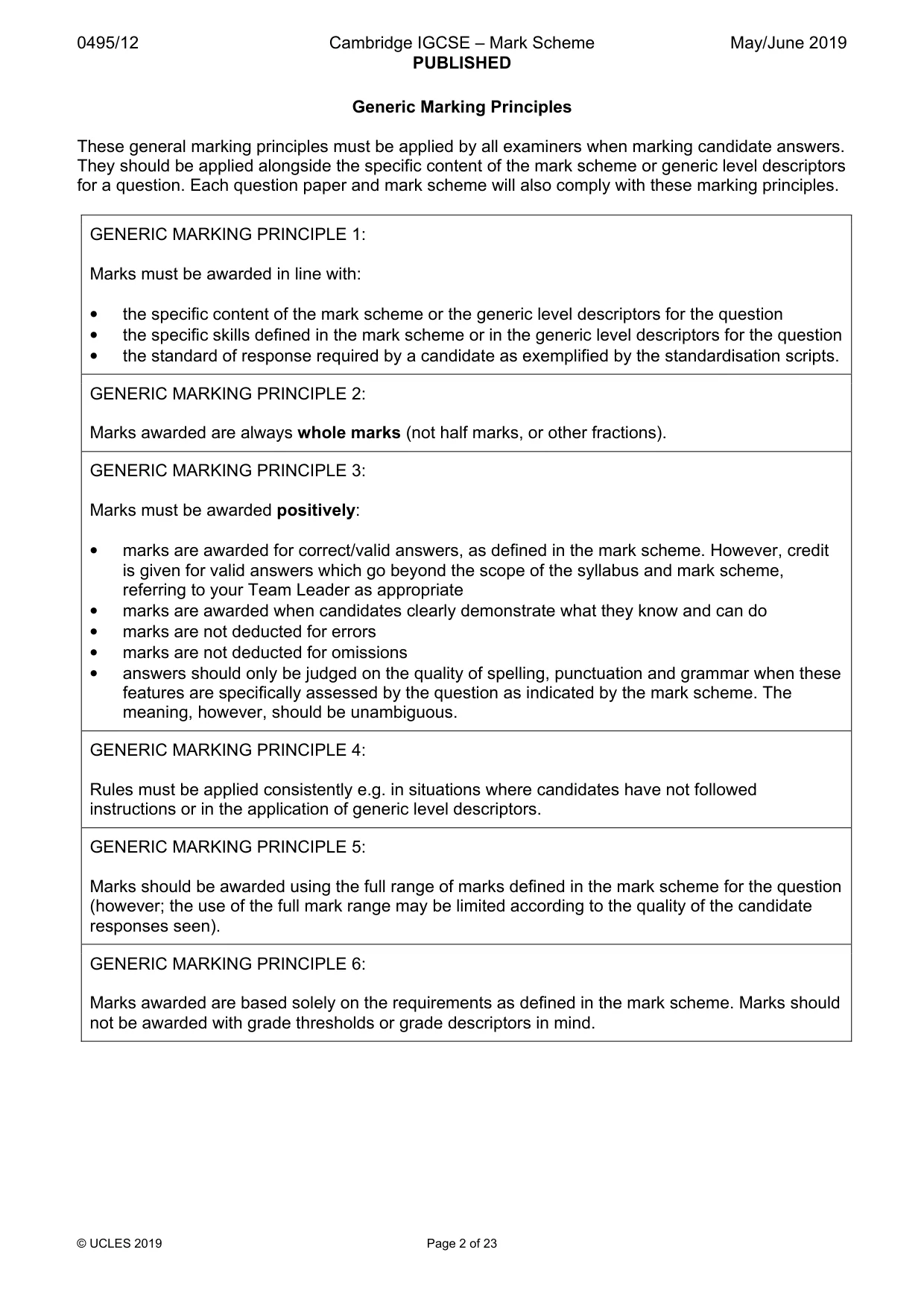
0495/12 Cambridge IGCSE – Mark Scheme PUBLISHED May/June 2019 © UCLES 2019 Page 2 of 23 Generic Marking Principles These general marking principles must be applied by all examiners when marking candidate answers. They should be applied alongside the specific content of the mark scheme or generic level descriptors for a question. Each question paper and mark scheme will also comply with these marking principles. GENERIC MARKING PRINCIPLE 1: Marks must be awarded in line with: • the specific content of the mark scheme or the generic level descriptors for the question • the specific skills defined in the mark scheme or in the generic level descriptors for the question • the standard of response required by a candidate as exemplified by the standardisation scripts. GENERIC MARKING PRINCIPLE 2: Marks awarded are always whole marks (not half marks, or other fractions). GENERIC MARKING PRINCIPLE 3: Marks must be awarded positively: • marks are awarded for correct/valid answers, as defined in the mark scheme. However, credit is given for valid answers which go beyond the scope of the syllabus and mark scheme, referring to your Team Leader as appropriate • marks are awarded when candidates clearly demonstrate what they know and can do • marks are not deducted for errors • marks are not deducted for omissions • answers should only be judged on the quality of spelling, punctuation and grammar when these features are specifically assessed by the question as indicated by the mark scheme. The meaning, however, should be unambiguous. GENERIC MARKING PRINCIPLE 4: Rules must be applied consistently e.g. in situations where candidates have not followed instructions or in the application of generic level descriptors. GENERIC MARKING PRINCIPLE 5: Marks should be awarded using the full range of marks defined in the mark scheme for the question (however; the use of the full mark range may be limited according to the quality of the candidate responses seen). GENERIC MARKING PRINCIPLE 6: Marks awarded are based solely on the requirements as defined in the mark scheme. Marks should not be awarded with grade thresholds or grade descriptors in mind.
Mark scheme, page 3
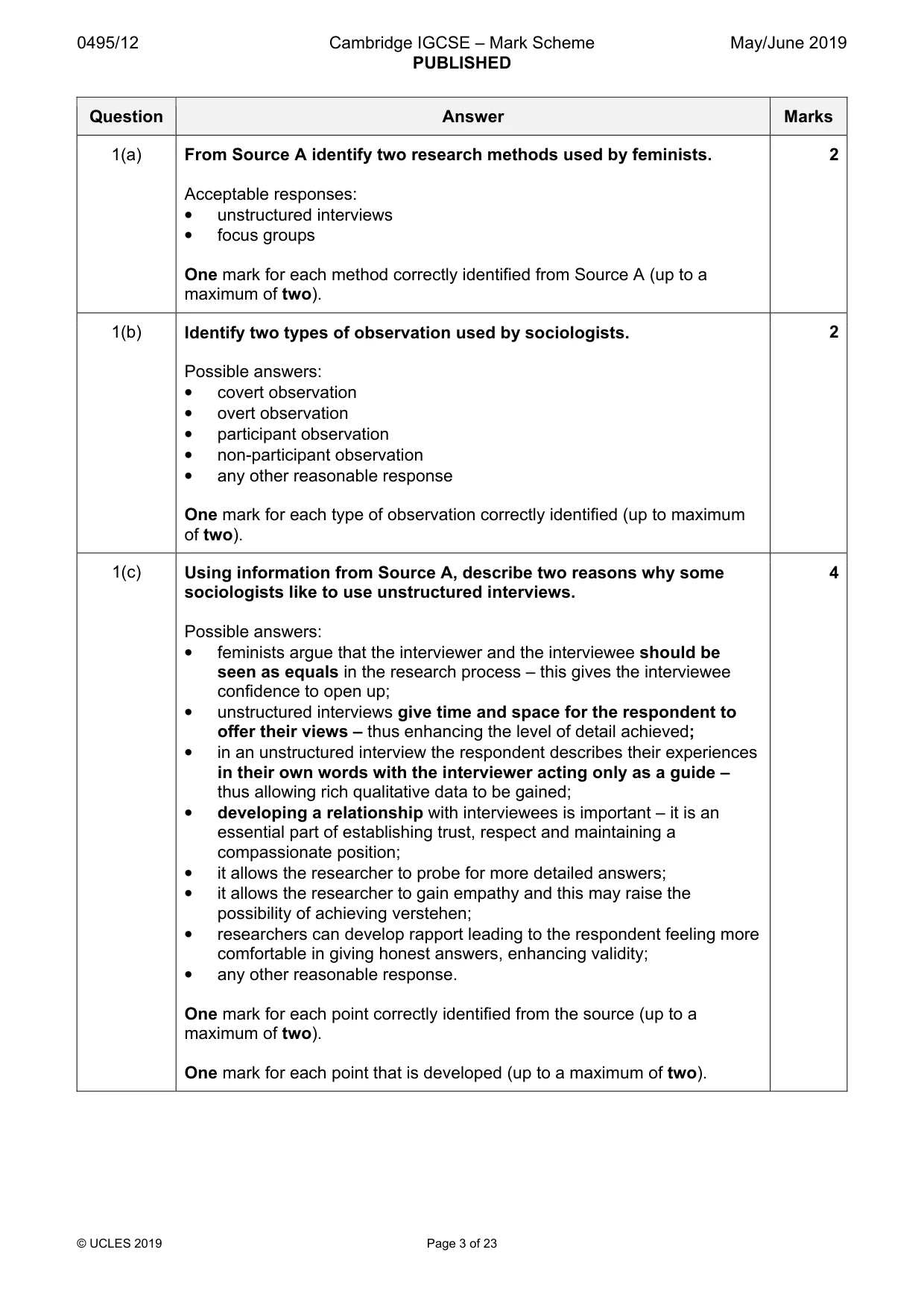
0495/12 Cambridge IGCSE – Mark Scheme PUBLISHED May/June 2019 © UCLES 2019 Page 3 of 23 Question Answer Marks 1(a) From Source A identify two research methods used by feminists. Acceptable responses: • unstructured interviews • focus groups One mark for each method correctly identified from Source A (up to a maximum of two). 2 1(b) Identify two types of observation used by sociologists. Possible answers: • covert observation • overt observation • participant observation • non-participant observation • any other reasonable response One mark for each type of observation correctly identified (up to maximum of two). 2 1(c) Using information from Source A, describe two reasons why some sociologists like to use unstructured interviews. Possible answers: • feminists argue that the interviewer and the interviewee should be seen as equals in the research process – this gives the interviewee confidence to open up; • unstructured interviews give time and space for the respondent to offer their views – thus enhancing the level of detail achieved; • in an unstructured interview the respondent describes their experiences in their own words with the interviewer acting only as a guide – thus allowing rich qualitative data to be gained; • developing a relationship with interviewees is important – it is an essential part of establishing trust, respect and maintaining a compassionate position; • it allows the researcher to probe for more detailed answers; • it allows the researcher to gain empathy and this may raise the possibility of achieving verstehen; • researchers can develop rapport leading to the respondent feeling more comfortable in giving honest answers, enhancing validity; • any other reasonable response. One mark for each point correctly identified from the source (up to a maximum of two). One mark for each point that is developed (up to a maximum of two). 4
Mark scheme, page 4
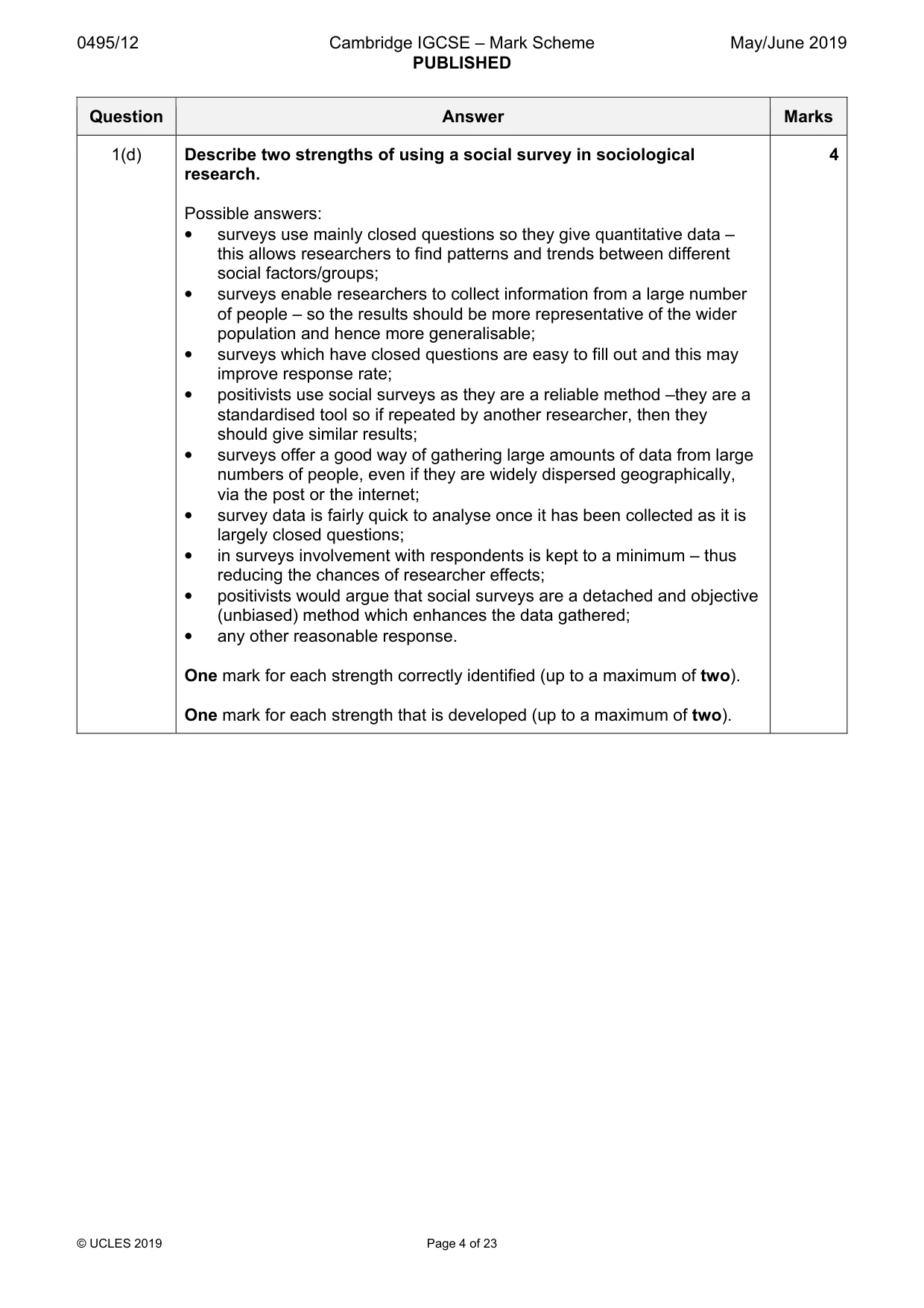
0495/12 Cambridge IGCSE – Mark Scheme PUBLISHED May/June 2019 © UCLES 2019 Page 4 of 23 Question Answer Marks 1(d) Describe two strengths of using a social survey in sociological research. Possible answers: • surveys use mainly closed questions so they give quantitative data – this allows researchers to find patterns and trends between different social factors/groups; • surveys enable researchers to collect information from a large number of people – so the results should be more representative of the wider population and hence more generalisable; • surveys which have closed questions are easy to fill out and this may improve response rate; • positivists use social surveys as they are a reliable method –they are a standardised tool so if repeated by another researcher, then they should give similar results; • surveys offer a good way of gathering large amounts of data from large numbers of people, even if they are widely dispersed geographically, via the post or the internet; • survey data is fairly quick to analyse once it has been collected as it is largely closed questions; • in surveys involvement with respondents is kept to a minimum – thus reducing the chances of researcher effects; • positivists would argue that social surveys are a detached and objective (unbiased) method which enhances the data gathered; • any other reasonable response. One mark for each strength correctly identified (up to a maximum of two). One mark for each strength that is developed (up to a maximum of two). 4
Mark scheme, page 5
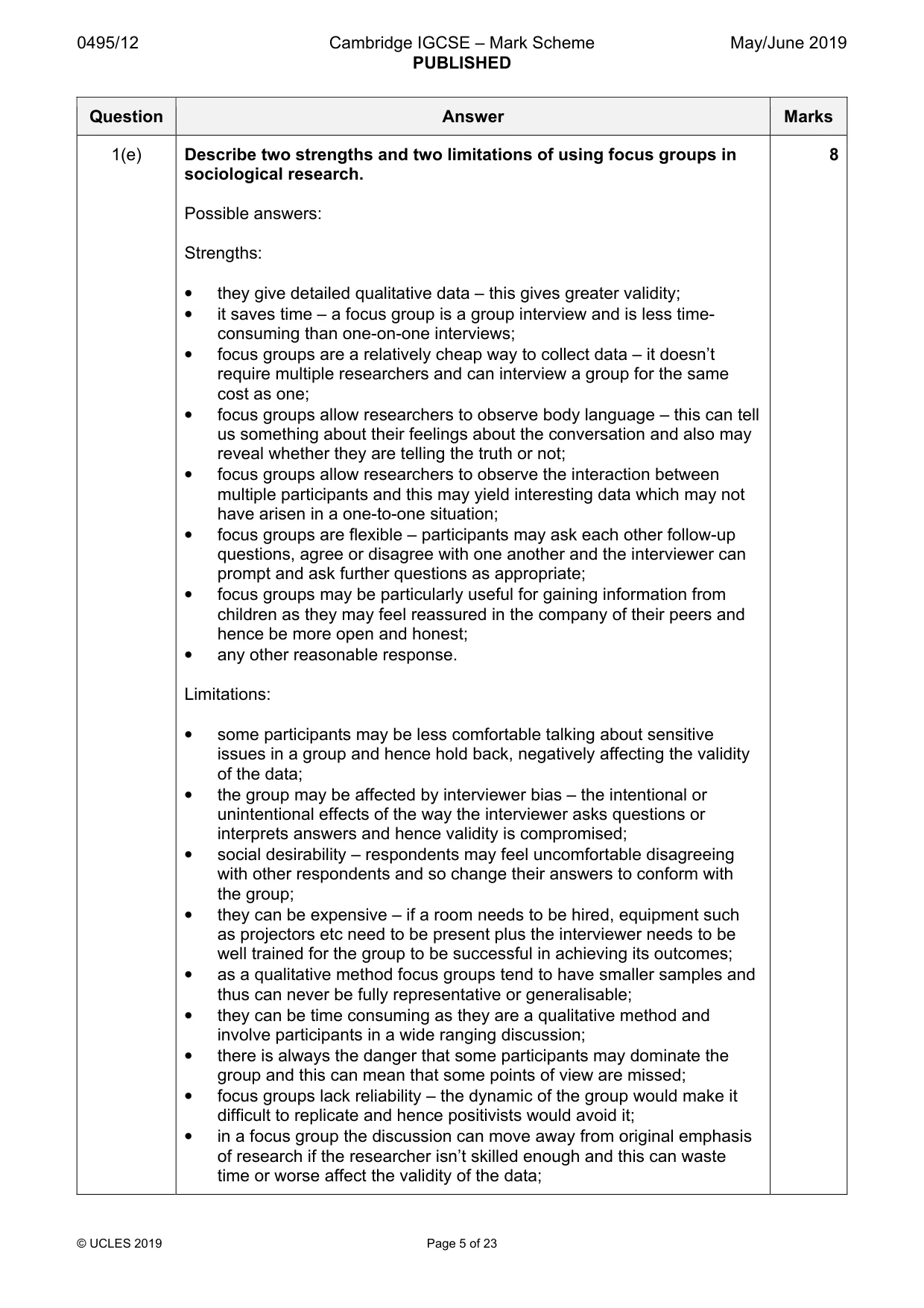
0495/12 Cambridge IGCSE – Mark Scheme PUBLISHED May/June 2019 © UCLES 2019 Page 5 of 23 Question Answer Marks 1(e) Describe two strengths and two limitations of using focus groups in sociological research. Possible answers: Strengths: • they give detailed qualitative data – this gives greater validity; • it saves time – a focus group is a group interview and is less time- consuming than one-on-one interviews; • focus groups are a relatively cheap way to collect data – it doesn’t require multiple researchers and can interview a group for the same cost as one; • focus groups allow researchers to observe body language – this can tell us something about their feelings about the conversation and also may reveal whether they are telling the truth or not; • focus groups allow researchers to observe the interaction between multiple participants and this may yield interesting data which may not have arisen in a one-to-one situation; • focus groups are flexible – participants may ask each other follow-up questions, agree or disagree with one another and the interviewer can prompt and ask further questions as appropriate; • focus groups may be particularly useful for gaining information from children as they may feel reassured in the company of their peers and hence be more open and honest; • any other reasonable response. Limitations: • some participants may be less comfortable talking about sensitive issues in a group and hence hold back, negatively affecting the validity of the data; • the group may be affected by interviewer bias – the intentional or unintentional effects of the way the interviewer asks questions or interprets answers and hence validity is compromised; • social desirability – respondents may feel uncomfortable disagreeing with other respondents and so change their answers to conform with the group; • they can be expensive – if a room needs to be hired, equipment such as projectors etc need to be present plus the interviewer needs to be well trained for the group to be successful in achieving its outcomes; • as a qualitative method focus groups tend to have smaller samples and thus can never be fully representative or generalisable; • they can be time consuming as they are a qualitative method and involve participants in a wide ranging discussion; • there is always the danger that some participants may dominate the group and this can mean that some points of view are missed; • focus groups lack reliability – the dynamic of the group would make it difficult to replicate and hence positivists would avoid it; • in a focus group the discussion can move away from original emphasis of research if the researcher isn’t skilled enough and this can waste time or worse affect the validity of the data; 8
Mark scheme, page 6
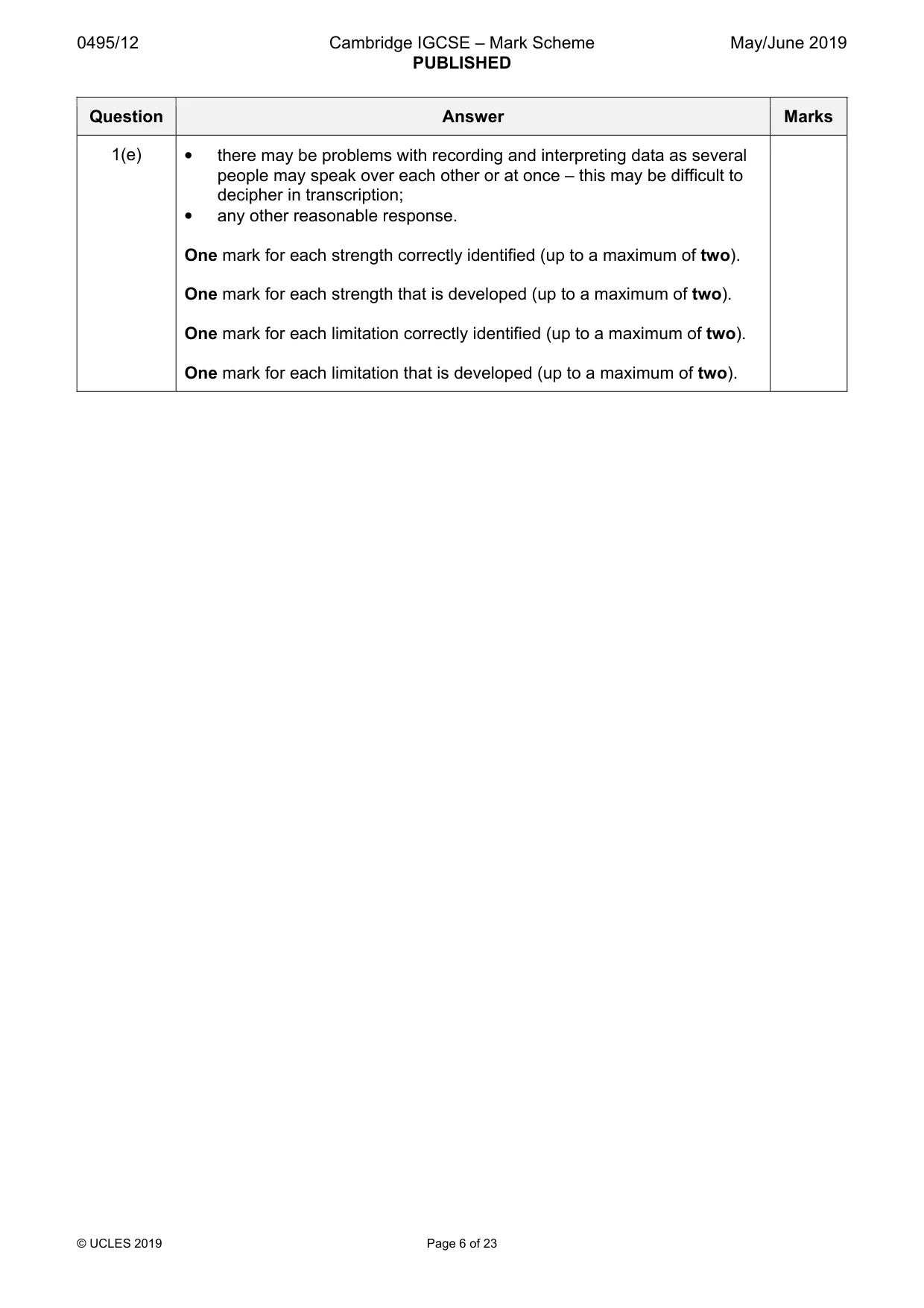
0495/12 Cambridge IGCSE – Mark Scheme PUBLISHED May/June 2019 © UCLES 2019 Page 6 of 23 Question Answer Marks 1(e) • there may be problems with recording and interpreting data as several people may speak over each other or at once – this may be difficult to decipher in transcription; • any other reasonable response. One mark for each strength correctly identified (up to a maximum of two). One mark for each strength that is developed (up to a maximum of two). One mark for each limitation correctly identified (up to a maximum of two). One mark for each limitation that is developed (up to a maximum of two).
Mark scheme, page 7
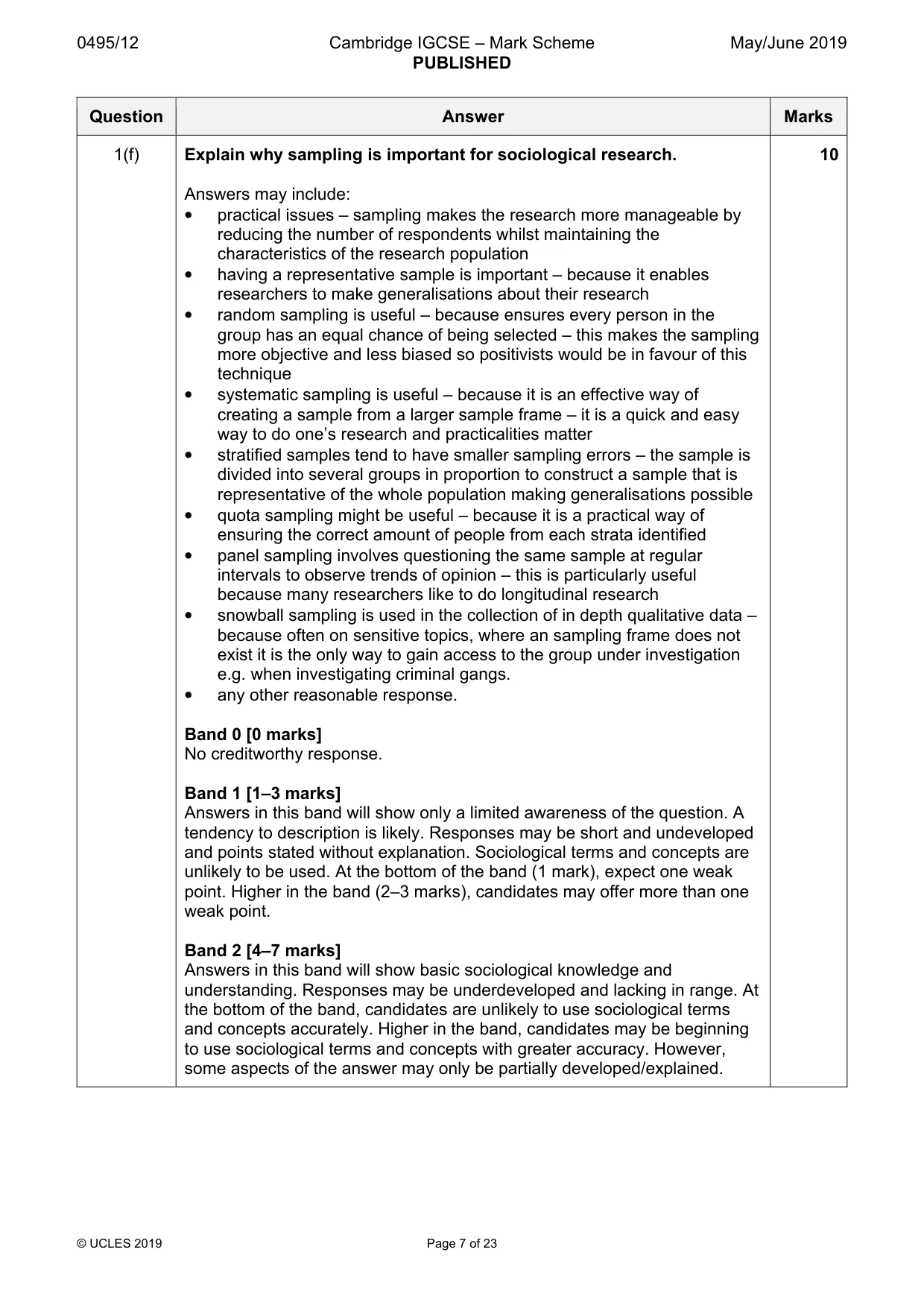
0495/12 Cambridge IGCSE – Mark Scheme PUBLISHED May/June 2019 © UCLES 2019 Page 7 of 23 Question Answer Marks 1(f) Explain why sampling is important for sociological research. Answers may include: • practical issues – sampling makes the research more manageable by reducing the number of respondents whilst maintaining the characteristics of the research population • having a representative sample is important – because it enables researchers to make generalisations about their research • random sampling is useful – because ensures every person in the group has an equal chance of being selected – this makes the sampling more objective and less biased so positivists would be in favour of this technique • systematic sampling is useful – because it is an effective way of creating a sample from a larger sample frame – it is a quick and easy way to do one’s research and practicalities matter • stratified samples tend to have smaller sampling errors – the sample is divided into several groups in proportion to construct a sample that is representative of the whole population making generalisations possible • quota sampling might be useful – because it is a practical way of ensuring the correct amount of people from each strata identified • panel sampling involves questioning the same sample at regular intervals to observe trends of opinion – this is particularly useful because many researchers like to do longitudinal research • snowball sampling is used in the collection of in depth qualitative data – because often on sensitive topics, where an sampling frame does not exist it is the only way to gain access to the group under investigation e.g. when investigating criminal gangs. • any other reasonable response. Band 0 [0 marks] No creditworthy response. Band 1 [1–3 marks] Answers in this band will show only a limited awareness of the question. A tendency to description is likely. Responses may be short and undeveloped and points stated without explanation. Sociological terms and concepts are unlikely to be used. At the bottom of the band (1 mark), expect one weak point. Higher in the band (2–3 marks), candidates may offer more than one weak point. Band 2 [4–7 marks] Answers in this band will show basic sociological knowledge and understanding. Responses may be underdeveloped and lacking in range. At the bottom of the band, candidates are unlikely to use sociological terms and concepts accurately. Higher in the band, candidates may be beginning to use sociological terms and concepts with greater accuracy. However, some aspects of the answer may only be partially developed/explained. 10
Mark scheme, page 8
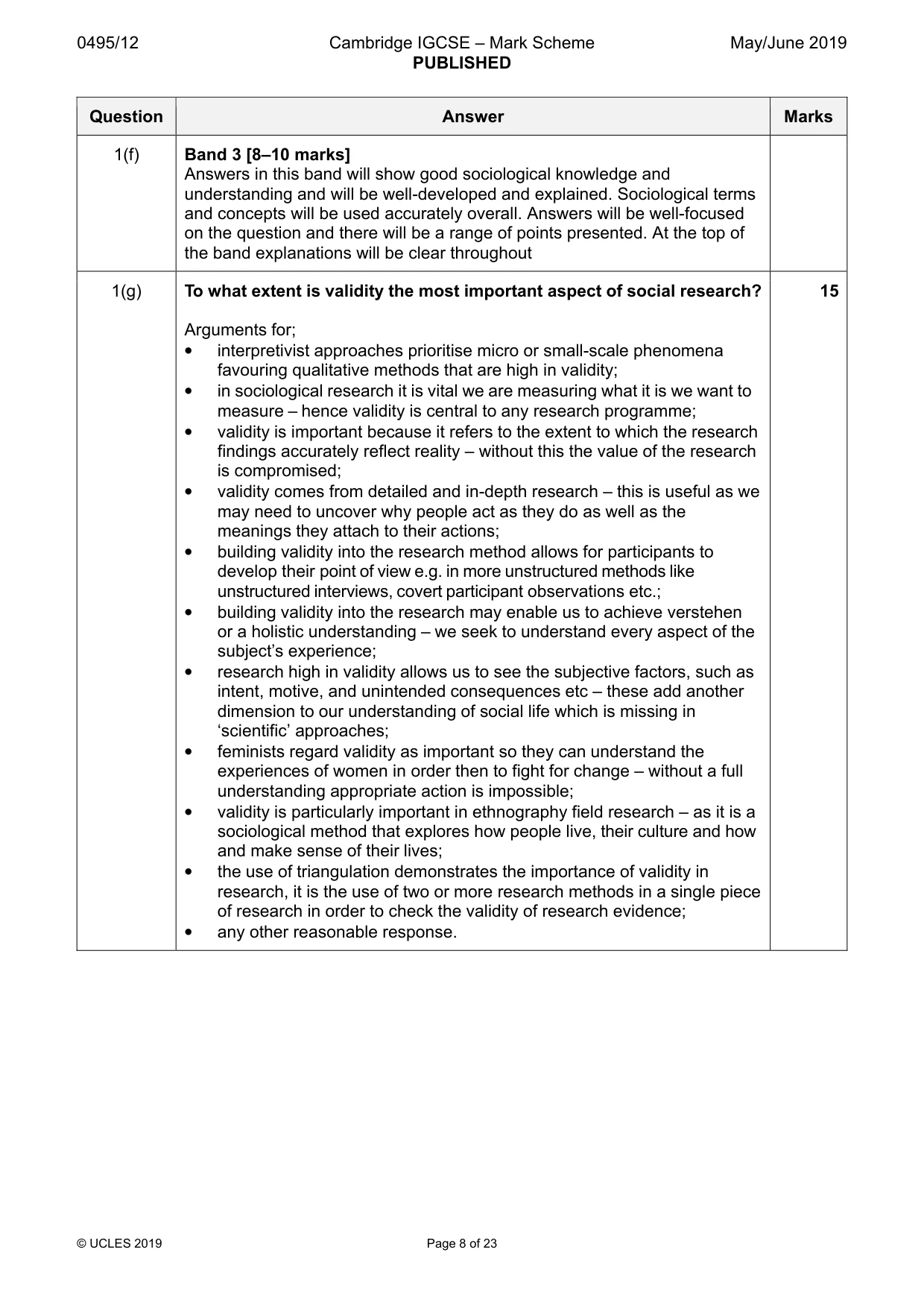
0495/12 Cambridge IGCSE – Mark Scheme PUBLISHED May/June 2019 © UCLES 2019 Page 8 of 23 Question Answer Marks 1(f) Band 3 [8–10 marks] Answers in this band will show good sociological knowledge and understanding and will be well-developed and explained. Sociological terms and concepts will be used accurately overall. Answers will be well-focused on the question and there will be a range of points presented. At the top of the band explanations will be clear throughout 1(g) To what extent is validity the most important aspect of social research? Arguments for; • interpretivist approaches prioritise micro or small-scale phenomena favouring qualitative methods that are high in validity; • in sociological research it is vital we are measuring what it is we want to measure – hence validity is central to any research programme; • validity is important because it refers to the extent to which the research findings accurately reflect reality – without this the value of the research is compromised; • validity comes from detailed and in-depth research – this is useful as we may need to uncover why people act as they do as well as the meanings they attach to their actions; • building validity into the research method allows for participants to develop their point of view e.g. in more unstructured methods like unstructured interviews, covert participant observations etc.; • building validity into the research may enable us to achieve verstehen or a holistic understanding – we seek to understand every aspect of the subject’s experience; • research high in validity allows us to see the subjective factors, such as intent, motive, and unintended consequences etc – these add another dimension to our understanding of social life which is missing in ‘scientific’ approaches; • feminists regard validity as important so they can understand the experiences of women in order then to fight for change – without a full understanding appropriate action is impossible; • validity is particularly important in ethnography field research – as it is a sociological method that explores how people live, their culture and how and make sense of their lives; • the use of triangulation demonstrates the importance of validity in research, it is the use of two or more research methods in a single piece of research in order to check the validity of research evidence; • any other reasonable response. 15
Mark scheme, page 9
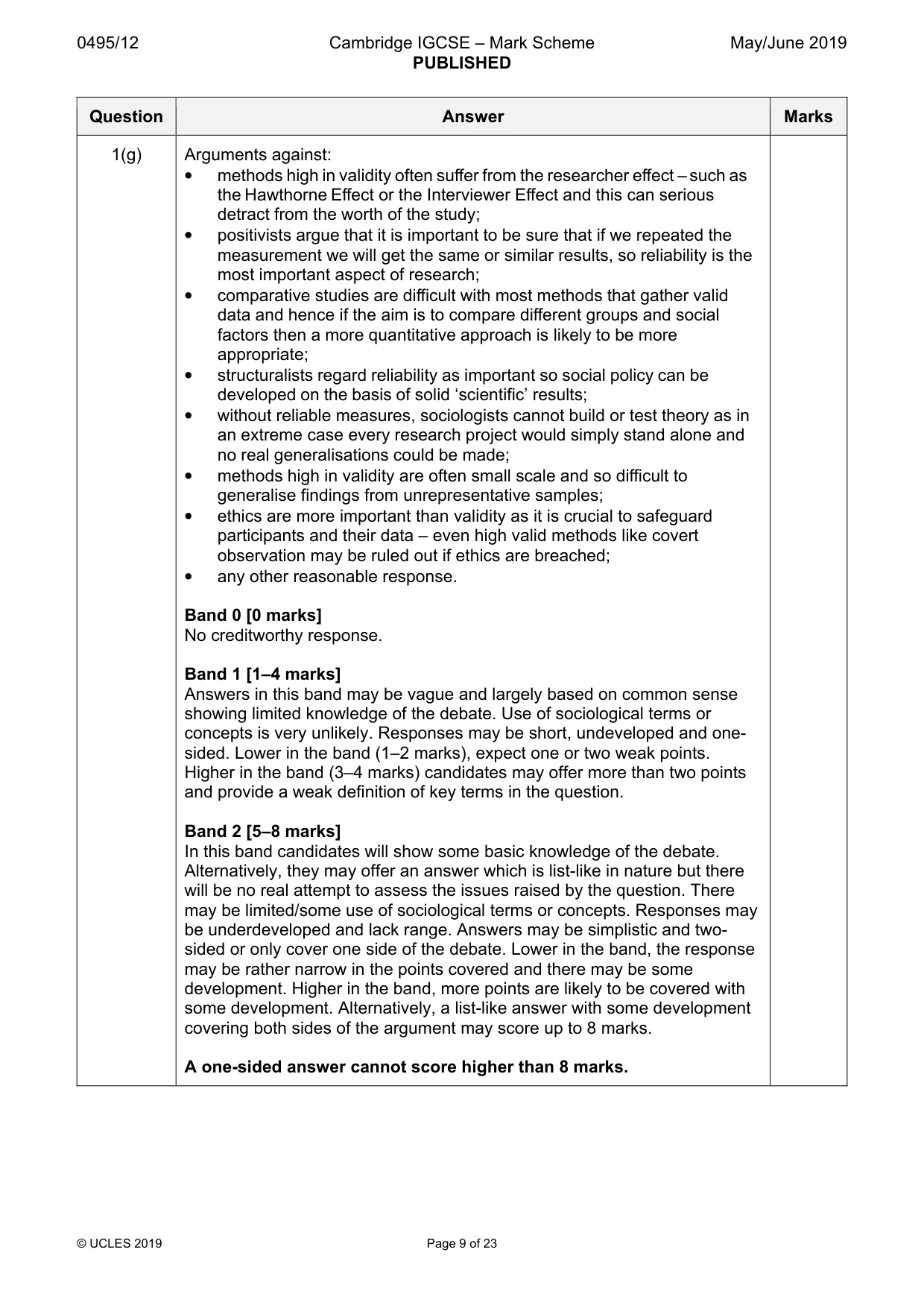
0495/12 Cambridge IGCSE – Mark Scheme PUBLISHED May/June 2019 © UCLES 2019 Page 9 of 23 Question Answer Marks 1(g) Arguments against: • methods high in validity often suffer from the researcher effect – such as the Hawthorne Effect or the Interviewer Effect and this can serious detract from the worth of the study; • positivists argue that it is important to be sure that if we repeated the measurement we will get the same or similar results, so reliability is the most important aspect of research; • comparative studies are difficult with most methods that gather valid data and hence if the aim is to compare different groups and social factors then a more quantitative approach is likely to be more appropriate; • structuralists regard reliability as important so social policy can be developed on the basis of solid ‘scientific’ results; • without reliable measures, sociologists cannot build or test theory as in an extreme case every research project would simply stand alone and no real generalisations could be made; • methods high in validity are often small scale and so difficult to generalise findings from unrepresentative samples; • ethics are more important than validity as it is crucial to safeguard participants and their data – even high valid methods like covert observation may be ruled out if ethics are breached; • any other reasonable response. Band 0 [0 marks] No creditworthy response. Band 1 [1–4 marks] Answers in this band may be vague and largely based on common sense showing limited knowledge of the debate. Use of sociological terms or concepts is very unlikely. Responses may be short, undeveloped and one- sided. Lower in the band (1–2 marks), expect one or two weak points. Higher in the band (3–4 marks) candidates may offer more than two points and provide a weak definition of key terms in the question. Band 2 [5–8 marks] In this band candidates will show some basic knowledge of the debate. Alternatively, they may offer an answer which is list-like in nature but there will be no real attempt to assess the issues raised by the question. There may be limited/some use of sociological terms or concepts. Responses may be underdeveloped and lack range. Answers may be simplistic and two- sided or only cover one side of the debate. Lower in the band, the response may be rather narrow in the points covered and there may be some development. Higher in the band, more points are likely to be covered with some development. Alternatively, a list-like answer with some development covering both sides of the argument may score up to 8 marks. A one-sided answer cannot score higher than 8 marks.
Mark scheme, page 10
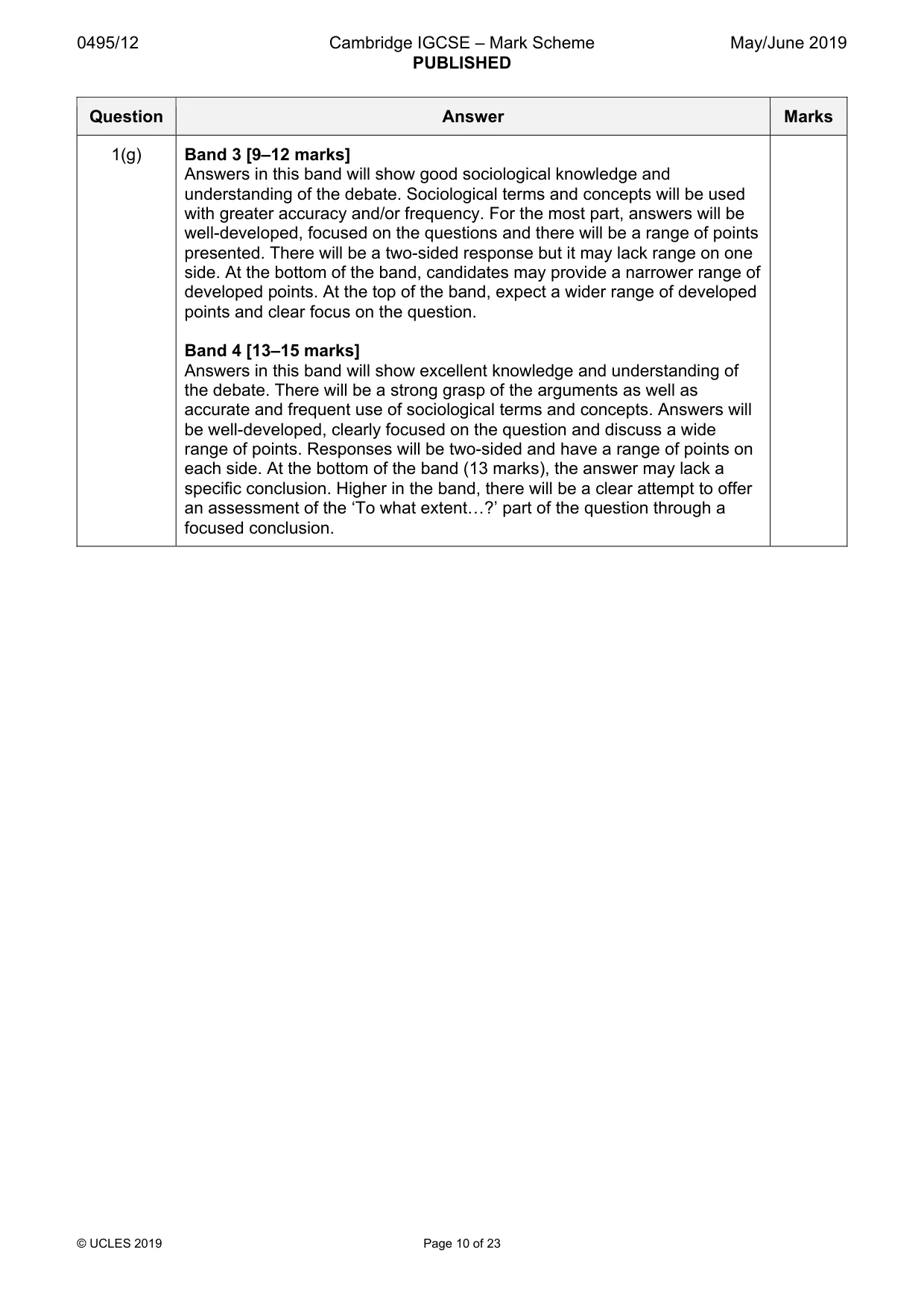
0495/12 Cambridge IGCSE – Mark Scheme PUBLISHED May/June 2019 © UCLES 2019 Page 10 of 23 Question Answer Marks 1(g) Band 3 [9–12 marks] Answers in this band will show good sociological knowledge and understanding of the debate. Sociological terms and concepts will be used with greater accuracy and/or frequency. For the most part, answers will be well-developed, focused on the questions and there will be a range of points presented. There will be a two-sided response but it may lack range on one side. At the bottom of the band, candidates may provide a narrower range of developed points. At the top of the band, expect a wider range of developed points and clear focus on the question. Band 4 [13–15 marks] Answers in this band will show excellent knowledge and understanding of the debate. There will be a strong grasp of the arguments as well as accurate and frequent use of sociological terms and concepts. Answers will be well-developed, clearly focused on the question and discuss a wide range of points. Responses will be two-sided and have a range of points on each side. At the bottom of the band (13 marks), the answer may lack a specific conclusion. Higher in the band, there will be a clear attempt to offer an assessment of the ‘To what extent«?’ part of the question through a focused conclusion.
Mark scheme, page 11
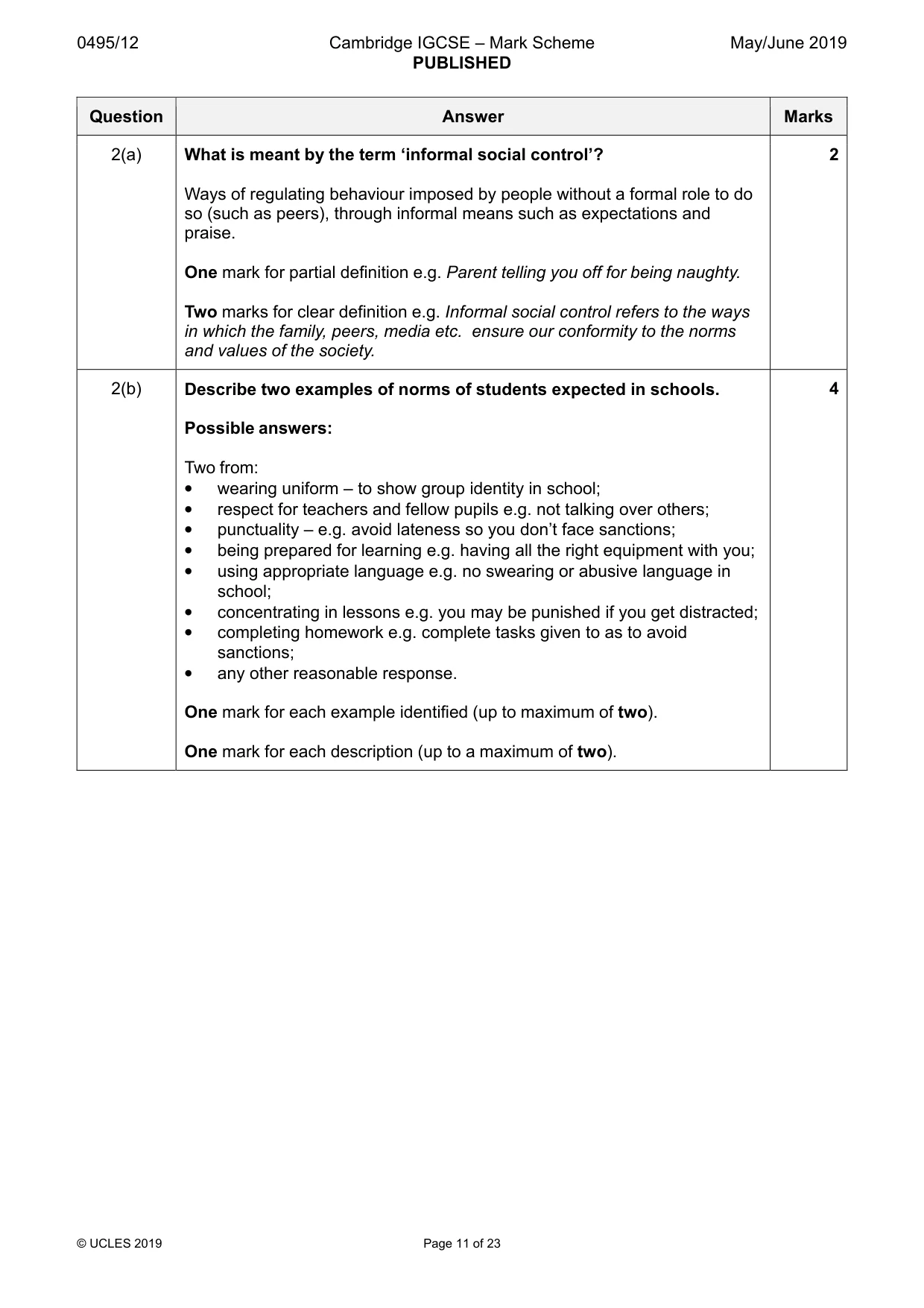
0495/12 Cambridge IGCSE – Mark Scheme PUBLISHED May/June 2019 © UCLES 2019 Page 11 of 23 Question Answer Marks 2(a) What is meant by the term ‘informal social control’? Ways of regulating behaviour imposed by people without a formal role to do so (such as peers), through informal means such as expectations and praise. One mark for partial definition e.g. Parent telling you off for being naughty. Two marks for clear definition e.g. Informal social control refers to the ways in which the family, peers, media etc. ensure our conformity to the norms and values of the society. 2 2(b) Describe two examples of norms of students expected in schools. Possible answers: Two from: • wearing uniform – to show group identity in school; • respect for teachers and fellow pupils e.g. not talking over others; • punctuality – e.g. avoid lateness so you don’t face sanctions; • being prepared for learning e.g. having all the right equipment with you; • using appropriate language e.g. no swearing or abusive language in school; • concentrating in lessons e.g. you may be punished if you get distracted; • completing homework e.g. complete tasks given to as to avoid sanctions; • any other reasonable response. One mark for each example identified (up to maximum of two). One mark for each description (up to a maximum of two). 4
Mark scheme, page 12
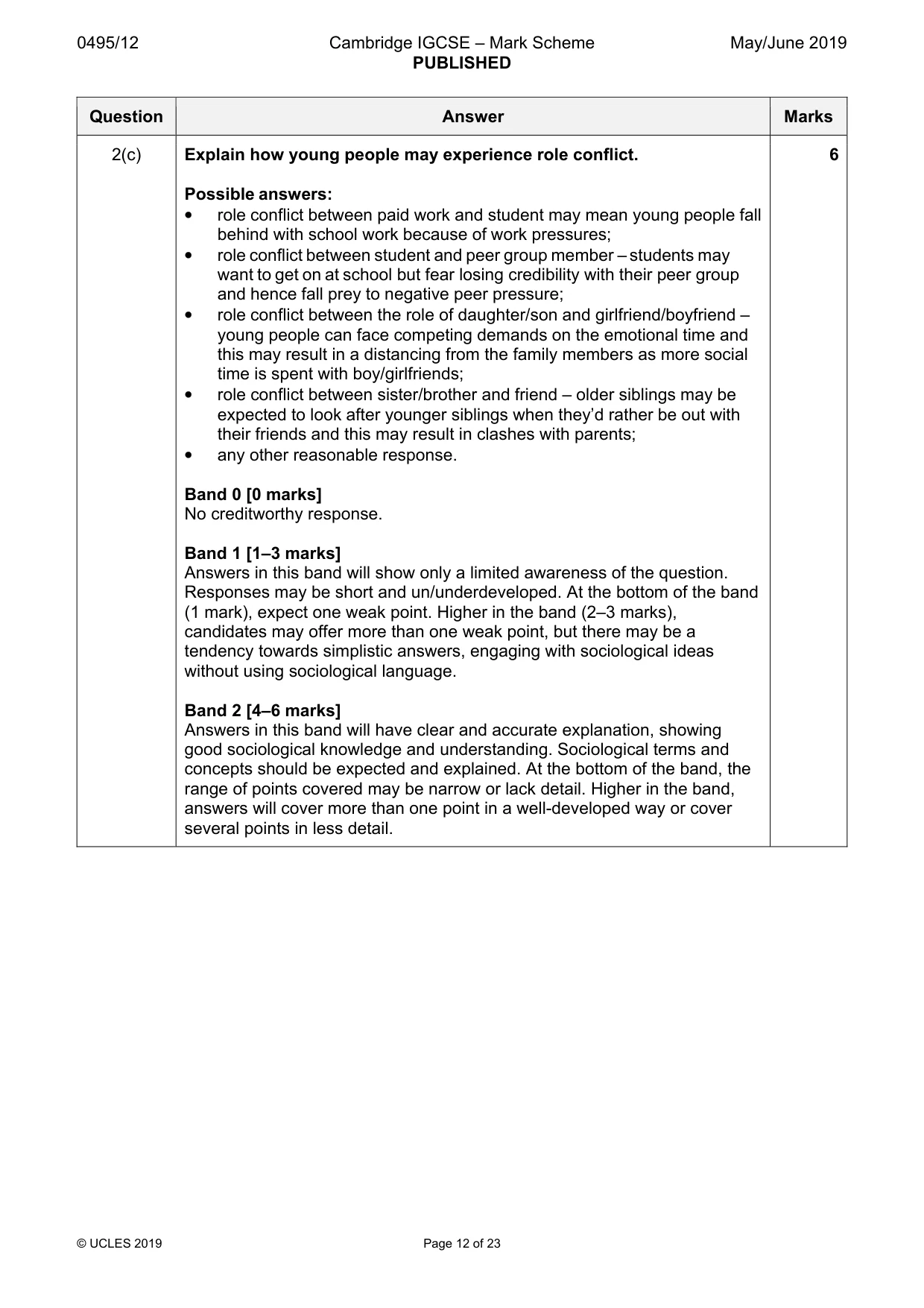
0495/12 Cambridge IGCSE – Mark Scheme PUBLISHED May/June 2019 © UCLES 2019 Page 12 of 23 Question Answer Marks 2(c) Explain how young people may experience role conflict. Possible answers: • role conflict between paid work and student may mean young people fall behind with school work because of work pressures; • role conflict between student and peer group member – students may want to get on at school but fear losing credibility with their peer group and hence fall prey to negative peer pressure; • role conflict between the role of daughter/son and girlfriend/boyfriend – young people can face competing demands on the emotional time and this may result in a distancing from the family members as more social time is spent with boy/girlfriends; • role conflict between sister/brother and friend – older siblings may be expected to look after younger siblings when they’d rather be out with their friends and this may result in clashes with parents; • any other reasonable response. Band 0 [0 marks] No creditworthy response. Band 1 [1–3 marks] Answers in this band will show only a limited awareness of the question. Responses may be short and un/underdeveloped. At the bottom of the band (1 mark), expect one weak point. Higher in the band (2–3 marks), candidates may offer more than one weak point, but there may be a tendency towards simplistic answers, engaging with sociological ideas without using sociological language. Band 2 [4–6 marks] Answers in this band will have clear and accurate explanation, showing good sociological knowledge and understanding. Sociological terms and concepts should be expected and explained. At the bottom of the band, the range of points covered may be narrow or lack detail. Higher in the band, answers will cover more than one point in a well-developed way or cover several points in less detail. 6
Mark scheme, page 13
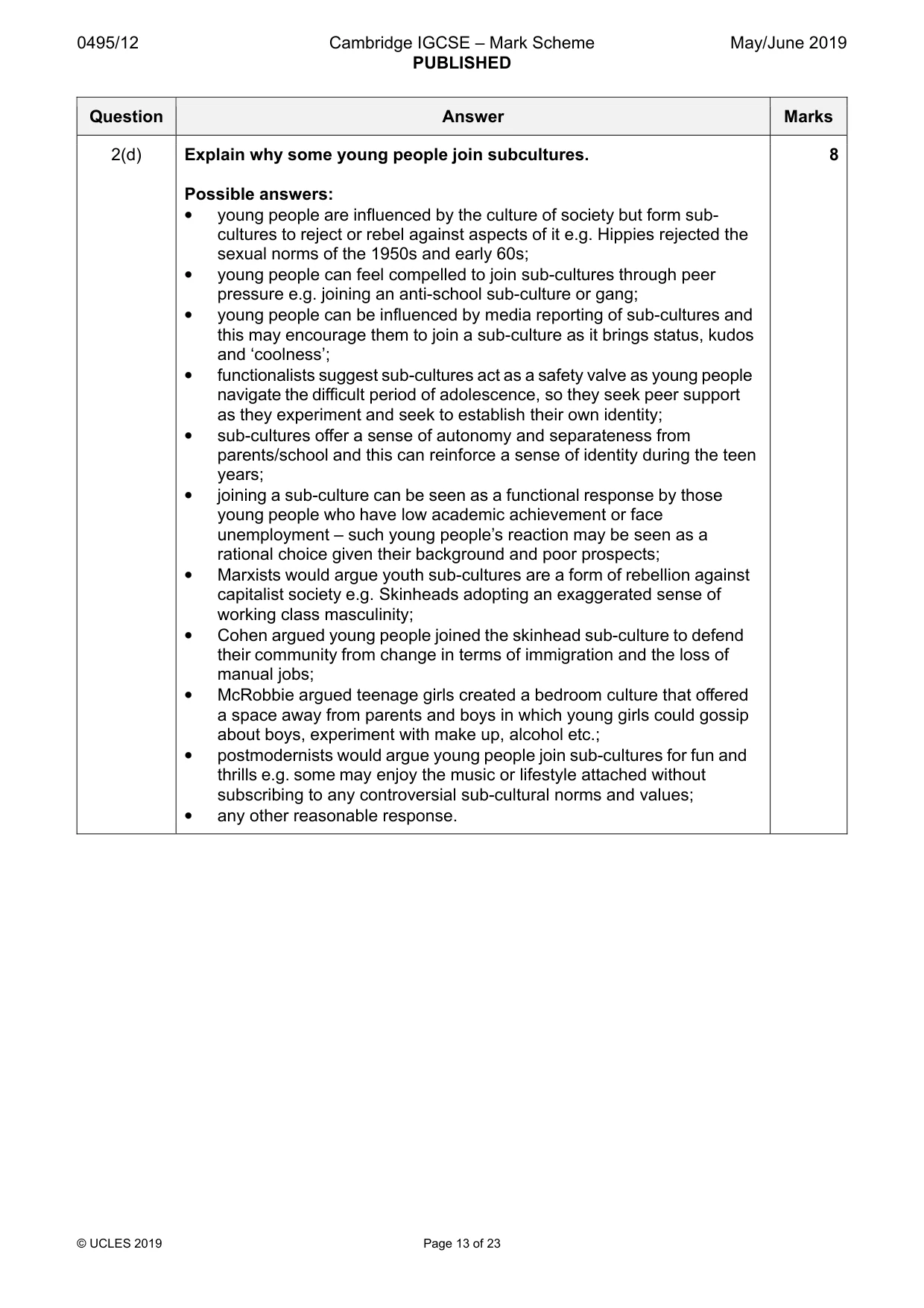
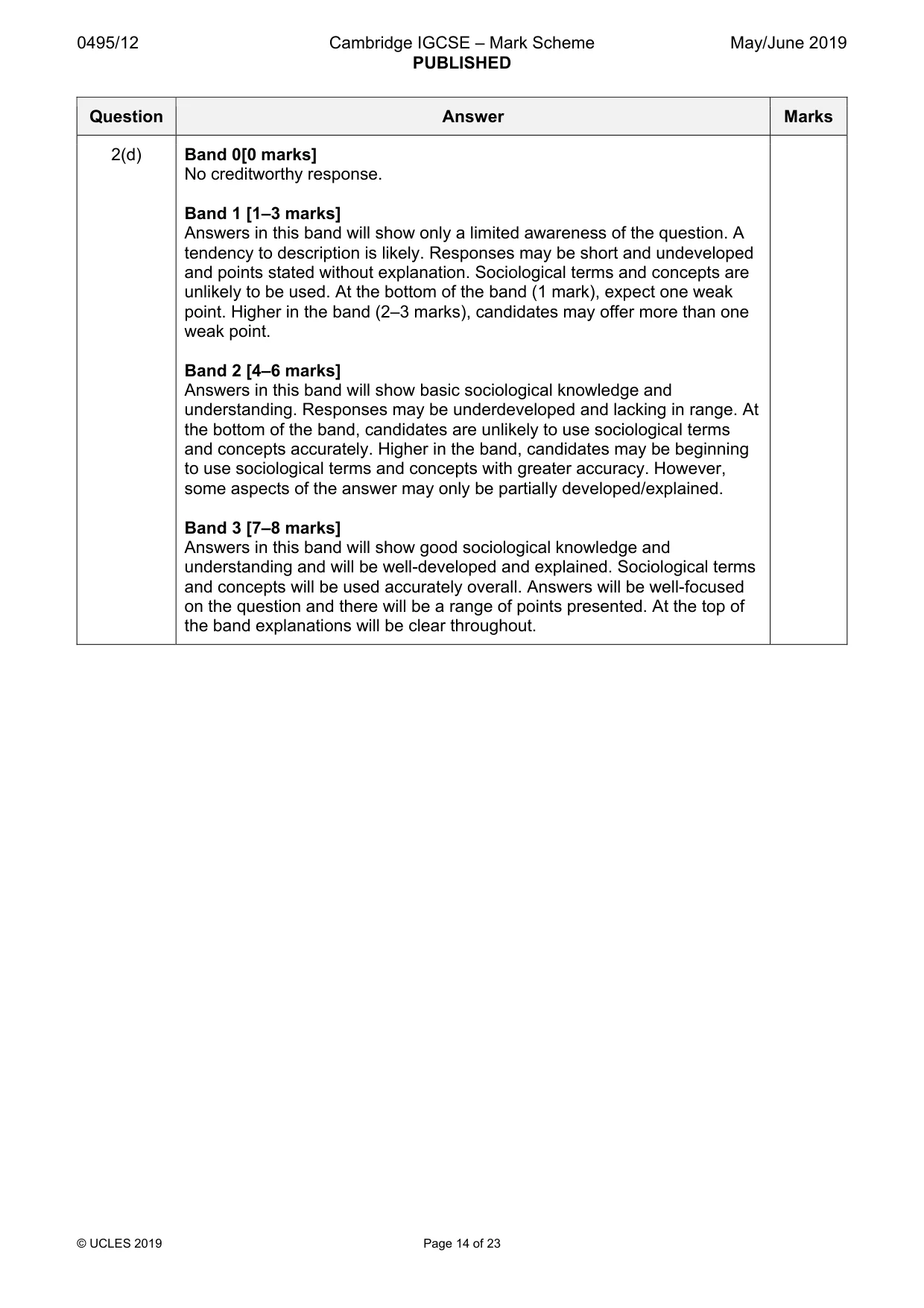
0495/12 Cambridge IGCSE – Mark Scheme PUBLISHED May/June 2019 © UCLES 2019 Page 13 of 23 Question Answer Marks 2(d) Explain why some young people join subcultures. Possible answers: • young people are influenced by the culture of society but form sub- cultures to reject or rebel against aspects of it e.g. Hippies rejected the sexual norms of the 1950s and early 60s; • young people can feel compelled to join sub-cultures through peer pressure e.g. joining an anti-school sub-culture or gang; • young people can be influenced by media reporting of sub-cultures and this may encourage them to join a sub-culture as it brings status, kudos and ‘coolness’; • functionalists suggest sub-cultures act as a safety valve as young people navigate the difficult period of adolescence, so they seek peer support as they experiment and seek to establish their own identity; • sub-cultures offer a sense of autonomy and separateness from parents/school and this can reinforce a sense of identity during the teen years; • joining a sub-culture can be seen as a functional response by those young people who have low academic achievement or face unemployment – such young people’s reaction may be seen as a rational choice given their background and poor prospects; • Marxists would argue youth sub-cultures are a form of rebellion against capitalist society e.g. Skinheads adopting an exaggerated sense of working class masculinity; • Cohen argued young people joined the skinhead sub-culture to defend their community from change in terms of immigration and the loss of manual jobs; • McRobbie argued teenage girls created a bedroom culture that offered a space away from parents and boys in which young girls could gossip about boys, experiment with make up, alcohol etc.; • postmodernists would argue young people join sub-cultures for fun and thrills e.g. some may enjoy the music or lifestyle attached without subscribing to any controversial sub-cultural norms and values; • any other reasonable response. 8
Mark scheme, page 14
0495/12 Cambridge IGCSE – Mark Scheme PUBLISHED May/June 2019 © UCLES 2019 Page 14 of 23 Question Answer Marks 2(d) Band 0[0 marks] No creditworthy response. Band 1 [1–3 marks] Answers in this band will show only a limited awareness of the question. A tendency to description is likely. Responses may be short and undeveloped and points stated without explanation. Sociological terms and concepts are unlikely to be used. At the bottom of the band (1 mark), expect one weak point. Higher in the band (2–3 marks), candidates may offer more than one weak point. Band 2 [4–6 marks] Answers in this band will show basic sociological knowledge and understanding. Responses may be underdeveloped and lacking in range. At the bottom of the band, candidates are unlikely to use sociological terms and concepts accurately. Higher in the band, candidates may be beginning to use sociological terms and concepts with greater accuracy. However, some aspects of the answer may only be partially developed/explained. Band 3 [7–8 marks] Answers in this band will show good sociological knowledge and understanding and will be well-developed and explained. Sociological terms and concepts will be used accurately overall. Answers will be well-focused on the question and there will be a range of points presented. At the top of the band explanations will be clear throughout.
Mark scheme, page 15
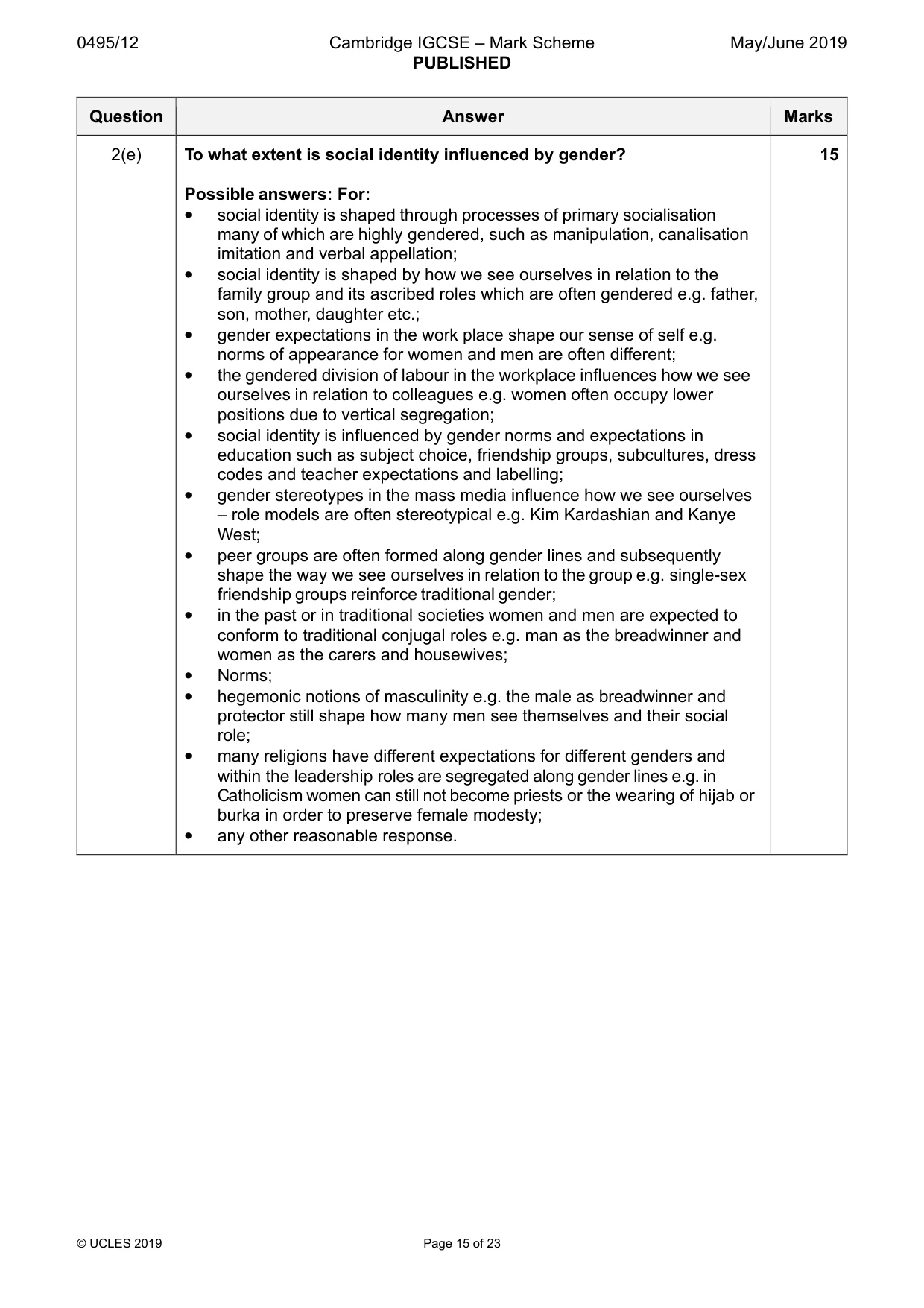
0495/12 Cambridge IGCSE – Mark Scheme PUBLISHED May/June 2019 © UCLES 2019 Page 15 of 23 Question Answer Marks 2(e) To what extent is social identity influenced by gender? Possible answers: For: • social identity is shaped through processes of primary socialisation many of which are highly gendered, such as manipulation, canalisation imitation and verbal appellation; • social identity is shaped by how we see ourselves in relation to the family group and its ascribed roles which are often gendered e.g. father, son, mother, daughter etc.; • gender expectations in the work place shape our sense of self e.g. norms of appearance for women and men are often different; • the gendered division of labour in the workplace influences how we see ourselves in relation to colleagues e.g. women often occupy lower positions due to vertical segregation; • social identity is influenced by gender norms and expectations in education such as subject choice, friendship groups, subcultures, dress codes and teacher expectations and labelling; • gender stereotypes in the mass media influence how we see ourselves – role models are often stereotypical e.g. Kim Kardashian and Kanye West; • peer groups are often formed along gender lines and subsequently shape the way we see ourselves in relation to the group e.g. single-sex friendship groups reinforce traditional gender; • in the past or in traditional societies women and men are expected to conform to traditional conjugal roles e.g. man as the breadwinner and women as the carers and housewives; • Norms; • hegemonic notions of masculinity e.g. the male as breadwinner and protector still shape how many men see themselves and their social role; • many religions have different expectations for different genders and within the leadership roles are segregated along gender lines e.g. in Catholicism women can still not become priests or the wearing of hijab or burka in order to preserve female modesty; • any other reasonable response. 15
Mark scheme, page 16
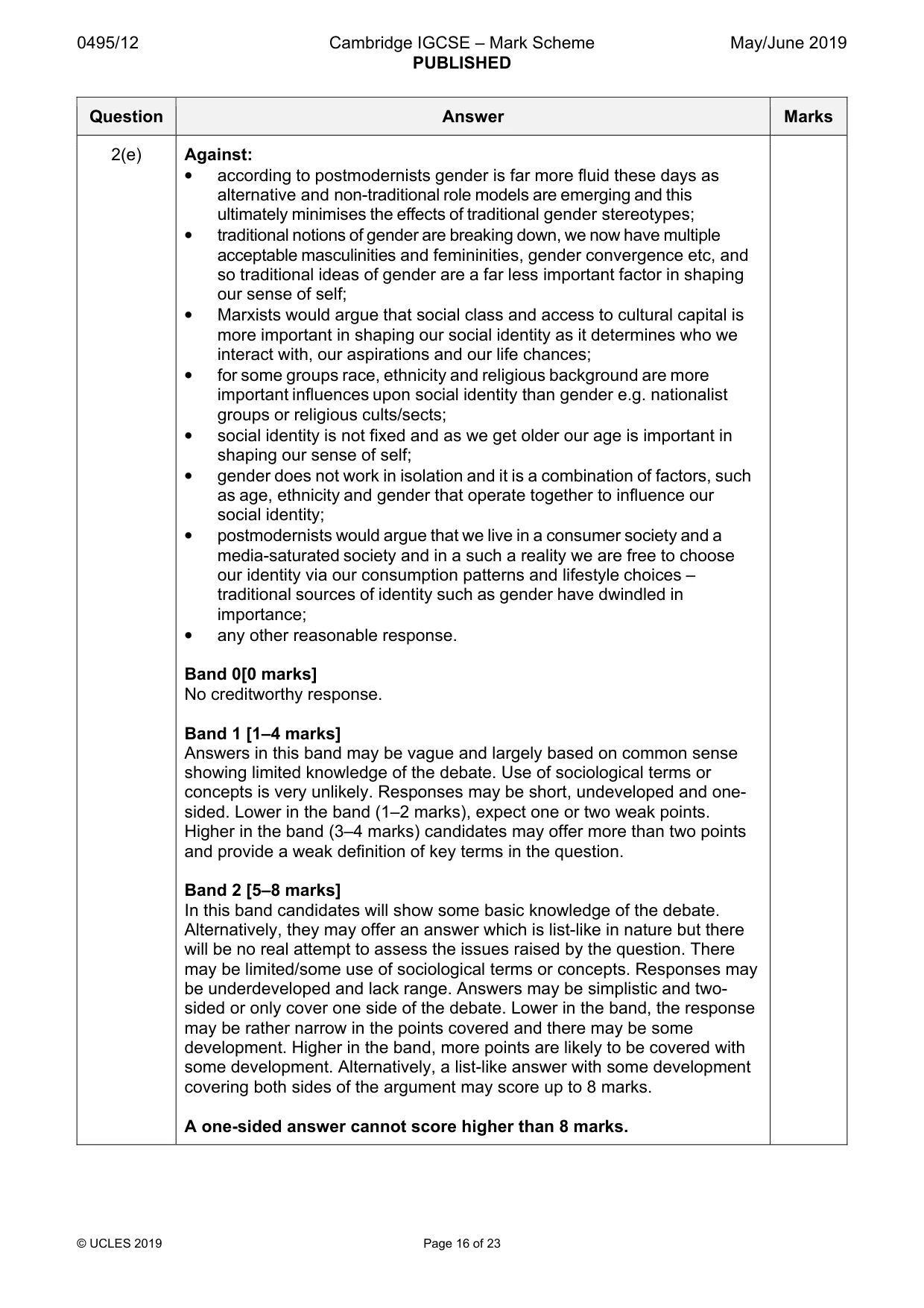
0495/12 Cambridge IGCSE – Mark Scheme PUBLISHED May/June 2019 © UCLES 2019 Page 16 of 23 Question Answer Marks 2(e) Against: • according to postmodernists gender is far more fluid these days as alternative and non-traditional role models are emerging and this ultimately minimises the effects of traditional gender stereotypes; • traditional notions of gender are breaking down, we now have multiple acceptable masculinities and femininities, gender convergence etc, and so traditional ideas of gender are a far less important factor in shaping our sense of self; • Marxists would argue that social class and access to cultural capital is more important in shaping our social identity as it determines who we interact with, our aspirations and our life chances; • for some groups race, ethnicity and religious background are more important influences upon social identity than gender e.g. nationalist groups or religious cults/sects; • social identity is not fixed and as we get older our age is important in shaping our sense of self; • gender does not work in isolation and it is a combination of factors, such as age, ethnicity and gender that operate together to influence our social identity; • postmodernists would argue that we live in a consumer society and a media-saturated society and in a such a reality we are free to choose our identity via our consumption patterns and lifestyle choices – traditional sources of identity such as gender have dwindled in importance; • any other reasonable response. Band 0[0 marks] No creditworthy response. Band 1 [1–4 marks] Answers in this band may be vague and largely based on common sense showing limited knowledge of the debate. Use of sociological terms or concepts is very unlikely. Responses may be short, undeveloped and one- sided. Lower in the band (1–2 marks), expect one or two weak points. Higher in the band (3–4 marks) candidates may offer more than two points and provide a weak definition of key terms in the question. Band 2 [5–8 marks] In this band candidates will show some basic knowledge of the debate. Alternatively, they may offer an answer which is list-like in nature but there will be no real attempt to assess the issues raised by the question. There may be limited/some use of sociological terms or concepts. Responses may be underdeveloped and lack range. Answers may be simplistic and two- sided or only cover one side of the debate. Lower in the band, the response may be rather narrow in the points covered and there may be some development. Higher in the band, more points are likely to be covered with some development. Alternatively, a list-like answer with some development covering both sides of the argument may score up to 8 marks. A one-sided answer cannot score higher than 8 marks.
Mark scheme, page 17
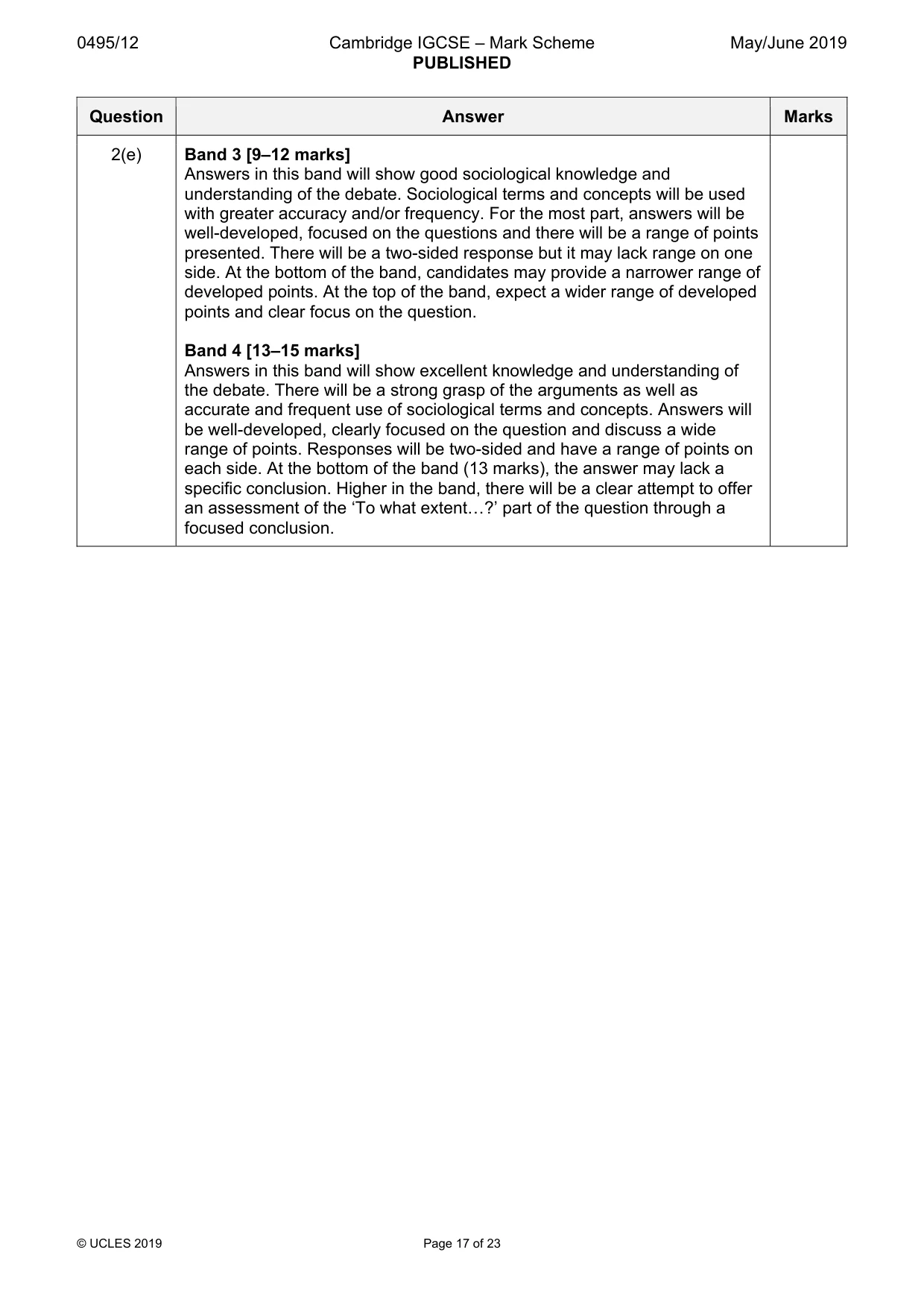
0495/12 Cambridge IGCSE – Mark Scheme PUBLISHED May/June 2019 © UCLES 2019 Page 17 of 23 Question Answer Marks 2(e) Band 3 [9–12 marks] Answers in this band will show good sociological knowledge and understanding of the debate. Sociological terms and concepts will be used with greater accuracy and/or frequency. For the most part, answers will be well-developed, focused on the questions and there will be a range of points presented. There will be a two-sided response but it may lack range on one side. At the bottom of the band, candidates may provide a narrower range of developed points. At the top of the band, expect a wider range of developed points and clear focus on the question. Band 4 [13–15 marks] Answers in this band will show excellent knowledge and understanding of the debate. There will be a strong grasp of the arguments as well as accurate and frequent use of sociological terms and concepts. Answers will be well-developed, clearly focused on the question and discuss a wide range of points. Responses will be two-sided and have a range of points on each side. At the bottom of the band (13 marks), the answer may lack a specific conclusion. Higher in the band, there will be a clear attempt to offer an assessment of the ‘To what extent«?’ part of the question through a focused conclusion.
Mark scheme, page 18
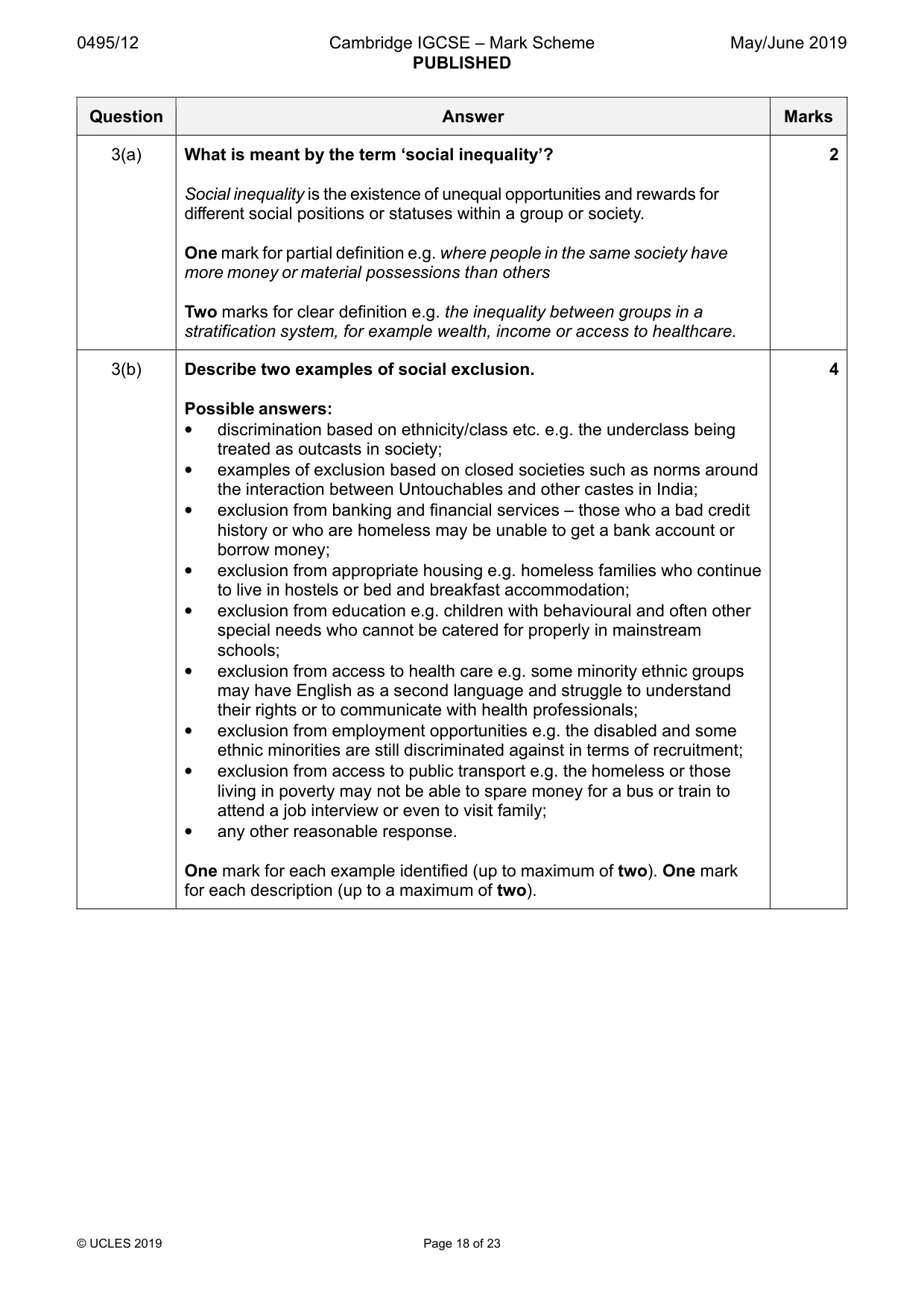
0495/12 Cambridge IGCSE – Mark Scheme PUBLISHED May/June 2019 © UCLES 2019 Page 18 of 23 Question Answer Marks 3(a) What is meant by the term ‘social inequality’? Social inequality is the existence of unequal opportunities and rewards for different social positions or statuses within a group or society. One mark for partial definition e.g. where people in the same society have more money or material possessions than others Two marks for clear definition e.g. the inequality between groups in a stratification system, for example wealth, income or access to healthcare. 2 3(b) Describe two examples of social exclusion. Possible answers: • discrimination based on ethnicity/class etc. e.g. the underclass being treated as outcasts in society; • examples of exclusion based on closed societies such as norms around the interaction between Untouchables and other castes in India; • exclusion from banking and financial services – those who a bad credit history or who are homeless may be unable to get a bank account or borrow money; • exclusion from appropriate housing e.g. homeless families who continue to live in hostels or bed and breakfast accommodation; • exclusion from education e.g. children with behavioural and often other special needs who cannot be catered for properly in mainstream schools; • exclusion from access to health care e.g. some minority ethnic groups may have English as a second language and struggle to understand their rights or to communicate with health professionals; • exclusion from employment opportunities e.g. the disabled and some ethnic minorities are still discriminated against in terms of recruitment; • exclusion from access to public transport e.g. the homeless or those living in poverty may not be able to spare money for a bus or train to attend a job interview or even to visit family; • any other reasonable response. One mark for each example identified (up to maximum of two). One mark for each description (up to a maximum of two). 4
Mark scheme, page 19
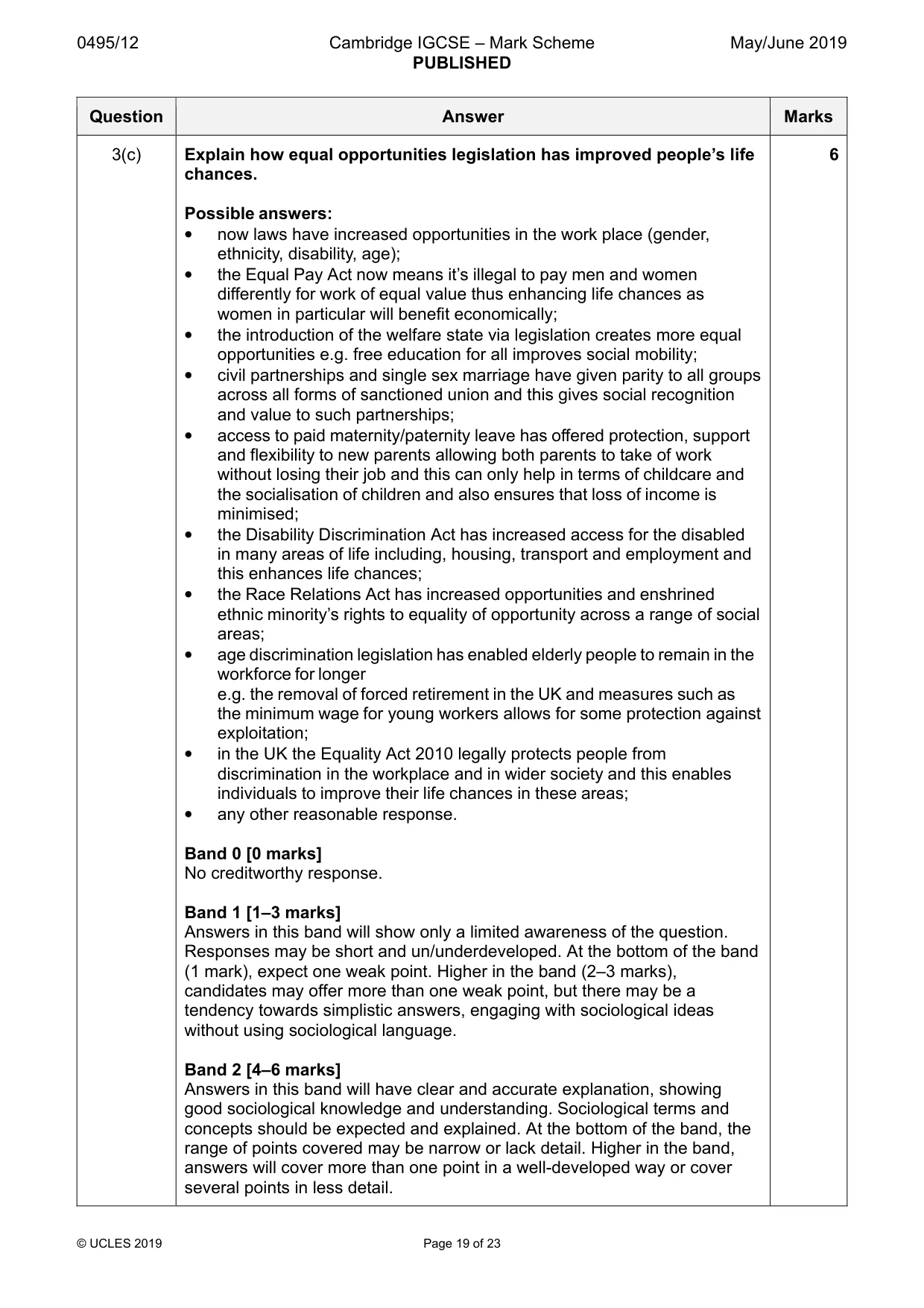
0495/12 Cambridge IGCSE – Mark Scheme PUBLISHED May/June 2019 © UCLES 2019 Page 19 of 23 Question Answer Marks 3(c) Explain how equal opportunities legislation has improved people’s life chances. Possible answers: • now laws have increased opportunities in the work place (gender, ethnicity, disability, age); • the Equal Pay Act now means it’s illegal to pay men and women differently for work of equal value thus enhancing life chances as women in particular will benefit economically; • the introduction of the welfare state via legislation creates more equal opportunities e.g. free education for all improves social mobility; • civil partnerships and single sex marriage have given parity to all groups across all forms of sanctioned union and this gives social recognition and value to such partnerships; • access to paid maternity/paternity leave has offered protection, support and flexibility to new parents allowing both parents to take of work without losing their job and this can only help in terms of childcare and the socialisation of children and also ensures that loss of income is minimised; • the Disability Discrimination Act has increased access for the disabled in many areas of life including, housing, transport and employment and this enhances life chances; • the Race Relations Act has increased opportunities and enshrined ethnic minority’s rights to equality of opportunity across a range of social areas; • age discrimination legislation has enabled elderly people to remain in the workforce for longer e.g. the removal of forced retirement in the UK and measures such as the minimum wage for young workers allows for some protection against exploitation; • in the UK the Equality Act 2010 legally protects people from discrimination in the workplace and in wider society and this enables individuals to improve their life chances in these areas; • any other reasonable response. Band 0 [0 marks] No creditworthy response. Band 1 [1–3 marks] Answers in this band will show only a limited awareness of the question. Responses may be short and un/underdeveloped. At the bottom of the band (1 mark), expect one weak point. Higher in the band (2–3 marks), candidates may offer more than one weak point, but there may be a tendency towards simplistic answers, engaging with sociological ideas without using sociological language. Band 2 [4–6 marks] Answers in this band will have clear and accurate explanation, showing good sociological knowledge and understanding. Sociological terms and concepts should be expected and explained. At the bottom of the band, the range of points covered may be narrow or lack detail. Higher in the band, answers will cover more than one point in a well-developed way or cover several points in less detail. 6
Mark scheme, page 20
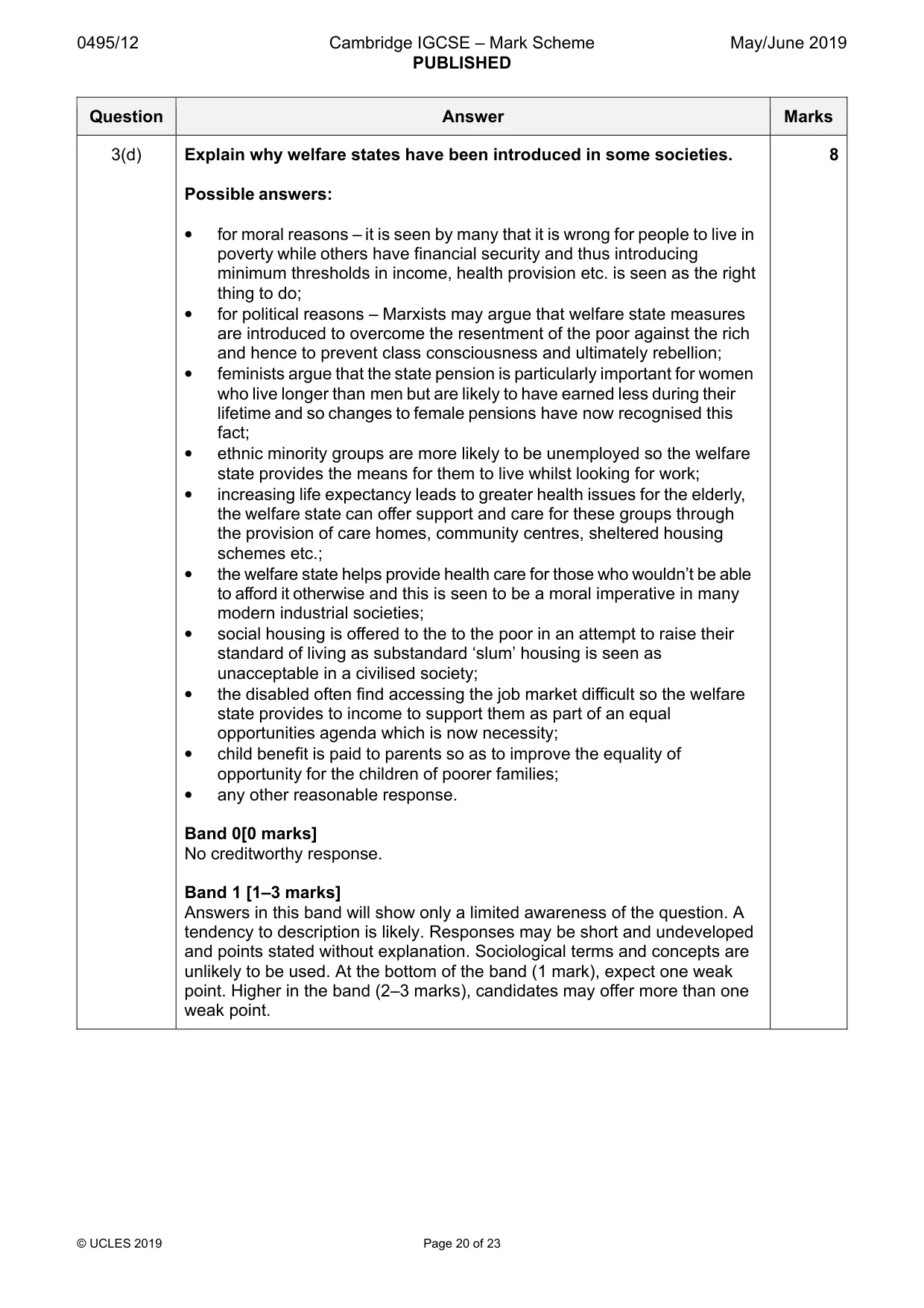
0495/12 Cambridge IGCSE – Mark Scheme PUBLISHED May/June 2019 © UCLES 2019 Page 20 of 23 Question Answer Marks 3(d) Explain why welfare states have been introduced in some societies. Possible answers: • for moral reasons – it is seen by many that it is wrong for people to live in poverty while others have financial security and thus introducing minimum thresholds in income, health provision etc. is seen as the right thing to do; • for political reasons – Marxists may argue that welfare state measures are introduced to overcome the resentment of the poor against the rich and hence to prevent class consciousness and ultimately rebellion; • feminists argue that the state pension is particularly important for women who live longer than men but are likely to have earned less during their lifetime and so changes to female pensions have now recognised this fact; • ethnic minority groups are more likely to be unemployed so the welfare state provides the means for them to live whilst looking for work; • increasing life expectancy leads to greater health issues for the elderly, the welfare state can offer support and care for these groups through the provision of care homes, community centres, sheltered housing schemes etc.; • the welfare state helps provide health care for those who wouldn’t be able to afford it otherwise and this is seen to be a moral imperative in many modern industrial societies; • social housing is offered to the to the poor in an attempt to raise their standard of living as substandard ‘slum’ housing is seen as unacceptable in a civilised society; • the disabled often find accessing the job market difficult so the welfare state provides to income to support them as part of an equal opportunities agenda which is now necessity; • child benefit is paid to parents so as to improve the equality of opportunity for the children of poorer families; • any other reasonable response. Band 0[0 marks] No creditworthy response. Band 1 [1–3 marks] Answers in this band will show only a limited awareness of the question. A tendency to description is likely. Responses may be short and undeveloped and points stated without explanation. Sociological terms and concepts are unlikely to be used. At the bottom of the band (1 mark), expect one weak point. Higher in the band (2–3 marks), candidates may offer more than one weak point. 8
Mark scheme, page 21
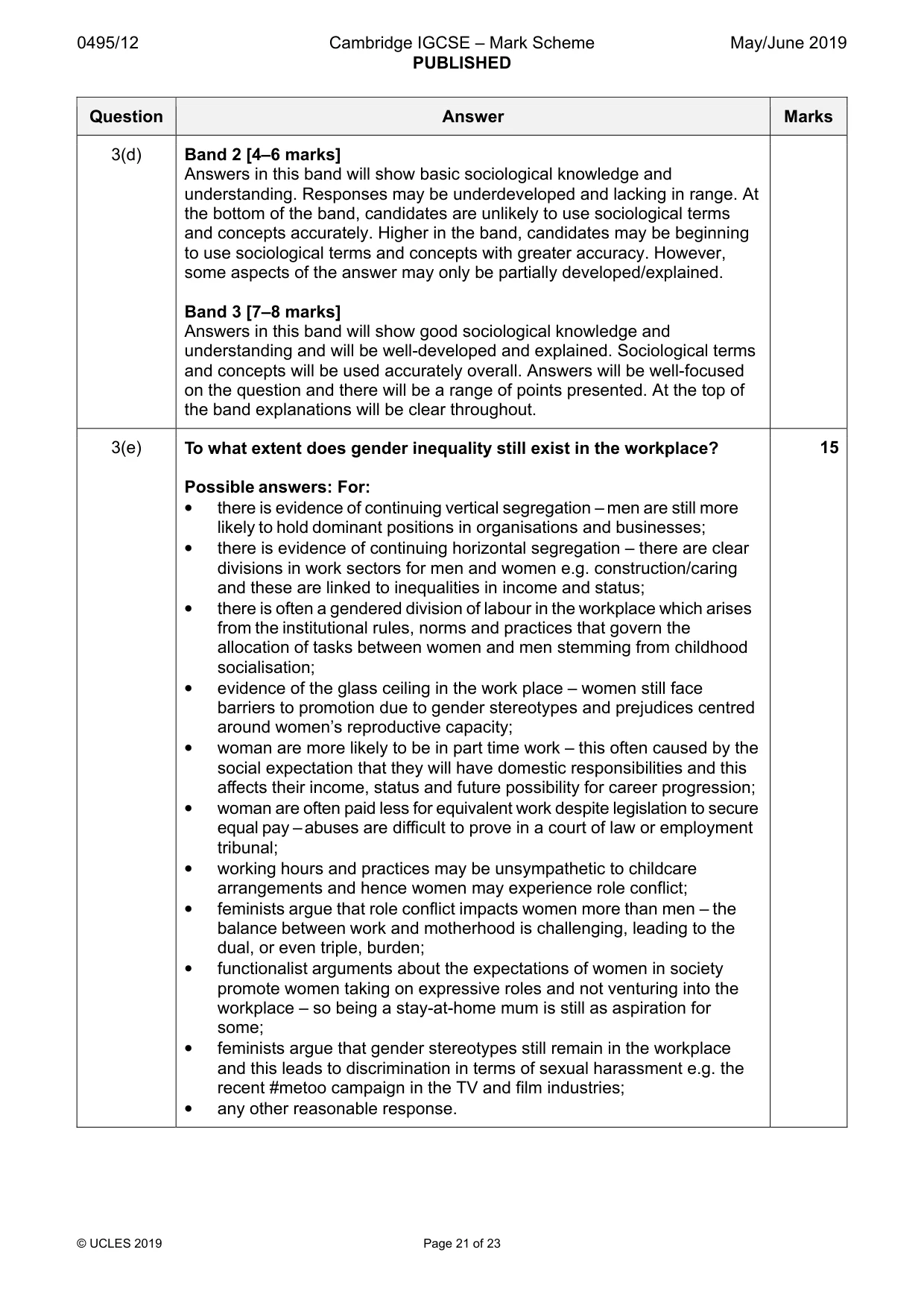
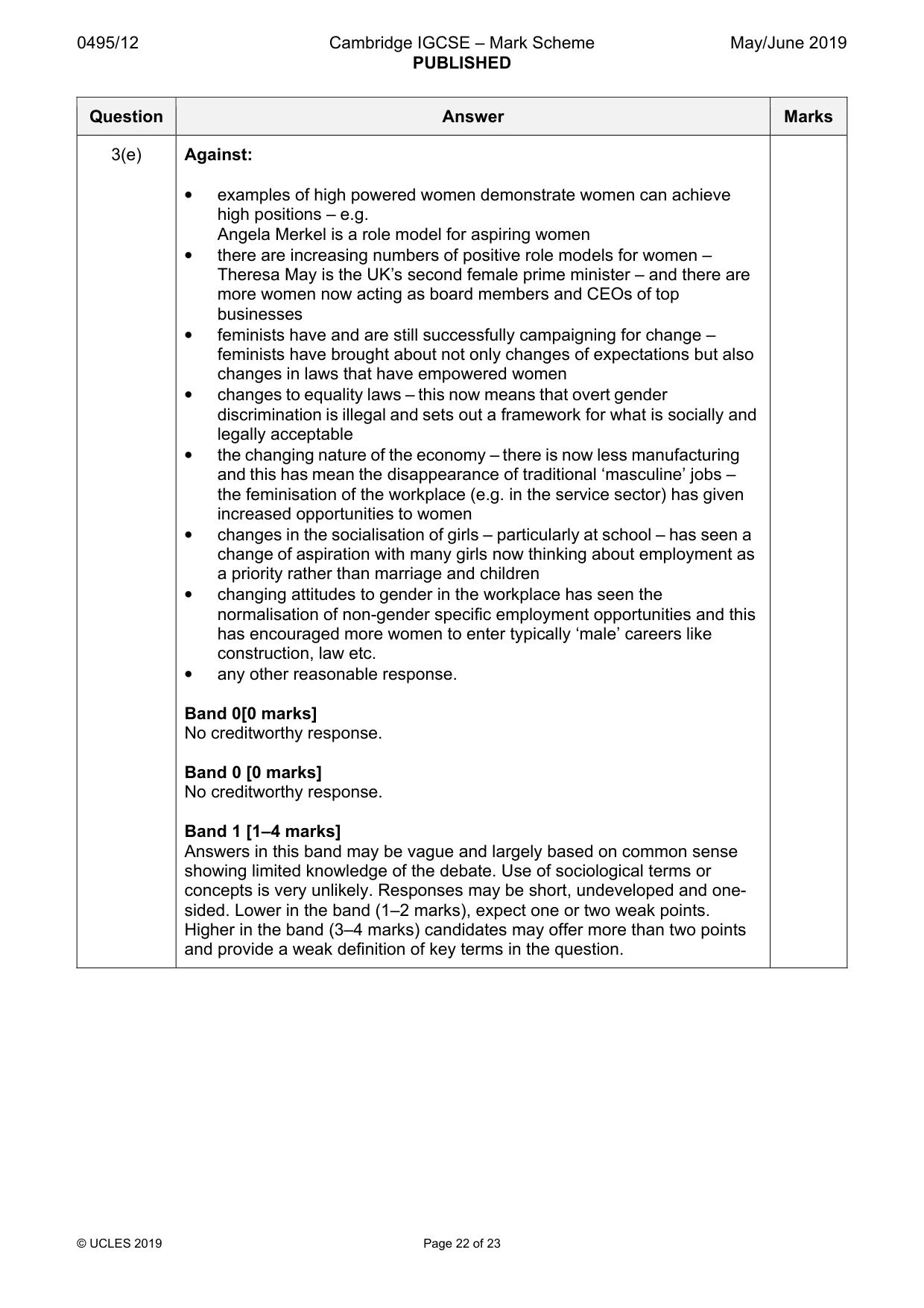
0495/12 Cambridge IGCSE – Mark Scheme PUBLISHED May/June 2019 © UCLES 2019 Page 21 of 23 Question Answer Marks 3(d) Band 2 [4–6 marks] Answers in this band will show basic sociological knowledge and understanding. Responses may be underdeveloped and lacking in range. At the bottom of the band, candidates are unlikely to use sociological terms and concepts accurately. Higher in the band, candidates may be beginning to use sociological terms and concepts with greater accuracy. However, some aspects of the answer may only be partially developed/explained. Band 3 [7–8 marks] Answers in this band will show good sociological knowledge and understanding and will be well-developed and explained. Sociological terms and concepts will be used accurately overall. Answers will be well-focused on the question and there will be a range of points presented. At the top of the band explanations will be clear throughout. 3(e) To what extent does gender inequality still exist in the workplace? Possible answers: For: • there is evidence of continuing vertical segregation – men are still more likely to hold dominant positions in organisations and businesses; • there is evidence of continuing horizontal segregation – there are clear divisions in work sectors for men and women e.g. construction/caring and these are linked to inequalities in income and status; • there is often a gendered division of labour in the workplace which arises from the institutional rules, norms and practices that govern the allocation of tasks between women and men stemming from childhood socialisation; • evidence of the glass ceiling in the work place – women still face barriers to promotion due to gender stereotypes and prejudices centred around women’s reproductive capacity; • woman are more likely to be in part time work – this often caused by the social expectation that they will have domestic responsibilities and this affects their income, status and future possibility for career progression; • woman are often paid less for equivalent work despite legislation to secure equal pay – abuses are difficult to prove in a court of law or employment tribunal; • working hours and practices may be unsympathetic to childcare arrangements and hence women may experience role conflict; • feminists argue that role conflict impacts women more than men – the balance between work and motherhood is challenging, leading to the dual, or even triple, burden; • functionalist arguments about the expectations of women in society promote women taking on expressive roles and not venturing into the workplace – so being a stay-at-home mum is still as aspiration for some; • feminists argue that gender stereotypes still remain in the workplace and this leads to discrimination in terms of sexual harassment e.g. the recent #metoo campaign in the TV and film industries; • any other reasonable response. 15
Mark scheme, page 22
0495/12 Cambridge IGCSE – Mark Scheme PUBLISHED May/June 2019 © UCLES 2019 Page 22 of 23 Question Answer Marks 3(e) Against: • examples of high powered women demonstrate women can achieve high positions – e.g. Angela Merkel is a role model for aspiring women • there are increasing numbers of positive role models for women – Theresa May is the UK’s second female prime minister – and there are more women now acting as board members and CEOs of top businesses • feminists have and are still successfully campaigning for change – feminists have brought about not only changes of expectations but also changes in laws that have empowered women • changes to equality laws – this now means that overt gender discrimination is illegal and sets out a framework for what is socially and legally acceptable • the changing nature of the economy – there is now less manufacturing and this has mean the disappearance of traditional ‘masculine’ jobs – the feminisation of the workplace (e.g. in the service sector) has given increased opportunities to women • changes in the socialisation of girls – particularly at school – has seen a change of aspiration with many girls now thinking about employment as a priority rather than marriage and children • changing attitudes to gender in the workplace has seen the normalisation of non-gender specific employment opportunities and this has encouraged more women to enter typically ‘male’ careers like construction, law etc. • any other reasonable response. Band 0[0 marks] No creditworthy response. Band 0 [0 marks] No creditworthy response. Band 1 [1–4 marks] Answers in this band may be vague and largely based on common sense showing limited knowledge of the debate. Use of sociological terms or concepts is very unlikely. Responses may be short, undeveloped and one- sided. Lower in the band (1–2 marks), expect one or two weak points. Higher in the band (3–4 marks) candidates may offer more than two points and provide a weak definition of key terms in the question.
Mark scheme, page 23
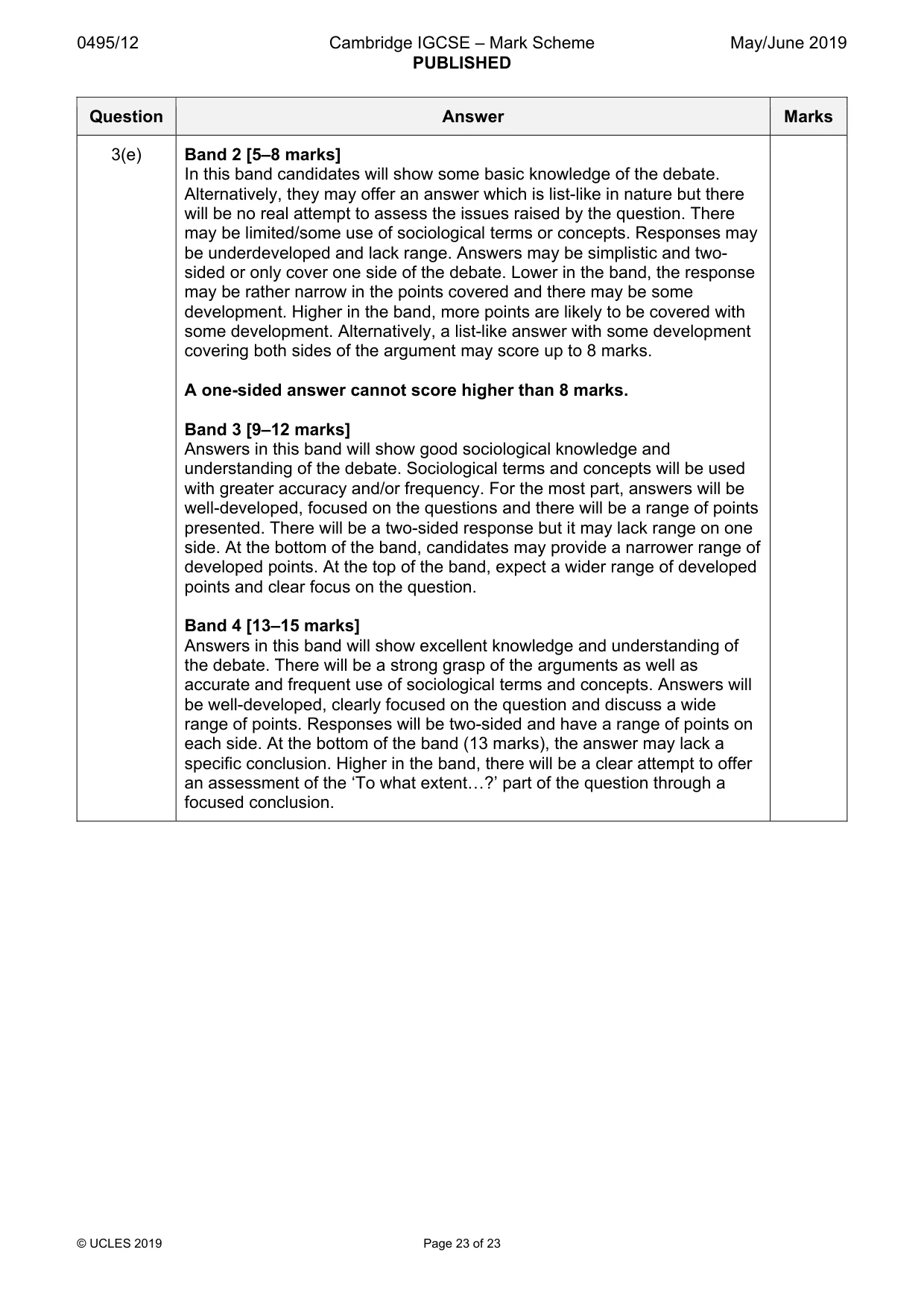
0495/12 Cambridge IGCSE – Mark Scheme PUBLISHED May/June 2019 © UCLES 2019 Page 23 of 23 Question Answer Marks 3(e) Band 2 [5–8 marks] In this band candidates will show some basic knowledge of the debate. Alternatively, they may offer an answer which is list-like in nature but there will be no real attempt to assess the issues raised by the question. There may be limited/some use of sociological terms or concepts. Responses may be underdeveloped and lack range. Answers may be simplistic and two- sided or only cover one side of the debate. Lower in the band, the response may be rather narrow in the points covered and there may be some development. Higher in the band, more points are likely to be covered with some development. Alternatively, a list-like answer with some development covering both sides of the argument may score up to 8 marks. A one-sided answer cannot score higher than 8 marks. Band 3 [9–12 marks] Answers in this band will show good sociological knowledge and understanding of the debate. Sociological terms and concepts will be used with greater accuracy and/or frequency. For the most part, answers will be well-developed, focused on the questions and there will be a range of points presented. There will be a two-sided response but it may lack range on one side. At the bottom of the band, candidates may provide a narrower range of developed points. At the top of the band, expect a wider range of developed points and clear focus on the question. Band 4 [13–15 marks] Answers in this band will show excellent knowledge and understanding of the debate. There will be a strong grasp of the arguments as well as accurate and frequent use of sociological terms and concepts. Answers will be well-developed, clearly focused on the question and discuss a wide range of points. Responses will be two-sided and have a range of points on each side. At the bottom of the band (13 marks), the answer may lack a specific conclusion. Higher in the band, there will be a clear attempt to offer an assessment of the ‘To what extent«?’ part of the question through a focused conclusion.
What you needed in this session
Cambridge’s own grade thresholds for 2019 May/June, Paper 1 · Variant 2. A higher threshold means an easier paper — the bar moves with how the cohort did.