Cambridge IGCSE Sociology 0495 — 2018 Oct/Nov Paper 1 · Variant 1
0495/11/O/N/18 · 80 marks · ≈90 min
The question paper and its mark scheme, free to read here and free to download. This is Cambridge’s own paper, exactly as it was sat.
Question paper4 pages

Mark scheme18 pages
Answers below. Sit the paper first if you are practising.
Paper as text
Question paper, page 1
Cambridge International Examinations Cambridge International General Certificate of Secondary Education 0495/11 October/November 2018 SOCIOLOGY Paper 1 2 hours (including 15 minutes’ reading time) Additional Materials: Answer Booklet READ THESE INSTRUCTIONS FIRST An answer booklet is provided inside this question paper. You should follow the instructions on the front cover of the answer booklet. If you need additional answer paper ask the invigilator for a continuation booklet. Answer Question 1 and either Question 2 or Question 3. The number of marks is given in brackets [ ] at the end of each question or part question. This document consists of 3 printed pages and 1 blank page. [Turn over 11_0495_11_2018_1.7 © UCLES 2018 *6774010463*
Question paper, page 2
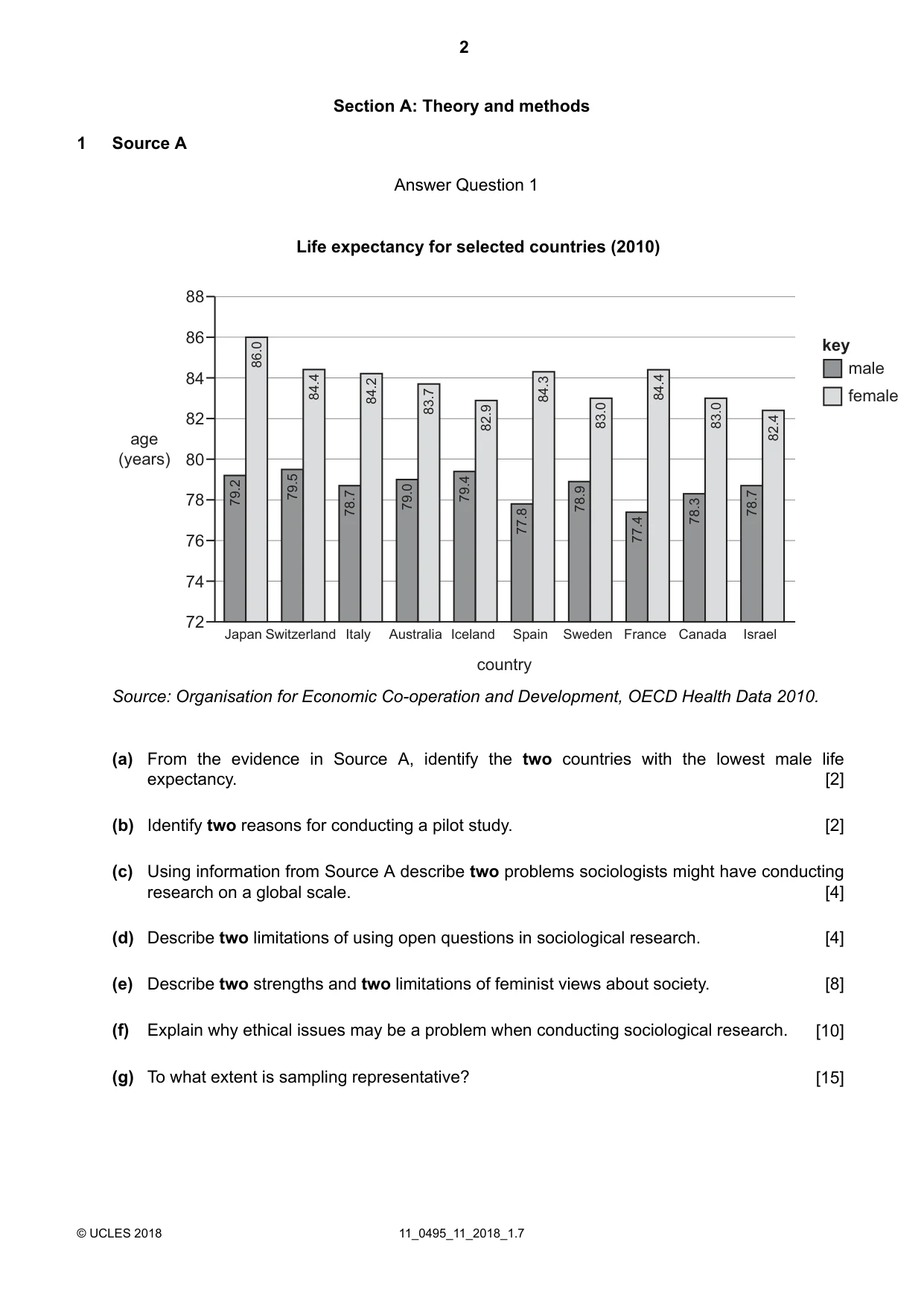
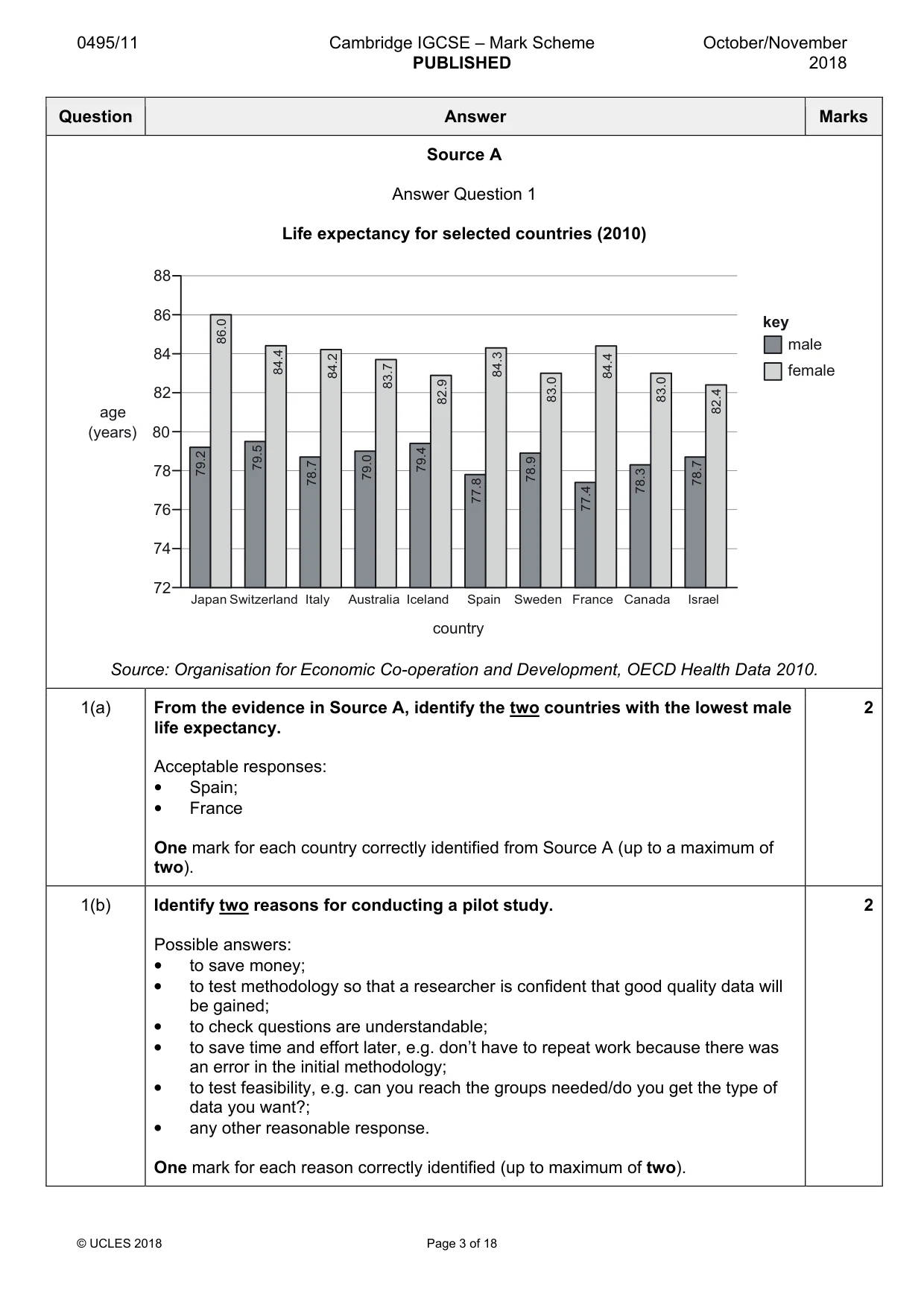
Section A: Theory and methods Source A 1 Answer Question 1 Life expectancy for selected countries (2010) Japan Switzerland Italy Australia Iceland Spain Sweden France Canada Israel 88 86 84 82 80 78 76 74 72 age (years) country key male female 79.2 86.0 79.5 84.4 78.7 84.2 79.0 83.7 79.4 82.9 77.8 84.3 78.9 83.0 77.4 84.4 78.3 83.0 78.7 82.4 Source: Organisation for Economic Co-operation and Development, OECD Health Data 2010. From the evidence in Source A, identify the two countries with the lowest male life expectancy. [2] (a) Identify two reasons for conducting a pilot study. [2] (b) Using information from Source A describe two problems sociologists might have conducting research on a global scale. [4] (c) Describe two limitations of using open questions in sociological research. [4] (d) Describe two strengths and two limitations of feminist views about society. [8] (e) Explain why ethical issues may be a problem when conducting sociological research. [10] (f) To what extent is sampling representative? [15] (g) 11_0495_11_2018_1.7 © UCLES 2018 2
Question paper, page 3
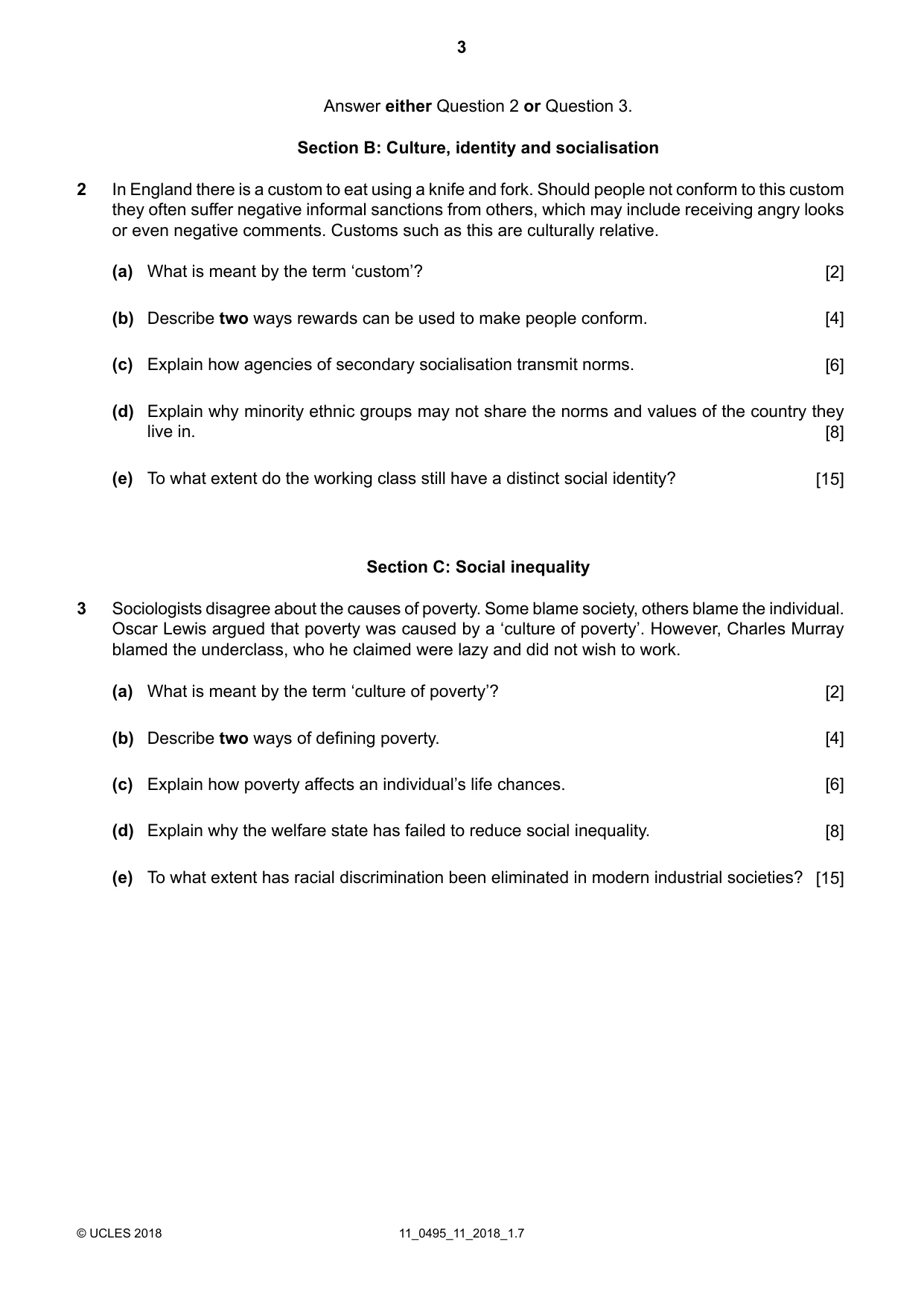
Answer either Question 2 or Question 3. Section B: Culture, identity and socialisation In England there is a custom to eat using a knife and fork. Should people not conform to this custom they often suffer negative informal sanctions from others, which may include receiving angry looks or even negative comments. Customs such as this are culturally relative. 2 What is meant by the term ‘custom’? [2] (a) Describe two ways rewards can be used to make people conform. [4] (b) Explain how agencies of secondary socialisation transmit norms. [6] (c) Explain why minority ethnic groups may not share the norms and values of the country they live in. [8] (d) To what extent do the working class still have a distinct social identity? [15] (e) Section C: Social inequality Sociologists disagree about the causes of poverty. Some blame society, others blame the individual. Oscar Lewis argued that poverty was caused by a ‘culture of poverty’. However, Charles Murray blamed the underclass, who he claimed were lazy and did not wish to work. 3 What is meant by the term ‘culture of poverty’? [2] (a) Describe two ways of defining poverty. [4] (b) Explain how poverty affects an individual’s life chances. [6] (c) Explain why the welfare state has failed to reduce social inequality. [8] (d) To what extent has racial discrimination been eliminated in modern industrial societies? [15] (e) 11_0495_11_2018_1.7 © UCLES 2018 3
Question paper, page 4
BLANK PAGE Permission to reproduce items where third-party owned material protected by copyright is included has been sought and cleared where possible. Every reasonable effort has been made by the publisher (UCLES) to trace copyright holders, but if any items requiring clearance have unwittingly been included, the publisher will be pleased to make amends at the earliest possible opportunity. To avoid the issue of disclosure of answer-related information to candidates, all copyright acknowledgements are reproduced online in the Cambridge International Examinations Copyright Acknowledgements Booklet. This is produced for each series of examinations and is freely available to download at www.cie.org.uk after the live examination series. Cambridge International Examinations is part of the Cambridge Assessment Group. Cambridge Assessment is the brand name of University of Cambridge Local Examinations Syndicate (UCLES), which is itself a department of the University of Cambridge. 11_0495_11_2018_1.7 © UCLES 2018 4
Mark scheme, page 1
This document consists of 18 printed pages. © UCLES 2018 [Turn over Cambridge Assessment International Education Cambridge International General Certificate of Secondary Education SOCIOLOGY 0495/11 Paper 1 October/November 2018 MARK SCHEME Maximum Mark: 80 Published This mark scheme is published as an aid to teachers and candidates, to indicate the requirements of the examination. It shows the basis on which Examiners were instructed to award marks. It does not indicate the details of the discussions that took place at an Examiners’ meeting before marking began, which would have considered the acceptability of alternative answers. Mark schemes should be read in conjunction with the question paper and the Principal Examiner Report for Teachers. Cambridge International will not enter into discussions about these mark schemes. Cambridge International is publishing the mark schemes for the October/November 2018 series for most Cambridge IGCSE™, Cambridge International A and AS Level components and some Cambridge O Level components.
Mark scheme, page 2
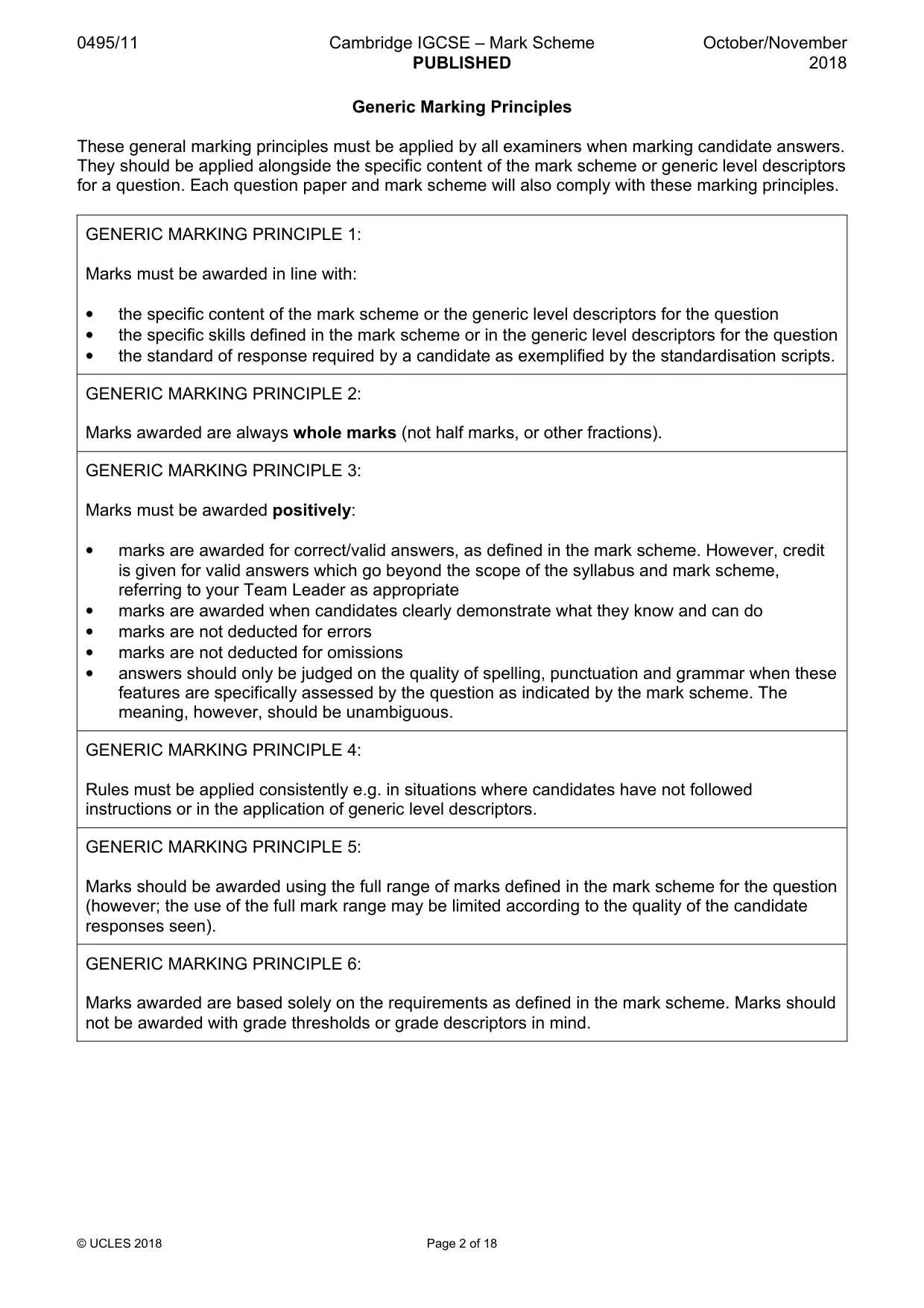
0495/11 Cambridge IGCSE – Mark Scheme PUBLISHED October/November 2018 © UCLES 2018 Page 2 of 18 Generic Marking Principles These general marking principles must be applied by all examiners when marking candidate answers. They should be applied alongside the specific content of the mark scheme or generic level descriptors for a question. Each question paper and mark scheme will also comply with these marking principles. GENERIC MARKING PRINCIPLE 1: Marks must be awarded in line with: • the specific content of the mark scheme or the generic level descriptors for the question • the specific skills defined in the mark scheme or in the generic level descriptors for the question • the standard of response required by a candidate as exemplified by the standardisation scripts. GENERIC MARKING PRINCIPLE 2: Marks awarded are always whole marks (not half marks, or other fractions). GENERIC MARKING PRINCIPLE 3: Marks must be awarded positively: • marks are awarded for correct/valid answers, as defined in the mark scheme. However, credit is given for valid answers which go beyond the scope of the syllabus and mark scheme, referring to your Team Leader as appropriate • marks are awarded when candidates clearly demonstrate what they know and can do • marks are not deducted for errors • marks are not deducted for omissions • answers should only be judged on the quality of spelling, punctuation and grammar when these features are specifically assessed by the question as indicated by the mark scheme. The meaning, however, should be unambiguous. GENERIC MARKING PRINCIPLE 4: Rules must be applied consistently e.g. in situations where candidates have not followed instructions or in the application of generic level descriptors. GENERIC MARKING PRINCIPLE 5: Marks should be awarded using the full range of marks defined in the mark scheme for the question (however; the use of the full mark range may be limited according to the quality of the candidate responses seen). GENERIC MARKING PRINCIPLE 6: Marks awarded are based solely on the requirements as defined in the mark scheme. Marks should not be awarded with grade thresholds or grade descriptors in mind.
Mark scheme, page 3
0495/11 Cambridge IGCSE – Mark Scheme PUBLISHED October/November 2018 © UCLES 2018 Page 3 of 18 Question Answer Marks Source A Answer Question 1 Life expectancy for selected countries (2010) Source: Organisation for Economic Co-operation and Development, OECD Health Data 2010. 1(a) From the evidence in Source A, identify the two countries with the lowest male life expectancy. Acceptable responses: • Spain; • France One mark for each country correctly identified from Source A (up to a maximum of two). 2 1(b) Identify two reasons for conducting a pilot study. Possible answers: • to save money; • to test methodology so that a researcher is confident that good quality data will be gained; • to check questions are understandable; • to save time and effort later, e.g. don’t have to repeat work because there was an error in the initial methodology; • to test feasibility, e.g. can you reach the groups needed/do you get the type of data you want?; • any other reasonable response. One mark for each reason correctly identified (up to maximum of two). 2 88 86 84 82 age (years) 80 78 76 74 72 Japan Switzerland Italy Australia Iceland Spain Sweden France Canada Israel country key male female 79.2 86.0 79.5 84.4 78.7 84.2 79.0 83.7 79.4 82.9 77.8 84.3 78.9 83.0 77.4 84.4 78.3 83.0 78.7 82.4
Mark scheme, page 4
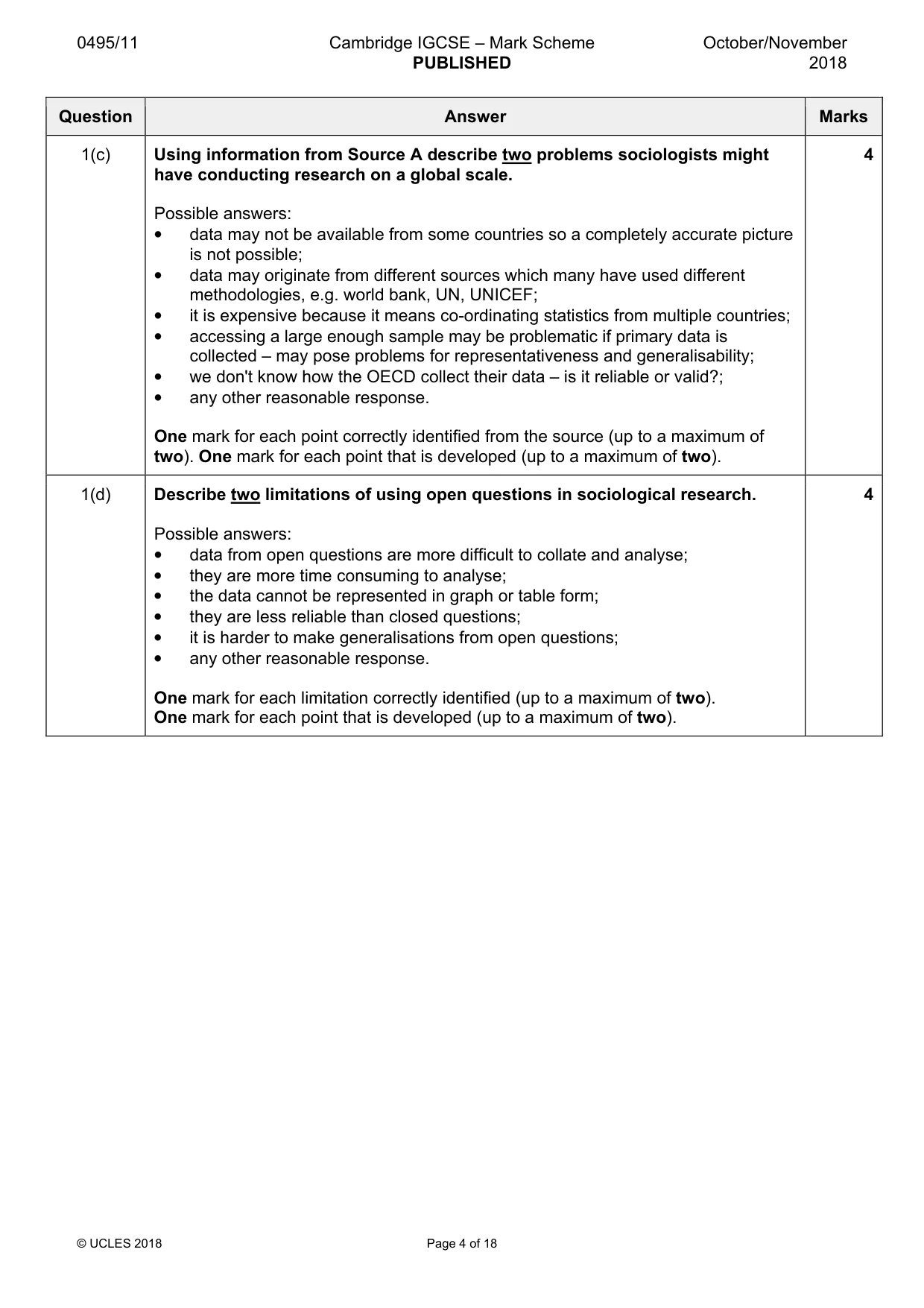
0495/11 Cambridge IGCSE – Mark Scheme PUBLISHED October/November 2018 © UCLES 2018 Page 4 of 18 Question Answer Marks 1(c) Using information from Source A describe two problems sociologists might have conducting research on a global scale. Possible answers: • data may not be available from some countries so a completely accurate picture is not possible; • data may originate from different sources which many have used different methodologies, e.g. world bank, UN, UNICEF; • it is expensive because it means co-ordinating statistics from multiple countries; • accessing a large enough sample may be problematic if primary data is collected – may pose problems for representativeness and generalisability; • we don't know how the OECD collect their data – is it reliable or valid?; • any other reasonable response. One mark for each point correctly identified from the source (up to a maximum of two). One mark for each point that is developed (up to a maximum of two). 4 1(d) Describe two limitations of using open questions in sociological research. Possible answers: • data from open questions are more difficult to collate and analyse; • they are more time consuming to analyse; • the data cannot be represented in graph or table form; • they are less reliable than closed questions; • it is harder to make generalisations from open questions; • any other reasonable response. One mark for each limitation correctly identified (up to a maximum of two). One mark for each point that is developed (up to a maximum of two). 4
Mark scheme, page 5
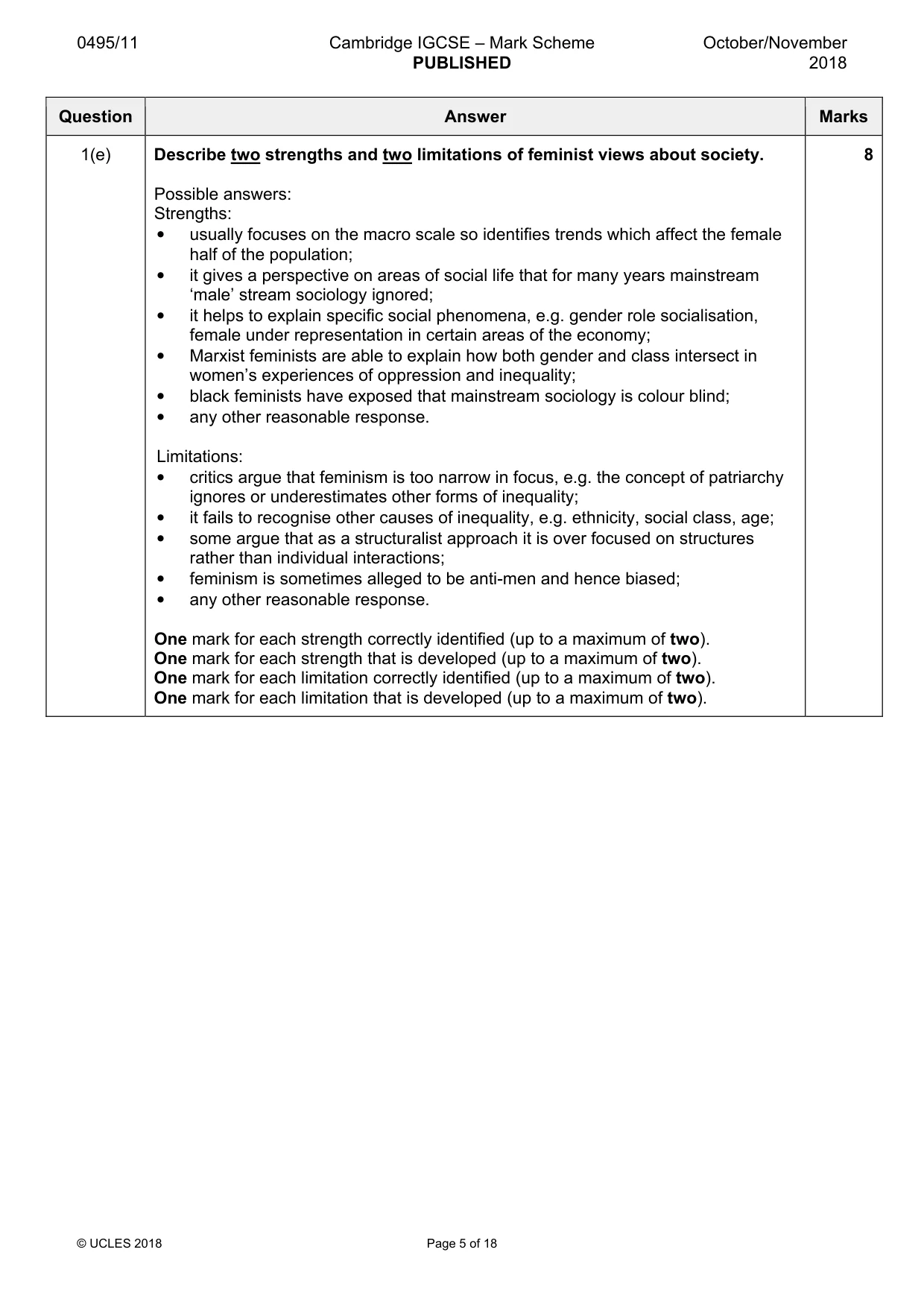
0495/11 Cambridge IGCSE – Mark Scheme PUBLISHED October/November 2018 © UCLES 2018 Page 5 of 18 Question Answer Marks 1(e) Describe two strengths and two limitations of feminist views about society. Possible answers: Strengths: • usually focuses on the macro scale so identifies trends which affect the female half of the population; • it gives a perspective on areas of social life that for many years mainstream ‘male’ stream sociology ignored; • it helps to explain specific social phenomena, e.g. gender role socialisation, female under representation in certain areas of the economy; • Marxist feminists are able to explain how both gender and class intersect in women’s experiences of oppression and inequality; • black feminists have exposed that mainstream sociology is colour blind; • any other reasonable response. Limitations: • critics argue that feminism is too narrow in focus, e.g. the concept of patriarchy ignores or underestimates other forms of inequality; • it fails to recognise other causes of inequality, e.g. ethnicity, social class, age; • some argue that as a structuralist approach it is over focused on structures rather than individual interactions; • feminism is sometimes alleged to be anti-men and hence biased; • any other reasonable response. One mark for each strength correctly identified (up to a maximum of two). One mark for each strength that is developed (up to a maximum of two). One mark for each limitation correctly identified (up to a maximum of two). One mark for each limitation that is developed (up to a maximum of two). 8
Mark scheme, page 6
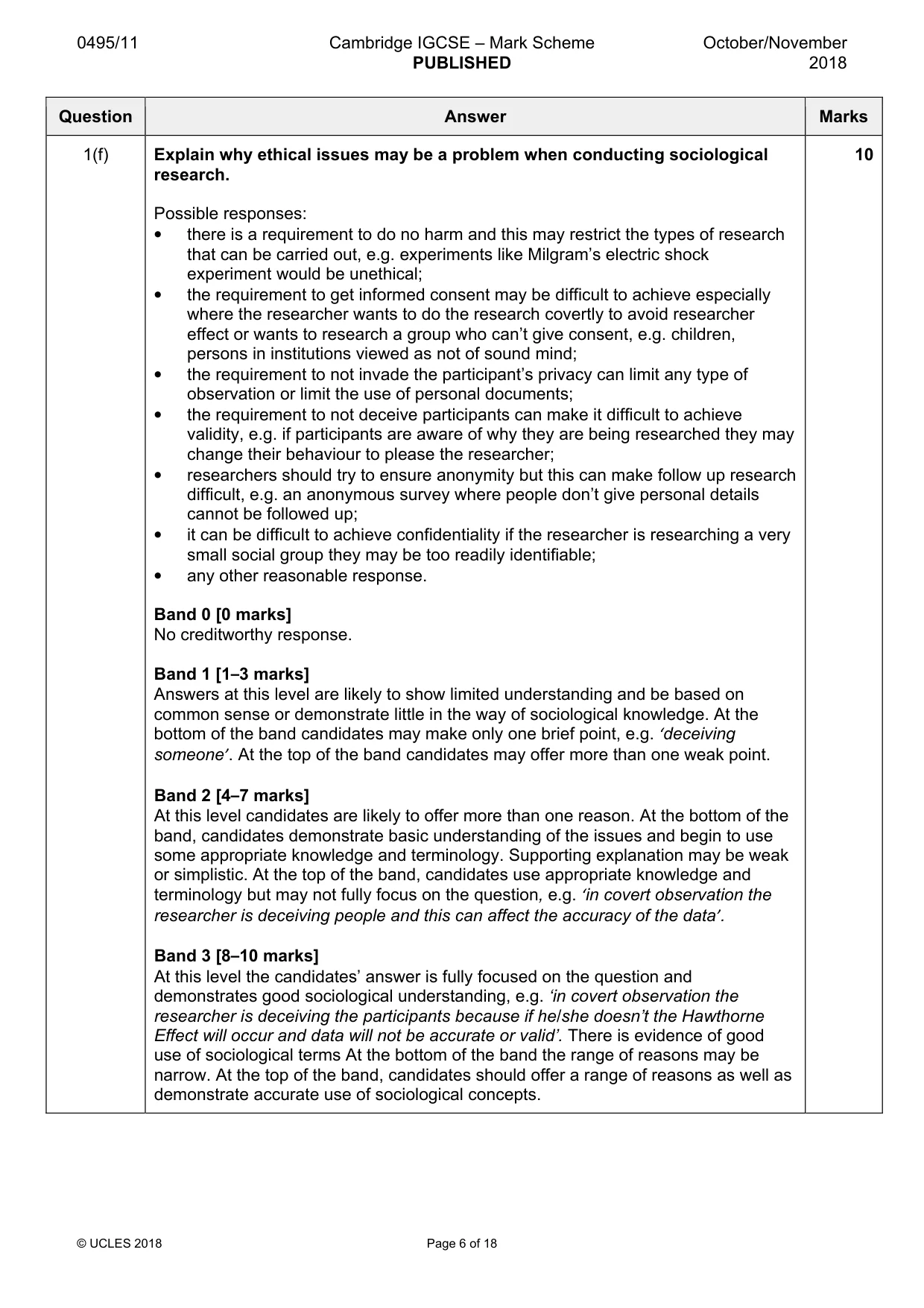
0495/11 Cambridge IGCSE – Mark Scheme PUBLISHED October/November 2018 © UCLES 2018 Page 6 of 18 Question Answer Marks 1(f) Explain why ethical issues may be a problem when conducting sociological research. Possible responses: • there is a requirement to do no harm and this may restrict the types of research that can be carried out, e.g. experiments like Milgram’s electric shock experiment would be unethical; • the requirement to get informed consent may be difficult to achieve especially where the researcher wants to do the research covertly to avoid researcher effect or wants to research a group who can’t give consent, e.g. children, persons in institutions viewed as not of sound mind; • the requirement to not invade the participant’s privacy can limit any type of observation or limit the use of personal documents; • the requirement to not deceive participants can make it difficult to achieve validity, e.g. if participants are aware of why they are being researched they may change their behaviour to please the researcher; • researchers should try to ensure anonymity but this can make follow up research difficult, e.g. an anonymous survey where people don’t give personal details cannot be followed up; • it can be difficult to achieve confidentiality if the researcher is researching a very small social group they may be too readily identifiable; • any other reasonable response. Band 0 [0 marks] No creditworthy response. Band 1 [1–3 marks] Answers at this level are likely to show limited understanding and be based on common sense or demonstrate little in the way of sociological knowledge. At the bottom of the band candidates may make only one brief point, e.g. ‘deceiving someone’. At the top of the band candidates may offer more than one weak point. Band 2 [4–7 marks] At this level candidates are likely to offer more than one reason. At the bottom of the band, candidates demonstrate basic understanding of the issues and begin to use some appropriate knowledge and terminology. Supporting explanation may be weak or simplistic. At the top of the band, candidates use appropriate knowledge and terminology but may not fully focus on the question, e.g. ‘in covert observation the researcher is deceiving people and this can affect the accuracy of the data’. Band 3 [8–10 marks] At this level the candidates’ answer is fully focused on the question and demonstrates good sociological understanding, e.g. ‘in covert observation the researcher is deceiving the participants because if he/she doesn’t the Hawthorne Effect will occur and data will not be accurate or valid’. There is evidence of good use of sociological terms At the bottom of the band the range of reasons may be narrow. At the top of the band, candidates should offer a range of reasons as well as demonstrate accurate use of sociological concepts. 10
Mark scheme, page 7
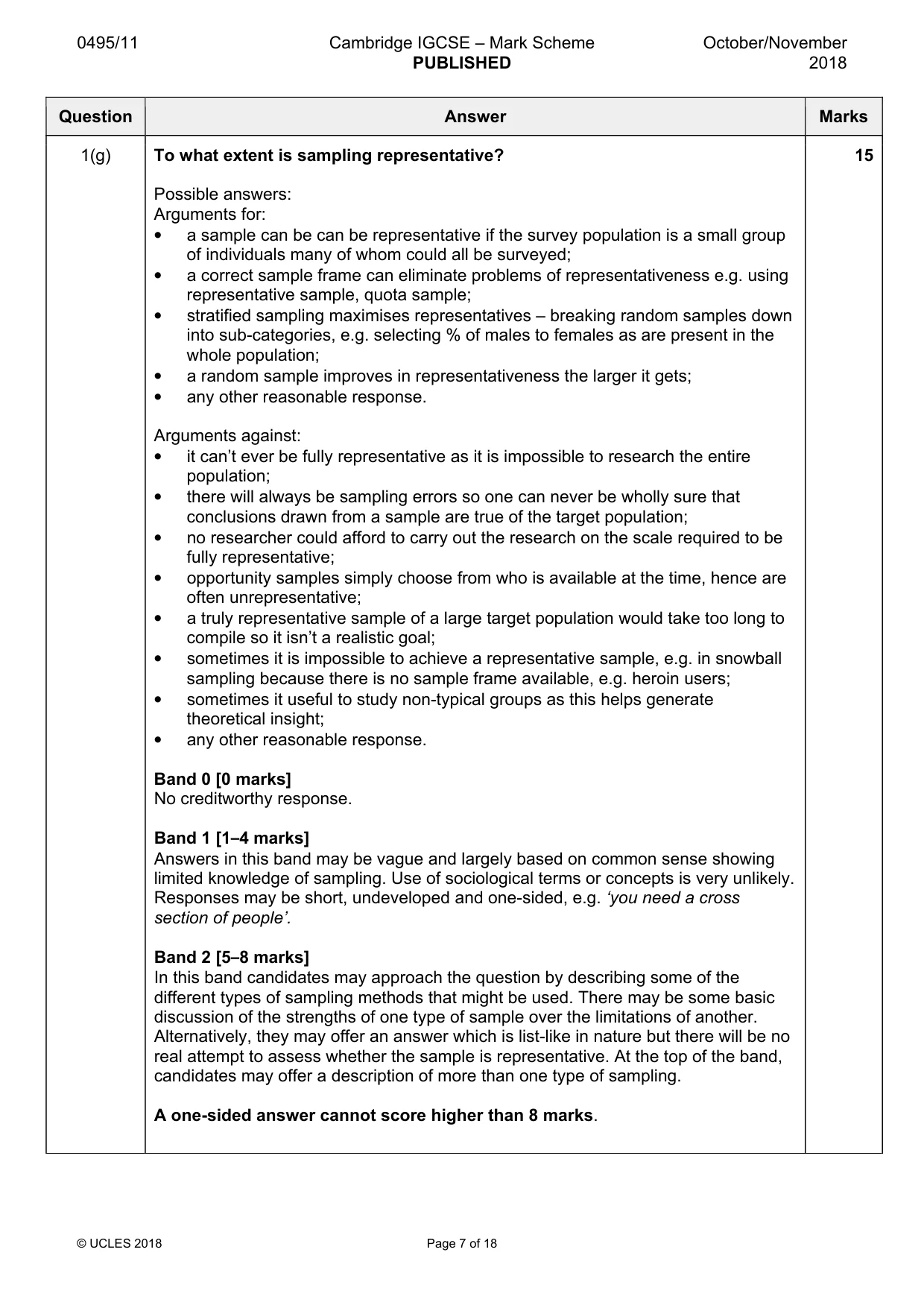
0495/11 Cambridge IGCSE – Mark Scheme PUBLISHED October/November 2018 © UCLES 2018 Page 7 of 18 Question Answer Marks 1(g) To what extent is sampling representative? Possible answers: Arguments for: • a sample can be can be representative if the survey population is a small group of individuals many of whom could all be surveyed; • a correct sample frame can eliminate problems of representativeness e.g. using representative sample, quota sample; • stratified sampling maximises representatives – breaking random samples down into sub-categories, e.g. selecting % of males to females as are present in the whole population; • a random sample improves in representativeness the larger it gets; • any other reasonable response. Arguments against: • it can’t ever be fully representative as it is impossible to research the entire population; • there will always be sampling errors so one can never be wholly sure that conclusions drawn from a sample are true of the target population; • no researcher could afford to carry out the research on the scale required to be fully representative; • opportunity samples simply choose from who is available at the time, hence are often unrepresentative; • a truly representative sample of a large target population would take too long to compile so it isn’t a realistic goal; • sometimes it is impossible to achieve a representative sample, e.g. in snowball sampling because there is no sample frame available, e.g. heroin users; • sometimes it useful to study non-typical groups as this helps generate theoretical insight; • any other reasonable response. Band 0 [0 marks] No creditworthy response. Band 1 [1–4 marks] Answers in this band may be vague and largely based on common sense showing limited knowledge of sampling. Use of sociological terms or concepts is very unlikely. Responses may be short, undeveloped and one-sided, e.g. ‘you need a cross section of people’. Band 2 [5–8 marks] In this band candidates may approach the question by describing some of the different types of sampling methods that might be used. There may be some basic discussion of the strengths of one type of sample over the limitations of another. Alternatively, they may offer an answer which is list-like in nature but there will be no real attempt to assess whether the sample is representative. At the top of the band, candidates may offer a description of more than one type of sampling. A one-sided answer cannot score higher than 8 marks. 15
Mark scheme, page 8
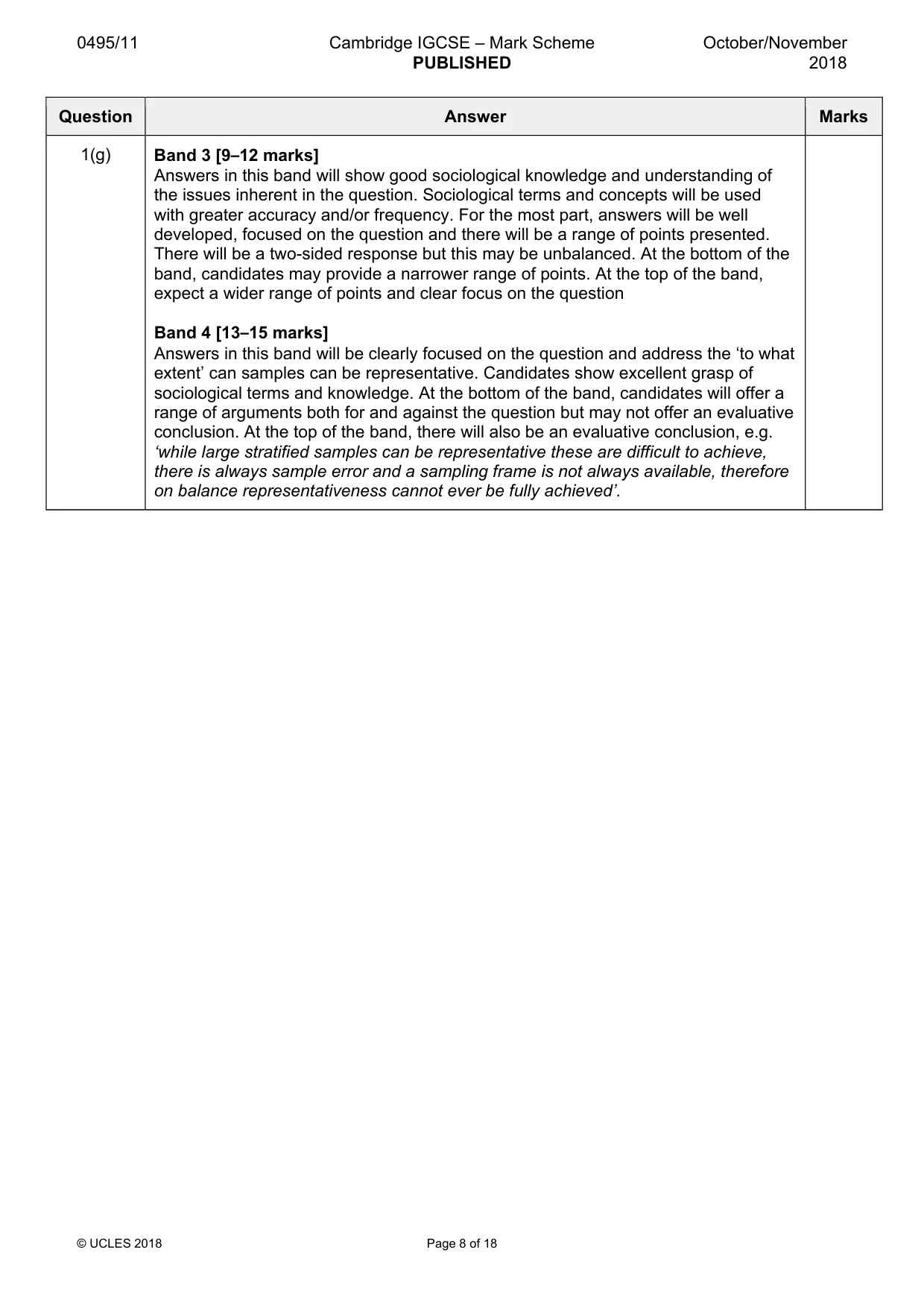
0495/11 Cambridge IGCSE – Mark Scheme PUBLISHED October/November 2018 © UCLES 2018 Page 8 of 18 Question Answer Marks 1(g) Band 3 [9–12 marks] Answers in this band will show good sociological knowledge and understanding of the issues inherent in the question. Sociological terms and concepts will be used with greater accuracy and/or frequency. For the most part, answers will be well developed, focused on the question and there will be a range of points presented. There will be a two-sided response but this may be unbalanced. At the bottom of the band, candidates may provide a narrower range of points. At the top of the band, expect a wider range of points and clear focus on the question Band 4 [13–15 marks] Answers in this band will be clearly focused on the question and address the ‘to what extent’ can samples can be representative. Candidates show excellent grasp of sociological terms and knowledge. At the bottom of the band, candidates will offer a range of arguments both for and against the question but may not offer an evaluative conclusion. At the top of the band, there will also be an evaluative conclusion, e.g. ‘while large stratified samples can be representative these are difficult to achieve, there is always sample error and a sampling frame is not always available, therefore on balance representativeness cannot ever be fully achieved’.
Mark scheme, page 9
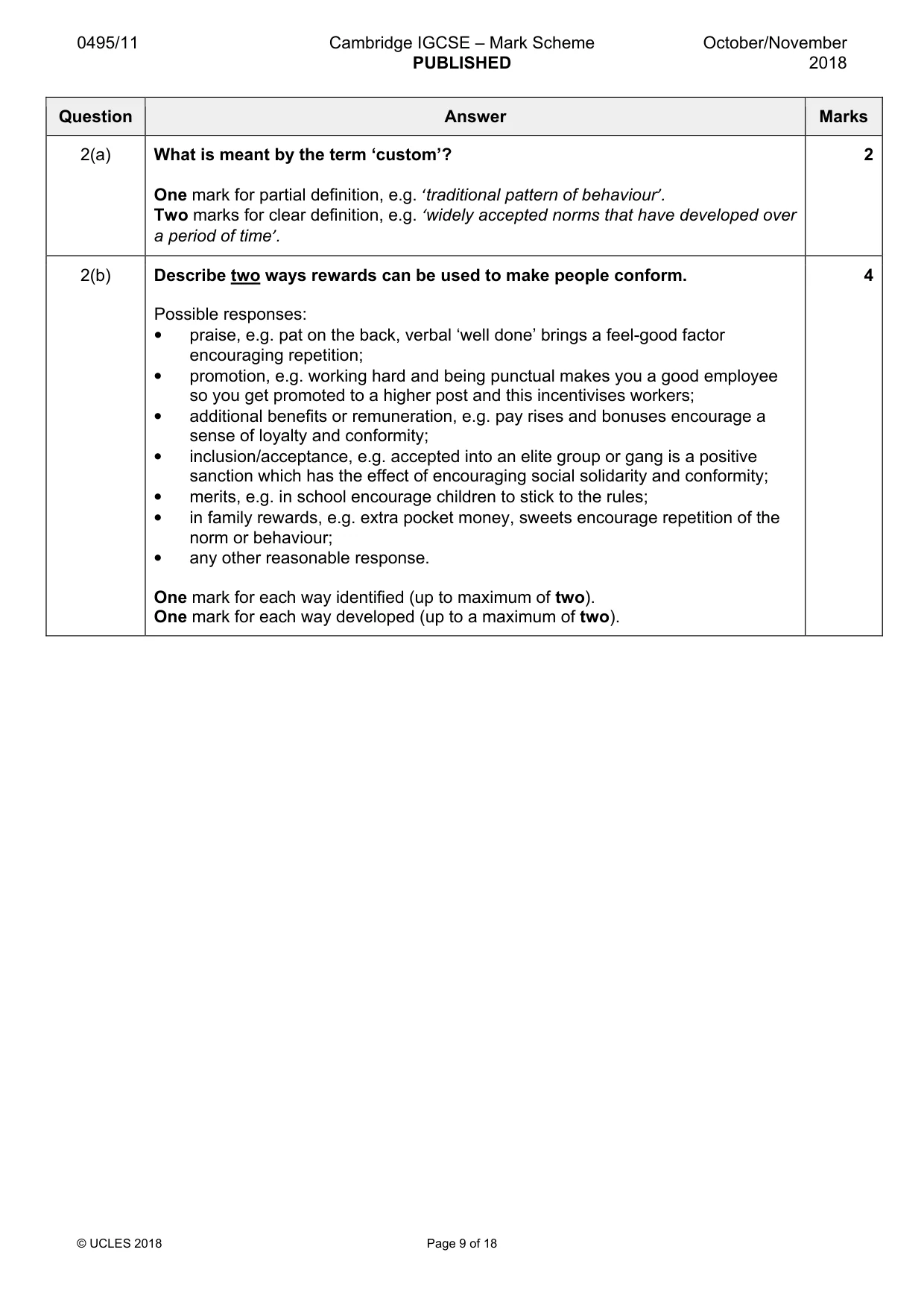
0495/11 Cambridge IGCSE – Mark Scheme PUBLISHED October/November 2018 © UCLES 2018 Page 9 of 18 Question Answer Marks 2(a) What is meant by the term ‘custom’? One mark for partial definition, e.g. ‘traditional pattern of behaviour’. Two marks for clear definition, e.g. ‘widely accepted norms that have developed over a period of time’. 2 2(b) Describe two ways rewards can be used to make people conform. Possible responses: • praise, e.g. pat on the back, verbal ‘well done’ brings a feel-good factor encouraging repetition; • promotion, e.g. working hard and being punctual makes you a good employee so you get promoted to a higher post and this incentivises workers; • additional benefits or remuneration, e.g. pay rises and bonuses encourage a sense of loyalty and conformity; • inclusion/acceptance, e.g. accepted into an elite group or gang is a positive sanction which has the effect of encouraging social solidarity and conformity; • merits, e.g. in school encourage children to stick to the rules; • in family rewards, e.g. extra pocket money, sweets encourage repetition of the norm or behaviour; • any other reasonable response. One mark for each way identified (up to maximum of two). One mark for each way developed (up to a maximum of two). 4
Mark scheme, page 10
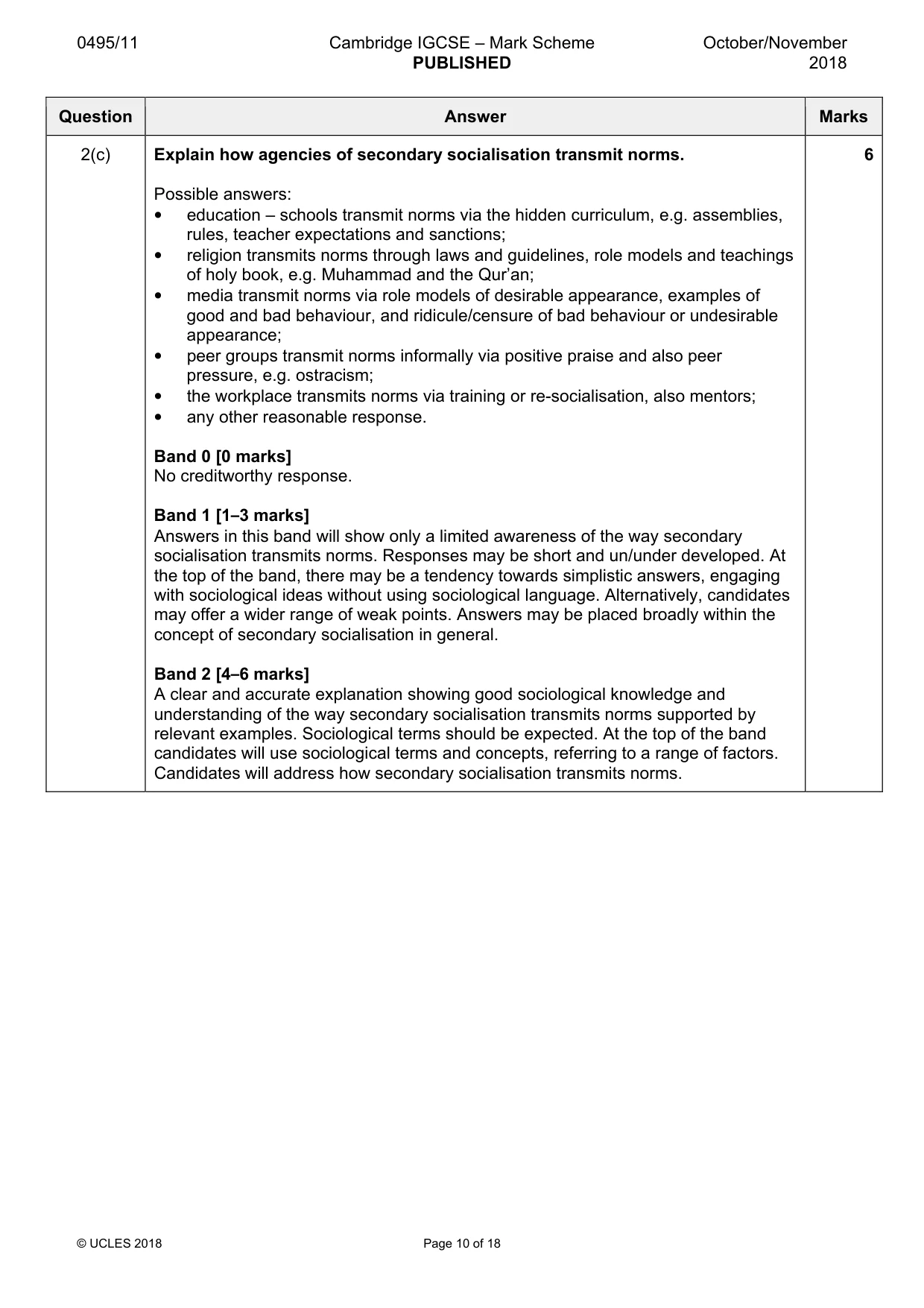
0495/11 Cambridge IGCSE – Mark Scheme PUBLISHED October/November 2018 © UCLES 2018 Page 10 of 18 Question Answer Marks 2(c) Explain how agencies of secondary socialisation transmit norms. Possible answers: • education – schools transmit norms via the hidden curriculum, e.g. assemblies, rules, teacher expectations and sanctions; • religion transmits norms through laws and guidelines, role models and teachings of holy book, e.g. Muhammad and the Qur’an; • media transmit norms via role models of desirable appearance, examples of good and bad behaviour, and ridicule/censure of bad behaviour or undesirable appearance; • peer groups transmit norms informally via positive praise and also peer pressure, e.g. ostracism; • the workplace transmits norms via training or re-socialisation, also mentors; • any other reasonable response. Band 0 [0 marks] No creditworthy response. Band 1 [1–3 marks] Answers in this band will show only a limited awareness of the way secondary socialisation transmits norms. Responses may be short and un/under developed. At the top of the band, there may be a tendency towards simplistic answers, engaging with sociological ideas without using sociological language. Alternatively, candidates may offer a wider range of weak points. Answers may be placed broadly within the concept of secondary socialisation in general. Band 2 [4–6 marks] A clear and accurate explanation showing good sociological knowledge and understanding of the way secondary socialisation transmits norms supported by relevant examples. Sociological terms should be expected. At the top of the band candidates will use sociological terms and concepts, referring to a range of factors. Candidates will address how secondary socialisation transmits norms. 6
Mark scheme, page 11
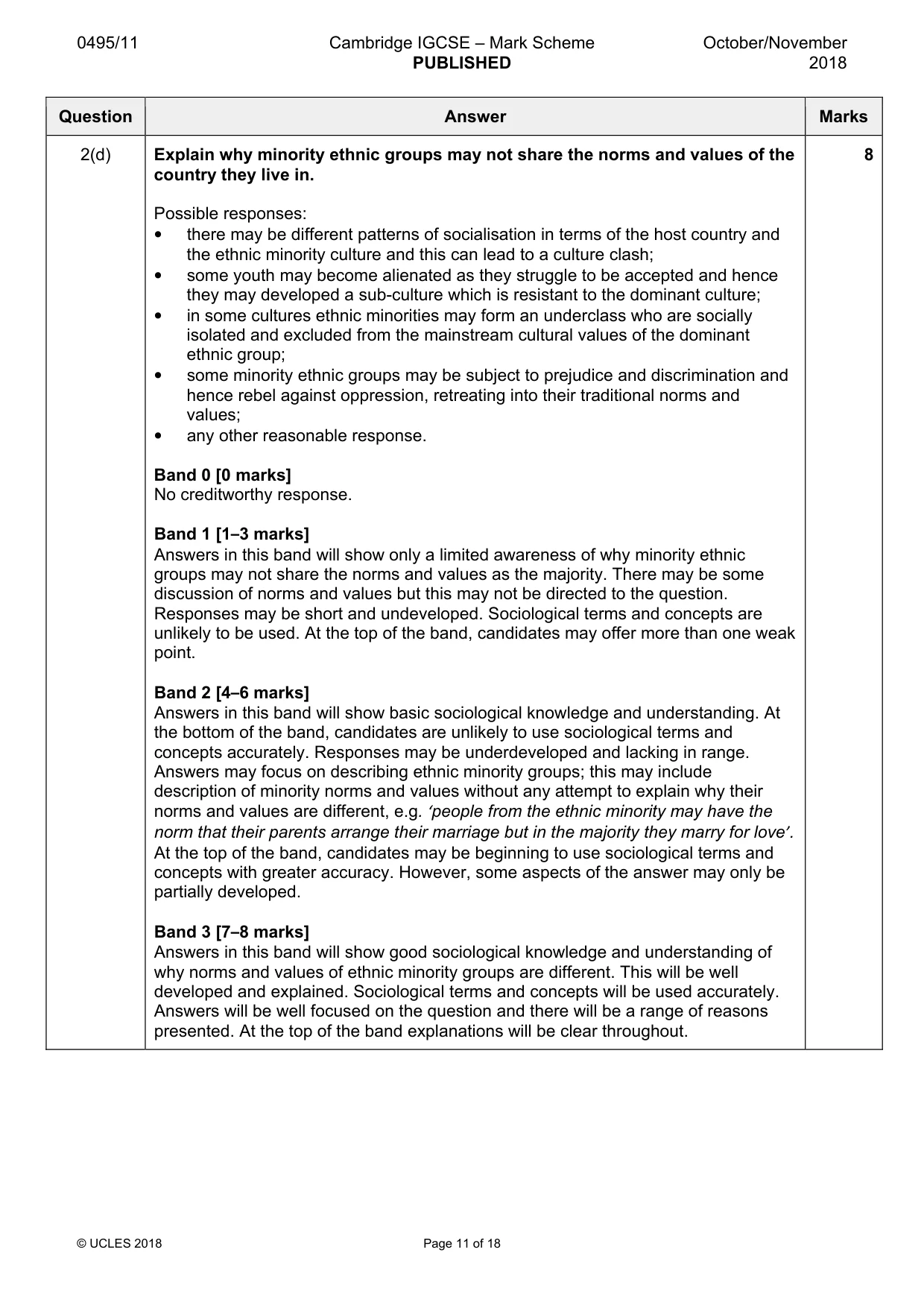
0495/11 Cambridge IGCSE – Mark Scheme PUBLISHED October/November 2018 © UCLES 2018 Page 11 of 18 Question Answer Marks 2(d) Explain why minority ethnic groups may not share the norms and values of the country they live in. Possible responses: • there may be different patterns of socialisation in terms of the host country and the ethnic minority culture and this can lead to a culture clash; • some youth may become alienated as they struggle to be accepted and hence they may developed a sub-culture which is resistant to the dominant culture; • in some cultures ethnic minorities may form an underclass who are socially isolated and excluded from the mainstream cultural values of the dominant ethnic group; • some minority ethnic groups may be subject to prejudice and discrimination and hence rebel against oppression, retreating into their traditional norms and values; • any other reasonable response. Band 0 [0 marks] No creditworthy response. Band 1 [1–3 marks] Answers in this band will show only a limited awareness of why minority ethnic groups may not share the norms and values as the majority. There may be some discussion of norms and values but this may not be directed to the question. Responses may be short and undeveloped. Sociological terms and concepts are unlikely to be used. At the top of the band, candidates may offer more than one weak point. Band 2 [4–6 marks] Answers in this band will show basic sociological knowledge and understanding. At the bottom of the band, candidates are unlikely to use sociological terms and concepts accurately. Responses may be underdeveloped and lacking in range. Answers may focus on describing ethnic minority groups; this may include description of minority norms and values without any attempt to explain why their norms and values are different, e.g. ‘people from the ethnic minority may have the norm that their parents arrange their marriage but in the majority they marry for love’. At the top of the band, candidates may be beginning to use sociological terms and concepts with greater accuracy. However, some aspects of the answer may only be partially developed. Band 3 [7–8 marks] Answers in this band will show good sociological knowledge and understanding of why norms and values of ethnic minority groups are different. This will be well developed and explained. Sociological terms and concepts will be used accurately. Answers will be well focused on the question and there will be a range of reasons presented. At the top of the band explanations will be clear throughout. 8
Mark scheme, page 12
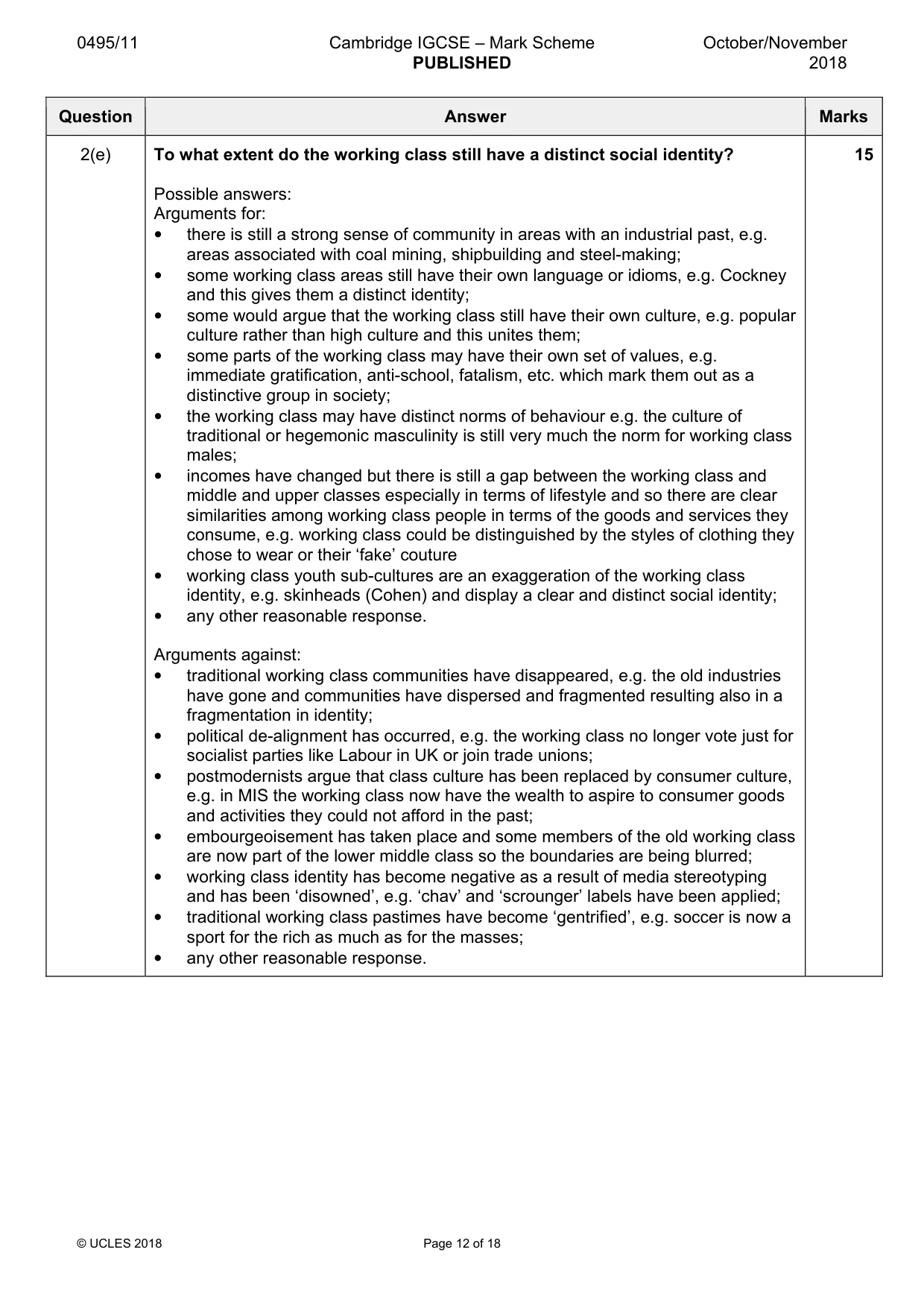
0495/11 Cambridge IGCSE – Mark Scheme PUBLISHED October/November 2018 © UCLES 2018 Page 12 of 18 Question Answer Marks 2(e) To what extent do the working class still have a distinct social identity? Possible answers: Arguments for: • there is still a strong sense of community in areas with an industrial past, e.g. areas associated with coal mining, shipbuilding and steel-making; • some working class areas still have their own language or idioms, e.g. Cockney and this gives them a distinct identity; • some would argue that the working class still have their own culture, e.g. popular culture rather than high culture and this unites them; • some parts of the working class may have their own set of values, e.g. immediate gratification, anti-school, fatalism, etc. which mark them out as a distinctive group in society; • the working class may have distinct norms of behaviour e.g. the culture of traditional or hegemonic masculinity is still very much the norm for working class males; • incomes have changed but there is still a gap between the working class and middle and upper classes especially in terms of lifestyle and so there are clear similarities among working class people in terms of the goods and services they consume, e.g. working class could be distinguished by the styles of clothing they chose to wear or their ‘fake’ couture • working class youth sub-cultures are an exaggeration of the working class identity, e.g. skinheads (Cohen) and display a clear and distinct social identity; • any other reasonable response. Arguments against: • traditional working class communities have disappeared, e.g. the old industries have gone and communities have dispersed and fragmented resulting also in a fragmentation in identity; • political de-alignment has occurred, e.g. the working class no longer vote just for socialist parties like Labour in UK or join trade unions; • postmodernists argue that class culture has been replaced by consumer culture, e.g. in MIS the working class now have the wealth to aspire to consumer goods and activities they could not afford in the past; • embourgeoisement has taken place and some members of the old working class are now part of the lower middle class so the boundaries are being blurred; • working class identity has become negative as a result of media stereotyping and has been ‘disowned’, e.g. ‘chav’ and ‘scrounger’ labels have been applied; • traditional working class pastimes have become ‘gentrified’, e.g. soccer is now a sport for the rich as much as for the masses; • any other reasonable response. 15
Mark scheme, page 13
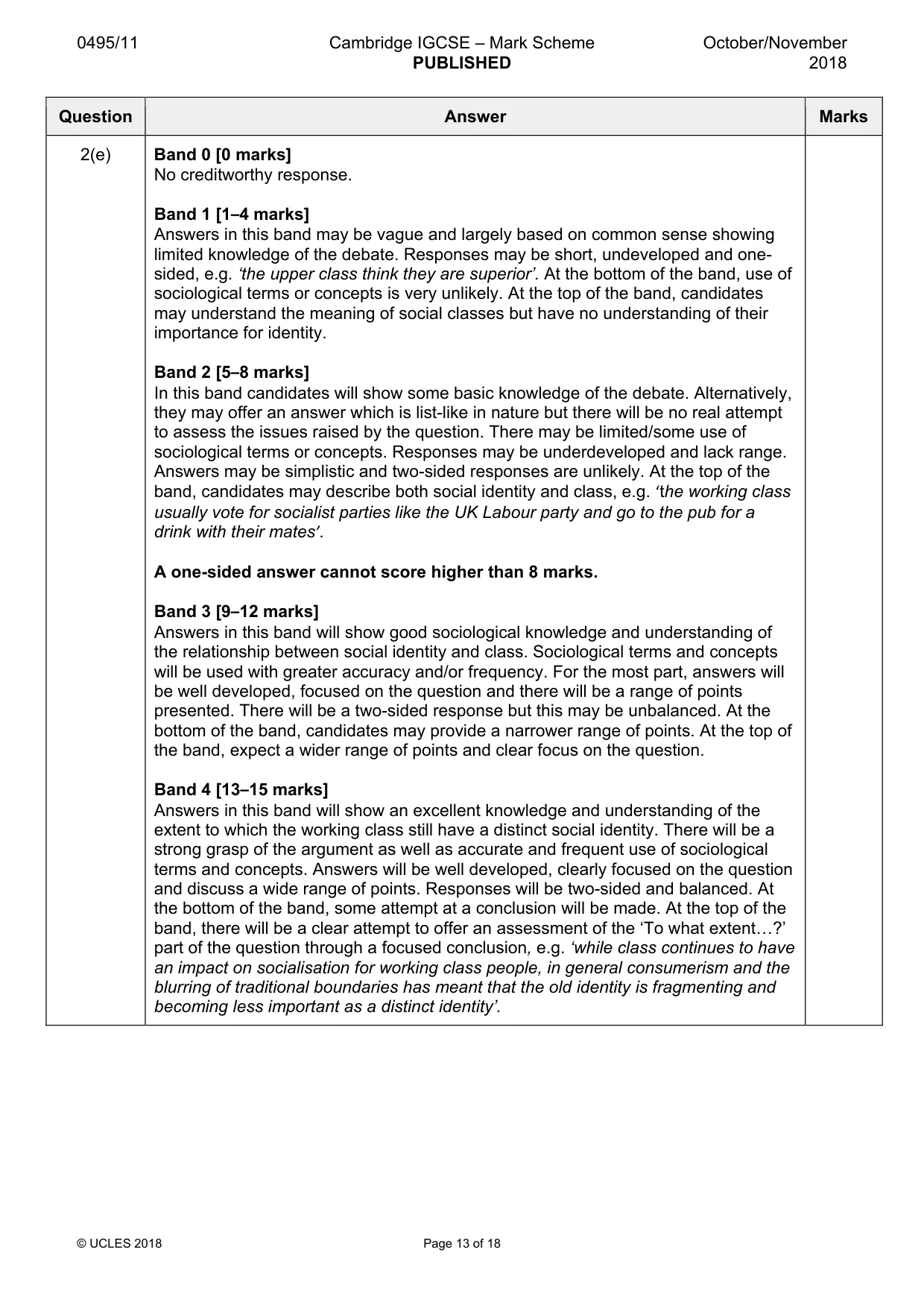
0495/11 Cambridge IGCSE – Mark Scheme PUBLISHED October/November 2018 © UCLES 2018 Page 13 of 18 Question Answer Marks 2(e) Band 0 [0 marks] No creditworthy response. Band 1 [1–4 marks] Answers in this band may be vague and largely based on common sense showing limited knowledge of the debate. Responses may be short, undeveloped and one- sided, e.g. ‘the upper class think they are superior’. At the bottom of the band, use of sociological terms or concepts is very unlikely. At the top of the band, candidates may understand the meaning of social classes but have no understanding of their importance for identity. Band 2 [5–8 marks] In this band candidates will show some basic knowledge of the debate. Alternatively, they may offer an answer which is list-like in nature but there will be no real attempt to assess the issues raised by the question. There may be limited/some use of sociological terms or concepts. Responses may be underdeveloped and lack range. Answers may be simplistic and two-sided responses are unlikely. At the top of the band, candidates may describe both social identity and class, e.g. ‘the working class usually vote for socialist parties like the UK Labour party and go to the pub for a drink with their mates’. A one-sided answer cannot score higher than 8 marks. Band 3 [9–12 marks] Answers in this band will show good sociological knowledge and understanding of the relationship between social identity and class. Sociological terms and concepts will be used with greater accuracy and/or frequency. For the most part, answers will be well developed, focused on the question and there will be a range of points presented. There will be a two-sided response but this may be unbalanced. At the bottom of the band, candidates may provide a narrower range of points. At the top of the band, expect a wider range of points and clear focus on the question. Band 4 [13–15 marks] Answers in this band will show an excellent knowledge and understanding of the extent to which the working class still have a distinct social identity. There will be a strong grasp of the argument as well as accurate and frequent use of sociological terms and concepts. Answers will be well developed, clearly focused on the question and discuss a wide range of points. Responses will be two-sided and balanced. At the bottom of the band, some attempt at a conclusion will be made. At the top of the band, there will be a clear attempt to offer an assessment of the ‘To what extent«?’ part of the question through a focused conclusion, e.g. ‘while class continues to have an impact on socialisation for working class people, in general consumerism and the blurring of traditional boundaries has meant that the old identity is fragmenting and becoming less important as a distinct identity’.
Mark scheme, page 14
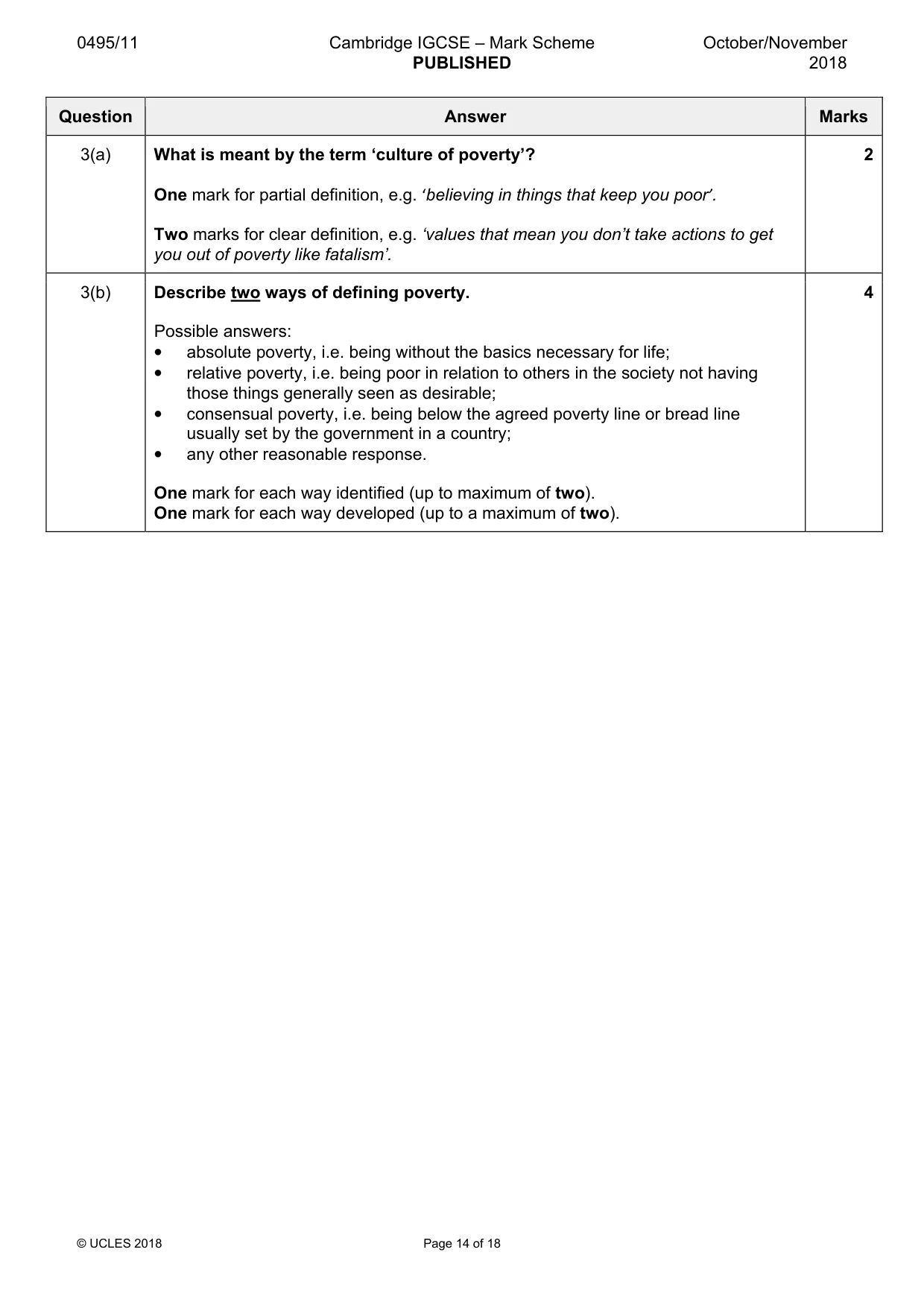
0495/11 Cambridge IGCSE – Mark Scheme PUBLISHED October/November 2018 © UCLES 2018 Page 14 of 18 Question Answer Marks 3(a) What is meant by the term ‘culture of poverty’? One mark for partial definition, e.g. ‘believing in things that keep you poor’. Two marks for clear definition, e.g. ‘values that mean you don’t take actions to get you out of poverty like fatalism’. 2 3(b) Describe two ways of defining poverty. Possible answers: • absolute poverty, i.e. being without the basics necessary for life; • relative poverty, i.e. being poor in relation to others in the society not having those things generally seen as desirable; • consensual poverty, i.e. being below the agreed poverty line or bread line usually set by the government in a country; • any other reasonable response. One mark for each way identified (up to maximum of two). One mark for each way developed (up to a maximum of two). 4
Mark scheme, page 15
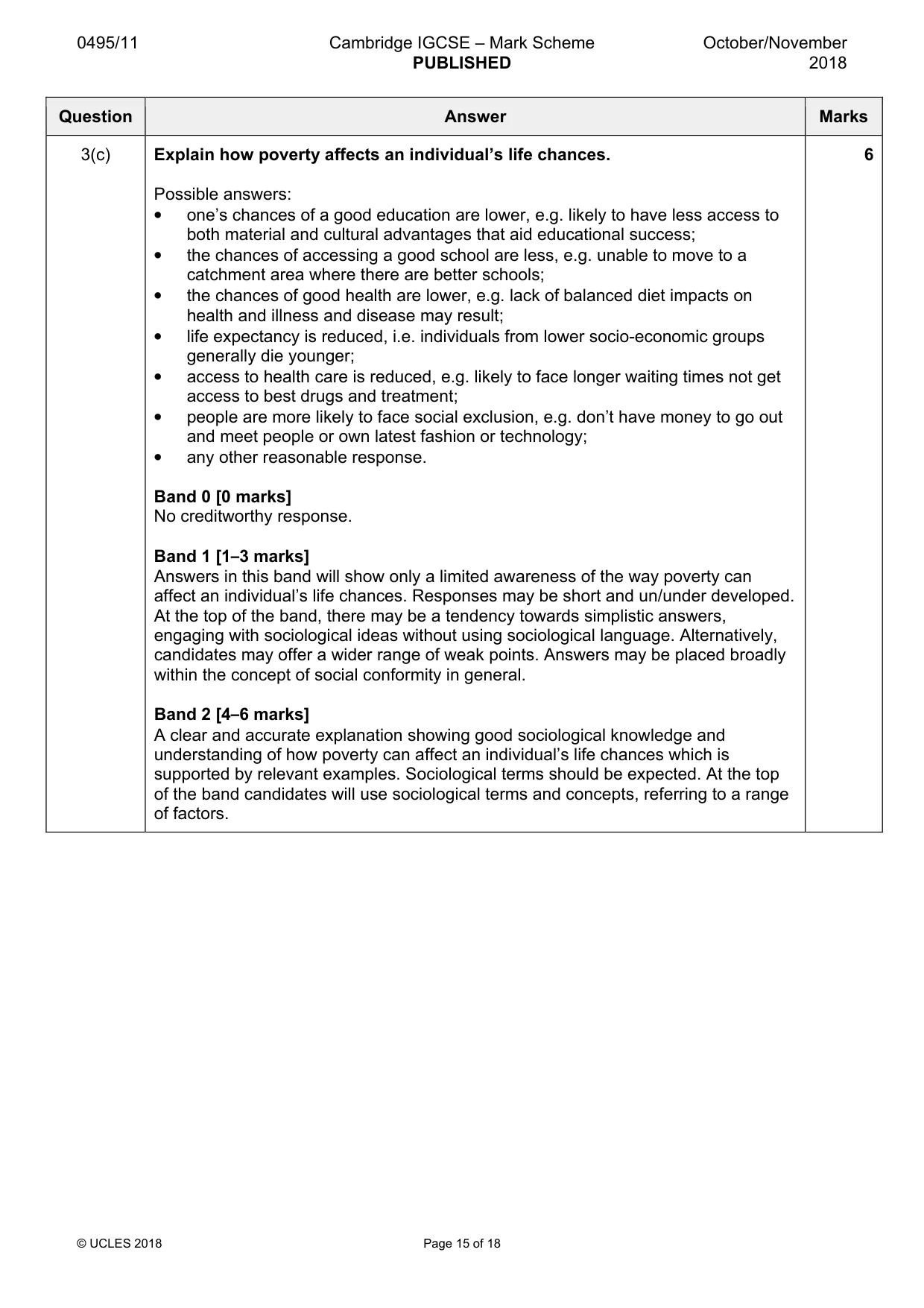
0495/11 Cambridge IGCSE – Mark Scheme PUBLISHED October/November 2018 © UCLES 2018 Page 15 of 18 Question Answer Marks 3(c) Explain how poverty affects an individual’s life chances. Possible answers: • one’s chances of a good education are lower, e.g. likely to have less access to both material and cultural advantages that aid educational success; • the chances of accessing a good school are less, e.g. unable to move to a catchment area where there are better schools; • the chances of good health are lower, e.g. lack of balanced diet impacts on health and illness and disease may result; • life expectancy is reduced, i.e. individuals from lower socio-economic groups generally die younger; • access to health care is reduced, e.g. likely to face longer waiting times not get access to best drugs and treatment; • people are more likely to face social exclusion, e.g. don’t have money to go out and meet people or own latest fashion or technology; • any other reasonable response. Band 0 [0 marks] No creditworthy response. Band 1 [1–3 marks] Answers in this band will show only a limited awareness of the way poverty can affect an individual’s life chances. Responses may be short and un/under developed. At the top of the band, there may be a tendency towards simplistic answers, engaging with sociological ideas without using sociological language. Alternatively, candidates may offer a wider range of weak points. Answers may be placed broadly within the concept of social conformity in general. Band 2 [4–6 marks] A clear and accurate explanation showing good sociological knowledge and understanding of how poverty can affect an individual’s life chances which is supported by relevant examples. Sociological terms should be expected. At the top of the band candidates will use sociological terms and concepts, referring to a range of factors. 6
Mark scheme, page 16
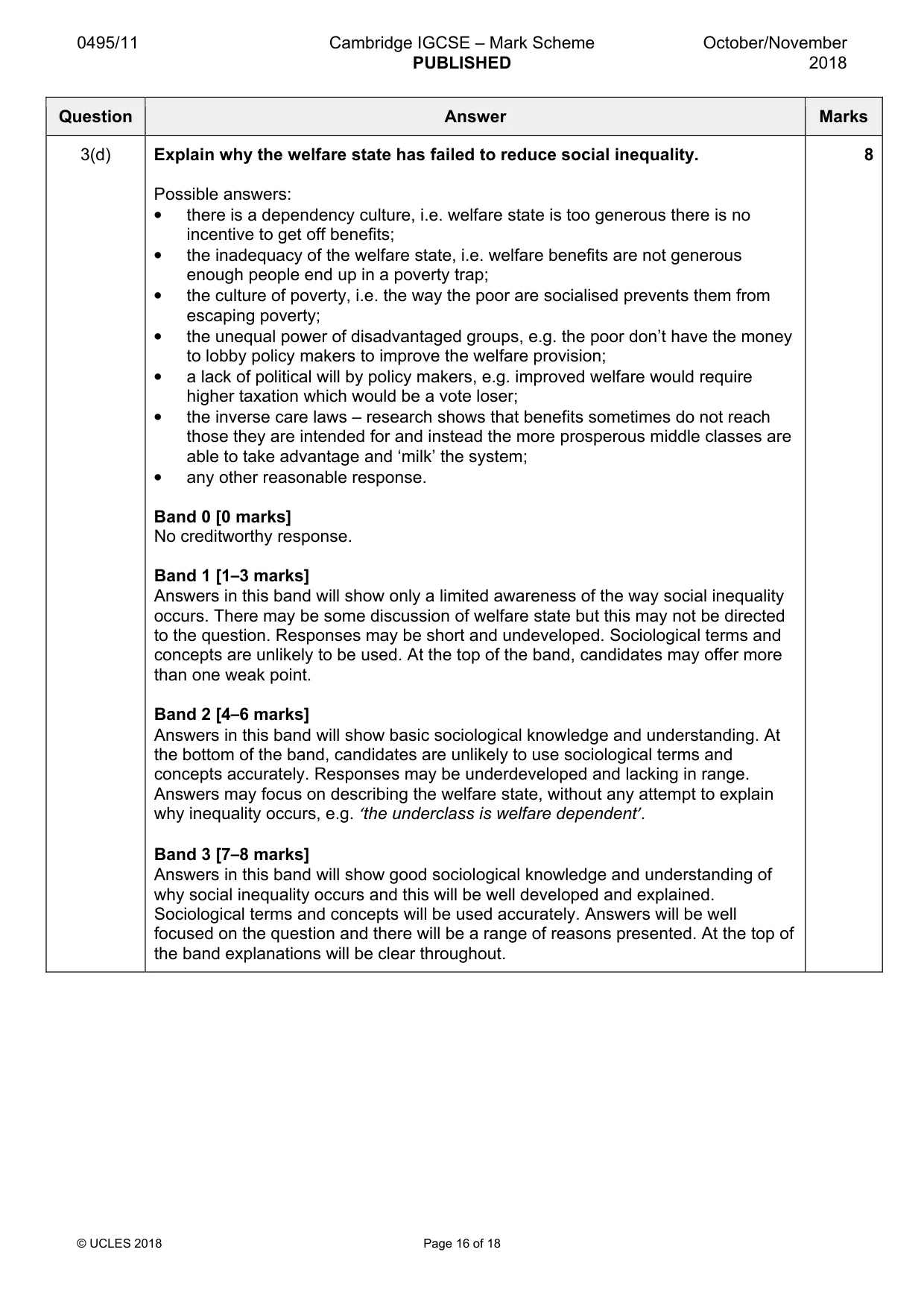
0495/11 Cambridge IGCSE – Mark Scheme PUBLISHED October/November 2018 © UCLES 2018 Page 16 of 18 Question Answer Marks 3(d) Explain why the welfare state has failed to reduce social inequality. Possible answers: • there is a dependency culture, i.e. welfare state is too generous there is no incentive to get off benefits; • the inadequacy of the welfare state, i.e. welfare benefits are not generous enough people end up in a poverty trap; • the culture of poverty, i.e. the way the poor are socialised prevents them from escaping poverty; • the unequal power of disadvantaged groups, e.g. the poor don’t have the money to lobby policy makers to improve the welfare provision; • a lack of political will by policy makers, e.g. improved welfare would require higher taxation which would be a vote loser; • the inverse care laws – research shows that benefits sometimes do not reach those they are intended for and instead the more prosperous middle classes are able to take advantage and ‘milk’ the system; • any other reasonable response. Band 0 [0 marks] No creditworthy response. Band 1 [1–3 marks] Answers in this band will show only a limited awareness of the way social inequality occurs. There may be some discussion of welfare state but this may not be directed to the question. Responses may be short and undeveloped. Sociological terms and concepts are unlikely to be used. At the top of the band, candidates may offer more than one weak point. Band 2 [4–6 marks] Answers in this band will show basic sociological knowledge and understanding. At the bottom of the band, candidates are unlikely to use sociological terms and concepts accurately. Responses may be underdeveloped and lacking in range. Answers may focus on describing the welfare state, without any attempt to explain why inequality occurs, e.g. ‘the underclass is welfare dependent’. Band 3 [7–8 marks] Answers in this band will show good sociological knowledge and understanding of why social inequality occurs and this will be well developed and explained. Sociological terms and concepts will be used accurately. Answers will be well focused on the question and there will be a range of reasons presented. At the top of the band explanations will be clear throughout. 8
Mark scheme, page 17
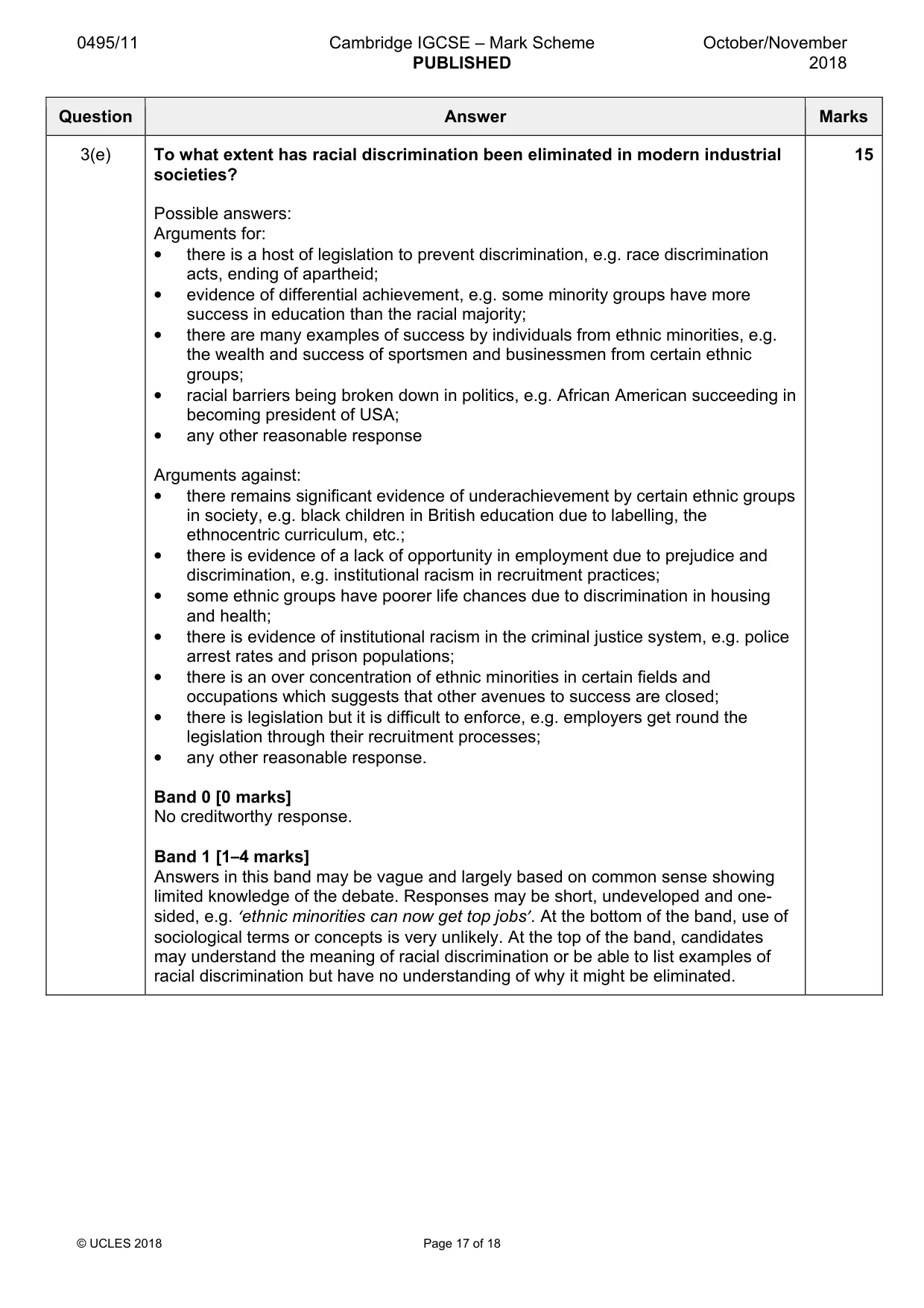
0495/11 Cambridge IGCSE – Mark Scheme PUBLISHED October/November 2018 © UCLES 2018 Page 17 of 18 Question Answer Marks 3(e) To what extent has racial discrimination been eliminated in modern industrial societies? Possible answers: Arguments for: • there is a host of legislation to prevent discrimination, e.g. race discrimination acts, ending of apartheid; • evidence of differential achievement, e.g. some minority groups have more success in education than the racial majority; • there are many examples of success by individuals from ethnic minorities, e.g. the wealth and success of sportsmen and businessmen from certain ethnic groups; • racial barriers being broken down in politics, e.g. African American succeeding in becoming president of USA; • any other reasonable response Arguments against: • there remains significant evidence of underachievement by certain ethnic groups in society, e.g. black children in British education due to labelling, the ethnocentric curriculum, etc.; • there is evidence of a lack of opportunity in employment due to prejudice and discrimination, e.g. institutional racism in recruitment practices; • some ethnic groups have poorer life chances due to discrimination in housing and health; • there is evidence of institutional racism in the criminal justice system, e.g. police arrest rates and prison populations; • there is an over concentration of ethnic minorities in certain fields and occupations which suggests that other avenues to success are closed; • there is legislation but it is difficult to enforce, e.g. employers get round the legislation through their recruitment processes; • any other reasonable response. Band 0 [0 marks] No creditworthy response. Band 1 [1–4 marks] Answers in this band may be vague and largely based on common sense showing limited knowledge of the debate. Responses may be short, undeveloped and one- sided, e.g. ‘ethnic minorities can now get top jobs’. At the bottom of the band, use of sociological terms or concepts is very unlikely. At the top of the band, candidates may understand the meaning of racial discrimination or be able to list examples of racial discrimination but have no understanding of why it might be eliminated. 15
Mark scheme, page 18
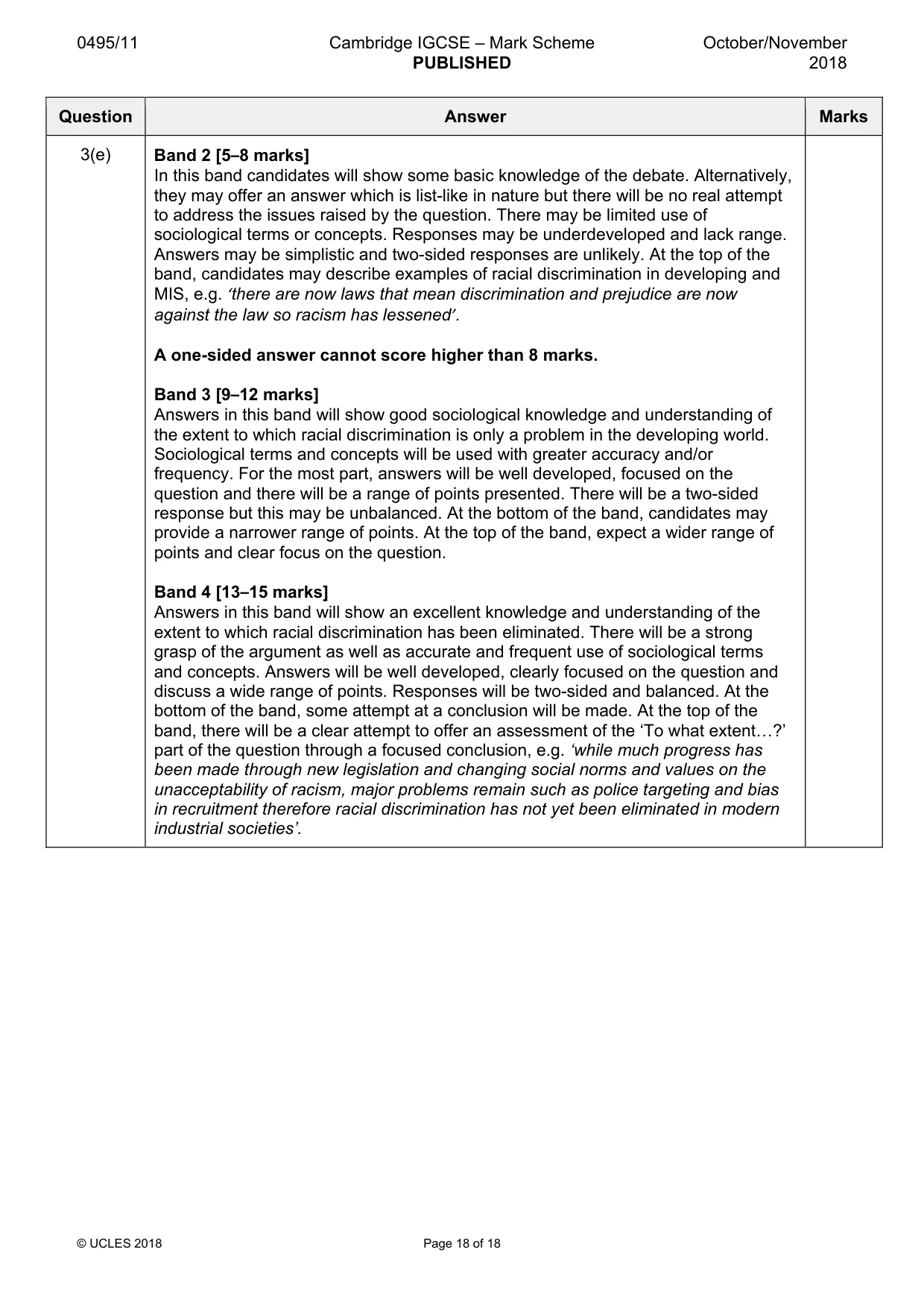
0495/11 Cambridge IGCSE – Mark Scheme PUBLISHED October/November 2018 © UCLES 2018 Page 18 of 18 Question Answer Marks 3(e) Band 2 [5–8 marks] In this band candidates will show some basic knowledge of the debate. Alternatively, they may offer an answer which is list-like in nature but there will be no real attempt to address the issues raised by the question. There may be limited use of sociological terms or concepts. Responses may be underdeveloped and lack range. Answers may be simplistic and two-sided responses are unlikely. At the top of the band, candidates may describe examples of racial discrimination in developing and MIS, e.g. ‘there are now laws that mean discrimination and prejudice are now against the law so racism has lessened’. A one-sided answer cannot score higher than 8 marks. Band 3 [9–12 marks] Answers in this band will show good sociological knowledge and understanding of the extent to which racial discrimination is only a problem in the developing world. Sociological terms and concepts will be used with greater accuracy and/or frequency. For the most part, answers will be well developed, focused on the question and there will be a range of points presented. There will be a two-sided response but this may be unbalanced. At the bottom of the band, candidates may provide a narrower range of points. At the top of the band, expect a wider range of points and clear focus on the question. Band 4 [13–15 marks] Answers in this band will show an excellent knowledge and understanding of the extent to which racial discrimination has been eliminated. There will be a strong grasp of the argument as well as accurate and frequent use of sociological terms and concepts. Answers will be well developed, clearly focused on the question and discuss a wide range of points. Responses will be two-sided and balanced. At the bottom of the band, some attempt at a conclusion will be made. At the top of the band, there will be a clear attempt to offer an assessment of the ‘To what extent«?’ part of the question through a focused conclusion, e.g. ‘while much progress has been made through new legislation and changing social norms and values on the unacceptability of racism, major problems remain such as police targeting and bias in recruitment therefore racial discrimination has not yet been eliminated in modern industrial societies’.
What you needed in this session
Cambridge’s own grade thresholds for 2018 Oct/Nov, Paper 1 · Variant 1. A higher threshold means an easier paper — the bar moves with how the cohort did.