Cambridge IGCSE Sociology 0495 — 2017 Oct/Nov Paper 2 · Variant 2
0495/22/O/N/17 · 4 questions · 70 marks · ≈79 min
The question paper and its mark scheme, free to read here and free to download. This is Cambridge’s own paper, exactly as it was sat.
Question paper4 pages

Mark scheme29 pages
Answers below. Sit the paper first if you are practising.

Questions as text
Q1 · Marriage and family life are not always a positive experience for all individuals
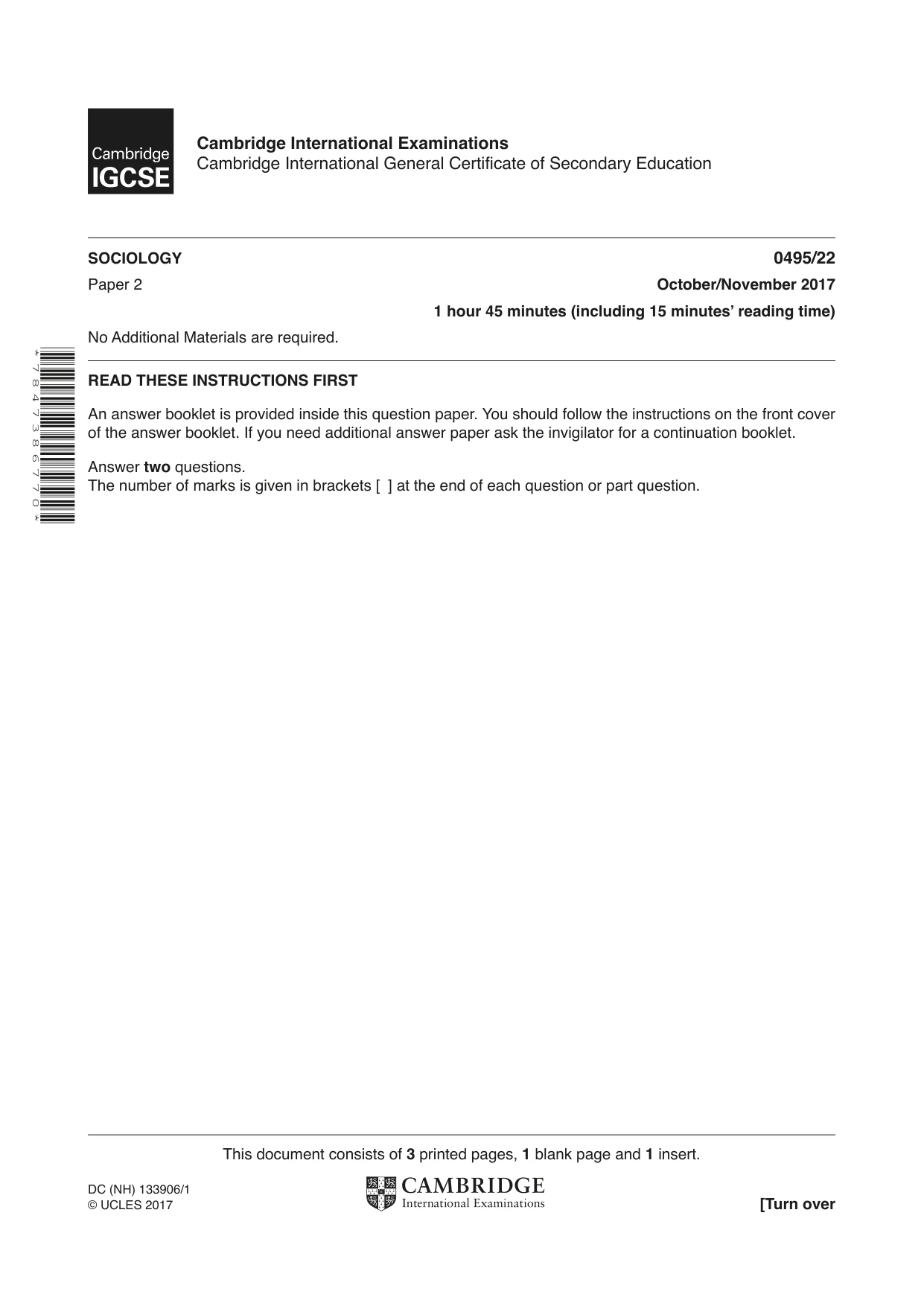
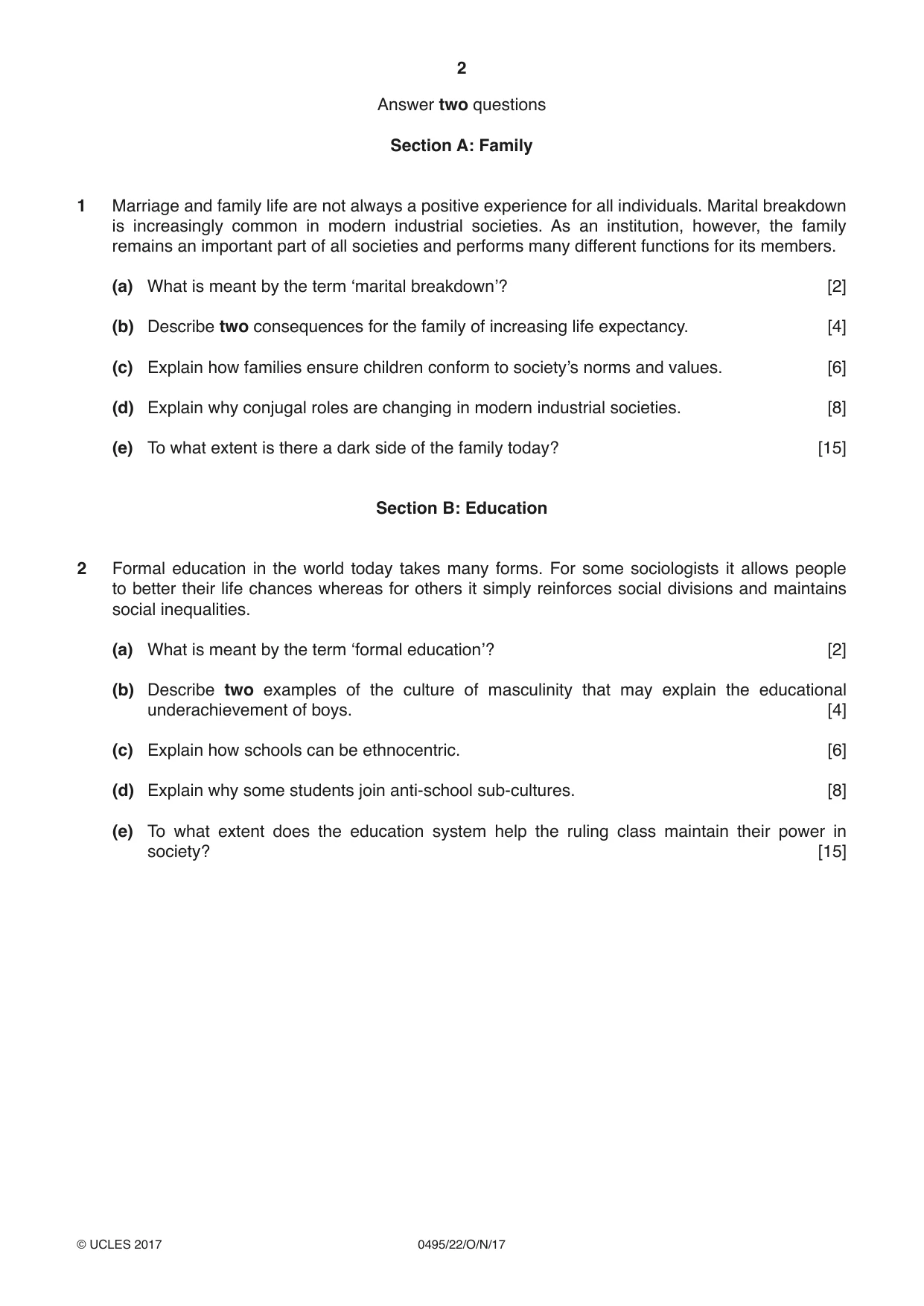
1 Marriage and family life are not always a positive experience for all individuals. Marital breakdown is increasingly common in modern industrial societies. As an institution, however, the family remains an important part of all societies and performs many different functions for its members. (a) What is meant by the term ‘marital breakdown’? [2] (b) Describe two consequences for the family of increasing life expectancy. [4] (c) Explain how families ensure children conform to society’s norms and values. [6] (d) Explain why conjugal roles are changing in modern industrial societies. [8] (e) To what extent is there a dark side of the family today? [15]
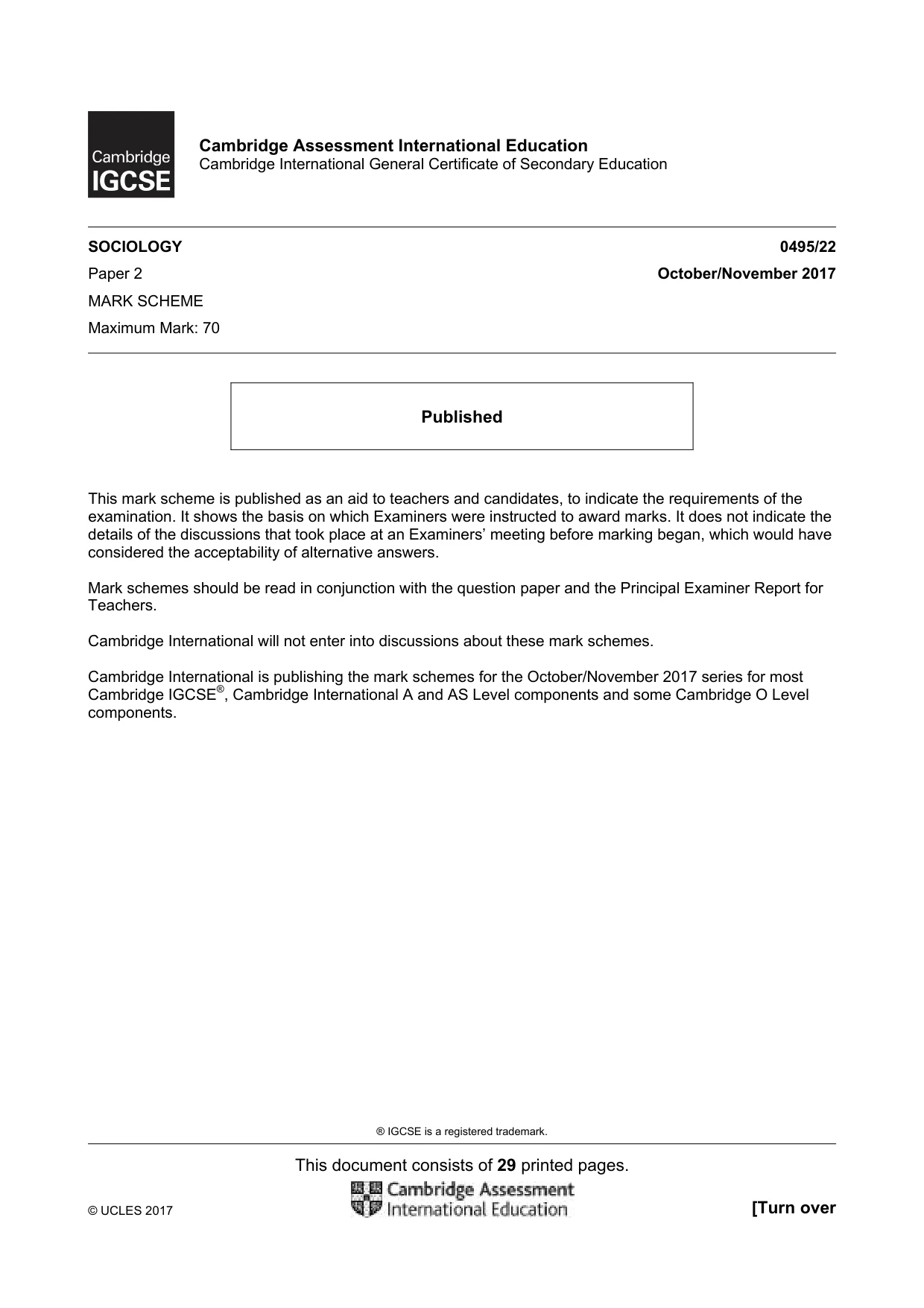
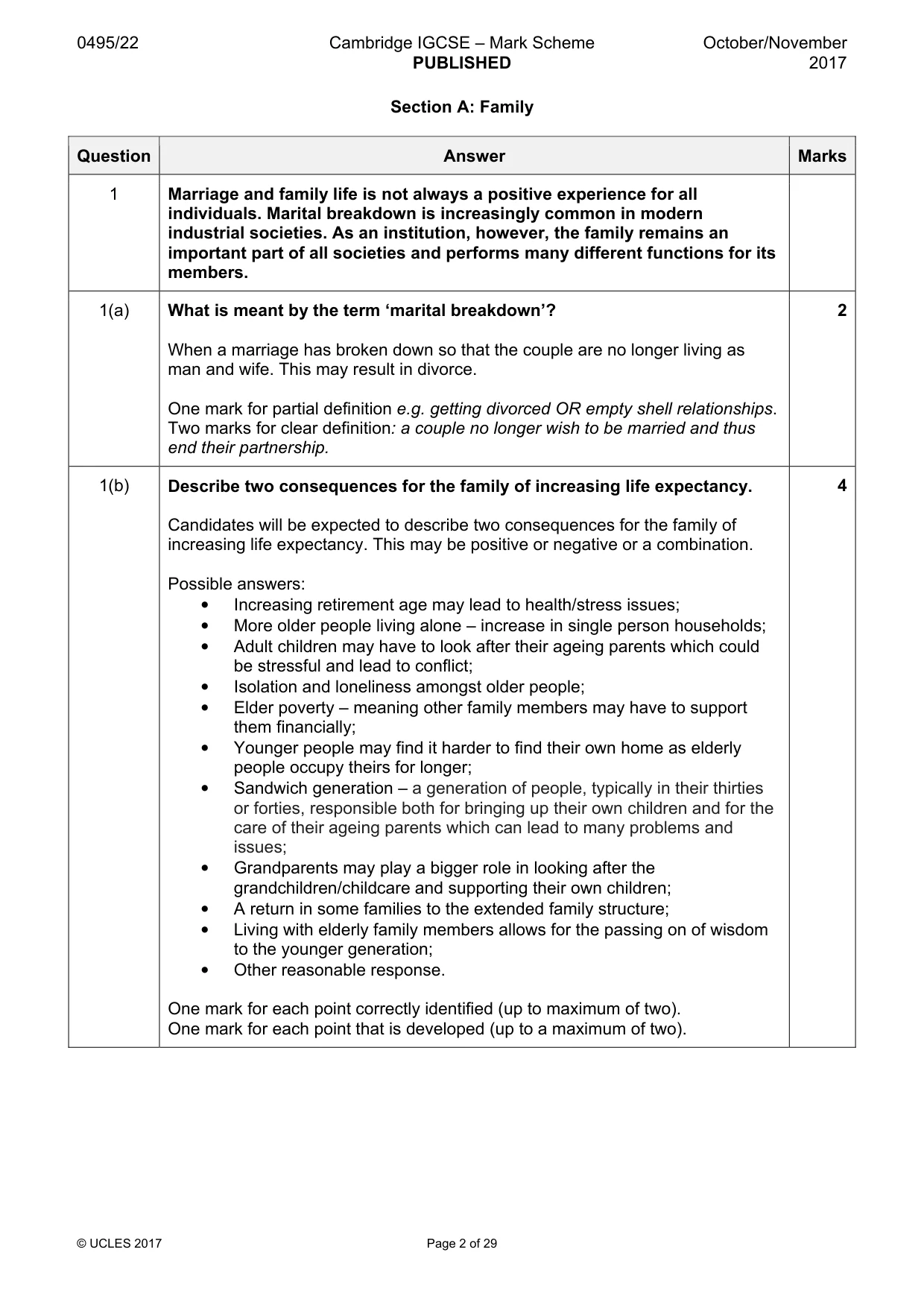
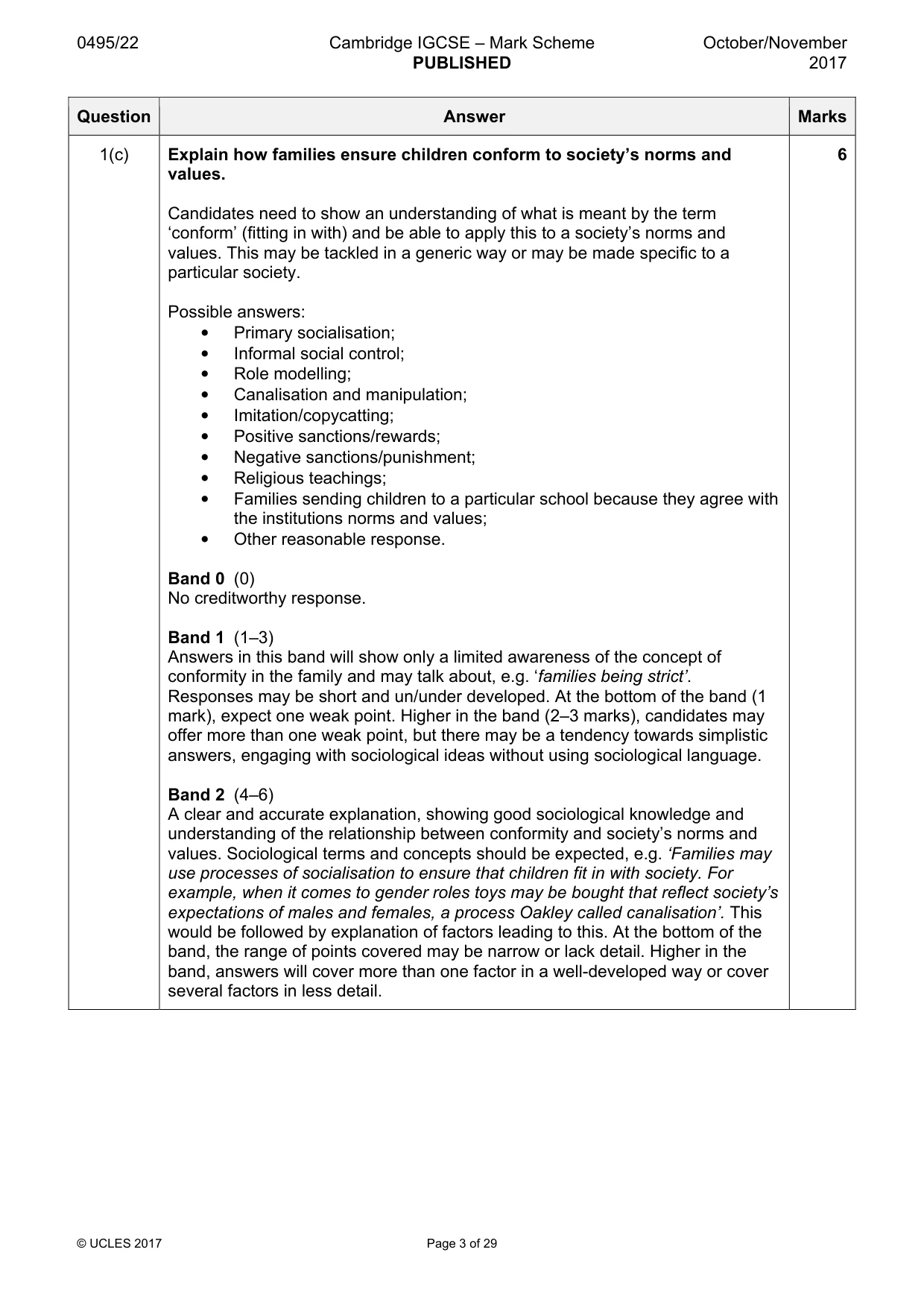
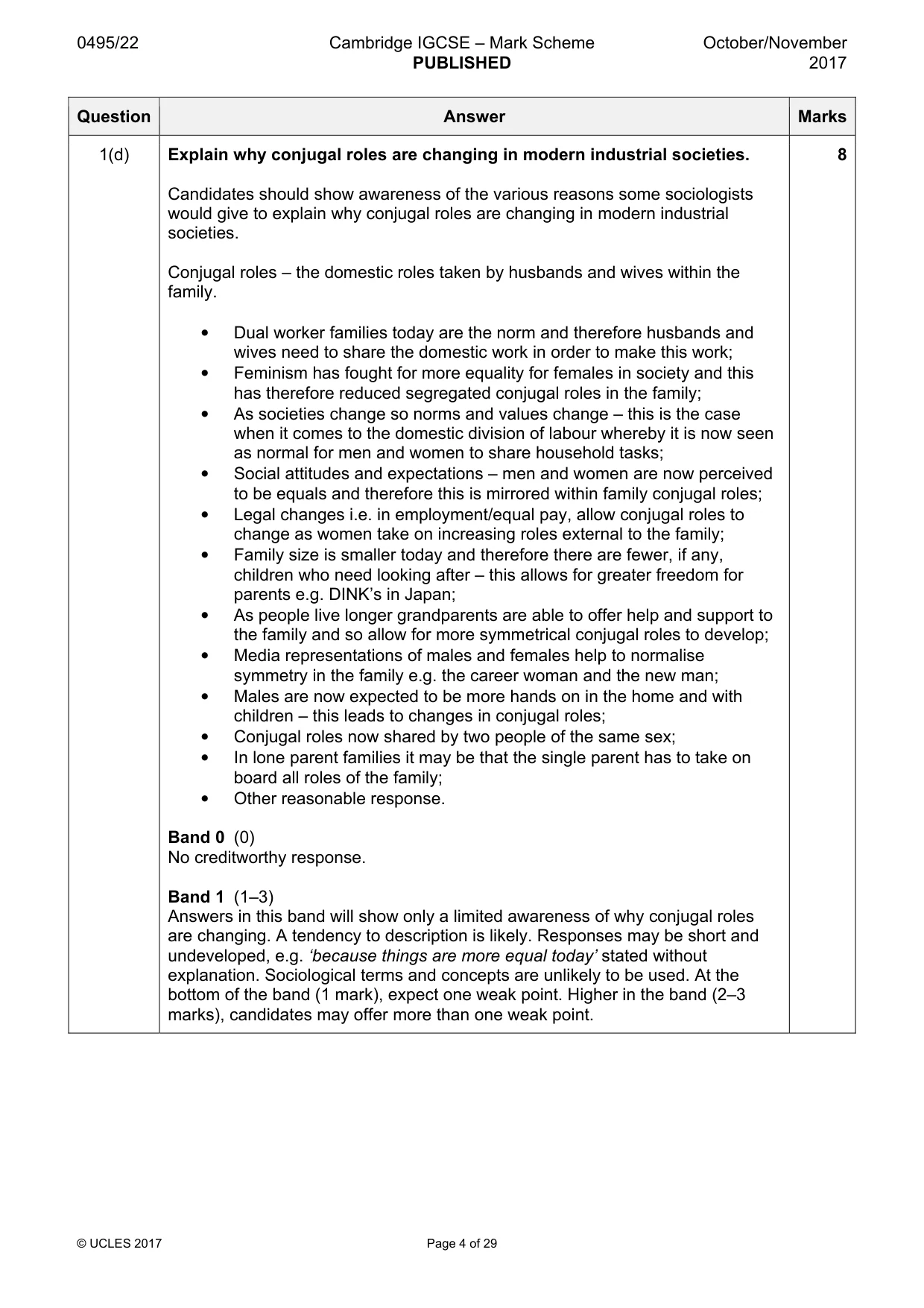
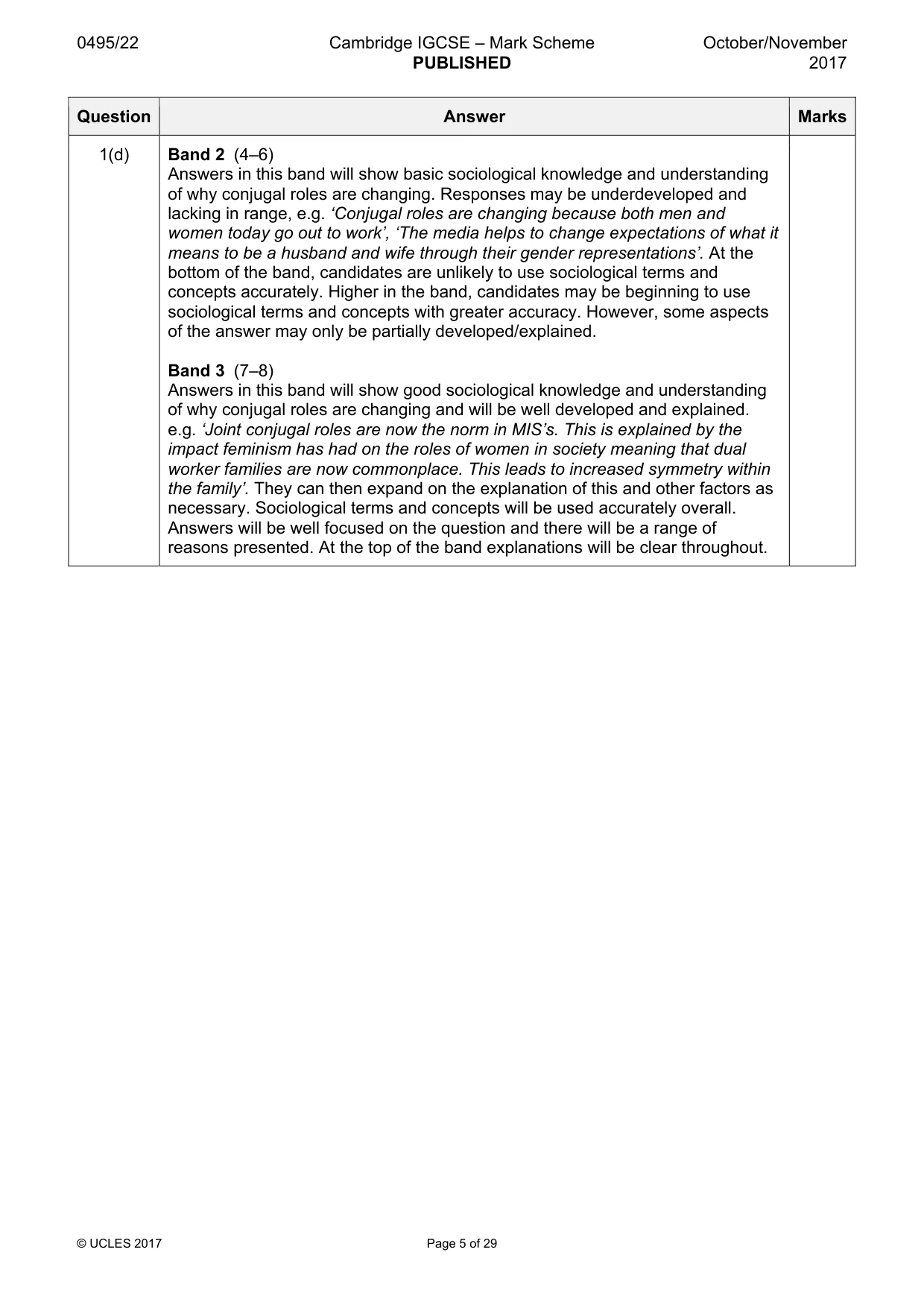
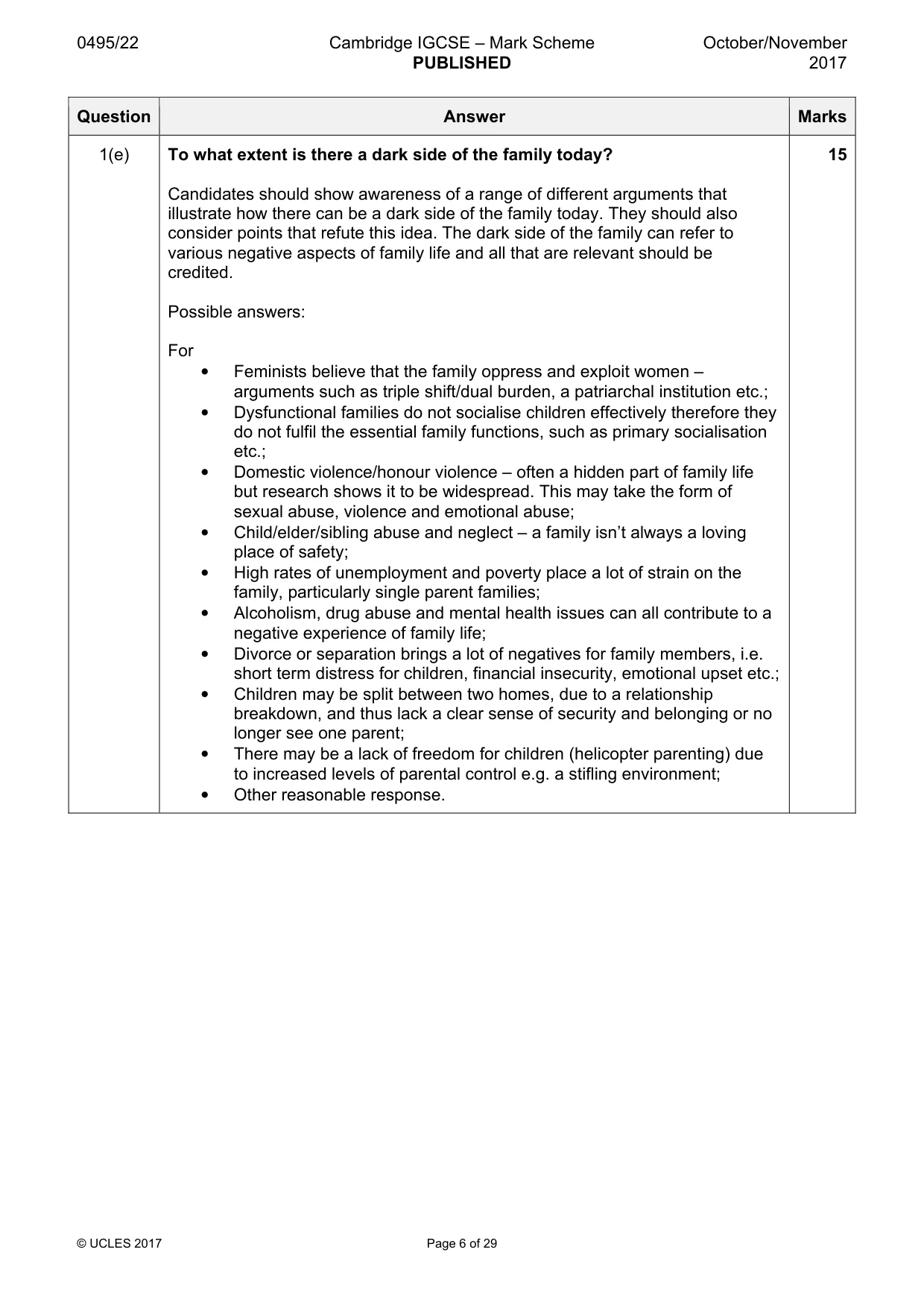
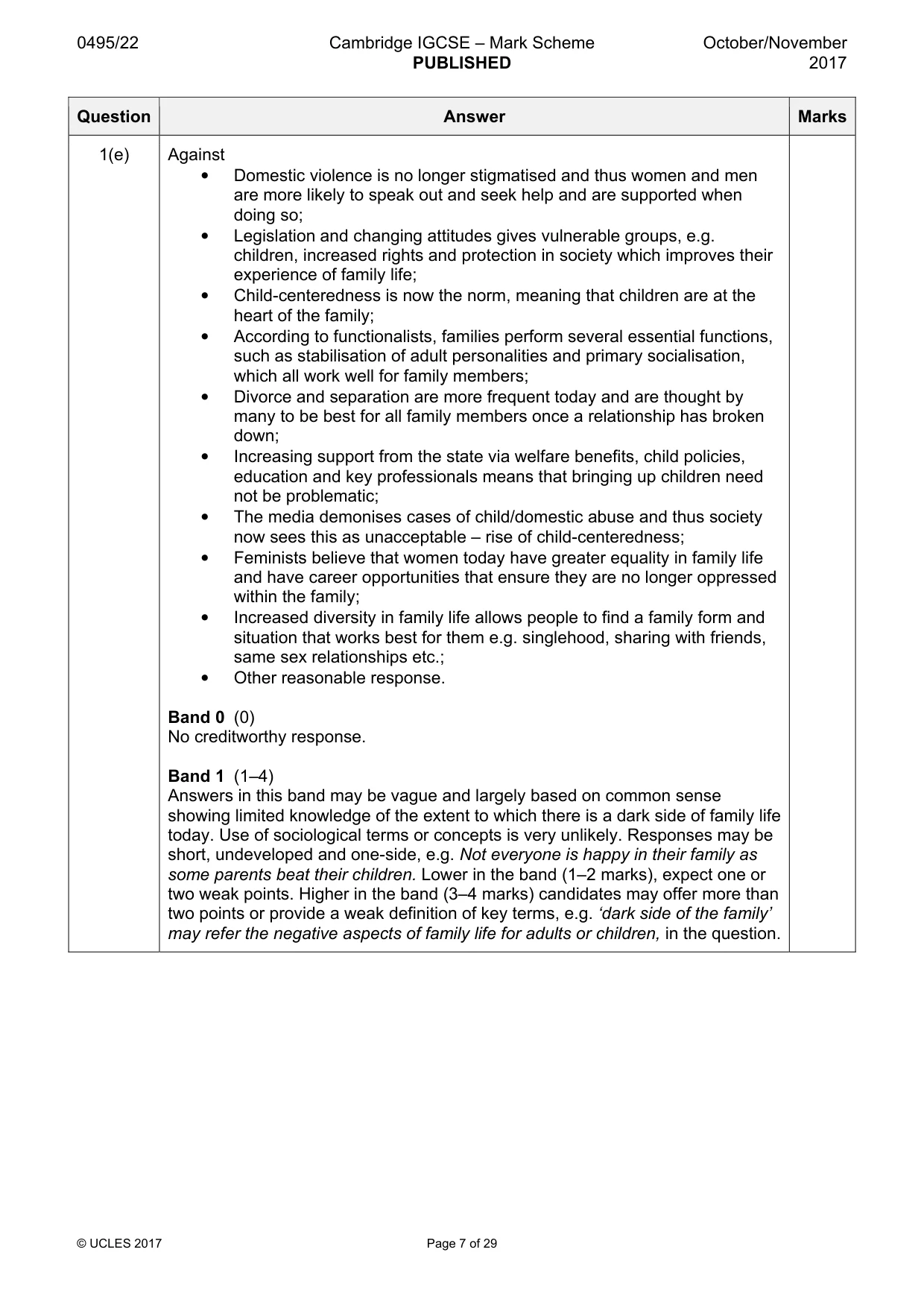
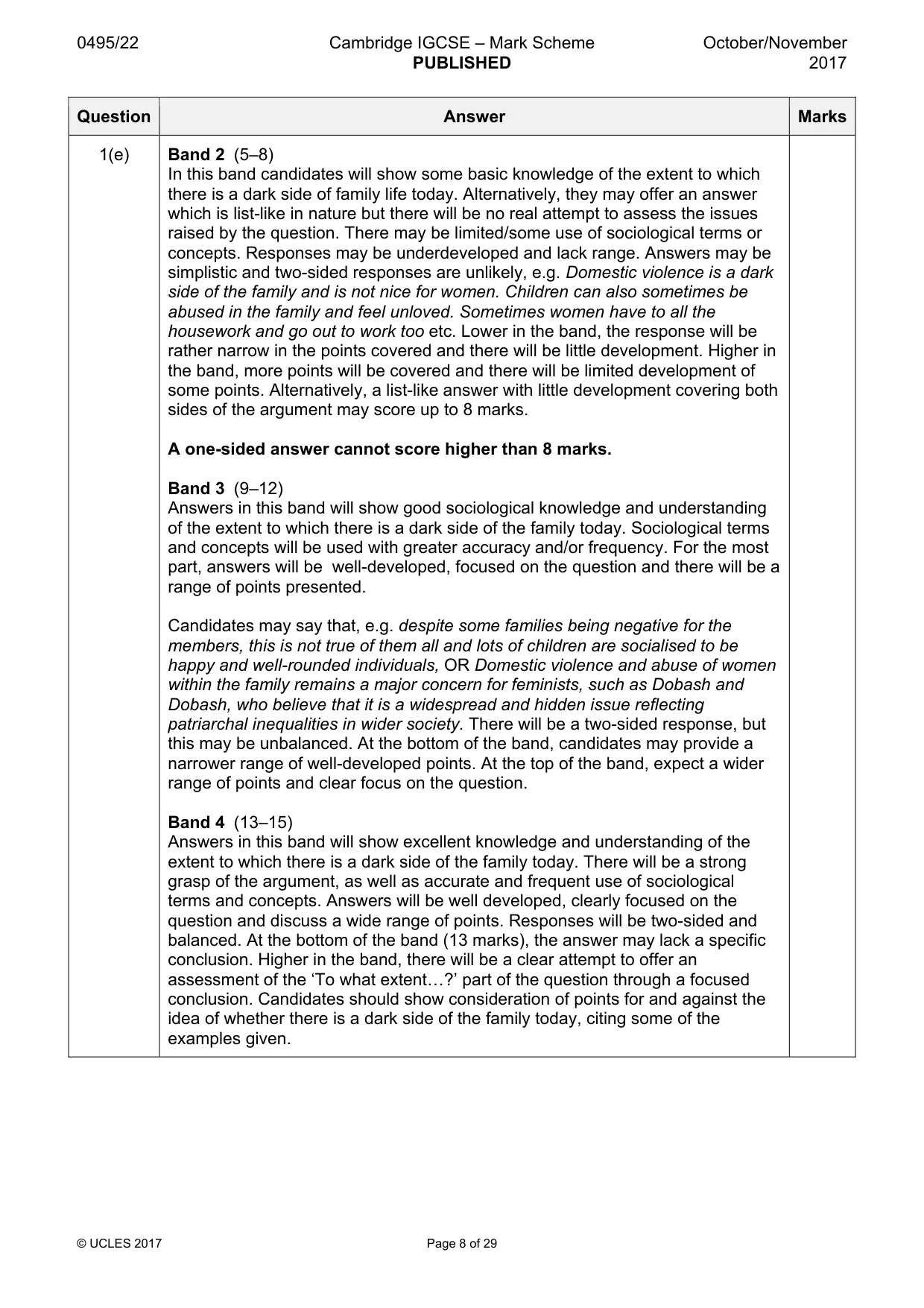
Mark scheme: Question Answer Marks 1 Marriage and family life is not always a positive experience for all individuals. Marital breakdown is increasingly common in modern industrial societies. As an institution, however, the family remains an important part of all societies and performs many different functions for its members. 1(a) What is meant by the term ‘marital breakdown’? 2 When a marriage has broken down so that the couple are no longer living as man and wife. This may result in divorce. One mark for partial definition e.g. getting divorced OR empty shell relationships. Two marks for clear definition: a couple no longer wish to be married and thus end their partnership. 1(b) Describe two consequences for the family of increasing life expectancy. 4 Candidates will be expected to describe two consequences for the family of increasing life expectancy. This may be positive or negative or a combination. Possible answers: • Increasing retirement age may lead to health/stress issues; • More older people living alone – increase in single person households; • Adult children may have to look after their ageing parents which could be stressful and lead to conflict; • Isolation and loneliness amongst older people; • Elder poverty – meaning other family members may have to support them financially; • Younger people may find it harder to find their own home as elderly people occupy theirs for longer; • Sandwich generation – a generation of people, typically in their thirties or forties, responsible both for bringing up their own children and for the care of their ageing parents which can lead to many problems and issues; • Grandparents may play a bigger role in looking after the grandchildren/childcare and supporting their own children; • A return in some families to the extended family structure; • Living with elderly family members allows for the passing on of wisdom to the younger generation; • Other reasonable response. One mark for each point correctly identified (up to maximum of two). One mark for each point that is developed (up to a maximum of two). 1(c) Explain how families ensure children conform to society’s norms and 6 values. Candidates need to show an understanding of what is meant by the term ‘conform’ (fitting in with) and be able to apply this to a society’s norms and values. This may be tackled in a generic way or may be made specific to a particular society. Possible answers: • Primary socialisation; • Informal social control; • Role modelling; • Canalisation and manipulation; • Imitation/copycatting; • Positive sanctions/rewards; • Negative sanctions/punishment; • Religious teachings; • Families sending children to a particular school because they agree with the institutions norms and values; • Other reasonable response. Band 0 (0) No creditworthy response. Band 1 (1–3) Answers in this band will show only a limited awareness of the concept of conformity in the family and may talk about, e.g. ‘families being strict’. Responses may be short and un/under developed. At the bottom of the band (1 mark), expect one weak point. Higher in the band (2–3 marks), candidates may offer more than one weak point, but there may be a tendency towards simplistic answers, engaging with sociological ideas without using sociological language. Band 2 (4–6) A clear and accurate explanation, showing good sociological knowledge and understanding of the relationship between conformity and society’s norms and values. Sociological terms and concepts should be expected, e.g. ‘Families may use processes of socialisation to ensure that children fit in with society. For example, when it comes to gender roles toys may be bought that reflect society’s expectations of males and females, a process Oakley called canalisation’. This would be followed by explanation of factors leading to this. At the bottom of the band, the range of points covered may be narrow or lack detail. Higher in the band, answers will cover more than one factor in a well-developed way or cover several factors in less detail. 1(d) Explain why conjugal roles are changing in modern industrial societies. 8 Candidates should show awareness of the various reasons some sociologists would give to explain why conjugal roles are changing in modern industrial societies. Conjugal roles – the domestic roles taken by husbands and wives within the family. • Dual worker families today are the norm and therefore husbands and wives need to share the domestic work in order to make this work; • Feminism has fought for more equality for females in society and this has therefore reduced segregated conjugal roles in the family; • As societies change so norms and values change – this is the case when it comes to the domestic division of labour whereby it is now seen as normal for men and women to share household tasks; • Social attitudes and expectations – men and women are now perceived to be equals and therefore this is mirrored within family conjugal roles; • Legal changes i.e. in employment/equal pay, allow conjugal roles to change as women take on increasing roles external to the family; • Family size is smaller today and therefore there are fewer, if any, children who need looking after – this allows for greater freedom for parents e.g. DINK’s in Japan; • As people live longer grandparents are able to offer help and support to the family and so allow for more symmetrical conjugal roles to develop; • Media representations of males and females help to normalise symmetry in the family e.g. the career woman and the new man; • Males are now expected to be more hands on in the home and with children – this leads to changes in conjugal roles; • Conjugal roles now shared by two people of the same sex; • In lone parent families it may be that the single parent has to take on board all roles of the family; • Other reasonable response. Band 0 (0) No creditworthy response. Band 1 (1–3) Answers in this band will show only a limited awareness of why conjugal roles are changing. A tendency to description is likely. Responses may be short and undeveloped, e.g. ‘because things are more equal today’ stated without explanation. Sociological terms and concepts are unlikely to be used. At the bottom of the band (1 mark), expect one weak point. Higher in the band (2–3 marks), candidates may offer more than one weak point. 1(d) Band 2 (4–6) Answers in this band will show basic sociological knowledge and understanding of why conjugal roles are changing. Responses may be underdeveloped and lacking in range, e.g. ‘Conjugal roles are changing because both men and women today go out to work’, ‘The media helps to change expectations of what it means to be a husband and wife through their gender representations’. At the bottom of the band, candidates are unlikely to use sociological terms and concepts accurately. Higher in the band, candidates may be beginning to use sociological terms and concepts with greater accuracy. However, some aspects of the answer may only be partially developed/explained. Band 3 (7–8) Answers in this band will show good sociological knowledge and understanding of why conjugal roles are changing and will be well developed and explained. e.g. ‘Joint conjugal roles are now the norm in MIS’s. This is explained by the impact feminism has had on the roles of women in society meaning that dual worker families are now commonplace. This leads to increased symmetry within the family’. They can then expand on the explanation of this and other factors as necessary. Sociological terms and concepts will be used accurately overall. Answers will be well focused on the question and there will be a range of reasons presented. At the top of the band explanations will be clear throughout. 1(e) To what extent is there a dark side of the family today? 15 Candidates should show awareness of a range of different arguments that illustrate how there can be a dark side of the family today. They should also consider points that refute this idea. The dark side of the family can refer to various negative aspects of family life and all that are relevant should be credited. Possible answers: For • Feminists believe that the family oppress and exploit women – arguments such as triple shift/dual burden, a patriarchal institution etc.; • Dysfunctional families do not socialise children effectively therefore they do not fulfil the essential family functions, such as primary socialisation etc.; • Domestic violence/honour violence – often a hidden part of family life but research shows it to be widespread. This may take the form of sexual abuse, violence and emotional abuse; • Child/elder/sibling abuse and neglect – a family isn’t always a loving place of safety; • High rates of unemployment and poverty place a lot of strain on the family, particularly single parent families; • Alcoholism, drug abuse and mental health issues can all contribute to a negative experience of family life; • Divorce or separation brings a lot of negatives for family members, i.e. short term distress for children, financial insecurity, emotional upset etc.; • Children may be split between two homes, due to a relationship breakdown, and thus lack a clear sense of security and belonging or no longer see one parent; • There may be a lack of freedom for children (helicopter parenting) due to increased levels of parental control e.g. a stifling environment; • Other reasonable response. 1(e) Against • Domestic violence is no longer stigmatised and thus women and men are more likely to speak out and seek help and are supported when doing so; • Legislation and changing attitudes gives vulnerable groups, e.g. children, increased rights and protection in society which improves their experience of family life; • Child-centeredness is now the norm, meaning that children are at the heart of the family; • According to functionalists, families perform several essential functions, such as stabilisation of adult personalities and primary socialisation, which all work well for family members; • Divorce and separation are more frequent today and are thought by many to be best for all family members once a relationship has broken down; • Increasing support from the state via welfare benefits, child policies, education and key professionals means that bringing up children need not be problematic; • The media demonises cases of child/domestic abuse and thus society now sees this as unacceptable – rise of child-centeredness; • Feminists believe that women today have greater equality in family life and have career opportunities that ensure they are no longer oppressed within the family; • Increased diversity in family life allows people to find a family form and situation that works best for them e.g. singlehood, sharing with friends, same sex relationships etc.; • Other reasonable response. Band 0 (0) No creditworthy response. Band 1 (1–4) Answers in this band may be vague and largely based on common sense showing limited knowledge of the extent to which there is a dark side of family life today. Use of sociological terms or concepts is very unlikely. Responses may be short, undeveloped and one-side, e.g. Not everyone is happy in their family as some parents beat their children. Lower in the band (1–2 marks), expect one or two weak points. Higher in the band (3–4 marks) candidates may offer more than two points or provide a weak definition of key terms, e.g. ‘dark side of the family’ may refer the negative aspects of family life for adults or children, in the question. 1(e) Band 2 (5–8) In this band candidates will show some basic knowledge of the extent to which there is a dark side of family life today. Alternatively, they may offer an answer which is list-like in nature but there will be no real attempt to assess the issues raised by the question. There may be limited/some use of sociological terms or concepts. Responses may be underdeveloped and lack range. Answers may be simplistic and two-sided responses are unlikely, e.g. Domestic violence is a dark side of the family and is not nice for women. Children can also sometimes be abused in the family and feel unloved. Sometimes women have to all the housework and go out to work too etc. Lower in the band, the response will be rather narrow in the points covered and there will be little development. Higher in the band, more points will be covered and there will be limited development of some points. Alternatively, a list-like answer with little development covering both sides of the argument may score up to 8 marks. A one-sided answer cannot score higher than 8 marks. Band 3 (9–12) Answers in this band will show good sociological knowledge and understanding of the extent to which there is a dark side of the family today. Sociological terms and concepts will be used with greater accuracy and/or frequency. For the most part, answers will be well-developed, focused on the question and there will be a range of points presented. Candidates may say that, e.g. despite some families being negative for the members, this is not true of them all and lots of children are socialised to be happy and well-rounded individuals, OR Domestic violence and abuse of women within the family remains a major concern for feminists, such as Dobash and Dobash, who believe that it is a widespread and hidden issue reflecting patriarchal inequalities in wider society. There will be a two-sided response, but this may be unbalanced. At the bottom of the band, candidates may provide a narrower range of well-developed points. At the top of the band, expect a wider range of points and clear focus on the question. Band 4 (13–15) Answers in this band will show excellent knowledge and understanding of the extent to which there is a dark side of the family today. There will be a strong grasp of the argument, as well as accurate and frequent use of sociological terms and concepts. Answers will be well developed, clearly focused on the question and discuss a wide range of points. Responses will be two-sided and balanced. At the bottom of the band (13 marks), the answer may lack a specific conclusion. Higher in the band, there will be a clear attempt to offer an assessment of the ‘To what extent«?’ part of the question through a focused conclusion. Candidates should show consideration of points for and against the idea of whether there is a dark side of the family today, citing some of the examples given. Section B: Education
Q2 · Formal education in the world today takes many forms
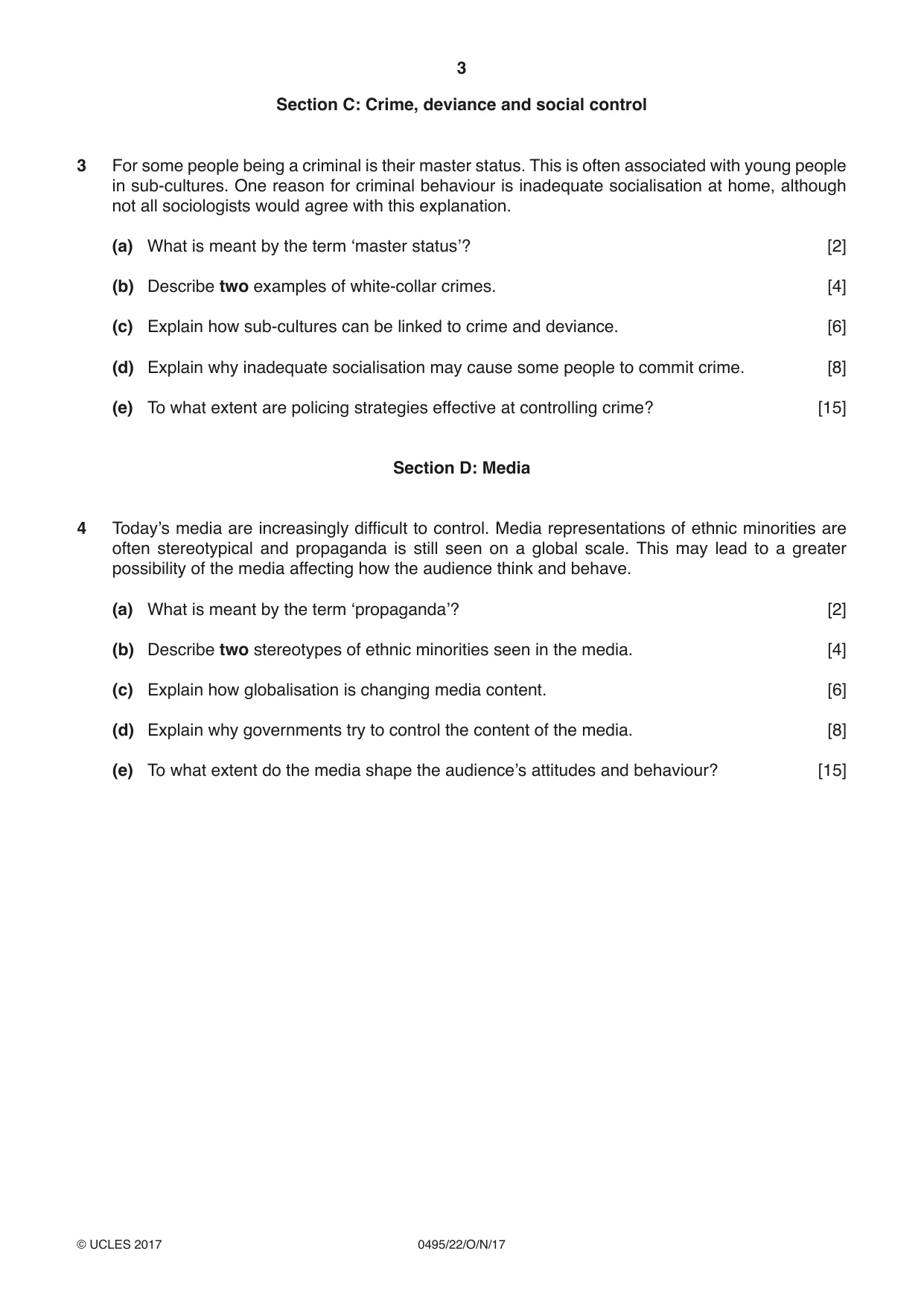
2 Formal education in the world today takes many forms. For some sociologists it allows people to better their life chances whereas for others it simply reinforces social divisions and maintains social inequalities. (a) What is meant by the term ‘formal education’? [2] (b) Describe two examples of the culture of masculinity that may explain the educational underachievement of boys. [4] (c) Explain how schools can be ethnocentric. [6] (d) Explain why some students join anti-school sub-cultures. [8] (e) To what extent does the education system help the ruling class maintain their power in society? [15] Section C: Crime, deviance and social control
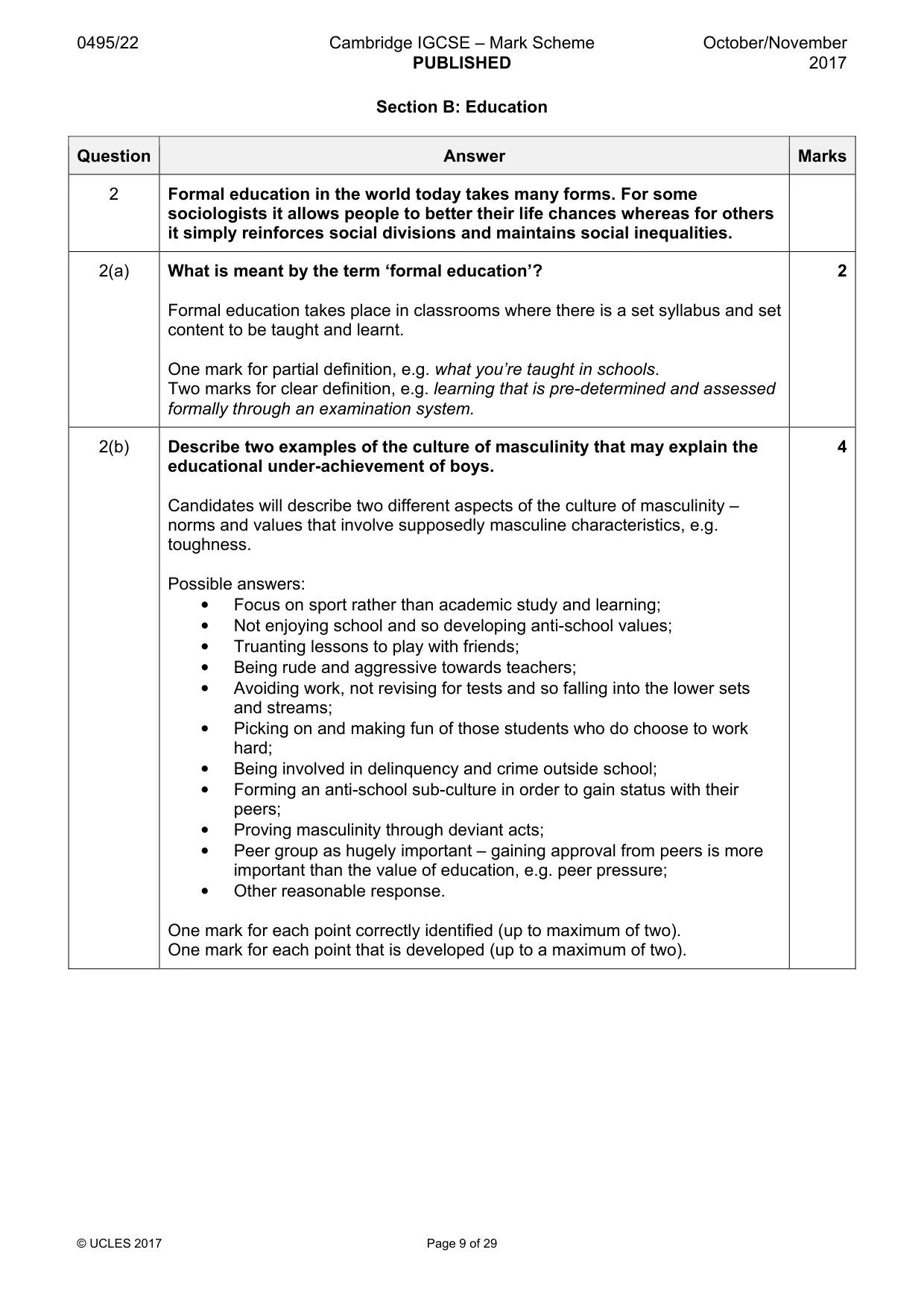
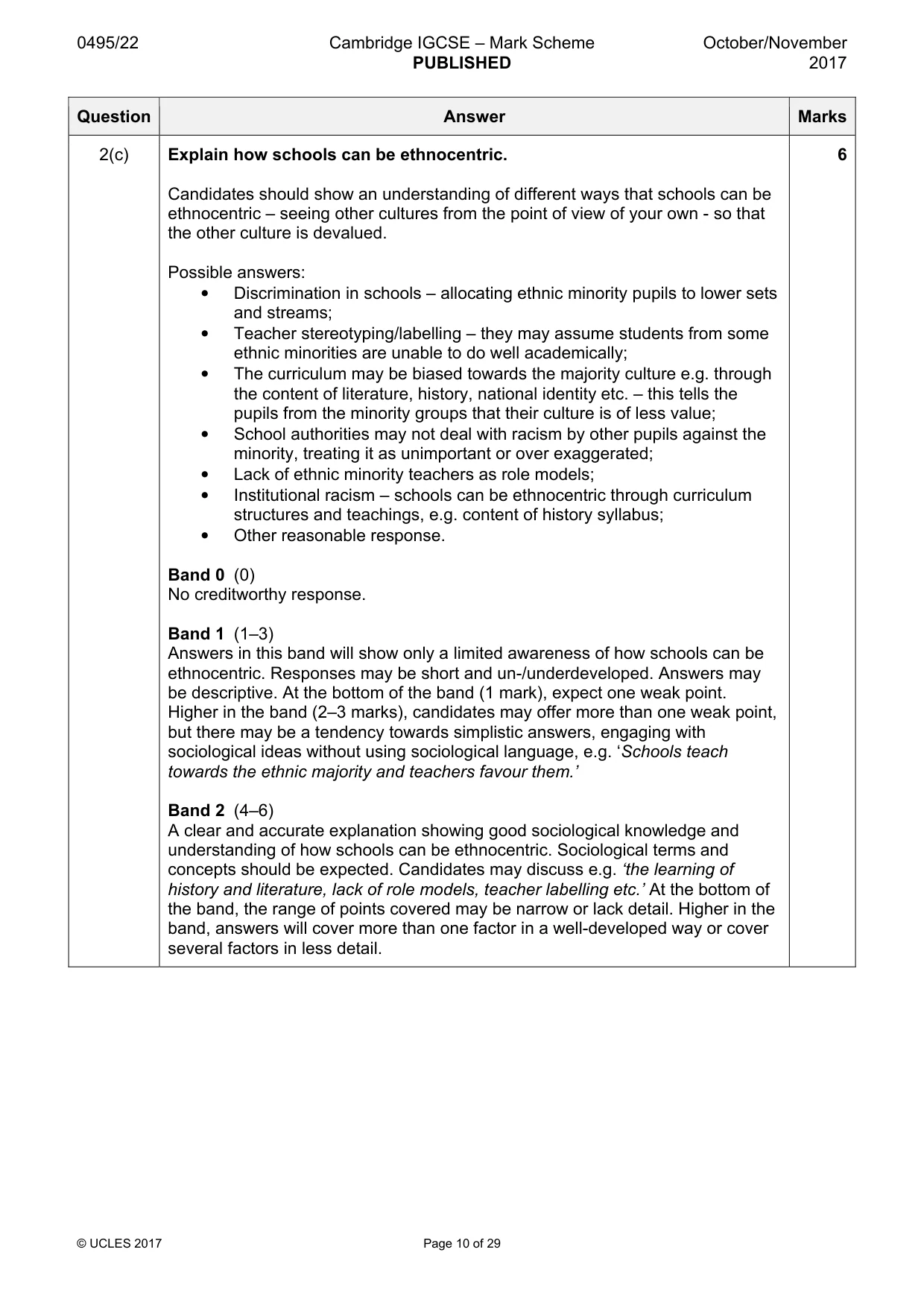
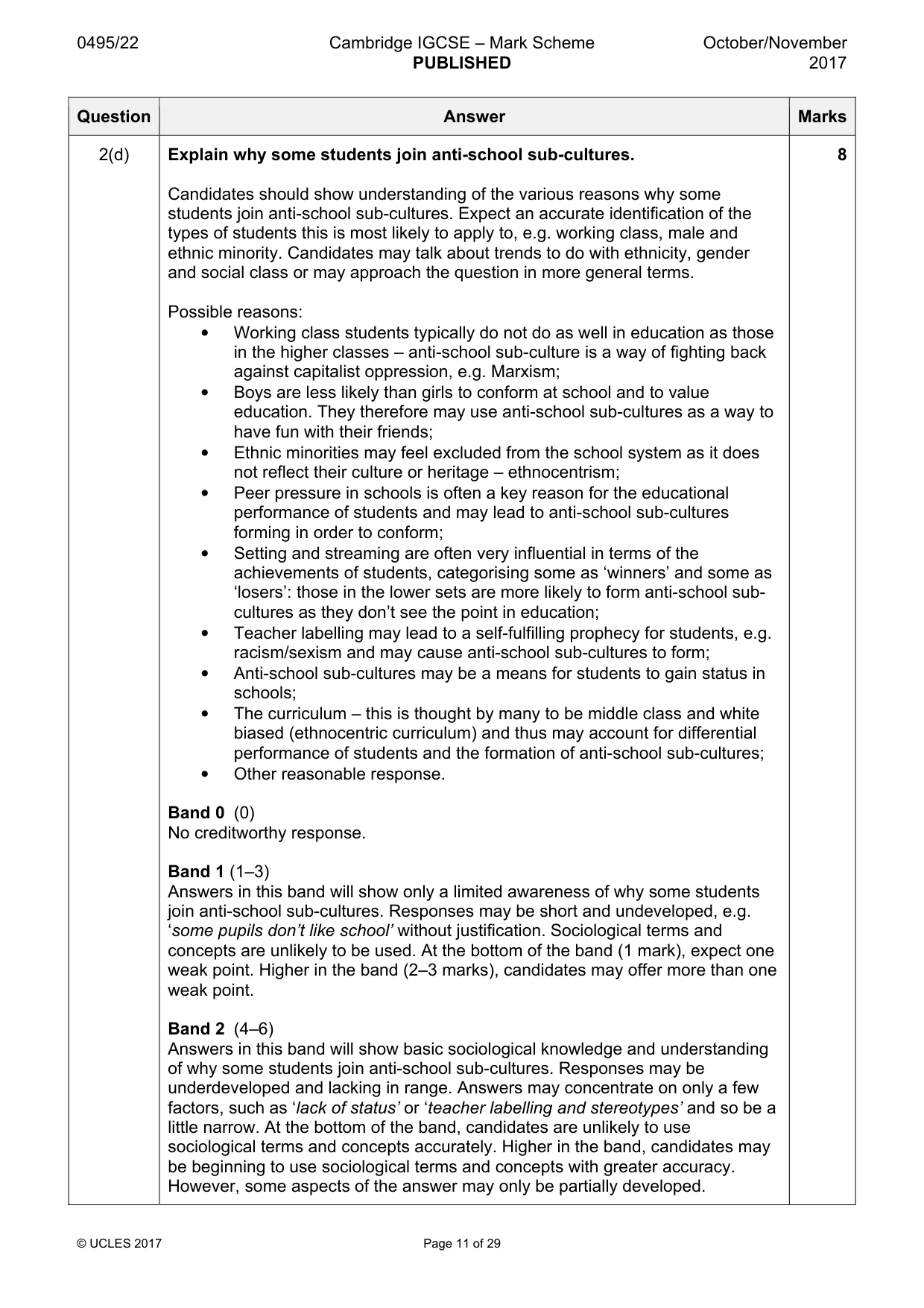
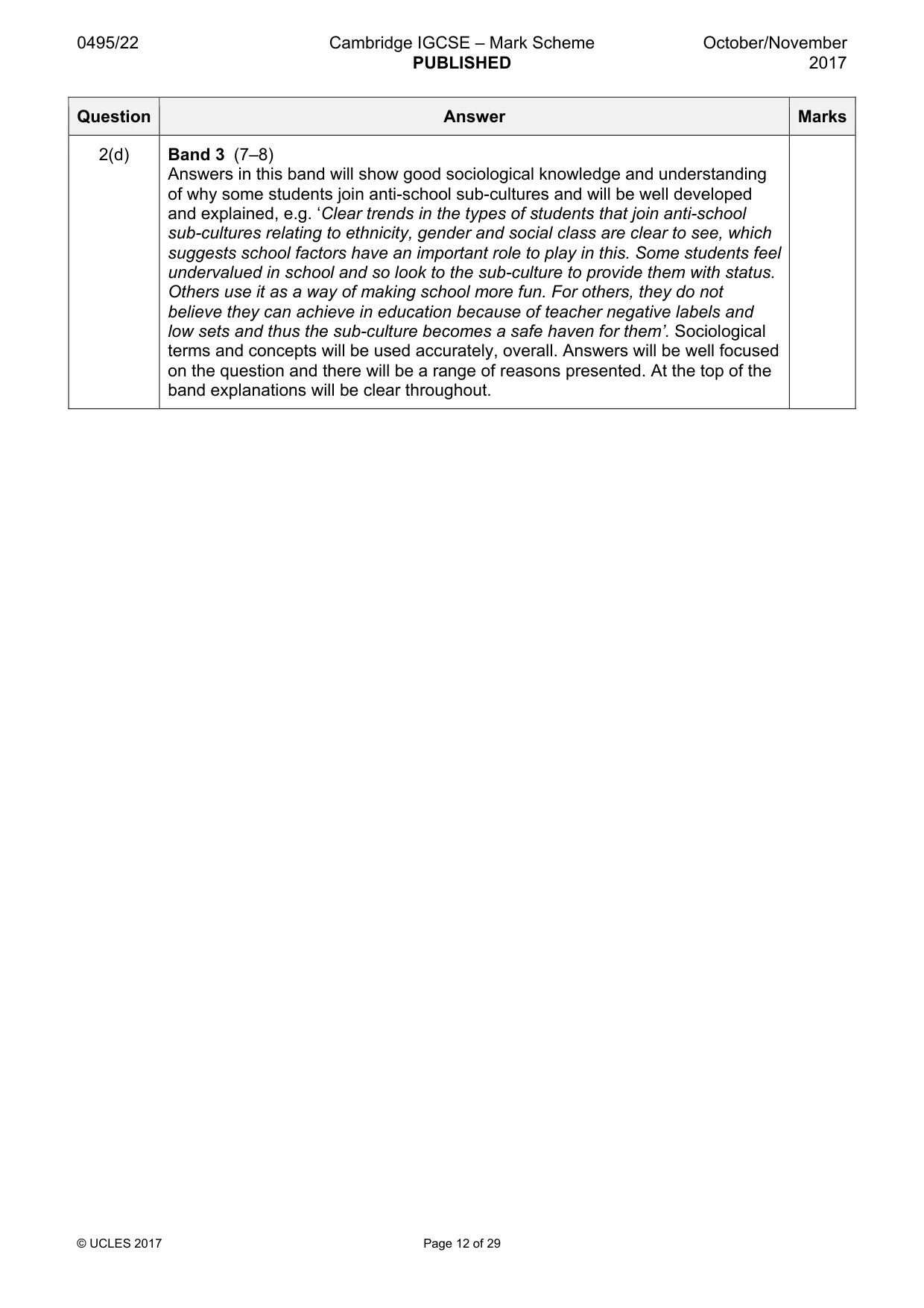
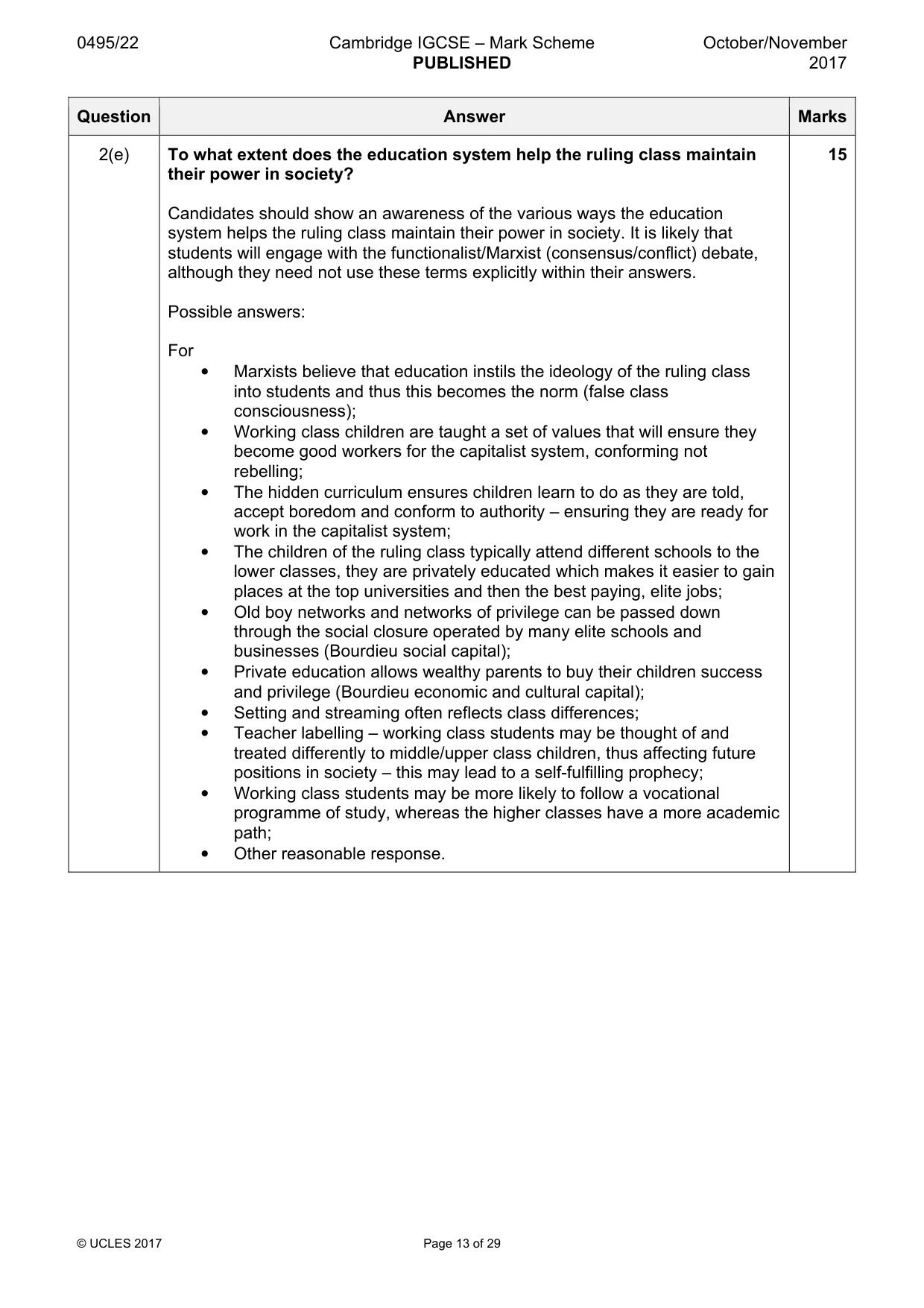
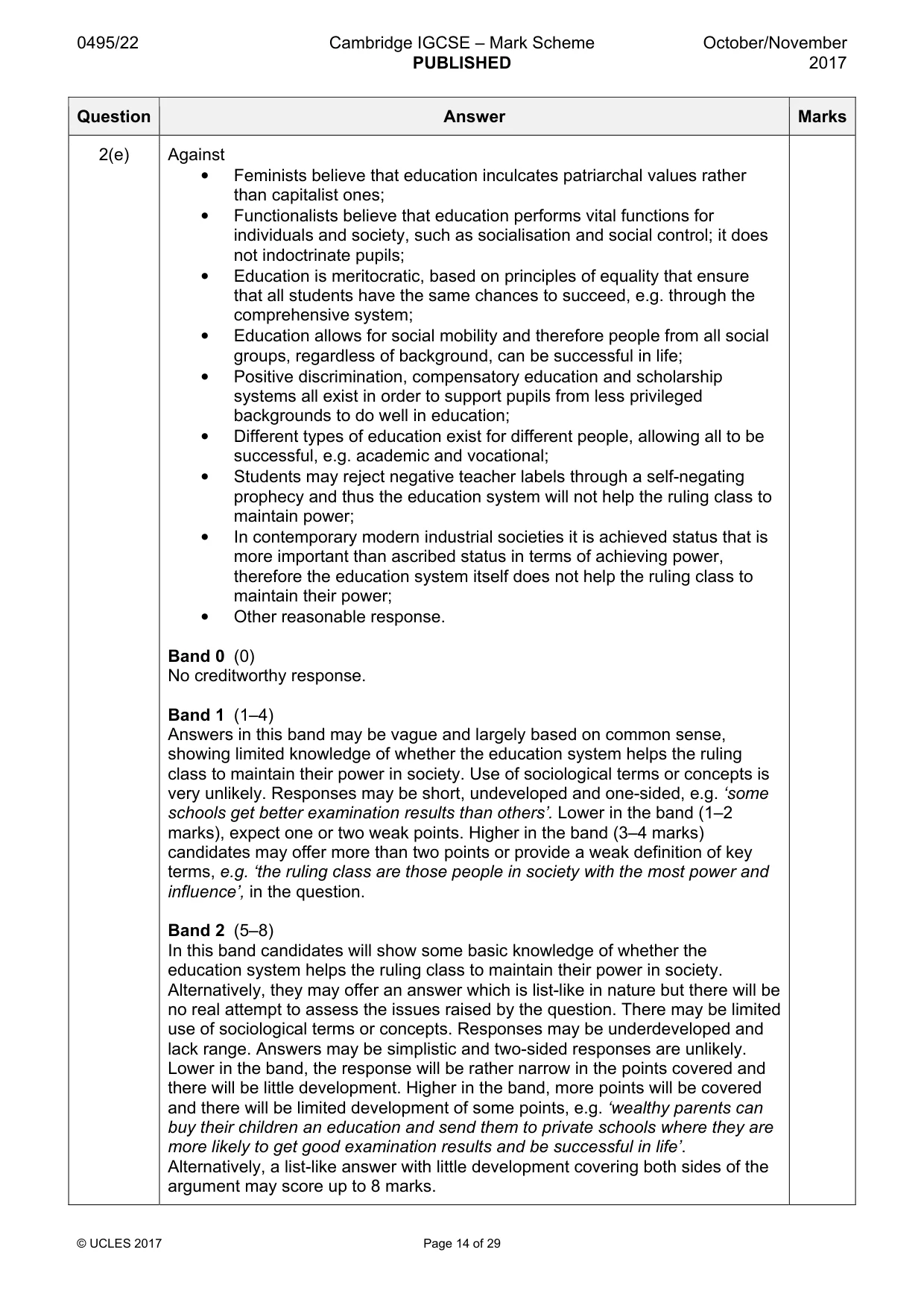
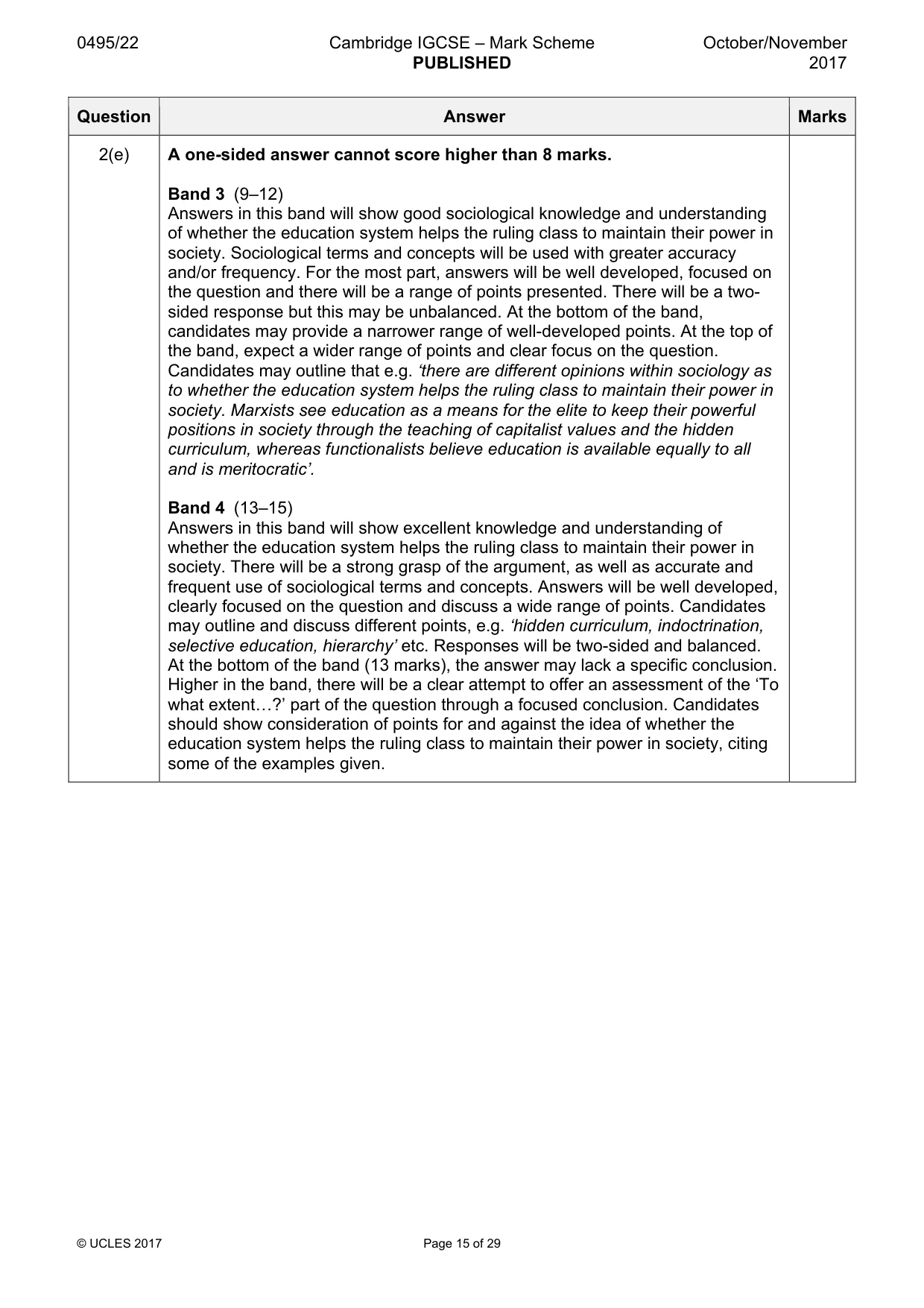
Mark scheme: 2(a) What is meant by the term ‘formal education’? 2 Formal education takes place in classrooms where there is a set syllabus and set content to be taught and learnt. One mark for partial definition, e.g. what you’re taught in schools. Two marks for clear definition, e.g. learning that is pre-determined and assessed formally through an examination system. 2(b) Describe two examples of the culture of masculinity that may explain the 4 educational under-achievement of boys. Candidates will describe two different aspects of the culture of masculinity – norms and values that involve supposedly masculine characteristics, e.g. toughness. Possible answers: • Focus on sport rather than academic study and learning; • Not enjoying school and so developing anti-school values; • Truanting lessons to play with friends; • Being rude and aggressive towards teachers; • Avoiding work, not revising for tests and so falling into the lower sets and streams; • Picking on and making fun of those students who do choose to work hard; • Being involved in delinquency and crime outside school; • Forming an anti-school sub-culture in order to gain status with their peers; • Proving masculinity through deviant acts; • Peer group as hugely important – gaining approval from peers is more important than the value of education, e.g. peer pressure; • Other reasonable response. One mark for each point correctly identified (up to maximum of two). One mark for each point that is developed (up to a maximum of two). 2(c) Explain how schools can be ethnocentric. 6 Candidates should show an understanding of different ways that schools can be ethnocentric – seeing other cultures from the point of view of your own - so that the other culture is devalued. Possible answers: • Discrimination in schools – allocating ethnic minority pupils to lower sets and streams; • Teacher stereotyping/labelling – they may assume students from some ethnic minorities are unable to do well academically; • The curriculum may be biased towards the majority culture e.g. through the content of literature, history, national identity etc. – this tells the pupils from the minority groups that their culture is of less value; • School authorities may not deal with racism by other pupils against the minority, treating it as unimportant or over exaggerated; • Lack of ethnic minority teachers as role models; • Institutional racism – schools can be ethnocentric through curriculum structures and teachings, e.g. content of history syllabus; • Other reasonable response. Band 0 (0) No creditworthy response. Band 1 (1–3) Answers in this band will show only a limited awareness of how schools can be ethnocentric. Responses may be short and un-/underdeveloped. Answers may be descriptive. At the bottom of the band (1 mark), expect one weak point. Higher in the band (2–3 marks), candidates may offer more than one weak point, but there may be a tendency towards simplistic answers, engaging with sociological ideas without using sociological language, e.g. ‘Schools teach towards the ethnic majority and teachers favour them.’ Band 2 (4–6) A clear and accurate explanation showing good sociological knowledge and understanding of how schools can be ethnocentric. Sociological terms and concepts should be expected. Candidates may discuss e.g. ‘the learning of history and literature, lack of role models, teacher labelling etc.’ At the bottom of the band, the range of points covered may be narrow or lack detail. Higher in the band, answers will cover more than one factor in a well-developed way or cover several factors in less detail. 2(d) Explain why some students join anti-school sub-cultures. 8 Candidates should show understanding of the various reasons why some students join anti-school sub-cultures. Expect an accurate identification of the types of students this is most likely to apply to, e.g. working class, male and ethnic minority. Candidates may talk about trends to do with ethnicity, gender and social class or may approach the question in more general terms. Possible reasons: • Working class students typically do not do as well in education as those in the higher classes – anti-school sub-culture is a way of fighting back against capitalist oppression, e.g. Marxism; • Boys are less likely than girls to conform at school and to value education. They therefore may use anti-school sub-cultures as a way to have fun with their friends; • Ethnic minorities may feel excluded from the school system as it does not reflect their culture or heritage – ethnocentrism; • Peer pressure in schools is often a key reason for the educational performance of students and may lead to anti-school sub-cultures forming in order to conform; • Setting and streaming are often very influential in terms of the achievements of students, categorising some as ‘winners’ and some as ‘losers’: those in the lower sets are more likely to form anti-school sub- cultures as they don’t see the point in education; • Teacher labelling may lead to a self-fulfilling prophecy for students, e.g. racism/sexism and may cause anti-school sub-cultures to form; • Anti-school sub-cultures may be a means for students to gain status in schools; • The curriculum – this is thought by many to be middle class and white biased (ethnocentric curriculum) and thus may account for differential performance of students and the formation of anti-school sub-cultures; • Other reasonable response. Band 0 (0) No creditworthy response. Band 1 (1–3) Answers in this band will show only a limited awareness of why some students join anti-school sub-cultures. Responses may be short and undeveloped, e.g. ‘some pupils don’t like school’ without justification. Sociological terms and concepts are unlikely to be used. At the bottom of the band (1 mark), expect one weak point. Higher in the band (2–3 marks), candidates may offer more than one weak point. Band 2 (4–6) Answers in this band will show basic sociological knowledge and understanding of why some students join anti-school sub-cultures. Responses may be underdeveloped and lacking in range. Answers may concentrate on only a few factors, such as ‘lack of status’ or ‘teacher labelling and stereotypes’ and so be a little narrow. At the bottom of the band, candidates are unlikely to use sociological terms and concepts accurately. Higher in the band, candidates may be beginning to use sociological terms and concepts with greater accuracy. However, some aspects of the answer may only be partially developed. 2(d) Band 3 (7–8) Answers in this band will show good sociological knowledge and understanding of why some students join anti-school sub-cultures and will be well developed and explained, e.g. ‘Clear trends in the types of students that join anti-school sub-cultures relating to ethnicity, gender and social class are clear to see, which suggests school factors have an important role to play in this. Some students feel undervalued in school and so look to the sub-culture to provide them with status. Others use it as a way of making school more fun. For others, they do not believe they can achieve in education because of teacher negative labels and low sets and thus the sub-culture becomes a safe haven for them’. Sociological terms and concepts will be used accurately, overall. Answers will be well focused on the question and there will be a range of reasons presented. At the top of the band explanations will be clear throughout. 2(e) To what extent does the education system help the ruling class maintain 15 their power in society? Candidates should show an awareness of the various ways the education system helps the ruling class maintain their power in society. It is likely that students will engage with the functionalist/Marxist (consensus/conflict) debate, although they need not use these terms explicitly within their answers. Possible answers: For • Marxists believe that education instils the ideology of the ruling class into students and thus this becomes the norm (false class consciousness); • Working class children are taught a set of values that will ensure they become good workers for the capitalist system, conforming not rebelling; • The hidden curriculum ensures children learn to do as they are told, accept boredom and conform to authority – ensuring they are ready for work in the capitalist system; • The children of the ruling class typically attend different schools to the lower classes, they are privately educated which makes it easier to gain places at the top universities and then the best paying, elite jobs; • Old boy networks and networks of privilege can be passed down through the social closure operated by many elite schools and businesses (Bourdieu social capital); • Private education allows wealthy parents to buy their children success and privilege (Bourdieu economic and cultural capital); • Setting and streaming often reflects class differences; • Teacher labelling – working class students may be thought of and treated differently to middle/upper class children, thus affecting future positions in society – this may lead to a self-fulfilling prophecy; • Working class students may be more likely to follow a vocational programme of study, whereas the higher classes have a more academic path; • Other reasonable response. 2(e) Against • Feminists believe that education inculcates patriarchal values rather than capitalist ones; • Functionalists believe that education performs vital functions for individuals and society, such as socialisation and social control; it does not indoctrinate pupils; • Education is meritocratic, based on principles of equality that ensure that all students have the same chances to succeed, e.g. through the comprehensive system; • Education allows for social mobility and therefore people from all social groups, regardless of background, can be successful in life; • Positive discrimination, compensatory education and scholarship systems all exist in order to support pupils from less privileged backgrounds to do well in education; • Different types of education exist for different people, allowing all to be successful, e.g. academic and vocational; • Students may reject negative teacher labels through a self-negating prophecy and thus the education system will not help the ruling class to maintain power; • In contemporary modern industrial societies it is achieved status that is more important than ascribed status in terms of achieving power, therefore the education system itself does not help the ruling class to maintain their power; • Other reasonable response. Band 0 (0) No creditworthy response. Band 1 (1–4) Answers in this band may be vague and largely based on common sense, showing limited knowledge of whether the education system helps the ruling class to maintain their power in society. Use of sociological terms or concepts is very unlikely. Responses may be short, undeveloped and one-sided, e.g. ‘some schools get better examination results than others’. Lower in the band (1–2 marks), expect one or two weak points. Higher in the band (3–4 marks) candidates may offer more than two points or provide a weak definition of key terms, e.g. ‘the ruling class are those people in society with the most power and influence’, in the question. Band 2 (5–8) In this band candidates will show some basic knowledge of whether the education system helps the ruling class to maintain their power in society. Alternatively, they may offer an answer which is list-like in nature but there will be no real attempt to assess the issues raised by the question. There may be limited use of sociological terms or concepts. Responses may be underdeveloped and lack range. Answers may be simplistic and two-sided responses are unlikely. Lower in the band, the response will be rather narrow in the points covered and there will be little development. Higher in the band, more points will be covered and there will be limited development of some points, e.g. ‘wealthy parents can buy their children an education and send them to private schools where they are more likely to get good examination results and be successful in life’. Alternatively, a list-like answer with little development covering both sides of the argument may score up to 8 marks. 2(e) A one-sided answer cannot score higher than 8 marks. Band 3 (9–12) Answers in this band will show good sociological knowledge and understanding of whether the education system helps the ruling class to maintain their power in society. Sociological terms and concepts will be used with greater accuracy and/or frequency. For the most part, answers will be well developed, focused on the question and there will be a range of points presented. There will be a two- sided response but this may be unbalanced. At the bottom of the band, candidates may provide a narrower range of well-developed points. At the top of the band, expect a wider range of points and clear focus on the question. Candidates may outline that e.g. ‘there are different opinions within sociology as to whether the education system helps the ruling class to maintain their power in society. Marxists see education as a means for the elite to keep their powerful positions in society through the teaching of capitalist values and the hidden curriculum, whereas functionalists believe education is available equally to all and is meritocratic’. Band 4 (13–15) Answers in this band will show excellent knowledge and understanding of whether the education system helps the ruling class to maintain their power in society. There will be a strong grasp of the argument, as well as accurate and frequent use of sociological terms and concepts. Answers will be well developed, clearly focused on the question and discuss a wide range of points. Candidates may outline and discuss different points, e.g. ‘hidden curriculum, indoctrination, selective education, hierarchy’ etc. Responses will be two-sided and balanced. At the bottom of the band (13 marks), the answer may lack a specific conclusion. Higher in the band, there will be a clear attempt to offer an assessment of the ‘To what extent«?’ part of the question through a focused conclusion. Candidates should show consideration of points for and against the idea of whether the education system helps the ruling class to maintain their power in society, citing some of the examples given. Section C: Crime, deviance and social control
Q3 · For some people being a criminal is their master status
3 For some people being a criminal is their master status. This is often associated with young people in sub-cultures. One reason for criminal behaviour is inadequate socialisation at home, although not all sociologists would agree with this explanation. (a) What is meant by the term ‘master status’? [2] (b) Describe two examples of white-collar crimes. [4] (c) Explain how sub-cultures can be linked to crime and deviance. [6] (d) Explain why inadequate socialisation may cause some people to commit crime. [8] (e) To what extent are policing strategies effective at controlling crime? [15] Section D: Media
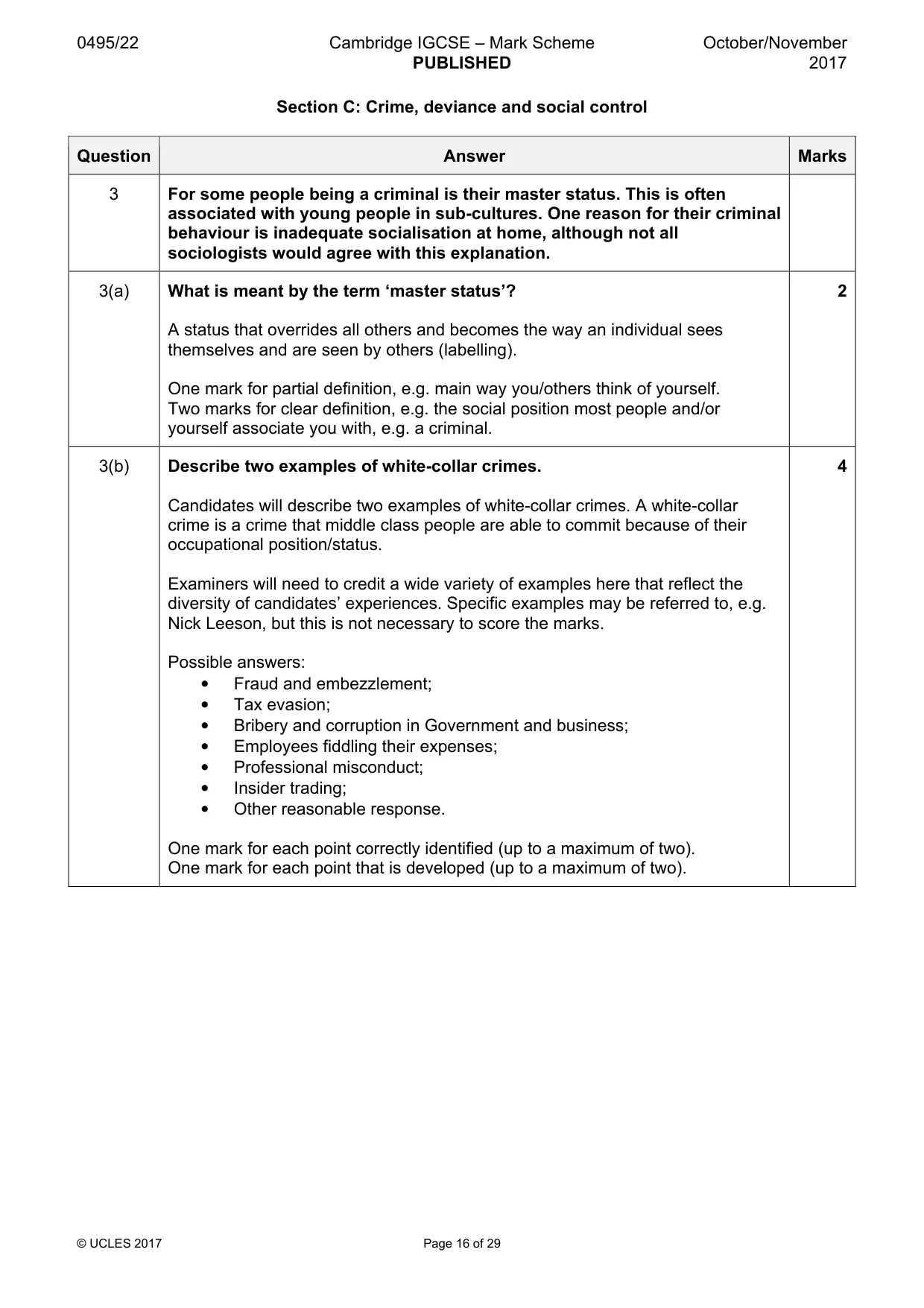
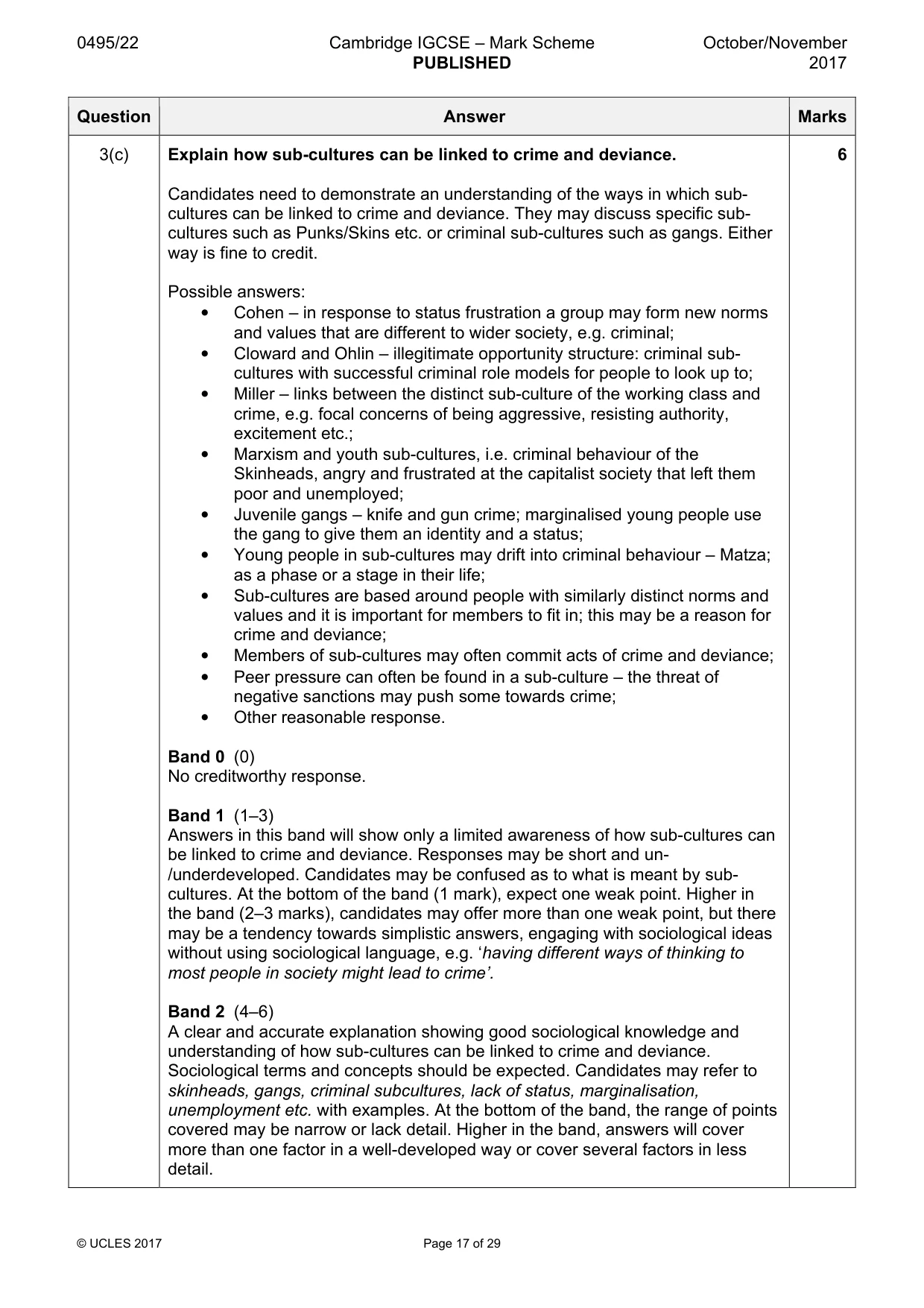
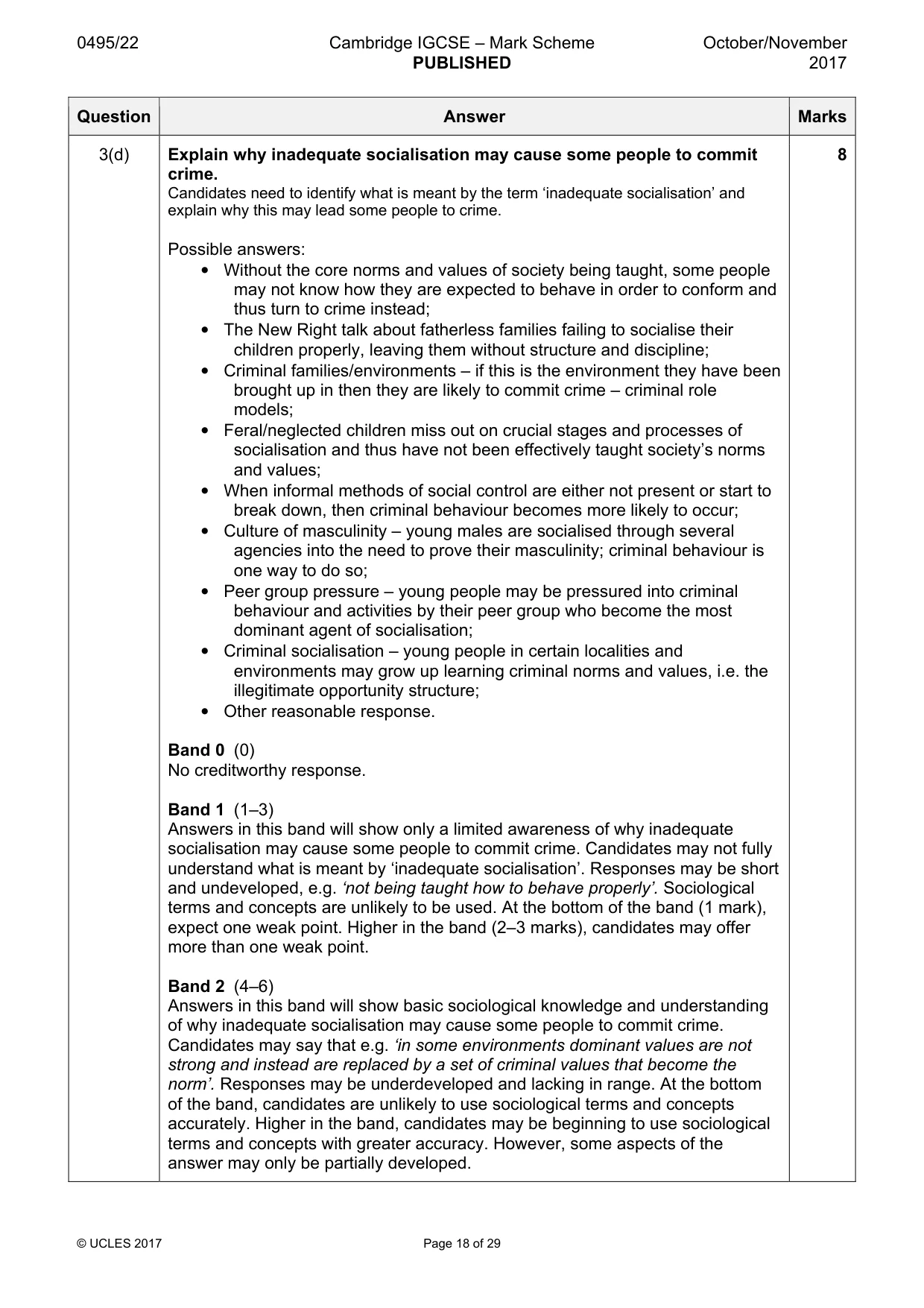
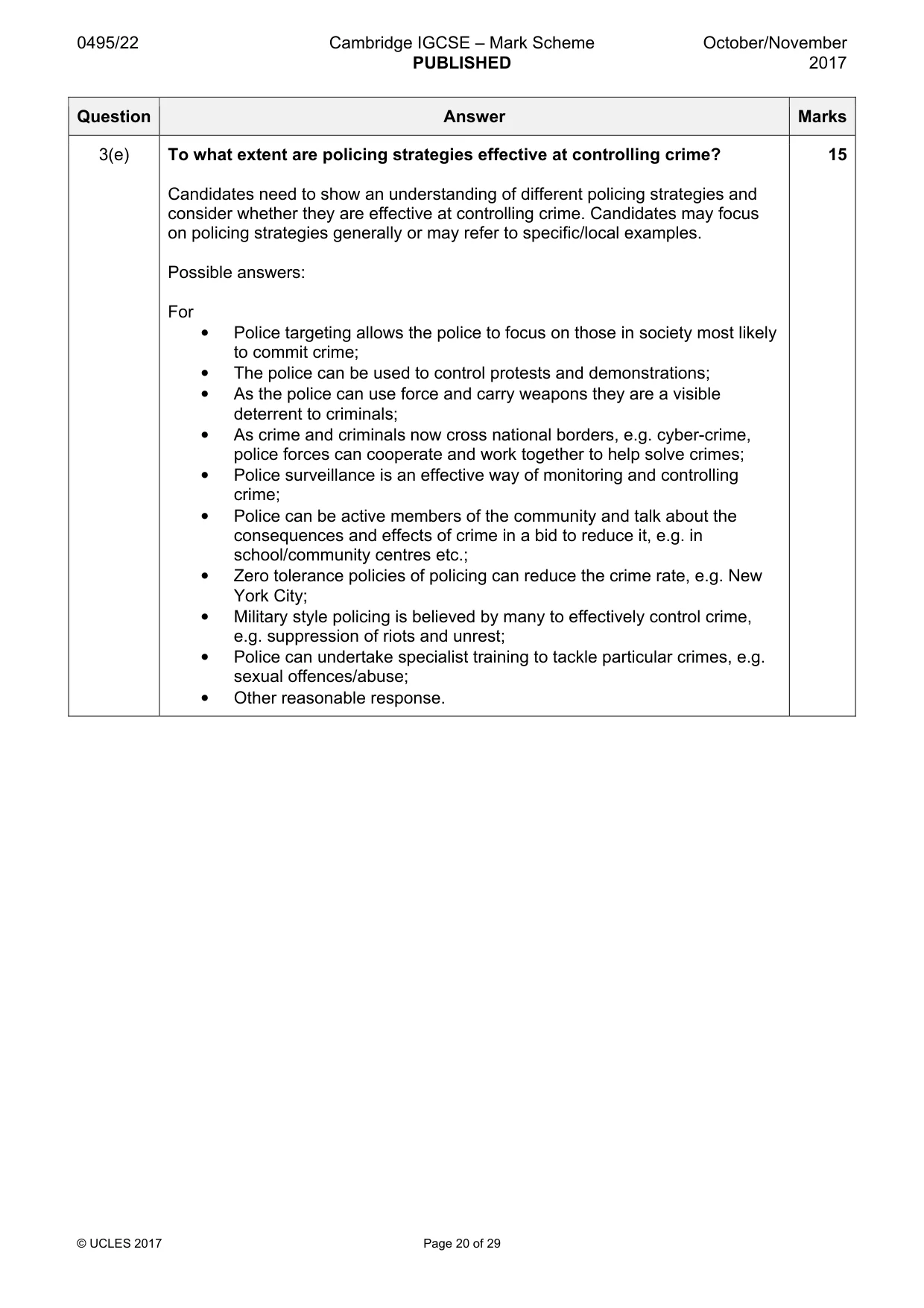
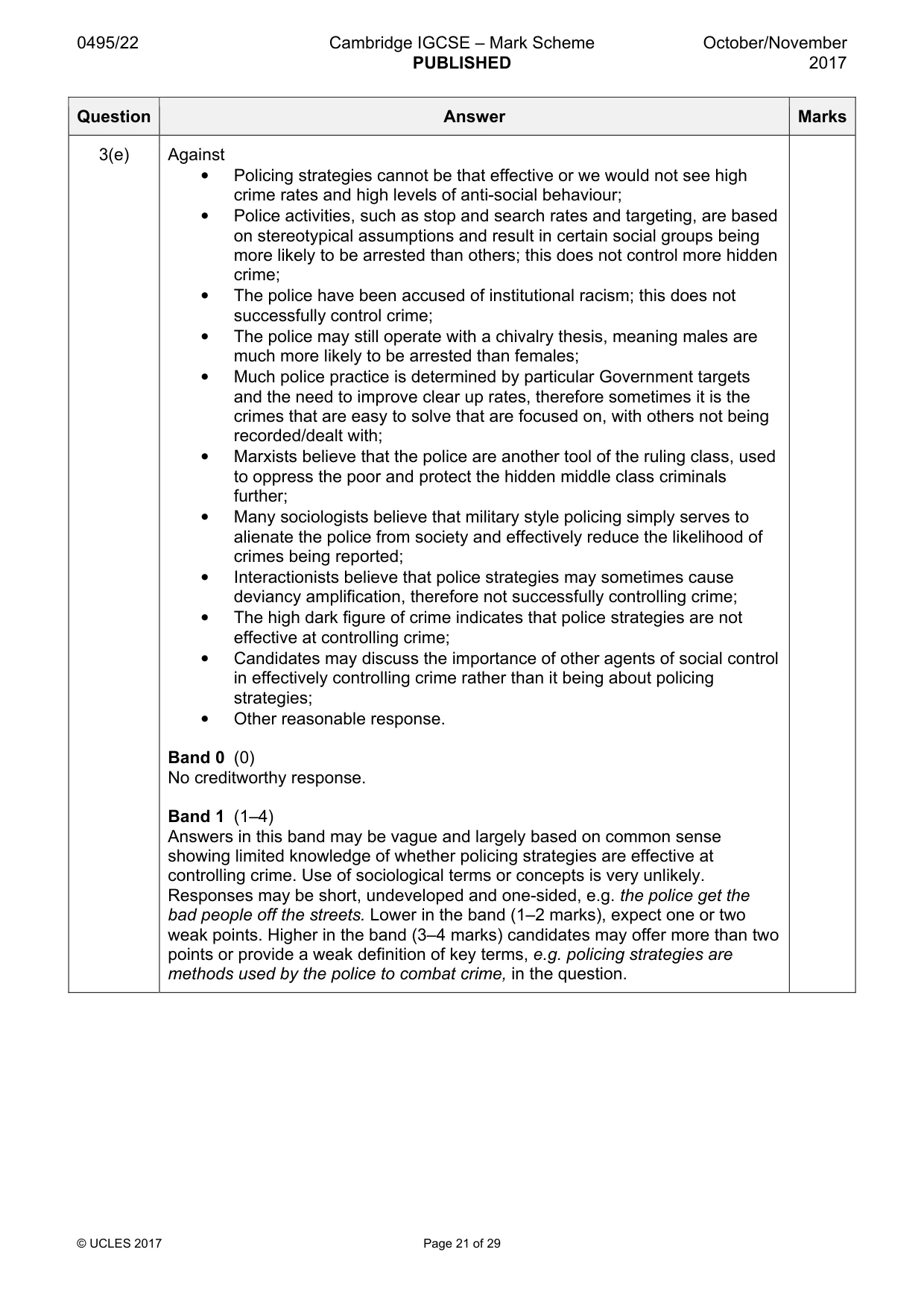
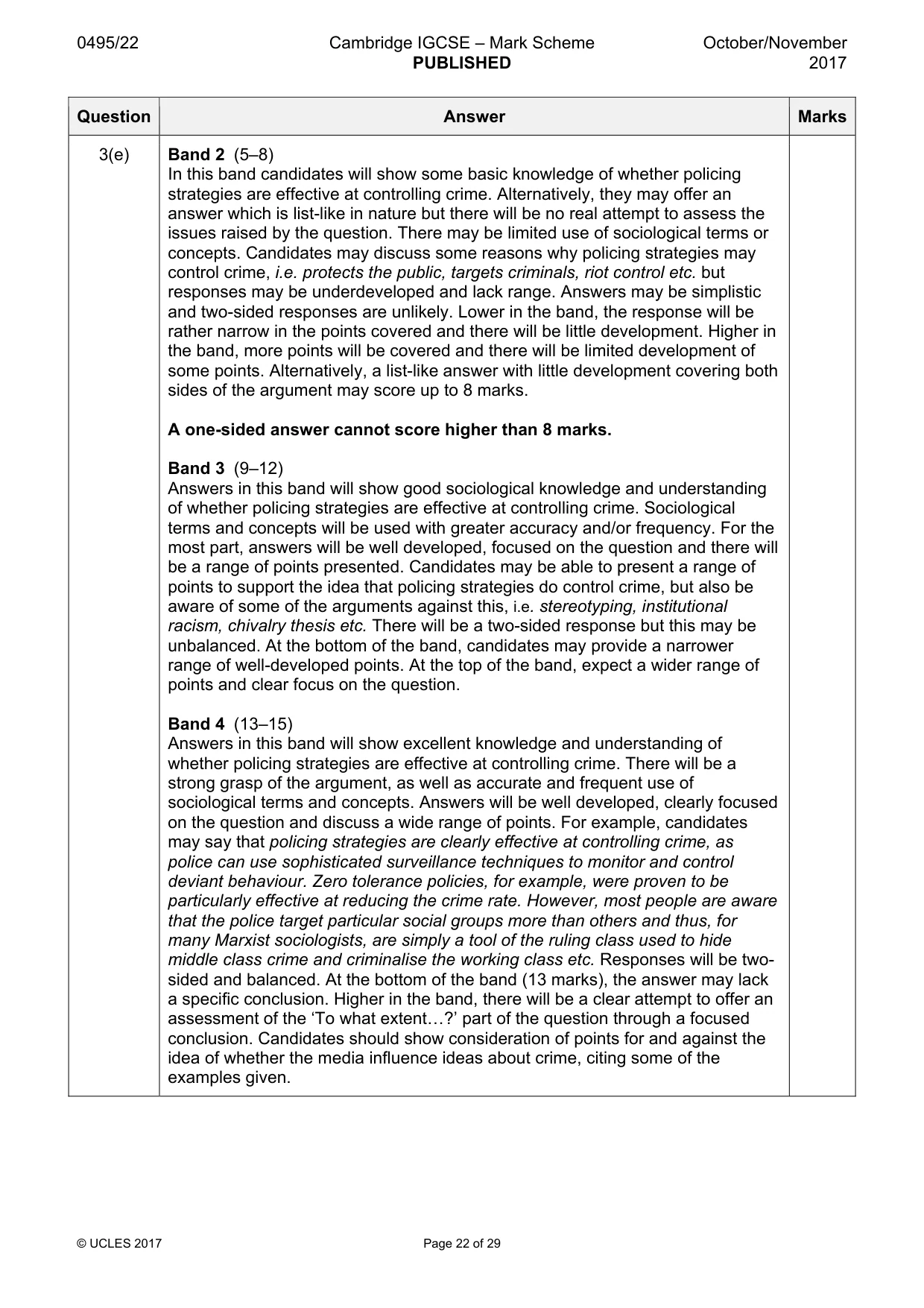
Mark scheme: 3(a) What is meant by the term ‘master status’? 2 A status that overrides all others and becomes the way an individual sees themselves and are seen by others (labelling). One mark for partial definition, e.g. main way you/others think of yourself. Two marks for clear definition, e.g. the social position most people and/or yourself associate you with, e.g. a criminal. 3(b) Describe two examples of white-collar crimes. 4 Candidates will describe two examples of white-collar crimes. A white-collar crime is a crime that middle class people are able to commit because of their occupational position/status. Examiners will need to credit a wide variety of examples here that reflect the diversity of candidates’ experiences. Specific examples may be referred to, e.g. Nick Leeson, but this is not necessary to score the marks. Possible answers: • Fraud and embezzlement; • Tax evasion; • Bribery and corruption in Government and business; • Employees fiddling their expenses; • Professional misconduct; • Insider trading; • Other reasonable response. One mark for each point correctly identified (up to a maximum of two). One mark for each point that is developed (up to a maximum of two). 3(c) Explain how sub-cultures can be linked to crime and deviance. 6 Candidates need to demonstrate an understanding of the ways in which sub- cultures can be linked to crime and deviance. They may discuss specific sub- cultures such as Punks/Skins etc. or criminal sub-cultures such as gangs. Either way is fine to credit. Possible answers: • Cohen – in response to status frustration a group may form new norms and values that are different to wider society, e.g. criminal; • Cloward and Ohlin – illegitimate opportunity structure: criminal sub- cultures with successful criminal role models for people to look up to; • Miller – links between the distinct sub-culture of the working class and crime, e.g. focal concerns of being aggressive, resisting authority, excitement etc.; • Marxism and youth sub-cultures, i.e. criminal behaviour of the Skinheads, angry and frustrated at the capitalist society that left them poor and unemployed; • Juvenile gangs – knife and gun crime; marginalised young people use the gang to give them an identity and a status; • Young people in sub-cultures may drift into criminal behaviour – Matza; as a phase or a stage in their life; • Sub-cultures are based around people with similarly distinct norms and values and it is important for members to fit in; this may be a reason for crime and deviance; • Members of sub-cultures may often commit acts of crime and deviance; • Peer pressure can often be found in a sub-culture – the threat of negative sanctions may push some towards crime; • Other reasonable response. Band 0 (0) No creditworthy response. Band 1 (1–3) Answers in this band will show only a limited awareness of how sub-cultures can be linked to crime and deviance. Responses may be short and un- /underdeveloped. Candidates may be confused as to what is meant by sub- cultures. At the bottom of the band (1 mark), expect one weak point. Higher in the band (2–3 marks), candidates may offer more than one weak point, but there may be a tendency towards simplistic answers, engaging with sociological ideas without using sociological language, e.g. ‘having different ways of thinking to most people in society might lead to crime’. Band 2 (4–6) A clear and accurate explanation showing good sociological knowledge and understanding of how sub-cultures can be linked to crime and deviance. Sociological terms and concepts should be expected. Candidates may refer to skinheads, gangs, criminal subcultures, lack of status, marginalisation, unemployment etc. with examples. At the bottom of the band, the range of points covered may be narrow or lack detail. Higher in the band, answers will cover more than one factor in a well-developed way or cover several factors in less detail. 3(d) Explain why inadequate socialisation may cause some people to commit 8 crime. Candidates need to identify what is meant by the term ‘inadequate socialisation’ and explain why this may lead some people to crime. Possible answers: • Without the core norms and values of society being taught, some people may not know how they are expected to behave in order to conform and thus turn to crime instead; • The New Right talk about fatherless families failing to socialise their children properly, leaving them without structure and discipline; • Criminal families/environments – if this is the environment they have been brought up in then they are likely to commit crime – criminal role models; • Feral/neglected children miss out on crucial stages and processes of socialisation and thus have not been effectively taught society’s norms and values; • When informal methods of social control are either not present or start to break down, then criminal behaviour becomes more likely to occur; • Culture of masculinity – young males are socialised through several agencies into the need to prove their masculinity; criminal behaviour is one way to do so; • Peer group pressure – young people may be pressured into criminal behaviour and activities by their peer group who become the most dominant agent of socialisation; • Criminal socialisation – young people in certain localities and environments may grow up learning criminal norms and values, i.e. the illegitimate opportunity structure; • Other reasonable response. Band 0 (0) No creditworthy response. Band 1 (1–3) Answers in this band will show only a limited awareness of why inadequate socialisation may cause some people to commit crime. Candidates may not fully understand what is meant by ‘inadequate socialisation’. Responses may be short and undeveloped, e.g. ‘not being taught how to behave properly’. Sociological terms and concepts are unlikely to be used. At the bottom of the band (1 mark), expect one weak point. Higher in the band (2–3 marks), candidates may offer more than one weak point. Band 2 (4–6) Answers in this band will show basic sociological knowledge and understanding of why inadequate socialisation may cause some people to commit crime. Candidates may say that e.g. ‘in some environments dominant values are not strong and instead are replaced by a set of criminal values that become the norm’. Responses may be underdeveloped and lacking in range. At the bottom of the band, candidates are unlikely to use sociological terms and concepts accurately. Higher in the band, candidates may be beginning to use sociological terms and concepts with greater accuracy. However, some aspects of the answer may only be partially developed. 3(d) Band 3 (7–8) Answers in this band will show good sociological knowledge and understanding of why inadequate socialisation may cause some people to commit crime and will be well developed and explained. Candidates may discuss single parent families, alternative sets of norms and values, master status, criminal socialisation, role models, illegitimate opportunity structure etc. Sociological terms and concepts will be used accurately, overall. Answers will be well focused on the question and there will be a range of reasons presented. At the top of the band explanations will be clear throughout. 3(e) To what extent are policing strategies effective at controlling crime? 15 Candidates need to show an understanding of different policing strategies and consider whether they are effective at controlling crime. Candidates may focus on policing strategies generally or may refer to specific/local examples. Possible answers: For • Police targeting allows the police to focus on those in society most likely to commit crime; • The police can be used to control protests and demonstrations; • As the police can use force and carry weapons they are a visible deterrent to criminals; • As crime and criminals now cross national borders, e.g. cyber-crime, police forces can cooperate and work together to help solve crimes; • Police surveillance is an effective way of monitoring and controlling crime; • Police can be active members of the community and talk about the consequences and effects of crime in a bid to reduce it, e.g. in school/community centres etc.; • Zero tolerance policies of policing can reduce the crime rate, e.g. New York City; • Military style policing is believed by many to effectively control crime, e.g. suppression of riots and unrest; • Police can undertake specialist training to tackle particular crimes, e.g. sexual offences/abuse; • Other reasonable response. 3(e) Against • Policing strategies cannot be that effective or we would not see high crime rates and high levels of anti-social behaviour; • Police activities, such as stop and search rates and targeting, are based on stereotypical assumptions and result in certain social groups being more likely to be arrested than others; this does not control more hidden crime; • The police have been accused of institutional racism; this does not successfully control crime; • The police may still operate with a chivalry thesis, meaning males are much more likely to be arrested than females; • Much police practice is determined by particular Government targets and the need to improve clear up rates, therefore sometimes it is the crimes that are easy to solve that are focused on, with others not being recorded/dealt with; • Marxists believe that the police are another tool of the ruling class, used to oppress the poor and protect the hidden middle class criminals further; • Many sociologists believe that military style policing simply serves to alienate the police from society and effectively reduce the likelihood of crimes being reported; • Interactionists believe that police strategies may sometimes cause deviancy amplification, therefore not successfully controlling crime; • The high dark figure of crime indicates that police strategies are not effective at controlling crime; • Candidates may discuss the importance of other agents of social control in effectively controlling crime rather than it being about policing strategies; • Other reasonable response. Band 0 (0) No creditworthy response. Band 1 (1–4) Answers in this band may be vague and largely based on common sense showing limited knowledge of whether policing strategies are effective at controlling crime. Use of sociological terms or concepts is very unlikely. Responses may be short, undeveloped and one-sided, e.g. the police get the bad people off the streets. Lower in the band (1–2 marks), expect one or two weak points. Higher in the band (3–4 marks) candidates may offer more than two points or provide a weak definition of key terms, e.g. policing strategies are methods used by the police to combat crime, in the question. 3(e) Band 2 (5–8) In this band candidates will show some basic knowledge of whether policing strategies are effective at controlling crime. Alternatively, they may offer an answer which is list-like in nature but there will be no real attempt to assess the issues raised by the question. There may be limited use of sociological terms or concepts. Candidates may discuss some reasons why policing strategies may control crime, i.e. protects the public, targets criminals, riot control etc. but responses may be underdeveloped and lack range. Answers may be simplistic and two-sided responses are unlikely. Lower in the band, the response will be rather narrow in the points covered and there will be little development. Higher in the band, more points will be covered and there will be limited development of some points. Alternatively, a list-like answer with little development covering both sides of the argument may score up to 8 marks. A one-sided answer cannot score higher than 8 marks. Band 3 (9–12) Answers in this band will show good sociological knowledge and understanding of whether policing strategies are effective at controlling crime. Sociological terms and concepts will be used with greater accuracy and/or frequency. For the most part, answers will be well developed, focused on the question and there will be a range of points presented. Candidates may be able to present a range of points to support the idea that policing strategies do control crime, but also be aware of some of the arguments against this, i.e. stereotyping, institutional racism, chivalry thesis etc. There will be a two-sided response but this may be unbalanced. At the bottom of the band, candidates may provide a narrower range of well-developed points. At the top of the band, expect a wider range of points and clear focus on the question. Band 4 (13–15) Answers in this band will show excellent knowledge and understanding of whether policing strategies are effective at controlling crime. There will be a strong grasp of the argument, as well as accurate and frequent use of sociological terms and concepts. Answers will be well developed, clearly focused on the question and discuss a wide range of points. For example, candidates may say that policing strategies are clearly effective at controlling crime, as police can use sophisticated surveillance techniques to monitor and control deviant behaviour. Zero tolerance policies, for example, were proven to be particularly effective at reducing the crime rate. However, most people are aware that the police target particular social groups more than others and thus, for many Marxist sociologists, are simply a tool of the ruling class used to hide middle class crime and criminalise the working class etc. Responses will be two- sided and balanced. At the bottom of the band (13 marks), the answer may lack a specific conclusion. Higher in the band, there will be a clear attempt to offer an assessment of the ‘To what extent«?’ part of the question through a focused conclusion. Candidates should show consideration of points for and against the idea of whether the media influence ideas about crime, citing some of the examples given. Section D: Media
Q4 · Today’s media are increasingly difficult to control
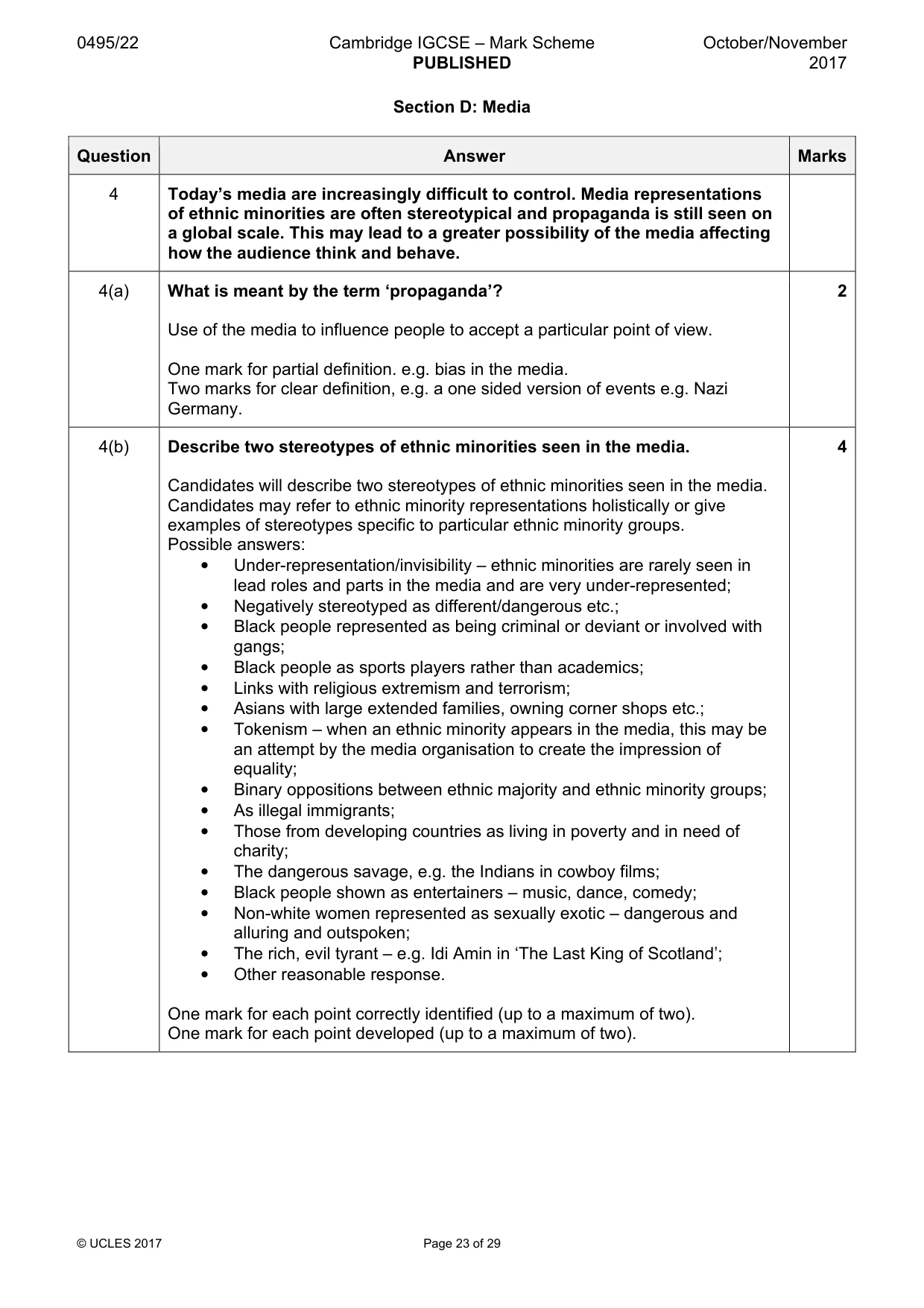
4 Today’s media are increasingly difficult to control. Media representations of ethnic minorities are often stereotypical and propaganda is still seen on a global scale. This may lead to a greater possibility of the media affecting how the audience think and behave. (a) What is meant by the term ‘propaganda’? [2] (b) Describe two stereotypes of ethnic minorities seen in the media. [4] (c) Explain how globalisation is changing media content. [6] (d) Explain why governments try to control the content of the media. [8] (e) To what extent do the media shape the audience’s attitudes and behaviour? [15]
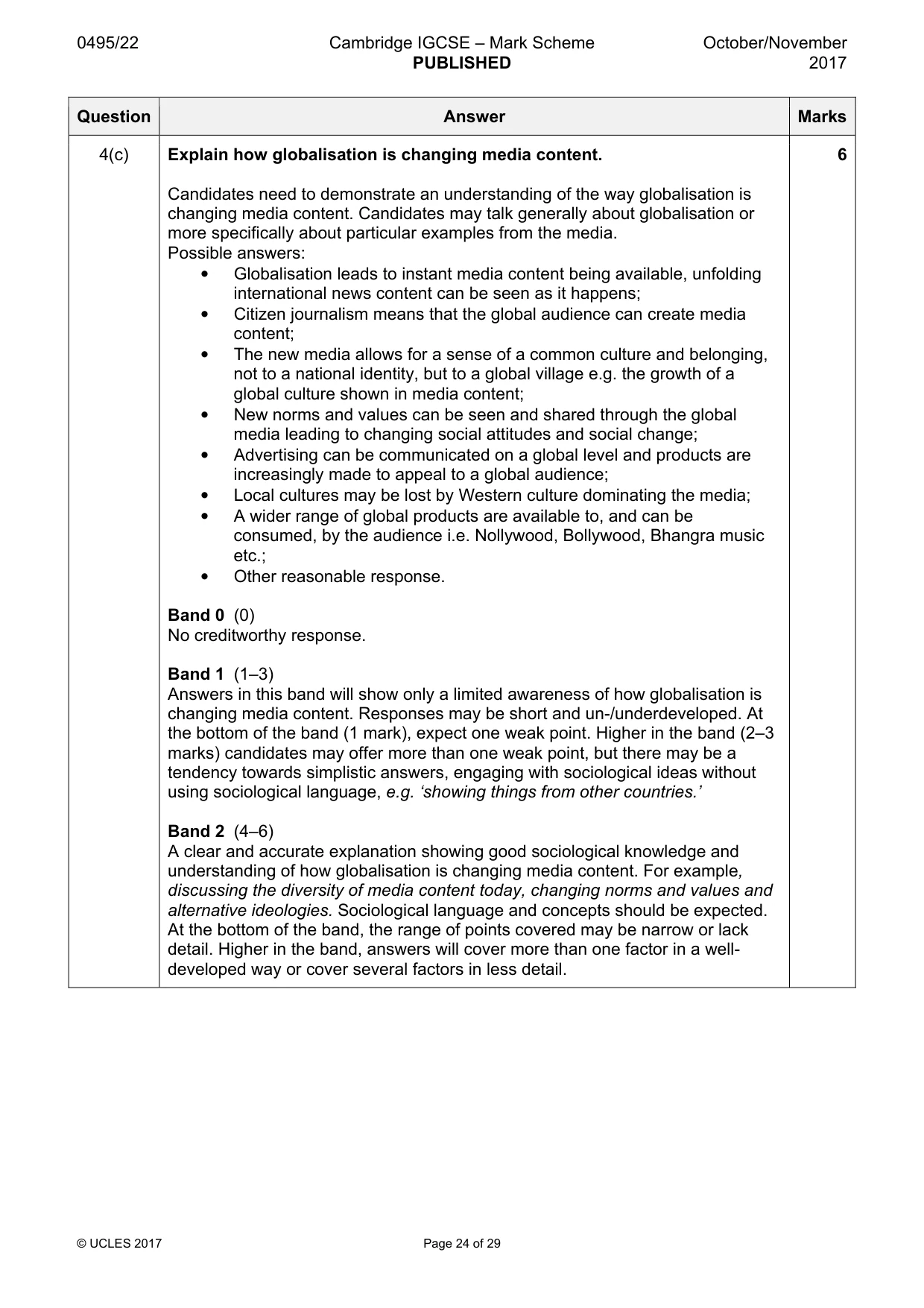
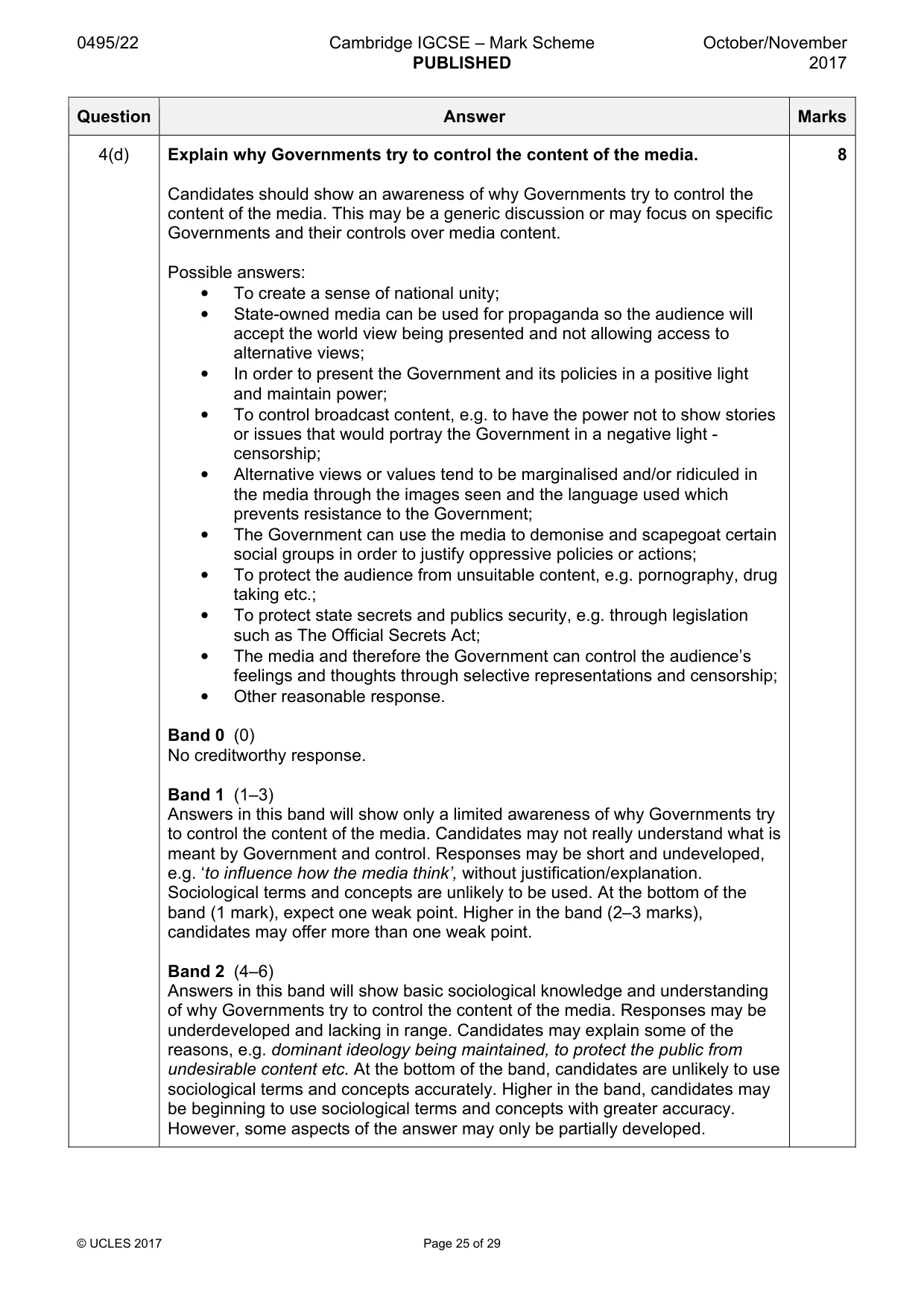
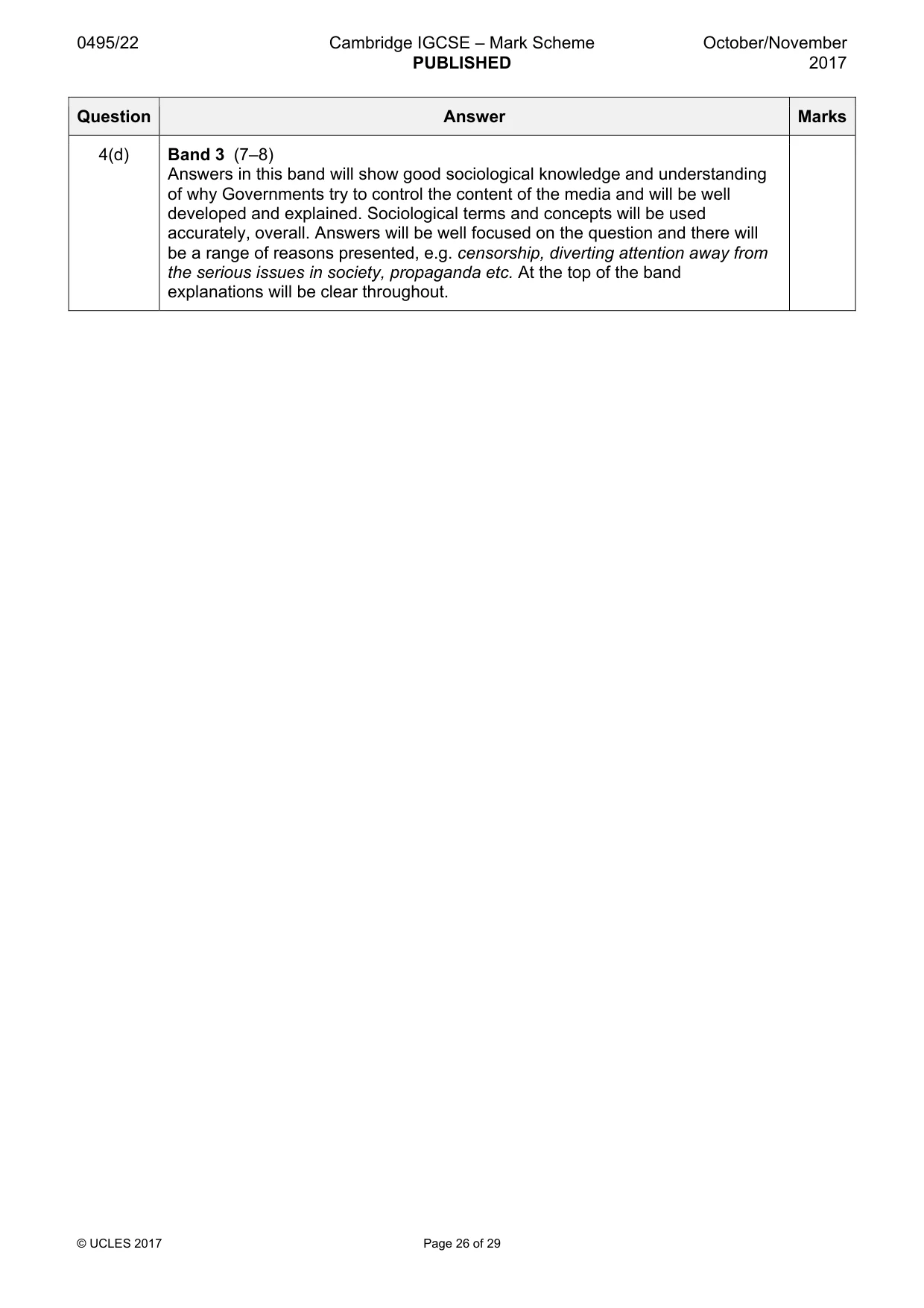
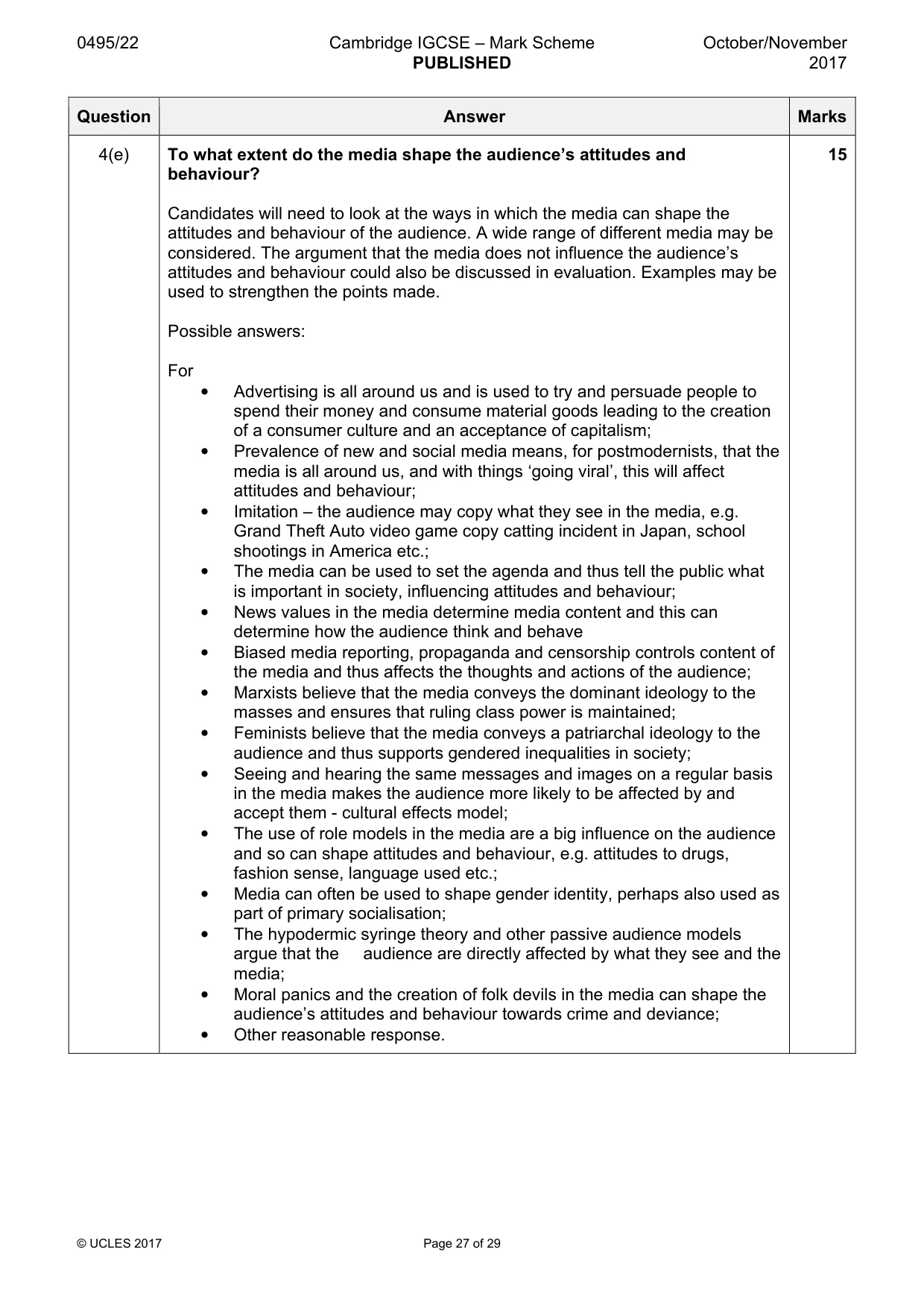
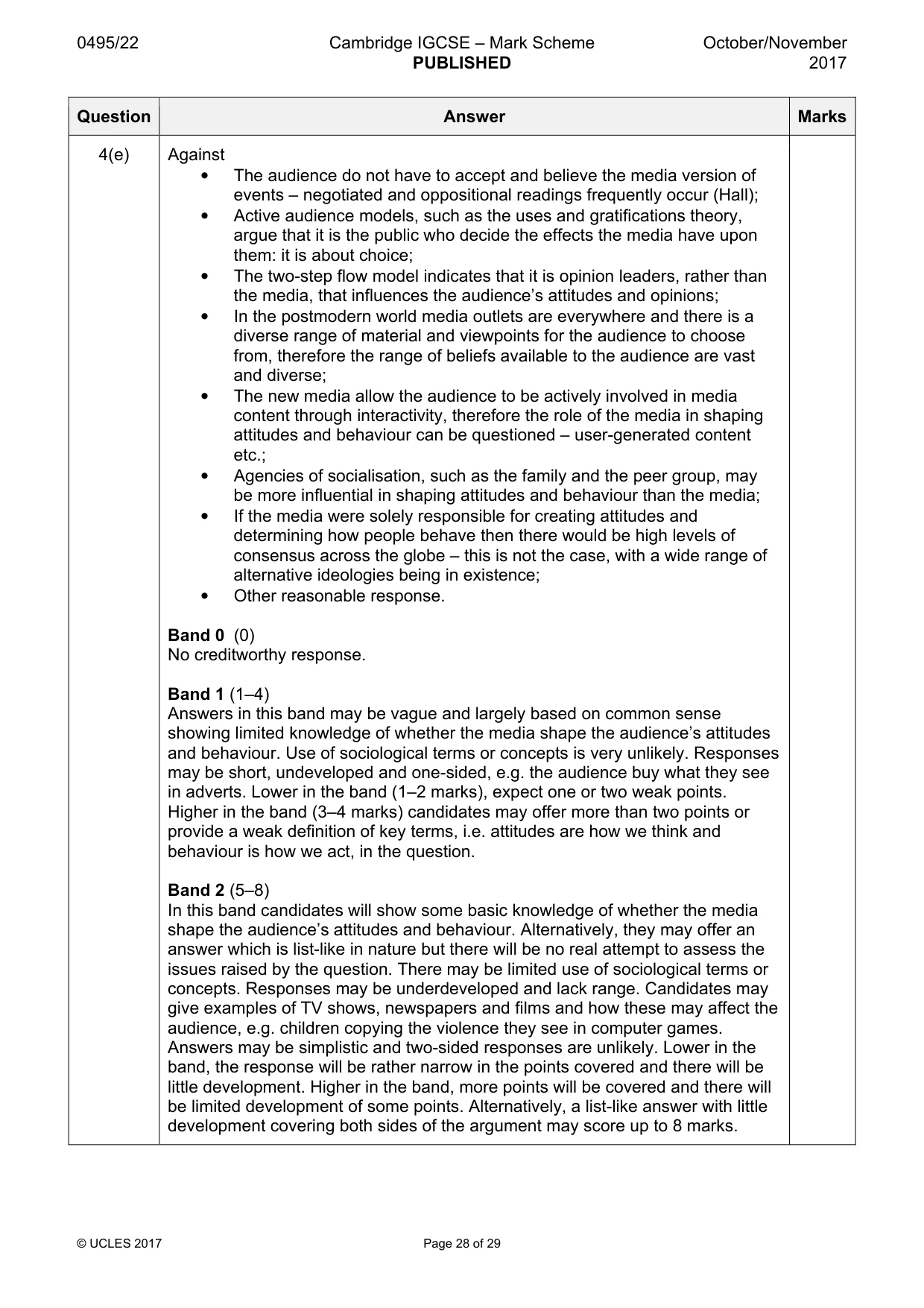
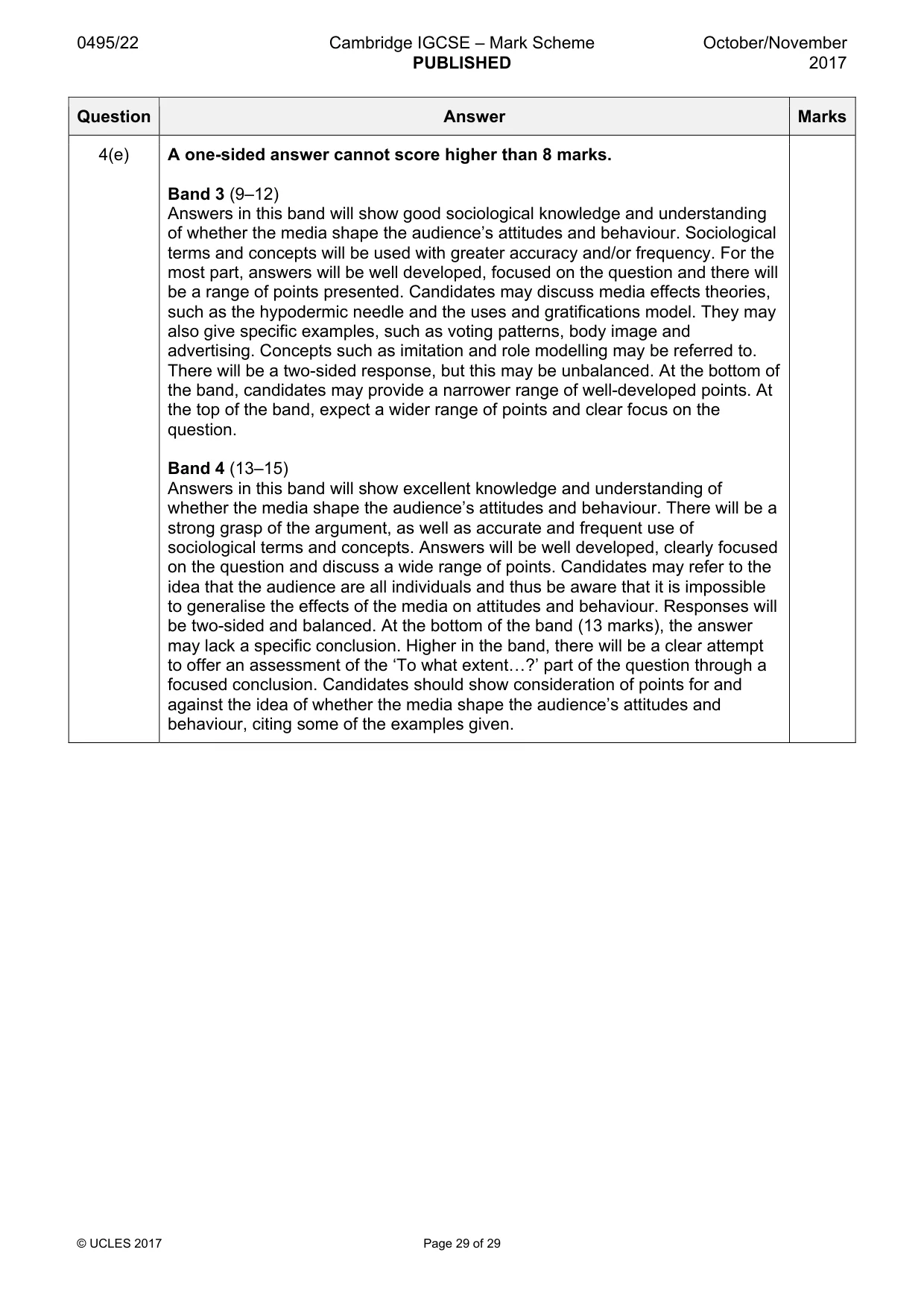
Mark scheme: 4(a) What is meant by the term ‘propaganda’? 2 Use of the media to influence people to accept a particular point of view. One mark for partial definition. e.g. bias in the media. Two marks for clear definition, e.g. a one sided version of events e.g. Nazi Germany. 4(b) Describe two stereotypes of ethnic minorities seen in the media. 4 Candidates will describe two stereotypes of ethnic minorities seen in the media. Candidates may refer to ethnic minority representations holistically or give examples of stereotypes specific to particular ethnic minority groups. Possible answers: • Under-representation/invisibility – ethnic minorities are rarely seen in lead roles and parts in the media and are very under-represented; • Negatively stereotyped as different/dangerous etc.; • Black people represented as being criminal or deviant or involved with gangs; • Black people as sports players rather than academics; • Links with religious extremism and terrorism; • Asians with large extended families, owning corner shops etc.; • Tokenism – when an ethnic minority appears in the media, this may be an attempt by the media organisation to create the impression of equality; • Binary oppositions between ethnic majority and ethnic minority groups; • As illegal immigrants; • Those from developing countries as living in poverty and in need of charity; • The dangerous savage, e.g. the Indians in cowboy films; • Black people shown as entertainers – music, dance, comedy; • Non-white women represented as sexually exotic – dangerous and alluring and outspoken; • The rich, evil tyrant – e.g. Idi Amin in ‘The Last King of Scotland’; • Other reasonable response. One mark for each point correctly identified (up to a maximum of two). One mark for each point developed (up to a maximum of two). 4(c) Explain how globalisation is changing media content. 6 Candidates need to demonstrate an understanding of the way globalisation is changing media content. Candidates may talk generally about globalisation or more specifically about particular examples from the media. Possible answers: • Globalisation leads to instant media content being available, unfolding international news content can be seen as it happens; • Citizen journalism means that the global audience can create media content; • The new media allows for a sense of a common culture and belonging, not to a national identity, but to a global village e.g. the growth of a global culture shown in media content; • New norms and values can be seen and shared through the global media leading to changing social attitudes and social change; • Advertising can be communicated on a global level and products are increasingly made to appeal to a global audience; • Local cultures may be lost by Western culture dominating the media; • A wider range of global products are available to, and can be consumed, by the audience i.e. Nollywood, Bollywood, Bhangra music etc.; • Other reasonable response. Band 0 (0) No creditworthy response. Band 1 (1–3) Answers in this band will show only a limited awareness of how globalisation is changing media content. Responses may be short and un-/underdeveloped. At the bottom of the band (1 mark), expect one weak point. Higher in the band (2–3 marks) candidates may offer more than one weak point, but there may be a tendency towards simplistic answers, engaging with sociological ideas without using sociological language, e.g. ‘showing things from other countries.’ Band 2 (4–6) A clear and accurate explanation showing good sociological knowledge and understanding of how globalisation is changing media content. For example, discussing the diversity of media content today, changing norms and values and alternative ideologies. Sociological language and concepts should be expected. At the bottom of the band, the range of points covered may be narrow or lack detail. Higher in the band, answers will cover more than one factor in a well- developed way or cover several factors in less detail. 4(d) Explain why Governments try to control the content of the media. 8 Candidates should show an awareness of why Governments try to control the content of the media. This may be a generic discussion or may focus on specific Governments and their controls over media content. Possible answers: • To create a sense of national unity; • State-owned media can be used for propaganda so the audience will accept the world view being presented and not allowing access to alternative views; • In order to present the Government and its policies in a positive light and maintain power; • To control broadcast content, e.g. to have the power not to show stories or issues that would portray the Government in a negative light - censorship; • Alternative views or values tend to be marginalised and/or ridiculed in the media through the images seen and the language used which prevents resistance to the Government; • The Government can use the media to demonise and scapegoat certain social groups in order to justify oppressive policies or actions; • To protect the audience from unsuitable content, e.g. pornography, drug taking etc.; • To protect state secrets and publics security, e.g. through legislation such as The Official Secrets Act; • The media and therefore the Government can control the audience’s feelings and thoughts through selective representations and censorship; • Other reasonable response. Band 0 (0) No creditworthy response. Band 1 (1–3) Answers in this band will show only a limited awareness of why Governments try to control the content of the media. Candidates may not really understand what is meant by Government and control. Responses may be short and undeveloped, e.g. ‘to influence how the media think’, without justification/explanation. Sociological terms and concepts are unlikely to be used. At the bottom of the band (1 mark), expect one weak point. Higher in the band (2–3 marks), candidates may offer more than one weak point. Band 2 (4–6) Answers in this band will show basic sociological knowledge and understanding of why Governments try to control the content of the media. Responses may be underdeveloped and lacking in range. Candidates may explain some of the reasons, e.g. dominant ideology being maintained, to protect the public from undesirable content etc. At the bottom of the band, candidates are unlikely to use sociological terms and concepts accurately. Higher in the band, candidates may be beginning to use sociological terms and concepts with greater accuracy. However, some aspects of the answer may only be partially developed. 4(d) Band 3 (7–8) Answers in this band will show good sociological knowledge and understanding of why Governments try to control the content of the media and will be well developed and explained. Sociological terms and concepts will be used accurately, overall. Answers will be well focused on the question and there will be a range of reasons presented, e.g. censorship, diverting attention away from the serious issues in society, propaganda etc. At the top of the band explanations will be clear throughout. 4(e) To what extent do the media shape the audience’s attitudes and 15 behaviour? Candidates will need to look at the ways in which the media can shape the attitudes and behaviour of the audience. A wide range of different media may be considered. The argument that the media does not influence the audience’s attitudes and behaviour could also be discussed in evaluation. Examples may be used to strengthen the points made. Possible answers: For • Advertising is all around us and is used to try and persuade people to spend their money and consume material goods leading to the creation of a consumer culture and an acceptance of capitalism; • Prevalence of new and social media means, for postmodernists, that the media is all around us, and with things ‘going viral’, this will affect attitudes and behaviour; • Imitation – the audience may copy what they see in the media, e.g. Grand Theft Auto video game copy catting incident in Japan, school shootings in America etc.; • The media can be used to set the agenda and thus tell the public what is important in society, influencing attitudes and behaviour; • News values in the media determine media content and this can determine how the audience think and behave • Biased media reporting, propaganda and censorship controls content of the media and thus affects the thoughts and actions of the audience; • Marxists believe that the media conveys the dominant ideology to the masses and ensures that ruling class power is maintained; • Feminists believe that the media conveys a patriarchal ideology to the audience and thus supports gendered inequalities in society; • Seeing and hearing the same messages and images on a regular basis in the media makes the audience more likely to be affected by and accept them - cultural effects model; • The use of role models in the media are a big influence on the audience and so can shape attitudes and behaviour, e.g. attitudes to drugs, fashion sense, language used etc.; • Media can often be used to shape gender identity, perhaps also used as part of primary socialisation; • The hypodermic syringe theory and other passive audience models argue that the audience are directly affected by what they see and the media; • Moral panics and the creation of folk devils in the media can shape the audience’s attitudes and behaviour towards crime and deviance; • Other reasonable response. 4(e) Against • The audience do not have to accept and believe the media version of events – negotiated and oppositional readings frequently occur (Hall); • Active audience models, such as the uses and gratifications theory, argue that it is the public who decide the effects the media have upon them: it is about choice; • The two-step flow model indicates that it is opinion leaders, rather than the media, that influences the audience’s attitudes and opinions; • In the postmodern world media outlets are everywhere and there is a diverse range of material and viewpoints for the audience to choose from, therefore the range of beliefs available to the audience are vast and diverse; • The new media allow the audience to be actively involved in media content through interactivity, therefore the role of the media in shaping attitudes and behaviour can be questioned – user-generated content etc.; • Agencies of socialisation, such as the family and the peer group, may be more influential in shaping attitudes and behaviour than the media; • If the media were solely responsible for creating attitudes and determining how people behave then there would be high levels of consensus across the globe – this is not the case, with a wide range of alternative ideologies being in existence; • Other reasonable response. Band 0 (0) No creditworthy response. Band 1 (1–4) Answers in this band may be vague and largely based on common sense showing limited knowledge of whether the media shape the audience’s attitudes and behaviour. Use of sociological terms or concepts is very unlikely. Responses may be short, undeveloped and one-sided, e.g. the audience buy what they see in adverts. Lower in the band (1–2 marks), expect one or two weak points. Higher in the band (3–4 marks) candidates may offer more than two points or provide a weak definition of key terms, i.e. attitudes are how we think and behaviour is how we act, in the question. Band 2 (5–8) In this band candidates will show some basic knowledge of whether the media shape the audience’s attitudes and behaviour. Alternatively, they may offer an answer which is list-like in nature but there will be no real attempt to assess the issues raised by the question. There may be limited use of sociological terms or concepts. Responses may be underdeveloped and lack range. Candidates may give examples of TV shows, newspapers and films and how these may affect the audience, e.g. children copying the violence they see in computer games. Answers may be simplistic and two-sided responses are unlikely. Lower in the band, the response will be rather narrow in the points covered and there will be little development. Higher in the band, more points will be covered and there will be limited development of some points. Alternatively, a list-like answer with little development covering both sides of the argument may score up to 8 marks. 4(e) A one-sided answer cannot score higher than 8 marks. Band 3 (9–12) Answers in this band will show good sociological knowledge and understanding of whether the media shape the audience’s attitudes and behaviour. Sociological terms and concepts will be used with greater accuracy and/or frequency. For the most part, answers will be well developed, focused on the question and there will be a range of points presented. Candidates may discuss media effects theories, such as the hypodermic needle and the uses and gratifications model. They may also give specific examples, such as voting patterns, body image and advertising. Concepts such as imitation and role modelling may be referred to. There will be a two-sided response, but this may be unbalanced. At the bottom of the band, candidates may provide a narrower range of well-developed points. At the top of the band, expect a wider range of points and clear focus on the question. Band 4 (13–15) Answers in this band will show excellent knowledge and understanding of whether the media shape the audience’s attitudes and behaviour. There will be a strong grasp of the argument, as well as accurate and frequent use of sociological terms and concepts. Answers will be well developed, clearly focused on the question and discuss a wide range of points. Candidates may refer to the idea that the audience are all individuals and thus be aware that it is impossible to generalise the effects of the media on attitudes and behaviour. Responses will be two-sided and balanced. At the bottom of the band (13 marks), the answer may lack a specific conclusion. Higher in the band, there will be a clear attempt to offer an assessment of the ‘To what extent«?’ part of the question through a focused conclusion. Candidates should show consideration of points for and against the idea of whether the media shape the audience’s attitudes and behaviour, citing some of the examples given.
More questions on What types of data and evidence do sociologists use?
What was in this paper
The subtopics covered by these 4 questions, and how many questions each got. Open one in a new tab to see every Cambridge question on it.
What you needed in this session
Cambridge’s own grade thresholds for 2017 Oct/Nov, Paper 2 · Variant 2. A higher threshold means an easier paper — the bar moves with how the cohort did.