Cambridge IGCSE Sociology 0495 — 2016 Oct/Nov Paper 2 · Variant 1
0495/21/O/N/16 · 70 marks · ≈79 min
The question paper and its mark scheme, free to read here and free to download. This is Cambridge’s own paper, exactly as it was sat.
Question paper4 pages

Mark scheme21 pages
Answers below. Sit the paper first if you are practising.
Paper as text
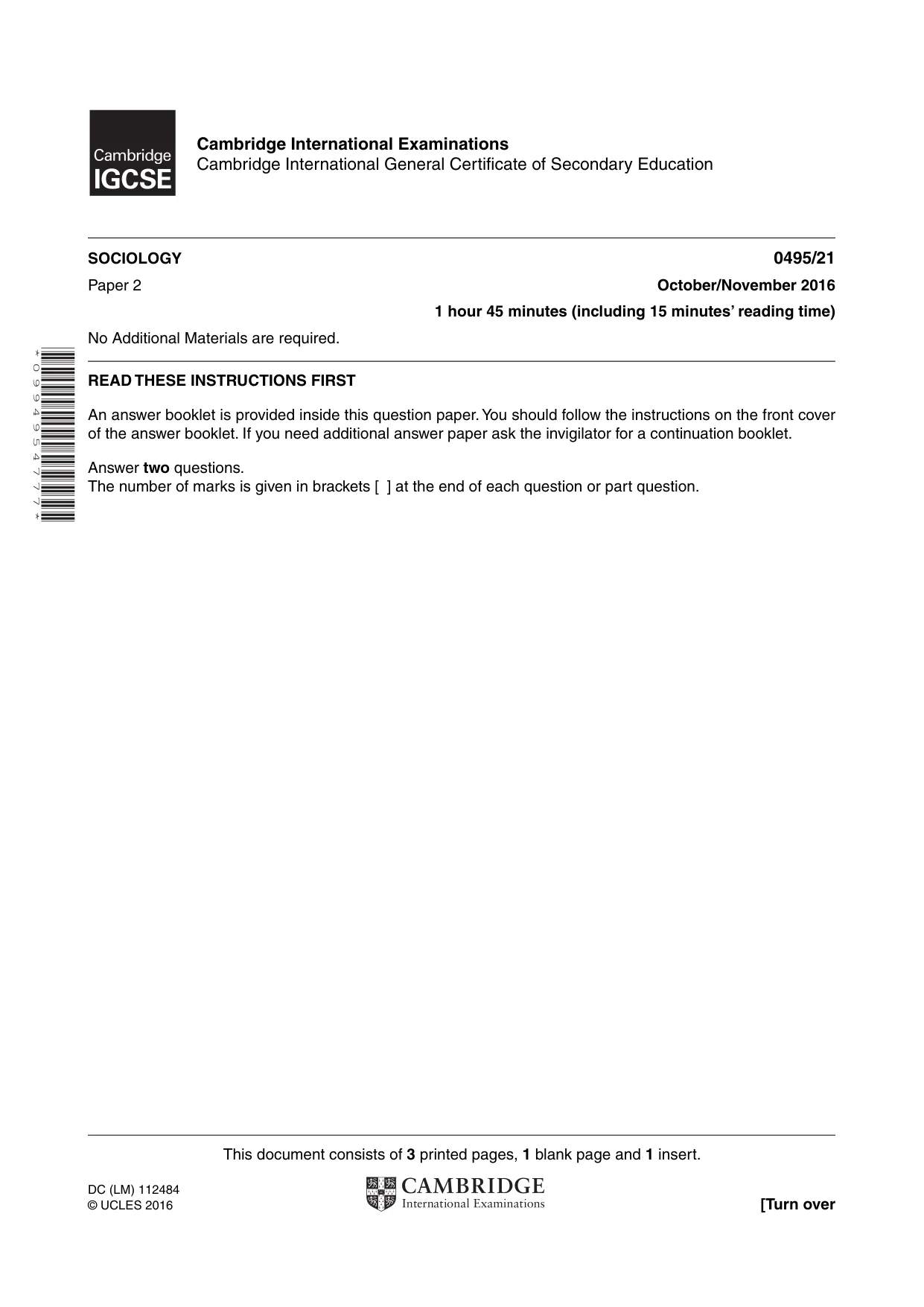
Question paper, page 1
This document consists of 3 printed pages, 1 blank page and 1 insert. DC (LM) 112484 © UCLES 2016 [Turn over Cambridge International Examinations Cambridge International General Certificate of Secondary Education * 0 9 9 4 9 5 4 7 7 7 * SOCIOLOGY 0495/21 Paper 2 October/November 2016 1 hour 45 minutes (including 15 minutes’ reading time) No Additional Materials are required. READ THESE INSTRUCTIONS FIRST An answer booklet is provided inside this question paper. You should follow the instructions on the front cover of the answer booklet. If you need additional answer paper ask the invigilator for a continuation booklet. Answer two questions. The number of marks is given in brackets [ ] at the end of each question or part question.
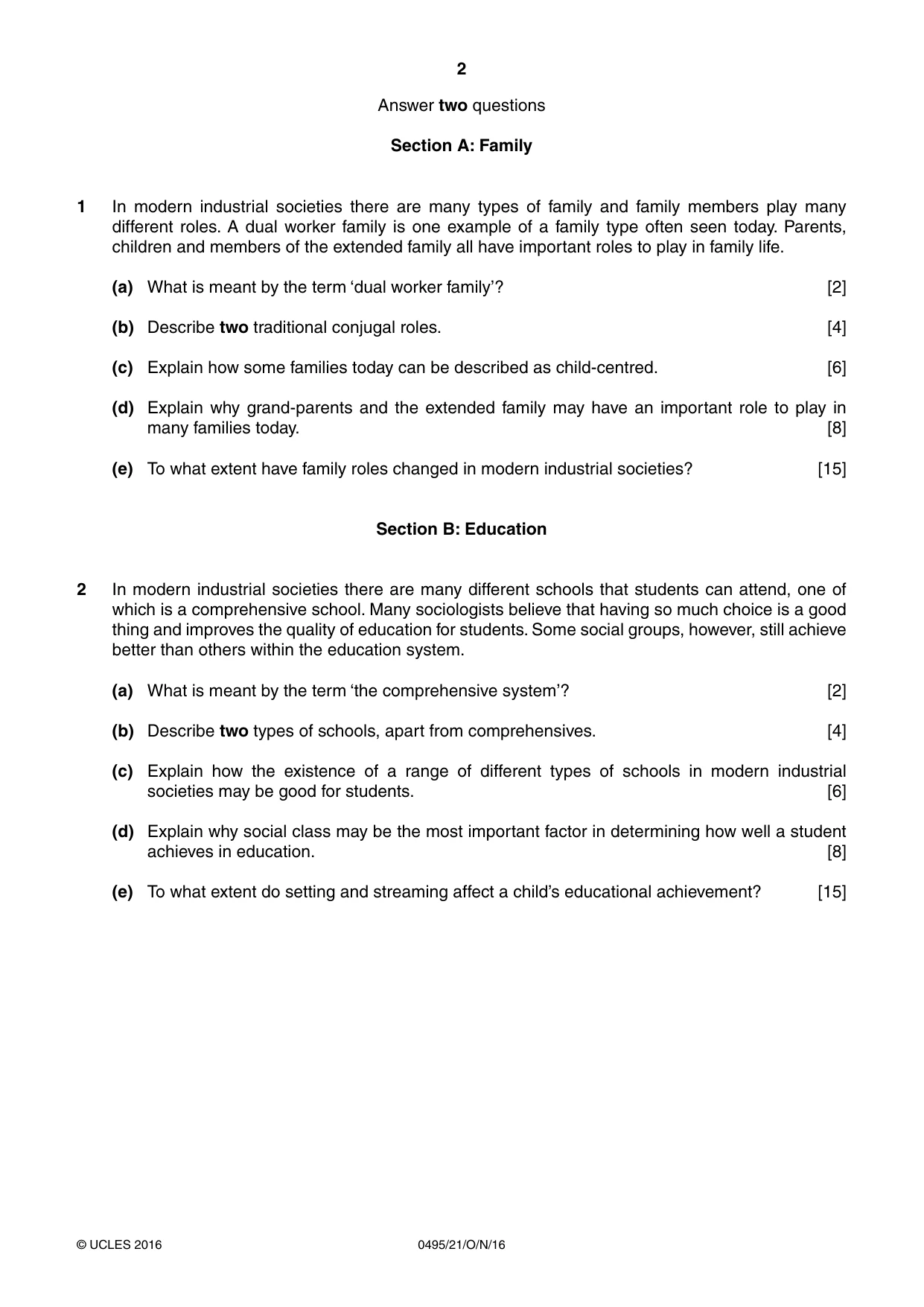
Question paper, page 2
2 0495/21/O/N/16 © UCLES 2016 Answer two questions Section A: Family 1 In modern industrial societies there are many types of family and family members play many different roles. A dual worker family is one example of a family type often seen today. Parents, children and members of the extended family all have important roles to play in family life. (a) What is meant by the term ‘dual worker family’? [2] (b) Describe two traditional conjugal roles. [4] (c) Explain how some families today can be described as child-centred. [6] (d) Explain why grand-parents and the extended family may have an important role to play in many families today. [8] (e) To what extent have family roles changed in modern industrial societies? [15] Section B: Education 2 In modern industrial societies there are many different schools that students can attend, one of which is a comprehensive school. Many sociologists believe that having so much choice is a good thing and improves the quality of education for students. Some social groups, however, still achieve better than others within the education system. (a) What is meant by the term ‘the comprehensive system’? [2] (b) Describe two types of schools, apart from comprehensives. [4] (c) Explain how the existence of a range of different types of schools in modern industrial societies may be good for students. [6] (d) Explain why social class may be the most important factor in determining how well a student achieves in education. [8] (e) To what extent do setting and streaming affect a child’s educational achievement? [15]
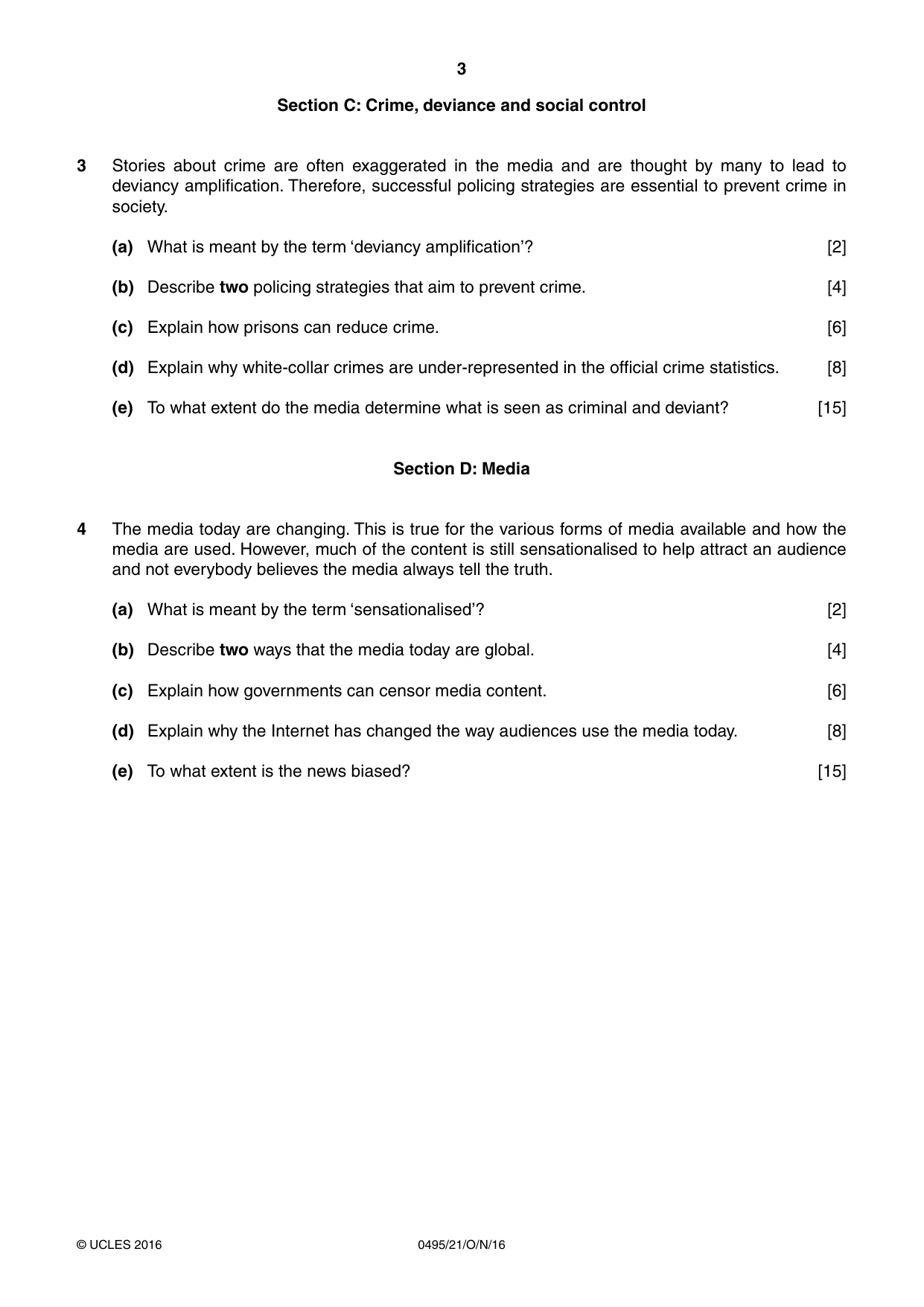
Question paper, page 3
3 0495/21/O/N/16 © UCLES 2016 Section C: Crime, deviance and social control 3 Stories about crime are often exaggerated in the media and are thought by many to lead to deviancy amplification. Therefore, successful policing strategies are essential to prevent crime in society. (a) What is meant by the term ‘deviancy amplification’? [2] (b) Describe two policing strategies that aim to prevent crime. [4] (c) Explain how prisons can reduce crime. [6] (d) Explain why white-collar crimes are under-represented in the official crime statistics. [8] (e) To what extent do the media determine what is seen as criminal and deviant? [15] Section D: Media 4 The media today are changing. This is true for the various forms of media available and how the media are used. However, much of the content is still sensationalised to help attract an audience and not everybody believes the media always tell the truth. (a) What is meant by the term ‘sensationalised’? [2] (b) Describe two ways that the media today are global. [4] (c) Explain how governments can censor media content. [6] (d) Explain why the Internet has changed the way audiences use the media today. [8] (e) To what extent is the news biased? [15]
Question paper, page 4
4 0495/21/O/N/16 © UCLES 2016 BLANK PAGE Permission to reproduce items where third-party owned material protected by copyright is included has been sought and cleared where possible. Every reasonable effort has been made by the publisher (UCLES) to trace copyright holders, but if any items requiring clearance have unwittingly been included, the publisher will be pleased to make amends at the earliest possible opportunity. To avoid the issue of disclosure of answer-related information to candidates, all copyright acknowledgements are reproduced online in the Cambridge International Examinations Copyright Acknowledgements Booklet. This is produced for each series of examinations and is freely available to download at www.cie.org.uk after the live examination series. Cambridge International Examinations is part of the Cambridge Assessment Group. Cambridge Assessment is the brand name of University of Cambridge Local Examinations Syndicate (UCLES), which is itself a department of the University of Cambridge.
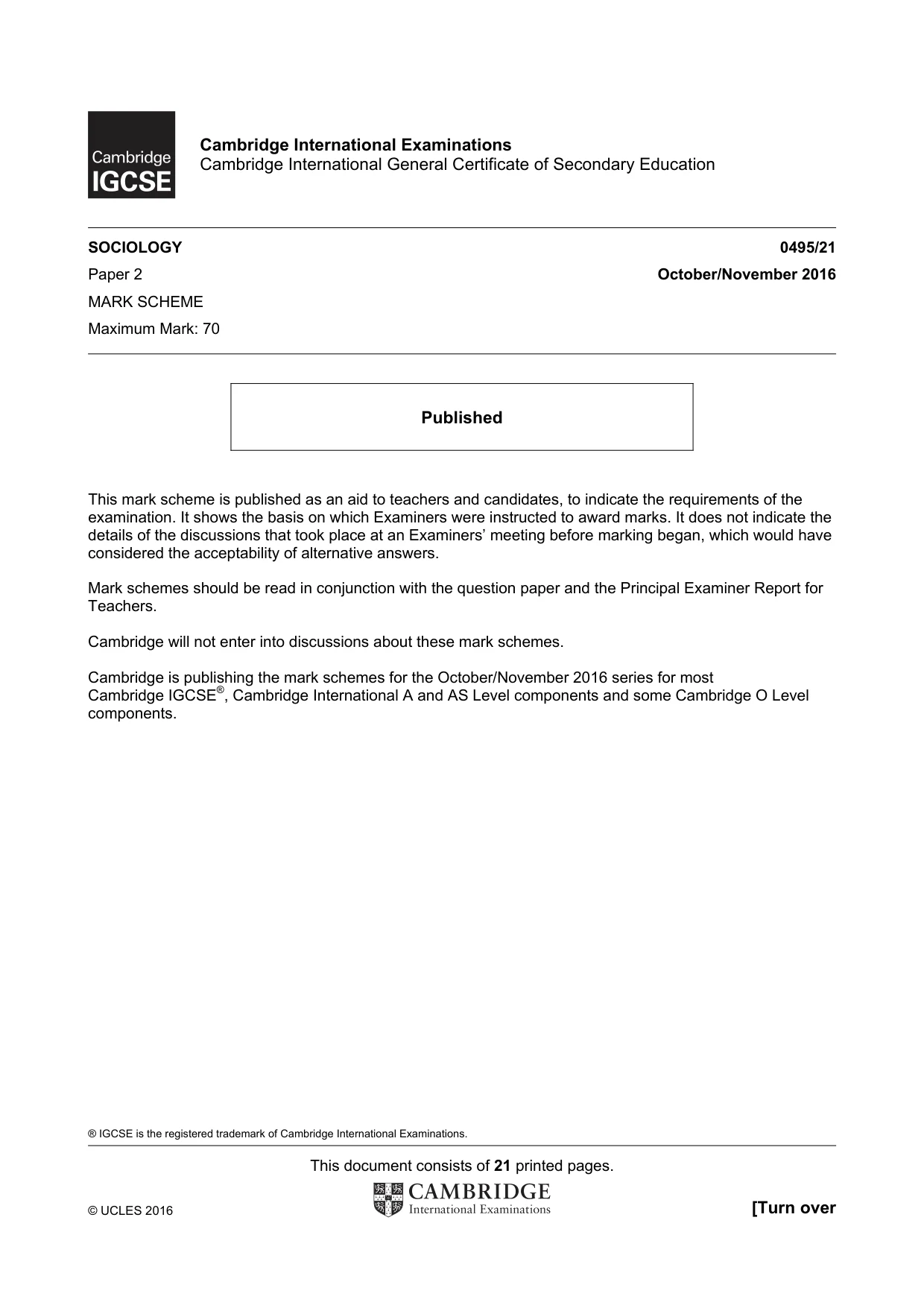
Mark scheme, page 1
® IGCSE is the registered trademark of Cambridge International Examinations. This document consists of 21 printed pages. © UCLES 2016 [Turn over Cambridge International Examinations Cambridge International General Certificate of Secondary Education SOCIOLOGY 0495/21 Paper 2 October/November 2016 MARK SCHEME Maximum Mark: 70 Published This mark scheme is published as an aid to teachers and candidates, to indicate the requirements of the examination. It shows the basis on which Examiners were instructed to award marks. It does not indicate the details of the discussions that took place at an Examiners’ meeting before marking began, which would have considered the acceptability of alternative answers. Mark schemes should be read in conjunction with the question paper and the Principal Examiner Report for Teachers. Cambridge will not enter into discussions about these mark schemes. Cambridge is publishing the mark schemes for the October/November 2016 series for most Cambridge IGCSE®, Cambridge International A and AS Level components and some Cambridge O Level components.
Mark scheme, page 2
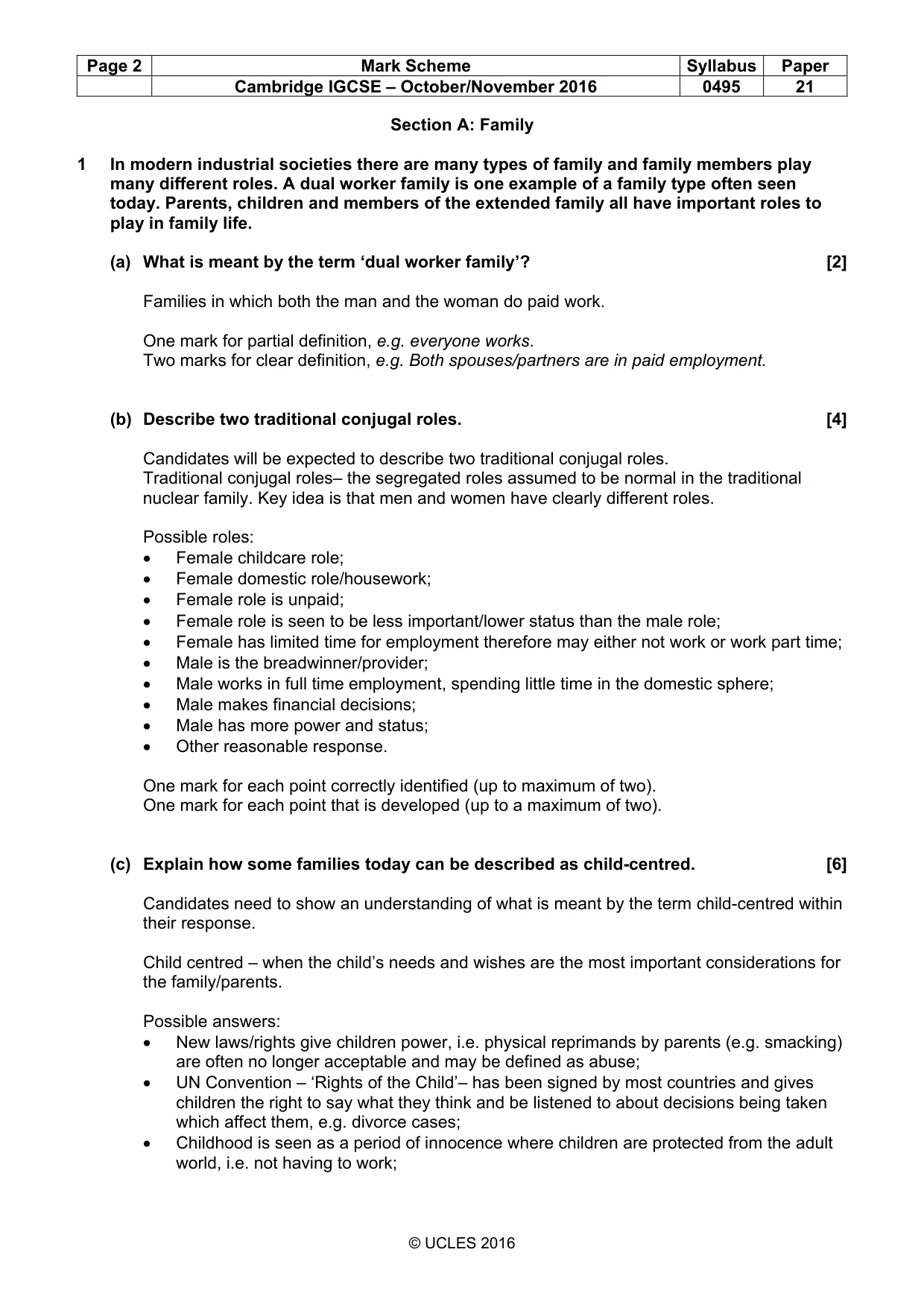
Page 2 Mark Scheme Syllabus Paper Cambridge IGCSE – October/November 2016 0495 21 © UCLES 2016 Section A: Family 1 In modern industrial societies there are many types of family and family members play many different roles. A dual worker family is one example of a family type often seen today. Parents, children and members of the extended family all have important roles to play in family life. (a) What is meant by the term ‘dual worker family’? [2] Families in which both the man and the woman do paid work. One mark for partial definition, e.g. everyone works. Two marks for clear definition, e.g. Both spouses/partners are in paid employment. (b) Describe two traditional conjugal roles. [4] Candidates will be expected to describe two traditional conjugal roles. Traditional conjugal roles– the segregated roles assumed to be normal in the traditional nuclear family. Key idea is that men and women have clearly different roles. Possible roles: • Female childcare role; • Female domestic role/housework; • Female role is unpaid; • Female role is seen to be less important/lower status than the male role; • Female has limited time for employment therefore may either not work or work part time; • Male is the breadwinner/provider; • Male works in full time employment, spending little time in the domestic sphere; • Male makes financial decisions; • Male has more power and status; • Other reasonable response. One mark for each point correctly identified (up to maximum of two). One mark for each point that is developed (up to a maximum of two). (c) Explain how some families today can be described as child-centred. [6] Candidates need to show an understanding of what is meant by the term child-centred within their response. Child centred – when the child’s needs and wishes are the most important considerations for the family/parents. Possible answers: • New laws/rights give children power, i.e. physical reprimands by parents (e.g. smacking) are often no longer acceptable and may be defined as abuse; • UN Convention – ‘Rights of the Child’– has been signed by most countries and gives children the right to say what they think and be listened to about decisions being taken which affect them, e.g. divorce cases; • Childhood is seen as a period of innocence where children are protected from the adult world, i.e. not having to work;
Mark scheme, page 3
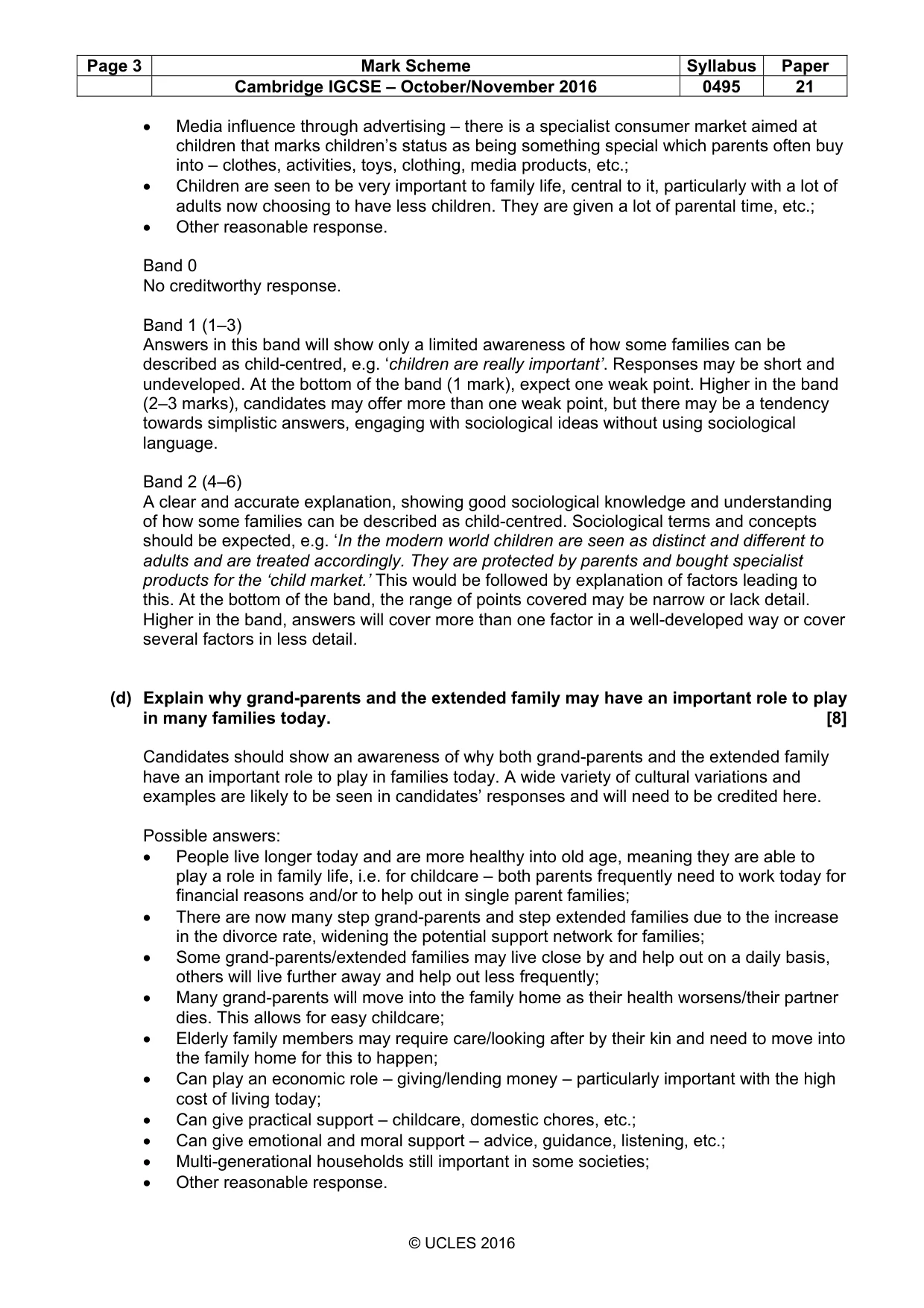
Page 3 Mark Scheme Syllabus Paper Cambridge IGCSE – October/November 2016 0495 21 © UCLES 2016 • Media influence through advertising – there is a specialist consumer market aimed at children that marks children’s status as being something special which parents often buy into – clothes, activities, toys, clothing, media products, etc.; • Children are seen to be very important to family life, central to it, particularly with a lot of adults now choosing to have less children. They are given a lot of parental time, etc.; • Other reasonable response. Band 0 No creditworthy response. Band 1 (1–3) Answers in this band will show only a limited awareness of how some families can be described as child-centred, e.g. ‘children are really important’. Responses may be short and undeveloped. At the bottom of the band (1 mark), expect one weak point. Higher in the band (2–3 marks), candidates may offer more than one weak point, but there may be a tendency towards simplistic answers, engaging with sociological ideas without using sociological language. Band 2 (4–6) A clear and accurate explanation, showing good sociological knowledge and understanding of how some families can be described as child-centred. Sociological terms and concepts should be expected, e.g. ‘In the modern world children are seen as distinct and different to adults and are treated accordingly. They are protected by parents and bought specialist products for the ‘child market.’ This would be followed by explanation of factors leading to this. At the bottom of the band, the range of points covered may be narrow or lack detail. Higher in the band, answers will cover more than one factor in a well-developed way or cover several factors in less detail. (d) Explain why grand-parents and the extended family may have an important role to play in many families today. [8] Candidates should show an awareness of why both grand-parents and the extended family have an important role to play in families today. A wide variety of cultural variations and examples are likely to be seen in candidates’ responses and will need to be credited here. Possible answers: • People live longer today and are more healthy into old age, meaning they are able to play a role in family life, i.e. for childcare – both parents frequently need to work today for financial reasons and/or to help out in single parent families; • There are now many step grand-parents and step extended families due to the increase in the divorce rate, widening the potential support network for families; • Some grand-parents/extended families may live close by and help out on a daily basis, others will live further away and help out less frequently; • Many grand-parents will move into the family home as their health worsens/their partner dies. This allows for easy childcare; • Elderly family members may require care/looking after by their kin and need to move into the family home for this to happen; • Can play an economic role – giving/lending money – particularly important with the high cost of living today; • Can give practical support – childcare, domestic chores, etc.; • Can give emotional and moral support – advice, guidance, listening, etc.; • Multi-generational households still important in some societies; • Other reasonable response.
Mark scheme, page 4
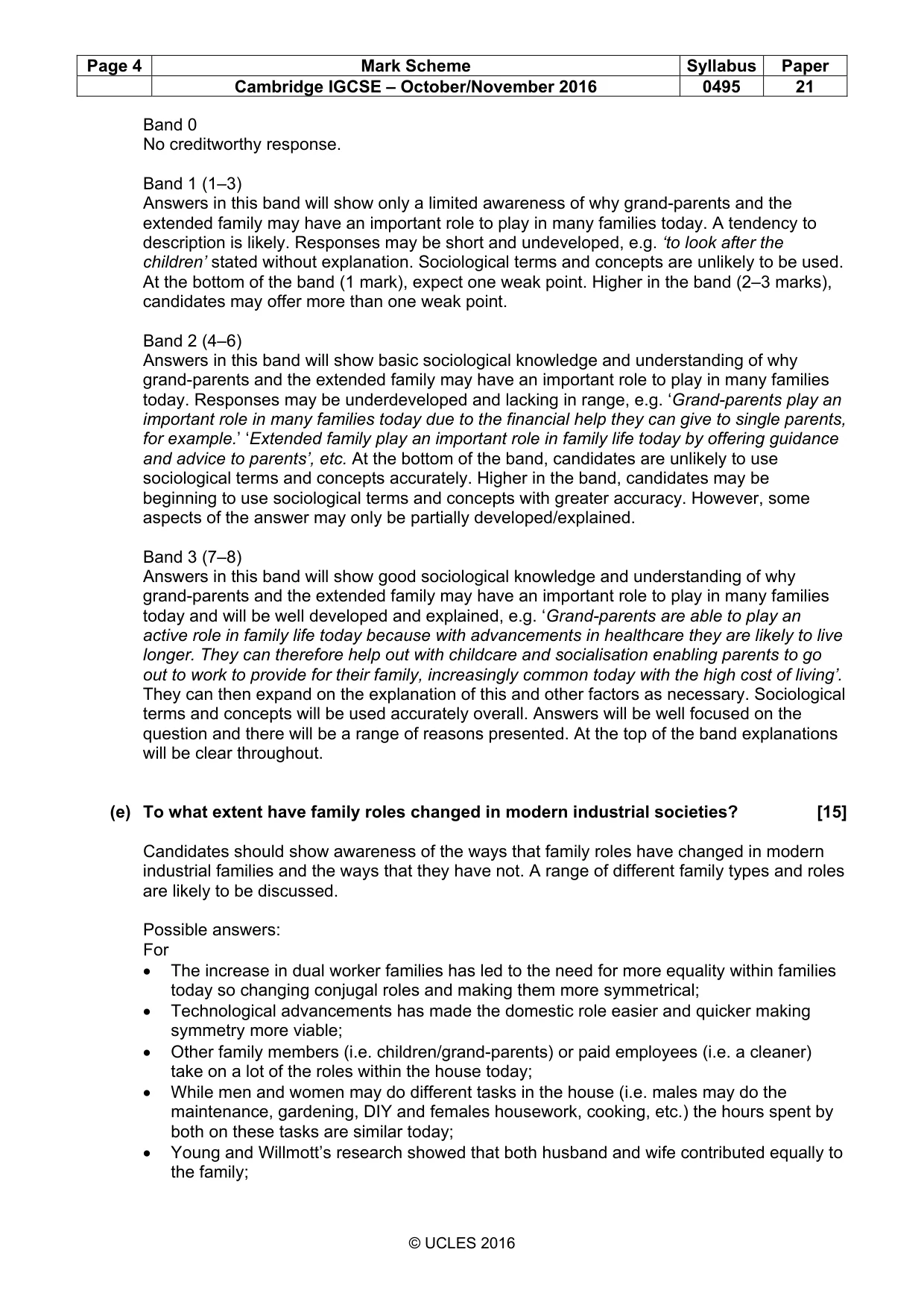
Page 4 Mark Scheme Syllabus Paper Cambridge IGCSE – October/November 2016 0495 21 © UCLES 2016 Band 0 No creditworthy response. Band 1 (1–3) Answers in this band will show only a limited awareness of why grand-parents and the extended family may have an important role to play in many families today. A tendency to description is likely. Responses may be short and undeveloped, e.g. ‘to look after the children’ stated without explanation. Sociological terms and concepts are unlikely to be used. At the bottom of the band (1 mark), expect one weak point. Higher in the band (2–3 marks), candidates may offer more than one weak point. Band 2 (4–6) Answers in this band will show basic sociological knowledge and understanding of why grand-parents and the extended family may have an important role to play in many families today. Responses may be underdeveloped and lacking in range, e.g. ‘Grand-parents play an important role in many families today due to the financial help they can give to single parents, for example.’ ‘Extended family play an important role in family life today by offering guidance and advice to parents’, etc. At the bottom of the band, candidates are unlikely to use sociological terms and concepts accurately. Higher in the band, candidates may be beginning to use sociological terms and concepts with greater accuracy. However, some aspects of the answer may only be partially developed/explained. Band 3 (7–8) Answers in this band will show good sociological knowledge and understanding of why grand-parents and the extended family may have an important role to play in many families today and will be well developed and explained, e.g. ‘Grand-parents are able to play an active role in family life today because with advancements in healthcare they are likely to live longer. They can therefore help out with childcare and socialisation enabling parents to go out to work to provide for their family, increasingly common today with the high cost of living’. They can then expand on the explanation of this and other factors as necessary. Sociological terms and concepts will be used accurately overall. Answers will be well focused on the question and there will be a range of reasons presented. At the top of the band explanations will be clear throughout. (e) To what extent have family roles changed in modern industrial societies? [15] Candidates should show awareness of the ways that family roles have changed in modern industrial families and the ways that they have not. A range of different family types and roles are likely to be discussed. Possible answers: For • The increase in dual worker families has led to the need for more equality within families today so changing conjugal roles and making them more symmetrical; • Technological advancements has made the domestic role easier and quicker making symmetry more viable; • Other family members (i.e. children/grand-parents) or paid employees (i.e. a cleaner) take on a lot of the roles within the house today; • While men and women may do different tasks in the house (i.e. males may do the maintenance, gardening, DIY and females housework, cooking, etc.) the hours spent by both on these tasks are similar today; • Young and Willmott’s research showed that both husband and wife contributed equally to the family;
Mark scheme, page 5
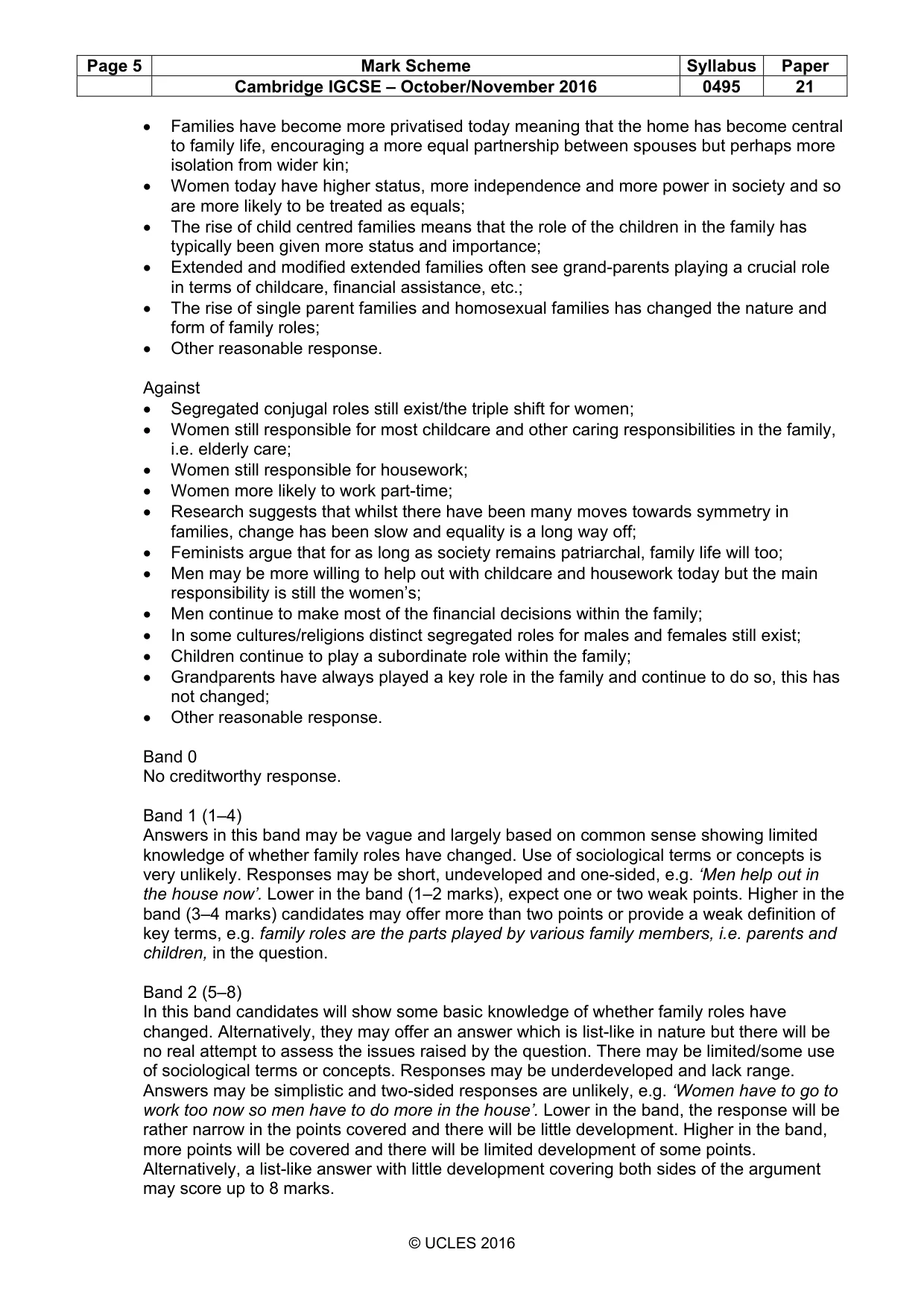
Page 5 Mark Scheme Syllabus Paper Cambridge IGCSE – October/November 2016 0495 21 © UCLES 2016 • Families have become more privatised today meaning that the home has become central to family life, encouraging a more equal partnership between spouses but perhaps more isolation from wider kin; • Women today have higher status, more independence and more power in society and so are more likely to be treated as equals; • The rise of child centred families means that the role of the children in the family has typically been given more status and importance; • Extended and modified extended families often see grand-parents playing a crucial role in terms of childcare, financial assistance, etc.; • The rise of single parent families and homosexual families has changed the nature and form of family roles; • Other reasonable response. Against • Segregated conjugal roles still exist/the triple shift for women; • Women still responsible for most childcare and other caring responsibilities in the family, i.e. elderly care; • Women still responsible for housework; • Women more likely to work part-time; • Research suggests that whilst there have been many moves towards symmetry in families, change has been slow and equality is a long way off; • Feminists argue that for as long as society remains patriarchal, family life will too; • Men may be more willing to help out with childcare and housework today but the main responsibility is still the women’s; • Men continue to make most of the financial decisions within the family; • In some cultures/religions distinct segregated roles for males and females still exist; • Children continue to play a subordinate role within the family; • Grandparents have always played a key role in the family and continue to do so, this has not changed; • Other reasonable response. Band 0 No creditworthy response. Band 1 (1–4) Answers in this band may be vague and largely based on common sense showing limited knowledge of whether family roles have changed. Use of sociological terms or concepts is very unlikely. Responses may be short, undeveloped and one-sided, e.g. ‘Men help out in the house now’. Lower in the band (1–2 marks), expect one or two weak points. Higher in the band (3–4 marks) candidates may offer more than two points or provide a weak definition of key terms, e.g. family roles are the parts played by various family members, i.e. parents and children, in the question. Band 2 (5–8) In this band candidates will show some basic knowledge of whether family roles have changed. Alternatively, they may offer an answer which is list-like in nature but there will be no real attempt to assess the issues raised by the question. There may be limited/some use of sociological terms or concepts. Responses may be underdeveloped and lack range. Answers may be simplistic and two-sided responses are unlikely, e.g. ‘Women have to go to work too now so men have to do more in the house’. Lower in the band, the response will be rather narrow in the points covered and there will be little development. Higher in the band, more points will be covered and there will be limited development of some points. Alternatively, a list-like answer with little development covering both sides of the argument may score up to 8 marks.
Mark scheme, page 6
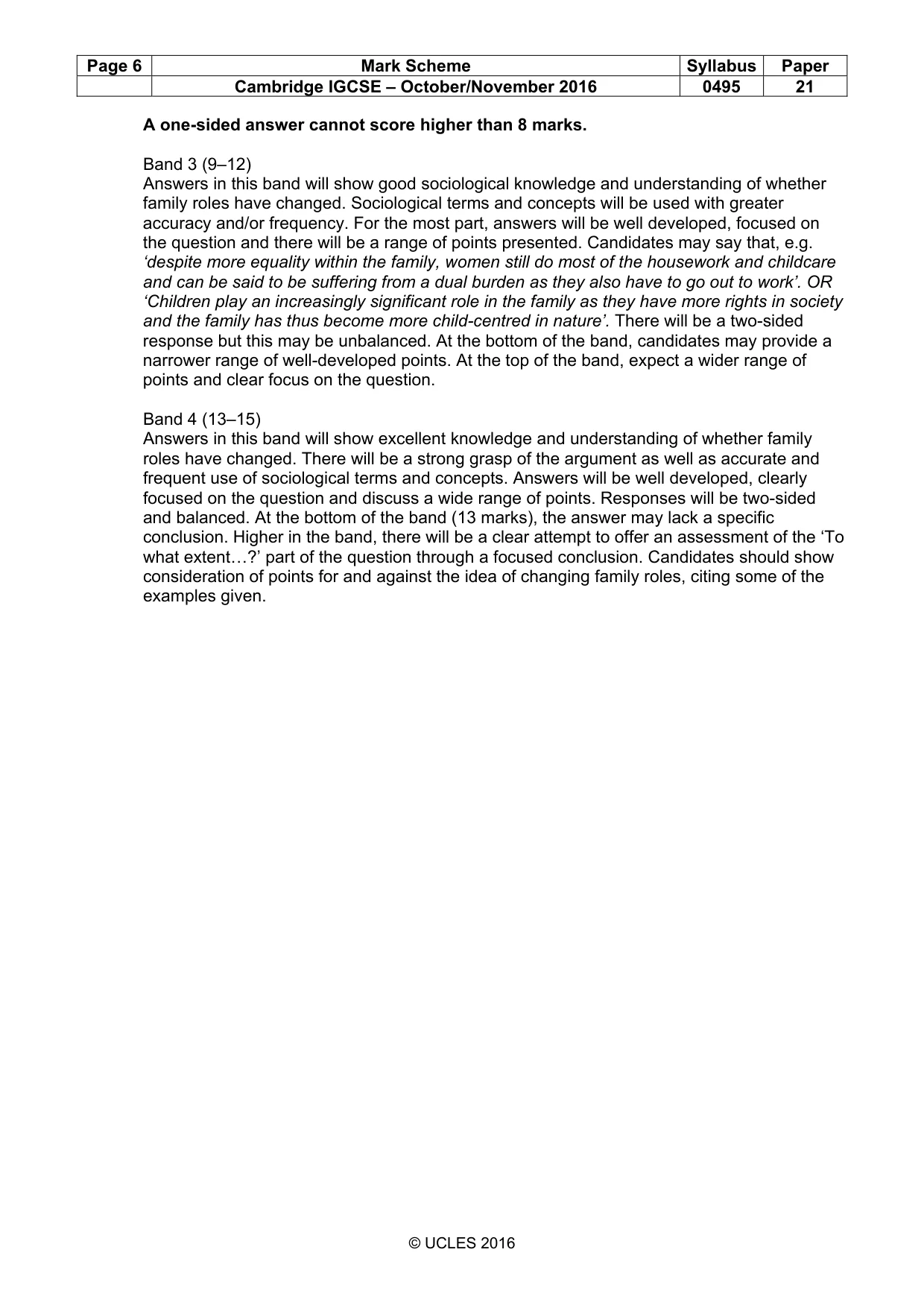
Page 6 Mark Scheme Syllabus Paper Cambridge IGCSE – October/November 2016 0495 21 © UCLES 2016 A one-sided answer cannot score higher than 8 marks. Band 3 (9–12) Answers in this band will show good sociological knowledge and understanding of whether family roles have changed. Sociological terms and concepts will be used with greater accuracy and/or frequency. For the most part, answers will be well developed, focused on the question and there will be a range of points presented. Candidates may say that, e.g. ‘despite more equality within the family, women still do most of the housework and childcare and can be said to be suffering from a dual burden as they also have to go out to work’. OR ‘Children play an increasingly significant role in the family as they have more rights in society and the family has thus become more child-centred in nature’. There will be a two-sided response but this may be unbalanced. At the bottom of the band, candidates may provide a narrower range of well-developed points. At the top of the band, expect a wider range of points and clear focus on the question. Band 4 (13–15) Answers in this band will show excellent knowledge and understanding of whether family roles have changed. There will be a strong grasp of the argument as well as accurate and frequent use of sociological terms and concepts. Answers will be well developed, clearly focused on the question and discuss a wide range of points. Responses will be two-sided and balanced. At the bottom of the band (13 marks), the answer may lack a specific conclusion. Higher in the band, there will be a clear attempt to offer an assessment of the ‘To what extent…?’ part of the question through a focused conclusion. Candidates should show consideration of points for and against the idea of changing family roles, citing some of the examples given.
Mark scheme, page 7
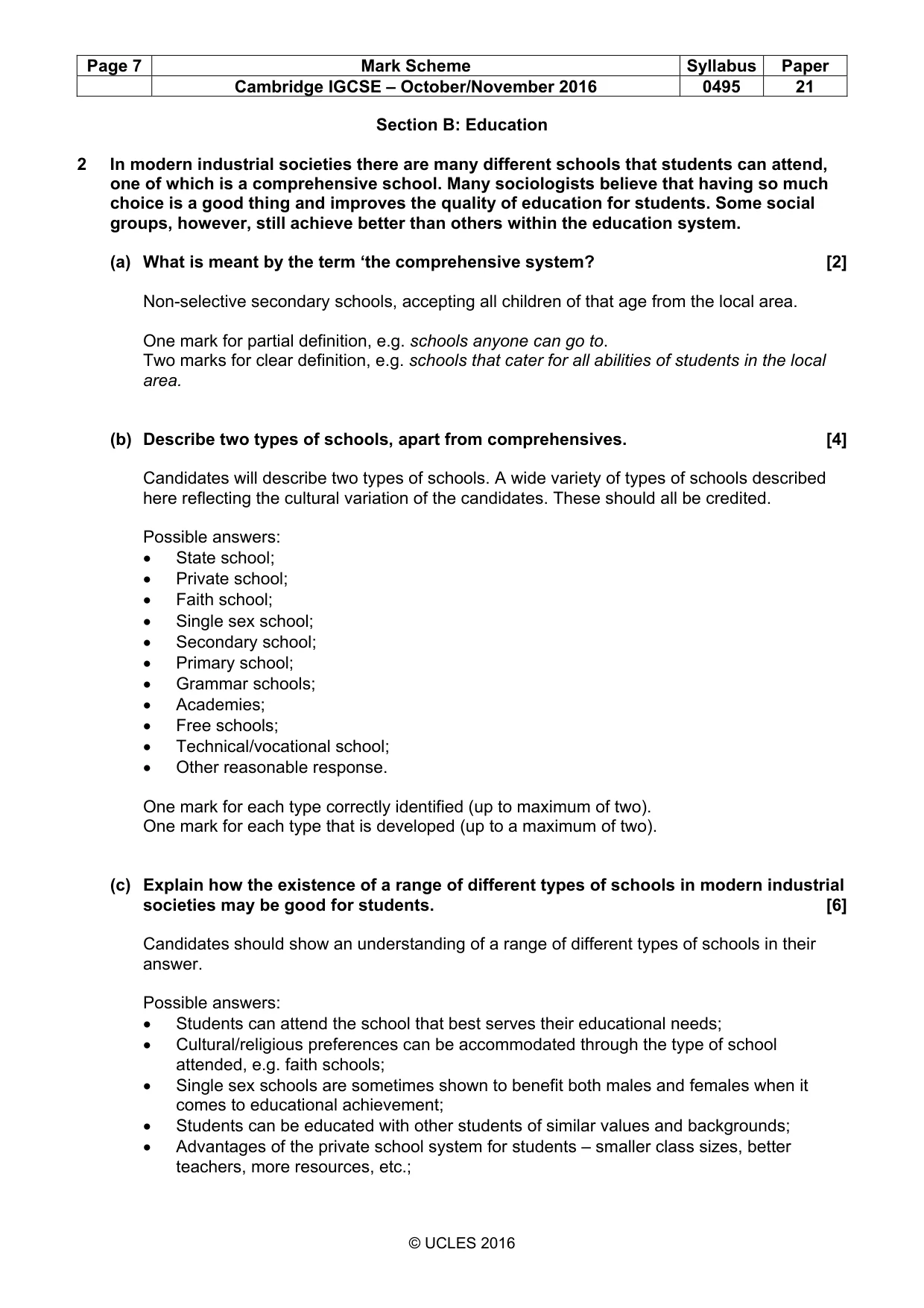
Page 7 Mark Scheme Syllabus Paper Cambridge IGCSE – October/November 2016 0495 21 © UCLES 2016 Section B: Education 2 In modern industrial societies there are many different schools that students can attend, one of which is a comprehensive school. Many sociologists believe that having so much choice is a good thing and improves the quality of education for students. Some social groups, however, still achieve better than others within the education system. (a) What is meant by the term ‘the comprehensive system? [2] Non-selective secondary schools, accepting all children of that age from the local area. One mark for partial definition, e.g. schools anyone can go to. Two marks for clear definition, e.g. schools that cater for all abilities of students in the local area. (b) Describe two types of schools, apart from comprehensives. [4] Candidates will describe two types of schools. A wide variety of types of schools described here reflecting the cultural variation of the candidates. These should all be credited. Possible answers: • State school; • Private school; • Faith school; • Single sex school; • Secondary school; • Primary school; • Grammar schools; • Academies; • Free schools; • Technical/vocational school; • Other reasonable response. One mark for each type correctly identified (up to maximum of two). One mark for each type that is developed (up to a maximum of two). (c) Explain how the existence of a range of different types of schools in modern industrial societies may be good for students. [6] Candidates should show an understanding of a range of different types of schools in their answer. Possible answers: • Students can attend the school that best serves their educational needs; • Cultural/religious preferences can be accommodated through the type of school attended, e.g. faith schools; • Single sex schools are sometimes shown to benefit both males and females when it comes to educational achievement; • Students can be educated with other students of similar values and backgrounds; • Advantages of the private school system for students – smaller class sizes, better teachers, more resources, etc.;
Mark scheme, page 8
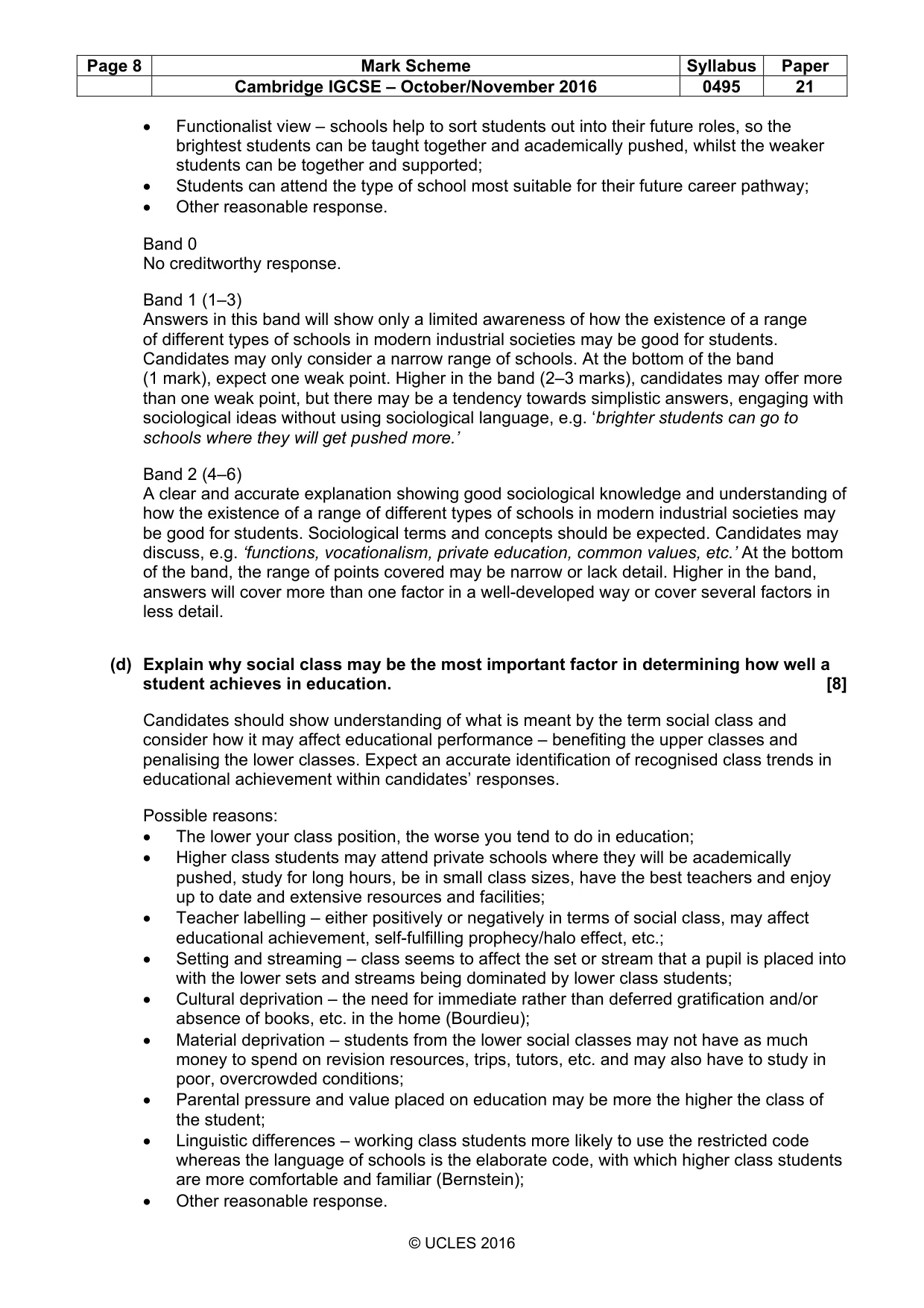
Page 8 Mark Scheme Syllabus Paper Cambridge IGCSE – October/November 2016 0495 21 © UCLES 2016 • Functionalist view – schools help to sort students out into their future roles, so the brightest students can be taught together and academically pushed, whilst the weaker students can be together and supported; • Students can attend the type of school most suitable for their future career pathway; • Other reasonable response. Band 0 No creditworthy response. Band 1 (1–3) Answers in this band will show only a limited awareness of how the existence of a range of different types of schools in modern industrial societies may be good for students. Candidates may only consider a narrow range of schools. At the bottom of the band (1 mark), expect one weak point. Higher in the band (2–3 marks), candidates may offer more than one weak point, but there may be a tendency towards simplistic answers, engaging with sociological ideas without using sociological language, e.g. ‘brighter students can go to schools where they will get pushed more.’ Band 2 (4–6) A clear and accurate explanation showing good sociological knowledge and understanding of how the existence of a range of different types of schools in modern industrial societies may be good for students. Sociological terms and concepts should be expected. Candidates may discuss, e.g. ‘functions, vocationalism, private education, common values, etc.’ At the bottom of the band, the range of points covered may be narrow or lack detail. Higher in the band, answers will cover more than one factor in a well-developed way or cover several factors in less detail. (d) Explain why social class may be the most important factor in determining how well a student achieves in education. [8] Candidates should show understanding of what is meant by the term social class and consider how it may affect educational performance – benefiting the upper classes and penalising the lower classes. Expect an accurate identification of recognised class trends in educational achievement within candidates’ responses. Possible reasons: • The lower your class position, the worse you tend to do in education; • Higher class students may attend private schools where they will be academically pushed, study for long hours, be in small class sizes, have the best teachers and enjoy up to date and extensive resources and facilities; • Teacher labelling – either positively or negatively in terms of social class, may affect educational achievement, self-fulfilling prophecy/halo effect, etc.; • Setting and streaming – class seems to affect the set or stream that a pupil is placed into with the lower sets and streams being dominated by lower class students; • Cultural deprivation – the need for immediate rather than deferred gratification and/or absence of books, etc. in the home (Bourdieu); • Material deprivation – students from the lower social classes may not have as much money to spend on revision resources, trips, tutors, etc. and may also have to study in poor, overcrowded conditions; • Parental pressure and value placed on education may be more the higher the class of the student; • Linguistic differences – working class students more likely to use the restricted code whereas the language of schools is the elaborate code, with which higher class students are more comfortable and familiar (Bernstein); • Other reasonable response.
Mark scheme, page 9
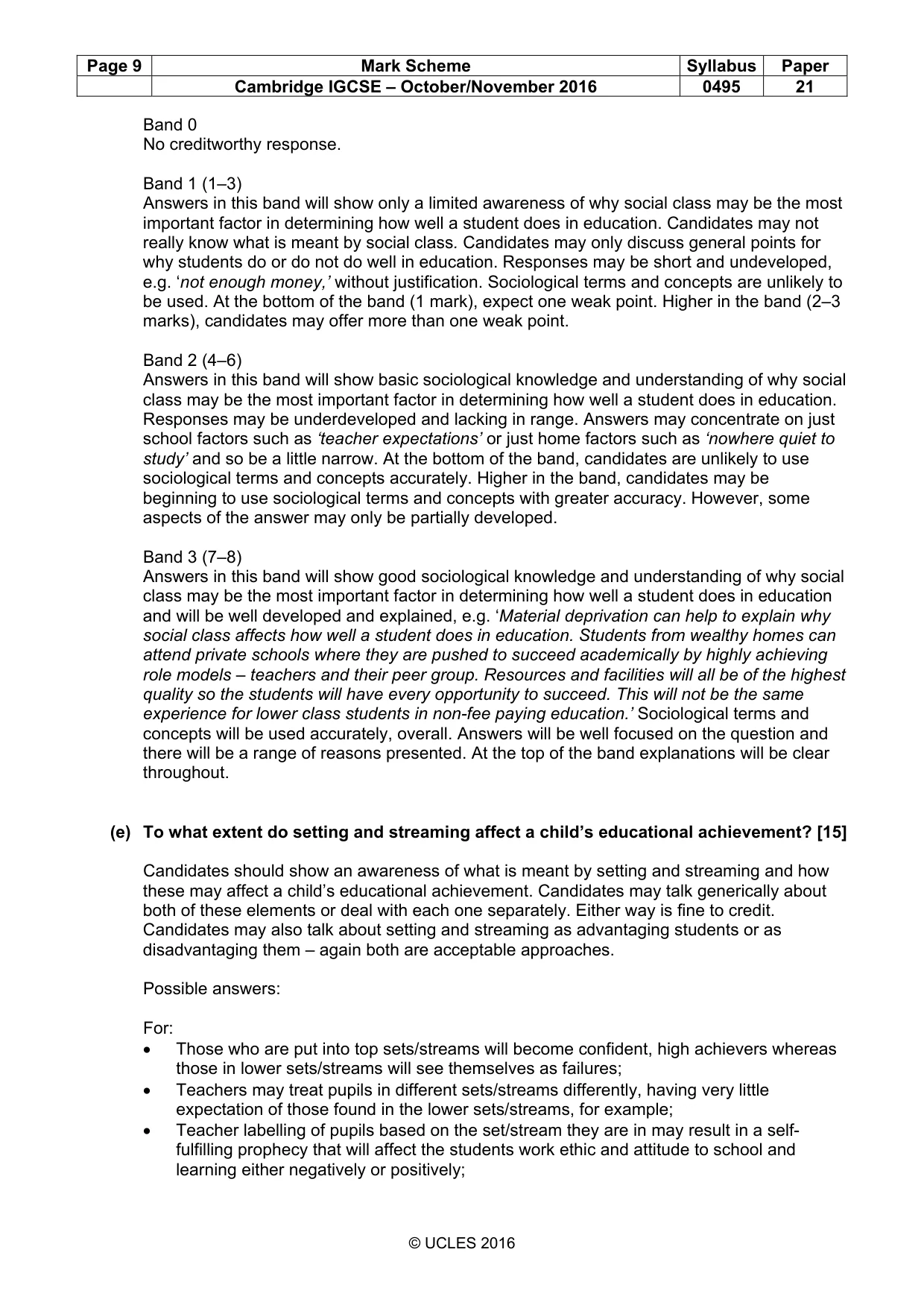
Page 9 Mark Scheme Syllabus Paper Cambridge IGCSE – October/November 2016 0495 21 © UCLES 2016 Band 0 No creditworthy response. Band 1 (1–3) Answers in this band will show only a limited awareness of why social class may be the most important factor in determining how well a student does in education. Candidates may not really know what is meant by social class. Candidates may only discuss general points for why students do or do not do well in education. Responses may be short and undeveloped, e.g. ‘not enough money,’ without justification. Sociological terms and concepts are unlikely to be used. At the bottom of the band (1 mark), expect one weak point. Higher in the band (2–3 marks), candidates may offer more than one weak point. Band 2 (4–6) Answers in this band will show basic sociological knowledge and understanding of why social class may be the most important factor in determining how well a student does in education. Responses may be underdeveloped and lacking in range. Answers may concentrate on just school factors such as ‘teacher expectations’ or just home factors such as ‘nowhere quiet to study’ and so be a little narrow. At the bottom of the band, candidates are unlikely to use sociological terms and concepts accurately. Higher in the band, candidates may be beginning to use sociological terms and concepts with greater accuracy. However, some aspects of the answer may only be partially developed. Band 3 (7–8) Answers in this band will show good sociological knowledge and understanding of why social class may be the most important factor in determining how well a student does in education and will be well developed and explained, e.g. ‘Material deprivation can help to explain why social class affects how well a student does in education. Students from wealthy homes can attend private schools where they are pushed to succeed academically by highly achieving role models – teachers and their peer group. Resources and facilities will all be of the highest quality so the students will have every opportunity to succeed. This will not be the same experience for lower class students in non-fee paying education.’ Sociological terms and concepts will be used accurately, overall. Answers will be well focused on the question and there will be a range of reasons presented. At the top of the band explanations will be clear throughout. (e) To what extent do setting and streaming affect a child’s educational achievement? [15] Candidates should show an awareness of what is meant by setting and streaming and how these may affect a child’s educational achievement. Candidates may talk generically about both of these elements or deal with each one separately. Either way is fine to credit. Candidates may also talk about setting and streaming as advantaging students or as disadvantaging them – again both are acceptable approaches. Possible answers: For: • Those who are put into top sets/streams will become confident, high achievers whereas those in lower sets/streams will see themselves as failures; • Teachers may treat pupils in different sets/streams differently, having very little expectation of those found in the lower sets/streams, for example; • Teacher labelling of pupils based on the set/stream they are in may result in a self- fulfilling prophecy that will affect the students work ethic and attitude to school and learning either negatively or positively;
Mark scheme, page 10
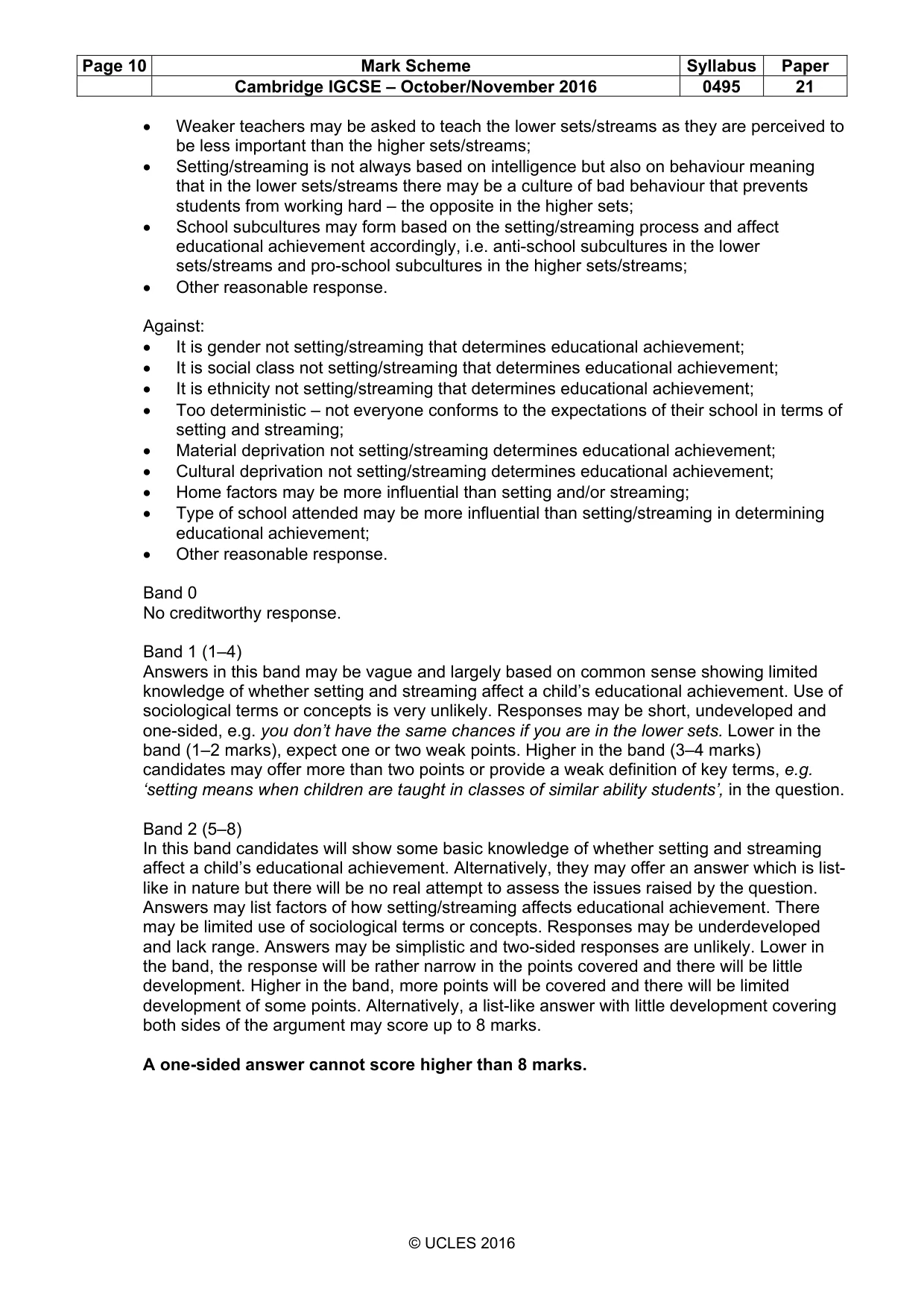
Page 10 Mark Scheme Syllabus Paper Cambridge IGCSE – October/November 2016 0495 21 © UCLES 2016 • Weaker teachers may be asked to teach the lower sets/streams as they are perceived to be less important than the higher sets/streams; • Setting/streaming is not always based on intelligence but also on behaviour meaning that in the lower sets/streams there may be a culture of bad behaviour that prevents students from working hard – the opposite in the higher sets; • School subcultures may form based on the setting/streaming process and affect educational achievement accordingly, i.e. anti-school subcultures in the lower sets/streams and pro-school subcultures in the higher sets/streams; • Other reasonable response. Against: • It is gender not setting/streaming that determines educational achievement; • It is social class not setting/streaming that determines educational achievement; • It is ethnicity not setting/streaming that determines educational achievement; • Too deterministic – not everyone conforms to the expectations of their school in terms of setting and streaming; • Material deprivation not setting/streaming determines educational achievement; • Cultural deprivation not setting/streaming determines educational achievement; • Home factors may be more influential than setting and/or streaming; • Type of school attended may be more influential than setting/streaming in determining educational achievement; • Other reasonable response. Band 0 No creditworthy response. Band 1 (1–4) Answers in this band may be vague and largely based on common sense showing limited knowledge of whether setting and streaming affect a child’s educational achievement. Use of sociological terms or concepts is very unlikely. Responses may be short, undeveloped and one-sided, e.g. you don’t have the same chances if you are in the lower sets. Lower in the band (1–2 marks), expect one or two weak points. Higher in the band (3–4 marks) candidates may offer more than two points or provide a weak definition of key terms, e.g. ‘setting means when children are taught in classes of similar ability students’, in the question. Band 2 (5–8) In this band candidates will show some basic knowledge of whether setting and streaming affect a child’s educational achievement. Alternatively, they may offer an answer which is list- like in nature but there will be no real attempt to assess the issues raised by the question. Answers may list factors of how setting/streaming affects educational achievement. There may be limited use of sociological terms or concepts. Responses may be underdeveloped and lack range. Answers may be simplistic and two-sided responses are unlikely. Lower in the band, the response will be rather narrow in the points covered and there will be little development. Higher in the band, more points will be covered and there will be limited development of some points. Alternatively, a list-like answer with little development covering both sides of the argument may score up to 8 marks. A one-sided answer cannot score higher than 8 marks.
Mark scheme, page 11
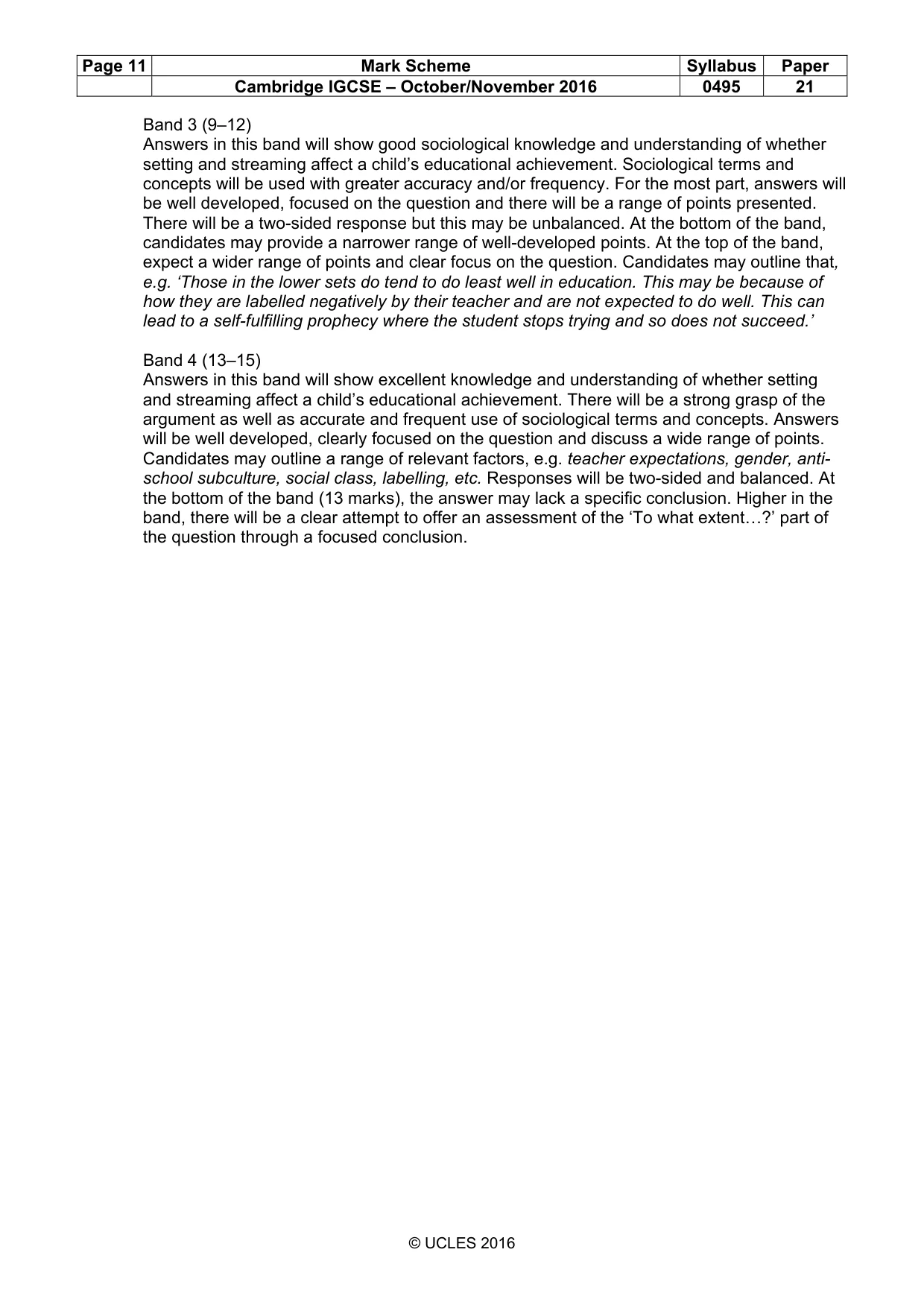
Page 11 Mark Scheme Syllabus Paper Cambridge IGCSE – October/November 2016 0495 21 © UCLES 2016 Band 3 (9–12) Answers in this band will show good sociological knowledge and understanding of whether setting and streaming affect a child’s educational achievement. Sociological terms and concepts will be used with greater accuracy and/or frequency. For the most part, answers will be well developed, focused on the question and there will be a range of points presented. There will be a two-sided response but this may be unbalanced. At the bottom of the band, candidates may provide a narrower range of well-developed points. At the top of the band, expect a wider range of points and clear focus on the question. Candidates may outline that, e.g. ‘Those in the lower sets do tend to do least well in education. This may be because of how they are labelled negatively by their teacher and are not expected to do well. This can lead to a self-fulfilling prophecy where the student stops trying and so does not succeed.’ Band 4 (13–15) Answers in this band will show excellent knowledge and understanding of whether setting and streaming affect a child’s educational achievement. There will be a strong grasp of the argument as well as accurate and frequent use of sociological terms and concepts. Answers will be well developed, clearly focused on the question and discuss a wide range of points. Candidates may outline a range of relevant factors, e.g. teacher expectations, gender, anti- school subculture, social class, labelling, etc. Responses will be two-sided and balanced. At the bottom of the band (13 marks), the answer may lack a specific conclusion. Higher in the band, there will be a clear attempt to offer an assessment of the ‘To what extent…?’ part of the question through a focused conclusion.
Mark scheme, page 12
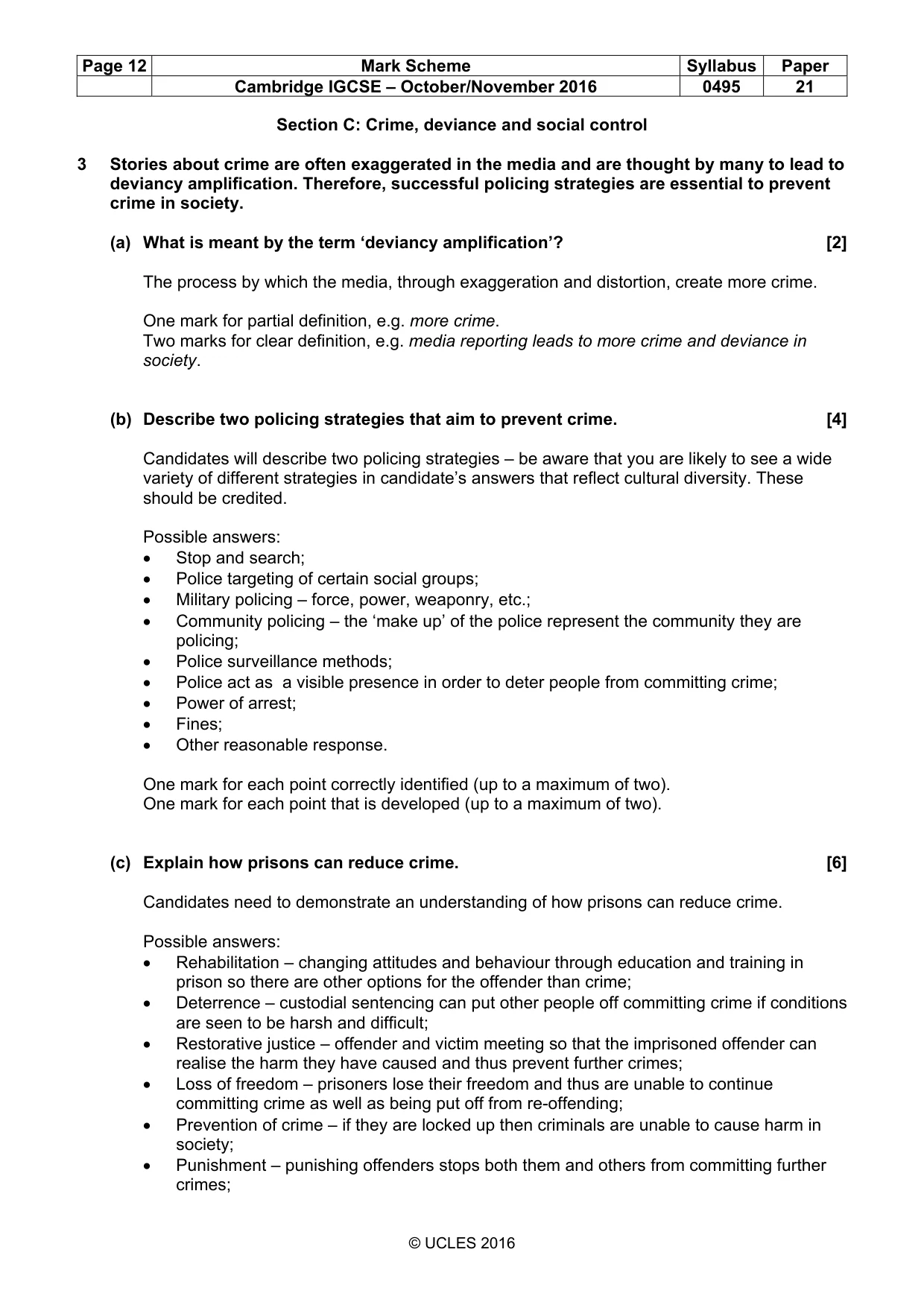
Page 12 Mark Scheme Syllabus Paper Cambridge IGCSE – October/November 2016 0495 21 © UCLES 2016 Section C: Crime, deviance and social control 3 Stories about crime are often exaggerated in the media and are thought by many to lead to deviancy amplification. Therefore, successful policing strategies are essential to prevent crime in society. (a) What is meant by the term ‘deviancy amplification’? [2] The process by which the media, through exaggeration and distortion, create more crime. One mark for partial definition, e.g. more crime. Two marks for clear definition, e.g. media reporting leads to more crime and deviance in society. (b) Describe two policing strategies that aim to prevent crime. [4] Candidates will describe two policing strategies – be aware that you are likely to see a wide variety of different strategies in candidate’s answers that reflect cultural diversity. These should be credited. Possible answers: • Stop and search; • Police targeting of certain social groups; • Military policing – force, power, weaponry, etc.; • Community policing – the ‘make up’ of the police represent the community they are policing; • Police surveillance methods; • Police act as a visible presence in order to deter people from committing crime; • Power of arrest; • Fines; • Other reasonable response. One mark for each point correctly identified (up to a maximum of two). One mark for each point that is developed (up to a maximum of two). (c) Explain how prisons can reduce crime. [6] Candidates need to demonstrate an understanding of how prisons can reduce crime. Possible answers: • Rehabilitation – changing attitudes and behaviour through education and training in prison so there are other options for the offender than crime; • Deterrence – custodial sentencing can put other people off committing crime if conditions are seen to be harsh and difficult; • Restorative justice – offender and victim meeting so that the imprisoned offender can realise the harm they have caused and thus prevent further crimes; • Loss of freedom – prisoners lose their freedom and thus are unable to continue committing crime as well as being put off from re-offending; • Prevention of crime – if they are locked up then criminals are unable to cause harm in society; • Punishment – punishing offenders stops both them and others from committing further crimes;
Mark scheme, page 13
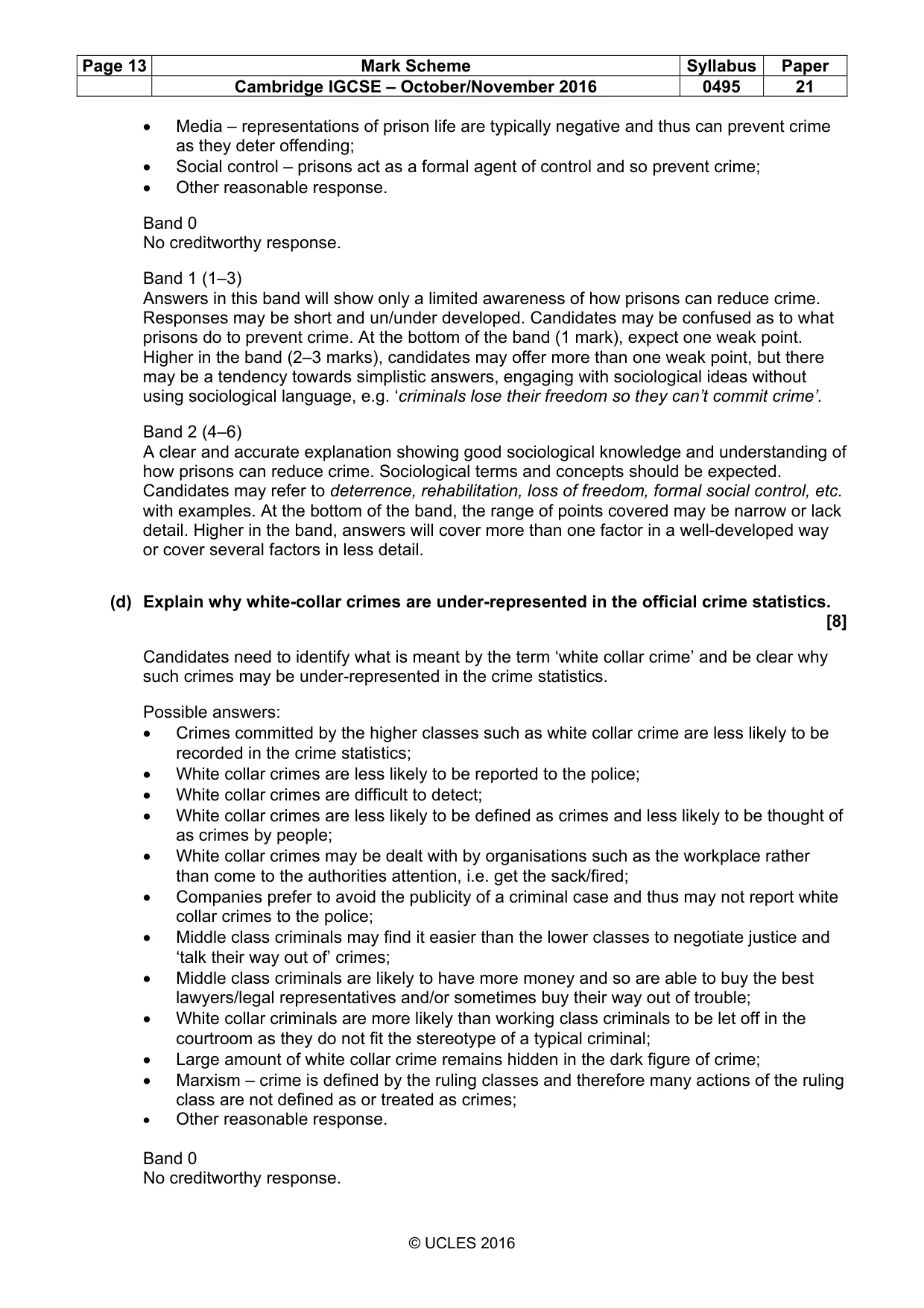
Page 13 Mark Scheme Syllabus Paper Cambridge IGCSE – October/November 2016 0495 21 © UCLES 2016 • Media – representations of prison life are typically negative and thus can prevent crime as they deter offending; • Social control – prisons act as a formal agent of control and so prevent crime; • Other reasonable response. Band 0 No creditworthy response. Band 1 (1–3) Answers in this band will show only a limited awareness of how prisons can reduce crime. Responses may be short and un/under developed. Candidates may be confused as to what prisons do to prevent crime. At the bottom of the band (1 mark), expect one weak point. Higher in the band (2–3 marks), candidates may offer more than one weak point, but there may be a tendency towards simplistic answers, engaging with sociological ideas without using sociological language, e.g. ‘criminals lose their freedom so they can’t commit crime’. Band 2 (4–6) A clear and accurate explanation showing good sociological knowledge and understanding of how prisons can reduce crime. Sociological terms and concepts should be expected. Candidates may refer to deterrence, rehabilitation, loss of freedom, formal social control, etc. with examples. At the bottom of the band, the range of points covered may be narrow or lack detail. Higher in the band, answers will cover more than one factor in a well-developed way or cover several factors in less detail. (d) Explain why white-collar crimes are under-represented in the official crime statistics. [8] Candidates need to identify what is meant by the term ‘white collar crime’ and be clear why such crimes may be under-represented in the crime statistics. Possible answers: • Crimes committed by the higher classes such as white collar crime are less likely to be recorded in the crime statistics; • White collar crimes are less likely to be reported to the police; • White collar crimes are difficult to detect; • White collar crimes are less likely to be defined as crimes and less likely to be thought of as crimes by people; • White collar crimes may be dealt with by organisations such as the workplace rather than come to the authorities attention, i.e. get the sack/fired; • Companies prefer to avoid the publicity of a criminal case and thus may not report white collar crimes to the police; • Middle class criminals may find it easier than the lower classes to negotiate justice and ‘talk their way out of’ crimes; • Middle class criminals are likely to have more money and so are able to buy the best lawyers/legal representatives and/or sometimes buy their way out of trouble; • White collar criminals are more likely than working class criminals to be let off in the courtroom as they do not fit the stereotype of a typical criminal; • Large amount of white collar crime remains hidden in the dark figure of crime; • Marxism – crime is defined by the ruling classes and therefore many actions of the ruling class are not defined as or treated as crimes; • Other reasonable response. Band 0 No creditworthy response.
Mark scheme, page 14
Page 14 Mark Scheme Syllabus Paper Cambridge IGCSE – October/November 2016 0495 21 © UCLES 2016 Band 1 (1–3) Answers in this band will show only a limited awareness of why white-collar crimes are under-represented in the official crime statistics. Candidates may not fully understand what is meant by white collar crime. Responses may be short and undeveloped, e.g. ‘Not all crimes are reported to the police’. Sociological terms and concepts are unlikely to be used. At the bottom of the band (1 mark), expect one weak point. Higher in the band (2–3 marks), candidates may offer more than one weak point. Band 2 (4–6) Answers in this band will show basic sociological knowledge and understanding of why white-collar crimes are under-represented in the official crime statistics. Candidates may say that, e.g. ‘not all white collar crimes are reported to the police because they are hard to detect and therefore many victims do not realise that a crime has occurred’. Responses may be underdeveloped and lacking in range. At the bottom of the band, candidates are unlikely to use sociological terms and concepts accurately. Higher in the band, candidates may be beginning to use sociological terms and concepts with greater accuracy. However, some aspects of the answer may only be partially developed. Band 3 (7–8) Answers in this band will show good sociological knowledge and understanding of why white- collar crimes are under-represented in the official crime statistics and will be well developed and explained. Candidates may discuss issues of non-reporting, non-recording and non- detection as well as Marxist views of white collar crime and the ruling class. Sociological terms and concepts will be used accurately, overall. Answers will be well focused on the question and there will be a range of reasons presented. At the top of the band explanations will be clear throughout. (e) To what extent do the media determine what is seen as criminal and deviant? [15] Candidates need to show an understanding of whether the media determine what is seen as criminal and deviant. Candidates need not address both crime and deviance separately in their response, although some may choose to do so. Possible answers: For: • Media plays a vital role in determining what we see as crime and deviance as few people come into direct contact with crime and criminals and so what they know they have learnt from the media; • In the Postmodern world the media is all around us 24/7 in various different forms and therefore has a lot of power over us; • Despite statistics to the contrary, crime rates are typically decreasing but the public think the opposite – the media is thought to be responsible for this distortion; • Media creates moral panics and folk devils through selective and exaggerated reporting – mods and rockers, terrorists, etc.; • Media labelling certain groups as criminal may lead to a self-fulfilling prophecy whereby people live up to the negative labels they have been given and so cause deviancy amplification; • Media stereotypes of who are criminal and deviant leads to the audience believing what they see and so affecting their perceptions of crime and deviance; • Other reasonable response.
Mark scheme, page 15
Page 15 Mark Scheme Syllabus Paper Cambridge IGCSE – October/November 2016 0495 21 © UCLES 2016 Against: • The media merely reflects the true picture of crime as found in the crime statistics; • The media may present a distorted picture of crime but this does not mean that the audience believes what they see and hear – uses and gratifications theory; • Police have the power to determine what is thought of as criminal and deviant not the media, i.e. stop and search, discretion, targeting, etc.; • The Government determine what is thought of as criminal and deviant through the law making procedure, not the media; • The courts determine what we think of as criminal through their sentencing, not the media; • The family through primary socialisation determine what we think of as criminal and deviant, i.e. through the teaching of norms and values, not the media; • The peer group influence our thoughts and opinions on what is criminal and deviant, i.e. through peer pressure and subcultures, not the media; • The education system influences what we think of as criminal and deviant – through things such as the hidden curriculum and teacher role models, not the media; • Religion teaches us what we think of as criminal and deviant through holy books, religious teachings, etc., not the media; • The media may be one crucial factor, but not the main/only one; • Other reasonable response. Band 0 No creditworthy response. Band 1 (1–4) Answers in this band may be vague and largely based on common sense showing limited knowledge of whether the media determine what is seen as criminal and deviant. Use of sociological terms or concepts is very unlikely. Responses may be short, undeveloped and one-sided, e.g. the media show us who the bad people are. Lower in the band (1–2 marks), expect one or two weak points. Higher in the band (3–4 marks) candidates may offer more than two points or provide a weak definition of key terms, e.g. criminal is breaking the law, in the question. Band 2 (5–8) In this band candidates will show some basic knowledge of whether the media determine what is seen as criminal and deviant. Alternatively, they may offer an answer which is list-like in nature but there will be no real attempt to assess the issues raised by the question. There may be limited use of sociological terms or concepts. Candidates may discuss some reasons why the media determines what is seen as criminal and deviant, i.e. exaggeration, representation, stereotypes, etc. but responses may be underdeveloped and lack range. Answers may be simplistic and two-sided responses are unlikely. Lower in the band, the response will be rather narrow in the points covered and there will be little development. Higher in the band, more points will be covered and there will be limited development of some points. Alternatively, a list-like answer with little development covering both sides of the argument may score up to 8 marks. A one-sided answer cannot score higher than 8 marks. Band 3 (9–12) Answers in this band will show good sociological knowledge and understanding of whether the media determines what is seen as criminal and deviant. Sociological terms and concepts will be used with greater accuracy and/or frequency. For the most part, answers will be well developed, focused on the question and there will be a range of points presented. Candidates may be able to present a range of points to support the idea that the media does determine what is seen as criminal and deviant, but also be aware of some of the
Mark scheme, page 16
Page 16 Mark Scheme Syllabus Paper Cambridge IGCSE – October/November 2016 0495 21 © UCLES 2016 weaknesses in this argument, i.e. police, government, courts, other agencies of socialisation, etc. There will be a two-sided response but this may be unbalanced. At the bottom of the band, candidates may provide a narrower range of well-developed points. At the top of the band, expect a wider range of points and clear focus on the question. Band 4 (13–15) Answers in this band will show excellent knowledge and understanding of whether the media determines what is seen as criminal and deviant. There will be a strong grasp of the argument as well as accurate and frequent use of sociological terms and concepts. Answers will be well developed, clearly focused on the question and discuss a wide range of points. For example, candidates may say that as well as agreeing that the media can determine what is seen as criminal and deviant through methods such as moral panics and sensationalism, there are also other ways of doing this, i.e. police targeting, chivalry thesis, peer pressure, socialisation, etc. Responses will be two-sided and balanced. At the bottom of the band (13 marks), the answer may lack a specific conclusion. Higher in the band, there will be a clear attempt to offer an assessment of the ‘To what extent…?’ part of the question through a focused conclusion.
Mark scheme, page 17
Page 17 Mark Scheme Syllabus Paper Cambridge IGCSE – October/November 2016 0495 21 © UCLES 2016 Section D: Media 4 The media today are changing. This is true for the various forms of media available and how the media are used. However, much of the content is still sensationalised to help attract an audience and not everybody believes the media always tell the truth. (a) What is meant by the term ‘sensationalised’? [2] A form of bias in the media in which stories are deliberately reported in ways designed to excite or attract consumers. One mark for partial definition, e.g. exciting stories. Two marks for clear definition, e.g. stories are made more appealing to readers through biased and exaggerated reporting. (b) Describe two ways that the media today are global. [4] Candidates will describe two ways that the media today are global. This may be through examples or through media forms. Possible answers: • Media communication is now instant and worldwide; • TV programmes/films/pop music, etc. from different countries can be consumed all over the world; • The internet and digital technology allows media today to be consumed by a global audience; • As news happens it can be watched almost instantly throughout the world; • Non-Western media, i.e. Bollywood/Nollywood, can now reach global audiences; • Social networking allows for the sharing of global media instantly; • Disney has become a global brand; • Other reasonable response. One mark for each point correctly identified (up to a maximum of two). One mark for each point developed (up to a maximum of two). (c) Explain how governments can censor media content. [6] Candidates need to demonstrate an understanding of how governments can censor media content. Possible answers: • Propaganda –a one sided, possibly untrue, version of events with no possibility for the audience to access alternative views; • Laws protecting the state, e.g. UK Official Secrets Act; • Laws on obscenity, e.g. The Obscene Publications Act; • Libel and slander laws; • Anti-discrimination laws, e.g. concerning ethnic minority groups/hate crimes – Race Relations Acts, etc.; • Certification process for films and computer games; • TV watershed to prevent unsuitable material being shown before 9pm; • Defence Advisory Notices (DA) can be issued;
Mark scheme, page 18
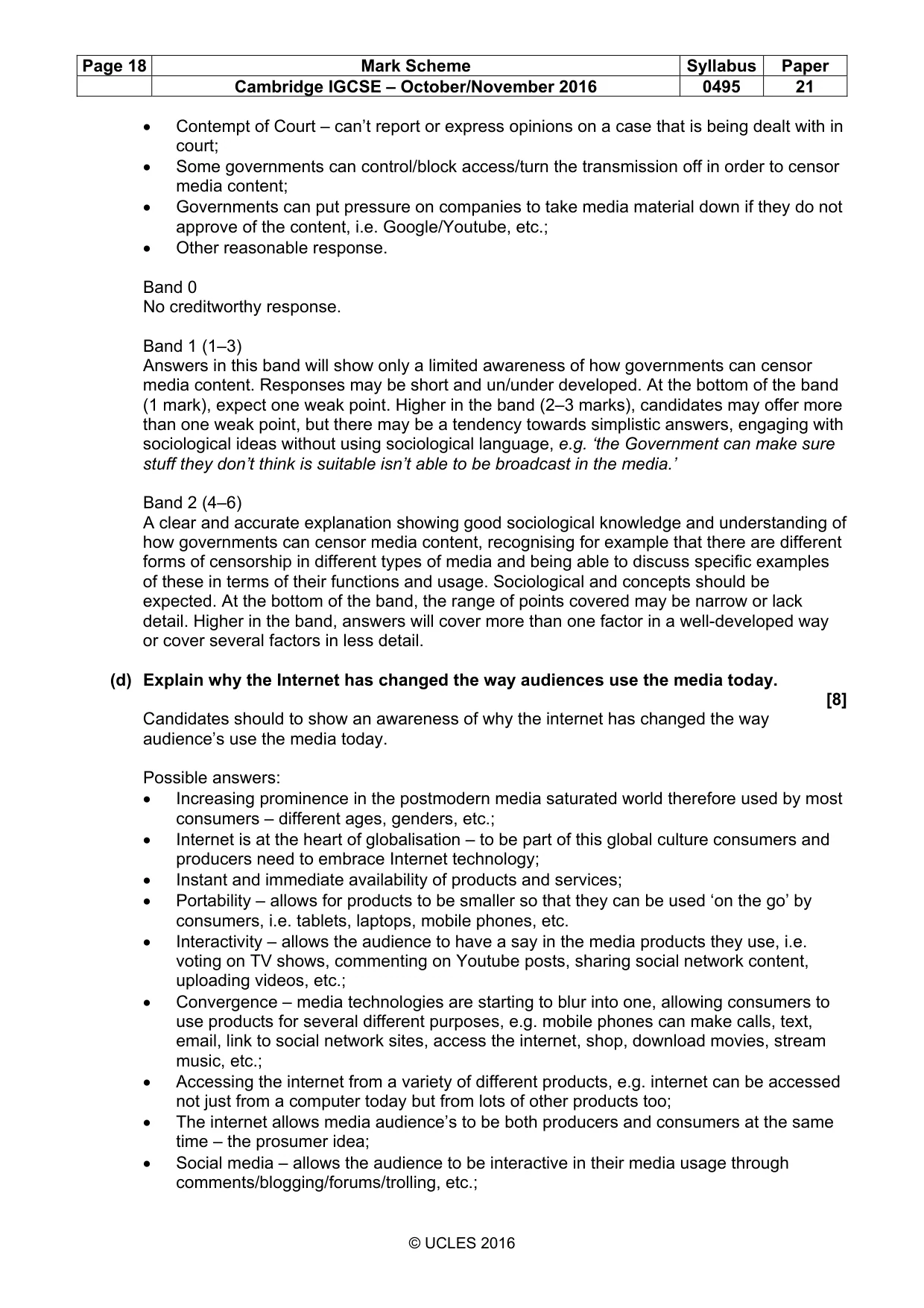
Page 18 Mark Scheme Syllabus Paper Cambridge IGCSE – October/November 2016 0495 21 © UCLES 2016 • Contempt of Court – can’t report or express opinions on a case that is being dealt with in court; • Some governments can control/block access/turn the transmission off in order to censor media content; • Governments can put pressure on companies to take media material down if they do not approve of the content, i.e. Google/Youtube, etc.; • Other reasonable response. Band 0 No creditworthy response. Band 1 (1–3) Answers in this band will show only a limited awareness of how governments can censor media content. Responses may be short and un/under developed. At the bottom of the band (1 mark), expect one weak point. Higher in the band (2–3 marks), candidates may offer more than one weak point, but there may be a tendency towards simplistic answers, engaging with sociological ideas without using sociological language, e.g. ‘the Government can make sure stuff they don’t think is suitable isn’t able to be broadcast in the media.’ Band 2 (4–6) A clear and accurate explanation showing good sociological knowledge and understanding of how governments can censor media content, recognising for example that there are different forms of censorship in different types of media and being able to discuss specific examples of these in terms of their functions and usage. Sociological and concepts should be expected. At the bottom of the band, the range of points covered may be narrow or lack detail. Higher in the band, answers will cover more than one factor in a well-developed way or cover several factors in less detail. (d) Explain why the Internet has changed the way audiences use the media today. [8] Candidates should to show an awareness of why the internet has changed the way audience’s use the media today. Possible answers: • Increasing prominence in the postmodern media saturated world therefore used by most consumers – different ages, genders, etc.; • Internet is at the heart of globalisation – to be part of this global culture consumers and producers need to embrace Internet technology; • Instant and immediate availability of products and services; • Portability – allows for products to be smaller so that they can be used ‘on the go’ by consumers, i.e. tablets, laptops, mobile phones, etc. • Interactivity – allows the audience to have a say in the media products they use, i.e. voting on TV shows, commenting on Youtube posts, sharing social network content, uploading videos, etc.; • Convergence – media technologies are starting to blur into one, allowing consumers to use products for several different purposes, e.g. mobile phones can make calls, text, email, link to social network sites, access the internet, shop, download movies, stream music, etc.; • Accessing the internet from a variety of different products, e.g. internet can be accessed not just from a computer today but from lots of other products too; • The internet allows media audience’s to be both producers and consumers at the same time – the prosumer idea; • Social media – allows the audience to be interactive in their media usage through comments/blogging/forums/trolling, etc.;
Mark scheme, page 19
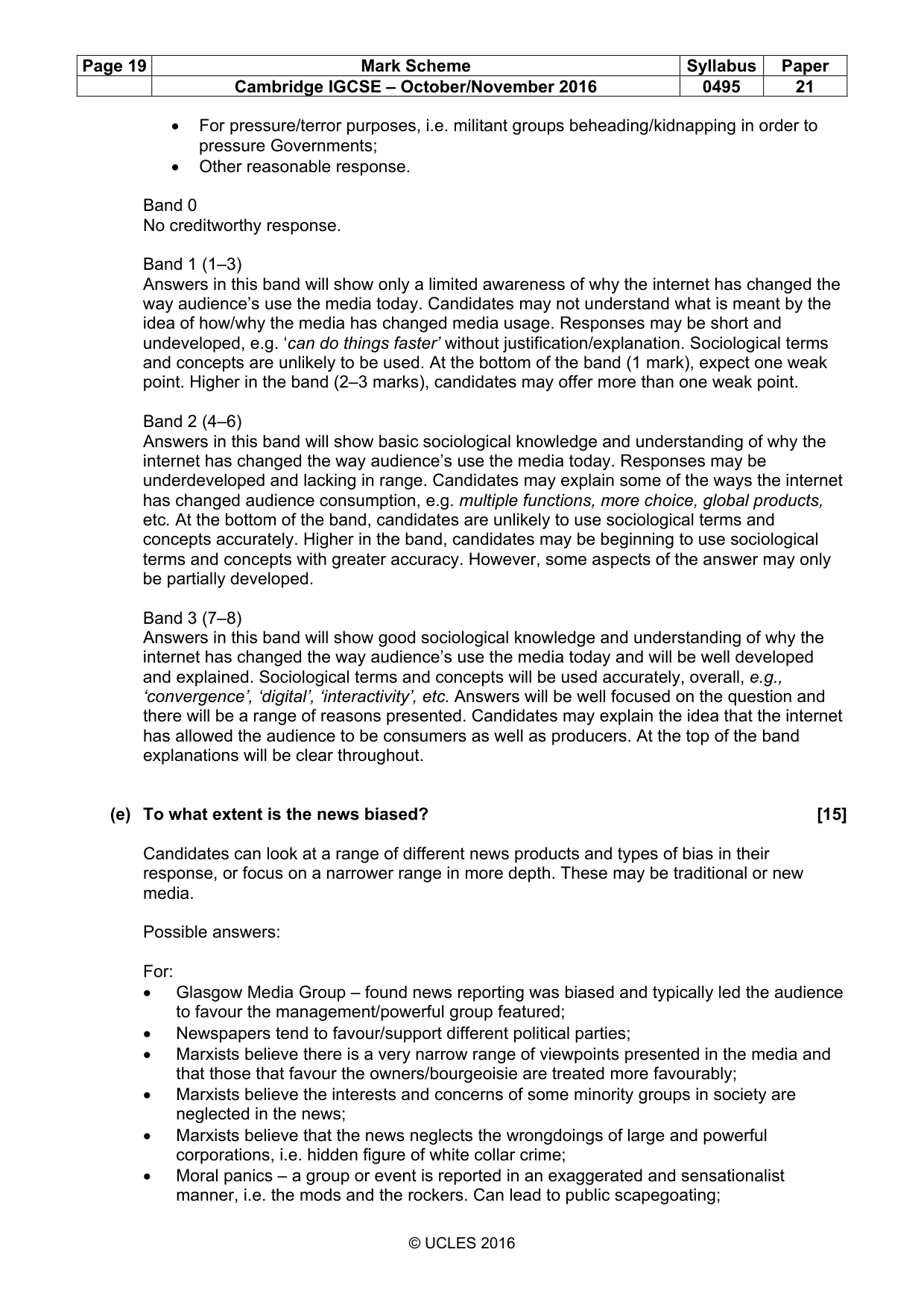
Page 19 Mark Scheme Syllabus Paper Cambridge IGCSE – October/November 2016 0495 21 © UCLES 2016 • For pressure/terror purposes, i.e. militant groups beheading/kidnapping in order to pressure Governments; • Other reasonable response. Band 0 No creditworthy response. Band 1 (1–3) Answers in this band will show only a limited awareness of why the internet has changed the way audience’s use the media today. Candidates may not understand what is meant by the idea of how/why the media has changed media usage. Responses may be short and undeveloped, e.g. ‘can do things faster’ without justification/explanation. Sociological terms and concepts are unlikely to be used. At the bottom of the band (1 mark), expect one weak point. Higher in the band (2–3 marks), candidates may offer more than one weak point. Band 2 (4–6) Answers in this band will show basic sociological knowledge and understanding of why the internet has changed the way audience’s use the media today. Responses may be underdeveloped and lacking in range. Candidates may explain some of the ways the internet has changed audience consumption, e.g. multiple functions, more choice, global products, etc. At the bottom of the band, candidates are unlikely to use sociological terms and concepts accurately. Higher in the band, candidates may be beginning to use sociological terms and concepts with greater accuracy. However, some aspects of the answer may only be partially developed. Band 3 (7–8) Answers in this band will show good sociological knowledge and understanding of why the internet has changed the way audience’s use the media today and will be well developed and explained. Sociological terms and concepts will be used accurately, overall, e.g., ‘convergence’, ‘digital’, ‘interactivity’, etc. Answers will be well focused on the question and there will be a range of reasons presented. Candidates may explain the idea that the internet has allowed the audience to be consumers as well as producers. At the top of the band explanations will be clear throughout. (e) To what extent is the news biased? [15] Candidates can look at a range of different news products and types of bias in their response, or focus on a narrower range in more depth. These may be traditional or new media. Possible answers: For: • Glasgow Media Group – found news reporting was biased and typically led the audience to favour the management/powerful group featured; • Newspapers tend to favour/support different political parties; • Marxists believe there is a very narrow range of viewpoints presented in the media and that those that favour the owners/bourgeoisie are treated more favourably; • Marxists believe the interests and concerns of some minority groups in society are neglected in the news; • Marxists believe that the news neglects the wrongdoings of large and powerful corporations, i.e. hidden figure of white collar crime; • Moral panics – a group or event is reported in an exaggerated and sensationalist manner, i.e. the mods and the rockers. Can lead to public scapegoating;
Mark scheme, page 20
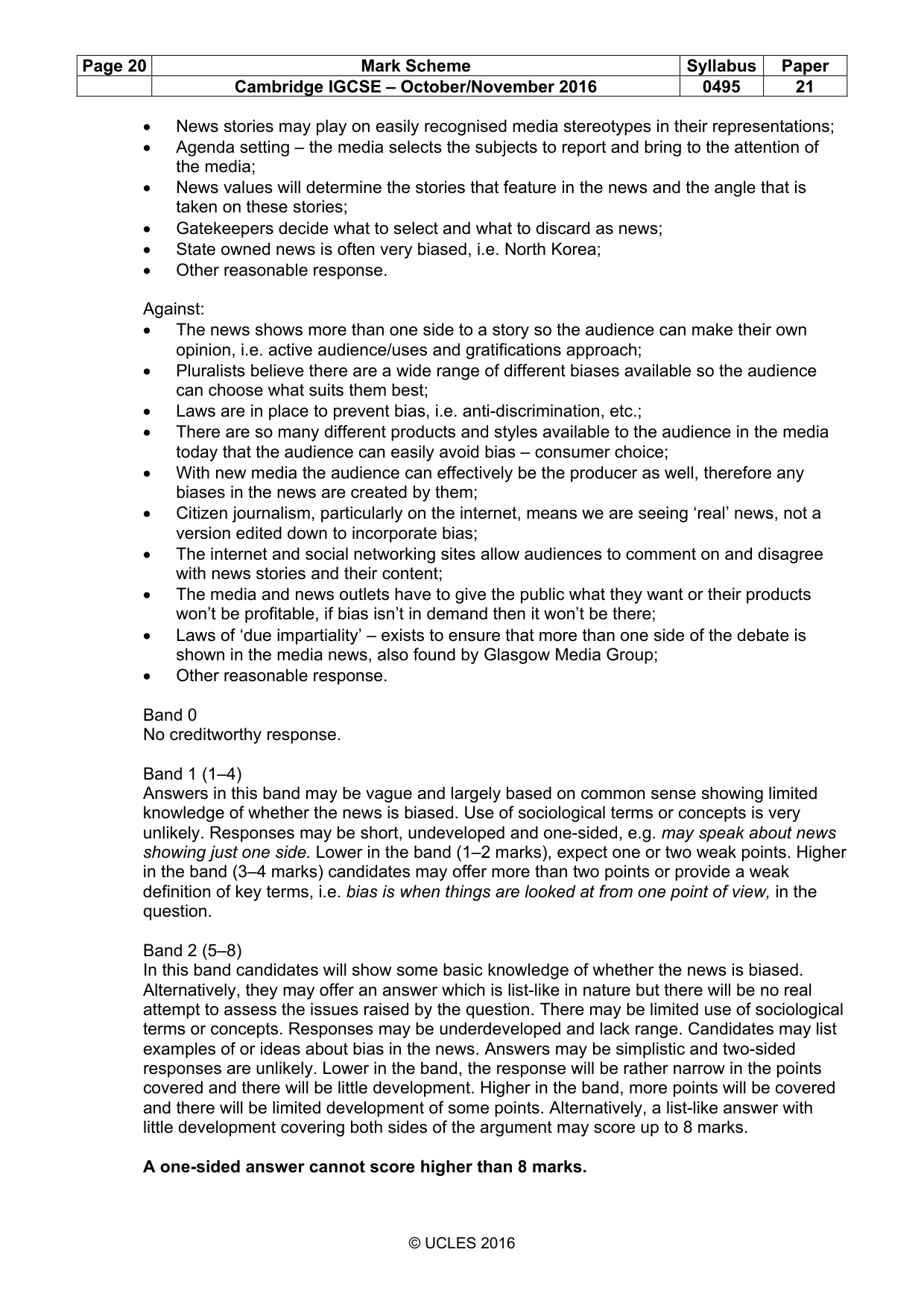
Page 20 Mark Scheme Syllabus Paper Cambridge IGCSE – October/November 2016 0495 21 © UCLES 2016 • News stories may play on easily recognised media stereotypes in their representations; • Agenda setting – the media selects the subjects to report and bring to the attention of the media; • News values will determine the stories that feature in the news and the angle that is taken on these stories; • Gatekeepers decide what to select and what to discard as news; • State owned news is often very biased, i.e. North Korea; • Other reasonable response. Against: • The news shows more than one side to a story so the audience can make their own opinion, i.e. active audience/uses and gratifications approach; • Pluralists believe there are a wide range of different biases available so the audience can choose what suits them best; • Laws are in place to prevent bias, i.e. anti-discrimination, etc.; • There are so many different products and styles available to the audience in the media today that the audience can easily avoid bias – consumer choice; • With new media the audience can effectively be the producer as well, therefore any biases in the news are created by them; • Citizen journalism, particularly on the internet, means we are seeing ‘real’ news, not a version edited down to incorporate bias; • The internet and social networking sites allow audiences to comment on and disagree with news stories and their content; • The media and news outlets have to give the public what they want or their products won’t be profitable, if bias isn’t in demand then it won’t be there; • Laws of ‘due impartiality’ – exists to ensure that more than one side of the debate is shown in the media news, also found by Glasgow Media Group; • Other reasonable response. Band 0 No creditworthy response. Band 1 (1–4) Answers in this band may be vague and largely based on common sense showing limited knowledge of whether the news is biased. Use of sociological terms or concepts is very unlikely. Responses may be short, undeveloped and one-sided, e.g. may speak about news showing just one side. Lower in the band (1–2 marks), expect one or two weak points. Higher in the band (3–4 marks) candidates may offer more than two points or provide a weak definition of key terms, i.e. bias is when things are looked at from one point of view, in the question. Band 2 (5–8) In this band candidates will show some basic knowledge of whether the news is biased. Alternatively, they may offer an answer which is list-like in nature but there will be no real attempt to assess the issues raised by the question. There may be limited use of sociological terms or concepts. Responses may be underdeveloped and lack range. Candidates may list examples of or ideas about bias in the news. Answers may be simplistic and two-sided responses are unlikely. Lower in the band, the response will be rather narrow in the points covered and there will be little development. Higher in the band, more points will be covered and there will be limited development of some points. Alternatively, a list-like answer with little development covering both sides of the argument may score up to 8 marks. A one-sided answer cannot score higher than 8 marks.
Mark scheme, page 21
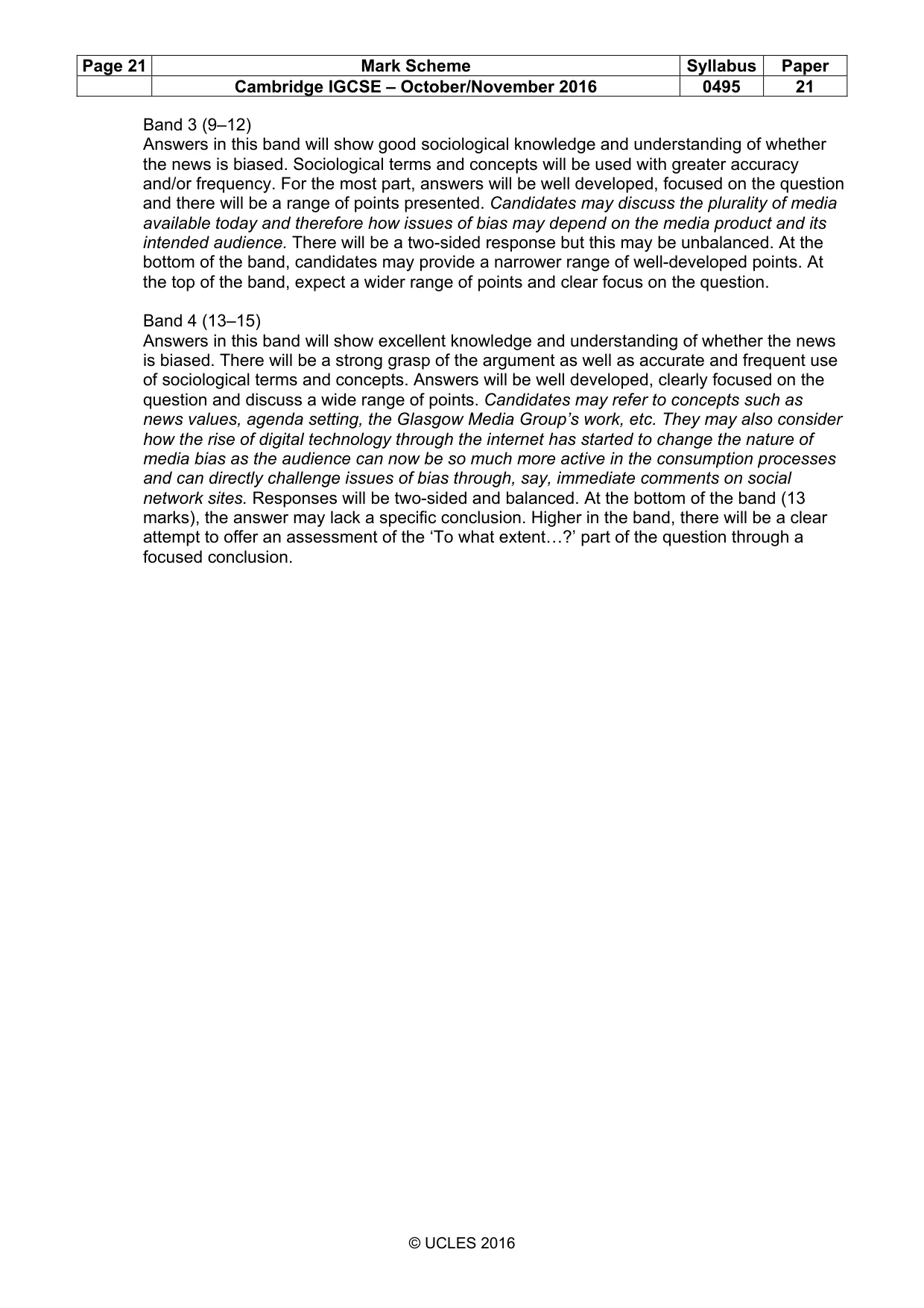
Page 21 Mark Scheme Syllabus Paper Cambridge IGCSE – October/November 2016 0495 21 © UCLES 2016 Band 3 (9–12) Answers in this band will show good sociological knowledge and understanding of whether the news is biased. Sociological terms and concepts will be used with greater accuracy and/or frequency. For the most part, answers will be well developed, focused on the question and there will be a range of points presented. Candidates may discuss the plurality of media available today and therefore how issues of bias may depend on the media product and its intended audience. There will be a two-sided response but this may be unbalanced. At the bottom of the band, candidates may provide a narrower range of well-developed points. At the top of the band, expect a wider range of points and clear focus on the question. Band 4 (13–15) Answers in this band will show excellent knowledge and understanding of whether the news is biased. There will be a strong grasp of the argument as well as accurate and frequent use of sociological terms and concepts. Answers will be well developed, clearly focused on the question and discuss a wide range of points. Candidates may refer to concepts such as news values, agenda setting, the Glasgow Media Group’s work, etc. They may also consider how the rise of digital technology through the internet has started to change the nature of media bias as the audience can now be so much more active in the consumption processes and can directly challenge issues of bias through, say, immediate comments on social network sites. Responses will be two-sided and balanced. At the bottom of the band (13 marks), the answer may lack a specific conclusion. Higher in the band, there will be a clear attempt to offer an assessment of the ‘To what extent…?’ part of the question through a focused conclusion.
What you needed in this session
Cambridge’s own grade thresholds for 2016 Oct/Nov, Paper 2 · Variant 1. A higher threshold means an easier paper — the bar moves with how the cohort did.