Cambridge IGCSE Sociology 0495 — 2016 Oct/Nov Paper 1 · Variant 3
0495/13/O/N/16 · 80 marks · ≈90 min
The question paper and its mark scheme, free to read here and free to download. This is Cambridge’s own paper, exactly as it was sat.
Question paper4 pages
Mark scheme15 pages
Answers below. Sit the paper first if you are practising.
Paper as text
Question paper, page 1
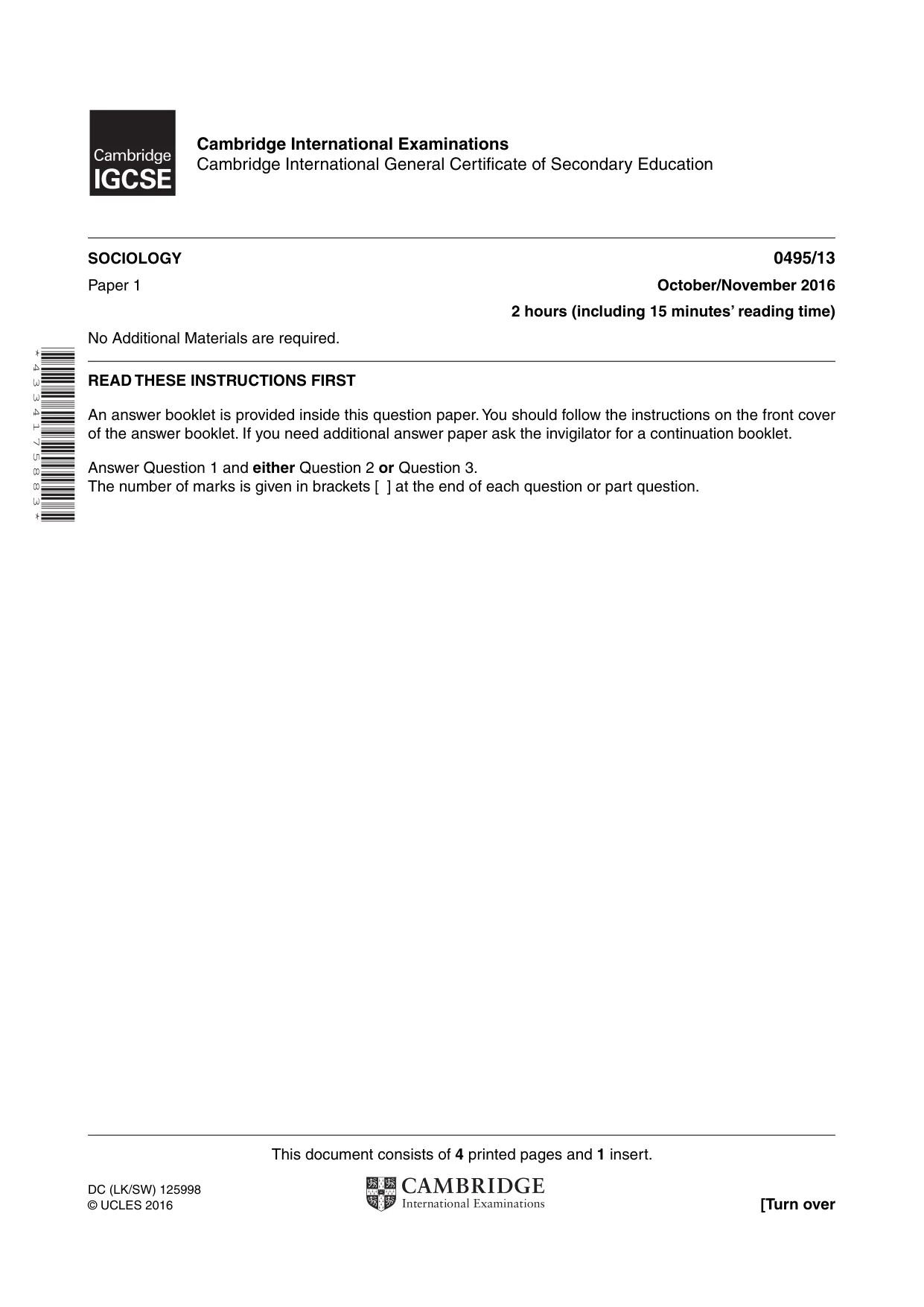
This document consists of 4 printed pages and 1 insert. DC (LK/SW) 125998 © UCLES 2016 [Turn over Cambridge International Examinations Cambridge International General Certificate of Secondary Education * 4 3 3 4 1 7 5 8 8 3 * SOCIOLOGY 0495/13 Paper 1 October/November 2016 2 hours (including 15 minutes’ reading time) No Additional Materials are required. READ THESE INSTRUCTIONS FIRST An answer booklet is provided inside this question paper. You should follow the instructions on the front cover of the answer booklet. If you need additional answer paper ask the invigilator for a continuation booklet. Answer Question 1 and either Question 2 or Question 3. The number of marks is given in brackets [ ] at the end of each question or part question.
Question paper, page 2
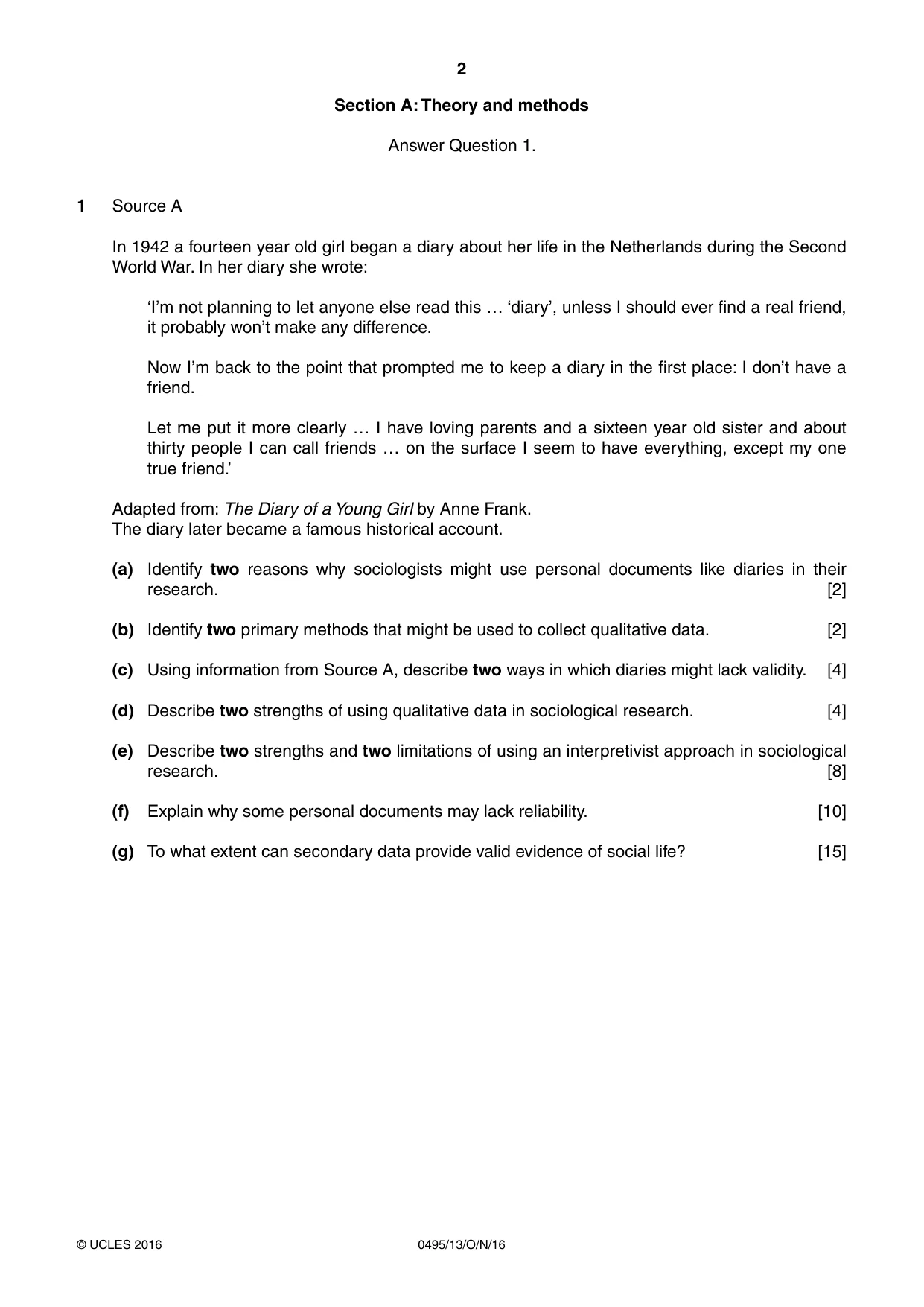
2 0495/13/O/N/16 © UCLES 2016 Section A: Theory and methods Answer Question 1. 1 Source A In 1942 a fourteen year old girl began a diary about her life in the Netherlands during the Second World War. In her diary she wrote: ‘I’m not planning to let anyone else read this … ‘diary’, unless I should ever find a real friend, it probably won’t make any difference. Now I’m back to the point that prompted me to keep a diary in the first place: I don’t have a friend. Let me put it more clearly … I have loving parents and a sixteen year old sister and about thirty people I can call friends … on the surface I seem to have everything, except my one true friend.’ Adapted from: The Diary of a Young Girl by Anne Frank. The diary later became a famous historical account. (a) Identify two reasons why sociologists might use personal documents like diaries in their research. [2] (b) Identify two primary methods that might be used to collect qualitative data. [2] (c) Using information from Source A, describe two ways in which diaries might lack validity. [4] (d) Describe two strengths of using qualitative data in sociological research. [4] (e) Describe two strengths and two limitations of using an interpretivist approach in sociological research. [8] (f) Explain why some personal documents may lack reliability. [10] (g) To what extent can secondary data provide valid evidence of social life? [15]
Question paper, page 3
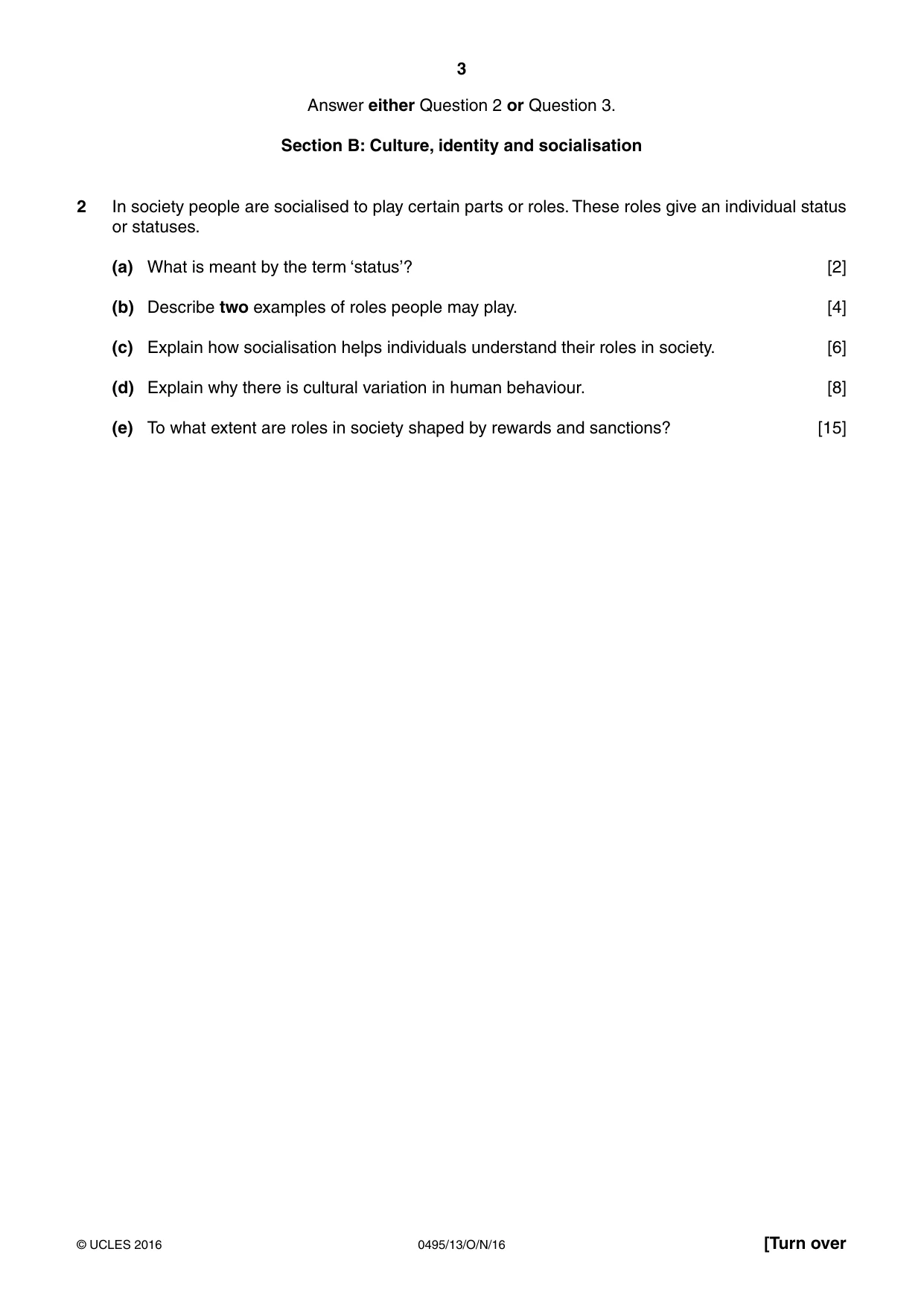
3 0495/13/O/N/16 © UCLES 2016 [Turn over Answer either Question 2 or Question 3. Section B: Culture, identity and socialisation 2 In society people are socialised to play certain parts or roles. These roles give an individual status or statuses. (a) What is meant by the term ‘status’? [2] (b) Describe two examples of roles people may play. [4] (c) Explain how socialisation helps individuals understand their roles in society. [6] (d) Explain why there is cultural variation in human behaviour. [8] (e) To what extent are roles in society shaped by rewards and sanctions? [15]
Question paper, page 4
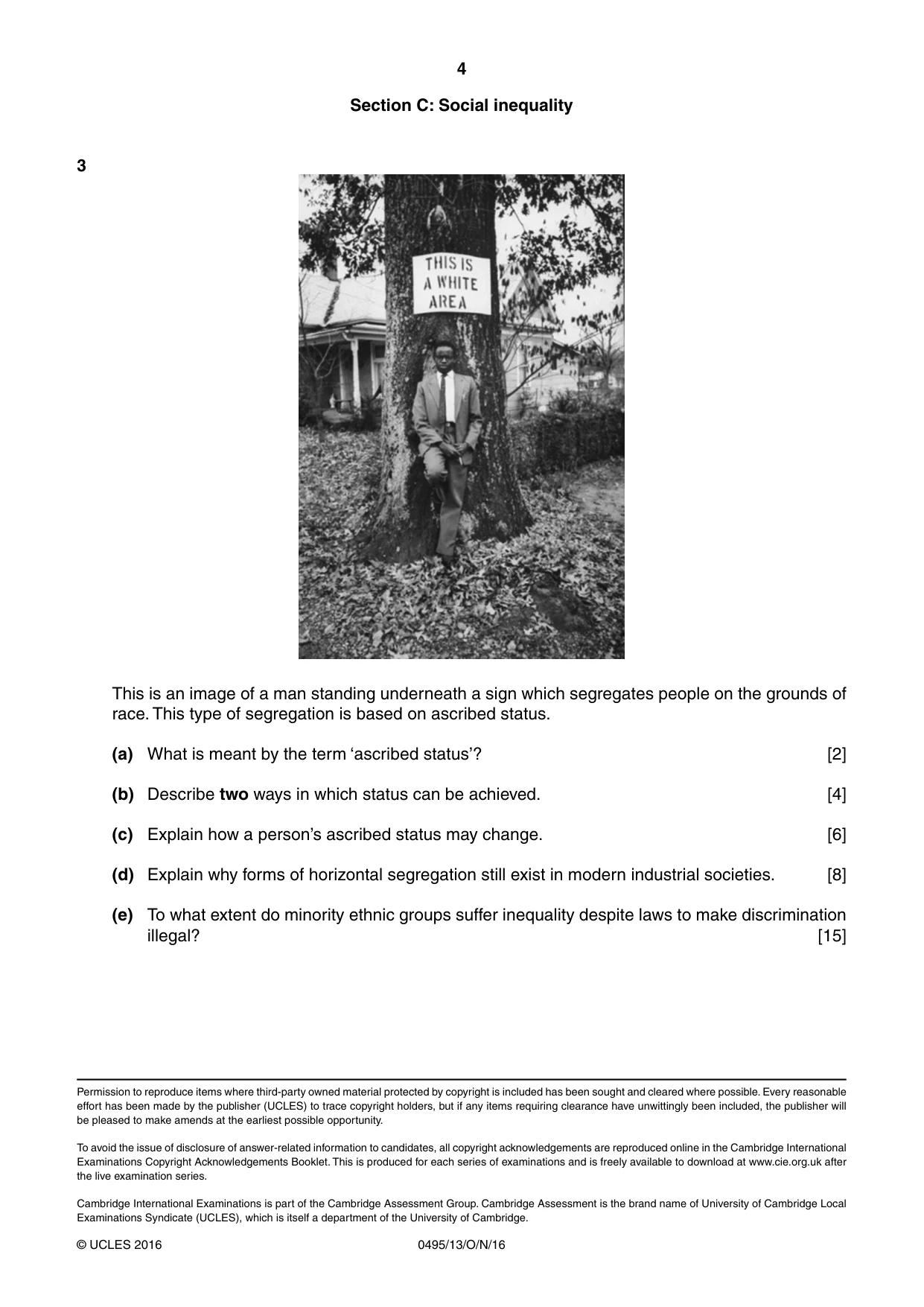
4 0495/13/O/N/16 © UCLES 2016 Permission to reproduce items where third-party owned material protected by copyright is included has been sought and cleared where possible. Every reasonable effort has been made by the publisher (UCLES) to trace copyright holders, but if any items requiring clearance have unwittingly been included, the publisher will be pleased to make amends at the earliest possible opportunity. To avoid the issue of disclosure of answer-related information to candidates, all copyright acknowledgements are reproduced online in the Cambridge International Examinations Copyright Acknowledgements Booklet. This is produced for each series of examinations and is freely available to download at www.cie.org.uk after the live examination series. Cambridge International Examinations is part of the Cambridge Assessment Group. Cambridge Assessment is the brand name of University of Cambridge Local Examinations Syndicate (UCLES), which is itself a department of the University of Cambridge. Section C: Social inequality 3 This is an image of a man standing underneath a sign which segregates people on the grounds of race. This type of segregation is based on ascribed status. (a) What is meant by the term ‘ascribed status’? [2] (b) Describe two ways in which status can be achieved. [4] (c) Explain how a person’s ascribed status may change. [6] (d) Explain why forms of horizontal segregation still exist in modern industrial societies. [8] (e) To what extent do minority ethnic groups suffer inequality despite laws to make discrimination illegal? [15]
Mark scheme, page 1
® IGCSE is the registered trademark of Cambridge International Examinations. This document consists of 15 printed pages. © UCLES 2016 [Turn over Cambridge International Examinations Cambridge International General Certificate of Secondary Education SOCIOLOGY 0495/13 Paper 1 October/November 2016 MARK SCHEME Maximum Mark: 80 Published This mark scheme is published as an aid to teachers and candidates, to indicate the requirements of the examination. It shows the basis on which Examiners were instructed to award marks. It does not indicate the details of the discussions that took place at an Examiners’ meeting before marking began, which would have considered the acceptability of alternative answers. Mark schemes should be read in conjunction with the question paper and the Principal Examiner Report for Teachers. Cambridge will not enter into discussions about these mark schemes. Cambridge is publishing the mark schemes for the October/November 2016 series for most Cambridge IGCSE®, Cambridge International A and AS Level components and some Cambridge O Level components.
Mark scheme, page 2
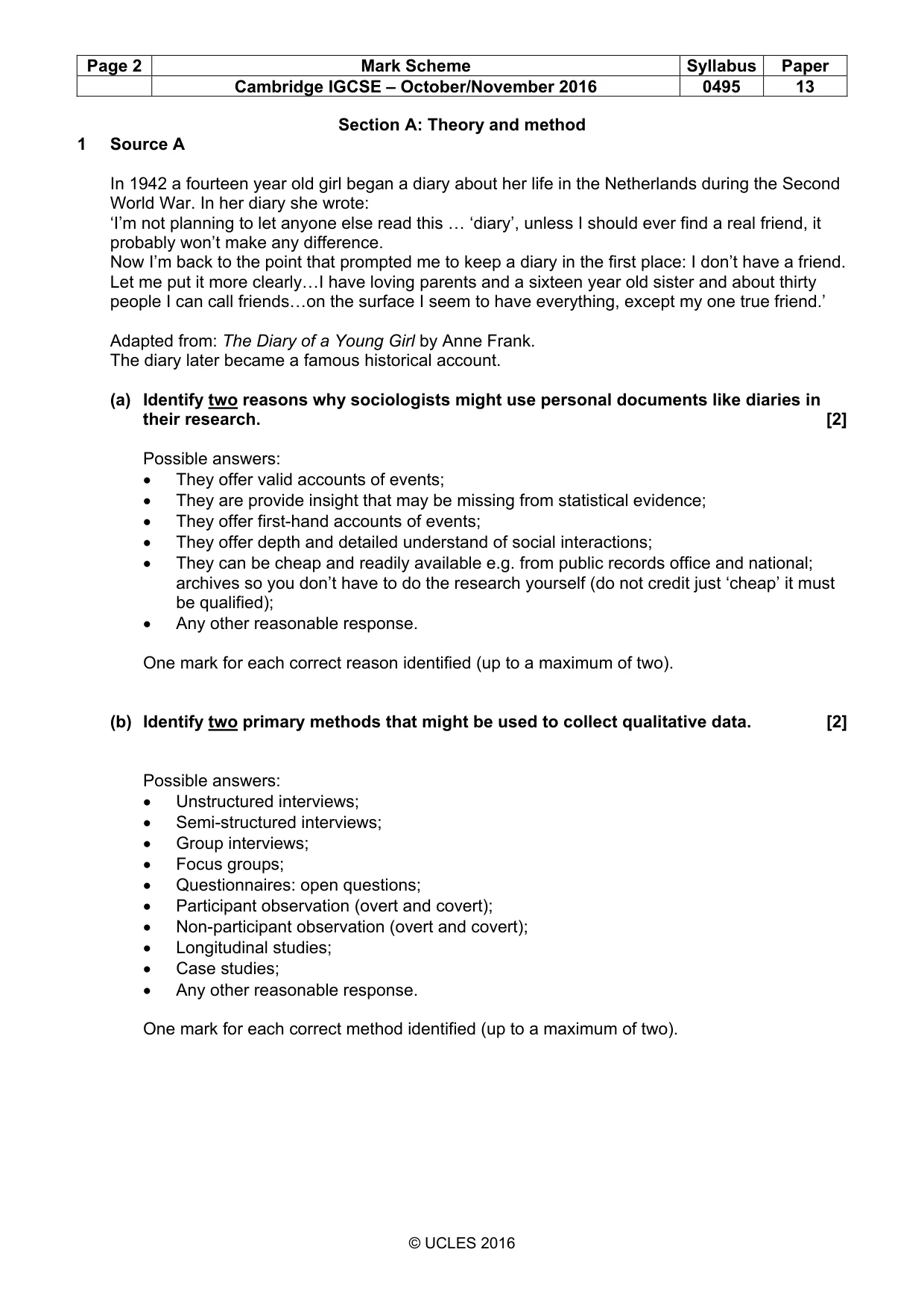
Page 2 Mark Scheme Syllabus Paper Cambridge IGCSE – October/November 2016 0495 13 © UCLES 2016 Section A: Theory and method 1 Source A In 1942 a fourteen year old girl began a diary about her life in the Netherlands during the Second World War. In her diary she wrote: ‘I’m not planning to let anyone else read this … ‘diary’, unless I should ever find a real friend, it probably won’t make any difference. Now I’m back to the point that prompted me to keep a diary in the first place: I don’t have a friend. Let me put it more clearly…I have loving parents and a sixteen year old sister and about thirty people I can call friends…on the surface I seem to have everything, except my one true friend.’ Adapted from: The Diary of a Young Girl by Anne Frank. The diary later became a famous historical account. (a) Identify two reasons why sociologists might use personal documents like diaries in their research. [2] Possible answers: • They offer valid accounts of events; • They are provide insight that may be missing from statistical evidence; • They offer first-hand accounts of events; • They offer depth and detailed understand of social interactions; • They can be cheap and readily available e.g. from public records office and national; archives so you don’t have to do the research yourself (do not credit just ‘cheap’ it must be qualified); • Any other reasonable response. One mark for each correct reason identified (up to a maximum of two). (b) Identify two primary methods that might be used to collect qualitative data. [2] Possible answers: • Unstructured interviews; • Semi-structured interviews; • Group interviews; • Focus groups; • Questionnaires: open questions; • Participant observation (overt and covert); • Non-participant observation (overt and covert); • Longitudinal studies; • Case studies; • Any other reasonable response. One mark for each correct method identified (up to a maximum of two).
Mark scheme, page 3
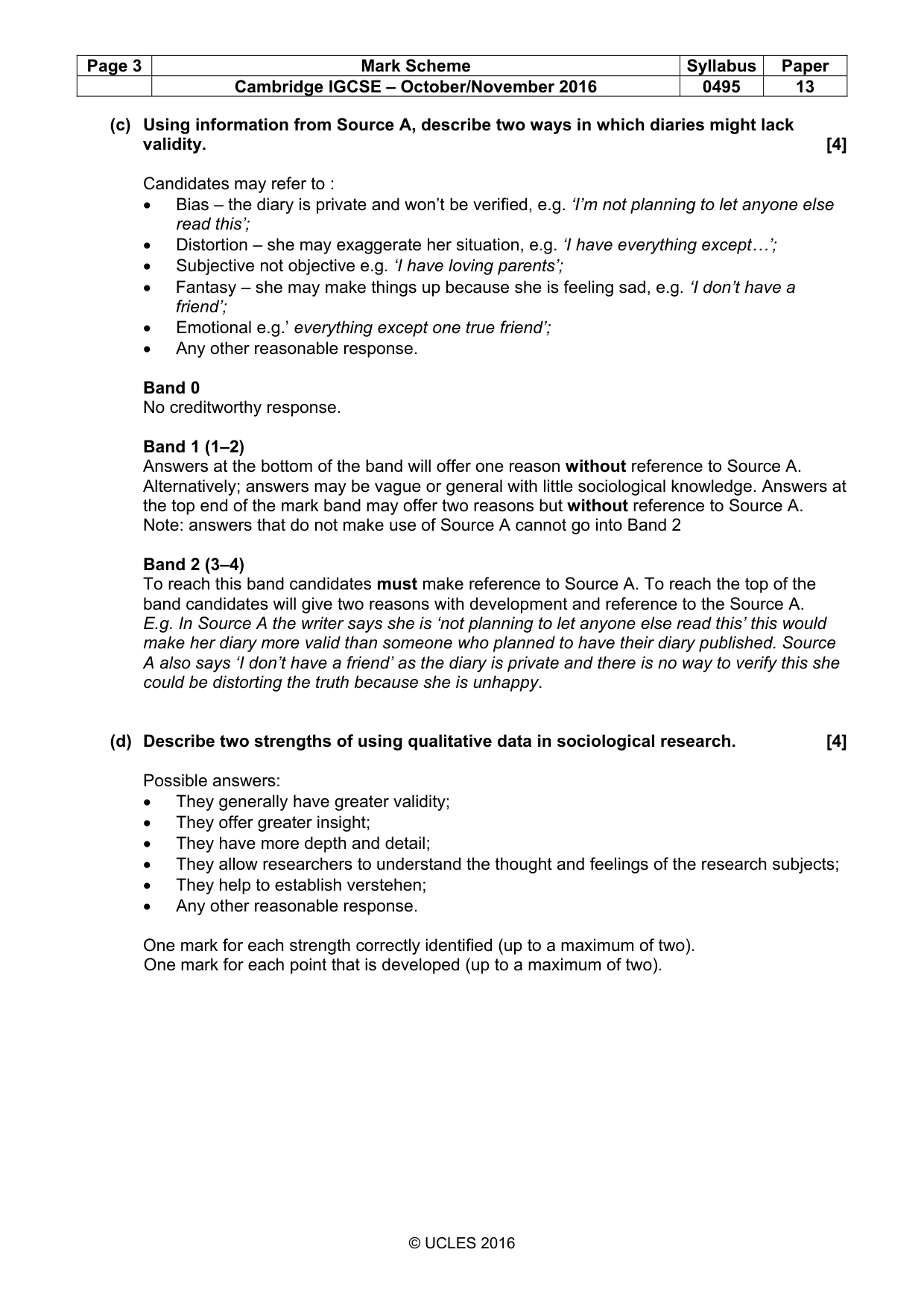
Page 3 Mark Scheme Syllabus Paper Cambridge IGCSE – October/November 2016 0495 13 © UCLES 2016 (c) Using information from Source A, describe two ways in which diaries might lack validity. [4] Candidates may refer to : • Bias – the diary is private and won’t be verified, e.g. ‘I’m not planning to let anyone else read this’; • Distortion – she may exaggerate her situation, e.g. ‘I have everything except…’; • Subjective not objective e.g. ‘I have loving parents’; • Fantasy – she may make things up because she is feeling sad, e.g. ‘I don’t have a friend’; • Emotional e.g.’ everything except one true friend’; • Any other reasonable response. Band 0 No creditworthy response. Band 1 (1–2) Answers at the bottom of the band will offer one reason without reference to Source A. Alternatively; answers may be vague or general with little sociological knowledge. Answers at the top end of the mark band may offer two reasons but without reference to Source A. Note: answers that do not make use of Source A cannot go into Band 2 Band 2 (3–4) To reach this band candidates must make reference to Source A. To reach the top of the band candidates will give two reasons with development and reference to the Source A. E.g. In Source A the writer says she is ‘not planning to let anyone else read this’ this would make her diary more valid than someone who planned to have their diary published. Source A also says ‘I don’t have a friend’ as the diary is private and there is no way to verify this she could be distorting the truth because she is unhappy. (d) Describe two strengths of using qualitative data in sociological research. [4] Possible answers: • They generally have greater validity; • They offer greater insight; • They have more depth and detail; • They allow researchers to understand the thought and feelings of the research subjects; • They help to establish verstehen; • Any other reasonable response. One mark for each strength correctly identified (up to a maximum of two). One mark for each point that is developed (up to a maximum of two).
Mark scheme, page 4
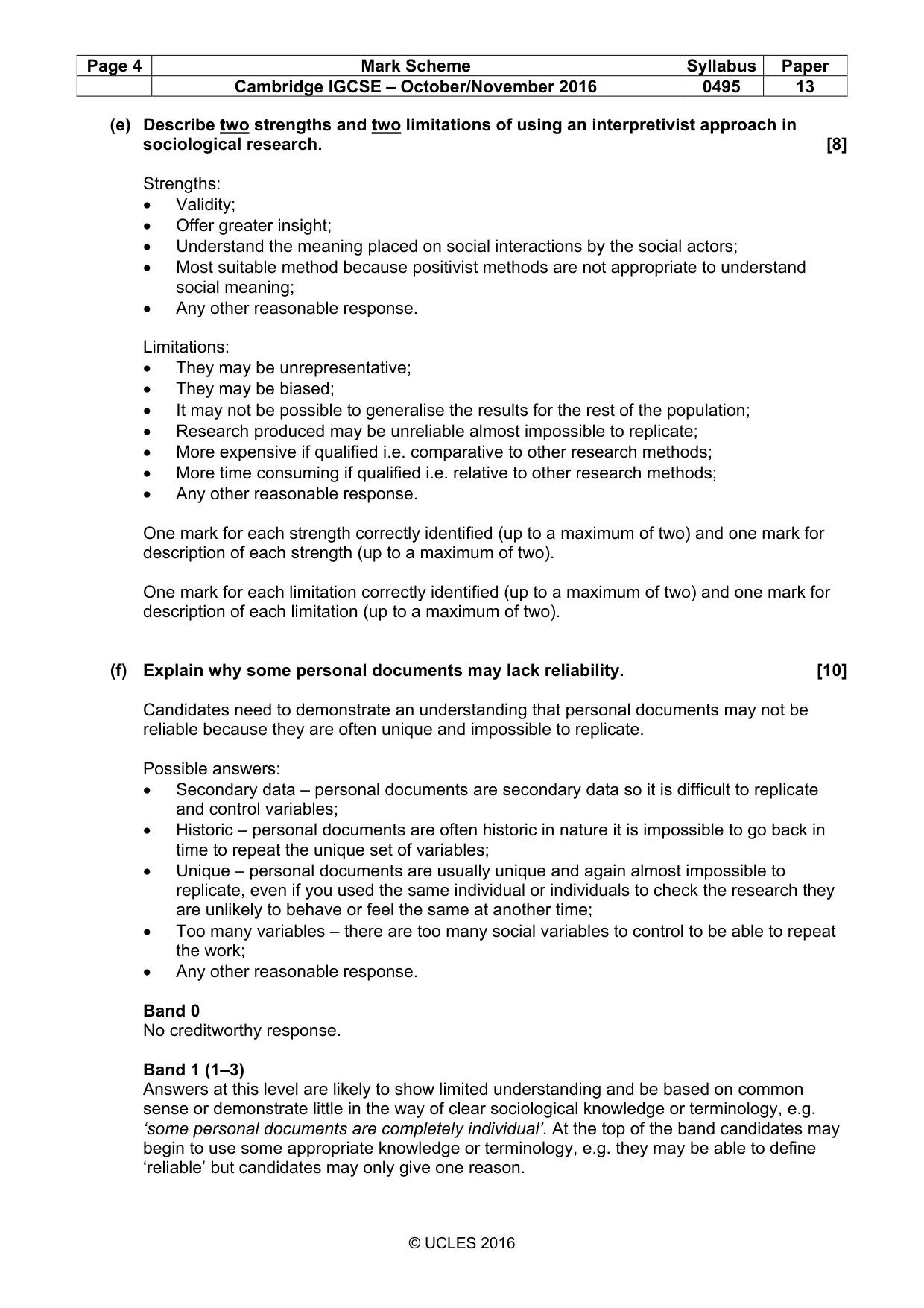
Page 4 Mark Scheme Syllabus Paper Cambridge IGCSE – October/November 2016 0495 13 © UCLES 2016 (e) Describe two strengths and two limitations of using an interpretivist approach in sociological research. [8] Strengths: • Validity; • Offer greater insight; • Understand the meaning placed on social interactions by the social actors; • Most suitable method because positivist methods are not appropriate to understand social meaning; • Any other reasonable response. Limitations: • They may be unrepresentative; • They may be biased; • It may not be possible to generalise the results for the rest of the population; • Research produced may be unreliable almost impossible to replicate; • More expensive if qualified i.e. comparative to other research methods; • More time consuming if qualified i.e. relative to other research methods; • Any other reasonable response. One mark for each strength correctly identified (up to a maximum of two) and one mark for description of each strength (up to a maximum of two). One mark for each limitation correctly identified (up to a maximum of two) and one mark for description of each limitation (up to a maximum of two). (f) Explain why some personal documents may lack reliability. [10] Candidates need to demonstrate an understanding that personal documents may not be reliable because they are often unique and impossible to replicate. Possible answers: • Secondary data – personal documents are secondary data so it is difficult to replicate and control variables; • Historic – personal documents are often historic in nature it is impossible to go back in time to repeat the unique set of variables; • Unique – personal documents are usually unique and again almost impossible to replicate, even if you used the same individual or individuals to check the research they are unlikely to behave or feel the same at another time; • Too many variables – there are too many social variables to control to be able to repeat the work; • Any other reasonable response. Band 0 No creditworthy response. Band 1 (1–3) Answers at this level are likely to show limited understanding and be based on common sense or demonstrate little in the way of clear sociological knowledge or terminology, e.g. ‘some personal documents are completely individual’. At the top of the band candidates may begin to use some appropriate knowledge or terminology, e.g. they may be able to define ‘reliable’ but candidates may only give one reason.
Mark scheme, page 5
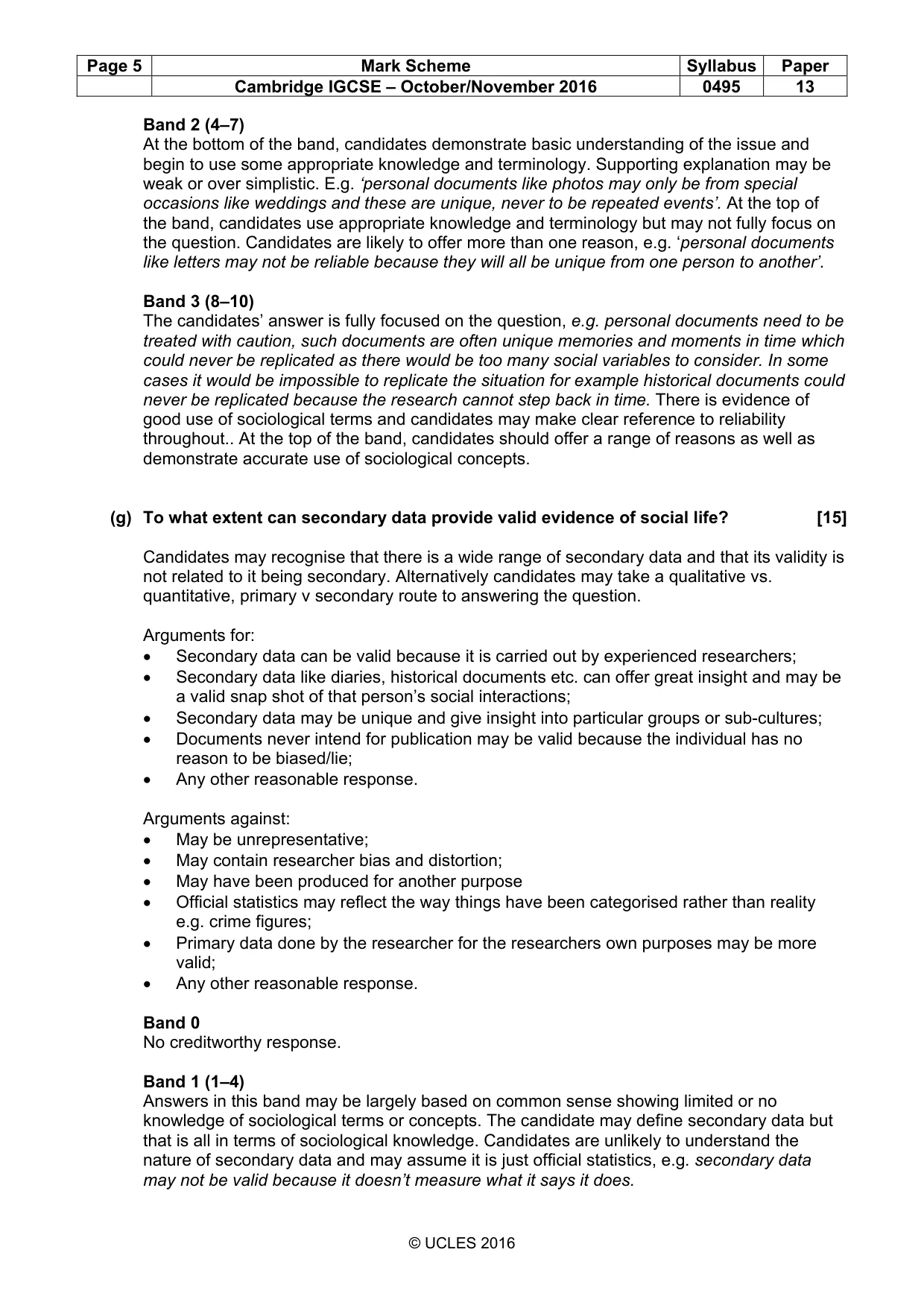
Page 5 Mark Scheme Syllabus Paper Cambridge IGCSE – October/November 2016 0495 13 © UCLES 2016 Band 2 (4–7) At the bottom of the band, candidates demonstrate basic understanding of the issue and begin to use some appropriate knowledge and terminology. Supporting explanation may be weak or over simplistic. E.g. ‘personal documents like photos may only be from special occasions like weddings and these are unique, never to be repeated events’. At the top of the band, candidates use appropriate knowledge and terminology but may not fully focus on the question. Candidates are likely to offer more than one reason, e.g. ‘personal documents like letters may not be reliable because they will all be unique from one person to another’. Band 3 (8–10) The candidates’ answer is fully focused on the question, e.g. personal documents need to be treated with caution, such documents are often unique memories and moments in time which could never be replicated as there would be too many social variables to consider. In some cases it would be impossible to replicate the situation for example historical documents could never be replicated because the research cannot step back in time. There is evidence of good use of sociological terms and candidates may make clear reference to reliability throughout.. At the top of the band, candidates should offer a range of reasons as well as demonstrate accurate use of sociological concepts. (g) To what extent can secondary data provide valid evidence of social life? [15] Candidates may recognise that there is a wide range of secondary data and that its validity is not related to it being secondary. Alternatively candidates may take a qualitative vs. quantitative, primary v secondary route to answering the question. Arguments for: • Secondary data can be valid because it is carried out by experienced researchers; • Secondary data like diaries, historical documents etc. can offer great insight and may be a valid snap shot of that person’s social interactions; • Secondary data may be unique and give insight into particular groups or sub-cultures; • Documents never intend for publication may be valid because the individual has no reason to be biased/lie; • Any other reasonable response. Arguments against: • May be unrepresentative; • May contain researcher bias and distortion; • May have been produced for another purpose • Official statistics may reflect the way things have been categorised rather than reality e.g. crime figures; • Primary data done by the researcher for the researchers own purposes may be more valid; • Any other reasonable response. Band 0 No creditworthy response. Band 1 (1–4) Answers in this band may be largely based on common sense showing limited or no knowledge of sociological terms or concepts. The candidate may define secondary data but that is all in terms of sociological knowledge. Candidates are unlikely to understand the nature of secondary data and may assume it is just official statistics, e.g. secondary data may not be valid because it doesn’t measure what it says it does.
Mark scheme, page 6
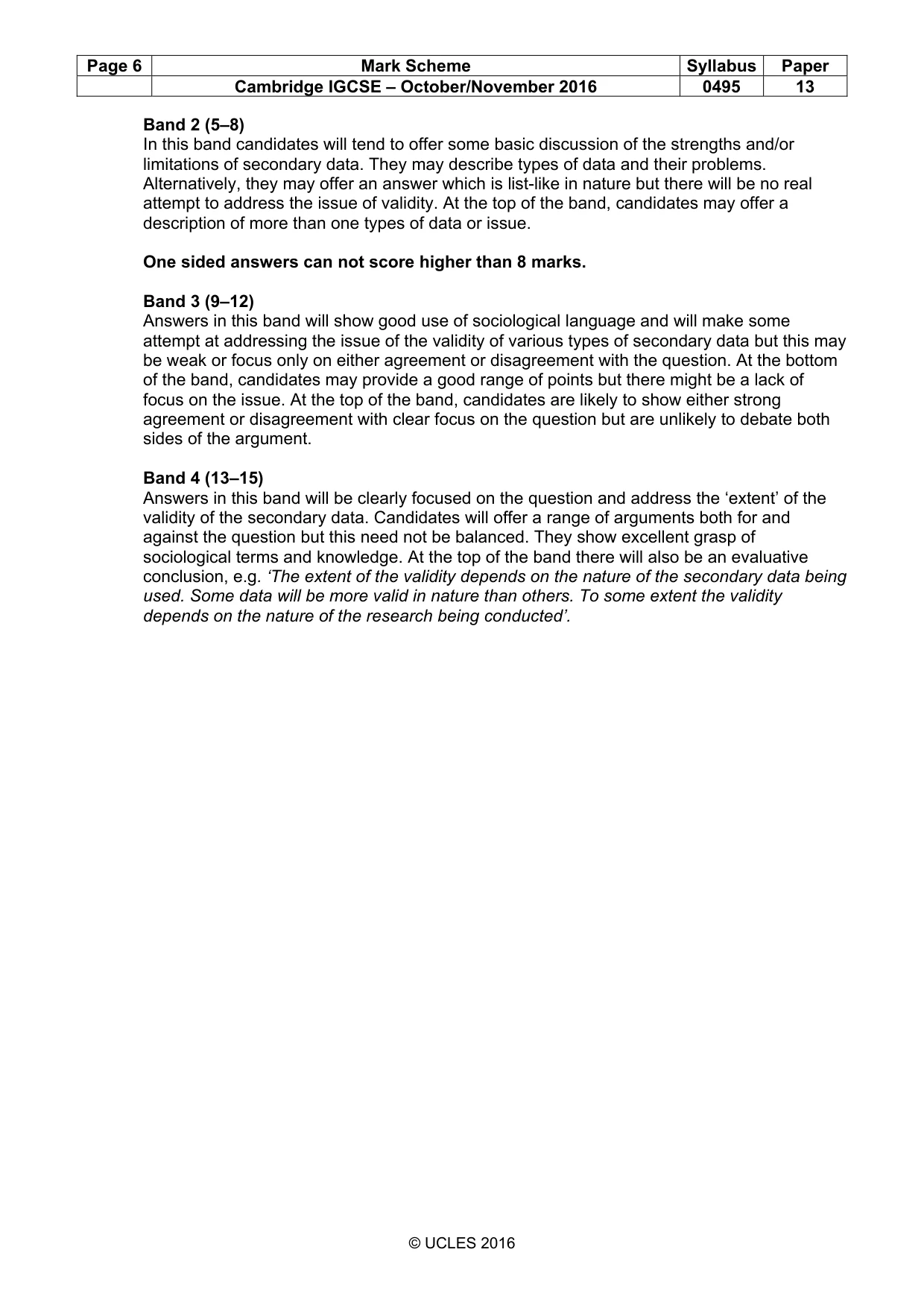
Page 6 Mark Scheme Syllabus Paper Cambridge IGCSE – October/November 2016 0495 13 © UCLES 2016 Band 2 (5–8) In this band candidates will tend to offer some basic discussion of the strengths and/or limitations of secondary data. They may describe types of data and their problems. Alternatively, they may offer an answer which is list-like in nature but there will be no real attempt to address the issue of validity. At the top of the band, candidates may offer a description of more than one types of data or issue. One sided answers can not score higher than 8 marks. Band 3 (9–12) Answers in this band will show good use of sociological language and will make some attempt at addressing the issue of the validity of various types of secondary data but this may be weak or focus only on either agreement or disagreement with the question. At the bottom of the band, candidates may provide a good range of points but there might be a lack of focus on the issue. At the top of the band, candidates are likely to show either strong agreement or disagreement with clear focus on the question but are unlikely to debate both sides of the argument. Band 4 (13–15) Answers in this band will be clearly focused on the question and address the ‘extent’ of the validity of the secondary data. Candidates will offer a range of arguments both for and against the question but this need not be balanced. They show excellent grasp of sociological terms and knowledge. At the top of the band there will also be an evaluative conclusion, e.g. ‘The extent of the validity depends on the nature of the secondary data being used. Some data will be more valid in nature than others. To some extent the validity depends on the nature of the research being conducted’.
Mark scheme, page 7
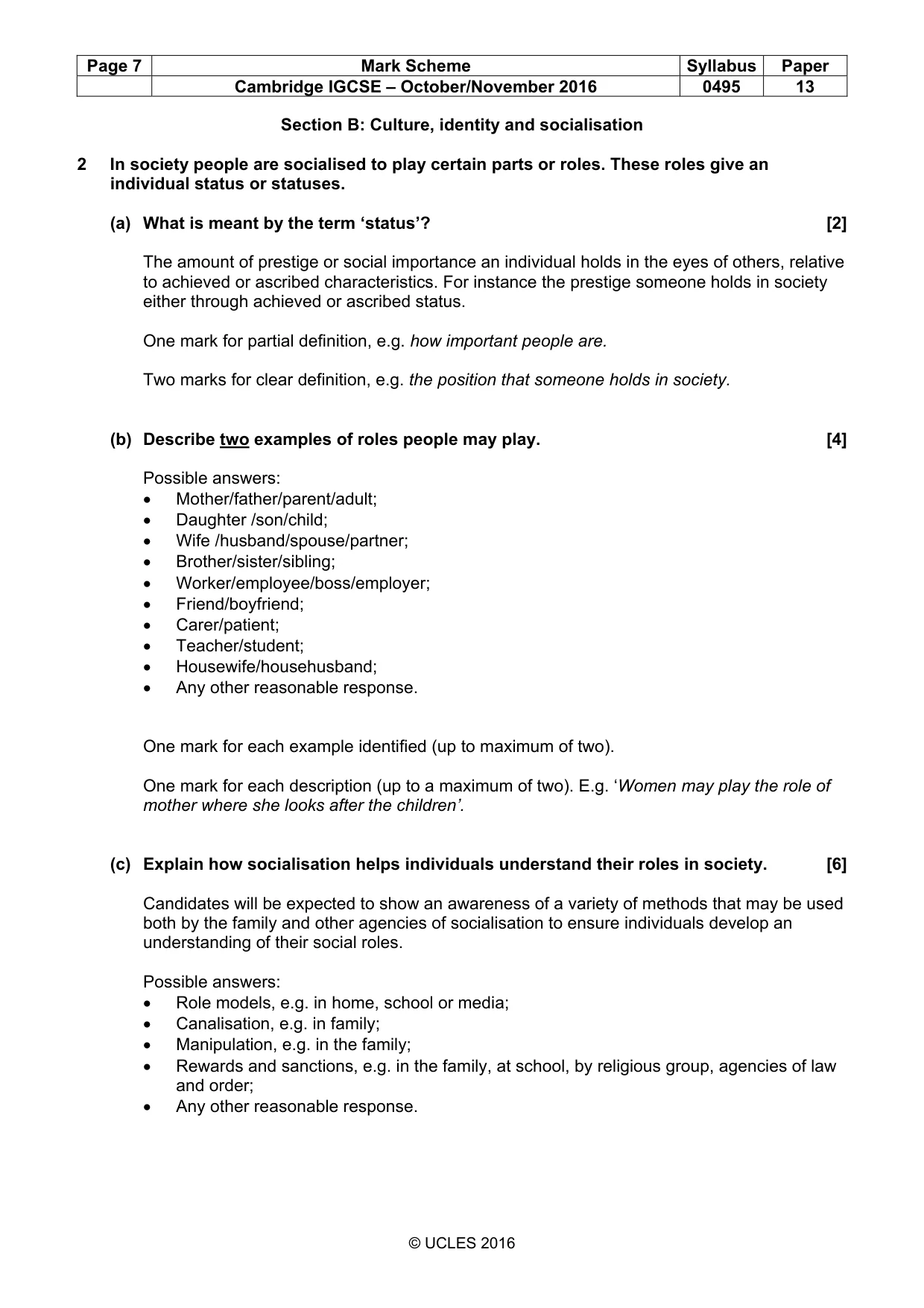
Page 7 Mark Scheme Syllabus Paper Cambridge IGCSE – October/November 2016 0495 13 © UCLES 2016 Section B: Culture, identity and socialisation 2 In society people are socialised to play certain parts or roles. These roles give an individual status or statuses. (a) What is meant by the term ‘status’? [2] The amount of prestige or social importance an individual holds in the eyes of others, relative to achieved or ascribed characteristics. For instance the prestige someone holds in society either through achieved or ascribed status. One mark for partial definition, e.g. how important people are. Two marks for clear definition, e.g. the position that someone holds in society. (b) Describe two examples of roles people may play. [4] Possible answers: • Mother/father/parent/adult; • Daughter /son/child; • Wife /husband/spouse/partner; • Brother/sister/sibling; • Worker/employee/boss/employer; • Friend/boyfriend; • Carer/patient; • Teacher/student; • Housewife/househusband; • Any other reasonable response. One mark for each example identified (up to maximum of two). One mark for each description (up to a maximum of two). E.g. ‘Women may play the role of mother where she looks after the children’. (c) Explain how socialisation helps individuals understand their roles in society. [6] Candidates will be expected to show an awareness of a variety of methods that may be used both by the family and other agencies of socialisation to ensure individuals develop an understanding of their social roles. Possible answers: • Role models, e.g. in home, school or media; • Canalisation, e.g. in family; • Manipulation, e.g. in the family; • Rewards and sanctions, e.g. in the family, at school, by religious group, agencies of law and order; • Any other reasonable response.
Mark scheme, page 8
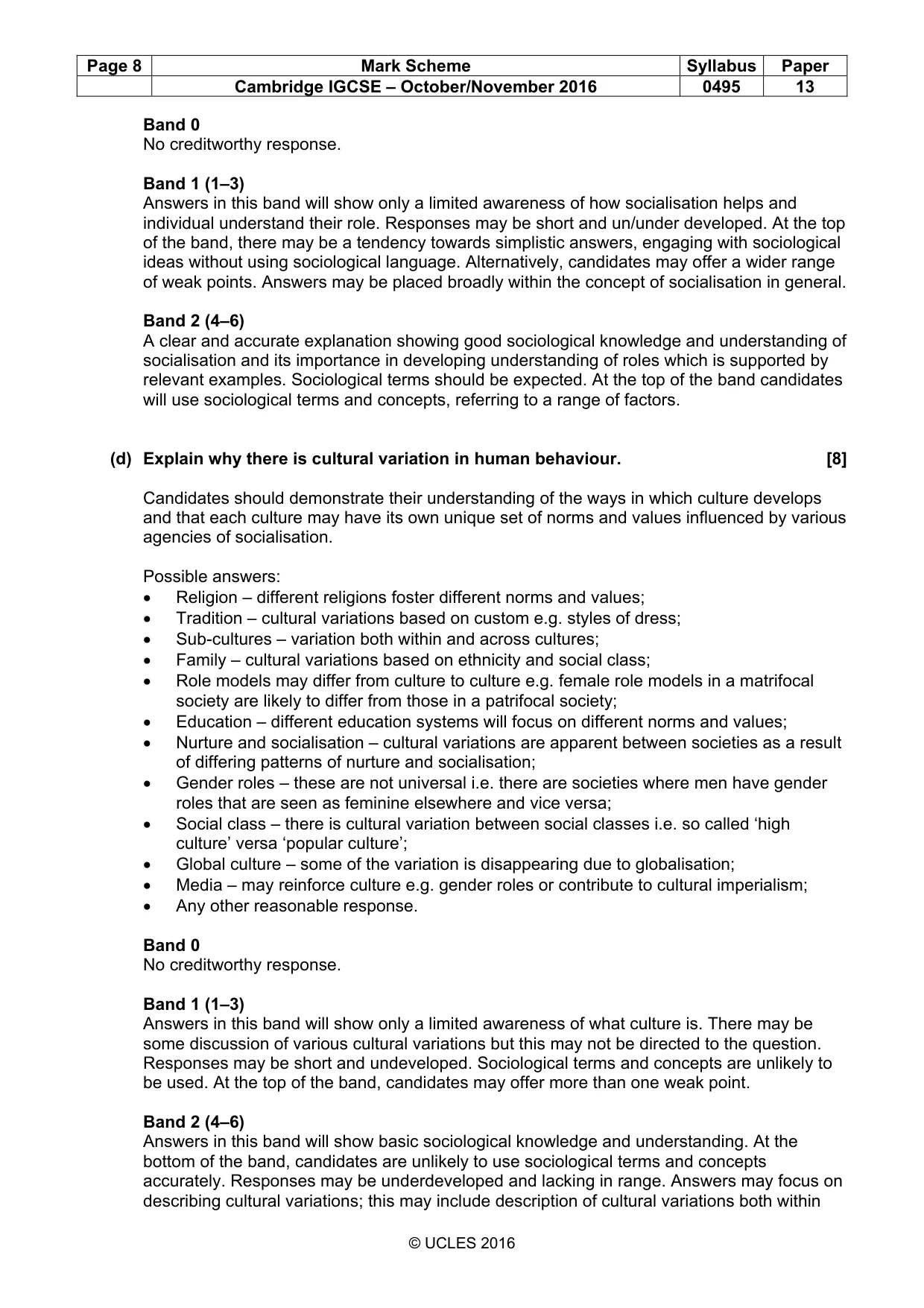
Page 8 Mark Scheme Syllabus Paper Cambridge IGCSE – October/November 2016 0495 13 © UCLES 2016 Band 0 No creditworthy response. Band 1 (1–3) Answers in this band will show only a limited awareness of how socialisation helps and individual understand their role. Responses may be short and un/under developed. At the top of the band, there may be a tendency towards simplistic answers, engaging with sociological ideas without using sociological language. Alternatively, candidates may offer a wider range of weak points. Answers may be placed broadly within the concept of socialisation in general. Band 2 (4–6) A clear and accurate explanation showing good sociological knowledge and understanding of socialisation and its importance in developing understanding of roles which is supported by relevant examples. Sociological terms should be expected. At the top of the band candidates will use sociological terms and concepts, referring to a range of factors. (d) Explain why there is cultural variation in human behaviour. [8] Candidates should demonstrate their understanding of the ways in which culture develops and that each culture may have its own unique set of norms and values influenced by various agencies of socialisation. Possible answers: • Religion – different religions foster different norms and values; • Tradition – cultural variations based on custom e.g. styles of dress; • Sub-cultures – variation both within and across cultures; • Family – cultural variations based on ethnicity and social class; • Role models may differ from culture to culture e.g. female role models in a matrifocal society are likely to differ from those in a patrifocal society; • Education – different education systems will focus on different norms and values; • Nurture and socialisation – cultural variations are apparent between societies as a result of differing patterns of nurture and socialisation; • Gender roles – these are not universal i.e. there are societies where men have gender roles that are seen as feminine elsewhere and vice versa; • Social class – there is cultural variation between social classes i.e. so called ‘high culture’ versa ‘popular culture’; • Global culture – some of the variation is disappearing due to globalisation; • Media – may reinforce culture e.g. gender roles or contribute to cultural imperialism; • Any other reasonable response. Band 0 No creditworthy response. Band 1 (1–3) Answers in this band will show only a limited awareness of what culture is. There may be some discussion of various cultural variations but this may not be directed to the question. Responses may be short and undeveloped. Sociological terms and concepts are unlikely to be used. At the top of the band, candidates may offer more than one weak point. Band 2 (4–6) Answers in this band will show basic sociological knowledge and understanding. At the bottom of the band, candidates are unlikely to use sociological terms and concepts accurately. Responses may be underdeveloped and lacking in range. Answers may focus on describing cultural variations; this may include description of cultural variations both within
Mark scheme, page 9
Page 9 Mark Scheme Syllabus Paper Cambridge IGCSE – October/November 2016 0495 13 © UCLES 2016 and/or across societies, without any attempt to explain why the cultural variations occur. E.g. ‘in some societies it is traditional for women to stay in the home where as in others they can go to work and have a career’. At the top of the band, candidates may be beginning to use sociological terms and concepts with greater accuracy. However, some aspects of the answer may only be partially developed. Band 3 (7–8) Answers in this band will show good sociological knowledge and understanding of why cultural variation occurs and will be well developed and explained. Sociological terms and concepts will be used accurately. Answers will be well focused on the question and there will be a range of reasons presented. At the top of the band explanations will be clear throughout. (e) To what extent are roles in society shaped by rewards and sanctions? [15] Candidates need to demonstrate an understanding that society has expectations about how certain roles are performed and that individuals face pressure to conform and those who fail to fulfil these roles as expected will face sanctions whilst those who fulfil their roles as expected will be rewarded Arguments for: • Social sanctions, e.g. ignored, excluded, shunned, being ostracised; • Legal sanctions, e.g. arrest/imprisonment/fines; • Physical punishment, e.g. caning children who do not fulfil their role of pupil; • Reprimand, e.g. verbal telling off at home or at school; • Religious pressure to conform, e.g. may be shunned if you don’t conform; • Financial rewards for conforming, e.g. those who fulfil the role of good worker are given a pay rise and/or promotion for hard work; • Fines for failure to fulfil roles e.g. fines for dropping litter – not being a good citizen; • Pressure from peers, media, family etc.; • Any other reasonable response. Arguments against: • In more open societies there is often greater freedom to rebel against expected roles; • Sub-cultures have different expectations from the mainstream (note: but may also have their own systems of rewards and sanctions); • Roles may result from ascribed characteristics e.g. women have to bear children; • Roles may be learnt through role modelling, canalisation and manipulation and other means of socialisation without need of reinforcement from rewards and sanctions; • Any other reasonable response. Band 0 No creditworthy response. Band 1 (1–4) Answers in this band may be vague and largely based on common sense showing limited knowledge of how rewards and sanctions may shape roles. Responses may be short, undeveloped and one-sided, e.g. People who do not carry out their roles will be punished. At the bottom of the band, use of sociological terms or concepts is very unlikely. At the top of the band, candidates may understand what ascribed status means.
Mark scheme, page 10
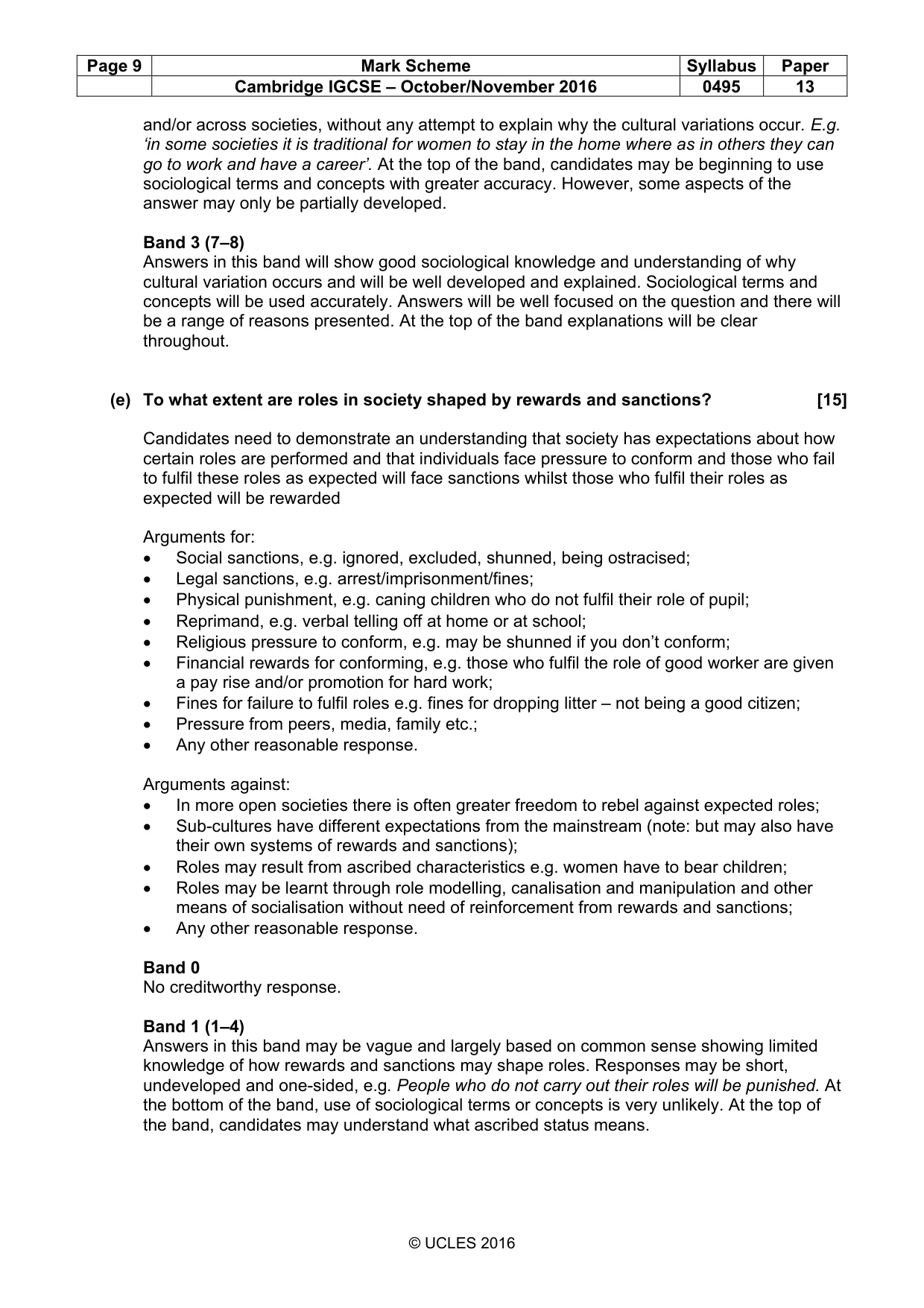
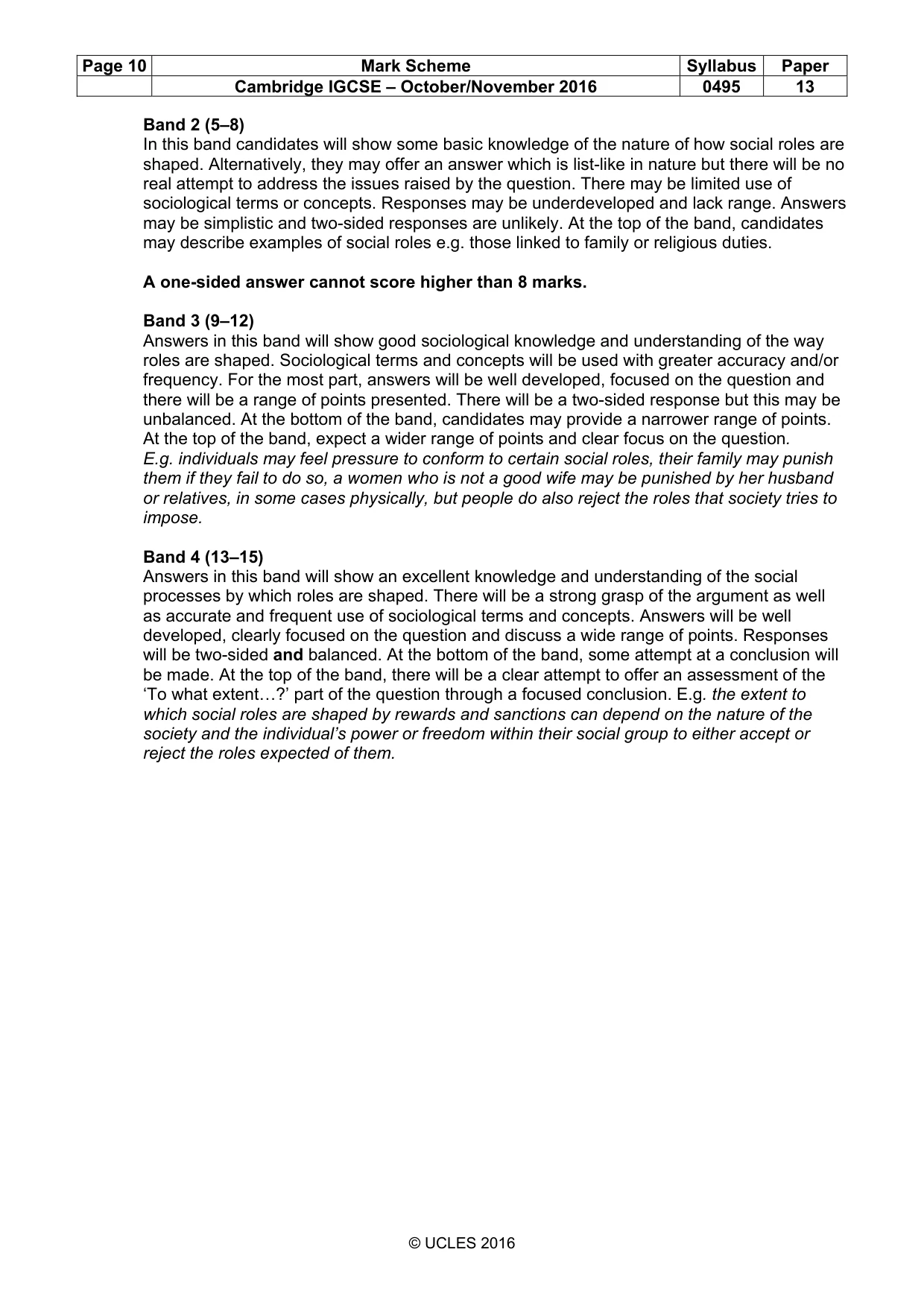
Page 10 Mark Scheme Syllabus Paper Cambridge IGCSE – October/November 2016 0495 13 © UCLES 2016 Band 2 (5–8) In this band candidates will show some basic knowledge of the nature of how social roles are shaped. Alternatively, they may offer an answer which is list-like in nature but there will be no real attempt to address the issues raised by the question. There may be limited use of sociological terms or concepts. Responses may be underdeveloped and lack range. Answers may be simplistic and two-sided responses are unlikely. At the top of the band, candidates may describe examples of social roles e.g. those linked to family or religious duties. A one-sided answer cannot score higher than 8 marks. Band 3 (9–12) Answers in this band will show good sociological knowledge and understanding of the way roles are shaped. Sociological terms and concepts will be used with greater accuracy and/or frequency. For the most part, answers will be well developed, focused on the question and there will be a range of points presented. There will be a two-sided response but this may be unbalanced. At the bottom of the band, candidates may provide a narrower range of points. At the top of the band, expect a wider range of points and clear focus on the question. E.g. individuals may feel pressure to conform to certain social roles, their family may punish them if they fail to do so, a women who is not a good wife may be punished by her husband or relatives, in some cases physically, but people do also reject the roles that society tries to impose. Band 4 (13–15) Answers in this band will show an excellent knowledge and understanding of the social processes by which roles are shaped. There will be a strong grasp of the argument as well as accurate and frequent use of sociological terms and concepts. Answers will be well developed, clearly focused on the question and discuss a wide range of points. Responses will be two-sided and balanced. At the bottom of the band, some attempt at a conclusion will be made. At the top of the band, there will be a clear attempt to offer an assessment of the ‘To what extent…?’ part of the question through a focused conclusion. E.g. the extent to which social roles are shaped by rewards and sanctions can depend on the nature of the society and the individual’s power or freedom within their social group to either accept or reject the roles expected of them.
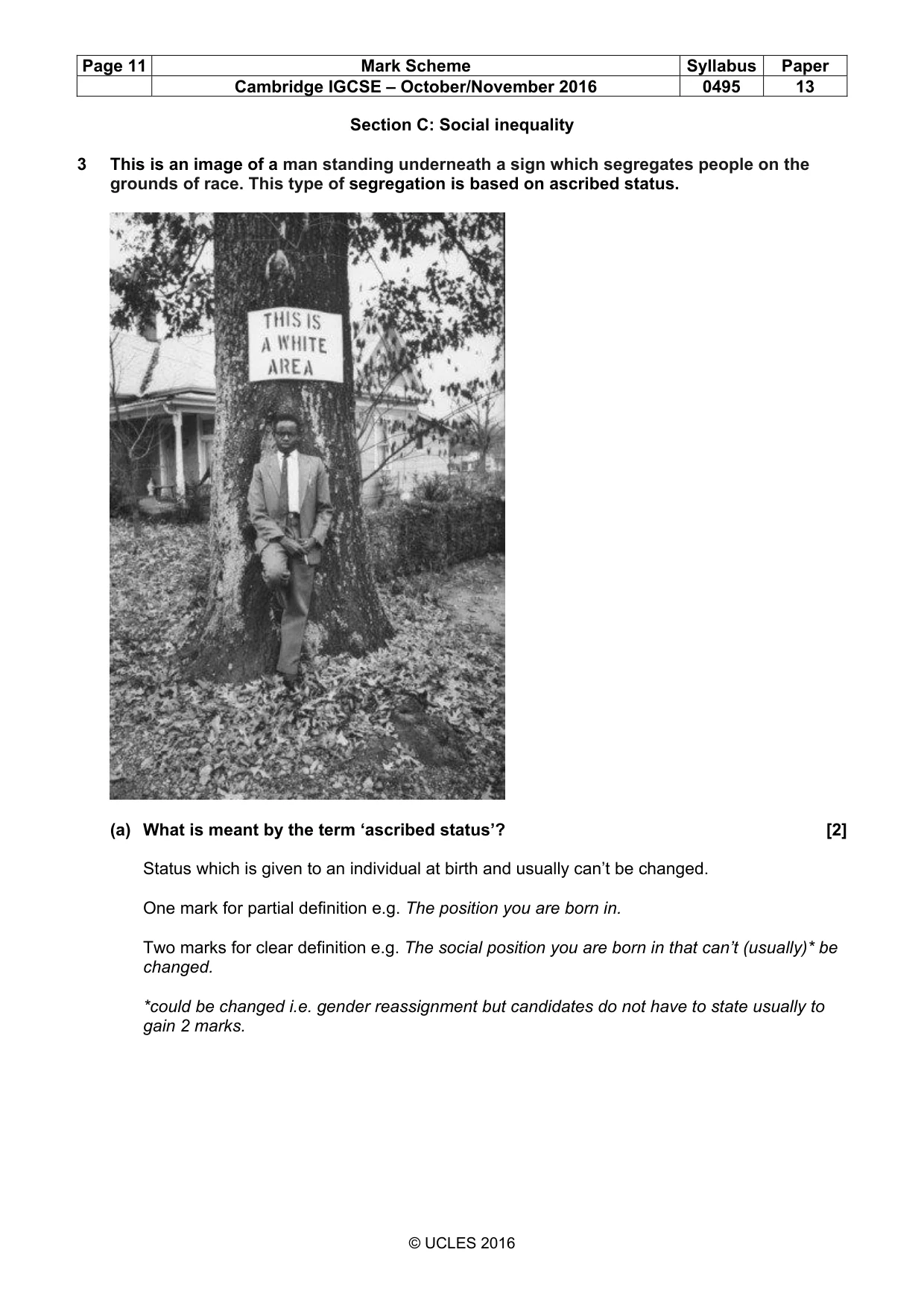
Mark scheme, page 11
Page 11 Mark Scheme Syllabus Paper Cambridge IGCSE – October/November 2016 0495 13 © UCLES 2016 Section C: Social inequality 3 This is an image of a man standing underneath a sign which segregates people on the grounds of race. This type of segregation is based on ascribed status. (a) What is meant by the term ‘ascribed status’? [2] Status which is given to an individual at birth and usually can’t be changed. One mark for partial definition e.g. The position you are born in. Two marks for clear definition e.g. The social position you are born in that can’t (usually)* be changed. *could be changed i.e. gender reassignment but candidates do not have to state usually to gain 2 marks.
Mark scheme, page 12
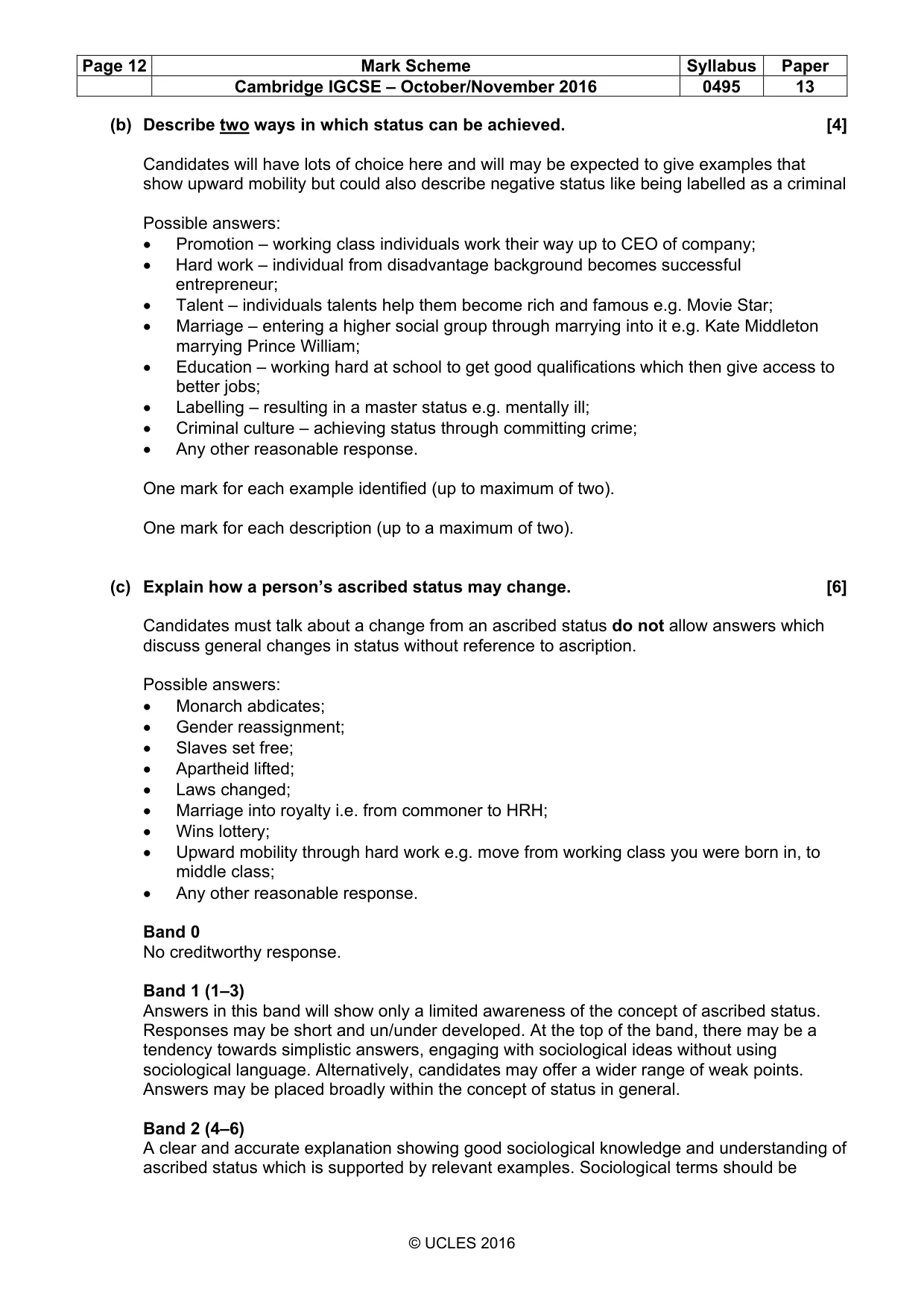
Page 12 Mark Scheme Syllabus Paper Cambridge IGCSE – October/November 2016 0495 13 © UCLES 2016 (b) Describe two ways in which status can be achieved. [4] Candidates will have lots of choice here and will may be expected to give examples that show upward mobility but could also describe negative status like being labelled as a criminal Possible answers: • Promotion – working class individuals work their way up to CEO of company; • Hard work – individual from disadvantage background becomes successful entrepreneur; • Talent – individuals talents help them become rich and famous e.g. Movie Star; • Marriage – entering a higher social group through marrying into it e.g. Kate Middleton marrying Prince William; • Education – working hard at school to get good qualifications which then give access to better jobs; • Labelling – resulting in a master status e.g. mentally ill; • Criminal culture – achieving status through committing crime; • Any other reasonable response. One mark for each example identified (up to maximum of two). One mark for each description (up to a maximum of two). (c) Explain how a person’s ascribed status may change. [6] Candidates must talk about a change from an ascribed status do not allow answers which discuss general changes in status without reference to ascription. Possible answers: • Monarch abdicates; • Gender reassignment; • Slaves set free; • Apartheid lifted; • Laws changed; • Marriage into royalty i.e. from commoner to HRH; • Wins lottery; • Upward mobility through hard work e.g. move from working class you were born in, to middle class; • Any other reasonable response. Band 0 No creditworthy response. Band 1 (1–3) Answers in this band will show only a limited awareness of the concept of ascribed status. Responses may be short and un/under developed. At the top of the band, there may be a tendency towards simplistic answers, engaging with sociological ideas without using sociological language. Alternatively, candidates may offer a wider range of weak points. Answers may be placed broadly within the concept of status in general. Band 2 (4–6) A clear and accurate explanation showing good sociological knowledge and understanding of ascribed status which is supported by relevant examples. Sociological terms should be
Mark scheme, page 13
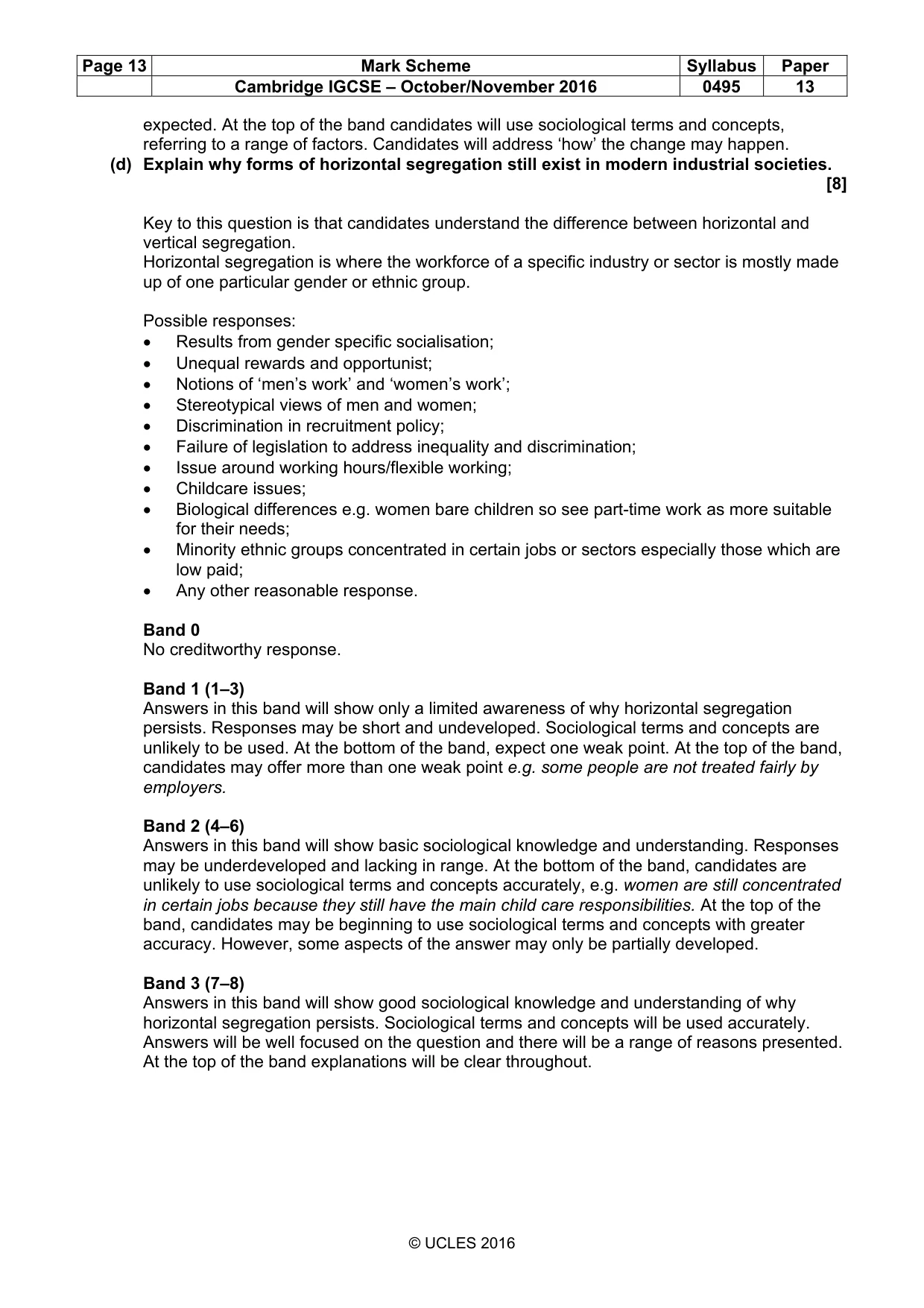
Page 13 Mark Scheme Syllabus Paper Cambridge IGCSE – October/November 2016 0495 13 © UCLES 2016 expected. At the top of the band candidates will use sociological terms and concepts, referring to a range of factors. Candidates will address ‘how’ the change may happen. (d) Explain why forms of horizontal segregation still exist in modern industrial societies. [8] Key to this question is that candidates understand the difference between horizontal and vertical segregation. Horizontal segregation is where the workforce of a specific industry or sector is mostly made up of one particular gender or ethnic group. Possible responses: • Results from gender specific socialisation; • Unequal rewards and opportunist; • Notions of ‘men’s work’ and ‘women’s work’; • Stereotypical views of men and women; • Discrimination in recruitment policy; • Failure of legislation to address inequality and discrimination; • Issue around working hours/flexible working; • Childcare issues; • Biological differences e.g. women bare children so see part-time work as more suitable for their needs; • Minority ethnic groups concentrated in certain jobs or sectors especially those which are low paid; • Any other reasonable response. Band 0 No creditworthy response. Band 1 (1–3) Answers in this band will show only a limited awareness of why horizontal segregation persists. Responses may be short and undeveloped. Sociological terms and concepts are unlikely to be used. At the bottom of the band, expect one weak point. At the top of the band, candidates may offer more than one weak point e.g. some people are not treated fairly by employers. Band 2 (4–6) Answers in this band will show basic sociological knowledge and understanding. Responses may be underdeveloped and lacking in range. At the bottom of the band, candidates are unlikely to use sociological terms and concepts accurately, e.g. women are still concentrated in certain jobs because they still have the main child care responsibilities. At the top of the band, candidates may be beginning to use sociological terms and concepts with greater accuracy. However, some aspects of the answer may only be partially developed. Band 3 (7–8) Answers in this band will show good sociological knowledge and understanding of why horizontal segregation persists. Sociological terms and concepts will be used accurately. Answers will be well focused on the question and there will be a range of reasons presented. At the top of the band explanations will be clear throughout.
Mark scheme, page 14
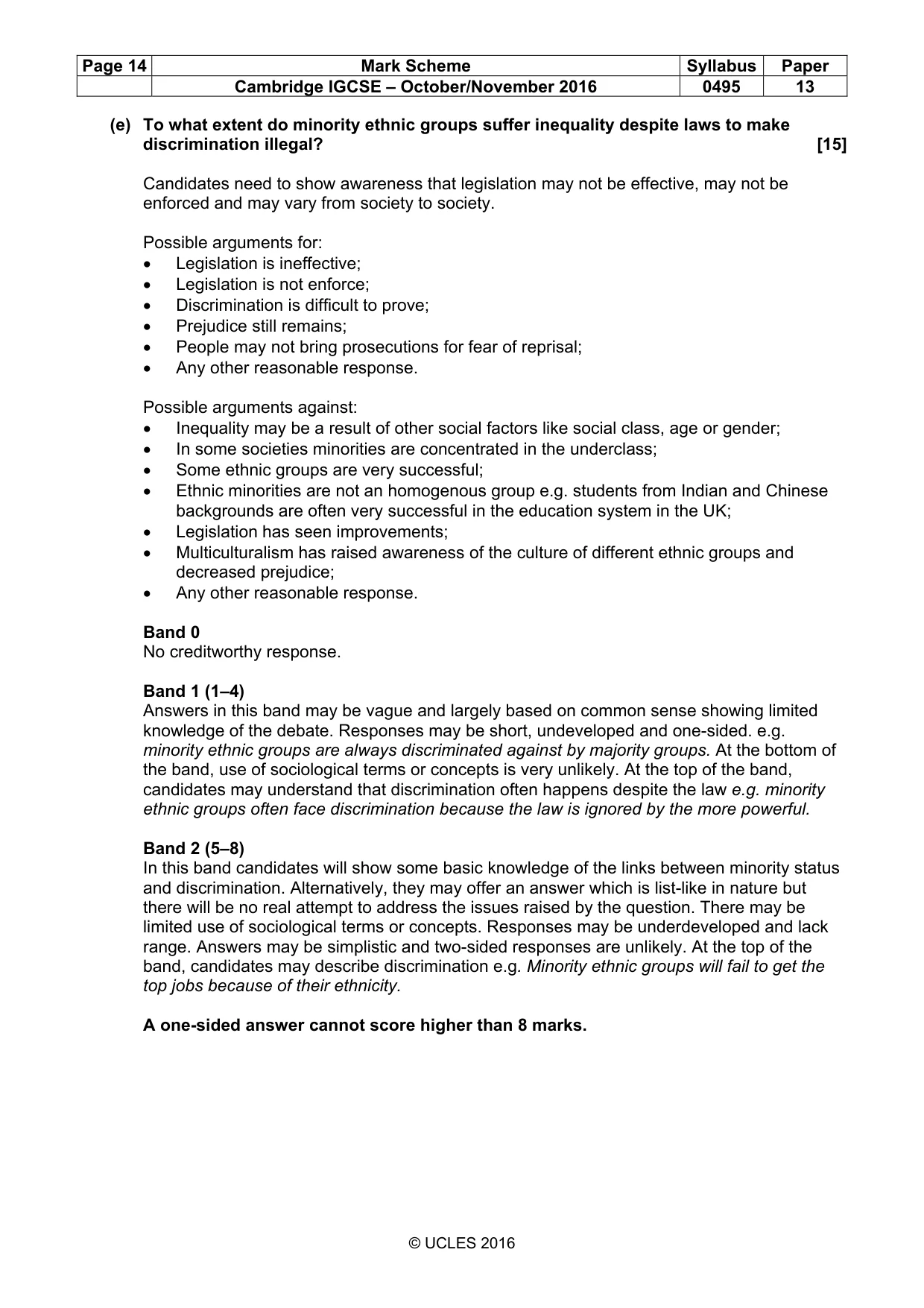
Page 14 Mark Scheme Syllabus Paper Cambridge IGCSE – October/November 2016 0495 13 © UCLES 2016 (e) To what extent do minority ethnic groups suffer inequality despite laws to make discrimination illegal? [15] Candidates need to show awareness that legislation may not be effective, may not be enforced and may vary from society to society. Possible arguments for: • Legislation is ineffective; • Legislation is not enforce; • Discrimination is difficult to prove; • Prejudice still remains; • People may not bring prosecutions for fear of reprisal; • Any other reasonable response. Possible arguments against: • Inequality may be a result of other social factors like social class, age or gender; • In some societies minorities are concentrated in the underclass; • Some ethnic groups are very successful; • Ethnic minorities are not an homogenous group e.g. students from Indian and Chinese backgrounds are often very successful in the education system in the UK; • Legislation has seen improvements; • Multiculturalism has raised awareness of the culture of different ethnic groups and decreased prejudice; • Any other reasonable response. Band 0 No creditworthy response. Band 1 (1–4) Answers in this band may be vague and largely based on common sense showing limited knowledge of the debate. Responses may be short, undeveloped and one-sided. e.g. minority ethnic groups are always discriminated against by majority groups. At the bottom of the band, use of sociological terms or concepts is very unlikely. At the top of the band, candidates may understand that discrimination often happens despite the law e.g. minority ethnic groups often face discrimination because the law is ignored by the more powerful. Band 2 (5–8) In this band candidates will show some basic knowledge of the links between minority status and discrimination. Alternatively, they may offer an answer which is list-like in nature but there will be no real attempt to address the issues raised by the question. There may be limited use of sociological terms or concepts. Responses may be underdeveloped and lack range. Answers may be simplistic and two-sided responses are unlikely. At the top of the band, candidates may describe discrimination e.g. Minority ethnic groups will fail to get the top jobs because of their ethnicity. A one-sided answer cannot score higher than 8 marks.
Mark scheme, page 15
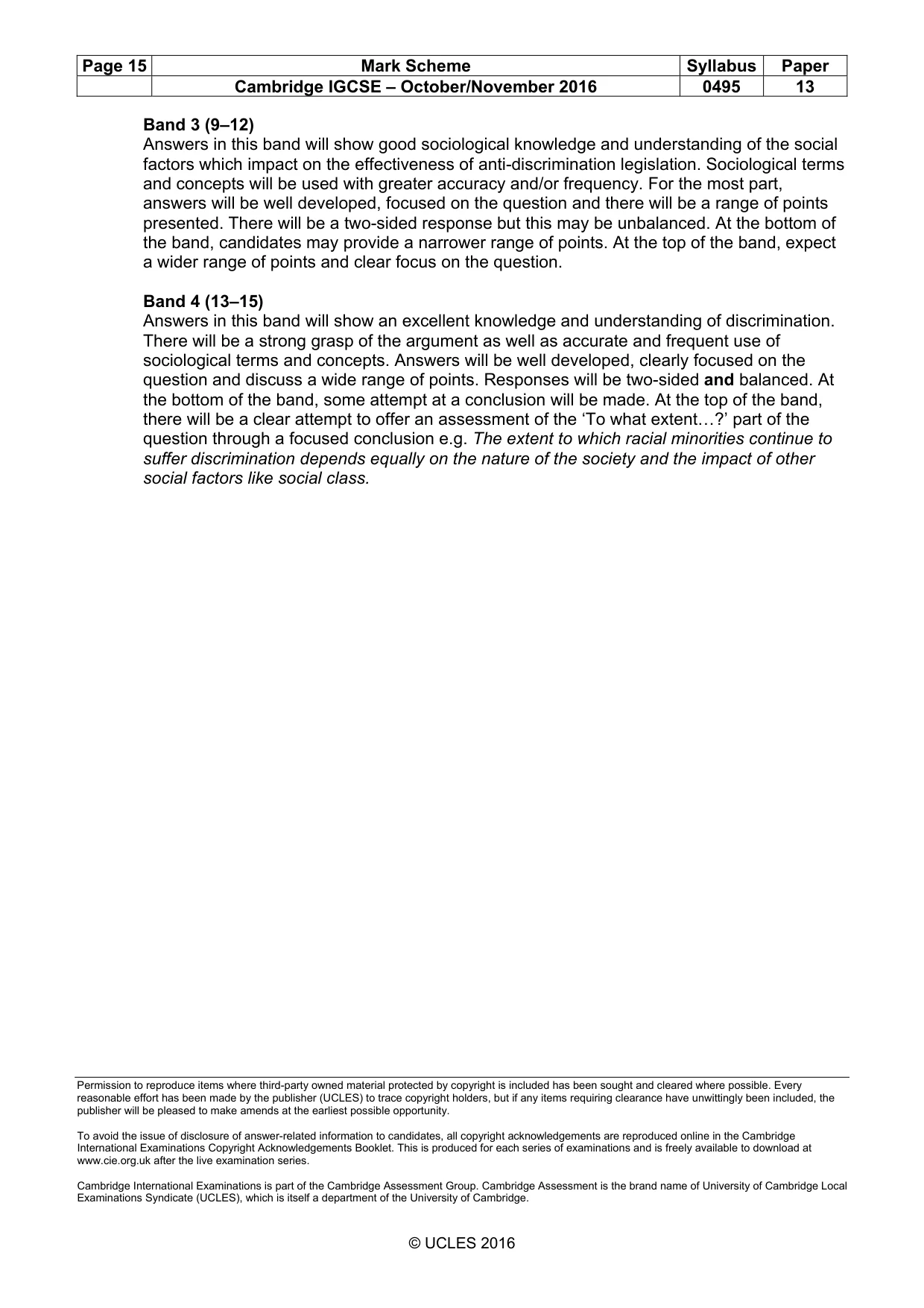
Page 15 Mark Scheme Syllabus Paper Cambridge IGCSE – October/November 2016 0495 13 © UCLES 2016 Band 3 (9–12) Answers in this band will show good sociological knowledge and understanding of the social factors which impact on the effectiveness of anti-discrimination legislation. Sociological terms and concepts will be used with greater accuracy and/or frequency. For the most part, answers will be well developed, focused on the question and there will be a range of points presented. There will be a two-sided response but this may be unbalanced. At the bottom of the band, candidates may provide a narrower range of points. At the top of the band, expect a wider range of points and clear focus on the question. Band 4 (13–15) Answers in this band will show an excellent knowledge and understanding of discrimination. There will be a strong grasp of the argument as well as accurate and frequent use of sociological terms and concepts. Answers will be well developed, clearly focused on the question and discuss a wide range of points. Responses will be two-sided and balanced. At the bottom of the band, some attempt at a conclusion will be made. At the top of the band, there will be a clear attempt to offer an assessment of the ‘To what extent…?’ part of the question through a focused conclusion e.g. The extent to which racial minorities continue to suffer discrimination depends equally on the nature of the society and the impact of other social factors like social class. Permission to reproduce items where third-party owned material protected by copyright is included has been sought and cleared where possible. Every reasonable effort has been made by the publisher (UCLES) to trace copyright holders, but if any items requiring clearance have unwittingly been included, the publisher will be pleased to make amends at the earliest possible opportunity. To avoid the issue of disclosure of answer-related information to candidates, all copyright acknowledgements are reproduced online in the Cambridge International Examinations Copyright Acknowledgements Booklet. This is produced for each series of examinations and is freely available to download at www.cie.org.uk after the live examination series. Cambridge International Examinations is part of the Cambridge Assessment Group. Cambridge Assessment is the brand name of University of Cambridge Local Examinations Syndicate (UCLES), which is itself a department of the University of Cambridge.
What you needed in this session
Cambridge’s own grade thresholds for 2016 Oct/Nov, Paper 1 · Variant 3. A higher threshold means an easier paper — the bar moves with how the cohort did.