Cambridge IGCSE Sociology 0495 — 2016 May/June Paper 2 · Variant 1
0495/21/M/J/16 · 70 marks · ≈79 min
The question paper and its mark scheme, free to read here and free to download. This is Cambridge’s own paper, exactly as it was sat.
Question paper4 pages

Mark scheme26 pages
Answers below. Sit the paper first if you are practising.
Paper as text
Question paper, page 1
This document consists of 3 printed pages, 1 blank page and 1 insert. DC (LEG) 118884/1 © UCLES 2016 [Turn over Cambridge International Examinations Cambridge International General Certificate of Secondary Education * 0 4 3 4 1 1 1 3 4 6 * SOCIOLOGY 0495/21 Paper 2 May/June 2016 1 hour 45 minutes (including 15 minutes’ reading time) No Additional Materials are required. READ THESE INSTRUCTIONS FIRST An answer booklet is provided inside this question paper. You should follow the instructions on the front cover of the answer booklet. If you need additional answer paper ask the invigilator for a continuation booklet. Answer two questions. The number of marks is given in brackets [ ] at the end of each question or part question.
Question paper, page 2
2 0495/21/M/J/16 © UCLES 2016 Answer two questions. Section A: Family 1 In modern industrial societies there are many views on the role of the family, marriage and kinship. Family size has changed over time and today families can most accurately be described as diverse. For some, marriage remains an essential part of family life, whereas for others it is optional. (a) What is meant by the term ‘kinship’? [2] (b) Describe two trends in marriage in modern industrial societies. [4] (c) Explain how ethnicity may affect the roles individuals play in the family. [6] (d) Explain why the average family size has fallen in modern industrial societies. [8] (e) To what extent is marriage today a matter of choice? [15] Section B: Education 2 Education has an important influence on the lives of individuals, often affecting future life chances. Differences in achievement can be due to a wide range of home and school factors. For example, the type of school an individual attends is thought by many to be very influential. (a) What is meant by the term ‘life chances’? [2] (b) Describe two reasons why pupils from the working class may underachieve in education. [4] (c) Explain how the hidden curriculum is different to the official curriculum. [6] (d) Explain why private schools achieve better results than state schools. [8] (e) To what extent does education lead to social mobility? [15]
Question paper, page 3
3 0495/21/M/J/16 © UCLES 2016 Section C: Crime, deviance and social control 3 According to the official crime statistics, some social groups are more likely to commit crime than others. There are many different explanations for this, one of which is the labelling theory. How the law enforcement agencies deal with crime is also important. Criminals are punished in lots of different ways today but all punishment aims to reduce crime rates in society. (a) What is meant by the term ‘official crime statistics’? [2] (b) Describe two types of surveillance. [4] (c) Explain how societies punish criminals. [6] (d) Explain why males are more likely to be convicted of a crime than females. [8] (e) To what extent can lack of opportunity explain criminal behaviour? [15] Section D: Media 4 Today there are more media products and technologies available to the audience than ever before, resulting in increased interactivity. However, this does not mean that media owners are any less powerful than they were previously. The role of the media in society and its ability to promote certain norms and values is therefore frequently debated by sociologists. (a) What is meant by the term ‘interactivity’? [2] (b) Describe two ways governments control the media. [4] (c) Explain how state and private ownership of the media are different. [6] (d) Explain why Pluralists believe that choice and competition in the media are good for the audience. [8] (e) To what extent do the media help the ruling class maintain their powerful position in society? [15]
Question paper, page 4
4 0495/21/M/J/16 © UCLES 2016 BLANK PAGE Permission to reproduce items where third-party owned material protected by copyright is included has been sought and cleared where possible. Every reasonable effort has been made by the publisher (UCLES) to trace copyright holders, but if any items requiring clearance have unwittingly been included, the publisher will be pleased to make amends at the earliest possible opportunity. To avoid the issue of disclosure of answer-related information to candidates, all copyright acknowledgements are reproduced online in the Cambridge International Examinations Copyright Acknowledgements Booklet. This is produced for each series of examinations and is freely available to download at www.cie.org.uk after the live examination series. Cambridge International Examinations is part of the Cambridge Assessment Group. Cambridge Assessment is the brand name of University of Cambridge Local Examinations Syndicate (UCLES), which is itself a department of the University of Cambridge.
Mark scheme, page 1
® IGCSE is the registered trademark of Cambridge International Examinations. This document consists of 26 printed pages. © UCLES 2016 [Turn over Cambridge International Examinations Cambridge International General Certificate of Secondary Education SOCIOLOGY 0495/21 Paper 2 May/June 2016 MARK SCHEME Maximum Mark: 70 Published This mark scheme is published as an aid to teachers and candidates, to indicate the requirements of the examination. It shows the basis on which Examiners were instructed to award marks. It does not indicate the details of the discussions that took place at an Examiners’ meeting before marking began, which would have considered the acceptability of alternative answers. Mark schemes should be read in conjunction with the question paper and the Principal Examiner Report for Teachers. Cambridge will not enter into discussions about these mark schemes. Cambridge is publishing the mark schemes for the May/June 2016 series for most Cambridge IGCSE®, Cambridge International A and AS Level components and some Cambridge O Level components.
Mark scheme, page 2
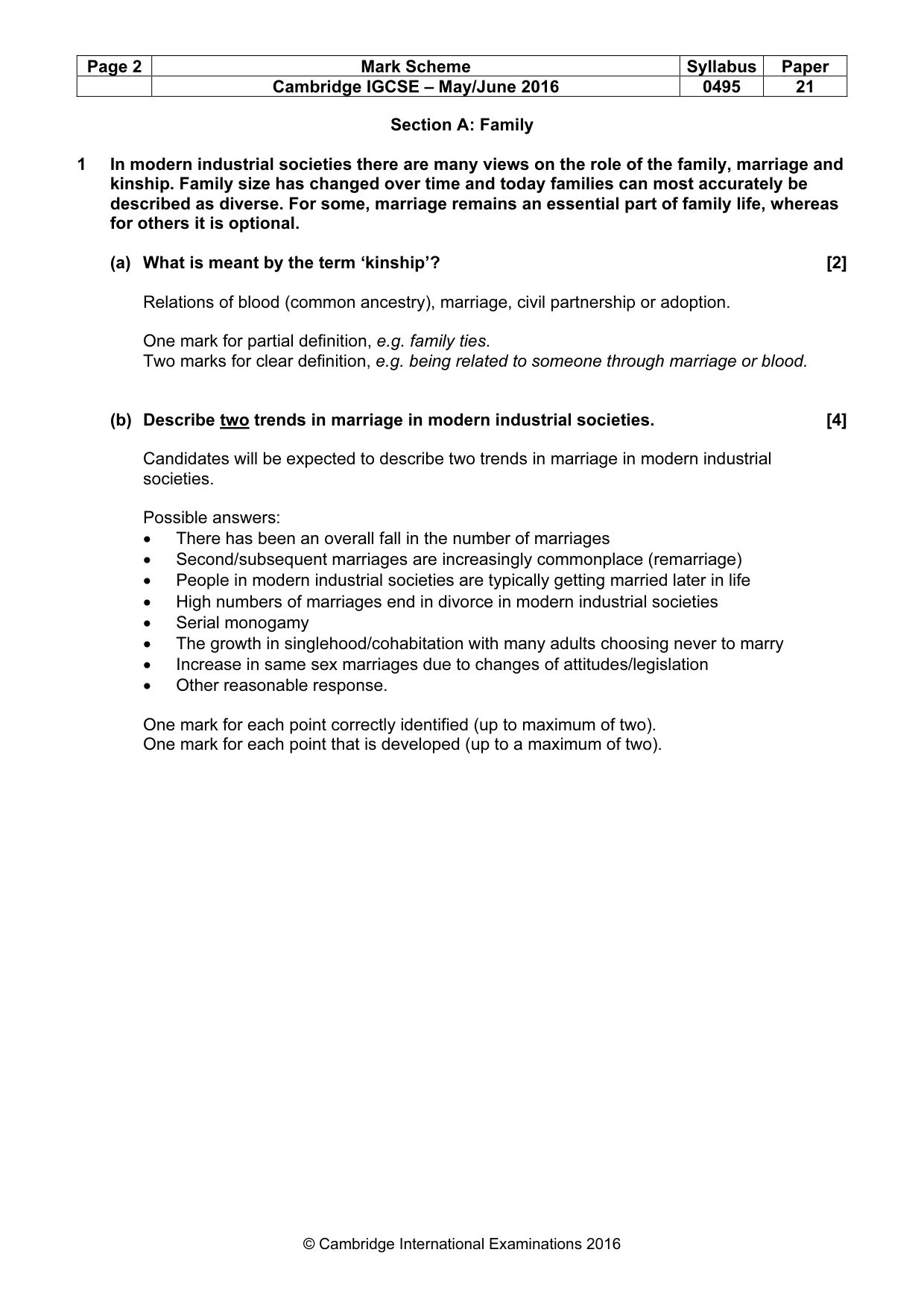
Page 2 Mark Scheme Syllabus Paper Cambridge IGCSE – May/June 2016 0495 21 © Cambridge International Examinations 2016 Section A: Family 1 In modern industrial societies there are many views on the role of the family, marriage and kinship. Family size has changed over time and today families can most accurately be described as diverse. For some, marriage remains an essential part of family life, whereas for others it is optional. (a) What is meant by the term ‘kinship’? [2] Relations of blood (common ancestry), marriage, civil partnership or adoption. One mark for partial definition, e.g. family ties. Two marks for clear definition, e.g. being related to someone through marriage or blood. (b) Describe two trends in marriage in modern industrial societies. [4] Candidates will be expected to describe two trends in marriage in modern industrial societies. Possible answers: • There has been an overall fall in the number of marriages • Second/subsequent marriages are increasingly commonplace (remarriage) • People in modern industrial societies are typically getting married later in life • High numbers of marriages end in divorce in modern industrial societies • Serial monogamy • The growth in singlehood/cohabitation with many adults choosing never to marry • Increase in same sex marriages due to changes of attitudes/legislation • Other reasonable response. One mark for each point correctly identified (up to maximum of two). One mark for each point that is developed (up to a maximum of two).
Mark scheme, page 3
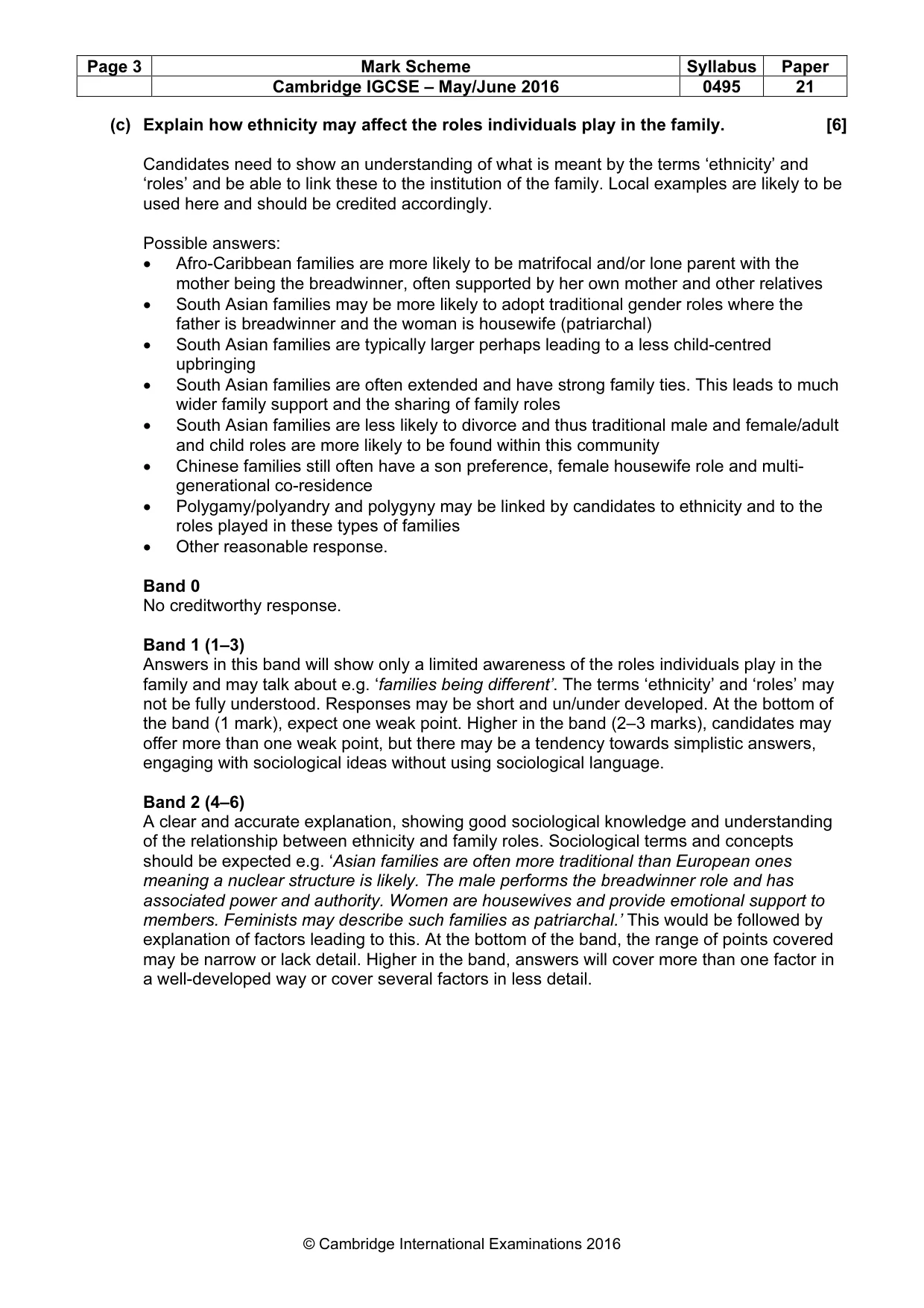
Page 3 Mark Scheme Syllabus Paper Cambridge IGCSE – May/June 2016 0495 21 © Cambridge International Examinations 2016 (c) Explain how ethnicity may affect the roles individuals play in the family. [6] Candidates need to show an understanding of what is meant by the terms ‘ethnicity’ and ‘roles’ and be able to link these to the institution of the family. Local examples are likely to be used here and should be credited accordingly. Possible answers: • Afro-Caribbean families are more likely to be matrifocal and/or lone parent with the mother being the breadwinner, often supported by her own mother and other relatives • South Asian families may be more likely to adopt traditional gender roles where the father is breadwinner and the woman is housewife (patriarchal) • South Asian families are typically larger perhaps leading to a less child-centred upbringing • South Asian families are often extended and have strong family ties. This leads to much wider family support and the sharing of family roles • South Asian families are less likely to divorce and thus traditional male and female/adult and child roles are more likely to be found within this community • Chinese families still often have a son preference, female housewife role and multi- generational co-residence • Polygamy/polyandry and polygyny may be linked by candidates to ethnicity and to the roles played in these types of families • Other reasonable response. Band 0 No creditworthy response. Band 1 (1–3) Answers in this band will show only a limited awareness of the roles individuals play in the family and may talk about e.g. ‘families being different’. The terms ‘ethnicity’ and ‘roles’ may not be fully understood. Responses may be short and un/under developed. At the bottom of the band (1 mark), expect one weak point. Higher in the band (2–3 marks), candidates may offer more than one weak point, but there may be a tendency towards simplistic answers, engaging with sociological ideas without using sociological language. Band 2 (4–6) A clear and accurate explanation, showing good sociological knowledge and understanding of the relationship between ethnicity and family roles. Sociological terms and concepts should be expected e.g. ‘Asian families are often more traditional than European ones meaning a nuclear structure is likely. The male performs the breadwinner role and has associated power and authority. Women are housewives and provide emotional support to members. Feminists may describe such families as patriarchal.’ This would be followed by explanation of factors leading to this. At the bottom of the band, the range of points covered may be narrow or lack detail. Higher in the band, answers will cover more than one factor in a well-developed way or cover several factors in less detail.
Mark scheme, page 4
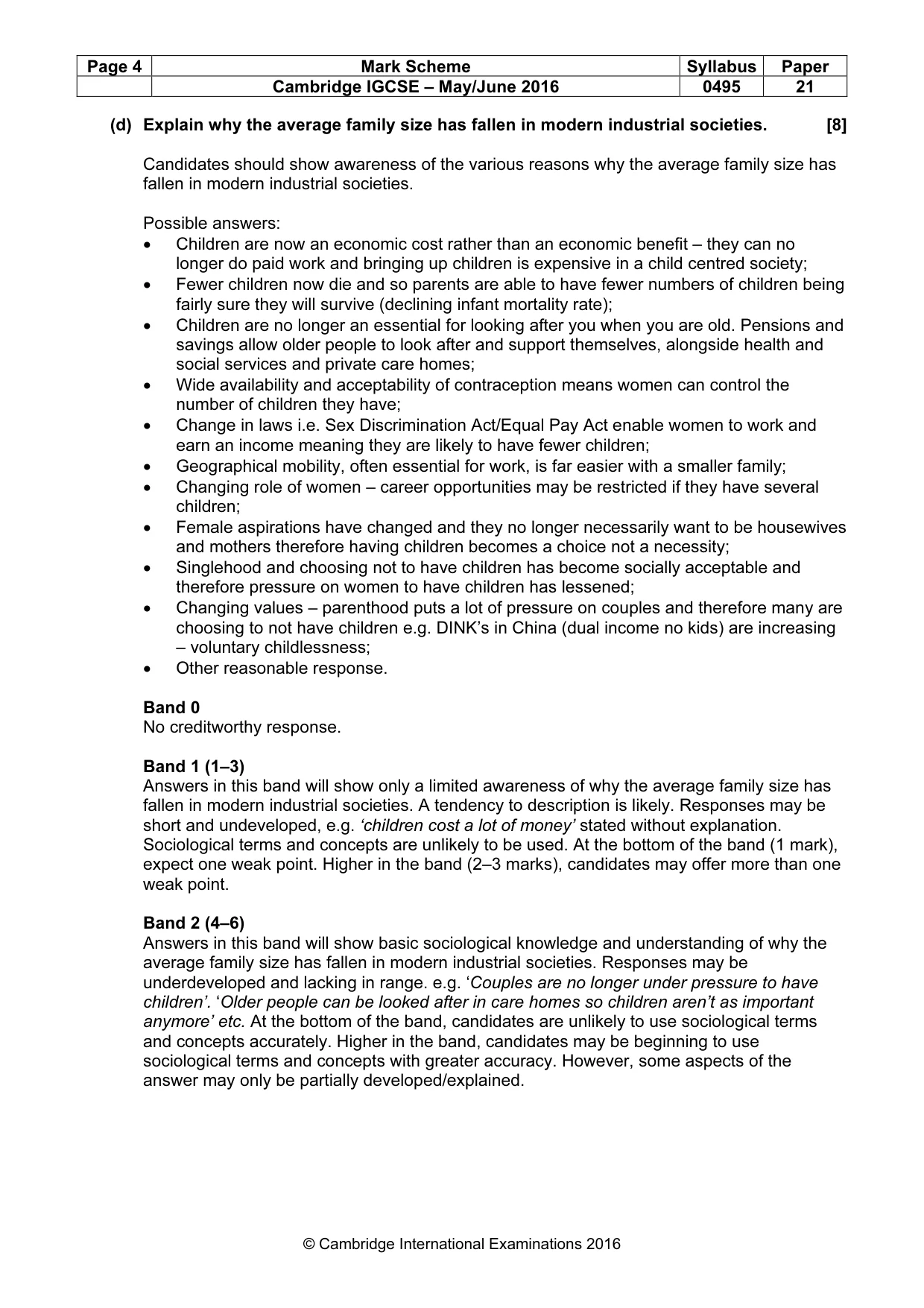
Page 4 Mark Scheme Syllabus Paper Cambridge IGCSE – May/June 2016 0495 21 © Cambridge International Examinations 2016 (d) Explain why the average family size has fallen in modern industrial societies. [8] Candidates should show awareness of the various reasons why the average family size has fallen in modern industrial societies. Possible answers: • Children are now an economic cost rather than an economic benefit – they can no longer do paid work and bringing up children is expensive in a child centred society; • Fewer children now die and so parents are able to have fewer numbers of children being fairly sure they will survive (declining infant mortality rate); • Children are no longer an essential for looking after you when you are old. Pensions and savings allow older people to look after and support themselves, alongside health and social services and private care homes; • Wide availability and acceptability of contraception means women can control the number of children they have; • Change in laws i.e. Sex Discrimination Act/Equal Pay Act enable women to work and earn an income meaning they are likely to have fewer children; • Geographical mobility, often essential for work, is far easier with a smaller family; • Changing role of women – career opportunities may be restricted if they have several children; • Female aspirations have changed and they no longer necessarily want to be housewives and mothers therefore having children becomes a choice not a necessity; • Singlehood and choosing not to have children has become socially acceptable and therefore pressure on women to have children has lessened; • Changing values – parenthood puts a lot of pressure on couples and therefore many are choosing to not have children e.g. DINK’s in China (dual income no kids) are increasing – voluntary childlessness; • Other reasonable response. Band 0 No creditworthy response. Band 1 (1–3) Answers in this band will show only a limited awareness of why the average family size has fallen in modern industrial societies. A tendency to description is likely. Responses may be short and undeveloped, e.g. ‘children cost a lot of money’ stated without explanation. Sociological terms and concepts are unlikely to be used. At the bottom of the band (1 mark), expect one weak point. Higher in the band (2–3 marks), candidates may offer more than one weak point. Band 2 (4–6) Answers in this band will show basic sociological knowledge and understanding of why the average family size has fallen in modern industrial societies. Responses may be underdeveloped and lacking in range. e.g. ‘Couples are no longer under pressure to have children’. ‘Older people can be looked after in care homes so children aren’t as important anymore’ etc. At the bottom of the band, candidates are unlikely to use sociological terms and concepts accurately. Higher in the band, candidates may be beginning to use sociological terms and concepts with greater accuracy. However, some aspects of the answer may only be partially developed/explained.
Mark scheme, page 5
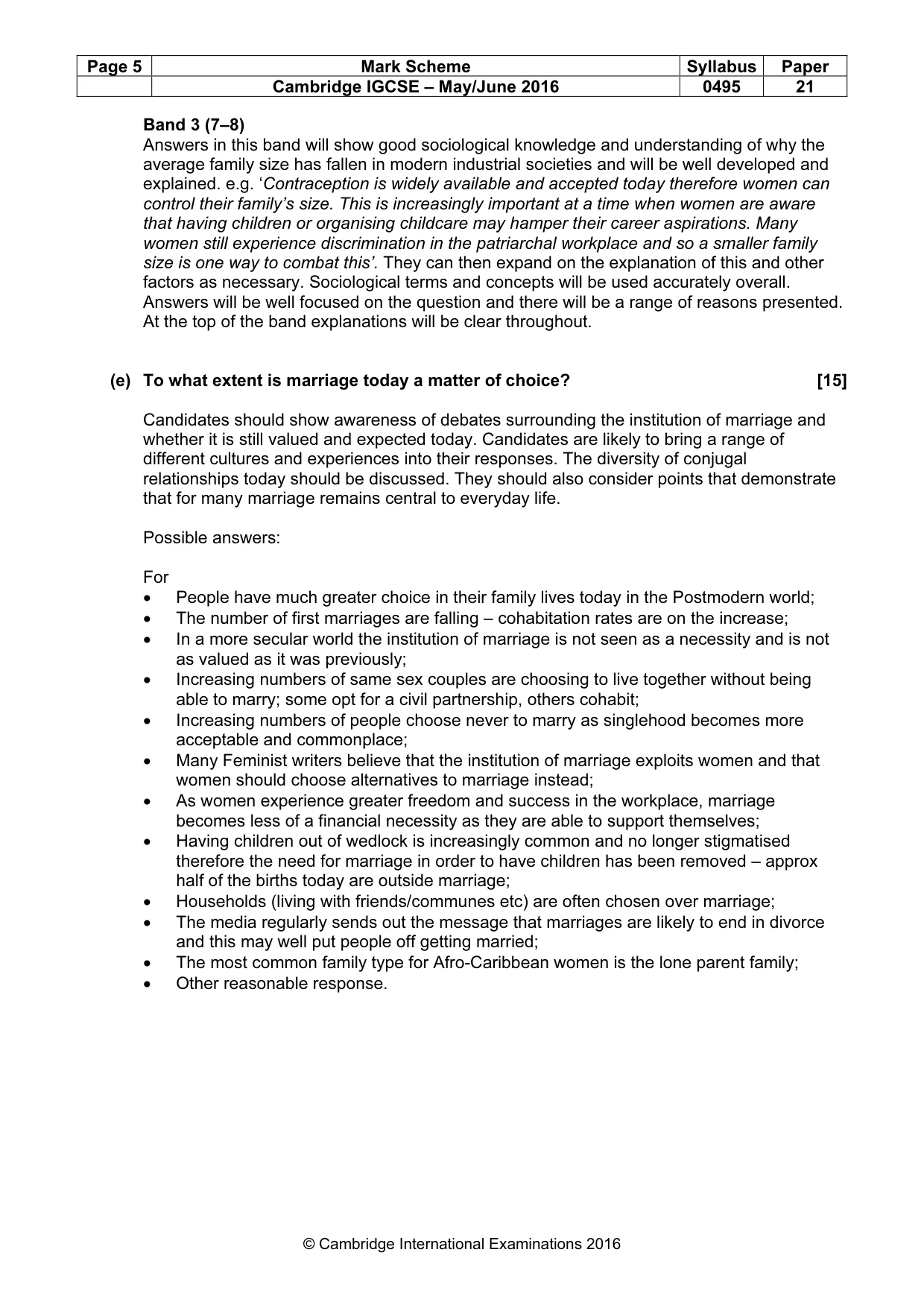
Page 5 Mark Scheme Syllabus Paper Cambridge IGCSE – May/June 2016 0495 21 © Cambridge International Examinations 2016 Band 3 (7–8) Answers in this band will show good sociological knowledge and understanding of why the average family size has fallen in modern industrial societies and will be well developed and explained. e.g. ‘Contraception is widely available and accepted today therefore women can control their family’s size. This is increasingly important at a time when women are aware that having children or organising childcare may hamper their career aspirations. Many women still experience discrimination in the patriarchal workplace and so a smaller family size is one way to combat this’. They can then expand on the explanation of this and other factors as necessary. Sociological terms and concepts will be used accurately overall. Answers will be well focused on the question and there will be a range of reasons presented. At the top of the band explanations will be clear throughout. (e) To what extent is marriage today a matter of choice? [15] Candidates should show awareness of debates surrounding the institution of marriage and whether it is still valued and expected today. Candidates are likely to bring a range of different cultures and experiences into their responses. The diversity of conjugal relationships today should be discussed. They should also consider points that demonstrate that for many marriage remains central to everyday life. Possible answers: For • People have much greater choice in their family lives today in the Postmodern world; • The number of first marriages are falling – cohabitation rates are on the increase; • In a more secular world the institution of marriage is not seen as a necessity and is not as valued as it was previously; • Increasing numbers of same sex couples are choosing to live together without being able to marry; some opt for a civil partnership, others cohabit; • Increasing numbers of people choose never to marry as singlehood becomes more acceptable and commonplace; • Many Feminist writers believe that the institution of marriage exploits women and that women should choose alternatives to marriage instead; • As women experience greater freedom and success in the workplace, marriage becomes less of a financial necessity as they are able to support themselves; • Having children out of wedlock is increasingly common and no longer stigmatised therefore the need for marriage in order to have children has been removed – approx half of the births today are outside marriage; • Households (living with friends/communes etc) are often chosen over marriage; • The media regularly sends out the message that marriages are likely to end in divorce and this may well put people off getting married; • The most common family type for Afro-Caribbean women is the lone parent family; • Other reasonable response.
Mark scheme, page 6
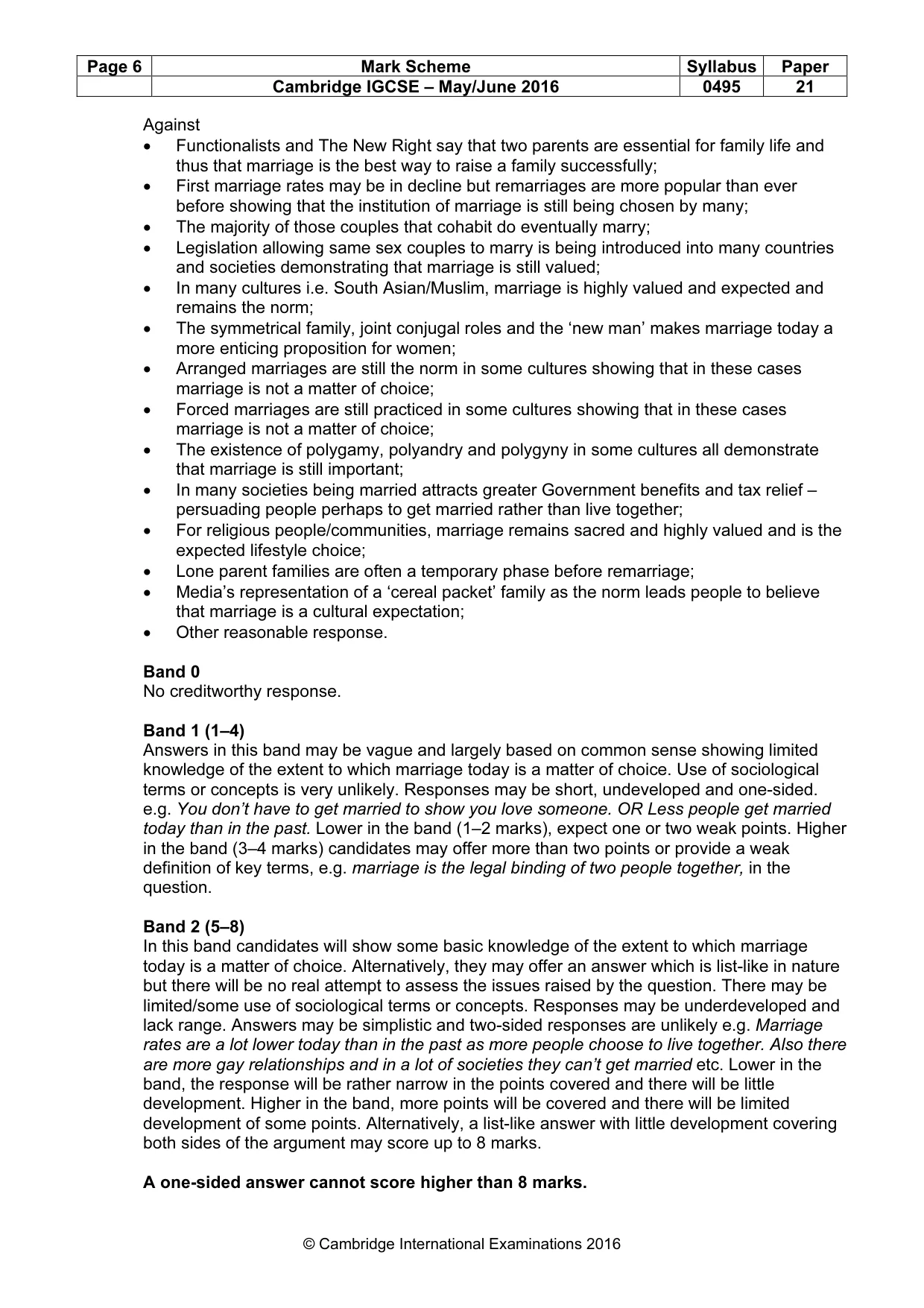
Page 6 Mark Scheme Syllabus Paper Cambridge IGCSE – May/June 2016 0495 21 © Cambridge International Examinations 2016 Against • Functionalists and The New Right say that two parents are essential for family life and thus that marriage is the best way to raise a family successfully; • First marriage rates may be in decline but remarriages are more popular than ever before showing that the institution of marriage is still being chosen by many; • The majority of those couples that cohabit do eventually marry; • Legislation allowing same sex couples to marry is being introduced into many countries and societies demonstrating that marriage is still valued; • In many cultures i.e. South Asian/Muslim, marriage is highly valued and expected and remains the norm; • The symmetrical family, joint conjugal roles and the ‘new man’ makes marriage today a more enticing proposition for women; • Arranged marriages are still the norm in some cultures showing that in these cases marriage is not a matter of choice; • Forced marriages are still practiced in some cultures showing that in these cases marriage is not a matter of choice; • The existence of polygamy, polyandry and polygyny in some cultures all demonstrate that marriage is still important; • In many societies being married attracts greater Government benefits and tax relief – persuading people perhaps to get married rather than live together; • For religious people/communities, marriage remains sacred and highly valued and is the expected lifestyle choice; • Lone parent families are often a temporary phase before remarriage; • Media’s representation of a ‘cereal packet’ family as the norm leads people to believe that marriage is a cultural expectation; • Other reasonable response. Band 0 No creditworthy response. Band 1 (1–4) Answers in this band may be vague and largely based on common sense showing limited knowledge of the extent to which marriage today is a matter of choice. Use of sociological terms or concepts is very unlikely. Responses may be short, undeveloped and one-sided. e.g. You don’t have to get married to show you love someone. OR Less people get married today than in the past. Lower in the band (1–2 marks), expect one or two weak points. Higher in the band (3–4 marks) candidates may offer more than two points or provide a weak definition of key terms, e.g. marriage is the legal binding of two people together, in the question. Band 2 (5–8) In this band candidates will show some basic knowledge of the extent to which marriage today is a matter of choice. Alternatively, they may offer an answer which is list-like in nature but there will be no real attempt to assess the issues raised by the question. There may be limited/some use of sociological terms or concepts. Responses may be underdeveloped and lack range. Answers may be simplistic and two-sided responses are unlikely e.g. Marriage rates are a lot lower today than in the past as more people choose to live together. Also there are more gay relationships and in a lot of societies they can’t get married etc. Lower in the band, the response will be rather narrow in the points covered and there will be little development. Higher in the band, more points will be covered and there will be limited development of some points. Alternatively, a list-like answer with little development covering both sides of the argument may score up to 8 marks. A one-sided answer cannot score higher than 8 marks.
Mark scheme, page 7
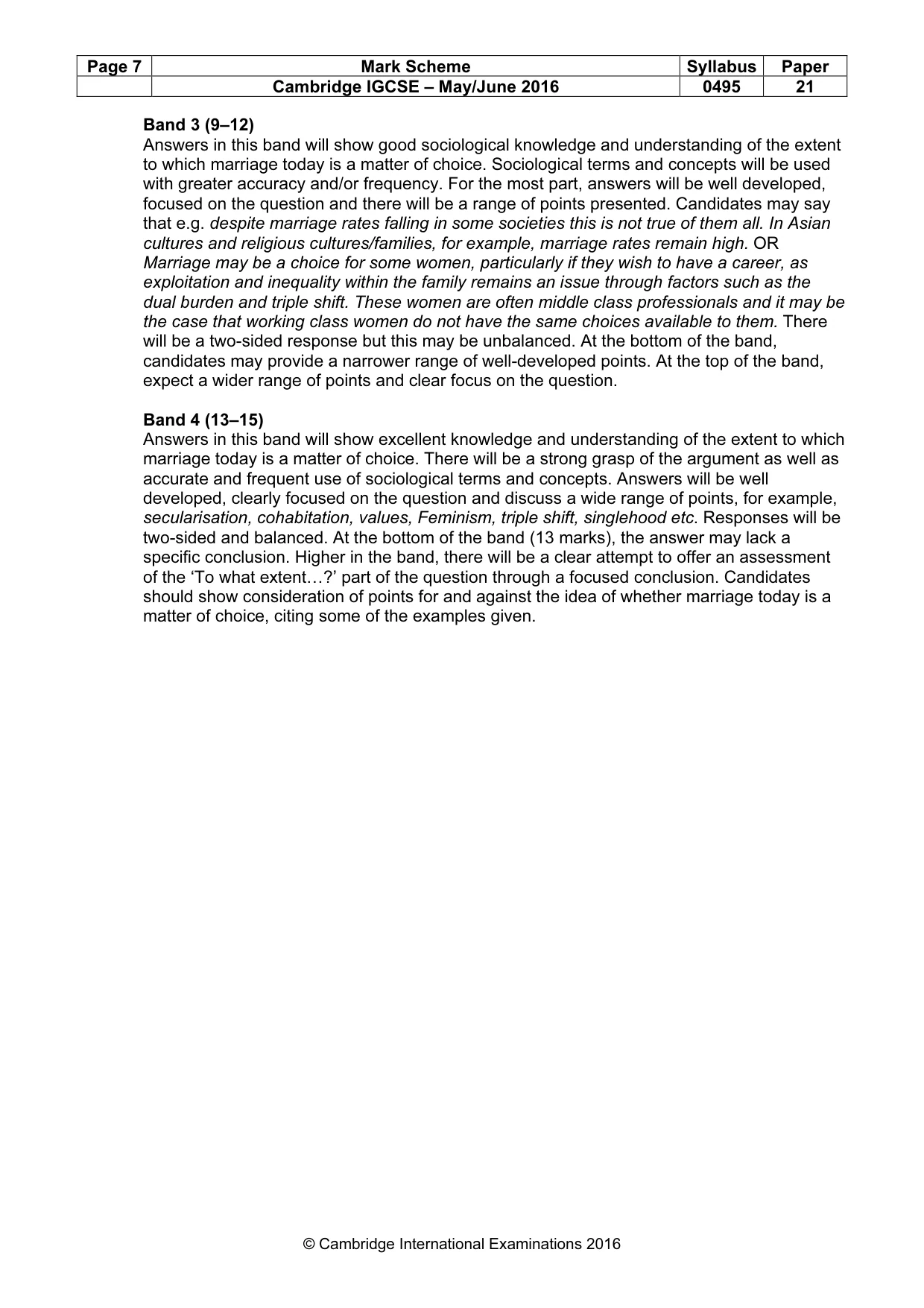
Page 7 Mark Scheme Syllabus Paper Cambridge IGCSE – May/June 2016 0495 21 © Cambridge International Examinations 2016 Band 3 (9–12) Answers in this band will show good sociological knowledge and understanding of the extent to which marriage today is a matter of choice. Sociological terms and concepts will be used with greater accuracy and/or frequency. For the most part, answers will be well developed, focused on the question and there will be a range of points presented. Candidates may say that e.g. despite marriage rates falling in some societies this is not true of them all. In Asian cultures and religious cultures/families, for example, marriage rates remain high. OR Marriage may be a choice for some women, particularly if they wish to have a career, as exploitation and inequality within the family remains an issue through factors such as the dual burden and triple shift. These women are often middle class professionals and it may be the case that working class women do not have the same choices available to them. There will be a two-sided response but this may be unbalanced. At the bottom of the band, candidates may provide a narrower range of well-developed points. At the top of the band, expect a wider range of points and clear focus on the question. Band 4 (13–15) Answers in this band will show excellent knowledge and understanding of the extent to which marriage today is a matter of choice. There will be a strong grasp of the argument as well as accurate and frequent use of sociological terms and concepts. Answers will be well developed, clearly focused on the question and discuss a wide range of points, for example, secularisation, cohabitation, values, Feminism, triple shift, singlehood etc. Responses will be two-sided and balanced. At the bottom of the band (13 marks), the answer may lack a specific conclusion. Higher in the band, there will be a clear attempt to offer an assessment of the ‘To what extent…?’ part of the question through a focused conclusion. Candidates should show consideration of points for and against the idea of whether marriage today is a matter of choice, citing some of the examples given.
Mark scheme, page 8
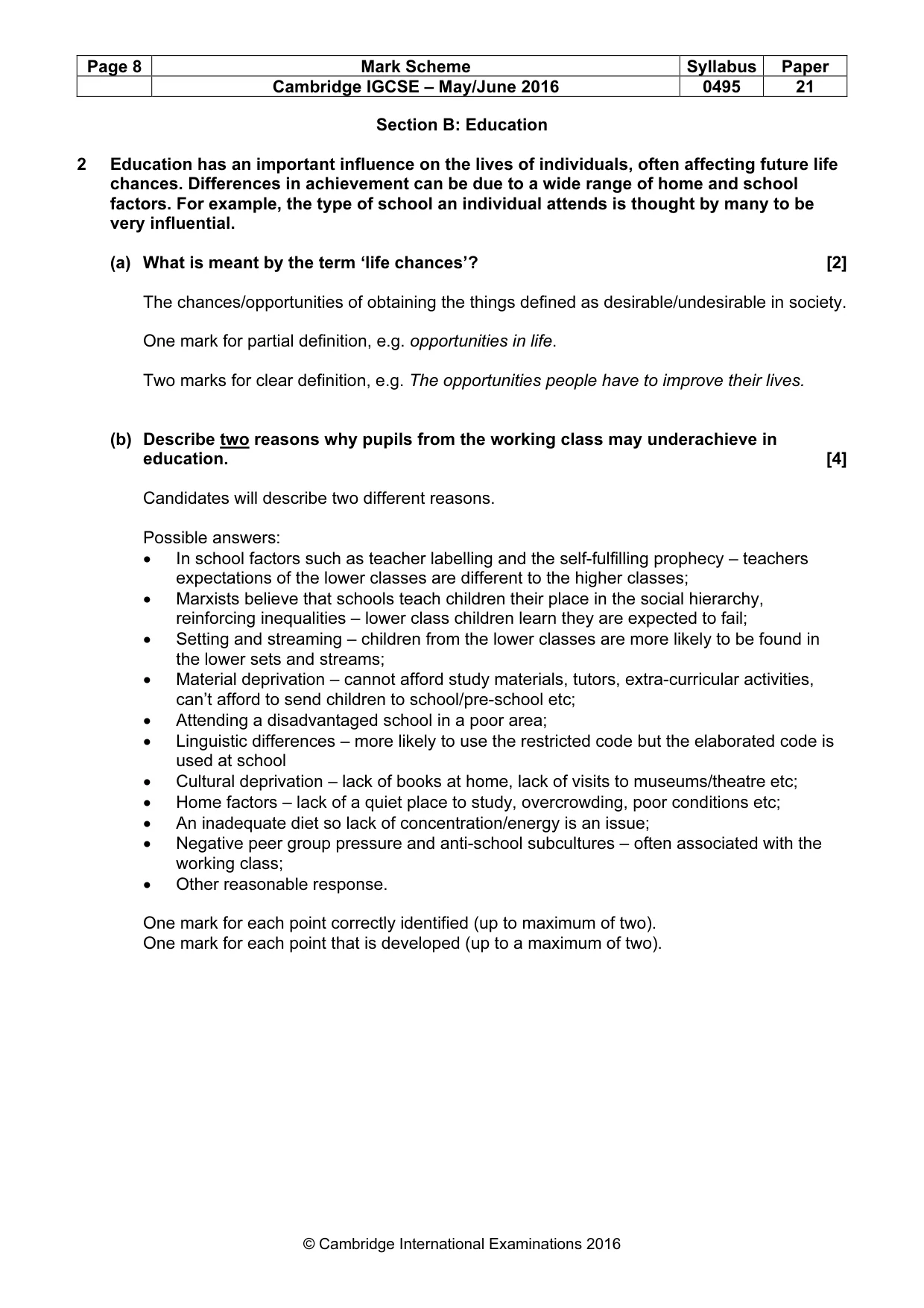
Page 8 Mark Scheme Syllabus Paper Cambridge IGCSE – May/June 2016 0495 21 © Cambridge International Examinations 2016 Section B: Education 2 Education has an important influence on the lives of individuals, often affecting future life chances. Differences in achievement can be due to a wide range of home and school factors. For example, the type of school an individual attends is thought by many to be very influential. (a) What is meant by the term ‘life chances’? [2] The chances/opportunities of obtaining the things defined as desirable/undesirable in society. One mark for partial definition, e.g. opportunities in life. Two marks for clear definition, e.g. The opportunities people have to improve their lives. (b) Describe two reasons why pupils from the working class may underachieve in education. [4] Candidates will describe two different reasons. Possible answers: • In school factors such as teacher labelling and the self-fulfilling prophecy – teachers expectations of the lower classes are different to the higher classes; • Marxists believe that schools teach children their place in the social hierarchy, reinforcing inequalities – lower class children learn they are expected to fail; • Setting and streaming – children from the lower classes are more likely to be found in the lower sets and streams; • Material deprivation – cannot afford study materials, tutors, extra-curricular activities, can’t afford to send children to school/pre-school etc; • Attending a disadvantaged school in a poor area; • Linguistic differences – more likely to use the restricted code but the elaborated code is used at school • Cultural deprivation – lack of books at home, lack of visits to museums/theatre etc; • Home factors – lack of a quiet place to study, overcrowding, poor conditions etc; • An inadequate diet so lack of concentration/energy is an issue; • Negative peer group pressure and anti-school subcultures – often associated with the working class; • Other reasonable response. One mark for each point correctly identified (up to maximum of two). One mark for each point that is developed (up to a maximum of two).
Mark scheme, page 9
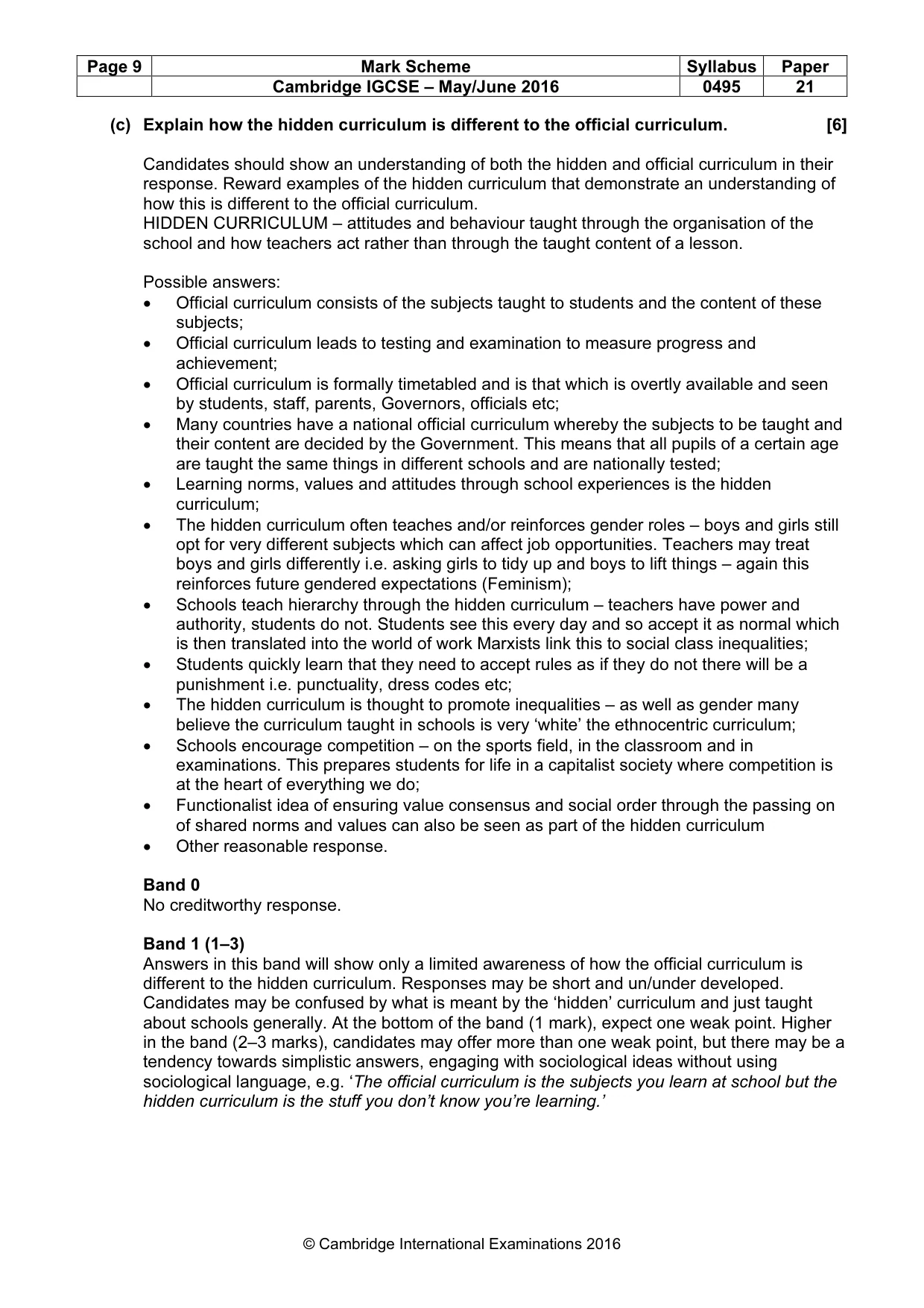
Page 9 Mark Scheme Syllabus Paper Cambridge IGCSE – May/June 2016 0495 21 © Cambridge International Examinations 2016 (c) Explain how the hidden curriculum is different to the official curriculum. [6] Candidates should show an understanding of both the hidden and official curriculum in their response. Reward examples of the hidden curriculum that demonstrate an understanding of how this is different to the official curriculum. HIDDEN CURRICULUM – attitudes and behaviour taught through the organisation of the school and how teachers act rather than through the taught content of a lesson. Possible answers: • Official curriculum consists of the subjects taught to students and the content of these subjects; • Official curriculum leads to testing and examination to measure progress and achievement; • Official curriculum is formally timetabled and is that which is overtly available and seen by students, staff, parents, Governors, officials etc; • Many countries have a national official curriculum whereby the subjects to be taught and their content are decided by the Government. This means that all pupils of a certain age are taught the same things in different schools and are nationally tested; • Learning norms, values and attitudes through school experiences is the hidden curriculum; • The hidden curriculum often teaches and/or reinforces gender roles – boys and girls still opt for very different subjects which can affect job opportunities. Teachers may treat boys and girls differently i.e. asking girls to tidy up and boys to lift things – again this reinforces future gendered expectations (Feminism); • Schools teach hierarchy through the hidden curriculum – teachers have power and authority, students do not. Students see this every day and so accept it as normal which is then translated into the world of work Marxists link this to social class inequalities; • Students quickly learn that they need to accept rules as if they do not there will be a punishment i.e. punctuality, dress codes etc; • The hidden curriculum is thought to promote inequalities – as well as gender many believe the curriculum taught in schools is very ‘white’ the ethnocentric curriculum; • Schools encourage competition – on the sports field, in the classroom and in examinations. This prepares students for life in a capitalist society where competition is at the heart of everything we do; • Functionalist idea of ensuring value consensus and social order through the passing on of shared norms and values can also be seen as part of the hidden curriculum • Other reasonable response. Band 0 No creditworthy response. Band 1 (1–3) Answers in this band will show only a limited awareness of how the official curriculum is different to the hidden curriculum. Responses may be short and un/under developed. Candidates may be confused by what is meant by the ‘hidden’ curriculum and just taught about schools generally. At the bottom of the band (1 mark), expect one weak point. Higher in the band (2–3 marks), candidates may offer more than one weak point, but there may be a tendency towards simplistic answers, engaging with sociological ideas without using sociological language, e.g. ‘The official curriculum is the subjects you learn at school but the hidden curriculum is the stuff you don’t know you’re learning.’
Mark scheme, page 10
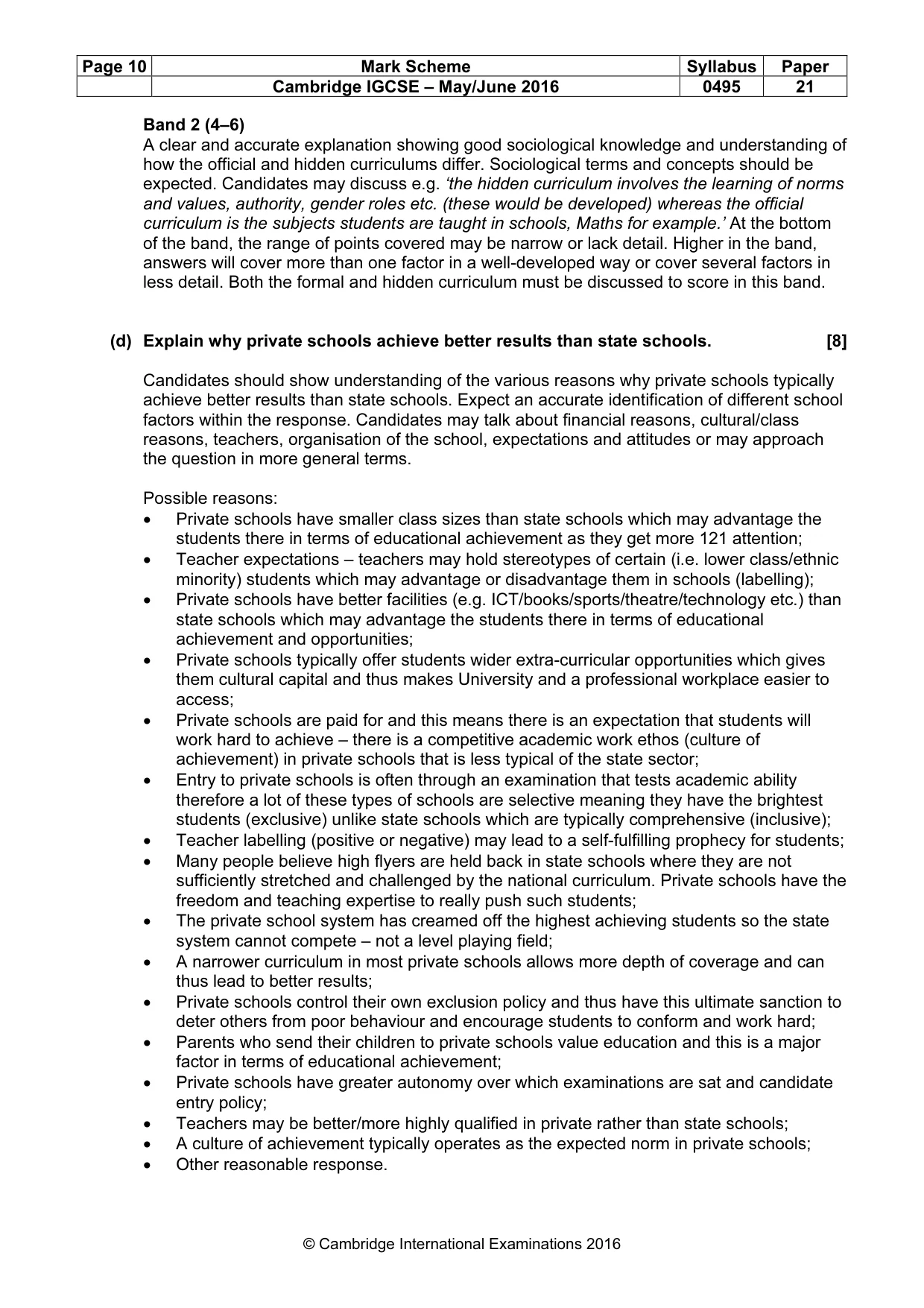
Page 10 Mark Scheme Syllabus Paper Cambridge IGCSE – May/June 2016 0495 21 © Cambridge International Examinations 2016 Band 2 (4–6) A clear and accurate explanation showing good sociological knowledge and understanding of how the official and hidden curriculums differ. Sociological terms and concepts should be expected. Candidates may discuss e.g. ‘the hidden curriculum involves the learning of norms and values, authority, gender roles etc. (these would be developed) whereas the official curriculum is the subjects students are taught in schools, Maths for example.’ At the bottom of the band, the range of points covered may be narrow or lack detail. Higher in the band, answers will cover more than one factor in a well-developed way or cover several factors in less detail. Both the formal and hidden curriculum must be discussed to score in this band. (d) Explain why private schools achieve better results than state schools. [8] Candidates should show understanding of the various reasons why private schools typically achieve better results than state schools. Expect an accurate identification of different school factors within the response. Candidates may talk about financial reasons, cultural/class reasons, teachers, organisation of the school, expectations and attitudes or may approach the question in more general terms. Possible reasons: • Private schools have smaller class sizes than state schools which may advantage the students there in terms of educational achievement as they get more 121 attention; • Teacher expectations – teachers may hold stereotypes of certain (i.e. lower class/ethnic minority) students which may advantage or disadvantage them in schools (labelling); • Private schools have better facilities (e.g. ICT/books/sports/theatre/technology etc.) than state schools which may advantage the students there in terms of educational achievement and opportunities; • Private schools typically offer students wider extra-curricular opportunities which gives them cultural capital and thus makes University and a professional workplace easier to access; • Private schools are paid for and this means there is an expectation that students will work hard to achieve – there is a competitive academic work ethos (culture of achievement) in private schools that is less typical of the state sector; • Entry to private schools is often through an examination that tests academic ability therefore a lot of these types of schools are selective meaning they have the brightest students (exclusive) unlike state schools which are typically comprehensive (inclusive); • Teacher labelling (positive or negative) may lead to a self-fulfilling prophecy for students; • Many people believe high flyers are held back in state schools where they are not sufficiently stretched and challenged by the national curriculum. Private schools have the freedom and teaching expertise to really push such students; • The private school system has creamed off the highest achieving students so the state system cannot compete – not a level playing field; • A narrower curriculum in most private schools allows more depth of coverage and can thus lead to better results; • Private schools control their own exclusion policy and thus have this ultimate sanction to deter others from poor behaviour and encourage students to conform and work hard; • Parents who send their children to private schools value education and this is a major factor in terms of educational achievement; • Private schools have greater autonomy over which examinations are sat and candidate entry policy; • Teachers may be better/more highly qualified in private rather than state schools; • A culture of achievement typically operates as the expected norm in private schools; • Other reasonable response.
Mark scheme, page 11
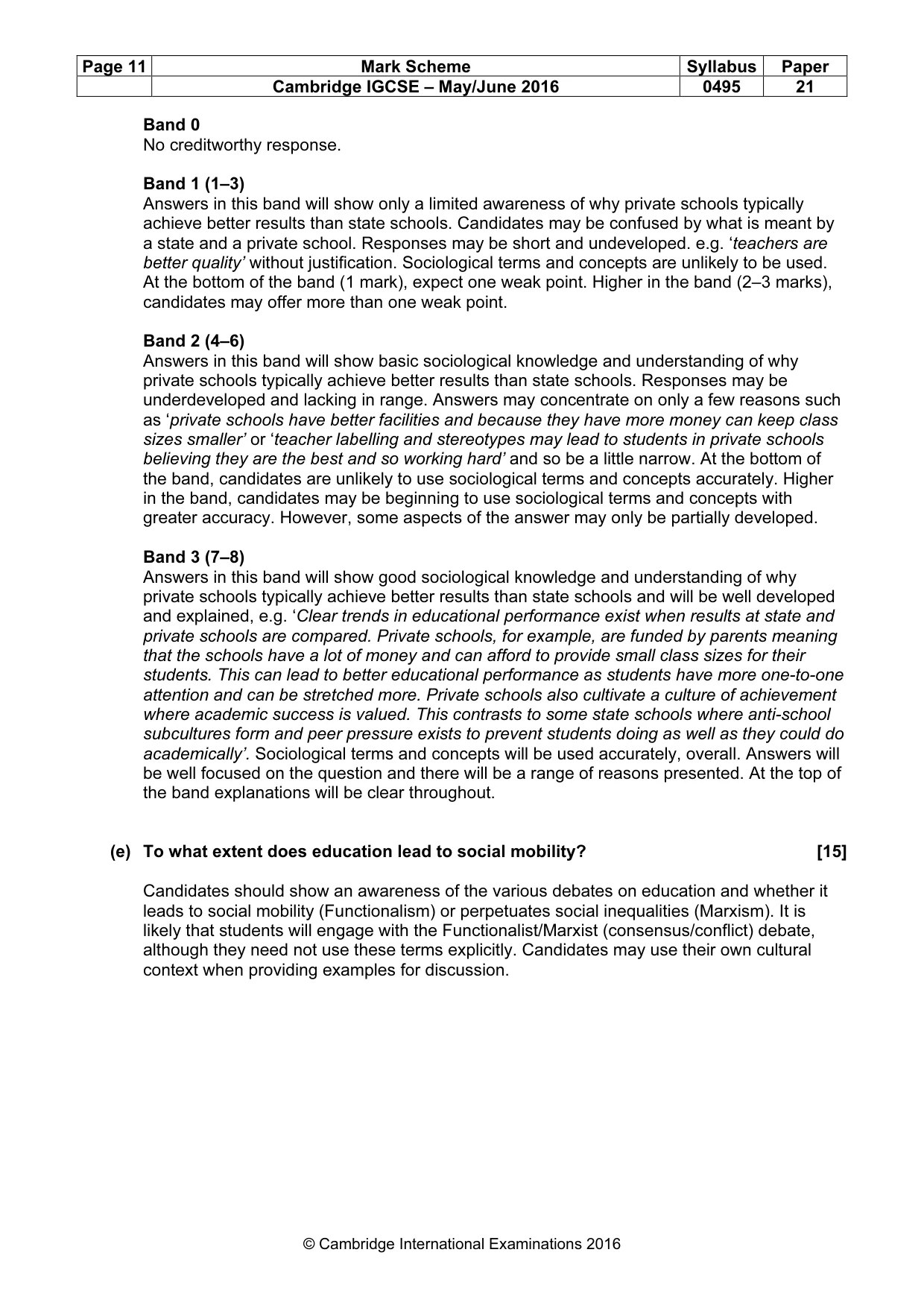
Page 11 Mark Scheme Syllabus Paper Cambridge IGCSE – May/June 2016 0495 21 © Cambridge International Examinations 2016 Band 0 No creditworthy response. Band 1 (1–3) Answers in this band will show only a limited awareness of why private schools typically achieve better results than state schools. Candidates may be confused by what is meant by a state and a private school. Responses may be short and undeveloped. e.g. ‘teachers are better quality’ without justification. Sociological terms and concepts are unlikely to be used. At the bottom of the band (1 mark), expect one weak point. Higher in the band (2–3 marks), candidates may offer more than one weak point. Band 2 (4–6) Answers in this band will show basic sociological knowledge and understanding of why private schools typically achieve better results than state schools. Responses may be underdeveloped and lacking in range. Answers may concentrate on only a few reasons such as ‘private schools have better facilities and because they have more money can keep class sizes smaller’ or ‘teacher labelling and stereotypes may lead to students in private schools believing they are the best and so working hard’ and so be a little narrow. At the bottom of the band, candidates are unlikely to use sociological terms and concepts accurately. Higher in the band, candidates may be beginning to use sociological terms and concepts with greater accuracy. However, some aspects of the answer may only be partially developed. Band 3 (7–8) Answers in this band will show good sociological knowledge and understanding of why private schools typically achieve better results than state schools and will be well developed and explained, e.g. ‘Clear trends in educational performance exist when results at state and private schools are compared. Private schools, for example, are funded by parents meaning that the schools have a lot of money and can afford to provide small class sizes for their students. This can lead to better educational performance as students have more one-to-one attention and can be stretched more. Private schools also cultivate a culture of achievement where academic success is valued. This contrasts to some state schools where anti-school subcultures form and peer pressure exists to prevent students doing as well as they could do academically’. Sociological terms and concepts will be used accurately, overall. Answers will be well focused on the question and there will be a range of reasons presented. At the top of the band explanations will be clear throughout. (e) To what extent does education lead to social mobility? [15] Candidates should show an awareness of the various debates on education and whether it leads to social mobility (Functionalism) or perpetuates social inequalities (Marxism). It is likely that students will engage with the Functionalist/Marxist (consensus/conflict) debate, although they need not use these terms explicitly. Candidates may use their own cultural context when providing examples for discussion.
Mark scheme, page 12
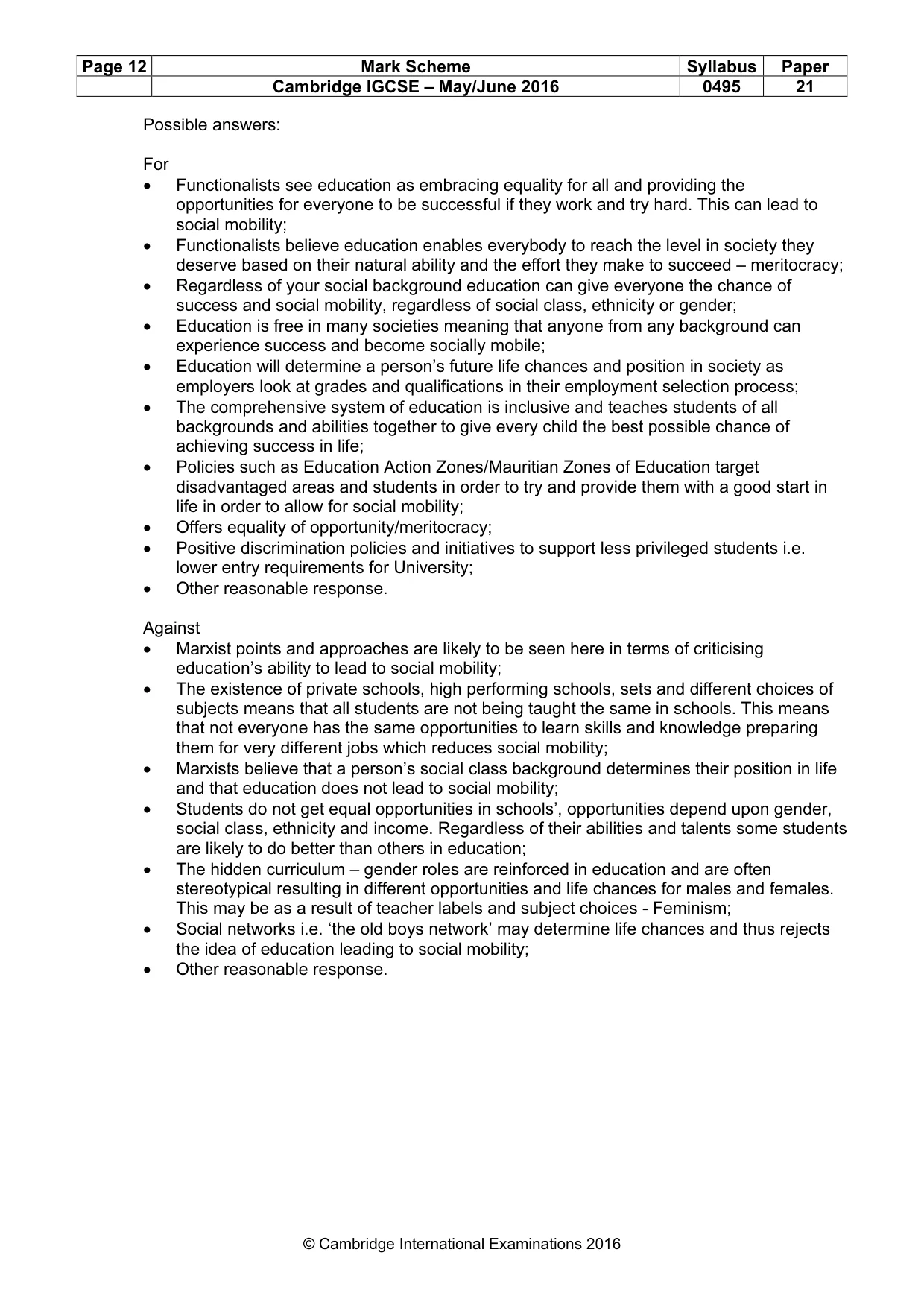
Page 12 Mark Scheme Syllabus Paper Cambridge IGCSE – May/June 2016 0495 21 © Cambridge International Examinations 2016 Possible answers: For • Functionalists see education as embracing equality for all and providing the opportunities for everyone to be successful if they work and try hard. This can lead to social mobility; • Functionalists believe education enables everybody to reach the level in society they deserve based on their natural ability and the effort they make to succeed – meritocracy; • Regardless of your social background education can give everyone the chance of success and social mobility, regardless of social class, ethnicity or gender; • Education is free in many societies meaning that anyone from any background can experience success and become socially mobile; • Education will determine a person’s future life chances and position in society as employers look at grades and qualifications in their employment selection process; • The comprehensive system of education is inclusive and teaches students of all backgrounds and abilities together to give every child the best possible chance of achieving success in life; • Policies such as Education Action Zones/Mauritian Zones of Education target disadvantaged areas and students in order to try and provide them with a good start in life in order to allow for social mobility; • Offers equality of opportunity/meritocracy; • Positive discrimination policies and initiatives to support less privileged students i.e. lower entry requirements for University; • Other reasonable response. Against • Marxist points and approaches are likely to be seen here in terms of criticising education’s ability to lead to social mobility; • The existence of private schools, high performing schools, sets and different choices of subjects means that all students are not being taught the same in schools. This means that not everyone has the same opportunities to learn skills and knowledge preparing them for very different jobs which reduces social mobility; • Marxists believe that a person’s social class background determines their position in life and that education does not lead to social mobility; • Students do not get equal opportunities in schools’, opportunities depend upon gender, social class, ethnicity and income. Regardless of their abilities and talents some students are likely to do better than others in education; • The hidden curriculum – gender roles are reinforced in education and are often stereotypical resulting in different opportunities and life chances for males and females. This may be as a result of teacher labels and subject choices - Feminism; • Social networks i.e. ‘the old boys network’ may determine life chances and thus rejects the idea of education leading to social mobility; • Other reasonable response.
Mark scheme, page 13
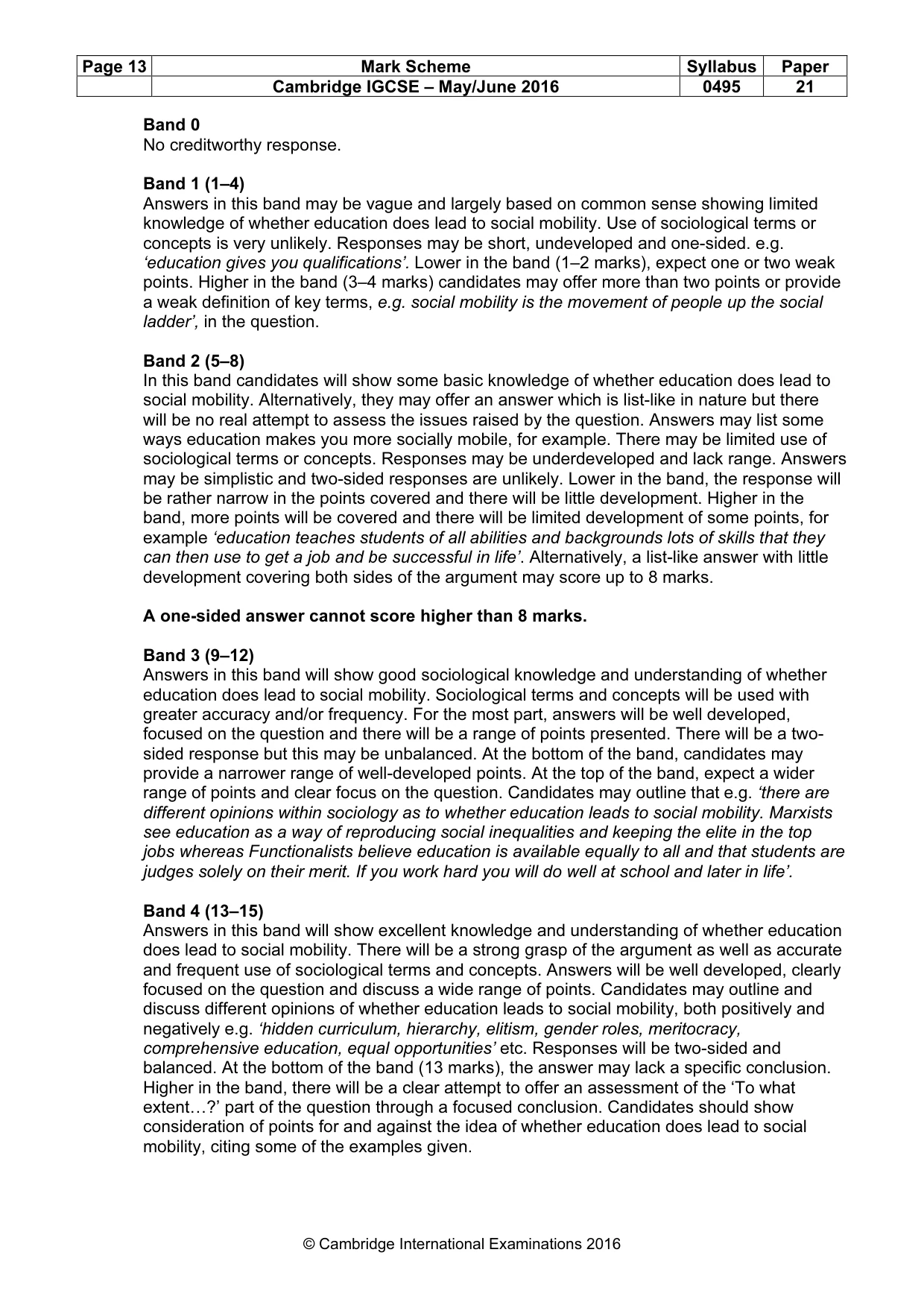
Page 13 Mark Scheme Syllabus Paper Cambridge IGCSE – May/June 2016 0495 21 © Cambridge International Examinations 2016 Band 0 No creditworthy response. Band 1 (1–4) Answers in this band may be vague and largely based on common sense showing limited knowledge of whether education does lead to social mobility. Use of sociological terms or concepts is very unlikely. Responses may be short, undeveloped and one-sided. e.g. ‘education gives you qualifications’. Lower in the band (1–2 marks), expect one or two weak points. Higher in the band (3–4 marks) candidates may offer more than two points or provide a weak definition of key terms, e.g. social mobility is the movement of people up the social ladder’, in the question. Band 2 (5–8) In this band candidates will show some basic knowledge of whether education does lead to social mobility. Alternatively, they may offer an answer which is list-like in nature but there will be no real attempt to assess the issues raised by the question. Answers may list some ways education makes you more socially mobile, for example. There may be limited use of sociological terms or concepts. Responses may be underdeveloped and lack range. Answers may be simplistic and two-sided responses are unlikely. Lower in the band, the response will be rather narrow in the points covered and there will be little development. Higher in the band, more points will be covered and there will be limited development of some points, for example ‘education teaches students of all abilities and backgrounds lots of skills that they can then use to get a job and be successful in life’. Alternatively, a list-like answer with little development covering both sides of the argument may score up to 8 marks. A one-sided answer cannot score higher than 8 marks. Band 3 (9–12) Answers in this band will show good sociological knowledge and understanding of whether education does lead to social mobility. Sociological terms and concepts will be used with greater accuracy and/or frequency. For the most part, answers will be well developed, focused on the question and there will be a range of points presented. There will be a two- sided response but this may be unbalanced. At the bottom of the band, candidates may provide a narrower range of well-developed points. At the top of the band, expect a wider range of points and clear focus on the question. Candidates may outline that e.g. ‘there are different opinions within sociology as to whether education leads to social mobility. Marxists see education as a way of reproducing social inequalities and keeping the elite in the top jobs whereas Functionalists believe education is available equally to all and that students are judges solely on their merit. If you work hard you will do well at school and later in life’. Band 4 (13–15) Answers in this band will show excellent knowledge and understanding of whether education does lead to social mobility. There will be a strong grasp of the argument as well as accurate and frequent use of sociological terms and concepts. Answers will be well developed, clearly focused on the question and discuss a wide range of points. Candidates may outline and discuss different opinions of whether education leads to social mobility, both positively and negatively e.g. ‘hidden curriculum, hierarchy, elitism, gender roles, meritocracy, comprehensive education, equal opportunities’ etc. Responses will be two-sided and balanced. At the bottom of the band (13 marks), the answer may lack a specific conclusion. Higher in the band, there will be a clear attempt to offer an assessment of the ‘To what extent…?’ part of the question through a focused conclusion. Candidates should show consideration of points for and against the idea of whether education does lead to social mobility, citing some of the examples given.
Mark scheme, page 14
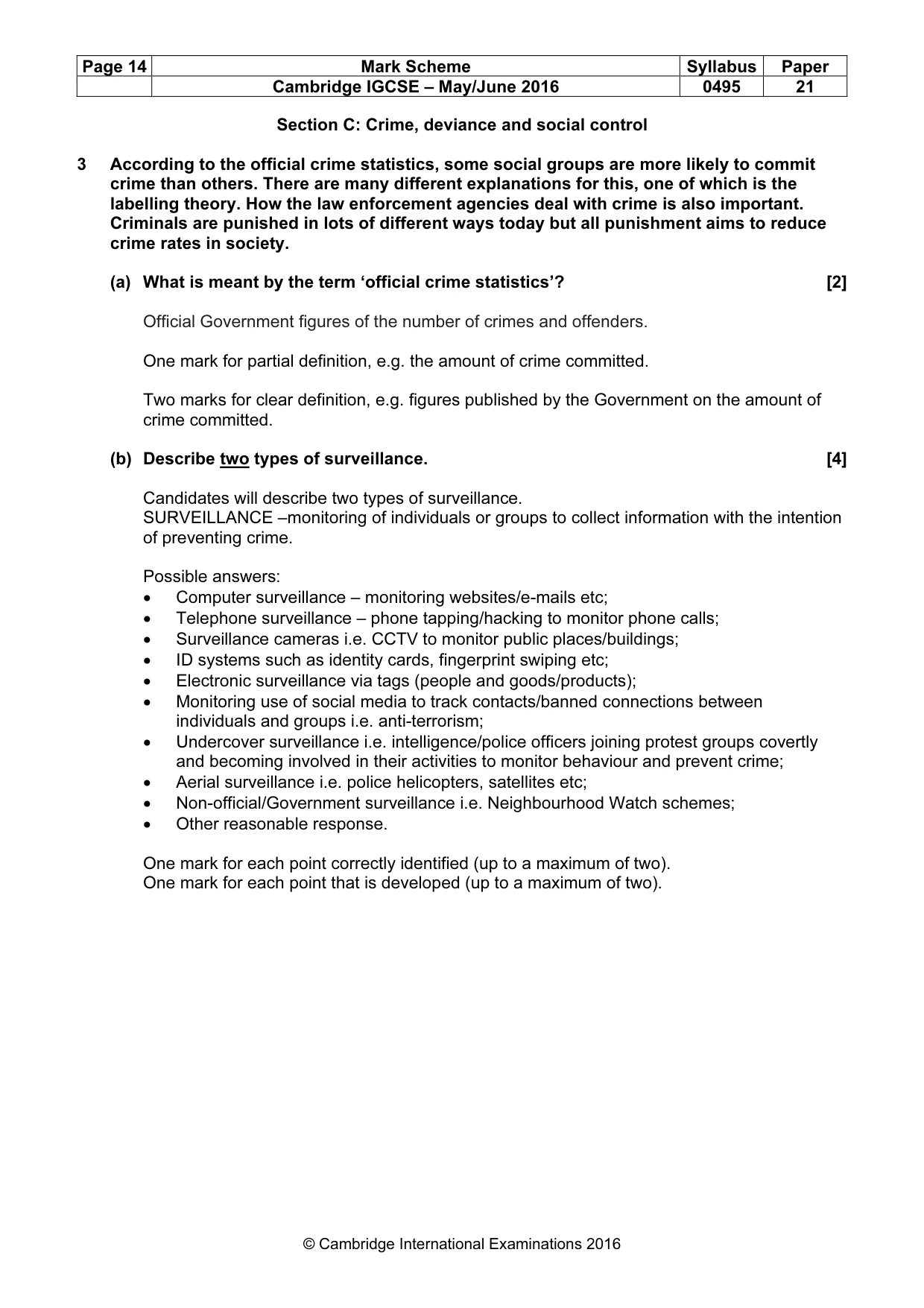
Page 14 Mark Scheme Syllabus Paper Cambridge IGCSE – May/June 2016 0495 21 © Cambridge International Examinations 2016 Section C: Crime, deviance and social control 3 According to the official crime statistics, some social groups are more likely to commit crime than others. There are many different explanations for this, one of which is the labelling theory. How the law enforcement agencies deal with crime is also important. Criminals are punished in lots of different ways today but all punishment aims to reduce crime rates in society. (a) What is meant by the term ‘official crime statistics’? [2] Official Government figures of the number of crimes and offenders. One mark for partial definition, e.g. the amount of crime committed. Two marks for clear definition, e.g. figures published by the Government on the amount of crime committed. (b) Describe two types of surveillance. [4] Candidates will describe two types of surveillance. SURVEILLANCE –monitoring of individuals or groups to collect information with the intention of preventing crime. Possible answers: • Computer surveillance – monitoring websites/e-mails etc; • Telephone surveillance – phone tapping/hacking to monitor phone calls; • Surveillance cameras i.e. CCTV to monitor public places/buildings; • ID systems such as identity cards, fingerprint swiping etc; • Electronic surveillance via tags (people and goods/products); • Monitoring use of social media to track contacts/banned connections between individuals and groups i.e. anti-terrorism; • Undercover surveillance i.e. intelligence/police officers joining protest groups covertly and becoming involved in their activities to monitor behaviour and prevent crime; • Aerial surveillance i.e. police helicopters, satellites etc; • Non-official/Government surveillance i.e. Neighbourhood Watch schemes; • Other reasonable response. One mark for each point correctly identified (up to a maximum of two). One mark for each point that is developed (up to a maximum of two).
Mark scheme, page 15
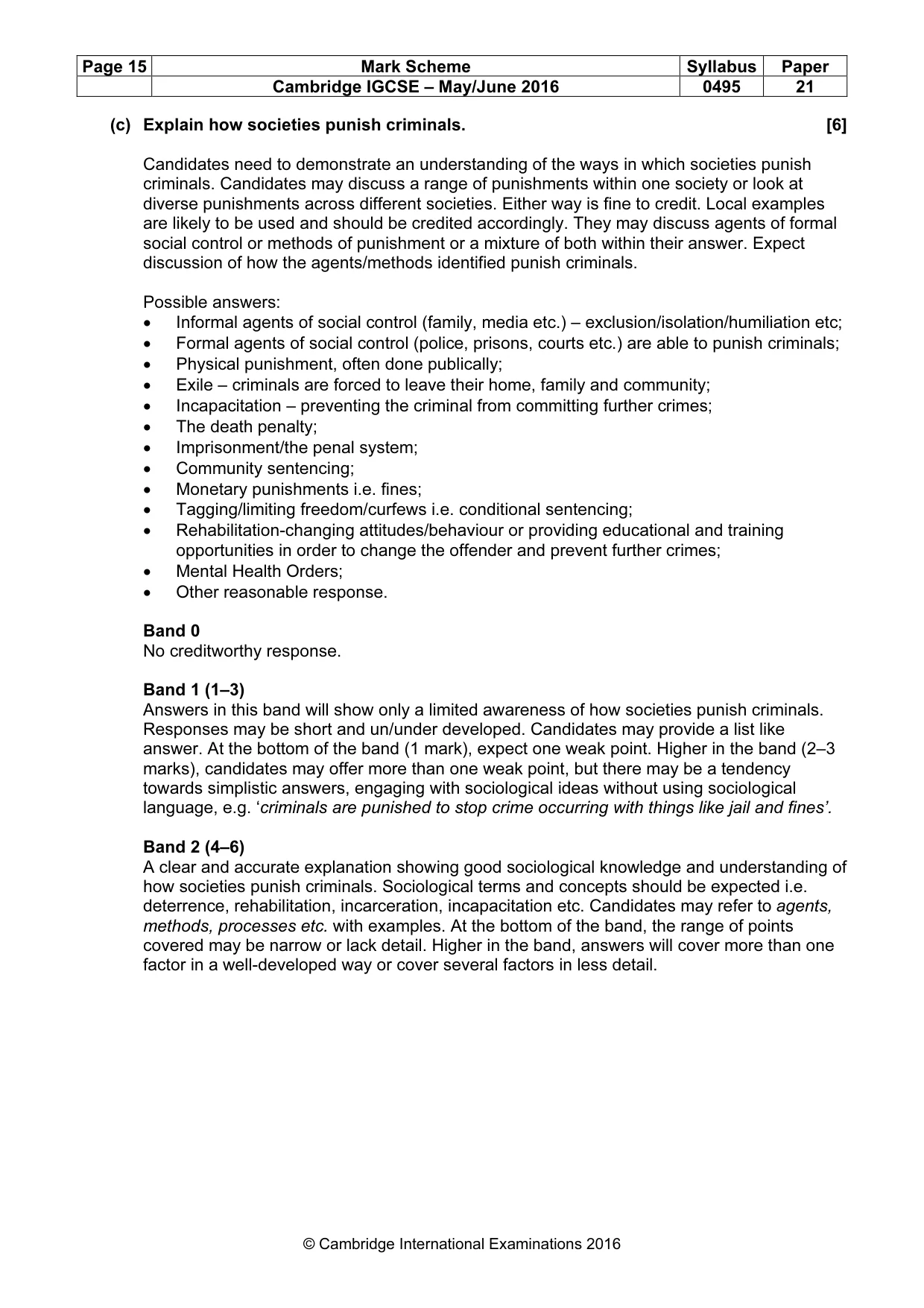
Page 15 Mark Scheme Syllabus Paper Cambridge IGCSE – May/June 2016 0495 21 © Cambridge International Examinations 2016 (c) Explain how societies punish criminals. [6] Candidates need to demonstrate an understanding of the ways in which societies punish criminals. Candidates may discuss a range of punishments within one society or look at diverse punishments across different societies. Either way is fine to credit. Local examples are likely to be used and should be credited accordingly. They may discuss agents of formal social control or methods of punishment or a mixture of both within their answer. Expect discussion of how the agents/methods identified punish criminals. Possible answers: • Informal agents of social control (family, media etc.) – exclusion/isolation/humiliation etc; • Formal agents of social control (police, prisons, courts etc.) are able to punish criminals; • Physical punishment, often done publically; • Exile – criminals are forced to leave their home, family and community; • Incapacitation – preventing the criminal from committing further crimes; • The death penalty; • Imprisonment/the penal system; • Community sentencing; • Monetary punishments i.e. fines; • Tagging/limiting freedom/curfews i.e. conditional sentencing; • Rehabilitation-changing attitudes/behaviour or providing educational and training opportunities in order to change the offender and prevent further crimes; • Mental Health Orders; • Other reasonable response. Band 0 No creditworthy response. Band 1 (1–3) Answers in this band will show only a limited awareness of how societies punish criminals. Responses may be short and un/under developed. Candidates may provide a list like answer. At the bottom of the band (1 mark), expect one weak point. Higher in the band (2–3 marks), candidates may offer more than one weak point, but there may be a tendency towards simplistic answers, engaging with sociological ideas without using sociological language, e.g. ‘criminals are punished to stop crime occurring with things like jail and fines’. Band 2 (4–6) A clear and accurate explanation showing good sociological knowledge and understanding of how societies punish criminals. Sociological terms and concepts should be expected i.e. deterrence, rehabilitation, incarceration, incapacitation etc. Candidates may refer to agents, methods, processes etc. with examples. At the bottom of the band, the range of points covered may be narrow or lack detail. Higher in the band, answers will cover more than one factor in a well-developed way or cover several factors in less detail.
Mark scheme, page 16
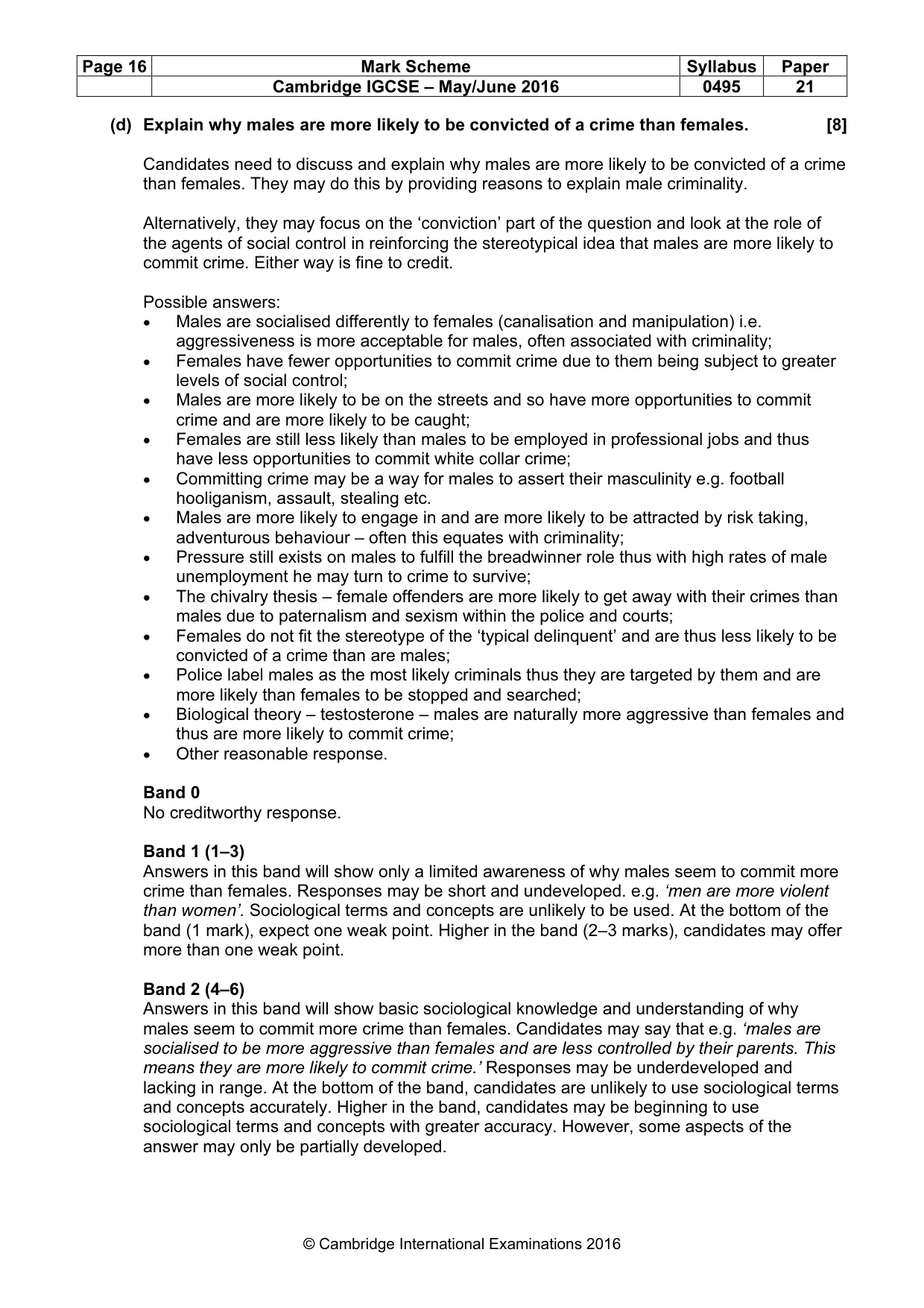
Page 16 Mark Scheme Syllabus Paper Cambridge IGCSE – May/June 2016 0495 21 © Cambridge International Examinations 2016 (d) Explain why males are more likely to be convicted of a crime than females. [8] Candidates need to discuss and explain why males are more likely to be convicted of a crime than females. They may do this by providing reasons to explain male criminality. Alternatively, they may focus on the ‘conviction’ part of the question and look at the role of the agents of social control in reinforcing the stereotypical idea that males are more likely to commit crime. Either way is fine to credit. Possible answers: • Males are socialised differently to females (canalisation and manipulation) i.e. aggressiveness is more acceptable for males, often associated with criminality; • Females have fewer opportunities to commit crime due to them being subject to greater levels of social control; • Males are more likely to be on the streets and so have more opportunities to commit crime and are more likely to be caught; • Females are still less likely than males to be employed in professional jobs and thus have less opportunities to commit white collar crime; • Committing crime may be a way for males to assert their masculinity e.g. football hooliganism, assault, stealing etc. • Males are more likely to engage in and are more likely to be attracted by risk taking, adventurous behaviour – often this equates with criminality; • Pressure still exists on males to fulfill the breadwinner role thus with high rates of male unemployment he may turn to crime to survive; • The chivalry thesis – female offenders are more likely to get away with their crimes than males due to paternalism and sexism within the police and courts; • Females do not fit the stereotype of the ‘typical delinquent’ and are thus less likely to be convicted of a crime than are males; • Police label males as the most likely criminals thus they are targeted by them and are more likely than females to be stopped and searched; • Biological theory – testosterone – males are naturally more aggressive than females and thus are more likely to commit crime; • Other reasonable response. Band 0 No creditworthy response. Band 1 (1–3) Answers in this band will show only a limited awareness of why males seem to commit more crime than females. Responses may be short and undeveloped. e.g. ‘men are more violent than women’. Sociological terms and concepts are unlikely to be used. At the bottom of the band (1 mark), expect one weak point. Higher in the band (2–3 marks), candidates may offer more than one weak point. Band 2 (4–6) Answers in this band will show basic sociological knowledge and understanding of why males seem to commit more crime than females. Candidates may say that e.g. ‘males are socialised to be more aggressive than females and are less controlled by their parents. This means they are more likely to commit crime.’ Responses may be underdeveloped and lacking in range. At the bottom of the band, candidates are unlikely to use sociological terms and concepts accurately. Higher in the band, candidates may be beginning to use sociological terms and concepts with greater accuracy. However, some aspects of the answer may only be partially developed.
Mark scheme, page 17
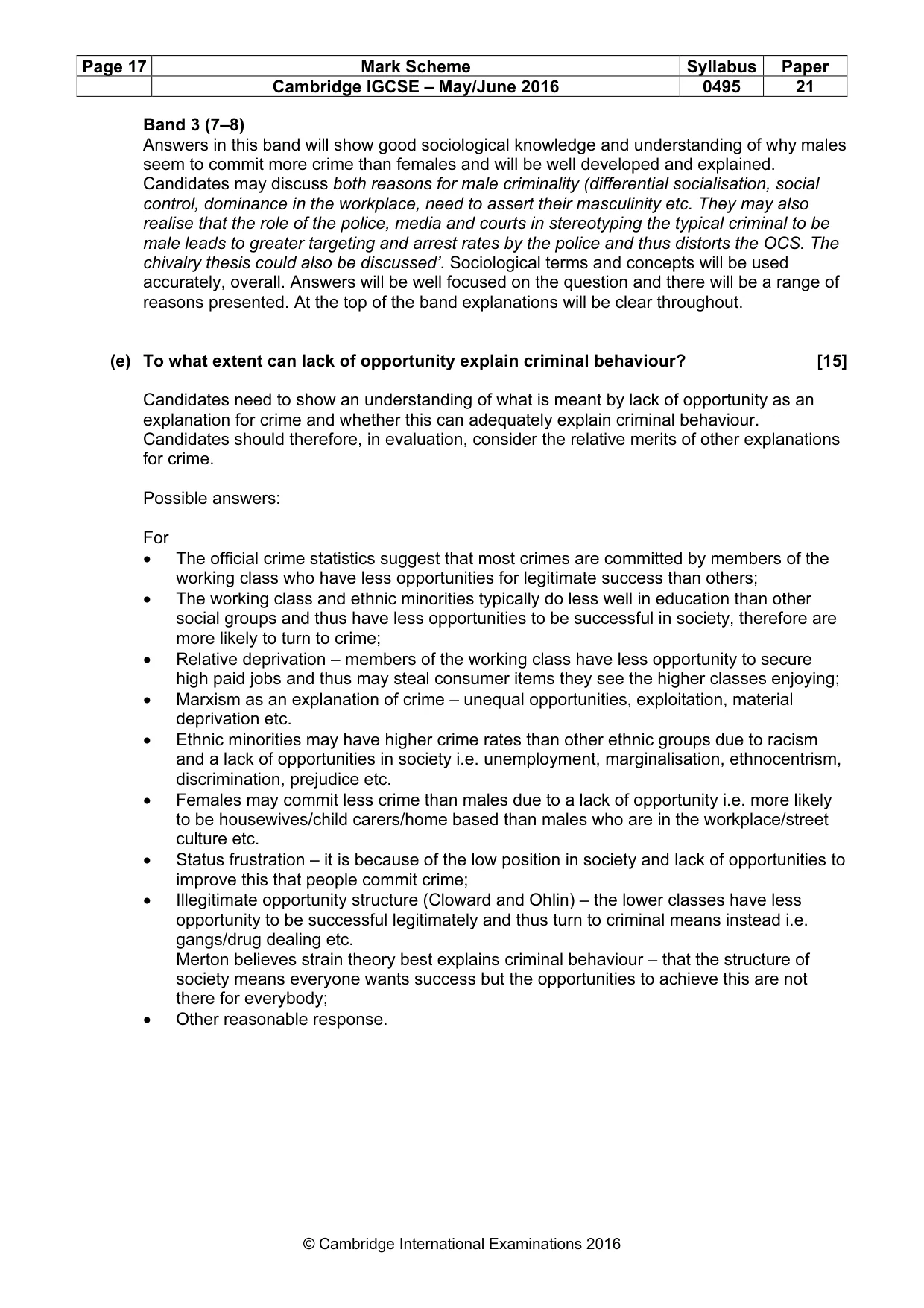
Page 17 Mark Scheme Syllabus Paper Cambridge IGCSE – May/June 2016 0495 21 © Cambridge International Examinations 2016 Band 3 (7–8) Answers in this band will show good sociological knowledge and understanding of why males seem to commit more crime than females and will be well developed and explained. Candidates may discuss both reasons for male criminality (differential socialisation, social control, dominance in the workplace, need to assert their masculinity etc. They may also realise that the role of the police, media and courts in stereotyping the typical criminal to be male leads to greater targeting and arrest rates by the police and thus distorts the OCS. The chivalry thesis could also be discussed’. Sociological terms and concepts will be used accurately, overall. Answers will be well focused on the question and there will be a range of reasons presented. At the top of the band explanations will be clear throughout. (e) To what extent can lack of opportunity explain criminal behaviour? [15] Candidates need to show an understanding of what is meant by lack of opportunity as an explanation for crime and whether this can adequately explain criminal behaviour. Candidates should therefore, in evaluation, consider the relative merits of other explanations for crime. Possible answers: For • The official crime statistics suggest that most crimes are committed by members of the working class who have less opportunities for legitimate success than others; • The working class and ethnic minorities typically do less well in education than other social groups and thus have less opportunities to be successful in society, therefore are more likely to turn to crime; • Relative deprivation – members of the working class have less opportunity to secure high paid jobs and thus may steal consumer items they see the higher classes enjoying; • Marxism as an explanation of crime – unequal opportunities, exploitation, material deprivation etc. • Ethnic minorities may have higher crime rates than other ethnic groups due to racism and a lack of opportunities in society i.e. unemployment, marginalisation, ethnocentrism, discrimination, prejudice etc. • Females may commit less crime than males due to a lack of opportunity i.e. more likely to be housewives/child carers/home based than males who are in the workplace/street culture etc. • Status frustration – it is because of the low position in society and lack of opportunities to improve this that people commit crime; • Illegitimate opportunity structure (Cloward and Ohlin) – the lower classes have less opportunity to be successful legitimately and thus turn to criminal means instead i.e. gangs/drug dealing etc. Merton believes strain theory best explains criminal behaviour – that the structure of society means everyone wants success but the opportunities to achieve this are not there for everybody; • Other reasonable response.
Mark scheme, page 18
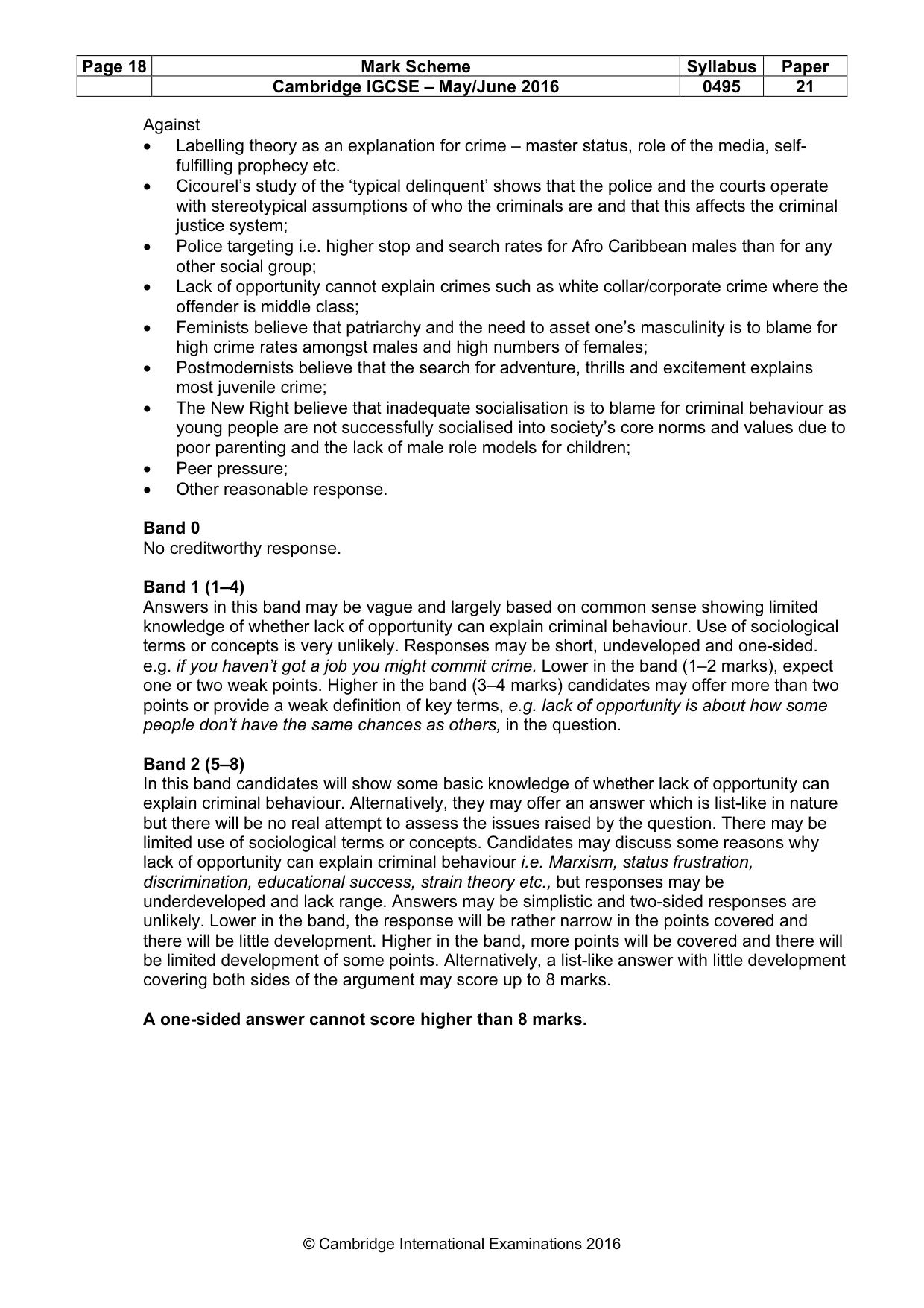
Page 18 Mark Scheme Syllabus Paper Cambridge IGCSE – May/June 2016 0495 21 © Cambridge International Examinations 2016 Against • Labelling theory as an explanation for crime – master status, role of the media, self- fulfilling prophecy etc. • Cicourel’s study of the ‘typical delinquent’ shows that the police and the courts operate with stereotypical assumptions of who the criminals are and that this affects the criminal justice system; • Police targeting i.e. higher stop and search rates for Afro Caribbean males than for any other social group; • Lack of opportunity cannot explain crimes such as white collar/corporate crime where the offender is middle class; • Feminists believe that patriarchy and the need to asset one’s masculinity is to blame for high crime rates amongst males and high numbers of females; • Postmodernists believe that the search for adventure, thrills and excitement explains most juvenile crime; • The New Right believe that inadequate socialisation is to blame for criminal behaviour as young people are not successfully socialised into society’s core norms and values due to poor parenting and the lack of male role models for children; • Peer pressure; • Other reasonable response. Band 0 No creditworthy response. Band 1 (1–4) Answers in this band may be vague and largely based on common sense showing limited knowledge of whether lack of opportunity can explain criminal behaviour. Use of sociological terms or concepts is very unlikely. Responses may be short, undeveloped and one-sided. e.g. if you haven’t got a job you might commit crime. Lower in the band (1–2 marks), expect one or two weak points. Higher in the band (3–4 marks) candidates may offer more than two points or provide a weak definition of key terms, e.g. lack of opportunity is about how some people don’t have the same chances as others, in the question. Band 2 (5–8) In this band candidates will show some basic knowledge of whether lack of opportunity can explain criminal behaviour. Alternatively, they may offer an answer which is list-like in nature but there will be no real attempt to assess the issues raised by the question. There may be limited use of sociological terms or concepts. Candidates may discuss some reasons why lack of opportunity can explain criminal behaviour i.e. Marxism, status frustration, discrimination, educational success, strain theory etc., but responses may be underdeveloped and lack range. Answers may be simplistic and two-sided responses are unlikely. Lower in the band, the response will be rather narrow in the points covered and there will be little development. Higher in the band, more points will be covered and there will be limited development of some points. Alternatively, a list-like answer with little development covering both sides of the argument may score up to 8 marks. A one-sided answer cannot score higher than 8 marks.
Mark scheme, page 19
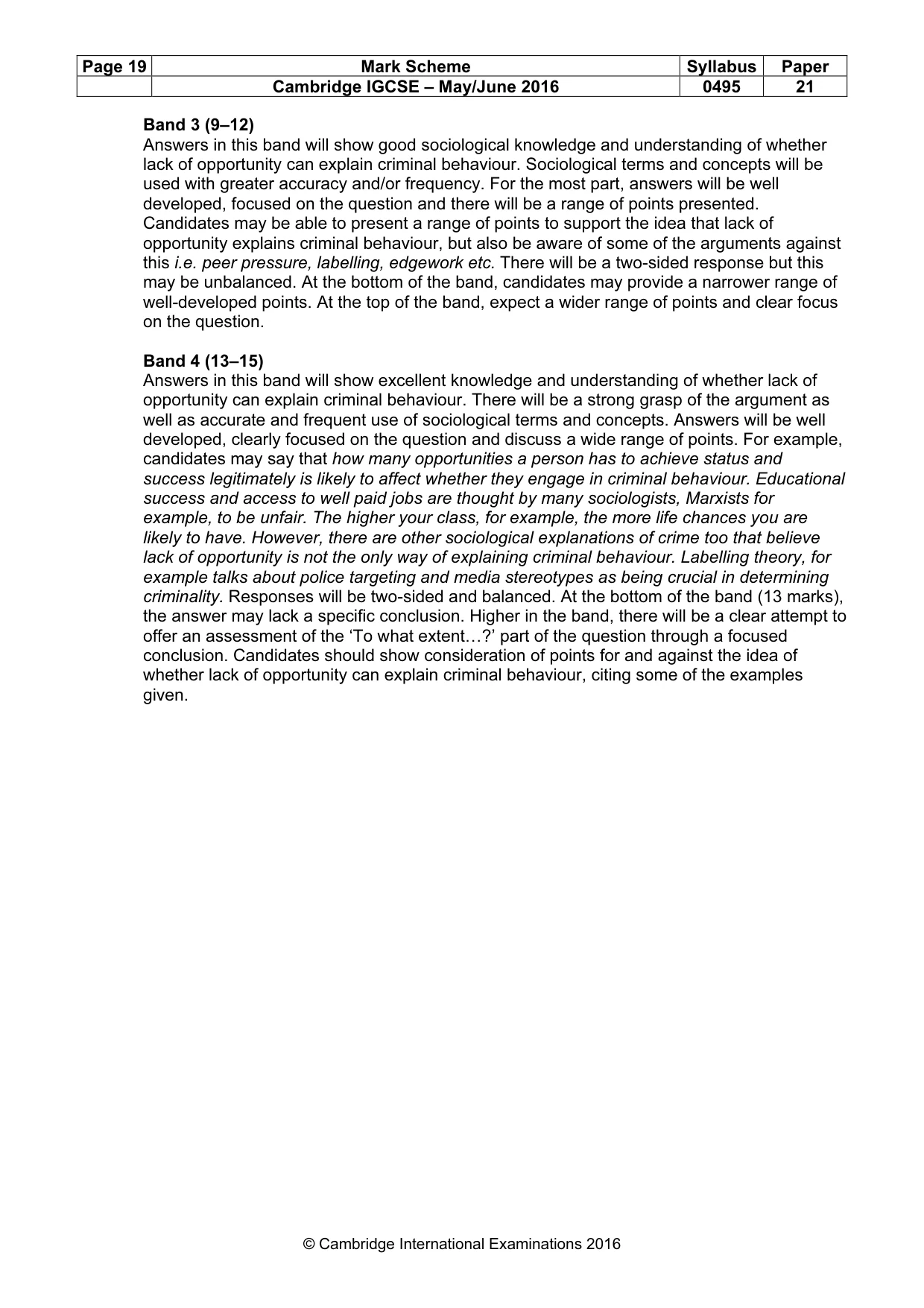
Page 19 Mark Scheme Syllabus Paper Cambridge IGCSE – May/June 2016 0495 21 © Cambridge International Examinations 2016 Band 3 (9–12) Answers in this band will show good sociological knowledge and understanding of whether lack of opportunity can explain criminal behaviour. Sociological terms and concepts will be used with greater accuracy and/or frequency. For the most part, answers will be well developed, focused on the question and there will be a range of points presented. Candidates may be able to present a range of points to support the idea that lack of opportunity explains criminal behaviour, but also be aware of some of the arguments against this i.e. peer pressure, labelling, edgework etc. There will be a two-sided response but this may be unbalanced. At the bottom of the band, candidates may provide a narrower range of well-developed points. At the top of the band, expect a wider range of points and clear focus on the question. Band 4 (13–15) Answers in this band will show excellent knowledge and understanding of whether lack of opportunity can explain criminal behaviour. There will be a strong grasp of the argument as well as accurate and frequent use of sociological terms and concepts. Answers will be well developed, clearly focused on the question and discuss a wide range of points. For example, candidates may say that how many opportunities a person has to achieve status and success legitimately is likely to affect whether they engage in criminal behaviour. Educational success and access to well paid jobs are thought by many sociologists, Marxists for example, to be unfair. The higher your class, for example, the more life chances you are likely to have. However, there are other sociological explanations of crime too that believe lack of opportunity is not the only way of explaining criminal behaviour. Labelling theory, for example talks about police targeting and media stereotypes as being crucial in determining criminality. Responses will be two-sided and balanced. At the bottom of the band (13 marks), the answer may lack a specific conclusion. Higher in the band, there will be a clear attempt to offer an assessment of the ‘To what extent…?’ part of the question through a focused conclusion. Candidates should show consideration of points for and against the idea of whether lack of opportunity can explain criminal behaviour, citing some of the examples given.
Mark scheme, page 20
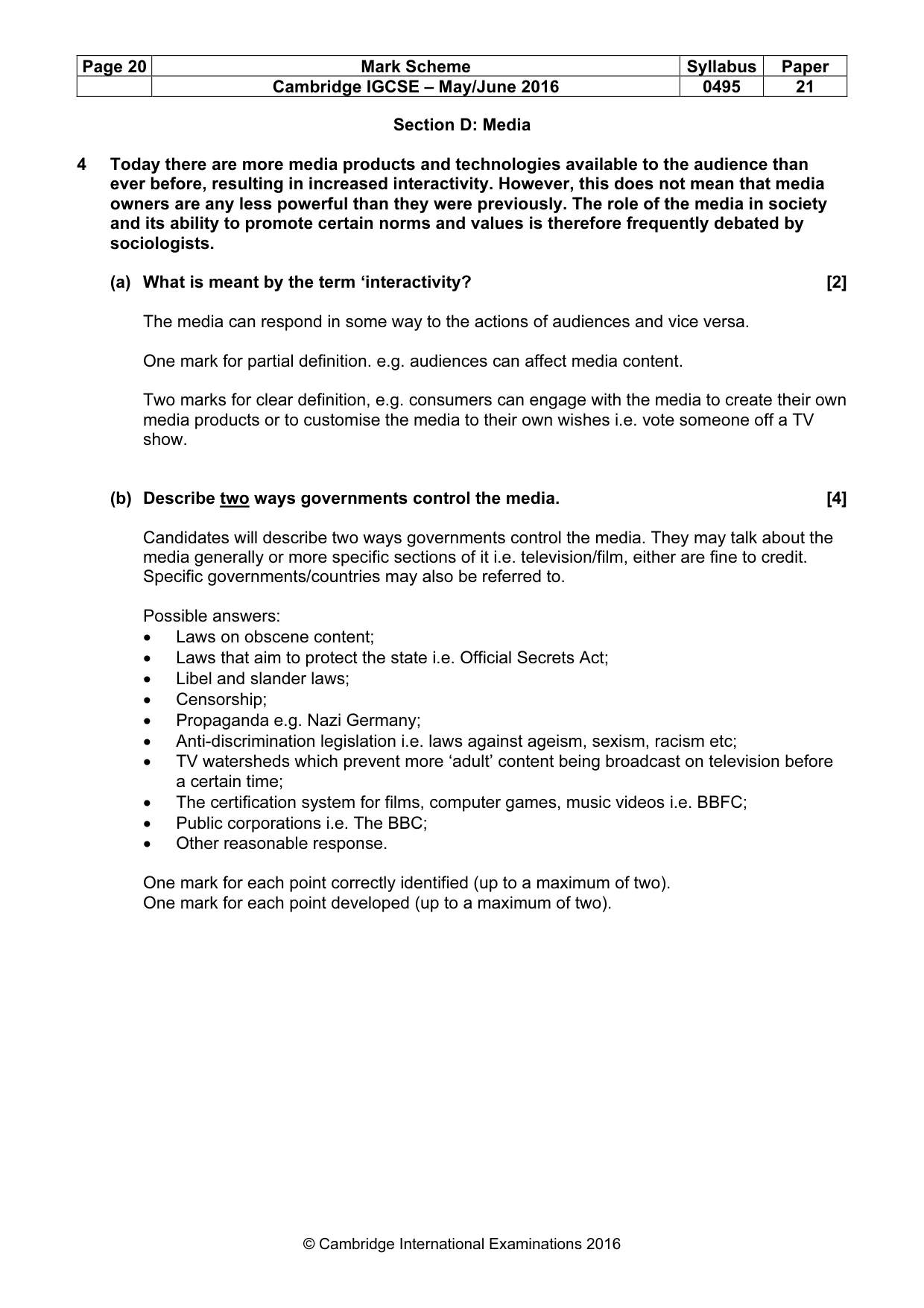
Page 20 Mark Scheme Syllabus Paper Cambridge IGCSE – May/June 2016 0495 21 © Cambridge International Examinations 2016 Section D: Media 4 Today there are more media products and technologies available to the audience than ever before, resulting in increased interactivity. However, this does not mean that media owners are any less powerful than they were previously. The role of the media in society and its ability to promote certain norms and values is therefore frequently debated by sociologists. (a) What is meant by the term ‘interactivity? [2] The media can respond in some way to the actions of audiences and vice versa. One mark for partial definition. e.g. audiences can affect media content. Two marks for clear definition, e.g. consumers can engage with the media to create their own media products or to customise the media to their own wishes i.e. vote someone off a TV show. (b) Describe two ways governments control the media. [4] Candidates will describe two ways governments control the media. They may talk about the media generally or more specific sections of it i.e. television/film, either are fine to credit. Specific governments/countries may also be referred to. Possible answers: • Laws on obscene content; • Laws that aim to protect the state i.e. Official Secrets Act; • Libel and slander laws; • Censorship; • Propaganda e.g. Nazi Germany; • Anti-discrimination legislation i.e. laws against ageism, sexism, racism etc; • TV watersheds which prevent more ‘adult’ content being broadcast on television before a certain time; • The certification system for films, computer games, music videos i.e. BBFC; • Public corporations i.e. The BBC; • Other reasonable response. One mark for each point correctly identified (up to a maximum of two). One mark for each point developed (up to a maximum of two).
Mark scheme, page 21
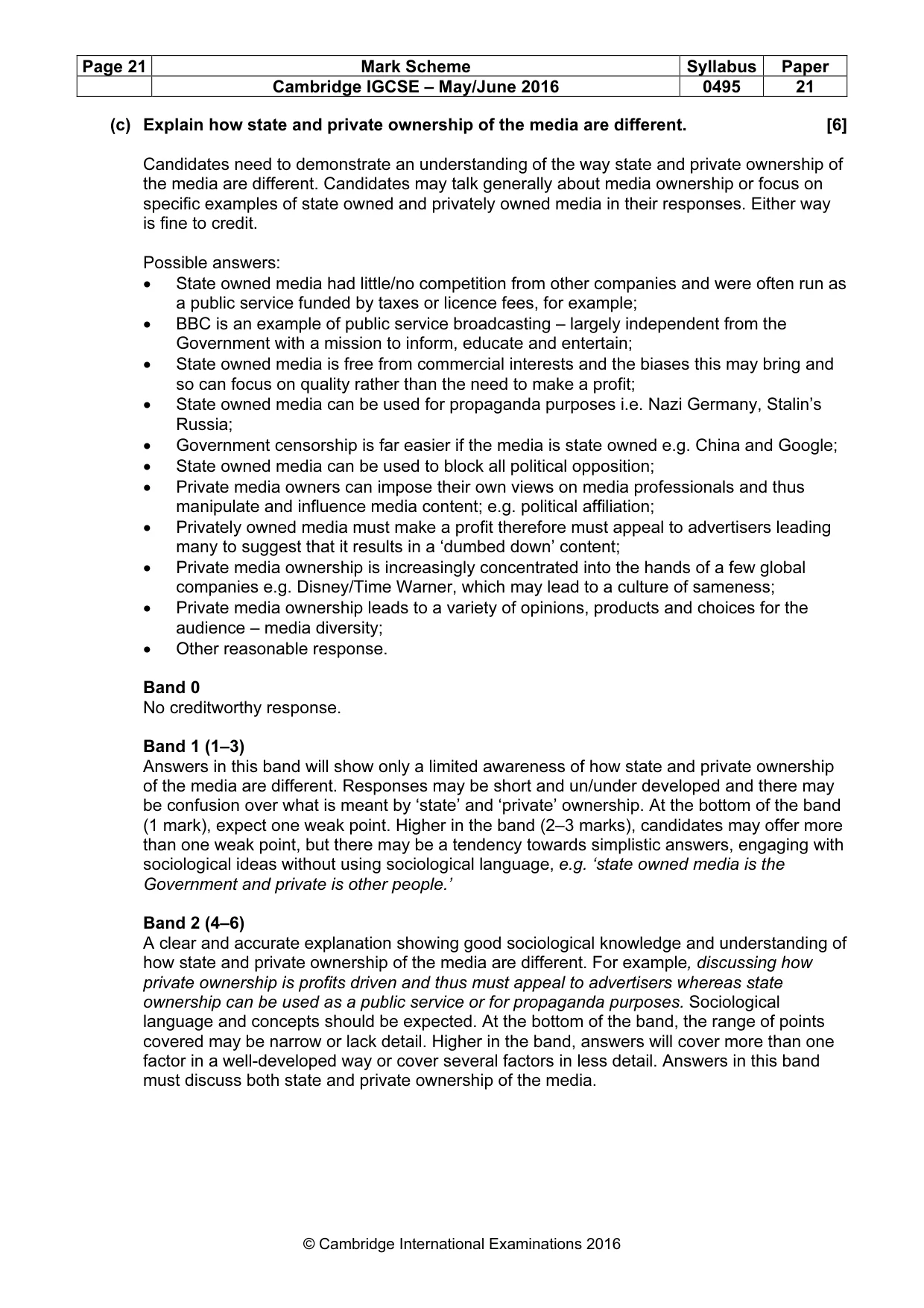
Page 21 Mark Scheme Syllabus Paper Cambridge IGCSE – May/June 2016 0495 21 © Cambridge International Examinations 2016 (c) Explain how state and private ownership of the media are different. [6] Candidates need to demonstrate an understanding of the way state and private ownership of the media are different. Candidates may talk generally about media ownership or focus on specific examples of state owned and privately owned media in their responses. Either way is fine to credit. Possible answers: • State owned media had little/no competition from other companies and were often run as a public service funded by taxes or licence fees, for example; • BBC is an example of public service broadcasting – largely independent from the Government with a mission to inform, educate and entertain; • State owned media is free from commercial interests and the biases this may bring and so can focus on quality rather than the need to make a profit; • State owned media can be used for propaganda purposes i.e. Nazi Germany, Stalin’s Russia; • Government censorship is far easier if the media is state owned e.g. China and Google; • State owned media can be used to block all political opposition; • Private media owners can impose their own views on media professionals and thus manipulate and influence media content; e.g. political affiliation; • Privately owned media must make a profit therefore must appeal to advertisers leading many to suggest that it results in a ‘dumbed down’ content; • Private media ownership is increasingly concentrated into the hands of a few global companies e.g. Disney/Time Warner, which may lead to a culture of sameness; • Private media ownership leads to a variety of opinions, products and choices for the audience – media diversity; • Other reasonable response. Band 0 No creditworthy response. Band 1 (1–3) Answers in this band will show only a limited awareness of how state and private ownership of the media are different. Responses may be short and un/under developed and there may be confusion over what is meant by ‘state’ and ‘private’ ownership. At the bottom of the band (1 mark), expect one weak point. Higher in the band (2–3 marks), candidates may offer more than one weak point, but there may be a tendency towards simplistic answers, engaging with sociological ideas without using sociological language, e.g. ‘state owned media is the Government and private is other people.’ Band 2 (4–6) A clear and accurate explanation showing good sociological knowledge and understanding of how state and private ownership of the media are different. For example, discussing how private ownership is profits driven and thus must appeal to advertisers whereas state ownership can be used as a public service or for propaganda purposes. Sociological language and concepts should be expected. At the bottom of the band, the range of points covered may be narrow or lack detail. Higher in the band, answers will cover more than one factor in a well-developed way or cover several factors in less detail. Answers in this band must discuss both state and private ownership of the media.
Mark scheme, page 22
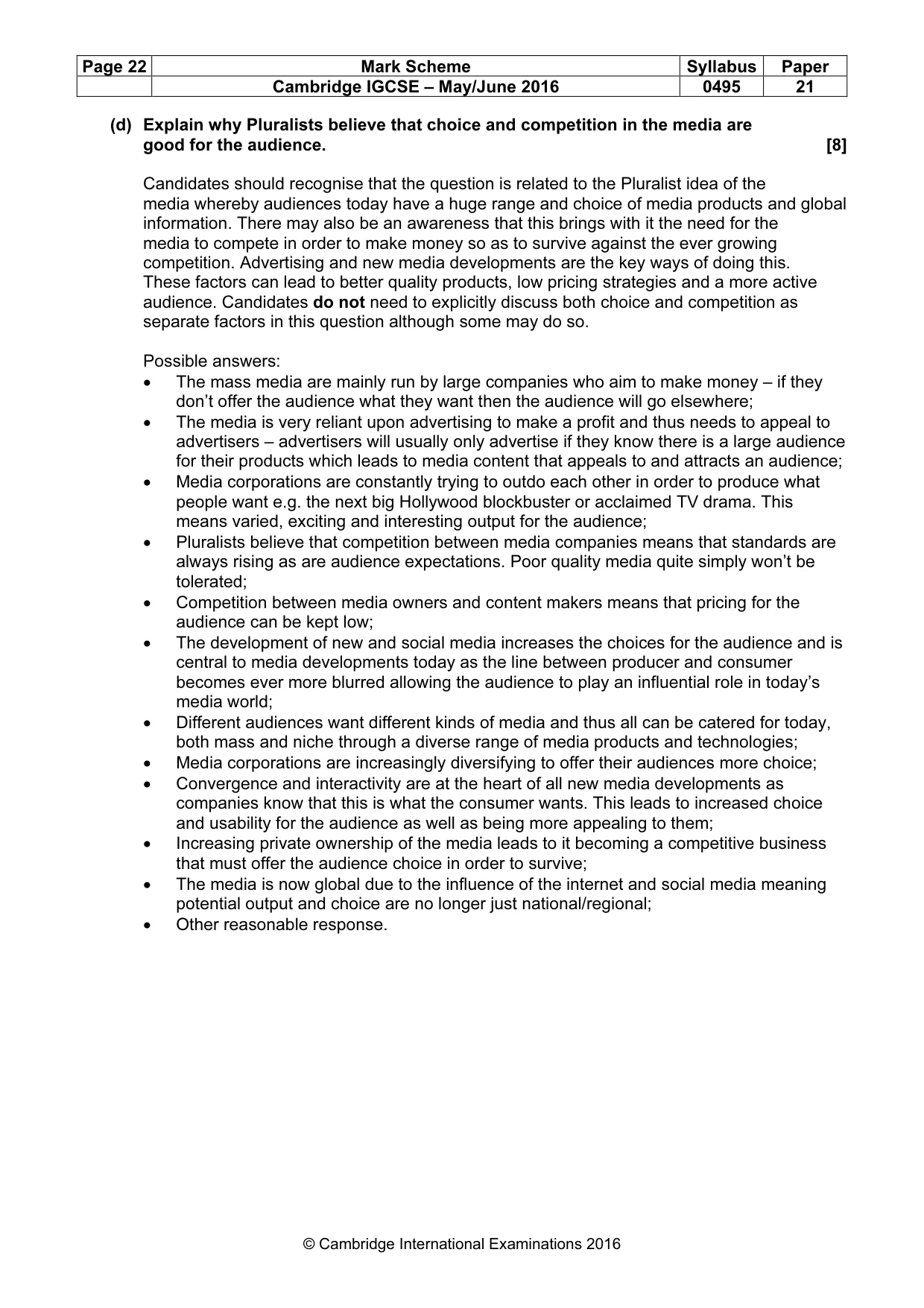
Page 22 Mark Scheme Syllabus Paper Cambridge IGCSE – May/June 2016 0495 21 © Cambridge International Examinations 2016 (d) Explain why Pluralists believe that choice and competition in the media are good for the audience. [8] Candidates should recognise that the question is related to the Pluralist idea of the media whereby audiences today have a huge range and choice of media products and global information. There may also be an awareness that this brings with it the need for the media to compete in order to make money so as to survive against the ever growing competition. Advertising and new media developments are the key ways of doing this. These factors can lead to better quality products, low pricing strategies and a more active audience. Candidates do not need to explicitly discuss both choice and competition as separate factors in this question although some may do so. Possible answers: • The mass media are mainly run by large companies who aim to make money – if they don’t offer the audience what they want then the audience will go elsewhere; • The media is very reliant upon advertising to make a profit and thus needs to appeal to advertisers – advertisers will usually only advertise if they know there is a large audience for their products which leads to media content that appeals to and attracts an audience; • Media corporations are constantly trying to outdo each other in order to produce what people want e.g. the next big Hollywood blockbuster or acclaimed TV drama. This means varied, exciting and interesting output for the audience; • Pluralists believe that competition between media companies means that standards are always rising as are audience expectations. Poor quality media quite simply won’t be tolerated; • Competition between media owners and content makers means that pricing for the audience can be kept low; • The development of new and social media increases the choices for the audience and is central to media developments today as the line between producer and consumer becomes ever more blurred allowing the audience to play an influential role in today’s media world; • Different audiences want different kinds of media and thus all can be catered for today, both mass and niche through a diverse range of media products and technologies; • Media corporations are increasingly diversifying to offer their audiences more choice; • Convergence and interactivity are at the heart of all new media developments as companies know that this is what the consumer wants. This leads to increased choice and usability for the audience as well as being more appealing to them; • Increasing private ownership of the media leads to it becoming a competitive business that must offer the audience choice in order to survive; • The media is now global due to the influence of the internet and social media meaning potential output and choice are no longer just national/regional; • Other reasonable response.
Mark scheme, page 23
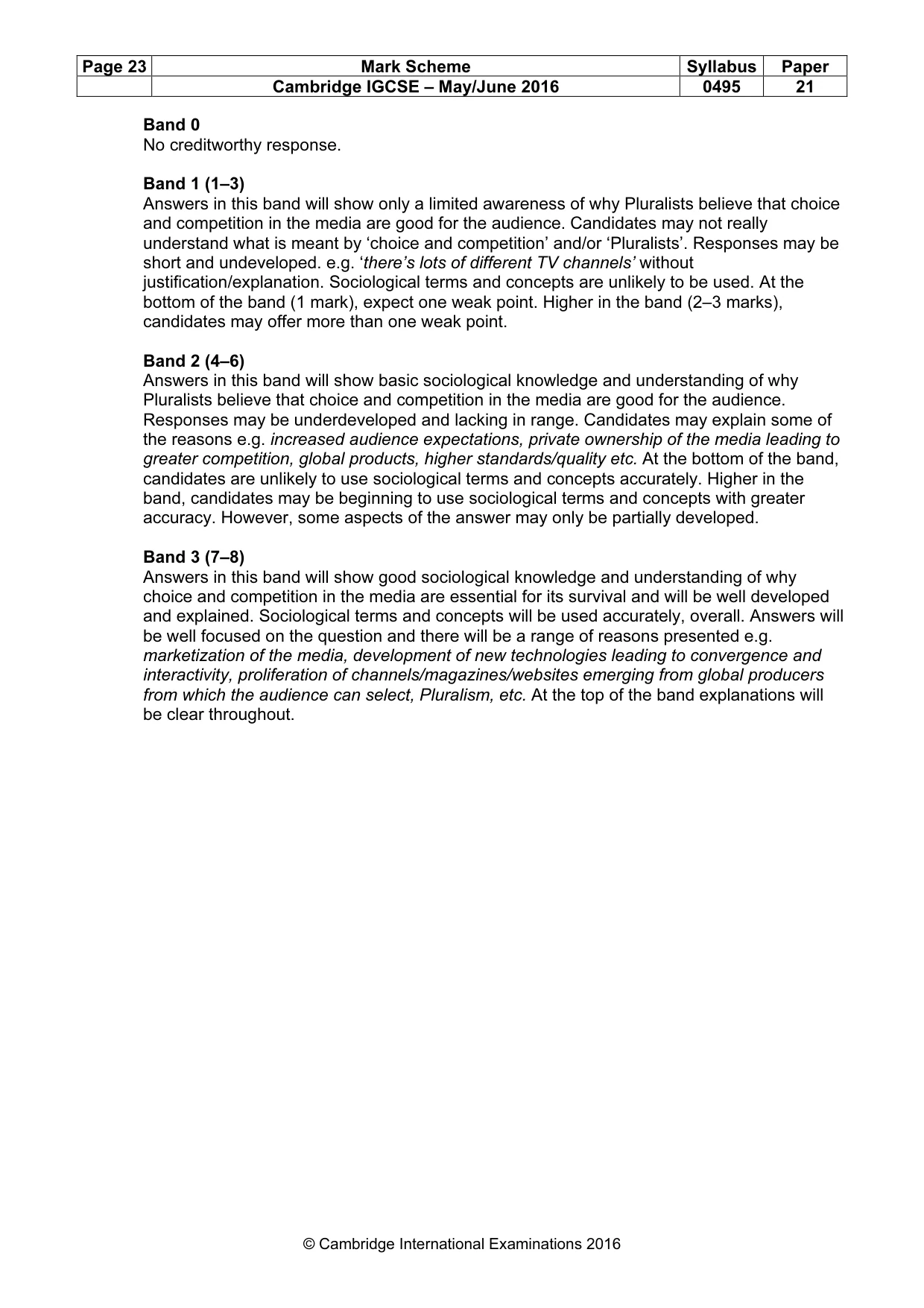
Page 23 Mark Scheme Syllabus Paper Cambridge IGCSE – May/June 2016 0495 21 © Cambridge International Examinations 2016 Band 0 No creditworthy response. Band 1 (1–3) Answers in this band will show only a limited awareness of why Pluralists believe that choice and competition in the media are good for the audience. Candidates may not really understand what is meant by ‘choice and competition’ and/or ‘Pluralists’. Responses may be short and undeveloped. e.g. ‘there’s lots of different TV channels’ without justification/explanation. Sociological terms and concepts are unlikely to be used. At the bottom of the band (1 mark), expect one weak point. Higher in the band (2–3 marks), candidates may offer more than one weak point. Band 2 (4–6) Answers in this band will show basic sociological knowledge and understanding of why Pluralists believe that choice and competition in the media are good for the audience. Responses may be underdeveloped and lacking in range. Candidates may explain some of the reasons e.g. increased audience expectations, private ownership of the media leading to greater competition, global products, higher standards/quality etc. At the bottom of the band, candidates are unlikely to use sociological terms and concepts accurately. Higher in the band, candidates may be beginning to use sociological terms and concepts with greater accuracy. However, some aspects of the answer may only be partially developed. Band 3 (7–8) Answers in this band will show good sociological knowledge and understanding of why choice and competition in the media are essential for its survival and will be well developed and explained. Sociological terms and concepts will be used accurately, overall. Answers will be well focused on the question and there will be a range of reasons presented e.g. marketization of the media, development of new technologies leading to convergence and interactivity, proliferation of channels/magazines/websites emerging from global producers from which the audience can select, Pluralism, etc. At the top of the band explanations will be clear throughout.
Mark scheme, page 24
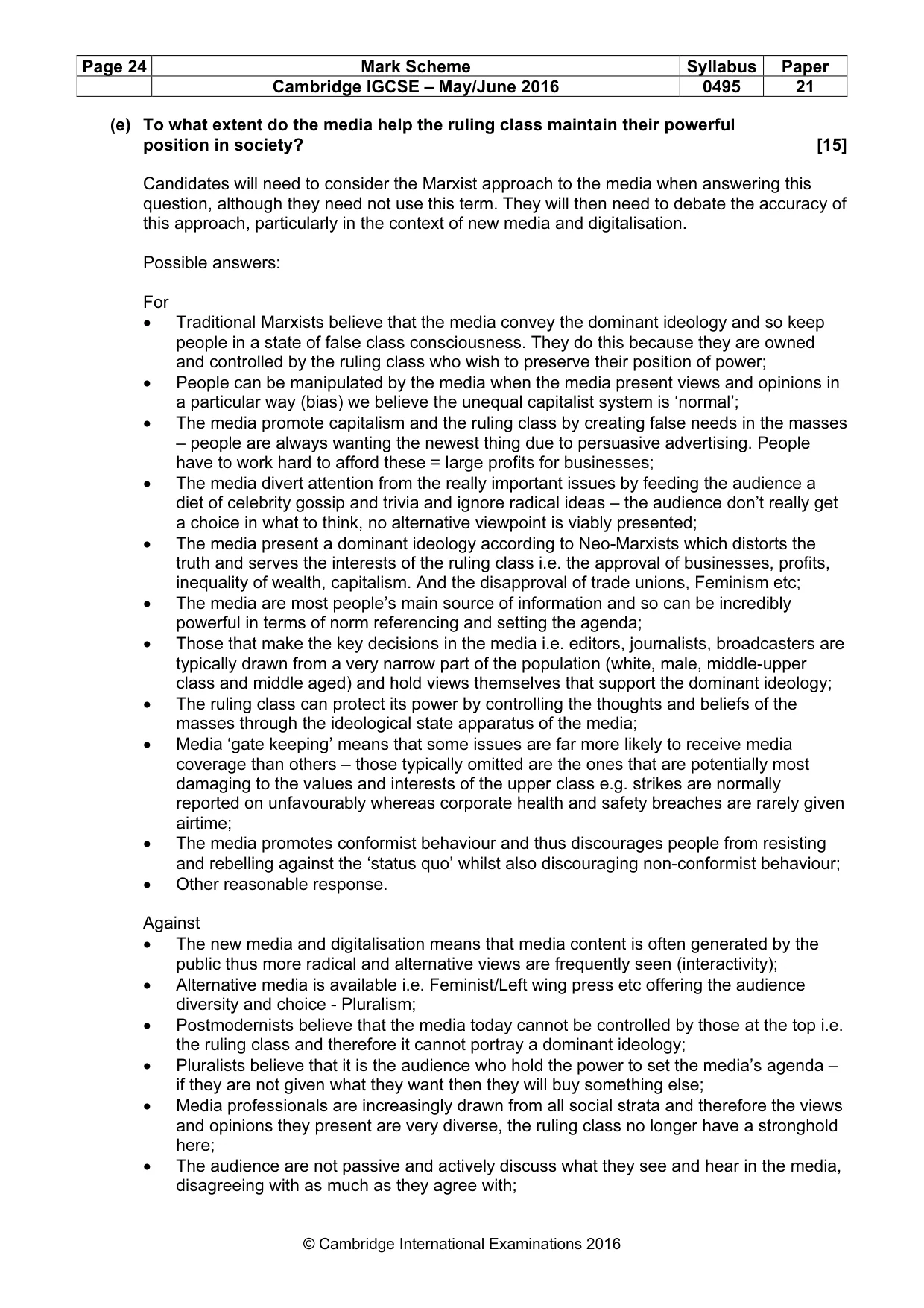
Page 24 Mark Scheme Syllabus Paper Cambridge IGCSE – May/June 2016 0495 21 © Cambridge International Examinations 2016 (e) To what extent do the media help the ruling class maintain their powerful position in society? [15] Candidates will need to consider the Marxist approach to the media when answering this question, although they need not use this term. They will then need to debate the accuracy of this approach, particularly in the context of new media and digitalisation. Possible answers: For • Traditional Marxists believe that the media convey the dominant ideology and so keep people in a state of false class consciousness. They do this because they are owned and controlled by the ruling class who wish to preserve their position of power; • People can be manipulated by the media when the media present views and opinions in a particular way (bias) we believe the unequal capitalist system is ‘normal’; • The media promote capitalism and the ruling class by creating false needs in the masses – people are always wanting the newest thing due to persuasive advertising. People have to work hard to afford these = large profits for businesses; • The media divert attention from the really important issues by feeding the audience a diet of celebrity gossip and trivia and ignore radical ideas – the audience don’t really get a choice in what to think, no alternative viewpoint is viably presented; • The media present a dominant ideology according to Neo-Marxists which distorts the truth and serves the interests of the ruling class i.e. the approval of businesses, profits, inequality of wealth, capitalism. And the disapproval of trade unions, Feminism etc; • The media are most people’s main source of information and so can be incredibly powerful in terms of norm referencing and setting the agenda; • Those that make the key decisions in the media i.e. editors, journalists, broadcasters are typically drawn from a very narrow part of the population (white, male, middle-upper class and middle aged) and hold views themselves that support the dominant ideology; • The ruling class can protect its power by controlling the thoughts and beliefs of the masses through the ideological state apparatus of the media; • Media ‘gate keeping’ means that some issues are far more likely to receive media coverage than others – those typically omitted are the ones that are potentially most damaging to the values and interests of the upper class e.g. strikes are normally reported on unfavourably whereas corporate health and safety breaches are rarely given airtime; • The media promotes conformist behaviour and thus discourages people from resisting and rebelling against the ‘status quo’ whilst also discouraging non-conformist behaviour; • Other reasonable response. Against • The new media and digitalisation means that media content is often generated by the public thus more radical and alternative views are frequently seen (interactivity); • Alternative media is available i.e. Feminist/Left wing press etc offering the audience diversity and choice - Pluralism; • Postmodernists believe that the media today cannot be controlled by those at the top i.e. the ruling class and therefore it cannot portray a dominant ideology; • Pluralists believe that it is the audience who hold the power to set the media’s agenda – if they are not given what they want then they will buy something else; • Media professionals are increasingly drawn from all social strata and therefore the views and opinions they present are very diverse, the ruling class no longer have a stronghold here; • The audience are not passive and actively discuss what they see and hear in the media, disagreeing with as much as they agree with;
Mark scheme, page 25
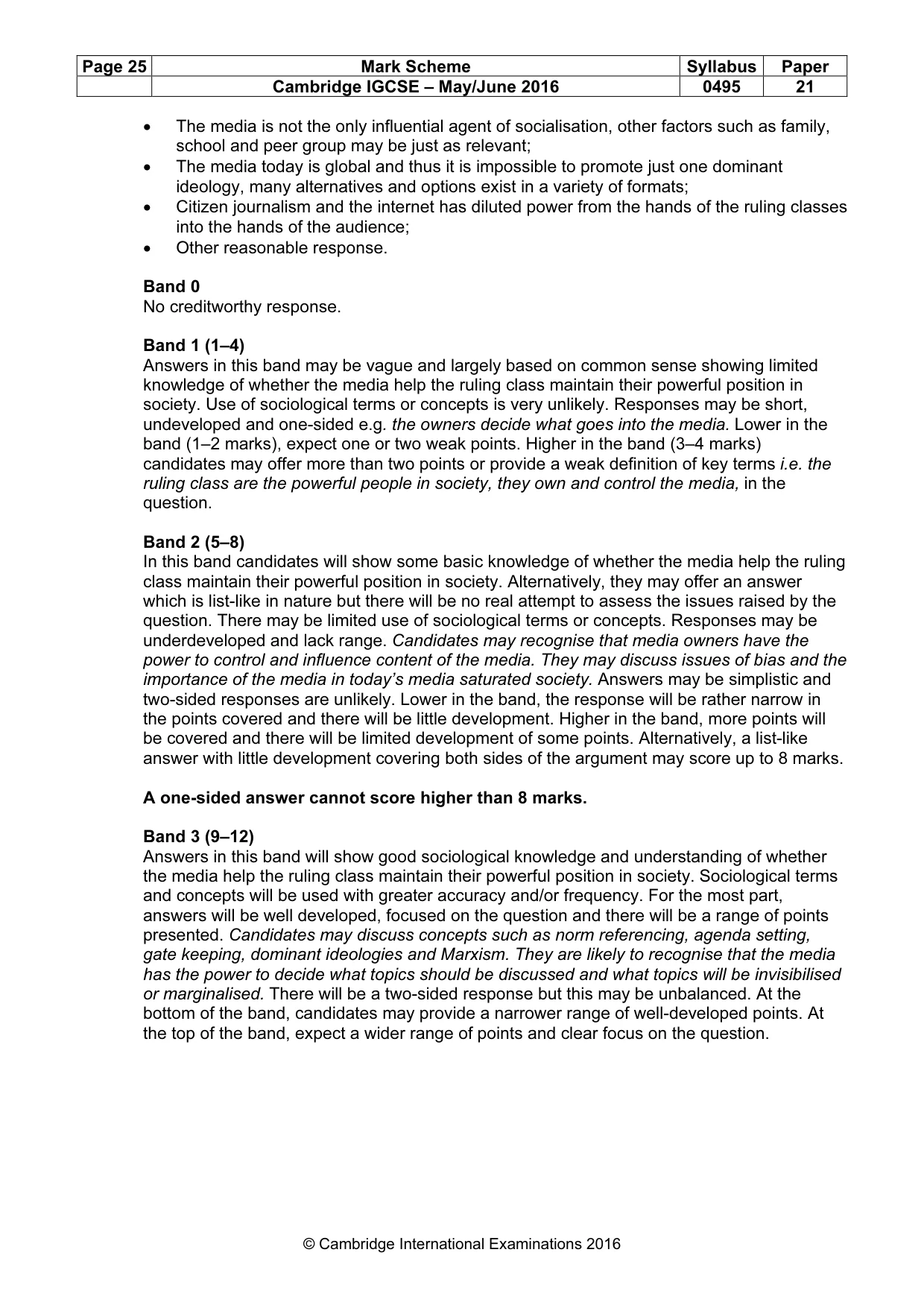
Page 25 Mark Scheme Syllabus Paper Cambridge IGCSE – May/June 2016 0495 21 © Cambridge International Examinations 2016 • The media is not the only influential agent of socialisation, other factors such as family, school and peer group may be just as relevant; • The media today is global and thus it is impossible to promote just one dominant ideology, many alternatives and options exist in a variety of formats; • Citizen journalism and the internet has diluted power from the hands of the ruling classes into the hands of the audience; • Other reasonable response. Band 0 No creditworthy response. Band 1 (1–4) Answers in this band may be vague and largely based on common sense showing limited knowledge of whether the media help the ruling class maintain their powerful position in society. Use of sociological terms or concepts is very unlikely. Responses may be short, undeveloped and one-sided e.g. the owners decide what goes into the media. Lower in the band (1–2 marks), expect one or two weak points. Higher in the band (3–4 marks) candidates may offer more than two points or provide a weak definition of key terms i.e. the ruling class are the powerful people in society, they own and control the media, in the question. Band 2 (5–8) In this band candidates will show some basic knowledge of whether the media help the ruling class maintain their powerful position in society. Alternatively, they may offer an answer which is list-like in nature but there will be no real attempt to assess the issues raised by the question. There may be limited use of sociological terms or concepts. Responses may be underdeveloped and lack range. Candidates may recognise that media owners have the power to control and influence content of the media. They may discuss issues of bias and the importance of the media in today’s media saturated society. Answers may be simplistic and two-sided responses are unlikely. Lower in the band, the response will be rather narrow in the points covered and there will be little development. Higher in the band, more points will be covered and there will be limited development of some points. Alternatively, a list-like answer with little development covering both sides of the argument may score up to 8 marks. A one-sided answer cannot score higher than 8 marks. Band 3 (9–12) Answers in this band will show good sociological knowledge and understanding of whether the media help the ruling class maintain their powerful position in society. Sociological terms and concepts will be used with greater accuracy and/or frequency. For the most part, answers will be well developed, focused on the question and there will be a range of points presented. Candidates may discuss concepts such as norm referencing, agenda setting, gate keeping, dominant ideologies and Marxism. They are likely to recognise that the media has the power to decide what topics should be discussed and what topics will be invisibilised or marginalised. There will be a two-sided response but this may be unbalanced. At the bottom of the band, candidates may provide a narrower range of well-developed points. At the top of the band, expect a wider range of points and clear focus on the question.
Mark scheme, page 26
Page 26 Mark Scheme Syllabus Paper Cambridge IGCSE – May/June 2016 0495 21 © Cambridge International Examinations 2016 Band 4 (13–15) Answers in this band will show excellent knowledge and understanding of whether the media help the ruling class maintain their powerful position in society. There will be a strong grasp of the argument as well as accurate and frequent use of sociological terms and concepts. Answers will be well developed, clearly focused on the question and discuss a wide range of points. Candidates may refer to how new global media changes debates about power and control in the media and gives the audience far more power to set the agenda than ever before. Responses will be two-sided and balanced. At the bottom of the band (13 marks), the answer may lack a specific conclusion. Higher in the band, there will be a clear attempt to offer an assessment of the ‘To what extent…?’ part of the question through a focused conclusion. Candidates should show consideration of points for and against the idea of whether the media help the ruling class maintain their powerful position in society, citing some of the examples given.
What you needed in this session
Cambridge’s own grade thresholds for 2016 May/June, Paper 2 · Variant 1. A higher threshold means an easier paper — the bar moves with how the cohort did.