Cambridge IGCSE Sociology 0495 — 2014 Oct/Nov Paper 1 · Variant 1
0495/11/O/N/14 · 90 marks · ≈101 min
The question paper and its mark scheme, free to read here and free to download. This is Cambridge’s own paper, exactly as it was sat.
Question paper4 pages
Mark scheme19 pages
Answers below. Sit the paper first if you are practising.
Paper as text
Question paper, page 1
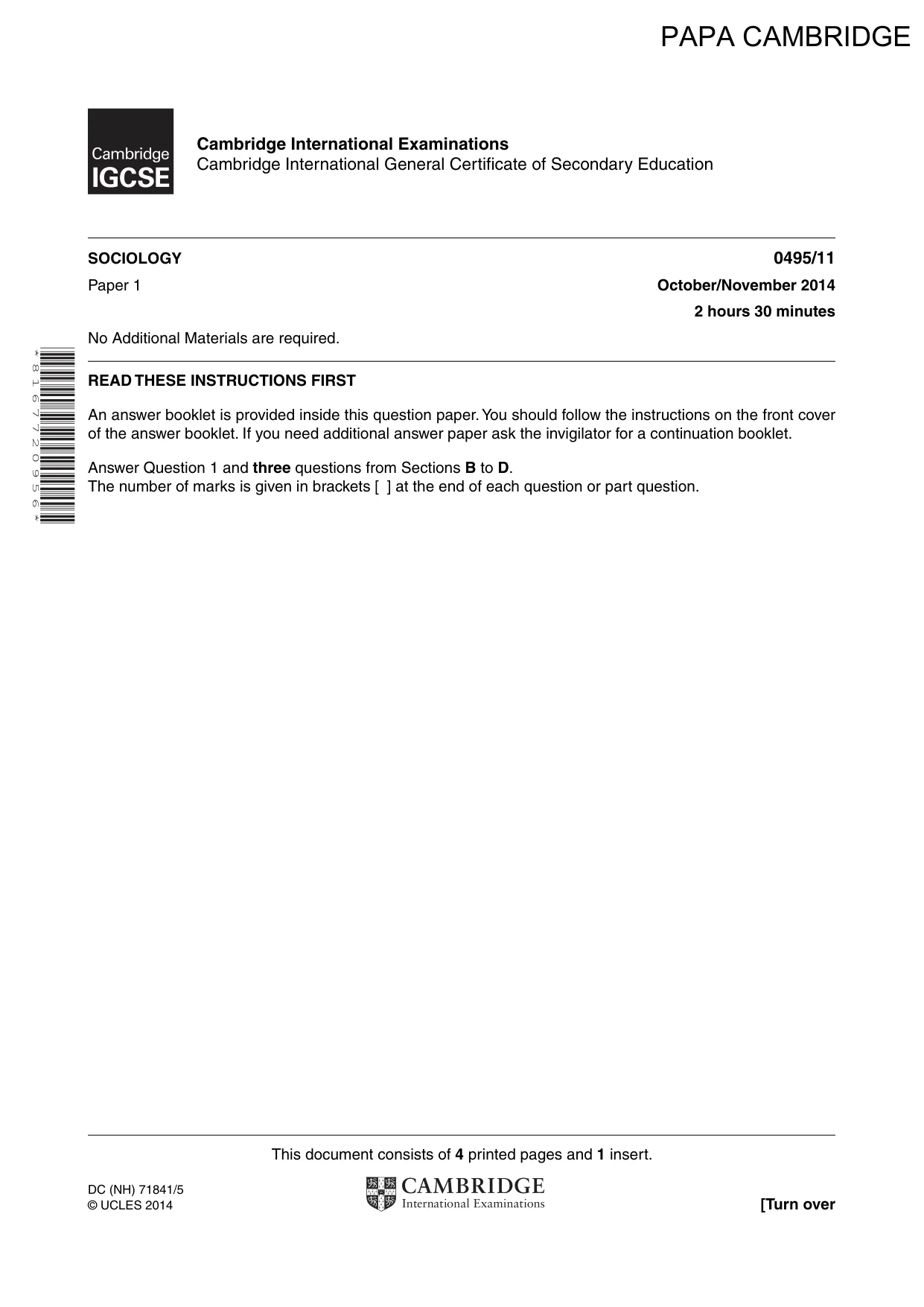
This document consists of 4 printed pages and 1 insert. DC (NH) 71841/5 © UCLES 2014 [Turn over Cambridge International Examinations Cambridge International General Certificate of Secondary Education * 8 1 6 7 7 2 0 9 5 6 * SOCIOLOGY 0495/11 Paper 1 October/November 2014 2 hours 30 minutes No Additional Materials are required. READ THESE INSTRUCTIONS FIRST An answer booklet is provided inside this question paper. You should follow the instructions on the front cover of the answer booklet. If you need additional answer paper ask the invigilator for a continuation booklet. Answer Question 1 and three questions from Sections B to D. The number of marks is given in brackets [ ] at the end of each question or part question. PAPA CAMBRIDGE
Question paper, page 2
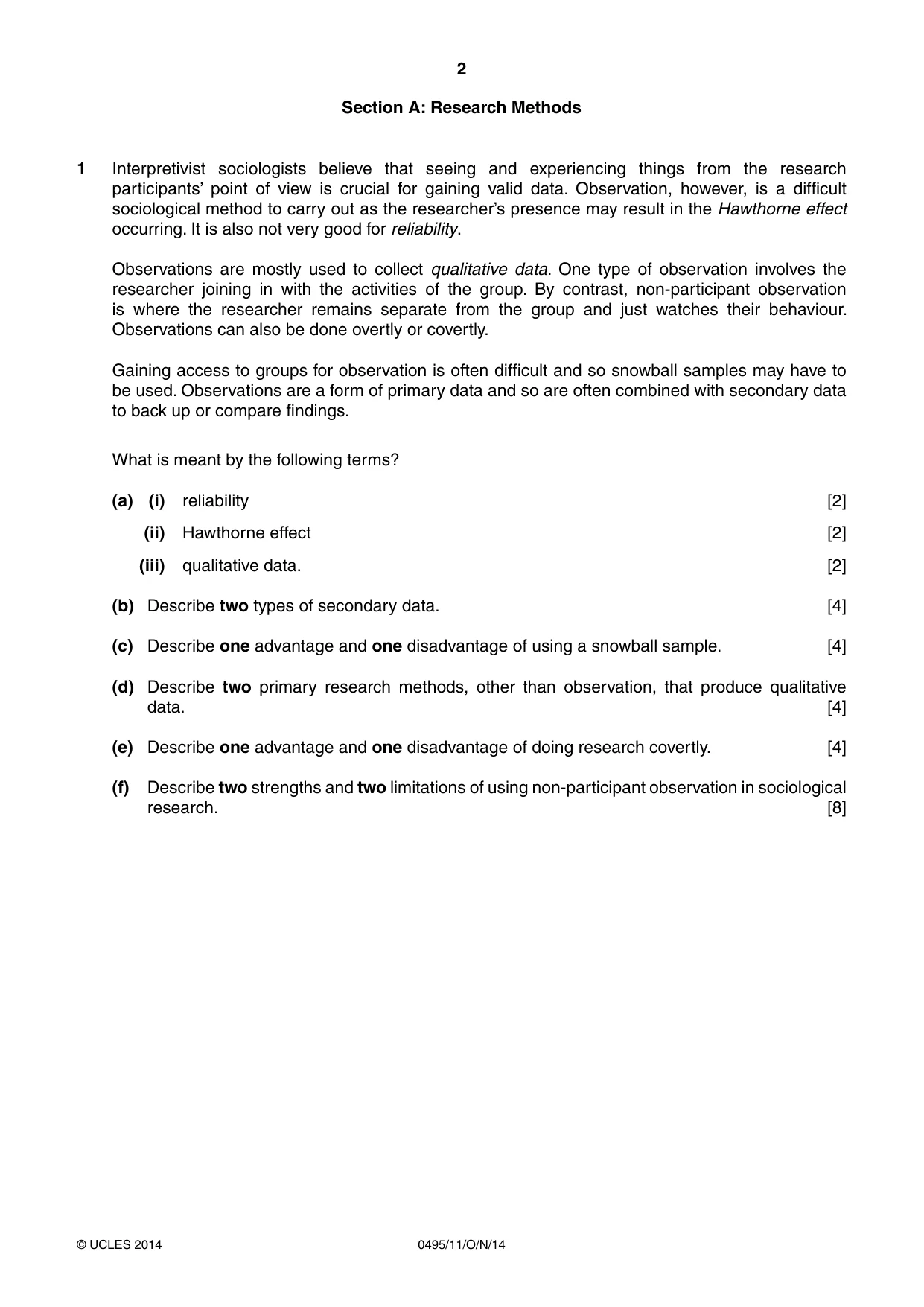
2 0495/11/O/N/14 © UCLES 2014 Section A: Research Methods 1 Interpretivist sociologists believe that seeing and experiencing things from the research participants’ point of view is crucial for gaining valid data. Observation, however, is a difficult sociological method to carry out as the researcher’s presence may result in the Hawthorne effect occurring. It is also not very good for reliability. Observations are mostly used to collect qualitative data. One type of observation involves the researcher joining in with the activities of the group. By contrast, non-participant observation is where the researcher remains separate from the group and just watches their behaviour. Observations can also be done overtly or covertly. Gaining access to groups for observation is often difficult and so snowball samples may have to be used. Observations are a form of primary data and so are often combined with secondary data to back up or compare findings. What is meant by the following terms? (a) (i) reliability [2] (ii) Hawthorne effect [2] (iii) qualitative data. [2] (b) Describe two types of secondary data. [4] (c) Describe one advantage and one disadvantage of using a snowball sample. [4] (d) Describe two primary research methods, other than observation, that produce qualitative data. [4] (e) Describe one advantage and one disadvantage of doing research covertly. [4] (f) Describe two strengths and two limitations of using non-participant observation in sociological research. [8]
Question paper, page 3
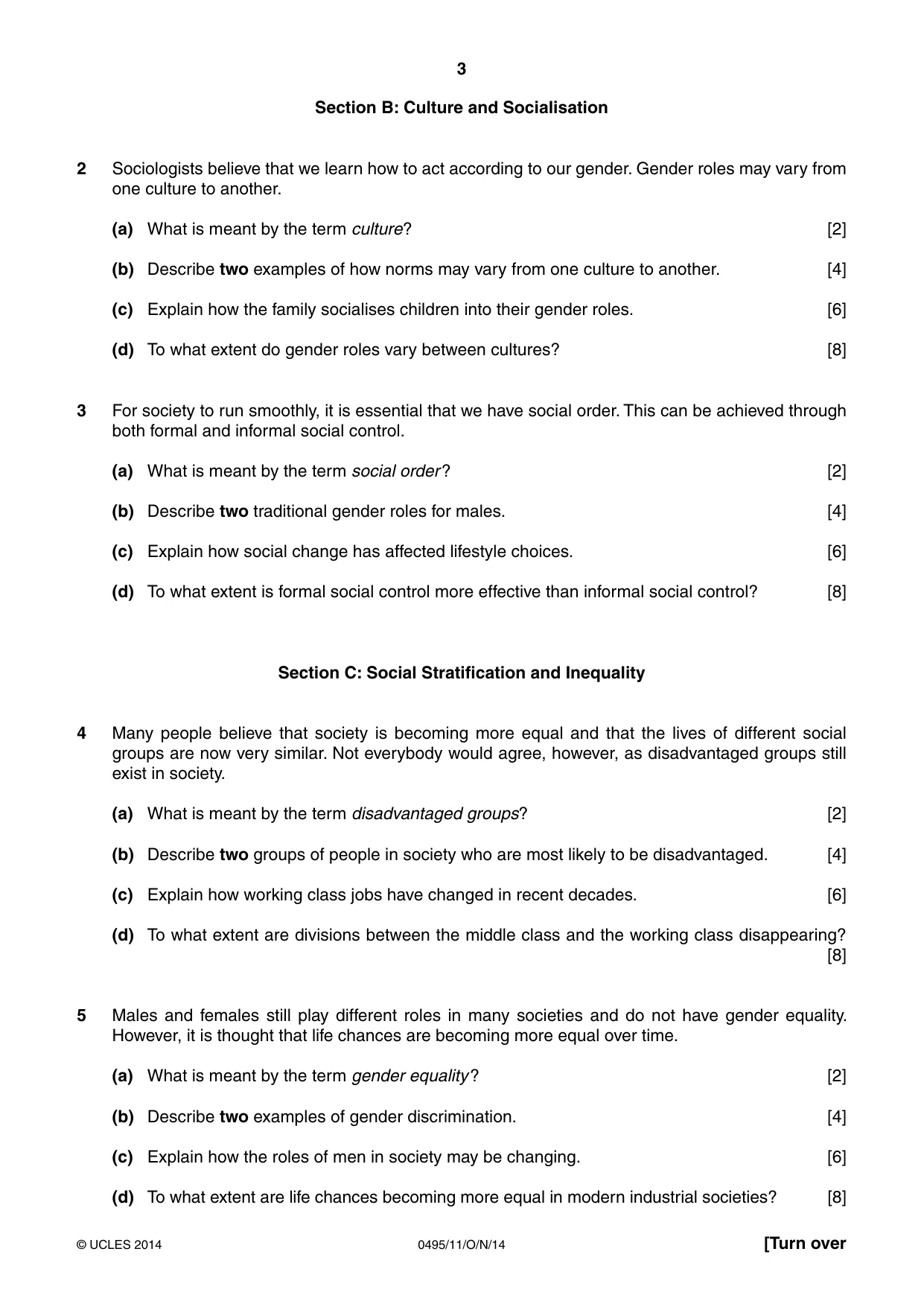
3 0495/11/O/N/14 © UCLES 2014 [Turn over Section B: Culture and Socialisation 2 Sociologists believe that we learn how to act according to our gender. Gender roles may vary from one culture to another. (a) What is meant by the term culture? [2] (b) Describe two examples of how norms may vary from one culture to another. [4] (c) Explain how the family socialises children into their gender roles. [6] (d) To what extent do gender roles vary between cultures? [8] 3 For society to run smoothly, it is essential that we have social order. This can be achieved through both formal and informal social control. (a) What is meant by the term social order ? [2] (b) Describe two traditional gender roles for males. [4] (c) Explain how social change has affected lifestyle choices. [6] (d) To what extent is formal social control more effective than informal social control? [8] Section C: Social Stratification and Inequality 4 Many people believe that society is becoming more equal and that the lives of different social groups are now very similar. Not everybody would agree, however, as disadvantaged groups still exist in society. (a) What is meant by the term disadvantaged groups? [2] (b) Describe two groups of people in society who are most likely to be disadvantaged. [4] (c) Explain how working class jobs have changed in recent decades. [6] (d) To what extent are divisions between the middle class and the working class disappearing? [8] 5 Males and females still play different roles in many societies and do not have gender equality. However, it is thought that life chances are becoming more equal over time. (a) What is meant by the term gender equality ? [2] (b) Describe two examples of gender discrimination. [4] (c) Explain how the roles of men in society may be changing. [6] (d) To what extent are life chances becoming more equal in modern industrial societies? [8]
Question paper, page 4
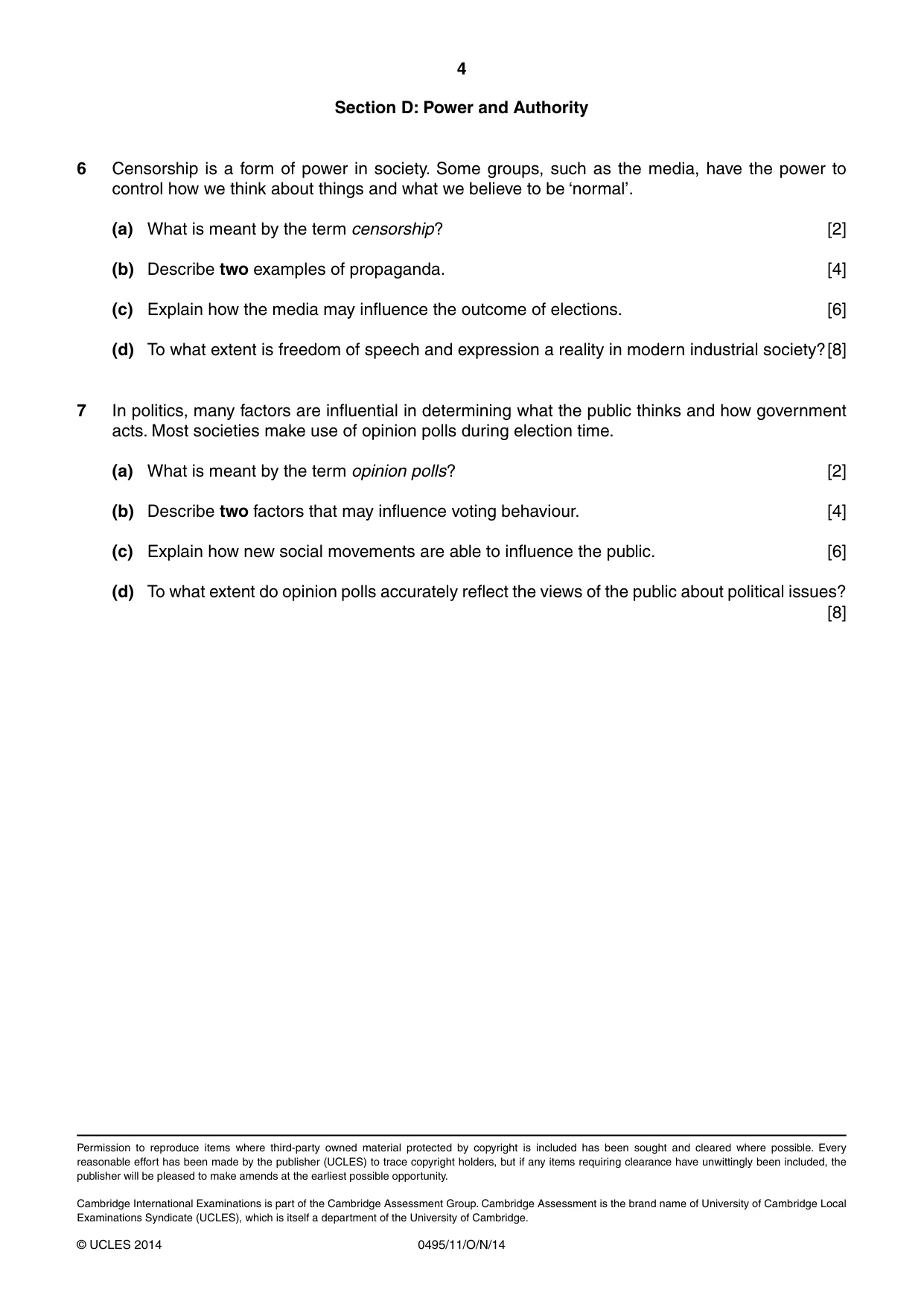
4 0495/11/O/N/14 © UCLES 2014 Section D: Power and Authority 6 Censorship is a form of power in society. Some groups, such as the media, have the power to control how we think about things and what we believe to be ‘normal’. (a) What is meant by the term censorship? [2] (b) Describe two examples of propaganda. [4] (c) Explain how the media may influence the outcome of elections. [6] (d) To what extent is freedom of speech and expression a reality in modern industrial society? [8] 7 In politics, many factors are influential in determining what the public thinks and how government acts. Most societies make use of opinion polls during election time. (a) What is meant by the term opinion polls? [2] (b) Describe two factors that may influence voting behaviour. [4] (c) Explain how new social movements are able to influence the public. [6] (d) To what extent do opinion polls accurately reflect the views of the public about political issues? [8] Permission to reproduce items where third-party owned material protected by copyright is included has been sought and cleared where possible. Every reasonable effort has been made by the publisher (UCLES) to trace copyright holders, but if any items requiring clearance have unwittingly been included, the publisher will be pleased to make amends at the earliest possible opportunity. Cambridge International Examinations is part of the Cambridge Assessment Group. Cambridge Assessment is the brand name of University of Cambridge Local Examinations Syndicate (UCLES), which is itself a department of the University of Cambridge.
Mark scheme, page 1
® IGCSE is the registered trademark of Cambridge International Examinations. CAMBRIDGE INTERNATIONAL EXAMINATIONS Cambridge International General Certificate of Secondary Education MARK SCHEME for the October/November 2014 series 0495 SOCIOLOGY 0495/11 Paper 1, maximum raw mark 90 This mark scheme is published as an aid to teachers and candidates, to indicate the requirements of the examination. It shows the basis on which Examiners were instructed to award marks. It does not indicate the details of the discussions that took place at an Examiners’ meeting before marking began, which would have considered the acceptability of alternative answers. Mark schemes should be read in conjunction with the question paper and the Principal Examiner Report for Teachers. Cambridge will not enter into discussions about these mark schemes. Cambridge is publishing the mark schemes for the October/November 2014 series for most Cambridge IGCSE®, Cambridge International A and AS Level components and some Cambridge O Level components. PAPA CAMBRIDGE
Mark scheme, page 2
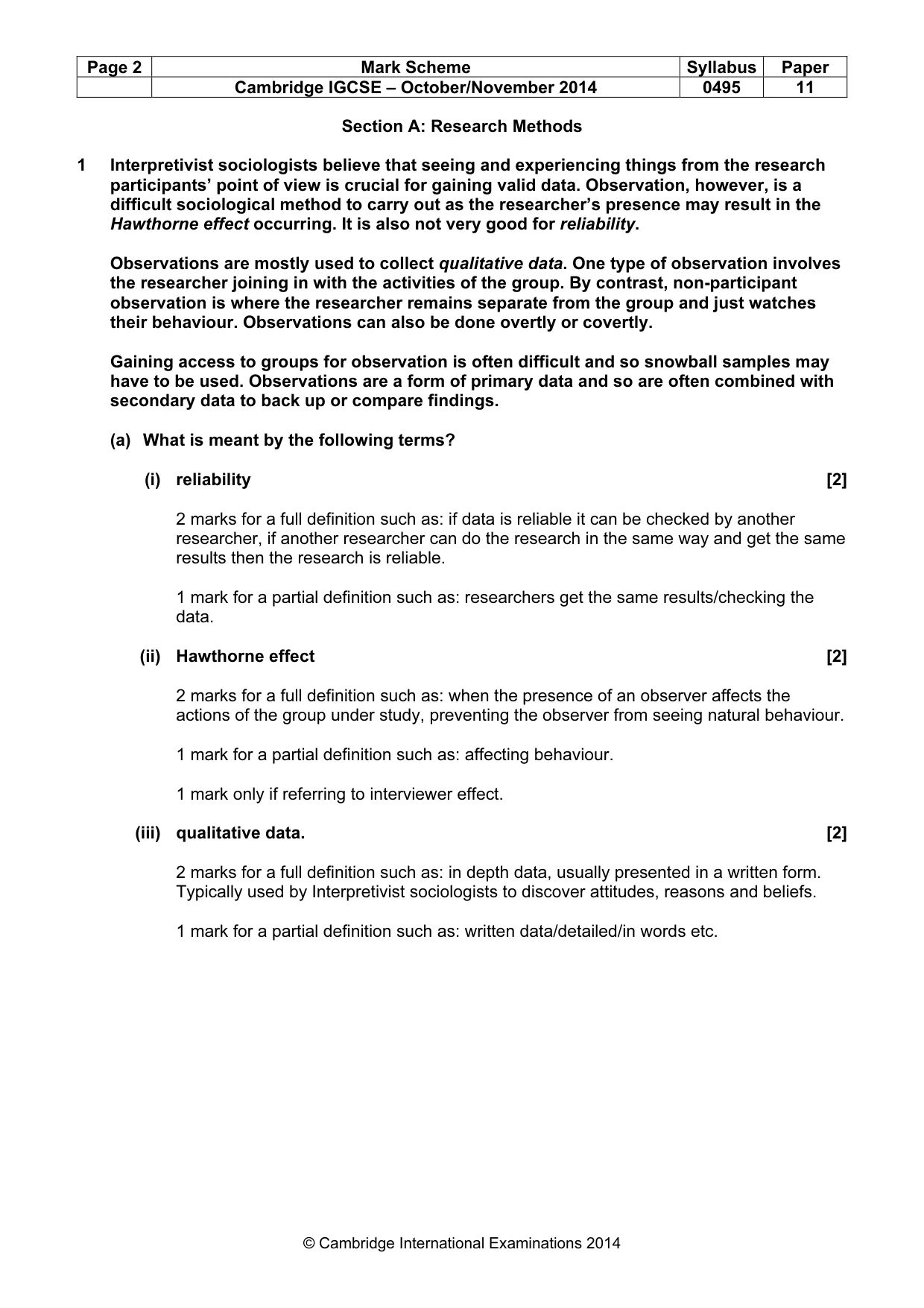
Page 2 Mark Scheme Syllabus Paper Cambridge IGCSE – October/November 2014 0495 11 © Cambridge International Examinations 2014 Section A: Research Methods 1 Interpretivist sociologists believe that seeing and experiencing things from the research participants’ point of view is crucial for gaining valid data. Observation, however, is a difficult sociological method to carry out as the researcher’s presence may result in the Hawthorne effect occurring. It is also not very good for reliability. Observations are mostly used to collect qualitative data. One type of observation involves the researcher joining in with the activities of the group. By contrast, non-participant observation is where the researcher remains separate from the group and just watches their behaviour. Observations can also be done overtly or covertly. Gaining access to groups for observation is often difficult and so snowball samples may have to be used. Observations are a form of primary data and so are often combined with secondary data to back up or compare findings. (a) What is meant by the following terms? (i) reliability [2] 2 marks for a full definition such as: if data is reliable it can be checked by another researcher, if another researcher can do the research in the same way and get the same results then the research is reliable. 1 mark for a partial definition such as: researchers get the same results/checking the data. (ii) Hawthorne effect [2] 2 marks for a full definition such as: when the presence of an observer affects the actions of the group under study, preventing the observer from seeing natural behaviour. 1 mark for a partial definition such as: affecting behaviour. 1 mark only if referring to interviewer effect. (iii) qualitative data. [2] 2 marks for a full definition such as: in depth data, usually presented in a written form. Typically used by Interpretivist sociologists to discover attitudes, reasons and beliefs. 1 mark for a partial definition such as: written data/detailed/in words etc.
Mark scheme, page 3
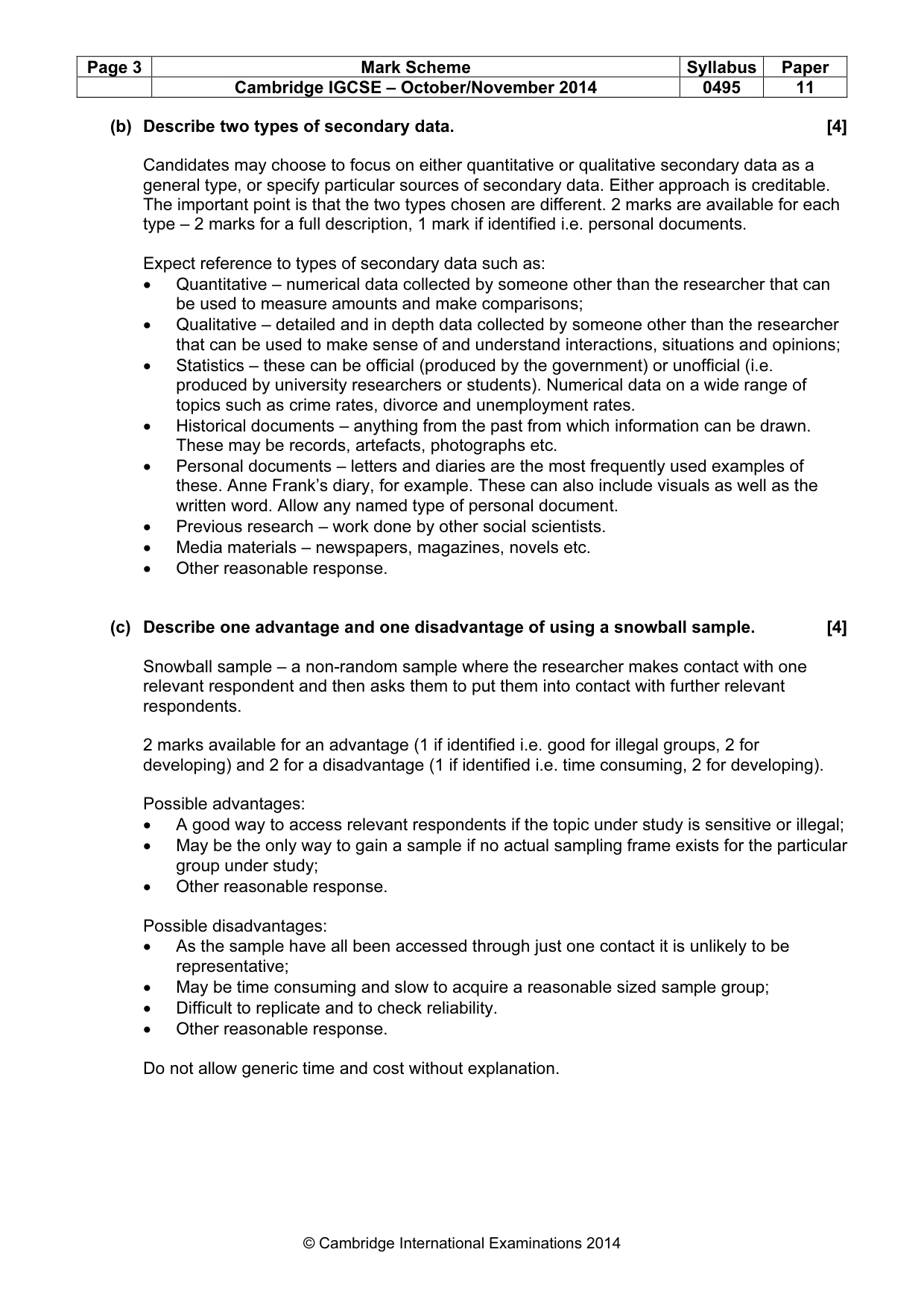
Page 3 Mark Scheme Syllabus Paper Cambridge IGCSE – October/November 2014 0495 11 © Cambridge International Examinations 2014 (b) Describe two types of secondary data. [4] Candidates may choose to focus on either quantitative or qualitative secondary data as a general type, or specify particular sources of secondary data. Either approach is creditable. The important point is that the two types chosen are different. 2 marks are available for each type – 2 marks for a full description, 1 mark if identified i.e. personal documents. Expect reference to types of secondary data such as: • Quantitative – numerical data collected by someone other than the researcher that can be used to measure amounts and make comparisons; • Qualitative – detailed and in depth data collected by someone other than the researcher that can be used to make sense of and understand interactions, situations and opinions; • Statistics – these can be official (produced by the government) or unofficial (i.e. produced by university researchers or students). Numerical data on a wide range of topics such as crime rates, divorce and unemployment rates. • Historical documents – anything from the past from which information can be drawn. These may be records, artefacts, photographs etc. • Personal documents – letters and diaries are the most frequently used examples of these. Anne Frank’s diary, for example. These can also include visuals as well as the written word. Allow any named type of personal document. • Previous research – work done by other social scientists. • Media materials – newspapers, magazines, novels etc. • Other reasonable response. (c) Describe one advantage and one disadvantage of using a snowball sample. [4] Snowball sample – a non-random sample where the researcher makes contact with one relevant respondent and then asks them to put them into contact with further relevant respondents. 2 marks available for an advantage (1 if identified i.e. good for illegal groups, 2 for developing) and 2 for a disadvantage (1 if identified i.e. time consuming, 2 for developing). Possible advantages: • A good way to access relevant respondents if the topic under study is sensitive or illegal; • May be the only way to gain a sample if no actual sampling frame exists for the particular group under study; • Other reasonable response. Possible disadvantages: • As the sample have all been accessed through just one contact it is unlikely to be representative; • May be time consuming and slow to acquire a reasonable sized sample group; • Difficult to replicate and to check reliability. • Other reasonable response. Do not allow generic time and cost without explanation.
Mark scheme, page 4
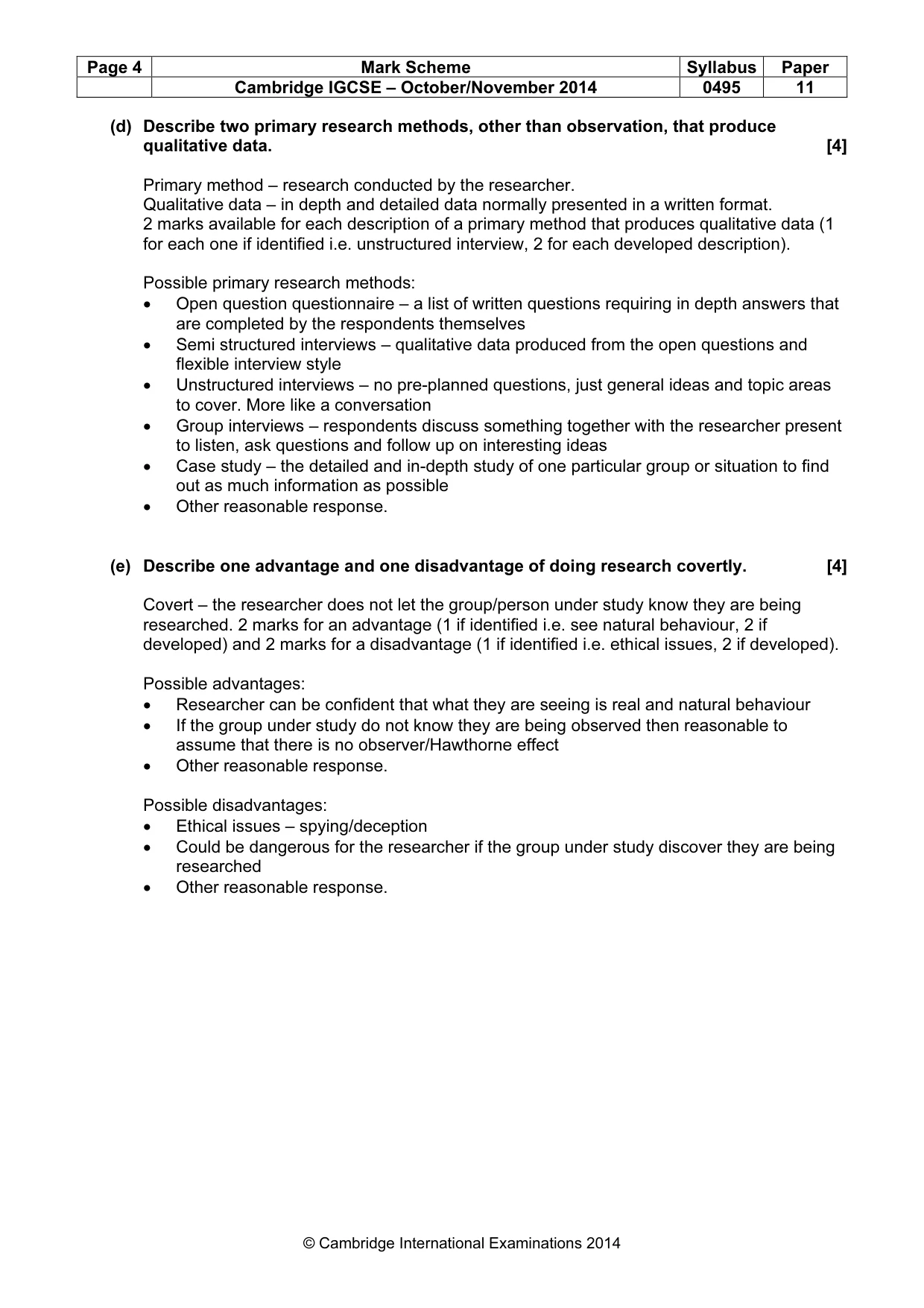
Page 4 Mark Scheme Syllabus Paper Cambridge IGCSE – October/November 2014 0495 11 © Cambridge International Examinations 2014 (d) Describe two primary research methods, other than observation, that produce qualitative data. [4] Primary method – research conducted by the researcher. Qualitative data – in depth and detailed data normally presented in a written format. 2 marks available for each description of a primary method that produces qualitative data (1 for each one if identified i.e. unstructured interview, 2 for each developed description). Possible primary research methods: • Open question questionnaire – a list of written questions requiring in depth answers that are completed by the respondents themselves • Semi structured interviews – qualitative data produced from the open questions and flexible interview style • Unstructured interviews – no pre-planned questions, just general ideas and topic areas to cover. More like a conversation • Group interviews – respondents discuss something together with the researcher present to listen, ask questions and follow up on interesting ideas • Case study – the detailed and in-depth study of one particular group or situation to find out as much information as possible • Other reasonable response. (e) Describe one advantage and one disadvantage of doing research covertly. [4] Covert – the researcher does not let the group/person under study know they are being researched. 2 marks for an advantage (1 if identified i.e. see natural behaviour, 2 if developed) and 2 marks for a disadvantage (1 if identified i.e. ethical issues, 2 if developed). Possible advantages: • Researcher can be confident that what they are seeing is real and natural behaviour • If the group under study do not know they are being observed then reasonable to assume that there is no observer/Hawthorne effect • Other reasonable response. Possible disadvantages: • Ethical issues – spying/deception • Could be dangerous for the researcher if the group under study discover they are being researched • Other reasonable response.
Mark scheme, page 5
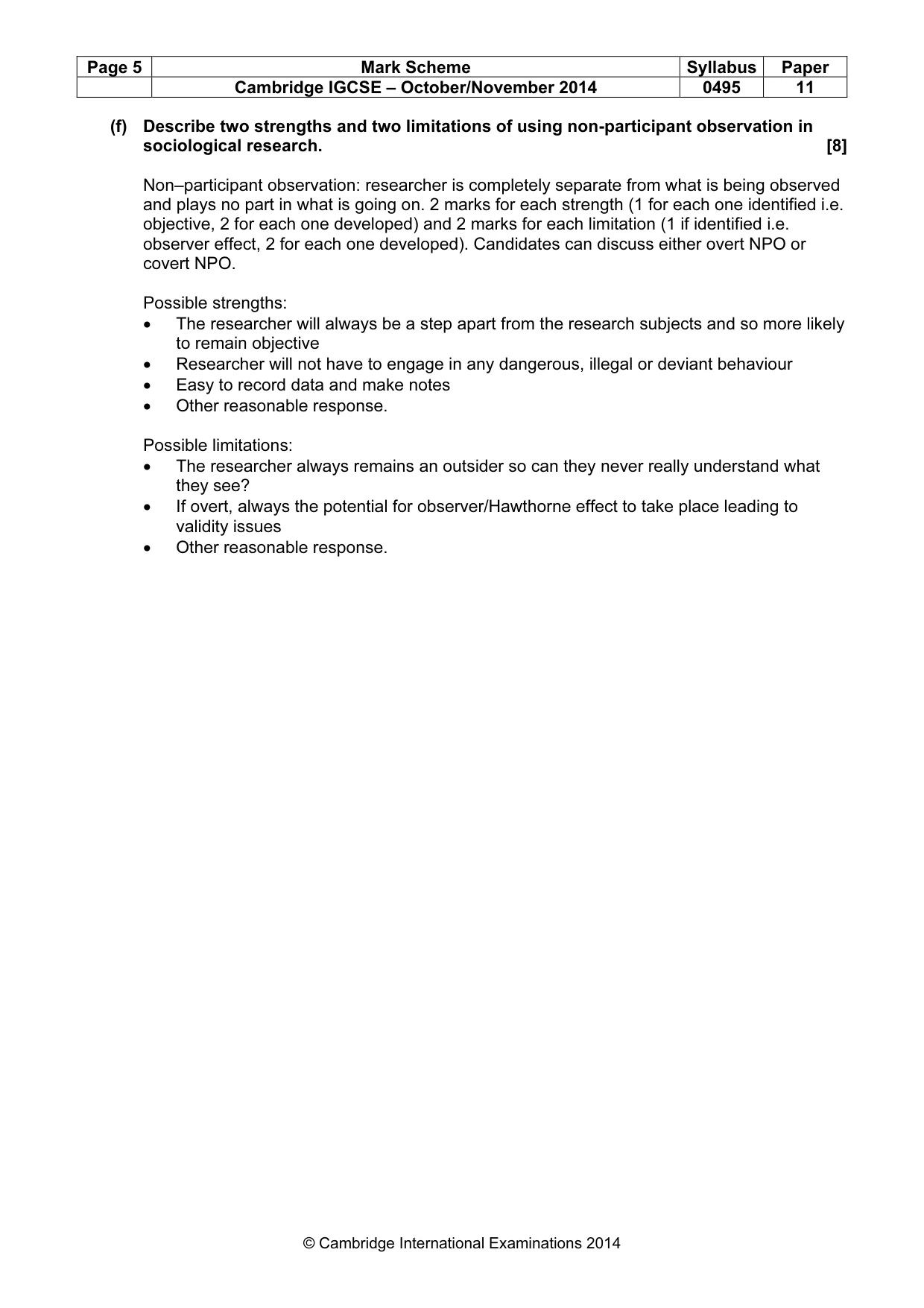
Page 5 Mark Scheme Syllabus Paper Cambridge IGCSE – October/November 2014 0495 11 © Cambridge International Examinations 2014 (f) Describe two strengths and two limitations of using non-participant observation in sociological research. [8] Non–participant observation: researcher is completely separate from what is being observed and plays no part in what is going on. 2 marks for each strength (1 for each one identified i.e. objective, 2 for each one developed) and 2 marks for each limitation (1 if identified i.e. observer effect, 2 for each one developed). Candidates can discuss either overt NPO or covert NPO. Possible strengths: • The researcher will always be a step apart from the research subjects and so more likely to remain objective • Researcher will not have to engage in any dangerous, illegal or deviant behaviour • Easy to record data and make notes • Other reasonable response. Possible limitations: • The researcher always remains an outsider so can they never really understand what they see? • If overt, always the potential for observer/Hawthorne effect to take place leading to validity issues • Other reasonable response.
Mark scheme, page 6
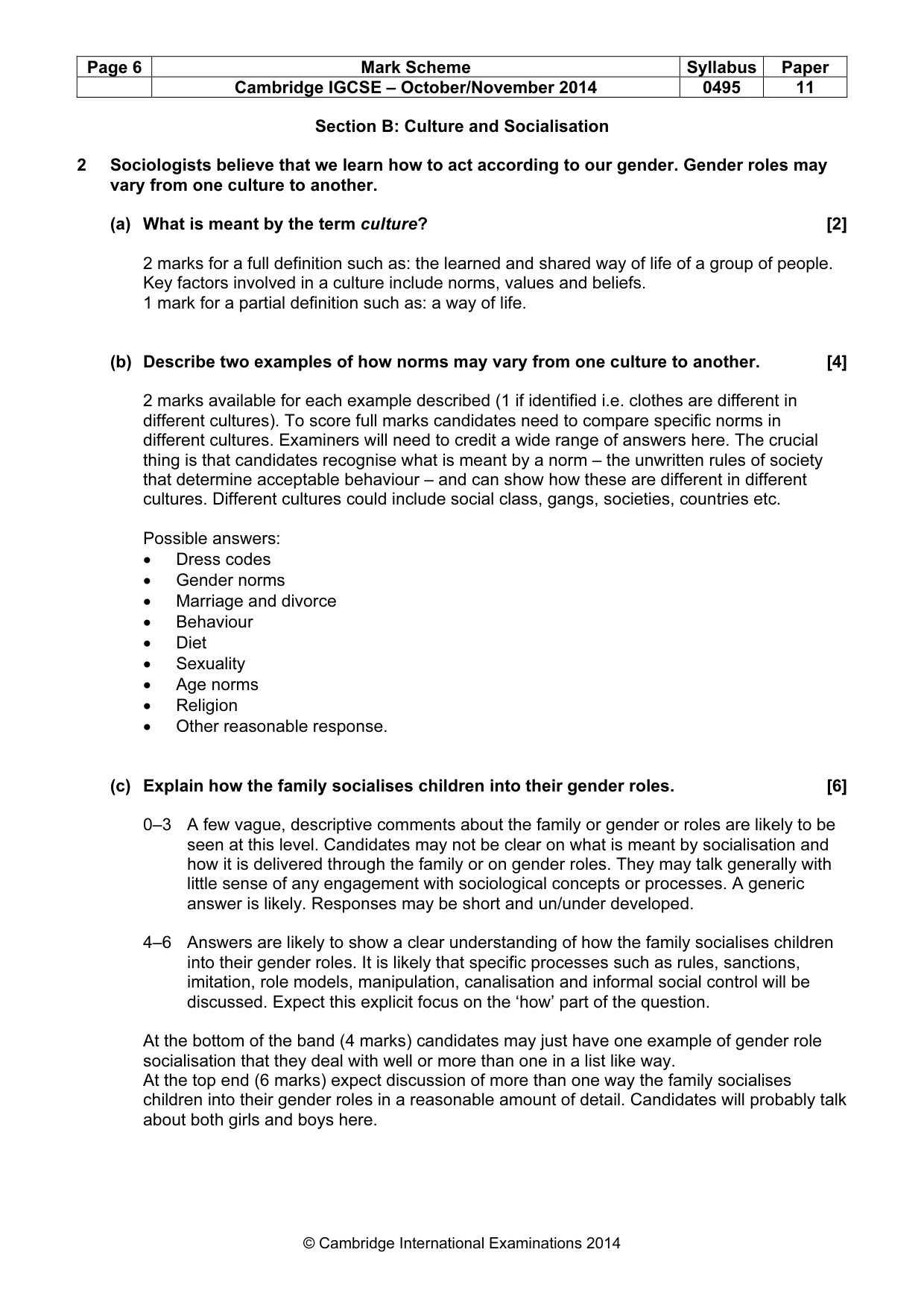
Page 6 Mark Scheme Syllabus Paper Cambridge IGCSE – October/November 2014 0495 11 © Cambridge International Examinations 2014 Section B: Culture and Socialisation 2 Sociologists believe that we learn how to act according to our gender. Gender roles may vary from one culture to another. (a) What is meant by the term culture? [2] 2 marks for a full definition such as: the learned and shared way of life of a group of people. Key factors involved in a culture include norms, values and beliefs. 1 mark for a partial definition such as: a way of life. (b) Describe two examples of how norms may vary from one culture to another. [4] 2 marks available for each example described (1 if identified i.e. clothes are different in different cultures). To score full marks candidates need to compare specific norms in different cultures. Examiners will need to credit a wide range of answers here. The crucial thing is that candidates recognise what is meant by a norm – the unwritten rules of society that determine acceptable behaviour – and can show how these are different in different cultures. Different cultures could include social class, gangs, societies, countries etc. Possible answers: • Dress codes • Gender norms • Marriage and divorce • Behaviour • Diet • Sexuality • Age norms • Religion • Other reasonable response. (c) Explain how the family socialises children into their gender roles. [6] 0–3 A few vague, descriptive comments about the family or gender or roles are likely to be seen at this level. Candidates may not be clear on what is meant by socialisation and how it is delivered through the family or on gender roles. They may talk generally with little sense of any engagement with sociological concepts or processes. A generic answer is likely. Responses may be short and un/under developed. 4–6 Answers are likely to show a clear understanding of how the family socialises children into their gender roles. It is likely that specific processes such as rules, sanctions, imitation, role models, manipulation, canalisation and informal social control will be discussed. Expect this explicit focus on the ‘how’ part of the question. At the bottom of the band (4 marks) candidates may just have one example of gender role socialisation that they deal with well or more than one in a list like way. At the top end (6 marks) expect discussion of more than one way the family socialises children into their gender roles in a reasonable amount of detail. Candidates will probably talk about both girls and boys here.
Mark scheme, page 7
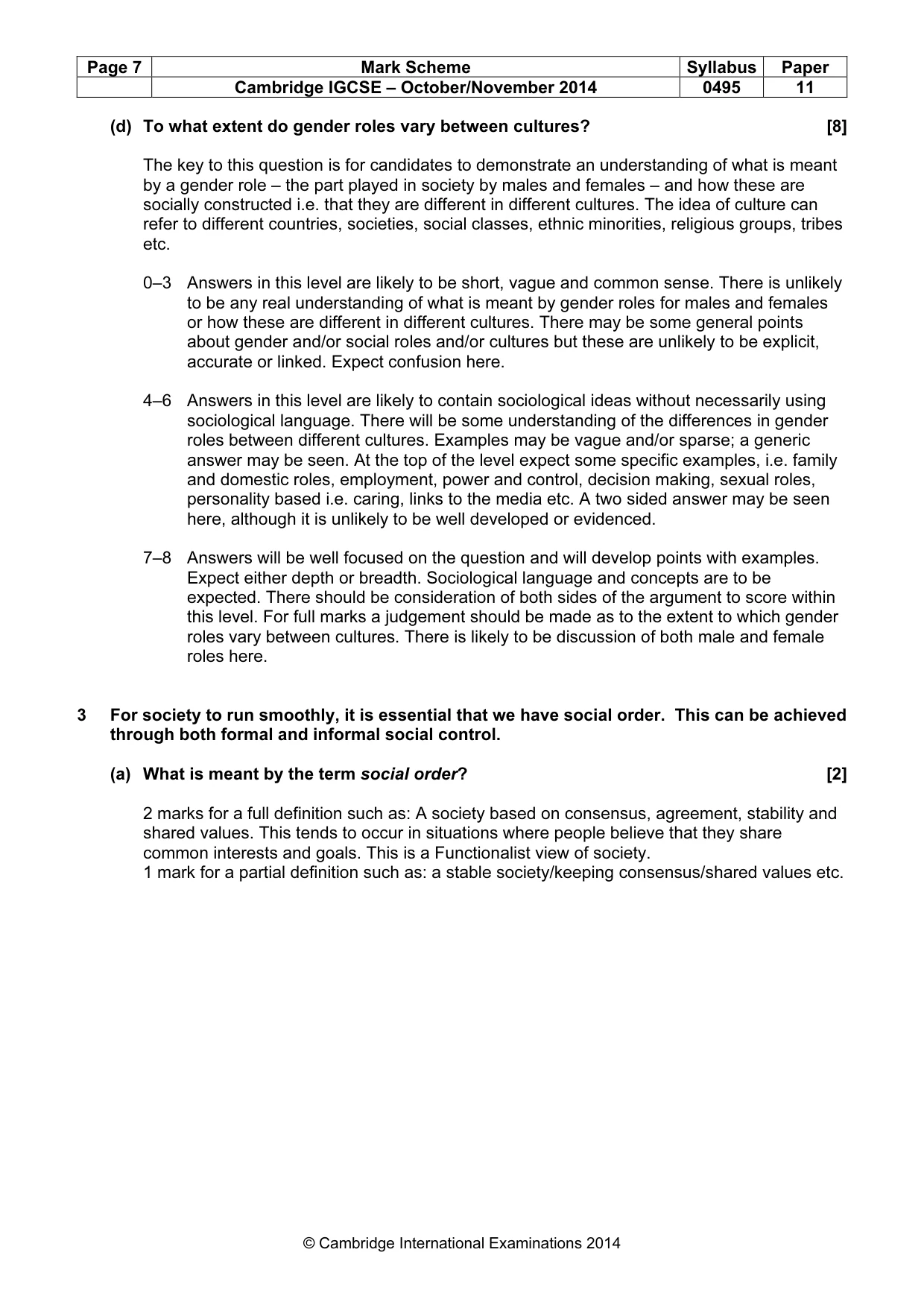
Page 7 Mark Scheme Syllabus Paper Cambridge IGCSE – October/November 2014 0495 11 © Cambridge International Examinations 2014 (d) To what extent do gender roles vary between cultures? [8] The key to this question is for candidates to demonstrate an understanding of what is meant by a gender role – the part played in society by males and females – and how these are socially constructed i.e. that they are different in different cultures. The idea of culture can refer to different countries, societies, social classes, ethnic minorities, religious groups, tribes etc. 0–3 Answers in this level are likely to be short, vague and common sense. There is unlikely to be any real understanding of what is meant by gender roles for males and females or how these are different in different cultures. There may be some general points about gender and/or social roles and/or cultures but these are unlikely to be explicit, accurate or linked. Expect confusion here. 4–6 Answers in this level are likely to contain sociological ideas without necessarily using sociological language. There will be some understanding of the differences in gender roles between different cultures. Examples may be vague and/or sparse; a generic answer may be seen. At the top of the level expect some specific examples, i.e. family and domestic roles, employment, power and control, decision making, sexual roles, personality based i.e. caring, links to the media etc. A two sided answer may be seen here, although it is unlikely to be well developed or evidenced. 7–8 Answers will be well focused on the question and will develop points with examples. Expect either depth or breadth. Sociological language and concepts are to be expected. There should be consideration of both sides of the argument to score within this level. For full marks a judgement should be made as to the extent to which gender roles vary between cultures. There is likely to be discussion of both male and female roles here. 3 For society to run smoothly, it is essential that we have social order. This can be achieved through both formal and informal social control. (a) What is meant by the term social order? [2] 2 marks for a full definition such as: A society based on consensus, agreement, stability and shared values. This tends to occur in situations where people believe that they share common interests and goals. This is a Functionalist view of society. 1 mark for a partial definition such as: a stable society/keeping consensus/shared values etc.
Mark scheme, page 8
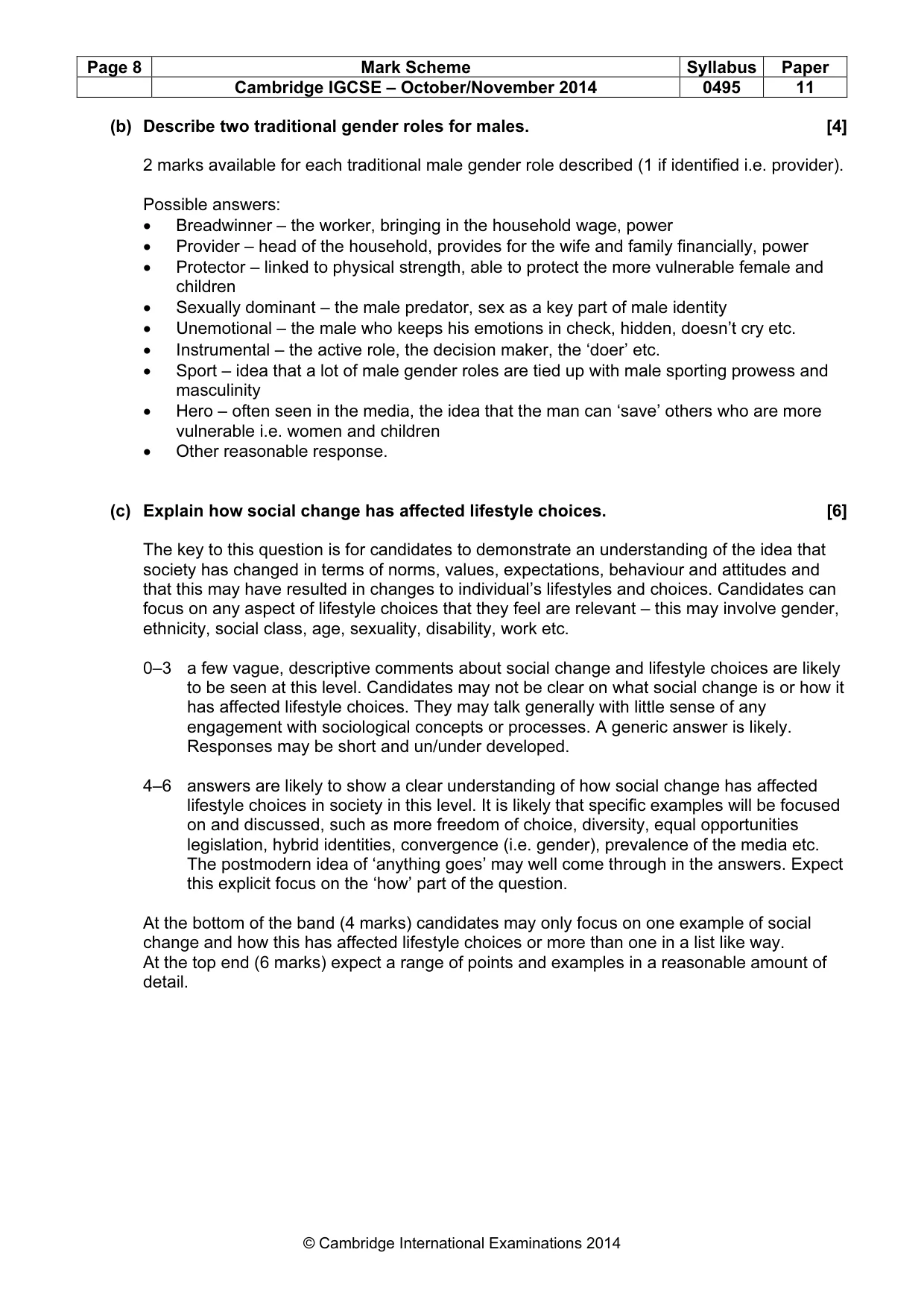
Page 8 Mark Scheme Syllabus Paper Cambridge IGCSE – October/November 2014 0495 11 © Cambridge International Examinations 2014 (b) Describe two traditional gender roles for males. [4] 2 marks available for each traditional male gender role described (1 if identified i.e. provider). Possible answers: • Breadwinner – the worker, bringing in the household wage, power • Provider – head of the household, provides for the wife and family financially, power • Protector – linked to physical strength, able to protect the more vulnerable female and children • Sexually dominant – the male predator, sex as a key part of male identity • Unemotional – the male who keeps his emotions in check, hidden, doesn’t cry etc. • Instrumental – the active role, the decision maker, the ‘doer’ etc. • Sport – idea that a lot of male gender roles are tied up with male sporting prowess and masculinity • Hero – often seen in the media, the idea that the man can ‘save’ others who are more vulnerable i.e. women and children • Other reasonable response. (c) Explain how social change has affected lifestyle choices. [6] The key to this question is for candidates to demonstrate an understanding of the idea that society has changed in terms of norms, values, expectations, behaviour and attitudes and that this may have resulted in changes to individual’s lifestyles and choices. Candidates can focus on any aspect of lifestyle choices that they feel are relevant – this may involve gender, ethnicity, social class, age, sexuality, disability, work etc. 0–3 a few vague, descriptive comments about social change and lifestyle choices are likely to be seen at this level. Candidates may not be clear on what social change is or how it has affected lifestyle choices. They may talk generally with little sense of any engagement with sociological concepts or processes. A generic answer is likely. Responses may be short and un/under developed. 4–6 answers are likely to show a clear understanding of how social change has affected lifestyle choices in society in this level. It is likely that specific examples will be focused on and discussed, such as more freedom of choice, diversity, equal opportunities legislation, hybrid identities, convergence (i.e. gender), prevalence of the media etc. The postmodern idea of ‘anything goes’ may well come through in the answers. Expect this explicit focus on the ‘how’ part of the question. At the bottom of the band (4 marks) candidates may only focus on one example of social change and how this has affected lifestyle choices or more than one in a list like way. At the top end (6 marks) expect a range of points and examples in a reasonable amount of detail.
Mark scheme, page 9
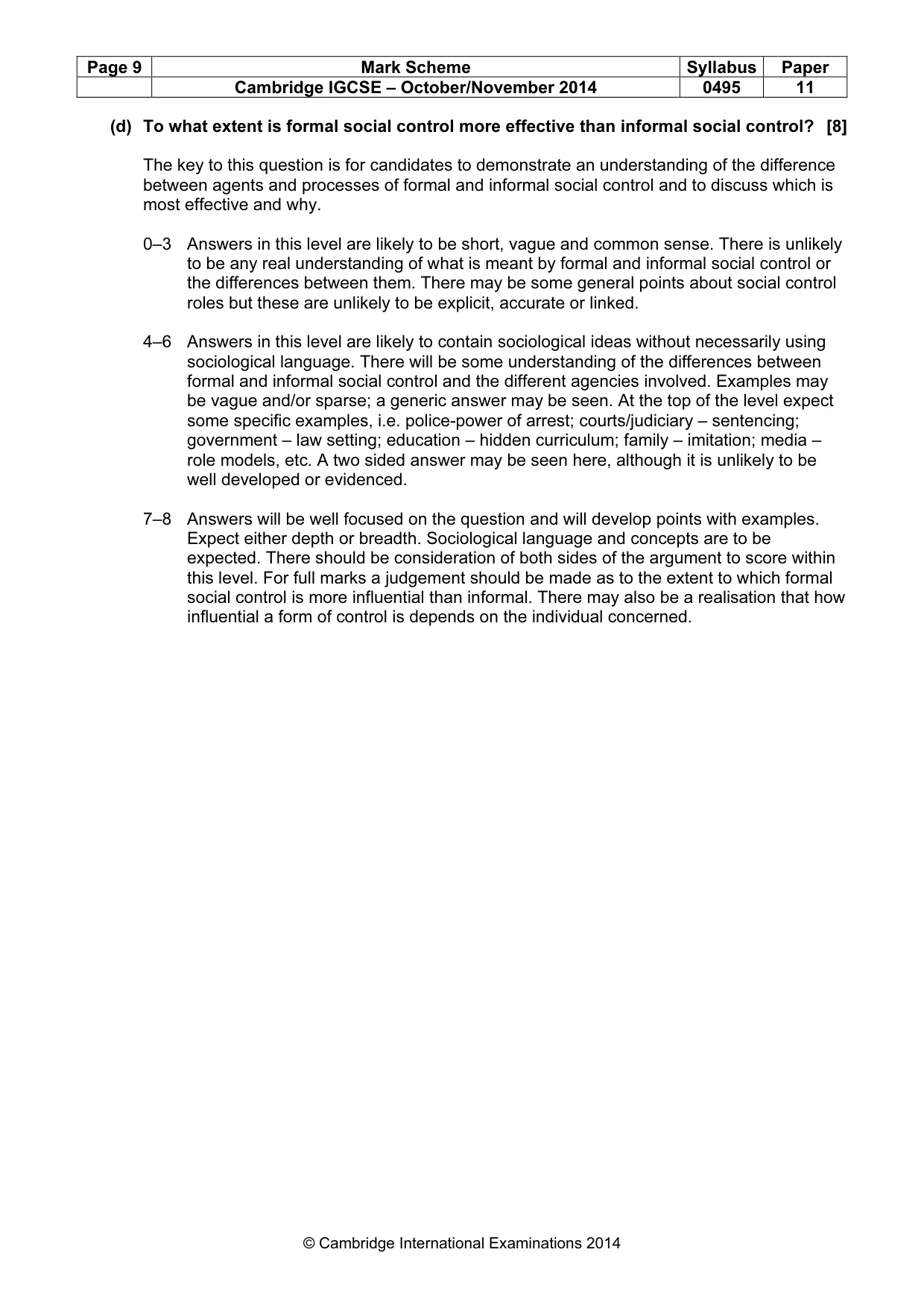
Page 9 Mark Scheme Syllabus Paper Cambridge IGCSE – October/November 2014 0495 11 © Cambridge International Examinations 2014 (d) To what extent is formal social control more effective than informal social control? [8] The key to this question is for candidates to demonstrate an understanding of the difference between agents and processes of formal and informal social control and to discuss which is most effective and why. 0–3 Answers in this level are likely to be short, vague and common sense. There is unlikely to be any real understanding of what is meant by formal and informal social control or the differences between them. There may be some general points about social control roles but these are unlikely to be explicit, accurate or linked. 4–6 Answers in this level are likely to contain sociological ideas without necessarily using sociological language. There will be some understanding of the differences between formal and informal social control and the different agencies involved. Examples may be vague and/or sparse; a generic answer may be seen. At the top of the level expect some specific examples, i.e. police-power of arrest; courts/judiciary – sentencing; government – law setting; education – hidden curriculum; family – imitation; media – role models, etc. A two sided answer may be seen here, although it is unlikely to be well developed or evidenced. 7–8 Answers will be well focused on the question and will develop points with examples. Expect either depth or breadth. Sociological language and concepts are to be expected. There should be consideration of both sides of the argument to score within this level. For full marks a judgement should be made as to the extent to which formal social control is more influential than informal. There may also be a realisation that how influential a form of control is depends on the individual concerned.
Mark scheme, page 10
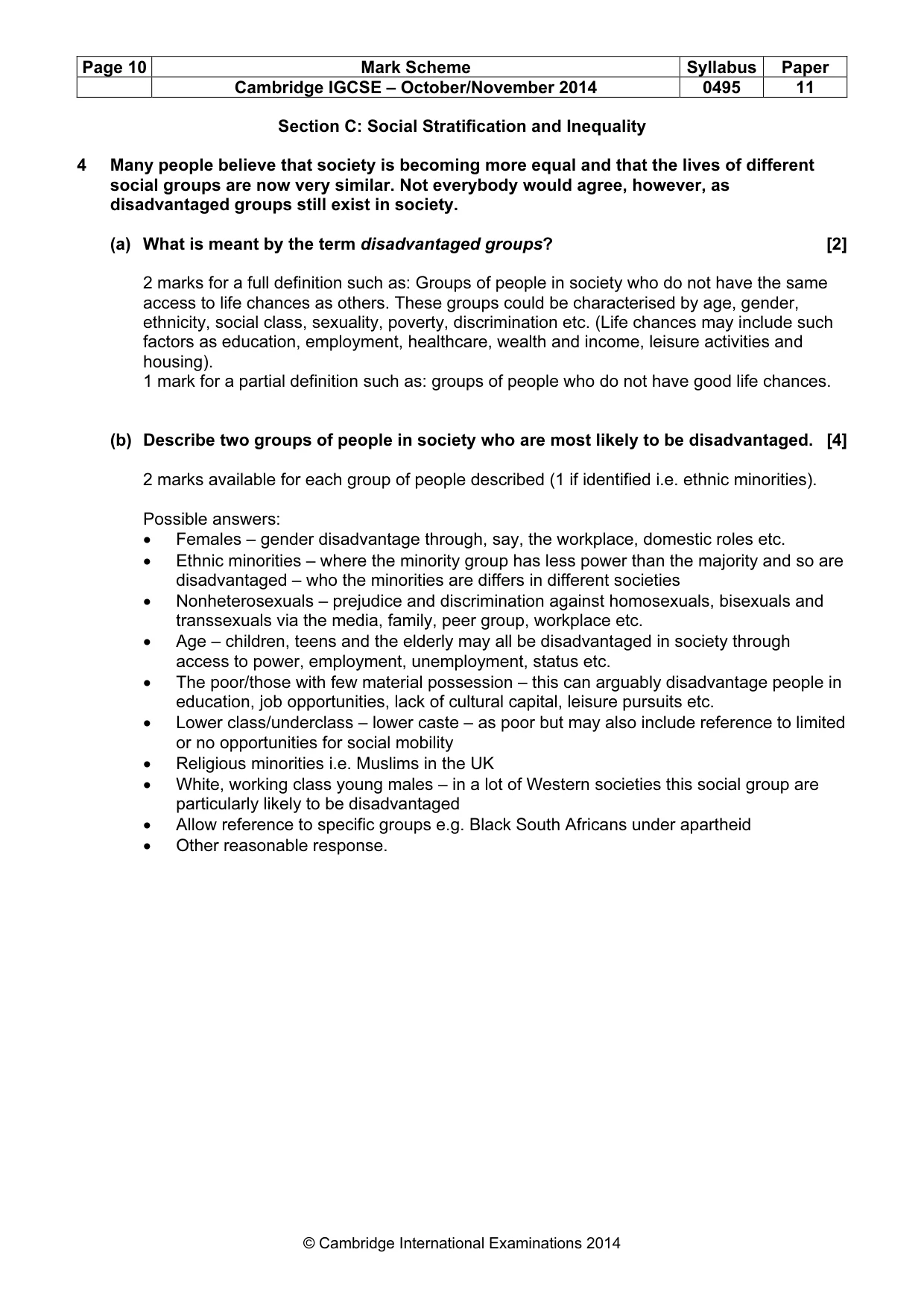
Page 10 Mark Scheme Syllabus Paper Cambridge IGCSE – October/November 2014 0495 11 © Cambridge International Examinations 2014 Section C: Social Stratification and Inequality 4 Many people believe that society is becoming more equal and that the lives of different social groups are now very similar. Not everybody would agree, however, as disadvantaged groups still exist in society. (a) What is meant by the term disadvantaged groups? [2] 2 marks for a full definition such as: Groups of people in society who do not have the same access to life chances as others. These groups could be characterised by age, gender, ethnicity, social class, sexuality, poverty, discrimination etc. (Life chances may include such factors as education, employment, healthcare, wealth and income, leisure activities and housing). 1 mark for a partial definition such as: groups of people who do not have good life chances. (b) Describe two groups of people in society who are most likely to be disadvantaged. [4] 2 marks available for each group of people described (1 if identified i.e. ethnic minorities). Possible answers: • Females – gender disadvantage through, say, the workplace, domestic roles etc. • Ethnic minorities – where the minority group has less power than the majority and so are disadvantaged – who the minorities are differs in different societies • Nonheterosexuals – prejudice and discrimination against homosexuals, bisexuals and transsexuals via the media, family, peer group, workplace etc. • Age – children, teens and the elderly may all be disadvantaged in society through access to power, employment, unemployment, status etc. • The poor/those with few material possession – this can arguably disadvantage people in education, job opportunities, lack of cultural capital, leisure pursuits etc. • Lower class/underclass – lower caste – as poor but may also include reference to limited or no opportunities for social mobility • Religious minorities i.e. Muslims in the UK • White, working class young males – in a lot of Western societies this social group are particularly likely to be disadvantaged • Allow reference to specific groups e.g. Black South Africans under apartheid • Other reasonable response.
Mark scheme, page 11
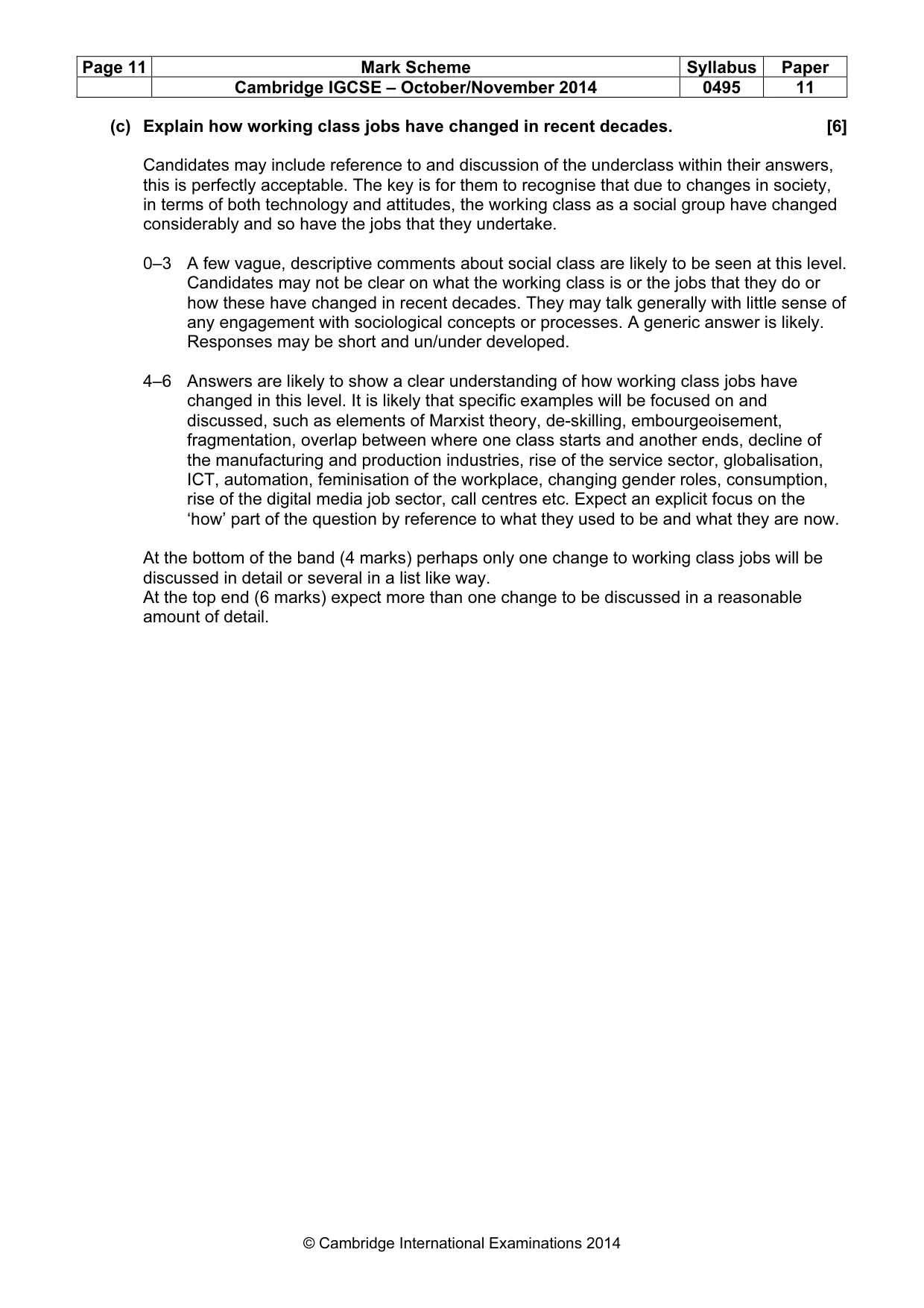
Page 11 Mark Scheme Syllabus Paper Cambridge IGCSE – October/November 2014 0495 11 © Cambridge International Examinations 2014 (c) Explain how working class jobs have changed in recent decades. [6] Candidates may include reference to and discussion of the underclass within their answers, this is perfectly acceptable. The key is for them to recognise that due to changes in society, in terms of both technology and attitudes, the working class as a social group have changed considerably and so have the jobs that they undertake. 0–3 A few vague, descriptive comments about social class are likely to be seen at this level. Candidates may not be clear on what the working class is or the jobs that they do or how these have changed in recent decades. They may talk generally with little sense of any engagement with sociological concepts or processes. A generic answer is likely. Responses may be short and un/under developed. 4–6 Answers are likely to show a clear understanding of how working class jobs have changed in this level. It is likely that specific examples will be focused on and discussed, such as elements of Marxist theory, de-skilling, embourgeoisement, fragmentation, overlap between where one class starts and another ends, decline of the manufacturing and production industries, rise of the service sector, globalisation, ICT, automation, feminisation of the workplace, changing gender roles, consumption, rise of the digital media job sector, call centres etc. Expect an explicit focus on the ‘how’ part of the question by reference to what they used to be and what they are now. At the bottom of the band (4 marks) perhaps only one change to working class jobs will be discussed in detail or several in a list like way. At the top end (6 marks) expect more than one change to be discussed in a reasonable amount of detail.
Mark scheme, page 12
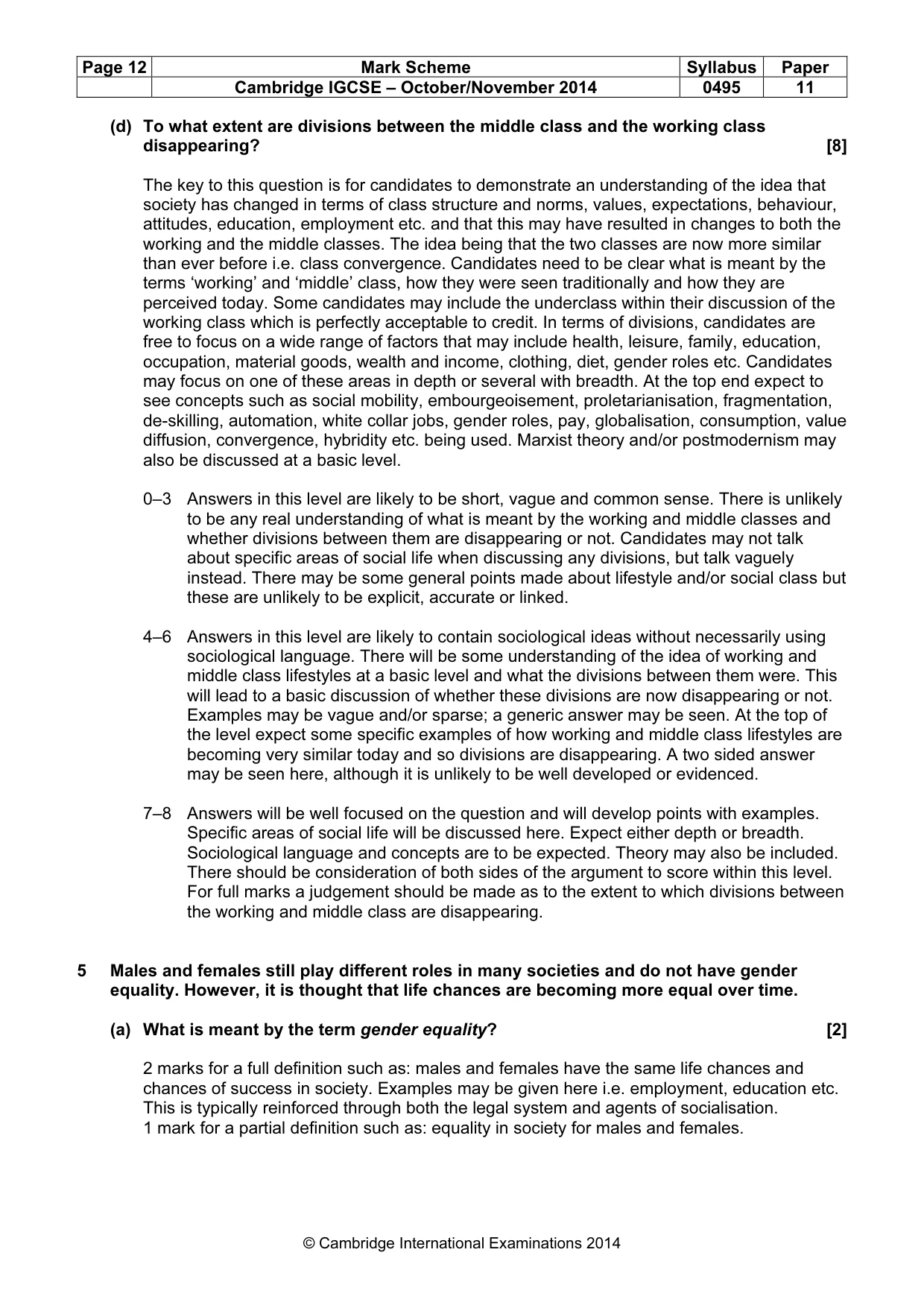
Page 12 Mark Scheme Syllabus Paper Cambridge IGCSE – October/November 2014 0495 11 © Cambridge International Examinations 2014 (d) To what extent are divisions between the middle class and the working class disappearing? [8] The key to this question is for candidates to demonstrate an understanding of the idea that society has changed in terms of class structure and norms, values, expectations, behaviour, attitudes, education, employment etc. and that this may have resulted in changes to both the working and the middle classes. The idea being that the two classes are now more similar than ever before i.e. class convergence. Candidates need to be clear what is meant by the terms ‘working’ and ‘middle’ class, how they were seen traditionally and how they are perceived today. Some candidates may include the underclass within their discussion of the working class which is perfectly acceptable to credit. In terms of divisions, candidates are free to focus on a wide range of factors that may include health, leisure, family, education, occupation, material goods, wealth and income, clothing, diet, gender roles etc. Candidates may focus on one of these areas in depth or several with breadth. At the top end expect to see concepts such as social mobility, embourgeoisement, proletarianisation, fragmentation, de-skilling, automation, white collar jobs, gender roles, pay, globalisation, consumption, value diffusion, convergence, hybridity etc. being used. Marxist theory and/or postmodernism may also be discussed at a basic level. 0–3 Answers in this level are likely to be short, vague and common sense. There is unlikely to be any real understanding of what is meant by the working and middle classes and whether divisions between them are disappearing or not. Candidates may not talk about specific areas of social life when discussing any divisions, but talk vaguely instead. There may be some general points made about lifestyle and/or social class but these are unlikely to be explicit, accurate or linked. 4–6 Answers in this level are likely to contain sociological ideas without necessarily using sociological language. There will be some understanding of the idea of working and middle class lifestyles at a basic level and what the divisions between them were. This will lead to a basic discussion of whether these divisions are now disappearing or not. Examples may be vague and/or sparse; a generic answer may be seen. At the top of the level expect some specific examples of how working and middle class lifestyles are becoming very similar today and so divisions are disappearing. A two sided answer may be seen here, although it is unlikely to be well developed or evidenced. 7–8 Answers will be well focused on the question and will develop points with examples. Specific areas of social life will be discussed here. Expect either depth or breadth. Sociological language and concepts are to be expected. Theory may also be included. There should be consideration of both sides of the argument to score within this level. For full marks a judgement should be made as to the extent to which divisions between the working and middle class are disappearing. 5 Males and females still play different roles in many societies and do not have gender equality. However, it is thought that life chances are becoming more equal over time. (a) What is meant by the term gender equality? [2] 2 marks for a full definition such as: males and females have the same life chances and chances of success in society. Examples may be given here i.e. employment, education etc. This is typically reinforced through both the legal system and agents of socialisation. 1 mark for a partial definition such as: equality in society for males and females.
Mark scheme, page 13
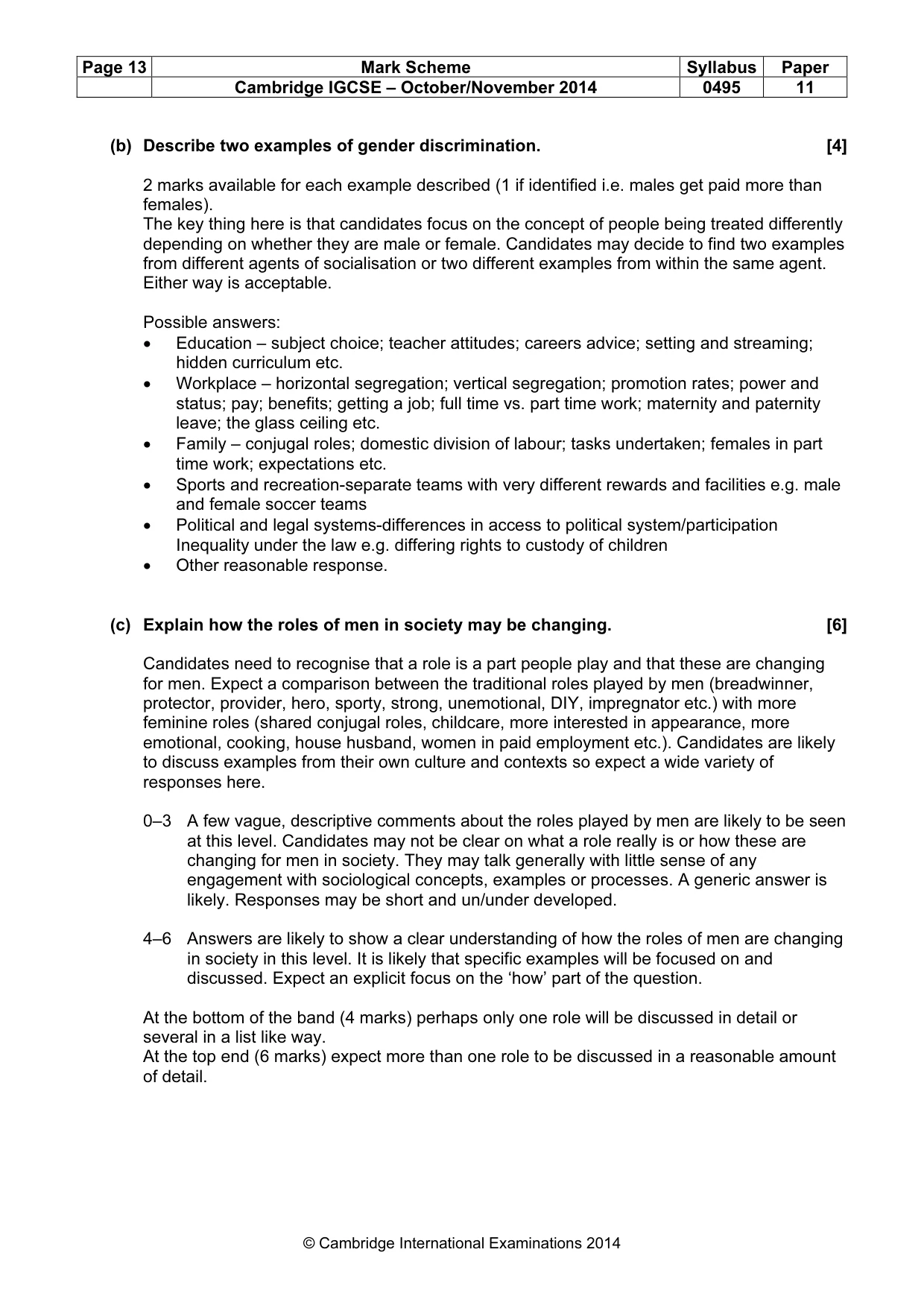
Page 13 Mark Scheme Syllabus Paper Cambridge IGCSE – October/November 2014 0495 11 © Cambridge International Examinations 2014 (b) Describe two examples of gender discrimination. [4] 2 marks available for each example described (1 if identified i.e. males get paid more than females). The key thing here is that candidates focus on the concept of people being treated differently depending on whether they are male or female. Candidates may decide to find two examples from different agents of socialisation or two different examples from within the same agent. Either way is acceptable. Possible answers: • Education – subject choice; teacher attitudes; careers advice; setting and streaming; hidden curriculum etc. • Workplace – horizontal segregation; vertical segregation; promotion rates; power and status; pay; benefits; getting a job; full time vs. part time work; maternity and paternity leave; the glass ceiling etc. • Family – conjugal roles; domestic division of labour; tasks undertaken; females in part time work; expectations etc. • Sports and recreation-separate teams with very different rewards and facilities e.g. male and female soccer teams • Political and legal systems-differences in access to political system/participation Inequality under the law e.g. differing rights to custody of children • Other reasonable response. (c) Explain how the roles of men in society may be changing. [6] Candidates need to recognise that a role is a part people play and that these are changing for men. Expect a comparison between the traditional roles played by men (breadwinner, protector, provider, hero, sporty, strong, unemotional, DIY, impregnator etc.) with more feminine roles (shared conjugal roles, childcare, more interested in appearance, more emotional, cooking, house husband, women in paid employment etc.). Candidates are likely to discuss examples from their own culture and contexts so expect a wide variety of responses here. 0–3 A few vague, descriptive comments about the roles played by men are likely to be seen at this level. Candidates may not be clear on what a role really is or how these are changing for men in society. They may talk generally with little sense of any engagement with sociological concepts, examples or processes. A generic answer is likely. Responses may be short and un/under developed. 4–6 Answers are likely to show a clear understanding of how the roles of men are changing in society in this level. It is likely that specific examples will be focused on and discussed. Expect an explicit focus on the ‘how’ part of the question. At the bottom of the band (4 marks) perhaps only one role will be discussed in detail or several in a list like way. At the top end (6 marks) expect more than one role to be discussed in a reasonable amount of detail.
Mark scheme, page 14
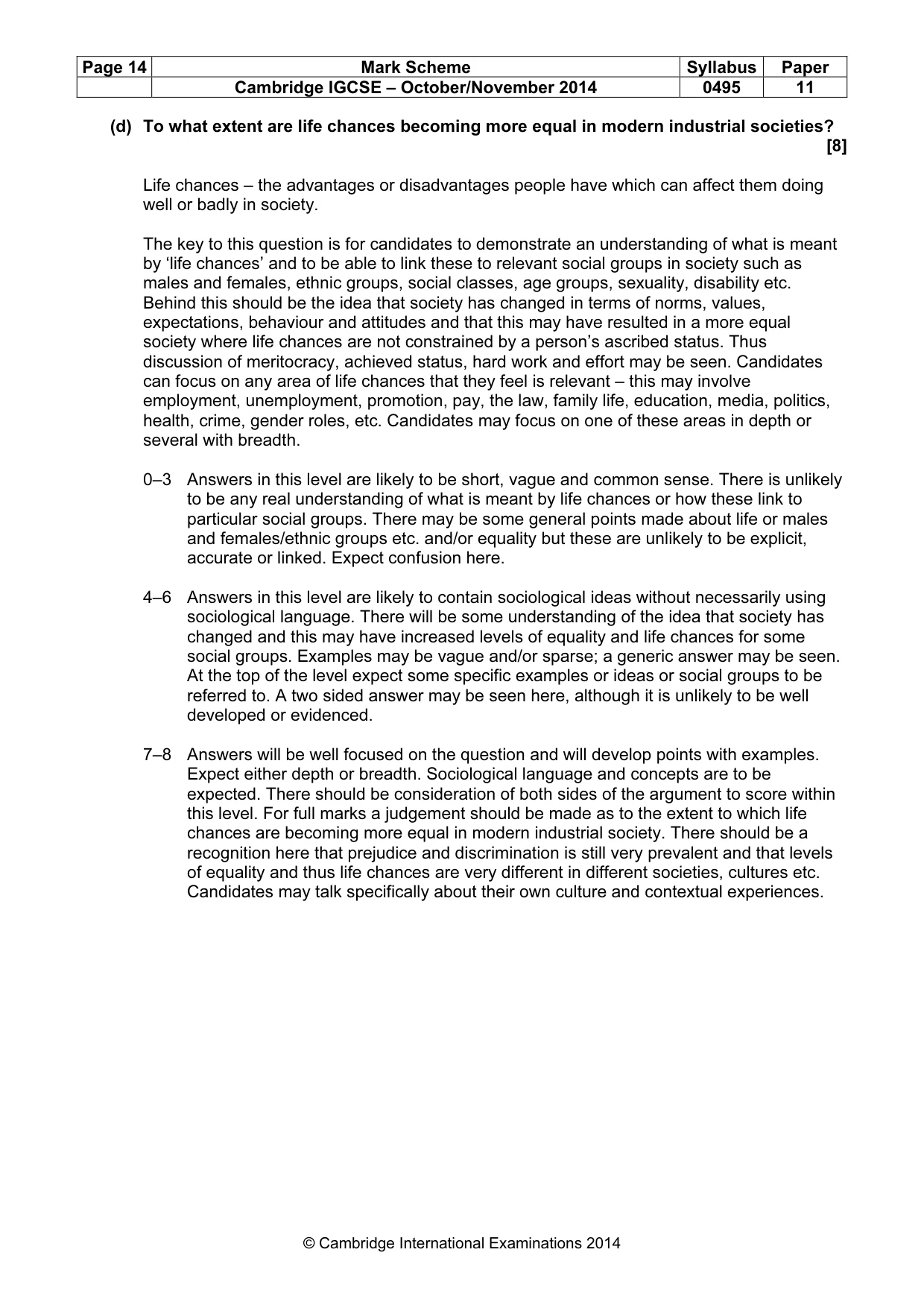
Page 14 Mark Scheme Syllabus Paper Cambridge IGCSE – October/November 2014 0495 11 © Cambridge International Examinations 2014 (d) To what extent are life chances becoming more equal in modern industrial societies? [8] Life chances – the advantages or disadvantages people have which can affect them doing well or badly in society. The key to this question is for candidates to demonstrate an understanding of what is meant by ‘life chances’ and to be able to link these to relevant social groups in society such as males and females, ethnic groups, social classes, age groups, sexuality, disability etc. Behind this should be the idea that society has changed in terms of norms, values, expectations, behaviour and attitudes and that this may have resulted in a more equal society where life chances are not constrained by a person’s ascribed status. Thus discussion of meritocracy, achieved status, hard work and effort may be seen. Candidates can focus on any area of life chances that they feel is relevant – this may involve employment, unemployment, promotion, pay, the law, family life, education, media, politics, health, crime, gender roles, etc. Candidates may focus on one of these areas in depth or several with breadth. 0–3 Answers in this level are likely to be short, vague and common sense. There is unlikely to be any real understanding of what is meant by life chances or how these link to particular social groups. There may be some general points made about life or males and females/ethnic groups etc. and/or equality but these are unlikely to be explicit, accurate or linked. Expect confusion here. 4–6 Answers in this level are likely to contain sociological ideas without necessarily using sociological language. There will be some understanding of the idea that society has changed and this may have increased levels of equality and life chances for some social groups. Examples may be vague and/or sparse; a generic answer may be seen. At the top of the level expect some specific examples or ideas or social groups to be referred to. A two sided answer may be seen here, although it is unlikely to be well developed or evidenced. 7–8 Answers will be well focused on the question and will develop points with examples. Expect either depth or breadth. Sociological language and concepts are to be expected. There should be consideration of both sides of the argument to score within this level. For full marks a judgement should be made as to the extent to which life chances are becoming more equal in modern industrial society. There should be a recognition here that prejudice and discrimination is still very prevalent and that levels of equality and thus life chances are very different in different societies, cultures etc. Candidates may talk specifically about their own culture and contextual experiences.
Mark scheme, page 15
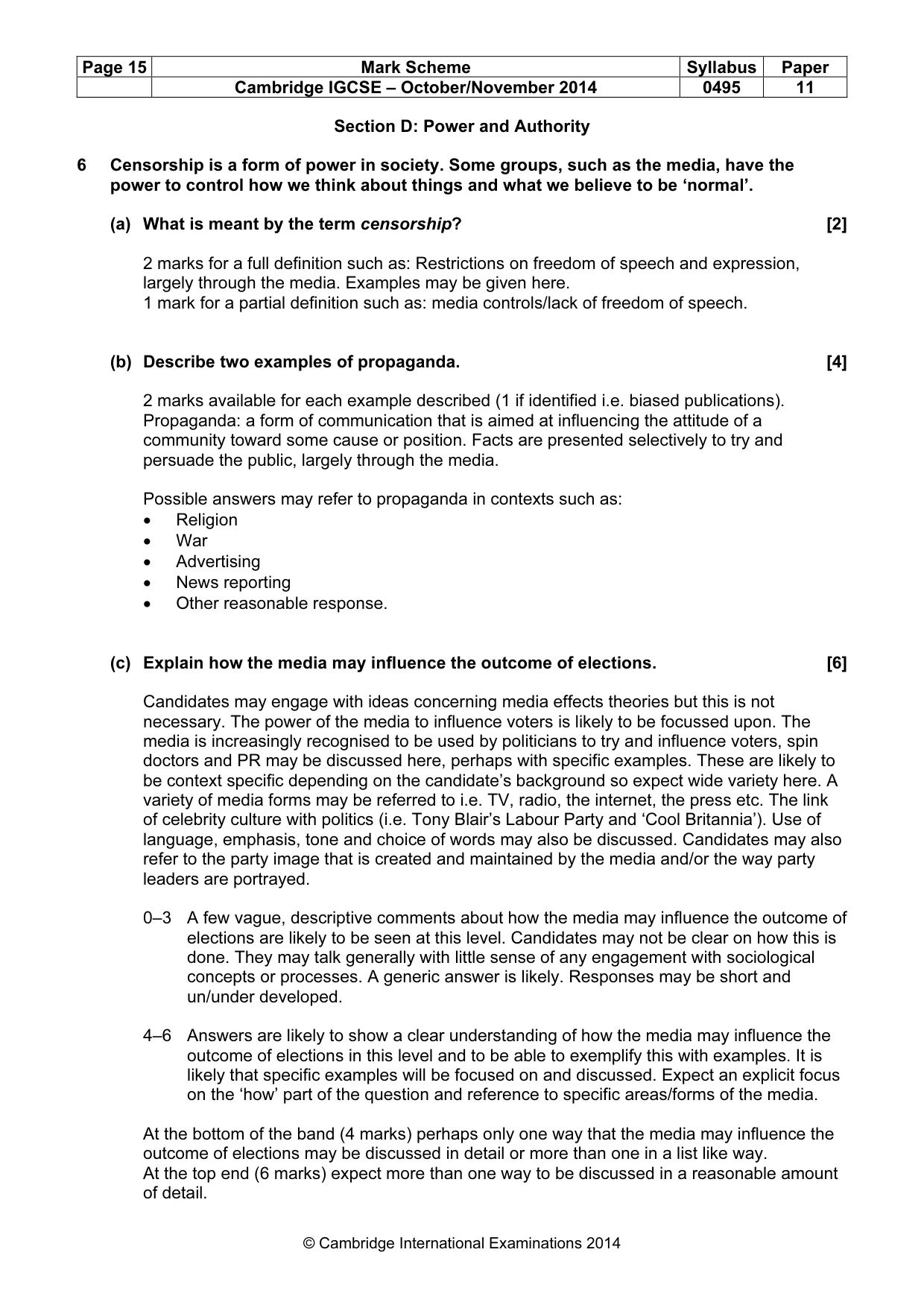
Page 15 Mark Scheme Syllabus Paper Cambridge IGCSE – October/November 2014 0495 11 © Cambridge International Examinations 2014 Section D: Power and Authority 6 Censorship is a form of power in society. Some groups, such as the media, have the power to control how we think about things and what we believe to be ‘normal’. (a) What is meant by the term censorship? [2] 2 marks for a full definition such as: Restrictions on freedom of speech and expression, largely through the media. Examples may be given here. 1 mark for a partial definition such as: media controls/lack of freedom of speech. (b) Describe two examples of propaganda. [4] 2 marks available for each example described (1 if identified i.e. biased publications). Propaganda: a form of communication that is aimed at influencing the attitude of a community toward some cause or position. Facts are presented selectively to try and persuade the public, largely through the media. Possible answers may refer to propaganda in contexts such as: • Religion • War • Advertising • News reporting • Other reasonable response. (c) Explain how the media may influence the outcome of elections. [6] Candidates may engage with ideas concerning media effects theories but this is not necessary. The power of the media to influence voters is likely to be focussed upon. The media is increasingly recognised to be used by politicians to try and influence voters, spin doctors and PR may be discussed here, perhaps with specific examples. These are likely to be context specific depending on the candidate’s background so expect wide variety here. A variety of media forms may be referred to i.e. TV, radio, the internet, the press etc. The link of celebrity culture with politics (i.e. Tony Blair’s Labour Party and ‘Cool Britannia’). Use of language, emphasis, tone and choice of words may also be discussed. Candidates may also refer to the party image that is created and maintained by the media and/or the way party leaders are portrayed. 0–3 A few vague, descriptive comments about how the media may influence the outcome of elections are likely to be seen at this level. Candidates may not be clear on how this is done. They may talk generally with little sense of any engagement with sociological concepts or processes. A generic answer is likely. Responses may be short and un/under developed. 4–6 Answers are likely to show a clear understanding of how the media may influence the outcome of elections in this level and to be able to exemplify this with examples. It is likely that specific examples will be focused on and discussed. Expect an explicit focus on the ‘how’ part of the question and reference to specific areas/forms of the media. At the bottom of the band (4 marks) perhaps only one way that the media may influence the outcome of elections may be discussed in detail or more than one in a list like way. At the top end (6 marks) expect more than one way to be discussed in a reasonable amount of detail.
Mark scheme, page 16
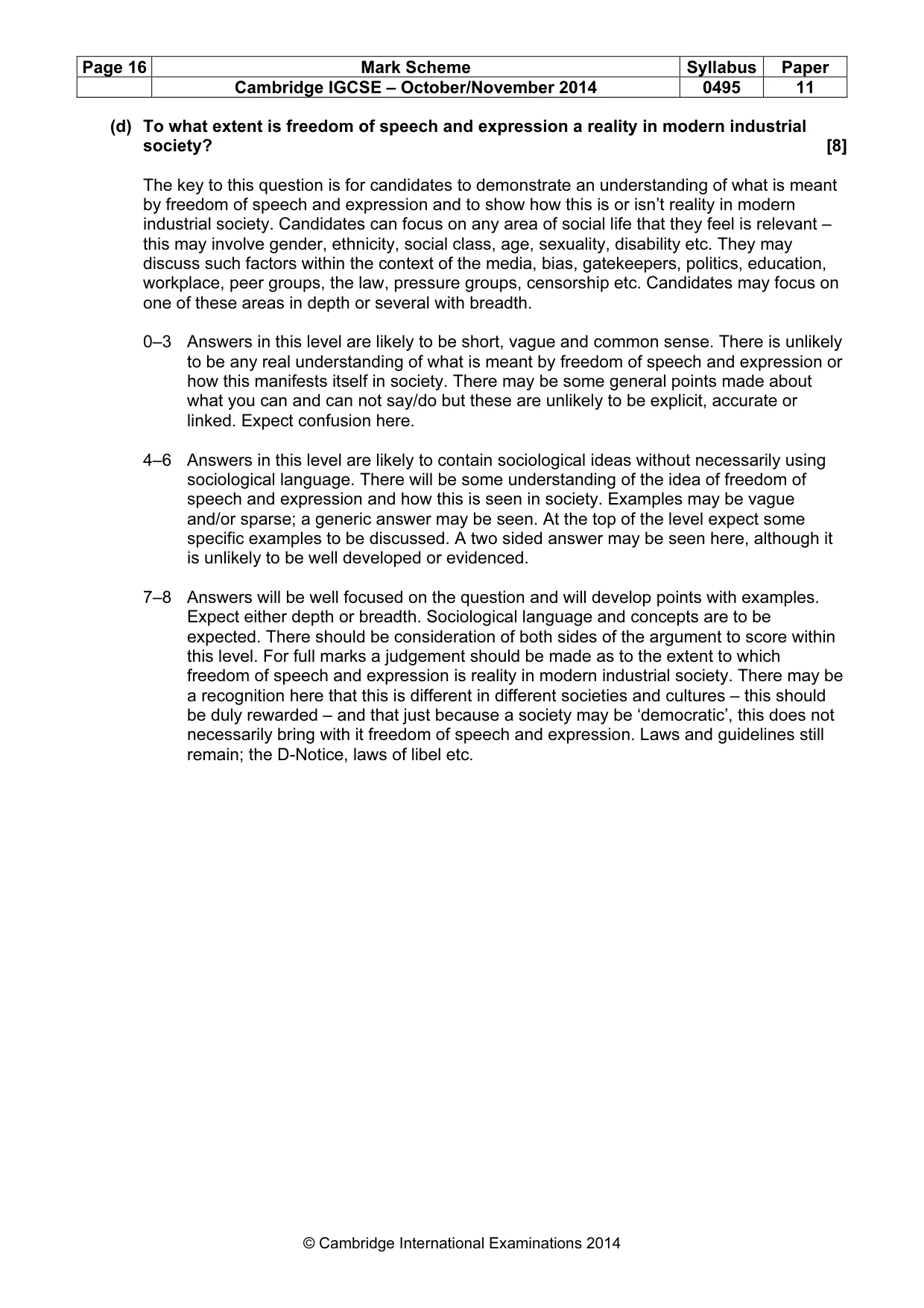
Page 16 Mark Scheme Syllabus Paper Cambridge IGCSE – October/November 2014 0495 11 © Cambridge International Examinations 2014 (d) To what extent is freedom of speech and expression a reality in modern industrial society? [8] The key to this question is for candidates to demonstrate an understanding of what is meant by freedom of speech and expression and to show how this is or isn’t reality in modern industrial society. Candidates can focus on any area of social life that they feel is relevant – this may involve gender, ethnicity, social class, age, sexuality, disability etc. They may discuss such factors within the context of the media, bias, gatekeepers, politics, education, workplace, peer groups, the law, pressure groups, censorship etc. Candidates may focus on one of these areas in depth or several with breadth. 0–3 Answers in this level are likely to be short, vague and common sense. There is unlikely to be any real understanding of what is meant by freedom of speech and expression or how this manifests itself in society. There may be some general points made about what you can and can not say/do but these are unlikely to be explicit, accurate or linked. Expect confusion here. 4–6 Answers in this level are likely to contain sociological ideas without necessarily using sociological language. There will be some understanding of the idea of freedom of speech and expression and how this is seen in society. Examples may be vague and/or sparse; a generic answer may be seen. At the top of the level expect some specific examples to be discussed. A two sided answer may be seen here, although it is unlikely to be well developed or evidenced. 7–8 Answers will be well focused on the question and will develop points with examples. Expect either depth or breadth. Sociological language and concepts are to be expected. There should be consideration of both sides of the argument to score within this level. For full marks a judgement should be made as to the extent to which freedom of speech and expression is reality in modern industrial society. There may be a recognition here that this is different in different societies and cultures – this should be duly rewarded – and that just because a society may be ‘democratic’, this does not necessarily bring with it freedom of speech and expression. Laws and guidelines still remain; the D-Notice, laws of libel etc.
Mark scheme, page 17
Page 17 Mark Scheme Syllabus Paper Cambridge IGCSE – October/November 2014 0495 11 © Cambridge International Examinations 2014 7 In politics, many factors are influential in determining what the public thinks and how government acts. Most societies make use of opinion polls during election time. (a) What is meant by the term opinion polls? [2] 2 marks for a full definition such as: surveys conducted by asking a small cross-section of the population for their opinion on a specific issue. These are often to do with politics. 1 mark for a partial definition such as: asking people how they will vote/asking people what they think about something. (b) Describe two factors that may influence voting behaviour. [4] 2 marks available for each way described (1 if identified i.e. family background e.g. social class). Possible answers: • Media – Governments may release selective information to encourage people to vote a particular way • Media bias/selection – how the media portray leaders or policies or parties is thought to have a significant link to voting behaviour • Social class – a person’s social class position is often linked to their voting behaviour i.e. in the UK the working class have traditionally voted Labour • Family background – how a family has traditionally voted and the political socialisation that this will lead to may well influence a person to vote a particular way • Age – younger and older people typically have different priorities and so tend to vote for different political parties • Peer group-adopting the beliefs and attitudes of peers and voting accordingly. • Gender – women and men may vote differently • Ethnicity – links clearly exist between voting behaviour and the way a person votes • Geography – where a person lives (whether that is a specific region or urban/rural area) may have a big influence on how they vote • Religion – lots of links exist between politics and religion i.e. Northern Ireland; • Party Policies – voters typically say that it is the policies offered by particular parties that encourage them to vote for that political party • Party leaders/image – the individuals in charge of particular political parties and the image that they present is thought to be crucial in determining how a person will vote • Voters may use tactical voting if their party of choice appears to have little chance of winning according to the opinion polls • Voters may decide not to vote/abstain from voting because of the predictions from the opinion polls • Bandwagon effect – some voters may ‘jump on the bandwagon’ and vote for the party which the opinion polls predicts will win • Other reasonable response.
Mark scheme, page 18
Page 18 Mark Scheme Syllabus Paper Cambridge IGCSE – October/November 2014 0495 11 © Cambridge International Examinations 2014 (c) Explain how new social movements are able to influence the public. [6] NSM – a loosely organised set of different groups who come together to bring about social change. These often involve alternative ways of thinking and acting and there is no formal membership. Good examples are feminist movements, green movements and lesbian and gay movements. 0–3 A few vague, descriptive comments about new social movements are likely to be seen at this level. Candidates may not be clear on what they really are, what they aim to achieve or how they influence the public. They may talk generally with little sense of any engagement with sociological concepts, examples or processes. A generic answer is likely. Responses may be short and un/under developed. 4–6 Answers are likely to show a clear understanding of what a NSM is and how it can influence the public. It is likely that specific examples will be focused on and discussed. Expect an explicit focus on the ‘how’ part of the question, perhaps referring to campaigns, profile raising, publicity stunts, use of the media, celebrity endorsement etc. At the bottom of the band (4 marks) perhaps only one way will be discussed in detail or more than one in a list like way. At the top end (6 marks) expect more than one way to be discussed in a reasonable amount of detail.
Mark scheme, page 19
Page 19 Mark Scheme Syllabus Paper Cambridge IGCSE – October/November 2014 0495 11 © Cambridge International Examinations 2014 (d) To what extent do opinion polls accurately reflect the views of the public about political issues? [8] The key to this question is for candidates to demonstrate an understanding of what is meant by the term ‘opinion poll’ and how accurate its predictions and findings actually are in terms of public opinion. Opinion polls are a type of social survey used to discover voter’s intentions in the run up to an election. Organisations such as MORI typically conduct these. The accuracy of the results gained is likely to depend upon the representativeness and therefore generalisablity of the sample surveyed. Results are thus not always reliable and a number of reasons have been put forward to explain why opinion polls can get it wrong, such as sample composition, people may not respond truthfully, may change their minds at the last minute, mat not actually bother to vote, questions may be poorly worded and so misunderstood, interviewer bias may effect validity of results, people may not have yet decided how to vote so will be recorded as ‘don’t knows’. The nearer to the election the poll is done, the more reliable the predictions are thought to be. However, they do give a snapshot of voting intention and can be a useful indicator of outcome. Candidates may focus on one of these areas in depth (if so, likely to be with a specific case study example of an election and opinion polls relating to it) or several with breadth. 0–3 Answers in this level are likely to be short, vague and common sense. There is unlikely to be any real understanding of what is meant by an opinion poll and how it does or doesn’t accurately reflect public opinion. There may be some general points made about voting and/or elections and/or public opinion but these are unlikely to be explicit, accurate or linked. Expect confusion here. 4–6 Answers in this level are likely to contain sociological ideas without necessarily using sociological language. There will be some understanding of what an opinion poll is and how it reflects public opinion. Examples may be vague and/or sparse; a generic answer may be seen. At the top of the level expect some specific examples and points to be made. A two sided answer may be seen here, although it is unlikely to be well developed or evidenced. 7–8 Answers will be well focused on the question and will develop points with examples. Expect either depth or breadth. Sociological language and concepts are to be expected. There should be consideration of both sides of the argument to score within this level. For full marks a judgement should be made as to the extent to which opinion polls accurately reflect the views of the public about political issues. A balanced debate is not required.
What you needed in this session
Cambridge’s own grade thresholds for 2014 Oct/Nov, Paper 1 · Variant 1. A higher threshold means an easier paper — the bar moves with how the cohort did.